Pulitzer Prize Board 1987-1988
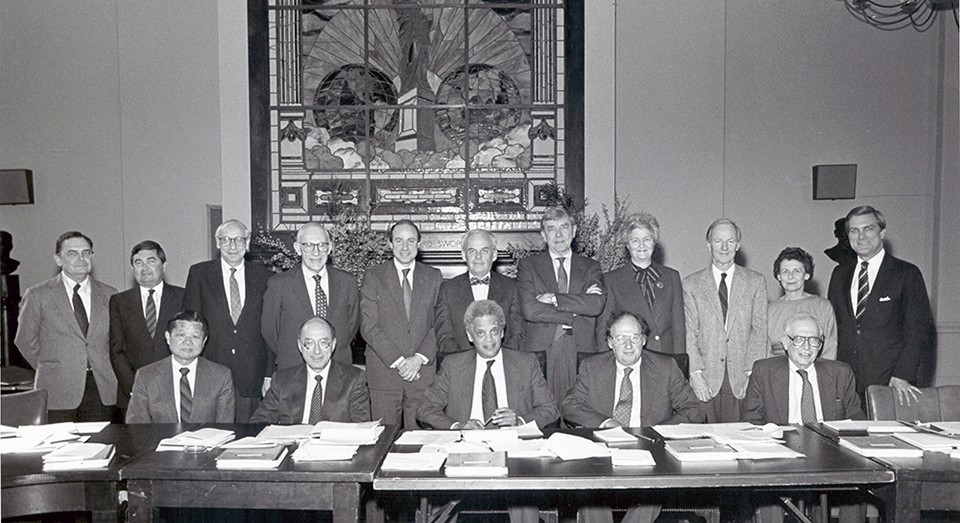
front row, left to right: F. Yu, M. Sovern, R. Wilkins, D. Laventhol, R. Christopher; back row, left to right: E. Roberts, B. Osborne, H. Simons C. Sitton, P. Kann, M. Gartner, R. Baker, C. Saikowski, C.K. McClatchy, M. Greenfield, J. Hoge (absent from photo: R. Maynard) Credit: Joe Pineiro/Columbia University
(Courtesy of Encyclopedia Britannica)
Russell Baker, in full Russell Wayne Baker (born August 14, 1925, Loudoun County, Virginia, U.S.), American newspaper columnist, author, humorist, and political satirist, who used good-natured humour to comment slyly and trenchantly on a wide range of social and political matters.
When Baker was five years old, his father died. From that time on, he and his mother and one of his sisters moved frequently, living in Virginia, Maryland, and New Jersey. After graduating from Johns Hopkins University in 1947, Baker worked as a journalist for the Baltimore Sun (1947–54). He also wrote a lively weekly column, “From a Window on Fleet Street.” At the Washington bureau of the New York Times (1954–62), he covered the White House, the State Department, and the Congress. In the early 1960s he began writing the “Observer” column on the paper’s editorial page. In this syndicated humour column he initially concentrated on political satire, writing about the administrations of U.S. Presidents John F. Kennedy, Lyndon B. Johnson, and Richard M. Nixon. Moving to New York City in 1974, he found other subjects to skewer, and in 1979 he won the Pulitzer Prize for commentary. His topics included tax reform, the artist Norman Rockwell, inflation, and fear.
Baker’s Growing Up (1982), which recalls his peripatetic childhood, won the 1983 Pulitzer Prize for biography. A sequel, The Good Times, was published in 1989. Baker’s other works include An American in Washington (1961), No Cause for Panic (1964), Poor Russell’s Almanac (1972), and further collections of his columns. Baker also edited The Norton Book of Light Verse (1986) and wrote the book for the musical play Home Again, Home Again (1979). In 1993 he succeeded Alistair Cooke as host of the television program Masterpiece Theatre. In that same year he published Russell Baker’s Book of American Humor, which, following an illuminating introduction, gives its due to figures such as Benjamin Franklin, Mark Twain, and James Thurber. Baker’s final “Observer” column for the New York Times appeared on Christmas Day, 1998. In 2002 he published Looking Back: Heroes, Rascals, and Other Icons of the American Imagination.
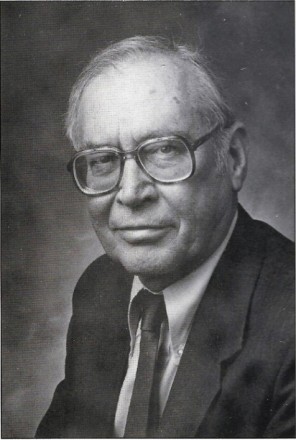
Author Robert C. Christopher, Editor At Time, Newsweek
Chicago Tribune, June 15, 1992
By Kenan Heise
Robert C. Christopher, 68, an author and former editor at Time and Newsweek magazines, had been secretary of the Pulitzer Prize Board and administrator of Pulitzer Prizes at Columbia University since 1981. A resident of Old Lyme, Conn., he died of emphysema Sunday in Lawrence and Memorial Hospital, New London, Conn.
"He did an excellent job in guiding the board in its many tough decisions," Pulitzer Prize Board president Claude Sitton said. "He was personally a warm and wonderful fellow who was admired by all of us. He was also a great repository of information about the Pulitzers."
For the last 11 years, Mr. Christopher administered the annual selection of Pulitzer Prizes, arranging for the selection of jurors, handing in the thousands of entries and serving as a non-voting member of the Pulitzer Prize Board. Awards are made in 21 areas of journalism, letters, drama and music.
The prestigious awards are announced by the president of Columbia University, where Mr. Christopher has been an adjunct professor in writing. Changes in the awards over recent years have seen increases in the monetary size of the prizes, to $3,000 from $1,000, and in the record number of women, 11, winning Pulitzer Prizes in 1991.
Mr. Christopher, a native of Thomaston, Conn., graduated Phi Beta Kappa from Yale University. During World War II and the Korean War, he served as an officer in Army intelligence.
He spent 13 years at Time magazine in positions that included associate editor and Rome correspondent. From 1964 to 1978, he was at Newsweek, where he served as foreign editor, executive editor and international editions editor. Mr. Christopher wrote three books in the 1980s: "The Japanese Mind: The Goliath Explained," "Second to None: American Companies in Japan" and "Crashing the Gates: the DeWASPing of America's Power Elite."
Survivors include his wife, Rita; four sons, Nicholas, Thomas, Alistair and Gordon; two daughters, Ulrica and Valerie Moerler; three grandsons; and a sister.
Post Editor, Newsweek Columnist Meg Greenfield Dies
By J.Y. Smith
Special to The Washington Post
Friday, May 14, 1999; Page A1
Meg Greenfield, 68, the Pulitzer Prize-winning editor of the editorial page of The Washington Post and a columnist for Newsweek magazine, died of cancer yesterday at her home in Washington.
An astute and principled observer, Greenfield spent her professional life writing about the events that shaped the second half of the 20th century. She brought to the task a rigorous intellect, a broad insight into the human condition and a conviction that life is not as simple as one would like. She distrusted shortcuts and the idea that it is always possible to reconcile differing points of view. In her world, there were losers as well as winners.
Most of all, Greenfield loved irony -- the disjunction between reality and appearance in this or that bit of the day's news. Nothing pleased her more than pointing out the difference between what actually happened or was proposed in a given situation and the spin with which one interested party or another might describe it. She conveyed her findings to readers with gusto and a fine eye for detail and character.
For more than 30 years, Greenfield helped shape The Post's views on issues ranging from war and peace to home rule for the District of Columbia and the proclivity of some drivers to run red lights. Katharine Graham, a former chairman of the board of The Washington Post Co. and one of Greenfield's closest friends, described her as "independent and uninfluenced by trends or molds. Her judgment is very dispassionate."
Topics that particularly interested Greenfield included nuclear strategy, military preparedness, politics and civil rights.
In a statement issued at the White House, President Clinton said, "Hillary and I were deeply saddened to learn of" her death. "In her work for The Washington Post and Newsweek," the president said, "Meg perfected the art of the newspaper column. Her essays were invariably tightly reasoned, forcefully stated and deeply felt. She called on those who work in government to pursue far-sighted public policy and bipartisan solutions. Her voice of eloquence and reason will be sorely missed."
Although she played one of the defining roles in the Washington drama in which the protagonists are the government and the media, Greenfield was an intensely private person. She avoided the television appearances and interviews by which many of her colleagues were known and limited herself to perhaps three appearances a year, usually in university settings. She disliked talking about herself and believed her job was to understand and record the news, not make it.
A Perfectionist Editor
Greenfield joined The Post as an editorial writer in 1968 and was named deputy editor of the editorial page in 1969. In 1978, she won the Pulitzer Prize for editorial writing for pieces about international affairs, civil rights and the press. She became editor of the editorial page in 1979.
In 1974, she began a biweekly column in Newsweek, which is owned by The Washington Post Co. It dealt primarily with Washington life, a subject that, "contrary to widespread belief," she explained, "does not exclude everything human."
Her work was full of the context and underlying texture of events. She was interested in precedent as well as where an issue would go next. She had a knack for finding the nub of complicated situations. She loved argument and continued a tradition under which Post editorials avoided hortatory calls to action in favor of making points by marshaling facts.
The Post's editorial board represents the publisher, Donald E. Graham, in matters of opinion. It is entirely separate from the news department, whose function is reporting on events rather than commenting on them. In practice, the distinction is sometimes blurred, but The Post's view is that readers should be able to tell at a glance whether they are reading fact or opinion. To this end, the news and editorial staffs at the newspaper are organized into entirely separate hierarchies. Greenfield dominated the editorial function in the same way that Leonard Downie Jr., the executive editor, or Benjamin C. Bradlee, his predecessor, have dominated the news side.
She described the editorial board as a collective tending to middle age and having "the sensibility of 1950s liberals." By that, she meant it was generally conservative on foreign policy and national defense and generally liberal on social issues. She noted that liberals frequently said the paper was too conservative while conservatives at one time called it an arm of the Communist Party.
One of Greenfield's most important tasks took place entirely out of public view. This was presiding over the daily meeting at which the next day's editorials are thrashed out. A small but commanding figure (she was 5-foot-1) at the head of a long table, she was gracious, witty, skeptical and given to the Socratic model of analysis by question. Although she said the process was give-and-take among "intelligent and forgiving friends," it was not really democratic.
She always had the final word.
"People ask questions that tell me they presume something much more exotic, and often sinister, than it is," she told an interviewer. "I don't think it's sinister at all. We try to keep -- without much success -- a certain amount of discretion, because . . . I don't know, Washington being Washington . . . you hear, 'Well, they said this, but the only reason they said this was that she hates that one and the other hates this, and this one lost the argument and the other one wept,' and so on. And all this stuff is almost invariably completely wrong."
The board's decisions were confidential and sometimes, as in the case of endorsing presidential or other political candidates, were guarded with great care until they were published.
Besides editorials, Greenfield was responsible for the letters to the editor; the op-ed page; the "Free for All" page on Saturdays, which carries letters from readers; and the "Close to Home" page on Sundays, which carries longer local pieces by readers.
As her staff could attest, she was a perfectionist and a ferociously hard worker. Nothing got on her pages without her approval. When she traveled, she would have material faxed or read to her over the telephone. She once called in changes from Saudi Arabia. The only exception to her sway was Herblock, the cartoonist, who is regarded at The Post as a kind of force of nature. He reports to no one.
Greenfield was always on the lookout for interesting new writers. Among those she brought to the op-ed page were the columnists George Will, whom she encouraged to abandon academia for a career in journalism, and Charles Krauthammer, a psychiatrist turned commentator.
Will recalled in a column how he had once telephoned Greenfield to say he couldn't get to the matters of state he usually wrote about because he had to baby-sit. She told him to write about what it was like to stay home from work and care for a child. The resulting piece drew a wide response from readers.
The Power of the Pen
Although the influence of Post editorials is hard to gauge at any given time, it has been a factor in some local elections. Local politics also illustrate the editorial board's willingness to change its mind about candidates and issues.
In 1978, for example, The Post backed Marion Barry, a council member and former civil rights leader, for mayor over the incumbent, Walter E. Washington, who had previously had the paper's support. The endorsement followed meetings between the editorial board and each candidate and a review of records, positions, qualifications and other material. Barry won handily.
The Post also endorsed Barry in 1982 and 1986 with decreasing levels of enthusiasm. By 1988, the editorial page was deploring his "propensity for scandal" and "huge capacity for self-indulgence," characteristics which it said tarnished "the accomplishments of those serious government workers and political appointees who have labored to make the city work."
In 1990, Barry was convicted of a misdemeanor drug violation and sentenced to six months in federal prison. In that year, The Post gave its mayoral endorsement to Sharon Pratt Dixon (she later became Sharon Pratt Kelly), a power company executive who was a newcomer to politics, and she won. Four years later, the paper backed Carol Schwartz, a Republican, in the mayor's race. She lost to Barry, who returned to the mayor's office that year. Barry had been elected to the D.C. Council in 1992.
Greenfield described the extent of The Post's influence in these terms:
"What we tend to notice here is the great number of wise suggestions we make that are rejected at the polls, and in the agencies, and in the U.S. Congress, and in the District school board, and if there's someplace I've left out, remind me -- so that we don't feel the Republic or the environs are in any terrific danger of being [controlled] by the Washington Post editorial page. Much as we try."
On the other hand, she said, "this is a town where people like to say to you, 'I never read editorials,' and then complain in minute detail about one that was in yesterday. This is a town where opinions are in conflict, at war in various ways."
The hazard of editorial writing, she once wrote, is complacency.
"There is a little Mussolini in every editorial writer," she said. "Pompous, meddlesome, pretentious, a figure of fun to everyone but himself . . . issuing grandiose orders that have no effect on anything at all . . . to which an ungrateful nation will reply, 'Oh, knock it off.' "
Early Journalism
Greenfield was born in Seattle on Dec. 27, 1930. Her parents were Lewis James Greenfield and Lorraine Nathan Greenfield. Her father ran an antique furniture business. Her mother died when she was 12. She majored in English at Smith College, where she was elected to Phi Beta Kappa and graduated summa cum laude in 1952. She then spent a year at Cambridge University studying the poetry of William Blake on a Fulbright Scholarship.
In the 1956 presidential election, she was director of research for the New York committee of Adlai E. Stevenson, the Democratic candidate. The following year, she joined the Reporter, a magazine of political commentary. She was assigned to its Washington bureau in 1961, and in 1965 she was named Washington editor. She stayed in that job until the Reporter ceased publication in 1968 and The Post hired her.
Making her way in a male-dominated industry was largely a matter of "accidents and non-decisions," she said. She described herself as a wobbly spear-carrier in the feminist march. "I was an English major who couldn't decide what to do," she told an interviewer. "I wasn't trying to strike a blow for sisterhood." Although she supported "what's serious about the [feminist] movement," she resisted suggestions that there is a woman's perspective on general issues.
"For example," she told Shop Talk, the Post employees' publication, "the women in the House of Representatives reflect the whole political spectrum, and my own opinion is often at variance with the female politicians."
Greenfield was equally wary of political correctness. She detested the term "Ms." and preferred to be called Miss Greenfield. She once gave an address in Seattle decrying speech codes and calling on her audience to "fight like tigers against government attempts to substitute its judgment for ours." She added, however, that she regretted opposing efforts in Maryland to outlaw the word "fatso." (She worried about her weight.)
Nothing disturbed her more than suggestions that The Post was open to the blandishments of Washington's vast and well-heeled public relations industry. In 1982, she sent a memo, which was later widely quoted outside The Post, to Bradlee, the executive editor, complaining that PR firms "seem to be promising, among other promises, that they can get The Post to 'help' " their clients.
"The reason for saying no to these wolves is plain and very strong," she continued. "Why should we be in their goddam memo traffic as exploitable or exploited 'resources'? Why should we be in their campaign plans as something 'deliverable' by their various agents who can 'reach' us?"
Her solution was to proclaim what she called "the irrational Greenfield rule." This stated that the editorial staff would not accept any manuscript or interview request that came from a "flack firm." It proved unworkable and soon lapsed.
Ethics and Responsibility
Over the years, Greenfield frequently made working trips with Katharine Graham, and in the course of their travels, they had meetings with a number of world leaders. In 1988, with other Post and Newsweek staff members, Greenfield and Graham interviewed former Soviet President Mikhail Gorbachev in Moscow.
In 1986, Greenfield published a piece describing her observation that humdrum, ordinary life goes on even under extremely repressive regimes. "You don't encounter absolute rule," she wrote, "and it is the fault of a kind of Achtung delusion that you even expect it. For nobody and no group, not even the driven, arrogant Chinese government, can entirely control a nation's life."
Some of Greenfield's most powerful writing concerned ethics and how people respond to life's various imperatives. This was the subject of her first Newsweek column, which dealt with the disgrace of Spiro T. Agnew. The Maryland governor, he became vice president under Richard M. Nixon and a leading administration spokesman against all forms of wrongdoing. He resigned from office after an extensive federal investigation into allegations of bribery and extortion.
The question Greenfield raised was whether he and his like ever were aware of their own duplicity and hypocrisy. "Was it like being a double agent?" she asked. "Do you offer yourself a great crooked wink in the mirror every morning?
"I think not. My speculation is that Mr. Agnew and the other lapsed preachers of our public life didn't make the connection -- didn't make the connection between their own crimes and those committed by other, 'lesser' people."
In a column in 1989, she wondered whether the decline of civility and the growing number of false and unproved accusations in politics weren't dulling the nation's ability to react to real scandal.
"All day long around here, we . . . go around implying that the other fellow is lying, trimming, gouging, feathering his nest, murdering the innocent and otherwise violating everything that upright people hold dear. The effect of this constant play is that we lose the ability to recognize a genuine moral dereliction when we see one."
In a 1998 column, she wrote about public and private behavior and President Clinton's sexual relationship with a White House intern, Monica S. Lewinsky.
"What is real," she said, "and what we have been trying so hard to avoid all these months, is the one overarching question that we keep raising in our arguments and then fleeing because it is so complex and hard: What is the proper relationship of a public figure's personal behavior and private life to his conduct of public business?
"It is a very large part of politics to try to get these relationships right, to rationalize them in a human and practical way to the extent we can -- to know where the lines should be drawn and to draw them. People say we should do this for our children. We should do this for ourselves, for our own self-respect."
At the very least, she said, Clinton should be forthright in taking responsibility for his actions.
In private life, Greenfield had a wide acquaintance in Washington and elsewhere. She loved parties. She was responsible for introducing Warren E. Buffett, the noted investor, to Bill Gates, the founder and head of Microsoft Corp. Buffett was a guest at the house she built on Bainbridge Island near Seattle, and she took him to a party given by Gates's mother, an old friend.
Greenfield described herself as a "passionate, failed gardener." She was a former volunteer at St. Ann's Infant Home in Hyattsville. She swam at Georgetown University and studied Latin for fun. Sometimes she and Katharine Graham would sneak out of the office and go to a movie.
"I read, I fall asleep," she told the Washington Journalism Review. "I realize as I read the newspaper that I lead a really dull life. I gotta tell you I just read in The Washingtonian about a book that's coming out that says Mamie Eisenhower and Buster Keaton were having an affair. These things always make me think, God, you know, I just thought everybody went home and read magazines."
Greenfield was a past co-chair of the Pulitzer Prize board, and she was a member of the American Society of Newspaper Editors. She held honorary degrees from Smith College, Williams College, Georgetown University, Wesleyan University and Princeton University.
She leaves no immediate survivors.
© Copyright 1999 The Washington Post Company
(Current biography as of March 2016)
Prior to joining Teneo, Mr. Hoge was Editor of Foreign Affairs, a bi-monthly, non-partisan magazine of analysis and commentary on international affairs and U.S. foreign policy. During his 18 years as editor, Foreign Affairs more than doubled its circulation to an all-time high of 161,000 and also launched editions in Spanish, Japanese and Russian. The magazine was founded in 1922 by the Council on Foreign Relations to educate the public on key international challenges and to enrich the debate on policy choices.
Prior to joining Foreign Affairs, Mr. Hoge spent three decades in newspaper journalism as a Washington correspondent, then editor and publisher of The Chicago Sun-Times and finally as publisher of The New York Daily News. Mr. Hoge has been a Fellow at Harvard’s John F. Kennedy School of Government, the Freedom Forum Media Center at Columbia University and on the American Political Science Association’s Congressional program.
He is a former Chairman of Human Rights Watch and The International Center for Journalists, as well as a member of the advisory board of the Center for Global Affairs at NYU-SCPS and of Brown University’s Watson Institute.
(Courtesy of Teneo Holdings)
Peter R. Kann is the former chairman of Dow Jones & Company and editorial director of Dow Jones’ publications.
In 1967, Mr. Kann became The Journal’s first resident reporter in Vietnam. From 1969 through 1975, he continued to cover the Vietnam War, as well as other events across Asia, as a roving reporter based in Hong Kong. He was awarded a Pulitzer Prize in 1972 for distinguished reporting on international affairs for his coverage of the 1971 India-Pakistan War.
In 1976, Mr. Kann was named the first publisher and editor of The Asian Wall Street Journal, headquartered in Hong Kong. After 12 years in Asia, Mr. Kann returned to the U.S. in 1979, and in 1980 he was named associate publisher of The Journal and a vice president of Dow Jones. Later that year he was named president and chief operating officer of Dow Jones. He became chief executive officer in January 1991 and served in that role through January 2006. He served as the Journal’s publisher from 1989 until July 2002.
Mr. Kann is a member of the board of trustees of the Institute of Advanced Study in Princeton. He is a former member of the Pulitzer Prize board.
A native of Princeton N.J., Mr. Kann graduated from Harvard University with a bachelor’s degree in government. He began his newspaper career in high school as a copy boy for the Princeton Packet.
David Laventhol has been a Pulitzer Prize board member since 1982.
He has been with the Times Mirror company for 18 years, mostly at Newsday, which Times Mirror purchased in 1970. He has been Times Mirror's president since January 1987 and chairman of Newsday since 1986. He joined Newsday in 1969 as associate editor and was named editor in 1970. In 1978 he became publisher and chief executive officer. In 1981 he became group vice president, eastern newspaper, which included responsibility for the Hartford Courant, Southern Connecticut Newspapers, and ultimately the Allentown Morning Call and the Baltimore Sun, while continuing as publisher of Newsday. Before joining Newsday, he had been assistant managing editor at The Washington Post and prior to the had served as city editor of The New York Herald Tribune.
Mr. Laventhol received the B.A. degree from Yale University and the M.A. from the University of Minnesota and holds honorary degrees from Dowling Colleg and Hofstra University. Among his many professional and charitable associations, he is a director of the United Negro College Fund, Inc., the New York City Partnership, the International Press Institute, the Newspaper Advertising Bureau, and the Los Angeles Times-Washington Post News Service, Inc.
(Courtesy of The New York Times)
Robert C. Maynard, 56, Publisher Who Helped Minority Journalists
By Bruce Lambert
August 19, 1993
Robert C. Maynard, a trailblazer for minority journalists who was the first black editor and owner of a major daily newspaper in the United States, died at his home in Oakland, Calif., on Tuesday. He was 56.
He died of prostate cancer, a family spokesman said.
For a decade Mr. Maynard was the editor, publisher and owner of The Oakland Tribune, until eroding circulation and advertising forced its sale to the Alameda Newspaper Group last year.
His newspaper career began to flourish when he became the White House correspondent for The Washington Post, and he eventually became an editor, national columnist, television panelist, Pulitzer Prize juror and a leader in professional organizations.
But he won more praise for his efforts to help minority youths follow him into journalism. Paul Cobb, who is active in Oakland community affairs, once said that "Maynard is to publishing what Jackie Robinson is to baseball."
Mr. Maynard and his wife, the former Nancy Hicks, formed the Institute for Journalism Education at Berkeley, Calif., a nonprofit organization that trained hundreds of minority students. In management and professional circles, he advocated diversity and prodded news organizations to recruit and promote more minority employees.
"This country cannot be the country we all want it to be if its story is told by only one group of citizens," he said in his last public speech, in May. "Our goal is to give all Americans front-door access to the truth."
Mr. Maynard was a high school dropout, born to immigrant parents from Barbados in the Bedford-Stuyvesant section of Brooklyn. But he had his heart set on journalism as a youngster, even at the expense of his formal education. The allure of watching courtroom reporting led him to skip classes.
While still a teen-ager he worked for The New York Age, a Brooklyn weekly. He also worked for The Afro-American News in Baltimore and The York Gazette and Daily in Pennsylvania, now The York Daily Record.
After winning a Nieman fellowship at Harvard in 1966, Mr. Maynard joined The Post, where he won plaudits for his coverage of urban unrest. He served as a national correspondent, ombudsman and editorial writer before leaving The Post to found the training institute.
Returning to newspapers, he was hired in 1979 as The Tribune's editor by its new owner, the Gannett chain. Despite Gannett's investments to improve the paper, it remained fiscally tenuous, based in a black community and competing with papers in affluent white suburbs and San Francisco.
In 1983 Gannett sold The Tribune to Mr. Maynard for $22 million, financed by loans from Gannett and banks.
Mr. Maynard's prominence grew when he became the paper's owner. He wrote a syndicated column, appeared as a commentator on the David Brinkley and MacNeil-Lehrer television programs and served on the boards of The Associated Press, the American Society of Newspaper Editors and the National News Council.
Besides his wife, Mr. Maynard is survived by a daughter, Dori Maynard; two sons, David and Alex Maynard, and four brothers and sisters.
(Courtesy of the Los Angeles Times)
C.K. McClatchy, 62; Head of Chain of Newspapers
By Edward J. Boyer
April 17, 1989
C.K. McClatchy, chairman of the McClatchy chain of newspapers in California, Washington state and Alaska, died Sunday after collapsing while jogging in Sacramento.
A soft-spoken man known for his abiding independence, McClatchy, 62, was jogging in William Land Park, near a school bearing his family's name, when he apparently suffered a heart attack, said McClatchy Newspapers President Erwin Potts.
"He was just a great friend and a great boss," said Potts, who knew McClatchy for 13 years. "He was a hell of a newspaperman and he was a hell of a guy. We're just going to miss him an awful lot."
McClatchy, who Potts said had no history of heart problems, was pronounced dead shortly after 1 p.m. at the University of California, Davis, Medical Center in Sacramento.
McClatchy Newspapers publishes the Sacramento Bee and 11 other West Coast newspapers. The Anchorage Daily News, one of the company's papers, won the Pulitzer Prize for public service last month.
"If you had to draw up a list of people most important to journalism in this country, you'd come to C.K. pretty early in the game," said Riverside Press-Enterprise Publisher Tim Hayes, a longtime McClatchy friend.
"I was most struck by his independence," Hayes said. "There's so little independence left in this profession. He was a wonderful guy without any pretense."
Los Angeles Times Publisher and Chief Executive Officer Tom Johnson described McClatchy as a "splendid newspaper leader who represented the very highest standards of editorial and managerial excellence."
"He was uncommonly dedicated to quality in his newspapers. His passing is a major loss to our profession."
McClatchy's family has been a powerful force in Sacramento since 1857, when C.K. McClatchy's great-grandfather, James McClatchy, served as the first editor of the Sacramento Bee. He later bought the newspaper.
C.K. (for Charles Kenny) McClatchy was born in Fresno on March 25, 1927, and earned a bachelor's degree from Stanford University in 1950. He began his career as a reporter for the Washington Post in 1953, and moved to the Sacramento Bee five years later.
He held several editorial and managerial posts at the Bee and with the parent company, and was elected chairman of the board when McClatchy Newspapers stock was offered for sale to the public last year.
At about the same time the company began offering its shares on the American Stock Exchange, McClatchy accused some newspaper chains of paying more attention to profits than to quality journalism.
Delivering the annual Press-Enterprise Lecture at UC Riverside, McClatchy pointedly criticized several newspaper groups, saying Rupert Murdoch's News America Co., then owner of the New York Post, "deserves mention in any listing of the appalling."
"He was saying we should talk candidly about the problems associated with group or chain ownership," said the Press-Enterprise's Hayes. "Groups should criticize each other and look at the problems--the sameness of papers in a chain, excessive rotation of editors. Nobody is in your town for more than three or four years."
McClatchy's great-grandfather came to California during the 1849 Gold Rush and sent dispatches to several newspapers, including Horace Greeley's New York Tribune. As the Bee's editor, he proved to be a forceful environmentalist, arguing against hydraulic mining.
The process ruined the environment, poured debris into the rivers and harmed farmers, James McClatchy argued. When he died in 1883, he was succeeded by C.K. McClatchy, a champion of the state's progressive movement, ally of reform Gov. Hiram Johnson and a foe of the Southern Pacific Railroad's grip on state government.
The elder C.K., who died in 1936, was succeeded by his daughter, Eleanor, who left Columbia University to run the company for the next 42 years. She, in turn, was followed by McClatchy, her nephew, and C.K.'s grandson.
The papers were characterized by their liberal editorial point of view, and McClatchy's endorsement was vigorously sought by Democratic Party candidates.
McClatchy had autographed photos of John F. Kennedy, Adlai Stevenson, Theodore Roosevelt, Franklin D. Roosevelt and Earl Warren in his office. He worked as Stevenson's press secretary during the former Illinois governor's 1956 presidential campaign.
McClatchy's independence and courage made the newspaper company willing "to take on big, tough and potentially dangerous subjects, and to risk and fight through the litigation that this inevitably brings," former Sacramento Bee executive editor Frank McCulloch told The Times in a 1987 interview.
The newspapers once had seven libel suits pending simultaneously in Fresno County alone, McCulloch said.
Nevada Sen. Paul Laxalt once sued the chain's Bee newspapers for $250 million, charging that he had been libeled in a story saying profits had been skimmed from a gambling casino he once owned. Laxalt and the papers settled the suit before trial, and both sides claimed victory.
"He can put whatever label on it he wants to, but the fact is he has dismissed (the suit) without (receiving) any apology, without any retraction and without any payment of money (for damages)," McClatchy said of Laxalt.
The newspapers' insurance carrier later paid Laxalt's lawyers $647,454 for their work in the unsuccessful suit.
Along with the Sacramento Bee and the Anchorage Daily News, McClatchy Newspapers publishes the Fresno Bee and Modesto Bee, the Tacoma News Tribune and Tri-City Herald in Washington state and several weekly newspapers.
At the time of McClatchy's death, he was a member of the Pulitzer Prize board, the Newspaper Advertising Board of Directors, a trustee of the Washington Journalism Center in Washington, D.C., and a member of the executive committee of the American Press Institute.
McClatchy is survived by two sons, Charles, 30, of Phoenix, Ariz., and Kevin, 26, of Miami; a daughter, Adair, 28, of San Francisco; two brothers, James, 58, of Tiburon, and Ellery, 64, of Palm Beach, Fla., and his mother, Phebe, of Fresno.
Funeral arrangements were pending.
Burl Osborne, president and editor of The Dallas Morning News, has overall responsibility for the operation of the newspaper, including direct supervision of the news and editorial departments.
In October, 1980, Osborne joined The Morning News as executive editor, with responsibility for all news gathering and editing. In 1981 he became vice president and executive editor and in 1983 he was named senior vice president and editor. He was named president and editor in 1985.
Osborne came to The Morning News after 20 years with the Associated Press, where he was managing editor. As managing editor of the AP, Osborne had responsibility for the daily AP news report, plus direct supervision of the national reporting and editing staffs based in New York. He also supervised the national news file, which is generated from news bureaus throughout the U. S. by a staff of more than 1,000 reporters and editors.
Osborne began his career with the AP in 1960 as a correspondent in Bluefield, West Virginia. He became an editor-reporter in Charleston, West Virginia, in 1962 and in 1964 moved to Spokane, Washington, where he had news responsibility encompassing parts of three states.
In 1967, Osborne became news editor for Colorado and Wyoming, based in Denver. He moved from Denver to Louisville, Kentucky, in 1970, where he oversaw the news, administrative and business activities of the AP in Kentucky. He was promoted to chief of the AP's Ohio bureau in 1972 with overall responsibility for that state and production responsibilities in adjoining states. Osborne was named assistant chief of the AP's Washington bureau in 1974. In Washington, AP's largest news operation, he supervised the news staff and developed the AP's Washington news report. During that time, Osborne helped plan the AP's coverage of the 1976 presidential election.
In 1977, Osborne was promoted to the position of managing editor, based in New York City. Prior to joining the AP, he was a reporter for the Ashland, Kentucky Daily Independent and for WHTN-TV in Huntington, West Virginia.
Osborne holds a bachelor's degree in journalism with a minor in mathematics from Marshall University in Huntington, West Virginia and a master'd degree in business from Long Island University. He is a graduate of the Harvard Business School Advanced Management Program.
(June 1986)
(Courtesty of the Pennsylvania Center for the Book)
Gene Roberts, a former executive editor at The Philadelphia Inquirer, achieved national fame for leading the paper to 17 Pulitzer Prizes in an 18-year span. He was widely respected for his high standards in journalism and ability to run a newspaper. A former reporter of his once said, “He’s the ideal editor that a reporter dreams about.”
Eugene Leslie Roberts Jr. was born on June 15, 1932, in Pikeville, North Carolina, to an area preacher, Eugene L. Roberts Sr., and Margaret (Ham) Roberts. While growing up in Goldsboro, North Carolina, Roberts’s interest in journalism began to grow. It started when Roberts helped his father print a small weekly paper that was distributed to the local community. This interest extended through his teens and into his college years. He attended Mars Hill College from 1950 to 1952 before graduating from the University of North Carolina with a degree in journalism in 1954. After college, Roberts enlisted in the military and served in the U.S. Army under the Counter-Intelligence Corps from 1954 to 1956.
After returning home from the Army, Roberts earned his first official newspaper job working for his home-town paper, Goldsboro News-Argus. At the time, it was the leading newspaper in Wayne County, North Carolina. His duties included writing for its farm column, “Rambling in Rural Wayne,” and reporting on the local government. Later in his life, Roberts recalled the column, saying that he covered “the first farmer of the season to transplant tobacco plants from the seed bed to the field” and “a sweet potato that looked like Gen. Charles de Gaulle.”
Roberts moved on to work for the Norfolk Virginian-Pilot (1958 to 1959) and Raleigh News & Observer (1959 to 1961) before being selected for a Nieman Fellowship by Harvard University in 1962. The Nieman Fellowship is a prestigious 10-month appointment at Harvard University for reporters, editors, photographers, editorial writers, and cartoonists with at least five years of full-time professional experience in news media. According to Harvard’s Nieman Foundation for Journalism, fellows use this time “to step back from deadlines, to renew their intellectual curiosity and to enrich their understanding of the worlds they cover as journalists.” As a result, Roberts spent his time at Harvard preparing a book with fellow Nieman award winner, Jack Nelson, called The Censors and the Schools (1963).
After spending time at Harvard, Roberts returned to the Goldsboro News-Argus and worked as its Sunday editor from 1962 to 1963. He then spent one year with the Detroit Free Press covering labor (1963 to 1964) and then one year as its city editor (1964 to 1965). In 1965, Roberts was one of the most promising young journalists in America. His hard work was not overlooked, as he was spotted by The New York Times. In 1965, they offered him a job as a chief Southern correspondent. Roberts accepted the position and spent two years covering many of the trials and tribulations of the Civil Rights Movement. When the Vietnam War started heating up, Roberts was quickly sent to South Vietnam in 1968. Once there, Roberts encountered a soldier who recognized his column from the Goldsboro News-Argus. Taken aback by the man, Roberts later wrote, “I learned never to underestimate readers. They can laugh with you at the Charles de Gaulle sweet potato stories, but they expect depth when stories arise that are important to them.”
When Roberts returned to the U.S., The Times named him its national editor in 1969. He stayed there until 1972, when the Philadelphia Inquirer came knocking on his door. The paper was losing money and its journalistic qualities were coming into question. The Inquirer sought out someone who could bring energy and uphold high standards of journalism. Roberts was the perfect fit. He was hired as its new executive editor and change was immediate. With Roberts at the helm, The Inquirer tackled various local, national, and international issues. Topics varied from Pentagon spending to mental hospitals to South Africa. Stories such as these earned the respect from other journalists and newspapers across the country. The hard work paid off as the paper earned 17 Pulitzer Prizes in an 18-year span.
In a stunning change of events, Roberts announced his decision to leave The Inquirer at a noon meeting in 1990. Surprising most of his staff with the decision, Roberts became so emotional during his announcement that he left the meeting early. After numerous confrontations over budget cuts, Roberts finally had enough and resented an industry obsessed with profit margins. Hearing of Roberts’s resignation, Bill Kovach, curator of the Nieman Foundation, said, “Gene Roberts or persons like him were the kind of people that Jefferson and Madison and George Mason had in mind when they carved out the role of journalists in a self-governing society.” Roberts was known to say, “I didn’t want to work for another newspaper. This is my newspaper.”
Roberts kept his distance from newspapers by accepting a teaching job at the University of Maryland in 1991. In 1993, he received the National Press Club’s “Fourth Estate Award” as a tribute to his lifetime of achievements in journalism. After a few years of teaching journalism classes, Roberts was persuaded by friend and executive editor of The New York Times, Joe Lelyveld, to become managing editor of The Times in 1994. Roberts took a three year leave of absence from Maryland in order to help a newspaper find its old identity. According to some at the time the newspaper was “socially rigid and out of step with the mood, views, and concerns of New Yorkers.” Although Roberts was at The Times for only a few years, he reverted to the hard-nosed journalistic approach. By allowing journalists to take their time to find and write a good story rather than just write about the sensational, The Times produced several well-written stories and gained back some of its credibility. Roberts returned to the University of Maryland in 1997.
In 2007, Roberts, along with Hank Klibanoff, authored a book entitled The Race Beat: The Press, the Civil Rights Struggle, and the Awakening of a Nation, which explores how America’s press system has evolved over time, going from ignoring race issues to realizing the importance of the 1950s and 1960s civil rights movement. Vanessa Bush, a Booklist contributor, wrote that Klibanoff and Roberts "demonstrate the profound changes the movement wrought not only on U.S. social justice but also on American journalism." Other reviewers in addition to Bush have applauded the Roberts and Klibanoff for how they recognize the black journalists and editors who had been historically ignored and gone unnoticed. In 2007, Klibanoff and Roberts won the Pulitzer Prize for this book.
Roberts currently lives in the Washington, D.C. area with his wife Susan and continues to teach journalism at the University of Maryland. Together Roberts and Susan have raised four children: Leslie Jane, Margaret Page, Elizabeth Susan, and Polly Ann. Roberts teaches classes on writing complex stories, newsroom management, and the press’ role in the Civil Rights Movement. He enjoys his time away from the news field saying, “Four months off at the end of spring. Four to six weeks off during the Christmas holiday...that wouldn’t have been possible if I were still in the newspaper business.” Roberts also served as the American chairman of both the International Press Institute and the Committee to Protect Journalists. He is a former chairman of the Pulitzer Board for awards in journalism and arts and letters.
(Courtesy of The Washington Post)
Charlotte Saikowski, 73
April 14, 2000
Charlotte Saikowski, 73, the Washington bureau chief for the Christian Science Monitor from 1983 until she retired in 1990, died of a heart ailment April 8 at Lynn House, a Christian Science nursing home in Alexandria. She lived in Washington.
Ms. Saikowski joined the Monitor in 1962 and came to its Washington bureau a decade later. She had previous assignments as bureau chief in Tokyo and Moscow and as chief editorial writer.
Fluent in Polish and Russian, she was best known for her foreign policy expertise, particularly Russian and Eastern European affairs. Some of her dispatches from abroad were reprinted in The Washington Post.
Her professional honors include an Overseas Press Club award and Sigma Delta Chi Distinguished Service Award for international reporting, both in 1972, for her "Letters to President Nixon" series.
She was born in Chicago and graduated from Principia College in Illinois.
She received a master's degree in international affairs from Columbia University.
Before joining the Monitor, she was an editor of Columbia University's Current Digest of the Soviet Press.
She had been a Pulitzer Prize advisory board member and member of the American Society of Newspaper Editors, National Conference of Editorial Writers and Gridiron Club in Washington.
After retiring from the Monitor, she became a first reader and president of the 6th Church of Christ Scientist in Washington.
She leaves no immediate survivors.
(Courtesy of The New York Times)
Howard Simons, Dies at Age 60, An Ex-Editor at Washington Post
By Alex S. Jones
June 14, 1989
Howard Simons, a former managing editor of The Washington Post, died yesterday of pancreatic cancer in a hospice of Methodist Hospital in Jacksonville, Fla. He was 60 years old and lived in Jacksonville Beach.
Until recently, Mr. Simons had been curator of the Nieman Foundation, which sponsors a prestigious sabbatical program in which mid-career journalists are given a year of study at Harvard University.
Mr. Simons was known as a journalistic traditionalist who prized aggressive reporting and was outspokenly critical of what he considered to be a modern trend toward lighter, less serious newspapers and an undue dependence on anonymous sources.
''He played a vital role in everything that the paper did,'' Benjamin C. Bradlee, executive editor of The Post, said in an interview yesterday. ''He was a powerhouse here, and a mensch.''
As managing editor of The Post, Mr. Simons helped direct the paper's investigation of the 1972 Watergate burglary that eventually led to the resignation of President Richard M. Nixon two years later.
''He got short-changed by the movie,'' Mr. Bradlee said, referring to the film ''All the President's Men,'' noting that Mr. Simons ''led the charge'' on Watergate.
Mr. Simons's journalistic hallmark was an energetic aggresiveness that he sometimes described as ''280 miles per hour going into first.'' In recent years, he often railed at what he considered to be a dearth of probing investigative reporting. ''How could Ollie North have gotten away with it for so long?'' he asked rhetorically in an interview a month ago. Br
In 1984, after 13 years as managing editor of The Post, Mr. Simons became curator of the Nieman Foundation. The appointment suited his custom of nurturing those who worked for him with a mixture of affection and hard-boiled hectoring.
Mr. Simons had been a Nieman Fellow in the class of 1959, and as curator broadened the program's reach to include more journalists from parts of Africa and South America. He had also successfully led a fund-raising campaign that increased the foundation's endowment by over $1 million.
In early April, Mr. Simons learned that he was terminally ill with pancreatic cancer and elected not to take any treatment, instead addressing his illness with the frankness and astringent wit that had been one of his signatures. He said he had bet his doctor that he had incurable liver cancer, and was angry at himself as a former science writer for the misdiagnosis. When asked what he was going to do in Florida, he would crack that he planned to sunbathe without sunscreen.
Though clearly in a weakened state, he insisted on fulfilling his duties as host at ceremonies marking the 50th anniversary of the Nieman program.
Late last month, he resigned as curator and went to Jacksonville Beach with Tod, his wife of 32 years, where he was able to indulge his passions for fishing and bird-watching. Mrs. Simons said yesterday that upon arriving in Florida he had plunged into collecting and categorizing seashells.
''We have lost one of the great spirits and souls of American journalism,'' said Bill Kovach, who was named acting curator of the Nieman Foundation last month.
Mr. Simons was a native of Albany, N.Y., and received a bachelor of arts degree from Union College in Schenectady in 1951 and a master's degree a year later from the Columbia University Graduate School of Journalism.
After service in the Korean War, he became a science reporter in Washington for several news organizations, and joined The Post as a science writer in 1961. He became assistant managing editor in 1966 and managing editor in 1971.
Mr. Simons was the author of ''Jewish Times: Voices of the American Jewish Experience,'' published by Houghton-Mifflin in 1988, and ''Simons' List Book,'' published in 1977. He edited two books with Joseph A. Califano Jr., ''The Media and the Law'' and ''The Media and Business,'' and in 1986 wrote a spy novel with Haynes Johnson called ''The Landing.''
Mrs. Simons said yesterday that there was as yet no plan to memorialize her husband. ''His memorial service was really the last two months,'' she said of the flood of letters, articles and visitors after Mr. Simons's illness became public.
Mr. Simons is survived by his wife, the former Tod Katz, and four daughters: Anna, who returned from studies in Africa to be with her father; Isabel, who lives in Maryland; Julie, of Washington, and Rebecca, of New York City. He is also survived by a brother, Sanford Simons.
(Courtesy of The New York Times)
Claude Sitton, 89, Acclaimed Civil Rights Reporter, Dies
By Dennis Hevesi
March 10, 2015
Claude Sitton, a son of the South whose unwavering coverage of the civil rights movement for The New York Times through most of that tumultuous era was hailed as a benchmark of 20th-century journalism, died on Tuesday in Atlanta. He was 89.
The cause was congestive heart failure, his son Clint said. Mr. Sitton had been in a hospice.
In later years Mr. Sitton won a Pulitzer Prize as a columnist for The News & Observer in Raleigh, N.C., where he was also the editor. But it was in the crucible of the Jim Crow South that he forged his most enduring legacy.
Roaming the region as a reporter from May 1958 to October 1964, Mr. Sitton was an eyewitness to one of the most wrenching but consequential episodes in American history, often spending weeks on the road, flying home to Atlanta for a night, then heading out again the next day.
By the end of those six and a half years he had written almost 900 articles, some analytical and steeped in his knowledge of the South, many drawn from on-the-scene reporting.
They recounted the strategizing by civil rights leaders in the courts and on the ground, explored the political dynamics of race in the statehouses and at the White House, and opened readers’ eyes to the violence with which the movement was often met — the beatings, bombings and church burnings.
He often portrayed the struggle through the individuals who gave it flesh: the demonstrators, freedom riders and ordinary Southern blacks who braved white mobs, brutal police officers and segregationist public officials simply to get an education or to vote.
When Turner Catledge, the Mississippi-born managing editor of The Times, chose Mr. Sitton to cover the South in 1958, “he was about to set in motion a level of reporting that would establish the national standard for two decades,” Gene Roberts and Hank Klibanoff wrote in 2006 in their Pulitzer Prize-winning book, “The Race Beat: The Press, the Civil Rights Struggle and the Awakening of a Nation.” (Mr. Roberts was himself a managing editor of The Times.)
“Nobody in the news business,” the authors continued, “would have as much impact as he would — on the reporting of the civil rights movement, on the federal government’s response, or on the movement itself. Sitton’s byline would be atop the stories that landed on the desks of three presidents.”
One of his articles, in 1962, caught the attention of Robert F. Kennedy, the attorney general at the time. It described a south Georgia sheriff and his deputies intruding on a voting rights meeting at a church in Terrell County and menacing the citizens there. One officer repeatedly struck his palm with a large flashlight as if it were a club; another ran his hand over his revolver and cartridge belt.
Mr. Sitton began by quoting the sheriff: “We want our colored people to go on living like they have for the last hundred years.”
Kennedy sent a Justice Department team to Terrell County to sue the sheriff two weeks later.
“It was not that Claude was some flaming liberal or liberator,” Mr. Klibanoff told The Associated Press in an interview. “He just liked a good story and liked to have it first. And frequently he was reporting on injustice — and they knew, on the civil rights side, that if The New York Times wrote about it, it would get attention from important people.”
Mr. Sitton covered the Little Rock school desegregation upheaval in 1958-59, after Gov. Orval E. Faubus of Arkansas ordered the city’s schools closed. He was there on June 11, 1963, when Gov. George C. Wallace fulfilled his campaign pledge to “stand in the schoolhouse door” before stepping aside when handed a presidential order to allow two black students to enroll at the University of Alabama.
And he was on the first bus carrying Freedom Riders out of Montgomery, Ala., on May 24, 1961, as it headed toward Jackson, Miss.
That bus trip was a three-day exception he had been granted after being barred from setting foot in Alabama — not by Alabama officials but, to his intense frustration, by the Times’s lawyers and top editors. The order was a cautionary response to two libel lawsuits that had been brought by Alabama officials (neither involving Mr. Sitton).
The Times eventually won both cases, one of them eliciting a unanimous Supreme Court ruling in Times v. Sullivan, setting the precedent that public officials cannot receive damages for criticism of their official performance unless they can prove actual malice.
Only after Governor Wallace was elected in November 1962 and the Rev. Dr. Martin Luther King Jr. declared Birmingham a new focus of the civil rights struggle was Mr. Sitton allowed to step again on Alabama soil after two and a half years. But there was no dearth of news elsewhere in the South.
He was in Oxford, Miss., on Sept. 30, 1962, when James H. Meredith, a black Air Force veteran, was admitted to the University of Mississippi. He wrote of the all-night riots on campus in which two people were killed.
After Medgar Evers, another civil rights leader, was shot to death outside his home in Jackson on June 12, 1963, enraged demonstrators took to the city’s streets. The next day, Mr. Sitton’s article on the front page of The Times described how police officers had charged demonstrators who were chanting “We want freedom!” and clubbed them into submission.
“Six Negroes were struck or choked by police nightsticks drawn across their throats,” he wrote.
Mr. Sitton would sometimes report what he observed and interpret it plainly without qualifiers or the filter of a quoted voice. In Oxford in 1963, he wrote, “Racists here, as elsewhere, have underscored this principle: The rights of dissent and freedom of association — which they so frequently invoke for themselves — do not extend to those who disagree with them.”
He could be evocative in his writing, as he was in a dispatch from 1963, datelined Greenwood, Miss.
“The night of Feb. 28 was mild with a hint of early spring as the black sedan rolled westward along U.S. Route 82 across the Mississippi Delta,” he began.
“One of its three Negro occupants recalled later that as a string of traffic faded to the rear near Itta Bena, a car that had trailed them from Greenwood pulled alongside. Two white men sat in front, one in back.
“Bursts of gunfire rang out. Thirteen .45 caliber bullets stitched a ragged seam of finger-sized holes along the sedan’s left side and a copper-jacketed slug burned into the driver’s shoulder to within an inch of his spine.”
In the so-called Freedom Summer of 1964, hundreds of college students from around the country went to Mississippi to register blacks to vote. On the night of June 21, 1964, three volunteers — Michael Schwerner, James Chaney and Andrew Goodman — were stopped by the police near Philadelphia, Miss., taken to jail and released. Then they disappeared. Forty-four days passed before their bodies were found in the mud of an earthen dam. All three had been shot to death. Mr. Sitton wrote 13 articles about the search for the bodies and their discovery.
Describing the coverage of Freedom Summer, Newsweek magazine said: “One reporter stood above the rest. The best daily newspaperman on the Southern scene is the Atlanta-based Sitton.”
Claude Fox Sitton was born in Atlanta on Dec. 4, 1925, one of two sons of Claude and Pauline Sitton. His great-grandfather had been a tax collector for the Confederacy, a slave owner and mayor of Pendleton, N.C. His father was a railroad conductor who bought a farm during the Depression, outside of Conyers, Ga. Young Claude worked beside black sharecroppers there.
After graduating from high school in 1943, he joined the Navy and served in the Pacific. Home from the war, he earned a bachelor’s degree from Emory University in Atlanta in 1949 and worked for the International News Service and United Press.
In 1953, he married Eva Whetstone, who survives him. Besides his son Clint, he is also survived by two daughters, Lea Stanley and Suzanna Greene; another son, Mac; and nine grandchildren.
Mr. Sitton left journalism in 1955 to become a press attaché for the United States Information Agency in Ghana. But two years later he was hired by The Times as a copy editor. After nine months on the copy desk, he was asked by Mr. Catledge to return to the South.
He came back to New York in the fall of 1964, after Freedom Summer, having been named national editor of The Times. He soon instituted a rule that a staff reporter must cover Dr. King wherever he went. Earl Caldwell, a Times correspondent, was in Memphis on April 4, 1968, when Dr. King was assassinated.
Several weeks later, Mr. Sitton left The Times to become editor of The News & Observer, a post that he held until 1990. For many years, while editor, he wrote a Sunday column in which he continued to focus on civil rights but also on other topics, like the environment and public education. He was awarded the Pulitzer Prize for commentary in 1983. He also received a 1991 George Polk Award for career achievement.
That he returned to the South after his years with The Times did not surprise his colleagues. He had never lost his emotional bond with the South, nor his drawl, for that matter. And for a reporter covering the region for a Northern newspaper, a drawl could come in handy.
Roy Reed, a Times reporter hired by Mr. Sitton in 1965 to help cover the South, told how Mr. Sitton was once confronted by a group of menacing young men in Philadelphia, Miss.
“One of these young toughs said, ‘Who are you?’ ” Mr. Reed said in an interview. “And Claude, in his thick South Georgia accent, responded, ‘I’m with The New York Times.’ ”
“These guys thought this was patently ridiculous,” Mr. Reed said. “They laughed and walked away.”
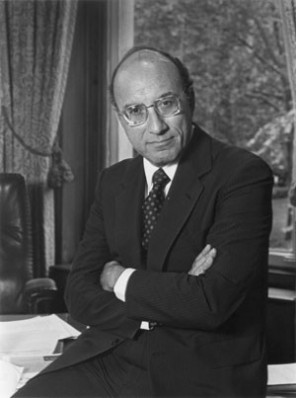
Commendatore in the Order of Merit of the Republic of Italy, 1991. Recipient, Citizens Union Civic Leadership Award, 1993. Columbia Law School Medal for Excellence, 1997. Town Hall Friend of the Arts Award, 2001. Order of the Rising Sun, Gold and Silver Star from Japan, 2004. Centennial Medal, American Academy in Rome, 2006. Lawrence A. Wien Prize for Social Responsibility, 2010. After two years on the faculty at the University of Minnesota Law School, joined the Columbia faculty in 1957. Served as chairman of the Executive Committee of the Faculty of Columbia University, 1968-69; dean of the School of Law, 1970-79; executive vice president for academic affairs and provost of the University, 1979-1980; president of the University, 1980-93.
Former arbitrator for disputes between numerous private companies and public agencies and the unions representing their employees; mediator in negotiations between the New York Transit Authority and the Transport Workers Union, as well as between New York City and its firefighters and policemen; author-moderator, WNBC-TV series Due Process for the Accused; host, WNET-TV series, Leading Questions; special counsel, Governor of New Jersey; consultant on law to Time magazine; and consultant to the Ford Foundation. Member, Pulitzer Prize Board and NAACP Legal Defense Fund, and Presidential Legal Expense Trustee.
Founding member of the board of directors of Mobilization for Youth’s Legal Services Unit; the Mexican-American Legal Defense Fund; the Puerto Rican Legal Defense and Education Fund; and Helsinki Watch. Chairman, New York City Charter Revision Commission, 1982-83. Chairman, State-City (New York) Commission on Integrity in Government, 1986.
Current member, board of directors of the Asian Cultural Council; WNET/13; and other corporate and nonprofit organizations. Member, Council on Foreign Relations; American Law Institute; American Academy of Arts and Sciences; and the American Philosophical Society. Honorary Chairman, Japan Society. Chairman Emeritus, American Academy in Rome. President, Shubert Foundation. Past Chairman of Sotheby’s. Past member, board of directors of AT&T, Comcast, Pfizer and Chase.
--biography courtesy of Columbia University Law School
(Courtesy of George Mason University)
Roger Wilkins
L.L.B, 1956, University of Michigan
B.A, 1953, University of Michigan
Pulitzer Prize-winning author and distinguished professor Roger Wilkins was born in 1932 in Kansas City, Missouri. Wilkins attended the University of Michigan, receiving his B.A. in 1953 and his J.D. in 1956, interning with Thurgood Marshall at the NAACP's Legal Defense Fund. Following graduation, Wilkins worked in several capacities as an advocate for justice. Beginning his career as a caseworker in the Ohio Welfare Department, Wilkins went on to work for the U.S. Agency for International Development and then as assistant attorney general under President Lyndon B. Johnson. Wilkins' interest in legal issues and equality stems partially from his family's background. His uncle, Roy Wilkins, was executive secretary of the NAACP from 1955 to 1977. In 1972, Wilkins began writing for the editorial page of The Washington Post just as the Watergate scandal was breaking. His critically informed editorials about the issues leading up to President Richard Nixon's resignation won him a shared Pulitzer Prize, along with reporters Bob Woodward and Carl Bernstein and cartoonist Herb Block. He then moved to The New York Times, where he served as the first African American on its editorial board as well as a columnist. Subsequently, Wilkins worked for the Institute for Policy Studies, The Washington Star, National Public Radio and CBS Radio. He continues to be a major commentator and analyst on American public policy and social justice issues.
Roger Wilkins retired from teaching at George Mason University in 2007.
MA (1948), PhD (1951) [University of Iowa]; first non-American student in the nation to earn a PhD in mass communication; taught at the University of Southern California for three years, served as vice dean (1979); taught at the Columbia University Graduate School of Journalism from 1962 and was named the first CBS professor of international journalism in 1980; author of five books. -- http://clas.uiowa.edu/sjmc/people/frederick-tc-yu