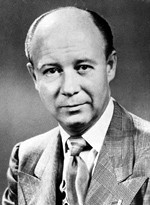
(Courtesy of The New York Times)
Turner Catledge Dies at 82; Former Editor of The Times
Turner Catledge, former executive editor of The New York Times, died at home in New Orleans yesterday of a long illness after a stroke. He was 82 years old.
In a journalism career that spanned five decades, Mr. Catledge began as a reporter covering floods and murders, went on to the White House and national politics and for 17 years oversaw the work of several hundred reporters and editors.
Mr. Catledge expanded the coverage of foreign and national news in The Times and stressed the importance of writing, as he put it, ''in terms of people and how they lived.''
Under Mr. Catledge, the paper also stepped up its reporting on religion and other specialized subjects, began devoting more space to biographical material about people in the news and covered politics with the general reader in mind, rather than the political specialist.
''I had no master plan, no magic formula for solving the paper's problems,'' he once said. ''I was dealing with people - talented, sensitive, sometimes stubborn people - and they were constantly surprising me, one way or the other. I proceeded by trial and error, always pragmatic, trying to learn from experience.''
Editors and reporters who worked with the tall, courtly Southerner say that in addition to changing the content of the newspaper, he also passed along to a generation of developing journalists a passionate concern for fairness in news coverage and the need for a strong sense of ethics.
''Turner Catledge made a vital contribution to American journalism,'' said Arthur Ochs Sulzberger, the publisher of The Times. ''His was a unique talent with an unfailing sense of mission. He never lost sight of journalism's ultimate purpose - to inform the reader, to bring him each day a letter from home and never to permit the serving of special interests. His love of his craft and his deep affection for those who practiced it well have left an enduring imprint on The Times.
''He was loved and we will miss him.'' Mr. Catledge, who was born on a farm in central Mississippi and worked his way through college as a waiter, had a beguiling manner that helped him build a large and effective network of news sources as a reporter and win the friendship of several Presidents.
He liked to entertain friends and colleagues with homespun anecdotes and imitations of Southern politicians. When he addressed large groups, he once told a reporter, ''I ad-lib a great deal and I syncopate it.''
Colleagues said it was a combination of gifts - intelligence, enterprise and courage - that made Mr. Catledge an esteemed newspaperman. In 1926, he investigated fraud in Tennessee's Democratic primary so vigorously that followers of the state Democratic Party's leader, Edward Hull (Boss) Crump, beat him until he bled.
Opportunity, in the form of two Memphis city detectives, knocked on Mr. Catledge's door one morning in 1927. Alarmed by the fierce pounding, his widowed mother, Willie Anna Turner Catledge, answered the door of the apartment that she shared with him.
The detectives demanded to see Mr. Catledge, then a 26-year-old reporter for The Memphis Commercial Appeal. Even though she was afraid that he was being arrested, she woke him; he was sleeping late because he was exhausted from two weeks of covering a vast and devastating Mississippi River flood.
By plane and car he had been across six states to chronicle the destruction -taking pictures, telephoning his reports back to Memphis, even doing newscasts for his newspaper's radio station. A Meeting With Hoover
The detectives rushed Mr. Catledge to the elegant old Peabody Hotel and into a suite that was occupied by Herbert Hoover, then the Secretary of Commerce, who had just arrived in Memphis. President Calvin Coolidge had sent him down from Washington to oversee relief efforts in the flood area.
Mr. Hoover, who had been told by the Mayor of Memphis that The Commercial Appeal's reporter was highly knowledgeable, began bombarding Mr. Catledge with questions about the flood.
He gave detailed answers, and the Secretary paid careful attention to the eager young man with the shrewd eyes, pink-cheeked good looks and easy Southern courtesy.
Mr. Hoover was impressed - so impressed that he later wrote a letter about Mr. Catledge to Adolph S. Ochs, then publisher of The New York Times and grandfather of the present publisher.
Mr. Hoover suggested that The Times hire Mr. Catledge as a reporter, and it did - but not until 1929, after Mr. Hoover had repeated his recommendation, this time as President of the United States.
Before long, Times executives, too, were impressed with Mr. Catledge's talents - so impressed that they made him deputy chief of the Washington bureau, from 1936 to 1941; national correspondent, 1943-44; an aide to the managing editor, 1944-51; managing editor, 1951-64, and executive editor, 1964-68. He was a director of The New York Times Company from 1968 to 1973 and a vice president from 1968 to 1970 before retiring.
Reminiscing about his editing years, Mr. Catledge once wrote: ''My career was not without drama, but the hardest decisions tended to be those within the organization, within the family, decisions regarding policy and people, decisions that demanded a crusading spirit less often than a careful balancing of complex issues.'' A Visit to Pacific Island
Mr. Catledge was a valued friend and counselor to three publishers of The Times, as well as chief steward of their family-controlled enterprise. Arthur Hays Sulzberger, Mr. Ochs's son-in-law and successor as publisher, found Mr. Catledge to be a congenial traveling companion even under difficult circumstances. When they were visiting the Pacific island of Peleliu in 1944 shortly after American soldiers had occupied it, a Japanese sniper's bullet narrowly missed them.
Undisturbed, Mr. Sulzberger remarked to their Army escort, ''I don't think all resistance has stopped.'' Mr. Catledge, with a skilled reporter's reflexes, took shelter behind a jeep.
In later years, Mr. Catledge used to eat sandwich lunches in Central Park with Arthur Hays Sulzberger's son-in-law and successor as publisher, Orvil E. Dryfoos. And he was fondly nicknamed ''Professor'' by Mr. Dryfoos's successor, Arthur Ochs Sulzberger.
Mr. Catledge's ideas and convivial nature also led him to be active in the Associated Press Managing Editors Association and the American Society of Newspaper Editors, which he served as president in 1960 and 1961. He helped to establish another journalistic organization, the American Press Institute, and was on its advisory board for many years.
As he noted in his autobiography, ''My Life and The Times,'' Mr. Catledge also had his flaws and foibles. During his rough-and-tumble apprenticeship in Southern journalism, he sometimes stole photographs of newsworthy people from their homes. As a writer, he was not notably polished. As an editor, he noted in his autobiography, he was often irritable about small errors.
Mr. Catledge was born on March 17, 1901, in Choctaw County in central Mississippi. In his ''Who's Who'' biography he gave his birthplace as Ackerman, a lumber-milling town, but he was actually born on his paternal grandfather's 300-acre farm near a hamlet called New Prospect.
The people of that part of Mississippi are known for being tough and shrewd; many of them are small cotton and soybean farmers scratching a living from the red clay soil. The Catledges were farmers, while the Turners, Mr. Catledge's family on his mother's side, had gone into shopkeeping.
From his father, Lee Catledge, a political enthusiast who became Mayor of Philadelphia, Miss., Mr. Catledge acquired a passionate interest in politics. And from his mother, a strong-willed seamstress who ran a boardinghouse in Philadelphia, he acquired much of his ambition and drive.
Mr. Catledge spent most of his boyhood in Philadelphia, a cottonginning center in east central Mississippi. The town's high school gave Mr. Catledge a sound grounding in Latin, Greek and English composition.
Mr. Catledge went on to major in business at Mississippi State University near Starkville, 50 miles north of Philadelphia. His family was financially hard pressed, and while he was an undergraduate he worked as a waiter to help make ends meet. When he went on dates, he used to borrow clothes from a student who was better off - John C. Stennis, who later became a United States Senator from Mississippi.
After graduating in 1922, Mr. Catledge went to work running The Tunica Times, a small weekly newspaper in Tunica, in the northwestern corner of Mississippi. At the owner's behest, he published articles designed to make local blacks feel at home and not want to move to the North. He also wrote a series of articles denouncing the Ku Klux Klan.
''I thought very little about the plight of Negroes during my early newspaper career,'' Mr. Catledge wrote in his autobiography, which was published in 1971. ''Separate but equal was the law of the land, and it did not occur to me to challenge it. My thinking changed slowly, as did the nation's. When the great Supreme Court decisions of the 1950's came down, outlawing various forms of segregation, I realized that they were right, that segregation in public institutions and facilities cannot be tolerated.''
From Tunica, Mr. Catledge moved 100 miles southeast to Tupelo, Miss., a cattle-marketing center, where he served briefly as managing editor of The Tupelo Journal, a biweekly paper, at a weekly salary of $22.50.
Seeking greater opportunities, he soon moved on to the nearest big city, Memphis. He arrived there by train during a blizzard in February 1924 with $2.07 in his pocket.
After a brief stint on The Memphis Press, Mr. Catledge went to work for The Commercial Appeal and soon impressed his bosses and coworkers with his touch typing, his vocabulary and his large repertory of hymns, in addition to his reportorial skills.
In 1927 Mr. Catledge took a job as a reporter for The Baltimore Sun, where, he later recalled, ''I learned to write better, to dress better, to act better - in short, to behave in a more civilized style than prevailed among Memphis newspapermen.'' It was in Baltimore, he wrote, ''that I first learned there are better things to drink than corn whisky.''
After two years The Times beckoned, and Mr. Catledge went to work briefly as a Times reporter in New York, covering Jewish affairs and later serving as a general-assignment reporter. Then he joined the Washington bureau, where his first job was covering the House of Representatives.
Soon after arriving in the capital, he paid a call on Mr. Hoover in the White House. The President asked how much The Times was paying him, and when Mr. Catledge told him $80, Mr. Hoover remarked that it was too little. Mr. Catledge said the salary was not all that important, but the President admonished him, saying, ''You don't want to be too idealistic where money is concerned.''
Although Mr. Catledge was a lifelong Democrat, he tried to be impartial in his Washington reporting. ''I am a Democrat for the same reason the Pope is a Catholic,'' he liked to say. ''I was born one and subsequent developments persuaded me to remain one.''
In 1936, President Franklin D. Roosevelt summoned Mr. Catledge to the White House and, saying that he did not get along with Arthur Krock, the longtime head of the Washington bureau, he proposed to bypass the bureau chief and disclose news directly to Mr. Catledge. Out of loyalty to Mr. Krock, Mr. Catledge refused the President's offer.
The following year, Mr. Catledge covered Mr. Roosevelt's attempt to ''pack'' the Supreme Court with additional justices who would be sympathetic to the President's views, which Congress refused to approve.
After the attempt, Mr. Catledge and Joseph Alsop, then a Capitol Hill correspondent for The New York Herald Tribune, wrote a book about it entitled ''The 168 Days.'' It became a best seller.
In 1941 Mr. Catledge, still seeking greater opportunities, left The Times to work for The Chicago Sun. He began as chief correspondent, then became editor in chief. But he felt out of place on the paper.
''We just didn't fit,'' he later said in an interview. ''I'd become so much a part of The Times.'' So after 19 months, he recalled in his autobiography, he went back to Washington with The Times, taking a cut in his annual salary, from $26,500 to $12,000.
In January 1945, Mr. Catledge moved to New York, and for seven years was the chief assistant to Edwin L. James, the managing editor. Mr. Catledge had begun as an assistant to Mr. James with the primary assignments of adding youth and vigor to The Times's editing and reportorial staffs and improving its internal organization.
Mr. Catledge duly set about trying to bring more unity among what he later called The Times's ''many pockets of bureaucracy'' and its ''various dukedoms'' - notably the Washington bureau - which he said were ''fiercely jealous of their prerogatives.''
He handled the problem in various ways, including the initiation of daily editors' meetings and the relaxation of jurisdictional boundaries within the newspaper.
In addition, Mr. Catledge tried to improve the paper's foreign news coverage, although it was already widely admired. In his memoirs he recalled urging Mr. James to increase coverage of Latin American affairs.
''I argued that we had a responsibility to develop an audience,'' Mr. Catledge wrote, ''that our readers should never be surprised by anything that occurred in the world.'' And, in due course, Times readers were served larger helpings of staff-written news from Latin America.
When Mr. Catledge became managing editor in December 1951, after the death of Mr. James, he assumed overall supervision of the paper's daily news staff. He did not direct the editorial page or the Sunday sections; their chiefs reported directly to the publisher.
In various ways, Mr. Catledge tried to brighten the paper. He particularly wanted reporters to write shorter sentences. In this effort his chief aide was one of his editor-proteges, Theodore M. Bernstein, who was named an assistant managing editor. Decision on Article on Cuba
Mr. Catledge also spent much time and energy on personnel matters, including the advancement of outstanding staff members. Among them were Clifton Daniel, a foreign correspondent, who became his chief assistant and succeeded him as managing editor, and A.M. Rosenthal, also a foreign correspondent, who was named metropolitan editor by Mr. Catledge and is now executive editor.
It was as managing editor that Mr. Catledge made the decision on how to handle one of the most debated articles ever published by The Times, a report by Tad Szulc that counterrevolutionaries were training in the United States and in Central America for an invasion of Cuba in 1961.
The article was published 10 days before anti-Castro forces backed by the Central Intelligence Agency landed in Cuba at the Bay of Pigs. While some executives of the newspaper argued that the article should be withheld out of concern for national security, Mr. Catledge contended that The Times was obliged to present the story. But he deleted from the article the reporter's characterization that the invasion was ''imminent,'' because he felt the newspaper should not be making a prediction. He also replaced all references to the C.I.A. with the term ''United States officials.''
President Kennedy accused The Times and other newspapers of disregarding national security in their reporting of the anti-Castro activities. But Mr. Catledge said in his autobiography that the President later told him privately, ''If you had printed more about the operation you would have saved us from a colossal mistake.''
Mr. Catledge wrote that, in hindsight, he thought the newspaper should have printed more than it did and, ''if we had, we might have caused a cancellation of the invasion.''
''But,'' he added, ''that judgment is based on knowledge I did not have at the time - that the invasion was in fact imminent and, most important, that it was destined to utter failure.''
In 1964, when Mr. Catledge became executive editor, he undertook overall supervision of the Sunday sections as well as the daily paper. Then, in 1968, he was named a vice president and became in effect a senior adviser to James Reston, his successor as executive editor, and to Arthur Ochs Sulzberger, who had become the publisher. In 1970, he retired to live in New Orleans.
Mr. Catledge was a member of the Century Club in New York, the Metropolitan Club in Washington and the Boston Club in New Orleans, among others, and held honorary degrees from Tulane and Washington and Lee Universities and the University of Kentucky.
Mr. Catledge was married in 1931 to Mildred Turpin, whom he had met when he was a young reporter in Baltimore. They were legally separated in 1949 and divorced some years later.
In 1957, while in San Francisco to deliver a speech to a meeting of the American Society of Newspaper Editors, Mr. Catledge met Abby Ray Izard of New Orleans. In his memoirs he wrote: ''Mrs. Izard fell under the spell of my oratory, which I repeated, in various settings and forms, during the next seven months until she became Mrs. Turner Catledge.''
Mr. Catledge is survived by his wife; two daughters by his first marriage, Mildred Lee Sampson of Stratford, Conn., and Ellen Douglas Catledge of McLean, Va.; a sister, Bessie Catledge Porter of Memphis; four grandchildren, and one great-granddaughter.
No funeral service is planned. The family suggests that in lieu of flowers, contributions be made to the Turner Catledge Fund for Journalistic Studies, Mississippi State University (care of the Development Office), Mississippi State, Miss. 39762.