Additional Resources
“[I]t’s my duty to see that they get the truth; but that’s not enough, I’ve got to put it before them briefly so that they will read it, clearly so that they will understand it, forcibly so that they will appreciate it, picturesquely so that they will remember it, and, above all, accurately so that they may be wisely guided by its light.” - Joseph Pulitzer
Pulitzer100 Bookmarks
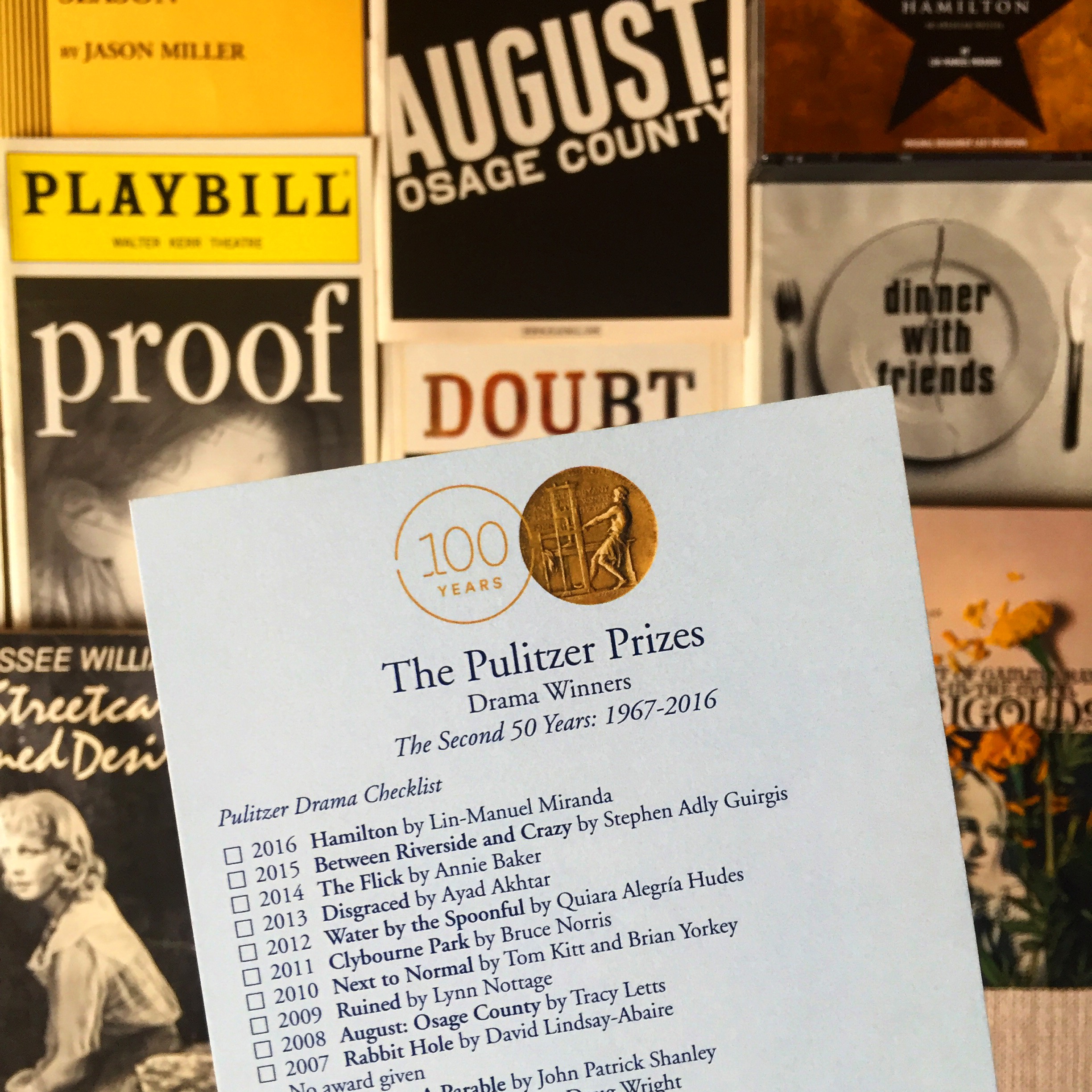
The ultimate Pulitzer Prizes reading checklists are here: complete read-throughs for every book category, with winners listed by date.
Print your own Fiction and Drama bookmarks.
Bookmarks for History, Biography and General Nonfiction coming soon.
Let us know your progress by using the hashtag #Pulizter100 on social media.
General Interest Books
Pulitzer's Gold: A Century of Public Service Journalism
By Roy J. Harris Jr. (University of Missouri Press, 2008; Columbia University Press [revised], 2015)
 The Joseph Pulitzer Gold Medal for meritorious public service is an unparalleled American media honor, awarded to news organizations for collaborative reporting that moves readers, provokes change, and advances the journalistic profession. Updated to reflect new winners of the Pulitzer Prize for public service journalism and the many changes in the practice and business of journalism, Pulitzer's Gold goes behind the scenes to explain the mechanics and effects of these groundbreaking works.
The veteran journalist Roy J. Harris Jr. adds fascinating new detail to well-known accounts of the Washington Post investigation into the Watergate affair, the New York Times coverage of the Pentagon Papers, and the Boston Globe revelations of the Catholic Church's sexual-abuse cover-up. He examines recent Pulitzer-winning coverage of government surveillance of U.S. citizens and expands on underexplored stories, from the scandals that took down Boston financial fraud artist Charles Ponzi in 1920 to recent exposés that revealed neglect at Walter Reed Army Medical Center and municipal thievery in Bell, California. This one-hundred-year history of bold journalism follows developments in all types of reporting—environmental, business, disaster coverage, war, and more. (Courtesy of Columbia University Press)
 Pulitzer Prize Feature Stories: America's Best Writing, 1979-2003 by David Garlock, editor (Wiley-Blackwell, 2003)
As Garlock relates in the preface, “The quality of the research, reporting and writing of these unique features is stunning. No two are written exactly the same way. But they all hold to one constant: strong emotions and content—powerful, touching, frightening, harrowing journalism.”
The rules for winning a Pulitzer Prize in feature writing are simple, yet demanding: the prize is awarded for “a distinguished example of feature writing giving prime consideration to high literary quality and originality.” For over two decades, the Pulitzer has been given annually to journalists whose work best exemplifies those high ideals.
The second edition of Pulitzer Prize Feature Stories: America’s Best Writing is an unabridged collection of this award-winning work, now covering 25 years. Editor David Garlock analyzes each story, and readers are given a glimpse at the circumstances surrounding the narrative. Each feature is followed by an insightful analysis by Garlock that probes the tactics the feature writer used in both writing and reporting the work. Journalism students and experienced professional writers will find Pulitzer Prize Feature Stories an essential compendium of the best feature writing of the last quarter century. (Courtesy of John Wiley & Sons)
 Pulitzer Prize Editorials: America's Best Writing, 1917-2003 by Wm. David Sloan and Laird B. Anderson (Wiley-Blackwell, 2003)
Since Joseph Pulitzer first established a prize for the best editorial in 1917, the award’s prestige has grown steadily. Today the Pulitzer is acknowledged as the most distinguished prize in journalism. All 87 years of these prize-winning pieces are collected in the updated third edition of Pulitzer Prize Editorials: America’s Best Writing, 1917-2003.
This book is an impressive anthology that illustrates the evolution of editorial writing over the decades. Each entry contains the entire, unabridged text of the prize-winning editorial from that year, and is preceded by a succinct introduction from the editors. From students learning the craft to accomplished opinion writers, Pulitzer Prize Editorials makes it possible for all students of editorial writing to learn from the best. (Courtesy of John Wiley & Sons)
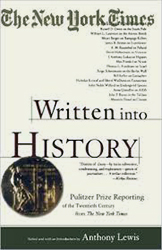 Written into History: Pulitzer Prize Reporting of the Twentieth Century from the New York Times by Anthony Lewis (Times Books/Henry Holt, 2001)
A selection of reportage by the distinguished legal journalist and two-time Prizewinner.
Who's Who of Pultizer Prize Winners by Elizabeth A. Brennan and Elizabeth C. Clarage (Greenwood Publishing Group, 1999)
Long out of print, this comprehensive biographical resource (including educational data and vitae for hundreds of winners) is frequently consulted by the staff of the Administrator's Office while fielding inquiries. Inexpensive secondhand copies are available.
The Pulitzer Prize Story: News Stories, Editorials, Cartoons, and Pictures from the Pulitzer Prize Collection at Columbia University by John Hohenberg (Columbia University Press, 1965)
The Pulitzer Prize Story II: Award-Winning News Stories, Columns, Editorials, Cartoons, and News Pictures, 1959-1980 by John Hohenberg (Columbia University Press, 1980)
A bona fide bestseller commemorating the fiftieth anniversary of the Prizes, many selections in the anthology and its 1980 follow-up were drastically condensed by the venerable administrator. Even if depth is forsaken in favor of breadth, both volumes are quite prevalent on the secondhand market; collectively, they represent a fine introduction to the scope of the Prizes for the layperson.
Books About Joseph Pulitzer
Pulitzer: A Life in Politics, Print, and Power by James McGrath Morris (Harper, 2010)
An Adventure With a Genius Recollections of Joseph Pulitzer by Alleyne Ireland (Kessinger Publishing, 2004)
Pulitzer: A Life by Denis Brian (New York: Wiley & Sons, 2001)
About the History of the Pulitzer Prizes
The Pulitzer Diaries: Inside America's Greatest Prize by John Hohenberg (Syracuse University Press, 1997)
This collection of Prize-related excerpts from Hohenberg's voluminous diaries offers probing and capacious insights into an increasingly tulmultuous epoch, culminating in the unprecedented Prizewinning disclosures of Watergate and the Pentagon Papers in the early 1970s and the divestment of Columbia University's trustees from the Prize process in 1975. Although he frequently clashed with his colleagues on the Journalism School's full-time faculty (as detailed by James Boylan in Pulitzer's School), the mercurial professor remained an indefagitable champion of the Prizes until his death in 2000, returning to Morningside Heights as a juror well into his nominal "retirement" as a roving journalism instructor at various Southern universities. Hohenberg enjoined generations of emergent journalists to "go with what you got," and there is no greater testament to his maxim than this book.
The Pulitzer Prizes by John Hohenberg (Columbia University Press, 1974)
Although he equivocated and carefully elided several of the controversies that were subsequently foregrounded in The Pulitzer Diaries, the official history of the Prizes remains a nuanced work of scholarship forty years on; his account of the Prizes' gestation--ballasted by the belated archivization of the Prizes' files by Hohenberg and his staff--is nearly definitive, ranking alongside Andrew Dolkart's Morningside Heights and Robert McCaughey's Stand, Columbia as an integral contribution to the history of Columbia University. As with both volumes of The Pulitzer Prize Story, inexpensive secondhand copies are quite common.
Edited by Dr. Heinz-Dietrich Fischer of Ruhr University, the Pulitzer Prize Archive series (published by K. G. Saur and more recently by LIT Verlag) showcases rare selections from Prizewinning entries and other archival material maintained by the Administrator's Office, including jury reports and miscellaneous correspondence. Although scarce on the retail market, the series can be obtained via interlibrary loan and at many academic libraries. Representative titles include:
Supplements: Chronicle of the Pulitzer Prizes for Biography (2007)
Chronicle of the Pulitzer Prizes for History: Discussions, Decisions and Documents (2005)
Complete Historical Handbook of the Pulitzer Prize System, 1917-2000: Decision-Making Processes in All Award Categories Based on Unpublished Sources (2003)
A History and Anthology of Award-Winning Materials in Journalism, Letters and Arts (Thomson Gale 2003)
Complete Biographical Encyclopedia of Pulitzer Prize Winners 1917-2000: Journalists, Writers and Composers on Their Ways to the Coverted Awards (2002)
Press Photography Awards 1942-1998 (2000)
Editorial Cartoon Awards 1922-1997 (1999)
A History & Anthology of Award-Winning Materials in Journalism Delles Poetry Verse (1998)
General Nonfiction Awards 1962-1993: From the Election of John F. Kennedy to a Retrospect of Abraham Lincoln's Gettysburg Address (1995)
Cultural Criticism 1969-1990: From Architectural Damages to Press Imperfections (1993)
Political Editorial 1916-1988 from War-Related Conflicts to Metropolitan Disputes (1990)
Social Commentary 1969-1989: From University Troubles to a California Earthquake (1991)
Local Reporting 1947-1987: From a County Vote Fraude to a Corrupt City Council (1989)
National Reporting, 1941-1986: From Labor Conflicts to the Challenger Disaster (1988)
About the Pulitzer Prize Winning Photographs
Moments: The Pulitzer Prize Photographs edited by Hal Buell (New York: Black Dog and Leventhal Publishing, 2002)
Capture the Moment: The Pulitzer Prize Photographs edited by Cyma Rubin and Eric Newton (New York: W. W. Norton, 2000)
Websites
Columbia University Journalism Library's Pulitzer Archives are composed of the winning entries in the Journalism categories of the Prizes. For the years 1917-1995, winning entries are on microfilm. For the years 1987 to 2011, winning entries are available in print form.
Columbia University Rare Book and Manuscript Library's Pulitzer Prize Collection consists of the original prize-winning exhibits. In many cases, the exhibit is accompanied by an entry form, a nominating letter, photograph of winner, biography of winner.