Pulitzer Prize Board 1947-1948
(Courtesy of the Columbia University Libraries)
Carl William Ackerman (1890-1970), Columbia University B. Litt. 1913, was Dean of the Columbia University School of Journalism from 1931 to 1956. He spent from 1960 to 1962 researching and writing a biography (unpublished) of Hokan Bjornstrom Steffanson, 1883-1962, the Swedish-American industrialist and financier.
Ackerman was a champion of freedom of the press. His professional career was forged in both major World Wars. While working as a correspondent in World War I with the United Press, Ackerman came to attention when he published Germany, The Next Republic?, a book that discussed the possibility of a successful democracy in post-Kaiser Germany.
When the book was printed in 1917, at the height of World War I, this sentiment was considered quite radical. The London Times Literary Supplement commented: "For the serious student of affairs the importance of the book lies in the large mass of information which it contains as to the struggle which was going on all the time in Germany between the two great parties, the Pan-Germans and the party of comparative moderation which centered round the Foreign Office." Mexico's Dilemma was considered "topical," "limited in scope and subject," and of "little relevance." Trailing the Bolsheviki was similarly received. As a biography, Dawes, the Doer was panned as "poorly handled," whereas Biography of George Eastman was called by the New York Tribune "objective in the sense that it holds strictly to the drama of events in justification of its hero. This makes it eminently readable, even exciting at times, purely as an epic of success achieved, a sort of `Pilgrim's Progress' of business."
Mr. Ackerman was an outspoken advocate of a journalism foundation in the United States "dedicated to the study of the daily newspaper and government." He explained, "We need scientific studies of the press by the press, and for the press, which will contribute to the progress of journalism as the great educational foundations have advanced medicine."
Ackerman married Mabel VanderHoof in 1914, and was the father of Robert VanderHoof Ackerman. Writings by Ackerman: Germany, the Next Republic?, Hodder & Stoughton, 1917.; Mexico's Dilemma, Doran 1918, Gordon Press, 1976; Trailing the Bolsheviki, Scribner, 1919; Dawes, the Doer (biography), Houghton, 1930; Biography of George Eastman, Houghton, 1930. Ackerman authored numerous articles, pamphlets, and reports on journalism and related affairs.
(Courtesy of United Press International.)
PROVIDENCE, R.I. -- Sevellon Brown III, veteran Washington correspondent and reporter for the Providence Journal-Bulletin, died Wednesday at Rhode Island Hospital. He was 70,
Brown worked at the Journal-Bulletin from 1939 to 1968 when he retired because of ill health.
He was born in Washington on April 23, 1913, the son of Sevellon and Elizabeth Barry Brown.
His family had an association with the Journal-Bulletin that began in 1904 when his maternal grandfather, David S. Barry, left his post as Washington correspondent for the New York Sun to become editor-in-chief of the Providence newspapers.
Two years later, Barry returned to Washington as Journal-Bulletin correspondent. In 1919, he was elected sergeant-at-arms of the U.S. Senate.
The elder Sevellon Brown succeeded his father-in-law as Washington correspondent after service in World War I. He then moved to Providence as managing editor and later became editor and publisher of the newspapers.
The younger Brown, known as Jeff, was Journal-Bulletin Washington correspondent from 1939-1942 and as bureau chief from 1942 to 1944.
After World War II and service with the OSS in London, Brown returned to the Journal-Bulletin as assistant to the editor (his father) from 1946 to 1949, then as associate editor from 1949 to 1953. He was appointed editor on Feb. 4, 1953 and held the post until his retirement.
For several years he served on the advisory board of the American Press Institute, chaired the American section of the International Press Institute, served on Columbia University's Pulitzer Price selection committees, and on the committee that selected Nieman fellowships for Journalists at Harvard.
Brown was a board member and later president of the New England Society of Newspaper Editors and chaired the New England Associated Press News Executives Association.
He is survived by his wife, the former Janice O. Van DeWater, two daughters by a previous marriage, five grandchildren, and a brother, Barry Brown, of Washington.
A memorial service was scheduled at 1 p.m. Friday at Swan Point Chapel. Burial will be private.
Dwight D. Eisenhower rose to world prominence through his leadership of the Allied forces during World War II. As commanding general of American forces in Europe, he conducted successful campaigns in North Africa, Sicily, and Italy. As supreme commander of the Allied Expeditionary Force, he directed the D-Day invasion of Normandy, France, and the subsequent military campaign—one of the most complex such operations in history—that culminated in victory over Nazism. He became America's 34th president in 1952 and was easily reelected the nation's chief executive in 1956.
During his presidency, the United States brokered the truce that ended the Korean War, introduced atomic weapons to the armed forces, sent troops to Little Rock, Arkansas, to enforce the desegregation of its public schools, launched the first U.S. space satellite, created the National Aeronautics and Space Administration (NASA), and sent the first U.S. military advisers to Vietnam.
Eisenhower succeeded Nicholas Murray Butler as president of Columbia, but did not take up the duties until nearly three years after Butler had resigned. He served as the University's thirteenth president from May 1948 until January 1953. "The principal purpose of education," he said the year he became the University's president, "is to prepare the student for effective personal and social life in a free society. From the school at the crossroads to a university as great as Columbia, general education for citizenship must be the common and first purpose of them all."
At Columbia, Eisenhower took a moderate position in the face of the Red Scare: He accepted a gift from the Communist government of Poland to establish a chair in Polish studies but also defended the dismissal of a left-wing member from Teachers College and served on a national commission that published a handbook declaring that communists should be excluded from employment as teachers.
On another front, he prevented legendary football coach Lou Little from leaving for Yale, and regularly attended the Lions' contests at Baker Field.
Never the most engaged of presidents, in December 1950 he took a leave of absence from Columbia to become the first supreme commander of the North Atlantic Treaty Organization (NATO). He retired from active duty in 1952, but not from the Columbia presidency, to campaign for the Republican presidential nomination. Once in the White House, his dealings with Columbia were infrequent.
-- http://c250.columbia.edu/c250_celebrates/remarkable_columbians/dwight_d_eisenhower.html
By Sean Murphy
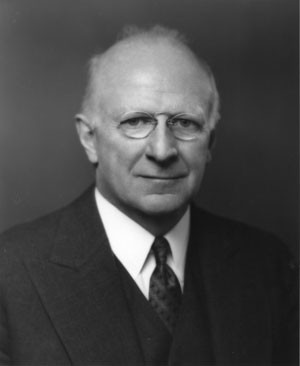
Frank D. Fackenthal was born on February 22, 1883 in Hellertown, PA. He was initially raised in Coplay, PA before the family moved to Roanoke, VA. The family relocated once more to the Crown Heights district of Brooklyn in 1894 when Fackenthal's father Michael (a largely self-educated iron works executive and community leader active in Freemasonry and Congregationalism) was appointed general manager of the Peter Cooper Glue Factory. Fackenthal attended Brooklyn public schools for the remainder of his primary and secondary education; at the prestigious Boys High School, he took the standard college preparatory course of Greek and Latin.
He matriculated at Columbia College in 1902 and received the A.B. in 1906. As an undergraduate, Fackenthal exemplified the fin de siècle ideal of the well-rounded collegiate gentleman of the upper middle class. "I didn't gain any great glory in college," he recalled in a 1957 oral history taken by the University. "On the whole I was probably just an 'able C man.' I chugged along on whatever was to be done, and spent much time on campus activities." These included the Daily Spectator (where he served on the editorial board and eventually as business manager), the Mandolin Club, the Players Club, the Varsity Show and the Barnard Literary Society.
It was not long before University President Nicholas Murray Butler became cognizant of Fackenthal's prodigious administrative abilities, culminating in his appointment as secretary of the University Employment Committee (charged with administrating student workers) in early 1906, months before Fackenthal received his sheepskin. In October of that year, he was appointed chief clerk of the University.
A lifelong bachelor, Fackenthal commuted from Brooklyn to Morningside Heights for his entire career. For some of that time, he resided with his older brother Joseph (a prominent lawyer and fellow Columbia alumnus who served as vice president of the New York City Board of Education under Fiorello LaGuardia) and his family at 35 Prospect Park West in Park Slope. As of 1940, he lived at his parents' house at 930 St. Marks Avenue in Crown Heights.
From 1910 to 1937, Fackenthal served as University secretary; in this capacity, he was the principal liaison between President Butler and the University trustees. As delineated by John Hohenberg in his eponymous history of the Pulitzer Prizes, administration of the program—and particularly the letters, drama and music awards—essentially fell to Fackenthal by proxy as "an unlooked for addition to his regular responsibilities" during this period.
With the Advisory Board only convening once a year to pass their selections on to the trustees for final approval, it was left to Fackenthal and a coterie of trusted associates (most notably longtime administrative assistants Vera Southard and Philip Hayden) to enjoin jurors to serve, disburse entries to the juries, ensure the timely filing of their reports and oversee the annual announcement of the awards in conjunction with the University press office. Before Pride, Gissler, Topping, Christopher, Baker and Hohenberg, there was Fackenthal.
In the spring of 1929, Fackenthal received both an honorary LL.D. from Franklin & Marshall College (a small liberal arts institution in Pennsylvania that was the frequent recipient of Fackenthal familial philanthropy) and an honorary Litt.D. from Columbia. Although he never completed an earned graduate degree, he was frequently characterized in the press thereafter as "Dr. Fackenthal." He later received additional honorary doctorates from Syracuse, Rutgers, NYU and Union College.
Fackenthal's ascendancy to the provostship in 1937 was highly atypical, a result of Butler's unwillingness to cultivate a new academic successor after longtime protégé Dixon Ryan Fox assumed the presidency of Union College. As Robert McCaughey observed in his history of the University, Stand, Columbia, "Fackenthal was not an academic and held no advanced degrees; for twenty-seven years his job had been to execute the president's orders. There was no reason to expect him to depart from this pattern as provost."
Although he had served faithfully in the Butler administration for over thirty years, the relationship between Butler and Fackenthal was not as convivial as one would expect, perhaps accounting for Fackenthal's continued residence in Brooklyn. Indeed, Butler went so far as to publicly deprecate his colleague at times, characterizing the provost as "my clerk" on at least one occasion. Nevertheless, as both men were codependent in their professional lives, it is hardly coincidental that Fackenthal stepped in as provost—and as the New York Times would ultimately concede, "deputy president"—while Butler's health and faculties were in abject decline. During World War II, Fackenthal served on the University's war research committee that initially oversaw the incipient Manhattan Project.
Following Butler's retirement in October 1945, Fackenthal was appointed acting president by the trustees during the long search for a successor, a process complicated by the ailing Butler's status as a trustee. When no viable internal candidate manifested a year into what fellow lifelong Columbian Jacques Barzun deemed "the long interregnum," rumors circulated that some trustees nearly capitulated to reason and proposed Fackenthal's permanent appointment; however, this was swiftly forestalled by Butler. Butler also castigated trustee chair Frederick Coykendall when Fackenthal was elected to that board in 1946, as tradition stipulated that only a permanent president could serve as a trustee.
According to McCaughey, Fackenthal was an "institutional caretaker." He mainly developed a long-term plan for Columbia's continued growth (largely eschewed by his successors) and oversaw the evolution of the University's Extension division (including the University Undergraduates program that circumvented Columbia College's ethnic quotas) into the School of General Studies, a propitious step toward inclusivity in higher education. Fackenthal also oversaw the coalescence of such robust Cold War initiatives as the School of International Affairs and the Russian Institute, the latter under the aegis of the Rockefeller Foundation.
After the trustees elected General Dwight D. Eisenhower to replace Butler in the spring of 1947, Fackenthal remained in his position for another year until Eisenhower was released from his military obligations just prior to the 1948 commencement. He had now served as an officer of administration at his alma mater for 42 years. In January 1948, he received the Alexander Hamilton Medal—the University's highest honor—at a special dinner including 1,300 students, faculty and staff.
Three months later, he received a Special Citation on a scroll from the Pulitzer Prize Advisory Board, an achievement that reverberates today in the commemorative scrolls given to each outgoing chair of the Pulitzer Prize Board. It read:
To Dr. Frank Diehl Fackenthal, greetings and felicitations.
You have been associated with the historical development of the Pulitzer Prizes from the beginning.
You were the author of the report which bridged the years between experiment and fulfillment of Joseph Pulitzer's dreams.
You initiated the jury system, communicated with, advised, and at times even consoled juries.
As secretary, provost, and acting president of the university, you were the personal tie between the Advisory Board and the Trustees.
To you, on this occasion, the members of the Advisory Board award the Pulitzer Prize of our friendship in perpetuity.
Thereafter, Fackenthal served as educational consultant for the Carnegie Foundation of New York from 1948 to 1952 and president of Columbia University Press from 1953 to 1958. He also served as president and director of the Bushwick Savings Bank (where his father had also served on the board of directors) and as a director at Tayler, Stiles, & Company, a financial services firm. In addition, he remained a trustee of a variety of institutions, including Columbia University, Barnard College, Franklin and Marshall College, the Riverdale Country School and International House. Columbia University Press published The Greater Power, a collection of 18 speeches from his presidency, in 1949; none totaled more than 500 words, a testament to Fackenthal's laconic elan.
In December 1965, Fackenthal was critically injured when his car collided with a tractor-trailer in White Township, NJ, roughly fifty minutes south of his country home in Buck Hill Falls, PA. He remained infirm thereafter and was forced to eventually relocate from Brooklyn to Buck Hill Falls. In 1967, he relinquished his duties as a trustee of Columbia and became trustee emeritus. Fackenthal succumbed to his injuries and old age at Monroe County General Hospital in East Stroudsburg, PA on September 5, 1968.
(Courtesy of The New York Times)
A Writer and a Businessman
By Deirdre Carmody
June 17, 1981
John S. Knight, founder of the Knight publishing empire and editor emeritus of Knight-Ridder Newspapers Inc., died last night of a heart attack at the home of a friend in Akron, Ohio. He was 86 years old. Dale Allen, executive editor of The Akron Beacon Journal, the first Knight newspaper, said that Mr. Knight had been hospitalized for two or three days with a heart condition after attending the 150th anniversary celebration of another of his papers, The Detroit Free Press, about a month ago.
Mr. Knight retired in 1976 as editorial chairman of the Knight-Ridder chain and divided his time between working in the offices of the Akron newspaper and in Miami at the chain's corporate offices one floor above The Miami Herald, another of the chain's papers.
As principal stockholder he owned just under 20 percent of the Knight-Ridder stock. His brother James owns about 10 percent of the outstanding shares.
In the early years of American journalism, publishers tended to be strong-willed, competitive men whose personalities and political philosophies dominated the newspapers they produced.
As times changed there emerged a new generation of publishers whose primary interest was to buy newspapers and create newspaper groups, and they turned American journalism into a full-fledged industry.
John Shively Knight belonged, in a sense, to both breeds. He inherited The Akron Beacon Journal from his father in 1933 and went on to assemble the Knight-Ridder newspaper group, which became the chain with the largest weekly circulation in the country.
By 1981 it included 34 daily newspapers in 17 states with an aggregate weekly circulation of 25 million. It also included four television stations, and in 1980 its revenues were $1.099 billion.
But, unlike many publishers who had little to do with the editorial side of their papers, Mr. Knight wrote a weekly opinion column for years on an ancient typewriter in his office. The column, entitled ''The Editor's Notebook,'' won him a Pulitzer Prize in 1968 for ''distinguished editorial writing.'' His opinions earned him descriptions by friends as ''crusty'' and ''blunt.'' Two More Pulitzers
Two Knight newspapers, The Detroit Free Press and The Charlotte Observer, also won Pulitzers in the same year as Mr. Knight. It was the first time that one publisher had carried off three of the journalism prizes.
''I'm a bleeder,'' Mr. Knight once said in describing his own writing habits. ''I used to sit here and struggle with the typewriter, smoking cigarettes and drinking soft drinks and ruining my gut. I'd go home from the office drained. This was work.''
One of his campaigns was for freedom of the press around the world and against censorship. His belief was that ''if the peoples of the world can come to know and understand one another through the freedom of international news exchange, many of the causes of war will have been eliminated.''
Mr. Knight was a firm believer in local control by each of his newspapers, as well as strong coverage of local news. He used to say that he wanted each of his papers to have its own ''character.'' Summing up his beliefs to fellow publishers in 1969, he said:
''Your first duty is to the citizen who buys your newspaper in the belief that it has characer and stability, that it is at all times a defender and protector of the rights and liberties of our people, that it does not yield to the pressure of merchant or banker, politician or labor union.''
Mr. Knight was born in Bluefield, W. Va., on Oct. 26, 1894. When he was 6 years old, his family moved to Akron, Ohio, where his father became advertising manager of The Beacon Journal. By 1915 the father had acquired full control of the paper.
As a boy, John worked at the newspaper on summer vacations; on election nights he sold extras on street corners. He attended high school in Akron, then the Tome School in Maryland and Cornell University. He left Cornell in his junior year to enlist in the Motor Transport Corps but was later transferred to the 113th Infantry, rose to Lieutenant and saw action in the Argonne. Just before the Armistice he joined the Army Air Corps.
After raising cattle for a brief time in California, Mr. Knight went to work at The Beacon-Journal in 1920 as a sportswriter. Five years later he became managing editor, and in 1933, upon his father's death, he inherited the paper.
Four years later he bought The Miami Herald and acquired and then discontinued The Miami Tribune. In 1938 he bought The Times-Press, the rival Akron paper, which left him with a monopoly in that city. In 1940 he bought The Free Press, Detroit's only morning paper, and in 1944 he bought controlling interest in The Chicago Daily News for $2.2 million, although he sold The Daily News in 1959. Public Triumph, Private Grief
By 1973 he owned 15 daily newspapers, including The Philadelphia Inquirer and Daily News. The following year, he consolidated his group by merging with Ridder Publications, thus adding ownership or substantial interest in 19 more dailies in the West and Middle West.
While his public life prospered, however, his private life was marked by grief. His first wife, Katherine McLain, died in 1929, eight years after their marriage, leaving him with three young sons. In 1932 he married Beryl Zoller Comstock, who died in 1974.
In the closing weeks of World War II, his eldest son, John S. Knight, was killed in action, two weeks before the birth of his own son. Another son, Frank, died of illness in 1958. In December 1975, Mr. Knight's grandson, John S. Knight 3d, who was an editor of The Philadelphia Daily News, was murdered in a robbery in his apartment.
The surviving son, Charles Landon Knight of Akron, is president of Portage Newspaper Supply Company, a Knight-Ridder subsidiary. In 1976, Mr. Knight married Frances Elizabeth Augustus, widow of Ellsworth H. Augustus, a Cleveland civic leader and millionaire industrialist.
Like Mr. Knight, she owned racing horses. The Knight stables in Miami were called the Fourth Estate Stables and most of the horses were given names related to newspapers, such as Wire Editor and Extra, Extra. She died in January.
Mr. Knight, who had held the title of chairman of the board and chief executive officer of the company, relinquished his last post as editorial director in 1976, saying, ''There is a time to quit. I quit when I was doing well.''
But he remained an avid reader of newspapers and continued to send editors notes chiding them for mistakes or offering words of praise for a job well done.
Stuart H. Perry (1874-1957) was a newspaper publisher and authority on meteorites. He made extensive collections of meteorites and donated many specimens to the United States National Museum (USNM). In 1940, Perry became an Honorary Associate in Mineralogy, USNM, a title he held until his death.