
Pulitzer Prize Board 1967-1968

This Board presided over the judging process that resulted in the 1968 winners and finalists.
Joseph Pulitzer, Jr., chair; John Hohenberg, secretary
1968 Pulitzer Prize Board

front row, left to right: E. Canham, J. Pulitzer, P. Miller, W.D. Maxwell, B. Bingham, N. Chandler; back row, left to right: J. Reston, R. McGill, V. Royster, G. Kirk, K. MacDonad, N. Noyes, J. Hohenberg


(Courtesy of The New York Times)

Barry Bingham Sr. Is Dead at 82; Louisville Newspapers' Publisher

By Alex Jones

August 16, 1988

Barry Bingham Sr., whose newspapers in Louisville, Ky., were leading liberal voices in the South, for decades, died yesterday at his Louisville home. He was 82 years old and had been undergoing treatment for cancer.

The Bingham newspapers, The Courier-Journal and The Louisville Times, championed such unpopular causes as civil rights and strip-mining reform, and won seven Pulitzer Prizes after coming under Bingham ownership in 1918.

In large part, their success was a result of Mr. Bingham's long-standing policy of sacrificing profit for editorial excellence. For instance, each paper had its own art critics, which most owners of papers the size of his two would have considered a great extravagance.

In 1971, Mr. Bingham retired from active management of the family companies, though he remained chairman. The family businesses included Louisville television and radio stations and a printing company.

Mr. Bingham was again thrust into the public eye in January 1986 when he decided to sell the papers and other enterprises to escape bitter family strife. His decision was characterized as a betrayal by his only surviving son, Barry Bingham Jr., who had managed the family businesses since 1971.

At the time, Barry Bingham Jr. was locked in a struggle over the future of the companies with his sisters Eleanor Miller, who favored the sale and has remained close to her parents, and Sallie Bingham, who also favored selling but has denounced the family as sexist and is estranged from the family.

The sale of the properties brought about $435 million, $300 million of which was paid by the Gannett Company for the newspapers.

Barry Bingham Sr. said in 1986 of his decision to sell the companies that his children had never learned to compromise, a practice he considered essential. Though the family remains divided over the wisdom of selling, he was attended closely by Eleanor and Barry Jr. in the months of his sickness.

Mr. Bingham was born in Louisville, where his father, Robert Worth Bingham, was a lawyer and politician and, later, United States Ambassador to Britain. After Mr. Bingham's mother died in an automobile accident, his father remarried Mary Lily Kenan Flagler, one of the nation's richest women. She died within a year, and left Robert Worth Bingham $5 million with which he acquired the Louisville newspapers.

After graduating magna cum laude from Harvard in 1928, Barry Bingham Sr. returned to Louisville to enter the family business. He married Mary Clifford Caperton of Richmond, Va., who graduated from Radcliffe in the same year.

After his father died in 1937, Barry Bingham became sole owner of the family enterprises. He hired Mark Ethridge, a celebrated liberal Southern publisher, as operating head of the companies. Advocate of Civil Rights

Mr. Bingham, as editor, directed the editorial page. Though the papers' later support for civil rights prompted a violent backlash, he said that in 1939 and 1940 his vigorous advocacy of the United States entering World War II was even more unpopular in isolationist Kentucky.

In May 1941 Mr. Bingham went on active duty in the Naval Reserve, mainly in response to taunts by his isolationist critics. He left Mr. Ethridge in charge of the newspapers in his absence, directing him to pay close attention to Mrs. Bingham, who was her husband's closest adviser.

He directed public relations for the Navy in Europe and was praised by reporters for his energetic efforts to speed articles through censorship. Upon returning to Louisville in 1945, he elected to remain editor and president of the papers so he could retain the services of Mr. Ethridge, who kept the title of publisher until 1961. That was the year Mr. Ethridge retired.

The arrangement freed Mr. Bingham to accept a wide array of other tasks. For example, in 1949 he began a year's service as chief of the Marshall Plan in France, and was given the rank of Commander, Legion of Honor, by the French Government. In 1955, he gave a series of lectures in the Fourth Fulbright Conference on American Studies at University College, Oxford.

Mr. Bingham took a very active role in local affairs. The companies contributed 5 percent of their pretax earnings to local charity, and even late in life, Mr. Bingham was deeply involved with community projects, especially arts endeavors like the Kentucky Center for the Arts Endowment Fund, of which he was chairman.

But the elegant appearance and glamorous living style of the Binghams, as well as their wealth, power and liberal politics, set them apart from many of their Louisville neighbors. They moved with a patrician grace through the cosmopolitan world outside Kentucky that occupied much of their time. Mr. Bingham was an overseer at Harvard University for 12 years, a trustee of the Asia Foundation and involved with many national and international organizations.

He was an ardent Democrat and devoted himself full time to Adlai E. Stevenson's 1956 Presidential campaign, not an unusual move for newspaper executives of that era.

Mr. Bingham's editorial page usually endorsed Democrats and he was at his most combative when he was writing editorials. He was also a man who loathed confrontation and sought common ground, and that made him less a kingmaker than his Republican and conservative critics contended he was.

Instead, to exert leadership behind the scenes, he used a talent for charm and tact and the influence of his communications empire.

Two of Mr. Bingham's sons, Jonathan and Worth, were killed in accidents in the mid-1960's, and his third son, Barry Bingham Jr., was stricken with Hodgkin's disease soon after taking charge of the family businesses in 1971. Though Barry Jr. recovered, the series of misfortunes aroused in Mr. Bingham a sense that the family was ill-fated.

Maintaining family ownership, especially of the newspapers, had been the central purpose of Mr. Bingham's life. But after deciding to sell, he said that he felt the outcome was almost destined.

Mr. Bingham lived from childhood on the family estate overlooking the Ohio River at Glenview, Ky., and had a summer house at Chatham, Mass.

He is survived by his wife, two daughters, and son, all of Louisville, and nine grandchildren.

Erwin D. Canham, who guided The Christian Science Monitor as its chief news executive for nearly three decades, died yesterday in Agana, Guam. It was under Mr. Canham's leadership that the churchsponsored paper attained its reputation for thoughtful, analytical coverage. Mr. Canham was 77 years old.

Mr. Canham underwent abdominal surgery on Guam two weeks ago. He and his wife, Patience, maintained homes on Saipan, where he had served as resident commissioner of the Northern Marianas Islands in the 1970's, and at Cape Cod, Mass.

Mr. Canham, a soft-spoken, genteel man with a puckish sense of humor, served the internationally circulated newspaper for 49 years as reporter, Washington bureau chief, columnist, managing editor, editor and editor in chief. He became editor emeritus in 1974 and five years later retired.

Strengthened Foreign Coverage

As the newspaper's editor from 1945 to 1964 and as editor in chief for the next 10 years, he strengthened The Monitor's coverage of foreign news and developed staff specialists in that and other areas.

"The paper had had expert editors before him, and they were competent professionals, but a more intense journalistic competence was developed under Canham,'' said Saville R. Davis, former managing editor of the paper.

Mr. Canham was also respected for his knowledge of international affairs, familiarity with political and business leaders around the world and his many outside interests.

''He was extremely speedy as a thinker and a writer,'' turning out a column and serving on outside comittees while putting out a newspaper, said the paper's editor, Earl W. Foell.

Paper's Charter From Miss Eddy

The Boston-based newspaper, which has a circulation of 180,000, has carefully adhered to the philosophy of Mary Baker Eddy, the founder of Christian Science who established the publication in 1908 and said its goal would be ''to injure no man, but to bless all mankind.''

In practice, this meant little emphasis on crime, violence and disasters, and greater attention to topics of long-term significance. In a departure from the practice at most other newspapers, The Monitor has given little attention to medical news because of the church's emphasis on spiritual healing. However, Mr. Canham said, this had its compensations because much medical news was of transient significance.

In explaining the newspaper's approach, Mr. Canham argued that, by the mid-1960's, radio and television had forced newspapers to go beyond ''the mere reporting of the event'' and that editors should ''press the task of reporting more deeply and widely.'' However, he warned that reporters must avoid coloring their articles with opinion.

Mr. Canham's career was an unusual combination of two deep interests: religious concern and a nose for news. A lifelong Christian Scientist, he taught a Sunday school class of college students at the Mother Church, near his office.

In 1966, he was given a one-year term in the largely honorary post of president of the church. In a worldwide lecture tour, he argued that the estrangement of science and religion was a mistake, adding, ''It is important to see that truth -spiritual truth - runs through all aspects of life.''

Robert P. Hey, The Monitor's managing editor, said: ''He had quite an extraordinary gift for combining the big, broad canvas, in terms of national and international coverage, with the importance of the individual, no matter what his job. He made it his business to know something about and to care about you.''

Erwin Dain Canham was born Feb. 13, 1904, in Auburn, Me. His father was agricultural editor of The Lewiston (Me.) Sun and Journal. Mr. Canham recalled that when he was 8 years old he stood on a chair in f ront of an old-fashioned wall telephone and took down items for publication. At 14, he became a general repor ter for the paper in theWorld War I manpower shortage.

He worked as a correspondent for up to eight daily newspapers while attending Bates College in Lewiston. Received Rhodes Scholarship

After graduating in 1925, he reported for The Monitor for a year before attending Oxford University as a Rhodes scholar. While there he covered the League of Nations for The Monitor.

Rejoining the newspaper full time, Mr. Canham covered national and international events, served as chief of the Washington bureau from 1932 to 1939, and was general news editor until 1942, when he became managing editor. Four years later he became the editor.

A year after being named editor emeritus, Mr. Canham was sent to Saipan by the United States Government to administer a plebiscite in which residents of the Northern Marianas Islands voted to withdraw from the American-administered Trust Territory of the Pacific Islands. He was Resident Commissioner from 1975 until 1978.

Accepted Outside Positions

Unlike some newspaper editors, Mr. Canham accepted a variety of outside posts. In 1948 he was vice chairman of the United States delegation to the United Nations Conference on Freedom of Information. In the Eisenhower Administration, he was chairman of the National Manpower Council and a member of the Commission on Information, which helped shape United States policy on information and propaganda.

In 1959, he was president of the Chamber of Commerce of the United States. In the 1970's, he was a member of President Nixon's Commission on Campus Unrest and a member of the board of the Public Broadcasting Service. He was president of the American Society of Newspaper Editors in 1948-49.

Mr. Canham's first wife, the former Thelma Whitman Hart, died in 1967. In addition to his wife, he is survived by two daughters, Carolyn Shale Paul and Elizabeth Davis. -- (from The New York Times, Jan. 4, 1982 by William Dickie) Edward D.

Canham joined the Pulitzer Board in 1958.

(Courtesy of Encyclopedia Britannica.)

Norman Chandler, (born September 14, 1899, Los Angeles, California, U.S.—died October 20, 1973, Los Angeles), American newspaper publisher who helped change the Los Angeles Times from a conservative regional journal to one of the largest and most influential newspapers in the world.

After attending Stanford University, Norman Chandler joined the Los Angeles Times in 1922 as secretary to his father, Harry Chandler, the paper’s owner. Norman became president and general manager of the paper in 1941. In 1960 he stepped aside as publisher in favour of his son, Otis, under whose direction the newspaper gave more editorial space to liberal and opposing viewpoints. He modernized the Times Mirror Company’s operation and made the Times one of the most automated newspapers in the United States. After he relinquished the day-to-day operations of the Times in 1960, Norman concentrated on expansion and diversification, buying the daily Newsday in Garden City, New York, the Orange Coast Daily Pilot in Orange county, California, and the Dallas Times Herald in Texas.

In 1991 Otis Chandler stepped down as board chairman after 10 years in that position. The Los Angeles Times had won 16 Pulitzer Prizes during his tenure. In March 2000 the Chandlers, who owned the majority of Times Mirror stock, sold the company to the Tribune Company of Chicago. (See Chicago Tribune.)

(Courtesy of The New York Times)

John Hohenberg, 94, Former Pulitzer Prize Official, Dies

By Douglas Martin

August 8, 2000

John Hohenberg, who began his journalism career as a teenager by snatching an interview with the president of the United States and went on to become administrator of the Pulitzer Prizes, died Sunday morning at his home in Knoxville, Tenn. He was 94.

Mr. Hohenberg also taught journalism for many years at Columbia University and wrote a widely used textbook on reporting. In all, he wrote 22 books -- including a novel at the age of 80 -- and maintained an arduous professional itinerary.

He wrote for numerous New York newspapers and taught at universities from New York to Tennessee to Florida to Kansas to Syracuse. He traveled the world, particularly Asia, lecturing for the State Department and other federal agencies. He began the practice of publishing the names of Pulitzer jurors and of drawing jurors from regions beyond New York.

Mr. Hohenberg came from the golden age of competitive newspapering, covering the 1935 trial of Bruno Richard Hauptmann -- who was convicted of kidnapping Charles Lindbergh's baby -- hanging out with Hemingway in Paris and reporting on the birth pangs of the United Nations and Israel. Tom Goldstein, dean of the Graduate School of Journalism at Columbia University, speaks of ''the John Hohenberg legend.''

Mr. Hohenberg's larger mission was elevating journalism itself, and he viewed the painstaking selection of Pulitzer winners as another means of raising the bar.

''Our news media, our reporters and editors -- if they are serious people and if they really mean business and aren't merely sensation-minded -- should be the conscience of the American people,'' he said in a 1988 interview in The New York Times.

He abhorred pomposity and wordiness, regarding journalism as a spontaneous ballet that could seldom be perfect because of daily deadlines. His motto, first growled to him by a crusty editor, was, ''Go with what you got.'' Generations of journalism students at Columbia committed the slogan to memory and the class of '69 had it printed on sweatshirts.

Mr. Hohenberg was born on Feb. 17, 1906, in a tenement on the Lower East Side of Manhattan, the son of Louis Hohenberg, a Hungarian immigrant, and Jettchen Scheuermann, an immigrant from Germany. When he was 18 months old, the family moved to Seattle, where his father set up several small businesses.

He started as an engineering student at the University of Washington but did not like it. His father refused to pay for the liberal arts education he wanted, so the gangling 17-year-old showed up at The Seattle Star, now closed, to ask for a job.

The response was brusque, he later recalled. ''Listen, kid,'' the city editor said, ''the president of the United States is coming to Seattle tomorrow. You get me an exclusive interview and I'll give you a job.''

When the Secret Service demanded to see his nonexistent press credentials, employment seemed unlikely. He called the office, fearing that his name would mean nothing.

''Mercifully,'' he wrote later, ''by grace of the kindly Jehovah that watches over babies, pretty girls and addled young men, the city editor remembered me and was sportsman enough to clear me for passage to the pier as a Star reporter.''

The result was a second's conversation in which President Warren G. Harding allowed that he liked Seattle. Mr. Hohenberg turned the remark into a three-page story. ''For better or worse, I had become a newspaperman,'' Mr. Hohenberg said.

The family soon moved back to New York to be nearer relatives. While attending journalism school at Columbia, Mr. Hohenberg worked for The New York Graphic, his first stop in 25 years of working for New York papers. After graduating, he toured Europe as the recipient of a Pulitzer Traveling Scholarship.

In 1948, as he was reporting on the establishment of the United Nations at Lake Success, N.Y., he was asked to substitute for a Columbia journalism teacher who had broken a leg. The students liked him, he liked the students and a new career began.

In 1960, he published what became the basic reporting and writing textbook used at many journalism schools, ''The Professional Journalist'' (Holt, Rinehart & Winston), which went through five editions and has been translated into Chinese, Japanese, Arabic and Spanish.

His 21 other books ranged from several histories of the Pulitzer Prize to an exhaustive history of foreign correspondence, recounting its beginnings in the Napoleonic Wars and offering long analyses of the challenges facing journalism.

Soon after his appointment in 1953 as administrator of the Pulitzer Prizes and secretary of the Advisory Board on Pulitzer Prizes, he nudged at least two members of the Pulitzer board into seeing all the plays under consideration for the drama prize, something not necessarily done before.

In later years, he wrote about how the Columbia trustees, as final arbiters, refused to accept the Pulitzer board's recommendation that The New York Times be given a prize in 1972 for its publication of stories based on the Pentagon Papers, the government's classified history of the Vietnam War.

The trustees were uneasy over the newspaper's decision to report classified material, an unusual action for journalists in that period. Columbia's president, William J. McGill, persuaded the trustees to reverse their decision.

Then, Mr. McGill and Mr. Hohenberg persuaded the trustees to yield veto power over the Pulitzers, perhaps the biggest procedural change during Mr. Hohenberg's tenure, which ended in 1975. The year before, he had accepted an appointment as professor of journalism at the University of Tennessee. That was the first of a chain of academic stops over the last two decades of his life.

Mr. Hohenberg married Dorothy Lannier, a classmate at Columbia, in 1928. She died in 1977. They had no children. He is survived by his second wife, JoAnn Fogarty Johnson, and her two children, whom he adopted: Pamela Green of Knoxville and Eric of Dawsonville, Ga.

In 1986, Mr. Hohenberg's wife found a yellowing manuscript on newspaper copy paper in the basement that turned out to be the skeleton of a spy novel he had abandoned in the 1920's. He whipped it into shape and sold it, under the title ''The Parisian Girl.''

In 1976 he received a Pulitzer Prize special award for his service to journalism. The citation said thousands of journalists had learned to value his tough integrity.

''From you they learned to respect the language,'' it read. ''They might split an infinitive because you taught them how. But they dare not dangle a participle. You forbid it.''


(Courtesy of The New York Times)

Grayson Kirk, 94, President of Columbia During the 1968 Student Protests, Is Dead

By Karen W. Arenson

November 22, 1997

Grayson Louis Kirk, the scholarly president of Columbia University whose ill-fated decision in the spring of 1968 to turn 1,000 police officers in riot gear against student protesters became an emblem of the generational conflict characterizing the Vietnam War era, died early yesterday morning.

He was 94 and died in his sleep at his home in Bronxville, N.Y., his son, John G. Kirk, said.

For many years, the university grew and prospered under Dr. Kirk's leadership. An exponent of broad, liberal education of the sort Columbia offered, he proved adept at relating to the trustees and to raising money. Under him, the university quadrupled the size of its endowment. It also expanded its library, introduced new academic programs and built more than a dozen new buildings.

But toward the end of his tenure, Dr. Kirk was widely viewed as no match for the enormous pressures for social change surging through the institution in the late 60's. He resigned shortly after the student protests of 1968.

Dr. Kirk became the university's president in 1953, succeeding Dwight D. Eisenhower after his election as President. A portly, pipe-smoking man, he presided over a period of enormous growth for the university. But as the 60's swept by, Dr. Kirk repeatedly found himself and Columbia at the center of public controversies: for deteriorating relations with the surrounding community, capped by the university's decision to build a gymnasium in Morningside Park; for taking a controlling interest in a cigarette filter whose sale would bring revenues to Columbia; and finally, for the way he handled the student demonstrations of 1968. Those demonstrations were directed against the building of the gymnasium and the university's affiliation with a consortium that did military research for the Government.

Students took over five campus buildings and the president's office. The pressure built as the police stood outside the campus gates while faculty and student negotiating committees tried to end the protest. Finally, on April 30, 1,000 helmeted police officers swarmed onto campus and began dragging away the protesters, kicking and beating those who did not move fast enough. Hundreds of students were arrested and dozens injured. Dr. Kirk said the decision to call in the police was ''obviously the most painful one I ever made.''

As the students left, they chanted: ''Kirk must go, Kirk must go.''

A second campus protest a month later resulted in another battle between student protesters and police, but Dr. Kirk resisted leaving office, declaring repeatedly that he would not bow to the protesters and resign.

But in August 1968, just four months after students had first occupied his office, he stepped down, saying that he hoped his retirement would ''insure the prospect of more normal university operations.''

He became president emeritus, and said he would continue to help raise money for the university.

As college administrators everywhere faced campus protests and challenges to their authority, the actions of Dr. Kirk and Columbia administrators were closely examined. The Cox Commission, a panel established by Columbia's faculty to investigate the campus uprisings, said that Columbia's administration and trustees had ''too often conveyed an attitude of authoritarianism and invited mistrust.''

The 222-page report, delivered in October 1969 and written largely by the panel's chairman, Archibald Cox, a Harvard Law School professor and former Solicitor General of the United States, was sharply critical of Dr. Kirk's tenure.

''The hurricane of social unrest struck Columbia at a time when the university was deficient in the cement that binds an institution into a cohesive unit,'' the report said.

It took Columbia to task for the ''unhealthy relations'' with the largely black community of Harlem, pointing to its ''indifference'' to the poor and the manner in which the university had expanded its presence in Morningside Heights.

But the commission pointed to equally poor relations on the campus itself, and criticized the administration for its handling of the student protests. ''The trauma of the violence that followed police intervention intensified emotions, but support for the demonstrators rested upon broad discontent and widespread sympathy for their position.''

After Dr. Kirk stepped down, the university began to try to change the imperious manner emanating from the president's office. In sharp contrast to Dr. Kirk's continued resistance to expanding the governance of the university to include more input from students and faculty, Andrew Cordier, his successor as acting president, said he would stress ''the human values and participatory possibilities of university life.''

Grayson Kirk grew up in a bucolic Middle Western town far removed from the turmoil-ridden urban campus he would later inherit. He was born on a farm in Jeffersonville, Ohio, a town of 800, on Oct. 12, 1903. His father was a farmer, his mother a schoolteacher.

Although he first wanted to be a foreign correspondent, he moved into educational administration as a young man, serving briefly as a high school principal even before he graduated from Miami University in Ohio. After earning a master of arts degree at Clark University in Worcester, Mass., and studying at the Ecole Libres des Sciences Politiques in Paris, he completed a doctorate at the University of Wisconsin in 1930, where he taught for a decade.

Dr. Kirk arrived at Columbia in 1940 as an associate professor of government. With Columbia as a base, he moved in and out of international affairs. He took a leave in 1942 to head the security section of the State Department's political studies division, and then left again in 1944 to serve on the United States staff at the Dumbarton Oaks Conference. He also participated in the establishment of the United Nations Security Council in San Francisco in 1945.

Back at Columbia, he became the director of Columbia's new Institute for European Studies, and from there, took charge of planning for the installation of Eisenhower as Columbia's president in 1948. A year later, Dr. Kirk was made provost.

A man of few words, he said he found administration ''better that I had anticipated.'' He said he had had to take an earlier train from Scarsdale -- the 8:15 A.M. instead of the 9:07 -- and had had to give up golf and his woodworking shop in his home cellar. ''It's full of headaches, as I expected,'' he said in 1950, ''but more interesting that I thought it would be. And then, too, I'm pretty good at delegating things.''

When Eisenhower was elected President of the United States in 1952, Dr. Kirk was an easy choice as his successor at Columbia. He had served as acting president of the university when Eisenhower took a leave to head NATO forces in 1951. When Eisenhower left Columbia on January 5, 1953, Columbia's trustees asked Dr. Kirk to step out of the boardroom for a few minutes. Minutes later, he was named Columbia's 14th president.

Under him, Columbia's endowment ballooned from about $100 million to more than $400 million. And in 1966, he initiated a $200 million, three-year capital-fund drive. In the first 14 months, with Dr. Kirk's active solicitation of alumni and others, Columbia raised more than $70 million in gifts and pledges, which was said to be a record at the time.

Academically, the university expanded, too. It introduced a variety of new research programs and institutes, from the Southern Asian Institute to the Division of Urban Planning in the School of Architecture. With a $10 million grant from the Ford Foundation, Columbia also created a Center for Urban Community Affairs, aimed at improving employment, education, health, housing and cultural opportunities in Harlem.

During Dr. Kirk's tenure, the university also doubled the size of its library to four million volumes and added more than a dozen new buildings, both on its Morningside Heights campus and farther afield, including the Columbia-Presbyterian Medical Center and the Lamont Geological Observatory in Palisade, N.Y.

But as the 1960's unfolded, Dr. Kirk found himself increasingly embroiled in controversy. He was criticized in 1967, when Columbia tried to profit from a cigarette filter whose value many found questionable. He drew fire from students and Harlem residents for Columbia's plan to build a gymnasium in Morningside Park, which was seen as a symbol of the university's distance from the Harlem community and its interests. He was attacked personally for his membership in the Institute for Defense Analyses, a consortium of universities doing research for the Government.

But even as student protests mounted, there were signs that Dr. Kirk had at least some understanding of the problems facing the nation and campuses like his. In a speech at the University of Virginia in early April of 1968, just weeks before Columbia erupted in battle, Dr. Kirk called for the United States to get out of Vietnam ''as quickly as possible,'' saying that none of the country's social, economic or political problems could be managed until the war was ended.

''In many ways, our society is in a more perilous condition than at any time since the convulsive conflict between the states a century ago,'' he said. Disrespect for law and authority had reached such a level of acceptance, he added, that ''its natural concomitant, resort to violence, has almost achieved respectability.''

But if he understood the nature of the problem intellectually, he showed little capacity to deal with it practically. Less than two weeks later, students occupied his office.

Although President Kirk said he would put the issue of the gym before the trustees, and the university initially resisted bringing in police for fear of worsening tensions, it ultimately filed trespassing charges against the students occupying five buildings, and the police charged in to clear the buildings.

But protests continued, and student demands for Dr. Kirk's resignation escalated. The president said that since he was 64, he had discussed retirement with the trustees before the protests began. But, he declared, ''I am not going to resign under fire, because that would be a victory for those who are out to destroy the university.''

But his presidency encountered growing difficulties. He was accompanied by heavy security. And in June, rather than risk disruption of commencement ceremonies, he stayed away and let his academic vice president preside.

Then, in August, he announced that he would step down, saying that ''campus events'' prevented him from devoting enough time to raising money as would be desirable.

The trustees accepted his resignation ''with deep regret,'' and stressed that it was voluntary.

Dr. Kirk served out his terms as president of the Council on Foreign Relations and of the Association of American Universities, and continued to help raise money for Columbia.

But after 1968, Dr. Kirk largely faded from public view. His wife, Marion Sands Kirk, died last year. He is survived by his son, John G., as well as by four granddaughters and two great-grandchildren.

But whenever the events of the '60's are replayed, as on the 25th anniversary of the Columbia protest in 1993, Dr. Kirk and his legacy are remembered. There were campus protests around the country, but Columbia's was one of most explosive.

Correction: December 3, 1997, Wednesday An obituary on Nov. 22 about Grayson L. Kirk, the president of Columbia University who called the police to confront student protesters in 1968, misstated his role in that year's commencement. Dr. Kirk presided; he did not stay away. But the address traditionally given by the president was delivered instead by Prof. Richard Hofstadter to reduce the chances that the ceremony would be disrupted.

Kenneth MacDonald worked at the [Des Moines Register] for 50 years, starting at the age of 21. In 1926, MacDonald, a journalism graduate from the University of Iowa, came to see William Waymack, who was the managing editor. There was some mistrust of journalism graduates by the old guard, and Waymack didn’t give MacDonald much hope for a job, but he did mention that the news editor could use a copyreader. MacDonald walked out of Waymack’s office, into the newsroom and told the news editor he was ready to start.

He was known for wanting the paper to remain statewide and Iowa to be progressive. Under his leadership, the papers were among the first general circulation newspapers to scrutinize conservation, education, medicine, religion and the arts as regular sources of news. The newspapers became known for coverage of agriculture and as one of the few outside newspapers whose voice was heard in Washington. -- (from blogs.desmoinesregister.com

Kenneth MacDonald joined the Pulitzer Prize Board in 1958.

(Courtesy of Marquis Who's Who)

Son of Harry Lincoln and Grace (Beck) M.; student De Pauw U., 1917-20. D.Litt (hon.), 1952; U. Chgo., 1920; married Marjorie Thomas, Dec. 20, 1920; 1 son, David Beck. Reporter Chicago Tribune, 1920-22, copy reader, 1922-25, sports editor, 1925-30, news editor, 1930-38, city editor and assistant managing editor, 1939-51, managing editor and editor, 1955-69; 1st vice president Tribune Company, 1961-75; director Asso. Press, Ontario Paper Co., Ltd. Trustee McCormick-Patterson Trust; mem. bd. trustees Robert R. McCormick Charitable Trust, Northwestern U. Mem. Phi Kappa Psi, Sigma Delta Chi. Republican. Methodist. Clubs: Commercial, Mid-Am., Tavern, Skokie Country, Chicago, Lake Zurich. Home: Evanston, Ill. 


(Courtesy of the New Georgia Encyclopedia.)

Ralph McGill, as editor and publisher of the Atlanta Constitution, was a leading voice for racial and ethnic tolerance in the South from the 1940s through the 1960s. As an influential daily columnist, he broke the code of silence on the subject of segregation, chastising a generation of demagogues, timid journalists, and ministers who feared change. When the U.S. Supreme Court outlawed segregated schools in 1954 and southern demagogues led defiance of the court, segregationists vilified McGill as a traitor to his region for urging white southerners to accept the end of segregation. In 1959, at the age of sixty-one, he was awarded the Pulitzer Prize for editorial writing.

Early Life

Ralph Emerson McGill was born on February 5, 1898, in the remote farming community of Igou's Ferry, about twenty miles north of Chattanooga, Tennessee. He was the second son (the first died as an infant) of Mary Lou Skillern and Benjamin Franklin McGill. McGill graduated from the McCallie School in Chattanooga and between 1917 and 1922 (with time out for service in the U.S. Marines in 1918-19) attended Vanderbilt University in Nashville, Tennessee, but he did not graduate. In his senior year he was suspended after writing a column in the student newspaper that suggested wrongdoing because Vanderbilt had not erected a student lounge, as stipulated in the will of a professor who had bequeathed the school $20,000. McGill might have appealed to return to graduate, but he had found a full-time job as a reporter for the Nashville Banner, and as a colleague noted, "the degree didn't mean that much to him."

During the 1920s McGill became the Banner's sports editor and sports columnist, but he eagerly looked for opportunities to break away from the seasonal sports routine to cover murder trials and political campaigns. Friendships with other southern sportswriters led him in 1929 to the Atlanta Constitution, as assistant sports editor and later sports editor and columnist. Also in 1929 McGill married Mary Elizabeth Leonard, the daughter of a dentist, whom he met when he interviewed her brother, a Vanderbilt football star. They had a daughter, who died days after her birth. Shortly thereafter the couple adopted a baby girl, and she died a few years later from leukemia. A son, Ralph Jr., was born in 1945. McGill's wife died in 1962, and in 1967 McGill married Mary Lynn Morgan, an Atlanta children's dentist.

Early Atlanta Career

McGill's distinct writing voice established him as a popular talent, giving the morning Constitution an edge over the two afternoon papers, the Atlanta Georgian, owned by the William Randolph Hearst chain, and the Atlanta Journal. As in Nashville, his enormous energy and sense of timing secured him opportunities to write on serious subjects. In 1933 he got his first break in international journalism, persuading the Constitution to send him to cover the Cuban revolution. His datelined stories, including an exclusive interview with dictator Gerardo Machado days before he fled, were displayed on the front page of the paper, establishing McGill as a serious journalist.

McGill completed his transformation to serious journalism after he won a Rosenwald Fellowship, freeing him to study and write from Europe during the first six months of 1938. From Vienna, Austria, his front-page accounts of Adolf Hitler's seizure of that country earned him a promotion to editor of the editorial page when he returned to Atlanta.

From June 1938 until his death in February 1969, McGill wrote daily, more than 10,000 columns. In 1942 he was promoted to editor-in-chief of the Constitution, and in 1960 to publisher. For much of his career he was a lone voice in Atlanta journalism, breaking the white code of polite silence about social and educational segregation and political disfranchisement—the so-called situation, or "sitch."

The Conscience of the South

Between 1938 and 1954 McGill courageously portrayed the South's failure to live up to the "separate but equal" ruling by the U.S. Supreme Court in 1896. Without advocating integration, he described the deplorable conditions of Georgia's black schools, comparing their budgets for books and buildings with those of white schools. In the political arena he noted that one day African American voters would have considerable influence.

McGill understood that he could not write unrelentingly about civil rights and still keep his audience. In sportswriting he had chronicled pitchers who cleverly mixed their pitches, and he adopted that pattern: he mixed his columns, writing one day about barbecue, then about a charity, then about a newsworthy Atlanta citizen, then a sports column, and then, again, the "sitch." A notable column in 1953, "One Day It Will Be Monday," presaged the Supreme Court's ruling that would outlaw the system of dual societies: "So, somebody, especially those who have a duty so to do, ought to be talking about it calmly, and informatively."

For such comments segregationists vilified him. They telephoned his home and wrote letters, often with misspelled words, which he found somewhat humorous and shared with his small group of likeminded "brethren" editors across the South, among them Harry Ashmore at the Arkansas Gazette and William C. "Bill" Baggs at the Miami News. Segregationists branded McGill as "Rastus," a Communist, a traitor. His colleague Jack Tarver noted that the Constitution's polls showed readers were evenly divided between those who loved him and those who reviled him, that some could not eat breakfast without reading McGill and others could not eat breakfast after reading him.

All these emotions erupted after the Brown v. Board of Education decision in 1954. The U.S. Supreme Court ruling and southern governors' resistance forced the issue of segregation out of the sanctuary of silence. McGill sided with the law of the land, which meant a radical reorientation of a society that for generations nurtured legal segregation from the rest of the nation.

During the late 1950s and 1960s McGill made another career transformation, becoming a national voice as a syndicate circulated his column to hundreds of newspapers. With his national audience in mind, McGill traveled frequently to Washington, D.C. As a lifelong Democrat, he gained an inside political track during the administrations of U.S. presidents John F. Kennedy and Lyndon B. Johnson. Both presidents sent him on cold war ambassadorial trips to newly independent nations in Africa to persuade leaders that the United States was working to solve its civil rights problems.

Intimacy with the presidency had a downside. McGill, as a loyal Democrat and a former marine, was unwilling to criticize America's war in Vietnam. In general, he was more likely to be correct about what was closest to his heart and soul—the South—than about the other worlds he reached out to—distant cultures where he was not a citizen but a sojourner.

Two things were clear to McGill's appreciative contemporaries. The first was that he spoke and wrote unfalteringly what he thought and felt, and in doing so he inspired others to break the silence. He had a poet's facility with language and a journalist's ease with the medium. In the last months of his life, he repeated a central article of faith—that "the desire for individual dignity and freedom . . . is in the genes of all mankind."

The second reality was his bedrock intellectualism—a never-ending appetite for scholarship. Few public men read so ravenously as McGill, and few understood as much and communicated it to so large an audience—an audience that was often unready and frequently hostile. McGill consciously employed his mind methodically, he developed habits that made him work his mind tirelessly, and he found the conditions that encouraged him to study, to write, and to publish daily.

Book Publications

McGill published four books over the course of his career. The first three consisted primarily of compilations of his newspaper columns. One of these three, A Church, a School (1959), comprised his editorials on the Temple bombing in Atlanta and on hate crimes by the Ku Klux Klan. It was these editorials for which McGill won the Pulitzer Prize in 1959.

His most notable book was the The South and the Southerner, first published in 1963. A selective memoir of his East Tennessee upbringing and various facets of his journalistic career, it is also a much broader social commentary on and sharp critique of the South, past and present, though it also reflected his optimism for the region's capacity for progressive change.

McGill died suddenly of a heart attack in Atlanta on February 3, 1969, just two days before his seventy-first birthday. In 2004 he was inducted into the Georgia Writers Hall of Fame.

(Courtesy of The New York Times)

Paul Miller, 84, Former Chairman Of Gannett and the A.P., Is Dead

By Dennis Hevesi

August 23, 1991

Paul Miller, who presided over the Gannett Co. for 16 years as it grew into the nation's largest newspaper group, died Wednesday at Good Samaritan Hospital in West Palm Beach, Fla. He was 84 years old.

Mr. Miller, who had homes in Palm Beach and Pittsford, N.Y., outside of Rochester, died of pneumonia, according to The Assocated Press, which Mr. Miller also headed during his tenure as president and chairman of Gannett.

He was the first employee of The A.P. to lead the news service, a cooperative operated for its member newspapers.

Although much of his career was spent as an executive, Mr. Miller always thought of himself as a reporter. He was one of only three reporters who, in 1945, boarded an Army C-54 Skymaster, the "Globester,"for a 151-hour, globe-circling flight that took off and landed in Washington, D.C. The flight marked the opening of a weekly service by the Army's Air Transport Command and presaged global commercial service. Inspired Acclaimed Series

Even after he became an executive, Mr. Miller seized opportunities to write a story. In 1971, while vacationing in the Far East, he interviewed Eisaku Sato, then Japan's prime minister, and filed a story.

In 1963, while president of Gannett, Mr. Miller inspired a series of articles on the positive aspects of integration that would win a Pulitzer Prize for Public Service for his newspaper chain.

Born in Diamond, Mo., on Sept. 28, 1906, Mr. Miller's career in journalism began when at the age of 15 he won a national editorial-writing contest for high school students. "Inflated by this triumph," he said, "I hung around the Pawhuska, Okla., Daily Journal until they gave me a job."

Mr. Miller left Oklahoma A&M, now Oklahoma State University, to edit The Daily Leader in Okemah, Okla. Okemah "was a tough town," Mr. Miller once said. Readers there were not satisfied to write a complaining letter to the editor.

"The phone would ring," Mr. Miller said, "and the call always went about like this: 'Is this the editor? Well, get set. I'm coming down to beat the hell out of you.'

On March 10, 1932, Mr. Miller was hired as a rewrite man by The A.P.'s office in Columbus, Ohio. There he met Louise Johnson, an editor for The Columbus Journal, whom he would marry seven months later. Move to Gannett

Over the next decade, Mr. Miller worked his way through a series of reporting positions with The A.P. to become the service's bureau chief in Washington.

Mr. Miller joined Gannett in 1947, serving as executive assistant to the founder, Frank E. Gannett. He soon took on added duties as editor and publisher of The Rochester Times-Union in New York, an afternoon paper, and publisher its morning counterpart, The Democrat and Chronicle.

Retaining his positions on the Rochester papers, Mr. Miller succeeded Mr. Gannett in 1957 as president and chief executive officer of the chain.

The Gannett group then included 19 daily newspapers in four states. Under Mr. Miller's leadership, it began making acquisitions, not in big cities but in growing communities.

By the time he became chairman of Gannett in 1970, the company's holdings included 53 daily newspapers in 16 states and on Guam. Gannett now owns 82 daily newspapers with a total circulation of 6.4 million, making it the nation's largest newspaper group.

Mr. Miller's successor at Gannett, Allen H. Neuharth, devotes a chapter of his autobiography, "Confessions of an S.O.B.," to describing how he maneuvered to replace Mr. Miller as chief executive in 1973.

Mr. Miller was elected president of The Associated Press, a part-time position, in 1963. The title was changed to chairman in 1972.

That year, he and other executives of The A.P. negotiated an agreement with the Chinese news agency, Hsinhua, for the exchange of news and photos. It marked the first time in 22 years that an American news organization had established a regular news link with China.

Mr. Miller retired as chairman of The A.P. in 1977, and as chairman of Gannett a year later.

Besides his wife, he is survived by a daughter, Jean Miller Gordon; three sons, Ranne, Paul, and Kenper; two sisters, Elizabeth Wright and Louise Campbell; a brother, Horace; 10 grandchildren, and one great-grandson.

(Courtesy of The New York Times)

Newbold Noyes Jr., 79, Ex-Editor Of The Washington Evening Star

By Edward Wyatt

December 19, 1997

Newbold Noyes Jr., who as editor of The Washington Evening Star from 1963 to 1975 was the last member of four generations of his family to lead the newspaper, died yesterday in Sorrento, Me. He was 79.

Mr. Noyes had heart problems, said a son, Newbold Noyes 3d.

The Noyes family co-owned The Star from 1867 to 1975, when control of its parent company was sold to Joe L. Albritton, a Houston businessman. The paper ceased publication in 1981.

Mr. Noyes's great-grandfather, Crosby S. Noyes, joined The Star as a reporter soon after its founding in 1852 and bought a one-third interest in the paper. Frank B. Noyes, his grandfather, served as president of The Star and was one of the founders of The Associated Press, and Newbold Noyes Sr. served as associate editor of the paper.

After graduating from Yale University in 1941, Mr. Noyes joined The Star as a reporter, then served as an ambulance driver in the American Field Service from 1942 to 1944. He rejoined The Star as a foreign correspondent covering American troops in Italy, filing dispatches on the invasion of southern France and the Allied advance into Germany.

Mr. Noyes served as president of the American Society of Newspaper Editors from 1970 to 1971, as a director of The Associated Press and as a member of the Pulitzer Prize advisory board.

In addition to his son, Newbold, of Sorrento, Mr. Noyes is survived by his wife of 53 years, the former Beatrice Spencer, of Sorrento; another son, Howard Baldwin Noyes of Bodyke, County Clare, Ireland; two daughters, Alexandra Noyes Koenig of Plainfield, Vt., and Elizabeth Noyes, also of Sorrento, and 12 grandchildren.

Correction: December 20, 1997, Saturday An obituary yesterday about Newbold Noyes Jr., a former editor of The Washington Evening Star, misspelled the surname of the Houston businessman who bought control of The Star's parent company in 1975. He is Joe L. Allbritton, not Albritton.

Joseph Pulitzer Jr. Is Dead at 80; Publisher Was Avid Art Collector

by DENNIS HEVESI

Published: Thursday, May 27, 1993

Joseph Pulitzer Jr., chairman of the Pulitzer Publishing Company and owner of one of the world's finest collections of modern art, died yesterday at his home in the Central West End of St. Louis. He was 80.

Mr. Pulitzer died of colon cancer, the publishing company said in a news release.

Tall, elegant and reserved, Mr. Pulitzer had, for the last seven years, served primarily as chairman of Pulitzer Publishing, which owns three newspapers, seven television stations and two radio stations. He had led Pulitzer Publishing and its flagship publication, The St. Louis Post-Dispatch, for 38 years, serving for 31 of those years as editor and publisher of the newspaper.

Mr. Pulitzer relinquished his positions with the paper in 1986 to devote his attention to the company, which went public that year. From 1955 to 1986, he served as chairman of the board of the Pulitzer Prizes, the highest awards in journalism, which were established by his grandfather.

Avid Collector of Art

Though principally identified with journalism, Mr. Pulitzer was widely recognized for the art collection he began as a student at Harvard University, a collection that ultimately became one of the most important and generously shared in the world.

Art News magazine called Mr. Pulitzer's acquisitions "one of the most brilliant and comprehensive collections of modern art in the country," and John Russell of The New York Times described it as "one of the most discriminating" in the nation, saying it was "as remarkable for range as for quality."

Born on May 13, 1913, Mr. Pulitzer was baptized in the Episcopal Church as Joseph Pulitzer 3d, but he later adopted the junior designation, which his father had dropped after the death of the first Joseph Pulitzer.

Mr. Pulitzer graduated from St. Mark's School in Southborough, Mass., in 1932, and went on to earn his bachelor's degree in fine art from Harvard in 1936. His newspaper career began with a stint as a cub reporter for The San Francisco News in 1935, the summer before his senior year at Harvard. After graduating, he joined The Post-Dispatch news staff and helped cover the Roosevelt-Landon campaign of 1936.

'Illuminate Dark Places'

Over the next 20 years, he worked in every department of the paper, including periods as editor of the daily magazine and editor of the Sunday rotogravure, or pictorial. In 1948, he became associate editor, a position he held until he became editor and publisher on the father's death in 1955.

In an editorial he wrote on the day he took over the paper, a week after his father's death, Mr. Pulitzer pledged that The Post-Dispatch would maintain its tradition as one of the nation's great crusading papers. "We will not only report the day's news but illuminate dark places, and, with a deep sense of responsibility, interpret these troublous times," he wrote.

At the time, besides the newspaper, Pulitzer holdings included only a radio and television station in St. Louis. But under Joseph Jr.'s guidance, the company bought The Arizona Daily Star in Tucson and The Southtown Economist in Chicago, six other television stations and another radio station.

In 1986, the Pulitzer company faced its greatest financial challenge. It had accrued a large debt, and a group of dissident relatives who owned stock in the privately owned company found a buyer, A. Alfred Taubman, a Michigan real estate developer, who offered $625 million for the company. The company successfully resisted the takeover bid, going public with the stock in order to offset its debt.

In 1989, the company faced another challenge when Ralph Ingersoll 2d began publishing The St. Louis Sun. Although that newspaper failed after only seven months, its presence spurred the staid Post-Dispatch to improve its coverage.

A Litany of Firsts

During Mr. Pulitzer's tenure as editor, The Post-Dispatch won five Pulitzers, including prizes for commentary and editorial cartooning. In 1987, Mr. Pulitzer received a special citation from the Pulitzer Prize board, citing his "extraordinary services to American journalism and letters."

The Post-Dispatch was one of the first newspapers in the country to oppose the war in Vietnam, and it was also one of the first to publish excerpts from the Pentagon Papers, the secret history of the war.

It was also the first paper in the country to replace the old letter-press printing process with offset cold-type printing, which allowed high-quality color printing. "Color was of special interest to an art connoisseur like Mr. Pulitzer," the company's statement yesterday said, "and at his insistence The Post-Dispatch moved early into color publication."

Hobby Became a Passion

Mr. Pulitzer's art collecting began simply enough in 1936 when as an undergraduate he bought Modigliani's "Elvira Resting at a Table." Three years later, at an auction in Lucerne, Switzerland, he bought "Bathers With a Turtle," by Matisse for $2,400, a piece that is now easily worth 10,000 times that amount.

Mr. Pulitzer's father had no enthusiasm for modern art and sometimes took his friends into his son's room to ridicule the purchases. "He was convinced that I had been fleeced by shrewd and unscrupulous New York dealers," Mr. Pulitzer said in a speech earlier this year.

Later, when his father realized the value of his collection and asked where he learned so much about art, Mr. Pulitzer told him that the knowledge had been acquired at Harvard and that the elder Pulitzer had footed the bill.

The Pulitzer Collection came to include 86 pieces, all of which were shown at the Fogg Art Museum in Cambridge, Mass., in 1988. The collection could have included Picasso's seminal work "Demoiselles d'Avignon," but Mr. Pulitzer had bought it before World War II and then donated it to the Museum of Modern Art.

Mr. Pulitzer always insisted on anonymity when lending his works to museums.

His collection included Vuillard's "Self Portrait," and "Head of a Man" by Degas, one of Monet's "Water Lilies," as well as works by Braque, Picasso and Miro.

Mr. Pulitzer's first wife, Louise Vauclain, died in 1968. He married again in 1973, to the former Emily S. Rauh, who at the time was curator of the St. Louis Art Museum.

He is survived by his son, Joseph Pulitzer 4th; his half brother, Michael of St. Louis, two sisters, Kate Davis Quesada of Hobe Sound, Fla., and Elinor Hempelmann of Rochester, and four grandchildren.

(Courtesy of The New York Times)

James Reston, a Giant of Journalism, Dies at 86

By R.W. Apple Jr.

December 7, 1995

WASHINGTON, Dec. 6— James Reston, former columnist, Washington correspondent and executive editor of The New York Times, died tonight at his home here. He was 86.

The cause was cancer, said his son Thomas.

First as a reporter and then, beginning in 1953, as a columnist, Mr. Reston was perhaps the most influential journalist of his generation. In Washington, where he was based, and also in other capitals around the world, he had unrivaled access to the high and the mighty. Yet he retained a wry, self-deprecating personality, free of bombast, and always sought to reduce political complexity to plain language.

"What I try to do," he said, "is write a letter to a friend who doesn't have time to find out all the goofy things that go on in Washington."

Interested in China and the Soviet Union as well as the United States, a student of diplomacy as well as domestic politics, he won two Pulitzer Prizes and dozens of other awards.

Mr. Reston was forgiving of the frailties of soldiers, statesmen and party hacks -- too forgiving, some of his critics later said, because he was too close to them. But his stern moral standards, rooted in the Victorian values of his youth, never wavered. He remained an idealist in a world of cynics.

From his strong-minded mother he inherited a Presbyterian conscience and an abiding sense of duty and responsibility. Work hard, he was taught. Work for large goals that transcend self-interest. Be cooperative. Be modest.

A talent scout of prodigious capacity, Mr. Reston hired and trained many of The Times's best-known journalists, and served as mentor to many more. To each of them, he passed along a lifetime's lessons about craft and country.

Mr. Reston's 50-year association with The Times began when he joined its London bureau on Sept. 1, 1939, the day Hitler's armies marched into Poland, igniting World War II. It was a fitting day on which to start his career at the paper, much of which would be spent recording and reflecting upon the aftermath of that fateful day.

His nationally syndicated column appeared regularly until 1987, when he became senior columnist. He retired from The Times in 1989, without ceremony, on his 80th birthday.

In an interview marking the occasion, he said the two greatest political triumphs in his lifetime had been the common defense system developed by the West after World War II and the improvement in the lot of black people in America since 1960.

Mr. Reston, who was born in Scotland, described the men who met in Philadelphia in 1787 to draft the Constitution as the great heroes in his adopted country's history. The document that they produced, he said, made possible "the triumph of the moderates" over the next two centuries.

A moderate himself, hostile to both fascism and communism, he described journalism's role in their eclipse as "one of the great pleasures of my life."

Asked whom he had most admired, he cited Franklin D. Roosevelt as the finest President he had known and Dean Acheson, Secretary of State in the Truman Administration, as "the key man" who "came to the fork in the road" and concluded that containing the Soviet Union would require a new alliance.

But he chose Jean Monnet, the French visionary who conceived the European Community, as the greatest man he had ever known as well as the person who had most deeply influenced his own thinking. Monnet proved, Mr. Reston often said, that "if you don't demand credit for things, you can push them through."

Mr. Reston thought of himself primarily as a reporter, and he often beat his competitors to be the first to write about major news events. His coverage of the Dumbarton Oaks Conference in Washington in 1944, which laid the groundwork for the United Nations, was one of the era's most important exclusives and won him his first Pulitzer, in 1945. Those articles disclosed the substance of secret documents that were then being circulated among delegations from the United States, the Soviet Union, Britain and China on the structure of the proposed international organization.

Mr. Reston won his second Pulitzer in 1957 for distinguished reporting from Washington. The articles cited were written in June 1956 and analyzed the effects of President Dwight D. Eisenhower's illness on the functioning of the executive branch.

He was also responsible for The Times's publication in 1955 of the documents of the 1945 Yalta Conference. And in 1954 he disclosed that J. Robert Oppenheimer, who had directed the making of the first atomic bomb, had subsequently been denied access to secret documents by the Atomic Energy Commission because of suspicion that he was passing information to the Soviet Union, a charge of which Oppenheimer was later cleared.

One exclusive dispatch came by accident. In 1971, as one of the first American reporters allowed into China, Mr. Reston developed appendicitis. His report, filed from his bed in the Anti-Imperialist Hospital in the capital, ran on the front page under the headline "Now, About My Operation in Peking."

From the 1950's on, Mr. Reston interviewed most of the world's leaders, often producing major news accounts that were scrutinized at the State Department for their every nuance. The interviews often bore the special Reston stamp: He sought to reveal not only the policies and the politics of the people he interviewed, but also their vision of life and their view of history.

Mr. Reston, who was called Scotty by virtually everyone who knew him, was 5 feet 8 inches tall and had a round and ruddy face, gray-green eyes, an ever-present pipe and an invariably pleasant manner. He was courteous not only to high-level officials but also to the young people who worked for him.

"He believes in hard work, in thrift, honor your parents, woman's place is in the home, play by the rules and live clean," his colleague Russell Baker once said.

Mr. Reston was credited by competitors with having more high-level news sources in Washington than almost any other reporter, although some critics felt that he was too kind in print to some of them. The economist John Kenneth Galbraith, reviewing Mr. Reston's "The Artillery of the Press," a 1967 collection of his talks before the Council on Foreign Relations, suggested that Mr. Reston had learned to his disadvantage "to treat all people in the manner of a newspaperman who must one day go back and see them again."

But in a 1980 article in The New Republic, Mr. Reston was quoted as saying: "If you spend your life as a hatchet man -- and there's something to be said for that -- then eventually you find that everybody's out to lunch when you call. You're left with only your own opinion. I wouldn't like that because my own opinions aren't that good."

Writing his column three times a week, Mr. Reston was a procrastinator, often filing right on deadline, to the dismay of night editors at The Times. A two-finger typist, he regularly wore out typewriters because he banged so hard on the keys, and his desk was a litter of papers, many of which bore tiny black marks where a stream of smoldering matches had landed in the course of a never-ending pipe-lighting ritual.

His columns, laced with quotations from Walter Lippmann, H. G. Wells, Matthew Arnold and Churchill, were a combination of high moral tone, detailed reporting, allusions to sports, impish humor and evocative descriptions of seasonal changes along the Potomac. They seldom offered absolute judgments about people or events; he used the word "maybe" more than most pundits.

His first column, on Oct. 18, 1953, established the Reston style.

"This town is still full of echoes from the days of America's isolation," he wrote of Washington. "It has changed in policy and personnel, more than any other world capital in the last generation. No nation has taken on so much or moved so far in such a hurry. Yet the habits of the past, like the bent figures of homeless former senators, still haunt the capital."

He often returned to certain themes, such as the role of the press. In his column of Oct. 30, 1968, when Spiro T. Agnew, soon to be elected Vice President, was denouncing news organizations, Mr. Reston wrote:

"The candidates and the press are fussing at each other again, and this is the way it should be. They have different jobs, and in many ways they are natural enemies, like cats and dogs. The first job of the candidate is to win, and he usually says what he thinks will help him win. The job of the reporter is to report what happens and decontaminate as much of the political poison as he can. The conflict is obvious."

In addition to his two Pulitzer Prizes, Mr. Reston was awarded the Presidential Medal of Freedom in 1986 and the Franklin D. Roosevelt Four Freedoms Award in 1991. He received the Overseas Press Club award for interpretation of international news three times, the George Polk Memorial Award for national reporting and the French Legion of Honor, and was named Commander, Order of the British Empire. He also received 28 honorary degrees.

After retiring, he fulfilled a longtime promise to his wife, Sally, by writing his memoirs. Titled "Deadline," they were published by Random House in 1991.

Reviewing the book for The New York Times, Ronald Steel, author of "Walter Lippmann and the American Century," called Mr. Reston "the quintessential Washington insider."

"Officials used him to test out new ideas on the public or to drop leaks for which they did not want to be held accountable," Mr. Steel wrote. "Because of his high position at The Times and his personal integrity, he was trusted both by those who provided the news and by those who read it.

"But what he did so well and so usefully for so long could not be done today. Journalism and the political world have changed too much."

James Barrett Reston began life about as far from the Washington power center as one could get.

He was born in Clydebank, Scotland, on Nov. 3, 1909, the son of James, a machinist, and Johanna Irving Reston. The Restons migrated to the United States when he was an infant, but Mrs. Reston became ill, and the family returned to Scotland.

There followed years of harsh poverty, of life in a brick tenement where young James and his sister slept crosswise at the foot of their parents' bed. In 1920 the family returned to the United States and settled in Dayton, Ohio. His father worked for the Delco Remy Division of General Motors.

When his parents were naturalized, young James automatically became an American citizen. In 1932, he graduated from the University of Illinois with an undistinguished academic record. He had majored in journalism, skipping the course in governmental reporting but getting an A in sportswriting.

During his high school years he caddied at the Dayton Country Club golf course. His own game became so good that he twice won the Ohio state public links championship and at Illinois was captain of the Big Ten championship golf team in 1932. His father wanted him to become a golf pro. His mother wanted him to be a preacher, which, he was to say later, is really what he became.

In the winters during his school days, he hung around The Dayton Daily News. "When the phone rang, I'd pick it up and take down the scores," he later recalled. "And from that I just moved into newspapering. I never thought of anything else."

Another link to the world of newspapers was Gov. James M. Cox, the Ohio publisher and 1920 Democratic Presidential candidate, for whom young Reston had caddied. Mr. Cox gave him his first job after college on one of the Cox newspapers in Ohio, The Springfield Daily News, where he earned $10 a week as the sports editor.

Later he was hired as traveling secretary and publicity director for the Cincinnati Reds baseball team. In 1934 he moved to New York as a sportswriter for the Associated Press Feature Service.

The next year he married Sally Jane Fulton, a former college classmate who had been president of her sorority, an A student and a Phi Beta Kappa in her junior year. Named Sara but always called Sally, she was the daughter of a judge from Sycamore, Ill., a small town near Chicago.

Mr. Reston once told a University of Illinois graduating class, "I should say in passing that I myself married a recklessly beautiful girl whom I first saw on Wright Street wearing a scarlet coat."

"My Gal Sal," as he called her in the dedication of "Sketches in the Sand," a collection of his columns published in 1967, became his closest confidante, frequent collaborator and steadiest supporter.

They had three sons, Richard, James Jr. and Thomas. Mr. Reston's own happy situation made him a champion of marriage, and he was forever asking his young bachelor colleagues when they were going to wed.

In 1937 The Associated Press sent Mr. Reston to London on a rather loose dual assignment: in summer covering sports events, in winter the British Foreign Office.

In 1939 he joined The Times and became low man on the totem pole in the London bureau, with a salary of $85 a week. He was so little known on the foreign desk in New York that his first byline in The Times had his name wrong -- John instead of James.

Then came the London blitz. The Times's office for much of the war was on the seventh floor of the Reuters Building on Fleet Street, which offered a view of the dome of St. Paul's Cathedral. He described this view of the battle in his first book, "Prelude to Victory."

"Before we got better sense, we used to put the lights off in the Times office every night and watch this effort," he wrote. "With uncanny regularity, the German bombers would come over just about 10 minutes after blackout and start dropping incendiary bombs all over this section. About an hour before we could see the flames, we would begin to hear the steady throb of scores of engines along the banks of the Thames; these were the pumps, driving the muddy water from the river up through miles of new hose. . . .

"A little later the sky would begin to change in color from midnight blue to a reddish glow, and soon the great dome of the cathedral would stand out in silhouette against the flames of perhaps a dozen raging fires. Night after night we watched this incredible scene, and morning after morning we marveled at the fact that the fires were somehow put out."

In December 1940 he was reassigned to Washington, and in 1942 published "Prelude to Victory," a call to action to the American people that was acclaimed here and abroad. Its theme was pure Reston: Unless Americans put aside personal aims and materialistic thinking and made sacrifices in a crusade for their country, the war would not be won.

In late 1942, Elmer Davis, head of the Office of War Information, obtained a leave of absence from The Times for Mr. Reston and sent him to London to set up the agency's effort there.

John G. Winant, the United States Ambassador to Britain, recommended him to Arthur Hays Sulzberger, then president and publisher of The Times, who was looking for an assistant. It was the beginning of Mr. Reston's close friendship with the Sulzberger family.

Mr. Reston returned to Washington and was named national correspondent in 1945. He made his mark with his coverage of Dumbarton Oaks, which illustrated a Reston maxim: Seek out the disgruntled party. His theory was that people who were disenchanted were more likely to talk candidly.

In this case, it was the Chinese representatives to the conference who were disenchanted. In his memoirs, Mr. Reston told of having met Chen Yi, one of the Chinese delegates, some years before the war through Iphigene Ochs Sulzberger, wife of The Times's publisher. At Mr. Reston's urging, Chen Yi slipped him the complete texts of the proposals.

Instead of writing one long article, Mr. Reston doled out the information, producing an exclusive a day. The Russians thought Washington had leaked the material; Washington suspected the British, and the F.B.I. started an investigation of Mr. Reston.

In 1948 Mr. Reston became diplomatic correspondent for The Times, and in 1953 he became Washington bureau chief, succeeding Arthur Krock.

Mr. Reston continued as bureau chief until 1964, when he voluntarily relinquished the post to concentrate on his column.

In 1968 he was summoned to New York by Arthur Ochs Sulzberger, who had become publisher, to succeed Turner Catledge as executive editor, in charge of the entire news operation. The internal politics of the news department had received publicity after an unsuccessful effort by editors in New York to exert more control over the Washington bureau. Mr. Reston's mandate was to re-establish peace.

For 13 months he ran the news department while commuting to Washington a few times a week to write his column. It was an almost impossible job. In 1969, knowing that his column was suffering and that he had to choose between it and the editor's post, he gladly chose the column.

Mr. Reston was eminently a Washington man. He loved and understood the capital. Moreover, he had helped shape the Washington bureau. These were his people, and many of them regarded him as a father figure. The New York office, on the other hand, seemed a vast, impersonal beehive, and Mr. Reston never felt totally comfortable there.

During these years the Restons lived in a pleasant red brick house on Woodley Road in leafy northwest Washington and spent weekends at their log cabin in Fiery Run, Va. Mr. Reston often used Fiery Run as the dateline on his Thoreau-like columns about the restorative life in the country.

In 1968 the Restons purchased The Vineyard Gazette, a 122-year-old weekly on Martha's Vineyard, Mass., where they vacationed in the summer. The paper has remained in the family; their son Richard is editor and publisher, and his wife, Mary Jo, is publisher and general manager.

Mr. Reston played a part in the publication of the Pentagon Papers in 1971 and in two other major news events involving The Times in questions of national security. The others were the Bay of Pigs invasion in 1961 and the Cuban missile crisis of 1962.

In the spring of 1961, The Times was preparing to publish an article by Tad Szulc reporting that 5,000 or 6,000 Cuban exiles who had been training in the United States and in Central America for nine months were about to launch an invasion of Cuba to overthrow the regime of Fidel Castro.

The article was planned for page 1 on April 7, under a four-column headline. But Orvil Dryfoos, then the publisher, was troubled by the security implications of the report. On April 6, he and Mr. Catledge, then managing editor, telephoned Mr. Reston, who advised them not to publish the article and cautioned against giving away the proposed timing of the landing as "imminent."

The article was published on April 7 under a one-column headline and with no mention of the invasion's date. The Bay of Pigs invasion took place 10 days later and ended in debacle. President John F. Kennedy, who took full responsibility, said that if The Times had published more about the operation, it might have saved the Administration from making such a colossal mistake.

"If I had it to do over, I would do exactly what we did at the time," Mr. Reston said later. "It is ridiculous to think that publishing the fact that the invasion was imminent would have avoided this disaster."

In 1962 Mr. Reston was apparently the only reporter who had found out that the Soviet Union, then under the leadership of Nikita S. Khrushchev, had secreted nuclear missiles in Cuba, only 90 miles from Florida. When Kennedy realized that Mr. Reston had the information, he telephoned him directly.

Four years later, Mr. Reston recounted the incident to E. Clifton Daniel, then managing editor of The Times.

"The President told me that he was going on television on Monday evening to report to the American people," Mr. Reston recalled. "He said that if we published the news about the missiles, Khrushchev could actually give him an ultimatum before he went on the air.

"I told the President I would report to my office in New York," Mr. Reston continued. "And if my advice was asked, I would recommend that we not publish. It was not my duty to decide."

Kennedy then called Mr. Dryfoos, the publisher, and asked him not to print Mr. Reston's article. Mr. Dryfoos left the matter up to Mr. Reston and his staff, and the article was withheld.

It was a different story, however, in 1971 when The Times obtained and published what became known as the Pentagon Papers, the Government's top-secret documents on the Vietnam War. Seeing this at once as "the story of the century," Mr. Reston was one of the editors who felt that the documents should be published because they were history and that therefore no question of national security was involved.

One of Mr. Reston's contributions to journalism was the corps of young reporters he discovered and developed.

In 1961 he instituted a program of internships for young would-be reporters, modeled on the clerkships at the United States Supreme Court and suggested to him by the late Justice Felix Frankfurter. Each year he would recruit a new college graduate as his clerk and researcher. He paid a price for this program, as time and again the young clerks with lofty journalistic thoughts would mix up his airline reservations or keep the Secretary of State waiting because they had failed to cancel a scheduled appointment.

Linda Greenhouse, who went on to report on the Supreme Court for The Times, recalled that on her first day as a clerk, Mr. Reston asked her to get Ted Sorensen on the phone and suggested she try Paul Weiss in New York. After unsuccessfully calling every Weiss-comma-Paul in the Manhattan phone book, she reported back to Mr. Reston.

"He didn't groan, tear his hair or -- more important, and the reason for my undying gratitude -- laugh at me," Ms. Greenhouse said. "He gently explained that Paul, Weiss was a New York law firm where Ted Sorensen was working, looked up the number and gave it to me."

It was perhaps this quality, this unfailing kindliness, that constituted his special attractiveness. It enabled him to view the faults and frailties of the world with compassion and to carry on in the belief that the best in mankind would eventually win out over the worst.

"Stick with the optimists, Niftie," he wrote in a column in February 1980, welcoming his new grandson, Devin Fitzgerald Reston, to the human race. "It's going to be tough enough even if they're right."

Mr. Reston is survived by his wife; his sons, Richard F. Reston of Martha's Vineyard, James B. Reston Jr. of Chevy Chase, Md., and Thomas B. Reston of Washington; his sister, Joanna Richey of Santa Cruz, Calif., and five grandchildren.
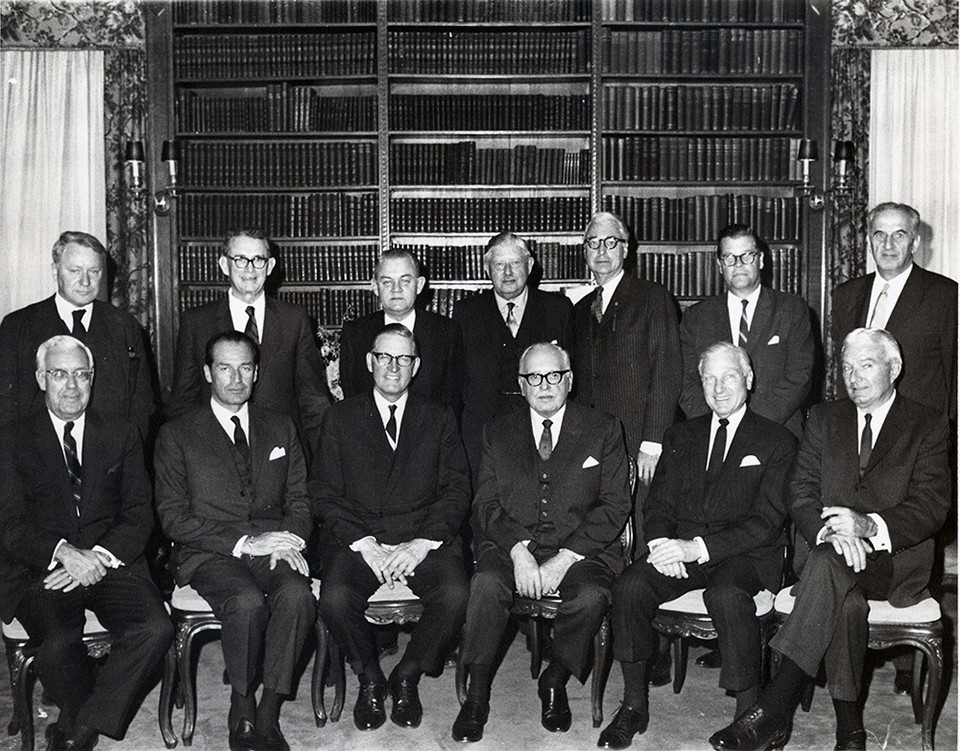
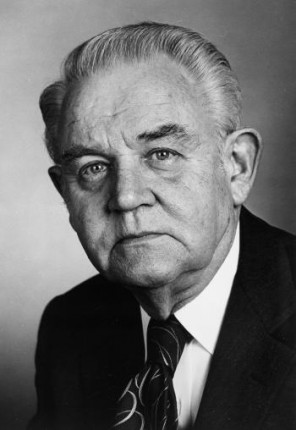
Vermont C. Royster

New York Times obituary, July 23, 1996

Vermont Royster, a former editor of The Wall Street Journal who won two Pulitzer Prizes and helped to shape his newspaper into the country's leading business daily, died yesterday in a retirement community in Raleigh, N.C., The Journal said. He was 82.

The Journal said Mr. Royster had been in ill health for several years.

Mr. Royster started as a reporter at The Journal in 1936 and worked his way up the ranks, becoming Washington correspondent, Washington bureau chief, editorial writer and editor.

Mr. Royster was also a senior vice president for Dow Jones & Company, the newspaper's publisher, and was a director of the company. After his 1971 retirement, he was named editor emeritus of The Journal and continued to write his weekly column, Thinking Things Over, until 1986.

Mr. Royster won his first Pulitzer in 1953, for editorial writing. The Pulitzer was awarded not for a specific editorial but for his work in general, which was praised for its "warmth, simplicity and understanding of the basic outlook of the American people."

In awarding him his second Pulitzer, in 1984, for distinguished commentary, the judges cited his column for its compassion and for putting contemporary events in a historical context.

Vermont Connecticut Royster was born in Raleigh. His given names were the same as those of his grandfather, whose own father named his children after states in the Union.

Mr. Royster graduated from the University of North Carolina and was a reporter for several newspapers in his home state before joining The Journal.

Mr. Royster interrupted his journalistic career to serve in the Navy during World War II. He was on convoy duty in the Atlantic and later served in the Pacific. He commanded a submarine chaser, a gunboat and a destroyer escort.

In person and in print, Mr. Royster was known for the gentle tone and rigorous thought that underlay his words. He was, in the words of one fellow journalist, "a gentle essayist among the shrillers of his time."

In 1953, Mr. Royster deplored the fact that some businessmen were discussing the truce in Korea in terms of bull markets and bear markets. "War itself is a terrible thing," he wrote, "but we find more terrible the fact that there are men walking about who talk of peace as if it were terrible."

In 1962, Mr. Royster was one of a group of American newspaper editors who had an audience with Nikita S. Khrushchev in which the Soviet leader said that, while he would rather invest in farm machinery than in rockets, his country had an anti-missile missile that could hit "a fly in outer space."

After retiring from The Journal, Mr. Royster became a professor of journalism and public affairs at the University of North Carolina.

In 1967, Mr. Royster's book "A Pride of Prejudices," a collection of some 100 editorials he wrote over two decades, was published by Knopf. His 1983 book, "My Own, My Country's Time: A Journalist's Journey," published by Algonquin Books, was an account of his childhood, his combat experiences and his years as a journalist.

In 1986, Mr. Royster received the Presidential Medal of Freedom, the nation's highest civilian award. Mr. Royster, President Reagan said, had a common sense "that exploded the pretensions of 'expert opinion,' and his compelling eloquence warned of the evils of a society loosed from its moorings in faith."

Mr. Royster is survived by his wife, Frances, and two daughters.