Pulitzer Prize Board 1944-1945
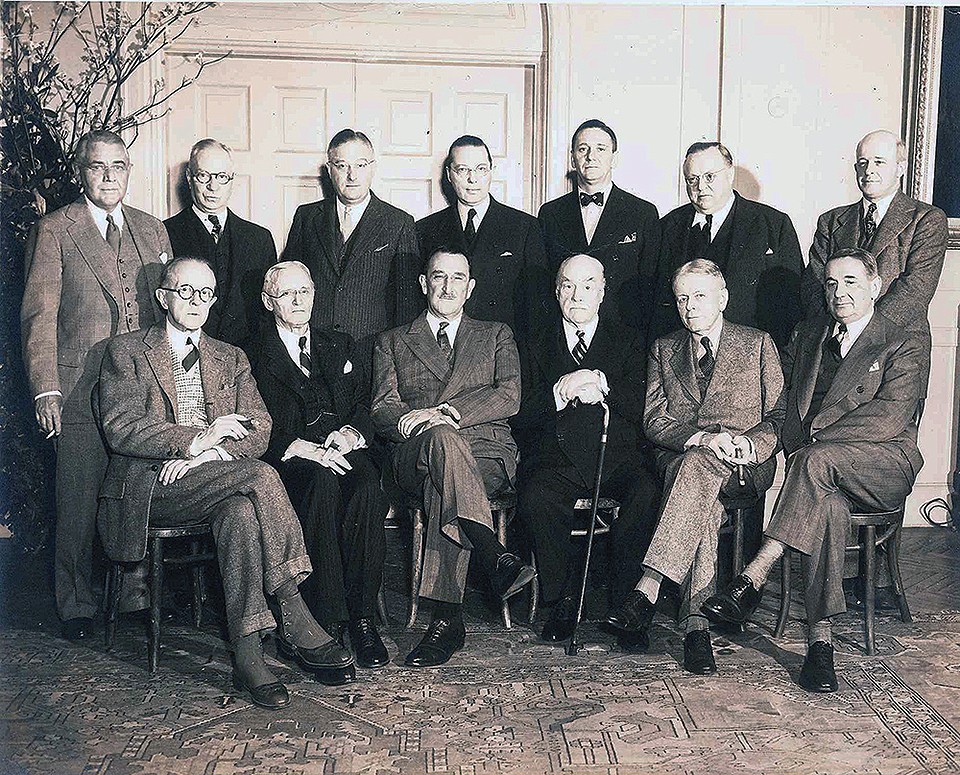
front row, left to right: H. Pollard, A. Howe, J. Pulitzer, N. Butler, S. Perry, K. Cooper; back row, left to right: S. Brown, F. Kent, A. Krock, C. Ackerman, R. Choate, R. Roberts, W. Mathews (absent from photo: J. Knight, W. Harrison)
(Courtesy of the Columbia University Libraries)
Carl William Ackerman (1890-1970), Columbia University B. Litt. 1913, was Dean of the Columbia University School of Journalism from 1931 to 1956. He spent from 1960 to 1962 researching and writing a biography (unpublished) of Hokan Bjornstrom Steffanson, 1883-1962, the Swedish-American industrialist and financier.
Ackerman was a champion of freedom of the press. His professional career was forged in both major World Wars. While working as a correspondent in World War I with the United Press, Ackerman came to attention when he published Germany, The Next Republic?, a book that discussed the possibility of a successful democracy in post-Kaiser Germany.
When the book was printed in 1917, at the height of World War I, this sentiment was considered quite radical. The London Times Literary Supplement commented: "For the serious student of affairs the importance of the book lies in the large mass of information which it contains as to the struggle which was going on all the time in Germany between the two great parties, the Pan-Germans and the party of comparative moderation which centered round the Foreign Office." Mexico's Dilemma was considered "topical," "limited in scope and subject," and of "little relevance." Trailing the Bolsheviki was similarly received. As a biography, Dawes, the Doer was panned as "poorly handled," whereas Biography of George Eastman was called by the New York Tribune "objective in the sense that it holds strictly to the drama of events in justification of its hero. This makes it eminently readable, even exciting at times, purely as an epic of success achieved, a sort of `Pilgrim's Progress' of business."
Mr. Ackerman was an outspoken advocate of a journalism foundation in the United States "dedicated to the study of the daily newspaper and government." He explained, "We need scientific studies of the press by the press, and for the press, which will contribute to the progress of journalism as the great educational foundations have advanced medicine."
Ackerman married Mabel VanderHoof in 1914, and was the father of Robert VanderHoof Ackerman. Writings by Ackerman: Germany, the Next Republic?, Hodder & Stoughton, 1917.; Mexico's Dilemma, Doran 1918, Gordon Press, 1976; Trailing the Bolsheviki, Scribner, 1919; Dawes, the Doer (biography), Houghton, 1930; Biography of George Eastman, Houghton, 1930. Ackerman authored numerous articles, pamphlets, and reports on journalism and related affairs.
(Courtesy of United Press International.)
PROVIDENCE, R.I. -- Sevellon Brown III, veteran Washington correspondent and reporter for the Providence Journal-Bulletin, died Wednesday at Rhode Island Hospital. He was 70,
Brown worked at the Journal-Bulletin from 1939 to 1968 when he retired because of ill health.
He was born in Washington on April 23, 1913, the son of Sevellon and Elizabeth Barry Brown.
His family had an association with the Journal-Bulletin that began in 1904 when his maternal grandfather, David S. Barry, left his post as Washington correspondent for the New York Sun to become editor-in-chief of the Providence newspapers.
Two years later, Barry returned to Washington as Journal-Bulletin correspondent. In 1919, he was elected sergeant-at-arms of the U.S. Senate.
The elder Sevellon Brown succeeded his father-in-law as Washington correspondent after service in World War I. He then moved to Providence as managing editor and later became editor and publisher of the newspapers.
The younger Brown, known as Jeff, was Journal-Bulletin Washington correspondent from 1939-1942 and as bureau chief from 1942 to 1944.
After World War II and service with the OSS in London, Brown returned to the Journal-Bulletin as assistant to the editor (his father) from 1946 to 1949, then as associate editor from 1949 to 1953. He was appointed editor on Feb. 4, 1953 and held the post until his retirement.
For several years he served on the advisory board of the American Press Institute, chaired the American section of the International Press Institute, served on Columbia University's Pulitzer Price selection committees, and on the committee that selected Nieman fellowships for Journalists at Harvard.
Brown was a board member and later president of the New England Society of Newspaper Editors and chaired the New England Associated Press News Executives Association.
He is survived by his wife, the former Janice O. Van DeWater, two daughters by a previous marriage, five grandchildren, and a brother, Barry Brown, of Washington.
A memorial service was scheduled at 1 p.m. Friday at Swan Point Chapel. Burial will be private.
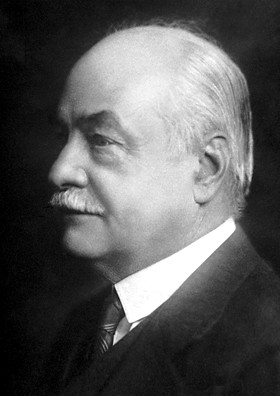
Nicholas Murray Butler (April 2, 1862-December 7, 1947) was an educator and university president; an adviser to seven presidents and friend of statesmen in foreign nations; recipient of decorations from fifteen foreign governments and of honorary degrees from thirty-seven colleges and universities; a member of more than fifty learned societies and twenty clubs; the author of a small library of books, pamphlets, reports, and speeches; an international traveler who crossed the Atlantic at least a hundred times; a national leader of the Republican Party; an advocate of peace and the embodiment of the «international mind» that he frequently spoke about. He was called Nicholas Miraculous Butler by his good friend Theodore Roosevelt; the epithet was so perfect that, once uttered, it could not be forgotten.
Born in Elizabeth, New Jersey, this son of Henry L. Butler, a manufacturer, and Mary Murray Butler, daughter of Nicholas Murray, a clergyman and author, began his career with a brilliant record as a student. In 1882, at the age of twenty, he received his bachelor's degree, in 1883, a master's degree, in 1884, a doctorate - all from Columbia College; in 1885 he studied in Paris and in Berlin where he began a lifelong friendship with Elihu Root, who was also destined to become a Nobel peace laureate. In the fall of 1885, he accepted an appointment on the staff of the Department of Philosophy at Columbia College, which in 1896 became Columbia University. And so began a professional association that was to last for sixty years.
From the first, Butler distinguished himself as an educational administrator. Within four years he gave administrative form to his philosophical theory of pedagogy by establishing an institute which, later affliated with Columbia, became known as Teachers College. He founded the Educational Review and edited it for thirty years, wrote reports on state and local educational systems, served as a member of the New Jersey Board of Education from 1887 to 1895, participated in the formation of the College Entrance Examination Board. He was named acting president of Columbia University in 1901 and president in 1902, retaining that position until retirement in October, 1945.
Under his presidency, Columbia University made phenomenal growth. It became a major university. All graduate studies were enormously expanded; the scope of professional training was enlarged to include new schools such as those of journalism and dentistry; the student body was increased from 4,000 to 34,000 and the faculty by a like ratio; the plant was enlarged by a construction program that averaged a new building each year, and the endowment kept pace; the professorial salaries were increased enough to attract many of the world's leading scholars to the teaching and research staff.
Butler moved in the realm of politics as easily as he did in that of education. He was a delegate to the Republican convention for the first time in 1888 and for the last in 1936. Butler, Root, William Howard Taft, and Theodore Roosevelt constituted a powerful political quartet in the early years of the century. Breaking with the others in 1912, Roosevelt ran for the presidency as the candidate of the Progressive Party, which drew most of its strength from Republicans, against the nominees of the constituted party: Taft for the presidency and Butler for the vice-presidency. By splitting the national vote, they permitted the Democrat, Woodrow Wilson, to win the election. In 1916 Butler failed in his attempt to secure the Republican presidential nomination for Root and in 1920 and 1928 failed to secure it for himself.
Meanwhile, Butler sought to unite the world of education and that of politics in a struggle to achieve world peace through international cooperation. He was chairman of the Lake Mohonk Conferences on International Arbitration, which met periodically from 1907 to 1912, and was appointed president of the American branch of International Conciliation, an organization founded by another Nobel peace laureate, d'Estournelles de Constant. His association with the Carnegie Endowment for International Peace was a fruitful one of thirty-five years. Influential in persuading Andrew Carnegie to establish the Endowment in 1910 with a gift of $ 10,000,000, he served as head of the Endowment's section on international education and communication, founded the European branch of the Endowment, with headquarters in Paris, and held the presidency of the parent Endowment from 1925 to 1945.
Butler married twice. His first wife, whom he married in 1887 and by whom he had one daughter, died in 1903; he remarried in 1907. When Butler became almost totally blind in 1945 at the age of eighty-three, he resigned the demanding posts he still held. He died two years later.
In 1940, Butler completed his autobiography with the publication of the second volume of Across the Busy Years. Both in size and in title it is peculiarly appropriate.
--From Nobel Lectures, Peace 1926-1950, Editor Frederick W. Haberman, Elsevier Publishing Company, Amsterdam, 1972
(Courtesy of The New York Times)
A Writer and a Businessman
By Deirdre Carmody
June 17, 1981
John S. Knight, founder of the Knight publishing empire and editor emeritus of Knight-Ridder Newspapers Inc., died last night of a heart attack at the home of a friend in Akron, Ohio. He was 86 years old. Dale Allen, executive editor of The Akron Beacon Journal, the first Knight newspaper, said that Mr. Knight had been hospitalized for two or three days with a heart condition after attending the 150th anniversary celebration of another of his papers, The Detroit Free Press, about a month ago.
Mr. Knight retired in 1976 as editorial chairman of the Knight-Ridder chain and divided his time between working in the offices of the Akron newspaper and in Miami at the chain's corporate offices one floor above The Miami Herald, another of the chain's papers.
As principal stockholder he owned just under 20 percent of the Knight-Ridder stock. His brother James owns about 10 percent of the outstanding shares.
In the early years of American journalism, publishers tended to be strong-willed, competitive men whose personalities and political philosophies dominated the newspapers they produced.
As times changed there emerged a new generation of publishers whose primary interest was to buy newspapers and create newspaper groups, and they turned American journalism into a full-fledged industry.
John Shively Knight belonged, in a sense, to both breeds. He inherited The Akron Beacon Journal from his father in 1933 and went on to assemble the Knight-Ridder newspaper group, which became the chain with the largest weekly circulation in the country.
By 1981 it included 34 daily newspapers in 17 states with an aggregate weekly circulation of 25 million. It also included four television stations, and in 1980 its revenues were $1.099 billion.
But, unlike many publishers who had little to do with the editorial side of their papers, Mr. Knight wrote a weekly opinion column for years on an ancient typewriter in his office. The column, entitled ''The Editor's Notebook,'' won him a Pulitzer Prize in 1968 for ''distinguished editorial writing.'' His opinions earned him descriptions by friends as ''crusty'' and ''blunt.'' Two More Pulitzers
Two Knight newspapers, The Detroit Free Press and The Charlotte Observer, also won Pulitzers in the same year as Mr. Knight. It was the first time that one publisher had carried off three of the journalism prizes.
''I'm a bleeder,'' Mr. Knight once said in describing his own writing habits. ''I used to sit here and struggle with the typewriter, smoking cigarettes and drinking soft drinks and ruining my gut. I'd go home from the office drained. This was work.''
One of his campaigns was for freedom of the press around the world and against censorship. His belief was that ''if the peoples of the world can come to know and understand one another through the freedom of international news exchange, many of the causes of war will have been eliminated.''
Mr. Knight was a firm believer in local control by each of his newspapers, as well as strong coverage of local news. He used to say that he wanted each of his papers to have its own ''character.'' Summing up his beliefs to fellow publishers in 1969, he said:
''Your first duty is to the citizen who buys your newspaper in the belief that it has characer and stability, that it is at all times a defender and protector of the rights and liberties of our people, that it does not yield to the pressure of merchant or banker, politician or labor union.''
Mr. Knight was born in Bluefield, W. Va., on Oct. 26, 1894. When he was 6 years old, his family moved to Akron, Ohio, where his father became advertising manager of The Beacon Journal. By 1915 the father had acquired full control of the paper.
As a boy, John worked at the newspaper on summer vacations; on election nights he sold extras on street corners. He attended high school in Akron, then the Tome School in Maryland and Cornell University. He left Cornell in his junior year to enlist in the Motor Transport Corps but was later transferred to the 113th Infantry, rose to Lieutenant and saw action in the Argonne. Just before the Armistice he joined the Army Air Corps.
After raising cattle for a brief time in California, Mr. Knight went to work at The Beacon-Journal in 1920 as a sportswriter. Five years later he became managing editor, and in 1933, upon his father's death, he inherited the paper.
Four years later he bought The Miami Herald and acquired and then discontinued The Miami Tribune. In 1938 he bought The Times-Press, the rival Akron paper, which left him with a monopoly in that city. In 1940 he bought The Free Press, Detroit's only morning paper, and in 1944 he bought controlling interest in The Chicago Daily News for $2.2 million, although he sold The Daily News in 1959. Public Triumph, Private Grief
By 1973 he owned 15 daily newspapers, including The Philadelphia Inquirer and Daily News. The following year, he consolidated his group by merging with Ridder Publications, thus adding ownership or substantial interest in 19 more dailies in the West and Middle West.
While his public life prospered, however, his private life was marked by grief. His first wife, Katherine McLain, died in 1929, eight years after their marriage, leaving him with three young sons. In 1932 he married Beryl Zoller Comstock, who died in 1974.
In the closing weeks of World War II, his eldest son, John S. Knight, was killed in action, two weeks before the birth of his own son. Another son, Frank, died of illness in 1958. In December 1975, Mr. Knight's grandson, John S. Knight 3d, who was an editor of The Philadelphia Daily News, was murdered in a robbery in his apartment.
The surviving son, Charles Landon Knight of Akron, is president of Portage Newspaper Supply Company, a Knight-Ridder subsidiary. In 1976, Mr. Knight married Frances Elizabeth Augustus, widow of Ellsworth H. Augustus, a Cleveland civic leader and millionaire industrialist.
Like Mr. Knight, she owned racing horses. The Knight stables in Miami were called the Fourth Estate Stables and most of the horses were given names related to newspapers, such as Wire Editor and Extra, Extra. She died in January.
Mr. Knight, who had held the title of chairman of the board and chief executive officer of the company, relinquished his last post as editorial director in 1976, saying, ''There is a time to quit. I quit when I was doing well.''
But he remained an avid reader of newspapers and continued to send editors notes chiding them for mistakes or offering words of praise for a job well done.
Stuart H. Perry (1874-1957) was a newspaper publisher and authority on meteorites. He made extensive collections of meteorites and donated many specimens to the United States National Museum (USNM). In 1940, Perry became an Honorary Associate in Mineralogy, USNM, a title he held until his death.