Pulitzer Prize Board 1969-1970
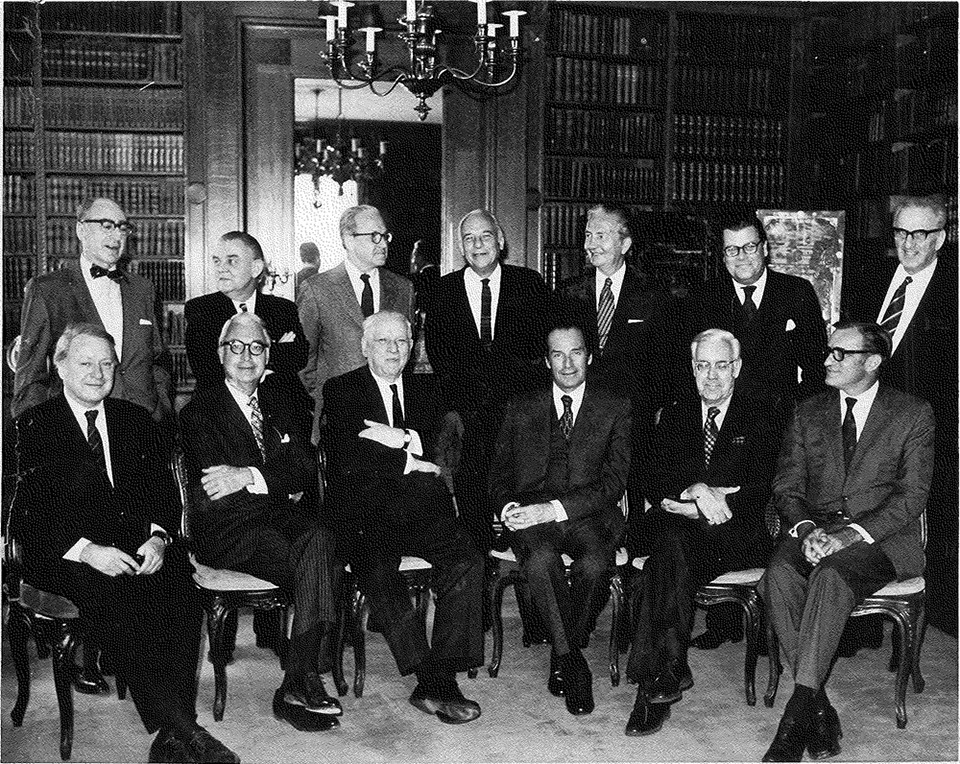
front row, left to right: J. Reston, K. MacDonald, A. Cordier, J. Pulitzer, E. Canham, S. Meyer; back row, left to right: N. Isaacs, V. Royster, W. Carroll, W. Dickinson, L. Hills, N. Noyes, J. Hohenberg (absent from photo: B. Bradlee)
(Courtesy of The New York Times)
Ben Bradlee’s Charmed, Charming Life
By David Carr
October 22, 2014
Civilians, people who don’t think the toppling of a sitting American president with newspaper articles is one of humankind’s lasting achievements, will read encomiums to Ben Bradlee like this one and wonder: What’s the big deal?
After all, he didn’t cover the Watergate story for his Washington Post, he picked the reporters. It’s not as if he wrote the articles, he edited them. But journalists are people who will go where they are pointed, and Mr. Bradlee generally pointed to important, consequential subjects. People who worked for him went through walls to bring back those stories, some of which revealed the true course of American history and some of which altered it.
The newspaper business can be a grand endeavor, but most of the people who commit journalism would never be mistaken for larger than life. Journalists are bystanders who chronicle the exploits of people who actually do things.
But Ben Bradlee did things. He went to war, loved early and often, befriended and took on presidents, swore like a sailor, and partied like a movie star. Now that he is gone — he died on Tuesday at the age of 93 at his home in Georgetown — it is tough to imagine a newspaperman ever playing the kind of outsize role that he once did in Washington. Newspapers, and people’s regard for them, have shrunk since he ran The Post.
He took over an also-ran paper and turned it into a formidable fighting ship like the one on which he served in World War II. Once the newspaper he oversaw gained steam, there was only the relentless effort to beat the competition, to find and woo talent, to pursue targets that The Post deemed worthy.
In the more than quarter-century that he helped lead the newsroom, from 1965 to 1991, he doubled its staff and circulation, and multiplied its ambitions. He would have been a terrible newspaperman in the current context — buyouts, reduced print schedules, timidity about offending advertisers — but he was a perfect one for his time.
“I had a good seat,” he told The American Journalism Review in a 1995 interview. “I came along at the right time with the right job and I didn’t screw it up.”
Mr. Bradlee had the attention span of a gnat — anecdotes of him walking away from a conversation he ceased to find interesting were common — but he was completely hypnotized by the chase of a good story.
His own life and persona make for a pretty fair tale: Boston Brahmin, junior naval officer in World War II, Paris in the ’50s, friend of the Kennedys, tormentor of Nixon. He was Zelig-like in his ability to appear at critical junctures in American history.
I knew him in the mid-’90s, when he was vice president at large of The Post, but he was still large, still engaged, perpetually on the hunt for political gossip or newsroom intrigue. He was a decent, if relentlessly loyal, source when I covered The Post as the editor of the Washington City Paper. But even though I barely knew him, he was hilarious to bump into.
“I like your paper a lot,” he’d deadpan, “whenever it doesn’t have its,” insert sailor adjective, “finger in my eye.” Cue big roar of laughter, dancing eyes, deep pleasure at his own riposte.
Anybody who has ever watched Mr. Bradlee enter a room knows that whatever “it” is, he had a lot of it. There was the smile, a flash of white teeth matching the white collar of the custom striped shirts he wore without fail, and a voice that was a mix of gravel and gravitas that had a hearty (and generally profane) word for everybody. In a town notorious for big entrances — Bill Clinton, Marion Barry, Ronald Reagan, you name it — Mr. Bradlee tilted a room just by being himself.
“He was one of those people who could make you feel like a superstar just by being in the same room with him,” David Von Drehle, a longtime Post writer now at Time, told me by phone on Tuesday. “Every woman in the room wanted to be with him, and every man in the room wanted to be him.”
He was a durable celebrity in Washington and beyond, partly because he was the rare person who became more handsome as he grew older. A photo from just two years ago that ran with a Post piece shows a remarkably good-looking 90-plus-year-old, a patrician pirate. Few journalists could suggest that they were better looking than the movie stars who played them, as Jason Robards portrayed Mr. Bradlee in the film about Watergate, “All the President’s Men,” but Mr. Bradlee could have claimed as much. He was more Clark Gable than Clark Kent.
By some estimations, including his own, his most enduring accomplishment had nothing to do with the Pentagon Papers or Watergate. After he became editor of The Post, he watched with envy as The New York Herald Tribune and magazines like Esquire and Playboy were using a different vocabulary, a so-called New Journalism, to expand the ways in which stories were told.
So in 1969, he conjured Style, a hip, cheeky section of the newspaper that reflected the tumult of the times in a city where fashion and discourse were rived with a maddening sameness. The effect on the business was profound, as if Chuck Berry had walked into a Glenn Miller show and started playing guitar. He expanded the vernacular of newspapering, enabling real, actual writers to shed the shackles of convention and generate daily discourse that made people laugh, spill their coffee or throw The Post down in disgust.
He had nothing of the commoner about him, hosting and grilling much of the world’s elite at the Georgetown home he shared with Sally Quinn, a Post society reporter who became his third wife. But although he grew up in Boston, not even knowing anyone who was black, he managed to make a credible newspaper in a majority-black city. His efforts to cover the black community in deeper ways, combined with an overeager desire to believe in an unbelievable story, led to a Pulitzer Prize being returned in the Janet Cooke affair, a big blemish on a very shiny run.
Mr. Bradlee could be almost cartoonishly ambitious. Asked by Katharine Graham, The Post’s publisher, about his interest in the top job at the paper, he immediately replied that he would “give my left one” for the opportunity. He probably would have gotten along fine on the remaining testosterone.
A player of favorites and an admirer of bravado, he famously vetoed the hiring of a reporter who had already been vetted and all but hired, because “nothing clanks when he walks.”
Ben Bradlee clanked when he walked.
***
The executive editor of The Post from 1965 to 1991, Bradlee oversaw the Post's prize-winning coverage of the Watergate affair. He came to journalism via Harvard, did a stint working for the State Department in Paris, before becoming a reporter and editor at Newsweek and The Post. In 1971, he defied the Nixon administration by publishing the Pentagon Papers, a top-secret study of the Vietnam War and endured harsh criticism from Republicans during the early days of the Watergate scandal. Vindicated by Nixon's resignation, Bradlee was lionized in the movie version of "All the President's Men," where he was portrayed by Jason Robards. In retirement he published a memoir, "A Good Life." -- from washingtonpost.com 7/18/2014 Benjamin Bradlee joined the Pulitzer Board in 1969.
Erwin D. Canham, who guided The Christian Science Monitor as its chief news executive for nearly three decades, died yesterday in Agana, Guam. It was under Mr. Canham's leadership that the churchsponsored paper attained its reputation for thoughtful, analytical coverage. Mr. Canham was 77 years old.
Mr. Canham underwent abdominal surgery on Guam two weeks ago. He and his wife, Patience, maintained homes on Saipan, where he had served as resident commissioner of the Northern Marianas Islands in the 1970's, and at Cape Cod, Mass.
Mr. Canham, a soft-spoken, genteel man with a puckish sense of humor, served the internationally circulated newspaper for 49 years as reporter, Washington bureau chief, columnist, managing editor, editor and editor in chief. He became editor emeritus in 1974 and five years later retired.
Strengthened Foreign Coverage
As the newspaper's editor from 1945 to 1964 and as editor in chief for the next 10 years, he strengthened The Monitor's coverage of foreign news and developed staff specialists in that and other areas.
"The paper had had expert editors before him, and they were competent professionals, but a more intense journalistic competence was developed under Canham,'' said Saville R. Davis, former managing editor of the paper.
Mr. Canham was also respected for his knowledge of international affairs, familiarity with political and business leaders around the world and his many outside interests.
''He was extremely speedy as a thinker and a writer,'' turning out a column and serving on outside comittees while putting out a newspaper, said the paper's editor, Earl W. Foell.
Paper's Charter From Miss Eddy
The Boston-based newspaper, which has a circulation of 180,000, has carefully adhered to the philosophy of Mary Baker Eddy, the founder of Christian Science who established the publication in 1908 and said its goal would be ''to injure no man, but to bless all mankind.''
In practice, this meant little emphasis on crime, violence and disasters, and greater attention to topics of long-term significance. In a departure from the practice at most other newspapers, The Monitor has given little attention to medical news because of the church's emphasis on spiritual healing. However, Mr. Canham said, this had its compensations because much medical news was of transient significance.
In explaining the newspaper's approach, Mr. Canham argued that, by the mid-1960's, radio and television had forced newspapers to go beyond ''the mere reporting of the event'' and that editors should ''press the task of reporting more deeply and widely.'' However, he warned that reporters must avoid coloring their articles with opinion.
Mr. Canham's career was an unusual combination of two deep interests: religious concern and a nose for news. A lifelong Christian Scientist, he taught a Sunday school class of college students at the Mother Church, near his office.
In 1966, he was given a one-year term in the largely honorary post of president of the church. In a worldwide lecture tour, he argued that the estrangement of science and religion was a mistake, adding, ''It is important to see that truth -spiritual truth - runs through all aspects of life.''
Robert P. Hey, The Monitor's managing editor, said: ''He had quite an extraordinary gift for combining the big, broad canvas, in terms of national and international coverage, with the importance of the individual, no matter what his job. He made it his business to know something about and to care about you.''
Erwin Dain Canham was born Feb. 13, 1904, in Auburn, Me. His father was agricultural editor of The Lewiston (Me.) Sun and Journal. Mr. Canham recalled that when he was 8 years old he stood on a chair in f ront of an old-fashioned wall telephone and took down items for publication. At 14, he became a general repor ter for the paper in theWorld War I manpower shortage.
He worked as a correspondent for up to eight daily newspapers while attending Bates College in Lewiston. Received Rhodes Scholarship
After graduating in 1925, he reported for The Monitor for a year before attending Oxford University as a Rhodes scholar. While there he covered the League of Nations for The Monitor.
Rejoining the newspaper full time, Mr. Canham covered national and international events, served as chief of the Washington bureau from 1932 to 1939, and was general news editor until 1942, when he became managing editor. Four years later he became the editor.
A year after being named editor emeritus, Mr. Canham was sent to Saipan by the United States Government to administer a plebiscite in which residents of the Northern Marianas Islands voted to withdraw from the American-administered Trust Territory of the Pacific Islands. He was Resident Commissioner from 1975 until 1978.
Accepted Outside Positions
Unlike some newspaper editors, Mr. Canham accepted a variety of outside posts. In 1948 he was vice chairman of the United States delegation to the United Nations Conference on Freedom of Information. In the Eisenhower Administration, he was chairman of the National Manpower Council and a member of the Commission on Information, which helped shape United States policy on information and propaganda.
In 1959, he was president of the Chamber of Commerce of the United States. In the 1970's, he was a member of President Nixon's Commission on Campus Unrest and a member of the board of the Public Broadcasting Service. He was president of the American Society of Newspaper Editors in 1948-49.
Mr. Canham's first wife, the former Thelma Whitman Hart, died in 1967. In addition to his wife, he is survived by two daughters, Carolyn Shale Paul and Elizabeth Davis. -- (from The New York Times, Jan. 4, 1982 by William Dickie) Edward D.
Canham joined the Pulitzer Board in 1958.
Wallace Carroll, Publisher And Editor, Is Dead at 95
Wallace Carroll, a retired newspaper editor and publisher who campaigned against the Vietnam War and led his paper to a Pulitzer Prize for environmental reporting, died on Sunday in a nursing home in Winston-Salem, N.C. He was 95.
Mr. Carroll had first joined The Winston-Salem Journal and Sentinel in 1949 as executive editor but left in 1955 to serve eight years as news editor of the Washington bureau of The New York Times. He returned to Winston-Salem as editor and publisher from 1963 to 1973. Under his direction, the paper favored gun control and busing to integrate public schools, positions unpopular with many North Carolinians.
Articles about environmental protection -- particularly a series on strip mining -- earned the paper the 1971 Pulitzer Prize for public service.
On March 17, 1968, he published a signed editorial in Winston-Salem under the headline ''Vietnam -- Quo Vadis?'' that argued that United States policy in Southeast Asia was misguided and irrelevant to the goal of thwarting Soviet expansion. Dean Acheson, the former secretary of state and an adviser to President Lyndon B. Johnson, showed the editorial to Johnson and stood by while the president read it. Later that month, Johnson announced that he would not run for re-election and would begin peace negotiations with North Vietnam. In an article about events leading to Johnson's announcement, The Washington Post reported that Mr. Carroll's editorial had influenced his thinking.
Two years later, Mr. Carroll wrote in another article: ''What we are losing is something more serious than the loss of any war or territory. It is the soul of America that is being lost in Vietnam. It is time for us to save the soul of America.''
Wallace Carroll was born in Milwaukee on Dec. 15, 1906, and graduated from Marquette University. He began his journalism career as a reporter with The United Press in Chicago, and the news agency sent him to Europe to cover the Nazi advances. After the United States entered the war, Mr. Carroll became director of the United States Office of War Information in London. He was friendly there with James Reston, then a war correspondent in London for The Times. Mr. Reston wrote in his memoirs, ''Deadline,'' that Mr. Carroll emphasized ''with his usual common sense'' the importance of explaining United States policy to Americans and people in the allied countries but was often rebuffed by his superiors.
After the war, he wrote a book about his work, ''Persuade or Perish,'' and became executive editor in Winston-Salem. Mr. Carroll maintained his friendship with Mr. Reston, and in 1955, Mr. Reston, as Washington bureau chief of The Times, hired Mr. Carroll to be his deputy with the title of news editor. Mr. Carroll was in charge of day-to-day coverage.
In his history of The New York Times, ''The Kingdom and the Power,'' Gay Talese wrote that James Reston offered to make Mr. Carroll bureau chief if he would stay at The Times. But Mr. Carroll declined the offer and in 1963, he returned to Winston-Salem to be editor and publisher.
Mr. Carroll's wife, Margaret, died last year. He is survived by a son, John S. Carroll, the editor of The Los Angeles Times, as well as by three daughters, Margaret Carroll of Washington, Rosamond Carroll of Kenfield, Calif., and Patricia Carroll of Arlington, Va.; four grandchildren and two great grandchildren.
After he retired in 1973, Mr. Carroll lectured for several years at Wake Forest University. Although Mr. Carroll spent most of his career as a news executive, Reston wrote that he had ''a studied respect for the English language'' and ''could have edited Lincoln's Gettysburg Address and improved it.''
-- (New York Times, July 30, 2002 by David E. Rosenbaum)
Mr. Carroll Joined the Pulitzer Prize Board in 1969.
Andrew Wellington Cordier was born in Canton, Ohio in 1901. He died on Long Island in 1975. Cordier was educated at Manchester College in Indiana, (1923-44); the Univ. of Chicago; and the Graduate Institute of International Studies in Geneva. From 1944 to 1946 he worked at the U.S. Dept. of State, after which he joined the United Nations, eventually serving as Executive Assistant to the UN secretaries general. He was a chief negotiator for the United Nations in the Congo in 1960.
In 1962 he left the UN to become Dean of the School of International Affairs (SIA) at Columbia University. He served as acting President of Columbia in the years 1968 and 1969; later he was appointed President (1969-70). After leaving the Columbia presidency, Cordier returned to his position as Dean of SIA and served until 1972.
In 1970 Cordier was awarded the Alexander Hamilton medal, the university's highest honor.
(from www.columbia.edu, 7/18/2014)
(Courtesy of the University of Wisconsin)
William Boyd Dickinson Jr. was born May 18, 1908 in Kansas City, Missouri. He graduated from the University of Kansas in 1929. After working for the Kansas City Star, he went to the United Press as a reporter from 1930-1948. While with UPI he served as a war correspondent in London from 1941-1944 and in Australia and Japan from 1944-1947. He married Joan Younger in 1949, and the two relocated to Philadelphia where he joined the Philadelphia Bulletin as an editor-a position he would hold until his retirement in 1973. He continued to write and report until his death in 1978.
Lee Hills, 93, Knight Ridder Official and Pulitzer Winner
By FELICITY BARRINGER
Published: February 5, 2000
Lee Hills, who began a journalism career as a teenage reporter covering mining disasters in Utah, continued it as an editor by bringing Pulitzer Prizes and national renown to The Miami Herald and The Detroit Free Press, and finally spread the gospel of quality journalism around the country as chief executive of the Knight Ridder newspaper group, died Thursday in Miami. He was 93.
He earned a law degree by the age of 29 while moving through newspapers in Oklahoma, Indiana, Ohio and Tennessee, and later became well versed in the financial side of the business, but Mr. Hills never strayed far from the newsroom.
Even as editor of The Free Press, he could not resist the lure of reporting -- a predilection that won him a Pulitzer Prize in 1955 for coverage of labor negotiations between the United Automobile Workers and the automakers. He later revealed that no less a figure than Henry Ford II had been a crucial source.
Five years later, as editor of The Miami Herald, he directed the newspaper's coverage of mob bosses living in the area, a series called ''Know Your Neighbor,'' which won that newspaper its first Pulitzer Prize.
Most of all, according to journalists who knew him, Mr. Hills saw probing, objective journalism as a calling and a public service. Mr. Hills -- an employee and friend of the late John S. Knight, who, with his brother James, owned the Knight newspaper group -- had sought to make the sharp, the curious, the critical and the crusading professionals around him adopt his standards of fairness, objectivity and excellence.
''He knew full well the kind of journalism he had come into, a journalism of faction and interests and parochialism and provincialism, and of a brawling independence as well,'' said Hodding Carter, speaking of the 1920's and 1930's -- when Mr. Hills covered everything from lynchings to the crime career of Charles (Pretty Boy) Floyd.
''But,'' Mr. Carter continued, ''he believed so strongly in the implications of a free press that he became one of the guys who helped to guide us into the period in which the adoption of standards and the notion of a semi-profession, with real connection to principle, and with the idea that the news came first and public interest came first.''
Mr. Carter, who is president of the John S. and James L. Knight Foundation, added: ''He came up wanting above all else to be a good newspaperman, a good journalist. He became, in effect, the prime minister for Jack Knight as he created a newspaper organization that was solidly successful economically and held to the old values in journalism throughout.''
Mr. Hills was born in Egg Creek Township, near Granville, N.D., in 1906. The family moved to Utah after his mother's death in 1911. It was in that state that he took his first job at a newspaper, sweeping floors at The Price News Advocate.
He received his college education at Brigham Young University and the University of Missouri. While working as a reporter and editorial writer at The Oklahoma City Times, which he joined in 1929, he earned a law degree. He later worked for that newspaper's competitor, The Oklahoma News, a Scripps-Howard newspaper, before introducing himself to John Knight in 1942.
According to the obituary in The Detroit Free Press yesterday, Mr. Hills, looking for a new job, asked to meet with Mr. Knight, who, with his brother, owned The Akron Beacon-Journal, The Detroit Free Press and The Miami Herald. Mr. Knight agreed to take him on as a news editor at The Herald. He soon became managing editor.
When the government rationed newsprint at the height of the war, Mr. Hills persuaded Mr. Knight to cut back on advertising to allow full space for war coverage.
Some of the reporting he made room for was his own, as he served briefly as a war correspondent for The Herald, and filed reports from the Far East, the Middle East and Latin America -- an area of the world that fascinated him. At The Herald, he supported extensive coverage of Latin America.
Even as the head of professional groups, he found a way to get back to his reporting roots. In 1962, touring the Soviet Union with 12 editors -- at the time he was president of the American Society of Newspaper Editors -- he got nationwide attention, reporting an interview with the Soviet leader Nikita S. Khrushchev.
As John Knight's chief lieutenant, Mr. Hills served for the better part of three decades -- from 1951 to 1979 -- as executive editor or publisher of both The Herald and The Free Press.
Alvah Chapman, who, like Mr. Hills, served as a chief executive of Knight Ridder, said yesterday: ''Lee, of course, was both a business operator and a journalist. He was responsible for the business success as well as the editorial success of The Detroit Free Press. But he was best known for editorial skills and news skills.''
Mr. Hills and Mr. Chapman, at Mr. Knight's behest, arranged the 1974 merger of Knight Newspapers Inc. with Ridder Publications Inc., producing a newspaper group that boasted a greater circulation than any of its rivals -- until the rapid growth of USA Today put the Gannett Company into the lead.
Mr. Hills was the first chairman and chief executive of the merged newspaper group. He retired as editorial chairman in 1981.
Mr. Hills was also an active philanthropist in both Detroit and Miami. Mr. Carter credits Mr. Hills with persuading the Knight brothers to set up the Knight Foundation with gifts amounting to more than $400 million. He also served as president of the Inter-American Press Association -- through which he met his third wife, Tina Ramos Hills.
Mr. Hills is survived by his wife and by Ronald Hills of Saratoga, Calif., his son with his first wife, Leona Hass, whom he divorced in 1944. His second wife, Eileen Whitman Hills, whom he married in 1948, died in 1961. He is also survived by two sisters, Louise Elwood, of Seattle, and BeverLee Margolis, of Mercer Island, Wash.; a brother, Stanley Hills, of Mercer Island; two grandsons and three great-grandsons.
Allen H. Neuharth, a colleague of Mr. Hills at The Herald and later, as founder of USA Today, a competitor, said yesterday: ''Among journalists, he was a reporter who never stopped being a reporter, even though he went on to be an executive and a publisher. But he retained his reporter's instincts and sensibility, and that motivated everything he did in his newspaper decisions.''
(Courtesy of The New York Times)
John Hohenberg, 94, Former Pulitzer Prize Official, Dies
By Douglas Martin
August 8, 2000
John Hohenberg, who began his journalism career as a teenager by snatching an interview with the president of the United States and went on to become administrator of the Pulitzer Prizes, died Sunday morning at his home in Knoxville, Tenn. He was 94.
Mr. Hohenberg also taught journalism for many years at Columbia University and wrote a widely used textbook on reporting. In all, he wrote 22 books -- including a novel at the age of 80 -- and maintained an arduous professional itinerary.
He wrote for numerous New York newspapers and taught at universities from New York to Tennessee to Florida to Kansas to Syracuse. He traveled the world, particularly Asia, lecturing for the State Department and other federal agencies. He began the practice of publishing the names of Pulitzer jurors and of drawing jurors from regions beyond New York.
Mr. Hohenberg came from the golden age of competitive newspapering, covering the 1935 trial of Bruno Richard Hauptmann -- who was convicted of kidnapping Charles Lindbergh's baby -- hanging out with Hemingway in Paris and reporting on the birth pangs of the United Nations and Israel. Tom Goldstein, dean of the Graduate School of Journalism at Columbia University, speaks of ''the John Hohenberg legend.''
Mr. Hohenberg's larger mission was elevating journalism itself, and he viewed the painstaking selection of Pulitzer winners as another means of raising the bar.
''Our news media, our reporters and editors -- if they are serious people and if they really mean business and aren't merely sensation-minded -- should be the conscience of the American people,'' he said in a 1988 interview in The New York Times.
He abhorred pomposity and wordiness, regarding journalism as a spontaneous ballet that could seldom be perfect because of daily deadlines. His motto, first growled to him by a crusty editor, was, ''Go with what you got.'' Generations of journalism students at Columbia committed the slogan to memory and the class of '69 had it printed on sweatshirts.
Mr. Hohenberg was born on Feb. 17, 1906, in a tenement on the Lower East Side of Manhattan, the son of Louis Hohenberg, a Hungarian immigrant, and Jettchen Scheuermann, an immigrant from Germany. When he was 18 months old, the family moved to Seattle, where his father set up several small businesses.
He started as an engineering student at the University of Washington but did not like it. His father refused to pay for the liberal arts education he wanted, so the gangling 17-year-old showed up at The Seattle Star, now closed, to ask for a job.
The response was brusque, he later recalled. ''Listen, kid,'' the city editor said, ''the president of the United States is coming to Seattle tomorrow. You get me an exclusive interview and I'll give you a job.''
When the Secret Service demanded to see his nonexistent press credentials, employment seemed unlikely. He called the office, fearing that his name would mean nothing.
''Mercifully,'' he wrote later, ''by grace of the kindly Jehovah that watches over babies, pretty girls and addled young men, the city editor remembered me and was sportsman enough to clear me for passage to the pier as a Star reporter.''
The result was a second's conversation in which President Warren G. Harding allowed that he liked Seattle. Mr. Hohenberg turned the remark into a three-page story. ''For better or worse, I had become a newspaperman,'' Mr. Hohenberg said.
The family soon moved back to New York to be nearer relatives. While attending journalism school at Columbia, Mr. Hohenberg worked for The New York Graphic, his first stop in 25 years of working for New York papers. After graduating, he toured Europe as the recipient of a Pulitzer Traveling Scholarship.
In 1948, as he was reporting on the establishment of the United Nations at Lake Success, N.Y., he was asked to substitute for a Columbia journalism teacher who had broken a leg. The students liked him, he liked the students and a new career began.
In 1960, he published what became the basic reporting and writing textbook used at many journalism schools, ''The Professional Journalist'' (Holt, Rinehart & Winston), which went through five editions and has been translated into Chinese, Japanese, Arabic and Spanish.
His 21 other books ranged from several histories of the Pulitzer Prize to an exhaustive history of foreign correspondence, recounting its beginnings in the Napoleonic Wars and offering long analyses of the challenges facing journalism.
Soon after his appointment in 1953 as administrator of the Pulitzer Prizes and secretary of the Advisory Board on Pulitzer Prizes, he nudged at least two members of the Pulitzer board into seeing all the plays under consideration for the drama prize, something not necessarily done before.
In later years, he wrote about how the Columbia trustees, as final arbiters, refused to accept the Pulitzer board's recommendation that The New York Times be given a prize in 1972 for its publication of stories based on the Pentagon Papers, the government's classified history of the Vietnam War.
The trustees were uneasy over the newspaper's decision to report classified material, an unusual action for journalists in that period. Columbia's president, William J. McGill, persuaded the trustees to reverse their decision.
Then, Mr. McGill and Mr. Hohenberg persuaded the trustees to yield veto power over the Pulitzers, perhaps the biggest procedural change during Mr. Hohenberg's tenure, which ended in 1975. The year before, he had accepted an appointment as professor of journalism at the University of Tennessee. That was the first of a chain of academic stops over the last two decades of his life.
Mr. Hohenberg married Dorothy Lannier, a classmate at Columbia, in 1928. She died in 1977. They had no children. He is survived by his second wife, JoAnn Fogarty Johnson, and her two children, whom he adopted: Pamela Green of Knoxville and Eric of Dawsonville, Ga.
In 1986, Mr. Hohenberg's wife found a yellowing manuscript on newspaper copy paper in the basement that turned out to be the skeleton of a spy novel he had abandoned in the 1920's. He whipped it into shape and sold it, under the title ''The Parisian Girl.''
In 1976 he received a Pulitzer Prize special award for his service to journalism. The citation said thousands of journalists had learned to value his tough integrity.
''From you they learned to respect the language,'' it read. ''They might split an infinitive because you taught them how. But they dare not dangle a participle. You forbid it.''
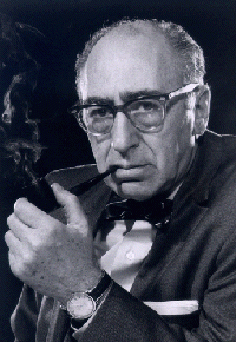
Norman E. Isaacs, Teacher and Editor, Is Dead at 89
Norman E. Isaacs, considered dean of American newspaper editors, former executive editor of the Courier-Journal and Louisville Times in Kentucky and teacher in Columbia’s Graduate School of Journalism, died Mar. 7 in an Alzheimer’s clinic in Santa Barbara, Calif. He was 89.
He died of heart failure, said his son, Stephen, a professor in the Journalism School.
Isaacs was a mentor to scores of students at Columbia as a lecturer and editor-in-residence from 1970 to 1980. He interrupted his Columbia career for a year, in 1975-76, when he was brought in as president and publisher of the daily newspapers of Wilmington, Del., to successfully resolve a management crisis and restore newsroom morale.
Isaacs was a highly regarded authority on journalism practice and ethics. He led the two Louisville papers during the 1950s and 1960s, when they won three Pulitzer Prizes, and where he created the first newspaper ombudsman. He was a special lecturer and editor-in-residence at Columbia for a decade and was a member of the Pulitzer Prize Board.
He attempted to overhaul the ethics codes of the Associated Press Managing Editors when he was the group’s president in 1953 and of the American Society of Newspaper Editors when he became its president in 1969. He was a founder of the National News Council and its chairman for five of its 10 years of existence in the 1970s and ‘80s. His book, Untended Gates: The Mismanaged Press, was published by Columbia University Press in 1986.
Norman Ellis Isaacs was born Mar. 28, 1908, in Manchester, England, and moved to Canada with his family when he was 3 and to Indianapolis when he was 13. His newspaper career began as a high school sports correspondent for the Indianapolis Star. After putting up briefly with an editor who took money from a sports promoter to run stories, he quit and joined the Indianapolis Times, found an ethical tutor in an editor there and rose to become managing editor of the paper at the age of 27. He became editorial director of the Indianapolis News in 1943 and managing editor of the St. Louis Star-Times in 1945.
He moved to The Louisville Times as managing editor in 1951 and became vice president and executive editor of The Courier-Journal & Louisville Times in 1961, remaining until 1970. The Courier-Journal won journalism’s highest award, the Pulitzer Prize gold medal for public service, in 1967 for articles on the Kentucky strip mining industry that advanced the conservation of natural resources. The papers also won Pulitzers in 1956 for editorial cartooning and 1969 for local spot news reporting.
His wife, Dorothy Ritz, died in 1977. He is survived by their two children, Stephen D. Isaacs of Dobbs Ferry, N.Y., and Roberta Matthews of Washington, D.C.; his second wife, Mildred, of Santa Barbara, five grandchildren and three great grandsons.
-- Columbia University Record, March 27, 1998
Kenneth MacDonald worked at the [Des Moines Register] for 50 years, starting at the age of 21. In 1926, MacDonald, a journalism graduate from the University of Iowa, came to see William Waymack, who was the managing editor. There was some mistrust of journalism graduates by the old guard, and Waymack didn’t give MacDonald much hope for a job, but he did mention that the news editor could use a copyreader. MacDonald walked out of Waymack’s office, into the newsroom and told the news editor he was ready to start.
He was known for wanting the paper to remain statewide and Iowa to be progressive. Under his leadership, the papers were among the first general circulation newspapers to scrutinize conservation, education, medicine, religion and the arts as regular sources of news. The newspapers became known for coverage of agriculture and as one of the few outside newspapers whose voice was heard in Washington. -- (from blogs.desmoinesregister.com
Kenneth MacDonald joined the Pulitzer Prize Board in 1958.
(Courtesy of The New York Times)
Sylvan H. Meyer -- Editor, 79
Correction Appended
Sylvan H. Meyer, a newspaper editor and outspoken white supporter of civil rights in Georgia in the 1950's and 60's, died on April 8 at his home in Dahlonega, Ga. He was 79.
Mr. Meyer, who was chairman of the Georgia advisory committee to the United States Civil Rights Commission from 1958 to 1965, advocated peaceful integration, a stand that led to death threats against him and his family.
He was editor of The Times of Gainesville, a daily newspaper in the North Georgia mountains, from 1950 to 1969 and editor of The Miami News in Florida from 1969 to 1973. He was also on the American Civil Liberties Union's national advisory counsel.
Born in Atlanta, Mr. Meyer graduated from the University of North Carolina.
His survivors include his wife, Alice Heineman Meyer; a daughter, Erica Rauzin of Miami Beach; two sons, David N., II, of Manhattan and Jason, of Pennington, N.J.; five grandchildren; and a brother, Leonard, of Atlanta.
Correction: April 24, 2001, Tuesday An obituary of the Georgia newspaper editor Sylvan H. Meyer on Saturday misstated the given name of his wife, who survives him. She is Anne Heineman Meyer, not Alice.
(Courtesy of The New York Times)
Newbold Noyes Jr., 79, Ex-Editor Of The Washington Evening Star
By Edward Wyatt
December 19, 1997
Newbold Noyes Jr., who as editor of The Washington Evening Star from 1963 to 1975 was the last member of four generations of his family to lead the newspaper, died yesterday in Sorrento, Me. He was 79.
Mr. Noyes had heart problems, said a son, Newbold Noyes 3d.
The Noyes family co-owned The Star from 1867 to 1975, when control of its parent company was sold to Joe L. Albritton, a Houston businessman. The paper ceased publication in 1981.
Mr. Noyes's great-grandfather, Crosby S. Noyes, joined The Star as a reporter soon after its founding in 1852 and bought a one-third interest in the paper. Frank B. Noyes, his grandfather, served as president of The Star and was one of the founders of The Associated Press, and Newbold Noyes Sr. served as associate editor of the paper.
After graduating from Yale University in 1941, Mr. Noyes joined The Star as a reporter, then served as an ambulance driver in the American Field Service from 1942 to 1944. He rejoined The Star as a foreign correspondent covering American troops in Italy, filing dispatches on the invasion of southern France and the Allied advance into Germany.
Mr. Noyes served as president of the American Society of Newspaper Editors from 1970 to 1971, as a director of The Associated Press and as a member of the Pulitzer Prize advisory board.
In addition to his son, Newbold, of Sorrento, Mr. Noyes is survived by his wife of 53 years, the former Beatrice Spencer, of Sorrento; another son, Howard Baldwin Noyes of Bodyke, County Clare, Ireland; two daughters, Alexandra Noyes Koenig of Plainfield, Vt., and Elizabeth Noyes, also of Sorrento, and 12 grandchildren.
Correction: December 20, 1997, Saturday An obituary yesterday about Newbold Noyes Jr., a former editor of The Washington Evening Star, misspelled the surname of the Houston businessman who bought control of The Star's parent company in 1975. He is Joe L. Allbritton, not Albritton.
Joseph Pulitzer Jr. Is Dead at 80; Publisher Was Avid Art Collector
by DENNIS HEVESI
Published: Thursday, May 27, 1993
Joseph Pulitzer Jr., chairman of the Pulitzer Publishing Company and owner of one of the world's finest collections of modern art, died yesterday at his home in the Central West End of St. Louis. He was 80.
Mr. Pulitzer died of colon cancer, the publishing company said in a news release.
Tall, elegant and reserved, Mr. Pulitzer had, for the last seven years, served primarily as chairman of Pulitzer Publishing, which owns three newspapers, seven television stations and two radio stations. He had led Pulitzer Publishing and its flagship publication, The St. Louis Post-Dispatch, for 38 years, serving for 31 of those years as editor and publisher of the newspaper.
Mr. Pulitzer relinquished his positions with the paper in 1986 to devote his attention to the company, which went public that year. From 1955 to 1986, he served as chairman of the board of the Pulitzer Prizes, the highest awards in journalism, which were established by his grandfather.
Avid Collector of Art
Though principally identified with journalism, Mr. Pulitzer was widely recognized for the art collection he began as a student at Harvard University, a collection that ultimately became one of the most important and generously shared in the world.
Art News magazine called Mr. Pulitzer's acquisitions "one of the most brilliant and comprehensive collections of modern art in the country," and John Russell of The New York Times described it as "one of the most discriminating" in the nation, saying it was "as remarkable for range as for quality."
Born on May 13, 1913, Mr. Pulitzer was baptized in the Episcopal Church as Joseph Pulitzer 3d, but he later adopted the junior designation, which his father had dropped after the death of the first Joseph Pulitzer.
Mr. Pulitzer graduated from St. Mark's School in Southborough, Mass., in 1932, and went on to earn his bachelor's degree in fine art from Harvard in 1936. His newspaper career began with a stint as a cub reporter for The San Francisco News in 1935, the summer before his senior year at Harvard. After graduating, he joined The Post-Dispatch news staff and helped cover the Roosevelt-Landon campaign of 1936.
'Illuminate Dark Places'
Over the next 20 years, he worked in every department of the paper, including periods as editor of the daily magazine and editor of the Sunday rotogravure, or pictorial. In 1948, he became associate editor, a position he held until he became editor and publisher on the father's death in 1955.
In an editorial he wrote on the day he took over the paper, a week after his father's death, Mr. Pulitzer pledged that The Post-Dispatch would maintain its tradition as one of the nation's great crusading papers. "We will not only report the day's news but illuminate dark places, and, with a deep sense of responsibility, interpret these troublous times," he wrote.
At the time, besides the newspaper, Pulitzer holdings included only a radio and television station in St. Louis. But under Joseph Jr.'s guidance, the company bought The Arizona Daily Star in Tucson and The Southtown Economist in Chicago, six other television stations and another radio station.
In 1986, the Pulitzer company faced its greatest financial challenge. It had accrued a large debt, and a group of dissident relatives who owned stock in the privately owned company found a buyer, A. Alfred Taubman, a Michigan real estate developer, who offered $625 million for the company. The company successfully resisted the takeover bid, going public with the stock in order to offset its debt.
In 1989, the company faced another challenge when Ralph Ingersoll 2d began publishing The St. Louis Sun. Although that newspaper failed after only seven months, its presence spurred the staid Post-Dispatch to improve its coverage.
A Litany of Firsts
During Mr. Pulitzer's tenure as editor, The Post-Dispatch won five Pulitzers, including prizes for commentary and editorial cartooning. In 1987, Mr. Pulitzer received a special citation from the Pulitzer Prize board, citing his "extraordinary services to American journalism and letters."
The Post-Dispatch was one of the first newspapers in the country to oppose the war in Vietnam, and it was also one of the first to publish excerpts from the Pentagon Papers, the secret history of the war.
It was also the first paper in the country to replace the old letter-press printing process with offset cold-type printing, which allowed high-quality color printing. "Color was of special interest to an art connoisseur like Mr. Pulitzer," the company's statement yesterday said, "and at his insistence The Post-Dispatch moved early into color publication."
Hobby Became a Passion
Mr. Pulitzer's art collecting began simply enough in 1936 when as an undergraduate he bought Modigliani's "Elvira Resting at a Table." Three years later, at an auction in Lucerne, Switzerland, he bought "Bathers With a Turtle," by Matisse for $2,400, a piece that is now easily worth 10,000 times that amount.
Mr. Pulitzer's father had no enthusiasm for modern art and sometimes took his friends into his son's room to ridicule the purchases. "He was convinced that I had been fleeced by shrewd and unscrupulous New York dealers," Mr. Pulitzer said in a speech earlier this year.
Later, when his father realized the value of his collection and asked where he learned so much about art, Mr. Pulitzer told him that the knowledge had been acquired at Harvard and that the elder Pulitzer had footed the bill.
The Pulitzer Collection came to include 86 pieces, all of which were shown at the Fogg Art Museum in Cambridge, Mass., in 1988. The collection could have included Picasso's seminal work "Demoiselles d'Avignon," but Mr. Pulitzer had bought it before World War II and then donated it to the Museum of Modern Art.
Mr. Pulitzer always insisted on anonymity when lending his works to museums.
His collection included Vuillard's "Self Portrait," and "Head of a Man" by Degas, one of Monet's "Water Lilies," as well as works by Braque, Picasso and Miro.
Mr. Pulitzer's first wife, Louise Vauclain, died in 1968. He married again in 1973, to the former Emily S. Rauh, who at the time was curator of the St. Louis Art Museum.
He is survived by his son, Joseph Pulitzer 4th; his half brother, Michael of St. Louis, two sisters, Kate Davis Quesada of Hobe Sound, Fla., and Elinor Hempelmann of Rochester, and four grandchildren.
(Courtesy of The New York Times)
James Reston, a Giant of Journalism, Dies at 86
By R.W. Apple Jr.
December 7, 1995
WASHINGTON, Dec. 6— James Reston, former columnist, Washington correspondent and executive editor of The New York Times, died tonight at his home here. He was 86.
The cause was cancer, said his son Thomas.
First as a reporter and then, beginning in 1953, as a columnist, Mr. Reston was perhaps the most influential journalist of his generation. In Washington, where he was based, and also in other capitals around the world, he had unrivaled access to the high and the mighty. Yet he retained a wry, self-deprecating personality, free of bombast, and always sought to reduce political complexity to plain language.
"What I try to do," he said, "is write a letter to a friend who doesn't have time to find out all the goofy things that go on in Washington."
Interested in China and the Soviet Union as well as the United States, a student of diplomacy as well as domestic politics, he won two Pulitzer Prizes and dozens of other awards.
Mr. Reston was forgiving of the frailties of soldiers, statesmen and party hacks -- too forgiving, some of his critics later said, because he was too close to them. But his stern moral standards, rooted in the Victorian values of his youth, never wavered. He remained an idealist in a world of cynics.
From his strong-minded mother he inherited a Presbyterian conscience and an abiding sense of duty and responsibility. Work hard, he was taught. Work for large goals that transcend self-interest. Be cooperative. Be modest.
A talent scout of prodigious capacity, Mr. Reston hired and trained many of The Times's best-known journalists, and served as mentor to many more. To each of them, he passed along a lifetime's lessons about craft and country.
Mr. Reston's 50-year association with The Times began when he joined its London bureau on Sept. 1, 1939, the day Hitler's armies marched into Poland, igniting World War II. It was a fitting day on which to start his career at the paper, much of which would be spent recording and reflecting upon the aftermath of that fateful day.
His nationally syndicated column appeared regularly until 1987, when he became senior columnist. He retired from The Times in 1989, without ceremony, on his 80th birthday.
In an interview marking the occasion, he said the two greatest political triumphs in his lifetime had been the common defense system developed by the West after World War II and the improvement in the lot of black people in America since 1960.
Mr. Reston, who was born in Scotland, described the men who met in Philadelphia in 1787 to draft the Constitution as the great heroes in his adopted country's history. The document that they produced, he said, made possible "the triumph of the moderates" over the next two centuries.
A moderate himself, hostile to both fascism and communism, he described journalism's role in their eclipse as "one of the great pleasures of my life."
Asked whom he had most admired, he cited Franklin D. Roosevelt as the finest President he had known and Dean Acheson, Secretary of State in the Truman Administration, as "the key man" who "came to the fork in the road" and concluded that containing the Soviet Union would require a new alliance.
But he chose Jean Monnet, the French visionary who conceived the European Community, as the greatest man he had ever known as well as the person who had most deeply influenced his own thinking. Monnet proved, Mr. Reston often said, that "if you don't demand credit for things, you can push them through."
Mr. Reston thought of himself primarily as a reporter, and he often beat his competitors to be the first to write about major news events. His coverage of the Dumbarton Oaks Conference in Washington in 1944, which laid the groundwork for the United Nations, was one of the era's most important exclusives and won him his first Pulitzer, in 1945. Those articles disclosed the substance of secret documents that were then being circulated among delegations from the United States, the Soviet Union, Britain and China on the structure of the proposed international organization.
Mr. Reston won his second Pulitzer in 1957 for distinguished reporting from Washington. The articles cited were written in June 1956 and analyzed the effects of President Dwight D. Eisenhower's illness on the functioning of the executive branch.
He was also responsible for The Times's publication in 1955 of the documents of the 1945 Yalta Conference. And in 1954 he disclosed that J. Robert Oppenheimer, who had directed the making of the first atomic bomb, had subsequently been denied access to secret documents by the Atomic Energy Commission because of suspicion that he was passing information to the Soviet Union, a charge of which Oppenheimer was later cleared.
One exclusive dispatch came by accident. In 1971, as one of the first American reporters allowed into China, Mr. Reston developed appendicitis. His report, filed from his bed in the Anti-Imperialist Hospital in the capital, ran on the front page under the headline "Now, About My Operation in Peking."
From the 1950's on, Mr. Reston interviewed most of the world's leaders, often producing major news accounts that were scrutinized at the State Department for their every nuance. The interviews often bore the special Reston stamp: He sought to reveal not only the policies and the politics of the people he interviewed, but also their vision of life and their view of history.
Mr. Reston, who was called Scotty by virtually everyone who knew him, was 5 feet 8 inches tall and had a round and ruddy face, gray-green eyes, an ever-present pipe and an invariably pleasant manner. He was courteous not only to high-level officials but also to the young people who worked for him.
"He believes in hard work, in thrift, honor your parents, woman's place is in the home, play by the rules and live clean," his colleague Russell Baker once said.
Mr. Reston was credited by competitors with having more high-level news sources in Washington than almost any other reporter, although some critics felt that he was too kind in print to some of them. The economist John Kenneth Galbraith, reviewing Mr. Reston's "The Artillery of the Press," a 1967 collection of his talks before the Council on Foreign Relations, suggested that Mr. Reston had learned to his disadvantage "to treat all people in the manner of a newspaperman who must one day go back and see them again."
But in a 1980 article in The New Republic, Mr. Reston was quoted as saying: "If you spend your life as a hatchet man -- and there's something to be said for that -- then eventually you find that everybody's out to lunch when you call. You're left with only your own opinion. I wouldn't like that because my own opinions aren't that good."
Writing his column three times a week, Mr. Reston was a procrastinator, often filing right on deadline, to the dismay of night editors at The Times. A two-finger typist, he regularly wore out typewriters because he banged so hard on the keys, and his desk was a litter of papers, many of which bore tiny black marks where a stream of smoldering matches had landed in the course of a never-ending pipe-lighting ritual.
His columns, laced with quotations from Walter Lippmann, H. G. Wells, Matthew Arnold and Churchill, were a combination of high moral tone, detailed reporting, allusions to sports, impish humor and evocative descriptions of seasonal changes along the Potomac. They seldom offered absolute judgments about people or events; he used the word "maybe" more than most pundits.
His first column, on Oct. 18, 1953, established the Reston style.
"This town is still full of echoes from the days of America's isolation," he wrote of Washington. "It has changed in policy and personnel, more than any other world capital in the last generation. No nation has taken on so much or moved so far in such a hurry. Yet the habits of the past, like the bent figures of homeless former senators, still haunt the capital."
He often returned to certain themes, such as the role of the press. In his column of Oct. 30, 1968, when Spiro T. Agnew, soon to be elected Vice President, was denouncing news organizations, Mr. Reston wrote:
"The candidates and the press are fussing at each other again, and this is the way it should be. They have different jobs, and in many ways they are natural enemies, like cats and dogs. The first job of the candidate is to win, and he usually says what he thinks will help him win. The job of the reporter is to report what happens and decontaminate as much of the political poison as he can. The conflict is obvious."
In addition to his two Pulitzer Prizes, Mr. Reston was awarded the Presidential Medal of Freedom in 1986 and the Franklin D. Roosevelt Four Freedoms Award in 1991. He received the Overseas Press Club award for interpretation of international news three times, the George Polk Memorial Award for national reporting and the French Legion of Honor, and was named Commander, Order of the British Empire. He also received 28 honorary degrees.
After retiring, he fulfilled a longtime promise to his wife, Sally, by writing his memoirs. Titled "Deadline," they were published by Random House in 1991.
Reviewing the book for The New York Times, Ronald Steel, author of "Walter Lippmann and the American Century," called Mr. Reston "the quintessential Washington insider."
"Officials used him to test out new ideas on the public or to drop leaks for which they did not want to be held accountable," Mr. Steel wrote. "Because of his high position at The Times and his personal integrity, he was trusted both by those who provided the news and by those who read it.
"But what he did so well and so usefully for so long could not be done today. Journalism and the political world have changed too much."
James Barrett Reston began life about as far from the Washington power center as one could get.
He was born in Clydebank, Scotland, on Nov. 3, 1909, the son of James, a machinist, and Johanna Irving Reston. The Restons migrated to the United States when he was an infant, but Mrs. Reston became ill, and the family returned to Scotland.
There followed years of harsh poverty, of life in a brick tenement where young James and his sister slept crosswise at the foot of their parents' bed. In 1920 the family returned to the United States and settled in Dayton, Ohio. His father worked for the Delco Remy Division of General Motors.
When his parents were naturalized, young James automatically became an American citizen. In 1932, he graduated from the University of Illinois with an undistinguished academic record. He had majored in journalism, skipping the course in governmental reporting but getting an A in sportswriting.
During his high school years he caddied at the Dayton Country Club golf course. His own game became so good that he twice won the Ohio state public links championship and at Illinois was captain of the Big Ten championship golf team in 1932. His father wanted him to become a golf pro. His mother wanted him to be a preacher, which, he was to say later, is really what he became.
In the winters during his school days, he hung around The Dayton Daily News. "When the phone rang, I'd pick it up and take down the scores," he later recalled. "And from that I just moved into newspapering. I never thought of anything else."
Another link to the world of newspapers was Gov. James M. Cox, the Ohio publisher and 1920 Democratic Presidential candidate, for whom young Reston had caddied. Mr. Cox gave him his first job after college on one of the Cox newspapers in Ohio, The Springfield Daily News, where he earned $10 a week as the sports editor.
Later he was hired as traveling secretary and publicity director for the Cincinnati Reds baseball team. In 1934 he moved to New York as a sportswriter for the Associated Press Feature Service.
The next year he married Sally Jane Fulton, a former college classmate who had been president of her sorority, an A student and a Phi Beta Kappa in her junior year. Named Sara but always called Sally, she was the daughter of a judge from Sycamore, Ill., a small town near Chicago.
Mr. Reston once told a University of Illinois graduating class, "I should say in passing that I myself married a recklessly beautiful girl whom I first saw on Wright Street wearing a scarlet coat."
"My Gal Sal," as he called her in the dedication of "Sketches in the Sand," a collection of his columns published in 1967, became his closest confidante, frequent collaborator and steadiest supporter.
They had three sons, Richard, James Jr. and Thomas. Mr. Reston's own happy situation made him a champion of marriage, and he was forever asking his young bachelor colleagues when they were going to wed.
In 1937 The Associated Press sent Mr. Reston to London on a rather loose dual assignment: in summer covering sports events, in winter the British Foreign Office.
In 1939 he joined The Times and became low man on the totem pole in the London bureau, with a salary of $85 a week. He was so little known on the foreign desk in New York that his first byline in The Times had his name wrong -- John instead of James.
Then came the London blitz. The Times's office for much of the war was on the seventh floor of the Reuters Building on Fleet Street, which offered a view of the dome of St. Paul's Cathedral. He described this view of the battle in his first book, "Prelude to Victory."
"Before we got better sense, we used to put the lights off in the Times office every night and watch this effort," he wrote. "With uncanny regularity, the German bombers would come over just about 10 minutes after blackout and start dropping incendiary bombs all over this section. About an hour before we could see the flames, we would begin to hear the steady throb of scores of engines along the banks of the Thames; these were the pumps, driving the muddy water from the river up through miles of new hose. . . .
"A little later the sky would begin to change in color from midnight blue to a reddish glow, and soon the great dome of the cathedral would stand out in silhouette against the flames of perhaps a dozen raging fires. Night after night we watched this incredible scene, and morning after morning we marveled at the fact that the fires were somehow put out."
In December 1940 he was reassigned to Washington, and in 1942 published "Prelude to Victory," a call to action to the American people that was acclaimed here and abroad. Its theme was pure Reston: Unless Americans put aside personal aims and materialistic thinking and made sacrifices in a crusade for their country, the war would not be won.
In late 1942, Elmer Davis, head of the Office of War Information, obtained a leave of absence from The Times for Mr. Reston and sent him to London to set up the agency's effort there.
John G. Winant, the United States Ambassador to Britain, recommended him to Arthur Hays Sulzberger, then president and publisher of The Times, who was looking for an assistant. It was the beginning of Mr. Reston's close friendship with the Sulzberger family.
Mr. Reston returned to Washington and was named national correspondent in 1945. He made his mark with his coverage of Dumbarton Oaks, which illustrated a Reston maxim: Seek out the disgruntled party. His theory was that people who were disenchanted were more likely to talk candidly.
In this case, it was the Chinese representatives to the conference who were disenchanted. In his memoirs, Mr. Reston told of having met Chen Yi, one of the Chinese delegates, some years before the war through Iphigene Ochs Sulzberger, wife of The Times's publisher. At Mr. Reston's urging, Chen Yi slipped him the complete texts of the proposals.
Instead of writing one long article, Mr. Reston doled out the information, producing an exclusive a day. The Russians thought Washington had leaked the material; Washington suspected the British, and the F.B.I. started an investigation of Mr. Reston.
In 1948 Mr. Reston became diplomatic correspondent for The Times, and in 1953 he became Washington bureau chief, succeeding Arthur Krock.
Mr. Reston continued as bureau chief until 1964, when he voluntarily relinquished the post to concentrate on his column.
In 1968 he was summoned to New York by Arthur Ochs Sulzberger, who had become publisher, to succeed Turner Catledge as executive editor, in charge of the entire news operation. The internal politics of the news department had received publicity after an unsuccessful effort by editors in New York to exert more control over the Washington bureau. Mr. Reston's mandate was to re-establish peace.
For 13 months he ran the news department while commuting to Washington a few times a week to write his column. It was an almost impossible job. In 1969, knowing that his column was suffering and that he had to choose between it and the editor's post, he gladly chose the column.
Mr. Reston was eminently a Washington man. He loved and understood the capital. Moreover, he had helped shape the Washington bureau. These were his people, and many of them regarded him as a father figure. The New York office, on the other hand, seemed a vast, impersonal beehive, and Mr. Reston never felt totally comfortable there.
During these years the Restons lived in a pleasant red brick house on Woodley Road in leafy northwest Washington and spent weekends at their log cabin in Fiery Run, Va. Mr. Reston often used Fiery Run as the dateline on his Thoreau-like columns about the restorative life in the country.
In 1968 the Restons purchased The Vineyard Gazette, a 122-year-old weekly on Martha's Vineyard, Mass., where they vacationed in the summer. The paper has remained in the family; their son Richard is editor and publisher, and his wife, Mary Jo, is publisher and general manager.
Mr. Reston played a part in the publication of the Pentagon Papers in 1971 and in two other major news events involving The Times in questions of national security. The others were the Bay of Pigs invasion in 1961 and the Cuban missile crisis of 1962.
In the spring of 1961, The Times was preparing to publish an article by Tad Szulc reporting that 5,000 or 6,000 Cuban exiles who had been training in the United States and in Central America for nine months were about to launch an invasion of Cuba to overthrow the regime of Fidel Castro.
The article was planned for page 1 on April 7, under a four-column headline. But Orvil Dryfoos, then the publisher, was troubled by the security implications of the report. On April 6, he and Mr. Catledge, then managing editor, telephoned Mr. Reston, who advised them not to publish the article and cautioned against giving away the proposed timing of the landing as "imminent."
The article was published on April 7 under a one-column headline and with no mention of the invasion's date. The Bay of Pigs invasion took place 10 days later and ended in debacle. President John F. Kennedy, who took full responsibility, said that if The Times had published more about the operation, it might have saved the Administration from making such a colossal mistake.
"If I had it to do over, I would do exactly what we did at the time," Mr. Reston said later. "It is ridiculous to think that publishing the fact that the invasion was imminent would have avoided this disaster."
In 1962 Mr. Reston was apparently the only reporter who had found out that the Soviet Union, then under the leadership of Nikita S. Khrushchev, had secreted nuclear missiles in Cuba, only 90 miles from Florida. When Kennedy realized that Mr. Reston had the information, he telephoned him directly.
Four years later, Mr. Reston recounted the incident to E. Clifton Daniel, then managing editor of The Times.
"The President told me that he was going on television on Monday evening to report to the American people," Mr. Reston recalled. "He said that if we published the news about the missiles, Khrushchev could actually give him an ultimatum before he went on the air.
"I told the President I would report to my office in New York," Mr. Reston continued. "And if my advice was asked, I would recommend that we not publish. It was not my duty to decide."
Kennedy then called Mr. Dryfoos, the publisher, and asked him not to print Mr. Reston's article. Mr. Dryfoos left the matter up to Mr. Reston and his staff, and the article was withheld.
It was a different story, however, in 1971 when The Times obtained and published what became known as the Pentagon Papers, the Government's top-secret documents on the Vietnam War. Seeing this at once as "the story of the century," Mr. Reston was one of the editors who felt that the documents should be published because they were history and that therefore no question of national security was involved.
One of Mr. Reston's contributions to journalism was the corps of young reporters he discovered and developed.
In 1961 he instituted a program of internships for young would-be reporters, modeled on the clerkships at the United States Supreme Court and suggested to him by the late Justice Felix Frankfurter. Each year he would recruit a new college graduate as his clerk and researcher. He paid a price for this program, as time and again the young clerks with lofty journalistic thoughts would mix up his airline reservations or keep the Secretary of State waiting because they had failed to cancel a scheduled appointment.
Linda Greenhouse, who went on to report on the Supreme Court for The Times, recalled that on her first day as a clerk, Mr. Reston asked her to get Ted Sorensen on the phone and suggested she try Paul Weiss in New York. After unsuccessfully calling every Weiss-comma-Paul in the Manhattan phone book, she reported back to Mr. Reston.
"He didn't groan, tear his hair or -- more important, and the reason for my undying gratitude -- laugh at me," Ms. Greenhouse said. "He gently explained that Paul, Weiss was a New York law firm where Ted Sorensen was working, looked up the number and gave it to me."
It was perhaps this quality, this unfailing kindliness, that constituted his special attractiveness. It enabled him to view the faults and frailties of the world with compassion and to carry on in the belief that the best in mankind would eventually win out over the worst.
"Stick with the optimists, Niftie," he wrote in a column in February 1980, welcoming his new grandson, Devin Fitzgerald Reston, to the human race. "It's going to be tough enough even if they're right."
Mr. Reston is survived by his wife; his sons, Richard F. Reston of Martha's Vineyard, James B. Reston Jr. of Chevy Chase, Md., and Thomas B. Reston of Washington; his sister, Joanna Richey of Santa Cruz, Calif., and five grandchildren.
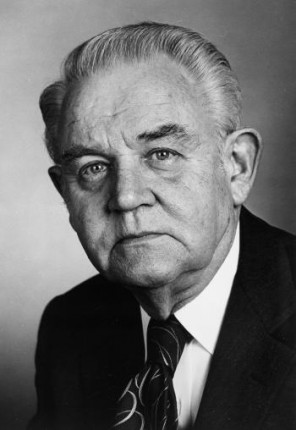
New York Times obituary, July 23, 1996
Vermont Royster, a former editor of The Wall Street Journal who won two Pulitzer Prizes and helped to shape his newspaper into the country's leading business daily, died yesterday in a retirement community in Raleigh, N.C., The Journal said. He was 82.
The Journal said Mr. Royster had been in ill health for several years.
Mr. Royster started as a reporter at The Journal in 1936 and worked his way up the ranks, becoming Washington correspondent, Washington bureau chief, editorial writer and editor.
Mr. Royster was also a senior vice president for Dow Jones & Company, the newspaper's publisher, and was a director of the company. After his 1971 retirement, he was named editor emeritus of The Journal and continued to write his weekly column, Thinking Things Over, until 1986.
Mr. Royster won his first Pulitzer in 1953, for editorial writing. The Pulitzer was awarded not for a specific editorial but for his work in general, which was praised for its "warmth, simplicity and understanding of the basic outlook of the American people."
In awarding him his second Pulitzer, in 1984, for distinguished commentary, the judges cited his column for its compassion and for putting contemporary events in a historical context.
Vermont Connecticut Royster was born in Raleigh. His given names were the same as those of his grandfather, whose own father named his children after states in the Union.
Mr. Royster graduated from the University of North Carolina and was a reporter for several newspapers in his home state before joining The Journal.
Mr. Royster interrupted his journalistic career to serve in the Navy during World War II. He was on convoy duty in the Atlantic and later served in the Pacific. He commanded a submarine chaser, a gunboat and a destroyer escort.
In person and in print, Mr. Royster was known for the gentle tone and rigorous thought that underlay his words. He was, in the words of one fellow journalist, "a gentle essayist among the shrillers of his time."
In 1953, Mr. Royster deplored the fact that some businessmen were discussing the truce in Korea in terms of bull markets and bear markets. "War itself is a terrible thing," he wrote, "but we find more terrible the fact that there are men walking about who talk of peace as if it were terrible."
In 1962, Mr. Royster was one of a group of American newspaper editors who had an audience with Nikita S. Khrushchev in which the Soviet leader said that, while he would rather invest in farm machinery than in rockets, his country had an anti-missile missile that could hit "a fly in outer space."
After retiring from The Journal, Mr. Royster became a professor of journalism and public affairs at the University of North Carolina.
In 1967, Mr. Royster's book "A Pride of Prejudices," a collection of some 100 editorials he wrote over two decades, was published by Knopf. His 1983 book, "My Own, My Country's Time: A Journalist's Journey," published by Algonquin Books, was an account of his childhood, his combat experiences and his years as a journalist.
In 1986, Mr. Royster received the Presidential Medal of Freedom, the nation's highest civilian award. Mr. Royster, President Reagan said, had a common sense "that exploded the pretensions of 'expert opinion,' and his compelling eloquence warned of the evils of a society loosed from its moorings in faith."
Mr. Royster is survived by his wife, Frances, and two daughters.