Staff of The Washington Post
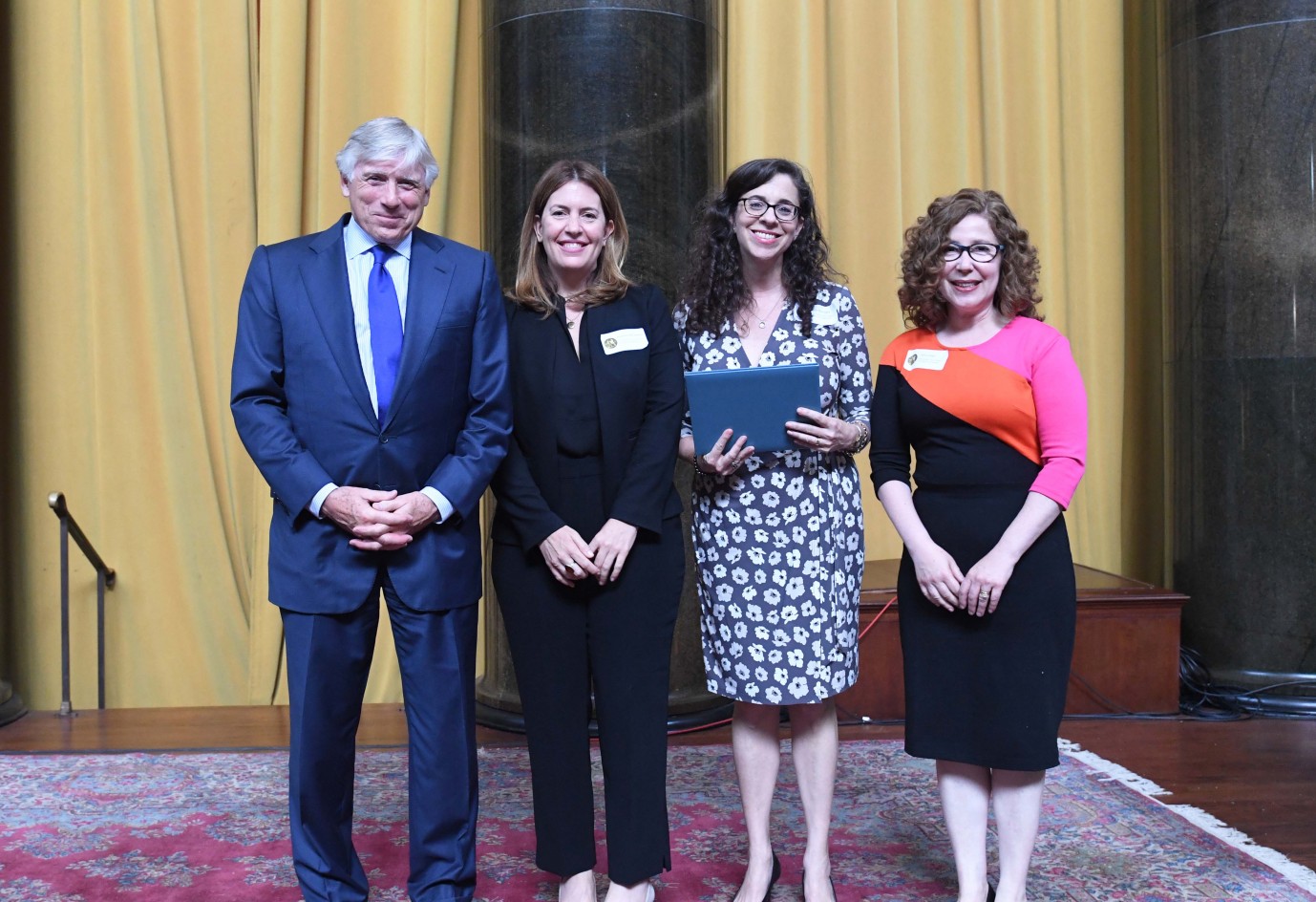
Staff members from The Washington Post (from left: Stephanie McCrummen, Beth Reinhard and Alice Crites) accept the 2018 Pulitzer Prize for Investigative Reporting from Columbia University President Lee Bollinger. (Photo: Eileen Barroso/Columbia University)
Winning Work
SHE WAS 14 IN 1979; HE WAS 32
3 others say now-Senate candidate pursued them, too
By Stephanie McCrummen, Beth Reinhard and Alice Crites
Leigh Corfman says she was 14 years old when an older man approached her outside a courtroom in Etowah County, Ala. She was sitting on a wooden bench with her mother, they both recall, when the man introduced himself as Roy Moore.
It was early 1979 and Moore — now the Republican nominee in Alabama for a U.S. Senate seat — was a 32-year-old assistant district attorney. He struck up a conversation, Corfman and her mother say, and offered to watch the girl while her mother went inside for a child custody hearing.
“He said, ‘Oh, you don’t want her to go in there and hear all that. I’ll stay out here with her,’ ” says Corfman’s mother, Nancy Wells, 71. “I thought, how nice for him to want to take care of my little girl.”
Alone with Corfman, Moore chatted with her and asked for her phone number, she says. Days later, she says, he picked her up around the corner from her house in Gadsden, drove her about 30 minutes to his home in the woods, told her how pretty she was and kissed her. On a second visit, she says, he took off her shirt and pants and removed his clothes. He touched her over her bra and underpants, she says, and guided her hand to touch him over his underwear.
“I wanted it over with — I wanted out,” she remembers thinking. “Please just get this over with. Whatever this is, just get it over.” Corfman says she asked Moore to take her home, and he did.
Two of Corfman’s childhood friends say she told them at the time that she was seeing an older man, and one says Corfman identified the man as Moore. Wells says her daughter told her about the encounter more than a decade later, as Moore was becoming more prominent as a local judge.
Aside from Corfman, three other women interviewed by The Washington Post in recent weeks say Moore pursued them when they were between the ages of 16 and 18 and he was in his early 30s, episodes they say they found flattering at the time, but troubling as they got older. None of the three women say that Moore forced them into any sort of relationship or sexual contact.
Wendy Miller says she was 14 and working as a Santa’s helper at the Gadsden Mall when Moore first approached her, and 16 when he asked her on dates, which her mother forbade. Debbie Wesson Gibson says she was 17 when Moore spoke to her high school civics class and asked her out on the first of several dates that did not progress beyond kissing. Gloria Thacker Deason says she was an 18-year-old cheerleader when Moore began taking her on dates that included bottles of Mateus Rosé wine. The legal drinking age in Alabama was 19.
After The Post published this story Thursday afternoon, Majority Leader Mitch McConnell (Ky.) and a handful of other GOP senators said Moore must step aside if Corfman’s account is true.
According to campaign reports, none of the women has donated to or worked for Moore’s Democratic opponent, Doug Jones, or his rivals in the Republican primary, including Sen. Luther Strange, whom he defeated this fall in a runoff election.
Corfman, 53, who works as a customer service representative at a payday loan business, says she has voted for Republicans in the past three presidential elections, including for Donald Trump in 2016. She says she thought of confronting Moore personally for years, and almost came forward publicly during his first campaign for state Supreme Court in 2000, but decided against it. Her two children were still in school then and she worried about how it would affect them. She also was concerned that her background — three divorces and a messy financial history — might undermine her credibility.
“There is no one here that doesn’t know that I’m not an angel,” Corfman says, referring to her home town of Gadsden.
Corfman described her story consistently in six interviews with The Post. The Post confirmed that her mother attended a hearing at the courthouse in February 1979 through divorce records. Moore’s office was down the hall from the courtroom.
Neither Corfman nor any of the other women sought out The Post. While reporting a story in Alabama about supporters of Moore’s Senate campaign, a Post reporter heard that Moore allegedly had sought relationships with teenage girls. Over the ensuing three weeks, two Post reporters contacted and interviewed the four women. All were initially reluctant to speak publicly but chose to do so after multiple interviews, saying they thought it was important for people to know about their interactions with Moore. The women say they don’t know one another.
“I have prayed over this,” Corfman says, explaining why she decided to tell her story now. “All I know is that I can’t sit back and let this continue, let him continue without the mask being removed.”
This account is based on interviews with more than 30 people who said they knew Moore between 1977 and 1982, when he served as an assistant district attorney for Etowah County in northern Alabama, where he grew up.
****
Moore was 30 and single when he joined the district attorney’s office, his first government job after attending the U.S. Military Academy at West Point, serving in Vietnam, graduating from law school and working briefly as a lawyer in private practice in Gadsden, the county seat.
By his account, chronicled in his book “So Help Me God,” Moore spent his time as a prosecutor convicting “murderers, rapists, thieves and drug pushers.” He writes that it was “around this time that I fashioned a plaque of The Ten Commandments on two redwood tablets.”
“I believed that many of the young criminals whom I had to prosecute would not have committed criminal acts if they had been taught these rules as children,” Moore writes.
Outside work, Moore writes that he spent his free time building rooms onto a mobile home in Gallant, a rural area about 25 miles west of Gadsden.
According to colleagues and others who knew him at the time, Moore was rarely seen socializing outside work. He spent one season coaching the Gallant Girls, a softball team that his teenage sister had joined, said several women who played on the team. He spent time working out at the Gadsden YMCA, according to people who encountered him there. And he often walked, usually alone, around the newly opened Gadsden Mall — 6 feet tall and well-dressed in slacks and a button-down shirt, say several women who worked there at the time.
Corfman describes herself as a little lost — “a typical 14-year-old kid of a divorced family” — when she says she first met Moore that day in 1979 outside the courtroom. She says she felt flattered that a grown man was paying attention to her.
“He was charming and smiley,” she says.
After her mother went into the courtroom, Corfman says, Moore asked her where she went to school, what she liked to do and whether he could call her sometime. She remembers giving him her number and says he called not long after. She says she talked to Moore on her phone in her bedroom, and they made plans for him to pick her up at Alcott Road and Riley Street, around the corner from her house.
“I was kind of giddy, excited, you know? An older guy, you know?” Corfman says, adding that her only sexual experience at that point had been kissing boys her age.
She says that it was dark and cold when he picked her up, and that she thought they were going out to eat. Instead, she says, he drove her to his house, which seemed “far, far away.”
“I remember the further I got from my house, the more nervous I got,” Corfman says.
She remembers an unpaved driveway. She remembers going inside and him giving her alcohol on this visit or the next, and that at some point she told him she was 14. She says they sat and talked. She remembers that Moore told her she was pretty, put his arm around her and kissed her, and that she began to feel nervous and asked him to take her home, which she says he did.
Soon after, she says, he called again, and picked her up again at the same spot.
“This was a new experience, and it was exciting and fun and scary,” Corfman says, explaining why she went back. “It was just like this roller-coaster ride you’ve not been on.”
She says that Moore drove her back to the same house after dark, and that before long she was lying on a blanket on the floor. She remembers Moore disappearing into another room and coming out with nothing on but “tight white” underwear.
She remembers that Moore kissed her, that he took off her pants and shirt, and that he touched her through her bra and underpants. She says that he guided her hand to his underwear and that she yanked her hand back.
“I wasn’t ready for that — I had never put my hand on a man’s penis, much less an erect one,” Corfman says.
She remembers thinking, “I don’t want to do this” and “I need to get out of here.” She says that she got dressed and asked Moore to take her home, and that he did.
The legal age of consent in Alabama, then and now, is 16. Under Alabama law in 1979, and today, a person who is at least 19 years old who has sexual contact with someone older than 12 and younger than 15 has committed sexual abuse in the second degree. Sexual contact is defined as touching of sexual or intimate parts. The crime is a misdemeanor punishable by up to one year in jail.
The law then and now also includes a section on enticing a child younger than 16 to enter a home with the purpose of proposing sexual intercourse or fondling of sexual and genital parts. That is a felony punishable by up to 10 years in prison.
In Alabama, the statute of limitations for bringing felony charges involving sexual abuse of a minor in 1979 would have run out three years later, and the time frame for filing a civil complaint would have ended when the alleged victim turned 21, according to Child USA, a nonprofit research and advocacy group at the University of Pennsylvania.
Corfman never filed a police report or a civil suit.
She says that after their last encounter, Moore called again, but that she found an excuse to avoid seeing him. She says that at some point during or soon after her meetings with Moore, she told two friends in vague terms that she was seeing an older man.
Betsy Davis, who remains friendly with Corfman and now lives in Los Angeles, says she clearly remembers Corfman talking about seeing an older man named Roy Moore when they were teenagers. She says Corfman described an encounter in which the older man wore nothing but tight white underwear. She says she was firm with Corfman that seeing someone as old as Moore was out of bounds.
“I remember talking to her and telling her it’s not a good idea,” Davis says. “Because we were so young.”
A second friend, who spoke on the condition of anonymity for fear of losing her job, has a similar memory of a teenage Corfman telling her about seeing an older man.
After talking to her friends, Corfman says, she began to feel that she had done something wrong and kept it a secret for years.
“I felt responsible,” she says. “I felt like I had done something bad. And it kind of set the course for me doing other things that were bad.”
She says that her teenage life became increasingly reckless with drinking, drugs, boyfriends, and a suicide attempt when she was 16.
As the years went on, Corfman says, she did not share her story about Moore partly because of the trouble in her life. She has had three divorces and financial problems. While living in Arizona, she and her second husband started a screen-printing business that fell into debt. They filed for bankruptcy protection three times, once in 1991 with $139,689 in unpaid claims brought by the Internal Revenue Service and other creditors, according to court records.
In 2005, Corfman paid a fine for driving a boat without lights. In 2010, she was working at a convenience store when she was charged with a misdemeanor for selling beer to a minor. The charge was dismissed, court records show.
****
The three other women who spoke to The Post say that Moore asked them on dates when they were between 16 and 18 and he was in his early 30s.
Gloria Thacker Deason says she was 18 and Moore was 32 when they met in 1979 at the Gadsden Mall, where she worked at the jewelry counter of a department store called Pizitz. She says she was attending Gadsden State Community College and still living at home.
“My mom was really, really strict and my curfew was 10:30 but she would let me stay out later with Roy,” says Deason, who is now 57 and lives in North Carolina. “She just felt like I would be safe with him. . . . She thought he was good husband material.”
Deason says that they dated off and on for several months and that he took her to his house at least two times. She says their physical relationship did not go further than kissing and hugging.
“He liked Eddie Rabbitt and I liked Freddie Mercury,” Deason says, referring to the country singer and the British rocker.
She says that Moore would pick her up for dates at the mall or at college basketball games, where she was a cheerleader. She remembers changing out of her uniform before they went out for dinners at a pizzeria called Mater’s, where she says Moore would order bottles of Mateus Rosé, or at a Chinese restaurant, where she says he would order her tropical cocktails at a time when she believes she was younger than 19, the legal drinking age.
“If Mother had known that, she would have had a hissy fit,” says Deason, who says she turned 19 in May 1979, after she and Moore started dating.
Around the same time that Deason says she met Moore at the jewelry counter, Wendy Miller says that Moore approached her at the mall, where she would spend time with her mom, who worked at a photo booth there. Miller says this was in 1979, when she was 16.
She says that Moore’s face was familiar because she had first met him two years before, when she was dressed as an elf and working as a Santa’s helper at the mall. She says that Moore told her she looked pretty, and that two years later, he began asking her out on dates in the presence of her mother at the photo booth. She says she had a boyfriend at the time, and declined.
Her mother, Martha Brackett, says she refused to grant Moore permission to date her 16-year-old daughter.
“I’d say, ‘You’re too old for her . . . let’s not rob the cradle,’ ” Brackett recalls telling Moore.
Miller, who is now 54 and still lives in Alabama, says she was “flattered by the attention.”
“Now that I’ve gotten older,” she says, “the idea that a grown man would want to take out a teenager, that’s disgusting to me.”
Debbie Wesson Gibson says that she was 17 in the spring of 1981 when Moore spoke to her Etowah High School civics class about serving as the assistant district attorney. She says that when he asked her out, she asked her mother what she would say if she wanted to date a 34-year-old man. Gibson says her mother asked her who the man was, and when Gibson said “Roy Moore,” her mother said, “I’d say you were the luckiest girl in the world.”
Among locals in Gadsden, a town of about 47,000 back then, Moore “had this godlike, almost deity status — he was a hometown boy made good,” Gibson says, “West Point and so forth.”
Gibson says that they dated for two to three months, and that he took her to his house, read her poetry and played his guitar. She says he kissed her once in his bedroom and once by the pool at a local country club.
“Looking back, I’m glad nothing bad happened,” says Gibson, who now lives in Florida. “As a mother of daughters, I realize that our age difference at that time made our dating inappropriate.”
****
By 1982, Moore was by his own account in his book causing a stir in the district attorney’s office for his willingness to criticize the workings of the local legal system. He convened a grand jury to look into what he alleged were funding problems in the sheriff’s office. In response, Moore writes, the state bar association investigated him for going against the advice of the district attorney, an inquiry that was dismissed.
Soon after, Moore quit and began his first political campaign for the county’s circuit court judge position. He lost overwhelmingly, and left Alabama shortly thereafter, heading to Texas, where he says in his book that he trained as a kickboxer, and to Australia, where he says he lived on a ranch for a year wrangling cattle.
He returned to Gadsden in 1984 and went into private law practice. In 1985, at age 38, he married Kayla Kisor, who was 24. The two are still married.
A few years later, Moore began his rise in Alabama politics and into the national spotlight.
In 1992, he became a circuit court judge and hung his wooden Ten Commandments plaque in his courtroom.
In 2000, he was elected chief justice of Alabama’s Supreme Court, and he soon installed a 5,280-pound granite Ten Commandments monument in the judicial building.
In 2003, he was dismissed from the bench for ignoring a federal court order to remove the monument, and became known nationally as “The Ten Commandments Judge.”
Moore was again elected chief justice of the Alabama Supreme Court in 2012, and was again dismissed for ignoring a judicial order, this time for instructing probate judges not to issue marriage licenses to same-sex couples.
All of this has made Moore a hero to many Alabama voters, who consider him a stalwart Christian willing to stand up for their values. In a September Republican primary for the seat vacated by Attorney General Jeff Sessions, Moore defeated the appointed sitting senator, Luther Strange, who was backed by President Trump and other party leaders in Washington. Moore faces the Democratic nominee, Doug Jones, in a special election scheduled for Dec. 12.
On a visit home in the mid-1990s to see her mother and stepfather in Alabama, Corfman says, she saw Moore’s photo in the Gadsden Times.
“ ‘Mother, do you remember this guy?’ ” Wells says Corfman said at the time.
That’s when Corfman told her, Wells recalls. Her daughter said that not long after the court hearing in 1979, Moore took her to his house. Wells says that her daughter conveyed to her that Moore had behaved inappropriately.
“I was horrified,” Wells says.
Years later, Corfman says, she saw a segment about Moore on ABC News’s “Good Morning America.” She says she threw up.
There were times, Corfman says, she thought about confronting Moore. At one point during the late 1990s, she says, she became so angry that she drove to the parking lot outside Moore’s office at the county courthouse in Gadsden. She sat there for a while, she says, rehearsing what she might say to him.
“ ‘Remember me?’ ” she imagined herself saying.
Now-Senate candidate gained a reputation for making overtures at mall
By Stephanie McCrummen, Beth Reinhard and Alice Crites
Gena Richardson says she was a high school senior working in the men’s department of Sears at the Gadsden Mall when a man approached her and introduced himself as Roy Moore.
“He said, ‘You can just call me Roy,’ ” says Richardson, who says this first encounter happened in the fall of 1977, just before or after her 18th birthday, as Moore, then a 30-year-old local attorney, was gaining a reputation for pursuing young women at the mall in Gadsden, Ala. His overtures caused one store manager to tell new hires to “watch out for this guy,” another young woman to complain to her supervisor and Richardson to eventually hide from him when he came in Sears, the women say.
Richardson says Moore — now a candidate for U.S. Senate — asked her where she went to school, and then for her phone number, which she says she declined to give, telling him that her father, a Southern Baptist preacher, would never approve.
A few days later, she says, she was in trigonometry class at Gadsden High when she was summoned to the principal’s office over the intercom in her classroom. She had a phone call.
“I said ‘Hello?’” Richardson recalls. “And the male on the other line said, ‘Gena, this is Roy Moore.’ I was like, ‘What?!’ He said, ‘What are you doing?’ I said, ‘I’m in trig class.’ ”
Richardson says Moore asked her out again on the call. A few days later, after he asked her out at Sears, she relented and agreed, feeling both nervous and flattered. They met that night at a movie theater in the mall after she got off work, a date that ended with Moore driving her to her car in a dark parking lot behind Sears and giving her what she called an unwanted, “forceful” kiss that left her scared.
“I never wanted to see him again,” says Richardson, who is now 58 and a community college teacher living in Birmingham. She describes herself as a moderate Republican and says she didn’t vote in the 2016 general election or in this year’s Republican Senate primary in Alabama.
Moore’s campaign did not directly address the new allegations. In a statement, a campaign spokesman cast the growing number of allegations against Moore as politically motivated.
“If you are a liberal and hate Judge Moore, apparently he groped you,” the statement said. “If you are a conservative and love Judge Moore, you know these allegations are a political farce.”
Richardson, whose account was corroborated by classmate and Sears co-worker Kayla McLaughlin, is among four women who say Moore pursued them when they were teenagers or young women working at the mall — from Sears at one end to the Pizitz department store at the other. Richardson and Becky Gray, the woman who complained to her manager, have not previously spoken publicly. The accounts of the other two women — Wendy Miller and Gloria Thacker Deason — have previously been reported by The Washington Post.
Phyllis Smith, who was 18 when she began working at Brooks, a clothing store geared toward young women, said teenage girls counseled each other to “just make yourself scarce when Roy’s in here, he’s just here to bother you, don’t pay attention to him and he’ll go away.’ ”
****
The encounters described by the women occurred between 1977 and 1982, when Moore was single, in his early 30s and an attorney in Etowah County in northeastern Alabama. In October 1977, he was appointed deputy district attorney.
In all, The Post spoke to a dozen people who worked at the mall or hung out there as teenagers during the late ’70s and early ’80s and recall Moore as a frequent presence — a well-dressed man walking around alone, leaning on counters, spending enough time in the stores, especially on weekend nights, that some of the young women who worked there said they became uncomfortable.
Several of the women said they decided to share their accounts after reading a Post story last week in which four women said Moore pursued them as teenagers, including one who said she was 14 and Moore was 32 when he touched her sexually.
Since that story was published, another woman, Beverly Young Nelson, appearing with lawyer Gloria Allred, accused Moore of sexually assaulting her in his car when she was 16. A lawyer for Moore’s campaign held a news conference on Wednesday to dispute Nelson’s account, suggesting that a signature in her yearbook she said was Moore’s might have been forged.
Moore has denied engaging in any kind of sexual misconduct. In an interview last week with Sean Hannity of Fox News, Moore did not rule out that he may have dated teenage girls when he was in his 30s, though he said he could not recall. Moore said he doesn’t remember “ever dating any girl without the permission of her mother.”
Moore has brushed off mounting calls from Republican leaders in Washington to end his campaign, saying the media and the GOP establishment are aligned against him. The reaction in Alabama, among voters and elected officials, has been more mixed.
President Trump has not gone as far as other Republican leaders, saying through press secretary Sarah Huckabee Sanders that Moore should drop out if the allegations are true. Trump ignored questions Wednesday from reporters asking if Moore should quit the race.
****
The sprawling Gadsden Mall opened in 1974 with a Sears at one end, a Pizitz department store at the other, a movie theater in the middle and plenty of parking all around. It quickly became a social hub for teenagers.
By 1977, Moore had returned home from law school after attending the U.S. Military Academy at West Point and serving in Vietnam. It was around that time, people say, that he became a regular at the mall.
“It would always be on Friday or Saturday night,” says Becky Gray, who was then 22 and working in the men’s department of Pizitz. “Parents would drop kids off, let them roam the mall. Well, he started coming up to me.”
She says Moore kept asking her out and she kept saying no.
“I’d always say no, I’m dating someone, no, I’m in a relationship,” says Gray, now 62, a retired teacher and a Democrat who supports Moore’s opponent in the Senate race. “I thought he was old at that time. Anyone over 22 was just old.”
Gray says he was persistent in a way that made her uncomfortable. She says he lingered in her section, or else by the bathroom area, and that she became so disturbed that she complained to the Pizitz manager, Maynard von Spiegelfeld. Gray says he told her that it was “not the first time he had a complaint about him hanging out at the mall.” Von Spiegelfeld has since died, according to a relative.
Pizitz is also where Deason told The Post last week that Moore asked her out when she was 18 and working behind the jewelry counter.
Beyond Pizitz was a long corridor of shops, including Brooks, which sold rabbit fur coats and fashions geared toward young women. Smith, the one-time Brooks employee, says she was probably 19 when Moore began coming into the store, which she says employed many teenage girls. She remembers him being alone and had the strong impression he wasn’t looking to shop.
“I can remember him walking in and the whole mood would change with us girls,” says Smith, 59, who lives in Gadsden and says she is a Democrat. “It would be like we were on guard. I would find something else to do. I remember being creeped out.”
Smith says Moore never approached her personally, but she saw him chatting with other young clerks, and that she would tell new hires to “watch out for this guy.” She says that occasionally, one of the store managers would have to deal with bounced checks, which meant going to the district attorney’s office where Moore worked. She says the managers would “draw straws” to decide who had to go talk to him about the cases.
“It was just sort of a dreadful experience,” she says.
At the center of the mall was a photo booth, where Wendy Miller earlier told The Post her mother worked. Miller said she hung out there with her mom when she was 16 and that Moore repeatedly asked her out on dates, which her mother forbade. Miller’s mother, Martha Brackett, confirmed her account.
****
At the other end of the mall was Sears, where Richardson says she was among a clique of Gadsden High girls who worked at the store during their senior year.
Richardson, whose maiden name is Burgess, was assigned to the men’s section, and her friend and classmate McLaughlin worked at the cosmetics and jewelry counter at the front of the store with a view down the long mall corridor.
“I could see when he came in,” says McLaughlin, whose maiden name was Shirley and who says that she and Richardson usually worked evening shifts on the weekends. “He didn’t really talk to me, he was over there visiting with Gena a lot. And that got to be a pattern.”
McLaughlin says she told her friend to stay away from Moore. “I hate to say this, but Gena was like my little sister. She was raised by a Southern Baptist preacher and a little naive. So I’d let her know: ‘Here he comes.’ ”
When Richardson met Moore she says he introduced himself as an attorney, and says she found it odd that he asked her to call him “Roy.”
“That was strange in the first place, because of the way we were always taught to call someone Mr. or Mrs.,” she says.
When he asked for her number, she says that she told him, “No, my dad is so strict. Mm-mm. No.” She and McLaughlin both say they talked about Moore after that, with McLaughlin telling her friend, “You can’t go out with him. He’s old.”
It was a few days later, Richardson says, when she was called out of her trigonometry class.
Richardson says she was startled, thinking maybe her dad was calling, and that when she realized it was Moore, “I felt like every person in that office was staring at me.”
“At that point, he said, ‘Would you like to go out some time?’ ” recalls Richardson, who says she described the call right afterward to McLaughlin, who confirmed the account. “I said, ‘Well, I can’t talk right now.’ And being so naive, and so not worldly, I said, ‘I’ll be at work Friday or Saturday.’”
The next Friday or Saturday night, she says, he came in to Sears and asked her out again and she again told him, “Look, my dad is so strict.”
She recalls Moore suggesting that they meet for a late movie after she got off work. She says she called her parents and told them she was going out with friends.
Instead, she says she met Moore at the movie theater. She says she can’t remember what they saw, but she remembers clearly what happened after. She says it was cold and Moore offered to drive her to her car, which was more than a football field’s distance away in a parking area behind Sears. She says he parked by her car and began chatting with her, and she says she told him again about her dad.
“I just explained to him that my dad’s a minister, and you know, I just can’t sneak around because that’s wrong,” she recalls. “So I thanked him and started to get out and he grabbed me and pulled me in and that’s when he kissed me.
“It was a man kiss — like really deep tongue. Like very forceful tongue. It was a surprise. I’d never been kissed like that,” she says. “And the minute that happened, I got scared then. I really did. Something came over me that scared me. And so I said, ‘I’ve got to go, because my curfew is now.’ ”
She says she got out of the car and into her own.
Richardson and McLaughlin say they talked about it afterward, and when Moore came into Sears after that, McLaughlin would warn her friend so she could hide in the back of the store. “I would call and say he’s coming this way,” McLaughlin says. “She would go to the back. She was uncomfortable.”
Richardson says she never spoke to Moore again. She says she first told her father about the incident on Wednesday. She says she never told her mother, who is deceased.
“All these years, I thought that was an isolated incident,” Richardson says. “Now, as a mother and a grandmother, it just makes me physically sick. I realize that it didn’t just happen to me.”
Woman appears to work with group that says it exposes media bias
By Shawn Boburg, Aaron C. Davis and Alice Crites
A woman who falsely claimed to The Washington Post that Roy Moore, the Republican U.S. Senate candidate in Alabama, impregnated her as a teenager appears to work with an organization that uses deceptive tactics to secretly record conversations in an effort to embarrass its targets.
In a series of interviews over two weeks, the woman shared a dramatic story about an alleged sexual relationship with Moore in 1992 that led to an abortion when she was 15. During the interviews, she repeatedly pressed Post reporters to give their opinions on the effects that her claims could have on Moore’s candidacy if she went public.
The Post did not publish an article based on her unsubstantiated account. When Post reporters confronted her with inconsistencies in her story and an Internet posting that raised doubts about her motivations, she insisted that she was not working with any organization that targets journalists.
But on Monday morning, Post reporters saw her walking into the New York offices of Project Veritas, an organization that targets the mainstream news media and left-leaning groups. The organization sets up undercover “stings” that involve using false cover stories and covert video recordings meant to expose what the group says is media bias.
James O’Keefe, the Project Veritas founder who was convicted of a misdemeanor in 2010 for using a fake identity to enter a federal building during a previous sting, declined to answer questions about the woman outside the organization’s offices on Monday morning shortly after the woman walked inside.
“I am not doing an interview right now, so I’m not going to say a word,” O’Keefe said.
In a follow-up interview, O’Keefe declined to answer repeated questions about whether the woman was employed at Project Veritas. He also did not respond when asked if he was working with Moore, former White House adviser and Moore supporter Stephen K. Bannon, or Republican strategists.
The group’s efforts illustrate the lengths to which activists have gone to try to discredit media outlets for reporting on allegations from multiple women that Moore pursued them when they were teenagers and he was in his early 30s. Moore has denied that he did anything improper.
A spokesman for Moore’s campaign did not respond to a message seeking comment.
The woman who approached Post reporters, Jaime T. Phillips, did not respond to calls to her cellphone later Monday. Her car remained in the Project Veritas parking lot for more than an hour.
The Post positioned video reporters outside the group’s office in Mamaroneck, N.Y, after determining that Phillips lives in Stamford, Conn., and realizing that the two locations were just 16 miles apart. Two reporters followed her from her home as she drove to the office.
After Phillips was observed entering the Project Veritas office, The Post made the unusual decision to report her previous off-the-record comments.
“We always honor ‘off-the-record’ agreements when they’re entered into in good faith,” said Martin Baron, The Post’s executive editor. “But this so-called off-the-record conversation was the essence of a scheme to deceive and embarrass us. The intent by Project Veritas clearly was to publicize the conversation if we fell for the trap. Because of our customary journalistic rigor, we weren’t fooled, and we can’t honor an ‘off-the-record’ agreement that was solicited in maliciously bad faith.”
Phillips’s arrival at the Project Veritas office capped a weeks-long effort that began only hours after The Post published an article on Nov. 9 that included allegations that Moore once initiated a sexual encounter with a 14-year-old named Leigh Corfman.
Post reporter Beth Reinhard, who co-wrote the article about Corfman, received a cryptic email early the next morning.
“Roy Moore in Alabama . . . I might know something but I need to keep myself safe. How do we do this?” the apparent tipster wrote under an account with the name “Lindsay James.”
The email’s subject line was “Roy Moore in AL.” The sender’s email address included “rolltide,” the rallying cry of the University of Alabama’s sports teams, which are nicknamed the Crimson Tide.
Reinhard sent an email asking if the person was willing to talk off the record.
“Not sure if I trust the phone,” came the reply. “Can we just stick to email?”
“I need to be confident that you can protect me before I will tell all,” the person wrote in a subsequent email. “I have stuff I’ve been hiding for a long time but maybe it should stay that way.”
The tipster’s email came amid counterattacks by Moore supporters aimed at The Post and its reporters.
That same day, Gateway Pundit, a conservative site, spread a false story from a Twitter account, @umpire43, that said, “A family friend in Alabama just told my wife that a WAPO reporter named Beth offer her 1000$ to accuse Roy Moore.” The Twitter account, which has a history of spreading misinformation, has since been deleted.
The Post, like many other news organizations, has a strict policy against paying people for information and did not do so in its coverage of Moore.
On Nov. 14, a pastor in Alabama said he received a voice mail from a man falsely claiming to be a Post reporter and seeking women “willing to make damaging remarks” about Moore for money. No one associated with The Post made any such call.
In the days that followed the purported tipster’s initial emails, Reinhard communicated with the woman through an encrypted text messaging service and spoke by phone with the person to set up a meeting. When the woman suggested a meeting in New York, Reinhard told her she would have to know more about her story and her background. The woman offered that her real name was Jaime Phillips.
Phillips said she lived in New York but would be in the Washington area during Thanksgiving week and suggested meeting Tuesday at a shopping mall in Tysons Corner, Va. “I’m planning to do some shopping there so I’ll find a good place to meet before you get there,” Phillips wrote in a message sent via Signal, the encrypted messaging service.
When Reinhard suggested bringing another reporter, Phillips wrote, “I’m not really comfortable with anyone else being there this time.”
Reinhard arrived to find Phillips, wearing a brown leather jacket and with long red hair, already seated in a booth in the restaurant.
The 41-year-old said she had been abused as a child, Reinhard said. Her family had moved often. She said she moved in with an aunt in the Talladega area of Alabama and started attending a church youth group when she met Moore in 1992, the year he became a county judge. She said she was 15. She said they started a “secret” sexual relationship.
“I knew it wasn’t right, but I didn’t care,” she said.
She said that she got pregnant, that Moore talked her into an abortion and that he drove her to Mississippi to get it.
In the interview, she told Reinhard that she was so upset she couldn’t finish her salad.
Phillips said she had started thinking about coming forward after the allegations about Hollywood film producer Harvey Weinstein surfaced. Then she said she saw the news about Moore flashing across the television screen while in a break room at her job at a company called NFM Lending in Westchester County, N.Y., Reinhard said.
Phillips also repeatedly asked the reporter to guarantee her that Moore would lose the election if she came forward. Reinhard told her in a subsequent text message that she could not predict what the impact would be. Reinhard said she also explained to Phillips that her claims would have to be fact-checked. Additionally, Reinhard asked her for documents that would corroborate or support her story.
Later that day, Phillips told Reinhard that she felt “anxiety & negative energy after our meeting,” text messages show. “You just didn’t convince me that I should come forward,” she wrote.
Reinhard replied, “I’m so sorry but I want to be straight with you about the fact-checking process and the fact that we can’t guarantee what will happen as a result of another story.”
Phillips was not satisfied. On Wednesday, the day before Thanksgiving, she suggested meeting with another Post reporter, Stephanie McCrummen, who co-wrote the initial article about Corfman. “I’d rather go to another paper than talk to you again,” Phillips told Reinhard.
Back at the newsroom, Reinhard became concerned about elements of Phillips’s story. Phillips had said she lived in Alabama only for a summer while a teenager, but the cellphone number Phillips provided had an Alabama area code. Reinhard called NFM Lending, the company Phillips said she worked for in Westchester County, but was told no one named Jaime Phillips worked there.
The company issued a statement after the publication of this article saying Phillips worked briefly for Maryland-based NFM Lending, but her tenure ended in the summer of 2016. The company also said it has no offices in Westchester County.
Alice Crites, a Post researcher who was looking into Phillips’s background, found a document that strongly reinforced the reporters’ suspicions: a Web page for a fundraising campaign by someone with the same name. It was on the website GoFundMe.com under the name Jaime Phillips.
“I’m moving to New York!” the May 29 appeal said. “I’ve accepted a job to work in the conservative media movement to combat the lies and deceipt of the liberal MSM. I’ll be using my skills as a researcher and fact-checker to help our movement. I was laid off from my mortgage job a few months ago and came across the opportunity to change my career path.”
In a March posting on its Facebook page, Project Veritas said it was seeking 12 new “undercover reporters,” though the organization’s operatives use methods that are eschewed by mainstream journalists, such as misrepresenting themselves.
A posting for the “journalist” job on the Project Veritas website that month warned that the job “is not a role for the faint of heart.”
The job’s listed goal: “To adopt an alias persona, gain access to an identified person of interest and persuade that person to reveal information.”
It also listed tasks that the job applicant should be able to master, including: “Learning a script,” “Preparing a background story to support your role,” “Gaining an appointment or access to the target of the investigation,” and “Operating concealed recording equipment.”
Project Veritas, founded in 2010, is a tax-exempt charity that says its mission is to “investigate and expose corruption, dishonesty, self-dealing, waste, fraud and other misconduct.” It raised $4.8 million and employed 38 people in 2016, according to its public tax filing. It also had 92 volunteers.
O’Keefe’s criminal record has caused the charity problems in some states. Mississippi and Utah stripped the group of a license to raise money in those states because it failed to disclose O’Keefe’s conviction on state applications, records show.
Also working at Veritas is former television producer Robert J. Halderman, who was sentenced to six months in jail in 2010 after he was accused of trying to blackmail late-night host David Letterman. Halderman was with O’Keefe outside the Project Veritas offices Monday as a reporter tried to ask about Phillips’s role with the organization.
Because Jaime Phillips is a relatively common name, it wasn’t a certainty that the GoFundMe page that Crites found was created by the same woman who approached The Post. But there was another telling detail, in addition to the name. One of two donations listed on the page was from a person whose name matched her daughter’s, according to public records.
McCrummen agreed to meet Phillips that afternoon.
Phillips suggested meeting somewhere in Alexandria, Va., saying she was shopping in the area. Post video reporters accompanied McCrummen, who brought a printout of the fundraising page to the interview.
Again, Phillips had arrived early and was waiting for McCrummen, her purse resting on the table. When McCrummen put her purse near Phillips’s purse to block a possible camera, Phillips moved hers.
The Post video reporters sat separately, unnoticed, at an adjacent table.
Phillips said she didn’t want to get into the details of what she had said happened between her and Moore.
She said she wanted McCrummen to assure her that the article would result in Moore’s defeat, according to a recording. McCrummen instead asked her about her story regarding Moore.
Phillips complained that President Trump had endorsed Moore.
“So my whole thing is, like, I want him to be completely taken out of the race,” she said. “And I really expected that was going to happen, and now it’s not. So, I don’t know what you think about that.”
McCrummen asked Phillips to verify her identity with a photo identification. Phillips provided a Georgia driver’s license.
McCrummen then asked her about the GoFundMe page.
“We have a process of doing background, checking backgrounds and this kind of thing, so I wanted to ask you about one thing,” McCrummen said, pulling out a copy of the page and reading from it. “So I just wanted to ask you if you could explain this, and I also wanted to let you know, Jaime, that this is being recorded and video recorded.”
“Okay,” Phillips said. “Um, yeah, I was looking to take a job last summer in New York, but it fell through,” Phillips said. “Yeah, it was going to be with the Daily Caller, but it ended up falling through, so I wasn’t able to do it.”
When asked who at the Daily Caller interviewed her, Phillips said, “Kathy,” pausing before adding the last name, “Johnson.”
Paul Conner, executive editor of the Daily Caller, said Monday that no one with the name Kathy Johnson works for the publication and that he has no record of having personally interviewed Phillips. Conner later said in an email that he had asked other top editors at the Daily Caller and the affiliated Daily Caller News Foundation about Phillips.
“None of us has interviewed a woman by the name Jaime Phillips,” Conner wrote.
At the Alexandria restaurant on Wednesday, Phillips also told The Post that she had not been in contact with the Moore campaign. As the interview ended, Phillips told McCrummen she was not recording the conversation.
“I think I probably just want to cancel and not go through with it at this point,” Phillips said at Souvlaki Bar shortly before ending the interview.
“I’m not going to answer any more questions,” she said. “I think I’m just going to go.”
She picked up her coat and bag, returned her drink to the front counter and left the restaurant.
By 7 p.m. the message on the GoFundMe page was gone, replaced by a new one.
“Campaign is complete and no longer active,” it read.
Correction: A previous version of this story incorrectly said the NFM Lending office a Post reporter called to verify Jaime Phillips’s employment was in Westchester County. The company has no offices in that county. This story has been updated with a statement from Maryland-based NFM Lending indicating that Phillips’s brief employment with the company ended in the summer of 2016.
Thomas LeGro and Dalton Bennett contributed to this report.
Ala. Senate hopeful said he took no ‘regular salary,’ but earned $1 million-plus
By Shawn Boburg and Robert O'Harrow Jr.
Former Alabama judge Roy Moore, a Republican candidate for U.S. Senate, once said publicly that he did not take a “regular salary” from the small charity he founded to promote Christian values because he did not want to be a financial burden.
But privately, Moore had arranged to receive a salary of $180,000 a year for part-time work at the Foundation for Moral Law, internal charity documents show. He collected more than $1 million as president from 2007 to 2012, compensation that far surpassed what the group disclosed in its public tax filings most of those years.
When the charity couldn’t afford the full amount, Moore in 2012 was given a promissory note for back pay eventually worth $540,000 or an equal stake of the charity’s most valuable asset, a historic building in Montgomery, Ala., mortgage records show. He holds that note even now, a charity official said.
A Washington Post review of public and internal charity documents found that errors and gaps in the group’s federal tax filings obscured until now the compensation paid to Moore, whose defeat last month of President Trump’s choice for Republican nominee in the Senate race will likely embolden far-right challengers to the party’s mainstream incumbents. Moore is the front-runner in the race to fill the seat vacated by Attorney General Jeff Sessions.
The charity helped Moore thrive - financially and otherwise - after his ouster from the state’s Supreme Court in 2003 for refusing to remove a Ten Commandments monument from the courthouse. The group has filed scores of legal briefs in cases involving conservative Christian issues, but it was in many ways built around Moore himself.
At a time when Moore was running for other public offices in Alabama, the charity kept him in the public eye and helped establish a nationwide network of donors while he took on controversial positions against same-sex marriage, Islam and the separation of church and state. Over the years, it has provided him with health-care benefits, travel expenses and a bodyguard, documents show.
The Foundation for Moral Law’s website routinely promoted Moore’s speaking engagements and his book, “So Help Me God: The Ten Commandments, Judicial Tyranny, and the Battle for Religious Freedom.” In his last two years as president, as fundraising dwindled, Moore’s compensation amounted to about a third of the contributions to the group, tax filings show.
The charity has employed at least two of Moore’s children, although their compensation is not reflected in tax filings. Moore’s wife, Kayla, who is now president, was paid a total of $195,000 over three years through 2015.
Moore’s charitable and political activities have also overlapped in significant ways. The former longtime executive director of the charity now serves as Moore’s campaign manager. The charity retained the same fundraising firm used by three of Moore’s most recent campaigns for state office, public records show.
An Internal Revenue Service audit of the Foundation for Moral Law’s 2013 finances, provided by the charity, concluded that it left out information about fundraising and other activities on its public tax filings and also identified discrepancies between those filings and its internal books. The IRS wrote that the issues “could jeopardize your exempt status.”
Seven charity and tax law specialists consulted by The Post said the nonprofit’s activities raised questions about compliance with IRS rules, including prohibitions on the use of a charity for the private benefit or enrichment of an individual.
“The biggest issue is the benefit to Roy Moore,” said Paul Streckfus, a former tax lawyer at the IRS and editor of the EO Tax Journal, when told of The Post’s findings.
In interviews with The Post, Alabama Circuit Court Judge John Bentley, a longtime member of the charity’s board and its former chairman, denied that the Foundation for Moral Law served Moore’s personal or political goals. He said the group’s officials did not intentionally do anything wrong.
But he said that he could not fully explain inconsistencies in audits and public tax filings, and that he and other board members did not provide enough oversight. He acknowledged the nonprofit was essentially run by Moore and his family.
“That’s my fault,” he said. “I should have been a lot more active than I was.”
Roy and Kayla Moore did not respond to interview requests. Kayla Moore provided answers to detailed questions in a statement, and the charity gave The Post internal documents to clarify why Moore received the promissory note. The agreement that he would receive compensation of $180,000 a year, described in those documents, has not been previously reported.
‘The Ten Commandments Judge’
A year after his election to the state Supreme Court in 2000, Moore drew national attention and controversy for installing a 2.6-ton monument of the Ten Commandments in the court’s building. His ouster from the bench in 2003, after he refused to obey a federal court ruling to remove the monument, made him a hero among some evangelical Christians.
As he fought against litigation to move the monument, friends and allies created an organization they called the Roy Moore Legal Defense Fund and began raising money. The organization’s first application to be recognized as a charity was rejected in 2004 because the IRS determined that it “operated for the benefit of private interests.”
The group renamed itself the Foundation for Moral Law and broadened its mission, saying it would promote the idea that “our rights are given to us by our Creator.” The following year, the IRS approved it as a tax-exempt 501(c)(3) public charity, allowing contributors to deduct donations.
Moore became its chairman and traveled the country, giving speeches and making media appearances. He received no compensation at first, although the charity provided health insurance and covered travel expenses. The organization also gave him VIP-level security, paying for bulletproof vests and a bodyguard, a martial arts expert and cousin of former heavyweight boxing champion Evander Holyfield, records show.
“Judge was traveling the country speaking. He needed protection due to threats,” Kayla Moore said in her statement to The Post.
Political observers considered the nonprofit a showcase for the former judge.
“It was a platform for Roy Moore to advance himself on any possible front, whether it was political or oratorical,” said William Stewart, a professor emeritus of political science at the University of Alabama and a longtime observer of Moore’s career.
Joining Moore at the nonprofit were two other state Supreme Court employees who also lost their jobs over the monument controversy. One of them, Richard Hobson — now Moore’s campaign manager in the Senate race — became the charity’s president. Moore’s daughter, Heather, became its receptionist.
In an interview, Bentley, the board member, played down the hiring of Moore’s family members, describing them as “cheap labor.” He said he did not know exactly how much they were paid.
With donations pouring in — more than $1.5 million in 2005 — the charity bought a pre-Civil War office building in downtown Montgomery for $546,000 and began renovations costing hundreds of thousands more, records show.
The charity hired the Richard Norman Company, a fundraising firm in Virginia that raised money for conservative candidates. Months later, as Moore launched a campaign for Alabama governor, he turned to the firm for his political fundraising as well, drawing donors from across the country.
In an interview, founder Richard Norman said his firm kept the charitable and political operations separate. But he acknowledged that in both contexts Roy Moore’s defiance of the federal government was a central selling point.
“He's known as ‘The Ten Commandments Judge,’” he said. “That story was an important part of every fundraising appeal we did.”
Moore lost the race.
Unusual payment plan
In 2007, Moore became the charity’s president, committing himself to 20 hours a week, according to tax filings. The board agreed to pay him; the question was how much. They considered a figure as high as $500,000 annually, according to an internal letter the charity provided to The Post.
On March 5, they decided to follow Moore’s lead. “Judge Moore has recommended a salary of $180,000,” Bentley, then the chairman, wrote to other board members.
They agreed to pay him in an unusual way. Moore would be paid whatever speaking fees and donations to the charity he could generate through what was called “Project Jeremiah,” the group’s ministry to pastors and preachers. But he was guaranteed $180,000 a year under the agreement, with the charity making up the difference if Project Jeremiah revenue fell short. If the charity did not have the cash in a given year, the debt to Moore would accumulate.
The Foundation for Moral Law created a separate bank account and earmarked donations to “Project Jeremiah” specifically for Moore, Bentley said.
“This is a very important project to restore a proper understanding of God to the preachers of our land, but I need your help!” Moore wrote in 2007 in a personal fundraising message about “Project Jeremiah” on the charity’s website. “My resources are limited.”
The salary agreement and “Project Jeremiah” were not disclosed in the charity’s tax filings that year. Moore’s compensation was reported as $105,500.
The charity’s descriptions on public documents of its payments to Moore varied greatly. In some years, including 2007, he was described as an outside legal contractor, tax filings show, and in others he was paid as president. His reported compensation ranged from $55,392 to $105,500 — and not until 2012 did the figure match the $180,000 the board had agreed to pay him.
Martin Wishnatsky, a spokesman for the charity, said Moore was never a legal consultant, despite the statements in tax filings.
“Judge Moore never received separate amounts for ‘legal work,’” Wishnatsky said in a statement. “That description was a shorthand for the services he provided to the Foundation that included overall supervision, educational programs, and participation in preparing amicus briefs on religious liberty and related issues.”
IRS identifies problems
By 2011, attention to Moore’s monument battle was waning. Donations to the Foundation for Moral Law were in a nose-dive, down by almost two-thirds from 2005. But the board stood by its pledge to give Moore $180,000 in compensation each year.
On Feb. 17, documents show, the board convened for an annual meeting in Gadsden, Alabama. There was only one item on the agenda: how to pay Moore for “arrearages of salary during the past four (4) years,” according to the board’s record of the meeting.
Lacking the ability to pay him cash, the board agreed to give Moore a promissory note worth $393,000 that Moore could cash in on demand, documents show. The board backed up its promise with a second mortgage on the charity’s historic building. In effect, the board was giving him the opportunity to foreclose on its headquarters to collect what he was owed. It also authorized Bentley to increase the amount owed to Moore as needed.
Among the nine members on the board was Kayla Moore, who recused herself from the vote.
Later that year, while giving an opening statement on behalf of the charity in a legal dispute with a telemarketing company, Moore played down his financial arrangements.
“My salary does not come by way of a regular salary from the Foundation, but through a special project that I run so that I don’t inhibit the Foundation,” he told a jury in August, according to a transcript of the hearing in federal court in Ohio.
In December 2011, Bentley agreed to increase the amount of debt to Moore, anchored by the mortgage, to $498,000, records show.
The back-pay arrangement was not disclosed to the IRS on annual tax filings until Nov. 14, 2012, one week after Moore won an election to return to Alabama’s Supreme Court. The tax filing, covering 2011, said he had been paid $393,000 in “retirement or other deferred compensation,” reflecting the amount in the original note, although mortgage records show the higher figure.
For 2012, Bentley bumped up the indebtedness to $540,000, mortgage documents show. On tax filings for that year, the charity said he was paid $138,000 in “reportable” compensation and $42,000 in “other” pay — for the first time reflecting the $180,000 total he was to receive each year under the agreement.
Moore’s full $180,000 compensation should have been disclosed each year, whether it was paid to him or accumulated as debt, said Marcus Owens, who led the tax-exempt organizations division at the IRS from 1990 to 1999.
“The treatment of the payments to him really is quite irregular,” Owens said.
Eve Borenstein, an expert on nonprofit tax law, said the annual tax filings, known as a Form 990, are the public’s only way to know how charities are spending donations and paying their employees each year.
“If people do not report what is intended to have sunlight on it, there’s no point in having the form,” she said.
Officials with the charity did not respond to questions about why its tax filings for the five years beginning in 2007 did not reflect the board’s obligation to pay Moore $180,000 a year.
Kayla Moore became the charity’s president when Moore returned to the Alabama Supreme Court in 2013, making $65,000 a year from 2013 to 2015. Roy Moore was kicked off the court for a second time last year for ordering state judges not to honor a U.S. Supreme Court ruling allowing same-sex marriage.
In February this year, the IRS concluded its audit of the charity’s 2013 finances, according to the documents provided to The Post. The IRS identified problems that it said could threaten the group’s tax-exempt status if not resolved.
The IRS wrote that the charity “did not identify its special fundraising activities.” It also found that the group’s tax filings contained figures that “did not reflect those recorded on your books of account.” The document does not detail the activities or figures at issue.
In recent weeks, the Campaign Legal Center, a watchdog group in Washington, accused the charity of openly promoting Moore’s Senate campaign through a Facebook page titled “Foundation for Moral Law.” Charities are prohibited by law from supporting or opposing political candidates.
Kayla Moore said in her statement to The Post that the Facebook page “is not an official page of the Foundation for Moral Law.”
In an interview, Bentley said he could not account for all of the gaps and inaccuracies in tax filings, audits and other documents, in part because he had devoted so little time to overseeing the group’s finances.
“I can understand why that would raise some concerns,” he said.
Senate candidate has denied knowing her, others
By Stephanie McCrummen
DELRAY BEACH, Fla. — Debbie Wesson Gibson was in her attic hauling out boxes of Christmas decorations last week when she noticed a storage bin she said she had forgotten about. Inside was a scrapbook from her senior year of high school, and taped to a page titled “Those Who Inspire” was a graduation card.
“Happy graduation Debbie,” it read in slanted cursive handwriting. “I wanted to give you this card myself. I know that you’ll be a success in anything you do. Roy.”
The inscription, Gibson said, was written by Roy Moore, the Alabama Republican nominee for U.S. Senate who in recent days has repeatedly denied the accounts of five women who told The Washington Post that he pursued them when they were teenagers and he was an assistant district attorney in his 30s. Since those allegations were published last month, four more women have come forward to allege that Moore made unwanted sexual advances. The accounts in The Post included those of Leigh Corfman, who said she was 14 when Moore touched her sexually, and Gibson, who said that she publicly dated Moore when she was 17 and he was 34, a relationship she said she “wore like a badge of honor” until she began reevaluating it in light of the accounts of other women, and now, Moore’s own denials.
Shortly after the allegations first surfaced, Moore said in a radio interview with Sean Hannity that he did not know Corfman but that he remembered Gibson as well as Gloria Thacker Deason, who had told The Post that she dated Moore when she was 18. He called each one “a good girl” and said that he did not remember dating them.
But at two campaign events in recent days, Moore has backtracked.
At a Nov. 27 campaign event in the north Alabama town of Henagar, Moore said: “The allegations are completely false. They are malicious. Specifically, I do not know any of these women.”
At a Nov. 29 rally at a church in the south Alabama town of Theodore, Moore said, “Let me state once again: I do not know any of these women, did not date any of these women and have not engaged in any sexual misconduct with anyone.”
Gibson said that after finding the scrapbook, she was not sure whether to make it public given the threats she received after publication of the original story. Then she heard what Moore said last week, she said, and contacted The Post.
“He called me a liar,” said Gibson, who says she not only openly dated Moore when she was 17 but later joined him in passing out fliers during his campaign for circuit court judge in 1982 and exchanged Christmas cards with him over the years. “Roy Moore made an egregious mistake to attack that one thing — my integrity.”
The Moore campaign did not respond to numerous requests for comment for this article.
Two of the other women named in The Post article have also pushed back in recent days against Moore.
In an open letter to Moore published on the Alabama news site Al.com after Moore’s Nov. 27 speech, Corfman wrote that “I am done being silent.”
“You sent out your spokesman to call me a liar. Day after day. Finally, last night, you did the dirty work yourself . . .” she wrote. “What you did to me when I was 14-years old should be revolting to every person of good morals. But now you are attacking my honesty and integrity. Where does your immorality end?”
In a statement to The Post after Moore’s Nov. 29 speech, Paula Cobia, an attorney for Deason, recounted Deason’s vivid memories of dating Moore, including specific restaurants she says they frequented and the velvet-collared dress Deason says she wore when she says Moore took her to a social function at a Ramada Inn.
“No matter what lies Roy Moore may choose to tell now,” Cobia said, “the truth was the first thing out of his mouth when it came to remembering Gloria.”
Gibson, 54, now lives in Delray Beach, Fla., is a registered Republican and is the founder of a company that provides sign language interpretation. Though she said the bulk of her work is in educational, medical and legal settings, her clients have included Democrats such as Hillary Clinton and Joe Biden, and Republicans such as the mayor of Miami. She said that despite requests from dozens of media outlets, she had “very carefully said absolutely nothing” after her account was first published in The Post, because of a barrage of threatening hate mail she received, prompting her to notify her local police department. She and the other women have been accused by Moore’s surrogates of lying, or being paid to spread false stories, or being part of a larger political conspiracy to defeat Moore.
Then she found the scrapbook and the graduation card with the slanted, cursive handwriting, which she said immediately reminded her of another woman, Beverly Young Nelson, who had come forward after the Post article was published. In an emotional news conference with the attorney Gloria Allred, Nelson accused Moore of sexually assaulting her when she was 16, and produced what she said was her high school yearbook with an inscription to her from Moore.
“I just couldn’t imagine him doing something like that,” Gibson said. “And then when I saw the interview from Beverly, and I saw his handwriting in her yearbook, my heart just sank. And when I saw what I knew to be Roy Moore’s handwriting, I just began to sob openly.”
Mark Songer, a former FBI forensic examiner now with the firm Robson Forensic, examined an image of the graduation card at The Post’s request and said that it “appears to be naturally prepared.” Songer also compared an image of the yearbook inscription to the image of the graduation card and said that “the style of writing, as well as certain letter features, appear to be similar.” He stressed the need for a full and comprehensive handwriting examination to arrive at a final conclusion.
Gibson said she remembers Moore handing the card to her at the Etowah High School graduation ceremony in Attalla, Ala., where Gibson grew up about 10 miles from Moore’s home. She remembers reading the inscription and writing below it: “Roy Moore inspires me because he is such a successful man himself. Also, he is about the only person I know of who seriously believes in me. I appreciate that. He’s got to be one of the nicest people I know.”
As she flipped through the scrapbook last week, Gibson said, she realized it contained other indications of her relationship with Moore, which she says began in March 1981, after he came to speak to her high school civics class.
On a page titled “commencement,” under “My own guests,” she had written “Roy S. Moore,” just above “mom” and “dad.”
On a page titled “remembrances,” she had listed her graduation gifts line by line, including “$10, card” from “Roy S. Moore,” and a check mark indicating she had sent a thank-you card.
On a page titled “the best times,” she had written: “Wednesday night, 3-4-81. Roy S. Moore and I went out for the first time. We went out to eat at Catfish Cabin in Albertville. I had a great time.” She had underlined “great” twice.
The scrapbook also contained a photo of Gibson as a high school senior, and when she saw it, she said, she thought to herself, “That’s the age I was when I dated Roy Moore, because my braces were off.”
As Gibson previously told The Post, she said that she and Moore dated for a couple of months. She said he kissed her by the swimming pool concession stand at a local country club, that he played his guitar and read his own poetry to her, and that things ended when she went off to college in another part of Alabama, though they still kept in touch.
She said she helped Moore when he was campaigning for circuit court judge in 1982, and remembers tucking fliers under windshield wipers at the Kmart parking lot.
She said that when she became engaged, Moore insisted on meeting her fiance to make sure he was “good enough for me.” She said that when Moore was first appointed as a circuit court judge in 1992, she sent him a gavel engraved with his name and a congratulatory note and that her family and his exchanged Christmas cards some years.
She said that she held Moore “in high esteem,” despite political differences with him, until she began hearing stories from other women who alleged that Moore pursued them as teenagers. She said that at first she did not want to believe the women.
“It takes what I thought was a very lovely part of my past, and it colors it, and it changes it irrevocably,” she said. “It changes it permanently.”
What made her decision to share the documents easier, she said, was watching and re-watching a video she has on her cellphone of Moore speaking last week and deciding that supporting the women who have come forward was more important than staying silent.
“At 34 minutes and 56 seconds into the video, he says, unequivocally, I did not know any of them,” Gibson said. “In that moment, it changed my perspective. I knew he was a liar.”