Leonora LaPeter Anton and Anthony Cormier of the Tampa Bay Times and Michael Braga of the Sarasota Herald-Tribune
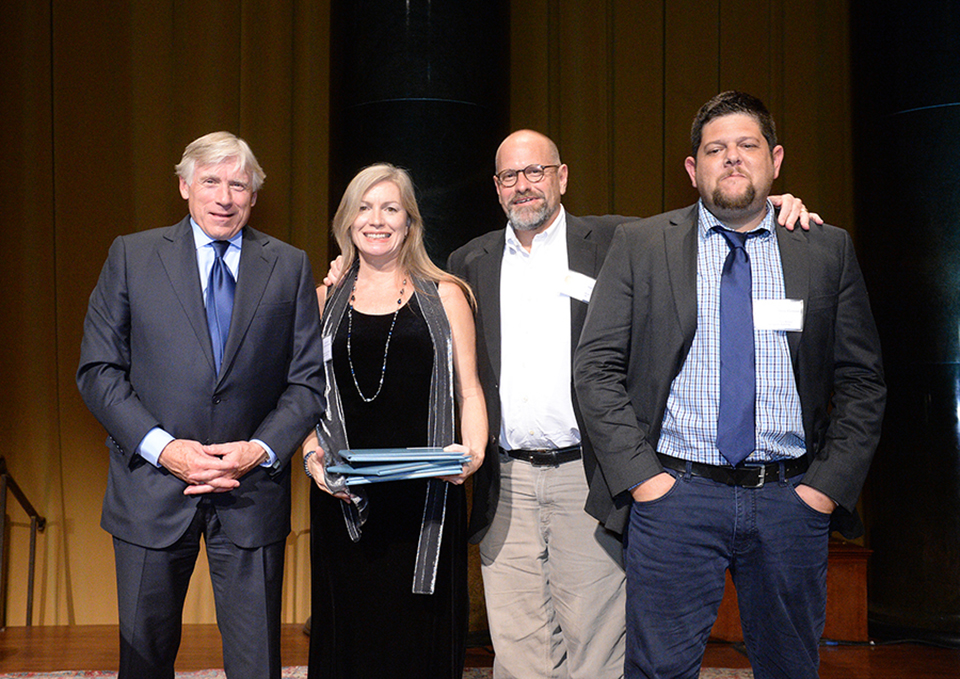
Columbia University President Lee C. Bollinger (left) presents the 2016 Investigative Reporting Prize to Leonora LaPeter Anton and Anthony Cormier of the Tampa Bay Times and Michael Braga (center) of the Sarasota Herald-Tribune.
Winning Work
To the Judges:
Each year, Florida courts send thousands of patients to live in state-funded mental hospitals. They go because they are seriously ill, mentally broken and potentially dangerous. They need round-the-clock care to avoid hurting themselves or someone else.
But in Florida, the care that patients, their families – and society – count on has given way to state-run chaos. Over the past six years, Florida has tried to run these hospitals on the cheap, quietly stripping them of $100 million in funding in order to plug holes in more politically popular programs. The result: mental patients are warehoused, cared for by startlingly few trained workers, and living in a violent environment that has led to the death and injury of patients and staff.
And the state has kept it all secret.
Then the Tampa Bay Times and the Sarasota Herald-Tribune teamed up to publish: “Insane. Invisible. In danger.”
It took more than 18 months for reporters from the two newsrooms to scale a wall of secrecy, review and translate millions of files of data and comb through thousands of pages of police, court and personnel records to find the truth. The result was a devastating series chronicling years of state-sponsored neglect that has led to a doubling of violent attacks and injuries, and to the death of 15 people entrusted to state care.
Gov. Rick Scott and the Florida Legislature kept cutting mental health resources even when violence spiraled out of control and patients began killing themselves and each other. The cuts continued as the hospitals rotted from within, doors literally falling off the hinges, rats creeping into beds at night, patients forced to forage through garbage cans to get enough food.
In the name of patient privacy, government officials tried to hide these realities. It took months for the reporters to get the state to release the names of patients who had been ordered by courts into the state facilities. Then attorneys for the Department of Children and Families fought to deny reporters basic information about deaths and injuries in the facilities. They even refused to turn over the names of hospital workers who were criminally convicted for abusing patients.
When the files were released they were so heavily redacted and unreliable (the state claimed it had simply lost years’ worth of incident reports) that the newspapers built their own database of injuries by stitching together thousands of pages of 911 dispatch records, police incident reports and medical examiner death investigations. Then the reporters set about the tedious work of sifting out the farfetched, unproven allegations and identifying each case where authorities recorded evidence of an assault or injury.
This painstaking work generated the only comprehensive account ever taken of violent attacks and injuries in Florida’s mental asylums. It revealed that the state’s own tracking system has been undercounting violent incidents by half. And it allowed reporters to uncover video evidence of many attacks that state officials had refused to provide.
The Times/Herald-Tribune series prompted an immediate call for emergency action. State Sen. Eleanor Sobel, chair of the committee that oversees DCF spending, has demanded a report (expected in January) from the agency on how it plans to reduce violent incidents. And she said “it’s necessary” that the state restore funding for state mental hospitals and hire more staff.
In the days after reporters presented their findings to the state, Gov. Scott ordered an audit of the state hospitals, including a review of staffing levels scrutinized by the Times/Herald-Tribune reporters. Later he called for $1.7 million in new security cameras and body alarms for staff who work with patients.
In Washington, D.C. U.S. Rep. Kathy Castor entered the newspaper series into the Congressional Record during hearings on a sweeping mental health bill under consideration in the House. The series prompted her to offer amendments that would create a data base to track violence at mental hospitals and nullify state laws that currently keep investigative reports of such attacks secret, even to parents and families of patients who die in state custody.
The newspapers -- originally working separately on different aspects of the same investigation – decided this story was more important than competitive concerns. They forged a unique partnership to combine resources and maximize the impact of the work.
Two other Florida newspapers, including the Miami-Herald, published the series in print. Six other papers wrote editorials calling on state officials to act. The Daytona Beach News-Journal called it a “crisis.” Miami Herald columnist and author Carl Hiaasen urged the Justice Department to investigate, calling the hospitals "medieval" and likening them to a "torture chamber."
"Any law that conceals their abusers must be changed," Hiassen wrote. "Any bureaucracy as covert and cold-hearted as DCF ought to be gutted, rebuilt from the top down."
The Times/Herald-Tribune series has brought unprecedented attention to the dark secrets of Florida’s mental hospitals. It has stirred action to provide better care and protection to those who are ill and must live in these facilities, and improved safety for those with the difficult jobs of working there. They all deserve better.
We are very proud to nominate the work of Leonora LaPeter Anton, Michael Braga and Anthony Cormier for the Pulitzer Prize.
Sincerely,
Neil Brown
Editor and Vice President, Tampa Bay Times
Bill Church
Executive Editor, Sarasota Herald-Tribune
Biography
Leonora LaPeter Anton is a Tampa Bay Times reporter on the enterprise team. She grew up in Connecticut and Greece and studied journalism at the University of Illinois at Urbana-Champaign. She has worked for the Okeechobee News in Okeechobee, the Island Packet on Hilton Head Island, S.C., the Tallahassee Democrat in Tallahassee and the Savannah Morning News in Savannah, Ga. She joined the Times in 2000, the same year she won the American Society of News Editors award for deadline reporting.She lives in St. Petersburg with her husband, Larry, and daughter, Lauren.

Anthony Cormier is an investigative reporter at the Times and previously at the Sarasota Herald-Tribune. He has been a reporter in Florida for 14 years.

Michael Braga is the investigations editor at the Herald-Tribune and has been a reporter in Florida for 20 years. He was a finalist for the Pulitzer Prize in Investigative Reporting in 2010.