The New York Times, by Eric Lipton
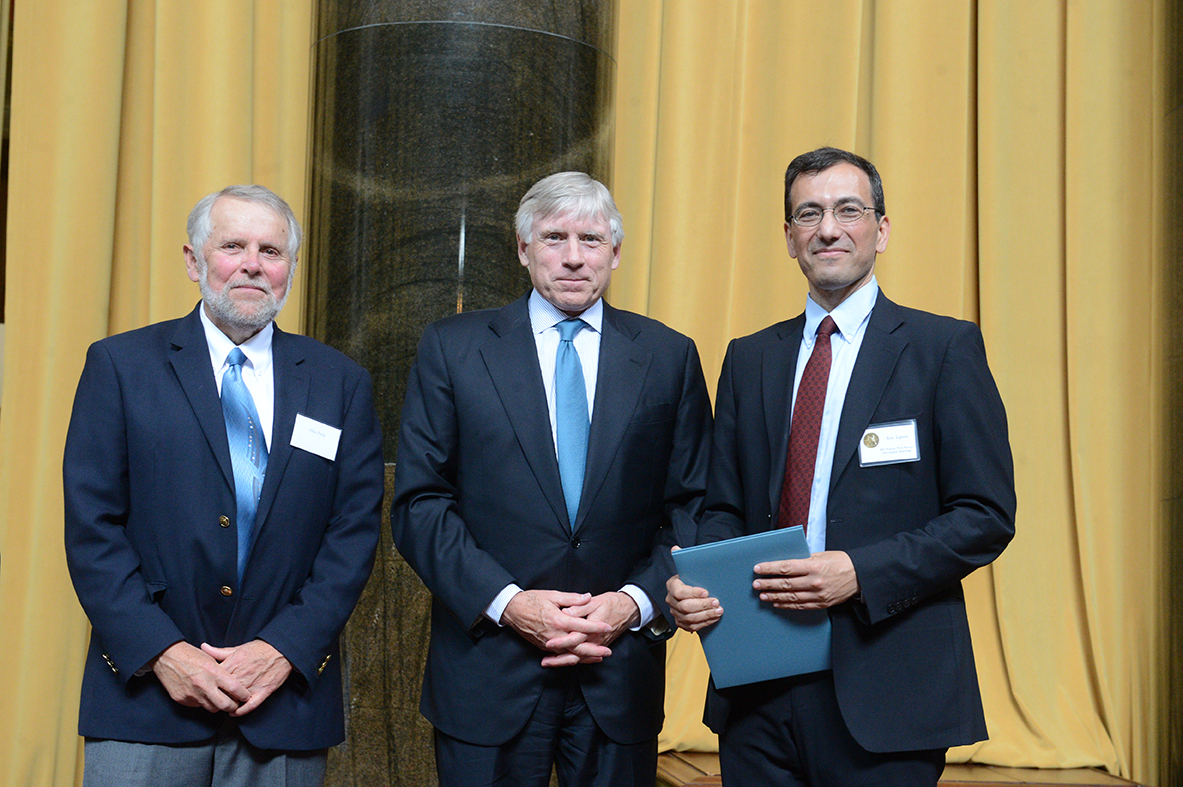
Mike Pride, Pulitzer Prize Administrator (left), and Lee C. Bollinger, President of Columbia University (center), present a 2015 Investigative Reporting Prize to Eric Lipton.
Winning Work
By Eric Lipton
When the executives who distribute 5-Hour Energy, the popular caffeinated drinks, learned that attorneys general in more than 30 states were investigating allegations of deceptive advertising — a serious financial threat to the company — they moved quickly to shut the investigations down, one state at a time.
But success did not come in court or at a negotiating table.
Instead, it came at the opulent Loews Santa Monica Beach Hotel in California, with its panoramic ocean views, where more than a dozen state attorneys general had gathered last year for cocktails, dinners and fund-raisers organized by the Democratic Attorneys General Association. A lawyer for 5-Hour Energy roamed the event, setting her sights on Attorney General Chris Koster of Missouri, whose office was one of those investigating the company.
“My client just received notification that Missouri is on this,” the lawyer, Lori Kalani, told him.
Ms. Kalani’s firm, Dickstein Shapiro, had courted the attorney general at dinners and conferences and with thousands of dollars in campaign contributions. Mr. Koster told Ms. Kalani that he was unaware of the investigation, and he reached for his phone and called his office. By the end of the weekend, he had ordered his staff to pull out of the inquiry, a clear victory for 5-Hour Energy.
The quick reversal, confirmed by Mr. Koster and Ms. Kalani, was part of a pattern of successful lobbying of Mr. Koster by the law firm on behalf of clients like Pfizer and AT&T — and evidence of a largely hidden dynamic at work in state attorneys general offices across the country.
Attorneys general are now the object of aggressive pursuit by lobbyists and lawyers who use campaign contributions, personal appeals at lavish corporate-sponsored conferences and other means to push them to drop investigations, change policies, negotiate favorable settlements or pressure federal regulators, an investigation by The New York Times has found.
A robust industry of lobbyists and lawyers has blossomed as attorneys general have joined to conduct multistate investigations and pushed into areas as diverse as securities fraud and Internet crimes.
But unlike the lobbying rules covering other elected officials, there are few revolving-door restrictions or disclosure requirements governing state attorneys general, who serve as “the people’s lawyers” by protecting consumers and individual citizens.
A result is that the routine lobbying and deal-making occur largely out of view. But the extent of the cause and effect is laid bare in The Times’s review of more than 6,000 emails obtained through open records laws in more than two dozen states, interviews with dozens of participants in cases and attendance at several conferences where corporate representatives had easy access to attorneys general.
Often, the corporate representative is a former colleague. Four months after leaving office as chief deputy attorney general in Washington State, Brian T. Moran wrote to his replacement on behalf of a client, T-Mobile, which was pressing federal officials to prevent competitors from grabbing too much of the available wireless spectrum.
“As promised when we met the A.G. last week, I am attaching a draft letter for Bob to consider circulating to the other states,” he wrote late last year, referring to the attorney general, Bob Ferguson.
A short while later, Mr. Moran wrote again to his replacement, David Horn. “Dave: Anything you can tell me about that letter?” he said.
“Working on it sir,” came the answer. “Stay tuned.” By January, the letter was issued by the attorney general largely as drafted by the industry lawyers.
The exchange was not unusual. Emails obtained from more than 20 states reveal a level of lobbying by representatives of private interests that had been more typical with lawmakers than with attorneys general.
“The current and increasing level of the lobbying of attorneys general creates, at the minimum, the appearance of undue influence, and is therefore unseemly,” said James E. Tierney, a former attorney general of Maine, who now runs a program at Columbia University that studies state attorneys general. “It is undermining the credibility of the office of attorney general.”
Private lawyers also have written drafts of legal filings that attorneys general have used almost verbatim. In some cases, they have become an adjunct to the office by providing much of the legal work, including bearing the cost of litigation, in exchange for up to 20 percent of any settlement.
Money gathered through events like the one in February 2013 at the Loews hotel is flooding the political campaigns of attorneys general and flowing to party organizations that can take unlimited corporate contributions and then funnel money to individual candidates. The Republican Attorneys General Association alone has pulled in $11.7 million since January.
It is a self-perpetuating network that includes a group of former attorneys general called SAGE, or the Society of Attorneys General Emeritus, most of whom are now on retainer to corporate clients.
Giant energy producers and service companies like Devon Energy of Oklahoma, the Southern Company of Georgia and TransCanada have retained their own teams of attorney general specialists, including Andrew P. Miller, a former attorney general of Virginia.
For some companies, the reward seems apparent, according to the documents obtained by The Times. In Georgia, the attorney general, after receiving a request from a former attorney general who had become a lobbyist, disregarded written advice from the state’s environmental regulators, the emails show. In Utah, the attorney general dismissed a case pending against Bank of America over the objections of his staff after secretly meeting with a former attorney general working as a Bank of America lobbyist.
That Bank of America case was cited in July when the two most recent former attorneys general in Utah were charged with granting official favors to donors in exchange for golf getaways, rides on private planes and a luxury houseboat.
While the Utah case is extreme, some participants say even the daily lobbying can corrode public trust.
“An attorney general is entrusted with the power to decide which lawsuits to file and how to settle them, and they have great discretion in their work,” said Anthony Johnstone, a former assistant attorney general in Montana. “It’s vitally important that people can trust that those judgments are not subject to undue influence because of outside forces. And from what I have seen in recent years, I am concerned and troubled that those forces have intensified.”
Several current and former attorneys general say that while they are disappointed by the increased lobbying, they reject the notion that the outside representatives are powerful enough to manipulate the system.
“There is no Mr. Fix-It out there you can hire and get the job done no matter what the merits are,” said Attorney General Tom Miller of Iowa, the longest-serving state attorney general in the country, at 19 years.
Mr. Koster said he regretted the prominence of groups like DAGA and RAGA — as the Democratic and Republican attorneys general associations are known — saying the partisanship and increased emphasis on money had been damaging.
“I wish those two organizations did not exist,” Mr. Koster said during an interview at his office in Kansas City, even though the Democratic group has contributed at least $1.4 million to his election campaigns, more than any other source.
But he rejected any suggestion that his office had taken actions as a result of the lobbying, instead blaming mistakes made by his staff for moves that ended up benefiting Dickstein’s clients.
Some companies have come grudgingly to the influence game.
Executives from the company that distributes 5-Hour Energy, for example, have contributed more than $280,000 through related corporate entities in the last two years to political funds of attorneys general.
Company executives wrote those checks after the investigation into false claims and deceptive marketing, which initially involved 33 states, opened in January 2013. Requests started to come in for contributions, including a phone call this year directly from Mr. Ferguson of Washington State, whose staff was involved in the inquiry.
In a statement after the company was sued by three states in July, the company strongly denied the allegations and compared being solicited for contributions to being pressured to pay “ransom.” It asked, “Is it appropriate for an attorney general to ask for money from a company they plan to sue?”
A spokesman for Mr. Ferguson first called the allegation baseless. But after being shown a copy of an invitation to a fund-raising event that Mr. Ferguson held in May during a DAGA conference — where 5-Hour Energy was listed as a sponsor — his spokesman confirmed that Mr. Ferguson had made a personal appeal to the company.
Secluded Access
Breakfast was served on a patio overlooking the Pacific Ocean — a buffet of fresh baked goods, made-to-order eggs, lox and fruit — as the Republican attorneys general, in T-shirts and shorts, assembled at Beach Village at the Del, in Coronado, Calif.
These top law enforcement officials from Alabama, South Carolina, Nebraska, Wisconsin, Indiana and other states were joined by Ms. Kalani, of Dickstein Shapiro, and representatives from the U.S. Chamber of Commerce, Pfizer, Comcast and Altria, among other corporate giants.
The group had gathered at the exclusive Beach Village at the Del — where rooms go for as much as $4,500 a night and a special key card is required to enter the private compound — for the most elite event for Republican attorneys general, a gathering of the Edmund Randolph Club (named for the first United States attorney general).
The club, created by the Republican Attorneys General Association, has a $125,000 entry fee — money used to fund the campaigns of attorney general candidates with as much as $1 million, and to pay for the hotel bills, airfare and meals for the attorneys general who attend the events.
As at the Democrats’ event, the agenda included panels to discuss emerging legal issues. But at least as important was the opportunity for the lobbyists, corporate executives and lawyers to nurture relationships with the attorneys general — and to lobby them in this casual and secluded setting. (A reporter from The Times attended this event uninvited and, once spotted, was asked to leave.)
The appeals began the moment the law enforcement officials arrived, as gift bags were handed out, including boxes of 5-Hour Energy, wine from a liquor wholesalers group and music CDs (Roy Orbison for the adults, the heartthrob Hunter Hayes for their children) from the recording industry.
Andy Abboud, a lobbyist for Las Vegas Sands, which donated $500,000 through its chief executive to the Republican group this year, has been urging attorneys general to join an effort to ban online poker. At breakfast, he approached Attorney General Pam Bondi of Florida.
“What are you going to be doing today?” he asked.
“Sailing,” Ms. Bondi replied.
“Great, I want to go sailing, too,” Mr. Abboud said, and they agreed to connect later that day.
The increased focus on state attorneys general by corporate interests has a simple explanation: to guard against legal exposure, potentially in the billions of dollars, for corporations that become targets of the state investigations.
It can be traced back two decades, when more than 40 state attorneys general joined to challenge the tobacco industry, an inquiry that resulted in a historic $206 billion settlement.
Microsoft became the target of a similar multistate attack, accused of engaging in an anticompetitive scheme by bundling its Internet Explorer with the Windows operating system. Then came the pharmaceutical industry, accused of improperly marketing drugs, and, more recently, the financial services industry, in a case that resulted in a $25 billion settlement in 2012 with the nation’s five largest mortgage servicing companies.
The trend accelerated as attorneys general — particularly Democrats — began hiring outside law firms to conduct investigations and sue corporations on a contingency basis.
The widening scope of their investigations led companies to significantly bolster efforts to influence their actions. John W. Suthers, who has served as Colorado’s attorney general for a decade, said he was not surprised by this campaign.
“I don’t fault for one second that corporate America is pushing back on what has happened,” Mr. Suthers said. “Attorneys general can do more damage in a heartbeat than legislative bodies can. I think it is a matter of self-defense, and I understand it pretty well, although I have got to admit as an old-time prosecutor, it makes me a little queasy.”
Republican attorneys general were the first to create a party-based fund-raising group, 14 years ago. An initial appeal for contributions to corporate lobbyists and lawyers said that public policy was being shaped “via the courthouse rather than the statehouse.” It urged corporate lawyers “to round up your clients and come see what RAGA is all about.” The U.S. Chamber of Commerce alone has contributed $2.2 million this year to the group, making it the association’s biggest donor.
The Democrats at first fought the idea, but two years later formed a counterpart.
Dickstein, and a handful of other law firms, moved to capitalize by offering lobbying as well as legal assistance to deal with attorneys general, whom Dickstein called “the new sheriffs in town.”
In an effort to make allies rather than adversaries, Bernard Nash, the head of the attorney general practice at Dickstein and the self-proclaimed “godfather” of the field, tells clients that it is essential to build a personal relationship with important attorneys general, part of what his firm boasts as “connections that count.”
“Through their interaction with A.G.s, these individuals will become the ‘face’ of the company to A.G.s, who are less likely to demagogue companies they know and respect,” said a confidential memo that Dickstein sent late last year to one prospective client, Caesars Entertainment.
Executing this strategy means targeting the attorneys general “front office,” a reference to the handful of important decision makers.
“Front office interest or lack of interest in an issue can come from an assessment of media reports and potential media scrutiny; advocacy group requests; political benefit or detriment; legislative inquiries; and ‘pitches’ made by law firms or other professionals in whom the front office has confidence,” Dickstein said in the memo pitching business to executives at Caesars that asked the company to pay $35,000 a month, plus expenses, for lobbying and strategic advice, not including any legal work.
Mr. Nash and his team build relationships through dinners at exclusive spots like the Flagler Steakhouse in Palm Beach, Fla., and Brown’s Beach House Restaurant in Waimea, Hawaii, during attorneys general conferences, as well as with a constant stream of campaign contributions, totaling at least $730,000 in the last five years.
Dickstein is hardly alone.
Other dinner invitations have come from former Attorney General Thurbert E. Baker of Georgia, whose clients have included AT&T and the debt buyers industry; former Attorney General Patrick C. Lynch of Rhode Island, who represents payday lenders, Comcast and makers of online video games; and former Attorney General Rob McKenna of Washington State, who has been retained by Microsoft and T-Mobile.
In several cases, these former officials are clearly acting as lobbyists. Mr. Lynch, who declined several requests for comment, tells prospective clients that he can guide them “through the national network of attorneys general associations and work with them to build relationships,” yet The Times could find no record that he had registered as a lobbyist in more than two dozen states where he has worked.
State lobbying laws generally require registration when corporations hire someone to influence legislation, but appeals targeting attorneys general are not explicitly covered, even if a company is pushing its agenda.
The documents obtained by The Times include dozens of emails that Mr. Lynch has sent to attorneys general on behalf of clients. He is also a regular at the attorney general conferences, which include social events like trap shooting, fitness training and all-terrain-vehicle rides, in addition to cocktail parties and meals.
These conferences also include panels on topics like regulation of oil and natural gas pipelines.
Yet often a seat on these panels is, in effect, for sale. A large donation can secure the right to join a panel or provide an opportunity for a handpicked executive to make a solo presentation to a room full of attorneys general. That is what a top executive from TransCanada, the company behind the Keystone XL pipeline, did at two recent attorneys general meetings in Utah and Colorado.
For the attorneys general, there is a personal benefit, too: Their airfare, meals and hotel bills at these elite resorts are generally covered, either by the corporate sponsors or state taxpayers.
Ms. Bondi, the Florida attorney general, for example, received nearly $25,000 worth of airfare, hotels and meals in the past two years just from events sponsored by the Republican Attorneys General Association, state disclosure reports show. That money came indirectly from corporate donors.
She has charged Florida taxpayers nearly $14,000 since 2011 to take additional trips to meetings of the National Association of Attorneys General and the Conference of Western Attorneys General, including travel to Hawaii. Those events were also attended by dozens of lobbyists. Ms. Bondi, in a statement, said the support she had received — directly or through the Republican Attorneys General Association — had not had an impact on any of her actions as attorney general.
But Matthew L. Myers, the president of the nonprofit Campaign for Tobacco-Free Kids, who was on a panel about e-cigarettes at an event in Park City, Utah, was startled by what he saw: lobbyists from regulated industries — financial, energy, alcohol, tobacco and pharmaceutical companies — socializing with top state law enforcement officers.
“You play golf with somebody, you are much less likely to see them as a piranha that is trying to devour consumers, even if that is just what they are,” said Mr. Myers.
Mr. Tierney, the former Maine attorney general, said that lobbyists were entitled to set up a meeting with the attorneys general in their offices. But to write a check, for as much as $125,000, to gain days’ worth of private time with the attorneys general is another matter, he said.
“When you start to connect the actual access to money, and the access involves law enforcement officials, you have clearly crossed a line,” he said. “What is going on is shocking, terrible.”
An Ear in Missouri
In Missouri, as in other states, the attorney general’s office has provided a springboard to higher office, either to the governor’s mansion or the Senate. So even before Mr. Koster was sworn in for his second term, he was being mentioned as a candidate for higher office. And that made him an ideal target for the team at Dickstein.
The Dickstein lawyers have donated to his campaigns, invited him and his chief deputy to be featured speakers at law firm events and hosted Mr. Koster at dinners, and stayed in close contact with his office in emails that suggest unusual familiarity.
The relationship seems to have benefited some Dickstein clients.
Pfizer, the New York-based pharmaceutical giant, had hired Dickstein to help settle a case brought by at least 20 states, which accused the company of illegally marketing two of its drugs — Zyvox and Lyrica — for unapproved uses, or making exaggerated claims about their effectiveness.
Instead of participating in the unified investigation with other states — which gives attorneys general greater negotiating power — Mr. Koster’s office worked directly with Mr. Nash and Pfizer’s assistant general counsel, Markus Green.
Mr. Nash negotiated with Deputy Attorney General Joseph P. Dandurand through a series of emails, followed by a visit to Missouri in April 2013.
But both Pfizer and Dickstein had already built a relationship with Mr. Koster. Dickstein had participated in at least four fund-raising events for Mr. Koster, with its lawyers and the firm donating $13,500 to his campaigns, records show.
Several of those contributions came after Mr. Nash had invited Mr. Koster to participate in an “executive briefing” at the Park Hyatt for Dickstein’s clients. That same day, Mr. Koster held a fund-raising event, taking in contributions from Mr. Nash and other lawyers involved in matters that Mr. Koster would soon be, or already was, investigating, the records show.
Pfizer had directly donated at least $20,000 to Mr. Koster since 2009 — more than it gave to any other state attorney general, according to company records. That does not include the $320,000 that Pfizer donated during the same period to the Democratic Attorneys General Association, which in turn has donated to Mr. Koster’s campaigns.
Mr. Koster said his office was forced to negotiate directly with Mr. Nash and Pfizer because a staff lawyer missed a deadline to participate in the multistate investigation.
“This was an accident,” Mr. Koster said, adding that since he became attorney general in 2009, his office has participated in six cases against Pfizer that brought a total of $26 million to Missouri.
But the emails show that just as the negotiations on the 2013 case were intensifying, Mr. Koster’s chief deputy received an unusual invitation: Would the attorney general be interested in flying to Chicago to be the keynote speaker at a breakfast that Pfizer was sponsoring for its political action committee?
The topic was “the importance of corporations’ building productive relationships with A.G.s,” according to an email in March from Dickstein to Mr. Dandurand.
“As you know, these relationships are important to allow A.G.s and corporations to work together to address important public policy issues of concern to both the A.G. and the corporation,” the invitation said. “The conference participants also would like to hear how these relationships can help to efficiently address A.G.s’ questions or concerns before they escalate into major problems (like multistate investigations or litigation), as well as how they can carry over when A.G.s are elected to higher offices.”
Mr. Dandurand worked to accommodate the request.
“Trying now to clear his calendar,” Mr. Dandurand wrote back to the Dickstein lawyer, before confirming that Mr. Koster would accept the invitation.
“The folks at Pfizer are very appreciative and excited to hear from the General,” J. B. Kelly, a partner at Dickstein, replied.
Five days later — and just before Mr. Koster was scheduled to give the speech — Mr. Dandurand and Mr. Nash met to discuss a settlement in the fraud investigation. They agreed that Pfizer would pay Missouri $750,000 — at least $350,000 less than it would have collected if it had been part of the multistate investigation.
“Thank you for the meeting,” Mr. Nash wrote to Mr. Dandurand, after the settlement meeting in Missouri. “Pfizer is pleased.”
Mr. Koster said Missouri received a smaller payment from Pfizer because the state had less leverage after missing the multistate deadline. Oregon, the other state to negotiate directly with Pfizer on the Zyvox matter, secured a settlement worth $3.4 million — four times what Missouri received — even though Oregon’s population is far smaller.
Pfizer was not the only Dickstein client pleased with the firm’s representation before Mr. Koster’s office.
AT&T was also subject to an investigation by Mr. Koster’s office, something that Mr. Nash learned at the conference held at the Loews hotel. And like Ms. Kalani, Mr. Nash pleaded his case directly with Mr. Koster.
Three weeks after the conversation with Mr. Nash, Mr. Koster’s office took a step that questioned the legal strategy of a multistate investigation of AT&T’s billing practices, email records show. Mr. Koster did not officially back out of the inquiry, and Missouri ultimately benefited from a national settlement announced this month.
But frustrating leaders of the multistate investigation, Mr. Koster decided to join a small group of attorneys general who, to the industry’s pleasure, wanted to resolve the matter without subpoenas or the threat of a lawsuit, the emails show.
AT&T has been a major campaign contributor to Mr. Koster’s political causes, donating more than $27,000 in just the last two years, half before and half after his actions regarding the investigation.
Mr. Koster said the donations had no effect on his actions, adding that he was determined to investigate the company for its deceptive billing practices. With 5-Hour Energy, he added, he pulled out of the investigation because he did not believe it was merited — adding that he personally uses the energy drink.
Yet he said he was angry that his staff had not notified him before joining investigations into these two major companies.
“Its stock price would move at the mere mention of our involvement,” Mr. Koster said, referring to AT&T.
Mr. Nash’s appeals were not finished.
A month after returning from the Santa Monica meeting, Mr. Koster adopted a new office policy requiring lawyers and managers in his consumer affairs division to get approval from his top aides before opening any investigations involving a publicly traded company or any company with more than 10 employees.
Mr. Nash and Lisa A. Rickard, a senior executive from the U.S. Chamber of Commerce, were so pleased with the change that they asked Mr. Koster to give a talk about his new office policy at a meeting of attorneys general in Washington.
“This is going to be titled my Lisa Rickard memorial presentation,” Mr. Koster said at the February 2014 meeting. “She was the one who initiated this idea.”
The email records also reveal the personal nature of the relationship between Mr. Koster’s office and the lawyers at Dickstein.
In an August 2013 exchange, in which the attorney general’s office assured Mr. Nash that it would not share potentially damaging information on a Dickstein client with another state attorney general who was investigating the company — saying the documents were considered confidential — the conversation took a sudden turn away from business.
“Let’s go bowling sometime,” Mr. Dandurand wrote.
“Thanks,” Mr. Nash wrote back. “I’d rather eat and drink with you any time, any place.”
And an Ear in Florida
The email records show a similarly detailed interaction with the office of Ms. Bondi, the Florida attorney general and a fast-rising star in the Republican Party.
Mr. Nash and his partners worked to help Ms. Bondi further her political ambitions at the same time they were lobbying her office on behalf of companies under investigation by it.
Accretive Health, a Chicago-based hospital bill collection company, whose operations in Minnesota had been shut down by the attorney general’s office there for abusive collection practices, had turned to Dickstein Shapiro to try to make sure that other states did not follow Minnesota’s lead. Mr. Nash contacted Ms. Bondi’s chief deputy and urged the office to take no action.
“We persuaded A.G.s not to sue Accretive Health following the filing of a lawsuit by the Minnesota A.G.,” Dickstein wrote in a recent marketing brochure.
Bridgepoint Education, a for-profit online school that has been under scrutiny for what Mr. Miller, the Iowa attorney general, called “unconscionable sales practices,” turned to Dickstein to set up meetings with Ms. Bondi’s staff, to urge her not to join in the inquiries underway in several states. Again, her office decided not to take up the matter, citing the small number of complaints about Bridgepoint it has received.
Dickstein set up a similar meeting for Herbalife, which has been investigated by federal and state authorities for sales practices related to its nutritional shakes and other products. No investigation was opened; again, Ms. Bondi’s staff said her office had received few complaints.
Perhaps the greatest victory in Florida for Dickstein relates to a lawsuit filed by Ms. Bondi’s predecessor against online reservation companies, including Travelocity and Priceline, which Dickstein then represented, based on allegations that they were conspiring to improperly withhold taxes on hotel rooms booked in the state.
Local officials in Florida were confounded by the fact that the case, which was filed before Ms. Bondi was sworn in, suddenly seemed to come to a halt.
“As our state’s highest-ranking law enforcement official, and as the people’s attorney, you have the authority to pursue action on behalf of the citizens of Florida,” Mayor Rick Kriseman of St. Petersburg, a Democrat, wrote to Ms. Bondi in 2011, while he was a state legislator, estimating that Florida was losing $100 million a year.
Behind the scenes, Dickstein had been working to get the case dropped.
“Thank you so much for chatting with me last week about the online travel site suit,” said a January 2012 email to Deputy Attorney General Patricia A. Conners from Christopher M. Tampio, a former lobbyist for the convenience store industry who was hired to work in Dickstein’s attorney general practice, even though he is not a lawyer or a registered lobbyist in Florida.
A year later, a second round of emails arrived in Ms. Bondi’s office: first, one inviting Ms. Bondi or her top aide to dinner at Ristorante Tosca in Washington, and then one from a Dickstein lawyer pointing out that similar online travel cases had recently been dismissed by Florida judges.
The email records provided to The Times show no response to Dickstein, other than a terse “thanks.” But two months later, Ms. Bondi’s office moved to do what the firm had sought.
“Dismissed before hearing,” the state court docket shows, as the case was closed in April 2013 even before it was officially taken up by the court.
A spokesman for Ms. Bondi said her office had dropped the matter after concluding, as Dickstein had argued, that state tax law was ambiguous. The office urged the State Legislature to clarify the matter. But several Florida counties have continued to pursue the matter, taking it to the State Supreme Court.
Dickstein also took unusual steps to promote Ms. Bondi’s political career.
The firm’s lawyers helped arrange a cover article for Ms. Bondi in a magazine called InsideCounsel, which is distributed to corporate lawyers, and invited her, as it did Mr. Koster, to appear at an event in Washington that included the firm’s clients.
And as with Mr. Koster, the assistance included direct political contributions. Mr. Nash was a sponsor of an elaborate fund-raising event this year in Ms. Bondi’s honor at the Mar-a-Lago Club in Palm Beach, owned by Donald J. Trump, which is considered one of the most opulent mansions in the United States.
Ms. Bondi, in a statement, said none of these efforts had affected her decisions.
“My office aggressively protects Floridians from unfair and deceptive business practices, and absolutely no access to me or my staff is going to have any bearing on my efforts to protect Floridians,” she said.
The Revolving Door
In at least 31 states and in Congress, elected officials are banned from lobbying their former colleagues during a cooling-off period, which is intended to limit their ability to cash in on their contacts. Once they do start to lobby, they are required to register to disclose the work.
But even in states like Georgia, where the law prohibits state officials from registering as lobbyists or engaging in lobbying for one year after leaving office, a former attorney general made appeals almost immediately to his former office.
Mr. Baker, who left his post as the state’s attorney general in January 2011, wrote repeatedly that year to the office of his successor, Sam Olens, and to Mr. Olens’s chief deputy, who had served in the same role during Mr. Baker’s tenure, to ask them to take actions that would benefit AT&T, which he had been hired to represent.
“Hi Thurbert,” Jeff Milsteen, Georgia’s chief deputy attorney general, replied to one of the emails that Mr. Baker sent to him in 2011, as Mr. Baker sought his successor’s public support for the proposed merger between T-Mobile and AT&T. “I’ll let you know as soon as I can.”
The next day, Mr. Milsteen wrote back. “I’ve talked to Sam,” he said, “and he is fine with you adding him to the letter.”
A spokesman for Mr. Olens said that he saw nothing wrong with the exchanges because Mr. Baker was acting as a lawyer, not as a lobbyist, and therefore was exempt from the one-year ban — which covers only lobbying of the legislature or the governor, not the attorney general.
But Mr. Baker declined, when asked by The Times, to identify a single legal filing concerning AT&T that he had been involved with. He wrote back to say that this definition of “lawyer” was too narrow.
“Lawyers are advocates,” he said.
In Washington State, both Mr. McKenna, the former attorney general, and Mr. Moran, who had been his top deputy, were pressing their former colleagues within months of leaving their jobs last year, on behalf of clients including Microsoft and T-Mobile, emails show.
For Mr. McKenna, it was quite a turnaround. He had sued T-Mobile in September 2011 to block its proposed merger with AT&T. Now, as a corporate lawyer, Mr. McKenna was setting up meetings with his successor, Mr. Ferguson, to ask him to intervene with federal officials on T-Mobile’s behalf in the inquiry over whether the company was seeking to prevent its competitors from acquiring what it thought was too large a share of the available federal wireless spectrum.
“I write today on behalf of the millions of consumers of wireless and mobile computing services,” said a letter, drafted initially by T-Mobile, but sent out by Mr. Ferguson in January, although it made no mention of the role played by the company or the former attorney general.
Email records show a similar intervention by Mr. McKenna on behalf of Washington State-based Microsoft, with outcomes that brought praise from the corporate executives. “I know that Microsoft was very pleased that you made yourself available,” Mr. McKenna wrote to Mr. Ferguson last October. “Thank you again.”
Mr. Baker and Mr. McKenna are both regulars at the attorneys general retreats. As former attorneys general, they are also special guests at events of the Society of Attorneys General Emeritus.
They have good company in the SAGE club: More than a dozen of the members are now lawyers and lobbyists for corporations, or work at plaintiff’s law firms that are seeking to secure commission-based contracts and then sue corporations on a state’s behalf.
The schedule of attorney general conferences for the coming year is laid out — after a pause for the elections — with events set for the Fontainebleau resort in Miami Beach, the Four Seasons Hotel at Mandalay Bay in Las Vegas and the Grand Wailea resort on Maui, among many others. The invitations for corporate sponsorships are already being sent.
Stacey Solie contributed reporting from Seattle. Griff Palmer and Kitty Bennett contributed research.
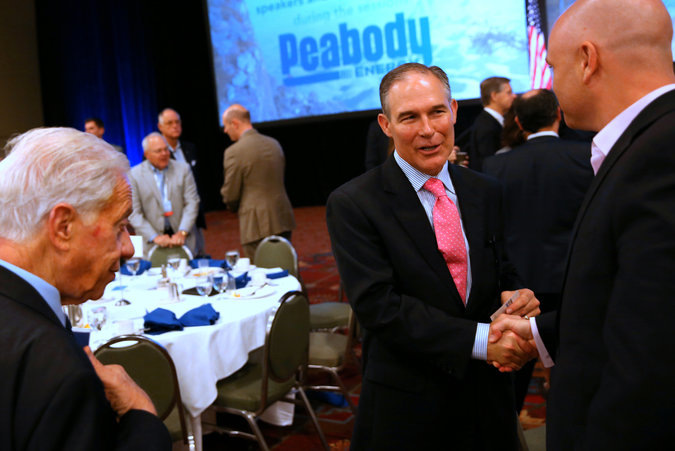
SCOTT PRUITT The Oklahoma attorney general, second from right, in Dallas in July, and his Republican counterparts have formed alliances to oppose federal regulations.
The letter to the Environmental Protection Agency from Attorney General Scott Pruitt of Oklahoma carried a blunt accusation: Federal regulators were grossly overestimating the amount of air pollution caused by energy companies drilling new natural gas wells in his state.
But Mr. Pruitt left out one critical point. The three-page letter was written by lawyers for Devon Energy, one of Oklahoma’s biggest oil and gas companies, and was delivered to him by Devon’s chief of lobbying.
“Outstanding!” William F. Whitsitt, who at the time directed government relations at the company, said in a note to Mr. Pruitt’s office. The attorney general’s staff had taken Devon’s draft, copied it onto state government stationery with only a few word changes, and sent it to Washington with the attorney general’s signature. “The timing of the letter is great, given our meeting this Friday with both E.P.A. and the White House.”
Mr. Whitsitt then added, “Please pass along Devon’s thanks to Attorney General Pruitt.”
The email exchange from October 2011, obtained through an open-records request, offers a hint of the unprecedented, secretive alliance that Mr. Pruitt and other Republican attorneys general have formed with some of the nation’s top energy producers to push back against the Obama regulatory agenda, an investigation by The New York Times has found.
Attorneys general in at least a dozen states are working with energy companies and other corporate interests, which in turn are providing them with record amounts of money for their political campaigns, including at least $16 million this year.
They share a common philosophy about the reach of the federal government, but the companies also have billions of dollars at stake. And the collaboration is likely to grow: For the first time in modern American history, Republicans in January will control a majority — 27 — of attorneys general’s offices.
The Times reported previously how individual attorneys general have shut down investigations, changed policies or agreed to more corporate-friendly settlement terms after intervention by lobbyists and lawyers, many of whom are also campaign benefactors.
But the attorneys general are also working collectively. Democrats for more than a decade have teamed up with environmental groups such as the Sierra Club to use the court system to impose stricter regulation. But never before have attorneys general joined on this scale with corporate interests to challenge Washington and file lawsuits in federal court.
Out of public view, corporate representatives and attorneys general are coordinating legal strategy and other efforts to fight federal regulations, according to a review of thousands of emails and court documents and dozens of interviews.
“When you use a public office, pretty shamelessly, to vouch for a private party with substantial financial interest without the disclosure of the true authorship, that is a dangerous practice,” said David B. Frohnmayer, a Republican who served a decade as attorney general in Oregon. “The puppeteer behind the stage is pulling strings, and you can’t see. I don’t like that. And when it is exposed, it makes you feel used.”
For Mr. Pruitt, the benefits have been clear. Lobbyists and company officials have been notably solicitous, helping him raise his profile as president for two years of the Republican Attorneys General Association, a post he used to help start what he and allies called the Rule of Law campaign, which was intended to push back against Washington.
That campaign, in which attorneys general band together to operate like a large national law firm, has been used to back lawsuits and other challenges against the Obama administration on environmental issues, the Affordable Care Act and securities regulation. The most recent target is the president’s executive action on immigration.
“We are living in the midst of a constitutional crisis,” Mr. Pruitt told energy industry lobbyists and conservative state legislators at a conference in Dallas in July, after being welcomed with a standing ovation. “The trajectory of our nation is at risk and at stake as we respond to what is going on.”
Mr. Pruitt has responded aggressively, and with a lot of helping hands. Energy industry lobbyists drafted letters for him to send to the E.P.A., the Interior Department, the Office of Management and Budget and even President Obama, The Times found.
Industries that he regulates have also joined him as plaintiffs in court challenges, a departure from the usual role of the state attorney general, who traditionally sues companies to force compliance with state law.
Energy industry lobbyists have also distributed draft legislation to attorneys general and asked them to help push it through state legislatures to give the attorneys general clearer authority to challenge the Obama regulatory agenda, the documents show.
“It is quite new,” said Paul Nolette, a political-science professor at Marquette University and the author of the forthcoming book “Federalism on Trial: State Attorneys General and National Policy Making in Contemporary America.” “The scope, size and tenor of these collaborations is, without question, unprecedented.”
And it is an emerging practice that several former attorneys general say threatens the integrity of the office.
“It is a magnificent and noble institution, the office of attorney general, as it is truly the lawyer for the people,” said Terry Goddard, a Democrat who served two terms as Arizona’s attorney general and who, like Mr. Frohnmayer, reviewed copies of the documents collected by The Times. “That independence is clearly at risk here. What is happening diminishes the reputation of individual attorneys general and the community as a group.”
Mr. Pruitt, who has emerged as a hero to conservative activists, dismissed this criticism as misinformed.
“Those kinds of questions arise from the environment we are in — a very dysfunctional, distrustful political environment,” Mr. Pruitt said in an interview. “I can say to you that is not who we are or have ever been, and despite those criticisms we sit around and make decisions about what is right, and what represents adherence to the rule of law, and we seek to advance that and try to do the best we can to educate people about our viewpoint.”
In a state dominated by the energy industry, Mr. Pruitt’s stands have been widely popular. “Attorney General Pruitt has been a champion for our state,” said State Senator Mike Schulz, a Republican who is the majority floor leader. “The State of Oklahoma is in a better position than the E.P.A. to regulate drilling.”
But Mr. Pruitt’s ties with industry are clear. One of his closest partners has been Harold G. Hamm, the billionaire chief executive of Continental Resources, which is among the biggest oil and gas drilling companies in both Oklahoma and North Dakota.
This year, Mr. Pruitt joined with a group aligned with Mr. Hamm to sue the Interior Department over its plan to consider adding animals such as the lesser prairie chicken to the endangered species list, a move that Mr. Hamm has said could knock out “some of the most promising land for oil and gas leases in the country.” The suit was filed after Mr. Hamm announced that he would serve as the chairman of Mr. Pruitt’s re-election campaign.
“Time and time again, General Pruitt has stood up and bravely fought for the rights of Oklahomans in those instances when the federal government has overextended its hand,” Mr. Hamm said as his role in Mr. Pruitt’s re-election effort was announced.
A Potent Ally
Energy industry executives and lobbyists from across the United States saw great potential in Mr. Pruitt, a gifted politician who had been a state legislator and a minor-league baseball team co-owner and executive before running for attorney general.
Among them was Andrew P. Miller, a patrician 81-year-old former Virginia attorney general. Mr. Miller is a regular at gatherings of state attorneys general at resort destinations, and his client list includes TransCanada, the backer of the Keystone XL pipeline; the Southern Company, the Georgia-based electric utility, which has a large number of coal-burning power plants; and the investor group behind the proposed Pebble Mine in Alaska.
For the energy industry, Mr. Pruitt was an easy choice.
“There’s a mentality emanating from Washington today that says, ‘We know best,’ ” Mr. Pruitt said during his 2010 campaign. “It’s a one-size-fits-all strategy, a command-and-control kind of approach, and we’ve got to make sure we know how to respond to that.”
Among Mr. Pruitt’s first acts was to create a “federalism office,” which challenged the Obama administration’s plan to reduce haze in southwestern Oklahoma by requiring coal-burning electricity plants in the state to install new pollution control equipment.
His interaction with the industry, Mr. Pruitt said during an interview at his Oklahoma City office, has been motivated by a desire to gather information from experts, while defending his state’s longstanding tradition of self-determination.
That ethos, he said, is depicted in a large oil painting in his office that shows local authorities with rifles at the ready confronting outsiders during the land rush era. “The founders recognized that power concentrated in a few is a bad thing,” Mr. Pruitt said.
Mr. Miller made it his job to promote Mr. Pruitt nationally, both as a spokesman for the Rule of Law campaign and as the president of the Republican Attorneys General Association.
“I regard the general as the A.G. best suited to take this lead on this question of federalism,” Mr. Miller wrote to Mr. Pruitt’s chief of staff in April 2012. “The touchstone of this initiative would be to organize the states to resist federal ‘overreach’ whenever it occurs.”
To Mr. Miller, having Mr. Pruitt as an advocate fit a broader strategy. He wanted state attorneys general to band together the way they did when they challenged the health care law in 2010. In that effort, they hired a major national corporate law firm, Baker Hostetler, to argue the case, with much of the bill being paid through donations from executives at corporations that oppose the law.
In his initial appeal to Mr. Pruitt, Mr. Miller insisted that his approach was not “client driven.” But he soon began to name individual clients — TransCanada and Pebble Mine in Alaska — that he wanted to include in the effort. The E.P.A. has held up the Pebble Mine project, which could potentially yield 80 billion pounds of copper, after concluding it would “threaten one of the world’s most productive salmon fisheries.”
“This strike force ought to take the form of a national state litigation team to challenge the E.P.A.’s overreach,” Mr. Miller said in an email to Mr. Pruitt’s office. “Like the Dalmatian at the proverbial firehouse, it could move out smartly when the alarm sounded.”
A Call to Arms
Mr. Miller’s pitch to Mr. Pruitt became a reality early last year at the historic Skirvin Hilton Hotel in Oklahoma City, where he brought together an extraordinary assembly of energy industry power brokers and attorneys general from nine states for what he called the Summit on Federalism and the Future of Fossil Fuels.
The meeting took place in the shadow of office towers that dominate Oklahoma City’s skyline and are home to Continental Resources, a leader in the nation’s fastest-growing oil field, the Bakken formation of North Dakota, as well as Devon Energy, which drilled 1,275 new wells last year.
More liberal attorneys general, such as Douglas F. Gansler, Democrat of Maryland, did not participate.
“Indeed, General Gansler would in all likelihood try to hijack your summit,” Mr. Miller wrote to Mr. Pruitt in an email. “At best you would be left to preside over a debate, rather than a call to arms.”
Oklahoma energy companies were there, according to an agenda, joined by executives from Peabody Energy of Missouri, the world’s largest private-sector coal producer, as well as the Southern Company, which has aggressively challenged federal air pollution mandates.
The nation’s top corporate energy regulatory lawyers were there, too, including F. William Brownell, a senior partner at the law firm Hunton & Williams, which has spent more than 25 years fighting the enforcement of the Clean Air Act.
The event was organized by an energy-industry-funded law and economics center at George Mason University of Virginia. The center is part of the brain trust of conservative, pro-industry groups that have worked from the sidelines to help Mr. Pruitt and other attorneys general.
And there was nothing ambiguous about the agenda.
“Suggested Responses to Assaults on Federalism” was the topic of one breakfast meeting, moderated by Attorney General Wayne K. Stenehjem of North Dakota, that showcased Mr. Brownell and three other top corporate regulatory lawyers. Mr. Hamm was the featured dinner speaker.
“We need to ensure the robust role of the states,” said Paul M. Seby, another coal industry lawyer who attended. “And as the chief law enforcement officers, it is not surprising this is becoming a cornerstone of attorney generals’ attention.”
Attorneys general said they had no choice but to team up with corporate America. “When the federal government oversteps its legal authority and takes actions that hurt our businesses and residents, it’s entirely appropriate for us to partner with the adversely affected private entities in fighting back,” said Attorney General Pam Bondi of Florida, whose top deputy attended the meeting.
A ‘Strike Force’
The impact of the gathering was immediate. A week later, a new Federalism in Environmental Policy task force was established by lawyers in the offices of 19 state attorneys general, according to email records obtained from the office of Attorney General Timothy C. Fox of Montana, who had participated in the Oklahoma meeting.
“This message is in follow-up to the excellent environmental conference put on last week by George Mason University and hosted by the Oklahoma attorney general’s office,” said one email sent by Katie Spohn, the deputy attorney general in Nebraska. “In order to continue our coordination of efforts regarding Federalism in Environmental Policy, I am seeking input from each state who participated in the conference.”
Mr. Miller was pleased. “Just the kind of strike force I was talking about,” he said in an interview.
And the input poured forth. The states worked to detail major federal environmental action, like efforts to curb fish kills, reduce ozone pollution, slow climate change and tighten regulation of coal ash. Then they identified which attorney general’s office was best positioned to try to monitor it and, if necessary, attempt to block it.
Follow-up by Mr. Pruitt’s federalism office often came after coordination with industry representatives, especially from Devon Energy. The company, one of the most important financial supporters for the Republican Attorneys General Association, is guarded about its public profile. But it readily turned to Mr. Pruitt and his staff for help, setting up meetings for the attorney general with its chief executive, its chief lobbyist and other important players.
“We have a clear obligation to our shareholders and others to be involved in these discussions,” John Porretto, a Devon spokesman, said in a statement.
While some of the exchanges were general in character, others were quite explicit, especially the communication about the E.P.A.’s methane regulations that had prompted Mr. Whitsitt, the Devon official, to propose that Mr. Pruitt send a letter to the agency.
“Just a note to pass along the electronic version of the draft letter to Lisa Jackson at E.P.A.,” said one September 2011 letter to Mr. Pruitt’s chief of staff from Mr. Whitsitt. “We have no pride of authorship, so whatever you do on this is fine.”
Mr. Pruitt took the letter and, after changing just 37 words in the 1,016-word draft, copied it onto his state government letterhead and sent it to Ms. Jackson, the E.P.A. administrator.
That was just one of his challenges to Washington. Devon officials also turned to Mr. Pruitt to enlist other Republican attorneys general and Republican governors to oppose a rule proposed by the Bureau of Land Management that would regulate hydraulic fracturing, or fracking, on federal land.
“As promised, we are sending you the attached draft of the R.G.A./RAGA follow-up letter to President Obama opposing B.L.M.’s proposed rule,” Brent Rockwood, Devon’s director of government affairs, wrote to Mr. Pruitt’s staff in late 2012, in an email marked “confidential.”
Weeks later, that letter was sent to Mr. Obama without only a few word changes, signed by Mr. Pruitt and Gov. Bobby Jindal of Louisiana, who was the head of the Republican Governors Association at the time.
Company officials again expressed their pleasure to Mr. Pruitt.
“I’ve learned that we’re having an effect — and may be able to have more, perhaps even to having the rule withdrawn or shifted to almost a reporting-only one,” Mr. Whitsitt wrote, in another email marked “confidential.”
The rule — which the industry claims would cost $346 million a year to comply with — has still not been issued.
Coordination between the corporations and teams of attorneys general involved in the Rule of Law effort also involves actual litigation to try to clear roadblocks to energy projects, documents show.
Energy producers, for instance, wanted to sue the Interior Department as it considered adding animals such as the sage grouse — which nests near sites of oil and gas drilling — to a list of endangered species, a move that could put tens of thousands of acres off limits to new drilling.
The energy companies could have sued on their own, but their executives believed that the case would be more potent by bringing in Mr. Pruitt and the weight of the State of Oklahoma.
“We just came to the conclusion he would be the best person to be the lead attorney on this,” said Mike McDonald, an owner of Triad Energy, a small oil and gas exploration company, and the president of a group that calls itself the Domestic Energy Producers Alliance. “He has exceeded our expectations.”
For the industry, the state is an extremely valued partner because states are granted “special solicitude” from the federal courts, a critical advantage to private companies that helps confer legal standing and means that a matter is less likely to be dismissed.
Mr. Pruitt’s office, in a statement to The Times, rejected any suggestion that the attorney general has been wrong to send to Washington comment letters written by industry lobbyists, or to take up their side in litigation.
“The A.G.’s office seeks input from the energy industry to determine real-life harm stemming from proposed federal regulations or actions,” the statement said. “It is the content of the request not the source of the request that is relevant.”
Persuading lawmakers to offer legislation has been another effective lobbying tool. In West Virginia, Mr. Miller handed Attorney General Patrick Morrisey a draft of legislation that he argued would put West Virginia in a better position to sue the Obama administration over proposed regulations to tighten pollution controls on power plants, emails show.
“I trust you will find the legislation acceptable in its present form,” Mr. Miller wrote to Mr. Morrisey in February, referring to a private meeting the two had had in the law library of Mr. Morrisey’s office in Charleston. “If so, I would appreciate your having it introduced by your friends in both the Senate and the House.”
A version of the bill was introduced and passed by the West Virginia Legislature in March. Delegate Rupert Phillips Jr., the chief sponsor of a second bill that also contained language identical to what Mr. Miller had requested, said in an interview that he had acted with Mr. Morrisey’s support, an account supported by William B. Raney, the president of the West Virginia Coal Association.
“It is nice to have everybody singing from the same sheet of music,” Mr. Raney said.
A spokesman for Mr. Morrisey disputed this account, saying that while he supported the effort to challenge the rule, he did not play a role in promoting the legislation.
Blurred Lines
The work in Mr. Pruitt’s office has sometimes seemed to blur the distinction between his official duties and the advancement of his political career.
Mr. Pruitt’s chief of staff, Crystal Drwenski, served as gatekeeper to his office, arranging meetings and helping companies get Mr. Pruitt and his staff to intervene with the federal authorities. But Ms. Drwenski also played an important supplemental role for the attorney general: fund-raising aide.
“A.G. Pruitt is working with the Republican Attorneys General Association on their national meeting in Washington,” Ms. Drwenski wrote to Mr. Whitsitt. “The benefit of membership and participation is having 25 Republican A.G.s in a room to discuss policy issues.”
Ms. Drwenski wanted Devon Energy’s help in enlisting the American Petroleum Institute, and Mr. Whitsitt agreed.
“I’ve put in a plug to A.P.I.,” Mr. Whitsitt wrote back to Ms. Drwenski, a few hours after her request, having reached out to the organization’s senior lobbyist, Marty Durbin. “He is expecting a call.”
In addition to the American Petroleum Institute, major energy companies — ConocoPhillips, the oil and gas company; Alpha Natural Resources, a coal mining giant; and American Electric Power, the nation’s biggest coal consumer — have recently joined the Republican Attorneys General Association, bringing in hundreds of thousands of additional dollars to the group, internal documents show.
By last year, the association was starting to pull in so much money under Mr. Pruitt’s leadership that it decided to break free from its partnership with the Republican State Leadership Committee, a group that represents state elected officials. Within months, the association also set up the Rule of Law Defense Fund, yet another legal entity that allows companies benefiting from the actions of Mr. Pruitt and other Republican attorneys general to make anonymous donations, in unlimited amounts. Fund-raising skyrocketed.
The $16 million that the association has collected this year is nearly four times the amount it collected in 2010, money it used mostly to buy millions of dollars’ worth of television advertisements in states like Arizona, Arkansas, Colorado and Nevada, all places where Republican candidates for attorney general won election.
The fund-raising has taken place on the state level as well. Oklahoma Gas & Electric — a for-profit utility that Mr. Pruitt joined with in federal court to fight the E.P.A. — invited its employees to the Petroleum Club in downtown Oklahoma City late last year for a fund-raising event for Mr. Pruitt, drawing donations from about 45 company employees, including the chief executive. Four days later, Mr. Pruitt filed a new appeal in the case — timing that the utility said was a coincidence.
While Mr. Pruitt’s efforts to raise money for the Republican Attorneys General Association have been an unqualified success, the lawsuits and regulatory appeals he has filed have yielded mixed results.
In May, the Supreme Court declined to take up the appeal on the Oklahoma Gas & Electric matter, meaning the company is now moving ahead on retrofitting its coal-burning plants. But other lawsuits are pending, including Mr. Pruitt’s challenge of the Dodd-Frank law, which rewrote the nation’s financial regulations, and, perhaps most important, his challenge of the tax subsidies that are a critical part of the Obama administration’s health care law.
Mr. Pruitt’s staff has juggled various duties — helping major corporations push their challenges against Washington, and then turning to these same executives, at times, to ask them for financial support.
For example, Ms. Drwenski, who is no longer Mr. Pruitt’s chief of staff, asked Devon Energy in 2012, on a workday afternoon, for help in signing up the American Petroleum Institute as a member of the Republican Attorneys General Association.
She used her personal email account to send out the initial request. But the subsequent exchange took place on her work email account, even though Oklahoma state law prohibits state officials from using state property or time to solicit political contributions. A spokesman for Mr. Pruitt said, “It is entirely possible she could have been taking a late lunch.”
Mr. Pruitt, who ran unopposed to win a second term, has not needed much of the money himself, but his fund-raising efforts have greatly benefited other Republicans running for the job.
That explains the partylike atmosphere late last month in South Florida, where members of the Republican Attorneys General Association held their fall meeting at the chic Fontainebleau Miami Beach, along with hundreds of lobbyists, lawyers and corporate executives, whose companies had paid as much as $125,000 for the privilege to celebrate with them.
During the opening reception, on a giant terrace overlooking the Atlantic Ocean, with red, white and blue lights beaming onto the walls and rock music blasting, the Republican attorneys general strode to the stage to trumpet their new majority in the states.
Mr. Pruitt was there for the weekend’s festivities, an event at which Devon Energy served as a corporate host, with banners hung in the hotel hallways featuring the corporate logo.
The Oklahoma attorney general’s stay was brief. The Rule of Law campaign had a new and urgent target.
“Our president sees himself as above the law,” Mr. Pruitt said from Oklahoma City as he announced several days later yet another front in the campaign, a lawsuit he planned to file to challenge the Obama administration’s new immigration policies. “We will take action to hold him accountable.
Correction: December 14, 2014
A picture credit last Sunday with the continuation of an article about Republican attorneys general in several states who have formed a secretive alliance with some of the nation’s top energy producers to oppose President Obama’s regulatory agenda misidentified the photographer in some editions. The picture, of Scott Pruitt, the Oklahoma attorney general, was taken by Dylan Hollingsworth, not by Nick Oxford.
Nick Madigan contributed reporting.
By Eric Lipton
WASHINGTON — When they met at the J. W. Marriott Hotel two blocks from the White House, Linda Singer, a former attorney general turned plaintiffs’ lawyer, approached Attorney General Gary King of New Mexico with an unusual proposition.
Ms. Singer wanted him to sue the owner of a nursing home in rural New Mexico that Mr. King had never heard of and Ms. Singer had never set foot in. She later presented him with a proposed lawsuit that did not cite any specific complaints about care. What she shared with him were numbers on staffing levels gleaned from records suggesting that residents were being mistreated there and at other facilities.
“Do you have 10 minutes at any point today?” Ms. Singer, who had served as attorney general in the District of Columbia, wrote to to Mr. King in a March 2012 email, to set up a meeting. “I finally got the numbers on the nursing home case and would love to discuss it with you briefly.”
“I’m in the lobby, near the reception desk,” Mr. King later replied, signing the message “GK.”
The casual nature of the exchange between the two Democrats, which was among thousands of pages of emails obtained by The New York Times, belied the enormous potential payoff for Ms. Singer’s firm if she could persuade Mr. King to hire her and use his state powers to investigate and sue, which he did.
The partnership is part of a flourishing industry that pairs plaintiffs’ lawyers with state attorneys general to sue companies, a collaboration that has set off a furious competition between trial lawyers and corporate lobbyists to influence these officials.
Much as big industries have found natural allies in Republican attorneys general to combat federal regulations, plaintiffs’ lawyers working on a contingency-fee basis have teamed up mostly with Democratic state attorneys general to file hundreds of lawsuits against businesses that make anything from pharmaceuticals to snack foods.
The lawsuits follow a pattern: Private lawyers, who scour the news media and public records looking for potential cases in which a state or its consumers have been harmed, approach attorneys general. The attorneys general hire the private firms to do the necessary work, with the understanding that the firms will front most of the cost of the investigation and the litigation. The firms take a fee, typically 20 percent, and the state takes the rest of any money won from the defendants.
While prospecting for contracts, the private lawyers have also donated tens of thousands of dollars to campaigns of individual attorneys general, as well as party-backed organizations that they run. The donations often come in large chunks just before or after the firms sign contracts to represent the state, campaign finance records and more than 240 contracts examined by The Times show.
“This has gotten out of hand,” said Scott Harshbarger, a Democrat who was the attorney general of Massachusetts in the 1990s, when this practice first burst into prominence as a result of the litigation against tobacco companies. “And it seriously threatens the perception of integrity and professionalism of the office, as it raises the question of whether attorneys are taking up these cases because they are important public matters, or they are being driven more by potential for private financial gain.”
Emails and contingency lawyer contract documents obtained by The Times from attorneys general in 15 states show how these alliances have scrambled roles in the legal profession.
Private lawyers whose traditional work has been filing class-action tort claims or securities fraud cases on behalf of individuals or groups are now often operating with the power of the state, substantially increasing their chance for success by bringing claims on behalf of “the people.”
State attorneys general defend the practice, saying that with tight budgets, hiring outside lawyers is often the only tool they have to achieve rough parity with the army of corporate lawyers who are aggressively trying to blunt the lawsuits — in court, through legislation and in elections in which they target certain attorneys general for defeat.
In no place has the contingency-fee practice flourished more than in Mississippi, where lawyers hired by Attorney General Jim Hood, a Democrat, have collected $57.5 million in fees during the last two years — three times as much as Mr. Hood has spent on running his state office during the same period.
Mr. Hood has taken in $395,000 in campaign contributions from trial law firms over the last decade, more than any other attorney general.
In one case, a senior partner at the Houston-based firm Bailey Peavy Bailey donated $125,000 to Mr. Hood after the firm filed a lawsuit on behalf of the state against Eli Lilly, the pharmaceutical company, litigation that in 2010 generated a $3.7 million payment to the outside lawyers. Mr. Hood has now signed a second contract with the firm, to sue the drug company Bristol-Myers Squibb.
Mr. Hood’s office rejected any suggestion that the contracts are given out in exchange for donations. “Whether or not an individual makes a campaign contribution during an election cycle has no bearing on any decisions made by the office of attorney general or its career attorneys who adhere to the highest standards of professionalism,” the office said in a statement.
Over all, plaintiffs’ firms have donated at least $9.8 million directly to state attorneys general and political groups related to attorneys general over the last decade, according to an analysis of campaign finance data by The Times, with more than 76 percent of that money going to Democrats.
The financial benefit to Mississippi’s treasury is also clear. Mr. Hood’s office has brought in $400 million over the last decade from lawsuits filed with the help of outside lawyers, state records show.
The boom in the contingency law business has been driven in part by former attorneys general like Ms. Singer who have capitalized on personal relationships with former colleagues that they have nurtured since leaving office, often at resort destination conferences where they pay to gain access.
Ms. Singer herself has made dozens of pitches, presenting attorneys general with a shopping list of possible litigation topics, like defective highway guardrails and abuses by for-profit colleges, emails show.
“I fear that I’m now stalking you with my voice mail messages and thought I’d switch media,” Ms. Singer wrote in an email late last year to the Washington State attorney general’s office. “Do you have time to talk in the next few weeks? I’d love to pick up the thread of our conversation and get your reaction to the cases we suggested.”
Mr. King and other attorneys general say lawsuits against major corporations or industry sectors can require the hiring of expert witnesses and produce hundreds of thousands of pages of documents that must be reviewed. All of this comes at a high cost, and outside lawyers can foot the bills upfront.
“It’s one of the only tools I have to level the playing field on behalf of consumers, given the significant financial firepower that big pharma, big banking and any number of other industries have,” Mr. King said. “The attorney general is virtually the only protection the consumer has against abuse by those industries.”
But some of his colleagues remain sharply critical of the practice.
“Farming out the police powers of the state to a private firm with a profit incentive is a very, very bad thing,” said Attorney General John Suthers of Colorado, a Republican and a former United States attorney.
A Lawyer’s Plea
For Ellen F. Rosenblum, a Democrat who was the newly elected attorney general of Oregon, November 2012 had been a particularly busy month. She was investigating allegations of ballot tampering, and, on a personal level, her daughter’s wedding was approaching.
But Ms. Singer was determined to get on the attorney general’s calendar to pitch her cases.
“I am delighted to be able to write with congratulations on your election, as well as a more mundane follow-up,” Ms. Singer said in an email during the Thanksgiving holiday weekend in 2012. “I am eager to pick up our conversation at your convenience.”
The exchange echoed pleas that Ms. Singer sent to attorneys general — almost all Democrats — in Arizona, Connecticut, Nevada, New Mexico, New York and Washington State as she worked to team up with them on major civil cases with her firm, Cohen Milstein. Many of the pitches generated no new deals. Ms. Rosenblum, for example, has not given her a contract so far. But a single case can generate millions in payments to her firm.
Though Ms. Singer, 48, served just a year as attorney general in the District of Columbia, she had a long prior tenure in public service jobs, and she referred to her work at Cohen Milstein as an extension of her commitment to serving the public good.
“There is not a bit of shame about anything we do here,” she said in an interview in her Washington office.
Hers is an expansive portfolio of cases. Mississippi hired her to handle an investigation by the state of the credit ratings agencies Experian and TransUnion, which was based on an allegation that they knowingly included errors in their credit files. The relationship was made clear in a subpoena issued to TransUnion in July 2013.
“Please direct any questions regarding our requests or your production to our outside counsel,” said a cover letter on the subpoena, emblazoned with the state seal. It also listed Ms. Singer’s telephone number and address in Washington, in addition to information for a state official helping to supervise the case.
Nevada hired her firm in 2009, under a contract that had an exceptionally broad mandate: to seek compensation for anyone in the state who was harmed as a result of fraudulent mortgage lending practices. And Ms. Singer negotiated a settlement with Bank of America that generated an extra $38 million for Nevada, and $5.6 million for her firm — reflecting a 15 percent fee.
She was also successful in adding to her nursing home case in New Mexico by persuading the attorney general of Pennsylvania to sign a contingency-fee contract pressing similar claims.
In many of those cases, Ms. Singer’s legal theory, at least initially, had a generic quality. In New Mexico, she and the state ended up suing a different company altogether — one based in Texas, instead of the Pennsylvania-based chain that Ms. Singer had identified in a draft complaint she initially provided to Mr. King.
“We go where the evidence leads, and no place else,” Ms. Singer said, explaining the change.
The new case still relies primarily on a calculation suggesting that the 11 nursing homes did not have enough staff members. But the complaint, which named Preferred Care Partners Management Group of Plano, Tex., among others, is now backed up with specific allegations of mistreatment of patients, based on “confidential witnesses.”
Mr. King acknowledged that the lawsuit relied on a novel claim, developed through the use of a software program, that estimated resident harm based on the ratio between nurse’s aides and residents. But Mr. King said that because Cohen Milstein was covering most of the cost, there was little risk to the state, adding that he was receptive to this approach because of what he said had been a disturbing pattern of abuse in his state’s nursing homes.
“The court system in America is a good way to determine if that is a sufficient argument,” Mr. King said.
Ms. Singer’s firm does not have the field to itself. Former attorneys general, including Patricia A. Madrid of New Mexico, Walter W. Cohen of Pennsylvania, Grant Woods of Arizona, Patrick C. Lynch of Rhode Island, Steve Six of Kansas, Drew Edmondson of Oklahoma, Peg Lautenschlager of Wisconsin and Mike Moore of Mississippi, have also pursued or struck deals with states, documents obtained by The Times show. Several of them work simply as brokers, earning a commission just for helping to pitch a case.
Ms. Madrid has flown around the country with her husband (also a lawyer), acting as a broker to solicit business. They traveled early this year to Vermont on behalf of the Texas-based law firm Baron & Budd and successfully pitched the firm to the staff of the attorney general, an old friend, to represent the state in a lawsuit against oil companies over allegations that a fuel additive caused groundwater contamination. Ms. Madrid will earn a fee for helping to sell the job.
“It just gives credibility when you are dealing with someone that you know,” Mike Messina, Ms. Madrid’s husband, said this month while sitting on a couch in the lobby of the Ritz-Carlton hotel in Fort Lauderdale, Fla., where the couple were attending a dinner for newly elected attorneys general. “It gets you past a lot of difficult questions.”
Vermont’s attorney general, William H. Sorrell, said he first developed a friendship with Ms. Madrid when they traveled to Israel together as part of an official delegation of attorneys general. He acknowledged that Ms. Madrid played a role in pitching the case, but said he agreed to the deal only because it will help Vermont bring in the largest possible recovery.
“An office my size to take on a major company or a whole industry, like the oil industry, is David versus Goliath, times 10,” said Mr. Sorrell, who has a staff of about 80 lawyers.
‘Like a Family Party’
One night last week at the restaurant Rosa Mexicano in Washington, as margaritas flowed and trays of shrimp and chicken skewers were passed, the network between contingency-fee lawyers and Democratic attorneys general was on vivid display.
The restaurant was closed for a private holiday party hosted by the Democratic Attorneys General Association. These plaintiffs’ firms have donated more than $3.8 million to the group over the last decade, money that has been passed on in chunks to Democrats to help them with their re-election bids.
Ms. Singer, along with lawyers from at least nine other firms, worked the crowd, chatting up the attorneys general from Vermont, Virginia and other states, while Marlon E. Kimpson, a lawyer from Motley Rice, which focuses on securities litigation, introduced himself to the new attorneys general from Maryland and New Mexico. The event was co-sponsored by the law firm Kaplan Fox, which just secured a multimillion-dollar payout after suing the mortgage giant Fannie Mae on behalf of the State of Tennessee.
“It was like a family party,” said one lawyer who attended and who requested anonymity because it was a private event.
That is precisely the kind of coziness that has driven corporations to marshal a counteroffensive by challenging on multiple fronts attorneys general who hire contingency lawyers.
Darrell McGraw, who collected more than $2 billion worth of settlements in partnership with contingency-fee lawyers during his tenure as West Virginia’s attorney general, was one of the early targets.
“McGraw diverted millions to pet projects and to campaign donors he hired,” said one 2012 television advertisement during his re-election campaign, a reference to a settlement his office had negotiated with Purdue Pharma over its sale of painkillers. That deal included a $2 million payment to contingency-fee law firms whose partners were past campaign donors.
His campaign bought its own advertisement defending his efforts, as did an independent group called the Mountaineer Committee for Justice and Fairness that is funded in part by plaintiffs’ lawyers.
But Mr. McGraw said the assault was overwhelming, and he was defeated after two decades in office.
“They are simply able to eliminate people,” Mr. McGraw said.
The attempts to push back have come in federal and state courts as well. Companies as diverse as Diamond Foods, the snack food maker, and Merck, the pharmaceutical giant, have filed lawsuits or counterclaims arguing that the attorneys general improperly turned over state law enforcement powers to private parties, citing their financial incentive to push ahead with cases against them, even if the facts did not support the claims.
The court challenges have yet to be successful, but some federal judges have at least been receptive to the argument.
Judge William Alsup of Federal District Court for the Northern District of California, who was appointed by President Bill Clinton, wrote last year that cases filed by attorneys general should not become “a vehicle for keeping elected officials in office by allowing them to extract campaign contributions from lawyers selected to serve as class counsel.”
The appeal to state legislatures is the most intensive part of the campaign. Since 2012, at least 14 states have adopted new rules that generally require attorneys general to make a specific “finding of need for outside counsel” and often to have an open competition for the work. In several states, limits have also been placed on fees.
Perhaps the most important victory for the corporate lawyers came this year in Louisiana, where Attorney General Buddy Caldwell, a Republican, has collected $294 million in settlements since 2011 against pharmaceutical companies with the help of outside law firms, which in turn have earned $54 million in fees. The legislation, Mr. Caldwell said in a statement, was devised by the companies to “restrict and destroy the attorney general’s ability to hold them accountable.”
As Gov. Bobby Jindal signed the legislation in June, Pete Martinez, the senior director for state government affairs at Pharmaceutical Research and Manufacturers of America, stood directly behind the governor, with a slight smile.
“The way these issues really get done is a result of the grass-roots effort,” Lisa A. Rickard, the head of the U.S. Chamber of Commerce’s Institute for Legal Reform, said in October as she presented an award to the business leaders from Louisiana who led the fight.
But the grass roots had high-powered allies. Mr. Martinez was there again as the award — a small glass gavel that Ms. Rickard referred to as the chamber’s version of the Oscar — was bestowed.
Plaintiffs’ lawyers said they were not surprised by the onslaught.
“You look at the results, and I can see why the business community is organizing to fight this,” said Blair A. Nicholas, managing partner at the firm Bernstein Litowitz. “The attorneys general are getting significant results. They speak for themselves.”
The plaintiffs’ bar — and its allies in the offices of attorneys general — have tried to fight back.
Mr. Lynch, the former Rhode Island attorney general, who represents three of the nation’s largest plaintiffs’ firms, sent a confidential appeal to half a dozen state attorneys general in January, asking them to intervene in the matter with the United States Supreme Court to protect their ability to file federal securities fraud cases, typically handled by outside lawyers.
“Based on our conversation last night, I write to get confirmation that you will sign this brief today,” Mr. Lynch wrote to Ms. Rosenblum, the Oregon attorney general. He added that he already had a tentative commitment from Mr. Hood, as well as from Attorney General Bob Ferguson of Washington State and Attorney General Kathleen G. Kane of Pennsylvania, all Democrats who have taken contributions from the contingency-fee lawyers.
A spokeswoman for Ms. Rosenblum said the contributions played no role in the decision. Instead, her staff agreed to adopt the brief as its own, after making some editing changes, because it agreed with it.
Still, the counterattack by big business has had its impact. Ms. Madrid said some newly elected Democrats were reluctant to hire outside firms, fearful that they were going to be targeted for defeat in elections.
But the sales pitches are still taking place, with Ms. Singer, in particular, urging attorneys general to join her firm for a new round of possible cases, including ones against makers of furniture that has a chemical additive that some consider harmful, and drug companies that sell certain painkillers. In fact, at least three former attorneys general are pitching painkiller abuse cases to states nationwide, although no state has yet publicly signed up.
“The chamber has made the bar so high, attorneys general understand there is a cost politically to hiring outside counsel,” she said. “So it is not something they do lightly or freely.”
Kitty Bennett contributed research.
By Eric Lipton
VAIL, Colo. — After some time in the hot tub, an evening cocktail reception and a two-and-a-half-hour dinner in a private dining room named Out of Bounds, Representative Adrian Smith, Republican of Nebraska, made one last stop, visiting the lounge at the Four Seasons Resort hotel here to spend more time with the lobbyists and other donors who had jetted in from Washington, D.C., to join him for the weekend getaway.
On the other side of the Rocky Mountains, in Utah, Senator Kelly Ayotte, Republican of New Hampshire, kicked off the new year in the equally upscale resort town of Park City by hitting the ski slopes in the morning with her chief of staff. She then joined a roomful of corporate executives and lobbyists at a mountaintop resort for lunch, her face flush from the mountain sun.
“Anyone who wants to do some runs with me, I would love to,” Ms. Ayotte told her guests, many of them also in ski gear.
This is the world of destination fund-raisers, where business interests blend with pleasure in exclusive vacation venues. Lobbyists go to build relationships with lawmakers, Democrats and Republicans alike, seeking action — and often inaction — in Washington for their clients and companies, with millions of dollars at stake. While approval ratings are at historic lows for members of Congress, their allure to those seeking influence in the nation’s capital is as strong as ever.
Neither the lawmakers nor the lobbyists attending the events want to talk about them, even though such trips are permitted under the law. They allow members of Congress to hit hot spots like the Napa Valley wine country, famed golf courses and hunting preserves, as well as five-star hotels in Puerto Rico, Las Vegas, South Florida and even Bermuda.
Congress, after a corruption scandal that involved golf trips to Scotland and other getaways paid for by lobbyists, passed legislation in 2007 prohibiting lobbyists from giving lawmakers gifts of just about any value. But as is the norm in Washington, the lawmakers and lobbyists have figured out a workaround: Political campaigns and so-called leadership PACs controlled by the lawmakers now pay the expenses for the catering and the lawmakers’ lodging at these events — so they are not gifts — with money collected from the corporate executives and lobbyists, who are still indirectly footing the bill.
Even if no explicit appeals for help are made, the opportunity to build a relationship with the lawmakers, staff members and family — far from the distractions of Washington — is worth the price of admission, the lobbyists said. The donors and lobbyists, 50 to 100 of whom typically attend the events, generally donate individually or through a corporate political action committee between $1,000 and $5,000 apiece, in addition to paying their own hotel bills and airfare. There is no public disclosure that specifically shows how much is raised at each event, and lawmakers are generally unwilling to say.
“An informal setting is an effective way to build a better relationship,” said a health care lobbyist who attended the fund-raising weekend in Vail this month. The event included five House Republicans, none of them from Colorado and two of whom serve on the powerful Energy and Commerce Committee, which oversees the health care industry. “It’s a way to get some large chunks of a lawmaker’s time,” the lobbyist said.
One Republican campaign consultant, Mike Gula, sent lobbyists a save-the-date summary in December that featured 30 trips in 2014, such as a “Spa Weekend Trip” in Las Vegas in March sponsored by Representative Ann Wagner, Republican of Missouri.
On the Democratic side, both Representatives Steny H. Hoyer of Maryland and Xavier Becerra of California have picked the Ritz-Carlton’s Dorado Beach hotel in Puerto Rico for their destination events, while Representative John Conyers of Michigan is scheduled to be at the Beverly Hilton in Beverly Hills, Calif., this weekend, for a fund-raising event tied to the Grammy Awards. Mr. Hoyer’s political action committee alone spent $91,000 at the Puerto Rico resort in 2013, records show.
“This is an event Mr. Hoyer holds to support Democrats and help Democrats win back the House majority,” said Stephanie Young, a spokeswoman for Mr. Hoyer, who is the second-ranking House Democrat.
A New Kind of ‘Norm’
Lobbyists who participate in destination events, and campaign consultants who are paid to organize them, say they are happening more often.
“It has become kind of the norm,” said Vic Fazio, a Democratic lobbyist and former congressman from California, whose Blue Chip client list now includes Anheuser-Busch and UPS. He and his wife attended the fund-raiser that Mr. Hoyer hosted in Puerto Rico last year.
“To the average citizen, it might seem like there is a disconnect between the reality of life in America and these getaways,” Mr. Fazio added, saying he supports changes in campaign finance laws to eliminate the need for such trips.
The events at high-end resorts in Park City and Vail, which a reporter for The New York Times attended without a formal invitation, are popular even among lawmakers like Ms. Ayotte and Mr. Smith, who won their seats in Congress by wooing voters with calls for limited government and populist appeals tuned to the Tea Party-inspired. Mr. Smith said there was no disconnect.
“This was a good way to raise some funds,” he said as he emerged from the Flame restaurant at the Four Seasons Resort and Residences Vail. The meal, with campaign donors and lobbyists, included kimchi brussels sprouts, bacon-wrapped prawns, Wagyu strip steak and Franciscan Estate Cabernet, a Napa blend that cost $60 a bottle.
“With the holidays here it seems to be a good critical mass,” he added.
The fund-raising events that are not in the lawmakers’ home states often dovetail with their hobbies. Representative Aaron Schock, Republican of Illinois and an avid skier, made the trip this month to Vail, for example, while Representative Collin C. Peterson, Democrat of Minnesota, has hunted turkeys in Florida, geese in Texas and quail in Georgia over the last three years, according to invitations sent to lobbyists. (Neither lawmaker responded to a request for comment.)
A spokesman for Representative Smith said that the lawmaker had bought his own ski pass in Vail, but that his travel, lodging and meals had been provided to him at no personal expense. Those at the event included Representative Edward Whitfield, Republican of Kentucky, and Katie Ott, a lobbyist for PPL Corporation, the single biggest contributor to Mr. Whitfield.
Mr. Whitfield is chairman of the Energy and Commerce subcommittee that regulates energy utilities, making him one of the most important players in Congress for the industry. Only days after the Vail trip, he introduced legislation that would allow utilities like PPL to build new coal-burning power plants, overriding environmental restrictions recently imposed by the Obama administration.
In just the first evening of the two-day event in Colorado, lobbyists spent nearly six hours with Mr. Whitfield or other co-sponsors of the trip, time that would be all but impossible to arrange in Washington, with conversations ranging from health care legislation to energy issues and the coming elections.
“The most important thing is we want all of you to have fun, because I know we’re going to have a lot of snow tomorrow,” Mr. Whitfield said as he greeted a room packed with lobbyists in the $8.75 million penthouse suite at the Four Seasons, which featured a candlelit rooftop terrace with panoramic views of Vail Mountain, as waiters struggled to keep up with the demand for drinks. “Thank you again for your support,” he said, “and continue your celebrating tonight.”
Play and Work, in Utah
For Ms. Ayotte, a first-term senator who does not face re-election until 2016, the trip to Utah mixed business and pleasure.
She held her first fund-raiser in Park City at the multimillion-dollar home of Gordon Smith, the former senator from Oregon. Mr. Smith is now a lobbyist and chief executive of the National Association of Broadcasters, which has a long list of high-stakes matters before the Senate Commerce Committee, of which Ms. Ayotte is a member. One of those matters includes the planned auction of television broadcast spectrum.
Just three weeks before her fund-raising event, Ms. Ayotte spoke in favor of the industry at a Senate hearing. She raised concern that the auction could be handled in a way that hurt television broadcasters, an objection also stated in a letter to federal regulators that she co-signed in September.
Ms. Ayotte’s chief of staff, John Easton, said that her actions were unrelated to any financial support she has received and that “numerous constituents have raised the interference issue” with her. “Viewers could see service disruptions” if the auction were not handled properly, Mr. Easton said.
After the reception at Mr. Smith’s house, Ms. Ayotte went to a hotel bar, at Chateau Deer Valley, and spent more than an hour chatting with two aides and a donor who is a lawyer and who had attended the party. The senator’s aides would not identify the lawyer. They talked about the Obama health care initiative, Mitt Romney’s presidential campaign, and what it was like to have lunch with senior Republican senators at the Capitol Hill Club.
The next morning and afternoon, before and after the fund-raiser at the Montage Deer Valley resort, she went skiing.
“I hope to make this an annual event,” Ms. Ayotte said during the luncheon.
More Raised Than Spent
Lawmakers and organizers said holding such fund-raisers made business sense, as the successful ones, while more expensive to stage than at a restaurant in Washington, raise much more than they cost.
A typical event that might cost $25,000 would raise about $75,000 after expenses, said Alissa McCurley, a spokeswoman for Representative Howard P. McKeon, Republican of California. Mr. McKeon, the chairman of the House Armed Services Committee, has hosted an annual golfing and fishing fund-raiser at the Ocean Reef Club in Key Largo, Fla., which his donor list suggests is largely attended by defense contractors, who have relied on Mr. McKeon to help block cuts in spending for new weapons systems. He held the event last year — with his travel costs provided — though he announced last week that he is not running for re-election.
“We would also need to have numerous events to come close to raising what we do from the Key Largo event, and it’s a fun and popular event for supporters,” Ms. McCurley said.
But even some lobbyists who are invited said that going to such events makes them uncomfortable.
“Everybody is embarrassed about it,” said a prominent lobbyist at a major Washington firm who frequently receives invitations. “Although not so embarrassed that they don’t do it.”
To campaign finance experts, the fund-raisers illustrate why the public has so little respect for Congress.
“As they say, the shocking thing in Washington is not what is illegal — but what’s legal,” said Meredith McGehee, policy director at the Campaign Legal Center, a nonprofit watchdog group. “This is a system that is corrupting.”
David O. Williams contributed reporting.
By Eric Lipton, Brooke Williams and Nicholas Confessore
WASHINGTON — The agreement signed last year by the Norway Ministry of Foreign Affairs was explicit: For $5 million, Norway’s partner in Washington would push top officials at the White House, at the Treasury Department and in Congress to double spending on a United States foreign aid program.
But the recipient of the cash was not one of the many Beltway lobbying firms that work every year on behalf of foreign governments.
It was the Center for Global Development, a nonprofit research organization, or think tank, one of many such groups in Washington that lawmakers, government officials and the news media have long relied on to provide independent policy analysis and scholarship.
More than a dozen prominent Washington research groups have received tens of millions of dollars from foreign governments in recent years while pushing United States government officials to adopt policies that often reflect the donors’ priorities, an investigation by The New York Times has found.
The money is increasingly transforming the once-staid think-tank world into a muscular arm of foreign governments’ lobbying in Washington. And it has set off troubling questions about intellectual freedom: Some scholars say they have been pressured to reach conclusions friendly to the government financing the research.
The think tanks do not disclose the terms of the agreements they have reached with foreign governments. And they have not registered with the United States government as representatives of the donor countries, an omission that appears, in some cases, to be a violation of federal law, according to several legal specialists who examined the agreements at the request of The Times.
As a result, policy makers who rely on think tanks are often unaware of the role of foreign governments in funding the research.
Joseph Sandler, a lawyer and expert on the statute that governs Americans lobbying for foreign governments, said the arrangements between the countries and think tanks “opened a whole new window into an aspect of the influence-buying in Washington that has not previously been exposed.”
“It is particularly egregious because with a law firm or lobbying firm, you expect them to be an advocate,” Mr. Sandler added. “Think tanks have this patina of academic neutrality and objectivity, and that is being compromised.”
The arrangements involve Washington’s most influential think tanks, including the Brookings Institution, the Center for Strategic and International Studies, and the Atlantic Council. Each is a major recipient of overseas funds, producing policy papers, hosting forums and organizing private briefings for senior United States government officials that typically align with the foreign governments’ agendas.
Most of the money comes from countries in Europe, the Middle East and elsewhere in Asia, particularly the oil-producing nations of the United Arab Emirates, Qatar and Norway, and takes many forms. The United Arab Emirates, a major supporter of the Center for Strategic and International Studies, quietly provided a donation of more than $1 million to help build the center’s gleaming new glass and steel headquarters not far from the White House. Qatar, the small but wealthy Middle East nation, agreed last year to make a $14.8 million, four-year donation to Brookings, which has helped fund a Brookings affiliate in Qatar and a project on United States relations with the Islamic world.
Some scholars say the donations have led to implicit agreements that the research groups would refrain from criticizing the donor governments.
“If a member of Congress is using the Brookings reports, they should be aware — they are not getting the full story,” said Saleem Ali, who served as a visiting fellow at the Brookings Doha Center in Qatar and who said he had been told during his job interview that he could not take positions critical of the Qatari government in papers. “They may not be getting a false story, but they are not getting the full story.”
In interviews, top executives at the think tanks strongly defended the arrangements, saying the money never compromised the integrity of their organizations’ research. Where their scholars’ views overlapped with those of donors, they said, was coincidence.
“Our business is to influence policy with scholarly, independent research, based on objective criteria, and to be policy-relevant, we need to engage policy makers,” said Martin S. Indyk, vice president and director of the Foreign Policy Program at Brookings, one of the oldest and most prestigious think tanks in Washington.
“Our currency is our credibility,” said Frederick Kempe, chief executive of the Atlantic Council, a fast-growing research center that focuses mainly on international affairs and has accepted donations from at least 25 countries since 2008. “Most of the governments that come to us, they understand we are not lobbyists. We are a different entity, and they work with us for totally different purposes.”
In their contracts and internal documents, however, foreign governments are often explicit about what they expect from the research groups they finance.
“In Washington, it is difficult for a small country to gain access to powerful politicians, bureaucrats and experts,” states an internal report commissioned by the Norwegian Foreign Affairs Ministry assessing its grant making. “Funding powerful think tanks is one way to gain such access, and some think tanks in Washington are openly conveying that they can service only those foreign governments that provide funding.”
The think tanks’ reliance on funds from overseas is driven, in part, by intensifying competition within the field: The number of policy groups has multiplied in recent years, while research grants from the United States government have dwindled.
Foreign officials describe these relationships as pivotal to winning influence on the cluttered Washington stage, where hundreds of nations jockey for attention from the United States government. The arrangements vary: Some countries work directly with think tanks, drawing contracts that define the scope and direction of research. Others donate money to the think tanks, and then pay teams of lobbyists and public relations consultants to push the think tanks to promote the country’s agenda.
“Japan is not necessarily the most interesting subject around the world,” said Masato Otaka, a spokesman for the Japanese Embassy, when asked why Japan donates heavily to American research groups. “We’ve been experiencing some slower growth in the economy. I think our presence is less felt than before.”
The scope of foreign financing for American think tanks is difficult to determine. But since 2011, at least 64 foreign governments, state-controlled entities or government officials have contributed to a group of 28 major United States-based research organizations, according to disclosures by the institutions and government documents. What little information the organizations volunteer about their donors, along with public records and lobbying reports filed with American officials by foreign representatives, indicates a minimum of $92 million in contributions or commitments from overseas government interests over the last four years. The total is certainly more.
After questions from The Times, some of the research groups agreed to provide limited additional information about their relationships with countries overseas. Among them was the Center for Strategic and International Studies, whose research agenda focuses mostly on foreign policy; it agreed last month to release a list of 13 foreign government donors, from Germany to China, though the organization declined to disclose details of its contracts with those nations or actual donation amounts.
In an interview, John J. Hamre, president and chief executive of the center, acknowledged that the organization’s scholars at times advocate causes with the Obama administration and Congress on the topics that donor governments have funded them to study. But Mr. Hamre stressed that he did not view it as lobbying — and said his group is most certainly not a foreign agent.
“I don’t represent anybody,” Mr. Hamre, a former deputy secretary of defense, said. “I never go into the government to say, ‘I really want to talk to you about Morocco or about United Arab Emirates or Japan.’ I have conversations about these places all the time with everybody, and I am never there representing them as a lobbyist to their interests.”
Several legal experts who reviewed the documents, however, said the tightening relationships between United States think tanks and their overseas sponsors could violate the Foreign Agents Registration Act, the 1938 federal law that sought to combat a Nazi propaganda campaign in the United States. The law requires groups that are paid by foreign governments with the intention of influencing public policy to register as “foreign agents” with the Justice Department.
“I am surprised, quite frankly, at how explicit the relationship is between money paid, papers published and policy makers and politicians influenced,” said Amos Jones, a Washington lawyer who has specialized in the foreign agents act, after reviewing transactions between the Norway government and Brookings, the Center for Global Development and other groups.
At least one of the research groups conceded that it may in fact be violating the federal law.
“Yikes,” said Todd Moss, the chief operating officer at the Center for Global Development, after being shown dozens of pages of emails between his organization and the government of Norway, which detail how his group would lobby the White House and Congress on behalf of the Norway government. “We will absolutely seek counsel on this.”
Parallels With Lobbying
The line between scholarly research and lobbying can sometimes be hard to discern.
Last year, Japan began an effort to persuade American officials to accelerate negotiations over a free-trade agreement known as the Trans-Pacific Partnership, one of Japan’s top priorities. The country already had lobbyists on retainer, from the Washington firm of Akin Gump, but decided to embark on a broader campaign.
Akin Gump lobbyists approached several influential members of Congress and their staffs, including aides to Representative Charles Boustany Jr., Republican of Louisiana, and Representative Dave Reichert, Republican of Washington, seeking help in establishing a congressional caucus devoted to the partnership, lobbying records show. After those discussions, in October 2013, the lawmakers established just such a group, the Friends of the Trans-Pacific Partnership.
To bolster the new group’s credibility, Japanese officials sought validation from outside the halls of Congress. Within weeks, they received it from the Center for Strategic and International Studies, to which Japan has been a longtime donor. The center will not say how much money the government has given — or for what exactly — but an examination of its relationship with a state-funded entity called the Japan External Trade Organization provides a glimpse.
In the past four years, the organization has given the center at least $1.1 million for “research and consulting” to promote trade and direct investment between Japan and the United States. The center also houses visiting scholars from within the Japanese government, including Hiroshi Waguri, an executive in the Ministry of Defense, as well as Shinichi Isobe, an executive from the trade organization.
In early December, the center held an event featuring Mr. Boustany and Mr. Reichert, who spoke about the importance of the trade agreement and the steps they were taking to pressure the White House to complete it. In addition, at a Senate Foreign Relations Committee hearing later that month, Matthew P. Goodman, a scholar at the center, testified in favor of the agreement, his language driving home the very message Japan’s lobbyists and their congressional allies were seeking to convey.
The agreement was critical to “success not only for the administration’s regional economic policy but arguably for the entire Asia rebalancing strategy,” Mr. Goodman said.
Mr. Hamre, the center’s president, acknowledged that his organization’s researchers were pushing for the trade deal (it remains pending). But he said their advocacy was rooted in a belief that the agreement was good for the United States economy and the country’s standing in Asia.
Andrew Schwartz, a spokesman for the center, said that language in the agreements the organization signs with foreign governments gives its scholars final say over the policy positions they take — although he acknowledged those provisions have not been included in all such documents.
“We have to respect their academic and intellectual independence,” Mr. Otaka, the Japanese Embassy spokesman, said in a separate interview. But one Japanese diplomat, who asked not to be named as he was not authorized to discuss the matter, said the country expected favorable treatment in return for donations to think tanks.
“If we put actual money in, we want to have a good result for that money — as it is an investment,” he said.
Qatar and the United Arab Emirates — two nations that host large United States military bases and view a continued American military presence as central to their own national security — have been especially aggressive in their giving to think tanks. The two Persian Gulf monarchies are also engaged in a battle with each other to shape Western opinion, with Qatar arguing that Muslim Brotherhood-style political Islam is the Arab world’s best hope for democracy, and the United Arab Emirates seeking to persuade United States policy makers that the Brotherhood is a dangerous threat to the region’s stability.
The United Arab Emirates, which has become a major supporter of the Center for Strategic and International Studies over the past decade, turned to the think tank in 2007 after an uproar in Congress about the nation’s plan to purchase control of terminals in several United States ports. After lawmakers questioned whether the purchase would be a national security threat to the United States, and the deal was scuttled, the oil-rich nation sought to remake its image in Washington, Mr. Hamre said.
The nation paid the research organization to sponsor a lecture series “to examine the strategic importance” of the gulf region and “identify opportunities for constructive U.S. engagement.” It also paid the center to organize annual trips to the gulf region during which dozens of national security experts from the United States would get private briefings from government officials there.
These and other events gave the United Arab Emirates’ senior diplomats an important platform to press their case. At a round table in Washington in March 2013, Yousef Al Otaiba, the ambassador to the United States, pressed Gen. Martin E. Dempsey, the chairman of the Joint Chiefs of Staff, about whether the United States would remain committed to his country given budget reductions in Washington.
Mr. Dempsey’s reply was quickly posted on the Facebook page of the United Arab Emirates Embassy: The country, he assured Mr. Al Otaiba and others in the crowd, was one of America’s “most credible and capable allies, especially in the gulf region.”
Access to Power
Small countries are finding that they can gain big clout by teaming up with American research organizations. Perhaps the best example is Norway.
As one of the world’s top oil producers, a member of NATO and a player in peace negotiations in spots around the globe, Norway has an interest in a broad range of United States policies.
The country has committed at least $24 million to an array of Washington think tanks over the past four years, according to a tally by The Times, transforming these nonprofits into a powerful but largely hidden arm of the Norway Foreign Affairs Ministry. Documents obtained under that country’s unusually broad open records laws reveal that American research groups, after receiving money from Norway, have advocated in Washington for enhancing Norway’s role in NATO, promoted its plans to expand oil drilling in the Arctic and pushed its climate change agenda.
Norway paid the Center for Global Development, for example, to persuade the United States government to spend more money on combating global warming by slowing the clearing of forests in countries like Indonesia, according to a 2013 project document describing work by the center and a consulting company called Climate Advisers.
Norway is a major funder of forest protection efforts around the world. But while many environmentalists applaud the country’s lobbying for forest protection, some have attacked the programs as self-interested: Slowing deforestation could buy more time for Norway’s oil companies to continue selling fossil fuels on the global market even as Norway and other countries push for new carbon reduction policies. Oilwatch International, an environmental advocacy group, calls forest protection a “scheme whereby polluters use forests and land as supposed sponges for their pollution.”
Kare R. Aas, Norway’s ambassador to the United States, rejected this criticism as ridiculous. As a country whose territory extends into the Arctic, he said, Norway would be among the nations most affected by global warming.
“We want to maintain sustainable living conditions in the North,” Mr. Aas said.
But Norway’s agreement imposed very specific demands on the Center for Global Development. The research organization, in return for Norway’s money, was not simply asked to publish reports on combating climate change. The project documents ask the think tank to persuade Washington officials to double United States spending on global forest protection efforts to $500 million a year.
“Target group: U.S. policy makers,” a progress report reads.
The grant is already paying dividends. The center, crediting the Norwegian government’s funding, helped arrange a November 2013 meeting with Treasury Department officials. Scholars there also succeeded in having language from their Norway-funded research included in a deforestation report prepared by a White House advisory commission, according to an April progress report.
Norway has also funded Arctic research at the Center for Strategic and International Studies, at a time when the country was seeking to expand its oil drilling in the Arctic region.
Mr. Hamre, of the center, said he was invited to Norway about five years ago and given a presentation on the Arctic Circle, known in Norway as the “High North.”
“What the hell is the High North?” he said in an interview, recalling that he was not familiar with the topic until then.
But Norway’s government soon began sending checks to the center for a research program on Arctic policy. By 2009, after the new Norway-supported Arctic program was up and running, it brought Norway officials together with a key member of Congress to discuss the country’s “energy aspirations for the region.”
In a March 2013 report, scholars from the center urged the Obama administration to increase its military presence in the Arctic Circle, to protect energy exploration efforts there and to increase the passage of cargo ships through the region — the exact moves Norway has been advocating.
The Brookings Institution, which also accepted grants from Norway, has sought to help the country gain access to American officials, documents show. One Brookings senior fellow, Bruce Jones, offered in 2010 to reach out to State Department officials to help arrange a meeting with a senior Norway official, according to a government email. The Norway official wished to discuss his country’s role as a “middle power” and vital partner of the United States.
Brookings organized another event in April 2013, in which one of Norway’s top officials on Arctic issues was seated next to the State Department’s senior official on the topic and reiterated the country’s priorities for expanding oil exploration in the Arctic.
William J. Antholis, the managing director at Brookings, said that if his scholars help Norway pursue its foreign policy agenda in Washington, it is only because their rigorous, independent research led them to this position. “The scholars are their own agents,” he said. “They are not agents of these foreign governments.”
But three lawyers who specialize in the law governing Americans’ activities on behalf of foreign governments said that the Center for Global Development and Brookings, in particular, appeared to have taken actions that merited registration as foreign agents of Norway. The activities by the Center for Strategic and International Studies and the Atlantic Council, they added, at least raised questions.
“The Department of Justice needs to be looking at this,” said Joshua Rosenstein, a lawyer at Sandler Reiff.
Ona Dosunmu, Brookings’s general counsel, examining the same documents, said she remained convinced that was a misreading of the law.
Norway, at least, is grateful for the work Brookings has done. During a speech at Brookings in June, Norway’s foreign minister, Borge Brende, noted that his country’s relationship with the think tank “has been mutually beneficial for moving a lot of important topics.” Just before the speech, in fact, Norway signed an agreement to contribute an additional $4 million to the group.
Limits on Scholars
The tens of millions in donations from foreign interests come with certain expectations, researchers at the organizations said in interviews. Sometimes the foreign donors move aggressively to stifle views contrary to their own.
Michele Dunne served for nearly two decades as a specialist in Middle Eastern affairs at the State Department, including stints in Cairo and Jerusalem, and on the White House National Security Council. In 2011, she was a natural choice to become the founding director of the Atlantic Council’s Rafik Hariri Center for the Middle East, named after the former prime minister of Lebanon, who was assassinated in 2005.
The center was created with a generous donation from Bahaa Hariri, his eldest son, and with the support of the rest of the Hariri family, which has remained active in politics and business in the Middle East. Another son of the former prime minister served as Lebanon’s prime minister from 2009 to 2011.
But by the summer of 2013, when Egypt’s military forcibly removed the country’s democratically elected president, Mohamed Morsi, Ms. Dunne soon realized there were limits to her independence. After she signed a petition and testified before a Senate Foreign Relations Committee urging the United States to suspend military aid to Egypt, calling Mr. Morsi’s ouster a “military coup,” Bahaa Hariri called the Atlantic Council to complain, executives with direct knowledge of the events said.
Ms. Dunne declined to comment on the matter. But four months after the call, Ms. Dunne left the Atlantic Council.
In an interview, Mr. Kempe said he had never taken any action on behalf of Mr. Hariri to try to modify positions that Ms. Dunne or her colleagues took. Ms. Dunne left, he said, in part because she wanted to focus on research, not managing others, as she was doing at the Atlantic Council.
“Differences she may have had with colleagues, management or donors on Middle Eastern issues — inevitable in such a fraught environment where opinions vary widely — don’t touch our fierce defense of individual experts’ intellectual independence,” Mr. Kempe said.
Ms. Dunne was replaced by Francis J. Ricciardone Jr., who served as United States ambassador to Egypt during the rule of Hosni Mubarak, the longtime Egyptian military and political leader forced out of power at the beginning of the Arab Spring. Mr. Ricciardone, a career foreign service officer, had earlier been criticized by conservatives and human rights activists for being too deferential to the Mubarak government.
Scholars at other Washington think tanks, who were granted anonymity to detail confidential internal discussions, described similar experiences that had a chilling effect on their research and ability to make public statements that might offend current or future foreign sponsors. At Brookings, for example, a donor with apparent ties to the Turkish government suspended its support after a scholar there made critical statements about the country, sending a message, one scholar there said.
“It is the self-censorship that really affects us over time,” the scholar said. “But the fund-raising environment is very difficult at the moment, and Brookings keeps growing and it has to support itself.”
The sensitivities are especially important when it comes to the Qatari government — the single biggest foreign donor to Brookings.
Brookings executives cited strict internal policies that they said ensure their scholars’ work is “not influenced by the views of our funders,” in Qatar or in Washington. They also pointed to several reports published at the Brookings Doha Center in recent years that, for example, questioned the Qatari government’s efforts to revamp its education system or criticized the role it has played in supporting militants in Syria.
But in 2012, when a revised agreement was signed between Brookings and the Qatari government, the Qatar Ministry of Foreign Affairs itself praised the agreement on its website, announcing that “the center will assume its role in reflecting the bright image of Qatar in the international media, especially the American ones.” Brookings officials also acknowledged that they have regular meetings with Qatari government officials about the center’s activities and budget, and that the former Qatar prime minister sits on the center’s advisory board.
Mr. Ali, who served as one of the first visiting fellows at the Brookings Doha Center after it opened in 2009, said such a policy, though unwritten, was clear.
“There was a no-go zone when it came to criticizing the Qatari government,” said Mr. Ali, who is now a professor at the University of Queensland in Australia. “It was unsettling for the academics there. But it was the price we had to pay.”
If you thought corporate lobbying couldn’t get any worse, think again. All-out lobbying has spread from legislative chambers into the state attorney general’s office all across the land. Too many of those who call themselves “the people’s lawyers” turn out to be another tribe of elected politicians to be catered to.
Eric Lipton, a reporter for The New York Times, captured the lobbyists at work and play in a nine-month investigation that accomplished what no journalist had ever succeeded in doing: to show in irrefutable detail how corporations sway and co-opt the very state officials elected to protect consumers and individual citizens.
Through Lipton’s eyewitness reports, we saw Republican state attorneys general sitting around the pool at the posh Hotel del Coronado in California schmoozing with corporate lobbyists, who had paid $125,000 to join in. They ate and drank together on the beach. They sailed, they played cards. And all of it was behind resort gates that required special key card access.
The coziness is apparently bipartisan. At a 2013 Democratic fund-raiser in Santa Monica beside the Pacific, a Dickstein Shapiro lawyer informed the Missouri attorney general of his staff’s investigation into deceptive advertising by 5-Hour Energy, represented by Dickstein. The attorney general reached for his phone and stopped the inquiry in its tracks.
Lipton found:
- Lobbyists and lawyers are using campaign contributions, personal appeals at corporate-sponsored conferences and other forms of favor to persuade attorneys general to drop investigations, change policies, negotiate sweetheart settlements or pressure federal regulators.
- In at least a dozen states, attorneys general are working, often in secret, with energy companies and other corporate interests that they are charged with regulating. Those companies and their executives have, in turn, provided them with millions in campaign donations. One stunning instance of stealthy collaboration: the imploring letters that Oklahoma’s attorney general dispatched to the head of the Environmental Protection Agency, the Interior secretary and President Obama himself were actually written by lawyers for one of Oklahoma’s biggest oil and gas companies.
- Biased drafting services are common. A coal company lobbyist handed West Virginia’s attorney general proposed legislation, written by company representatives, to block new Clean Air rules. The measure passed.
- Former attorneys general frequently become lobbyists, and several have become brokers in a new business. They introduce state attorneys general to plaintiffs’ law firms that are eager to join the state in pursuing cases, hoping to share in big-dollar settlements. In exchange, the plaintiffs’ lawyers pump millions of dollars into the campaigns of those attorneys general.
Because of Lipton’s series, “Courting Favor,” investigations were begun in Missouri, Rhode Island, Florida and Washington State. The attorney general of Missouri vowed he would no longer accept gifts from lobbyists or contributions from companies with cases before his office. In Washington, legislation was introduced to bar former attorneys general from lobbying state officials, and the New York attorney general urged the Democratic Attorneys General Association to bar contributions from companies under investigation.
In addition, during a closed-door meeting of the National Association of Attorneys General in December, officials voted to stop accepting corporate sponsorships. A White House ethics lawyer under George W. Bush has asked the American Bar Association to prohibit attorneys general from discussing continuing investigations or other official matters while participating in fund-raising events at resort destinations. (The impact of this work is detailed in the Supplementary portion of this entry.)
The series on attorneys general was only part of Lipton’s searching body of work on new and alarming lobbying tactics. In other articles, he disclosed:
- Laws that bar corporate lobbyists from giving legislators gifts are being circumvented: Political organizations now pay to feed and lodge the lawmakers at posh resorts where they meet lobbyists — and then are indirectly reimbursed by the companies.
- Foreign governments are trying to influence United States policy by pouring tens of millions of dollars into nonprofit think tanks (like the Brookings Institution), seeking to skew policy reports in their favor.
This project was nose-to-the-grindstone reporting. Through open-records laws, Lipton obtained 8,000 pages of emails between corporate representatives and attorneys general. He reviewed documents by the thousands and conducted interviews by the hundreds to complete the picture. When attorneys general refused to disclose emails, Lipton filed appeals and prevailed.
Lipton made an airtight case by relying on the players’ own words to show how the lobbying worked and how effectively. These records are rarely public, and lobbyists in many states are not required to register, so no journalist has ever examined this practice in such detail before.
Beyond combing records, Lipton traveled to conferences, where he got to know attorneys general (present and past) and lobbyists and persuaded them to fill in stories, transforming chains of emails into a compelling narrative.
To complete the picture, Lipton used disclosure records to show how the Republican Attorneys General Association had quadrupled its contributions in just four years — a period that coincided with the officials’ unprecedented alliance with industry.
Lipton’s reports were rendered rock-solid by an extensive online presentation — hundreds of pages of original documents, in the best “show me, don’t tell me” tradition of journalism. They included emails, letters, photographs and copies of invitations to attorneys general for resort-destination conferences. The Times annotated these materials, put them in chronological order, and showed how secret lobbying campaigns unfolded in real time. The documents became a source for reporters around the country, who wrote dozens of articles of their own.
What is clear, as some current and former state attorneys general now concede, is that Eric Lipton’s revelations have changed the world in which they operate. Attorneys general are already debating whether they need a new code of ethics intended to avoid even the perception of a conflict — including banning contributions from companies targeted in investigations.
Thanks to Eric Lipton, the days when no outsider was aware or watching are over. We proudly nominate this work for the Pulitzer Prize for Investigative Reporting.
Biography
Eric Lipton is an investigative reporter in the Washington bureau of The New York Times, where he writes about lobbying, ethics and corporate agendas. He joined the Washington bureau in 2004, initially to cover terrorism and homeland security.
From 1999 until 2001, Mr. Lipton was a reporter for the Metro section of The Times covering City Hall and Mayor Rudolph W. Giuliani. In September 2001, he was assigned to write exclusively about the attack on the World Trade Center, a topic he covered for two years; he ultimately co-wrote a book on the topic, “City in the Sky: The Rise and Fall of the World Trade Center” (Times Books, 2003). In 2002, a package of articles Mr. Lipton wrote with James Glanz and other science reporters at The Times about ground zero was a finalist for the Pulitzer Prize in explanatory journalism.
Before joining The Times, Mr. Lipton spent five years at The Washington Postas a Metro reporter. From 1989 until 1994, Mr. Lipton worked at The Hartford Courant. While at The Courant, he and a colleague won the 1992 Pulitzer Prize for explanatory journalism for their stories about the flaw in the main mirror of the Hubble Space Telescope.
Mr. Lipton started his daily newspaper career in 1987 at a small New Hampshire paper, The Valley News. He received a B.A. in philosophy and history from the University of Vermont. Born in Philadelphia, he graduated from Germantown Academy, a private school in the Philadelphia suburbs in 1983. He lives in Washington.