For distinguished fiction published in book form during the year by an American author, preferably dealing with American life, Ten thousand dollars ($10,000).

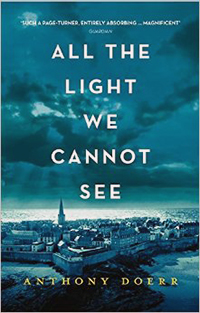
All the Light We Cannot See, by Anthony Doerr (Scribner)

An imaginative and intricate novel inspired by the horrors of World War II and written in short, elegant chapters that explore human nature and the contradictory power of technology.
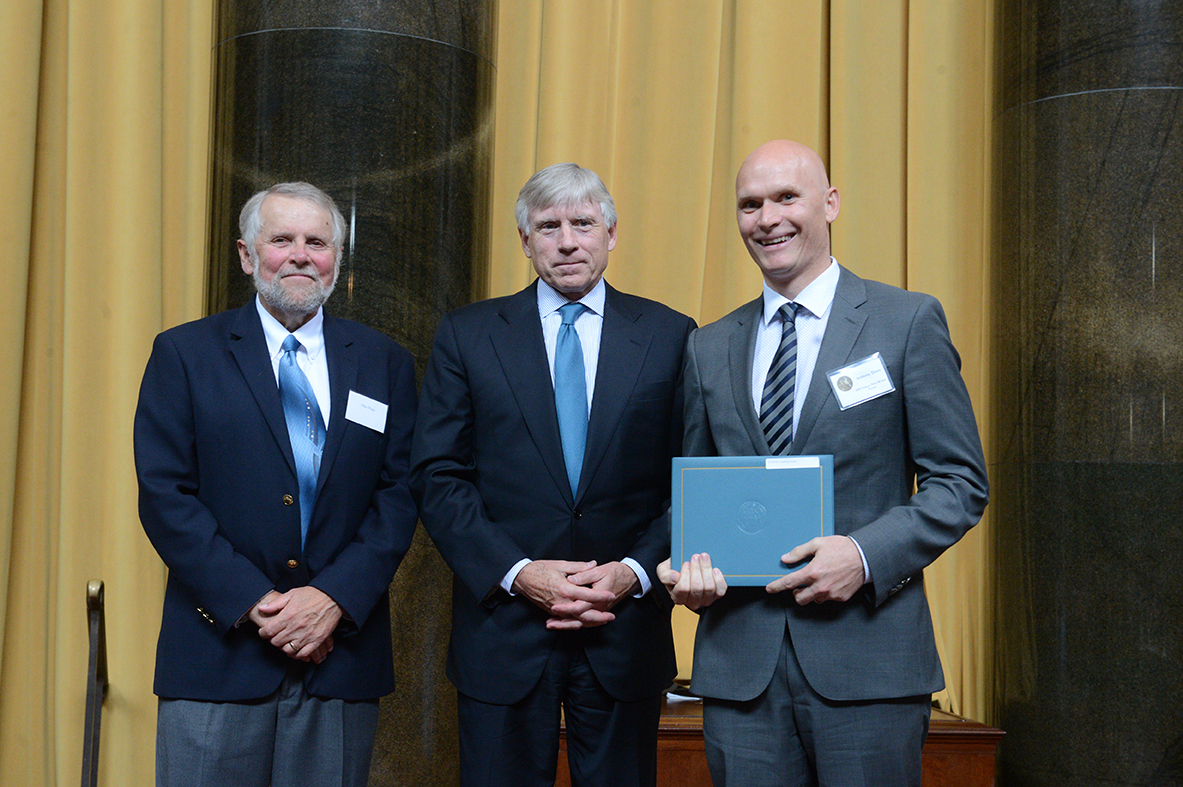
Mike Pride, Lee Bollinger and Anthony Doerr

Mike Pride, Pulitzer Prize Administrator (left) and Lee C. Bollinger, President of Columbia University (center), present the 2015 Fiction Prize to Anthony Doerr.

Winning Work

All the Light We Cannot See

All the Light We Cannot SeeFrom the highly acclaimed, multiple award-winning Anthony Doerr, the beautiful, stunningly ambitious instant New York Times bestseller about a blind French girl and a German boy whose paths collide in occupied France as both try to survive the devastation of World War II.

Marie-Laure lives with her father in Paris near the Museum of Natural History, where he works as the master of its thousands of locks. When she is six, Marie-Laure goes blind and her father builds a perfect miniature of their neighborhood so she can memorize it by touch and navigate her way home. When she is twelve, the Nazis occupy Paris and father and daughter flee to the walled citadel of Saint-Malo, where Marie-Laure’s reclusive great-uncle lives in a tall house by the sea. With them they carry what might be the museum’s most valuable and dangerous jewel.

In a mining town in Germany, the orphan Werner grows up with his younger sister, enchanted by a crude radio they find. Werner becomes an expert at building and fixing these crucial new instruments, a talent that wins him a place at a brutal academy for Hitler Youth, then a special assignment to track the resistance. More and more aware of the human cost of his intelligence, Werner travels through the heart of the war and, finally, into Saint-Malo, where his story and Marie-Laure’s converge.

Doerr’s "stunning sense of physical detail and gorgeous metaphors" (San Francisco Chronicle) are dazzling. Deftly interweaving the lives of Marie-Laure and Werner, he illuminates the ways, against all odds, people try to be good to one another. Ten years in the writing, All the Light We Cannot See is a magnificent, deeply moving novel from a writer “whose sentences never fail to thrill” (Los Angeles Times).

-- from the publisher
Biography

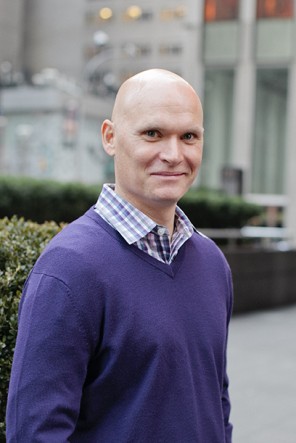
Anthony Doerr is the author of the story collections Memory Wall and The Shell Collector, the novel About Grace, and the memoir Four Seasons in Rome. He has won numerous prizes both in the US and overseas, including four O. Henry Prizes, three Pushcart Prizes, the Rome Prize, the New York Public Library’s Young Lions Award, the National Magazine Award for fiction, a Guggenheim Fellowship, and the Story Prize.

Finalists

Nominated as finalists in Fiction in 2015:

Joyce Carol Oates

A rich collection of stories told from many rungs of the social ladder and distinguished by their intelligence, language and technique.

Laila Lalami

A creative narrative of the ill-fated 16th Century Spanish expedition to Florida, compassionately imagined out of the gaps and silences of history.

Richard Ford

An unflinching series of narratives, set in the aftermath of Hurricane Sandy, insightfully portraying a society in decline.

The Jury

Elizabeth Taylor(Chair )

literary editor

Alan Cheuse

author, writer and NPR book commentator

David Haynes

professor of English and director of creative writing

Winners in Fiction

Donna Tartt

A beautifully written coming-of-age novel with exquisitely drawn characters that follows a grieving boy's entanglement with a small famous painting that has eluded destruction, a book that stimulates the mind and touches the heart.

Adam Johnson

An exquisitely crafted novel that carries the reader on an adventuresome journey into the depths of totalitarian North Korea and into the most intimate spaces of the human heart.

Jennifer Egan

An inventive investigation of growing up and growing old in the digital age, displaying a big-hearted curiosity about cultural change at warp speed.

2015 Prize Winners

Julia Wolfe

A powerful oratorio for chorus and sextet evoking Pennsylvania coal-mining life around the turn of the 20th Century.

Stephen Adly Guirgis

A nuanced, beautifully written play about a retired police officer faced with eviction that uses dark comedy to confront questions of life and death.

David I. Kertzer

An engrossing dual biography that uses recently opened Vatican archives to shed light on two men who exercised nearly absolute power over their realms.

Gregory Pardlo

Clear-voiced poems that bring readers the news from 21st Century America, rich with thought, ideas and histories public and private.