Sarasota Herald-Tribune, by Paige St. John
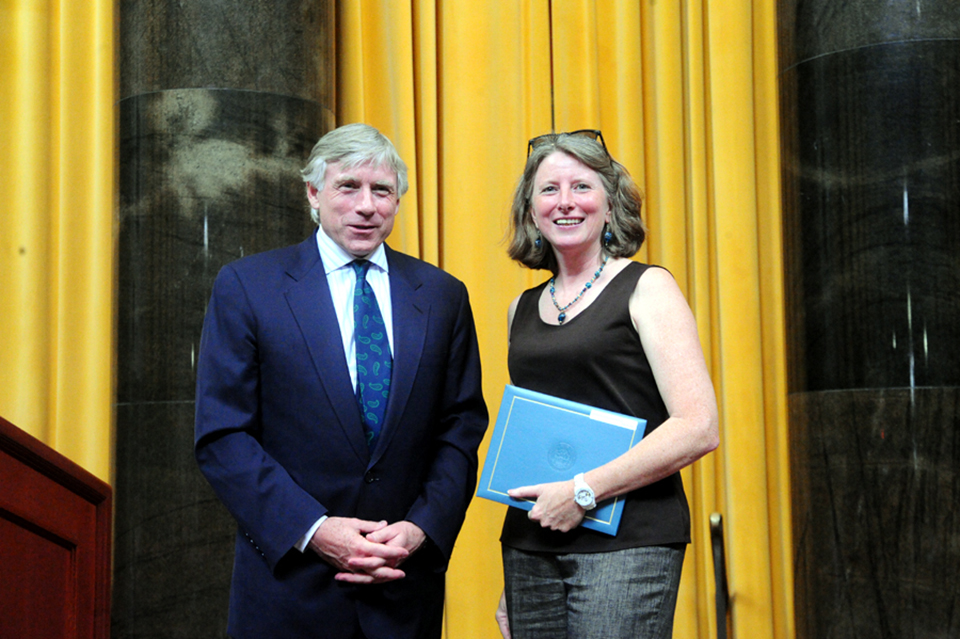
Lee C. Bollinger, President of Columbia University, presents the 2011 Investigative Reporting prize to Paige St. John of the Sarasota Herald-Tribune.
Winning Work
By Paige St. John
Millions of Floridians now bet their homes on property insurers that teeter on the edge of financial failure, a Herald-Tribune investigation has found.
These companies look nothing like the Allstates and State Farms that insure the rest of America -- legacy carriers that command bankrolls the size of small nations.
Instead, because State Farm and Allstate are fleeing Florida, a growing number of homeowners get their insurance from tiny, untested companies that have a few million dollars in the bank but insure billions worth of property they could never hope to rebuild on their own.
No one knows what will happen when the next big storm strikes Florida shores. But the signs are not promising.
Over the past year, without having to weather a single hurricane, Florida led the nation with a half-dozen property insurance failures. For the first time, state regulators openly warn that more failures will come, even if a storm does not.
The Herald-Tribune spent more than a year examining Florida's property insurers, tracing the ownership of more than 70 companies through shell corporations and reviewing the financial filings of each. It found:
- One in three privately insured Florida homeowners relies on insurers that exhibit one or more signs of financial risk.
- More than 100,000 homeowners relied on companies barely capable of paying for house fires, let alone hurricanes. These insurers' reserves come so close to the state's $4 million minimum requirement that they operate with only a few hundred thousand dollars of their own to pay claims.
- During the 2009 hurricane season, at least 38,000 Florida homes were insured by companies state regulators knew would fail. Homeowners were not told until after hurricane season, when one company was shut down and the other had to sell.
- Lawmakers and regulators have ignored warnings and encouraged private companies to stretch their limited cash further. They have pushed companies to insure more and more homes without increasing the money set aside to pay claims, a practice that put state residents farther out on a limb.
- Larger dangers loom. Despite rising property values, one in three Florida carriers has decreased the cash set aside for storms.
The Florida-only carriers that provide the majority of hurricane coverage in this state now stretch their limited cash nearly twice as far as they did before 2004. They do it by buying a form of backstop insurance, called reinsurance, that is supposed to kick in and prevent insurers from failing when major catastrophes strike.
But insurers still must have their own money to pay what amounts to a deductible. And after every storm they need cash to operate and pay claims until they can collect on their backstop policies.
Experts point out that even companies with the best reinsurance policies can fail if they experience cash-flow problems.
In simplest terms, the average Floridian with a $350,000 house is insured by a company with less than $750 in hand to pay for that home. By contrast, the average carrier had $1,300 in 2003.
That same year, Allstate and other well-funded insurers had nearly $4,000 banked for the same risk.
"It is the Florida Ponzi Scheme," said Miami agent Phil Lyons, secretary of the Independent Insurance Agents of South Florida.
Regulators, insurance executives and industry lobbyists argue that the system, perhaps flawed, is all that Florida has to fill the yawning hole left by the mass exodus of national insurers.
"What were the options?" asked Sam Miller, vice president of the Florida Insurance Council, the industry's largest trade group in the state. "I don't think any other plan would have worked."
Yet among insurance insiders there is unease and growing alarm.
"There should be bells and whistles going off everywhere," said Jeff Grady, president of the Florida Association of Insurance Agents, where chasing down rumors of failing insurers has become the trade group's recent obsession.
"On the surface it may appear things are OK, but below the surface, things are really troubling."
WHY UPSTART INSURERS DOMINATE IN FLORIDA
Beginning with Hurricane Andrew in 1992 and accelerating after Katrina in 2005, Florida's property insurance market changed dramatically.
State Farm and Allstate, combined protectors of one-third of Florida homeowners before 2004, led a wave of withdrawals, followed by Nationwide, USAA, Hartford and Travelers.
In their place arose what insurance expert Robert Klein, director of the Center for Risk Management and Insurance Research at Georgia State University, calls the "Florida-zation of cat risk."
These are the insurance companies that only do business in Florida, taking an all-or-nothing gamble on the state's weather.
In 1992, these concentrated risk-takers insured just 6 percent of Florida. Today, including the Florida-only subsidiaries of national insurers, they cover 71 percent.
Insurance, historically, has been an industry built on huge reserves. Firms amass a foundation of capital, then risk that money by promising to repay homeowners in the event of losses.
Profits, historically, came from the interest earned on the money that sits waiting to be paid out.
All that has changed. In Florida, insurers are now risk-brokers, players with relatively little money and a lot of leverage. In place of huge cash reserves, they have reinsurance -- essentially insurance policies for insurance companies -- that pays off in a major disaster. Those policies are so costly that most companies have little money left to build reserves.
Reinsurance enables fast growth. Instead of building up a company slowly by amassing enough surplus to write more policies, new insurers can pledge a portion of future premiums and instantly take on thousands more customers and billions more dollars in hurricane risk.
The formula has helped springboard start-up insurers into multibillion-dollar enterprises in months. But it has crashed others just as quickly, putting thousands of Florida homeowners at risk.
Even in 2000, before the explosion of single-state carriers in Florida, A.M. Best, the nation's oldest financial rating company, issued a report warning that the state was growing companies without the financial depth to survive a single hurricane, let alone the state's average of 2.5 a year.
It accused Florida, paying these new companies to assume policies from the state insurance pool, of handing the riskiest properties to "thinly capitalized, opportunistic insurers."
NOT ENOUGH MONEY TO PAY OFF HOUSE FIRES
Miami businessmen Alexander Anthony and Albert Fernandez sold their security guard business to launch Northern Capital Insurance Group.
They rocketed from $476,000 in revenue in 2006 to more than $95 million by 2008, adding a second carrier, Northern Capital Select, in the process.
Last September, Inc. Magazine heralded the company as "America's Fastest Growing Private Company."
The award came with publicity and a congratulatory letter from Gov. Charlie Crist, thanking the carrier for its phenomenal growth.
But the meteoric rise also came at great risk, mostly to customers.
State records show the group has the most concentrated roll of the dice in all of Florida.
Three of every four policies written by the companies were in a 143-mile stretch of the Atlantic coast -- Miami to Palm Beach -- that presents the single greatest hurricane threat in all of America. For as far back as the records go, a Category 1 storm has rolled ashore here at least every four years.
The exposure of these two insurers during the 2009 hurricane season was twice that even of Citizens Property Insurance, the state-run company that covers homes deemed too risky by other insurers. Six other Florida carriers are in the same boat, carrying greater concentrations of risk in Miami than Citizens does.
"It scares me. I fear when the next storm comes. I fear if it lands anywhere near here," said Dulce Suarez-Resnick, a Miami agent who is past president of the Latin American Association of Insurance Agencies.
While Northern Capital Select had the highest concentration of hurricane risk in Florida, it also had the least amount of money.
Northern Capital Select's financial statements and reinsurance contracts show that in 2009 it was operating with barely a $300,000 cushion above what it needed to meet state solvency requirements -- not even enough to cover a handful of house fires.
The larger Northern Capital had greater assets, but also more risk, leaving it at the start of 2009 just above what state laws required for its exposure.
The problems started when the company was formed. Under the old business model of property insurance, the Northern Capital companies would have needed more than $130 million set aside to meet state requirements for the value of homes they insured in Florida.
They did it with less than $20 million.
The companies bridged the gap by buying huge amounts of reinsurance from overseas investors willing to gamble against a storm. According to third-quarter financial statements, the carriers by September 2009 spent $64 million of the $94 million in premium they collected buying that protection.
Between what the insurers paid for reinsurance and what they paid in other overhead costs, contracts filed with regulators show, there was not enough money left to pay claims.
The constant losses destroyed reserves. By last September, Northern Capital Select barely met the state solvency requirement.
But regulators did not warn consumers about the risk.
Instead, the agency in August secretly prepared an order placing the company under administrative supervision.
While Northern Capital basked in the glow of its Inc. Magazine publicity and hit the financial markets hoping to raise $12 million, OIR sought to require the company to buy more reinsurance and stop writing new business in Miami-Dade, Broward and Palm Beach counties.
An unsigned copy of the confidential order was obtained by the Herald-Tribune. OIR officials refused to acknowledge its existence, and calls to Northern Capital's owners were not returned. President Wayne Fletcher and vice president Will Brauer did not respond to repeated calls.
By October, Northern Capital began retrenching, merging its two insurers into one. In February, the company lost its "A-exceptional" financial rating from Demotech, after the rating agency claimed deadlines to raise additional cash and come up with a new business plan passed unmet.
The company remains in business.
IN THE RED ZONE: 42 INSURERS AND RISK
The financial troubles of Florida insurers go far beyond Northern Capital.
Six companies have failed or been forced to sell in the past year. Florida regulators say more are on the verge of collapse, but will not name the companies or say how many are in trouble.
In the absence of public disclosure, the Herald-Tribune turned to measures commonly used by those in the industry, from agents who place your policy to regulators who police the business, to academics and consumer advocates.
A half-dozen experts consulted by the Herald-Tribune cautioned that no single measure told the strength of an insurer.
They agreed, however, that there are several important indicators of financial weakness and they provided benchmarks for each. They include: low levels of savings, comparatively high amounts of risk, an over-reliance on reinsurance and a heavy concentration of customers in one geographic area.
The Herald-Tribune found that about 30 companies out of more than 70 reviewed appear fiscally sound. Forty-two failed at least one of the benchmarks.
That means one in three privately insured homes in Florida -- some 2 million families -- relies upon an at-risk insurer for hurricane protection.
Fourteen of those insurers tripped two or more of the four warning flags. Of the three companies that failed at least three tests, two of them, Edison and Northern Capital Select, were being shut down or sold by January.
In December, Aon Benfield, one of the the world's largest insurance brokers, questioned if the Florida insurance market is, in its words, "at the tipping point."
In a report to its insurance company clients, the brokerage estimated that one in 10 Florida carriers has insufficient capital to weather a catastrophe. Not one of the 150 national property insurers reviewed by Aon had the same risk.
Bryon Ehrhart, CEO of Aon Analytics in Chicago, said, "Florida is operating at a much higher leverage rate than the rest of the nation."
WHAT HAPPENS IF YOUR INSURER FAILS
After eight hurricanes swept through Florida in 2004 and 2005, five insurance companies failed. Some 58,000 homeowners across the state were pushed into the state's bailout program, the Florida Insurance Guaranty Association.
Aside from the nearly $900 million bill presented to Florida consumers to cover those checks, "It is not a bad place to land," said FIGA Operations Manager Tom Streuckens.
That is not always the case.
More than five years after Hurricane Ivan struck the Panhandle, Pensacola lawyer Charles Beall is still trying to force the solvency fund to compensate victims who lost four homes in the storm.
Two of Beall's clients have received low offers, but he said the other two have yet to get even a claim estimate from the state fund. One is unable to rebuild. Her unlivable, damaged town house sits unrepaired and empty amid rows of rebuilt homes.
Beall's hands are largely tied. The fund cannot be sued for acting in bad faith. The lawyer cannot even collect his legal fees unless he can persuade the fund to at least give him and his clients a denial.
"It's the ultimate insult when the state company set up to protect you ignores you," Beall said. "They ought to be thrown in jail just for callous indifference."
Even if the program worked perfectly as a backstop, it would not have enough money to cover everyone if a large enough wave of insurance failures struck after a hurricane.
The 2004-05 hurricanes pushed the solvency fund to its financial limits in 2006.
Executives acknowledge that the program would have difficulty raising money fast enough to make timely payment of claims for much larger insolvencies. The result would be homeowners receiving only partial payment, then waiting months, if not years, for the rest.
Streuckens considers a disaster of that scale unlikely.
"It is pretty much a doomsday scenario," he said.
But a "doomsday scenario" may not be all that unlikely, according to Aon's estimate of the number of Florida insurers at risk.
According to the broker's report, 18 percent of Florida insurers have borderline amounts of capital -- placing $143 billion worth of homes at risk of being uncovered in a catastrophe.
That is one and a half times the size of the insurance companies that failed following the 2004-05 hurricanes.
BILLIONS IN POLICIES FROM KEY BISCAYNE HOME
When Magnolia Insurance was approved to start insuring Florida homes in 2008 it had no office, no outside agents, and a lot of debt.
The carrier, opened by a Key Biscayne insurance agent working with a $24 million loan, did not even have an active insurance license when Florida regulators agreed in April 2008 to allow it to take as many as 60,000 policies from Citizens Property Insurance.
By mid-2008, thousands of South Florida homeowners were getting letters announcing that unless they objected, Magnolia was their new carrier.
Miami insurance agents working on behalf of homeowners to check on the obscure newcomer had little more than a Texas Post Office box to guide them.
"They didn't even have an office. They didn't even have a Web site. They didn't have a phone." said Dulce Suarez-Resnick, the South Florida insurance agent.
"You couldn't even help your customer get a copy of their new policy."
When she did locate Magnolia, it was at an unlikely place -- the personal residence of its founder.
"They were working out of his home in Key Biscayne," Suarez-Resnick said. "We knew from Day One Magnolia was not going to make it."
Just 20 months later, the same Florida regulators who helped put Magnolia into business put it under administrative supervision and ordered its president to leave.
The December order capped what is possibly the shortest start-to-suspension of a Florida insurance company.
Florida agents wonder how the company got licensed in the first place.
State incorporation records for Magnolia list its Key Biscayne business address as the four-bedroom red-tile roof home of company president Henry James Irl.
Florida law allows state regulators to deny an insurance license to a company whose executives show poor financial credibility. Yet the Office of Insurance Regulation cleared Irl, despite the fact that Miami-Dade County Circuit Court files show he had a history of bad credit card debt.
Court filings from 2006 through 2008 show Irl was sued for $40,000 in unpaid debts and interest, resulting in two orders attempting to collect the money by garnishing his wages at the not-yet operational Magnolia.
The last of those cases was not dismissed until the end of 2008. By then, Irl was running an insurance company responsible for the financial security of 100,000 homeowners with property worth $24 billion.
"How did the state of Florida allow this person to get approved to run an insurance company in the state?" asked Suarez-Resnick.
Officials with Florida's Office of Insurance Information refused to answer questions about Magnolia, including whether Irl had disclosed his personal financial problems. Irl did not respond to messages left with his company or at his home.
Circumstances surrounding Magnolia's supervision remain sealed under Florida insurance laws that treat regulatory investigations as confidential, leaving more than 80,000 policyholders in the dark as they must decide whether to renew.
Though company executives and their consultants met with state regulators in November, Magnolia operated through the 2009 hurricane season with no outward sign of trouble.
The only specific information about why Magnolia's operations were seized comes through Demotech, the financial rating firm that suspended Magnolia's "A Exceptional" rating two weeks before regulators stepped in.
With the rating suspension, Demotech explained for the first time that it had been negotiating with Magnolia for months over serious problems with its financing, policy handling and management.
FLORIDA OFFICIALS ASK: WHAT CHOICE IS THERE?
The Office of Insurance Regulation readily acknowledges Florida is in the throes of dramatic change.
From Kevin McCarty, insurance commissioner, to the lowest-level regulators, OIR officials expressed optimism for the market as a whole despite trepidation over the stability of individual insurers.
"You're right. There will be failures," said Robin Westcott, solvency director for OIR's property division. However, she and other regulators said, they believe most of Florida's relatively new insurers will survive and a large portion of the market is strong.
These officials argue the failures are a natural byproduct of the state's need to find new insurers quickly as national carriers dumped hundreds of thousands of customers after 2005.
Florida had to convince investors, entrepreneurs and others to get into the insurance business and assume tens of thousands of policies almost overnight.
The state has, since 2006, attracted 29 new companies with $509 million in new investment.
"I think it's a success story that we're able to attract new companies that are writing 615,000 policies," McCarty told Florida Cabinet members in August.
But in the months following, McCarty and his staff have switched their message, warning that some of those new carriers are failing and others need rate increases to survive.
"It is a difficult marketplace. ... You're getting to a point where these companies are going to separate themselves as to who can do it successfully and then those that aren't going to," Westcott said in November, following the shutdown of American Keystone.
"All we hear from the Legislature is 'Free Market, Free Market, Free Market,'" Westcott said. "Well, this is a function of Free Market."
© 2010 Sarasota Herald-Tribune
By Paige St. John
For most of 2009, American Keystone was an empty promise.
The Florida company insured some 70,000 homes and condominiums worth $12 billion with just a few hundred thousand dollars in operating cash.
At the height of hurricane season, Keystone was so low on money the Florida Office of Insurance Regulation deemed it “injurious to its policyholders and to the public.”
Had a hurricane arrived, thousands of Floridians would have found themselves with worthless policies. But the state agency did not shut Keystone down.
Records sealed from public view for nearly a year show regulators chose to allow Keystone customers to unknowingly gamble through an entire hurricane season.
The delay bought Florida regulators a chance to orchestrate a “soft landing” instead of an abrupt collapse and gave Keystone's investors a chance to search for a buyer. Meanwhile, company insiders continued to pay themselves hundreds of thousands of dollars in salaries and consulting fees.
A yearlong Herald-Tribune investigation found that allowing struggling insurers to remain in business has become an alarming part of how Florida regulators cope with the state's ongoing property insurance crisis.
VIDEO: Mike Gold talks about his insurance company and his agents
Eager to replace national carriers fleeing the state and to reduce government-sponsored coverage, regulators have bet Florida's future on companies they know are shaky. They allowed at least four insurers on the verge of failure to write policies through most of 2009, the Herald-Tribune found.
What's more, regulators have awarded licenses to would-be insurers that had no funding, to individuals who had dubious credentials and, in the case of Keystone, to a business started by a felon banned from the industry.
In the past three years, state regulators have encouraged unproven companies to take on dangerous amounts of policies, and steered more than 200,000 homeowners into companies so weak they were already required or close to being required to improve their finances.
When these overextended insurers became unsound, Insurance Commissioner Kevin McCarty's office took extraordinary steps to keep them open. In lieu of cash and sound investments that could be used to pay claims, regulators sometimes counted questionable assets, including IOUs, real estate and tax credits.
The Herald-Tribune found evidence of these practices in five of the seven instances in which companies foundered last year.
The full details of how regulators handled those insurers remain sealed within confidential regulatory records. The exception is Keystone, whose closure is documented in thousands of pages that became public when the company was forced into liquidation last fall.
The records show Florida insurance regulators will grant a failing insurer great latitude, giving it chance after chance to stay open while customers remain at risk.
For months, Florida's top insurance administrators failed to heed warnings from their own financial experts and aided Keystone when they knew it was essentially bankrupt. And they allowed the crippled insurer to keep renewing policies.
Not once did homeowners receive a warning of their peril.
“I hate to say it, but that's what the state of Florida allows is this crap,” said Michael Clarkson, a Clearwater insurance agency owner who tried unsuccessfully in 2008 to call regulatory attention to Keystone.
Administrators at the Office of Insurance Regulation say they do their best under difficult circumstances.
They believe it is more damaging to suddenly close a company and dump large numbers of policyholders back onto the state than it is to let a failing company take a year to silently wind down while seeking a buyer.
Regulators say they are trying to more aggressively go after weak companies but also say legal hurdles to shut down a company are steep.
“We look back like everybody else and try to see if there's more we can do, if there's something we didn't do right, if there's something more we could have done,” said Deputy Insurance Commissioner Belinda Miller. “In retrospect, would any of these companies have been licensed? No. Not if we knew then what we know now.”
Even so, Miller's staff argues homeowners were at minimal risk. They point out that even the most frail insurers are backed by reinsurance policies designed to pay the vast majority of claims after a hurricane. And even if insurers fail, homeowners who lose coverage are able to collect from Florida's insurance solvency fund.
But that taxpayer-supported fund covers only the first $500,000 in losses, leaving owners of larger homes unprotected. One in three home policies sold by Keystone exceeded this cap.
And records show the reinsurance coverage that regulators rely on does not always exist.
Keystone, for instance, canceled chunks of its coverage in 2009 and carried almost no protection for two storms, creating the potential to put billions of dollars of storm losses back onto Floridians.
PRESSURE TO APPROVE
When American Keystone was created in 2006, it was a godsend for state regulators.
The Office of Insurance Regulation had just shut down the insolvent Poe Insurance Group, leaving 320,000 policyholders without coverage. National carriers were fleeing the state en masse.
American Keystone offered to take on some of the least desirable of that business, first directly from Poe and later from Citizens Property Insurance, the state-run insurer of last resort for more than 1 million Floridians.
There was a catch. Regulators knew from the start that the people and money behind Keystone had connections to Sarasota entrepreneur William Griffin, whose 1999 federal conviction for generating illegal campaign contributions had banned him from the insurance industry for life.
Documents submitted to the Office of Insurance Regulation show the company was run by Griffin's son-in-law, controlled by Griffin's family trust and business associates, employed some of Griffin's friends, and was funded by a loan from a Griffin-created holding company formerly named Riscorp of Florida.
OIR solvency chief Robin Westcott required Griffin's son-in-law to step down as an officer of Keystone, the limit of what she said she could legally do. She said Griffin's own involvement in Keystone was never more than a suspicion.
“I know my supervisor, my chief analyst, came in and said, ‘We're not real sure. ... '” Westcott said.
Griffin provided a slightly different account. Department of Financial Services documents show he told a state fraud investigator he was a major investor in Keystone, but said his participation was “supervised and approved by state regulators and his attorney, therefore he thought his involvement was lawful.”
For all the issues Griffin's involvement raised, Keystone offered Florida insurance regulators serious benefit.
The company proposed to take on the most toxic, untouchable hurricane risk in Florida: coastal condominium associations abandoned to Citizens Property Insurance.
The policies represent thousands of dollars each in premium, and millions of dollars of concentrated risk in perilous locations. More than 70 percent of that business in Florida sits in the government-run Citizens. No private carrier will take it.
Regulators knew Citizens did not have the cash to pay those policies if a major storm struck. Floridians would likely wind up paying billions of dollars for a bailout.
Keystone was the first — and so far only — carrier to offer to take over these policies from Citizens.
“So the pressure for us: Is there a way for us to allow takeouts?” said Westcott. “I think that was the reasoning on this. This company did have the reinsurance to do this.”
CLEAR WARNINGS
Twice, Westcott agreed to move chunks of Florida condominium policies into the newly formed Keystone.
Agency correspondence files obtained by the Herald-Tribune show she did it despite objections and warnings from insurance regulation staff and officials at Citizens.
In April 2008, the manager of Citizens' policy assumption program, Lee Stuart, complained OIR was forcing Keystone's approval even though the company had missed four of five deadlines in the application process.
Stuart warned that policyholders should not be turned over to a company unable to meet simple bureaucratic requirements.
He was overruled. Westcott cleared Keystone to take over coverage of as many as 718 condominium associations, representing an estimated 47,000 residences.
Almost immediately, Keystone sought a second round of condominium policies from the state. Financial experts working for Westcott expressed alarm at the company's shrinking surplus and its chronic losses. The insurer was operating with only $500,000 more than it needed to avoid losing its license.
“As I said before, I'm concerned,” analyst Carolyn Morgan wrote to Westcott on July 1, 2008. “This company has no room for error.”
The following day, OIR analyst Jay Ambler finished his own review of Keystone's deteriorating financial condition and raised the insurer's risk level.
Ambler's official report ended with a recommendation that Keystone's request for more state-provided policies be denied.
A day later, July 3, Westcott approved the takeout, citing the company's promises to buy reinsurance.
The Herald-Tribune obtained a copy of Ambler's original report. A subsequent version no longer included the call for a denial.
“Maybe he changed his mind,” said Miller, the deputy insurance commissioner. “I don't think it's a fair characterization that we weren't listening to staff.”
Keystone's financial situation only grew worse.
Financial statements subsequently filed with state regulators show the company's condition deteriorated rapidly from July to November 2008. Its surplus fell below the legal minimum to $3 million, a level that had it been revealed at that time would have put the company out of business.
Keystone responded with an aggressive plan for growth. Sales fliers circulated by agents show the company offered to insure high-risk condominium associations in some of Florida's riskiest locales at below-market prices. It lured in thousands of new policies worth millions of dollars in premium, doubling the risk it carried, and doubling the number of Floridians in jeopardy.
Insurance experts say such pricing is a hallmark of desperation to generate cash.
“This is scary, because all of us will basically pick up the tab again while several whom become wealthy will hardly care,” Clearwater agency owner Michael Clarkson wrote in a Dec. 4, 2008, warning to regulators at three state agencies.
Clarkson forwarded to the OIR copies of what he said were Keystone's unscrupulous offers, deals to cover risky properties at rates as much as 40 percent below what residents would have to pay elsewhere.
The papers landed on Miller's desk. Files show she asked Westcott to investigate. “Please find out what American Keystone is up to,” she wrote.
“We are looking into this,” an aide replied.
There is no further record of a review.
When asked if such a review was conducted, Westcott would only say there are many internal discussions not reflected in agency records, and that those regarding Keystone were numerous.
TURNING A BLIND EYE
As American Keystone's finances got worse, the Office of Insurance Regulation could have quickly stepped in to try to close the company.
But the OIR, which is responsible for protecting consumers from dangerous insurers, rarely takes that step.
In December 2008, Keystone still lacked the $4 million state law requires insurers to set aside at all times.
To stay in business, it sought permission to count two unusual assets: a $1 million IOU from an affiliated company, and a Sarasota medical office building owned by William Griffin, the man banned from insurance.
The 40-year-old building was priced by Griffin at $2.6 million but carried $1.3 million in debt. The value of the building exceeded state limits on the amount of surplus an insurer can tie up in real estate.
In addition, the building was parked in one of the most depressed real estate markets in the country, presenting a liquidity challenge if Keystone actually needed to sell the building to pay claims.
OIR staff noted both negatives. Nevertheless, their superiors agreed to allow the assets, which freed Keystone to write even more policies.
Despite having doubled the amount of premium it collected, Keystone continued to lose money, and its steps to appear solvent became riskier.
By April 2009, the insurer told regulators, it began to drop some of the reinsurance coverage it had bought to help pay future hurricane claims.
OIR held off aggressive action while company officers promised they were overseas seeking new investors in London.
But Westcott's staff expressed doubts.
“Given the company's performance and approaching storm season the analyst cannot believe this is a possibility,” department staff wrote in the OIR's April 2009 supervisory plan for the troubled insurer.
In July, regulators discovered Keystone had less reinsurance than it had stated, and that its finances were in worse shape than previously revealed.
A later report from an independent consultant hired by the state to review Keystone's contracts showed that by July the insurer had no protection for tropical storms that caused less than $11 million in damage, and even less protection if a second storm struck that same year.
Regulators began an order to suspend Keystone. Westcott edited the draft agreement, penciling in her own words declaring Keystone “hazardous or injurious to its policyholders and to the public.”
On Thursday, July 29, the Office of Insurance Regulation issued that order suspending American Keystone, demanding it stop writing policies and giving it five days to tell existing policyholders they were in danger.
But the agency never acted on the order.
By the following Monday, OIR lawyers were drafting a new, confidential order to vacate the suspension and keep Keystone in operation under state supervision.
The cause was Keystone. Miller said the company over the weekend had objected to the suspension but agreed to close down voluntarily by the end of 2009. Instead of initiating what could become a tough legal battle, Miller said, her agency accepted Keystone's proposal and made secret plans to move all Keystone storm victims into a state bailout fund should a storm strike.
As a result, Keystone — which regulators said at the time met the statutory definition of “impaired” — continued writing policies. That appears to violate state law, which makes it a felony for an impaired insurance company to sell or renew policies.
Despite the law, Keystone continued to accept homeowners' renewal checks, a source of income needed to pay the company's daily bills, including checks to Keystone's sister companies and a host of consultants with ties to Griffin.
Internal OIR memos show regulators at least three times noted the ongoing renewals, sometimes with surprise, and sometimes with disagreement about whether the practice should continue.
Yet they did not stop it.
It was not until Sept. 29 that Miller ordered Keystone to stop renewing policies, as the agency began its own steps to close down the insurer.
Keystone was shuttered Oct. 9 by court order.
Some 7,600 policyholders, homeowners and associations representing an estimated 70,000 families, had 29 days to find replacement coverage.
In the course of the shutdown, Westcott's staff would conclude in internal correspondence that American Keystone should have been declared insolvent nearly a year earlier.
The company had survived only through what Jim Pafford, an OIR supervisor of the financial analysts handling Keystone, called a series of “creative solutions” to “prop up” the company's paper balances.
“They should not have been writing since November of 2008,” he wrote.
WHO IS PROTECTED?
Rather than recognize American Keystone as a failure, the Office of Insurance Regulation focused for months on the chance it could survive or find a buyer.
Regulators argue that strategy is best for consumers — and for Florida taxpayers.
If a struggling company finds a buyer, policyholders can keep their coverage with few noticeable differences. If no buyer is found, regulators prefer an orderly withdrawal that might allow other companies to assume at least some policies by the failing insurer.
Secrecy is key. “The minute you tell everybody this is going down the tubes, the book (of business) is gone, and there's nothing to sell,” Westcott said.
The worst outcome, regulators say, is an immediate shutdown that dumps policyholders into already stretched government insurance programs.
“It's our job to say how can this be best accomplished in the marketplace that is least disruptive to the policyholder,” Westcott said.
In the case of Keystone, regulators said, they believed the company had a chance to find a buyer. And it was easier to have a slow shutdown with the company's cooperation than a quick one against the company's will, Miller said.
In fact, she contends the legal hurdle to shut down a company is so high it is nearly impossible to force an insurer to close against its will. As a result, companies like Keystone are given time to wind down if they sign settlement agreements that require them to close.
“To say we keep the company in business is not a fair characterization,” Miller said. “We were putting them in a position to take policies out. We were taking it apart at that point.”
Even so, Miller said her office has been taking more aggressive oversight in recent months because so many owners are draining capital out of their insurance companies.
She said the agency is reviewing companies' financial arrangements more closely and is more apt to order owners to infuse cash into flagging companies.
She also said the OIR is no longer willing to divert large numbers of homeowners covered by Citizens into new insurance companies, a practice that helped some questionable companies instantly generate business.
© 2010 Sarasota Herald-Tribune
By Paige St. John
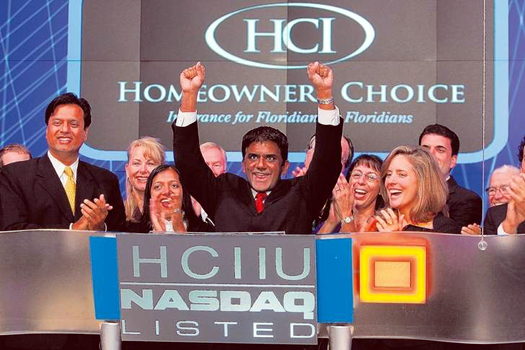
Panish Patel, chairman of Homeowners Choice Inc., rings the Nasdaq opening bell on Aug. 4, 2008. (Nasdaq)
Today, nearly half of Florida's home insurance is provided by companies whose primary profit comes not from insuring homes but from diverting premiums into a host of side ventures.
Investors and executives in 2008 moved $1.9 billion in policyholder money out of heavily regulated insurers, where profits are capped and dividends are restricted, to separate companies that are owned by the same people, housed at the same address and sometimes use the same employees.
As soon as the money is moved, it is beyond the reach of homeowners who might need it to rebuild after a disaster.
It is also free to be paid to investors and owners as profit without interference from regulators.
Meanwhile, insurance executives complained about losses and state-mandated discounts, and pressured state regulators for permission to charge homeowners more -- even to end rate regulation altogether.
The payments to themselves, by and large, were legal.
As Allstate and State Farm have fled the state and left homeowners scrambling for coverage, Florida lawmakers have intentionally relaxed rules designed to police insurance company profits. Regulators hoped the promise of profits would persuade investors to start more insurance companies.
The Herald-Tribune spent more than a year investigating the Florida insurance industry, including reviewing the financial filings of more than 70 Florida-only companies that now provide nearly three-quarters of the private property insurance in the state.
(Year-end reports filed earlier this month reported 2009 losses of $650,000 for the regulated insurance company and 2009 profit of $11 million profit for the holding company.)
"There is so much business in Florida that, managed well, you can do very, very well," Mahdu said.
Homeowners Choice turned an insurance "loss" into a stockholder profit mainly in this fashion:
- Homeowners Choice paid Homeowners Choice Managers $24 million (and $2 million more to others) in 2009 for management services that cost $15.4 million.
- It paid $9 million to Bermuda-based Claddaugh for reinsurance, almost all of which was likely profit because, according to state regulatory filings, none of it was used to pay claims.
Homeowners concedes its profits come from itself, but says the money is pumped back into the insurer as capital contributions that allow it to offer insurance to more Floridians.
"We haven't taken any money out," Mahdu said. "It's all about growth for us."
Homeowners has issued no dividends to investors, but three company directors collected $1.4 million by charging for services through their own private ventures.
In 2008, Homeowners Choice paid $400,000 to lease its computer billing system from a software company owned by Paresh Patel, founder of Homeowners Choice. The contract requires that Patel's insurance company is the firm's only client. Patel was also paid a total of $525,000 in bonuses for the past two years.
Another owner/director, developer Gregory Politis, leases Homeowners part of the third floor of a Clearwater office building he owns, for $150,000 a year. And in 2008, Homeowners paid $643,000 for legal services from the firm of another director, Martin Traber.
Mahdu said the many Homeowners Choice subsidiaries are the artificial construct of corporate attorneys.
"There is no such thing as the division. A Homeowners employee is a Homeowners employee," he said. "At the end of the day, we live and die on the bottom line. It doesn't matter which entity posts a profit or loss."
PAYING AFFILIATES FOR BACKUP COVERAGE
One way insurers move money out of the regulated business is by forming their own reinsurance companies. Essentially, they sell insurance to themselves.
In 2007, one of the reinsurers with which United Property and Casualty did business was a Grand Cayman Island reinsurer called Caymaanz.
What made the transaction stand out was how much United paid for reinsurance from Caymaanz.
In return for $6.5 million in storm protection, the Florida property insurer paid Caymaanz $6.5 million -- $5.5 million for the coverage and $1 million for the purchase of Caymaanz stock.
If there had been a hurricane, United would have gotten back essentially what it paid in. Without a storm, Caymaanz and its owners walked away with an untaxed, unregulated profit. Don Cronin, chief executive of United, said he did not remember what United made on the deal.
One of the Caymaanz owners was also a United director. Florida incorporation records show Caymaanz is owned by a Tampa workers compensation insurer named Sunz. One of the Sunz Group directors, according to the records, was Ocala horse feed manufacturer Greg Branch -- at the time also the chairman of United Property and Casualty.
United did not report the transaction as an affiliated purchase because, said Cronin, "it didn't meet the technical definition."
No-risk reinsurance deals in which firms basically pay up front what they expect to collect were at the root of former New York Attorney General Eliot Spitzer's financial fraud investigations of the insurance industry in 2007. In the aftermath, regulators adopted restrictions on such deals.
Cronin said the Caymaanz contract passed that test because it also included prepaid coverage for a second hurricane. Under the right conditions, Cronin said, United could have collected $13 million, twice what it paid for the coverage.
He would not say who arranged the transaction, but said Branch, chairman of United's board and chairman of Sunz's reinsurance committee, abstained from the board vote approving it.
DEAL HELPS BANK, BUT NOT POLICYHOLDERS
While it is common for Florida-only insurers to do business with themselves, Hillcrest Insurance did a deal with its founder that cost policyholders.
In early 2009, according to filings with the National Association of Insurance Commissioners, Hillcrest Insurance bought $600,000 in bank stock from the insurance company's founder, Vernon D. Smith.
Seven months later, the stock -- in a banking group that Smith owned -- was written off by the insurer as worthless.
The purchase is noted in the quarterly NAIC financial filings. Hillcrest's March 31 report to regulators identified Smith as the "vendor" who sold it the stock, while other filings describe the shares as coming from a company director.
Smith did not return phone calls to his home. Neither did his daughter and son-in-law, who serve as Hillcrest's chairman and CEO.
They formed Hillcrest in 2005, with 90 percent of its ownership coming from a family trust that state incorporation records show Vernon D. Smith controlled.
Smith was regarded as a pillar of Florida's community banking scene. Over decades he had organized three different "Riverside" banking groups with branches stretching from St. Augustine to Cape Coral. He was a major donor for Indian River Community College, owner of a small newspaper chain and adviser to the Florida Highway Patrol.
But at the time of the stock purchase, Smith's Riverside banking empire was in trouble. One group was beset by financial rating downgrades and bad loans, another was closing offices, and the third was seized by the FDIC.
It was in that environment that Hillcrest reported to the National Association of Insurance Commissioners that it paid $600,000 for 4,000 shares of stock in Riverside Banking Co.
By September, the insurance company wrote off that purchase, declaring the stock worthless. The company's filings show the write-down contributed to a $680,000 loss that September. To pay its bills, Hillcrest pulled money from its policyholder surplus, reducing the amount of money set aside to pay future claims.
The Herald-Tribune also attempted to reach Smith and his family through their insurance company, without success. There is no Hillcrest office to contact. The company pays the Tower Hill insurance group to run its business.
"We're what you call a 'virtual operation,'" said Hillcrest chief finance officer William Thompson, who earns his $172,000 salary working from Tallahassee.
Subsequently, on Dec. 21, Hillcrest sold the shares to a charity. The reported buyer, Big Brothers Big Sisters of St. Lucie, paid $1,000.
EXECUTIVES ACCUSED OF STRIPPING MILLIONS
Florida homeowners are still paying the $810 million bill for the failure of the Poe Insurance Group, the costliest property insurance failure in state history.
State investigators now believe the bailout was made worse by executives grabbing tens of millions of dollars before regulators could close the deteriorating company.
They did it by funneling money into unregulated sister companies, steering the money to investors and owners instead of to homeowners, according to allegations laid out in a civil court case filed by Florida Insurance Receiver's office in Leon County Circuit Court.
Over four years, through what the court complaint alleges was a "fraudulent scheme," Poe founder and former Tampa Mayor William Poe Sr. received more than $30 million. Another $1 million went to his nonprofit foundation.
In addition, instead of paying hurricane claims, Poe's managing agency paid off $25 million in debt for which Poe was personally liable and kept $35 million in premium fees it did not earn, the complaint states.
That money could have helped thousands of Poe customers left with worthless insurance after the 2004-05 hurricane season and forced to seek payment through a state solvency fund. Instead it enriched company insiders or softened their financial losses, the state argues.
Attorneys for the Poe family would not comment, citing pending litigation. But statements made in court show that while they contest the allegation of fraud, they do not dispute the amounts taken -- just whose money it was. They contend the family put most of what was not eaten up by taxes back into the insurer.
"There is no insurance company monies that ever went to the Poes," attorney Harley Reidel said in a court hearing last year.
The Poe family has responded by filing for bankruptcy protection and seeking federal court orders barring the state from pursuing its claims in circuit court.
The insurers left behind $1.5 billion in policyholder claims and less than half the money needed to pay those bills. Florida consumers are on the hook for the rest, as fees on their own home premiums from the Florida Insurance Guaranty Association.
LOOPHOLE LETS PROFITS SLIP THROUGH
Florida's Office of Insurance Regulation polices almost every aspect of the insurance industry.
But when it comes to following the money paid to affiliates, the OIR is largely benched.
Lawmakers intentionally made it so.
Like most states in the mid- 1990s, Florida adopted model laws aimed at regulating how insurers use managing companies called MGAs.
But in Florida, the Legislature added words excluding the most common kind of managing agent in the state, those controlled by the insurance company's owners.
So there are laws that require managing agents to charge a fair rate and allow regulators to audit their books, and laws that impose penalties for violators.
But those laws do not apply if the insurance company owners form their own MGA and charge themselves for the services.
"Enabling insurers to have wholly owned MGAs operate without oversight, that's what I see is the problem," said Shaw, the insurance consumer advocate.
Florida's insurance industry trade group says regulators and insurers have worked out a compromise -- inserting language into management contracts that stipulate regulators have a right to look at certain financial reports.
Officials at the Office of Insurance Regulation refused to say how often they conducted such reviews, contending it was a "legal research question" the agency did not have resources to answer.
At least twice, the agency has ordered insurers to reduce their MGA fees. In the case of First Home, affiliates were also ordered to return $1.3 million in management fees.
On Tuesday, Southern Oak was ordered to show why it should not be required to return $10 million in "excessive profit," a portion of the $35 million in profit regulators said the MGA made off the insurer since its inception in 2004.
Southern Oak CEO Tony Loughman said those profits were "consistently" invested back into the insurance company. Annual financial filings show Southern Oak paid $72 million to its managing agent since 2004, returning only $12.6 million.
A second order, signed Friday, allowed Southern Oak to keep its MGA commissions as they are, but to return a portion of them if the insurer loses money.
The fees OIR sought to restrict were approved by the agency in 2004 -- when the company was launched by a former candidate for governor, Stephen Pajcic, a prominent Democrat who also owns a Jacksonville law firm -- and again in 2005 and 2007.
In interviews, the state's insurance solvency chief said that in the past, her office did not look at the flow of secondary profits through affiliates, because it allowed company owners to pay off their own loans used to start the insurer.
Allowing these profits "facilitated more capital to our marketplace" said Robin Westcott, solvency director for the agency's property insurance division.
OIR is now paying more attention because, she said, "it can be manipulated to take money out of the companies."
© 2010 Sarasota Herald-Tribune
By Paige St. John
Hurricane Katrina extracted a terrifying toll -- 1,200 dead, a premier American city in ruins, and the nation in shock. Insured losses would ultimately cost the property insurance industry $40 billion.
But Katrina did not tear a hole in the financial structure of America's property insurance system as large as the one carved scarcely six weeks later by a largely unknown company called Risk Management Solutions.
RMS, a multimillion-dollar company that helps insurers estimate hurricane losses and other risks, brought four hand-picked scientists together in a Bermuda hotel room.
There, on a Saturday in October 2005, the company gathered the justification it needed to rewrite hurricane risk. Instead of using 120 years of history to calculate the average number of storms each year, RMS used the scientists' work as the basis for a new crystal ball, a computer model that would estimate storms for the next five years.
The change created an $82 billion gap between the money insurers had and what they needed, a hole they spent the next five years trying to fill with rate increases and policy cancellations.
RMS said the change that drove Florida property insurance bills to record highs was based on "scientific consensus."
The reality was quite different.
Today, two of the four scientists present that day no longer support the hurricane estimates they helped generate. Neither do two other scientists involved in later revisions. One says that monkeys could do as well.
In the rush to deploy a new, higher number, they say, the industry skipped the rigors of scientific method. It ignored contradictory evidence and dissent, and created penalties for those who did not do likewise. The industry flouted regulators who called the work biased, the methods ungrounded and the new computer model illegal.
Florida homeowners would have paid more even without RMS' new model. Katrina convinced the industry that hurricanes were getting bigger and more frequent. But it was RMS that first put a number to the increased danger and came up with a model to justify it.
As a result of RMS' changes, the cost to insure a home in parts of Florida hit world-record levels.
Hundreds of thousands of homeowners were forced to find new insurers as national carriers fled the state.
Yet the prediction of a more dangerous Florida has not played out.
The new RMS model called for at least 11 hurricanes to come ashore in the United States by the end of 2010, most of them aimed at Florida.
Four hurricanes struck the U.S. None hit the Sunshine State.
RMS stands by its five-year outlook and contends that the risk of hurricanes remains higher than normal. Company officials last week said they would continue to adjust their model as needed, but a single five-year lull does not disprove their results.
Yet a growing number of experts now wonder if the changes spurred by RMS -- and the accompanying spike in insurance premiums -- were justified.
The woman credited with launching the industry of hurricane modeling questions how near-term models were introduced. She accuses RMS of overselling software that lacked sufficient scientific support, and says insurers accepted the output of that model as if it were fact.
"I've never seen the industry so much just hanging on what a handful of scientists or one model would say," said Karen Clark, founder and former CEO of AIR Worldwide, an RMS competitor.
"They're just tools," Clark said.
"They're models.
"They're wrong."
FOUR MEN, FOUR HOURS
The daily papers were still blaring news about Katrina when Jim Elsner received an invitation to stay over a day in Bermuda.
The hurricane expert from Florida State University would be on the island in October for an insurance-sponsored conference on climate change. One of the sponsors, a California-based company called RMS, wanted a private discussion with him and three other attendees.
Their task: Reach consensus on how global weather patterns had changed hurricane activity.
The experts pulled aside by RMS were far from representative of the divided field of tropical cyclone science. They belonged to a camp that believed hurricane activity was on the rise and, key to RMS, shared the contested belief that computer models could accurately predict the change.
Elsner's statistical work on hurricanes and climatology included a model to predict hurricane activity six months in advance, a tool for selling catastrophe bonds and other products to investors.
There was also Tom Knutson, the National Oceanic and Atmospheric Administration meteorologist whose research linking rising carbon dioxide levels to potential storm damage had led to censoring by the Bush White House.
Joining them was British climate physicist Mark Saunders, who argued that insurers could use model predictions from his insurance-industry-funded center to increase profits 30 percent.
The rock star in the room was Kerry Emanuel, the oracle of climate change from the Massachusetts Institute of Technology. Just two weeks before Katrina, one of the world's leading scientific journals had published Emanuel's concise but frightening paper claiming humanity had changed the weather and doubled the damage potential of cyclones worldwide.
Elsner said he anticipated a general and scholarly talk.
Instead, RMS asked four questions: How many more hurricanes would form from 2006 to 2010? How many would reach land? How many the Caribbean? And how long would the trend last?
Elsner's discomfort grew as he realized RMS sought numbers to hard-wire into the computer program that helps insurers set rates.
"We're not really in the business of making outlooks. We're in the business of science," he told the Herald-Tribune in a 2009 interview. "Once I realized what they were using it for, then I said, 'Wait a minute.' It's one thing to talk about these things. It's another to quantify it."
Saunders did not respond to questions from the Herald-Tribune. Knutson said if RMS were to ask again, he would provide the same hurricane assessment he gave in 2005.
But Emanuel said he entered the discussion in 2005 "a little mystified" by what RMS was doing.
He now questions the credibility of any five-year prediction of major hurricanes. There is simply too much involved.
"Had I known then what I know now," Emanuel said, "I would have been even more skeptical."
Elsner's own frustration grew when he attempted to interject a fifth question he thought critical to any discussion of short-term activity: Where would the storms go?
The RMS modelers believed Florida would remain the target of most hurricane activity. Elsner's research showed storm activity shifted through time and that it was due to move north toward the Carolinas.
But RMS' facilitator said there was not enough time to debate the matter, Elsner said. There were planes to catch.
In the end, the four scientists came up with four hurricane estimates -- similar only in that they were all above the historic average.
RMS erased that difference with a bit of fifth-grade math. It calculated the average.
Thus, the long-term reality of 0.63 major hurricanes striking the U.S. every year yielded to a prediction of 0.90.
Contrary to Elsner's research, RMS aimed most of that virtual increase at Florida.
On paper, it was a small change from one tiny number to another tiny number.
Plugged into the core of a complex software program used to estimate hurricane losses, the number rewrote property insurance in North America.
Risk was no longer a measure of what had been, but what might be. And for Floridians living along the Atlantic, disaster was 45 percent more likely.
RMS defended its new model by suggesting it had brought scientists together for a formal, structured debate.
Elsner disputes that idea.
"We were just winging it," he said.
PREDICTING APOCALYPSE
In the Oz of insurance, RMS is the man behind the curtain.
The company is a Silicon Valley prodigy created 22 years ago by four Stanford graduates and their engineering professor, who parlayed a research project into a commodity: calculating earthquake probabilities and selling them to the insurance industry.
It was a short leap from there to run odds on just about every terrible and unlikely event, from Florida hurricanes to Japanese typhoons to European tempests, what RMS CEO and co-founder Hemant Shah calls a "full portfolio of apocalyptic hazard events."
The company Shah started from his California apartment is now a $200 million-a-year enterprise. Major insurance and reinsurance companies the world over pay annual subscriptions of $1 million or more to lease RMS' disaster-predicting software.
The impact these private models have on the insurance price homeowners pay is so great that Bob Hunter, insurance director for the Consumer Federation of America, calls them unregulated "rate bureaus."
For most of the past two decades, risk models have relied on actual hurricane activity recorded over more than 100 years to produce averages and other estimates of storm formation.
But even before Katrina, RMS was under pressure to disband the long-term outlook. Insurance insiders wanted something they believed would be more accurate. And they wanted it to forecast hurricane activity for next few years based on current conditions, not simply assume history would repeat itself.
The pressure came from several places. Some reinsurers sought validation that global warming was increasing the threat of hurricanes. Others in the industry wanted a short-term model to encourage investors, who wanted odds on their returns in the near term.
Shah says he had an obligation to pursue the short-term model because of the belief that hurricanes had gotten more dangerous.
"How are you going to incent people to mitigate their homes if you don't have the right kind of signaling on what risk really is?" he told the Herald-Tribune in 2008.
An accurate prediction of the near future could save insurers billions of dollars by indicating when to raise rates or drop policies in places most likely to be ravaged. It's the difference between predicting how many times the number 1 will appear in 100 rolls of the dice, and anticipating what number is expected for the next five rolls.
That, essentially, was what RMS promised.
RiskLink 6.0, RMS chief researcher Robert Muir-Wood wrote in a February 2006 column, "is likely to be the most eagerly awaited model ever introduced into the reinsurance market."
RUSHING TO RAISE RATES
Records show reinsurers and insurers did not wait.
Using numbers RMS provided in its promotional materials, they began increasing their own hurricane loss estimates 30 to 40 percent, six months before the new model was finished in May 2006.
Florida insurers in turn sought rate boosts in anticipation of what the new model would do to their own costs.
But the yet-unpublished five-year model did not become an industry standard until December 2005, when it was embraced by A.M. Best, the Chicago firm that provides financial ratings for insurance investors.
Best said it would determine an insurer's soundness by simulating its performance in back-to-back 100-year hurricanes as calculated by the five-year model.
The reasoning was simple.
"Catastrophe is the single largest threat of insolvency to an insurance company," Devin Inskeep, senior financial analyst at A.M. Best, said in an interview.
According to a confidential presentation one of its officers gave an industry think tank, RMS calculated its new hurricane model raised the expected cost of a major U.S. hurricane by $55 billion.
Plugging that model into A.M. Best's stress test meant the industry as a whole would need to raise $82 billion to remain solvent.
RMS' two chief competitors argued there was inadequate scientific grounding to heavily promote a five-year outlook.
Clark, at the time CEO of AIR Worldwide, said she urged A.M. Best to reconsider requiring a model "based on theories."
Having alternative models available was good, she said, but "I personally was an advocate of not rushing into something that was not tested and would have a dramatic change. Certainly, I had a lot of conversations with A.M. Best."
The warnings were not heeded. Both Eqecat and AIR eventually produced their own five-year versions, though AIR warned clients it considered the only credible version to be the long-term model.
By January 2006, five months before RMS released its new model, at least half a dozen reinsurers were pricing their contracts based on the new numbers, comments made in quarterly earnings calls show. The pricing triggered a cascade of rate hikes in Florida.
In a calculation Florida regulators learned about two years later, State Farm added a $1.5 billion "frequency adjustment" to its potential hurricane losses. That, in turn, required it to buy more reinsurance from its parent, a cost that resulted in a 47 percent rate increase to its Florida customers.
Allstate increased the loss estimates of its long-term hurricane model by 41 percent, a "climate cycle" adjustment it only briefly noted within its 4,000-page request for a 22 percent rate hike.
By the time the actual model was released in May 2006, it had already reshaped the Florida property insurance market, unleashing the largest spike in premiums in state history.
Florida has a law intended to prevent just such chaos.
A state commission must review and approve catastrophe models before insurers may use them to set rates. No short-term model has ever passed that test.
RMS in 2007 submitted its model for review by the Florida Hurricane Loss Methodology Commission -- the only body of its kind in the nation.
Meteorologists, statisticians and engineers for the commission began a lengthy review. But when RMS learned those reviewers planned to reject the model, the company withdrew it from consideration.
A draft report shows the objections centered largely on how RMS had determined its new hurricane rates.
The panel said the model change failed to meet credibility and bias tests, and it questioned how RMS had picked its four scientists and why so few were invited.
Shah later told the Herald-Tribune he believed Florida was "mucking things up," suppressing a credible view of risk "so pricing can be more affordable."
"If you artificially constrain your view of risk then you're not going to have the clarity of insight that suggests what really needs to be done to solve the problem," he said.
RMS continues to promote its short-term model as the preferred option for its customers. A survey by Bermuda officials shows it is the dominant model for Bermuda reinsurers, the most crucial source of private hurricane protection for Florida.
MONKEYS COULD DO THIS
At the outset in 2005, RMS promised to revisit its forecast at the end of every season. "If there is a material change," the company said, "rates would be updated."
So it was in October 2008 that RMS assembled a group of seven weather science experts at the Hotel Victor on Miami's South Beach.
Rather than produce their own storm predictions, they were asked by an expert in gathering scientific opinion to rank 39 different climate models that RMS would then run to produce a five-year forecast.
The man running the show was Tony O'Hagan, a British statistician who had developed drug trials for AstraZeneca. He came armed with Tiddlywinks, 30 for each scientist, to help them visualize and rank the weather simulators.
What struck University of Colorado environmental science professor Roger Pielke as he played with his pile of green chips was the pointlessness. Pielke, already a critic of the five-year forecast, believed the 39 models were a stacked deck, "biased upwards."
RMS said it gave its experts the option of sticking with a long-term average. "We were strongly encouraged not to do so," Pielke said.
Another participant, Georgia Tech climatologist Judith Curry, had her own misgivings. She believed the selection too narrow.
"I thought all of the models were wrong. I didn't have confidence in any of them," Curry said.
When RMS averaged the scientists' choices, the number of expected storms had dropped from the previous finding in 2005.
This time, the number of Category 3 and higher hurricanes expected to strike the U.S. each year dropped, from .9 to .8, a seemingly small change.
That decrease meant the risk of hurricanes had dropped by a third. Presumably, homeowners' premiums should follow suit.
But there was no rush to adjust homeowners' bills and no publicity surrounding the new scientific "consensus."
RMS in December 2008 described the results as "consistent" with past findings. It disclosed the lower numbers six months later in an April 2009 confidential report to clients. By then it was too late to effect that year's reinsurance rates for many insurance companies.
Company vice president Claire Souch denied that RMS promoted the increase and downplayed the decrease. "Our time lines were the same," she said.
Even after it was released, brokers said, the revised model was not roundly embraced.
"It is true that many 'set aside' the model change when underwriting this year," said John DeMartini, vice president at the Towers Watson brokerage.
"While they were quick to adopt near-term when it raised loss estimates, they didn't commit to sticking with it through reductions."
Following the unusually inactive 2009 season, RMS announced it would skip its annual expert review. By fall 2010, RMS had changed its methodology to remove the human element, Souch said. Souch said a new model will be released in February. It is expected to decrease rates along the coast and increase them inland, RMS officials said.
For his part, Pielke returned to Colorado and set up a random number generator to rank RMS' 39 climate models from 2008 -- akin to blindly throwing darts to choose the best model.
The outcome nearly matched the scientists' consensus.
"So with apologies to my colleagues," he wrote in his science policy blog, "we seem to be of no greater intellectual value to RMS than a bunch of monkeys."
© 2010 Sarasota Herald-Tribune
By Paige St. John
Never before have Floridians paid so much to protect themselves from hurricanes.
And never have they received so little benefit.
A Herald-Tribune investigation shows that since the state's last spate of hurricanes, a dramatic shift has taken place. Two-thirds of property insurance premiums now leave Florida as unregulated payments to largely offshore reinsurers -- companies that sell hurricane protection to insurers and that operate without rate control or consumer oversight.
They, more than state insurers and state regulators, determine how much Floridians must pay to live in the state, and whether property insurance is available at all.
Florida's growing reliance on this profit-driven market is eroding its ability to withstand the inevitable disaster.
In the past four years, Florida-based home insurers paid out $15 billion for private reinsurance.
There has been no storm to trigger payments. Most of the money is gone, pocketed by a reinsurance industry that plays by Wall Street rules, able to rack up profits no regulated insurance company would be allowed to keep.
Without a major storm before next June, Florida's lost capital will near $19 billion.
Had it remained in Florida, that money could have doubled the size of the state's publicly run catastrophe fund and lowered premiums 20 percent. It could have paid for another round of hurricanes like the eight that struck in 2004 and 2005.
Instead, homeowners' insurance premiums reached record levels in 2006 and 2007, exacerbating widespread policy cancellations. The lost capital also weakened insurance company finances, drained surplus for future storms, and pushed carriers over the edge, giving Florida the highest insurance failure rate in the nation.
The volatile reinsurance market now has such a tight hold on Florida that homeowners and the state economy are perpetually at risk of future market shocks, even those triggered by events elsewhere in the world.
The costly dependence frustrates those who would try to revive the state's foundering property insurance market.
State Insurance Commissioner Kevin McCarty alternatively has pleaded with reinsurers to play a greater role in Florida and called them "greedy" when they extracted crushing rate hikes.
Former Gov. Jeb Bush set aside his free-market ideology to conclude Florida could not "be at the mercy of people who hope for catastrophes to keep their rates high."
The newspaper learned that Bush secretly spent part of his last year in office seeking an alternative, lobbying his brother in the White House and fellow governors of catastrophe-prone states to create a government substitute.
Four years later, a leader of state insurance agents reached a similar conclusion.
"A large part of Florida's marketplace problems are due to its over-reliance on reinsurance," said Jeff Grady, president of the Florida Association of Insurance Agents.
"Yet we are a crack addict. We have to have it."
IN ITS TRADITIONAL form, reinsurance was insurance for insurance companies, policies bought in relatively small amounts to protect carriers from the remote chance of a very large disaster.
But in Florida today, and increasingly along the eastern seaboard, reinsurance is on the verge of replacing traditional insurance altogether.
The turning point was Hurricane Katrina.
A month after Katrina, with the storm's cost and death toll mounting, Allstate president Thomas Wilson expressed regrets in an October 2005 quarterly earnings conference call, but said that the nation's second-largest insurer was through with hurricanes.
"We have no moral or legal obligation to provide this kind of coverage to people," Wilson declared.
Allstate and other national carriers accelerated a retreat from risk along the American coast. "It was a turning point for not just Florida, but from Massachusetts to the Gulf of Mexico," said state Insurance Commissioner McCarty.
From 2005 to 2008, 2.2 million Florida homeowner policies were canceled or non-renewed. The state-run Citizens Property Insurance for the first time became the largest provider of hurricane coverage in Florida.
With no viable alternative, state regulators and private insurance companies looked to offshore reinsurers to underwrite the risk posed by storms. With a few million dollars in the bank, newly formed insurers could buy large amounts of reinsurance to instantly write billions of dollars worth of coverage.
The new Florida norm are carriers like ACA Home, a tiny St. Petersburg home insurer started after 2005 with funding in part from a Bermuda reinsurer.
ACA Home has no employees and pays an affiliate, American Strategic, to run its business.
Financial filings show reinsurers take 86 cents of every premium dollar ACA collects -- $9 million of the $10.5 million it collected in 2009.
The cost for turning over almost all of its risk is high. ACA pays as much as 33 cents for $1 of protection against the most likely kind of storms, the equivalent of paying $66,000 a year to insure a house worth $200,000.
The Herald-Tribune found more than half a dozen Florida insurers paying more than 50 cents for a dollar of hurricane coverage, reinsurance rates brokers say are the highest in the world.
Yet Florida's insurers continue to buy more. They use the premium they collect to purchase additional reinsurance to write more policies, rather than retaining the money to shore up their own capital bases.
From 2004 to 2009, Florida carriers' reinsurance bill nearly tripled, from $1.4 billion a year to more than $4 billion.
The portion of homeowners' premium devoted to reinsurance in that time increased from 37 percent to 64 percent, according to the newspaper's analysis of 70 Florida-only property insurers. The national average is only 19 percent.
That in turn drove up the cost of coverage for homeowners. Quarterly premium reports show the average Florida homeowner pays 72 percent more today than in 2003. The average premium has nearly doubled or more in nine coastal counties.
Florida regulators have sanctioned rates as high as $7,890 to insure a $100,000 house in Palm Beach and $13,000 a year for the same abode in the Florida Keys -- making insurance premiums there as expensive as a mortgage.
The change in how Florida's largest insurers handle risk is most dramatic. A state report noted State Farm, Allstate, Universal Property and American Strategic in 2002 spent only 7 percent of their premium on reinsurance.
In 2009, the Herald-Tribune found, the burden was 54 percent.
Annual financial reports show more than 28 Florida insurers devote more than half their premium to external coverage, some to the point of extinction.
"Nobody can stay in business spending that," said Lara Mowery, vice president of Guy Carpenter & Co., one of the chief brokers of Florida reinsurance contracts. "That can't be a sustainable business plan."
FOR A GUT-WRENCHING 48 hours in September 2008, the National Hurricane Center's skinny black line pointed like an accusation at Miami.
Hurricane Ike was barreling through the Atlantic as a Category 4, on a westerly track that had the potential to deliver the long-dreaded sucker punch that would bring Florida to its knees.
As stomachs churned in Florida, a quarter turn around the globe on the balmy Mediterranean, the reinsurance industry welcomed an American calamity.
The financial giants who underwrite the world's risks were gathered in Monte Carlo for their annual Rendez-Vous de Septembre. Amid champagne parties and sailing races, they kept close watch on the advance of the storm.
Profits at that moment were flat and reinsurance rates falling, even in Florida.
By their analysts' calculations, it would take a $35 billion disaster to turn the market around.
The head of research for a London brokerage sized up the hurricanes circulating in the American Gulf.
"Gustav and Hannah: perhaps unlikely to have a major impact ..." he told financial writers in the plush salon of a Monte Carlo hotel, as they picked over silver trays of tiny lime tarts.
"But Ike ..." he said, turning his attention to the storm worrying Miami, "... depending on which way it goes, it could be a turning point, ladies and gentlemen."
There was nothing in his tone, nor the reaction of those taking note, to reveal they were discussing the decimation of another American city.
There is a perverse tendency for the reinsurance industry to hope for disaster.
The cost of calamity coverage is determined mostly by supply and demand. Big disasters can temporarily dampen quarterly profits and even kill a few unlucky reinsurers, but they drive up demand and draw down capital, shrinking supply.
The result is record profits made on the back of the world's biggest catastrophes -- Hurricane Andrew, 9/11 and Hurricane Katrina.
The macabre sentiment pervading Monte Carlo in 2008 was parodied a few mornings later at the Cafe de Paris, where reinsurance brokers massed 20-deep for preliminary negotiations on the hurricane contracts for which Floridians would pay the next year.
"Industry mourns the passing of Gustav," joked a headline in the Rendez-Vous edition of the normally sedate Insurance Day.
By missing New Orleans, the trade journal quipped, the hurricane had "failed to destroy billions of dollars worth of energy infrastructure and make millions of uninsured poor people homeless.
"An executive from a Bermuda start-up said he had lost everything as a result of the non-storm ...
"'I've got everything riding on a big one.'"
THE REINSURANCE INDUSTRY is much like the high-priced casino where reinsurers gather every fall.
The money on the table comes from the world's richest investors -- institutional funds, global bankers and, increasingly, U.S. hedge funds.
The objects of their betting are hurricanes, typhoons and earthquakes, as well as pandemic diseases.
Their biggest wager is Florida.
The state has more than $2 trillion of property parked on the edge of the world's hottest hurricane zone. No other insured peril in the world comes close in potential losses.
"Florida is the, by far, the number one 'cat' risk in the world. Bar none. By a factor of two," said Harbor Point Re vice president Greg Richardson.
But the risk of a hurricane accounts for only a fraction of the price reinsurers charge. The majority of the cost is driven by how much profit investors demand, and whether insurers are desperate enough to pay those rates.
"It's like a game of poker," John DeMartini, vice president of risk for Towers Watson, a national broker of reinsurance contracts, told the Herald-Tribune.
The game is uneven.
Florida insurers are particularly needy buyers, hence they have little choice to refuse what reinsurers demand to be paid.
"It is a diabolical situation insurers find themselves in," DeMartini said.
On average, the Herald-Tribune calculated, reinsurers charge five times more than the actuarial risk of loss.
The translation for Florida property owners: For every $1 in hurricane risk to their home, they pay another $4 for the reinsurer's profit. In other words, if a reinsurer determines a home is likely to sustain $2,000 in damage in a year, it will charge $10,000 to cover that home.
In reinsurance, such math is unquestioned. It is not "undue profitability" but "the cost of capital," concluded an industry-funded study by the vaunted Wharton Risk Center at the University of Pennsylvania.
"Insurers need considerable capital to supply this insurance and the cost of that capital is included in the premium," they note.
After Hurricane Katrina, some of the highest rollers providing $33 billion to recapitalize the reinsurers of Bermuda included Lehman Brothers and Goldman Sachs, and private investors recruited by Jeff Greenberg, son of former AIG chairman Hank Greenberg.
These new players demanded paybacks equal to or better than the heady profits rolling off mortgage-backed securities. They sought return percentages from the mid-teens to high 20s, Mike Millete, a managing director of Goldman Sachs, told reinsurance executives during a 2006 industry forum in Bermuda.
In the end, Bermuda reinsurance investors saw a record return on equity, according to a Guy Carpenter analysis. Greenberg had a 26 percent return on Validus Holdings. Lancashire Re gave its New York private equity fund investors a 33 percent return. And in 2009, the largest reinsurer of Florida carriers reported a 38 percent return.
Being in Bermuda, the profits were tax-free.
On the other hand, Florida regulators limit property insurers to a 3.7 percent annual profit on their underwriting activities.
"Putting aside the tremendous human cost of natural catastrophes, as an investment category, cat risk is actually quite wonderful," Greg Richardson, vice president of Harbor Point Re, told his peers at a summit in 2008.
AS INSURERS SPEND more on reinsurance, they have less money to set aside for future storms.
Called policyholder surplus, this stash represents the first line of defense for hurricane claims.
To the alarm of industry watchers, it is weakening.
The surplus held by Florida-based insurers in 2003 was $2 billion. It is now about $2.4 billion -- an increase that has not kept pace with the amount of property these companies insure.
In 2003, Florida insurers had 65 cents in the bank to back every dollar of brick and shingle they insured.
Now it is 42 cents.
The decrease is all the more alarming because it occurs during a lull in hurricane activity, when Florida insurers should be building capital to withstand future storms.
And it comes despite record revenues. Insurance premiums statewide have climbed from an average $850 per home in 2003 to $1,458 in June.
But in three of the past four storm-free years, the total amount of surplus held by Florida-based insurers gained only minor ground. In 2009, when reinsurers raised their Florida rates to counter Wall Street losses, it actually dropped.
For some insurers, the surplus drain became a death sentence.
Since 2009, 10 carriers have fallen so short on capital they have been forced to close, been placed under regulatory consent orders or had their financial ratings withdrawn.
Florida last year led the nation in property insurance company failures.
THE VIEW OFFSHORE is much brighter.
The U.S. hurricanes in 2005, particularly Katrina, left the Bermuda reinsurers that provide most of Florida's hurricane coverage with net losses of $2.1 billion.
Those same reinsurers reported profits of $11.6 billion in 2006 -- a record -- and $11 billion in 2007.
Those running the companies fared well, too.
Executive pay for the top five officers at Renaissance Re -- Florida's biggest reinsurer -- quadrupled from $6 million in 2005 to $28 million in 2009. CEO Neill Currie's latest $7.6 million compensation package included nearly half a million dollars to allow him and family members to fly between Bermuda and his home in North Carolina.
"They load the boat on the profits they make in Florida," said Jeff Grady, the president of the state agents' association.
Nowhere are the riches from Florida more on display than when the industry gathers on the French Riviera for its annual convention in Monte Carlo.
For a week during the height of the Florida hurricane season, the extravagant gambling resort is packed with hundreds of reinsurers and brokers who negotiate their contracts.
There is a single scheduled event -- a poorly attended speech on some aspect of the market.
Tradition demands a sailboat race at the Monte Carlo Yacht Club. Some years there is also a road rally through the south of France in collectible cars.
Only a few contracts get signed in this open air market.
The bulk of the week is devoted to "building relationships," a function some reinsurance brokers say they hold more important than the price for any one year.
In 2008, as Florida gambled with the weather, hundreds of reinsurance underwriters and brokers packed the marbled lobby of the Hotel de Paris and commandeered the outdoor tables of the Cafe de Paris, befuddling cruise ship tourists who had nowhere to go.
Brokers huddled over spreadsheets beneath bronze busts of Louise XIV or scribbled notes against a grand piano or beneath a Greek nude. The bigger reinsurance houses held forth from private salons and yachts tied up in the harbor.
"Uncivilized, isn't it?" a Bermuda broker remarked unbidden, taking refuge in a slice of shade at the cafe as he awaited a turn at the strangely public discussions, the subject of which was death and destruction.
At sundown the din yielded to a frenzy of sumptuous dinners and endless champagne.
The brokers from Guy Carpenter held a huge party in a ballroom beneath a ceiling papered in gold, lasers casting corporate logos atop the bathing nudes painted on the walls. "Do you realize $1 trillion of wealth is in this room right now?" remarked the impressed publicist for a catastrophe modeling firm.
On the next block, top-hatted magicians on stilts greeted delegates who entered through a veil of tiny bubbles, tossing firecrackers over their heads.
The impeccably dressed hosts from Dubai handed out party favors of oversized billfolds, while a bus crouched at the curb to ferry brokers to the next soiree.
On the terrace, a trio of sequined starlets slid among the strolling financiers, trailed by backup dancers.
"They tried to make me go to rehab," they crooned to the drinking brokers.
"I said, no, no, no ..."
© 2010 Sarasota Herald-Tribune
By Paige St. John
When State Farm stepped up its march out of Florida, it loudly and publicly claimed hurricanes were pushing it toward financial disaster.
The company argued it had to leave the Florida coast -- and drop nearly half a million customers -- because it could not profit in a state wracked by so many storms.
But State Farm never really left Florida.
A Herald-Tribune investigation finds Florida's largest insurer has instead found an easier way to profit from homeowners desperate for coverage. And the desperation State Farm helped create allows it to command some of the highest rates in the world.
The conduit for this back-door insurance is DaVinci Reinsurance Ltd., an offshore company with no physical office or employees of its own that sells policies to insurers to cover their storm losses.
The virtual corporation was launched in 2001 by State Farm and a Bermuda reinsurer with which it has close ties.
State Farm provided $200 million in seed capital. Its partner, RenaissanceRe Holdings Ltd., took on management and the recruitment of other investors.
While it has little physical presence, DaVinci is now one of the state's most important hurricane reinsurers. Contracts show DaVinci provided coverage last year to more than 50 Florida insurance carriers representing the owners of 3.7 million homes.
Through DaVinci, State Farm quietly continues to collect money from thousands of former customers who were told their homes were too risky to insure.
Collectively, these customers have paid hundreds of millions of dollars to State Farm's offshore reinsurance venture. Without a hurricane, the $300 million in Florida premium paid to DaVinci from 2006 through 2009 has been largely profit. Florida's payments for 2010 are not yet available.
The advantages to State Farm are clear.
In Florida, the insurance rates State Farm can charge are regulated by the government. Profits are controlled and taxed. The potential loss from a major hurricane is measured in billions of dollars.
DaVinci's premiums, on the other hand, are as high as the market will bear. Based in Bermuda, it avoids U.S. taxes and faces no limit on profits. If a hurricane strikes, State Farm would lose no more than its investment in DaVinci -- $350 million at the end of last year.
State Farm officials would not disclose the company's current ownership interest in DaVinci. Nor would RenRe release the names of DaVinci's directors.
Securities filings show that since 2008, State Farm has had an option to leave DaVinci, but as of December 2009 it had not exercised that right.
A spokesman for State Farm responded to questions from the Herald-Tribune with a two-sentence statement.
"Reinsurance exists to help insurers protect homeowners from major catastrophes," wrote spokesman Phil Supple. "In this instance, State Farm is simply an investor and not actively involved in this reinsurer's underwriting decisions."
Stacked against State Farm Mutual's $92 billion in assets, the investment in DaVinci is small. The cash payout so far has been only $100 million in dividends split between State Farm and other investors, including the Ontario Teachers Pension Fund.
But the impact on Floridians has been huge.
DaVinci helped facilitate the transformation of Florida's home insurance market into one reliant on thinly capitalized, Florida-based companies and unregulated offshore reinsurance.
DaVinci, along with its partner RenaissanceRe, writes a specialized form of reinsurance that allows investors to launch and operate new Florida insurers with relatively little cash.
"It brings more capacity ... I would welcome State Farm to do more of it in a heartbeat," said Joe Graganella, president of two Florida insurance companies, Capitol Preferred and Southern Fidelity, which buy coverage from DaVinci and RenRe.
Without that protection, it would be hard to do business, Graganella said.
The expansion of DaVinci's coverage in Florida, however, was also self-serving.
DaVinci's presence made it easier for State Farm to withdraw from Florida's densely populated coastlines and in five years shed more than 865,000 customers -- by helping give those customers a place to go.
That, in turn, aided State Farm politically.
The company's withdrawal has put pressure on lawmakers to give concessions to the insurance industry, but is not so cataclysmic as to prompt state intervention to prevent it.
In the end, Florida officials allowed State Farm to sharply raise rates and eliminate policy discounts while shifting to safer parts of the state and retaining its highly profitable auto insurance operation in Florida.
Earnings projections filed with state regulators show State Farm expects to collect as much premium in 2011 as it did before its exodus.
"State Farm has done a good job, an excellent job, in pulling the wool over the eyes of many of my colleagues in the House and Senate," said state Sen. Mike Fasano, a Pasco County Republican and a critic of State Farm.
"They've convinced them that State Farm is poor and they're losing money and the Legislature is willing to come to their rescue."
OPPORTUNITY IN DISASTER
DaVinci emerged from the rubble of the World Trade Center.
Within weeks of the Sept. 11 terrorist attacks in 2001, it was created by State Farm and its Bermuda partner, RenaissanceRe, to capitalize on price increases that followed the disaster.
State Farm's original $200 million stake gave it a 40 percent share in DaVinci and a seat on the board of directors. RenRe provided 20 percent of the money and manages the venture.
At the outset, DaVinci was a nominal reinsurer for Florida. It specialized in low-risk contracts with large U.S. insurers such as Allstate and Zurich American.
That changed after Hurricane Katrina in 2005.
To take advantage of rising reinsurance rates, DaVinci shifted its attention to hurricane risk, raising $375 million, including $25 million more from State Farm. It doubled its capacity to write reinsurance and refocused much of its business on Florida.
Together, DaVinci and RenRe became the largest provider of hurricane coverage to Florida-based insurers.
The rates they charged Florida insurers post-Katrina doubled, RenRe executives told stock analysts at the time.
The company's pursuit of such distressed markets is a central part of its business philosophy.
"Where there's gunfire we don't run toward the bullets, but we like to get involved when there's still smoke in the air," RenRe CEO Neill Currie told the Herald-Tribune two years ago at a reinsurance gathering in Monte Carlo. "It works out pretty well, because we come riding in on the horse."
National reinsurance records show that in 2005, Florida-only insurers provided 23 percent of DaVinci's U.S. revenue. By 2009, it was 41 percent.
Interviews and documents examined by the Herald-Tribune show DaVinci focused on selling the riskiest, hardest-to-get coverage most critical to Florida's weakest property insurers.
There is little competition in that niche, and reinsurance brokers said the price for such protection is among the highest in the world, sometimes more than 50 cents for $1 in coverage.
" 'Opportunistic' is the absolute key word," said John DeMartini, vice president at Towers Watson, a national reinsurance brokerage. "DaVinci cleverly stepped into the void."
What's more, State Farm organized its withdrawal in a way that helped it keep control of its most profitable business -- car insurance.
It created a list of insurers to which State Farm agents could direct dropped customers. Homeowners who switched to those companies could retain their multi-policy discounts.
State Farm agents also keep their clients if they move them into the state-created Citizens, or to the pre-approved companies -- most of which are backed by DaVinci reinsurance coverage.
Details about DaVinci were kept quiet enough that several longtime Florida State Farm agents told the Herald-Tribune they were not aware most of the pre-approved companies had a connection to State Farm.
EVERYWHERE, A BIT OF STATE FARM
Tampa resident Trudy Hensley canceled her State Farm home and car policies in 2009 after seeing her premium jump 66 percent in two years.
State Farm's threat to drop Florida residents angered her enough to look for coverage elsewhere. She switched to Tower Hill.
What she did not know was that the Tower Hill group, including four insurers under that umbrella, is by far DaVinci's largest Florida customer.
The Tower Hill companies together paid State Farm's reinsurance venture more than $48 million in premiums from 2004 through 2009.
"It's very unethical. I have no feelings of Good Neighborliness," Hensley said. "I'm not happy at all. It's another case of those big insurance companies taking advantage of people."
Hensley's first reaction after being told about DaVinci was to ask for a list of companies that do not buy reinsurance from the company.
It would be hard to find one.
By 2009, DaVinci, in partnership with RenRe, had provided some hurricane protection for 54 Florida insurers, including Allstate and fast-growing Universal Property & Casualty.
The duo supplied the majority of hurricane protection for six companies, a list that included Security First, Argus and the now-defunct Northern Capital.
According to financial contracts reviewed by the Herald-Tribune, DaVinci was the third-largest commercial provider of hurricane reinsurance in Florida by the end of 2009.
As State Farm dropped customers along the Florida coast, many remained in the State Farm family when they were picked up by companies using DaVinci reinsurance, including Northern Capital.
The Miami-based insurer was started in 2007 by the owners of a security guard company. Alexander Anthony and Albert Fernandez put up $8 million and approached state regulators with an offer to take on more than 45,000 homeowners who had been dropped into a state-run program by State Farm and others.
Like many Florida start-up insurers, Northern Capital lacked the money to insure that many homes.
It could have drastically scaled back its growth plans to fit the money it had. Instead, it devoted two-thirds of its income to buy reinsurance, letting it insure thousands more homes.
Northern Capital concentrated its business in Miami-Dade County and adjacent areas -- a region State Farm closed to new business in 1992. Despite that, 90 percent of Northern Capital's private reinsurance in 2007 came from DaVinci and RenRe.
The decision was a fertile opportunity for State Farm's venture.
Northern Capital paid DaVinci as much as 40 cents for every $1 in protection it received, akin to paying $80,000 a year to insure a $200,000 home.
A risk assessment done for state regulators shows Northern Capital's coverage from DaVinci had a technical value -- the average annual expected hurricane loss -- of no more than 4 cents per $1 insured.
But DaVinci demanded to be paid 10 times the actual risk. That cost landed on homeowners.
A Herald-Tribune review of scores of reinsurance contracts found similar terms for other companies.
In 2009, Southern Fidelity paid 52 cents for every $1 of protection bought from DaVinci and RenRe. Homeowners Choice paid the two companies 43 cents per $1 of protection. Capitol Preferred also bought high-risk coverage last year at 57 cents on the dollar; Gulfstream paid 32 cents for every $1 of coverage.
As Northern Capital illustrates, the contracts worked out better for State Farm than for companies that bought the coverage. With no hurricanes, DaVinci kept the $20 million it collected from Northern Capital.
In early 2009, state regulators accused Northern Capital of paying too much for reinsurance and put it under secret supervision.
A year later, the company had so little money regulators shut it down.
© 2010 Sarasota Herald-Tribune
By Paige St. John
In early 2006, Florida was on the verge of a financial disaster.
After two deadly hurricane seasons, major insurance carriers were leaving, smaller companies struggled to raise capital and Florida families scrambled to find coverage and pay escalating premiums.
As they strove to recover from the eight hurricanes of 2004 and 2005, Floridians took another hit — from Bermuda reinsurance companies that seized on the crisis to double or triple their rates.
These reinsurance companies, which insure the insurance companies, are the lifeblood for scores of under-capitalized, highly leveraged start-up insurers. Most carriers could not remain in business without costly reinsurance policies geared to cover their losses.
But in 2006, many reinsurers reduced the storm coverage they were willing to give Florida. Some purposefully refused to write policies for months, convinced they could extract an even higher price from insurers that neared collapse.
First-hand accounts, brokerage reports and copies of reinsurance contracts written that year show Florida insurers were still cobbling together hurricane protection in August and September, during the peak of danger, and paying three times the January rate.
The cost was paid by Florida property owners, some of whom suddenly faced premiums as high as their house payments. Real estate agents complained they were losing home sales as buyers no longer qualified for mortgages, and Florida bank leaders trouped to Tallahassee begging relief.
The squeeze was legal, and opportunistic.
“That's what we saw after hurricane Andrew and that's what will happen again, in my opinion, the next time we have a major hurricane,” said Steve Alexander, actuary for the office of the Florida Insurance Consumer Advocate.
REINSURANCE OPERATES ON a global scale, regulated to some extent in Europe and hardly at all elsewhere, especially in Bermuda, a tax haven.
The tiny volcanic rock 600 miles east of North Carolina is home to nearly half the reinsurance sold to Florida, a $470 billion powerhouse crammed in a few blocks between the rum bars and T-shirt shops.
There are more than 1,200 foreign insurers incorporated in this oceanic frontier town, including 59 reinsurers that provide billions of dollars of hurricane protection for nearly every home in Florida, from swamp trailer to coastal high-rise.
They crowd and color every aspect of Bermuda. With no place to build, newcomers worth hundreds of millions settle for whatever they can lease. Two cram offices next to a hair salon, heralded by wooden signs of equal size.
With no place to park, wealthy executives buzz around on motor scooters, ties flapping and knees peeking beneath colorful Bermuda shorts, one of the persisting oddities cultivated by the island's financial expats.
An industry broker once dubbed them the “almost-pirates of the almost-Caribbean.”
Bermuda's regulations are famously light, exposing consumers to business practices designed to reduce competition and encourage price-fixing.
Solvency requirements exist, but they are dramatically light compared with what private financial rating firms consider reasonable. Only the island's 37 largest reinsurers must file audited annual reports. Only 29 of those agree to make the document public.
The only other records Bermuda allows the public to view are kept in a drab office building two blocks from the harbor. Hidden on the third floor, behind a wobbling counter propped against the wall, a government clerk will fetch all that Bermuda cares to make public about the financial giants who shoulder Florida's tremendous hurricane risk.
The manila files are virtually empty.
What they do contain is unhelpful — mostly lists of island lawyers who serve on boards of convenience that hide the real owners and decisionmakers.
THE STREETS OF New Orleans were still flooded in 2005 when reinsurers started raising money to pay for Hurricane Katrina and take advantage of the market boom expected to follow.
By December, Bermuda's reinsurers had raised $17 billion from eager investors, primarily hedge funds, private equity firms and U.S. investment banks such as Merrill Lynch, Goldman Sachs and Lehman Brothers.
But the flood of new money was not used to make more hurricane coverage available to Florida.
Reinsurance contracts and comments by executives show that even when they had money in the bank and board approval to use it, Bermuda reinsurers cut the capital they were willing to allot to Florida.
The layoff in part was driven by the belief global warming had increased hurricane risk, a view backed by some scientists hired by the insurance industry.
But it also was driven by a hunger to maximize profit — to, as ACE Ltd. Chief Executive Officer Evan Greenberg told investors in a 2006 earnings call, “ruthlessly take the elevator up at the right times.”
Rather than just ride Katrina-driven price increases, the Herald-Tribune found, reinsurers worked to make them bigger. They sat on business they normally would have signed. They turned away Florida insurers they normally would have backed.
“It's a good tactic to do this,” Aspen Reinsurance CEO Chris O'Kane told stock analysts in early 2006. When he spoke, Aspen had written only half its normal Florida contracts.
“We're confident that we will be able to replace a significant part of this lost exposure by the middle of this year at much better prices.”
O'Kane expected reinsurance prices to double because Aspen was not the only reinsurer refusing to write. Other reinsurers also were holding out.
Axis Capital chairman John Charman started the Florida writing season predicting severe shortages, and ended it by confirming in an earnings call, “We held back capacity.”
Other reinsurers were willing to write policies but seized on the opportunity to boost profits in other ways.
Montpelier Reinsurance, for example, stopped selling a broad form of coverage on which many Florida reinsurers relied and offered a more expensive substitute.
CEO Anthony Taylor urged analysts to be patient as the Bermuda reinsurer turned away early business. He would make it up later, he promised, earning 30 percent more while writing half the risk.
“This is an unprecedented market disruption,” Taylor said in the conference call, “providing opportunities for those who have available capacity.”
By July, Florida's cost to reinsure against the biggest hurricanes had tripled.
Aspen's O'Kane told analysts he still was withholding capacity, confident Florida insurers would return in a few months as “distressed buyers.”
Florida home insurers complained prices rose so fast they were “written in pencil.” Security First president Locke Burt, seeking rate increases of his own, told regulators he would secure a quote only to discover “a month later our price was two times, then three times” the quoted amount.
Florida regulators began a watchlist of insurers without full coverage at the start of hurricane season. Industry sources said five insurers were put under temporary supervision. Records obtained by the Herald-Tribune show at least one, United Property and Casualty, was still short in mid-September and operating under a regulatory consent order, even as it sought a state loan to expand.
The average cost of reinsurance coverage in Florida climbed from $9.90 per $100 in exposure to $20, the highest in the nation.
The average home premium increased 80 percent. Residents near the coast saw increases of 300 percent. More than 300,000 Florida families lost their private coverage, forced to find a new company or join Citizens, the state-run insurer of last resort.
A few industry leaders were troubled. Bill Riker, president at the time of Renaissance Reinsurance, said the Bermuda reinsurers overreached, hurting their own market. “The reinsurers didn't do themselves well at all,” he told the Herald-Tribune. They “lost track of what they're all about.”
Most reinsurers simply rejoiced. Aspen Re ended the year with a $378 million profit, more than double what it lost to Katrina.
THANKS TO ANOTHER industry practice, every reinsurer enjoyed a piece of the profit, even if they had sat out the squeeze play.
A Florida insurer typically needs to buy reinsurance from a dozen or more reinsurers who each agree to pay a portion of the losses.
But the prices on those contracts are set by consensus, not competition. And only a handful of the largest reinsurers participate in the negotiation phase.
A reinsurer who has the largest share of the contract, or takes the last essential piece of it, can drive up the price everyone charges, even if there are others willing to take less.
The widespread use of “best terms” clauses ensures that every competitor on a contract gets the highest rate paid.
It robs consumers of the benefit of competition.
Industry leaders contend the process stabilizes prices and protects consumers from reinsurers that might bid too low and go broke when disaster strikes.
Some downplay the impact and argue the alternative could create more problems.
“I don't think it restricts competition at all,” said Ken LeStrange, CEO of Endurance Specialty Insurance Ltd., one of the largest Bermuda reinsurers of Florida property insurers. Open competition on price, he said, “would be quite chaotic. I don't see it happening.”
Florida is particularly vulnerable to the lack of competition.
The state represents the largest catastrophe risk in the insured world. It also has more small, thinly capitalized insurance companies than any other state.
Thus, Florida demand for reinsurance almost always outstrips supply, most of which comes from a few dominant reinsurers.
“It's an oligopoly, I don't know what else to call it,” said St. Johns Insurance president Reese Bowen.
Oligopolies can artificially drive prices higher without explicitly trying, a practice economists call “tacit collusion.” Such actions are difficult to control and frustrate antitrust authorities, international law expert Sigrid Stroux told the Herald-Tribune.
What's more, the insurance industry as a whole is largely exempted from antitrust laws.
“It's not a free market when people conspire to set rates,” said U.S. Rep. Bill Posey, a Republican from South Florida who for years chaired the state Senate's insurance committee.
American regulators have raised no challenge to consensus pricing. But controversy surrounding its use overseas prompted the European Union to investigate in 20007.
Examiners concluded such practices distort market prices, “to the benefit of the reinsurers imposing it and to the detriment of the reinsured.”
Brokerage reports show state residents suffer even when a big storm like Katrina is not distorting the market.
A glut of capital and soft markets drove U.S. reinsurance prices down 15 percent in 2009. But in Florida, according to insurance broker Guy Carpenter & Co., they fell only 5 percent.
MOST OF THE MONEY behind Bermuda reinsurers comes from the U.S., as does most of the business. But the profits Bermuda reinsurers make are, under Bermuda law, tax-free.
Regulation of Bermuda's 1,240 insurers is left to the Bermuda Monetary Authority, which is not an arm of government. The independent organization is run with oversight from a board that includes executives of the very companies it oversees.
The system is structured to allow multimillion-dollar ventures to spring to life in weeks. New executives and their business plans are reviewed by a panel of executives from other firms, not by regulators.
By comparison, it takes months of regulatory review to launch a Florida insurance company. State officials require criminal background checks and must examine the capital sources behind a new company.
Solvency requirements, though changing, remain light. In 2008, Bermuda for the first time determined how much money a reinsurer needed by how much risk it assumed. But the level was set so low it provided little protection.
Renaissance Re, the largest carrier of Florida hurricane risk in the world, needs $316 million to meet Bermuda's requirements. To keep an A grade from financial rating firm A.M. Best, it carries more than $1.5 billion.
In places, the lines between regulator and regulated are blurred.
Paula Cox is the Bermuda prime minister of finance, as was her father before her. She also is a lawyer for ACE Ltd., the island's largest reinsurer. Her brother, Jeremy Cox, is the supervisor of insurance, responsible for setting the standards Bermuda reinsurers must meet.
Supporters argue such intimacy is why Bermuda succeeds.
“There are few secrets here,” trade representative Brad Kading noted in an essay on Bermuda reinsurance. “That serves a self-policing role in meeting the business ethics tests.”
Bermuda officials and their supporters insist the island is making strides in matching European countries.
“You could use ‘light touch' as a pejorative, or you could use it as the way to go,” said David Ezekial, president of International Advisory Services, a Bermuda firm that specializes in launching new reinsurers.
They also point out billions of dollars from Bermuda helped rebuild after Katrina.
“We are good for America,” said Axis Re chairman Michael Butt. “In 20 years' time, this is going to be Florida's survival.”
© 2010 Sarasota Herald-Tribune
By Paige St. John
Mike Gold's idea to transform Florida property insurance arrived at the right moment.
With insurance premiums hitting record highs and national carriers dropping millions of homeowners, Gold told regulators in late 2007 he could cover tens of thousands of families for bargain basement prices.
His plan?
Sell policies over the phone instead of through agents, and stop handing out checks when homeowners filed claims, sending repairmen to fix the problems instead.
The approach was unorthodox, so much so that even the man Gold hired to run his company thought it was headed for disaster.
"I just knew it wouldn't work," Richard Widdicombe told state investigators after leaving the company in early 2009. "There's no way you can replace a thousand people's roofs with your own people."
But the Office of Insurance Regulation was willing to let Gold try, and in 2008 granted People's Trust permission to sell insurance, putting thousands of homeowners into the hands of a company run by a man who had no insurance experience.
Then, when insurance agents around Florida began to allege in September 2008 that People's was endangering customers by using unlicensed workers to sell policies, state regulators held off action. They waited until early 2009 to begin their own inquiry.
What the Office of Insurance Regulation would eventually discover is that behind Gold's ideas to rewrite the rules of Florida home insurance was a large call center operation, pumping out thousands of policies containing legal violations that could have left unwitting homeowners uninsured for major risks.
Ultimately cited for hundreds of violations, People's Trust was ordered to reorganize in April 2009. It was allowed to keep its 30,000 policies. By July, with a newly trained staff but the same business model, regulators put Gold back into business for a second try at the Florida market.
Gold blames early problems on his inexperience and said he never intended to do anything more than give Floridians an affordable option to insure their homes.
He is ready to move on.
"Is there truly a value in two-year-old allegations?" he asked during interviews, offering to focus instead on testimonials from satisfied customers.
AN UNORTHODOX COMPANY
Gold, a former New Jersey office equipment distributor, got into property insurance by happenstance.
He had retired to Florida, built a house, and was outraged at what companies charged to insure it. Unable to find a bargain, Gold launched his own insurer, and hired his home contractor as his claims manager.
Ever the salesman, Gold courted the media and politicians. He paid $25,000 to the Republican Party of Florida for a ticket to Gov. Charlie Crist's 52nd birthday bash in July 2008. Thanks to what Gold claims was the handiwork of Senate President Jeff Atwater, he was seated at the head table next to the governor and his future wife.
As Gold tells it, People's Trust was licensed by Florida's Office of Insurance Regulation with full knowledge that its plans were unorthodox.
Florida Insurance Commissioner Kevin McCarty "personally told me we were a breath of fresh air, that he approved of our approach to the marketplace," Gold said.
The selling point was cheap insurance.
People's Trust cuts costs by relying on telephone sales by marketers following scripts, skipping the 10 percent commission usually pocketed by outside agents.
Instead of writing claims checks, the company sends out repairmen whose costs it controls. Gold also plans to stock a warehouse with hurricane repair supplies to avoid the supply shortages and inflated prices that usually follow a major disaster.
Within a year, People's Trust had more than 30,000 customers. But Gold quickly ran into problems.
In September 2008, the Florida Association of Insurance Agents began to document scores of violations, and by November 2008, turned over large boxes of evidence to state regulators.
Among the alleged violations: People's was illegally allowing unlicensed employees to sell insurance. And in pursuit of low premiums, it often was writing policies that did not fully cover homeowners for such hazards as sinkholes.
The agents also warned the two Florida agencies that oversee insurance companies that People's Trust was offering homeowners unjustifiable discounts in an attempt to undercut competitors. By charging too little, the association warned, People's Trust was endangering its ability to pay future claims.
The rest of that year, nothing happened.
"We were at a loss of what to do," said insurance agents association president Jeff Grady, who at the time believed the case would go ignored.
By late 2008, Chief Financial Officer Alex Sink's Department of Financial Services had started a slow but methodical investigation into Gold's use of unlicensed agents, a line of inquiry that would take a year to unfold without ever closing down the operation.
The Office of Insurance Regulation did not send its own examiners to check on People's until February 2009. Deputy Commissioner Belinda Miller said the delay was reasonable, considering the time needed to line up an investigation and the intervening holidays.
"We should have shut them down over the Christmas holidays?" she asked.
OIR reports on the investigation were never finished, but early drafts show examiners randomly inspected policies. Every one contained at least one violation of state law. Most had several. In all, the 109 policies contained 795 violations of 22 state statutes.
The policies lacked documentation of the property insured. They lacked required documentation that policyholders knew they had foregone coverage for things like sinkholes and floods.
Half the policies contained premium discounts for which the homeowners were ineligible. Old homes were written as "new." Block homes were insured as "superior."
Gold says most of the violations were unintentional. In a 10-minute YouTube video posted in March 2009, Gold argued he had permission from state officials to sell insurance without licensed agents. In the video, he berates CFO Alex Sink for not being "informed of these things although a number of leading Democrats in the state tried to make her aware of it."
The findings by state regulators did not surprise Widdicombe, at the time the company's only executive with insurance experience.
Widdicombe left the company during the OIR investigation, and later told investigators for Sink's office that what Gold created at People's was deliberately misleading.
In statements made under oath, Widdicombe alleged Gold set out to win policies from other insurance companies by giving homeowners huge discounts for which they did not qualify.
"He wanted to win the sale," said Widdicombe, who characterized Gold's philosophy as, "If you can sell a washing machine, you can sell an insurance policy."
The belief was reflected in those hired to staff People's sales phones. Former employees interviewed by the Herald-Tribune included an office supply salesman and a mortgage salesmen. Both said they knew nothing about insurance when they were selling it for People's.
In April 2009, insurance regulators suspended People's and fined it $150,000. The Department of Financial Services would follow eight months later with a $100,000 settlement with the managing agency Gold used to operate People's.
RISING AGAIN
Gold's insurance suspension did not last long.
Under the supervision of state insurance regulators, he invested more money in his company and hired experienced executives to run the operation.
He also put his sales staff through enough training to clear them to sell property insurance policies.
In July, insurance regulators gave People's Trust permission to sell insurance for a second time.
"They recovered. I was not sure they could," said Deputy Commissioner Miller. "They came back and hired some experienced managers and they have put a lot of effort. I am hopeful that company will be fine.
"They have some good, innovative business ideas. They will always be under attack because they don't use agents."
Gold's own enthusiasm for his business model remains unbridled. In a recent interview, Gold said he still plans to stockpile warehouses with drywall for the next hurricane.
"We have built a real company," he said. "We have a business model to change things in this state."
© 2010 Sarasota Herald-Tribune
By Paige St. John
Property insurers today are largely dependent on the secret algorithms of just a few simulation programs to determine who qualifies for home insurance and how much it will cost.
The computer models created three decades ago as advisory tools have become so embedded, cautions University of Colorado professor Roger Pielke, a national expert on climate science, "they are treated like Black Box truth machines."
But the catastrophe models at the core of just about every aspect of hurricane insurance, from rates to regulation, are flawed.
Their creators warn the programs are imprecise, more useful for spitting out a range of possibilities than the single numbers insurance companies commonly select and cite as fact.
But even the ranges are suspect. Studies conducted after Hurricane Katrina showed the models were stuffed with bad data. Industry leaders warn a "garbage-in, gospel-out" mentality has taken hold: Insurers plug in bad information about the property they insure yet accept the risk calculations spit out of the model as fact.
Even further from their intended use, models are being used not to seek the most accurate picture of hurricane risk but to chase the highest profits.
A Herald-Tribune review of regulatory filings and interviews with experts found insurers deciding which model to use, or how to use it, to produce higher rates. Several companies seeking rate increases used models that left out data about safety features on the homes they insure -- factors that would have reduced their expected losses and undermined their request for higher premiums.
And 7 of 18 insurers surveyed had located their customers by ZIP code rather than street address, a practice also shown to raise loss predictions.
While Florida regulators have limited control over what property insurers do with their models, they have no say over the offshore reinsurers that carry much of Florida's hurricane risk and help drive its price.
"It's the Wild West out there," Howard Eagelfeld, a state actuary who sits on the only public agency in the U.S. given access to the confidential programs, testified at a national forum.
So much of what comes out of the "scientific" models is wrong, or subjective, or can be manipulated, that experts caution they undermine efforts to regulate rates and give consumers a false sense of certainty about the bill they pay.
Despite that danger, the realm entrusted to the model is growing. Since Katrina, catastrophe models have been expanded to include costs for political meddling, government ineptness and even human greed.
FLAWED FROM THE START
Catastrophe models that insurers use to estimate their risk of hurricane loss come primarily from three vendors.
The majority of what is within those models is confidential; external scrutiny is limited to a single public agency, a Florida commission sworn to keep most of what it sees secret.
Its annual reviews show that inside the black boxes are a mash of real-world observations, theories and statistical formulas. At the core are programs similar to the models weather forecasters use to predict landfall of an approaching hurricane -- including a deceptively precise dotted line surrounded by a wide cone of doubt.
Modelers have less than 50 years of reliable hurricane experience from which to draw. Many assumptions must be made, producing results that span wide ranges.
Yet insurers and their regulators typically pick a single number from that cloud of possibilities, using it to set rates, buy reinsurance and determine where to cut coverage.
"Models are seductive," Nonnie Burns told participants at a national reinsurance conference in 2009, when she was Massachusetts' insurance commissioner. "We've all been sucked into the fascination of models."
The trap, said Burns and others, is believing the final number chosen from the range of estimates. For a specific insurance company riding out a specific catastrophe, it is almost always wrong.
United Property & Casualty filed documents with state regulators showing its catastrophe model, applied in hindsight, estimated Hurricane Charley would cost twice as much as it actually did.
The same program came close for hurricanes Frances and Katrina, but overshot Hurricane Jeanne by a factor of three.
Another major Florida insurer, the Tower Hill Group, said the state-approved model it uses to set rates came close to actual losses only once. It overshot hurricanes Frances, Ivan and Wilma by a factor of two.
Errors run the other direction, too. Tiny insurer Homesite told regulators its model underestimated four of the past five hurricanes as much as 60 percent.
Despite the missed predictions, all three insurers told regulators they give the models "100 percent credibility" to support recent rate hike requests.
Florida insurance regulators ask every insurer to compare actual losses with what the models predict. Scores of agency files reviewed by the Herald-Tribune show few comply.
Former Renaissance Reinsurance CEO William Riker, a leader in the early adoption of models, accused the industry of what he called "delusional exactitude."
"A lot of management, regulators, consumers, have gotten confused thinking these cat models are precise estimates of what can actually happen," Riker told the Herald-Tribune in an interview before his death last May.
GARBAGE IN
If a model is imprecise by nature, it is even more so if the information fed into it is wrong.
After insurers reported widespread problems with their models underestimating Hurricane Katrina losses, modelers reviewed the data insurers had put into those models.
AIR Worldwide discovered property values for commercial buildings off by as much as 90 percent. Other crucial details were missing, including roof type, building construction, window protection and height.
A similar study by competitor RMS found an 80 percent error rate, a company official told the Royal Gazette, a Bermuda newspaper, in 2008.
Among the most glaring of examples: floating gambling casinos in Biloxi, Miss., had been coded into models as land-built concrete buildings. Tossed by the storm, an RMS official said, they behaved more like mobile homes.
After two decades of encouraging insurers to use and trust their models, AIR founder Karen Clark was alarmed.
"Even the minimal amount of information the companies were putting in was lacking," she told the Herald-Tribune. "There is no way the models can even come close to giving accurate or precise loss estimates."
Those errors do not just mislead insurers. They lead to added charges for policyholders.
Bad data is so widespread that a survey by financial consulting giant Ernst & Young found reinsurers -- companies that sell coverage to insurers -- commonly tack on surcharges as high as 25 percent to cover potentially missed risk. The penalty is passed to policyholders, who pay for their insurer's inability to distinguish between a concrete bunker and a mobile home.
SKEWING RESULTS
How an insurer uses a model also greatly affects the results it gets. It is up to insurers whether to factor in storm surge, details of home construction and even the exact location of a property.
Experts say such flexibility allows insurers to fit a model to their particular situation or tolerance of risk.
But the Herald-Tribune also found insurers choosing models or using them in ways that boosted their bottom line, including to argue for rate hikes.
Filings with Florida regulators show several insurers sought rate increases this year after using catastrophe models that left out loss-reducing details such as roof shape or storm shutters.
Other insurers, including State Farm, modeled their policies at the ZIP code level rather than street address, a practice a former Lloyd's of London executive said generally increases the estimated loss. An analysis by RMS showed the hurricane risk within a single Miami ZIP code differs by as much as 250 percent.
Which model insurers choose is crucial, potentially doubling the estimated hurricane losses, according to a 2009 Florida State University study.
Confidential documents turned over to Florida regulators show Allstate in 2007 went so far as to develop a "Plan B" if it thought its catastrophe model would not support a rate hike.
If that were the case, according to a company PowerPoint presentation obtained and cited by state regulators, Allstate intended to switch to a later model version known to produce higher losses.
In a 2008 letter to Florida Senate leaders, Allstate lawyers said the company was not model shopping.
They said Allstate planned to eventually switch to the higher model anyway and it was just a matter of timing.
State Farm this year openly switched to a model that better supported its rate-hike request. After years of presenting other models, State Farm swapped to a seldom-used engineering-based catastrophe model to argue for a 21 percent rate increase on homes fortified against hurricanes.
The company said it always uses multiple models, and chose this one to best support its evidence that home mitigation, such as storm shutters and modern roof design, is not as effective as regulators contend.
A comparison by the Herald-Tribune shows State Farm's new model generates statewide loss estimates 18 percent higher than its previous model. Records show Florida regulators questioned the model switch but nevertheless approved the rate increase last week.
MODEL CREEP
Until 2006, Florida largely limited catastrophe models to meteorology and engineering.
That changed when modelers successfully argued they had enough data from the 2004 and 2005 hurricanes to accurately predict what they call "demand surge."
The label once included only the rise in price of materials and hourly wages that accompany the biggest storms. But with state approval came a large expansion of demand-surge factors.
The model RMS created in 2006 calculated not only for a bundle of shingles, but for price-gouging by contractors, claims fraud by policyholders and sloppy work by harried adjusters.
It also created what it called "Super Cat" charges for major storms RMS believed would trigger a series of follow-on disasters, as did Katrina in New Orleans.
They include the economic meltdown of a community, botched disaster response, political interference with insurers, and unforeseen events, such as the collapse of the levees. The Super Cat category drove up insurance costs primarily for commercial policyholders.
Eight cities, including Miami and Tampa, were designated as susceptible to such systemic meltdown, and their hurricane loss estimates increased accordingly.
For some Florida businesses, these new model factors did more to increase premiums than the controversial assumption that hurricane frequency had increased.
For a commercial property insurer, the Super Cat designation alone has the potential to more than double predicted hurricane losses, New Jersey-based insurance broker NAPCO warned clients in a 2006 review. RMS told the Herald-Tribune home losses typically increase less than 10 percent.
The model expansion allows insurers to shield yet more of their rate from open scrutiny by regulators. Where they were once forced to justify such charges, it is now an automatic function of the confidential model.
From 2006 to 2007, while the Florida modeling commission reviewed demand surge, it also ruled those discussions confidential to shield information from competitors.
"If it's not logical, we would not approve it," said commission chairman Randy Dumm, who runs an insurance risk institute at Florida State University.
Three commission members told the Herald-Tribune they believe demand surge is a real expense. Yet they also characterized efforts to model that cost as "evolving" and "not well-understood." They noted models can include false assumptions that inflate losses.
Modeling commission actuary Martin Simons testified before Massachusetts regulators that the new RMS model presumed insurers will pay more to house storm victims in hotels -- but applied that charge to all policies, even vacation homes whose owners do not collect temporary living expenses.
RMS in 2007 told the Florida model review commission it based its estimates for demand surge on data from hundreds of thousands of claims against its insurance company clients.
Though the company said that at the time there was no published literature to support its methods, RMS vice president Claire Souch last week noted recent studies from a French economist.
"You can be quite data-driven on this," she said. "It's human behavior, but it manifests itself through numbers."
While the new charges are an attempt to make models better mirror the real world, they are "too blunt," and should not be applied to all policies as a matter of course, said modeling expert Karen Clark.
Others worry that adding charges not based on independent research only makes models easier to manipulate.
"It leaves the door open for all sorts of incentives to take root," said Pielke, the University of Colorado professor.
NO RULES IN BERMUDA
There are no rules for how Bermuda reinsurers -- ultimately responsible for the bulk of private hurricane coverage and its price -- use their models.
A survey by Bermuda regulators in 2008 found four of five reinsurers adjust their models in some way. Two-thirds increase the value of property as reported to them by the insurers they cover.
A similar number add in storm surge, though insurers do not generally pay flood damage. A third apply their own increases for price-gouging and inflation.
Though she said data quality is better among Florida home insurers than commercial carriers, Clark has pressed state regulators and national rating agencies for greater scrutiny of how insurers use models.
At the minimum, she said, regulators should require independent audits of data fed into models.
A rating agency, A.M. Best, agreed to ask insurers to declare what data quality checks they use.
Otherwise, Clark said, there has been no fundamental change in how rating agencies or regulators address data quality
© 2010 Sarasota Herald-Tribune
Biography
Paige St. John joined the Sarasota-Herald Tribune in 2008 as an investigative reporter. She has been a working journalist for more than three decades, covering Florida politics, the environment and natural disasters. Her prior posts include statehouse bureau chief for Gannett News Service, environment reporter for The Detroit News, and Traverse City, Mich., correspondent for the Associated Press.
A product of what was once the nation's smallest accredited journalism program (Southern Illinois University at Edwardsville), St. John continues the school's tradition of multi-faceted journalism. She specializes in database-driven projects, graphics and web sites, narrative writing and investigative journalism. Past awardwinning projects have exposed Florida's failure to protect environmentally sensitive beaches from rampant development, failure of federal regulators and medical device manufacturers to protect human lives, and institutionalized fraud within university enrollment systems.
She lives in Florida with her daughter and husband. They enjoy travel, horseback riding and kayaking.