The New York Times, by Walt Bogdanich and Jake Hooker
Richard Oppel, Pulitzer Board co-chair (left), presents a 2008 Pulitzer Prize in Investigative Reporting to Jake Hooker (center) and Walt Bogdanich of The New York Times.
Winning Work
By Walt Bogdanich and Jake Hooker
The kidneys fail first. Then the central nervous system begins to misfire. Paralysis spreads, making breathing difficult, then often impossible without assistance. In the end, most victims die.
Many of them are children, poisoned at the hands of their unsuspecting parents.
The syrupy poison, diethylene glycol, is an indispensable part of the modern world, an industrial solvent and prime ingredient in some antifreeze.
It is also a killer. And the deaths, if not intentional, are often no accident.
Over the years, the poison has been loaded into all varieties of medicine — cough syrup, fever medication, injectable drugs — a result of counterfeiters who profit by substituting the sweet-tasting solvent for a safe, more expensive syrup, usually glycerin, commonly used in drugs, food, toothpaste and other products.
Toxic syrup has figured in at least eight mass poisonings around the world in the past two decades. Researchers estimate that thousands have died. In many cases, the precise origin of the poison has never been determined. But records and interviews show that in three of the last four cases it was made in China, a major source of counterfeit drugs.
Panama is the most recent victim. Last year, government officials there unwittingly mixed diethylene glycol into 260,000 bottles of cold medicine — with devastating results. Families have reported 365 deaths from the poison, 100 of which have been confirmed so far. With the onset of the rainy season, investigators are racing to exhume as many potential victims as possible before bodies decompose even more.
Panama’s death toll leads directly to Chinese companies that made and exported the poison as 99.5 percent pure glycerin.
Forty-six barrels of the toxic syrup arrived via a poison pipeline stretching halfway around the world. Through shipping records and interviews with government officials, The New York Times traced this pipeline from the Panamanian port of Colón, back through trading companies in Barcelona, Spain, and Beijing, to its beginning near the Yangtze Delta in a place local people call “chemical country.”
The counterfeit glycerin passed through three trading companies on three continents, yet not one of them tested the syrup to confirm what was on the label. Along the way, a certificate falsely attesting to the purity of the shipment was repeatedly altered, eliminating the name of the manufacturer and previous owner. As a result, traders bought the syrup without knowing where it came from, or who made it. With this information, the traders might have discovered — as The Times did — that the manufacturer was not certified to make pharmaceutical ingredients.
An examination of the two poisoning cases last year — in Panama and earlier in China — shows how China’s safety regulations have lagged behind its growing role as low-cost supplier to the world. It also demonstrates how a poorly policed chain of traders in country after country allows counterfeit medicine to contaminate the global market.
Last week, the United States Food and Drug Administration warned drug makers and suppliers in the United States “to be especially vigilant” in watching for diethylene glycol. The warning did not specifically mention China, and it said there was “no reason to believe” that glycerin in this country was tainted. Even so, the agency asked that all glycerin shipments be tested for diethylene glycol, and said it was “exploring how supplies of glycerin become contaminated.”
China is already being accused by United States authorities of exporting wheat gluten containing an industrial chemical, melamine, that ended up in pet food and livestock feed. The F.D.A. recently banned imports of Chinese-made wheat gluten after it was linked to pet deaths in the United States.
Beyond Panama and China, toxic syrup has caused mass poisonings in Haiti, Bangladesh, Argentina, Nigeria and twice in India.
In Bangladesh, investigators found poison in seven brands of fever medication in 1992, but only after countless children died. A Massachusetts laboratory detected the contamination after Dr. Michael L. Bennish, a pediatrician who works in developing countries, smuggled samples of the tainted syrup out of the country in a suitcase. Dr. Bennish, who investigated the Bangladesh epidemic and helped write a 1995 article about it for BMJ, formerly known as the British Medical Journal, said that given the amount of medication distributed, deaths “must be in the thousands or tens of thousands.”
“It’s vastly underreported,” Dr. Bennish said of diethylene glycol poisoning. Doctors might not suspect toxic medicine, particularly in poor countries with limited resources and a generally unhealthy population, he said, adding, “Most people who die don’t come to a medical facility.”
The makers of counterfeit glycerin, which superficially looks and acts like the real thing but generally costs considerably less, are rarely identified, much less prosecuted, given the difficulty of tracing shipments across borders. “This is really a global problem, and it needs to be handled in a global way,” said Dr. Henk Bekedam, the World Health Organization’s top representative in Beijing.
Seventy years ago, medicine laced with diethylene glycol killed more than 100 people in the United States, leading to the passage of the toughest drug regulations of that era and the creation of the modern Food and Drug Administration.
The F.D.A. has tried to help in poisoning cases around the world, but there is only so much it can do.
When at least 88 children died in Haiti a decade ago, F.D.A. investigators traced the poison to the Manchurian city of Dalian, but their attempts to visit the suspected manufacturer were repeatedly blocked by Chinese officials, according to internal State Department records. Permission was granted more than a year later, but by then the plant had moved and its records had been destroyed.
“Chinese officials we contacted on this matter were all reluctant to become involved,” the American Embassy in Beijing wrote in a confidential cable. “We cannot be optimistic about our chances for success in tracking down the other possible glycerine shipments.”
In fact, The Times found records showing that the same Chinese company implicated in the Haiti poisoning also shipped about 50 tons of counterfeit glycerin to the United States in 1995. Some of it was later resold to another American customer, Avatar Corporation, before the deception was discovered.
“Thank God we caught it when we did,” said Phil Ternes, chief operating officer of Avatar, a Chicago-area supplier of bulk pharmaceuticals and nonmedicinal products. The F.D.A. said it was unaware of the shipment.
In China, the government is vowing to clean up its pharmaceutical industry, in part because of criticism over counterfeit drugs flooding the world markets. In December, two top drug regulators were arrested on charges of taking bribes to approve drugs. In addition, 440 counterfeiting operations were closed down last year, the World Health Organization said.
But when Chinese officials investigated the role of Chinese companies in the Panama deaths, they found that no laws had been broken, according to an official of the nation’s drug enforcement agency. China’s drug regulation is “a black hole,” said one trader who has done business through CNSC Fortune Way, the Beijing-based broker that investigators say was a crucial conduit for the Panama poison.
In this environment, Wang Guiping, a tailor with a ninth-grade education and access to a chemistry book, found it easy to enter the pharmaceutical supply business as a middleman. He quickly discovered what others had before him: that counterfeiting was a simple way to increase profits.
And then people in China began to die.
Cheating the System
Mr. Wang spent years as a tailor in the manufacturing towns of the Yangtze Delta, in eastern China. But he did not want to remain a common craftsman, villagers say. He set his sights on trading chemicals, a business rooted in the many small chemical plants that have sprouted in the region.
“He didn’t know what he was doing,” Mr. Wang’s older brother, Wang Guoping, said in an interview. “He didn’t understand chemicals.”
But he did understand how to cheat the system.
Wang Guiping, 41, realized he could earn extra money by substituting cheaper, industrial-grade syrup — not approved for human consumption — for pharmaceutical grade syrup. To trick pharmaceutical buyers, he forged his licenses and laboratory analysis reports, records show.
Mr. Wang later told investigators that he figured no harm would come from the substitution, because he initially tested a small quantity. He did it with the expertise of a former tailor.
He swallowed some of it. When nothing happened, he shipped it.
One company that used the syrup beginning in early 2005 was Qiqihar No. 2 Pharmaceutical, about 1,000 miles away in Heilongjiang Province in the northeast. A buyer for the factory had seen a posting for Mr. Wang’s syrup on an industry Web site.
After a while, Mr. Wang set out to find an even cheaper substitute syrup so he could increase his profit even more, according to a Chinese investigator. In a chemical book he found what he was looking for: another odorless syrup — diethylene glycol. At the time, it sold for 6,000 to 7,000 yuan a ton, or about $725 to $845, while pharmaceutical-grade syrup cost 15,000 yuan, or about $1,815, according to the investigator.
Mr. Wang did not taste-test this second batch of syrup before shipping it to Qiqihar Pharmaceutical, the government investigator said, adding, “He knew it was dangerous, but he didn’t know that it could kill.”
The manufacturer used the toxic syrup in five drug products: ampules of Amillarisin A for gall bladder problems; a special enema fluid for children; an injection for blood vessel diseases; an intravenous pain reliever; and an arthritis treatment.
In April 2006, one of southern China’s finest hospitals, in Guangzhou, Guangdong Province, began administering Amillarisin A. Within a month or so, at least 18 people had died after taking the medicine, though some had already been quite sick.
Zhou Jianhong, 33, said his father took his first dose of Amillarisin A on April 19. A week later he was in critical condition. “If you are going to die, you want to die at home,” Mr. Zhou said. “So we checked him out of the hospital.” He died the next day.
“Everybody wants to invest in the pharmaceutical industry and it is growing, but the regulators can’t keep up,” Mr. Zhou said. “We need a system to assure our safety.”
The final death count is unclear, since some people who took the medicine may have died in less populated areas.
In a small town in Sichuan Province, a man named Zhou Lianghui said the authorities would not acknowledge that his wife had died from taking tainted Amillarisin A. But Mr. Zhou, 38, said he matched the identification number on the batch of medicine his wife received with a warning circular distributed by drug officials.
“You probably cannot understand a small town if you are in Beijing,” Zhou Lianghui said in a telephone interview. “The sky is high, and the emperor is far away. There are a lot of problems here that the law cannot speak to.”
The failure of the government to stop poison from contaminating the drug supply caused one of the bigger domestic scandals of the year. Last May, China’s premier, Wen Jiabao, ordered an investigation of the deaths, declaring, “The pharmaceutical market is in disorder.”
At about the same time, 9,000 miles away in Panama, the long rainy season had begun. Anticipating colds and coughs, the government health program began manufacturing cough and antihistamine syrup. The cough medicine was sugarless so that even diabetics could use it.
The medicine was mixed with a pale yellow, almost translucent syrup that had arrived in 46 barrels from Barcelona on the container ship Tobias Maersk. Shipping records showed the contents to be 99.5 percent pure glycerin.
It would be months and many deaths later before that certification was discovered to be pure fiction.
A Mysterious Illness
Early last September, doctors at Panama City’s big public hospital began to notice patients exhibiting unusual symptoms.
They initially appeared to have Guillain-Barré syndrome, a relatively rare neurological disorder that first shows up as a weakness or tingling sensation in the legs. That weakness often intensifies, spreading upward to the arms and chest, sometimes causing total paralysis and an inability to breathe.
The new patients had paralysis, but it did not spread upward. They also quickly lost their ability to urinate, a condition not associated with Guillain-Barré. Even more unusual was the number of cases. In a full year, doctors might see eight cases of Guillain-Barré, yet they saw that many in just two weeks.
Doctors sought help from an infectious disease specialist, Néstor Sosa, an intense, driven doctor who competes in triathlons and high-level chess.
Dr. Sosa’s medical specialty had a long, rich history in Panama, once known as one of the world’s unhealthiest places. In one year in the late 1800s, a lethal mix of yellow fever and malaria killed nearly 1 in every 10 residents of Panama City. Only after the United States managed to overcome those mosquito-borne diseases was it able to build the Panama Canal without the devastation that undermined an earlier attempt by the French.
The suspected Guillain-Barré cases worried Dr. Sosa. “It was something really extraordinary, something that was obviously reaching epidemic dimensions in our hospital,” he said.
With the death rate from the mystery illness near 50 percent, Dr. Sosa alerted the hospital management, which asked him to set up and run a task force to handle the situation. The assignment, a daunting around-the-clock dash to catch a killer, was one he eagerly embraced.
Several years earlier, Dr. Sosa had watched as other doctors identified the cause of another epidemic, later identified as hantavirus, a pathogen spread by infected rodents.
“I took care of patients but I somehow felt I did not do enough,” he said. The next time, he vowed, would be different.
Dr. Sosa set up a 24-hour “war room” in the hospital, where doctors could compare notes and theories as they scoured medical records for clues.
As a precaution, the patients with the mystery illness were segregated and placed in a large empty room awaiting renovation. Health care workers wore masks, heightening fears in the hospital and the community.
“That spread a lot of panic,” said Dr. Jorge Motta, a cardiologist who runs the Gorgas Memorial Institute, a widely respected medical research center in Panama. “That is always a terrifying thought, that you will be the epicenter of a new infectious disease, and especially a new infectious disease that kills with a high rate of death, like this.”
Meanwhile, patients kept coming, and hospital personnel could barely keep up.
“I ended up giving C.P.R.,” Dr. Sosa said. “I haven’t given C.P.R. since I was a resident, but there were so many crises going on.”
Frightened hospital patients had to watch others around them die for reasons no one understood, fearing that they might be next.
As reports of strange Guillain-Barré symptoms started coming in from other parts of the country, doctors realized they were not just dealing with a localized outbreak.
Pascuala Pérez de González, 67, sought treatment for a cold at a clinic in Coclé Province, about a three-hour drive from Panama City. In late September she was treated and sent home. Within days, she could no longer eat; she stopped urinating and went into convulsions.
A decision was made to take her to the public hospital in Panama City, but on the way she stopped breathing and had to be resuscitated. She arrived at the hospital in a deep coma and later died.
Medical records contained clues but also plenty of false leads. Early victims tended to be males older than 60 and diabetic with high blood pressure. About half had been given Lisinopril, a blood pressure medicine distributed by the public health system.
But many who did not receive Lisinopril still got sick. On the chance that those patients might have forgotten that they had taken the drug, doctors pulled Lisinopril from pharmacy shelves — only to return it after tests found nothing wrong.
Investigators would later discover that Lisinopril did play an important, if indirect role in the epidemic, but not in the way they had imagined.
A Major Clue
One patient of particular interest to Dr. Sosa came into the hospital with a heart attack, but no Guillain-Barré-type symptoms. While undergoing treatment, the patient received several drugs, including Lisinopril. After a while, he began to exhibit the same neurological distress that was the hallmark of the mystery illness.
“This patient is a major clue,” Dr. Sosa recalled saying. “This is not something environmental, this is not a folk medicine that’s been taken by the patients at home. This patient developed the disease in the hospital, in front of us.”
Soon after, another patient told Dr. Sosa that he, too, developed symptoms after taking Lisinopril, but because the medicine made him cough, he also took cough syrup — the same syrup, it turned out, that had been given to the heart patient.
“I said this has got to be it,” Dr. Sosa recalled. “We need to investigate this cough syrup.”
The cough medicine had not initially aroused much suspicion because many victims did not remember taking it. “Twenty-five percent of those people affected denied that they had taken cough syrup, because it’s a nonevent in their lives,” Dr. Motta said.
Investigators from the United States Centers for Disease Control and Prevention, who were in Panama helping out, quickly put the bottles on a government jet and flew them to the United States for testing. The next day, Oct. 11, as Panamanian health officials were attending a news conference, a Blackberry in the room went off.
The tests, the C.D.C. was reporting, had turned up diethylene glycol in the cough syrup.
The mystery had been solved. The barrels labeled glycerin turned out to contain poison.
Dr. Sosa’s exhilaration at learning the cause did not last long. “It’s our medication that is killing these people,” he said he thought. “It’s not a virus, it’s not something that they got outside, but it was something we actually manufactured.”
A nationwide campaign was quickly begun to stop people from using the cough syrup. Neighborhoods were searched, but thousands of bottles either had been discarded or could not be found.
As the search wound down, two major tasks remained: count the dead and assign blame. Neither has been easy.
A precise accounting is all but impossible because, medical authorities say, victims were buried before the cause was known, and poor patients might not have seen doctors.
Another problem is that finding traces of diethylene glycol in decomposing bodies is difficult at best, medical experts say. Nonetheless, an Argentine pathologist who has studied diethylene glycol poisonings helped develop a test for the poison in exhumed bodies. Seven of the first nine bodies tested showed traces of the poison, Panamanian authorities said.
With the rainy season returning, though, the exhumations are about to end. Dr. José Vicente Pachar, director of Panama’s Institute of Legal Medicine and Forensic Sciences, said that as a scientist he would like a final count of the dead. But he added, “I should accept the reality that in the case of Panama we are not going to know the exact number.”
Local prosecutors have made some arrests and are investigating others connected to the case, including officials of the import company and the government agency that mixed and distributed the cold medicine. “Our responsibilities are to establish or discover the truth,” said Dimas Guevara, the homicide investigator guiding the inquiry.
But prosecutors have yet to charge anyone with actually making the counterfeit glycerin. And if the Panama investigation unfolds as other inquiries have, it is highly unlikely that they ever will.
A Suspect Factory
Panamanians wanting to see where their toxic nightmare began could look up the Web site of the company in Hengxiang, China, that investigators in four countries have identified as having made the syrup — the Taixing Glycerine Factory. There, under the words “About Us,” they would see a picture of a modern white building nearly a dozen stories tall, adorned by three arches at the entrance. The factory, the Web site boasts, “can strictly obey the contract and keep its word.”
But like the factory’s syrup, all is not as it seems.
There are no tall buildings in Hengxiang, a country town with one main road. The factory is not certified to sell any medical ingredients, Chinese officials say. And it looks nothing like the picture on the Internet. In reality, its chemicals are mixed in a plain, one-story brick building.
The factory is in a walled compound, surrounded by small shops and farms. In the spring, nearby fields of rape paint the countryside yellow. Near the front gate, a sign over the road warns, “Beware of counterfeits.” But it was posted by a nearby noodle machine factory that appears to be worried about competition.
The Taixing Glycerine Factory bought its diethylene glycol from the same manufacturer as Mr. Wang, the former tailor, the government investigator said. From this spot in China’s chemical country, the 46 barrels of toxic syrup began their journey, passing from company to company, port to port and country to country, apparently without anyone testing their contents.
Traders should be thoroughly familiar with their suppliers, United States health officials say. “One simply does not assume that what is labeled is indeed what it is,” said Dr. Murray Lumpkin, deputy commissioner for international and special programs for the Food and Drug Administration.
In the Panama case, names of suppliers were removed from shipping documents as they passed from one entity to the next, according to records and investigators. That is a practice some traders use to prevent customers from bypassing them on future purchases, but it also hides the provenance of the product.
The first distributor was the Beijing trading company, CNSC Fortune Way, a unit of a state-owned business that began by supplying goods and services to Chinese personnel and business officials overseas.
As China’s market reach expanded, Fortune Way focused its business on pharmaceutical ingredients, and in 2003, it brokered the sale of the suspect syrup made by the Taixing Glycerine Factory. The manufacturer’s certificate of analysis showed the batch to be 99.5 percent pure.
Whether the Taixing Glycerine Factory actually performed the test has not been publicly disclosed.
Original certificates of analysis should be passed on to each new buyer, said Kevin J. McGlue, a board member of the International Pharmaceutical Excipients Council. In this case, that was not done.
Fortune Way translated the certificate into English, putting its name — not the Taixing Glycerine Factory’s — at the top of the document, before shipping the barrels to a second trading company, this one in Barcelona.
Li Can, managing director at Fortune Way, said he did not remember the transaction and could not comment, adding, “There is a high volume of trade.”
Upon receiving the barrels in September 2003, the Spanish company, Rasfer International, did not test the contents, either. It copied the chemical analysis provided by Fortune Way, then put its logo on it. Ascensión Criado, Rasfer’s manager, said in an e-mail response to written questions that when Fortune Way shipped the syrup, it did not say who made it.
Several weeks later, Rasfer shipped the drums to a Panamanian broker, the Medicom Business Group. “Medicom never asked us for the name of the manufacturer,” Ms. Criado said.
A lawyer for Medicom, Valentín Jaén, said his client was a victim, too. “They were tricked by somebody,” Mr. Jaén said. “They operated in good faith.”
In Panama, the barrels sat unused for more than two years, and officials said Medicom improperly changed the expiration date on the syrup.
During that time, the company never tested the product. And the Panamanian government, which bought the 46 barrels and used them to make cold medicine, also failed to detect the poison, officials said.
The toxic pipeline ultimately emptied into the bloodstream of people like Ernesto Osorio, a former high school teacher in Panama City. He spent two months in the hospital after ingesting poison cough syrup last September.
Just before Christmas, after a kidney dialysis treatment, Mr. Osorio stood outside the city’s big public hospital in a tear-splattered shirt, describing what his life had become.
“I’m not an eighth of what I used to be,” Mr. Osorio said, his partly paralyzed face hanging like a slab of meat. “I have trouble walking. Look at my face, look at my tears.” The tears, he said apologetically, were not from emotion, but from nerve damage.
And yet, Mr. Osorio knows he is one of the lucky victims.
“They didn’t know how to keep the killer out of the medicine,” he said simply.
While the suffering in Panama was great, the potential profit — at least for the Spanish trading company, Rasfer — was surprisingly small. For the 46 barrels of glycerin, Rasfer paid Fortune Way $9,900, then sold them to Medicom for $11,322, according to records.
Chinese authorities have not disclosed how much Fortune Way and the Taixing Glycerine Factory made on their end, or how much they knew about what was in the barrels.
“The fault has to be traced back to areas of production,” said Dr. Motta, the cardiologist in Panama who helped uncover the source of the epidemic. “This was my plea — please, this thing is happening to us, make sure whoever did this down the line is not doing it to Peru or Sierra Leone or some other place.”
The power to prosecute the counterfeiters is now in the hands of the Chinese.
Last spring, the government moved quickly against Mr. Wang, the former tailor who poisoned Chinese residents.
The authorities caught up with him at a roadblock in Taizhou, a city just north of Taixing, in chemical country. He was weak and sick, and he had not eaten in two days. Inside his white sedan was a bankbook and cash. He had fled without his wife and teenage son.
Chinese patients were dead, a political scandal was brewing and the authorities wanted answers. Mr. Wang was taken to a hospital. Then, in long sessions with investigators, he gave them what they wanted, explaining his scheme, how he tested industrial syrup by drinking it, how he decided to use diethylene glycol and how he conned pharmaceutical companies into buying his syrup, according to a government official who was present for his interrogation.
“He made a fortune, but none of it went to his family,” said Wang Xiaodong, a former village official who knows Mr. Wang and his siblings. “He liked to gamble.”
Mr. Wang remains in custody as the authorities decide whether he should be put to death. The Qiqihar drug plant that made the poisonous medicine has been closed, and five employees are now being prosecuted for causing “a serious accident.”
In contrast to the Wang Guiping investigation, Chinese authorities have been tentative in acknowledging China’s link to the Panama tragedy, which involved a state-owned trading company. No one in China has been charged with committing the fraud that ended up killing so many in Panama.
Sun Jing, the pharmaceutical program officer for the World Health Organization in Beijing, said the health agency sent a fax “to remind the Chinese government that China should not be selling poisonous products overseas.” Ms. Sun said the agency did not receive an official reply.
Last fall, at the request of the United States — Panama has no diplomatic relations with China — the State Food and Drug Administration of China investigated the Taixing Glycerine Factory and Fortune Way.
The agency tested one batch of glycerin from the factory, and found no glycerin, only diethylene glycol and two other substances, a drug official said.
Since then, the Chinese drug administration has concluded that it has no jurisdiction in the case because the factory is not certified to make medicine.
The agency reached a similar conclusion about Fortune Way, saying that as an exporter it was not engaged in the pharmaceutical business.
“We did not find any evidence that either of these companies had broken the law,” said Yan Jiangying, a spokeswoman for the drug administration. “So a criminal investigation was never opened.”
A drug official said the investigation was subsequently handed off to an agency that tests and certifies commercial products — the General Administration of Quality Supervision, Inspection and Quarantine.
But the agency acted surprised to learn that it was now in charge. “What investigation?” asked Wang Jian, director of its Taixing branch. “I’m not aware of any investigation involving a glycerin factory.”
Besides, Huang Tong, an investigator in that office, said, “We rarely get involved in products that are sold for export.”
Wan Qigang, the legal representative for the Taixing Glycerine Factory, said in an interview late last year that the authorities had not questioned him about the Panama poisoning, and that his company made only industrial-grade glycerin.
“I can tell you for certain that we have no connection with Panama or Spain,” Mr. Wan said.
But in recent months, the Glycerine Factory has advertised 99.5 percent pure glycerin on the Internet.
Mr. Wan recently declined to answer any more questions. “If you come here as a guest, I will welcome you,” Mr. Wan said. “But if you come again wanting to talk about this matter, I will make a telephone call.”
A local government official said Mr. Wan was told not to grant interviews.
A five-minute walk away, another manufacturer, the Taixing White Oil Factory, also advertises medical glycerin on the Internet, yet it, too, has no authorization to make it. The company’s Web site says its products “have been exported to America, Australia and Italy.”
Ding Xiang, who represents the White Oil Factory, denied that his company made pharmaceutical-grade glycerin, but he said chemical trading companies in Beijing often called, asking for it.
“They want us to mark the barrels glycerin,” Mr. Ding said in late December. “I tell them we cannot do that.”
Mr. Ding said he stopped answering calls from Beijing. “If this stuff is taken overseas and improperly used. ...” He did not complete the thought.
In chemical country, product names are not always what they seem.
“The only two factories in Taixing that make glycerin don’t even make glycerin,” said Jiang Peng, who oversees inspections and investigations in the Taixing branch of the State Food and Drug Administration. “It is a different product.”
All in a Name
One lingering mystery involves the name of the product made by the Taixing Glycerine Factory. The factory had called its syrup “TD” glycerin. The letters TD were in virtually all the shipping documents. What did TD mean?
Spanish medical authorities concluded that it stood for a manufacturing process. Chinese inspectors thought it was the manufacturer’s secret formula.
But Yuan Kailin, a former salesman for the factory , said he knew what the TD meant because a friend and former manager of the factory, Ding Yuming, had once told him. TD stood for the Chinese word “tidai” (pronounced tee-die), said Mr. Yuan, who left his job in 1998 and still lives about a mile from the factory.
In Chinese, tidai means substitute. A clue that might have revealed the poison, the counterfeit product, was hiding in plain sight.
It was in the product name.
Renwick McLean and Brent McDonald contributed reporting.
© 2007 The New York Times Company
By Walt Bogdanich and Jake Hooker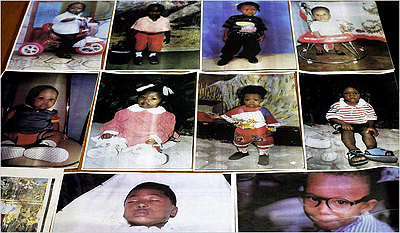
In a case echoed by recent poisonings, at least 88 Haitian children were killed in 1996 by medicine made with a toxic syrup sent from China. Their pictures were collected by a lawyer, David Mishael. (Barbara F. Fernandez for The New York Times)
After a drug ingredient from China killed dozens of Haitian children a decade ago, a senior American health official sent a cable to her investigators: find out who made the poisonous ingredient and why a state-owned company in China exported it as safe, pharmaceutical-grade glycerin.
The Chinese were of little help. Requests to find the manufacturer were ignored. Business records were withheld or destroyed.
The Americans had reason for alarm. “The U.S. imports a lot of Chinese glycerin and it is used in ingested products such as toothpaste,” Mary K. Pendergast, then deputy commissioner for the Food and Drug Administration, wrote on Oct. 27, 1997. Learning how diethylene glycol, a syrupy poison used in some antifreeze, ended up in Haitian fever medicine might “prevent this tragedy from happening again,” she wrote.
The F.D.A.’s mission ultimately failed. By the time an F.D.A. agent visited the suspected manufacturer, the plant was shut down and Chinese companies said they bore no responsibility for the mass poisoning.
Ten years later it happened again, this time in Panama. Chinese-made diethylene glycol, masquerading as its more expensive chemical cousin glycerin, was mixed into medicine, killing at least 100 people there last year. And recently, Chinese toothpaste containing diethylene glycol was found in the United States and seven other countries, prompting tens of thousands of tubes to be recalled.
The F.D.A.’s efforts to investigate the Haiti poisonings, documented in internal F.D.A. memorandums obtained by The New York Times, demonstrate not only the intransigence of Chinese officials, but also the same regulatory failings that allowed a virtually identical poisoning to occur 10 years later. The cases further illustrate what happens when nations fail to police the global pipeline of pharmaceutical ingredients.
In Haiti and Panama, the poison was traced to Chinese chemical companies not certified to make pharmaceutical ingredients. State-owned exporters then shipped the toxic syrup to European traders, who resold it without identifying the previous owner — an attempt to keep buyers from bypassing them on future orders.
As a result, most of the buyers did not know that the ingredient came from China, known for producing counterfeit products, nor did they show much interest in finding out.
China itself was a victim of diethylene glycol poisoning last year when at least 18 people died after ingesting poisonous medicine made there.In the wake of the deaths, and reports of pet food and other products contaminated with dangerous ingredients from China, officials there announced that they would overhaul the regulation of food, drugs and chemicals.
Beyond the three incidents linked to Chinese diethylene glycol, there have been at least five other mass poisonings involving the mislabeled chemical in the past two decades — in Bangladesh, Nigeria, Argentina and twice in India.
“This problem keeps coming back,” said Dr. Joshua G. Schier, a toxicologist with the Centers for Disease Control and Prevention. And no wonder: the counterfeiters are rarely identified, much less prosecuted.
Finding a way to keep diethylene glycol out of medicine, particularly in developing countries, has confounded health officials for decades.“It is preventable and we have to figure out some way of stopping this from happening again,” said Carol Rubin, a senior C.D.C. official.
In a global economy, ingredients for drugs are often bought and sold many times in different countries, sometimes without proper paperwork, all of which increases the risk of fraud, the authorities say.
The Panama poison passed through five hands, the Haitian poison six. In both cases, the factory’s original certificate of analysis, attesting to the contents of the shipment and its provenance, did not accompany the product as it moved around the world.
“Where there is a loophole in the system, a frailty in the system, it’s the ability of an unscrupulous distributor to take industrial or technical material and pass it off as pharmaceutical grade,” said Kevin J. McGlue, a board member of the International Pharmaceutical Excipients Council.
Uncovering that deception can be difficult. “It’s impossible to get anyone to do the trace-backs,” said Dr. Michael L. Bennish, co-author of a 1995 medical journal article on a poisoning epidemic in Bangladesh.
One reason, Dr. Bennish said, is the clout of local manufacturers. “We tried to follow up as amateur Sherlocks, investigators, but you don’t go down to the wholesale market and ask questions,” he said. “You are going to get your fingers burnt.”
A Crisis in Haiti
By the end of June 1996, the F.D.A. knew it might have an international crisis on its hands. A poison had found its way into fever syrup in Haiti, and the F.D.A. wanted to know if more of the same might be heading to the United States or, for that matter, to any other country. But to learn that, the agency needed to find the manufacturer.
This was not just any poison. Virtually every young poisoning victim who showed up at the main hospital in Port-au-Prince, Haiti’s capital, died.
Labeled pharmaceutical-grade glycerin, the toxic syrup was mixed into thousands of bottles of fever medicine. For months, parents gave it to children, then watched them die, in agony, from kidney failure. No one suspected the medicine until much later.
Officially, at least 88 children died, nearly half under the age of 2.But those 88 were only the ones doctors remembered or for whom hospital records could be found.
The F.D.A. traced the poison to a German broker, Chemical Trading and Consulting, but the company’s records were not much help. “They cannot trace glycerine lots to their manufacturer,” David Pulham, an F.D.A. investigator, wrote on June 30, 1996.
Chemical Trading had arranged for a Dutch company, Vos B.V., to sell 72 barrels of the suspect syrup to Haiti, records show. The agency dispatched an investigator, Ann deMarco, who made an unsettling discovery: sitting in Vos’s warehouse near Rotterdam were 66 more barrels labeled glycerin, all containing lethal concentrations of diethylene glycol.
“Some of this second shipment has been sold,” Ms. deMarco wrote in a memorandum on July 4, 1996. Although the missing barrels had gone to an industrial user, not a drug maker, the F.D.A.’s worries grew.
Ms. deMarco learned that another broker, Metall-Chemie, a German trader, had arranged for Vos to buy the barrels from Sinochem International Chemicals Company, a giant exporter in Beijing owned by the Chinese government.
But Metall-Chemie also did not know the manufacturer, and one of its officials predicted that the F.D.A. would have trouble finding that out. “It is difficult to get any information from Chinese traders,” Ms. deMarco wrote.
More complete shipping records would have identified who made the poison.But in this case, records provided few clues.
“The original source of the material had been obliterated on documents and product containers,” Ms. deMarco wrote to senior F.D.A. officials.“One trader referred to this practice as ‘neutralization.’ I was advised that neutralization is a common practice among traders in order to protect their business interests.”
With no paper trail, American officials turned to Sinochem for help.
Initially, they took an indirect approach. In July 1996, the American Embassy in China contacted the company and asked for a list of Chinese glycerin makers, without saying that it was investigating the Haiti poisonings.Sinochem, however, “would not reveal the names of actual manufacturers in order to prevent the prospective foreign customer from bypassing Sinochem,” an embassy official reported to Washington.
In early August, American officials asked Sinochem representatives specifically about the origin of the Haiti poison. “They want to investigate further and were unable (or unwilling) to give the name of the manufacturer at this time,” the officials reported.
Federal investigators sought help from senior Chinese drug regulators, who promised to help find the manufacturer, but said it “will take time,” records show.
When another month passed without any word from either regulators or Sinochem, the embassy tried again. Chinese regulators said they had done nothing to find the factory, according to a confidential State Department telegram from September 1996.
Sinochem did finally offer the manufacturer’s name: the Tianhong Fine Chemicals Factory in the city of Dalian in northeastern China. But Sinochem “refused” to provide an address, saying it was illegible.A telephone number would have to suffice, it said.
That, too, was unproductive. When American investigators called the plant manager, Zhang Gang, they were told he was not available. Send a fax, they were told. That did not work either. “The phone was always busy,” investigators reported.
Finally, they got Mr. Zhang on the phone, but he, too, refused to give out his factory’s address. He said that tests had found no signs of diethylene glycol, adding that “there had been no cases in China of poisoning resulting from the ingestion” of glycerin contaminated by diethylene glycol, investigators wrote.
After months of trying to trace the poison to its source, United States investigators were at a dead end.
“The Chinese officials we contacted on this matter were all reluctant to become involved,” a State Department official wrote in late September 1996, saying that drug regulators and the plant manager had insisted on communicating only on the telephone “to avoid leaving a paper trail.”
He added, “We cannot be optimistic about our chances for success in tracking down the other possible glycerine shipments.”
The following May, Mr. Pulham, who was part of the original F.D.A. investigative team in Haiti, tried to revive the investigation. “Is it possible to block-list all Chinese pharmaceutical products until we gain cooperation?” he asked.
The suggestion went nowhere. Five months later, Ms. Pendergast of the F.D.A. wrote her memorandum, imploring investigators to keep digging.
“China is turning into one of the major bulk pharmaceutical producers in the world,” she wrote. “Unless they have an open, transparent and predictable system for dealing with problems and other countries, it is going to be rough sledding in the years ahead.”
On Nov. 17, 1997, federal investigators once again questioned Sinochem officials. They denied any wrongdoing, saying that two certificates of analysis showed that the suspect shipment was safe, pharmaceutical-grade syrup. But when the F.D.A. asked to see them, Sinochem refused.
“The officials were not willing to explain why they could not provide the copies,” an American official reported at the time.
Chen Liusuo, who handled the glycerin sales, strongly disputed the F.D.A.’s account. In an interview with The Times, Mr. Chen said Sinochem cooperated.“We gave them everything they wanted,” Mr. Chen said, adding that the agency was satisfied.
“The product we sold was glycerin,” he said. “It passed through three or four companies after us. To find the problem you need to look at every link in the supply chain.”
A Chinese government official familiar with the F.D.A.’s inquiries said the Americans’ frustration might have stemmed from their misunderstanding about who regulated chemical companies, which led them to seek help from the wrong officials. “This was a truly tragic event, and we expressed our sadness and sympathy,” said the official, who asked not to be identified.
At the end of 1997, a year and a half after the F.D.A. began tracing the poisonous shipments, one of its investigators, Ted Sze, finally got inside the Tianhong chemical plant in Dalian. But glycerin was no longer made there, and Mr. Sze had no records to inspect. The plant manager, Mr. Zhang, told investigators that he had received no complaints about his products and that his company had not produced the poison.
Mr. Sze, now retired from the F.D.A., said in an interview that he had no choice but to accept the manager’s word and clear the company of wrongdoing. “By the time I went there, the plant was already shut down,” he said. “The agency can only do so much.”
The Experts’ Recommendations
The United States may not have gotten what it wanted from China, but the Haiti crisis did bring together health groups to search for ways to stop diethylene glycol poisonings. At a workshop in Washington in February 1997, health experts recommended that certificates of analysis be improved to allow users to “trace the product back through every intermediary, broker and repackager to the original manufacturer.”
The workshop participants also called for better testing of drug ingredients and asked governments to tighten oversight of drug manufacturing.
The next year, the World Health Organization offered many of the same recommendations. And a 1998 article in JAMA, the Journal of the American Medical Association, warned that failure to strictly follow the guidelines could cause poisonings “even in countries where quality control procedures are usually strictly applied.”
Much of this had been said before, yet the poisonings have continued.
Just as the JAMA article was being published, three dozen children began dying of acute renal failure at two hospitals in Delhi, India. A local drug maker had unwittingly mixed diethylene glycol into acetaminophen syrup, much as the Haitian pharmacist had.
The drug maker was prosecuted, but according to interviews and government records no progress had been made in identifying the supplier of the poison.
“My experience as an investigator tells me that many of these things will not be proven,” said Dr. M. Venkateswarlu, the drug controller general of India.
Finding counterfeiters often means pursuing leads across foreign borders, and no international authority has the power to do that. Dr. Howard Zucker, who helps to oversee drug issues for the W.H.O., said individual countries must conduct their own trace-back investigations.
But if the United States could not do that on behalf of Haiti, poorer, less influential nations would have little chance of tracking down counterfeiters.
After the Haiti poisoning, a more accurate, less expensive test for diethylene glycol was developed, but last year’s case in Panama shows that suppliers and governments do not always use it.
And as long as counterfeiters do not fear prosecution, the poisonings are likely to continue, experts say.
Dr. Mohammed Hanif, a prominent physician in Dhaka, Bangladesh, said the foreign suppliers of diethylene glycol were never prosecuted for the deaths of thousands of children from 1982 to 1992. “The traumatizing memories of those days still torment me,” said Dr. Hanif, who wrote a paper about the deaths from toxic medicine.
In Argentina, a court official said no one had been prosecuted for supplying the diethylene glycol that ended up in a health supplement, killing 29 people in 1992.
David Mishael, a Miami lawyer, knows the difficulty of assigning blame in these deaths. For 10 years, Mr. Mishael has unsuccessfully pursued legal claims in the United States and Europe against European traders that helped to arrange the shipment of toxic syrup to Haiti. “You can imagine the cost,” said Mr. Mishael, who is representing Haitian parents whose children died from the fever medicine.
He said Dutch authorities assessed a $250,000 fine against Vos, which tested the counterfeit syrup, found it impure and did not alert anyone in Haiti. But given how many died, he called the size of the fine “a joke.” A lawyer who represents Vos, Jeffrey B. Shapiro, declined to comment.
A few children survived after being flown to the United States by humanitarian groups. One of them, Faika Jean, was 2 months old at the time and nearly died en route. Now 11, she has learning disabilities as a result of the poisoning, said her father, Wislin Jean.
Ms. Pendergast, now a private lawyer and consultant, said China had the most to answer for. “Everybody else is just reacting to initial failures,” she said. “It needs to take steps to protect not just its own consumers but also consumers all around the world.”
After The Times reported in May that the Panama poison had been made and exported by Chinese companies as 99.5 percent pure glycerin, Chinese regulators said they would reopen their investigation of the incident. Three weeks later, the officials acknowledged some “misconduct” in how Chinese companies labeled the toxic syrup.
But most of the blame, they said, rested with a Panamanian importer who changed the paperwork to make the syrup look safer than it actually was.
The F.D.A. disagrees, saying the deception began with Chinese companies falsely labeling a poisonous product glycerin. “If the drums had been 99.5 percent glycerin, the deaths in Panama would never have occurred,” the F.D.A. said in a statement.
A Dissatisfied Customer
The F.D.A.’s Haiti investigation never did find more counterfeit glycerin from China, despite a global hunt. But its concerns, it turns out, were not unfounded.
In 1995, the same year babies began to die in Haiti, 284 barrels of a chemical labeled glycerin arrived in New York on container ships. Although the chemical was not intended for use in drugs, it was labeled 98 percent pure. An official with the company that bought the barrels, Dastech International, of Great Neck, N.Y., would later say, “It smelled like glycerin, it looked like glycerin.” But after one of its customers complained, Dastech took a closer look.
Although the chemical was labeled 98 percent pure glycerin, Dastech said in court records that the syrup actually contained sugar compounds — as well as diethylene glycol.
The exporter was Sinochem. Claiming that it was fleeced, Dastech tried to get its money back from the broker who arranged the sale, court records show.
It never did.
Reporting was contributed by Jake Hooker from Beijing, Hari Kumar from New Delhi, Anand Giridharadas from Mumbai, and Julfikar Ali Manik from Dhaka, Bangladesh.
© 2007 The New York Times Company
By Walt Bogdanich
--Correction Appended
PANAMA — Eduardo Arias hardly fits the profile of someone capable of humbling one of the world’s most formidable economic powers.
A 51-year-old Kuna Indian, Mr. Arias grew up on a reservation paddling dugout canoes near his home on one of the San Blas islands off Panama’s Caribbean coast. He now lives in a small apartment above a food stand in Panama, the nation’s capital, also known as Panama City.
But one Saturday morning in May, Eduardo Arias did something that would reverberate across six continents. He read the label on a 59-cent tube of toothpaste. On it were two words that had been overlooked by government inspectors and health authorities in dozens of countries: diethylene glycol, the same sweet-tasting, poisonous ingredient in antifreeze that had been mixed into cold syrup here, killing or disabling at least 138 Panamanians last year.
Mr. Arias reported his discovery, setting off a worldwide hunt for tainted toothpaste that turned out to be manufactured in China. Health alerts have now been issued in 34 countries, from Vietnam to Kenya, from Tonga in the Pacific to Turks and Caicos in the Caribbean. Canada found 24 contaminated brands and New Zealand found 16. Japan had 20 million tubes. Officials in the United States unwittingly gave the toothpaste to prisoners, the mentally disabled and troubled youths. Hospitals gave it to the sick, while high-end hotels gave it to the wealthy.
People around the world had been putting an ingredient of antifreeze in their mouths, and until Panama blew the whistle, no one seemed to know it.
The toothpaste scare helped galvanize global concerns about the quality of China’s exports in general, prompting the government there to promise to reform how food, medicine and consumer products are regulated. And other countries are re-examining how well they monitor imported products.
Lost in this swirl of activity was the identity of the person who started it all — Mr. Arias. Until The New York Times tracked him down with the help of the Panama City mayor’s office, his name had not been known, even to some people working on the case. “We haven’t been able to find him,” said Julio César Laffaurie, the Panamanian prosecutor pursuing the case of the contaminated toothpaste.
In looking back over events of the past year, Dr. Jorge Motta, director of the Gorgas Memorial Institute, a prominent research center in Panama City, said he was grateful that some good had come from the national trauma brought on by the toxic cough syrup.
“The whole questioning about Chinese goods began in Panama with our deaths,” he said, putting a twist on an old Chinese saying by adding, “A little butterfly in Panama beat her wings and created a storm in China.”
Mr. Arias, who lives alone and does not own a car, went to buy blank CDs on May 5 at Vendela, a discount store where he had heard prices were so low that street vendors bought supplies there. Stepping into the store, a large display of toothpaste caught his eye.
“Without touching the tube, the letters were big enough for me to read: diethylene glycol,” Mr. Arias said.
A year ago, those words would have meant nothing to him. “Nobody had ever heard of this stuff,” Mr. Arias said. But a steady drumbeat of news about poison cough syrup had engraved the words in his mind.
“It was inconceivable to me that a known toxic substance that killed all these people could be openly on sale and that people would go on about their business calmly, selling and buying this stuff,” said Mr. Arias, who has a midlevel government job reviewing environmental reports.
Mr. Arias thought about alerting the store clerk but figured nothing would come of it. Instead, he bought a tube with the plan of turning it over to the health authorities. It was not easy.
Since government offices were closed on the weekend, he said, he used a vacation day on Monday to walk the tube to the nearest Health Ministry office. But that office refused to accept it, directing him to a second health center.
Mr. Arias walked there and found himself in a crowded office. “It’s always filled with people who are seeking medical attention,” he said. The clerk there directed him to another section of the building where he spoke to another official.
“I said, look, here is this toothpaste I bought on the pedestrian mall,” he said he told the official, “and it says right here — it’s got diethylene glycol.”
The official told him he needed to take the toothpaste to a third health center, this one much farther away. “I said, wait, wait, do I have to walk all the way over there?” he recalled. “Can’t I give it to you and make the complaint here?”
At this point, Mr. Arias said he was given a form to fill out. He left wondering what if anything would come of his complaint.
Mr. Arias got his answer three days later when the nation’s top health official, Dr. Camilo Alleyne, announced that toothpaste containing diethylene glycol had been found by an unidentified shopper in Panama City.
The news set off alarms. In 2006 the government had mistakenly mixed mislabeled diethylene glycol into 260,000 bottles of cold medicine, and Panama was still coping with its aftermath. The day before Dr. Alleyne’s announcement, a front-page newspaper article here reported the finding by The Times that the diethylene glycol in the cold medicine had come from a Chinese company not certified to sell pharmaceutical ingredients, and that it had been sold under a false label.
Over the years, counterfeiters have used diethylene glycol as a cheap substitute for its more expensive chemical cousin, glycerin, a common ingredient in medicine, food and household products.
Could the suspect toothpaste have come from China as well, investigators wanted to know? And how did it enter the country unnoticed?
“Under no circumstances were we ever going to let another incident such as happened last year happen again,” said Eric Conte, a top drug official at the Panamanian Health Ministry.
The label did not list its origin. “There was stuff in English, how to brush your teeth, and there was a list of ingredients,” Mr. Conte said. Markings suggested that it came from Germany, but the authorities were skeptical.
“We had a good idea where it came from,” said Reynaldo Lee, director of the national food protection agency. He suspected China, and shipping records proved him right.
The toothpaste had entered Panama through the Colón Free Trade Zone on the Atlantic side of the Panama Canal. One of the world’s biggest free zones, with 30,000 workers and 2,500 businesses, it is a place where billions of dollars in goods are unloaded, stored and either sold or reshipped free of tariffs. From there, 5,000 to 6,000 tubes slipped into the Panamanian market, without proper certification, mixed in with animal products, investigators said. A much larger number of tubes were reshipped from the free zone to other Latin American countries.
But it was not until the United States disclosed June 1 that tainted tubes had penetrated its borders that the hunt intensified, a task that grew more difficult when investigators discovered that some contaminated toothpaste did not list diethylene glycol on the label.
Even two well-known brands, Colgate and Sensodyne, got caught up in the sweep when counterfeiters were found to be selling toothpaste with antifreeze under their names. Some fake Colgate tubes also contained potentially harmful bacteria, according to a statement from Health Canada, the national health agency.
“Consumers should seal the tube and put the tube in a sealed bag,” Canadian officials advised. Investigators told The Times that both counterfeit brands came from China.
As the complaints mounted, China’s government defended legitimate manufacturers that used diethylene glycol as a thickening agent in toothpaste, saying it had caused no health problems among Chinese consumers.
Officials outside China took a different view. “They should apologize to the world, and not say that it is not dangerous” said Dora Akunyili, who runs the National Agency for Food and Drug Administration and Control in Nigeria. “This is ridiculous.”
Like Panama, Nigeria had its own lethal encounter with diethylene glycol when dozens of children died in 1990 from medicine that also contained the poison.
In laboratory tests, Canadian authorities found diethylene glycol concentrations of nearly 14 percent in Chinese toothpaste — about twice the level of poison detected in the deadly Panamanian cough syrup.
“While toothpaste is not meant to be swallowed, it is often swallowed by young children,” Health Canada warned. Action against Chinese toothpaste is continuing. In late September, Brunei and Australia announced bans on toothpaste containing unacceptable levels of diethylene glycol.
As reports from around the world mounted, Chinese officials showed they were not immune to the criticism. When the makers of Sensodyne tracked counterfeit toothpaste through the Dubai Free Trade Zone to a factory in Zhejiang Province in China, regulators there shut it down, a spokesman for Sensodyne said. The government also closed the chemical company that made the poison used in the toxic Panamanian cough syrup.
And in July, China ordered its manufacturers to stop using diethylene glycol in toothpaste.
The decision generated news coverage around the world. The name Eduardo Arias was nowhere to be found. He did not seem to mind.
“At least I contributed something,” he said.
R.M. Koster contributed reporting from Panama.
Correction: October 3, 2007
A front-page article on Monday about the Panamanian man whose discovery of a toxic ingredient in Chinese-made toothpaste led to a global consumer storm over products from China misspelled the name of the Chinese province where a factory that produced counterfeit Sensodyne toothpaste was closed. It is Zhejiang, not Shejiang.
© 2007 The New York Times Company
By Walt Bogdanich
This article was reported by Walt Bogdanich, Jake Hooker and Andrew W. Lehren and written by Mr. Bogdanich.
MILAN — In January, Honor International Pharmtech was accused of shipping counterfeit drugs into the United States. Even so, the Chinese chemical company — whose motto is “Thinking Much of Honor” — was openly marketing its products in October to thousands of buyers here at the world’s biggest trade show for pharmaceutical ingredients.
Other Chinese chemical companies made the journey to the annual show as well, including one manufacturer recently accused by American authorities of supplying steroids to illegal underground labs and another whose representative was arrested at the 2006 trade show for patent violations. Also attending were two exporters owned by China’s government that had sold poison mislabeled as a drug ingredient, which killed nearly 200 people and injured countless others in Haiti and in Panama.
Yet another chemical company, Orient Pacific International, reserved an exhibition booth in Milan, but its owner, Kevin Xu, could not attend. He was in a Houston jail on charges of selling counterfeit medicine for schizophrenia, prostate cancer, blood clots and Alzheimer’s disease, among other maladies.
While these companies hardly represent all of the nearly 500 Chinese exhibitors, more than from any other country, they do point to a deeper problem: Pharmaceutical ingredients exported from China are often made by chemical companies that are neither certified nor inspected by Chinese drug regulators, The New York Times has found.
Because the chemical companies are not required to meet even minimal drug-manufacturing standards, there is little to stop them from exporting unapproved, undulterated or counterfeit ingredients. The substandard formulations made from those ingredients often end up in pharmacies in developing countries and for sale on the internet, where more Americans are turning for cheap medicine.
In Milan, The Times identified at least 82 Chinese chemical companies that said they made and exported pharmaceutical ingredients — yet not one was certified by the State Food and Drug Administration in China, records show. Nonetheless, the companies were negotiating deals at the pharmaceutical show, where suppliers wooed customers with live music, wine and vibrating chairs.
One of them was the Wuxi Hexia Chemical Company. When The Times showed Yan Jiangying, a top Chinese drug regulator, a list of 186 products being advertised by the company, including active pharmaceutical ingredients and finished drugs, Ms. Yan said, “This is definitely against the law.”
Yet in China, chemical manufacturers that sell drug ingredients fall into a regulatory hole. Pharmaceutical companies are regulated by the food and drug agency. Chemical companies that make products as varied as fertilizer and industrial solvents are overseen by other agencies. The problem arises when chemical companies cross over into drug ingredients. “We have never investigated a chemical company,” said Ms. Yan, deputy director of policy and regulation at the State Food and Drug Administration. “We don’t have jurisdiction.”
China’s health officials have known of this regulatory gap since at least the mid-1990s, when a chemical company sold a tainted ingredient that killed nearly 100 children in Haiti. But Chinese regulatory agencies have failed to cooperate to stop chemical companies from exporting drug products.
In 2006, at least 138 Panamanians died or were disabled after another Chinese chemical company sold the same poisonous ingredient, diethylene glycol, which was mixed into cold medicine.
China has an estimated 80,000 chemical companies, and the United States Food and Drug Administration does not know how many sell ingredients used in drugs consumed by Americans.
The Times examined thousands of companies selling products on major business-to-business Internet trading sites and found more than 1,300 chemical companies offering harmaceutical ingredients. How many others sell drug ingredients but don’t advertise this way on the Web is not known.
If the Milan show is any guide, most, if not all, are not certified by China’s drug authorities.
China exports drug ingredients to customers in 150 countries, said Sun Dongliang,
a Chinese trade official who helped organize his country’s Milan exhibitors. Many suppliers have passed inspections by drug authorities and sell active pharmaceutical ingredients, or A.P.I.’s, of high quality, buyers say.
“Sometimes you can just have your lunch on the floor of the factory because it’s so clean and so perfect, sometimes much better than in Europe,” said Jean-François Quarre, a French drug company official who had a booth in Milan. But Mr. Quarre cautioned that he has seen the other side as well. “It’s frightening.”
At their worst, uncertified chemical companies contribute to China’s notoriety as the world’s biggest supplier of counterfeit drugs, which include unauthorized copies as well as substandard, even harmful, formulations. “Underregulated manufacturers are increasingly becoming the source of A.P.I.’s used in the production of counterfeit medicine,” R. John Theriault, until recently Pfizer’s head of global security, said in a statement to Congress.
Because United States drug regulators require pharmaceutical suppliers to meet high standards, the American supply chain is among the world’s safest. But as China’s chemical suppliers multiply, Congressional investigators are questioning the F.D.A.’s ability to protect consumers.
Even some Chinese chemical companies recognize their limitations in making pharmaceuticals.
“We don’t have the resources and means to produce medicine,” said Gu Jinfeng, a salesman for Changzhou Watson Fine Chemical. “The bar for producing chemicals is pretty low.”
Even so, Watson Chemical advertises that it makes active pharmaceutical ingredients.
But Mr. Gu said he would export them only to countries with lower standards than China, or if “we can earn really good profits.”
A Trail of Steroids
Just days before the Milan trade show, United States officials made an announcement
that brought home the global reach and attendant dangers of China’s expanding chemical industry. The officials disclosed that they had dismantled a 27-state underground network for steroids and human growth hormone, arresting 124 people in “Operation Raw Deal.”
The supply trail almost always led to China. Thirty-seven companies there supplied virtually all of the bulk chemicals, federal officials said.
Of the 37 suspect companies, all but one unnamed by the American authorities, The Times identified eight. Records show that six are uncertified chemical companies, including Hunan Steroid, which marketed its products at the Milan convention.
“Just want to see the old customers and develop the new market,” said Sun Xueqin, a deputy export manager for Hunan Steroid. Ms. Sun said the company sold raw pharmaceutical ingredients in Europe and America and more advanced pharmaceutical ingredients in India, among other places.
Later, another Hunan official, Huang Zili, said the company did not sell to the United States, and declined to comment on the government’s contention that Hunan was a supplier of bodybuilding drugs. Hunan has not been charged with any crime.
As serious as the accusations are in Operation Raw Deal, health experts say they believe that counterfeit drugs, particularly those sold on the Internet, pose a greater threat to a broader segment of the American public.
“The facts are irrefutable,” Mr. Theriault, the former Pfizer official, told Congress. “The importation of counterfeit, infringing, misbranded and unapproved pharmaceutical products in the United States is increasing exponentially.” Pfizer makes Viagra, one of the drugs most often counterfeited.
Finding uncertified companies feeding the market is not difficult. Orient Pacific International, the Milan registrant whose owner did not show up, advertised that it makes and exports pharmaceutical ingredients to “worldwide famous medical companies.” The owner, Mr. Xu, is accused of selling counterfeit medicine to treat ailments like cancer, mental illness and heart disease, according to United States Immigration and Customs Enforcement, or I.C.E.
Mr. Xu shipped drugs to an Internet pharmacy, investigators say. But he also penetrated the highly regulated supply chain of legitimate distributors in Europe, said David A. Faulconer, a customs official. Acting on tips from large drug companies, federal officials devised a plan to stop him from doing the same in the United States.
Posing as a buyer, an investigator for the immigration and customs agency met Mr. Xu in Bangkok on March 6. Mr. Xu gave him “detailed suggestions for transshipment and smuggling techniques to evade United States Customs detection,” federal records show.
After investigators bought multiple shipments of counterfeit drugs, Mr. Xu traveled to Houston “to consummate an agreement for widespread distribution of his counterfeit products in the United States,” according to an affidavit filed in federal court. Federal agents arrested Mr. Xu, who has pleaded not guilty.
Another company exhibiting in Milan, Honor International Pharmtech, was also the subject of a customs investigation. In January, agents seized 3,041 fake Viagra pills sent by the company to a DHL shipping hub in Wilmington, Ohio, according to customs.
The shipment, disguised as grape seed extract, was destined for an Internet pharmacy in Central America, said agents who requested anonymity because the investigation continues.
“We do make grape seed extract,” the company’s managing director, Nie An, said in a telephone interview. He denied shipping counterfeit Viagra, but he acknowledged other indiscretions: making false advertising claims, using another company’s import-export license and creating a fake corporate name.
“We don’t really have a factory,” Mr. Nie said, even though he advertised that he did. Honor International is just a trading company, he said, adding, “As a trading company, saying you can manufacture attracts business. It was fake advertising.”
The Times found several other companies posing as manufacturers, thereby obscuring a drug’s provenance. In a recent joint statement, chemical associations in the United States and Europe cautioned that globalization has led to a rise in complexity in supply chains, “ increasing the potential for contamination, mislabeling or substitution.”
Pharmaceutical ingredients can pass through three or four trading companies, none of which check their quality. The ultimate manufacturer may not realize the ingredients came from an uncertified chemical company.
Mr. Nie, for example, said he markets Viagra’s main ingredient, sildenafil, through a partnership with a chemical company in a distant region that he has never visited. “We met them at a trade fair,” he said. “This company didn’t even have a booth at the fair. They were standing outside the entrance to the exhibition center, and they handed us a flier with a menu of their products.”
He said he was trying to the reach the factory, which has no Web site, to fill a Croatian company’s order.
“Our main markets are in Latin America — Brazil, Argentina, Uruguay,” he said. “ A little in Canada, a little in the United States. In Europe, we export to Germany, Russia, Italy.”
But Mr. Nie faces an uncertain future. He said that Chinese investigators had recently visited his office, and that they knew about the seizure in Ohio.
Viagra is hardly the only drug that companies try to copy. The French drug maker Sanofi-Aventis grew weary of watching other companies sell knockoffs of its new diet drug, Acomplia, and alerted French authorities that three Chinese companies were marketing their own version of the product at the 2006 pharmaceutical ingredient trade show, held in Paris. Six Chinese company officials were arrested.
One of those arrested in Paris was Jin Lijie, managing director of the Wuxi Hexia Chemical Company. Still, Wuxi Hexia showed up in Milan in 2007 selling a line of pharmaceutical ingredients.
Its representatives declined to be interviewed in Milan, or at its offices in the boomtown of Wuxi. “We are all young college graduates and we are still learning about the market,” said an employee named Du Yanqun.
Factories on the Yangtze
A good place to find companies selling uncertified drug ingredients is Changzhou in the Yangtze delta, where the raw materials for chemical production are readily available and easily transported by canals and roads.
Several factories there sent representatives to Milan, including the Changzhou Kangrui Chemical Company. It makes pharmaceutical ingredients in an old converted steel plant. “I’m afraid it will leave you with a bad impression,” said Zhou Ladi, a sales representative, as she gave a tour. She said Kangrui Chemical hopes to move into a new plant by early 2009.
“As long as we don’t export products that are under patent in other countries, the government encourages us to export,” she said.
To help find customers overseas, smaller factories enlist the services of people like Bian Jingya, export manager for a trading company called the Changzhou Wejia Chemical Company.
Ms. Bian said chemical companies are involved in all phases of drug manufacturing, including making finished products. Some, she said, “are under patent in other countries.”
Ms. Bian, who was also in Milan, said the government should spell out more clearly what companies may and may not do. “If you want to be regulated, they will regulate you,” she said. “If you don’t want to be regulated, they don’t.”
The Chinese drug agency does not oversee the making of pharmaceutical raw materials, called intermediates, which are the building blocks for active pharmaceutical ingredients. “It is unrealistic for us to certify all factories that make intermediates and regulate them like medicine products,” said Ms. Yan, the agency official. But if companies make active ingredients, a more refined product, then they must be regulated by drug authorities, she said.
When The Times pointed out that many uncertified chemical companies openly advertise active ingredients, Ms. Yan said that was illegal. “If there are in fact chemical companies that are making drugs without certification then this is very serious,” she said. “These companies are not qualified to make medicine. They make chemicals.”
Wang Siqing, managing director of the Changzhou Yabang Pharmaceutical Company, estimated that uncertified chemical companies make half the active pharmaceutical ingredients sold in China. “The stuff produced by chemical plants is clearly counterfeit medicine, but they aren’t investigating,” Mr. Wang said in an interview at his office. “This has been happening in a regulatory void.” He added that most chemical company exports go to unregulated markets in Africa or South America. “That’s not to say these products don’t enter the United States through these other countries,” he said.
To find out how well American consumers are being protected from unsafe imported drugs, investigators from the House Energy and Commerce Committee recently accompanied F.D.A. officials on inspections of drug plants in China and India.
In a letter to the F.D.A. commissioner, the committee said that the agency was unable to provide such basic information as the number of firms exporting to the United States, and that overseas F.D.A. inspectors lacked necessary logistical support. A House hearing on F.D.A. oversight of foreign drug manufacturers is scheduled for Thursday.
“China alone has more than 700 firms making drug products for the U.S., yet the F.D.A. has resources to conduct only about 20 inspections a year in China,” said Representative John D. Dingell, the Michigan Democrat who is the chairman of the House Energy and Commerce Committee. The F.D.A. said it would answer the committee’s questions at the hearing.
Poisonings in Haiti
United States officials learned of problems with China’s chemical companies in the mid-1990s while investigating the fatal poisonings in Haiti. Chinese authorities took no action against the uncertified chemical company that made the poison, diethylene glycol, or the giant state-owned trader, Sinochem International Chemicals, that exported it.
A decade later another state-owned trading company, CNSC Fortune Way, exported the diethylene glycol — also from an uncertified chemical company — that ended up in the deadly Panamanian cold medicine in 2006.
Chinese officials have known for years that uncertified chemical companies are producing active pharmaceutical ingredients. In 2004 the Chinese drug authority’s newspaper cited complaints that some licensed companies “affiliate” with unlicensed ones to hide their illegal purchases, while others buy only a token amount from certified suppliers to pass inspection. “The impact of chemical products on the bulk pharmaceutical market hints at a much larger problem: a huge hole in drug safety,” the drug agency publication stated.
Since the Panama poisonings, China is considering ways to corral the chemical industry. At Panama’s request, Michael O. Leavitt, the secretary of health and human services, has pressed the Chinese government to step up regulation of chemical companies selling pharmaceutical ingredients.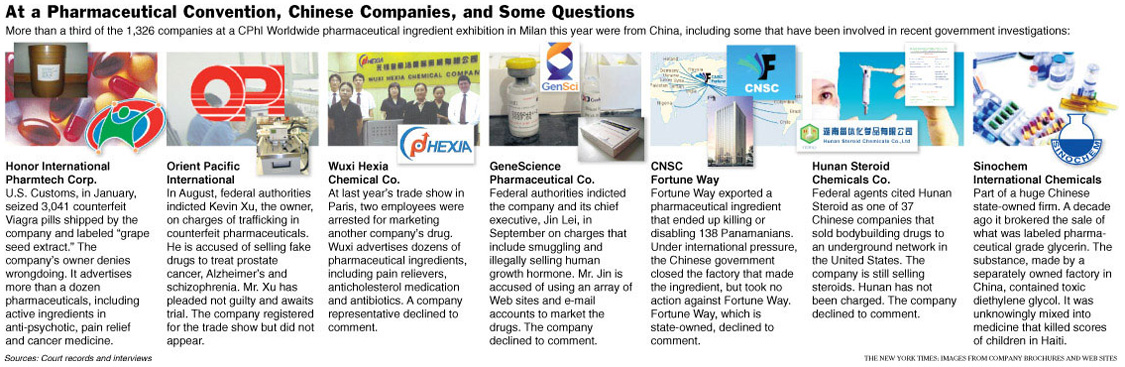
American and Chinese health officials held their first high-level meeting in May, and hope to sign a memorandum of agreement in December. “The Chinese have finally come to the realization that their regulatory system needs repair,” said William Steiger, director of international affairs for Mr. Leavitt’s agency. But meaningful change will be difficult. Chinese authorities may not have enough investigators to weed out the many small chemical companies that are making drug ingredients.
And efforts to close the regulatory gap must overcome one particularly thorny issue: some uncertified companies accused of selling counterfeit drugs are owned by the government itself.
© 2007 The New York Times Company
By Walt Bogdanich
DUBAI, United Arab Emirates — Along a seemingly endless row of identical gray warehouses, a lone guard stands watch over a shuttered storage area with a peeling green and yellow sign: Euro Gulf Trading.
Three months ago, when the authorities announced that they had seized a large cache of counterfeit drugs from Euro Gulf’s warehouse deep inside a sprawling free trade zone here, they gave no hint of the raid’s global significance.
But an examination of the case reveals its link to a complex supply chain of fake drugs that ran from China through Hong Kong, the United Arab Emirates, Britain and the Bahamas, ultimately leading to an Internet pharmacy whose American customers believed they were buying medicine from Canada, according to interviews with regulators and drug company investigators in six countries.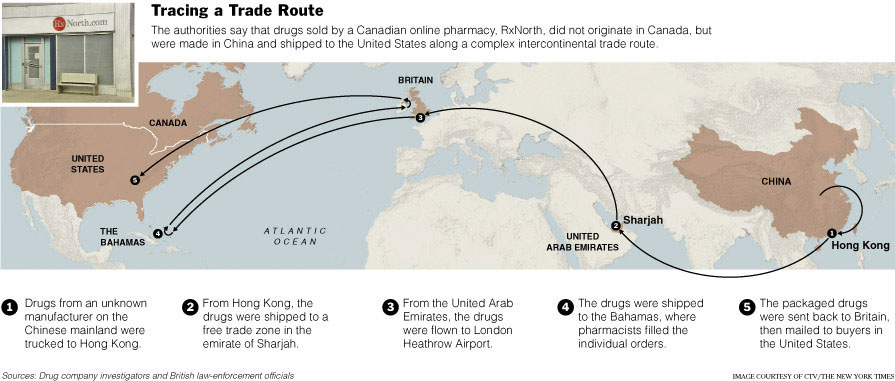
The seizure highlights how counterfeit drugs move in a global economy, and why they are so difficult to trace. And it underscores the role played by free trade zones — areas specially designated by a growing number of countries to encourage trade, where tariffs are waived and there is minimal regulatory oversight.
The problem is that counterfeiters use free trade zones to hide — or sanitize — a drug’s provenance, or to make, market or relabel adulterated products, according to anticounterfeiting experts.
“Free trade zones allow counterfeiters to evade the laws of the country because often times the regulations are lax in these zones,” said Ilisa Bernstein, director of pharmacy affairs at the United States Food and Drug Administration. “This is where some of the Internet sellers work,” she added.
Dubai is particularly attractive to counterfeiters because of its strategic location on the Persian Gulf between Asia, Europe and Africa. Records show that nearly a third of all counterfeit drugs confiscated in Europe last year came from the United Arab Emirates. “Three or four years ago, Dubai did not even appear on the radar screen,” said an investigator for a major American drug company who is based in China and requested anonymity because he did not have authority to speak for his employer.
Dubai is vulnerable because of the huge volume of goods that move through its free trade areas, and because of what is perceived by some in the pharmaceutical industry to be a murky line of authority for rooting out counterfeits there. “It is not clear that the normal Dubai customs authorities have jurisdiction,” said Rubie Mages, a director of global security for Pfizer.
The authorities in Dubai do show a willingness to act when drug company investigators tip them to possible counterfeits, as they did in the raid announced earlier this year. “Dubai has taken a big step in fighting the counterfeiters,” said Ahmed Butti Ahmed, director general of Dubai customs.
But significant quantities of fake drugs are still getting through, international health officials say. And as countries create more free zones, counterfeiters have more options. “What happens is they move around,” said Ms. Bernstein of the F.D.A. Sometimes, in an attempt to avoid detection, they move products between free zones.
“It’s not just the U.A.E. trade zones that are a problem, but free zones around the world,” said Steve Allen, a senior investigator for Pfizer, who was in Dubai early this month to talk to customs officials.
One problem area, counterfeiting experts say, is the Colón Free Trade Zone, situated next to the Panama Canal.
In June, the Panamanian authorities raided a warehouse there that was used by an Australian, George Adams, to run his Internet pharmacy business. No charges were filed in connection with that raid, but about $50,000 in drugs were seized, Mr. Adams said. Several months earlier, Mr. Adams had been arrested for trying to sell counterfeit Viagra. He said he was “set up” and denies any wrongdoing.
Mr. Allen, of Pfizer, said his latest concern involves counterfeit shipments passing through Jordan and Mauritius, an island east of Africa.
In July, the authorities in Dubai said fake drugs from Mauritius had been seized at a free zone next to the Dubai airport. There were more than half a million pills of counterfeit Plavix, a blood-thinning drug made by the French company Sanofi-Aventis.
The Dubai health authorities say they do not know who made it.
Some pills, a government official said at the time, contained cement powder.
A Suspicious Shipment
On May 22, 2006, British customs officials made a troubling discovery at Heathrow Airport in London. They intercepted 846 pounds of pharmaceuticals, mostly counterfeits of products made by such well-known companies as Merck, Novartis, AstraZeneca, Pfizer and Procter & Gamble. Some medication contained traces of metal.
These were not just lifestyle drugs; this medicine was supposed to treat high blood pressure, high cholesterol, osteoporosis and acid reflux, among other ailments.
Where the drugs came from and where they were going struck inspectors as odd.
The shipment had arrived from the United Arab Emirates en route to its next destination: the Bahamas. This was not a route the drug companies used, said Nimo Ahmed, head of intelligence for the British drug regulatory agency. “What triggered this particular interception was that the pharmaceutical companies had conducted some awareness training with customs in Heathrow to explain suspicious routes,” Mr. Ahmed said.
Pfizer took a particular interest in the case. Thousands of pills of its cholesterol-fighting drug Lipitor had been among those counterfeited, the company said.
Pfizer, which runs one of the industry’s most sophisticated anticounterfeiting operations, contacted Bahamian law enforcement officials in the hope they would investigate the intended recipient of the Heathrow cache. In early June, the Bahamian authorities followed up and raided the Personal Touch Pharmacy in Freeport, seizing nearly $4 million in drugs, some of which turned out to be counterfeit, investigators said.
Eventually it was determined that the pharmacy did $8 million in annual business. The question was, with whom?
Meanwhile, back in London, there was the matter of tracing the drugs back to their source. That led to one of the many free trade zones in the United Arab Emirates. Those zones are major revenue producers for the emirates and, according to a 2006 State Department report, 17 of them were in operation, with 11 more in development.
“The government in Dubai, believing in the liberal market, adopted this concept,” said Mohammed Y. Rai Al Boom, a spokesman for the Dubai Airport Free Zone Authority. “It is very convenient to get products in and out of Dubai.”
Mr. Ahmed, the British health official, said the zones were set up to encourage legitimate trade. “They will process packages quicker, receive fees for them, and if everything is done legitimately it’s a win-win for everybody,” he said. But, he added, “counterfeiters are using it as a way to hide where their products are originally sourced.”
Free zones act as way stations for goods moving around the globe. Since most of the shipments do not officially enter the country, there are fewer bureaucratic entanglements. In the mirates’ zones, the usual requirement for local ownership of companies is waived, and there are no import and export fees or income tax.
Shipping records showed that the Heathrow container came from a company located in a free zone in Sharjah, one of the emirates.
Drug company investigators say that shortly after the raid in the Bahamas, an effort was made to hide additional drug stock by moving it from Sharjah to the Jebel Ali Free Zone.
Afaque Ahmed Khan, a business executive in Dubai, has seen Jebel Ali grow from nothing. “It’s literally like someone walking in the sand and placing his figure on a spot and saying, ‘This here is going to be the transit point for trade, globally,’” Mr. Khan said. “And that’s what happened, literally.”
By far the biggest and oldest free zone in Dubai, Jebel Ali is home to some 6,000 companies. A major new airport is being built to complement the seaport, where millions of containers from boats around the world are unloaded each year.
The counterfeit drugs were put in warehouse VC-08, which belonged to Euro Gulf, a trading house that sells laundry, household cleaning and personal care products, according to its Web site. “Our proactive international strategy has resulted in an increase in exports to more than 40 countries worldwide,” the Web site said.
But customs officials in Dubai had been alerted to what was inside. They swept in, found counterfeit drugs and charged seven people with various crimes.
A Canadian Pharmacy
In the Bahamas, investigators had also made an important discovery. The computers at Personal Touch Pharmacy were connected to a server hosting a Canadian Internet pharmacy Web site.
The site belonged to RxNorth, described by one trade association as the world’s
first major online pharmacy.
A founder, Andrew Strempler, had been the subject of numerous profiles, including one in The New York Times in 2005 that described how at the age of 30 he had two Dodge Vipers, a Jaguar and a yellow Lamborghini with a license plate that leads “RX Boss.”
The article reported that Mr. Strempler’s innovation “created a whole new Canadian industry that has plugged a niche in America’s troubled health care system almost overnight, providing about $800 million worth of low-cost drugs a year to two million uninsured and underinsured Americans, many elderly.” Drugs have traditionally been cheaper in Canada because of its health care system.
The big pharmaceutical companies were not pleased. Pfizer and Merck cut off his supplies, forcing Mr. Strempler to buy from other wholesalers.
That was not Mr. Strempler’s only setback. According to the Manitoba Pharmaceutical Association newsletter, the group’s discipline committee concluded that in 2001 Mr. Strempler had improperly filled “in excess of 10,000 orders for medications for patients residing in the United States of America without receiving prescriptions from a medical practitioner or dentist licensed to practice in Canada.”
Mr. Strempler’s online business began to unravel last year when Edward Hector, a former customer service employee, complained to a Canadian television station about the company’s business practices. In a recent interview, Mr. Hector said he was told, “Under no circumstances are you to tell any customer that their medication comes from the Bahamas.” Mr. Hector said he left RxNorth in May 2006 after working there for a little more than a year.
Mr. Strempler did not return telephone messages seeking comment, but he has publicly defended his products. The television station also quoted him as saying customers were not told about the Bahamas because medicine coming through there might actually originate in Europe or Australia. It was not clear if he knew the true source of drugs being dispensed by the company in the Bahamas.
In fact, drug company investigators say, some of them were coming from China, a country known for producing counterfeit medicine.
“We traced the source of the medicines and determined that they had been manufactured in China,” said Ms. Mages of Pfizer. From the mainland it went to Hong Kong, then to the United Arab Emirates and the Bahamas, where individual prescriptions were filled and put into packets and addressed.
“Instead of sending it directly to the patient, it then went back to the U.K., where U.K. postage would be affixed, and then it would be mailed to the U.S.,” Ms. Mages said. #147;This was done to lend credibility to the medicine.”
Drug company investigators say they believe that at least some of the counterfeit drugs seized at the Jebel Ali zone were following that same route.
Mr. Ahmed, the British health official, said circuitous routes were used to avoid customs checks. “The chance of getting intercepted lessens if they use this route,” he said. And Ms. Mages cited another reason: “The whole purpose of going through multiple points of entry is to disguise the source.”
In August and September of last year, the F.D.A. intercepted 5,000 packages from the online pharmacy. At the same time, the agency also warned Americans not to buy 10 drugs from RxNorth or related Web sites because preliminary testing had found counterfeits.
The drugs named were: Lipitor, Crestor and Zetia, for cholesterol; Diovan and Hyzaar, for high blood pressure; Actonel for osteoporosis; Nexium for reflux disease; Celebrex for arthritis pain; Arimidex for breast cancer; and Propecia for baldness.
Trail’s End
Mr. Strempler has not been charged with any crime relating to RxNorth, and published reports say about a year ago he transferred dispensing operations to another Canadian online pharmacy.
The F.D.A. declined to comment on RxNorth. Health Canada, the national health agency, said it “cannot comment on ongoing investigations, specific companies or alleged violations with respect to possible counterfeit activity.”
In the Bahamas, a pharmacist and office manager for Personal Touch Pharmacy face trial next year on conspiracy and fraud charges, said Garvin Gaskin, chief counsel for the office of attorney general in the Bahamas.
In Dubai, seven officials associated with Euro Gulf were convicted recently and sent to prison, customs officials said. “We have been successful in getting customs authorities to work with us to inspect and to seize questionable goods, but we still have a long way to go,” Ms. Mages said.
And Mr. Ahmed, the British health official, said he expected individuals to be tried next year on charges relating to RxNorth’s links to Britain. He declined to elaborate.
But a critical piece of the puzzle remains missing — who made the counterfeit drugs? Investigators had obtained the license number of a truck that brought the suspect medicine into Hong Kong from mainland China. But that turned out to be a dead end.
And even if investigators do find the factory, there is no shortage of Chinese companies making fake, subpotent or adulterated drug products.
“Some of them in the morning, they manufacture good drugs and in the afternoon and evening they manufacture counterfeit medicine,” said Dr. Mohammed Abu Elkhair, a health official in Abu Dhabi who helped organize a conference last month in the capital city to educate United Arab Emirates officials on how to combat counterfeit medicine.
In October, The New York Times reported that scores of Chinese chemical companies were exporting drug ingredients even though they were not licensed to do so.
Calling counterfeit medicine a growing global threat, Dr. Abu Elkhair said one only had to look at a mass poisoning in Panama last year to understand the seriousness of the problem. More than a hundred people died there because the government had unwittingly mixed a counterfeit ingredient made by a chemical company in China into cold medicine.
“The people there lost faith in the whole health care system, not just in the drug regulations authority,” he said.
Andrew W. Lehren contributed reporting from New York, and R. M. Koster from Panama.
© 2007 The New York Times Company
Biography
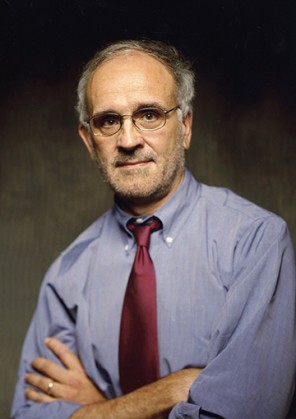
Walt Bogdanich became the investigations editor for the Business and Finance desk of The New York Times in January 2001. He was named an assistant editor for the paper's newly expanded Investigative Desk in 2003. Before joining The Times in 2001, he was an investigative producer for "60 Minutes" on CBS and for ABC News. Previously, he worked as an investigative reporter for The Wall Street Journal in New York and Washington. He also worked for The Cleveland Press and The Plain Dealer.
Born in Chicago on Oct. 10, 1950, Mr. Bogdanich graduated from the University of Wisconsin in 1975 with a degree in political science. He received a master's degree in journalism from Ohio State University in 1976. Mr. Bogdanich won the Pulitzer Prize in 2005 for National Reporting for his series "Death on the Tracks," which examined the safety record of the U.S. railroad industry. He also won the Pulitzer Prize in 1988 for Specialized Reporting for his articles in The Wall Street Journal on substandard medical laboratories. Mr. Bogdanich has won four George Polk Awards and an Overseas Press Club Award.
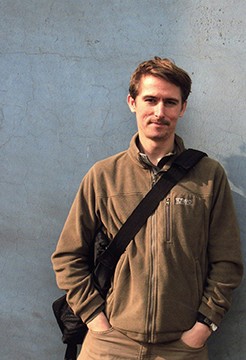
Jake Hooker was born on Oct. 27, 1973 in Newton, Massachusetts. He attended Milton Academy and Dartmouth College, where he studied art history. For two years he lived in the backcountry of the White Mountain National Forest as a caretaker for several backcountry huts operated by the Appalachian Mountain Club.
He was a volunteer in the Peace Corps in China starting in 2000. For two years, he taught English at a middle school in Wanxian, a small town along the middle reach of the Yangtze River, near the Three Gorges. In his free time there, he learned Chinese. He published his first newspaper article, about his life in Wanxian, in The Boston Globe in 2001.
In 2003, Jake returned to China to work for the Surmang Foundation, a nongovernmental organization that runs a free health clinic for nomads in eastern Tibet. Western doctors work alongside Tibetans there; patients come on horseback. Jake translated for Western doctors and Tibetan doctors, bought medicine, wrote reports and met with health officials, Tibetan monks and other people in the Surmang Valley. Jake has traveled to most places in China writing about rural life, AIDS, ethnic identity, and archaeology. Since 2006, he has contributed research and reporting to a wide range of China coverage for The New York Times.