The Washington Post, by Susan Schmidt, James V. Grimaldi and R. Jeffrey Smith
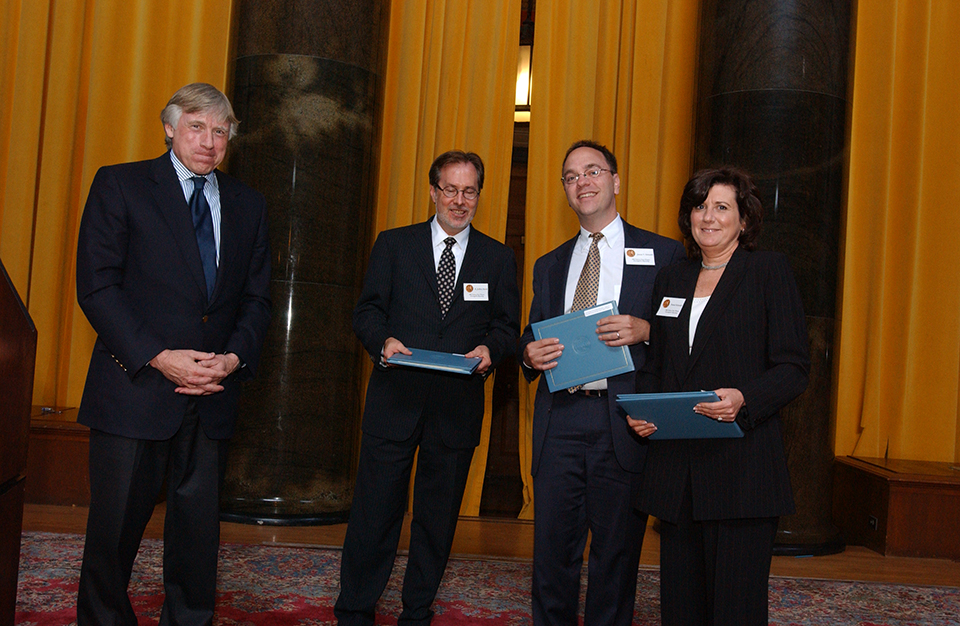
Columbia University President Lee C. Bollinger (left) presents (left to right) R. Jeffrey Smith, James V. Grimaldi and Susan Schmidt with the 2006 Pulitzer Prize in Investigative Reporting.
Winning Work
By James V. Grimaldi and R. Jeffrey Smith
Washington Post staff writers
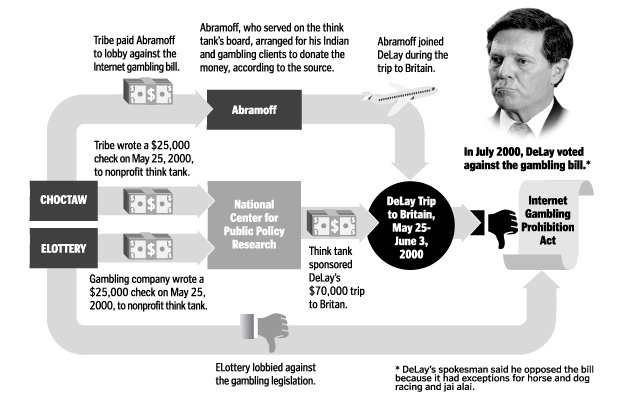
An Indian tribe and a gambling services company made donations to a Washington public policy group that covered most of the cost of a $70,000 trip to Britain by House Majority Leader Tom DeLay (R-Tex.), his wife, two aides and two lobbyists in mid-2000, two months before DeLay helped kill legislation opposed by the tribe and the company.
The sponsor of the week-long trip listed in DeLay's financial disclosures was the nonprofit National Center for Public Policy Research, but a person involved in arranging DeLay's travel said that lobbyist Jack Abramoff suggested the trip and then arranged for checks to be sent by two of his clients, the Mississippi Band of Choctaw Indians and eLottery Inc.
The dates on the checks coincided with the day DeLay left on the trip, May 25, 2000, according to grants documents reviewed by The Washington Post. The Choctaw and eLottery each sent a check for $25,000, according to the documents. They now say that they were unaware the money was being used to finance DeLay's travels.
But Amy Ridenour, president of the National Center, said that, when the trip was arranged, Abramoff promised he would secure financial backing. She said that even without Abramoff's efforts, the National Center would have borne the cost of the trip, which was intended to allow the group to network with conservative British politicians and included an outing to the famous St. Andrews golf course in Scotland.
"We paid for the trip," Ridenour said. "This trip was going to be paid for by the National Center, regardless of whether we got the donations from the Choctaw or eLottery."
House ethics rules allow lawmakers and their staffs to have travel expenses paid only for officially connected travel and only by organizations directly connected to the trips. The rules also require that lawmakers accurately report the people or organizations that pay for the trips. They prohibit payments by registered lobbyists for lawmakers' travel.
DeLay's spokesman, Dan Allen, said: "The trip was sponsored, organized and paid for by the National Center for Public Policy Research, as our travel disclosures accurately reflect and what the National Center has publicly said."
Abramoff's attorney, Abbe David Lowell, declined to comment. Abramoff, the National Center and the flow of money between them are now being investigated by a federal task force and by the Senate Committee on Indian Affairs; DeLay was admonished three times last year for infringements of House ethics rules.
To prove an ethics violation, investigators would have to show that DeLay and his staff knew the gambling interests were funding the trip, said Jan W. Baran, a Wiley Rein & Fielding LLP ethics lawyer who often represents Republicans. "If somebody is doing some backdoor financing, how would the member know?"
Abramoff, a member of the National Center's board, joined the DeLays on the May 25 to June 3, 2000, trip, which DeLay's congressional office has said included a stop in London and a visit with Margaret Thatcher, along with the golf outing at St. Andrews, where colleagues say Abramoff has a membership.
DeLay, an avid golfer, listed the purpose of the trip on a report filed with the House clerk as "educational." He was majority whip at the time and brought his wife, Christine, and two top staff members -- Tony Rudy from the whip's office and chief of staff Susan Hirschmann, as well as her husband, David Hirschmann, according to filings with the House clerk that indicated the total cost of transportation, lodging and meals was $70,265.
Internet Gambling Bill Killed
Two months later, in July 2000, DeLay and 43 other Republicans joined 114 Democrats in killing the Internet Gambling Prohibition Act, which would have made it a federal crime to place certain bets over the Internet and was opposed by eLottery and the Choctaws. The bill was supported by 165 Republicans and 79 Democrats but fell about 25 votes short of passage; because of a parliamentary maneuver, it required a two-thirds majority vote.
DeLay spokesman Allen said that DeLay voted against the bill because it had exemptions for jai alai and horse and dog racing. Rudy later that year went to work for Abramoff as a lobbyist.
The Choctaw Indians run a highly profitable casino near Philadelphia, Miss., that bankrolls their community activities and has subsidized an extensive lobbying effort in Washington. The tribe donated a total of $65,000 to Ridenour's group in 2000 and $1.07 million in 2002.
The Choctaw money was intended to help the center create a program to build support for the idea that Indian casinos could drive prosperity for poor tribes, Ridenour said. "We were trying to tell the Choctaw story," she said. On its Web site, the center attributes the following statement to DeLay: "The National Center is The Center for conservative communications."
Asked about the DeLay trip to Britain, tribal lawyer Bryant Rogers said: "The tribe did not authorize the use of any money for this purpose. . . . If it occurred, it occurred without the tribe's knowledge."
ELottery is a Connecticut company that provides Internet services to state lotteries. One version of the gambling legislation contained a provision that would have severely restricted state lottery sales over the Internet. Edwin J. McGuinn, president of eLot Inc., the parent of eLottery, said the provision would have killed his company. "We wouldn't have been able to operate," he said.
McGuinn said he was unaware that eLottery's $25,000 check was meant to pay for DeLay's trip. Of the donation to the National Center, he said: "It certainly was our impression that any and all moneys were being positioned to get the attention and focus of our cause."
DeLay today describes himself as a longtime opponent of any expansion of gambling. But in a House floor speech six months after his trip to Britain, he praised the head of the Mississippi Band of Choctaw Indians as a "champion of peace and prosperity" and placed in the Congressional Record an editorial praising chief Phillip Martin for enriching the tribe through the "construction of a casino."
The editorial, from the magazine Indian Country Today, noted that Martin had also wisely positioned his tribe "to solidify friendships with Republican powerhouses." It said -- in an apparent reference to Abramoff -- that the tribe and its chief had hired "quality lobbyists as their new wealth allowed" and successfully persuaded Republican leaders that the tribal revenue from gambling and other ventures should not be taxed.
Three and a half weeks after DeLay's Jan. 3, 2001, speech saluting Martin "for all he has done to further the cause of freedom," at least one of DeLay's aides went on a trip via private jet to the Super Bowl in Tampa arranged and financed by one of Abramoff's companies. Sources familiar with the trip said the guests were also taken out to an Abramoff-owned gambling ship that was anchored near Tampa.
No one on DeLay's staff filed a report disclosing the trip, a task required by House rules for "the receipt of travel expenses from private sources" but not for government-funded or political travel.
DeLay spokesman Allen said: "The staffer went down to participate in a National Republican Congressional Committee party, so it was considered political travel. The staffer never saw Abramoff during the trip."
The Internet gambling legislation was the only issue Abramoff and his employer at the time, Preston Gates Ellis & Rouvelas Meeds LLP, mentioned in lobbying disclosure records when they reported earning $440,000 in fees from eLottery in 2000. The Internet gambling bill was one of several legislative issues listed in a separate lobbying disclosure for the firm's efforts on behalf of the Choctaw, which paid Preston Gates $880,000 in 2000.
Expense Voucher Submitted
The trip to Britain by the DeLays previously attracted notice because Abramoff submitted an expense voucher to Preston Gates seeking a reimbursement of $12,789.73 to cover expenses for meals, hotels and transportation incurred by the DeLays, the Hirschmanns and a former DeLay chief of staff -- lobbyist Ed Buckham -- who also went on the trip.
House ethics rules prohibit registered lobbyists such as Abramoff from paying for a lawmaker's expenses. But the Preston Gates records state that Abramoff told his firm he paid $4,285.35 for the DeLays' stay at London's Four Seasons Hotel, plus $5,174.64 for the Hirschmanns' stay. He also reported spending $800 on transportation for the group between May 25 and May 29.
The existence of the voucher and a portion of its contents were reported last month in the National Journal. The voucher's tally of expenses differs from the account given by DeLay in a signed report to the House clerk on June 30, 2000, in which he reported that total lodging for the couple over nine nights cost Ridenour's group $3,840. Susan Hirschmann's separate, signed report also gave a different figure from Abramoff; she stated that lodging expenses for her husband and her for this period amounted to $3,360.
Both the DeLays and the Hirschmanns reported their meal expenses during the trip as $2,000 per person, or roughly $200 a day.
Last week, DeLay told reporters that he had reported the trip "as we are supposed to do." He said that, to his knowledge, the National Center "paid for the trip."
DeLay told Cox News Service earlier this month: "I went to London to meet with conservatives in England and Scotland and talk about the things we had been doing in the Republican, conservative House. They wanted to dialogue to see if they could adopt some the things that we had done."
A person who went on the trip but spoke on the condition of anonymity because of the controversy said that DeLay talked with Thatcher about her efforts to help end the Cold War and with others about trade issues. An aide to Thatcher confirmed that the meeting occurred.
Abramoff was a member of the board of the National Center from about 1997 until last October, when the center accepted his resignation.
Stanley Brand, a former Democratic counsel to the House and an ethics specialist, said arrangements in which funds are passed through an intermediary to pay for a lawmaker's travels breach ethics rules if the lawmaker who benefited "knew or should have known" the origin of funds.
Brand said the House ethics committee, if it opens an investigation, would have to decide whether the circumstances of the travel "should have put a reasonable person on notice that it was paid for by someone else."
Researchers Alice Crites, Lucy Shackelford and Don Pohlman contributed to this report.
© 2005 The Washington Post Company
By Susan Schmidt
Washington Post Staff Writer
When a ragtag band of Louisiana Indians won their governor's support for a casino three years ago, they never could have fathomed the powerful cast of characters who would collaborate to flatten them.
Jack Abramoff, one of Washington's most prominent Republican lobbyists, tapped into the gambling riches of a rival tribe to orchestrate a far-reaching campaign against the Jena Band of Choctaws -- calling on senior U.S. senators and congressmen, the deputy secretary of the interior and evangelical leaders James Dobson and Ralph Reed.
The story of what Abramoff did for the Louisiana Coushatta tribe provides the most complete picture yet of the role of the lobbyist at the center of a widening federal corruption investigation in Washington. It was reconstructed through interviews with tribal leaders, government officials and former business associates, as well as through Interior Department and other documents and e-mails obtained by The Washington Post.
Abramoff arranged for Dobson and Reed to pressure federal officials to reject the Jenas' bid on anti-gambling grounds. He and his partners drafted anti-Jena letters that were then signed by congressional leaders, some of whom have received thousands of dollars in donations from tribes represented by Abramoff. One ally inserted language opposing the casino into a bill late in the legislative process.
And in an attempt to influence the Interior Department -- which has the final say on a tribe's gambling ambitions -- Abramoff directed his tribal clients to give at least $225,000 to the Council of Republicans for Environmental Advocacy, a conservative group that was founded by Gale A. Norton before President Bush chose her to be his interior secretary. Federal officials are investigating the nature of the relationship between the group's president, Italia Federici, and Norton's then-deputy, J. Steven Griles.
The Jenas lost their first round. They came back to win approval for a second casino plan. Meantime, the spoils of the lobbying war have been bountiful.
Tribal money bolstered the campaign coffers of many members of Congress. Dobson had the opportunity to flex grass-roots muscle that he would later use to mobilize evangelicals for Bush's reelection. Reed, former executive director of the Christian Coalition, quietly received as much as $4 million to whip up public sentiment against expansion of gambling in Louisiana and Texas. Reed's efforts, in turn, boosted support for a congressman from Louisiana who was elected last year to the U.S. Senate.
Abramoff profited, as well. He and Michael Scanlon, the public affairs executive he recommended to the tribe, were paid $32 million over three years by the Coushattas.
A Justice Department task force is examining the Jena episode as part of its investigation into the $82 million Abramoff and Scanlon were paid by tribes. Among the areas under scrutiny, according to sources with knowledge of the probe, are Abramoff's contacts with the Interior Department and with members of Congress; the payments to the Republican environmental group; the Griles-Federici relationship; and Griles's possible attempt to intervene in the casino decision.
A spokeswoman for Griles said he was unavailable for questions, but said Griles "didn't participate in any decision-making process regarding the Jena Band and gaming." Federici declined to discuss the nature of her relationship with Griles or the tribe's contributions to her group, but said all of her group's activities involve environmental issues. A spokesman for Norton said that the department's decisions were properly made, but that she could not respond to questions because the matter is under investigation.
A spokesman for Abramoff, Abbe Lowell, called it "highly ironic" that Abramoff is being questioned for using "every legal and proper method" to protect his client's interests. "The effort to stop the illegal placing of a Jena casino in a position to destroy the economy of Abramoff's tribal client, the Louisiana Coushattas, was extensive and successful," he said.
45 Days
When the Jena casino plan was unveiled in January 2002, Abramoff had 45 days to act before the Interior Department completed the legal review called for by the Indian Gaming Regulatory Act.
The Coushattas were already one of Abramoff's wealthiest tribal clients. As a lobbyist for the Washington law firm Greenberg Traurig, he had been winning over tribes around the country, preaching that they needed to cultivate the new GOP majority in Washington as well as the Democrats they traditionally supported. Abramoff was among the first to recognize the potential power and largess of the growing, $18.5 billion-a-year Indian gambling business.
Abramoff asked the Coushattas, along with his other tribal clients, to contribute to politicians and conservative groups. On March 22, 2001, according to tribal lawyer David Pore, the Coushattas sent $50,000 to Federici's group, the Council of Republicans for Environmental Advocacy.
CREA describes its mission as promoting "community-based" environmental solutions and "highlighting Republican environmental accomplishments." Some environmental groups contend its purpose is to put a pro-environment gloss on mining and petroleum interests.
Within weeks of the Coushattas' contribution, Federici -- who had worked on Norton's political campaigns in Colorado before she became interior secretary -- sent a note to Norton's scheduler requesting a meeting for the tribe's chairman, Lovelin Poncho. The meeting did not take place.
In July, Abramoff e-mailed a tribal lawyer that he had a call in to "our guy Steve Griles" and, if need be, would try to get Norton to send some "positive signals" to Louisiana's Republican governor about renewing the Coushattas' own gambling contract with the state.
Abramoff said he would proceed carefully, the e-mails obtained by The Post show. His first step would be "a quiet meeting" with Griles. "What we don't want is to have this new administration (which combines a complete lack of order -- since some of their appointees are only now getting into place -- with hostility to gaming in general) to do something which could hurt us. We have our friends inside in powerful positions, and need to make sure they are guiding us."
In September, tribal chairman Poncho finally got his meeting with Norton. Abramoff arranged for him to attend a CREA dinner in Georgetown with the secretary and Griles, records show.
In January 2002, the Coushattas were stunned to learn that after secret talks, then-Louisiana Gov. Mike Foster (R) had agreed that the Jena Band of Choctaws could build a casino in Vinton, close to the Texas state line and an hour from the $300 million-a-year Coushatta Casino Resort in Kinder, La. The state was to get 15.5 percent of the profits. The Coushattas already vied for customers with nearby non-Indian riverboat casinos and did not want any more competition.
The Jenas were an impoverished group of about 200 people spread through rural north-central Louisiana. They had won federal recognition as a tribe only in 1995 and had no reservation. Foster said the deal was good for the state.
The prospect of a Jena casino upset not only the Coushattas but also the Mississippi Choctaws, who had their own casino. They, too, were Abramoff clients.
Days after the Jena plan was announced, Abramoff faxed Griles a request for a meeting among Griles, Norton and Choctaw Chief Philip Martin. Griles appeared eager to accommodate him. He jotted a note on the fax and sent it to Norton's secretaries: "I would like 5/10 minute quick drop by photo with Sec. since [the Choctaw chief] missed her at the [September CREA] dinner! . . . Need let Jack know if this can happen!"
The meetings -- one with Norton and a longer one with Griles -- did take place on Feb. 5, 2002, according to Interior records.
Christian Coalition
Meanwhile, Abramoff opened a second front to bring outside pressure on Interior against the Jenas.
He looked to Reed, the former Christian Coalition leader who operated several consulting companies. Reed has acknowledged receiving as much as $4 million from Abramoff and his associate, Scanlon, to organize grass-roots anti-gambling campaigns in Louisiana and Texas. The money came from casino-rich Indian tribes, including the Coushattas, but Reed said that although he knew of Abramoff's connection to the tribes, he did not know until media accounts surfaced last summer that his fees came from gambling proceeds.
Reed then turned to Dobson to marshal his vast network of evangelicals, Abramoff's e-mails show.
Abramoff wrote to Scanlon in a Feb. 20, 2002, e-mail that Dobson would make radio ads against gambling. Reed "may finally have scored for us! Dobson goes up on the radio on this next week!" He suggested giving Reed $60,000 for the ads to run in Louisiana and Texas. "We'll then play it in the WH [White House] and Interior," he told Scanlon.
The prospect that Dobson would become involved had an immediate impact at Interior. His regular radio show had a huge audience, and his Colorado-based Focus on the Family actively campaigned against gambling as a social evil.
One of Dobson's top aides, Tom Minnery, wrote to Norton saying Louisiana "already has an alarming number of gaming establishments" -- a letter he copied to White House Chief of Staff Andrew H. Card Jr. The Interior Department's White House liaison, Doug Domenech, sounded the alarm.
"Doug came to me and said, 'Dobson's going to shut down our phone system. He's going to go on the air and tell everyone who listens to Focus on the Family to call Interior to oppose the Jena compact,' " said a former senior Interior official, who spoke on the condition that he not be identified.
Federici, of CREA, stoked the nervousness at Interior. "From what I have been told," she wrote Norton spokesman Eric Ruff in a Feb. 21 memo, Reed "has been bending the ear of Karl Rove and possibly even the President about land-in-trust and gaming issues. I am also hearing that Ralph has involved James Dobson and Phyllis Schlafly with this. Supposedly Dobson is planning to run ads and they mention Gale by name."
Federici said she had also heard that conservatives in the House "have been asked to sign a letter to Gale and the President slamming DOI [Department of Interior]."
Federici declined to comment on why she had any involvement with the tribes or the gambling issue. Along with her memo to Ruff, she enclosed without explanation copies of e-mails on the issue that Reed had sent to Abramoff.
There is no evidence that Dobson's group knew of Abramoff's connection to Reed. But Dobson's involvement was discussed at a senior Interior staff meeting and "had its intended effect, which was to get everyone worried," the former senior official said. "Norton didn't want a spectacle involving the department, especially involving gambling."
Norton's predecessor, Bruce Babbitt, had endured a two-year probe by an independent counsel before being cleared of allegations involving an Indian tribe and campaign contributions.
Norton's aides contacted Dobson's group to calm things down, the former official said, and told it that whatever the decision, the Jenas would need to clear more hurdles before opening a casino.
Help on the Hill
In addition to the grass-roots pressure on Interior, Abramoff and his lobbying team sought allies on Capitol Hill.
David Vitter, a Republican congressman from Louisiana and longtime gambling foe, wrote a three-page letter in February 2002 to Norton, urging her to reject the Jena compact.
Reed was delighted. He forwarded to Abramoff the details of four telephone calls made by top Vitter supporters to the congressman's staff, lauding his efforts to block the Jenas. "He's feeling the love," Reed wrote in an e-mail to Abramoff.
THE PLAYERS
Interior Secretary Gale A. Norton ultimately ruled in favor of the Jenas Band of Choctaws' casino application.
J. Steven Griles, Norton's deputy at Interior, allegedly mounted a late but unsuccessful challenge to the Jenas' plan.
Jack Abramoff, lobbying for a competing Indian tribe, mobilized anti-Jenas efforts outside and inside Washington.
David Vitter, then a congressman from Louisiana, urged Norton in February 2002 to turn down the Jenas' application.
Michael Scanlon and Abramoff were paid $32 million by the Louisiana Coushatta tribe, which operated a casino in the state.
Ralph Reed was paid up to $4 million by Abramoff and Scanlon to organize anti- gambling campaigns in Texas and Louisiana.
Opponents of the Jenas' bid invoked the name of evangelical leader James Dobson in order to pressure federal officials.
Reed's Committee Against Gambling Expansion followed up by mailing thousands of postcards to voters praising Vitter. Vitter, who was mulling a run for governor, said he later got the group's permission to use its name in his own phone-banking effort. The gambling furor raised Vitter's political profile, and he went on to win the Senate seat vacated by Democrat John B. Breaux last year.
At the time of the Jena fight, Vitter said, he had no idea that Reed and Abramoff were behind the group or that it was funded with Coushatta casino money. When newspaper stories last summer reported the link, he said, he was "surprised and quite frankly disappointed." Vitter said he never dealt with Abramoff and had met him only once, in passing.
With the March 7 deadline for Interior's decision approaching, Vitter fired off another strong letter to Norton, this one co-signed by 26 House conservatives, as Federici had predicted.
Over the next two weeks, senior members of Congress also weighed in with letters, among them Sens. Thad Cochran and Trent Lott, Mississippi Republicans and longtime supporters of the Mississippi Choctaws who received $68,500 and $27,000, respectively, from Abramoff's lobbying team and tribal clients. Breaux, whose legislative aide, Stephanie Leger Short, had just gone to work for Abramoff as a Coushatta lobbyist, sent Norton a stack of anti-Jena constituent mail. Breaux received $14,250 from the lobbyists and their tribal clients.
On March 6, Poncho, the Coushatta chief, approved cutting 61 checks to members of Congress and their political action committees, some for as much as $25,000, according to tribal and federal election records. The list labeled "Coushatta requests" was prepared by Abramoff, according to tribal representatives. One list provided to The Post by tribal council member David Sickey includes a request for $100,000 for CREA and the notation: "Council for Republican Advocacy (Norton)."
One day later, Interior announced its decision on the Jena casino. Assistant Secretary Neal A. McCaleb said that Louisiana's revenue-sharing proposal amounted to an impermissible tax on the tribe. The casino plan was scuttled.
Second Chance
But the Jenas were not finished. They and their casino development company hired new lobbyists at Patton Boggs LLP. Soon they had a new proposal for a casino in Logansport, La., in a district represented by Rep. Jim McCrery (R).
The Jenas also hired lobbyist Wallace Henderson, former chief of staff to Breaux and then-Rep. W.J. "Billy" Tauzin (R). In early 2003, the two lawmakers shocked the Abramoff lobbying team when they offered the Jenas tacit support.
"We just found out that Billy Tauzin is now supporting the Jena effort to put the casino in McCrery's district!" Abramoff said in an e-mail to Federici on Feb. 18, 2003. ". . . This will be a PR disaster as you can imagine, especially if for some reason Interior agrees to approve this deal. McCrery and Vitter (the other R's in the delegation) are furious beyond belief. This is going to get really ugly. Please let Steve know about this. Thanks so much Italia!"
Former Abramoff associates said the "Steve" referred to by Abramoff was Steven Griles.
Federici, citing the ongoing federal investigation, declined to comment on why Abramoff would ask her to communicate with Griles on his behalf. Interior spokesman Dan DuBray said the department's inspector general is reviewing contacts between Griles and Federici as part of the government's Abramoff investigation.
D.C. Superior Court records show that Federici listed Griles as a witness in her lawsuit against the owner of a Watergate apartment where she lived. Federici contended that Griles had a conversation with the owner about her rental arrangements.
Federici and her lawyer declined to comment on the e-mail or her relationship with Griles. "You have the documents. They say what they say. I don't want her responding to this," lawyer Michael G. Scheininger said.
The Coushattas and the Saginaw Chippewa in Michigan, also an Abramoff client, say they paid Federici's group a total of $225,000 during the Jena fight. Federici said she could not confirm the amount because environmental groups guard the privacy of their donors. "We live and die by that rule, just as the Sierra Club does," she said.
Federici said she would be disturbed "if any tribe is intimating they were solicited by CREA for anything other than environmental work. CREA's money is spent on environmental work, period."
McCrery, in whose district the Jena now planned to build, wanted to introduce "a bill to address the Jena issue," according to an e-mail Leger Short sent in May to Abramoff. She wrote that "Bob" sent her a draft bill, which she circulated for reaction, and said she was to meet with him the following day.
"Bob," Leger Short said in an interview last week, was Bob Brooks, McCrery's chief of staff, who went on a golfing trip to St. Andrews in Scotland later that summer with Abramoff. Brooks did not return telephone calls seeking comment.
Meanwhile, Abramoff lobbyist Todd Boulanger drafted a stiff letter to Norton warning, "we hold you accountable" to shoot down "reservation shopping" by the Jenas. Boulanger's proposed signatories were House Majority Leader Tom DeLay (R-Tex.), House Speaker J. Dennis Hastert (R-Ill.) and Majority Whip Roy Blunt (R-Mo.). The draft was circulated by e-mail to Abramoff and others on the team.
In June, Norton received a slightly toned-down version of the letter, this one bearing the House leaders' signatures.
Last-Ditch Efforts
But the prospects for the Jenas at Interior were growing stronger in Round Two, because career officials found their new plan more palatable. That was when Griles, who was rarely involved in Indian issues, sought to intervene, according to two former senior department officials.
"He demanded to be involved, and said he did not want to see the Jena casino shoved down the throat of Louisianans," one of the former officials said.
Both former officials said Griles turned up with a thick binder containing letters and legal arguments opposing the Jena plan. Griles said it came from a congressional staffer, but when challenged by Michael G. Rossetti, who was then Interior's general counsel, he acknowledged that it had probably been put together by Abramoff, one of the former officials said.
A Lobbying Machine
Prominent Republican lobbyist Jack Abramoff mounted a far-reaching campaign in 2002 on behalf of his clients, the Louisiana Coushatta tribe, to prevent another tribe, the Jena Band of Choctaws, from winning federal approval for a rival casino. As part of his efforts, Abramoff sent the Coushattas a list of politicians and organizations, titled "Coushatta Requests," for whom he wanted to tribe to write checks. Abramoff also worked with former Christian Coalition director Ralph Reed to whip up anti-gambling fervor in Louisiana. In the e-mail below, Abramoff tells his associate Michael Scanlon that Reed had recruited evangelical leader James Dobson to provide radio ads opposing any more casinos, and that Abramoff would send Reed money to pay for the ads.
In front of several senior staff members, Rossetti clashed with Griles, telling him he did not want Norton's decision process on the Jenas influenced by "outside people," according to a person who was present.
FBI and Interior investigators are examining Griles's binder as part of their probe, according to two people familiar with the matter. Griles, who previously came under scrutiny from the department's inspector general for maintaining close ties to his former lobbying firm and energy clients, left his Interior post last December to return to consulting.
As Norton's decision on the Jenas neared, Vitter, the Louisiana congressman, made one more try. Working with Abramoff's legal team, he said, his staff drafted language that he placed in an Appropriations conference report that urged the Interior Department to prevent the Jenas from establishing a casino on lands outside their historic tribal area.
Despite the extraordinary lobbying efforts, Norton in late December approved the Jena plan to acquire land for a casino in Logansport. Interior spokesman DuBray said that the department's decision making on the Jenas' application was properly "based on the facts of the case and application of the law."
But the tribe got stalled again in Louisiana. Foster, who had originally backed the tribe's bid, unexpectedly decided to leave the issue to his successor, Kathleen Babineaux Blanco. The new governor opposes the Logansport plan on the grounds that any expansion of gambling is undesirable. The Jenas are back to seeking a site for their casino.
Researchers Alice Crites and Julie Tate and research database editor Derek Willis contributed to this report.
© 2005 The Washington Post Company
By R. Jeffrey Smith and James V. Grimaldi
Washington Post Staff Writers
The three foreign trips at issue share common elements.
A six-day trip to Moscow in 1997 by then-House Majority Whip Tom DeLay (R-Tex.) was underwritten by business interests lobbying in support of the Russian government, according to four people with firsthand knowledge of the trip arrangements.
DeLay reported that the trip was sponsored by a Washington-based nonprofit organization. But interviews with those involved in planning DeLay's trip say the expenses were covered by a mysterious company registered in the Bahamas that also paid for an intensive $440,000 lobbying campaign.
It is unclear precisely how the money was transferred from the Bahamian-registered company to the nonprofit.
The expense-paid trip by DeLay and four of his staff members cost $57,238, according to records filed by his office. During his six days in Moscow, he played golf, met with Russian church leaders and talked to Prime Minister Viktor Chernomyrdin, a friend of Russian oil and gas executives associated with the lobbying effort.
DeLay also dined with the Russian executives and two Washington-based registered lobbyists for the Bahamian-registered company, sources say. One of those lobbyists was Jack Abramoff, who is now at the center of a federal influence-peddling and corruption probe related to his representation of Indian tribes.
House members bear some responsibility to ensure that the sponsors for their travel are not masquerading for registered lobbyists or foreign government interests, legal experts say. House ethics rules bar the acceptance of travel reimbursement from registered lobbyists and foreign agents.
In this case, travel funds did not come directly from lobbyists; the money came from a firm, Chelsea Commercial Enterprises Ltd., that funded the lobbying campaign, according to the sources. Chelsea was coordinating the effort with a Russian oil and gas company -- Naftasib -- that has business ties with Russian security institutions, the sources said.
Aides to DeLay, who is now the House majority leader, said that despite the presence during the trip of the two registered lobbyists, DeLay thought the nonprofit organization -- the National Center for Public Policy Research -- was funding the trip on its own. Suggestions to the contrary have come to light in media reports only in the past few weeks, an aide said.
"The trip was initiated by the National Center," spokesman Dan Allen said, "and they were the ones who organized it, planned it and paid for it." Sources connected to the trip say, however, that Abramoff, acting at the behest of his Russian-connected client, Chelsea, brought the idea to the center.
Questions on Three Trips
The 1997 Moscow trip is the third foreign trip by DeLay to be scrutinized in recent weeks because of new statements by those involved that his travel was directly or indirectly financed by registered lobbyists or a foreign agent.
Media attention focused on DeLay's travel last month after The Washington Post reported on DeLay's participation in a $70,000 expense-paid trip to London and Scotland in 2000 that sources said was indirectly financed in part by an Indian tribe and a gambling services company. A few days earlier, media attention had focused on a $106,921 trip DeLay took to South Korea in 2001 that was financed by a tax-exempt group created by a lobbyist on behalf of a Korean businessman.
DeLay on March 18 portrayed criticism of his trips and close ties to lobbyists as the product of a conspiracy to "destroy the conservative movement" by attacking its leaders, such as himself. "This is a huge, nationwide, concerted effort to destroy everything we believe in," DeLay told supporters at the Family Research Council, a conservative Christian group.
The three foreign trips at issue share common elements. The sponsor of the Moscow trip, the Capitol Hill-based National Center for Public Policy Research, also sponsored the later London trip. The center is a conservative group that solicits corporate, foundation and individual donations.
Also, Abramoff not only joined DeLay in Moscow but also helped organize DeLay's subsequent London trip. Abramoff also filed expense reports indicating he paid for some of DeLay's hotel bill in London, according to a copy obtained by The Post.
Edwin A. Buckham, who was DeLay's chief of staff in 1997 and then became a Washington lobbyist for major corporations, participated in two of the three trips. In 1997, he visited Moscow twice -- once with DeLay -- and on one of these trips he returned via Paris aboard a Concorde jet with a ticket he told the Associated Press in 1998 had been financed by the National Center.
Buckham also joined DeLay on the Korea trip. Buckham did not respond to messages left by The Post.
Untangling the origin of the Moscow trip's financing is complicated by questions about the ownership and origins of Chelsea, the obscure Bahamian-registered company that financed the lobbying effort in favor of the Russian government that targeted Republicans in Washington in 1997 and 1998. Those involved in this effort also prepared and coordinated the DeLay visit, individuals with direct knowledge about it said.
In that period, prominent Russian businessmen, as well as the Russian government, depended heavily on a flow of billions of dollars in annual Western aid and so had good reason to build bridges to Congress. House Republicans were becoming increasingly critical of U.S. and international lending institutions, such as the Overseas Private Investment Corporation (OPIC) and the International Monetary Fund, which were then investing heavily in Russia's fragile economy.
Unlike some House conservatives who scorn such support as "corporate welfare," DeLay proved to be a "yes" vote for institutions bolstering Russia in this period. For example, DeLay voted for a bill that included the replenishment of billions of dollars in IMF funds used to bail out the Russian economy in 1998.
A DeLay aide said he tried to reform these institutions through the legislative process. DeLay voted to fund these agencies because their financing was usually included in appropriation bills that he generally supported, the aide said. They also noted that OPIC had the strong backing of the energy industry, including companies from Texas that received OPIC financing.
Meetings in Moscow
The Russian campaign is detailed in disclosures filed with the House by lobbyists. Those records state that Chelsea, with an address listed variously as a post office box on the British island of Jersey -- a tax haven off the French coast -- or a law firm in the Bahamas, paid at least $440,000 to fund lobbying aimed at building "support for policies of the Russian government for progressive market reforms and trade with the United States," according to lobbying registration documents.
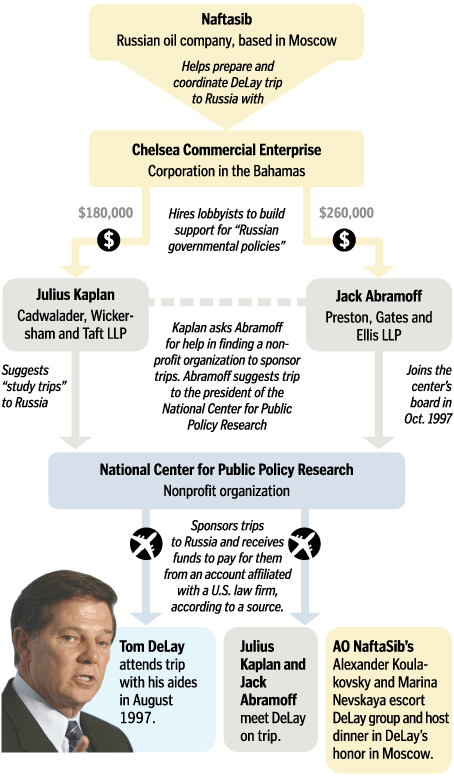
The Washington offices of two lobbying and law firms collected the fees. Preston Gates Ellis and Rouvelas Meeds LLP -- where Abramoff then worked -- received $260,000 in 1997 and less than $10,000 in 1998; Cadwalader Wickersham and Taft LLP was paid $180,000 in 1997 and less than $10,000 annually for the next three years, according to the registrations. Their listed lobbying targets included members of the House and Senate and officials of the State Department and the Agency for International Development.
"One of the functions of the lobbying effort was to encourage U.S. policymakers to visit Russia and to learn more about Russia," Ellen S. Levinson, a lobbyist then working on the Chelsea account at Cadwalader, said in an e-mailed response to questions.
She said Preston Gates used its "contacts with policy institutes and congressional offices" to arrange these trips. Preston Gates said in a written statement that it does not comment on its work for clients.
In a Cadwalader memo dated May 6, 1997, and obtained by The Post from another source, Levinson depicted the DeLay trip as one of six organized that year as part of the lobbying effort. Others included an "advance team" that visited Moscow later that month and a visit by "think tank" experts in June. A copy of the memo was sent to Abramoff.
A total of six members of the two lobbying firms participated in these trips, according to those involved. Levinson and two Preston Gates lobbyists were members of the "advance team."
During the third visit, Cadwalader lobbyist Julius "Jay" Kaplan joined DeLay and Abramoff at a "fancy dinner" in Moscow, according to one of those present -- a circumstance first reported last month in an article about the trip in National Journal's Congress Daily.
Breaking with traditional practice for congressmen traveling overseas, DeLay did not contact the State Department in advance or meet with officials at the U.S. Embassy in Moscow regarding his meeting with Chernomyrdin, according to a department spokeswoman who said she checked with 10 people at the embassy then or responsible for facilitating congressional trips.
Allen, DeLay's spokesman, said the State Department was not contacted because "the National Center was responsible for the arrangements on the trip, including setting up the meetings. Beyond that, members of Congress aren't required to have the State Department present at meetings with leaders from other countries."
Last month, Amy Ridenour, director of the National Center, posted a statement on her organization's Web site in response to questions about DeLay's trip to Russia stating that the center itself had "sponsored and paid" for all the expenses associated with it. Ridenour and her husband also took part in the visit.
But a person familiar with planning for the trip said Abramoff -- who has long been close to DeLay -- approached the National Center with the idea for the trip on behalf of Kaplan and his client, Chelsea. That person said the expenses by the center were in turn replenished by "an American trust account affiliated with a law firm" that the person declined to name.
Kaplan declined to be quoted for this article, citing what he called "lawyer-client privilege." But another person with direct knowledge about the trip arrangements said that it was Chelsea -- which had the registered Washington lobbyists in its employ -- that "gave the money to NCPPR to pay for the trip."
This person, who spoke on the condition of anonymity to protect his business interests, added: "I didn't see anything wrong there. All these foundations get money from somewhere, and they give it out." Moreover, the source said, "this was the Russians' way of doing business then -- moving money from one firm to another."
Who Financed Travel?
The question is: Who stood behind Chelsea, and thus ultimately financed the trip? A regular office for the firm could not be located by The Post, in Moscow or at its two listed addresses; its Bahamian registration ended in 2000, officials there said. Efforts by The Post to find the three men -- one Belgian, one British, one Russian -- named in lobbying registrations as Chelsea investors or owners in lobbying disclosures were unsuccessful.
A spokeswoman for Cadwalader, Paula Zirinsky, said the firm had no contact information for anyone from Chelsea, because "persons that worked on that matter have not been with the firm since 1997." Jonathan Blank, managing partner of the Washington office for Preston Gates, similarly said his firm had no current contact information for Chelsea.
In interviews, however, five individuals with direct knowledge of the lobbying effort separately described executives of a diversified Russian energy firm known as Naftasib as being intimately involved in the lobbying.
Naftasib, which oversees interests in mining, oil and gas, construction and other enterprises from a four-story unmarked building in downtown Moscow, says it is a separate company from Chelsea but acknowledges seeking to cultivate friends in Washington in 1997.
In a written statement issued Friday in response to questions from The Post, Marina Nevskaya, Naftasib's deputy general manager, explained that her firm "wanted to foster better understanding between our country and the United States, and felt that if these trips were successful they would foster a better overall climate that could ultimately benefit Naftasib as well as other Russian enterprises."
Nevskaya said her company "did not finance in any manner" the DeLay trip or the others described in Levinson's memo. But she said Naftasib "did host and pay for some dinners for participants in some of the trips, organized a few other special events . . . and may have provided minor courtesies, such as some auto pickups and dropoffs for some visitors during one or more of the trips."
She also acknowledged providing "advice about trip logistics" before they occurred and meeting trip participants. Nevskaya did not offer details, but those involved in organizing DeLay's trip said he met with Nevskaya and was escorted around Moscow by the general manager of Naftasib, Alexander Koulakovsky. DeLay has also met with Nevskaya and Koulakovsky in Washington since then, according to several sources with direct knowledge of the contact.
During the June 1997 trip to Moscow by "think tank" experts -- one of the scheduled visits listed in Levinson's memo -- several participants said they got the impression that Preston Gates was the organizer, Naftasib was the ultimate financier and that the trip was a dry run for DeLay's visit.
"It was done through or under the auspices of NCPPR," said Bart Adams, a North Carolina journalist who joined the expense-paid trip. But he said he recalls hearing that "the money was coming from a Russian oil company."
David Lowe, an official at the National Endowment for Democracy, said he was recruited to join the trip by the Preston Gates firm; former Senate aide James P. Lucier, who also was on the trip, said Naftasib's executives played such a large role that they "seemed to be the clients of Preston Gates," a claim the firm denies. "Some American investment or tie was the end goal," said a third participant, "and the plan was to bring over some congressmen" later.
A publicist who works for Abramoff attorney Abbe David Lowell said Abramoff did lobby for Chelsea but not for Naftasib. The publicist said Abramoff thought "bringing a greater understanding of Russia to American decision makers was and is good for America."
The efforts by Naftasib's executives to curry favor among Republicans -- including DeLay -- sowed controversy at the time among conservatives. A journal published by a Washington think tank, the American Foreign Policy Council, claimed within a few days after DeLay's trip ended that it was actually "sponsored" by Naftasib. The journal -- the Russian Reform Monitor -- also highlighted what it characterized as Naftasib's tight connections to the Russian security establishment.
The journal quoted promotional literature for Naftasib that described the firm as a major shareholder in Gazprom, the state-controlled oil and gas giant. The literature also said Natfasib's largest clients were the ministries of defense and internal affairs. The literature also states that Nevskaya was an instructor at a school for Russian military intelligence officers. She declined to address those claims in response to questions from The Post.
Steve Biegun, who was then a senior Russia expert for the Senate Foreign Relations Committee and later served as executive secretary to the National Security Council during President Bush's first term, said he deliberately blocked a meeting that Nevskaya sought with Jesse Helms (R-N.C.), then the committee chairman.
"They were a client of the lobbying firm Preston Gates," said Biegun, who is now a Ford Motor Co. vice president for international governmental affairs. "I made some calls . . . and got enough warning signs" to ensure that Helms avoided dealing with the firm. Biegun said the information he obtained from his sources was "nothing that would stand up in court" but he worried that in this period, "a lot of unsavory figures from Russia were buying their way into meetings and getting their pictures taken, to put on the wall back in Moscow."
"I just had my doubts, and nobody did anything to allay them," Biegun said. "I did not know who either of them really were."
Asked to comment, Blank, Preston Gates's Washington managing partner, said in a written statement: "Chelsea was our only client. Naftasib was not our client. We did work with Naftasib representatives when their interests coincided with our client's." Blank added that "we are confident that the individuals still with the firm who were involved at the time acted ethically, appropriately, and in service of the client."
Abramoff left Preston Gates at the end of 2000.
Staff writer Susan Schmidt, research editor Lucy Shackelford, and researchers Alice Crites and Madonna Lebling contributed to this report.
© 2005 The Washington Post Company
By R. Jeffrey Smith
Washington Post Staff Writer
The airfare to London and Scotland in 2000 for then-House Majority Whip Tom DeLay (R-Tex.) was charged to an American Express card issued to Jack Abramoff, a Washington lobbyist at the center of a federal criminal and tax probe, according to two sources who know Abramoff's credit card account number and to a copy of a travel invoice displaying that number.
DeLay's expenses during the same trip for food, phone calls and other items at a golf course hotel in Scotland were billed to a different credit card also used on the trip by a second registered Washington lobbyist, Edwin A. Buckham, according to receipts documenting that portion of the trip.
House ethics rules bar lawmakers from accepting travel and related expenses from registered lobbyists. DeLay, who is now House majority leader, has said that his expenses on this trip were paid by a nonprofit organization and that the financial arrangements for it were proper. He has also said he had no way of knowing that any lobbyist might have financially supported the trip, either directly or through reimbursements to the nonprofit organization.
The documents obtained by The Washington Post, including receipts for his hotel stays in Scotland and London and billings for his golfing during the trip at the famed St. Andrews course in Scotland, substantiate for the first time that some of DeLay's expenses on the trip were billed to charge cards used by the two lobbyists. The invoice for DeLay's plane fare lists the name of what was then Abramoff's lobbying firm, Preston Gates & Ellis.
Multiple sources, including DeLay's then-chief of staff Susan Hirschmann, have confirmed that DeLay's congressional office was in direct contact with Preston Gates about the trip itinerary before DeLay's departure, to work out details of his travel. These contacts raise questions about DeLay's statement that he had no way of knowing about the financial and logistical support provided by Abramoff and his firm.
Yesterday, DeLay's lawyer, Bobby R. Burchfield, said that DeLay's staff was aware that Preston Gates was trying to arrange meetings and hotels for the trip but that DeLay was unaware of the "logistics" of bill payments, and that DeLay "continues to understand his expenses" were properly paid by the nonprofit organization, the National Center for Public Policy Research.
In 2000, Abramoff was a board member of the group. In a telephone interview yesterday, Hirschmann said the contacts between DeLay's office and persons at Preston Gates occurred because Abramoff "was a board member of the sponsoring organization." Hirschmann added: "We were assured that the National Center paid for the trip."
House rules do not exempt such nonprofit organization board members from the prohibition on lobbyist payments for travel. They also state that this prohibition "applies even where the lobbyist . . . will later be reimbursed for those expenses by a non-lobbyist client."
Burchfield did not dispute that Abramoff used his credit card to pay for DeLay's plane fare, but said in a statement that "the majority leader has always believed and continues to believe that all appropriate expenses for the U.K. trip were paid by the National Center for Public Policy Research." He said that "to the extent that Mr. Abramoff put the charges on his personal credit card, Mr. DeLay has no knowledge of this. But that would be consistent with Mr. Abramoff obtaining full reimbursement from the National Center."
He said further that, in his view, Abramoff's participation on this trip as a board member meant he was permitted to pay for some of the expenses, subject to reimbursement, and that numerous court decisions recognize that different rules may be applicable to the same person acting in different capacities.
Andrew Blum, a publicist for Abramoff's lawyer and spokesman for Abramoff, did not respond to questions relating to the use of Abramoff's credit card for DeLay's plane fare. But he said in a statement yesterday that it was the National Center that "sponsored" the trip, "not Jack Abramoff."
Blum said that DeLay was "one of the center's honored guests on this trip" and that Abramoff "is being singled out for doing what is commonly done by lobbyists -- taking trips with members of Congress and their staff so that they can learn about issues that impact the Congress and government policy." The center's ability to sponsor "this type of educational trip, using contributor funds, is both legal and proper," Blum said.
DeLay was admonished three times last year by the House ethics committee for infringing rules governing lawmakers' activities and their contacts with registered lobbyists. House ethics rules bar the payment by lobbyists for any lawmaker's travel-connected entertainment and recreational activities costing more than $50; they also require that lawmakers accurately report the sponsor of their trips and the full cost.
In an article last month about the same trip by DeLay, The Post reported that an Indian tribe and a gambling services company made donations to the National Center for Public Policy Research that covered most of the expenses declared by participants at that time. The article also said these payments were made two months before DeLay voted against legislation opposed by the tribe and the company. DeLay has said the vote was unrelated to the payments.
The article also reported that Abramoff submitted an expense voucher to Preston Gates seeking a reimbursement of $12,789.73 to cover expenses for meals, hotels and transportation during the London and Scotland trip incurred by DeLay; his wife, Christine; and his two aides.
The new receipts add more detail about these expenses, make clear that the total expenses for all of the participants were at least $50,000 more than was previously known, and connect Abramoff directly to the payment of some charges.
For DeLay, the 10-day trip began on May 25 with a flight to London from Dulles airport and ended on June 3 with a return trip from Europe via Newark and ending in Houston. In between, his itinerary called for stops in Edinburgh, Glasgow, and St. Andrews, in Scotland. DeLay said the purpose of the trip was to hold meetings with "Conservative leaders" in Britain and Scotland, including Margaret Thatcher. The former prime minister's office has confirmed that such a meeting occurred.
DeLay's two aides, Tony Rudy and Susan Hirschmann, had an overlapping itinerary; Rudy participated from May 29 to June 3, and Hirschmann participated from May 22 to June 2. The spouses of Rudy and Buckham also were present.
The travel receipts do not make clear how the expenses for the entire trip -- which involved at least 10 people and which two sources said exceeded $120,000 -- were paid. One source familiar with the billings said yesterday that the National Center reimbursed Abramoff for the charges incurred by DeLay and his staff that were billed to Abramoff's credit card; but the receipts themselves do not indicate whether some of the charges incurred by Abramoff were ultimately reimbursed and, if so, by whom.
The receipts make clear that flights for DeLay and his wife were initially billed to Abramoff. The plane ticket for the husband of one of DeLay's aides -- David Hirschmann -- was billed to the same American Express card used for the DeLay tickets, according to a copy of the invoice.
Although Amy Ridenour, director of the National Center for Public Policy Research, has said she organized the trip, two other sources said that DeLay's round-trip business-class tickets on Continental Airlines and British Airways were booked by Preston Gates employees.
The itinerary and invoice for DeLay's trip, prepared by a travel service in Seattle, was sent by the service to Preston Gates on May 23, 2000, according to a copy of the invoice. That was two days before DeLay's departure. The invoice states that DeLay's business-class tickets on Continental Airlines and British Airways cost $6,938.70.
The records also indicate that the expenses associated with DeLay exceeded those that he declared in a signed statement to the House clerk on June 30, 2000. That form listed the purpose of the trip as "educational" and gave a tally of $28,106 in expenses for DeLay and his wife, or an average of $2,800 a day; it stated that all of these charges were paid by the National Center for Public Policy Research, which provided the data to DeLay.
Receipts from the golfing portion of the trip show that DeLay accumulated additional charges, which, according to fees set by the tour arranger, amounted to nearly $5,000 for each golfer and totaled in the tens of thousands of dollars for the entire group. Fees associated with playing golf are not listed on DeLay's travel disclosure form. Burchfield, DeLay's lawyer, said DeLay "personally paid for two rounds of golf and understands that the other two rounds of golf he played were included in his hotel package" and reimbursed by the National Center.
A copy of the $184 bill for the DeLays' expenses during the trip at a separate hotel in St. Andrews -- the Old Course Hotel Golf Resort & Spa -- states that those charges were paid by the same American Express credit card used on the trip by Buckham, the lobbyist, to pay for his own hotel room at the Glasgow Hilton. Buckham could not be reached by phone at home or his office and did not respond to an e-mailed request for comment. Burchfield said he cannot explain how this happened and did not know who owned this credit card; he also said DeLay was unaware of this fact.
Buckham, a former chief of staff to DeLay, was at the time a registered lobbyist for AT&T, Enron Corp., and the Nuclear Energy Institute. DeLay's wife was employed, at the time of the trip, by Buckham's lobbying firm, the Alexander Strategy Group, and was receiving a salary from it, according to DeLay's personal financial disclosure statement for that year, on file with the House clerk.
Abramoff, at the time of the trip, represented eLottery Inc. , a gambling services company that opposed the Internet gambling bill pending before the House. Preston Gates registered as a lobbyist for eLottery on June 2, 2000, one day before the trip ended; later in the year, Abramoff registered as a lobbyist for other clients who opposed the bill, including several Indian tribes. The federal probe is looking into his handling of his tribal clients and the large fees he was paid.
Hirschmann and her husband ultimately accumulated charges of 2,073 British pounds, or about $3,109 at the prevailing exchange rate for four nights in their "superior" room at the London Four Seasons Hotel. Those charges included $129 at the hotel lounge, $75 from the room bar, $34 from the gift shop, and $422 for chauffeured cars, according to a copy of their hotel bill. Hirschmann said one car was used to reach the meeting with Thatcher.
At least one of the Hirschmanns also played golf at St. Andrews. Susan Hirschmann is now a lobbyist at the Washington firm of Williams & Jensen; the firm's Web site contains a published claim that DeLay and other House Republican leaders are in frequent contact with her. As a staff member at the time of the trip, she would have been covered by the same ethics rules that apply to DeLay and other House members. Rudy, her staff colleague at the time, now works for Buckham's lobbying firm.
DeLay and his wife, for their part, stayed for four nights in a "conservatory" room at the same hotel in London as Hirschmann, accumulating charges of roughly $790 a night for rooms that included a glass-enclosed porch overlooking London's Park Lane, according to a copy of the bill for their stay and the Web site of the hotel.
They also ran up hotel charges of $145 for room service, $13 for a valet pressing and $302 for a private car from Heathrow airport, the bill states. Their room bill also lists a charge of $434 for six theater tickets, but Burchfield said the DeLays do not recall attending any plays in London. He said if the hotel charges were being "picked up" by a representative of the National Center, "they would not necessarily have seen the hotel bill."
DeLay, Burchfield said, "does not know how the logistics . . . [of the bill payments for the trip] were being effectuated."
House ethics rules contain detailed provisions barring the acceptance of any travel funds from private sources if doing so would "create the appearance of using public office for private gain." They also obligate lawmakers to "make inquiry on the source of the funds that will be used to pay" for any travel ostensibly financed by a nonprofit organization -- to rule out the acceptance of reimbursements that come from one organization when a trip is "in fact organized and conducted by someone else."
Trips outside the United States are also not supposed to exceed a week in length out of concern, the rules state, for "the public perception that such trips often may amount to paid vacations for the Member and his family at the expense of special interest groups."
Research editor Lucy Shackelford and researchers Alice Crites and Madonna Lebling contributed to this report.
Correction to This Article
Because of the use of an inappropriate currency exchange figure, early editions April 24 understated the cost of some of the expenses incurred by Rep. Tom DeLay (R-Tex.) and his aide Susan Hirschmann during a 2000 trip to London. The correct estimates, based on a conversion of English pounds into dollars at the prevailing rate in June 2000, are $790 a night for DeLay's room in London, $145 for room service, $13 for a valet pressing, $302 for a private car from Heathrow airport and $184 at a hotel in St. Andrews, Scotland. Their room bill also lists a charge of $434 for six theater tickets. Hirschmann's hotel room in London cost a total of $3,109 for four nights, and her other charges totaled $129 at the hotel lounge, $75 from the room bar, $34 from the gift shop and $422 for chauffeured cars.
© 2005 The Washington Post Company
By Susan Schmidt and James V. Grimaldi
Washington Post Staff Writers
It was a gangland-style hit straight out of "Goodfellas."
A man in a BMW was driving down a quiet side street after an evening meeting at his Fort Lauderdale office when a car slowed to a stop in front of him. A second car boxed the BMW in from behind, then a dark Mustang appeared from the opposite direction. The Mustang's driver pulled alongside and pumped three hollow-point bullets into the BMW driver's chest.
The dead man was Konstantinos "Gus" Boulis, a volatile 51-year-old self-made millionaire, a Greek immigrant who had started as a dishwasher in Canada and ended up in Florida, where he built an empire of restaurants, hotels and cruise ships used for offshore casino gambling. Boulis's slaying, still unsolved four years later, reverberated all the way to Washington. Months earlier he had sold his fleet of casino ships to a partnership that included Republican superlobbyist Jack Abramoff.
Abramoff is best known as a target of a federal investigation in Washington into the tens of millions in fees he and a partner collected from casino-owning Indian tribes. But the wreckage from his brief and tumultuous time as owner of the gambling fleet threatens to overtake his Washington legal troubles.
Not long after Abramoff and his partners bought SunCruz Casinos in September 2000, the venture ran aground after a fistfight between two of the owners, allegations of mob influence, dueling lawsuits and, finally, Boulis's death on Feb. 6, 2001. Now, Abramoff is the target of a federal investigation into whether the casino ship deal involved bank fraud. According to court records, the SunCruz purchase hinged on a fake wire transfer for $23 million intended to persuade lenders to provide financing to Abramoff's group.
Although the outlines of the tale have become part of South Florida lore, what has not been disclosed are the full details of the alleged fraud at the heart of the transaction and the extent of Abramoff's role -- including his use of contacts with Republican Reps. Tom DeLay (Tex.) and Robert W. Ney (Ohio) and members of their staffs as he worked to land the deal.
The SunCruz story combines the South Florida of novelist Carl Hiaasen with the Washington of influence-peddling K Street: Thousands of pages of bankruptcy and other court records, along with dozens of interviews in Florida and Washington, reveal secret deals; a forged document; double-crossing partners; and socializing with government officials on a private jet, at the U.S. Open golf tournament at Pebble Beach, at a Monday night football game in a private box at FedEx Field, and at an exclusive party on Inauguration Day in Washington.
Gus Boulis never really wanted to sell SunCruz. He bought his first cruise boat in 1994 and swiftly added 10 more, building an enormously profitable business that took in as much as $30 million in yearly profits.
Boulis, a larger-than-life character, had always been a scrapper and something of a business genius. As a teenager, he jumped ship from a Greek freighter in Canada, where he made his first fortune with Mr. Submarine sandwich shops. After retiring to the Florida Keys, at the age of 30, he built another fortune with the popular Miami Subs chain. Then he launched SunCruz, known as a "cruise to nowhere" casino business. His midsize cruise ships left on day trips from nine ports around Florida, taking tourists, high-rollers and elderly players into international waters, beyond the reach of the state's anti-gambling laws.
Based outside Fort Lauderdale, the business was the bane of Florida officials, who thought Boulis flouted the law, and SunCruz's port city neighbors, who complained that drunken gamblers were urinating on their lawns. For years, Boulis beat back efforts by federal and state lawyers determined to shut him down.
In 1999, federal prosecutors charged Boulis with violating the Shipping Act by purchasing his vessels without being a U.S. citizen. Boulis agreed to pay a $1 million fine and sell his cruise line. The government gave him 36 months to do it and agreed to keep the settlement secret so Boulis would not lose money in a fire sale.
To sell his business, Boulis turned to his lawyers in the D.C. office of Preston Gates Ellis & Rouvelas Meeds LLP. Art Dimopoulos, a maritime lawyer, looked for buyers. Jack Abramoff, one of Dimopoulos's partners at Preston Gates, said he could find one.
Abramoff, 40, was a study in contradictions. A smooth-talking political power player who was an Orthodox Jew, the former high school weightlifter produced movies in Hollywood before becoming one of the top lobbyists in town.
He had built a lucrative practice by showing then-Democrat-dominated K Street and its corporate clients how to make friends in the new Republican Congress. He was especially close to Tom DeLay, then House majority whip. Abramoff had also convinced casino-rich Indian tribes that they should begin switching their copious campaign contributions to the GOP.
The buyer Abramoff found for Boulis was Adam Kidan, a 36-year-old New York City businessman who had owned the Dial-a-Mattress franchise in Washington. Abramoff had known Kidan since the 1980s when Abramoff was at Georgetown Law Center and Kidan was an undergraduate at George Washington University. Both were active in the national office of the College Republicans.
Abramoff and Kidan were already in business with a third partner, former Reagan White House aide Ben Waldman, who also had been a College Republican. The three men had gotten together in a fledgling venture that sought to sell advertising on water taxis that would travel the Potomac River.
Dimopoulos took Kidan to Florida to meet Boulis. What was not disclosed to Preston Gates for at least eight months, according to a statement by the firm on Friday, was that Abramoff then joined Kidan in the SunCruz venture as a 50-50 partner. Such an arrangement would constitute a potential conflict of interest, because partners in the Preston Gates firm would be on both sides of the deal. The Preston Gates statement said that when the firm learned of the situation, it notified Boulis, who was already aware of it and did not object.
Abramoff's plan was to have Kidan put up most of the money and Abramoff "would use his lobbying expertise and network to help expand the new company's markets both in the U.S. and abroad," Abramoff's lawyers later asserted. Abramoff would say later that Kidan told him he was looking to invest an "eight-figure" payoff he had made from the sale of his Dial-a-Mattress franchise.
But even a cursory background check would have raised serious questions about whether Kidan had that kind of money. Kidan's business was in bankruptcy proceedings, and Kidan had declared personal bankruptcy in 1996.
Nonetheless, in January 2000, Boulis agreed in a letter of intent to sell SunCruz for $145 million. A few weeks later, though, Boulis demanded a host of unwelcome additional terms, including a consulting deal.
Suddenly, Boulis was being denounced in Congress.
Michael Scanlon, a former DeLay spokesman Abramoff had just hired at Preston Gates, asked Ohio congressman Bob Ney to insert remarks into the Congressional Record that would put pressure on Boulis.
"Mr. Speaker, how SunCruz Casinos and Gus Boulis conduct themselves with regard to Florida laws is very unnerving," Ney said in the March 30 Congressional Record. "I don't want to see the actions of one bad apple in Florida, or anywhere else . . . affect the business aspect of this industry or hurt any innocent casino patron in our country."
Ney said later he was "furious" at Scanlon for not fully informing him about SunCruz. Scanlon, for his part, said he had been given bad information about SunCruz and regretted his request to Ney.
As the SunCruz negotiations warmed up again that spring, Boulis found out that Abramoff and Kidan had another friend on Capitol Hill.
On June 9, DeLay's office sent Boulis a flag that had flown over the U.S. Capitol, according to records kept by the architect of the Capitol's office. The gift from DeLay's office was issued six days after DeLay and his deputy chief of staff, Tony Rudy, returned from a golf trip to Scotland with Abramoff.
DeLay spokesman Dan Allen said the congressman did not remember Boulis. A DeLay aide said the office handles many requests for flags.
A Trip to Pebble Beach
Rudy, a George Mason Law School graduate who had spent five years on DeLay's staff in a variety of jobs, joined Abramoff and Kidan at another sumptuous sporting event on June 15. The three flew on SunCruz's jet out to the U.S. Open in Pebble Beach, Calif., along with Joan Wagner, Boulis's chief financial officer, and her husband, said a former SunCruz insider who spoke on the condition of anonymity because of the ongoing investigation.
Rudy did not report the trip in his House travel records. When contacted by The Washington Post recently, Rudy declined to be interviewed for this article. Wagner and her lawyers did not respond to calls for comment.
A week after the Pebble Beach trip, on June 22, 2000, Boulis entered into a formal agreement to sell SunCruz to Kidan and Abramoff.
Now the partners had to find financing for the deal. They turned to a specialty lender, Foothill Capital, a unit of Wells Fargo & Co.
On the plus side for the would-be borrowers were Abramoff's glowing press clippings, including a July 3 story on the front page of the Wall Street Journal that described the millions he was bringing in to his lobbying firm. The article, which Kidan faxed to lenders, called Abramoff Washington's "GOP stalwart" because of his pull with Republican leaders such as DeLay, who praised Abramoff for getting Indians to donate to Republicans.
Abramoff provided Foothill Capital a financial statement stating his net worth as $13 million. He valued his lobbying practice at $7.5 million and family business interests at nearly $3 million, including a $1.4 million investment with his father in a company that owns parking lots in Atlantic City. The lobbyist also sent Foothill Capital a list of loan references that included Rudy and Rep. Dana Rohrabacher (R-Calif.).
"I don't remember it, but I would certainly have been happy to give him a good recommendation," Rohrabacher said. "He's a very honest man."
Kidan also provided Foothill Capital a one-page financial statement in which he claimed to be worth $26 million, all but $874,000 of it in unspecified "closely held corporations." But a background report on Kidan done for Foothill Capital revealed a string of lawsuits, judgments, liens, bankruptcies and failed businesses.
Kidan grew up in New York and graduated in 1989 from Brooklyn Law School. He ran two bagel businesses and had a law practice. In 1993, his mother was killed during a botched robbery at her Staten Island home. The slaying was linked to organized crime figures trying to steal several hundred thousand dollars they thought Kidan's stepfather kept in a safe.
The stepfather had also sued him, alleging that Kidan misappropriated $250,000 being held in escrow, a dispute that would eventually lead Kidan to relinquish his license to practice law. Among the funds at issue: $15,000 posted as a reward in his mother's slaying.
Nevertheless, Foothill Capital and a second specialty lender, Citadel Equity Fund, agreed to lend Abramoff and Kidan $60 million to buy Boulis's business, requiring the two men to personally guarantee the loans and to put $23 million of their own money into the deal.
Foothill Capital's representative in the deal was Greg C. Walker, then a vice president at the firm. Asked last week why Foothill Capital would take a chance on someone such as Kidan, Walker said, "You'd have to be there at the time."
He declined to elaborate.
A Sealed Envelope
The lenders, buyers and sellers gathered to begin closing the deal on the morning of Sept. 18, 2000, in the midtown Manhattan offices of Foothill Capital's lawyers. Tensions were running high; Kidan and Abramoff were annoyed that Walker was requiring them to pay hundreds of thousands of dollars more than they had expected in closing fees.
That night, though, they smoothed things over during a Monday night football game, between the Redskins and the Dallas Cowboys. Kidan and Walker traveled to Washington from New York to join Abramoff in the lobbyist's leased skybox at FedEx Field. Abramoff was spending about $1 million a year on skyboxes at FedEx Field, MCI Center and Oriole Park at Camden Yards, and often allowed politicians and their staffers to use them for fundraising. A copy of a roster maintained by Abramoff and obtained by The Post shows he provided the box for DeLay's use that night.
Walker said he was introduced to DeLay in the skybox and was later told that DeLay was the majority whip. Walker said he was unfamiliar with the position, which is the third in rank in the House.
"It sounds to me like it is a powerful position," Walker said in a recent interview. Asked whether the introduction with DeLay helped establish Abramoff's bona fides, Walker said, "The credit has to stand on its own."
DeLay spokesman Allen said last week that DeLay does not recall meeting Walker.
Nine days after the Redskins game, the last of the closing documents were signed in New York: Under the final terms, Kidan and Abramoff were to put in $23 million in cash, Foothill Capital and Citadel would lend the partners $60 million, and Boulis would agree to accept IOUs from Kidan and Abramoff totaling $67.5 million.
Boulis would stay as a consultant with a 10 percent stake in the company. As one of the four owners -- Kidan and Abramoff each had 40 percent, and Waldman had 10 percent -- Boulis thought he would also still have a say in how business was done.
The closing documents did not tell the whole story, however. What really happened that week is the subject of the federal bank fraud investigation.
Kidan later acknowledged that he and Abramoff never made the $23 million cash payment to Boulis. Kidan testified in a court deposition that Boulis secretly agreed instead to accept two promissory notes totaling $20 million just before the closing when Kidan had threatened to walk away from the deal because he thought the price was too high.
"I told Mr. Boulis we would not be closing the deal," Kidan later said in a deposition. "He said under what terms would I do it? And I told him I would do it if the price was adjusted accordingly."
Kidan later testified in a deposition there was nothing in writing about the change, but he said that he, Abramoff and Boulis orally agreed to do it. "There was a discussion between myself and Mr. Boulis and Mr. Abramoff, and then Mr. Boulis went off to Greece" to attend his father's funeral, Kidan testified. Boulis left his subordinates to handle the closing.
In effect, Kidan and Abramoff were allowed to buy Gus Boulis's gambling company without putting in a cent of equity.
When Foothill Capital eventually sued to recover its loans, one of its lawyers said it would never have lent the $60 million if it had known about the secret promissory notes. The loan agreements with the banks required that Abramoff and Kidan have a cash stake in SunCruz, just as a bank usually requires a cash down payment before issuing a home mortgage. Foothill Capital has said it relied on the financial statements provided by Abramoff and Kidan in which they represented that they had the necessary means to put up $23 million in cash.
Foothill Capital also said that the buyers and sellers knew that the secret arrangement was fraudulent and tried to conceal it. Foothill Capital cited a fax to Kidan at his hotel from Joan Wagner, Boulis's chief financial officer and his representative at the closing. The fax included copies of the two promissory notes and the hand-scrawled instruction: "Please review and if 'ok' sign and give to Jimmy in a sealed envelope."
"Jimmy" was another Boulis lawyer, according to Foothill Capital. The lender said in a court filing "the clear implication of this directive was to hide the very existence of the substituted notes from the lenders."
Foothill Capital also said it has even stronger evidence of fraud.
The lender had asked for proof that the Kidan group had paid the $23 million to Boulis. In response, Kidan and Waldman each faxed copies of a purported wire-transfer document to Greg Walker on Sept. 27, the final day of closing. The document was a Sept. 22 notice of a wire transfer of $23 million "by order of Adam Kidan" from Chevy Chase Bank to Boulis's account at Ocean Bank. However, Kidan's account at Chevy Chase had been closed weeks earlier, according to court documents. Even when the account was active, there was never a transaction larger than $107,000, Chevy Chase told Foothill Capital.
Waldman did not respond to repeated requests seeking comment.
Kidan's lawyer has argued that Foothill Capital may not be an innocent victim. "Everyone needs to look at what knowledge the lender had," said Martin Jaffe of Hollywood, Fla., adding that he could not comment on the details of the case. "You can't be defrauded if you know what's going on and are a party to it."
Court records show that Foothill Capital did have a confidential side agreement with Kidan. Under the agreement, prepared just before the closing, Kidan promised to resolve the liabilities in his personal bankruptcy within 45 days.
At the top of a draft of the letter is a puzzled note from Citadel's lawyer: "Looks fine, but who are we hiding these items from & why?"
Lawyers for Foothill Capital did not respond to repeated requests for comment.
Boulis Was Incensed
When the deal was done, Kidan moved to Florida to run SunCruz. Abramoff stayed in D.C.
Abramoff and Kidan started paying themselves $500,000-a-year salaries. Among the first checks Kidan wrote were payments totaling $310,000 that he sent to Abramoff to help pay for the sports skyboxes at FedEx Field, MCI Center and Camden Yards.
Operating out of SunCruz's offices near Fort Lauderdale, Kidan moved into a $4,300-a-month luxury condo paid for by SunCruz and bought a 34-foot powerboat. He quickly put his mark on the business, firing SunCruz employees including several of Boulis's friends and relatives.
"We fired his friends, we fired his family and he wasn't happy with it," Kidan later told the Sun-Sentinel in Fort Lauderdale.
Kidan said that he found the ships were in disrepair and that there were overdue bills. He refused to make his loan payments to Boulis.
Boulis was incensed. In October 2000, he wrote letters to Kidan demanding payment, threatening to tell the lenders and Abramoff that Kidan was reneging.
Two former SunCruz insiders say that Boulis's truculence sent Abramoff and Kidan back to their friends on Capitol Hill. Scanlon, at the time a public relations consultant employed by SunCruz, once again asked Ney to place comments in the Congressional Record. Two days after Boulis's last letter, Ney did so. "I have come to learn that SunCruz Casino now finds itself under new ownership," Ney stated in the record. Kidan's "track record as a businessman and a citizen lead me to believe that he will easily transform SunCruz from a questionable enterprise to an upstanding establishment."
In the midst of the infighting with Boulis, Kidan decided to hire an old New York friend, Anthony Moscatiello, who was running a catering hall. Kidan made him a food-and-beverage consultant. Moscatiello has been described by law enforcement as an unofficial bookkeeper for New York City's Gambino crime family.
He and Kidan first met about 1990 when Kidan was running a bagel business in the Hamptons. Moscatiello had been indicted on federal heroin-trafficking charges in 1983 along with Gene Gotti, brother of John Gotti, the boss of the Gambinos. Moscatiello was accused of trying to dissuade witnesses from testifying in the case. After Gotti and several others were convicted and sentenced to prison, charges against Moscatiello were dropped.
In Florida, Moscatiello began visiting Kidan's condominium and golfing with Kidan and Waldman, according to depositions of Kidan and Waldman. Kidan later testified he was unaware of Moscatiello's legal troubles or the alleged Gambino affiliations.
'This Guy Is Violent'
In early November 2000, Abramoff flew to Miami to meet with Boulis and Kidan "to try to mediate their differences for the good of the business," Abramoff's attorney said later. "Abramoff met alone with Boulis and his representatives. Boulis recounted Kidan's bad acts and at one point stated 'Kidan stole my company.' " Abramoff said later in court documents he learned for the first time at this meeting with Boulis that Kidan had not given Boulis the $23 million. "Abramoff was flabbergasted by this news," his attorney wrote. "He could not believe that it could be true, given Kidan's representations to Abramoff."
But Abramoff, along with Kidan, had signed sworn documents faxed to the closing in which he and Kidan attested that they had paid Boulis the $23 million. And in e-mails exchanged with Kidan and Wagner, Abramoff continued to support Kidan.
By late November, threats were flying. Boulis's allies began to stir trouble, including a business associate who accused Kidan of having mafia connections at a community meeting in Mayport, Fla., where SunCruz docked one of its gambling boats. Kidan threatened to sue.
The conflict exploded on Dec. 5. Joan Wagner, Boulis's chief financial officer, had called a meeting of the SunCruz principals except for Abramoff, who was traveling abroad. They met at the company's offices in Dania Beach, Fla., to try to resolve the increasing acrimony. What happened there is in dispute.
Kidan later filed a police report stating that Boulis assaulted him with a pen, drawing blood. He claimed in court papers that Boulis "attacked [Kidan] in the face and neck and kicked his body," before being pulled off by a SunCruz employee.
Police said that at least one other witness stated that Kidan provoked Boulis by calling Wagner names and making threats. According to this account, Boulis told Kidan to stop, but Kidan instead repeated an insult. Boulis then punched Kidan.
The day of the fight, Wagner e-mailed Abramoff pleading with him to come to Florida to mediate.
"The crisis at suncruz took on new meaning today with gb [Gus Boulis] and ak [Adam Kidan] getting physical," Wagner wrote. "Money is being wasted and lost and it shouldn't continue. . . . I'm telling you that you must address the issue asap. Your delay is only emboldening Adam and he is really on the edge."
Wagner wrote, "I liked Adam and thought I would be working with all of you to build an empire to be proud of and make us all alot of money too." But now she said, "the only recourse" was for Abramoff to join with Boulis and Waldman to vote Kidan out of SunCruz.
A day later, Wagner pointedly noted that Boulis, as a lender to the Kidan group, could "veto certain activities and transactions," thus canceling the takeover of SunCruz.
Abramoff forwarded Wagner's last e-mail to Kidan and Waldman. In response, Kidan told Abramoff, "We need to shut her down."
Kidan also urged, "Jack, you need to act above all of this."
In his e-mails to Abramoff, Kidan made a cryptic reference to an ally who had sent protection to Kidan in Florida.
"My friend in NY is acting out of concern for my safety," Kidan wrote to Abramoff. "By sending security I am afraid it will make things worse and I will ask him today to remove them. I appreciate his efforts, but the situation is at a critical point."
Kidan proposed "a concerted press effort" against Boulis.
"I was the victim of family violence before," Kidan wrote. "Lets use that in our favor (my mother wouldn't mind) to show how we can't tolerate violence and the like of criminals. Lets get the protective order. By painting the picture we box him. The negative is that his profile shows that he will retaliate against me."
Abramoff replied, "I agree with this completely."
He e-mailed Boulis attorney Anthone Damianakis: "It is my belief that Gus and Adam need to resolve the issue of what Gus is owed and Gus needs to move on out of the company."
Kidan hired a security firm to assess what kind of threat was posed by Boulis, who once had been arrested for harassing a girlfriend who had obtained a restraining order after she accused him of beating her. Kidan paid for three bodyguards and ordered an armor-plated Mercedes, according to court records. He also requested a restraining order, which was granted. He alleged that Boulis vowed to have him killed.
A week later, SunCruz made the first of $145,000 in payments to Moscatiello. Three checks for $10,000 each were made to Jennifer Moscatiello, daughter of Anthony, and $115,000 to Gran-Sons, a company the Moscatiellos ran. The payments were for catering, consulting and "site inspections," Kidan said later.
However, there is no evidence that any food or drink was provided or consulting documents prepared. The checks to Jennifer were made at Anthony's instruction, Kidan said, even though she performed no services. A lawyer for the Moscatiellos declined to comment.
On Jan. 19, 2001, Boulis went to court, seeking an injunction to prevent Kidan from operating the boats and to force him to make his payments to Boulis.
The next day, Kidan and Scanlon were guests at a reception in DeLay's Capitol Hill office celebrating the inauguration of George W. Bush, according to two people who were at the reception.
A week later, Abramoff and his partners leased a corporate jet to ferry congressional staffers down to Tampa for the Super Bowl game and a night of gambling aboard a SunCruz ship. Among those aboard were DeLay aide Tim Berry, who is now DeLay's chief of staff, and two staffers to Sen. Conrad Burns (R-Mont.). DeLay's former deputy chief of staff, Tony Rudy, by then a newly minted lobbyist working for Abramoff, was there, too.
Berry failed to report the trip on his disclosure forms. A DeLay spokesman said Berry had no idea SunCruz paid for the trip. He thought it was a Republican fundraising trip allowable under House rules.
On Jan. 31, the Kidan-Boulis brawl hit the front page of the Sun-Sentinel. Kidan told the newspaper that Boulis said: "I'm not going to sue you, I'm going to kill you. . . . This guy is violent -- he's sleazy."
A Federal Target
Back in Washington, Abramoff was moving his lobby business and many of his clients, including his tribal accounts, from Preston Gates to Greenberg Traurig LLP. He also took at least 10 employees with him from Preston Gates. At Greenberg, Abramoff made Tony Rudy his first hire from Capitol Hill.
Abramoff's departure had been coming for months. His style had clashed with others at Preston Gates, who believed he was moving too fast and being careless. Earlier in the year, Manuel Rouvelas, the firm's founding partner in Washington, had warned Abramoff, according to people familiar with the exchange.
"If you're not careful," Rouvelas told Abramoff, "you will end up dead, disgraced or in jail."
In February 2001, less than two months after Abramoff had settled in at Greenberg Traurig, Abramoff and Kidan were abroad prospecting for new business. They were in England preparing to fly to Hong Kong, when Kidan's bodyguard got a call. Boulis was dead.
Kidan rushed home. He told police he knew nothing about the slaying.
Fort Lauderdale police detectives say they know who committed the crime. All they need, they say, is one cooperating witness.
After Boulis's slaying, Kidan and Abramoff conducted business as usual at SunCruz. They asked Foothill Capital for another loan to clear up their debts. They stepped up plans to expand casino operations to the Northern Mariana Islands, where the government had been a client of Abramoff's. They also hired Greenberg Traurig as their lobbyists in Washington.
In March 2001, SunCruz executives, including Abramoff and Kidan, attended a fundraiser in Abramoff's box at MCI Center for Ney. The next month Kidan hosted a fundraiser in his apartment in Fort Lauderdale for his local congressman, Rep. Peter Deutsch (D-Fla.).
But the relationship between DeLay and Abramoff changed. DeLay told a group of conservatives last month "that he had no idea that Abramoff was involved in this and was absolutely shocked when he found out about it," said Paul M. Weyrich, a conservative activist and longtime friend of DeLay's. "Immediately he had Abramoff called in and told him, 'I want no more dealings with you,' and I think he felt blind-sided by Abramoff, that Abramoff was aware of Tom's views on the subject and never bothered to tell him" about his stake in SunCruz.
DeLay, whose campaign committee had been one of the largest recipients of gambling money, has since stopped accepting contributions from Indian tribes that operate casinos.
In late spring, stories began appearing in the Florida media about Kidan's links to the Moscatiellos. In June, Abramoff, Kidan and the Boulis estate abruptly settled their differences by placing the company into bankruptcy. As part of the settlement, Abramoff and Kidan relinquished most of their interest in the company to the Boulis estate, in exchange for an agreement releasing Abramoff and Kidan from their debts and liabilities.
Foothill Capital would later contend that the settlement was intended to cover up the fraud at the closing.
In April 2003, the Court of Appeals for the 11th Circuit threw out the settlement, saying it was marred by conflicts of interest and should not have been approved by the bankruptcy judge. The court said the Kidan management was "riddled with fraudulent and dishonest transactions," including the charges the Boulis side made about Kidan's misuse of funds.
Today, the SunCruz casino boats are sailing under new ownership after a bankruptcy auction. Abramoff and Kidan remain embroiled in litigation with Foothill over the $60 million they were lent.
Neal Sonnett, a prominent Miami criminal defense lawyer hired by Abramoff, said in a court pleading last August that federal prosecutors have told him Abramoff is a "target" of a federal grand jury investigation.
Sonnett told The Post he is confident Abramoff will be cleared, calling him a "victim" in the SunCruz case. Sonnett said he could not discuss specifics, including the wire transfer, because of the ongoing investigation.
Abramoff has had little to say publicly about SunCruz. In 2002, he did talk to the Washington Business Forward.
"I was fortunate to get out of that financially better off than when I entered it," he said. "I was lucky it did not damage me. But it's not something I would repeat."
By then, Abramoff had already embarked on another enterprise -- one that Sen. John McCain (R-Ariz.) would later brand a "truly extraordinary" example of "exploitation and deceit." During a three-year period, Abramoff and Scanlon took in $82 million in lobbying and public relations fees from six Indian tribes.
"We need that moolah," Abramoff e-mailed Scanlon on Jan. 16, 2002. "We have to hit $50M this year (our cut!)."
The Missing $23 Million
To qualify for a $60 million loan to buy SunCruz Casinos, lobbyist Jack Abramoff signed a document (1) certifying that he and his partner, Adam Kidan, put $23 million in cash into the deal. Asked to prove the money was deposited, Kidan and another partner, Ben Waldman, faxed the lender, Foothill Capital, what appeared to be a confirmation (2) of a wire transfer of the money from Kidan's account at Chevy Chase Bank to the seller's bank. But Chevy Chase later said (3) in answer to a subpoena that Kidan's account had already been closed at the time of the purported wire transfer. Foothill now contends that the faxed document was a forgery.
Researcher Alice Crites and database editor Derek Willis contributed to this report.
© 2005 The Washington Post Company
By Susan Schmidt
Washington Post Staff Writer
Indicted lobbyist Jack Abramoff claimed in e-mails sent in 2002 that the deputy secretary of the interior had pledged to block an Indian casino that would compete with one of the lobbyist's tribal clients. Abramoff later told two associates that he was trying to hire the official.
A federal task force investigating Abramoff's activities has conducted interviews and obtained documents from Interior Department officials and Abramoff associates to determine whether conflict-of-interest laws were violated, according to people with knowledge of the probe. It can be a federal crime for government officials to negotiate for a job while being involved in decisions affecting the potential employer.
The two former Abramoff associates, who spoke on the condition of anonymity because they are under scrutiny in the investigation, said Abramoff told them in late 2003 that he was trying to arrange for his firm, Greenberg Traurig LLP, to hire J. Steven Griles, then deputy interior secretary. Federal investigators are interested in those discussions and in job negotiations Abramoff may have had with a second department official, according to sources.
Abramoff told associates that he believed Griles was "committed" to blocking an effort by the Gun Lake Indian tribe to build a casino near Grand Rapids, Mich., according to the content of e-mail messages reviewed by The Washington Post. Abramoff said the blocking would involve an environmental challenge to the project, a tactic also proposed by Michigan business leaders opposed to the casino. Abramoff fought the project because it would draw business from a casino operated by his clients, the Saginaw Chippewas.
Environmental concerns ended up delaying action on the Gun Lake casino. The project was cleared last May by the Interior Department.
Gun Lake was not the only casino that Abramoff tried to derail through his departmental contacts. The Post has reported on e-mails indicating the lobbyist enlisted Griles to stop a Louisiana tribe's proposed casino, which threatened another Abramoff client.
Griles, who left the Interior Department earlier this year to form a consulting firm, "said he never had anything to do with the Gun Lake casino issues," a spokeswoman at his company said. He did not comment on any job discussions with Abramoff. A spokesman for Abramoff also declined to comment. Greenberg Traurig, citing the ongoing investigation, had no comment on possible job talks with department officials.
In a separate case, Abramoff and a business partner were indicted this month on federal wire fraud and conspiracy charges in Florida. They are accused of providing lenders with a counterfeit financial document to consummate their purchase of a casino cruise line in 2000. Allegations of fraud emerged after the seller was later killed in a gangland-style hit.
The Washington probe, being conducted by the Justice Department's fraud and public corruption unit, focuses on Abramoff's lobbying work on Capitol Hill for Indian tribes for which he and public relations executive Michael Scanlon were paid $82 million. Scanlon, one of about a dozen congressional staffers who went to work with Abramoff, had served as press spokesman for House Majority Leader Tom DeLay (R-Tex.).
The Justice Department task force, which includes the FBI and the IRS, is looking into Abramoff's dealings with lawmakers and their staffs. Investigators from the Interior Department's inspector general's office, part of the task force, have been asking witnesses about the Gun Lake casino project, according to people who have had contact with the investigators.
The task force also is examining Abramoff's relationships and influence with officials of the Bush administration, as highlighted by the previously undisclosed Gun Lake e-mails. The e-mails show how Abramoff relied on the president of a conservative group, Italia Federici, to intercede with Griles, who was her friend.
Copies of Abramoff's e-mails referencing Griles and Federici were obtained from a variety of sources, including the Interior Department. Some e-mails involving Gun Lake were read to The Post by a person who declined to release them because of the federal probe.
Department officials said the Gun Lake process was proper, adding that they could not comment further because of the ongoing investigation into Abramoff's contacts with Interior.
'The Way to Stop It'
The Gun Lake tribe, formally known as the Match-E-Be-Nash-She-Wish Band of Pottawatomi Indians, in 2001 began seeking approval for a casino on 147 acres near Grand Rapids.
As part of its application, the tribe prepared an environmental assessment and was close to approval by the end of 2002. The tribe was not asked to produce an environmental impact statement, or EIS, a much more detailed study.
On Dec. 4, 2002, Abramoff received an e-mail from Saginaw Chippewas tribal representative Chris Petras, who said that Gun Lake's proposal was moving forward rapidly. A public comment period on the tribe's environmental assessment was expected to be the last step before the Bureau of Indian Affairs -- a part of the Interior Department -- cleared the way.
That same day, Abramoff sent an urgent e-mail to Federici, president of the Council of Republicans for Environmental Advocacy.
"This is a disaster in the making," Abramoff wrote. "This is the casino we discussed with Steve and he said that it would not happen. It seems to be happening! The way to stop it is for Interior to say they are not satisfied with the environmental impact report. Can you get him to stop this one asap? They are moving fast. Thanks Italia. This is a direct assault on our guys, Saginaw Chippewa."
Federici posted a quick reply: "I will call him asap." She met with Griles in his office two days later, according to a copy of Griles's schedule released under the Freedom of Information Act. Federici did not respond to interview requests for this article.
Federici's group, CREA, was founded in the 1990s by conservative anti-tax activist Grover Norquist and Gale Norton, now secretary of the interior. It has received financial backing from chemical and mining interests, leading some environmentalists to brand it a front for industrial polluters. Abramoff directed tribes he represented to donate $225,000 to CREA from 2001 to 2003.
Days after he appealed to Federici for help with Griles, Abramoff reassured the Saginaw Chippewas tribal representative. "The meeting with Griles went well. We have a lot to do but we'll get there," he told Petras in a Dec. 12, 2002, e-mail.
Scanlon weighed in the following week, suggesting technical roadblocks to stop the casino. "Hey, I think a real quick way to blow this Gun Lake thing out of the water is to have BIA reject the land into trust, or lay some stipulation on their application that would buy us some time," Scanlon wrote Abramoff on Dec. 16. "Any word from Griles on this?"
Abramoff wrote back: "I thought the way to do this is to have them reject the EIS, which I believe Griles has committed to do."
In the first half of 2003, the Gun Lake tribe remained under the impression that its application was about to be approved. But in July of that year, the Department of Justice's Indian law section raised concerns about the project and sought to have the tribe prepare an environment impact statement.
Federal investigators are examining the circumstances that led the section to raise its objections, according to people who have been interviewed in the probe.
Thomas L. Sansonetti, then the associate attorney general overseeing the Indian law section, told Interior Department officials that his office did not want to take on the burden of defending the department if it was sued by Michigan opponents of Gun Lake on environmental grounds.
In an interview this month, Sansonetti said that he wanted to have a strong defense in the event of a lawsuit. He said he was not moved by the Gun Lake tribe's offer to provide legal assistance for any court case.
Sansonetti said he first heard about Gun Lake from the Interior Department's solicitor's office. "I think there was a concern with the [environmental assessment] being sufficient all along," he said.
Sansonetti said he has attended events sponsored by Federici's group. He said he had no communication with Griles or Abramoff about Gun Lake and said he is unaware of any investigation of the matter. He left the Justice Department this year to join a Wyoming law firm.
Asked to comment on how his tribe's application was handled, Gun Lake leader D.K. Sprague issued a statement complaining of the cost of the delay in the casino application and urging "a thorough investigation" by the Justice Department task force. "We have been denied our federal rights, economic self-sufficiency, and jobs that will benefit our community," he said.
Opponents Sue Interior
In addition to Gun Lake, in 2003 Abramoff and Griles were active in an effort to stop a casino proposed by the Jena Band of Choctaws in Louisiana, rivals of another Abramoff client.
Late in that year, Griles, who was generally not involved in Indian issues, presented Interior officials with a binder containing legal arguments and congressional letters opposing the Jena plan. Griles acknowledged to colleagues that the binder had probably been put together by Abramoff, according to one former senior department official, who spoke on the condition of anonymity.
In March, The Post reported that Griles's involvement in the Jena case led to a clash with other Interior Department officials, including former legal counsel Michael G. Rossetti. A spokeswoman for Griles commented for that article, saying that he "didn't participate in any decision-making process regarding the Jena Band and gaming."
In April, the Interior Department solicitor's office dropped opposition to the Gun Lake tribe's casino application. The tribe subsequently received approval for its casino.
A group of Grand Rapids business leaders, who had long argued that the casino would harm the city's renewal plans and should undergo a more extensive environmental review, immediately sued the Interior Department.
One of those involved in the legal action was Peter F. Secchia, a major GOP fundraiser who served as an ambassador for President George H.W. Bush. In December 2002, he told the Kalamazoo Gazette that he was going all-out to block the casino, so much so that he spoke to presidential political adviser Karl Rove about it at a White House Christmas party for donors.
"I talked to Rove, and he put me in touch with his guy in charge of this kind of operation. I'm going to do my damnedest on this one. This is really important to us," Secchia told the Gazette that December.
In a recent interview, Secchia said he has spoken not only to Rove but also to President George W. Bush and Vice President Cheney about what he sees as the negative impact of the proliferation of tribal casinos. Both men, he said, told him it was a legislative issue. "Karl told me to talk to [congressional] committee people," he said, and put him in touch with the White House office of intergovernmental relations.
Secchia said he has not talked to officials at Interior or Justice about Gun Lake. He said he has never had contact with Abramoff, who is out on $2.25 million bond and is to be arraigned next week in Miami in the casino fleet case.
© 2005 The Washington Post Company
By Susan Schmidt and James V. Grimaldi
Washington Post Staff Writers
Lobbyist Jack Abramoff and his team were beginning to panic.
An anti-gambling bill had cleared the Senate and appeared on its way to passage by an overwhelming margin in the House of Representatives. If that happened, Abramoff's client, a company that wanted to sell state lottery tickets online, would be out of business.
But on July 17, 2000, the Internet Gambling Prohibition Act went down to defeat, to the astonishment of supporters who included many anti-gambling groups and Christian conservatives.
A senior aide to then-Majority Whip Tom DeLay (R-Tex.) helped scuttle the bill in the House. The aide, Tony C. Rudy, 39, e-mailed Abramoff internal congressional communications and advice, according to documents and the lobbyist's former associates.
Rudy received favors from Abramoff. He went on two luxury trips with the lobbyist that summer, including one partly paid for by Abramoff's client, eLottery Inc. Abramoff also arranged for eLottery to pay $25,000 to a Jewish foundation that hired Rudy's wife as a consultant, according to documents and interviews. Months later, Rudy himself was hired as a lobbyist by Abramoff.
The vote that day in July was just one part of an extraordinary yearlong effort by Abramoff on behalf of eLottery, a small gambling services company based in Connecticut. Details of that campaign, reconstructed from dozens of interviews as well as from e-mails and financial records obtained by The Washington Post, provide the most complete account yet of how one of Washington's most powerful lobbyists leveraged his client's money to influence Congress.
The work Abramoff did for eLottery is one focus of a wide-ranging federal corruption investigation into his dealings with members of Congress and government agencies. Abramoff is under indictment in another case in connection with an allegedly fraudulent Florida business deal.
Abramoff had deep roots in the conservative movement and rose to prominence by helping Republicans tap traditionally Democratic K Street lobbyists for campaign dollars. But in the eLottery fight, he employed a win-at-any-cost strategy that went so far as to launch direct-mail attacks on vulnerable House conservatives.
Abramoff quietly arranged for eLottery to pay conservative, anti-gambling activists to help in the firm's $2 million pro-gambling campaign, including Ralph Reed, former head of the Christian Coalition, and the Rev. Louis P. Sheldon of the Traditional Values Coalition. Both kept in close contact with Abramoff about the arrangement, e-mails show. Abramoff also turned to prominent anti-tax conservative Grover Norquist, arranging to route some of eLottery's money for Reed through Norquist's group, Americans for Tax Reform.
At one point, eLottery's backers even circulated a forged letter of support from Florida Gov. Jeb Bush (R).
Rudy declined to comment for this report. A spokesman for Reed -- now a candidate for lieutenant governor of Georgia -- said that he and his associates are unaware that any money they received came from gambling activities. Sheldon said that he could not remember receiving eLottery money and that he was unaware that Abramoff was involved in the campaign to defeat the bill. Norquist's group would say only that it had opposed the gambling ban on libertarian grounds.
Abramoff's lawyer declined requests for a comment.
DeLay, an outspoken opponent of gambling, was an instrument, witting or unwitting, in eLottery's campaign, documents and interviews show. Along with Rudy, he was a guest on a golfing trip to Scotland. As majority whip, he cast a rare vote against his party on the Internet gambling bill and for the rest of the year helped keep the measure off the floor. He told leadership colleagues that another vote could cost Republican seats in the hard-fought 2000 elections.
A statement from DeLay's lawyer said his votes "are based on sound public policy and principle."
The Scotland trip is one aspect of the gambling matter being investigated by the corruption task force. The trip took place more than five years ago, which ordinarily would be beyond the five-year statute of limitations on certain possible corruption charges. But legal sources say prosecutors have obtained a waiver of the time limit because of the need to gather information abroad. Desperate Company
Like many Internet companies emerging from the overheated 1990s, eLottery's money was drying up in the spring of 2000.
The company was founded in 1993 on the gamble that even a small fraction of the market for helping states and others put lotteries online could be worth a billion dollars a year. But the company faced many obstacles.
In 1998, the Justice Department had used existing gambling laws to force eLottery to shut down its first online lottery venture, with an Idaho Indian tribe. ELottery had not earned a dime since.
The Senate had passed the Internet Gambling Prohibition Act in late 1999, aiming to make it easier for authorities to stop online gambling sites. With a companion bill by Rep. Robert W. Goodlatte (R-Va.) advancing in the House in the spring of 2000, eLottery was desperate to ramp up its Washington lobbying. It had to sell off assets to stay afloat and raise cash.
In May, eLottery hired Abramoff's firm, Preston Gates & Ellis LLP, for $100,000 a month, according to lobbying reports. In the following months, Abramoff directed the company to pay hundreds of thousands of dollars to various organizations, faxes, e-mails and court records show. The groups included Norquist's Americans for Tax Reform; Sheldon's Traditional Values Coalition; companies affiliated with Reed; and a Seattle Orthodox Jewish foundation, Toward Tradition.
Robert Daum, a former eLottery official, said he could not recall the names of the groups that received the payments but noted that all the money spent by the company at Abramoff's direction was for the purpose of defeating the Internet bill.
"We were willing to pursue all legitimate means to ensure that outcome, as people do all the time in Washington," Daum said. "Nothing more, nothing less."
Arrayed against eLottery were many leading groups on the religious right who were pushing to ban Internet gambling, including the Moral Majority and the Christian Coalition. James Dobson, influential leader of Focus on the Family, praised the bill in an opinion piece for the New York Times.
Still, according to his strategy e-mails, Abramoff thought he could turn conservatives in the House against the bill. He seized on some compromise language in the bill making exceptions for jai alai and horse racing.
Abramoff's plan: argue that the legislation and its exemptions would actually expand legalized gambling.
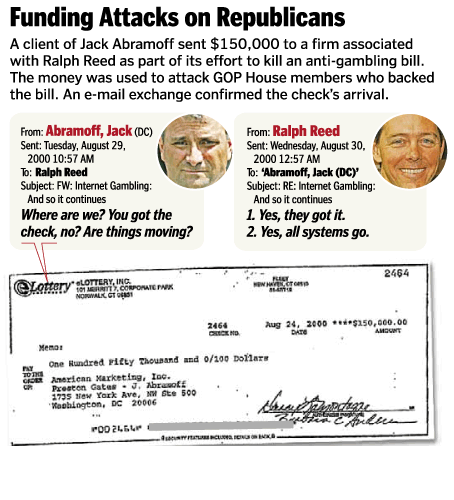
Check in the Mail
To reach the House conservatives, Abramoff turned to Sheldon, leader of the Orange County, Calif. - based Traditional Values Coalition, a politically potent group that publicly opposed gambling and said it represented 43,000 churches. Abramoff had teamed up with Sheldon before on issues affecting his clients. Because of their previous success, Abramoff called Sheldon "Lucky Louie," former associates said.
Checks and e-mails obtained by The Post show that Abramoff recruited Reed to join Sheldon in the effort to pressure members of Congress. Reed had left the Christian Coalition in 1997 and started a political consulting firm in Georgia.
Abramoff asked eLottery to write a check in June 2000 to Sheldon's Traditional Values Coalition (TVC). He also routed eLottery money to a Reed company, using two intermediaries, which had the effect of obscuring the source.
The eLottery money went first to Norquist's foundation, Americans for Tax Reform (ATR), and then through a second group in Virginia Beach called the Faith and Family Alliance, before it reached Reed's company, Century Strategies. Norquist's group retained a share of the money as it passed through.
"I have 3 checks from elot: (1) 2 checks for $80K payable to ATR and (2) 1 check to TVC for $25K," Abramoff's assistant Susan Ralston e-mailed him on June 22, 2000. "Let me know exactly what to do next. Send to Grover? Send to Rev. Lou?"
Minutes later Abramoff responded, saying that the check for Sheldon's group should be sent directly to Sheldon, but that the checks for Norquist required special instructions: "Call Grover, tell him I am in Michigan and that I have two checks for him totaling 160 and need a check back for Faith and Family for $150K."
v According to the e-mails, Reed provided the name and address where Norquist was supposed to send the money: to Robin Vanderwall at a location in Virginia Beach.
Vanderwall was director of the Faith and Family Alliance, a political advocacy group that was founded by two of Reed's colleagues and then turned over to Vanderwall, Vanderwall said and records show.
Vanderwall, a former Regent University Law School student and Republican operative, was later convicted of soliciting sex with minors via the Internet and is serving a seven-year term in Virginia state prison.
In a telephone interview, Vanderwall said that in July 2000 he was called by Reed's firm, Century Strategies, alerting him that he would be receiving a package. When it came, it contained a check payable to Vanderwall's group for $150,000 from Americans for Tax Reform, signed by Norquist. Vanderwall said he followed the instructions from Reed's firm -- depositing the money and then writing a check to Reed's firm for an identical amount.
"I was operating as a shell," Vanderwall said, adding that he was never told how the money was spent. He said: "I regret having had anything to do with it."
Abramoff had previously paid Reed's consulting firms to whip up Christian opposition to Indian casinos and a proposed Alabama state lottery that would compete with the gambling business of Abramoff's tribal clients, sometimes using Norquist's foundation as a pass-through, a Senate investigation has found.
A spokeswoman for Reed said Century Strategies had no business relationship with eLottery. She said Reed did anti-gambling work for Abramoff but was assured by Abramoff's firm "that our activities would not be funded by revenues derived from gambling activities."
Norquist declined to be interviewed. His spokesman did not answer questions about the movement of funds.
Another check issued in 2000 by eLottery at Abramoff's direction wound up helping to fund the Scotland golfing trip attended by Rudy and DeLay. On May 25, 2000, as the trip got underway, the company sent $25,000 to the National Center for Public Policy Research, where Abramoff was a board member at the time. Along with money from another Abramoff client, that payment covered most of the Scotland travel costs, according to records and interviews.
DeLay has said that he thought the National Center sponsored and paid for the trip.
A few weeks after the golfing trip, Abramoff took Rudy to the U.S. Open in Pebble Beach, Calif. They traveled aboard a corporate jet belonging to SunCruz Casinos, a Florida cruise line Abramoff was negotiating to buy, according to a participant who spoke on the condition of anonymity because of the ongoing investigation. Rudy did not report this trip in his House travel records.
Abramoff listed Rudy as a financial reference that summer in the SunCruz purchase. That transaction ultimately led to the indictment two months ago of Abramoff and a business partner on charges that they had forged a $23 million wire transfer.
Working the Bill
In early June 2000, DeLay had not yet taken a position on the Internet gambling ban. But his aide, Rudy, was already providing advice to Abramoff about how to kill it.
Five days after Rudy and DeLay got back from the Scotland trip, Rudy sent an emergency message to Abramoff from a wireless device.
"911 gaming," Rudy typed on June 8.
He followed up with a suggestion that Abramoff's team get a conservative House caucus to seek a meeting with the chamber's top leaders, Speaker J. Dennis Hastert (R-Ill.) and Majority Leader Richard K. Armey (R-Tex.) -- a key supporter of the bill. Abramoff forwarded the idea to his team members. "Message from Tony Rudy. Don't share it please. However we should take his advice."
Sheldon was also hard at work, holding news conferences and buttonholing House conservatives to argue against the bill. On July 10, he called Abramoff's group saying he had run into resistance from the staff of an influential member who still favored the bill.
"Lou just called," team member Shawn Vasell told colleagues in an e-mail. "We need to get together and draft a response for Lou." Kevin Ring, Vasell's associate, responded: "This is a disaster."
Abramoff weighed in minutes later, saying he would get Reed to ramp up efforts. "I just chatted with Ralph. We are going to have to go on the air nationally on radio. We must get the conservatives back on this or we are doomed," he told the team.
Abramoff got another strategy e-mail the next morning from Rudy. Rudy was on DeLay's staff but wrote "we" as though he belonged to Abramoff's team. "I think we should get weyrich to get like 10 groups to sign a letter to denny and armey on gaming bill," Rudy wrote, referring to Free Congress Foundation Chairman Paul M. Weyrich and the House leaders.
Sheldon got a private meeting with DeLay on July 13. "I told him I strongly opposed the bill," Sheldon told Congressional Quarterly at the time.
A former DeLay staff member who spoke on the condition of anonymity said, "Lou was a credible face" because Sheldon's religious credentials carried some weight with conservative voters.
DeLay then told House Republican leaders that he was prepared to go against the anti-gambling bill.
The Bush Forgery
Still, the Abramoff team was worried about the vote. So the eLottery forces pressed the argument that the Internet bill was an unfair infringement of the right of individual states to sell lottery tickets online. Amid the frenzied lobbying, a potentially influential letter making that case began circulating on Capitol Hill. It was purportedly signed by Jeb Bush.
"While I am no fan of gambling, I see this bill as a violation of states' rights and I am looking to prevent this encroachment," the letter said.
A surprised Hill staffer called the Florida governor's office, and the letter was exposed as a forgery.
Months later, a little-noted investigation by Florida authorities resulted in a confession from a Tampa man hired by a division of Shandwick Worldwide, a public affairs company. Shandwick was working on the eLottery account with Abramoff's team. The Florida man, Matthew Blair, told authorities in a plea bargain agreement that he was hired to get letters opposing the bill from the governor and others. He said he created the forged letter on his own after he was unable to obtain one from Bush's office.
Brian Berger, then a Shandwick official, said his firm had been hired to produce the letters by Abramoff associate Michael Scanlon, a former DeLay press aide. Berger said in a recent interview that although he and Scanlon knew Blair, they did not sanction the forgery. "Essentially, we had a bad operative," Berger said.
But the letter still had an impact. It fed the confusion about the bill in the days before the floor vote. Goodlatte, the sponsor, had more than enough votes for his carefully crafted compromise. Yet he became worried that amendments might be introduced during the debate that could kill the bill.
One way to avoid a floor fight is to place a bill on the suspension calendar, which is supposed to be for non-controversial legislation; it suspends the usual rules, banning amendments and limiting debate. But doing so would require a two-thirds majority for passage.
Goodlatte agreed to the suspension calendar approach because he thought he could get the two-thirds. "We were told [by House leaders] to bring it up on the suspension calendar so you won't have to deal with all these amendments," said a member of Goodlatte's staff who spoke on the condition of anonymity.
That opening was exploited by the Abramoff team with Rudy's help -- fewer votes would be needed to stop the bill.
On July 17, the House debated for about 40 minutes. Rumors continued to fly about the Bush letter. Some members remained confused about the bill's contents. About 30 did not vote. "There was a lot of misinformation," said a congressional staff member who worked on the bill.
Still, Goodlatte had reason to be optimistic because nine out of 10 bills on the suspension calendar pass.
But Abramoff's efforts had eroded just enough votes. The roll call -- 245 in favor, 159 against -- left Goodlatte 25 members short. The bill failed.
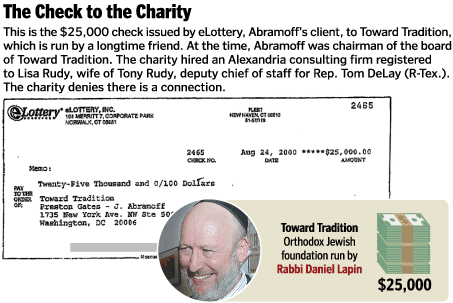
'All Systems Go'
The eLottery team was euphoric. Abramoff lobbyist Patrick Pizzella, who was in the Capitol to watch the vote, wrote in an e-mail to colleagues the next day that he saw Sheldon celebrating the victory, too. "There was lucky Louie out front hi-fiving with some lobbyists," said Pizzella, who the following year was named an assistant secretary of labor. Others partied across from the Capitol at the restaurant Tortilla Coast.
Supporters of the Internet gambling ban, though, were outraged. They vowed to resurrect it, perhaps as part of an appropriations bill.
The Christian Coalition issued an "action alert." Dobson took to the airwaves, saying, "I'm just sick about what the Republican leadership is doing with regard to gambling." He urged listeners to contact DeLay and other House leaders to revive the measure.
Abramoff's team realized there was no way to win enough support for a simple majority because they were down more than two dozen votes. Instead, they had to persuade the leadership to keep the bill off the House floor, despite intense pressure from Goodlatte and another backer, Rep. W.J. "Billy" Tauzin (R-La.) .
On July 21, DeLay's legislative director, Kathryn Lehman, e-mailed Rudy: "Goodlatte and Tauzin asked Tom [DeLay] what they needed to do to get his vote, and Tom said to talk to you!"
Rudy immediately forwarded the e-mail to Abramoff asking for help.
Documents show that Abramoff's strategy was to dispatch Sheldon to pressure about 10 social conservatives in their home districts, accusing them of being soft on gambling for supporting Goodlatte's bill. Abramoff's group hoped those members would stir fears among House leaders that another vote on the gambling bill could threaten those members and thus the GOP's thin 13-seat majority.
On Aug. 18, Abramoff faxed a message to eLottery's Daum ordering more money for Reed's activities. "I have chatted with Ralph and we need to get the funding moving on the effort in the 10 congressional districts," Abramoff wrote. "Please get me a check as soon as possible for $150,000 made payable to American Marketing Inc. This is the company Ralph is using."
ELottery issued the requested check to American Marketing on Aug. 24 and delivered it to Abramoff at Preston Gates. Five days later, Abramoff e-mailed Reed. The subject, "Internet Gambling: And so it continues." The message asked, "Where are we? You got the check, no? Are things moving?"
Reed answered the next day: "1. Yes, they got it. 2. Yes, all systems go."
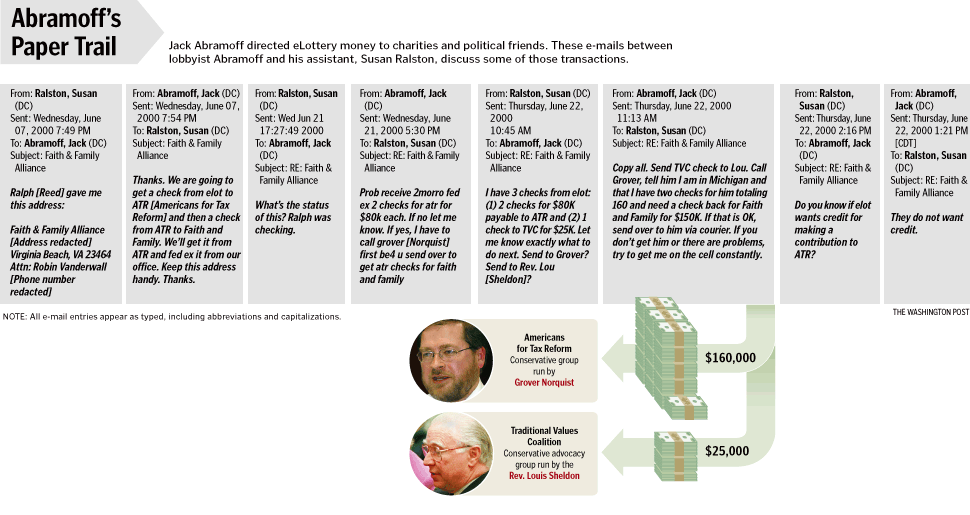
Targeting 'Our Guys'
Weeks later, a political mailer from Sheldon's group landed like a small bomb in the North Alabama district of Rep. Robert Aderholt.
The Republican was a member of the religious right's Values Action Team in Congress, a champion of public displays of the Ten Commandments and a vigorous gambling opponent. But now, in the midst of a tough reelection race, Aderholt was accused of being soft on gambling.
"Congressman Robert Aderholt voted with them in support of HR #3125 with the law the gamblers want on horse and dog racing," said Sheldon's mailer. Sheldon urged voters to call Aderholt's Washington office "and ask him to vote NO this time." Aderholt's opponent quickly incorporated Sheldon's attack in an ad of his own.
The bulk rate stamp on the mailing said it was paid for by American Marketing. Records show that the company is run by Robert Randolph, the president of Reed's direct-marketing subsidiary. A spokeswoman for Reed said that American Marketing is "a different company" and that she could not respond to questions about it.
Sheldon's fliers also targeted Rep. J.C. Watts of Oklahoma, then the House GOP deputy whip, and vulnerable incumbents, including Rep. James E. Rogan of California, one of the managers of the impeachment of President Bill Clinton, and Rep. Robin Hayes of North Carolina.
Angry House members targeted by Sheldon complained to the leadership. "Certainly our displeasure was relayed on up the chain, so to speak," said Andrew Duke, the chief of staff for Hayes.
Abramoff's willingness to jeopardize Republican House seats startled his lobbying team, some of whom had come from DeLay's office. "Once we started talking about taking out our guys, I got worried," said a former associate of Abramoff's who spoke on the condition of anonymity.
The same former Preston Gates lobbyist said Rudy played a key role in getting House leaders to pay attention to the plight of members under attack.
"Tony would say to members, 'Oh, you're getting phone calls on this? I better go tell the whip.' Lou Sheldon sending a letter is not going to do anything unless you have somebody on the inside. Tony exaggerated to leadership how backing the bill could hurt those members," the former Abramoff associate said.
The outrage prompted Sheldon to back off in some of the races. In Aderholt's district, he issued a letter praising the congressman and claiming that his previous mailer had been mistakenly distributed. In Rogan's district, he stopped pressuring the incumbent and, instead, attacked his challenger as "a champion of the homosexual agenda."
Sheldon said in an interview this week that he recalled little about his efforts against the bill in 2000. He said he did not remember receiving a $25,000 check from eLottery, but added that it is possible that his organization did receive it. He said he remembered some money coming in to pay for fliers he had printed and mailed to congressional districts to persuade members to oppose the bill.
"I wasn't aware the money was coming from them [eLottery]," Sheldon said. "I don't think I ever saw the check. It came in, and we paid the bill for some of the printing."
Sheldon also said he had no idea that Abramoff was lobbying against the bill or that he was working for eLottery.
"This is all tied to Jack?" Sheldon said. "I'm shocked out of my socks."
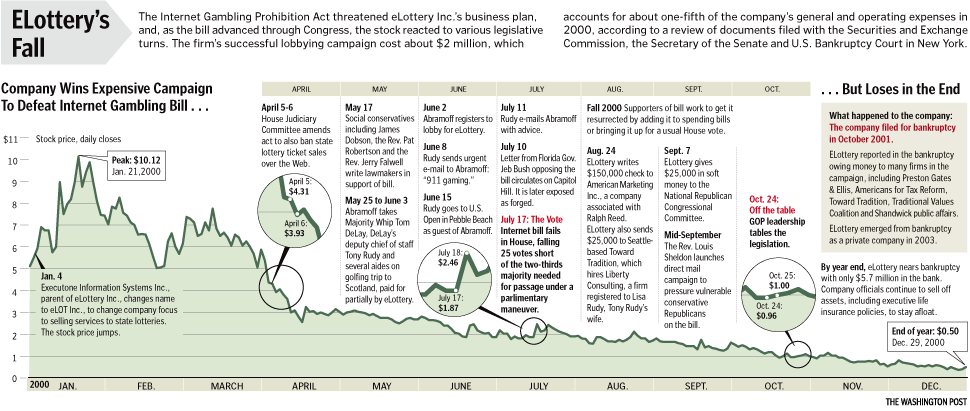
Chilling Effect
Rudy, who had known Abramoff for years, went to work for Abramoff when the lobbyist switched law firms, to Greenberg Traurig LLP, in January 2001.
Rudy's wife, Lisa, was also drawn into Abramoff's orbit. She was paid fees by Toward Tradition, the Seattle-based Orthodox Jewish foundation that often allies with the Christian right on social issues. The foundation is headed by longtime Abramoff friend Rabbi Daniel Lapin and the lobbyist served as chairman of the board.
Toward Tradition was issued a $25,000 check dated Aug. 24, 2000, by eLottery. A copy of the check was obtained by The Post. Daum, the former eLottery official, said he could not remember the check but said all funds Abramoff directed him to spend were intended to defeat the Internet gambling bill.
Lapin said in an interview that he could not remember a check from eLottery but that the company could have made donations to his foundation. He said that any such donation would have been separate from his foundation's hiring of Liberty Consulting, a political firm founded and operated by Lisa Rudy.
"Lisa Rudy worked for us for six months -- six to nine months -- to organize groundwork for a conference," Lapin said. He said she was paid more than $25,000 but was unsure exactly how and when Lisa Rudy was hired. Lapin said her work could have been for an interfaith conference held in Washington in mid-September 2000. That conference, which opened a few weeks after the eLottery check was sent to Toward Tradition, featured such speakers as DeLay, Sheldon and Norquist.
Rudy declined to comment on the Toward Tradition contract and said that his wife was not available for a comment.
A month after the interfaith conference, the gambling bill's sponsors agitated to get House leaders to let them attach the measure to an end-of-the-year spending bill.
But Sheldon's campaign in conservative districts had the desired chilling effect on GOP leaders. That became clear on Oct. 24, when House Republicans met to discuss their year-end strategy.
What happened at the meeting was relayed to Abramoff by a former associate, David H. Safavian, who was then a lobbyist for a coalition of online gambling companies and who this month was indicted for allegedly lying to federal investigators in the Abramoff probe.
DeLay, Safavian wrote in an e-mail, "spoke up and noted that the bill could cost as many as four House seats. At that point, there was silence. Not even Rep. Dick Armey (R-Texas) -- our previous opponent -- said a word."
When Congress prepared to adjourn in 2000 without revisiting the gambling bill, Safavian was ecstatic. He sent his clients an e-mail, which was posted on the Web site of the Fantasy Sports Trade Association.
"Relax a bit," Safavian wrote. "Policy beat politics once again. (Maybe the American system isn't really that bad.) The good guys won."
Researchers Alice Crites and Julie Tate contributed to this report.
© 2005 The Washington Post Company
By James V. Grimaldi and Susan Schmidt
Washington Post Staff Writers
As federal officials pursue a wide-ranging investigation into the activities of Washington lobbyist Jack Abramoff, his arrest on fraud charges in the purchase of a Florida casino boat company has increasingly focused attention on a little-known congressman from rural Ohio.
Rep. Robert W. Ney (R-Ohio) placed comments in the Congressional Record favorable to Abramoff's 2000 purchase of the casino boat company, SunCruz Casinos. Two years later, Ney sponsored legislation to reopen a casino for a Texas Indian tribe that Abramoff represented.
Ney approved a 2002 license for an Israeli telecommunications company to install antennas for the House. The company later paid Abramoff $280,000 for lobbying. It also donated $50,000 to a charity that Abramoff sometimes used to secretly pay for some of his lobbying activities.
Meanwhile, Ney accepted many favors from Abramoff, among them campaign contributions, dinners at the lobbyist's downtown restaurant, skybox fundraisers, including one at his MCI Center box, and a golfing trip to Scotland in August 2002. If statements made by Abramoff to tribal officials and in an e-mail are to be believed, Ney sought the Scotland trip after he agreed to help Abramoff's Texas Indian clients. Abramoff then arranged for his charity to pay for the trip, according to documents released by a Senate committee investigating the lobbyist.
Ney is under investigation by Florida federal prosecutors looking into Abramoff's acquisition of SunCruz, according to sources familiar with the investigation who spoke on the condition of anonymity. Abramoff and his business partner Adam Kidan were indicted in August on fraud charges related to the purchase.
Ney declined to be interviewed. He has said his actions benefiting Abramoff had nothing to do with the favors he received. He said he was misled by Abramoff and his associates.
"I am absolutely outraged by the dishonest and duplicitous words and actions of Jack Abramoff," Ney said last year when Abramoff's statements about Ney first came up in e-mails released by the Senate Indian Affairs Committee. "As the testimony at both committee hearings has revealed, Jack Abramoff repeatedly lied to advance his own financial interests."
Abramoff, whose attorneys declined to comment for this article, has publicly denied that he misled Ney.
This spring, Ney hired a prominent Washington criminal defense lawyer, Mark Tuohey, to handle inquiries from the Justice Department and congressional investigators pursuing the widening scandal. Tuohey has not returned phone calls in recent weeks to discuss his client.
Comments for SunCruz
A six-term congressman from rural eastern Ohio, Ney, 51, does not have a national profile. A former teacher and public safety director for his home town of Bellaire, Ney was an Ohio legislator in 1994 when he defeated the Democratic incumbent in the congressional district once represented by Wayne Hays (D).
But to members of Congress, Ney is known as the mayor of Capitol Hill. Ney is Administration Committee chairman, a powerful position that doles out budgets, equipment, offices and parking spaces to House members. These perks are used by House Republican leaders to keep their rank and file in line.
Ney became chairman of the committee thanks to his political patron, Rep. Tom DeLay (R-Tex.), who recently stepped down as House majority leader after he was indicted on a charge of conspiracy to violate a Texas campaign law. Shortly after Ney arrived in the House in 1994, he became a part of DeLay's Retain Our Majority Program (ROMP), a fundraising effort in which GOP colleagues donated to Republicans such as Ney in districts without a safe majority. After lines were redrawn to make Ney's district more Republican, he returned the favor, donating to other vulnerable House Republicans. That helped him earn his chairmanship in 2001, leapfrogging over a colleague with more seniority.
Ney and Abramoff, whom DeLay once described as "one of my closest and dearest friends," crossed paths as early as 1996. That year Ney took a trip to Montenegro sponsored by a foundation that had links to Abramoff, who was a lobbyist for Montenegro.
A few years later, Ney paid unusual attention to another Abramoff client, the Florida gambling boat company SunCruz, which was headquartered more than 1,000 miles outside of Ney's congressional district. Abramoff and his business partner were trying to buy the cruise ship fleet from Konstantinos "Gus" Boulis, but Boulis was demanding unwelcome additional terms.
In March 2000, Ney used the Congressional Record to assail Boulis.
"On the Ohio River we have gaming interests that run clean operations and provide quality entertainment," Ney wrote. "I don't want to see the actions of one bad apple in Florida, or anywhere else to affect the business aspect of this industry or hurt any innocent casino patron in our country."
Ney's remarks were orchestrated by Michael Scanlon, a former DeLay spokesman who had just been hired to work for Abramoff at Preston Gates & Ellis LLP. Scanlon had approached Ney through his chief of staff, Neil Volz, according to sources who spoke on the condition of anonymity. Volz has repeatedly declined to be interviewed.
A few months later, Boulis agreed in principle to sell SunCruz to Abramoff and Kidan for $147.5 million. The deal closed in the fall. But Abramoff and Kidan failed to make good on a $23 million payment owed to Boulis, court records show.
When Boulis was being difficult in the negotiations, Ney again made an official statement, this time heaping praise on Kidan.
"Since my previous statement, I have come to learn that SunCruz Casino now finds itself under new ownership and, more importantly, that its new owner has a renowned reputation for honesty and integrity," Ney said in the Congressional Record on Oct. 26, 2000. "The new owner, Mr. Adam Kidan, is most well known for his successful enterprise, Dial-a-Mattress, but he is also well known as a solid individual and a respected member of his community.
"While Mr. Kidan certainly has his hands full in his efforts to clean up SunCruz's reputation, his track record as a businessman and as a citizen lead me to believe that he will easily transform SunCruz from a questionable enterprise to an upstanding establishment that the gaming community can be proud of."
But Kidan's "track record" included a string of lawsuits, judgments, liens, bankruptcies and failed businesses. His Dial-a-Mattress franchise in the District was in bankruptcy. He had filed personal bankruptcy, and he had surrendered his law license in New York after being accused of fraud. One of his mentors, Anthony Moscatiello, was alleged by law enforcement to be an accountant for New York's Gambino crime family.
Ney later said he did not know about Kidan's background.
Four months after Ney's remarks in the Congressional Record, Boulis was murdered in Fort Lauderdale. Police did not make any arrests in the case until September, when they charged four men in the slaying, including Moscatiello and a business associate of Moscatiello's whom Kidan had paid $250,000 as catering consultants.
Five weeks after the Boulis killing, SunCruz officials, including Kidan, threw a $1,000-a-head fundraiser for Ney at Abramoff's skybox at the MCI Center, according to Abramoff's fundraising log.
Language for Tiguas
In early 2002, Volz left his post as Ney's chief of staff to join Abramoff's lobbying team. Soon after, in March 2002, Ney agreed to sponsor legislation that would benefit the Tigua tribe of El Paso, an Abramoff and Scanlon client. They wanted Ney's help to reopen the Tiguas's casino, which the state of Texas had shut down.
"Just met with Ney!!! We're f'ing gold!!!! He's going to do Tigua," Abramoff told Scanlon in a March 20, 2002, e-mail.
Six days later, Abramoff directed tribal officials to make three contributions totaling $32,000 to Ney's campaign and political action committees. A Ney spokesman recently said that money has been donated to Ohio charities.
On June 7, 2002, Abramoff wrote in an e-mail to Tigua consultant Marc Schwartz that "our friend" had "asked if we could help (as in cover) a Scotland golf trip for him and some staff."
The e-mail does not name "our friend," but Schwartz testified in the Senate last fall that it was Ney.
Abramoff wrote that "the trip will be quite expensive (we did this for another member -- you know who) 2 years ago." He was referring to an earlier Scotland golf trip that Abramoff had arranged in 2000 for DeLay. Abramoff suggested to Schwartz that the tribe send $50,000 to a charity he directed, the Capital Athletic Foundation, which would pay for the trip "as an educational mission."
Ney later stated on disclosure forms filed with the House that the August 2002 trip cost $3,200 and was paid for by the National Center for Public Policy Research, a conservative advocacy group on whose board Abramoff served. The Washington Post reported last year that the trip was actually paid for by the Capital Athletic Foundation, which reported in tax records that it spent $150,225 on the trip.
Ney has said he was misled by Abramoff about who paid for the trip.
"In April, 2002, I was approached by Mr. Abramoff, who I believed to be a respected member of the community, and asked to go on a trip to Scotland which Mr. Abramoff said would help support a charitable organization, that he founded, through meetings he organized with Scottish Parliament officials," Ney said in a statement last November.
Ney's report to Congress listed as a purpose of the trip: "speech to Scottish Parliamentarians." However, there is no record of Ney's speech in the Scottish Parliament's register of official visits kept by the external liaison office, which is available on the Web. In addition, at the time of Ney's trip, the Scottish Parliament was out for its August recess, spokeswoman Sally Coyne said.
Ney is not the first public official who has come under scrutiny by investigators for the Scotland trip. David Safavian, then chief of staff at the General Services Administration, also went on the trip with Ney, Abramoff and former Christian Coalition leader Ralph Reed Jr. Safavian, who went on to become the chief White House procurement officer, was indicted this month on charges that he lied to investigators looking into the Scotland trip when he said that Abramoff had no business before the his agency.
The trip, Ney said in his statement last year, had nothing to do with legislation for the tribe.
"I want to be absolutely clear that at no point, ever, was I made even remotely aware that any Indian tribe played any role in this trip," Ney said in his statement.
Ney said he supported the Tigua legislation at Abramoff's request after the lobbyist told him the provision was supported by Sen. Christopher J. Dodd (D-Conn.), who was sponsoring the election reform bill that would carry the Tigua provision.
"I then [in July 2002] personally asked Senator Dodd about this provision and he expressed no knowledge of it," Ney said. "In short, I had been misled by Jack Abramoff. I then asked Jack Abramoff why Senator Dodd was apparently not supporting it and Mr. Abramoff told me that someone had lied to him. The matter was then closed from my perspective."
However, the Tiguas say no one told them the matter was closed. Tigua consultant Schwartz later testified to the Senate Indian Affairs Committee that Ney remained a strong supporter of the Tigua legislation and Abramoff long after his conversation with Dodd.
Schwartz said that in August 2002 -- a month after Ney's reported conversation with Dodd and around the time of the Scotland trip -- Abramoff arranged for Ney to meet with Tigua representatives in his office. Before the meeting, "in an e-mail to me, Abramoff mentioned that Congressman Ney didn't want his trip to Scotland brought up, as he would show his appreciation to the Tribe later," Schwartz testified.
The meeting lasted more than 90 minutes, two tribal members testified at the Senate hearing. The tribal leaders who attended the meeting were pleased and impressed with the outcome, Schwartz said.
"During that meeting, Congressman Ney was very animated about Mr. Abramoff's skill and repute as a leader in the lobbying circles," Schwartz testified. "We were told about the impending success of Mr. Abramoff's legislative plan and how much Congressman Ney wanted to help to restore the Tribe's ability to conduct gaming on their reservation."
Two months later, on Oct. 8, after the election bill came out of a House-Senate conference committee without a Tigua provision, Ney held a conference call with tribal officials and told them of his "disbelief that Dodd had gone back on his word" to support the provision, Schwartz testified. Ney also expressed his continued support for the Tiguas, tribal officials said.
Ney responded to Schwartz's testimony by saying, "I, like these Indian tribes and other members of Congress, was duped by Jack Abramoff."
Ney later said he was very angry at Abramoff and Scanlon, who he said had misled him about Dodd. Ney has called Abramoff and Scanlon's activities in the Tigua episode "nefarious."
Abramoff shot back by referring to the conference call when he spoke to the New York Times Magazine this spring. "It's crazy" for Ney to say he was duped, Abramoff said. "He was on the phone for an hour and a half!"
Contract for Foxcom
In the late 1990s, members of Congress became increasingly frustrated at the lack of cell phone coverage inside the Capitol and its nearby office buildings.
The House decided to let the major wireless companies select -- and pay for -- a company to install antennas for cellular phones. In 1999, AT&T Wireless had asked LGC Wireless of San Jose to work with the House bureaucracy to put the antennas and repeaters into House buildings. The project was one of the largest of its kind, worth more than $3 million.
At the time, LGC was the world's leading provider of such equipment and had wired the headquarters of most cellular phone companies, including Nextel and AT&T. During the next year, LGC worked with the architect of the Capitol and the House Information Resources office to develop a plan.
Then Foxcom Wireless, an Israeli start-up telecommunications firm, entered the picture. Foxcom, which has since moved headquarters from Jerusalem to Vienna, Va., and been renamed MobileAccess Networks, lobbied for the job.
In early 2001, Ney took charge of the House Administration Committee, which was ultimately responsible for the antenna job. Sometime that year, exactly when is unclear, Foxcom donated $50,000 to the Capitol Athletic Foundation, Abramoff's charity. Foxcom officials have declined to be interviewed about the donation or the wireless project. A spokesman for Foxcom, now MobileAccess, referred all questions Monday to Ney's committee.
Also that same year, a decision was delayed on the antennas, which caught House staff by surprise.
"We were really surprised, given all the work we put in with LGC in designing the system," said Henry F. "Bud" Collins Jr., the senior network systems engineer for the House. "Then, all of a sudden this other company showed up. We had to go through this whole thing again."
LGC Chief Operating Officer Alex Gray wrote to Ney to complain about the "highly politicized selection process" that favored the Israeli company despite the House's "Buy American" posture. "Only Foxcom was permitted a full and fair hearing on the merits of its proposal -- essentially a 'back room' deal based on political expediency alone," Gray wrote.
Assistant House Counsel Carolyn Betz, replying on behalf of Ney, said in a letter to LGC that in the fall of 2001 the major wireless companies were receiving ballots to vote on who should get the contract.
In a letter to Betz, LGC president and chief executive Ian Sugarbroad called the election process "deeply flawed and unfair." He said each wireless company was sent a ballot and allowed to vote for LGC, Foxcom or "no preference." There were no details on the bid proposals, such as cost, security features, band capacity or critical performance metrics, Sugarbroad said.
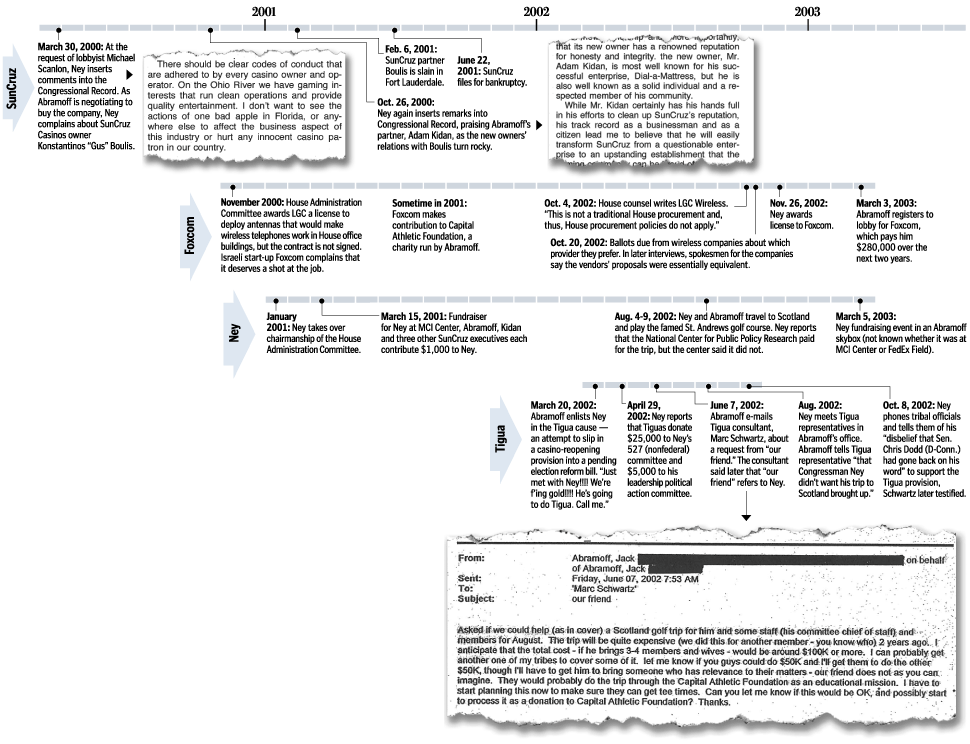
Brian Walsh, Ney's spokesman, provided The Post redacted copies of the ballots. Three show checkmarks in a box next to Foxcom. The other three ballots are marked "no preference."
But representatives of all six companies said they voted no preference, according to interviews and documents. Five of them were interviewed by The Post, and the sixth made its preference known in a letter obtained by The Post.
Spokesmen for the companies -- Cingular, Nextel, Sprint, Verizon Wireless, AT&T Wireless and Voicestream -- said they remained neutral because both LGC and Foxcom were considered capable of doing the job.
Walsh said those statements are "an absolute contradiction to the documentation."
Ney awarded the license to Foxcom on Nov. 26, 2002, Walsh said. He declined to make public a copy of documents relating to the agreement, noting that the Freedom of Information Act does not apply to Congress. He noted that the work was paid for by the wireless companies and not by Congress, and he pointed out that the Senate also chose Foxcom.
LGC had no right to appeal. "This is not a traditional House procurement and, thus, House procurement policies do not apply," Betz stated in her letter to LGC.
Collins, the House engineer who has since retired, said, "It almost seemed like the cards were stacked for them."
After the contract was awarded, Foxcom listed Abramoff as its lobbyist. Over the next two years, Foxcom paid Abramoff's team $280,000.
Researcher Alice Crites and database editor Derek Willis contributed to this report.
Correction to This Article
An Oct. 18 article incorrectly reported that Rep. Robert W. Ney (R-Ohio) defeated an incumbent Democrat in 1994. It should have said Ney replaced a retiring Democrat.
By Susan Schmidt and James V. Grimaldi
Washington Post Staff Writers
Jack Abramoff liked to slip into dialogue from "The Godfather" as he led his lobbying colleagues in planning their next conquest on Capitol Hill. In a favorite bit, he would mimic an ice-cold Michael Corleone facing down a crooked politician's demand for a cut of Mafia gambling profits: "Senator, you can have my answer now if you like. My offer is this: nothing."
The playacting provided a clue to how Abramoff saw himself -- the power behind the scenes who directed millions of dollars in Indian gambling proceeds to favored lawmakers, the puppet master who pulled the strings of officials in key places, the businessman who was building an international casino empire.
Abramoff is the central figure in what could become the biggest congressional corruption scandal in generations. Justice Department prosecutors are pressing him and his lawyers to settle fraud and bribery allegations by the end of this week, sources knowledgeable about the case said. Unless he reaches a plea deal, he faces a trial Jan. 9 in Florida in a related fraud case.
A reconstruction of the lobbyist's rise and fall shows that he was an ingenious dealmaker who hatched interlocking schemes that exploited the machinery of government and trampled the norms of doing business in Washington -- sometimes for clients but more often to serve his desire for wealth and influence. This inside account of Abramoff's career is drawn from interviews with government officials and former associates in the lobbying shops of Preston Gates & Ellis LLP and Greenberg Traurig LLP; thousands of court and government records; and hundreds of e-mails obtained by The Washington Post, as well as those released by Senate investigators.
Abramoff, now 47, had mammoth ambitions. He sought to build the biggest lobbying portfolio in town. He opened two restaurants close to the Capitol. He bought a fleet of casino boats. He produced two Hollywood movies. He leased four arena and stadium skyboxes and dreamed of owning a pro sports team. He was a generous patron in his Orthodox Jewish community, starting a boys' religious school in Maryland.
For a time, all things seemed possible. Abramoff's brash style often clashed with culturally conservative Washington, but many people were drawn to his moxie and his money. He collected unprecedented sums -- tens of millions of dollars -- from casino-rich Indian tribes. Lawmakers and their aides packed his restaurants and skyboxes and jetted off with him on golf trips to Scotland and the Pacific island of Saipan.
Abramoff offered jobs and other favors to well-placed congressional staffers and executive branch officials. He pushed his own associates for government positions, from which they, too, could help him.
He was a man of contradictions. He presented himself as deeply religious, yet his e-mails show that he blatantly deceived Indian tribes and did business with people linked to the underworld. He had genuine inside connections but also puffed himself up with phony claims about his access.
Abramoff's lobbying team was made up of Republicans and a few Democrats, most of whom he had wined and dined when they were aides to powerful members of Congress. They signed on for the camaraderie, the paycheck, the excitement.
"Everybody lost their minds," recalled a former congressional staffer who lobbied with Abramoff at Preston Gates. "Jack was cutting deals all over town. Staffers lost their loyalty to members -- they were loyal to money."
A senior Preston Gates partner warned him to slow down or he would be "dead, disgraced or in jail." Those within Abramoff's circle also saw the danger signs. Their boss had become increasingly frenzied about money and flouted the rules. "I'm sensing shadiness. I'll stop asking," one associate, Todd Boulanger, e-mailed a colleague.
Abramoff declined to comment for this article. "I have advised my client not to speak, except in court," said Neal Sonnett, one of his attorneys. A friend of two decades, Rep. Dana Rohrabacher (R-Calif.), defended Abramoff: "I think he's been dealt a bad hand and the worst, rawest deal I've ever seen in my life. Words like bribery are being used to describe things that happened every day in Washington and are not bribes."
Few of those interviewed would agree to be quoted on the record because of the ongoing investigation by a Justice Department task force. But some who spoke on the condition of anonymity said they look back in amazement at the heady days of Abramoff's rise.
"We weren't outside the box," the former Preston Gates colleague said. "We were outside the universe."
Hints of Trouble
A quarter of a century ago, Abramoff and anti-tax crusader Grover Norquist were fellow Young Turks of the Reagan revolution. They organized Massachusetts college campuses in the 1980 election -- Abramoff while he was an undergraduate at Brandeis and Norquist at Harvard Business School -- to help Ronald Reagan pull an upset in the state.
They moved to Washington, maneuvered to take over the College Republicans -- at the time a sleepy establishment organization -- and transformed it into a right-wing activist group. They were joined by Ralph Reed, an ambitious Georgian whose later Christian conversion would fuel his rise to national political prominence.
Soon they made headlines with such tactics as demolishing a mock Berlin Wall in Lafayette Park, where they also burned a Soviet leader in effigy. "We want to shock them," Abramoff told The Post at the time.
They forged lifelong ties. At Reagan's 72nd-birthday party at the White House, Reed introduced Abramoff to his future wife, Pam Alexander, who was working with Reed. She eventually converted to Judaism and embraced the Orthodox beliefs Abramoff had adopted as a teenager.
Even in those early days, there were hints of the troubles to come. "If anyone is not surprised at the rise and fall of Jack Abramoff, it is me," said Rich Bond, a former chairman of the Republican National Committee.
Abramoff and his crew busted the College Republicans' budget with a 1982 national direct-mail fundraising campaign that ended up "a colossal flop," said Bond, then deputy director of the party's national committee. He said he banished the three from GOP headquarters, telling Abramoff: "You can't be trusted."
Shortly thereafter, Abramoff was running Citizens for America, a conservative grass-roots group founded by drugstore magnate Lewis E. Lehrman. Abramoff was in frequent contact with Marine Lt. Col. Oliver L. North, the Reagan White House's Iran-contra mastermind, about grass-roots efforts to lobby Congress for the Nicaraguan contras, according to records in the National Security Archive.
One of Abramoff's most audacious adventures involved Jonas Savimbi, the Angolan rebel leader who had U.S. support but was later found to have ordered the murders of his movement's representative to the United States and that man's relatives. With Savimbi, Abramoff organized a "convention" of anticommunist guerrillas from Laos, Nicaragua and Afghanistan in a remote part of Angola. Afterward, Lehrman fired Abramoff amid a dispute about the handling of the group's $3 million budget.
Abramoff also worked on behalf of the apartheid South African government, which secretly paid $1.5 million a year to the International Freedom Foundation, a nonprofit group that Abramoff operated out of a townhouse in the 1980s, according to sworn testimony to the South African Truth and Reconciliation Commission.
At the same time, Abramoff dabbled as a Hollywood producer, shepherding an anticommunist movie, "Red Scorpion," starring Dolph Lundgren, filmed in Namibia, which was then ruled by South Africa. Actors in the film said they saw South African soldiers on the set. When the film was released in 1989, anti-apartheid groups demonstrated at the theaters. The movie ran into financial difficulty during and after production, but Abramoff produced a sequel, "Red Scorpion 2."
Mysterious Entrance
When Republicans wrested control of the House from the Democrats in 1994, Abramoff turned his focus back to Washington politics. With Norquist's help, he reinvented himself as a Republican lobbyist on heavily Democratic K Street. Norquist was one of the intellectual architects of the Republican Revolution and a muse for its leader, Newt Gingrich (R-Ga.), soon to be speaker of the House.
Abramoff also counted on his father, who had a wealth of connections from his days as president of the Diners Club credit card company. Frank Abramoff had once looked into operating a casino in the Commonwealth of the Northern Mariana Islands, U.S. territory that includes Saipan. He introduced his son around, and the Marianas became one of the first important clients of the new lobbyist.
Soon the younger Abramoff developed a key alliance with Rep. Tom DeLay, a conservative Republican from Texas who was working his way up in the House leadership. The two met at a DeLay fundraiser on Capitol Hill in 1995, according to a former senior DeLay aide. The aide recalled that Edwin A. Buckham, then DeLay's chief of staff, told his boss: "We really need to work with Abramoff; he is going to be an important lobbyist and fundraiser."
DeLay, a Christian conservative, did not quite know what to make of Abramoff, who wore a beard and a yarmulke. They forged political ties, but the two men never became personally close, according to associates of both men.
Almost from the start, Abramoff struck some rival lobbyists as a strange figure who operated on the margins. He even turned up as a representative of the Pakistani military when Prime Minister Benazir Bhutto went to Washington in 1995 to seek the return of $600 million the Islamabad government had paid for 28 F-16 fighters. The sale had been blocked by the U.S. government over concerns about Pakistan's nuclear program.
Bhutto's Washington lobbyists were at the Pakistani Embassy savoring her successful meeting with President Bill Clinton when a man in a suit made a mysterious entrance.
"Suddenly, this portly guy steps in and sits down. He says nothing," recalled one of the lobbyists. The Americans asked him to introduce himself. He folded his arms and refused.
"Finally, he says, 'I am Jack Abramoff,' " recalled the lobbyist, a well-connected Democrat. They had never heard of him. Abramoff explained that he was "close to Newt."
The astonished lobbyists for Bhutto learned that Abramoff had traveled to Islamabad and had sold his services to the Pakistani military without the prime minister's knowledge.
In the Senate, Abramoff befriended Republicans and their staffers, along with some Democrats on the appropriations committees. In August 1999, he signed up for the National Republican Senatorial Committee's "Tartan Invitational," in which a half-dozen Republican senators and their aides spent a few days with about 50 lobbyists golfing at the exclusive St. Andrews Links in Scotland.
The following year, Abramoff figured out how to use his clients to fund his own trips to St. Andrews with lawmakers. The first guests were DeLay and his aides.
Team Abramoff
With Norquist's help, Abramoff secured a spot on the transition team for the Interior Department after George W. Bush was elected president in 2000. He tried to place several officials in Interior, including an unsuccessful attempt to land a former Marianas official in the top spot overseeing U.S. territories.
He was able to befriend J. Steven Griles, the deputy interior secretary, e-mails and interviews show. By the sum mer of 2001, Abramoff was referring to him in an e-mail to a client as "our guy Steve Griles." Federal investigators are now looking into whether Griles interceded on behalf of Abramoff and improperly discussed a job with the lobbyist while in a position to affect his clients. Griles denied any wrong doing in recent testimony to the Senate.
Abramoff's team also cultivated Roger Stillwell, the Marianas desk officer at the Interior Department. In a recent interview, Stillwell said he accepted dinners at Abramoff's restaurant, Signatures, and tickets to Washington Redskins games. But he said that all those actions occurred while he was a contract employee at Interior, not a federal worker. He also said he sent Abramoff copies of e-mails he sent to his boss, but he noted that none of them contained confidential information and that "there's nothing wrong with doing that."
Abramoff wallowed in his access, real and imagined. When his crack administrative assistant Susan Ralston bolted for a position with White House political adviser Karl Rove, Abramoff told colleagues he had gotten her the job even though it was Ralston's old boss, Reed, who made it happen, her former colleagues said.
Even glowing profiles in the New York Times and Wall Street Journal noting Abramoff's extensive influence and impressive income were not enough. Abramoff quietly paid op-ed columnists thousands of dollars to write favorably about his clients, including one writer for Copley News Service who disclosed this month that he had been paid for as many as two dozen columns since the mid-1990s.
Abramoff drove his colleagues hard, often e-mailing them late into the night. Many more than doubled their Hill pay when they went to work with him, some earning salaries of $200,000 to $300,000.
"He hired a bunch of white, middle-class Irish Catholic guys who wanted to exceed their parents' expectations," said one of the young lobbyists who himself fit that description. "He was always pushing, demanding. He would say, 'We are a family, we will work 24 hours a day, we will win.' "
Team Abramoff included former staffers to DeLay, as well as to Sen. Conrad Burns (R-Mont.), head of the Senate Appropriations panel's Interior subcommittee; Rep. Robert W. Ney (R-Ohio), chairman of the House Administration Committee; Rep. John T. Doolittle (R-Calif.), who has served on the key House committee that oversees tribes; and Sen. Harry M. Reid (D-Nev.), now minority leader.
Abramoff gathered his troops for strategy meetings that were "a great show," rollicking forums where ethical niceties were derided with locker room humor, recalled a former Preston Gates colleague. "Jack would say, 'I gave that guy 10 grand and he voted against me!' " the former associate recalled.
Bill padding was openly discussed, according to Abramoff's Greenberg Traurig e-mails that have been released by the Senate Indian Affairs Committee. For example, in April 2000, Abramoff had lobbyist Shawn Vasell working on a monthly invoice to the Mississippi Band of Choctaw Indians, telling him to "be sure we hit the $150k minimum. If you need to add time for me, let me know."
An exasperated Vasell e-mailed back: "You only had 2 hours. We are not even close to this number . . . ." Abramoff's solution: "Add 60 hours for me," and "pump up" the hours for three or four other lobbyists.
The Choctaws were one of a half-dozen Indian tribes who gave more than $80 million to Abramoff between 2000 and 2003. Not only were the tribes paying Abramoff's lobbying firm, they were also paying Abramoff's secret outside partner, Michael Scanlon, who charged the Indians millions of dollars for public relations work and split the money with Abramoff. Scanlon's public relations fees did not have to be disclosed under lobbying rules, thus making it possible for the magnitude of their take from the tribes to be kept from public view. The two dubbed their scheme "Gimme Five," according to e-mails in which Abramoff disparaged their clients as "morons" and "troglodytes."
E-mails show that Abramoff put his money into an array of political and personal projects.
The nonprofit Capital Athletic Foundation, for example, allowed him to schmooze with Washington's movers and shakers at charity affairs. He put a congressional spouse -- Julie Doolittle, wife of the California lawmaker -- on his payroll to plan at least one event. The congressman's office has said that there was no connection between his wife's work and official acts.
The foundation was ostensibly created to help inner-city children through organized sports. There is no evidence money went to city kids, but the foundation did fund some of Abramoff's pet projects: a sniper school for Israelis in the West Bank, a golf trip to Scotland for Ohio congressman Ney and others, and a Jewish religious academy in Columbia that Abramoff founded and where he sent his children to be educated.
Another Abramoff financial vehicle was the nonprofit American International Center, a Rehoboth Beach, Del., "think tank" set up by Scanlon, who staffed it with beach friends from his summer job as a lifeguard. The center became a means for Abramoff and Scanlon to take money from foreign clients that they did not want to officially represent. Some of the funds came from the government of Malaysia. Banks and oil companies there were making deals in Sudan, where U.S. companies were barred on human rights grounds. Sudan was among several oil-rich nations in Africa, Asia and the Middle East that Abramoff eyed as venues for lucrative energy deals. Abramoff told associates he wanted to become a go-to person for U.S. companies seeking to do business with oil-patch nations.
But by early 2003, Abramoff's private dealmaking had spiraled out of control. His religious academy was draining his income, and his restaurants were hemorrhaging money. He told Scanlon in an e-mail that February that he was at "rock bottom" and needed funds immediately. By the next day, he was frantic. "Mike!!! I need the money TODAY! I AM BOUNCING CHECKS!!!"
'Enron of Lobbying'
To Abramoff's rivals in the niche world of tribal lobbying, however, he was still a confounding success.
Team Abramoff was stealing away tribal clients from other lobbyists and charging fees of $150,000 a month or more -- 10 or 20 times what the Indians had been paying to others. Team members did it by touting their ties to powerful Republicans on Capitol Hill and stoking tribal worries that Congress might try to tax casino proceeds. Abramoff and Scanlon also quietly got involved in tribal elections.
Sen. Byron L. Dorgan (N.D.), the ranking Democrat on the Indian Affairs Committee, remembers first hearing "vague complaints" about Abramoff in June 2003 from three Democratic lobbyists. The tribes had traditionally supported Democrats, but Abramoff was capturing them for Republicans, getting them to boost their contributions and give two-thirds to his party.
There was even more buzz on Capitol Hill about Scanlon, the gregarious former DeLay press aide who had become a multimillionaire almost overnight. His old friends were astonished that Scanlon, then in his early thirties, was traveling to the beach by helicopter and living in a waterfront Rehoboth mansion that he bought for nearly $5 million in cash. A Louisiana paper, the Town Talk of Alexandria, reported in September 2003 that the Coushatta tribe paid Scanlon's public relations firm $13.7 million, a figure that amazed tribal lobbyists as well as some of Abramoff's colleagues. It was around that time that one colleague, Kevin Ring, learned from one of Abramoff's assistants that his boss was secretly getting money from Scanlon, according to a source privy to the conversation.
"This could be the Enron of lobbying," Ring told the colleague.
Rival lobbyists, including some Republicans, were comparing notes about what they considered Abramoff's outrageous conduct.
One of them contacted The Post in fall 2003. In early 2004, The Post published a detailed account of Abramoff's tribal lobbying, showing how four of Greenberg Traurig's Indian clients had paid $45 million, most of it in fees to Scanlon's firm. Within weeks, Greenberg initiated an internal investigation, Abramoff was ousted and the Senate Indian Affairs Committee began its own inquiry, which unearthed hundreds of incriminating e-mails from Abramoff's Greenberg Traurig computer files.
Abramoff had another problem that few people in Washington knew about.
He and another old friend from College Republican days, Adam Kidan, had purchased in 2000 a fleet of Florida casino boats for $147.5 million. By 2004, SunCruz Casinos was bankrupt, and the two men were being sued by lenders for $60 million in loan guarantees, accused of faking a wire transfer for the $23 million they had promised to put into the deal.
Even more serious, Abramoff and Kidan were targets of a Florida federal grand jury investigating the SunCruz wire transfer. And local authorities were probing the gangland-style slaying of the man who had sold them the cruise line, Konstantinos "Gus" Boulis.
Greenberg Traurig officials have said that they asked Abramoff to resign in March 2004 over unauthorized personal transactions. They have noted that they had no knowledge of his financial arrangement with Scanlon before they received inquiries from The Post.
However, two months before the firm requested Abramoff's resignation, Greenberg lawyers representing Abramoff in the SunCruz bankruptcy summoned Scanlon to the firm's Miami headquarters to ask about the relationship, according to two people close to Scanlon. Scanlon told them he had paid Abramoff $19 million out of the money he had received in public relations fees from tribal clients. Cesar L. Alvarez, president and chief executive of Greenberg Traurig, said the firm will not comment on any meeting with Scanlon.
By the spring of 2004, the Justice Department had launched an investigation of Abramoff and Scanlon that quickly developed into a multi-agency task force.
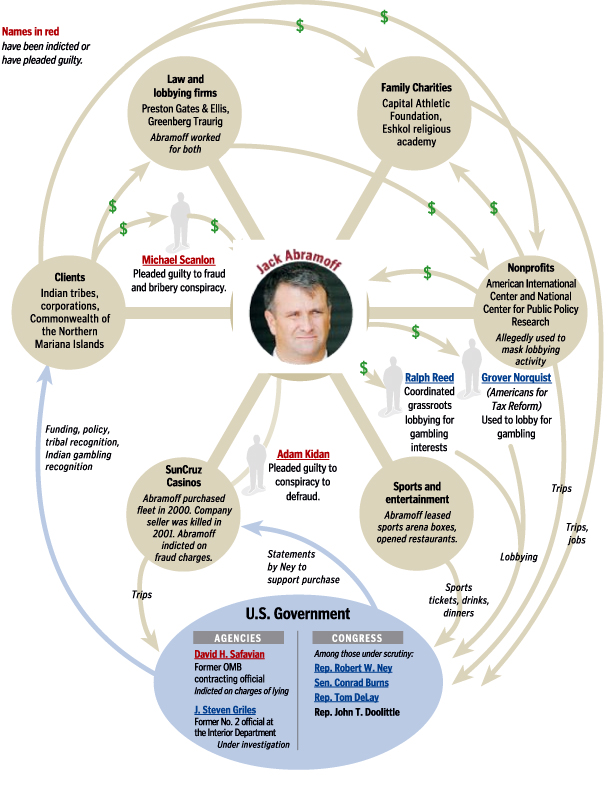
Pressure to Plead
Nearly two years later, Abramoff's legal troubles appear to threaten the careers of many of his colleagues and political allies. Sources familiar with the Justice Department investigation say that half a dozen lawmakers are under scrutiny, along with Hill aides, former business associates and government officials.
Two of Abramoff's former business partners -- Scanlon and Kidan -- have pleaded guilty and have agreed to testify about bribery and fraud in Florida and Washington.
Three men have been arrested in the Boulis killing. Two of the three were Kidan's associates; one of them is known to law enforcement as an associate of the Gambino crime family.
Another former Abramoff associate, David H. Safavian -- most recently head of the Office of Federal Procurement Policy in the Office of Management and Budget -- has been indicted on five felony counts of lying to federal investigators about his dealings with Abramoff while he was chief of staff at the General Services Administration.
Within the past year, Abramoff began selling off assets such as his restaurants and has told his lawyers he is broke. He faces the possibility of lengthy prison sentences and stiff financial penalties that could be reduced if he cooperates.
All these developments have added to the pressure on Abramoff to reach his own deal before the SunCruz trial begins on Jan. 9.
Alan K. Simpson (R), the former Wyoming senator who was in Washington during the last big congressional scandal -- the Abscam FBI sting in the late 1970s and early 1980s, in which six House members and one senator were convicted -- said the Abramoff case looks bigger. Simpson said he recently rode in a plane with one of Abramoff's attorneys, who told him: "There are going to be guys in your former line of work who are going to be taken down."
Dozens of lawmakers -- who were showered with trips, sports and concert tickets, drinks and dinners -- are returning campaign contributions from Abramoff and his clients and calling him a fraud and a crook.
Burns, one of half a dozen legislators under scrutiny by the federal Abramoff task force, returned $150,000 in campaign contributions this month.
"This Abramoff guy is a bad guy," Burns told a Montana television station. "I hope he goes to jail and we never see him again. I wish he'd never been born, to be right honest with you."
Former Republican congressman Mickey Edwards (Okla.), usually a defender of lobbying and Congress, said there have always been members who get caught "stuffing money in their pants." But he said this is different -- a "disgusting" and disturbingly broad scandal driven by lobbyists whose attitude seemed to be "government to the highest bidder."
"This is at a scale that is really shocking," said Edwards, who teaches public and international affairs at Princeton. "There is a certain kind of arrogance that in the past you might not have had. They were so supremely confident that there didn't seem to be any kind of moral compass here."
Researcher Alice Crites contributed to this report.
Correction to This Article
A Dec. 29 article about former lobbyist Jack Abramoff cited an incorrect date for an e-mail he sent about client bills. The e-mail was sent in April 2001, not April 2000. A Dec. 29 article misstated the position once held by the father of former lobbyist Jack Abramoff. Frank Abramoff was president of the franchises unit of Diners Club, not the parent company.
By R. Jeffrey Smith
Washington Post Staff Writer
The U.S. Family Network, a public advocacy group that operated in the 1990s with close ties to Rep. Tom DeLay and claimed to be a nationwide grass-roots organization, was funded almost entirely by corporations linked to embattled lobbyist Jack Abramoff, according to tax records and former associates of the group.
During its five-year existence, the U.S. Family Network raised $2.5 million but kept its donor list secret. The list, obtained by The Washington Post, shows that $1 million of its revenue came in a single 1998 check from a now-defunct London law firm whose former partners would not identify the money's origins.
Two former associates of Edwin A. Buckham, the congressman's former chief of staff and the organizer of the U.S. Family Network, said Buckham told them the funds came from Russian oil and gas executives. Abramoff had been working closely with two such Russian energy executives on their Washington agenda, and the lobbyist and Buckham had helped organize a 1997 Moscow visit by DeLay (R-Tex.).
The former president of the U.S. Family Network said Buckham told him that Russians contributed $1 million to the group in 1998 specifically to influence DeLay's vote on legislation the International Monetary Fund needed to finance a bailout of the collapsing Russian economy.
A spokesman for DeLay, who is fighting in a Texas state court unrelated charges of illegal fundraising, denied that the contributions influenced the former House majority leader's political activities. The Russian energy executives who worked with Abramoff denied yesterday knowing anything about the million-dollar London transaction described in tax documents.
Whatever the real motive for the contribution of $1 million -- a sum not prohibited by law but extraordinary for a small, nonprofit group -- the steady stream of corporate payments detailed on the donor list makes it clear that Abramoff's long-standing alliance with DeLay was sealed by a much more extensive web of financial ties than previously known.
Records and interviews also illuminate the mixture of influence and illusion that surrounded the U.S. Family Network. Despite the group's avowed purpose, records show it did little to promote conservative ideas through grass-roots advocacy. The money it raised came from businesses with no demonstrated interest in the conservative "moral fitness" agenda that was the group's professed aim.
In addition to the million-dollar payment involving the London law firm, for example, half a million dollars was donated to the U.S. Family Network by the owners of textile companies in the Mariana Islands in the Pacific, according to the tax records. The textile owners -- with Abramoff's help -- solicited and received DeLay's public commitment to block legislation that would boost their labor costs, according to Abramoff associates, one of the owners and a DeLay speech in 1997.
A quarter of a million dollars was donated over two years by the Mississippi Band of Choctaw Indians, Abramoff's largest lobbying client, which counted DeLay as an ally in fighting legislation allowing the taxation of its gambling revenue.
The records, other documents and interviews call into question the very purpose of the U.S. Family Network, which functioned mostly by collecting funds from domestic and foreign businesses whose interests coincided with DeLay's activities while he was serving as House majority whip from 1995 to 2002, and as majority leader from 2002 until the end of September.
After the group was formed in 1996, its director told the Internal Revenue Service that its goal was to advocate policies favorable for "economic growth and prosperity, social improvement, moral fitness, and the general well-being of the United States." DeLay, in a 1999 fundraising letter, called the group "a powerful nationwide organization dedicated to restoring our government to citizen control" by mobilizing grass-roots citizen support.
But the records show that the tiny U.S. Family Network, which never had more than one full-time staff member, spent comparatively little money on public advocacy or education projects. Although established as a nonprofit organization, it paid hundreds of thousands of dollars in fees to Buckham and his lobbying firm, Alexander Strategy Group.
There is no evidence DeLay received a direct financial benefit, but Buckham's firm employed DeLay's wife, Christine, and paid her a salary of at least $3,200 each month for three of the years the group existed. Richard Cullen, DeLay's attorney, has said that the pay was compensation for lists Christine DeLay supplied to Buckham of lawmakers' favorite charities, and that it was appropriate under House rules and election law.
Some of the U.S. Family Network's revenue was used to pay for radio ads attacking vulnerable Democratic lawmakers in 1999; other funds were used to finance the cash purchase of a townhouse three blocks from DeLay's congressional office. DeLay's associates at the time called it "the Safe House."
DeLay made his own fundraising telephone pitches from the townhouse's second-floor master suite every few weeks, according to two former associates. Other rooms in the townhouse were used by Alexander Strategy Group, Buckham's newly formed lobbying firm, and Americans for a Republican Majority (ARMPAC), DeLay's leadership committee.
They paid modest rent to the U.S. Family Network, which occupied a single small room in the back.
'Red Flags' on Tax Returns
Nine months before the June 25, 1998, payment of $1 million by the London law firm James & Sarch Co., as recorded in the tax forms, Buckham and DeLay were the dinner guests in Moscow of Marina Nevskaya and Alexander Koulakovsky of the oil firm Naftasib, which in promotional literature counted as its principal clients the Ministry of Defense and the Ministry of Interior.
Buckham, a graduate of the University of Tennessee, had worked for DeLay since 1995, after serving in other congressional offices and then as executive director of the Republican Study Committee, a group of fiscally conservative House members.
Their other dining companions were Abramoff and Washington lawyer Julius "Jay" Kaplan, whose lobbying firms collected $440,000 in 1997 and 1998 from an obscure Bahamian firm that helped organize and indirectly pay for the DeLay trip, in conjunction with the Russians. In disclosure forms, the stated purpose of the lobbying was to promote the policies of the Russian government.
Kaplan and British lawyer David Sarch had worked together previously. (Sarch died a month before the $1 million was paid.) Buckham's trip with DeLay was his second to Moscow that year for meetings with Nevskaya and Koulakovsky; on the earlier one, the DeLay aide attracted media attention by returning through Paris aboard the Concorde, a $5,500 flight.
Former Abramoff associates and documents in the hands of federal prosecutors state that Nevskaya and Koulakovsky sought Abramoff's help at the time in securing various favors from the U.S. government, including congressional earmarks or federal grants for their modular-home construction firm near Moscow and the construction of a fossil-fuel plant in Israel. None appears to have been obtained by their firm.
Former DeLay employees say Koulakovsky and Nevskaya met with him on multiple occasions. The Russians also frequently used Abramoff's skyboxes at local sports stadiums -- as did Kaplan, according to sources and a 2001 e-mail Abramoff wrote to another client.
Three sources familiar with Abramoff's activities on their behalf say that the two Russians -- who knew the head of the Russian energy giant Gazprom and had invested heavily in that firm -- partly wanted just to be seen with a prominent American politician as a way of bolstering their credibility with the Russian government and their safety on Moscow's streets. The Russian oil and gas business at the time had a Wild West character, and its executives worried about extortion and kidnapping threats. The anxieties of Nevskaya and Koulakovsky were not hidden; like many other business people, they traveled in Moscow with guards armed with machine guns.
During the DeLays' visit on Aug. 5 to 11, 1997, the congressman met with Nevskaya and was escorted around Moscow by Koulakovsky, Naftasib's general manager. DeLay told the House clerk that the trip's sponsor was the National Center for Public Policy Research, but multiple sources told The Post that his expenses were indirectly reimbursed by the Russian-connected Bahamian company.
DeLay spokesman Kevin Madden said the principal reason for his Moscow trip was "to meet with religious leaders there." Nevskaya, in a letter this spring, said Naftasib's involvement in such trips was meant "to foster better understanding between our country and the United States" and denied that the firm was seeking protection through its U.S. contacts.
Nevskaya added in an e-mail yesterday that Naftasib and its officials were not representing the ministries of defense and interior or any other government agencies "in connection with meetings or other lobbying activities in Washington D.C. or Moscow."
A former Abramoff associate said the two executives "wanted to contribute to DeLay" and clearly had the resources to do it. At one point, Koulakovsky asked during a dinner in Moscow "what would happen if the DeLays woke up one morning" and found a luxury car in their front driveway, the former associate said. They were told the DeLays "would go to jail and you would go to jail."
The tax form states that the $1 million came by check on June 25, 1998, from "Nations Corp, James & Sarch co." The Washington Post checked with the listed executives of Texas and Florida firms that have names similar to Nations Corp, and they said they had no connection to any such payment.
James & Sarch Co. was dissolved in May 2000, but two former partners said they recalled hearing the names of the Russians at their office. Asked if the firm represented them, former partner Philip McGuirk at first said "it may ring a bell," but later he faxed a statement that he could say no more because confidentiality practices prevent him "from disclosing any information regarding the affairs of a client (or former client)."
Nevskaya said in the e-mail yesterday, however, that "neither Naftasib nor the principals you mentioned have ever been represented by a London law firm that you name as James & Sarch Co." She also said that Naftasib and its principals did not pay $1 million to the firm, and denied knowing about the transaction.
Two former Buckham associates said that he told them years ago not only that the $1 million donation was solicited from Russian oil and gas executives, but also that the initial plan was for the donation to be made via a delivery of cash to be picked up at a Washington area airport.
One of the former associates, a Frederick, Md., pastor named Christopher Geeslin who served as the U.S. Family Network's director or president from 1998 to 2001, said Buckham further told him in 1999 that the payment was meant to influence DeLay's vote in 1998 on legislation that helped make it possible for the IMF to bail out the faltering Russian economy and the wealthy investors there.
"Ed told me, 'This is the way things work in Washington,'" Geeslin said. "He said the Russians wanted to give the money first in cash." Buckham, he said, orchestrated all the group's fundraising and spending and rarely informed the board about the details. Buckham and his attorney, Laura Miller, did not reply to repeated requests for comment on this article.
The IMF funding legislation was a contentious issue in 1998. The Russian stock market fell steeply in April and May, and the government in Moscow announced on June 18 -- just a week before the $1 million check was sent by the London law firm -- that it needed $10 billion to $15 billion in new international loans.
House Republican leaders had expressed opposition through that spring to giving the IMF the money it could use for new bailouts, decrying what they described as previous destabilizing loans to other countries. The IMF and its Western funders, meanwhile, were pressing Moscow, as a condition of any loan, to increase taxes on major domestic oil companies such as Gazprom, which had earlier defaulted on billions of dollars in tax payments.
On Aug. 18, 1998, the Russian government devalued the ruble and defaulted on its treasury bills. But DeLay, appearing on "Fox News Sunday" on Aug. 30 of that year, criticized the IMF financing bill, calling the replenishment of its funds "unfortunate" because the IMF was wrongly insisting on a Russian tax increase. "They are trying to force Russia to raise taxes at a time when they ought to be cutting taxes in order to get a loan from the IMF. That's just outrageous," DeLay said.
In the end, the Russian legislature refused to raise taxes, the IMF agreed to lend the money anyway, and DeLay voted on Sept. 17, 1998, for a foreign aid bill containing new funds to replenish the IMF account. DeLay's spokesman said the lawmaker "makes decisions and sets legislative priorities based on good policy and what is best for his constituents and the country." He added: "Mr. DeLay has very firm beliefs, and he fights very hard for them."
Kaplan did not respond to repeated messages, and through a spokesman for lawyer Abbe Lowell, Abramoff declined to comment.
No legal bar exists to a $1 million donation by a foreign entity to a group such as the U.S. Family Network, according to Marcus Owens, a Washington lawyer who directed the IRS's office of tax-exempt organizations from 1990 to 2000 and who reviewed, at The Post's request, the tax returns filed by the U.S. Family Network.
But "a million dollars is a staggering amount of money to come from a foreign source" because such a donor would not be entitled to claim the tax deduction allowed for U.S. citizens, Owens said. "Giving large donations to an organization whose purposes are as ambiguous as these . . . is extraordinary. I haven't seen that before. It suggests something else is going on.
"There are any number of red flags on these returns."
Hailing Indian Tribe's Hiring of Lobbyists
Buckham and Tony Rudy were the first DeLay staff members to visit the Choctaw Reservation near Meridian, Miss., where the tribe built a 500-room hotel and a 90,000-square-foot gambling casino. Their trip from March 25 to 27, 1997, cost the Choctaws $3,000, according to statements filed with the House clerk.
DeLay, his wife and Susan Hirschman -- Buckham's successor in 1998 as chief of staff -- were the next to go. Their trip from July 31 to Aug. 2, 1998, was described on House disclosure forms as a "site review and reservation tour for charitable event," and the forms said it cost the Choctaws $6,935.
Buckham, who was then a lobbyist, arranged DeLay's trip, which included a visit to the tribe's golf course to assess it as a possible location for the lawmaker's annual charity tournament, according to a tribal source. Abramoff told the tribe he could not accompany DeLay because of a prior commitment, the source said.
One day after the DeLays departed for Washington, the U.S. Family Network registered an initial $150,000 payment made by the Choctaws, according to its tax return. The tribe made additional payments to the group totaling $100,000 on "various" dates the following year, the returns state. The Choctaws separately paid Abramoff $4.5 million for his lobbying work on their behalf in 1998 and 1999. Abramoff and his wife contributed $22,000 to DeLay's political campaigns from 1997 to 2000, according to public records.
A former Abramoff associate who is aware of the payments, and who spoke on the condition of anonymity to protect his clients, said the tribe made contributions to entities associated with DeLay because DeLay was crucial to the tribe's continuing fight against legislation to allow the taxation of Indians' gambling revenue.
An attorney for the tribe, Bryant Rogers, said the funds were meant not only to "get the message out" about the adverse tax law proposals but also to finance a campaign by Buckham's group within "the conservative base" against legislation to strip tribes of their control over Indian adoptions. "This was a group connected to the right-wing Christian movement," Rogers said. "This is Ed Buckham's connection."
In March 1999, after the tribe had paid a substantial sum directly to the U.S. Family Network, Buckham expressed his general gratitude to Abramoff in an e-mail. "I really appreciate you going to bat for us. Remember it is the first bit of money that is always the hardest, but means the most," Buckham said, according to a copy. He added: "Pray for God's wisdom. I really believe this is supposed to be what we are doing to save our team."
During this period, a fundraising letter on the U.S. Family Network stationery was sent to residents of Alabama, announcing a petition drive to promote a cause of interest to Abramoff's Indian gambling clients in Mississippi and Louisiana, including the Choctaw casino that drew many customers from Alabama: the blocking of a rival casino proposed by the Poarch Creek Indians on their land in Alabama.
"The American family is under attack from all sides: crime, drugs, pornography, and one of the least talked about but equally as destructive -- gambling," said the group's letter, which was signed by then-Rep. Bob Riley (R), now the Alabama governor. "We need your help today . . . to prevent the Poarch Creek Indians from building casinos in Alabama."
Asked about the letter, Rogers said "none of us have seen" it and "the tribe's contributions have nothing to do with it." A spokesman for Riley said that he could not recall the circumstances behind the letter, but that he has long opposed any expansion of gambling in Alabama.
DeLay, meanwhile, saluted Choctaw chief Philip Martin in the Congressional Record on Jan. 3, 2001, citing "all he has done to further the cause of freedom." DeLay also attached to his remarks an editorial that hailed the tribe's gambling income and its "hiring [of] quality lobbyists."
Throughout this period, the U.S. Family Network was paying a monthly fee of at least $10,000 to Buckham and Alexander Strategy Group for general "consulting," according to a former Buckham associate and a copy of the contract. While DeLay's wife drew a monthly salary from the lobbying firm, she did not work at its offices in the townhouse on Capitol Hill, according to former Buckham associates.
Neither the House nor the Federal Election Commission bars the payment of corporate funds to spouses through consulting firms or political action committees, but the spouses must perform real work for reasonable wages.
"Anytime you [as a congressman] hire your child or spouse, it raises questions as to whether this is a throwback to the time when people used campaigns and government jobs to enrich their families," said Larry Noble, executive director of the Center for Responsive Politics, a nonpartisan watchdog group, and a former general counsel of the FEC.
Research editor Lucy Shackelford; researchers Alice Crites, Madonna Lebling, Karl Evanzz and Meg Smith; and research database editor Derek Willis contributed to this report.
© 2005 The Washington Post Company
Biography
Susan Schmidt has worked for The Washington Post since 1983. She received a bachelor's degree in English from Mary Baldwin College in 1975 and then landed a job as a news assistant at the Washington Star. She went on to reporting jobs at the Los Angeles Herald Examiner and the Quincy Mass. Patriot Ledger. After joining The Washington Post, she worked as an editor in various capacities on the metro desk and then joined the business news staff as a reporter covering the collapse of the savings-and-loan industry Schmidt joined the national news staff in 1992. She covered Whitewater and other independent counsel investigations and wrote the first story about the Monica Lewinsky investigation. She and a co-author, Michael Weisskopf, published a best selling book in 2000 about the inner workings of that investigation, Truth at Any Cost. Since then, Schmidt has written about terrorism and, most recently, has been detailed to the Post's investigative staff to write about corruption in lobbying. Schmidt is married to Glen Nishimura, an editor at USA Today. They have two teenage daughters and live in McLean, VA.
James V. Grimaldi is an investigative reporter for The Washington Post, where he has worked since 2000. His work in the aftermath of the Sept. 11, 2001, attacks was part of a staff entry that was a finalist for the Pulitzer Prize Gold Medal for Public Service in 2002.
While at the Orange County (CA) Register, he contributed to a staff entry that won the 1996 Pulitzer Prize for Investigative Reporting. He has been a Knight-Bagehot business and economics fellow and has journalism degrees from the University of Missouri and the Graduate School of Journalism at Columbia University.
He has won awards from the Society of Professional Journalists, the National Press Club, the Society of American Business Editors and Writers, and other media organizations. He is on the board of Investigative Reporters and Editors.
R. Jeffrey Smith has been a reporter at The Washington Post since 1986. He is a native of Milwaukee and has degrees from Duke University and the Columbia University Graduate School of Journalism.
He worked at the Sarasota Herald-Tribune, the Des Moines Register and the Milwaukee Journal before joining Science magazine in Washington, where he won a National Magazine Award in 1986 for an article on technology and the arms race. He then joined The Post as a national security correspondent. In 1998, he became the newspaper's Rome bureau chief, covering the Balkans, two wars in Kosovo, a revolution in Serbia and a rebellion in Macedonia.
He is now an investigative reporter on the national news staff.