Sun Herald, by Sun Herald

Columbia University President Lee C. Bollinger (left) presents Stan Tiner of the Sun Herald with a 2006 Pulitzer Prize in Public Service.
Winning Work
Brace for Katrina's Fury and Heartache
By Tracy Dash
GULFPORT --- South Mississippi is braced for the fury, and subsequent heartache, of powerful Hurricane Katrina.
Packing winds at 180 mph at mid-day Sunday, the Category 5 Hurricane Katrina is expected to make landfall around 7 a.m. today near Grand Isle, La.
Forecasters warn that a 25-foot storm surge is possible and predict the area will experience hurricane-force winds for about 12 hours. Tropical storm winds were expected to reach the coast by Sunday eveing.
Some watching the track of Hurricane Katrina believe it will be as catastrophic, if not more so, as Hurricane Camille, the most powerful hurricane to hit land in U.S. history.
The following is an excerpt from a blog on Weather Underground.com, a Web site specializing in weather: "If the eye wall was to shrink to 15 nautical miles in diameter, we would have another Camille --- except it is a larger storm than Camille."
"If Katrina maintains a Category 5 intensity all the way to the coast, a storm surge of 24-28 feet will hit the Delta region ... this storm will produce the most catastrophic damage in modern times if it maintains its intensity and projected track. The repercussions will be felt nationwide for a very long time."
Harrison, Hancock and Jackson county officials ordered mandatory evacuations in some areas and urge other residents to leave town.
In Harrison County, mandatory evacuations for Zones A and B were effective at 10 a.m. Sunday. Flood zone maps are located on the Harrison County Civil Defense Web site at www.co.harrison.ms.us. They also are printed on page 55 of the 2005 Bellsouth phonebook.
Col. Joe Spraggins, director of the Harrison County Emergency Management Agency, strongly urges all Harrison County residents to get out of town, especially those in mobile homes.
"If you can get out of Harrison County, get out of Harrison County," Spraggins said during an 8 a.m. Sunday briefing.
All shelters in Harrison County opened at noon Sunday. Spraggins said law enforcement officers will go to as many homes as possible asking those who refuse to evacuate to sign paperwork attesting to that effect.
He said casinos closed at 2 a.m. Sunday.
Hancock County officials called for mandatory evacuations beginning at 6 a.m. for the entire county, including the cities of Bay St. Louis and Waveland.
In Pearl River County, Carolyn Nelson, coordinator of Emergency Management said at 9:30 a.m. that there were no mandatory evacuations and none were expected. The first shelter was to open in Picayune at 2 p.m., with others to be opened as needed.
"We're telling callers that if they have good sturdy homes and they not in a flood zone to stay," said Nelson, "Leaving is their call."
In Jackson County, mandatory evacuations were invoked at 8 a.m. Sunday for all areas south of U.S. 90 and in the Flood A zone and all low-lying areas. Darryl Goldmen, radio emergency community coordinator at county emergency management in Pascagoula, said all areas south of I-10 are "highly recommended" for evacuation.
"The people who have been calling haven't been giving me any lip," Goldmen said. "People are recognizing this is another Camille-type event and it has their attention."
In George County, Nancy Smith, administrative assistant to the director of emergency management, said shelters would open at 6 p.m. Sunday.
No mandatory evacuations had been ordered or in Stone County.
© 2005 Sun Herald
Prayer and plywood now stand between us and the greatest threat to South Mississippi from a hurricane since Camille.
But unlike Camille, the slow approach of Katrina has provided us with time to prepare or flee. For that, we can be truly thankful.
By now, there is little if any opportunity left for preparations. Evacuation is all but out of the question.
Those who have chosen to remain are expected to experience one of the greatest furies that nature can unleash.
The storm is almost certain to change the face of South Mississippi forever.
But our communities have experienced such devastation before. Camille also forever altered many of our lives and much of our landscape.
Enduring such a calamity is part of our collective heritage. Whatever challenges Katrina presents us, we are confident that they too will be met with similar resolve.
as anyone about what this day may bring. But we have no doubt that, with time, whatever can be done will be done to restore our way of life.
Until then, may all the plywood hold.
And may all our prayers be answered.
© 2005 Sun Herald
At least 50 die in a storm as fearsome as Camille
By Anita Lee, Don Hammack, Joshua Norman and Margaret Baker
To our readers: Today's Sun Herald is being delivered in the afternoon because of Hurricane Katrina. A team of Sun Herald staffers traveled to Columbus, Ga., to assemble and print today's paper. The papers were then transported back to South Mississippi. The Sun Herald will resume a normal delivery schedule as quickly as it can. --The Editors.
BILOXI --- Hurricane Katrina devasted South Mississippi on Monday with a force not seen since Camille 36 years ago, sweeping aside multimillion-dollar casinos, burying the beach highway and killing at least 50 people in Harrison County.
"This," said Biloxi Mayor A.J. Holloway, "is our tsunami."
At least 50 are confirmed dead in Gulfport and Biloxi.
Katrina raged ashore in Mississippi at dawn and terrorized the Coast until winds subided after 3 p.m., leaving massive damage in her wake. Monday night, communications were down and transportation systems demolished. Katrina also crippled medical services.
Beleaguered emergency personnel awaited reinforcements from the federal government and other states to shore up assistance.
"We are still in the searach-and-rescue mode," Holloway said. It will be days before the costs of Katrina, in lives and property, are known.
Katrina's tidal surge swept away bridges that had linked the three Coast counties.
Along the waterfront, the storm surge obliterated businesses, homes, community landmarks and condominiums. It swept away the concrete Eight Flags display marketing the Gulfport-Biloxi boundary on the beach.
Countless treasures washed from homes joining streams of debris that settled 5 feet high on residential streets off the beach.
New sets of stairs to nowhere joined those Camille left when she washed away waterfront mansions on Aug. 17, 1969. Katrina will forever be compared to Camille in many ways. Camille cost the Coast 144 lives and more than $6.5 billion in property damage in current dollars.
A revitalized and growing Mississippi Coast had even more to lose. In Biloxi, Holloway said at least five casinos are out of commission.
Grand Casino Biloxi washed across U.S. 90. Treasure Bay's pirate ship was beached.At least three other casinos were out of commission, Holloway said.
Beau Rivage still stood, while Hard Rock Casino, scheduled to open in early September, was heavily damaged. The signature guitar, said to be the world's largest, stood.
"Highway 90 is destroyed," Holloway said. "It's something like I've never seen before. I saw a disaster. Water did not get this high for Camille."
Most of the residents who lost their lives were on Point Cadet, at the southeastern tip of Biloxi's peninsula.
In Gulfport, the storm surge crossed the CSX railroad tracks, a line old-timers say Camille did not cross.
Hancock and Jackson counties didn't fare any better. Communications were all but severed during Katrina.
Before telephone contact was lost Monday morning, Hancock County officials reported that a foot of water swamped their Emergency Operations Center, which sits 30 feet above sea level. The back of the Hancock County courthouse, where the center is located, gave way.
"Thirty-five people swam out of their Emergency Operations Center with life jackets on," said Christopher Cirillow, Harrison County's Emergency Medical Services director.
"We haven't heard from them. The only person we can raise on the radio is the sheriff in his car."
Jackson County's Emergency Operations Center also began to disintergrate shortly after Katrina raged ashore. The roof was peeling off by 7:30 a.m., forcing officials to evacuate to the courthouse across the street.
As soon as the wind subsided, looters struck.They stole cars, radios, liquor, furniture, generators and anything else they could find.
A furious Harrison County Sheriff George Payne was heard on the police scanner telling his deputies to make room in the jail.
In neighborhoods, shell-shocked residents burst into tears and embraced, consoling one another.
The atmosphere, at times, was surreal.
Brothers Jesus and David Diaz walked up Biloxi's St. Charles Avenue in a daze.
"What are you looking for?" they were asked.
One of them said, "Our house."
© 2005 Sun Herald
The Sun Herald and its parent company, Knight Ridder, has established a toll-free number, 1-866-453-1925, where people can call to post messages for loved ones to call them. The Sun Herald plans to run as many of these messages as possible each day after the storm. Below are the messages received Thursday:
Louie, Lenny and Joshua: Daddy and Momma, Joey and Marion Noles of Picayune, are OK. We're at Calahola Baptist Church and will be there until we find shelter. Our home is gone, but we're alive.
Richard or Melissa Corona or Jennifer Davis: Please call us at (205) 682-8703, (850) 477-7885 or (205) 951-2935. Love, Mother.
Marsha McKnight is looking for any information about her aunt, Marjorie Roemer, 78, who lives at 14009 Bay Sweet Circle in Ocean Springs. Please call (502) 859-2872 or e-mail [email protected]. A friend named Merle may have stayed with her during the storm.
Judy and Cecily are at 939 22nd St. in Gulfport; they are Second Street residents. Judy wants help as soon as possible.
Trying to find Everett. Apartment complex off of Texas Street and Courthouse. Contact Lisa, Jesse's daughter, at 228-424-7223.
Oliver Waldron of Gulfport is looking for his daughter, Maranda Ann Grissom, 12, and son, Charlie Randolph, 11. They were with their uncle, Howard Mills. Waldron is at the Central Elementary School shelter in Gulfport.
Larry Kervo wants his family in Moore, Okla., to know that he is OK.
Deanna Peterson, 228-209-0868, is looking for her father Michael Peterson of Waveland Avenue. He is a diabetic and needs insulin. Also a son in Bogalusa, Robby Nichols.
Joel & Karen Estes evacuated & are OK in Knoxville, Tenn.
Jennifer Jarrell is fine but is looking for sister Tammy Ellington & her 3 kids
Elenor Boggs Schumaker, 717-244-7700, Clair Morrison, Archibold Boggs,& children @ Hampton Inn, call and she will come get you
Tom Slessenger, 985-788-8505, Looking for mother, wants her to call, 4601 W. Railroad St. Gulfport
Alexandria McKenzie, 251-510-4964, Wants info on mother & sister
Unsigned, 615-473-3948, Looking for entire family from 2411 Fortson St., wants to come get them
Bill & Barbara Flutey evacuated to Atlanta; will return when all clear
Cynthia Johnson, 503-310-9123, Looking for grandmother Polly Davis & aunt Daisy
Vivian Deloch, 404-929-5845, Wants someone to call her
Susan Pela OK in Mobile, Ala., 251-660-0093, Looking for parents, Stanley & Jeanette Spradley, 38th Ave in Gulfport
Angela Mitchell, Looking for info about Barbara & John Deakle, where is info posted?
Steven McCullagh & 4 daughters evacuated safely
Gene Blough, Maria, & Joshua, Spencer, Terry & Margaret Haney, Steve Meritos all OK
Parents & aunt stayed @ 3511 Park Blvd., Gulfport, can someone check?
Unsigned, 334-808-9059, Looking for someone in Ocean Springs
Mary Mahoney, Looking for Charlie & Eileen Eisel Looking for Collin
Snellings &Amber Johnson Bostwick family, Glen & Virginia Wright,318-442-7055, Trying to contact Robert Merchant at Hilton, entire family is OK
Reporting missing person, 105 S. Seashore Dr. in Long Beach, please check
Danielle Beck is OK in Alabama with boyfriend's family
Maria Evans, 281-415-4003, Looking for brother Anthony Evans from Gulfport
Marilyn Susan Beck, 837-7889, Escaped storm, in Destin, wants to hear from neighbors on Mills Ave.
Terry L. Byrd & wife Kathleen, Frankie Seymour & Amanda are all OK
Unsigned, 850-456-2885, Looking for Carol Fontoroy & Mark Fontoroy from Gulfport Wants to know how info is getting to people who are looking for family
Scott & Vanessa Soshay & the children, please call Mary Taylor, to let us know you're OK
Aunt in Las Vegas, 702-228-6239, Needs info about Moss Point, 21-year-old nephew stays on fishing boat
Elaine Birmingham, Wants son, Sgt J Birmingham to know they fled to Texas, need to hear from him
Trying to find Wanda Howell, Sun Herald employee-please call home
Trying to check on Theresa & Ernie Sellars please check 750 Red Knot, Gulfport
Louie Ezell is safe & OK, 228-324-9987, but she can't find parents or siblings
Lee Armstrong, 850-648-4654, Let Joseph Holder know she's OK, with Lisa Mercer @ New Mexico Beach
Parents, 726 Bee Line Road in North Long Beach, with 5-year-old in home, please check
Wants to know where on Web site the info is listed, can't find any
Chris & Kristen Hogan, Peggy McCray & family, please contact the Hogans if you're OK
Jack & Bonnie Blocker, Mary Michael, Angie & Coty Hutchinson are fine
Debbie Diskerud, If you're OK, call home
Monica Martinez, 305-826-0943, looking for Novia Vesta, Maria Pass Martinez
How do you get the information back to families that people are OK?
Pat Barlow, Evacuated to Orlando, is OK.
Ronald Smith & family, William Chambers & family, & David Cresenzo & family are safe, evacuated to Memphis TN, 662-895-2941, room 231
Stephen Wopat from Waveland, Miss., is safe
Mary Katherine Lanatra, [email protected], Wants Tom Wilemon, reporter, to let her know if her home is standing
William Guise III, Ann Guise, David Jacob, Faye, Joe, alive & well in Alabama
Irene Deemer, evacuated to South Carolina, 843-971-2699, They got out safe; are daughter Maureen & son in law Richard OK
Louis Stubbs, 910-483-6174, [email protected], looking for elderly parents, Ann & Bill Montgomery
Shirley, 772-878-7822, Trying to locate Dawn Cline in Ocean Springs
Sharon Cartwright, 870-668-4178, Looking for parents Charles & Edith Harris & grandchildren, Ghaan Dr. Gulfport
Angela Austin Ross, Susan Reed from Ocean Springs are OK & alive
Rebecca, 727-389-2893, Looking for Sheila & Frank Cloud, Pearlington Miss.,Jenness Road.
To Georgina Robers - Alan & Shirley Sharp are well & in Nashville
Nathan Fetching, 228-305-0229, Trying to reach William & Alice Fetching, at 205-985-0530
Kimberly Barkman, New Mexico, 505-994-9613, Trying to get info about family
Louis & Crystal Venton are in Louisville, Ky., 502-933-2227
Bernita Riland, Looking for Lucy Riland Asbury & daughter Marlene McCoy, Biloxi
Gena Johnson, 901-413-8520, Looking for George, Gena, & Jason Lawry, & let them know I'm OK
Stephanie Glovacki, Just wanted to let my family know I'm OK
Tom, 904-641-3773, Looking for Johnny & Gladys McCartle from Commission Road in Long Beach
Bob & Frankie Marque are safe in Memphis, Tenn., 901-380-0019
Ray & Mary Marshall from Biloxi are safe at Ray's mother's
Greg Odom, 228-493-0940, Trying to contact Erin Jackson, also, tell mother, Ernastine Odom he is OK
Carman & Bob Wilson, safe in Ala., Martina Campbell, Frank Marconte, Kim Anderson, Laurence Wheeler, all safe
Sylvia Hickey, Mobile Ala., is fine
Lovey Williams, 850-434-8234, Trying to locate Patricia Hood-please have her call Lovey Williams
Unsigned, 409-770-6300, Looking for daughter in Moss Point, Miss. She is 8 months pregnant
Maria Valentine, sis & brother want to know you're OK & they're thinking of you
Audrey & Darren Myer & family, from Long Beach, Miss., are safe
Linda Buchanan, Timothy Loshon, Jimmy Kilgore, all OK
Joy Austringer, 817-291-9613, Trying to reach Troy & Aundrea Austringer & 3 month old grandson, Biloxi
Tom Hardy & family from 8th St. did evacuate safely
George & Betty Wilkins from Biloxi evacuated safely, 251-928-5707, looking for Florence Sevaro
Fred & Shirley Card are safe with daughter in Charleston, S.C.
Donald Bivins, Bay St. Louis, evacuated, entire family OK
Nancy, Max, & Jacob Gilbert, safe in Ala., wants info about Pass Christian on Web
Don & Mary Silkwood family are OK; want info about in-laws; Shirley & Ray Silkwood
Tim, Ann, Ian, Granny Margaret Norris, Gulfport are OK, son in New Orleans OK too
Diane Peyton, 770-439-2868, Trying to reach Becky & Mike Lally-has 2 of their grandchildren & mother safe
What is devastation north of I-10? Also, what about people in trailers?
Diane & Christine Arnett are OK, 662-413-4153, can be located in Banner, Miss.
Kathy & Neal Black, Looking for Joe & Arty Guiso, please call, they're here for you with supplies or place to stay
Claudia, Marty, Elliot, Jay, Michael, Shay Freeman OK, evacuated to Orlando
Joy Stopson & daughters are fine
Robert Bossio Jr, Virginia & son Anthony are OK in Pennsylvania, 724-335-3772
Carrie Bartlett & family are OK; looking for Savannah Weeks
Joe Mark Bowen, from White Harbor Road is OK; house & car gone; camper & truck OK, moving to North Carolina
Sandra & Roger Shanks are OK, going to Long Beach to daughter's house
George Lee, 773-348-2378, Looking for children Gabriel, Dillon & Lizzy Lee, ex wife Suzanne Lee
Donna Truitt, Let Jean Herbert know that her sister is in Houston & safe
Martha, Paul, & Lucy Stephens OK in Pensacola FL
Relative in Houston, 800-777-9826, Looking for Wayne Ledkins
Mary Hudson, Looking for half brother, fire chief Tommy Stone
Tom & Beverly Preston evacuated to Wiggins & are OK
Francis Bowen, North Carolina, Lee Travis, parents are OK; mother is OK & can you pick up parents?
Nicholas & Wanda Hass are OK
Angela Hardison, Baton Rouge LA
Bryan Donovan, 512-288-5752, looking for his sister
Mark Williams, 228-547-8661, please call Katie McGandy, personal friend
Ryan Markle, 318-322-3443, employee
Allytra Perryman, 404-244-0863, for: Drew Tarter, SH Photographer, call when you can
Carolyn Lummus, 662-494-8676, to contact Marie Harris of editorial dept., call 662-494-8676
Courtney Wynne, 985-395-5971, to April Migues, please call your sister
Joshua Goins, 914-822-9716, to Carol Elvin or Patti Guider, please call
Kate Biffel, 901-826-8460, SH employee Tony Biffel, please call your daughter
Priscella France, 917-270-3791, SH employee Paul Mallory, please call your niece
Gary Renshaw, 660-385-7115, John Renshaw or anyone from the Grand Casino, please call
Renissa Brown, 803-817-7950, Rosalind Perry, please call your sister
Debbie Vann, 615-337-2745, calling for Jamie Bates
Mike Lacey, 229-559-5565, calling from Georgia
Alfredo Cruz, 305-968-0483, looking for Ricky Matthew
Cheryl Tosch, 979-345-5967, wants any info on Ocean Spring
Quincy Collins, 512-557-5463, Are bridges clear for return?
Keith Caldwell, 713-682-1833, looking for Robin Fitzgerald (brother)
Ben Castle, 662-773-3017, Wanted to know if he needs to come in
Robert Owens, 303-886-0356, looking for Randy Seid
Carl Richardson, 850-286-1767, with Thomas Husdon in Panama City, Fla.
Teresa Stevenson, in Florida Red Roof Inn, 850-385-7884, from electronic press dept., feel free to call
Liz Williams, 205-752-5403, looking for Derek Johnson
Peoples Bank, next to city hall, people stuck inside a vault
© 2005 Sun Herald
Hundreds now feared dead, but survivors emerge
By Anita Lee and Greg Lacour
BILOXI - Hurricane Katrina cost more lives and destroyed more property than any disaster in Coast history.
Unprecedented destruction on the Coast and elsewhere will prompt "the largest Red Cross response in the history of the nation," national Red Cross spokesman Peter Teahen said Tuesday. Mississippi Coast history, prompting "the largest Red Cross response in the nation's history," said Peter Teahen, a national spokesman for the relief agency.
"It's going to be much higher than anything we've ever seen," said Jim Pollard, spokesperson for the Harrison County Emergency Management Agency.
Hundreds are feared dead, said Biloxi spokesperson Vincent Creel.
Firefighters, police officers and volunteers pulled bodies from the rubble in East Biloxi Tuesday morning, whilehearses and trucks cruised Howard Avenue to load the corpses. In a five-block radius north of Howard Avenue, between Kuhn and Claiborne Street, firefighters recovered five bodies in only a few hours.
Two silver hearses and a truck eased through the littered landscape to retrieve the bodies as one person after another arrived, sometimes in hyusterics, to find missing relatives.
Public officials were skittish about relaying fatality numbers because firefighters, other emergency workers and even volunteers navigated mountains of debris Tuesday, finding bodies all along the waterfront.
The hardest hit areas appeared to be the peninsula in East Biloxi, a four-block stretch of the waterfront in Long Beach and low-lying areas of Henderson Point on the west side of Pass Christian.
Rubble was so thick and high that some areas were inaccessible.
Officials were still concentrating on search and rescue missions, looking for survivors that might have been trapped in debris, Tuesday afternoon. As many as 100 rescue vehicles were expected to fill the parking lot at the Mississippi Coast Coliseum, designated a command center for rescue operations.
Biloxi officials were worried, too, about a shortage of potable water they hoped wouldn't lead to more deaths. The city's water and sewer system is not working, Creel said, and the heat and humidity will quickly dehydrate people who have no access to clean water.
Officials are trying to arrange for one or more portable water stations to be brought to Biloxi, Creel said.
"The nightmare we thought might happen before the hurricane hit appears to be developing," Teahen said.
Frantic family members who fled Katrina made their way to devastated neighborhoods Tuesday, searching for loved ones. Many burst into tears when they took in the destruction and wondered if they would ever again see relatives who dared face Katrina.
"Has anyone seen...?"
"Have they found...?"
The agony on their faces was apparent, but no one could offer them answers.
The scene could only be compared to 9/11, when people desperately sought word from loved ones. Emergency workers moved as fast as they could. Some of them, including firefighters at Biloxi's East End station, barely escaped Katrina themselves.
The East End firefighters tied themselves down in the hose beds of their fire trucks as water rose to the hoods. Two silver hearses and a truck eased through the littered landscape to retrieve the bodies. More vehicles were on the way and a makeshift morgue was set up in Gulfport.
Some family members brought their deceased loved ones to the Harrison County coroner's office.
Joseph Waldrop approached firefighters with a single tear trickling down his cheek. He reported seeing a body on Oak Street. The firefighters told him they would get to it when they could.
He was angry with his neighbors who stayed behind. Waldrop arranged early in the week to evacuate to high ground north of the interstate in D'Iberville.
"People ought to know not to stay here for something like this," Waldrop said. "I knew better. They gave them plenty of warning to get out of here."
Katrina's storm surge overwhelmed the community. Residents expected Camille; they were wrong.
"We've been through Camille," said resident David McCaleb. "We've been through everything. But I ain't never seen anything like this in my life."
Added Richard Wright, who floated to a perch in his neighbor's attic and rode out the storm there: "It looked like a tsunami with hurricane winds."
When the water's subsided, Wright found the body of his 90-year-old neighbor, Francis Odessa Saucier, in her living room.
A devout Catholic, she had lived frugally.
"Believe me, she's in heaven," said Janet Wright Dubaz. "People thought she was homeless, but she gave everything to the church."
Charles Parfait's family was among the fortunate. They survived Katrina in the attic with their two dogs. They lashed 5-year-old Hannah Mays, a family member, to the rafters.
Why did they stay in their home? "Shelters don't accept animals," Parfait said. The family was covered in mud. They tried to regroup on the roadside and decide where they could go with their dogs.
Several people said they perched in treetops for Katrina's duration.
Huong Tran, 50, and her fiancee were among them.
As the water rose, he helped her up a Live Oak, where they spent six hours. "I thought I was going to die," Tran said. "The water was over the house. She prayed to a Buddhist goddess. "I called to her, 'Help me, help me. I think I'll die."
Although most of her possessions washed away, she found her goddess statute on the ground near the tree. She hugged it to her chest Tuesday, saying, "I love her so much. I'll keep her forever."
She said she and her fiancee did not evacuate because they were having car trouble.
Her family had found her.
Aaron Williams found his 4-year-old son's dog, appropriately named Hercules, on a roof a block from what had been their home. Williams clutched the beagle to his chest and sobbed.
"I can't believe it," he said.
When Leon and Lonnie Duvall had recovered their wits after arriving to see the destruction, she told her husband, "Lonnie, lets hang that flag up."
Their son, Dustin, hung the flag from an oak still standing.
"There you go, son," his father said. "Stretch it proud."
After the Duvalls departed, Tera Davidson arrived from Gulfport, desperate to find her brother, his girlfriend and their 8-month-old baby.
Michael Knuth had called her at 11 a.m. Monday, as the storm surge from Katrina rose into his attic. She hadn't heard from him since.
Davidson's shoulders shook as she cried, "That little baby didn't have a chance in the world."
About an hour later, an observer's heart filled with dread, hoping against hope Davidson would not spot the hearses in the debris field, that she could hold onto a slim hope.
At that moment, she screamed at the top of her voice, "MICHAEL." Her brother was strolling down the sidewalk toward her. Mother and baby were fine. They had made it out.
He was worried about one thing: Getting to his van. "I have $2,000 worth of tools in there," he said as his sister urged him forward so their mother, waiting nearby, could see him alive.
Two bodies going into the hearse were identified by the Rev. Jeffrey Clyburn, assistant pastor at Seashore Mission United Methodist Church. They were congregation members for whom he had been searching.
Clyburn tried to put the catastrophe into perspective: "It's glory time, as odd as that sounds, even in the midst of a storm. It's glory time.
"They don't have to worry about anymore pain, suffering or tribulation. It's over. They are with the Lord.
© 2005 Sun Herald
By Joshua Norman
PASS CHRISTIAN - Two-year-old Matthew lay wrapped in a dirty white blanket on a small green footstool in the shade of his mother's porch Tuesday afternoon while Samuel Tart, his father, lay not far away inside their Pass Christian home where the two had tried to stay in during Hurricane Katrina. The rising water had taken their lives.
Matthew's mom, Geno Veva, spent the storm at Southern Mississippi Regional Center, a facility for mentally handicapped adults in Long Beach where she works.
Veva, 45, said she woke up Tuesday morning with a bad feeling in her gut and rushed home to the Belle Rose subdivision in Pass Christian.
When she saw what happened she started screaming.
"I just wanted some help," Veva said. "I said, 'Sir, please, my family is dead!'"
Gerald Ross heard her cry and came running. His house, like every other in the neighborhood, had been trashed by the over 20-foot flood waters and one of his cats had drowned.
Despite his personal pain, he was taken aback by Veva's story.
"I couldn't listen to her too long without getting choked up," Ross, 76, said.
Darlene Mange, another neighbor who decided to stay at home for Hurricane Katrina, also heard her screaming around 11 a.m. and came running. Although Manage and Veva were strangers before the storm, they sat like sisters cradling each other Tuesday afternoon while they waited for some help, any help.
For more than four hours, Veva, Mange and Mange's son Timothy had been sitting in the scorching sun waiting for help of any kind.
Police, Sheriff's Department and Fire vehicles had cruised the neighborhood, but none would help her get her son to whatever the next place was that he needed to go.
Veva was so bewildered she did not even know of what funeral homes were nearby.
"I really thought they'd be here for my family, but they won't," Veva said.
© 2005 Sun Herald
By Stan Tiner
We are on a learning curve, we survivors of Katrina.
The education we are receiving is not a course we would have chosen, but when it has concluded we will hold Ph.Ds in coping - for we have no other choice but to cope.
But first we had to live, and that as determined by personal choices.
The stories of how some lived and some died will be told in the days and years ahead. These stories will be told through the generations, and they will become the lore of how that after Katrina we were forever changed.
We can see that clearly in the moment, though it is difficult to see where we may be in a week or a month, and certainly we can't see very far beyond that.
We huddled in our homes and clung to each other. We uttered prayers and begged for mercy as this storm visited its wrath upon us. It seemed almost personal as we were pounded hour after unending hour.
And God, the sound. A howling sound like some mythical creature, roared with the voice of a thousand banshees.
I hear it still. When we thought it could not become more intense, the intensity grew.
When we thought it was spent, it came again with more of its deadly capital visited upon us.
But aside from the respect, even fear, that Katrina taught us, there were positive lessons. Perhaps the chief of these was anew sense of perspective and gratefulness.
In the days since, we see these in great abundance. Thousands have lost everything, including many of my colleagues at the Sun Herald. One by one, they returned to the newspaper and told us of seeing their houses demolished. We hugged, cried with them and then went about our jobs.
Each of us has quickly learned the calculus of survival. My plight may be bad, but so many others have it worse - much worse. So even if some have lost all their worldly possessions and they are living, then they have much for which to give thanks.
The statement that has become our mantra is, "I'm still standing." So for we survivors, that is our common coda - we are still standing together.
The "stare"
In the hours after Katrina passed, I walked near the waters of the Mississippi Sound in Biloxi and Gulfport and looked at the devastation.
People walked everywhere, aimlessly, some alone, others with an arm wrapped around a friend or loved one. They all wore what I quickly observed to be the "stare." It is a look that you see sometimes in combat when a unit has suffered greatly. People just look blankly ahead but without focus. They don't appear to be looking at anything in particular.
As instructed before the storm, I wore my press pass issued by the Harrison County Emergency Management Office. I suppose the badge gave me some official, visual empowerment. A great many people asked me to help.
"Can you give us food or water? We have lost everything and we don't know where to go or what to do. We are thirsty and hungry."
I thought of Scripture. I knew what the moment called for, but I had no food or drink - only words of compassion and sorry over their loss.
They thanked me and ambled away.
Lawlessness abounds
You wonder how thin the veneer that civilization has covered us in. Almost before the storm had passed, the looters were at work. I saw it. Other reporters watched as roving bands of mostly young men ransacked stores for whiskey, beer and cigarettes, furniture, TVs and the like in open view.
The lawlessness has only increased since those first acts of looting. More stories tell of widespread vandalism and theft, and some of the thugs are brandishing guns, it is said.
There are not enough police organization to prevent the sacking of our towns.
Waiting for ... what?
Immediately, there was no gasoline or water to be hand, and the need for these and food has grown by the hour. As soon as survivors could chains-saw their way out of subdivisions or apartments, they loaded up the car and went out to see the damage and to "get stuff." Unfortunately, there was really nothing to get. But that didn't stop folks from queuing up for nothing.
There was a gas station on U.S. 49 where dozens of cars lined up for gasoline. Separately, there was a line at the front door. Like others, I stopped for gas. After a while, I asked someone if there was gas. They told me no, and furthermore, that the next closest gas station with gasoline was in Jackson. The line at the front door was not moving, and indeed I do not believe the station was actually open. When asked, "Why are we in line?" the man at the end of the line said, "I don't know." It has been said that we are a nation of sheep. I don't know if this is true, but it does seem many of us are prepared to stand in any line - if it seems that we can either be given something or can buy anything.
Chorus of discontent
Things are bad and only going to get worse here. We know that and are prepared to live with the uncomfortable state for a very long time.
Everyone wants gas and water. Neither can be found, and with each hour our personal caches are dwindling. But the needs of our people are so incredibly great as to cry out for attention.
Medical needs, food, water, gasoline - all are needed, and now. Some say our plight coupled with the unbelievable state of degradation in New Orleans represents the greatest humanitarian crisis in American history.
This has led us to profoundly understand our dependence on others. In this moment of need, we wonder, Who will help us? We are even so bold as to send a message from the lost cities of the Mississippi Coast: Will you help us?
© 2005 Sun Herald
The coastal communities of South Mississippi are desperately in need of an unprecedented relief effort.
We understand that New Orleans also was devastated by Hurricane Katrina, but surely this nation has the resources to rescue both that metropolitan area and ours.
Whatever plans that were in place to deal with such a natural disaster have proven inadequate. Perhaps destruction on this scale could not have been adequately prepared for.
But now that it has taken place, no effort should be spared to mitigate the hurricane's impact.
The essentials - ice, gasoline, medicine - simply are not getting here fast enough.
We are not calling on the nation and the state to make life more comfortable in South Mississippi, we are calling on the nation and the state to make life here possible.
We would bolster our argument with the number of Katrina casualties confirmed thus far, but if there is such a confirmed number, no one is releasing it to the public. This lack of faith in the public's ability to handle the truth is not sparing anyone's feelings, it is instead fueling terrifying rumors.
While the flow of information is frustratingly difficult, our reporters have yet to find evidence of a coordinated approach to relieve pain and hunger or to secure property and maintain order.
People are hurting and people are being vandalized.
Yet where is the National Guard, why haven't every able-bodied member of the armed forces in South Mississippi been pressed into service?
On Wednesday reporters listening to horrific stories of death and survival, at the Biloxi Junior High School shelter looked north across Irish Hill Road and saw Air Force personnel playing basketball and performing calisthenics.
Playing basketball and performing calisthenics!
When asked why these young men were not being used to help in the recovery effort, our reporters were told that it would be pointless to send military personnel down to the beach to pick up debris.
Litter is the least of our problems. We need the president to back up his declaration of disaster with a declaration that every man and woman under hiss command will do whatever is necessary to deal with that disaster.
We need the governor to provide whatever assistance is at his command.
We certainly need our own county and city officials to come together and identify the most pressing needs of their constituents and then allocate resources to meet those needs. We appreciate the stress that these elected ad appointed officials have been under since the weekend but they must do a better job restoring public confidence in their ability to meet this challenge.
© 2005 Sun Herald
Officials work to prevent spread of disease
By Tom Wilemon, Beth Musgrave, Greg Lacour and Mark Washburn
Authorities had mounting concerns about public health issues in the wake of Hurricane Katrina on Saturday as bodies continued to wash ashore after five days at sea and a possible dysentery outbreak shut down a shelter for hundreds.
Fuel shortages are hampering supply efforts and causing a breeding ground for disease. There is no working sewage system. Portable toilets are scarce. People are trying to live in damaged homes, finding refuge in their vehicles and in some cases living with strangers.
Authorities fear a disease outbreak could add to the toll of fatalities from the hurricane. The number of confirmed deaths in the six southernmost counties rose to 134. Family and friends are driving through the streets of ravaged neighborhoods asking the few residents still in their homes if they know what happened to their loved ones.
The stench of decay - human and animal - was growing stronger in flattened neighborhoods where cranes would be needed to untangle the debris. Bodies swept out to sea in the storm Sunday are still coming back, authorities said.
On the bright side, Gulfport officials reported some positive developments. At a late afternoon session, it was noted that the Chamber of Commerce has secured 700 Florida houses for displaced Gulfport residents and that a truckload of baby supplies is en route to the city.
Water service is being restored neighborhood by neighborhood and power is back on in some pockets of the city.
In other developments Saturday:
A suspected dysentery outbreak resulted in the evacuation of an American Red Cross shelter on Irish Hill Road across the street from Keesler Air Force Base.
Fear of a cholera outbreak caused emergency officials to order the areas south of the CSX Railroad in Long Beach and Pass Christian be evacuated.
The American Red Cross was running low on fuel for its relief efforts.
No federal or private relief agency had erected tents or other temporary housing for the homeless, and officials across the Coast criticized the Federal Emergency Management Agency and Keesler Air Force Base for not doing enough.
Unofficial damage estimates indicated that 75 percent of all structures in the three Coast counties sustained damage, according to information from a morning briefing with relief agencies.
The Interstate 110 bridge over the Back Bay of Biloxi has been reduced to one lane in each direction due to cracks detected under the northbound lanes. Motorists are advised to avoid the highway.
The shelter with the suspected dysentery outbreak has lacked functioning plumbing for five days. Hundreds of people stayed there after the storm. Eight buses arrived at Michele Seventh Grade School around 1 p.m. to begin taking people to Georgia.
"There's a lot of diarrhea, a lot of bad water. Dysentery is the word," said Patrick Velasco, a member o the medical team under the direction of FEMA.
Confusion ensued. People asked where they were going in Georgia.
"I cannot reveal that for fear of it being mobbed," Velasco said. "It is a state-of-the-art Red Cross facility across the border."
Many who have spent the week at the shelter were walking around town, unaware of the urgent shutdown. Families were split up; those left at the shelter debated whether to evacuate.
Coastwide, there is no functioning plumbing in most neighborhoods and portable toilets are scarce.
Officials reported trunks with supplies for the Biloxi area stranded without fuel in or near Meridian, about a four-hour drive from Gulfport, according to Stephen Peranich, chief of staff for U.S. Rep. Gene Taylor, D-Miss. Peranich said he spoke Saturday with a federal emergency relief staffer the declined to name.
"This was known yesterday but it's still a problem today," Peranich said.
The Red Cross faced the possibility of parking its supply trucks until more fuel arrives. Mississippi Public Broadcasting, a key source of news and critical information for many throughout the state, put out an urgent call for diesel fuel so it could continue to broadcast.
On the fuel front, the Chevron oil refinery in Pascagoula won't return to operation for weeks or months, a spokesman said Saturday, but it is pumping 300,000 gallons of gasoline onto tanker trucks daily.
The gasoline was stormed as a precaution just before Hurricane Katrina struck on Monday, said the spokesman, Steve Renfroe. He said he did not know the volume of gasoline stored at the refinery.
Renfroe said eight Chevron and Texaco stations had reopened in southern Mississippi as of Saturday afternoon, and the company expected five more to reopen in the area in the next week or so.
"Our hope is that people will see more stations open and significantly shorter lines," Renfroe said.
The Chevron Products Corp. refinery, which employs about 1,200 people, was evacuated for the storm. He said engineers are still trying to assess the damage to the plant. Employees, many of whom won't be able to return to work until the plant goes back online, can call the company's newsline if they have phone service, he said. About 300 of the company's workers lost or suffered significant damage to their homes.
One caravan that did make it to the Coast consisted of eight charter buses with doctors and nurses from Baldwin and Mobile counties. More National Guardsmen arrived, and Navy personnel continued to provide emergency services, but Keesler Air Force Base still had not initiated any response.
No new shelters had been provided for the homeless the day after President Bush stood in hurricane-ravaged East Biloxi and promised help.
"FEMA will be providing a lot of temporary housing," he said. "That's one of the responsibilities that FEMA assumes, to find shelter for people. In terms of the longer term, the government has got the capacity to make low-interest loans and help businesses get back going. Once the situation gets stabilized, there will be the appropriate authorities to start passing out the forms necessary for people to apply for the relief and the help they can get. The federal government will be providing the temporary housing."
Officials across the Coast said they were not satisfied with FEMA's response.
Donovan Scruggs, director of community development for Ocean Springs, said on Saturday - five days after the hurricane struck - that this city did not even have a FEMA contact.
"Outside assistance from FEMA has been pretty much nonexistent," Scruggs said. "We've been running the show, but nobody here has any experience managing a disaster. We need the experienced show-runners."
One FEMA representative was present in Hancock County.
Mike Beeman, the FEMA coordinator for Harrison County, said Friday that federal agencies are responding to the area's needs but several logistical problems had emerged - most notably the fuel shortage. Beeman said a task force for temporary shelters had been established. The U.S. Army Corps of Engineers is also in the area and has programs for people who need tarps and help with their homes.
Beeman said FEMA is only a partner in the relief efforts and the organization takes its cues on where to place needed services from local and state officials.
Harrison County Supervisor Connie Rockco said the Coast needed more aid from Keesler Air Force Base "during our worse time of need."
The county requested a special air-conditioning system to keep the courthouse cool for the people's needs, she said, but had heard nothing back from the base.
"I'm an Air Force brat," Rockco said. "I'm totally, totally disappointed."
Lt. Col. Claudia Foss, the communications director at Keesler Air Force Base, said on Friday that 50 percent of the base had been damaged, including major damage to housing areas. "We are in contact with local authorities to do what we can, but before we can help, we need to first take care of our folks and get the infrastructure in place," Foss said. "Keesler got hit as well."
The base had no electricity on Friday, but did have water.
Joe Spraggins, director of civil defense for Harrison County, said the Seabee base in Gulfport has offered its engineering expertise and equipment to help in the Gulfport area.
On Saturday morning, Mississippi Power announced that it had restored power to 40,000 Coast homes. Company spokesman Kurt Brautigam said it will take "several weeks" to restore power to everyone in the Coast's power grid.
Some of the injured and ill were transported from Coast hospitals to other locations after a caravan of eight charter buses manned by doctors and nurses from Mobile and Baldwin counties arrived Saturday afternoon.
"Hospitals all along the Gulf Coast have made beds available," said Dr. Charles Johnson.
© 2005 Sun Herald
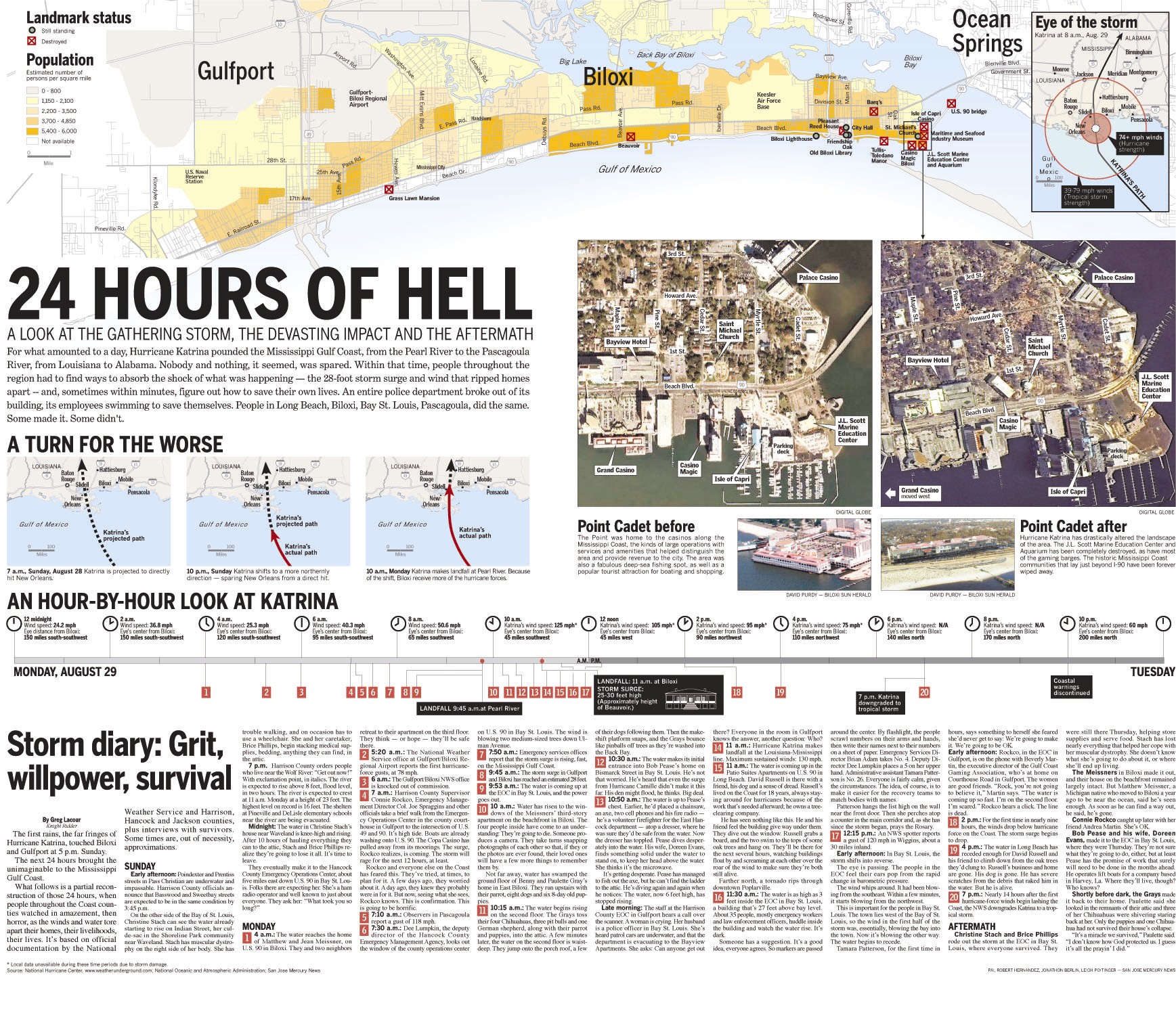
© 2005 Sun Herald
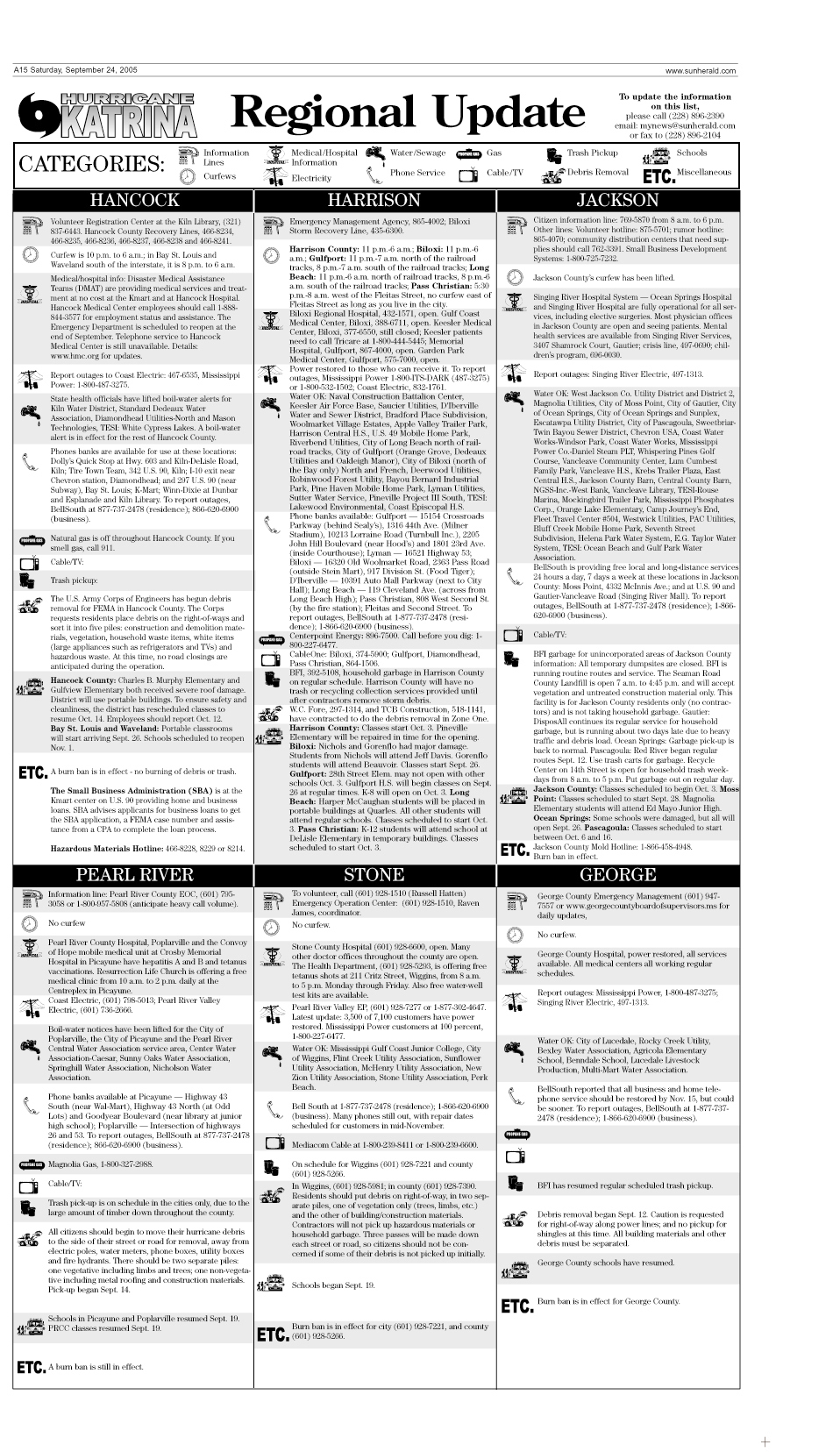
© 2005 Sun Herald
It may go down in history as the Gulf Coast Diaspora. Or perhaps the Gulf Coast Gold Rush.
More than 1 million people from a three-state region have been scattered to points near and far because of the devastation wrought by Hurricane Katrina. They're homeless, or jobless, or both; young and old; rich and poor; native-born and those who'd adopted this place.
Some will never return.
The exodus of those with no homes or jobs - along with those who are just weary of putting up with hurricanes - could be as dramatic as the flight from the Dust Bowl, when drought caused poverty-stricken Okies to flee westward, or the decades-long Great Migration of blacks to the industrial cities of the North.
That would be the diaspora.
But there's something about this potential exodus that makes it different. In this case, there may be no end to the list of people and investors willing to fill the void, much as they've done for years in hurricane-prone Florida.
That would be the gold rush.
"We can look to Florida as sort of a bellwether. Have you seen people fleeing the beaches?" asks Ronald Cossman, a social science researcher at Mississippi State University.
Newcomers who were beginning to discover the Gulf Coast and its low cost of living before Katrina are unlikely to turn away now. They'll come in droves - and that could change the social and economic fabric of South Mississippi and surrounding areas forever.
Homes and jobs
The devastation wrought by the Category 4 hurricane that struck Aug. 29 is mind-numbing. Homes and businesses all across coastal Mississippi were swept away by winds and water. Portions of U.S. Highway 90 look like they were twisted and crumbled by an earthquake.
The hurricane obliterated coastal Pass Christian, Long Beach, Bay St. Louis and Waveland, and cut out beachfront portions of Biloxi, Gulfport, Ocean Springs and Pascagoula.
David Swanson, professor of sociology at the University of Mississippi and director of the university's Center for Population Studies, did a preliminary study that shows some staggering numbers.
In Mississippi, 80 percent of housing in Hancock and Harrison counties and 60 percent of housing in Jackson, Pearl River and Stone counties may have been destroyed. That translates to 127,146 housing units valued at $10.7 billion, and 293,991 displaced persons.
In four Louisiana parishes - Jefferson, Orleans, Plaquemines and St. Bernard - as many as 100 percent of housing may have been rendered uninhabitable. Two other parishes, St. John the Baptist and St. Tammany, may have had as much as 60 percent of their housing destroyed. The toll comes to 494,827 housing units valued at $48 billion and 1.1 million displaced persons.
Overall, Katrina wiped out 621,973 housing units valued at $59 billion, and displaced 1.4 million people, according to Swanson's preliminary numbers.
Figures compiled by the American Red Cross are more conservative. The Red Cross estimates of 171,000 South Mississippi dwellings, more than 65,380 or 38 percent, were destroyed and 38,600 sustained major damage. Add Louisiana to the mix and the number goes to 400,000.
And then there are the jobs, or lack thereof.
Government figures released Thursday show 279,000 people were thrown out of work by Katrina, a figure that doesn't include those not yet seeking unemployment benefits. Some private economists predict a half-million people or more will have lost jobs by the final count. The Congressional Budget Office puts Katrina-related job losses at 400,000 for the final four months of the year.
Add to that the number of people who are weary of dealing with hurricanes and it appears the movement of people will be significant, experts say.
"It's pretty clear not all of them will go back to doing what they did before," Swanson said.
He and others from the University of Mississippi have asked evacuees if they planned to return and found that 30 percent weren't interested in going back home.
Reluctant migrants
That's the bottom line question: How many will stay and how many will find a new place to call home?
It boils down to: What is built to replace what was lost; the financial means of the evacuees; and, to a large extent, their state of mind, ranging from attachment to place to fear of another hurricane.
Most who left did not want to, said Bill Frey, a Brookings Institute demographer who specializes in migration issues. He said this region of the country is characterized by residents with a strong attachment to place and culture.
"I think the people who left, especially in New Orleans, are people who would not have left under almost any circumstances," said Frey, noting a high percentage have lived their whole lives in the Crescent City.
"These are hard-core (residents) that stayed during economic downturns," Frey said. "They have this very strong attachment. These are very reluctant migrants."
The same can be said in Mississippi.
"We have one of the highest percentage of native-born," said Cossman, assistant research professor at the Social Science Research Center at MSU. Just over 74 percent of the state's population was born in Mississippi. In Louisiana the figure is 82.4 percent.
Ties along the Coast may be less strong. Census figures show just 52 percent of residents of the Biloxi-Gulfport-Pascagoula metro area were born in Mississippi.
Cossman said people will return to New Orleans and South Mississippi if they have a strong social network in the area - an emotional investment. And that, to a certain extent, will be determined by whether friends and relatives stay.
"If you're part of a family, a network or community, that's a pretty strong draw," Cossman said.
But, as with other large migrations, the evacuees may find ties elsewhere. Frey said evacuees may move from their initial place of refuge to areas of the country where they have traditionally migrated, and form expatriate communities.
New Orleans expatriates, for example, have a large presence in Oakland, Calif. Other people from Louisiana have migrated to portions of Texas and Maryland.
Emotional attachments aside, there are some very tangible financial reasons that will determine whether the displaced will stay away. A lot of people whose homes were damaged or destroyed due to storm surge did not have flood insurance, Cossman said.
"These people have lost their wealth. They had all that home equity, and now it's wiped clean and there's no one who is going to pay them back for that," Cossman said. "A lot who will want to rebuild will not have the resources to do that."
Those evacuees who did not have the means to leave on their own likely don't have the means to return. Cossman said these are the ones who will have a harder time getting back, though they might have the strongest family and community ties.
Frey said the middle class and the more affluent are in a much different position. They have a wider range of choices and might or might not return.
Mike Gossman, administrator of the Cedar Lakes Surgery Center, will be able to rebuild. He lost his home in Ocean Springs, as did every neighbor on his street. He had all the insurance he needed, including flood coverage, he said.
He's displaced, but not dispersed to another part of the country. He's staying with his in-laws in Ocean Springs. He'll be moving into another house in Woolmarket so he can rebuild - if insurance premiums don't rise too much.
"We want to rebuild. We have deep roots here, with good friends and neighbors," said Gossman, who was born in Pensacola and has lived in Biloxi, New Orleans, Slidell, Tampa and Clearwater, Fla.
He said it never crossed his mind to move out. "This is my home. Why would I leave?"
But many of those who evacuated to north Mississippi and beyond will look for a job there - and if they find one they may never return to the Coast, Cossman said.
"Maybe what you'll see is the breadwinner coming back, but they may leave their family in place in Starkville or Memphis," Cossman said.
If rebuilding takes too long?
"Six months or a year from now are they going to come back? If there are opportunities for them, they will," Frey said.
They will if Florida is any indication.
The Sunshine State rebounds
Florida might be the best example.
Stan Smith of the University of Florida thinks South Mississippi will have a temporary population loss, but it will primarily be because it will take time to rebuild.
"I think when you're looking at say the Alabama-Mississippi Gulf Coast, you might have a similar situation to Florida, especially after Hurricane Andrew. There were a whole lot of units destroyed or damaged and a lot of people moved out short-term, but most of them eventually returned," he said.
The permanent loss for Miami-Dade County after Andrew was 40,000 residents, of which 15,000 left the state entirely. That, Smith said, represented two years of growth. It was more than made up in short order.
"After that, the growth continued as it had been before," he said. "My guess would be that most people (in Mississippi and Alabama) will decide that, either because of the other amenities of the area or family ties, it's still a pretty good place to live."
New Orleans, Smith said, is a different case. One of the key reasons is the number of homes left uninhabitable is large - and most were damaged by floodwaters.
"My understanding is that a pretty substantial part of the housing stock was fairly old. Given the contamination as well as the water damage, thousands of homes are going to have to be demolished," Smith said.
A lot of rethinking will have to be done on just how to build a city that is below sea level and depends so much on a system of levees to protect homes and businesses. That could mean different types of housing for the flooded areas.
"It may price it out of the range of low-income people that might have been there before," Smith said.
The inflow
Swanson said with every emigration others flow in to replace them. But past ones did not involve anything like a rush. Any vacuum caused on the Gulf Coast may be quite different.
He said he knows new residents will come, "but I don't know what it's going to look like." For now, most of the newcomers fall into the category of cleanup, repair and construction workers, he said.
The first to come are the "pioneers," generally single men or men who left the family elsewhere. They come to earn money, then return home. But some will end up staying and bringing their families.
"They're not considered residents, but they're there," Swanson said of the newcomers. "Some who come down - it's the classic story of migration - some of them stick and send word back to their hometown."
One of the most notable groups of newcomers are Hispanic, going where the jobs are and clustering with friends. They include workers from Mexico as well as U.S.-born Latinos.
But there will also be the well-to-do, looking for an opportunity to buy up waterfront property that traditionally is the most valuable. One real estate agent in Jackson County said a New York developer was seeking to buy land along the Coast, including sites to build homes for themselves. And just last week a condo developer inked a deal to buy some beachfront land in devastated Pass Christian for $2 million.
"If I had property down there I would not sell to the first person who came along," said Swanson. "It's high-amenity property."
The rebuilding
That the cities will be rebuilt is a given.
It was suggested early on that maybe New Orleans should not be rebuilt because it sits below sea level and the rupture of the levees proved so costly. But it's not the only place in that position. Look at the Netherlands and Venice.
Besides, rebuilding is part of the human condition. It happened in Chicago after the 1871 fire, in Galveston after the 1900 hurricane and in San Francisco after the 1906 earthquake.
The nation after World War II embarked on efforts to rebuild European and Asian cities devastated by years of armed conflict.
The rebuilding will take tens of billions of dollars. And what will eventually rise in New Orleans and South Mississippi will look different. Some of the things that made New Orleans unique remain, including the French Quarter and the Garden District. But scant little of South Mississippi's unique waterfront vista is left.
Author Harry S. Dent Jr., chief economist of High Street Financial, an investment management firm in Tampa, said the rebuilding will mark the beginning of a boom.
"As we saw with Hurricane Andrew, there was a building boom and rejuvenation," he said. "You get to redo things right."
For the areas devastated by Katrina, that could include putting Mississippi's casinos on land instead of in the water - and New Orleans can make levees better. Dent likened it to the way a forest fire permits new growth.
Gulfport-based contractor David Dennis, a member of the Federal Reserve Board of New Orleans, said this is a time to put a master plan together that could include everything from height restrictions to new zoning options.
But just how to "redo things right" could be a source of tension between newcomers and long-time residents.
There are already early indications the condominium boom just begun in South Mississippi - 65 projects and 11,000 units on the drawing boards before the hurricane - is likely to kick into high gear.
Two structures on the Gulfport shoreline left standing were the twin Legacy Towers. The sales manager said it proved beachfront condo construction is safe.
But that raises another issue: Will the codes and the new buildings make it too expensive for some to live here?
Past migration studies focused on the social conflicts that arose in areas where Okies and Southern blacks settled. This time, how the place they left - the Gulf Coast - redevelops may be prime material for study.
Dennis has high hopes for this area's future.
"The idea is to take this as an opportunity - a tragic opportunity," he said.
© 2005 Sun Herald
Hurricane Katrina dealt South Mississippi a devastating blow. Gone are many landmarks that used to be a part of our culture. Gone are many people's homes and belongings. Gone is much of the history that helped define our region. The greatest loss of all, however, is the loss of life, people we will never forget --- our family members, friends and neighbors.
Today, on Page A-16, we begin a series titled "We Remember" to pay tribute to the people who lost their lives when Katrina came ashore Aug. 29.
If you would like to share a favorite story of one of those people and a photograph, if you have one, please contact the Sun Herald at (228) 896-2309 (leave the person's name and town, your name and your call back phone numbers) or you can send e-mail to [email protected].
--- THE EDITORS
Dr. Louis Maxey Sr.
Dr. Louis Maxey Sr. had a book inside him. "He always wanted to write about the life and times he grew up in and the opportunity that blacks did or did not have," said one of three sons, Louis Maxey Jr., an assistant district attorney in Racine, Wisc. "He felt fortunate to be able to do all he did, but nobody gave it to him.
"Somehow he transcended race, and people saw that. They saw his genius and his skill and they didn't let race cloud their judgment. He always had white patients."
The New York Times reported the Indianapolis native was one of the first blacks to be a resident physician in plastic and maxillofacial surgery at Chicago's Cook County Hospital. He also had pharmaceutical and dental degrees and was appreciated as a "teacher" of many things. Pointing out the best way to do things was his way.
"I don't know why he didn't write that book," said his namesake. "A lot of us have books in us and never do write them."
Once Maxey and his wife, Harneitha, retired on the Mississippi Coast, his teaching tendencies surfaced as a school mentor and in local volunteer health programs. But not to be forgotten was his love of music rooted in the Southern black tradition. Maxey served as the first president of Mississippi Gulf Coast Blues Commission.
- KAT BERGERON
October 6, 2005
Harneitha Maxey
In a scene reminiscent of old-style comedy, Harneitha Elizabeth Maxey ran down the hill after her son in a runaway golf cart. But this was for real.
"Mom wasn't fast but she was fast that day," said Roger Maxey of Jackson, who was 7 when his parents house-shopped on the Mississippi Coast and the agent asked him to park a brakeless cart.
"With my mom chasing me I knew it would be all right. It gave me a lasting image of my mom that no matter what I did or where I went she would always be there for me, trying to help."
In 1980 the Maxeys bought a Long Beach house because Dr. Louis Maxey Sr. was tired of cold winters. The couple stayed in their home during Katrina because an arduous 2004 Hurricane Ivan evacuation aggravated her husband's health.
Harneitha, 75, was born in Seneca, S.C., and is remembered as "an all-around, classy, sophisticated, warm, loving - everything." The registered nurse met her husband at the noted Provident Hospital in Chicago, left nursing to raise three boys, but when they moved to the Coast she worked in her husband's plastic surgery practice.
A 1993 retirement became a joke. Recalled Roger, "Every time I came home, she was heading out - the symphony board, the garden club, the book club, the Democratic Women, or just to help somebody."
- KAT BERGERON
© 2005 Sun Herald
Parishioners of St. Clare Catholic Church would be ringing their bells, if they could find them. The bells disappeared, along with the Waveland church, its elementary school and the rectory.
The reason for celebration centers on a letter the Rev. Martin Gillespie received Thursday. Bishop Thomas Rodi wrote that after "prayerful consideration" he has decided the parish can rebuild the church on the same beachfront site.
"Everyone has been so happy with the letter. The roots of St. Clare go so deeply in Waveland," said Gillespie, the church's parochial administer since July. "For the bishop to decide 'yes, it is important to rebuild' is a testament of faith and hope."
Much of Waveland was destroyed or flooded in Katrina.
On Monday Gillespie will fly to Woonsocket, R.I., to secure a bus donated by a school bus company and drive it to Stamford, Conn., for Operation Load the Bus. The parish there collected school supplies for St. Clare. Where they will build the new school on the 25-acre site is not yet decided, but the rectory and church will be rebuilt on the same foundations.
Waveland Catholics got a mission church at that site in 1882, although St. Clare wasn't established until 1919. The buildings that Katrina claimed were constructed after Hurricane Camille claimed all but a 1957 bell tower. Katrina took that.
- KAT BERGERON
© 2005 Sun Herald
Surveyors: Storm Water Topped at Least 28 Feet
By Don Hammack
The surveyors who've helped map Hurricane Katrina's storm surge continue to refine their data, but one thing seems certain. Every suspicion that the storm was as bad as any we've ever seen is being confirmed.
On Scenic Drive in Pass Christian, there's a water mark inside a house that's been measured at roughly 28 feet. Two others in the neighborhood confirm it.
At Interstate 10's Jourdan River bridge in Hancock County, there's a debris line on the east end that's about 28 feet. Another mark at the Turkey Creek bridge in Gulfport shows the same surge.
At the Beach Mini Mart near the east end of the U.S. 90 bridge over Biloxi Bay, an inside mark measures 20 feet.
Along Interstate 10's Pascagoula River bridge, it's about 13 feet.
"The flood elevations are extraordinarily high," FEMA's Todd Davison said. "Anybody who has studied storm surge, these are well in excess of 100-year flood numbers."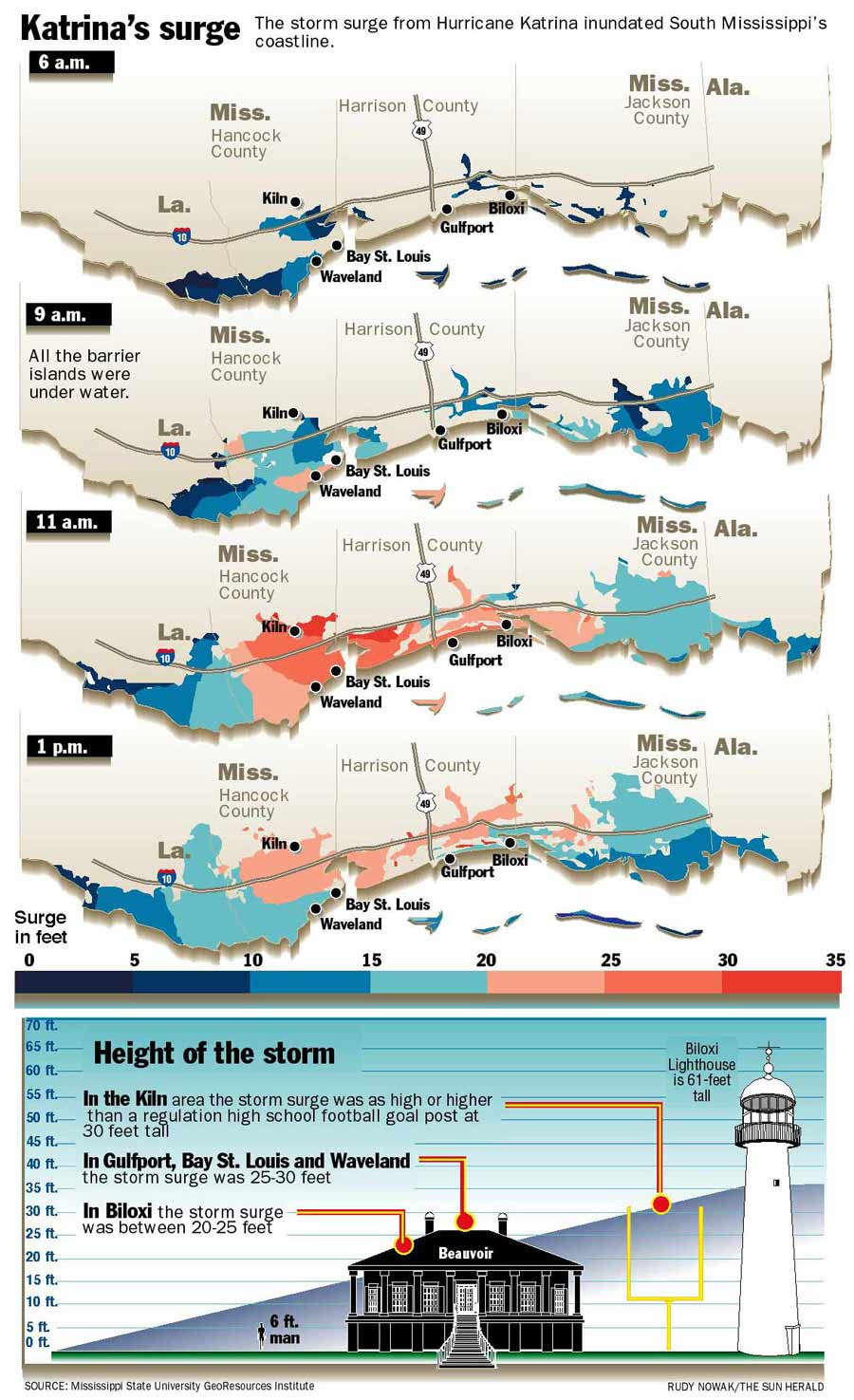
FEMA spearheads compiling the surveying data and hopes to release the first round of tabular data this week. A high-resolution online map should be available in mid-November.
The agency has already released suggestions to city officials on how to rebuild, making a first-cut prediction at what the ultimate goal of this project is, an updated 100-year flood zone map.
Working backward
The efforts to measure Katrina's storm surge are an effort in forensic meteorology. Think "CSI: Gulf Coast" with surveyors taking the place of coroners and investigators, plumb bobs, GPS units and spray paint instead of DNA kits, rubber gloves and toe tags.
Soon after the storm, teams from three government agencies hit the ground in South Mississippi. Most of the information that's been released has come from the U.S. Geological Survey team's work along the I-10 corridor.
The Army Corps of Engineers' Mobile office hit east Jackson County, where it was easier to access with the I-10 bridge damage. FEMA contracted URS Corporation, a huge international engineering firm that's also involved in preparations to rebuild the U.S. 90 bridges, to go in and fill in the rest of the map.
A preliminary compilation of data shows 100 locations that have been measured, although less than a third have rough elevation numbers calculated.
Survey crews look at a variety of indicators to measure storm surge. Typically, they look inside buildings because waves don't blur the true height of the surge.
"If it was inside somebody's home, they didn't want to go in there and spray paint the walls," said Mickey Plunkett of the Jackson USGS office, "so they'd get a surveying instrument inside and tie it to a fire hydrant or wheel curb outside."
Katrina has caused extra difficulties because many benchmarks used in surveying were washed away or damaged. The USGS crews, for example, used the surface of the I-10 bridges, which are known heights from the state transportation department, to measure from.
Computer simulations help
Trying to figure out exactly what happens during a storm is difficult. It's up to computer modeling to take a look at what happened.
"The reason we run the computer simulations is the observations break down," said Pat Fitzpatrick, Mississippi State University's GeoResources Institute hurricane expert. "The tide gauges are all destroyed by the storm."
The GRI has run models for Katrina showing the storm's impact in motion. It and LSU are the only schools that run the Advanced Circulation Model, according to Fitzpatrick. He says it's better than the National Weather Services model, using parallel computing power to examine small chunks of water that can model bayous, canals and coastal contours better.
The two models use the same equations, inputting wind data from the National Hurricane Center, hurricane eye size, the breadth of hurricane- and tropical storm-force winds and speed of movement.
The most accurate simulation takes into account the tides, but takes several weeks to run. The simulations done for Katrina were done without, creating a 2- to 3-foot error in an area that doesn't feature a wide range of tides. In the Mississippi simulation, Waveland starts taking on water on Aug. 29 at 5 a.m., with water moving up the Jourdan River. Three hours later, water is 12 to 15 feet high in Waveland and areas around Biloxi are starting to flood.
At 11 a.m., there are dramatic differences. Water is five miles inland west of Bay St. Louis, at 27 to 33 feet. The rest of the Mississippi Coast has major inundation with surge heights of 18 to 24 feet. Fitzpatrick's team also ran simulations on Louisiana, which yielded interesting results. He doesn't think Lake Pontchartrain got high enough to overflow its levees into New Orleans.
Instead, the computer results imply that there was a structural failure in those levees.
What happens now?
Mapping all the real-world data continues, and it will do so for quite some time. FEMA will release a series of maps like it did after Ivan hit Alabama and the Florida Panhandle (www. fema.gov/ivanmaps). They will start with the mid-November maps. Eventually, there will be very interactive products online, with links to photos of actual locations where the measurements were taken.
But the ultimate goal of the effort is a revision of the 100-year, or one-percent flood maps used by the insurance and financial industry to set rates and determine where money should be loaned to rebuild.
The advisory information that went out is the first step in that.
"If you're a good driver, you get better rates. If you're not a smoker, you get better rates," he said. "Floods are the same. People who use the advisory information will get better rates."
Katrina's massive storm surge will change the way South Mississippi thinks about storms. It'll do so beyond the psychological impact she's brought to the area, in more concrete ways like this flood map.
Davison said that it won't strictly reflect Katrina. Experts think it's beyond the pale of a 100-year event.
Instead, it will take into account the 25 years or so since the last revision that have changed the historical basis for the maps, storms like Elena, Opal, Ivan and Dennis.
"It's fair to say the 100-year is going to go up," Davison said, "but they won't go to the Katrina levels."
© 2005 Sun Herald
By Herald Staff
BILOXI --- Enter the developers.
A day after plans were introduced for a new South Mississippi, developers from across the region converge on the Isle of Capri Casino Hotel to take a look at the designs.
How many will show up and how many will be interested is anybody's guess. More than 2,000 developers from across the region were invited.
The meeting follows by one day Monday's heavily attended closing session of the six-day Mississippi Renewal Forum, where leaders from 11 communities battered by Hurricane Katrina looked at detailed plans for their cities.
The designs spotlighted Monday reflect new urbanism, which calls for walkable communities with mixed uses, including affordable housing. The architects worked closely with local designers to ensure the styles hark back to the Mississippi styles of the past.
Former Netscape CEO Jim Barksdale, who heads the Governor's Commission on Recovery, Rebuilding and Renewal, said the new urbanists are a "wonderful group of people."
Barksdale, a Mississippi philanthropist who along with the Knight Foundation is funding the governor's commission overseeing the rebuilding, said the designers worked day and night like "architects on steroids."
Andres Duany, founding principal of Duany Plater-Zyberk of Miami, led the huge effort to come up with new designs for 11 cities that would incorporate the essence of each community. They did it in part by talking at length with local residents and poring over old pictures.
"All I did was be confident that it could be done," Duany said about the undertaking, which involved 200 designers, architects, code specialists, engineers and others. He said they put together "first-rate designs for regular folks."
Duany, considered the father of new urbanism, said many of the participants in the design teams were from the Coast and some of them lost everything, yet they still continued to work. That's an indication of the "spirit of Mississippi," he said.
Duany urged those in the room to raise their expectations. Every chain outlet has better and worse models, he said, and South Mississippi should not settle for less.
"Here what you're getting is the low-end Wal-Mart. And the reason is that they think you will expect it," said Duany.
"If you have the mentality that your city is a beggar, that you're grateful for the jobs and the tax base, they will give you the low-end model," he said.
"But if you say, we're too good for that, if you demand that you get the high-end model, then you will get that."
The plans that are being shown to local people are simply possibilities for the rebuilding. Coast cities may or may not adopt the plans, even though the designs fit together as a coherent package.
Gov. Haley Barbour, who gave only brief opening comments because he wanted to see the result of the planners' work, said local people will be making the decision. But Duany and his team helped "illuminate the choices."
The designers who came are all advocates of smart growth and new urbanism, which seeks to build walkable communities that minimize the use of autos as an alternative to urban sprawl.
They use a charrette --- an intense brainstorming session --- to develop plans based on feedback from the community. But the event in Biloxi was the largest ever undertaken and attracted the interest of the national media.
What appeared to be near-nonstop work was done primarily in the ballroom at the hotel. Eleven teams for each of the cities along with specialized teams for broader issues, such as transportation, sat around tables to discuss issues and to put the ideas on paper.
Despite the upbeat presentation, the major issue that continues to overshadow the work is the concern over new standards that may be required from FEMA. The agency last week issued an advisory warning that flood insurance rate maps will likely push the high hazard zone farther inland, and that buildings in those zones will have to be elevated many more feet.
The forum, which is just one part of the governor's commission's broad effort to rebuild South Mississippi, ended Monday. Team leaders will be working for the next two weeks at home to prepare a final report.
© 2005 Sun Herald
Satellite technology is showing new advisory flood elevations, lot by lot. It will also show Katrina's surge.
By Anita Lee
GULFPORT - Beginning Nov. 18, South Mississippians can go to the Internet and pinpoint flood elevations recommended for construction on coastal property.
FEMA is using satellite technology to generate maps showing new advisory flood elevations, lot by lot. Maps also will show Katrina's tidal surge, which was even higher.
Quite frankly, in terms of hurricane storm surge, nothing compares to Hurricane Katrina. Not even close," Todd Davison, FEMA's mitigation director for this region, told theSun Herald on Wednesday. He said the surge from Hurricane Camille in 1969 was 10 feet or more lower.
Katrina's highest recorded surge was 35 feet, on the Mississippi Sound in west Pass Christian.
While new advisory flood elevations are lower than Katrina's surge, they are 3 to 8 feet higher than current flood elevations in the three Coast counties.
FEMA is urging Coast cities and counties to require that residents build to the new advisory elevations, designed to minimize loss of life and property.
Governments that fail to adopt the elevations could jeopardize millions in federal dollars, including grants to homeowners for elevating their houses and funding to reconstruct public buildings at safer heights.
"These advisory maps are trying to advance what is the inevitable," Davison said.
Homeowners who build to the higher elevations could see discounted insurance rates.
In 18 months, FEMA expects to finish tweaking new flood elevations, bring them back to local governments for public review, then publish final insurance rate maps.
Local governments must then adopt the new maps or be dropped from the National Flood Insurance Program, started in 1968. Residents who rebuild at current elevations will pay rates from those maps.
The 1982 maps currently in use were developed using old data and technology. Davison said the budget to update maps was very limited until 2003, when Congress increased it six- to seven-fold as the intensity and frequency of coastal storms emphasized the need for better information.
FEMA was working on new Coast maps when Katrina hit. The agency produced them as quickly as possible so rebuilding could begin in South Mississippi. Developing the advisory elevations created debate within the agency, he said. "
No. 1 is timing," Davison said, "We have never tried to do anything this fast before and hold the science together."
The elevations show how high above mean sea level a building should be raised to minimize flood risk. There is a 1 percent chance in any given year that water will reach flood elevations.
"It's all about the elevation," Davison said. "The higher you go, the safer it is."
IN HIS OWN WORDS: "Quite frankly, in terms of hurricane storm surge, nothing compares to Hurricane Katrina. Not even close." "These advisory maps are trying to advance what is the inevitable . . We're not creating the flood risk. We are trying to accurately map it." --Todd Davison, FEMA's mitigation director.
© 2005 Sun Herald
Katrina took away Coast Vietnamese's life, work
A Vietnamese folk legend says in ancient times, the sea dragon Lac Long Quan married the mountain fairy Au Co and she gave birth to 100 children. Half of the children went with their mother back to the mountains, and half stayed to live off the sea.
From these 100 children came the Vietnamese people.
The 50 children who stayed with their father became fishermen. Thus those who make their living off the sea have an honored status in Vietnamese society.
The sea rose and took away much from the Vietnamese community along the Gulf Coast during Hurricane Katrina. In response, a collective of fishermen called the An Giang Fisheries Association from the Mekong Delta in Vietnam gathered $15,000 and gave it to the U.S. Embassy in Hanoi to distribute among their brethren here, reported the Thanh Nien Daily, one of Vietnam's largest newspapers.
Though it was a small amount compared to the devastation - for the 10,000 or so Vietnamese in South Mississippi, the hurricane ruined their principal occupations of shrimping and hospitality as well as their neighborhoods - it was a huge gesture from one of the world's poorest and last communist countries.
"The concern is that one of our own is suffering, starving in a foreign land," said Tuyet A.N. Tran, a community advocate and founder of New York-based viettouch.com, a Vietnamese cultural Web site. "Many in the Vietnamese diaspora have relatives in Vietnam still."
The Vietnamese community spread throughout America also was eager to help after the storm, said Huy Vu Bui, president of the National Alliance of Vietnamese American Service Agencies. The perception in the community here and abroad was that not enough was being done for a group of people who largely did not speak English and kept to their own.
That perception led to hundreds of thousands of dollars in donations from the Vietnamese government, American businesspeople and community organizations.
Interviews with dozens of Vietnamese living in South Mississippi did not reveal the same sense of abandonment by government that many in the outside community felt.
"They didn't do much for anyone," said Thuy Tran, 25, a manicurist in Gulfport who grew up in Pass Christian.
She said she did not feel the Vietnamese were ignored any much worse than anyone else and many Vietnamese spoken to in the last month agreed.
According to many of the interviewees, Vietnamese translators appeared in South Mississippi a little more than a month after the storm for agencies such agencies as FEMA and the Red Cross, while the Coast Guard had translators almost immediately after the storm to help in rescuing the many Vietnamese stranded on fishing boats.
The Rev. Dong Phan of the Biloxi Vietnamese Martyrs Church said finding comfort in community has been crucial since the storm. More than 70 percent of Vietnamese in South Mississippi are Catholic, and his church, one of several Vietnamese Catholic churches in South Mississippi, has been a cradle of the local community, providing spiritual guidance and a place to gather every day since the storm.
"There has been a lot of suffering," said Phan, a former chaplain in the South Vietnamese Army. He said he has been eager to get people together to help in the healing.
Just up the road from Phan's church at the Van Duc Buddhist Temple, the monks Thien Tri and Minh Nguyen have been trying to provide a sense of normalcy for their constituents.
The monks estimate only 30 percent of the local community is Buddhist, but said 80 percent in Vietnam are Buddhist. The monks hold daily meditation sessions and are especially able to empathize with their community - they rode out the storm in their temple's attic.
Nguyen said every monk is allowed four possessions: three sets of robes and one bowl.< Everything else must be donated by followers because Buddhist monks vow a life of poverty by tradition. Nguyen said all he has left now are the robes on his back.
The sense of loss is overwhelming in the Vietnamese community and it goes well beyond material possessions.
Thuy Tran's parents lost everything to the storm. Her father, Thin Tran, 58, was a shrimper who stayed on his boat in hopes of saving it but barely escaped with his life. Now, like the hundreds of older Vietnamese shrimpers who know nothing other than shrimping and cannot afford a new boat because of a lack of insurance and an already-dismal shrimping season, Thin Tran does not know what he can do.
Thuy Tran lost her old job at the Wal-Mart in Waveland and now lives in her overcrowded apartment with several homeless relatives, like most Vietnamese in South Mississippi.
The sudden loss of housing and jobs - a vast majority of Vietnamese either worked in the seafood industry or in a casino-related job - has sent at least 25 percent of their population elsewhere in America looking for work, said several Vietnamese interviewed.
Hai Tran, no relation to Thuy, was a welder in Mobile who lived with his three children, his wife, his parents, his brother and his sister on Division Street in Biloxi before the storm. His house was leveled by the flood water and he now lives with just his mother, wife and kids because his father and siblings have gone from New York to California in search of jobs.
"I lost everything I got," Hai Tran said, adding he is grateful to have a FEMA trailer to live in. "I don't have money to rebuild my house. I applied for an SBA loan. I stay here for my family."
South Mississippi's pleasant climate and ties to the sea are what keep many Vietnamese here. While the sea took so much away, many said there is much that it can give back and that is their hope for the future.
© 2005 Sun Herald
Katrina's toll in Mississippi
As Aug. 29 recedes into the conscious time of many Americans, the great storm that devastated 70 miles of Mississippi's Coast, destroying the homes and lives of hundreds of thousands, fades into a black hole of media obscurity.
Never mind that, if taken alone, the destruction in Mississippi would represent the single greatest natural disaster in 229 years of American history. The telling of Katrina by national media has created the illusion of the hurricane's impact on our Coast as something of a footnote.
The awful tragedy that befell New Orleans as a consequence of levee failures at the time of Katrina, likewise, taken by itself, also represents a monumental natural disaster. But, of course, the devastation there, and here, were not separate events, but one, wrought by the Aug. 29 storm.
There is no question that the New Orleans story, like ours, is a compelling, ongoing saga as its brave people seek to reclaim those parts of the city lost to the floods.
But it becomes more and more obvious that to national media, New Orleans is THE story - to the extent that if the Mississippi Coast is mentioned at all it is often in an add-on paragraph that mentions "and the Gulf Coast" or "and Mississippi and Alabama."
The television trucks and satellite dishes that were seen here in the early days have all but disappeared.
While there has been no study to quantify the amount of coverage accorded to the plight of so many here or in New Orleans, it is obvious to any observer that the number of news stories on New Orleans is many times that of those focused on Mississippi.
So, why does that matter?
It matters first as it relates to journalism's obligations to cover human beings whose conditions are as dire as those that exist here.
The depth of the suffering and the height of the courage of South Mississippians is an incredible story that the American people must know. But, in the shadows of the New Orleans story, the Mississippi Coast has become invisible and forgotten to most Americans.
Could it be possible that the ongoing story of an Alabama teenager missing in Aruba has received more coverage on some cable networks than all of the incredibly compelling stories of courage, loss and need of untold thousands of Mississippians? Maybe a lot more coverage?
The second reason that the coverage matters is in the realm of politics. If the American people and their elected representatives do not truly know the scope of the destruction here, and if they are not shown the ongoing conditions afflicting so many, then there are consequences which are playing out even this week in Washington, where Congress will act, or not act, to relieve the incredible pain that has reduced the condition of so many American citizens to Third World status or worse.
If the people do not know, they cannot care.
We believe if they are shown the extent of the devastation and the suffering, they and their representatives will respond.
So the coverage matters. A lot.
The problem, to some extent, is that you have to be here and see it for yourself to comprehend the utter destruction that is so much like Berlin or Tokyo after World War II.
We would like to invite our news colleagues from across the nation to come and view the Coast with us. It is impossible to comprehend this disaster from afar. A television can display only a single screen of the damage. When you have driven mile after mind-numbing mile and viewed the complete nothingness where cities and homes and businesses once stood, only then will you begin to understand what has happened here.
Then you will begin to wonder, where are all the people who used to live on this beautiful shore? What has happened to their families and all of those shattered lives? That is when you will understand that the story of Katrina in South Mississippi isn't over, it has only begun.
On the third day after Katrina crushed us, this newspaper appealed to America: "Help us now," the headline implored. America answered with an outpouring of love and help. That response saved us then.
Our plea to newspapers and television and radio and Web sites across the land is no less important today: Please, tell our story. Hear the voice of our people and tell it far and wide.
We are here. Do not forsake us.
We are no footnote.
And one more thing...
Thank you. To every out-of-state volunteer, to every friend and family member who has sent supplies or prayers, we sincerely thank you.
And we ask that you do one more thing: Call your senators and your congressional representative and ask them to support additional aid for South Mississippi's recovery.
We couldn't have gotten off our knees without you. But we can't get back on our feet without federal help.
| Katrina's toll in Mississippi | |
| $125 billion | Estimated dollar amount of damage caused by Hurricane Katrina |
| 231 | Identified dead statewide |
| 5 | Unidentified dead |
| 67 | Missing |
| 65,380 | Houses in South Mississippi destroyed |
| 383,700 | Mississippi insurance claims filed (Katrina and Rita) |
| $5 billion | Claims paid (as of Nov. 21) |
| $141,000 | Insurance claims filed in South Mississippi |
| $1.3 billion | Claims paid in South Mississippi |
| 44 million | Estimated cubic yards of debris in South Mississippi |
| 21.8 million | Cubic yards removed as of Dec. 5 |
| 20,447 | Red Cross staff and volunteers in Mississippi |
| 5,543,006 | Red Cross meals served |
| 42,768 | People sheltered by Red Cross |
| 229 | Red Cross shelters opened |
| $185 million | Red Cross money spent in South Mississippi as of Nov. 30 |
© 2005 Sun Herald