Los Angeles Times, by Los Angeles Times
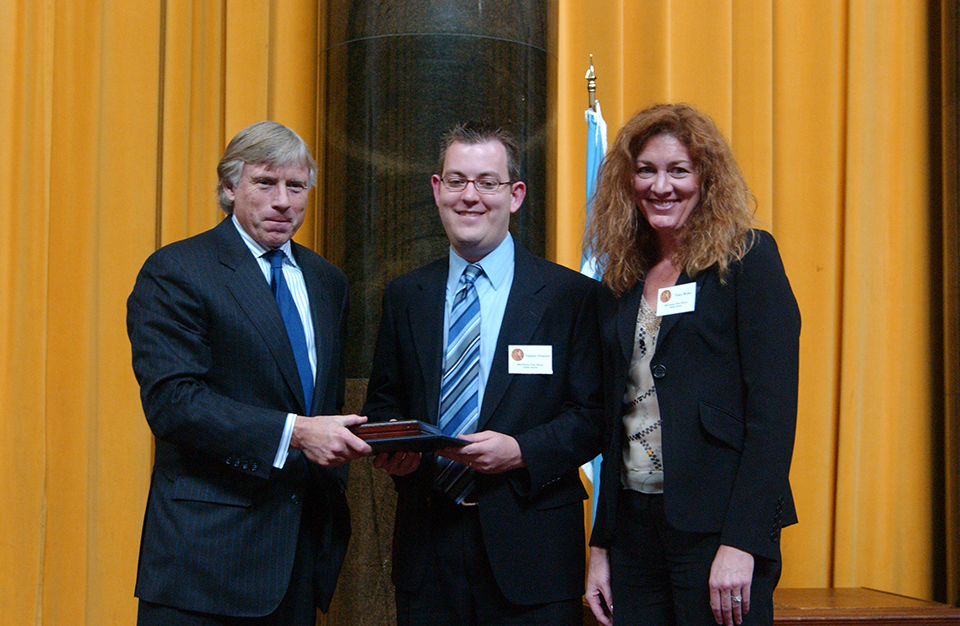
Columbia University President Lee C. Bollinger (left) presents Charles Ornstein and Tracy Weber of the Los Angeles Times, with the 2005 Pulitzer Prize for Public Service.
Winning Work
By Tracy Weber, Charles Ornstein and Mitchell Landsberg
A Times investigation finds King/Drew far more dangerous than the public knows. Community pride, timid county leadership stand in the way of a remedy.
On a warm July afternoon, an impish second-grader named Dunia Tasejo was running home after buying ice cream on her South Los Angeles street when a car sideswiped her. Knocked to the pavement, she screamed for help, blood pouring from her mouth.
Her father bolted from the house to her side. An ambulance rushed her to the nearest hospital: Martin Luther King Jr./Drew Medical Center.
For Elias and Sulma Tasejo, there was no greater terror than seeing their 9-year-old daughter strapped to a gurney that day in 2000. But once they arrived at King/Drew, fear gave way to relief.
Dunia's injuries were minor: some scrapes, some bruises and two broken baby teeth. The teeth would have to be pulled.
"They told me to relax," Sulma recalled. "Everything was fine."
At least, it should have been.
What the Tasejos didn't know was that King/Drew, a 233-bed public hospital in Willowbrook, just south of Watts, had a long history of harming, or even killing, those it was meant to serve.
Over the last year, reports by journalists and regulators have offered stark glimpses of failings at King/Drew: Nurses neglecting patients as they lay dying. Staff failing to give patients crucial drugs or giving them toxic ones by mistake. Guards using Taser stun guns on psychiatric patients, despite an earlier warning to stop.
Over the same period, a team ofTimes reporters has been systematically examining the hospital. They conducted hundreds of interviews, studied years of malpractice cases and reviewed records of the hospital and its regulators. They looked closely at individual departments and physicians. And, to put their findings in perspective, they consulted outside experts in hospitals and medical care.
The investigation reveals that King/Drew is much more dangerous than the public has been told.
Among the findings:
Errors and neglect by King/Drew's staff have repeatedly injured or killed patients over more than a decade, a pattern that remains largely unscrutinized and unchecked. Some lapses were never reported to authorities -- or even to the victims or their families. And some people learned of the severity of the failings only by suing or, in several instances, from Times reporters who sought them out to learn about their care.
Although King/Drew opened in 1972 with the promise that it would be "the very best hospital in America," it is now, by various measures, one of the very worst. It pays out more per patient for medical malpractice than any of the state's 17 other public hospitals or the six University of California medical centers.
Entire departments are riddled with incompetence, internal strife and, in some cases, criminality. Employees have pilfered and sometimes sold the hospital's drugs; chronic absenteeism is rampant; assaults between hospital workers are not uncommon. Despite King/Drew's repeated promises to regulators, the problems have gone unfixed for years.
The hospital's failings do not stem from a lack of money, as its supporters long have contended. King/Drew spends more per patient than any of the three other general hospitals run by Los Angeles County. Millions of dollars go to unusual workers' compensation claims and abnormally high salaries for ranking doctors.
The hospital's governing body, the county Board of Supervisors, has been told repeatedly -- often in writing -- of needless deaths and injuries at King/Drew. Recently the supervisors have made some aggressive moves aimed at fixing the hospital. But for years, the board shied away from decisive action in the face of community anger and accusations of racism.
King/Drew, founded in the aftermath of the 1965 Watts riots, has stood for more than three decades as a symbol of justice and political power to many black people in South Los Angeles and beyond. In reality, if not officially, the hospital was established by and for African Americans; the majority of its staff always has been black.
"That hospital means hope to us," said Karimu McNeal, 52, an African American woman treated successfully for colon cancer at King/Drew in 2002. "When you go into the hospital and you see people that look like you and take care of you, it gives you hope for the whole race that we're achieving and doing something."
Mixed with community pride is an undercurrent of concern about King/Drew's standards. For about three decades it has been known by an unflattering nickname, "Killer King." Patients have fled ambulances to avoid it, according to paramedics and one ranking fire official. And police officers say they have an understanding among themselves that, if shot, they will not be taken there.
The Tasejos, immigrants from Guatemala, didn't know any of this the day their daughter was hurt. All they knew was that she needed help.
In the seven hours after Dunia's arrival, the hospital would commit a series of medical errors in treating her, each compounding the one before.
By the middle of that night, the couple were standing outside the pediatric intensive care unit, bewildered and increasingly frightened. Alarms were ringing and doctors were running by. The Tasejos tried to catch the eye of a physician who had reassured them earlier.
"He looked at me," Elias Tasejo recalled. "He kept walking."
Here is an account of Dunia's care, based on her medical records, a state health department investigation, a medical expert consulted byThe Times and interviews with her family:
To keep her still during a precautionary CT scan, her 65-pound body was pumped with enough drugs to sedate a grown man.
Paralyzed by the medications, she had to be hooked up to a ventilator to help her breathe. Its settings were wrong; a blood test showed she was being starved of oxygen.
The settings were adjusted to give her more. But inexplicably, an emergency room doctor ordered a trainee physician to pull out Dunia's breathing tube 20 minutes later. No one checked to see whether she could breathe on her own.
For the next two hours, Dunia's nurses failed to monitor her vital signs or breathing, records show. By the time she was transferred to the pediatric intensive care unit, she was flailing from lack of oxygen and calling, "Mama."
The medical resident who admitted her to the ICU was unable to operate a machine to check her oxygen levels, and didn't seek help for at least 15 minutes.
By then, Dunia's heart and lungs had stopped working. Doctors resuscitated her, but later that day she was declared brain dead.
After two days, she was removed from life support.
"This child should not have died," said Dr. Lorry Frankel, chief of pediatric intensive care at Stanford University's children's hospital, who reviewed Dunia's records for The Times. "If she had been taken to any pediatric center that had appropriate policies and procedures in place ... she would still be alive today."
Frankel described Dunia's care as "appalling" and "really pathetic."
After her death, a team of doctors took the Tasejos into a room and promised to find out what had killed her.
Elias Tasejo said the associate medical director handed him a business card. He kept it in his wallet for three years, thinking he might hear back. He never did.
"Our daughter is dead," he said earlier this year, "and we have no idea why."
Hospital defenders
What happened to Dunia, and others like her, rarely figures in the public debate over King/Drew. Community activists, who fought so hard for the hospital's creation, are far more consumed with the fear that it could be closed.
When King/Drew is threatened, it is often Lillian Mobley -- long the hospital's most visible defender -- who takes the microphone.
Last January, she stood facing about 200 people in an auditorium at Grant AME Church in Watts. As cheers of adoration washed over her, Mobley, a thin woman of regal bearing, thrust her chin forward in a characteristically defiant pose.
Moments passed. When the last voice had been stilled, when every head turned her way, only then did she speak.
"The hospital," she said gravely, leaning on a cane, "is being closed piece by piece."
There were murmurs, shouts of dismay.
"We have to stand together to fight this battle," said Mobley, her voice rising. "We have to rise every morning under God's will ... to save Martin Luther King."
That meeting, held to protest planned cutbacks at King/Drew, was one of many such gatherings she has addressed over the years.
Strong-willed and fiercely protective, Mobley, 74, is at the forefront of a coterie of African American leaders, most now in their 70s and 80s, who defend King/Drew with the same intensity that they once devoted to the civil rights movement.
To them, it is part of the same struggle.
Some vividly recall how things used to be, when they had to find a ride to the main county hospital some 15 miles away. It was a long trip if you didn't have a car -- and most people didn't. "Twenty-five dollars sick" meant you were in bad enough shape to pay for a cab across town.
Many remember the case of Leonard Deadwyler, a black man who in 1966 was rushing his pregnant wife from their home in Watts to County General Hospital (today's County-USC) in Boyle Heights when police stopped him for speeding. An officer approached his car and shot him to death. The shooting was determined to have been an accident, but many saw it as a racist killing.
They also remember how the voters of Los Angeles County, mostly white, refused to pay for King/Drew's construction, forcing Supervisor Kenneth Hahn to find money elsewhere. Even now, threats to trim the hospital's budget revive fears that whites are trying to take it away.
"We see something that we fought really hard for," said Dr. Herbert Avery, 71, an obstetrician who helped plan the hospital and served briefly on its staff. "And now it's being driven down under the ground under the guise that the people out there ... they're black and Mexican and they're too stupid to run a hospital and a medical school."
Mobley's group is small, and its members hold no elective office, yet they are the curators of King/Drew's dream. They are often called simply "the Community," reverently spoken, as with a capital C. It is a status they have guarded ever more zealously as the neighborhoods around them have become increasingly Latino.
"If you're going to work at King/Drew, you have to work with the Community," said Dr. Thomas Yoshikawa, chairman of the internal medicine department. "You just can't come in and say, 'I'm the new kid on the block. I'm going to play the game my way.' No, you have to play the game their way."
Defying them can draw charges of racism -- even when the transgressor is African American.
In the fall of 2003, members of Mobley's group paced the lawn in front of the hospital, as one bellowed through a bullhorn: "Marcelle Willock, you can't hide. We charge you with genocide."
Willock, who is black and Latina, is dean of the hospital's affiliated medical school at the Charles R. Drew University of Medicine and Science. The protesters contended that she had not done enough to protect and support key programs.
While racial politics sometimes play out on its expansive front lawn, inside the hospital, King/Drew's legacy is on display.
In the lobby are prominent portraits of King; his wife, Coretta; and local political dignitaries posing beside former Presidents Clinton and Johnson. A photograph of King being greeted by the late Supervisor Hahn is hung in two places there and in at least six others around the hospital.
Down winding hallways is one of the hospital's greatest points of pride -- a trauma unit with state-of-the-art equipment. More gunshot wounds have been treated here in recent years than at any other hospital in the county. Many in surrounding neighborhoods credit the unit's surgeons with saving their lives or those of their sons and daughters."There's a lot of violence in the world today, especially in this community," said Lee Russell, 40, yanking up his shirt to display rope-like scars from a November 2003 shooting and stabbing. He praised the King/Drew doctors and nurses, saying that if the trauma center hadn't been nearby, "I would be dead.... I'm their walking miracle.
Last month, the Board of Supervisors voted to close the trauma unit to focus on fixing the rest of King/Drew, which like other county hospitals treats patients regardless of insurance status. In September, the board agreed to hire private turnaround consultants for $13.2 million. The supervisors' actions were their strongest to date, brought about only by threats to King/Drew's federal funding and national accreditation.
The trauma unit's closure, especially, drew residents' ire. "Don't disrespect or underestimate our community," read a banner hung last month at a rally of more than 1,000 hospital supporters.
King/Drew has become the "proxy for an entire community's identity," said Los Angeles civil rights attorney Connie Rice, who is African American.
That creates tension between those who see the hospital in strictly medical terms and those who see it as an embodiment of their dreams for racial self-determination.
"You're talking about the fact that the nurses weren't trained to use monitors," Rice said, "and they're going back to '60s Watts."
Community of grief
Over the years, King/Drew has created another community, one bound by a common grief.
Jereatha Thomas belongs to it. She rushed her 27-year-old daughter, Demetria, to King/Drew in June 2003.
In the emergency room, printouts from three electrocardiograms stated plainly that Demetria Thomas had suffered a massive heart attack. Two labeled it "acute," the other "extensive."
No one acted on the findings for more than 10 hours, as doctors pursued other theories. By the time a cardiologist pointed out the obvious, it was too late, said two experts who reviewed her medical records for The Times.
Two days later, shortly after being transferred to Harbor-UCLA Medical Center for more specialized care, Demetria died.
Jereatha Thomas has never recovered. She moved out of the house she shared with Demetria, unable to live with the memories. She works three jobs until she's too tired to think.
"Since the time my daughter passed away, people have come up to me and said, 'My aunt, my uncle, my friend died the same way,'" Thomas said. "It was a lesson to be learned for me. I would never go back to King. Never, ever."
Thomas decided to hold the hospital accountable in the only way she knew how: She sued. Her case is pending.
Every hospital makes mistakes, some of them fatal. Filing a lawsuit is one of the few recourses patients and their families have when something goes wrong. But taken together, the malpractice cases involving King/Drew portray a place where things often go wrong -- sometimes in the same way, over and over.
King/Drew spent $20.1 million on malpractice payouts during fiscal years 1999 to 2003, an extraordinary sum for a public hospital its size in California. Adjusting for the number of patients the hospital saw, that figure is more than at any of the state's other public hospitals or the University of California medical centers.
Even County-USC Medical Center, which is three times larger and not without troubles of its own, spent less. (King/Drew's payouts cannot be compared to those at public hospitals outside the state, because California has strict limits on malpractice damages.)
The Tasejos' award was added to the tab this October, more than four years after Dunia's death. Weary of the legal battle, the family settled for $195,000.
Her father plans to build an altar at her grave in Guatemala, enshrining the dress and shoes she wore that July day.
"I want to get the [legal] papers so I can put them in the tomb and say, 'Look. It's over, honey,' " he said.
Malpractice awards are just one sign of trouble at King/Drew.
From 1999 to March 2004, the hospital was cited for violating California health regulations more often than 97% of hospitals statewide, according to a Times analysis of state data. It had more violations than any of the county's three other general hospitals.
The two most prominent national accrediting groups rate King/Drew among the nation's most troubled institutions.
It is the only hospital in America to have received the lowest possible rating in its last two reviews from the Accreditation Council for Graduate Medical Education. The group has ordered the closure of three of King/ Drew's 18 doctor-training programs: surgery, radiology and neonatology. A fourth, orthopedic surgery, may be phased out under pressure from the council.
King/Drew is also one of only seven U.S. hospitals that the Joint Commission on Accreditation of Healthcare Organizations has said should lose overall accreditation this year. The group accredits 4,579 hospitals nationwide. King/Drew has appealed the decision, but if it fails, it could be forced to close all its doctor-training programs and lose nearly $15 million in private insurance contracts.
"This hospital," said Dr. Dennis O'Leary, the joint commission's president, "has problems of orders of magnitude that are substantially greater than almost all other hospitals in this country."
Even the top county health official finds King/Drew's failings hard to fathom.
"I'm not sure who would imagine the depths of the problems," said Dr. Thomas Garthwaite, director of the Department of Health Services. "I'm not sure anybody has the life experiences to prepare themselves for this."
It is only through brutal experience that some patients and their families learn of the dangers at King/Drew.
Sherry Ridley, a 43-year-old airport security guard, underwent elective surgery there for ovarian cysts in November 2002.
First a doctor in training stitched through her colon in error, essentially blocking it, according to a surgical note in Ridley's medical records. No one caught the mistake for two weeks as her stomach painfully bloated. A second resident's belated repair job failed.
Over the next couple of weeks, a senior surgeon opened the patient up eight times, trying to scrub out a worsening infection. More medical equipment sprouted from Ridley nearly every day; wires and hoses protruded from her like tentacles. Swollen with fluid, she ballooned from 187 to 321 pounds. Bands had to be looped around her abdomen to hold her incision together.
Ridley, the mother of two sons and one of seven close-knit siblings, died five days after Christmas.
"My sister went in there healthy," said Gail Gordon, her eldest sister. "She went from a human being to a monster when she passed."
The number of patients harmed or killed at King/Drew is impossible to tally.
The Times asked Michael Pine, a national health quality expert, to compare complications and deaths at King/Drew with those at all other hospitals in California. After reviewing six years of data collected from hospitals by state health authorities, Pine said he was unable to reach firm conclusions. King/Drew, he said, often left out information about whether patients came in with complications or developed them at the hospital.
"There are definite problems in the way they're reporting their data," said Pine, whose firm is based in Chicago.
Separately, The Times discovered cases in which medical errors were reported neither to the county coroner nor the state health department as required -- let alone to uncomprehending families.
The circumstances of Barbara J. Robinson's death might never have been known but for a last-minute call to the coroner's office from a King/Drew surgeon who was not involved with her care.
In February 2002, doctors suspected that fluid was building up around Robinson's heart, dangerously compressing it. But when they finally sought an echocardiogram image to confirm their theory -- 11 hours after her arrival at the King/Drew emergency room -- the only technician available said he wasn't qualified to perform the procedure, according to Robinson's medical records. Three hours later, the patient began to slip away. Without an image of her heart for guidance, a doctor seeking to drain fluid plunged a needle into her chest.
Robinson, 46, died within hours. A doctor wrote on her preliminary death certificate that she had died from natural causes.
After her body had already been embalmed, the King/Drew surgeon called the coroner's office, suggesting that Robinson's doctor might have made a fatal mistake.
An autopsy confirmed that the needle had struck her coronary artery, spilling blood from her heart.
Cases like these sometimes pass unnoticed.
But many of King/Drew's mistakes are well known to the elected leaders responsible for overseeing the hospital, a board so powerful its members are called "the five little kings."
Vows of action
Spurred by media reports of lapses in patient care at King/Drew, county Supervisor Yvonne Brathwaite Burke held a news conference to announce "swift and decisive action."
"Due to a series of highly publicized problems, irregularities, illegalities and tragic mistakes ... the public's confidence in this major county medical facility has been shaken," she said. "It is unacceptable for anyone who depends on King hospital ... to fear that they won't get the level of care they expect and deserve."
It was time for "drastic action." The hospital, she said, needed a "crisis management task force" and a major administrative shakeup. Her colleagues on the board approved Burke's plan.
"This," said Supervisor Zev Yaroslavsky, "is a major step; it's a beginning at MLK."
Those remarks might have been made this year. In fact, they were delivered nearly nine years ago.
Many such pledges have been made in the years before and since. But they have not produced meaningful change.
In 1989, the supervisors were jolted by a Times investigation into King/Drew that described a series of botched cases. In one, an 18-year-old shooting victim survived even though her throat was mistakenly slit by trauma surgeons.
The supervisors ordered an investigation and pushed for a top-level task force. They also removed the hospital's administrator, provoking a wave of community protest.
King/Drew drifted out of the spotlight -- for a while. But notorious cases arose periodically in subsequent years, grabbing public attention and prompting more promises of reform.
In 1992, Nelson Yamamoto, a 26-year-old sheriff's deputy, was taken to King/Drew with four gunshot wounds. Joking with nurses as he arrived, he was dead two days later. The coroner said the deputy died of the gunshot wounds. But the district attorney later faulted the care provided by doctors, in particular a surgeon who administered a lethal combination of heart drugs.
"We have no doubt that there are many competent, dedicated healthcare professionals at Martin Luther King hospital," the district attorney's report said. "But we cannot turn a blind eye to the facts as we have found them."
The doctors involved in Yamamoto's care were never charged. The incident, however, cemented some police officers' impressions that King/Drew was not a safe place to go.
In 1994, Aleta Clemons, a 42-year-old woman who went to King/Drew for a hysterectomy, was infused with blood that had tested positive for the AIDS virus. But no one had bothered to check the test results.
In 1998, Blanca Maldonado, 52, drank a glass of tissue preservative, a poisonous chemical mixture accidentally left on her hospital bed stand by a doctor in training. She staggered to the closest nursing station, pleaded for help and died a short time later.
Each of these cases led to promises by the Board of Supervisors that King/Drew would be fixed.
A pattern emerged: A crisis would bring superficial reform, followed by a short period of relative calm, soon to be followed by another crisis.
"Members of the Board of Supervisors tiptoe around Martin Luther King hospital," said political consultant Kerman Maddox, who is black. "They have to pay attention when they're forced to pay attention, but when they're not ... they'd rather ignore it and hope it'll go away. They'd rather not get in battles with people in the community, because they would appear to be racially insensitive."
Few people have been in a better position to know what is going on at King/Drew than the supervisors. They receive county, state and federal reports spelling out the hospital's most severe patient care failings, along with other documentation.
The supervisors also must sign off on malpractice payments of more than $100,000 -- two dozen from King/Drew in the last six years alone. Confidential paperwork describes precisely what went wrong and how the hospital plans to fix it.
Yet, again and again, the board has professed shock at the hospital's tragedies.
Last year, when a series of crises erupted at King/Drew, the supervisors -- four of whom have been on the board more than a decade -- reacted much as they had before. They called for another task force, which had virtually the same mission as the 1996 group and was even staffed with some of the same people.
Top health department officials took control of King/Drew's operations. And under their watch, the hospital was twice threatened with the immediate loss of federal funding for, among other things, repeatedly bungling medication orders.
When the supervisors announced plans early this year to scale back the hospital's prized neonatal unit, community activists, led by Rep. Maxine Waters (D-Los Angeles), geared for a fight.
Waters threatened at a protest meeting to climb "on top of [the] desk" of health department officials. A short time later, the county backed off, saying its proposal needed further study.
While the board vacillates, patients suffer.
A cry of despair
In July 1994, Dr. Wilbert Jordan drove to a gold-colored house, trimmed with white, just a block from King/Drew.
Jordan had the sort of news he felt he could deliver only in person: The hospital had given Aleta Clemons, a mother of three, HIV-tainted blood. She might be infected with the deadly virus.
She seemed almost calm when he told her. It wasn't until he was outside that he knew she understood.
"I will never forget the scream and the cry that she let out as I was walking to my car," the doctor said. "It was chilling."
Jordan, a specialist in infectious diseases, said hospital officials had tried to dissuade him from telling Clemons about the mistake. He felt it was his duty.
Two weeks later she learned that she was, in fact, infected with HIV.
Clemons, now 53, hadn't planned on going to King/Drew at all. She was supposed to have her hysterectomy at Harbor-UCLA. She'd even stored her own blood there in advance, on a doctor's advice. But when she began hemorrhaging unexpectedly, her sister took her to King/Drew because it was closer.
"I begged her not to take me there," Clemons said. "But she said that I would have bled to death."
In late 1995, Clemons took her questions and concerns about what happened to Supervisor Burke. Jordan went with her.
Burke was full of promises, Clemons recalled, wanting to make sure she had a job, a formal apology and a house of her own. Clemons said she never got those things.
Burke said she did not recall meeting with Clemons. "At no time did I say I would get her a house or a job," the supervisor said. "Whenever she calls, we try to do whatever we can to assist."
Clemons did get a $450,000 legal settlement, paid out over more than a decade, and the promise of free lifetime care -- at King/Drew.
"This," Jordan observed, "is like having to live with the person that raped you."
Even 10 years later, Clemons thinks about going to the Board of Supervisors to remind it of Burke's other pledges.
"I tried to get up the courage, because I really want to talk to them face to face," Clemons said. "Every time, I just get depressed. I can't go."
In recent months, her health has deteriorated markedly. Her gait is no longer steady. She takes 16 pills daily.
She lives in King/Drew's shadow. She can see it from the rear window of her apartment.
"Every time I look at that hospital I think about what happened to me," Clemons said. "That hospital took my life away from me."
© 2004, Los Angeles Times
An emergency unmet
By Mitchell Landsberg
By the time he got to King/Drew, Oluchi McDonald was in such unbearable pain that a nurse described it as 10 on a 10-point scale.
It had begun that morning, March 12, 2003, when he awoke with a stomachache unlike anything he had ever felt, says his roommate, Ben Kutsko.
The two young men, childhood friends from Boulder, Colo., shared an apartment near Los Angeles City College and had spent the night before as they often did, hanging out and watching old movies.
Kutsko took McDonald to a private hospital, which transferred him to King/Drew after learning that he had no health insurance.
At King/Drew, it was six hours before he received pain medication, nearly eight hours before he was admitted to the hospital and 17 hours before he was found on the floor, unconscious, in a pool of his own vomit, a federal investigation found.
An hour later, he was dead.
In all that time, the investigation showed, King/Drew doctors never diagnosed what was wrong with the 20-year-old aspiring artist and photographer who, months earlier, had ridden his mountain bike much of the way from Colorado to L.A.
Nor was there evidence that he was given diagnostic tests much beyond measuring his blood pressure and pulse, both of which pointed to a serious problem.
It took the county coroner to diagnose what had been wrong with McDonald: gangrene of the intestine, which had become twisted.
His mother, Akilah Oliver, a poet and university writing instructor, was moved by his death to start LINKS, an organization dedicated to raising awareness about problems in U.S. healthcare.
"He was a beautiful young man," she says, "who deserves so much more than invisibility."
A diagnosis botched
By Steve Hymon
By 9 p.m. on March 24, 1999, Petra Lamas had spent nearly a day at King/Drew with her ailing 11-year-old daughter, Patricia Arellano. Patricia had been taken to the hospital with abdominal pain, and doctors had removed her appendix early that morning after deciding that it seemed inflamed.
Now, Lamas thought, it was time to go home and check on her baby.
Shortly after midnight, her phone rang. Get to the hospital, she was told. By the time she arrived, a sheet covered Patricia.
The Los Angeles County coroner ruled the cause of death to be acute pancreatitis, an inflammation of the pancreas that is rare in children but treatable. Tests showed that there was nothing wrong with Patricia's appendix, the coroner said.
Dr. James K. Ribe, a medical examiner, wrote in an internal report that in addition to appendicitis, doctors should have considered other diagnoses, including pancreatitis. He added, "The nursing care shows abundant evidence of incompetence, disorganization, and lack of supervision."
Twice during the hours before Patricia died, nurses had noted in her charts that her pulse was abnormally high. But doctors were not told, according to an analysis of the case by attorneys for the county.
Lamas sued. The malpractice case was settled for $100,000. A Mexican immigrant and hotel maid, Lamas says she cannot bring herself to spend the money. "I don't even want to touch it," she says.
Her daughter was a good student, a girl whose future held promise, she says. She wanted to be a police officer or a lawyer.
Nearly every week, Lamas takes three buses from her tiny home near downtown to visit Patricia's grave in Monrovia.
A delivery too late
By Steve Hymon
On April 1, 1999, Veronica Melendez was in labor at King/Drew when her baby's heart rate began to slow, a possible sign of fetal distress. She was sent to the operating room for a caesarean.
En route, however, doctors diverted the 22-year-old to a delivery room for another attempt to deliver the boy without surgery. There, doctors used forceps to try to free him, an analysis of the case by attorneys for the county found.
The effort failed. A C-section was finally done, but the baby had suffered brain damage from lack of oxygen, according to the county analysis. The family says no one at the hospital told them anything was seriously wrong.
Today, Brandon Echeverria has cerebral palsy and needs braces to walk. He can make sounds, but can't say much. He attends a special school for children with disabilities. He is adept at video games.
"He still needs help with everything," his mother says. "But I think he's very smart. Everything I say to him, he tries to say. When his father does something funny, he laughs."
Brandon's disability has altered his parents' plans to move back to their native Mexico. Care is better in the United States, they say.
The family settled a malpractice suit against the county for $1.2 million in 2002.
In their analysis of the case, attorneys for the county told the Board of Supervisors that experts would criticize the delay in the C-section.
In addition to Brandon's case, the supervisors since 1997 have approved three other settlements totaling nearly $4.4 million in lawsuits involving newborns harmed by C-section delays at King/Drew.
The settlement money for Brandon's care has gone into a trust fund. It helps.
Still, says his mother, "we're not going to get back what was done to him."
An infection missed
By Steve Hymon
Angel Ayala was 8 months old when he was taken to King/Drew's emergency room in 1993, suffering a fever and seizures.
No one at the hospital was sure what was wrong. His mother, Diana Ayala, says he was sent home a week later, just as sick as when he arrived.
Doctors did not pick up on the fact that he had a viral infection, according to an analysis of the case by lawyers for the county. A spinal tap was misread as normal.
Weeks later, his family took him to another hospital; he was found to have irreversible brain damage, later determined to be from the herpes simplex virus. The family sued. County lawyers determined that experts would be critical of King/Drew doctors for failing to consider the virus as the culprit and failing to give Angel antiviral medication promptly.
Today, Angel cannot see, cannot talk, cannot walk. He can't hold up his head. His left side is paralyzed. His identical twin, Ray, outweighs him by 50 pounds. Ray helps feed Angel through a stomach tube. He sings and reads to Angel; he believes his brother is listening.
After a legal battle over whether the family sued too late, the Board of Supervisors agreed to a $500,000 settlement. The family received a smaller amount from Angel's pediatrician, not affiliated with King/Drew.
Angel's mother tries not to be angry at King/Drew. She says the boy has shown her the meaning of love. But she cannot forget the harm he has suffered. "This hospital knows that they have made mistakes," she says. "Shouldn't they have meetings and say, 'Look, we have one lawsuit already, now we have another, now we have 10'? How come they don't sit down and say, 'Let's correct the problem, let's do something.'"
© 2004, Los Angeles Times
For a public hospital, King/Drew is flush. But it spends millions on employees' odd injury claims, lavish doctor pay and workers who don't show up.
By Charles Ornstein, Tracy Weber and Steve Hymon
For years it has been a heartfelt cry: "This hospital desperately needs more money!"
Whenever Martin Luther King Jr./Drew Medical Center is criticized, as it often is, the response from supporters is the same. They say Los Angeles County leaders never wanted King/Drew built in the first place -- and have been trying to starve it ever since.
"You know damn well the county knows what we need," said "Sweet Alice" Harris, long revered for her charitable efforts in South Los Angeles' black and Latino neighborhoods. "My problem is: Why is it that they don't love the poor people and want to help them? We're the first to be cut and the last to be rewarded."
Amen to that, said Dr. Xylina Bean, who started at King/Drew in 1973, the year after it opened, and is now director of neonatology.
"We have a saying here which we all understand, 'The Lord giveth and the Lord taketh away,' and usually King hospital has always been on the taketh away list, OK?"
Spend any time at the county-run hospital near Watts and it's easy to reach the same conclusion: Patients linger unattended, walls are gouged with holes, mattresses are worn and stained, even ink cartridges are in short supply.
The numbers, however, tell a different story. Though widely believed, the notion that King/Drew is being shortchanged is false.
The medical center spent more per patient than 75% of the public and teaching hospitals in California, according to a 2002 state audit that looked at fiscal year 2000.
The difference is stark when King/Drew is measured against the three other general hospitals run by Los Angeles County.
It spent $492 more per patient daily than Olive View-UCLA Medical Center, $685 more than County-USC and $815 more than Harbor-UCLA in 2002-03, county figures show.
The hospital with the most comparable budget is Harbor-UCLA, a much bigger facility 10 miles away. Last year, Harbor-UCLA had nearly $372 million to work with, not much more than King/Drew's $342 million.
Harbor-UCLA, however, did far more with its money.
It treated 61% more people in its emergency room and admitted 91% more patients. And it performed certain complex procedures, such as open heart surgery and kidney transplants, that King/Drew did not -- drawing in patients who were sicker and more expensive to care for.
King/Drew's problem is not the amount of money it gets but the way the money is squandered, according to audits, financial records, legal filings and dozens of interviews.
As at most hospitals, its greatest cost is employees. But King/Drew, with a staff of nearly 2,500, spends inordinate sums on people who do little or no work. The rest of the hospital -- hardworking employees, patients and their families -- often make do or do without.
Here are some examples:
In the last five years, King/Drew has spent nearly $34 million on employee injuries -- 53% more than Harbor-UCLA and more than any of the University of California medical centers, some of which are double or triple King/Drew's size. Employees make claims for such things as damage to their "psyche," assaults by their colleagues and a variety of freak accidents, according to a Times review of workers' compensation claims.
Last year, King/Drew employees billed for 299,804 hours of overtime, costing the hospital nearly $9.9 million. That's 61% more than the sum spent by Harbor-UCLA, which has about 400 more workers. Fourteen King/Drew employees pulled in more than $50,000 each in overtime. At Harbor-UCLA, there was one.
Some employees habitually fail to show up, logging weeks, even months, of unexcused absences each year. And those who do come to work often don't do their jobs, causing one consultant in 2002 to remark that they had "retired in place." Others are distracted or impaired. County Civil Service Commission filings tell of staff members grabbing and clawing each other's necks; inspection reports tell of patients literally dying of neglect.
King/Drew pays its ranking doctors lavishly. Some draw twice what their counterparts make at other public hospitals -- often for doing less. Eighteen King/Drew physicians earned more than $250,000 in the last fiscal year, including their academic stipends. Harbor-UCLA had nine.
If King/Drew and county health officials had controlled this excess spending, the hospital could have used the money in other areas, or even put it back into county coffers.
The mismanagement of the hospital is no secret.
The county Board of Supervisors and the Department of Health Services it oversees have received decades of warnings. Since 2000, there have been dozens of audits, scores of disciplinary reports and hundreds of workers' compensation claims.
Yet even as the county has faced enormous pressures over the years to trim its health budget, the board has largely spared King/Drew. The slightest suspicion that a cut might be coming mobilizes activists who treasure the black-run hospital.
So the waste continues. And so does the perception among King/Drew supporters that their hospital is being maliciously underfunded.
At a town hall meeting in the fall of 2003, a King/Drew doctor angrily jabbed his forefinger in the air as he accused the county health director, who is white, of punishing the hospital.
"I've been here 31 years and watched this hospital be yanked and pulled ... shot and kicked," said Dr. Ernie Smith, an African American pediatric cardiologist who has since left King/Drew. "This is nothing more than racism and white supremacy."
Doctors, nurses and other staff members in the audience applauded, amid approving murmurs of "Mmm-hmm, all right."
Supervisor Yvonne Brathwaite Burke, who has represented the hospital's district for 12 years and is the sole African American board member, bristled at the charge.
"We have spent money and money and money, far beyond what we've spent anywhere else," she said. "Whenever anything goes wrong, they say, 'We don't have enough people. We don't have enough money.' "
Dr. Bean and many other King/Drew supporters don't buy that argument.
"There is a credibility gap here," Bean said. "I will tell you, I ain't got no excess nothing."
Employee Injury Claims
Vast sums at King/Drew go to workers injured in encounters with seemingly harmless objects.
Take, for instance, the chair.
Employees have been tumbling from their seats at King/Drew almost since it opened its doors. The hospital's oldest open workers' compensation claim involves Franza Zachary, now 71, who sprained her back falling from a chair in October 1975 -- costing the hospital more than $300,000 so far.
The bills for two other chair-fallers have topped $350,000 each, county records show.
Between April 1994 and April 2004, employees filed 122 chair-fall claims at King/Drew, more than double the number at Harbor-UCLA. And King/Drew has spent $3.2 million -- and counting -- to pay for them.
"Sitting down. Eating lunch. [Chair] broke" was how licensed vocational nurse Elizabeth Rugley described her mishap in a 1999 claim. "Fell to floor. Hit the floor. Landed on my buttock."
In the last nine years, records show, Rugley, now 51, has had three other on-the-job accidents at King/Drew: a second chair misadventure in which she slipped and banged her head on a wall, a tumble, and a trip over an elevator entrance. As a result, according to her filings with the state, she has strained her neck, wrenched her back and injured her right shoulder.
To treat Rugley's last three injuries and pay her when she has been unable to work, King/Drew has spent $364,435.
In an interview, Rugley said her doctor told her that a person was prone to accidents after a back injury. "I'd rather be working and healthy and not hurting," she said.
Phyllis Butler-Young's chair gave way at King/Drew in 1999, according to her workers' compensation claim.
A year later, she said, she re-injured herself pushing and pulling gurneys in her job as a licensed vocational nurse. And in 2001, during training at a rehabilitation center, Butler-Young was "jolted" while trapped in an elevator, according to records she filed with the state.
All told, her claims have cost King/Drew more than $100,000.
Butler-Young, now 42, said chair falls were "common" at King/Drew.
"They're old," she said of the chairs. "They claim they didn't have any money, so they took chairs from County-USC ... [that] had to be welded back together."
The cost of King/Drew's various injury claims runs higher than that of comparable hospitals.
Averaged over its entire staff, King/Drew spent $2,326 per employee on workers' compensation in each of the last six years, more than all but one of the 17 other California public or teaching hospitals for which The Times could obtain similar records. The average for all the surveyed hospitals was $1,342 per employee annually.
King/Drew was expected to pay more than $50,000 each on 385 active claims as of August, according to county records. Harbor-UCLA had 210 claims projected to cost that much.
"My eyebrows start raising at the $50,000 mark," said Vickie Wells, director of occupational safety for the public agency that runs San Francisco General Hospital Medical Center. "Every claim where we spent more than $50,000, there is something usually going on."
Los Angeles County regularly challenges workers' comp filings it considers questionable, but it must pay if administrative law judges rule in a worker's favor.
The high number and cost of claims at King/Drew may stem more from bad morale than clumsiness or unsafe conditions, workers' compensation specialists said.
"If you like your employer and you love what you're doing and you like the environment you're in, you're much less likely to say, 'I hurt my back or finger' or that 'I'm stressed out,' " said Priscilla Morse, who handles workers' comp claims for San Mateo County.
King/Drew's claims show that its employees often don't seem to like each other much -- let alone their employer. Some of the filings cite assaults and psychological wounds.
One cashier filed a claim in 1999 saying she was overwhelmed by stress. The tipping point, she told her workers' comp psychiatrist, was when her supervisor grew angry at not being asked to be one of the cashier's bridesmaids. The cashier said her resulting anxiety triggered headaches, chest pain and chronic fatigue.
A judge agreed, and King/Drew so far has paid more than $216,000 on the claim.
Operating room nurse Santiago Blanco, injured six years ago, is still collecting from the hospital as well.
He reported being slugged in the back by a female colleague while tending to a semi-conscious patient having a leg operation. The punch, delivered about 20 minutes into the surgery, threw him four feet from the table, causing back and neck injuries, he said.
"I don't know what the patient's reaction was," Blanco, 47, said in an interview. "I was on the floor."
His injuries have cost King/Drew $316,500 so far, and are expected to ultimately cost it more than $500,000.
Blanco was off work for months. But he, at least, had a medical excuse.
Medical Staff Absent
On Friday morning, Aug. 13, 2004, patients filed into King/Drew's orthopedic clinic seeking treatment for their broken bones and aching joints.
Help was not to be had.
The medical staff -- doctors, doctor trainees and physician assistants -- was inexplicably absent. It took three hours or more to find fill-in doctors, county auditors later found.
That Friday the 13th was merely the beginning of a bad weekend for King/Drew. Later that day, officials were forced to close the emergency room to ambulances until Monday morning because nearly half the nurses on some shifts had either called in sick or failed to show up.
Every hospital must contend with the national nursing shortage -- and King/Drew's shortfall, given the county's relatively low pay and its ongoing problems, may be worse than most. More than 35% of its nursing positions are vacant.
But the hospital also is thrown into chaos when nurses, doctors and others on the payroll simply don't come to work.
The consequences are costly, not just in terms of overtime, but also in sick pay and use of temporary workers. King/Drew spent $14.7 million on temps last year, more than a third of that on nurses. Harbor-UCLA spent $3.1 million, although it relied on its own nurses to fill in when necessary.
These expenses are well known to the county health department. Its second-in-charge, Fred Leaf, routinely signs off on disciplinary letters, including allegations of absenteeism.
A review of such letters, which become public when employees appeal their discipline, shows that King/Drew workers often are given chance after chance to mend their ways.
Sherri Echols, a nursing assistant, was warned three times about her attendance problems in 2002 and 2003. She was finally suspended in April for 30 days after missing more than 18 weeks of work without permission over those two years, said a disciplinary letter in her county Civil Service Commission file.
"The act of being employed in itself requires you to report to work," an administrator counseled Echols in the letter.
Echols denied the allegations in her appeal of the discipline.
Some employees, such as nurse Elaine Pitts, go for years totting up warnings.
In 1999, after her second suspension for absenteeism, Pitts was told she was allowed just one unscheduled absence a month. She was absent or sick for about two months out of the next 10, finally losing her job in June 2000, records show.
"Unnecessary expenditure of this sort is totally unacceptable," an administrator wrote in her termination letter, "particularly in this time of limiting resources for patient care."
Pitts lost her chance to appeal when she was absent for her own hearing.
In an interview, she conceded that she had missed work, but said she was juggling life as an exhausted single mother with a boss who wasn't sympathetic.
"I'm not going to lie," said Pitts, who now works elsewhere but says she wishes she were still at King/Drew. "There were times I'd come into the lobby and see [the supervisor], and I'd leave and call in sick."
Some employees provide unusual excuses.
Ultrasound technician Donald Ray Hall was absent more than seven weeks during his first eight months on the job. His explanations included "car trouble, jail," according to Civil Service records.
After repeated warnings, he was fired in 2000.
Civil Service records show that one financial services worker provided this justification for repeated absences in 2002: "temporary insanity."
Violence and Neglect
Another cost, less easily tallied, results from employees who show up but don't do their jobs.
A nursing supervisor found nurse Nopawan Mahasuwan "asleep in a lounge chair, mouth open, snoring and drooling," in February 2000, according to an internal hospital memo.
Supervisor Liberty Pascual said she watched Mahasuwan sleep for at least three minutes before trying to wake her.
Mahasuwan, however, said she was watching a monitor -- not sleeping. And, she added, Pascual didn't simply nudge her, but delivered a smack that caused pain and swelling, according to the memo.
It was yet another disagreement among staff members that had escalated to threats or violence, according to internal reports and Civil Service records.
King/Drew employees have been suspended for such infractions as shouting expletives at their colleagues and threatening to "fix" their bosses or make them "pay." A custodian is appealing a 20-day suspension for allegedly pulling a putty knife on his boss.
During their shifts in June 2002, a nurse and an aide got into a scuffle, grabbing and scratching each other's necks.
"This is not really a big issue," said nursing attendant Beverly Norman in a written statement after the incident.
Hospital officials disagreed, finding that Norman's conduct "may have caused patients, visitors and other staff to incorrectly believe that staff at this medical center are unprofessional," her disciplinary letter said.
Visitors may come to that conclusion on their own.
In hallways and offices, employees hawk bootleg DVDs, peanuts and other products, leading one doctor's wife to compare the hospital to a giant swap meet.
"It wasn't like they were trying to hide it," said Leaf, the health department's chief operating officer, who was brought in a year ago to oversee operations at King/Drew. "They didn't have an expectation ... that it might have been inappropriate."
Some patients and their families say medical care has not been the priority.
Maria Mayorga, who spent two days at King/Drew after breaking her ankle in a car accident last December, said the nurses and aides "would just ignore you."
"You could hear them all chatting in the hall. They would be talking about parties, movies, about getting together.... I was upset. I'm sitting there on the [bed] potty. If I could have moved myself, I would have, but I needed the help."
Sometimes the neglect leads to death. Government inspectors found that serious nursing lapses contributed to five patients' deaths last year. And this October, a man died after his nurse missed signs on a cardiac monitor that his heart was failing, county health officials have alleged.
Until recently, however, few King/Drew employees lost their jobs for poor performance. And the county Civil Service system ensures that fired workers have numerous avenues of appeal.
"If they had an employee in there that didn't work, they just moved them to the side and brought in someone else," said David Runke, a County-USC administrator brought in to help fix King/Drew in the fall of 2003. "You have a lot of people, but you don't necessarily have a lot of productivity."
One of the Elite
Dr. George Locke is a member of King/Drew's ruling class.
When he pulls his 2002 Mercedes-Benz coupe into his reserved spot at the hospital, he routinely stands beside it until a female assistant arrives to carry some of his belongings inside. On his way out, someone is on hand to tote them back.
When political leaders, such as Rep. Maxine Waters (D-Los Angeles), arrive at King/Drew, Locke often is there to greet them with a hug.
As neurosciences chief, Locke made a total of more than $1 million over the last two fiscal years. That includes his hospital salary and a stipend he receives from King/Drew's affiliated medical school, records show.
Top county officials can't say what Locke does for all the money he earns.
At an August board meeting, Supervisor Mike Antonovich questioned the hundreds of thousands in "taxpayer money" that Locke received and whether he had earned it. The county health director, Dr. Thomas Garthwaite, had no firm answers, saying his department was looking into the matter.
During a review of the county's own records, however, The Times found that Locke took part in only 15 of the 501 surgeries performed by his department in the four years ending in December 2003.
Last year, Locke, who oversees both neurosurgery and neurology, participated in three operations, hospital records show. His second-in-command, neurosurgery chief Dr. Samuel Biggers, performed seven.
By comparison, Dr. Martin Holland, neurosurgery chief at San Francisco General, said in an interview that he did about 100 surgeries last year.
Though Locke's neurosurgery staff is larger than Holland's, it performs about half as many operations.
Holland has co-written eight medical journal articles in the last two years. Locke was an author on four in the last 14, according to the National Library of Medicine.
Yet Locke, 70, earned about twice as much as Holland.
"That's a lot of money per case," Holland said. "I wish I made that much."
Locke declined to comment. But his attorney, Lawrence Silver, wrote in a letter to The Times that Locke earned "significantly" less than he would in the private sector.
Moreover, Silver disputed the hospital's accounting of the number of surgeries Locke had performed and the national library's tally of the articles he had written. The lawyer did not provide what he considered the correct figures.
" ... It would not be a criticism of Dr. Locke even if the numbers showed that he did no surgeries at all," Silver wrote.
"His job performance is not measured based upon his publications, but rather on his dedicated performance of his job as a physician and administrator."
Locke's signed time cards seem to reflect that dedication.
He sometimes has recorded one marathon workday after another, indicating he has spent the whole day at the hospital and the whole night on paid standby call, available by phone for advice.
On Nov. 17, 2003, for example, his time card showed that he had worked 12 hours at the hospital and 12 hours on standby. Actually, he arrived at the hospital about 10:30 a.m. and left about 4 1/2 hours later.
On July 26 this year, Locke's time card showed him working 12 hours and being on call an additional 14, for an impossible total of 26 hours. He was at the hospital for 6 1/2 hours.
On both days, as well as others, a Times reporter observed his arrival and departure.
Attorney Silver said his client didn't have to be at the hospital to work. " ... The practice of medicine knows no time cards," he wrote. "This is not an employment where the cobbler works at his bench and cannot perform his tasks unless he is at the place of business."
King/Drew's medical director, Roger Peeks, said county rules require doctors to work at the hospital.
Unless he's on call, "the hours he puts down on his county time card, he should be actually here on premises," Peeks said.
When asked about the hours Locke keeps, health director Garthwaite shook his head and said, "I'm not going to defend George Locke."
The county's inability to explain expenditures at King/Drew extends well beyond Locke.
Spending More, Getting Less
Every year, the hospital doles out millions in county money -- $13.7 million last year alone -- to the university across the street.
And every year, it's unclear whether King/Drew gets its money's worth.
The Charles R. Drew University of Medicine and Science, which was founded about the same time as the hospital, is under contract to run King/Drew's doctor training programs and provide some clinical staff.
But county auditors this summer couldn't figure out how many residents Drew trained, how its doctors spent their time or where the millions went. Records that were supposed to be kept by the hospital and the school often couldn't be found, their report said.
One thing was clear, according to the auditors: King/Drew, once again, was spending more than Harbor-UCLA and getting less.
Medical residents at both institutions earned the same salary, but King/ Drew spent 57% more than Harbor-UCLA on stipends for medical faculty and other academic support.
The extra money did not buy success.
It was under Drew University's watch that a national accrediting group in the last two years revoked the hospital's right to train aspiring surgeons, radiologists and neonatologists.
None of Harbor-UCLA's programs have been forced to close.
In a letter to the county auditor, a Drew University official said the findings were inaccurate:
"The evidence clearly shows that services were performed, funds were expended appropriately and the payments to Drew were proper."
Concerned about the shoddy accounting and poor academic results, some county supervisors this year said they were fed up with Drew.
They courted, begged and even tried to shame the nationally prominent medical schools at UCLA and USC into taking over.
But given the problems with the hospital and its training programs, the two schools have mostly kept their distance.
"It's not like UCLA is saying, 'Oh, hallelujah, I'd love to do it,' or USC is saying, 'Let me in on that deal,' " Supervisor Gloria Molina said in August.
Weeks later, the county signed on with Drew University once more.
Advice Often Ignored
County leaders have received lots of advice on how to fix King/Drew, from both their own auditors and outside consultants.
What they have not done, for the most part, is heed it.
About three years ago, health department officials turned to veteran management consultant Leonard Fuller.
Fuller was blunt in his assessment. Some employees, he wrote, "feel that they have little incentive to do more than 'the absolute minimum to get by.' "
The hospital's very future is at risk if the financial disarray is not addressed, he warned in his report.
Fuller said he presented his findings to Supervisor Burke. "Her thoughts were, 'This is terrible. We've got to get down to the bottom of it,'" he recalled.
To tackle that task, Garthwaite, then the new health director, wanted to fill the vacant King/Drew administrator's post with an outsider, he said. But he said Willie T. May, who was serving as King/Drew's interim leader, had Burke's blessing.
"Let's just say we were encouraged to give Willie May a chance," he said.
Burke said she did not object to May's appointment but did not lobby for it.
In a November 2002 memo, the county's chief administrative officer welcomed May as a "highly qualified" manager who "possesses the special knowledge, skills and experience" to succeed at King/Drew.
By March 2004, the health department had begun the process of firing May, saying the hospital had foundered on his watch. He had cancer and retired rather than fight for his job.
May was the latest in a series of administrators to quit or be ushered out, overwhelmed by King/Drew's many problems.
In October 2003, he testified in a deposition over budget cuts that he had learned about crucial matters through the "rumor mill," which he defined as "just general people talking in the hallways." (A 16% budget reduction at King/ Drew was begun in 2003, but put on hold midstream, in part because county officials couldn't figure out what to cut.)
In the deposition, May also said he had fixed 11 major violations cited by a hospital accrediting group two years earlier. He couldn't name one.
May did not respond to telephone calls and a detailed letter requesting comment.
Garthwaite recommitted himself to the task of turning around King/Drew. He sent his own deputies to begin sorting through the hospital's finances.
A year later, they are still stumped by basic questions about how King/Drew spends it money.
Leaf, the health department's second-in-command, said it could be another year before they had solid answers.
"I know the games that are played and the stalling tactics that go on" at King/Drew, he said. "Even knowing that, it's just an unbelievable morass. It really is."
Times staff writer Mitchell Landsberg and researcher Scott Wilson contributed to this report.
© 2004, Los Angeles Times
Alarmed colleagues reported pathologist Dennis Hooper to King/Drew officials, but he stayed on the job. Records detail sloppy work and faulty diagnoses even before he was hired.
By Tracy Weber and Charles Ornstein
Five pathologists slipped into the microscope lab at Martin Luther King Jr./Drew Medical Center, steeling themselves to act after months of deepening suspicion.
They'd seen enough. They were convinced that their newest colleague, Dr. Dennis G. Hooper, was making dangerous mistakes. And on this August afternoon in 2000, they were prepared to turn him in.
Dr. Brian Yee had caught the first hint of trouble in April. Rechecking a 27-year-old man's blood work, he noticed that Hooper, a pathologist with 16 years' experience, had missed signs of leukemia.
Over the summer of 2000, the pathologists believed, Hooper had misdiagnosed at least four other patients.
One was Virginia Jackson, 75, known as "Mama Jackson" to her adoring 117th Street neighbors. In early July, Hooper had said she was cancer-free -- having failed to spot the malignant cells in her urine.
Six weeks later, another pathologist, Dr. Theresa Loya, found invasive bladder cancer in a subsequent biopsy. The cancer would eventually kill Jackson, a mother of 16 and grandmother of 39.
About the same time, Dr. Hezla Mohamed was asked to recheck another of Hooper's cases. Hooper had seen "no area of malignancy" in the swollen neck tissue of a 59-year-old man, medical records show. Mohamed suspected that it was thyroid cancer -- a finding that an outside lab would later confirm.
At a certain point, "you start to wonder if the person knows what he's doing," said Mohamed, now pathology chairwoman at the Los Angeles County-owned hospital.
In the microscope lab that August day, Hooper's colleagues worked out the details of a warning letter to the hospital's chief medical officer and his associate.
The letter said Hooper, in his first six months on the job, had lost specimens and at Times cut tissue so sloppily that he could not make an accurate diagnosis. It meticulously charted his alleged failings, listing each by case number, and cautioned that his work "puts all of us and the institution at risk for medical malpractice."
Soon afterward, Mohamed recalled, the pathologists met with the hospital's medical leaders, who said they would investigate the complaints and keep an eye on Hooper.
Further entreaties brought no response. Tension gave way to bitterness as the colleagues realized that this was the hospital's final answer: silence.
"Here you had five pathologists signing a letter listing cases and telling administration in no uncertain terms that this pathologist has competency problems, and there was no response," said Dr. Timothy Dutra, who signed the letter.
Worse than that, he said, the hospital's medical leaders later denied ever receiving the letter, "even though I know it was given to them on three separate occasions."
Hooper continued working, whipping slides through his microscope with a speed some colleagues considered irresponsible. The tall, paunchy pathologist, once eager for their friendship, kept more to himself now, listening to the music of Yanni on his headphones and saving his charm for their boss, Dr. Irene Gleason-Jordan.
Even when confronted with mistakes, some co-workers recall, Hooper seemed indifferent to the life-or-death importance of his job. Though pathologists rarely see patients in person, they issue crucial verdicts based on blood or tissue samples. Depending on a pathologist's report, patients can return home to a normal life, require surgery and other treatment, or face the reality that their lives are ending.
Six months after the pathologists sent their letter, Johnnie Mae Williams, then 40, went to the public hospital in Willowbrook, south of Watts, for a seemingly minor gynecological exam. Hooper determined that she had cancer of the uterine lining, and surgeons quickly gave her a radical hysterectomy, taking out all of her reproductive organs.
Hooper was wrong.
He had seen cancer -- but it wasn't hers. His findings, it was later determined, were based on a slide from another patient, who had brain cancer. In his report, Hooper raised the possibility that the slide had somehow been mislabeled, but medical records show no evidence that he investigated where the slide came from.
When Mohamed examined Williams' excised organs 2 1/2 weeks after her surgery, she found no evidence of cancer, according to Williams' medical records.
A uterine-cancer expert said that what Hooper saw on the slides should have made him wary. The cancer that he diagnosed is uncommon in a woman of Williams' age, and one cell type necessary for Hooper's finding was absent, said Dr. Lora Hedrick Ellenson, a professor of pathology at Cornell University's medical school, who reviewed Williams' medical records for The Times.
"Everything about this case should have raised all kinds of red flags," Ellenson said.
Mohamed informed at least five other doctors at King/Drew, including several involved in Williams' care, that she did not have cancer, the records show.
But no one told Williams.
She did not learn of the misdiagnosis until more than two years later, when a Times reporter -- unaware that she didn't know -- sought her out for an interview.
After the operation, "I felt like I wasn't even going to be a full woman anymore," she said, her hands shaking.
The mother of three had wanted to have more children. But she'd taken solace in being a cancer survivor, and she'd been grateful to King/Drew. "Everyone kept calling it 'Killer King,' " she said. "I used to say, 'No, that hospital saved my life.' "
Hooper, 55, has repeatedly declined to discuss the case and others cited in this article.
His attorney, James Andrew Hinds Jr., wrote in a Nov. 5 letter to The Timesthat the criticisms of Hooper amounted to "innuendo" and were "without factual substantiation." In fact, he said, Hooper cleaned up "an administrative mess at the hospital." Hinds also indicated that the doctor was precluded from commenting because of patient confidentiality rules.
As much as they scrutinized Hooper's performance at King/Drew, his fellow pathologists knew little about his past. The same was true, apparently, of hospital officials.
Had they looked into it more closely, they might not have hired him in the first place.
An unseen cancer
When Roberta Nesbit got the results of her biopsy back from a San Diego lab in 1995, she had reason to celebrate.
The mole on her groin was benign, according to Hooper, who was filling in for another pathologist at the lab. She was cancer free.
Actually she wasn't. Over the next 15 months, the melanoma would grow underneath her skin, becoming a massive tumor. She had a second biopsy, which revealed not only that she did have cancer, but also that it had spread to her lymph nodes.
Nesbit sued Hooper and the lab for malpractice.
In court papers, the pathologist's own attorneys conceded that even a second-year medical trainee would have spotted the cancer in the mole. But Hooper, they said, was not at fault: He must have looked at a slide from another, healthy patient, mislabeled by a technician as Nesbit's.
Nesbit's attorney, who dismissed Hooper's defense as specious, negotiated a $450,000 settlement with the doctor in 1998.
Less than a year later, Nesbit was dead at 57.
"We're not talking about some trivial error here," said Nesbit's lawyer, Richard Binder. "We're talking about something that cost someone her life."
Hooper moved on. By late 1997, he was filling in at a Reno medical center operated by the U.S. Department of Veterans Affairs and tending to private medical laboratories he had opened in California, Nevada and Wyoming. (He eventually operated at least six, at various Times.)
At the VA medical center, former co-workers remember him in rumpled khakis, singing along with Elvis recordings during autopsies or lamenting the ban on the diet drug combination fen-phen. He'd hurry through dissections and slides, then make phone calls related to his outside businesses, they say.
As at King/Drew, it wasn't long before the quality of his work came into question.
In May 1998, a surgeon discovered that Hooper had failed to notice one of two tumors in a section of colon she had taken out, according to VA documents that The Times obtained through the federal Freedom of Information Act. Another pathologist determined the growth to be cancerous.
After a second physician expressed worries, Hooper was found to have made at least two more serious errors, VA documents show.
Ultimately, hospital administrators opened an investigation and sent slides from 346 of Hooper's cases to the nationally renowned Armed Forces Institute of Pathology for a comprehensive review.
Of these cases, nearly a third contained mistakes. The institute found that Hooper had made major errors in 10 cases and minor errors in 104 more. Major errors typically require remedies such as chemotherapy or surgery.
According to a published study and two experts, the standard error rate for major mistakes by a general pathologist such as Hooper is less than 1% when all cases are reviewed.
Hooper's rate was nearly three Times that.
His contract as a fill-in at the hospital was not renewed, VA officials said.
"I would not hire him ever" again, said Dr. Paul Jensen, former chief of pathology and laboratory medicine at the Reno facility. "Wouldn't even consider it."
But the VA kept Hooper's litany of mistakes to itself -- never alerting the Nevada Board of Medical Examiners.
Dr. Thomas Barcia, the hospital chief of staff, said VA lawyers advised him that Hooper's errors fell within acceptable industry norms.
To this day, if another hospital called to inquire about Hooper, the VA would give him a clean reference, Barcia said, adding that "the data I have does not show he was a substandard pathologist."
In 1999, the year after the VA's investigation of Hooper, another arm of the federal government sanctioned him for lapses in his private Reno laboratory.
The Health Care Financing Administration determined that Hooper had falsely claimed the lab was accredited by the College of American Pathologists. In fact, he had never applied for such accreditation, government records say.
The regulators also found that Hooper closed the lab to avoid an inspection. The government banned him from owning or operating a pathology lab anywhere in the United States for two years.
Even before these sanctions, some associates had serious doubts about the quality of work at Hooper's labs.
One of them was James Champa, a Wyoming orthopedic surgeon and former medical school friend.
"I realized something was wrong," he recalled, "when my male patient got a positive pregnancy test from the lab Hooper ran here in Jackson."
'On the fast track'
From an early age, Hooper sought to make his mark in the world of science.
After high school, he left tiny Ely, the dusty east Nevada mining town where his father was postmaster. While pursuing a PhD in microbiology, Hooper attended medical school at the University of Nevada in Reno.
He told admiring classmates that he'd been asked by medical school officials to teach microbiology, but felt it would be awkward to instruct his peers.
"He was on the fast track," Champa recalled. "I was awed."
Hooper trained as a pathologist in the Navy and leaped over colleagues to become chairman of the laboratory department at the Naval Medical Center in San Diego.
Then, in 1994, his nearly 15-year naval career came to an abrupt, and somewhat mysterious, end.
Hooper resigned after he was investigated for allegedly using government resources improperly, according to his own testimony in a 2002 court hearing. The Navy would not discuss the inquiry.
Hooper rebounded quickly. He captivated friends and colleagues in the mid-1990s with ideas for lucrative diagnostic and research labs.
They recall his saying that he was on the hunt for an HIV vaccine and that he had a patent on his research. He planned to sell the idea to a pharmaceutical giant.
But first he needed money. Many friends -- and their families and their friends -- invested with Hooper, some handing over hundreds of thousands of dollars.
Hooper, who had been active in his Lutheran church, came across "as a person who is really dedicated to medicine and especially to HIV," said Father Frank Hoffmann, a Catholic hospital chaplain in San Diego who invested $8,000 of his retirement money. "He looked honest, sincere. With me he would always bring up the religious part."
Colleagues and other investors say Hooper appeared to be the high-rolling businessman, entertaining them in casino suites and fancy restaurants.
He would disarm them, they say, with funny asides punctuated with high-pitched giggles.
He seemed to handle the pressures of business well, his associates said, though they noticed that he chain-chewed Pepcid AC and Tums, bought in bulk at Costco.
Before long, however, his enterprises crumbled. The promised profits never materialized. And Hooper, once so solicitous, stopped returning investors' calls.
Hal Forseth, a Montana obstetrician who interned with Hooper in the Navy, recalled the pathologist's sending a brisk form letter saying Forseth's investment had been lost: "Just, it tanked.... Adios, amigo. That was hurtful. He was a friend."
Hooper filed for personal bankruptcy in 1999 -- a year before King/Drew hired him -- listing 28 pages of creditors. Two groups of investors sued, accusing him of swindling them out of nearly $1 million in all. In court papers, he denied the allegations.
In one suit, investors alleged that Hooper had coaxed them into funding labs and research destined to fail. They contended that he knew his HIV vaccine didn't work and that, contrary to his claims, it had not been patented.
"You're looking at him and you're thinking, 'This is the nice guy next door who will help my mom across the street,' " said Dr. Thomas O'Gara, a Reno family physician and medical school classmate of Hooper.
O'Gara's family won $70,000 in a court judgment last year, but he said they had yet to collect anything. With interest, the award had grown to at least $95,000 as of October 2003, according to a court filing.
"He didn't just take me," O'Gara said. "He took my mother, my dad. He took my brother."
The second suit, filed by eight other investors -- including Father Hoffmann -- is pending.
Robert Mallon, a Yuma, Ariz., pathologist and former Navy colleague of Hooper, said he hoped to recover at least some of the $167,000 he invested.
"If we get a judgment against him, I'll follow him to his grave," Mallon said.
Red flag after red flag
The investor suits are among several items in public records that document Hooper's legal and professional troubles in the years before King/Drew put him on staff.
Evidence could also have been found at the Nevada medical board, to which -- as a doctor licensed in that state -- he was required to report the Nesbit settlement. Other information was in the U.S. government's Laboratory Registry and in federal bankruptcy filings.
And these are just the public documents. More could have been gleaned from private reference checks.
Los Angeles County health officials said King/Drew did a criminal background check on Hooper and searched his malpractice record on a national registry. County spokesman John Wallace said he could not discuss the registry results because they are confidential. Hooper had no criminal history, Wallace said.
It is unclear whether King/Drew knew of Hooper's federal lab sanctions or the investor lawsuits, Wallace said. Physician applicants at the hospital are not required to disclose bankruptcy filings or lawsuits unrelated to malpractice.
But a hiring expert said a responsible hospital should make every effort to learn if there had been any.
Any business should be wary of a bankrupt applicant who is being sued by his partners, because he might be more concerned with his legal woes than the job at hand, said William Greenblatt, chief executive of Sterling Testing Systems, which performs background checks on hospital job applicants and others.
"You would have to know that he had lawsuits," said Dr. David Shenton, who added that he lost $15,000 in one of Hooper's ventures.
"You'd see some red flags, and then you'd call references," said Shenton, who helps screen physician applicants at his Billings, Mont., hospital. "It just seems sort of odd that [King/Drew] didn't catch it."
Impassioned campaign
In the pathology lab at King/Drew, Dr. Dutra knew only what he saw: a colleague who shrugged off his mistakes -- when he acknowledged them at all.
"He would make these casual diagnoses that were wrong, and they didn't seem to bother him," Dutra recalled.
While the other pathologists sank into bitter disappointment at management's seeming indifference to their concerns, Dutra embarked on an impassioned campaign. He made angry phone calls and wrote pleas to county Supervisor Yvonne Brathwaite Burke's office, county auditors and health department leaders and the Medical Board of California. He listed new diagnoses by Hooper that he considered questionable, including case numbers and dates.
He sometimes began his letters with sheepish apologies for his earlier vehemence.
"The truth of the matter is that we're only seeing the tip of the iceberg," Dutra wrote in May 2001 to Dr. Gail Anderson Jr., the health department's acting medical director who oversaw King/Drew. "Who knows how many other time bombs Dr. Hooper has out there, waiting to show up sometime in the future with their misfortune?"
Dutra's frustration clouded his professionalism at times, he freely acknowledges. One day he ranted against Hooper so loudly in the pathology department hallway that Hooper called him later and, in obscene terms, told him to "shut the ... up," Dutra said.
County auditors, spurred in part by Dutra's effort, began asking questions about Hooper in November 2000. Stymied by what they saw as hospital officials' slow responses, they didn't complete their report until September 2001.
Their conclusion: Dutra and his colleagues had been right all along. Hospital leaders had known of Hooper's failings and done nothing.
The 16-page report faulted Dr. Edward Savage, the former medical director to whom the pathologists had addressed their letter, and Gleason-Jordan, the department's chairwoman, for brushing aside the warnings.
The audit urged disciplinary action against Hooper. But by this time, he was on disability leave, claiming harassment and stress, the audit said. He formally left county service in July 2002. Hooper was never disciplined, county officials recently confirmed.
Others faulted in the audit still contest its findings.
"They don't know what they're talking about," said Savage, who retired under pressure but now works at the hospital part time. "We did everything according to the rules."
Gleason-Jordan was replaced as chairwoman the month after the audit was released, and she later retired.
In an interview, she defended Hooper's performance and accused her former staff of lying.
Dr. Thomas Garthwaite, who became director of the county Department of Health Services in early 2002, said the Hooper case was his first signal that King/Drew suffered from grave medical and management problems.
"I was just struck by the nature of the errors and by the relatively casual way it was handled," he said recently. "It was very clear to me we needed new leadership."
Garthwaite could not explain, however, why he did not act against Hooper.
An independent expert who reviewed the audit, the pathologists' letter of warning and other records for The Times said Hooper's ongoing mistakes pointed to broad failures in leadership at the hospital.
"Certainly his bosses were not doing a good job in preventing these errors," said Dr. Hector Battifora, former chairman of pathology at City of Hope National Medical Center in Duarte. "When errors like this happen and they are reported and nothing is done ... that is absurd. And the administration should have been aware of it, and they should have done something about it."
Dutra distinctly remembers one administrator's response.
Anderson, the health department's acting medical director, chastised Dutra in a letter for "releasing confidential, patient-specific information" to the medical board and Burke's office.
In the final paragraph, however, Anderson briefly commended Dutra's concern for patient safety.
Reexamining 2,000 diagnoses
Administrators finally did something about Hooper -- after he was gone.
They paid Mohamed and another pathologist thousands of dollars to comb through all his nearly 2,000 diagnoses.
Mohamed said she had not kept a precise tally of misread tests, but had referred cases as she found them to the hospital's risk management department. She said recently that she could remember just one significant case beyond those the hospital already knew about.
According to court files, Maria Aparicio, now 66, learned after the review that Hooper had missed her breast cancer two years earlier. Aparicio, who required surgery and follow-up treatment, sued and collected a $25,000 settlement from the hospital.
California authorities did not try to discipline Hooper until October 2003 -- three years after the pathologists wrote their letter -- when the state medical board accused him of mishandling the care of six King/Drew patients, including Williams, whose reproductive organs were removed unnecessarily. He is contesting the board's accusation.
Dutra took no solace in his group's ultimate vindication by county auditors. He left King/Drew in July 2003, disgusted, he said, with its leadership. "Even when you win, you don't win anything," he said.
By the time the medical board filed its case, Hooper had left the state.
Today, he is a staff pathologist at a large private hospital in San Antonio.
"Dr. Hooper is a member in good standing of our medical staff here at Baptist Health System," spokeswoman Karen May said. "And that's the information we're prepared to release."
Times researcher Scott Wilson contributed to this report.
© 2004, Los Angeles Times
Dr. Jonathan Heard
A full-time surgeon at King/Drew, Heard was faulted in the 1992 death of Sheriff's Deputy Nelson Yamamoto.
The deputy had a better than even chance of surviving his gunshot wounds, but Heard administered a lethal combination of heart medications, said county prosecutors in a report issued three years later. The district attorney never filed charges, however, saying a jury would be unlikely to convict.
Since then, Heard has been named in three other malpractice suits resulting in payouts to people he treated while moonlighting at Long Beach Memorial Medical Center. They include a $285,000 jury award in 1999 to a patient who suffered a massive infection after Heard missed a perforation in his esophagus during surgery, court records say.
Another case, which was settled for an undisclosed sum, also prompted a formal accusation from the Medical Board of California in 2002. The board accused Heard of misdiagnosing a 27-year-old man with appendicitis when he actually had Crohn's disease, an intestinal disorder.
According to the board's allegations, Heard told Brian Kelly's family that he had removed Kelly's appendix, and he billed the man's insurance company for the procedure. Heard hadn't removed the organ, however. He had stitched through Kelly's intestinal tract, the board said, and after an infection developed, another doctor operated and found "a normal, intact appendix."
Heard has asked for a hearing to contest the board's allegations, but declined to comment on them in an interview. In the sheriff's deputy case, he said, the board did not pursue discipline against him after he passed an oral examination.
In general, Heard acknowledged making some mistakes but said all surgeons did, especially in difficult cases.
"I want you to find me a surgeon that works in a high-risk field and find one that has not had any type of adverse action against him," he said.
Dr. Richard Branan
BRANAN was hired as a neurosurgeon at King/Drew in 2002, four months after a Colorado jury found him at fault in the care of a patient and ordered him to pay a $5.8-million malpractice award. It was one of the largest such verdicts in that state's history.
The patient, an inspector at a nuclear weapons plant, had become paralyzed after Branan removed a suspicious mass from his back, the lawsuit said.
After a judge reduced the jury award, Branan settled the case last year for more than $1.5 million, according to a Times analysis of data from the National Practitioner Data Bank, a clearinghouse for information on malpractice and discipline against doctors.
Branan settled three other cases last year for $70,000 to $350,000, and one for an unspecified sum this year involving care he provided in Colorado.
Branan faced other difficulties in his career: He was terminated from one neurosurgical job in Colorado in 1996 and was asked to leave his physician-training program in the mid-1970s.
In both cases, his difficulties arose from conflicts with other doctors, according to his own testimony in one Colorado lawsuit. Branan declined to comment.
Dr. Sharon Ashley
ASHLEY, an anesthesiologist, has been in charge of King/Drew's doctor-training programs since 2001. During her tenure, accreditors have ordered the closure of training programs in radiology, surgery and neonatology. Accreditors say King/Drew's overall supervision of its residents ranks it among the U.S.' worst teaching hospitals.
Yet last fiscal year, Ashley was one of King/Drew's highest-paid employees, earning $333,341, with her academic stipend.
Ashley has had other troubles. In a discrimination lawsuit, lawyers for a middle-aged doctor contended that Ashley had urged his removal from a residency program because of his age, causing him to have a heart attack. In 2000, a jury ruled in the man's favor, against King/Drew and its affiliated medical school. The county settled with his family for $3.8 million in 2002, after he had died.
In 1996, the Medical Board of California gave Ashley two years' probation for not properly supervising 14 physician assistants, including five not licensed in California. Though this involved private clinics, she was also working at King/Drew then.
Ashley referred questions to attorney Mark Ravis. In a letter to The Times, he said that her medical board sanction resulted from a "technical violation" and that the jury's decision in the discrimination case was wrong. Ravis praised Ashley's accomplishments, saying she was eminently qualified for her position.
Dr. Arthur Fleming
FLEMING was forced out in 2003 as chairman of the King/Drew surgery department. Later, as the county was attempting to fire him, he resigned from the hospital staff.
Even so, for the fiscal year ending last June, he was the second-highest-paid King/Drew doctor, earning $399,367, including an academic stipend.
County health officials blamed Fleming after a national accrediting group withdrew its endorsement of the surgery residency program in August 2003, forcing its closure last June.
Separately, a 2003 county health department audit raised concerns about delays in surgeries and absenteeism among surgical staff. It also said that Fleming's department made loans to physicians from surgery accounts and that it did not track whether the money was repaid.
Overall, the audit said, the department's leadership showed a "fundamental absence of administrative skills or competence."
Fleming has defended his performance, and last week referred a reporter to his testimony at a state Assembly hearing in September 2003. There, he said that the loss of the residency program was not his fault and that the council's action was based on misinformation. He also said he kept his department going for years despite inadequate resources from the county.
Dr. Fred Reed
REED was accepted into King/Drew's internal-medicine training program in 1998 despite admitting that he had been convicted of Medicaid fraud and, as a result, had lost his medical license in Louisiana, records show.
Twenty days after Reed began his residency, in July 1998, the attorney general of Louisiana informed King/Drew's affiliated medical school that he had "major problems" that would impair his ability to practice medicine, the school said in court records. He was fired a year later.
In an interview, Reed said that he had been forthcoming with the hospital and medical school but that "they were having problems getting residents in who could pass the licensing exam, and they rushed me in because of that."
Reed said he had believed that King/Drew, when it accepted him, was giving him a second chance. Then "they just sabotaged me and they made me the fall guy," he said.
In 2003, a state Court of Appeal rejected his claims of wrongful termination.
© 2004, Los Angeles Times
A culture of mismangement pervades nursing, orthopedic surgery, residents' training and the pharmacy. Individual shortcomings often make matters worse.
By Charles Ornstein and Tracy Weber
Brenda Nelson hurried though the doors of Martin Luther King Jr./Drew Medical Center in October, toting a container of gumbo soup for her son, Mario. She expected him home soon.
To her surprise, she was told that Mario, 28, was in intensive care. There, a security guard repeatedly refused to let her in. When she finally was allowed through an hour later, nobody told her what she would find.
Mario was dead, his eyes and mouth open.
"I screamed and hollered," she said recently, her hands trembling. "I tried to pull my baby out of the bed."
Then she closed his eyes.
A nurse told Nelson that Mario -- the family's chief party planner and cook, and a onetime church choir director -- had suffered from AIDS, something she hadn't known. The immediate cause of death was respiratory failure brought on by pneumonia.
What Nelson was not told, until The Times reported it five days later, was that the nurse assigned to keep constant watch over Mario had not. She had silenced the alarm on his vital-signs monitor, then failed to notice his heartbeat fading, according to the nurse's suspension letter filed in her Civil Service records.
Nor was Nelson told that the nurse had allegedly falsified her son's medical chart. According to Los Angeles County health officials, the nurse indicated that she found Mario stable at 6 p.m. -- more than an hour after he had died.
"She took it in her hands to play God," said Nelson, who has sued the county, which owns King/Drew.
Mario's death was no isolated incident. Three King/Drew patients, all hooked up to monitors, died last year after nurses failed to notice their declining vital signs, state and federal inspectors found.
The nursing department is often considered the heart of a hospital; its failings alone can incapacitate the entire institution. The frequency of lapses in King/Drew's nursing department suggests a systemic problem, one that goes beyond mere individual shortcomings.
In fact, a Times investigation found that such deep failings extend well beyond nursing, to at least three other areas.
Mistakes and neglect at times have debilitated King/Drew's pharmacy and doctor-training programs, which affect nearly every patient admitted. And the newspaper found the small but essential department of orthopedic surgery to be crippled by employee misbehavior -- absenteeism, profiteering, even the commission of felonies in off hours.
The fault, hospital experts say, lies with the institution's overall leadership.
Unless leaders can identify and fix what is broken, a hospital cannot operate safely, said Dr. Donald Berwick, president of the Boston-based Institute for Healthcare Improvement. Otherwise, he said, it's like insisting, "My car is fine except for the brakes."
Until recently, the Los Angeles County Board of Supervisors, King/Drew's governing body, has balked at wholesale repairs. Over the years, as the evidence has piled up in audits, malpractice cases, internal memos and reports from regulators, the board has largely stood by, seemingly paralyzed.
"Fundamentally, someone has to step up to the plate and lead the people out of the morass that they're in," said Dr. Kenneth W. Kizer, president of the National Quality Forum, a nonprofit group seeking to improve healthcare.
Orthopedic surgery
Orthopedic surgeons are the carpenters of medicine, called in to repair limbs shattered by bullets or snapped in car wrecks. They tend to the aching joints of the elderly and the torn ligaments of the weekend warriors.
At King/Drew, they also quite often get into trouble.
It starts at the top.
Dr. Clarence Woods, department chief until his removal this fall, was twice faulted by county auditors for having little or no control over his staff -- including surgeons and physician assistants who often worked only when they wanted to.
Dr. William T. Long, the only other full-time orthopedic surgeon, recently resigned after being threatened with dismissal for allegedly falsifying his time cards and referring insured King/Drew patients to his private practice at Centinela Hospital Medical Center in Inglewood. Auditors found him performing surgeries and seeing private patients at Centinela on at least five Fridays this year when his time card indicated he was at King/Drew.
Long said the county dropped its allegations against him before he resigned. "I was not found to be at fault for anything when I left there," he said.
Department of Health Services officials said they could not comment on personnel matters.
Dr. James K. Brannon, a high-profile surgeon and medical entrepreneur, is under investigation by county auditors for alleged conflicts of interest.
Although he works just part time at King/Drew, the doctor has ordered nearly $1 million in medical equipment for surgeries there from a company he co-owns. The disposable items, used for bone grafts, are far more expensive than the reusable devices employed by most hospitals, orthopedic surgery experts told The Times.
Brannon has denied wrongdoing, saying he ordered his company's equipment with the full approval of the county.
The department's surgeon-training program is so rife with troubles that the county plans to phase it out at the urging of the national accrediting group for physician-training programs.
In a recent letter to the hospital, the Accreditation Council for Graduate Medical Education said King/Drew's orthopedic surgery residents were badly selected and poorly trained.
Residents dissatisfied with the program told accreditors that they were reluctant to complain because they felt intimidated by program leaders.
The department has other problems. The performance of physician assistants, who treat patients and prescribe medications under a doctor's guidance, is "terrible," said a report the accreditation council sent to King/Drew last summer. "These individuals are seen as unreliable and undependable, frequently absent and often discourteous."
A county audit came to similar conclusions last year. In fact, then-department chief Woods told auditors, King/Drew's own human resources department had determined that physician assistants were "running amok."
Assistant Karen Theophile was reprimanded in 1999 for not responding when paged, in 2000 for not being available when on call, in 2001 for not following directions and in 2002 for skipping work without permission. Last year, auditors said they were unable to verify when she worked because of her "inconsistent use of the time clock."
Theophile declined to comment.
"What we have is a group of employees who don't come to work," Long said at a meeting of physician assistants in April 2002, according to the meeting's minutes. "Can't think of a single day when a PA has been on time."
Woods told county auditors in 2003 that he'd rather step down as chief than figure out a solution. Supervising physician assistants, he complained, "is like supervising children."
The failings of PAs extend beyond absenteeism.
For 5 1/2 months in 2002, physician assistant Andrew Josiah spent his nights working at King/Drew and his days at the halfway house where he was serving out a sentence for felony child abuse.
Josiah was convicted of trying to choke his 12-year-old son and then dunking his head under water.
Woods knew all about it: By his own account, he signed the form allowing Josiah to participate in the work-release program. The hospital did not dismiss Josiah until July, six months after a state licensing agency had put him on five years' probation.
Josiah did not return telephone calls seeking comment.
Woods acknowledged that he had been slow to discipline employees and naive to help Josiah. But he said the orthopedic surgery department served patients well under his watch.
"We were productive," he said. "I think anybody you talk to could attest to that -- that we were the hardest working of the departments there."
Residency program
In July 1999, Dr. Penelope Velasco, then 28, began training at King/Drew to become an obstetrician/gynecologist.
By last year, the final one of her residency, she had been involved in three malpractice suits.
In her first year, she was the primary surgeon during the caesarean delivery of Lauryn Johnson, who suffered brain damage. In a lawsuit, the baby's mother alleged that doctors performed the procedure too late. The county settled the case for $2.5 million in July 2003.
In her second year, Velasco was unable to deliver a large baby who temporarily became stuck in the birth canal, according to a subsequent lawsuit. The baby's arm was left unusable. (Velasco was then working at Riverside County Regional Medical Center as part of a training rotation that King/Drew had arranged.)
The case against her and others was settled in September for $375,000, according to the plaintiff's lawyer.
In her final year, Velasco performed elective surgery on 43-year-old Sherry Ridley. During an operation to remove ovarian cysts, Velasco stitched through Ridley's colon in error, according to Ridley's medical records. Doctors did not notice the error for 12 days. Ridley was ultimately overcome with infection and died.
Her family's lawsuit is pending.
Medical residents such as Velasco are expected to make mistakes, experts say. But experienced physicians are expected to catch them.
More than anything, Velasco's troubles highlight potentially dangerous lapses in the supervision of King/Drew's doctor-training programs, founded more than three decades ago to turn out talented physicians to serve the nation's impoverished minority communities.
"The gynecology resident and attending surgeons in this case clearly did not recognize what they were doing or had done," said Dr. Thomas Gouge, director of surgical residency at New York University Hospital, who reviewed Ridley's medical records for The Times. "They thought that their stitches were fine."
Velasco said in an interview that she had received good supervision during her residency and properly cared for patients. She said she was aware of no evidence that she had stitched through Ridley's colon.
In any physician-training program, she said, "things will happen. It's just the nature of medicine, the nature of life."
In the last two years, oversight of residents at King/Drew has been deemed so lax that the national Accreditation Council for Graduate Medical Education ordered the hospital and its affiliated medical school to close three of 18 training programs -- in surgery, radiology and neonatology.
Despite these sanctions, some residents continue to work with little or no supervision. Just last month, a resident left a 20-inch-long metal guide-wire inside a patient while trying to insert a catheter into his leg. The error was not discovered until 13 days later, when the wire was spotted precariously close to his heart on a routine X-ray, county health officials reported in a memo to the Board of Supervisors.
Walter Strong, vice president for university relations at Charles R. Drew University of Medicine and Science, defended the residency programs' overall quality, saying they are moving "in a positive direction." Ten have been fully accredited since January, including one that had previously been on probation.
Many current and former King/Drew trainees say they learned a great deal from the variety of injuries they saw at the medical center.
"You can't buy the experience that I got at King," said Dr. Mary-Anne Purtill, a 1997 surgery graduate who directs the trauma center at the Medical College of Ohio in Toledo.
But King/Drew, by the county's own admission, often does not attract top-tier minority residency candidates. And many residents, after their training, fare worse than their peers on national specialty examinations.
King/Drew's academic problems can be compounded by its tolerance of disturbing behavior.
In 1999, for instance, the hospital hired Dr. Warren C. Lemons as a resident in its family medicine program despite documented academic problems. He had been forced to repeat his first year of a pediatric residency in North Carolina and then left -- by mutual agreement with officials -- without finishing the program.
At King/Drew, said a former staff psychologist responsible for evaluating residents, Lemons displayed such odd and defensive behavior that she kept notes about him on her daily calendar and reported him to her superiors.
Lemons remained at King/Drew until 2001, when he was dismissed because he failed to get a medical license from the state of California as required.
In February, Lemons returned -- unofficially. Security guards caught him barricaded in an unused hospital room, with a former King/Drew patient, setting up videotaping equipment. The former patient, a deaf and mute man, was zipping up his pants, and Lemons had his old hospital ID, baby oil and soft restraints in his possession. Both men were allowed to leave.
Months later, Lemons was arrested on suspicion of killing the man during a sexual encounter in a Calexico hotel room. In a search, police said, they found the dead man's King/Drew medical records and 140 videotapes, including some graphic images of naked male patients.
The police investigation is still underway, and Lemons has not been criminally charged. His attorney has said Lemons did nothing wrong.
Pharmacy
In February 2003, federal agents raided the home of a low-level pharmacy clerk, Eric Townsend, seizing 38,700 prescription pills he had stolen from King/Drew and was selling from his garage.
Among the stash, agents found tablets to control depression, schizophrenia, heartburn and high blood pressure, according to Townsend's plea agreement. An informant told authorities he'd been buying in bulk from the clerk for more than three years. The pills seized in the raid, and 4,000 others acquired during a previous undercover buy, were valued at about $150,000, authorities said.
Townsend was sentenced to five months in federal prison and ordered to pay $30,000 in restitution to King/Drew.
The hospital's pharmacy director, Amy Gutierrez, acknowledged in an interview that she hadn't been aware the drugs were missing until she was contacted by the state Board of Pharmacy, months after Townsend's sentencing. She said the department tightened security as a result.
This was one of many significant failures in the department in the last decade. It has been hobbled by haphazard supervision, staff misconduct and venomous infighting, according to interviews, lawsuits and county records. Employees have sued and counter-sued one another, and even summoned county police to quell disputes.
What suffers is the department's core mission: delivering the right drugs at the right time to patients.
In March, for example, federal inspectors confirmed a Times report that a 46-year-old meningitis patient had been mistakenly given a potent anti-cancer drug for four days. The drug, Gleevec, is used to treat a form of leukemia.
The patient, William Watson, continued to fall victim to medication errors -- even after the first mistakes were caught. Inspectors found that nurses and pharmacists had failed to give him 25 doses of medications ordered by doctors. Making matters worse, they had given him 12 extra doses of one drug and one injection of an anti-psychotic medication that was never ordered.
During their investigation, the inspectors -- pulling files randomly -- discovered that pharmacists and nurses had mishandled the drug treatment of nine other patients.
A stroke patient had to wait nearly five hours for a drug to help prevent heart attacks and recurrent strokes, the inspectors' report said.
At one point, pharmacists refused to fill the patient's medication order because a doctor had misspelled the drug's name. Later, an inspector watched as two pharmacists within half an hour of each other picked up the prescription, looked at it, then walked away without arranging for its delivery. It is unclear whether the patient suffered harm as a result.
In the August 2001 edition of Tech Talk, the pharmacy department's short-lived newsletter, pharmacy technician Derrick Evans warned of an "alarming" number of medication errors.
"It's important that we don't forget who loses out if we do not do our jobs to the best of our ability," he reminded his colleagues. "The patients."
Current and former employees describe their bosses as misguided, unqualified or, in at least one case, asleep. One pharmacy technician recalled nervously filling prescriptions while the night pharmacist pushed two chairs together, donned his slippers and slept through his shift.
"He didn't check my calculations. He didn't check to see what I put in my [IV] bags," said Cassandra Ellis-Woodson, a former King/Drew pharmacy technician who quit in 2002. "There was just so much stuff at that place.... You couldn't focus on patient care."
County health leaders have said at various times in the last year -- even after the cancer-drug mix-up -- that the pharmacy is one of the better-functioning areas at King/Drew.
And Gutierrez, who has led the department for 10 years, said she was not to blame for any problems. She has tried to set high standards for employees, she said, and that's why some don't like her. Also, she said, the department struggles with a staffing shortage, which forces the use of temporary workers.
Gutierrez said all hospital pharmacies make mistakes. "The answer to a medication error is not always to point a finger at the bad apple," she said. "You look at the system, and you look at a way to improve the system so it doesn't recur."
But with some pharmacists at King/Drew, mistakes happen again and again.
One pharmacist from a temporary agency, Zenaida Joaquin, was reprimanded at least three times for mistakes in the hospital's outpatient pharmacy in 2002 and 2003, according to county hospital records.
She allowed a patient to receive two vials of medication that were prescribed to another patient with the same last name. She gave a different patient three medications prescribed for someone else. And she gave a third patient twice the ordered dose of Valium.
Joaquin said the outpatient pharmacy processed hundreds of orders a day and did not have enough staff.
"I feel like I'm being made a scapegoat," she said. "There were others who committed mistakes also."
Rona and Cynthia Millage were shocked to learn about the death of Mario Nelson, the AIDS patient whose nurse had failed to notice his heart faltering in October.
To them, it seemed the hospital had learned nothing at all from the death of their mother, Robbie Bilbrew, 16 months earlier.
She too had been hooked to a cardiac monitor. Her condition too had declined without anyone's noticing. Her nurse, too, had fabricated chart entries in advance, a state investigation found.
The nurse, Elsa Ruiz, left the hospital the morning of Bilbrew's death in July 2003, never to return. Ultimately she was fired for abandoning her post.
Contacted by The Times, Ruiz declined to comment. She did, however, admit to the state nursing board that she had repeatedly falsified medical records and misrepresented events in the case, the board said in a written accusation against her. The board's action is pending.
Rona Millage said her mother, a 52-year-old former teacher's aide, was in a hospital unit dedicated to patients who needed extra nursing care. Yet she slipped away, alone and unnoticed.
"What was that nurse doing for all that time?" Millage asked. "Didn't she care?"
It's a question the families of other patients, even some of the hospital's own doctors, have asked as well. Some nurses at King/Drew, they say, have lost -- or never had -- the sort of compassion and commitment that draws people to the profession.
Hospital inspection reports, legal filings and personnel records detail behavior by King/Drew nurses that seems not only callous, but inconceivable--even allowing for the pressures at a hospital with an especially severe nursing shortage.
On several occasions in 1999, nurse Yvonne Cathey allegedly ordered a janitor's aide to mix up intravenous medications for critically ill patients in the trauma intensive care unit. According to Civil Service records, the aide's job description restricted her to "only the most unskilled duties" and required her only to recognize "a limited number of two- and three-syllable words."
This year, the state nursing board stripped Cathey of her license despite her denial of wrongdoing.
Between 1999 and March 2004, state inspectors cited only five of California's 450 hospitals more often than King/Drew for violating nursing standards.
Sometimes, according to inspection records, patients have languished unattended by one nurse after another. A patient with gangrene of the leg, kidney failure and a temperature of just above 90 degrees shivered for 19 1/2 hours -- until his death -- without a special air-heated blanket ordered by a doctor, said a 2004 federal inspection report that did not name the patient.
Nurse after nurse reportedly noted the patient's low temperature but ignored the directive, supplying only a light blanket.
Other times, the same nurse was involved in more than one serious medical lapse.
Wilma Walker, who allegedly failed to notice Mario Nelson's declining vital signs in October, had been suspended in April for giving the anti-cancer drug to meningitis patient Watson, according to county records.
Walker has appealed her latest discipline to the Civil Service Commission, denying the allegations.
"It's not really a great place to be when you're really sick," he said.Watson said the failings in his care were more than medically harmful -- they were dehumanizing. Made incontinent by his medications, he recalled mopping up his urine with his hospital gown. The stench had become too much to bear.
Cynthia Millage said the nurses and aides didn't take time for even the most basic needs of her mother. Millage had to teach herself to clean her mother's bedsores, even her breathing tube.
"It'd get all clogged and stuff," she said. "We had to do everything."
In nursing, some dangerous practices were allowed -- and even encouraged -- by the bosses. For instance, senior nursing managers urged front-line nurses to minimize the severity of patients' illnesses, a June county audit showed, because patients rated sicker would require more nursing care.
The publicized troubles at King/Drew--and an long contract dispute with the county's nurses union--made hiring difficult and added to the burden of those already on staff.
Despite challenges that can make each shift grueling, many King/Drew nurses say they do their best to provide high-quality care. "We can't turn the patients away," said Ida Steverson, a surgical nurse, of the poor people King/Drew serves. "They can't just get up and go to Cedars-Sinai" Medical Center near Beverly Hills.
Some staffers remain on the job, however, despite poor training and outright ineptitude. Earlier this year, a consulting group tested King/Drew's nurses and determined that at least one in five could not pass competency tests.
Nursing expert Jean Ann Seago, who reviewed King/Drew's nursing citations for The Times, said she'd seen rampant problems before with one hospital unit or one rogue nurse, but never throughout an institution.
"If it's sort of the general culture of the whole hospital, oh my God," said Seago, director of the UC San Francisco nursing administration program. "Somebody needs to get a grip on the situation."
"This is an example of what happens when you just let things go on and on," she said.
© 2004, Los Angeles Times
A damaged boy
By Steve Hymon
On the evening of Jan. 29, 1997, Ernesto Alonso De La Torre lay in the pediatric intensive care unit at King/Drew, recovering from pneumonia. Doctors had decided that day that the 2-year-old was well enough to go home.
At 6:30 p.m., one of Ernesto's nurses went to dinner, leaving the unit understaffed, according to a subsequent analysis of the case by lawyers for the county.
Soon afterward, the boy's breathing tube became dislodged, the analysis said.
At 6:49 p.m., monitors showed he was receiving 96% of the oxygen he needed.
At 6:52 p.m., it was zero.
At 6:55 p.m., someone noticed.
Despite resuscitation efforts, Ernesto was left severely brain-damaged.
His mother, Maria De La Torre, was in a hospital waiting room. She remembers a nurse coming to tell her "something has happened to your son."
Twenty-three days later he was transferred to a convalescent home in North Hollywood, where he still lives.
Ernesto suffers from profound mental retardation and extreme weakness in all four limbs. He requires a wheelchair, breathing tube and feeding tube. He cannot speak.
Maria De La Torre sued the county, which settled the case for $840,000 in 2000. The money goes to Ernesto's care.
She tries to visit him twice a month, although she still cares for three of her seven children at home in South Los Angeles while working part time in a bakery making pies."I can't believe what a joyful boy God gave me," Maria said, caressing his hair on a recent visit.
Later, she said she was hopeful: The convalescent home soon was going to teach Ernesto how to wiggle his pinkie when someone said his name.
A family broken
By Steve Hymon
One April evening in 1997, 34-year-old Sammie Johnson drove herself to King/Drew's ER, suffering from vaginal bleeding and severe stomach pain. Doctors diagnosed an ectopic pregnancy: A fertilized egg had become wedged in her fallopian tube, according to a subsequent analysis of the case by attorneys for the county.
There was no room for it to grow, and it had to be removed.
Surgeons operated on Johnson in the middle of the night. As the surgery ended, her heart stopped. While reviving her, doctors inserted a catheter in her neck. At that point, they discovered that air somehow had entered her bloodstream and might have caused a blockage, an analysis by county attorneys said.
Johnson was revived but began to bleed internally. About 15 hours after the first surgery, doctors opened her up again -- finding that a small artery had been left open or become untied, causing the bleeding. They sewed it shut. Despite the repair, the teacher's aide and graphic artist from South Los Angeles died 12 days later of adult respiratory distress syndrome, a complication of the air bubbles, whose source was never determined.
The coroner ruled her death an accident.
The family sued, and the county settled for $225,000 in 2000. County lawyers, in urging the settlement, said experts would fault the doctors for proceeding with the first surgery without seeking more-experienced physicians' help and for waiting too long to operate again.
Johnson, a single mother of a 5-year-old girl, was at the core of a family of three brothers and two sisters.
"She was the one who kept the family together," says Johnson's mother, Annie Tennison.
A struggling girl
By Charles Ornstein
TANYA COLLINS knew little about King/Drew when she moved to Los Angeles in the eighth month of her third pregnancy. A friend referred her to the Hubert H. Humphrey Comprehensive Health Center, a county-run clinic affiliated with the hospital.
Early on June 28, 2000, Collins' water broke, nine days after her due date. She rushed to King/Drew. For the next 15 hours, she was given medication to induce labor and intermittently had severe pain.
When it became clear the baby wasn't getting enough oxygen, about 8:15 p.m., doctors ordered an emergency caesarean. The procedure wasn't performed for more than an hour and a half, according to an analysis of the case by lawyers for the county.
"I kept begging them to take the baby," Collins said.
At the time of her birth, Lauryn Johnson was noted to be "non-responsive, floppy and without signs of breathing," the county lawyers' analysis said.
The county paid Lauryn and her family $2.5 million, the largest settlement involving King/Drew in at least five years. Under state law, injured patients who live often are eligible to receive far more than the families of those who die because of the costs of ongoing medical care.
The delayed C-section caused some developmental delays, the county and the family agree. In her first months, Lauryn suffered regular seizures. She drooled uncontrollably.
Today, Lauryn, who lives with her family in Greenville, Texas, is doing better. Still, the 4-year-old's speech is slurred and she has trouble remembering her alphabet and colors. She can't lift her arms to put her shirt over her head.
"She's coming along," said Lauryn's great-grandmother, Flora Collins, "but it's slow. She's slow."
A brother gone
By Steve Hymon
During a trip to Los Angeles in November 2002, Salvadoran merchant Wilson Calderon arrived at King/Drew's emergency room with symptoms of jaundice. A CT scan of the hard-drinking 42-year-old found cirrhosis of the liver and what looked like a mass, according to medical and coroner's records.
Two weeks later, doctors performed a biopsy. Afterward, Calderon's blood pressure plunged, suggesting that he was bleeding internally. Physicians began giving him transfusions. Three days later, he was dead.
A coroner's investigation found that Calderon had bled to death. The biopsy needle had punctured his inferior vena cava, a major vessel, and surgeons did not repair it, according to the findings.
More than a gallon of blood had pooled in Calderon's abdominal cavity. The death was ruled accidental.
Calderon's brother, Jaime, a Lancaster restaurant owner, is angry at what happened. He believes that King/Drew staff members failed to make their best effort in his brother's case.
But he decided against suing, saying something didn't sit right about taking the hospital to court.
"They are still trying to save people," he said, flipping through his brother's wallet -- with Wilson's resident card and photos of his children's grade-school graduation. "Even though they stink."
Jaime says he still sends a few hundred dollars to his brother's wife in El Salvador each month to help support Wilson's two children. He wishes he could do more.
Sometimes, Jaime says, he dreams that he and his brother are boys again in El Salvador. Sitting on a brick wall, his older brother says, "Let's play."
© 2004, Los Angeles Times
Fearful of provoking black protests, they shied away from imposing tough remedies on inept administrators. 'We have failed the community,' one board veteran acknowledges.
By Mitchell Landsberg
Despite their greater numbers, Latinos have tended to keep quiet -- at least publicly -- about King/Drew, even when they believe the hospital has ill served them. They have not agitated for change, in the supervisors' chambers or in the streets.
On the sultry evening of Aug. 11, 1965, a 21-year-old black man named Marquette Frye was pulled over by the California Highway Patrol at 116th Street and Avalon Boulevard for driving drunk.
A crowd gathered. Frye resisted arrest. A patrolman struck him in the face with a nightstick.
It was as if the blow knocked loose the cornerstone of a dam.
What poured forth was a torrent of rage, propelled through the streets of Watts and South Los Angeles by the conviction that African Americans had lived too long with the contempt of a white-run society -- denied respect, along with decent housing, education and medical care.
That flood of anger led directly to the creation of Martin Luther King Jr./Drew Medical Center, which opened in 1972. And the power of that feeling, rooted both in centuries of black struggle and in pride and hope for a better tomorrow, has always been as much a part of the hospital as IV drips and surgical gloves.
From the beginning, King/Drew was to be something special -- a hospital that reflected African American achievement and power, a model for urban hospitals nationwide.
But within three years, it had become clear that, for all the aspirations the hospital represented, it was falling far short. At times, instead of healing its patients -- almost all of them black and Latino -- it was killing and maiming them.
The Los Angeles County Board of Supervisors, which runs the hospital, was left with a political and moral dilemma:
It could take tough, decisive action, which would surely bring protests and pickets. Or it could take the path of least resistance -- issue ineffective reprimands, commission studies, fire an administrator or two -- and hope the problems would go away.
The political price of inaction was small. Members of the Board of Supervisors rarely face serious electoral challenges, and the people being harmed were not politically powerful or well-connected.
So, given the choice -- the distress of racial politics on the one side, the likelihood of more needless deaths on the other -- the board chose to risk the latter.
And the problems didn't go away. If anything, they got worse.
In the last year, the county-owned hospital slid into such crisis that the supervisors took the strongest and least popular steps ever to fix King/Drew, closing the trauma unit and hiring an outside consulting firm to manage the hospital for a year.
As they did so, the supervisors were forced to admit that it had taken years of neglect -- their neglect -- for the hospital to reach such straits.
"We should be embarrassed, all of us collectively," Supervisor Gloria Molina acknowledged at a recent meeting, "because we have failed the community."
It was a remarkable admission from someone who sits on what is, by some measures, the most powerful local political body in the United States.
The 'five little kings'
Collectively, the five supervisors -- Molina, Michael Antonovich, Yvonne Brathwaite Burke, Don Knabe and Zev Yaroslavsky -- represent more constituents than all but eight U.S. governors. They spend twice as much money annually as the combined governments of El Salvador, Nicaragua, Honduras and Costa Rica.
They are both the executive and legislative branches of county government, which gives them broad powers with few checks and balances.
Yet for all their power, the "five little kings," as they have been called, have been unable or unwilling to provide consistently decent healthcare to some of the neediest, least powerful people they represent.
A Times investigation published over the last four days has detailed how King/Drew, by a variety of yardsticks, has become one of the worst hospitals in California and, in some respects, the nation. The record is replete with botched surgeries, misdiagnoses and fatal neglect by nurses.
There is no shortage of people to share the blame.
There have been bureaucrats too timid to tell their superiors the truth. Hospital administrators who downplayed problems. Department heads who tolerated lax discipline. State legislators and members of Congress who stood in the way of change. Regulators and accreditors who balked at sanctions. An affiliated medical school, at the private Charles R. Drew University of Medicine and Science, that failed to provide the expertise and prestige that UCLA and USC offer other county hospitals.
But the county board, more than anyone, had the power to shape King/Drew, for good or ill.
The supervisors have generally responded to the alarm bells at King/Drew weakly or not at all. They have expressed shock at each fresh disclosure of problems, and offered piecemeal reforms that didn't work or didn't last.
"We have not had the information that there were these kinds of problems," Burke said last December, when federal inspectors charged that the hospital was shirking the fundamentals of good patient care.
Why, asked Yaroslavsky, weren't the supervisors told that "the place is going to hell in a handbasket?"
The evidence suggests that they were told -- repeatedly.
No major malpractice claim at King/Drew can be settled without the supervisors' approval. Some of the claims at King/Drew, said Molina, were so "astounding" she could "hardly believe it."
They were just one tipoff to the hospital's failings.
Regulators and consultants sent reports. Whistle-blowers complained. Employees sent petitions. Newspapers wrote exposes. Mistreated patients and their families told their stories.
All that information, and more, was available to the supervisors.
But the mistakes continued and, over the years, bodies piled up. Some died in horrifying ways: poisoned by accident, paralyzed by drug overdoses, abandoned in their own vomit.
The reasons for the supervisors' failure are as complex as the county itself. Race has been an issue, but so have incompetent or neglectful workers and bureaucrats -- and a rigid Civil Service system that hampers efforts to fire them.
"Most fundamentally," said Assemblyman Mark Ridley-Thomas (D-Los Angeles), whose district includes neighborhoods served by the hospital, "it's a failure of resolve to address the issue creatively and forthrightly."
There's also an issue of turf. By long tradition, the board hands over responsibility for county institutions to the supervisor in whose district they lie.
In the 32-year history of King/Drew, only two supervisors have represented the 2nd District: Kenneth Hahn, a revered powerbroker; and Burke, a committed conciliator.
Both were players in King/Drew's saga from the beginning; both failed to make it the hospital it was meant to be.
Behind riots, deep grievances
Months after the Watts riots, Gov. Pat Brown convened a commission chaired by former CIA Director John McCone to investigate the causes. The obvious trigger was the Frye arrest. But the grievances reached much deeper.
The McCone Commission concluded that African Americans in Los Angeles had been denied a fair share of public services, prominently including healthcare. There was no accredited hospital in Watts or surrounding communities; the nearest public hospitals were far away and hard to reach by public transportation.
The McCone report galvanized Kenny Hahn, then in his prime on the Board of Supervisors. First elected in 1952, he was a natural-born politician.
A white man, he cultivated a devoted following, even after his heavily white district turned heavily black. It was a following that would, decades later, help elect his son, James K. Hahn, as mayor, and his daughter, Janice, to the City Council.
Had a lesser politician been supervisor, King/Drew would not have been built. County voters turned down a bond issue to pay for it, many reasoning that it was like rewarding Watts residents for rioting. A majority of his fellow supervisors were skeptical, if not outright opposed.
Hahn's daughter still loves to tell how her father cut short a Hawaiian vacation and herded his family back home when he got wind of a board vote to scuttle the hospital.
"A man," he grumbled, "should be entitled to a legitimate vacation. This is a sneaky way to do business, when a man's back is turned."
Ultimately, Hahn cajoled the state Legislature into funding the hospital. He orchestrated its opening, and watched with pride as young, idealistic African Americans set out to run it.
"It broke down racism like you wouldn't believe," said Dr. Melvin Fleming, an early hospital administrator. Like every other top administrator at the hospital since it opened, he is African American.
Before King/Drew, he said, "we were excluded from any kind of experience at running a hospital in Los Angeles County because of racism."
Until he left office in 1992, Hahn remained King/Drew's patron. He met regularly with hospital officials. King/Drew's community advocates knew they could always reach him by phone.
"Kenny Hahn ... was our savior; he was our leader," said Dr. Richard Allen Williams, a cardiologist who was involved from the start. Hahn, he added, was "willing to come at any time, any hour, under any circumstances, to make sure that Martin Luther King hospital had what it needed."
What Hahn couldn't do was guarantee that the hospital would succeed.
By 1975, only three years after it opened, The Times was reporting that "horror stories implying neglect and incompetence, especially by nursing personnel, are heard regularly" at King/Drew.
In 1977, a disgruntled nurse wrote Hahn anonymously to complain that the hospital was dirty, patients were "sent around in circles," doctors scheduled to be working were not on the premises and some employees worked drunk or under the influence of drugs, some of them stolen from the hospital pharmacy.
All this, the nurse wrote, had led to the nickname "Killer King," which dogs the hospital to this day.
County officials made few substantial changes until 1989, when a story in The Times described a systemic breakdown of care at King/Drew, where "a disproportionate number of patients are dying."
Hahn demanded an investigation, which led to the dismissal of the medical center's administrator. The hospital hired more nurses and established a team to monitor nursing care.
The fixes didn't hold.
Antonovich, the longest-serving of the current supervisors, spent more than a decade on the board with Hahn. While acknowledging his own role in King/Drew's failures, he said his former colleague, who died in 1997, five years after retiring, left a mixed legacy there.
"Kenny was very protective of the hospital, because of his leadership in getting the hospital built," Antonovich said. "Where he erred was in not demanding the same high-level degree of management and accountability at that hospital as the other county hospitals have had."
A balancing act for Burke
By the time Yvonne Brathwaite Burke was elected in 1992, King/Drew seemed to be in perpetual trouble.
The shooting of Sheriff's Deputy Nelson Yamamoto had occurred months before she was sworn in. Yamamoto was saved by King/Drew emergency surgeons, only to die 42 hours later. The coroner said the deputy died of the gunshot wounds. The district attorney faulted doctors, although no charges were filed.
In the face of such challenges, Burke seemed to bring ample talent and experience to the job.
She had been a pathfinder as a black woman in politics, her every job seeming to break new ground. As a young real estate lawyer, she had been a staff attorney to the McCone Commission, drawing attention for her astute handling of politically sensitive matters. In 1976, not long after she became the first sitting member of Congress to have a baby, U.S. News & World Report ran an interview with her under the headline: "A Woman President 'Any Day Now.' "
As supervisor, Burke waded into the politics of King/Drew, initially defending the hospital in the Yamamoto case. A year after her election, she expressed confidence that there was "no intentional maltreatment or gross negligence" in his death.
But as details emerged suggesting that the deputy had been killed by a lethal combination of heart drugs, she reversed herself, saying in July 1995 that the death, along with six other suspicious ones, was "terribly indicting."
The incident foreshadowed the difficulties Burke would face -- navigating between a community that demanded protection for the hospital, and outside forces demanding reform.
That December, Burke called for an immediate, sweeping reorganization at King/Drew. Antonovich praised her for "biting the bullet on this very difficult situation."
Burke got her "swift and decisive action," much as Hahn had in 1989: a new nursing director, a team of nursing consultants, a "medical management surveillance team" to keep an eye on doctors, new chiefs for key medical departments -- and a new administrator.
Yet a year later, in 1997, Burke called for a new investigation, this time in response to reports that a 3-year-old had received a transfusion of the wrong blood type.
So it went, one problem following another.
"I have to be very honest," Burke said recently. "I have existed from crisis to crisis over this whole 12 years."
As the crises have multiplied in the last year, she has expressed increasing exasperation, but has not proposed any comprehensive plan to fix things.
On a warm Monday in September, she sat alongside her four colleagues in a cramped, dimly lit conference room in the downtown Hall of Administration, facing a bank of cameras and vowing to heed the advice of the county health director, Dr. Thomas Garthwaite, to shut down King/Drew's trauma unit.
Garthwaite said the closure would "decompress" the hospital by sending patients with serious, traumatic injuries to other hospitals. The supervisors had agreed in secret meetings -- later deemed violations of the state's open-meetings law -- to give it a try.
Now they were announcing their intentions in public.
Burke wasn't happy. But she agreed: "We have to do what we have to do."
The announcement met with an outcry, not only from the usual community activists and political leaders, but from paramedics and police officers who argued that the decision would cost lives by delaying the time it took for some patients to get care. The decision, and the way it was reached, inflamed long-standing suspicions that the board was bent on closing the entire hospital.
Four days later, Burke backed down.
The matter, she said, needed more study.
This time, her fellow supervisors didn't follow her lead. They voted 4 to 0 last month to close the trauma center, with Burke abstaining.
Although she was praised by some for her change of heart, others said it fit an unfortunate pattern.
"That isn't leadership," complained the Wave, a weekly newspaper that circulates in areas served by King/Drew. "It's going in whatever direction the winds of public opinion blow."
Burke is known as an able negotiator and conciliator -- qualities that have generally served her well as a supervisor. Larry Aubry, founder of the fledgling Community Oversight Committee, a watchdog group that keeps an eye on political leaders in South-Central Los Angeles, described Burke -- not disparagingly -- as "an avowed, self-described centrist."
"In other words," he continued, "she's a moderate. And I'm suggesting that no moderate is going to turn this thing around."
Fiercely protective activists
Burke's moderation stands in marked contrast to many of the voices heard in the King/Drew debate.
The supervisor herself has said the inflammatory rhetoric from community activists and political leaders has made it hard for her to support reforms at the hospital
Speaking in October 2003 about the hospital's administrators, she said: "Personally, I think I should have pushed for many of these people to be replaced, but any time anything is done, the community has become totally upset."
Since its founding, King/Drew has been fiercely protected by a group of African American activists who have forged close ties to many of the doctors and administrators at the hospital and rallied behind them when county officials demanded change.
Health department chief Garthwaite said he understood why members of the community had reacted as they did.
"I think it's a terribly regrettable statement in our society that no one cared about the healthcare of the citizens of South Los Angeles until there was a riot," he said. "What does that say? The only way to get attention is to be loud and to be political."
The loudest, most political voice on King/Drew in the last year hasn't been Burke's but that of Rep. Maxine Waters (D-Los Angeles), who has rallied community opposition to much of what the supervisors have tried to do at the hospital.
When the supervisors met to discuss the proposed trauma center closure last month, Waters organized a demonstration, roused political leaders, including the Rev. Jesse Jackson, and then virtually hijacked the board's session by grabbing the microphone and staging a one-woman tour de force.
It enhanced her reputation with many in the community, who saw her -- unlike Burke -- as someone willing to use every weapon in the activist's arsenal to fight for her constituency.
But some have accused Waters -- and others -- of being knee-jerk King/Drew defenders.
"Why weren't they out in front of the hospital with placards ... demanding that the hospital serve the community the way Cedars [-Sinai] serves its community?" asked Joe Hicks, a longtime civil rights leader, referring to the prominent medical center on Los Angeles' Westside. "Why are they now standing in the way of reform?"
Fear of being called racist
At the heart of the rhetoric surrounding the hospital has been the issue few politicians want to confront: race.
Some in the core group of hospital activists have made race a central element. Members of the Board of Supervisors and other critics have been reluctant to take on problems partly for fear of being branded racists.
"Asking about King/Drew really was like touching the third rail," said Connie Rice, a prominent civil rights lawyer who is African American. "You would get such a voracious and vicious, racially accusatory backlash that no one would touch it."
As a public hospital, King/Drew cannot be a black institution -- at least not officially. But in practice, it and its affiliated medical school have been black since their inception.
"It's the most symbolic and substantive institution in the black community," said state Assemblyman Mervyn Dymally, who has been involved with the hospital throughout its history. "It is probably the only major institution in which we have a sense of ownership. King/Drew is ours.... It's a product of our sweat and tears."
Most King/Drew employees -- including many doctors -- are black, as are the vast majority of administrators. Given all that, some community activists consider criticism of the hospital to be racist.
Several county supervisors said they had received racist hate mail over the years whenever they had spoken out about problems at King/Drew.
"They're just really, really, nasty, nasty letters," said Molina, a Latina who has been accused -- falsely, she says -- of wanting to change the name of the hospital to "Benito Juarez Medical Center," after the 19th century Mexican statesman and national hero.
"There are some political leaders who look at everything through a racial context," Antonovich said. "But when you have political leaders using the race card to prop up inferior medical standards and inferior management, they are doing a disservice to the community."
When supervisors talk about race-based criticism, one voice they cite is that of Ernie Smith, ombudsman for the Black Community Health Task Force, an influential grass-roots organization that is an advocate for African American interests at the hospital.
An engaging man with a PhD in comparative culture from UC Irvine, Smith (no relation to Dr. Ernie Smith, a pediatric cardiologist quoted earlier in this series) is passionate and knowledgeable about the hospital, but couches his arguments in racially bombastic language.
He has warned ominously about a Latino takeover of the hospital. In his lexicon, Garthwaite, the white physician who heads the county health department, is the "grand wizard," an allusion to the Ku Klux Klan. Police are "pigs" and "Rottweilers." King/Drew's African American administrators are establishment pawns, "old hog-maw and sauce-eatin' Negroes."
Many people associated with the hospital insist that race is no longer a significant issue there, or that it is beside the point.
"It's a hospital that's named after Dr. King, but it treats anyone who comes in the door," said former Assemblyman Roderick Wright.
Dr. Xylina Bean, who heads the neonatal division at King/Drew, argues that the hospital and its patients have been the victims of class prejudice as much as racism.
"It's based more in a concept that poor people do not deserve, just because they're poor, the same level of quality of care that the rest of the world requires," Bean said earlier this year at a community meeting. "You can call it racism if you want to, because it does tend to reflect upon specific people who just happen to be African American or just happen to be Hispanic."
Different dynamic for Latinos
King/Drew was built at a pivotal time in Los Angeles history, just as African Americans were coming into their own as a powerful political force.
At the same time, the city's Latino population was starting to surge as immigrants flowed north from Mexico and Central America. Latinos now constitute a majority of residents in the area surrounding King/Drew, and a plurality of the hospital's patients.
Despite their greater numbers, Latinos have tended to keep quiet -- at least publicly -- about King/Drew, even when they believe the hospital has ill served them. They have not agitated for change, in the supervisors' chambers or in the streets.
One likely reason is that many in the community served by King/Drew are illegal immigrants leery of drawing attention to themselves.
"The fear factor is a big barrier to these people getting involved," said Arturo Ybarra, a political organizer who has spent more than 13 years trying to rouse Latinos to take a more assertive role at King/Drew. "They play it low key."
Also, many immigrants come from countries where poor healthcare is a fact of life. King/Drew may be better than any hospital they have known.
"Back in our country, you are used to this," said Jaime Calderon, 42, who grew up in rural El Salvador before immigrating to the U.S. "You go to the hospital there, and they're supposed to operate on your right leg and instead they operate on the left."
Calderon's older brother died at King/Drew in 2002 after a botched liver biopsy.
There may be another dynamic at work. Among Latinos, the hospital does not hold the outsized significance it does for many African Americans. "It's another county hospital to them," said Molina. "It isn't 'their' hospital."
This is true at the most fundamental levels. To begin with, many Latinos say they face a language barrier at King/Drew that makes it seem alien and forbidding.
"I don't communicate well with the staff at the hospital," said Rebecca Hernandez, who emigrated from Mexico 14 years ago and lives in Watts with her husband and four children. She speaks only Spanish.
"They give me written instructions," she said, "but they're all in English. I throw away all the papers because I don't understand them." Although some King/Drew employees do speak both English and Spanish, they aren't always available.
Latinos aren't the only ones who lack a sense of ownership. Many younger black people take the hospital and its conditions for granted, much as someone might accept a long line at the post office.
"A county hospital," said Steven Brown, 36, as he propelled his wheelchair down King/Drew's sidewalk, "is like a county jail. It's always going to be full, but they take care of everybody."
This may be King/Drew's most insidious enemy -- the burden of low expectations.
Both grateful and angry
Marcia Kpodo's experience with King/Drew is neither the best nor the worst. It speaks to an uneasy ambivalence that many served by King/Drew feel.
Kpodo hurried to the hospital one day in January after she learned that her niece, visiting from Philadelphia, had been rushed there with acute appendicitis.
Kpodo arrived to find her 25-year-old niece in agony, still waiting for treatment in the emergency room. She pleaded with the staff to remove the appendix before it burst. She spoke with an administrator and finally begged for help from Rep. Waters, who happened to be touring the hospital. Waters asked the attending physician to treat Kpodo's niece as soon as possible.
Nothing worked. "They told me their hands were tied, because they didn't have an operating room at the time," Kpodo said later.
Not until nearly 12 hours after her niece's arrival did surgeons operate, successfully removing the appendix.
The next day, Kpodo appeared at a community rally led by Waters on behalf of the medical center.
"I'm eternally grateful to King/Drew," Kpodo told the cheering crowd of King/Drew activists.
Later, she acknowledged her anger at the delay her niece endured -- but she didn't blame the hospital. Rather, she faulted a medical system that seemed to penalize the less fortunate.
"America," she said, "should be ashamed."
Times staff writers Daren Briscoe, Steve Hymon, Charles Ornstein and Tracy Weber contributed to this report.
© 2004, Los Angeles Times
KING / DREW FATAL NEGLECT
The Martin Luther King Jr./Drew Medical Center opened in 1972 to serve South Los Angeles neighborhoods that had been shunned by white doctors. It was supposed to be a symbol of Los Angeles' commitment to right the wrongs that had led to the Watts riots. Three decades later, it is a symbol indeed. It symbolizes a black community leadership that cares more about symbols than reality and a political establishment that is too afraid of a fuss from local leaders to do what is right for poor and minority patients.
But King/Drew is not just a symbol. It is also a real-life hospital so incompetent that it is as much a threat as a boon to the community it is supposed to serve. The Los Angeles County Board of Supervisors, which bears primary responsibility, would never let this happen to patients on the Westside or in the San Fernando Valley.
As dramatically demonstrated by the series that begins today on Page A1 of The Times, King/Drew is literally killing people.
A Long List of Victims
The stories are heart-rending:
Nine-year-old Dunia Tasejo escaped with only a couple of broken teeth when she was sideswiped by a car. Then the ambulance delivered her to King/Drew. Paralyzed by an overdose of sedatives, removed prematurely from a ventilator and left unmonitored, the second-grader died.
Oluchi McDonald, a 20-year-old college student, was found on the floor, unconscious, in a pool of his own vomit 17 hours after entering King/Drew. He died an hour later of gangrene of the intestine, without having undergone diagnostic tests much beyond taking his pulse and blood pressure.
Sherry Ridley, a 43-year-old airport security guard and mother of two sons, had elective surgery for ovarian cysts. A physician trainee stitched through her colon, then a second trainee was unable to fix the first mistake. A senior surgeon operated eight more times in the next few weeks as Ridley, swollen with fluids, ballooned by 140 pounds and then died.
Patricia Arellano, 11, entered King/Drew's ER with abdominal pain, and her appendix was removed. Later that night she died of a rare but highly treatable inflammation of the pancreas. There had been nothing wrong with her appendix.
Angel Ayala, just 8 months old, was carried into the emergency room of King/Drew with a fever and seizures and left a week later just as sick. Weeks later he was found by another hospital to have irreversible brain damage from an undiagnosed but treatable viral infection. Today he cannot see, talk or walk.
Tragic accidents happen at even the best hospitals. But King/Drew is widely acknowledged to be among the worst.
It is one of just seven medical facilities in the United States that faced a total loss of accreditation this year, and that is just the latest insult from accrediting groups and from federal agencies that finance half of King/Drew's budget.
Yet the reaction is always the same. A few South Los Angeles politicians accuse an overzealous news media (that would be this newspaper, among others) of exaggerating run-of-the-mill problems that wouldn't get so much attention in a white-run hospital.
County Supervisors' Failure
Other local pols and neighborhood leaders in the rest of the city remain silent. Are they ignorant of conditions at King/Drew, or indifferent to them?
County supervisors, who are supposed to be running the place, express shock and outrage every time some scandal makes news. Apparently the supervisors would rather be thought of as utter failures in their duty to supervise than to be considered politically insensitive.
The supervisors woke up a bit this fall. Over the protests of an angry black community, which had a point in objecting that the decision had been made in secret and therefore was illegal, they ordered the busy trauma unit shut down so that doctors and nurses could devote more time to basic care. They hired an outside management team to take over the hospital's day-to-day operations and begin a top-to-bottom overhaul.
Experts from across the country agree that these are the right first steps. The one-year management contract bought the supervisors some time.
But in the history of King/Drew, more time has been just an opportunity for procrastination.
In 1989, an editorial appeared on this page titled, "Even Worse Than We Knew." It accompanied a Times investigation of shockingly substandard medical care at King/Drew. As the headline suggested, King/Drew already had a bad reputation. Today, that reputation is worse than it was 15 years ago. But it is still not as bad as the reality.
The hospital near Watts was supposed to be a source of pride. King/Drew is a source of shame -- not just for people in the neighborhood but for everyone in this city. No one with a choice would go there for medical care. As both symbol and reality, it is separate and unequal -- the very injustice it was supposed to cure. The only form of justice it provides is a parody of justice: the right of black people to die in a black hospital.
© 2004, Los Angeles Times
Ordinarily, sitting in a chair is one of the safer ways to pass the time. But not, apparently, at the Martin Luther King Jr./Drew Medical Center near Watts. As reported in Monday's segment of a Times series on the appalling conditions at King/Drew, an extraordinary number of staff members have received hefty compensation for injuries allegedly suffered in connection with sitting in a chair.
Cynics may wonder whether the problem is actually the chairs at King/Drew, which are not unique to this institution, or the wastrel attitude toward money, which seems to be. The truth about how King/Drew spends its money is key to understanding the hospital's real problems and the somewhat unreal controversy that swirls around it.
King/Drew's defenders regularly accuse downtown-based Los Angeles County bureaucrats of shortchanging the hospital born of the Watts riot. Implicit -- and often explicit -- in these complaints is the passionately held belief that King/Drew gets less money than other county hospitals because it is run by and serves minorities. "This hospital has been understaffed and underfunded," Los Angeles City Councilwoman Janice Hahn told a cheering crowd of King/Drew supporters and employees in March.
But she was wrong. It's not about the money. King/Drew spends more per patient than any of the county's other hospitals. It has spent more per patient than 75% of the public and teaching hospitals in California.
The private Charles R. Drew University of Medicine and Science, which trains the residents who staff King hospital, pays its residents the same salary as Harbor-UCLA does but charges the county 57% more for stipends for medical faculty and other academic support.
Yet in the last two years, King/Drew has been ordered to shut down its surgery, radiology and neonatology training programs after losing national accreditation; its overall residency program received two consecutive unfavorable reviews.
Despite receiving its fair share of taxpayer dollars and then some, King/Drew is today the worst hospital in L.A. County and among the worst in the nation. Its poor and minority patients receive inferior care not because county bureaucrats withhold money but because the hospital squanders it.
Epicenter of a Crisis
Public hospitals nationwide are struggling to deal with more and more patients who don't have medical insurance, and with ever-tighter squeezes by federal insurance programs and private managed care. Los Angeles County is the epicenter of this crisis, with more uninsured residents than the entire populations of 16 states.
The pie plainly isn't big enough. That makes it all the more shameful that King/Drew squanders so much of the slice it gets.
Where does the money go? A lot of it goes to paying people for not working. Absenteeism is so rampant that one morning in August, patients at King/Drew's orthopedic clinic could not find a single doctor, doctor trainee or physician's assistant to treat them. Workers, when they do show up, sleep on the job, peddle peanuts door to door and turn offices into swap meets.
Dr. George Locke, King/Drew's neurosciences chief, last year participated in just three surgeries. By comparison, the neurosurgery chief at San Francisco General Hospital -- who earns about half Locke's salary -- did about 100 surgeries.
Collecting on a workers' compensation claim at King/Drew is as easy as, well, falling off a chair. The hospital has doled out $3.2 million on chair-related claims in the last 10 years. Then there are the malpractice lawsuits. Based on the number of patients it treated, King/Drew spent more on malpractice than any of the state's 17 other public hospitals or the six UC medical centers over a five-year period. The victims in these cases didn't just fall off a chair. They were tragically injured or even killed by incompetent care, including mistakes made over and over again.
As we say, it's not about the money.
© 2004, Los Angeles Times
KING/DREW FATAL NEGLECT
The supervisors knew just how badly the King/Drew Medical Center was broken but failed for years to do anything about it.
The hospital named for Martin Luther King Jr. was supposed to be a realization of the civil rights hero's dream. From the nightmare of the Watts riots would spring one of the best hospitals in America to serve the poorest neighborhoods of Los Angeles County. Yet as The Times'series published last week made indisputably clear, today that hospital is one of the nation's worst, and the county Board of Supervisors bears full responsibility for the patients who suffered and died there. The supervisors knew just how badly the King/Drew Medical Center was broken but failed for years to do anything about it.
How did things go so wrong for so long before anyone acted to fix them?
A closer reading of King/Drew's history offers a clue. What goes unsaid of the hospital born of the 1965 riots is that it was conceived as much to create jobs as to heal patients.
The state McCone Commission, appointed to probe the causes of the riots, did not include a hospital in its top three recommendations -- more jobs, better education and improved police relations. At least, not directly. The shocking health disparity separating black from white Los Angeles was barely mentioned in the 101-page report, which included an entire chapter on the need for jobs. Two years later, a follow-up report lauded the work begun on what would become King/Drew by noting that "over 1,000 jobs will result for persons who live in the vicinity of the proposed hospital."
It's not that jobs weren't needed. Many of the area's ills, from hypertension to homicide, had roots in poverty and unemployment. They still do. But from the beginning, jobs -- who got them and kept them -- came to be seen as the measure of the hospital's success. Patient care was a distant second.
Public institutions that function as job factories, run by cronyism and protected by powerful politicians, are nothing new. But King/Drew's origins in one of the nation's worst race riots scared off even the most cursory oversight. The hands-off culture established in its earliest days protected dedicated employees and slackers alike. No one would be held accountable.
County supervisors, led by Yvonne Brathwaite Burke and her predecessor in the district, averted their eyes to botched care and patient deaths rather than take on this public works project and risk being called racially insensitive. Their cowardice -- it's hard to describe it any other way -- harmed and killed constituents who were mostly poor and virtually all black or Latino.
There's No Excuse
Nor is there any excuse for how Rep. Maxine Waters and other elected officials defended the deadly status quo at King/Drew -- a hospital so substandard that any other neighborhood in Los Angeles would have soundly rejected it.
If not an excuse, history does offer an explanation for why so many African Americans today reflexively support and defend King/Drew and are suspicious of outside criticism.
Not quite a year after the Watts riots, a black man was driving his pregnant wife from South Los Angeles to Big County, as County-USC Medical Center in Boyle Heights was then known. He tied a white handkerchief to the antenna of his car to signal an emergency. A police officer stopped him for speeding. A widely protested coroner's inquest would later rule that the officer's pistol discharged accidentally. Driver Leonard Deadwyler, mortally wounded, slumped bleeding onto his wife's lap.
The white-handkerchief shooting, though 38 years ago, is a vivid communal memory that outsiders and newcomers don't share of what life was like in South Los Angeles -- black Los Angeles -- before it had a public hospital at all. From this vantage point, King/Drew is a symbol of self-sufficiency, not the foundering hospital that outsiders see. And this is not the only story framing that view.
Consider the broader national context. The year King/Drew opened, in 1972, the Associated Press broke the story of the ongoing Tuskegee experiment begun 40 years earlier. The U.S. Health Service study on the progression of syphilis followed 399 black men from Alabama without ever telling them they had the disease, even after penicillin was found to cure it in 1947. Small wonder that African Americans in Los Angeles or anywhere else distrusted hospitals -- except those rare ones run largely for and by blacks.
If only more community leaders and activists -- from both inside and outside Los Angeles' black community -- had found the courage to speak up for the victims of King/Drew's failings, to point out that lives lost to lowered expectations were no less precious than the lives once lost to racism.
Broken Promises
King/Drew has not been the McCone report's only broken promise, judging by the blight surrounding the hospital.
Demographically, of course, the area has changed dramatically. Latinos are now the majority. But there are still too few jobs, too many lousy schools and too little hope for those left behind.
What else has not changed in the almost 40 years since the Watts riots is the poor health of the area's residents. Los Angeles County is divided into eight health-service regions. The one served by King/Drew leads all others in deaths from cancer, heart disease, stroke, pneumonia, flu -- and homicide. It has the highest rate of teen births and of low-birth-weight babies. Its infant mortality rate, though better than it was in 1965, remains the highest in the county. What matters to Los Angeles County's neediest residents is not King/Drew's past but their own future. What should matter to everyone is ensuring that they get not a public works project but the decent healthcare they deserve.
© 2004, Los Angeles Times
County board must give up its control of King/Drew, experts say. Some also suggest rooting out incompetent workers, linking with a different medical school, even closing for a time to regroup.
By Tracy Weber, Charles Ornstein and Steve Hymon
Times Staff Writers
If Martin Luther King Jr./Drew Medical Center is to survive, let alone thrive, the Los Angeles County Board of Supervisors needs to get out of the way.
That's an opinion shared by most of the two dozen healthcare experts The Times asked for solutions to the county-run hospital's long-standing problems.
"If they don't delegate the responsibility and step aside, it's going to be a nightmare," said Dr. Ron Anderson, chief executive of the Parkland Health and Hospital System in Dallas.
Handing over control to an independent board or healthcare professional would be the best way to ensure that good medicine takes precedence over King/Drew's polarizing politics, said many of those consulted.
The Times talked with leaders of the nation's largest public hospital systems, national accreditors, and experts in hospital management, human resources, patient safety and nursing. In addition, the paper interviewed elected officials and others familiar with King/Drew's politics.
They were asked to suggest remedies for problems detailed in a five-part series, "The Troubles at King/Drew," published by The Times two weeks ago.
A yearlong investigation by a team of reporters determined that errors and neglect at the 32-year-old facility in Willowbrook, south of Watts, had repeatedly harmed or killed patients. Entire departments at the hospital, founded with high hopes after the 1965 Watts riots, were found to be rife with incompetence, infighting and, sometimes, criminality.
The failings cannot be ascribed to sparse funding, as the hospital's supporters often have done. The Times found that by the standards of most public hospitals in California, King/Drew is well-funded. The money, however, is often wasted.
The hospital's governing body, the five county supervisors, has been told of the problems repeatedly. But for years it has backed away from decisive action when faced with activists' anger and accusations of racism. So the problems at King/Drew, most of whose patients are impoverished African Americans or Latinos, have become entrenched.
There are no pain-free cures, the experts told The Times. All potential remedies face barriers, even active resistance. But they are worth trying, on their own or in combination, they said.
"I see this as kind of like a person who has a very bad -- but curable -- illness," said Dr. Donald Berwick, president of the Boston-based Institute for Healthcare Improvement.
Dr. Robert Wachter, chief of the medical service at UC San Francisco Medical Center and co-author of a book on medical errors, was equally pragmatic.
"Nobody's aspiring to turn this into the Mayo Clinic," he said, referring to the renowned facility in Minnesota. "That ain't going to happen. Everyone should try to turn this into a place where you wouldn't panic if you're told that's where the ambulance is taking you."
Successful reform depends heavily on the commitment and good will of the people involved, from the county supervisors to low-level hospital technicians, the experts cautioned. It almost certainly would require changes in staffing, policy and, perhaps, law.
The supervisors say they already have taken a dramatic step. In October, at a cost of $13.2 million, they hired Navigant Consulting to identify and begin making changes over the next year. The hospital turnaround firm's blueprint for action is due Jan. 3.
But many of those interviewed said bringing in consultants was the easy part.
"They're not the ones that are going to stay there and fix the place in the long term," said Dr. Kenneth Kizer, California's former health director and now chief executive of the National Quality Forum, a patient-safety group in Washington, D.C.
For fixes to last, said Los Angeles civil rights attorney Connie Rice, they need to be farsighted, even drastic.
"Don't bring in this consultant to do tooth whitening and flossing," she said. "We need root canals and dental implants."
Create new oversight
More than anything else, the experts said, the county supervisors must cede control to people with the time, inclination and know-how to improve treatment at King/Drew, regardless of political backlash.
The supervisors officially delegate operation of the county's five public hospitals to the Department of Health Services, but they have intervened sporadically, usually for political reasons, The Times investigation found. When problems have erupted publicly, the board has often endorsed half-measures, not wholesale change.
"Some kind of oversight group has to take control of the place," said Gail Warden, president emeritus of the Henry Ford Health System in Detroit. "You can't fix any of it unless somebody is put in charge who has the will to do it."
This could be accomplished in one of several ways, the experts said. The county could:
Ask the state Legislature to create a health authority -- a separate body that would have complete control over all the county hospitals. The authority's members could include local medical school deans, presidents of private hospitals and successful corporate leaders. To avoid political patronage, they could be appointed or screened by a special commission.
Appoint a separate oversight board for each of the five county-run hospitals, letting the boards make management and funding decisions. Each would have independent auditors at its disposal to ensure accountability.
Appoint or elect an independent "surgeon general" to oversee all the hospitals. This person, with expertise in hospital management or medicine, would operate much like the sheriff or district attorney, in control of day-to-day decisions. The supervisors would set the budget, but their overall role would be greatly reduced.
In any case, the county board cannot -- or should not -- continue in its present capacity, most experts agreed.
A new oversight group will be a key recommendation of a steering committee, funded by the California Endowment philanthropy group, that has been examining the hospital for several months.
"I don't know whether the embarrassment of King/Drew has been sufficient to get the Board of Supervisors to go back and say, 'We need to create a buffer there,' " said Dr. Cornelius Hopper, chairman of the committee. "At a certain point in time it would seem to me they would welcome a buffer."
Should the supervisors agree, the changes would probably apply to the rest of the county's hospitals as well, which would be costly, time-consuming and perhaps controversial. Many experts say the system could use such sweeping reform, although none of the other facilities has problems as serious as King/Drew's.
Some caution that shifting responsibility elsewhere does not always work. It sometimes just adds another layer of bureaucracy, without guaranteeing independent management.
Denise Martin, president of the California Assn. of Public Hospitals and Health Systems, resigned from the Alameda County health authority's board because, she said, county supervisors never stopped interfering.
"Health authorities are not a panacea," she said. "It's too easy to have a finger-pointing situation when you have two different boards, each saying, 'It's not my fault,' when something goes wrong."
Whatever Los Angeles County decides to do, several experts said, local business and medical leaders need to take an active role in improving King/Drew and the entire county health system, which overall faces a huge funding crisis. The experts point to the success of healthcare advocates in Dallas and Chicago -- even to the way Los Angeles civic leaders have taken an interest in the city's troubled school district.
State politicians and health regulators also need to assume a more active role, one official said.
Considering that Los Angeles County is the most populous in the state, "if I was the [state] health director, I think I'd call and say, 'What are you clowns doing down there?' " Supervisor Gloria Molina said.
Refocus the mission
Regardless of the supervisors' role, the experts said, King/Drew may need to redefine its mission.
"I think the purpose should be, or could be, to improve patient care for the community," said Dr. David Leach, executive director of the Accreditation Council for Graduate Medical Education, which oversees teaching hospitals nationwide. "It's not clear that is the purpose. The purpose may be to provide jobs."
Many of those interviewed said King/Drew might be trying to do too much -- juggling specialty care and a host of physician-training programs -- and falling short on the basics.
The medical center should provide the services that its patients really need and that its staff is qualified to perform, experts said. That might mean scaling back to the level of a community hospital, rather than being a full-service teaching institution.
Several experts suggested that King/Drew focus on medical conditions that disproportionately affect minority communities, such as hypertension, diabetes, asthma and congestive heart failure, and for which these groups typically receive inadequate care.
Richard Berman, president of Manhattanville College in Purchase, N.Y., and a former state hospital regulator in New York, suggested that King/Drew be converted into 24-hour outpatient clinics for medical conditions that commonly afflict the community.
"Think of asthma," Berman said. "You could provide a lot of inhalers for the cost of one inpatient day."
Changes to the hospital's mission must be accompanied by a shift in attitude among its most vocal supporters, who often defend the status quo, some experts said.
"It's going to be sustainable only if there is a community that says, 'We deserve good healthcare and we demand good healthcare,' " said Hopper of the California Endowment-funded steering committee. "It doesn't do you any good to defend a hospital where people are dying."
Clean house
King/Drew needs a strong and independent administrator -- chosen purely for talent -- with the authority to root out incompetence and misbehavior throughout the staff, many experts said.
The Times' investigation found some of King/Drew's employees to be among its most intractable problems. The hospital is plagued by absenteeism, inattention to duty and, occasionally, violence.
"There's no teacher in the room," said Dr. Dennis O'Leary, president of the Joint Commission on Accreditation of Healthcare Organizations, which inspects hospitals nationwide. "Why are we surprised that kids are throwing chalk and erasers?"
Some experts recommended -- even if there were a new administrator -- a short-term suspension of Civil Service and other personnel rules, which require extensive documentation before an employee can be disciplined.
"Culture change in a place that is that broken does involve heads rolling. There's just no question about it," said Wachter of UC San Francisco. "Everyone from a hospital clerk to a highly paid doctor, if they're not doing their job, they're fired."
Scrapping Civil Service, however, is not easy. It would probably require forming a hospital authority, securing an agreement with unions or amending the county's charter through an election.
And some experts said the Civil Service system itself wasn't at fault. Rather, they blamed hospital managers who didn't do what they should have: routinely document employees' poor performance and apply appropriate sanctions, so that when suspension or firing was warranted, they could prove it
"If you have a good manager, you don't need to suspend anything," Jean Ann Seago, director of the UC San Francisco nursing administration program.
Reform is not just a matter of punishing or jettisoning poor performers, however. The county must also pay competitively and give prospective employees financial incentives to apply at King/Drew in the first place, several experts said.
Another potential draw -- or drawback -- is a hospital's image. Medical professionals might join King/Drew if they felt it was a place where they could help people who needed them most.
"That's why people come to a lot of the troubled systems," said Dr. Benjamin Chu, president of the New York City Health and Hospitals Corp. "They see a tremendous opportunity to maybe make a difference. And you can; that's the crazy part."
Find a new training partner
Several experts question whether King/Drew and its affiliated medical school should continue training doctors to be specialists while the hospital is in such disarray.
"You can't train residents in this type of environment," Kizer said. "At least, I shudder to think of what they're being trained" to do.
King/Drew's residency programs -- run under contract by the Charles R. Drew University of Medicine and Science -- won't attract top applicants until the hospital itself improves, several experts said.
Six of 18 training programs have either been ordered to close or could face sanctions. And the hospital is the only one in America to have received the lowest possible rating in the last two reviews from the Accreditation Council for Graduate Medical Education.
Removing the training programs could take pressure off King/Drew as a whole. But some experts said such a drastic move would undermine one of the hospital's earliest and highest aspirations: to train minority doctors so they might serve long-neglected communities.
And Drew University officials say they have taken important steps, such as reforming their board of trustees, to improve their programs.
Even so, several leaders with experience running academic medical centers found fault with the performance of Drew, whose faculty supervises the residents' training at the hospital.
Many of those interviewed, including politicians, consultants and hospital leaders, said UCLA and USC would be better partners for King/Drew because they already run successful training programs at other county hospitals. The two schools have agreed to provide advice but have balked at further involvement -- a stance some experts found unacceptable.
"I think that's an abrogation of responsibility," said Anderson of Parkland, the public hospital in Dallas.
But Dr. Brian Henderson, dean of USC's Keck School of Medicine, countered that "it would be beyond our resources ... to try to do something like that. UCLA might be in a much stronger position, with more depth than we have."
Not so, said Dr. Michael Drake, the UC system's vice president for health affairs. "The county has to make the hospital viable," he said. "The university just doesn't have the capacity to do that."
Dr. Robert Ross, president of the California Endowment, said fixing King/Drew's training programs might require UCLA's involvement.
"It may be necessary not to have UCLA volunteer but to draft UCLA to provide some kind of oversight," he said, and perhaps enlist local members of Congress and state legislators to apply pressure.
Issue a report card
King/Drew must find ways to hold its physicians and other employees accountable, hospital and medical experts said.
David Thornton, executive director of the Medical Board of California, said King/Drew historically had not done enough to review mistakes that harmed or killed patients.
In the last five years, he said, the hospital has referred only one physician to the state for possible discipline, far fewer than other hospitals, many with better reputations. Thornton and other experts said King/Drew's peer review system, in which doctors examine each other's mistakes, needed to be completely revamped.
"They need to look at some other institutions," such as Cedars-Sinai Medical Center on Los Angeles' Westside, "that do it and do it well, and learn from them," Thornton said.
Another possibility is having outside reviewers assess King/Drew's quality of care until doctors there show themselves up to the task, the experts said.
Some said the hospital needed to make itself more directly accountable to the public as well. One option is to publicize information on how the hospital performs, including its complication rates for various medical procedures and its workers' compensation costs.
Rather than singling out King/Drew, such a report card could be compiled for all of the county's public hospitals and made available online.
Dartmouth-Hitchcock Medical Center, a private teaching hospital in Lebanon, N.H., posts on its website such information as mortality rates, breast cancer survival rates, the thoroughness of doctors' exams and whether patients were given pain medications promptly.
A county report card could also include the amount spent on medical malpractice and overtime -- for which King/Drew has historically paid out more than other county hospitals.
Public accounting would probably enhance performance, said Leach, head of the group that accredits doctor-training programs. "The nature of human beings is to improve what is measured."
Close temporarily
The hospital cannot reinvent itself from the bottom up without closing temporarily, several experts said.
"The best way to try to fix it is to give it a rest," said Berwick, president of the Institute for Healthcare Improvement. "This could emerge as a dramatic success story. But only if they invest the time to ... redesign it."
Once it was closed, experts said, the county and hospital leaders could retrain staff members who were competent and fire those who weren't, hire new workers, institute new procedures and thoroughly clean, patch and paint the hospital.
"Whatever is done, you're going to have to do it one thing at a time," said Seago, the nursing expert. "You're going to have to focus on a given unit and get that unit straightened out."
The hospital could then, perhaps after six months, reopen gradually, she and others said.
Most of those interviewed acknowledged, however, that closing the hospital, even temporarily, might prove politically unfeasible. The county supervisors have said repeatedly and publicly that they have no plans for closure, and a temporary shutdown would probably fuel fears of a betrayal.
"I think you'll turn the community against you," said O'Leary, head of the national accrediting group. "You'll lose your opportunity to engage them."
Kizer, the former California health director, said temporary closure also posed practical problems. "My fear is: Where are people going to go for the next six months?" he said.
Instead, he suggested, the hospital could temporarily cut back to its most essential services, then branch out again as reforms took hold.
Most experts did not suggest permanent closure. But Wachter, co-author of a recent book on medical errors, said he would not rule out that possibility entirely. The county health department, he said, needs to pick 15 to 20 ways to measure the quality of care at King/Drew and set appropriate goals in each category to ensure patient safety.
Then the supervisors, he said, should take a pledge: "At the end of three years, if we're not achieving this level of performance on these outcomes, we all agree we are closing the doors."
© 2004, Los Angeles Times
In the latest blunder at the troubled hospital, nurses give anti-cancer medication to a man with meningitis
Error renews calls for accountability
By Charles Ornstein and Tracy Weber
Times Staff Writers
William Watson doesn't have cancer. But for at least four days last week, nurses at Martin Luther King Jr./Drew Medical Center gave the 46-year-old man a potent anti-cancer drug before they realized the medication was intended for another patient.
When the error was discovered, Watson said, a nursing supervisor told him: "I want you to sign this paper saying that this had happened, but it had no effect on you." He said he signed the paper, even though he wasn't sure it was true, "because I didn't know what I was doing."
"They told me, 'We can just forget about it, and just squash it like it never happened,'" Watson said during a telephone interview from his hospital room. Watson, who is uninsured and lives on disability payments, has been at King/Drew since Jan. 31, suffering from meningitis.
The error comes even as officials at the hospital and the Los Angeles County health department, which owns the facility, have been assuring regulators that they have fixed problems there.
The hospital is under close scrutiny by state and federal inspectors because of a pattern of lapses in care, including the deaths of five patients last year after a host of errors by nurses and other employees.
County and hospital officials have stressed that paid consultants and a team of top health department managers are on-site at King/Drew, which is in Willowbrook, just south of Watts, to ensure nothing further goes wrong.
After learning of the latest patient-care blunder, county Supervisor Gloria Molina said employees needed to be held accountable.
"It's caught up to them now," she said. "They're just not prepared to meet the mission out there, and they're going to have to move out of the way."
Supervisor Zev Yaroslavsky said that he was running out of ways to express his outrage and frustration that patients continued to be harmed at King/Drew.
"You can't argue that this is an anomaly," he said. "It appears to be more normal than an anomaly."
Supervisor Yvonne Brathwaite Burke, whose district includes the hospital, expressed anger. But she said she believed that "considerable work" had been done to correct problems at King/Drew.
"I don't know that you can correct all of the problems from 25 years in three months," she said. "It's going to take awhile because there's still a lot of people there that have to be removed and there has to be a whole discipline approach -- so that when people do something, it has to be in their records so you can hold them accountable. And that has not been done there."
Physicians who study how and why medical mistakes occur said the current situation at King/Drew makes it ripe for errors. A hospital in turmoil faces more problems preventing errors because it is making so many changes that require learning new systems and procedures, said Dr. Robert M. Wachter, chief of the medical service at UC San Francisco Medical Center and author of a new book on medical mistakes.
"If this particular patient is lucky enough not to be durably harmed by the Gleevec, that's just dumb luck," Wachter said, referring to the drug that Watson received.
Gleevec is one in a new generation of cancer drugs that target specific molecules. The drugs are designed to kill cancer cells while avoiding serious damage to normal cells, according to the National Cancer Institute. Gleevec was approved in 2001 for use in patients with a form of leukemia.
County health officials said they were investigating the incident and would decide later this week whether to discipline employees.
"Obviously something like this is terrible," said Fred Leaf, chief operating officer of the county Department of Health Services. "But you can believe, you can bet, that every time something occurs, the safety process doubles.... I think we're doing everything we can to assure there's a safe environment."
A health department spokesman, John Wallace, confirmed Wednesday that the incident had happened but would not confirm Watson's identity, citing privacy rules. He said officials did not yet know if the patient had suffered any harm from taking the medication.
Watson said, however, that his eyes were swollen to the size of "golf balls" and that he was unable to see out of one of them.
Product information for Gleevec notes that one of the side effects is "swelling around the eyes."
Geoff Cook, a spokesman for Novartis Oncology, the manufacturer of Gleevec, said that if someone without cancer took the drug for four days, "he or she would be unlikely to have any significant long-lasting effects." Cook said he did not think swelling would occur after just four days of treatment.
Dr. Fred Millard, an oncologist at the Rebecca and John Moores UC San Diego Cancer Center, said, "Obviously we hate to give people the wrong medicine, but probably it's not really likely to hurt them."
But, he added, "You always wonder a little bit, 10 to 20 years from now, is this going to result in something you didn't expect? If you are otherwise dying from leukemia, that's a risk you're willing to take. What would happen to a normal person, I don't know."
On Wednesday, county health officials said an early review of Watson's case showed the systems designed to protect patients had broken down and individual employees had not performed their duties properly.
Doctors did not order the drug. They did not realize Watson had been given it. Nurses administered the drug for at least four days without checking for a doctor's order. And pharmacists filled the order incorrectly and didn't realize their mistake.
County officials, who did not identify Watson by name, provided this account of what happened: Watson apparently had been given a drug ordered for another patient. When Gleevec did not appear on the other patient's medication record, a nurse alerted the pharmacy, which created a second order for the drug.
No one checked to see who was getting the first order, and Watson continued to receive Gleevec, along with medicine for his meningitis. Wallace said the two patients' names are not similar, so that would not account for the error.
Gleevec first appeared on Watson's medication record on Feb. 12, but a nurse crossed it out, noting that it had not been ordered for him. A second nurse took the same action a day later.
Between Feb. 14 and 17, different nurses gave the man Gleevec, even though there was no doctor's order. On Feb. 18, a nurse again noticed the problem and alerted the pharmacy, which began to investigate.
"It's not explainable right now," Wallace said.
The California Department of Health Services was notified Wednesday of the incident, a manager said, but was waiting for additional information before deciding how to proceed.
The county health department said it had made immediate changes to prevent the mistake from reoccurring. The pharmacy, for instance, is now required to check each patient's medication record each day for potential mistakes and to ensure that drugs have been administered. And physicians are instructed to review patients' medications daily.
Supervisor Molina said she didn't know how much more leeway federal and state regulators would give King/Drew.
"If doctors, nurses and administrators keep failing us, this hospital is going to sink," Molina said. "That's my fear."
© 2004, Los Angeles Times
The surgical error is the latest in a series of patient-care mistakes that have drawn scrutiny to the county-owned hospital
By Charles Ornstein
Times Staff Writer
Surgeons at Martin Luther King Jr./Drew Medical Center mistakenly left a metal clamp the length of a ballpoint pen inside a patient two weeks ago -- another in a series of lapses to occur despite the hospital's vows to fix failings in patient care.
The clamp was left inside the unidentified patient during emergency trauma surgery for multiple gunshot wounds at the Los Angeles County-owned hospital. The error was discovered last week, when the patient underwent a chest X-ray in preparation for another surgery, county health officials confirmed Monday. The clamp was removed, and the patient does not appear to have suffered injury, the officials said.
A clamp looks like a pair of scissors but does not have sharp edges; it is used to cut off blood flow to specific areas during surgery. Leaving tools inside a surgical patient is rare, occurring in as few as one in 1,500 abdominal surgeries, studies show.
"That just shouldn't happen," said Dr. Kenneth W. Kizer, president of the National Quality Forum in Washington, D.C., a patient safety group, and a former California health director. "In this patient, maybe it didn't cause any harm; the next one might not be so lucky."
County Supervisor Zev Yaroslavsky said the incident cannot be viewed in isolation, given King/Drew's recent history of mistakes and patient-care violations. Just a few months ago, for instance, a meningitis patient was mistakenly given a potent cancer drug. Shortly before that, government inspections found that five patients had died after being ignored or neglected by nurses and others.
"If there's one thing that has been certain at King/Drew over the last few years, if not longer, it's that aberrations happen too often, and that is obviously of great concern and frustration," Yaroslavsky said. "I'm really just at my wit's end.... It doesn't seem to stop. It doesn't seem to end."
Surgical teams are generally expected to count sponges and instruments before, during and after operations to ensure that none are left inside the patient. In the urgency of trauma surgeries, such counts sometimes cannot be done. In those cases, doctors are expected to order a post-surgical X-ray to ensure that no tools were left behind, said John Wallace, spokesman for the county Department of Health Services .
That did not happen in this case, Wallace said. The X-ray that caught the error was needed for an upcoming surgery.
The hospital did not notify the state Department of Health Services about the error, as is expected in such cases, said Jackie Lincer, a district manager in the agency's Orange County office. Los Angeles County officials said they were under no obligation to inform Lincer's agency.
Court records indicate King/Drew has made similar mistakes in recent years. Los Angeles County has settled four lawsuits in the past three years involving catheters and other objects left in patients during surgeries. Within the last year, a man was paid $50,000 because of a catheter left inside him for at least six years. The catheter was not discovered until 2002, when he complained of abdominal pain and bloody diarrhea.
Dr. Thomas Garthwaite, director of the Department of Health Services, said he could not say if King/Drew's surgical mistakes and other problems were more pronounced than those of other hospitals. The problems do, however, receive more media attention, he said.
© 2004, Los Angeles Times