The New York Times, by The New York Times
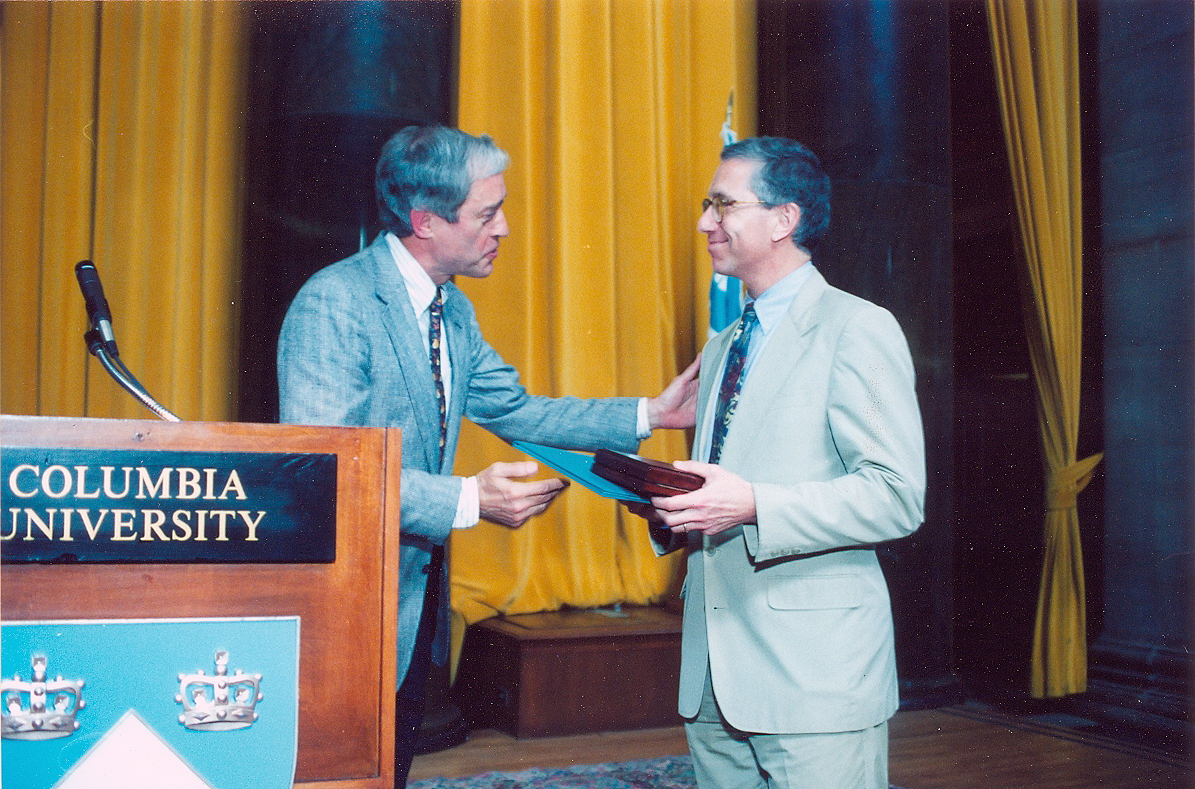
Columbia University President George Rupp (left) presents Jonathan Landman of The New York Times, with the 2002 Pulitzer Prize for Public Service.
Winning Work
By Dexter Filkins
Mazar-I-Sharif, Afghanistan, Dec. 8 -- The graves are barely visible to the newcomer, a weathered row of bumps and stones that on an autumn day are shrouded in snow.
"They are here," said Abdul Satar, jabbing a withered finger toward the mounds beneath him. "I know. I dug the graves." In this place, a once-thriving village called Qezelabad, Taliban soldiers swept in four years ago and shot and stabbed nearly everything that was alive. When they left, almost everything was dead, and the survivors returned on the fourth day to wash the bodies and put them in the ground. They were a minority people, the Hazaras who lived in Qezelabad, but their neighbors came from hamlets far away when they heard the terrible news.
They came to dig.
After the funerals, the villagers moved away; the Taliban guards thought the 70 bodies underfoot were too powerful a symbol to allow anyone to cultivate. Today, the wind whips through an empty village, past the tiny mounds that are some of the only evidence that anyone ever lived here.
"I knew these people," said Mr. Satar, the gravedigger, looking back as he trudged through the snow.
Mass graves wreathe this ancient Afghan city, bearing the grim evidence of its central role in this country's civil war. For six years, Mazar-i-Sharif was the Afghan crucible, the place where the feuds and betrayals and ancient rifts played themselves out with the greatest ferocity. The Taliban came into this city and left, and then came and left again, each time in a trail of sorrow and death.
Now, as Afghanistan appears set to embark on a new Western-backed political experiment, the town stands as a somber warning.
Human rights groups say thousands of people perished here in the ethnic and religious bloodletting that engulfed the city, particularly in two great massacres in 1997 and 1998. But the truth seems as ill-defined as the fading mounds that mark the graves.
Today, Mazar-i-Sharif hums with the giddiness of a city set free. The music shops are jammed, the turbans are off, and the young women, their faces peeking out from tightly wrapped head scarves, are once again strolling the sidewalks of Balkh University. In the first sweet moments of liberty, few people seem eager to confront the recent past or gather the details with which they might construct their history.
"The graves, they're in the desert," said Muhammad Islam, 45, as he sat at the counter of his auto parts store in the city center. "It's too late. They're hidden in the sand. You'll never find them now."
But some graves, unlike those of the Hazara, are advertised for their Taliban victims. In the desert outside of town, in the middle of a flat and empty expanse, a billboard proclaims the area hallowed ground.
It is perhaps 20 feet wide, this giant outdoor advertisement, and it reflects the austerity that was the Taliban aesthetic: a wooden sign, trimmed with metal and adorned with tin cones that look like gasoline funnels turned upside down.
"In this place, hundreds of martyrs lie buried," the sign says, in Dari and Pashto, the language of the Taliban. "In 1997, the holy Taliban were betrayed by the great traitor Malik and hundreds of Taliban were massacred by the pagans. These pagans stalked the real Muslims, and killed all of them, and buried them in different parts of this desert."
The Taliban are gone from Mazar-i-Sharif now, and the sign has been smeared with mud. No one knows how many Taliban soldiers were buried in the deserts outside the city, probably thousands. But it was the massacre of the Taliban in 1997 that sparked the reprisals against other groups that continued until the Taliban left the city for good last month.
The Taliban tombstone in the desert puts it succinctly.
"By God's grace, the Taliban captured the northern region of Afghanistan in 1998, and massacred the pagans."
The bloodletting here arose from the tangled politics of the Afghan civil war, which by May 1997 pitted the ragtag Northern Alliance against a Taliban army that had rolled over most of the country. Mazar-i-Sharif, the commercial center of northern Afghanistan, was the country's last great prize.
With the Taliban just outside the city limits, a local Northern Alliance commander, Malik Pahlawan, struck a deal that allowed them to enter the city without firing a shot. Mr. Pahlawan made the move to upstage his own leader, Gen. Abdul Rashid Dostum.
Within hours after Taliban troops entered the city, a Northern Alliance militia comprised of Hazara troops backed out of the deal and attacked the Taliban. The Hazaras, who largely adhere to the Shiite branch of Islam, had been the special targets of the Taliban, who are Sunnis.
Soon, Mr. Pahlawan's troops joined in the fighting. Hundreds of Taliban troops, caught off guard, were either killed or taken prisoner.
When Taliban troops first entered Mazar-i-Sharif, Jawat, a 23-year-old Pashtun man, walked outside to greet them. But instead of a celebration he saw the bodies of Taliban soldiers scattered in the streets. Mr. Jawat says he watched as Hazara militia men executed 20 Taliban soldiers, throwing them up against a wall and firing their machine guns.
"I ran for my life," he said.
According to aides of General Dostum, one of the warlords now presiding over Mazar-i-Sharif, Mr. Pahlawan ordered thousands of Taliban prisoners taken to the desert and shot. He then fled to Iran.
Ruzi, a 23-year-old farmer who frequently crosses the desert outside of Mazar-i-Sharif, did not see the Taliban prisoners being killed that day. But he watched their bodies being dug up a year later.
It was late summer of 1998, Mr. Ruzi said, just after the Taliban had captured Mazar-i-Sharif for the last time. Mr. Ruzi said he watched Taliban troops pull perhaps 300 bodies from the ground, many out of shipping containers where they had been stuffed by Northern Alliance soldiers. "The Taliban put the bodies in caskets and took them to Kandahar," Mr. Ruzi said.
In the emptiness of the desert, the graves seem at once everywhere and nowhere.
Less than a mile from the Taliban billboard, a visitor asked a local man recently if the area contained any Taliban cemeteries.
"Well, there is one right here," said Yosin, a 26-year-old farmer who had stopped his tractor on the road.
Sure enough, Mr. Yosin was pointing to a crude tombstone made of mud and rocks.
Traveling the route four years ago, Mr. Yosin said, he came across the bodies of some 600 Taliban soldiers strewn across the desert. Some were half-buried, Mr. Yosin said, some had been dug up by dogs.
After the 1997 massacre, the Taliban retreated from Mazar-i-Sharif, only to return with special ferocity the next year. They made no deals this time. Instead, by many accounts, they headed straight for the Hazara neighborhoods, shooting and stabbing in a frenzy that left thousands of civilians dead.
In Ferduous Park, an ethnically mixed neighborhood, most of the Hazaras saw what was coming. They ran for the mountains on the city's southern side.
The family of Aqhela, a 50-year-old Hazara woman, stayed behind. She figured her family had nothing to hide.
The Taliban soldiers entered Aqhela's house on Aug. 11, 1998, three days after the Taliban had taken control of Mazar-i-Sharif. The Taliban troops, certain that most of the city's Hazaras were guerrilla fighters, demanded that Aqhela's family turn over its guns.
"We didn't have any guns; we were ordinary people," she said.
When no guns were produced, Ms. Aqhela said, the Taliban soldiers dragged her husband, Akbar, and his two brothers, Anwar and Ramazdan, out of the house and down the muddy street. In an intersection about a quarter mile away, Aqhela said, the Taliban soldiers made Akbar and his brothers stand at attention, and then they gunned them down with bursts from their Kalashnikovs.
With the neighborhood empty, Ms. Aqhela said she retrieved the bodies, rolling them into a pushcart and wheeling them back home. Too afraid to venture outside, Ms. Aqhela closed the gate and dug the graves in her yard, rolling each body off the cart and into its respective pit.
Today, Ms. Aqhela supports her three children by renting out a corner of her house to a boarder. Each morning, she walks to the small walled cemetery she built and sits down for a time.
"I think about my previous life," she said.
In Qezelabad, the Hazara ghost town, a lone man recently rode through the snow on a horse. Muhammad Isok was born in the village 30 years ago, and in 1997, when the Taliban attacked, he barely escaped. He came back the other day to remember his family, 30 of whom lie in Qezelabad's graves.
According to Mr. Isok, the Taliban soldiers laughed as they worked three years ago, shooting animals and children and old people. One of them fired at Mr. Isok but missed, and he ran to his home and gathered his family and lifted the carpet that hid the crawl space he had built while fighting the Soviets.
Mr. Isok and his wife and children lay in the hiding place until nightfall, when they slipped away and ran out of town.
When he returned four days later, Mr. Isok and Mr. Satar helped bury the village, washing the bodies and tying their toes and covering each in a shroud.
They dug seven pits, laying 10 bodies in each. As he worked, Mr. Isok said he recognized a son-in-law and a brother-in-law and a cousin among the dead. He said he could not make out the identities of everyone that day; the faces of many of the victims had been peeled away.
"It was a terrible day," he said.
When he finished speaking, Mr. Isok climbed back on his horse and rode out of Qezelabad. He said he would be coming back soon to start again.
People do try to start again, despite the encircling sorrow and graves. This is a more hopeful time for Mazar-i-Sharif. One month after the Taliban's retreat, the city is trying to look forward rather than back.
American dollars and German beer flow readily here, the former legal and the latter not. Radio Balkh, hardly listened to during Taliban times when the station played only Koranic readings, has begun playing music again.
The most popular song these days is "Laili," named for a girl that steps in and out of a man's life:
You came from a village
And made me your lover
And now you've broken my heart.
Oh Laili, Laili, Laili,
Now you've broken my heart.
In the words, there is longing and sadness and a thirst for beauty -- emotions evident in much of this city. Few people here profess to know what the future will bring to Mazar-i-Sharif, or Afghanistan, but for now, the omens seem good.
At the Azrat Ali mosque, the doves have returned. The birds are a famous part of this city: according to legend the birds were brought by Sultan Hussein Baiqhra in the 17th century from Nejev in modern-day Iraq. Nejev is said to hold the body of Ali, the son of Islam's Holy Prophet, Muhammad, and Mazar-i-Sharif his spirit.
Quri Amonullah, the mullah at Azrat Ali, said the doves were the first to leave when the fighting started in Mazar-i-Sharif, and often the last to return.
"They went to special hiding places," the turbaned cleric said. "Sometimes for many days."
But now the doves that have seen so much seem to be sticking around.
© 2001, The New York Times Company
By William Glaberson
The Justice Department has asked a federal appeals court for a broad ruling to authorize the use of secret evidence in cases in which it is trying to detain or deport immigrants it contends are in the country illegally. For national security reasons, the government argues that it should share secret evidence with only immigration judges and not with the immigrants and their lawyers.
The court did not act on the request, because it decided the case before it on other grounds. But legal experts say that request and other actions since Sept. 11 indicate that the government is moving toward the renewed use of secret evidence in immigration cases, one of the most criticized of the Justice Department's tactics in recent years. The government, however, says that since President Bush's term began, it has not broken his campaign pledge not to use secret evidence against immigrants.
In the 1990's, immigrants' groups and other critics of secret evidence gained legal and political ground in their assertions that it relegates immigrants to a legal netherworld, having to disprove accusations like whether they have connections to terrorists without knowing specifically what the accusations are. The practice had ground nearly to a halt in recent years after several federal court decisions and under the criticism of some politicians.
Since Sept. 11, said Niels W. Frenzen, an immigration law specialist at the University of Southern California: "That trend has been completely reversed. We are in a much more secretive, much more one-sided process" in immigration courts.
In a debate on Oct. 11, 2000, Mr. Bush sided with the critics of secret evidence. "Arab-Americans are racially profiled on what's called secret evidence," Mr. Bush said, adding that the government should "do something about that."
Immigration officials and lawyers who support them often argue that it is naive for critics to suggest that the government should supply all its evidence to aliens suspected of terrorism and other crimes. To do so, they say, would supply a road map to intelligence sources and methods that would thwart the government's ability to stop terrorism.
In the case before the appeals court, six weeks ago, the Justice Department lawyers said the use of secret evidence "would enhance the government's ability to attack terrorist infrastructure."
Last week a Justice Department spokesman, Dan Nelson, said the department had not used secret evidence in any case that started after Mr. Bush became president. When asked if officials planned to use such evidence, Mr. Nelson said: "It was a campaign promise by the president not to use secret evidence in immigration cases. We've abided by that promise."
But some immigration lawyers say they are skeptical. "I would be shocked if it's not being used," said David Cole, a professor at the Georgetown University Law Center who handled several immigrants' cases in which secret evidence was used in the Clinton administration. Immigration officials relied on secret evidence in the early years of the Clinton administration but the Justice Department backed away from the tactic toward the end of the Clinton years.
In addition to the government's appeals court request, immigration lawyers point to a new Justice Department rule requiring closed immigration hearings in some cases as evidence that the government may use secret evidence. That rule requires that the hearings be held before judges with national security clearances with "no visitors, no family, no press."
Before the terrorist attacks, a bill in Congress titled the Secret Evidence Repeal Act, which would have sharply limited the circumstances under which secret evidence could be used, was given a good chance of passing. But in the midst of the terrorism investigation, that bill is languishing. And under new antiterror laws passed since Sept. 11, the attorney general may detain for deportation any noncitizen who he has "reasonable grounds to believe" endangers national security.
"The legislation opens the door to secret evidence," because it does not require the attorney general to disclose what the evidence is, said Nancy Chang, a lawyer at the Center for Constitutional Rights in New York.
Around the country some immigration lawyers say they have already detected that they are arguing against evidence that they are not allowed to see. "It seemed like I was trying to defend my client blindfolded and handcuffed," said Karen H. Pennington, a Dallas lawyer who represented a Palestinian-born man who was arrested in Texas on Sept. 22.
Ms. Pennington said lawyers for the Immigration and Naturalization Service told her there were items in her client's file that she should not see. She said accusations against her client repeatedly appeared in news accounts that she never learned officially.
Critics have long said the use of secret evidence violated the Constitution because it deprived immigrants of any way to defend themselves. Courts have held that immigrants who are in the United States have some due process rights when they are facing assertions that they are in the country illegally.
Some lawyers who believe they have confronted secret evidence recently say immigration service lawyers are not acknowledging what their evidence is. But these lawyers say the immigration service lawyers also appear aware that the courts have been critical of secret evidence so they are avoiding describing their information in those terms.
"They never used the words 'secret evidence,' " said Donna L. Lipinski, a Denver lawyer, "but they wouldn't disclose any of the reasons they had for holding my clients."
Many of the cases dealing with immigrants who have been detained since Sept. 11 are still in the preliminary stages so lawyers for the immigration service have not had to disclose to judges the government's case. Government lawyers might disclose secret evidence to immigration judges when the cases reach the phase of full deportation hearings.
It was in a case handled by Professor Cole in Miami this fall that the Justice Department made the request for a broad ruling from the United States Court of Appeals for the 11th Circuit permitting the use of secret evidence. The case, which began long before Sept. 11, involved a Palestinian man officials said had ties to terrorists.
In a brief filed in late October, Justice Department lawyers referred to a 1974 decision that approved of the use of secret evidence long before the string of court cases in 1980's and 90's that found its use unconstitutional. The Supreme Court has not considered the issue since a 1956 case in which it suggested that the use of secret evidence might be permissible under the Constitution for national security reasons.
In their argument in the Miami case, the Justice Department lawyers said that "at a time when the nation is at war with terrorism and we are under attack," it would be important to reaffirm the 1974 ruling permitting the use of secret evidence as "important executive authority."
In several cases in recent years, federal judges said that when they finally examined the government's secret evidence it was often thin or speculative. In one case, a 30-year-old Palestinian immigrant in New Jersey spent more than 19 months in jail because of unspecified accusations of ties to terrorists. The man, Hany Kiareldeen, always said that false reports about him might have come from a former wife with whom he was having a child custody dispute.
In 1999, a federal district judge released Mr. Kiareldeen from custody, saying he could not prove his innocence based on sketchy summaries of the secret evidence against him.
"The I.N.S.' reliance on secret evidence," the judge, William H. Walls wrote, "raises serious issues about the integrity of the adversarial process, the impossibility of self-defense against undisclosed charges, and the reliability of government processes initiated and prosecuted in darkness."
© 2001, The New York Times Company
By Norimitsu Onishi
QUETTA, Pakistan, Dec. 8— In 1761, King Ahmad Shah Durrani, the founder of Afghanistan whose descendants would rule until a Communist coup in 1978, received some free land on which he built the city of Kandahar. The gift came from a powerful local clan called the Populzai.
Last week, the clan's latest leader, Hamid Karzai, said he had secured an agreement to reclaim Kandahar from the Taliban, and he is expected to lead Afghanistan's new interim government starting on Dec. 22. The Taliban's surrender ended two decades of exile for the Karzais, whose fate, perhaps more than any other Afghan family's, has been intimately tied to the ups and downs of Afghanistan's tumultuous history.
''It means a lot to us,'' Ahmed Karzai, the new leader's youngest brother and chief spokesman, said of the appointment.
He spoke last week here in this Pakistani city, where the Karzais, so tied to their land back in Afghanistan, have made a point of renting, never buying, the houses in which they have lived since 1981.
It was on a street corner near their gated compound here that, on July 14, 1999, Hamid Karzai's father was killed -- presumably by Taliban assassins who objected to the Karzais' anti-Taliban activities. After his father's burial in Kandahar -- even the Taliban did not try to deprive the head of the Populzai of a final resting place in his native soil -- tribal elders chose Hamid Karzai to be the successor.
Hamid Karzai became known as the ''King of Kandahar.''
Mr. Karzai was born in Kandahar in 1957, roughly in the middle of Mohammad Zahir Shah's reign, a period remembered by many Afghans with nostalgia. He grew up in Kabul, where his father served as speaker of the Parliament.
But the situation in Afghanistan changed significantly when he was in high school. The king went into exile in 1973 after one of his cousins, Sardar Mohammad Daoud, seized power, charging that the royal family was corrupt and declaring Afghanistan a republic.
Another coup followed -- along with a Marxist reform program inimical to the conservative traditions in Afghanistan and especially of its Pashtun ethnic group, which includes the Populzai. Changes in marriage practices and land reforms were pushed through. Traditional rulers, intellectuals and religious leaders were made targets, resulting in killings and prison terms.
The Soviets entered Afghanistan in 1979. But despite vast numbers of Soviet troops, pro-Soviet governments in Kabul never succeeded in establishing control outside the capital.
It was during this period that the Karzais left Afghanistan, settling here in 1981. Countless Afghans gravitated to Quetta, a city close to the border with Afghanistan, and close in culture and spirit to the area of southern Afghanistan.
Exile sent the Karzai children -- seven brothers and one sister -- off on different paths. Hamid went to India where he earned two university degrees.
Ahmed left for the United States in 1983, to Chicago, where he opened the family's first restaurant a block away from Wrigley Field. He became a staunch Cubs fan.
''They were always good for business,'' Ahmed Karzai recalled.
The family opened more restaurants in Boston, Baltimore and San Francisco. Today, six of the eight siblings live in the United States.
But Hamid Karzai chose not to do so. According to a short biography printed by his family, he ''joined Afghan jihad in 1982,'' eventually becoming a spokesman for a Pakistan-based mujahedeen group.
The Soviet occupation began attracting mujahedeen fighters from the Islamic world, including Osama bin Laden. In 1984, they began receiving broad assistance, in weapons and training, from the United States.
Hamid Karzai did not fight on the front lines, but found his role funneling covert American aid to the mujahedeen. It was the beginning of a relationship that would eventually lead a different generation of American policy makers to turn to him, two months ago, as their main ally in southern Afghanistan.
After the defeat of the Soviets, Mr. Karzai was appointed deputy foreign minister in 1992. But with the mujahedeen government contributing to the spreading anarchy in Afghanistan, he resigned in 1994.
It was around the same time that a radical Islamic movement began emerging from his hometown, Kandahar. The Taliban, as they called themselves, promised order and stability, a message that attracted many Afghans, including Mr. Karzai, who helped them from 1994 to 1995.
The Taliban had their roots in the same conservative Pashtun culture as the Karzais. But while the Karzais were Pashtun aristocrats with an international outlook, Taliban leaders were generally little-educated men who had not ventured much beyond rural Afghanistan and Koranic schools.
Mullah Muhammad Omar, for instance, was born in a village near Kandahar, a member of a little-known Pashtun clan called the Hotak. The son of poor, landless peasants, Mullah Omar's social position was the opposite of Mr. Karzai's.
Unlike Mr. Karzai, who met policy makers in Washington and testified before Congress, Mullah Omar was famous for almost never having left Kandahar and for almost never having met non-Muslims. In his years in power, Mullah Omar is said to have visited Kabul only twice.
In private, Pakistani officials, who have always kept a close eye on Mr. Karzai, describe him as intensely nationalistic and more secular than most Afghans. Indeed, Mr. Karzai -- who had to be pressured by his family to get married, in his 40's, to a doctor -- rejected the Taliban's extreme social and religious views.
''After he saw the Taliban as they really were, he cut all his ties in 1997,'' Ahmed Karzai said.
With the end of the cold war, the United States' interest in this region had greatly diminished. So Mr. Karzai struggled to rally international support against the Taliban, though American ears perked up whenever he mentioned that foreign terrorists had become ensconced in Afghanistan. Then the events of Sept. 11 and the latest war in Afghanistan changed Mr. Karzai's life.
Afghanistan was back in American minds. So was Mr. Karzai.
He slipped secretly into Taliban-held southern Afghanistan and slowly persuaded Pashtun tribal leaders to turn against the Taliban. He gave interviews to the BBC Pashto-language service to gather popular support behind him.
''So many people are trying to rid the country of foreigners,'' he once said in an allusion to Mr. bin Laden and his Arab fighters. ''I am trying to do the same.''
It was mostly through persuasion, not fighting, that Mr. Karzai was able to descend from Uruzgan province down to a town about 10 miles north of Kandahar, the last Taliban stronghold and the city built on his ancestors' land.
© 2001, The New York Times Company
By Michael R. Gordon
This article was reported and written by John H. Cushman Jr., Carlotta Gall, Eric Schmitt, Thom Shanker and Tim Weiner, with Mr. Gordon.
KABUL, Afghanistan, Dec. 8 -- When Afghanistan's new transitional government takes power two weeks from today, it will inherit a capital full of blaring horns, busy markets and a nearly universal yearning for peace.
But real peace will have to wait, for the highly unusual war that has wrested Kabul and now every last Afghan city from Taliban rule is not over yet. Indeed, the most complex and potentially perilous tasks that the United States has assigned itself still lie ahead. They include more than the hot pursuit of Osama bin Laden, his Al Qaeda collaborators and the thousands of Arab and other foreign fighters he drew to Afghanistan.
Even with the fall of Kandahar this weekend, more needs to be done before the Taliban movement can be written off. The task starts with the capture of Mullah Muhammad Omar, but hardly ends there: enough law and order must be imposed to allow medicine and food to flow to an ill and starving population and to prevent a resurgence of violence as the traditional arbiter of power in the land.
From the start, the United States strategy has been to make the most of an unrelenting and high-tech air campaign while avoiding a major commitment of ground troops.
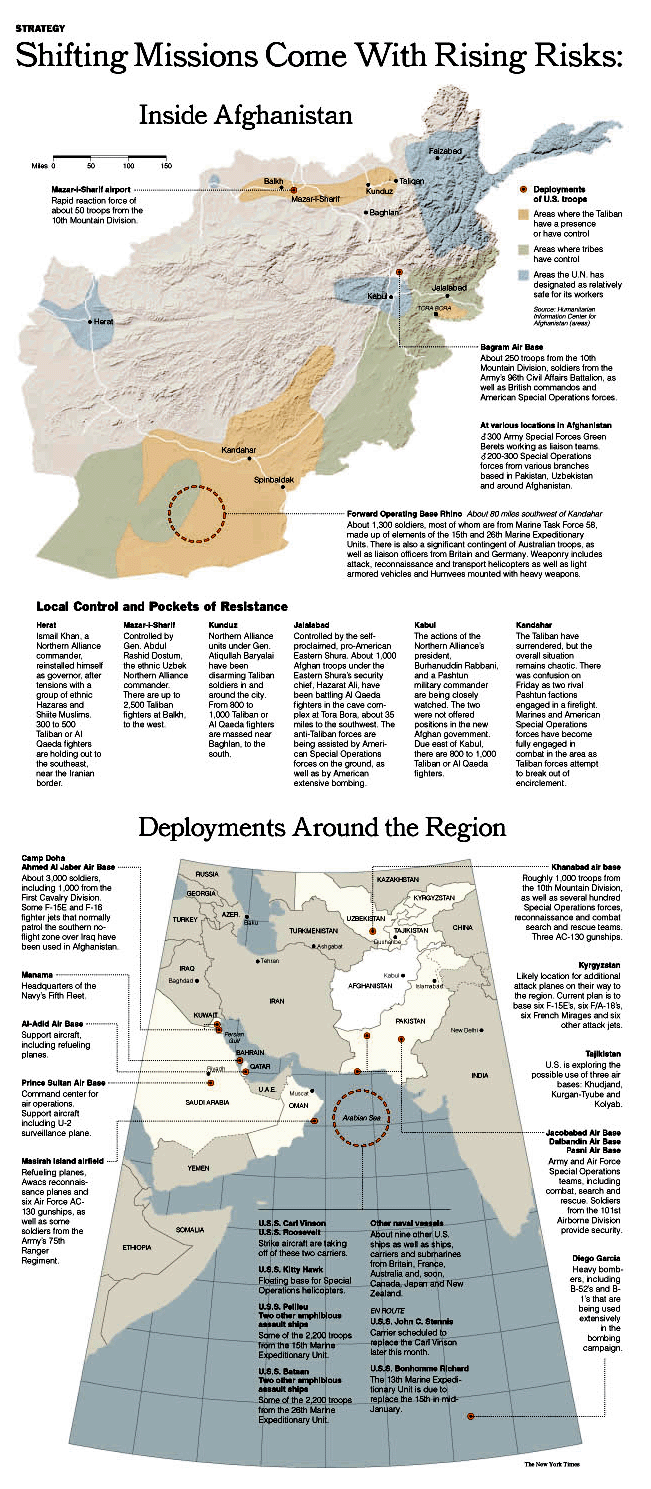
The United States deployed about 2,000 marines, commandos and Army infantry forces. Countries including Britain and Australia contributed a few hundred soldiers.
The brunt of the fighting on the ground was done by Washington's allies of convenience: the anti-Taliban Afghans of the Northern Alliance, who had been waging a long and bitter fight with the Taliban, and southern tribal factions, who took up arms or swapped sides only after the Taliban began to crumble. Even they could not have seized the initiative without the American air campaign and the close support of American advisers.
In victory, the indigenous forces, unpolished but seasoned by a generation of upheaval, acted in ways unfamiliar to the American commanders: first mounting cavalry charges into the teeth of tanks, then negotiating terms of surrender in which some went home with their firearms and others entered prison only to rebel in a suicidal last stand. More than a few, it seems, met rough justice at the hands of the triumphant.
The United States has accomplished much of its mission. As a political and military force, the Taliban is in its death throes. A new Afghan leadership has been assembled in talks in Bonn. Kabul, Herat and Mazar-i-Sharif are calm. Al Qaeda's terrorist training camps are a ruin.
But there are military actions yet to come, focused on chasing down dispersed Taliban fighters and foreign brigades in hiding. This will be a fight in unfamiliar terrain that is still plagued by outlaws and groups of armed warriors, a war that could prove less predictable and riskier for American and allied troops than the air campaign and proxy ground war of the first stage of the conflict.
"We're entering a very dangerous aspect of this conflict," Defense Secretary Donald H. Rumsfeld said recently. "It is a confused situation in the country. The amount of real estate they have to operate on has continually been reduced. The noose is tightening, but the remaining task is a particularly dirty and unpleasant one."
Certainly, the task of tracking a fugitive Mr. bin Laden in the wilds of Afghanistan and bringing him to justice is a tough assignment for the American military. It is complicated by the prospect of battling the thousands of Arab and other foreign fighters who surround him, unmoved by the $25 million bounty on his head, loyal still to the global jihad he initiated from the chaos of Afghanistan.
American and British Special Operations forces are working with a freshly assembled Afghan force that is scouring the mountains around Tora Bora in eastern Afghanistan, trying to prevent anyone from slipping across the adjacent border with Pakistan.
The isolated enemy's main ally may be Afghanistan's difficult terrain, the cragged heights, tunnels and caves of Tora Bora and the mountains northeast of Kandahar. The remaining Taliban and Al Qaeda warriors seem determined to elude capture and, if cornered, to fight hard. On Friday, they even probed the perimeters of the desert base where marines have set up an operating base within striking distance of Kandahar.
Another question is what will become of Mullah Omar -- also worth $25 million to anyone who helps capture or kill him. He is thought to be in or around Kandahar, although nobody at the Pentagon claims to know for sure.
Even if Mr. bin Laden, his warriors and his Taliban protectors are all killed, captured or dispersed, the problem of stabilizing Afghanistan remains.
The United Nations is rushing to complete plans for an international security force, the first elements of which are expected to arrive in the capital within the next two weeks. But the size and ability of the force is still not clear, and its mandate is limited to Kabul and the immediate area. The United States has made clear that it will not take part.
Soon Afghanistan will be host to two separate foreign forces -- the security force intended to reinforce peace, and the American and allied militaries still prosecuting war.
Kandahar
Marines on Patrol, Isolating Al Qaeda
Almost as soon as opposition forces entered Kandahar, the marines whose presence in the nearby desert had contributed to the city's fall refocused their attention on locating any members of Mr. bin Laden's Al Qaeda network among those fleeing the city.
Officers out on patrols in armored all-terrain Humvees with heavy weapons, able to call in nearby helicopters to attack anyone who tries to escape, were carrying pictures of particular Al Qaeda suspects.
"If the mission has changed, it is that we are looking more for Al Qaeda, instead of Taliban," said Marine Capt. Stewart Upton. "We hope the Taliban realizes that if he doesn't drop his arms and raise his hands, he dies." For the most part, he added, any surrendering Taliban fighter would be allowed to "go on his merry way."
Al Qaeda and the foreign fighters are viewed as more dangerous, and would be taken into custody, and perhaps even tried in Afghanistan, Pentagon officials have said.
It will not be easy, though, to tell who is who in the chaos around Kandahar. "One of the difficulties that one has any time you have a whole lot of people all wearing generally the same-looking clothing is the business of identification, friend and foe," said Gen. Tommy Franks, the commander of American troops in the region, noting that his troops would just have to be "cautious" in that regard.
The very presence of more than 1,200 marines at the desert base they call Rhino, within striking distance of Kandahar, had practically guaranteed the eventual fall of the Taliban there. The main fighting, however, was done by anti-Taliban Pashtuns, including a faction led by Hamid Karzai, the head of the transitional government that will soon take power.
Opposition forces, small but eager to seize power, streamed from all directions toward a city that was effectively under siege, its military occupants unable to flee and subjected to relentless bombing.
A Taliban convoy moving across the desert was quickly destroyed by an airstrike on Nov. 27, soon after the marines' arrival. Over the next few days, they promptly fanned out across the area, blocking roads and keeping the area under constant surveillance. When enemy troops probed the marines' perimeter on Thursday night, shooting flares, they were easily repulsed with mortar fire. Only on Friday, as the defense of Kandahar collapsed, were marines reported to have engaged in a firefight on the ground, killing seven Taliban fighters.
It is not clear what the marines' role will be in the weeks ahead. After the surrender is complete, they could serve mainly to secure the base for commandos coming in to finish the hunt for Taliban and Al Qaeda leaders and holdouts. They could spread more broadly through the region and expand the search, or even just leave as quickly as they arrived on Nov. 25.
The marines' mission depends in part on how swift or orderly the surrender of Kandahar proves to be. Brief clashes were reported among their Pashtun fighters as they entered the city, and who would now control Kandahar was a decision being considered today by an ad hoc council of tribal elders. The whereabouts of Mullah Omar, the Taliban leader, were unknown.
In the surrounding countryside and in the nearby mountains, Special Operations forces had joined in the fighting, the Pentagon said, and troops from Australia and Britain were also playing a role, although their missions were not disclosed.
The most critical thing determining what the marines do next may be how the hunt for Mr. bin Laden proceeds in the mountains to the east.
Tora Bora
Afghan Factions In the Mountains
With the fall of Kandahar, the war's immediate focus will shift to the mountains of Tora Bora. Gen. Muhammad Fahim, the new Afghan defense minister, said his government's sources indicated that Mr. bin Laden had taken refuge in the area -- a forbidding region of caves, tunnels, steep hills and hideouts where Mr. bin Laden operated when he was first chased out of Sudan in 1996.
Certainly, there is good reason for him to be there. First, the terrain offers countless hideaways. This is the region where the Central Intelligence Agency helped the mujahedeen resistance hide from the Soviet Army of occupation and stash the weapons they smuggled in from nearby Pakistan.
The Pakistani border also beckons as an escape route now, accessible by mule trails that no army controls. Pulling out a detailed military map, General Fahim pointed out the key passes and byways.
"Even with the snow, the way to Pakistan is open," he said. "The tribes in this region are free. They do not belong to Pakistan and they are not under the control of Afghanistan."
Unless those escape routes are sealed, Al Qaeda's fugitives, who know them well, can slip through the Safed mountain range into Pakistan's northwest frontier and re-enter Afghanistan, perhaps into the Paktia and Paktika provinces.
"Bin Laden is constantly changing his location," General Fahim said. "He can cross the border between Afghanistan and Pakistan and back again."
The battle of Tora Bora is front and center on the American agenda today. But the battle began not in some Washington war room, but in a courtyard in Jalalabad where a group of elders gathered last weekend for a traditional high council.
They hammered out a simple message and sent a delegation to deliver it to the warlords of Tora Bora, where about 2,000 Al Qaeda fighters were dug in -- among them, perhaps, Mr. bin Laden himself.
"To those foreigners living in the mountains of Afghanistan, we say to you: leave our country," the elders said. It was an ultimatum: withdraw, surrender or die. On Monday, the elders gave marching orders to their local commanders.
About 1,000 Pashtun fighters left Jalalabad for Tora Bora at dawn on Tuesday and went to war. The assault was directed by Aleem Shah, a front-line commander for Hazarat Ali, a minister of the new pro-American local government in Jalalabad, the Eastern Shura, which had seized control when the Taliban collapsed. Both men had sheltered at Tora Bora during their war against the Soviets. They know the caves and caverns intimately.
"We are trying to surround them," Mr. Shah said as he stood beside three aging Soviet tanks on a ridge less than 2 miles north of the caves, a walkie-talkie to his ear, listening intently when his men shouted reports to him from the mountainsides.
"Half of Tora Bora is under our control," he said Wednesday afternoon. "Upward in the higher ridges is Al Qaeda."
General Franks was less ebullient a few days later. "There certainly is movement by opposition forces in the Tora Bora area," he said on Friday. "But that area is by no means completely secured and searched."
Even so, as the Afghan opposition advances, the Pentagon's airstrikes become more effective. It will also scour the mountainous region northeast of Kandahar, where some speculate that Al Qaeda leaders and fighters could also be hiding.
"Now that opposition groups are moving their troops toward the complex, we are able to provide air support that they are helping to direct, because they are able to see the caves that are active," said Gen. Peter Pace, vice chairman of the Joint Chiefs of Staff, on Thursday.
In the Tora Bora area, the United States has been stepping up a punishing bombing campaign. But "bombing alone will not be effective" against the caves at Tora Bora, said Mr. Ali's intelligence officer, Sohrab Qadri. He said the site could only be taken by siege.
Al Qaeda "will never surrender," Mr. Qadri said. "The only way that remains for them is to be killed," he said, or to die slowly of cold and starvation in the mountains.
Mazar-i-Sharif
A Hub for Relief Is Still Threatened
As hundreds of their armed fighters waited outside, three anti-Taliban leaders -- the Uzbek general Abdul Rashid Dostum, the Tajik general Atta Muhammad, and the Hazara leader Hajji Muhammad Moheqiq -- met this week in the northern crossroads city of Mazar-i-Sharif to talk about consolidating the hold of their Northern Alliance over a broad swath of Afghanistan.
A city of bustling markets and camel trains, Mazar-i-Sharif is expected to serve as the hub for the international relief effort to northern Afghanistan, the region hardest hit by famine.
"The world is concerned about the security threats which are delaying the arrival of aid, so we held this meeting with some urgency," said Mr. Moheqiq. American Special Forces advisers were at the meeting, as were newly arrived French military forces, now in charge of security at the nearby airfield.
Secretary of State Colin L. Powell has secured a promise from Uzbekistan to reopen the Freedom Bridge, which would establish an aid corridor to the north.
At least until today, however, the United Nations deemed the north of Afghanistan too volatile to send in its expatriate staff to coordinate the huge aid effort that is desperately needed.
On Friday, General Franks said that aside from a little looting of food, Mazar-i-Sharif itself, and other cities in the north, were "essentially calm." But he added, "We do not believe that the road between Kunduz and Mazar-i-Sharif is a very safe road to be using right now."
There are an estimated 1,000 to 2,500 Taliban fighters still at large in areas west and south of Mazar-i-Sharif. That is not the only pocket of Taliban resistance. Another is south of Kunduz, in the direction of Kabul and in the general vicinity of Baghlan, where 800 to 1,000 fighters have massed. A third is the almost due east of Kabul and also has 800 to 1,000 fighters. And the final is southeast of Herat, near the Iranian border, where 300 to 500 fighters remain.
The fighters in those areas do not appear to be under any coherent command. They have small arms but no artillery or tanks. The United States military is watching them closely and continues to send about 10 percent of its daily sorties of attack jets into the skies over these sites in case the troops pop up and start to move.
It remains unclear whether the resistance plans to stand and fight, or fade into the mountains for sustained guerrilla war, or simply melt away.
"All we know is there are enough of them to strike with significant force," said one senior military officer. "What we don't know is whether they will wait it out all winter -- they're isolated from their commanders, that's for sure. Or will they fight their way out?"
One thing that is clear is that the numbers are sufficient to threaten the lives of Afghan citizens, disrupt aid routes, attack foreign peacekeepers and relief workers and, in essence, undermine any government.
The delivery of aid is not the only worry. Residents in Mazar-i-Sharif remain fearful of a resurgence of violence and are hoping that the international military presence will force factional leaders not to engage in the infighting that has torn the city apart before.
But so far the three factions, Uzbeks, Tajiks and Hazaras, are cooperating here.
Each of the leaders said he has learned the lesson of the damage they wrought by fighting among themselves, because it allowed the Taliban to rise up and take over here three years ago.
"We have learned from our experiences," Mr. Moheqiq said in a recent interview. "It will not happen again."
The leaders insist that they are working together to force the Taliban remnants in the town of Balkh, just west of Mazar, to surrender with a mixture of negotiation and show of force.
The alliance's fighters, packed into pickup trucks but also equipped with armored personnel carriers and other heavy arms, have taken up positions around Balkh. During the past week there has been just one small skirmish, when some Taliban resisted. For now, the standoff remains.
Although they may not have been engaged in the bloodletting of the past, the leaders in the north have expressed dissatisfaction with the interim government drawn up this week at the United Nations-sponsored talks in Bonn.
They call the deal unjust, asserting that they had an understanding that they would receive a greater hand in governing Afghanistan.
General Dostum said he was promised the Foreign Ministry for his role in seizing Mazar-i-Sharif and is now threatening to boycott the government. And Mr. Moheqiq said that if the issue could not be solved, he would not take up his post of deputy prime minister in the government.
The uncertain situation in the north may give General Dostum a chance to expand his power base. Pentagon officials said the Uzbek commander was negotiating to have Taliban fighters at Balkh swear loyalty to him.
Still, at least one Tajik fighter expressed hope that there would not be a resumption of factional fighting.
"The situation has changed," said the warrior, Sadruddin, 25, who said he had been fighting since he was 16. "Now we are brothers. The fighting is over. We are all tired. No one wants to fight anymore,"
But he conceded that, in Afghanistan, such decisions do not rest with the likes of him. "It depends on our leaders," he said.
The Region
Neighboring Players In the Great Game
For the past decade, Afghanistan has been an arena for competition among neighboring nations who tried to keep the country divided for their own advantage.
With the hunt for Taliban and Al Qaeda leaders now entering its final phase, most of the neighbors seem to have a common interest in a stable Afghanistan and a broad-based interim Afghan government.
The traditional players of the Great Game, as it has come to be called in Afghanistan, all helped coax the faction leaders gathered in Bonn this week into final agreement. Pakistan, Iran, India and Russia have all pronounced themselves satisfied with the results.
Afghanistan's neighbors will play a critical role in determining the stability of the new government in Kabul. "They are front-line states for terrorism, narcotics and refugee problems emanating from Afghanistan, and their role in backing the transition will be very important," Christine Rocca, assistant secretary of state for South Asian affairs, told the Senate Foreign Relations Committee this week.
For their part, the leaders of the new transitional government, which is set to take power in Kabul on Dec. 22, insist that they want stability, too.
But there are skeptics. "Frankly, I think the Bonn settlement will break down in a few weeks," said Charles H. Fairbanks Jr., a Central Asia expert at Johns Hopkins University.
A crucial step is getting an international peacekeeping force in place. The Pentagon had objected to the early deployment of peacekeepers, saying it might interfere with the prosecution of the war.
But the British, French and Germans, who believe that an international security force is vital, essentially outmaneuvered the Pentagon by arranging for the agreement in Bonn to call for an international force.
That force is to be initially stationed in Kabul and its surroundings, but might eventually be expanded to protect other areas of the country.
Diplomats have yet to agree on how large the force will be, who will command it and which nations, European and Islamic, will contribute.
The force is not just intended to protect Kabul but to dilute the domination of the Northern Alliance so that Mr. Karzai, the transitional government leader, and his cabinet -- which is still dominated by the Northern Alliance but contains a mix of Afghan ethnic and political groups -- can establish some hold.
Unsurprisingly, former Northern Alliance have urged that the deployment be as small as possible. General Fahim, the designated defense minister and Northern Alliance commander, indicated that he did not favor the deployment of large numbers of foreign soldiers. Some Northern Alliance officials have said they would like hundreds, not thousands.
"There is no reason for them to go to all parts of Afghanistan," General Fahim said.
The British, in contrast, have been advocating a force to protect not only Kabul and its environs, but also to guard at least a land corridor to Pakistan. To carry out those tasks would require a force numbering in the thousands.
Regardless of his reservations about an international force, General Fahim said his government had an understanding with the United States that it could keep its forces in Afghanistan as long as the hunt for Mr. bin Laden continued.
General Fahim voiced hope that the Americans, working with Pashtun tribes in the Tora Bora region, would find their man, but stressed that success was not guaranteed.
"The United States is talking with the local commanders and is conducting the operation with them," he said. "We hope they can succeed."
By C.J. Chivers
ALIABAD, Afghanistan, Dec. 8 -- The interim Northern Alliance government here, demonstrating a willingness to impose harsh order over the largely lawless territory it captured from the Taliban, attacked a band of suspected highway robbers with tanks and soldiers this week and put the bullet-riddled body of a man it killed on public display.
The body hung suspended for two days from the barrel of a tank beside this village's main road. It was cut down and buried in a shallow roadside grave on Friday night. This morning the men who had killed the suspected bandit said their severe brand of justice was an effective deterrent assuring that local roads would be safe.
"Now we have good security for transportation," said Abdul Shahid, 48, a village supervisor who stood by the grave with a crowd of soldiers. "We can guarantee to civilians that they can use the way."
Delegates from various factions of Afghanistan agreed in Germany this week to form a coalition government that would soon rule the nation and replace the Taliban's violent brand of fundamental Islamic law. This coalition should eventually wield some influence here in the north.
But for now the government in Aliabad and the rest of the Kunduz province is essentially a self-appointed extension of the Northern Alliance military. Although the alliance has shown flashes of Western influences, it demonstrated this week that it is willing to resort to ancient elements of civic rule.
The district supervisor in Aliabad, Abduliyan, 48, said the display of the dead suspect was a public service and would be repeated as necessary. "We hanged him for the other people to take advice from this," he said. "For keeping security, we performed this action. Now we are trying to find the other robbers, and if we do they will be hanged, too."
The dead man's name was Ayeed, and the men who killed him or watched him hang for two days estimated his age as between 40 and 44. They believed that he came from Baghlan, the province to the south, but were not sure. They also believed that he had been a Taliban soldier, but only because he was armed and wore a black turban, as Taliban soldiers did. They did not really know.
What they did know was that on Wednesday three trucks came to the village on the road from Baghlan, and the 15 people inside the trucks said they had been robbed at gunpoint a few miles away. Mr. Abduliyan said he conferred with the soldiers on garrison in the village, and soon two tanks and 30 soldiers sped down the road to catch the bandits.
One soldier, Abdul Bari, 30, said that as they rumbled toward a group of about 15 men they suspected were the bandits, they came under fire from rocket-propelled grenades. The rockets missed, he said, and the Northern Alliance soldiers returned fire. In the brief exchange, Mr. Ayeed, the man they captured was struck by a barrage of bullets and taken into custody as the others fled.
"When we caught him he had a big bag of money," Mr. Bari said.
Mr. Abduliyan quickly added, "Even though he was shot, he was holding it very tight."
The soldiers said they returned the money to those who had been robbed.
Mr. Ayeed died of his wounds on Thursday morning, the soldiers said, and they and the local supervisors decided to display the remains.
The tank was parked on a highly visible knoll at the village's edge, and the soldiers used Mr. Ayeed's black turban to hang him from the barrel, right beneath the green, white and black flag of the Northern Alliance and an 8-by-11-inch photograph of the late Gen. Ahmed Shah Massoud.
The display seemed to satisfy high- and low-ranking members of the alliance alike.
The senior Northern Alliance official in the region, Gen. Atiqullah Baryalai, said he supported the response to the robberies, although he was not involved. "I did not order this to be done, but when I went to Aliabad and the commander reported to me about it, I said to him, 'Thank you,' " he said. "It is an effective way."
The driver of the tank from which Mr. Ayeed was hanged was also pleased. Pointing to the fresh mound of earth where he had just buried him, he said justice had been served. "We were feeling happy when he was hanging," said the driver, Faizullah, 24. "People who want to be robbers should take this advice."
© 2001, The New York Times Company
By Patrick E. Tyler with Jon Kifner
TASHKENT, Uzbekistan, Sunday, Dec. 9 -- After weeks of diplomatic pressure from the United States, the president of Uzbekistan, Islam Karimov, agreed on Saturday to open a crucial bridge that could help speed urgently needed food and medical supplies from this Central Asian country to war-ravaged Afghanistan.
The announcement to open the Friendship Bridge came in a news conference here with Secretary of State Colin L. Powell, who is visiting partners in the United States-led coalition against terrorism. The decision would free international relief organizations to move millions of tons of food and other aid into northern Afghanistan, where wintry weather has already complicated the plight of millions of Afghan civilians threatened by drought and the war. The bridge over the Amu Darya, which had been closed because Mr. Karimov has long feared an influx of Islamic terrorists who could destabilize his government, would also provide access for United States forces based here to resupply units operating in northern Afghanistan.
Although Mr. Powell said he had been promised that the bridge would open today, distributing the aid beyond the northern border region remained a serious obstacle. The surrender of the last Taliban stronghold, Kandahar, on Friday signaled the collapse of Taliban rule, but Taliban forces continue to roam the countryside and areas are held by feuding warlords and bandits for whom aid convoys are a prime target.
The situation in Kandahar remained uncertain over the weekend. Rival Pashtun warlords jostled for control, seizing separate parts of the city and later trying to sort out the claims in a shura, or council.
The whereabouts of Mullah Muhammad Omar, the Taliban leader, and his patron, Osama bin Laden, were still a mystery. Despite unconfirmed reports that Mullah Omar had been seized by a warlord in Kandahar, the Northern Alliance foreign minister, Dr. Abdullah Abdullah, said Mullah Omar was still missing.
"Unfortunately, he is still alive," said Dr. Abdullah, who will also be foreign minister in the new interim government that is to take power on Dec. 22. He said reports that Mullah Naqib Ullah, a local Pashtun commander to whom Mullah Omar surrendered the city, was sheltering the Taliban leader were false.
A Pashtun commander who is a member of Northern Alliance said today in Kabul that bombs from American military jets killed 140 Arab Taliban fighters who had gathered in a school in Kandahar. But the commander, Wahidullah Sabawoon, said many other Arabs had fled with Taliban troops from Kandahar without being disarmed. He said a majority of the Arabs were now holed up in the Tora Bora mountains east of Jalalabad.
Mullah Mohammed Omar could have fled into any of three mountain ranges around Kandahar, including the Qalat mountains northeast of the city, he said, adding that Mullah Omar's clan is based near Qalat.
The Taliban defense minister, Mullah Obaidullah, negotiated the surrender of the city, he said. "It was not Mullah Omar's decision; it was the defense minister's decision," Mr. Sabawoon said. "They said, 'Mullah Omar is crazy and we don't want all of our people killed.' " But instead of surrendering as agreed, Taliban forces slipped out of the city on Friday, Mr. Sabawoon said.
In the mountains of Tora Bora, just south of Jalalabad in the eastern part of the country, American and anti-Taliban forces pressed their search for Mr. bin Laden and members of his Al Qaeda network.
Mr. bin Laden and several thousand Al Qaeda troops are thought to be hiding in the vast complex of caves and tunnels there, which experts say are extensive enough to permit the Taliban to cross the border to Pakistan underground.
"You could bomb day and night and it wouldn't make a big difference," said Hazarat Ali, the top mujahedeen commander. "Soldiers have to go in there."
The Pakistani government insisted that the border areas were being closely watched. "There is greatly increased surveillance," Maj. Gen. Rashid Qureshi said in Islamabad, the capital of Pakistan.
Farther north, an official of the Northern Alliance said one of its cargo helicopters had crashed in fog soon after takeoff on Saturday on the way from Taliqan to Kabul, the Afghan capital. All 17 people aboard, including three senior Taliban commanders who has been taken prisoner this week in Kunduz, were presumed dead, said the official, an officer named Daruq, who is an aide to the commanding alliance general in Taliqan. The 10 other passengers were Afghan civilians, he said.
American warplanes bombed the cave complexes again on Saturday and the Navy continued to query -- and even halt and board -- vessels in the northern Arabian Sea suspected of smuggling Al Qaeda members out of the region, Pentagon officials said.
On the ground in Afghanistan, marines stationed at Forward Operating Base Rhino, southwest of Kandahar, were on alert for Taliban escaping from Kandahar and for Al Qaeda leaders. Marines above the rank of sergeant have been issued photos of top members of Al Qaeda's leadership, an officer at the base told American reporters.
On Saturday, Marines at the base buried an anti-Taliban Afghan fighter killed this week when a B-52 dropped a precision-guided bomb on the wrong location north of Kandahar. He was not identified. Three American Special Forces soldiers also died in the bombing. A marine at Rhino who is a Muslim read prayers from the Koran at the burial ceremony at the base, according to the pool report.
Pentagon officials said on Saturday that John Walker Lindh, the American captured last week with the Taliban, had been taken to the Marines' base southwest of Kandahar and would be held there for now. A final determination of his status had not been made, they said. Officials said there was no confirmation of reports from the battlefield that a second fighter claiming American citizenship had been captured.
The decision to reopen the Friendship Bridge on the Uzbekistan-Afghanistan border was hailed on Saturday by United Nations officials in Tashkent. Until now, United Nations relief organizations have had to ferry tons of supplies by barge from the river port of Termez to the Afghanistan side of the Amu Darya.
Mr. Karimov said an inspection team would meet today to check final security and customs procedures on the bridge, and it seemed possible from his comments that the opening could be delayed several more days. But a senior State Department official traveling with Mr. Powell said he had received what he believed was concrete assurance that the bridge would be open by the end of the weekend.
Mr. Powell said on Saturday that the pressure of the relief aid issue had been so intense in recent days that he had sent emissaries to see Mr. Karimov several times a day seeking to resolve the security and logistical problems that Uzbek authorities have raised in preparing for the reopening.
It was not clear who would provide security after the bridge is reopened, since aides to Mr. Powell were not able to report progress on the formation of an international peacekeeping force for lawless parts of Afghanistan. Mr. Karimov closed the bridge in 1996 as the Taliban consolidated its hold over Afghanistan.
Mr. Powell was making a one-day visit to the Uzbek capital on a swing through Central Asia to thank leaders here, in Kyrgyzstan and Kazakhstan for their support in the military campaign in Afghanistan. He was expected to arrive in Moscow today.
On his first stop here, Mr. Powell said, "I assured the president our interests in this country and region go far beyond the current crisis in Afghanistan." He brought a letter from President Bush inviting the Uzbek leader to visit Washington.
Addressing the questions of Mr. Karimov's poor record for ensuring human rights, Mr. Powell said he was engaged in discussions with him on the need to tolerate "peaceful" and "pious" religious expression in a country where thousands of Muslims are reported to be imprisoned for peaceful religious activities.
© 2001, The New York Times Company
By Douglas Frantz
ISLAMABAD, Pakistan, Dec. 8 -- About 10,000 Afghan refugees have trickled back to the capital of Kabul, but United Nations officials said today that they did not expect large numbers of people to return to Afghanistan until next spring.
The coming winter weather, drastic food shortages and lingering security concerns will keep most Afghans in neighboring countries from venturing home, said Kamel Morjane, assistant commissioner of the United Nations refugee agency. "Today we cannot say how many will go back and when," Mr. Morjane said, hours after arriving in Islamabad from Kabul.
An estimated four million Afghan refugees have fled to neighboring countries, primarily Pakistan and Iran, in two decades of fighting, and another one million are living outside the region. Refugee officials said a multiyear rehabilitation program would be required to accommodate any large number of returning people. In the initial stages, the United Nations can offer only meager supplies.
Mr. Morjane said increasing incentives for refugees to go home and laying the groundwork for an international rehabilitation program would be on the agenda next month when donor countries assemble in Tokyo to develop a strategy for restoring a semblance of normalcy to a country ravaged by 22 years of war.
Pakistan and Iran are expected to step up pressure on refugees to return now that major fighting appears to have ended, but the United Nations officials said they did not expect large numbers of Afghans to be forcibly returned.
Security problems have slowed efforts to ship food into Afghanistan and reopen aid offices. Mr. Morjane said the refugee agency office in Kabul was still working with a small staff and that many United Nations workers had been unable to go back to Afghanistan because of the continuing danger.
© 2001, The New York Times Company
By David E. Sanger
This article was reported by Douglas Frantz, James Risen and David E. Sanger and written by Mr. Sanger.
The United States is investigating new intelligence reports of contacts between Pakistani nuclear weapons scientists and the Taliban or the terrorist network Al Qaeda, according to Pakistani and American officials.
More than a month ago, Pakistan detained and interrogated two nuclear scientists who had contacts with the Taliban and Al Qaeda, but neither had any knowledge or expertise that would have helped terrorists build or obtain a nuclear weapon, the officials said. Since then, however, American and Pakistani officials have received new reports of other possible contacts involving scientists with actual experience in production of nuclear weapons and related technology.
The officials in the United States and Pakistan offered different, and sometimes conflicting, accounts of the nature of those contacts and who might be involved. But American officials said the intelligence was credible enough for them to focus new concern on the security of Pakistan's weapons program.
Pakistani officials said their government was resisting some of the American efforts to interrogate several of the scientists and engineers, for fear that the intelligence reports may be a ploy by Washington to learn details of Pakistan's secret nuclear program.
According to Pakistani officials and news reports in Pakistan in recent days, the United States has asked that two other nuclear experts, Suleiman Asad and Muhammed Ali Mukhtar, with long experience at two of Pakistan's most secret nuclear installations, be questioned.
Pakistani officials said George J. Tenet, the director of central intelligence, discussed this issue with top Pakistani officials while he was in the country last weekend. C.I.A. officials would not confirm that account, but White House officials said Mr. Tenet's trip was related in part to nuclear issues.
But in an unusual move, as soon as Mr. Tenet returned to Washington, Pakistani officials volunteered to Pakistani and Western reporters that Mr. Asad and Mr. Mukhtar were the subjects of concern by the C.I.A. The motives of the Pakistani officials for disclosing the information were unclear, but they also said the two men were unavailable because they were sent, shortly after Sept. 11, on a vague research project to Myanmar, formerly Burma, and were not expected home anytime soon.
In fact, one Pakistani official said that Gen. Pervez Musharraf, Pakistan's military president, who met Mr. Tenet during his trip, telephoned one of Myanmar's military rulers to ask him to provide temporary asylum for the two nuclear specialists, offering his assurances that they were not connected to terrorism. A spokesman for Pakistan's Atomic Energy Commission told a Pakistani news service that "we don't want to interrupt them" by returning them to Pakistan for questioning.
While much about this latest dispute remains unclear, it underscores the degree to which Pakistan and the United States are at odds over important issues despite recent cooperation in the war against terrorism.
The United States is concerned that Al Qaeda is trying to obtain at least a primitive radioactive weapon and has concerns about the security of the Pakistani nuclear weapons program, the officials said.
The Pakistani government, for its part, is suspicious that Washington, which is also trying to grow closer to Pakistan's nuclear rival, India, is using its security concerns as a pretext for prying open Pakistan's nuclear weapons program.
Pakistan has always barred international inspectors from examining its facilities or taking stock of its production of plutonium and highly enriched uranium, used to make weapons.
So far, American officials say, the Bush administration does not believe Al Qaeda has a nuclear weapon, despite its clear desire to obtain one. On Friday Gen. Tommy R. Franks, the American commander heading the Afghanistan operations, said, "We have not yet found evidence of weapons of mass destruction in the sites that we have been in."
But officials in Washington remain concerned that Al Qaeda cells elsewhere may be searching for enough material to make a "dirty bomb," in which radioactive material would be wrapped around a conventional explosive and detonated, spreading nuclear contamination.
Two Pakistani nuclear scientists who have been detained and questioned by Pakistan did meet with Taliban and Al Qaeda officials in Afghanistan to discuss nuclear issues. But the scientists, Sultan Bashiruddin Mahmood and Chaudry Abdul Majeed, were not weapons experts, and therefore of little value to terrorists, American officials say.
Under interrogation, Mr. Mahmood and Mr. Majeed have recounted discussions with the Taliban and Al Qaeda, an American official said. The interrogations disclosed that Al Qaeda officials did not have even the most basic knowledge of nuclear weapons and materials, the American official said. "It was the blind leading the blind," the official said.
The interrogations have provided new evidence to suggest that Al Qaeda has been lacking in technical expertise, the official added. "If they had been handed the plans for a nuclear bomb, the worst they could have done is use them as kindling to start a fire," the official said.
But in the interrogations, one of the two scientists mentioned that he had a personal relationship with a Pakistani, and that the man had also been in contact with the Taliban, an American official said. United States intelligence officials believe that they have identified the man as a weapons expert who has left the Pakistani program and is now in business, an intelligence official said. While unable to confirm that account, another American intelligence official said there were new reports suggesting previously undisclosed connections between Pakistani nuclear weapons experts and the Taliban or Al Qaeda.
American and Pakistani officials said that at least some of the scientists the United States is worried about had been involved in the complex of top-secret nuclear facilities southwest of Islamabad where much of Pakistan's rogue nuclear weapons program is concentrated. It remains unclear whether Pakistan plans to detain any of the individuals suspected of involvement.
The new American concern over Pakistan's nuclear program highlights what could well become a growing source of tension between the United States and Pakistan as the war against terrorism enters a new phase. Mr. Bush is more focused than ever, his aides say, on preventing any repeat of the Sept. 11 terrorism, and is particularly worried that Al Qaeda, seeking revenge for the American success in Afghanistan, will use any weapon it can find.
But in private, midlevel Pakistani officials say that while they share Mr. Bush's concern, they also believe that the United States is trying to leverage the current crisis to discover more about Pakistan's facilities, in case Washington someday feels the need to secure or destroy them.
But the American approach, to one Pakistani government official, seems straightforward. Asked in Islamabad about the American requests for cooperation, he characterized the requests this way: "One of the things the U.S. wants is Pakistani knowledge of the market. Could these people have passed on how to acquire technology? Who is selling on the international market?"
If the survivors of the American-led military assault on Al Qaeda in Afghanistan are searching for such nuclear technology and materials, there are two natural targets: Russia and Pakistan. The Pakistani program may be particularly tempting, American officials say, because its major facilities are near the Afghanistan border, as far from India as possible. Pakistan has barred international inspections of the facilities, so their security is unclear.
While American officials believe that Pakistan has built fewer than 20 complete nuclear weapons, all based on designs that use uranium, they also believe that Pakistan has enough weapons-grade material to build a total of at least 45 nuclear weapons. That figure includes Pakistan's recent production of plutonium, enough for at least five bombs.
As one former American official who carefully followed the program until recently said, the estimates of Pakistan's nuclear material are "almost certainly way, way low." The fact of the matter, said another senior Bush administration official in Washington this week, is, "we simply don't know what they've got, how much they've made. That means we can't create a baseline" to determine whether nuclear material is missing.
But the most immediate concern is whether Pakistani scientists and engineers harbor sympathies for the defeated Taliban government in Afghanistan, or are willing to carry on for Osama bin Laden. "Is there loose plutonium in Pakistan?" one senior administration official with lengthy experience in Pakistan said on Friday. "I don't think so. Is there loose technology? That's a different question, and everyone there who has knowledge and access to the material needs to be talked to."
The interrogations of Pakistani scientists and engineers began several weeks ago. After a tip from the United States, Pakistani authorities last month arrested Mr. Mahmood and Mr. Majeed. Both men were associated with a private foundation that did humanitarian work in Afghanistan, and both apparently had contact with Al Qaeda members within the country. Papers found in the foundation's office in Kabul indicated that someone there was also sketching out designs for a helium balloon that could disperse anthrax.
The two men were released and then rearrested, and attempts to reach them have been unsuccessful. They are still being detained without charges. A spokesman for the Pakistani foreign ministry said yesterday that several other associates of the private foundation had recently been detained for questioning, but that none of them were nuclear experts. The families of Mr. Mahmood and Mr. Majeed have said they are innocent of any wrongdoing.
Gary Samore, a senior fellow at the International Institute for Strategic Studies in London and a former senior nonproliferation specialist in the Clinton White House, returned from Pakistan last week with a similar report.
"Pakistani officials claim that no sensitive nuclear materials or information was provided by these retired scientists to Al Qaeda, although they acknowledged that there were discussions that were ongoing," he said. "The critical question is whether that is accurate, and whether there are other cases of individual Pakistani scientists willing to sell nuclear or missile information."
American intelligence officials are increasingly convinced that Pakistan may become the site of a furtive struggle between those trying to keep nuclear technology secure and those looking to export it for terrorism or for profit.
"The Pakistanis themselves have a strong interest in keeping everything locked down," one senior American official said. "But at the same time, they refuse to stop producing new material," because India, Pakistan's nuclear rival, continues its own production. "And there are some in the Pakistani hierarchy who fear a Trojan horse that we are learning about their nuclear program because, in their minds, we may one day need to deal with it."
© 2001, The New York Times Company
By James Sterngold
SAN DIEGO, Dec. 7 -- After having been detained for two months, first as a material witness and then on charges that he had lied on an asylum application, Mohadar Mohamed Abdoulah, 23, was finally granted bail. It had been set at an unusually high $500,000, but in a powerful symbol of unity the Muslim community here had promised to provide it, vowing that the time had come to stand up.
Today, what was to have been a triumph for the community has turned into a symbol of the divisions sown at a time of uncertainty. While many people expressed support for Mr. Abdoulah, a Yemeni who attended college here, few were willing to put up the money or property deeds to secure his bail if it meant disclosing their names. Although his lawyers can come forward at any time once the money is in place, they admit it is uncertain now whether Mr. Abdoulah will go home before his trial, which may not take place until March or later.
"We were at pledges of $400,000 or so, but when people were told they'd have to go to court and answer questions from the judge, they chilled out," said one of Mr. Abdoulah's lawyers, Randall Hamud. "I have trouble accepting their fear. One day it's all about solidarity and standing tall. Then they run. This community isn't split. This is about abject fear."
The United States attorney in San Diego had initially resisted any bail. Mr. Abdoulah is charged with immigration crimes, not terrorism, and he has pleaded not guilty. But the prosecutors have said his relationship with two of the hijackers on Sept. 11, who lived in San Diego for much of last year, is what led to his detention and still casts suspicion on him.
Mr. Abdoulah has acknowledged that he knew the men -- Khalid al-Midhar and Nawaq Alhazmi -- from a mosque and provided some help with air reservations and finding a flight training school. But he has insisted these were only favors for newcomers.
The government agreed to bail because the sum was to have been put up by a large number of Muslims who live in San Diego. The city has one of the largest Islamic populations in the country, with about 80,000 people and 12 mosques.
Mohamad Kotob, who knows Mr. Abdoulah from the mosque they attended and showed up at court last month to offer support, said conflicting emotions were gnawing at people individually and at the community, pitting instincts of self-preservation against religious identity.
"Even people who do know him well and support him are worried because they don't want to be stigmatized," said Mr. Kotob, who has put up money to support the bail fund. "We're frustrated. I don't think people are afraid of the money part. They just don't want to take a risk of being stigmatized."
He added: "I know people who knew him really well, and they are the most afraid. They have families and houses and things. They don't want all that sabotaged because they are associated with this."
Kerry Steigerwalt, Mr. Abdoulah's criminal lawyer, said his client has been permitted to ask one friend to visit him in jail, but that friend has refused to go out of fear it will make him a subject for investigation, too.
In interviews here, a number of Muslims conceded that the case has highlighted the fears behind all their responses to the terrorism crisis.
"I wouldn't mind offering support if I knew he was innocent," said Javed Bhaghani, a member of the board of the Muslim Community Center here. "Everything I've heard suggests he is, but you have to think about it carefully. You have to ask, 'If I'm supporting a guy getting bail am I supporting terrorism?'"
There has been a shift in these attitudes. Shortly after Mr. Abdoulah was granted bail, the mood among many Muslims was buoyant. Mohamad Nasser, the member of a newly formed coalition of 22 Muslim organizations, said he thought the money would be raised in short order.
"We realize if we don't step up, these guys in jail now may just be at the forefront and we may be next," Mr. Nasser had said.
Today, he acknowledged that the effort appeared to have failed, but said it was not surprising.
"The person himself is not very well known to the community," Mr. Nasser said. "Second, some people are concerned that if he did lie on his asylum application, it just doesn't sit well with them."
The temple where Mr. Abdoulah sometimes worshiped, the Ar-Ribat al-Islami mosque in La Mesa, has led the effort to raise the bail, and some of its members had expressed frustration that other mosques were not helping. But now even some people from Ar-Ribat al-Islami, who had shown up at the courtroom to applaud Mr. Abdoulah's success, have backed away from public displays.
A leader of the group of people who came to court was a shortish, slight, heavily bearded man who is a leader at the mosque. He would not give his name, but the man spoke glowingly of Mr. Abdoulah's morals and religious sensibility, and said the mosque was united in its will to resist what he described as an assault on the civil liberties of all Muslims. He invited a reporter to see the mosque.
But a couple of weeks later, the man unceremoniously led the reporter who came to the mosque back out the front door and refused to answer questions about Mr. Abdoulah's situation. Mr. Hamud said he spoke at the mosque last Monday night and, despite a fiery speech, could not persuade people to put up the money.
"For the majority of people who know him, they want to be able to help, but not in the public eye," said Mejgan Afshan, the president of the Muslim student association at Grossmont College, where Mr. Abdoulah had studied. "There has been so much harassment, and people are worried about what the government would do."
© 2001, The New York Times Company
By Francis X. Clines
AMERICAN JOURNAL
ARLINGTON, Va., Dec. 7 -- With two small children to comfort and her husband suddenly gone forever, Laurie Laychak was not sure what to expect next as she gathered with the other 124 Pentagon families plunged into grief by the Sept. 11 terror attacks.
Then Cmdr. Yvette C. BrownWahler, a five-foot Navy officer, strode to the fore at the grim hotel gathering down the road from the gashed west front of the Pentagon. A 39-year-old mother and career executive with a trim determined swagger in navigating the Pentagon's buzzing maze of corridors, Commander BrownWahler took the helm of a Family Emergency Center that was forming even as the tears still flowed in the stunned gathering. "The commander turned out to be tremendous," said Mrs. Laychak, looking back on a harrowing 12-week passage through shock, panic and grief in which, the widow gratefully notes, Commander BrownWahler was always on call at all hours with a tonic mix of maternal compassion and executive resolve.
"Whatever we needed, whatever question we raised, the commander would be back with an answer within 24 hours," said Mrs. Laychak, still far from healed but grateful for the humanity that the hulking wounded Pentagon managed to put forth. "We came to feel like we were part of an extended family."
In the larger scheme of life, the sudden news that Commander BrownWahler is getting ready to ship out and become a rarity in the Navy -- a woman in command of a warship -- strikes Mrs. Laychak and others among the grieving Pentagon families as a bit of footnote cheer and national-security reassurance in the continuing ordeal of grief and fear.
"She'll be superb," said Mrs. Laychak, enjoying the image of the commander's moving on from the families to the 300-member crew of the guided missile destroyer Chafee, which is being built in Maine.
"And when I'm out at sea, I won't forget the lessons of the family center," Commander BrownWahler promises. "I'll remember every day why I'm doing what I'm doing. I'll see both sides. I'll see my crew before me, and I'll see their families, too, and the war and sorrow that can come."
Under the Pentagon program, the family cases have now moved from the emergency center here to the care of individual casualty officers and counseling agencies closer to their homes. But Commander BrownWahler is still on deck handling individual family requests and problems.
"It's important that the families never see me break down," the commander declares in what seems a firm executive order to herself. "I break down privately, at home."
Lately, she is seeing to the paperwork so that families claim their fair share in the flood of charity donations from across the nation. She is waiting for four babies still to be born. She manages a raft of continuous gatherings including a toy fair for the 145 children and a hoped-for moment of solace this weekend at a quiet gathering for tea, so victimized spouses might reflect together.
In Pentagon fashion, the commander also is analyzing her experiences to make a preparedness plan for the ghastly possibility of some next time. She finds special need, for example, in the fact that military children, like her own 11-year-old daughter, Diana, see parents regularly disappear in six-month deployments, but always return -- an impossible expectation now troubling some of the Pentagon families.
With seven weeks before she casts off from her Pentagon desk, the commander has been peeking at her computer for shipyard pictures of the Chafee abuilding. She will oversee the final 18 months of construction, crewing and launching, then set to sea with a command cut essentially from the same cloth of interdependent humanity that is her current mission.
"Oh, the sea," she said with enthusiasm as someone who came upon the sea the hard way, through an R.O.T.C. program at the University of Utah. "A feeling like no other.
"A calm sea at midnight," she declared, standing before the Pentagon west front where a great chunk is missing as engineers prepare for reconstruction.
"Watching the stars," said the sailor, looking beyond the battered land. "Drifting along at five knots. A silence that puts you close to God."
"The sea has always been on my mind through this," Commander BrownWahler said, rounding into her final weeks of a shore duty that she knows that she will never forget. "No burden in this assignment," she said. "It's been an honor."
Articles in this series are reporting on places around the country as they adapt to life after the terror attacks and to the onset of war.
© 2001, The New York Times Company
By Iver Peterson
At one point in a letter home from a United States Army outpost in Uzbekistan, Pvt. Giovanny Maria wrote that he would like to be a Green Beret. But he also wrote that he would give anything to come home, unless he got to see some action and shoot some Taliban.
Then he wrote to an ex-girlfriend that his tour seemed to last forever. And two weeks ago, while on duty guarding an Uzbek airbase used by United States forces deployed against the Taliban next door in Afghanistan, Private Maria, known as Gio, died when he was struck in the head with a bullet from his own M-4 rifle. Now, Diomedes Espinosa, his guardian and uncle back home in Fresh Meadows, Queens, is left wonder while the Army continues its investigation into one of the first United States military deaths in the fight against terrorism. Was it an accident, or did the skinny, 19-year-old high school dropout who was so proud to make it past basic training and win the right to be an Army infantryman take his own life?
Already the Army has made it clear that Private Maria, of the 10th Mountain Division, will not be counted among the combat casualties, and will not be on the lists of those who fell on the field of honor.
"It hurts," said Mr. Espinosa, a consulting engineer. "When they count the numbers, he's not one of them. When they talk about the casualties, they don't talk about him."
Officially, the Army is staying nothing. The public affairs officer at Fort Drum, near Watertown, N.Y., would not provide a home address or the names of Private Maria's next of kin. The sergeant who visited Mr. Espinosa and his wife, Juana, on Thursday had little to add, except that the gunshot straight through the private's forehead was self-inflicted and was being investigated.
But Private Maria's recent history tells the story of a young man who seemed headed anywhere but to a suicidal end.
He was a slacker but artistic, a high school dropout who wrote complex sentences in letters home from the war. Each word was spelled correctly and written with the florid script of copperplate engraving, by a young man who struggled to overcome a shaky start to earn a high school equivalency degree and make it past the rigors of basic training.
To Mr. and Mrs. Espinosa, who became Private Maria's guardians after his mother died, he was too proud of what he had won to throw it away in a suicide.
On his first leave after graduating from Fort Benning, Ga., on Sept. 14, Private Maria wore his new uniform to the Loews Cinema 5 on Horace Harding Boulevard in Fresh Meadows to show to the kids he used to work with. And on Sept. 21, he wore it again to homecoming day at the Milton Hershey School in Hershey, Pa., the free boarding school for children from poor families where he was forced to repeat 10th grade and from which he eventually dropped out without graduating."I was smart but lazy," he wrote to his sister from Fort Benning.
Private Maria used to whine and roll his eyes when his uncle ordered him to bring in the groceries, Mr. Espinosa said, but the Army toughened him up, gave him muscles. The young soldier spurned his uncle's offer to pick him up from Penn Station in a car when he came north on leave, and he took the subway instead, lugging packs too heavy for even his uncle to pick up.
"They must have weighed 80 pounds each," Mr. Espinosa said.
But once he arrived in Uzbekistan in late November, Private Maria began to show signs of disenchantment, or at least a soldier's routine grumbling about boredom and homesickness.
"Man, right now I would trade anything for a chance to go home, 'cuz I probably won't see any of the action," he wrote to a friend who worked at Loews, on Nov. 26. Later he added, "I'm supposed to go home in six months, but this lasts forever, or at least feels that way." And to an ex-girlfriend, "I wanna get back home and chill."
Mr. Espinosa said he took hope from the undertaker's remarks that the bullet's trajectory straight through his nephew's head did not seem consistent with a suicidal rifle shot. He also hopes that the autopsy, and the Army's final report, will clear Private Maria's name.
"There's no way he could point the gun at his head and not have the bullet come out at an angle," Mr. Espinosa said. "If he could even do it at all. And to say he accidentally shot himself? That's impossible."
© 2001, The New York Times Company
By Richard L. Berke
"It's a little more somber when you're dealing with life-and-death issues instead of the patients' bill of rights," said Karl Rove, Mr. Bush's chief political adviser.
WASHINGTON, Dec. 8 -- He may be a wartime president, but President Bush was hardly solemn during a meeting at the White House with a handful of lawmakers last month, days after he threw out the first pitch of a World Series game at Yankee Stadium.
"He said, 'I didn't know then that New Yorkers could wave with all of their fingers!'" recalled Representative Roy Blunt, a Missouri Republican who is close to Mr. Bush. "This is serious business," Mr. Blunt said of the burdens on the president, "but he has definitely not lost his sense of humor."
While he still cannot resist a joke or two (even ribald ones), dozens of friends and advisers who have spent time with Mr. Bush said in interviews that since Sept. 11 he has conducted himself far more seriously than he had before.
Friends say that while Mr. Bush usually appears upbeat -- and is trying to convey a sense of normality -- the terrorist attacks and their aftermath have weighed on the 55-year-old president far more than the lowest moments of the grueling presidential campaign.
"It's aged the hell out of him," said Gov. William J. Janklow of South Dakota, a Republican who for years has been close to Mr. Bush and his parents. "Look at his hair. Look at the lines on his face. It's incredible, the toll. He's the only guy in history who had to take lessons to get that smirk off his face. He's a jokester. But right now he's probably consciously trying to avoid that stuff. He sees the mortality of himself and others. The fact that he lives in a building where an airplane may have been heading to blow him up -- that would weigh on you enormously."
Describing the demands on Mr. Bush as unimaginable, Mr. Janklow said: "Good grief. He goes to bed at night not knowing when the next suicide idiot is going to blow himself up in the Middle East, in New York City or Timbuktu, Ind."
Given the solemnity of the times, several of Mr. Bush's friends say, he has restrained his natural jocularity but also sought a balance so as not to set too gloomy a tone.
"It's a little more somber when you're dealing with life-and-death issues instead of the patients' bill of rights," said Karl Rove, Mr. Bush's chief political adviser. "I don't think the genuine warmth and charisma are gone. But being a wartime president means you're dealing with war. There's a clear command presence. When those admirals and generals leave the Oval Office, you can see they've been with the commander in chief."
Events have left Mr. Bush little choice but to rise to the challenge, but many loyalists say they are nevertheless struck by how much more comfortable and engaged he seems than three months ago.
In a White House that prided itself on punctuality and brevity in meetings and memos, aides say Mr. Bush has become even more businesslike and less patient with long-winded advisers. Meetings that in more tranquil times ran 45 minutes now often take about 20. But people who have met with Mr. Bush say he speaks intensely about his religious beliefs and what he views as his mission to guide the country through war.
While Mr. Janklow said Mr. Bush "will acknowledge the pressures" when asked privately, most of his friends say he conceals any stress he may have.
"Quite frankly, he's very low maintenance," said Marc Racicot, the former Montana governor whom Mr. Bush this week named as chairman of the Republican National Committee. "I've never seen him agitated or anxious. His heart is heavy for the pain, there's no question about that, but everyone's is."
Mr. Racicot said that when he and his wife, Theresa, had dinner with the Bushes a few weeks ago in the White House, Mr. Bush acknowledged that he was "moved by the extraordinary heroism" displayed on and since Sept. 11. But he said the president comfortably went on to chat about his twin daughters.
"He knows my children; I know his," Mr. Racicot said. "We just talked about the impossibility of raising young children. He has two daughters and I have three, and we were just commiserating about the challenge of 50-year-old fathers with 20-year-old daughters."
Some of Mr. Bush's friends say his strength lies in what he was often ridiculed for during the campaign: seeing the big picture and not delving into details.
"My personal view is that complexity in a leader is not a helpful thing," Representative Blunt said, "and certainly not a helpful thing in a crisis."
Mr. Bush's advisers insisted that he was quite engaged in the day-to-day war operations. But they conceded that he was not by nature as hands-on as presidents like Jimmy Carter, who during the Iranian hostage crisis was involved with such details as the number of helicopters needed for a rescue mission.
Former Senator Alan K. Simpson of Wyoming, a confidant of former President George Bush and Vice President Dick Cheney, said the current President Bush had displayed a fortitude that comes from having overcome his drinking more than a decade ago.
"Once you've licked one of those things, there are no phantoms out there -- and you're ahead of the game emotionally," Mr. Simpson said.
White House officials and Mr. Bush's friends are extraordinarily sensitive to observations that the president has grown into the job. They argue that people never gave him enough credit during the campaign.
"All the doubters and cynics will say he's changed," said Gov. John G. Rowland of Connecticut, chairman of the Republican Governors Association. "He's not changed. I'll argue that till death. What you see is what you get. "
Others who have known the president for years remarked about his maturation.
"If you look at pre-Sept. 11, he was getting his sea legs, he was dealing with a change in the Senate majority," said Gov. Dirk Kempthorne of Idaho, a former senator. "He was realizing that it is a rough-and-tumble world of politics in D.C. He was experiencing for the first time that it is a contact sport. But the pressures of the terrorist attacks have really enhanced the maturing. All the potential was there; it's now harnessed into reality."
Recalling that Mr. Bush was a cutup at governors' meetings not so long ago, Mr. Kempthorne said the transformation had been striking. "At the National Governors Association meeting, he'd be one of us sitting at the table and there'd be a twinkle in his eye," he said. "You knew there was something he was thinking that would be humorous, always lighthearted. There's still going to be a joke, but it's followed by the harsh reality of what he's dealing with."
Gov. Bill Owens of Colorado said the president did not display "quite as much of the hail fellow well met." At a recent meeting with some governors, Mr. Owens said, Mr. Bush displayed a new stature. "It wasn't our friend the president who used to be a governor," he said. "It was the president. We all looked at him a little differently that day, given what he was in the middle of."
When Mr. Bush does tease people, the subject often involves one of his passions, baseball. Just before Thanksgiving, on a trip to Fort Campbell, Ky., to buck up the 101st Airborne Division, Mr. Bush bounded out of his cabin on Air Force One to greet his guests, including Senator Jim Bunning of Kentucky, a former major-league pitcher who is in the Hall of Fame. "The president appears in the cabin, very confidently, and there's Jim Bunning and the president says he threw a fastball at the World Series that Bunning would be jealous of," Senator Bill Frist of Tennessee recalled.
Despite the view -- not universally shared by his friends -- that Mr. Bush has aged visibly, he has been working out even more rigorously since Sept. 11.
"The fact that he's running a seven-minute mile now attests to the discipline he's bringing to his whole life right now," said Mark McKinnon, Mr. Bush's chief media consultant during the 2000 campaign. "He has more snap, more energy, more focus." (Before Sept. 11, Mr. McKinnon said, Mr. Bush was 27 to 30 seconds slower.)
Mr. Bush is a better listener at meetings than he was before Sept. 11, aides say. Yet they also say he asks more questions, and sooner, in an effort to shorten meetings.
"He'll say, 'Let's move it along,' " said one of Mr. Bush's senior aides.
After a recent meeting of the National Economic Council, the aide said he complimented Mr. Bush for prodding the participants into ending it 10 minutes early -- without their seeming to realize what he had done.
"He laughed and said, 'Don't tell anybody,' " the aide said.
Some of Mr. Bush's oldest friends say they regret that they have not heard from the president since Sept. 11. But, they insist, they understand.
"He doesn't write; he doesn't call," said a tongue-in-cheek H. Grant Thomas, who has known Mr. Bush since junior high school. "But somebody described him as the least neurotic person on the planet, and I think that's true. In terms of the big picture he has a sense of buoyancy, of calm, of focus, which comes in handy in a situation like this where it can be very easy to get confused and scared."
© 2001, The New York Times Company
By David E. Rosenbaum
"Democrats," they declared, must be "committed to fighting terrorism but also committed to addressing the economy and jobs, health care and education."
WASHINGTON, Dec. 8 -- With President Bush's popularity rating in the stratosphere and the country solidly behind the war on terrorism, Democrats have adopted a delicate strategy for winning control of Congress in next year's elections and positioning themselves for challenging the president in 2004.
They express unwavering support of the war effort. They refrain from even the slightest personal criticism of Mr. Bush. But they are stepping up their attacks on the president's economic and social policies -- on taxes and spending, on health care, on education and, especially, on the administration's response to the recession. This is how Senator Tom Daschle of South Dakota, the Democratic leader, made the case this week: "I have absolutely the greatest respect for the president personally, admire him in many ways. I happen to differ with him on many of his domestic proposals, but I generally share his view about foreign policy currently and what he's attempting to do in Afghanistan. So it's an easy distinction for me to make. I think that most of my colleagues feel the same way."
So, Mr. Daschle was asked, is the president to blame for the recession?
"I don't think the recession is his fault," Mr. Daschle said. "I do believe that efforts that have been made in this administration over the course of the year have contributed to the economic slowdown and to the problems we're now having. I don't think there's any question that the deficits have been created in large measure because of the tax cuts that were passed at the insistence of the administration."
Three prominent Democratic tacticians -- James Carville, Stanley Greenberg and Robert Shrum -- described the strategy in detail in an 18-page memorandum, "Politics After the Attack."
"It is important to support the president and set a tone that lacks a sharp partisan quality," the strategists wrote. "Democrats," they declared, must be "committed to fighting terrorism but also committed to addressing the economy and jobs, health care and education."
Weekly polls and focus groups conducted since Sept. 11, they said, indicate that Democrats have a strong hand on pocketbook issues and that "Republican economic policies are oddly out of sync with the national mood currently sweeping America."
Paradoxically, the notion of supporting the president while attacking his policies is exactly the opposite of the Republicans' approach during most of Bill Clinton's presidency. Often reluctant to attack Mr. Clinton's policies, which were generally popular, Republicans concentrated on attacking him personally.
"The Democrats are taking a page out of the Republican playbook and turning it upside down," said Tony Coelho, the former Democratic congressman who ran Al Gore's campaign in the 2000 presidential primaries.
Marshall Wittmann, a political scientist who specializes in Congress and the presidency, said, "Bush is now the anti-Clinton."
The closest a leading Democrat has come to an outright attack on the president since Sept. 11 was when Representative Nita M. Lowey of Westchester County, chairwoman of the Democratic Congressional Campaign Committee, was quoted in USA Today referring to the "Bush recession."
In an interview, Ms. Lowey said what she meant was that Mr. Bush would ultimately be judged on the way he handled the recession, and that Mr. Clinton could not be held responsible for it.
When Representative Richard A. Gephardt of Missouri, the House minority leader, was asked in an interview this week about Mr. Bush's responsibility for the recession, he stuck to the party line: criticize the policies, not the president.
"I don't know that you can ever say one figure in history caused a recession," Mr. Gephardt asserted, "but in the last year, his budget, tax and economic policies have been misguided, have been wrong."
The Democratic strategy of focusing on domestic issues seemed to have borne fruit in last month's elections. Democrats won the only governorships at stake, in New Jersey and Virginia, and the races for mayor in Los Angeles and Houston. The only consequential Republican victory was Michael R. Bloomberg's election as mayor of New York, and that race was not fought on partisan ground.
"The American public absolutely will accept well-founded criticism of Bush's domestic policies," said James Jordan, executive director of the Democratic Senatorial Campaign Committee. "The elections last month settled that forever."
By a one-vote margin this week, the House voted to give Mr. Bush expanded authority to negotiate trade agreements. But the rest of his domestic agenda remains stalled in Congress, including an economic stimulus package based on corporate tax cuts, education legislation and energy policy.
In an odd way, Mr. Bush has abetted the Democratic strategy by opting to stay out of the political fray in the interest of preserving unity on the war against terrorism. This could work to Mr. Bush's benefit in 2004, many political experts say, but it could hurt his party's chances of retaining control of the House and Senate.
By staying clear of partisan politics, Mr. Wittmann said, Mr. Bush has effectively made Representatives Dick Armey and Tom DeLay, the House majority leader and whip, the leading voices of the Republican Party. Mr. Armey and Mr. Delay, both Texans, are ardent conservatives whose style may seem strident in the swing states and districts that will be decisive in the elections.
"The Democrats are lucky to have DeLay and Armey to shoot at," he said.
© 2001, The New York Times Company
Here are glimpses of some of the victims of the Sept. 11 attack on the World Trade Center
MARK BRISMAN
Give a Little, Get a Little
Could they have had less in common?
She was an actress with traveling in her toes, an adventurous career in her dreams. He was stiff, proper Dudley Do-Right. By age 5, he had mapped out his life: lawyer with wife in the suburbs, raising their kids. When Juliette Steuer met Mark Brisman, he was 19 going on 40.
The relationship worked, because sometimes opposites prod each other in the best ways. He gave her stability; she loosened him up. He managed to jump in a few fountains at college, and she married him, moved to Westchester and stayed home with their two young children.
Meanwhile, back at the office -- Harris Beach, a law firm with a branch on the 85th floor of 2 World Trade Center -- Mr. Brisman, 34, worked exhaustively, for his family's sake. If he was seen as old-fashioned in his treatment of women (as delicate flowers who need protection), he was also regarded as a can-do, meticulous guy, supersmart and assured. He was awarded his long-sought partnership posthumously.
He knew himself. "I'm not a babe magnet," he said. "I'm a baby magnet." Formal with adults, he whooped freely with small people, especially his own. A snapshot from Labor Day weekend: Mr. Brisman playing happily with children, his tall frame folded into a kiddie airplane at Adventureland.
CHRISTOPHER VIALONGA
Cool Guy, Warm Heart
Hey. To be 30, single, a sharp dresser, with a front pocket full of cash and a back pocket full of friends and family? Little brother, your married-with-children two older brothers think you're having too much fun!
Even though he meant to settle down (no serious contenders for the wife title, so far), Christopher Vialonga, a foreign exchange trader with Carr Futures, was having a great time flying solo.
A big, good-looking guy and former offensive tackle, he whistled everybody together for Jets tailgate parties and organized the tee-off times on Sundays for a gang of six. He always arrived a half-hour early, because he was so revved. Johnnie Juicebag, they called him, Johnnie Black Shoes.
The money spilled from his pockets. Yes, it went for the black BMW and those clothes -- forgetting to pack ski clothes for a Lake Tahoe trip, dropping $1,000 on new stuff -- but it flowed like crazy for his niece and nephews ("Chris, you're spoiling them!")
A full-tilt guy, who happened to be a sweetheart. He was worrying about his mother, Katherine, who struggled with widowhood. So at the beginning of September, he moved home to Demarest, N.J., to help around the house, just for a little while.
GLENN KIRWIN
Fit as a Fiddle, Full of Love
Glenn Kirwin was fit. Triathlon fit.
Over the years, he competed in a number of triathlons, and though he stopped the endurance events after the children arrived, he kept himself in enviable shape. "He was a fitness freak," said his wife, Joan. "He did 50-mile bicycle rides." When they were dating, she tried to keep up, but it was hopeless. "I once did 30 miles with him," she said, "but I couldn't sit for a week."
Mr. Kirwin, 40, lived in Scarsdale, N.Y., and was up at 5:15 in the morning to catch the 6:30 train to New York, where he was the head of product development at the eSpeed division of Cantor Fitzgerald.
It was usually 8 at night when he arrived home. It was his practice, though, to always do something with the children, Miles, 10, and Troy, 7, before they went to bed. He would read them a story or play checkers or engage in a game of Go Fish. Sometimes they would go outside and play catch or shoot baskets.
On weekends, he would take the boys golfing with him, even if that meant they did little more than steer the cart. Miles had gotten into running, and Mr. Kirwin would take him jogging for three or four miles.
In mid-October, Miles came home from school beaming. There had been a mile run that day as part of the National Physical Fitness Award program. Miles told his mother that he had finished first among the fifth graders. Mrs. Kirwin said to him, "Well, Daddy was up there watching you and rooting for you."
MARK COLAIO
STEPHEN COLAIO
Together, Start to Finish
There are countless ways to encapsulate Mark and Stephen Colaio, but the T-shirts do it in three words. The brothers owned matching shirts that they wore every chance they got. On the front was inscribed, "Life Is Good."
"They drank up life," said their sister, Jean Colaio Steinbach. Mark, top, was 34, two years older than Stephen, and in the best sense of an elder brother, he always looked out for him. As their sister put it, "From Little League to Wall Street, they were best friends."
Mark Colaio was a senior managing director and ran the agency desk at Cantor Fitzgerald, and he recruited his brother to work with him as a broker.
Granted, they had their distinctive sides. Stephen Colaio, for instance, adored the song "Rapper's Delight" by the Sugar Hill Gang, and knew it by heart.
Then there was that hair thing with Mark Colaio. One day last summer, he and his father, Victor, were getting their hair cut. They decided to opt for pretty short. In an impromptu moment, they decided to go the limit and shaved their heads entirely. They announced that shaved heads would henceforth become a summer ritual.
Family was paramount to the brothers Colaio. Mark Colaio lived with his wife, June, and two children, Delaney, 3, and Joseph, 22 months, in TriBeCa. Stephen Colaio, who was engaged, lived a few blocks away. So did their sister.
One recent night, Victor Colaio told his daughter, "I lost my beautiful sons, but I lost my two best friends. That's how I feel about it. They were my best friends."
MICHAEL CARROLL
Always Ready to Help
Over at the Ladder Company 3 firehouse, none of the coffee cups have handles. It's one of the many legacies of Michael Carroll, 39, who spent 16 years there. The other firefighters are not sure why he started snapping off the handles, but just like his other habits, it could not be stopped. He also cut a hole in the wall between the ladder company's dormitory and a room reserved for the aide who drives the local battalion chief around. Late at night, if the ladder company answered an alarm and the aide stayed in bed, Firefighter Carroll would reach through the hole, open a dresser drawer and slam it, just to let the aide know they had returned.
"He was an incredible teacher for the younger firemen," said Pat Murphy, whose idea of torture was speaking to school groups touring the firehouse -- until Firefighter Carroll helped him.
Michael Carroll drove the truck to the fires, coached his son, Brendan, in baseball, and doted on his wife, Nancy, and daughter, Olivia. He was "great, great and great," said his friend Gerard Brenkert.
During the blizzard of 1996, he was heading uptown from New York Hospital after his father had surgery there.
"On every other corner, there was a poor soul looking for a cab," said Nancy Amigron, his sister. One by one, Firefighter Carroll picked up the snow-covered New Yorkers and drove them home. "We were so relieved about my father that we would have driven anybody to California," said Mrs. Amigron, who is planning to send some new coffee cups -- without handles -- to Ladder 3.
EDWARD CARLINO
Shirt-Sleeve Executive
Edward Carlino was the senior vice president in charge of running the financial reporting systems at the insurance brokerage firm Marsh & McLennan. It was a job he loved. Mr. Carlino, 46, had both technical and financial expertise, according to a Marsh spokesman, and he was responsible for assembling and analyzing financial data for the company.
"He worked hard," his wife, Marie, said. "He was at work more often than he was at home. He would be there at 7:30 a.m. and not leave before 9 p.m. He was one of the few people at his level who took off his coat, rolled up his sleeves and worked with the people that reported to him."
The couple met more than 11 years ago in a club after work when "I literally ran into him," Mrs. Carlino said.
They tried to take two vacations a year, Mrs. Carlino said, but that "was like pulling teeth." Mr. Carlino liked Paris and small Caribbean islands, especially St. Barts. The two were married and spent their honeymoon on St. Thomas in June 1995.
The latest addition to their family was Mandie, a mixed-breed dog from the North Shore Animal League. Mr. Carlino "didn't think he was a dog person, but he was," Mrs. Carlino said.
THOMAS A. CASORIA
On the Verge of Marriage
Thomas A. Casoria waited almost five years, after taking his exam, to be called to his job at the Fire Department. After almost three years on the job he was with Engine Company 22 on East 85th Street.
Firefighter Casoria was last heard from, according to his father, Carlo, when he radioed his captain to say that he and two other firefighters were helping a paraplegic down the stairs from the fifth floor of 1 World Trade Center and, a little later, when he radioed that a fireman was down.
Firefighter Casoria, 29, grew up in Whitestone, Queens. At Holy Cross High School in Flushing, Queens, he played second base and was captain of his baseball team and was an all-city football player. Once in the Fire Department, he switched to softball and played second base on the department team. He "made plays they can't believe he made," his father said.
Firefighter Casoria's brother Carlo, who is also a firefighter, was in the same class at the academy. "He was my go-to guy," the brother said. "He would be there for me."
With his firefighting career under way, Thomas Casoria had time to think of his future and make his mother, Judy, happy. He was engaged on Oct. 22 a year ago and was set to be married on Oct. 13.
JAMES QUINN
At the Center of Things
Since childhood, when he sneaked train rides to the hotel where the famous baseball players stayed, James Quinn would find a way to be at the center of the action with celebrities, and he had dozens of photographs to prove it. There was Jimmy with Wayne Gretzky, Jimmy with Michael Jordan, Jimmy with Will Smith. "You never knew how he would get in," said Noreen Quinn, his mother. "He would just walk in like he belonged."
But he was interested in less famous people too, and closely followed the basketball career of his younger brother Joseph, a West Point cadet. Though James Quinn, 23, loved the excitement of being a fledgling trader at Cantor Fitzgerald, he did not mind entertaining a young cousin or an elderly aunt.
Late one night when he was a teenager, his mother remembered, he called to say he had gotten a ride to the end of the Marine Parkway Bridge. When she arrived to pick him up on the Brooklyn side, she discovered that the bridge was closed for construction. But there came Mr. Quinn; he had persuaded the workers to radio to those on the other side to let him across, telling them his mother was waiting.
"I really thought he would come out of the darkness this time," she said. "I really did."
ALLAN SHWARTZSTEIN
No Clothes Horse, He
After 15 years on Wall Street, Allan Shwartzstein still wore the watch he had received for his bar mitzvah. He preferred ratty denim shirts and hole-ridden khakis to the cuff links and starched collars more typical of Cantor Fitzgerald equities traders. That is what he wore on his second date with his wife, Amy, and still she married him. He promptly lost his wedding ring. "It just wasn't him," she said.
"He was somebody that, what you saw was what you got," she added. "This was not the guy that was going to hold the door open or worry about what came out of his mouth, or worry about what I looked like. He was genuine."
Mr. Shwartzstein was the kind of man for whom other people had a hard time buying presents, but who would always remember when it was time to buy them for others. "He would call and say: 'Don't tell him I told you, but it's John's birthday. Call him,' " said Jay Scharf, a best friend.
Even as a child, he seemed older than his years. "When he came home, he did not go straight to the friends to play with them," said his father, Avi. "He would stand first with the parents and have a mature conversation."
Allan Shwartzstein, 37 and the father of two, was named after an uncle who was killed in Israel in 1948. The uncle's body has never been found, Avi Shwartzstein said. Neither has Allan's.
TODD ISAAC
A Kick Out of Everything
rom college on, it was Todd Isaac and Troy Dixon. Two young black men navigating the mostly white world of Wall Street traders. They played golf, they went to the Hamptons, but Mr. Dixon drew the line at skiing. "Todd said: 'Why don't we learn to snowboard? That way we can say we've been skiing all along, and we're just trying something new,' " Mr. Dixon said.
So they did, and when they were on top of Whistler Mountain, Mr. Isaac, who grew up in the Bronx and worked for Cantor Fitzgerald, would say, "Look at us!" And when they were in South Beach, or in the V.I.P. lounge of a swank Manhattan nightclub, or at the Super Bowl, he would say it again. "Look. At. Us."
It was persistence and charm that got him there. Those qualities got him his girlfriend, Sandra Perez, too. A quiet foil to his boisterous humor, she did not like him when they met, at a Valentine's dinner for singles. She is Puerto Rican, and Mr. Isaac made one too many jokes about flan.
But it was not long before she was picnicking in Central Park with him, poring over the real estate ads to plan where they would live. "Todd would make you love him," said his brother O'Dell Isaac. "If you didn't love him right away, he would work on you until you did."
JAMES F. MURPHY IV
'A Smiling Soul'
On Friday, Sept. 7, James F. Murphy IV got up early to catch a flight to Dallas. His limo never came. So at 6 a.m., he woke his mother, Helen Marie Murphy, and asked her to take him to the airport. Except that he insisted on taking his car, a beloved new Volkswagen Passat, and doing the driving himself. "It was hysterical," said Mr. Murphy's mother, recalling how he wove in and out of the traffic at a furious speed. "I said, 'Jimmy, if you don't slow down, you won't have a mother, a car or a flight.' "
But Mr. Murphy, a 30-year-old account manager at Thomson Financial who was habitually late for everything, was coolly confident, arriving at the airport with six minutes to spare. By Sunday night, he was back at his parents' kitchen table on Long Island -- where he and his wife, Jeanine, and four gregarious older sisters liked to gather -- with a pair of turquoise and silver earrings and an apology for his mother. "I know it was the ride from hell," he told her, more amused than contrite.
It was his upbeat, teasing manner that won over his wife, whom he met at college in Maryland. As she put it: "He was a very genuine person, warm and comfortable to be around. He was not a saint, but he had a smiling soul."
Married in 1999, Mr. Murphy and his wife were living temporarily with his parents while repainting a new apartment in Mineola, N.Y. But on Sept. 11, Mr. Murphy attended a trade show at the World Trade Center.
GREGORY SPAGNOLETTI
Most kids hate hand-me-downs. But Paul Spagnoletti did not mind wearing his brother Gregory's, because the clothes always seemed practically new, arriving spotless and crisply folded. Greg was the third of the four Spagnoletti brothers -- best friends and hockey fanatics all -- and he was utterly meticulous. He was also, as Paul Spagnoletti put it, "definitely the responsible one."
As an adult, living in the city and working as a bond salesman at Keefe Bruyette & Woods, Greg Spagnoletti was a problem-solver, caretaker and coach, checking in on his kid brother every day, helping his dad with his finances, organizing an ice hockey team at Chelsea Piers and dropping in on Anthony, the neighborhood tailor, with a cup of coffee.
And Mr. Spagnoletti, who would have turned 33 on Oct. 18, remained as neat and particular as ever. Two years ago, he bought a 1,200-square-foot apartment on West 72nd Street. It was perfectly livable, but he and his fiancee, Gretchen Zurn, spent nine months gutting it to its slab and girders and putting it back together again.
"When all was said and done, he was so proud of it," Paul Spagnoletti said. "It would take him 45 minutes to give you the tour."
GLEN PETTIT
The Smile Behind a Camera
Glen Pettit took on a lot and never let it slow him down. In addition to being a New York City police officer, he was a TV news cameraman, a freelance photographer, a volunteer firefighter and a devotee of Irish tradition and music.
Then there was the endless flood of gifts: from care packages of Skippy peanut butter for friends in East Asia to the prize seat he arranged for his mother at a Christmas Eve Mass at St. Patrick's Cathedral, just a row from the mayor and the police commissioner. "If he loved you he loved you completely, and he was going to take care of you," recalled Tara Felice, one of his five siblings.
Officer Pettit, 30, had joined the department's video production unit, which makes training and promotional videos. "His greatest love was being behind a camera, composing a shot," said his partner, Officer Scott Nicholson. The video unit responded to the World Trade Center attack hoping to get footage for an annual promotional tape it makes called "Heroes."
"Glen was telling us, 'I'm gonna get in close; you stay and get the establishing shots, get the rescue workers responding,' " Officer Nicholson recalled. "I looked over and Glen was running past me, camera in hand, heading toward the towers."
DANNY A. CORREA
Poetic Journey
Danny A. Correa wrote this: I dance in the clouds and soak in the haze. What about you?
That lyric query was in an e-mail message that Mr. Correa sent to a friend a few weeks after he started working on the 98th floor of 1 World Trade Center. The routine of ascending the building's summit quickly spawned images that fed his poetry.
"Danny loved to write," said his father Helman Correa, who brought his family to the United States from Colombia in 1979. Danny Correa, 25, represented the fulfillment of his father's dream of a better life. Berkeley College had placed him in a job at the accounting department of Marsh & McLennan in July; he was to receive his bachelor's degree in accounting, with honors, this fall.
He was the father of a 4-year-old daughter, Katrina, and founder of a basement rock band called Lucid-A. He played lead guitar, but he also could handle drums, keyboard and horns.
"He was amazing, quiet and kind of mysterious," said Erin McAteer, a friend. "He never talked too much about private things, but you could tell that a lot of him came out in his music."
MEREDITH EWART
PETER FEIDELBERG
Meredith Ewart, 29, and Peter Feidelberg, 34, had a romance that began in a corporate office in Montreal. They took their vows in a civil ceremony at the Municipal Building in Manhattan.
And more than a year after that, they held the reception back home in Quebec, at a country inn where friends and family danced and toasted their happiness under bright sunny skies.
"They really loved each other," said Robert Ewart, Ms. Ewart's father. "I never heard them fight, never heard them bicker."
Both worked at Aon Corporation, on the 104th floor of 2 World Trade Center. Their long-planned wedding party finally took place on Aug. 11 at an inn a few miles from Otterburn Park, Ms. Ewart's hometown, where about 90 guests gathered. The weather, so hot and sticky most of August, became clear and mild for the occasion.
"He was just a prince of a fellow, and we just loved him," Ms. Ewart's father said of Mr. Feidelberg. "At the end I went over, and I said, 'I love you, Mer,' and she said, 'I love you, Dad.' "
Mr. Feidelberg, an avid skier and bicyclist, had recently returned from a trip to Germany, where he hiked in the mountains with his father. "I was fortunate to travel with him," said his father, Michael. "It's a very big loss."
Ms. Ewart was born on June 25, 1972, her father's 33rd birthday, and they always celebrated together, with two cakes -- orange for him, chocolate for her. But last year, she and her husband bought a house in Hoboken, N.J., and could not make it to Montreal for the big day.
As they went for a walk that evening, Mr. Feidelberg told her he regretted that he had never formally proposed to her. "So he got down on his knees and said, 'Meredith, will you marry me?' " Mr. Ewart said, "And he gave her this gorgeous diamond engagement ring. Needless to say, she accepted the proposal, and the birthday present."
CHARLES L. KASPER
Granddaddy's Trains
Last year at Christmas time, Deputy Chief Charles L. Kasper of the Fire Department's Special Operations Command went out and bought a set of trains.
They were not for his 425-person division, which races to the scene whenever there is a major catastrophe and already owns a huge collection of red-painted fire trucks, fireboats and other exciting toys for grown-ups. No, they were for his grandson, but when the chief linked the track pieces into a circle and sent the locomotive huffing and whistling around it, Dylan, then only 7 months old, was too young to appreciate the spectacle.
Never mind, thought Chief Kasper. There's always next year.
On Sept. 11, the 54-year-old veteran of dozens of rescues was having a day off when he heard about the World Trade Center attacks. He scrambled into a spare fire engine parked near his home in Staten Island and sped to the towers. He had a motto: "Drive it like it's stolen," recalled Jim Ellson, a retired captain.
Recently Chief Kasper's wife, Laureen, and their children unpacked the trains, set them up the same way he had and watched while Dylan reacted with delight. "We say that he's playing with Granddaddy," who was "always on duty for his family," Mrs. Kasper said. "And we know that Charlie's circle will always encircle us."
KAREN MARTIN
They Liked Her Style
Karen Martin's friends say she was not just a Type A personality, she was a Type A+. Competitive. Organized. In charge. On the stick to a fault.
She did her Christmas shopping during the summer, had it all wrapped up and out of the way by first frost.
When water skiing, she would dip and slip a little lower than most people. On snow, she always took the steeper, riskier route down. Golfing? She hit from the men's tee.
Back in the 1980's, Ms. Martin, from Danvers, Mass., worked for a while as a bartender at the Hard Rock Cafe in Boston -- a Type A+ bartender. She set up her glasses and bottles just so, kept a precise inventory of everything and ragged on all the other bartenders to do likewise. They grumbled. But it was good-natured grumbling because at heart they liked Karen Martin's style. They went along.
In 1989, Ms. Martin became an American Airlines flight attendant and, jumping up onto a chair, proclaimed to her friends: "There is now something special in the air." She liked to work the long, hard hauls, especially the coast-to-coast "transcons."
On Sept. 11, she was the head attendant on American Flight 11, bound out of Boston for Los Angeles. She was 40 years old.
DENNIS MORONEY
The Fantastic 40
Maybe it was a bit of ego at work. Or maybe it was an early attack of male midlife crisis, sparked perhaps by one of those fleeting thoughts about mortality. Then again, maybe it was just, hey, time to boogie!
Whatever it was, starting last spring, Dennis Moroney began to talk a lot about making a big deal out of his 40th birthday, which would fall on Nov. 7.
First, he told his wife, Nancy, that he wanted her to throw a big bash for him and invite all his friends from Eastchester, N.Y., where he lived, as well as friends from his office at Cantor Fitzgerald.
Then he began to change the way he lived.
"He started to work a lot harder and longer at his job," Mrs. Moroney recalled.
"And he went on a diet and started exercising a lot more. When he started, he weighed maybe 215 pounds and loved to eat cheeseburgers, five and six a week. But all of a sudden he was seriously into eating veggies and regular jogging, sometimes 10 miles or more. He dropped at least 25 pounds. He was still the sweetest man who ever lived, but he also seemed to have this fresh new focus on life."
Mrs. Moroney reserved space at an Eastchester restaurant for a birthday celebration and drew up a guest list. Invitations were to go out on Oct. 1. Most of the people on the list ended up gathering in Immaculate Conception Church in Eastchester on Sept. 22 for a memorial service.
JEFFREY DWAYNE COLLMAN
Happiest in Flight
Jeffrey Dwayne Collman, a flight attendant for American Airlines, had his normal flight pattern down pat: he worked the Boston-to-San Francisco route, an itinerary that linked two of his favorite cities and made for a reasonable commute home to Navato, Calif.
His presence on Flight 11 on Sept. 11 was a fluke: he had a birthday coming up on Sept. 28 and signed on for the extra trip so that he could take time off to turn 42 with a little party at home. An inspired dessert chef, he was likely planning to get creative and bake his own birthday cake.
And he didn't mind flying the extra shift: traveling was his idea of bliss. Becoming a flight attendant three and a half years ago had been the culmination of a stubborn campaign. After United turned him down, he applied to American; he was ecstatic when he was accepted on his second try.
His on-the-ground passion was tennis. The week before his death, he attended the United States Open in Queens.
"He had friends all over the world; he was a people person," said his stepmother, Kay Collman from Yorkville, Ill., his hometown. "He'd know the life histories of his passengers after just one flight."
DENNIS L. DEVLIN
Her Cheerleader
For 29 years, Dennis and Kathleen Devlin were man and wife, parents to four children. In a house on a small hill in upstate New York, they watched sunsets and laid plans to grow old together.
But Dennis Devlin, a battalion chief for the New York City Fire Department, is gone now, leaving Mrs. Devlin to try and hold on to their bond.
So, Chief. Devlin's hobbies have become her hobbies. Every morning, she's out on a three mile run, a habit she never cared for when her husband was alive, but one she hopes now will prepare her for a coming race that she is planning in his honor.
"I can hear him sometimes telling me not to get tired, pushing me," she said.
It is also because of her husband that no day passes without Mrs. Devlin thumbing through one of the 23 photo albums Chief Devlin labored over, for decades, meticulously labeling and dating each photograph. (The last photo he ever entered, taken three months before Sept. 11, was one of him in a helicopter flying over Lower Manhattan, staring at the World Trade Center.)
"We complained about him taking so many pictures, everywhere we went," she said. "But having those albums now is such a joy. We all look at them and think how blessed we are that he took the time and that we were a happy family."
STEPHEN J. FIORELLI
Painting the Picture
For Robert Vitali, Stephen J. Fiorelli was the truest kind of childhood friend, the kind you stick with, commute with, talk to on the phone four times a week, and name as your baby's godfather. The two grew up four houses away from each other in Dongan Hills, in Staten Island.
"He was the best kind of best man," Mr. Vitali said.
Mr. Fiorelli, 43, was an engineer for the Port Authority, and loved buildings and bridges, said his brother Bill. He was well known in Aberdeen, N.J., for helping neighbors and friends with their home improvement projects.
"He was really an artist in a lot of ways," said Mr. Vitali, who still has the cocktail napkin his friend used to sketch out the new second floor of the Vitali home.
"He was able to paint the picture both in words and in drawings. I could watch him for hours, explaining something, sketching something out. It was amazing."
After Mr. Fiorelli's funeral, Mr. Vitali offered these words to people who asked him how he was holding up: "If you have any close friends, write a eulogy for them today, even if they're still alive. You'll look at them differently."
DAVID KOVALCIN
Portraits in the Mist
There are little ghosts of Daddy in the mirrors of the Kovalcin house in Hudson, N.H.
David Kovalcin had a habit of drawing smiling portraits of the whole family -- his wife, Elizabeth, and their daughters, Rebecca, 4, and Marina, 1 -- on the steamy glass in the bathrooms. Now Rebecca draws her own, with only three people.
Mr. Kovalcin, 42, was a passenger on Flight 11, on a business trip for Raytheon, where he was a senior mechanical engineer. Mrs. Kovalcin said they had carved out a "Father Knows Best" kind of life, with him coming home at six every evening, choosing to know his family well rather than to work longer hours for more money.
She remembers that her husband had trouble sleeping two nights before his departure. "He woke me up at 3 a.m., and said 'I'm pacing the house. I can't sleep,' " she said.
"I rubbed his head and tried to calm him down. He was very distressed, but had no idea what it was. Then three days later I remembered, and thought, 'Holy cow, I wonder what that was about.' "
The morning he left home he had written a note for his family: "Rebecca, Marina and Mommy, I will miss everybody very much. See you Friday night." At the end he added, "I fed the dogs but not the fish."
NICHOLAS P. PIETRUNTI
Everybody's Nicky
Everyone seemed to know Nicholas Pietrunti, who earned the nickname, "The Mayor."
In Staten Island, in Manhattan, or anywhere in New Jersey, "there would always be someone who knew him," said his sister, Janet Ciaramello. "I'd say my maiden name and people would say, 'Oh, do you know Nicky, are you related to Nicky?' Everybody knew him."
Mr. Pietrunti, 38, lived in Belford, N.J., buying a home there after his mother died six years ago. He worked as an equities clerk at Cantor Fitzgerald, and lived alone.
John Pietrunti said the future would not have necessarily been easy for his brother, who was deaf, but that his life was starting to improve.
"That's the sad part. You don't build to a crescendo of happiness, it comes and goes, but the only thing I believe is that on Sept. 11 he was happy. He was looking forward to going to work the next day. Work didn't define him, but he felt good about where he was."
JENNIFER MAZZOTTA
Keeping Her Standards High
At 8, Jennifer Mazzotta cut out magazine photos of big, luxurious kitchens and bathrooms to tape to the refrigerator door. "For my house," she said. "When I grow up."
Amused and slightly alarmed, Catherine Mazzotta said: "You shouldn't set your standards so high!"
But Jennifer replied firmly: "No, Mom. I'm going to have these."
Fifteen years later, Jennifer Mazzotta, of Queens, was one of Cantor Fitzgerald's youngest traders and engaged to Anthony Roman, a student at the police academy.
"They were on a roller coaster of making their plans," Mrs. Mazzotta said. "He was graduating in February. They were looking for a house. Their wedding was in the summer. They each were saving."
But then, Jennifer had been making meticulous plans since age 5. She got ready for kindergarten by selecting a special outfit, sharpening several number 2 pencils and packing a new box of crayons.
At the school doorway, Mrs. Mazzotta steeled herself for her daughter's tears, "but she just gave me a kiss and said 'Goodbye, Mom,' and walked in without looking back. I was the one who cried."
JOSE CARDONA
The Good Things
Pictures of Jose Cardona show him dancing on a conga line with his wife and friends, clowning around after getting off a horse during a vacation, having dinner with his daughter from a previous marriage -- Sasha, 11 -- and his wife's son from hers, Miguel, 14.
He loved his family, liked the good things in life and wanted his wife, Paulina Cardona, 33, to look sexy.
She said her husband was so touched he cried when she surprised him with a tattoo of a rose on her left breast, his idea. And he cried again, she said, when the couple found out that she was expecting their first child and the baby would be a son.
Knowing his family would expand, Mr. Cardona wanted to make extra money to buy a house. So on Saturdays, the couple would get up at 6 a.m. and travel around New York City in their car selling fish and products from Ecuador, their home country, to friends and friends of friends.
When his customers found out that Mr. Cardona was missing at the World Trade Center, some asked: "He sold fish there?"
In fact, Mr. Cardona, 35, had been working for Wall Street companies for 14 years, most recently as a clerk at Carr Futures.
The baby is due in January.
JOHN RIGO
Coffee and the Man
John Rigo liked to pose as the lovable curmudgeon. "That's Mr. Rigo to you," he would say, when somebody wanted something.
His two great loves were his wife, Elizabeth, and his work as senior vice president at Marsh & McLennan, where he specialized in workers' compensation claims, and put in 50- to 60-hour work weeks.
Mr. Rigo, 48, and his wife had no children, and they were particularly fond of their nieces and nephews. Mr. Rigo loved to play the subversive uncle. Last summer, the Rigos took Mrs. Rigo's nephew, Jackson Meredith, 10, to Rome and Paris.
Jackson was too young for many things he would have liked to do, among them drinking coffee. But every morning, Mr. Rigo and Jackson would sneak out of the hotel, arms around one another, and have a cup together, man to man. On the plane back, the stewardesses were enchanted with young Jackson, Mrs. Rigo said.
Jackson wanted to know how come he could attract older women, "but I can't get the girls in my class interested in me," he said.
"Come back to me in a couple of years and I'll give you a couple of tips," Mr. Rigo told him.
LUCY CRIFASI
To Be So Loved
Everybody loved Lucy.
And why not? Lucy Crifasi was the kind of woman who always seemed to have a big smile and time to solve somebody else's problems. That's basically what she did as an American Express travel coordinator assigned to the Marsh & McLennan offices in the World Trade Center.
Ms. Crifasi, 51, took care of family and friends as well. In recent months, she took off one day a week to spend more time with her 85-year-old mother, with whom she lived in Glendale, Queens.
She loved to travel, and over the last few years she took her brother, Frank, to London and Antigua. The day after school ended last year she took her sister, Maria, a Roman Catholic school principal, to the Caribbean.
"She didn't like going away in the summer because it was too hot, but it was the only time I could go," Ms. Crifasi said. "She knew how stressed out I was."
The Crifasi family came to New York from Sicily in 1958. Last year, the whole family went back to visit Montevago, their hometown. Then the two sisters took a side trip to Rome, where they said the rosary with the pope and toured the city. "She made everybody feel very, very special," said Ms. Crifasi.
Lucy Crifasi was known for her devotion to the singer Julio Iglesias and for her classy sense of fashion. "Lucy only had two vices," said her brother, Frank. "Shoes and pocketbooks."
These sketches were written by B. Drummond Ayres Jr., Nichole M. Christian, Anthony DePalma, Shaila K. Dewan, Emily Eakin, Robin Finn, Jonathan Fuerbringer, Tobin Harshaw, Constance L. Hays, Jan Hoffman, Tina Kelley, N. R. Kleinfield, Mireya Navarro, Dinitia Smith and Barbara Stewart.
© 2001, The New York Times Company
By David Rohde
QALA-I-NASRO, Afghanistan, Nov. 12 -- Near an abandoned Taliban bunker, Northern Alliance soldiers dragged a wounded Taliban soldier out of a ditch today. As the terrified man begged for his life, the alliance soldiers pulled him to his feet.
They searched him and emptied his pockets. Then, one soldier fired two bursts from his rifle into the man's chest. A second soldier beat the lifeless body with his rifle butt. A third repeatedly smashed a rocket-propelled-grenade launcher into the man's head. The killing occurred minutes after Northern Alliance soldiers, advancing toward Kabul, surged deep into Taliban territory. They chose to celebrate with executions.
Ten yards away lay the body of a younger man who alliance soldiers said was a Pakistani. He was on his side with his arms extended. In the side of his head was a bullet hole.
Two hundred yards away, the soldiers who had minutes earlier shot the older man searched the possessions of a motionless Taliban soldier on the ground. After emptying the man's pockets, a soldier fired a burst from his rifle into the man. The soldiers moved on quickly, showing no emotion. A few minutes later, someone laid an unused mortar round across the man's throat
A fourth body a mile away had a bullet wound in the side of the head. The Taliban soldier, flat on his back, had his hands up, as if he had been surprised or surrendering when shot.
Looting was widespread. Alliance soldiers, who have received extensive backing from the United States, plundered Taliban bodies and bunkers, stealing shoes, bags of sugar, flashlights and anything else that they could find. "I got 700,000 afghani!" a soldier who was leaving an abandoned Taliban bunker shouted, flashing a wad of bills worth $20. "I got 700,000!"
The killings here suggested that alliance soldiers might prove difficult to control as their victories build.
The looting and executions were an ugly ending to what began as a well-executed tank and infantry assault. Alliance forces broached Taliban lines near the Bagram Air Base and Khalazai on the western edge of the line.
Taliban lines broke after a two-hour bombardment and an hourlong tank and infantry attack. The alliance reported few casualties, with one soldier killed and eight wounded near Bagram.
Alliance soldiers reacted to the corpses in different ways. Nearly all stopped and gazed at the dead. Some searched for valuables. One, in a more dignified gesture, placed a cloth over a corpse.
Attitudes on looting varied. One soldier bragged about his take, showing off a bag of sugar and a pair of sneakers that he had found in a bunker. Another showed off the identification card of a Pakistani, Ahmad Bakhtiar, 22.
Some told other soldiers about their take, particularly when it involved weapons. Others were more discreet. At one point, an officer screamed at his soldiers to stop and rejoin the fight. "Let's go!" he shouted. "Let's go!" Carrying sacks of loot, the soldiers followed.
Taliban soldiers appeared to have left their posts quickly. In one compound, the freshly cooked head of a goat sat on a piece of wood waiting to be carved.
At other sites, bags of clothing and transistor radios were left. The defenses appeared crude but formidable, with a six-foot-deep trench along the front line and machine-gun nests and mortar positions behind it. The Taliban soldiers lived in simple mud huts and cooked food in large vats over open fires.
Three Afghan refugees who left Kabul on Sunday and arrived in Peshawar, Pakistan, on Monday said they were met at three separate highway checkpoints east of Kabul by tense Taliban soldiers. They described the Taliban they saw as disorganized, rattled, cowed by passengers who refused to be searched, and hungry for news from the capital. "They were terribly nervous," said Muhammad Azim, a pediatrician who fled Kabul with his family.
Why the Taliban lines broke so quickly was unclear. American planes carried out their heaviest bombing before the attack in the afternoon. Six B-52's conducted broad-scale bombardment while fighter-bombers hit individual targets.
As Taliban forces fled later in the day, American jets bombed their vehicles. Low morale after the fall of Mazar-i-Sharif in the north may have been a factor in the hasty retreat, alliance officers said. Some defections were also reported.
The American raids appeared to have destroyed enough Taliban tanks and artillery to swing the battle in favor of the alliance.
Alliance tactics were simple. Two groups of assault troops, called Zarbati, attacked with tanks across plains in Bagram, in the center of the line, and in Khalazai, on the western edge. The units were created by Ahmed Shah Massoud, the alliance commander who was assassinated in early September, to give his force more offensive punch.
In Bagram, the Taliban fired scores of mortars at the armored vehicles, but appeared to lack the tanks and heavy weapons to destroy them. The tanks, backed by infantry, attacked along asphalt roads that cannot be mined.
Officers on nearby roofs coordinated tank, artillery and infantry units in the attack. At 3:05, a voice shouted over the radio: "We're past the house! We're past the house!"
That was a signal that alliance forces had broached Taliban lines.
An armored personnel carrier rushed to the line to help out arrived at a chaotic scene. Alliance soldiers shouted at one another as shells and bullets whizzed overhead, and the troops struggled to find pockets of resistance.
Twelve Taliban soldiers were seen running across a field. A soldier fired his machine gun.
Slowly, order was restored, and pockets of resistance were identified and attacked by tanks.
As night fell, alliance officials said a large group of Taliban soldiers, many of them Arab and Pakistani volunteers, had been surrounded on the northern part of the Shamali Plain. Alliance forces on the western side of the plain advanced 10 miles south, to Qara Bagh, which is 15 miles north of Kabul.
Alliance forces that were attacking from the center of the line advanced six miles, to Poluborikau, which is 25 miles from Kabul.
Throughout the night, rockets and artillery from the two sides intermittently fired on each other. Alliance commanders said they would continue advancing toward Kabul in the morning.
The commander of 300 soldiers in the special Zarbati units, "Captain Habib," who took part in the attack, seemed unconcerned when told of the killings. "The soldiers must have been very angry," he said, and he shrugged.
© 2001, The New York Times Company
By C.J. Chivers
KABUL, Afghanistan, Dec. 30 -- The sniper sat behind sandbags on the roof of the American Embassy as the sun dropped behind the Paghman Mountains and the sky began to fade. A camp stove at his knee exhaled the stink of diesel and a steady hiss.
His name was Sgt. Shane B. Schmidt. He was a marine. This was his bunker. To his left was a bolt-action rifle with a telescopic sight. To his right were five candy canes hanging on a cord. Sergeant Schmidt had been vacationing in Wisconsin when the hijacked jetliners knocked the World Trade Center down. Watching it happen live on television, he said, "was like being a boxer who couldn't hit back." Now the capital of Afghanistan was spread out before him, freed of the Taliban and as quiet as midnight in Central Park. He was momentarily content. "The coalition forces?" he said. "Let's just say they've done a pretty good job of clearing out the rats."
It was among the last in a series of memories that will endure for life. The sky darkened. The stars came out. It was Christmas Eve and peaceful enough to nap. The trip hadn't started out like this.
On the first night, three and a half months earlier and 7,000 miles away, Police Officer Eric Josey wandered the wreckage near Liberty and West Streets, a broad-shouldered silhouette illuminated by fire. The space where the towers had been was a mountain of burning rubble and a column of black sky.
Officer Josey was dazed. His face was plastered with ash and sweat. He paced, sat, got up to pace again. Three members of his emergency services truck were lost somewhere in the pile. Around him were shattered fire engines. Their lights still flashed and radios called out but most of their crews were dead. A cop nearby, in stained civilian clothes, spoke his missing brother's name. Officer Josey looked away.
"We've been in there all day and we can't get to anybody," he said, steam rising from his neck and back. "Everybody's gone."
New York and Afghanistan, paired worlds of rubble, work and grief. To travel from one to the other -- 12 days at ground zero; three months in Central Asia and Afghanistan -- was to wander a succession of stages populated by distinct and overburdened tribes.
From afar, the escalating events, filtered through radio, television and newspapers, achieved a sort of context, with analysis and interpretation from many points of view. Up close, context usually fell away. The devastation in New York and Afghanistan, and the war that joined them, became a blur of people and impressions. No single scene can capture it, at least not according to the notebooks, or the memories tumbling out.
New York. A tremendous platinum-and-gold flash where the jet disappeared into the tower, and then the explosion's roar and screams from a crowd breaking into a run. Mothers on a stairwell in the smoky Trinity Church day care center, cradling children and getting ready to step outside, unaware that the remaining tower was about to go. An old woman in a wheelchair being pushed down Greenwich Street, visible one moment and lost the next as another stampede began and the second wave of stinging dust swooshed through. A fire chief limping as he escorted out the bagged remains of one of his battalion's dead. A National Guard captain walking by flashlight through the lightless World Trade Center basement, his beam briefly illuminating the face of the Bugs Bunny doll at the ruined Warner Brothers store.
A word on an iron worker's helmet. "War."
Afghanistan. A teenager tossing a grenade into a brown river -- ga-loomph, a geyser of spray -- and then wading in to look for stunned fish. A haze of dust at sunset as the Northern Alliance infantry moved from Bangi to Khanabad, the restless soldiers hoping to claim the city in time to break the Ramadan fast. Two Taliban soldiers on their backs in the Kunduz bazaar, the dime-sized bullet holes in their foreheads showing the manner of execution hours before. A 10-year-old boy whose home was destroyed by American bombs describing pain in two limbs he no longer had. An alliance general, handsome enough for the cover of a fashion magazine, flossing his teeth after dinner, admitting he was confused.
"All of my life, a fight," said the general, Atiqullah Baryalai, his brown eyes fixed on nothing, his right forearm traced with scars. "Now we have to govern. To do this we must think very hard."
Sometimes the notes and memories contained a distillation of a theme. Some matched the sound bites on the shortwave radio when the shortwave radio worked. Some were separated by minutes; others by a week. They tell of fear, fatigue, pain, fury, courage, carnage, betrayal, sorrow, hunger, despair, disease, bewilderment, loneliness and regret. They tell of boredom, of wondering what would happen next.
They tell of joy. A few days before Afghanistan's new government was sworn in, a line of Afghan porters, crossing the Salang Pass high in the Hindu Kush, trekked through rock and snow as an American warplane passed overhead. They were poor men with filthy clothes and hacking winter coughs. The Taliban had been defeated. They were about to get their nation back.
The plane dropped pods of glowing flares, four at a time for miles, leaving a descending trail of smoke and light in a bowl of mountain air.
"It's like when the Russians left," one porter said, his breath full at 11,000 feet. "It means victory! Victory!"
Maybe he was right.
Unless you asked the sniper ("It's not over," Sergeant Schmidt said. "Wherever there is terrorism, that's where we want to go.") Unless you asked the cop. (Officer Josey's unit had given its blue shoulder patches to the military to glue to aircraft bombs. He said, "They've got a lot more bombs to drop.")
They were dual worlds, Manhattan and Afghanistan, full of contrasts and common themes. They doled out two lessons, over and again: that your truth depends upon your tribe, and the power of luck is almost absolute.
What happened? Depends upon who was asked, and there were more tribes with a stake in what was going on than could quickly be counted: politicians, cops, Pashtuns, refugees, clerics and Green Berets; firefighters, Uzbeks, widows, orphans, amputees and marines. Each one had a different version, even when talking about the same thing.
A Taliban soldier in a hospital bed lifted a sheet to show where two bullets had passed through his groin. He said he had been ordered to drop his weapon by an alliance soldier, and when he did the soldier shot him there. It was just another interview, until the pro-alliance translator realized it was being written down.
"This man is lying," he said. "Do not listen to him. All of his words are lies."
The Talib pleaded for antibiotics and pain killers. The translator walked away.
Every tribe had its talkers, from Mayor Rudolph W. Giuliani to a one-legged Tajik car thief. Some were crazy. Others lied. Many were honest and got it right. There were few rules for dealing with each. But a former British infantryman, who knew the country and gamely shared his hidden Scotch, had one: whenever an Afghan soldier gives you a number, he said, always take away one of the zeros.
Many times it just about worked: an alliance commander said he had 100 men, but only 11 could be found. Sometimes it was not enough: tips about a Taliban massacre near Kunduz -- "200 people slaughtered, maybe more," the Afghan soldiers said -- led to a search that turned up one shepherd who knew of six dead.
Or maybe we missed things. Given the lack of sleep and language barriers, it was just as likely the case. We got lost almost every day. We were always headed somewhere else.
The different interpretations went on and on. Some revealed only ignorance, as when the mayor's administration said ground zero needed no more volunteers, and the volunteers around the rubble desperately needed help. Others revealed the distance between cultures locked in war.
The construction worker arrived at West Street, maybe on Day 4, wearing canvas overalls and a sweatshirt with a collar tight on his muscular neck. He had the personality of a boss. He organized a crew of sweepers and for 12 hours worked them harder than anyone else in sight. His name was Anthony. He wanted every Muslim in America to be put in camps.
"Look at what they did here, man," he said, sitting to eat with firefighters in the broken glass and trash. "This was our neighborhood."
Places changed, perspectives changed, there was always another take.
Six weeks later, a Muslim woman sat primly on a bench in the Ferghana Valley, Uzbekistan, where in 70 years of occupation the Russians had gotten things just about perfectly wrong. Communists had tried banning Islam while ruining the economy and denying citizens civil rights. The repression spawned basmachis, Islamic guerrillas and some of the precursors to the mujahedeen.
After Uzbekistan became independent in 1991, President Islam Karimov attacked faith with fresh zeal. He locked up men for praying in public or circulating religious books. In the woman's city of Namangan, more than 1,000 men who tried to rebuild a mosque had been sent to jail. In the past week two had come home dead.
Here, Anthony seemed to have his way: Muslims were in camps. What came of it? As Mr. Karimov pressed harder, children begged in alleys and the resistance grew anew.
Some men fought in the Ferghana, others slipped into Afghanistan, where veteran guerrillas trained them and Al Qaeda gave them guns. They started out as fighters against oppression. They ended up bunking with angry men from across the Muslim world -- Pakistanis, Chechens, Tajiks, Arabs, a Westerner or two -- foot soldiers in the global jihad.
The woman's husband had been found working at the mosque and was imprisoned after a secret trial. She had no heat, meat or plumbing, and was too poor to send her children to school. She said she had no sympathy for the terrorists but understood what drew men to the fight.
It had a familiar ring. "We are educated, and we know that America made a revolution to get its freedom," she said. "When you had this revolution, were your conditions as bad as ours?"
It was almost always someone else's fault, no matter where you went.
Six weeks later still, at a Kunduz high school the Taliban had commandeered, former Taliban soldiers were still around. They had changed their hats from Taliban black turbans to the alliance's tan pakool, and a dozen turncoats followed two visitors down the hall. A sign over one door said: "Arabs." Over another: "Do not enter without permission." A third: "Uzbeks."
This was a barracks for foreign members of the Taliban. It spoke of bravado turned to despair.
Perhaps once these jihad warriors were fearsome, but in the end they were too scared to go outside. In the final days of the bombardment, before switching sides or surrendering, they used their quarters as a toilet and ate the pigeons that flew in through the open roof. They left behind land mines and cocky graffiti: "The rising of Osama bin Laden" or "Our way is the jihad." They gave up Kunduz with hardly a fight.
Even their former comrades spoke of them with contempt. "The foreign Taliban were bad people," said one of the turncoats, Jawid Gaurd, 15 and peach-fuzzed, with an AK-47 on his back.
His father, Abdullah Gaurd, had been an Afghan Taliban commander, and the next day the father waited at the top of a staircase in his home while his bodyguards escorted visitors in. He spoke convincingly, touching points in the new party line -- about peace, rights and democracy; about Afghanistan's allies in the West.
Only once did he slip, when recounting how many people he had killed. He was somewhere in the hundreds when he caught himself and stopped. "But never any civilians," he said, pointing his finger for emphasis. "Never. Not even one. You can ask all of the people in our city. They will tell you: Abdullah Gaurd is a great friend to Afghanistan's people."
Out in the city, people scowled when they heard his name.
Out in the countryside, signs of the dead were all around. In places the roads were lined with fresh graves with white and green flags, the mark of martyrs, snapping in the wind. In others, with the rusted hulks of Soviet tanks or bomb craters ringed with sparkling bits of glass.
Here and there the bombs had missed, and the Afghans were digging through their homes for civilian dead. It was just like the police and firefighters downtown, except they had no welders, cranes or budget for it, and no one handing out Gatorade and turkey rollups or cheering when they broke for sleep.
There were places where the bombs did not explode, and they sat in families' yards. Muhammad Baz waved from his door in Charykari and the crowd walked right into his living room and saw the huge bomb's protruding fin. It happened kind of fast. When a visitor stepped backward, Mr. Baz scoffed and flicked his wrist.
"Puh!" he said. "Your country put it here, and you are afraid."
There were children all around him, staring and shaking their heads. The interview continued down the street.
People have been conditioned, through lore and life alike, to expect certain qualities as arbiters of survival. Judgment, physical fitness, alertness, a knack with equipment -- all are supposed to ensure that a person in a bad spot has a chance of getting out.
In countless cases in New York and Afghanistan, they mattered not a bit. Chance was the ultimate arbiter, and good luck and bad were best expressed by the locations of one's feet when the planes came in, when the buildings came down or when bombs landed on a house.
One man's feet were at Liberty and Church on Sept. 11. He lived. Another's were in an office on the 65th floor of the second tower. He didn't. What determined who was where? Nothing much. It was impossible to choose to be in the good spot or the bad one, because when people made their decisions they had no idea of how serious the outcome would be a few minutes later, just as when an Afghan family took shelter in an airstrike it could not know that of all the bombs that would land in their neighborhood, the one that would crash through their ceiling would not explode.
Bad judgment or sloth could get someone killed, but good judgment and fitness wouldn't necessarily keep them alive. It was luck, and there were moments when it seemed the most powerful force in the world, stronger than the jihad soldiers' certitude in the will of God, stronger than America's bombs.
Then there were exceptions.
A lean alliance commander, Rhamazhoni, stood near a bomb crater on the highway the morning after Khanabad fell. A dozen of his men had been killed in rice fields roughly two weeks before, and now that the front lines had shifted he had come to give them proper graves. The first victim, Rahim Ullah, was carried to the shoulder of the road. Someone put a blanket over his mud-caked face. He had been a big man. It took six soldiers to carry his remains.
Mr. Rhamazhoni said he died like this: the men had been stranded after the Taliban ambushed their vehicles and they scurried into the fields. They fought until they were short of ammunition and then they tried to run. Some were injured and couldn't keep up, and were executed as the pursuing Taliban ran them down.
One man escaped, the other did not, and the reason was so basic it might have come from a schoolyard game of tag. "I was faster than him," Rhamazhoni said.
These were the constants: Just when you thought you had figured something out, you were proved wrong. You always risked missing the most important moments, because you were looking for something else.
The snow crunched beneath the hikers' feet. It was during a rest break in the Hindu Kush, and the porters crowded in to ask where the two foreigners were from. "London? Germany? America?" one said.
We were trying to keep the group moving so we could make it to Kabul.
"New York," I answered, in a hurry, starting to walk away.
He stopped me by my elbow, making sure his eyes had mine. When he spoke again it was in the slow diction of a man on an excursion into an unfamiliar language, but who wanted to be heard. He nodded, deep enough to be a bow, before raising both hands to eye level and letting them flutter to his waist.
The meaning was obvious, even high in mountains in a distant corner of the earth. Towers falling down.
"New York," the Afghan porter said. "Very sorry us."
© 2001, The New York Times Company
© 2001, The New York Times Company
From Empire to Revolt and Back: A Sampling of Afghanistan's Warriors, Kings and Dynasties
1709
MIRWAIS KHAN
A local chief who liberated Kandahar from the Safawid Iranians, Khan is seen as the Afghan's George Washington. He did not want to be called king and was known as Mirwais Baba -- Baba meaning father.
1747
KING AHMAD SHAH DURRANI
The poet-general who consolidated Afghanistan within its current borders. When a grand council became deadlocked on choosing the king, they consulted a spiritual leader who said he had dream that Ahmad was a durr-i durr-a, a pearl of pearls. They chose him, and he took the name Durrani which became the name of his clan of Pashtuns. He was buried in Khandahar.
After his death his clan split into three parts.
1826
DOST MUHHAMAD KHAN
A man who became king, twice. His rise brought the Muhammadzai branch of the Durrani to power. The British deposed him, but could not handle the resulting insurrections. He returned to power after Afghan tribesmen murdered 4,500 British troops retreating from Kabul. He was one of the few Afghan rulers to die of natural causes.
1863
SHER ALI KHAN
The son of Dost Muhammad and father of Yakub Khan, he leaned toward the Russians who were vying with the British for regional influence; the British went to war. On his death, Yakub made agreements recognizing British influence. When a British envoy was murdered in 1879, British forces occupied Kabul and forced Yakub to abdicate, replacing him with his cousin.
1919
EMIR AMNULLAH KHAN
A modernerizing king who traveled to Russia and Europe, he gave women the right to vote in 1924 and asked if they would voluntarily remove their veils. His attempts to introduce a reform, however, sparked rebellion and he fled in 1929.
1933
MOHAMMAD ZAHIR SHAH
A mild-mannered and popular king, he sometimes drove his own car without the protection of his bodyguards. He ruled for 40 years and was overthrown after he left the country to go to Italy for eye treatment. His reign was peaceful, and toward its end Afghanistan was economically self-sufficient.
1973
SARDAR MOHAMMAD DAOUD
After ousting his cousin and brother-in-law, the king, he abolished the monarchy and became president. He opened the door to a relationship with the Soviets. He and his family were assassinated at the palace during a coup in 1978 by soldiers loyal to Taraki.
1978
NOOR MOHAMMAD TARAKI
Known for being cruel and crude, he lasted about a year until he was assassinated by being suffocated to death on the orders of his vice president. He tried a succession of political and land reforms, none of which took hold. Among other unpopular ideas, he changed the colors of the flag to match those of the Soviet Union.
1979
BABRAK KAMAL
A former deputy prime minister with a degree in economics, he came to power after the Soviet invasion. His protests against the government while he was a student activist landed him in jail during a period when Daoud Khan was unhappy about challenges to his government. He ruled until 1986 and died in 1996 of cirrhosis of the liver.
1986
MOHAMMAD NAJIBULLAH
A quiet high school student with a flair for English, he went on to receive a medical degree at Kabul University. Trained by the K.G.B. as a spy, a disciple of Kamal, during his tenure as head of the secret service hundreds of thousands of people went to prison and never came back. When the Soviet Union fell, so did he.
1992
BURHANUDDIN RABBANI
After Najibullah yielded to the mujahedeen, Rabbani was installed for an interim term of four months. He stayed for four years. A former professor at Kabul University, with a masters degree in Islamic law and theology from Al-Azhar University in Egypt, he was part of a Muslim youth movement and an active fundamentalist.
1996
MULLAH MUHHAMAD OMAR
One of the resistance fighters against the Soviets, he lost his right eye in the war against the Russians and is known to his followers as the Prince of All Believers. After the Soviet Union withdrew its forces in 1989 he left as well to study in a religious school in Pakistan. Known as a fierce fighter, he never finished his education.
2001
HAMID KARZAI
An Afghan nationalist, he made his name by fighting the ruling Taliban, and has the advantage of being a cousin of the deposed king, Mohammad Zahir Shah. His grandfather was deputy minister of the interior. His father, whose assassination in Pakistan in 1999 remains unsolved, was vice president and a member of the legislature.
(Sources: Dr. Alam Payind, Middle East Studies Center at Ohio State University: Dr. Thomas E. Gouttierre, Center for Afghanistan Studies, University of Nebraska: Dr. Barnett R. Rubin, Center on International Cooperation, New York University)