The Washington Post, by The Washington Post
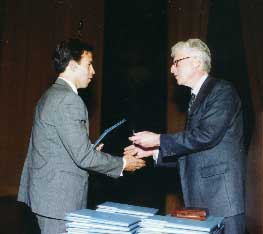
Columbia University Provost Jonathan R. Cole (right) presents Rick Atkinson, of The Washington Post, with the 1999 Pulitzer Prize for Public Service.
Winning Work
By Jeff Leen, Jo Craven, David Jackson and Sari Horwitz
Post Staff Writers
The District of Columbia's Metropolitan Police Department has shot and killed more people per resident in the 1990s than any other large American city police force.
Many shootings by Washington police officers were acts of courage and even heroism. But internal police files and court records reveal a pattern of reckless and indiscriminate gunplay by officers sent into the streets with inadequate training and little oversight, an eight-month Washington Post investigation has found.
Washington's officers fire their weapons at more than double the rate of police in New York, Los Angeles, Chicago or Miami. Deaths and injuries in D.C. police shooting cases have resulted in nearly $8 million in court settlements and judgments against the District in the last six months alone.
"We shoot too often, and we shoot too much when we do shoot," said Executive Assistant Chief of Police Terrance W. Gainer, who became the department's second in command in May.
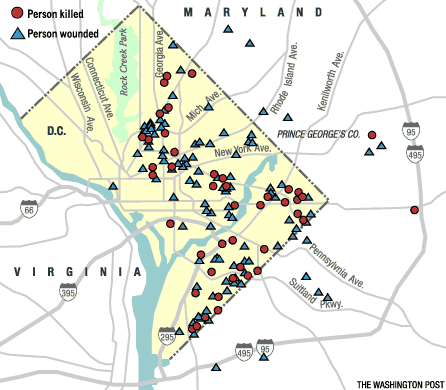
Shootings by D.C. Police, 1994-1998
The shootings involve a small proportion of the District's 3,550 officers. But the details of individual cases can be chilling even to police veterans: An off-duty police officer out walking his dog in August 1995 fired 11 times while trying to stop an unarmed motorist who had hit a utility pole and left the scene of the accident. An off-duty police officer fishing in May 1995 shot an unarmed man three times after arguing with him on the banks of Rock Creek. In August, an officer ended a police chase of an irrational truck driver who had rammed several cars by firing 38 times into the truck's cab, killing the unarmed driver.
The extent and pattern of police shootings have been obscured from public view. Police officials investigate incidents in secret, producing reports that become public only when a judge intercedes. In a small hearing room closed to the public, nine of every 10 shootings are ruled justified by department officials who read the reports filed by investigating officers but generally hear no witnesses.
The spate of police shootings in the District this decade is closely tied to the training and supervision of officers and the way the department investigates cases and holds officers accountable, records and interviews show.
Police shootings began to rise at the beginning of the decade with a huge infusion of new, ill-prepared recruits and the adoption of the light-trigger, highly advanced Glock 9mm handgun as the department's service weapon. By the mid-1990s, shootings by officers had doubled to record levels even as a succession of police administrations failed to accurately track shooting patterns or correct acknowledged deficiencies in firearm skills.
Among the findings of The Post's investigation:
- In the last five years, D.C. officers shot and killed 57 people – three more than police reported in Chicago, which has three times the police force and five times the population. During that period, D.C. officers were involved in 640 shooting incidents – 40 more than the Los Angeles Police Department, which has more than double the officers and serves six times the population. Since 1990, Washington police have shot and killed 85 people.
- District officers in the last five years shot at 54 cars they said drove at them or others in "vehicular attacks." The shootings have killed nine people – all of them unarmed – and wounded 19. Police officers in the District and elsewhere are instructed to get out of the way and not shoot at moving cars, except in the gravest circumstances, because bullets can ricochet and because cars with wounded drivers can become unguided missiles. In New York City – with 10 times the number of officers and 14 times the population – officers shot at only 11 cars in vehicular attacks in the last three years.
- In addition to the incidents in which officers fired into cars, D.C. police in the last five years shot nine unarmed men on foot, killing two. Five of the surviving men were charged with assaulting a police officer, but the charges were dropped in all but one case.
- In 11 cases from 1992 to 1997, D.C. police ruled shootings justified despite eyewitness accounts or forensic evidence that contradicted officers, an examination of internal investigative records showed. Investigations were sometimes marked by errors, omissions and internal inconsistencies.
- Nearly 75 percent of the District officers who used their weapons in 1996 failed to meet the District's basic firearms standards for using the Glock semiautomatic handgun, a weapon that requires a high degree of training and skill. There have been more than 120 unintentional discharges of the gun in the past decade; 19 officers have shot themselves or other officers accidentally.
- In the internal records used to track shooting trends, D.C. police undercounted by nearly one-third the number of people they killed from 1994 to 1997, tallying only 29 fatal police shootings. The Post investigation confirmed 43 fatal police shootings in that period. Seven fatal shootings were missing from police shooting trend records, and seven other fatal shootings were mislabeled as nonfatal.
- Police shootings during the 1990s already have left a costly legacy: more than 70 lawsuits filed against the District. In June, a D.C. Superior Court jury awarded a $6.1 million judgment against police in a case in which a man with a knife was shot 12 times in the back by SWAT team members.
"Some of them just got gun-happy," one juror, William P. McLaurin, later told The Post.
That same month, the District quietly paid a $797,500 settlement in a lawsuit brought by the roommate of a D.C. police officer. The officer, who had not been to the firing range to qualify with his weapon for 26 months, accidentally shot and wounded his roommate. Department regulations require firearms training every six months.
© 1998, The Washington Post Company
By Jeff Leen
Washington Post Staff Writer
Hopping sidelong and holding his pistol in a two-handed grip, the man with the gun fired two shots through the side window of a Hyundai amid Monday morning rush-hour traffic on Florida Avenue.
One horrified witness thought he was seeing a drug hit. But the shooter was D.C. police officer Vernell Tanner. His dead victim: an unarmed 16-year-old wanted for driving recklessly and running red lights. Tanner said the youth had tried to run him over.
The death of Kedemah Dorsey on May 15, 1995, was not an isolated incident.
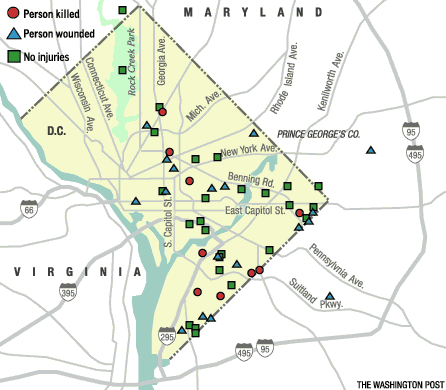
Shootings at vehicles by D.C. Police, 1994-1998
A year earlier, Detective Roosevelt Askew had shot and killed unarmed 19-year-old Sutoria Moore as he sat in his car during a routine traffic stop.
A year later, Officer Terrence Shepherd would shoot and kill unarmed 18-year-old Eric Anderson as he sat in his car during a routine traffic roadblock.
In each case, the officer said he was forced to fire to prevent a "vehicular attack" by the driver. But the department eventually determined all three of the shootings to be unjustified. In the last six months, the District has agreed to pay $775,000 to settle lawsuits brought by survivors in the three cases.
Like their counterparts in cities across the United States, D.C. police are instructed to shoot at unarmed people in cars only in extremely rare cases, to protect their lives or the lives of others. Yet since mid-1993, D.C. police officers have fired their weapons at cars 54 times in response to alleged vehicular attacks, killing nine people and wounding 19, an eight-month Washington Post investigation has found. In the overwhelming majority of those cases – and in all of the fatal shootings – the driver was unarmed.
"That's really chilling," said James Fyfe, a criminologist at Temple University and former New York City police lieutenant who has researched police shooting patterns for two decades. "What's happening is the District is bearing the cost of the errors of the past, the way they've hired and trained these officers."
Despite the discipline imposed on officers in some individual cases, the overall pattern of car shootings has continued throughout the 1990s. On Aug. 21, D.C. police surrounded a motorist on Interstate 295 who had vandalized one car and rammed three others, including two police cars, police said later. The trapped driver rammed a car carrying three passengers. To protect them, Officer Jacques Doby killed the unarmed driver by firing repeatedly into the truck. Doby shot 38 bullets, reloading twice, according to a police official.
"I'm really concerned about all these shootings," said Terrance W. Gainer, the department's new executive assistant chief. "What we're seeing in these cases are officers inappropriately putting themselves in harm's way because we haven't trained them well."
On Friday, Chief Charles F. Ramsey announced a new policy on the use of force placing even further restrictions on officers attempting to stop cars. "When confronted with an oncoming vehicle, [the] officer should move out of its path," the new policy states.
© 1998, The Washington Post Company
By David Jackson
Washington Post Staff Writer
In case after case when a District police officer shot a citizen during the 1990s, the Metropolitan Police Department's investigations were riddled with errors and omissions that make it impossible to sort out why the officer fired and whether the shooting was legitimate.
The poorly documented investigations protected officers who may have wrongly shot citizens or lied about the incidents, while making it difficult for blameless officers to clear their names in the civil lawsuits that often follow police shootings, an examination by The Washington Post found.
Because shootings by police may have enormous human consequences and put the department's integrity on the line, regulations call for every gunshot fired by an officer to undergo a rigorous, multilayered review. But from 1990 to the present, when shootings by D.C. officers reached record levels, that process was repeatedly short-circuited, The Post's investigation showed.
Bullet wounds were undercounted. Witness statements disappeared. Basic forensic tests were not conducted. Officers were allowed to shift their accounts or submit vague statements. And investigations of fatal shootings sometimes were conducted by direct supervisors instead of an independent unit, department records and interviews show.
In each of Officer Lawrence D. Walker's five shootings in a 10-month stretch in 1992 and 1993, Walker's supervisor participated in the investigation. In three cases, Walker and his partners shot people in the back; two died and one was severely injured.
When Lt. Elliott Gibson shot a 38-year-old deliveryman in the face during a June 1996 curbside drug bust, Gibson and the 10 other officers at the scene were not interviewed separately by detectives; instead, they composed written accounts of the shooting at the station house. Their typed statements – some submitted as long as a week after the shooting – contain some passages that match word for word.
When Officer Melvin Key shot a 21-year-old who was holding a BB gun, two witnesses were not interviewed until weeks later, after a lawyer for the young man's family brought the witnesses to the attention of federal prosecutors.
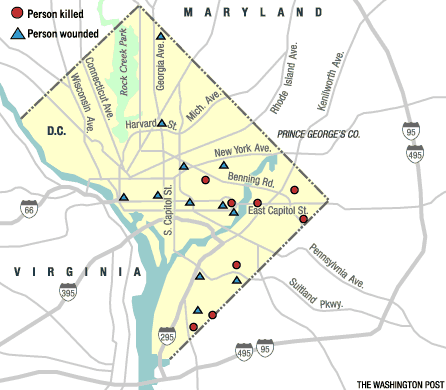 Shootings of unarmed civilians by D.C. Police, 1994-1998
On the night Officer Christopher Jack Yezzi killed a Maryland man, Yezzi's squad mates gave statements that described a righteous, by-the-book shooting. One of the officers later expressed misgivings about the episode and changed his account, but the shooting was ruled justified, police records show.
When Officer Kristopher Payne shot and killed an armed 18-year-old in 1995, police officials waited five months before conducting basic ballistics tests that would measure how far Payne was from the teenager when he fired. Those tests showed that one and possibly two shots to Antonio Williams's head came from a gun muzzle held only 24 to 30 inches away, corroborating a statement from a witness who said Payne shot the youth from close range as he lay defenseless.
The department declared all of these shootings justified on the grounds that the officers fired to protect their lives or the lives of others, and the officers or their attorneys said in interviews that police acted properly in each instance.
"What jumps out at me is the tendency to take the officer's account and build the investigation around that account," said Michael Cosgrove, a former Miami assistant chief who testifies in police shooting lawsuits and who reviewed summaries prepared by The Post of several cases.
Under police rules, if an officer wounds a civilian, his or her district commander supervises the investigation. If the citizen is killed, the case is entrusted to homicide detectives.
Once the internal investigations are complete, prosecutors at the U.S. attorney's office review the case and consider whether criminal law has been violated. Then the department's three-member Use of Service Weapon Review Board examines the case file to see whether the shooting violated weapons-use regulations and warrants disciplinary action against the officer.
© 1998, The Washington Post Company
By Jeff Leen and Sari Horwitz
Washington Post Staff Writers
A decade ago, the District's Metropolitan Police Department placed one of the most advanced pistols in the world into the hands of hundreds of ill-prepared, undertrained police recruits.
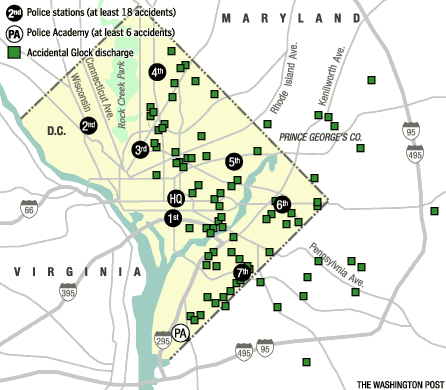
Accidental Discharge of Police Weapons, 1989-1998
The results have been unfortunate, according to police reports and internal department records examined by The Washington Post.
In the 10 years since D.C. police adopted the Glock 9mm to combat the growing firepower of drug dealers, there have been more than 120 accidental discharges of the handgun. Police officers have killed at least one citizen they didn't intend to kill and have wounded at least nine citizens they didn't intend to wound. Nineteen officers have shot themselves or other officers accidentally. At least eight victims or surviving relatives have sued the District alleging injuries from accidental discharges.
In an extraordinary sequence over the last six months, the District has settled three lawsuits for more than $1.4 million. The District admitted no wrongdoing in the suits, but the cases highlight the chronic neglect of Glock training by the D.C. police.
Last month, the District paid $250,000 to settle a case brought by the family of an unarmed teenager shot and killed at a traffic roadblock in 1996. The family's attorney argued that the officer's gun had discharged accidentally.
In August, the District paid $375,000 to settle another case in which a D.C. officer accidentally shot and killed an unarmed driver at a traffic stop in 1994.
In June, the District paid almost $800,000 to settle a case from 1994, when a D.C. officer accidentally shot his roommate. The officer had not been to the firing range to train with his weapon in more than two years – 20 months out of compliance with regulations.
"That's just poor on the department's part to allow that to happen, and poor on the individual's part," Chief Charles H. Ramsey, who took over the D.C. police in April, said in an interview. "No wonder they settled."
Ramsey's recent efforts to bolster lax training already have yielded significant improvements, police officials say. But as the recent legal settlements show, the bill for past shortcomings is still coming due.
The string of accidental shootings by D.C. officers came amid 10 years of warnings from firearms experts about the Glock's light trigger and propensity to fire an unintentional shot when handled incorrectly. Such a sensitive gun was designed for highly trained users.
Yet the department stinted on training for recruits and failed to keep veteran officers to a twice-yearly retraining schedule that experts consider the bare minimum for firearms competence. A Washington Post investigation found that 75 percent of all D.C. officers involved in shootings during 1996 failed to comply with the retraining regulation. One officer waited so long to come to the range that firearms instructors found a spider nest growing inside his Glock.
Several factors contributed to this neglect, including the reluctance of hard-pressed commanders to spare officers from street duty, lapses on the part of officers themselves, problems with lead contamination that shut down the shooting range in the early 1990s and poor management, according to interviews with officials and independent studies of the department.
D.C. police officials repeatedly studied the phenomenon of accidental discharges, invariably concluding that there was no fundamental problem with the Glock itself – as long as users were properly trained. Officials chose not to modify the Glock trigger, as New York City police did in 1990, to require a more forceful tug to fire the gun. In 1994, D.C. police recorded more accidental discharges than the Chicago or Los Angeles forces, two far bigger departments, according to discharge records from the departments. Last year, the accident rate for D.C. police was 50 percent greater than that of New York police.
Former D.C. police chief Larry D. Soulsby told The Post recently that he had planned to have the department switch from the Glock to another pistol before his retirement last November. Safety, Soulsby said, was "absolutely" a major factor in his thinking. In the past, the police union had pressed for a change of service weapon, Soulsby and former union officials said.
Glock Inc., the Austrian company's U.S. subsidiary, did not respond to repeated phone calls or a letter sent to its headquarters in Smyrna, Ga. A lawyer who has represented the company defended the gun as a safe weapon, citing the pistol's enormous popularity with U.S. police agencies.
"Glock has a market share probably in excess of 50 percent of the law enforcement market out there in the United States," New York lawyer John Renzulli said.
© 1998, The Washington Post Company
By Sari Horwitz
Washington Post Staff Writer
During a decade when fatal shootings by D.C. police rose to the highest levels in the nation, hundreds of city residents took legal action to charge officers with brutal force that stopped short of gunfire.
The allegations detailed in more than 750 civil lawsuits filed since 1990 sound common themes: short-fused officers who either provoked confrontations or allowed routine encounters to escalate; men and women, young and old, black and white, Hispanic and Asian, jailed on flimsy charges that were promptly dropped; hostility between officers and residents that touched every geographic quadrant and socioeconomic level – from Georgetown to Anacostia, from Spring Valley to Shaw – and sometimes involved brutal beatings with fists, nightsticks or blackjacks.
Disorderly in D.C.
In 1996—the last year for which such comparitive data were available—cities over 250,000 averaged 411 disorderly arrests per 100,000 residents while the District averaged 1,260. That is typical of the pattern for the previous eight years.
Like police shootings, brutality allegations have cost the District. The city paid settlements and judgments in more than 300 civil cases – nearly half of the lawsuits filed in the 1990s – for an average cost of $1 million a year, a review of court documents by The Washington Post showed. Corporation Counsel John M. Ferren, whose office handles civil litigation against the police, said settling a case is a "business decision" that takes into account the city's probability of winning in court.
Lapses in training and supervision frequently are at the root of both excessive-force and questionable shooting incidents, according to criminologists and police officials.
"You can't talk about deadly force unless you talk about the whole continuum of force," Chief Charles H. Ramsey said in an interview.
Police officials say that most of the city's 3,550 officers regularly demonstrate an ability to defuse tensions on the street without using force, and that only a small number of the 40,000 to 50,000 arrests made in the District each year result in complaints from citizens. Officers involved in brutality incidents tarnish the badges of officers who regularly use restraint, officials add.
"Suspects have rights, too," Ramsey said. "We are not allowed to use excessive force or verbally abuse people, nor should we."
Yet, court files and internal city documents reveal hundreds of incidents in which tensions led to violence:
A jury awarded $79,326 in 1993 to Quentin Porter, a 73-year-old retired postal worker who was mistaken for a criminal suspect, pulled from a park bench, beaten and arrested by an officer who broke Porter's arm.
The city paid Annie L. Brockett $45,000 in 1994 after the 56-year-old Columbia Heights woman said she was beaten with a nightstick on Christmas when she questioned officers who were involved in an altercation with two of her sons in front of her home.
The city paid Rose Pitt $250,000 in 1996 after her 31-year-old son, Frankie Murphy, a deaf Southeast Washington man, died in police custody. He stopped breathing after D.C. officers used a choke hold on him, according to court papers.
The city paid Leslie Howard and three relatives $130,000 last year after officers allegedly struck, cursed and maced them during a disturbance outside their Jamaican carryout restaurant on Georgia Avenue NW.
Of more than 400 lawsuits filed in the 1990s that have not been settled, some have been dismissed as groundless but many are still pending. In most of the settled cases reviewed by The Post, D.C. officers named in complaints and lawsuits faced little departmental discipline, even when they cost the city large financial judgments. One officer has amassed at least 18 citizen complaints, each ruled groundless.
© 1998, The Washington Post Company