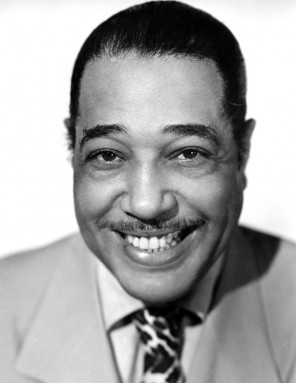
Duke Ellington

Bestowed posthumously, commemorating the centennial year of his birth, in recognition of his musical genius, which evoked aesthetically the principles of democracy through the medium of jazz and thus made an indelible contribution to art and culture.

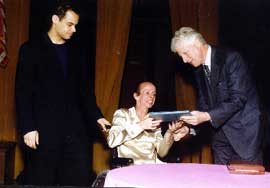
Columbia University Provost Jonathan R. Cole (right) presents Lene Ellington and Paul Ellington with the 1999 Pulitzer Prize Special Citation.

Winning Work

Ellington's Special Citation is for his life's work in music. Spanning fifty years, his vast oeuvre leaves several introductory points. Early Ellington: The Complete Brunswick and Vocalion Recordings (Decca/Verve, 1994) includes many (but not all) of the standards from the 1926-1931 "jungle" period in comparatively high fidelity, including "Mood Indigo" and "East St. Louis Toodle-Oo." 

Never No Lament: The Blanton-Webster Band (RCA, 2003) and The Duke at Fargo 1940: Special 60th Anniversary Edition (Storyville, 2001) highlight the contributions of Strayhorn, bassist Jimmy Blanton and saxophonist Ben Webster in an era that many regard as the apotheosis of Ellington's artistry. Not to be confused with Charlie Parker's composition of the same name, "Ko-Ko" showcases Blanton's virtuosity. 

Ellington at Newport 1956 (RCA, 1999) includes the Orchestra's complete comeback performance—long presumed lost—at the 1956 Newport Jazz Festival. Following the lean years of the early Fifties, saxophonist Paul Gonsalves's lengthy solo on "Diminuendo In Blue" helped to reaffirm Ellington's importance in the popular consciousness.

One of Ellington's most fascinating efforts is Money Jungle (United Artists, 1962), a one-off trio collaboration with musical descendants Charles Mingus (bass) and Max Roach (drums). The title track captures Ellington in a dissonant mood as "the poor man's Bud Powell."

The ethereal "Fleurette Africaine" is a little-known highlight of Ellington's later period. Written especially for Mingus and never performed by the Orchestra, its contemplative quietude anticipates later developments in ambient music.

Like his contemporary Woody Herman, Ellington remained attuned to all varieties of music. Taken from Ellington's last great suite, The Afro-Eurasian Eclipse (Fantasy, 1971), "Acht O'Clock Rock" melds his singular harmonic style to a rock-inspired beat.
Biography

From his perch at the Cotton Club during the Roaring Twenties through the Vietnam era, Duke Ellington was a towering figure in American music. While three-minute standards like "It Don't Mean a Thing (If It Ain't Got That Swing)" and "Sophisticated Lady" helped to define the course of big band jazz for a generation of listeners, Ellington refused to stop there. Aided by the classically-trained Billy Strayhorn, he began to see himself in the early Forties as a composer "beyond category."

Over the next twenty years, a remarkable artistic flowering included concert works influenced by the orchestral tradition (Black, Brown and Beige), musical theater (Jump for Joy), and ambitious suites incorporating non-Western and literary influences (the Shakespearean Such Sweet ThunderThe Far East Suite).

Even as the popularity of jazz waned in the postwar era, the Ellington Orchestra maintained a rigorous touring schedule, culminating in a remarkable performance at the 1956 Newport Jazz Festival that yielded the beststelling Ellington at Newport. From then on, Ellington was perceived as an eminent ambassador of American culture, as likely to be at the Johnson or Nixon White House as on a State Department tour of the Middle East.

When the Pulitzer Prize music jury could not select any suitable candidates for the second year in a row in 1965, a special award for Ellington was proposed. However, according to then-administrator John Hohenberg, "the Pulitzer Board... did not take the Ellington nomination seriously because it did not conform to the terms of the music award at the time, which was for an original work of music in its larger forms by an American composer." Although Hohenberg believed that the Board would have awarded the Music Prize to the eligible Far East Suite, this option was not brought to the floor. (Hohenberg, The Pulitzer Diaries, 147)

Instead, no award was given.

The oversight soon leaked to Ellington, who expressed his frustration in a phone conversation with critic Nat Hentoff. "I'm hardly surprised,” he said, “that my music is still without official honor at home. Most Americans still take it for granted that European-based—classical music, if you will—is the only really respectable kind. By and large, in this country, jazz has always been the kind of man you wouldn’t want your daughter to associate with.”

Despite the oversight, Ellington remained prolific until his death on May 24, 1974. Twenty-five years later, the Pulitzer Prize Board awarded the composer a posthumous special citation in commemoration of the centennial of his birth. The award certificate was accepted at the annual Pulitzer Prize luncheon by daughter-in-law Lene Ellington and grandson Paul Ellington.


Other Biographical Resources

First published in Rolling Stone in 1974, Ralph J. Gleason's "Farewell to the Duke" received the prestigious ASCAP/Deems Taylor Award that year. Invoking the streetwise wisdom of Nelson Algren (“If society denies someone their reality, then they’ll structure their own reality”), Gleason offers a near-definitive portrayal of Ellington as a complex avatar of modernism who was ultimately defined by his many contradictions.

More comprehensive overviews of Ellington's life may be found in Terry Teachout's Duke: A Life of Duke Ellington (Avery, 2013) and John Edward Hasse's Beyond Category: The Life And Genius Of Duke Ellington (Da Capo, 1995), with the latter drawing upon Hasse's curatorial work at the National Museum of American History. David Hajdu's Lush Life (North Point Press, 1997) is a pathbreaking life of Billy Strayhorn.

Winners in Special Citations and Awards

George Gershwin

Awarded posthumously, commemorating the centennial year of his birth, for his distinguished and enduring contributions to American music.

Herb Caen

For his extraordinary and continuing contribution as a voice and conscience of his city.

1999 Prize Winners

Chuck Philips and Michael A. Hiltzik

For their stories on corruption in the entertainment industry, including a charity sham sponsored by the National Academy of Recording Arts and Sciences, illegal detoxification programs for wealthy celebrities, and a resurgence of radio payola.

Staff

For its clear and detailed coverage of a shooting rampage in which a state lottery worker killed four supervisors then himself.

Maureen Dowd

For her fresh and insightful columns on the impact of President Clinton's affair with Monica Lewinsky.