The New York Times, by Maureen Dowd
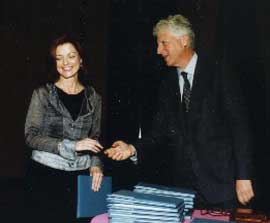
Columbia University Provost Jonathan R. Cole presents Maureen Dowd with the Pulitzer Prize for Commentary.
Winning Work
By Maureen Dowd
WASHINGTON -- There have been so many people rushing to TV studios in this giddy and cataclysmic week to talk about sex that networks are bringing makeup artists out of retirement.
The palaver about whether a 21-year-old White House intern had a particular kind of sex with the President has gotten so graphic that CNN's "Inside Politics" Friday featured a warning that the segment might not be suitable for young viewers.
Let's review what we've learned so far.
The President a liar? Knew that.
The President a philanderer? Knew that.
The President reckless in the satisfaction of his appetites? Knew that.
The President would say anything and hurt anybody to get out of a mess? Knew that.
Married men cheat? Knew that.
Married men cheat with young women? Knew that.
Married men who cheat with young women lie about it? Knew that.
Hillary isn't throwing Bill's stuff out on the White House lawn because she is as committed to their repugnant arrangement as he is? Knew that.
The Clinton team -- those great feminists -- devising ways to discredit women who come forward with reports of Clinton peccadilloes? Knew that.
The President and his minions dissembling and splitting hairs and playing semantic games and taking forever to find the documents until our attention wanders? Knew that.
The President has the moxie to pick out a dress for a woman? Didn't know that.
In the delirium of the scandal, something remarkable occurred. The President reportedly admitted, in a deposition to Paula Jones's lawyers, that, oh, yeah, by the way, he did have that affair with Gennifer Flowers, which he so adamantly denied during the '92 campaign.
I still remember James Carville ranting at reporters for being low enough to pay any mind to her, calling it cash for trash.
How can he go back on TV and defend Mr. Clinton in another sex scandal by once more trying to throw doubt on another damning tape?
At least Mr. Carville looked sheepish. Mr. Clinton's famous rapid-response team seems to have bimbo-battle fatigue.
The tapes of Monica Lewinsky, now 24, seem believable, not least because we heard it all before with Gennifer Flowers. Helping to get her a new job, telling her to say nothing went on if anyone asked. "Deny it," Mr. Clinton told Ms. Flowers on tape. "That's all. I mean, I expect them to come look into it and interview you and everything. But I just think if everybody's on record denying it, you've got no problem." The whole modus operandi is right there.
Also, why did Vernon Jordan become a patron to a lowly Pentagon assistant if she was nothing special to the President?
The reality that looms before the American people is not the impeachment of this President. It is the annulment of this President. He has finally determined his own place in history. He will be remembered as the priapic President. The Oval Office appears to be the bachelor pad of a married man who is the Commander in Chief. Like all addicts, this one is surrounded by enablers.
Many Americans had accepted Mr. Clinton as a charming rogue. But the portrait that may be pieced together from the confessions of his willing and unwilling women now looks utterly uncharming. Ms. Lewinsky's nickname for him -- "the big creep" -- could stick.
The Clinton doctrine may turn out to be nothing more than a view of the relationship of oral sex -- or Oval sex -- to adultery. CNN's Judy Woodruff reported that religious scholars could find no biblical basis for Mr. Clinton's purported claim to an Arkansas trooper that the Bible says oral sex is not cheating.
Ted Koppel actually began "Nightline" Thursday with the following sentence: "It may . . . ultimately come down to the question of whether oral sex does or does not constitute adultery."
Well, it sure isn't fidelity.
When Mr. Clinton says now that he can't answer questions about sex, lies and tapes because he must hurry back to governance, people will want him to hurry back to self-governance instead.
© 1998, The New York Times Company
By Maureen Dowd
Hillary Clinton knows her husband is a hound dog. She knew it before she married him. But they have their deal. He supported her when she messed up on Whitewater and health care. So if the Presidency hinges on "he said, she said," the First Lady won't hesitate to supervise the vivisection of the former intern.
WASHINGTON -- Inside the White House, the debate goes on about the best way to destroy That Woman, as the President called Monica Lewinsky.
Should they paint her as a friendly fantasist or a malicious stalker?
They hope it won't be necessary, of course. Maybe Kenneth Starr won't flip her. Maybe the Clintonites won't have to go out and maul a 24-year-old Valley Girl whose friends say she is "like, suicidal," a young woman who has already been traumatized by the creepy Starr and his marauding gang of F.B.I. agents.
But the Animal House President has messed up big time again, and he must be dragged back from the precipice by the bimbo patrol.
So far, it's been mostly a whispering campaign against Monica. But some Clinton supporters are whispering awfully loud.
"That poor child has serious emotional problems," Representative Charlie Rangel of New York said last night before the State of the Union. "She's fantasizing. And I haven't heard that she played with a full deck in her other experiences."
It helps that the President is attracted to women with big-cut hair and low-cut dresses. It makes it easier to slander them later.
At least some of the veteran Clinton shooters feel a little nauseated this time around, after smearing so many women who were probably telling the truth as trashy bimbos. It is a tricky matter, going after another young woman who really, like, loved the President, putting mushy valentines to him in the Washington Post personal ads, sending presents by messenger, paying $250 to get into a fund-raiser so she could follow him around like a high school kid waiting outside her boyfriend's biology class.
The Clintonites are worried that the public, having seen the tactic so often, starting with the private investigator hired by the '92 Clinton campaign to intimidate women from his past, might recoil.
Hillary Clinton knows her husband is a hound dog. She knew it before she married him. But they have their deal. He supported her when she messed up on Whitewater and health care. So if the Presidency hinges on "he said, she said," the First Lady won't hesitate to supervise the vivisection of the former intern.
Ms. Lewinsky, after all, is expendable. What really matters is the fate of the Republic and the fate of the Clintons. (For them, it is the same fate.)
It is ironic, of course, that they may paint Ms. Lewinsky as an erotomaniac. Feminists were outraged when Anita Hill was painted as one. It is probably just a matter of moments before we hear that Ms. Lewinsky is a little nutty and a little slutty.
The Clintonites need ammunition, and Ms. Lewinsky is pure Melrose Place. They will seize on her neuroses and transform them into vices. (They might also seize on Bill Clinton's vices and turn them into neuroses.)
The feminist icon in the White House doesn't flinch at smearing these women, even when she suspects they're telling the truth, because she feels they're instruments of a conspiracy. It may turn out that there are right-wing troublemakers involved here, but when Mrs. Clinton uses apocalyptic language she's just changing the subject.
Ms. Lewinsky must die so that the women of America can have better child care, longer maternity stays, toll-free domestic violence hot lines and bustling mutual funds.
Mrs. Clinton knows she can count on the complicity of feminists and Democratic women in Congress. They accept the trade-off in letting a few women be debased so that they can get more day-care centers.
The danger here is, spare the rod, spoil the President. If he escapes again, he will grope again.
Also, once you decide it's O.K. to sacrifice individual women for the greater good, you set a dangerous precedent. Mrs. Clinton's head might also wind up on the block.
Yesterday the sex casualty Dick Morris, commenting on the sex addict Bill Clinton, smeared the First Lady to defend the President.
"None of what I'm about to say is necessarily a fact," he said on KABC radio in Los Angeles. "But let's assume, O.K., that his sexual relationship with Hillary is not all it's supposed to be, let's assume that some of the allegations that Hillary -- sometimes not necessarily being into regular sex with men -- might be true," he said, going on to suggest the President might be justified in exploring other avenues of satisfaction.
© 1998, The New York Times Company
By Maureen Dowd
WASHINGTON -- Erik Tarloff's mother cut a deal with his father.
"If Frank Sinatra ever came on to her, she was allowed to go with him for one night, with no repercussions in the marriage," he recalls.
Mr. Tarloff, a writer who saw Washington from a rare perspective as the husband of a Cabinet-level official, the former Clinton chief economic adviser Laura D'Andrea Tyson, thought of his mother's groupie exemption when he wrote his new Washington novel, "Face-Time."
The book, not yet published, is about a young woman who works in the White House, along with her boyfriend, a speechwriter. She succumbs to the advances of a Clintonesque President because she feels it is an experience that transcends infidelity, and even sex.
Or, as Marilyn Monroe mused to her psychiatrist about her relationship with J.F.K.: "Marilyn Monroe is a soldier. ... The first duty of a soldier is to obey her Commander in Chief."
When all is said and done, Bill Clinton's biggest legacy may not be in politics, but in letters. Aside from the flock of fiction and nonfiction books written about our intriguing President, he has inspired one entirely new and remarkable genre: feminist erotic journalism.
After decades spent trying to dissuade powerful men from thinking they can have their way with less powerful women, feminists now have a terrible confession: They pant for power. They crave droit du seigneur. Take me! Take me!
First Larissa MacFarquhar wrote of Monica Lewinsky in The New Yorker that "It would be a rare young woman who could resist ... a chance to sleep with a man who is (a) the President and (b) a babe."
Then 10 women, including some feminists, a fashion designer and a retired dominatrix, participated in a panel for The New York Observer that resulted in a story headlined "New York Supergals Love That Naughty Prez."
"I think there has been a shift in the cultural climate since the time of the Anita Hill hearings," said Katie Roiphe, adding: "Now, this virile President is suddenly fulfilling this forbidden fantasy of this old-fashioned, taboo aggressive male. I think women are finding that appealing." Tina Brown wrote her bodice-ripping dispatch from the Tony Blair state dinner about Mr. Clinton: "His glamour is undersung ... a man in a dinner jacket with more heat than any star in the room (or, for that matter, at the multiplex) ... his height, his sleekness, his newly cropped, iron-filing hair, and the intensity of his blue eyes. ... He is vividly in the present tense and dares you to join him there."
The latest swooner is Nina Burleigh, a former White House reporter forTime, who writes in Mirabella about a game of hearts with Mr. Clinton on Air Force One flying to Jasper, Ark., that made her tingle.
"The President's foot lightly, and presumably accidentally, brushed mine once under the table. His hand touched my wrist while he was dealing the cards. When I got up and shook his hand at the end of the game, his eyes wandered over my bike-wrecked, naked legs. And slowly it dawned on me as I walked away: He found me attractive....
"There was a time when the hormones of indignant feminism raged in my veins. An open gaze like that, at least from a man of lesser stature, would have annoyed me. But that evening ... I felt incandescent. It was riveting to know that the President had appreciated my legs, scarred as they were. If he had asked me to continue the game of hearts back in his room at the Jasper Holiday Inn, I would have been happy to go there and see what happened."
Amazingly, Nina outflutters Tina, casting Bill as Zeus in "Leda and the Swan": "Yeats honored the magnetic sexual pull a powerful male can have on a weaker female. The beating wings of the giant swan enwrap the helplessly infatuated woman, whose 'terrified vague fingers' cannot push the 'feathered glory from her loosening thighs.' "
Ms. Burleigh may have Presidential affairs on the brain since she just wrote a book about Mary Meyer, a J.F.K. paramour who was murdered. Defending her piece to The Washington Post, she noted that she would have happily had a certain kind of sex with Mr. Clinton "just to thank him for keeping abortion legal."
We should stop blaming Ally McBeal for killing feminism. We should even stop blaming Bill Clinton. It is clearly a mass suicide.
© 1998, The New York Times Company
By Maureen Dowd
WASHINGTON -- We are deep into psychobabble.
Do we have closure, healing, catharsis? Are Bill and Hillary Clinton still in denial? Is the First Lady an enabler? Is her anger at Kenneth Starr and the press simply transference? Through confrontation, has the President broken his pattern of recovery and loss, of compulsive, addictive, destructive behavior?
Are we ready to give our bad boy in the White House a hug?
President Clinton is the Grand Canyon of need. He can never stay focused for long on running the country and the world because it gets in the way of his favorite pastime, a warped little mind game called "How Much Do You Love Me?"
The wild-child President enjoys dipping into his dark side -- "Saturday Night Clinton," Dick Morris calls it -- and engaging in the sort of hooliganism that requires everyone around him to make soul-wrenching compromises.
Rather than tell the truth about a cheesy office affair seven months ago, he dragged Washington and America into a stupid, phony war. It's not a war about ideology or principles or privacy rights, although the Clintons like to cast it that way. It's a war about how much Bill Clinton can get away with and still keep our affection. He's constantly testing the limits of our love.
He wants to know if his aides and advisers will lie for him, lose their good names for him, accrue legal bills for him, be saps for him.
Believe it or not, I remember a time when Ann Lewis was respected as a straight shooter.
To save his skin, the President forced government lawyers into brawls that have forever weakened the White House and Secret Service.
He used Madeleine Albright and Donna Shalala to give him feminist cover, and let them foolishly parade in front of the cameras to declare their fealty.
He turned feminists who fought so hard against Clarence Thomas and Bob Packwood into risible hypocrites. He would give them progressive public policies for women if they defended him on regressive private behavior with women.
Women in Congress who had stuck with Mr. Clinton through his seven months of living dangerously were furious about Monica yesterday. "It's the grossest kind of infidelity," one told me, "just sheer constant physical relief and satisfaction, really using in the crudest way somebody who was obviously extraordinarily gullible and obviously madly in love with him, somebody who would have done anything for him, and doing this in the Oval Office. I'm having a very hard time with it. I don't want to be an enabler."
The President gave his loyal, accomplished wife a choice between the two roles she most dreads: victim or liar. Either this superbrainy lawyer and strategist did not know her husband was lying, making our most modern First Lady a dupe in the oldest story in the world. Or she did know, meaning that she lied when she defended him on the "Today" show.
Mr. Clinton presented a searing Hobson's choice to his lovely daughter. She dutifully blessed him with her protection, holding his hand on the way to the helicopter yesterday, even though he humiliated her mother with a girl close to her own age.
The Clintons attack Mr. Starr to deflect attention from the President's immoral behavior. They appeal to decent American impulses -- we do not like lynch mobs, we do not like hate-mongering, we do not like women who rat out girl friends, we do not like Big Brother peeking through bedroom windows. The Clintons elicit our public-spirited impulses and use them for their private political gain.
But the choices they ask us to make are false ones.
You can think the notion of impeachment is ludicrous and still think that Mr. Clinton has acted with monstrous selfishness.
You can think Mr. Starr's investigation has been scary and still believe that a President should tell Americans the truth at the first opportunity, not the last.
You can think Linda Tripp rides on a broomstick and still believe that a President should not ask an intern to service him.
By expecting others to sacrifice so much to preserve his political viability, Mr. Clinton has killed something worthy and important in public life.
All this carnage, and for what? To cover up some seamy sexcapades?
His game has grown exhausting. How much do we love him?
Not that much.
© 1998, The New York Times Company
By Maureen Dowd
WASHINGTON -- It's not easy being in love with a President.
There are so many distractions. Whenever you want a little quality time, he's got some world crisis to handle.
I remember reading an interview with Judith Exner, where she talked about how lonely it was dating J.F.K. Whenever she wanted him to focus on her, he was focusing on Castro.
Cuba, Cuba, Cuba! That's all he cared about.
So I felt for Monica Lewinsky when she appeared before the grand jury on Thursday -- still pining for some attention from her ex-boyfriend -- and he was caught up in macho Commander in Chief stuff.
Sudan, Sudan, Sudan! That's all he cared about. And he wasn't even wearing one of her secret love ties.
The 25-year-old says she is eager to get on with her life. But does she still dream that her life will include an ex-President named Bill?
I just hope she is not over at the Watergate, flipping through designer swatches for the Clinton Presidential Library.
After the President's prime-time confession, the news media were abuzz about whether Mr. Clinton could repair his damaged relationships with his wife and daughter.
Suddenly, That Woman stamped her feet. Like the Glenn Close character in "Fatal Attraction," Monica Lewinsky issued a chilling ultimatum to the man who jilted her: I will not be ignored.
She let it be known that she was wounded that the President had failed to apologize to her and had dismissed their grand, 18-month romance, their shared passion for books and laughs, as trivial -- a mere mechanism for relieving Oval Office tension.
Mr. Clinton rejected a more contrite version of the speech written by Bob Shrum -- nicknamed the "Shoot Me" draft at the White House -- that contained an apology to "Monica Lewinsky and her family." Instead, with some brass-knuckle guidance from Hillary, he embraced his wife and daughter as "the two people I love most," while swatting Monica away as "inappropriate."
He portrayed himself, insultingly, as a passive participant in their trysts. What she called true love, he called "legally accurate."
Monica got cranky and complained about all the positive press and public sympathy heaped on her rival, Saint Hillary, while she was being portrayed as a vixen.
She had lied to protect her beloved. And she had believed, from hints he had dropped, that there might not be a Hillary in their future.
More in anger than hope, Monica returned to the grand jury and made it clear she was not simply servicing the President. The pleasuring, she insisted, contradicting his account, was mutual. Their relationship was not cheap. It was way unique.
The romance that rocked the White House seems so pathetically adolescent. Him, clinging to some juvenile belief that oral sex is not sex. Her, clinging to some juvenile belief that the President loved her.
It's hard to believe that this "feminist" President didn't see, or chose to overlook, the misogynistic and narcissistic nature of his relationship with Ms. Lewinsky.
Before the President finally fessed up, his henchlings had whispered that Monica was a stalker who had fantasized a romance with him.
While she is not a stalker, since Mr. Clinton encouraged her interest for quite some time, she is certainly aggressive. Otherwise, as a mere intern, she could not have barged through all the protective layers around the President. And she was, according to the Tripp tapes, desperate to continue the relationship after the President had slithered away. I will not be ignored.
Monica has at least one special talent: she is relentless. It was the quality that got her noticed by Bill Clinton, and it is the quality that will prevent him from ever escaping her.
There is a sort of rough romantic justice here. It may be de trop to punish this President with impeachment or resignation. In his case, the punishment is the crime. Monica will never let him go. She will be center stage for the rest of his Presidency, doing a star turn at Congressional hearings, granting celebrity interviews, signing book and movie deals.
It will not be in the way she envisioned, but she will get to ride off into the sunset with her man after all. Monica Lewinsky is Bill Clinton's legacy. They are linked together forever and ever.
In its own way, it's a perfect ending.
© 1998, The New York Times Company
By Maureen Dowd
WASHINGTON -- I was lolling at home yesterday morning, watching Howie Mandel, a talk-show host, ask Rosie O'Donnell, another talk-show host who was his guest, about her summer vacation.
Suddenly the program was interrupted for an ABC News Special Report. Had something happened to President Clinton? Was Russia no more? Had Monica and her mother signed a $10 million book deal?
No, Peter Jennings had broken in for a live report on the opening of the New York Stock Exchange. The anchor somehow managed to miss the opening bell and lose his remote feed from the trading floor. But he conveyed the import of the moment.
America's twin obsessions -- money and sex -- were captured most hilariously on Monday when CNN put a little stock ticker to the left of Trent Lott as he chastised Bill Clinton for diminishing the Presidency. It was impossible to focus on the majority leader's moral umbrage with the Dow plummeting 110 points right next to his helmet head.
I wasn't concerned about the market. I had already sold my paltry cache of stock to buy summer dresses. I thought I would wear the dresses to parties. But there are no parties. Washington is twitching through what is universally deemed the unsexiest sex scandal in its history. People here are too busy mucking around in others' private lives to enjoy their own.
By the time I got to work, the market was healing. But something else really, really scary had happened -- the A.P. wire was running a story about Dan Burton's sex life.
Dan Burton's sex life.
Just when you thought this scandal had hit rock bottom, the bottom got rockier. Thank you, Ken Starr, for wiring up Linda Tripp and for creating a nation of Peeping Toms, for dragging us down to the point where we have to hear the sex secrets of crepuscular Republican swamp life.
Representative Burton was trying to pre-empt any damaging personal revelations in an upcoming Vanity Fair profile by confessing rough times in his marriage. "If something comes out . . . that you think Danny shouldn't have done," Danny said, "I will own up to it."
In Mr. Starr's eagerness to get something, anything, on Bill Clinton to justify his overwrought investigation, the prosecutor has opened a sewer of T.M.I. -- Too Much Information.
Clintonites have long threatened a bedroom Doomsday strategy. Salon, an on-line magazine sympathetic to the White House, suggested why the House Speaker has been restrained about Monica. "Gingrich, lest we forget, has a closet full of sexual misconduct," wrote Stephen Talbot.
I dread to think what's next. Dick Armey's sex life? T.M.I. Phil Gramm's sex life? Way T.M.I.
It is remarkable, in a capital with such a lush history of sex, that a President might have to leave office for covering up an affair.
For decades, the rules of politics were very simple. As the Democratic strategist Raymond Strother summed it up: "If a politician stayed on his bar stool, he wasn't drunk. And if he didn't get caught, he wasn't cheating on his wife."
But for several years before Mr. Clinton came to town, it was clear that a gallows had gone up along the Potomac. With journalists willing to report more, with women coming into power more, the old libertine rules were vitiated.
In 1989 John Tower's nomination for defense secretary went down, amid opprobrium about his skirt-chasing and hard drinking, even though he promised to give up alcohol, and even though some senators came to the floor to vote against him with liquor on their breath.
Everyone realized then, as one G.O.P. consultant put it, that hypocrisy was going to be punished with more hypocrisy. John White, a former Democratic official, lamented that "there used to be better ways to gut a guy besides putting his personal mores through the meat grinder."
Allen Drury, the author of "Advise and Consent," mocked the new morality to me: "One must tell all and promise all and be a good, good, good boy and promise to be a good, good, good boy forever after."
Bill Clinton knew the rules had drastically changed. He promised to be a good, good boy. But he wasn't. It was a dangerous game. He lost and so did we. Even if the President escapes the gallows on the Potomac, we will be the world capital of T.M.I. for seasons to come.
© 1998, The New York Times Company
By Maureen Dowd
If we are going to dump our President, it should be for something big and bold and black and original. Not for the most tired story ever told.
WASHINGTON -- The President must not lose his job.
Not over this.
Certainly, Bill Clinton should be deeply ashamed of himself. He has given a bad name to adultery and lying. He has made wickedness seem pathetic, and that's truly a sin.
Kenneth Starr, all these years and all these millions later, has not delivered impeachable offenses. He has delivered a 445-page Harold Robbins novel.
If we are going to dump our President, it should be for something big and bold and black and original. Not for the most tired story ever told.
Middle-aged married man has affair with frisky and adoring young office girl. Man hints to girl he might be single again in three or four years. Man gets bored with girl and dumps her. Girl cries and rants and threatens, and tells 11 people what a creep he is.
The dialogue in this potboiler, compiled with sanctimonious, even voyeuristic relish by Reverend Starr, is so trite and bodice-ripping that it makes "Titanic" look profound.
In fact, Monica identified with Rose, the feisty, zaftig young heroine of "Titanic." Last January, the former intern wrote the President what she called "an embarrassing mushy note" inspired by the movie, asking her former boyfriend if they could have sex (the lying-down kind).
Despite the fact that it takes place in the most powerful spot on the planet, the romance does not sizzle.
Bill Clinton fancies himself another Jack Kennedy and invoked his idol's name last week to defend himself.
But Kennedy was cool. His women were glamorous. The Rat Pack was good copy. He may have been just as immoral, but his carousing at least had style.
Mr. Clinton's escapades are just cheesy and depressing. The sex scenes are flat, repetitive, juvenile and cloying, taking place in the windowless hallway outside the Oval Office study or in the President's bathroom.
The props are uninspiring. Monica always pretends she's carrying papers to get into the Oval Office, and she gives the President a frog figurine, a letter opener decorated with a frog and "Oy Vey! The Things They Say: A Guide to Jewish Wit."
Their meetings, often when the First Lady is traveling, are more needy than erotic.
Monica recalled, "I asked him why he doesn't ask me any questions about myself, and... is this just about sex... or do you have some interest in trying to get to know me as a person?"
By way of riposte, she said, the President laughed, said he cherished their time together and then "unzipped his pants and sort of exposed himself."
When she complained to the President that she had not had any hugs for months, he quipped, "Every day can't be sunshine."
Thankfully, Mr. Clinton grew tired of his little pizza girl. She sensed he was "putting up walls."
"This was another one of those occasions when I was babbling on about something," she said of their last rendezvous, "and he just kissed me, kind of to shut me up, I think."
He didn't call. He didn't write. She began to suspect she was being "strung along." Trapped in a stereotype, Monica became the raging, vengeful Glenn Close character in "Fatal Attraction."
"PLEASE DO NOT DO THIS TO ME," she wrote in a draft of a note to the President. "I feel disposable, used and insignificant."
She demanded a big job at the United Nations or in the business world in New York, as compensation for his ruining her life.
"I don't want to have to work for this position," she said. "I just want it to be given to me." She sent the President a "wish list" of jobs ("I am NOT someone's administrative/executive assistant") and enclosed an erotic postcard and her thoughts on education reform.
Now if the President was taking Monica's advice on education reform, that might be an impeachable offense.
She sent him a note that read: "I am not a moron. I know that what is going on in the world takes precedence... I need you right now not as president, but as a man. PLEASE be my friend."
Getting nervous over her fits, Mr. Clinton reminded her, "It's illegal to threaten the President." This is the document on which the fate of the Republic has been hanging? These are not grounds for impeachment. These are grounds for divorce.
© 1998, The New York Times Company
By Maureen Dowd
WASHINGTON -- The quintessential Bill Clinton moment can be found in footnote 109 of the Starr report.
The President was asked before the Starr grand jury about Robert Bennett's assertion during the deposition for the Paula Jones case that "there is absolutely no sex of any kind" between the President and Monica Lewinsky.
Mr. Bennett was right, Mr. Clinton said, because he was using the present tense. "It depends on what the meaning of the word 'is' is," the President explained helpfully.
The same footnote offers three other Clintonian gems before the grand jury: "I have not had sex with her as I defined it." "It depends on how you define alone." And, "There were a lot of times when we were alone, but I never really thought we were."
Mr. Clinton's double-talk had a contagious effect on Betty Currie. "I don't want the impression of sneaking," the secretary said, about Monica, "but it's just that I brought her in without anyone seeing her." And, "The President, for all intents and purposes, is never alone."
Mr. Clinton's greatest sin is not sex or dissembling about sex, as the heavy-breathing Kenneth Starr believes. His greatest sin is swindling and perverting the American language. He is like the cursed girl in the fairy tale: Every time he opens his mouth, a toad jumps out.
His problems stem from his instinct, when he runs into trouble, to shroud rather than illuminate.
He tries to make words subjective, insisting they mean only what he wants them to. Just as he made the Democratic Party about himself, and the Democratic Conventions about himself, and the Presidency about himself, he tries to make the language about himself.
But he can't. Laws are composed of words. The President is in charge of our laws. When he drains meaning from words, he jeopardizes his ability to govern. He has made Washington Orwellian. His corrupt language corrupts thought.
In order to escape the noose, the President is admitting and denying at the same time, and forcing his lawyers and aides to go out and behave like crazy contortionists.
Even Democrats are ashamed of the chuckle-headed "hairsplitting," as Tom Daschle calls it.
The President admits trying to mislead Paula Jones's lawyers, but denies lying under oath. He admits Monica had sex with him, but denies he had sex with Monica. He denies that oral sex (the second word of which is sex) is sex. The President, David Kendall says, committed "interpretations of contorted definitions," not perjury.
Once I went to Elizabeth Arden and they tried to sell me some soap. I told them that soap dried out my skin. "But," said the saleswoman, "this is the soap that isn't a soap." I bought it. It dried out my skin.
A friend of mine once picked up a purse at a counter in Saks and observed that it felt like plastic. "No," the saleswomen told her contemptuously, "it's Plastique."
The Clinton world is full of soap that isn't soap and plastic that isn't plastic.
"The great enemy of clear language is insincerity," George Orwell wrote in a famous essay on politics and language.
Mr. Clinton's supporters are upset that he did not give his groveling prayer breakfast speech 25 days earlier, on the night he made his defiant television address.
But the petulant and angry TV address was the authentic Clinton moment. The repentant and lip-biting prayer breakfast speech was the contrived Clinton moment.
We no longer expect this President to be sincere. We just expect him to fake better, fake sooner.
I don't think the President should be pushed from office. For his transgressions, he should have to perform 28 months of community service. He can join his National Service corps. Let him put aside his risky and challenging sex life and take up a risky and challenging public life. Let him cash in on his popularity, and do something wonderful for the country in return for all the slop he's put us through. As Rhett Butler said, "If you have enough courage you don't need a reputation."
But if he wants to move past "the adversity of the moment," as he so delicately calls it, Mr. Clinton must stop ducking, and find a way to reconnect words and meaning.
If he can't, he'll be in big trouble.
Depending on what you mean by the word "be."
© 1998, The New York Times Company
By Maureen Dowd
WASHINGTON -- He couldn't stop thinking about the thong underwear. He couldn't believe Monica had pulled up her jacket to show it off. It so inflamed his imagination. At meetings, at briefings, at the most unlikely times, his mind suddenly reverted to the image of those straps, quickening his pulse, making him catch his breath.
But it was the cigar that undid him. He was driven by the thought of what had been done with it. Suddenly the capital became a city of cigars. He saw them wherever he went. They ignited his desire. When he was alone or talking to other people, he took secret pleasure in letting smoke rings drift through his mind.
There were times when he worried that he might be a sex addict. He couldn't stop thinking of Monica: what she wore, when she wore it, where she wore it, or didn't wear it. Her little letters were so brazen, promising such wild pleasure. Everything she scribbled, every gift she gave, mesmerized him.
And then there was the power of her voice over him. He knew that he was entering the dangerous territory of obsession. No matter how much he heard Monica talk about sex, it was never enough.
He was a busy man. A powerful man. A serious man. But there were times when all he could remember were the sizzling phone conversations. They filled his head like a drug. People warned him that he was endangering his legacy. Friends and strangers tried to pull him back from the brink of his single-mindedness. But it was too late.
He had become the helpless victim of his cravings for ecstasy.
The big picture was lost. He hungered only for the details, all the stirring and seamy particulars. Nothing was too small or insignificant for him to consider, to turn over and over in his unappeasable mind.
He wanted to think about her eating cherry chocolates. He imagined her wrapped up like Cleopatra in the Rockettes blanket or panting in that Black Dog T-shirt. He kept seeing her in that blue Gap dress. It was too tight, and he was glad. Again and again he was visited by images of a man's roving lips. He knew it was wrong. But he liked to dip into sin. He needed a release from all the pressure, from the extraordinary responsibilities of a very public man.
When he went to church on Sundays, he wrestled with his conscience. He even wondered if he needed professional help.
Sometimes he worried that he was abusing his power and hurting the country. He even fretted that the Constitution itself might be damaged by his obsession.
And sometimes it wasn't easy to behold all the human damage that he already had caused: ruining a young woman's life, dragging all sorts of people through the muck, wounding reputations and bankrupting those who came near him. Would the Presidency survive his lust? It didn't matter.
Every time he heard those words -- inappropriate intimate contact, sex of any kind in any manner, shape or form, arousing or gratifying as defined in definition 1 -- he felt a fire burn.
He had his own definition of sex. Still, he was drawn to the endless discussion of the existential meaning of sex -- its forms, its uses. He was a lawyer, but this was not just tortured legalism. This was tortured eroticism. He liked to parse the lurid definition over and over and over again, gaining pleasure from repetition: "breasts," "genitalia," "inserted," "stain."
His acolytes and subordinates became agents of shamelessness. It seemed that everyone around him, everyone in the city, everyone in the country, was talking about what he wanted to hear. All of them had become his collaborators in perversity. He was spending millions and millions of dollars to drag an entire nation down to his twisted level.
He knew how strong he was. He was the most powerful man in the land. He could reach into every recess of the Government to satisfy himself. And the prospect of impeachment didn't frighten him.
In fact, the more he fixated on the strap of that thong, the more certain he was that he could hang Bill Clinton with it. And, of all those naughty words he loved to hear, none filled him with more pleasure than "impeachment."
After all, nobody could impeach him. He was Ken Starr.
© 1998, The New York Times Company
By Maureen Dowd
WASHINGTON -- The joke about Bill Clinton is: When he drives through a car wash in a convertible with the top down, somebody else gets wet.
The President turned the White House into Motel 1600 for rich donors, but Al Gore was the first one to get into trouble for making a few fund-raising calls from his office.
The President had his way with a young intern, but it was Newt Gingrich who got tossed out.
The President told one of the biggest, fattest lies in history, but the public wants to impeach the press.
New York magazine took a poll this week and concluded that it is the journalists covering the scandal who are all wet. "If there were justice, Cokie Roberts would resign, too," writes Michael Wolff in a cover story titled "Impeach the Media." "It was her morality -- and personality -- that people voted against." (Last I checked, she wasn't toying with an intern.)
Some talking heads have been giving themselves a lashing. After the election, George Stephanopoulos, the former Clinton adviser who is an ABC commentator, apologized, "We were all wrong, all the time."
To paraphrase President Clinton, it depends on what you mean by "were" and "wrong."
It was not smart for journalists to predict at the beginning of the Lewinsky scandal that the President would be gone within days. And it was wretched excess for the cable channels in search of another celebrity death watch to turn into vultures with daily "White House in Crisis" shows.
But the obsessiveness of the media does not justify the wrongheaded, vituperative consensus that has been building in the wake of the elections.
Myself, I was heartened by the way the voters weighed in with common sense and proportionality, reacting allergically to inquisitions and the prospect of impeachment.
But in the weeks since the election there has been too much gloating from the White House and its supporters. And there has been too much self-lacerating journalistic commentary misconstruing the public reaction as a vindication of the President. He won. The press lost. The press should get lost. Game over.
In a nation ruled by polls and ratings, where even newspapers hire focus groups to see what kind of news readers want, we are losing sight of something we should have learned as teen-agers: Just because something is popular doesn't mean it's right.
At the White House, the truth is employed only to the extent that it's useful. When the Monica story broke, Dick Morris said, the President asked him to do a poll to tell him what would play better, the truth or a lie. Mr. Morris said he told his old pal he couldn't tell the truth and survive, and Mr. Clinton replied, "Well, we'll just have to win."
New York magazine, which included me among its mug shots, rains a cascade of poll numbers showing that by big margins the public is fed up with hearing about the scandal.
I know exactly how the public feels. I'm sick of hearing about it too.
But the fact is that the scandal is there, and the President did what he did and said what he said, and the consequences of what he did and said have preoccupied the executive, the legislative and the judicial branches of government for a year.
To pretend otherwise, to submit robotically to the polls, to take one's professional instructions from the wishes and whims of a fickle electorate would be to abdicate the role the public says it wants the press to play: covering the news.
If the President had told the truth immediately, the story would have died. But it is our job to undo the spin and look into the lies and go the extra skeptical mile to see that there is no cover-up. Moreover, all journalists are not like all other journalists in the wild and woolly and recklessly fast era of the 24-hour news cycle of cable, the Internet and high-decibel know-it-alls and gossips.
The impure history of modern America -- Vietnam, Watergate, Iran-contra -- proves that reporters have a duty to dig for the truth, whatever the public thinks.
There is a danger of making false equations between popularity and rightness, between what is liked and what is true. The danger is that next time, when the cover-up takes place in a less gray area, reporters will look at the numbers and go home early. Next time it may not be about sex and lies. It may be about life and death.
© 1998, The New York Times Company
Biography
Maureen Dowd was appointed a columnist of The New York Times's Op-Ed page in January 1995 after having served as a correspondent in its Washington bureau since August 1986. There, she covered two Presidential campaigns and served as White House correspondent, gaining a wide following of admirers and imitators for her witty, incisive and acerbic portraits of the powerful. She also wrote a column, "On Washington," for The New York Times Magazine.
Ms. Dowd joined The Times as a metropolitan reporter in October 1983. She began her career in 1974 as an editorial assistant for the Washington Star, where she later became a sports columnist, metropolitan reporter and feature writer. When the Star closed in 1981, she went to Time magazine.
A Pulitzer Prize finalist for national reporting in 1992, Ms. Dowd received the Breakthrough Award from "Women, Men and Media" at Columbia University in 1991 and a Matrix Award from New York Women in Communications in 1994. She was named one of Glamour's Women of the Year for 1996.
Born in Washington, D.C., on January 14, 1952, Ms. Dowd received a BA degree in English literature from Catholic University (Washington) in 1973.
Ms. Dowd lives in Washington.