The Boston Globe, by Eileen McNamara
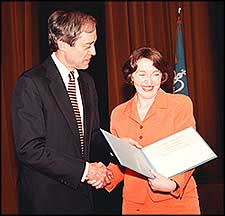
Columbia University President, George Rupp (left), presents Eileen McNamara with the Pulitzer Prize for Commentary.
Winning Work
By Eileen McNamara
Bill Bulger is not a racist man, but he is much too proud of being a parochial one.
Maybe now we can close the book on the potato famine, consign the No Irish Need Apply signs to history and concede that Judge W. Arthur Garrity was as sincere in his aims as Billy Bulger was in his.
The word from the wedgwood blue Massachusetts Senate chamber is that Himself will pack in his political career today.
It's a great day for the Irish.
For all the criticism of his dictatorial rule during his nine unprecedented terms as president of the Senate, it is the damage Bulger inflicted on his own people that is his saddest legacy.
A half-century after it ceased to have any meaning, Bulger continued to stoke the fires of Irish resentment toward Boston's moneyed Protestant class. Never mind that men named Murray, Flatley and Connors share the helm of Boston commerce. Bulger made the Irishman-as-victim a political cottage industry.
James Michael Curley first perfected the theme, exploiting the rancor between Brahmin and Irishman for political advantage through 10 mayoral campaigns over four decades. It was cynical enough then, when memories of oppression at the hands of English overlords were as fresh as the calloused knees of Irish women scrubbing the floors of the State Street Bank.
It is worse than cynical now. After 35 years in political life, Bulger still nurses the wounds of Boston Irish history, still savors the sting of old Yankee anti-Catholic prejudices.
There is a story former State Sen. George Bachrach tells of trying to cajole Bulger to take the lead during the upstart effort to reform the rules in the Legislature a dozen years ago.
"You could be a hero," Bachrach recalls telling the Senate president.
"You guys from Cambridge can be heroes, but guys like me can't," Bulger replied. "I'll always be a redneck mick from South Boston."
No one ensured that view of Bulger more than Bulger himself. It was as though he stubbornly refused to rise above his roots. He read Greek for pleasure and denied his children television to foster a love of books. His Jesuit education yielded an understanding of the ancient world, but little appreciation for dilemmas of the modern one.
He was right about so many things: about loyalty to place; about the central, but subterranean, role that class plays in this city; about the invisibility of the quiet struggles of working people in a news media obsessed with confrontation.
His opposition to busing to desegregate the schools sprang from an honest attachment to Southie; he still lives not two miles from the housing project where he spent his childhood.
But his inability to see beyond the South Boston peninsula trapped him in a venomous dance with anyone who did not share that world view. So Kevin White, Ted Kennedy, and especially Federal Judge W. Arthur Garrity were transformed into lace curtain lackeys, the Irish puppets of a Yankee aristocracy long dead. (It is unclear whether Garrity's larger sin was ordering the buses to roll or living in WASP-y Wellesley.)
Bill Bulger is not a racist man, but he is much too proud of being a parochial one. For him to challenge the insularity of his neighbors would be to betray them somehow. So he stood in the back of that hall in South Boston and listened to the racist invective against integrating public housing and said nothing.
For all of his classical education, how do we distinguish Bill Bulger's silence from Dapper O'Neil's rantings?
If he has a coherent political philosophy, the departing Senate president has never articulated it. His political career has brought a measure of financial security to his neighbors, directly through patronage jobs, indirectly through his votes to protect the social services on which so many of them depend. That appears to have been how he viewed his job.
In the past dozen years, Boston -- always an immigrant's city -- has been transformed once again. More than 40 percent of the city's residents are from minority groups. It will be a clear majority when the century turns.
Fourteen languages are taught in the public schools. The disenfranchised no longer have red curls and freckles, just as the entitled no longer all trace their roots to Plymouth Rock. (Bill Weld is from Smithtown, N.Y.)
"If you look at my vote, I do better as I get closer to my home address," Bill Bulger said five years ago. "The further away, the more difficult it is."
Amherst and the ethnically diverse state university he will lead into the next century could hardly be farther away from Southie and still be in Massachusetts. But education is said to be a broadening experience. One can hope.
© 1996, The Boston Globe
By Eileen McNamara
Life is in small ceremonies. Learning to ride a two-wheeler. Trembling on report card day. Asking for a first date.
Ron Getz and Sevrin Nelson have been denied more than their share of life's ceremonies. But the other day, two friends who spent half their lives institutionalized together participated in the most American of rituals: passing papers on a new home.
Ron is 56 now, Sevrin is 53. They met 50 years ago when they were committed as children to the Wrentham State School for the mentally retarded. They were roommates even then, when both were deemed too slow to learn, too disabled to try.
It's a diagnosis hard to imagine on a sunny winter day as the men dress in crisp, tailored suits of blue and gray, purchased with their discounts from Filene's and Filene's Basement, their employers for more than 20 years.
Their journey to independence charts as much as any graph how far we have come from those dark days when we hid away children like Ronnie and Sev, children we could have helped.
Their achievement, attained with the assistance of public and private agencies, is inoculation against the cynicism that could so easily be inspired by the political indifference and systematic incompetence that today puts so many vulnerable children in Massachusetts at risk.
Help came to Ron in 1973 and to Sevrin a year later when they rode the wave of deinstitutionalization out of a "school" that never taught them to count or expected them to read. In the next few years, they learned to do that and more as adults in the separate group homes where they lived.
The two friends were reunited a few years later with the help of the Newton Wellesley Weston Committee for Community Living, a nonprofit agency founded by parents and activists searching for a more humane alternative for the retarded than institutions.
In 1978, Ron and Sevrin moved into the first of many Newton apartments they would share, with the help of the NWW Committee and funding from the Department of Mental Retardation.
"We always work, every day, very hard," Sevrin says of the years it took for him and Ron to save the $20,000 down payment for the three-bedroom, shingled cottage with the white shutters in Newton Corner that now belongs to them.
Theirs was a real estate closing like no other William M. Noble Jr. has seen in his 42 years as an attorney. Accustomed to young couples purchasing their first home, or older couples refinancing the mortgage, Noble was unprepared for Sevrin and Ron and the entourage of camera-toting case managers, advocates and well-wishers who crowded into his paneled conference room.
"It's invigorating to be part of an occasion like this," says Noble, representing the mortgage lender, Auburndale Co-operative Bank. "These are two of the happiest homeowners I've ever met in my life."
As happy, and as anxious, as anyone who has just signed away a significant chunk of his future earnings. "No more bowling," Sevrin declares at the small dinette in the apartment he and Ron are preparing to leave behind. "No new clothes. No CDs. We've got a mortgage now."
Ron cringes at such sweeping prohibitions. Certainly, his eyes plead, there is money enough for a movie now and then or one more Johnny Mathis disc for the five-CD changer that was, until now, the biggest ticket item they'd ever purchased.
Will they be too broke for the housewarming they've been planning, they ask Becky Gloninger, the case manager who meets with them once a week to help with finances.
Introduced to the concept of pot luck entertaining, the suddenly frugal homeowners look immeasurably relieved. "Good. Everyone bring food. I'm not such a cook," concedes Sevrin, noting that Ron boasts a definite command of spaghetti.
Though freed from the burden of party planning, Ron and Sevrin remain preoccupied with all the decisions facing any new property owner. Ron has chosen the downstairs bedroom -- surgery last fall left him leery of stairs. But so many choices remain: beige or blue for the living room walls? Bare floors or wall-to-wall carpeting? The bus or the train for the commute to work?
Furniture. Appliances. Repairs. "One thing at a time," says Ron, neatly summarizing their latest transition -- tenants to homeowners -- and their lifetime transformation -- patients to taxpayers.
Ed Dailey, one of the lawyers who helped them negotiate the purchase of the house, has promised to help landscape the small lot.
In the fall, he will plant bulbs, perennials as hardy and as full of promise as the two graying gentlemen who will make their first mortgage payment on the first of March.
© 1996, The Boston Globe
By Eileen McNamara
Grief and anger compete today after the death of Jessica Dubroff in the crash of the plane the seven-year-old girl was piloting cross country.
Anger wins.
Anger at the parents who put a child in that cockpit.
Anger at the flight instructor who let them.
Anger at the cult of celebrity that has systematically killed off common sense in America.
We talk a lot about rights versus responsibilities in this country, but we almost always have the poor in mind when we do.
When flames engulf a tenement apartment we are quick to ask: "How could that mother have left her children home alone to run to the store for milk?"
When a child is shot dead on a summer night on a city street, we ask: "What was he doing out at that hour?"
This morning it is impossible not to ask about the ambitious middle-class parents of a precocious little girl: "What the hell were Jessica Dubroff's mother and father thinking?"
They certainly had a right to strap their little girl into a pilot's seat at Half Moon Bay Airport in California and point her toward the East Coast and 15 minutes of fame. But, just as surely, they had a responsibility not to.
Jessica was 4-foot-2. She weighed 55 pounds. She needed a booster seat to reach the control panel and leg extenders to reach the rudder pedals!
Her death was no accident. This child was put in harm's way.
Whether through a twisted sense of adventure, or a more base impulse toward self-promotion, Jessica's mother and father forgot that the first responsibility of parents is to protect their children.
"I don't want this to mean to people that you should hold your children down, that you don't give them freedom and choice," Jessica's mother, Blair Hathaway, said upon learning of her daughter's death. "And, God, that was what her beauty was. She got to choose."
Oh, Mrs. Hathaway, I know you are in shock, but what in heaven's name are you talking about?
Seven is old enough to choose which sweater to wear with what skirt, to choose, at least for awhile, to hate broccoli. But it is nowhere near old enough to choose to risk life and limb to become the youngest person to pilot an airplane across America.
Even the idea of such a record is obscene. That's why the Guinness Book of World Records eliminated the youngest pilot category years ago, knowing it had the potential to encourage such dangerous flights.
It's not just Jessica's parents who lost their moorings. The whole state of California seems to have taken leave of its senses.
Forrest Storz is a flight instructor at the airport south of San Francisco where Jessica had taken 30 hours of instruction in the last four months.
"Whatever happened was beyond their control," he said yesterday. "Some day your number is up."
What?
Have we gone so far down the road of evading responsibility that we blame fate for the crash of an airplane being piloted by a seven-year-old?
I understand that Jessica was a very, very bright child and that she really, really liked to fly. But I also know what she said about flying during the pre-flight publicity: "I enjoy looking out the window. But you have to concentrate on flying."
What she enjoyed doing and what she had to do to accomplish her goal -- or her parents' goal -- were two different things.
On any given day, my seven-year-old would really, really like to try his hand at any number of adult-sized challenges. He even has the skills to accomplish some of them. But what he lacks, and what Jessica lacked when she got behind the controls in that cockpit, was not the skill but the judgment that comes with maturity.
Seven-year-olds might know that thunder is nothing more than the violent expansion of air that has been heated by lightning, but that doesn't stop them from hiding under the covers.
They don't lack knowledge; they lack maturity.
The cross-country flight was all his idea, Lloyd Dubroff said the day before he, his daughter and her flight instructor climbed into that four-seat Cessna 177B Cardinal. "I'm the culprit," he boasted.
May you rest in peace, Mr. Dubroff, but you were right about that.
© 1996, The Boston Globe
By Eileen McNamara
Attention Bob Kraft: Christian Peter might be a little late for training camp this summer. With any luck, he'll be in jail.
The University of Nebraska defensive tackle just drafted by the New England Patriots is due in court for sentencing May 21.
The senior co-captain for the two-time defending national champion Cornhuskers faces three months in jail and a $500 fine for grabbing a woman around the throat while hassling her and other women in a bar after a football banquet last month.
This is nothing unusual for Peter, 23, a 290-pound, 6-foot-3 very Big Man on Campus.
It has only been three months since his probation expired for sexually assaulting Natalie Kuijvenhoven, a former Miss Nebraska whose crotch he grabbed repeatedly in a packed bar while spewing obscenities and telling her how much he knew she loved it.
That was in 1993, the same year Melissa DeMuth filed a police complaint that Peter invited her to his room and then pinned her down and ejaculated on her face in front of his friends. DeMuth remains convinced authorities never prosecuted the nose guard because he was a college football star.
It was Peter's star status that a 21-year-old Colorado woman says intimidated her from filing criminal rape charges in 1991. Last summer, frustrated by university inaction on her complaint and bolstered by therapy, she filed a federal sex discrimination suit against Peter and the school.
Peter denies the rape charges, but they are supported by a dorm mate to whom the plaintiff confided at the time. Her dorm mate wasn't surprised. She says Peter tried to expose himself to her after getting drunk at a campus party.
"She came forward because she realizes he is never going to change and more women are going to be hurt unless this guy is held accountable for his actions," Larry Trattler, a Denver attorney for the alleged rape victim, said yesterday.
Trattler's civil complaint against Peter and the university runs to 15 pages. It takes almost that long to enumerate Peter's arrest record beyond the sexual assaults: disturbing the peace, trespassing, urinating in public, refusing to comply with the order of a policeman, threatening to kill a parking attendant, possessing alcoholic beverages while under the age of 21.
All and all, you can see why New England Patriots owner Bob Kraft and coach Bill Parcells want this guy on their team.
Only last week, Parcells waxed philosophical about the off-field antics of his potential draft picks. "This league isn't all choir boys," he said. "You've just got to do your homework and hope you get the right kind of players on your team."
Well, either the dog ate their homework, or he and Kraft have very different hopes for this team than many Patriots' fans.
Kraft was too busy to talk yesterday, but Don Lowery, his spokesman, said the Pats are not reconsidering their offer to Peter, who will earn a six-figure salary if he makes the cut.
"The issue we face in drafting him," Lowery said, "is whether his basic character is so flawed that he is incapable of conducting himself properly in his personal and professional life in the future. We don't feel this is the case."
Now that's odd, because it wasn't too long ago that Kraft himself said he would never draft Lawrence Phillips, Peter's Nebraska teammate, because Phillips was convicted of assaulting his girlfriend.
What's the difference between Phillips and Peter? "I don't know, to be honest," said Lowery.
That's because there isn't any difference.
They are both thugs who graduated from a college football program distinguished by its tolerance of violence off the field, particularly violence against women. (In addition to Phillips and Peter, four other Huskers have been charged with everything from attempted murder to assault in recent years.)
Nebraska coach Tom Osborne's idea of discipline? After Peter pleaded no contest to sexual assault, Osborne suspended him from practice for a week and from one irrelevant spring game.
The Patriots player personnel director, Bobby Grier, concedes the Patriots did not know the extent of the charges against Peter, did not talk to his victims or their lawyers and did not go beyond the usual interviews with his coaches and agent. "We did talk to him about this," Grier said. "We think he's sorry."
I'm so glad.
If the past is prologue, Christian Peter won't be getting any jail time in Nebraska. Can't you just hear him now, telling the judge he's got a good job at good wages all lined up in New England?
© 1996, The Boston Globe
By Eileen McNamara
It is church quiet in The Waiting Room when the woman in the knit pantsuit pulls out the jigsaw puzzle.
"If we all work on this together, we'll be done by the end of the day," she says, dumping 1,000 cardboard pieces of "The Beech Trees" onto a circular table in the center of the room.
Her no-nonsense tone, crisp and authoritative, confuses many of the dozen people waiting in small knots or all alone for word of relatives fresh from, or still in, surgery.
Who is this woman? Not a hospital employee -- no ID badge. Not a volunteer -- no pink smock. "Come on now," she coaxes, her good cheer jarring in a room thick with anxiety and exhaustion. "I had more takers last week."
This is her sixth week in the Waiting Room. It has been that long since her 85-year-old mother was wheeled into the Intensive Care Unit deep in a coma after open-heart surgery.
Now she is the Veteran, the self-appointed recreation director for the Waiting Room, a one-woman entertainment committee devising ways to fill time between the 15-minute visits permitted on even-numbered hours between 10 a.m. and 8 p.m.
It is the Veteran who instructs newcomers that the pay phone takes incoming calls, that the wall clock in the Waiting Room is three minutes slower than the one inside the ICU.
It is the Veteran who steers newcomers away from the coffee in the cafeteria and toward the cappuccino from the pushcart outside Radiology.
The windowless Waiting Room where the Veteran holds sway is in a university medical center but, with its French Impressionist prints in pastel frames, its day-old newspapers and its gray carpeting blackened by coffee stains, it could be in any hospital, anywhere.
The room is dominated by middle-aged women suspended between their children at the end of the pay phone and their parents at the end of their lives. Some of the women come and go during the day; most just stay, adhering to their own routines, until it is time to return home or to a motel nearby.
The Napper curls up on the too-short, too-hard couch and manages to sleep. The Reader moves too quickly through Jane Smiley to Sue Grafton. The Weeper stakes out a corner chair, where her sobs are as quiet as her cheeks are damp.
There is no privacy here. Every emotion is on display, epecially when someone in blue surgical scrubs enters. The silence and the tension hang heavy until he or she alights.
Everyone eavesdrops, measuring their own fortunes against the good or bad news being delivered to someone else in the Waiting Room. The Veteran always hovers then. Over the weeks, she has learned to read the room, figuring out who needs a hug and who needs to be left alone.
She keeps a box of tissues at her elbow while she works the puzzle. The box comes in handy the night the surgeon tells a woman that a large blood clot, dislodged from her father's chest during surgery, has come to rest in his brain.
It is depleted after a nurse explains to a Russian immigrant that her husband's disorientation and paranoia is temporary, a consequence of narcotics and too much time in the netherworld of the brightly lit ICU, where day is indistinguishable from night.
When it is time for a visit, it is the Veteran who leads the group through the automated doors, past the nurses station where they separate, heading off to mothers on respirators, fathers on morphine.
Visitors go alone or in sometimes awkward pairings. The newly minted ex-wife meets her husband's lover in the ICU. He has had a massive coronary. His prospects are grim. The two women work out their respective positions silently. The younger woman moves from the side to the foot of the bed, giving 20 years of shared history their due.
It is church quiet late in the afternoon when the doctor slips into a chair at the blond oak table where the Veteran is hard at work piecing together "The Beech Trees."
"Did she wake up?" she asks, startled after so many weeks of benign neglect to find herself the focus of interest.
"No, she didn't," the doctor responds quietly, leaving unsaid what the room knows. The Veteran's wait is over.
The Napper brings her the tissue box. The Weeper folds her in an embrace.
When the Veteran has gone, those who remain in the Waiting Room pull their chairs up to the table and set to work on the unfinished jigsaw puzzle.
© 1996, The Boston Globe
By Eileen McNamara
Lisa Sampson has to skip her therapy session today. She isn't feeling suicidal enough to satisfy her insurance company.
Lisa is the 31-year-old widow of Daniel Sampson, the Whitman man who police say was mowed down by a repeat drunk driver last December as he walked his dog a block from home.
While Leah Crounse waits in Framingham State Prison for her manslaughter trial to begin next month, Lisa Sampson waits in Whitman for her life to begin again.
The Department of Correction is making the wait a whole lot easier for Crounse than Harvard Pilgrim Health Care is making it for Sampson.
It took only eight counseling sessions for Lisa to exhaust her policy's mental health coverage and the compassion of the insurance giant created last year by the merger of two of Massachusetts' largest HMOs.
Unless she can demonstrate that she is poised either to kill herself or to check into a psychiatric hospital, bean counters at Harvard Pilgrim told Lisa Sampson, she should consider that little depression of hers lifted.
"I'm not trying to find my inner child or anything; I'm just trying to cope with what happened," says Lisa, who appealed to her insurer to extend her counseling benefits at least through the trial, which begins June 27. "Why do they make you fight so hard when you are already so beaten down?"
It is not as though the paper pushers at Harvard Pilgrim are unaware of what sent Lisa into therapy -- more than one told her that they'd read all about her tragedy in the newspapers.
It's just a bottom line thing.
Massachusetts law mandates that HMOs provide a minimum of $500 in mental health coverage to subscribers but, more often than not, that minimum is the maximum a subscriber can get.
It is simply discriminatory for insurers to treat depression differently from diabetes. The US Senate acknowledged as much this month when it voted unanimously to mandate equivalent coverage for mental and physical illness.
However, that provision is unlikely to survive the scrutiny of the US House, where a less enlightened view more accurately reflects this nation's ambivalence about psychological problems.
On the one hand, the culture revels in the psychobabble of the confessional TV talk show; on the other, it embraces self-reliance as a national ideal.
Well, they don't come more self-reliant than Lisa Sampson. A seamstress since adolescence, she opened her first bridal shop in Dorchester at age 21. A year later, she moved to a larger store in Braintree, where she expanded twice in the next decade as her reputation and her business grew.
It all came crashing down Dec. 3 when a 1992 white Buick Century bounced off a utility pole and slammed into Lisa Sampson's husband of three months. Daniel Sampson, 37 and the father of two young sons from a previous marriage, was dead at the scene, 100 yards from his front door.
Lisa went from newlywed to widow in the blink of an eye. The 57-year-old woman charged is facing her third count of driving under the influence of alcohol. It was only 10:30 in the morning when, police say, she killed Danny Sampson. Her license had been revoked. The car she was driving was unregistered. She was still on probation for her last drunken-driving offense.
"It isn't just the loss," says Rick Savignano, the prosecutor who will try the case in Brockton Superior Court. "These are decent, hard-working people who have never been exposed to the system, whether it is the insurance company or the courts, that can be so frustrating. It must be very hard."
Hard enough that Lisa reluctantly closed her shop last January, selling off most of her inventory to competitors, sending the rest to Goodwill. "Dealing with all those brides, so happy and everything, I just couldn't handle it," she says.
She has tried to move, but finding a landlord willing to take Chelsea, the large brown Chow who escaped injury in the crash, takes more energy than she has just now.
It is hard to remain in the apartment she and Danny called home for so brief a time, but most days she can pass the spot where the Buick struck without tears. She places fresh flowers there every week.
"I feel like I'm living in a nightmare that won't end," she says. "Some days when I see how much I have to fight, I think about Leah Crounse. She probably has a better life in jail."
In jail, Leah Crounse gets her counseling at public expense.
© 1996, The Boston Globe
By Eileen McNamara
His integrity was unquestioned, but Judge King began to look less like an energetic reformer than a petty despot.
Judge Paul H. King supplied his own epitaph a decade ago when the Supreme Judicial Court removed him as presiding judge of Dorchester District Court.
"When they drag me down the aisle the final time," he told me defiantly, "I'll be singing 'I Did it My Way.' "
At his funeral in St. Gerard's in Canton yesterday, Father Bernard McLaughlin evoked that irreverent spirit when he recalled first seeing Paul King as a boy. He opened his front door in their Revere neighborhood to find Paul throwing rocks at his brother, Ed, the future governor of Massachusetts.
"I hid back inside and didn't come out again for about six months," the priest quipped.
Paul King, on the other hand, kept throwing rocks.
He was named to the bench in 1967 by GOP Gov. John A. Volpe, even though he had long been a Democratic activist. Judge King soon developed a reputation for thoroughness that reflected his dual training as both an accountant and a lawyer.
He was hailed as a reformer in 1974 when he was elevated to presiding judge in Dorchester after the Supreme Judicial Court removed Judge Jerome P. Troy for unethical business dealings and abuse of his judicial position.
He took charge just as Dorchester was poised to become one of the busiest of the state's 69 district courts. He applied a work ethic few equaled, arriving before 8 a.m. to review probation records of every defendant, never leaving before 6 p.m.
But the dilapidated courthouse on Washington Street seemed destined for controversy. In 1979, Associate Justice Margaret C. Scott was censured by the SJC for class and racial bias. And, before long, it was the conduct of Judge King that prompted protests and, in 1986, cost him the job he so clearly loved.
His integrity was unquestioned, but Judge King began to look less like an energetic reformer than a petty despot. He ran his courtroom like a feudal kingdom, mocking abused women, demeaning defendants and belittling cops and court officers alike. The investigatory report by the SJC was a veritable catalog of intemperate remarks from the bench.
To a battered woman: "What did you do to make him hit you?"
To an obese defendant: "Maybe if you tried running around the block a few times a day, you wouldn't have time to write bad checks."
To a Vietnam veteran: "No wonder we lost the war."
To a defendant whose mother was trying to speak to him in court: "Who's that bimbo?"
His conduct was intolerable, but even his critics recognized that his excesses sprang not from inherent meanness but from both the arrogance of power and the personal disabilities Judge King was loath to acknowledge.
In truth, the deterioration of the courthouse in Codman Square mirrored his own. He suffered from arthritis that left him bent, but never bowed. To watch him on the bench was to wince in sympathy from the pain so obvious on his face.
"You've got to play hurt," the lifelong hockey fan would tell colleagues who urged him to go home. He had such a high threshold for pain himself that he lost the capacity to empathize with those whose suffering seemed less profound.
Paul King's tragedy was that he stayed too long, beyond the point where his body or his mind could tolerate the demands of handling thousands of cases a year.
He was wrong about so many things. Domestic violence is not a "tempest in a teapot" fabricated by wily females looking for a leg up in a divorce action, as he told me. Confrontation does not always "beget solution," as he often told terrified employees. The Dorchester courthouse was not his, but ours.
But, in an era when few in power work as hard or have either the candor or the conviction to say what they really think, there was much to admire in Judge King.
Three years after he was banned from Dorchester and barred from hearing all but minor civil cases, the Judicial Conduct Commission subpoenaed me to testify at Judge King's disciplinary hearing. I would say only that the articles I wrote accurately reflected statements Judge King made to me.
Winking from the defense table, Judge King blew me a kiss and asked that the record reflect his objection to only one quotation. "It should read: 'When they drag me down the aisle the final time, I'll be singing 'I Did It My Way' and 'God Bless America,'" he said.
And that's exactly what the church organist played yesterday as the Hon. Paul H. King went down the aisle the final time.
© 1996, The Boston Globe
By Eileen McNamara
It may be a conceit for a rich man to empathize with a poor one, but it is sin to disdain him.
Our choice for the US Senate will say more about us than it will about John Kerry or Bill Weld.
It will tell us whether we think that seriousness of purpose is a character flaw; it will say whether we believe that self-interest overrides the social compact that historically has bound have and have-not in one commonweal.
In 10 days, we will decide who we are.
We are all susceptible to a political personality with the easy confidence of a William Weld. He's the kid brother coaxing us out to play, waving away our protests about the homework we have yet to do.
He waves away our grownup concerns too -- about how we'll pay for our children's educations, how we'll care for our aging parents -- all smiles and reassurance that there is no issue that will not yield to his winning ways.
He tells us what we want to hear and we listen, ignoring a lifetime of experience that cautions us against the simplistic solution. With demanding lives to live, we are tempted to think we can lay the public burden down.
But what is the political, after all, but the personal writ large?
This election is not about which of two wealthy men is more like the rest of us. The answer, clearly, is neither. It's about which one has invested the time and energy to understand the kinds of challenges he will never have to experience firsthand.
By that measure, our choice could not be clearer.
For 12 years, John Kerry has stood with working people, with the unemployed, with the most vulnerable among us who at one time or another needed the assistance of a government for which Bill Weld has only a breezy contempt.
When he focuses on his job long enough to confront an issue, Weld's prescription is invariably punitive, never preventive.
We can't keep our kids away from drugs and out of gangs just by putting them in jail. John Kerry fought GOP attempts to slash $200 million from the Safe & Drug Free Schools Program; he wrote the law that created YouthBuild, a job-training and education program for kids at risk that Weld's GOP friends in the Senate tried to eliminate last year.
We can't give wage earners economic opportunity by directing tax cuts to the richest among us, as Weld has in Massachusetts. John Kerry voted to raise the minimum wage to $5.15 an hour -- a paltry sum that Weld insists this economy cannot afford.
We can't give all students an equal shot at higher education by vetoing $22 million in student scholarship funds, as Weld did in Massachusetts. John Kerry has been a consistent vote for aid to students who were not signed up for Harvard or Yale at birth.
We can't keep working people from slipping into poverty by vetoing unemployment insurance for workers locked out of their jobs, as Weld did with the ComGas workers. John Kerry wrote the law permitting the unemployed to borrow without penalty from their IRAs.
Those aren't personality differences.
Kerry may be earnest, but he's also engaged. By contrast consider Weld's record, a level of disengagement that would have gotten a corporate chief executive fired, not promoted.
He's in charge of a Department of Social Services that he underfunds, understaffs and undermines by ignoring the voices warning of the perils to this state's neediest children; a Department of Industrial Accidents that hires a convicted drug smuggler and promotes a convicted wife beater; an educational empire run by men -- John Silber and Bill Bulger -- once denounced by the governor as "an intellectual bully" and an "old-style pol."
John Kerry is not without flaws. He made some ill-considered housing choices a decade ago that I wish he hadn't. But he broke no law. He fell into the trap too many politicians do: assuming that the voters' trust can be taken lightly.
But Weld is no less vulnerable to the charge that he is a rich man isolated in a social world dominated by other rich men.
It may be a conceit for a rich man to empathize with a poor one, but it is sin to disdain him. Kerry has made a career of trying to bridge the gap. Weld has made a career exploiting our basest resentments of the poor, the addicted and the vulnerable.
The other day, as the campaign sank deeper into the muck, Weld told radio personality Don Imus that "this race is just beginning to tickle my funny bone. I'm having fun, fun, fun."
Our choice in 10 days is between a man who will entertain us and a man who will take us and the job at hand seriously.
© 1996, The Boston Globe
By Eileen McNamara
The lady next door has died.
To her grave, she takes her fierce intelligence and her unsparing judgments of those of us she leaves behind.
With her death, she deprives a neighborhood of one of its central characters: its scold and its conscience.
She lived next door to me, but she also lives on every city block, in every suburban subdivision, in every small town.
The Lady Next Door was leery when the young couple with two obstreperous boys and a wailing baby moved into the wreck of a house behind her back fence. She had hoped for a family with the means to clean up the place overnight. What she got, instead, was repair and renovation on the installment plan.
The Lady Next Door was a master of indirection. Upon return from a weekend trip, she would gaze across the fence: "Is it my imagination or did that forsythia have a growth spurt while we were away?" (Translation: "Trim your hedges.")
"I know how hard it is to find workman in a new town. I've taken the liberty of making a list for you. Our painters' names are at the top." (Translation: "Paint your garage.")
She was attracted and repelled by the chaos on our side of the cedar stockade. Boys batting softballs into her gutters, kicking soccer balls into her front yard and, on their retrieval missions, snapping branches off her ornamental shrubs.
The Lady Next Door endured in silence a noise level that was often cacophonous. Barking dogs. Screaming infants. But she did not hesitate to reprimand the culprits if salty language from a soccer scrimmage carried to the screened porch where she entertained on warm afternoons from April through October.
Chances for good relations looked especially bleak when she traced a sneaker imprint in her well-tended flower bed to the foot of her new, 3-year-old neighbor. He shrank from her withering glare, but he watched his step thereafter.
The children took their cues from their mother, who never, ever called The Lady Next Door by her first name. There was in her manner the sense of absolute authority she must have projected when she was a mathematics teacher so many years ago.
The children sensed it, too, becoming uncharacteristically polite in her presence. The Lady Next Door was grown up in a way that their own parents were not. She provided a model of adult behavior and expectations only hinted at in their own household.
She wagged her finger but she gave them gifts they are now too young to appreciate -- the soothing strains of Chopin through an open window on mild nights, the rickety clack of a hand mower across the grass on Sunday mornings.
Long after they have forgotten the face of The Lady Next Door, they will remember those sounds of summer, how much more gracious they were than the thump of rock music and the sputter of the gas-powered lawn mower in their own backyard.
They will remember that the first seedling in their first garden was a gift handed across the back fence.
They will remember the smiley faces she took to drawing on their wayward kickballs before tossing them back.
The Lady Next Door was a snow bird with a reverse migratory pattern. She flew home each December for the holidays. Christmas in the desert was unthinkable for her, a Canadian native.
Six months ago, she came home from her winter retreat in an ambulance.
In one of life's cruel ironies, her hospital bed in the front parlor sat opposite the piano she could no longer play. The stroke had rendered The Lady Next Door speechless, a condition that never beset her in life.
She had opinions about everything and everyone. She was especially confused, as older accomplished women often are, by the laments of younger women about the burdens of juggling a career and a home.
Hadn't she juggled, too, at a time when there was little enough tolerance for women with careers and none at all for career women who complained?
Through the summer, her husband pushed her wheelchair around the block, letting her drink in the familiar sights of a life that was slipping away. It was awkward to meet them. She had so much to say and, suddenly, no way to say it.
The other morning, the hearse came for The Lady Next Door. We had been expecting it, but were saddened nonetheless.
Our sadness was tinged with relief. We had raked the yard the day before. All was in good order for the last trip through the neighborhood of The Lady Next Door.
© 1996, The Boston Globe
By Eileen McNamara
It is small consolation, I know, Mrs. Welsh, but I have never forgotten your daughter.
In the two decades since we found her lifeless body face down on her couch, I have thought of Kathleen every year on December 12. I lived in a two-room apartment in the narrow brick building on Beacon Hill where Kathleen was murdered 20 years ago.
It was my sister's 30th birthday.
I left my third-floor walkup that Sunday afternoon for the family party in North Cambridge, stopping briefly outside Kathleen's closed door on the first floor. I had forgotten my boots and considered going back upstairs.
I knew I'd catch hell from my mother for not dressing for the weather. But I was late, so I stepped into the damp street in a pair of patent leather pumps, my birthday gift of Jean Nate bath powder and cologne tucked under my arm.
It was dark and the streets were slick by the time I headed home. My walk up Revere Street from the Charles Street T station was more like a slide. I kept my head down, scanning the brick sidewalks for the icy patch that my mother warned would send me flying in my impractical shoes.
Police think Kathleen's killer might have been fleeing as I was inching my way up the hill. Had someone passed me? Did I see anyone leaving the building? Running up or down the hill?
I am still saddened to say, Mrs. Welsh, that I saw only my shoes, the bricks and the front doorstep of our apartment house where I did slip, at last. I fell against the heavy front door. It gave way against my shoulder, sending me stumbling into the hall.
How many times had we complained about that unreliable lock?
The half-dozen apartments in the building were all occupied by women in their 20s, living alone. We knew that security in the building was not what it should be, that safety on the back side of Beacon Hill was uncertain. But we wanted to be downtown, close to the schools we attended or the entry-level jobs we held, so we paid too much for apartments that were too small and alternately too hot or too cold.
We'd pass one another in the entry, exchanging the casual greetings of young strangers living parallel lives. We knew Kathleen was a graduate music student at Boston University, working part-time at the Lenox Hotel. I was a secretary at The Boston Globe, working overtime to prove I could do more.
Kathleen stood out among our serendipitous sorority because of her dogs, the two sleek Dalmatians who shared her apartment. She taught us to approach slowly if we wanted to pet them, to be careful not to startle them, lest they snap. We felt safer having them in the building.
Later, we would wonder why her dogs, always so protective, had not repelled Kathleen's killer.
That evening, as I steadied myself against the wobbling hall banister, I saw that Kathleen's apartment door was wide open. My eyes took in the flickering television screen, the Christmas presents on the table, the roll of wrapping paper. I heard the low growl of the dogs.
How, detectives later would ask, could I have registered the color of the gift wrap -- red with green designs -- and not seen the blood splattered on the wall?
I still have no answer, beyond the tricks a mind must play when it sees a sight too horrific to absorb. I did stop at the second-floor landing, though, to ask a neighbor if it didn't seem odd, Kathleen's door being open like that.
The neighbor -- her name is lost to time -- sold Avon cosmetics. She had an order for Kathleen. She'd just bring it down and make sure everything was all right.
The rest is surreal. The scream. Kathleen on the couch. The dogs guarding her body. The call to police. The sirens and blue lights. The hall full of blue uniforms. The detective ordering us to wait in our separate apartments. The silence shattered by two terrifying gunshots. Was the murderer still in the building?
The grief we felt for Kathleen and the rage we felt at her killer was redirected toward police when we realized they had shot and killed her dogs. Better to ask "why?" of them than to ask why someone stabbed my downstairs neighbor 56 times while I made my way home from my sister's birthday party.
I moved away from Revere Street as soon as I could, Mrs. Welsh, but I never forgot your daughter or the dogs she loved. Twenty years after that terrible night, I still pick up this newspaper every day hoping to read that the police have caught Kathleen's killer.
© 1996, The Boston Globe
Biography
Eileen McNamara was born in Cambridge, MA, on May 30, 1952. She was named a Boston Globe columnist last year after nearly 20 years as a reporter, covering everything from the night police beat to the United States Congress.
She has won many national public service awards, including citations by the Robert F. Kennedy Foundation and Sigma Delta Chi, for her reporting on conditions in the women's prison in Massachusetts, the racial disparity in Boston's infant mortality rates, the abusive treatment of battered women by state judges and the juvenile justice system's approach to teenage killers.
In 1987, McNamara was cited by Boston Magazine as The Best Reporter In Boston and by Esquire Magazine as one of the year's most promising young Americans.
McNamara is a lecturer in the journalism program at Brandeis University, where she teaches a course on Media & Public Policy. Her first book, on the malpractice case against Harvard psychiatrist Dr. Margaret Bean-Bayog, was nominated for an Edgar Award in 1995.
A graduate of Barnard College and the Graduate School of Journalism at Columbia University, she was a Nieman Fellow at Harvard University in 1988.
She is married to Boston Globe sportswriter Peter May and is the mother of three young children.