The Washington Post, by Tim Page
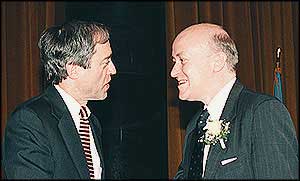
Columbia University President, George Rupp (left), presents Tim Page with the Pulitzer Prize for Criticism.
Winning Work
By Tim Page
If you respond to musical minimalism, you likely find it both hypnotic and invigorating; if you don't, you probably find it more boring than "Forrest Gump," white guilt and the collected works of Enver Hoxha put together.
Throughout much of the 1980s, I was the host of a radio program on New York's WNYC-FM that played a lot of contemporary music. One afternoon, however, I devoted an entire show to works by the 12th-century composer Perotin -- spare, ethereal yet startlingly intense vocal compositions based on the sound (fairly rare in Western music) of stark harmonic fourths. The phone rang and I was confronted with a furious gentleman who claimed that I'd ruined his drive home (and, one might have surmised, his life as well). He promised he would never again contribute to public radio until we stopped playing what he called "all that damned new music"!
Obviously, 800 years on, Perotin is still not an "easy listen." In fact, almost any musical language with which we are unfamiliar will seem "new" to us at first. But let's face it: For many well-disposed music lovers, this has been an especially tough century. Indeed, as far as the absorption and appreciation of 20th-century opera and concert music go, a lot of people out there pretty much missed it.
Exactly why this happened can and will be debated for many years to come (some possible reasons -- the collapse of music education, the split between the "high arts" and popular culture, the decline of the concert and the increased importance of mass media, and the perceived impenetrability and/or ugliness of much 20th-century creation). In any event, rightly or wrongly, many listeners never came to terms with the main classical music trends of this century.
This will not be one of those "Here are some nice, not-too-frightening recent works to pull you into your own century" articles. I approve of such ventures entirely (my own "getting started" list might include the music of Olivier Messiaen, Henryk Mikolaj Gorecki's Symphony No. 3 and some of the film scores of Philip Glass).
Instead, let's break out the hard stuff. For once, let's give frank radicalism its due -- without apology and without sugarcoating. The following is a list of substantial 20th-century pieces that make no special effort to be liked. Indeed, if I may anthropomorphize for a moment, they really couldn't care less whether you like them. These are works that were bold, original and, in some cases, downright horrifying to their audiences when they were first performed, and even today a first encounter with them will likely inspire anything from intrigue to befuddlement to inchoate fury.
No attempt has been made to be comprehensive, nor have I attempted to present only "the best" 20th-century pieces. (Great works of art are not necessarily radical; for example, Richard Strauss's nostalgic, deeply conservative "Four Last Songs" speak just as profoundly to us as his manic, off-the-wall "Elektra.")
Moreover, the shock has worn off of some once-notorious pieces. In 1927, George Antheil's "Ballet Mecanique" appalled traditionalists with its use of sirens, car horns and multiple pianos; today, in the era of computer sampling, this seems little more than a collection of gimmicks and the work barely holds our interest.
A much greater piece, Stravinsky's "Rite of Spring," was so influential in its time that listeners, hearing it co-opted and recycled again and again by composers of every stripe, have become accustomed to its language. While we admire "Rite" today, it no longer shocks us silly (indeed, Walt Disney incorporated it into "Fantasia" more than 50 years ago -- and how disconcerting can a Disney soundtrack be?). And the once-recalcitrant works of Pierre Boulez -- "Pli Selon Pli," "Le Marteau Sans Maitre" -- now sound almost pretty, and very much in the French tradition of Debussy and Ravel.
Still, here are a few important 20th-century pieces, in chronological order, that have never quite been tamed. Indeed, the subversive in me hopes they will inspire perplexed listeners and angry calls for at least 800 years.
Charles Ives: "The Unanswered Question" (1906). There is still some debate about whether Ives was a genuinely visionary musical thinker or merely a primitive dabbler who occasionally hit on a good idea. In general, I lean toward the dabbler theory; such works as the "Concord" Sonata seem arbitrary and incoherent -- one dissonance as satisfactory as another -- and his endless quotation of hymn tunes and Civil War songs, a sort of stylized, cosmetic Americana, wears thin very quickly. But there are a few Ives pieces that demand our respect and "The Unanswered Question" is one of them.
Scored for orchestra and solo trumpet, it begins with a slow, seraphic, barely audible chorale, played by the strings. A quizzical, angular phrase for trumpet poses the musical "question," which is "answered" by a gaggle of wind instruments. This is repeated, with greater intensity, and the piece eventually devolves into a controlled cacophony, after which it regains its gravity, repeating the question again before dying out into a cosmic stillness.
This is great music in a number of ways. It is both consonant (the soft bedding of the string chorale) and abrasively dissonant (the "questions" and "answers" are naked and awkward). It is a work that creates its own form, perfects it, then breaks the mold: There was nothing like "The Unanswered Question" before it was written, and, by its very nature, it can never have a legitimate sequel. Finally, it conveys, in a manner unlike any other piece I know, the vastness of infinity, at once mystical and humbling, all-inclusive and achingly lonely. (Recommended recording: Leonard Bernstein, New York Philharmonic. Sony Classical. To hear a free Sound Bite from this selection, call Posthaste at 202-334-9000 and press 8174.)
Richard Strauss: "Elektra" (1908). This is an utterly horrible piece; it is also magnificent. Strauss and librettist Hugo von Hofmannsthal took Sophocles' tragedy "Elektra," set it to music that combines graphic violence with convulsive sexual ecstasy, and created the most disturbing opera in the repertory. From the slashing outline of the D minor triad that opens the opera (rather as a punch in the face might be said to open a dialogue) through the triumphant, frazzled, obsessively reiterated C major chord that concludes the slaughter 80 psychotic minutes later, "Elektra" is a study in overkill so bloodthirsty that it is not surprising that Strauss completely changed course once he had this out of his system (his next opera was "Der Rosenkavalier," a Viennese comedy of manners!).
A good "Elektra" should leave an audience speechless. This is the most unhealthy of masterpieces; it incites us, with huge orchestra, chorus and a cast of iron-voiced soloists, to cheer on Elektra's revenge, a brutal matricide, all set to music that is both enormously sophisticated and primal as hell. (Recommended recording: Birgit Nilsson in the title role, with the Vienna Philharmonic under Sir Georg Solti. London Records. Soundbite code: 8175.)
Jean Sibelius: Symphony No. 4 (1911). Another one-of-a-kind. Sibelius had earned a world reputation with the romantic, somewhat Tchaikovskian grandeur of such works as "Finlandia" and the Symphony No. 2. In 1911, this dour, spare, austere and weirdly beautiful score came as a complete surprise to Sibelius's listeners and critics (many of whom were vociferous in their denunciations), and it remains unsettling and enigmatic to this day.
The Fourth Symphony has been likened to a sort of musical cubism, and as such analogies go, this is a fairly good one. The first movement in particular is built block by sonic block, with an absolute minimum of padding; rarely has a composer said so much so tersely. The second movement always seems to be about to break into a waltz, but it never quite gets there and ends abruptly, with dark, disturbing, birdy tritones and a peremptory roll from the timpani. The third movement is another study in delay -- in this case, we wait for a long, sweeping melody that climbs mournfully for 2 1/2 octaves and then dies away. And what can all those bells be about in the finale?
The entire symphony is very strange; "There is nothing, absolutely nothing, of the circus to it," Sibelius once said. To be sure, and it is as mystifying to a general audience today as it was when it was written. (Recommended recording: Herbert von Karajan, Berlin Philharmonic. EMI Classics. Soundbite code: 8176.)
Arnold Schoenberg: "Pierrot Lunaire" (1912). Even Schoenberg's greatest admirers admit that "Pierrot Lunaire" is difficult. The composer Charles Wuorinen once compared the experience of listening to it to that of befriending a porcupine. Another composer, George Perle, acknowledged that "Pierrot Lunaire" is "not a work that one ever gets used to." So why, almost 85 years later, with Schoenbergism largely abandoned as a musical movement, do we still care about "Pierrot Lunaire"?
Because it is there, that's why. This bizarre, arty, expressionist song cycle may not be Schoenberg's most appealing piece but it is undoubtedly his most radical -- indeed, it is the culmination of a certain strain of Viennese decadence. Here, the composer truly breathes the "air of other planets" that he alluded to in his String Quartet No. 2; this is cabaret music for Martians. Schoenberg set 21 poems (by Albert Giraud) in what he called sprechstimme -- a form of speech-song where the vowels in each word momentarily touch on the indicated pitch, then fall away from it for a sort of creepy-crawly, haunted-house effect that works well in the right material. This is the right material. (Recommended recording: Jan DeGaetani, with Arthur Weisberg and the Contemporary Chamber Ensemble. Nonesuch Records. Soundbite code: 8177.)
Virgil Thomson/Gertrude Stein: "Four Saints in Three Acts" (1928-34). To begin with, the opera is in four acts (but only one intermission) and has more than 30 saints in it. Stein's words come across as genial, cracked logorrhea ("To be asked how much of it is finished. To be asked Saint Teresa Saint Teresa to be asked how much of it is finished. To be asked Saint Teresa to be asked Saint Teresa to be asked ask Saint Teresa ask Saint Teresa how much of it is finished"). Thomson's music is straightforward, deceptively uncomplicated, chock-full of C major. The opening night cast was an all-black one (a tradition that has been preserved in later productions), the sets were cellophane, and nothing really "happens" in the sense of a recognizable plot. All the standard rules of musical theater were at least ignored, sometimes deliberately broken.
"Do not try to understand the words of this opera literally nor seek in the music of it undue references to modern Spain," Thomson wrote. "If, through the poet's liberties with logic and the composer's constant use of the plainest musical language, something is evoked of the inner gaiety and the strength of lives consecrated to a non-material end, the authors will consider their labors rewarded." Today, "Four Saints" seems the great-great-grandparent of performance art, maintaining a freshness, clarity and contemporaneity that is absolutely up to the moment. (Recommended recording: Orchestra of Our Time, conducted by Joel Thome. Nonesuch. Soundbite code: 8178.)
Aaron Copland: Piano Variations (1930). Forget such gentle, homespun scores as "Appalachian Spring" and "Quiet City." When Copland was in the mood, he could be as ferocious and uncompromising a modernist as America has produced. The Piano Variations, some 12 minutes of coiled, tactile fury, was once described by Leonard Bernstein as "a synonym for modern music -- so prophetic, harsh and wonderful, and so full of modern feeling and thinking."
Copland starts with a gonging four-note cell that sounds a little like the familiar "Westminster Carillon" turned on its head. On this, he constructs 20 succinct variations that build to a conclusion that is little short of cataclysmic. And yet there is an overriding structural clarity to the music: "As I listen to the Piano Variations," the author (and sometime composer) Paul Bowles once said, "I'm aware of every detail of its construction; its beams and struts are beautifully visible, unmarred by any ornamentation." (Recommended recording: Leo Smit. Sony Classics. Soundbite code: 8179.)
John Cage: Sonatas and Interludes for Prepared Piano (1946-48). It sounds like one of the dada stunts for which (unfortunately) John Cage would later be known: take an ordinary piano, then insert screws, erasers, nuts, bolts and pieces of plastic among the strings, and then sit down and try to play it. In fact, Cage had found a "whole new gamut of sounds, which was just what I needed," he wrote. "The piano had become, in effect, a percussion orchestra under the control of a single player."
Those who dismiss Cage's later work out of hand owe it to themselves to listen to the music he wrote in the '30s, '40s and early '50s, for it is charming, dynamic, attractive and unfailingly original. His longest and most ambitious piece from this era is the set of 16 sonatas and four interludes he created for the "prepared piano" in the years just after World War II. They were written at a time when Cage was just becoming interested in Zen philosophy: "I decided to attempt the expression in music of the permanent emotions of Indian traditions: the heroic, the erotic, the wondrous, the mirthful, sorrow, fear, anger, the odious and their common tendency toward tranquility." Strange and sublime noisemaking, this hour-long exploration can stand as Cage's testament -- "The Well-Prepared Piano." (Recommended recording: Maro Ajemian. Composers Recordings. Soundbite code: 8180)
Karlheinz Stockhausen: "Song of the Youths" (1955-56). On first hearing, it may sound like Munchkin babble -- and it drives unsympathetic listeners absolutely up the wall. Still, upon reflection, this is one of the great masterpieces of electronic music -- somber, specific and, on some curious level, deeply lyrical. Stockhausen took sung sounds and electronically produced noises and built them into a space-age devotional epic based on the Book of Daniel, the "Song of the Men in the Fiery Furnace." ("Whenever speech momentarily emerges from the sound-symbols in the music, it is to praise God," Stockhausen observed.)
A good deal of Stockhausen deserves rediscovery -- his glassy, hyperactive piano pieces; "Stimmung," an amazing proto-minimalist work for unaccompanied voices; "Hymnen," a vast, moody mid-century electronic tour of the world through its national anthems. It is unlikely that he will ever be a popular composer, but he is a significant one. (Recommended recording: composer-supervised on Deutsche Grammophon. Soundbite code: 8181.)
Steve Reich: "Four Organs" (1970). If you respond to musical minimalism, you likely find it both hypnotic and invigorating; if you don't, you probably find it more boring than "Forrest Gump," white guilt and the collected works of Enver Hoxha put together. Either way, you can't get much more "minimalist" than "Four Organs."
Reich once described this work succinctly -- "short chord made long." From a technical standpoint, that pretty much sums it up -- four organs, kept in time by steadily shaken maracas, repeat a single chord again and again, bringing in different voices for different lengths of time until we have examined the structure from what seems every possible vantage point. But this cannot convey the score's pristine formal perfection; the suspense it builds in a susceptive listener; the ecstasy one feels as the organists dive slowly, deeply, inexorably into Reich's wonderful chord and then come up renewed. I'm mad for "Four Organs"; however, it is fair to warn the reader that those who aren't mad for "Four Organs" usually despise it and that performances have provoked near riots. (Recommended recording: Steve Reich and Musicians -- including the young Philip Glass! Mantra. Soundbite code: 8182.)
Meredith Monk: "Tablet" (1977). "Tablet" begins with four women furiously shrieking out a cappella syllables as loudly as possible. The effect is both bracing and riveting (and has scared at least one 5-year-old out of the room and under his covers). Thereafter, however, this is a rich, warm, variegated and startlingly evocative piece and, for me, Monk's most satisfying work. But its strangenesses are genuine and manifold: "Tablet" is scored for soprano recorder, three pianists (who share one piano) and four specially trained voices singing, parrying and babbling made-up words and nonsense syllables.
Monk is a true original. She follows no leaders, leads no followers. In addition to her work as a composer, she is a choreographer, playwright and filmmaker, all of which she pursues with the same single-minded sense of purpose she devotes to her music. You may love her work or you may detest it, but you certainly haven't heard it before. Nor will it soon fade into the background. (Recommended recording: "Songs From the Hill/Tablet." Meredith Monk. Wergo Records. Soundbite code: 8183.)
By Tim Page
The Philadelphia Orchestra is widely and correctly perceived as the aristocrat among American orchestras. The Cleveland Orchestra may be more "perfect" (one balanced, synchronized, infinitely adaptable organism from top to bottom) and Chicago may have more muscle (ferocious virtuosity and a brass section that could have done the job at Jericho). But Philadelphia -- caloric, sumptuously blended and refreshingly Old World -- takes the prize for elegance and sheer sonic luster. In a world of lean cuisine, the Philadelphia Orchestra is still pure butterfat.
This group is at its best in leisurely music -- not because it cannot play fast and flashy but because so few of its competitors can play slow music convincingly. And a work like the Bruckner Symphony No. 8, of which the Philadelphia Orchestra offered a magnificent performance last night at the Kennedy Center under the direction of Wolfgang Sawallisch, demands not just slow but slow.
In fact, the symphony really demands that the listener suspend time. This is a long work -- just about 90 minutes -- and it is quite the opposite of suspenseful. To wait for sudden, startling events is to miss the point of Bruckner. Rather, one immerses oneself in his symphonies as in an absorbing landscape, in which change happens inevitably over an expanse of time.
The Philadelphia Orchestra's unusually good program notes referred to the "luxuriant leisure" by which Bruckner's symphonies reach their formal climaxes and goals. "With Bruckner firm in his religious faith," Deryck Cooke wrote, "the music has no need to go anywhere, no need to find a point of arrival, because it is already there."
It is not music that appeals to the tastes of all listeners. For some, Bruckner makes for a long evening in the concert hall; his symphonies seem informed by a sort of elephantine mysticism -- earnest, humble, undoubtedly deeply felt but somewhat ungainly. For others -- particularly in the Symphony No. 8 and the unfinished Symphony No. 9 -- he offers nothing less than spiritual transport. Rarely does one see so many people in the audience who obviously know every single note of such a mammoth work (some of them conducting along at their seats, smiling beatifically at especially lovely moments). And rarely does one see such an immediate, full-hearted standing ovation as Sawallisch and his players received at the end of the score.
Sawallisch was tender with the music but never sentimental. He kept things moving, even in those passages (rather less common in the Symphony No. 8 than in earlier works) when Bruckner can seem to be running in place. The Scherzo was terrific -- joyful, unfettered, cosmic, as if the Alps themselves had come to life and started to dance -- while the great Adagio had that sort of heavy, am-I-losing-my-mind? languor that we associate with the ever slower, ever more grandly exhausted, late recordings of Herbert von Karajan and Leonard Bernstein.
With the exception of some occasional weird tuning from the lower brass, the orchestra playing was little short of spectacular (is there a better string section in the world?). Sawallisch, conducting without score, proved that he knows every subtlety, every silence in this long and complicated work. From the beginning, the symphony seemed one unbroken trajectory. And yet there was plenty of room to meander, to ruminate -- essential in any performance of this composer. Despite Cooke's assertion, many of us find Bruckner's questions as interesting as his answers.
In short, it was a splendid night to be at the Kennedy Center. This is ideal repertoire for Sawallisch; he gave us a performance informed by Austro-Germanic tradition, a respect for musical architecture, a delight in the capacities of his orchestra, and an abiding and glowing love for Anton Bruckner.
By Tim Page
Elliot Goldenthal's "Fire Water Paper: A Vietnam Oratorio" is everything one might expect from a massive and ambitious piece by a young composer who does most of his work in Hollywood studios. It is slick, it is sometimes overblown, it is deeply derivative, it takes on a bigger subject than it can possibly address.
It is also, despite all, a pretty effective work on its own terms -- particularly in so spectacular a performance as the one Seiji Ozawa conducted Saturday afternoon at the Kennedy Center Concert Hall, when the Boston Symphony Orchestra gave "Fire Water Paper" its Washington premiere.
The piece had its genesis when the gifted young California-based conductor Carl St. Clair read an article by Art Buchwald suggesting that the Vietnam Veterans Memorial was "crying out for music." Shortly thereafter, St. Clair commissioned Goldenthal to write an oratorio for the Pacific Symphony Orchestra in Orange County, Calif., which is now home to the largest Vietnamese population outside Vietnam. (It is St. Clair who leads the new recording of "Fire Water Paper" on Sony Classics.)
Goldenthal responded with an hour-long piece for large orchestra and chorus, children's choir, solo soprano and baritone. He built his text from a variety of sources: ancient Vietnamese poetry, Virgil, Tacitus, Cicero, Horace, a suicide letter from one of the several monks who immolated themselves to protest the war, nursery rhymes, code names for American military operations -- all over the bedrock of the Requiem Mass of the Roman Catholic Church, sung in Latin. The world premiere took place on April 26, 1995, on the 20th anniversary of the official conclusion of the Vietnam War.
"Fire Water Paper" is expertly made; as one music professional in attendance Saturday afternoon put it, Goldenthal "knows his stuff." The vocal writing is assured and responsive to the words (in Latin, French, Vietnamese and English). The music falls easily on the ear and makes a stirring first impression; nothing is much more visceral and exciting than a great orchestra and chorus in full thrall, and Goldenthal gives both of them a lot to do.
The score's derivations are obvious: Benjamin Britten's "War Requiem" for the overall form; Bartok or Kodaly for the cello cadenzas; Stravinsky, Orff, Mahler and "Satyagraha"-era Philip Glass in passing. But genuine innovators are few and far between; better, perhaps, in a piece of this sort, for a composer to take time-tested gestures and, through feeling and technical expertise, make them his own, rather than sailing off into yet another narrow avant-garde rivulet.
"Fire Water Paper" flows. It is linear. It has a beginning, a middle and an end. It never gets mired down in its allusions. It holds the listener's attention for an hour. These are not small accomplishments.
Still, there is a central problem: "Fire Water Paper" ultimately seems grossly insufficient to its purpose. Indeed, I'm not sure what that purpose was intended to be, other than to encourage some spurious "healing" process. I was never convinced that Goldenthal had any real ideas about the Vietnam War, save that it was tragic and that it is over. I was often reminded of one of those newsweekly articles on controversial subjects that strive so mightily to offend neither left nor right that they end up sweeping all of their readers into some weird, quasi-lobotomized DMZ. I learned nothing new about Vietnam from Goldenthal's piece; much more to the point, I felt nothing new about Vietnam.
One couldn't have asked for a finer performance, however, and that helped carry the afternoon. This is the sort of thing Ozawa does best -- the huge orchestra-chorus-soloists showpieces (other examples include the Mahler Symphony No. 8, Schoenberg's "Gurre-Lieder" and Richard Strauss's "Elektra"). To this taste, Ozawa is usually a middling interpreter, but he is a wonderful sonic engineer: The choruses came in where they were supposed to, the balances were carefully calibrated, the climaxes were just so.
Jayne West has a high, pure, strong and affecting soprano voice; I should call it "angelic" if it were not so filled with worldly emotion. James Maddalena sang his part with dignity and musicianship, although his voice is probably a size too small for this score. Jules Eskin did a masterly job with the strenuous and intricate cello cadenzas. The Tanglewood Festival Chorus and the New York Concert Singers: Project Youth Chorus made their own valuable contributions.
The program began with Max Bruch's lovely and sentimental Violin Concerto No. 1 in G Minor, Op. 26. The young Japanese violinist Akiko Suwanai offered a technically flawless performance. She has patrician taste, undoubted musicianship and absolute control of her instrument; it is not yet clear whether she has a distinct artistic personality as well. But she sure plays a mean fiddle.
Two last thoughts on "Fire Water Paper": The incorporation of the Latin Mass seemed rather too easy a solution to some vexing artistic problems. In no way am I questioning Goldenthal's religious convictions, nor am I suggesting there is no room for further settings of these great words. But in this particular case, I occasionally had the sense that the composer, in search of some extra gravitas, had simply grabbed out for something that all but defines high seriousness and then appropriated its solemnity for his own.
Finally, I'm not at all convinced that the Vietnam Veterans Memorial is "crying out for music," by Goldenthal or anybody else. On the contrary, it should be approached silently, humbly, in a grave and dignified confusion. It has its own music, made up of time, wind and old sorrow.
By Tim Page
On some levels, this would seem the best of times for the classical record business.
"The Three Tenors," that initial musical collaboration among Luciano Pavarotti, Placido Domingo and Jose Carreras, continues to sell at an amazing rate -- more than 10 million units now, making it far and away the best-selling classical recording of all time. Discs by a few young vocalists (especially soprano Dawn Upshaw, mezzo-soprano Cecilia Bartoli and tenor Roberto Alagna, no matter what they are singing) are sure to climb the Billboard charts. And there has been an explosion of interest in some contemporary music (Henryk Mikolaj Gorecki's Symphony No. 3, works by Steve Reich, Philip Glass and John Adams) and material from the Renaissance and baroque (discs by Anonymous 4, the Hilliard Ensemble, Roger Norrington and John Eliot Gardiner).
Still, the fact remains that this is a nightmarish time to be in the business of making new classical recordings. Indeed, the industry, as we have known it, might just be coming to an end.
Consider. Philips is in the middle of finishing up its obligations to the Boston Symphony Orchestra and Seiji Ozawa. Deutsche Grammophon is winding down one arrangement with the Metropolitan Opera Orchestra and another one with the Dresden Staatskapelle. The Philadelphia Orchestra is nearing the end of its contract with EMI Classics and, although the talks go on, there are no current plans for renewal, according to sources within EMI. Sony Classics has downgraded its exclusive contract with the Berlin Philharmonic into an every-now-and-then arrangement. The agreement between the magnificent Cleveland Orchestra and London/Decca has been drastically cut back: A long-planned Mahler Symphony No. 2 has been canceled and the completion of a half-finished recording of Wagner's "Ring" cycle, conducted by music director Christoph von Dohnanyi, has been indefinitely postponed until after the turn of the century.
A few orchestras have been spared the scythe. BMG Classics -- the successor to RCA Victor -- plans to issue its first disc with Leonard Slatkin and the National Symphony Orchestra this fall and has spent a fortune establishing (and publicizing) a new deal with the San Francisco Symphony (SFS) and Michael Tilson Thomas. But BMG itself is in some disarray, with a near-complete turnover of upper-level personnel within the past two years; sources close to the SFS and Thomas have complained that they don't know to whom they are to report.
Meanwhile, according to the London Daily Telegraph, EMI Classics has reduced its international recording schedule from 85 albums per year to 47. And within the past five years, BMG has already cut its schedule from a high of nearly 100 releases down to about 45; by the end of 1997, that number may be reduced to 30 -- fewer than three new releases a month. The Telegraph quoted an unnamed senior vice president at BMG as saying, "We are reducing capacity but not shedding artists." This isn't quite the case: Last year, over the course of a single meeting, BMG Classics summarily dropped most of its "baby acts" -- such developing artists as pianist Barry Douglas (a winner of the prestigious Tchaikowsky Competition) and the violinist Kyoko Takezawa.
Why is this happening? There's an easy answer: Outside of a few flashy hits, the vast majority of new classical recordings simply aren't selling very well. It is now almost impossible to come close to breaking even on a major orchestral recording, traditionally the "meat and potatoes" of the business. After union costs for the musicians, stage labor and the recording engineers, a new Beethoven, Brahms or Sibelius recording with a major American orchestra can cost up to $ 200,000. Something really long and complicated like the Mahler Symphony No. 8 might easily run to half a million.
Keep those figures in mind, and then ponder the following: New CDs generally sell for between $ 10 and $ 15, a sum which must be split with distributors and record stores. First-year sales for a classical CD are considered respectable -- maybe even pretty good -- if they exceed a mere 5,000 units in the United States (add a few thousand more for the rest of the world) and many recordings never even approach that. Do your math. The numbers are bleak.
Nobody in the upper echelons of the record industry would speak for attribution in this article (as one executive put it: "How would it look for the CEO of a multi-million-dollar business to admit the game is over?"). But a glance at the current list of best-selling recordings for the Tower Records chain is instructive.
Of the Top 10 orchestral discs, fully six of them are reissues (all from Deutsche Grammophon's acclaimed "Originals" series, most of them featuring Herbert von Karajan, who died in 1989). Of the remaining four, two are directly associated with motion pictures ("Always and Forever: Movies Greatest," conducted by John Mauceri, and the soundtrack for "Mr. Holland's Opus"); one is a sort of special case ("Paper Music," well-known material conducted and sung by the successful and phenomenally gifted pop vocalist Bobby McFerrin); and only one -- an album of "African Portraits" featuring the Chicago Symphony Orchestra under Daniel Barenboim -- can possibly be considered a "music-driven" new classical recording.
"It's no secret to anyone in the music business that the recording industry is undergoing some very significant changes," Thomas W. Morris, the executive director of the Cleveland Orchestra, says. "It's been a dozen or so years since the last major technological innovation -- the CD -- and there's an absolute glut of material on the market, at many different prices. It's confusing to the buyer -- it's confusing to us -- and sales are down worldwide."
The back catalogue of a record company has always been an important asset, but nowadays this seems a case of the proverbial tail wagging the dog. For example, it is thrilling to have the complete recordings of violinist Jascha Heifetz available in one huge collection, sounding better than ever (BMG brought this out last year). But our ability to infuse the work of past masters with vivid new life also means that today's performers have to compete not only with their contemporaries but also with the ghosts of geniuses past. It sometimes seems that, through technology, we are establishing a permanent pantheon of great artists -- many of them long dead -- and that no newcomers need apply.
Waxing Nostalgic
In the past, everything needed to be re-recorded every few years to keep up with advancing technology. Remember the early 78s, those fabled Caruso discs that seem to occupy space in everyone's attic? We heard the artist through a sizzling hiss that sounded as if somebody were frying an egg just inside the loudspeaker. And because the 78 had only a 4 1/2-minute playing time, it was constantly necessary to get up and change the disc -- not exactly the ideal format for a five-hour Wagner opera! Moreover, 78s were notoriously impermanent: If you dropped them once, they were gone.
The advent of the LP, in the late 1940s, changed everything. You could now get pretty close to an unbroken half-hour of music on one side and the discs, while scratchable, were not easy to break. Much of what was best on 78 was ultimately transferred over to LP; new recording activity increased exponentially. By the late '50s, we had countless Beethoven Fifths from which to choose (we now have well over 300, in and out of print). In the mid-'60s, there was only one complete cycle of the Mahler symphonies (by Leonard Bernstein) and one complete recording of Wagner's 16-hour "Ring" (by Georg Solti). By the mid-'80s, there were a dozen unified versions of each of them.
Enter digital technology and the compact disc. Now it became possible to transfer recordings of the past to a new format with hitherto unimagined force, vividness and -- given tender care of the CD -- a certain permanence. Recordings from 30, 40 years ago no longer sounded antiquated; indeed, in some cases, they could have been made yesterday. No music lover can regret this -- it is cause for jubilation. But not without certain premonitions, especially the fear that we may be in the process of recording ourselves out.
When I count up my favorite "new" releases at the end of each year, I am always startled by how many of them are reissues -- many, perhaps most, of which would cost a buyer less than would a new recording. Reissues are particularly profitable for record companies, after all. There are no studio costs to pay, only some residuals to the artist (or artist's estate) and, in the case of orchestral music, a possible fee to the Musicians' Union. There can be no doubt that it is less expensive to reissue an existing recording than to create a new one and, in the case of, say, Glenn Gould or Vladimir Horowitz, the artist may arrive with a ready-made legend and the disc will all but sell itself.
Now assume you're a typical classical FM listener -- not a musician, nor a fanatic collector, just somebody with a certain fondness for classical music, somebody who buys maybe 10 to 20 compact discs every year. One day WETA plays a beautiful Chopin prelude on the air and you decide you have to have it. So you walk into a store, browse through the Chopin section and notice that you can buy a set of the preludes played by Joe Recent-Juilliard-Graduate for $ 15.99 or take home an older (but decent-sounding) performance by the legendary Arthur Rubinstein for $ 9.99. Again, on the assumption that you are not one of those collectors who want every set of the preludes ever made, which recording are you likely to buy?
Right now there are more than 40 versions of the Chopin preludes in the catalogue. It's extraordinary music, no doubt about it. But is there really an audience for these discs? What about 100 recordings of Vivaldi's "Four Seasons"? Twenty-five recordings of Mahler's Sixth Symphony? If you were a stockholder in Deutsche Grammophon, would you really want your CEO to order up another multi-million-dollar Beethoven symphony cycle, especially when the label already has complete sets recorded by Claudio Abbado, Leonard Bernstein and Herbert von Karajan (three different versions), as well as distinguished performances of individual symphonies by Karl Bohm, Ferenc Fricsay, Wilhelm Furtwangler, Carlos Kleiber and a dozen others, dating all the way back to 1913 and Arthur Nikisch's very first recording of the Beethoven Fifth?
Don't misunderstand me. In no way am I suggesting that the classics of the past are "played out" or that they have revealed all of their secrets. The Beethoven "Eroica" will surprise us every time we hear it; it is a supreme masterpiece, by any standards. So is Shakespeare's "Hamlet." But imagine a world in which Columbia Pictures would make a film of "Hamlet" one year, and then Disney, just to keep up, would make its version the following year, and then Tri-Star would weigh in with a "Hamlet" right after that -- and so on, ad infinitum. Now take matters one step further, and imagine that all of the film studios bringing out these multiple "Hamlets" already have dozens of other versions already in their vaults.
From a purely aesthetic point of view, it's kind of a lovely idea. But it would be crazy business practice -- sheer, barking lunacy -- and all involved would lose their shirts. Still, something similar actually goes on in the classical record industry. Last time I checked, BMG had no fewer than three versions of the German conductor Gunter Wand leading Anton Bruckner's Symphony No. 9. Nothing against either Wand or Bruckner, mind you, but was this really necessary?
Risk-Takers Are Rare
As a passionate adherent of that much derided canon of Western Art Music, I believe that most classical music is more substantial, and more likely to endure, than most popular music. But the pop world has one characteristic the classical world does not: It changes constantly, renewing itself every generation or two. Still, the fact remains that the classical music business has been hidebound for a long time -- more so than it needed to be -- and it is now paying the price. After all, we simply haven't generated much new repertory in the past half century and that is only partially the fault of our composers (there are some fine creators out there, if our orchestras, opera companies and presenting organizations would only let us hear them). What was the last major work to really enter the repertory big time -- "Carmina Burana" (1937)? "Appalachian Spring" (1944)?
And so the industry mavens were completely taken aback when an obscure Polish composer named Henryk Mikolaj Gorecki's Symphony No. 3 became a smash international hit in 1993, actually rising not only to the top of the classical charts but, for a time, to the top of the British popular charts as well. But why shouldn't the Gorecki have become a hit? It was stately, consonant, deeply felt, unfamiliar but both accessible and attractive; it spoke for our time, a few prescient radio hosts put it on the air, it was used in a couple of movies, and the record sold and sold. This was a healthy sign; Gorecki proved there was an audience out there and that it was hungry. Perhaps new repertory -- and the occasional fresh take on the standard repertory -- might just save the classical record industry.
If it can be saved, that is. I have my doubts. For the immediate future, at least, we can expect increased reliance on reissues of back catalogue, the occasional corporation- or foundation-subsidized new recording, some solo and chamber music discs (easier and cheaper to record than orchestras), a couple of stars for whom the general rules do not apply, an occasional foolproof circus item like "The Three Tenors" -- and a continuing diminution of releases across the board.
Much of what is brought out will likely be marketing department-driven novelties, such as the recent "Opera's Loudest Hits" (the "Anvil Chorus," the "Ride of the Valkyries" and so on), "Out Classics" (famous works by composers who, according to the publicity, "just happen to be gay") and the forthcoming "Exile on Classical Street" from Decca/London, which will feature the favorite classical works of some celebrated pop stars. (For the benefit of inquiring minds: Elton John likes three of the "Enigma" Variations, Brian Wilson is a fan of the "Rhapsody in Blue" while Elvis Costello reveals himself as a closet Vivaldi freak.) And -- surprise! -- Decca/London just happens to have some old recordings of all of these pieces in its vaults. Think about the business appeal of this project: no studio costs whatsoever, no additional payment to artists, just a cute idea, a few long-distance phone calls, and a lot of money coming into the coffers.)
It wouldn't surprise me if the classical divisions of multinational record companies were ultimately folded into their pop divisions. After all, pop has helped pay for classical at least since the 1950s, when the late producer and executive Goddard Lieberson of Columbia Records used the funds from bestsellers such as "My Fair Lady" to bankroll his great, visionary -- and defiantly unprofitable -- Modern American Music Series. But there is no Goddard Lieberson within our major companies today, and many -- if not most -- of the folks who make decisions about what classical music we will hear have little or no musical training.
There are exceptions, of course, notably over at the nonpareil Nonesuch, under the direction of Robert Hurwitz, which continues to explore unfamiliar and rewarding corners of the repertory. But Nonesuch very deliberately breaks the rules; it has never given us a complete set of Beethoven symphonies, nor does it seem likely it ever will. (This does not represent any subversive prejudice against Beethoven, merely a recognition that the other companies have covered him pretty thoroughly.) Instead, Nonesuch gives us the Kronos Quartet playing African music, song recitals by Dawn Upshaw, the collected works of Adams, Reich and Glass, recordings for tape loops and electric guitar. Nonesuch is a smart company -- it is often a visionary company -- but, by its own design, it cannot be judged by the same standards as BMG/RCA, Sony Classical, EMI, Deutsche Grammophon, Decca/London and the other traditional major labels.
Meanwhile, there are some lively "boutique" companies, usually run by one or two people, that continue to bring out interesting discs (notable among these are ECM, Mode, Conifer, HatArt, Ondine, CRI, New World, New Albion, Albany, Bridge, Eagle and several others). And, recently, on other small labels, some orchestral discs have begun to emerge from Eastern Europe, where costs are a fraction of what they would be here (one hears it said that Chinese orchestras will be next). Still, with all due respect, the impoverished ensembles from Bratislava or Shanghai cannot yet rival the standards set by orchestras in Berlin or Cleveland.
When the late Glenn Gould renounced live performance in favor of recordings in 1964, he stated unequivocably that the concert was "finished." On one level he was right: Records, radio and other media have long provided us with most of the music we listen to, and concerts -- however we may love them and however many we may attend -- are now a supplement to our musical understanding, rather than its core.
By Tim Page
On some levels, this would seem the best of times for the classical record business.
The first heat wave of the season, oily and leaden, settled upon Missouri this past weekend as Leonard Slatkin led his final concerts as music director of the St. Louis Symphony.
Exactly how many programs Slatkin has conducted here in the past 28 years -- from his fresh-out-of-Juilliard apprenticeship through his 17-year tenure as music director -- remains something of a mystery.
"I'm sorry, we just couldn't come up with a reliable answer for you," a St. Louis Symphony spokeswoman admitted. "When we tried to count up all the different things Leonard has done -- children's shows, new-music programs, community concerts, stepping in to conduct at the last minute, and so on -- it really got confusing."
"How about premieres?" she asked brightly. "I can tell you exactly how many premieres he's led."
That figure is indeed impressive -- 62 world premieres or first American performances, almost half of them original commissions -- but not so impressive as what cannot be quantified: Slatkin's sheer ubiquity in St. Louis over the past quarter-century. Here, in addition to his podium duties, Slatkin has hosted his own local radio and television programs, thrown out the first ball at Cardinals games, driven along most of the back roads in the city and county. The proprietors know him by name in the fanciest downtown restaurants and at the frozen-custard stands in the suburbs; he seems equally comfortable on either turf.
Unlike such Olympian music directors as Sir Georg Solti (who, during his last few seasons in Chicago, was required to be in town for only about 12 weeks of the year) or Zubin Mehta (who rarely passed up an opportunity to make a negative comment about New York City, even when its Philharmonic was paying him pretty close to a million-dollar salary), Slatkin has actually lived in his adopted city throughout his tenure and he has taken an active part in its day-to-day life.
As such, he is known and esteemed by many St. Louisans who ordinarily couldn't care less about classical music. Particularly within the past decade and a half, Slatkin has become a veritable symbol of the city, which has responded by cheering on the accomplishments of the orchestra the way other cities might cheer on their football teams. Now Slatkin is leaving town -- to take the helm of Washington's National Symphony Orchestra this fall -- and a party was in order. The farewell concert yesterday summed up many of Slatkin's achievements; the mood was both celebratory and bittersweet, and the weather obliged with a foretaste of the inimitable summer torpor to come. After so many years in Missouri, the Washington summer should hold no terrors.
St. Louis Blues
St. Louis is a paradoxical place. Once away from the tourist attractions, the restored downtown, the Mississippi River and the gigantic, gleaming Gateway Arch, a visitor feels rather as if he has fallen into a Dreiser novel or Steichen photograph. From certain vantage points, the city seems made up of nothing but brick, smokestacks, freight yards and faded advertising; old hotels and department stores stand shuttered, oddly eloquent, imbued with a grimy but unmistakable poetry.
At the corner of Seventh and Locust streets, the Ambassador Theater, an elaborate 1926 vaudeville palace, had recently taken a fatal but not yet conclusive hit from a wrecking ball. The Locust Street wall had been demolished and a passing spectator could look inside to the ruined auditorium. Strands of what looked like metal confetti strung with concrete dangled from the old painted proscenium, flanked by smashed-in terra-cotta cherubs. It must have been beautiful once.
A similar fate almost befell what is now Powell Symphony Hall, the St. Louis Symphony's first permanent home. Originally known as the St. Louis Theater (and built in 1925 by the same firm that created the Ambassador), Powell Hall is located on Grand Boulevard, in what is called the "midtown area," a mix of rubble and renovation located halfway between downtown St. Louis and the tidy, affluent bohemia of the Central West End. The orchestra bought the crumbling theater for $ 500,000 and then spent another $ 2 million or so fixing it up. Money well spent, for Powell Hall is a jewel -- a marvelous cream-colored old house with warmly responsive acoustics and an inviting elegance.
A few minutes after 2 on Saturday afternoon, just following an open rehearsal of his gala final concert, Slatkin sat at a table in the mirrored lobby of Powell Hall and met his fans.
Most of them asked for autographs -- on program books, ticket stubs, cocktail napkins and even, in one case, on a tablecloth. Some folks wanted their pictures taken with him (one young woman in tight jeans all but jumped into his lap just before the flash went off) while others merely came by to pay their respects.
Half an hour and roughly 75 signatures later, as the hall was being emptied to prepare for an imminent high school graduation ceremony, the head stagehand approached Slatkin hesitantly to say goodbye. "Hey, you don't get out of here without a hug," Slatkin said, as he walked around the table and threw his arms around him. "It's been a long time, buddy."
Two in Harmony
It is hard to think of another conductor who has intertwined his destiny with an artistic institution so completely that the two may be said to have grown up together. Some might make this argument for Leonard Bernstein and the New York Philharmonic, or James Levine and the Metropolitan Opera. But the Philharmonic and the Met were venerated, world-class organizations long before Bernstein and Levine were born. The St. Louis Symphony, on the other hand, was a solid, respectable orchestra of the second rank when the baby-faced, untested Slatkin signed on as an assistant conductor in 1968 and pretty much the same when he became music director in 1979.
What happened thereafter, however, was decidedly out of the ordinary. By 1984 or so, the Slatkin-St. Louis pairing had managed to combine two distinct -- and usually incompatible -- objectives: winning over the critics and music professionals with sophisticated, adventuresome programming while building a fervent following with local subscribers and donors, whose tastes tend to be deeply conservative. Suddenly, the St. Louis Symphony was as at home in the late 20th century as it was in the 19th, as comfortable with the music of large American cities as it was with the music of Austrian villages. And it played virtually everything with vigor, clarity, luster, virtuosity and style.
Slatkin has never been a radical. Indeed, he has been highly pragmatic in his choice of 20th-century works -- too pragmatic for some avant-garde tastes. He paid little attention to the music of such hyper-modernists as Pierre Boulez, Karlheinz Stockhausen, John Cage and Milton Babbitt. He cared neither for the abstract, aggressive chromaticism of Elliott Carter (although he conducted a memorable performance of the "Symphony of Three Orchestras") nor the austere, determinedly reductive minimalism of Philip Glass (although he has led works by three other leading figures in this movement -- Steve Reich, Terry Riley and John Adams.
Instead, he championed a middle ground, mostly composers whose works clearly reflected their origins in the 20th century, but who had never lost a nurturing connection with the traditions from which they grew. And he helped inspire a reevaluation of our own musical past, exploring works by the once-derided "American conservatives" -- composers such as Samuel Barber, Virgil Thomson, Walter Piston and William Schuman.
The farewell gala, which took place yesterday afternoon, was pure Slatkin. It was devoted in large part to 20th-century American music -- Barber's "Knoxville: Summer of 1915," Gershwin's "An American in Paris," and six especially commissioned riffs on the theme by Paganini that had already inspired variations by Brahms, Rachmaninoff and Lutoslawski, among others. From 19th-century Europe, there was the overture to Schubert's "Rosamunde" (the first work Slatkin ever conducted with the St. Louis Symphony) and the Beethoven Choral Fantasy. Many of the guest artists had long associations with Slatkin; one of them, soprano Linda Hohenfeld, is his wife.
About 30 musicians who performed that seminal "Rosamunde" Overture with Slatkin in 1968 were still in the orchestra to play it with him yesterday. Pianist Jeffrey Siegel, an old Juilliard pal, played the solo part in the Choral Fantasy with a massive, clangorous tone; the chorus was superbly prepared by Amy Kaiser. Hohenfeld sang the Barber work sweetly, idiomatically, with a rapt lyricism that was well maintained by the orchestra.
All four of the composers who have been "in residence" with the St. Louis Symphony since 1982 -- Joseph Schwantner, Joan Tower, Donald Erb and Claude Baker -- contributed to the ad hoc "Yet Another Set of Variations (on a Theme of Paganini)." So did William Bolcom, from whom the orchestra has commissioned three works, including the sumptuous Symphony No. 4. Finally, Slatkin added a variation of his own.
The contrasts were instructive. Schwantner provided a big, brassy fanfare, with lots of color and some Reichian ostinato passages for mallet instruments. Tower's entry was all swirls and trills, conveying a palpable aura of mystery. Bolcom offered a bright explosion for brass, winds, piano and percussion that popped and flared out in less than a minute. Baker scored his variation entirely for strings; out of an array of tone clusters emerged little fragments of melody to give the listener steady footing. Erb began with Paganini's theme (scored for bass fiddles) and then swerved unexpectedly into Haydn's "Farewell" Symphony -- appropriate for the occasion. Slatkin's own variation paid tribute to all of these composers, with teasing references to some of their other works -- an in joke, to be sure, but it was not necessary to recognize these allusions to enjoy the piece.
Then there were songs and tributes. One that likely meant a great deal to Slatkin was a presentation from Jack Buck, a sportscaster on KMOX who is known as the "Voice of the Cardinals." Slatkin was given what is known as an "away" jacket -- a Cardinals jacket for team members to wear when away from home.
The program closed with "An American in Paris," Gershwin's brash, breezy romp, in which the New World meets the Old and both rather enjoy the encounter. Slatkin is at home with syncopated symphonic jazz, something that can be said for only a few conductors of his eminence.
Finally, the music stopped and, after a shouting, stomping, standing ovation, the Slatkin era was at an end. The conductor returned to his dressing room, with its newly bare walls and crated scores, mementos, photographs and scrapbooks, all set to be shipped to a new office in the Kennedy Center. He planned to take a 9:15 flight to Washington last night.
"I think it would be much harder if I stuck around all night," he said on Saturday. "I just wanted to have one last good time this weekend -- no tearful farewells. Although it was pretty hard to say goodbye to the orchestra. When we had our last private moments together, I told them all how much I loved them, how much I was going to miss them, how much I believed in the future of the St. Louis Symphony. And then, just for fun, I asked whether anybody did a really good imitation of me, because I know musicians always do impressions of their conductors when he's not looking. And so one person stood up and did one. And it was pretty good, if I say so myself.
"You know, it was really the orchestra that made its own success," he said. "I was just the conduit, just somebody in the right place. It was ripe to happen. And Hans Vonk has a spectacular orchestra to work with."
Vonk begins his first term as music director of the St. Louis Symphony this fall. The board of directors decided, probably wisely, not to seek out a "Leonard II" to take Slatkin's place; Vonk, European-born and trained, is admired among musicians for his searching and meticulous interpretations, but his principal interest would seem to be the meat and potatoes of the standard repertory.
Philip Kennicott, music critic for the St. Louis Post-Dispatch, suggested that the city accept the change of command with equanimity. "If there is a lesson in the Slatkin years," he wrote in yesterday's paper, "it is that the St. Louis audience has a base-level toleration for the new and challenging. All of that suggests that the audience Vonk inherits from Slatkin will give him the benefit of the doubt, approach him with an open mind and . . . wait patiently until he has created a new relationship with and elicited new sounds from his orchestra."
A point well taken. Still, one hopes that Vonk will continue to infuse the middle- and late-20th century into the orchestra's repertory, especially now that the 21st century is only five years off.
And the audience may be finally ready to listen. On Saturday afternoon, an affable, conservatively dressed, identifiably Midwestern, seventyish couple approached Slatkin for an autograph. The man was content to stand back and smile as Slatkin signed his program booklet, but the woman had an unexpected compliment.
"Oh, Mr. Slatkin, we've been subscribers ever since you started here," she said. "We just love the new music, and we're so glad you introduced us to it."
Slatkin grinned -- the wide, satisfied grin of a man who had accomplished a cherished objective. "Thank you," he said. "We had a good time, didn't we?"
By Tim Page
Musical reputations come and go. A hundred years ago, Mozart was regularly dismissed as an exquisite lightweight while J.S. Bach occupied a respectable but somewhat forbidding place on the fringes of the repertory. Back then, neither of them was considered in the same league as, say, the revered opera composer Giacomo Meyerbeer -- who created such massive spectacles as "Les Huguenots" and "Le Prophete," now seldom performed and generally judged beyond resuscitation on those rare occasions when they do find a stage.
However, it is hard to think of any composer who has risen so high, fallen so low and then climbed so high again as Jean Sibelius. For most of his 91 years -- he lived from 1865 to 1957 -- Sibelius was accepted as the natural heir to the symphonic legacy of Beethoven and Brahms, not only admired by fellow musicians but enormously popular with the public. His native Finland issued a postage stamp to commemorate his 80th birthday; closer to home, when the Soviet Union invaded Finland at the beginning of World War II, a relief campaign in the United States fashioned an effective fund-raising poster. It bore the image of Sibelius and four simple words -- "I need your help."
Even then, however, a strong reaction against Sibelius had begun in musical circles, one that intensified during the 1950s and '60s and began to relent only in the late 1970s. With the exception of a few pieces ("Finlandia," above all, but also "The Swan of Tuonela," the "Karelia" Suite, the Violin Concerto and, to some extent, the Second and Fifth symphonies), his music fell from grace. Proper modernists dismissed him as an outright reactionary for the consonant harmonies and romantic sweep of his most familiar music. The composer Virgil Thomson, who was chief critic for the New York Herald Tribune from 1940 to 1954, took every opportunity to cut him down. "I realize that there are sincere Sibelius-lovers in the world," Thomson sniffed in 1940, "though I must say I've never met one among educated professional musicians." The French composer and conductor Rene Leibowitz went so far as to write an intemperate pamphlet called "Sibelius: The Worst Composer in the World." (And what, one cannot resist asking, has Rene Leibowitz done for us lately?)
In any event, as the century comes to a close, Sibelius has been triumphantly rehabilitated. He is once again a hero to many composers, ranging from the onetime British avant-gardist Peter Maxwell Davies to such post-minimalist Americans as John Adams and Ingram Marshall. Moreover, there are an enormous number of good recordings of his work available, with new releases coming along every month. Thomson used to refer to the Russians and Scandinavians as "cold climate" composers, and now the ultimate cold-climate composer is positively hot.
Jean Christian Sibelius was born in Finland on Dec. 8, 1865. He played the violin from an early age and, like many composers, was writing music before he formally "knew how." A rather stern-looking young man, his appearance only grew more austere as his hairline receded. He studied in Berlin and Vienna before returning to Finland, where he immersed himself in the movement for Finnish independence from czarist Russia. (Finland has, at different times, been forced to fight not only the Russians but also the Swedes and the Danes to hold on to its national identity.) Nordic legends and episodes from the great Finnish epic The Kalevala figure in much of the composer's music, and he became a proud nationalist. Indeed, Baker's Biographical Dictionary of Musicians has called Sibelius the "last representative of 19th century nationalistic Romanticism," but he is much more than that, which is why he fascinates and perplexes us today.
There are two things to be said straightaway about Sibelius. First, he is terribly uneven (much of his chamber music, a lot of his songs and most of his piano music might have been churned out by a second-rate salon composer from the 19th century on an off afternoon). Second, at his very best, he is often weird.
For example, the Symphony No. 6 (1923) is one of the century's most curious masterpieces -- serene, beatific, almost Mozartean in its clarity and grace, suffused with warm winter light. It is rarely played, has little to do with anything else Sibelius ever composed (what to make of the second movement, that long series of musical question marks?), and its interpreters have a habit of trying to turn it into Tchaikovsky or the more traditionally "romantic" Sibelius Symphony No. 5 or something else that they might recognize -- trying, in other words, to make it fit into a pattern. And it doesn't fit -- which is not at all to say it doesn't work.
Because Sibelius was such a quirky and intensely personal creator, he has had remarkably few disciples. The other great composers who worked through the first quarter of the 20th century -- Richard Strauss, Arnold Schoenberg, Igor Stravinsky -- are easier to imitate because their music has immediately identifiable traits and generally obeys certain laws (the composer's own, more often that not). And so a whole school of French music was able to spring directly out of Stravinsky, while every American university had a mini-Schoenberg or two in residence throughout the 1960s and 1970s.
But how does one write imitation Sibelius? Even Sibelius himself couldn't do it, and he left no new "laws." None of his last five symphonies has much in common with any of its neighbors; philosophically speaking, they all start pretty much from scratch. His music cannot be codified and it is not easy to explain -- what would seem meandering and digressive in other composers comes across as either intrepid exploration or sheer strangeness in the best of Sibelius. There is nothing academic in his nature; he did not invent a compositional system (as did Schoenberg), nor did he attempt to perfect any specific "style" (such as the neoclassicism of middle-period Stravinsky). Indeed, for the most part, his musical syntax was not particularly unusual; rather, he used a common language to say uncommon things.
A great Sibelius performance will likely be as contradictory and surprising as the scores themselves -- simultaneously wild and dramatic, Spartan and dignified, "passionate but anti-sensuous," as the late Glenn Gould once described it. And despite the large symphonic forces for which his best music was written, silence has a disproportionate importance in the work of this most sonorous of composers. If silence can be defined as an absence of sound, it may be helpful for the novice, when coming to Sibelius, to consider his music a temporary respite from quietude. The image of Sibelius as a brooding poet of the spare, near-motionless, unpeopled North is fairly hackneyed by now, but it is no less true for all that.
Among the many Sibelius recordings available today, one stands out as a spectacular bargain: the complete set of the symphonies, set down in the late 1970s, featuring Sir Colin Davis and the Boston Symphony Orchestra on the Philips label. Not only does this provide listeners with most of the essential Sibelius (in addition to excellent and idiomatic performances of the symphonies, it includes the Violin Concerto with Salvatore Accardo and the tone poems "Finlandia," "The Swan of Tuonela" and "Tapiola"), but it does so on four specially priced compact discs that most retailers sell for less than a full-priced two-CD set.
Other editions that ought to be considered include the vibrantly emotive cycle conducted by Leonard Bernstein with the New York Philharmonic (Sony Classics -- avoid his late, turgid renditions with the Vienna Philharmonic on Deutsche Grammophon), Paavo Berglund with the Helsinki Philharmonic (EMI Classics) and a startlingly persuasive recent set with Jukka-Pekka Saraste with the Finnish Radio Symphony Orchestra, issued last year on Finlandia.
Those listeners in search of individual symphonies have a spectacular range of recordings from which to choose (there are at least 50 renditions of the Symphony No. 2 alone). If you are at all fond of Sibelius, it is also advisable to pick up his early symphony-cum-oratorio "Kullervo," a panoramic treatment of Finnish lore for large orchestra and chorus that dates from 1892 and was suppressed by its composer during his lifetime. Indeed, I find it more than the much-later Symphony No. 1, which is a lot like Tchaikovsky but not so personal and assured. "Kullervo," in the original Finnish, is available in a bang-up performance by the Los Angeles Philharmonic, under Esa-Pekka Salonen on Sony Classics.
I have no special recommendation for the Symphony No. 1; Vladimir Ashkenazy on London, Bernstein on Sony and Herbert von Karajan on EMI Classics are all more than acceptable. My favorite recording of the Symphony No. 2 is a thrilling old Pierre Monteux disc with the London Symphony Orchestra, once available on RCA Victor, later on London, and probably set for CD release in the not-so-distant future. The insistently repeated theme in the last movement can either be beguiling or terrifying; most conductors opt for charm, but I prefer the suggestion of fierce Northern wind (Toscanini, on RCA, does a suitably unrelenting job here but the sound is dated). Bernstein with the New York Philharmonic is a little too lilting in the finale for some tastes, but he does bring an eerie ferocity to the second movement as well as his usual bristling excitement throughout. One might also consider the new James Levine performance with the Berlin Philharmonic on DG and the recording Herbert Blomstedt made with the San Francisco Symphony on London.
After the Symphony No. 2, we find a new Sibelius in place with each new symphony. The No. 3 is sweet-tempered, folkish and not immediately arresting (it is probably the least played of the symphonies). Yet it inspires affection among many who know it well, and it is very beautifully rendered by the London Symphony Orchestra, under Davis on RCA Red Seal, with a strong, solid version of the Symphony No. 5 as its disc-mate; when this new cycle is complete, it may be the edition of choice -- the first installments in the series have been even more authoritative than the versions Davis made with Boston.
The Symphony No. 4 is as baffling and forbidding as any work in the 20th-century repertory. I've loved this piece for almost 20 years, play it incessantly and still don't think I understand it fully. Bleak, spare, nothing if not mysterious, the symphony has been likened to a sort of musical cubism and, as such analogies go, that's a pretty good one (the first movement, in particular, is built block by sonic block, with an absolute minimum of padding). Oddly enough, the smooth, creamy textures that von Karajan elicited from the Berlin Philharmonic suit it perfectly; they complement the work's strangeness rather than dulling or drowning it. I prefer von Karajan's mid-'70s recording on EMI Classics to both his later (and earlier) readings on DG. Saraste and Blomstedt are also particularly fine in this symphony.
The No. 5 marks a partial return to form. "God opens his door for a moment and His orchestra plays the fifth symphony," Sibelius wrote in his diary during the process of composition. This is noble, affirmative, Heaven-storming High Romanticism, without any self-consciousness (and certainly without any trace of the modernist fragmentation we found in the No. 4). Here, again, von Karajan is excellent (any of his several recordings) but Bernstein is also riveting, as is Simon Rattle on EMI Classics. Indeed, for whatever reason, there seem to be more satisfactory recordings of the Symphony No. 5 than any of the others. For a different take on this piece, pick up Osmo Vanska's recent album for Bis Classics with the Lahti Symphony Orchestra -- an early, four-movement version that was quickly (and wisely) rejected but makes for a fascinating comparison.
We have already discussed the Symphony No. 6; my favorite recording is the first one made of it, dating from 1934 with Georg Schneevoight and the Helsinki Philharmonic. Tranquil and radiant, somehow conveying a humble and profound gratitude for the experience of life and living, it is now available on the Finlandia label (distributed by Warner) on a disc called "Historical Sibelius Recordings." Among more modern recordings, Davis and the London Symphony on RCA can be recommended.
To this taste, the Symphony No. 7 marks a falling-off after its three predecessors -- it seems an elaborate jaunt around the periphery of a prepared catharsis that never quite occurs. But many will disagree (the British critic Cecil Gray thought the Sibelius Seventh the most perfect symphony ever written). In any event, Bernstein and the New York Philharmonic do it up proud -- gorgeous, caloric string textures and lowing, majestic trombone chorales.
Setting aside the symphonies and the best of the tone poems, the other essential large Sibelius work is the Violin Concerto (which dates from roughly the same period that produced the Symphony No. 4 and the eerily fascinating "Luonnatar" for soprano and orchestra and shares some of their luminous darkness). Two historic performances of the Violin Concerto have been recognized as classics all along -- the first recording by the late Jascha Heifetz (accompanied by Sir Thomas Beecham; don't bother with the later version on RCA Victor with Walter Hendl and the Chicago Symphony) and the somewhat less dramatic but more expansive and graceful recording by the short-lived French violinist Ginette Neveu. Both of these are available on EMI Classics. Among recent recordings, the Russian emigre Viktoria Mullanova's disc with Seiji Ozawa and the Boston Symphony Orchestra on Philips is terrific -- and it shares a disc with an equally valuable performance of the Tchaikovsky Violin Concerto.
Sibelius left four string quartets, of which only one is a fully mature composition. "Voces Intimae" -- "Intimate Voices" -- is a sort of sustained study of various shades of musical gray, quite beautiful in its measured way. The readings by the Guarneri and Juilliard quartets (on Philips and Sony, respectively) are too unwontedly dramatic for this very static music; I suggest one of the Finnish quartets, such as the Sibelius Academy Quartet on Finlandia or the Voces Intimae Quartet on Bis.
Among the smaller works is bass-baritone Tom Krause's carefully chosen selection of the songs on Finlandia. And Glenn Gould's album of the otherwise unremarkable Sonatinas for piano has a fascinating quirk that should make it irresistible to anybody interested in Gould and his philosophy. He recorded the music with several microphones to capture the same performance from different vantage points and then used the tapes in the same way a movie director might coordinate a roomful of cameras. And so one phrase might be in "close-up" -- recorded only a few inches from the sounding board of the piano -- and the next phrase might be far away, a "long shot," with the piano in the sonorous distance. Whatever else this recording may be, it's unique; Gould never tried this experiment again.
Sibelius basically stopped composing around 1930, more than a quarter-century before he died (his last major work is the ruminative "Tapiola"). For years, there were rumors of an in-progress Eighth Symphony, but nothing turned up after the composer's death; there is some evidence to suggest that the symphony was written and then destroyed. Whatever the case, this "silent period" has been the subject of much speculation. Did Sibelius lose his gift? Was he debilitated by alcohol, of which he was very fond? Was he inhibited by his enormous reputation or, perhaps, by the innovations of young composers? Had he simply said his piece?
Another Sibelian mystery -- as compelling as the enigmas we find in his music.
By Tim Page
The Placido Domingo era at the Washington Opera -- which began Saturday night with a gala performance of A. Carlos Gomes' "Il Guarany" -- promises much for the musical life of our city.
Domingo is the most versatile, intelligent and altogether accomplished operatic tenor now before the public; he is also a sensitive (and increasingly technically confident) conductor. Now he is the artistic director of the Washington Opera and therefore, in theory at least, ultimately responsible for the repertory choices and musical and theatrical standards of a well-funded and enormously ambitious troupe.
Time will tell whether Domingo is as adept behind the scenes as he is before the footlights. For now, one can only note that his presence in our midst has already brought new excitement and heightened international attention to the Washington Opera. The Kennedy Center lobby was filled with music professionals -- singers, managers, record people, artists' representatives -- trading business cards and the latest buzz from the Met, La Scala, Covent Garden and other great opera houses. On Saturday night, within the closely knit world of opera, Washington was the chic, the necessary, place to be.
Until the curtain went up.
When one is presented with such a sumptuous, caloric, carefully trussed turkey as this "Il Guarany," the only thing to do is to carve it up; there may be sillier operas in the repertory but I can't think of any. And when you throw in a production that calls to mind an insect's-eye view of a potted plant (Gomes was into rain forests before rain forests were hip) and dress Domingo up in a bizarre, flame-colored, feathered headdress that makes him look like an acidhead's idea of an Indian-head penny from the front and a plastic sunflower from the back, you have the makings of a camp classic. I've never seen so many people in tuxedos giggling helplessly in the aisles -- usually in the most determinedly "tragic" moments.
The plot is a preposterous melange of improbable love affairs, treacherous betrayals, exotic poisons that can be cured by equally exotic herbal remedies, and so on. The action is set in Brazil, much of it in a castle peopled by early European settlers who are, however, surrounded by bands of hostile "savages." The PC crowd -- those interesting folks who go into froths of indignation over old Tarzan movies -- will hate all this, of course, but even an unreconstructed imperialist might have some difficulties following the logic of the climax, where the father of lovely Cecilia will grudgingly allow Indian chief Pery to rescue his daughter from murderous invaders but only if Pery immediately converts to Christianity. Okay, he says -- and off they go while Daddy dynamites the castle. Nobody in this opera seems to be running on much more than a vestigial brain.
The music is better. It should not be forgotten how deeply and immediately Latin American audiences took to Italian opera; by the turn of the century, the Teatro Colon in Buenos Aires was one of the world's most prestigious houses, while the national anthems for El Salvador and Uruguay might have been borrowed from a Donizetti finale. "Il Guarany" received its premiere at La Scala in 1870, the first opera by a Brazilian composer to be so honored. Gomes certainly deserves credit for earnest endeavor (and for some sweet lyricism and a rousing drinking song as well). But the score is almost entirely secondhand -- imagine Bellini without tunes, Rossini without wit, early Verdi without dynamism -- and every act seems longer than the one before.
Werner Herzog's direction was unremarkable, with very few "touches" beyond a dopey puppet show that accompanied a wan and listless coloratura meditation on love, sung by soprano Veronica Villarroel. She is a smart and expert artist, with a sure command of roulades and high notes, despite an imperfect trill and some dicey intonation. To this taste, the voice itself is neither lustrous nor charming, but Villarroel usually makes the most of what she has.
Carlos Alvarez sang the role of Gonzales with precision, conviction and a good, wiry baritone voice. Bass Hao Jiang Tian brought reasonable dignity and intensity to the thankless part of Don Antonio. There was worthy support from Victor Barrett, Daniel Sumegi, Boris Martinovic and William Joyner. John Neschling conducted the Kennedy Center Opera House Orchestra and Washington Opera Chorus with style and sympathy and he drew enthusiastic and well-disciplined performances from both ensembles.
As for Domingo, the role of Pery is probably a little high for him at this stage in his career, and there were some occasional signs of strain amid what was otherwise a mostly heroic outpouring of sound. Still, Domingo paid his customary close attention not only to the melodies he sang but to words and dramatic context, such as it was.
There are some musicians who are worth listening to in anything they choose to perform (think of the magnificent artistry that elevates John McCormack's recordings of some pretty treacly popular songs). If, way back in 1968, the Metropolitan Opera could revive Cilea's insipid "Adriana Lecouvreur" for the great soprano Renata Tebaldi, then the Washington Opera can certainly revive "Il Guarany" for Placido Domingo -- especially when the star is also the boss. If we never encounter "Il Guarany" again -- a prospect this listener is able to face without undue anguish -- at least we have had the opportunity to evaluate a fully committed production with the opera's most gifted and ardent current advocate in the central role.
By Tim Page
The lights dim, the audience falls quiet and looks to the stage. The conductor strides out, climbs the podium and surveys an ensemble of between 25 and 110 men and women in various states of anticipation. They sit with their instruments, often as many as two dozen different kinds.
The symphony orchestra is about to play, producing one of the richest and most complex musical experiences humans can perform.
The instruments range in size and pitch from the tiny piccolo (an abbreviated flute) to the grandest of the strings, the double bass (as big as a man and for which most airlines will charge an additional fare, should an artist refuse to check a priceless instrument as baggage). The players' duties will vary: A violinist may be busy throughout the show; someone else will wait for half an hour just to strum briefly on the harp and then wait some more.
Still, everyone on the stage has one thing in common. All are members of a symphony orchestra, an extraordinary invention that came out of central Europe in the late 1700s and has continued to evolve.
But orchestras are not uniform. Almost every generalization about the modern orchestra can be contradicted. There are large and small ones, orchestras that rely on a strong conductor and orchestras that conduct themselves, orchestras that specialize in music written before 1800 and those that play only the most far-reaching contemporary experiments.
Virgil Thomson, the American composer and critic, once described the orchestra as "primarily a string combo," with a marked emphasis on the violins (about 30 are in a typical group). He was mostly correct. Still, another American composer, Philip Glass, scored his three-act opera "Akhnaten" (1983) without a single violin. Nowadays, an orchestra can be anything at all and, as a result, anything can happen.
Regardless of what a contemporary composer might choose to do with the music-making facilities available in an orchestra, the grouping itself hasn't changed much in the last century. [See the diagram inside for the complement of musicians in Washington's own National Symphony Orchestra (NSO), a fairly representative ensemble and an increasingly fine one.] More than half of the musicians in an orchestra such as the NSO play stringed instruments -- violins, violas, cellos and doublebasses, to list them from high pitch and small size to low pitch and large size. All four evolved from the 400-year-old viol family, a collection of bowed instruments with names such as treble viol, tenor viol, bass viol and division viol, all played while they rested on or between a musician's legs.
The viol family was superseded about 1700 with early versions of the instruments we know today, all of them with four strings, all of them usually played with a bow that rubs a bundle of its own strings against the violin's strings to make them vibrate. The strings also may be plucked ("pizzicato"). Except for the cello, all can be played while standing (indeed, the six-foot-tall double bass demands either a high stool or a standing position).
In most orchestras, the positions occupied by each instrument are fairly standardized.
In general, the string instruments are in front, nearest the conductor, with violins on his or her left. This allows the violin's "sound-holes" to face the audience for greater projection. The violas, cellos and double basses are to the right, the bases behind the smaller cellos. The rest of the instruments are positioned toward the back of the stage.
Because most composers write more than one part for the violins to play at a time, that section usually is divided into first violins and second violins. Playing second violin does not necessarily mean playing "second fiddle;" the lead second violin is a choice job in any orchestra.
Still, the most prestigious position among the violins -- indeed, the most prestigious position in the orchestra other than conductor -- belongs to the concertmaster, the first of the first violins, who walks onstage just before the conductor, is accorded many honors and laden with many duties (such as indicating a choice of bowing and fingering to the other violins) and, in Great Britain, often is called simply "the leader."
Sometimes, the first and second violins are on opposite sides of the stage, playing stereophonically. Some conductors -- Leopold Stokowski (1882-1977) most notable among them -- have believed in regularly rearranging the orchestra's seating chart. Leonard Slatkin, the NSO's new conductor, has moved the timpani, or kettle drums, from the left rear with the other percussion instruments, where his predecessor Mstislav Rostropovich liked them, to the right rear.
No other group of instruments plays so large a part of a typical symphony as the strings, but the brass (horns, trumpets, trombones and a single tuba) and the woodwinds (flute, oboe, clarinet, bassoon and the very occasional saxophone) profoundly influence the overall sound.
The percussion family is in a class by itself. There are dozens of different hammered instruments from which a composer might choose, ranging from tiny bells and finger cymbals to timpani and even an anvil. Even the piano sometimes is said to be a percussion instrument, and some pianists play it that way.
The timpani, a set of resonant, thunderous, tuned drums, is considered "king" of the percussion instruments and was the only one used regularly in early symphonic works. Finally, there are some "occasional" instruments -- harp, piano, celesta and organ, among others.
As dominant as strings are in the modern orchestra, they were positively ubiquitous in earlier ensembles. Most of the more than 100 symphonies by Franz Joseph Haydn (1732-1809), sometimes known as the "father of the symphony," are scored overwhelmingly for strings, with only two oboes, a bassoon, two horns and a harpsichord to diversify the sound.
By the end of his life, Haydn had added two flutes, two clarinets, another bassoon, two trumpets and timpani to his standard mix, and this is fundamentally the same form of orchestra used by the next two great symphonic composers -- Wolfgang Amadeus Mozart (1756-91) in his most mature works and the young Ludwig van Beethoven (1770-1827).
Since those days, symphony orchestras have grown considerably in size, creating a richer, lusher sound. As a result, there has been debate about whether works from this early era should be played by a standard modern orchestra. While there can be little doubt that Haydn and Mozart were accustomed to hearing their works played by a much smaller ensemble than we are accustomed to today, it is impossible to say whether a larger sound would have displeased the composers.
Most orchestras compromise on this issue now and present the symphonies of Mozart and Haydn with a somewhat diminished string section -- with only 10 violins, say, instead of 30. Still, some groups, notably the Vienna and Berlin Philharmonics, continue to offer performances of early symphonic music with the full, proud, high-calorie luxuriance available only from a huge string section.
Incidentally, the word "philharmonic" is an interesting one. It derives from Greek and means "friendly to harmony." Considering that the emphasis on music's traditional rules of harmony has diminished quite a bit in the 20th century, it is not surprising that the term now is somewhat antiquated and mostly associated with older orchestras.
"Symphony" is another word that deserves clarification. Literally, it means a "sounding together," and only in North America is it considered a virtual synonym for orchestra, as in "The Chicago Symphony." In Europe, if the word "symphony" is used to describe a group of musicians, they inevitably are referred to as a "symphony orchestra" -- that is, an orchestra large and capable enough to play symphonies, which are musical compositions.
The symphony as a musical genre grew out of the sonata form in the mid-18th century. A sonota is like a symphony in having several contrasting movements but is written for a solo instrument, sometimes with accompaniment by another instrument. It was largely Haydn who expanded the sonata to the symphony.
Early on, a proper symphony was written in three movements (usually fast-slow-fast) but, over time, the strictures were both augmented and loosened, and the word "symphony," in this context, now seems to mean simply "a substantial work for a large orchestra."
Most of the best-known works in this genre are in four movements, but there are also numerous examples of symphonies in three movements (many of the early Haydn and Mozart works and two by Jean Sibelius), several important symphonies in one movement (by Sibelius, Arnold Schoenberg, Samuel Barber, Roy Harris and Allan Pettersson, among others), a few symphonies in two movements (Gustav Mahler's massive Symphony No. 8 and Anton Webern's sole contribution to the literature), the beloved "Pastoral" Symphony by Beethoven in five movements, symphonies in six movements (the Mahler Third), going all the way to 10 movements (the "Turangalila Symphony" by the late French composer Olivier Messiaen).
"A mass of images, remembrances and ideals comes instantly to mind when we hear the word symphony," the critic Michael Steinberg wrote in his book The Symphony: A Listener's Guide. "This mass, our idea of 'symphony,' has been shaped for us overwhelmingly by the nine symphonies that Beethoven composed across a quarter of a century."
There is no doubt that Beethoven changed the symphony forever. In his first two works in the idiom, he continued in the style of Haydn and Mozart (adding his own distinctive -- and underrated -- sense of humor to the blend). With the third symphony, the so-called "Eroica," he began to break the rules; a spacious performance of this symphony, observing all repeats, will take close to a full hour. The early symphonies of Haydn and Mozart, by comparison, last only about 10-15 minutes. Moreover, the "Eroica" is startlingly disjunct and dissonant by comparison with the music of the time.
In later works, Beethoven helped to perfect the concept of "program music" -- music intended to represent something beyond itself, like a story or a picture. His "Pastoral" Symphony, for example, is an idyllic depiction of a day in the country, complete with an impromptu thunderstorm. And then, in the Symphony No. 9, Beethoven added four vocal soloists and a full chorus for the grandest and most ambitious exercise in symphonic form that had ever been attempted.
The 19th century was filled with great symphonies -- by Franz Schubert, Felix Mendelssohn, Johannes Brahms, Antonin Dvorak and others -- but the form itself changed little for about 70 years. When it was pointed out to Brahms that the finale of his first symphony resembled the last movement of Beethoven's ninth, his response was direct and to the point -- "Any ass can hear that!"
Still, toward the end of the 19th century, the long, searching, subjective symphonies of Peter Ilich Tchaikovsky, Anton Bruckner and Mahler opened the field again. By the beginning of the present century, symphonies that lasted an hour were commonplace (only two of Mahler's 10 symphonies can possibly be played in less than that time), the orchestra was expanded (in the operas and symphonic poems of Richard Strauss and, most spectacularly, in Mahler's so-called "Symphony of a Thousand"), and the more deliberately "cosmic" and philosophical elements of the Beethoven Ninth were explored.
The seven symphonies of Sibelius (1865-1957) are especially interesting, as each of his mature works has almost nothing to do with any of its predecessors. Sibelius planned the most radical of these, the Symphony No. 4, as a protest against the music of his time; it was spare, succinct, deliberately austere in its utterance. "While other composers have served up champagne and cocktails," Sibelius once said, "I have given the world cold, clean water."
Since Sibelius, composers generally have followed their own instincts as to what makes a proper symphony. The 20th century has been rich in such hypotheses, resulting in the wiry and idiosyncratic works by Igor Stravinsky through the lush and mostly gentle symphonies by Ralph Vaughan Williams, to cite two nearly opposite styles.
The United States has had a particularly good century, with valuable symphonies by, among others, Aaron Copland, Virgil Thomson, Walter Piston, Howard Hanson, Samuel Barber, Roger Sessions, William Schuman, John Harbison and Ellen Taaffe Zwilich, the first woman to win the Pulitzer Prize in composition.
Some critics have suggested that the symphony may be finished as a musical form. While it is true that, for practical and economic reasons if nothing else, composers likely will find it easier to locate performances of works for smaller forces -- piano, choral group or chamber ensemble -- there has been strong interest in the symphony from today's younger generation of composers, including Oliver Knussen, Aaron Jay Kernis, Daron Hagen and Christopher Rouse. And, in the early '90s, a Nonesuch recording of a contemplative, prayerful symphony by a reclusive Polish composer named Henryk Mikolaj Gorecki (the "Symphony of Sorrowful Songs") became a smash hit worldwide.
Whether the symphony orchestra can survive as an economically viable entity also is open to question. Indeed, many smaller orchestras have already disbanded, as a result of rising costs and, in some cases, bitter labor disputes with unionized musicians.
Increasingly, we rely on the media -- radio, recordings, film -- to provide the music we listen to; live concerts are very expensive to mount and, often, to attend as well. It is probable that without increased federal funding (something that seems highly unlikely at the moment), many midlevel professional orchestras will cease to exist within the next quarter-century.
The great orchestras, of which there are perhaps 15 to 20 in the United States, will survive, as will the small, semi-professional groups founded by music lovers, largely for the sheer joy of playing. Those in the middle -- the hard-working, professional orchestras established in a different era to be a community's central source of music -- are most in jeopardy.
In the meantime, we can content ourselves with several weekly performances by the National Symphony Orchestra -- and visitors to New York, Chicago, Cleveland, Philadelphia, San Francisco, Baltimore and many other large American cities will want to hear the various ways groups there make music. Several times during the year, the NSO presents free concerts (often outdoors), and this may provide an informal and frugal introduction to classical music.
We have left the conductor for last -- some groups, such as the chamber ensemble Orpheus, leave conductors out entirely.
The conductor's is the most mysterious of musical talents. Who hasn't wondered what that person was really doing up there besides making funny faces and waving his arms? If Leonard Bernstein, who seemed caught in an ecstatic trance most of his time onstage, was a great conductor, what does that say for Pierre Boulez, who enjoys considerable acclaim but leads an orchestra with the brisk, dispassionate efficiency of a bank teller making change?
An ideal conductor combines the best virtues of shaman, athletic coach, psychologist and traffic cop -- planning the program, rehearsing the orchestra, inspiring the musicians to give their best, nurturing new talent and making sure that the various players' performances don't collide.
Composers specify the notes but often give few directions as to how fast to play or how loud. So the conductor must set tempos, keep the beat going, signal the musicians when to enter (usually necessary only in difficult music), emphasize particular aspects in the musical score, attempt to strike a balance between traditional interpretations and a possible desire to invent a new one.
Many great works will survive radically different interpretations. To choose one extreme contrast, Arturo Toscanini used to bring in Wagner's "Siegfried Idyll" at about 15 minutes, while Glenn Gould, the late pianist and occasional conductor, made a recording of the same piece that lasts 25 minutes -- more than half again as long!
Both performances are admirable, but the entire character of the piece is altered by the different tempos selected by the conductors. This is part of the reason that many record collectors prize not merely one but several performances of favorite pieces.
And so every new concert, no matter how familiar the works, should add to our understanding and knowledge of music. When you team a first-class conductor with eager and accomplished musicians and then let them play, the results can be exhilarating -- an aural experience like nothing else on the planet.
Horizon Discount For the Symphony
The National Symphony Orchestra is offering a 50 percent discount on tickets to this Friday evening's concert, in which Leonard Slatkin is to conduct several short works featuring seven soloists from the NSO. This will be an excellent opportunity to hear the special qualities of many of the instruments in the diagram on the opposite page.
All you need to do is ask for the Horizon discount when making the reservation. The performance, Friday, Dec. 13 at 8:30 p.m., is to be in the Kennedy Center Concert Hall.
Readers may purchase tickets at the Kennedy Center box office or by phone at 202-467-4600.
Anatomy of a Symphony Orchestra
All music, like all forms of sound, is produced by making air vibrate. The faster the vibration, the higher the pitch. Larger objects vibrate slower than small ones. Other factors influence tonal qualities that differentiate instruments.
THE THREE MAJOR TYPES OF INSTRUMENTS
String (violin, cello, guitar, etc.). Vibrations are produced by plucking or by rubbing the strings of a bow over those of the instrument. While the bow moves, the note sounds. Pitch is varied by changing the length of the part of the instrument's string free to vibrate. This is done by fingers pressing strings against the instrument's neck at various points. The hollow, wooden body vibrates with the string, amplifying the sound.
Wind (flute, clarinet, trumpet, oboe, etc.). All wind instruments are tubes of air made to vibrate by blowing through or across an opening at one end. The category is often divided into woodwind and brass. Woodwinds such as the oboe and clarinet have single or double reeds near the mouthpiece. Blowing makes reeds vibrate, setting the tube of air in motion. In brass instruments, the player's lips vibrate. The size of the tube determines the pitch. The material of which it is made affects more subtle characteristics of the sound. Tube length is varied directly, as with a slide in the trombone, or by uncovering holes with fingers or valves.
Percussion (drum, xylophone, chime, bell, triangle, etc.). Any object struck with another object will vibrate at a characteristic rate. Common objects include sheets of leather (drum), pieces of wood or metal (xylophone, triangle) or even pebbles in a gourd. The piano sometimes is called a percussion instrument because hammers strike the strings.
By Tim Page
"This is not a film about 'getting well,' " director Scott Hicks says of "Shine," his harrowing but ultimately ennobling study of a child prodigy grown into disturbed manhood. "It's a film about learning to cope -- with the world, with one's past, with genius."
"Shine," which opens in Washington on Christmas Day, was inspired by the story of David Helfgott, an Australian pianist now in his fifties. Raised by an overbearing and abusive father, Helfgott showed enormous talent as a boy and found his way to England, where he studied at the Royal College of Music in London and won a prestigious competition playing the Rachmaninoff Piano Concerto No. 3 (notorious among pianists as perhaps the most physically demanding work in the repertory).
Almost immediately thereafter, however, Helfgott suffered a complete breakdown, for which he was hospitalized, babbling and incontinent, and from which he has only recently emerged -- playing first to surprised patrons in an Australian wine bar and then gradually resuming a limited concert career.
In Helfgott's case, that famous "thin line between genius and madness" would seem to have been effaced completely, at least for a while. Actor Geoffrey Rush met with Helfgott before playing him as an adult in "Shine" (two other actors, Alex Rafalowicz and Noah Taylor, represent the pianist as a boy and as a young man, respectively). "I was struck by the extraordinary dichotomy between David's incredible focus and control when he was at the piano and the quicksilver, fractured quality of his speech," Rush said during a recent visit to Washington. "On some level, it was as if he were two different people.
"What happens so often with prodigies is that they develop one facet of their personalities to such an extreme degree that all their energy is sunk into that, and then they never really grow up," Hicks added. "They do one thing extraordinarily well, at the expense of everything else."
That's quite a cost -- and the list of musical prodigies who have had difficult passages to adulthood is a long one. Some never made it at all. The Polish violinist Josef Hassid (1923-1950) is remembered for nine near-miraculous 78-rpm recordings -- a little more than half an hour's worth of music -- that he made as a teenager in 1939 and 1940, and that have ensured his legend. Let the English record producer Bryan Crimp finish the story: "Before the end of what should have been a momentous year [1940] the boy had become seriously ill, falling prey to bouts of memory loss, becoming sullen and withdrawn, and often turning against his father and his violin. Acute schizophrenia was diagnosed. After an initial spell in hospital, his condition improved though he had to be readmitted in the summer of 1943. He was to remain in hospital for the rest of his short life . . . "
Other early casualties include the American violinists Michael Rabin and Penny Ambrose (the latter a suicide at 17) and the English pianists Terrence Judd and John Ogdon. And not all prodigies continue to develop: The late recordings of Jascha Heifetz are not markedly different from those he made at 16 (if anything, they are marred by a certain impatient aggression that was not present in his first discs). Many believe that another violinist, Yehudi Menuhin, who was world famous by the age of 12, never quite recovered from his imperfect training -- that his early playing was inspired by a youthful mixture of passion and poise he was never able to recapture in maturity.
According to Julian Stanley, a pioneer in the education of gifted children and the founder and director of the Study of Mathematically Precocious Youth at the Johns Hopkins University in Baltimore, there are two kinds of prodigies -- children "force-fed from an early age, who are very bright to start out with and then pushed to the limit by their parents in the conscious effort to produce a prodigy," and the occasional "extraordinary child who just comes into the world with the desire to make music or with a fascination for square roots."
Helfgott was "force-fed" by a particularly insensitive father, who pushed the boy to learn the "Rach Third" (as it is referred to throughout the film) at a point when he should properly have been working on his scales and some of the easier Chopin miniatures and Mozart piano sonatas. One is reminded of the unspeakable mother and father who sent their 7-year-old aviator up into stormy skies, chasing a spot in the Guinness Book of World Records.
But what is the parent of a gifted youngster to do -- just sit back and ignore an eager, blossoming talent? After all, Gary Graffman, who began his career as a pianist and later served as the president of the Curtis Institute of Music, has pointed out that almost every professional musician has been a child prodigy in one way or another. "They all start off between the ages of 3 and 5, maybe 6 or 7 at the outside," he once told this reporter. "It really isn't going to happen for them otherwise. If you are going to flourish during your teens, you have to have a pretty good technique by then. Because technique is just the beginning."
Cellist Yo-Yo Ma, a former prodigy who has been at the top of his profession since his late teens, is now in his early forties and a father himself. "I hear parents telling their kids that they too can be famous soloists if they work hard enough," he once said. "That, to me, is the worst thing you can do to a child.
"If you lead them toward music, teach them that it is beautiful and help them learn -- say, 'Oh, you love music, well, let's work on this piece together, and I'll show you something,' then that's very different," he continued. "That's a creative nurturing. But if you just push them to be stars, and tell them they'll become rich and famous -- or, worse, if you try to live through them -- that is damaging. For all of the pushing I received -- and it was considerable -- my parents had a high regard for learning, and that saved me."
Perhaps the greatest of musical prodigies to appear in recent years is the Japanese American violinist Midori. She became famous in 1986 at the age of 14 when she delivered a gleaming, note-perfect rendition of Leonard Bernstein's Serenade for Violin Solo, Strings, Harp and Percussion under Bernstein's direction at Tanglewood -- all this despite breaking not just one but two strings in the course of the performance and having to borrow other violins in mid-concert to continue. "When it was over, audience, orchestra, and conductor-composer joined in giving her a cheering, stomping, whistling standing ovation," John Rockwell reported in a front-page article in the New York Times.
Overnight, Midori became a superstar. She deserved it, and she deserves her continuing celebrity today. If her interpretations might fairly be described as "middle of the road" -- her playing is startlingly devoid of any tics or mannerisms -- the fact remains that her traditionalism is much more than learned mimicry. Every note sings; every phrase bears the force of conviction. There are certainly more "interesting" violinists around, but it is hard to think of one who pleases so consistently.
Still, in her early twenties, Midori would seem to have gone through a crisis. Long after it was appropriate, she still dressed in little-girl Popsicle colors and came across as an eternal moppet. She talked incessantly about Snoopy, and her body language -- when she wasn't playing the violin -- was that of a child, one well aware of her Lilliputian charm. At age 22, she took a season off for an unspecified "digestive disorder." Fortunately, when she returned to performing the following year, she came back with a new and pronounced maturity, dressed in a dark green evening gown, greeting the audience with a dignified bow and then playing magnificently. Further appearances (Midori is now 25) have confirmed the impression of a fully grown artist who has finally put the sideshow behind her.
Unfortunately, and through no fault of her own, Midori's success inspired a run on "cute kid" prodigies from the ever-hungry, ever-exploitative big-bucks classical music business. Suddenly we were presented with a string of lesser artists (most prominently Sarah Chang and the crossover star Vanessa-Mae) who were all about the same age Midori was when she started out. Indeed, on the very day that Midori canceled her season in 1993, I received calls from two different public relations firms touting their clients, both of whom were supposedly the "next Midori."
What kind of world is it when a great artist is (wrongly) believed washed up at 22 and (worse) considered a replaceable commodity? The mania for prodigies is one of the sickest aspects of the music business; one critic friend refuses to attend their concerts. "If they're really good," he reckons, "they'll stick around and likely have more to say when they're all grown up."
How far we have come from the days when one turned to old masters for authority! The wonderfully poetic Romanian pianist Dinu Lipatti (1917-1950) did not play Beethoven in public until the last year of his life; he did not yet feel "ready." Arthur Rubinstein continued to grow throughout his 75-year career and recorded many works more than once; in almost every case, his latest version of a favorite piece is the one to be preferred.
But what record company would sign a Rubinstein today, with so many nubile teenagers around who take such nifty photographs and who might even be available for a music video? "And a little child shall lead them," the Bible says, but one wonders whether we were really meant to be "led" through the most profound works in the literature by artists with only a few years of experience behind them, to say nothing of all the painful and necessary wisdom that can come along only with growing up.
Helfgott certainly has that wisdom, but it is still unclear just how much performing he will be doing in the future (those who are interested in his pianism are directed to the soundtrack of the film, available from Philips Classics, which contains music by Rachmaninoff, Liszt, Chopin and others, played with poetry, originality and fire). He continues to live in Australia, where he has made a happy marriage; Gillian Helfgott is credited by one and all as a significant -- perhaps the significant -- force in the pianist's renewal.
"David's music is one thing," Hicks said. "David's story is another. It touches people because they realize that clearly it is about redemption. It's about being able to survive experiences that none of us would want to come out on the other side -- in love, loved, and playing music to audiences."
"It took us a long time to win the Helfgotts' trust," Hicks recalled. "Finally they let us proceed, but on the understanding that they could remove David's name from the story if they were unhappy with the final film. And so I remember showing it to them when we were all finished -- a little nervously, you know. Watching David watch himself was the most amazing thing. He gave little laughs of recognition throughout the film, and he wept at the depiction of his relationship with his father. But when it was over, he told me it was about the greatest film he'd ever seen. 'Brilliantissimo,' he called it.
"He was a child prodigy at 10 and he was still a child prodigy at 40, with this great gift that he would not -- could not -- explore. But now he has begun to reclaim fragments of his lost career. Redemption through love, just like the legend. And Gillian is his anchor."
By Tim Page
She's in her seat at the Kennedy Center every Thursday night -- cheerful, interested, immaculately dressed and wearing one of her dozens of hats. Indeed, players in the National Symphony Orchestra have come to refer to Elizabeth Mensh as the "hat lady," and she is a beloved figure in Washington musical life.
Almost 67 years ago -- on Jan. 31, 1930 -- a new and shaky ensemble known tentatively as "The National Symphony Orchestra of Washington, D.C." played its first concert. Elizabeth Mensh was there, listening from the balcony of Constitution Hall. When the orchestra began its first full season the following year, under the leadership of its initial music director, Hans Kindler, Mensh became a charter subscriber. She was 19 years old.
Since then, hundreds of players and conductors have come and gone but Mensh has remained fiercely faithful to her cherished orchestra. Until the end of the 1990-91 season, she was a subscriber and she would undoubtedly still be one today, had not the NSO presented her with a special ticket, one that would be good "forever" for the opening concert of every program.
Mensh is a convivial and wide-ranging conversationalist. Like many music lovers who never took advanced lessons, she knows and understands the art better than she thinks she does, and her opinions are usually generous and wise. And she has unquestionably "heard 'em all."
Sergei Rachmaninoff? "Oh, my God! This little shy man, completely wrapped up in himself -- I don't know whether he knew English or not, he seemed so uncomfortable. But such a performance and such music!"
Vladimir Horowitz? "Never missed him. There was an intensity, a magnetism about him that I never found in any other pianist, not even Rubinstein."
Kirsten Flagstad? "What a soprano! She sang a 'Liebestod' [from Wagner's "Tristan und Isolde"] that had me loving it for the rest of my life."
That life has been spent entirely in Washington. Her parents, Louis and Hannah Rebecca Mensh, moved here at the turn of the century from the province of Galicia, which was then part of the Austro-Hungarian empire and has now been incorporated into Poland. Louis Mensh ran a grocery store at the corner of Ontario and Kalorama roads NW, and the family lived upstairs. "The building is still there, but it's now an annex for a black Baptist church," Mensh said. "Along with most of my brothers and sisters, I was born upstairs, delivered by a midwife. There were 10 people living in a house with one bathroom. If that doesn't teach you to get along, nothing will!
"When World War I broke out, Papa went to register and he was asked about his family. He said that he had eight children, and the lovely old lady who was in charge said, 'You go home now, Louis Mensh, you've got an army already.' "
The neighborhood in which Mensh grew up is now known as Adams-Morgan, and even then it was integrated, at least by the standards of the day. "Black and white, it made no difference to us," she recalled. "There was no difference. These were nice people. You could leave the doors and windows open all night. There was nothing to be afraid of."
The Mensh family store extended credit to neighbors and made quick deliveries both to area homes and to the embassies that then lined 16th Street. "We all worked putting inserts in the newspapers that were to be delivered. In fact, it was work that saved two of my brothers' lives when the roof of the Knickerbocker Theater collapsed in 1922 after a blizzard. We lived only 3 1/2 blocks from the Knickerbocker -- it was at the corner of 18th and Columbia, where the Crestar Bank is now -- but the papers were late that day and so my brothers couldn't do their inserts in time to get to the theater. And that's what saved them. One of the kids down the block didn't get saved. Oh, that was a horrible tragedy -- so many dead. I remember they got baskets at Papa's store to carry out the bodies."
Elizabeth Mensh graduated from business high school at the age of 16. "I was two years younger than everybody else in the class and I was given a scholarship to law school, which I did not take -- that was stupid on my part. But I got a job at Shannon & Luchs real estate, which at that time was one of the biggest such organizations in the city. It was supposed to be a temporary job but when my boss dictated 45 letters in the morning and I had them all written and mailed by 5:30, they asked me to come back the next day. That would have been 1928. In 1929, when the crash came, we went from 157 employees to only 19. I replaced 10 people in the insurance department and the stenographic department."
Shortly after the outbreak of World War II, Mensh became an agent for the Massachusetts Indemnity Insurance Co. "This was an era when women hadn't really gone into business as they have now," she said. "There weren't many women lawyers, many women doctors. And men simply didn't want a woman telling them about insurance and death and wills and all that sort of stuff." She shook her head. "That's all changed now, but it was pretty tough for us back then."
For five years, Mensh wrote a regular column for what is now Washington Jewish Week. "Do you know what a mensch is? It means a person of character. And so I called my column 'Among Us Mensches' and then wrote about anything that I wanted to write about. I interviewed everybody -- I don't think anybody ever turned me down, not even Jascha Heifetz."
In Good Hands
Throughout it all, Mensh kept up her subscription with the National Symphony. "It's important to have a subscription," she insists, "because it helps the orchestra know the bills will be paid, and it gives the listener an opportunity to find out about new things." She has vivid memories of all the music directors. Kindler, who led the orchestra from 1931 to 1949, was an "enormous presence," she says. "He had wonderful hands, some of the most expressive hands I ever saw, outside of [Leopold] Stokowski. Nobody had hands like Stokowski."
Mensh was personally acquainted with Howard Mitchell, who took over the orchestra in 1949 and conducted it until 1969. "He was a charming man with a lovely wife and several children. Our cantor at Adas Israel, Robert Barkin, was very friendly with the Mitchells and used to ask me to come along when they socialized. Poor Howard Mitchell got panned a lot by the press, but he worked hard and did quite a bit for the symphony."
Still, the music director she admired most was Antal Dorati, who led the orchestra from 1970 to 1977. "As far as I'm concerned, with my meager musical background, Dorati was responsible for changing the orchestra forever. A huge change -- just night and day. And I don't understand to this day why they let him go. He was attractive, dignified, professional, a complete musician."
Mensh has mixed feelings about Mstislav Rostropovich, music director from 1977 to 1994. "He was one of the greatest cellists I ever heard and quite a celebrity," she said. "But I always had the sense he didn't know the music the way he might have. He was always looking at the score. A wonderful woman who sat next to me summed him up perfectly -- instead of the music being in his head, his head was always in the music!"
She seems both intrigued by and slightly afraid of the agenda set down by the current music director, Leonard Slatkin. "After all the Shostakovich and Prokofiev and Russian stuff with Rostropovich, Slatkin is going to emphasize American music and turn this into a real national symphony," she said. "I think that's wonderful in a lot of ways. But what Slatkin is doing is surgery, and he's giving us a lot of things that are very difficult for me to listen to because I don't find them beautiful to my ears. So much of it is a reflection of the ugliness in our society -- in some pieces, I feel like I can hear the traffic going by -- and I don't always leave the Concert Hall uplifted and feeling beautiful the way I used to. But he is a great musician, and very personable, and I want to support my orchestra and I want to become one of his fans."
Mensh knows many of the musicians in the orchestra. "Some of the older players used to come to Papa's store," she said. "John Martin, who just retired and played cello in the NSO for about 50 years, lived just up the street from me. I used to call him up every now and then. I've been friends with the man who beats those things -- you know, the timpani -- for years, Fred Begun. Some of the people there may not know who I am, but I know most of them by name. I love the way [associate concertmaster] Elizabeth Adkins plays; I think she's wonderful."
The Price of Patronage
Once, Mensh almost stopped going to concerts. "I gave up my subscriptions to both the Boston and the Philadelphia orchestras because I was scared to come out by myself after dark," she said simply. "Much as I love the place, it's hard to get to the Kennedy Center -- I still wish that they'd built it at 15th and Pennsylvania, where it would have been convenient to everything, with a Metro stop right there. In any event, I didn't know anybody who could give me a ride home. I used to take a bus in and out, but I started to get nervous late at nights waiting to go home."
Her problem was solved one evening when two neighbors, Robert and Sheilah Pinsker, saw her waiting for a bus after a concert. "They stopped and said, 'Don't you live on Connecticut Avenue?' And I said that I did, and they said, 'Come on in, we do too, and we'll take you home.' And these two wonderful people have been taking me home now for about 10 years and they won't let me do anything for them in return, not even pay for parking. But I've just won a raffle for a dinner at a little French restaurant on Connecticut Avenue, and maybe I can coerce them into coming along with me.
"It saddens me to be afraid to go out at night, after having lived a long and full life in Washington," she continued. "This used to be such a wonderful city. The trees were taken care of, the streets were swept, even the gutters were cleaned out every day -- I know, because when we were kids we'd lose a tennis ball or something down there, and we'd wait for the man to come clean it out and give us our ball back."
Mensh is equally concerned about the high cost of concertgoing. "My sister sent me something that she'd cut out from an old NSO program book dating from the 1941-42 season. Back then, the orchestra used to play seven concerts a year at the Lyric Theater in Baltimore. And an entire subscription, all seven concerts, with great soloists like Joseph Szigeti and Rudolf Serkin, cost only between $9.99 and $13.53, including federal and state tax. Today, it's hard to find a single seat for $13.53! You might have to settle for an obstructed view."
One might expect such a devoted music lover to have many recordings. In fact, Mensh has neither a cassette machine nor a compact disc player -- indeed, she doesn't even have an old turntable. "Isn't that terrible? I have absolutely no mechanical aptitude whatsoever and the thought of having to go out and buy something and have to set it up and fool around with it -- " She gives a faint shudder. "I'm still living in another world, I guess. I still have most of Mama's old appliances, although I did have to replace the Toastmaster and the vacuum cleaner."
Although she has a radio and television, she is not pleased with much of what she finds on their stations. "So much garbage is coming to the American people," she said. "It's all so lowbrow. We have to find a way to get the National Symphony Orchestra on television -- interviews with the conductor and musicians, performances. We have to let people know that this great music is out there and that everybody is welcome to partake of it. I've been responsible for introducing my nieces and nephews to music, and some of them have become concertgoers. I love literature and reading, but there is something about music for my soul that makes life worth living."
Now in her mid-eighties, Mensh remains active in community affairs. "I go every Monday to a retirement home on Connecticut Avenue and make a presentation of local, national and international news, with some personality stories and some humor to sweeten it up," she said. "And then I stay and have lunch. I'm older than a lot of the people who live there, but one of my best friends in the home just had her 101st birthday. It's only recently that she's gone a little off -- such a shame!"
On Wednesdays, Mensh participates in a book club at the Cleveland Park Library. Thursdays, she can be found at the greetings office of the White House. "Every day, there are 30 to 40 volunteers opening up mail for the president and first lady," she said. "Everybody wants to invite them for weddings, bar mitzvahs, graduations all over the country. If they're over 80, they might want a card saying 'Happy Birthday.' Millions of pieces of mail must come into that office. This has been going on since Eisenhower."
And then, of course, on Thursday night, Mensh will be back in her seat at the Kennedy Center Concert Hall, continuing a tradition that has enhanced and enriched her life for almost seven decades, and wearing her hat. "Listen, at my age, if they don't know me for anything else at least they call me 'the hat lady.' It's a fun thing. I love hats."
Mensh doesn't know just how many hats she has. "I put them in boxes the way they do at a millinery shop, one inside of the other," she said. "And I've got a lot of those boxes. I rarely, if ever, throw out a hat, but I sometimes give them to people I like." Her favorite is one her sister brought her "all the way from Europe on the Normandie ocean liner. It has some beautiful rose red velvet in front," she added. "I don't have the nerve to wear it today, I don't think, but I'll keep it forever, out of sheer sentiment."
Whatever she wears, Mensh looks grand and proud as she walks down the aisle of the Kennedy Center -- a vital, vivid reminder of a more elegant era in the nation's capital. "Can you believe it?" she asked, her expression growing suddenly wistful. "Nowadays, most of the time I'm the only person in the house who even wears a hat."
Biography
Tim Page has been the chief classical music critic for The Washington Post since 1995. Before that, he was the chief music critic for Newsday and New York Newsday (1987-1995) and a regular contributor to The New York Times (1982-1987). He is the author and/or editor of eight books, including The Glenn Gould Reader, William Kapell, Selected Letters of Virgil Thomson, The Diaries of Dawn Powell and a collection of criticism, Music From The Road: Views and Reviews 1978-1992. He is presently at work on the first biography of Dawn Powell.
Page was born in 1954 and grew up in Storrs, Connecticut, where he was the subject of a celebrated short documentary film, A Day With Timmy Page. He is a graduate of Columbia University and studied music at the Tanglewood Music Center and the Mannes College of Music. Over the course of his career, Page has also done a stint as a cocktail pianist; played keyboards and composed for his own rock band, Dover Beach; served as the host of New, Old and Unexpected, a daily program on WNYC-FM, where he presented hundreds of radio premieres; and helped to found Catalyst, a contemporary music label for BMG Classics, among many other activities.
He lives in Washington and New York with his wife and three sons.