The New York Times, by Margo Jefferson
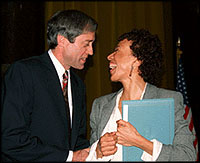
Margo Jefferson receives her 1995 Pulitzer Prize from Columbia University President George Rupp.
Winning Work
By Margo Jefferson
HARRIET BEECHER STOWE
A Life
By Joan D. Hedrick 507 pages. Oxford. $35.
I bought a cheap paperback edition of "Uncle Tom's Cabin" at a secondhand bookstore in 1969, expecting to sneer my way through its racial sophistries and female pieties. Instead, like Eliza crossing the ice, I found myself leaping from piety and sophistry to something much grander and landing, by means too varied and contradictory to recount, on the side of moral and narrative freedom.
Harriet Beecher Stowe's life has the same effect. To follow it is to be caught up in the great issues and crises of 19th-century America: the cult of True Womanhood, the struggles over slavery, the decline of Calvinism, the rise of industrial consumer culture and the birth of great American literature.
Harriet was the daughter of Lyman Beecher, one of America's fiercest, most famous ministers. He pronounced her a genius when she was 8, adding that he would give $100 if she were a boy and her brother Henry a girl. Harriet was also the daughter of Roxana Foote Beecher, who had grown up reading English novels, speaking French and debating her sisters as to whether Alexander or Hannibal was the greater general. But Roxana died young after bearing 13 children, and she was immediately turned into a household saint of whom it was said she never told a lie or spoke an angry word.
Both parents' legacies are writ large in Stowe's fiction: the passion for the domestic and the theological; the sternness and the sentimentality; the voice of the ur-mother and the voice of the prophet, now soothing, now charming, now exhorting, now lifting her readers in the pursuit of truth.
She was born in 1811, and she was given the best education a girl could get in Victorian America, learning mathematics, geography, Latin and moral philosophy in the ladies' seminaries of New England. She taught briefly at her sister Catharine's school, then went to Cincinnati with her father, who was determined to bring evangelical Protestantism to the West. There she wrote a geography book for children and her first sketches of New England life.
Having been fathered by one minister, she proceeded to marry another. It was a marriage of true minds but of clashing temperaments and a physical passion that had to be held in check after several miscarriages and the birth of six children. Calvin Stowe spent his life teaching theology, but he longed to "live and die a literary man," and he honored his wife's talent. "You must be a literary woman," he proclaimed in 1842, when she was about to publish her first book of stories. "Make all your calculations accordingly, get a good stock of health, brush up your mind." She was still primly signing her work "Mrs. H. E. Beecher Stowe": he told her to "write yourself only and always, Harriet Beecher Stowe, which is a name euphonous, flowing and full of meaning."
The 1840's were years of abolitionism, revivalism, utopianism, mind cures, health cures and, in Ms. Hedrick's words, "schemes secular and religious for the Total Improvement of Humanity." For the Stowes they were also years of sickness, financial woes and family deaths: "I often day and night was haunted and pursued by care that seemed to drink my life blood," Harriet wrote after her brother George's suicide. Ms. Hedrick is detailed and never at all dull on the social and spiritual conflicts that finally led to the writing of "Uncle Tom's Cabin" in 1852. The book made Harriet Beecher Stowe one of the best-known and best-paid writers of her day and supposedly made Abraham Lincoln remark, when they met, "So you're the little woman who wrote the book that started this great war!"
Ms. Hedrick, a professor of history at Trinity College in Hartford, walks just the right line between storytelling and historical analysis. Drawing on the fine feminist scholarship of Kathryn Kish Sklar, Carroll Smith-Rosenberg and Ann Douglas, she refuses to unify or prettify the contradictions in Stowe's work and temperament: the way she will seize on a cliche, then unearth a revelation.
"Stowe's originality and power arose from her skillful synthesis of literary realism -- the 'coarse, common world' validated in Dickens' novels -- with an evangelical intensity," Ms. Hedrick writes. Stowe dramatized racial sacrifice and resistance again in "Dred," dissected and canonized New England in "The Pearl of Orr's Island" and "The Minister's Wooing," and moved to worldly Newport and New York for "Pink and White Tyranny" and "My Wife and I." Every one of these novels is worth reading. When she is good she is brilliant, and when she is bad she still manages to be riveting.
This must be why the esthetically fastidious Henry James called "Uncle Tom's Cabin" a "wonderful 'leaping fish' of a novel." This must be why one can find the seeds of Edith Wharton's finest work in Stowe's wildly uneven New York novels. This must be why James Baldwin, also a minister's child, attacked her limits, then reclaimed and extended her literary and moral ministry. And this must be why words like these, from the final chapter of "Uncle Tom's Cabin," could have been written yesterday and could be written today:
"This is an age of the world where nations are trembling and convulsed. A mighty influence is abroad, surging and heaving the world, as with an earthquake. And is America safe? Every nation that carries in its bosom great and unredressed injustice has in it the elements of this last convulsion."
© 1994, The New York Times
By Margo Jefferson
ONE ART
Elizabeth Bishop Letters
Selected and Edited by Robert Giroux
Illustrated. 668 pages. Farrar, Straus & Giroux. $35.
Molds and mildew gave Elizabeth Bishop asthma, but they also gave her esthetic pleasure. It lay in "the black shadow, like the finest soot, that suddenly shows up, slyly, on white bread, or white walls."
"The molds on food go wild in just a day or two, and in a hot, wet spell like this, a tiny jungle, green, chartreuse and magenta, may start up in in a corner of the bathroom," she wrote in the story "Memories of Uncle Neddy." "That gray-green bloom, or that shadow of fine soot, is just enough to serve as a hint of morbidity, attractive morbidity -- although perhaps mortality is a better word."
Mildew, mortality, bloom and shadow; nature subverting human order; life and death not as opposition but as co-conspirators in a process: these are the elements of Bishop's art. Starting with "North & South" in 1946 and ending with "Geography III" in 1977, she published a small, fine book of poems about every 10 years. Since she died in 1979 at the age of 68, "The Complete Poems: 1927-1979" and "The Collected Prose" have appeared. Now there is "One Art," a selection of letters edited by Robert Giroux, her longtime publisher.
The woman who could take 16 years to finish one poem could write up to 40 letters in one day. It was "kind of like working without really doing it" she told a friend, and by work she meant writing. But she also meant the work of human contact: the explaining and the comforting, the trying not to quarrel; the war between intimacy and privacy, neither of which she could do without.
Bishop once wrote a little wistfully that children usually take their surroundings for granted. She didn't. By the time she was 12, she had lived in rural Nova Scotia and urban Massachusetts, with parents, grandparents, cousins and aunts. Her father died in 1911 when she was 8 months old. Her mother entered a mental institution when she was 5 and died 18 years later, without seeing Elizabeth again.
Her family circumstances set Bishop apart; so did her sensibility. High school friends spoke of her as "the Bishop" and never doubted her genius. "She had read more widely and deeply than we had," one remembered. "But she carried her learning lightly. She had a big repertory of stories she could tell, not read, and of wonderful songs she could sing, like ballads and sea chanteys." Everyone else had straight hair that hung down. The Bishop had tight curls that stood straight up.
She was high-minded and severe about poetry. When she was still an undergraduate at Vassar, she wrote of Shakespeare: "It was he who gave that beautiful, slightly sad lilt to the sonnet form, the impressiveness of the first lines and the importance and finality of last lines -- an atmosphere easy to crawl into without really having the right to be there, and a pillow for any number of weary ideas."
But as a poet she was very hard on herself. "I scarcely know why I persist at all," she wrote Marianne Moore, who was not so much her mentor as her fairy godmother. (Fairy godmothers are quite stern about the conditions under which they bestow their blessings.) "It is really fantastic to place so much on the fact that I have written a half-dozen phrases that I can still bear to reread without too much embarrassment."
We read artists' letters to catch sight of their lives, but also to watch their gifts at work behind the scenes. When Bishop has an allergy attack, her ears become "large red-hot mushrooms" in one letter, and "large red terra-cotta classical casts of ears" in another. When she is given a bird, a toucan with black feathers and blue skin, "as if he had blue jeans on under the feathers," she records his eating habits with gusto: "He eats six bananas a day. I must say they seem to go right through him & come out practically as good as new -- meat, grapes -- to see him swallowing grapes is rather like playing a pinball machine."
Then, suddenly, there is a shamefaced apology for a drunken binge, or, after months of the most muted complaints, a letter about her lover that declares: "The simple truth is that my darling Lota, whom I still love very much if she'd give me a chance to show it, has been simple hell to live with for five years now."
People she doesn't know well may get no more than a courteous qualifier like "nice," and she seldom arranges her tone or her stories to dazzle. When she performs, she is usually trying to hide something painful or embarrassing. Robert Lowell wrote in 1957 to say that he had almost proposed marriage to her 10 years earlier and that "asking you is the might-have-been for me, the one towering change, the other life that might have been had." She wrote back four months later: "Dearest Cal, I don't know why I haven't been able to write to you sooner, really," then went on to talk gracefully of Purcell, Monteverdi and poetry, never once addressing his confession.
Bishop lived happily in Brazil for 15 years, but after her lover, Lota Costellat de Macedo Soares, committed suicide in 1967, she returned to live in the United States.
She spent the last years of her life teaching, mostly at Harvard, winning awards and displaying not a shred of self-importance. She made her students memorize a poem each week, and she taught them iambic pentameter by way of sonnets and the blues. But she meant it when she wrote in 1975: "I really don't know how poetry gets to be written. There is a mystery & a surprise, and after that a great deal of hard work."
When Bishop's poems describe concrete things (a toad, an iceberg, a fish house or a hairless pink dog), they become conduits to something more. But when she begins with something more -- with grief, love or wonder -- she gives it the weight and flesh of the iceberg and the toad.
Mr. Giroux has chosen letters and excerpts from letters so carefully that sometimes he seems more like a chaperone than an editor. Still, what a touching and pleasing book this is! Bishop's letters are keys to her art and her life. She was a good letter writer. And she was a great poet.
© 1994, The New York Times
By Margo Jefferson
ELLA FITZGERALD
A Biography of the First Lady of Jazz
By Stuart Nicholson
Illustrated. 334 pages. Charles Scribner's Sons. $23.
Some performers win our hearts with their imperfections; others seem so gifted that our love is always accompanied by reservations. That must be why Ella Fitzgerald still arouses so much discontent, fame and fortune notwithstanding.
She can't sing the blues, go the complaints. She's girlish but sexless, cordial but distant, and she has no emotional attachment to the lyrics of her songs.
But once that's out of the way, what is left? Pure pleasure that consists of an unfailingly keen sense of rhythm, tempo and pitch; a lithe, serene voice, and a lightly worn knowledge of just how to mine a song's harmonic necessities and melodic possibilities. We don't chastise Carole Lombard or Cary Grant for being wonderful comic actors and competent but not wonderful serious ones. Ella Fitzgerald's gifts follow the same course. She does not confess or dramatize when she sings of love lost or longed for. But when she's in top form, she doesn't banish emotion, either; she acknowledges it in tranquillity.
In the words of Stuart Nicholson in "Ella Fitzgerald," she disappears into the song, which makes biography a tricky enterprise. Ms. Fitzgerald lived through, not just with or in, music. Mr. Nicholson does a very fine job with Ms. Fitzgerald the musician, but admits that she has always disliked talking about anything more private. If pressed, he writes, she would pull out the tale "of a we- were-poor-but-happy childhood and of a mother always on hand with homespun philosophy to soothe the growing pains of childhood." He adds, "The story was repeated again and again until it became standard journalistic copy, but all along it was just another song into which she could disappear."
To his everlasting credit, he reveals the facts behind the copy forthrightly but never gloatingly. It was much harder than it seemed, becoming Ella Fitzgerald: finding the golden mean between girlish ebullience and matronly calm that suited her temperament but also became her shield.
Ella Jane Fitzgerald was born in Newport News, Va., and reared in Yonkers, N.Y., by her mother, Temperance Williams, and her stepfather, Joseph DaSilva.She sang and danced before, after and on the way to school. She told her friends she was going to be famous. She practiced the Susie Q and the Snake Hips swivel, and she listened closely to Louis Armstrong, Bing Crosby and the Boswell Sisters, mimicking both their voices and the instruments that backed them.
She was 14 when her mother died in 1932 and 16 when she got herself onto the stage of the Apollo Theater in New York, wearing men's boots and cast-off clothes, and won the Amateur Night contest. In the years between, she was a grimy little street singer and ragamuffin. She left a bullying stepfather, earned pocket money running the numbers and warning prostitutes when the police came near, dropped out of school, and ran away from the orphanage to which the Board of Education had sent her. She lived by singing and dancing on the street corners of Harlem.
She got her start with the drummer Chick Webb's band, and she led it to the big-time with "A-Tisket, a-Tasket," that pouty swing version of a nursery rhyme that seems to capture the essence of every nymphet from Shirley Temple to Lolita. When Webb died in 1939, she went on, learning the speedy intricacies of be-bop in the 1940's and playing the role of gracious, if detached, hostess to songwriters like Cole Porter and Irving Berlin in the 1950's.
At first the voice was slightly overcast, in the manner of Connee Boswell. By the 1940's it had entered a zone of vibrato-free purity, and it remained there for a quarter-century. When it began to decline, along with her health (cataracts and diabetes), she kept performing. Mr. Nicholson follows her ceaseless, even brutal tour schedule and her ceaseless, even indiscriminate productivity with clear-eyed intelligence. According to a discography provided by the jazz historian and broadcaster Phil Schaap, Ms. Fitzgerald recorded nearly every year from 1939 to 1989. (And yes, those recordings did include "Put a Little Love in Your Heart," the theme from "Sanford and Son" and "I Heard It Through the Grapevine").
The producer John Hammond once admitted that he didn't notice Ms. Fitzgerald's work in the 30's because she wasn't sexy like Billie Holiday. Chick Webb noticed her, but not, Mr. Nicholson shows, without lodging a mean-spirited protest. "I don't want that old ugly thing!" he declared, to which Kaiser Marshall, a band member with much more foresight, replied, "You damn fool, you better take her!" Had she looked more like her peer Billie Holiday or her admirer Doris Day, her playfulness would probably be called provocative and her reserve enigmatic.
It's also true that Ms. Fitzgerald doesn't sing the blues if one demands that they be sung with the lean passion and power of Bessie Smith or Jimmy Rushing. But she uses the blues structure when she improvises: she can hum a blues languidly or drive it joyously through fast tempo and melody changes. That is how Fats Waller and Dizzy Gillespie use the blues, too. And who reproaches blues singers like Ida Cox or Blind Lemon Jefferson because they don't swing?
Her renditions of Cole Porter and Rodgers and Hart are not distinguished because the lyrics demand savvy theatrics. She sings Duke Ellington beautifully because she undercuts his too-often saccharine lyricists. And she sings the Gershwins sublimely because they were as drawn to high spirits and perpetual youth as she. Oscar Hammerstein and Jerome Kern might as well have been thinking of her when they wrote:
The music is sweet,
The words are true,
The song is you.
© 1994, The New York Times
By Margo Jefferson
GAY NEW YORK
Gender, Urban Culture and the Making of the Gay Male World, 1890-1940
By George Chauncey
Illustrated. 478 pages. Basic Books. $25.
It was considered smart to go slumming in the New York of 1890. Men and women of the better classes could tour, for a fee, the dance halls, saloons, opium dens and red-light venues of the city, watching or selectively mingling with showgirls, dancers and prostitutes, renegades of all races and sexes.
When Charles Nesbitt, a young medical student from North Carolina, took the slummer's tour that year, he found himself in a beer garden on the Bowery, conversing with a transvestite who went by the name of Princess Toto. He found her worldly and "unusually intelligent," and to reward his interest she invited him to a Lower East Side drag ball. There, he found about 500 same-sex couples "waltzing sedately to the music of a good band"; some of the women were in white tie and tails, some of the men in lavish gowns. He later recalled, "One could quite easily imagine oneself in a formal evening ballroom among respectable people."
"Gay New York: Gender, Urban Culture and the Making of the Gay Male World, 1890-1940," a first-rate book of history by George Chauncey, is filled with this sort of encounter.
New York City was the center of a great many worlds; in fact it is hard to imagine how so many people with such different pasts came to one city with a grand vision of self-improvement and self-expression. "All genuine style history is played out in the cities," proclaimed the German philosopher Oswald Spengler. And Mr. Chauncey quotes the American sociologist Robert Park, who called a city like New York "a mosaic of little worlds" that touch but do not blend. "This makes it possible for individuals to pass quickly from one moral milieu to another," Park said, and, he added, to conduct the "fascinating but dangerous" experiment of living in different worlds at once.
We tend to think of this mosaic as ethnic and social, easily fixed in Harlem or Little Italy or Hell's Kitchen. But it is sexual and cultural, too, and its borders are being crossed all the time. Mr. Chauncey writes: "Throughout the half-century before World War II, New York was full of single men and women who had left their families in southern Europe or the American South or whose work on the seas made New York one of their many temporary home ports. Countless men had moved to New York in order to participate in the relatively open gay life available there, and the waterfront, the Bowery, Times Square and other centers of transient workers had become major centers of gay life."
Mr. Chauncey, who is an assistant professor of American history at the University of Chicago, draws on a truly vast and impressive range of sources, from oral histories (some of men who still use pseudonyms) to the records of various anti-vice societies, as well as more general information about New York's housing and employment patterns and its entertainment districts and tastes.
He divides his book into three sections. The first, set in the years before World War I, centers on the conventions and laws that gave the homosexual and heterosexual cultures their increasingly distinct identities. The second part maps the ways in which gay men used the city's neighborhoods and public resources, particularly Greenwich Village, Harlem, Times Square, parks, cafeterias, rooming houses and apartment complexes to develop the bonds and codes that define a community.
Part 3, which Mr. Chauncey calls "The Politics of Gay Culture," concentrates on the expanding role gay people and the image of "gay life" played in the city's consciousness and the nation's. He wryly notes, for example, that Prohibition made gangsters, blacks and homosexuals all the rage for a time, at least in movies, plays and cabaret acts. But the repeal of Prohibition brought a crackdown, and, as he puts it, "a revulsion against gay life" that was part of "a larger reaction to the perceived 'excesses' of the Prohibition years and the blurring of the boundaries between acceptable and unacceptable public sociability."
Gay life became more segregated and less visible. "A few pansy clubs managed to survive as tourist traps in the Village," he writes, "but the gay subculture as a whole stopped being part of the spectacle of urban life."
His next book will take up that part of the story. But "Gay New York" is about all urban life, telling us as much about the heterosexual world as about the homosexual one. Slang, as usual, is instructive. Before "gay" meant homosexual, it referred to a female prostitute. A "fairy" was a flamboyantly effeminate man, but a "queer" was one who, in manner and appearance, could not be distinguished from your average "straight" Joe. And "trade" was, Mr. Chauncey writes, "ideally a sailor, a soldier or some other embodiment of the aggressive masculine ideal" who was perfectly willing to have a dalliance with a homosexual while never for a moment being inclined to think of himself as one.
Mr. Chauncey's prose can get a little labored, but his vision never does: he savors complexity and variety and he teaches his readers to do the same.
© 1994, The New York Times
By Margo Jefferson
AUTOBIOGRAPHY OF A FACE
By Lucy Grealy
223 pages. Houghton Mifflin. $19.95.
Suffering is exact. Each kind has its own weight and measure. Fearing you are ugly is not the same as knowing you are. Anticipating pain you have never felt is different from dreading pain you know inside out. Feeling that you have been asked to bear too much is a far cry from learning to bear it anyway.
When Lucy Grealy's family came to the United States from Ireland in the late 1960's, they thought of themselves as aristocrats fallen upon hard times in a coarse new land. Mr. Grealy had been a well-known journalist back home: now that he worked at NBC in New York City, why were they stuck in the suburbs, pressed for cash, and forced to watch people with less taste and intelligence spend it?
"If we had had the money we felt entitled to," ran the family plaint, "we would never have spent it on anything as mundane as a house in Spring Valley or as silly and trivial as a pony party."
Lucy's mother was stern and depressed, her father volatile and evasive, and when Lucy underwent surgery at age 9 for what seemed to be a dental cyst, she decided that being a model patient -- brave, chipper, uncomplaining -- would set a much-needed example: "All I had to do was perform heroically and I could personally save my entire family." But the cyst turned out to be Ewing's sarcoma, a rare and virulent form of cancer. Several operations later, nearly half her jaw was gone. The right side of her face was a boneless mass of flesh, and she was, as she puts it, "in this alone."
Ms. Grealy is on the cover of her book, "Autobiography of a Face." Her blond hair is blowing in the wind, and she is holding a translucent piece of material across her face. Her eyes are round, her nose is neatly shaped and her mouth pulls just a bit downward, as if a doll has been given a tiny pout.
What will we see when she drops the veil?
Here is what people saw and said over the course of 18 years and 30 operations. Children whispered, "What's wrong with her face?" while their parents silenced them and tried to find out. Older boys yelled, "That is the ugliest girl I have ever seen." Girls stared furtively and averted their eyes when she stared back.
Behind the veil another story was in progress: the story of her private relations with her face, and of how she gave a coherent shape to fear, pain and "the deep bottomless grief I called ugliness." Alexander Dumas said you need four walls, two people and one passion to make a drama. Ms. Grealy shows that four walls, one body and one soul will do the job just as well.
How well she writes about the body, struggling with itself and the forces of medicine. The body doesn't forgive or forget. It talks and fights back, resists every kind of intervention, then suddenly yields and changes course. Ms. Grealy's first chemotherapy treatment was a lesson in anatomy. She writes, "My stomach outlined itself for me; my intestines, my liver, parts of me I didn't know the names of began heating up, trembling with their own warmth, creating friction and space by rubbing against the viscera, the muscles of my stomach, my back, my lungs."
Then the senses took over. The wound in her jaw began to smell sweet. "Drainage tubes drifted down onto the pillow beside me, displaying the slightly shifting red and golden fluids of my body." Years passed, and she found she could put herself to sleep by imagining her body on a hospital stretcher, surrounded by uniforms, cool hands and soft voices, by "the distant beeps that were really heartbeats, the mechanical shushes of respirators, which meant someone, somewhere near, was breathing."
And finally the psyche began its process of denial and acknowledgment. Ms. Grealy allowed the words malignancy and Ewing's sarcoma into her vocabulary, but not cancer. She kept away from mirrors and deflected her fear about how she looked onto temporary things like the baldness caused by chemotherapy, not her absent jawline.
She developed a stringent theology of ugliness. In the first stage she measured her state against land mines, pogroms and the devastation of Cambodia, and concluded that it was her duty to accept her lot. When adolescence demanded that she acknowledge sex, she did: she cultivated desirelessness and saw herself as a noble, ill-fated lover whose failure to win earthly satisfaction assured spiritual and artistic victory.
Metaphor helped, too. Wasn't her face like the ruined estate where Doctor Zhivago wrote his poems, its true splendor "inextricably bound to the fact that it was ruined"? When all that failed, she was back in everyday life, hating Danny in orchestra class because she had a crush on him, and hating Katherine because Danny had a crush on her, and "plagued by petty desires and secret, evil hates."
How did she learn to seek and find lovers with the recognizably human and somehow manageable mix of terror, pleasure, shame and bravado? Is it any accident that it happened after she decided to make herself into a writer? She says, "I used to think truth was eternal . . . I know now that this isn't so, that most truths are inherently unretainable, that we have to work hard all our lives to remember the most basic things."
So many memoirs make you feel that you've been sealed up inside a wall with a monomaniac. A really good one, like "Autobiography of a Face," makes you feel there is more to ask and learn. You are not just seeing the writer; you are not trying to see yourself. You are seeing the world in a different way.
© 1994, The New York Times
By Margo Jefferson
DAWN POWELL AT HER BEST
Edited by Tim Page
452 pages. Steerforth Press. $28.
So, we say to ourselves, another nearly forgotten writer exhumed, cleaned up, reissued and put on display with endorsements from Edmund Wilson, Diana Trilling and Gore Vidal. Then a friend says no, she's terrific, read her, and we do, and here it is, that infinitely distinguished thing, a dead writer so full of charm and derring-do that literature's canon makers should sit back, smile and say, Dawn Powell, where have you been all our lives?
"Dawn Powell at Her Best" is edited by Tim Page, the chief music critic for Newsday, who is writing her biography. It contains two novels, eight stories and a short, lovely piece about fleeing Ohio ("We were on a farm with a new stepmother who didn't know what to do with us so she put us outdoors after breakfast and locked all the doors") and going to New York to write and live as she wanted to. Born in 1897, she moved to New York in 1917 and stayed there until she died in 1965.
Fortunately, whether Powell's writings are peopled by provincial Ohio families or showy New York artists, the story of living the way one wants is not a self-reflective quest; it is a piecemeal journey filled with stops, starts and odd little detours. Her plots, her people and her prose wheel along, gathering complexity then crushing it flat, grinding to a stop for disappointment or disaster, starting up again at the first sign of longing, ambition or any other appetite. Powell wrote: "My novels are based on the fantastic designs made by real human beings earnestly laboring to maladjust themselves to fate." Her creed: "I give them their heads. They furnish their own nooses."
Her stories are simple, her plot twists are many and her characters are bursting with dreams and doing their best to exceed or deny their limits. "Dance Night," published in 1930, is set in the Ohio of the teens and 20's amid boardinghouses, factories, dress shops, saloons and the occasional mansion. The would-be hero is Morry Abbott, the son of a cynical traveling salesman and a dreamy, rather elegant dressmaker, and he yearns for success beyond Lamptown office and assembly line jobs, "a success without calluses and without the embarrassment of however honest sweat." The would-be heroine is Jen St. Clair, an ambitious and, happily for us, unsentimental orphan. (When Morry first meets her, he is puzzled by her black hair and urchin ways: people usually adopt yellow- haired, blue-eyed little dolls, he says. "The hell they do," Jen says back. "They always pick somebody that looks like a good worker.")
It is the oldest of American stories, the story of how the young lie awake at night listening to city-bound trains roar by and trying not to listen to their parents, themselves lost in thwarted visions of style and self-expression. And it is fresh in Powell's hands, wholly alive to shifts of mood and tone. Actually, it is as close to musical theater as a novel can get: all the people have their own cadence and language; they move along through the stuff of their daily lives, then suddenly burst into action or fantasy as if they were bursting into song.
Powell's leitmotif is Lamptown's weekly dances, conducted by the suave instructor from Cleveland. At the dances, Elsinore the dressmaker can gracefully snub the factory girls in the ladies' room while the rich and spoiled Hunt Russell can invite a waitress out for a spin in his automobile. Here the town's progress is measured by the move from the schottische to the tango to the Mississippi glide, while outside progress is a matter of industry and real estate. And when the dance is over, we follow them back into their lives, yearning for the end of each day, when "warm darkness would smudge these sharp edges and let shadows invent their own town."
Years after she settled in New York, Powell wrote in "What Are You Doing in My Dreams?" that the day she left Ohio she "split in two at the crossroads and went up both roads, half of me by day here in New York and the other half by night with the dead in long-ago Ohio." "Turn, Magic Wheel" is a gleaming, brittle and slightly brutal New York novel. Published six years after "Dance Night," it has a surer, cleaner form and a buoyant city rhythm that never stops. Each chapter slips us into the consciousness and conversation of a group of worldly, needy New Yorkers, and keeps them afloat on the sounds and sensations, the dash, squalor and ugly beauty of the city.
This is a novel about novelists, but don't let that discourage you: there is no preening here at all. There is suspense, there is folly and there are comedies of manners and morals. When "Turn, Magic Wheel" opens, the writer Dennis Orphen is just about to publish a novel based on the confidences of an elegant older woman who has taken him up for her own reasons and told him everything he needed to know about her first marriage to an older and (for the moment) far greater novelist. Powell uses this the way Alfred Hitchcock uses those simple plot tricks he called MacGuffins: it sets things going and turns writing into a form of espionage, where novelists and the people who are their material struggle to best and outmaneuver each other.
Meanwhile, Powell savors the fun, tossing off parodies of Dickens, Henry James and Woolf from time to time, then tossing out her own observations, teasing our minds and our senses. See the pompadoured cocktail pianist who collects "handfuls of sprawling sugary chords"; see the artist who has managed to strike a note all his own by combining the manner of Clark Gable with that of Wallace Berry. And see New York itself: "On the glittering black pavement legs hurried by with umbrella tops, taxis skidded along the curb, their wheels swishing through the puddles, raindrops bounced like dice in the gutter." Or here, on a terrace 86 stories above the city, night, "spread out in a garden of golden lights; trucks, trains, ferryboats crawled soundlessly in and out of the island puzzle."
© 1994, The New York Times
By Margo Jefferson
LAST TRAIN TO MEMPHIS
The Rise of Elvis Presley
By Peter Guralnick
560 pages. Little, Brown. $24.95.
Should you seek a working hypothesis as to why Lisa Marie Presley married Michael Jackson, "Last Train to Memphis: The Rise of Elvis Presley," by Peter Guralnick, will provide one. Aren't we always told that women seek some version of their fathers in the husbands they choose?
Lisa Marie's father had done most of his best work by the time he was 25. He was precociously assured onstage and unnervingly childish off. He didn't wear clothing; he wore costumes set off by lacquered hair and makeup. He studied the tricks and manners of other stars, played with every racial style he could find (first artfully, then compulsively), and when he had done that, he went one step beyond into something that approached the extraterrestrial.
But we are getting ahead of the story. What Mr. Guralnick gives us is a passionate, detailed chronicle of Presley's early years and fame. The book ends in 1960 when he joins the Army. His mother has died, his career has been put on hold and, as he boards a ship bound for Germany, he sends a last message to his fans: "I'd like to say that in spite of the fact that I'm going away and will be out of their eyes for some time, I hope I'm not out of their minds."
He never was and never will be. Mr. Guralnick's intention was "to rescue Elvis Presley from the dreary bondage of myth and from the oppressive aftershock of cultural significance." But from our point of view this can't be done. He refuses to rifle the gossip bank and fast-forward to the later years, but the reader does and the reader can't help it. Still, as you read, then put the book down to play a tape or video (Mr. Guralnick writes vividly enough so that you can do without them, but why should you?), you find that you are freed from the bondage of all myths and opinions but your own.
It was keen instincts, hard work and boundless ambition that turned a poor Southern boy into a show-business king. When he was born in 1935, the Depression was still on, and between sharecropping, waitressing and factory work, his parents stayed poor. His twin brother, Jesse, had been stillborn, and Mrs. Presley always said that when one twin died, the other got the strength of both. Young Elvis was watched over by a well-meaning, hapless father and fussed overby an adoring, high-strung mother.
The early lives of most stars follow certain patterns. They often spend their youth daydreaming, unnoticed by their peers until, little by little, they make their presence felt. Gladys Presley made sure her son had guitar lessons, and soon he was performing at parties and high school picnics. He grew his hair long (he used three kinds of pomade to get the right shape), and he began dressing tango-pirate style, in a black bolero jacket and black peg-legged pants. (Sometimes they had a pink stripe.)
He listened to every kind of music the radio had to offer, and on Sundays he sneaked out of the family church and over to the Rev. Herbert Brewster's, where he could hear some of the best black gospel music in the country. When he was 18 he walked into the Sun Records studio in Memphis. The owner, Sam Phillips, had already recorded Rufus Thomas and Junior Parker and would go on to record Jerry Lee Lewis and Johnny Cash. In the meantime, here was a shy, self-effacing boy who said he just wanted to record a birthday song for his mother.
The Sun people said he was a promising ballad singer. (Small wonder, since Dean Martin and Bill Kenney of the Ink Spots were two of his favorites.) But the breakthrough didn't come until the next year when, after countless takes of a country ballad had flopped, Elvis launched into a blues number called "That's All Right." He just started singing, said his guitarist Scotty Moore, "jumping around and acting the fool, and then Bill picked up his bass, and he starting acting the fool, too, and I started playing with them." As Sam Phillips saw it, Elvis was scared to death, "but sounding so fresh, because it was fresh to him."
And that brings us to the heart of what they called hillbilly be-bop, "nig-grah music" and, finally, rock-and-roll. The elements weren't new, and they had been put together before. (Think of Louis Armstrong and Bing Crosby; even the Mills Brothers and Ukulele Ike Edwards.) The proportions were new, though: the tempos were all-out fast and the tone was flat-out insolent. To some, rock-and-roll was as threatening as Communism and desegregation.
Mr. Guralnick's book does everything that ardent, earnest research can do. What a pleasure it is not to keep crashing into standard rock hyperbole. But ardor and earnestness have their limits. Must Elvis, for instance, find that music gives him "a soft, dreamy feeling, a sense of almost cushiony release" that is also "as hard and concrete as desire"? And why are Memphis, New York and Hollywood rendered in such soft focus? It is a relief to find that Mr. Guralnick seems free of the anxieties that haunt so much writing about Presley, turning it into a musical version of a race and I.Q. debate on whether blacks are superior to whites when it comes to popular music and dance. But he didn't have to be taken in by the debate to record it more clearly.
It is when he shows how Elvis made his way through this cultural briar patch that we get what we need. So did Elvis. He got voluptuous phrasing and ecstatic self-confidence from gospel. He got wit and menace from blues and homespun sincerity from country, and from what we can now call gay theatrics (Liberace, Little Richard, Jackie Wilson), he got glamour and self-parody. He played the outlaw and the good son. What fun it is to watch him "yes, ma'am" and "no, sir" critics and television-show hosts into submissive admiration. How he flirts with his audiences, being casual, then fervent; sneering, then inviting us to laugh at or with him. As you desire me, he is saying, so shall I be.
Is he a great singer? To these ears, no. Is he a great performer? Yes and yes again. He galvanized rock-and-roll the way Al Jolson and Judy Garland galvanized vaudeville and Tin Pan Alley. He made you feel the fun and the risk and all the contradictions. That's self-invention, and that's entertainment.
© 1994, The New York Times
By Margo Jefferson
STRANGE JUSTICE
The Selling of Clarence Thomas
By Jane Mayer and Jill Abramson
406 pages. Houghton Mifflin. $24.95.
Is it a sign of racial progress when a stale political drama can be revitalized by casting blacks in the lead roles? If so, then the Clarence Thomas-Anita Hill hearings were an American triumph.
The bare bones of the plot are hardly new. A man is nominated for an important Government job, more on the strength of his politics than his merits. A former employee suddenly appears, making assertions that cast doubt on his character. A pitched battle follows, with much public posturing and much private whispering. And when it is all over, the candidate has the job and the journalists have the story. Last year, David Brock, a reporter for The American Spectator, wrote "The Real Anita Hill: The Untold Story." His aim was to determine whether Clarence Thomas had been guilty of sexual harassment "in this instance," as he put it, and to that end he presented us with an innocent and victimized Clarence Thomas, a sexually voracious and politically duplicitous Anita Hill and a smattering of emotionally fraught expressions like "feminist frenzy," "media blackout," "the Shadow Senate" and "radical utopians."
Now, Jane Mayer and Jill Abramson, reporters for The Wall Street Journal, have written "Strange Justice: The Selling of Clarence Thomas." As Mr. Brock did, they combine reporting with informed speculation, and they believe that in this instance sexual harassment did occur. They are as liberal as he is conservative (are investigative journalists ever without political views?), and because they provide us with evidence that was unavailable to or unsought by Mr. Brock, theirs is the better book.
In their prologue, they write that "the falsehoods and distortions involved in the selling of Clarence Thomas to the American people neither started nor ended with the treatment of Anita Hill's accusations. From the beginning, the placement of Thomas on the high court was seen as a political end justifying almost any means." And so the story begins in October 1990, at the party for Justice David H. Souter when he was sworn to the Supreme Court. There, amid the toasts and the chatter, President George Bush's chief of staff, John H. Sununu, promises Thomas Jipping, the legal point man for the Free Congress Foundation, that the next Supreme Court candidate will be "a true conservative" and that his confirmation will be "a knockdown, drag-out, bloody-knuckles, grass-roots fight." Nine months later, Thurgood Marshall announces his resignation from the court, and the nomination of Clarence Thomas is born. "The entire conservative movement not only supports him but believes in him," Mr. Jipping writes to Mr. Sununu. And he believes in himself, too: Mr. Thomas has been telling people for years that he intends to succeed Justice Marshall.
Using the tried-and-true flashback structure, Ms. Mayer and Ms. Abramson set the scene for the confirmation clashes, tracing the routes by which Mr. Thomas and Ms. Hill came to Washington, and introducing us to colleagues, rivals and friends who supply opinions and recollections of the ill-fated pair. Then, in the book's second part, they re-create the hearings in all their sleaze and silliness: the high stakes and the low blows, the high-toned moralizing punctuated by moments of pseudo-funky street talk. A nation watched it on television, hypnotized. If you turned the sound down, the participants looked sober and statesmanlike. But when you turned the sound up, you found you had entered a bizarre cartoon world in which names like Long Dong Silver and questions like "Who has put pubic hair on my Coke?" floated in white clouds above the speakers' heads.
But Ms. Mayer and Ms. Abramson also take us behind the scenes, where fierce political maneuvering determined the outcome: the White House lobbied fiercely for Senate votes, and new alliances were forged between white and black evangelical ministers.
There is plenty of absurdity in "Strange Justice." Upon learning of Ms. Hill's charges, Senator Howard M. Metzenbaum, Democrat of Ohio, exclaimed in alarm, "If that's sexual harassment, half the Senators on Capitol Hill could be accused." But upon learning that Ms. Hill planned to include such words as "penis" and "breast" in her testimony, two of Washington's most savvy Democratic lawyers protested vehemently that such words would be "needlessly offensive in the decorous atmosphere of the Senate."
There is irony here, too: the same Clarence Thomas who noted resentfully in 1987 that a black who wanted to get ahead in conservative circles had to "become a caricature of sorts" managed to get ahead three years later by playing the martyr in what he labeled a high-tech lynching by liberals.
There are even a few good one-liners. Angela Wright was the most visible of the four women who were prepared to testify against Mr. Thomas but were never called; had she been, she said, "these people were going to paint me as a two-headed hooker with alien babies." And Henry Terry, who had been one year behind Mr. Thomas at Yale Law School, recalled that Mr. Thomas could sound dignified in the courtroom but "profane, scatological and graphic" with his pals. "That's my boy," said Mr. Terry when Anita Hill offered her testimony. "That's him talking."
Senator John C. Danforth, the Missouri Republican who was Mr. Thomas's mentor and staunchest supporter, has written his account of the hearings in a tone that memorably combines noblesse oblige and religious piety. He calls his book "Resurrection," and its final lines read: "Clarence had risen. Alleluia!" But after finishing "Strange Justice," you are more likely to believe that what rose in the person of Clarence Thomas was the spirit of Richard Nixon. Compare their lives and careers: the punitive, harsh childhoods; the slights inflicted by peers and rivals; the resentments that built up and turned into grudges; the political acumen and intellectual cynicism; the drive to win at any cost.
How much of our public life must play hostage to private grudges? On the day he was confirmed, the 43-year-old Mr. Thomas told friends that he planned to spend the next 43 years of his life on the Supreme Court because it would take that long to get even.
That's our boy.
© 1994, The New York Times
By Margo Jefferson
LONG WALK TO FREEDOM
By Nelson Mandela
558 pages. Little, Brown. $24.95.
Nelson Mandela has already made history: now he has chosen to write it in the form of an autobiography.
"I am not and never have been a man who finds it easy to talk about his feelings in public," he acknowledges in "Long Walk to Freedom." When reporters asked how it felt to be free, he writes, "I did my best to describe the indescribable, and usually failed." His book is formal in tone: courtly, stern, ironic and, in its detailed accounts of political meetings and strategies, didactic. It is also fascinating because, like the hero in a Shakespearean history play, Mr. Mandela cannot help revealing himself: here are all the idiosyncracies and complications that turned a man into a leader and that have at last turned that leader back into a man.
South Africa, where worlds and races collide, supplies the plot. Mr. Mandela's youth was the stuff of pastoral legend. He was born in 1918, into the royal household of the Thembu tribe. His father served as a kind of prime minister to the Thembu monarchs and, he writes, "I was groomed, like my father before me, to counsel the rulers of the tribe."
Then there was a sudden clash with Western realpolitik. Refusing an order to appear before a local white magistrate, his father was stripped of his title, his land, his herd and revenue. Nelson found himself living in straitened circumstances in a small village, but privilege reasserted itself when his father died and he was placed in the household of the Thembu ruler. He was sent to boarding school and to the only college for blacks in South Africa. He studied English, anthropology, "native administration" and Roman Dutch law. He practiced ballroom dancing for hours, played John Wilkes Booth in a school drama about Lincoln, and helped organize a freshmen revolt against the power wielded by upperclassmen. He was a privileged young man with a few rough country edges who was being groomed for success in the world of his fellow Africans.
Then, to escape an arranged marriage, he rebelled against his family and ran away to Johannesburg. (He has the grace to note that his intended bride was in love with someone else, thus "undoubtedly no more eager to be burdened with me than I was with her.") Johannesburg was part big city and part frontier town when he got there in 1941 and began studying law at one of the few firms willing to hire a black as a clerk. He also began meeting the men and women who would make up the core of the African National Congress and its Indian, mixed-race and white allies.
He writes: "Change was in the air in the 1940's. . . . Inspired by the Atlantic Charter and the fight of the Allies against tyranny and oppression, the A.N.C. created its own charter, called African Claims, which called for full citizenship for all Africans, the right to buy land, and the repeal of all discriminatory legislation." Black miners struck for a minimum wage. Indians mounted a campaign against restrictions on their right to trade or buy property. And the National Party instituted apartheid (Afrikaans for "apartness"), that lethal system of laws and customs meant to insure, as the Nationalists put it, that "the white man must always remain boss."
As apartheid grew stronger, so did the means of opposing it: strikes, boycotts, passive resistance campaigns and, eventually, the sabotage of government property. Mr. Mandela started out as a lawyer, but he became a political organizer and a military strategist whose models included Boer generals, Cuban Communists, Menachem Begin and Clausewitz. Arrested and charged with treason in 1962, he was 44 when he entered prison and 71 when he was released. More than half the book is about those 27 intervening years: the shock of solitary confinement (he found himself "on the verge of initiating conversations with a cockroach"); the hunger strikes and hard labor at the lime quarry; the cultivation of good relations with this or that guard; the escape plan that turned out to be a setup; the messages smuggled to other political prisoners. ("One way was to write messages with milk. The milk would dry almost immediately, and the paper would look blank. But the disinfectant we were given to clean our cells, when sprayed on the dried milk, made the writing reappear.")
Then, in 1985, came the first talks with National Party officials. The suspense mounts almost unbearably as Mr. Mandela describes how a prisoner and his captors exchange notes, meet, shake hands, make small talk and take each other's measure for what could be a bloody life-and-death struggle.
His account of the meetings with President F. W. de Klerk and the fierce negotiations that led to the first election in which all South Africans were allowed to vote is marked by a curious and compelling mixture of tension and restraint. But finally, what moves one most is the Nelson Mandela we might never have seen if history had taken another course. The young boy who spent hours pressing the suits of the Thembu monarch, getting the crease in the trousers just right. The prisoner who wrote his wife that he dusted her picture each day: "I even touch your nose with mine to recapture the electric current that used to flush through my blood whenever I did so." The impeccable politician who, having been introduced to the children of a prison guard he liked, sent them Christmas cards every year from then on. The debater who saves the best retorts for himself, as when he tells National Party officials who insist he is a dupe of the Communists: "You gentlemen consider yourselves intelligent, do you not? You consider yourselves forceful and persuasive, do you not? Well, there are four of you and only one of me, and you cannot control me or get me to change my mind. What makes you think the Communists can succeed where you have failed?"
He says that "in attempting to serve my people, I was prevented from fulfilling my obligations as a son, a brother, a father and a husband." A child asks her father: " 'Why can you not be with us?' And the father must utter the terrible words: 'There are other children like you, a great many of them . . . 'and then one's voice trails off." He did, however, become one of the founding fathers of a new South Africa. And from the evidence of this book, he is an uncanny combination of rebel, gentleman and patriot.
© 1994, The New York Times
Seducified by a Minstrel Show
By Margo Jefferson
Besides, plenty of fans identified with Archie and didn't look down on him at all: minstrelsy has always managed to service an amazing variety of needs.
Who was your favorite character on "Amos 'n' Andy"? Mine was Lightning, the ineffably witless house painter. "Which way did he go, Lightning?" a policeman, hot on the track of some malefactor would shout, and Lightning would point to the right with his left forefinger and to the left with his right forefinger, expel some raspy syllables ("Ah... " "Well... " "Dat is..."), then cross his eyes and expire in puzzlement. One day Lightning got stuck in a garbage can. He banged about the room futilely for some moments, trying to get out. Then, realizing that this was not to be, he sank gently down, placed his chin mournfully in his hand and murmured, "Oh, me."
Oh, me, indeed. I'm not surprised that I liked the show: seeing episodes recently at the Museum of American Broadcasting, I saw how funny it had been. But why was I so attached to Lightning (the producers spelled it Lightnin'), the figure who most embodied what an aunt of mine called, in sorrow and disdain, "the type of the ignorant Negro"?
Comedy is such a mixture of empathy and superiority, identification and alienation. Belonging to the type of the educated Negro, I found Lightning provocatively unlike me (which let me laugh at him) and yet oddly like me (which let me laugh with him). For one thing, we were both cross-eyed. For another thing, which had precious little to do with race, I was a child, and his was the comedy of regression: broad, slow gestures; grimaces and double takes; sounds that broke language into vowels, syllables and tones. Besides, what child undergoing socialization doesn't know exactly what it feels like to get caught, literally or metaphorically, in a garbage can and to try desperately to get out before the adults find you?
Oh, me.
One day at school I was chatting with a classmate, and we started recounting the last episode of "Amos 'n' Andy." Nothing seemed more natural than that he would slip into a rendition of one of Kingfish's famous exclamations. It may have been "I'se regusted!" or "Holy mackerel!" (basso voice quavering, eyes turned heavenward); perhaps he stroked his chin and intoned, "Well, now, Sapphire. . . . " In any case, as soon as the words came out of his mouth, I stopped enjoying myself. I smiled weakly and hurried the conversation on. But because he was white and I was black, all sorts of other things had suddenly attached themselves to Amos, Andy, Lightning and Kingfish: charged talk about "equality" and "prejudice," about what holds "us" back and how "they" like to think we behave.
I tell the story because it told me something about comedy in a nation that is not a melting pot or a mosaic but one big ethnic variety show stuffed full of mixed dialects, mixed manners and mixed motives.
In her book "American Humor," published in 1931, the critic Constance Rourke said that our comedy sprang from a new nation's effort to devise an identity for itself in the face of a powerful, often patronizing Old World. The British saw the newly freed American as a coarse buffoon. Americans winced and admitted as much but retaliated by giving that buffoon a con man's wit and a prankster's bravado.
Comedy is about our needs, our place in the world, and how we cooperate or collide with people just as obsessed with their needs and place.
What began as comedies about rustic Anglo-Saxon buffoons in the 18th century became comic fantasies about Negroes in the 19th century, and by the 20th had spread to include nearly every immigrant group. And the comedy of ethnicity is always tied to that of social class: of new settlers who start in the barnyard, on the street corner or in the poolroom, then make their way to the office, the living room and the cocktail lounge. Which means it is always tied to the question of who is laughing at whom and why.
The ethnic and social masks kept on rotating. Northern Irish-American actors impersonated Southern African-American slaves, followed by Northern African-American actors impersonating Southern African-American slaves. Irish-Americans played Jewish-and Asian-Americans; Jewish-Americans played African-and Irish-Americans. In an essay called "Change the Joke and Slip the Yoke," Ralph Ellison said that for a nation of former colonials and immigrants, "the declaration of an American identity meant the taking on of a mask," one that "imposed not only the discipline of national self-consciousness, it gave Americans an ironic awareness of the joke that always lies between appearance and reality."
Which doesn't mean that the jokes were of grade-A quality. Here's a sample from "Desdemonum," a 19th-century minstrel burlesque of "Othello."
OTEL: Wake Desdemonum, see de risin' moon,
Everybody's snorin', nightingale's in tune. . . .
DES: 'Tel, my duck, I hear you: Daddy's gone to bed.
Fotch along your ladderum, I'm de gal to wed!
BOTH: De hour am propitious -- come my darlin' flame!
De say dat in de dark all cullrs am de same.
Plenty of jokes and comic types entered vaudeville largely stripped of ethnicity though still tied to sex and status: the harridan mother-in-law, the loutish politician, the girlfriend with the face of a saint -- a St. Bernard! But a lot of them kept both the thrill and the stench of ethnic difference: the way your voice, gestures and manners get interpreted out of motives that include pleasure, admiration, envy, disapproval and contempt.
Feckless, Shiftless, Shameless, White
If a group's status in America is fairly secure, ethnicity becomes a matter of style, artfully or awkwardly deployed. But if the group's status is perpetually up for grabs or periodically up for grabs or temporarily in question, every guffaw gets attached to a social or political judgment.
That's why "All in the Family," the long-running CBS series that was the first post-modern whiteface minstrel show, came to television in the 1970's. Against the backdrop of the Vietnam War, the civil rights and black power movements and feminism, it was the "counterculture" versus the "silent majority." And Archie Bunker was in the center of the fray: an oaf and yokel because he was a white hard hat and bigot.
Middle-class black viewers could feel comfortably superior on social and racial grounds. Middle-class white viewers were protected from all-out racial embarrassment because of their social distance. Women could take some satisfaction in an Edith Bunker who might be ditsy and ingratiating but had a kind heart and sometimes managed to get the last word. Jean Stapleton pulled this off well. And Carroll O'Connor played Archie so skillfully that you couldn't help enjoying his follies, his colorful (albeit primitive) way of expressing himself. Besides, plenty of fans identified with Archie and didn't look down on him at all: minstrelsy has always managed to service an amazing variety of needs.
My favorite white minstrel show today is MTV's chronicle of two young, mean-mouthed cartoon-strip white boys, "Beavis and Butt-head." Before I watched them I thought that only "special interest" groups like the N.A.A.C.P., NOW and the Anti-Defamation League protested the way mass culture portrayed their people. Now I rather enjoy watching mainstream editorial writers and politicians who could be the fathers or older brothers of Beavis and Butt-head denounce them as dangerous and degenerate.
It must have something to do with the fact that in their own way they are very like the pair of old-time black comic stereotypes, the pair of clowns who at various times have been called Tambo and Bones, Zip Coon and Jim Dandy, and Andy and Kingfish. They boasted and postured, insulted each other and told silly jokes in loud voices accompanied by snorts and chortles.
Like them, Beavis and Butt-head are feckless, shiftless and shameless. Their language, though white suburban in rhythm and tone (curt, short phrases instead of loopy, meandering ones; deadpan delivery instead of lavish theatrics), relies on the same puns and shrewdly butchered words that were the mainstay of minstrelsy. In old "Amos 'n' Andy" radio scripts, "repercussions" became "reconcussions," and "premeditated murder" became "prefabricated murder." In their book (the title of which cannot be reprinted here), Beavis and Butt-head turn cast of characters into "cast of caricatchers" and their acknowledgments into "uh-knowledge-mints."
But I don't think that the young classmate who unwittingly shamed me with his Kingfish imitation would have been ashamed to see me burst forth as Beavis or Butt-head. Because even if you loathe them (and I don't), they always get the last word and the last insult. This is something the blacks who peopled "Amos 'n' Andy" were never permitted, except by indirection. Audiences were encouraged to see the "Amos 'n' Andy" cast more as real-life racial types than skilled performers. They always ended up implying, directly or indirectly, that the cosmic joke was on them. They -- and by extension their people -- were absurd in a way they didn't get and couldn't help. Beavis and Butt- head, on the other hand, know exactly who thinks they're absurd and they couldn't care less. They make the rules, and they break them.
Richard Pryor and Dick Gregory led those who made the black comic over, from naive prankster to hip prophet: the one who remade the rules of his comic world while breaking the rules of yours. Eddie Murphy was their most popular 1980's descendant. The 90's brought Martin Lawrence.
Mr. Lawrence rules his world as firmly as Beavis and Butt-head rule theirs. (Since blacks spent so many years playing flesh-and-blood cartoons, it seems only fair that their comic emancipation would include rights of self-determination on a par with those of storyboard cartoons.) All three characters talk about sex, bodily fluids and bodily functions the way hyperactive kids trying to peek into a bedroom or under a bathroom stall would. They all use sturdy one-syllable Anglo-Saxonisms but in an oddly innocent way -- more like rhythm markers than expletives.
On "Martin," his Fox series, Mr. Lawrence plays a disk jockey engaged to a career girl and offers a story line that joins gentrification to folksiness. But when he does stand-up monologues as in the new film "You So Crazy," he dispenses with the sitcom niceties and goes for polymorphous-perverse broke.
If I have been talking only about men, that is because I have had to be faithful to American comic history. The female roles in the minstrel show were fixed versions of the vamp, the termagant and the bonehead, and until late in the 19th century they were played exclusively by men. The type was carried into vaudeville and onto television (Amos and Andy's fussy wives and bossy mothers-in-law; Archie Bunker's fond, foolish wife and earnest, dizzy daughter). So was the tradition of female impersonation: witness Martin Lawrence's bossy country mother and raucous homegirl neighbor Sheneneh.
A good, red-blooded, authoritative American female comic is still hard to find. That's because it is still a hard persona to create: the only two who seem to have pulled it off with steady mass-media success but with some fresh twists are Roseanne Arnold and Whoopi Goldberg. They have done it by combining old, seemingly unrelated styles with new tones and attitudes. When I watch Ms. Arnold, I see the product of a comic mating between Hattie McDaniel and Thelma Ritter: the type of the aggressive, no-nonsense black maid and mammy from 1930's and 40's movies, and the type of the laconic, no-nonsense white maid and housekeeper from 50's and 60's movies. Neither was permitted a life outside her day job, and the camera and script were always reminding audiences to snicker because McDaniel was fat and dark and Ritter was bony and sallow.
But Ms. Arnold throws her weight wherever she wants to on her series: her loud, flat voice sets the pace and grounds the plot. We can't condescend to Roseanne's working-class life because she makes better jokes about her family, food and home furnishings than we could, and she fires off better one-liners about sex, death and rock-and-roll too.
Whoopi Goldberg seems to have learned her craft from Richard Pryor (the quick changes of mood and character, the physical comedy) and from Pearl Bailey (the maternal folksiness that can turn scathing in a flash), among others. But she is clearly meant for screwball comedy: the combination of slapstick and dotty wit that Lucille Ball perfected in "I Love Lucy." Ms. Goldberg started out as a solo performer, playing characters of different ages, sexes and races without changing costume or pigmentation. Things began to falter when she went into the movies in the 1980's and got stuck in a series of lame vehicles like "Jumpin' Jack Flash" and "Burglar." Scriptwriters and directors veered nervously between asexual slapstick and pseudo-sexual pseudo-funk.
But her recent and very popular movies have managed to put her talent to better use. Playing a psychic in that sentimental fantasy-drama "Ghost," she bridged the usually segregrated worlds of the dead and the living with a vigor that gave the movie both comic relief and common sense. The silly and funny "Sister Act," in which she played a nightclub singer hiding out in a nunnery, had her walk the line between comic sleaze and comic celibacy. And in the 1993 "Made in America," she and Ted Danson tucked a romantic comedy into a screwball race tale.
I hope posterity will remember them for that, not for the Friars Club roast where Mr. Danson appeared in blackface to recite gags scripted by Ms. Goldberg. Ted Danson is a good comedian, but I'm reminded of what the critic Zora Neale Hurston said about performers who used burnt cork and dialect in the 1920's: "Good comedians but darn poor niggers."
I have high hopes for Queen Latifah too. On her records and videos as well as on her more gentrified sitcom, "Living Single," she claims a boy's traditional right to be a signifying braggart as well as social critic and a girl's right to be a comic charmer. She reminds me of Mae West, actually, and of vaudeville blues performers West admired, like Ida Cox and the young Ethel Waters. She blends satire and sex with a touch of the gangster.
A Time for More Comic Daring
Black or African-American comedy is an expanding set of performance traditions and styles, not a fixed set of sociological or cultural rules. When critics or comics speak of what constitutes "real" black comedy, they are speaking of its folk or populist traditions rather than its elite or bourgeois traditions. When folk traditions enter mass culture, they can keep their power and their edge, but they never stay "pure"; they start to call and respond to other influences. They can be flattened out, even degraded; brilliantly maintained and revised or, as with "Amos 'n' Andy," an unsettling combination.
This is all part of the history of American culture. Paying close attention to it does amount to what Ralph Ellison called "the discipline of national self-consciousness." That's why I would no longer mind seeing "Amos 'n' Andy" reruns on television now, playing alongside "Lucy," "The Jack Benny Show" and "The Honeymooners."
Comedy is always a jostling for rights of representation: having your job laughed at, your place in the world vindicated. And now, at a moment when representations of all groups are under fire and up for grabs, more comic daring is called for.
I'm often surprised at how safely segregated or tamely integrated mainstream comedy remains. Take "P.C.U.," the new movie send-up of political correctness on college campuses. Its merry band of politically incorrect students includes one black and several women, but no good comic use is made of that fact.
Asked about the autobiographical roots of the film recently, one of its scriptwriters reminisced about his days as a straight white man at Wesleyan University. "Early on, I was told that I should walk in a nonthreatening way," he said. "Every night I walked home from the library, I asked myself, 'Is my walk nonthreatening? How do I do this goofy, nonthreatening walk and not appear to be coming on to a girl? I mean, woman.' "
But instead of sounding a bit whiny, why not put that scene in the movie and develop it? He might have had his leading man go to an African-American cohort and request lessons on how to walk in a nonthreatening way: surely a young black male who had gotten to Wesleyan must have spent a good chunk of his adolescence mastering the art of walking down the street in a way that assured pedestrians of his good intentions. Together the two youths could then submit their walks to a panel, a girl group, of judges. Everyone would get a chance to play the fool; everyone would have a chance to get the last laugh.
And the best performer would be declared the winner. That's my idea of a divine American comedy.
© 1994, The New York Times
Biography
Margo L. Jefferson was appointed Sunday theater critic at The New York Times in January 1995, after having served as a critic on the culture desk since joining the Times in July 1993.
Previously, she was a lecturer and taught American literature, performing arts criticism, writing and English at Columbia University from 1991 to 1993.