Newsday, by Jim Dwyer
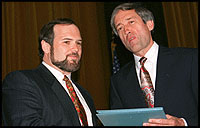
Jim Dwyer receiving his 1995 Pulitzer Prize from George Rupp, Columbia University President.
Winning Work
By Jim Dwyer
New York was built by invisible men and women, their work hidden beneath the dust of all the years.
For 136 years, the city of New York has leaned on the work of a cranky man who was feared by the mediocre. John H. Rhodes inspected pipe for the Brooklyn Water Works in 1858. The records show that he did not tolerate the shoddy or the half-done, and that he hugged himself in excitement when he came upon well-made Pipe. That is how he wrote the word, in the upper case: Pipe. The ones he inspected lasted two lifetimes, laid end to end.
That is not quite long enough for the mediocrities of the 20th Century, as people in Carroll Gardens discovered last Friday when a Rhodes pipe finally gave way and ruined homes.
Rhodes did his part. Starting Dec. 16, 1858, people on Clinton Street in Brooklyn drank from water that ran through a 30-inch main inspected by John Rhodes. They drank from it until Jan. 21, 1994. He inspected nearly 100 miles of pipe. Over the 19th Century and nearly to the end of the 20th, we can guess that 100 million babies were washed in water from Rhodes pipes, a billion loads of laundry were scrubbed, a trillion sips of water wetted the lips of Brooklyn.
We can talk about the 30-inch water main on Clinton Street as another paragraph in the history of things that finally went wrong. But before the death notice, look at the brilliant beginning and life. John Rhodes traveled the northeast in 1857 and tested 10,000 pieces of pipe. They were laid in Brooklyn over the next year and gave that city its first central water.
All we know today about Rhodes is that he tested Pipe and that he was cranky.
"In the course of the discharge of my duties, I found a great proportion of the work so faulty as to lead me to a critical examination of manufacturing and the causes of defects," Rhodes wrote in an 1859 report to the Brooklyn Water Commissioners.
"The proportion of bad Pipes which I have from time to time met with has been so great (sometimes as high as 50 per cent), as to create great doubt as to whether the remainder would be practically safe, although showing no defects to the eye or weakness under the application of the required pressure," he said, with great worry.
What? No defects to the eye. No weakness under pressure. Then why did Rhodes turn down so many?
The formal test was to bring the pipes to West Point and see how they did with known water pressures: to see if they would break or not. The pipes - forged in New Jersey and Pennsylvania, and in Glasgow, Scotland - had a tensile strength of about 22,000 pounds per square inch.
"The pipes are always examined by the hammer," wrote Rhodes. He banged them and listened for the flat sound, the dull answer that said No Good.
"On 5th of November 1857, I proceeded to the Warren Foundry and Machine Co," wrote Rhodes. "The proportion of good Pipes was so small as to create no inconsiderable excitement towards myself and very great apprehension among the stockholders of the company."
In short, they wanted to burn him alive. Look at the grades he passed out at the Warren Foundry:
6" Pipe: Accepted, 62, Rejected, 45.
8" Pipe: Accepted, 19, Rejected, 34.
12" Pipe: Accepted, 7, Rejected, 17.
He had failed more pipes than he passed. After he gave these results to the people at the Warren Foundry, they decided to get out of the small-pipe business.
"I now come to the consideration of twenty-inch, thirty-inch and thirty-six-inch Pipes, which were successfully cast at this Foundry by Messrs. John Firt and John Ingham, who were subcontractors to the Warren Foundry," wrote Rhodes.
"To them is essentially owing the great success which has been achieved in casting the Force Mains and large Branches for the works.
"I take great pleasure in having an opportunity to state that they have scarcely lost a Pipe in casting that has not been owing to improper material accidentally furnished them.
"These Pipes have undergone a very severe inspection and proof, in effecting which (although the loss, if rejected, fell upon them), I have always received their hearty cooperation and I have to record that I have not in a single instance known them to make an attempt to conceal imperfections; upon the contrary, they were gentlemanly and communicative upon all matters relevant to my duties, and I have derived from them great practical information."
Rhodes was employed by the Brooklyn Water Works, which were installed by Henry Welles and Company. A pipe cannot be tossed into its bed; if it is not set firmly, it is sure to break. Welles laid 120 miles of pipe and it all sat well. His engineer, James Pugh Kirkwood, wrote around the world for advice on protecting the pipes from corrosion. From Dublin came advice to dip them in coal-tar pitch that was cooking at 400 degrees. These were the first pipes in the United States to be so treated.
The excellent research staff in the library of the Brooklyn Historical Society helped find the water records. No trace of Rhodes or Welles or Kirkwood appears, except in the history of the Water Works. Beneath the streets are 54 miles of water main from before 1870, still working.
Why the Clinton Street main failed is a mystery. Maybe it was age; maybe it was the dynamite excavations the city was doing in the neighborhood. New York was built by invisible men and women, their work hidden beneath the dust of all the years. We have left all the care of our present to these forgotten people: when the crash comes, the dust of our own neglect rises, and we glimpse through the clouds the durable genius of good work.
© 1994, Newsday
By Jim Dwyer
In the picture they brought to his memorial yesterday on Audubon Avenue, Kevin was held aloft in loving arms. Beneath the image of the big-eyed boy, candlelight flickered against a vase of flowers and a statue of an angel. The people who took care of him sat in rows. Someone dug into a purse for a pack of Kleenex, then passed the package along without looking.
About the very same moment, the New York State Senate voted unanimously for more of the policy of silence about children's health that helped kill Kevin before he reached the age of 2.
The Senate bill is sponsored in all good intentions by a man from Long Island named Michael Tully, and in the Assembly, a twin version comes from Richard Gottfried, of Manhattan.
Kevin died of AIDS on Saturday. His short life tells us much about how AIDS politics have warped medical care for people who cannot carry picket signs. He was born in St. Luke's Hospital in Manhattan in June, 1992, and even though the laws of the State of New York required that he be tested for seven or eight diseases, the law also keeps one result secret: the HIV test.
"The mother went home from the hospital with Kevin, not knowing anything was wrong with him, and he came back at three months," said Dr. Stephen Nicholas, a pediatrician who cares for young AIDS patients at Harlem Hospital, Columbia Presbyterian and Incarnation Childrens Center.
By then, it was too late. A cough and fever quickly turned into pneumonia. "He was so sick from pneumocystis carinii pneumonia - what people call PCP - that he nearly died," said Nicholas. "Once an infant gets PCP, it is so devastating to the immune system, half die right away. The others live a year or so."
PCP is the main killer of babies with HIV infection, even though it is a totally avoidable disease. If Kevin had been diagnosed with HIV at birth, he could have been put on an ordinary antibiotic that heads off the pneumonia infection.
"With earlier intervention, a lot of his problems would have been prevented," said Nicholas. "His PCP certainly could have been prevented, and his immune system would not have been so beaten up. If you can prevent PCP, there's no doubt he could have lived longer. How much longer, and how well, is debated. We have kids living to an average age now of 8 to 10 years old."
For this reason, Nicholas supports a program of mandatory HIV testing for all newborns. "There is such clear evidence that we can help them," said Nicholas. "Routine newborn testing, the same way that we do syphilis testing, will help the children to live longer and better lives."
AIDS occupies a unique place in New York State's public health law because the first people to suffer from the disease, gay men, worried that disclosure of their condition would lead to discrimination. The center of the disease now is shifting into minority communities. The confidentiality that shielded homosexuals from harassment now is a high wall between babies and good medicine.
For instance, a provision of the Public Health Law, known as 27F, requires the state to test newborns for the infection - but forbids those results from ever being disclosed. In the case of Kevin, his blood was sent to Albany for HIV tests soon after his birth - but only with the identification that he was a baby boy, born in St. Luke's Hospital.
St. Luke's and the other hospitals are supposed to counsel the mothers on the value of HIV testing apart from the "blind tests" used to track AIDS cases. The state and the city provide funds for the counseling programs.
These programs are useless. At St. Luke's, for instance, between July 1 and Sept. 30 of last year, eight newborns tested positive for HIV. None of the mothers - not one - was given the results. The chances are that their infected babies will learn that they are HIV-positive when they become deathly ill.
Across the state, 226 HIV-positive babies were born during those same three months last year. The counseling programs persuaded 36 mothers to open up their HIV test results.
In other words, 84 percent probably didn't know their kids were vulnerable to a grim, early death - even though good medicine, good food and good care help kids live longer and better.
"They don't have a clue that their baby has been tested and is at risk for a deadly disease," said Assemb. Nettie Mayersohn, of Queens. "That baby is entitled to care. We're treating them as though they are non-persons. Statistical tools to track the epidemic, but expendable.
"We in the state Legislature have to make an assumption that these babies want and are entitled to the same state-of-the-art medical care and treatment that adult AIDS victims are demanding for themselves."
Last year, prompted by an extraordinary series of articles on AIDS by Nina Bernstein in New York Newsday, Mayersohn began to investigate the "iron curtain of confidentiality" that surrounds AIDS tests of newborns.
Her bill to open the newborn tests is opposed by the Gay Men's Health Crisis and the National Organization for Women, which say that a positive test of the newborn automatically reveals that the mother has the disease - a violation of her privacy.
To block the Mayerson bill, Gottfried and Tully have introduced legislation that would provide more funds for prenatal counseling - a valuable way of preventing AIDS cases - but would not change the state's laws on the newborn's HIV results.
"What works is counseling," said Gottfried. "Any pediatrician will tell you that the mother is the most important factor in a child's health care." He cited a counseling program at Harlem Hospital as an example of what his law would require.
But one of the doctors who designed the Harlem Hospital counseling program says it's not good enough - and it happens to be the doctor who treated young Kevin. "At best, we get 90 percent of the women to agree to tests," said Stephen Nicholas. "We don't feel it's good enough for Harlem Hospital, because you're still missing 10 percent. And no one else is getting as many mothers to agree to testing.
"Who is speaking up for these kids? Aren't they entitled to the same care as adults?"
© 1994, Newsday
By Jim Dwyer
No one noticed when Ed Smith watched the World Trade Center bomb trial. He slipped into a front bench in the courtroom, looking like just another FBI agent or lawyer in pinstripes.
Tomorrow morning, there will be no mistaking him.
At 10 a.m. in a third-floor courtroom at Foley Square, four of the men who bombed the Twin Towers will be sentenced by Judge Thomas Francis Duffy. The bombers likely will hear the sound of a door closing firmly on their lives.
But they also will hear from Ed Smith, a 31-year-old machinery salesman who has been granted extraordinary permission to address the court on behalf of those murdered in the Trade Center explosion.
Smith is breaking his public silence in the name of his pregnant wife, Monica, and their unborn child - a boy the Smiths planned to call Eddie - who were killed in the bombing of the World Trade Center, along with Robert Kirkpatrick, Steve Knapp, Bill Macko, Wilfredo Mercado, and John DiGiovanni.
The Smiths were the youngest victims.
"You know what, if these guys have to spend the rest of their lives in jail, great," Smith said. "But if for one minute I can make them think about what they took from someone else, I will. Our baby. I do feel bad about everybody that passed away, and I will talk about them. But here's a person, the baby, who never got to see anything."
In his work, Smith smiles fast, laughs easily, a salesman born with an agreeable manner. He also spends hours in airplanes, flying across the country. Alone, seven miles up, he broods. Last Thursday night, Smith sat in the business-class section of a Continental flight from New York to Los Angeles and wrote the five-page speech he will deliver tomorrow.
"I will tell them what they took. About the baby. And what my wife and me never got to experience with the baby, the first steps, the baby getting sick and holding the baby. I'll never get to see the kid play baseball. Watching him write for the first time. Making those noises. Calling me Daddy. Going home, just holding another living thing, and knowing I created that."
The four bombers also may speak. They are expected to talk about the glories of their God, which somehow got blended with 1,500 pounds of nitroglycerin, urea-nitrate and hydrogen.
"These guys say, 'oh we're trying to get our point across for Allah,' " Smith said. "Let me tell you something, that's bull - - - . These people do these things for personal gain and they stand behind this robe. But there's nothing religious about it at all. You can't sell that to me. How can any God want people to be dead, for any reason?
"Some of these guys have kids. They got to hold their kids. I never got that opportunity. I just want them to hear it. Maybe I'll get through to one of them. Just so they know what was lost," Smith said.
And Wednesday, the morning after the sentencing, Ed Smith will go to a law office in Long Island, sign some papers, and hand over the keys to the house in Seaford, L.I. that he and Monica rebuilt from scratch. With their home sold, he will board a plane and leave New York behind, escaping the skyline dominated by Twin Towers that are, to him, giant tombstones.
The plume that trails Ed Smith, airborne or on the ground, is a love story, a tale dangling from the new, demented world order.
"You're like every other salesman," said Monica Rodriguez, black hair, smooth coffee-colored skin. "You keep talking, you keep moving." That day in 1982, young Eddie Smith was flirting with Monica again. He was tall and apple-cheeked, just two years out of high school, making money and spilling the high exuberance of the young and strong. She was a secretary for the building management of the Trade Center, famous for her cheerful energy. He made sales calls to the B-2 level of the Trade Center.
"Anyway, I can't go on a date with you," she said. "I'm going to Hawaii on a vacation."
"Bring me back some pineapple," he pleaded. She rolled her big, beautiful eyes. A few weeks later, he was back in the Trade Center. Monica reached for something and produced a fresh pineapple. "Hey," Eddie Smith said. "Now I owe you. You have to let me take you out." She consented to a movie, then they stopped at JT's Alehouse on Jamaica Avenue.
He was wild and five years younger. She was full of fun, but ready for marriage. They broke up. "Someday," Ed promised. "I'll give you a call if I can ever settle down."
One day in 1989, he walked through the concourse of the Trade Center and saw a florist near the PATH station. In the window was a dog made of push-in pompons. He had brought one to Monica years ago. He changed directions and walked to a pay phone.
"You want to meet me for lunch?" Smith asked.
"I don't think so," she said.
"C'mon," Smith said. "You want to go to Atlantic City?"
She paused to think of her response. "I have a boyfriend," she fibbed. "Call me tomorrow."
He did. "I'll go back to you, but you know, this is serious," she said. "Absolutely, I wouldn't have called you unless I was," Ed promised. Later, he would remember the trip to Atlantic City: "All the way on the ride, she wouldn't let me give her a kiss or hold her hand. It was pretty funny." They were engaged three months later. On Aug. 31, 1990, they married in the Church of the Nativity on Woodhaven Boulevard.
For the party afterward, Rodriguez relatives arrived from Ecuador, while Smith's came from Queens and Long Island. It was a hot, muggy night, but Monica stayed on the floor all night. She danced and laughed with her bosses and friends from the Trade Center, Steve Knapp and Bill Macko. The world was too fresh and young to imagine that all three would die in the same instant.
Ed and Monica bought the house in Seaford where Ed grew up. On weekends, they stopped at the Cherrywood for a drink. During the day, they tore apart the house and made it new. They put seven coats of polyurethane on the wood floors, painting their way out the door in the morning. Each wanted bragging rights. "We still fight to this day," said Ed recently, then pausing to get his bearings. "She said she painted. I say, I did."
Ed was going to night school at Queensborough Community College. When he got home after 10, Monica, who had come from Ecuador at age 12, would get out of bed to make sure his dinner was warm. Sometimes, they argued about moving out of New York. "I love my job, I don't want to leave," she told Ed. "The people are the best." One night, she called him at school to rush him home. She had bought a pregnancy test. He held the tube while she dipped the stick. Monica bought Winnie The Pooh books for Ed to read to her belly, to the boy growing inside. In mid-February last year, with two months to go, they shopped for baby furniture.
The next weekend, Ed shopped by himself for a coffin. He buried his wife, age 35, in Manta, Ecuador, near her parents' home. In their bedroom at Seaford, he built a shrine with the Virgin of Montserrat, to whom Monica prayed nightly. When his feet found the ground again, he sneaked into the trial, listening to the dreadful tale of the murder of his wife and their friends.
"Why put yourself through this?" asked his father.
"To show that hey, listen, you can't get away with doing that," Ed said. "To say, who are you to do that? You know what? It's like, if nobody ever went, or nobody ever yelled, do you hear a noise? If nobody ever goes, do you really care? Yeah, I care. I care enough to see that something was done."
© 1994, Newsday
By Jim Dwyer
"They have phones in Queens," I argued.
I can tell you that the funeral mass in Washington Heights yesterday for the 16-month-old boy was unbearable to look at. But you must be as tired of other people's misery as I am. So let's talk statistics instead, and save ourselves thinking of a coffin 24 inches long that could be carried under your arm.
At least twice a week in 1993, doctors in New York City hospitals sent home babies infected with the HIV virus without telling the parents that their children were sick. That's not incompetence. Much worse: that's the law. In New York, unless the mother specifically asks for her child to be tested for the HIV infection, everyone keeps their mouths shut, by statute.
Hey! Keep your eye off that tiny white coffin. Here are more statistics to keep you warm: Last year, 774 newborns tested positive for the HIV infection. Only 332 mothers knew this when they left the hospital. The other 57 percent, the 442 other babies, went home with a mother ignorant that her child had tested positive. (Of these, ultimately 110 babies will come down with AIDS.)
A child with his parents' syphilis or sickle-cell anemia would be treated automatically, shortly after birth in a hospital nursery. But public health law on the HIV infection is still wrapped up in a 10-year-old notion that it is a disease of gay men who, many agreed, needed steel-door confidentiality on their tests. If privacy were compromised in HIV tests, it was felt that gay and bisexual people would avoid them. So unlike other sexually transmitted diseases, doctors by law cannot trace the sexual contacts of people with HIV. You can argue about that if you want.
But that argument is extended to the point of absurdity when it comes to the testing of newborns. The state tests all babies for seven diseases, but HIV is excluded because testing the baby automatically would disclose the mother's HIV status. That would violate her privacy under the law. Moreover, testing the mother without her consent, as has been repeated a thousand times, would "drive her away from the health-care system."
This is unproven dogma, not science, but it controls New York State public health law on AIDS.
The evidence is plain that a law protecting the privacy of gay men has almost no relevance to an epidemic that is now spreading fastest among babies and women of color. The death certificates of these people could list AIDS as the cause, with "confidentiality" chiseled in as a contributing factor.
Kids go home infected with a lethal disease and no one knows about it, and they get sick faster and die sooner. Medicine and good food, a bit of extra effort, can make their lives longer and better. Virtually all of them are black and Latino. The state is filled with professional AIDS activists who will fight to the last infant's corpse to prevent a mother from being tested through her child.
The people in charge of this scandal are Health Commissioner Mark Chassin and ultimately his boss, Gov. Mario Cuomo. However, they have help from the state Legislature, which now is considering whether to revise these laws so they would unlock the steel door and protect the child. Assemb. Nettie Mayersohn and state Sen. Guy Velella are sponsoring a law that effectively would test all babies at birth, and provide money to help counsel their mothers on the best way to proceed.
In the Assembly, Mayersohn now has a majority of the members as co-sponsors, and her bill would pass in a landslide - if it were released from health committee. The chairman of the committee, Richard Gottfried, is opposed to Mayersohn's bill and the measure has stalled there by a vote of 10-9. The opponents of her bill believe that persuading women to get HIV tests during pregnancy would be better than mandatory testing. They call, instead, for something described as "mandatory counseling." We will see how the speaker of the Assembly, Sheldon Silver, handles this one.
Right now, the state health department already spends more than $2 million a year on counseling programs. It is a spectacular failure: from there, we get 43 percent of the mothers taking the state's advice to get a test.
I tried all day yesterday to get Chassin to the telephone to talk about this public health flop that he presides over, but he wouldn't take a call.
"He's on his way to Queens," a spokeswoman said.
"They have phones in Queens," I argued.
My opinion of Chassin will go way up if he is keeping his mouth shut out of shame for this law. That funeral at Incarnation Church in Washington Heights yesterday was for one of those statistics last year that didn't get tested. There's another baby funeral today at a Baptist church - but hey, let's hear a little silence for death. Try these statistics on for size:
Newborns and HIV: Babies born HIV positive at city hospitals July 1-Dec. 31, 1993:
| Hospital | HIV-Positive Moms ID'd Through Counseling | Babies Born HIV Positive | Moms Who Knew HIV Status |
| Bellevue | 0 | 16 | 13 |
| Bronx Mun. | 2 | 22 | 19 |
| Coney Island | 1 | 9 | 2 |
| Elmhurst | 1 | 17 | 8 |
| Harlem* | 2 | 34 | 11 |
| Kings County | 0 | 30 | 11 |
| Lincoln | |||
| Med. Ctr. | 1 | 44 | 9 |
| Metropolitan | 1 | 17 | 1 |
| N. Central | |||
| Bronx | 2 | 20 | 7 |
| Queens | 0 | 16 | 2 |
| Woodhull | 2 | 28 | 11 |
| Total | 14 | 253 | 96 |
*-A new program at Harlem Hospital reports that 80 percent of mothers agreed to have their babies tested. SOURCE: State Department of Health
© 1994, Newsday
By Jim Dwyer
He was so shy and perfect," said Sandy of her husband, Felix. They had met on a warm, autumn day seven or eight years ago. She had bailed out of a marriage to a man who turned out to be a louse. Then she found Felix.
For reasons that will become clear, their love story comes to us from the files of the Columbia School of Public Health.
"He's two years younger than me, but that didn't matter. I was his first girlfriend. We had a courtship before the wedding. My first husband had been my first boyfriend, and we behaved with hot indiscretion.
"But this was different. We went slowly and properly, like in an old-time book. Then we got married."
They had a child, and Felix worked as a contractor, and Sandy worked part-time, staying home with the baby. A few years went by, and Sandy, having tasted the bitterness of a bad marriage, was living one that she regarded as nearly perfect. When she became pregnant again, Sandy went to prenatal care and had an easy delivery. They called their second child "Tony."
"Tony was three months old, and one day he had a little fever and seemed to be breathing a little fast," Sandy would later say. "But he slept fine and took the breast without any problem. I took him to the neighborhood pediatrician who said not to worry, it was just a minor cold. The next day, he began coughing and gasping for air and turning purple. I took him to Harlem Hospital, where they took him straight to the ICU. They incubated him and he was on a ventilator for seven days.
"A tall doctor came and sat down with me the first night, told me he had some bad news for me, and handed me some Kleenex.
"I remember thinking, `What worse news could he tell me? I can see my baby is dying from pneumonia.' Well, the news really was bad. Worse than bad. A nightmare. The baby had AIDS, which meant that I had AIDS. I couldn't believe it.
" `How could this be?' I asked him. `This is my third baby. I went for prenatal care, they tested my blood each time, they told me I was healthy, they told me my babies are healthy, how can this be?'"
The way it could be was this: under New York State law, her babies had been tested at birth for HIV infection - but the tests were done blindly, simply to track the spread of the epidemic. She and the babies didn't have syphilis or sickle-cell anemia or they would have been told, by law. No one could tell Sandy about HIV because, by law, no one knew she had it.
The news got worse. The doctors then tested the rest of the family. The first baby, "Ron," was tested. He, too, had HIV infection. And so did Felix, her second husband.
Sandy believed that she had been infected by her first husband. She confronted him, and he admitted that he had learned early in their marriage that he was was HIV positive. Under New York law, the doctors who tested her first husband were not permitted to trace his sexual partners and inform them.
If her husband had been diagnosed with gonorrhea or syphilis or chlamydia, she would have been told. But with HIV, it was up to the husband to admit the truth.
"He says he was afraid to tell me," Sandy said. "Afraid. I spat in his face and cursed him. What about morality? What about basic human decency. What kind of world is this we live in?
"He has destroyed me and I, in turn, have destroyed my family. The big difference is that he knew. I didn't."
Sandy had a daughter from her first marriage. She was the only one of the five in her family not to have been infected.
"During Tony's hospitalization and after we found everyone but Sandy Jr. was infected, we felt like we were falling off a high cliff.
"I felt so bitter that the doctors hadn't diagnosed my infection earlier. I infected two of three children and my second husband. Do you think I would have taken a chance on that if I'd known the truth? If Anthony hadn't gotten sick, I wouldn't have known this, since I feel just fine.
"I called my brother in Florida and asked him if he would take the children in case something ever happened to Felix and me," said Sandy two years ago.
"He started asking a lot of questions, but I just told him I wanted to make sure, theoretically. I haven't told my parents. Right now, I'm all alone in the world.
"I know Tony's long-term prognosis is poor. Most babies with PCP [AIDS-related pneumonia] die within a year, though some live longer. Look at his bright eyes. He's a fighter. Maybe he will make it longer. Baby Ron, with the way he likes to eat, will do fine. Felix seems the healthiest of all of us, but who knows what lies down the road.
"I'm not so sure about myself. Probably I'll be getting sick soon. I can't bear the thought of Sandy Jr. losing all of us. She may be full grown by the time all of us are gone, or maybe, with some luck, her father will live to see her graduate. But I don't get up daily thinking morbid thoughts. I love my children, love my husband, love life. It may not be a long one for me, but I'm going to try to make the most of it."
Sandy went to work counseling women with HIV infection. The family's names have been altered for this story, but the rest of the details come directly from her interview in the spring of 1992 by a medical school student taking a course in pediatric AIDS. The interview was provided by Dr. Stephen Nicholas, who was and is the children's doctor.
In November, 1993, Sandy's son Tony died. Sandy died in April at the age of 26. Her husband, Felix, is depressed, but in fair health. Their son, Baby Ron, is eating and doing well, so far. Her ex-husband's whereabouts are unknown.
© 1994, Newsday
By Jim Dwyer
Today, we are going to tell you every important number about the New York Yankees. Not one has to do with batting averages or home runs. Instead, we will talk about rent, murder and attendance. Then we will count the number of monkeys in New York.
Let us begin by discussing the rent that George Steinbrenner pays for Yankee Stadium to its owners and builders, the people of the City of New York.
1. Mr. Steinbrenner pays rent once a year, and his most recent check was for $715,066. That is the most he has paid in a decade and possibly ever. Here are the annual rents Steinbrenner and the Yankees paid for the last 10 fiscal years:
- 1985: Nothing
- 1986: Nothing
- 1987: Approx. $200,000
- 1988: Nothing
- 1989: Nothing
- 1990: $570,000
- 1991: $214,000
- 1992: $103,000
- 1993: Nothing
- 1994: $715,066
As you can see, the average rent paid by Steinbrenner during the last 10 years is $180,206. Let us now compare his average rent to those paid by other tenants of public spaces in the Bronx, namely, the people who occupy public housing projects.
| Housing Project | Tenant's Total Monthly Rent | Tenants' Avg. Income |
|---|---|---|
| Castle Hill | $514,188 | $12,388 |
| Edenwald | $551,837 | $13,687 |
| Morris | $450,043 | $11,411 |
| Patterson | $433,214 | $11,299 |
| Mitchell | $443,435 | $11,518 |
| Yankee Stad. | $15,024 | $1,721,744 |
If we may be so bold as to summarize this data: The millionaires in the Yankee Stadium pay in one year just a little more than working poor tenants pay in one week.
2. Recently, Mr. Clete Boyer, a fabulous third basemen for the Yankees 30 years ago, was quoted in the sports pages saying that, nowadays, he would not let his daughter come to Yankee Stadium. The area was too rough - unlike when he was a player, when the Bronx was a different place. Those were the days when kids played stickball in the streets, and slept on the fire escapes on summer nights, and women thought nothing of riding the subway at 2 in the morning. Alone, of course.
Of course the city was safer 30 years ago. But not a scrap of evidence shows that crime has kept the public away from Yankee Stadium. Mr. Boyer is participating in one of the great historical fictions: that colossal numbers of people used to come to the ballpark in the golden days.
People did not go to Yankee Stadium when ladies rode the subway at night by themselves. Not the way they do today.
For instance, Mr. Boyer played for the Yankees between 1959 and 1966, including five pennant-winning teams and two World Series championships. The average home attendance for Yankee Stadium during those years was 1.4 million.
Last year, when there were more murders in the city than all those years that Clete Boyer played, the attendance was 2.4 million - almost double what it was in those good old days. Not only that, the Yankees finished second, and were fading fast.
Maybe people in the old days were too comfortable sleeping on the fire escapes or riding the subways at all hours to bother going to Yankee games.
3. The only relationship between violent crime and Yankee attendance is a positive one: the more murders, the more people go to the games. In fact, as long as the team has good relief pitching, murder helps attendance.
Starting in 1951, and for the next 25 years - all through the days of Whitey Ford and Mickey Mantle and Casey Stengel - not once did the Yankees draw 2 million fans. Sure, the team won pennants and World Series and had Billy Martin. The public stayed home. Even when Roger Maris broke Babe Ruth's home-run record in 1961, the Yankees still didn't get 2 million in the ballpark. (Just over 1.7 million came that year - when, by the way, the team also won the World Series.)
It was not until 1976 that the Yankees drew 2 million - the same year the newly renovated Yankee Stadium opened. The public had just spent $78 million to rebuild the park from scratch. All the sight lines were improved, at the cost of 10,000 or so seats. But even with less space in the park and more crime on the streets, the public has come in swarms. The place kept the classical facade and doubled attendance over the classic era.
Today, the nice new ballparks in Baltimore and Cleveland are built at a cost of hundreds of millions in mimicry of that same old-fashioned style - the same way, a wise friend points out, that the Bennigan's chain of bars tries to imitate the old neighborhood saloon.
Now we have a voice rising from the bar stool: Some guy with the Yankees supposedly described the "colored boys" from the neighborhood as "monkeys" hanging on basketball rims. Even with his millions in profit and nothing in rent, Steinbrenner says the poor neighbors are dragging him down.
New Jersey, here I come!
Except he has nowhere to go. There is no baseball stadium in New Jersey, and no money to pay for one. The governor of New Jersey just cut the income tax. That means to pay the bills in the local school districts, the property taxes will climb.
And the voters whose taxes are going up for schoolbooks will build a stadium for the biggest Cadillac welfare bum in history?
Anyone who believes that really proves the point: He has made monkeys of us all.
© 1994, Newsday
By Jim Dwyer
The father had soldiered famously for his cause, was jailed, and came out as a big man in the Provisional Irish Republican Army. His teenage son also had struck a name for himself, but as a big nuisance in West Belfast.
About a year ago, the son stole a car and crashed it. Wasn't the first time, either. The people in the neighborhood warned him to straighten out.
"Eff off," he answered. He was thought to have graduated from joyriding to stick-ups.
Under normal circumstances, an apprentice hood such as this would have been punished with a republican bullet in the leg. But the matter was brought to his father, out of respect for his stature.
The father talked to his son about the damage a bullet does to the shin.
"Eff off," said the son. "You can't be doing this," said the father, who had spent a chunk of the son's youth in prison.
"Eff off," said the son. "You and your war. What did it get you? You did your bit. What good did you do with your years sleeping in a jail?"
That was a long year ago. By now, we have heard some of the obvious reasons for the IRA ceasefire announced on Wednesday: American investment, unity among Irish nationalists, flexibility on the part of the British. They are true, in their way.
But here is a small reason, also true: A generation of IRA men now are getting their lives mashed back into their faces by their teenage sons. The middle-aged men ran a war that they grew up with and went to jail for. They returned home to half-grown children. The children of prisoners are bored with politics. They'd rather joyride.
"The young kids, the hoods, are rebelling against what the fathers are doing," notes Rita Higgins, a nationalist originally from the Short Strand section of Belfast.
"It's like a lost generation. Maybe it's something every generation does. But years ago, if you had a young fella who went joyriding, who was anti-establishment, they could work with him and channel that into the movement. Not now."
The Irish republican war cannot be handed off to a generation that does not want it. And the IRA soldiers themselves have grown up.
"The IRA has matured and they see that they couldn't win this way," said Higgins. "Years ago, we were dreaming about a socialist republic. People were looking to Cuba and Russia and Nicaragua and all the rest. We'd be boat people now if it had worked. Now, the revolutionary ideologies have gone away. Twenty years ago, you'd still have homes without toilets. The housing is very much improved. The social and economic situation has improved. Sinn Fein [the IRA's political party] is doing local housing issues. The republicans have a tremendous cohesiveness and maturity from this struggle."
If Northern Ireland has a Martin Luther King, his name is John Hume. He comes from the city of Derry, where the war began and long ago burned out. Hume made a revolution without guns. Half a lifetime ago, he sat down in front of a British tank when the commander broke a promise to pull back his troops and let Catholic demonstrators go home. He was hosed with purple dye and jailed. And he has made his city as peaceful as Staten Island.
The IRA and Sinn Fein are hardly the only ones to speak for the Catholics of Northern Ireland. About 80 percent of the Catholics back Hume's party, the Social Democratic Labor Party.
Derry is a majority Catholic city, but because of gerrymandering, it had never had a Catholic mayor until Hume led the civil rights fight. Now Catholics control the city council, which picks the mayor. And the mayor's job is rotated between Catholic nationalists and Protestant loyalists, at Hume's insistence.
When Gerry Adams wanted to bring Sinn Fein towards the political center, he began by talking to his fiercest rival - John Hume. "It was my public duty to talk," said Hume. "Given that five British governments have not succeeded in achieving a cessation of violence, given that 20,000 troops have not succeeded, given that 12,000 armed police have not succeeded - if dialogue could do it, then you have a duty to do it."
On Wednesday, after the ceasefire announcement, there was a gathering at the Dublin residence of Jean Kennedy Smith, the U.S. ambassador to Ireland. She spoke of those who had died. One of the U.S delegation brought a sheet of paper with a poem, "Sometimes," by a Welsh writer named Sheenagh Pugh. A friend had seen it on a placard in the London subway. It seemed to have been written for a day when war was ending:
Sometimes things don't go, after
all,
from bad to worse. Some years,
muscadel
faces down frost; green thrives; the
crops don't fail,
sometimes a man aims high, and
all goes well.
A people sometimes will step back
from war;
elect an honest man; decide they
care
enough, that they can't leave some
stranger poor.
Some men become what they were
born for.
Sometimes our best efforts do not
go
amiss; sometimes we do as we
meant to.
The sun will sometimes melt a
field of sorrow
that seemed hard frozen: may it
happen for you.(Copyright Sheenagh Pugh, 1990; Dufour Press, Philadelphia.)
© 1994, Newsday
By Jim Dwyer
Who do you think a Suffolk County congressman is going to pretend he is protecting people from - someone they see every day or one of Those People from the city?
Last week, a man named Kevin Elders was sentenced to 10 years in prison for selling one-eighth of an ounce of cocaine to his best friend. It was Elders' first criminal offense. After the trial, the friend who turned him in committed suicide. This is a tremendous episode in the nation's stark-raving-mad love affair with jail cells for drug addicts. But it is far from the only one.
Yesterday, the president signed a bill that authorizes $8 billion for new prisons. There are enough people like Kevin Elders so that every new cell bought by this bill already is spoken for. We have doubled the number of people in jail since 1980, and nearly all of them are dope addicts and small-bore dealers and their friends. More people are in jails now than at any time in the history of the country. So much of it is a colossal waste of money and lives.
Among those occupying a cell at huge expense is Nicole Richardson, age 21.
One day, back when she was 18 and a senior in high school, she took a call from a drug agent, who was looking for her boyfriend, Jeff. The boyfriend dealt LSD. He had sold nine grams of LSD to the drug agents, and now the agents wanted to pay him. Nicole Richardson had nothing to do with drug dealing, other than dating a dealer. She told the man on the phone that Jeff wasn't home and gave out another phone number.
Of course, Jeff and Nicole both were arrested. Jeff bargained his way to five years because he knew many drug dealers and could tell the police about them. But Nicole only knew one drug dealer - her boyfriend, Jeff. The judge had to give her the minimum sentence that the Congress of the United States had enacted for selling nine grams of LSD, about a quarter-ounce:
Ten years in federal prison with no possibility of parole. Nicole Richardson is now incarcerated in West Virginia for answering a phone for her boyfriend Jeff when she was 18.
This is criminally insane. The nation has caused huge injury with drug laws that require a "mandatory minimum" sentence. These prevent judges from using common sense. It is sick.
In the crime bill that President Clinton signed yesterday, the Congress half-fixed the problem. From now on, people like Nicole - low-level nobodies, first offenders, nonviolent - would not have to be sentenced to 10 years. The judge could take real life into consideration. But at the last minute, Congress blew a chance to repair some of the damage to the Nicole Richardsons rotting away in prison. A sensible, decent reform was proposed to allow these nobodies to apply for a sentence reduction. It was backed by plenty of Republicans and Democrats.
But it was stopped dead at the last minute by a Republican congressman from Brightwaters, L.I., who threw his foolish body in front of it. When the committees were negotiating the final details, Rep. Rick Lazio demanded that they take out the language that would allow people such as Nicole Richardson to get a break in their sentences. Then he bragged about it in the House of Representatives. "The question I had to pose to myself was, do we care more about convicted drug dealers or the health and well-being of our children in our neighborhoods," said Lazio. He continued: "This revised bill strips the language that could have allowed the release of as many as 16,000 convicted crack dealers and drug offenders who would have been released into our communities under the original bill."
That happens to be Grade A baloney, neatly sliced. Of course he mentions crack dealers instead of cocaine dealers. A crack dealer is a black guy standing in front of a housing project in Brooklyn; a coke dealer is the guy with the long hair who stands near a jukebox in a Suffolk County bar.
Who do you think a Suffolk County congressman is going to pretend he is protecting people from - someone they see every day or one of Those People from the city?
Anyway, Lazio's numbers are wrong. The number of people who might get a break is not 16,000 - at most, it's 5,000, and probably not even that many.
The U.S. Sentencing Commission did a study of federal prisoners to figure out how many might be eligible for a break. The findings: "The proposal would definitely affect about 1,600 defendants . . . [with] another 3,400 possibly affected defendants."
And these 5,000 people wouldn't just stroll out of jail: their sentences would be cut, at most, from one to three years. This would have saved about $164 million, by the way.
Kevin Elders, who was sentenced to 10 years in prison for selling an eighth of an ounce of cocaine, comes from Little Rock, Ark. That happens to be Bill Clinton's hometown. Elders' mother is Joycelyn Elders, the surgeon general of the United States. He will join a huge congregation of people going nowhere in a society running on a treadmill over drugs.
"We went from 2,700 prisoners in 1980 to about 8,600 today," said Alan Ables, a spokesman for the Arkansas Department of Correction.
"For the past 20 years, we in the United States have had the greatest increase in the rate of imprisonment in human history - four times as many prisoners," said Mark Mauer of the Sentencing Project in Washington. "One would question is this a good use of financial resources."
Of course not. But it does allow Congress members to keep people like Nicole Richardson locked up. Then they go home and make speeches about how they saved us from crack dealers.
They should be arrested for squandering fortunes and lives.
© 1994, Newsday
By Jim Dwyer
"Amazing Snakes" is a book for kids about snakes, and its official list price is $6.95. But few people pay that much.
If you or I want to buy the snake book, which is part of the popular "Eyewitness" children's science series, just about any Toys 'R' Us carries it for a 20 percent discount. A big distributor would price it even less, at 40 percent off.
Even the New York City Board of Education does not pay list price.
The school board pays more.
It paid $7.65 for "Amazing Snakes," 1990 edition - 10 percent above the list price, nearly twice what the city might pay a distributor. "You talk about a scandal," says Judith May-McGowan, a school librarian.
Snakes are just the start. The state provides $35 in textbook money for each child. In New York City, the Board of Education wastes up to $14 of that by making librarians pay list price for the books instead of buying at discounts of 40 percent.
We will have politicians chiseling Caribbean vacations until time ends, and it will be a thrill to see them in handcuffs. But before then, some chancellor must unlock a rule that squanders 40 percent of every dollar for library books. "I have been working on this one for 12 years," said May-McGowan. That time would span seven chancellors and three mayors.
"The books I am talking about are widely available at discounts and the board is insisting through these regulations that it pay list price," says May-McGowan, formerly the head librarian at Bronx High School of Science.
She currently is assembling a library for an elementary school in South-Central Bronx. She has a total of $59,000 in state and federal money to buy the books.
"I am not going to spend it until we can do it the right way," she said. "The principal wants to spend it, and the district wants to spend it - but we all have agreed that we need to wait until we can get the 40 percent discount."
The other day, May-McGowan discussed in print the open secret of the school system - the use of dummy invoices, in which an educator creates a bogus paper trail to buy supplies that would otherwise be trapped in red tape. For instance, a librarian who needs a bookshelf would pretend to buy a box of books, since the central administration can understand the need for a box of books, but not the shelf. In reality, the librarian will have made a secret deal with the vendor to receive a bookshelf.
May-McGowan could use the same technique to spend the $59,000. By fudging the paperwork, she could make that $59,000 go 40 percent further. She has done it before. Why not this time?
"I could do that. I won't. I drew the line. I wasn't interested in doing it right for just one school, I want to change it for the system," she said. "I know that there are vendors that would work with me. But what good is fixing it for one single school if there are kids who need books all over the city, and millions of dollars at stake?"
All this wasted money would be easy to explain if someone were grabbing it for a vacation, or a new car.
But it's worse: The system is designed to blow money without regard to personal gain. And wasting money is legal.
Take the tale of the "Amazing Snakes" book. It was ordered in the spring of 1992 by a famous and well-regarded school in East Harlem. The librarian had been given a few thousand dollars from a state fund to bulk up the library. The state provides $35 for textbooks and $4 for library books for each student. The $4 can be spent efficiently by going to vendors for discounts.
But the other $35 must be spent at distributors that deal in textbooks, and generally will sell only at list price - even though the very same books may be available for 40 percent discounts if they were bought as library books.
"You can't go into Toys 'R' Us and buy the history of America, but you can go in there and buy 'Amazing Snakes,' and at a good discount," said May-McGowan.
"Many of the schools now want to use literature instead of textbooks, but they have to buy the novels and science books as if they were textbooks," she said. "They cannot get full value for their dollar."
Both the state and the feds would permit textbook money to be spent for library books - particularly since kids now use library books for many assignments.
But the Board of Education won't permit it because it has different approval procedures for buying texts and library books.
By following the board's rules, the "Amazing Snakes" book was bought from a textbook distributor - at $7.65, 10 percent above list price.
By changing a computer code to show that these were library books, the book could have been bought from another distributor for 40 percent below list, or $4.17.
To change the computer code would require a resolution from the board. A resolution from the board would require a policy statement from an instructional committee on state textbook money.
That would require a review.
And an interface with the procurement division.
"People just shrug their shoulders and say 'That's the Board of Ed,'" says May-McGowan. "But we are not giving in."
With good reason. Today we spend eight cents in the public school libraries for every dollar that was spent in 1980. Thieves we will have with us always.
But no one said we had to be stupid about the money forever.
© 1994, Newsday
By Jim Dwyer
Prison warden Don Cabana presided at an execution for the first time in his career at the stroke of midnight on a summer day in 1987. He was a conservative man at the toughest prison in the state of Mississippi. By 8 the next morning, Cabana was back at his desk, bewildered. Then the phone rang.
"Just checking in," said Morris L. Thigpen, who ran the jails in the next state over, Alabama. "I wanted to see how you're feeling today."
"Twenty-five years I prepared for last night, and still it surprised me," said Cabana. "It caught me unawares."
"Looks like we got a whole bunch coming up," said Thigpen.
"I don't wish it on anyone," said Cabana.
Eight executions later, Thigpen would write:
"I have often heard indviduals who have never participated in an execution say they would be more than willing to pull the switch, drop the pellet or inject the needle.
"On the other hand, I have never heard anyone who has participated in an execution say, 'I would like to do that again.' "
It seems certain that New York State will have a death penalty law in 1995. The executions will not be carried out by the politicians who pass the law, the governor who signs it, nor the public who elected them.
The job is done by proxies, in private: corrections guards, lab technicians, prison administrators.
"You don't hear a lot about its effect on the people who have to do these executions," Cabana said yesterday. "It surprised me in terms of its brutality. I came to dread it. It started me questioning the use of the death penalty."
A few months after calling Cabana to buck him up, Alabama Corrections Commissioner Thigpen had to preside at executions in his own system. The state was electrocuting a retarded man who had raped a woman, then stabbed her 66 times and left her tied to a tree. The woman's husband found her when he came home.
The sentence was carried out in Holman Prison. After the switch was thrown on the 2,000-volt feeder cables, a pair of doctors stepped up to make the pronouncement. They lifted the mask and saw no sign of life in the man's face.
Then one of them placed the stethoscope on the chest.
"Got a strong heartbeat," said the doctor. "He's alive."
A guard spotted a problem in the wiring. "I believe we got the jacks on wrong," he said.
In some states, the law permits two attempts at execution, then commutes the sentence to life. In Alabama, the law requires that electricity be applied until the prisoner is dead.
"With the condemned man's father and his principal attorney standing less than two feet away, I remember telling the warden that we would have to proceed with a second attempt," Thigpen wrote in an article for "Corrections Today."
"They're torturing him," said the father.
The next attempt worked. Thigpen later explained he hoped and believed that the man had been unconscious after the first jolt.
Thigpen was accused of going soft on a dreadful criminal. But he took a different view of the people he put to death - neither excusing the murders that brought them to prison, nor pretending that the state's actions were sterile lab procedures.
"The crimes they committed are heinous," Thigpen wrote. "However, I still feel compassion for them. I wonder what events in their lives led them to commit a capital offense. Was there some point at which intervention of some type might have changed the course of events?"
In Mississippi, Cabana initially believed that capital punishment was a necessary part of the system. After the first execution, he presided over a second, just four weeks later.
"This one was, if anything, worse," he said. "It was a kid I had come to know fairly well over four or five years. As the months dwindled, it became intense. I saw him too much, in a way. On the other hand, I don't have any regrets about that."
Cabana spent four years with the Air Force in Vietnam, then came back to Mississipi and worked his way to the warden's office at the huge prison farm called Parchman.
"You get into this thing believing that you can make a difference, that people can and do change," said Cabana. "Whether anyone chooses to believe it or not, you take the most conservative, toughest guard, and put them in daily contact with a death row prisoner for 8 or 10 years - they're going to not like it when the day comes. You're not executing the same guy that came in 10 years before."
After the second execution, Cabana transferred to a new job to avoid the dirty work.
"A colleague who was in the business 30-something years told me, 'If they ask me to do it again, my career is over, because I won't do it again,'" said Cabana. "I know some folks in the business don't dread it as much as I did. I have heard, 'you were just doing your job' so often that I have thought if I hear that one more time, I would slap someone."
He remembers driving the 21,000 acres of the prison farm after those executions, unable to sleep. And his friend, Thigpen, wrote of a similar wandering. "How accountable will I be for my role in executions at the end of my life?" said Thigpen.
"After each execution, I felt as though I left another part of my humanity and my spiritual being in that viewing room."
Thigpen lived two hours from the prison. "I almost always drove home alone after an execution. Sleep was out of the question... During this time, I wrestled with myself. Is the world a safer, more just place because of what has taken place tonight?"
© 1994, Newsday
Biography
James Dwyer joined New York Newsday in July 1984 as a reporter of Queens Courts. He now writes a three-times-per week general interest column. Prior to working for Newsday he worked as a reporter for the Hudson Dispatch, 1980 to 1981; The Elizabeth (NJ) Daily Journal from April to December 1982, and The Record of Hackensack (NJ), 1983 to 1984.