The Boston Globe, by David Shribman
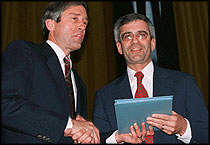
David Shribman receiving his 1995 Pulitzer Prize from Columbia President George Rupp.
Winning Work
The Presidency Has Changed Dramatically Since The Days of Abraham Lincoln And William McKinley. But Our Presidents Are Still Drawn To Prayer
By David Shribman
There are no atheists in the foxholes of the American presidency.
It happened, it turned out, on a Sunday. As President Bill Clinton and a high-level delegation of negotiators worked out an agreement on Haiti in mid-September, a White House speech writer began the lonely task of crafting a speech that the president would deliver on the subject to a nationwide television audience. Clinton liked the draft. But there was one line that left him feeling uncomfortable, as if it were right, but only half right. ''I assure you,'' the draft said, ''that no president makes decisions like this one without deep thought.'' The president read it again and yet again. Then, without apparent hesitation, Clinton penciled in two words at the end of the sentence that altered its meaning. Speaking that night to the American people, Clinton said: ''I assure you that no president makes decisions like this one without deep thoughtand prayer.''
The president of the United States, commander in chief of its armed forces -- arguably the most powerful man in the world, the best briefed, the most informed -- had spoken to diplomatic and political advisers before making one of the most important decisions of his presidency. But beyond that, he told us, he had sought the wisdom of God. Presidents do that. There are no atheists in the foxholes of the American presidency.
Abraham Lincoln saw the Civil War as an expression of God's wrath and once told his secretary, ''I have been driven many times upon my knees by the overwhelming conviction that I had nowhere else to go.'' William McKinley made his decision to seize the Philippines on his knees as well. Hour after hour, night after night, McKinley walked the floor of the White House, agonizing about America's role in the world and the prospect of making it a colonial power. Later, to a group of ministers, he confided: "I am not ashamed to tell you, gentlemen, that I went down on my knees and prayed Almighty God for light and guidance more than one night." In the end, McKinley decided to take the Philippines and its people, to "uplift and civilize and Christianize them," and then, the problem resolved, he said, he went to bed "and went to sleep and slept soundly."
The presidency has changed a lot since the days of Lincoln and McKinley. But presidents still are drawn to prayer. In the middle of the Cuban missile crisis, John Kennedy, a Roman Catholic, paused for prayer at St. Matthew's Cathedral, a few blocks from the White House. In the dark days of Watergate, Richard Nixon, reared as a Quaker, prayed with Henry Kissinger, a Jew. That same summer, in their bed, Gerald and Betty Ford, Episcopalians, prayed for guidance -- and help. And four years later, Jimmy Carter, the Southern Baptist who had taught Sunday school since he was 18, prayed for the wisdom to break an impasse between Anwar Sadat, the Muslim, and Menachem Begin, the Jew, at Camp David.
''There's no doubt that during my time as president I prayed more intensely and more fervently for God's guidance than at any other time in my life,'' Carter said this fall in an interview on spiritual issues. ''I wanted to do the right thing, and the problems that came to my desk were so complex that I sought counsel. My religious life in the White House had an exalted tone and intensity. We realized we had a special need for our religion.''
Americans always have had a special need for religion, even though the Constitution calls for the separation of church and state. Our sense of ourselves as a nation is drenched in the language and liturgy of faith. We have had, in 19th-century popular wisdom at least, a Manifest Destiny, presumably sent from God, to occupy the continent, sea to sea. We have also seen it as our national duty to bring the blessings of popular rule to every corner of the land and even, as missionaries of democracy, to extend it elsewhere.
There are, of course, startling similarities between pulpit and podium, and so the emphasis on religious themes in American politics provides plenty of room for mischief, even an invitation for it. The presence of public officials at events such as a blessing of the fleet, the appearance of candidates in yarmulkes, the faux solemnity of some politicians in their stump speeches -- all are examples of how religion and houses of worship can easily become stage sets for politicians looking for advantage. Indeed, few politicians are so inept as to appear to disregard God, religion, or prayer.
As a result, the danger in American society comes not only from the money- changer in the temple but also from the vote-seeker. ''I worry that the invocation of God has become too prominent in our politics,'' says Stephen L. Carter, a Yale Law School professor whose recent book,The Culture of Disbelief, deals with religion in American public life. ''Politicians too often say, 'God bless you,' or, 'God bless America.' Since everybody says these things, I have to believe that they are some kind of rote recital, without meaning, and that I don't like.''
But there are settings and moments when the impulse toward spirituality in American politics, and especially in American presidents, is neither strained nor false. Nor is the notion, so prominent in our political tradition, of public service as ''God's work.'' John Kennedy concluded his celebrated inaugural address -- it is little known that Rev. Billy Graham was a contributor -- with a vow to ''go forth to lead the land we love, asking His blessing and His help, but knowing that here on earth, God's work must truly be our own.''
As a young man, Bill Clinton was drawn to religious themes, music, and language. In the heat of the Arkansas racial battles of the 1950s, the 11- year-old Clinton persuaded a Sunday school teacher to drive him 50 miles to listen to Rev. Graham. Later, ''because of the impression he made on me then,'' the president recalled at a prayer breakfast nearly two years ago, he sent a little bit of his allowance to the Billy Graham crusade.
Sometimes he would wander over to the Pentecostal Gospel Sing at Red Field, between Little Rock and Pine Bluff, and explore issues of spirituality with considerable seriousness. He was a buff, poking around these issues the way some people study the Civil War, but he was also on a journey of self- discovery.
As a boy, he was far more religious than his mother, Virginia, whose nursing job and demanding hours often kept her away from church. So he would walk, Bible in hand, down the street to the Park Place Baptist Church. ''It was something that was within him, something that he had to do,'' recalls David Leopoulos, one of Clinton's oldest friends. Later, when the family moved next door to the preacher of the Second Baptist Church, he would wander there from time to time, often to hear the preacher's daughter, Carolyn Staley, sing ''O Holy Night'' at Christmas.
''None of us had any idea of what was going on in [Clinton's] house -- the drinking, the other stuff,'' says Staley, still one of Clinton's closest friends. ''We had not even a suggestion. And now, looking back, I think coming over to the preacher's house was something that comforted him.''
The Southern Baptist boy grew toward manhood at Georgetown University, in Washington, D.C., a Jesuit school where he encountered Rev. Otto Hentz in an introductory philosophy class. Hentz took his student out for a beer and burger and, unaware of his religious background, proffered a stunning suggestion: Clinton should become a Jesuit himself. ''He was a bright guy, interested in people, and I thought he was a natural,'' Father Hentz recalls. ''He laughed out loud, and he said he would have to be a Catholic first.'' Years later, as a presidential candidate, Clinton appeared at the University of Notre Dame, in Indiana, and said that he was ''deeply drawn to the Catholic social mission.''
Clinton's friends and associates say that they believe his impulse to pray is genuine, one of the keys to the locked-up places inside the president. Staley remembers popping over to the governor's mansion to baby-sit for the Clintons' daughter, Chelsea, when Bill Clinton had an evening function and the governor's wife, Hillary Rodham Clinton, was out of town. When the governor returned, Chelsea bounded out of bed, got down on her knees, and bid her father to join her in their evening prayer. ''I heard the prayer of his heart,'' Staley says.
Clinton once told Staley that C. S. Lewis' book Mere Christianity was one of the most meaningful books he had ever read. These issues are always with him. Once, in a Washington taxicab riding to an interview with the editorial board of Time, he and his wife broke into a spontaneous discussion about the nature of faith. Since becoming president, Clinton told religion writers in October, he has ''spent a lot more time than I ever have in my life reading religious books.'' He says they have helped him endure ''the pretty significant isolation of this job.''
Those who know the president well say that he worships most easily amid gospel music and in Pentecostal services, explaining that he loves the raw, unbridled honesty of Pentecostal worship, during which people pray and move their hands and speak in tongues. His friends believe that when he attends those sorts of services, he is, as Staley puts it, ''going home, to a place where he loves to worship, because there his religion can flow from down deep inside.''
As governor, he used to join state Rep. Ted Mullinex, a lawmaker from Hot Springs, onstage and sing gospel songs. Clinton would also often visit black churches. ''I've seen him at a lot of places,'' says Michael Gauldin, Clinton's press secretary for six years of his governorship, ''and I don't think I've ever seen him more at home than at black churches.''
At the governor's mansion, Clinton often sat at the end of the piano bench and asked for hymns to be played. On the day he formally announced his candidacy for the White House, a few friends and a handful of cousins lingered at the Clintons' home and sat around the piano singing ''Amazing Grace.'' And one day, at the Heights Shopping Center in Little Rock, while his wife was shopping for some clothes at the Toggery, Clinton saw Staley and implored her to sit in a parked car with him and listen to a cassette of a Pentecostal singer from Louisiana, Mickey Mangun, singing ''In the Presence of Jehovah.'' The song is about troubles vanishing and hearts being mended in the presence of God, and Bill Clinton, listening in the car, had a faraway look. ''Have you ever heard anything more beautiful?'' he asked.
The president's devotion to gospel music is so deep that he has asked that the gospel song ''Goin' up Yonder'' be played at his funeral:
If you want to know Where I'm going Where I'm going soon, I'm goin' up yonder Goin' up yonder Goin' up yonder To be with my Lord.Now that he's in Washington, the president has a weekly telephone conversation, a kind of pastoral conversation, with Rev. Rex Horne, the senior pastor of the Immanuel Baptist Church in Little Rock. ''The president knows how to pray,'' says Rev. Horne. ''I truly believe that. He understands the Bible teaches he has a right to go to God in prayer without a mediator. He knows that God hears us when we pray. He recognizes the Creator and speaks to him about whatever concerns him, and he does so both freely and frequently.''
But many of the president's critics, especially those on the right, are skeptical of the president's spirituality. As a result, his private religious life, like almost everything else, has become a matter of political discourse -- and dispute.
These critics point to his policy positions -- he advocates abortion rights and fought for gays to serve in the military -- and brand him a hypocrite. ''When it comes to Bill Clinton,'' wrote Philip Yancey, editor at large of Christianity Today, a leading evangelical Protestant publication, ''I sense in many Christians a feeling beyond anger, something closer to betrayal.'' Indeed, half of those identified as ''Clinton haters'' in a U.S. News & World Report poll the week before the midterm election also said they are born-again Christians.
Some of the president's critics have taken issue with his remark that God has made ''everyone a sinner.'' Cal Thomas, a prominent conservative columnist and former vice president of the Moral Majority, argued recently that the president speaks a ''bogus theology,'' saying that the president suggests that God be blamed for man's actions. ''There is a difference between 'All have sinned and fallen short of the glory of God' -- a choice made by individuals -- and God making us sinners, which would mean that we cannot be held responsible for anything we do,'' Thomas says.
Clinton's explorations into issues of faith have given him several encounters with Judaism and have brought him into a relationship with Rabbi Eugene Levy, of Congregation B'nai Israel in Little Rock. The two have talked about issues of spirituality, leading Rabbi Levy to conclude that the president leads a rich contemplative life. ''I think he takes religion to heart,'' the rabbi says. ''To me, he does what religion is supposed to do: to tie yourself to God and work in the world with people of all kinds. Some people here say that if he weren't a Southern Baptist, he would be a Jew.''
In fact, Clinton became the first president to attend a High Holidays service when, on vacation this past September, he joined worshipers at the Martha's Vineyard Hebrew Center. The president and his wife actively participated in the service, and the two of them sang the Shema, or central statement, of the Jewish faith: Hear O Israel, the Lord is God, the Lord is One.
White House officials told Rabbi Joshua Eli Plaut, the Jewish chaplain of the Massachusetts Institute of Technology and the leader of the Vineyard service, that the president loved Bible stories, and when they discovered that the rabbi was planning a sermon around a Hassidic story, they asked him to be sure to deliver it before Clinton left. Before the evening was out, the president and the rabbi had had a spirited discussion about the binding of Isaac.
Clinton models himself after President Kennedy, whose religion was an issue in 1960. A practicing Catholic, Kennedy was a regular churchgoer, seldom missing church on Sunday or a holy day of obligation.
Dave Powers, Kennedy's close and longtime associate, used to talk to Kennedy about the old tradition, revered among the Boston Irish, that those who visit a church for the first time are entitled to three wishes. One Sunday morning in Anchorage, during the 1960 campaign, Powers reminded Kennedy of the three wishes. Kennedy whispered: ''New York, Pennsylvania, Texas.''
The president prayed repeatedly during the Cuban missile crisis. Robert S. McNamara, then secretary of defense, is still struck by how both President Kennedy and his brother, Robert F. Kennedy, then attorney general, evaluated recommendations for an attack on Cuba through the prism of morality, believing ''that it was totally inconceivable that a great nation attack a small nation.'' And when, in a private moment at church during those 13 days in October 1962, Powers reminded the president of the three wishes, Kennedy said that this time he had but one wish.
The last summer of the president's life, when Jacqueline Kennedy was pregnant and resting at Hyannis Port, Powers and Kennedy often would have a swim at the White House and then sit on the Truman Balcony. Kennedy didn't want to be alone. Every night, before going to bed, Kennedy would get on his knees. ''The White House,'' Powers recalls, ''is a place where you do a little bit of extra praying.''
The extra praying may help, because doing God's work can be rough business, especially in politics. For that reason, prayer -- or simply, as former vice president Dan Quayle put it in a recent interview, ''running a conversation with God'' -- becomes a refuge for embattled national leaders. Prayer, say the men who have been in the White House, is an impulse, as natural in its way as pulling away from a hot stove. ''Although I prayed probably more actively as president, I wasn't conscious of it then,'' Gerald Ford recalled in an interview this autumn. ''As I look back, I am. It was just the thing to do at the time: You've got a problem, you need the reassurance that prayer gives you, and you do it.''
One witness to this phenomenon is Michael G. Ford, the former president's son and a graduate of Gordon-Conwell Theological Seminary, in South Hamilton. He watched his father tugged toward his faith, the spiritual side of his life growing deeper, richer, with each day in politics. ''I saw it early on, in Congress and as minority leader, and even on the Warren Commission, but greatest of all as president,'' says Michael Ford, now the director of student development at Wake Forest University, in North Carolina. ''There was a need to acknowledge there was a power greater than all of us. It wasn't so much to get answers but to find strength and resolve to press on.''
As Nixon's resignation neared in 1974, the elder Ford asked his son to help ''center him'' spiritually, and together they looked at Proverbs 3:5-6: ''Trust in the Lord with all your heart, and lean not on your own understanding; in all your ways acknowledge him and he will make your paths straight.''
As a family, the Fords retreated into a private room in the White House the day that Nixon left office in August 1974. There, alone, they read that passage. They joined hands and prayed together -- ''for wisdom,'' Michael Ford remembers, but also ''for strength, for the sense of being led by God to this new responsibility, and for the ability to do it with grace and clear direction.''
The Bible was open to the passage from Proverbs as Gerald Ford took the oath of office. But the oath that mattered most, a private one, had occurred minutes before. ''We committed ourselves and committed Dad to this new role,'' Michael Ford says. ''He believed God would be with him and would offer guidance.''
It wasn't the last time Ford prayed in the White House. The day he pardoned former president Nixon he walked to church. ''I felt very strongly I was about to make a monumental decision, and I wanted the feeling that I had prayed and hoped for the best,'' Ford says. He prayed again during the Mayaguez incident, when Cambodian gunboats seized an American merchant ship and its 39 crew members in the Gulf of Siam, in the spring of 1975. At Vladivostock, negotiating with Leonid Brezhnev, and at Helsinki, where he signed a human- rights agreement, Ford said ''special personal prayers.'' The Fords say they recite the two verses from Proverbs before they go to bed every night, even now.
Ford and Carter were bitter rivals in the 1976 election; they did not even speak to each other in an awkward moment during their debate when the microphones went dead. But they have, in retirement, grown close. One consults the other often, on matters big and small. The burden that brought them close to God, Carter believes, brought them close to each other.
''Jerry and I have had some private conversations about the difficulties of the White House and how the problems were sometimes overbearing, but how we survived with good humor and enjoyment,'' Carter says. ''I was more at ease with the office than you might surmise. Prayer is not a desperate action or something for a quandary or crisis. It is a commitment, a sharing of thoughts with a superior being.''
Although religion was part of the public debate in the 1960 election, when Kennedy became the first Catholic to become president, no man ever entered office as openly religious as Carter. ''He prays about everything,'' says his friend and first budget director, Bert Lance. ''He is a very sincere fellow who believes in intercessory prayer. He prays for others as well as for himself.''
Today Americans speak easily of being born again and of having personal relationships with God, but when Carter first broached these notions in 1975, he was regarded, especially in the Eastern press, with some skepticism. That reaction of shock seems almost quaint today, but it still is a matter of surprise to Carter.
''We talk about these things in the normal course of conversation'' around Plains, Georgia, says Carter. ''To us it is not strange to use words like 'born again' or 'salvation' or 'sinfulness' or 'forgiveness.' But these phrases were picked up by the national news media, and they made, to my amazement, headlines. I tried to make my churchgoing activity modest in tone. We carefully separated church from state.''
Privately, behind the wrought-iron fences on Pennsylvania Avenue, Carter was deeply devout, praying regularly and then with extra intensity during periods of political and personal crisis. He and Lance, the besieged budget director, prayed ''big time'' -- the term is Lance's -- during Lance's ordeal on Capitol Hill growing out of financial-irregularity charges. During the Camp David negotiations, when Sadat threatened to leave, the president said what he describes as ''a long, silent prayer'' that he could redeem the peace process. He talked Sadat into staying.
He also prayed with great fervor during the Iran hostage crisis. ''I don't want you to misunderstand what I say,'' Carter says. ''I don't mean I always acted with wisdom. I just asked for wisdom.''
Carter also says he was careful about prayer, not regarding it as a substitute for action or judgment. ''I don't ever feel God was insensitive to my prayers, but there were times when I was cautious about what I asked for,'' he says. ''Playing basketball as a kid or running cross-country, I never asked God to let me win. In the 1976 election, I asked only that God's will be done. I can't say that God has ever let me down.''
Whether presidents always feel as if God is on their side is another question entirely. Lincoln sometimes found himself, as Carl Sandburg put it, ''musing on the role of Providence in the dust of events.'' In his message to Congress at the end of 1862, a despairing Lincoln noted that ''it has not pleased the Almighty to bless us with a return of peace,'' but he vowed to ''press on guided by the best light He gives us.''
The dust of events sometimes does seem overwhelming in the White House. ''I pray for the strength to withstand the darker parts of the experience,'' Clinton said in an interview with ABC News nine months ago. The burden can be so great that sometimes only prayer can ease it -- prayer and, perhaps, a soaring gospel song like ''Goin' up Yonder,'' the one the president wants played at his funeral, the one that says:
I can take the pain, the
heartache it brings.
The comfort comes in
knowin' I'll soon be
there.
As God gives me grace,
I'll run this race,
Until I see my Saviour,
face to face.
© 1994, The Boston Globe
SPIRITUAL STOPS
According to the White House, here are some of the places where President Bill Clinton has attended religious services since his inauguration:
- St. John's Episcopal Church, Washington, D.C. (September 5, 1993).
- First Baptist Church, Washington, D.C. (October 10, 1993).
- B'nai B'rith 150th Anniversary Havdalah Service, at the Jefferson Memorial, (October 23, 1993).
- Olivet Baptist Church, Memphis, (November 13, 1993).
- Pasadena Presbyterian Church, Pasadena, California (November 21, 1993).
- St. Matthew's Cathedral, New York City, (December 13, 1993).
- Washington National Cathedral, Washington, D.C. (December 24, 1993).
- Christ Episcopal Church, Washington, D.C. (February 20, 1994).
- Mt. Helm Baptist Missionary Church, Indianoplis (May 14, 1994).
- The Sistine Chapel, Rome (June 2, 1994).
- Oranienburger Strasse Neue Synagogue, Germany (July 12, 1994).
- United Foundary Methodist Church, Washington, D.C. (July 31, 1994).
- Full Gospel AME Zion Church, Temple Hills, Maryland (August 14, 1994).
- Tabernacle Church, Martha's Vineyard, (August 28, 1994).
- Union Chapel, Martha's Vineyard, (September 4, 1994).
- St. Matthew's Cathedral, Washington, D.C. (October 3, 1994).
What's good for GM isn't necessarily good for Gingrich and vice versa
By David Shribman
It means that, under Gingrich, the Republican Party has its first authentic opportunity to separate itself from the image that, since the age of Franklin D. Roosevelt, has prevented it from becoming the majority party.
WASHINGTON -- The next speaker blew into town like a tornado, upending the customs of conduct in the Capitol, forcing whole political structures to collapse of their own weight, spewing rubble in all directions, raining destruction on the social conventions and political habits that have animated the House of Representatives for four decades. Newt Gingrich is a new and different force in Washington.
New, different -- and misunderstood in a fundamental way. His is not the ascendancy of devout conservatism in the tradition of William McKinley or Robert Taft or even Barry Goldwater or Ronald Reagan. This is a conservatism with a different kind of energy, power and potential. This is a conservatism born of frustration with the mainstream of the 20th century but shaped to the world of the 21st century.
The defining difference about Newt Gingrich is this: Like most of his conservative forebears, he is anti-government. But, unlike almost all of them, he is not pro-big business.
That is no small thing. It means that, under Gingrich, the Republican Party has its first authentic opportunity to separate itself from the image that, since the age of Franklin D. Roosevelt, has prevented it from becoming the majority party. Reagan spoke from the heart of a party and a conservative movement that reached ordinary citizens and small business, but his head (and, more important, his government) was the servant of big business.
Lost in the whirl of controversy and upheaval here in the last several weeks is the discomfort that many of the nation's signature businesses feel about the advent of Gingrich. To be sure, the new speaker of the House favors a reduction in the tax on capital gains that those businesses have trumpeted for a dozen years, but he also represents a threat to the way they have done business for generations.
Indeed, Gingrich's relationship with business provides one of the clearest windows into his political, social and cultural philosophy. And though his ascent has driven a wedge throughout Washington, nowhere are the splits greater than in the business community.
Many in the Gingrich circle offer no comfort to big business in the new era. ''Besides the old Congress, the single most out-of-touch group in America are the CEOs of Fortune 500 companies,'' says Frank Luntz, the Republican pollster with ties to Gingrich. ''They don't have a clue.''
Gingrich is attuned to the information-technology industries, to any sector of the economy where there remains room for entrepreneurship, to insurgent businesses that want to sweep away the old ways of doing things in much the same way the new speaker has, before even taking office, transformed not only the Capitol building but the entire capital.
The new speaker's populist roots make him instinctively suspicious of large institutions of any kind. ''Gingrich comes from revolution,'' says Fred Wertheimer, the president of Common Cause, the self-styled citizens' lobby, ''and corporate America is not about revolution.''
For that reason, the Bell operating companies, many of the restaurant and food-service divisions of Pepsico and scores of entrepreneurial computer and software companies will have the ear of Gingrich, while the Big Three automakers, the big steelmakers, the large computer hardware companies and the chemical companies -- some of which have contributed to various Gingrich causes over the years -- are in danger of being shut out.
The splits even affect individual industries. For example, the companies associated with the American Electronics Association may have little truck with the new Republicans -- the companies' leadership is regarded as relatively staid, too quick to accommodate, not revolutionary enough -- while the companies associated with the Electronic Industries Association -- regarded as more entrepreneurial by the Gingrich circle -- may get a better a hearing.
But the skepticism doesn't flow in only one direction. Many of the leading US chief executive officers favor reducing the tax on capital gains but are exceedingly wary of Gingrich's zeal to reduce taxes in general. These business leaders are, above all, worried about the deficit, which affects bond prices and the financial markets. The leaders of many of the smaller, more entrepreneurial businesses don't worry about the bond market because in large measure they don't float bonds; they want tax cuts because lower taxes spur people to spend more money.
Executives of big corporations also worry that less federal spending will put pressure on states to increase their taxes, shifting the tax burden from Washington to the states. The cost of doing business in some states would rise, giving some companies relative advantages but penalizing others. Companies in the Frost Belt would be hurt, and those in the Sun Belt would be helped. But large corporations would rather not have such imbalances, because they find it awkward, inconvenient and expensive to shift their resources.
''Their priorities are so different from those of the average American that it's almost sad how great the disconnect is,'' Luntz says. ''Newt wants to help the small-business person, because that's where the future lies. The new technologies and techniques are almost entirely being developed by the small businesses. It's the teams of three or four people who are winning the future, not big business.''
Some of the motivation for Gingrich's preference for smaller, entrepreneurial businesses is philosophical, of course. But some of it is cultural.
The anvil of his views toward business in the capital was the tax accord of 1990, long reviled by conservatives because some Republicans and a GOP president, George Bush, acceded to tax increases as a tool to reduce the federal budget deficit.
On one side of this agreement were Washington corporate representatives, epitomized by the Business Roundtable and leading US businesses, all desperately wanting to reduce the deficit even if it meant raising taxes. Gingrich heavily weighted himself against them and toward the small- business groups. The smaller businesses were more worried about take-home pay, concerned that any diminution there would hurt their enterprises.
That sealed Gingrich's connections with the National Federation of Independent Business, regarded as the premier representative in the capital of small businesses, and other Washington trade groups such as the National Association of Wholesaler-Distributors. Gingrich learned in 1990 which groups had grass-roots organizations and which had only a battalion of fancy lobbyists with good tennis backhands and memberships in tony golf clubs.
''I don't think the man has any of those social hobbies,'' says Benjamin Y. Cooper, senior vice president of the Printing Industries of America, one of the groups with close ties to Gingrich. ''He is not that kind of Washington figure.''
Gingrich grew to have contempt for many of the companies that maintained Washington representatives, believing that they stood in the way of his rise or at best contributed both to Republicans and Democrats. He delights, in fact, in challenging trade group lobbyists face-to-face, and for many years had frosty relations even with the US Chamber of Commerce. Many of these corporate representatives, of course, are former Democratic lawmakers or congressional staff members. They have no interest in seeing Gingrich succeed.
For that reason, for example, the Gingrich wing of the GOP is wary of the National Association of Manufacturers, which had grown accustomed to being one of the most influential business groups in Washington. The group may be well- positioned politically, and its legislative goals increasingly are being brought in line with those of the new GOP, but many in the Gingrich network know that Jerry Jasinowski, president of the group, is marked by original sin: He served as assistant secretary of commerce in the Carter administration.
Much of what Gingrich has done in the weeks leading up to becoming speaker can be explained in terms of his antipathy to the status quo. Last week, he and his associates abruptly pulled the plug on 28 caucuses in the House, including the Congressional Steel Caucus, the Congressional Automotive Caucus and the Northeast-Midwest Congressional Coalition.
Part of Gingrich's motivation, of course, was his determination to pare the size of government. But part of it was a desire to change the architecture of political life on Capitol Hill and thus to frustrate lobbyists who had grown accustomed to the 28 caucuses and had found ways to bend them to their own interests.
The new speaker's determination to wrest control of the legislative process from Washington's lobbyists can be seen just below the surface of a number of his other moves. Restructuring House committees and altering the names and responsibilities of some time-honored panels severs longstanding ties between lawmakers and lobbyists. Similarly, his decision to make legislation easier to amend on the floor takes away a long-cherished prerogative of committee chairmen, who often took their lead -- and, in some cases, the actual legislative language -- directly from the ''Gucci Gulch'' of big-business lobbyists.
Gingrich is in many ways a mysterious figure; in his introduction to Alvin and Heidi Toffler's book ''Creating a New Civilization: The Politics of the Third Wave,'' Gingrich speaks easily of the Renaissance, the collapse of Confucian China and even the fall of the Japanese Liberal Democratic Party. ''What seems to us, looking back in history, a brilliant, exciting period of innovation seemed to its contemporaries a terrifying collapse of the existing order,'' he writes.
Those who seek to fathom his mind must remember that the Georgia representative considers himself a revolutionary. He takes glee in blowing up the status quo -- and he believes that in many ways big business in the United States has learned to live with, even profit from, the status quo.
For all their public criticism of federal regulation, many big businesses -- slaves to stability and certainty, in the view of the Gingrich group -- have grown used to regulation, and some have actually grown cozy with regulators. In any case, they have legal affairs departments and teams of accountants that can steer them through the regulatory maze. Smaller businesses do not. They want to repeal regulations, or at least to rein them in substantially.
In truth, small businesses have been with Gingrich from the start, providing him with money and with the foot soldiers of his army of occupation that just now is settling into Washington. He has learned over the years that if he helped a big company there was little political payoff, but that if he helped a bunch of small businesses they would notice it, appreciate it and remember it. In the end, Gingrich, like business itself, is motivated above all by the most ancient tenet of the financial world: self-interest.
© 1994, The Boston Globe
Backers, Critics of Former President Show A Quiet Dignity
By David Shribman
WASHINGTON -- There are great ambiguities in the moments of silence for Richard Milhous Nixon, late president of the United States.
As the nation prepared for this day of mourning, the divisions that tore Americans apart in the Nixon years have become evident again. Mr. Nixon, who used political division as a tactic in life, cannot escape it in death.
But this time, after Mr. Nixon's final crisis, it is different.
Perhaps it is the very fact of his death, or the fact that two decades have passed since he left the White House in disgrace, or that many of his views and achievements have proven remarkably durable, but Mr. Nixon's passing has also brought forth a surprisingly generous impulse.
It has returned to our discourse a tone of civility that Mr. Nixon himself helped to expel.
It is not only sentimentality -- or the sort of nostalgia prompted by sepia-toned images of the past -- that has arisen in recent days. Commentators, politicians, millions of those who voted for and against him, and millions more of those too young to understand the passions he let loose on the country are talking of Mr. Nixon's accomplishments and fall from grace. But they are doing so in muted tones, with quiet decency.
''People are conflicted about him,'' said Michael Cromartie, senior research fellow in Protestant studies at the Ethics and Policy Center in Washington.
''They see him as a man who was vindictive but was personally troubled. And they see him being magnanimous toward communists he used to hate. His insecurities drove him to obsessive preoccupation with those who wanted to do him in. There are a lot of people who want to forgive him, and there is something not bad -- something charitable -- about that.''
No amount of historical revisionism will erase the fact that Mr. Nixon left office just short of certain impeachment in the House and conviction in the Senate, not only for the famous break-in at the Watergate complex but also for the coverup and other actions that made a mockery of the rule of law, produced a constitutional crisis and endangered the legitimacy of his office.
And so the many quiet moments that have been offered to mark the passing of Mr. Nixon have been awkward ones. There has been silence, to be sure, but, like the 18 1/2-minute gap in the Nixon presidential tapes that played a major role in Watergate, the silence has caused uneasiness, not comfort.
No American of our century was at the center of our politics for so long. No American reached such heights only to fall to such depths, and then rise again. Only Franklin D. Roosevelt rivals him in the depth of feelings he inspired, and in the number of people whose views on politics and government were defined by opposition to his way of conducting them.
And even now that Mr. Nixon is dead, he remains a divisive figure.
Around the country and in odd corners of the capital, the announcement of a national day of mourning for him caused a subterranean stir. A number of government officials are grumbling privately about the cost of such a gesture ($23 million, according to the Office of Personnel Management) and about the symbolism of honoring a man some describe as a crook and dissembler.
One Washington lawyer called today's federal holiday Mr. Nixon's final obstruction of justice. The Los Angeles Times ran a cartoon showing a tombstone with the epitaph, ''Here lies Richard M. Nixon,'' a mordant double- entendre and a reminder of the passions that he stirred.
Few of the criticisms of Mr. Nixon have been expressed publicly, in part, perhaps, because of the recognition that he brought out the worst in people and that they, in turn, brought out the worst in him. As angry as people were at Mr. Nixon, they were also angry at themselves.
In that spirit, President Clinton, who often talks about sin and redemption, was moved on Saturday night to reflect on the life and difficulties of one of his most controversial predecessors.
''The thing that impressed me about him was that he had a tenacious refusal to give up on his own involvement in this country and the world, and his hopes for this country and the world,'' Mr. Clinton said at the annual dinner of the White House Correspondents Association.
He pointedly added, ''I think we should all try to remember when we are tempted to write off anybody because of our differences with them that we share a common humanity.''
Mr. Nixon himself learned that, and he counseled dozens of others who fell from grace.
Now, as we begin the day of mourning for Mr. Nixon himself, the sort of garden-variety remarks at his expense that have been a staple of American politics and comedy somehow seem discordant.
In today's silences, someone may recall that Sen. Bob Dole of Kansas once referred to a joint appearance of former Presidents Gerald Ford, Jimmy Carter and Nixon as a gathering of Hear-No-Evil, See-No-Evil -- and Evil. This afternoon Dole, whose own anger and sharp tongue have helped keep him from the White House, delivers a eulogy for Richard Nixon, dead at 81.
© 1994, The Boston Globe
By David Shribman
Now begins a new flowering of New England jurisprudence.
The nomination Friday of federal appeals Judge Stephen G. Breyer to the Supreme Court brings the prospect of the greatest concentration of New England intellectual power at the heights of American judicial life in more than a half-century, and it may offer echoes of the golden age of New England jurisprudence, the 16 years when Oliver Wendell Holmes and Louis D. Brandeis served on the court together.
But the meeting of two prominent justices, Breyer of Massachusetts and David H. Souter of New Hampshire, on the high court would be more than simply an extraordinary symbol of the endurance of New England intellectual life. These two men -- one a Democrat, one a Republican -- could also define the new center of the court itself.
In nominating Breyer, President Clinton indicated that his strategy is to move the court away from the right, not by selecting a lone wolf to stand on the court's lonely left flank but by solidifying the center, which many experts believe is personified by Souter.
''Everything about Breyer's background and personality seems to lead him to the center, and he and Souter may reinforce each other and strengthen the center,'' said A.E. Dick Howard, a University of Virginia Supreme Court specialist.
Moreover, the two men -- Breyer, who moves easily in political circles, and Souter, with his more reserved and scholarly mien -- represent both the two sides of New England public life and the two currents of influence on the high court.
It is of no little significance that the two fit David Hackett Fischer's description of Paul Revere in his extraordinary account of the most famous horse ride in American history: ''His mind and character were shaped by the established institutions of New England -- family, school . . . and the town itself.''
There is, as Van Wyck Brooks put it in his classic 1938 book on the New England mind, ''a great life-pattern of New England.'' It was expressed by an early president of Harvard who said of John Adams what could be said of the two New Englanders of the court: ''For 50 years he rose before the sun.''
Breyer, early riser and deep thinker, is a San Franciscan by birth but a New Englander by choice. ''I woke up one morning and discovered I was a New Englander,'' he said in a conversation yesterday. He is not the first: The quintessential voice of New England, Robert Frost, was born in San Francisco in 1874.
Both Breyer and Souter are judges by profession, hikers by avocation. They have both seen the world as it looks from the top of New Hampshire's White Mountains.
They are both shaped by their years in a region that accepts the world's foibles, and where the words ''competence'' and ''conscience'' seem to flow off the tongue together, and easily. They are the products of a region where the phrase ''searching and restless intellect'' -- Clinton's description of Breyer on Friday night -- bespeaks a great tradition, and even great social cachet.
It was the essayist and poet Oliver Wendell Holmes, the justice's father, who said in 1860 that Boston, with its rude and crooked streets, kept open ''more turnpikes that lead straight to free thought and free speech and free deeds than any other city of live men or dead men.''
Much of the region's landscape and climate is stark, which is good for judgment. It has a history that has provided ample experience and literature about choices, whether in the novels of Nathaniel Hawthorne (and, later, of Stephen King) or the witch trials of Salem. It has a great heritage of contemplation, reaching its zenith with the transcendentalists of Middlesex County.
As judges, the two men gained their experience in both a calling and a region that are steeped in tradition -- where, it is said, every tub has its own bottom and every case is decided on its own merit. The phrase is attributed to Samuel Livermore, chief justice of New Hampshire and a senator in the early years of American independence.
The prevailing ethos, according to Jere Daniell, a Dartmouth College specialist in New England culture and history, is: ''Let wise men of judgment make decisions on a practical basis.''
The nature of justice has long been a subject of serious thought in the region. In a conversation with Justice Benjamin N. Cardozo, Frost, by then a zealous convert to the New England ethic, had this bit of counsel: ''You have to distinguish between being a referee and a handicapper.'' It is an apt synthesis of the judicial philosophy of both Breyer and Souter.
Both are wary of government interference, a longstanding tradition in an area where, as Donald Cole, a retired Phillips Exeter historian and expert on New England, put it, ''people have strong character and independence.''
Breyer and Souter, who know each other, both are frugal eaters in the New England way. Souter contents himself with a bowl of yogurt for lunch, leaving a recent dining partner to wonder whether the apple on the table was for him or for the justice (it turned out that Souter, man of habit, has his apple later in the day, eating it completely, including the core); last weekend Breyer picked apart an airline meal, putting the bread aside and leaving the candy bar entirely.
But there are important differences.
Breyer is a prominent figure in Cambridge, a more bustling setting, to be sure, than Ware, N.H. And while Souter is a close friend of taciturn New Hampshire political figures such as former GOP Sen. Warren B. Rudman and former Attorney General Thomas D. Rath, Breyer's political associates are of a more voluble sort, such as Democratic Sen. Edward M. Kennedy, his patron, and former Boston Mayor Ray Flynn.
''Breyer has a facility for walking between the hallowed grounds of Harvard and the cold political and practical grounds of Boston,'' said Kenneth R. Feinberg of Brockton, now a Washington lawyer.
That is a metaphor for the role that Clinton hopes Breyer will play on the court.
Breyer has already received an extraordinary range of support, stretching all the way from Kennedy, whom he served as chief of staff of the Senate Judiciary Committee, to GOP Sen. Orrin Hatch of Utah, a devout conservative. Republican Sen. Strom Thurmond of South Carolina pronounced the nomination of Breyer ''an excellent choice.''
Breyer's appointment came after Harry A. Blackmun announced his retirement earlier this year. It meant the end of the reign of the ''Minnesota Twins,'' the term given to the service of Blackmun and former Chief Justice Warren Berger. Two Arizonans, William H. Rehnquist and Sandra Day O'Connor, currently sit on the court.
It would not be the first time New Englanders have played vital roles on the court. William Cushing of Massachusetts and Oliver Ellsworth of Connecticut served together on the first court. Holmes also served with William Moody of Massachusetts for four years and with Harlan Fiske Stone, who was born in New Hampshire and coached football at Newburyport High but who achieved prominence as a Wall Street lawyer and, during his court years, was considered far more New York than New England.
Breyer has already left his mark on New England as one of the principal forces in the construction of the new federal courthouse at Fan Pier. ''He thinks of himself,'' said Vivian Li, the executive director of the Boston Harbor Association, ''as being from here.''
© 1994, The Boston Globe
By David Shribman
ARLINGTON, Va.-- After all the tributes, after all the film clips, after all the reminiscences, after all the eulogies, there was simply this: A coffin. A crescent of mourners. A president's solemn remarks. A son's kiss and his touch -- a loving pat, really -- at the gravestone of his father. And silence.
All America, it seemed, was silent yesterday afternoon. And the silence was deepest here, on a Virginia hillside, where Jacqueline Bouvier Kennedy Onassis was buried beside her husband, a martyred president of the United States, and two of their children.
In that silence, a kaleidoscope of images from President Kennedy's burial raced by: A caisson, drawn on its funeral route by three pairs of matched gray horses, the right row saddled but riderless. A widow, the black veil shielding but not hiding her grief. A scrawl on White House letterhead in the first lady's own hand, intended to be instructions for the memorial program of her husband: ''Dear God, please take care of your servant.''
And yet it was no struggle -- here in the hot sun or in millions of homes, factories, farms and offices scattered around the country -- to linger not on the funeral and burial of three decades ago but on the one that was happening that very afternoon.
The commentators all said this was the final tattoo of Camelot, and there was, to be sure, something of that. But this afternoon wasn't about the man she married, but the woman she was.
Born to privilege, she was buried in quiet understatement in the Virginia soil on which she had ridden and which she loved. It was, of course, at the site of the eternal flame, placed there at her request -- one of the few things she asked of the country after her president was killed -- and assembled by the Washington Gas & Light Co., which hastily put together the tanks and copper tubing that November weekend so long ago.
More than a few have thought this one of the loveliest spots in the nation. It is a place where, almost by miracle, the Jefferson Memorial, the Washington Monument and Capitol Dome all are visible, even in yesterday's haze. The setting inevitably triggers allusions to John Winthrop, the Puritan leader who vowed from the deck of the Arbella off the Massachusetts coast in 1630 that the new land would be a ''City Upon a Hill.'' The phrase, borrowed from the book of Matthew, was cited by John Kennedy himself on Beacon Hill just before he departed for Washington and his inauguration.
Jacqueline Kennedy visited this spot shortly before the funeral of her husband; her sister-in-law, Jean Smith, had told her it was ''the most wonderful place,'' and, in a scene that William Manchester likened to ''the opening of the final act of 'Our Town,' '' she stood there, silent, for a quarter hour. Then she nodded and the choice was made.
Yesterday the heads were bowed again, this time for her.
It was simpler than in 1963, and the handful of press observers gathered on the hill to record the moment felt less like witnesses, more like intruders. For John Kennedy's funeral, Mrs. Kennedy arranged for the skirling of the Black Watch bagpipers and saw to it that Irish cadets from the Military College at Curragh, County Kildare, were there, marching at a hundred paces a minute [counted in Gaelic], their rifle butts reversed, a symbol of mourning for the martyrs of Ireland.
This time there were only the Navy Sea Chanters.
Three decades ago John F. Kennedy Jr., at his mother's urging, saluted his father. He had seen the big men, the soldiers, execute a salute, and he did it himself, crisply and unforgettably. Earlier in the day, his third birthday, he had received a toy helicopter and a copy of ''Peter Rabbit.''
This time, a man himself, he kissed his mother's coffin, tapped his father's gravestone, and paid his respects to his brother, Patrick, who died shortly after birth. It was a completely spontaneous moment, overwhelming in its power.
Hours earlier, his uncle, Sen. Edward M. Kennedy, who has spoken at these events all too often, noted that Mrs. Onassis never wanted public notice, in part because it brought back ''painful memories of unbearable sorrow,'' all in the glare of a million lights.
And so the proceedings here at America's most famous military cemetery -- with row upon row of markers, tributes to our military dead -- were extraordinarily controlled. The Army Military District even distributed a statement to news organizations: ''Those who try to penetrate the grave site area will be escorted out by law-enforcement officials.''
The 11-minute graveside service had the boast of heraldry, the pomp of power, and symbols of all the beauty and wealth that Thomas Gray cited in his famous Elegy. There was, for the living, the sobering reminder that, as Gray put it, the ''paths of glory lead but to the grave.''
At the grave of Jacqueline Onassis the mind returns to a picture, laid across two pages of the special memorial edition of Life magazine, tucked away in thousands of closets, retrieved from many of them in the last few days. The headline from 1963 reads: ''The warmest way to remember him.''
The background is the dunes of Hyannis Port and, beyond it, a sandy pathway to the sea. In the foreground is a little child, Caroline, feeding an animal cracker to her dad. And there, on the right, is a woman, sitting amid the dandelions, laughing at the scene, content, thoroughly at ease. She was a lovely lady.
© 1994, The Boston Globe
Having Brought Polling to New Heights, will the Clinton Administration Reduce Government to a New Low?
By David Shribman
WASHINGTON -- The polls speak and Washington listens -- not wisely, but too well.
The polls show that crime is the preeminent issue, and so all of Washington rushes to get tough on crime. The polls show that the public actually thinks President Clinton, the most domestic-oriented president since Calvin Coolidge, spends too much time on international affairs, so administration policies on Haiti, North Korea and the future of Russia and the Western alliance continue to drift.
The result is that Washington has a lot of polls and is exercising very little leadership.
Consider the scene the other day at the health care deliberations conducted by a House labor-management subcommittee. ''Every member that got up to talk about whether a benefit should be in the package or not was quoting some poll,'' complained Rep. Ron Klink (D-Pa.). ''Every member has some half-assed poll of his own district, and members use them whatever way they want. Everyone is using some poll or another in every discussion.''
This is not what the Founding Fathers had in mind. The Founders, to be sure, could not have anticipated all the changes that have occurred in this country over the past two centuries. But they surely would not have expected a situation where a president could have spent $1,986,410 on polling for a single year.
But that's how much President Clinton paid a former Yale academic named Stanley Greenberg for polling last year. Greenberg does several polls and several focus groups a month for the White House. The polls are the magnetic north of the president's policy compass. The focus groups provide the idiom for many of his public utterances.
''When I conduct focus groups, from Topeka to New York, I quite literally hear, word-for-word, the same things Bill Clinton is saying,'' says Frank Luntz, a Republican pollster. ''I know it's not because people are copying Clinton. It's what they think and feel. That's what's so critical about Clinton -- he understands what people feel, not just what they think. He is a pollster's dream because he can internalize what Stan Greenberg tells him. Words from focus groups become Bill Clinton's words.''
It is the equivalent of a Vulcan mind meld, pioneered perhaps by Star Trek's Mr. Spock but perfected by the current administration, among Clinton, Greenberg and the American people.
As a result, this may be the very first president to say not only what the public wants to hear -- a special skill, honed over several years -- but also what the public itself says. It is a remarkable political achievement.
But Clinton is the president now, not just a candidate for the office, and a president has to do more than simply appeal to the people. He must lead them.
The ancient Greeks spoke of a democracy where, as Thucydides put it, a leader ''led them, not they him.'' In his insightful new book, ''Certain Trumpets,'' Garry Wills notes a more modern conception of democracy, where ''the leader does not pronounce God's will to the people but carries out what is decided by the people.'' That leaves Wills worrying whether ''the leader is, in that case, mainly a follower.''
This is a very old debate, older than the republic, older even than the English political tradition and the notion, proffered by Edmund Burke, that a member of Parliament should not merely represent his constituents' viewpoints but instead owes those constituents, and the country, the benefit of his good judgment.
Several years ago President Bush invited the historian David McCullough to the White House to give a lecture on Theodore Roosevelt. There, in a setting sacred to democracy, the historian told the president that Theodore Roosevelt didn't care much for, or about, public opinion. ''He didn't give much time to what the people were thinking,'' McCullough said. ''He said: 'I don't know what they think. I just know what they ought to think.' ''
Hardly anyone argues today (or did in the first decade of the century, when TR was president) that public opinion shouldn't be important in American politics and government. The question isn't whether public opinion should play a role, but how big the role should be.
''Even if politicians cared about nothing but reelection, they should still not simply follow the polls,'' says Gary C. Jacobson of the University of California at San Diego, a specialist in congressional elections. ''They have to try to anticipate what public reactions are going to be sometime in the future. What people want now might not be what they want later, or what they will want once they have gotten what they say they want.''
Polls are a tool, valuable to politicians if used correctly. As hints from the public, they can provide the spark toward midcourse corrections; a classic example of such a hint -- not followed, unhappily for Republicans -- was public dissatisfaction with President Bush's neglect of domestic economic issues. Polls also can allow leaders to understand the obstacles they will encounter if they try to exert leadership. But they are not a substitute for leadership.
The Founders designed the government as a representative democracy. They did not have government-by-referendum or government-by-poll in mind.
This question has taken on a new urgency in today's Washington, where the president's capacity for leadership has been diminished by his reliance on public polling. Clinton's proclivity for consulting the polls is so widely known that he has undercut his own presidency and made even his closest allies skeptical of his judgment, or at least of the way he proceeds toward judgment.
The most stunning example occurred earlier this month, just after he chose Stephen G. Breyer, chief judge of the US Circuit Court of Appeals in Boston, for the Supreme Court. Two days after the selection, which Clinton made despite reportedly wanting to appoint Bruce Babbitt, a public and therefore more controversial person, to the court, Sen. Patrick J. Leahy (D-Vt.) went on the CBS-TV program ''Face the Nation'' and urged the president to be steelier and more decisive. ''You have to stand up every so often and just say: 'Look, this is what I'm going to do.' . . . You know, forget the polls, forget these political considerations. Sometimes stake out things and you say, 'This is what I want to do,' and do it. It's amazing how the American people, even in a state as Republican as mine, will rally to that.''
But the president seldom does that. The shame is that the very area where he needs the most help -- foreign policy -- is the area where he could do himself the most good, and where the public, regardless of what they tell the pollsters, is likely to follow him -- at least for a time.
The public, to be sure, believes the president already spends too much time on foreign affairs; the latest Wall Street Journal/NBC News Poll, for example, shows that 38 percent of the public says it believes he is putting too much time and attention on foreign affairs, as compared with 29 percent that says it believes the balance between foreign and domestic is about right and 19 percent that says it believes that he is concentrating too much on domestic questions.
The problem is that polls -- even those that show, for example, public skepticism about military involvement in Haiti -- give too limited a view of a political leader's ability to alter public opinion.
Polls in December 1990, on the eve of the Gulf War, gave no indication that President Bush would be the recipient of stratospheric poll ratings as a result of Desert Storm. What the public -- only 17 percent of whom know that Serbia is at fault in the former Yugoslavia -- thinks now about Bosnia is irrelevant. No poll can gauge the shape of public opinion if Clinton were to address the country on the subject. Nor can any poll suggest how the public -- which by a 49-to-41 margin says it believes the United States has no responsibility to act in Bosnia, according to the CBS/New York Times Poll -- would respond to strong presidential language and action on the situation in the Balkans.
Indeed, foreign policy is the one area where presidential leadership can make the difference between something happening (including shifts in opinion) and nothing happening. There are sufficient forces in motion to keep things moving in the domestic area even in the absence of presidential leadership. But the only momentum in foreign policy during peacetime is to do nothing.
There is another danger. The fact that the illegitimate rulers of Haiti now know that the president is governed in large measure by polls means that Clinton's military threats are somewhat less credible. In a society where polls are numerous and easily accessible, the United States' adversaries, who tune into CNN and read American news clippings, have the same access to the same information the president has. The Haitian leaders, for example, know that the latest Time/CNN Poll indicates that only 43 percent of the public says it believes the United States has a great deal at stake in Haiti, as compared with 53 percent who believe the same for Bosnia, 62 percent for North Korea and 70 percent for Russia.
But there are dangers to polls even on the domestic side. Most professional pollsters are exceedingly careful to assure that the language of their questions doesn't shape the public's response. In an area as complicated as health care overhaul, however, there are additional dangers. Many respondents do not understand the Washington debate and, according to a study on public attitudes on health care by Karlyn H. Bowman for the American Enterprise Institute, ''certain code words, phrases or descriptions that speak to concerns about reform are going to affect responses.''
Many of the respondents may have tailored their answers so as to avoid embarrassment. In her new book, ''Life, Liberty and the Pursuit of Happiness,'' former Reagan and Bush speechwriter Peggy Noonan worries that polls have ''the effect of hardening opinions that haven't even been formed yet'' because people feel the need to answer pollsters' questions, and in a sophisticated, knowledgeable way.
The administration fell into the poll trap when it argued that positive public reaction to the president's September speech calling for changes in the health care system constituted support for the president's plan. Now, according to the Bowman study, the administration ''finds itself in the unenviable position of responding to questions about why 'support' has declined.''
Not that the president is fully to blame for all of this. Polls are everywhere these days; they are part of the landscape of American politics.
Take next month's Republican primary for lieutenant governor in Alabama as an eccentric but perhaps representative example. Both GOP candidates for this job, hardly the commanding heights of politics even in Alabama, have pollsters. The primary election for secretary of state in Florida isn't until September, but already both Democratic candidates have signed up pollsters. Garry Mauro, the Clintonista who is a land commissioner in Texas, has his own pollster.
The disease is so rampant that some people are talking seriously about hiring a full-time bipartisan pollster for Congress.
''I don't want government by polling,'' says Rep. Klink, who has sponsored the legislation. ''I just want us to have accurate polls.''
It is a commonplace of politics that no polls are fully accurate, and that the only poll that matters occurs on Election Day. So in that respect Congress already has polls, provided, as it turns out, by the Founders themselves. They are completely accurate. They're probably the only ones Congress needs.
They're almost surely not enough for Bill Clinton, though.
GREAT MOMENTS IN POLLING HISTORY
1824: First use of public opinion polling in a presidential race
1901: George Gallup born
1921: Louis Harris born
1936: Literary Digest straw poll predicts Landon will beat Roosevelt
1948: Dewey supposed to defeat Truman
1960: Patrick Caddell, 10, conducts first poll
1979: Caddell sends Jimmy Carter ''malaise'' memo
1989: 33 percent of voters in Wall Street Journal/NBC News poll say they voted for Dukakis in 1988 election (actual figure was 46 percent)
1991: Pollster Robert Teeter named head of Bush reelection campaign
1992: Bush loses
TAKING POLLS APART
''Polls are only good for dogs.''
--John Diefenbaker, Canadian prime minister
''I grieve to see that the government is governed by the hurrahs of . . . the citizens. It does not lead opinion, it follows it.''
-- Ralph Waldo Emerson
''We don't base our opinions on the Gallup Poll.''
--Lyndon B. Johnson
''The worse I do the more popular I get.''
--John F. Kennedy, on his poll ratings after the Bay of Pigs
''Wouldn't it be wonderful if we didn't have any idea how this election would come out?''
--Charles Kuralt, two days before the 1988 presidential election
''I took my own informal, politician's poll. I talked to 56 people. All 56 said that they didn't think that Truman could win, but all 56 said they were voting for Truman.''
-- Thomas P. (Tip) O'Neill Jr., on the 1948 presidential election
''July [polling] does not a November election make.''
--Gov. Ann Richards (D-Texas)
''Almost everyone in the firm was for Truman. But we saw the future of the firm going down the drain.''
--Pollster Elmo Roper, reflecting on his prediction 40 years earlier that Dewey would defeat Truman
''When a pollster's forecast is acurate, it is not news; when it is wrong, the words of Jesus to the Pharisees are recalled: 'O ye hypocrites, ye can discern the face of the sky; but can you not discern the signs of the times?' ''
--William Safire
''Any administration worth its salt does not make policy decisions based on the ups and downs of a poll.''
--John Sununu
''The experts get more wrong all the time.''
--Harry Truman, October 1948
© 1994, The Boston Globe
By David Shribman
WASHINGTON -- Now the trumpet summons Americans to battle again. But it is an uncertain trumpet, used by an uncertain president for uncertain reasons.
President Clinton solemnly spoke to the nation last night not only to build support for an invasion of Haiti but also to reestablish his own credibility as he approaches the midpoint of his term. The speech came as his ambitious domestic agenda was stalled, with his effort to win a major overhaul of the nation's health-care system an apparent failure, and as his presidency, which had energetically sought to avoid international entanglements, once again was being tested by a Third World crisis.
Clinton's message to Lt. Gen. Raoul Cedras and the other military leaders of Haiti was clear: You will be gone by choice or by force, but you will be gone. So, too, was his message to Americans: Clinton sought to be presidential and to begin to rebuild his own support.
But last night's speech, with its horrifying catalog of atrocities and assassinations, captured the conundrum of the administration: a president so accustomed to consulting the polls found himself trying to assert leadership in the face of the polls. Every reliable public-opinion indicator shows Americans reluctant to use force in Haiti. An ABC News poll released this week found that three out of four Americans oppose an invasion.
So as Clinton attempted to rally a reluctant nation and to redeem what he called ''Haitian dreams of democracy,'' administration expectations were low. Officials here would be satisfied with the public's understanding and acquiescence if not support.
That the president was in the position of public-opinion supplicant -- ''We have tried everything,'' he said -- was much of his own doing.
Until last night, when the president spoke of ''the cause of freedom'' and the value of hemispheric stability, Clinton and other administration leaders hadn't made much of a case to explain American interests and intentions in Haiti. They still haven't combated perceptions, widely held in Washington if not in the country at large, that his commitment to Haiti is a political gesture to the Congressional Black Caucus, which has been resistant to his entreaties on budget and domestic issues. But now even the 38-member Black Caucus appears divided on an invasion.
Many Democrats in Congress are hard-pressed to identify why the United States has a stake in the resolution of the stalemate in Haiti, much less why American troops must be dispatched to the island.
Indeed, last night's speech and its appeal for ''preserving democracy in our own hemisphere'' was an effort to go above the heads of Congress, which is unlikely to support armed intervention in Haiti if the matter were to come to a vote. Congress authorized force in the Persian Gulf in January 1991 and in Somalia in December 1992, but President George Bush acted in Panama in December 1989 by notifying Congress but not seeking its approval. Clinton administration officials argue that the Haiti case is much more similar to Panama than to the Persian Gulf.
But now that the president has set the nation on this course, he must bring it to closure swiftly. The premium on swiftness comes from two sources: his repeated warnings have become a subject for music-hall comedians and late- night talk masters. And it is unlikely Americans, who know that the last time US troops were sent to Haiti they remained there 19 years, would tolerate lengthy involvement in a foreign conflict that they hardly understand and barely countenance.
''This has to be quick and relatively costless,'' said Austin Ranney, a specialist on American politics at the University of California at Berkeley. ''The last thing we want is a long, drawn-out struggle where we aren't clear what our objections are.''
In truth, the nation that Clinton addressed last night is deeply non- interventionist; he noted that ''so many Americans are reluctant to commit military resources and our personnel.'' But by emphasizing job creation and economic growth at home over international issues, the president has undermined his own flexibility in foreign affairs.
''The foreign-policy dilemma of the Clinton administration is that the American people are incredibly insular right now,'' said Geoffrey Garin, a Democratic pollster. ''They have a very narrow view of America's self- interest, and Haiti is not in it.''
The decision to send troops to the Caribbean won't necessarily win Clinton friends abroad. Indeed, the message to Latin America, where the principle of nonintervention is an act of diplomatic faith, is mixed.
''The US is overriding the Latinist principle, but there will be some relief that democracy will be restored,'' said Patrice Franko, a Colby College expert on Latin America. ''Latin American leaders don't want to be part of the intervention, but they do want to be part of the nation-building.''
The domestic political impact of the mobilization is likely to be minimal at best. In any case the president can expect far less of a midterm-election boost than John Kennedy received in 1962, when in the wake of the Cuban missile crisis the Democrats gained two seats in the Senate and lost only four in the House. Unlike the Cuba crisis, where superpowers contemplated armed conflict, the security of the United States is not at issue. All signs continue to point to an erosion of Democratic power in the Congress after the November elections.
The president's speech was delivered on the very day American troops pulled down the flag to slink out of Somalia, the last American invasion target. That east African nation remains a land of factions and famine, and the danger is that the same could be said about Haiti a year from now.
© 1994, The Boston Globe
By David Shribman
NASHVILLE -- All of the forces that make this autumn's midterm elections unusually incendiary across the country are converging here in the buckle of the Bible Belt:
This is Vice President Al Gore's home state, and yet the public disapproves of President Clinton by a startling rate of 64 to 36. The state has been enjoying its lowest unemployment rate in history, and yet people are uneasy about the future. Local chambers of commerce no longer feel the need to court new factories and branch offices, and yet business leaders are worried.
The nation's voters go to the polls Tuesday to select 36 governors, 35 senators and all 435 members of the House, but nowhere are the stakes higher than here, where two Senate seats, the governor's office and four competitive House seats are being contested.
Indeed, in this year of voter rebellion and negative campaigning, of glowing economic statistics and deep-seated economic anxieties, Tennessee emerges as the nation in miniature.
''If there's a 'Republican' sweep here, there's a wave across the country,'' said former Gov. Lamar Alexander, who already is preparing a campaign for the 1996 Republican presidential nomination. ''What is happening in Tennessee is what is happening in the country. People are troubled about the future, people think there's something wrong with our government in Washington, and they think that our values are being lost. The uprising is about that.''
The political future will be visible Wednesday from the porches of Nashville. The elections in this state will give shape to the political climate for the remaining two years of the Clinton administration and, perhaps, for the remainder of the century.
''Tennessee,'' said Democratic Sen. Bob Kerrey of Nebraska, ''is the whole thing.''
This state's congressional races will help decide whether the Republicans take control of the House for the first time since 1955. The fate of Sen. Jim Sasser, regarded as the favorite in the contest to become the Democrats' new leader in the Senate if he can survive a tough challenge Tuesday, will help determine the party's public face in Washington.
Moreover, the two Senate races here -- this is the only state where two seats are at stake -- constitute a critical battleground in the struggle for the Senate, which the Democrats are in danger of losing to the GOP.
''To retain the Senate,'' Sen. Sam Nunn of Georgia said, ''the Democrats are going to need a couple of upsets.''
Right now, however, the Republicans are on the verge of capturing the Senate seat Gore relinquished when he became vice president. Fred Thompson, a former Senate Watergate Committee staffer and Hollywood actor who has been winning attention and support driving a blue Ford pickup across the state, has built a healthy lead over Rep. Jim Cooper, a moderate Democrat who won notice for offering a leading alternative to Clinton's health reform plan.
''This is a classic case where someone who has accomplished a lot outside government is up against a man who is a competent member of the House -- but who also represents a lot of the things people are fed up with,'' said William Lacy, Thompson's campaign manager.
Sasser's prospects, meanwhile, have brightened in his expensive contest against Bill Frist, a heart-transplant surgeon who has pumped millions of his own dollars into the race. The other day, three-term senator Sasser even risked putting the advantages of incumbency on display, a rare event in this year of fierce anti-incumbent sentiment, when he told workers at a Textron aviation-wing assembly plant of his efforts in the capital to keep alive the new V-22 helicopter.
All the while, however, Sasser stressed his populist impulses. ''I am a senator,'' he said, ''who represents the everyday working men and women of this state.''
Even if he prevails Tuesday, Sasser cannot become majority leader unless enough Democrats win to preserve their majority and he defeats Sen. Thomas Daschle of South Dakota in the secret leadership balloting Dec. 2 in the Capitol.
Tennessee politics usually has the air of a camp meeting, but this season it resembles more a demolition derby with too many contestants. Politics this autumn has been exciting and fast-moving, but it also has been difficult to keep all the races straight.
''Fred Thompson would take aim at Jim Cooper, miss him and hit me,'' Sasser said. ''We've gotten hit from shrapnel from those other campaigns.''
None of this would have happened in the old Tennessee. The state has been dependably Democratic since the days of Andrew Jackson, who lived in the Hermitage near here and gave the party its popular appeal. In the modern era, the Democrats' power was consolidated by Edward Crump, the fabled and feared boss of Memphis, and by three influential members of the Senate, Estes Kefauver, Albert Gore Sr. and Albert Gore Jr.
Legitimate two-party competition, in fact, has existed for only three decades, dating to when Howard H. Baker Jr., a Huntsville lawyer, and Don Kuykendall, a Memphis salesman, nearly won Senate seats in the Lyndon Johnson landslide. Since then, in dozens of statewide races for senator and governor, the Republicans have only won seven -- and five of those were won by Baker, who eventually won a Senate seat and became majority leader himself, or by his protege, Lamar Alexander.
''We've been waiting anxiously for our farm team to mature,'' Alexander said.
It has matured, both here and across the country. There was a surge in Republican fund-raising and in GOP primary voting this year. And this fall the Republicans are fielding their strongest candidates ever.
''This is the most competitive election cycle in Tennessee history,'' said Steve Gill, a Republican challenger who is taking on five-term Democratic Rep. Bart Gordon in Gore's old district in Middle Tennessee. ''People are running this time who have never run before.''
In truth, Clinton has bent the whole structure of Tennessee politics out of shape. Had President Bush been reelected, Gore would have remained in the Senate. Cooper would have glided to easy reelection in his House seat. The Republicans, not the Democrats, would have been on the defensive in midterm elections that customarily penalize the party that holds the White House. Gill, for one, admits he would not have run if Bush had remained in the White House.
The upheaval in this raucous political year has reached the state level, where a bitter gubernatorial race is under way between Nashville Mayor Phil Bredesen, a Democrat, and Rep. Don Sundquist, the Republican. The two have argued about jobs, crime and a state lottery, and in the runup to the election they have even bickered over whether the mayor shoved -- ''thumped'' is the verb of choice here -- Peaches Simpkins, a Democratic activist who is supporting Sundquist.
Sundquist has been telling audiences that ''a real man wouldn't do that.'' For his part, Bredesen has accused Sundquist of having ''a terrible record on women's issues and civil rights,'' criticized him for accepting ''free parking'' and charged him with having a proven record as a ''do- nothing.''
The result is a political climate that is a lot like the slow-dance country music the fabled Stock-Yard Band plays in the Bull Pen Saloon in downtown Nashville: seldom uplifting, often depressing.
''The public is in an anti-incumbent mood, and that hurts Democrats,'' Nunn said. ''But it could hurt Republicans, too. All that negativism we're seeing in the campaign creates cynicism about the political system.''
In the final days, the negativism has continued, but the races have been tightening, just as they have been doing elsewhere.
''As they approach the moment of decision,'' Sasser said, ''voters are becoming less emotional and more rational about the choices they're making.'' Even so, they defy prediction, here and across the country.
© 1994, The Boston Globe
By David Shribman
WASHINGTON -- Never in modern American history has Washington seen a repudiation quite like this.
Repudiated were four decades of Democratic rule in the House, a sitting president who himself had won office as an apostle of change, a political and social philosophy that has dominated American life and its national legislature for nearly two-thirds of a century, and scores of individual lawmakers who only a year or two ago thought they had lifetime tenure on Capitol Hill.
Not a single Republican incumbent governor or member of Congress was defeated Tuesday.
The American people spoke without ambiguity, venting their rage, frustration, impatience and fears. They were so angry that they would, as was said of tempestuous baseball great Ty Cobb, climb a mountain to punch an echo. They took their fury out on the Democrats and, in the process, ended an era and altered the political landscape of country and capital.
But in the fine print of Tuesday's election results is more than the powerful shout of ''No!'' In the choices they made in the quiet of the nation's polling places, Americans provided hints of an emerging new consensus in the country about government and political philosophy.
The voters sent many of the biggest names in American politics into retirement -- including Gov. Mario M. Cuomo of New York and former House Ways and Means Committee Chairman Dan Rostenkowski of Illinois, both symbols of New Deal liberalism -- but they also returned, with strong mandates, a series of Republican governors. These leaders, working far from Washington, have forged new policy trails on issues such as education and welfare and have pressed the low-tax agenda through skeptical legislatures.
Four of the governors -- Jim Edgar of Illinois, John Engler of Michigan, Tommy Thompson of Wisconsin and George Voinovich of Ohio -- are unflamboyant Midwesterners who won reelection by the kind of astonishing mandates that Democratic House members used to win routinely. Meanwhile, reelection victories of two governors on opposite coasts, Pete Wilson of California and William Weld of Massachusetts, may help shape the struggle for the Republican presidential nomination.
Rebellions in American political life almost always start at the local level, and that is why the road traveled by the Republican governors may suggest the direction of national politics. In fact, the few Republicans rejected in high-profile races -- especially Oliver North in Virginia and apparently Rep. Michael Huffington in California -- did not fit the mold.
At both the congressional and gubernatorial levels, the voice of the voters suggests far more than a rightward turn in the nation's politics. The election emphasized the need, as President Clinton gamely put it in his press conference yesterday afternoon, to ''change the way our country does business and make our government work again.''
But it also underlined deep distrust of the Democrats and profound doubts about their capacity to be entrusted with the responsibility to govern.
The failure of the anti-incumbent sentiment to touch even one Republican gave some credence to the belief of GOP Sen. Phil Gramm of Texas, a likely presidential candidate who said yesterday that the political sentiment was ''anti-Democrat, not anti-Washington.''
In fact, interviews with voters at polling places across the country showed that nearly three voters out of five believe the country is ''off on the wrong track.'' These voters, according to Mitofsky International, a New York polling firm, voted 2-to-1 for Republicans.
This week's vote, moreover, suggests that the nation's voters have grave doubts about 40 years of Democratic social engineering.
Americans do not entirely believe that all the Democrats' notions and all government programs are nefarious, of course. More than 33 million Americans are Medicare recipients, for example, and the Social Security program reaches into nearly every family in the country. But Americans do believe that after four decades of Democratic spending initiatives and social programs, the streets are not safe, the schools are in crisis, taxes are too high and public confidence in the future is at all-time lows.
That is why Sen. Richard Shelby of Alabama, elected a Democrat, could stand before a battery of microphones yesterday morning, pronounce himself a Republican, embrace what he called ''the philosophy of our forebears'' and describe the GOP ''a party of hope of America, not a party of dependency.''
Indeed, the winds of change that blew through the country in recent weeks whipped around Washington yesterday. Men who were accustomed to being called ''Mr. Chairman'' were out of work. Staff aides, committee lawyers, press spokesmen, secretaries and clerks were uneasy of their futures. The rules of lobbying, protocol and procedure were uncertain.
A whole way of life that had developed in the Democrats' four decades of dominance in the House -- a set of assumptions about power and comportment -- suddenly was rendered irrelevant. Never before had one party ruled the House for so long, and, in an instant, the whole architecture of life in Washington was in a shambles.
''Let new blood in,'' said Rep. Newt Gingrich of Georgia, who is poised to be the new House speaker.
There will be more new blood than even he expected only days ago, and almost certainly many battles ahead.
The House that Gingrich is building will seek to change the country but, first of all, will seek to change the way Congress works, especially in the application of federal laws to Congress itself. ''These reforms will be done immediately,'' said Rep. Bill Paxon of New York, chairman of the National Republican Campaign Committee.
But amid the heady expressions of victory there were some sober words about the burden of controlling Congress, and the pressure the voters will bring to bear on the Republicans to address the concerns that Americans brought with them to polling places Tuesday.
''If we don't do some of these things,'' said Sen. Bob Dole of Kansas, in line to become majority leader, ''they're going to cancel our lease.''
© 1994, The Boston Globe
By David Shribman
WASHINGTON -- What Americans saw last night was a president who is fighting -- for the limelight, for a guiding star to his presidency, for political credibility.
In his first address to the nation since the elections, President Clinton answered the Republican challenge with a ''middle class Bill of Rights'' full of presidential largesse. But even in reasserting his leadership, the president risked looking like a follower.
Candidate Bill Clinton spoke of middle-class tax breaks, shrinking government and making college more affordable. But until last month's election rout, President Bill Clinton had other priorities. Now he is presenting a program that is true to at least some of his campaign themes, but may be unsuited to the urgent political needs of his presidency.
Despite a forceful presentation, Clinton's effort to ''restore the American dream'' had less the air of a presidential initiative and more the whiff of a political response.
He is responding, of course, to the Republican ascendancy, but he is doing so on dangerous terms, inviting an engagement on a battlefield where his opponents -- true believers -- can outgun him with ease and delight.
''He can't out-tax-cut us and he can't out-tough us on defense,'' said Frank Luntz, the Republican pollster with ties to Newt Gingrich, who is in line to be the next House speaker. ''He's competing completely on our territory.''
Indeed, the House Republican leadership is urging a cut that is substantially larger than Clinton's.
The elements of the president's plan were carefully and shrewdly targeted: a college-tuition tax break to ease the greatest financial worry of many middle-class taxpayers, expanded savings opportunities for Americans under financial pressure, and tax benefits for families struggling with the cost of child-rearing.
Clinton's extraordinary holiday message, the result of weeks of agonizing in White House offices and in public, was an effort to reinject the nation's chief executive into the national debate. White House officials acknowledge privately that the president has come perilously close to becoming an afterthought, an astonishing development in a political system that from time to time prompts worry of an ''imperial presidency.''
But the danger is real enough. A Times Mirror poll this month showed that the public, by a 43-39 percent margin, thought that the Republican congressional leaders, not the president, should take the lead in solving the nation's problems. A New York Times/CBS News Poll last week said the public trusts congressional Republicans more than the president on the two principal issues of the new year: the budget and the overhaul of the welfare system. In both cases, the margin in favor of the Republicans was more than 2 to 1.
Last night's speech helped to reestablish the president's role in Washington, and his tuition plan goes to the heart of financial worries that affect millions of Americans and shape their personal and work lives.
But it may have done little to address his urgent need -- to win back Americans' confidence and to comfort them by displaying steadiness and conviction.
''He needs to command a little more affection from the American people,'' said Fred Greenstein, a Princeton specialist on the presidency. ''You have to be struck that someone who is as personable and effective personally as he has wound up being so disliked. He doesn't have to be soft and cuddly and attractive. He only has to find a consistent message and pursue it.''
Even his aides and supporters acknowledge that the president has appeared to appease conservatives, embracing proposals to make it easier to pray in public schools, restricting funding for some kinds of human embryo research and then firing Surgeon General Joycelyn Elders after her remarks about masturbation.
Now he is proposing a tax cut that Rep. Joseph Kennedy 2d, the Brighton Democrat, yesterday described as a ''short-term election bribe,'' along with generous tax treatment of retirement funds.
''He is taking elements of the Contract with America that are part of the core of being a Republican,'' said Luntz, the GOP pollster with ties to Gingrich. ''Bill Clinton is not a Republican. He is a pseudo-Republican, destroying his own base by approving our agenda. He's representing change, but . . . Republican change.''
But polls carry some sobering news for Gingrich as well. This week's Wall Street Journal/NBC News Poll says only 19 percent of the public has a positive view of the new speaker, as opposed to 32 percent with a negative view. His vow to work for a ''leaner, not a meaner government'' and to pursue ''less malice and more charity'' was an effort to take strength from what he perceives as his rivals' weaknesses.
The president sought to soften his remarks by vowing that in the next two years he would put ''country first and politics-as-usual dead last.'' That was both a return to his campaign themes and a signal that the president was determined not to cede the reformers' mantle.
White House officials contend that the president has returned to his roots as an advocate for the middle class. At the heart of their calculations is the hope that the administration and the Congress might actually find common ground.
That might yet be a formula for success. ''There's a lot of anger in the country, but there is also a great concern for results,'' said James David Barber, a Duke University specialist on the presidency. ''People want things to happen. If this can help make things happen, it might help him.''
© 1994, The Boston Globe
Biography
David M. Shribman is assistant managing editor, columnist and Washington bureau chief of The Boston Globe.
He joined The Globe after serving as national political correspondent for The Wall Street Journal. Prior to that, he covered Congress and national politics for The New York Times and was a member of the national staff of The Washington Star. He began his career at The Buffalo Evening News, where he worked on the city staff before being assigned to the paper's Washington bureau.