The Boston Globe, by Robert Campbell
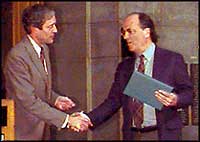
Robert Campbell is awarded the 1996 Pulitzer Prize by George Rupp, Columbia University President.
Winning Work
By Robert Campbell
What everyone remembers is the windows.
It was Chicken Little's panic come true: The glass was falling out of the sky.
The glass in question was from the 10,344 windows of the John Hancock Tower. They began to fail almost from the start. The crisis came in a winter gale on the night of Jan. 20, 1973, while the tower was still under construction. Gusts reached 75 miles per hour at the upper floors. Huge panels of glass, each weighing 500 pounds, shattered and dropped like sequins off a dress, smashing into other windows on their way down. In all, at least 65 fell.
Streets and sidewalks were hastily roped off. In the ensuing months, more windows broke. By April more than an acre of the Hancock's surface was covered not with glass but with sheets of plywood, painted black. The Plywood Palace, people called it. Nobody had the slightest idea what was happening.
Today that's all in the past. The 60-story, 790-foot mirror-glass tower, designed by Henry Cobb of the famed firm of I.M. Pei and Partners, is Boston's most visible, most spectacular building. A recent Globe poll of architects and historians rated it the third-best work of architecture in Boston history.
But the story of the Hancock disaster is important because even today very few people know the real facts. It's timely, too, because a crucial anniversary is about to arrive. On March 6, to be precise.
Myths about the Hancock continue to flourish. They're all persuasive but they're all wrong. One myth -- still believed even by former Hancock executives -- is that the windows fell out because the tower was swaying too much in the wind. It's not true -- although, as a matter of fact, the tower was doing exactly that. Another myth is that the glass was sucked out by bizarre wind forces at "hot spots" caused by the sharp angles of the tower's rhomboid shape. Again, not true -- although there were such hot spots, and although the tower's shape did prove to be a critical factor in its problems. Still another myth is that the windows broke because they were stressed when the tower's foundations settled. Again, not true -- yet there really was a terrible problem of settlement.
There's a reason for all these myths, all this ignorance. Everybody involved in the Hancock drama -- owners, architects, engineers, suppliers, builders -- signed a legal pact to keep secret what really happened. Nobody talked then and nobody talks now. But over the years, through interviews with people who are knowledgeable but not legally constrained, it's been possible to piece together what really happened.
What hardly anyone understands -- and this is the real story of the Hancock -- is that problems with the windows weren't even the biggest disaster to strike this haunted high-rise mirror, which always seems to be reflecting clouds as if it were brooding on its own grim beginnings.
That's why March 6 is a key. It was on that Thursday in 1975, just 20 years ago, that a Swiss engineer named Bruno Thurlimann flew from Zurich across the Atlantic to inform the owners of the Hancock that their building was in danger of falling down.
That's right. Falling down. Like a dead tree in the forest.
What follows is the real story of the most interesting architectural crisis in Boston history. We've divided it into four mini-chapters. Each is the story of a separate disaster. Bruno Thurlimann's announcement, it turns out, doesn't arrive until Chapter Four.
Builders began their work by digging a huge excavation for the Hancock's basement. The sides of this hole in the ground were braced with steel. The steel proved inadequate and the sides caved in, sometimes as much as 3 feet. Because of the cave-in, earth all around the site shifted and settled. Cracks appeared in nearby buildings. Underground utility lines ruptured. In the worst case, an entire transept wing of Trinity Church came within a hair of collapse before the problem was discovered.
It was a major disaster, but it had nothing whatever to do with the windows. The tower didn't even exist yet. Its foundations rest on steel piles driven down to bedrock. They never moved.
Because of the glass problem (which is going to be the subject of Chapter Three), the Hancock became, by far, the most closely studied building in history. Instruments were placed all over and around it, to measure how much it was moving in the wind and to find out if that movement was making the glass break.
It turned out that, yes, the Hancock certainly was moving too much. But the movement wasn't doing any harm to the glass, nor to the structural integrity of the building. What it was doing was making life very uneasy for people on the upper floors. The tower, in ordinary wind conditions, was accelerating too fast for comfort. It was doing a sort of cobra's dance, swaying a few inches forward and back and, at the same time, twisting. It happened that the natural period of vibration of the forward-and-back motion was very close to that of the torsional motion. The two motions were reinforcing each other.
All problems have solutions. Perhaps the Hancock could have been braced with guy wires, like a ship's mast. But instead a knight arrived on the scene in the person of William LeMessurier, a famous Cambridge engineer. LeMessurier slowed the Hancock's dance by installing something called a Tuned Mass Damper, which he'd just invented for the Citicorp Tower in New York.
Here's how the damper works. Two 300-ton weights sit at opposite ends of the 58th floor of the Hancock. Each weight is a box of steel, filled with lead, 17 feet square by 3 feet high. Each weight rests on a steel plate. The plate is covered with lubricant so the weight is free to slide. But the weight is attached to the steel frame of the building by means of springs and shock absorbers. When the Hancock sways, the weight tends to remain still -- that's inertia, right, class? -- allowing the floor to slide underneath it. Then, as the springs and shocks take hold, they begin to tug the building back. The effect is like that of a gyroscope, stabilizing the tower. The reason there are two weights, instead of one, is so they can tug in opposite directions when the building twists. The cost of the damper was $3 million.
The Hancock's cobra dance was, obviously, a second major disaster. But it, too, had absolutely nothing to do with the windows falling out. Which brings us to:
After all this technological excitement, the solution to the mystery of the falling glass comes almost as an anticlimax. Samples of the Hancock window panels were being exhaustively tested in a wind tunnel in Ontario. They were subjected to vibration and oscillation until they failed. Eventually it was found that the whole problem was right there in the window unit itself.
Each panel was a sandwich: two layers of glass with an air space between, all held in a metal frame. To cut the glare and heat of the sun, a coat of reflective chromium was placed on the inside surface of the outside pane of glass. (This layer of chrome was what gave the building its mirror effect.) The window frame was bonded to the chrome with a lead solder. During the testing, it was noticed that when a window failed, the failure began when a tiny J-shaped crack appeared at the edge of an outside pane of glass. What was happening was this: The lead solder was bonding too well with the chrome -- so well, so rigidly, that the joint couldn't absorb any movement. But window glass always moves. It expands and contracts with changes in temperature, and it vibrates with the wind. So the solder would fatigue and crack. The crack would telegraph through to the glass, and the cycle of failure would begin.
Investigators found that similar failures had occurred with this same window type, by this same window manufacturer, in other, less conspicuous buildings. All 10,344 of the Hancock's double-pane windows were replaced with single sheets of tempered glass. The window maker paid the cost, which was $7 million. Part of the deal was that everyone agreed to keep the secret.
Ever wonder what happened to the original windows? The 5,000 undamaged ones went on sale, at $100 each, in bargain outlets in Hingham and Lynn and in Maine. Many are now tabletops, picture windows or greenhouses. As for the plywood, much of it went to the Boston Redevelopment Authority, where it was used to board up abandoned buildings. Life goes on.
We're near the end now. Faced with such a multiplicity of problems, the architect, Harry Cobb, decided he needed some ultimate reassurance that his building was safe. He hired Thurlimann to review its structural integrity because Thurlimann was the world's leading authority on high-rise steel-frame buildings.
Thurlimann's discovery is the most astonishing of all these events. He announced that, according to his calculations, under certain rare but entirely possible wind conditions, the Hancock might fall over. Most amazing of all, it would fall on its narrow edge.
Nobody ever thinks of a long thin building like the Hancock falling over in the long direction. You'd imagine that if it ever blew over, it would fall on a flat side, since obviously the flat side -- like a sail -- receives much more wind. But no, said Thurlimann: The building was stiff enough in the flat direction. The danger was that it might collapse on a narrow edge. It would be as if a book standing upright on a table were to fall on its spine.
The problem is in the Hancock's shape -- not its funny angles, but its length, almost 300 feet. If it shifted out of plumb by even a tiny bit in the long direction, the force of gravity, acting over such a great length, would begin to pull it farther.
This gravity action would give the tower a longer natural period of vibration -- something like 16 seconds instead of 12. With each period it would move a little farther, until it fell.
Thurlimann convinced his audience. Over the next few months, at a cost, this time, of $5 million, the tower was stiffened from its base to its top with 1,500 tons of diagonal steel braces. These were placed along the walls of the service core, the central blob of elevators and toilets. In that location -- purely by chance -- there was just enough room for them. It was the Hancock's only stroke of luck.
Nobody was to blame. The Hancock met every structural building code. So it was necessary to stiffen not only the tower but also the codes, and that was done.
Would the Hancock ever, really, have fallen down? Nobody knows, but nobody was willing to take the risk. Is it safe today? A very few panes of the new glass have failed, but that's normal. After all the testing it went through, the Hancock today has got to be one of the safest high-rises in the world. It possesses the strength of a survivor.
So does its architect. Harry Cobb went on to become chairman of the department of architecture at Harvard and is currently the designer of a new federal courthouse on Boston's Fan Pier.
It's only fair to remember that we're talking about a building that, in its aloof way, is among the world's most beautiful. So we'll conclude with a passage from a John Updike story that appeared a year after these events. Updike's narrator, walking past Copley Square, is musing to himself:
"Now I am aware of loving only the Hancock Tower, which has had its missing pane restored and is again perfect, unoccupied, changeably blue, taking upon itself the insubstantial shapes of clouds, their porcelain gauze, their adamant dreaming. I reflect that all art, all beauty, is reflection."
Pane Speaking ...
MYTH: The windows failed because the tower was swaying too much in the wind.
TRUTH: It certainly was swaying, but the sway wasn't harming any windows.
MYTH: The sharp angles of the tower's rhomboid shape were creating "hot spots," where high wind velocities would damage or suck out the windows.
TRUTH: Wind tunnel tests showed there really were such hot spots -- but theydidn't correlate with the window failures.
MYTH: The tower was settling on its foundations, and that was what was stressing the windows.
TRUTH: Settlement and movement of the earth did occur, damaging nearby buildings and utility lines, but it derived from a failure in the Hancock's excavation and had nothing to do with the windows.
MYTH: Many windows are still falling out.
TRUTH: The manufacture of glass is an imperfect science. A certain tiny percentage of any large order of glass is expected to fail. The Hancock's new windows haven't exceeded that percentage.
© 1995, The Boston Globe
By Robert Campbell
Maybe the city of the next century will again be a smaller place of intense culture, like Florence during the Renaissance or London in the era of Samuel Johnson, a beautiful city of schools and cafes.
PROVIDENCE -- They've torn this city apart, but they haven't put it back together yet.
With the possible exception of Portland, Ore., no other American city today is reshaping itself more ambitiously than this semi-abandoned former seaport and manufacturing center.
No city, you could probably add, needed it more.
Maybe the amazing planners of Providence are visionaries, creating the city of the 21st century. Maybe they're fatheads, crafting a future ruin at great expense. It's too soon to tell.
Either way, Providence is a fascinating study. A Bostonian can't hope to understand it very deeply. But you can't help noticing the changes.
Especially the Riverwalk.
The Providence Riverwalk is astounding. A whole new river system cuts through the center of town, complete with embankments, bridges, pedestrian paths and parks. You used to have to look sharp to notice any rivers in Providence. They existed, somewhere, three of them -- the Woonasquatucket and the Moshassuck, merging to form the Providence -- but they'd been largely paved over. Sometimes they were even covered with buildings.
The people of Providence have now ripped off this thick blanket of construction to expose the water. Where they couldn't do that, they simply moved the rivers. That's right: They picked the rivers up like vacuum-cleaner cords and put them down where they wanted them.
As a climax to all this, they built an enormous outdoor terraced park called Waterplace, big enough for a modest production of, say, the opera ''Aida," complete with elephants. The Waterplace amphitheater faces a pool, which, with a couple of barges, could stand in nicely for the Nile. That kind of theatricality pervades the whole Riverwalk.
The sponsors of these astonishing feats are an alliance of local leaders -- public and private, state and city -- sparked by architect Bill Warner. Warner conceived and designed virtually every aspect of the Riverwalk. The money came from Washington. The feds bought the argument that moving all these urban mountains would make the mice of traffic run better. As with Boston's Artery Project, the urban design of a city is being reshaped with federal highway funds.
You can't help admiring the energy that created the Riverwalk. But you can still be nervous about its future.
As it stands, the Riverwalk exhibits all the scary emptiness of a thing half-built. It's eerily dissociated from everything around it. Two dreams are possible about the Riverwalk of the future.
The first is a nightmare: The concrete is heaving and cracking. Weeds and trees are pushing through. The city no longer acid-cleans the graffiti or sweeps up the glass. Rats skitter across the steps of the amphitheater. Homeless guys build nests out of trash. Hollywood cameras show up for a sequel to "Blade Runner."
The other dream is, in part, a dream about San Antonio. The Riverwalk in that city is the example that's cited by everyone in Providence. In this dream, barges and music drift up the Providence waterways, outdoor cafes line the banks and "Aida" is indeed in progress. Joggers and lovers frolic. Best of all, a gingerbread ferry is blowing its whistle. Filled with well-heeled tourists, commuters and excursionists, it is about to depart, from the very heart of Providence, for Newport and Narragansett Bay.
Either dream could become reality. The outcome depends on two fairly mundane things. One is maintenance and the other is commerce. As to commerce, there's a big difference between Providence and San Antonio. In San Antonio, hotels and restaurants belly up to the Riverwalk in a pretty much unbroken line. They feed the waterway with activity and vitality.
Nothing like that can happen in Providence. Too much of the banks of the Riverwalk is already committed to other uses: to a major new artery, Memorial Boulevard, and to other streets, plazas and parklands -- to emptiness, in other words. Some parcels are slated for future development, but maybe not enough to generate a critical mass of activity. The city hasn't even been able to attract a restaurant to fill the space intended for one at Waterplace. And San Antonio is warm: Its deeply shaded Riverwalk is a welcome refuge. Providence is cold, and its Riverwalk is open and exposed.
It's true that Providence's Riverwalk was filled with picnickers and neckers last summer, and you could even spot an occasional canoe on the water. And already the city is programming festive activities for the coming season, including contracts with vendors for food and drink. But it takes more than planned frivolity to make a place like this work. Programming a public space is like feeding a patient through an intravenous tube. If the place doesn't develop a life of its own -- including a commercial life -- the programming will flag once the novelty wears off.
As for maintenance, the problem, of course, is that the great US public -- that's us -- can't be trusted to maintain a pothole, much less a Riverwalk. It's relatively easy for a city to make big capital improvements, especially with federal dollars. That's why cities are always trying to cure their problems with one huge pep pill: an arena, an aquarium, a festival marketplace, a megaplex. It's far harder to maintain such improvements over the years within the constraints of a municipal budget.
And Riverwalk is going to need a lot of maintaining. Which brings us to the architecture.
Bill Warner has designed his bridges and gazebos and terraces in a traditional style. It's a sort of let's-pretend-we're-English-gentry look, a little bit like the magnificent two-century-old streets of College Hill in the nearby East Side. There's nothing wrong with that. But Warner -- and this happens so often today -- hasn't been able to afford the traditional materials or craftsmanship that once went into the making of this kind of architectural form. So the handsomely sculpted caps on the bridge posts, for example, tell a lie. At first you see them as carved in limestone or granite, but they turn out to be cast concrete. They've been made the way you make cupcakes, by pouring mush into a mold.
The result is a loss of any sense of authenticity. Once you realize how it's been constructed, you can't help perceiving the Riverwalk as a stage set. There's no subtlety or variety, no interesting detail. A stone carver with a chisel makes a very different object from what pops out of a concrete mold. Or take the bricks: They're flat, shiny and uniform, a far cry from the richly varied and textured masonry you expect in a traditional civic monument of the kind the Riverwalk pretends to be. Finally, things just don't look durable. And if there's one quality you absolutely must achieve in this kind of traditional architecture, it's a sense of permanence. The message you're trying to broadcast, after all, is a message about the continuity of culture over time.
There's a reason the Riverwalk doesn't look durable: It isn't. Already, there are gaps and irregularities in the concrete, even rust marks where steel reinforcing is staining through. In a New England winter, with its frequent freeze-thaw cycles, this kind of construction requires a lot of care.
Not wanting to bring a parochial Boston view, I talked to several architects more familiar with Providence. All find the Riverwalk's architecture a little ponderous. All suggest something more transparent, like the steel spiderweb bridges of the city's industrial past. Warner has actually produced a couple of these, in the Waterpark area, and they do look better.
He's done some other nice things, too, squeezing what he could from the pathetic budgets we, as a society, now allocate to our public realm. There are handsome brass railings. Some of the retaining walls are built up out of thousands of huge chunks of recycled granite. Interesting little historical markers and street names are set into the concrete.
Riverwalk isn't finished yet. A final stage is due to be complete later this year, including another big public square that seems entirely superfluous to me. The Riverwalk will be dredged, too. At the moment it's so shallow that nothing bigger than a kayak or canoe will float.
Riverwalk may turn out to be wonderful. It may turn out to be dreadful. Its future depends on the response to these issues.
Huge as it is, the Riverwalk is just a chapter in the story of Providence. Bored, perhaps, with moving rivers, Warner has produced a scheme to move an interstate highway. I-195 will be relocated, reconnecting downtown Providence -- "Down City," as it's called -- with the derelict old jewelry district to the south. Warner's plan has been approved and it's moving ahead.
Yet another mammoth project is proposed for the north edge of downtown. This is Providence Place, currently hanging fire while a new governor renegotiates the deal (once again, federal highway dollars are heavily involved). Providence Place is a humongous shopping mall with a million square feet of space, designed to house 150 stores, 5,000 cars and a bus depot. It will also contain a river and, one level above the river, a railroad.
You were reading correctly: An actual river and an actual railroad are proposed to run through the atrium of Providence Place. This isn't just any old railroad, either: It's the East Coast Amtrak line, five tracks wide. The river is the Woonasquatucket, to be fitted out as an extension of the Riverwalk.
A mall with a river and a railroad could become, in the hands of an adventurous developer, a pretty memorable chunk of architecture. But the question of whether Providence Place should be built at all is hotly debated. Some think it will drain commercial activity from the many beautiful old buildings downtown, although there's little left to drain. Still others fear that -- together with an adjacent new Westin hotel and a rather handsome convention center -- it will become an isolated Vatican within the city.
A lot depends on the final design. If Providence Place is open, trusting, and welcoming toward the city, if it reads, from outside, as a street of pedestrian shops instead of a blank fortress to be approached only by car, it could be a plus. If done right, it might help bring the Riverwalk to life. If.
Providence is a paradox. At the very moment when a city is scraping the bottom economically, it often has its best chance for revival, because it's an inexpensive place in which to invest. Providence may be almost there. It may be on the threshold of a new age. It's small, walkable, beautiful and cheap, and the food is terrific. It has lost its port and manufacturers, but it's slowly gaining the industries of today -- medical, tourist, financial.
Most intriguing of all, it's a city filled with students and artists. There are something like 20,000 college and graduate students in a city of 169,000, and all the schools are growing. One of them, Johnson and Wales University, known for culinary and hotel arts, recently purchased the crown jewel of the city's architecture, the Providence Arcade. Together with the Rhode Island School of Design, Johnson and Wales is one reason you may have visited Providence recently for a good dinner in a lively setting. Food and art: Is this the city of the future?
Maybe. Once upon a time, cities were the place where everybody interesting went -- patrons and artists, intellectuals and entrepreneurs, teachers and students. That intimate social city was replaced, during the 19th century, by another city that was essentially a huge pile of capital and labor: a Detroit.
It may turn out that Detroit was just a blip in history. Maybe the city of the next century will again be a smaller place of intense culture, like Florence during the Renaissance or London in the era of Samuel Johnson, a beautiful city of schools and cafes. Like Bologna. Or Heidelberg. Or Savannah, where another expanding art college is buying up another decrepit downtown. Or Providence?
By Robert Campbell
They're scattered all over Greater Boston. But you don't usually notice them. They've merged, over the decades, almost seamlessly into their surroundings.
They're the model neighborhoods. Each was somebody's idea of Utopia: the once-and-for-all ideal American community. Each was carefully planned and designed in an era that believed in the ability of brains and good intentions to make a better world.
The oldest date from the 19th century, the newest perhaps from the 1970s, certainly no later. Some were built for veterans, some for factory workers, some for the country-club set. Some are still intact. Some have largely disappeared. Some were never finished.
Woodbourne, in Jamaica Plain. Oak Hill Park, in Newton. Fisher Hill, in Brookline. Billerica Garden Suburb. Spring Hill, in Somerville. Larchwood, in Cambridge. Quincy Point. Maybe two dozen others.
If you're sharp, you can still spot them. There may be a funny twist to the street layout. Or an English-cottage look to the houses. Or an indefinable feeling of community. Something tells you yu've wandered onto sacred turf.
The headlines in the old newspapers convey the mood. "Billerica as a Workers' Paradise," trumpeted the Boston Evening Transcript on May 16, 1914. ''Boston to Solve Model Tenement Problem in West Roxbury," boasted the Boston American on December 11, 1911. "Oak Hill Park, Newton's Answer to the Veteran's Housing Problem," read the Newton Villager on May 18, 1950.
The Boston Utopias were mostly created to help people become homeowners. Apparently, if you didn't own your home, you weren't quite fully American. A good example is the following declaration. It was published in 1920 as the keynote of the "book of homes" supplement of a Boston newspaper:
Own Your Own Home Resolution
"I believe in the American home and its eternal power for good; I believe that it is my individual duty and privilege to own a home under the Stars and Stripes; I believe that Boston is one of the great home cities of the world; I solemnly resolve to make my best efforts during 1920 to become a homeowner in this great city, and thereby satisfy the cravings of my own heart and the desire of those dear to me in life; to make my own prosperity more secure, and also to stimulate through home ownership the industrial and commercial life of my own city."
Call that hype, if you want. Call it cynical manipulation, say it sounds like Newt Gingrich bingeing on Dr. Pepper, claim it's sentimental hogwash. It's all of that. But it's also an unembarrassed hymn of belief in a shared ethic, a shared sense of community.
The Boston Utopias were all built in the suburbs, or what were suburbs at the time. The case against suburbs is well known. Suburbs sprawl over farm and forest, blighting the land. They sort life into environments so bland that they make you sick: the mall, the office park, the gated condo pod. Nothing ever happens in a suburb except on the television screen. They rely too much on a single means of travel, the private car. The car system requires huge government subsidies, in the form of highways and other services; it imprisons everyone too young or too poor to drive (nearly half of all Americans); it leads in the end to congestion so horrible that drivers on Los Angeles' freeways take guns and shoot one another out of sheer frustration.
The antisuburb rap, whether you buy it or not, is the best reason for visiting the forgotten Utopias. To do so is to realize there are suburbs and suburbs. It is to immerse yourself, with wonder and admiration, in the idealism and energy of an earlier America.
Lois Craig is a professor at the Massachusetts Institute of Technology who has devoted much effort to rediscovering the Boston Utopias and to creating a video archive on the subject at MIT's Rotch Library. "They were places where a lot of energy went into the creation of an ideal," says Craig. "They were part of an international movement to recapture the healthy virtues of the country within an urban setting."
We'll briefly visit just four of them. We'll notice that each one was regarded by its sponsors as something more than an investment opportunity. Each was thought of as an act of social responsibility. Each would be a ''solution" to the housing problem, a solution that would be ''scientific," to use that wonderfully meaningless word, which crops up all the time in descriptions of the Utopias, always expressing a deep, vague faith -- a faith we have now lost -- in the perfectibility of the world.
Woodbourne
Woodbourne is a hilly enclave of little streets that climb and twist among mostly stucco cottages in a tiny corner of the Forest Hills section of Jamaica Plain, between Hyde Park Avenue and the Forest Hills Cemetery, just a short walk from the Arnold Arboretum.
This was "workers' housing," started in 1912 on 30 acres (by way of comparison, Boston Common -- not including the Public Garden -- is about 50 acres). There were 150 houses, or at least that's how many were planned. With all these communities, you can never be quite sure how many actually got built. Each house cost about $5,000, financed by the development company at $50 per month.
You can tell you're in Woodbourne by the street names: Bourne, Northbourne, Southbourne, Eastbourne, Westbourne, Westbourne Terrace, Bournedale. Yes, it's confusing.
As usual, the keenest whiff of the past rises from the contemporary newspapers. Here's The Boston Traveler for December 19, 1911:
"Not to be outdone in the matter of civic improvements, Boston people interested in the proper housing of the city's great army of workers are about to give the results of their study of the problem a scientific demonstration."
When was the last time -- and wasn't it a nice time -- that Boston worried about being "outdone in the matter of civic improvements"? But the article goes on:
"A voluntary association composed of the most prominent citizens of the city have organized the Boston Dwelling House Company. This company has acquired a 30-acre tract in the Forest Hills section, and in the near future will erect, at a cost estimated at a half million dollars, a set of buildings which will give the workers comfortable, sanitary homes."
Woodbourne was a working-class neighborhood, yet it was planned by the elite of the day. It was going to be an Eden: the first example of a new way of life. The landscape was by the Olmsted brothers, successors to the great Frederick Law Olmsted, who created Central Park in New York and Franklin Park in Boston. The planner was Robert Anderson Pope; the architects were Kilham & Hopkins, Grosvenor Atterbury, and Parker, Thomas & Rice -- all top names of the era.
Woodbourne's chief sponsor was a banker named Robert Winsor. Winsor took his task seriously. He sent emissaries to England, Germany, and other parts of Europe to study the housing being built there. He searched for a site that was handy to transportation, and he found it: Streetcars ran, at busy times, every five minutes in each direction on Hyde Park Avenue. The Forest Hills Elevated terminal, just a few blocks away, offered a five-cent, 15-minute ride to downtown. Winsor had the wit to solicit the Elevated Company's shareholders to invest in his project -- "as it will, incidentally, be of benefit to the Company."
The enormous charm of Woodbourne, which strikes everyone who looks at it, lies especially in its courtyards. Here the brick and stucco houses gather into a rough half circle, embracing a green lawn that is a lot like the quad that you'd find on a college campus -- a place for kids to play and grownups to rest or party. Slopes and rocks and old trees were all carefully preserved. The land wasn't leveled, as it would be today in order to make efficient use of heavy motorized equipment.
The architecture is deliberately quaint. It is intended to remind you of Olde England. The planners and architects were frank about that. They wrote: ''It was decided that the effect of the architecture should be akin to the cottage, of which the English have given us so many splendid examples."
For that reason, the brick was laid in a "tapestry" pattern, so it would look old and soft; the stucco was applied with a deliberately rough texture; and the roofs were sloped and covered with slate. Every house had a fireplace, china cupboards with glass doors, and hardwood floors. Electric and phone wires were buried. Care was taken that each house should have at least one view, from its second story, all the way to the horizon. The rooms were oriented to the sun: no northern exposures for bedrooms, for instance.
Remember, this was housing for workers -- "affordable housing," as we say now. But can anyone imagine, today, even the developer of houses for the wealthy country-club set taking such pains? Granted, the rooms at Woodbourne are small, and many of the floor plans are cramped and awkward, but overall, the place is a joy.
Woodbourne is a child of idealism, a child, more specifically, of the English garden-city movement. The garden cities were a reaction against the industrial revolution in Britain and the urban slums it created. The movement, which lasted from the 1890s into the 1920s, created green new towns around London -- Hampstead Garden Suburb, Letchworth Garden City, Welwyn Garden City. The garden-city advocates were trying to make something new in the world: cities or city neighborhoods with the virtues of country life. That's exactly what Woodbourne is.
Like the other Utopias, Woodbourne has long since faded into the pattern of the larger city. Nobody calls it "Woodbourne" anymore, and nobody remembers its beginnings. It's just some nice cottages on some nice streets.
Billerica Garden Suburb
This one is in North Billerica, on the Concord River. About 300 dwellings were built on 57 acres for the employees of the nearby repair shops of the Boston and Maine Railroad. The shops opened in 1914 with 1,200 employees; they expected eventually to employ two or three thousand. Both the repair yards and the housing were the brainchild of a promoter named Charles Williams, a clergyman and former member of the Massachusetts Legislature.
As usual, the papers went ballistic. "Billerica to Have a Garden Suburb That When Complete Will House Nearly a Thousand People," boomed the Lowell Courier-Citizen on July 7, 1914.
Like Woodbourne, Billerica was meant to be more than housing. "This marks the first conclusive stage in bringing into existence in this country the improved methods of housing for workingmen proven so successful in England," stated the prospectus.
What were these methods? One was a copartnership society. Tenants would buy stock in the company that owned their neighborhood. Thus they'd be, in a sense, their own landlords. The sponsors figured that copartnership was better than full home ownership, because it would leave these industrial workers free to move quickly to jobs in other localities if need be. They wouldn't be tied down by having to sell a house. By devices like copartnership, the sponsors also hoped to achieve the "elimination of speculative profits" -- a goal that might sound very strange to a developer of today.
Of course, everything was laid out "along advanced garden suburb lines," which, in practice, meant curving streets, modest densities (five or six families per acre), the economy of building many houses of standard types at one time, and plenty of parkland. You can't fail to perceive the English influence: In Billerica, you can stand at the corner of avenues named Letchworth and Hampstead. There's also a Port Sunlight Road, named for yet another British garden suburb.
In July 1914, the Lowell paper reported that one of the suburb's sponsors was "now on his way to Europe, where he will study similar plans in operation there." One would like to know more about this gentleman's study trip, since World War I broke out only four weeks later. Billerica Garden Suburb in its final form was planned by Arthur Comey, a city planner from Cambridge, and Warren Manning, an eminent landscape architect and former associate of Frederick Law Olmsted. Included was a "free workingmen's train" to bring employees to their jobs.
Today, Billerica Garden Suburb isn't as picturesque as Woodbourne. There's none of the cute, Peter Rabbit-style architecture. But you can still spot several of the original house types, and it's fun to see how they've grown and changed over the decades.
Quincy Point
This one is trickier to find, because it's on four separate plots on both sides of Washington Street in the section of town still called Quincy Point, stretching along Town River Bay. The idea was to make houses for the thousands of workers who had flocked to the Fore River shipyards during the mobilization for World War I. J. E. McLaughlin was the architect.
Near the factories, where things were least pleasant, the sponsors built what they called "temporary" dormitories and a vast common eating hall. Temporary indeed: they've now completely disappeared. The other three neighborhoods held 256 buildings altogether, mostly single and double houses. A semi-detached three-bedroom went for $11,500. Quincy Point opened in 1919.
The biggest section is Baker Yacht Basin, out along the bay, where even today you can buy a small, inexpensive house with a great view across Boston Harbor. But the most interesting neighborhood in Quincy Point is probably the one the sponsors called the Arnold Street tract, and especially the S-curved street called Ruggles.
When you look up Ruggles, which is lined with houses on both sides and ends in a park, you feel the essence of these early planned communities. The houses are of only two or three standard types, and they're built conventionally, of wood frame and clapboard. But there's an indefinable generosity of spirit at work. The houses themselves have been extensively revamped over the years with new dormers, porches, and wings.
And the huge back yards now boast an intriguing variety of home-made structures: garages for cars or tools, sheds for small cottage industries, and what seem to be small dwellings created for the purpose of getting a teen-ager out of the house. You feel a deep sense of American do-it-yourself, make-it-happen know- how at work here. You sense that this is a case where the hand of Big Brother -- the United States Housing Corp., as it happens -- was entirely beneficent. The shipworkers and their successors, grateful for the neighborhood, grabbed hold and made it their own.
Oak Hill Park
This is my other favorite local Utopia, along with Woodbourne. It's something much more modern: veterans' housing, built for the returning GIs of World War II, their brides, and their babies -- the children who would come to be known as baby boomers.
There were 412 houses on 128 acres in a southern corner of Newton near Mount Ida Junior College. There were six standard models, all with three bedrooms, designed and built under a contract with the city by the Kelly Corp., of Arlington. To be eligible to buy, you had to be a veteran and a Newton resident. The vets arranged their own financing through Newton banks at the favorable rates offered through the Federal Housing Authority or the GI Bill. You bought your lot first and then ordered up your house. A typical model without frills cost $8,000; you paid more for cedar siding, a breezeway, a porch, or a garage. It was like ordering extras for a new car. Today's consumer world was being born.
Once more, the sense of social purpose was very strong. This is the only one of the Utopias in which the public sector played a major role -- another sign of changing times. Newton took the lead in creating houses for its own returning soldiers. The city wanted to keep them in Newton, and to do so it needed to create cheaper housing.
As the Newton Villager wrote: "An analysis of the indicated annual income of a majority of the home seekers made it clear that such homes could not be produced if ordinary speculative building practices were followed and further, that such a housing program could be completed successfully only with the full cooperation of the City of Newton."
So the city took charge. It sold bonds and bought 128 acres from the Highland Sand & Gravel Co. It built 5 1/2 miles of streets and named each one after a Newton soldier killed in the war (since there were more soldiers than streets, the names were picked from a container). The city planted 1,600 trees and shrubs. It built a school and planned a shopping center.
Oak Hill Park is what architects call a greenbelt town. The name comes from the era of the New Deal -- a time when, for better or worse, it was believed that government might be better at solving problems than generating them. The original greenbelt towns were model communities created by the federal government in the 1930s, mostly around Washington, D.C. They were yet another spinoff from the garden-city movement. The big goal of the greenbelts was to separate the automobile from the pedestrian, and especially from children. Your front door opened off the street, but your back door opened onto a long, wide, pedestrian "greenway," a middle-of-the-block, car-free park that was supposed to become the neighborhood center. It was all like a green river system: The greenways fed into green parkways that led to the school or the shopping center.
The greenbelt system is what's unique about Oak Hill Park. There's nothing else like it in Massachusetts. And it's still intact. Even in today's privatized world, nobody has chopped the Oak Hill greenways into private, fenced barbecue patios. At its best, it works like this: Short residential streets, branching off larger streets, end in cul-de-sacs. These are lined with houses and used for cars and parking. You enter your house, pass through it, and emerge on the other side onto the shared greenway. So far as a visitor can judge, life still goes on here much as it went on in 1949.
A paragraph from the Newton Villager described that life in a way that conjures up the clubby, self-reliant, and deeply gender-segregated suburban world of the postwar era:
"How can a young matron of twenty-five stay indoors on spring afternoons to finish painting two chests for the bedroom when four of her neighbors have brought their coffee cups outdoors and are sitting on the lawn chatting and watching the children play?"
There was a darker side to Oak Hill Park, as there was to all these Utopias. The FHA approved the development in 1948. That was the year, as it happens, when, for the first time, the US Supreme Court outlawed restrictive race covenants. Until then, and for a long time afterward, the record of the FHA itself was appalling.
Until at least 1948, the agency never insured a housing project of mixed racial occupancy, and it tilted consistently, in its mortgage reviews, against not only blacks but often Jews as well. In 1947, a survey taken in New York state showed that 85 percent of all new developments of 75 or more homes were restricted to whites. So it's virtually certain that Oak Hill Park, in its early days, wasn't the paradise for blacks that it was for whites -- if, indeed, there were any black Newton veterans. Earlier patterns of segregation may have made the whole question moot.
Thus the Boston Utopias, like all Utopias since Plato's, were in some degree the work of control freaks. They were made by people who hoped to perfect life by leaving some of it out. It's not a recipe for the 1990s. And, as we move through the 20th century from Woodbourne to Oak Hill Park, we may shudder a little at the increasing reliance on the automobile, with all its present and future woes. But you can't help admiring the public spirit that built the forgotten Utopias. And, through changing times and populations, they're still pretty good places to live.
© 1995, The Boston Globe
By Robert Campbell
It's hard to imagine that anybody, ever, said these words: ''Hey, let's take a walk in Charles River Park."
Charles River Park may be a good place to live. But it doesn't contribute so much as an ice cream cone or a flower to the happiness of anybody else in Boston.
That's what makes it different from the great neighborhoods, the ones where we love to stroll. Charles River Park is a shut-the-gates, the-muggers-are- coming world.
This is a good moment to take a critical look at Charles River Park, because we're coming up on the neighborhood's emerald anniversary, so to speak. It was in the summer of 1960, 35 years ago, that the bulldozers of the city of Boston wiped out a living community on this site as brutally as if it had been bombed. That was the old West End. The narrow crowded streets simply disappeared. So did the residents. In their place arrived classier tenants, housed in the antiseptic high-rise apartments of a new development called Charles River Park. Slum clearance, they called this process. Urban renewal. Today the very words sound like groans from the Dark Ages.
OK, so Charles River Park was an urban planning disaster of legendary proportions. But that was a long time ago. The statute of limitations has run out. What's the place like today?
Most of us have very little idea, because the amazing thing about Charles River Park is that it's almost invisible. This is true even though it's about the area of Boston Common, is home to 5,000 residents plus a few businesses and is located in the heart of town, on the river and almost across the street from Beacon Hill.
The only thing you're pretty sure to have noticed is those sadistic signs on Storrow Drive: "IF YOU LIVED HERE, YOU'D BE HOME NOW." Like dancing imps, they mock the homeward-bound commuters who, each afternoon, back up in stalled traffic. Maybe you've also heard Celtic star Dominique Wilkins on the radio, pitching Charles River Park as a place to live. (Cam Neely has a pad here too. The place is handy to the Garden.)
But try to find it. There are only a couple of streets that go in, and they're anything but welcoming. If you walk the perimeter, you feel as if you're looking through the fence at a military preserve. Charles River Park feels guarded. It's a separate precinct. A sort of layman's Vatican.
You feel rebuffed: That's impression No. 1. No. 2, once you've found your way in, is equally simple. Charles River Park is ugly.
The apartment houses stand around like discarded boxes in pastel wrapping paper. You expect to be able to open them and find the real building inside. The washed-out Miami colors do nothing to remind you you're in Boston. Walking around is a perpetual disorientation. There's no pattern. Whichever way you head, a concrete wall or chain-link fence seems to block your path. All around you are leftover chunks of crud that look like droppings from some vast landscape-supply house in the sky: a shapeless patch of green here, a triangle of concrete paving there, all of it lacking the slightest rhyme or reason.
Only two things relieve the general disorder, and they're both interiors. One is a synagogue, designed by architects Childs, Bertman, Tseckares and built in 1970, an architectural gem where a mysterious golden light falls into the interior as if coming directly from God. The other is an older, Catholic church, St. Stephen's, that survived the erasure of the West End and has been carefully restored.
There's also the planting: It's beautiful too, especially at this season. Well-kept beds, shrubs and trees are blooming everywhere. They're blooming, all right, but they're not blooming for you. That's the problem of Charles River Park in a nutshell. The magnolias and azaleas of Commonwealth Avenue or Union Park are for everyone to enjoy. But the hidden gardens of Charles River Park are for the residents, period. In this newer, more private kind of community, we've lost our grip on the fact that a city exists in order to be shared. Otherwise, why have a city at all?
It's not just the isolation, it's the impersonality as well. The gardens of Charles River Park are obviously the work of central management rather than personal love. As you walk around you begin to feel you're in an institution. This must, surely, be a well-tended mental hospital. The flowers must be here to help the healing process.
That's the view, at least, of a disgruntled visitor. The view of the residents deserves to be heard too.
But who, exactly, lives in Charles River Park? If you lived here and you were home now, as the signs say, who would you be?
"You're international, urbane and you like seafood," croons a recent issue of Around the Park, the management's newsletter, in a report on the results of a survey of the residents.
OK, that's a start.
We also learn from the newsletter that the residents have recently been entertained by the likes of Peter Noone, once the leader of Herman's Hermits, and Micky Dolenz, the former Monkee.
So maybe it's not a mental hospital? Maybe it's a budget cruise?
A cruise, in fact, is exactly what the management seems to be trying to sell. When they give you a tour, they talk about the tennis courts, the bar, the cabanas, the pool and the planned social activities such as clambakes and fashion shows. Probably they're right. The best way to think of Charles River Park is to regard it as a big cruise ship docked along the Charles. By day, you take shore leave to your job in town. By night, when the natives might be more dangerous, you're safely back on board with your spacious, well- appointed cabin, your high security, your indoor tennis courts, your recycled entertainers and your personal canteen (a very nice on-site Sage's).
When you talk to the residents, they always mention two features: security and convenience. Charles River Park is patrolled by uniformed security, and crime is virtually nonexistent. The rest of the city is a short walk away, and when you need it, your car is handy, parked in a safe garage near your apartment. Undeniably, those are virtues.
"But it's changed a lot," adds one pioneer, who moved here in 1962 before her building was even completed. "In the beginning there was a lot of party giving. It was more stable then. It's much more transient now. There are lots of interns and residents from Mass. General who just come for a phase in their lives. There are fewer families. Some move in with just rented furniture. It's a less permanent type of society. It's more like a pad."
Management doesn't possess a demographic survey, but they guess 40 percent of the residents are connected in some way to Massachusetts General Hospital next door, some merely as relatives of patients. As for transients, they're not sure how many deserve that name. Thirty-odd apartments are specifically rented to short-termers, but corporations keep some others for the same purpose. Of the total of 2,300 units, 1,700 are rental, 600 condos. One building with 151 apartments is reserved for the elderly. There's an on-site day-care preschool, too. Many of the younger families see the Park as a starter home: Later, they'll move out and up. Management won't say what the vacancy rate is, but clearly it's low. A resident guesses the place is 99 percent full.
Yet some things are clearly in decline. A first-class restaurant, Maitre Jacques, located here in the early days, failed. "Since then, it's been all downhill, each restaurant worse than the last," says an old-timer. The restaurant space is attractive, with a view out over the river, yet at this writing it's vacant after the failure of an Italian place called Cafe Lago. No doubt the restaurants die because nobody outside the Park knows how to get to them, or even that they exist. Another recent closing was the cinema on Cambridge Street, in Charles River Plaza -- an ill-designed shopping center that nominally belongs to Charles River Park, although you'd never guess it because the pedestrian paths that connect the Plaza to the Park are -- for better security, no doubt -- laughably inconspicuous.
Another take on the Park population comes from the US Census. The 1990 count, by chance, pretty nearly isolates the Park as a statistical entity. From it we learn that the median family income (excluding singles) was $74,000. Most residents have college degrees -- 62 percent, just behind Back Bay and Beacon Hill. And it's true that "you'd be home now." The average commute is only 19 minutes, and it's usually performed on foot. Only 22 percent of commuters drive. There are roughly seven times as many whites as blacks, and 14 times as many white-collar workers as blue.
But to truly understand Charles River Park, you have to see it in its historical context. It's the near-perfect embodiment of a modernist idea about how to make cities. The idea was born in the mind of the French architect Le Corbusier, who claimed to hate crowded city streets (although he always chose to live and work on them) and imagined, instead, a city of towers, parks and freeways, filled with air and sun.
Charles River Park is a chunk of that Corbusian city. Specifically it's the brainchild of a man named Victor Gruen. Gruen is a forgotten figure now, but he was a huge presence in the America of the 1950s. More than anyone else, he invented and popularized the suburban shopping mall. Then he turned his attention to cities.
Gruen decided American downtowns were being destroyed by the automobile. He argued, in such writings as "The Cellular Metropolis of Tomorrow," that the solution was to carve them up into auto-free zones. Each such zone or cell would be a pedestrian precinct, free of cars, filled with happy people on their feet. All the traffic, public and private, would circulate on arterial roads around and between the cells, without entering them. Gruen identified shopping malls, college campuses and Disneyland as good prototypes for such cells.
It was Gruen who, hired by the city, planned Charles River Park as a Gruen cell. He also created a much larger plan for Boston, in which he divided the whole of downtown into six cells, or "centers," as he called them this time. Within some of these, there would be covered, air-conditioned pedestrian streets. About one such center, Gruen wrote:
"Old Boston Center, an area richly endowed with historic buildings, and located strategically between the Government Center with its tens of thousands of employees and the Washington Street Center, will have open landscaped areas with protected sidewalks in which historic mementos of Massachusetts' past will be placed."
In other words, the living city would become a managed, sanitized museum of itself. Gruen's goals were commendable, but his vision was disastrous, and his prestige today among planners is zero. All Gruen accomplished, in his many projects all around the country, was to prove that you can't make a city out of a lot of villages divided by highways. What you get is a lot of isolated villages, like Charles River Park. We should be thankful to the gods of political inertia that Cellular Boston never happened.
There's one more thing that needs to be said about Charles River Park. We read a lot today about "ethnic cleansing" in places like Bosnia and Rwanda. But our own hands are not so clean. The old West End, where Charles River Park now stands, was a multi-ethnic neighborhood, the first stop for generations of immigrants. When the city wiped it out, it tried to erase even the memory. The mayor of Boston was Irish and the developer was Jewish, but they carefully named everything in Charles River Park after Yankees. The buildings are Emerson, Hawthorne, Longfellow, Whittier and Lowell.
At Charles River Park, the dead white guys recaptured the city. Ethnic cleansing indeed.
"Boston is an exciting city and this is the best place from which to reach some of the major spots," a Park executive says. Alas, he's right. Charles River Park is a sort of lamprey fastened to the body of Boston, sucking out blood but giving nothing back. From it, you can walk out to a whole wonderful urban world, to Charles Street and Louisburg Square and the Public Garden and Newbury Street and the Esplanade and the North End and the Waterfront. But it offers that world nothing in return. Imagine a whole city of Charles River Parks: There'd be nothing to go to.
So the answer to the question of whether Charles River Park is a good place is a paradox.
Yes, it's a good place to live. Safe, convenient, practical, with many amenities of its own and with easy access to many more.
But it's not a good way to make a city.
© 1995, The Boston Globe
By Robert Campbell with Peter Vanderwarker
Most of us probably assume that Faneuil Hall Marketplace is a reasonably honest restoration of a great historic work of architecture. But as these before-and-after photographs prove, that's not quite the truth.
In both views, we're looking along North Market Street at one of the three rows of buildings that make up this nationally famous "festival marketplace" (also known, confusingly, as Quincy Market). The markets were built in 1826 and functioned for a century and a half as Boston's wholesale food center. In the 1970s, after the wholesalers moved out, the city "restored" the old buildings.
But the architects didn't merely restore. They also demolished and rebuilt. They were purists who wanted to strip away the accumulated changes of time. They wished to re-create the markets as they had looked, presumably, in 1826. That meant tearing down much of the complex and rebuilding it, using new granite cut from the original quarry.
When the "restoration" was complete, the developer James Rouse and the architect Benjamin Thompson filled the markets with the lively mix of food stalls and boutiques that we've come to know. The mix was more pungent once than it is now. National chain stores, for example, were banned in the early years.
The real fascination of these photos lies in the way they measure a change in taste. Nobody today would be likely to perform so violent an architectural restoration. Preservationists have become more sophisticated. They prefer to retain the evidence of change over time, rather than obliterate it. A building can thus become a rich living history, not merely a memorial to the moment in which it was built.
The Boston author Kevin Lynch put it best: "There is a pleasure in detecting the various layers of successive occupation of the city as they fade into the past -- and then in finding a few fragments whose origins are remote and inscrutable, whose meanings lurk beneath their shapes, like dim fish in dark water."
In the 1954 photo, the original buildings lurk beneath a coral reef of accumulated change. They possess, indeed, the mysterious fascination of dim fish in dark water.
© 1995, The Boston Globe
By Robert Campbell
"I do think rock 'n' roll deserves to be taken a little more seriously," [Pei] says evasively. "A tombstone? Time will tell."
CLEVELAND -- Asking architect I.M. Pei to design the new Rock and Roll Hall of Fame and Museum here is a little bit like getting, oh, say, Alistair Cooke to take over as hockey coach at a reform school.
Long hair and ripped jeans aren't Pei's style. He's now 78, wears elegant custom suits and dwells in a townhouse on upper-crust Sutton Place in New York. Throughout his career he's been typecast as official Architect to the Establishment. In many ways he is the Establishment: Back before the communist takeover, Pei's father was governor of the Bank of China.
So why Pei? The answer's obvious. Pei's the guy you hire when you're ready to build yourself a monument. A new Louvre in Paris, with its landmark glass pyramid. A Kennedy Library in Boston, shrine to a national hero.
One thing's for sure. This is going to be the most-hyped piece of architecture of the 1990s.
The sponsors got the knock-'em-dead building they wanted. The museum looks like a frozen explosion. Solid cubes, saucers and wedges seem to blast outward from a central glass pyramid like a fleet of spaceships. Pei calls the pyramid a tent. "Rock 'n' roll has tremendous energy," he says. "There is an explosive force inside the tent."
The tent is the part of the building you see first, and it's the place where you enter. Inside, it's a tall, bright atrium. The things that look like flying spacecraft turn out to be windowless exhibition rooms. Your experience of the building is this: You rise through the atrium on escalators, and you stop off at seven different levels to visit the exhibits.
Most of the building is a rock museum. It isn't until you get to the very top that you arrive at the actual Hall of Fame. This can be described only as a religious space. The saints are the rock immortals. It's a secular chapel. You reach it by climbing a dark circular stair, like the winding stair in a cathedral tower. You come to a hushed cube of space in which all the walls are black glass. Illuminating this room, like constellations in the night sky, are the signatures of the stars, carved into the glass walls. Next to each signature is the modern equivalent of stained glass: a silent video image of the star in performance.
The site is just as dramatic as the building. The museum stands with one foot at the edge of downtown Cleveland and the other in the water of Lake Erie. Why Cleveland, one may ask? Not Memphis, Detroit, Liverpool? The standard answer is that the legendary disc jockey Allan Freed, who's credited with coining the term "rock 'n' roll," broadcast out of a Cleveland radio station in the early '50s. But it's also a fact that Cleveland's business and political leadership organized well and lobbied hard.
I.M. Pei is easy to talk to, and I try some of the obvious questions on him. What does he know, for instance, about rock 'n' roll? He grins. "I haven't really gone beyond Bruce Springsteen," he says, trying hard to look guilty. "I can't get any farther than that." It's not so much that Pei's a square as that he's a cat of a different era. He loved big-band swing as a kid growing up in Shanghai and Hong Kong in the 1930s. He decided to finish his education in the United States partly because of a Bing Crosby film called ''Campus Humor," which made American college life look pretty good.
Pei claims he had to be talked into the job. The sponsors -- including Jann Wenner of Rolling Stone magazine and Ahmet Ertegun of Atlantic Records -- told him: "We can tell you all you need to know." They gave him a guided tour, of Memphis and Graceland, of New Orleans and Preservation Hall. "We were together day and night for a week," says Pei. "I learned that rock has roots. And I decided if it has roots, it will survive. So I took the job."
I try another question. Does the museum mean that rock is now dead? Has Pei erected its tombstone? He grins again. "I do think rock 'n' roll deserves to be taken a little more seriously," he says evasively. "A tombstone? Time will tell."
The museum cost $46 million to build, and the exhibits inside are almost as expensive. They're being designed by the Burdick Group, a San Francisco team. To amateur eyes, they seem wonderful and appropriately crazy. There's a wax museum of the stars in the form of spooky mannequins that stand stiffly, with their arms at their sides, like Egyptian funerary statues. There's a grandma's attic of artifacts -- nearly all donated, not purchased -- that contains not just the guitars and album covers you expect but oddball items such as the tap shoes worn by the Everly Brothers as children, Janis Joplin's hand-painted Porsche and two letters from Charles Manson to Rolling Stone magazine. There's a serious attempt, too, to show the history of rock and its roots in blues and jazz and folk, and to trace its later evolution from radio to TV to video. Five hundred key songs can be instantly accessed -- like almost everything here -- by pushing a button. There are funny displays such as "One Hit Wonders," which presents all the songs that ever made the Top 20 by performers who were destined never to score again. We all remember "Little Star" by the Elegants, right? And there's much more -- theaters and films, a DJ booth and a dance floor.
The Burdick Group has done something you'd think was almost impossible. The group has taken an art form -- music -- that exists primarily in time, and has found ways to represent it in a medium -- a museum -- that exists in space. Not only that, the group had to create the only museum in the world in which the visitors already own the collection, so to speak, yet the museum is still fresh and interesting.
The architecture is another matter. It doesn't have much to do with either the site or the contents. It's as if Pei had originally designed the building as, say, a shoe emporium for a site on Mars, then moved it to Cleveland and called it a rock museum.
It turns out that that's about what happened. Pei was hired before there was a curator or even a collection. Normally an architect designs a building to house a given set of purposes and contents, but in this case those were lacking. So Pei simply created an anthology of familiar I. M. Pei motifs. He left it to the later curators to figure out how to shoehorn the museum into the forms he had arbitrarily chosen.
Not only that, but Pei designed the building for an entirely different site. It was supposed to stand against a high bluff in another part of Cleveland. There, it would have fitted brilliantly. The glass tent would have jutted dramatically from the bluff. The elevator tower -- which now drops incomprehensibly into the water of Lake Erie -- would have brought the public from a shopping galleria at the top of the bluff to a park at the bottom. The site was changed but the building wasn't. In many ways, it's a misfit.
Some things do work well. At night as you approach it, the museum is utterly beautiful. Inside the glass mountain of the atrium colored lights play across white balconies and across the four actual automobiles -- from a U2 tour -- that hang in the space like lamps. One can imagine that future visitors -- many of them, one assumes, in lively attire -- will animate the atrium further as they flow up and down the long escalators.
What also works is the concept of the museum as a kind of procession. You're always emerging into the atrium like a bear coming into the sunlight from the cave of some exhibit. You re-orient yourself, then move on to the next exhibit. It's like a pilgrimage, with shrines along the way, and the Hall of Fame at the end.
Less successful, perhaps, is the crowd control. The one place everyone is going to want to see is the Hall of Fame, and it's intimate, to put it kindly. Endless queues seem almost inevitable.
Also weak is the whole relationship to the city. The museum has nothing to say about Cleveland. The Cleveland "flats" -- a low industrial area spanned by some of the nation's most spectacular bridges -- is the powerful architectural image you're sure to take away from this town. The Indians' new Gateway ballpark respects that gritty character with its vivid steel construction. But this museum could be anywhere. Its true site is in the oeuvre of I. M. Pei.
Pei comes close to admitting that. "For me, there has to be geometry," he says. "What are buildings but cubes, spheres, tetrahedrons? There are endless possibilities in the way you arrange these basic shapes. That is what interests me." He pauses, then adds an odd confession. "I like buildings I can't do. The Baroque, all those free curves in plaster, the one period where geometric discipline was dissolved."
He probably should have stretched for more of that freedom here. The Rock and Roll Hall of Fame is a bag of old architectural tricks. It's a recycled Louvre or Kennedy Library or National Gallery. It will look fresh to many visitors, and it often works well. You hope for more than that. Too much of it is shallow, showoff architecture, the kind you see at a world's fair or a theme park. No real risks have been taken. And that feels wrong for rock.
© 1995, The Boston Globe
By Robert Campbell
GLOUCESTER -- "Why don't people always hire an architect when they want to build a house?"
Jeremiah Eck, architect, is in the living room of the weekend getaway he designed here for Maggie and Joe Rosa of Winchester. He can't figure it out. "If you need brain surgery, you go to a brain surgeon," Eck continues, sounding baffled. "You need an architect to customize your house, to fit it to the site and the owners. That makes a lot more sense than buying some standard developer's neo-Colonial that may stick out like a sore thumb. It may take a little more time, but it isn't any more expensive."
The house where Eck is standing is his strongest argument. From a distance, it rises out of the granite boulders of the Massachusetts coast as naturally as a pile of weathered driftwood planks. Up close, another image takes over. The extended sheltering roof, looking out to sea, suggests a person with a hand held up to shield the eyes from sun or rain.
The architecture speaks of rough weather, of shipwrecks, of far horizons. This is a house that wouldn't be quite right for any other site, which is why it is perfect for this one.
Inside, it's even better than out. Eck has planned the experience of entry like a choreographer. You come through the door into a low vestibule. You can see steps ahead of you, leading down toward something bright, but you can't yet see what it is. There are only six steps and they're shallow, not steep, so it feels as if you're descending a gentle landscape slope. As you do so, the space of the living room explodes upward and outward. By the time you've taken that in, you've advanced further, to a point where you're stunned by an ocean panorama that stretches to infinity beyond a row of great windows. In the middle distance, placed as precisely as if by a painter, are the twin lighthouses of Thacher Island.
"I wanted you to have the feeling that you're sitting out on a rock, but sheltered from the weather," says Eck. "The house should nestle and protect you. It should express the fact that this is a place where there are storms."
Joe and Maggie Rosa work in the biotech industry. He's working on a multiple sclerosis treatment, she's experimenting with ways to transplant organs from pigs into people. Maybe it's the background in biology that made them want their house to grow organically from the site. They picked Eck as their architect after seeing one of his houses on the cover of Fine Homebuilding magazine, which, says Eck, is his favorite publication.
"Architecturally," says Maggie, "all I wanted was that the land dictate the style."
It sounds like an obvious request. But then you look up and down the coast at other new houses nearby. Often they're paper-thin, Disneyish clones of architectural styles of the distant past. Often they feature green lawns and brick walks and brass lanterns and arched windows and a lot of other doll- house motifs that do not belong on these rugged granite cliffs. Houses on this coast should fade respectfully into a landscape that will always be far greater than themselves. Too frequently, instead, they dance on the rocks like performing clowns.
Indoors, Maggie's requests were equally simple: the usual spaces, plus a couple of guest rooms, and a kitchen that is open to the living and dining areas -- "so people can flow in and out." The kitchen, in fact, is the only part of the house that looks expensive. Its curving pale gray cabinets, above a sweeping dark granite countertop, do suggest the flow of people. They also suggest fog over rocks.
Maggie's favorite room is a kind of add-on. It's the space farthest out on the rocks, a small room a couple of steps down from the living room with a glass prow like a pilot's cabin. "The rocks here come up and seem to wrap you," says Maggie. "You feel a little bit safer."
She goes out of her way to credit the general contractor, David Pynell, for the excellent craftsmanship. Family helped too: Joe's brother crafted the elegant stainless steel brackets that support the indoor stair balusters. Total cost of the house, including the coastal land, was about $700,000.
Infinite care is taken to join the house to the site. The fireplace, for instance. Its hearth appears to be -- although it really isn't -- an outcrop of the actual granite ledge the house is built on. A pile of oversized boulders, piled up at one side of the fireplace, extends the metaphor. These are motifs that were dear to the heart of the great architect Frank Lloyd Wright, who, like Eck, loved to build with materials taken from a house's actual site, so it would seem to grow naturally out of its surroundings. There are other reminiscences of Wright, too, among them the insistent horizontality, the overhanging roofs, and the living-room ceiling made of folded planes picked out with simple wood strips.
The floor keeps stepping up and down. You never lose your sense, as you move through the house, of the uneven rock ledge underneath. Nobody has blasted it flat to make a convenient building site. Eck is proud of the fact that virtually no change was made in the natural landscape.
Most of the materials have a pale, summery, salt-washed look. Birch floors. White walls with warmer-toned trim. Blue-gray tiles or carpeting in places like the kitchen and bedrooms. Rough unfinished stucco around the fireplace. Outdoors, a big chimney, also of stucco, that slants back a little as if the sea wind had been pushing at it, or as if it were the superstructure of a ship. Gray stained decking and shingled walls, with the shingles lapped tighter than normal with a narrower "exposure" of each one. "It gives a look of being pulled close against the weather," says Eck. "It's the kind of detail you never notice."
There's a lot of glass toward the south, where the ocean is, and a more solid wall toward the north, where the nearest neighbor lives. The glass tends to angle back and forth in a faceted way, like the surface of a diamond, subtly aiming you toward the best views.
As he finishes giving a visitor a tour, Jeremiah Eck is still issuing complaints -- jeremiads, you might say -- about how people need architects. ''The whole point is to find something in the landscape you can hang on to," he says. "Something that will make the house unique. But so often, commercial builders begin by negating the site. They plough it flat, they destroy the trees. Then they put up houses that are lies. They pretend to be Colonial mansions, or something else they're not."
He thinks for a moment. "Your house should not be another lie in your life," he says. "It should be a place that heals you from the lies and hype of everyday experience."
© 1995, The Boston Globe
By Robert Campbell with Peter Vanderwarker
For months, a group of powerful private citizens has been meeting regularly to figure out some way to pump a little blood through Boston's cold heart. The Trust for City Hall Plaza is led by the developer Norman Leventhal, whose credits include Rowes Wharf and the wonderful Post Office Square Park. Mayor Tom Menino, too, is a believer and has been making some proposals of his own, including one for a glass-walled restaurant on the roof of City Hall (at right in the 1995 photograph).
Anything would help. These sad photos are the record of an attempt to improve the city by demolishing it. After 40 years, nothing remains except a fragment of the Central Artery, visible at the center in both views. In the 1955 shot, we're looking down Hanover Street toward the North End. Hanover is packed with life, the kind that reminds you of the role once played in Boston by the thousands of sailors attached to the Charlestown Navy Yard. Here are cheap hotels, a tattoo parlor, the Stage Door Cafe, Jack's Light House Dine and Dance, the Brothers Cafe, the Casino burlesque theater, the Copa Restaurant, the Scollay Grill. There's a dentist named Dr. I. Flink -- Anglicized, one hopes, from Flinch -- and there are no fewer than four joke-and-novelty shops. The uses are seedy, but the amiable clutter and human scale are appealing. All this life was swept away in the 1960s in a Puritan frenzy of urban renewal.
Good cities are made of good streets, not barren spaces. Restoring Hanover Street in some form would help return a sense of connectedness to City Hall Plaza, which now resembles an abandoned brickyard. It's one of the options being considered by the trust. Another is building a hotel somewhere on the northern edge of the plaza, where it might help mask the insufferable JFK Federal Building (at left in the 1995 photograph). There will be a new subway kiosk, and there's even talk of converting an unused tunnel into an amusement ride named Charlie on the MTA, after the comic song. It now appears likely that change is coming again, and soon, to this part of Boston.
© 1995, The Boston Globe
By Robert Campbell
It's at its best at night. When you see it from across the dark expanse of City Hall Plaza, the six pale glowing towers resemble the masts or smokestacks of a ghost ship that is passing silently through the streets of Boston. The effect is magical, a mirage, something that seems not so much present as remembered or dreamed.
But at other times, the New England Holocaust Memorial is a mixed bag. Good causes are no guarantee of good architecture. Now that the memorial has been open for a few weeks and the emotion of the dedication has faded, we can experience it in its ordinary state. There is no surprise -- though there is disappointment -- in learning that seen by day, or close up, it is less compelling than that first breathtaking faraway vision.
The memorial was designed by Stanley Saitowitz, an architect born to a Jewish family in South Africa and now based in Los Angeles. Saitowitz got the job by winning an architectural competition in 1991. Designers from all over the country, and a few from overseas, sent in 520 different proposals. A jury chaired by the noted architect Frank Gehry picked Saitowitz's.
The good news is that the memorial is pretty successful urban design. Saitowitz realized that the site was a huge problem, and he solved it well. He had no choice about the location. Stephen Coyle, Boston's chief planner at the time, offered it, and the sponsors took it. It's a difficult site, a relic of the urban renewal of the 1960s, intended for a motor hotel that never got built. The location is handy to the Freedom Trail, but as a space it's no more than a glorified traffic island, cluttered with junk, including two prominent and bulky traffic-signal vaults. And it's caught between a rock and a hard place: the huge Boston City Hall on one side, and the delicate old Blackstone Block -- Boston's last surviving chunk of 18th-century streetscape -- on the other.
Saitowitz realized that if his memorial was going to have any presence in such a place it would have to be very bold. And it is: The towers are as tall as a six-story building. Even forgetting their purpose, they're a net gain for Boston. They've given a useless scrap of leftover turf a unique presence. They make the streets on either side feel more like streets and less like the fringes of some kind of lunatic traffic rotary.
For the visitor, the experience of the memorial is one of moving along a path through a series of small events. The towers are arranged in a gentle curve, straddling a path paved in black granite. The visitor walks in either direction along this path, passing through the towers at their bases.
Here's where the problems begin. The memorial is a try-this, try-that anthology of too many motifs. It's more like a set of unrelated notes than a finished, integrated work. There are the towers, which are made of thick tempered glass etched with 6 million numbers in random sequence, symbolizing the Jewish victims of Nazi murder. The towers are meant to suggest many things, among them the chimneys of the death camps and the seven candles of the menorah (with one symbolically missing). There are fiery pits underfoot, beneath grills, labeled with the names of six of the camps; the pits symbolize the terrible crematoria furnaces. There are words, inscribed on various surfaces of black granite or glass: bits of history, exhortations, statistics, quotations.
There is even, somewhat incredibly, a wall carved with the names of the sponsors and donors, as if the memorial were some ordinary building -- just another hospital wing, say. There are trees, grass, beds of ivy, benches. Saitowitz's original concept was to hack and stunt the trees, which were growing in good health on the site, to suggest both destruction and survival. But this idea was abandoned and the trees have merely been cut back in size to allow the towers to rise above them.
Much of all this is moving, especially some of the quotations, and much is informative. Although the memorial is dedicated to the 6 million Jews destroyed in those years, it is scrupulous in calling attention to other victims of the Nazis: Polish Catholics, Balkan Slavs, gays and Gypsies among them.
But things just don't cohere. The memorial is a rebus of unrelated parts. And some aspects are so literal-minded that they lack gravity, almost like the features of a model railroad, notably the furnaces made from optical fiber and steam. What is missing is the one thing a monument must have: a single commanding, memorable idea that governs every part. I suppose it's unfair to compare any monument with the great Vietnam Veterans Memorial in Washington, but the comparison does suggest what's lacking here. The Vietnam memorial is far richer in symbolic meanings than this one, yet it remains one simple, single, unforgettable thing.
Many features are puzzling. Why, among so many words, are we not told about the numbers etched in the towers -- how many there are and what they represent? Why from the path do we see these numbers backward? More important, why are the towers made in the particular way they are? They are constructed like high-tech commercial storefronts -- an assemblage of plate glass, brushed metal framing and shiny clips that looks as if it could be disassembled with a screwdriver. The details are elegant and suave, but are those the qualities we want in a memorial to the Holocaust?
Other details raise questions. The night lighting, set into the grass, is glary and distracting (perhaps it can be adjusted). Some of the lettering is difficult to read. The path is narrow, and even a small crowd creates congestion at the towers. And there's the issue of maintenance, which is to be taken over by the National Park Service. Those grills in the paving and those innumerable glass connections will be hard to keep clean.
Oddest of all is the relation to the twin bronze statues of Mayor James Michael Curley, which share the site. As you come to the end of the Holocaust walk, the paving changes from black to brick, and suddenly you're confronted by the genial politician. It's like a serious drama breaking for a commercial.
You have to feel sympathy for Saitowitz. It's next to impossible to memorialize anything as vast as the Holocaust. It's hard enough to agree on a way to honor even as specific a subject as President Franklin D. Roosevelt, whose memorial in Washington is now being built after more than 30 years of controversy and two rejected designs. In Berlin, a competition for a Holocaust memorial was held last year, and the government has just decided it won't build the winning proposal.
Creating a convincing memorial is tough in an age like ours, because we lack a common visual language of public symbols. You can't do a hero on horseback anymore; if you did, nobody would notice. How many of us were aware that the recent Million Man March in Washington took place at the Grant Memorial, which is a vast, 252-foot-long heap of bronze horses and cannons and lions with, as a climax, Gen. Grant himself embodied in the form of the world's second-largest equestrian statue? If we don't notice that, what do we notice?
Given all these next-to-impossible problems, the New England Holocaust Memorial comes off pretty well. But it certainly isn't great art or great architecture, and that's too bad. The purpose of a memorial isn't really memory; memory we can get from books. It's emotional catharsis, the kind that comes only from art -- as it does at the Vietnam Memorial, where every visitor I've ever seen is more or less crying.
One design did do this subject justice: The national Holocaust Museum in Washington, by James Ingo Freed, is a masterpiece of its kind. Perhaps once was the right number of times to make the attempt.
© 1995, The Boston Globe
By Robert Campbell
"Small is beautiful," as the saying goes. But with every year, the world gets bigger. Taller towers, wider highways, giant TV screens. As that happens, the things that remain small become more and more precious.
Boston's Old State House, for instance. It was a perfectly normal-sized building when it was erected, in 1713. But today, surrounded by skyscrapers, it is completely transformed. It possesses a new charm, a charm its architect could never have envisioned: the charm of a tiny jewel or an exquisite ivory carving. Or a child. Among the tall, blank, dark buildings that surround it, the Old State House, with its slightly loony ornaments -- a lion and a unicorn -- resembles a child in Halloween costume being escorted around the neighborhood by the FBI.
What is true of the Old State House as a building is equally true of Boston as a city. Once Boston, too, was a city of average scale. That's not the case anymore, not when you compare Boston with the typical American megalopolis, with its vast, bleak stretches of freeway and strip malls. By contrast, we've become Tiny Town.
Quite literally so. Boston comprises just 46 square miles of total area. Phoenix is 324, Los Angeles, 465, Honolulu, 596. The new Denver airport is bigger than all of Boston. You could put Louisburg Square in the center strip of many American downtown arteries and forget where you'd left it; it would resemble a minor traffic island. Or take our so-called skyscrapers. No fewer than 12 other US cities boast towers higher than the Hancock, our tallest. Chicago and New York between them have 22. There are several reasons why our buildings are smaller, the most important of which is that most of Boston's subsoil is muck, not bedrock like Manhattan's. By the time technology had solved the foundation problem, Bostonians were used to their smaller scale. The Boston Society of Architects officially came out against the Hancock Tower when it was first proposed, in the late '60s, on the grounds that it was too big and would overwhelm Copley Square and Trinity Church. It's hard to imagine architects in any other American city ganging up like that on one of their own. Further resistance to overbuilding was encouraged by some of the monstrosities of the 1980s, such as the ludicrous 500 Boylston Street complex, by famed architect Philip Johnson.
This quality of smallness may be one reason why Boston is such a big tourist attraction. It's not only the history, it's the human scale.
A photograph of Boston's skyline taken from across the harbor is revealing in this connection. It shows a rather villagelike cluster of office towers. The cluster doesn't look all that different from the spiky range of ships' masts and church steeples you would have seen in a similar picture a century ago. We're bigger now, but we're still a tightly bunched city, an intricate weaving of different kinds of people and activities.
The narrow cobbled streets of Beacon Hill -- how we love their tininess, how closely tailored to our own bodies they feel as we move comfortably around them. Bay Village is like that, too. So is the tangle of 18th-century alleyways next to Quincy Market, the enclave known as the Blackstone Block. So are parts of Charlestown, the South End, the North End, East Boston, South Boston, and many other Boston neighborhoods.
These tightly packed neighborhoods remind us of one of the great facts of Boston's history. Once the city stood on a small pollywog-shaped peninsula, attached to the mainland by the thinnest of tails. As the city of Boston grew, it had to pack as much as it could onto the available land. Anything else meant filling in more of the harbor to create new land, and that was expensive. Sprawl was impossible.
"God is in the details," an architect once remarked, and here, too, smallness is often a virtue. The wrought-iron railing of a balcony, casting a complicated shadow on a textured brick wall, helps us to feel we live in a world that has been crafted by caring hands, a world in which we, too, can expect to be nurtured. You can't have smallness, of course, without bigness: Scale is relative. And our perception of scale has a lot to do with our life cycle as human beings. We were all small once, and we all got bigger. In that sense, we are all Alice in Wonderland: In our imaginations and our dreams, we're always growing and shrinking. When we were little, a table was huge; we couldn't see over the top of it. The memory of being so overwhelmed is one reason we enjoy miniatures, like doll houses and architectural models. For many years, in the lobby of Gund Hall, the architecture school at Harvard University, there was a Plexiglas case, and inside the case was a basswood model of Gund Hall. The model lived inside the building in much the way a baby lives inside its mother. I'll never forget the squeal of utter joy and fascination when my then 6-year-old first saw this model and realized what it was. We all delight in such transformations of scale.
Why else do we flock to the famous "Main Streets" at Disneyland and Walt Disney World? All the buildings along these streets are built at three- quarters the size they would be in real life. The Disney people always get us right: In a world grown too big, we gravitate to a street that is just a little bit too small. It makes us feel more important, and it makes the world feel more manageable.
Architects speak of "human scale." Human scale is the ability of big buildings to relate to the size of human beings. They don't do it with 40- story, sheer, glass walls. They do it with architectural details that are related to the size of people, things meant to be appreciated by people walking by. They can be as simple as people-sized windows. Or they can be more elaborate, like the sculptures and ornaments that remind us of stories. The stork atop the Harvard Lampoon building, in Cambridge, for instance, evokes a smile with its long history of being regularly stolen by the editors of the rival Harvard Crimson. The Liberty Tree plaque, on Washington Street, reminds us of the events of the American Revolution. Through such small wonders, the city becomes voluble. It begins to tell us stories about itself.
Three buildings in Harvard Yard are particularly good examples of the Alice-in-Wonderland quality of being completely the wrong size and, therefore, completely fascinating. The first is Holden Chapel. It's just one room, by far the smallest of the older buildings in the yard, and over the years it has seen many changes. Yet, because of its enormous four-square simplicity and dignity, it is more genuinely monumental than anything else at Harvard. The second is the vast Widener Library, roughly the size and pomposity of a state capitol, which looms among the villagelike brick buildings around it like an elephant at a teddy bears' picnic. The brick buildings make Widener seem gargantuan; Widener makes them seem toylike. Both gain interest as a result. The third is a fussy little gatehouse, even tinier than Holden, that so lacks Holden's qualities of simplicity and self-assurance that it always seems to be puffing itself up to an importance it doesn't deserve. Harvard recurs in the larger city. In the Boston of today, there's a jostling of buildings of different eras, different heights, different styles. It's as if the college basketball team and the eighth-grade drum-and-bugle corps were all crowding into the same elevator. It's a rude jostling sometimes, but it's lively, and the city gains a syncopated rhythm. The marvelous Procter Building, on Bedford Street, becomes all the more breathtakingly elaborate as we see it against the blank architectural giants that are its companions. The astonishing architectural concoction of the Procter's facade -- copper crown, terra-cotta faces, scallop shells -- becomes almost cornucopian by contrast. Small wonders can be spaces, too. They can be those little holes in the wall we grow to love, like the Tasty Sandwich Shop, in Harvard Square. We cozy into such places the way a child snuggles under a desk, turning it into a personal cave. Or they can be outdoors: a Cafe Pamplona, its patio just a scraping together of a few chairs, as informal and evanescent as a chance meeting of friends. Or they can be individual houses that seem so tiny you'd have to be a child to live in them: 44 Hull Street and 9 Jefferson, both in Boston.
Most small wonders are accidents. But some are deliberate. The Kirstein Business Branch of the Boston Public Library, on School Street at Pi Alley, for instance. Its facade is a deliberate imitation -- a sort of living memory -- of the central portion of a more important building that had long been demolished when the Kirstein was erected, in 1930. This was the legendary Tontine Crescent, built in 1794 by the great early Boston architect Charles Bulfinch. Boston keeps the Kirstein as a Victorian might have carried the painted miniature of a lost relative.
Probably the most appealing small wonder in all of New England is the extraordinary Methodist Campground, in Oak Bluffs, on Martha's Vineyard. These cozily decorated houses were small from necessity, because they evolved out of an earlier campground of crowded tents. But elsewhere on the Vineyard, the Ogilvie writer's shack is quite the opposite: an intentionally tiny, one-room studio on a big windswept landscape, feeling like a buoy rocking on the Atlantic. By building small, the architect chose to emphasize the loneliness of the writer's creative act.
Intentional or not, these are all examples of things that seem somehow out of scale, that just don't seem to be quite the right size and therefore attract our attention and interest. When the "wrong" size is too big, it may command awe. When it is too small, it will often inspire love.
Boston, more than any other major American city, is a place that is filled with opportunities for that kind of affection.
© 1995, The Boston Globe
Biography
Robert Campbell has been architecture critic of The Boston Globe since 1973. He writes criticism, news stories, opinion pieces and feature articles about all aspects of the built environment, as well as a monthly Sunday column, "Cityscapes," in which he compares new and old views of Boston scenes. Campbell's work has received awards including a Design Fellowship from the National Endowment for the Arts (1976) and the medal for criticism of the American Institute of Architects (1980).
Born in Buffalo, New York, Campbell is a Phi Beta Kappa graduate of Harvard College, where he majored in English literature. He has a master's in journalism from Columbia and a master's in architecture from Harvard, where he was awarded the Appleton Traveling Fellowship and Kelley thesis prize. He helped found, and is now an advisor to, the Mayors Institute for City Design, which brings together mayors, designers and other experts to try to solve city problems. He is a fellow of the American Institute of Architects and the American Academy of Arts and Sciences.