Los Angeles Times, by Chuck Philips and Michael A. Hiltzik
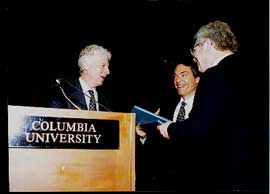
Columbia University Provost Jonathan R. Cole (left) presents Chuck Philips (center) and Michael Hiltzik (right) with the 1999 Pulitzer Prize for Beat Reporting.
Winning Work
Chief executive C. Michael Greene has made the awards show a blockbuster. But critics question his high pay, personal style and allocation of academy's charity funds.
By Chuck Philips and Michael A. Hiltzik
Times Staff Writers
In 10 years, C. Michael Greene has transformed the Grammy Awards from a minor industry ritual into the global television event airing Wednesday night before an audience of 1.5 billion.
Along the way, the 49-year-old Greene, chief executive of the National Academy of Recording Arts and Sciences, has transformed himself into one of the most powerful and controversial figures in the music industry. Once a struggling Atlanta saxophonist, Greene now lives in a $1.5-million Malibu home and has top industry executives fighting for his attention.
But he is also drawing increasing criticism for running the academy almost as a personal fiefdom, for his lavish style and for his erratic public behavior.
Although Greene relentlessly promotes the nonprofit academy's charitable endeavors as central to its purpose, public records show that in at least one key area the organization has spent less than 10% of every donated dollar on assistance to indigent, unemployed and infirm musicians--a fraction of what the organization spends on administrative expenses. Although Greene characterizes his own work as a "labor of love" and a "mission," he is paid more than many corporate executives and more than the heads of nonprofit entities hundreds of times the size of the academy, known as NARAS.
Few recording executives are willing to challenge Greene in public, in part because he and his deputies decide which acts receive coveted performance slots on the annual Grammy telecast--worldwide exposure that could be worth millions of dollars in album sales. (Voting for the awards is supervised by an outside auditing firm to guard against manipulation.)
Greene contends that he has become the focus of criticism because the Grammys' success has bred resentment.
"I am totally the lightning rod," he said in an interview with The Times. "I totally have a target on my back, and I'm not whining about that. When I'm personally attacked I have to take comfort in just one thing: that none of that is ever true."
In a monthlong investigation of Greene's stewardship of the Santa Monica-based recording academy, The Times has learned that:
* NARAS' charitable efforts, which lend philanthropic luster to the organization's image, are saddled by high overhead. Better Business Bureau guidelines generally recommend that charities should allocate no less than 60% to 70% of their revenues to programs. One of the group's philanthropic arms spends three to four times as much on administration and fund-raising as it disburses to the needy.
* While Greene speaks out against music that degrades women, he and his organization have been the target of complaints of sexual harassment. NARAS has settled two harassment and discrimination claims by former workers; three others allegedly received extended severance packages or out-of-court settlements after making similar accusations. Greene denied any wrongdoing. Last year, the recording academy's board called for an investigation into allegations of sexual harassment against Greene. The internal probe cleared him of all charges.
* Greene last year pitched a recording of his own music to record executives whose acts were up for performance slots in the Grammy telecast--often in the course of meetings about the awards. The record was bought by Mercury Records for about $250,000; Greene has pledged to donate his portion of any royalties or profits, after expenses, to charity.
* Although Greene asserted in an interview with The Times that NARAS operates on a budget "as tight as it can be," his own pay for fiscal 1995-1996 was $757,000, with expenses and fringe benefits worth another $55,000, public records show. His job perquisites include a leased Mercedes sedan and an annual membership in the exclusive Bel-Air Country Club.
For fiscal 1996-97 Greene received a raise in the form of a bonus tied to the more than five-year sale of Grammy telecast rights to CBS for $100 million. The exact size of the bonus is not publicly available and NARAS declined to disclose it. Two sources said that it could come to as much as $1 million or more.
* * * * *
There is no question that Greene has presided over a period of tremendous growth at the recording academy since his ascension to chief executive in 1988. That year, the organization had 14 employees, 3,500 members, and assets of $4.9 million. Currently, according to figures the academy provided to The Times, it has 78 staffers, 12,500 members, and $38 million in assets.
Greene, the son of a big-band leader from Atlanta, broke into the music business in the 1970s as a saxophone and keyboard player. After recording two poorly received albums, he worked in recording studios and cable TV stations, joining NARAS in 1985 as an unpaid Atlanta chapter president.
During his tenure, the telecast rights to the show have steadily risen in value to this year's $20 million. The cost of the show has also increased. The latest figures suggest that the production costs are more than $6.3 million. Industry sources say that figure is nearly double what it costs to produce such competing telecasts as the American Music Awards and the MTV Awards.
In the past four years, Greene has orchestrated the purchase of offices in Santa Monica, New York and Nashville. Greene also has plans to build a Grammy Hall of Fame in Memphis.
"Mike Greene has completely transformed the face of the Grammy organization," said music industry legend Ahmet Ertegun, founder and co-chairman of the Atlantic Records Group. "He turned it from a tiny little blip on the map into a giant international success. I think he is fabulous."
Leslie Moonves, president of CBS Entertainment, which will broadcast the ceremony, agrees.
"He turned that sleepy organization into one of the most powerful organizations in the country," Moonves said. "I know Mike is a controversial guy. He's not afraid to speak his mind and he's a tough negotiator. I think what Mike has now done in terms of public service with MusiCares and the Grammy-in-the-Schools charities is extraordinary."
Greene's personal style has sometimes become an issue. Earlier this month, industry leaders were dismayed when he reportedly berated and threatened a deputy of Rudolph W. Giuliani, the mayor of New York, the host city of this year's Grammys.
* * * * *
"I was shocked by Mike Greene's behavior," Giuliani said in a telephone interview. "I don't know if this reflects the view of the board of NARAS, but to be honest, I think they should've taken more decisive action with regard to his abusive behavior."
"It doesn't make anyone in the record industry look or feel good that one of our leaders is the subject of so much controversy," said Hilary Rosen, chairwoman of the Recording Industry Assn. of America, the leading industry trade group. "I don't know all the facts about what has gone on [but] in my opinion, it is the job of the board of directors to hold their chief executive accountable to ... their membership."
Greene formally serves at the pleasure of NARAS' 40-member board of trustees, which consistently supports him and ordinarily meets only once a year.
Greene denies that he threatened anyone.
What is true is that he has been rewarded handsomely by NARAS' unpaid board of trustees.
Greene's level of compensation is among the highest paid to any chief executive of a nonprofit entity in the country. His 1995-96 pay was nearly 25% higher than the $617,000 earned by Harold Williams, the former president of the J. Paul Getty Trust, which owned assets worth $4.5 billion compared to the recording academy's $21.5 million
The top-paid executives of the organizations that sponsor the Oscar and Emmy awards received salaries of $157,000 and $175,000 respectively. But Greene dismissed them as objects of comparison.
"They're associational executive directors," he said. "They're not really chief executive officers." By contrast, he argued, his role is "kind of a unique job" that involved his spending considerable time helping to supervise NARAS' charitable organizations.
As it happens, questions have circulated in the music industry for several years over the contrast between NARAS' charitable revenues and spending--particularly at the MusiCares Foundation, which was established to provide emergency financial assistance, including substance abuse treatment, to indigent or unemployed musicians.
"I don't believe that I or anyone else in the music industry has a clear understanding of where the money goes," said James Fifield, chief executive of EMI Music, a major recording company, and a member of the MusiCares advisory board.
Greene has long touted MusiCares, which provides grants of up to $2,000 a year with a $6,000 lifetime maximum, as one of NARAS' most important efforts.
"There are a few thousand people who are helped by MusiCares' financial grant and assistance program during the course of the year," he said, adding that last year "hundreds" of clients received help in coping with substance abuse.
Although MusiCares does sponsor a program of referrals for substance abusers, documents reviewed by The Times show it has provided financial assistance to only 524 individuals from its founding in 1992 through last November, the latest date for which the records were provided. In most cases the assistance came to $1,000 or less per person.
Over the entire period, MusiCares took in contributions of more than $6.5 million, but paid out $627,000, or less than 10% of its total income, in individual grants. Far larger sums went to cover organizational expenses.
In 1995-96, the most recent year for which a federal tax return is on public file for MusiCares, the charity received $1.72 million in contributions and other earnings and paid out $148,341 in individual grants to 102 individuals. Of the balance, some $978,000 went to organizational expenses, including nearly $500,000 to stage the annual "Person-of-the-Year" fund-raising dinner. Another $393,720 was added to MusiCares' financial holdings, which at the time already totaled $2 million.
Greene said MusiCares would have paid out substantially more if only it had more requests, and that many potential beneficiaries may be reluctant to apply for aid out of pride or concern for their privacy.
"We find that a lot of folks are reluctant to reach out," he said. "Many people, especially people that have made a name for themselves in this business, are very worried about their predicament becoming public information."
One spokesman for the organization said it is attempting to accumulate a war chest for the eventual construction of a residence and convalescent facility for indigent and homeless musicians.
But he acknowledged that no plans, cost estimates, or site exist for such a facility, and that its construction would probably require a government grant. In any event, the goal of building a facility has not been shared with many of the contributors and musicians who help promote the MusiCares program.
Greene's caginess about how MusiCares money is spent has irked, among others, singer Bonnie Raitt, a 1990 Grammy winner who lent her popularity to the charity by agreeing to be honored at its 1992 "Person-of-the-Year" dinner. She refused to attend subsequent events promoting MusiCares until she received documentation of the organization's spending.
Raitt declined to be interviewed, but her manager, Jeffrey Hersh, said it took nearly a year of repeated requests before Greene turned over any documentation to the singer. After reviewing a copy of a recent MusiCares tax form, Hersh said Raitt was disappointed to discover the small percentage of money being doled out.
"Bonnie Raitt agreed to work with this charity because she believed the lion's share of the money raised would go to benefit those in need," Hersh said. "She was told that the money would go directly to help pay for people's rent, food, clothing, health insurance and substance abuse problems."
Hersh said he and his client were shocked at the "reprehensible" disparity between the income and payout at MusiCares.
(A second charity, the NARAS Foundation, finances community music events and other programs, including benefit performances for schools and an embryonic archiving and preservation program.)
Critics also cite the way Greene treats his employees.
More than a dozen former NARAS employees interviewed by The Times contended that Greene has created a "hostile" work environment at the nonprofit organization. Records show that the California Department of Industrial Relations is investigating two stress and harassment claims filed with the Worker's Compensation Board against the academy by former employees.
* * * * *
Last year, more than a third of an estimated 60-person staff at the academy's headquarters in Santa Monica quit or were forced out of their jobs. "Turnover was so great people were taking numbers to get out," said one former employee who is an admirer of Greene. This employee, who asked to remain unidentified, ascribed the turnover to the heavy workload and relatively low pay at the recording academy rather than to inappropriate management behavior.
Greene scoffed at allegations of sexual harassment by several former employees, calling them "scurrilous rumors" disseminated by disgruntled people attempting to tarnish the Grammys' reputation.
"This stuff really irritates me. It's a bunch of lies. Categorically untrue," Greene said. "I have never harassed anyone. No screaming. No touching. This organization has probably one of the best work environments out there. We've got a great record of continuity in personnel."
Several current academy employees referred to The Times by Greene supported his assertions.
Greene and the academy were sued four years ago by a female employee who contended she had been subjected to sexual harassment by the academy's senior vice president, Rob Senn. The suit said Senn repeatedly tried to fondle her, made offensive sexual remarks, and engaged in similar conduct with other workers.
The employee, hired in 1992 as a $55,000-a-year controller, also contended in the suit that NARAS management retaliated against her for insisting that it comply with unspecified IRS reporting requirements and immigration and workplace safety laws.
Senn and the academy denied the allegations and resolved the case with an out-of-court settlement approved by the board of trustees, sources said.
Records show that the academy paid a settlement to resolve another harassment and discrimination complaint filed by a second female employee in 1993 with the state Department of Fair Employment and Housing. That settlement, however, was never disclosed to the board, sources said.
Sources said several other female staff members who threatened to file harassment or discrimination complaints against Greene in recent years were paid the equivalent of three months' salary if they promised to leave quietly. Greene denied that any employees were harassed or received severance packages in exchange for silence.
Last year, the board of trustees called for an investigation into allegations of sexual harassment and financial improprieties. The probe was supervised by two outside attorneys often employed for other legal matters, including the negotiation of Greene's compensation package.
Former academy chairman Joel Katz said the probe concluded that all the charges were groundless.
"They conducted a thorough investigation into every mudslinging charge made against me and none of it stuck," Greene said. "A verbal report was made to the board regarding the investigation at the last annual meeting and I was given a public apology."
This week, while Greene is in New York for the Grammys, he is expected to sign a contract with Mercury Records to release an album of his own songs--from which all proceeds are to be donated to help needy musicians.
The album was recorded over two years with a team of top musicians at some of the best studios in the nation and produced by Phil Ramone, who has since been named NARAS chairman, a nonpaying post. Last summer, Greene provided board members with a copy of the recording and told them he intended to shop it to a major label.
Greene said that he initially distributed the recording to major labels under a pseudonym to get objective feedback. Only after it received raves, he said, did his attorney began soliciting offers for the recording under Greene's name.
But five top record company chiefs said Greene stopped by their offices and personally handed them copies of the demonstration CD--an action some felt inappropriate for the head of the academy.
In December, Mercury Group Chairman Danny Goldberg agreed to sign Greene to his label. Goldberg, who six years ago signed a contract with President Clinton's brother Roger, has promised to contribute all Mercury's profits from the recording to MusiCares.
Goldberg declined to comment, but Greene said he showed no favoritism to Mercury in selecting this year's Grammy performers. Indeed, other companies who rejected Greene's album will have more acts on stage.
During an interview, Greene broke down in tears as he explained his motivations for recording his solo album.
"I am an artist and these are my most personal feelings," Greene said. "This is my most personal gift and I am giving it to MusiCares. I'm sorry I got all blubbery here, but it's just where I come from. You know, when you grow up with a big-band leader for a father and you see all those musicians in your house and you see their dreams broken and you see them die destitute.
"I mean, the music business is unfair and we have had more than a few broken dreams walk into this office since I took over. That's the reason this means so much to me. That's why I am so passionate about it. It's not a job to me. It's a mission."
© 1998, Los Angeles Times
Board member of group that sponsors the awards calls for a review. And a former academy employee says a complaint was lodged with IRS.
By Chuck Philips and Michael A. Hiltzik
Grammy chief C. Michael Greene faced intensifying questions Tuesday about his management of the organization that sponsors the prestigious music awards, as a prominent member of its board of trustees called for a review of the organization's finances.
A representative of a leading nonprofit group in New York also demanded a fuller accounting of the finances of the National Academy of Recording Arts and Sciences, or NARAS, before she turns over $600,000 the group raised to bring the Grammy ceremony to New York this year.
The Times also learned that a former academy employee lodged a complaint this week with the Internal Revenue Service questioning the academy's accounting practices. The former employee filed a report and was told that the complaint would be forwarded to the IRS Criminal Investigation Department.
An article in The Times on Sunday, based on federal income tax filings, court papers and other public documents in addition to extensive interviews with current and former NARAS employees, reported on a variety of controversies surrounding Greene's management of the Santa Monica-based Grammy organization. The article noted that Greene's salary of more than $757,000 exceeds that of many corporate executives and chiefs of other nonprofit, tax-exempt organizations.
It also disclosed that one of the recording academy's philanthropic arms, MusiCares, has consistently spent less than 10% of its income on its principal charitable goal--providing emergency financial assistance to indigent, unemployed and infirm individuals in the music industry--while spending three to four times as much on overhead, fund-raising and other administrative costs.
Greene, preparing for this evening's gala presentation of the 1998 Grammy awards in New York, could not be reached for comment Tuesday. He has denied any wrongdoing, and a spokesman for NARAS said the organization would be sending a letter pointing out a series of inaccuracies in The Times' reporting. But by late Tuesday, The Times had received no such letter.
The trustee calling for the internal review of NARAS is William J. Ivey, who is the director of the Nashville-based Country Music Foundation and chairman-designate of the National Endowment for the Arts. Ivey, a trustee on the recording academy's national board, said from Washington that he and other members of the board of the Nashville chapter intend to call for a review of the issues raised in The Times article.
"In the past, the Nashville trustees have played a leadership role in calling for investigations of allegations about the national office," Ivey said in a phone interview Tuesday. "It is my assumption as a trustee that we will be getting together within a week in Nashville and are likely to take the lead in that kind of action again."
Meanwhile, a representative of New York City Public-Private Initiative Inc., a nonprofit group of 85 business leaders who collected about $625,000 over the last year for the Grammy Host Committee, said she will send a letter to Greene demanding an accounting of where the money will be spent.
"The L.A. Times article that appeared on Sunday raised some concern regarding where the contributions raised by the host committee are actually going to go," said Tamra Lhota, president of the organization. She said the host committee would expect the accounting to cover "where the funds being contributed by the host committee will be going and . . . what programs they will be utilized for. The host committee will also request an accounting for last year's funds. In the event that we do not receive proper documentation from NARAS, I will take up the question with the board of directors as to whether to withhold the funds that we have raised."
Greene was unavailable for comment Tuesday on Lhota's and Ivey's actions. Recording academy Chairman Phil Ramone, an independent record producer, did not respond to calls for comment.
In a statement the recording academy released Monday to other news organizations, NARAS contended that The Times misinterpreted MusiCares' financial records. The statement said the article failed to consider MusiCares' spending on such items as a health insurance program and on a "planned health-care facility."
However, in an interview with The Times during the article's preparation, Greene acknowledged that no national insurance program exists. "In terms of me being able to stand up and say we have a national insurance program, I haven't been able to do that for two years now," he said.
MusiCares and NARAS officials queried about the health-care facility project before the article's publication said, moreover, that no plans, site, schedule or budget have been drawn up for any such facility, and no formal assessment of the need for it has been undertaken.
© 1998, Los Angeles Times
By Chuck Philips and Michael A. Hiltzik
Times Staff Writers
The nonprofit Grammy organization, which has built its reputation for philanthropy on the workings of its house charities, collects a substantial fee from one of those charities for use of the Grammy trademark and logo. The charity, in addition to paying the 18% royalty, also is billed for donors' tickets to the annual Grammy telecast.
In one recent year, the recording academy billed the charity $319,555 for royalties and tickets while contributing $86,922 to the NARAS Foundation. That produced what appears from public records to be a net profit to the academy of more than $232,000 from its own philanthropic enterprise.
The arrangement in which a parent organization--in this case the Santa Monica-based National Academy of Recording Arts & Sciences--charges its own charitable arm for the use of its trademark appears to be unusual in the world of nonprofit organizations. It is unique among the three major performing arts academies, including those sponsoring the Oscars and Emmys.
It also comes as a surprise to many contributors to the NARAS Foundation, which finances educational and benefit programs in schools and public places.
Several donors to the foundation told The Times they were unaware that any portion of their tax-deductible contributions went to the foundation's parent as a licensing fee and that they thought the charge was improper.
"This is the first I've heard of it," said Tamra Lhota, president of New York City Public-Private Initiative Inc., a nonprofit business group that collected about $625,000 over the last year for the Grammy Host Committee, in part for the foundation. "It's bizarre, but in light of the recent Los Angeles Times articles outlining the meager percentage of donations that actually reach the charity, I can't say it's surprising."
A source close to the committee said Public-Private Initiative Inc. is likely to demand that no funds given to the academy be used for a royalty payment.
Disclosure of the royalty fee is the latest in a series of questions to arise about the finances and management of the recording academy under its chief executive, C. Michael Greene.
Greene declined comment Thursday, but has repeatedly said that neither he nor the organization has done anything wrong.
In earlier articles, The Times has disclosed that another academy charity, MusiCares, has spent less than 10% of its revenue over the last five years on its principle charitable function, disbursements of emergency funds on behalf of ill, unemployed or indigent people in the music industry.
The articles also noted that Greene's academy salary of $757,000 in 1995-96 placed him among the uppermost rung of nonprofit chief executives in the country and that he hawked a recording of his own music to record executives during discussions of Grammy matters.
In the aftermath of disclosures by The Times, there have been these recent developments:
* Greene has formally withdrawn the album, for which he had negotiated a $250,000 contract from Mercury Records.
* An Atlanta-based member of the academy board of trustees, singer Tamiko Jones, on Thursday called upon Phil Ramone, chairman of the academy, to hire an independent outside firm to investigate the allegations raised in The Times articles.
"If the academy is to be exonerated, an outside--and I stress 'outside'--and independent investigation is an absolute necessity," Jones told The Times.
* Ramone said the board's executive committee had hired the auditing firm of Deloitte & Touche to review all relevant issues raised in The Times.
"I expect a report soon," Ramone said. "If there was any wrongdoing--and I don't know that there was--it will not be swept under the rug."
Deloitte has a long-standing business relationship with the academy and its subsidiaries. In 1995-96, for example, the academy and its two charities paid more than $304,000 in accounting fees. John Hazard, an academy lawyer, said he believed the bulk of these-- and possibly the entire sum--was paid to Deloitte. A spokesman for the accounting firm declined comment on its fees.
* On Tuesday, Greene received a round of applause after a 20-minute speech at a local board of governors meeting at the academy's Santa Monica headquarters. On Wednesday, the board of governors of the academy's Nashville chapter decided to wait for a report from the executive committee before taking further action.
The royalty arrangement raises new issues about the relationship between the National Academy of Recording Arts & Sciences and its subsidiary charities. It could not be learned, for example, if the size of the fee was subject to negotiation between the recording academy and the foundation, or whether the value of the trademark and logo--a distinctive representation of a vintage gramophone--was independently appraised. Greene serves both as chief executive of the academy and as the foundation's unpaid president.
Academy sources told The Times that the idea to impose the licensing fee originally came from Deloitte & Touche, which serves as financial auditor for both the academy and its foundation.
The 18% trademark fee, according to sources within the recording academy, is also charged against revenue due the foundation from the annual CD compilation of Grammy-award nominees' music. The record, which is produced and distributed on a rotating basis by the six major recording labels, is explicitly marketed to the public as a fund-raising device for the NARAS Foundation. Each copy, for example, bears a label stating that a portion of the album's proceeds "will be donated to the NARAS Foundation Inc., for music education initiatives."
Sources told The Times that income from the record is normally paid by that year's producing label directly to the recording academy. The academy, the sources said, subtracts "overhead" expenses, including the 18% trademark fee, before forwarding the balance to the foundation.
Sources said income from the recording accounts for the bulk of what the academy claims as its annual "cash contribution" to the foundation.
In 1995-96 that sum came to $725,507, according to public tax filings. That same year, however, the academy charged the foundation $357,648 for the trademark and for Grammy telecast tickets to be provided by the foundation to large contributors.
In 1994-95, the recording academy made a contribution of $86,922 to the foundation. But it billed the charity $319,555 for trademark royalties and tickets.
John Hazard, the recording academy's attorney, characterized its royalty arrangement as "common" among nonprofit entities.
"I have examined a number of such licensing agreements, and I find nothing unreasonable with the academy's trademark license with the NARAS Foundation," said Hazard, whose Washington-based law firm represents the academy and hundreds of other nonprofit organizations and foundations. "In fact, I think the academy's trademark license arrangement is quite advantageous for the foundation."
When asked to provide the name of another client with a similar arrangement, however, Hazard declined to do so.
Hazard said he believed that the academy uses the Grammy logo and license deal as part of its sales pitch when trying to raise funds from sponsors. But representatives from several major record companies that have donated hundreds of thousands of dollars in recent years to the NARAS Foundation said on Thursday that they had never heard of the 18% logo licensing fee.
The foundation typically raises money from a number of sources, including other charitable entities and corporations wishing to co-sponsor Grammy events.
One such contributor was the Recording Industries Music Performance Trust Fund, which was established by music unions to pay musicians to appear at benefit concerts around the country. The fund collects from record companies a fraction of a cent for every CD sold in the U.S.
The fund contributed $500,000 in 1995 to the foundation to co-sponsor its "Grammy Showcase," a touring act of little-known rock bands. Of that sum, $75,000 was collected by the recording academy for its royalty.
John Hall, the fund's trustee, said in an interview with The Times that he understood in advance that the royalty would be charged. "I was not happy with the idea," Hall said. Nevertheless, he said, he acceded to the academy's demand because he thought the co-sponsorship would give the trust fund a much-needed publicity boost.
He said in subsequent years the trust fund has sharply cut back its contributions to the NARAS Foundation--to $80,000 in the most recent year--and that it no longer agrees to pay the licensing fee.
© 1998, Los Angeles Times
By Chuck Philips and Michael A. Hiltzik
Times Staff Writers
Breaking new ground in the nonprofit world, the Grammy organization last year awarded its chief executive, C. Michael Greene, an unusual bonus of $707,810--nearly doubling his annual compensation to $1.5 million.
Greene's salary, benefits and bonus, which were approved by the 41-member board of trustees of the National Academy of Recording Arts and Sciences, or NARAS, appears to make him the highest-paid nonprofit organization executive in the country last year--with total compensation that handily outstripped that of the heads of the nation's top universities, museums and entertainment industry trade groups.
The bonus came in a year in which MusiCares, one of the academy's two public charities, spent roughly 12 cents of every dollar it earned in revenue on grants to needy individuals--its primary charitable purpose. Greene is the charity's unpaid president.
Greene's compensation raises new questions about the recording academy's management. These include whether the board is sufficiently independent from Greene, who has dominated the academy's management since he became its chief in 1988.
Tax and management experts say that given NARAS' relatively small size and asset base, Greene's compensation could run afoul of federal tax rules prohibiting excessive compensation of executives at nonprofit organizations.
NARAS took in $33 million in revenue in the year ended July 31, 1997, and reported assets of $23.8 million. By comparison, the Academy of Motion Picture Arts & Sciences, which sponsors the Oscars, reported $26.4 million in revenue and $62.1 million in assets for the same year--but its highest-paid executive received $200,000 in compensation.
Greene's compensation outstripped that of the entertainment industry's most prominent nonprofit organization executives--Jack Valenti, chairman of the Motion Picture Assn. of America, and Hilary Rosen, chairman of the Recording Industry Assn. of America, industry trade and lobbying arms. Both executives earned about $1.1 million last year.
Greene's bonus is believed to be the largest ever paid to the head of a U.S. tax-exempt organization, according to professionals familiar with nonprofit accounting.
"As far as I know, a bonus of this size is unprecedented in the nonprofit world," said Stacy Palmer, editor of the Chronicle of Philanthropy, which monitors the compensation of nonprofit executives.
Greene declined to discuss the formula used to calculate his compensation.
In written answers to a list of questions, the organization's executive committee said details of Greene's contract are confidential.
"The Board of Trustees is delighted with Mr. Greene's performance," the committee stated, "and his compensation reflects their strong support."
But it said Greene's pay package was not based on any study of performance bonuses granted to chief executives of other similar organizations--even though many tax experts recommend that nonprofit boards regularly survey salaries at comparable organizations to determine reasonable levels of pay for their own top officials.
"I think this board of trustees needs to take a hard look at the process by which they determined their CEO's compensation arrangement," said Judith O'Connor, president of the Washington-based National Center of Nonprofit Boards.
Federal law prohibits executives of tax-exempt organizations from receiving excessive compensation. More specifically, the tax code prohibits any action that could be interpreted as running such an organization for any individual's personal benefit.
The potential penalties for abuses of the rules include revocation of an organization's tax-exempt status. The Internal Revenue Service also has the authority to fine individuals and board members a significant percentage of the sum deemed excessive.
Defining when an executive's compensation becomes "excessive," however, has traditionally been tricky for the IRS. The agency is generally more tolerant of salaries and benefits at so-called business leagues, or trade groups such as NARAS, than at charitable organizations that raise money from the public. One reason is that individual contributions to the latter are tax-deductible, but funds donated to the former are not.
Still, IRS regulations prohibiting tax-exempt organization executives from unfairly benefiting from their positions apply equally to both categories.
Moreover, NARAS is the parent organization of two charities of which Greene is president. Greene receives no salary or benefits directly from the charities, the NARAS Foundation and MusiCares. The academy, however, does charge both charities for rent and office services at its Santa Monica headquarters building and, in the case of the foundation, an 18% fee for the use of the Grammy trademark.
The organization's latest public filings, covering the year ended July 31, 1997, also reveal:
* MusiCares has continued its pattern of spending only about 10% of its annual revenue on actual grants to needy musicians and other individuals. In the year ended July 31, 1997, the charity recorded $1.73 million in income, according to its audited financial statements and public tax return. It spent $204,655, or 11.8%, on direct grants to needy individuals. The grants typically cover expenses ranging from utility bills and pawnshop loans to the costs of drug treatment and hospital care.
Among MusiCares' other spending was $615,985 in expenses associated with the annual Person of the Year fund-raising dinner--about half the affair's gross take of $1.29 million; $88,627 on other fund-raising; and $42,720 in grants to other charitable bodies.
* The NARAS Foundation, which sponsors concerts and music programs for disadvantaged youths, was charged $553,248 by the recording academy for use of the Grammy trademark--a licensing fee unusual in the charitable world. The academy contributed about $2.17 million to the foundation--most of it from the proceeds of an annual anthology album released by the academy.
In February, the California attorney general's office notified the IRS of its concerns about the size of Greene's compensation after a series of reports in The Times. Grammy officials told The Times this week that they have not been contacted by the government.
Despite the controversy surrounding Greene's compensation, the board voted unanimously at its annual meeting in May to extend Greene's contract two more years.
This summer, the academy issued fresh copies to board members of its book of "leadership principles," which, among other things, bans them from having any contact with the media under threat of legal action. The principles say any trustee caught disseminating unauthorized information to the media can be terminated and sued for financial damages.
The executive committee this week said the conduct code was designed by their legal counsel, John Hazard, and ratified in 1997 by the board of trustees.
© 1998, Los Angeles Times
Programs for drying out in swank settings are typically ineffective and sometimes illegal. One Beverly Hills doctor defends his high-priced service.
By Chuck Philips and Michael A. Hiltzik
Times Staff Writers
By almost any measure, the heroin addiction treatment a prominent rock star underwent earlier this year was unorthodox.
For one thing, it took place not at a licensed clinic but at the Peninsula Hotel, the five-star center of Hollywood deal-making located in the heart of Beverly Hills. For another, the patient was spotted during the course of treatment ordering a Jack Daniels at the hotel bar.
Although the opiates used for treatment were supposed to be securely locked in a safe in the hotel room, the patient said he had no trouble gaining access to them at will.
Finally, the treatment was woefully ineffective. Within weeks the rock star, who spoke with The Times on condition that he not be named, was undergoing heroin detoxification again.
As unconventional as the star's weeklong sojourn at the Peninsula might have been, it was not unique.
So-called "hotel detoxes" at the Peninsula, the Four Seasons and other Westside luxury hotels have become a lucrative practice for physicians catering to the entertainment industry's rich and celebrated.
Hotel detox is flourishing even though state medical authorities say it is illegal in many cases and experts in the field say it is almost guaranteed to fail. Its availability and popularity highlight one reason why an enduring drug problem afflicts some of Hollywood's prominent executives and stars--people with the wherewithal and power to set the terms of their own treatment, often to their own disadvantage.
Among them: rock star Kurt Cobain, who underwent at least two unsuccessful hotel detoxes before succumbing to a long-standing heroin addiction and committing suicide in 1994, and film producer Don Simpson, who was detoxed five times at his Bel-Air estate before dying of an overdose in 1996.
In scores of interviews with chemical dependency experts, entertainment industry sources and former drug addicts, The Times found that a small group of physicians has been using Los Angeles' most luxurious hotels to detox celebrity addicts since the mid-1980s, when the practice was pioneered by maverick addiction specialist Dr. Robert P. Freemont.
Over the last few years the white limestone Peninsula Hotel, at Wilshire and Santa Monica boulevards, has won a reputation as the cushiest place in town to try to kick a drug habit.
That is largely the work of David A. Kipper, a Beverly Hills internist whose Lasky Drive office faces the hotel's rear entrance. Kipper, who treated the anonymous rock star, told The Times that he has conducted 100 such procedures at the hotel in a span of 24 months, weaning patients from a variety of addictive substances ranging from prescription painkillers to heroin. (In a follow-up letter he amended the claim to 40 procedures.)
State authorities say that conducting drug detoxification in an unlicensed facility such as a hotel violates the state health and safety code. State law also prohibits the use of an opiate to detox narcotic addicts--a rule flouted by Kipper, who told The Times he uses the synthetic opiate buprenorphine to wean his patients from heroin.
"I would bet it's not completely legal," Kipper said in an interview at his office. "But it's a gray area, and the reality is, it works."
Kipper said he has kept the Peninsula management fully apprised of what he does. But the hotel's management and owners said Kipper never told them he was conducting a medical procedure on the property. After inquiries by The Times, the Peninsula said it had "put a temporary freeze on all doctor-referred patients until we can better understand this situation."
Kipper's fee, from $10,000 to $19,000 per week of treatment (not including the hotel rate of up to $800 a night per room), is exorbitant by the standards of addiction medicine. It is several times the rate charged by such nationally recognized clinics as the Betty Ford Center in Rancho Mirage and Arizona's Sierra Tucson for programs combining detoxification and weeks of rehab therapy.
Kipper said the fees are high in part because his program is administered by an exceptionally qualified and costly staff--and that the steep price has some therapeutic value.
"I work in a community where people pay top dollar," he said. "My detox program is probably the most expensive one in the city." Addicts under treatment, he added, need to have the consequences of their behavior brought home to them. "There has to be a price to be paid. I hate to see that it is financial, yet that is one way to make people wake up and pay attention."
Entertainers Can Be a Challenge to Treat
But other addiction experts criticize Kipper's program for its expense and setting.
"It's outrageous to charge a patient so much money simply to detox them--no matter how rich they are," said Dr. Drew Pinsky, medical director of the chemical dependency program at Las Encinas Hospital in Pasadena.
"To feed an addict's need for special treatment with such pomp and circumstance is counter-therapeutic," he said. "From an ethical point of view, it seems to be taking advantage of people who are desperate to get better, people who are trying to hide their illness and not confront the painful reality of their disease."
There are no statistics showing that drug and alcohol addiction afflicts entertainment figures more than the population at large. But treating them can present unusual problems. Stars often have the money and power to fend off therapy or to insist on setting the terms of their treatment. Their money and prominence may also expose them to greater temptation than the average person, said some Hollywood veterans.
"Entertainers can get away with anything they want," said Danny Sugerman, former manager of The Doors rock group and a recovering addict himself. "And the successful ones have unlimited funds. On the road the temptations and expectations create more pressure. That's why relapses are so common."
Prominent stars and executives also commonly surround themselves with teams of "enablers"--friends and employees inclined to satisfy their whims. This coterie sometimes includes star-struck medical professionals willing to overprescribe dangerous and addictive drugs.
Others say the relentless pressure from entertainment corporations to meet deadlines for production and touring can make it difficult or impossible to fulfill the six- or nine-month rehabilitation commitment that experts say is necessary to have a strong chance of staying sober.
"Celebrities want to go through detox and go back to work," said Dae Medman, executive director of the Sherman Oaks-based Entertainment Industry Referral and Assistance Center, which works with studios and unions to help employees overcome chemical dependency. "They're not provided the opportunity for rehabilitation."
The result is a "quick-fix" mentality that places a high premium on detoxification--a "drying out" process over several days that cleans drugs out of an addict's system but fails to address the underlying causes of addiction as a disease.
Most experts agree that successful rehabilitation depends on an effective detox and on providing the recovering addict with a secure environment free from temptation and with sustained psychological support.
"People don't understand that drying out is easy," said Dr. Max A. Schneider, professor of psychiatry and human behavior at UC Irvine and past president of the American Society of Addiction Medicine. "The hard part is not getting wet again."
Treatment Pioneer Known as a Maverick
Experts are divided over whether treatment should include a punitive or humbling element to give addicts an incentive to avoid further drug use or whether it is more humane for treatment to proceed in the least painful and most comfortable environment possible.
The humane argument was one rationale behind Freemont's work in hotel therapy.
Freemont, who ran the chemical dependency unit at Beverly Hills Medical Center before his death in 1993, sought to develop a painless and discreet alternative for celebrity patients who refused to enter conventional drug rehab. He established a reputation in Hollywood as a maverick addiction specialist offering a way to wean celebrities off heroin while protecting their anonymity.
By the early 1990s, Freemont had detoxed a string of rock stars at such hotels as the Beverly Prescott and the Chateau Marmont. Many of his patients returned as repeat customers after their initial treatment failed, sources said.
Former Three Dog Night singer Chuck Negron said Freemont's program failed to help him kick his habit.
"They detoxed me and then sent me out on the road with different medications that were legal," Negron said. "At one point, I ended up having a bigger habit on the prescription stuff than when I first checked in. Freemont had this prescription cocktail, and when you got excited they would hold you down and give you a shot. And let me tell you, that shot was better than any dope I ever scored on the street."
In 1993, the Medical Board of California charged Freemont with gross negligence and unprofessional conduct for allegedly overprescribing drugs--including buprenorphine--and administering medications without proper follow-up exams. He died before the board finished its investigation, and the case was dismissed.
The hotel detox business was then taken up by several Westside physicians who checked celebrities into such high-end hotels as the Four Seasons, Nikko, Century Plaza, Miramar Sheraton and Beverly Hills Hotel, sources said. The hotels were unaware that addicts were being detoxed on their premises, according to doctors and hotel managers.
The physicians include Michael Horwitz, former head of Cedars-Sinai Medical Center's chemical dependency unit; Michael Meyers, former medical director of Brotman Medical Center in Culver City; Milton Birnbaum, director of addiction medicine at Steps rehabilitation center in Oxnard; and Stephen Patt, an internist who detoxes addicts for the Promises treatment center in Malibu.
These doctors said they employed the treatment in their private practices and only as a last resort to help a patient who adamantly refused to enter a hospital or licensed rehabilitation center. None of them charged more than $1,000 per day (including the hotel room) and none used buprenorphine for detox, sources said.
Some of the doctors have supervised hotel detoxes recently. Birnbaum and Patt told The Times they found the technique ineffective, especially when compared with comprehensive detox and rehabilitation programs at well-supervised clinics.
"It's much safer to detox somebody in a hospital," Birnbaum said. "The controls in a hotel are not good. The patient could have a seizure. They could have a heart attack or have someone bring them drugs. I've had addicts literally get up and leave the hotel room--despite nurses being in attendance--and go out and cop heroin in the lobby."
Said Patt: "The only thing positive I can say about hotel detoxes is that sometimes they act as a steppingstone to a later detox at a licensed inpatient facility."
Kipper has embraced the hotel method. The 50-year-old UCLA-trained internist, who took over the practice of the late Dr. Elsie Giorgi, a well-known physician-to-the-stars, began checking addiction patents into the Peninsula in 1996. He said about half his addiction treatments are for heroin; most of the rest are for prescription drug addictions, with a handful for alcohol.
In the anonymous rock star's case, Kipper prepared a contract identifying his service as the PENN Project, a term he said specifically referred to the Peninsula. A copy examined by The Times covered a 14-day detox for a fee of $38,360, including $18,000 for Kipper's medical services, $17,360 for 24-hour nursing and $3,000 for "support staff and administrative." The hotel room was extra. The treatment ended up being extended for six weeks, covering several attempts at detox. Kipper billed the patient about $90,000 before it was over, sources said.
Kipper said the contract covered two weeks during which the star was on a maintenance program to keep him off heroin. The doctor said the case was unique, describing the entertainer as "the most recalcitrant patient we've ever treated."
The cost varies from patient to patient, Kipper said, depending on how many nurses, counselors, therapists and other professionals he employs to help conduct the detox. Typical charges run from $10,000 to $14,000 a week, but can go as high as $19,000, he said. Despite the price, Kipper said his treatment method is so popular that during one week this year he was detoxing four addicts in separate rooms around the Peninsula.
Kipper said his program includes round-the-clock nurse supervision as well as visits from a psychiatrist, a physical therapist and a group of recovering addicts who are invited to encourage the patient to enter a rehabilitation program. In some cases, he also brings in a nutritionist, an acupuncturist and an art therapist to aid a patient's progress.
Candy Finnigan, a certified drug counselor who works with Kipper, said his program is unique in the detox field.
"I don't think Dr. Kipper is ripping anybody off," she said. "This isn't just a spin-dry approach where he's shoving people in there and then hanging them out to dry. This man is a dedicated professional. I find not a flaw in his commitment."
Some patients have responded well to his treatment. One is Karen Rosenthal, a businesswoman whose history of migraines had left her addicted to a wide range of painkillers.
After rejecting a counselor's suggestion that she check into a rehabilitation clinic, she turned to Kipper with the request that he supervise her detoxification during a weeklong stay at the Peninsula with 24-hour nursing care. She said that the program was a success and that she has stayed off drugs for the last 18 months.
"Without his intervention, I probably would have died," she said.
'Not Doing Anything Avant-Garde'
The rock star who ordered Jack Daniels at the hotel bar, however, told The Times he thought Kipper's program was ineffective and too costly.
He said he relied on Kipper's representation of himself as an expert in addiction medicine but now questions whether the doctor might have taken advantage of him, "considering the vulnerable state that I was in when I entered the program."
As a licensed physician, Kipper can legally conduct conventional detoxification therapy, but some experts in the field say those with addicts under their care should be specially trained and certified by the American Society of Addiction Medicine. The country's leading organization of addiction experts, it certifies those who pass a test demonstrating familiarity with the latest clinical developments in the field.
Asked in an interview whether he was certified by the society, Kipper replied, "I'd have to say no, because I don't know what it is."
Kipper argues that in his treatment program "we are not doing anything avant-garde." He said he treats narcotic addicts with intravenous solutions of dextrose and vitamins, followed by detoxification with a combination of drugs--including buprenorphine, clonidine and depacote. He said he will not agree to start the treatment unless the patient agrees in advance to enroll in a rehabilitation program for at least 30 days after treatment.
"Detoxing people is a very separate issue than getting people to stay sober," Kipper said. "They are really two very different parts of the puzzle. I focus on the detox part and then, depending on who they are and what they need, I send them to a variety of places such as Betty Ford and Sierra Tucson."
Kipper, who said he has been practicing internal medicine in Beverly Hills for more than 25 years, said the detox program is only one aspect of his medical practice. He said none of his detox patients has ever experienced a medical emergency at the hotel.
Shifting Definition of Success in Program
Kipper told The Times in an interview that his program has a 70% success rate, which he defined as patients having no relapses for a year. In a follow-up letter, he said, "We consider a detoxification successful only when patients are admitted and maintained in a treatment facility for one month after leaving our supervision," a much less rigorous standard.
"Ninety days [of treatment] keeps cropping up as a critical threshold," said Dr. Norman Hoffmann, an associate professor of public health at Brown University who has conducted a study of 15,000 alcoholism and drug addiction patients. "Anything less than three months is essentially useless."
Hoffmann said he found implausible Kipper's claim that 70% of his patients stayed clean for a year.
"Maybe if all his patients are airline pilots, who are highly regulated, closely scrutinized, and have a hell of a lot to lose," he said. Among a population of affluent entertainment professionals with largely unstructured daily lives, "I'd believe that figure as soon as I'd believe in Santa Claus or the tooth fairy."
Hoffmann said 65% of patients undergoing weekly counseling for six months after detox remain drug-free for at least a year.
Hotel detox programs raise several concerns for state medical authorities.
The California Uniform Controlled Substances Act specifically forbids treatment for narcotic addiction anywhere but in a hospital or a facility approved by the state Department of Health Services.
"There is a reason we have licensed chemical detoxification programs in this state," said Marc Gonzalez, a supervising investigator with the state medical board. "Strict protocols must be followed in a controlled environment by qualified people who know how to properly treat potentially life-threatening withdrawal symptoms--and that doesn't come in a hotel room. Hotel rooms do not fall under the law."
Gonzalez added, "Based on my interpretation of California law, it is not appropriate to detox someone from heroin or any addictive prescription drug except in a licensed facility or a physician's office."
Officials said the law also prohibits doctors from detoxing a patient at a residence, where experts say an addict may be able to exert even more control over his treatment than at a hotel. The dangers of home detoxification came to light after the 1996 overdose death of producer Simpson.
The medical board has since filed an accusation against Westside psychiatrist Dr. Nomi J. Fredrick for overprescribing drugs to Simpson and for helping to maintain and operate an "unlicensed chemical detoxification program" at Simpson's Bel-Air home. That program ended in 1995 when another physician involved in the treatment was found dead of a morphine overdose in the producer's pool house. Simpson died six months later from an overdose of 21 drugs at the same residence.
Moreover, state and federal law closely regulates the conditions under which doctors can administer opiates to narcotic addicts.
Although treating heroin addiction with buprenorphine is an accepted practice in Europe, it is not legal in the United States, where the drug can legally be administered to addicts only for pain relief, not for detoxification, except in clinical trial settings.
In a Sept. 14 letter to The Times, Kipper said that buprenorphine is used "specifically for heroin detoxification and remains the standard for therapy for treating acute opiate withdrawal." On Friday, however, Kipper told The Times that he was careful to record on the patient's medical chart that he was prescribing the drug for pain relief--the only legally permissible application.
"You don't write down in the chart that you are giving [buprenorphine] for detox," Kipper said. "You write down in your charting that you are using it for pain management. However the semantics are written, it keeps these guys comfortable and keeps them from drug seeking."
Offering a 'Safe, Not a Sterile, Environment'
How well informed the Peninsula and its staff were of Kipper's activities is unclear.
The hotel's general manager, Ali V. Kasikci, told The Times in an interview that he had the impression Kipper was checking patients into the hotel for preoperative comfort and postoperative recuperation--as many other local physicians do with affluent patients facing surgical procedures.
"I was shocked and disappointed to learn that physicians in this community would engage in any alleged unauthorized practice at the hotel," he wrote in a letter to The Times. "We have asked our attorneys to look into this matter, and to take whatever legal action is necessary to prevent any further use of the Peninsula's facilities or name associated with this practice."
He said Kipper has been instructed not to refer any further patients to the hotel until the Peninsula can investigate the legality of his program.
Kipper told The Times that security officials at the hotel were specifically notified of the location of each of his detox patients. On at least one occasion, he said, he arranged for the bartending staff to be instructed not to serve liquor to a patient.
A nurse who worked with Kipper's patients said she believed the activities were well-known to the staff. "The front desk recognized most of the nurses," she said.
Kipper said the hotel had even furnished him with a key to its back door. But Kasikci said Kipper is not authorized to use a hotel key. "It won't matter if he does have it; the locks will be changed in two hours," he said Thursday.
Another element of Kipper's program that draws skepticism is allowing patients to use such hotel amenities as the spa and pool, where they can come into unregulated contact with other guests. That violates accepted wisdom in the field that addicts in treatment should remain in a sequestered environment where they can obtain psychosocial support from experienced professionals and avoid the temptation to backslide.
But Kipper insisted that he maintains an appropriate level of security for his patients. "I want to keep them in a safe, not a sterile, environment," he said.
Although Kipper has never advertised his treatment program, he said demand is so great that he turns patients away. "There is a reason why we are so successful and busy," he said. "It's because we have the best program out there."
Detox, Hollywood Style
Experts in the addiction field say that successful drug treatment has several key elements and detox programs conducted in luxury hotels generally don't meet those standards.
Accepted Care Standard: Safety
Doctor certified by American Society of Addiction Medicine and other qualified personnel on site with access to proper equipment to treat patient in case of a seizure, heart attack or other medical emergency.
Hotel Detox: Safety
No emergency medical equipment on site. Patient is monitored by nurses around the clock, but doctor must be contacted by pager and rely on paramedic response in case of emergency.
* * *
Accepted Care Standard: Environment
Manipulative addicts are isolated from access to drugs and alcohol. Facility screens out individuals who might bring drugs to addicts during visits.
Hotel Detox: Environment
Addict has access to visitors who can bring in drugs and is often free to mingle with guests in an environment where alcohol and other temptations are available.
* * *
Accepted Care Standard: Aftercare
Rehabilitation program is based on 12-step philosophy requiring interaction with other addicts in recovery; no patient is given special treatment. Most of the patient's 30-day stay is spent in counseling sessions and group meetings designed to address the psychological components of addiction disease. Counseling may continue for months.
Hotel Detox: Aftercare
Patient choses whether to continue in aftercare program to address psychological aspects of the disease. Special, private treatment in a luxurious atmosphere that can be easily manipulated by the patient.
* * *
Accepted Care Standard: Daily Regimen
Patient is placed on a highly structured daily schedule requiring exercise and specific housekeeping and other duties. Patient is regularly escorted to AA meetings in the community.
Hotel Detox: Daily Regimen
Individually designed program varies in structure. Patient has option to quit or leave at any time.
The Cost of Drug Treatment
Dr. David Kipper: $10,000 to $19,000 a week (not including the cost of the hotel room, which can run up to $800 a day) for detox alone.
Malibu Promises: $24,000 for 30 days, including detox and rehabilitation.
Sierra Tucson (Arizona): $20,000 for 30 days, including detox and rehabilitation.
Betty Ford (Rancho Mirage): $12,100 for 28 days of recovery, not including detox.
Steps (Oxnard): $10,000 for 30 days, including detox and rehabilitation.
Impact (Pasadena): $4,500 for 30 days, including detox and rehabilitation.
© 1998, Los Angeles Times
Possible violations include use of unlicensed facility and prescription of opiates to treat addicts. Physician declines to comment.
By Chuck Philips and Michael A. Hiltzik
Times Staff Writers
Kipper said his program is safe and has a 70% success rate, which he defined as having patients admitted and maintained in a treatment facility for one month after leaving his supervision--a dubious standard, according to experts.
The enforcement arm of the California Medical Board is investigating whether a doctor violated any laws by detoxing heroin addicts at the Peninsula Hotel in Beverly Hills, sources said.
The probe follows an article published last month in The Times focusing on so-called hotel detoxes at the Peninsula and other Westside luxury hotels--a lucrative practice for a small group of physicians who cater to the entertainment industry's rich and celebrated. In the article, Dr. David A. Kipper said he had detoxed about 20 heroin addicts at the Peninsula and conceded that his detox program--which included the use of a synthetic opiate, buprenorphine--might not be "completely legal."
A series of Westside physicians over the past 18 years have used some of Los Angeles' most luxurious hotels to wean wealthy addicts off drugs while protecting their anonymity. Experts contend that hotel detoxes are unsafe and often fail because they allow addicts to set the terms of their own treatment, often to their own disadvantage.
State authorities say that conducting drug detoxification in an unlicensed facility such as a hotel violates the state and health safety codes. State regulations also prohibit the use of any opiate--including buprenorphine--to detoxify narcotic addicts.
"The major problem that this doctor seems to face is with the regulations that govern the treatment of opiate addicts with an opiate in a nonlicensed facility," said Dr. Michael Miller, chairman of the quality improvement committee of the American Society of Addiction Medicine.
Investigators for the state medical board declined to comment Thursday. Board investigations, which often take more than a year, can result in criminal prosecutions. More commonly, when a doctor is determined to have violated state medical standards, the board deals with the case administratively or seeks license revocation.
Kipper, a Beverly Hills internist whose Lasky Drive office faces the Peninsula's rear entrance, declined to comment Thursday.
Last month, Kipper told The Times that he had kept the Peninsula management apprised of his activities at the hotel. But the hotel's management and owners said Kipper never told them he was conducting medical procedures on the property.
Ali V. Kasikci, the general manager of the Peninsula, said Thursday that the hotel had not been contacted by state investigators.
"The Peninsula has been an innocent bystander in all of this," Kasikci said. "These detoxes were being done covertly without our knowledge. The instant it was brought to our attention, we stopped doing business with Dr. Kipper."
Earlier this year, one rock star detoxed by Kipper was seen ordering a whiskey at the Peninsula bar during the course of his treatment. The rock star, who spoke with The Times on condition that he not be named, said he had no trouble gaining access to the opiates used for his treatment, even though they were supposed to be locked in a safe in the hotel room.
Kipper said that case was unique, describing the entertainer as "the most recalcitrant patient we've ever treated." The rock star underwent Kipper's treatment three times in two months but failed to stay off drugs.
Kipper said his program is safe and has a 70% success rate, which he defined as having patients admitted and maintained in a treatment facility for one month after leaving his supervision--a dubious standard, according to experts. Kipper charges $10,000 to $19,000 per week for detoxification (not including the hotel rate of up to $800 a night per room)--about four times the rate charged by several nationally recognized treatment clinics.
Despite its cost, Kipper said his treatment method is so popular that during one week this year he was detoxing four addicts in separate rooms around the Peninsula.
This week, another Beverly Hills physician, Dr. Stephen Scappa, told The Times that he too has detoxed wealthy addicts at the Peninsula. On Thursday, the hotel's management said it had no knowledge that Scappa had conducted detoxes on the premises.
In an interview, Scappa said he and his partner, drug counselor John Citro, have detoxed more than 150 drug addicts and alcoholics on an outpatient basis around Los Angeles over the past 16 years. Scappa, who is a certified addiction psychiatrist, said less than a quarter of his detoxification treatments were for heroin.
Scappa said he has conducted the bulk of his detoxes at patients' homes, but has detoxed a number of addicts at the Peninsula--which is located about a block from his Wilshire Boulevard office. Scappa said he typically charges about $10,000 for a weeklong detox, but has charged as much as $8,000 a day under "extraordinary circumstances."
"I work with a population that is wealthy, and my approach is very unique and very successful," Scappa said. "I take a different tack than most of the guys doing outpatient detoxes. They are internists. As a psychiatrist, my emphasis is on a comprehensive treatment that includes psychotherapy, psycho-pharmacology and environmental management."
Scappa said that although he starts with a detox in a hotel or home, his program concentrates primarily on long-term psychiatric treatment of patients with substance abuse problems. Scappa, who typically charges $240 per hour, says his detox patients generally consult with him three times a week for more than a year--sometimes as often as twice a day in the early stages of treatment.
Scappa said his methods complied with state laws. He said addicts in his program are admitted as patients in a local methadone clinic, through which they are legally prescribed methadone on an outpatient basis.
"I'm not doing anything illegal--to the best of my knowledge."
"I did my first detox in a hotel way back in 1982," Scappa said. "I have a wealth of experience in how to detox and treat substance abuse problems. I know what I'm doing."
© 1998, Los Angeles Times
Practice is illegal, city officials' letter says. Internist who detoxed patients at the Peninsula is told not to use unlicensed facilities.
By Chuck Philips
Times Staff Writer
The Beverly Hills city attorney's office issued a public safety notice Thursday alerting the Peninsula and other hotels in the city that it is illegal to permit doctors to detoxify drug addicts on their premises.
City officials also sent a letter to Dr. David A. Kipper, a Beverly Hills internist whose Lasky Drive office faces the Peninsula's rear entrance, demanding that he immediately stop treating drug addicts at the hotel or any other unlicensed facility within the city limits.
The notice and letter follow an article in The Times last month about so-called hotel detoxes at the Peninsula and other luxury hotels--a lucrative practice for a small group of physicians who cater to the entertainment industry's rich and celebrated. In the article, Kipper said he had detoxed about 20 heroin addicts at the Peninsula and conceded that his detox program--which included the use of a synthetic opiate buprenorphine--might not be "completely legal."
Last week, the California Medical Board began investigating Kipper to determine whether he had violated state health and safety codes by detoxifying heroin addicts at the Peninsula.
State authorities say that conducting drug detoxification in an unlicensed facility such as a hotel violates the state and health safety codes. State regulations also prohibit the use of any opiate--including buprenorphine--to detoxify narcotic addicts.
The notice issued Thursday by Beverly Hills officials warned the Peninsula and other hotels that any establishment that allows doctors to conduct unlicensed detoxification programs on hotel grounds is in violation of the Beverly Hills city zoning code as well as state law. According to the prosecutor, hotels that permit drug detoxes to be conducted on the premises also violate county building, fire and tax codes.
The prosecutor said the city was deeply concerned about the alleged practices and demanded that hotels refrain from extending accommodations or services of any kind to physicians and other health care providers for boarding or care of their patients.--including persons being treated for substance abuse or those recovering from cosmetic or other surgery.
"You and your staff are in a position to ensure that hospital and convalescent operations do not occur in your hotel at any time," said prosecutor Steven H. Rosenblit in the notice. "Aside from the unlawful nature of these activities, a substantial public hazard is created."
In the notice, the prosecutor cautioned that hotels do not have approved procedures in place for the treatment and evacuation of patients undergoing drug detoxification in the event of an emergency. He said that unlicensed care of drug addicts compromised the safety of all patrons at a hotel.
In his letter to Kipper, the Beverly Hills city prosecutor demanded that the doctor provide written confirmation within five days that he has ceased to dispense medical or related health care services to any person in a hotel in the city.
The letter says Kipper must "refrain from providing services in the future to any person in any structure in the city which is not fully licensed and approved by all federal, state and county governmental agencies with jurisdiction over 'detox treatments' or other regulated activities."
Kipper did not return calls seeking comment Thursday.
Last month, Kipper told The Times that he had detoxed at least 40 addicts at the Peninsula in the span of 24 months, weaning patients from a variety of addictive substances ranging from prescription painkillers to heroin.
Kipper contended that he had kept the Peninsula management apprised of his activities. But the hotel's management and owners say Kipper never told them he was conducting medical procedures on the property. Three weeks ago, the Peninsula wrote a letter to Kipper informing him not to refer any further patients to the hotel.
Ali V. Kasikci, the general manager of the Peninsula, said Thursday that the hotel intends to put a stop to all doctor-referred patients.
Copies of the public safety notice were also sent to the Beverly Hills Hotel, the Four Seasons and the Hotel Nikko--other establishments allegedly used by doctors in recent years to detoxify drug addicts.
© 1998, Los Angeles Times
Executives call their marketing and concert deals with record labels legitimate.
By Chuck Philips and Michael A. Hiltzik
Times Staff Writer
"It's payola under another name," said Ralph Nader, a critic of consolidation in the broadcast industry, referring to illicit payments to radio stations for airplay. "The Federal Communications Commission should investigate what's going on here."
Pop singer Bryan Adams' new song, "On a Day Like Today," hit the charts quickly this fall and disappeared almost as fast--except at four big-city radio stations.
All four happen to be owned by the same broadcast group, Chancellor Media, which sold Adams' label, A&M Records, a $237,000 marketing campaign built around a series of commercials and contests. All four also happen to be sponsoring charity concerts this week at which Adams has agreed to perform without pay.
The arrangement between A&M and Chancellor, one of the nation's largest broadcasting chains, is raising new questions within the radio and recording industries over whether what A&M really got for its money is airplay. That's important because such an arrangement would be illegal.
"It's payola under another name," said Ralph Nader, a critic of consolidation in the broadcast industry, referring to illicit payments to radio stations for airplay. "The Federal Communications Commission should investigate what's going on here."
Chancellor, which has created similar marketing campaigns this year for other recording artists, says it charges music companies to air commercials on its radio stations--not songs.
"This is not pay for play. This is pay for marketing," said John Madison, senior vice president of operations at Chancellor Media. "We do not guarantee airplay for a record."
The arrangement reflects a fundamental shift of power in the music business. In the past, powerful record companies were accused of bribing deejays operating at small, independent radio stations to influence what songs were played. Payola was outlawed in the 1960s.
Industry mergers have moved the balance of power to radio groups, which today have the clout to launch a song simultaneously in scores of markets across the country--or consign it to oblivion.
New Leverage for Radio Groups
Some conglomerates are using their newfound leverage to extract deals from record companies and artists that appear to skirt payola laws.
In one case, a document obtained by The Times shows that Chicago radio station Q101, owned by Emmis Communications Corp., explicitly promises radio airplay as part of a promotional package. "For $3,500 (to Q101) you will receive: 30 guaranteed spins the first week.... 20 guaranteed spins the second week...."
Emmis Chairman Jeff Smulyan said the campaign--which includes a mention of a local retail outlet where the record can be purchased--applies only to songs already added to the station's playlist.
"What we're saying is look, if we are going to add a record anyway then, sure, the station can go to the record company and approach the label to participate in the program," said Smulyan, whose Indianapolis-based radio group has 16 stations. "I don't want to mislead anybody that we are only going to play that record if you give us money. That is absolutely, fanatically not the case."
The radio groups recognize that airplay is record companies' most powerful promotional tool. Many people buy records based solely on what they hear on the radio.
Federal law prohibits radio stations from taking money or anything of value in exchange for playing songs without disclosing the payment to listeners.
"It is certainly problematic if the station took money or something valuable--like an artist's performance--in exchange for airplay and didn't disclose that fact to their audience," said Charles Kelly, chief of enforcement in the mass media bureau of the Federal Communications Commission. "If a station is caught violating the law, they could be hit with significant fines."
Adams, who has sold more than 50 million albums and typically earns about $100,000 to appear in concert, is not the first act to be asked to perform for free at a radio charity concert. Dozens of acts are being pressured by radio stations across the nation to perform without pay at hundreds of benefit shows, which, while providing income for local charities, also bolster ratings and advertising revenue for broadcasters.
Artist managers say the concert events are turning into instruments of coercion used by radio broadcasters against musicians. They say many stations refuse to air bands' latest releases unless they agree to perform in concert. If a band does consent to play at one station's event, they face retaliation from competing broadcasters, who often pull the act's song from their own playlists, sources say.
Such arrangements are likely to become even more common as radio industry mergers force record companies and marketers to deal with fewer, more powerful radio groups. The joint marketing of airplay, promotions and concerts is an outgrowth of a relentless consolidation in the radio industry since 1996.
In its omnibus telecommunications act that year, Congress eliminated most restrictions on broadcast mergers. Over the next 12 months more than 4,000 of the country's 11,000 radio stations changed hands and more than 1,000 corporate mergers were proposed in broadcasting.
This produced such corporate behemoths as Dallas-based Chancellor Media, with 463 stations, and Clear Channel Communications of San Antonio, which will have more than 450 stations next year, following its proposed merger with Jacor Communications.
By acquiring several stations in numerous local markets, the leading groups are able to combine local marketing dominance with nationwide reach. That gives them a powerful position from which to negotiate promotional deals with even the most successful record labels.
"What we offer record companies is the chance to create partnerships that allow them to roll out a record across the entire nation, instead of trying to work a song station by station," said Chancellor's Madison. "Consolidation has opened up the door on tremendous opportunities at a national level, allowing a group like ours to tap into a number of new revenue streams."
Indeed, the huge conglomerates created by the merger wave have voracious appetites--in part because merging is an expensive process that often leaves the surviving company saddled with debt. So it is not surprising that the big players are exploring the money-raising potential of live concerts and other promotional events.
Jeff Cohen, founder of the New York-based media watchdog FAIR, contends that consolidation is bad for music fans. "The real victim in all of this is the listener--because they haven't got a clue as to how the airwaves, which they own and license to these conglomerates, are being manipulated to increase revenue," he said. "Until recently, there were lots of independent gatekeepers out there, which helped keep the market open to new music. But now there are only a few gatekeepers, and they stand outside the gate with a tin cup."
Executives at Chancellor--which this year has cut deals to promote such acts as Shania Twain, Billy Ray Cyrus, Third Eye Blind and Busta Rhymes--insist that their "nontraditional packaging" does not cross the line into illegality. They say they particularly avoid taking money directly for airplay, or "spins."
Yet Chancellor's arrangement with Adams' label illustrates the difficulty of telling when the line has been crossed.
Chancellor charged A&M a total of $237,000 for a marketing campaign to promote Adams' single on 10 of its stations in six major markets, sources said. The campaign included contest giveaways and a commitment from each station to air a 60-second commercial 96 times over a two-week period, as well as a series of "teaser' announcements to promote the singer's appearance at the four Chancellor charity concerts.
As part of the deal, Adams was required to record a voice-over for the commercials at a Chancellor studio, sit for promotional interviews on several Chancellor stations and perform for free at the radio benefits. In addition, A&M committed to spend an estimated $250,000 to transport Adams, his band and road crew to the charity events, sources said.
Adams could not be reached for comment, but the pop star apparently was not entirely happy with the arrangement. Some observers noted that the number of "spins" his record received from the four stations, while significant, was well below the level necessary to generate a hit-making buzz.
At one point, Adams flatly refused to appear in concert but finally agreed to perform this week at the four charity events, Madison said, in Detroit, Orlando, Fla., Philadelphia and Boston--where he is scheduled to perform tonight at WXKS-FM's Jingle Ball benefit.
Both Chancellor and A&M say the contract included no guarantee of airplay. But by agreeing to perform at the concerts, which benefit Chancellor, Adams effectively assured airplay.
A review of reports by Broadcast Data Systems, a firm that electronically samples airplay from hundreds of the top radio stations across the nation, indicates that the Chancellor stations where Adams is scheduled to perform this week were the only ones that continued to give "On a Day Like Today" substantial airplay after stations in the rest of the country dropped it.
Adams' song received substantial airplay on more than four dozen mainstream and adult Top 40 stations following its release in late September, but within six weeks most broadcasters had stopped playing the song.
Expanding Presence in Concert Business
"It appears now that the only stations across the United States still playing the Bryan Adams song in significant rotation are Chancellor-owned stations," said Jon Guynn, publisher of Airplay Monitor, a weekly trade publication that interprets statistics gathered by Broadcast Data Systems.
The four stations are WXYR-FM in Philadelphia, which gave the song 20 plays in the seven days starting Dec. 3; WKQI-FM in Detroit, 23 plays; WXXL-FM in Orlando, 15 plays; and WXKS-FM in Boston, 10 plays.
The song was played a total of 13 times on the other 182 stations surveyed during the period.
Chancellor's Madison denies that airplay of Adams' song at the stations was tied to its $237,000 marketing campaign with A&M.
"Every station that participated in this program would have played the song anyway," he said. "They made the Bryan Adams promotion the thrust of their fall book campaign, which is the big sweeps period in radio. These stations continue to support the song as part of the marketing campaign and because they are promoting Bryan's performance at their concerts. It's as simple as that."
One way Chancellor intends to generate more income, Madison says, is by expanding its presence in the concert business.
Until now, Chancellor stations have donated proceeds from their concerts to charity, relying on the events only to bolster ratings, which in turn helps generate additional advertising income. But Madison says the radio group is considering putting on a series of for-profit radio shows. Chancellor will also soon launch its own record label and sell music on the Internet, Madison says.
"We intend to turn radio show concerts into a profit center and we also plan to release our own compilation records," Madison said. "In the next year or so, there is a very good chance that we will begin signing artists to our own record label.
"We have this giant distribution system in place. It only makes sense that we would consider expanding into the record business. Having our own record label would give us more control over the content we pump through the distribution channel."
* * *
Pay for Play?
Bryan Adams' "On a Day Like Today" got substantial airplay following its release in late September, but within six weeks most stations had stopped playing the song--except four Chancellor stations sponsoring charity concerts this week where the singer agreed to perform without pay:
Plays per week by other major pop stations
Plays by 4 Chancellor stations
Source: Broadcast Data Systems
© 1998, Los Angeles Times
By Chuck Philips
Times Staff Writer
Raising the specter of a new form of payola, hundreds of radio stations around the country are pressuring rock bands to perform free at charity concerts that bolster the broadcasters' ratings and advertising revenue.
Artist managers contend that the stations coerce bands by refusing to air their latest releases unless they commit to perform in concert. Many artists now view it as little more than a shakedown that is broadly undermining the live concert business.
"It's like a subtle new form of payola--and it's causing big problems for bands," says Creative Artists Agency's Tom Ross, who represents such acts as Eric Clapton, Smashmouth and KISS.
"The fact is, the labels are afraid to say no to the radio stations. It's not just airplay for that band's song that they risk losing. The implication is that it might hurt airplay for the next act coming down the pike."
Sources say the stations offer to play a song for several weeks before the show but often drop it immediately after the concert.
Charity Show Concept Took Off
If a band does consent to play at one station's event, competing broadcasters retaliate by pulling the act's song from their playlists. Some radio programmers have gone so far as to threaten to ban all of a record label's upcoming releases if the company can't persuade a desired artist on its roster to appear, sources say.
When KROQ-FM launched its acoustic concert series nine years ago at Universal Amphitheatre, rock acts Social Distortion and Dramarama jumped at the chance to donate their services and perform at the high-profile charity event.
In the beginning, it seemed like a win-win situation for everybody. The station got a ratings boost that stimulated advertising. Artists got exposure that bolstered record sales. And fans got to see their favorite acts for a fair price, with the proceeds going to a good cause.
The concept worked so well that now about 200 broadcasters, primarily rock or alternative rock stations, now stage their own shows once or twice a year. Those stations are in both large and small markets across the country, and the charity radio show phenomenon has lost its philanthropic luster.
Radio airplay is the most powerful promotional tool for record companies. Many people buy records based solely on what they hear on the radio, believing that those songs are the best available.
Federal law prohibits radio stations from taking money or anything of value in exchange for playing songs without disclosing the payment to listeners.
"If a broadcaster is getting something valuable, like an artist performing at the station's concert, in exchange for playing the artist's song and they don't identify the sponsor of the record, then they are in violation of the law," said Charles Kelly, chief of the enforcement division in the mass media bureau of the Federal Communications Commission.
"If we get evidence that this practice is going on, sanctions could be imposed against the violating station."
Two Big Stations Deny Pay-for-Play
The nation's two most powerful rock stations--KROQ in Los Angeles and New York's Z-100--deny ever offering to play an act's songs in exchange for an appearance at their concerts. Executives at both broadcast outlets, however, say they have heard about other stations around the country holding up artists and record labels for airplay
"As more and more stations started doing concerts, the business practices just became more and more questionable--but that's not representative of what we do at KROQ," said Kevin Weatherly, vice president of programming at the CBS-owned station. "We only look for bands to play our shows whose records we already currently support."
Program Director Tom Poleman at Z-100 said: "Although it is sort of implied that the station will play the single, it is a song we would have aired anyway. What we do is come up with a campaign that gets the song more familiar on the air--but it isn't pay-for-play."
Record companies have long tried to influence the programmers who decide which of more than 5,000 songs offered each year will be played in the roughly 250 new slots per station in each year. In the past, companies have been accused of trying to bribe deejays with cash--a practice that has triggered a number of payola investigations, including an ongoing probe launched earlier this year involving Spanish-language music broadcasters and Fonovisa Records.
Companies still pay millions of dollars annually to independent consultants and industry tip sheets they believe can help their promotion departments obtain airplay for new songs. So initially, most record executives were eager to underwrite the involvement of artists in radio shows in order to obtain airplay for new songs.
But more than a dozen record executives and artist managers interviewed by The Times said they were fed up with the hardball tactics employed by broadcasters regarding radio shows. Most declined to be identified, fearing retaliation against their artists.
Matchbox 20 manager Michael Lippman says he willingly booked the rock quartet to perform for free at dozens of radio benefits during the beginning of their career because he felt it would help raise the band's profile.
"You have to start with the premise that without radio, an artist cannot be successful--and the understanding is that if you perform at their show, the station will add your record to their playlist," Lippman said. "It's a tit for a tat, but I think it can be positive in terms of gaining exposure when an artist is just starting out.
"The problem is that the bigger you get, everybody wants an exclusive, and some stations get really mad and penalize you for performing at a competing station's show by refusing to air your record at all," he said. "'That certainly has happened to us."
Critics Say Young Artists Undermined
Record company executives contend that these spikes in airplay can be verified in reports by Broadcast Data Systems, a firm that electronically samples airplay on an hourly basis from almost 200 U.S. rock stations and sells the data to music corporations. The BDS reports could not be obtained by The Times.
Lippman and other managers say radio shows not only take money out of artists' pockets, they undermine the ability of young performers to develop as touring acts. Radio shows feature as many as a dozen acts performing brief sets of hit songs in front of giant crowds.
Charity concerts represent a small percentage of the overall live concert business, but they have an out-sized impact because of the number of acts that perform per show. In Los Angeles, half a dozen stations sponsor a total of 12 to 14 shows each year.
Critics say the concerts foster one-hit wonders and rob young bands of the opportunity to polish material in front of small club audiences--a path followed by nearly every successful touring act, from the Rolling Stones to Jimmy Buffett.
Moreover, critics contend that radio benefits undercut the entire concert business by cutting into the revenue of the managers, agents and promoters who play a key role in developing the careers of successful touring acts.
Entertainers say they are forced to scratch cities in which they performed radio concerts off their own tour itinerary because young fans are reluctant to pay twice in one year to see the same act. Artists also sometimes avoid scheduling tour dates in cities where stations are battling for them to appear at competing shows in order to side-step airplay disputes.
So far, most of the disputes have played city by city and station by station. But a sweeping consolidation of the radio industry and of the live concert business could change that.
There is growing concern in the industry that broadcast chains may be starting to consider concert promotion as a potential profit center.
Broadcasters generally have donated proceeds from their concerts to charity, relying on the events to bolster only ratings, which in turn helps generate additional advertising income. But sources say several giant broadcasters have recently entered into talks with concert business consolidator SFX Entertainment to become partners in a national for-profit radio show tour expected to get off the ground by next spring.
Under the plan, SFX, which has spent the last two years acquiring a string of concert venues, promoters and management companies across the U.S., will produce and promote a radio show tour package with plans to stop in as many as 25 radio markets nationwide. The tour would be sponsored by a national advertiser and booked primarily into SFX-owned venues. Some acts might be paid nominal fees to perform.
Radio stations that participate in the tour could take in at least $100,000 per show from their cut of sponsorship revenue and ticket sales, according to SFX.
"We think we are going to be able to do things in this area that have never even been considered before," said Ted Utz, senior vice president of SFX's Media Marketing division.
"We think broadcast corporations could shoot for one show per quarter in each format--rock, country, R&B and pop," he said. "I can tell you this: Interest from radio stations is pouring in fast and furious."
© 1998, Los Angeles Times
U.S. agents subpoena radio stations, distributors after record label says it may have committed violations.
Fonovisa is credited by many in the industry with developing the U.S. market for banda, mariachi, norteno, ranchera and other types of music that fall into the regional Mexican category.
Culminating a wide-ranging probe of corruption in the Latin music business, federal agents began serving subpoenas Wednesday on several dozen record distributors and radio stations suspected of taking cash to play records, law enforcement sources said.
The payola investigation was launched seven months ago after lawyers representing Fonovisa, the dominant independent label in Latin music, which is the fastest-growing segment of the record industry, contacted the U.S. Justice Department to report improprieties within their own radio promotion department.
About 18 wholesale record distributors were served Wednesday and 20 radio stations are scheduled to receive subpoenas before the end of the week requiring them to turn over payroll records and other data that could help document improper payments to program directors and others, sources said. Many of the radio stations and record distributors are in Los Angeles, sources said.
Radio airplay is the most powerful promotional tool for record companies. Many people buy records based solely on what they hear on the radio, believing that those songs are the best available. Consumers find it offensive if those selections are made because of payoffs.
Federal law prohibits radio stations from taking money for playing specific songs without disclosing the payment to listeners.
Law enforcement sources said Wednesday that information gathered from the subpoenaed documents and follow-up interviews could trigger a wide-scale probe of promotional practices among other Latin music labels and perhaps throughout the $12-billion U.S. music industry.
No arrests have been made in connection with the probe, but law enforcement sources said a number of radio station employees could face criminal charges for payola, a misdemeanor, and tax evasion, a felony.
Fonovisa, which releases music by Spanish superstar Enrique Iglesias and accounts for about 16% of the nearly $500 million in Latin music records sold in the United States annually, is so far the only record label under investigation--although it is unclear whether the company or any of its employees will be charged.
It has been 12 years since the last big radio corruption scandal rocked the music business. Wednesday's sweep comes at a time when record companies have begun to expand their involvement in a controversial but legal form of programming called "pay for play." Under this new infomercial-like practice, radio stations bill record companies for airplay but notify listeners at the time of broadcast that the song is paid for.
Fonovisa is a subsidiary of Grupo Televisa, the largest media company in the Spanish-speaking world. Televisa, which last year generated about $2 billion in global revenues, also has interests in television programming, radio broadcasting, direct-to-home satellite services, publishing and film production.
Fonovisa is credited by many in the industry with developing the U.S. market for banda, mariachi, norteno, ranchera and other types of music that fall into the regional Mexican category. The company's biggest star is multimillion-seller Iglesias, the Spanish heartthrob son of Latin pop sensation Julio Iglesias.
Sources said that investigators are studying a possible correlation between Fonovisa's ascension as a powerhouse in the U.S. Latin music business in recent years and its alleged use of radio station payola to drive record sales. Last year, Fonovisa's total sales surged to more than $60 million--up from $350,000 in 1986, its first year in business.
Televisa acknowledged in a statement released to The Times on Wednesday that its Fonovisa record division "has made certain promotional payments in apparent violation of applicable laws." The company said it reported the activities to the government and is cooperating fully with the investigation and "has acted to assure that such payments will not be made in the future."
Officials at the IRS and the Justice Department, both of which are involved in the probe, declined to comment Wednesday.
Allegations of Cash Payments
Sources close to the investigation said Fonovisa wrote a series of checks last year to an independent record promoter who in turn dispersed cash to couriers on the Fonovisa payroll. The couriers allegedly visited radio stations and handed packages containing cash payments, sometimes as large as $10,000 per month, to program directors who agreed to play specific Fonovisa songs, sources said.
Some of the cash payments may have been financed by funds raised through the improper sale of promotional items--usually recorded music--to wholesale record distributors throughout the Southwest United States.
It is unclear whether employees at Fonovisa's Van Nuys office were acting at the direction of the independent record promoter or senior managers at the company. It is also unclear whether those employees understood that paying broadcasters to play songs is against the law in the United States, because such transactions are legal and a common practice in Mexico.
After Fonovisa discovered that a potential legal problem existed, the company's parent hired attorneys from Fried, Frank, Harris, Shriever & Jacobson, a New York corporate law firm, to conduct an audit of questionable record promotion expenditures within the organization.
In December, Televisa's lawyers contacted the Justice Department with the results of that audit. For the last five months, executives at Fonovisa and Televisa have cooperated with Justice Department prosecutors in Los Angeles and Washington and agents from the criminal investigation division of the IRS in Los Angeles.
In March, federal agents questioned a number of employees at Fonovisa's Van Nuys headquarters, including several couriers, about how the cash payments were dispersed to radio stations, sources said. Investigators have also interviewed a handful of Fonovisa's senior managers in recent months.
This is the first payola scandal that the government has investigated since 1986, when an NBC News report alleged that independent record promoters with Mafia ties offered cash, drugs and prostitutes to radio programmers in exchange for airplay. The allegations triggered grand jury investigations and led to the indictment of a top Los Angeles independent promoter, but the case was ultimately thrown out after the lead prosecutor was convicted of conducting illegal business transactions.
© 1998, Los Angeles Times
Biography
Chuck Philips:
EXPERIENCE
Los Angeles Times, staff writer, Business section, 1995-; contract writer, Calendar section, 1993-95; reporter, Calendar section, 1990-92. Calendar Music Reporter, freelance writer, 1990-91.
Rolling Stone/Spin Magazine, freelance writer, 1993-95.
Cashbox Magazine, freelance writer, 1989.
Wasserman Silkscreen, 1987-90.
EDUCATION
California State University, Long Beach. B.A., Journalism, 1989.
PERSONAL
Born: October 15, 1952. Detroit, Michigan.
Single.
AWARDS
Columbia Journalism Review Laurel Award for investigation of Grammy organization, 1998.
Los Angeles Times Editorial Award, for beat reporting, 1996.
National Association of Black Journalists Award for investigative business reporting, 1996.
George Polk Award for cultural reporting coverage of the $12-billion U.S. music industry, 1996.
Los Angeles Press Club Award for censorship stories, 1990.
Michael Hiltzik:
EXPERIENCE
Los Angeles Times, staff writer, Business section, 1994-; Moscow correspondent, 1993-94; Nairobi bureau chief, 1988-93; New York financial writer, 1982-88; staff writer, Business section, Los Angeles, 1922; staff writer, Business section, Orange County Edition, 1981-82.
EDUCATION
Columbia University, Graduate School of Journalism. M.S., Journalism, 1974.
Colgate University, Hamilton, New York. B.A., Journalism, 1973.
PERSONAL
Born: November 9, 1952. New York, NY.
Married: Deborah.
Children: Andrew and David.
AWARDS
Pulitzer Prize finalist, Explanatory Journalism, "The Managed Care Revolution: Remaking Medicine in California", 1996.
State Bar of California Public Service Award for Distinguished Reporting, co-winner, 1984.
Overseas Press Club Citation for Coverage of East Africa, 1989.
BOOKS
Dealers of Lightning: Xerox PARC and the Dawn of the Computer Age (HarperCollins, March 1999).
A Death in Kenya (Delacorte Press, 1991).