The New York Times, by Linda Greenhouse
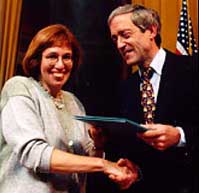
Columbia University President, George Rupp, presents Linda Greenhouse with the Pulitzer Prize for Beat Reporting.
Winning Work
By Linda Greenhouse
''This is lovely philosophy,'' Justice Scalia said. ''Where is it in the Constitution?''
WASHINGTON, Jan. 8 -- By the end of two intense hours of Supreme Court debate today over whether the Constitution gives terminally ill people a right to doctor-assisted suicide, it was clear that the Justices were fascinated by the issue and deeply engaged by the arguments -- but at the same time eager to keep the Court out of yet another momentous question of life and death.
''Everything you've said, it seems to me, could go on in a legislative chamber,'' Justice Ruth Bader Ginsburg told Kathryn L. Tucker, a Seattle lawyer arguing that Washington State's law against assisted suicide violates the due process rights of terminally ill patients who want a doctor's help in dying in a ''humane and dignified manner.''
Justice David H. Souter asked Ms. Tucker, ''Why shouldn't we conclude that as an institution, we are not in a position to make the judgment you want us to make?'' Referring to the consequences of opening the door to doctor-assisted suicide, Justice Souter said, ''It would just be guesswork.''
Although the doctrinal jargon of due process and equal protection was sprinkled throughout the argument, this was a Supreme Court session notable for the proportion of plain English that was spoken. The Justices wanted theory, but they were also hungry for facts. They sat as judges but appeared to feel themselves very much participants, on a human level, in a far-reaching societal debate.
''This is an issue every one of us faces, young and old, male and female, whatever it might be,'' Justice Sandra Day O'Connor said at one point. And Justice Ginsburg, whose mother died of cervical cancer at the age of 47, said, ''Most of us have parents and other loved ones who have been through the dying process, and we've thought about these things.''
Yet this was not a policy forum, but a legal argument before a Supreme Court that is years past any desire to find itself at the frontiers of constitutional law. The lawyers asked the Justices to weigh terminally ill patients' interest in avoiding uncontrollable pain against the states' interest in protecting life. But the Justices' concern often appeared to be the Court's own interest in avoiding the vulnerability that comes from folding into the Constitution a claimed right that society has not fully embraced.
Justice Souter, observing at one point that ''20 years ago, we weren't even reading about this,'' said, ''Maybe the Court should wait until it could know more.'' That led Justice Ginsburg to ask whether it was merely a question of ''just waiting'' -- the issue, she said, might be whether the Court should endorse the concept of doctor-assisted suicide ''now or ever.''
''This case raises the basic question of who decides,'' Justice Ginsburg said. ''Is this ever a proper question for courts to decide?''
The Justices are scheduled to rule on the matter before the end of the term in late June or early July. The Court agreed three months ago to take up the issue after two Federal appeals courts, ruling almost simultaneously last spring in suits brought by doctors and their terminally ill patients, struck down criminal prohibitions against assisted suicide in the states of Washington and New York.
These were the first Federal appellate rulings on the question, and both states filed appeals.
Dennis C. Vacco, New York's Attorney General, argued the New York appeal, Vacco v. Quill, No. 95-1858. William L. Williams, senior assistant attorney general of Washington, argued that state's appeal, Washington v. Glucksberg, No. 96-110.
The Clinton Administration entered the cases on behalf of the states. Solicitor General Walter Dellinger argued in both cases today.
In contrast to the states' lawyers, who urged the Court to find that there was no constitutional right at stake, Mr. Dellinger urged the Justices to recognize that terminally ill people have a ''liberty interest'' in not having the state prevent their relief, through doctor-assisted suicide, from ''severe pain and suffering.'' However, he said, the states' interest in ''affirming the value of life'' and protecting vulnerable patients should be given even greater weight, and the prohibitions should be upheld.
''The systemic dangers are dramatic'' in a society that allows doctor-assisted suicide, Mr. Dellinger said. ''The least costly treatment for any illness is lethal medication,'' he added.
The distinction between the Clinton Administration's view and the states' position is more than merely academic. A finding by the Court that a ''liberty interest'' is at stake would sweep the question of regulating doctor-assisted suicide within the ambit of the 14th Amendment, which prohibits the states from depriving ''any person of life, liberty, or property, without due process of law.'' It would commit the Court to a kind of ongoing constitutional supervision of the question.
How to define the substantive reach of the due process clause is perhaps the most profound constitutional debate on the Court today, and the Justices are likely to be sharply divided over this approach even if all or most agree that the state laws should be upheld.
''A liberty interest tosses this whole matter back to this Court,'' said Justice Antonin Scalia, the Court's most outspoken opponent of announcing new due process rights. His tone was sarcastic.
''I suppose proclaiming a liberty interest is cost-free,'' he said. Several months ago, in a speech at Catholic University here, Justice Scalia said it was ''absolutely plain that there is no right to die.''
He challenged Laurence H. Tribe, a Harvard Law School professor who was arguing on behalf of the plaintiffs in the New York case that ''when facing imminent and inevitable death,'' a person has the right ''not to be forced to be a creature of the state'' and to ''have some voice'' in the way the ''final chapter of life'' unfolds.
''This is lovely philosophy,'' Justice Scalia said. ''Where is it in the Constitution?''
In a 1990 decision, Cruzan v. Missouri Department of Health, the Court used a liberty-interest analysis to conclude that people have a right to avoid unwanted medical treatment, including treatment that is keeping them alive.
The meaning and relevance of that precedent were much discussed today.
In striking down New York's prohibition against assisted suicide, the United States Court of Appeals for the Second Circuit ruled that it violated the 14th Amendment's guarantee of equal protection because it allowed the state to treat differently two categories of terminally ill people: those on life-support systems, who have a right under state law as well as under the Cruzan decision to have the equipment withdrawn, and those who have no machinery to disconnect and who are denied the ability to hasten their deaths by prescribed medication.
Mr. Tribe said the distinction drawn under New York law not only was arbitrary, but also was based on a ''fantasy'' that there was a sharp demarcation in medical terms between the two groups of patients. Justice Anthony M. Kennedy said the distinction was between active intervention in the case of assisted suicide and ''nature taking its course'' for those who die after the withdrawal of equipment, but to that argument Mr. Tribe said, ''None of these patients is in a state of nature.''
Mr. Tribe said that terminally ill patients whose life-support equipment is removed are often placed in a deeply sedated condition, in which they die under medical supervision.
Attorney General Vacco, arguing the state's appeal, said the Constitution's equal protection guarantee was ''not implicated at all'' in the way New York treats the two categories of terminally ill patients because those who withdraw life support are ''merely asserting the right to be let alone,'' while those who seek assisted suicide want a third party's help in killing themselves.
In the Washington case, the United States Court of Appeals for the Ninth Circuit, which sits in San Francisco, based its decision not on equal protection, but on the due process guarantee, finding a ''liberty interest in choosing the time and manner of one's death.''
Mr. Williams, representing Washington, said the decision denied the state the ability to maintain ''a clear line between physicians as healers and curers and physicians as instruments of the death of their patients.''
Ms. Tucker, representing the plaintiffs in the Washington case, said judicial intervention was needed because ''ours is a culture of denial of death'' in which the ordinary political process could not work to protect the rights of terminally ill people. Referendums to establish doctor-assisted suicide narrowly failed in Washington in 1991 and in California in 1992; in a 1994 referendum, voters in Oregon approved an assisted-suicide law, which has been blocked in Federal court.
Chief Justice William H. Rehnquist asked Ms. Tucker why her clients' constitutional claim included a doctor's assistance in suicide rather than simply the right to kill themselves.
Ms. Tucker replied that her terminally ill clients -- all of whom died early in the litigation -- wanted ''a peaceful, humane, dignified death'' through medication for which a doctor is the ''gatekeeper.''
Justice Scalia asked why Ms. Tucker had limited her constitutional claim to people with terminal illnesses. Why, he asked, would someone faced with 10 years of ''terrible suffering'' not have a similar right?
The dying patient ''does not have a choice between living and dying,'' Ms. Tucker replied. ''The dying process has begun,'' and the patient has a choice only of controlling the manner of death.
''I have to tell you, the dying process of all of us has begun,'' Justice Scalia said.
© 1997, The New York Times Company
By Linda Greenhouse
WASHINGTON, March 23 -- Underlying last week's Supreme Court argument on free speech on the Internet was a premise so fundamental and obvious to all the participants, lawyers and Justices alike, that it did not even need to be articulated in the courtroom: not all speech is created equal.
Rather, there is a hierarchy of speech, under Supreme Court precedents dating back many decades that calibrate the degree of First Amendment protection with the particular medium of expression.
A decision from nearly 50 years ago, holding that speech that would be perfectly acceptable if uttered in a public park could constitutionally be banned when broadcast from a sound truck, offers a vivid example of the Court's approach. ''The moving picture screen, the radio, the newspaper, the handbill, the sound truck and the street corner orator have differing natures, values, abuses and dangers,'' Justice Robert H. Jackson wrote in a concurring opinion in that 1949 case, Kovacs v. Cooper. Each means of expression, he said, ''is a law unto itself.''
So only by deciding for themselves what the Internet is can the Justices decide where to place it on the hierarchy of First Amendment values. That placement, in turn, is likely to determine whether the challenge to the Communications Decency Act, which makes it a Federal crime to display ''patently offensive,'' sexually explicit material over the Internet in a manner available to children, succeeds or fails.
Not surprisingly, there was a subtext to last week's argument, one not always audible through the convoluted discussion of the technology of shielding children from indecent content that took up much of the 70 minutes in the courtroom. The subtext was the struggle by the lawyers for both sides to present, and by the Justices to select, the most apt analogy for the Internet.
Analogy is the only real road map for courts when technological change leaves them in unknown legal territory. Thirty years ago, for example, the Court was confronted with finding a constitutional framework for electronic eavesdropping, a technology that did not fit neatly into existing categories. Without the physical intrusion that usually constitutes a ''search,'' is eavesdropping covered by the Fourth Amendment's prohibition against unreasonable searches?
Yes, the Court ruled in a 1967 landmark, Katz v. United States, holding that Federal agents had conducted an unconstitutional search when they used an eavesdropping device, placed without a warrant on the outside of a public telephone booth, to listen to a gambler's calls. The Justices reasoned by analogy. When the gambler shut the phone booth's door, the Court said, he intended to shut out ''the uninvited ear'' no less than someone in another line of work who closed the door of his office.
For the Internet, the most obvious physical analogy is television. A computer monitor, after all, looks most like a television screen; turn the computer on, and the blank screen fills with images. But a physical analogy is imperfect at best, particularly when the old technology functions entirely differently from the new. Television, after all, has tended to be a one-way medium sending images and sound to many viewers; the Internet allows many people to communicate simultaneously with many others.
The coalition of Internet providers and users challenging the Communications Decency Act has always known that it could not succeed in its First Amendment challenge unless it persuaded the Court to look beyond the physical analogy and see the Internet as something new and unfettered by the long line of precedents upholding broad Federal regulation of the broadcast medium. By the same token, the Clinton Administration knew that its best chance of defending the law successfully was to anchor the Internet firmly in the world of broadcast.
The Government's briefs rely heavily on the Supreme Court's broadcast precedents, particularly a 1978 case, Federal Communications Commission v. Pacifica Foundation, that upheld the Government's daytime ban on the broadcast of sexually explicit speech -- the ''seven dirty words'' of the comedian George Carlin's well-known monologue.
An effort by any level of government to censure a newspaper for printing the same words would be a flagrant violation of the First Amendment. Nor can a government tell a newspaper what to print; a 1974 Supreme Court decision, Miami Herald v. Tornillo, struck down a Florida law giving political candidates a ''right of reply'' to criticism in the state's newspapers. But the Court has upheld similar compelled-access rules for broadcasters.
The Court has offered various rationales for relegating first radio and then television to a low rung of the First Amendment hierarchy: the finite size of the broadcast spectrum, justifying Federal regulation in the public interest; their ''uniquely pervasive presence in the lives of all Americans,'' as the Court said in the Pacifica case, and the ease with which children too young to read can turn a dial and be exposed to unsuitable material.
The Court is somewhat more protective of speech on cable television, where the capacity to offer dozens of channels negates the spectrum-scarcity rationale. But the Justices have been strikingly skittish about pinning themselves down to a legal standard for regulation of cable, citing evolving technology and the absence of a ''definitive choice among competing analogies,'' as Justice Stephen G. Breyer put it in a splintered decision last June on regulating indecency on cable television.
Can a Court that is nervous about cable television even begin to tackle the Internet, surely as dramatic a departure from the old means of communication as eavesdropping was from an old-fashioned police search?
During the argument, the Justices appeared surprisingly uninterested in pursuing the television analogy. There was more discussion, in fact, about telephones. Justice Breyer asked several questions comparing conversation over the Internet to telephone conversations -- not good news for the Government, given that the Court in a 1989 decision declared a Federal ban on dial-a-porn prerecorded sex messages to be unconstitutional. In that case, Sable Communications v. F.C.C., the Court said that private telephone conversations did not share the ''uniquely pervasive'' dangers of radio and televisions broadcasts that can turn unwilling listeners into a captive audience.
''The Internet is rather like the telephone,'' Justice Breyer said. Deputy Solicitor General Seth P. Waxman was quick to object. A telephone conversation is a ''discrete communication,'' he said, while material ''placed on a computer by anybody, anywhere, is available to everybody everywhere.''
Another vision beckons, although it was not clear from the argument how much appeal it has for the Court. The three-judge Federal District Court panel in Philadelphia, which declared the Communications Decency Act unconstitutional last June in the case now before the Court, depicted the Internet as a never-ending global conversation that deserves the highest level of protection the First Amendment has to offer.
''The most participatory marketplace of mass speech that this country -- and indeed the world -- has yet seen,'' is how Judge Stewart R. Dalzell described it in his separate opinion. An analogy to end all analogies, if the Justices are ready for it.
© 1997, The New York Times Company
By Linda Greenhouse
WASHINGTON, June 25 -- In one of its most important modern-day rulings on the sources and limits of Congressional power, the Supreme Court said today that Congress exceeded its authority when it passed a law four years ago to give the practice of religion more protection than the Court itself had found to be constitutionally required.
The 6-to-3 decision to strike down the Religious Freedom Restoration Act was a forceful reminder of judicial power and a warning to the other branches of Government not to trespass into the Court's domain.
''The power to interpret the Constitution in a case or controversy remains in the judiciary,'' Justice Anthony M. Kennedy said in his majority opinion, which was joined not only by the Court's three most conservative members, Chief Justice William H. Rehnquist and Justices Antonin Scalia and Clarence Thomas, but also by two of the most liberal Justices, John Paul Stevens and Ruth Bader Ginsburg. Justices Sandra Day O'Connor, David H. Souter and Stephen G. Breyer dissented.
The act, the product of the work of a broad coalition of religious and civil liberties groups, passed unanimously in the House of Representatives and attracted only three negative votes in the Senate.
Supported by President Clinton and defended by his administration in court, it provided that no level of government could enforce laws that ''substantially burden'' religious observance without demonstrating a ''compelling'' need to do so and without using the ''least restrictive means available.''
While the practical impact of today's decision -- which may be substantial -- will be felt in the myriad ways that religion and government interact, the case as the majority approached it was not principally about religion. Rather, this was the third major Supreme Court decision in as many years, grounded in three separate lines of constitutional analysis, to reject Congress's expansive interpretation of its own powers and to take a generous view of the role of the states in the Federal system.
Justice Kennedy said that by requiring ''searching judicial scrutiny'' of any state law that had the effect of making it more difficult for people to practice their religion, the Religious Freedom Restoration Act was a ''considerable intrusion into the states' traditional prerogatives and general authority to regulate for the health and welfare of their citizens.''
In the case before the Court today, a Catholic church in the Texas city of Boerne, near San Antonio, had tried to invoke the law to challenge the city's refusal to let it enlarge its church building in a neighborhood zoned for historic preservation. The city responded by challenging the constitutionality of the Religious Freedom Restoration Act.
A Federal District Judge in San Antonio declared the law unconstitutional, but the United States Court of Appeals for the Fifth Circuit, in New Orleans, reversed that decision and upheld the law last year.
The law was passed in response to a 1990 Supreme Court decision that rejected the ''compelling interest'' test, which the Court had previously applied in some contexts. The Court decision in rejecting the test held that there was no religious exemption from laws that apply generally to everyone and that were not passed to single out or discriminate against religion.
That 5-to-4 decision, Employment Division v. Smith, held that members of a Native American church who used the illegal hallucinogen peyote in their religious rituals had no constitutionally based exemption from Oregon's narcotics laws.
While a constitutional ruling of the Supreme Court can only be overturned by a constitutional amendment, and not by ordinary legislation, supporters of the Religious Freedom Restoration Act argued, in arguing for its enactment in 1993, that they were not confronting the Court directly but simply legislating a more protective standard of review for laws affecting religion, a standard the Court had deemed neither necessary nor forbidden.
As authority for the law, Congress invoked Section 5 of the 14th Amendment, the source of much modern civil rights legislation, which gives Congress the power to ''enforce, by appropriate legislation,'' the amendment's guarantees of due process and equal protection. The Supreme Court has interpreted the amendment's due process guarantee to make the First Amendment, with its guarantee of religious freedom, binding on the states.
That longstanding interpretation was not at issue today. Rather, the question as the Court saw it was whether in enacting the Religious Freedom Restoration Act, Congress was ''enforcing'' the 14th Amendment or, by contrast, going beyond that limited role to declare for itself the substantive meaning of the amendment. It was in this respect that the majority found Congress had gone too far.
''Congress does not enforce a constitutional right by changing what the right is,'' Justice Kennedy said, adding, ''It has been given the power 'to enforce,' not the power to determine what constitutes a constitutional violation.''
The Religious Freedom Restoration Act, Justice Kennedy said, ''cannot be considered remedial, preventive legislation, if those terms are to have any meaning.'' He said the law was ''so out of proportion to a supposed remedial or preventive object that it cannot be understood as responsive to, or designed to prevent, unconstitutional behavior. It appears, instead, to attempt a substantive change in constitutional protections.''
Beyond the immediate context of the case, City of Boerne v. Flores, the significance of the decision lay in how the majority drew the line between ''remedial'' and ''substantive'' actions to enforce the 14th Amendment. In the past, Congress had not limited itself to a precise tracking of the Court's constitutional rulings; for example, in a series of laws dealing with voting rights in the 1960's, Congress prohibited certain literacy tests even though the Court had ruled that literacy tests were constitutional. The Court, in turn, upheld the legislative prohibitions.
The Court reaffirmed the voting rights decisions today. Justice Kennedy said that, properly understood, the laws at issue in those decisions were responses to the ''persisting deprivation of constitutional rights resulting from this country's history of racial discrimination.'' He added, ''The appropriateness of remedial measures must be considered in light of the evil presented.''
On the other hand, Justice Kennedy said, the Religious Freedom Restoration Act reflected ''a lack of proportionality or congruence between the means adopted and the legitimate end to be achieved.'' Describing the law as ''sweeping'' and intrusive -- ''displacing laws and prohibiting official actions of almost every description and regardless of subject matter'' -- Justice Kennedy said it placed burdens on the states that ''far exceed any pattern or practice of unconstitutional conduct'' revealed in Congressional hearings or elsewhere.
He said there was no evidence of ''some widespread pattern of religious discrimination in this country,'' but at most evidence of ''incidental burdens'' such as the zoning dispute in this case.
The Court's requirement that Congressional action under the 14th amendment must demonstrate ''proportionality or congruence'' to the problem Congress is addressing is a new departure for the Court, which previously had left the full extent of Congress's 14th Amendment powers undefined. Some of the act's supporters said today the Court had taken an unduly circumscribed view of Congressional power.
Douglas Laycock, a University of Texas law professor who helped draft the law and who argued the case at the Court, said the ruling would invite new challenges to ''all the civil rights laws that apply to state and local government.'' Mr. Laycock said the Court was asserting ''the power to unilaterally contract our liberties and to deprive Congress of its power to protect those liberties.''
Many members of the coalition behind the Religious Freedom Restoration Act were more concerned today with what they saw as the Court's minimizing of the religious interests at stake, but calls by some groups for a constitutional amendment met with, at best, a cautious response.
The Rev. Oliver Thomas, special counsel to the National Council of Churches and the chairman of the legislative coalition, said in an interview that a constitutional amendment should be ''a last resort.'' He said the groups would get together early next month to devise a strategy.
''Every religious person will be hurt by this decision,'' Mr. Thomas said. He said the Court misunderstood the goal of the law, which was not to deter ''a bunch of wicked people'' from discriminating against religion but to prevent the ''unintended consequences'' of ordinary laws that make religious observance difficult or impossible.
The Religious Freedom Restoration Act was widely unpopular in the states, 16 of which filed a brief with the Court recounting the sometimes fanciful religious claims that prison inmates were making under the law.
The three dissenting Justices did not take issue with the standard the Court applied today to Congressional action under the 14th Amendment. Justice O'Connor, in fact, endorsed it.
But Justice O'Connor said the Court should have used this case to revisit and overturn the 1990 decision in the peyote case, from which she dissented and that she still regards, it was clear from her 23-page opinion today, as profoundly wrong.
Justices Breyer and Souter also called for re-examining the 1990 case.
The Court has declared several Federal laws unconstitutional in the past few years. Last year, it invalidated part of the Indian Gaming Regulatory Act, a 1988 law that permitted Indian tribes to sue states in disputes over establishing casinos. Two years ago, the Court ruled that a Federal gun control law exceeded the power of Congress to regulate interstate commerce.
© 1997, The New York Times Company
Court, 9-0, Upholds State Laws Prohibiting Assisted Suicide; Protects Speech on Internet
By Linda Greenhouse
WASHINGTON, June 26 -- Stepping for the first time into the wrenching political and moral debate over doctor-assisted suicide, the Supreme Court ruled today that states may continue to ban the practice but at the same time suggested that the door remained open to constitutional claims for assistance by dying patients in the future.
In a pair of 9-to-0 decisions, the Court rejected constitutional challenges to laws in New York and Washington that made doctor-assisted suicide a crime. But the Court's tone was that of a tentative first step rather than a definitive final ruling on the issue.
In concurring opinions that accounted for a majority of the Court, various Justices suggested that at least some terminally ill people in intractable pain might be able to claim in the future that they had a constitutional right to a doctor's assistance in hastening their deaths.
''Our opinion does not absolutely foreclose such a claim,'' Chief Justice William H. Rehnquist said in the Court's principal opinion, which was signed by four other Justices.
One of those four, Justice Sandra Day O'Connor, said that while she agreed there was ''no generalized right to 'commit suicide,' '' she viewed as still open the question of whether ''a mentally competent person who is experiencing great suffering'' that cannot otherwise be controlled has a constitutionally based ''interest in controlling the circumstances of his or her imminent death.''
The decisions came amid a torrent of other rulings from the Court in the final week of its 1996-97 term, in which the Justices also invalidated a Federal law banning indecent speech on the Internet and dismissed a challenge to the line-item veto, the President's power to kill individual items of spending in bills that he signs into law.
The session is now expected to end on Friday with a ruling in a states' rights challenge to the Brady gun control law.
The inconclusive nature of the ruling on doctor-assisted suicide was perhaps the most surprising aspect of a decision that was widely seen, in its bottom line, as a foregone conclusion. The Court was never likely to embrace the expansive views of due process or equal protection taken by the two Federal appeals courts whose decisions were reversed today. The lower courts had declared New York's and Washington's criminal prohibitions against assisted suicide to be unconstitutional.
Throughout the opinions today, the Court's tone was measured and sober, in contrast to the sharp language that sometimes pervades the Court's constitutional debates. The Court seemed to be inviting further developments. Chief Justice Rehnquist noted that ''throughout the nation, Americans are engaged in earnest and profound debate about the morality, legality and practicality of physician-assisted suicide.'' He said the Court's approach ''permits this debate to continue, as it should in a democratic society.''
Although the Court did not address the question directly, there was at least a strong suggestion in Chief Justice Rehnquist's opinion, as well as an explicit discussion in a concurring opinion by Justice David H. Souter, that states were free to experiment and permit doctor-assisted suicide if they chose to do so. The Court should ''stay its hand to allow reasonable legislative consideration,'' Justice Souter said.
Only one state, Oregon, has voted to permit doctor-assisted suicide, in a referendum that has yet to go into effect because of prolonged court challenges. The Justices have been asked by opponents of the measure to hear a challenge to its constitutionality, but that case will not come up for consideration until the Court's next term. Meanwhile, the Oregon Legislature decided to put the question to voters again, in November
One reason for the somewhat inconclusive outcome today was the way in which Chief Justice Rehnquist structured his opinion in the Washington State case, which dealt with the question of whether a right to doctor-assisted suicide should be recognized as an aspect of the ''liberty'' protected by the 14th Amendment's guarantee of due process.
The Chief Justice essentially reframed the question that five doctors had raised when they brought their lawsuit on behalf of three dying patients. The question, as the lower court interpreted it, was whether mentally competent, terminally ill adults had a right to a doctor's assistance in determining the time and manner of their death.
The United States Court of Appeals for the Ninth Circuit, in San Francisco, answered yes in a 1996 opinion that drew on the Court's constitutional precedents on the right to abortion and the right to reject unwanted life-sustaining treatment.
Chief Justice Rehnquist, however, put the question in the case on a higher level of generality: ''Whether the protections of the due process clause include a right to commit suicide with another's assistance.'' The answer to that question was no, he said, given several factors that he said were relevant: a 700-year history of disapproval of suicide and assisted suicide in the Anglo-American legal tradition; ''the considered policy choice of almost every state,'' and strong state interests in protecting vulnerable people and avoiding the ''path to voluntary and perhaps even involuntary euthanasia.''
In their concurring separate opinions other Justices objected to the Chief Justice's formulation of the question. Justice Stephen G. Breyer said the Court should have considered a different way of describing the question, one ''for which our legal tradition may provide greater support.'' He said: ''That formulation would use words roughly like a 'right to die with dignity.' But irrespective of the exact words used, at its core would lie personal control over the manner of death, professional medical assistance, and the avoidance of unnecessary and severe physical suffering -- combined.''
Justice Breyer said there was no need to decide in this case whether a right described in that way was protected by the Constitution because in both New York and Washington, doctors are permitted to prescribe pain-killing drugs, even in potentially lethal doses, so that ''the laws before us do not force a dying person to undergo that kind of pain.''
In a separate opinion, Justice John Paul Stevens said he viewed the decision today as being in much the same posture as the Court's decisions that upheld the death penalty 20 years ago. ''Just as our conclusion that capital punishment is not always unconstitutional did not preclude later decisions holding that it is sometimes impermissibly cruel,'' Justice Stevens said, ''so is it equally clear that a decision upholding a general statutory prohibition of assisted suicide does not mean that every possible application of the statute would be valid.'' He said there were ''situations in which an interest in hastening death is legitimate'' and ''entitled to constitutional protection.''
Justice Stevens said he did not agree with the appeals court that there was a categorical right involved, but said he recognized ''the possibility that an individual plaintiff seeking to hasten her death, or a doctor whose assistance was sought, could prevail in a more particularized challenge.''
It was this assertion that Chief Justice Rehnquist acknowledged in his opinion, at the same time adding that ''such a claim would have to be quite different'' from ones involved in this case. He did not elaborate.
In both the Washington case, Washington v. Glucksberg, No. 96-110, and the New York case, Vacco v. Quill, No. 95-1858, the Chief Justice's opinions for the Court were joined by Justices O'Connor, Antonin Scalia, Anthony M. Kennedy, and Clarence Thomas. In addition to the separate opinions by Justices O'Connor, Stevens, Souter and Breyer, Justice Ruth Bader Ginsburg indicated in a brief statement that she agreed with Justice O'Connor's approach.
In the New York case, which also began as a lawsuit by doctors and terminally ill patients, the United States Court of Appeals for the Second Circuit, in Manhattan, took a different approach to striking down the New York law. The appeals court said that because New York permitted terminally ill patients to hasten their death by ordering withdrawal of life-sustaining medical treatment, the prohibition against doctor-assisted suicide violated the rights of other dying patients who were not dependent on particular equipment or treatment.
In his opinion overturning this decision, Chief Justice Rehnquist said that ''unlike the Court of Appeals, we think the distinction between assisting suicide and withdrawing life-sustaining treatment, a distinction widely recognized and endorsed in the medical profession and in our legal traditions, is both important and logical.'' He added: ''It is certainly rational.''
The Chief Justice was the author of the Court's decision in 1990, in Cruzan v. Missouri Department of Health, that for the first time recognized a right to forgo unwanted treatment. As with the decisions today, the Cruzan decision left important issues unsettled and divisions within the Court unresolved.
The dispute over the Cruzan decision flared up again in a very telling way today in an oblique debate between the Chief Justice, who said the decision was based on little more than the common-law rule that ''forced medication was a battery,'' and Justice Stevens, who interpreted the decision as a much more affirmative recognition of a ''more basic concept of freedom that is even older than the common law.''
Justice Stevens said the right recognized in the 1990 decision, which concerned a young woman being kept alive in a persistent vegetative state, was ''not merely a person's right to refuse a particular kind of unwanted treatment, but also her interest in dignity, and in determining the character of the memories that will survive long after her death.''
Reaction to the rulings today was voluminous, reflecting the intense interest the cases had generated. More than 60 briefs were filed, a near record for the Court. Among those expressing satisfaction with the decision was President Clinton, who opposes assisted suicide and who recently signed into law a prohibition against using any Federal money, including Medicaid money, to pay for doctor-assisted suicide.
© 1997, The New York Times Company
Court, 9-0, Upholds State Laws Prohibiting Assisted Suicide; Protects Speech on Internet
By Linda Greenhouse
WASHINGTON, June 26 -- In a sweeping endorsement of free speech on the Internet, the Supreme Court today declared unconstitutional a Federal law making it a crime to send or display indecent material on line in a way available to minors.
The decision, unanimous in most respects, marked the Court's first effort to extend the principles of the First Amendment into cyberspace and to confront the nature of a new, and -- to most of the Justices -- an unfamiliar medium.
The result left the coalition of Internet users, computer industry groups and civil liberties organizations that had challenged the Communications Decency Act exultant. The forceful opinion for the Court by Justice John Paul Stevens held that speech on the Internet is entitled to the highest level of First Amendment protection, similar to the protection the Court gives to books and newspapers. That stands in contrast to the more limited First Amendment rights accorded to speech on broadcast and cable television, where the court has tolerated a wide array of Government regulation.
''Content on the Internet is as diverse as human thought,'' Justice Stevens said in a quotation from a special three-judge Federal District Court in Philadelphia, which struck down the Communications Decency Act a year ago in a decision the Supreme Court affirmed today.
The Internet is a rapidly expanding global computer network, which allows as many as 60 million people to communicate on line and connect with information and entertainment sources around the world. A large majority of its users live in the United States.
The decision makes it unlikely that any Government-imposed restriction on Internet content would be upheld as long as the material has some intrinsic constitutional value. Obscenity, which is outside the protection of the First Amendment, is also covered by the Communications Decency Act, and the Court left that provision intact today without even analyzing it.
The indecent material at issue today was not precisely defined by the 1996 law -- one of its serious vulnerabilities, as the Court saw it -- but was referred to in one section of the statute as ''patently offensive'' descriptions or images of ''sexual or excretory activities.''
Justice Stevens said that the Court regarded the law's goal of protecting children from indecent material as legitimate and important, but concluded that the ''wholly unprecedented'' breadth of the law threatened to suppress far too much speech among adults and even between parents and children. ''The interest in encouraging freedom of expression in a democratic society outweighs any theoretical but unproven benefit of censorship,'' Justice Stevens wrote.
He noted that people could not ''confidently assume'' that discussions of birth control, homosexuality, or prison rape, or even the transmission of ''the card catalogue of the Carnegie Library,'' would not violate the law and place computer network users at risk of severe criminal penalties. Violations of the Communications Decency Act, which never went into effect because of a stay issued by the lower court, carried penalties of two years in prison and a $250,000 fine. ''The severity of criminal sanctions may well cause speakers to remain silent rather than communicate even arguably unlawful words, ideas, and images,'' Justice Stevens said.
The law made it a crime to use a computer to transmit indecent material to someone under 18 years old or to display such material ''in a manner available'' to a person under 18. Justice Stevens said that given the nature of the Internet, there was no way someone transmitting indecent material could be sure that a minor would not see it. He noted that most uses of the Internet, like chat rooms, newsgroups, and the World Wide Web, ''are open to all comers.''
Nor, Justice Stevens said, could people rely on a defense provided by the law for those who take ''good faith, reasonable, effective and appropriate actions'' to restrict access by minors. No current technology satisfied those demands, he said.
The opinion, Reno v. American Civil Liberties Union, No. 96-511, was signed by Justices Antonin Scalia, Anthony M. Kennedy, David H. Souter, Clarence Thomas, Ruth Bader Ginsburg, and Stephen G. Breyer.
In a separate opinion by Justice Sandra Day O'Connor, she and Chief Justice William H. Rehnquist, who signed her opinion, subscribed to much of the Court's approach. They said the law could be constitutionally applied, but only in the very limited circumstance of deliberate transmission of indecent material ''where the party initiating the communication knows that all of the recipients are minors.'' If an adult might be among the recipients, the speech cannot constitutionally be suppressed, Justice O'Connor said.
Justice O'Connor said that on the surface, the Communications Decency Act was analogous to a zoning regulation, similar to the ''adult zones'' for bookstores and X-rated movie theaters the Court has upheld in a series of decisions. But the analogy was inexact, she said, because there is no way in cyberspace to make sure that minors can be screened out while still allowing adults to have access to the regulated speech.
Justice O'Connor said the law was clearly unconstitutional because it was ''akin to a law that makes it a crime for a bookstore owner to sell pornographic magazines to anyone once a minor enters his store.''
The Communications Decency Act was a last-minute Senate amendment to another bill, the Telecommunications Act of 1996. It was adopted without hearings and amid substantial doubts about its constitutionality. For that reason, its sponsors agreed to add a provision guaranteeing quick Supreme Court review after a hearing by a single three-judge court, a shortcut through the normal appellate process.
President Clinton signed the bill and Administration lawyers defended the law vigorously. At the same time, White House officials worked on a substitute Internet policy in the event the law was overturned, as some in the Administration hoped it would be.
The law was challenged by two main coalitions of plaintiffs, representing a wide spectrum of the Internet community. The United States Chamber of Commerce entered the case at the Supreme Court stage to argue that the law presented a threat to the country's ability to compete globally in an age of new communications, an argument that very likely got the attention of the free-market conservatives, including Justices Thomas and Scalia, who joined Justice Stevens's opinion.
The trial before the court in Philadelphia produced opinions by the three judges, Dolores K. Sloviter, Ronald L. Buckwalter and Stewart Dalzell, totaling 147 pages with 123 separate factual findings. The Court today relied heavily on these findings, including Justice Stevens's observation that the Internet was not as ''pervasive'' a medium as television or radio -- where the Court has permitted greater Government regulation -- because computer users have to actively search for indecent material and ''seldom encounter such content accidentally.''
Christopher A. Hansen, a lawyer for the American Civil Liberties Union, which organized one of the plaintiff groups, said today that in establishing the highest level of First Amendment protection, the Court's decision ''was more about speech than about technology.'' That made the decision important for all future Internet cases even as the technology may change, Mr. Hansen said.
In his opinion, Justice Stevens was critical of several aspects of the Government's defense of the law, but singled out one in particular. That was the argument that unless the law was upheld, development of the Internet would be stifled by parents' fears about having on-line access if they could not shield their children from indecent material.
''We find this argument singularly unpersuasive,'' Justice Stevens said, adding that ''the dramatic expansion of this new marketplace of ideas contradicts the factual basis of this contention'' given the ''phenomenal'' growth of the Internet. ''As a matter of constitutional tradition,'' he said, ''in the absence of evidence to the contrary, we presume that governmental regulation of the content of speech is more likely to interfere with the free exchange of ideas than to encourage it.''
© 1997, The New York Times Company
By Linda Greenhouse
''It is far more reasonable to presume that their decisions to impose modest burdens on state officials from time to time reflect a considered judgment that the people in each of the states will benefit therefrom.''
WASHINGTON, June 27 -- Providing the strongest evidence yet of the ascension of state power at the Supreme Court, a bitterly divided Court ruled today that the Brady gun control law violated ''the very principle of separate state sovereignty'' by requiring state officials to conduct background checks of prospective handgun purchasers.
The 5-to-4 decision, invalidating the background-check provision of the 1993 law, marked the third time in as many days that the Court overturned a major Federal statute. Earlier in the week, the Justices struck down both the Religious Freedom Restoration Act and the Communications Decency Act before concluding their 1996-97 term today. The decision today did not address a separate portion of the Brady law that imposes a five-day waiting period before a gun sale can be completed, leaving that provision intact at least for now.
The decision opened a new chapter in a profound and continuing debate among the Justices over the essential nature of the system of shared authority between the Federal Government and the states. Justice Antonin Scalia's majority opinion and the principal dissenting opinion by Justice John Paul Stevens ranged deeply into the nation's history, each disputing the other on the meaning of particular passages in the Federalist Papers as well as about how to interpret the Court's rulings on federalism over the years.
President Clinton and Congressional supporters of the Brady law, which was named for James S. Brady, the former White House press secretary who was shot and gravely wounded in the attempted assassination of President Ronald Reagan in 1981, said today that they would work to find an alternative to the invalidated provision.
Although Chief Justice William H. Rehnquist simply joined Justice Scalia's opinion today, without writing separately, the outcome was a triumph for the Chief Justice. He began his Supreme Court service 25 years ago as a critic of what he saw as the Court's aggrandizement of Federal power, and now presides over a solid, if narrow bloc, of five Justices who, in case after case, are aggressively readjusting the state-Federal balance in favor of the states.
Besides Justice Scalia and the Chief Justice, the majority today comprised Justices Sandra Day O'Connor, Anthony M. Kennedy and Clarence Thomas. This was the same five-Justice majority that two years ago, in a case called United States v. Lopez, ruled that a Federal law banning the possession of guns near schools exceeded Congressional authority. That decision was the first time since the New Deal that the Court had invalidated an exercise of Congress's asserted authority to regulate interstate commerce.
Last year the same five Justices made up the majority in Seminole Tribe v. Florida, which invalidated a 1988 Federal law on Indian gambling and held that Congress lacked the authority to permit Indian tribes to sue state governments in Federal court.
In addition to Justice Stevens, the dissenters today, as in the earlier two cases, were Justices David H. Souter, Ruth Bader Ginsburg and Stephen G. Breyer.
While the ruling today, Printz v. United States, No. 95-1478, alluded both to Congressional power under the Commerce Clause as well as to state authority under the 10th Amendment, which gives to the states the powers that the Constitution does not otherwise give to the Federal Government, Justice Scalia's opinion was not based on any one constitutional provision.
Rather, Justice Scalia based his conclusion on his view of the constitutional structure as a whole. He described the state and national governments as coequal sovereigns, coexisting on a political and constitutional level of equivalence. ''This separation of the two spheres is one of the Constitution's structural protections of liberty,'' Justice Scalia said.
He said it was no more acceptable for state and local officials to be required to administer Federal laws ''than it would be compatible with the independence and autonomy of the United States that its officers be impressed into service for the execution of state laws.''
The Court's conclusion was ''categorical,'' Justice Scalia said; there could be no ''balancing analysis'' that could give more weight to the Federal interests at stake in particular circumstances.
Against this vision, the dissenters put forward a diametrically opposite concept of the state-Federal relationship. Justice Stevens said it was clear that when Congress acted within one of its express grants of constitutional authority -- in this case, its power under the Commerce Clause -- the Federal Government was supreme and its actions were binding on the states. He noted that Article VI of the Constitution declares that Federal law ''shall be the supreme Law of the Land'' and requires state officials to take an oath to support the Constitution.
''Not only the Constitution, but every law enacted by Congress as well,'' Justice Stevens said, ''establishes policy for the states just as firmly as do laws enacted by state legislatures.'' He said that ''there is not a clause, sentence or paragraph in the entire text of the Constitution of the United States that supports the proposition that a local police officer can ignore a command contained in a statute enacted by Congress'' acting under one of its constitutional powers.
While Justice Scalia described the Brady law as a direct Federal assault on the states, Justice Stevens said the law imposed at most a ''trivial burden'' and ''modest duties'' on local law-enforcement officials.
In states that have not adopted their own background-check system under state law, as 27 states have done, the law requires the local officials to take ''reasonable'' efforts to check criminal records within a five-day waiting period to determine whether there is a reason a would-be buyer of a handgun should not be permitted to proceed with the purchase from a federally licensed gun dealer. A separate Federal law makes it a crime for felons, fugitives, drug users and some other categories of people to buy guns.
According to Federal statistics, the law has been quite effective, leading to the rejection of some 6,600 gun purchase applications a month.
The National Rifle Association has financed legal challenges to the law around the country, with mixed results. The case before the Court today was an appeal by two sheriffs, Jay Printz of Ravalli County, Mont., and Richard Mack of Graham County, Ariz., who challenged the law successfully in separate Federal District Court lawsuits. The United States Court of Appeals for the Ninth Circuit, in San Francisco, then heard the Government's appeal and upheld the law in a 1995 ruling.
For the Brady law itself, the impact of the ruling today may be somewhat limited. The background check provision was scheduled to expire in November 1998, to be replaced by a Federal record-checking system to be used by the gun dealers themselves.
Representative Charles E. Schumer, the Brooklyn Democrat who was the Brady law's original sponsor, said today that he would introduce a bill to make it illegal in the interim for gun dealers to sell a gun unless they first find a sheriff, either in their own jurisdiction or elsewhere, who will conduct a background check on the would-be purchaser. ''We will not allow a handful of rogue sheriffs to undermine or weaken the Brady law,'' he said.
In an interview, Mr. Schumer said that beyond the fate of the Brady law, the decision today had ''huge implications'' for federalism, undermining the basis for much modern Federal legislation. ''If you take the Scalia opinion to its logical extreme, you could go back to the 1890's,'' he said.
Federal laws now require states to administer some Federal labor and environmental programs. Bills pending in Congress to require states to give utility consumers access to alternative retail suppliers could possibly run afoul of the Court's analysis today.
Most Federal mandates on the states will not be affected by the ruling because they have at least theoretically been accepted voluntarily by states as inducements for eligibility for various Federal grants, such as money for highways or schools.
The opinions reflected very different views of the intentions and trustworthiness of Congress, with Justice Scalia's the more cynical. ''By forcing state governments to absorb the financial burden of implementing a Federal regulatory program,'' he said, ''members of Congress can take credit for 'solving' problems without having to ask their constituents to pay for the solutions with higher Federal taxes,'' and at the same time can make sure that local officials ''will be blamed for any error'' in how the program works.
Justice Stevens, by contrast, said the Court should rely on Congress to make the political judgments on what to require of the states. Given the political accountability of members of Congress to the electorate, he said, ''it is quite unrealistic to assume that they will ignore the sovereignty concerns of their constituents.'' He added, ''It is far more reasonable to presume that their decisions to impose modest burdens on state officials from time to time reflect a considered judgment that the people in each of the states will benefit therefrom.''
The courtroom was surprisingly empty for the final day of the term, perhaps because members of the Washington bar, knowing that only the Brady law case was due for decision, decided not to come. But the tourists, the Court staff and Administration lawyers who showed up were treated to a riveting and unusual display as Justice Scalia summarized his opinion and Justice Stevens responded.
Side by side the two Justices sat, the bearded, dark-haired Justice Scalia, youthful at 61, and the grandfatherly Justice Stevens, at 75 the Court's oldest member, both men deeply committed to opposing visions of the constitutional structure they have devoted their professional lives to interpreting.
Justice Stevens at times read from a memorandum that contained excerpts from his dissenting opinion. But often he spoke off the cuff, looking directly at the small audience as he explained his disagreement.
He made some sly points that his written opinion omitted. For example, he said that in its lack of textual support in the Constitution itself, the majority opinion reminded him of an opinion by Justice William O. Douglas that extrapolated a right to privacy from the Constitution's ''emanations'' and ''penumbras.'' That opinion, in Griswold v. Connecticut, has been denounced for 30 years by judicial conservatives as the height of judicial activism.
The debate today over Supreme Court precedent centered on a 1992 decision, New York v. United States, in which the Court declared unconstitutional a law that required states to handle their low-level radioactive waste. In effect, the Court said then, this law impermissibly required states to pass legislation.
In support of the Brady law, the Government and the dissenters today argued that the holding of New York v. United States was inapplicable because the background-check provision required nothing so out of the ordinary of local law-enforcement officers. Justice Scalia's opinion said this distinction was ''interesting'' but not persuasive.
There were several separate concurring and dissenting opinions today. One of the more interesting was by Justice Thomas, who said that given the Second Amendment's reference to ''the right of the people to keep and bear Arms,'' he doubted whether Congress had the power to regulate intrastate gun sales at all.
© 1997, The New York Times Company
By Linda Greenhouse
WASHINGTON, July 24 -- Justice William J. Brennan Jr., a towering figure in modern law who embodied the liberal vision of the Constitution as an engine of social and political change, died today, almost exactly seven years after his retirement from the Supreme Court. He was 91.
Justice Brennan had been in failing health for several years. He died at a nursing home in Arlington, Va., where he was undergoing rehabilitation after falling and breaking a hip last November.
The Court on which Justice Brennan was a pivotal force for nearly 34 years was, in many respects, the Brennan Court, although he never served as Chief Justice.
He was the author of numerous landmark opinions and, through his powers of persuasion and force of intellect, the prime mover behind many others. When he did not prevail, his voice in dissent was strong.
Named to the Court by President Dwight D. Eisenhower in 1956, Justice Brennan, the Newark-born son of Irish immigrants, left a legacy that is visible everywhere in the law and in American politicial and social life. It ranges from the one-person, one-vote doctrine that ended the established order in the nation's legislatures, to the decisions that transformed the Constitution's equal protection guarantee into a weapon against sex discrimination, to cases that opened the Federal courthouse doors to penetrating scrutiny of the quality of justice dispensed at the state and local levels.
The Court and the country had changed around him by the time he retired, after a stroke, at the age of 84 on July 20, 1990. The change has continued in the intervening years, and a notably more conservative Court has modified or overturned several significant Brennan opinions, most recently, last month, when the Court overturned a 1985 decision that had barred public school teachers from giving special remedial classes on the premises of parochial schools.
But Justice Brennan's vision of the Constitution and the role of a Federal judge remained unwavering, and the extent to which his legacy remains intact, indeed deeply knitted into the fabric of modern law, is striking. The 1,360 opinions that bore his name, and numerous others that were marked by his influence, set the high-water mark of an expansive vision of the Constitution and of the transformative power of law.
As Justice Brennan described his vision in a 1987 speech, he believed that the Constitution -- particularly the 14th Amendment's due process clause, which he did more than anyone else to infuse with modern vitality -- existed to guarantee ''the essential dignity and worth of each individual.''
Constitutional interpretation ''demands of judges more than proficiency in logical analysis,'' he said on that occasion, an address to the Bar Association of the City of New York celebrating the Constitution's bicentennial. ''It requires that we be sensitive to the balance of reason and passion that mark a given age, and the ways in which that balance leaves its mark on the everyday exchanges between government and citizen.''
At the White House, President Clinton, who had awarded Justice Brennan the Presidential Medal of Freedom, said the Justice's ''devotion to the Bill of Rights inspired millions of Americans, and countless young law students, including myself.''
''He once said the role of the Constitution is the protection of the dignity of every human being and he recognized that every individual has fundamental human rights that government cannot deny,'' Mr. Clinton said, ''He spent a lifetime upholding those rights and he offered some of the most enduring constitutional decisions of this century.''
Chief Justice William H. Rehnquist said, ''He played a major role in shaping American constitutional law.''
Justice Brennan's tenure on the Court, spanning eight Presidential Administrations, was extraordinary in both length and dimension. Only five Justices in the Court's history served longer: John Marshall, the fourth Chief Justice, who died in office after 34 years; Justices Stephen J. Field and Hugo Black, who both retired after 34 years; the first Justice, John Marshall Harlan, who died in office shortly before the 34-year mark; and Justice William O. Douglas, who retired after a record 36 years. Only Justice Douglas wrote more opinions.
For his first 13 years on the Court, Justice Brennan served under Chief Justice Earl Warren. Commentators on the Warren Court, which dramatically expanded the role of the Federal courts and the Constitution in protecting individual liberties, have identified Justice Brennan as the center of gravity of that Court's liberal majority, ''the catalyst for some of the most significant decisions during his tenure,'' in the words of Bernard Schwartz, a law professor and historian of the Court.
''If we look at Justices in terms of their role in the decision process,'' Professor Schwartz wrote in Judicature Magazine in 1995, Justice Brennan ''was actually the most influential Associate Justice in Supreme Court history.''
The center shifted under Chief Justices Warren E. Burger and Rehnquist; the liberals lost their majority, and Justice Brennan became the spokesman for a wing of the Court that was often outvoted and usually on the defensive. But while he was frequently in dissent, his role on the Court transcended that of an embattled defender of the liberal faith. Term after term, he defied all apparent odds in his ability to pull together majorities, albeit often narrow ones, for sustaining or even advancing the principles that first took root in the Warren era.
Senior Justice, 'Youngest Thinker'
Justice Brennan's final majority opinion for the Court was emblematic. Issued June 27, 1990, the last day of his last term, the opinion in Metro Broadcasting v. Federal Communications Commission, upheld two Federal affirmative-action programs aimed at increasing black ownership of radio and television stations. It had been widely anticipated that the Court would declare the programs unconstitutional, but Justice Brennan managed to find five votes for upholding them. Five years later, a changed Court struck down a separate Federal affirmative-action program and effectively overruled Metro Broadcasting.
To his admirers, the role Justice Brennan assumed in this last phase of his career on the Court embodied the best of the American constitutional system. ''Justice Brennan may be the Supreme Court's senior member, but he is also its youngest thinker,'' the liberal legal scholar Charles A. Reich wrote in the Cardozo Law Review in 1988, when the Justice was 82.
To his detractors, Justice Brennan symbolized all that was wrong with the ''activist judiciary.'' William Bradford Reynolds, the top civil rights official in the Reagan Administration, accused Justice Brennan in 1986 of advocating a ''radical egalitarianism'' that Mr. Reynolds called ''perhaps the major threat to individual liberty'' in the United States.
But when it came to evaluating Justice Brennan's significance on the legal landscape, both sides were in agreement. ''There is no individual in this country, on or off the Court, who has had a more profound and sustained impact upon public policy in the United States for the past 27 years,'' a generally critical article in the conservative journal National Review said in 1984.
There were few areas of the law that did not feel his impact. One of his best-known opinions, New York Times v. Sullivan, reshaped the law of libel. In that 1964 decision, the Court ruled that even when the press publishes false statements about public officials, the First Amendment permits no finding of liability unless the official can show that the statement was deliberately false or published in reckless disregard of the truth.
The First Amendment requires ''breathing space'' for free expression, Justice Brennan wrote, as an element of ''a profound national commitment to the principle that debate on public issues should be uninhibited, robust, and wide-open, and that it may well include vehement, caustic, and sometimes unpleasantly sharp attacks on government and public officials.''
Twenty-five years later, Justice Brennan had not wavered in his view of the First Amendment. In Texas v. Johnson, a 1989 decision that found First Amendment protection for the act of burning an American flag as a political protest, Justice Brennan wrote for the 5-to-4 majority: ''If there is a bedrock principle underlying the First Amendment, it is that the Government may not prohibit the expression of an idea simply because society finds the idea itself offensive or disagreeable.''
But it was his 1970 opinion for the Court in Goldberg v. Kelly, a case little known to the general public, that Justice Brennan appeared to cherish above all others. That decision held that it was a violation of the 14th Amendment's guarantee of due process of law for a state to cut off a welfare recipient's benefits without a hearing.
As a prescription for governmental behavior, the holding in Goldberg v. Kelly appeared modest enough. But the opinion proved to be a watershed of constitutional interpretation, a critical building block in what came to be known as the due process revolution. A series of decisions that followed erected a constitutional shield for the ordinary citizen against the arbitrary or standardless use of governmental power in many contexts.
In the 1987 New York speech, which he entitled ''Reason, Passion, and the Progess of the Law,'' Justice Brennan talked about the importance of the simple requirement that government officials meet a citizen face-to-face before taking adverse action.
''Due process asks whether government has treated someone fairly, whether individual dignity has been honored, whether the worth of an individual has been acknowledged,'' Justice Brennan said. ''If due process values are to be preserved in the bureaucratic state of the late 20th century, it may be essential that officials possess passion -- the passion that puts them in touch with the dreams and disappointments of those with whom they deal, the passion that understands the pulse of life beneath the official version of events.'' His opinion in Goldberg v. Kelly, he said, ''can be seen as injecting passion into a system whose abstract rationality had led it astray.''
Belief in Adapting The Constitution
Justice Brennan was an ardent defender of the view that the essential meaning of the Constitution was to be found in the modern age, and not in a search for the original intentions of its 18th-century framers.
Toward the end of his tenure, that vision placed Justice Brennan sharply at odds with prevailing views in the Reagan Administration, whose top legal officials, principally Attorney General Edwin Meese 3d, believed that the framers' ''original understanding'' was the only legitimate source for constitutional interpretation.
For years, Justice Brennan had refrained from commenting on current political tides. But in a 1985 speech at Georgetown University, he said that the constitutional theory of original intent ''is little more than arrogance cloaked as humility.''
''We current Justices read the Constitution in the only way that we can: as 20th-century Americans,'' he said in that speech. ''The genius of the Constitution rests not in any static meaning it might have had in a world that is dead and gone, but in the adaptability of its great principles to cope with current problems and current needs.''
Integral to Justice Brennan's constitutional vision was the notion that individuals should have the greatest access possible to the Federal courts. He wrote the opinion in a 1963 case, Fay v. Noia, which greatly expanded the extent to which the Federal courts could hear habeas corpus petitions challenging state criminal convictions. That decision has been whittled away, both by Congressional amendments to the Federal habeas corpus statute and by subsequent Supreme Court interpretations of that statute.
One of Justice Brennan's enduring landmark opinions, the 1962 decisions in Baker v. Carr, which led directly to the one-person, one-vote reapportionment cases, was in essence a case concerning access to the Federal courts. Baker v. Carr held that cases challenging unequal legislative apportionment could be heard in Federal court. Prior to that decision, the courts had labeled such cases ''political questions,'' and refused to hear them at all.
Chief Justice Warren later called Baker v. Carr ''the most important case that we decided in my time.'' Rex E. Lee, who served as Solicitor General in the Reagan Administration, went further in a 1991 forum sponsored by the American Bar Association. ''As you look back, Baker perhaps had a greater effect on the distribution of power within our country than any other opinion that's ever been handed down,'' Mr. Lee said.
Justice Brennan's opinion drew a bitter dissent from Justice Felix Frankfurter, his former professor at Harvard Law School. Justice Frankfurter once made the ironic comment, ''I always wanted my students to think for themselves, but Brennan goes too far.''
Among many other Brennan opinions that opened the Federal courthouse doors was Bivens v. Six Unknown Named Agents, in 1971, which for the first time recognized a right to sue a Government official directly under the Constitution. Another wasMonell v. New York City Department of Social Services, in 1978, which opened local governments to suits under a 1871 civil rights statute for violating an individual's constitutional rights.
Leader in Decisions Expanding Rights
In a series of decisions from 1961 to 1969, Justice Brennan led the Court in a quiet revolution that made provisions of the Bill of Rights -- a document that speaks only of the Federal Government -- applicable to the states. He wrote only one of the decisions, Malloy v. Hogan in 1964, which made the Fifth Amendment right against compelled self-incrimination applicable to the states, but he played a behind-the-scenes role in the other cases.
Justice Brennan joined the Court in the immediate shadow of the 1954 landmark school desegregation decision, Brown v. Board of Education. There was still much work to be done to end the regime of segregation. Justice Brennan wrote several opinions that were crucial in carrying out the principles of the Brown decision, including Keyes v. School District No. 1 of Denver, which in 1973 applied the Brown ruling to a Northern school district for the first time.
Justice Brennan wrote the opinion for the Court in Katzenbach v. Morgan, a major 1965 ruling that affirmed the authority of Congress to use the 14th Amendment as ''a positive grant of legislative power,'' providing a basis for expansive Congressional power involving civil rights.
He took the lead in applying the 14th Amendment's equal protection guarantee to strike down official discrimination on the basis of gender as well as race. In two opinions in the mid-1970's, Frontiero v. Richardson and Craig v. Boren, Justice Brennan defined a heightened level of constitutional scrutiny that laws making distinctions on the basis of gender would have to withstand in order to survive a 14th Amendment challenge.
Later, Justice Brennan was a strong defender of the use of affirmative-action programs that gave special opportunities to blacks even at the expense of some whites. In a 1979 opinion, United Steelworkers v. Weber, he rejected the argument that a special training program aimed at helping black workers violated the rights of white workers under the 1964 Civil Rights Act.
''It would be ironic indeed,'' he wrote in the Weber case, ''if a law triggered by a nation's concern over centuries of racial injustice and intended to improve the lot of those who had been excluded from the American dream for so long, constituted the first legislative prohibition of all voluntary, private, race-conscious efforts to abolish traditional patterns of racial segregation and hierarchy.''
Several years later, the Reagan Administration began using the courts to try to establish the principle that only those blacks who had been direct victims of discrimination should be allowed to benefit from affirmative-action programs. Justice Brennan mustered Court majorities that rejected the Administration's arguments and permitted the continued use of the affirmative-action concept.
Throughout his tenure, Justice Brennan was a firm supporter of the constitutional right to free choice on questions of contraception and abortion. His 1972 opinion in Eisenstadt v. Baird established the right of unmarried people to receive information about birth control. Justice Brennan wrote that if ''the right to privacy means anything, it is the right of the individual, married or single, to be free from unwanted governmental intrusions into matters so fundamentally affecting a person as whether to bear or beget a child.'' As constitutional doctrine, the opinion contributed significantly to the Court's later abortion decisions.
Justice Brennan also believed that the Constitution required strict separation of church and state. Asked in a 1986 interview to name his hardest case, he cited his concurring opinion in the 1963 Schempp case, one of the early decisions prohibiting organized prayer in the public schools.
''In the face of my whole lifelong experience as a Roman Catholic,'' he said in the interview, ''to say that prayer was not an appropriate thing in public schools, that gave me quite a hard time. I struggled.'' But he added that at the moment he joined the Court, ''I had settled in my mind that I had an obligation under the Constitution which could not be influenced by any of my religious principles.''
In 1987 he wrote the majority opinion in Edwards v. Aguillard, declaring unconstitutional a Louisiana law that required the teaching of ''creation science.'' The law was a device to advance the teaching of religious views, he said, and as such amounted to an unconstitutional ''establishment'' of religion. His opinion explained the reason for his strictly separationist view.
''Families entrust public schools with the education of their children,'' he said, ''but condition their trust on the understanding that the classroom will not purposely be used to advance religious views that may conflict with the private beliefs of the student and his or her family. Students in such institutions are impressionable and their attendance is involuntary.''
Time after time, Justice Brennan achieved results that defied predictions, putting together unlikely coalitions or finding compromises when there appeared little room for common ground.
Adversaries Treated With Respect
Commentators attributed his success to an unusual combination of a forceful intellect and personal magnetism. Perhaps drawing on skills he had learned early in his career as a labor lawyer, he was an excellent negotiator who treated his ideological opponents with respect and who never forgot that adversaries of the moment could prove to be allies in the next battle.
In a 1981 essay, Abraham D. Sofaer, a former law clerk of Justice Brennan's who was then a Federal District judge, wrote, ''Justice Brennan's great success on and off the Court has been achieved because he is an ebullient, generous, charismatic human being.'' Judge Sofaer continued: ''My point is not that Justice Brennan has always been right. Rather, it is that the human qualities of the man have placed him at a formidable advantage in any dispute over the wisdom and propriety of his decisions.''
Milton Katz, a Harvard Law School professor and longtime friend, recalled in a 1981 essay that he once teased Justice Brennan about some telling points that Justice Rehnquist had scored in a dissenting opinion. Professor Katz said Justice Brennan ''grinned in ungrudging admiration'' of his adversary and exclaimed, ''Wasn't Rehnquist good!''
Under the Supreme Court's rules, the Chief Justice has the right to assign the opinion in any case in which he is in the majority; when the Chief Justice is in dissent, the power falls to the senior Justice in the majority. When the Court was ideologically divided, that power often fell to Justice Brennan. He assigned himself a number of major opinions each term and placed other opinions strategically among his allies. Always willing to curb his own advocacy a bit to persuade an indecisive colleague or hold a wavering majority, he was more committed to winning than to having the final product reflect every nuance or preference of his own.
Failed to Persuade On the Death Penalty
One subject on which his powers of persuasion failed was capital punishment. Justice Brennan believed strongly that the death penalty was unconstitutional in all circumstances, a view shared among his colleagues only by Justice Thurgood Marshall.
Neither he nor Justice Marshall ever reconciled themselves to the Court's opinions permitting the continued use of the death penalty. The two men dissented every time the Court turned down an appeal from a death-row inmate, an event that occurred with increasing frequency in Justice Brennan's final years on the Court. After both Justices had retired, Justice Harry A. Blackmun adopted the same practice, shortly before his own retirement in 1994.
Sometimes Justice Brennan dissented at length. More often he simply noted his dissent, adding that he was ''adhering to my view that the death penalty is in all circumstances cruel and unusual punishment prohibited by the 8th and 14th Amendments.''
He believed that his position would ultimately be vindicated by a changed political consensus, although he acknowledged that this was unlikely in his lifetime. He told an audience at Georgetown University in 1985, ''On this issue, I hope to embody a community striving for human dignity for all, although perhaps not yet arrived.''
He used one of his last public appearances, in April 1996, to denounce the death penalty as a ''barbaric and inhuman punishment that violates our Constitution.'' The statement was read for him by his son, William J. Brennan 3d, in a ceremony at the Court marking the Justice's 90th birthday.
Justice Brennan, who began his judicial career on the state courts of New Jersey, never lost his interest in state constitutions and the workings of state judicial systems. He was an influential figure among state court judges. An article he wrote in a 1977 issue of the Harvard Law Review entitled ''State Constitutions and the Protection of Individual Rights'' urged state supreme court judges to look to their own state constitutions as sources of protection for individual rights at a time when the United States Supreme Court appeared to be cutting back on such protections.
The article became one of the most frequently cited law review articles in history, and the results were apparent in a rapidly growing number of state supreme court rulings that relied on state constitutions to expand individual rights.
''This one law review article, almost by itself, created the renaissance of state constitutionalism,'' a 1986 appraisal in the John Marshall Law Review concluded. There was an irony to Justice Brennan's role as a champion of state constitutions, because as a matter of Federal constitutional law he strongly opposed efforts, both on and off the Court, to enhance the powers of the state vis a vis the national Government.
Achieved Expectations Of His Father
William Joseph Brennan Jr. was born April 25, 1906 in Newark, the second of eight children of William Brennan and the former Agnes McDermott.. His parents met and married in the United States after immigrating separately from County Roscommon in Ireland.
His father, a metal polisher and brewery worker in Ireland, became active in the trade union movement and in New Jersey Democratic politics. He was a member of the Essex County Trades and Labor Council and served as Commissioner of Public Safety in Newark from 1917 until 1930, when he died at age 57.
''Everything I am, I am because of my father,'' Justice Brennan told an interviewer in 1986. Asked whether his father would be surprised to find him on the Supreme Court, Justice Brennan replied: ''No, he would have expected it.''
William Jr. attended both parochial and public elementary schools. He graduated from Barringer High School. In 1928, he graduated with honors from the Wharton School of Finance and Commerce at the University of Pennsylvania.
At the age of 21, shortly before graduation, he married Marjorie Leonard, whom he had met when he was a sophomore in high school. They had three children: William 3d, a lawyer in Princeton and former president of the New Jersey Bar Association; Hugh, an administrator at the United States Department of Commerce, and Nancy, a museum curator and administrator in Bermuda.
With his new wife staying behind in New Jersey to earn money for his tuition, he entered Harvard Law School and was among the top students in the class when he graduated in 1931. A scholarship enabled him to continue his studies after his father died at the end of his second year in law school. Returning to his home state to practice law, he was admitted to the New Jersey bar and began working at one of the state's top law firms, Pitney, Hardin & Skinner. He was a trial lawyer specializing in representing management in labor cases.
He joined the Army in 1942 as a major assigned to the legal division of the Ordnance Department. He won the Legion of Merit and was discharged with the rank of colonel. Upon his return to law practice, his firm changed its name to Pitney, Hardin & Brennan. Mr. Brennan became one of the better-known lawyers in the state, not only for his wide-ranging practice but also for his active involvement in the court reform movement that replaced New Jersey's antiquated constitution and legal system with one that was generally considered one of the country's best.
Although he was enrolled as a Democrat, his public activities were apolitical. New Jersey's Republican Governor, Alfred E. Driscoll, asked him to become a judge on the state's Superior Court in 1949. To the surprise of nearly all his professional colleagues, Mr. Brennan gave up his lucrative practice for the unglamorous life of a local trial judge.
A Republican President, A Democratic Justice
The next year, he was elevated to the Appellate Division. By 1952, when Governor Driscoll named him to the state's Supreme Court, he was highly regarded for the many procedural changes he had made to improve the flow of cases in the New Jersey courts. He had become a protege of Arthur Vanderbilt, New Jersey's Chief Justice, who was a leader in the national effort to modernize the courts. A speech Justice Brennan gave in May 1956 to a conference on court congestion and delay, held in Washington at the Department of Justice, brought him to the attention of the Eisenhower Administration.
In September 1956, Attorney General Herbert Brownell telephoned him to ask him to come to Washington to see President Eisenhower. The call came to Justice Brennan's chambers in Red Bank, N.J., late on a Friday afternoon, and he took an overnight train to Washington, arriving at about 5:30 Saturday morning.
Justice Brennan later told his biographer, Stephen J. Wermiel, that he assumed he was being invited to head a group on court administration, a position he did not want. He was surprised to find the Attorney General waiting for him at the station in Washington, and flabbergasted when Mr. Brownell informed him that President Eisenhower, a Republican, wanted to name him to the Supreme Court. Justice Sherman Minton had just announced that he would retire because of poor health. No Catholic had served on the Court since Justice Frank Murphy died in 1949, and with the 1956 Presidential election only weeks away, President Eisenhower's advisers believed that the appointment of a northeastern Catholic would be beneficial.
''Brennan fulfilled the specific purposes for which he was chosen,'' Professor Wermiel wrote in a 1993 account of the nomination. ''He was a Democrat, a Catholic, and a state court judge; he was comparatively young for a Supreme Court nominee; and he remained committed to reform efforts to reduce delays and backlogs in the nation's courts.'' The 50-year-old state judge was widely regarded as one of the most impressive young judges in the country, and the nomination was hailed in both the popular press and legal commentaries as an example of nonpartisan merit selection at its best. Life magazine said the nominee ''brings to the Court one of the keenest, quickest judicial minds in the country.''
Because Congress was in recess, Justice Brennan was able to take his seat immediately, on Oct. 16, 1956. At his confirmation hearing, in February 1957, he received hostile questioning only from Senator Joseph R. McCarthy of Wisconsin, who cast the only vote opposing his confirmation.
Although President Eisenhower was widely quoted as describing his selection of Justice Brennan as one of his two biggest mistakes -- the other being his nomination of Earl Warren as Chief Justice -- the evidence that he actually ever made such a remark is equivocal. Professor Wermiel said, ''It is difficult to see how the men around President Eisenhower could have missed Brennan's liberalism.''
In any event, the selection process focused on the politics of the moment and paid scarcely any attention to his views on constitutional issues. ''The inescapable conclusion is that Eisenhower got precisely the political result for which he was searching'' when he chose Justice Brennan, Professor Wermiel wrote.
Justice Brennan had several health problems in his later years. He appeared particularly dispirited in 1979, when he told some of his former law clerks that he was considering retiring. He had recently suffered a small stroke and undergone surgery for a cancerous tumor on a vocal cord. His wife had suffered from cancer for several years.
But he decided to remain on the Court. He nursed his wife until she died in late 1982. Three months later, Justice Brennan married Mary Fowler, who had worked at the Supreme Court for 40 years and had been his secretary for 26 . The marriage appeared to reinvigorate him. He resumed an active travel schedule and tackled his work at the Court with renewed energy and determination. His wife survives him, as do the three children of his first marriage, as well as seven grandchildren and a great-grandchild.
The Court said today that Justice Brennan's body would lie in the Great Hall of the Supreme Court Building from 10:30 A.M. to 10 P.M. on Monday for public viewing. The funeral will be on Tuesday at St. Matthew's Cathedral here with burial at Arlington National Cemetery.
Justice Brennan had no intention of retiring when the Court's 1989-90 term ended. He and his wife were on their way to a Scandinavian cruise shortly after the Court began its summer recess when he suffered a second minor stroke. The couple completed the cruise. But Justice Brennan's doctor then advised him that he faced the prospect of a major, disabling stroke unless he retired.
In a public statement he issued with his official retirement announcement, Justice Brennan said: ''It is my hope that the Court during my years of service has built a legacy of interpreting the Constitution and Federal laws to make them responsive to the needs of the people whom they were intended to benefit and protect. This legacy can and will withstand the test of time.''
To fill Justice Brennan's seat, President George Bush named David H. Souter, a Federal appeals court judge from New Hampshire. Despite their considerable differences in outlook -- Justice Souter is a Republican of more conservative leanings -- the two men developed a warm friendship, and Justice Souter has often expressed deep admiration for his predecessor.
In 1995, Justice Brennan's former law clerks honored him by endowing the Brennan Center for Justice at New York University School of Law, a nonpartisan litigation and research center. At a ceremony at the Court marking the opening of the Brennan Center, Abner J. Mikva, a former Federal appeals court judge who was then the White House counsel, declared that he was coining a new word, ''Brennanist,'' which he defined as, ''one who influences his colleagues beyond measure.''
© 1997, The New York Times Company
By Linda Greenhouse
WASHINGTON, Aug. 3 -- As the Supreme Court's calendar turns from the frantic final days of June to the fresh beginning of the first Monday in October, Sandra Day O'Connor is once again the Justice on the spot.
Throughout her 16-year tenure, Justice O'Connor has been at the center of many of the Court's most polarizing and important debates, whether the subject was abortion, religion or, as in the last term, federalism.
Now the subject is race, and in no area has Justice O'Connor played such a vital role over so many years as in the Court's struggle over whether, and to what purpose, the Government may ever take race into account.
Whether the context has been the role of race in electoral politics or the validity of set-aside programs to steer Government business to minority contractors, she has typically either written the opinions or cast the deciding vote in 5-to-4 decisions to treat race-conscious Government policies as highly suspect.
''O'Connor has rejected both of the ideologically pure positions about race-conscious public policy, one being that anything that overcomes the disadvantage of race is good, and the other that taking race into account is never appropriate,'' Prof. Richard H. Pildes of the University of Michigan Law School said in an interview. ''She has been groping for an intermediate, subtle, fine-grained position.''
Now for the first time in a decade, the Justices are about to take up the highly charged question of affirmative action, more often portrayed as a zero-sum game than an occasion for subtle line-drawing. People who agree on little else about the subject are united in the belief that the future of affirmative action may well be in Justice O'Connor's hands.
On the last day of the term, the Court announced it would hear an affirmative action case from a New Jersey school district, where officials dismissed a white teacher in order to preserve a black teacher's job. Overshadowed by the headline-grabbing flood of opinions in the term's final days, the Court's action has so far received relatively little public notice.
That is about to change. Just as the last Supreme Court term provided a stage for a searching public inquiry into physician-assisted suicide, the case of Piscataway Board of Education v. Taxman will most likely be the centerpiece of the new term, doing more to galvanize debate over affirmative action than any Presidential speeches or commissions.
The grant of review hardly went unnoticed by stakeholders in the affirmative action debate. In the six years since the Bush Administration went to court on behalf of Sharon Taxman, the dismissed white teacher -- a position the Clinton Administration later disavowed -- the Piscataway case has been a mirror of the shifting political currents on the subject of race.
Advocates on both sides have watched the twists and turns of a case that in many respects appears to put affirmative action in the worst possible light. A race-based layoff is a harder sell, both politically and legally, than almost any other race-conscious policy.
So the news that this case would be the Supreme Court's vehicle for revisiting affirmative action was greeted with either glee or dread by those who have viewed this case as either an opportunity or a train wreck. Groups on both sides are working on their briefs, no doubt tailored to win Justice O'Connor's attention and vote.
There is a parallel: almost exactly 20 years ago, the case of Allan Bakke, a white man whose effort to gain entrance to a California state medical school was frustrated by a policy that set aside a fixed number of places for minorities, set off a furious public debate. Justice O'Connor had not yet joined the Court, but there was another Justice in the middle, Lewis F. Powell Jr., now retired. Like Justice O'Connor, he was a moderate conservative with an aversion to the absolutist views on both ends of the spectrum.
With the Court otherwise split 4 to 4, Justice Powell's separate opinion defined the Court's position. The Bakke decision repudiated quotas but kept affirmative action alive by endorsing the goal of student diversity in higher education as a compelling governmental interest. Until last year's Hopwood decision, in which a Federal appeals court invalidated the affirmative-action admissions program at the University of Texas Law School in a ruling the Supreme Court declined to review, the Bakke case remained the law of the land. The underlying question in the new case is whether it still is.
''For better or worse, this is the vehicle for settling the diversity question,'' said Clint Bolick, president of the Institute for Justice, a conservative public interest law firm here that opposes affirmative action. ''O'Connor is pivotal on both the direction and distance the Court will travel.''
Would Justice O'Connor have voted as Justice Powell did in the Bakke case? Would she vote that way today, given the rapidly accumulating evidence of how the end of affirmative action in Texas and also in California, under state policy there, is resegregating the top public law schools? No one is sure.
Justice O'Connor ''would like to have diversity, but she doesn't want to have to talk about how you get there,'' Pamela S. Karlan, a law professor and voting rights expert at the University of Virginia, said in an interview. ''She's not at all indifferent, but she has almost an esthetic dislike of the nasty ugliness of taking race into account.''
There are some obvious differences between the Bakke and Piscataway cases. Allan Bakke lost an opportunity, while Sharon Taxman lost a job, which a majority of the Court may find unacceptable.
Bakke was a constitutional case, requiring the Court to apply the 14th Amendment's guarantee of equal protection of the laws to the new context of ''reverse discrimination.'' The Piscataway case is statutory, the question being whether the school board's action violated Title VII of the Civil Rights Act of 1964, the core Federal law that prohibits discrimination in employment. While the Constitution is binding only on government, Title VII applies throughout the private sector as well, to every workplace with at least 15 employees.
The Bakke case was about diversity among students, the Piscataway case about diversity within a faculty -- specifically, within a single high school department. Debra Williams and Sharon Taxman were the two junior members of the 10-teacher business department, equally qualified and with the same seniority. But Ms. Williams was the department's only black teacher, and when the order came to shrink the staff by one, the school board chose to retain her as a way of preserving diversity. Because there was no history of discriminatory hiring by the school board, neither side ever tried to describe the action as a remedy for past discrimination.
Two lower Federal courts ruled that the school board had violated Ms. Taxman's rights under Title VII, with the United States Court of Appeals for the Third Circuit, which sits in Philadelphia, writing broadly that under Title VII, diversity can never be a valid rationale for affirmative action. Only remedies for past discrimination ''can co-exist with the act's anti-discrimination mandate,'' the appeals court said in its 8-to-4 opinion last August.
Taken literally, Title VII's prohibition against adverse employment actions on account of race would bar nearly all policies that come under the heading of affirmative action. But the Court has nonetheless upheld affirmative action to alleviate a ''manifest imbalance'' in a work force and to remedy an employer's past discriminatory conduct.
In the mid-1980's, the Reagan Administration pushed a number of affirmative action cases to the Court in an effort to secure a ruling that would have permitted only identifiable victims of proven acts of past discrimination to benefit from affirmative action. The Administration's attempt failed, in part because Justice O'Connor, departing from the Court's other conservatives, insisted in her separate opinions on keeping the door open somewhat wider. How much wider is now the question.
Her concurring opinion in a 1987 case, Johnson v. Transportation Agency, upheld the promotion of a woman over a marginally better-qualified man for a public works job that no women had ever held. Citing the extreme statistical disparity, Justice O'Connor said the employer had ''a firm basis for believing that remedial action was required.'' Justice Antonin Scalia objected in a dissenting opinion that Justice O'Connor's position was little more than ''a halfway house'' on the road to race-neutral public policies.
In a 1986 case, Wygant v. Jackson Board of Education, Justice O'Connor agreed with the 5-to-4 majority that invalidated a public school district's policy to protect some recently hired black teachers against layoffs. The school district defended its policy as necessary to remedy ''societal discrimination'' and to provide black ''role models.'' But while agreeing that neither goal was valid in this context, Justice O'Connor noted in her separate opinion that the case left unresolved the validity of ''the very different goal of promoting racial diversity among the faculty.'' Because the school board had not raised that question, she said, ''I do not believe it necessary to discuss the magnitude of that interest or its applicability in this case.''
The language was typical O'Connor. ''She's defined herself as a judge who decides cases,'' Cass Sunstein, a law professor at the University of Chicago, said in an interview. ''She's nervous about rules and abstractions going wrong. She's very alert to the need for the Court to depend on the details of each case.''
Justice O'Connor's frequent refusal to go further than necessary to decide the case at hand has led some Court watchers to predict that she will keep the Court from using the Piscataway case to make a broad pronouncement if the Justices are in general agreement that the lower court can be upheld on narrower grounds. To say that diversity did not justify dismissing Ms. Taxman is not to decide whether diversity could ever be an acceptable rationale.
Four members of the Court -- Justices Scalia, Clarence Thomas, Anthony M. Kennedy, and Chief Justice William H. Rehnquist -- may well want to issue a definitive rejection of the diversity rationale, but ''they won't get her,'' Prof. Suzanna Sherry of the University of Minnesota Law School predicted. ''In a case that doesn't require it, she won't reach it.''
© 1997, The New York Times Company
By Linda Greenhouse
WASHINGTON -- The start of the Supreme Court's new term tomorrow falls on an anniversary the Justices will surely not observe, but one that should not slip by unnoticed.
It was 10 years ago tomorrow that the Senate Judiciary Committee, after three weeks of spellbinding public hearings and debate, rejected Robert H. Bork's nomination to the Court. The nomination lingered for another 17 days before its final defeat on the Senate floor, but the committee vote of 9 to 5 against Mr. Bork was the turning point that spelled failure for the Reagan Administration's effort to install on the Court the leading conservative voice of the day.
This is no mere historical footnote. It is living history, in many ways as relevant to events on and off the Court today as it was 10 years ago. The vote marked an end to a nomination but not to the explosive mix of law and politics that quickly became known as the Bork Battle.
Memories may have faded elsewhere, but to a remarkable degree, the battle still rages here. Its echoes are unmistakable in the combat zone known as the judicial confirmation process, where many Democrats see payback for Bork behind the Senate Republicans' meticulous search for any hint of ''judicial activism'' among Clinton Administration nominees to the Federal courts. ''This isn't the 10th anniversary of the Bork battle,'' one nominee said the other day, begging anonymity lest he offend the Republican senators who for months have failed to bring his nomination up for a vote. ''It's the 10th year of the Bork battle.''
A Commando's Text
That is a judgment that Republicans themselves do not dispute. Alan K. Simpson, the Wyoming Republican, was a powerful Bork defender on the Judiciary Committee. Now retired, he was referring to the anti-Bork strategists when he said in an interview: ''They wrote the text, and guess what? That's the commando booklet now for the other side.'' A week ago, President Clinton charged that the Senate's failure to act on his judicial nominations ''represents the worst of partisan politics.''
It is understandable that the losers' wounds are still raw. Year after year, the Court itself keeps serving up pointed reminders of what the stakes were and still are. Had Mr. Bork been sitting where Justice Anthony M. Kennedy, the successful nominee for the vacancy, now sits, the legal and political history of the last decade would look very different.
On the basis of Mr. Bork's own commentary and public positions, it is safe to say that Roe v. Wade would have been overruled and the constitutional right to privacy sharply circumscribed; burning an American flag as a political protest would be a crime rather than a First Amendment right; religion would play a greater role in public life; states would be able to impose term limits on their representatives in Congress.
In numerous 5-to-4 decisions addressing these and other important questions, Justice Kennedy has withheld his vote from the Court's conservative bloc; no liberal himself, Anthony Kennedy was nonetheless a nominee who commented at his confirmation hearing that the framers of the Constitution ''made a covenant with the future.'' According to Mr. Bork's testimony, the only appropriate reference point for constitutional interpretation is the past.
For the liberal coalition that worked to defeat Mr. Bork -- those who testified against him included Gov. Bill Clinton of Arkansas -- the 10 years have brought vindication. ''If I thought I was right then, I'm positive I was right now,'' Senator Joseph R. Biden, the Delaware Democrat who ran the hearings as chairman of the Judiciary Committee, said in an interview.
The opponents also find validation in Mr. Bork's speeches and writing of the last 10 years. His best-selling ''Slouching Towards Gomorrah'' (HarperCollins, 1996) burns with contempt for the Court and its current members, whose rulings, he proposes, should be subject to reversal by a simple majority in Congress. Mr. Bork, a former Solicitor General and Federal appeals court judge, asserts that the Justices' infatuation with ''radical individualism'' and ''extreme egalitarianism'' has brought the Court to a ''crisis of legitimacy.''
An Unbridgeable Gulf
It is not only the developments of the past decade that keep the Bork Battle fresh. The combatants stand on opposite sides of an unbridgeable gulf over what actually happened 10 years ago: over the legitimacy of the sophisticated mobilization against the nomination, with its polling and its television spots, and over the lessons to be drawn from the campaign's success. A dozen interviews with leading veterans of the Bork Battle produced observations that could have been, and in many cases were, offered 10 years ago in nearly the same words.
There remain two diametrically opposite story lines. One is Bork-the-victim. He was ''the victim of a misinformation campaign waged by liberal extremists who sought to further their own agenda,'' in the words of Senator Orrin G. Hatch, the Utah Republican who as a member of the Judiciary Committee he now heads was one of Mr. Bork's chief defenders. ''They knew they couldn't defeat him on his qualifications, so they distorted his writing and his views.''
''They turned him into an absolute gargoyle, into a beast,'' said former Senator Simpson, reminiscing about an effort he called ''savage.'' Charles J. Cooper, a Reagan Administration assistant attorney general who worked on the nomination, described the opposition as ''not a fair fight on substantive legal issues but a political fight pure and simple, with law and legal constructs as its topic.''
According to the other story line, the stop-Bork campaign was public education at its best, a ''civics lesson,'' in the phrase of Senator Biden and others, that informed Americans of the content and consequences of the nominee's views. ''It was a legitimate effort to defeat a nominee on the basis of his views, views that were extreme.'' Mr. Biden said. ''It was the most extensive civics lesson on the Constitution the American public has ever been exposed to.''
''They say it's politics and I say it's Civics 101,'' said Judith L. Lichtman, president of the Women's Legal Defense Fund, which took a leading role in the campaign. ''Politics only reflect what captures people's attention. Something in the body politic responded, because Bork's views opened up questions that the people thought were settled and were happy to keep settled.''
''Whether you agree or disagree with the outcome, the Bork hearings were really a reflection of the best of our democratic process, a majestic debate about ideas,'' said Nan Aron, president of the Alliance for Justice, a coalition of liberal groups that helped organize the opposition.
One question, as another new term begins, is whether the Bork Battle changed the Court and the country in a deeper, more subtle way than a chart simply comparing Anthony Kennedy's actual votes with Robert Bork's likely votes would indicate.
Among the Bork opponents, it is an article of faith that there is a deeper meaning to the story, that the effect of successfully depicting Mr. Bork as ''out of the mainstream'' was to define the mainstream itself in a way that ratified the modern course of constitutional law, unenumerated rights and all. ''The public repudiated not just a nominee but a vision,'' in Ms. Aron's words. Laurence H. Tribe, a Harvard law professor who helped Mr. Biden prepare for the hearings, said the debate ''was almost a national referendum that helped crystallize a national consensus on certain constitutional principles.''
The extent to which this view is correct -- and there certainly is evidence that it is -- also helps explain why the battle goes on. It is simply too important for either side ever to yield. Still, the premise is one that remains to be tested, case by case, in every Supreme Court term -- which is why tomorrow's anniversary is as much an opening to the future as a window on the past.
© 1997, The New York Times Company
By Linda Greenhouse
WASHINGTON, Nov. 21 -- An affirmative action case that began at a suburban New Jersey high school and evolved into a major Supreme Court test of the role of race in the workplace ended abruptly today when the parties announced an unusual financial settlement.
As a result, the case will be dropped from the Court's calendar just weeks before the scheduled argument. The tactical retreat leaves the state of affirmative action law unsettled, but from the point of view of the civil rights organizations that spearheaded the settlement, at least it is no worse than it was before.
A coalition of leading civil rights groups, not directly involved in the case but increasingly concerned that a broadly worded Supreme Court decision could prove disastrous for affirmative action, agreed to provide the major share of a $433,500 settlement that the Piscataway Township Board of Education will pay to Sharon Taxman, a white teacher whom the school board dismissed to preserve a black teacher's job in a 1989 budget reduction.
Ms. Taxman will receive $186,000, representing the $144,000 she won in a successful lawsuit against the school board, plus interest, with her lawyers receiving the remaining $247,500. About 70 percent of the total package will be paid for by a civil rights coalition headed by the Black Leadership Forum. The forum is a working group of the leaders of a dozen major civil rights groups, including the Urban League and the NAACP Legal Defense and Educational Fund, whose general counsel, Elaine Jones, was instrumental in propelling the idea of a settlement.
Another affirmative action case, any of several now in the pipeline, is certain to reach the Court soon, and affirmative action supporters say they hope the next case will present the issue in a more sympathetic light than the stark trade-off of two jobs that this case entailed. Opponents of affirmative action, on the other hand, said they were confident of winning at the Court eventually.
Participants were reluctant today to describe the negotiations or the source of the money, but people in the civil rights movement said the Rev. Jesse Jackson played a leading role in raising the money and that a substantial share of the money came from corporate donors worried about the fate of affirmative action programs in the private sector. Many corporate executives have learned to live with affirmative action over the years, and even to welcome what they thought were clear rules that enabled them to increase diversity in their work forces without inviting lawsuits.
While most of the recent affirmative action cases to reach the Court have concerned the Constitution, which applies only to the Government and public institutions, the Piscataway case was based on the Civil Rights Act of 1964, the basic Federal law that bars discrimination in employment. That law applies to private as well as public employers, thus placing every affirmative action plan in the country theoretically at risk in the case.
In a statement this morning, David B. Rubin, the school board's lawyer, said that while the board had always believed that its effort to preserve diversity in the high school's business education department was justifiable and legally defensible, the board ''now believes that a negotiated settlement of this case would best serve the interests of the citizens of Piscataway Township.''
Mr. Rubin said the school board had never expected to become ''the lightning rod in a stormy national debate over affirmative action.''
Members of the school board discussed the settlement in an executive session Thursday night and took a public vote to ratify it shortly before midnight.
The settlement leaves on the books a sweeping 1996 opinion in Ms. Taxman's favor by the United States Court of Appeals for the Third Circuit, in Philadelphia. The appeals court said that the goal of achieving or maintaining diversity in the workplace was by itself never a justification for a race-based employment decision. Affirmative action could only be justified as a remedy for precisely identified past discrimination, the appeals court said.
The school board had justified its action solely on the ground of diversity. Ms. Taxman and the black teacher whose job was saved, Debra Williams, had equal seniority as the two most junior members of the business department, but Ms. Williams was the department's only black teacher out of 10.
Regardless of whether the Supreme Court would have adopted the appeals court's broad language, there was a consensus among people who had watched the case on its tortuous journey to the Court that the justices would agree that the dismissal of Ms. Taxman violated Title VII of the Civil Rights Act. By midsummer, shortly after the Court accepted the school board's appeal, the feeling was widespread in the civil rights community that there was little point in pressing on to a near-certain defeat, albeit of uncertain dimensions.
''A lot of people felt this was a lousy case to bring to the Supreme Court, and it made sense for the school board to get the hell out of it,'' William T. Coleman Jr., chairman of the board of the NAACP Legal Defense and Educational Fund, said in an interview today.
The school board, however, had rejected several settlement opportunities over the years. Having, in its view, carried the flag for affirmative action to the Supreme Court's door, the board was reluctant to pay a cash settlement without having its final day in court, its lawyer, Mr. Rubin, said today in an interview.
The lawyer, 44, a sole practitioner from Metuchen, N.J., said the board members saw the appeal as ''a chance to overturn a judgment they didn't agree with, to defend an action the President and the Attorney General had said was not only legal, but commendable.'' While Ms. Taxman's lawsuit had been supported by the Bush Administration, the Clinton Administration had placed the Government on the other side, by supporting the school board when the case was on appeal in the Third Circuit.
Late in the summer, however, the Administration changed the Government's position yet again, filing a brief urging the Justices to rule, on narrow grounds, that the school board had violated Ms. Taxman's rights. While affirmative action was justifiable under some circumstances, the Government's brief said, those circumstances were not present in Piscataway.
Walter Dellinger, who filed the Government's brief as Acting Solicitor General, said in an interview today that the settlement was a great relief. He said the Supreme Court's ''near-certain rejection of the school board's action might well have produced an opinion that swept away other, more defensible uses of affirmative action.''
Opponents of affirmative action expressed disappointment today that an anticipated victory had been thwarted. ''Defenders of preferences recognize that the end is drawing near, and this payoff was the price they had to pay to forestall the day of reckoning,'' said Clint Bolick, litigation director of the Institute for Justice, a public interest law firm that opposes affirmative action and that recently helped lead the opposition to Senate confirmation of Bill Lann Lee, President Clinton's nominee to head the Justice Department's Civil Rights Division.
Senator Orrin G. Hatch, the Utah Republican who heads the Judiciary Committee, where the Lee nomination foundered, said today that ''the extraordinary lengths to which liberal civil rights organizations have gone to prevent the Supreme Court from ruling on the Piscataway case plainly serves as an acknowledgment that racial preferences are presumptively unconstitutional under current case law.''
The prospect of finding money to pay the judgment to Ms. Taxman first came up in July, shortly after the Supreme Court had accepted the case, at a meeting of civil rights groups to discuss the strategy they should pursue in filing friend-of-the-court briefs.
The case, Piscataway v. Taxman, was more amenable to settlement than many other cases because it involved solely a money judgment, rather than any broader adjustment of rights or relationships. The school board had rehired Ms. Taxman within two years, so the only question was that of payment for her two years of back pay, lost pension contributions and seniority, as well as lawyers' fees. She had received $144,000 in a judgment in 1993, which was appealed by the school board.
Nonetheless, participants said, prospects that the board might approve a settlement looked dim. But talks continued. Mr. Rubin, the school board's lawyer, said that while he felt no pressure from his ostensible allies in the civil rights community, ''there is no question that they had a very firm point of view, and when these groups get mobilized, they can certainly be very persistent.'' Meanwhile, the Jan. 14 argument date was looming.
''As you get closer to the argument, you do tend to start dwelling on the case and counting justice by justice,'' Mr. Rubin said.
Having decided to recommend a settlement, Mr. Rubin approached his adversary, Stephen E. Klausner, Ms. Taxman's lawyer, last Friday, and discussions continued for much of the week. Given the intense national interest in the case and the number of people who knew that talks were under way, the participants' ability to keep the settlement process secret was remarkable.
''It was amazing,'' said Gwendolyn Gregory, deputy counsel of the National School Boards Association, a longtime ally of the Piscataway board in the case. ''It just shows how important it was. Everyone knew if word got out, the settlement would die.''
Ms. Gregory said she was disappointed that the case would not proceed. ''I think we did have a shot at making the case that picking on the basis of diversity makes more sense than flipping a coin,'' she said. For years, school boards around the country have been urging the Court to give them clear rules to live by so they can avoid lawsuits.
Mr. Klausner, Ms. Taxman's lawyer, said in an interview that he had given up any expectation of a settlement before hearing from Mr. Rubin a week ago. He said he had just ordered a $2,000 custom-made suit for his Supreme Court argument. ''I told my wife I wasn't going to go down there as a schlepper,'' he said from his office in Somerville, N.J.
The two lawyers will now file a joint motion with the Court asking for dismissal of the case. Dismissal is a certainty because, in the absence of a live controversy, the Court lacks jurisdiction under the terms of Article III of the Constitution.
The development leaves in place a patchwork of significant affirmative action rulings by Federal appeals courts around the country, all of them unreviewed by the Supreme Court.
Last year, in the Hopwood case, the Court declined to review a ruling that barred affirmative action in admissions at the University of Texas Law School. Two weeks ago, the Court refused to hear an appeal from a ruling that upheld California's Proposition 209, the voter initiative that bars affirmative action in state government programs there. But several lawyers pointed out today that given the ferment over the issue, other cases are bound to reach the Court soon.
© 1997, The New York Times Company
Biography
Linda Greenhouse became The New York Times Supreme Court correspondent in 1978. Except for a brief period covering Congress in the mid-80's, she has covered the Court since that time.
Ms. Greenhouse joined The Times in July 1968 as a news clerk to James Reston, the columnist. In 1969 she was promoted to general assignment reporter and in 1970 became Westchester County correspondent for three years. After a short time on night rewrite, she was assigned to Albany to cover the New York State legislature and state government. She spent four years in the state capital, the last two as bureau chief.
Following a year at the Yale Law School, from 1977 to 1978, where she earned a master of studies in law degree on a Ford Foundation fellowship, she joined the Washington staff.
Born on Jan. 9, 1947, in New York City, Ms. Greenhouse grew up in Hamden, CT. She received a bachelor of arts degree in government, magna cum laude, from Radcliffe College in 1968. A member of Phi Beta Kappa, she was an editor of the Harvard Crimson.
Ms. Greenhouse is a member of the board of directors of the Harvard Club of Washington D.C. and of the Yale Law School Fund.
She and her husband, Eugene R. Fidell, a lawyer, live in Bethesda, Maryland, with their daughter Hannah.