Los Angeles Times, by Staff
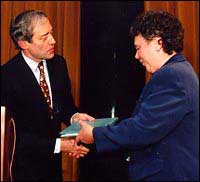
Columbia University President George Rupp (left) presents Ardith Hilliard of the Los Angeles Times with the Pulitzer Prize for Breaking News Reporting.
Winning Work
Suspects Slain, 10 Officers Injured in Heist Gone Awry
By Beth Shuster and Doug Smith
Times Staff Writers
In warlike pursuit captured on live TV, dozens of police officers tracked down and killed two heavily armed bank robbers in North Hollywood on Friday in the face of blistering automatic-weapons fire. Ten officers were wounded, including six in a spectacular eruption of firepower that draped a shroud of fear over a vast residential area of the eastern San Fernando Valley.
Three civilians were also hit by gunfire in a confrontation that recalled the apocalyptic 1974 gun battle between police and the Symbionese Liberation Army, the Maoist kidnappers of heiress Patty Hearst in South-Central Los Angeles.
The day brought renewed calls for gun controls and for better weapons to aid outgunned police.
In one of many scenes of inexplicably brazen conduct that appalled the nation, one of the robbers--braced for battle in full body armor--strode across the Bank of America parking lot near Laurel Canyon and Victory boulevards, spraying bullets at outgunned officers moments before he was shot to death on a nearby residential street. Police gunned him down when he stepped out from a hiding spot, apparently to face his death.
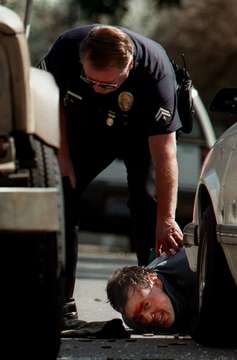
Still alive, one of the bank robbery suspects struggles with an officer near the corner of Archwood Street and Hinds Avenue in North Hollywood. He was shot there in an exchange of gun fire with police and later died. (Carolyn Cole)
The identities of the two dead robbers had not been released by Friday night. At least two other suspects in the robbery were being sought. None of the officers or civilians wounded by gunfire was seriously injured.
The shooting spread rapidly down house-lined streets, placing dozens of square blocks under siege, sending pedestrians ducking for cover, scattering motorists and forcing homeowners behind locked doors for hours.
In pursuit of other possible suspects, police closed streets and freeways and even sealed off 10 nearby public schools. Residents living within the battle zone were advised to stay home or to call 911 for police escorts out of the area.
"I was scared to go out but I did, 'cuz my grandma was out there too," said a 12-year-old witness, Ramella Aleksanyan. "We saw a guy who they shot but he wasn't really dead. He was kinda moving."
In one of countless dramas videotaped by news helicopters--which also came under fire--one of the wounded officers was rescued from the bank parking lot by three colleagues who shielded him with a patrol car, scooped him inside and lurched away backward with one door open.
So lopsided was the disparity in weaponry that nine frantic officers, probably in violation of Los Angeles Police Department policy, barged into a North Hollywood gun shop and borrowed seven rifles and ammunition.
"They asked us if they could have some firepower, namely that would penetrate vests," said the gun store owner, who asked that his name not be used.
When the gunfire stopped after about an hour, it seemed a miracle that so few were wounded.
Besides the shooting victims, an officer and a motorist were injured in a collision as police raced through the area. Three other officers sustained minor injuries during the manhunt. The injured were being treated at several hospitals. One officer who was shot was in surgery at Providence Holy Cross Hospital in Mission Hills, and a motorist was in critical condition Friday.
"These are very organized, brutal bank robbery suspects. They're killers," LAPD Cmdr. Tim McBride said into the television cameras, emphasizing the need for people to stay indoors.
Masked Gunmen Storm Bank
At least two heavily armed gunmen--suspects in earlier San Fernando Valley bank robberies--stormed the bank about 9:15 a.m., brandishing fully automatic weapons with 100-round clips.
Barking commands, the masked gunmen herded dozens of terrified customers into a vault.
Police said the robbers turned and fired their weapons back into the bank, wounding one person, as they were leaving with a cart loaded with bags of money. All the cash was recovered at the scene.
A call from a witness who saw the armored men walk into the bank brought the first police units, armed only with handguns. They were engulfed in a gunfight, with combatants and bystanders virtually rubbing shoulders.
Crystal Ransome was leaving the bank as the gunmen entered, pulling masks over their faces. She sought cover in her car when she heard gun reports. "I was laying down in my car, and the next thing I know, a cop is telling me, 'Get out, get out,' " she said. "A cop ran me across the street. He was holding his gun drawn the whole time."
Retreating from the surrounded bank, one robber took cover behind the getaway car--a white sedan--as it crept across the parking lot, blasting away in several directions and reaching inside for ammunition to reload. At one point, he apparently fired a round through the car window, either hitting or just missing his cohort at the wheel. Then he walked to a residential street, firing bursts of bullets along the way.
As police cautiously closed in, the suspect crouched in shadows between a large truck and a fence, but then stood. Walking along the sidewalk, he exchanged fire with his pursuers, falling after being hit, then jerking gruesomely from a shot to the head.
Meanwhile, as the getaway vehicle drove off in another direction, police shot out its tires. The driver pressed on at low speed. On a residential street nearby, he rammed an approaching car. After it eluded him, he shot through the window of an oncoming truck, apparently to scare away its driver, who fled to a nearby house.
From her porch, homeowner Tagui Guzubashyan saw the suspect get into his truck but abandon it when he couldn't get it started. Methodically, he began to unload weapons from his car trunk, picking his way across the carpet of bullet casings and glass.
Just then a patrol car with automatic weapons blazing out its windows pinned the suspect down behind his car. Three SWAT officers tumbled from the car and opened fire, taking cover behind the wheels.
"We heard maybe 200 or 300 shots," Guzubashyan said. "It was horrible. It was like in the movies."
Finally, a helmeted officer in shorts took a prone position behind the police car to shoot the suspect's legs. The man died on the street in handcuffs.
In the confusion attending the battles, several pedestrians were detained by officers who ordered them to lie spread-eagled on the asphalt; they were later released after it was determined they were not involved.
Search for Missing Suspects
About 30 minutes after the last gunshots, a mounting army of police and SWAT team members deployed carefully around a backyard littered with equipment and junk. After sizing up the situation for more than an hour, a police battering ram broke down a wall and part of a tool shed where they thought a suspect was hiding.
Officers unleashed police dogs, but after about 30 minutes of searching, the SWAT team determined that no one was in the yard.
At 2 p.m., Police Chief Willie L. Williams announced that the police had cleared the last areas where suspects might have been hiding. Twenty minutes later, television stations reported that the police had found a trail of blood in the yard.
The Hollywood Freeway, closed during the battle, reopened about 2 p.m., averting a potential traffic nightmare as commuters headed home for the weekend. But many streets remained closed.
The search for what police believed were two or three more robbers continued through the afternoon with no further success.
Friday evening, Williams said police believed that there had been only two men in the holdup. However, a large force continued to search surrounding streets with dogs while police escorts shuttled residents in and out until late in the night as officers in helicopters kept watch.
A source familiar with the rapidly unfolding investigation said authorities have strong reason to believe that the suspects killed in Friday's shootout also were responsible for two robberies last May.
That source said the techniques employed by the robbers resembled those used by gunmen who robbed a Bank of America branch on Woodman Avenue in Van Nuys on May 2, and another B of A branch on Roscoe Boulevard in Canoga Park on May 31.
He said the robbers in those earlier heists used high-powered weapons, fired rounds in the banks and operated with "military-like precision."
"The MO and physical description are not just close, they are right on," the source said of the May robberies and Friday's. "The weaponry, including the high-velocity rounds, were fired in all these robberies. And that's an anomaly."
Although it has been nine months since the previous robberies--a long hiatus for bank robbers--the heists last May netted the culprits a substantial sum of money, sources said. That could account for the long break between robberies.
Calls for Gun Control
The widespread terror left city and state political leaders scrambling for explanations and renewing calls for greater gun control.
"We have people equipped for warfare out there--it's unbelievable," said Los Angeles City Councilwoman Laura Chick, who chairs the council's Public Safety Committee. "I can't think of a more graphic, visual reason for the public of the United States of America to all get on board in advocating for rational, reasonable and sensible gun control.
"We have to find a way to eliminate military assault weapons being out on the streets," Chick added. "These people are better armed than our law enforcement experts."
Some lawmakers advocated a state law that would allow the city to enact stronger gun control regulations. They also called for providing more firepower to police.
© 1997, Los Angeles Times
By Beth Shuster and James Rainey
Times Staff Writers
A fallen policeman sat in a parking lot in a pool of his own blood. Bullets from a brazen gunman whirred and crackled across asphalt, glass and earth. Police officers, with their small sidearms, seemed hopelessly outmatched and unable to rescue their colleague.
But in a moment of raw bravery and studied precision, the Los Angeles Police Department rode to the rescue of one of its own, in just one of the many dramatic televised images of a botched bank robbery Friday morning.
The carload of police sped into an unprotected parking lot across the street from the bank, threw open their doors and pulled the injured plainclothes officer to safety. Then, under constant fire, the police car lurched into reverse and sped out of the parking lot--to safety and a waiting ambulance.
Time and again in a morning of extreme violence, policemen and policewomen stepped from behind cover with their light sidearms to face the suspected bank robbers, who launched a blazing gun battle that ranged across several blocks of a North Hollywood neighborhood.
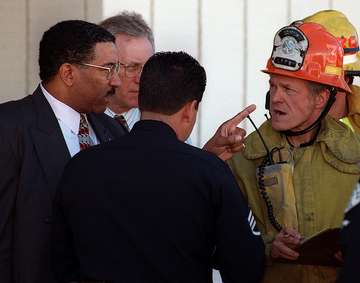
Police Chief Willie L. Williams gives instructions to police and Fire Department officials near the scene of the fatal North Hollywood shootout. (Ricardo DeAratanha)
"The thin blue line is made out of the men and women who are out there who put themselves in harm's way every day," Police Chief Willie L. Williams said later in the day, as police continued to search for suspects. "It's these brave men and women who allow us to go about our daily lives."
Ten officers were wounded or injured, including six by gunfire, but as the long day drew to a close, it seemed miraculous that the only fatalities were two riflemen in ski masks. Most of the gallery of heroes remained anonymous. Only shaky television images--taped from above by news helicopters--were testament to their actions.
Among those who faced down the gunmen or protected their colleagues in blue were a young female detective from the North Hollywood Division who helped push her wounded partner into a patrol car; another detective nearing retirement, wounded in the ankle, who compared the shootout to his duty in Vietnam; and a rookie cop whose own bullet wound didn't stop him from trying to save his partner.
Less than half an hour after the shooting, Det. Tracey Angeles was still gripping her police radio so tightly that her knuckles were white. Her royal blue jacket and black skirt were spattered with her partner's blood, her nylons were shredded and one black tennis shoe was missing.
An ashen Angeles, 29, told how she had been working that morning in the field, in plainclothes, when the call went out: "Officers under fire."
That message sent a rocket of adrenaline through the seven-year veteran and her colleagues. And although many were without their body armor or heavy weapons, they sped to the Bank of America on Laurel Canyon Boulevard where the robbery was coming violently unhinged.
Angeles and a colleague stopped in a parking lot across the street from the bank and quickly found themselves under fire. They dove first behind a car, then a key-making kiosk, but found that the AK-47 fire had little respect for such flimsy cover.
Uniformed officers with bulletproof vests then arrived to rescue the rescuers. One officer threw himself over Angeles to shield her from the fusillade. Later she wondered who her protector had been, hoping she could thank him.
Said Angeles: "We were taking too much fire. We couldn't stay where we were. We ran a short distance. That's when the officer got shot."
The downed policeman then became the preoccupation of his colleagues. He lay completely exposed in the parking lot. "It came to the point where, do you leave him to die or do you go in and get him?" said Det. Gordon Hagge.
Angeles said her wounded partner "unbelievably had the presence of mind to broadcast his location. A black and white unit came. They were still firing the whole time," she said. "We were able to get him in the car and get him out of there. We all helped."
Hagge, an auto theft detective in North Hollywood, said the police found their weapons of little use against the body armor of the robbers.
"They're waving AK-47s and I have a 9-millimeter," Hagge said. "I'm in the wrong place with the wrong gun.
"We had nothing that would go through their vests. Nothing," he said. "It was nuts."
For the Los Angeles Police Department, the unforgiving eye of the video camera has not always been kind. There are the unforgettable images of a prone Rodney G. King being beaten and of officers surrendering the intersection of Florence and Normandie avenues to a violent mob.
But on this day, the images were of swift and decisive police. Just minutes after the pictures of the parking lot rescue were broadcast, a home television audience saw two unidentified officers step out from behind a car and a tree and, without any cover, shoot and kill one of the gunmen who was walking slowly away from the bank.
When another of the masked men tried to abandon his crippled getaway car and take over a pickup truck, SWAT officers roared straight at the gunman in their squad car, seemingly ignoring the high-powered rifle and the clip of 100 rounds that he toted. The officers crept to within feet of the man. Withstanding a barrage of heavy gunfire, the officers shot and killed him.
Cmdr. Tim McBride, the Police Department's chief spokesman, said the SWAT officers were free in such a situation to use deadly force without direction from superiors.
"It was their call to make," McBride said. "It is a dangerous situation. You don't want to let these guys get away, so you have got to engage them. If you let them get away, who knows how many other people they are going to hurt."
Back at the parking lot where the daring rescues had occurred, other officers also coped with the fusillade. Two of them--a rookie patrolman and a detective looking forward to retirement--thought they had found refuge behind a van when armor-piercing bullets came slamming right through the vehicle.
The two officers lunged for the closest doorway and scrambled up a flight of stairs, where they found Dr. Jorge Montes, a dentist.
Over the next several minutes, Montes, 42, treated the officers' wounds. In the adrenaline-charged moment, Montes never bothered to learntheir names. One, who had been on the force just three months, had a bullet rip into his buttocks. The other, the veteran detective who had done a tour in Vietnam, took a bullet or debris in his ankle, Montes said.
Although the rookie cop had a wound 6 inches long and 2 inches wide, he was preoccupied with his injured partner, who remained in the street with a leg wound.
"He wanted to go back down there in the street and make sure his partner was out of harm's way," Montes said. "I don't think he realized how seriously hurt he was."
The veteran officer told the dentist that he had not seen such a firefight since Vietnam.
The detective persuaded the rookie that his partner would be safe below after they radioed for backup.
"Even though they were the ones who were injured, they were concerned with their fellow officers," Montes said. "They were very concerned with the public and helping each other, and they did all this to keep us safe. I was very, very impressed."
© 1997, Los Angeles Times
By Jill Leovy and Henry Chu
Times Staff Writers
It took only seconds for a humdrum task to be transformed into an exercise in terror, for David Shapiro to start "eating the linoleum" after armed robbers entered his local bank and ordered everyone to hit the floor.
It took no time at all for bank customer Anita Hernandez to throw her body over her baby granddaughter, offering the only protection she had.
"I knew the bullets would go right through me, but I got on top of her anyway," said Hernandez, still clutching 23-month-old Onica Vega hours after her ordeal was finally over.
Fear, bravery and shock twined into one tight knot of emotion Friday for about 30 bank workers and customers held captive by men outfitted with body armor and automatic weapons.
As the eyes of the nation watched the drama unfold on television screens, tucked away from view were these men, women and children. They experienced the horror at ground zero, then found themselves crammed inside a bank vault, ordered there at gunpoint.
None was seriously hurt in the robbery-turned-gunfight that ultimately claimed two lives and injured 13 others. But the nightmare will not soon be forgotten.
"It was intense," said Matthew Shapiro, 16, who was trapped inside the North Hollywood bank with his father, David, until police let them out.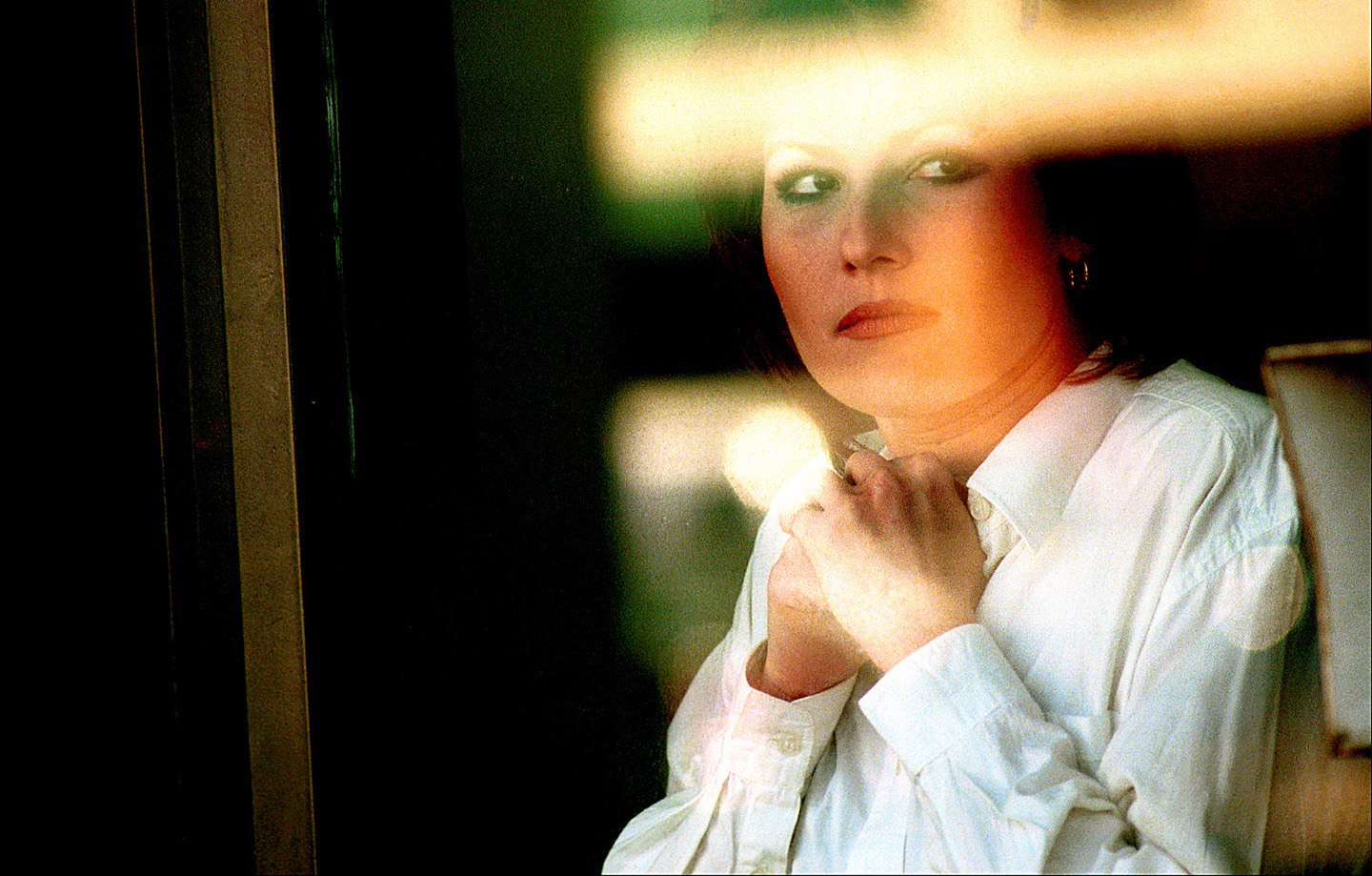
After the shootout at a nearby Bank of America, a worker peers through a glass door of the Wells Fargo building on Victory west of Laural Canyon in North Hollywood. (Gerard Burkhart)
The Shapiros were part of a crowd of early customers who stopped to take care of business at the Bank of America near Victory and Laurel Canyon boulevards shortly after 9 a.m. Friday.
Minutes later, the masked gunmen strode in, interrupting the bank's workaday routine with a burst of gunfire and barking orders.
"I heard gunshots and screaming voices--men's voices--yelling, 'This is a holdup!' " Matthew said. "I looked up, and I saw this big guy all in black, like armor. You couldn't see his face."
Hernandez, 39, was also jolted. Standing in line while holding her grandchild, she suddenly caught sight of "this huge monster, this guy in black, with a big ol' rifle pointed down."
"I heard them yelling, 'All you mother-Fs hit the floor!' " Hernandez said. "I was afraid the baby would cry. I was afraid of irritating them."
Terrified customers dived onto the brown tile at their feet. The sharp report of more gunfire rent the air as the intruders commanded bank tellers to hand over cash.
"They were screaming, 'Get the money out or we will kill you!' " Matthew said.
A short while later, a group of tellers was separated from the rest, ordered to stay in the front of the bank as the robbers herded everyone else into a vault, captives said. Gingerly, the prisoners obeyed, fearful of making any sudden moves or provoking their captors.
"I slowly got up. I kept my head down. I was still looking at the brown tiles," Matthew said. "We all slowly walked through this big metal door.
"There was nothing left in there."
About 30 people jammed into the vault's antechamber, a space that measured about 15 by 7 feet, Matthew said. Beyond, they could look into another chamber. Both were empty, except for some safety deposit boxes.
For the first time, the captives dared to speak to one another in whispers, exhibiting surprising calm despite what one later described as the almost continuous sound of bullets being fired outside. Parents comforted their children, who included at least three infants and two toddlers.
"It was very hot," Hernandez said. "Everyone kept saying to each other, 'Are you OK? Are you OK?' My baby was like, where am I?"
One of the captives had a cellular phone and called police, allowing authorities to remain in constant communication with the captives, said LAPD Cmdr. Tim McBride.
A male bank employee tried to keep everyone quiet to hear what was happening outside. Seconds expanded into minutes, which passed with agonizing slowness.
"We just waited. What . . . else was there to do?" said David Shapiro, 42.
In the rising heat and long silences, his thoughts turned to family.
"I just stood there thinking about my wife and kids," said Shapiro, a Studio City resident who owns a motion picture marketing company. "I was just thinking about my son's safety."
"I kept thinking, how long are we going to be in here?" said Hernandez, worried that her granddaughter was getting hungry.
Thirty to 40 minutes went by inside the vault.
By then, the robbers had fanned out into the surrounding neighborhood, caught up in a shootout with police who found themselves outgunned.
As the locus of the drama moved away from where it began, officers swarmed into the bank to release and interview the captives for the next few hours.
Finally, directed by police, they emerged in single file, hands held over their heads. They were frisked by officers in case any of the robbers was masquerading as a captive.
In the bank lobby, they were reunited with the tellers who had been separated from the rest of the group. One woman was shaking from fear.
David Shapiro grabbed her and gave her a long hug.
By midafternoon, they were released by police, their trial over.
© 1997, Los Angeles Times
Violence: Police order residents to stay inside, but some emerge to rescue
By Andrew Blankstein and Sharon Bernstein
Times Staff Writers
When the staccato cracks of gunfire ripped through Archwood Street, Ruel Poticar was doing his laundry, getting ready to report for his first day of work as a limousine driver. Down the block, Nvart Zakarian was tending her ailing 12-year-old granddaughter. Another neighbor, Orsana Rajanchyan, was doing housework.
In a matter of moments, they were trapped inside their stucco and brick homes, the strained voice of a police officer shouting from a bullhorn, "Don't come out! Don't come out!"
It was just before 10 a.m. and a violent band of robbers had just invaded a bank on nearby Kittridge Street, a few blocks away from this quiet working class neighborhood in North Hollywood. An escaping suspect, the tires of his car shot out by police, was spraying bullets as he tried to commandeer a pickup truck.
Tagui Guzubashyan froze, her eyes stuck to the horror unfolding in front of her house. She was standing on her porch, a place that until that moment had been a haven.
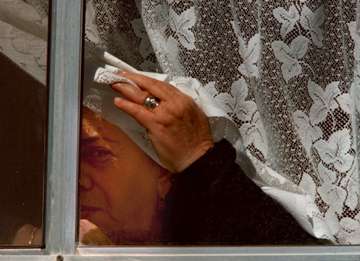
A resident peeks through her window curtain to watch the activities on Archwood Street. Outside, police cornered a gunman fleeing a bank robbery and killed him. (Carolyn Cole)
She watched as the suspect climbed out of his white car dressed in black and wearing a ski mask.
"I could see only his eyes and mouth," she recalled later. "I saw him carrying a big shotgun. He got out of his car and opened his trunk. He took some guns from his trunk."
Police cars screamed around the corner from Hinds Avenue.
"They surrounded the white car," she said. "He just started shooting."
Down the street, a curious Poticar squeezed open his home's screen door and saw the red flash of a gun. A driver screamed out from a passing car, telling him to go save his elderly neighbor, Bertha Wolf, who is hard of hearing and had made her way into the street to try to find out what was going on.
Poticar ran after her. "I was trying to push her inside," he said.
He "practically carried me into the house," Wolf said later. "He kept saying, 'Get in there, Mrs. Wolf. Get in there.'"
Outside, a police officer crouched down on one knee. Snap! The suspect, wounded, put up his hands.
Dora Lubenski heard a banging at her door and left the snack she had been making in the kitchen to see what it was. A man, blood spurting from his head, had collapsed outside. It was the driver of the pickup.
"The back of his head was soaked with blood," she said. "I called 911 and said, 'This guy is dying in front of my porch.'"
It was not the first time a bank robber had been caught on Archwood. Three years ago, Zakarian remembered, someone else had held up a nearby bank and run to their block. But nothing had ever happened like this.
"I know war in my country," said Rajanchyan, a native of Armenia, who wedged her young children into the space between the edge of the couch and the television when the shooting started Friday. "But I never saw anything like this. I heard shooting like it was in my home."
They lay there, Rajanchyan and her daughters, Lena and Alice, waiting for the shouting and the shooting to die down. "Mommy," said 3-year-old Lena, "I'm afraid. What's going on?"
Even after the mayhem settled, the immediate world outside could hardly be described as peaceful. Curbs and lawns were littered with police chalk, broken glass and spent bullet casings. Houses and driveways were pockmarked with bullet holes.
Police had closed off the street and several surrounding ones. Anyone who wanted to leave had to call 911 to ask for a police escort.
Ten local public schools and several private schools in the area were locked down by officers, who were combing the area for another possible suspect.
Some people huddled inside, worried about family members and children who were stuck at school. But others made their way into the sunlight, looking for some kind of explanation in the hard facts littering the ground.
Ramella Aleksanyan, 12, had felt sick Friday and stayed home from school. After the shootings, she went outside with her grandmother. "I was scared," she said. "But I had to come out and see it."
Eric Malgor, 13, who had the day off from school, also found himself outside, just checking to see if everything was all right. But he came back in to help his mother, content to think about household chores.
His brother, Jonathan, had been at school when the shooting started. The 7-year-old said later that he was frightened when the gunfire erupted.
"I thought that they were going to kill my mother," he said.
About 4 p.m., the neighbors were again herded into their houses. Police helicopters flew overhead, and an officer's voice boomed down: "Police dogs, canine units and SWAT teams are searching the area for an armed suspect. Please stay inside your homes."
The neighbors obliged. And perhaps home was the best place to be.
"My house is very safe," Rajanchyan said. "But you never know what's going on outside."
© 1997, Los Angeles Times
By Matt Lait and Greg Braxton
Times Staff Writers
"There's a balance in these instances with trying to pull far enough back while still covering the story," said Beth Maharrey, acting co-news director of KCAL Channel 9. "But that doesn't mean we're not going to show as much as we can."
Live, from the scene: An officer, sitting in his own blood, slumps against a car and waits for help. A heavily armed bandit fires off round after round before crumpling to the ground, shot by police. Down the street, another gunman armed with an automatic weapon hides behind a car, unloading on officers who duck for cover less than 20 feet away.
As morning viewers saw those horrific events in North Hollywood unfold on their television sets Friday, the law enforcement community watched too, growing increasingly uneasy over who might be tuning in. Were loved ones panicking as they saw friends or spouses put their lives on the line?
"These are very tense situations," said Los Angeles Police Lt. John Dunkin, adding that news directors need to use caution when their cameras get so close that an officer, especially a wounded officer, could be identified. "There has to be some discretion by these news agencies."
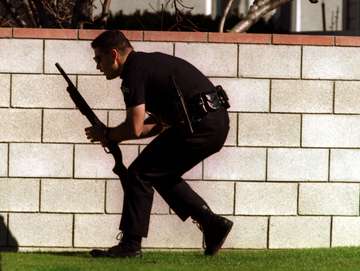
An officer with a shotgun takes cover behind a cinder-block wall while searching for the heavily armed suspects who fled after the bank robbery. (Los Angeles Times)
And although he says reporters play an important role and help police relay information to the public, Dunkin said live coverage in some cases could put officers in peril if criminals have access to a television and are able to watch police tactics and deployment.
"That kind of coverage can negate what we are attempting to do," he said.
But along with such concerns, some officers said the coverage Friday gave them a sense of vindication because the public had an opportunity to peek into the realities of their lives.
"It shows the public the hazards of this profession," said Dennis Zine, a director of the Los Angeles Police Protective League. "It's shows people how violent and desperate criminals are and how little respect they have for the public. It shows we're the good guys, we're not the villains."
Zine said he hoped Friday's incident would silence people who four days ago criticized officers of a special LAPD unit for their involvement in a Northridge shooting that left three alleged robbers dead and a bystander wounded.
"It's ironic. . . . Yesterday we were assassins, today we were doing our jobs," he said.
Even though Zine said he supported the live coverage, he agreed that television crews should not hamper police operations or get so close that a wounded officer could be identified.
Local television news officials, while trying to be sensitive to police and their tactics, are also aware of the exciting nature of such live incidents, saying they have an obligation to be as aggressive as possible in their coverage.
The boldness in this case resulted in one of the suspects apparently firing at news helicopters. At another point, viewers of at least two stations watched one of the suspects getting shot in the head by police.
"That's one of the dangers of live coverage," said KCBS-TV Channel 2 News Director Larry Perret. "But we have to cover it. We try to cooperate with the police, but it's a tough decision."
KNBC Channel 4 News Director Bill Lord said Friday's shooting was one of the most remarkable breaking news events captured on television.
"I would rank it just below the bombing in Oklahoma City," he said. "In this case, we didn't really see blood, but we saw gunfire, which is more shocking in the immediate sense."
For the most part, police officials say television news crews are sensitive to concerns of law enforcement. When an officer was gunned down in Hollywood in October 1994 near the KTLA Channel 5 studios, the station did not air footage it had of the dying officer until his family had been notified.
"We were very, very appreciative," said Dunkin, who until a year ago had been an LAPD spokesman. "If something is to happen to [police officers] they would prefer that their families learn about it from the department rather than from television."
On Friday, several news crews pulled away from camera shots of police surrounding a shed because police voiced concerns that the coverage might alert possible suspects in the area.
"There's a balance in these instances with trying to pull far enough back while still covering the story," said Beth Maharrey, acting co-news director of KCAL Channel 9. "But that doesn't mean we're not going to show as much as we can."
She said that often in breaking news situations, stations are monitored by police in the department's press relations office, which has a wall of television sets--one for each station.
"There's a press information officer who is in contact with us all the time. They are not the enemy," Maharrey said.
Jose Rios, news director of KTTV Channel 11, said the station's "first concern has to be public safety. You have to be careful in showing the officers who are in harm's way. The biggest concern the police had were aerial shots. . . . We have to be responsible."
Executives, however, scoffed at the notion that the suspects might be watching television to get an idea what police are up to.
"The chance that they are watching TV is highly unlikely," Perret said.
But it is likely that the spouses and friends of officers in the field are glued to their televisions.
Karen Morales, a member of Peace Officers Wives Club Affiliated, said live crime coverage is one of the most gut-wrenching things the spouse of a law enforcement officer can watch.
"There is nothing you can do," said Morales, the wife of a Garden Grove police officer who watched Friday's coverage at home. "I was grateful to have my husband sitting next to me."
© 1997, Los Angeles Times
By Jesus Sanchez
Times Staff Writer
Financial institutions will be under greater pressure to adopt more costly and cumbersome security measures in the wake of Friday's deadly bank shootout in North Hollywood, according to security and banking officials.
The holdup at a Bank of America branch will once again find bankers and others weighing the merits of more stringent security measures--such as armed guards and bulletproof shields--against their costs and potential for alienating and even scaring off customers.
"This may be a pivotal point in that debate," said John Stafford, a spokesman for the California Bankers Assn. "Do you go to full red alert at every bank? There does seem to be a trend" in that direction.
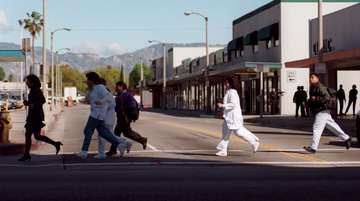
Area residents and workers dash across Bellingham Avenue to get away from the Bank of America robbery shootout Friday morning in North Hollywood. (Carolyn Cole)
Despite a dramatic drop in bank holdups, the Los Angeles area remains the nation's capital for such incidents. Southland bank robberies totaled 1,126 last year, about the same as in 1995 and well below the peak of 2,641 reached in 1992, according to the FBI.
However, the number of violent "takeover" robberies, which involve multiple bandits and sometimes the taking of hostages, surged 20% last year to 222.
Many security experts have long criticized banks, savings and loans, credit unions and other financial institutions for cutting back on security or failing to adopt higher levels of protection.
In recent years, more banks have purchased closed-circuit television systems and "bandit barriers"--sheets of bulletproof plastic placed in front of teller windows--to boost security.
These more visible and costly precautions have spread from high-crime, inner-city locations to suburban branches, where extended hours, open floor plans and easy access to freeways have made them tempting robbery targets.
But there is debate over the effectiveness of some security methods. As takeover robberies have increased, bandit barriers do little to protect customers and bank employees who are left in unprotected areas, said commercial security expert Bud Figliola.
"They do little to stop that kind of robbery," Figliola said. Bandits "will take a hostage and threaten to kill someone if they don't get what they want."
Many financial institutions have also moved away from armed security guards, whose presence has been found to often provoke more violent attacks. Many such institutions prefer unarmed, uniformed guards to help deter and report crime.
"Armed security personnel can only do so much," said Dereck Andrade, a spokesman for Encino-based Pinkerton's Inc. "These individuals [in Friday's attack]... showed up at the bank prepared for a small war. It's hard to prepare for something like that unless you have an army at your bank."
Pinkerton's said it had already received calls from companies in the San Fernando Valley to take a closer look at their security. It's a common occurrence after such a violent and well publicized robbery as the North Hollywood holdup, Andrade said.
"People are scared," he said.
© 1997, Los Angeles Times
By Bill Boyarsky
Times Staff Writer
We think we are civilized. With just a bit of irony, we congratulate ourselves on living in the pop culture capital of the world. But on Friday, L.A. was just the vicious old Wild West, where punks are armed with weapons powerful enough to outgun the Los Angeles Police Department.
The opening minutes of the gunfight at the Bank of America branch in North Hollywood were one-sided, with every advantage going to the robbers. Police handguns were outmatched by the bandits' automatic weapons.
"We went in with our 9-millimeters and some shotguns," Det. Gordon Hagge said. "They had body armor. It stopped everything we had. This guy came out shooting with an AK-47 as if he didn't have a care in the world. Their ability to sustain their fire was everything. That's why the battle lasted so long.
"If you write anything," Hagge told me on a nearby street not long after the shooting, "say we were outgunned."
Outgunned and overwhelmed by a permissive, rootless society that glorifies violence on television and in the movies. Worse yet, it is a society that permits every vicious criminal and nut, their minds poisoned by Hollywood's glorification of killing, to get automatic weapons capable of firing armor-piercing bullets through cars and houses.
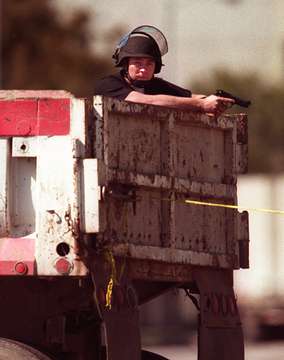
A commandereed trash hauler provides cover for a helmeted Los Angeles police officer at the corner of Vanowen and Radford. With pistol drawn, he helped maintain a search perimeter that forced residents inside their homes. (Robert Durell)
Death is cheap, plentiful, painless and often comic on the screen. It loses any meaning.
The movie and TV moguls, their lives far removed from the concerns of most people, justify their violence by invoking the sacred icon--art. They insist that the carnage on the screen doesn't cause violence.
I made that argument, myself, on a panel discussion a couple of years ago. My parents permitted my brother and me to watch and read everything. What was wrong with that? We didn't turn out to be violent.
Another panelist cut me to shreds.
His son was emotionally disturbed. Whenever the child happened to see violence on television, it upset him terribly. Maybe it didn't bother you. Maybe it didn't bother your kids, he said. But it bothers mine.
It would be an oversimplification to say that movie and television violence is the sole cause of tragedies such as the one at the bank. Even so, an uncounted number of people are profoundly affected by what they hear and see.
And for that minority of them who are violent, society has given them an outlet, a release, an easily obtained weapon--the firearm.
Not just a firearm, but a world-class automatic weapon that has no other use except to kill people.
So after submerging themselves in hours of televised brutality, probably stoking themselves with booze, drugs or both, the new American killer takes to the streets to act out what he has seen on the screen.
That's what these thugs were doing, dressed in black, in what the media called commando garb--an unfortunate violence-glorifying phrase that demeans the brave men who have served our country as commandos.
Then, their robbery having failed, the bandits brought the violence of television into quiet residential streets near the bank where most people's only contact with violence is courtesy of Hollywood.
Television became life.
" I could hear the shooting at the Bank of America," said Ken Ogger, who lives three blocks away. He saw and heard the helicopters from the police and television news. He went inside the house and turned on the television.
Feeling safe because the bank was three blocks away, "I thought I would just sit home with the dog and be quiet and watch." But the police had shot one of the bandits in front of his house.
"I ran into the laundry room and crouched down with the dog," he said.
There's a simplistic, but powerful, lesson for all of us in Ken Ogger's terror-filled morning: All these guns, all this movie and television violence, makes victims. Sometimes they're innocent bystanders, as happened in North Hollywood.
We know the solutions. In fact, they have been talked to death.
Some are unattainable, such as dealing with violence on the screen. The lure of big bucks is too great to reverse the trend.
Then there's gun control. It would help, no doubt, but the enactment of strict laws will continue to be stopped by gun advocates who wield great influence in congressional and legislative elections. We've nibbled at the corners, and cut down the gun supply, but the gun lobby is strong enough to prevent anything drastic--or really effective.
So in the end, we have to go along with Det. Gordon Hagge and the other cops who faced the bandits' superior firepower at the Bank of America branch.
They want more powerful weapons, .45s instead of 9-millimeter Berettas. "You've got to have knockdown power," said Hagge.
I agree. But that's sad. We just won an arms race against the Soviets. Now we're in one against domestic thugs. Too bad we can't live by a doctrine of personal and societal responsibility instead of wallowing around in our culture of violence.
© 1997, Los Angeles Times
Pulp Reality in L.A.
By Shawn Hubler
Times Staff Writer
What does it mean, that this vicious burst of human frailty could have looked for all the world like entertainment? What does it mean for this city that our art and our lives have become so intertwined?
In this city, more than most places on earth, art and life seem inseparable. Someone robs a bank in suburbia on live TV, and the collision is inevitable, an unclean segue between pulp fiction and truth.
The bad guys wore the requisite ski masks, the SWAT troops sported ball caps, the shrieking bank tellers holed themselves up in the vault. The police tape fluttered. The artillery was heavy. There were skycams and wounded bystanders on the curb. If you were watching it on TV, as virtually everyone did if they cared to see the mayhem du jour, you couldn't help but notice the influence of our local art.
But you also couldn't help but wonder about the inevitable, poignant entrance of life. At one point, shortly after the robbery, the police did a house-to-house search. Guns drawn, eyes peeled, they crept along fences and down alleys in search of fugitives.
But what was most noticeable was not so much the tension of it all, but the very ordinariness of the scene. The trash cans lined up for collection. The chinks in the pink stuccoed walls. The fragrant, wet laundry that flapped on the clotheslines of a yard where an armed and dangerous felon might be cowering, his mind racing, his gun heavier than you'd expect in one hand.
Did the robbers secretly wonder whether any of this would unfold in slo-mo? Did they imagine a soundtrack playing in their heads as they dreamed this all the night before? Did they think, as they strolled down the street, guns ablaze, that this was the way they did it in the movies?
And when there was no soundtrack or slo-mo, when it was just two men sweating under their dark clothing, struggling to see out of the scratchy holes in those ski masks--when the lights came up and the drama was still unfolding, how was it then for the human beings on the street below?
How did the asphalt feel against their faces? How did the glass from the shattered windshields crunch underfoot? Did they ask: How could I have gotten so out of touch with the truth of life?
More to the point: Did we?
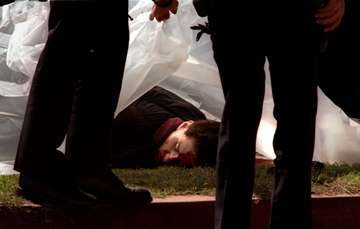
Officers examine one of two dead bank robbery suspects shot to death by police. He was killed during a furious exchange of gunfire less than a block from the bank near the corner of Archwood and Agnes. (Carolyn Cole)
It's so easy to reduce the news to something like a movie. You see a man's head being blown off, live, on a sidewalk and it crosses your mind that the director has shown remarkable restraint in filming this scene in long shot. You see a bank being robbed, and you think of all the glamour that has come to surround the genre--the physical beauty of the actors who played Bonnie and Clyde, the cool feel of the lexicon ("takedown robbery"), the disguises and masks and the swashbuckling attitudes.
It was like the movie "Heat," the television announcers told us, like an action flick with an exciting shootout at the end.
But it wasn't, not really, not even from the virtual peanut gallery of the skycam. For from up there, high in the sky, you could see the blood, and it wasn't bright or red or plentiful, the way it is on film.
It was only small and sad, like the strip of flesh that showed when the dead gunman's jacket rode up on his back as he lay on the street. The ultimate trick ending, as the broadcast cut back by midafternoon to Rosie O'Donnell and the Bugs Bunny show.
What does it mean, that this vicious burst of human frailty could have looked for all the world like entertainment? What does it mean for this city that our art and our lives have become so intertwined?
What does it mean, other than that the dramatized account of Friday's terrifying events will be coming soon to a theater near you?
© 1997, Los Angeles Times