New York Daily News, by Mike McAlary
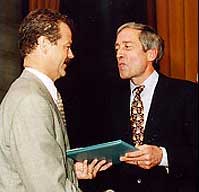
Columbia University President George Rupp (right) presents Michael McAlary with the Pulitzer Prize for Commentary.
Winning Work
By Mike McAlary
Abner Louima trembled in his hospital bed yesterday as his wife, Micheline, touched his cheek and wept. A plastic tube ran from his torn bladder into a plastic bag. His urine was red.
This is a tale straight from the police dungeon, an allegation of brutality at the hands of cops from Brooklyn's 70th Precinct that seems so impossible, so crudely medieval.
"They said, 'Take this, nigger,' " Louima said, "and stuck the stick in my rear end."
"Was it a nightstick?" I asked, leaning over the bed so I could hear his gasping voice.
"It was the plunger from the police man's bathroom," he said. "It was brown. When they were done they stuck it in my mouth and broke my teeth."
It all started early Saturday morning after a party in a club near the corner of Glenwood Road and Flatbush Ave. As the club emptied out, a fight broke out between two women. "I didn't know the women," said Louima, a 30-year-old Haitian immigrant. "I was there with my brother and my cousin."
The cops showed up, as they are supposed to, and scattered the crowd.
"The white cops started with some racial stuff," Louima whispered. "They said, 'Why do you people come to this country if you can't speak English?' They called us niggers.
"A cop said to shut up. I didn't think he was talking to me. He pushed me to the ground and handcuffed my hands. Two cops put me in their patrol car and drove me to the corner of Glenwood and Nostrand. There was another car there. They kicked and beat me with their radios. They were yelling, 'You people can't even talk English, I am going to teach you to respect a cop.' None of the cops had their nametags on. They put me back in the car and drove me to the corner of Glenwood and Bedford. They met two other cops and beat me again. This time in the legs, too."
Then, he said, he was driven to the 70th Precinct stationhouse, led to the duty sergeant's desk and strip-searched.
"My pants were down at my ankles, in full view of the other cops. They walked me over to the bathroom and closed the door. There were two cops. One said, 'You niggers have to learn to respect police officers.' The other one said, 'If you yell or make any noise, I will kill you.' Then one held me and the other one stuck the plunger up my behind. He pulled it out and shoved it in my mouth, broke my teeth and said, 'That's your s--t, nigger.' Later, when they called the ambulance, the cop told me, 'If you ever tell anyone . . . I will kill you and your family.' "
Louima is lying in critical condition in Coney Island Hospital's trauma unit with a pierced lower intestine and a torn bladder. His doctor told me it would take three or four months for him to recover. His left hand was shackled to the bed. A cop sat guard across the room.
If his story is true, a lot of cops should go down. Some cops, the good ones, are already outraged and tipped me off to this horrific incident late Monday night and yesterday morning.
The Brooklyn district attorney's corruption unit, which interviewed Louima at the hospital last night, and the Police Department's Internal Affairs Bureau are investigating. Cops usually silent about the misdeeds of other cops were volunteering to talk, insiders said.
"This is not a corruption case," said Brian Figeroux, a former assistant district attorney and one of Louima's lawyers. "This is a torture case. Cops are going to jail."
Abner Louima has never been arrested. He is a licensed guard and works for GFC Security in Brooklyn. "I liked cops," he said, "until this." Three hours after I left his bedside, he identified two 70th Precinct cops from photographs. They were placed on modified duty. Investigators have confiscated all the toilet plungers from the stationhouse.
After hearing a story that I wanted to be untrue, I was shaking.
This is not about the police force. This is about a group of cops who are sadistic racists. Be afraid, be very afraid if this story is true, and I am afraid it is.
Abner's father, Jean Louima, who wore a N.Y. Mets cap, touched his son's swollen cheek and stepped back and moaned. They are from Haiti. The father, three sons and a daughter live on E. 48th St. in East Flatbush. Abner and his wife live on 117th St. in Jamaica. They are a close, hardworking family.
"He has never been in trouble in his life," said his wife, Micheline, the mother of their son, Abner Jr., as she began to cry. She was wearing a bright-colored red dress and a white cap. "The cops are going to try and say this was some sort of homosexual thing. How much will they take from him?"
The doctor on the case, who gave his name only as Levin, told us that Louima suffered a "blunt-force trauma to the anus" and that "his injuries were consistent" with his frightening tale of torture.
It will be easy for investigators to determine which cops responded to the fight outside the club and who arrested and transported Louima. The first cops to show up at the hospital Saturday told the nurses they found Louima half-naked and bleeding and said he was a homosexual, family members said they were told.
"His family saw him get in the police car in perfect health," said Carl Thomas, Louima's other lawyer and a Brooklyn prosecutor until three years ago. "The next thing we know, he is in the hospital with a lacerated bladder and pierced intestine. This is worse than the stun gun case in Queens. What were these cops thinking? How can you do this to another human being? And how many people did they do this to before?"
This is a story to stop the city.
© 1997, New York Daily News
By Mike McAlary
It is hard to judge someone's size in bed, but Abner Louima, who has a gold-capped tooth in the front of his broken mouth, is a small, delicate man.
From his bed on the seventh floor at Coney Island Hospital, he offered a bruised, raw hand and tried to smile when we met. He kept fingering the bandage on the right side of his face.
"You'll be okay," I said.
"I know," said Louima as I leaned close to understand the Haitian immigrant's pained English.
His answer was bravado for his wife, Micheline. It was the only lie I heard, though I didn't want to begin to think what he described is even possible. We all know some cops can steal and lie. But this?
I first thought Louima was talking about being assaulted with a cop's nightstick. But he quickly corrected me.
"It was the stick from the plunger," he said. "Brown. Maybe plastic."
"How can you be sure?"
"I saw the bottom part," he said. "It was still attached."
He glanced at his wife. He was embarrassed to be talking about this horrendous act of sodomy in front of her, a stranger and his father, Jean. Maybe that's why our conversation Tuesday is the only interview he has done.
"I have to tell," Louima said. "Why did the cops do this? This could have happened to a kid."
But this happened to a grown man. And my guess is that it has happened before. But this time the cops weren't so lucky. That's what quite a few cops were telling me yesterday. The real outrage, one said, is that "these guys probably did it before and got away with it."
Micheline Louima said the name on the arrest report was Justin Volpe.
"Is he the one?" I asked.
"I don't know the name," Abner Louima said. "They didn't wear name tags. He had black hair, shaved on the side and spiky on top."
Identification is not going to be a problem in this case. No blue wall of silence this time. Most good cops are outraged.
And the cops and detectives I know were furious. They asked rhetorically: Did this happen before? The only reason the public knows about this incident is because there is a record of the injuries, they reasoned.
I keep going back to my notebook and re-reading Louima's words and my questions.
"The cops pulled down my pants in front of the desk sergeant," he said. "They were grabbing my wallet. They found some money and took it out. Then they marched me across to the bathroom."
"They marched you naked across the precinct?"
"Yes."
"There were other cops around?"
"Yes. There was the sergeant and other cops. They saw."
"And they said nothing?"
"I kept screaming, 'Why? Why?' All the cops heard me, but said nothing."
"What they said to me I'll never forget. In public, one says, 'You niggers have to learn how to respect police officers.'"
Years ago, I sat in the Jamaica Ave. courthouse in Queens at the trial of a sergeant named Richard Pike charged in the 106th Precinct stun gun torture scandal. Most of us would beg to be stunned a thousand times rather than suffer this kind of torture.
The good cops in this town have saved the city, cut the murder rate in half and beaten back violent crime. The mayor says we don't need a Civilian Complaint Review Board, but he is wrong. He wanted the city to trust his publicity-minded administration to keep an eye on the cops. He has forgotten his past. He started out so many years ago arresting corrupt cops.
Now, after Abner Louima, who will watch the watchers? We can't trust the police to do it.
This all started after a fracas at a nightclub.
"How many cops responded?" I asked.
"Fifteen to 20, but I was just watching. I wasn't involved."
"Did you strike a cop?"
"Look at me," he said.
There isn't much of him. But he was strong enough to survive the Tontons Macoutes, Haiti's murderous secret police. And now he gets this.
"And how many cops were there when they beat you?"
"Four," Abner said. "Two patrol cars. One I was in and another one."
His lawyer, Brian Figeroux, met my eyes. This should be easy to figure out. Just check the dispatch records.
Yesterday, Figeroux said he trusted Brooklyn District Attorney Charles Hynes to investigate the case but that he was going to the Justice Department anyway. "They want to be involved. They should be involved. We need an independent watcher."
"Has the mayor been around?"
"He just met with the family. Earlier he met with Abner. He didn't turn it into a campaign stop. He was understated, gracious. He understands this happened to his city."
I have never seen the mayor quit on a cop so fast. And he is right, based on the early evidence. But we cannot trust a politician who runs the Police Department as an arm of City Hall to police the police, whom he has tried to turn into campaign workers.
"No cops said anything," Louima said. "None came to help me."
"Could the cops in the precinct see into the bathroom?"
"No," he whispered. "They didn't open the door."
This is not corruption. This is torture chamber stuff. Most of us don't care what the mayor -- Vanity Fair be damned -- does behind closed doors.
But we need to know what the cops are doing behind the bathroom door.
© 1997, New York Daily News
By Mike McAlary
A week ago, she walked into the 70th Precinct, past the front desk to the stairs. As she climbed the steps to her office, she felt the eyes of the entire stationhouse on her again. She thought she was past all that.
Susan, a 26-year-old civilian employee, is a black woman in love with a white cop. She and Justin Volpe are the Seven-O love story and have been so for some time.
Then one of her friends -- a cop; it's one big family here -- told her why people were staring. Her boyfriend was one of the cops involved in a wild racist fracas over the weekend. One cop had beaten and shoved a bathroom plunger up a suspect's rectum. "They say Justin did it," the cop said.
She hopes it is a lie. Because if the terrible tale of torture that has people referring to the 70th, where she's worked for four years, as The Plunger Precinct is true, Susan has been planning to marry a lie.
"Justin wouldn't do this to our life," Susan said yesterday as we talked over coffee. "If it happened, he didn't do it."
Justin Volpe's hair is longer in Susan's picture than in the NYPD's official photograph. But he looks exactly as Abner Louima, a 30-year-old Haitian immigrant, described Volpe to me from a hospital bed last week maybe a little hipper, a little better looking.
"We want to be married, still," she said. They have been living together for most of the last two years, and were planning a big wedding.
Susan lives in Brooklyn. She wanted to meet and talk. She doesn't want her last name printed. She is concerned about her family. Many of them live in Brooklyn.
Her lover is a suspect in the most atrocious police torture case in 20 years, and his relationship with an intelligent black woman is confusing.
"Justin a racist? Impossible," she said, answering her own question.
"What color were our children going to be? It's like Justin tells the guys in the station, 'Susan isn't my black girlfriend. She is my girlfriend, period.'"
"I know. I know," she said, shaking her head. "On one hand, in the Seven-O, we are fighting racists who don't want to see a white man and a black woman together. But in the same precinct, he is accused of this.
"I see the looks the cops give me in the precinct. The black guys say to me, 'Has he brought you home to meet his parents? It's just sex, nothing will come of it.'"
She folded her hands and looked into space. Her courage in defending a lover accused of such an atrocity is humbling. From what I've learned, her family and his family cherish each other which makes all this, especially if Volpe is guilty, even sadder.
"Justin has been reluctant for me to come forward," she continued.
"I can't imagine being married to . . .
"It's hard to digest or even understand. Black people will say, 'How can you stand by him and believe he is innocent.' But my family said, 'We are with you. Stand by him.'"
I had to say it: "This is like the cliche, 'I can't be a racist. Some of my best friends are black.'"
"I know," she said, biting her lip. "But I know he is not an evil person. His life with me would have to be a lie. We are planning on getting married and having children. If Justin Volpe did this, he did it to me and his children."
Maybe he snapped.
"I have been to his house many times," she said. "His father, Robert, and Justin's mother treat me like their daughter. His father has come to Brooklyn. We traveled to see my family in Virginia. We stayed with my sister and her kids for a week.
"I work days; Justin works nights. Our worlds revolve. Justin I liked because he is different. He makes me laugh. We are together always. Vacations in the Bahamas and the West Indies. You can't lead one life and then do that, in the precinct bathroom. Racism isn't some switch you can turn on and off."
Maybe Justin Volpe can. "I am an educated woman," she said. "In the police world -- at that precinct -- you have to be aware of racism. There was nothing from Justin. But the others, yes. That's why we were reluctant to make our relationship public. Then one year turned to two and we decided to get married. We had to be bigger than the precinct gossip."
If everyone in the precinct knew them, has the Internal Affairs Bureau contacted her?
"They haven't called me. Perhaps because I don't fit with the version of the monster they are building."
She would marry into a Staten Island cop family. Justin's father, Robert, is a world-class detective. Justin's brother is a cop, too.
"Justin's father was saying this morning, 'You spend your whole life on one side. And then one day you wake up and your son is Public Enemy No. 1.' We are both crushed."
Because the man you love could be the most despised cop in the modern history of the NYPD?
"I asked him, and he says it didn't happen the way they're saying. He is not an evil man."
Susan is attractive and delicate with short hair. She is smaller and has a lighter complexion than Abner Louima does. On Sunday, after church, she wore a short black skirt and a white silk blouse. She had a diamond stud in each ear, a silver thumb ring on her right hand, a silver bracelet on her left wrist and an ankle bracelet under her stockings.
Do you know the cops named so far?
"Justin wasn't working with his regular partner that night," she said. "I know Charles Schwarz a little bit. I know Eric Turetzky. He is a new guy. I know them all, locked away in my room on the second floor. And the monster in the papers is not the man I want to marry."
This whole episode is confusing, especially emotionally. Abner Louima is compelling and didn't hesitate when he said he was violated and called "n----r" by a man who hoped to make a black woman his wife.
"We talked about racism many times. Cried about it at night. Where would we live? We talked about moving to Park Slope. I am from Coney Island. I went to Lafayette High School. We both know what the score is.
"I have seen him come home in the morning and struggle with the weight of being a police officer. Justin is depressed a lot. The sadness of the streets takes its toll."
But it is very possible that this man she loves so much stuck a toilet plunger up the rectum of a human being, nearly ruining the man.
If Justin Volpe is convicted, he will have violated Susan, too.
"Our first date? We went to Caliente Cab [Co.] in Greenwich Village," she said, suddenly warm with the memory. "We went to a place called the Shark Bar on Amsterdam Ave. later. He isn't much of a drinker. We're not club people, really. We were headed for a nice life. And then, this."
You think of Volpe and Abner Louima lying in bed in Coney Island Hospital keeps popping into your head.
He said a cop, who was calling him a n----r, told him that the blacks in the precinct wouldn't help him, that "all they do is make photocopies."
One of Susan's responsibilities is to make photocopies.
Did you ever hear Volpe say anything about David Dinkins or Rudy Giuliani?
"Never. He is not a political person. The thing about it being Giuliani's time is silly." And then she brought a hand to her tear-streaked face.
"We thought it was our time," she said.
© 1997, New York Daily News
By Mike McAlary
Justin Volpe offered his right hand, and I hesitated. It was small but powerful-looking. I remembered what Abner Louima said about a white cop who wore gloves in the 70th Precinct stationhouse bathroom.
"It is good to meet you," he said. "I always wanted to talk to you."
There was a graciousness about him. It seemed false and out of place in a police officer accused of sticking a toilet plunger up the rectum of a prisoner. He was on his best behavior. As we entered the room, he held the door. "No, go ahead," he said.
In the last 12 years, I've met the NYPD's worst rogues. Brian O'Regan and Henry Winter from the 77th Precinct were thieves who later committed suicide. Peter Heron admitted shooting and framing his heroin dealer. He went to jail. Then, there was Michael Dowd and his corrupt colleagues in the 30th Precinct. They all smile and offer their hands, but not in friendship.
"I am perfectly willing to believe all this is a lie if you convince me," I told Volpe, who is perhaps the most despised cop in America and single-handedly giving credibility to every allegation of police brutality in the country.
Volpe was controlled and soft-spoken. He plays the victim well. He is a weightlifter and built like a fire hydrant. It was easy to see him as some version of Mark Fuhrman on steroids.
"It didn't happen the way they are saying," Volpe said. "Now I know what it's like to be falsely accused."
"Then what happened?"
"It wasn't me."
"Then who was it?"
"If it happened, it wasn't me," he said. "It will all come out. I will be vindicated. It's like a nightmare and I can't wake up."
That is far as we got on that subject. He told me he would talk if I didn't press him on the facts.
"A lot of stuff is going to come out about that club [the Rendez-Vous, where the incident began]," he said. "There may have been a fight in that bathroom."
This is the cop alibi, spoken as if it would explain everything. A lot of cops talk in whispers. It was a gay club, they say in hushed tones.
From his bed in Coney Island Island Hospital last week, Abner Louima, a Haitian immigrant, and his wife, Micheline, told me about the Aug. 9 horror of being beaten with radios and having a toilet plunger shoved up his rectum through his intestines into his bladder.
"The cops who came here that Saturday morning told a nurse they found me bleeding on the ground," Louima said. "They told her, 'He was half naked and bleeding when we found him. Something happened in the club.' They said it was a homosexual thing. The coverup started there."
Volpe shook his head a lot during our two-hour conversation. "It wasn't me," he said again. "It happened before [at the nightclub.]"
Police and investigators for the Brooklyn district attorney's office say this is nonsense. If Louima had been violated at Club Rendez-Vous before he got to the stationhouse, he would have been bleeding when he was stripped at the front desk.
Volpe is much smaller than the crime with which he is charged and is shorter than I imagined. He wasn't wearing a suit, and his hair wasn't slicked back the way he appeared in court. He wore dungarees and a white linen shirt. There was an orange stain, the color of Cheetos, on the left shoulder. But he looks movie star cool in a shaggy Brad Pitt way.
His black hair is long on top and almost shaved on the sides, just as Louima described it. We talked in a room that was terrifyingly small, about the size of a precinct bathroom.
"They ask us to go out and save people," he said. "You see the terrible things in the city. You push hard to please the bosses. And then, this happens."
"You feel the bosses are pushing you to make arrests?"
"Yeah, but I'm not going to get into that. Morale is terrible. We work hard, and we don't get paid squat."
The Patrolmen's Benevolent Association has a bumper sticker, "No zeroes for heroes." But this is not about money or heroes. It is not about corruption. We call what happened to Louima sodomy because this is a family newspaper. But this isn't rape or a sex crime. This is dungeon stuff, sadistic torture in the middle of New York City.
Two years ago, the police union delegate in the 70th Precinct, Anthony Abbate, was running for PBA trustee. The election brought out a lot of bigotry in the precinct, and Abbate was said to be right in the middle of it. The union, I reported then, ran the precinct. When I was working that story, I saw Volpe on the street one day. He sneered at me. Abbate was later fired for racism and poor judgment.
"Were you one of Abbate's guys?" I asked.
He scrunched his face.
"I was never into the precinct politics," he said. "I was never into politics. They are only your friends when they need you."
"Did you say, 'This isn't Dinkins time. This is Giuliani time'?"
"No, we don't like any of the politicians."
He was with his father, Robert, a retired detective, and his girlfriend, Susan, whom I'd talked with before. She is black and grew up in the projects. She is a civilian employee at the 70th. They were holding hands as he spoke, black and white fingers, like their lives, intertwined.
Susan is both intelligent and courageous. She had told me that she did not believe Volpe, who basically lived with her, could be involved in anything like this. She said if he was lying about what happened, their life together was a lie, too.
"I will do anything for Susan," he said. "We were about to be officially engaged. Now this happened. I'm not sure how to proceed with our life. We aren't just dating. This relationship is at a whole another level.
"We were talking about where we were going to go on our honeymoon. We talked about racism. We sat and cried when we thought of bringing up kids in this world. I love her so much. I didn't want her to go through my pain.
"Protecting her is the most important thing. I will do anything to protect her. I don't care about me. All I care about is her."
I honestly couldn't see him as a protector.
His father, as a father must, sees him as innocent. "I can't believe this has happened to my father," Volpe said. "I look at him and I want to cry."
The senior Volpe wore a stylish black silk shirt and looked pained. He was a hero cop whose career is the stuff of novels. His partner was shot.
"You spend your whole life on one side of the law, and you wake up with a son who is Public Enemy No. 1," he said. "You always expect a knock at the door and for someone to say one of your sons was shot, but not this."
"Did he talk to you about what happened?"
"No, he came home in the morning, and I saw a laceration on his face the next day. He said he got smacked. That happens. He's a tough kid. But nothing about this. And then the world just explodes."
"Everyone that knows Justin says this is impossible," the senior Volpe said. "Everyone that doesn't know him says he is a monster."
"It doesn't matter what people say," I said. "What matters is what happened in the bathroom."
The son made a face.
"People will know what happened," Justin Volpe said, holding his head. "That's all I can say now. It didn't happen the way they are saying."
Maybe there is some truth in his denials. Maybe he isn't a racist. Maybe this all happened out of rage.
Volpe was struck at the club, investigators say, but by another man. He then grabbed Louima, the nearest black face. This was a mistake, and now Volpe wants us to think he is being mistaken for an abuser.
That isn't likely. When I mentioned Joey Buttafuoco, another infamous client of Volpe's lawyer, Marvyn Kornberg, Volpe scowled and winced.
"Oh, that fellow," he said. "Bad guy."
It seemed so absurd that Volpe was turning up his nose. Volpe's girlfriend is very much like Mary Jo Buttafuoco. Hopefully, her denials will end sooner.
The conversation turned to Volpe's photograph in the newspaper, the official one from the NYPD. He had no neck and appeared notorious.
"I look like Sammy the Bull," he snickered. "Like a gangster. It's a terrible picture. You never think it is going to make it out of the file at 1 Police Plaza."
Robert Volpe, a fabled and world-renowned detective, has made many cases with less evidence than they have built against his son.
"It will all come out," he said, shrugging and offering a knowing cop look.
© 1997, New York Daily News
By Mike McAlary
Last week a detective who helped solve an assassination murder of a cop 10 years ago was ordered to work a parade detail outside the stationhouse in Brooklyn's painfully notorious 70th Precinct. He was to stand at attention in his uniform, hands at his side, and protect the premises during a protest march.
Some of the protesters screamed the same curse Rudy Giuliani screamed at another mayor while standing at City Hall a few years ago with some of the same 70th Precinct cops he disciplined last week. As the detective stood, stone-faced, a part of him wanted to scream with the marchers. One fist was clenched against the insults in front of him; his other fist was clenched against the outrage behind him.
"I was humiliated by what people were yelling at me and ashamed of being seen as defending what happened behind me," he said.
More good cops will be caught in the middle at today's march, held to protest the inhuman treatment and humiliation of Abner Louima, who has taken a definite turn for the worse.
This city has two police forces: one small and horrible, and one great and noble. People see the uniform and figure all cops are part of the horror. That's not true.
In the 1820s, the city had two police forces, and they fought on the steps of City Hall. That police riot occurred when one force tried to arrest the mayor.
The closest we've come to that was when Giuliani encouraged a police mob to rattle then-Mayor David Dinkins in 1992. Giuliani no longer has that kind of support from the police. Morale is terrible, and most cops hate him.
When I interviewed Louima in Coney Island Hospital right before his torture and humiliation became national headlines, he did not say anything to me about Dinkins or Giuliani "time." He may have forgotten to mention it or I forgot to ask: "After the cops attacked you, did they say anything about Dinkins or Giuliani?"
In a later interview, however, he remembered the cops saying something else: "The black cops here are not going to help you, either. All they do is run the photocopy machine."
I have met Justin Volpe, the cop charged at the center of this, and his girlfriend, an administrative assistant at the 70th who chronicles arrests and works the copy machine. Was Volpe, who is white, driven by rage or racism? After seeing him with his intended bride, Susan, who is black, I could attribute the attack on Louima to rage.
"We were talking about where we were going to go on our honeymoon," Volpe said. "We talked about racism and cried when we thought of bringing up kids in this world. We talked about where we would live together."
"We had talked about living in Park Slope," Susan added. "Some place we wouldn't stick out."
Volpe was not, until now, regarded as brute in a precinct that was controlled by the police union until this year. Every station has a basher, a coward who gets brave once the handcuffs are on or beats prisoners in cells.
In the Bronx, there was a cop who was called in when someone wanted a prisoner beaten. This is part of the NYPD's brutal and sordid history. Only a mayoral puppet would call all this "anecdotal" -- whatever that means.
Police Commissioner Howard Safir, who thinks corruption is movie fantasy, will be framed forever by the Louima "anecdote." Giuliani is punishing a precinct commander who was on vacation during the attack on Louima but keeping a commissioner devoid of one original idea.
John Timoney, a former deputy commissioner run off in favor of "The Shopping Bag," as many cops refer to Safir, used to go to roll calls and tell the story of Nutsy Ryan:
"I used to be partners with the last cop in New York convicted of killing a prisoner. I volunteered to be his partner just to keep an eye on him. One night I missed work, and he killed a prisoner. If I had gone to work that night, I would have prevented the murder. Other cops allowed Nutsy to beat a prisoner to death. It isn't enough not to brutalize prisoners yourself. You have to stop it when you see it."
No one in the NYPD hierarchy has the credibility to have that kind of conversation. Chief Louis Anemone, whom Francis Livoti called "my cuz" until the bitter end, is worse than the commissioner.
Anemone leads by example. Two years ago, Anemone Maced several black men on Staten Island who were protesting police brutality. He should have been disciplined, maybe even arrested. No one said a word, which spoke loudly to the troops.
It is hoped that members of that other police force will leave their Mace locked up with their toilet plungers, mop handles and broomsticks today.
© 1997, New York Daily News
By Mike McAlary
The paramedics were parked near the ambulance garage behind Coney Island Hospital when the call came. The 70th Precinct was in another sector, but when Brooklyn bleeds, they roll. Two hours later, they returned to the hospital with Abner Louima and two police guards.
This is the story from inside Ambulance 431 on Aug. 9 after cops allegedly shoved a wooden stick into Louima's rectum and then his mouth.
Frank Birnbaum was driving. His partner, Billy Pagan, was riding shotgun. They arrived at the 70th Precinct stationhouse at 6:24 a.m. to get two prisoners. They didn't return to the hospital until about 8:15 a.m.
The Fire Department paramedics, who work out of Station 31, have been taken off the street because bosses fear they will be harmed if they go back into the 70th Precinct.
They are scared, too.
"What happened to you?" the paramedics said they asked Louima.
"I have nothing to tell you here," the terrified prisoner said. "Wait until we get to the hospital."
The paramedics weren't allowed to leave the stationhouse until their boss, Capt. John Travis, went to the 70th and demanded that they be allowed to leave.
"I was just doing my job," Travis said. "I can't talk."
But others are talking. Pagan and Birnbaum have been interviewed by police, but not by federal investigators. This is what they have told friends and associates.
"I never knew how badly he was injured until I saw the story break in the Daily News," Pagan has said.
He has been a paramedic for 10 years, and works the midnight tour. Pagan's new partner, Birnbaum, was hoping to become a cop until this ride.
"We were told it was a two-prisoner job," Pagan has said. "We get there and there are two holding cells in the back. There are three guys in the cell on the left. One guy is sleeping in a chair with a hat on his face. Patrick Antoine [another prisoner] is standing there with another guy. Patrick has a cut above his eye."
When Pagan asked about the second prisoner, cops pointed to the adjoining cell. Louima lay there, his hands free, fully clothed, Pagan told investigators.
"Louima was in there alone," Pagan has said. "We didn't even see him at first. He got up when Frank went over. Louima had a swollen face, that was all we saw. No blood. No smell."
The paramedics said cops told them that the prisoners were hurt in a riot and that they were cop fighters.
"The cops told us nothing about rectal trauma or homosexuality," Pagan said, referring to police claims that Louima's injuries resulted from homosexual activity.
The paramedics wanted more information. "What happened to you?" Birnbaum asked.
"I am not going to say anything here," Louima said.
"You gotta tell us what happened," the paramedic said. "What's wrong with you? We can't help you unless you tell us where it hurts."
"Wait till we get to the hospital," Louima whispered.
That is consistent with what the torture victim told me from his hospital bed.
"The medics helped me," Louima said. "But I was too scared to tell them."
He said because the cops threatened to kill him if he talked, he never spoke to anyone until he got to the hospital. Then Louima spoke to a nurse, who told another nurse, Magalie Laurent, who placed the 911 call to Internal Affairs that the NYPD could not find for two weeks.
"I don't blame him for not telling me," Pagan has said. "I would have done the same thing if I was surrounded by cops. The Fire Department doesn't want us to go into that precinct on a job. Cops may feel we overheard something. But we didn't hear or see anything unusual."
Their two-hour delay occurred, the paramedics say, because the cops didn't want to authorize overtime. They were told to wait for an 8 a.m. precinct shift change until officers could accompany the ambulance.
"As I waited I noticed a lot of white cops," Pagan has said. "There was only one black guy I saw. I was even playing with a dog for a while, waiting. I had to leave the precinct twice to move the ambulance. Were the cops stalling? Maybe."
It wasn't until Travis spoke to a sergeant, the paramedics claim, that police allowed them to depart.
"Louima walked to the ambulance," Pagan has said. "Frank was driving. There were five of us in the back. Two cops, one to guard each prisoner.
"Louima was moving slow. I felt bad for him. He wasn't some homeless guy. . . . The cops in the ambulance had just come on duty. They didn't say a word to him."
There was a white sheet on the stretcher. There was no blood on it when Louima got up, Pagan has told investigators. Any rectal bleeding, Pagan reasoned, was internal.
"I don't think I ever saw Justin Volpe," he said of the cop accused of using the wooden stick. "But one of the cops I saw in the paper . . . took Polaroid shots of Louima outside the cell before we left. Very normal. 'Face left, then right.' "
The cop seemed proud of his work, Pagan told investigators.
© 1997, New York Daily News
By Mike McAlary
I told them about a photograph that columnist Michael Daly had shown me. It was taken at the notorious police rally/riot outside City Hall -- five years before Louima and the 70th Precinct stationhouse bathroom. In the black-and-white photo, a cop is seen holding a bathroom plunger while others scream about the bathroom attendant, David Dinkins.
Abner Louima Jr. fidgeted on a plastic-covered couch in Brooklyn as his grandmother reached to keep him from grabbing my cell phone. As I remember, he moved a lot quicker than his father. The 1-year-old certainly laughed louder than his father.
On a recent day, as I visited with Abner Louima's friends and family in East Flatbush, the father was still in a hospital bed. That afternoon, the child's mother, Micheline, was visiting her husband, Abner, America's most famous victim of police brutality since Rodney King.
Abner now will come home to their neighborhood to live in a new apartment, his lawyers said yesterday. His homecoming is less than two months after an allegedly savage attack in the bathroom of the 70th Precinct stationhouse that was worse than the King case. The crime has staggered the Police Department, but a harsher life awaits Louima, who has a colostomy bag.
"Little Abner miss his father," said Marie Louima, the grandmother. "We all miss the old one."
As the kid played with the cell phone, an odd circle seemed complete. Months ago, I used the same phone in a Coney Island Hospital room to alert the city to a tale from the police dungeon. "Hello," the 1-year-old said into the phone. "Hello, Dad-Dee."
They didn't speak then. But they hope to be together today. The child was delightful and as his grandmother swooped the child up to go and change his diaper, the kid squealed. I was reminded of the way the father had looked in the bed the first day, when the nurses had to change his own soiled clothing.
One nurse saved Louima, and his story. Her name is Sonya Miller and she is the unknown hero in this case.
On that first night he arrived in the emergency room, after Louima refused to even tell the medics how he had been injured, he told the story to the nurse. Miller listened as Abner Louima whispered the horrific details through a broken mouth. She then told another nurse, Magalie Laurent, and suggested she call the Police Department's Internal Affairs Bureau. The cops lost the call, and Miller told me she only wants to talk to the feds now.
Louima comes home to the staggering cost of home health care. His lawyers say it will cost about $50,000 to turn an apartment near his mother's house into an infirmary. Louima doesn't have the money. Although he deserves millions from a city that didn't want to believe police brutality is a serious problem, the former security guard is a long way off from that payday.
The lawyers will set up a benefit for him in the next week or so, and I expect New Yorkers, rich and poor, will shower him with gifts to cover his health care.
"My first love is my son," his mother said. "I want to get him better. Even if we have nothing, I will be there for him."
They live on the top floor of a five-story walkup near a public school in Brooklyn. The sign over the door reads: "Christ is Able." Abner lived here with his parents until he got married to Micheline, now 24. He has a daughter Sandra, 6, who rejoined him from Haiti last month.
The girls in the apartment had been watching soap operas "Another World" and "One Life To Live" while I visited. The toddler quit my phone for a harmonica after a few minutes.
"My brother will survive this," Abner's sister Yversoe, 28, said. "All of this."
She spoke beneath a picture of her sister Fanie, and her brother, Jonahs. They were both in splendid blue gowns, graduates of Samuel Tilden High. The Louimas were a New York success story until Justin Volpe, the cop alleged to have stuck a stick up Abner's rectum, came into their lives.
I told them about a photograph that columnist Michael Daly had shown me. It was taken at the notorious police rally/riot outside City Hall -- five years before Louima and the 70th Precinct stationhouse bathroom. In the black-and-white photo, a cop is seen holding a bathroom plunger while others scream about the bathroom attendant, David Dinkins.
"Yes, well, some cops that way," Abner's mother said. "Some are haters." The shame of the bathroom plunger attack that scars Abner Louima might cripple most families. But I sense love will get the Louimas through this. The sign above Marie's couch reads: "God is the chief of my house."
One uncle is a Brooklyn pastor, and another is a Haitian artist whose religious drawings fill his family's apartment. There is a plastic cover on the couch and a collection of porcelain ducks and parrots on a table.
Abner Louima returns to a religious, but breakable, world. He will come home, too, with a colostomy bag. Here's hoping that Abner Louima will be free of the bag by the time his son is potty-trained.
© 1997, New York Daily News
Biography
Michael McAlary is an award-winning columnist whose insight into New York City Police Department matters is virtually unmatched. He routinely reveals matters of justice and injustice to Daily News readers.
McAlary's career, which spans 15 years, began when he worked as a sports writer at various newspapers and ABC Sports. He later joined the New York Newsday staff as a general assignment reporter. Shortly afterward he became a Daily News columnist.
In addition to his journalistic accomplishments, McAlary is the author of three novels; most recent among them is Good Cop, Bad Cop.