The Times-Picayune, by The Times-Picayune
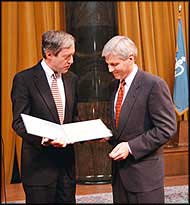
Columbia University President, George Rupp (left), presents Jim Amoss, editor of The Times-Picayune, with the 1997 Pulitzer Prize for Public Service.
Winning Work
By John McQuaid
Staff Writer
MORE fishing boats harvest the world's oceans than at any time in history. But their best catch is seven years gone. Besieged by exploding demand, beset by overfishing, devastated by destruction of life-giving coastal wetlands, the world's oceans have reached their limit.
Drastic measures might turn the tide. Anything less, and the fishing way of life that is so much a part of south Louisiana almost certainly will not survive.
Terry Shelley piloted his flat-bottomed boat through the sunlight one recent morning on his way to the oyster beds he depends on for a living. The marsh air was warming, but the wind had a sting to it and the water had taken on a wintry blue cast.
After beaching the boat, Shelley and his mate, Timmy Kirk, paused to orient themselves by the tidal eddies and southwest wind. Then they lumbered through the water, backs bent, their eyes scanning the marsh floor. Reaching down with gloved hands, they picked up oysters and tossed them into rowboats they pulled behind them.
The going was easy that morning. But it isn't always. Sometimes a fast-moving tide brings the water up to their necks. Sometimes the water recedes and they must drag the boats across desolate, wind-whipped mud flats.
Shelley can adapt to the changing mood of the marshes. It comes with the job.
But he and thousands of other fishers are helpless before the man-made changes tearing across the Gulf of Mexico, leaving a swath of wrecked lives and ecological havoc in their wake.
Part of a global sea change in fishing, the forces include disappearing fish and marshlands, a flood of cheap seafood imports and gill net bans. They threaten millions of livelihoods and the Gulf's unique fishing culture.
They have already reduced Shelley to wading through mud to support his family in Marrero.
He started out shrimping with a small skiff decades ago and traded his way up to a 72-foot shrimp boat, the Second Chance. But shrimping went sour in the 1980s. He tried to make do without insurance and lost his boat after somebody rammed it and he couldn't pay for repairs.
Now he is left with a boat too small to name, 2,000 acres of marsh he leases for $4,000 a year, and that simplest of fishing implements: his hands.
Even those are no longer enough.
A health scare has sent the price of oysters plummeting, and Shelley fears new regulations will put him out of business. Recently, state Wildlife and Fisheries Department agents cited him for a rules violation - passing off day-old oysters as fresh. He scuffled with them and they threw him to the ground, gave him a shot of pepper spray and carted him off in handcuffs.
If regulations and agents don't get him, coastal erosion will. It has already put the squeeze on oyster beds, and threatens to wipe out the marsh and all the fish and fishers that depend on it.
These problems seemed abstract and remote that languid morning as Shelley talked of his plans for a comeback, a new boat. But they are never far from his thoughts.
"I've been doing this since I was 15," said Shelley, 44. "I've never quit the business, but I've had the business quit me several times. I intend to keep going - what else can I do at my age?"
Essence of the Gulf
Fishing defines the Gulf of Mexico. An armada of commercial and recreational fishing boats pursues a stunning variety of fish that have sustained human cultures for centuries. All told, 200,000 workers in the sport and commercial fishing industries have an economic impact on the regional economy estimated at more than $5 billion.
But three intertwined trends have turned the Gulf into an arena of bitter conflict, economic pain and ecological destruction:
Overfishing
Thanks to its biological diversity, the Gulf hasn't seen the kind of collapse that occurred in New England and other parts of the world. But too much fishing by more and more boats has lowered the populations of many fish. Lower catches and tight restrictions make it hard to pay the bills.
Economics
Falling fish populations and world markets have tipped the playing field against Gulf fishers, forcing them to compete with lower-priced imports that can be caught with cheaper labor and without the same regulations. Adjusted for inflation, the value of Gulf fish landings was $744 million in 1986. In 1994, considered the best catch in years, it was $544 million, a 27 percent decline.
Habitat destruction
About 98 percent of Gulf fish species depend on wetlands during some stage of their life cycle, and unless Gulf residents find a way to significantly slow erosion, scientists project that most of the region's marshes will be underwater in 50 years and useless as a spawning ground. Meanwhile, a "dead zone" that forms every year near the mouth of the Mississippi River is growing. Scientists fear it could create a permanent undersea wasteland where some of the region's prime fishing grounds used to be.
The trends already have taken a devastating toll. If they continue, they will destroy most fishing in the Gulf and the culture that depends upon it in a matter of decades.
"The core component of the culture of coastal Louisiana is shrimping and fishing," said University of New Orleans sociologist Anthony Margavio, the co-author of a book on shrimpers and their tangles with conservationists. "It's not just the way people have historically made their living. It is life. It is what they do. It is what they are. I think the people down here are pretty tenacious. I cannot see it disappearing, but it'll be marginalized to a large extent."
A fishing explosion
As in other parts of the world, population growth and rapid development have taxed the Gulf to its limits.
Between 1960 and '90, U.S. population increased 37 percent. But the population of the Gulf's coastal parishes and counties doubled from 7.4 million to 14.7 million, according to a study by the National Oceanic and Atmospheric Administration.
That means more wastewater from sewer systems and runoff from streets, farm fields and construction sites polluting streams and creeks on the way to the Gulf. More roads, levees and dredging projects are diverting water sources for crucial habitats.
At the same time, growing populations and changing tastes around the world have created hot new markets for seafood. Even as the local fish catch and its value fell, the number of fish wholesalers in the region grew more than 70 percent between 1984 and '92, according to a University of Florida study.
Sport fishing was also expanding into an economic juggernaut. In 1994, Gulf anglers spent $1.8 billion on boats, equipment, lodging, guides and other amenities, according to the Sport Fishing Institute.
Billions of dollars also flowed into commercial fishing boats after Congress extended the nation's territorial waters to 200 miles in 1976, expelling foreign fleets.
Between 1977 and '93, the estimated number of commercial fishing boats in the Gulf doubled, from 16,257 to 32,114, according to National Marine Fisheries Service data. But they aren't catching more fish. During the 1970s, the average Gulf catch was 1.8 billion pounds. During the first five years of the '90s, it was 1.7 billion pounds.
Commercial fishing has been the victim of its own expansion. Twice as many boats catching the same amount of fish means fewer fish for everyone. Add into the equation competition from cheap imported fish and the result has been an economic catastrophe for commercial fishing.
About 70 percent of the Gulf's fishspecies that scientists can measure are considered overfished. The rest are fished to their limits of biological and/or economic sustainability.
Many of the tasty reef fish favored by chefs are depleted; among them, the red snapper population remains in danger of collapsing. Bluefin tuna was once plentiful in the Gulf and the Atlantic; in the past decade, demand by Japanese consumers that has driven the price as high as $68,000 a fish has decimated the species.
This is where sport and commercial fishing diverged - and eventually collided. Sport fishing kept growing economically because anglers could accept catch limits more easily than commercial fishers, whose living depends on quantity.
Shrimp a case in point
Shrimp, the most economically important fish in the Gulf, has been the hardest hit, its value falling 35 percent, adjusted for inflation, from its heyday in the late 1970s and early '80s.
It has been hurt by imports of inexpensive farmed shrimp, economically burdensome regulations, and overinvestment that has swelled the fleet to an unsustainable size.
Shrimpers are fishing longer and catching less than ever before.
"It's overfished and underpriced. Too many boats in too little area. It's put a lot of us out of business and there have got to be some changes made or a lot more of us are going down," said Golden Meadow shrimper Michael Callais.
The rest of the Gulf catch has had similar problems. Red snapper is protected by some of the toughest rules in the region. Fishing it is banned most of the year. Meanwhile, imports from Mexico and other countries that have no similar restrictions have come to dominate the market and have driven down the price, which has dropped as much as 27 percent since the 1980s.
Snapper fisherman Ron Anderson, also of Golden Meadow, has seen his crew of three reduced to one. His son went to work at a shrimp shack, and another regular crew member found a construction job at a local Wal-Mart. These days Anderson sometimes gets help from his wife and grandson.
"I'm at poverty level now," he said.
Oysters also face a crunch. Encroaching communities and the pollution that came with them have squeezed oyster beds from the north, while coastal erosion has closed in from the south. A health scare about a bacterium found naturally in oysters, Vibrio vulnificus, had the federal government contemplating a 7-month-a-year ban on raw oysters and sent prices falling 50 percent in inflation-adjusted dollars between 1990 and '94. Last fall oystermen staged protests demanding higher dockside prices.
The changes of the past two decades took one of the last unregulated areas of American life and put a fence around it, making it another zone overseen by government agents, analysts and bureaucrats.
Once it became apparent that the limits of many fish species could be overrun so easily, governments established hundreds of regulations - quotas, trip limits, bag limits, size limits, license limits, area closures, gear restrictions and seasonal closures.
This mishmash of rules has yet to restore many fish populations. But it has succeeded in confusing and angering fishers.
"It's no secret that fishery management in the Gulf and South Atlantic hasn't worked very well over the years," said Charles Adams, a fishery economist at the University of Florida. "There are a lot of fish still overfished. It's taking a long time. It's difficult to monitor and enforce it."
One big difference between the Gulf and other regions is the growing influence of sport fishers and their organizations in management decisions. Their influence has helped restrict gill netting in Florida, Alabama, Texas and Louisiana, which have all enacted net bans or serious restrictions in the past few years.
Sport fishing organizations such as Louisiana's Gulf Coast Conservation Association have consolidated their political power. With media savvy, they allied themselves with public sentiment for resource conservation.
Commercial fishers, on the other hand, have failed to move public opinion. Undercut by their traditional independence, they've had trouble presenting a solid front, and ended up offending possible allies last fall with disorganized attempts to block sport fishers from reaching boat launches on the coast.
"They shouldn't split the parish. They shouldn't pit brother against brother. We make our money off of sportsmen of Louisiana," said James Dixon Sr., the owner of Bait Inc. in New Orleans. "The commercial fishermen are alienating people like me who would be supporting them otherwise."
The Florida ban has had the biggest impact, displacing 5,000 fishers, forcing them to range far afield to find areas to drop their nets. The cost to the state was estimated at $40 million a year in lost revenue, boat buybacks and other aid programs. When it takes full effect next year, the Louisiana ban on most inshore netting will close the largest and last relatively open area for Gulf gill netters.
Fishery management is almost always crisis management: Managers wait for something bad to happen and then try to fix it. Because responsibility for fish and their habitats is divided among many government agencies, only rarely does anyone have an eye trained on the long term.
For instance, after 10 years of severe restrictions, the plan to restore redfish seems to be working; managers hope to reopen offshore commercial fishing for the fish soon. At the same time, however, business interests are building levees around wetlands that redfish use as nursery grounds, which could prove devastating to the population.
But neither the Gulf of Mexico Fishery Management Council nor Fisheries Service has any say over that activity. The only opportunity for input comes if an agency staffer happens to participate in the wetlands permitting process overseen by the Army Corps of Engineers.
Change is certain
Fishing in the Gulf of Mexico is undergoing a vast cultural change that one way or another will transform it into something much smaller than it is today, say scientists, managers and fishers.
One change already under way will end the open access and freedom that was the rule in the Gulf for centuries. The most common solution - introducing a form of property rights to fishing - would put strict limits on who could fish and how much, something many fishers consider akin to communism.
And what can stop the forces of nature from eroding the vast stretches of marshland that sustain the fisheries? Scientists are leaning toward policies that call for rerouting the Mississippi Riverin attempts to build vast new deltas of marshland that can support the fisheries of the future.
But such projects would cost billions of dollars and disrupt existing fisheries - forcing oyster farmers, for example, to abandon beds covered by sediment or by too-fresh water and find new ones farther away.
Only a vast infusion of money from Washington - or from private sources that might demand more control over marshland in exchange - would pay for such projects. The political climate makes such financing unlikely until the crisis reaches the dinner plates of consumers. By then it will be too late.
© 1996, Times-Picayune
By John McQuaid
Staff Writer
TALUMPHUK, THAILAND
For generations, the men of Talumphuk have left their thatched huts each morning, heaved their boats down log runners, and skimmed off to set their nets for the valuable shrimp and bottom fish that teemed nearby in the Gulf of Thailand.
Their seagoing gondolas bow to the modern with buzzing 140-horsepower outboard motors, and to the traditional, with flowers garlanding their bows as an offering to Mae Yanang, the spirit who inhabits and protects each vessel.
But with each passing year, that once-felicitous balance has swung more and more toward the modern. Now Talumphuk's three hamlets are under siege by progress run amok.
Lured by the riches of an expanding export market, the modern Thai fishing fleet years ago scooped most of the fish out of the gulf, leaving slim pickings for local fishers.
The rush to build lucrative shrimp farms has demolished mangrove forests and accelerated coastal erosion, trapping villagers in the shrinking space between the expanding farms and the advancing sea.
Waste from the farms has killed fish and threatens shrimp spawning grounds near the coast, forcing Talumphuk fishers farther out to sea or to distant shores for months at a time.
"Ten years ago, we could catch anything we wanted,'' said Sophon Loseresakun, wearing a red loincloth and crouched on the bamboo deck of his house. "But in the last 10 years, it has gotten to be less and less. Now we have almost nothing.''
Sophon and his neighbors are not alone.
The fierce competition to meet the world's growing demand for seafood has caused an orgy of overfishing and coastal destruction that threatens the livelihoods of fishers from the Gulf of Thailand to the Gulf of Mexico, and most places in between.
Isolated a generation ago, today these fishing grounds are wired together by an overheating global economy of changing markets, overbuilt fleets and lightning-fast development. The new economic links have created a few winners and many losers - cheap shrimp exported from that same Thai coast, for example, bring billions of dollars into Thailand's economy while undercutting Gulf of Mexico shrimpers.
These problems raise questions of how long the planet can support a growing population hellbent on development. The crisis has forced a re-examination of the basic principles humans have used to manage natural resources for the past 100 years.
It also is the latest in a series of economic shifts in which small institutions have given way to larger, more efficient, impersonal ones. In the process, iconic figures such as the American family farmer in the 1980s, and now the small-scale fisher in the '90s, are forced grudgingly off the economic playing field and into museums and history books.
"There's that old saying: `Give a man a fish, and feed him for a day. Teach a man to fish, and he can feed himself for a lifetime,''' said David Nygard, an analyst with the International Food Policy Research Institute in Washington. "But things have been completely turned on their head. Now, if you teach a man to fish, you will impoverish him for the rest of his life. Whatever you do, don't teach a man to fish.''
Until the middle part of this century, conventional wisdom held that the world's oceans contained an inexhaustible supply of fish. Many people still believe that.
It's not true.
Only a seventh of the 24,000 known marine finfish species are edible or commercially valuable, and they tend to live near the coast, easy pickings for nets and hooks. Technological advances and fleet expansion after World War II have made it possible to wipe out a fish population in a matter of days.
Tripling from 1958 levels, the world catch peaked at 86.4 million metric tons in 1989, and it has wavered a few million tons below that ever since, despite high demand, continued expansion of international fleets and a desperate search for new fish to exploit.
A generation ago, fish was known as the poor man's protein. But trends ranging from expanding international markets to the health craze in the United States helped make seafood a hot commodity. The advent of 200-mile territorial limits called exclusive economic zones in the 1970s allowed nations to expel foreign fishing fleets from their waters and cash in.
The effect was akin to the buffalo hunts of the American West, where the once huge herds were wiped out by hunting rifles and the rush of settlers.
The same sad story repeats itself all over the world. In Thailand, there are an estimated 38,000 fishing boats operating, most on the Gulf of Thailand. Compare that with an estimated 32,000 boats in the Gulf of Mexico, about twice the size of the Gulf of Thailand and with a similar variety of fish, already fished to its limits.
First thinned by habitat damage, key species of shrimp and reef fish have been decimated by the Thai fleet. One study showed that the amount of fish caught on an average trawl run in the Gulf of Thailand fell by 83 percent between 1961 and '80.
"There's nothing left in the Gulf of Thailand,'' said Thai boat captain Amphai Chuwala, 42, who pays $1,250 a year for the privilege of fishing Indonesian waters. ``Even there, the fish are getting smaller. But every year we see more boats and go farther away.''
Short-term greed
Other forms of resource exploitation such as agriculture and mining are governed by property rights. To make a profit, you must own a stake in what you produce, or rent it from someone who does.
Fishing is different.
Fishers don't own their catch until they haul it on board. Historically, anyone with the right equipment - whether it's a bit of line and some bait or a factory trawler - can go out and fish. With a relatively low investment, some skill and effort, the returns can be enormous.
Boom and bust is intrinsic to open-access fishing, which usually remains profitable in the short run, even after too many boats get into the act to keep fishing in the long run. They continue operating because leaving a fish in the water means leaving it for someone else to catch. Soon, a collapse occurs - in fish populations, profits, or both.
That didn't matter to banks, entrepreneurs, governments and international lending organizations that pumped billions of dollars into low-interest loans and grants for boat-building and fish-finding gear, new and upgraded ports, payment of foreign license fees and other subsidies renewed year after year.
Between 1970 and '92, the last year for which figures are available, the number of decked fishing boats in the world doubled, from 581,000 to 1.2 million. The number of fishing vessels with federal licenses in Louisiana doubled between 1977 and '87, from 1,930 to 4,066.
It turned out that the huge investment was in fact a loser: A report by the Food and Agriculture Organization, a unit of the United Nations, estimated that $124 billion is spent on the worldwide fishing fleet each year; its revenue is about $70 billion.
Economists call this phenomenon "overcapitalization'' - putting so much money into an enterprise that the return on the investment no longer makes sense.
Investments that don't turn a profit are usually not repeated. But in fishing, inefficiency and waste have been routinely rewarded, not punished.
Boats depreciate rapidly, so keeping them operating is the only way to make money. They are more flexible than, say, factories; if the fish run out in one area, a boat can be sent somewhere else.
The economic disadvantages are usually spread so thin - among governments, debt-holders and corporations - and over such a long time span that the short-term gains outweigh long-term concerns.
Those gains continue to be impressive because at the same time that fish populations are falling, demand and prices continue rising.
While the unit price of the world's more valuable food fish went up 38 percent between 1970 and '89, their catch rates fell 25 percent on average, according to a Food and Agriculture study.
While fleet capacity was doubling, the catch increased by only 47 percent, according to the U.N. study. The world fleet filled the empty space in its holds by shifting to commercially less valuable fish, such as pollock in Alaska.
All these factors made it easier for large commercial fishing with global operations to rearrange operations, keep going, and even expand.
Meanwhile, subsidies have come to be seen as entitlements, and boat owners have fought attempts to discontinue them.
"Instead of dealing with the cause of the problem - too many fishermen - the response is to provide economic relief in subsidies,'' said fishery consultant Francis Christy, who has studied the issue for the United Nations. "If you're a politician, you're not going to stay in office very long by saying you must reduce the number of fishermen by 50 percent.''
Growth's downside
The uncontrolled growth of fishing fleets is only the starkest example of a range of development pressures that are resculpting the world's coastlines.
In the United States, coastal development and populations have expanded rapidly in the past 20 years, creating pollution, freshwater diversions and other problems that affect fish. In the Pacific Northwest, development activities of all kinds - dams, logging, housing - have altered key spawning habitats and all but destroyed the wild salmon.
Thailand is a prime example of the trend, which has exploded across the developing world: It has remade its coastline into an engine of economic activity in both fishing and aquaculture that turned it into the world's leading seafood exporter in 1994, surpassing the United States.
Touted as a way to make up the shortfall in the world's fishing catch, and offering a high return on a low investment, fish farming can be almost irresistible. But it too operates by its own relentless economic logic, a dynamic that is in effect cannibalizing much of the land and surrounding ecosystems upon which it depends.
In the last decade, a vast infusion of capital has transformed the once-lazy Gulf of Thailand coast into a muddy gray expanse of shrimp farms. With few environmental safeguards, the farms have played havoc with the environment.
Sludge from the ponds is piled anywhere farmers can find room, raising health concerns and filling the air with the stench of sewage. Shrimp diseases can run quickly through the tightly packed ponds.
Shrimp aquaculture has literally whipsawed mangrove forests around the world. Like the Louisiana marsh, they are delicate estuaries that support hundreds of species. But their marshy settings are perfect for shrimp ponds, and their wood makes great charcoal.
If development pressures continue, the world could see a cascade of habitat-related fish collapses, said Meryl Williams, director of the International Center for Living Aquatic Resources Management in Manila, Philippines.
"The coastal zone is under a huge amount of pressure, and that will have a lag effect on fishing,'' she said. "Some things take a while to work their way down.''
Unseen consequences
The vast changes overfishing and development have made in ecosystems will have unpredictable results that could be even more disastrous, scientists say.
> In many areas, including the New England coast, fleets have fished out one species, then another, destroying whole food chains.
Fish populations depend on a web of interactions with other fish and their environment, so once depleted they may never come back in the same size or proportions.
Fishing fleets accidentally catch and discard 25 billion metric tons of fish each year - an amount equal to almost a third of the world's total catch. In some cases - as with red snapper caught in Gulf of Mexico shrimp trawls - it has had a devastating effect on populations.
Illegal, fine-mesh push nets used in the Philippines, Indonesia, Thailand and elsewhere can wipe out entire populations in small areas in a short time.
With desperate fishing fleets roaming the world looking for fish that aren't there, and rising social stresses caused by quick development, international tensions are on the rise.
Last year Canadian patrol ships used military force to capture and impound a Spanish vessel in international waters. The Canadian government was concerned that fishing in the area was depleting the spawning stock of turbot, a bottom fish that straddled the 200-mile limit. In the interest of conservation, Canada laid claim on fish outside its territorial waters.
Big democracies can usually work out their differences, as Canada and Spain did a few months later. But most nations lack their political stability.
> "Some societies have already got so many problems they will not be able to cope, and these resource problems are the ones that resist solutions. Often they make management just too difficult,'' said Thomas F. Homer-Dixon, director of a University of Toronto project on Environmental Scarcities, State Capacities, and Civil Violence.
In South Asia, with beefed-up international fleets scouring the seas, government officials looking to cash in, and nationalistic disputes about territorial rights, the pot is boiling.
Thai fishers are routinely detained for fishing illegally in neighboring countries' waters. A group of Thais recently killed five Burmese fishers they were partnered with. The Burmese were going to blow the whistle after catching the Thais unloading fish taken in Burmese waters and using a banned fish finder. In response, Burma temporarily shut its border with Thailand and has demanded $1 million in compensation.
People in turmoil
A report by the International Center for Living Aquatic Resources Management in Manila likened the crisis to the transition that occurred 10,000 years ago when humans moved from hunting and gathering to agriculture.
One symptom is the chain of painful shakeouts spreading around the world. In terms of global scale and cultural impact, the changes dwarf the corporate-driven restructuring that has devastated swaths of the American economy.
Governments, which helped create the problem, have been left to pick up the pieces, spending taxpayers' money to decommission fleets they helped build a few years ago.
Canada has a $1.4 billion program to provide direct aid and retraining to the 40,000 fishers thrown out of work by the collapse of the northern cod due to overfishing and a breakdown in the management system.
In New England, where a similar collapse occurred, the U.S. government has allocated $55 million in aid. It won't go far. With the problem worsening, the $30 million for job retraining is almost gone; $25 million for buying back boats would purchase a tiny fraction of the vessels that officials would like to take out of action.
Around the world, millions of people have even less to fall back on.
Ironically, most of the money made and damage done has been through the efforts of large- and medium-scale fleets that employ a minority of the world's fishers - less than 10 percent, according to a report by the Worldwatch Institute.
Meanwhile, the great hunger for fish in the United States, Europe and Japan and the developing world's aggressive push to cash in on fisheries have in effect created a giant siphon of seafood products from the undeveloped countries to the developed nations, taking food from the people who catch it and shipping it to those who will pay top dollar.
In India, local fishing groups competed with trawling enterprises for years, depleting many fisheries. Then the government decided there was more money to be made in selling fishing rights to foreign fleets. Since 1991, 180 licenses have been granted to vessels from Spain, Russia and elsewhere.
Foreign fleets can easily outpace smaller-scale Indian fleets, while exporting the entire catch without even docking in India. The government has offered cheap fuel and other incentives to boat operators.
"These fleets are not benefiting the nation, or offering protein to the masses, or foreign exchange, or help for other people. This may help a few bureaucrats or ministers of India who will benefit from commissions and kickbacks,'' said Thomas Kocherry, leader of the Indian National Fishworkers Forum, which has staged national strikes trying to stop the practice.
The aquatic resources center in Manila estimates that 50 million people worldwide are engaged in small-scale fishing through catching, processing and marketing. Most live in small communities that until a generation ago were immune to these forces.
They are people who in many cases have little political voice. They must live with the changes initiated by consumers and decision-makers thousands of miles away, victims of forces they cannot control and often cannot understand.
"I'm 41 years old, and I'm more confused now than I ever was in my life,'' said unemployed New Bedford, Mass., fisherman Bobby Taylor. "When you do something that you love for so many years and it's taken away from you, the stress that it puts down on you and your family is unbelievable.
© 1996, Times-Picayune
By John McQuaid
Staff Writer
The Gulf of Mexico is one of the world's great natural treasures. Its rich fishing grounds supply a large share of the world's fish, shrimp, oysters and crabs. Its swamps, marshes and bayous nurture an incredible diversity of plants and wildlife. Its waterways, beachfronts and bays are a recreational and sporting paradise. Its culture and lifestyle draw tourists and new residents from around the world. But those attractions may also prove fatal: Commercial and sport fishers are battling over a shrinking resource; pollution and development threatens the ecosystem and its inhabitants; and population growth is adding new pressures daily. Are we finally demanding more than the Gulf can produce?
Here is an overview of the production, pressures and prospects for the region:
The Trouble With Shrimping
Shrimping is a $400 million industry in the Gulf, the largest cash crop in the fishery. But it also is under siege from government regulators and environmentalists who say the operations are too wasteful, scooping up and discarding so many young fish in the trawls that many fish species may be endangered, including the commercially valuable red snapper.
Shrimp farming and other aquaculture operations are seen as the wave of the future in coping with the shrinking supply of fish in the wild, but there are ecological concerns about inbreeding, water pollution and habitat destruction caused by the farms. For the operators, start-up costs can be prohibitive, and the risks of disease, contamination and wildly fluctuating markets are a recipe for disaster.
Dealing With A Deadly Virus
Taura Syndrome, a virus of mysterious origin first detected in Ecuador four years ago, broke out on the Texas coast in May 1995, destroying 90 percent of the shrimp in three farms in the largest shrimp-farming area in the United States. It destroyed between $10 million and $15 million worth of shrimp in a matter of days and raised fears that it would spread to other farms and into the wild populations. The outbreak eventually subsided, but shrimp farmers and fishers remain wary.
Pollution Harms From Far Away
Petrochemical plants, factories, oil production facilities and other industrial activities along the Mississippi River add chemical pollution that can poison fish and damage plant life.
Runoff from farms, fertilized lawns, golf courses and parks pours into the Mississippi, fueling algae blooms that add to the dead zone.
Wetlands Fading Fast
The loss of wetlands and coastline to erosion, subsidence and urban development is a threat to all forms of life along the Gulf Coast. Wetlands help contain flooding, filter pollution and provide key nurseries and feeding grounds for fish and migratory birds. The coastline protects against the storm surges of hurricanes and winter storms and the incredible force of the Gulf waters.
Shrimping Besieged
The deaths of endangered sea turtles have prompted the government to require controversial turtle excluder devices on shrimp trawls, a move that shrimpers say costs them millions of dollars a year in time, lost catch and damaged equipment.
A Dead Zone Spreads
A lifeless stretch called the dead zone appears along the bottom of the Gulf each summer when algae blooms die, sink, and suck oxygen from the deeper water, killing fish and organisms living on the bottom. Fish ahd shrimp tend to avoid the zone, forcing fishers farther into the Gulf to pursue their catch.
Oyster Beds Under Siege
Oysters live in a narrow zone of brackish water and cannot survive in fresh water. If the water is too salty, the oysters fall victim to the oyster drill, a shelled animal that eats through the oyster's shell. A combination of human and animal wastes and chemical pollution washed off city streets and from inadequate sewage treatment systems has forced health officials to prohibit the harvest of oysters from larger areas of the narrow zone.
Rush To Coast Makes Things Worse
A fast-growing coastal population and the resulting beachfront developments - from multimillion-dollar condominiums to small fishing camps - add to the pollution, runoff and erosion problems threatening the coastline. The National Oceanic and Atmospheric Administration estimates that more than 133 million people - 54 percent of the nation's population - lived in the 673 coastal counties along the Gulf, Atlantic and Pacific Oceans and the Great Lakes, in 1990. That represents a 41 percent increase in coastal population since 1960.
Levees A Blessing And A Curse
The control of flooding along the Mississippi River has provided the security necessary to build the New Orleans metropolitan area and other coastal communities. But eliminating the river's annual flood of fresh water and sediment has been a death sentence for more than a million acres of wetlands, swamps and other land formations crucial crucial to the health of the Gulf's ecosystem.
Commerce And Sport Engage In Battle
As fish stocks decrease and competition rises, commercial and sport fishers are increasingly at odds over how to manage and conserve the region's marine resources. Recent battles in Louisiana, Florida and Alabama to ban gill nets from Gulf waters are seen only as the first shots in a continuing war for the fish.
Menhaden Fleet Cause For Worry
Huge factory ships pull a billion tons of menhaden from the Gulf each year to be used for oil and fish meal. Scientists and fishery managers are not sure what long-term effects the huge catch will have. The Atlantic menhaden fishery was wiped out by similar fishing fleets.
Pollution Contributors
- Industrial plants
- Agriculture
- Residential areas
- Major shrimping areas
- Oyster beds
Commercial Gulf Catch 1950-1994
- The 1990s have been rough years for commercial fishing in the Gulf. Catch rose until the mid-1980s, then dropped due to both environmental and economic factors. Initial indications are that the 1995 catch was lower than 1994, an unusually good year.
- 1950: 571 millions pounds
- 1994: 2.1 billion pounds
- Even as the catch rose, its value leveled off almost 20 years ago, and has dropped 22 percent from the 1980s to the 1990s.
- 1950: $209 million
- 1994: $544 million
*Value of catch adjusted for inflation, using Consumer Price Index.
Endangered Species
There are 134 animal and fish species listed as endangered or threatened in the five states bordering the Gulf of Mexico. Many depend on the Gulf waters or bordering wetlands for survival.
Sea Turtles
Six species of sea turtles that feed along the Gulf Coast, including the endangered Kemp's ridley, are listed as endangered or threatened. The turtles are often caught and killed by shrimp trawls. Human intrusion on the sandy beaches where the Kemp's ridley turtles nest in Mexico also threatens their existence. The National Marine Fisheries Service last year approved a requirement that all shrimp boats operating in federal waters must install turtle excluder devices in their nets to reduce turtle deaths. The Mexican government has attempted to protect the nesting beach used by Kemp's ridley turtles in Rancho Nuevo from egg collectors. Nesting beaches for other turtles in the United States are under federal protection.
Gulf Sturgeon
The threatened Gulf sturgeon, a fish that once was commercially harvested, has all but disappeared during the past 50 years because of dredging and other habitat destruction that has damaged its spawning beds. The fish, which can live up to 100 years and weigh as much as 500 pounds, now is found only in the Pearl River system in Louisiana and the Apalachicola and Suwannee rivers in Florida.
American Crocodile
The endangered American crocodile nests on mangrove-lined beaches on deserted keys along the Florida coast. Loss of habitat and disturbance by humans, including camping and the use of jet skis, have interrupted nesting activities. Hunting also has hurt the species.
Everglades' Fragile Balance Shattered
Florida's famed Everglades - the River of Grass - has been so damaged by human intrusion, including the development of the sugar cane farming industry and the growth of the Miami urban area, that even the delicate Florida Keys are endangered. Many experts believe it will cost at least $1 billion to restore the area, which cleans and filters water going into the Gulf and provides a habitat for many animals, including the endangered American crocodile.
The Gulf Harvest
Best known for its rich harvest of shrimp, crabs and oysters, the Gulf of Mexico also yields a wide variety of fish, from the oily menhaden for feed and fertilizers to the delicacies of tuna, black drum and mullet roe sought after by restaurants and fish markets around the world.
1 - Shrimp
- The top cash crop of the Gulf and one of the world's most popular seafoods.
- up to 7 7/8 inches long, 1 1/8 inches high.
- 1994 harvest
- Pounds: 206.2 million
- Value: $462.7 million
2 - Menhaden
- Too oily to make a good food fish, it is used as bait, animal feed and fertilizer.
- 3-18 inches.
- 1994 harvest
- Pounds: 1.7 billion
- Value: $91 million
3 - Crabs
- Prized for their high protein, low-fat meat.
- Up to 9 1/4 inches wide, 4 inches long.
- 1994 harvest
- Pounds: 57.5 million
- Value: $55.4 million
4 - Oysters
- Found in shallow, warm waters in all oceans, most commercially harvested oysters are cultivated in artificial beds.
- Up to 10 inches by 4 inches.
- 1994 harvest
- Pounds: 17.2 million
- Value: $33.9 million
5 - Spiny Lobsters
- Found in the warm waters off Florida and farther south; lacks the large claws of true lobsters.
- Up to 24 inches long, 6 inches high.
- 1994 harvest
- Pounds: 6.3 million
- Value: $26.4 million
6 - Groupers
- Part of the sea bass family, groupers are abundant in tropical and subtropical seas.
- Up to 4 feet.
- 1994 harvest
- Pounds: 9.6 million
- Value: $21.1 million
7 - Snappers
- Depleted by overfishing in the Gulf, the red snapper is considered one of America's best food fishes.
- Up to 31 inches.
- 1994 harvest
- Pounds: 8.8 million
- Value: $16.9 million
8 - Mullet
- Found in both fresh and salt water, the Florida mullet is tasty, but those in muddier Gulf waters are sought for their eggs for caviar.
- 1994 harvest
- Pounds: 27.2 million
- Value: $16.4 million
9 - Tuna
- A popular food fish found in most of the waters of the world, a single fish has brought $68,000 in a Japanese market.
- Up to 10 feet, 1,496 pounds.
- 1994 harvest
- Pounds: 5.1 million
- Value: $12.7 million
10 - Black Drum
- Became a major commercial fish in the Gulf after restrictions were placed on red drum (red fish) and spotted sea trout.
- Up to 3 feet, 113 pounds.
- 1994 harvest
- Pounds: 5.3 million
- Value: $3.7 million
Sources: Habitat Degradation in the Gulf of Mexico, the Gulf Oyster Fishery of the Gulf of Mexico, United States Fishing Lines, the Audubon Society Field Guide to North American Fishes, Whales & Dolphins, staff researchs
© 1996, Times-Picayune
By John McQuaid
Staff Writer
Small thunderstorms had kicked up all evening over the marsh, and a little after 11 p.m. the wind gusted hard out of the darkness and the grass started to bend and twist. In the middle of a push for shrimp, John Alexie eyed his radar screen and spotted a squall about four miles south, churning straight for his Lafitte skiff, the Lucky John.
His 10-year-old daughter, Shalane, stood at the deck mounted on the stern, sorting the shrimp and crabs from the finfish with a broad-bladed hand tool, shoving castoffs into the water. Alexie plopped her in front of the wheel.
"This is us," he told her, pointing to the radar screen, which showed the boat dead center in a narrow channel. "Drive straight."
"I can't see nothing," she said as she squinted out the window. Eyes on the radar screen, she rolled the wheel back and forth, compensating for current and breeze as her father pulled the nets partway up and secured them.
With Alexie back at the wheel, the Lucky John flew through lakes, bayous and channels, past pipeline valves and wooden "No Trespassing" signs that flashed by in the night. As they pulled into their slip in Lafitte a little before 1 a.m., rain started to sprinkle the roof of the cabin.
He can still give the slip to a summer squall, but lately Alexie's luck has been bad.
Early last year, he had problems with a fuel line that cost him a week of shrimping. Later, the net on one skimmer rig got caught on his propeller, twisting the boat around and popping the frame on the other side. All told, he dropped thousands of dollars in repairs and lost fishing days.
Then last summer, the Louisiana Legislature voted to shut down most gill netting - what Alexie relied on to tide him over once shrimping went slack during the winter.
That, combined with a mounting pile of other problems - competition from cheap imported shrimp, red tape, coastal erosion - has Alexie worried that his luck, and the luck of his family, cousins and neighbors up and down Bayou Barataria, may be running out for good.
"I had a Lafitte skiff since I was 12 years old," Alexie said. "I been commercially fishing my whole life. I choose this life. I like to wake up in the morning, go out in the evening, watch the sun fall or the sun come up, the breeze and fresh air. That's how I want to live - that's how I want to end my life. I don't want to do it under a welding shield, or on a hot roof putting down tar paper. I don't want to do that."
In the space of the past generation, the growing demand for fish everywhere in the world gave many small-scale fishers a ticket from the social margins to the middle class. But even as they climbed the ladder of success for the first time, the rungs began collapsing beneath them.
It is a painful irony to Alexie that although shrimp and other fish still teem in the marsh and the open Gulf of Mexico, commercial fishing today has the feeling of life in the twilight. It is dominated by anger over the present, fear of the future and nostalgia for the past - the life, now fading, of a fisher on a boat alone in the marsh.
The Alexie fishing franchise spans at least five generations. John, his father, Vincent, son John and brother Benny all fish. With skills honed by years in the marsh, Alexie has fishing down to a practiced art, tempered by his wry sense of humor and a rat-a-tat-tat laugh. A jack-of-all-trades in the marsh, he would shrimp from late spring into the fall, then fish with gill nets in the fall and winter. The net ban has limited his options, and he will be able to catch only mullet in another year. Lately he has switched to crabs.
Slack hours and small disappointments predominate in fishing. But all that can change in an instant. When skiffs converge on a spot where white shrimp are running, the shrimp will scatter across the surface of the water, like kernels of popping corn.
"You'll see 'em like rain. Sometimes they're jumping so much, nothing but water flies," Alexie said. "I'm a person that lives to watch a shrimp jump. If you're with me on my boat at night and I got the spotlight in my hand, I'm going to watch the shrimp jump. To me, that's a thrill. With white shrimp it's spectacular because he's going to jump three or four times. Plenty of people would say `Oh, you foolish,' but if you're out on the boat and see what I see, and believe what I believe in, then you'd think it was something nice to look at."
Reacting to nature
Alexie's routine varies depending on where he is: He drops his skimmer rigs and pushes for a while, periodically pulling up the bag at the end of the net and sampling its contents, then dropping it back in. Sometimes he holds his position as the current - and shrimp - flow into the net.
Alexie sat at the wheel, pointing his small spotlight out the window at the surface of the water and the yawning mouth of the net. A few small jumpers, but not much else. Out in the Gulf, Hurricane Opal had rolled in a strange crop of fish usually found only near the beach or offshore - faintly glowing jellyfish and 3-inch sun perch and angelfish, even some brown shrimp, which were out of season. Hardly any white shrimp.
"You can't make soup out of that. I push for eight hours like this and all I'll get is a bucketful of shrimp," Alexie said after dumping the paltry take from a half-hour push onto the deck. With his sorting tool he quickly culled the few handfuls of shrimp from the pull and dumped them into another basket.
Dealing with change
Living off the marsh means dealing with a constant flux in day-to-day conditions. But lately the long-term changes have posed a tougher challenge.
Lafitte is no longer the small, isolated fishing village it was during Alexie's youth, but an increasingly popular haven for sport fishing and for suburbanites escaping the hassles of big-city living. The growth brings changes.
"In the city you cannot do what I'm talking about - leave your keys in your car at night, your front door unlocked when you go to sleep," Alexie said. "There's not too many places you can live in where that's true. We used to do that and a lot of times we still do. But it's getting so now that plenty of people on this bayou are strangers to us. There's more and more people coming down here we know nothing about. I mean nothing."
When Alexie was growing up, mud and prairie grass dominated the marsh landscape. But the intrusion of rising, saltier water caused by coastal erosion and subsidence, along with channels cut by oil and gas companies, has sculpted a different marsh, one full of open water and straightaways.
The erosion is slowly wiping out the region's prime fish habitat. Marsh rebuilding projects have sent river water and sediment flowing into the area. But that means fewer shrimp, which tend to flee fresh water. The change also has spawned huge clots of marsh grass, which favors fresh water - meaning a chronic problem with clogged nets.
"If this freshwater diversion ain't stopped, our livelihood is gone," Alexie said as he piloted his skiff past clumps of marsh grass.
Alexie can still live by his wits in the marsh, but his day-to-day economic status is ruled by international markets he cannot control. For almost a decade, they have been eroding his income as cheap imported shrimp catch the fancy of consumers and a growing share of the market.
"Imports are killing us," Alexie said. "We're just getting by. Times are, we may not have the $5,000 on hand we need to tide us over through the winter."
Nevertheless, he has managed to hold on to what he's built for his family. They live in a comfortable house he built, have a stake in the family camp and own two cars. After expenses, he netted about $19,000 last year, from shrimp, mullet and black drum. His wife, Vanessa, works as a manager in a discount store.
Reams of rules
In the past decade, Alexie has had to hone new skills to deal with the volumes of rules state officials write to protect fish populations from the expansion of fishing: He must be a part-time accountant and paper-pusher if he wants to keep the law off his back.
The net ban has left Alexie with $5,000 in nets and buoys piled in his yard. Recently he had to throw away 500 to 600 pounds of black drum and speckled trout he caught while mullet fishing because he didn't have the right permits.
He ran into trouble when he tried to get all 12 of his licenses and permits renewed late last year, an annual ritual costing more than $800.
The rule changes that came with the new net law made that task even tougher. For 1996 licenses, he needed proof he was authentic - an accountant's statement that at least 50 percent of his 1995 income came from commercial fishing. But because the tax year wasn't over, no accountant would certify him. He had to give up days of fishing going back and forth to Baton Rouge to try to straighten it all out.
To Alexie and his fellow inshore fishers, the new restrictions have a punitive edge that goes beyond mere red tape. They feel as if the politicians and sport fishing groups have targeted them for extinction.
"Our boats, some of them is worth $30,000 to $60,000 apiece. What are we supposed to do with them if commercial fishing quits? Take them and put them in our front yard for a showcase?" he said. "We've got a heritage on this bayou, and yet in a few years the bayou won't have anything to do with commercial fishing if things keep going the way they going."
Alexie's son, Jay, 21, opted to drop out of high school and fish full time. Alexie said he was always pushing him to be the best and catch the most, and perhaps he pushed him a little too hard at the beginning. He had Jay deckhanding for a while, then when he was barely ready Alexie bought him his own boat, which sank after Jay hit some rocks.
"I expected too much from him at first. At 15, he was a little bitty runt, no bigger than his sister is now," he said. "When that boat sank, it was just as well for him."
The hulk of the boat still sits partly submerged in a slip near the Lucky John's, a project for another day. For a while, Jay deckhanded on another boat, getting a 20 percent cut of the catch. Now he's out of the business.
Alexie's daughter Shannon, a student at Louisiana State University, married Rickey Matherne Jr., another shrimper's son, in December. His new son-in-law wants to teach college. But he also has a partnership in an offshore boat with his father, who wanted to bring him in as a captain.
Alexie pondered the options as he crouched in a duck blind near the family camp, a rustic six-room cabin on a spit of grass in the middle of the marsh equipped with pirogues, soft-shell crab cages, junk food and mosquito repellent.
"I don't know if I want him to do that, cause once he starts I don't know if he'll be able to stop," he said. "It's tough. Those guys go out 20, 30 days at a time. That ain't no way to have a life of your own, a family life. Me, I go out two or three days at a time. I can be with my family, I can go out when I want. I have the freedom."
That warm, hazy morning late last year, Alexie's shotgun jammed a few times and his aim was a bit off, so he missed several ducks he should have bagged. Maybe it was the impending changes - bachelor and bachelorette parties later that night for the bride and groom - or the recent equipment damage that cost him another $500, wiping out his $280 shrimp catch. Or hard times that seem both remote and imminent at the same time.
We're living on the edge,'' he said. "We're not high class, we're not low class. I'm not going to get no food stamps or anything. As long as we can be happy - come out here, do some hunting and fishing, make a living - that's all I worry about.''
© 1996, Times-Picayune
By Mark Schleifstein
Staff Writer
THE DEAD SEA
Is it possible to kill 7,000 square miles of the Gulf of Mexico? Alarmed scientists are beginning to think it is more than a possibility; it's increasingly likely. Already, the dead zone, a seasonal area rendered almost lifeless byvast amounts of pollution pumped into the Gulf of Mexico from the Mississippi River, is expanding. Without action, it may become permanent.
Fertilizer, sewage brew dead zone
Biologist Nancy Rabalais fights nausea as she struggles into a wet suit and scuba gear on the pitching deck of the R.V. Acadiana about 15 miles off the Louisiana coast.
She is preparing to descend along the metal leg of an abandoned oil rig to the shallow bottom of the Gulf of Mexico, where she will replace a meter that measures the amount of oxygen in the water.
It’s not the most pleasant of chores for a marine biologist prone to seasickness. But Rabalais considers a little nausea a small price to pay to gain another clue to the Gulf of Mexico’s biggest, most alarming mystery:
How do we stop the dead zone?
A 7,000-square-mile swath of Gulf water stretching from the mouth of the Mississippi River to the Texas border, the zone becomes so devoid of oxygen each summer that it kills the clams, crabs, worms and other organisms that live on and in the sediment, destroying the food chain from the bottom up.
A death sentence for the region’s rich fish stocks if it becomes permanent, the zone already is changing the face of fishing in the Gulf.
Every year, fishing boats are forced to go farther and farther out, sometimes hundreds of miles from port, to find viable fishing grounds beyond the zone — using precious time and fuel that can mean the difference between profit and loss.
The dead zone also is encroaching on areas usually rich in menhaden, the small fish used for fish meal, which is used to feed farm-raised fish. Commercial menhaden fishers suspect it is reducing the Gulf catch — worth $91 million in 1994 — by killing young fish emerging from the marshes and forcing others into distant areas of the Gulf, far from their nets.
The sheer size of the zone traps fish, forcing them to flee or starve.
"We know where oxygen is low that fish and shrimp and the food they eat disappear or die," said Gene Turner, interim director of the Coastal Ecology Institute at Louisiana State University. "We can’t yet say they don’t go somewhere else and get caught, but we’re talking about 7,000 square miles."
It begins in the spring, when the Mississippi River is swollen by rains and melted snow that wash a rich mixture of agricultural fertilizers and municipal sewage from 40 states downstream into the Gulf.
The lighter fresh water floats on top of the denser salt water of the Gulf, creating layers. As spring turns to summer, the sun combines with the pollution from fertilizers and sewage to fuel huge blooms of algae.
The chemicals in the pollution are mostly nitrogen and phosphorous, and they are known as nutrients, because they make things grow. When it’s corn in Iowa or wheat in Kansas, nutrients are good. But when it’s too much algae in the ocean, nutrients can be deadly.
When the algae dies, it sinks to the bottom, where its decay uses up oxygen in the saltier water. Oxygen from the surface can’t get past the freshwater layer at the top to replenish the water below. By midsummer, all the oxygen in a vast area of the Gulf may be gone.
"The effect can be akin to taking Saran Wrap and placing it over (an area the size of) Connecticut and Rhode Island, slowly pulling it down and suffocating everything beneath it," said Melissa Samet, a lawyer and wildlife biologist with the Sierra Club Legal Defense Fund.
Mystery zone
Rabalais and other scientists want to learn the exact sources of the nutrients causing the algae blooms, determine the long-term effects of the low oxygen conditions — called hypoxia — on fish, and discover how to reduce the nutrients that reach the Gulf.
It’s already clear from the work of Rabalais and others that the dead zone’s expansion mirrors an increase in the use of chemical fertilizers by farmers in the Midwest and in manure runoff from livestock operations. Sewage from the heavy urbanization of land along the Mississippi and its tributaries is only a fraction of the problem, say officials of the U.S. Geological Survey.
Nitrogen, and to a lesser extent phosphorus, are thought to be the driving force behind the algae blooms. Both are used as fertilizers on millions of acres of farmland in the 30 states within the vast Mississippi River watershed. The chemicals also are found in animal and human wastes that are washed by rainfall into the river and its tributaries.
But scientists concede that much about the dead zone and its dynamics remains a mystery:
Why, for instance, was the 1995 dead zone so large two years after a major flood of the Midwest, when the amount of water carried by the river was back to normal?
Are the nutrients trapped in the sediment on the bottom of the Gulf of Mexico along Louisiana’s coast becoming remixed along the Gulf Coast in some unknown fashion years after major floods?
And how will the repeated killing of bottom-dwelling organisms dependent on oxygen, and their replacement with sulfur-laced networks of non-oxygen-breathing bacteria, affect this most fertile area of the Gulf?
The answers found in dead zones in other parts of the world are not comforting.
Driven by the rapid pace of population growth and economic development, dead zones are a new and largely unstudied problem that is growing more quickly than governments and scientists can keep up with it.
Scientists say that in just the past few years, as many as a dozen dead zones have appeared in different areas of the world, all caused by the same combination of agricultural fertilizer and sewage runoff.
"No other parameter of such ecological importance has been changed so drastically in such a short period of time by human activities as dissolved oxygen contents in the world’s oceans," said Robert J. Diaz, a researcher at the Virginia Institute of Marine Sciences and president of the Atlantic Estuarine Research Society.
Five of those zones have so little oxygen that they are on the verge of collapse. "It won’t take very much more to push them over the edge," Diaz said.
One of the five is the area off the Louisiana coast.
The dead zone in the Gulf of Mexico waxes and wanes each year, but if it follows the pattern in similar areas, it could become permanent, bereft of oxygen-breathing life, including the valuable fish and shrimp along the coast.
Dead zones start as an infrequent occurrence, showing up every two or three years. Organisms on the sea floor are suffocated, but soon replaced when the zone breaks up.
Then the events become seasonal, as they have in the Gulf, and the ecology of the affected ocean becomes stressed over long periods of time, harming fish and driving fishing boats elsewhere.
Finally, the dead zone becomes permanent and a major change takes place: Fish, shellfish and crustaceans that need oxygen are replaced by forms of bacteria that thrive in a no-oxygen world.
The four other dead zones on the verge of collapse — all sandwiched between the highly developed Nordic nations and Germany — are seasonal.
"All you have to do in these systems is increase the exposure time at these concentrations (of low oxygen), or have a further decline of oxygen levels, and we are predicting permanent changes in the benthic (bottom-dwelling organisms) communities and the temporary or permanent collapse of fisheries stocks," Diaz said.
Sometimes, perversely, a dead zone can temporarily produce more fish, slowing efforts to fix the problem.
In the 80-mile-wide Kattegat Channel between Denmark and Sweden, annual bouts of low oxygen began in 1980. By 1984, fishers were catching record amounts at the same time low oxygen levels were being recorded, Diaz said.
The catch, however, was the Norway lobster, which normally burrows into the ocean floor.
What was happening, Diaz said, was that the lobsters were trying to swim higher in the water to find oxygen, and were more vulnerable to being scooped up by trawls. In the Gulf of Mexico, biologist Don Harper of Texas A&M University’s marine laboratory has observed a similar behavior pattern in worms that burrow beneath the ocean floor, but in hypoxic waters climb over each other to form balls in search of oxygen.
In 1988, 3,000 square kilometers of the Kattegat Channel’s bottom was affected by hypoxia. Fisheries collapsed and bottom-living organisms were killed.
"The Norwegian lobster fishery still has not recovered," Diaz said.
We’re way behind
The growth of the Gulf of Mexico’s dead zone has far outpaced efforts to pin down its specific causes and behavior, let alone come up with a policy to solve the problem. Like many other ecological problems related to fish habitats, it was discovered years ago, but its significance wasn’t realized until money was made available to study it.
And today, the responsibility for fixing it is mired in a complex mishmash of overlapping agencies and jurisdictions, a problem that afflicts much of fisheries management.
Although the National Marine Fisheries Service has the authority to deal with issues affecting ocean fisheries, including pollutants coming from inland sources, the farm runoff problems also fall under the auspices of the Environmental Protection Agency, the Department of Agriculture and the Fish & Wildlife Service, as well as a variety of state agencies. The U.S. Geological Survey already is involved in a separate investigation of fertilizer runoff problems — the contamination by nitrogen of ground water that is used for drinking water across the Midwest.
Answers available
The solutions, in theory, are simple. But they may be politically impossible. Basically, they require changes in land use throughout the Midwest:
- Creating a buffer of grass between fields and streams that will filter much of the nutrients before they reach the water.
- Using farming methods that rely less on chemical fertilizers and pesticides, either through no-till farming or with new satellite-based computerized crop systems that measure the need for fertilizer more accurately.
- Building wetlands at strategic locations along the paths of agricultural runoff ditches to capture and treat the fertilizer runoff.
- Creating similar wetlands to treat sewage-tainted water washing from suburbs and cities.
- Improving enforcement of sanitary codes to force the replacement of inadequate septic tanks and sewage systems in urban and suburban areas.
- Forcing replacement of inadequate sewage-treatment ponds and drainage fields at pig, chicken, cattle and dairy farms.
The problem is persuading farmers and city-dwellers alike to shoulder the cost of such improvements for the benefit of people hundreds or thousands of miles away, and then finding money to pay for the improvements. That would be a massive undertaking requiring unprecedented cooperation between local, state and federal governments, and perhaps billions of dollars.
Those trying to solve the dead zone problem are going to have to deal with hard political realities, said Clyde Walker of the Natural Resources Conservation Service.
"The Environmental Protection Agency is faced with dramatic cuts to its budget and an apparently unsympathetic Congress," he said.
And John Burt, special assistant to the chief of the federal Natural Resources Conservation Service, said that with the world’s grain supply low and prices for wheat, cotton and corn high, for the first time in a number of years there is pressure on farmers to increase production, which could mean they will increase their use of fertilizers.
Burt also complained that environmental groups have hurt the chances of finding the political clout to reduce agricultural runoff by focusing so much of their criticism on farmers, without targeting poor pollution practices of city sewage-treatment plants and residents who use too much fertilizer on their lawns and backyard gardens.
"When the floods of 1993 covered the Midwest, it wasn’t just agricultural land that was flooded, but sewage-treatment plants and urban streets," Burt said. "All these loads made their way down to the Gulf," he said.
© 1996, Times-Picayune
By Mark Schleifstein
Staff Writer
LAKE CHARLES
Paul Ringo lives in what should be a fisher’s paradise. Calcasieu Lake, Lake Charles and a spider web of bayous are just minutes from his doorstep.
Speckled trout, flounder and redfish are there for the taking. But when Ringo goes fishing, he drives 50 miles to Cameron, launches a 20-foot boat off the coast and tries his luck in the Gulf of Mexico.
It’s not that Ringo prefers saltwater fishing. He doesn’t.
But he’s afraid of one day getting cancer or some other disease from eating the fish that are exposed to the cocktail of toxic chemicals found in the water and sediment around Lake Charles. He’s also afraid that the problem may threaten others.
"The fish we catch in Lake Charles migrate and travel all the way from the Gulf," Ringo said. "We’ve had hot spots of pollution show up over the years all the way from Lake Charles to Hackberry. We’ve got commercial oystermen and crabbers and shrimpers all through here."
Ringo is not alone. Concerns and questions about the safety of seafood have grown along with its popularity over the past decade and reached critical mass with recent reports of people dying after eating raw oysters.
The issues are critical to the future of the Gulf seafood industry, which has a large shellfish trade and a legacy of chemical pollution. Pollution and contamination pose a direct threat to the health of the marine life as well as consumer faith in the products.
Health concerns about oysters already have shut down many of the beds in Louisiana, and prices have been depressed by the recent scares and federal Food and Drug Administration warnings. Chemical pollution has closed many of the state’s waterways to swimming and fishing and prompted warning signs and advisories.
New FDA rules requiring seafood processors to identify and take steps to eliminate possible points of contamination and spoilage are a direct response to the recent scares.
But consumer advocates say the rules overlook fishing boats and grocery stores and provide no increase in seafood inspections, which are much rarer than checks of beef and poultry.
Seafood processors undergo FDA safety inspections at least once every two years, but only in plants selling across state lines. Plants that sell only in-state are subject to less-regular inspections from state health officials.
So how safe is it to eat fish? In general, it depends on where it comes from, how you prepare it and how often you eat it. In Louisiana and the Gulf Coast, the concern is focused on contamination and natural bacteria in oysters and chemical pollution in waterways.
The greatest single risk to seafood consumers, health officials say, is raw shellfish, particularly oysters, mussels and clams contaminated with bacteria and viruses from water polluted with fecal matter or, less commonly, with naturally occurring marine bacteria.
More than half the shellfish-producing areas along the Gulf Coast are either permanently closed or often declared off-limits by health officials because of pollution, a study by the National Marine Fisheries Service showed.
The most common cause for closure is fecal matter washed into the oyster beds from urban areas or nearby farmland. Oysters contaminated with waste can cause cholera and other diseases.
The closures have had a significant effect on oyster production.
In the early 1980s, the Gulf oyster catch approached 30 million pounds a year; during the first half of the 1990s, it averaged 15 million.
"It’s been like cutting up a piece of paper smaller and smaller," said Port Sulphur dock owner Paul Pelas. "But other states have it worse than us."
Officials in the six states along the Chesapeake Bay, for example, estimate that the region’s once world-renowned oysters are at only 3 percent of historic levels, largely because of illnesses that have killed entire oyster beds.
A second major health problem facing the Gulf’s oyster industry is the bacteria Vibrio vulnificus, which can cause an illness called septicemia — a bacterial infection of the blood that’s often fatal.
Vibrio vulnificus contamination is not related to fecal pollution, officials said, but is found naturally in the Gulf’s warm waters.
Health officials estimate that as many as 15 people a year are killed by the disease, which can be contracted from eating as few as half a dozen raw oysters. Most of those who died were susceptible to the bacteria because they suffered from liver problems or a lowered immune system.
Vibrio can be killed by thorough cooking.
Deaths from the disease in recent years have increased pressure to better regulate the oyster industry, both by requiring greater education of the oyster-eating public by posting signs in restaurants and by requiring oystermen to get their catch refrigerated more quickly.
Louisiana health officials said they will begin a strict refrigeration rule May 1 that will require oysters to be placed in a mechanical refrigeration unit from six to 14 hours after they are pulled from the Gulf. The sliding time scale depends on the warmth of the waters; warmer water means less time that oysters may go unprotected in boats.
It’s unclear whether the restriction will be voluntary or whether oystermen will be allowed to harvest only during certain hours of the day, said Charles Conrad, director of seafood inspections for the Louisiana Department of Health and Hospitals.
Gulf oystermen fear these changes will worsen an already heavy economic burden.
"Refrigeration’s going to cripple the small man," Marrero’s Terry Shelley said. "Only big boats will be able to get it. It’s like anything — the big gets bigger and the small gets smaller."
Very troubled water
Over the past generation, federal and state governments have increased regulations designed to clean up the nation’s waterways and reduce pollution. But long-existing contaminants, runoff from new sources and residue leached from abandoned waste sites continue to find their way into the water and into the fish.
The problem is worse in the Gulf of Mexico than in other parts of the country because the area’s huge marshes and estuaries, prime spawning grounds for many valuable fish species, also have been prime dumping grounds.
The Calcasieu River estuary is one of Louisiana’s most polluted waterways. For years the lakes, the river and its tributaries were used as disposal sites for the area’s chemical industry. At the bottom of Bayou D’Inde, a Calcasieu tributary, a mixture of toxic and potentially cancer-causing substances used in making chemicals and plastics can be stirred up simply by sticking a pole into the sediment.
The five states bordering the Gulf of Mexico — Texas, Louisiana, Mississippi, Alabama and Florida — historically have been among those releasing the most toxic chemicals into the air and water.
And although Louisiana’s fertilizer industry for the past five years has been implementing major restrictions that cut the state’s water pollution in half in 1994, many industries continue to dump toxic materials into the Mississippi and other rivers cutting through the state’s wetlands to the Gulf.
More than 43 percent of the state’s nearly 10,000 miles of rivers and streams are not safe for fishing or swimming, according to the Louisiana Department of Environmental Quality.
In February, officials found dangerously high levels of mercury contamination in bass from lagoons in New Orleans’ City Park. Officials have told children participating in a fishing derby at the park later this year to throw back whatever fish they catch.
Runoff from streets and farmland is another source for the toxic mix, said Steve Mathies, program director for the Barataria-Terrebonne National Estuary Program.
In 1991, thousands of fish were killed in wetlands bordering sugar cane fields when pesticides applied in wet weather washed into bayous.
"And we still have a lot of abandoned waste pits from oil and gas exploration and production," Mathies said. "It’s a concern for us, especially when you look at how many folks use the wetlands and harvest their resources."
Food chain at risk
Because the toxins are stored in the bodies of the fish, the poison is passed on to anyone who eats them.
In general, an occasional fillet presents little or no risk. But eating fish regularly, especially the same species, increases the chance of consuming toxic amounts that can cause immediate or long-term poisoning, birth defects or cancer.
Not all contaminants dumped into the water end up in the food chain, but when they do it’s usually predator species that build up the highest doses of the chemicals in their bodies. And often those species — speckled trout, red fish, black drum, sheepshead, croaker, flounder, catfish, crabs — are the ones most sought after by anglers.
For humans, the question is whether the chemicals are in the part of the fish we eat — usually the fillet — at high enough levels to cause harm if consumed over a lifetime.
Although health officials say advising the public to cut away fat and skin is sometimes enough to reduce the hazard below health concerns, critics say health standards often are based on inaccurate and outdated estimates of fish consumption.
The danger is especially high among subsistence fishers and poor people who supplement their diets with large portions of fish taken from local waters, sometimes ignoring warning signs and advisories in their search for a cheap source of food.
State officials say there’s not much they can do if people ignore warnings.
"In Louisiana, people have a legal, constitutional right to fish," said Department of Health and Hospitals epidemiologist Ken Lanier. "Whether they eat those fish or not, if they’re caught recreationally, it’s their own decision."
The warnings also have no impact on wildlife that take fish whole from the rivers, streams and lakes.
Scientists have shown it was the pesticide DDT in fish that almost wiped out fish-eating birds like the bald eagle and brown pelican during the 1950s and ‘60s by causing their eggshells to be too thin for chicks to survive.
DDT, along with more than 100 other chemicals, also is being blamed for a host of reproductive and hormonal problems that could threaten whole fish populations in the Gulf.
© 1996, Times-Picayune
By Mark Schleifstein
Staff Writer
The plight of croaker in parts of the Houston Ship Channel and Galveston Bay is -raising troubling questions about the long-term effects of chemical pollutants in the Gulf of Mexico, scientists say. The inshore fish, so abundant across the Gulf, have lost their ability to reproduce after exposure to pollution in some areas along the Texas coast.
Dr. Peter Thomas, a toxicologist at the University of Texas' Port Aransas Marine Laboratory, has been studying the effects of chemical contaminants known as polychlorinated aromatic hydrocarbons. They're often associated with refined crude products, like those produced in the dozens of petrochemical plants and refineries in the Houston area.
"We found that the croaker in the most heavily contaminated site, in Green's Bayou, didn't show any reproductive development at all," Thomas said. "All of the young croaker at the more contaminated sites showed impaired puberty. A lower percentage of fish than normal underwent sexual maturation; It's either been inhibited or delayed."
While Thomas' findings are disturbing, what's even more diaconcerting to a growing number of scientists is that they're not all that unusual. Scientists have found numerous cases where minute quantities of chemicals are disrupting the endocrine systems of wildlife and humans, often causing reproductive, growth or behavioral problems that could doom animal populations.
Take the case of Louis Guillette's alligators. Guillette, a zoologist at the University of Florida, was trying to find out why the male sexual organs of juvenile alligators in Lake Apopka were not achieving full development. The percentage of alligator eggs being hatched was abnormally low, and the alligators had unusually low levels of the male hormone testosterone.
He discovered that the lake is next to a Superfund site, and it's contaminated with the banned pesticide DDT and other organochlorine chemicals, chlorine,based byproducts used in household items such as plastic wrap, pesticides and paper.
Zoologist Theo Colborn, senior scientist for the World Wildlife Fund, said these and other cases show that chemicals do 'cause significant hormonal damage to wildlife.
"We can no longer assume that low-level exposure to chemicals does not pose a threat to our wellbeing," Colborn said in a February speech in New Orleans. "We can no longer accept that healthyappearing individuals in populations will be reproducing if and when they reach adulthood."
Colborn and a growing number of scientists believe the chemicals are disrupting the animals' endocrine system? the glands and hormones that keep the body's internal environment stable. They also point to:
- Female cormorants and eagles --birds that eat primarily fish-- born with crossed bills.
- Predatory fish and herring gulls in the Great Lakes with thyroid glands so enlarged that they often explode.
- Seals that have difficulty reproducing, and seal pups with decreased survival rates.
In each case, scientists have found elevated levels of a variety of organochlorine chemicals in their bodies, Colborn said. And because there are so many different compounds that cause the same effects, it's not possible to lay the blame on a specific chemical.
So far, more than 100 man-made compounds and metals used in manufacturing processes have been linked to endocrine disruption, Colborn said, including a variety of pesticides and plastics ingredients that contaminate Louisiana's rivers and streams.
The chemicals mimic hormones to disrupt the endocrine system in two ways: blocking the production of substances and signals that regulate body activities, or stimulating the production of those substances and signals at the wrong time.
The endocrine system includes the brain and a variety of glands: thyroid, adrenal, ovaries, testes, pituitary and pancreas.
The substances and signals produced by these glands regulate sexual development and reproduction, the production of insulin, body growth, response to stress, metabolism and a variety of other functions.
Even more disconcerting than the wildlife studies is research on human sperm counts, Colborn said.
In Sweden, scientists looking at records of sperm production in humans between 1938 --the first year that DDT was produced--and 1991, found a 45 percent reduction over time. French researchers who questioned that study found a similar reduction in sperm counts in samples from fertility clinics in France.
And when Danish researchers compared sperm counts for organic farmers--who use none of the chemicals on their crops--to those of people living in downtown Copenhagen, the organic farmers had 50 percent more sperm.
As the scientific community studies her hypothesis, Colborn warns that regulators must begin retooling systems for protecting the public from the potential long-term health risks of the endocrine disruptors.
"We must think beyond cancer and acute risk of poisoning when considering the effects of chemicals," Colborn said. "There are 72,000 synthetic chemicals used in the United States and another 1,500 new chemicals are introduced every year. Officials are testing 15 per year for health effects, and none are being tested for endocrine disruption."
© 1996, Times-Picayune
By Mark Schleifstein
Staff Writer
It is one of the world's great fish nurseries, cradle to a commercial fishery worth nearly a billion dollars a year. But in the past 50 years, Louisiana's coastal wetlands have suffered an ecological catastrophe: More than 1,500 square miles of marshland have disappeared. Perhaps the only tragedy greater than the loss is how little has been done to stop it
Volunteers stand ankle-deep in gumbo mud on a balmy February morning, hammering together wooden pens to hold several thousand Christmas trees on a tiny island at the edge of Lake Pontchartrain.
Wrestled into place by workers in hip boots and mud-caked clothes, the tree fences are designed to trap the sediment in the water and begin rebuilding the island. The spot of land near Bayou Chevee lost 100 feet of shoreline to erosion last year.
The island protects a 5-acre underwater meadow of sea grass, prime habitat for the fish that are the bread and butter of the Gulf Coast economy: crabs, crawfish and shrimp.
It is one of dozens of small efforts to restore wetlands along Louisiana’s coast, and it’s important both for the area it restores and the publicity it generates, said officials with the federal Gulf of Mexico program.
But it also reveals much about the status of the battle against a problem that has cost Louisiana more than 1 million acres of wetlands — an area 25 percent bigger than Rhode Island — over the past 70 years. It could take another 16,000 acres this year.
With the loss of the Mississippi River’s rich supply of sediment, the rising Gulf of Mexico and the laws of nature and gravity threatening one of the world’s great estuaries, the first and last lines of defense so far are stacks of alarming reports, conflicting proposals for restoration projects and a few thousand Christmas trees.
Times running out
With each passing day, another 44 acres disappears. Unless action is taken quickly, experts say, erosion will dissolve the coastal contours of the Louisiana coast in the next 15 to 45 years, submerging as many as 19 town sites — including Chauvin, Dulac, Lacombe and Grand Isle — and destroying one of the world’s richest fish spawning grounds.
Everywhere in the world, the ripple effects of economic development are destroying vital coastal habitats that nurture fish populations and the livelihoods and unique cultures that depend on them.
And few, if any, are as important and productive as the Louisiana wetlands. An estimated 98 percent of the commercially important fish in the Gulf of Mexico and 40 percent of the nation’s catch begin in these coastal wetlands.
Losing the vast array of fish that depend on the marsh would be an unprecedented economic and social catastrophe.
‘‘The bumper sticker says, ‘No wetlands, no shrimp,’ and that’s a pretty good way of putting it,’’ said Gene Turner, a biologist and interim chairman of the marine sciences department at Louisiana State University.
The Gulf commercial catch was worth $806.2 million in 1994. The region supplies more commercial fish product than any other U.S. fishery except Alaska and provides the largest finfish catch for sport fishers, a Gulf industry whose total economic output is estimated at $3.5 billion annually, according to the American Sportfishing Association.
Throughout the Gulf, perhaps 200,000 people depend directly on commercial and sport fishing for their livelihoods — fishers, processors, wholesalers, charter boat operators, fish dock workers, marina employees and boat builders. Millions more depend on those jobs indirectly. When the habitat disappears, so will most of the jobs.
Habitat loss is a far more insidious problem than the overfishing that has devastated many fish stocks. The fleets can be managed with restrictions and even shutdowns to allow stocks to recover. But restoring coastlines and wetlands can mean rerouting rivers, making cuts in levees and rebuilding barrier islands. Such projects can take years and billions of dollars to complete, and by then the fish may be long gone.
A unique ecosystem
Louisiana has 5,156 remaining square miles of saltwater, brackish and freshwater wetlands, supporting a diversity of wildlife almost as varied as that found in tropical rain forests.
The soupy water of sediment, decaying vegetation and microscopic organisms is the recipe of life. The thick marsh grass is the perfect haven for protecting young fish from the predators they’ll eventually face in the Gulf’s open waters.
Life in this delicate transition from fresh to salt water — what scientists call an estuary — can’t survive without these unique conditions. In the Gulf of Mexico, that means just about every fish worth catching: menhaden, shrimp, crabs, oysters, redfish and many more.
But the tide of history continues to take a toll on the wetlands and the vital processes that depend on them. The Louisiana coastal wetlands are being strangled by long-standing flood-control projects and the levees built to contain the Mississippi River, which once shifted back and forth across hundreds of miles of the state as it made its way to the Gulf, building up deltas and leaving behind rich estuaries in the process.
Without that supply of river water and sediment, the marshes are sinking under their own weight and drowning.
Between the late 1950s and early ’70s — when the booming oil industry changed water flows with a maze of channels and canals — scientists estimated the state was losing 42 square miles of wetlands a year. That rate has slowed to about 25 square miles during the past few years, and in some areas it may be dropping even further.
It could get worse
But predicted reductions in the loss rate don’t necessarily spell relief, for two reasons: In areas where marsh loss is dropping off, fisheries experts expect the production of fish to drop off too. And waiting on the horizon is the specter of global climate change, which could cause much higher Gulf waters along the coast, flooding much of its remaining marshes.
Gulf fishers of this generation may see collapses in fish populations that could wipe them out.
At the very least, losing the wetlands would destroy a $460 million shrimp industry — two thirds of the nation’s annual production and the biggest fishing business in the Gulf — and the rich culture that depends on it.
A 1989 study by National Marine Fisheries Service biologist Joan Browder warned that if wetlands loss continued at the pace it was going, ‘‘brown shrimp catches dependent upon Barataria, Timbalier and Terrebonne bays may fall to zero in 75 years.’’
Scientists think the pace has slowed, but Turner says the dropoff in fish stocks is already happening in some of those areas.
‘‘We have done studies showing that some fisheries are already declining in production or will be shortly,’’ Turner said. ‘‘Some are actually peaking because of the increased interface area (between wetland plants and open water). Then they will fall off sharply, and we won’t have fisheries production.’’
It is that cruel irony — that the decomposition of the wetlands fuels a temporary increase in fish stocks — that has so far masked the impact of the marsh loss. The disintegration is providing the nutrients necessary to produce big crops, but only in the short term.
Erosion is only one element of the problem. The marsh also is slowly sinking under its own weight, a phenomenon called subsidence that has accelerated due to development, levees and dredging. It too is tightening a noose around the Gulf’s fisheries.
‘‘The base of the food chain is decaying,’’ said Bill Herke, a retired fisheries scientist and an expert on the relationship between fish and marshes. ‘‘You can liken it to money in the bank. If you keep enough in the bank, you can live off the interest. We’re living off the principal, and there’s less and less out there to deteriorate.’’
Without significant efforts to halt and restore the loss of wetlands, Louisiana could lose another 786,000 acres of wetlands — more than a third of what remains — by the year 2040, scientists predict. Up to now, erosion has been confined to unpopulated areas. But this time communities are directly in the path of rising waters.
The Army Corps of Engineers has estimated the value of that projected lost acreage at $3.5 billion, including the cost of moving 19 towns with a combined population of 23,000 people.
An unknown number of people probably would move farther inland to avoid the effects of more-frequent flooding caused by hurricanes and other storms, once the buffer of wetlands along the coast shrunk, officials say.
And, if the world’s atmosphere is warming, as a growing number of scientists believe, sea levels could increase even more rapidly during the next 100 years.
According to a 1995 study by the Environmental Protection Agency, the Gulf could be 22.4 inches higher at Grand Isle by the year 2100 if global warming predictions come true.
That could dramatically escalate the speed at which wetlands disappear. One estimate by state geologists indicates that most land outside hurricane protection levees along the coast could disappear by 2040.
No chain of command
The effort to save the wetlands has been rushed and ineffective, ginned up by federal and state officials only in the past few years, long after the worst damage was done.
Part of the problem is organization and authority: Fishery management institutions are not set up to deal with habitat questions. In general, they manage fishing fleets. Other federal, state and local agencies with wetlands authority — there are more than 100 of them with authority in Louisiana alone — don’t coordinate their activities much. Habitat protection often gets lost in the shuffle.
The Department of Commerce’s Office of Inspector General issued an audit in 1994 criticizing the National Marine Fisheries Service and its parent agencies, the National Oceanic and Atmospheric Administration and the Commerce Department, for not putting enough effort into habitat issues. The report said a number of scientists in the agency have complained that their efforts to defend habitat have been shunted aside by superiors within their parent agency, Commerce, because they conflict with industry and development interests.
Today, often too little and possibly too late, efforts expected to cost billions of dollars to reverse habitat loss in the United States are getting under way. But they are ensnarled in bureaucratic red tape and delays.
The biggest effort so far involves the federal Coastal Wetlands Planning, Protection and Restoration Act of 1990. Cosponsored by U.S. Sens. J. Bennett Johnston and John Breaux, both D-La., the act provided $50 million a year in combined federal and state spending for wetlands restoration and protection projects approved by a task force of federal agencies and the state.
But from the very start, it has been bogged down in bureaucratic problems and disputes.
The first three years’ efforts under the new law focused on small projects aimed at making sure each part of the coast got some of the money.
But few projects are getting built, and the projects on the boards would restore only a small percentage of the state’s lost wetlands.
Meanwhile, state officials — who have only an advisory role in approving the projects but can veto them by withholding matching funds — last year put the brakes on approval of new projects under the federal legislation for two reasons.
First, state Department of Natural Resources officials questioned the economic effectiveness of a number of the smaller projects that would add little in wetlands acreage.
Second, the state realized it didn’t have enough money to carry out its part of the bargain.
Louisiana’s constitutionally protected trust fund financed by severance taxes, which was used for the state’s share, ran out of cash because of the slowdown of oil and gas production. Instead of $25 million a year, state officials found they had at most $5 million annually.
Efforts to pass a constitutional amendment to increase the amount going into the trust fund have failed.
Frustrated at delays and the piecemeal approach, in early 1993 state and federal officials called for a rethinking of the state-federal restoration strategy.
The result has been the adoption of a ‘‘big fix’’ strategy calling for using as much as a third of the water and sediment carried by the Mississippi River to build new wetlands.
But that approach may not amount to much: Three big projects proposed under the strategy still must be financed by Congress, and the cost is expected to be more than $2 billion. Approval is a dicey prospect in this era of budget cutting.
One project would reroute a major part of the river through the east bank levee below Violet to begin a new delta-building process in Breton Sound.
A second project would reopen the barrier that allows only boat traffic to move from the Mississippi onto Bayou Lafourche, with the goal being to build additional land in the bayou’s lower reaches.
The third would build and rebuild a string of barrier islands on the outer edge of the state’s wetlands in an attempt to protect them from Gulf storm waters.
Locals lead the way
Within Louisiana, meanwhile, state plans to deal with the problem have barely moved off the drawing board, even though scientists at the National Marine Fisheries Service and Louisiana State University have been warning for years about the effects of wetlands loss on fishing.
Instead of planning a coordinated effort, state officials have slowly evolved plans developed at the local level.
U.S. Rep. Billy Tauzin, R-Chackbay, remembers that in the early days the federal Environmental Protection Agency thought it might be best to allow erosion to take place, and let new wetlands form as the shoreline moved inland.
But communities in Plaquemines Parish quickly realized that under that strategy, none of the parish’s land would be left except that between the levees along Louisiana 23.
Plaquemines officials used money from oil and gas production on parish lands to build the first of a number of small siphons — cuts in the hurricane protection levee that allow sediment and water to move more naturally into marshes on both sides of the Mississippi River.
The state Department of Wildlife and Fisheries and the U.S. Fish & Wildlife Service have followed suit with similar siphons in their refuges near the river’s mouth.
But critics say that although these smaller projects are encouraging, without a major commitment of both state and federal money, Louisiana’s wetlands will be lost.
‘‘We have to make the public understand that our wetlands are of the same national significance as Chesapeake Bay, as the Everglades,’’ said Kirk Cheramie, president of the Barataria-Terrebonne Estuary Foundation. ‘‘It’s a national treasure we must protect for our children.’’
© 1996, Times-Picayune
By Mark Schleifstein
Staff Writer
From the creation of the first farms and settlements to construction of the latest subdivisions and shopping malls, for centuries America’s wetlands and marshes have been caught between the needs of society and the rights of individual property owners.
Landowners and developers found that their interests generally matched those of society as the nation was founded and expanded. There was little opposition, for instance, when New Orleans settlers decided that raising levees was better than enduring floods and that draining swamps was better than fighting mosquitoes and yellow fever.
But increased awareness of the value of the marshlands in protecting communities from hurricane storm surges and nurturing fish and wildlife has pushed the pendulum toward conservation.
After almost two centuries of encouraging the draining and filling of swamps to expand agricultural and urban development, in the 1970s the U.S. government began restricting actions that might damage or reduce wetlands.
By the time former President Bush declared ‘‘no net loss of wetlands’’ in 1989, restrictions on wetland use had become controversial as they butted up against the plans of some private land owners and major developers.
The latest battles are being waged in two areas: the attempt by Congress to rewrite the 1972 Clean Water Act with new definitions and regulations for wetlands, and the debate over managing vast expanses of marshes with levees and gates to attract waterfowl and other wildlife for hunters.
The debates are crucial to the Gulf of Mexico, where vast losses of Louisiana’s coastal wetlands threaten to eliminate the nursery grounds for 98 percent of the region’s commercially important fish. The continued collapse of the wetlands, experts say, will wipe out the fishing grounds and destroy much of the coastline.
Here is a look at the issues:
Regulation:
Citing stories of overzealous bureaucrats protecting questionable wetlands by blocking developments and depriving private property owners of the use of their land, Congress last year considered measures to redefine wetlands and compensate citizens for property values diminished by regulations. The efforts were stalled by the crush of the budget debate and a backlash from constituents who sided with environmentalists.
Much of the controversy involves seasonal wetlands, which are saturated only at certain times of the year. While those wetlands often are in upland areas, away from the coasts, they also are often the beginning of a river’s watershed and provide storage for flood waters as well as habitat for migrating birds and other wildlife.
Critics say the system is too liberal in applying the wetland label to areas of standing water and does not take into consideration that some marshlands are more valuable than others and they should be protected at different levels.
Environmentalists argue that adopting a political definition of wetlands, rather than a scientific definition based on how the wetlands fit into a particular watershed or how they are used by wildlife, would greatly reduce the amount of wetlands protected and the protection they provide for wildlife and the public.
Marsh management:
A less-publicized but no less important issue being debated along the Gulf Coast is ‘‘marsh management,’’ the practice of protecting a marsh or controlling its plant growth to attract a specific type of wildlife.
Such projects often pit conservation and wildlife interests against each other. Wildlife preserve officials and private land managers want to regulate water inside a marsh management area to maximize the kinds of marsh grasses that entice ducks. Fisheries officials want to regulate the water levels to maximize the ability of fish to find protection during their growing stages, and to move in and out of the marsh area at will. The two management schemes are seldom compatible.
Researchers say the growth of marsh management during the past 40 years, and the expected use of similar projects during the next 20 years, will result in a third of Louisiana’s wetlands being partially cut off to fish. That greatly reduces the stocks available to Gulf fishers.
The first marsh management projects consisted largely of levees built around a plot of land, with a limited number of passageways, usually an underwater wooden dam called a weir. The idea was to control the amount of salt water getting into the marsh and fresh water getting out, because salt water eventually kills the freshwater marsh vegetation. Sometimes pumps helped owners remove excess water from the impoundments.
But the combination of levees and weirs has been shown to keep fish and shrimp inside the marsh much longer than normal, and limit the number that can get into the managed areas.
Bill Herke, a retired fisheries scientist and an expert on the relationship between fish and marshes, conducted a two-year study of two similar stretches of wetlands surrounded by levees.
Herke found that three times more fish passed in and out of enclosed areas of marsh where openings in the levees did not have weirs than in those marshes that allowed movement of fish only over weirs.
Federal and state officials now require new weirs in marsh management areas to have a vertical slot that allows fish to pass more easily. But Herke and other researchers say marsh management projects still dramatically reduce fish habitats.
More than 600,000 acres of marsh in Louisiana are under some form of management, often including levees and fixed or adjustable weirs. Another 600,000 acres of wetlands could be placed under some form of marsh management during the next 20 years, officials estimate.
© 1996, Times-Picayune
By Mark Schleifstein
Staff Writer
Woody Gagliano looks almost elfin as he holds court in his Baton Rouge office, spreading scientific documents and maps across a long, dark boardroom table to explain how he came to sound the first alarms about the devastating loss of Louisiana’s wetlands.
Gagliano, 60, president of the consulting firm Coastal Environments Inc., was the first person to recognize that Loui siana’s wetlands were not regenerating every year, as scientists believed as late as 1969. Instead, they were disappearing at a rate of 16.5 square miles a year.
Silently and out of public view, Louisiana was losing its most valuable resource: the nursery for 40 percent of the nation’s seafood harvest.
Gagliano’s groundbreaking research resulted from a proposal by Texas and New Mexico officials to ‘‘steal’’ water from the Mississippi River during the mid-1960s.
‘‘The Texas Water Board wanted to divert Mississippi River water to the high plains of Texas and New Mexico,’’ Gagliano said.
The idea was to funnel the equivalent of six days of river water a year in a huge canal through southern Arkansas or northern Louisiana to irrigate cotton farms. It was supported by the federal Bureau of Reclamation and the administration of then-President Johnson, a Texan.
Even though it represented only 1.6 percent of the river’s annual flow, the project had Army Corps of Engineers officials worried. They financed a four-year research program to determine the effects of removing the water from the river.
Louisiana State University’s Coastal Studies Institute was tapped to do the research, and Gagliano was given the job.
‘‘Everyone knew that freshwater inflow into Louisiana’s marshes was important,’’ Gagliano said. ‘‘But when the studies were initiated, it was generally believed there was a natural balance in coastal Louisiana, that overall every year we were gaining wetlands and estuaries were being replenished.
‘‘I questioned that,’’ Gagliano said. ‘‘I didn’t think that was true, based on the observations I already had made in my research.’’
The research rapidly turned to whether Louisiana’s coastline was shrinking because of reduced river flow into the marshes.
Gagliano drew on his personal experience to focus the research: As a high school student, he became interested in coastal archaeolgy, visiting shell heaps left behind by American Indians in the marshes of southern Louisiana.
But by the late 1960s, ‘‘The shell heaps were all eroding and sinking. It became clear to me that a lot of erosion and land-sinking was going on.’’
Gagliano had to make sense of a variety of historical maps to determine if there were any patterns to the way the coastline changed.
What he found in that first study was that Louisiana’s coastline was losing an area about two thirds the size of Manhattan each year.
In 1970, Gagliano presented his findings to the National Academy of Sciences at a meeting in Houston. By the year 2000, he said, Louisiana would lose 500 square miles of coastal wetlands.
Two years later, he presented his findings to a local audience. He told a surprised Louisiana Intracoastal Seaway Association, which represented many of the shipping interests involved in dredging navigation channels and canals, that they’d be better off spending some of their public relations dollars to build new barrier islands off the Louisiana coast to protect the interior marshes from decay.
‘‘The immediate response was disbelief,’’ Gagliano said. ‘‘No one really wanted to accept the findings because it implied we were doing something wrong.’’
In March 1974, Gagliano told the Louisiana Shrimp Association that ‘‘another 30 years of abuse at the present level will virtually destroy the viability of the Mississippi delta system.’’
Gagliano, in those early studies, suggested that mimicking the delta-building actions of the river would be the best and quickest way to replace lost wetlands. He suggested a series of man-made crevasses into Breton Sound and along the west bank of the river to begin that process.
A series of man-made barrier islands — using pilings or junked cars as a core, and sediment dredged from back bays or offshore as the topping — could protect the wetlands along the coastline from rapid erosion by the Gulf, he said.
The corps supported Gagliano’s controversial wetlands findings, and authorized additional studies of the causes and effects of the huge losses.
Gagliano’s findings were reinforced in studies by the corps and the U.S. Geological Survey that showed wetland loss in the state increasing to a high of about 40 square miles a year before falling to about 25 square miles in 1991.
Plaquemines Parish, with some state help, has opened a series of small crevasses along the river to test Gagliano’s theory, and the U.S. Fish & Wildlife Service is doing the same in the Delta National Wildlife Refuge.
Congress tacitly endorsed Gagliano’s findings in 1990 with passage of the Coastal Wetlands Planning, Protection and Restoration Act — better known as the Breaux-Johnston bill — that authorized about $50 million a year in combined federal and state spending on wetlands restoration projects.
But it wasn’t until 1993 that Louisiana officials, the corps and four other federal agencies endorsed the idea of major reroutings of the Mississippi River to build new deltas, including one in Breton Sound, and the building of a series of barrier island chains around the coast.
Those projects, which will cost between $1 billion and $3 billion, are years away from being financed by Congress or the state, however.
Today, Gagliano is still tinkering with new ways to protect the coast. One idea suggested by him and his coastal planning firm involves growing oysters in triangular cages on the edge of wetlands along the coast and in interior lakes to reduce wave action and provide a new source of oysters for restaurants.
And Gagliano has plenty of advice for the public officials who will be making planning decisions involving the coast.
‘‘What we get now is a lot of redundancy and overlap that is causing time delays and making things a lot more costly,’’ he said.
Gagliano recommends forming an objective commission of people who’ve been involved in wetlands issues for years to step back and review the science and technology as well as the money available and how it’s being used.
‘‘The great fear is that we’ve reached the point where this quest has momentum,’’ he said. ‘‘There are lots of dollars involved and we must avoid allowing those dollars to fall in the wrong hands and the wrong pockets.’’
© 1996, Times-Picayune
By Mark Schleifstein
Staff Writer
For more than 7,000 years, the Mississippi River meandered along what is now Louisiana’s coastline, creating long, sediment-rich deltas and then abandoning them for another route to the Gulf of Mexico.
As the abandoned deltas deteriorated, their marshes provided rich grounds for fisheries and other wildlife. The marshes eventually sank under their own weight or were overcome by Gulf waters, becoming a low point on the coast and pulling the river back in a repetitive cycle that guaranteed that the Gulf’s fisheries would be sustained indefinitely — or at least until the next ice age resulted in a much shallower Gulf of Mexico.
‘‘It was a wonderful situation where the river had a habit of shifting course every thousand years or less and in doing so, caused a whole sequence of environmental changes to unfold, both in the new area where it was discharging and in the area it abandoned,’’ said Woody Gagliano, a partner in Coastal Environments Inc. who first sounded the alarm about wetlands loss.
In the river’s new paths, freshwater wetlands were formed and new land was built. In the abandoned courses, the sea slowly invaded, increasing the coastal area of brackish water used as a nursery for juvenile fish native to the Gulf.
But when Europeans sought to settle the area, they quickly moved to rein in the river. They began what has grown into the vast network of levees protecting urban areas and farmland along the Mississippi River from spring flooding. The levees also cut off the supply of sediment that flooding once brought into the marsh interior.
The sediment was a key to the marshes’ survival; the levees have proven to be its death sentence.
Fooling with nature
Opposing forces work at raising and lowering coastal wetlands over thousands of years: Sediment and decomposing plants build up the marsh; the rising Gulf waters and growing weight of the marsh soils push it under. The long process releases nutrients that feed fish and other marine life.
Loss of the sediment tipped the scale toward a more rapid loss of wetlands along Louisiana’s coast; the levees blocked the river’s return.
It was a turning point in the region’s development from the forces of nature to the control of man.
As Albert Cowdrey wrote in ‘‘Land’s End,’’ a history of the Army Corps of Engineers’ battle with the lower Mississippi River: ‘‘When men set about building a civilization in the flood plain, they had to interfere with this natural balance. Unless they were willing to give up cities, towns, large-scale agriculture, and industry, and live at a subsistence level, the river had to be restrained.
‘‘To raise its natural levees was the simplest and cheapest course, and the first Europeans had hardly settled in the valley before they adopted it,’’ Cowdrey wrote.
As with much of the state’s early history, Louisiana State University fisheries biologist Richard Condrey says we can blame it on the French monarchy.
In 1719, Father Pierre Francois Xavier de Charlevoix was sent by King Louis XV of France to explore Canada and the Mississippi and make recommendations on how best to develop New France.
After three years of exploration, ‘‘He recommended to the king that French settlers should learn to live with the annual inundations of the river because it fed and fattened the land,’’ Condrey said. ‘‘The French knew that these annual overflows were very important to maintaining the fertility of the soil.
‘‘But the court wasn’t interested in long-term economic development or social equality,’’ Condrey said. ‘‘They were out to make a short-term profit, and leveeing quickly became the policy because they wanted the land cleared, the cypress out of the way, and the bison gone so they could build plantations.
‘‘They knew when they planted cotton and leveed the land they’d lose the fertility of the soil. In the coastal region, they knew they were losing wetlands. But that was OK because they were making short-term profits and would be able to get artificial fertilizers or move to virgin territory.’’
By the late 1800s, levees and channels blocked the river’s natural tendency to look for the quickest downhill path to the Gulf of Mexico, and the sediment that washed from the country’s midsection was channeled off the continental shelf into deep Gulf waters.
Today, only the Atchafalaya River delta is growing significantly larger, thanks to the 30 percent of Mississippi River water diverted to the Red River just above the Atchafalaya’s source.
The success in blocking the normal spring flood cycle meant that subsidence — the sinking of the coast’s waterlogged mix of sediment and organic soils under their own weight — became the overriding force for change along the coast.
Ship traffic takes toll
Compounding the problems caused by levees have been efforts to open Louisiana’s coastal marsh to commerce.
Cutting through natural oyster reefs to allow deep-draft ships to move up the Calcasieu River allowed salt water to reach interior marshes on each tide. The boat wakes and saltier water increased the speed at which interior marshes containing fresher water and freshwater and brackish water plants deteriorated in Louisiana’s western Chenier Plain.
The Intracoastal Waterway along the state’s central coast provided a similar conduit for salt water to flow to interior marshes, and the wakes of ships in the waterway performed a similar destructive function.
Perhaps the most widely criticized example of such channel-caused erosion occurs south and east of New Orleans, where the Mississippi River-Gulf Outlet, planned to be only 500 feet wide, rapidly expanded to more than a mile wide at places, despite having an average of only two cargo ships a day traversing its 70-mile passage to the Industrial Canal in New Orleans. Despite being a shortcut to the Gulf, the outlet has never been used much. It rapidly became obsolete: It is too small for the larger boats that came to dominate the shipping industry soon after it was built.
Today, the same Army Corps of Engineers that built the passage in the 1960s is desperately trying to build a rock barrier against the threat of the MR-GO breaking through the rapidly shrinking marshes that form the western border of Lake Borgne.
And when oil producers discovered that beneath Louisiana’s wetlands there were huge pools of oil and gas, they used the latest technology to cut smaller canals from the coast or from interior rivers and bayous to drilling sites.
The canals provided a much more direct path for salt water to invade interior freshwater marshes. Before the marshes could naturally evolve from fresh to salt water plants, the freshwater plants would die. As their roots lost a grip on the easily erodible organic muck below, the soils often washed away, creating unprecedented interior lakes along the Louisiana coast.
Gene Turner, a biologist and interim chairman of the marine sciences department at Louisiana State University, thinks the slowdown in dredging navigation channels and oil and gas service canals caused by the downturn in oil and gas prices in the 1980s has helped reduce wetland loss in the past few years.
The gator factor
Man’s fascination with the alligator — and its valuable skin — also is believed to have played a historic role in reshaping the marshes. In many areas where once the marshes were a rich mixture of species, the burning of grasses to search for the dwindling number of alligators in the late 1800s and early 1900s spurred the growth of a particular type of marsh grass eaten by the muskrat, according to studies by Percy Viosca, a Louisiana wetlands scientist who conducted groundbreaking research on the animals in the 1940s.
When the muskrats became so numerous that a local market developed for their skins, farmers and marsh owners began burning the swamps specifically to encourage growth of those marsh grasses.
But an unfortunate consequence of that action was the rapid overpopulation of the marshes with muskrats. And when too many of the animals congregated on an acre of marsh, they created a new problem: The muskrats cropped marsh grasses to the roots — and ate the roots too — leaving the soil to be washed away.
The introduction of nutria as a second fur species only aggravated the problems. Nutria like the same types of marsh grasses, and they have an equally damaging effect when they overpopulate.
And when the anti-fur movement became popular in the 1970s and ’80s, the market for muskrat and nutria furs largely disappeared, followed rapidly by a population explosion and reports of wider destruction of marsh plants.
© 1996, Times-Picayune
By Mark Schleifstein
Staff Writer
LOOE KEY, Fla. -- Diving boat Capt. Paul Moore angrily blasts his foghorn at an obviously novice snorkeler standing a top a coral reef 20 yards away.
The swimmer may not know that just touching the live coral can create scars on it that open a pathway for predators, disease and death, but ignorance is no excuse to Moore. Killing the reefs is like taking food off his table.
In addition to producing more than $48 million a year in commercial fish and shrimp, Florida Bay and the Florida Keys barrier reef generate $463 million a year in tourist business from sport fishers and divers.
That’s why Moore takes it personally when he sees someone damaging the reef and why he worries about the other problems threatening what once was one of the most productive and beautiful spots in the world.
At the bottom of South Florida’s troubled Everglades ecosystem, the reefs, fish and wildlife of Florida Bay feel the full spectrum of problems that are destroying wetlands and fishing grounds around the world: urban and agricultural runoff, explosive population growth, the pressures of tourism, development and the forces of nature.
The results present a painful lesson in what happens when the delicate connections between wetlands and coastal fisheries are disrupted, and they’ll provide a test case for society’s ability to restore them.
After years of court fights and skirmishes over who has responsibility for reviving the Everglades, the U.S. government and the sugar industry, whose plantations ring the marsh, are coming to terms on what will likely be a multibillion-dollar effort to heal the system.
The cleanup efforts may also provide clues to the future of other valuable Gulf Coast ecosystems, including Louisi ana’s disappearing wetlands.
For now, the people who make their living on Florida Bay can only wait for help from above — a healthy Everglades.
About 1 million people come to South Florida each year to dive near the coral reef and marvel at the colorful fish and marine life it attracts. But divers venturing into the waters these days often find their view clouded by algae and pollutants.
The algae thrives on waste washing into the lower Everglades system from truck farms and the Miami metropolitan area.
Diving companies have reported widespread cancellations since word has spread that the once crystal-clear water looks like someone’s stagnant backyard swimming pool.
Many corals on the reef, the only coral barrier reef in North America, are suffering from diseases believed caused by pollution, or possibly warmer water and more ultraviolet light caused by global warming.
Sea grass churned up by Hurricane Andrew in 1992 and algae blooms in other sections of the bay have created dead zones of low-oxygen water that have reduced fish and shrimp crops by half or more.
A recent study showed that waste water flushed down the toilets of homes using septic tanks in the Florida Keys reached the ocean within hours — a sure sign that at least part of the pollution attacking the reef emanates from the islands’ own residents.
But like so much of the Gulf, the cycle of life begins in the coastal wetlands, and for Florida Bay and the Keys that means the Everglades and its water source, the Kissimmee River, 330 miles away, and just about everything in between.
‘‘The Keys’ ecosystem is much larger than we ever envisioned,’’ said Billy Causey, superintendent of the new Florida Keys National Marine Sanctuary, created in part to fight the attacks on the Keys’ habitat.
Strangled by progress
Florida’s Seminole and Miccosukee Indians used the word pa-hay-okee, or grassy waters, to describe the Everglades, then 40 miles wide by 100 miles long.
The shallow waterway, sometimes only inches deep, was long misunderstood. It may look like a swamp, bit it’s actually a great river, moving fresh water at a glacier-like 100 feet a day through thick, razor-sharp saw grass on its way to the mangrove swamps that surround Florida Bay and the Gulf of Mexico. In the process, the water is cleaned, flood water is controlled, and fish, birds and wildlife thrive in the environment.
But then came settlers with plans for flood-protection canals and sugar plantations, and the Army Corps of Engineers with designs to take the twists and turns out of the Kissimmee River, and progress slowly began strangling the Everglades and eventually Florida Bay.
‘‘They drained 45,000 acres of wetlands, much of which was converted into pasture,’’ said Richard Coleman, an environmental activist who has been in the forefront of the fight to restore the river to its meandering path.
By straightening the river, the corps reduced the flooding of cattle pastures and farmland, but destroyed the huge wetland areas that stored water above Lake Okeechobee and disrupted the natural flow of water each year into the top of the Everglades system.
Coleman and other activists have persuaded the corps to restore the river’s flow into several river bends that were cut off by the channeling projects, and the additional water has increased the wetland characteristics of those areas, providing additional areas for fish and nesting birds.
But at Lake Okeechobee, which used to spill over into the beginning of the saw grass wetlands, agricultural interests pushed for levees to prevent flooding of the sugar cane they were planting.
When several hurricanes hit in the 1920s, causing widespread flooding, the state built a dike around the southern end of Lake Okechobee, effectively cutting off the annual flow of water into the Everglades.
In 1928, the state completed construction of the Tamiami Trail. It was the first east-west highway to connect the Florida coasts, but it also acted as a dam, cutting the Everglades in half and limiting the amount of fresh water making it to Florida Bay.
Hurricanes in the 1940s prompted the Corps of Engineers to build additional canals to counteract flooding, and in the process they drained an even greater area of the Everglades. In the 1960s, the corps built dikes around much of the rest of the Everglades system as additional flood controls.
In all, between 1948 and ’71, the corps built a 2,000-mile system of levees, canals, pumping stations and hundreds of other structures, changing the natural Everglades system forever.
Seasons out of whack
Historically, the Everglades’ wet season began in June and ran through October. Rains in the northern part of the state were stored in the Kissimmee River wetlands and Lake Okechobee. The water moved so slowly that even in wetter years, there were islands of dry land providing refuge for wildlife.
In November, the dry season began, and the marshes began drying out. But alligator holes retained enough water to serve as oases for wildlife.
Now half their original size, the Everglades don’t often see the sheets of water that once sustained them.
Instead, heavy rains move through the system too rapidly, helped by the man-made canals and the channeling of the Kissimmee. The higher waters during wet months often drown large numbers of animals.
In January 1995, in the midst of what was supposed to be the dry season, heavy rains killed hundreds of deer, raccoons, rabbits and smaller animals trapped on the Miccosukee Indian Reservation in the Everglades.
In the drier months, the land becomes parched and susceptible to fires that burn the vegetation above ground and even the peaty soil.
Differences in the timing of the release of water have wreaked havoc with the hatching habits of alligators and the spawning of fish, and the reduced number of fish in turn reduces the number of birds.
The heavier rains over urban areas and sugar plantations to the north and truck farms along the eastern edge of Everglades National Park end up carrying big concentrations of fertilizer waste into the Everglades system.
The fertilizers enhance the growth of cattails that clog out plants necessary for wildlife habitat and increase the algae in Florida Bay.
At the same time, less fresh water reaches the bay because it is diverted to the ocean north of the bay to protect urban areas from flooding.
The result is that a 450-square-mile swath of Florida Bay has become warmer and saltier, a dead zone during hot summer months that young fish avoid and that disrupts the growth cycle of the economically important pink shrimp.
The fertilizer runoff has turned the bay into an algae machine, said Ron Jones, a microbiologist at Florida International University in Miami.
When the algae die, their decomposition uses up oxygen, creating seasonal dead zones where fish can’t live.
And then there’s sea level rise — the slow increase in the height of the water along South Florida caused by natural processes, and possibly exacerbated by global warming. As the water rises, it pushes saltier water into the mangrove forests on the edge of the Everglades system, killing some of them.
The effects of these problems are visible all the way up the food chain. Where once birdwatchers marveled at the millions of wading birds, including egrets, blue herons and ibises at the southern end of the Everglades, the nests now are mostly abandoned, possibly because of the lack of fish in the bay area.
Between 1985 and today, fishers dependent on species living part of their lives in Florida Bay have seen their catches cut in half.
Trying to recover
Public concern over the health of South Florida’s once-rich estuary has resulted in attempts to restore at least part of the Everglades’ natural water system over the past 10 years.
The restoration efforts are both small and large:
The Everglades Forever Act of 1994, a state law, calls for the building of artificial marshes to strain out the excess phosphorus, nitrogen and chemicals applied to the vast acres of sugar cane sandwiched between today’s Everglades federal and state parks and Lake Okeechobee.
The corps is attempting to partially restore the flow of water in the middle of the Everglades by building a series of culverts beneath the Tamiami Trail.
President Clinton is supporting a 1-cent-per-pound tax — a reduction in the federal price support — on sugar from Florida to help pick up the tab for many of the bigger projects. That proposal will require approval from Congress.
Peter Rosendahl, a spokesman for Flo-Sun, the state’s largest sugar producer, thinks the ultimate price tag could be as high as $10 billion for engineering all the solutions that will allow the Everglades to coexist with agriculture and the dramatically increasing population along Florida’s East Coast.
Flo-Sun has committed spending between $4 million and $6 million a year as its share of the cost, as well as helping finance long-term studies of the health of Florida Bay.
But the ultimate solution will be rethinking that relationship in terms that recognize the value of both, he said. Sugar plantations traditionally drained their plantations to the ocean at the first sign of rain, and often were wasteful with the water that arrived in abundance from the north. Coexistence means changing those traditions, Rosendahl said.
‘‘It means don’t pump water to the coast at the first sign of a cloud,’’ he said. ‘‘It means you can only use a certain amount of water and the excess must be discharged into the Everglades.’’
© 1996, Times-Picayune
By John McQuaid
Staff Writer
MANAGING TO FAIL
In theory, saving the fish is simple: Count them, decide how many you can spare, and limit the catch accordingly. In practice, fishing has proven extraordinarily difficult to manage. The science of ‘counting’ fish is really closer to educated guessing. And when the numbers point to trouble, as they did in the case of the red snapper, the industry and the politicians too often shout down the warnings and guarantee collapse.
In late October — a time of blustery, changeable weather in the Gulf of Mexico — the government decided it was time for a little red snapper fishing.
The shimmering snapper, sought after by haute chefs and family cooks alike, is off-limits to commercial fishing in the Gulf most of the year. It was overfished through much of the 1980s, scientists say, and its population still hovers dangerously close to collapse.
But officials had miscalculated the closing date for the season the previous March, and the commercial catch had come in 210,000 pounds under quota. The solution, requested by the fishing industry, was a 36-hour makeup season.
From Texas to Florida, hundreds of boats set out in a mad midnight scramble. But the weather didn’t cooperate. Two miles south of Grand Isle, a whistling east wind and 5-foot seas forced Capt. Ron Anderson to turn his boat around and head home.
Three hours before the starting time, officials postponed the derby for two days.
By the time Anderson made it out, the time limit left him stuck in an area already picked over by boats that had ignored the postponement or gotten an earlier start. He came back with a disappointing 600 pounds of snapper, well under his 2,000-pound limit.
It shouldn’t be such a hassle to go fishing. But despite the best intentions of the snapper’s caretakers, efforts to preserve it have gone spectacularly awry, endangering both the fish and the livelihoods of the people catching it.
The struggle to manage the snapper mirrors hundreds of other battles to protect valuable fish populations, situations where the best science has often failed, and a maze of regulations can do more to alienate fishers than save fish.
In the Gulf, no other fish has gotten more care and attention than the red snapper. Dockside monitors, number crunchers, biologists, economists, anthropologists and regulators have collected reams of data, run complex computer models and written sheaves of rules in their struggle to bring the fish population back from depletion.
It hasn’t worked. The snapper population is bigger than it was at its lowest point, but scientists say it is decades away from complete recovery.
The snapper’s problems are not unusual. For the most part, marine fisheries are ruled by crisis management that kicks in only after a fish population has dropped dramatically and jobs are being lost.
The result is an approach one wry observer termed MAD: Management After Depletion.
"One of the founders of our field once said that fishery science is based on elegant post-mortems," said Bradford Brown, director of the National Marine Fisheries Service’s Southeast Fisheries Science Center in Miami.
Science is at the base of the system. But it was a rickety foundation from the start. Scientific data about fish populations is always sketchy, and that makes it vulnerable to political pressures. As fish populations plunge, the politics becomes more desperate and the science more irrelevant.
"The management process has helped destroy this fish and it’s doing a pretty good job on us too," said Anderson, who has been on several fishery management committees.
Twenty years ago, the government barely paid attention to fishing. But when the United States expanded its jurisdiction to 200 miles offshore in 1976, it set up regional fishery management councils — advised by the Fisheries Service — to oversee fishing in its new domain and work with state agencies.
Overfishing began almost immediately, causing widespread damage before anyone could get a handle on the problem. Agencies have been behind the curve ever since.
The arrangement wasn’t designed to control the size of fleets, the biggest pressure on fish, or do much about protecting coastal habitat, the other major source of trouble.
Its decentralized structure is supposed to help build consensus, but just as often it has caused political paralysis.
Rules aren’t cutting it
"Fisheries have been managed with the same principles for the last 100 years, and look at the fish stocks — they’re a disaster," said international fishery consultant Francis Christy.
There are now more fishery regulations — international, federal and state — than ever before. Yet fish populations are in worse shape than ever before.
One good indicator of the trend can be found in the Federal Register, which publishes all regulatory changes, seasonal openings and other parts of the Fisheries Service’s management plans, just a fraction of all the rules and regulations affecting fisheries.
In 1980, there were 14 regulations listed in the register. In 1984, when the councils first started implementing comprehensive management plans, there were 226. In the first three quarters of 1994, there were 417.
U.S. fisheries are vast and diverse, and management has worked in some cases, such as many of the bountiful Alaskan fisheries. Gulf redfish, which are not related to red snapper, were decimated a decade ago but are making a strong comeback under a strict management system. But on the whole, the regulatory buildup has slowed but not stopped the depletion of fish populations across the country.
The Fisheries Service says 80 percent of the species groups it has enough data on to characterize are overfished or fished at their limit, up from 68 percent in 1977.
During the same period, the country as a whole was catching fewer fish, and the value of those fish fell — except in the West, which experienced a vast expansion in landings of inexpensive Alaskan pollock in recent years. That contraction, along with a quantum shift to larger boats and more mechanization, has put tens of thousands of people out of work, and the trend continues today.
This is a recipe for upheaval, and it has spawned political fights in fisheries everywhere, including the red snapper fishery.
Gambling the future
When some fish populations fall very low, any additional pressure can send them spiralling into a collapse from which they might never recover. Fisheries Service biologist Phil Goodyear’s most recent assessment says the snapper population may be on the edge of that cliff.
If it’s true, he wrote, "any decline in the spawning stock below current levels should be strongly avoided, as it could lead to precipitous population declines."
Goodyear estimates it will take until 2019 to rebuild the snapper population to a healthy, sustainable stock — and that’s only if a solid plan is put in place immediately.
Instead, under pressure from the commercial fishing industry, the Gulf of Mexico Fishery Management Council recently voted to allow more, not less, snapper fishing.
It raised the annual limit from 6 million to 9 million pounds, based on the hope that the incidental catch of young snappers by shrimp trawls will be cut in half starting next year. Forty million young snapper were caught by trawls in 1994, and Goodyear says slashing that number is crucial to the species’ survival.
The problem is that by-catch reduction has been politically gridlocked for years because shrimping, the biggest Gulf fishery, has a lot of political clout, and managers are swayed as much by political as by scientific arguments.
"They’re gambling the future of the fish," Goodyear said. "But I’ve given up worrying about it."
Red snapper’s demise
The snapper is a reef fish, which tend to congregate on hard bottoms and underwater structures: rocks, coral reefs, oil rigs and shipwrecks. That makes them easy to find and catch in large numbers.
Snapper are also slow-growing and long-lived; the oldest fish recorded was 53. They were thus easy to deplete: Fishing killed so many adults that those remaining couldn’t reproduce quickly enough to replace them.
Trawling and overfishing sent the catch plummeting between 1981 and ’87, when the estimated combined commercial-recreational catch fell from 16.9 million pounds to 5.1 million pounds, a decline of nearly 70 percent.
The council delayed taking serious action until 1990. The chief reason was scientific uncertainty. Because dramatic fluctuations in annual catches can occur even during periods when a fish is not in decline, such drops are often dismissed until it’s too late, a mistake that wiped out key fish populations in New England.
"A lot of it was not knowing what was going on," Andrew Kemmerer, Southeast regional director of the Fisheries Service, said of the failure to detect the red snapper collapse sooner. "The science was slowly becoming more reliable, but the managers were not paying attention to it. Had the council been confronted with the same kinds of information with the same level of precision we have now, things might have turned out differently."
Estimates, guesses
Fishery biologists are studying something they can neither see nor measure directly. Fish populations are, after all, under water, spread out over wide areas. During spawning, they release millions of eggs, a fraction of which will survive for reasons scientists can only guess at.
It takes years or even decades to gather reasonably comprehensive data, which must be painstakingly assembled from historical catch statistics, data on length and age gathered by dockside agents, and sampling by government research boats equipped with trawls.
Agencies don’t have the time and resources to identify problems before they turn into full-blown crises. They usually focus on the most economically important or most depleted fish. Or both, in the case of red snapper.
When they assemble their data, it is almost always inaccurate.
Commercial fishers often underreport their catch, because they don’t want to fill a quota, or exceed a trip limit. Data from sport fishing boats are even sketchier, gathered from projections of data gathered from voluntary surveys.
Once they have data, scientists must try to fit it into a model of how the fish population is structured by age and how it changes year to year. But to fill in the gaps, scientists make assumptions — in some cases, assumptions built upon assumptions.
Take the problem with shrimp trawls. According to Goodyear’s assessment, they are the main reason the snapper remains in such bad shape. He estimates they kill more than 85 percent of all baby snappers each year.
To get that number, Goodyear combined three pieces of information. He took data from sample trawling done by research vessels that break down how many fish of each kind are caught on a given run. He took data on the activity of shrimp boats operating in the same area. He made a guess at the rate fish die of natural causes. He crunched it all in a computer model to estimate how many fish there were to start with and how many were left after the trawls got to them.
Goodyear defends the process, saying data from many sources corroborate each other in his model. But he concedes it is based on assumptions that could be wrong; that’s the nature of the scientific method.
It’s no surprise that snapper fishers dispute his findings.
"There’s plenty of fish out there. The Goodyear report is just plain wrong," said snapper boat captain Wayne Werner of Golden Meadow.
Goodyear says it’s a difference in perspective. There are more fish because regulations have had some effect, he says. In addition, an unusually high number of baby snapper were born in 1989. Such short-lived fluctuations are common in fish populations. They do not change the long-term trends, but they do often undercut arguments for restrictions on fishing — another reason action was delayed in New England.
But Goodyear’s assessment is based on data stretching back 20 years, collected over the entire Gulf of Mexico. He says fishers aren’t wrong, but that they haven’t analyzed the big picture.
Scientists and managers must look at the long term. They want to maintain the size of the fishing fleet and keep the fish population at sustainable levels, so that revenues remain consistent and there are enough fish year after year.
Fishers usually have their eye on the short term. Because many fishing fleets are too big, the pressure is great to fish as much and as quickly as possible, even when populations are low.
Moving a decimal point in a scientific assessment can mean the difference between recovery and virtual extinction. It also can mean millions of dollars.
"It’s a two-edged sword," said Environmental Defense Fund scientist Rod Fujita. "If you err on the side of conservation, you’re attacked. If you err on the side of too much fishing, the fish disappear."
Fishing industry groups now routinely attack assessments that don’t favor their goals, and they often succeed in delaying and sometimes torpedoing measures to protect fish populations. If an industry is big enough, it can appeal to members of Congress. Members have routinely intervened in New England and in the Gulf to undermine the Fisheries Service and the regional management councils.
Elected officials usually share the same short-term goals of keeping constituents working and their businesses operating. In the process, any credibility and authority the science has is undermined.
Rules unfathomable
While merely analyzing the snapper population has sparked bitter fights, attempts to protect it have confused and angered snapper fishers, the very people who ought to be supporting the effort.
The rules have changed year to year and sometimes month to month. For most workers, this would be like having their office moved and hours changed on a regular basis, with their pay going up and down constantly, all dictated by people rarely if ever seen.
The tough regulations started in 1990. An overall quota was put in place for the first time. Special permits were required to fish for reef fish. To allow the fish to grow and reproduce, regulators established size limits for both commercial and sport fishing — currently, a minimum of 15 inches. Recreational fishers also got bag limits — seven fish at first, now five.
As the regulations took hold, fish became more plentiful, and it took less and less time to catch the limit. The commercial season, 95 days in 1993, shrank to 51 days last year.
The short season is a headache for fishers. Competition for fish is intense, and finding them is harder. Because so many fish arrive at the docks at the same time, the price drops, sometimes as much as $1 a pound in a single day. It’s also hard to measure the catch accurately as it comes in — hence the 36-hour mini-season last year.
The quotas also are unfairly applied. Though sport fishers technically operate under a quota, officials do not have the resources or a system to count the sport catch. As a result, sport fishers often exceed it by large margins — 40 percent in 1994, according to the Fisheries Service.
As managers struggled to limit fishing, the system grew more and more complex.
In 1992, trip limits took effect, starting at 1,000 pounds for all boats. The next year, managers shifted to a two-tiered system in which 131 "historical" red snapper fishing boats were authorized, with a 2,000-pound-per-trip limit. All other commercial boats had their catches capped at 200 pounds per trip.
The red tape caused mistakes. In 1992, for example, officials were overwhelmed with permit applications. So they waived the permit rule. Suddenly, anybody could fish for snapper.
"I had outboards fishing around me," Anderson said.
Some quit, others hope
Riding this regulatory merry-go-round has proved too much for many snapper fishers.
Jim Gerard lives on his boat, the Long Gone, usually docked in Leeville. He had been fishing for five years, often taking huge snapper catches, when he took a job on a supply boat in 1989, was injured, and did not return to fishing until 1992.
Meanwhile, the Gulf Fishery Management Council had declared that the sought-after snapper "endorsements" guaranteeing a 2,000-pound limit per trip would go only to fishers who had caught 5,000 pounds of snapper for the past three years.
Gerard was shut out, stuck with a 200-pound limit.
For others, all the paperwork proved overwhelming. Golden Meadow fisherman Leon Elliot captained two boats during the same period. But he was unable to produce a key logbook he said he never knew he had to fill out, and he couldn’t get an endorsement either.
"A lot of us are not very educated and that kills us right there. This stuff is so complicated," Elliot said.
Around the world, agencies are giving up on the management-by-regulation approach, and managers want the snapper to be part of the change.
Under a proposal already approved by the Gulf Council, the snapper would be one of the first fisheries in the country to get a new system called an Individual Transferable Quota, a legal right to a fraction of the total catch set each year that the fisher can sell or lease.
The change would simplify the regulatory web. A boat could take fish any time of year, as long as it didn’t exceed its annual quota.
Snapper fishers are divided on the concept. Anderson avidly supports it. But others fret that it will unfairly shut out some, like Gerard and Elliot. Others fear it will end up costing them money. After creating quota shares that have value, the government may want something in exchange to finance the program.
But congressional opposition may torpedo the new snapper program. Managers have been ordered not to implement it while Congress wrestles with the issue. The House has voted to ban a key element of the plan — the transferability of the quotas — and the Senate is leaning toward creating a moratorium on them.
The presentation of these materials is for educational purposes only to further the appreciation and understanding of journalism. The materials may not be copied, distributed or displayed for commercial gain without authorization from the originating news organizations.
© 1996, Times-Picayune
By John McQuaid
Staff Writer
ABOARD THE RANGER
Forced to operate within a web of rules and restrictions, offshore fisherman Ron Anderson favors simplicity.
During the summer, he trolls with two lines off the back of his boat, each with a sparkling silver lure. He pulls in king mackerels and fat bonitos hand over hand, hoists them from the water with a jerk of his shoulder, and watches them writhe and shudder on the deck as they die.
Red snapper are different. They can be caught quickly and their per-pound value is high. Told the snapper season would be opening late last year, Anderson readied his 55-foot Ranger. He hired a mate, and even had an observer working for the National Marine Fisheries Service on board and ready to go.
After a false start, Anderson delayed his departure eight hours because he was worried about the rough seas and the Ranger’s wooden hull. Once at sea, he made a beeline for a spot he knew well that others did not — a sunken, broken-up barge whose coordinates he culled from a dog-eared notebook of past fishing trips.
The Ranger is equipped with fish-finding sonar that can easily spot snapper, which tend to hover in groups around structures — rocks, reefs, and offshore oil rigs that dot the Gulf.
The boat has reels a foot in diameter, called ‘‘bandits’’ in fishing lingo, mounted at intervals around the rail. They use high-test steel cable and fishing line, a weight, and removable baited lines with anywhere from five to 15 hooks.
Anderson, his wife, Liz, and mate, Darrell Taylor, dropped the bait — a type of mackerel Anderson swears by — and paced the spinning reels with their hands. When the weights hit the bottom, they gave the handles a few upward turns and waited.
After observing a few tugs on their lines, they sprang into action, two bandits to a person. Backs bent, they cranked the handles and pulled up the brightly colored fish — several on each line — jerking on the hooks.
They measured the fish on rail-mounted rulers. If they were below the 14-inch minimum, Anderson removed the hook, punctured the fish’s air bladder — bloated by the change in pressure — and threw it back. Without a punctured air bladder, the fish would die because it couldn’t swim back down. Sometimes they die anyway. Anderson and his helpers threw the fish that made the cut into plastic laundry baskets, and later put them on ice.
As morning turned to afternoon to evening and night, Anderson moved from his barge to a series of oil rigs, avoiding other boats crawling over prime snapper territory. At 2 a.m., he was at one rig. At 4 a.m., another. A couple of times he hit clusters of vermilion snappers, a close relative of the red snapper. But often he came up empty and had to move on. As the sun came up, he turned for home well under his limit.
© 1996, Times-Picayune
By John McQuaid
Staff Writer
Hundreds of snapper boats roam over thousands of square miles, so enforcing the long list of rules that protect the fish is mostly random and ineffective. That reflects the state of enforcement in general in the open Gulf of Mexico.
There are only 10 National Marine Fisheries Service enforcement officers to cover the 1,630 miles of U.S. coastline on the Gulf and all its fisheries. They are seriously understaffed, said Tom Shuler, the district supervisor based in Picayune, Miss.
Working with the Coast Guard, they monitor illegal activity such as catching fish out of season, using illegal equipment and black marketeering.
A big black market for snapper springs to life during the long periods commercial fishing is banned. Restaurants want the fish year-round, and some fishers are happy to oblige them. Officials estimate the black market often equals the size of the legal market, making it another big source of overfishing.
Even with more personnel, it’s unclear how effective the Fisheries Service and the Coast Guard could be. They have only a narrow window of opportunity to nab violators; they must catch them red-handed with the fish on board a boat.
Once fish reaches land, there is no way to tell whether it was caught illegally. ‘‘As soon as fish hits the dock, all they have to do is write out an invoice that the fish came from Mexico,’’ Shuler said.
The regulatory disorder also has provided openings for illegal fishing. When last fall’s 36-hour emergency derby was postponed two days, many fishers already on the water simply turned off their radios so they would miss any postponement announcement. When they came in, they were allowed to sell their catch.
© 1996, Times-Picayune
By John McQuaid
Staff Writer
ABOARD THE R.V. CARETTA
In a classic Gulf of Mexico silhouette, a boat plies choppy waters off the coast in a stiff breeze, outriggers deployed, towing its shrimp trawls along the sea bottom.
But a motorized inflatable raft trailing behind indicates that this is no ordinary shrimping scene. The raft carries two teams of wet-suited divers, video cameras and other equipment.
When the right moment comes, each pair dives down to the nets, grabs hold of the mesh and rides. One diver injects a stream of blue dye into an unusual frame of mesh and aluminum in the net, while the other videotapes the twisting blue flow.
They are government scientists testing ‘‘by-catch reduction devices’’ off the Florida panhandle.
Scientists think the BRD is the magic bullet that will save the red snapper population. Shrimpers, who would have to use it, see it as another government regulation to make their jobs and lives more difficult.
From about 6 months to 2 years of age, the 1- to 2-inch-long snappers gather in clumps on the muddy floor of the Gulf within a few miles of shore — prime shrimping territory. The National Marine Fisheries Service, which developed the BRD, says shrimp trawls kill them by the millions. They, along with the other unwanted fish called ‘‘by-catch,’’ are thrown away.
In theory, BRDs installed in thousands of shrimp trawls would allow many young snappers to escape and help rebuild the population.
With direct overfishing of snapper already tightly controlled, by-catch has become the most urgent fishery management problem in the Gulf. Fisheries Service scientist Phil Goodyear says reducing the snapper by-catch by 50 percent is the only way to bring the population back from the brink of collapse.
But like the other efforts the government has made on the snapper’s behalf, the by-catch reduction device is at the center of a protracted, bitter political fight between shrimpers, scientists, managers and members of Congress. The battle illustrates not only the political problems so common in fishery management, but also how difficult it is to devise technical solutions.
The Fisheries Service has spent $7.4 million on the problem over the past three years, more than the value of a year’s snapper catch. They believe they have several devices that will work. But politically they are far from getting them installed.
The shrimping industry, which has more boats and makes more money than any other fishery in the Gulf, lost a long and bitter fight in the 1980s when the government required boats to pull turtle excluder devices to save endangered sea turtles. Shrimpers harbor bitter resentment of the federal government because of TEDs, which allow shrimp to escape the trawls along with the turtles, cost money and are generally a hassle.
Shrimpers see by-catch reduction devices as TEDs all over again. Managers are well aware of the hostility. A few years ago, BRDs were called fish excluder devices, but officials decided the acronym ‘‘FED’’ sent the wrong message.
‘‘They’re trying to put us out of business with this, that’s clear,’’ said Jacko Darda, a Lafitte offshore shrimper.
Scientists and fish managers are firmly behind the devices, but the shrimping industry has powerful friends in Congress. Sen. John Breaux, D-La., and Rep. Billy Tauzin, R-Chackbay, have fought BRDs at every turn and won almost every time.
In 1990 they postponed any BRD program for four years so more study could be done. That set back the recovery of the snapper population by years, Goodyear said.
But Tauzin says the Fisheries Service has been inflexible. Instead of examining alternatives during the postponement, he said, managers refined the BRD and tried to build support for it.
Because the agency is wedded to the idea of BRDs, Tauzin says, it has exaggerated shrimping’s harm to snappers.
‘‘It is exactly the same as a TED,’’ Tauzin said. ‘‘It is going to become a nightmare — an oppressive, obsessive federal regulatory intrusion into the lives of fishermen in the Gulf. There are better ways to deal with this.’’
He suggests that instead of throwing by-catch overboard, the industry ought to work with managers to find a use for it. But scientists say that won’t work. At least dead fish thrown overboard are eaten by other fish and absorbed back into the ecosystem. If the by-catch were removed, they say, the ecological consequences could be disastrous.
During the postponement, the Gulf of Mexico Fishery Management Council helped form a study group of scientists and shrimpers. They spent two years taking the temperature of the shrimping community, doing cooperative tests of BRDs and trying to build a consensus for them.
But the effort has had only a tiny ripple effect among the thousands of shrimpers who might be affected.
Tauzin failed last year to put off the BRD program again. But the council, which also tends to favor the shrimping industry, has yet to move forward with the plan.
If the science and politics are problematic, the technical problems may be an even bigger challenge.
Reef fish like underwater structures, so they tend to swim along inside the net even when there’s an escape hatch. Scientists have devised several different BRDs that they say allow snappers to escape by letting them ride a water flow out through the hole, but some people are skeptical.
Said Greg Faulkner, a Milton netmaker who has worked independently to develop workable TEDs and BRDs, ‘‘It’s like trying to develop a pit bull that won’t bite."
© 1996, Times-Picayune
By John McQuaid
Staff Writer
ACUSHNET, Mass. -- Manuel Botelho, known to friends as Danny, worked 17 years on the scallop dragger Mariner as deckhand, mate and finally skipper. Rugged and handy, he could weld a broken propeller shaft on choppy seas with both trawls in the water.
Then he lost his boat, his job and his way of life in what can only be called an international incident.
In November 1993, Canadian patrol boats boarded and impounded the 73-foot Mariner and its catch, saying Botelho had been fishing on the wrong side of the so-called Hague Line that divides Canadian and U.S. waters.
With fish stocks falling all along the North Atlantic coast, Canada has taken a hard line against incursions by foreign fishing vessels, and authorities made an example of Botelho. He was put in cuffs and leg irons, paraded in front of TV cameras in Halifax, Nova Scotia, and left to stew in prison for a week. They fined him $132,000, sent him home and told him never to come back. They kept the boat.
Angry and humiliated, Botelho returned to the New Bedford area and began a strange odyssey on land, not water. In the past two years, usually unemployed and often bewildered, he has moved through a world much changed from the one in which he first started fishing almost 30 years ago.
Change merciless
In New England, nothing sums up the fishing collapse better than the clash between the rough-and-ready independence of the boat captain and the impersonal economic and political forces slowly grinding down the fishing industry.
Faced with shrinking catches, rusting boats, longer trips for shorter pay, complex regulations and even, improbably, Canadians using military force, thousands of proud New England fishers are being displaced from the culture that forged them. Many are unable, and sometimes unwilling, to adapt to the changes thrust upon them.
Botelho, a barrel-chested man whose passions and bluster fill a room, is descended from Portuguese immigrants, like much of the New Bedford fishing community. Having discipline problems in school, he begged his brother-in-law to help him break into the fishing business. "I always had a mind of my own, and I wanted the big money, so I went out when I was 15," he said.
He stayed in the fishing industry until he was kicked out almost 30 years later. Now, at 46, the center of his life is a newfound domesticity with his wife of four years, Liz, and their 3-year-old son, Joey.
Making ends meet is a day-to-day struggle. Liz drives a school bus, while Danny tries to rustle up whatever work he can, mainly roofing and household renovation, driving around in his late fathers clunky blue Chevy pickup. Much of the time he spends at home caring for Joey.
It is a strange fate for a man who has always lived hard and worked harder. In the sheltered subculture of New England fishing, boat captains are virtual kings. Granted wide discretion by the boat owner, they not only handpick the crew, command the boat and decide where and when to fish, but they also sell the catch at auction and divide the money among crew members.
"I think the fishermen are the greatest bunch of guys you're ever gonna meet in your life, and they're the hardest-working sons of bitches. You can't kill us with work," Botelho said in the salty, working-class accent of southeastern New England, lacing every other sentence with cuss words. Warned of a 12-hour shift when he applied for a fishing job once, he said he laughed.
"I said when I go skipper, I go 18 hours, then I lay down for four, then I go 24 hours. I've been doing that for 28 years. Whats 12 hours a day? I'll do that sitting on my head."
The good ol days
Fishers in the New England dragger fleet live a life of extremes. After two weeks at sea away from their families, working around the clock, Botelho and his crew would come home and binge, emptying their fattened wallets, partying, sometimes brawling. Then they'd go out to sea again.
For many years there was money to fuel that way of life. The harder Botelho worked, the more he made. At the height, he was bringing in more than $100,000 a year, living in a big house, buying a new car, a Trailblazer, a Monte Carlo, every few years.
He could blow $5,000 in a weekend of partying, not counting fines and court costs when he went too far. One night in 1979 or 80, when he was jumped by five men outside a New Bedford bar, he said he fought them off, left, then returned with a .22-caliber pistol and shot out every window in the place.
"I had many a fight, 17 assaults and batteries in one year," he said, while driving by the multicolored warehouses and grungy fish piers of the New Bedford waterfront. "I went wild down here. I kicked ass. I was on probation 13 years after that."
Little by little, though, problems arose in his paradise of testosterone and free enterprise. Overfishing led to new rules and beefed-up enforcement by government agencies.
Once during the year of 17 assaults and batteries, a state enforcement officer came on board the Mariner and demanded to see the boat license, which Botelho said had been renewed but had not yet come in the mail.
When the officer, with a gun on his hip, asked the crew members to line up as if he were conducting an inspection, Botelho snapped. He hustled the officer off the boat by the seat of his pants, then hopped in his car and chased after him, pinning the officers car against a street light and trapping him inside. "I paid all kinds of fines for that," he said.
From bad to worse
Troubles mounted. In the mid-1980s, crews shrank, trips got longer and catches got smaller. Incomes fell. Many fishers, accustomed to making and spending money with no strings attached, were unable to keep up with changes in the federal tax code that put a halt to withholding from their paychecks. Now obliged to pay a lump sum each April, they soon found themselves in debt to the Internal Revenue Service as well as their creditors.
Along with thousands of others, Botelho was struggling. He owed thousands of dollars to the IRS and was forced to sell his house and other worldly goods or watch as they were repossessed.
At the same time, job stresses were helping dissolve Botelhos first marriage. Weeks at sea, followed by days of letting off steam, put a constant strain on families. In the short time they spend at home, exhausted fishers often demand total support.
Though their marriage had grown rocky, Botelho said his first wife wasn't averse to staying together. But he couldnt stay with her.
"She let other people adjust her. Being a fisherman and working all them hours, by the time you notice it, it's a little too late," he said.
Things are different at home now. Liz is more than 20 years younger than Botelho. In middle age, his temper has cooled a bit from his brawling days; he can spend hours doting on her and their son. With his brother, a doctor, signing the note, he got her a new green Hyundai to drive to work.
Life is defined by odd jobs, time with Joey and puttering around the house: he redid the walls, installed an electric line for their oven, and wants to put up a new ceiling, as well as the search for the elusive second career.
He tried working at the Circle K for a while and impressed his boss with his energy and initiative, rearranging the shelves, stocking any time there was a lull, working overtime whenever he was asked. Soon a rival convenience store was bidding for his services, and to keep him the store upped his pay before a promotion came through.
But after Botelho worked 63 hours one week, the Circle K regional zone manager noticed his inflated paycheck and put a stop to the extra money. Botelho argued with him, to no avail. After that, the friction between them got worse.
One day the zone manager accused Botelho behind his back of skimming money out of the register. Botelho overheard him and one of the store managers arguing.
The store manager defended him, he recalled, but the zone manager said "Let me tell you something: As zone manager I've got to have people that I can control, and I can't control that guy."
Botelho confronted him.
"I walked in and I told him, 'I'm getting out of here. You're getting me out, because you can't control me. I said I been captain too long, so take this job and shove it.'"
Fishing in his blood
Without steady work, Botelho still feels drawn to fishing, and that has provoked an ongoing family debate. Liz does not approve.
"I'm too attached to him," she said. He works 12 days on and four days off, but he's actually working two weeks, and that leaves us two days together. I'm a single mother for all that time. It's awful."
Botelho goes down to the docks regularly and sometimes gets to work a trip as a mate or deckhand.
"I am a sick puppy sometimes. I dont know why. Some people, it's in their blood," he said. "I miss the ocean so bad. So, so bad."
Alternatives are sparse. Congress set aside $30 million in aid for the industry and displaced fishers, now mostly spent. It is a paltry amount compared with the magnitude of the problem, and little of it has trickled down to Botelho or his friends in New Bedford.
Jason, Botelho's 19-year-old son from his first marriage, is in similar straits, having quit school and started fishing just as the industry was starting its slide. But he managed to get his GED last year and is studying refrigeration. Botelho has just entered a GED program too. He has some contacts in the trucking business he hopes to exploit when he gets the certificate.
But, as with many Gulf of Mexico fishers, underneath it all lurks a belief that fishers are always the first to take the hit, and they always will be.
Last year Botelho visited the Fishermens Family Center in downtown New Bedford. Using federal dollars, it offers people help with job retraining programs. But it was hardly a panacea and Botelho said he thought the counselors were not up to the job.
"They're not helping anybody," he said. "And this is the way it's always been. Always been. Remember I just got through telling you the fishermen always take the cut when its time? Aren't they doing the same thing right now?"
© 1996, Times-Picayune
By John McQuaid
Staff Writer
Who’s responsible for the overfishing that wrecked New England’s key fish populations, throwing tens of thousands of people out of work?
NEW BEDFORD, Mass. -- The Narragansett rumbled out of the soft mist before 8 p.m. The captain steered the black-hulled dragger up to the RCC Seafood dock, while crew members and workers from Fish Lumpers Union Local 1749 readied their shovels and buckets to offload the catch.
At the height of New England’s fisheries boom 10 or 15 years ago, offloading was more like shoveling cash than fish. Gleaming new boats crowded fish docks.
When the Narragansett trawled over Georges Bank, it could haul in more than 100,000 pounds of fish, filling the hold to the brim with prime cod, haddock or flounder.
But this evening it was the only boat to bring a catch to New Bedford.
The workers took off 19,958 pounds of fish to be auctioned off the next morning: small amounts of cod and haddock, but also pollock, ocean catfish, cusk, hake, sea dabs, sole, skatewings, monkfish and a few halibut, with several hundred pounds of lobster thrown in for good measure.
Once the nation’s richest fishing grounds, Georges Bank has been picked clean of the fish that bring top dollar.
‘‘I’ve been unloading boats for years and it’s the worst I’ve seen. It’s terrible, terrible,’’ said Glen Nunes, one of three fish lumpers tossing the catch into buckets down in the icy hold.
Who’s responsible for the overfishing that wrecked New England’s key fish populations, throwing tens of thousands of people out of work? New Englanders have no one to blame but themselves. Armed with the latest science, public agencies made bad decisions repeatedly, declining to curb fishing until it was too late. It’s the worst such disaster in the United States, but just one of many around the world — a growing list that has sparked a fierce debate about the way humans manage fish and other natural resources.
Scientists and fishers have attacked the principles that managers have used for the past century, saying they are relics rendered irrelevant by a quickly changing world.
‘‘The system is based on a pipe dream. It’s seductive but it isn’t real,’’ said Sylvia Earle, a former chief scientist at the National Oceanographic and Atmospheric Administration and author of the book ‘‘Sea Change,’’ which urges policy makers to take a more holistic view of ocean resources. ‘‘The way we manage is not the way nature works,’’ Earle said. ‘‘Nature is not a test tube, but we’re treating it like one, and the experiment is failing.’’
The optimum yield
Fishery managers attempt to control the amount of fishing with a two-part goal: maximizing the catch of fleets while maintaining a large enough population of fish to support fishing efforts year after year. In resource jargon, that level is called ‘‘maximum sustainable yield.’’
Variations of maximum sustainable yield have guided managers for decades. Current federal law makes the goal ‘‘optimum yield,’’ and requires managers to consider social impacts, such as the effects of overfishing or quota restrictions on fishers and their families.
The world is considerably more complicated than the parameters these neat, well-defined puzzles would indicate. As scientists run their computer models, unpredictable and often uncontrollable forces such as weather, politics and global capitalism conspire to thwart their best-laid plans.
The traditional approach is ‘‘based upon the false assumption that science is capable of furnishing information reliable enough to allow a command-and-control approach to ecosystems,’’ said Chris Finlayson, a fishery social scientist who did a study of Canadian mismanagement.
An influential article published in the journal Science in 1993 argued that the uncertainty in fisheries science, combined with widespread political and economic pressure to exploit the resource, has too often made long-term management impossible.
‘‘In such circumstances, assigning causes to past events is problematical, future events cannot be predicted, and even well-meaning attempts to exploit responsibly may lead to disastrous consequences,’’ wrote the authors, three fishery scientists.
One basic problem, they said, is that scientists and managers are too ambitious: Their credibility is based on their ability to measure changes in fish populations. Often, they cannot.
‘‘If you want to find what the truth is, you hold a series of experiments,’’ said Donald Ludwig of the University of British Columbia, one of the authors. ‘‘But you can’t do that with fisheries. Too many interests are involved. There are constraints on getting data. It’s very difficult to get any kind of sensible scientific experiment going.’’
Scientists in labs experiment using trial and error. But fishery scientists are, in effect, running a big experiment with fish populations and fishers’ lives. Trial and error, in this case, usually involve waiting to see exactly how much fishing causes a population to fall, then putting the brakes on until it comes back to the right level. The social costs of miscalculations are enormous.
Fishery scientists and managers operate on a razor’s edge. They must allow as much fishing as possible without allowing the fish population to collapse. And they are usually under pressure to move in the more dangerous direction, to keep fishers working and allow fishing to continue.
When too much confidence is placed in their work, the results can be disastrous, as they were in Canada’s Atlantic provinces. In Canada, fishing is a vastly more important industry than it is in the United States, and Canada’s fishery management system is strong and centrally controlled by the Department of Fisheries and Oceans.
Some of the agency’s surveys were finding fewer cod than commercial catch figures indicated. But scientists erred on the side of the fishing industry, giving more weight to the commercial figures because they offered a more upbeat picture. They ignored skepticism from some local fishing groups concerned that they were seeing fewer fish.
They later found a reason for the discrepancy: Instead of being spread out uniformly, the fish populations were abundant only in some areas — and that was where the boats were. Overall, the population was much lower than expected.
But even then, managers were caught between pressure to keep the catch as high as possible and their own conflicting data. They compromised.
As a result, managers allowed too much fishing and the population collapsed almost entirely. It will take decades to come back, and it will never support the level of fishing it once did.
In New England, an equally destructive dynamic developed. National Marine Fisheries Service scientists had been reporting falling populations since the early 1980s. But the Fishery Management Council, bowing to pressure from boat owners, other industry interests and local congressmen, did little.
‘‘Scientists have been screaming in the wind for the better part of a decade and were pretty much ignored,’’ said Steven Murawski, a scientist in the Fisheries Service’s Northeast Regional Laboratory in Woods Hole, Mass. ‘‘It was just too late to pull these stocks out of the fire by the time there was general recognition of the seriousness of the problem.’’
It ultimately took a lawsuit to get action. In 1991, the Conservation Law Foundation in Boston filed a lawsuit against the U.S. secretary of Commerce, who oversees the Fisheries Service, claiming that the most recent management plan was illegal because it would not control overfishing.
‘The lawsuit was settled in one face-to-face discussion about four hours long,’’ said foundation attorney Peter Shelley. ‘‘It was clear to us that they wanted to lose that case as quickly as possible.’’
When government agencies resort to being sued to get things done, there is clearly something wrong.
The underlying ideas behind modern fisheries management date to the 18th century Enlightenment, a time when scientists and philosophers viewed the universe as a kind of giant, whirring timepiece. To understand it, all they had to do was divide it into its constituent parts and study how they fit together, said fishery social scientist Finlayson.
Modern descendants of these ideas live on in government agencies, which have refined their good points, but also perpetuated their flaws.
The Fisheries Service, for example, is overwhelmingly dominated by biologists who track population changes in single species of fish.
The agency gives much shorter shrift to fleet economics, fishing communities, fish habitat, or interactions with other species — things that are arguably just as important, if not more so.
On top of that, nature often behaves in unpredictable ways that can sandbag scientists and managers, even when they’re doing what they do best — looking at the landings of a single species.
Take the case of the gag grouper, a fish caught off the Florida coast in the Gulf of Mexico. For years, assessments showed the stock to be healthy. But biologists studying its behavior recently found it is transsexual; all gag groupers start out as females, then some change sex as they reach spawning age.
Because the males are more aggressive and tend to swim higher in the water, they are fished out sooner. Complicating the phenomenon, females on the cusp of changing sex often start behaving like males, so they’re fished out sooner too.
While the gag grouper’s total population was generally maintained at fishable levels during most of the past 20 years — meaning there was little rationale to protect it — the percentage of males in the population has dropped from 20 percent to 1 percent, a study showed. There’s plenty of fish. It’s just that they’re almost all females, meaning soon there may not be enough males to sustain the population.
‘‘If you continue to fish like this, there is not going to be a fishery in two or three years,’’ said Florida State University biologist Felicia Coleman. The National Marine Fisheries Service and the Gulf of Mexico Fishery Management Council missed the boat on the gag grouper and several species that behave similarly, Coleman says. In some areas, those fish have already disappeared.
Changes in the U.S. fisheries law, the Magnuson Act, now up for renewal in Congress, will address some of these weaknesses. One reform would better define overfishing and give the Fisheries Service the power to stop it.
The core of the problem, say fishers, scientists and managers, is not scientific but political.
In many places, there’s no consensus either to abide by scientific surveys or, more generally, to conserve fish populations over the long run.
Ideally, reformers argue, the size of fishing fleets ought to be limited and fishing should be restrained at a level safely below that razor’s edge where surprises from nature or politics can cause disaster.
‘‘What if you were in the dark, on a mountain road, with precipices and cliffs you could fall over without warning?’’ said fishery scientist Ludwig. ‘‘You’d be cautious.’’
© 1996, Times-Picayune
By John McQuaid
Staff Writer
TRAWLING INTO TROUBLE
Shrimpers in the Gulf of Mexico are a hardy lot, surviving a tough business even in the face of a burgeoning fleet and tighter regulations that force them to work longer hours for more days catching fewer shrimp. But the world economy may be their undoing. Poorer nations are burying the U.S. market under tons of cheap, high-quality, farm-grown shrimp, a trend that is coldly, quietly devastating shrimping in the Gulf.
DULAC
America’s most famous fictional shrimper, Forrest Gump, struck it rich after he stayed out in the Gulf of Mexico during a hurricane. Back at the docks, the rest of the trawler fleet was smashed to bits.
Shrimpers say that is a kind of perverse metaphor for their situation: Dumb luck might be the only thing that saves them from destruction.
The Gulf shrimp boats — the nation’s single biggest fishing fleet — aren’t exactly being wrecked. But the changes the industry is undergoing might prove more devastating than any natural disaster.
Imports of cheap, farmed shrimp and competition from too many boats have made it tougher and tougher to make money. Government agencies have piled mounds of regulations on shrimpers and are writing more. Environmental groups are mobilizing public opinion against them for killing turtles and finfish along with their catch. Disappearing habitats one day might put them out of business.
Demand remains steady for Gulf shrimp, but its marginal position in the marketplace does not promise to improve. Some experts predict that its problems and inherent economic inefficiency sooner or later will render it obsolete.
‘‘I feel, and this may be a bias on my part, that eventually there will only be shrimp farms,’’ said Bob Rosenberry, editor and publisher of Shrimp News International, an industry newsletter. ‘‘That day might not be for 20 to 30 years. I base that on the idea that hunter-gatherers are in decline everywhere in the world, and it’s more economical to produce shrimp on farms than it is on the high seas.’’
Reality setting in
Through it all, thousands of shrimpers have persevered. But at docks and processing plants, and on the water, anxiety and sometimes paranoia grips shrimping in the Gulf, which remains a stubbornly old-fashioned industry under siege in a world with no patience for tradition.
‘‘There’s no future in this, and everybody knows it,’’ said shrimper Rick Millard of the 51-foot trawler Capt. Rick, docked in Grand Isle. ‘‘To get into it now, a man would have to be damn near crazy.’’
Ironically, shrimp is an ideal target for fishers: It is a high-value product, plentiful and easy to catch, and almost impossible to deplete by overfishing.
Billions of white and brown shrimp spawn in the Gulf each year. Their offspring begin their lives sustained by the region’s vast coastal wetlands, then make their way out into the open Gulf.
Shrimpers caught 206 million pounds of shrimp worth $463 million in 1994, at a time when shrimp has never been more popular nationwide.
Shrimping is the biggest fishery in the Gulf, supporting a majority of the Gulf’s fishers. In Dulac, one of the biggest shrimp ports in the Gulf, hundreds of shrimp boats line the bayous — 100-foot offshore trawlers, Lafitte skiffs with skimmer rigs, even tiny outboard boats equipped with hand-held trawl nets.
So it seems a cruel paradox to shrimpers that amid all the bounty, they face economic ruin.
Adjusted for inflation, the value of the catch during the first half of the 1990s was lower than at any time since the 1960s. It was 35 percent below shrimping’s richest decade, 1978-87.
Shrimpers also are getting less money per pound than they have since the late 1960s. Adjusted for inflation, the average per-pound value of Gulf shrimp for the 1990s was $1.29, compared with $1.69 during the ’80s, and $1.86 in the ’70s.
There are fewer shrimp to catch than in the peak years of 1987 for white shrimp and 1990 for brown. But the main culprit for the devaluation of the shrimp catch is imports. Gulf shrimp has been brutally undercut by competition from shrimp imported from Asia and South America, much of it produced on farms.
As prices have fallen, the cost of doing business has risen. Fuel and ice — the main day-to-day costs — have risen steadily in the past 20 years. Also, fishing is a risky business, and insurance rates have gone through the roof. Coverage for a full-size offshore trawler can run $15,000 per month, and many shrimpers simply do without, gambling that they won’t get into an accident or damage their boats.
Gerald Billiot shrimps with his 66-foot Quest, with his son James as his crew. Running the boat — without insurance — costs him $6,000 to $7,000 per month, so he must fish constantly to keep up. He said he decided not to get a license to fish in Texas waters because it costs $800. ‘‘I figure if I can’t do it here, off the Louisiana coast where I was born and raised, why do it at all?’’ he said.
Boom years
For the first 300 years of its existence, the Gulf shrimp industry did nothing but expand.
That expansion hit new heights during the 1970s and ’80s with an explosion of investment, sparked by growing sea-food markets and the expansion of U.S. jurisdiction to 200 miles offshore.
Other factors played a role too. Many people turned out of oil and gas jobs during the oil bust fell into shrimping, the kind of activity that people raised in Louisiana’s marshes tend to fall back on in an economic pinch, University of New Orleans sociologist Anthony Margavio says. It’s also something others think they can break into for the cost of a boat and a license.
And the government helped: Federal loan guarantees backed the construction of 745 offshore shrimp boats in the South Atlantic and Gulf of Mexico from the 1950s to the early ’80s, 12 percent of the total built during that time.
The Fisheries Service discontinued the program in 1984, but not before it had helped drive the number of boats in the Gulf to a record high.
But, as has happened in fisheries around the world, the growth could not be sustained.
The amount of shrimp available to be caught is not infinite: It fluctuates each year, more or less within certain limits. After the fleet grows bigger than its optimum size, the more boats there are the less there is for each individual.
National Marine Fisheries Service officials say the shrimp fleet expanded past that optimum size a generation ago, even before the big buildup.
‘‘In the mid-1960s, we were catching the same amount as today with one third the fleet. You’re just dividing the pie up smaller and smaller,’’ said Fisheries Service economist John Ward. ‘‘In the late 1960s, the increase in shrimp yield with increased fishing effort stopped. Effort continued to expand, but the rise of returns to the fishery in terms of harvest ended.’’
That means the bang shrimpers get for their buck — pounds of shrimp caught per hour — has been falling since scientists began collecting data 35 years ago.
According to an analysis of Fisheries Service data, in the first five years of the 1990s, shrimpers caught an average of 18 to 19 pounds per hour, compared with 25 pounds per hour a decade earlier. Gone are the occasional glory years such as 1981, when the figure was 32 pounds per hour.
The rise in fishing pressure also means that shrimpers catch more shrimp earlier in their life cycle, before they can grow into the choice sizes that bring the most money.
In 1960, the average Gulf shrimp was in the 40- to 50-per-pound category; now it’s close to 80 per pound, meaning the shrimp are a little more than half their former size.
Hard times
These grim statistics were too much for the shrimp fleet. The number of boats has been falling since 1987, and Fisheries Service officials say the decline isn’t over.
The shakeout of boats and fishers is dominated by the loss of smaller boats, which are easier to convert, junk or sell than the big and costly steel-hulled offshore boats. In Louisiana, for example, the number of state shrimping licenses — including those for out-of-state boats — fell from 43,920 in 1987 to 25,473 in ’95 — a decline of 42 percent.
But the crunch also has hit the big boats, which are costly to pay off and to maintain. Between 1987 and ’93, the last year for which figures are available, the number of operating offshore shrimp vessels fell 17.5 percent, from 4,486 to 3,700.
‘‘It’s bad around here,’’ said George Terrebonne, the owner of two shrimp docks along Bayou Lafourche. ‘‘A lot of the people who got into the business shouldn’t have been there to begin with. But the changes have hit everybody hard.’’
All these economic factors — rising costs, falling prices, too much competition — have turned shrimping into an increasingly desperate struggle for economic survival.
‘‘You talk to somebody with a big boat, they’re going to want to shut down the little boats. You talk to somebody with butterfly rigs, they’re going to want to shut down the inshore waters to everybody but them,’’ said Nat Alario of Galliano, who owns a 46-foot shrimp boat and has three children to support. He said the family is able to get by because his wife works as a nurse’s aide.
Fisheries Service figures show that total Gulf shrimping has fallen only slightly, on average, in recent years. Although there are fewer boats at sea, on average they spent more days working than ever before. That means more work, but not more money, for the remaining shrimpers.
Despite a persistent glut, boat construction continues. Shrimp processors, for example, own many boats and control others. They depend on keeping the shrimp supply as high as possible, said University of Iowa anthropologist Paul Durrenberger, author of a book on Mississippi shrimpers.
‘‘You’ve always got processors looking for more product, looking to put more boats on the water,’’ he said. ‘‘The National Marine Fisheries Service talks about regulating fishermen, but it’s not fishermen that need regulating.’’
More than 100 big offshore trawlers, each worth more than $1 million, were commissioned over the past year in local shipyards. They all took advantage of an incentive: a package financing deal offered by Caterpillar Inc., the engine and heavy equipment manufacturer, which offered 10.5 percent to 11.5 percent financing for 30 percent down.
‘‘We don’t want a boat back, so we’ll do everything possible to keep it afloat,’’ said Brad DeCell, the Caterpillar Financing agent in charge of the program.
Philosophical debate
Fisheries Service managers and some shrimpers say open access — allowing anyone to shrimp — is at the root of the industry’s woes. Limiting the number of boats years ago might have averted the current bust, they say. Even today, with the number of boats falling, open access causes problems.
Amateur shrimpers are another reason for the industry’s decline, managers say. They don’t have the overhead and debts that go with shrimp boats, but still can sell their catch. They are, in effect, taking shrimp away from the professionals on whom the industry depends.
‘‘It doesn’t take a lot of people long to figure out if they can take a week off from their real job, they can take their boat out for $100 worth of licenses and make a lot of money,’’ said Jerry Clark, a former state Wildlife and Fisheries Department official who now heads the National Fish and Wildlife Foundation in Washington. ‘‘In Louisiana, there are more than 20,000 commercial shrimp licenses,’’ Clark said. ‘‘The notion that the shrimp industry can support so many is ridiculous.’’
But the notion of limiting access to shrimp has sparked a fierce philosophical debate. On one side are biologists and fisheries managers who see fish and shrimp in the sea as akin to the oil and gas underneath it, or similar to publicly held forests. Controlling who can have access, through restrictions on leases or licenses, maximizes the return on the resource for everyone involved, but shuts out some operators.
Last year, over the protests of some shrimping organizations, Texas started a program of license limits for its inshore waters. Officials and many shrimpers were worried that too much inshore fishing resulted in smaller shrimp and less valuable catches, said Hal Osburn, the coastal fisheries policy director for the Texas Parks and Wildlife Department.
‘‘You can go at it with closed seasons, closing the time of day, with gear restrictions, catch limits, size limits. But all of those things basically serve to reduce the efficiency of the shrimper,’’ Osburn said. ‘‘Limiting the number of people shrimping is the only way to do it; it addresses the biological problem. But it doesn’t solve the social and economic problems that come with shutting people out.’’
But that notion runs against the deeply held beliefs of many shrimpers — especially those in Louisiana, who were brought up to look at the marsh and the Gulf as nature’s bounty, open to all, capable of feeding and supporting anybody with the skills to take advantage of it. When the government interferes with that, it’s a recipe for trouble.
‘‘This is America,’’ said Dulac shrimper Wilson Guidry. ‘‘You start getting into a constitutional right when you tell people you can’t do this kind of thing. Everybody has the opportunity to go and be in the situation they want. The fishermen who aren’t making the money are the ones who attend the meetings and say we need limited entry.’’
Attempts, even hints, at limited entry for shrimping in Louisiana have failed. Clark said he became ‘‘a pariah’’ after spearheading a program to introduce license limits in Louisiana fisheries. He eventually gave up and left the state.
Dealing with by-catch
If the problems of a contracting industry were not enough, shrimpers are at the center of a growing, messy environmental battle that they also seem ill-equipped to handle.
The thousands of shrimp boats that ply Gulf waters for most of the year, back and forth, scoop up and kill an extraordinary amount of bottom fish. Most of them, such as croaker and longspine porgy, are commercially worthless and thrown overboard. But scientists have established a link between trawling and one commercially valuable fish — red snapper.
Because nets drag smooth bottoms where large numbers of fish tend to congregate, feeding on shrimp, trawling produces the highest amount of ‘‘by-catch’’ of any form of fishing. On those terms, the Gulf of Mexico shrimp fishery ranks among the world’s most wasteful, according to a recent United Nations Food and Agriculture Organization study.
On Billiot’s Quest, piles of fish spill across the deck every time he opens the bag at the base of the trawl. It’s hard to see any shrimp before his son James culls through the pile and sweeps the dead fish overboard.
The figures on what is caught and how much vary widely depending on the area and the amount of shrimping done there. The amount of fish caught per pound of shrimp ranges from 3-to-1 off the Texas coast to as much as 7-to-1 in offshore Louisiana waters, according to Fisheries Service studies, with a Gulf-wide average of about 4-to-1.
There’s little doubt that trawling is producing changes on the floor of the Gulf. The by-catch-to-shrimp ratio has been dropping since the late 1970s, when it was as high as 10 pounds of fish for every pound of shrimp.
Some shrimping organizations have seized on the lower ratios to support their contention that the problem isn’t so bad. They say use of the turtle excluder device — a metal grate and trap door built into the net to expel endangered sea turtles before they drown — has addressed the problem by also letting fish escape.
But although scientists agree that TEDs have lowered by-catch, they say the main reason for the declining ratio of fish caught is that the trawls have depleted them at the bottom of the Gulf.
Croakers, for example, are about 40 percent as abundant as they were 20 years ago. One study showed that the density of fish on the sea floor of the north central Gulf — prime shrimping territory — fell 85 percent from 1973 to ’87.
If most of the fish on the Gulf floor are wiped out, scientists concede, they don’t know what the long-term effects will be. Ecosystems often behave in unpredictable ways when even much smaller changes take place.
For years, the issue of by-catch was overshadowed by more high-profile environmental issues, such as sea turtles. Then over the past few years, environmental groups publicizing the worldwide fishing crisis began focusing media and public attention on the by-catch problem.
The spectacle of killing billions of fish and dumping their carcasses overboard strikes many people as needless waste in an age of recycling and dolphin-safe tuna.
To deal with the problem, officials want shrimpers to add a by-catch reduction device to their trawls, something that will add to the economic pressure. A study by Wade Griffin, a fishery economist at the University of Texas, estimated that TEDs cost the industry an average of $10 million a year, and that adding by-catch reduction devices could double that.
Global economic forces, new regulations and other changes, combined with the insularity of many shrimping communities, have created an atmosphere that sometimes borders on paranoia. One flier circulated among shrimpers last year — with no basis in fact — warned of a plot by a multinational shrimp farming company to corner the market and drive them out of business.
‘‘The multinational corporations pit good groups — commercial and sport fishermen, and environmental groups, against each other,’’ said Donald Lirette, head of the Terrebone Commercial Fishermen’s Organization. ‘‘When it’s happening we don’t see it. But we’re being manipulated.’’
Management programs for other fisheries often are viewed, with some justification, as test runs for shrimping — the biggest, messiest Gulf fishery.
For example, officials have been trying to set up a program of Individual Transferable Quotas for the red snapper — a limited-access program in which each fisherman is given a percentage of the annual catch. A few years ago the Fisheries Service studied the feasibility of doing the same for shrimping.
Jane Black, who owns USA Fish, a fish dock in Leeville, spoke for many when she said: ‘‘The feeling is, shrimping’s next.’’
© 1996, Times-Picayune
By John McQuaid
Staff Writer
Imported, farm-raised shrimp are less expensive, generally bigger and more consistent in size and flavor than wild Gulf of Mexico shrimp.
So the farm product has dominated the global marketplace for years, dramatically expanding its market share in the past decade. In the United States, where Gulf shrimp once reigned, imports accounted for 87 percent of the shrimp market in 1994, up from 56 percent 20 years ago.
Exports of farmed shrimp from Thailand, the No.1 producer, brought in $1.9 billion in 1994, more than four times as much as the $463 million Gulf of Mexico shrimp catch.
The Gulf shrimp industry is at a disadvantage for several reasons. Because there is only so much shrimp to be caught, shrimpers can’t simply increase production. Like many fisheries, Gulf shrimping is made up of many independent boat owners, processors and buyers. They cannot coordinate their actions or output to respond to market changes; they can only wait and react.
Most shrimp aquaculture is run by big corporations with vast holdings and resources, using cheap land and labor. A single decision by one of these companies can affect the entire market.
Charoen Pokphand, or CP, the largest Thai agribusiness corporation, owns and operates many shrimp farms and has an interest in others. It can provide seed money, shrimp larvae, feed and technical support to farmers. Its operations are, in a sense, self-perpetuating: CP is making money on feed even be-fore the export money starts rolling in.
The availability of cheap imported product has fueled a shrimp craze across the United States — a phenomenon that, ironically, has hurt Gulf shrimpers by driving up demand for their foreign competition, fueling more production abroad and lowering prices at home.
Seafood restaurant chains have brought shrimp to the masses and to places such as Iowa and Montana where it used to be considered a high-priced delicacy. This has helped drive up U.S. shrimp consumption from about 2 pounds per person in the early 1980s to 3.32 pounds in 1994.
While most upscale restaurants in New Orleans swear by fresh Gulf shrimp, restaurant chains such as Red Lobster, which has expanded aggressively over the past decade to more than 700 locations, uses exclusively flash-frozen, imported, farmed shrimp — even in its New Orleans area establishments.
‘‘There’s a consistency and continuity of supply. You don’t have the wild swings you have with wild caught shrimp,’’ said Red Lobster spokesman Dick Monroe.
‘‘You get more uniformity in size, and that’s very important to restaurants and to diners; when you get your shrimp cocktail or shrimp dinner, they should all be the same size, and you’re going to expect it the next time. If you get big, big shrimp, we have to make sure that the size stays that way all the time to keep people coming back.’’
© 1996, Times-Picayune
By John McQuaid
Staff Writer
CUT OFF
Cao grew up fishing with his father on a small boat out of Vung Tao, a seagoing town on the coast of South Vietnam. From the time he was 13 or 14, he spent almost every day on the water from dawn to dusk, pulling up nets of finfish and shrimp.
He might have spent the rest of his life that way, but the Vietnam War changed everything.
Cao was a 23-year-old soldier in the South Vietnamese Marines when his side lost in 1975. Discharged just days before the end of the war, he and other soldiers made their way home on an unmarked bus, worrying the whole time that they might be stopped and captured.
Meanwhile, the Viet Cong were closing in on Vung Tao. Cao’s family feared the communists would seize their boats and decided to flee. On edge, they prepared an escape and waited for Cao and his brother to return from their military duty. Cao made it, but his brother was left behind.
On April 29, 1975 — a day before Saigon fell — 80 family members and neighbors, including Cao’s parents and his wife, Cay Nguyen, packed into a 40-foot shrimp trawler and made for the shipping lanes. The boat rode low in the water and its engine strained as it headed out to sea.
‘‘A lot of people were seasick and were vomiting all the time. We were all afraid we wouldn’t make it — afraid we would run out of water and food, that we might sink, or the motor might break down, or that the Viet Cong might stop us,’’ Cao said. He spoke through an interpreter, though his English is passable.
But good luck followed the refugees. After three days at sea, an American cargo vessel spotted them. Cao remembers watching as many people threw themselves up against the side of the ship during the rescue operation, trying to get aboard.
Since that day two decades ago, Cao has worked ceaselessly to build a life for himself and his family in the United States — a life that echoes his lost childhood. He shrimps offshore in the Gulf of Mexico aboard the 64-foot trawler he owns and captains, the St. Joseph.
At a time when shrimping has become a culture of complaint about cheap imports, oppressive regulations and other problems, Cao says he tries not to worry. His complaints are few. He just wants to shrimp.
‘‘We do it day and night,’’ he said. ‘‘From the time we leave the dock, the engine never stops. It’s go, go, go until we come back. Then we go out again. We have to keep making money.’’
In just 20 years, Vietnamese immigrants have become part of the rich tapestry of fishing in the Gulf of Mexico. With iron bonds of family and community, they have weathered the shrinking industry’s changes.
Some competitors resent the newcomers, who tend to keep to themselves. But many have grudging admiration for their work ethic and persistence.
With shrimping in decline, Vietnamese-Americans are virtually the only ones still building offshore shrimp boats in the Gulf.
‘‘This is the land of opportunity, and a lot of what we complain about, they see as opportunity,’’ said Joe Rodriguez, a boat owner and owner of Rodriguez Boatyard in Bayou La Batre, Ala., which in the last year has had a small boom in building for Vietnamese-American shrimpers.
It wasn’t always that way. Arriving as refugees in several waves during the late 1970s, they at first were considered interlopers by local shrimpers. Their use of Asian-style push nets was quickly banned in Louisiana waters when other shrimpers complained.
In 1981, arsonists torched two shrimp boats owned by Vietnamese immigrants in Seadrift, Texas, and the Ku Klux Klan held a rally against the Vietnamese in Galveston Bay, Texas, according to ‘‘Gulf Coast Soundings,’’ a book on shrimping by anthropologist Paul Durrenberger.
Nothing came easy
Cao started out a penniless refugee. The steady upward arc of his life since then almost makes fishing look easy. But success came only through consistent, sometimes backbreaking, effort.
After their dramatic rescue, Cao and his shipmates were moved to a refugee camp in the Philippines. Months later, they were moved to a camp in Florida, where, one by one, authorities farmed them out to sponsors around the United States.
By this time the Caos had a son, David. The three of them ended up in New Iberia, living in a house with a sponsor and other refugee families. In early 1976 Cao’s sponsor helped place him at a local shoe repair shop, where he quickly took to the work and started teaching himself English with a phrase book.
‘‘After he had made his 40 hours the first week, I told him in sign language he didn’t have to come back the next day,’’ said his boss, Mark Gulotta, who now owns a Western boot shop in New Iberia. ‘‘Then he went back into the shop, and someone came out and said, ‘What did you tell him? He’s really upset — all he’s saying is, no want go home, want work.’ It was at a time when I really thought we had lost the work ethic in this country, and there he was asking for more.’’
Cao spent more than two years working in the shop, then moved to the New Orleans area in 1978. As the Cao family kept growing, Gulotta became the godfather of one of their six sons. The two men still talk to each other from time to time.
Cao was determined to get back into fishing if he could. After a brief stint at another shoe repair shop, he and his family moved to Cut Off in 1980.
He and Cay got jobs in fish houses, cracking crab claws four and a half days a week. He commuted to New Orleans for a day and a half of work at the shoe repair job. On Sundays, he rested.
The Caos moved into their home in 1990, on a quiet residential street a couple of blocks off Louisiana 1. None of their immediate neighbors is Vietnamese, and Cao says he’s friendly with them, bringing back shrimp to barbecue. But generally he and Cay, who speaks little English, move within a tight-knit network of their Catholic church and about 60 fishing families from Vietnam who live in the area.
Because many fishers live in small coastal towns, spending long periods at sea, immigrant fishing communities often manage to keep their cultures intact. In New England, many Portuguese and Italian fishers retain their language, customs and links to Europe. In Louisiana, fishers of Cajun, Croatian and Spanish descent also hold onto their traditions.
Home-grown network
Those close ties enabled Cao to move from being a minimum-wage employee to a successful boat owner with impressive speed.
In eight months during 1986 and ’87, Cao, a cousin and three brothers-in-law built the 64-foot St. Joseph — without help from professional boat builders.
The five worked 12 hours a day on a rented lot near a shipyard, where they bought cut steel, tools and other materials. Cao was in charge of materials, which he bought with a loan pooled from family members and friends. The others, who had worked building other boats, handled the drilling and welding.
‘‘If you know how, it’s easy,’’ Cao said.
But that solidarity is one of the things the global fisheries crisis is eroding in many places.
Like everyone else, Cao has been hit hard by cheap imports from, among other places, Southeast Asia; by rising costs, fierce competition and rules, such as the requirement that he use turtle excluder devices.
Cao devotes himself to a set routine in the winter, when shrimp are out of season, to ready his weather-beaten equipment for the spring. Short but solid, with a moustache and a wisp of beard, pale skin and a warm smile, he spends each day in a folding chair in his carport, sewing his nets from 8:30 a.m. to 5 p.m.
With practiced fingertips, he stitches mesh tubes to webbing containing the aluminum frames of TEDs. That in turn must be attached to the net on one end, and to the bag that holds the catch on the other. He also spends time darning holes caused by snags on rocks and other debris.
After that, Cao dyes the nets bright sea green using a large metal vat he keeps in his backyard, along with an apparatus of ropes, pulleys and tree branches he uses to suspend the dripping mesh.
The St. Joseph sits idle at a dock a few miles away on Bayou Lafourche, sandwiched between other shrimp vessels, also named for Catholic saints, owned by Vietnamese-Americans. After Tet, the Vietnamese New Year, which fell on Mardi Gras this year, he and his three crew members began getting the boat in shape for April, when the shrimp resume running in the Gulf.
$30,000 a good year
Cao’s boat is medium-sized for an offshore trawler, and he typically spends 10 to 14 days on a trip, keeping within a few miles of shore. He will return for a day, maybe two, before heading out again. All told, he says he can bring in $100,000 worth of shrimp in a year, but the high expenses leave him with a net income of $25,000 to $30,000.
Even with all his energy, Cao has his limits. Injured several times during combat, he lost his right eye when mortar fire blew up in his face. He still has a slight limp in his right leg from another explosion.
But he seems to have no bitterness about the war. It bothers him more that American-born shrimpers seem to resent him for working hard.
‘‘We work day and night, then we come in and sell a lot of shrimp, and people get mad at us,’’ he said. ‘‘We are catching more shrimp than the Americans and they don’t like it.’’
Cao is now a naturalized American citizen. His family is settled, even Americanized. His son David attends Northeast Louisiana University in Monroe, and his other sons — Michael, Hung, Dung, Tuan and Minh, 10 to 19, are enrolled in local schools.
Though he is carrying on his father’s work, Cao believes the fishing legacy will end with him. He has bigger plans for his sons — college and careers as professionals. They tend to get seasick anyway, never a promising trait for a fisher.
He and Cay try to give a disciplined structure to their children’s lives. They work on the boat sometimes and do chores around the house. They have curfews. Cay says she worries about what they’re exposed to away from home.
‘‘We don’t want them to go out anywhere, no matter how old they are, but they have other ideas,’’ she said.
Their Catholicism helps. Its symbols are everywhere, from the praying hands mounted high on the rigging of the St. Joseph to the rosary beads draped on the windows in the wheelhouse, near a tiny American flag. They attend a Vietnamese-language Mass in LaRose every Saturday evening. At the beginning of the shrimping season in April, a priest blesses the boats and sprinkles them with a little holy water.
Cao regularly sends money to relatives back in Vietnam. ‘‘They think we are rich, but I still have to work all the time,’’ he said. ‘‘They don’t understand.’’ He says he’d like to visit his homeland someday, but he has no desire to live there again, despite the recent normalization of relations with the United States.
The Cao family stays in touch with the rest of the 80 people who fled Vietnam on the trawler that day 21 years ago. Many live in the New Orleans area, including Cao’s parents, a brother and two sisters. All of his eight siblings now live in the United States, including the brother who missed the boat that day. He lives in Cincinnati and works as an electronics repairman.
‘‘I am an American citizen,’’ Cao said. ‘‘I try to remember and to keep contact with Vietnam, but it’s much better here than there.’’
© 1996, Times-Picayune
By John McQuaid
Staff Writer
One of the biggest challenges facing fishery managers in the Gulf of Mexico region is history: the longstanding mistrust and suspicion between shrimpers and the government agencies that regulate them, and the agencies’ inability to devise policies everyone can live with.
Like other fisheries, shrimping has seen an enormous increase in regulation in the past 20 years. Shrimpers often disagree with government decisions, but they accept many regulations without protest. In Louisiana, for example, shrimpers follow state shrimping seasons, and few object to the annual six-week closure of Texas’ offshore waters, which allows shrimp to grow bigger.
But many shrimpers still harbor resentment from the decade-long fight over turtle excluder devices. Federal rules require TEDs in offshore waters to let endangered sea turtles escape from nets. Officials think the rules, devised under the Endangered Species Act, save thousands of turtles each year.
Shrimpers fought the regulations for years, saying TEDs were an onerous burden because they allow shrimp as well as turtles to escape, they can get twisted or clogged, and they’re an additional expense in a time when every dollar counts. By the early 1990s the government had won, but at the price of lingering bitterness in shrimping communities across the Gulf Coast.
‘‘This is a tough industry to regulate because the shrimpers are doing what their fathers have done, only with more regulation,’’ said Dan Foster, a National Marine Fisheries Service biologist. Even so, he said, ‘‘TEDs would probably be a minor thing if people were making more money at this.’’
The Fisheries Service says TEDs cause a 5 percent loss of shrimp, but shrimpers say it’s worse — anywhere from 10 percent to 40 percent. Whatever the real figure, TEDs have been yet another factor in shrimping’s economic decline. At a time when shrimpers are working more hours, they say the hassle is significant too.
‘‘The biggest problem is the junk we catch — tires, drums or something. A 55-gallon drum or a 5-gallon bucket hits the TED, breaks it, tears it up, it doesn’t go into the bag. You pick up, you tear the net, you tear the TED. It’s a lot of work,’’ said shrimper Mike Lorraine.
Enforcement also has caused bitterness, and managers contribute to the problem with seemingly arbitrary decision-making. Last summer, for example, when a surprising number of dead turtles washed up on Gulf beaches, the Fisheries Service declared an emergency and temporarily expanded TED regulations.
Shrimpers were incensed, not only at the action, but also that it came with no warning. Prodded by U.S. Sen. John Breaux, D-La., and U.S. Rep. Billy Tauzin, R-La., Fisheries Service chief Rolland Schmitten flew to the region and convened a series of meetings with shrimpers to work out a compromise.
After its experience with TEDs, the Fisheries Service has put more effort into having shrimpers participate in developing rules requiring the use of by-catch reduction devices in trawls. But a lot of opposition remains among shrimpers.
‘‘They tend to be very independent, living in isolated communities,’’ Foster said. ‘‘Generally, they don’t like an idea that comes from outside. They can accept it if they do it themselves.’’
© 1996, Times-Picayune
By John McQuaid
Staff Writer
BAN LANG THA SAO, Thailand -- Two years ago, Dulah Kwankha was toiling his life away in a rice paddy on the outskirts of his village, supporting his wife and three children with the $400 he earned each year. Then, in a story worthy of Horatio Alger, he became an entrepreneur and started earning six times that much.
Dulah, 46, rode the economic wave that has swept up and down the Thai peninsula during the 1980s and ’90s: shrimp farming.
With a $12,000 bank loan, backed by a Thai company, he converted his rice paddy into a shrimp pond that produces three crops a year, earning him $2,400. He now spends most of his time supervising the two villagers he pays to feed the shrimp, maintain the water flow and circulation, and harvest the black tiger prawns when they reach full size.
The succulent prawns, produced cheaply by farms like Dulah’s, have flooded the U.S. market in the past 10 years and continue to gain popularity. To cash in, Thailand, Ecuador, China, Taiwan and other developing countries have thrown billions of dollars into shrimp farms.
The shrimp farming craze illustrates the power of the global marketplace to alter people’s lives on opposite sides of the world, often for the worse.
Farmed shrimp has undercut the price of wild shrimp caught in the Gulf of Mexico, helping send a once-vital industry spiralling into economic decline. And it has brought the forces of capitalism to the doorsteps of subsistence farmers and fishers for the first time in history.
Aquaculture has turned thousands of square miles of coastline in Thailand and other countries into humming engines of shrimp production.
But the price of this newfound wealth has been high. Cultures and values have been altered, often with devastating consequences. And in many places, the delicate ecologies that millions of people depend upon for their living are being ravaged by a headlong rush to collect on the world shrimp boom.
While Dulah has money to spend for the first time in his life, the possibility of disaster haunts him. He is still paying off his initial loan, and he must borrow each year to finance his operation. Diseases frequently wipe out shrimp crops. Maintaining water quality is a constant struggle. Over time, a buildup of waste products from the ponds often renders them useless. When that happens, neither shrimp nor rice farming is possible.
Dulah, who wears a Thai kilt-like garment wrapped around his legs and a silver ring with a jade inlay on his right hand, regards this state of affairs with more regret than satisfaction.
‘‘With rice farming I only made enough money to feed my family, and it was very hard work,’’ he said. ‘‘But I didn’t worry much about it. Shrimp farming isn’t such hard work, but I’m worrying a lot more. When I think about it, I was happier rice farming — there was no debt to pay.’’
Following the path of many other Asian nations, the Thai government has aggressively pursued growth and foreign exchange. It has seized upon the high demand for seafood in developed countries by offering tax breaks and other incentives to companies to develop shrimp farming.
Supply meets demand
On the balance sheet, it has worked spectacularly well. With farmed shrimp as its most important product, Thailand became the world’s top seafood exporter in 1994. With new shrimp ponds being dug every day, the business has skyrocketed: Exports of frozen shrimp, most of it farmed, rose from $1.5 billion to $1.9 billion, or 27 percent, between 1993 and ’94, the most recent year for which figures are available.
Investment from several companies, foreign and domestic, has transformed hundreds of miles of Thai coastline into a zone dedicated almost exclusively to shrimp farming. On the coastal highway north of Songkla, a major fishing port, Buddhist temples, dusty shacks, snack bars and lazy, palm-shaded beaches quickly give way to a gray patchwork of shrimp ponds stretching as far as the eye can see.
Rectangular, with narrow strips of mud dividing them, either filled or emptied and awaiting another crop, the ponds are connected by rickety networks of blue plastic piping that carries fresh water in and waste water out. Spinning water wheels connected to electric generators keep the water circulating and oxygenated. Men and women in small paddle boats toss in feed pellets, provided by the companies, and chlorine and antibiotics to make sure the shrimp stay healthy.
Harvesting goes on year-round. To collect the shrimp, workers open a drain pipe into channels that run between the ponds and let the water flow out. They set up a net across the channel; the shrimp pour into it. Then the workers pour the shrimp into plastic baskets, which are put on the back of a pickup truck for transport.
Because shrimp farming visits such radical changes on the environment, it must be managed carefully; otherwise the land eventually becomes useless. Such management is possible, aquaculture specialists say, only if everything from water treatment to waste disposal is meticulously coordinated.
But the development in most nations has been so rapid and uncontrolled that many farms have almost no safeguards.
‘‘The central government has no resources to implement the kind of management needed at the local level,’’ said Somsak Boromthanarat, director of the Coastal Resources Institute at Prince of Songkla University in Hat Yai, just south of a major Thai shrimp farming zone.
The farms are run by a patchwork of organizations. Some are owned and run by major companies, such as the Thai agribusiness corporation Charoen Pokphand. It has scientists and technicians who constantly check water quality and treatment.
But many are run by cooperatives or individuals without concern for long-term management.
Waste is the biggest problem. Every shrimp crop produces a layer of black sludge on the bottom of the pond — an unhealthy combination of fecal matter, molted shells, decaying food and chemicals. It must be removed somehow — by bulldozer, hose or shovel — before the next crop cycle can begin.
There’s no place to put it. So it is piled everywhere — by roadsides, in canals, in wetlands, in the Gulf of Thailand, on the narrow spits of land between the ponds. When it rains, the waste drains into the watershed, causing health problems. All along the coast, fishers say, the sludge, along with untreated or poorly treated shrimp farm waste water, has killed fish close to shore. Many shrimp farmers seem unaware of the risk.
Siri Bunkrai, 36, stood outside his house, a stone’s throw from the Gulf, and watched as four workers cleaned the sludge out of his shrimp pond using high-pressure hoses. The muddy liquid flowed into a tube connected to a rattling pump.
The tube ran from the shrimp pond to a growing slick of jet-black ooze underneath and behind his house, which rested on concrete stilts. Blooms of foam floated on the surface. The sludge was leaking into a nearby canal, where fish were jumping from lack of oxygen. A stench hung in the humid air.
Siri, a former fisherman who said he has been shrimp farming for four years, leaned against a water urn and said he has $12,000 in the bank. Using hoses, he said, is one tenth as expensive as hiring a bulldozer.
‘‘There’s no health problem,’’ he said. ‘‘And after it dries in a couple of weeks, you won’t smell it anymore.’’
The farms have other costs too, which may not become apparent for years. Nearly every tree in the shrimp farm zone has been uprooted or killed by polluted water. Many of those that remain are dying. There is literally nothing holding the land in place, and coastal erosion has increased dramatically in the past 10 years, residents say. The intrusion of salt water has ruined rice paddies.
Trees under siege
To make way for the farms, Thais have clear-cut the mangrove forests, the valuable coastal habitats that, like the Gulf of Mexico marshes, provide important habitats for many fish species. On the Gulf of Thailand coast, where most shrimp farming takes place, they have been cut from 920,000 acres to a mere 40,000 in the past 30 years, a loss of almost 96 percent.
Mangrove cutting has been banned in most of the country, but it continues in some places because the government has granted exceptions to politically connected enterprises.
On the Andaman Sea coast of the Thai peninsula, Porn Naranong, 38, and his wife, Eed Tangmoe, 37, buzzed on their motorized dugout, piled high with thin logs, through the marshy channel in a mangrove forest near the village of Chao Mai. They tied up to a tree and he stepped over the muddy floor and quickly whacked off the branches of one mangrove, then another, with a few practiced flicks of a hatchet.
With shrimp farming reaching full capacity on the Gulf of Thailand coast, observers say development pressure is shifting to the Andaman Sea coast, site of the country’s last unspoiled mangrove forests.
It might be possible to deal with any one of these problems in isolation. But together, in such tight proximity, aquaculture specialists say they are a catastrophe in the making. They think much of the shrimp-farming zone eventually may be a useless wasteland.
‘‘People gain a lot from shrimp ponds, but they have not yet realized what they’ve lost. After a few years, they may,’’ said Pisit Chansnoh, director of the Yadfon (Raindrop) Association, an organization based in Trang, Thailand, that helps local villages manage their resources.
Disease already has been a devastating problem: In several countries, such as China in 1994, it has wiped out almost the year’s entire production, helping drive up the price around the world — a temporary boon to Gulf of Mexico shrimpers. In Thailand, 1993 was a bad year for disease.
‘‘Availability of virgin sections of the Thai coastline masked the real magnitude of the problems for a while, but considering the devastating disease outbreaks in 1993, the end seems to be close,’’ said a recent report by the United Nations Food and Agriculture Organization.
The effects are hitting Ban Lang Tha Sao. A Muslim village near the southeast coast of the Thai peninsula, its small houses and thatched-roof huts are laid out around a delicate white, green-domed mosque. But its ambiance is now dominated by the whirring of electric paddle wheels in the dozens of shrimp ponds that surround it.
‘‘We have more money, but we also have many problems,’’ said Yad Todanya, a local official. ‘‘Shrimp pond waste water flushed into the lake has hurt the fish, so we cannot fish anymore; the fish are small and dying. We cannot do rice farming anymore because of the salty water from shrimp ponds. Then the ponds often fail to produce. Last year the disease started in another village with seven or eight ponds. Soon, everybody had it.’’
Humans affected too
The cultural effects of shrimp farming also are proving devastating. In many countries, longstanding disputes over land have worsened with the spread of shrimp farming, sparking protests and violence. In Bangladesh, at least two leaders of anti-shrimp-farming groups have been killed.
In Thailand, subsistence rice farmers and fishers who barely eked out a living even five years ago have become capitalists making tens of thousands of dollars, but they’re also deeply in debt to banks and large corporations. They must adjust to often-baffling changes as they trade one way of life for another.
‘‘Families and villages are now under stresses they have never had before,’’ Somsak said. ‘‘They don’t think about sustainability. They just want to earn some more money and send their children out to get an education, because there’s no future for them there. But many are falling into debt, and if farming goes, they will have nothing.’’
© 1996, Times-Picayune
SPORTING LIFE
By Bob Marshall
Staff Writer
But those successes do not mean the region is returning to the abundance of the past, scientists warn.
Ah, what a wonderful time to be a recreational fisher in Louisiana. The gill netters are banished. The redfish are back. You can even hook specks again. But all is not well. The very thing that gave sport fishers last year’s victory over commercial netters — the explosion in their numbers — will soon lead to more limits, less fishing and fewer keepers for the ice chest. It is a world that few weekend anglers have even begun to comprehend.
Like many Louisiana sport fishers, Grand Isle’s Sonny Arnona allowed himself to dream a bit last summer about the boundless possibilities of a Gulf of Mexico free of gill nets and commercial competition.
The state Legislature had just banned the nets, and the future seemed full of more and bigger fish for anyone using a rod and reel.
Plenty of fish, no limits ... the ‘‘Sportsman’s Paradise’’ that used to be promised on license plates.
So the suggestion of a very different future brought him up short.
‘‘Let me get this straight,’’ Arnona said. ‘‘In order to go fishing, I’ll have to enter a lottery — and then I can’t keep anything I catch?
‘‘Hey, man, talk like that around here, you’ll start a revolution. That’ll never happen here.’’
Don’t bet on it, Gulf fishery managers say.
The long, emotional battle that sport fishers fought to end gill netting was just a speed bump on the road to a future many of them will not recognize, experts say. That’s because problems once posed by netting are dwarfed by the long-term challenges that have been building for the sport. Those threats include irreversible habitat loss, a soaring number of fishers competing for a stagnant or declining number of fish, the millions of young fish caught and killed in shrimp trawls, and shrinking budgets for management and enforcement.
And that’s just for starters.
‘‘I feel like I’m stepping up to the plate with two strikes on me — and a fast ball on the way,’’ said Vernon Minton, director of Alabama’s Division of Marine Resources. ‘‘I’m really not sure a lot of fishermen understand the challenges we’re facing. They’re catching fish now and think everything is OK. But it really isn’t.’’
Crisis certainly is not in the air. Unlike other coastal regions, the Gulf’s recreational fishing is in an era of building resources. Many inshore species that had been fished into trouble through the 1980s have been managed toward recovery.
Redfish and speckled trout, the two most popular species, are in greater supply today than they were five years ago. And with the notable exception of red snapper, many popular open-Gulf species also are making comebacks.
Recovery modest
But those successes do not mean the region is returning to the abundance of the past, scientists warn. Recovery has suffered from inflation: In almost every case, the definition of full recovery does not mean a return to the higher limits or quotas of the past decade.
Louisiana, for example, considers its inshore population of redfish fully recovered, and brags that its anglers seldom have trouble taking their limit of the highly prized game fish. But the limit today is five; before the recovery plan started in 1987 it was 50.
Managing for less has been the policy all along the Gulf for much of the decade, and recreational fishers seem to have adjusted, concentrating on sport rather than trying to fill the freezer.
But some fishery managers worry that acceptance is based on the idea that such limits are temporary and will no longer be needed when commercial fishing is reduced. The reality, they say, is that things will get tighter still. Some of the fish will never return in the numbers that once roamed the coastline.
‘‘There is a level of expectation out there that isn’t realistic,’’ Minton said. ‘‘The good old days, whatever they were, are never coming back. What we have to make people understand is that we have a fight on our hands just trying to keep the level of abundance we have today.
‘‘That’s the scary part.’’
The major problem is simple: The coastal habitat that produces the fish is declining, while the number of fishers is increasing.
The National Marine Fisheries Service estimates that 51 percent of the Gulf of Mexico’s coastal fish habitat has been lost, most of that since 1960. While the rate of loss has slowed in many states, it will never stop completely, state resource managers say.
At the same time, the population of Gulf Coast communities is growing at one of the most explosive rates in the nation, doubling in 99 key communities between 1960 and ’88 — and expected to grow by another 22 percent before 2010, the U.S. Department of Commerce said.
Many of those new residents go fishing.
Louisiana has seen its saltwater sport fishing license sales increase 5 percent each year for the past four years, even while the state’s population was flat. Other Gulf states report annual increases in license sales of 3.5 percent to 4.5 percent.
Florida, which leads the nation in residential building permits for coastal counties, has 3 million saltwater anglers and expects that number to grow by 1 million in the next five years, the Florida Marine Fisheries Commission said.
The American Sportsfishing Association, using figures from the U.S. Fish and Wildlife Service, says the sport’s 4.6 million Gulf participants generate an economic output of $3.5 billion that includes 56,700 full-time jobs in the region.
But it also has created a problem the sport has never known in the Gulf of Mexico.
‘‘It’s the oldest problem in fisheries management: too many fishermen, not enough fish,’’ said Fred Deegan, director of Marine Fisheries for Mississippi.
Changing that equation will be almost impossible, the managers say, because as coastal communities continue growing, the habitat will continue shrinking. And without habitat, there are no fish left for all those anglers who moved to the coast partly for the fishing.
The worst loss has been in Louisiana, which contains more than a third of the nation’s coastal wetlands habitat. Almost all the fish in the Gulf of Mexico spend a portion of their lives in Louisiana’s marshes.
Florida decimated
Florida is living that nightmare, with 5 million people in the southern part of the state. By the early 1970s it had lost about 50 percent of its original coastal estuaries, most of it sacrificed to residential development spurred, in part, by the lure of recreational fishing. The forest of condominiums and waterfront communities that spread across famed fishing meccas such as Tampa Bay and Panama City consumed the habitat that produced the fish.
‘‘Typically the developer would dredge a canal through the mangroves and grass beds, and use the dredged material to build the land on which the roads and houses were constructed,’’ said Ken Haddad of the Florida Marine Fisheries Institute. ‘‘The loss was greatest in the largest metropolitan areas, which also happened to be in some of the most valuable and productive estuaries.
‘‘Tampa Bay has lost about 40 percent of its mangrove habitat, and 80 percent of its sea grass beds. Panama City has lost about 60 percent of its habitat.’’
Since the mid-1970s, wetlands regulations have dramatically slowed the rate of loss, but the damage has been done, Haddad said. Fishery production for key species such as speckled trout and redfish, while up from the worst of years, remains a fraction of what it was; there is little hope that it will ever reach pre-1970s levels.
Speckled trout is considered overfished, and the commission has recommended reducing the daily limit from 10 to five. Redfish are rated ‘‘stable’’ under a management plan that allows one fish per angler per day.
Faced with those realities, Florida fishery managers have started concentrating on lowering sport fishers’ expectations.
‘‘I can see situations where you might have a lottery for a certain species of fish in a certain area,’’ said Russell Nelson, director of the Florida Marine Fisheries Commission. ‘‘Say, John Smith fishes on Tuesday and Thursday, Joe Smith fishes Wednesday and Fridays.
‘‘You’ve already got controlled access on some of the blue-ribbon trout streams out West. They control the number of fishermen per mile on the river to preserve the quality of experience, because the number of anglers was overwhelming the resource.
‘‘I’m not saying that’s going to come right away, or that it will come to all states at the same time. But, given the numbers and the trends, I think ultimately that’s the future. We really have no choice.’’
Texas comeback
Texas provides hope for those options.
Like Florida it suffered devastating habitat damage, losing 50 percent of its coastal wetlands to development by the mid-1970s.
‘‘It’s hard to put a figure on what that has cost in fish production, but we know it’s been severe,’’ said Larry McKinney, director of Resource Protection for the Texas Department of Parks and Wildlife.
Yet despite its losses, Texas claims its recreational fishing resource is healthier and more vibrant than it has been since the mid-1970s.
It credits the comeback to two factors: a decision in 1988 to end commercial netting and put speckled trout and redfish off-limits to commercial fishing, and a change in the expectations of Texas anglers.
Despite the elimination of nets, Texas anglers have seen their limits steadily reduced. When a severe freeze caused substantial fish kills in 1989, trout limits were reduced from 20 per day to 10, and the minimum size was raised from 14 inches to 15. Redfish limits were dropped from 10 fish daily to five, and then to three fish.
But as fish populations have rebounded, recreational fishers have remained content with their limits.
‘‘Two years ago our redfish populations had recovered so well, we told the sports fishermen it would be OK to raise the limit from three to five fish per day,’’ said Hal Osburn, Coast Fisheries policy director.
‘‘They told us, ‘No, thank you. We’d rather have more fish and bigger in the water. We’re having fun catching them, we don’t need to bring them home.’
‘‘I’m not sure that would have happened 10 years ago. Can attitudes change? I think our fishermen prove they can. Do I think it’s important to the future — unquestionably.’’
Osburn said the unbreakable equation of less habitat plus more fishermen eventually will make Texas-style conversions critical in other Gulf states.
‘‘Most people today realize the goal of recreational fishing is not necessarily to feed your family,’’ he said. ‘‘It’s the experience of fun while trying to catch the fish.’’
Florida may provide another peek at the future in Gulf fisheries.
In an effort to protect its famed tarpon population six years ago, the state tried an experiment: Anyone who wants to keep a tarpon must buy a $50 tag.
The annual quota was placed at 2,500 tags, and the state sells about 300 a year.
‘‘People are telling us they don’t need to keep these fish, that they’re more interested in the challenge, the thrill of the fight,’’ Nelson said. ‘‘That’s what we have to work on everywhere. We can meet demand, as long as we change the demand.’’
That might be a tougher act in Louisiana, where the prospect of the meal at the end of the day is traditionally as exciting as the chase. But as ever more fishers pursue fewer fish, some things will have to change.
‘‘Not keep a few to eat?’’ Arnona asked, clearly put off by the concept. ‘‘‘Man, I been fishing all my life, and it’s an important part of my life, but I don’t know if I’d go out and fish under those conditions.
‘‘I just don’t know.’’
© 1996, Times-Picayune
By Bob Marshall
Staff Writer
During his eight years as a state legislator, Randy Roach had seen some dramatic shifts in political power. But none compared with the sudden swing in 1995 that resulted in gill nets being banned from Louisiana waters.
In the course of one legislative session, the sport fishing lobby grew from minnow to whale.
‘‘For several years there was pretty much political parity on the issues between sports and commercial fishing interests,’’ said Roach, who represented Lake Charles in the House from 1988 to ’95. ‘‘Things went 50-50, or maybe 55-45, one way or the other. It was usually pretty close.
‘‘But in 1995, the sports lobby came back and ... Wham! Suddenly they were on top 90-10. They literally steamrolled the opposition on the gill net ban, something they had been only able to talk about for 10 years.
‘‘I mean, it was no contest. Sudden, complete dominance. That is a very rare thing in politics.’’
It was unheard-of for sport fishers in Louisiana and the Gulf. Since the early 1980s, when gill nets first sparked their political activism, recreational fishers had made plenty of noise, but won few political battles.
All that changed during a dramatic 18 months starting in November 1994, when Florida voters overwhelmingly approved a ban on gill nets in their waters.
Legislatures in Louisiana, Alabama and Mississippi followed in the spring of 1995 with partial bans on the nets, which critics say are wasteful.
Louisiana’s sport fishers capped the turnaround early this year, when Jimmy Jen-kins, president of the Gulf Coast Conservation Association — the sport fishers lobby — was named secretary of the state Department of Wildlife and Fisheries.
The changes are part of a larger trend that has shifted the balance of power from commercial fishers to sport fishing interests all across the Gulf of Mexico. It is a battle that could change the way fish are managed and regulations are written for years to come.
But while the sport fishers’ victories were dramatic, lawmakers and lobbyists say the turnaround had been building since the mid-1980s, and reflected two key factors for political success: numbers and organization.
The sport fishers have both; the commercial interests never did.
‘‘It was always a matter of time, because of the numbers; there are many more recreationals than commercials,’’ said Mark Hilzim, executive director of the GCCA from 1986 to ’92. ‘‘Our job was getting the Legislature to recognize our economic impact.’’
Marine recreational fishing had been quietly building into a major economic power since the 1980s when the Gulf Coast began experiencing explosive growth. Studies credit sport fishing with at least half of the $5 billion to $6 billion generated by the Gulf fishing industry each year. About 57,000 full-time jobs are directly connected to the region’s recreational fishing, and the American Sportsfishing Association estimates that 4.6 million recreational anglers fish in the Gulf, a large voting bloc for lawmakers to consider.
But sport fishers say state agencies were slow to acknowledge them because saltwater species are generally considered a commercial commodity. Until recently, for example, biologists assigned to manage marine fisheries at the Louisiana Department of Wildlife and Fisheries worked in the ‘‘Seafood Division.’’
‘‘We never went to the Legislature as favorites,’’ Hilzim said. ‘‘Commercial fishing controlled the committees. We were always underdogs.’’
That began to change in 1986, thanks to a recipe. Cajun chef Paul Prudhomme’s blackened redfish became a national craze, and in a few months what had been a relatively unimportant commercial species was fished to the brink of depletion.
Film of commercial boats netting so many of the fish that they had to throw away thousands enraged sport fishers.
The GCCA entered the political arena and, using the redfish as its logo, lobbied to have commercial fishing for the species closed. Commercial fishers responded by using their political clout to temporarily close recreational fishing as well, a move that galvanized sport fishers to action.
After two years of bitter debate, the Legislature finally agreed with the sport fishers, and in 1988 it designated redfish a game fish, making it off-limits to commercial fishers.
Roach considers that decision the beginning of the end for commercial fishing interests.
‘‘That event really was the first time the Legislature said that a recreational fishery was more important than a commercial effort on the same species,’’ Roach said.
The vote was close, but the sport fishing crowd had established a beachhead.
Hilzim, who left the conservation association in 1992 to become secretary of the state Department of Culture, Tourism and Recreation, has watched the continued rise of sport fishing’s power with interest and insight, and pinpointed four keys to its current dominance.
‘‘First, the commercials lost important allies on the key (natural resource) committees in the Legislature,’’ he said. ‘‘Many times we couldn’t get bills onto the floor because of those guys. By 1992, they were almost all gone.
‘‘Two, pure demographics. Politics is numbers. Eventually the sheer weight of the rec numbers — 600,000 of us to 1,500 netters — took its toll on the voting.
‘‘Three, the commercials hurt themselves by refusing to work with the recs earlier. They had any number of opportunities to take the initiative. I think there were some commercial guys who knew that and wanted to change some things, but they weren’t listened to by their leaders.
‘‘And, finally, the Florida vote.’’
If redfish was the turning point for recreational fishing in Louisiana, Florida’s ban was the benchmark for the Gulf Coast.
‘‘That was the catalyst for what happened in Louisiana,’’ Hilzim said. ‘‘Without that vote, I don’t think the GCCA would have had the success it had here last year.’’
Florida outlawed the nets with a 72 percent landslide in a vote of the people that provided powerful precedent. Texas had banned gill nets by government proclamation in 1988, but Florida’s public vote was a clear sign that things had changed.
‘‘For a major state, with a seafood industry we can relate to, to take that kind of step was a major factor,’’ Roach said. ‘‘The Florida vote, in many people’s eyes, validated the GCCA’s position on gill nets here. People who weren’t that familiar with the issue saw the big margin and said, ‘Well, there must be something to the (sport fishers’) complaint.’
‘‘Timing is everything. The GCCA was able to capitalize on the Florida vote. Plus it was an election year. Legislators — especially those from north Louisiana — were only hearing one thing from their constituents: Ban the nets.’’
Like Hilzim, Roach said much of the sport fishers’ success was rooted in the commercial industry’s two major failings: lack of organization and resistance to change.
Unlike sport fishers, commercial fishers had no single umbrella group representing their interests. And the competitive and independent nature of the business fosters resistance to organization.
‘‘Several of us (legislators) who were trying to strike a balance could not get the attention of the commercials to the reality of the political winds that were blowing,’’ Roach said. ‘‘We were never successful in getting them to back off a little and be more realistic.’’
A week after the Florida gill net vote, Carl Turner, director of the Louisiana Seafood Marketing and Promotion Board, announced a proposal by commercial fishers for dramatic reforms, including a ban on set gill nets, closed seasons, limited entry and other ideas long championed by conservation groups.
When asked why the sudden change of heart, Turner said, ‘‘It’s amazing what you will do when you have a gun pointed at your head.’’
But by then, the GCCA smelled blood, and it wasn’t willing to back down on the push for a total ban.
Six months later, the recreational fishing lobby flexed its newfound muscles and changed the landscape of Louisiana’s coastal fishery politics.
‘‘I don’t think commercial fishermen ever faced reality,’’ Roach said, ‘‘until it was too late.’’
© 1996, Times-Picayune
By Bob Marshall
Staff Writer
DESHKA RIVER, Alaska -- The line of king salmon waves slowly in the clear water like a long red ribbon moving in a gentle breeze, first right, then left, but always pointed upstream.
They are huge fish, some pushing 40 pounds, enough to make the heart of a fisher race with excitement — especially after spending big bucks just to get to this spot in the Alaska wilds.
But the two Louisiana anglers on the bank can only watch.
‘‘We can’t even fish for them on this section of the river,’’ said Dennis Kosocek, an Oregonian leading the trip. ‘‘A little farther down we can catch and release. We can play with the silvers and the rainbows all we want, but we can’t do much with the kings on the Deshka this year.’’
No one is surprised. This is how things work here.
Alaska may be the world’s most coveted sport fishing destination, an almost mythical symbol of wild abundance, the place many anglers consider the final frontier.
But it also is the most tightly regulated fishery in the nation.
Fishers and fishery managers say that’s no coincidence.
While other states wrestle with tough management decisions in often-ugly political fights, Alaska stands as an example of management that works. In recent years it has both prevented problems from happening and moved aggressively when resources were threatened.
‘‘We’ve been blessed in Alaska in that we don’t have the habitat problems many of our friends to the south are facing,’’ said John Burke, deputy director of the Division of Sport Fish for the Alaska Department of Fish and Game. ‘‘Our major challenge is managing people, the fishermen.
‘‘Generally the fishermen in Alaska — both commercial and recreational — accept the need for, and importance of, management.’’
That doesn’t mean it’s been easy. The state’s unique wilderness heritage poses special challenges. Managers often must develop plans that satisfy four groups: commercial fishers; recreational fishers; and native peoples and others who rely on the resources for survival; and ‘‘personal-use’’ fishers, state residents who have the right to catch fish for the freezer.
But in some cases the job has been a manager’s dream. Rainbow trout, considered one of the world’s finest freshwater sport fish, was placed under highly restrictive management in 1990 at the request of sport fishers, even though the species was not in trouble. Large regions of the state are restricted to catch-and-release fishing, and some areas restrict the type of gear or method that can be used: fly fishing or single barbless hooks only, for example.
‘‘The fishermen in this state decided on their own they wanted to manage for quality,’’ said Kevin Delaney, director of the Division of Sport Fish. ‘‘It was certainly a smart idea. Rainbow trout are a long-lived species, and you can overfish a stream in a hurry if you begin taking out a lot of the older fish.
‘‘But we really hadn’t reached that point. This was a choice made by the fishermen.’’
The goal of the plan is to produce trophy trout while protecting the state’s native wild strain. To satisfy subsistence users and catch-and-eat fishers, some streams are open to catch-and-keep. And for fishers living in urban areas, hatchery-raised fish are stocked in lakes.
The state’s success in managing its resources can be seen in the steady increase in the number of sport fishers. Last year a record 409,686 fishers bought licenses, including 236,720 nonresidents, 53,000 more than 1990. The number of fishers is increasing because the fishing remains good.
‘‘Those license sales figures are a good reason why it was smart to act when we did,’’ said Mac Minard, Fish and Game biologist for southwest Alaska. ‘‘As pressure has increased even in the remote areas, we’ve had a plan to deal with the impacts. In most cases we can keep ahead of the problems.’’
That wasn’t the case with salmon, which was fished close to ruin in the 1970s before Alaska officials launched an aggressive recovery program that may serve as a model for other states.
Salmon runs that once blocked the entrances to rivers had been so heavily overfished by 1974 that some streams were almost empty of the fish. The total salmon catch by the state’s huge commercial fleet had fallen to 21 million fish from 68 million in 1970.
The next year intensive management took effect, including a program to limit the number of fishers in the commercial fleet. By 1994, the catch climbed to 196 million and then it soared to 214 million last year, the sixth record catch in seven years. The harvest is so great this year that the government has agreed to buy the surplus to protect fishers from depressed prices and wasted catch.
That improvement came to a species that is among the most challenging to manage because its life journey crosses so many political and user-group boundaries. Alaska has succeeded with comprehensive management that covers the fish from the cradle to the grave in a remarkable combination of regulations and technology:
The species’ journeys in the open ocean are monitored to judge the size, strength and timing of the run.
The Fish and Game Department determines how many salmon must be allowed to reach the spawning grounds on each river to maintain the stock. The total catch on each river is limited to the surplus.
‘‘For instance, if 200,000 fish return to the mouth of the Deshka, and we determine we need 75,000 spawners, then we allow 125,000 fish to be caught from that group,’’ Minard said.
It’s more complicated than it sounds. The agency uses sonar and human counters to estimate the number of fish passing through a river’s mouth. Commercial boats wait in the bays for the signal for an ‘‘opening’’ to start fishing. There usually are several openings because the agency also tries to assure genetic diversity of the spawning stock.
‘‘Different fish spawn in different sections of the river, and at different times,’’ Minard said. ‘‘If we take all the fish off the front end of the run, we may wipe out one group of fish. So we try to pace it so we get a good cross-section.’’
Commercial fleets aren’t the only users. If there is a big enough surplus, the unusual tradition of ‘‘personal-use days’’ kicks in. Then city residents are allowed to catch fish for a day or more using almost any gear they want, from gill nets to a hook and line. Subsistence users also are allocated a percentage of the fish. Finally, sport fishers get their share, and unlike rainbow fishers, salmon anglers almost always want to bring fish home.
In cases where a run has been in trouble — such as on the Deshka — the agency continues its management efforts upstream. It constructed a mesh dam at a choke point on the Deshka so it could get an accurate count of how many king salmon made it upriver. And agency planes flew over key spawning grounds checking on the run’s progress.
Because the state is so huge, the agency is spread thin. But the intensive effort pays off. While there are various problems from year to year, Alaskan salmon stocks remain strong, and fishers continue to travel to the state — even if, in some cases, they can only watch.
© 1996, Times-Picayune
By Bob Marshall
Staff Writer
A cold wind punches through Port Sulphur and sends an icy chill across the marsh, but a warm glow comes from the tiny trailer the Rocker family calls a camp.
Henry Rocker, 65, is telling stories about fishing trips, first with his father, then his seven children, and now with his grandchildren. He remembers days and nights prowling the marshes between the boat ramp and the Gulf of Mexico, camp-outs on the beaches, breakdowns on mud flats, crab boils and fish fries.
The memories are shining in his eyes, the laughter flowing.
Then someone asks about the future, and the laughter dies.
‘‘I don’t know, I just don’t know,’’ Rocker said, the tiny room now quiet as a wake. ‘‘I’ve seen the marsh destroyed so much, just disappear. This was such an important part of my life — my family’s life — I don’t even like to think about what’s coming.’’
His son, Chip, has.
‘‘It’s like watching someone you love die with cancer,’’ said Chip, 38. ‘‘It just hurts in your heart. You try to ignore it, deny it, think about the good times. But you can’t help notice that it’s wasting away, losing the fight.
‘‘You keep on fishing, but that thought is always there, just kind of nagging at you.’’
The Rockers aren’t alone. Every week hundreds of thousands of fishing families gather along the Louisiana coast from Delacroix to Cameron to renew their cherished tradition, and worry about its future.
The signs of change come in with each wave. They have seen their favorite camping spots reclaimed by the Gulf and the marshlands overrun by salt water. They know that the fish and their way of life may not be far behind.
Nation of fishers
That they express such concerns doesn’t surprise Mark Duda, executive director of Responsive Management, a Virginia research company that recently concluded a national survey revealing that 96 percent of Americans support sport fishing. That support, research showed, is not superficial.
People have strong personal memories of fishing associated with families and friends that transcend a simple sporting activity, Duda said.
‘‘This was a dominant theme. People got teary-eyed about childhood memories of hunting or fishing,’’ Duda said.
‘‘I think it’s wrong to call hunting and fishing recreational activities. They are clearly more than that to most people.’’
And there are few places in the nation, if any, where fishing is such an integral part of the culture as it is in south Louisiana. This is a people who were shaped by the marshes and Gulf waters. The natural wealth of the wetlands was a major reason Louisiana was settled, initially by American Indians, then by Europeans, who cast their lines and nets into surrounding waters for subsistence and then turned cooking that bounty into an art form.
That unique heritage was never lost, even when supermarkets changed fishing from necessity to recreation. As late as the mid-1950s, trains dubbed ‘‘sportsmen’s specials’’ left New Orleans in the wee hours of weekend mornings, booked solid by fishers heading to then-distant outposts such as Chef Pass, the Rigolets, Shell Beach and Hopedale.
The trains have stopped running, but the fishers haven’t. The state Department of Wildlife and Fisheries estimates that 500,000 of Louisiana’s 4.2 million residents are saltwater sport fishers; more than 100,000 people buy licenses in the metro New Orleans area alone.
Evidence of that popularity can be seen any weekend morning as highways become clogged by sport fishers towing their boats to more than 30 local hoists, ramps and marinas. And in most of those boats you will find generations of friends and families, like the Rockers, people who can’t imagine life without fishing in their marshes.
‘‘Fishing, really, has been a part of my family as long as I can remember,’’ Henry Rocker said. ‘‘Some of my earliest memories of my dad involve fishing. We had a camp out at Little Woods, and the whole family would go out there and catch tremendous amounts of crabs, bull croakers and white trout.
‘‘I bought a boat when I was 17 years old, still in high school at Jesuit. A 14-footer with a 10-horsepower Mercury, that was a pretty big deal back then.
‘‘Around 1947, we started coming down here to Port Sulphur. It was gorgeous then, and the fishing was great. So this is where I stayed, and started my kids out.’’
Chip Rocker says it’s impossible to forget those days.
‘‘A lot of what we did as a family revolved around fishing,’’ he said. ‘‘Of course, we’d fish almost every week, but fishing was also part of other family events. We’d rent a camp at Grand Isle for big family vacations. We’d have fish fries, crab boils.
‘‘My high school graduation present was a boat, a 14-foot semi-V with a 25-horsepower Evinrude. That was heaven for me.’’
Chip followed his father into the family electrical contracting business, and also followed his lifelong love of the marsh. He is an admitted fishing addict, keeping records of every trip on a computer, reading everything he can find on the subject. He bought the small camper trailer so he could make two-day trips without having to return to New Orleans. And the family’s passion for fishing has claimed another generation: On most outings his daughter, Kailey, 6, is at his side.
‘‘I can’t get enough of it,’’ Chip said. ‘‘I just have this thirst to want to learn more, to find the fish. I realize I’m not old, but when I’m out there I feel like a kid again. Maybe I associate it with all those great memories coming up.
‘‘I know I feel inside how important this has been to me, and my relationships with my family, and it gives me a tremendous amount of satisfaction to know my daughter is enjoying this now too.’’
A sea change
Father and son have watched their world change dramatically over the past 20 years, most of that change unwanted. Members of the Gulf Coast Conservation Association, they are happy the commercial nets are mostly out of the water, but they regret the tension there is now between commercial and recreational fishers.
‘‘It used to be like one big family out there on the water,’’ Henry said. ‘‘Not anymore. I feel there’s room enough for everyone, but there were just too many of the netters who wouldn’t follow the law.’’
More than anything, the Rockers are dismayed by the loss of marsh to coastal erosion. The Port Sulphur fishing area is on the eastern edge of the Barataria Bay estuary complex, a region that has suffered one of the highest rates of land loss along the coast.
‘‘There are whole places that have been washed away,’’ Henry said with a shake of his head. ‘‘I mean, it’s hard to even imagine how much has been destroyed. So many places I used to fish aren’t there anymore. Some of the islands where we used to camp at night are just gone.
‘‘We go out fishing and we talk about how this used to be such and such a place, but all you see now is open water.
‘‘I don’t know what’s going to happen.’’
Chip has some ideas, and they make him uncomfortable. ‘‘I know the state and feds are trying different things with freshwater diversions and all, but if you’re out here as much as I am and see it falling apart before your eyes, it’s hard to be optimistic,’’ he said.
Like his father, Chip thinks of the marsh as a friend of the family.
‘‘There are so many wonderful memories,’’ he said. ‘‘Just last summer Kailey and I camped out on the island below Bay Long, the same island my dad took me camping on so many times.
‘‘We lay there on our sleeping bags looking up at the night sky and Kailey was just amazed at how many stars there were. She stayed up all night counting shooting stars — never did go to sleep.
‘‘That’s something money can’t buy. That’s the kind of memory that makes this marsh feel so important. I guess that’s why I feel so happy when I come out here.’’
Henry smiles at the story, and remembers other fishing trips to that island.
‘‘You know, I’ve been involved in a lot of things in my life, but eventually I lose interest and move on to something else,’’ he said. ‘‘Not fishing. I’m still doing basically the same thing I’ve been doing since I was a kid, and that’s really amazing.
‘‘My wife asked me when I’m going to stop fishing. Well, I think I know: I’ll stop fishing when I die.’’
© 1996, Times-Picayune
By Mark Schleifstein
Staff Writer
Answering a mysterious call from somewhere deep within, salmon and trout each year make their remarkable journey from the Pacific Ocean up the rivers and streams of California, Washington, Oregon and Idaho to spawn and die within 100 yards of where their lives began.
Sixteen million salmon once surged through the region's rivers. In recent years, however, some of the massive runs have been reduced to a trickle.
In November, the Chamber of Commerce in Lewiston, Idaho, whose waters used to be abundant spawning grounds, was forced to cancel its annual Steelhead Trout Derby. State wildlife officials had determined that the number of steelhead returning to the Clearwater River would be below safe spawning levels, and ordered all fishers to follow catch-and-release rules.
"It just wouldn't work," chamber spokesman Fritz Adams said. "You have to bring the fish in to be weighed, and the fish die."
Adams said the week long derby, in its fifth year, usually has 1,500 participants, many from out of state, so the blow to tourism income was significant.
The story is the same all along the cascading streams and quiet mountain lakes of the Pacific Northwest: The fish are not coming back.
Their paths blocked by huge hydroelectric dams and their spawning grounds spoiled by pollution, runoff and irrigation projects, Pacific salmon and trout are at the center of the nation's most complicated and dramatic battle over habitat protection.
"Pacific salmon have disappeared from about 40 percent of their historical breeding ranges in Washington, Oregon, Idaho and California over the past century, and many remaining populations are severely depressed in areas where they were formerly abundant," the National Research Council, an arm of the National Academy of Sciences, said last year in a report on the future of salmon in the Pacific Northwest.
"If the areas in which salmon are threatened or endangered are added to the areas where they are now extinct, the total area with losses is two thirds of their previous range in the four states," the report said.
The battle over the future of the fish is being framed by timber interests, hydroelectric power plant operators and developers on one side, and commercial and recreational fishers and environmentalists on the other. The focus of the debate is whether management of the rivers and forests should be tilted to ensure the survival of the fish and wildlife or in favor of providing cheaper electricity and farm products and protecting jobs generated by the logging industry--or if there is a way to do both.
"Those of us from the West come from a place characterized by rough individualism and a sense of personal freedom," said Amy Solomon, executive director of the Northwest Renewable Resources Center in Seattle, who has been in the midst of negotiations among landowners, environmentalists, fishers and Indian tribes over the rights to salmon and logging.
"We have big trees and big fish, and, when you add them up you get big problems."
Overfishing certainly played a major role in the early decline of the salmon and trout; populations were down in the 1930s, even before the dams were built. But environmentalists and state and federal experts say protecting the spawning grounds is the key to long-term recovery.
The battle has recently escalated after congressional Republicans succeeded in rolling back portions of the federal Endangered Species Act, used to restrict development and land use
When a species is declared threatened or endangered, the U.S. Fish & Wildlife Service or the National Marine Fisheries Service formulates a plan to restore the species. In most cases, these plans focus on habitat loss, and run head-on into the concerns of landowners and timber companies that want to harvest trees in federally owned forests where the streams run.
Two birds listed as threatened under the Endangered Species Act--the Northern spotted owl and the marbled murrelet--use West Coast old-growth forests for nesting. Both birds rely on fish, including salmon, for food. Several salmon species also are listed or proposed for listing as endangered or threatened.
Habitat protection plans aimed at each of these species would have made much of the old-growth forest in the Northwest off-limits to timber removal, to protect the birds' nesting areas and the streambeds where the fish spawn.
Timber interests have objected to the habitat designations, saying that thousands of jobs have been or will be lost by putting the forests off-limits.
Congress approved a provision last year that allows timber companies to cut damaged trees in federal forests while being insulated from lawsuits under environmental laws, including compliance with the habitat protection plans.
Environmentalists and the U.S. Forest Service have complained that timber companies are interpreting the provision liberally and destroying valuable habitat while they rapidly move to cut down trees.
But the timber industry and U.S. Sen. Slade Gorton, R-Wash., who wrote the timber salvage measure, say the environmental consequences of the harvesting are minor, compared with the lost timber jobs caused by environmental legislation in the Northwest during the past 10 years.
President Clinton agreed to the provision as part of a budget compromise last summer, but he has joined a growing number of congressmen who are calling for the provision's repeal.
Timber companies may have won the public relations battle with the spotted owl, but they are expected to have a tougher time gaining support from Northwest residents who see the fish as a cultural icon as well as a tourist and sport fishing attraction.
Salmon are to the Northwest what crawfish and shrimp are to south Louisiana.
© 1996, Times-Picayune
By Mark Schleifstein
Staff Writer
DOWN ON THE FISH FARM
They call it by a fancy name, but aquaculture is basically just fish farming. It is also becoming the world’s seafood salvation. As a planet, we already consume at least 12 million tons more seafood than the oceans can produce, and demand is soaring. Whether crawfish from Acadiana or shrimp from Ecuador, aquaculture fills the gap. Sometimes, it is done well. Too often, it is done poorly. Either way, it is key to the future of fishing.
GOLDEN MEADOW
Ambling across a boardwalk, checking water levels and shoveling feed, Richard Fernandez seems more like a fisher or a farmer than a pioneering businessman.
He is, in fact, a little of each.
Fernandez, 34, a former research biologist, is on the front lines of the fast-developing international industry called aquaculture — fish farming.
His crop is 12,000 pounds a week of redfish and hybrid striped bass.
His field is a series of 24 plastic-net pens anchored in 6 feet of water in Lac Des Isle, in the midst of wetlands east of Golden Meadow, and nine 600-gallon fiberglass basins perched atop a barge anchored nearby. The system, spread over little more than an acre of open water and a tiny island, makes up Lafourche Mariculture Inc.
Practiced for centuries in its simplest form by those who harvest oysters, crawfish and clams, growing fish in contained, controlled areas is nothing new. What is new is the urgent sense that increasing fish farm production is the only way to meet the world’s growing demand for fish.
The United Nations Food and Agriculture Organization determined last year that worldwide aquacultural production must double by the year 2010 — from about 16 million metric tons to 31 million metric tons — to keep pace with population growth and the world’s demand for fish protein.
The world catch of edible fish — about two thirds of the total catch — has dropped in recent years to about 55 million metric tons a year, according to the United Nations. Yet the world consumes 72 million tons of fish. Aquaculture makes up the difference.
By 2010, the U.N. group said, one in every three meals of fish eaten in the world must come from fish ponds, tanks or cages to meet consumer demand.
Already, there’s a 50-50 chance that the salmon you buy at the supermarket was raised in a cage, even if it was imported from Europe. And there’s a one-in-three chance that shrimp served in a U.S. restaurant was raised in a pond in China, Ecuador or Thailand.
Proponents of aquaculture say the farming of fish, from traditional part-time operations in rice paddies to high-tech layouts with water filters, antibiotics, breeding programs and scientific diets, can address many of the concerns caused by lower wild fish harvests by:
- Providing another steady source of food protein.
- Relieving pressure on depleted natural fisheries.
- Enhancing stocks for sport fishing.
- Providing jobs for people knocked out of work by the collapse of the traditional fishing industry.
But national leaders, environmentalists and operators like Fernandez are finding that all that promise is not without peril:
- Although aquaculture is billed as a clean industry, pollution from waste water fouled by food, medicine and fish excrement is a threat to sensitive coastal areas.
- A lot of fish in a small area increases the possibility of disease sweeping through the farm and possibly contaminating natural stocks.
- In a headlong rush to exploit resources for cash, many developing countries have allowed fish farms to displace natural fish habitats in wetlands and mangrove forests, causing permanent environmental damage and ruining agricultural areas.
- Start-up costs for some aquaculture operations can be daunting — as much as $4,000 per acre in the United States to create a catfish pond, not counting the land, and operators must wait as long as 18 months for the fish to mature to a marketable size. Also, fish farmers face the same weather and market forces that have threatened disaster for traditional farmers for thousands of years.
Some aquaculture officials warn that the expansion of fish farming will not result in many job opportunities for fishers.
‘‘The concept of being a hunter-fisher is totally different from being an aquaculturalist,’’ said Bill Allen, executive director of the Catfish Institute. ‘‘We nurture and raise a crop 90 percent of the time and harvest it during a couple of days. That’s a different mentality.’’
Those problems create large economic and environmental obstacles to the industry’s continued rapid expansion.
‘‘World aquaculture production will increase, but not as rapidly as over the last 10 years,’’ when it went from 7 million metric tons to 16 million metric tons, warned the International Center for Living Aquatic Resources Management in a 1995 fisheries production forecast.
In the United States, the development of aquaculture — especially finfish and shrimp farms — has lagged behind the growth in many other parts of the world for several reasons.
U.S. environmental regulations have made it difficult for aquaculture operations to gain a foothold in coastal areas near fish processors and other resources. And because of aquaculture’s short track record and the extensive risk involved in the operations, U.S. bankers have been reluctant to invest.
Foreign investors have been quick to bankroll operations in South America and Asia that fall under fewer environmental regulations and are close to fish-hungry countries like Japan and the United States.
Fernandez, who was working as a fishery scientist at a university in Texas before beginning Lafourche Mariculture, recognizes he’s in a unique position in the fish farming business. Lafourche Land Corp., which owns his company, is able to finance the operation with revenue from oil and gas leases in the Louisiana wetlands.
The money is essential for equipment to keep the environment safe and the fish healthy, and for weathering the inevitable crop failures.
‘‘The type of aquaculture we need to practice in the U.S. is very capital-intensive,’’ said Greg Lutz, an aquaculture specialist with the Louisiana State University Agriculture Center and secretary of the Louisiana Aquaculture Society. ‘‘Even for those operations that have a very good chance at being profitable and competitive, trying to round up the capital to get things started is very difficult.’’
Work and worry
Wearing jeans and cotton shirts under coveralls, Fernandez and his employees — mostly fishers working there between seasons — scoop dog-food-like pellets from 100-pound bags and throw them across the top of the cages and basins.
The water froths up like the Amazon in a piranha movie – tails, fins and mouths flashing on the surface.
On harvest days, the workers don wet suits to corral fish into nets and then into refrigerated trucks for the trip to market.
Despite his use of modern technology, Fernandez is as much at the mercy of the weather, market prices and plagues as an 1800s sodbuster or a modern-day fisher.
He’s had an entire crop killed by freezing weather and another washed away by high tides after Hurricane Gilbert. Two other farms, in Grand Isle and Dulac, were wiped out by the hurricane.
Fernandez guards against plagues by scooping up fish from holding ponds and vaccinating each one against pastorella, a bacterial disease that can wipe out a fish farm in two weeks.
Fernandez also must traverse a myriad of state and federal regulations before any of his fish can be sold to New Orleans restaurants. His operations are subject to unannounced inspections by federal and state health and wildlife officials and he must keep ‘‘cradle-to-grave’’ paperwork proving each young fish came from an approved hatchery and not the wild. Through it all, Fernandez is fighting an uphill battle to keep his fish at a price competitive with those caught in the wild.
The biggest expense, Fernandez said, is the feed developed for redfish and bass of fish. About 40 percent of the material in the pellets is menhaden fish meal, which is mixed with soybean and corn. Fernandez said the fish gain 1 pound for every 2 pounds of feed.
Until he is able to develop a steady market for the fish, he will be at the whim of market forces. The recent partial ban on gill net fishing in Louisiana waters will help push prices up, but Latin American investors are looking into their own caged redfish operations, which could operate with fewer regulations and lower-paid workers.
Aquaculture has become a significant cash crop for developing countries, especially the production of shrimp, and often at the expense of fishers and the poor. The farms are bankrolled by foreign investors who keep the profit and ship the fish off to the highest bidders.
The shrimp are too expensive for native populations. And the farms hire at most a handful of native workers.
Unfortunately, during the first two decades of the aquaculture boom, the shrimp farms themselves often have been short-lived, according to the United Nations and aquaculture researchers.
They often are operated as intensive, environmentally degrading businesses that must be abandoned in only a few years, after the investors earn their money back.
Often what’s left behind is a devastated habitat that once was the nursery for native shrimp and fish, food and cash crop for local people.
In Ecuador, for example, about 20 percent of the country’s coastal mangrove forests had been destroyed by aquaculture operations by the late 1980s, said Conner Bailey, a fishery development specialist at Auburn University.
Ecuadorean officials blame the destruction for a dramatic drop in the populations of several wild fisheries.
That is why Louisiana, a nursery for an incredible bounty of wild fish, could be left out in the rush to farm fish.
‘‘You’ll probably never see the expansive shrimp farms in Louisiana of the type that exist in South Carolina or Texas or various tropical countries simply because of the restrictions on coastal land use here,’’ Lutz said.
‘‘To be successful here, you’d have to see the same conditions as have destroyed the coastline of Thailand, and even then, they wouldn’t be able to compete because the cost of production would be higher here because you’d be limited to one short growing season.’’
But growing populations and declining ocean harvests are likely to make fish farming more and more economically attractive.
What is driving the few operations like Lafourche Mariculture to continue experimenting is marsh landowners’ concern that their traditional sources of revenue — oil and gas and the muskrat and nutria fur industries — are drying up.
‘‘Our company, with the decline in oil and gas, had all this land with water on it,’’ Fernandez said. ‘‘They brought me over from Texas and asked, ‘What can we do with it?’ "
© 1996, Times-Picayune
By Mark Schleifstein
Staff writer
It took only three weeks last May for a little-understood disease to sweep through three shrimp farms in south Texas and send shudders through the nation’s aquaculture and shrimp fishing industries.
The Taura syndrome, named for a shrimp-farming province in Ecuador where it was identified, wiped out as much as 90 percent of the farms’ crop, worth between $10 million and $15 million.
Many feared it might spread into the wild shrimp population, threatening a $460 million industry along the U.S. coast of the Gulf of Mexico. The farms, at the southern tip of the Texas coast not far from South Padre Island, discharge waste water into the lower Laguna Madre, a crucial nursing habitat for shrimp in the Gulf of Mexico.
The virus is harmless to humans and, so far, appears to be contained from infecting wild shrimp. But the outbreak and other environmental concerns highlight the risks involved in this fast-growing industry.
Scientist think Taura virus attacks the shrimp just beneath its shell, infecting the flesh and eventually killing the shrimp.
Taura and several similar diseases cause significant losses in aquaculture operations each year, but there’s little money available for research into their causes and potential cures, Texas state fisheries pathologist Ken Johnson said.
For starters, researchers don’t know where the virus that hit the Texas farms came from: a Hawaii hatchery, packaging plants and warehouses, birds flying from Ecuador, human waste leaking into the ponds, or some other source.
And chances are they will never know, Johnson said.
‘‘You’re just not going to see Dustin Hoffman and a crew of scientists flying into Texas on jet planes for a shrimp farm problem,’’ Johnson said, referring to the motion picture ‘‘Outbreak,’’ in which Hoffman played a scientist fighting a killer virus in humans.
Ironically, the Taura outbreaks may be the result of genetic efforts to develop a virus-free shrimp.
The farm-raised species — a white shrimp known as Penaeus vannamei to scientists but known as Vanna White shrimp to farmers — was bioengineered to be resistant to a killer virus that plagued shrimp farms previously.
But because all the shrimp come from the same genetic stock, they are equally susceptible to any virus that kills any of them.
‘‘When the Taura virus problem arose, nearly all the stock used in the United States came from that single line,’’ Johnson said. ‘‘As a consequence of that, people now think that particular strain was sensitive to the Taura virus.’’
But while scientists go back to the drawing board to develop a new version that will resist the Taura virus, fishers in Texas and all along the Gulf worry that the farms are a threat to wild shrimp populations.
Michael Ray, director of inland fisheries for the Texas Department of Parks and Wildlife, said the agency moved quickly to quarantine the affected shrimp farms, prohibiting them from disposing of water until it was treated to kill the virus.
Johnson said he’s found no indication that any wild shrimp have been affected by the Taura virus.
Ray said it’s not surprising that the shrimp farms have occasionally run into trouble with viruses. The farms were developed at a time when there was virtually no regulatory oversight of aquaculture.
‘‘Soon after the beginning of their operations, it became pretty obvious that there were a lot of potential problems,’’ Ray said. ‘‘I wouldn’t say they didn’t know what they were doing, but it’s realistic to say that nobody knew what effects these shrimp farms would have locally.’’
Viruses aren’t the only concern facing aquaculture. Scientists are raising disturbing questions about the effects of drugs and chemicals used to fight disease and pests.
The biggest concern is over the use of feed spiked with antibiotics. Congress’ recently dismantled Office of Technology Assessment and the United Nations Food and Agriculture Organization have raised warnings about the practice after discovering that many strains of disease-causing bacteria are becoming resistant to antibiotics.
There also is little to keep the antibiotics given to fish in ocean pens from escaping to be ingested by wild fish.
When humans eat fish containing the antibiotics, the drugs can trigger resistant strains of bacteria that can cause illness in humans as well.
Scientists also are concerned that the use of toxic chemicals to kill bacteria and parasites in fish pens could cause the same sorts of problems already resulting from the overuse of similar chemicals on agricultural lands.
‘‘The positive aspect is that aquaculture is relatively young in this country and can learn from the mistakes made with chemical-based agriculture,’’ said Rebecca Goldburg, senior scientist with the Environmental Defense Fund.
© 1996, Times-Picayune
By Mark Schleifstein
Staff Writer
BELZONI, Miss. -- Soybeans were selling for about $2.50 a bushel in 1966, not really enough to make plowing a couple hundred acres of buckshot clay soil worthwhile.
So Tom Reed III took a roundabout trip to visit agricultural extension agents in Auburn, Ala., and Stuttgart, Ark., to talk about an odd alternative he’d been reading about: catfish.
When he got back to Belzoni, Reed created a few small ponds and stocked them with catfish. In 18 months, he had his first crop.
Today, Reed, 66, farms 1,350 acres of catfish ponds along with his 2,000 acres of cotton. The catfish brings in much more money than cotton ever did.
‘‘If someone had told me back then that catfish farming was my future, I’d have told him he was crazy as a switch end,’’ Reed said.
U.S. catfish farmers, 70 percent of whom are Reed’s Mississippi neighbors, produced 439 million pounds of catfish in 1994 worth $374 million. That’s a far cry from the 5.7 million pounds produced in 1970.
In 1966, Reed was one of a handful of Mississippi farmers who pioneered the industry. During the first few years, he sold his catfish to ‘‘live haulers,’’ truck drivers who carried the fish to fishing ponds outside urban areas ‘‘up north,’’ Reed said, where the pond owners would charge people for the chance to catch them.
‘‘After the first few crops, we realized we could grow catfish successfully and actually grow more pounds than we had been led to believe,’’ Reed said. ‘‘A few of us got together and opened up a processing plant in Morgan City, Mississippi, and then we started a few of them all-you-can-eat fish houses.’’
By 1973, catfish farming was on its way, and Reed and other growers got together to nail down the other end of the supply chain, forming Producers Feed Co. to begin manufacturing fish food for the farms.
In 1986, Reed and other catfish farmers and feed mills formed the Catfish Institute, the industry’s marketing arm. It conducts national and international advertising campaigns aimed at raising consumer awareness of the product.
Today, catfish is the fifth most popular fish in the nation, with per-capita consumption averaging just less than a pound a year. Growers credit their success to their ability to produce tasty fillets competitive in price with supermarket cod and halibut.
But that success also has resulted from the institute’s aggressive marketing campaign aimed at individual consumers, institutional users like public schools, and restaurants and cafeterias.
In Mississippi, Louisiana, Alabama and Arkansas, the nation’s top four catfish-producing states, the industry employs 12,000 people and contributes more than $3.5 billion to the states’ economies, according to the Catfish Institute.
At the beginning of this year, there were 167,280 acres of land being used for catfish production, according to the U.S. Department of Agriculture.
While there’s room for more catfish sales in this country, institute director Bill Allen said the potential overseas is even greater. Last year the institute targeted Germany as its first European market, promoting catfish as an alternative to premium fish fillets.
‘‘It’s certainly a pretty good position to be in when you realize that oceans are finite in the amount of fish they will supply in the future,’’ Allen said. ‘‘Catfish has been the one legitimate aquaculture industry in the United States during the last 20 years.’’
And the industry has been a major factor in the economics of rural Mississippi, Allen said.
‘‘I think we probably take its benefits for granted,’’ Allen said. ‘‘You ride through downtown Belzoni and you wouldn’t call this an extremely prosperous region.
‘‘But ride up the road 50 or 60 miles where there’s not any catfish production and you’ll see boarded-up storefronts and abandoned towns,’’ he said. ‘‘We’re doing OK.’’
© 1996, Times-Picayune
By John McQuaid
Staff Writer
Back in the late 1940s, New Orleans seafood dealer Preston Battistella ran into a logistical problem. To meet the rising postwar demand for seafood, his family fish house was expanding its reach beyond Louisiana, moving fish to and from national, sometimes international, destinations.
But rail companies objected to carrying the leaky, sometimes fishy-smelling containers common to the industry. Airlines, with high demand for their limited cargo space, were even less amenable to the idea.
So Battistella, fresh from a stint in the Navy, sat down with some people from Delta Airlines and Olin Craft Box Co. and designed a new container. Made of reinforced cardboard infused and coated with wax, double-folded, with a plastic-lined compartment, the box was watertight. The ‘‘Batt-pak’’ became an industry standard, used not only for fish but also for chicken and other perishable items.
‘‘It proved to be better for the product and for the whole industry,’’ said Battistella, who never patented the design. ‘‘It meant that fish could be shipped anywhere in the United States.’’
Battistella, 70, is the owner, patriarch and chief wheeler-dealer at Battistella Seafood Inc., the New Orleans area’s oldest fish house. In a lifetime in the business, he has seen and helped the fish trade grow almost beyond the reaches of his imagination. Lately, he has seen it overheat, the victim of a topsy-turvy maelstrom of fishing regulations, rising imports and higher prices.
He has no one to succeed him and no plans to retire. The fish trade is a constant dance on the edge, and he says he just can’t afford it.
‘‘There’s a lot of money in this business, but the profit margin isn’t the greatest,’’ he said. ‘‘In other businesses, they make a 35 to 40 percent gross profit. But here we operate at pennies above cost. A guy called me the other day and ordered crabmeat. Then he called me back and canceled. He said, ‘I cut your price by $2 a pound.’ What I am supposed to do about that? I’ve got to keep trying to keep up with it.’’
Battistella’s grandfather, an immigrant from Italy, started the business in 1877, at an open stall in the French Market at the foot of Esplanade Avenue, adjacent to the old Morning Call cafe. The fish were unloaded by hand at the Barracks Street ferry landing nearby. The business supplied local hotels, restaurants and stores, and also operated as a retail establishment.
Battistella got his start there as a kid, working along with his four brothers and a sister after school and on weekends for his father, who inherited the business. Eventually his siblings quit to do other things, and his children have opted for other lines of work as well. Preston ended up as the only Battistella left in the place.
His main products of 50 years ago — shrimp, speckled trout and redfish — are still around — though redfish was taken off the market after being overfished during the 1980s.
‘‘I remember selling redfish from my teen-age days,’’ Battistella said. ‘‘It was a standard item. In a lot of cases, it was sold as red snapper. People didn’t know the difference. We sold it to D.H. Holmes, Gluck’s, the early (The) Court of Two Sisters. Now the product line has changed. We sell a lot of black drum, sheepshead, salmon, tuna — a fish that was always out there in the Gulf, but never caught on in this area before the redfish ban. Then people started wanting blackened tuna.’’
Battistella was a Navy seaman during World War II, helping land Sherman tanks on the beach in Guam. When he returned home in 1946, a 20-year-old, he became a major mover in the fish house. And he was just in time for major changes.
Fish had never been as popular as beef, and it hadn’t even been rationed during the war. Its popularity rose and fell during the year, hitting a peak on Thursdays and Fridays during Lent. Fish was cheap and bountiful; the Fairmont Hotel would order a ton of redfish at 10 cents a pound for big banquets.
But with the postwar baby boom, demand started to go up. In the late 1950s, Battistella said, most restaurants in town that didn’t already specialize in seafood began serving fish every day of the week.
At the same time, transportation got faster. An airplane could transport fresh fish to the West Coast in five or six hours, compared with three days for a truck or train. ‘‘Now we wait on the airlines, instead of waiting for the guy to go catch it,’’ said Frank Zuccarelli, Battistella’s plant manager.
Today — as with many longtime fish businesses — Battistella’s is a mixture of local charm and global reach. For the past 25 years or so it has occupied a small cluster of rust-colored buildings on Touro Street in Faubourg Marigny. Its atmosphere is old-fashioned, from the 1950s-style signs on its walls urging workers to ‘‘THINK: The best safety device is a careful worker’’ to a needlepoint on a post in the office depicting a shrimp, oyster, crawfish and crab.
Workers circulate in a constant motion, pulling boxes out of cold storage, shoveling ice into bins, sorting sheeps head by weight and size. In an upstairs room, a man staples Batt-paks together.
With a few flicks of a knife over a cutting board, they create fillets to be sent off to local customers such as Antoine’s, Whole Foods and Market and Langenstein’s, or to Mobile, Ala., New York or the West Coast.
One recent morning, a truck brought some merchandise in from the airport — 150-pound boxes of mahi-mahi from Miami, along with clams and mussels from Massachusetts and the Carolinas, by way of Philadelphia. Much of the imported fish, however, arrives by truck after flying in through Miami or Houston, where the airports have better facilities and flights for international freight traffic.
Battistella sits in the center of a small knot of offices and work spaces, making and taking calls for hours as he tries to finagle deals to fly seafood in from places like South America, or to move it overland across the Mexican border.
The business is fast-paced and never the same two days in a row. Advance planning is almost pointless. ‘‘Restaurants order based on what they did last night,’’ Battistella said. ‘‘Based on what we do today, we plan for tomorrow.’’
Lately, though, Battistella feels as if he’s been running against the tide. The converging changes in the Gulf region — more regulation, less fishing, higher prices — combined with the volatility of international markets, and other things such as the recent cold weather — have made this one of the worst Lenten seasons in recent memory.
When Louisiana’s gill net ban took effect a few weeks ago, Battistella’s local supplies of sheepshead, drum and trout dried up completely. He has spent days on the phone arranging to bring in higher-priced varieties from places such as Costa Rica.
‘‘It makes the market a lot more difficult to deal with,’’ he said. ‘‘I bought some speckled trout out of Mexico, flew it into the country, and it went through three people’s hands before I got it. That’s three people making money on it, and a 10 to 15 percent mark up each time.’’
Freshness also suffers, he said. Importing a fish from South America can mean a nine- or 10-day gap between the time it’s caught — or taken out of the water, in the case of fish farms — and its appearance on a dinner plate. For a fish caught in the Gulf, the lag time might be only three days.
Prices have gone up, and demand has fallen accordingly in the past few months, and more generally the past few years. Battistella fears the latest changes may really undercut him and many local restaurants.
‘‘If we offer a filleted trout to a restaurant now, it’s $6 a pound,’’ he said. ‘‘Then he’s looking at an $18 to $21 entree cost. The customer’s then looking at that $20 entree, plus a cocktail, a salad and a glass of wine. Pretty soon he’s going to be saying hello, Mr. McDonald.’’
Battistella says he doesn’t have time to worry about his future. A smart operator can survive, even make a killing, in today’s market. He says he’s more worried about fishers being put out of business, and about consumers.
‘‘A processor like myself will stay in business, but it’s the consumer who will be hurt,’’ he said. ‘‘Can you picture someone down here from Ohio going to Antoine’s and asking for trout amandine — and getting tuna or salmon instead?’’
© 1996, Times-Picayune
By John McQuaid
Staff Writer
TOKYO -- When it comes to fish, Japanese consumers are a bit more discerning than Americans. They have to be — fish are everywhere.
Supermarkets sell fish hot dogs. Chewy invertebrate organisms such as sea cucumbers are washed down with beer at business lunches. Dried eel vertebrae are Japan’s answer to pork rinds. Sea bream are bestowed on victorious sumo wrestlers.
Seafood and the rituals of preparing and presenting it are deeply rooted in Japanese culture. An island nation in a region where fish has been the protein staple throughout history, Japan has imbued fish with historical, symbolic, even spiritual meaning.
Carp, which swim upstream, are a symbol of strength, perseverance and masculinity in Japan. Multicolored carp are bred for fish ponds. On an annual holiday honoring boys, carp-shaped windsocks fly from flagpoles. One of the country’s more popular baseball teams is the Hiroshima Carp.
Seafood is the No.1 dish in Japan, despite the recent growth in popularity of steaks, fast food and other Western-style dishes. Japanese households spend more on seafood, including seaweed, than any other food product, government studies show.
For many Japanese, fish will remain a big part of life no matter how many visits they make to McDonald’s.
‘‘We can observe the changing seasons by what’s available at the fish market,’’ said Hiroko Ikeda, a Tokyo homemaker. ‘‘Eel in the summer, cod in the winter. Bonito is a harbinger of spring.’’
Ikeda lives in a Tokyo apartment building subsidized by the international bank that employs her husband, Kazuo. Though her three teen-aged boys tend to favor hamburgers, she serves fish three or four times a week: sometimes miso soup made with fish stock, or saury — a small, bluish-gray whole fish, or an abalone marinade, or eel.
Her husband grew up in a fishing town, and his mother was disappointed when he married a girl from Tokyo who was unfamiliar with small-town, seagoing traditions, she said. But Ikeda learned many cooking techniques from her mother-in-law and the fishmongers of Tokyo.
Like many Japanese, Ikeda tries to juggle tradition with the demands of modern life. Many fish products are sold prepared, she said, such as the dried bonito shavings used to flavor soup and other dishes. But she prefers to buy the bonito whole and use a traditional tool: a rectangular box with a blade built into the lid and a drawer to pull out the shavings that fall past the blade. It takes more time, but it tastes better.
‘‘Nowadays, a young housewife doesn’t know how to handle a fish,’’ she said.
Japanese buying habits are also influenced by a combination of folk wisdom and fads. The vitamins contained in kelp, the green seaweed used in many Japanese dishes, for example, are supposed to help women keep their hair a lustrous black.
Recently, when scientists reported that many fish eyeballs contained DHA, an unsaturated fatty acid that supposedly improves brain functioning, demand skyrocketed, especially among anxious students trying to pass college entrance exams.
© 1996, Times-Picayune
By John McQuaid
Staff Writer
TOKYO -- The air is heavy and moist in the hours before dawn, and the constant buzz of motion that governs life in Tokyo takes its pause for the night. But like a vast organism stirring from slumber, the Tsukiji fish market springs to life.
Carts and dollies careen madly around corners as workers jump aside. In compact stalls, thousands of fish sellers set out oysters, snapper, sea urchin, and giant flounder with the sea salt still fresh on their shiny, jet-black skin.
At 5 a.m., auctioneers and buyers gather around orderly rows of bluefin, yellowfin and bigeye tuna carcasses, marked with bright red numbers ranking freshness and quality.
Buyer Hideo Deguchi’s company sells tuna — jetted in from the Atlantic or the Gulf of Mexico — to pricey sushi restaurants, where Japanese consumers pay dearly for the pleasure of eating tiny slices.
Deguchi, a cap on his head and a fishhook hanging from his belt, crouches next to bluefin No.21. He points a flashlight at the round cross section of exposed meat where the fish’s tail was cut off. He is not pleased.
‘‘You can see this fish is slightly blue on the inside, which means it’s not completely fresh. I look for a strong reddish-pink color,’’ Deguchi said. ‘‘You can also see the eyes have gone cloudy — they should be translucent, quite clear, a bluish color. I look at the fat by examining the tail. The more fat, the better. But this is not really a proper, clear red that you would get with high fat content.’’
Fish part of life
Sprawled over a vast lot on the Tokyo waterfront, Tsukiji, pronounced "skee-gee," is the mother of all markets in the biggest, most vibrant consumer marketplace for fish in the world: Japan, where fish is not merely a meal, but a cultural icon.
The Tsukiji market is one of the key junctures where supply meets demand in the global fish trade — an expanding, high-tech, high-stakes business whose tendrils stretch from tiny villages to large urban centers. Its purpose is to get fish anywhere in the world and sell it wherever consumers have money to pay for it.
But the world fish market has another face, the face of growth gone mad. Its supplies overtaxed by oversized fishing fleets, and without the structures that put the brakes on market excesses elsewhere, such as ownership of the resource, it is destroying the very sources of its wealth.
International fishery conflicts, fish stock collapses and the loss of jobs in the Gulf of Mexico and elsewhere can all be traced to the spectacular growth of the international fish trade in the past 20 years.
‘‘In this case, the invisible hand of the market is a fiction of somebody’s imagination,’’ said University of Auburn professor Conner Bailey, a fishery development specialist.
The bluefin that Deguchi examined that morning comes from a dwindling tuna population, overfished because it became popular in Japan. That’s the main reason the going price at Tsukiji — about $45 per pound — is so high.
Other food products such as chicken, milk and grain have fairly well-defined markets. But fish are so diverse, and the demand so varied around the world, that the fish trade has virtually no boundaries and few rules.
‘‘Fish is incredibly international, more so than any other food. Cod roe from Japan end up in Alaska, fake crab from Japan ends up in Georgia, monkfish livers and tuna from Rhode Island go to Japan,’’ said James Anderson, a University of Rhode Island resource economist. ‘‘The market’s so global even the players sometimes don’t know what’s happening.’’
Even the term ‘‘fish market’’ is something of a misnomer. It is actually hundreds of individual markets — some stable, others flickering in and out of existence in the space of a few months.
‘‘All the time, there’s new products coming on line,’’ Anderson said. ‘‘In the beef market, it’s beef, beef, beef. To make a comparison, it would be like a new animal comes on line all of a sudden to compete with beef. That happens all the time in the fish business.’’
The basic problem with this freewheeling arena of entrepreneurship is that often supply cannot keep up with demand.
Businesses will go to any length to satisfy consumer demand for fish, even when the fish start to disappear. The economics of fishing fleets keep many boats operating even when their catches fall.
And when supply goes down and demand remains constant, prices go up. Knowing they can get better prices, fishermen redouble their efforts and the depletion is accelerated until governments are forced to step in and restrain the fleet.
That’s what happened to the orange roughy, a pleasant-tasting white fish caught in the deep waters off the coast of New Zealand. Originally called ‘‘slime head,’’ it started to catch on a decade ago and became popular in restaurants and supermarkets around the world, including the United States.
But orange roughy is especially long-lived — 150 years or longer — and doesn’t reach sexual maturity until 30. Overfishing to meet the market demand quickly decimated the population, forcing New Zealand to restrict the catch and set up a quota system.
These demand-driven cycles of collapse are commonplace around the globe. They also have other environmental repercussions.
Since restaurants allowing customers to choose live reef fish from a tank became the rage in Japan, China and elsewhere, Southeast Asia fishers have resorted to using cyanide to stun their prey, killing other fish and coral reefs in the process, according to a study sponsored by the Nature Conservancy.
Trade complications
The fish trade also is unique because it is relatively free around the world — even in Japan, which is notorious for its closed markets.
Seafood is one of the few areas where the United States enjoys a trade surplus with Japan, which is the No.1 target for U.S. fish exports. The value of Japan’s U.S. fish imports is 10 times greater than its exports.
But free trade also has helped destroy fish stocks and jobs. Around the Caspian Sea, for example, sturgeon made the region one of the world’s prime caviar producers. Like everything under communism, fishing was tightly regulated.
After the breakup of the Soviet Union, the five nations bordering the sea — Azerbaijan, Iran, Kazakhstan, Russia and Turkmenistan — rushed to fill the void. With free trade and no regulation, they reduced the sturgeon stock to a fraction of its size, and the caviar industry is withering away.
Such disasters were made possible by the vast expansion of the global fish trade in the past two decades, growth that far outpaced both the rise in catch and the world’s population.
New transportation technology and the great variety of seafood fueled the growing consumer demand for more choice in the developed countries. In the developing world, emerging middle classes were able to buy fish daily for the first time.
The increase in demand drove fish prices steadily up, making the fish trade increasingly lucrative. Prices have more than tripled in the past 20 years, with most of the increase occurring in the past 10 years, according to the United Nations’ Food and Agriculture Organization. Meanwhile, the prices of its chief competitors, beef, pork and chicken, have increased less than half as much.
Japan, the world’s largest fish-consuming nation, is the apex of this food chain.
With a 40th of the world’s population, Japan consumes more than an eighth of the seafood produced each year and accounts for a quarter of the total seafood trade, far outpacing all other nations. It’s the second-biggest per-capita consumer of seafood, after Iceland. Japanese eat more fish than they do beef, chicken and pork combined.
Japan’s taste for fish has exacted a heavy price on the world’s fish stocks and on its own fishing industry.
A generation ago, Japan was self-sufficient in seafood production. Its wide-ranging fishing fleets were notorious for their efficiency, some scooping up vast amounts of fish with drift nets, each several miles long, that capture everything in their path. But the advent of 200-mile territorial limits around the world changed that in the late 1970s.
After being kicked out of the rich coastal fishing grounds of other nations, many of Japan’s boats returned and overfished their own waters. A recent U.S. government report described the industry as being ‘‘at a low ebb,’’ and many Japanese fishing communities are slowly dying.
But Japan had to have more seafood. Its 1980s ‘‘bubble economy’’ — rapid growth and a consumer craze — expanded the demand for many kinds of food, including nontraditional meats such as beef. With fish, the pendulum swung away from inexpensive, traditional varieties such as mackerel or surimi, a processed fish product, and toward pricier, more exotic varieties.
Even as the bubble burst and the Japanese economy stagnated in the 1990s, slowing demand, the high consumption of specialized fish products has continued.
Japan had only one option left: import.
In 1970, Japan imported 395,000 metric tons of seafood and exported 720,000, according to U.N. Food and Agriculture Organization statistics. By 1990, those numbers were radically different: Imports had skyrocketed to 3 million metric tons, while exports drop ped to 440,000 tons.
The change has been felt everywhere. The P&L Seafood Dock in Dulac exports many Gulf of Mexico fish to Japan, including yellowfin and bluefin tuna, flounder, sheepshead, grouper and snapper.
‘‘Once they fished many areas out, the export business got good. Business is still good, but not like it was five years ago, when the yen was higher and the dollar was lower,’’ sales manager Steve Loga said.
Other nations that once ruled fishing on the high seas have undergone similar changes. European Union nations saw a steady increase in their seafood trade deficit throughout the 1980s, from $2 billion to $7 billion.
With its fleet unproductive and its citizens flush with spending money, over the past 20 years the Japanese government and private companies have switched from catching fish to buying and moving fish.
Trillions of yen have been poured into a market distribution system that puts other countries to shame. It quickly moves vast quantities of fresh and frozen fish from points around the world to supermarkets and restaurants all over the country, to meet demand for the finest tuna sushi or the humblest kamaboko, or processed fish product.
The Tokyo Ichiba Reizou Co. specializes in cold storage. It takes imported fish and other food products from around the world and freezes them, then moves quantities to markets around Japan as demand dictates. The availability and technology of Japanese cold storage is 10 to 20 years ahead of that in the United States, said Koh Ishida, the company’s executive vice president.
A stroll through the cold rooms is like a tour of the increasingly modernized, corporatized state of fisheries — frozen fish, most of it from fish farms, some as old as two years, neatly boxed and dated, ready to be released whenever the price is right. There’s Indonesian shrimp, sea bass and sea bream from Chile, Alaskan salmon, cuttlefish from Thailand and Senegal, Chinese blue crab, Danish herring roe, hoki from New Zealand.
In conjunction with the local government of Kawasaki, an industrial seaside area south of central Tokyo, Ichiba Reizo is building a new storage center, its eighth. The trend, Ishida said, is away from wholesale markets such as Tsukiji — institutions that date back centuries — and toward a more anonymous and efficient approach.
The efficiency of markets is always extolled as their main virtue. But in the rush to satisfy consumers, that efficiency has become an agent of the destruction of fish and jobs.
Consumers in Japan and elsewhere are barely aware of these changes. Because fish are so profitable, fishing fleets so mobile and distribution systems so flexible, the depletion or collapse of many of the world’s fish stocks has had relatively little effect on the availability of fish. But it has driven up prices and begun to hurt the business in the past few years.
The people who are feeling the pinch are those who depend directly on fish to make a living. When demand shifts somewhere in the world, people on boats and in processing plants rush to meet it. Once the supply disappears, markets adjust to fill the gap, leaving the fishers behind.
Fishing industries in most nations never had the kinds of price supports and other protections that, for example, farmers have enjoyed in the United States for decades — until free trade agreements began dismantling them in recent years.
Fishing is heavily subsidized by governments and businesses, but that focuses on larger boats and fleets. The vast majority of fishers have minimal support and nothing to cushion them from the blows of market shifts.
Cheap imports have been undermining fisheries in the Gulf of Mexico for the past 20 years, while the region’s sugar cane farmers still enjoy some price protections.
Similar inequities around the world have led to a rise in protests by embattled fishers — especially in Europe, where the European Union’s elimination of trade barriers within its borders has helped impoverish many already-struggling fishers.
In France, fishers have staged protests against the EU’s cooperative fish policy, which allows for minimal tariffs and the import of cheap fish, including Norwegian farmed salmon. Unlike many other nations, France responded to the problem by expanding inspections of all imported fish, creating a bottleneck.
As fish stacked up at border inspection stations, countries that export fish to France, including the United States, protested. France eventually relaxed the requirement.
But those problems are overshadowed by an even larger shift in jobs and capital from the developed to the developing world. Many industrialized nations have found their big fleets are too powerful and their fishing grounds too small, while the developing world, slightly behind the curve in depleting fish populations, continues to export cheap fish.
Caught up in change
As underdeveloped countries look for ways to develop, they have taken up a larger and larger share of the ocean catch, and in 1989 they surpassed the overall catch of industrialized countries for the first time.
Meanwhile, industrialized nations have the money to import fish from anywhere. Seafood exports from developing countries have increased twice as quickly as those from industrial nations. Conversely, industrial countries import nearly seven times as much as developing nations.
The result, some fear, is that the industrialized world will end up sucking the developing world dry.
Increasingly left out of the picture will be the traditional consumers — subsistence fishermen and inhabitants of coastal areas who rely on fish to survive.
The effects are already apparent in coastal Thailand. The Pak Phanang fish market, on an inlet off the Gulf of Thailand, once thrived, local people say. These days, the pickings are slim: some catfish, squid, crabs, and a single red snapper — a bargain by American standards at about 90 cents a pound.
Several factors have all but killed business: people leaving rural areas, the depletion of many Gulf fish, and the fact that most fish moving through the nearby fishing port are bound for other countries.
‘‘Sales are terrible. There’s no fish coming in and no one to buy it anymore,’’ said Yupa Satae, as she sat cross-legged on a table, occasionally pouring water over her meager wares. Her sister, Daeng Satae, sat at the next table. ‘‘If we can get some money,’’ she said, ‘‘we want to change our business and go into shrimp farming.’’
© 1996, Times-Picayune
By John McQuaid
Staff Writer
FOGO, Newfoundland -- The global fish trade works in mysterious ways. When fast-moving markets plug into unpredictable ecosystems, the two can ricochet faster than billiard balls.
Take the case of the snow crab.
An unlikely chain of forces and events — Japanese consumer tastes, the collapse of crabs in one place and their unexpected appearance 3,500 miles away — recently helped bring some money into the devastated fishing towns of Newfoundland.
Snow crab has caught fire in Japan. To meet the demand, the Japanese are willing to pay top dollar and go almost anywhere in the world to get it.
For a while they got most of it from the North Pacific coast, from Washington to Alaska. But then the crab began to disappear, probably due to overfishing and environmental changes.
Simultaneously, the snow crab made a mysterious comeback in the North Atlantic. It was an unexpected bit of luck in a region where cod that once supported entire provinces has been fished to collapse, fishing fleets have been idled and 30,000 fishers put on the dole.
Scientists theorize that the disappearance of cod, a bottom fish, might have opened up an environmental niche and allowed crabs to expand.
Frustrated by falling catches and rising prices in the Pacific, the Japanese jumped at the new supply. Suddenly the Canadians had a fishing renaissance on their hands, albeit a tiny one.
The Department of Fisheries and Oceans, which controls Canadian fishing with an iron hand, awarded 360 temporary crabbing licenses in Newfoundland through a lottery, each with a seasonal quota of 5 tons.
It wasn’t nearly enough to satisfy the province’s fishers, who had protested the previous year demanding more crab licenses.
But for those who got them, the experience was almost indescribable. On Fogo Island, a remote locale off the northeast Newfoundland coast, boats were pulled from drydock and their engines primed, and they put out to sea for the first time in years.
‘‘This is wonderful. Even if you don’t get anything, it’s wonderful to have something to do,’’ said Ronald Lynch, 52, a square-jawed, red-haired man who had just brought his boat, the Lady Lynch, into the dock with as much as 300 pounds of crab from his 30 pots.
The Fogo Island fish processing plant opened for more than a month, putting people back to work — briefly.
‘‘The Japanese have really taken over the market in the last few years. Obviously it’s a lot cheaper to ship from Alaska to Japan, so we just lucked out,’’ said Barry Payne, the plant’s quality control supervisor. ‘‘Now the Japanese buyers come in and tell us exactly what they’re looking for, and we give it to them. But we know this $2.65 per pound is not going to last much longer.’’
The crab season was short, and the next market dynamic might be completely different.
‘‘When the crab fishing goes, we go too,’’ said Dave Holmes, 40, a maintenance man at the plant. Like most others on the island, he is on a government-sponsored aid program that runs out in a few years.
© 1996, Times-Picayune
By Mark Schleifstein
Staff Writer
Segundo Coello is teaching Ecuador’s coastal villagers how to sew. It’s an unusual job for a fishery biologist, but it could be an important link in Ecuador’s attempts to restore its rapidly declining fisheries and gain control of an unrestrained fish-farming industry.
The two collide along the coast, where the explosion of shrimp farms has fueled a demand for shrimp larvae to stock the ponds and created a new type of fisher: the larvero.
Larveros wade into coastal waters with their hand-stitched Tijeras, or scissor nets, to collect the tiny larvae. The problem is they also catch large amounts of young fish important to the wild harvest. The larveros dump their catch on the beach to pick out the shrimp larvae and leave the rest to rot.
That’s where Coello’s sewing lessons come in.
At first, Coello and his co-workers in Ecuador’s Program for Management of Coastal Resources tried to educate the larveros about the effects of their fishing methods.
‘‘We showed them what they were catching and asked them to return the by-catch to the sea,’’ he said. ‘‘But even though they understood what was in their nets, juvenile fish, there was no benefit to them because it would mean losing time fishing.’’
So Coello worked with Ecuador’s Fisheries Research Institute to design a net that would use a cone collection device to automatically separate the shrimp larvae from fish as they entered the net, and allow the larveros to dump the fish back into the water before bringing the net to the beach.
‘‘We tried to keep the net as it was, but come up with something that we could sell to the larveros,’’ Coello said. The new net turns out to be an improvement on all fronts. Its hydrodynamic design actually helps the larveros catch shrimp more quickly, and the nets are cheaper to make because they use less mesh. And the nets have reduced by-catch as much as 70 percent.
Now, Coello and his colleagues are conducting trial teaching programs in several fishing villages near the city of Guayaquil to teach the larveros’ wives how to make the nets. He’s also attempting to get the Inter-American Development Bank to support a coast-wide expansion of the education program.
Innovation has become the key for governments attempting to balance the survival of traditional fishing with the rush to cash in on the lucrative expansion of aquaculture — fish farming.
While aquaculture is generally seen as a complement to traditional fishing, the track record in many parts of the world is full of conflict. Fish farms have destroyed crucial habitat, heightened the threat of viral epidemics and siphoned off food fish and nursery stock to keep the farms going.
The problems have been especially harsh in developing countries seeking to exploit their natural resources with little oversight or regulation.
Coello recognizes that the nets are only a small step in correcting Ecuador’s many fishing problems. His agency also is joining local health officers, municipal and federal police and port captains to better enforce fishing rules near Guayaquil, where many of the shrimp farms are located.
‘‘We have been using shrimp in almost every stage of its life cycle,’’ Coello said. The larveros sell their catch to middlemen who try to grow the larvae into juvenile shrimp in ponds.
Many of those ponds are highly inefficient, Coello said. Only half the shrimp collected survive at the best ponds before being transferred to other ponds or to the shrimp farms. At many, Coello said, the survival rate is only 10 percent.
While larger, well-financed operations often are properly run and cause little additional damage to the environment, their construction along the coast has destroyed thousands of acres of mangroves — trees that grow in coastal waters and provide a nursery and hiding area for juvenile fish and shrimp.
The mangroves also are the home of black cockles — a relative of the oyster — mangrove crabs, mangrove oysters and mussels, important food for native people.
The smaller shrimp farms — those that are not so well-financed — are ecological disasters, Coello said. Many pollute the coast with untreated waste water, creating health problems for natives eating shellfish.
With the expansion of coastal cities into mangrove areas, the aquaculture boom has destroyed much of the coastal habitat for fisheries.
For instance, in Rio Chone, one of the most heavily affected estuaries, 85 percent of the mangroves have been overrun by shrimp farms.
‘‘Shrimp farms there now hold within their ponds the same amount of water as the entire estuary used to hold at low tide,’’ Coello said. ‘‘That’s a huge volume of water, and when it is overused, it causes eutrophication (oxygen depletion) and a major reduction in wildlife productivity.’’
‘‘Rio Chone is devastated,’’ he said. ‘‘You can hardly find either cockles or fish.’’
Coello said the irony of his country’s environmental problems is that Ecuador has ample legislation designed to stop such devastation. The problem is enforcement.
‘‘Our laws are not perfect, but they’re not bad either,’’ he said. ‘‘But we’re talking about a typical government fisheries officer who hasn’t got even a bicycle to go around and enforce the law, and he’s been the only person given the task to guard a very large extent of the coast.’’
But that problem too is being remedied with a trial conservation and vigilance unit in the Guayaquil area, Coello said. The port captain uses the area’s fishery officer, and also the forestry, tourism and health officers, to enforce fishery laws.
‘‘This puts all the resources together. They have a car, a boat, even armed navy personnel through the port captain,’’ Coello said. ‘‘And working as a team, they can look for whatever sanctions better applies to an individual case.’’
The trick for guaranteeing a future for the coastal resources, he said, is expanding the trial program — which covers about 8 percent of Ecuador’s coast — to the entire coastline.
© 1996, Times-Picayune
By John McQuaid
Staff Writer
STORMS OF CHANGE
Delacroix fisherman Thomas Gonzales knows it. He’s watched the marshes disappear. So does Thai reef fisher Pinsom Nimsuwan, his livelihood devastated by overfishing. And Jim Hart of Newfoundland, on the public dole after the cod collapsed. They know that their old fishing ways are dying. But there is hope. After tough times, Maryland’s Mike Garvilla is doing better, pulling clams from the Atlantic Ocean. So is Fumio Terasawa, a gill netter in Shichigahama, Japan. They are part of bold efforts in cooperation and innovation that may offer the last, best hope for the fishing way of life.
About dawn most mornings, Delacroix fisherman Thomas Gonzales crosses the road from his house to the slip on Bayou Terre Aux Boeufs, where his outboard boat is tied up, and runs the 200 crab traps he and his son, Tommy, have scattered around the marsh.
Gonzales, 58, steers the boat while Tommy, 26, stands in the bow and does the lifting. It takes him 30 seconds to hoist a trap, dump the contents into the boat, then take a piece of mullet and shove it into the bait compartment before dropping the trap back overboard.
His father grips the crabs, measures them to make sure they meet the size minimum, and tosses them into plywood boxes.
Some people might consider the endless repetition of pulling, dumping, baiting and dropping traps a burden. But Gonzales considers the sameness a virtue; changes in season, weather, tide and mood make it different every time. Its simplicity and continuity link the present and the past. His father, Gonzales said, spoke only Spanish and favored the seine-type nets of his Spanish ancestors.
The rhythms of life in the Louisiana marsh echo those of small-scale fishers everywhere. Many have family roots that stretch back centuries and across oceans. Some just took to the business back when anyone could go fish. They all share intimate knowledge of the water and depend on its bounty to support themselves — sometimes to stay alive.
But those rhythms are being destroyed by the other thing that fishers around the world share: the global fishing crisis.
What’s happening, fishery experts say, is the kind of change that hasn’t occurred since the dawn of civilization. Many say the future lies not with wild fish but with fish farms — a future that recalls the monumental shift from hunting and gathering to agriculture that took place about 10,000 years ago.
‘‘The transition from hunting and gathering took thousands of years,’’ said John Poggie, a fishery anthropologist at the University of Rhode Island. ‘‘Here, the time frame is in terms of decades, a rapid change that is causing problems for people who are suited to be fishermen and who may be poorly suited to changing, and feel a tremendous sense of loss in having to give up something they know how to do and enjoy tremendously.’’
Wild fisheries probably will survive in some form, but they won’t look much like today’s. And the change ultimately will have broad effects on everyone. It could mean fish that taste different, are less plentiful and more expensive — and serious social upheavals if coastal areas continue degrading to the point of becoming unlivable.
Small-scale fishers are partly to blame for their plight.
Like big corporations, they have taken advantage of rapidly expanding markets that have injected higher profits and debts into communities that were largely self-sufficient. When fish stocks began collapsing or the market went sour, the fishers often were left high and dry.
Everywhere in the world, fishers have the same troubles and complaints.
Besides crabbing, Gonzales also shrimps, fishes with gill nets, hunts and traps to support himself. He keeps four pet otters in his backyard, tending to them like a doting father every afternoon. But like the rising waters of the Gulf, changes are lapping at his feet.
‘‘I used to go out there and there were islands and sandbars everywhere,’’ he said. ‘‘Now they aren’t there anymore. Breton Island (part of the Chandeleur Island chain southeast of New Orleans) was a jungle full of rabbits and cottonmouth. Now there’s almost nothing left there but a sandbar. I can’t use the net my ancestors brought from Spain 200 years ago. There’s more to all this than meets the eye.’’
No fish to catch
But Gonzales has it easy compared to former cod fisherman Jim Hart, who lives in a shingled house cantilevered into a hill on Fogo Island, a weather-beaten outcropping of rock, blue lakes and fir trees off the northeast coast of Newfoundland.
Like the Louisiana marsh, it’s a beautiful setting for fishing, with one big difference: There are no fish.
Overfishing has all but wiped out the northern cod that sustained the region for generations. Cod fishing is banned. Hart, 35, is a lost and bewildered man. He and his family live on a temporary government aid package, and he is trying to figure out how to cash in a worthless boat, leave Fogo Island and start over when most people his age are starting to come into their own.
Rising from a seat in his kitchen, he took a frozen cod — one of two he had filleted, salted and wrapped in a plastic bag in his freezer — and cradled it in his hands.
‘‘I’m afraid to eat ’em now,’’ he said.
Gonzales would also identify with the gill netters of Shichigahama — a small, well-scrubbed fishing port on a sparkling blue bay about 200 miles northeast of Tokyo.
In coastal Japan, key species of flounder have been declining for 30 years. In the past decades Japan’s big offshore fleets, expelled from distant waters when nations set up 200-mile limits, returned and fished down the flounder population even further.
Despite attempts to repopulate the seas by seeding them with baby flounder cultivated in tanks, the aging fishers of Shichigahama are working harder for less and their children are abandoning the trade.
Fumio Terasawa, 60, a gill netter with a ready smile, gold teeth and a booming laugh, worked on an offshore trawler until 1977, then decided to get his own boat. He said catches were good until a few years ago, but he’s determined to keep fishing until he’s 70. After he returns from fishing, he and his wife spend the afternoon repairing tears and picking debris from the nets in a shed near his boat.
‘‘I like being on the water. Working 9 to 5 is not something I want to do,’’ Terasawa said. His son grew bored in Shichigahama because there was nothing to do but fish; he works as a salesman in nearby Sendai. ‘‘There’s no future in this, and he knew it,’’ Terasawa said. ‘‘It looks like, in about 10 years, there will be no more fishermen here.’’
History marches on
Fishers and experts say these communities are out of sync with the times.
‘‘This is a case in which a socially desirable structure — small family fishing operations in coastal communities — no longer fits the economic realities of the latter 20th century,’’ said Nova Scotia fishery consultant Trevor Kenchington. ‘‘Unlike family farms, where a change in crops could increase economic yield, overall production is beyond human control.
‘‘So, in controlling this, what are the choices? If we limit technology, fishermen are left as rural poor. If we limit entry, then major operators will concentrate wealth and traditional communities erode. If we reject such limits, fish disappear.’’
Most economic activity takes place on land, where property values fluctuate slowly and environmental change tends to be slow. Fishers operate on the sea, where property rights rarely exist, and quick environmental and economic shifts can enrich them or drive them out of business in a season or two.
‘‘Farmers have been socially and economically anchored in the land, which they didn’t always own, but usually did or had some kind of common lease agreement,’’ said Michael Orbach, an anthropologist at Duke University. ‘‘But in fishing, there is no carved-out piece of the natural resource or the environment that is protected.’’
The upside to the lack of protection is supposed to be freedom. But that has hurt fishing communities even more. Managers blame open access in fisheries for the oversized fleets, overfishing and economic inefficiency that plague fishing everywhere. And the regulations they have installed to compensate have removed much of the freedom.
Managers say further restricting access is the only way to save fisheries, from shrimp in the Gulf to Newfoundland cod — and that means a lot fewer people will be fishing.
In the long run, managers say, only ‘‘professional’’ fishers defined by some bureaucratic yardstick will be allowed to fish. Anyone trying to break into the business will have to wait for somebody else to get out.
Failed leadership
Government agencies in the United States and elsewhere failed to anticipate the crisis. Even once they recognized what was happening, they often botched the job of maintaining fish stocks and economically healthy fishing fleets. That has many people wondering whether governments are capable of managing the big transition going on — or whether they must undergo a transition of their own.
Scientists exist in a world of computer models of fish stocks and economic behavior, while the fishers who must ultimately cope with their decisions live in a completely different world. This is a recipe for conflict and political gridlock.
At the National Marine Fisheries Service, 1,570 employees are natural scientists, 31 are economists, and two are anthropologists, specialists in fishing communities rather than fish. None has experience in commercial fishing.
‘‘The old myth was that you manage fish,’’ said Ray Hilborn, a University of Washington fishery scientist and co-author of a book on uncertainty in fishery science and management. ‘‘You don’t manage fish at all, you manage people. We’ve still got a long way to go.’’
This situation has begun to change. Many fishery experts are encouraging a move to more co-management — the idea of building a consensus for good science and long-term conservation from the ground up rather than imposing it from above.
‘‘People have to get out on boats and into people’s kitchens. They’re going to have to learn to go into the fishermen’s homes, shut their mouths and listen to what they have to say,’’ Kenchington said.
One example can be found in Japan, where a cooperative system of fishery management is centuries old.
In Shichigahama, the gill net cooperative consists of 60 boats, most about 50 feet long, each with a narrow beam and a high cockpit. They operate within a tight regulatory structure overseen by the state and federal governments, but negotiate the details themselves.
The gill netters compete with a bigger trawl fleet. Fifteen years ago, when landings dropped noticeably, conflicts began. Trawlers began fishing illegally at night, and often ran over the gill nets. But the gill netters got together with the trawlers and hammered out an agreement still in force today.
They divided the fishing ground into a grid of rectangles. Trawlers and gill netters take alternate rectangles on the map, and the rules for fishing are quite precise: a limit of 14 nets per area, marked with numbered, color-coded flags, spaced 600 meters apart.
‘Perfect fall guy’
The Japanese have a tradition of cooperation. Elsewhere, managers say, better decision-making has to evolve out of balky systems. There are some signs of hope in the United States, where the system is decentralized, and its management councils are supposed to take all interests into account — though it often hasn’t worked out that way.
On the Pacific Coast, many organizations of fishers and boat owners have long histories, political clout, and an eye on the long term. As a result, the fisheries are better-managed, though hardly free of conflict. On the Atlantic and Gulf coasts, the situation is less rosy: Many fishers are small-scale owner-operators who don’t like organizations to begin with.
‘‘They’ve been totally ineffective politically because they’re spread out, they’re never around when there are meetings, and going to meetings goes against their instinct for individuality,’’ said Joseph Garland, a Gloucester, Mass., writer working on a history of fishing in New England. ‘‘The fisherman is a perfect fall guy, and he, predictably, plays into it.’’
Survival of fittest
Fishers must face hard realities, but adaptability also is part of the fishing culture. In coastal Thailand southeast of Bangkok, pollution and overfishing have left little for the trawlers from the fishing port of Bangsarea. These days, young people go to work in the factories and tourist resorts that dot the coastline.
‘‘Thirty years ago, everyone respected you if you were a fisherman, because you were a rich man,’’ said Pinsom Nimsuwan, 48, who owns two boats.
Pinsom has not given up on fishing. Instead, he has helped build artificial reefs made of used tires and concrete not far offshore, and he’s always looking for new ways to attract fish. ‘‘It’s very difficult to find fish now,’’ he said. ‘‘With the reefs we’ve built, we have good volume of fish and pretty good size.’’
But many fishers will have to adapt to lives out of fishing. Programs to help with retraining in New England and Canada, however, have had mixed results: It has been hard to move people into new jobs because they must adjust to not just a career change but also big change in every aspect of their lives.
‘‘If I’m forced to go, well then I’ll go. But I hope I never have to go,’’ said Lafitte inshore fisherman Troy Schultz, 31. ‘‘I don’t know if I could have somebody over me telling me, you got to do this, you got to do that.
‘‘I know what I got to do with fishing. When the season comes around for shrimp, I know I got to get my boat ready for shrimp. When the season comes around for the winter and we start fooling with crabs, I know I got to take the shrimping stuff off and put my crab traps out.
‘‘I do it at my own pace, my own time. Nobody tells me when to go, when not to go. As long as you go about what you’re doing, everything works out fine. I just don’t want to ever have to do anything else if I don’t have to.
‘‘We just trying to fight for something we believe in. This is a heritage place down here.’’
© 1996, Times-Picayune
By John McQuaid
Staff Writer
OCEAN CITY, Md. -- For years, surf clam fisherman Mike Garvilla was forced to shuffle paperwork under a bewildering array of regulations designed to protect the species from overfishing.
But six years ago, Garvilla, 36, became a rare phenomenon in these days of vanishing fish and eroding fishing jobs: a happy fisherman.
Now he fishes whenever and wherever he wants. He takes his boat, the Betty C. II, about 15 miles due east of Ocean City — an easy two-hour trip. He drops the stern-mounted, 22-foot dredge with a built-in hydraulic pump, blasts clams out of the sand and into the metal cage, then hauls them to the surface with electric winches. He’s back by mid-afternoon.
‘‘It’s a completely different situation,’’ he said. ‘‘We have our freedom, and it feels good for a change.’’
Garvilla is part of a management experiment that could revolutionize fishing around the world by establishing property rights for fishers over the animals they catch for the first time in history.
The program, proposed for the Gulf of Mexico red snapper, is called an Individual Transferable Quota. It would assign each certified fisher a share of the year’s preset total catch. He could fish any time he wanted to fill that quota, or sell or lease his share to someone else.
The change would be this century’s version of fencing the open range — a government-sanctioned takeover of an open resource — all in the name of saving it.
The theory is alluring: Giving fishers a direct financial stake in the resource would encourage conservation and end the mad rush to outfish rivals, a competition that has depleted many fish populations.
But the reality would mean painful trade-offs.
‘‘There is a tradition of wanting all fisheries to have open access. That’s a cultural thing,’’ said Carolyn Creed, a fishery anthropologist who co-authored a Rutgers University study of the several ITQ programs, including surf clams. ‘‘But the history of open access is pretty grim. So we’re forced into the hard choices.’’
If they are widely implemented as some experts predict, ITQs would transform commercial fishing in the Gulf into something unrecognizable. Only certified ‘‘professional’’ fishers could work. The lucky ones, however, would probably be better off.
Creating property rights over fish would turn fishing into something closer to farming, with the crop effectively owned by the people who bring it in.
ITQs are supposed to bring the free market to bear on fishing fleets, where normal market forces have been distorted by subsidies, overinvestment and the unconventional economics of a resource owned by no one.
In some places, they have had positive results. New Zealand has ITQs for 32 species of fish, part of a coordinated fishery development and management program. Fishing employment and ownership of quota shares has risen in the past 10 years, cutting against the trend of economic collapse elsewhere in the world.
ITQs address the problem of overbuilt fleets by strictly limiting who may fish — usually those with a documented history of catching the fish being regulated.
Managers assign a fraction of an annual quota to each fisher — or in some cases, each boat or fishing enterprise. The fisher must stop once the quota is reached.
That eliminates the short seasons and derby fishing found in many fisheries, including the red snapper. Instead of seeing prices drop when everyone sells their catch at once during a derby, landings would be spread over time and the price would remain stable.
Finally, the T in ITQ means they can be transferred, creating a marketplace for the shares, a policy designed to consolidate them in the most economically efficient hands.
Transferability would accelerate the slow shakeout of boats and employment occurring around the world, almost instantly creating winners and losers. And in many places, the losers would greatly outnumber the winners.
Revealing experiment
The surf clam fishery was ideal for the ITQ experiment in ways many others are not. Boats sell only to a few companies that make processed fish products. The fleet size — about 135 boats — made it easier to arrive at a consensus among boat owners.
Still, its lessons are dramatic.
Before the ITQ system took effect, the fleet was in bad shape.
‘‘Expenses had gone up, the fleet had become old, boats were unsafe, they’d lost people at sea. There was a knowledge that as things stood, many were going to go out of business. It just wasn’t working,’’ Creed said.
With an overall catch capped to preserve the stock, boats could fish only once every two weeks, for six hours. In Garvilla’s case, it was every other Tuesday, from 8 a.m. to 2 p.m.
If the weather on the designated day was bad, fishers could make it up the next day. But if bad weather continued, they had to wait another two weeks. That, and other mishaps such as engine trouble, often left them losing money.
When the ITQ program started in 1990, after a period of meetings and consensus-building among the boat owners and managers of the Mid-Atlantic Fishery Management Council, most boat owners ended up with small quotas.
‘‘I did not have enough allocation to make a living at it,’’ said Joe Garvilla, Mike’s father, who owns the Betty C. II along with his son. ‘‘If the quota is divided up properly at first, everybody is going to be unhappy. So when you come up with an ITQ plan, you’ve either got to buy or sell.’’
Over the next five years, the fleet size dropped by about 100 boats as their owners sold or leased their shares. Most of the boats ended up junked.
Many people lost their jobs when companies and individuals consolidated their shares, though the number of jobs was shrinking even before the program began.
But ITQs also provide a means for struggling boat owners to get out, something not easily accomplished before.
‘‘It allows them to leave the fishery with some resources,’’ said Rutgers fishery anthropologist Bonnie McCay, who collaborated on the ITQ study with Creed. ‘‘If you quit farming you can sell the farm and move to Florida. In fishing, that’s not the case because your boat has depreciated.’’
With the experimental system, fishers have their quotas to sell.
But ITQs have sparked bitter opposition. Opponents say transferability would allow large entities to come in and dominate small operators — in effect eliminating the freedom that defines fishing, turning fishers into little better than sharecroppers.
Even before the ITQ process started, big companies combining all the elements of seafood production — fishing, processing and marketing — dominated the surf clam fishery. ITQs accelerated the process.
Without limits on shares, critics say, ITQs could allow companies to corner a market and set the price, leaving consumers at their mercy. Proponents say the rules can be written to prevent concentrating too many shares in too few hands.
Managers like the quota system because it’s simpler than the current snarl of regulations.
But whether it promotes conservation is unclear. McCay and Creed’s study, for example, showed that in one Canadian fleet, it tended to increase the capture of bigger fish to ensure the largest profit margin — a practice that removes the best breeders from a stock.
And under the U.S. system, the overall quotas would still be set by the regional Fishery Management Councils, which have often caved in to industry pressure to relax or delay conservation measures.
Meanwhile, Congress has gotten jittery on the issue. It appears poised to put off new ITQ programs for five years so they can be studied further, which may increase pressure on fish stocks.
‘‘There will be a mad rush by assorted fishing interests to acquire catch histories during the period of the moratorium so that they will be in a position to claim shares when it ends,’’ said international fishery consultant Francis Christy, who is credited with introducing ITQs. ‘‘It will be the trumpet call for the start of a massive derby.’’
ITQ proponents say it’s transferability that makes the system work. Without it, they say, there is no way to consolidate shares, but also no incentive — and perhaps no way — for small operators to make their enterprises more profitable or even to get out of the business.
‘‘Without transferability, this is a crock,’’ said Louisiana red snapper fisher Ron Anderson, who supports the ITQ snapper program, which was set to start this year but is now in political limbo.
© 1996, Times-Picayune
By John McQuaid
Staff Writer
For most of this century, the custodians of our fisheries have taken a single-minded approach: Study one fish and control the fleet that catches it.
This idea is almost an article of faith among managers and biologists who dominate the field.
Dozens of government agencies are devoted to it, hundreds of university programs initiate marine biologists into its mysteries, and it is propagated in the attitudes handed down from one generation of scientists to the next.
So what happens when it doesn’t work?
Collapsing fish stocks and a rash of mysterious occurrences such as the oxygen-depleted ‘‘dead zone’’ in the Gulf of Mexico have called into question the basic principles used to manage resources since the early 1900s, which say the best way to manage fisheries is to count the fish and control fishing accordingly.
Fish vs. ecosystem
Instead of looking at how individual parts of an ecosystem operate in isolation, new disciplines look at the behavior of entire systems. The emerging fields — chaos and complexity theory and ecological science — could ultimately supplant traditional methods.
They look for ways to explain what traditional scientists consider unexplainable — wild fluctuations in fish populations, for example, that often confound fishery managers and paralyze management.
Traditional science operates on the assumption that natural systems like fish populations exist in balance. But in reality they are in constant flux — spiking up and down, with many overlapping cycles — and can be upset by even tiny changes.
That’s where the new approaches come in. Chaos scientists, for example, try to find order in what looks like chaos.
They have found complex equations, called nonlinear in mathematics jargon, that describe many common, previously inexplicable behaviors.
An example of chaos science at work involves the relationship between the population of fish spawning and their offspring.
Most fish release millions of eggs, a fraction of which survive and grow into baby fish. The numbers of baby fish left alive for fishers to catch vary wildly year to year, seemingly independent of the numbers of parents. That makes measuring the total population problematic.
Most fishery scientists treat the internal dynamics of spawning, affected by thousands of factors such as ocean currents, predators and temperature changes, as random and unknowable.
‘‘Someone with a standard view would say that all the stuff that I can’t explain is noise. The nonlinear view is, maybe I can get something out of that,’’ said George Sugihara, a biophysicist at the Scripps Institution of Oceanography at the University of California at San Diego. ‘‘Noise is not an objective thing. It’s a statement of our own ignorance.’’
Take the case of the damselfish, a common aquarium fish that spawns off Australia’s Great Barrier Reef.
In a recent study that Sugihara supervised, scientists focused on what happens when fish spawn at their nests, which are clustered on the sea floor, defended by male fish. When the larvae emerged, the scientists measured wind speed and direction, phases of the moon and other factors, then 30 days later observed what happened with the population’s size, repeating the experiment many times.
They were able to show that the successive shifts in the population of new fish were caused in part by a single environmental factor: wind speed.
Their equation showed that wind speed accounted for 64 percent of the fluctuations. The statistical analysis used in most fish stock assessments was able to account for only 5 percent.
If scientists could routinely isolate the environmental factors that influence the size of each year’s crop of fish, they would have a powerful tool to manage fishing.
Variables infinite
Some practitioners of chaos theory go the opposite route, seeking to describe not the interactions of just one or two things, but billions. Sometimes, patterns of order emerge even at the global level. They can be described, even predicted, with the right equation.
Chaos scientist Stephen Guastello of Marquette University in Milwaukee applied predator-prey dynamics to the world fish catch. Predators, in this case, are fishing boats, and prey are fish.
The relationship between populations of predators and prey can display chaotic cycles in which one rises, then the other falls. No two cycles are alike.
By tracking catches in 16 regions monitored by the United Nations — most of which have been falling since the late 1980s — he derived a nonlinear equation that showed several possible trends for the future catch. Nonlinear equations can have multiple solutions.
One showed a decline bottoming out last year, then wobbling at weak levels — not making a recovery for 36 years. Another possible trend showed the catch falling indefinitely.
Scientists are using other approaches to study dynamic change. Ecologists study ecosystems — marshes, oceans, deserts — where many populations interact with each other and the environment. Sometimes they treat the economy as a part of the ecosystem.
The ecosystem approach is especially useful for the Gulf of Mexico, where almost all commercially important fish species depend on marsh habitats in constant flux.
‘‘The standard models don’t really address the issue of habitat at all — just fish population,’’ said Robert Costanza, director of the University of Maryland’s Institute for Ecological Economics. ‘‘Particularly in places like Louisiana with a lot of interactions with coastal wetlands, addressing habitats is what you need to do.’’
Costanza was the principal designer of a computer model that projected long-term changes in a section of the Atchafalaya marsh.
The model divided the area into a checkerboard of 2,479 squares, each a square kilometer.
The scientists took data from detailed maps compiled by the U.S. Fish and Wildlife Service on three occasions over 27 years to map the actual changes in the marsh. They used a weekly record of climate conditions in the area during the same period — rainfall, temperature, wind, river flow, and sediment and nutrient concentrations.
Plugging all this into the model, they were able to chart a continuous change in each square over decades, and get a picture of how the marsh was evolving.
To see what the marsh might look like in the future, the scientists plugged in different scenarios for climate, sea level, man-made structures and other factors. One result: The model showed that random, catastrophic events such as hurricanes and floods have a greater cumulative effect on marsh erosion than daily tidal flows and the annual flood cycle.
Tradition dies hard
Ecosystem scientists argue for a shift away from just managing fishing toward a more comprehensive approach taking into account habitat, current flow and interactions with other species.
But the new approaches face many obstacles. Scientists violently disagree, for example, on the role of chaotic changes in fish populations. Many fishery scientists say any chaotic changes will almost always be impossible to separate from other factors that aren’t chaotic.
And while agencies such as the National Marine Fisheries Service employ new techniques as they can, they must function in an era when government is shrinking — not expanding its mandates across entire ecosystems.
‘‘One reason fish management spends a lot of effort on controlling fishing is that’s what the law allows fish managers to control. That has the most immediate impact, and that’s what the public is most concerned about,’’ said Bradford Brown, director of the Southeast Regional Science Center of the Fisheries Service, who is also an expert on ecosystem modeling.
But the biggest problem is history. Institutions are set up and budgets are determined the way they are because agencies have been doing it that way for decades, not because their approaches are the best.
‘‘The people who are the principal proponents of current theory are government scientists who have a large vested interest in it,’’ said James Wilson, a fishery economist at the University of Maine and a proponent of alternative management approaches.
‘‘From my perspective, there’s a problem in that the government has had a monopoly on the science in this area.’’
© 1996, Times-Picayune
Environmental issues are often presented as stark tradeoffs between indiscriminate waste or unspoiled beauty. Either jobs or nature. The disaster that has beset the world’s fisheries shows how false those choices can be.
Fish are both a natural and an economic resource. When fisheries are depleted or their delicate breeding grounds are destroyed, people lose their jobs, go hungry or pay higher prices at the supermarket.
That is happening to fishing and fishers around the globe, and there is plenty to suggest that the worst is yet to come.
An orgy of overfishing, habitat destruction and pollution — thoroughly documented in an eight-day Times-Picayune series concluding today — has devastated the world’s fishing grounds. Growth has cannibalized the resources on which entire economies are built.
From an out-of-work New England boat captain to the festering shrimp farms in Thailand, from the top-dollar tuna auctions in Tokyo to the nightmarish tangle of fishing regulations in the Gulf of Mexico, the symptoms of disaster touch every part of the world.
And the upheaval, driven by population growth and demands of the free market, raises a question that transcends fishing: Will a world that can tax the vast limits of the oceans be able to feed itself in the next century?
The fishing crisis is a case study in how today’s accelerating growth can overwhelm slow-moving, sometimes outdated institutions. Government agencies and regulatory systems created to manage small, insular fisheries, for example, have been overmatched by the explosive growth of fleets and world markets.
But no single agency, group or person is at fault. No one controls the global economy that is the source of these changes, yet everyone feels the impact.
The crisis is part of a historic shift away from fishing and toward fish farming, which may one day predominate. Experts believe that fishing, once as open as the high seas, will eventually be tightly managed everywhere and that entry into it will be restricted by bureaucratic gatekeepers.
If we want to preserve jobs and communities that depend on fishing and protect fish populations, we must learn how to manage this transition. Without prompt action, the economic and social costs, already serious, will be incalculable.
Yet governments everywhere have so far failed to even recognize that there is a problem.
Thailand, Ecuador and other countries in the developing world, for example, have placed such a high premium on economic development they cannot see beyond the horizon of next year’s profit margin. They don’t even try to manage the shrimp farms that are destroying their coastlines and could eventually render them useless to all economic activity.
The United States and other developed nations aren’t doing much better. Their heavily subsidized, overbuilt fleets are still scouring the oceans for fish that aren’t there. Habitat destruction is sometimes worse than in the developing world.
Marshlands, for example, nurture 98 percent of the fish species caught in the Gulf of Mexico. Yet they are eroding before our eyes as government agencies argue about how to divide up the money set aside to slow — not stop — their destruction.
Other examples of dithering abound. The red snapper, a signature commercial product in the Gulf, hovers near collapse while fishing interests, scientists, managers and politicians stage a political brawl over how to manage it. Researchers are only now beginning to understand the ‘‘dead zone,’’ a huge oxygen-depleted, organism-killing swath of the Gulf that reappears each year — bigger each time.
National leaders typically ignore these problems until they become so overwhelming that only billions of dollars will fix them. The problems are also routinely used by politicians, fishers, and environmental groups as a pretext to attack government agencies and each other.
Only strong leadership can help build a consensus for long-term conservation of fish populations, something that requires agreement among all users: commercial and sport fishers and the managers, scientists and politicians charged with protecting the resource.
Leaders must recognize the value of habitats such as Louisiana’s coastal wetlands and elevate them to the national stage alongside Florida’s Everglades and the East Coast’s Chesapeake Bay, where extensive, costly restoration projects are under way.
Members of Congress could start by pushing to finance major diversions of the Mississippi River into Breton Sound and Bayou Lafourche, which would allow sediment-rich waters to begin the process of rebuilding coastal marshes.
Leaders must work with fishery agencies to redefine priorities, moving away from the tunnel vision of analyzing individual fish populations and toward managing what really affects them: fishing communities, economics and habitats.
Members of Congress who routinely try to micromanage fishery policy in the Gulf should leave fishery management to the scientists, managers and fishers.
Congress, which seems poised to take one step forward by updating the federal fisheries law, the Magnuson Act, simultaneously seems poised to take two steps back. It wants to ban, temporarily or permanently, the most innovative policy tool fishery managers have at their disposal: A program to assign a fraction of the year’s catch to individual fishers in shares that could be sold or rented. ‘‘Individual Transferable Quotas’’ would introduce market forces to help shrink overbuilt fishing fleets and give fishers a bigger stake in preserving the fish. Congress should allow fisheries to try the program.
Commercial fishers have been hardest hit by the crisis. The independent, insular nature of many small fishing communities is the bedrock of their character. Ironically, it has also been their undoing. It has often left them sitting on the sidelines grumbling while their livelihoods were destroyed or taken away.
They must learn to work within the system. Only by speaking with one voice and having a real say in the decisions that determine their fate can they have a hope of long-term survival.
© 1996, Times-Picayune