The News & Observer (Raleigh, NC)
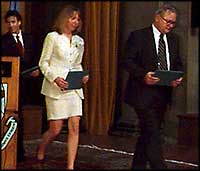
Melanie Sill, Pat Stith and Joby Warrick accept the 1996 Pulitzer Prize in Public Service.
Winning Work
By Pat Stith, Joby Warrick and Melanie Sill
N&O Staff Writers
North Carolina becomes the nation's No. 2 pig producer, but not without cost. Who wins, and who loses, when a major industry is given special treatment?
In this five-part series, The News & Observer explores North Carolina's pork revolution and the state's role as a supporter and mediator. The stories drive home one central question:
Who's in charge?
North Carolina, hundreds of miles from America's traditional Midwest hog belt, has become the nation's No. 2 hog producer. Last year, hogs generated more than $1 billion in revenue -- more than tobacco. This year, hogs are expected to pass broiler chickens as the No. 1 agricultural commodity.
That's part of the story -- the part claimed proudly by companies such as Murphy Family Farms, Carroll's Foods and Prestage Farms. These companies have put North Carolina on the map with high-tech, high-density hog production.
But there's more to the story of North Carolina's fastest-growing industry.
In a seven-month investigation, The N&O found that state agencies aid the expansion of pork production but are slow to act on a growing range of problems resulting from that increase.
The industry has won laws and policies promoting its rapid growth in North Carolina. It also has profited from a network of formal and informal alliances with powerful people in government.
Now, a growing chorus of residents, local leaders and environmental groups is pressing the state to address worries about hog farming. Most are complaining about odor. And an increasing number want to know about pollution problems and long-term economic development issues in Eastern North Carolina.
The first package of stories shows how hog farms are polluting groundwater, how serious the environmental effects might be, and how environmental regulators worry that they lack the information and the authority they need to protect the public. Subsequent stories look at corporate farming, politics, hog odor and campaign finance.
THE SERIES
February 19: Hog waste is polluting the groundwater. New evidence shows that hog farm wastewater lagoons are leaking. But environmental regulators don't have the nformation or the authority they need to protect drinking water.
February 21: Corporate takeover. Corporate farming has taken over the swine industry the way chain stores took over retailing, and contract farms are the new franchises. North Carolina farmers are borrowing heavily to raise pigs for corporations.
February 22: Murphy's law. During his 10 years as a state legislator, Wendell Holmes Murphy became the nation's biggest hog producer. And he helped pass laws worth millions of dollars to his company and his industry.
February 23, 1995: Hog-Tied on Ethics: a News & Observer editorial
February 24: Money talks. Some of their neighbors say that hog farms stink; pork companies call it the "smell of money." Find out what Eastern North Carolina is getting out of its new status as Pig Country, U.S.A., and why some people want the growth to stop.
Putting the hush on hogs: a News & Observer editorial
February 26: Pork barrels. Follow hog-industry contributions to some influential positions in government. Do the connections add up to undue influence?
February 28, 1995: When hogs come first: a News & Observer editorial
© 1995, The News & Observer
By Joby Warrick and Pat Stith
N&O Staff Writers
Imagine a city as big as New York suddenly grafted onto North Carolina's Coastal Plain. Double it.
Now imagine that this city has no sewage treatment plants. All the wastes from 15 million inhabitants are simply flushed into open pits and sprayed onto fields.
Turn those humans into hogs, and you don't have to imagine at all. It's already here.
A vast city of swine has risen practically overnight in the counties east of Interstate 95. It's a megalopolis of 7 million animals that live in metal confinement barns and produce two to four times as much waste, per hog, as the average human.
All that manure -- about 9.5 million tons a year -- is stored in thousands of earthen pits called lagoons, where it is decomposed and sprayed or spread on crop lands. The lagoon system is the source of most hog farm odor, but industry officials say it's a proven and effective way to keep harmful chemicals and bacteria out of water supplies.
New evidence says otherwise:
- The News & Observer has obtained new scientific studies showing that contaminants from hog lagoons are getting into groundwater. One N.C. State University report estimates that as many as half of existing lagoons -- perhaps hundreds -- are leaking badly enough to contaminate groundwater.
- The industry also is running out of places to spread or spray the waste from lagoons. On paper, the state's biggest swine counties already are producing more phosphorous-rich manure than available land can absorb, state Agriculture Department records show.
- Scientists are discovering that hog farms emit large amounts of ammonia gas, which returns to earth in rain. The ammonia is believed to be contributing to an explosion of algae growth that's choking many of the state's rivers and estuaries.
Hogs aren't the only the agricultural commodity that poses a threat to water quality. Fertilizer from crop land and golf courses has been cited for years among pollution sources in Eastern North Carolina.
Pork industry officials say they are supporting research into hog waste and odor problems. They say no one works harder than they do to prevent the contamination of water supplies -- a resource that they also must use.
But there's also no precedent for the expansion of high-density hog farming in North Carolina. Nowhere else has this waste-intensive industry grown so much so fast, with so little known about long-term consequences.
What is known is that Eastern North Carolina, with its sandy soils and a shallow water table, is especially vulnerable to groundwater pollution. Yet the state has weaker environmental regulations for hog farms than any major hog-producing state.
Compared to Missouri, Iowa and even neighboring Virginia, North Carolina has lenient requirements for lagoon construction, minimum buffer zones between hog farms and neighbors, and seepage from lagoons into the ground. It minimally enforces the rules that are in place.
The newest state regulations call for increased reporting from farmers, but even those rules won't be fully implemented until 1997. By then, North Carolina hog farms are projected to produce up to 16 million swine a year -- and as much raw waste as a country of 32 million people.
Can the swine industry handle that much manure without seriously degrading the environment? It's a worrisome question for water quality experts like Lawrence B. Cahoon, professor of biological science at the University of North Carolina at Wilmington.
"You have to put it in perspective," said Cahoon, who is studying nutrient pollution in the Cape Fear River. "There are now 2 million hogs in the Cape Fear River basin alone. Is hog waste treatment up to the same standard as human sewage treatment? Certainly not.
"And if it's nowhere close, then you've got a mammoth potential problem on your hands."
Lagoons leak
Carroll's Foods of Virginia was hoping to quell neighbors' fears about groundwater contamination when it agreed to install monitoring wells at three of its Northampton County hog farms early in 1993.
The results took everyone by surprise.
The first few months of testing yielded nothing unusual. But then, last winter, contamination started showing up in a well outside a waste lagoon on Farm No. 32.
Levels of ammonia nitrogen -- a byproduct of urine -- suddenly jumped from a normal background level of 2 parts per million to 18. Three months later it had jumped to 27, then to 57. By last autumn it had soared to 178 parts per million -- many times the norm.
Those numbers shocked Northampton County officials who were receiving test results regularly. They asked Carroll's to allow an independent investigator to perform more tests at the site, but the company refused.
Until now, the findings have received almost no notice outside the immediate area. In a letter to Northampton County manager W.E. Daniels, Carroll's downplayed the results as a "nonmaterial variation."
But to Richard Maas, a UNC-Asheville scientist who studied the test results at the county's request, they could mean only one thing.
"If you're seeing ammonia," said Maas, director of the university's Environmental Quality Institute, "it means water is leaching out through the lagoon."
The conventional wisdom about hog lagoons -- where bacteria breaks down animal waste -- is that they are virtually leak-proof. The heavier sludge is supposed to settle to the bottom and form a seal that prevents the escape of harmful bacteria as well as chemicals such as nitrate, a groundwater contaminant that can be lethal to infants.
As recently as two years ago, the Division of Environmental Management told lawmakers in a briefing that lagoons effectively self-seal within months with "little or no groundwater contamination" -- even in sandy, highly permeable soils.
Wendell H. Murphy, a former state senator who is now the nation's largest producer of hogs, said in an interview this month that "lagoons will seal themselves," and that there is "not one shred, not one piece of evidence anywhere in this nation that any groundwater is being contaminated by a hog lagoon."
But what Murphy didn't know was that a series of brand-new studies, conducted on Eastern North Carolina hog farms, was showing that large numbers of lagoons are leaking -- some of them severely.
The studies, described in papers prepared for academic publication, concluded that lagoons were causing local pollution around hog farms. One of the researchers, Rodney L. Huffman, acknowledged the explosiveness of the findings as he discussed them.
"I'm not trying to be an alarmist," said Huffman, an assistant professor of biological and agricultural engineering at N.C. State University. "The simple fact is that some lagoons work well, but others, especially the older ones, apparently do not."
Huffman was a principal researcher in three of major four research projects that sought to explore what happens to hog waste in lagoons and in the ground. The results were strikingly similar.
- Old lagoons: The scientists selected 11 lagoons that were at least 7 years old and dug a series of test wells to see if wastes were seeping out of them. Their findings: More than half of the lagoons were leaking moderately to severely. Even the lagoons that were described as having little seepage still produced groundwater nitrate levels up three times the allowable limit.
"Assuming these findings to be typical," the researchers said in a paper awaiting publication, "leads to the conclusion that about half of the swine operations in the lower coastal plain of North Carolina are inadvertently contributing to local contamination of the surficial aquifer."
The report concludes: "If this level of contamination cannot be tolerated, remedial measures should be taken."
- New lagoons: Test wells were installed at three new lagoons and monitored over a period of five years. Two of the lagoons, were constructed in coarse sandy soil, began leaking immediately and never stopped. Huffman concluded that sand-based lagoons may never seal adequately unless liners are installed.
- Extent of contamination: Researchers at a Duplin County hog farm discovered that nitrates seeping from lagoons can be quite mobile. Their test wells tracked a "plume" of nitrates from a leaking lagoon that caused water contamination at distances beyond 250 feet.
- Irrigation fields: Lagoons may not be the only source of groundwater contamination. Another Huffman research project looked at groundwater quality in test wells in fields where hog waste had been sprayed as fertilizer. The result: "Evidence of contamination was found almost everywhere" in the sandy soils beneath the spray fields, the June report said.
In some cases, nitrate was observed to be moving very deeply into the ground, presenting a "possible contamination hazard to the confined aquifer system," it said.
The findings are particularly worrisome for Eastern North Carolina, where large numbers of rural residents draw their water from shallow wells. The contaminants seeping out of these lagoons are known to include numerous strains of harmful bacteria and chemicals.
Among the contaminants is nitrate-nitrogen, which causes methemoglobinemia, a disease that can be fatal to infants. Methemoglobinemia, or "blue-baby syndrome," interferes with the blood's ability to absorb oxygen.
Kris C. Matson, a hydrogeologist for the state Division of Environmental Management, said the findings challenge many of the industry's basic assumptions about how waste should be handled. Even spray irrigation -- considered the most environmentally benign way to recycle nutrients from manure -- may have to be re-examined, he said.
"This is a wake-up call," he said.
Wells at risk?
What does it all mean for the state's drinking water?
Huffman, for one, isn't urging rural residents to rush out to buy bottled water. In most of the cases he studied, the contaminants appeared to be migrating laterally toward the nearest ditch or stream rather than causing wholesale contamination of groundwater.
Pork industry officials, likewise, are convinced that any pollutants from leaking lagoons are filtered out harmlessly by the soil. They note that there's no direct evidence that a private well has been contaminated by a leaking lagoon.
But the truth is, no one really knows what is happening to the wastes once they enter the soil. The NCSU research did not attempt to answer the question. A two-year, $157,000 study funded by federal and state grants is just getting under way to see if lagoon wastes are reaching drinking water supplies.
But whatever is taking place, it is likely happening on a huge scale:
- There are 8,000 farms with hogs in the state, including 1,800 farms with 100 or more animals. Most of the larger farms have one or more lagoons. The exact number of lagoons is unknown because the state has never required permits for them.
In some of the biggest hog-producing counties, as many as two-thirds of the waste-management systems fall short of recommended guidelines, according to a 1993 survey by the federal Natural Resources Conservation Service. A failing grade could mean anything from an undersized lagoon to the lack of a liner in an area with coarse soils.
Those findings are significant because that federal agency, formerly called the Soil Conservation Service, sets the standards for lagoon construction, and in many cases actually designs the lagoons.
- Compacted clay or synthetic liners can make lagoons almost leak-proof. But at least until recently, very few hog producers were putting any kind of liner on their lagoons, industry sources say. A 1993 court affidavit prepared by the NRSC said that in Johnston County, home to 128,500 hogs in 1993, only one farm was known to have a clay-lined lagoon.
Wendell Murphy said his company now spends the extra money to put clay liners in lagoons.
"I would tell you that there were some that were done without clay, but I would also tell you that they are perfectly sealed. I'll guarantee you they're sealed. And I challenge anybody to prove me wrong on that."
Even now, under the state's tougher water-quality standards imposed last year, hog farms aren't required to install liners unless a "technical specialist" -- in some cases, a hog company employee -- recommends it. By contrast, Virginia, which has similar soils, requires a one-foot compacted clay liner or an equivalent synthetic liner on all new lagoons.
Eastern North Carolina's situation is complicated by a crazy-quilt of soil types where layers of sand, loam and clay begin and end abruptly. It's impossible to judge from a few soil samples whether a piece of land is suitable for a lagoon, said Doug Rader, a former special projects group leader in DEM's water quality branch.
Hog company executives such as Murphy consider the Coastal Plain's sandy soil to be an advantage. "You're much less likely to get the runoff because the sand will absorb the moisture," Murphy said recently.
But Rader, now senior scientist for the N.C. Environmental Defense Fund, says sand is hardly an asset when it comes to protecting groundwater. Sand allows nitrates and bacteria to pass quickly to water supplies below. And in lagoons, even a small patch of sand in the wall of lagoon can prevent it from ever sealing properly, he said.
"It can't help but leak," Rader said, "like a bucket with a hole in it."
Toxic spills
If a leaking lagoon is like a slow, steady drip from a faucet, a spill is the equivalent of a water-main burst.
Some are accidents; others are intentional releases of lagoon waste. Either way, a spill violates state law prohibiting the discharge of any waste whatsoever.
Occasionally major spills are cleaned up quietly so the public never hears about them. That's what happened in May 1991 when a 10-acre lagoon ruptured on Murphy Farm's Magnolia No. 1 facility in western Duplin County.
A limestone layer beneath the lagoon collapsed May 8, sending tons of water cascading into the nearby Millers Creek in an incident that was never reported to state water-quality officials.
An employee of the town's water department discovered the problem when he saw corn kernels and hog waste floating by in the creek. He alerted the company, and within hours a task force had been assembled to plug the leak. Wendell Murphy himself traveled to the site to inspect the damage.
It took four days to find and patch the leak. But neither Magnolia town officials nor Murphy Farms ever notified the state about the spill.
"In retrospect, maybe we should have," Murphy said. "But I would also say that to my knowledge, no harm has come of it."
Former employees of hog companies told The N&O that spills are a common occurrence. Marvin Angel, a former farm manager for Carroll's of Virginia in Northampton County, said hardly a week passed that there wasn't some kind leak or overflow.
One of the worst occurred a year ago when some pipes froze and burst overnight, Angel said. Workers arrived to find hundreds of thousands of gallons of waste water puddled around the buildings.
"There are so many ways to have a spill that it's impossible NOT to have one," Angel said. "Pipes fill up with leaves. Drains get stopped up."
When accidents occur, workers do the best they can to clean it up. After that's it's just "pray and keep your mouth shut," he said.
In other, documented cases, farmers have deliberately discharged lagoon waste into ditches, streams and swamps. State officials usually learn of these incidents only when someone complains.
By then substantial damage already may have been done.
A river runs through it
Even if there were no more spills and all lagoons magically sealed, the pork industry could still have a major impact on the state's water quality. The effects would just show up many miles downstream.
A growing body of scientific data shows that Eastern North Carolina's rivers and streams are carrying ever-larger volumes of what researchers call "nutrient pollution" -- nitrogen, phosphorous and other substances that are used in fertilizers and are contained in all animal waste. An overabundance of these nutrients can trigger an explosion of algae growth that kills fish.
In recent years, the state DEM has classified the Neuse, Chowan and Tar-Pamlico rivers as "nutrient-sensitive waters" because of problems resulting from high levels of nutrients. A major source of this pollution, the DEM says, is runoff from crop lands and intensive livestock operations.
This is indirect, or "non-point," pollution, and no one knows exactly how big of a role hogs are playing. New research on the issue, though, has helped illuminate problems for the industry that could have serious ramifications for the future.
First, the hog industry is running out of places to put its wastes. Most swine farms spray the contents of their waste lagoons on crop lands and pastures as a substitute for commercial fertilizer. The problem is, you need lots of land to accommodate all that waste -- and some counties are rapidly reaching the saturation point.
In fact, Duplin and Sampson counties -- the nation's top two swine-producing counties with nearly 1,300 hogs per square mile -- are already reporting a nutrient surplus: They are producing more phosphorous in animal waste than they have crop acres to put it on, according to a survey by NCSU and the state Agriculture Department. Nitrogen wasn't very far behind.
The prospect of being buried under all that manure has sent state officials scurrying to find new uses for the stuff. One idea being discussed calls for spreading composted waste on the sides of highways as fertilizer for beautification projects.
Meanwhile, if farmers apply too much manure on crops, the excess nutrients will eventually turn up in rivers through storm runoff and groundwater discharge. Determining how much manure to apply is a complicated procedure that requires a chemical analysis of the soil, the waste and the crops being grown.
A second source of nutrient pollution is ammonia gas, which research shows is escaping through the air in large quantities and returning to earth with rainfall. According to Dr. Leon Chesnin, professor emeritus of waste management and utilization at the University of Nebraska-Lincoln, a farm with 1,400 mature hogs will produce a ton of airborne ammonia a year.
Much of this ammonia is apparently coming from lagoons. As the pork industry often points out, lagoons are designed not just to hold waste but to treat it through bacterial digestion. One result is that 70 percent to 80 percent of the nitrogen content is eliminated -- much of it as airborne ammonia gas.
Hans Paerl, a Kenan professor of Marine and Environmental Sciences at UNC-Chapel Hill, is studying the affect of this ammonia on rivers. As the ammonia falls to the earth as rain, he says, it creates a whole new source of nutrients that can trigger algae blooms.
In Northern Europe, where the swine population is even more dense, ammonia gas has become the No. 1 environmental concern for the agricultural community. Because most regulations are aimed at curbing ammonia, open-air lagoons have been banned completely, and farmers must directly inject waste into cropland rather than spraying it.
No one has yet proposed such measures for North Carolina, but some of Paerl's preliminary data shows that all this vanishing nitrogen may not be so invisible after all.
"They were getting rid of it, all right," Paerl said. "But it was going into the atmosphere and ending up somewhere else."
How big of impact is it having? Paerl still isn't sure. The fact is, the trend toward large-scale hog production is still so new that no one knows what the long-term effects might be.
What is known is that pollutant levels in water and in soil tend to build slowly. Nitrates that leach into the soil today, for example, may not turn up in drinking water for several years, Chesnin says.
But once groundwater becomes contaminated, it's virtually impossible to clean it up by mechanical means. The only solution is time -- a long, long time.
"You may not find deterioration of your well water immediately or in the first few years, but the nitrates continue to travel through the soil layers, into the ground," said Chesnin, who has investigated contaminated sites throughout the Midwest.
"Once you remove the animals, it takes about 20 years for it to quit coming down," he said. "And then it took another 20 years to clear out of the groundwater on its own accord.
"That's two generations."
© 1995, The News & Observer
By Joby Warrick and Pat Stith
N&O Staff Writers
Hundreds of contract farmers make up a franchise system run by a few big companies. Meanwhile, traditional hog farming is fading.
CLINTON -- Greg Stephens is the 1995 version of the North Carolina hog farmer: He owns no hogs.
Stephens carries a mortgage on four new confinement barns that cost him $300,000 to build. The 3,000 hogs inside belong to a company called Prestage Farms Inc. Prestage simply pays Stephens a fee to raise them.
For the next 10 years, most of Stephens' earnings will go toward paying off his debt. Then, if all goes well, he can start making money -- enough, he hopes, to put his kids through college.
The arrangement is called contract farming, and it's hardly risk-free. But for anyone wanting to break into the swine business these days, it's the only game in town.
"Without a contract, there's no way I'd be raising hogs," said Stephens, of Clinton. "And even if I had somehow gotten in, my pockets aren't nearly deep enough to let me stay in."
Welcome to corporate livestock production, the force behind the swine industry's explosive growth in North Carolina. The key players are big companies like Prestage, Carroll's Foods and Murphy Family Farms.
The backbone of the new system is a network of hundreds of contractors like Stephens, the franchise owners in a system that more closely resembles a fast-food chain than traditional agriculture.
Nowhere in the nation has this change been as dramatic, or as officially embraced, as in North Carolina. As a result, the hog population has more than doubled in four years, and nearly all of that growth has occurred on farms controlled by the big companies.
Meanwhile, independent farmers have left the business by the thousands.
While Midwestern states debate the merits of increased hog production against the loss of independent family farms, North Carolina's government and land-grant university have promoted and encouraged large-scale production for years.
No less an authority than state Agriculture Commissioner Jim Graham believes the corporatization of agriculture is inevitable.
Opponents, however, say the corporations have created a perfect system -- for themselves. They say the hog companies are saddling hundreds of small farmers with huge debts, with no guarantees that they will ever reap the kinds of profits they were promised.
"Why invest your capital when you can get a farmer to take the risk?" asked former state Rep. Joe Mavretic, an advocate for stronger legal protections for contract farmers.
"Why own the farm when you can own the farmer?"
Risky business?
If you want to know how popular hog contracts have become in North Carolina, just call any of the big hog companies and try to get one. Murphy and Prestage say they have yearlong waiting lists. Carroll's says the wait can be as much as two years.
With tobacco facing an uncertain future, many farmers are jumping at the chance to diversify their income and bring in steady earnings. Others see the contracts as an investment or a way to break into the livestock business.
Wendell H. Murphy, founder of Murphy Family Farms and the man generally credited with adapting the contracting concept to hog farming, describes the achievement as his greatest contribution to the industry.
"These contracts are very good for the growers, and they work good for the integrators," Murphy said in an interview. "It's just been a strong economic boost to the region."
To Stephens, the biggest selling point is freedom from risk. When pork prices go south, as they did two months ago, contract farmers are barely affected.
"The company that owns the pig takes on more risk than you do," Stephens said.
But others say the opposite is true: The growers are putting their homes and property on the line, and they're also legally reponsible for environmental problems and lawsuits from neighbors.
"The contract looks a whole hell of a lot better when they're presenting it than the actual value is," said Jack Sauls, a former contract farmer from Faison. "It's a good deal for a man who doesn't have any money and can't borrow the money. You give him a string to hold onto, and he thinks it's great. And it turns out to be a wonderful deal -- for the company."
The risks are real, according to Kelly Zering, an N.C. State University agricultural economist and a widely recognized expert on the state's swine industry.
A typical hog contract farmer borrows anywhere from $200,000 to $1 million to construct his barns -- a loan that's typically secured by his house and land. But while the grower carries the debt for the seven to 10-year life of the loan, the hog company can pull out with 30 days notice. Zering says contracts for raising pigs usually run for only a year, and contain an exit clause that allows either side to cancel much earlier.
"I encourage anyone who considers a contract to consider what they will do with these facilities in the event they lose the contract," Zering said. Once that happens, the grower's only real options are to try to find another company or lease his property to someone else.
Zering says the contract grower can make a "very high level of income" once his mortgage is paid. But his research shows that most barns have a maximum lifetime of only 15 years. The equipment, Zering says, will probably last about half that long.
Meanwhile, while the debt is being repaid, a grower will gross about $9.50 per hog sold, Zering said. After paying his debt service and expenses, the farmer is left a small amount of money for labor -- roughly $7 an hour -- and an additional income of about 50 cents a hog.
"There's not a huge profit margin there," Zering said.
Some contract farmers complain that they didn't make any money at all. John Cooper, a Newton Grove farmer who has worked under contract for three different companies, said he was lured into the business with promises of up to $100,000 a year. But after making $56,000 in annual payments on a $750,000 loan, he ended up taking a loss of $8,000 in his first year.
"I would tell people that each and every contract should be looked at carefully, and nothing should be taken for granted," said Cooper, who says he is happy with his new company, Southern States.
The author of a new book on contract farming agrees.
"People generally don't ask you to go borrow $150,000 to get an $8-an-hour job," says Neil D. Hamilton, director of the Agricultural Law Center at the Drake University Law School in Des Moines, Iowa, and author of "A Farmer's Legal Guide to Production Contracts."
"These relationships shift an awful lot of risk to the producer -- the risk of owning the building, the risk of environmental damage, the risk that the contract won't be renewed," he said.
At the request of The News & Observer, Hamilton reviewed five North Carolina hog contracts that were obtained by the newspaper. His impressions:
The North Carolina contracts were "fairly standard" for the industry and illustrated the general premise of the book:
"Whoever wrote them," he said, "wrote them to take care of themselves."
No legal protections
The changes that are sweeping the swine industry today were pioneered by chicken and turkey growers in the 1960s and '70s. Total confinement housing, vertical integration and contract farming are all standard practices in the feather world.
As a result, you need only look at chickens to see where pork is headed:
The poultry industry today is fully integrated -- meaning a handful of companies control all phases of production -- and the labor is performed by an army of contract growers, some of them decidedly unhappy.
"It's sharecropping -- that's what it is," said Larry Holder, a chicken farmer and president of the N.C. Contract Poultry Growers Association.
Holder's group is pushing for legislation that would give farmers some protection from being squeezed or suddenly cut off before their debts are paid. These rights have long been granted to auto dealerships and similar franchise operators. But swine and poultry growers won't be getting them any time soon -- not if the major livestock companies get their way.
"I don't know that we need legislation to protect people, or to mandate business decisions," said Walter Cherry, director of the N.C. Pork Producers Association.
Cherry's group was one of the leading opponents two years ago when state Rep. Mavretic and Sen. Roy Cooper introduced legislation that would have provided legal safeguards for poultry growers. After an intense lobbying campaign, the bill was killed in the Senate Agriculture Committee.
Swine company officials say the protections aren't needed, and they stand by their relationships with their growers. Murphy says with pride that none of his contract growers has failed financially -- although several have left his company to work for others.
"When we make a commitment, I'm going to stand there and fight to honor that commitment," Murphy said.
Many of the contract hog growers interviewed had nothing but praise for their company. George Garner, a Kenansville farmer, has raised pigs for Carroll's Farms Inc. for 10 years.
"They've been nothing but good to me," Garner said.
But with so much at stake, contract farmers shouldn't have to simply rely on their company's word, proponents of increased regulation say. In the poultry industry, there has been an explosion of lawsuits by contract farmers, some of which resulted in multimillion-dollar damage awards after poultry companies were found to be defrauding growers.
Late last year, Goldsboro Milling, a major producer of turkeys and hogs, offered turkey farmers a cash settlement after being accused in a lawsuit of systematically cheating them on weight for five years.
At least a dozen other lawsuits are pending in Southern states from growers complaining of a wide range of abuses, including unfair termination of contracts, new equipment requirements at the growers' expense, and underweighing of animals and feed.
Mavretic said he believes the problems will continue until contractors are given legal protections by their governments.
"Here is the legislative problem that we refuse to acknowledge: Why is North Carolina such a great state for the poultry integrators, and why has it become such a great state for a few major hog producers?" Mavretic asked. "The answer is, because our laws are so lax that they allow the major integrators to exploit the contract grower."
A dying breed
There's a twist to the pork statistics coming out of the state Agricultural Department, one that is sometimes overlooked: Despite the phenomenal growth in hog production here, the number of hog farmers is dropping -- rapidly.
Since 1983, about the time corporate hog production was just starting to ignite, more than 16,000 North Carolina hog farmers have left the industry -- roughly two-thirds of the 23,400 growers who were in business at the time.
Some, like Sampson County farmer W.E. Warren, are closing down for good.
Others -- producers like Norman Denning, chairman of the Johnston County commissioners and a 54-year veteran of the pig business -- are cutting back.
"It's just a matter of who hangs it up first. There're too many hogs," said Denning, whose herd size is dropping from 125 sows to 45.
The independents are the biggest losers as the swine industry goes corporate. And as they disappear, a way of life is vanishing with them.
Zering, the economist, believes some of the independents will survive, but most will have to either get big or get out, partly because the existing marketing system caters to very large producers.
There are only two major slaughtering plants in the state, Carolina Food Processing Plant in Bladen County and Lundy's in Clinton. Murphy's, Carrolls, Prestage and Brown's of Carolina have supply contracts to provide animals to the packing companies on a regular basis. Independent farmers say they sometimes face long delays in trying to get their animals to market.
"The entire marketing system is changing to try to get rid of the inefficiencies that existed in the past," Zering said. "Being an independent in the sense that you could take five hogs down the road in a trailer or sell them at an auction -- that system is gone."
But even independents that have tried to match the bigger operations in size and technology find it difficult. The major swine producers operate much more cheaply because they import their own grain in bulk and mill it in vast company-owned grain mills.
More importantly, Big Pork has the financial resources to weather extended downturns in the market -- for example, a plunge in wholesale prices over the fall and winter that resulted in the lowest rates, adjusted for inflation, since the Great Depression.
Hogs everywhere sold for a loss, but some of the integrated companies are continuing to post profits.
Smithfield Foods Inc., the Virginia-based hog processor and producer, announced earnings of $7.8 million for the second quarter of its 1995 fiscal year -- up from $923,000 in the second quarter of fiscal 1994. The company credited an ample supply of hogs and lower wholesale prices.
Pork prices at the grocery store haven't dropped.
Despite the lower prices and lack of market access, a few independent producers are managing to hang on -- for now.
Otis Byrd, a 45-year-old Johnston County farmer, has deliberately avoided contract production and says his main ambition is to simply "make a living for my family." But the lack of a contract is making it increasingly difficult to obtain loans or find a market for his pigs.
"I don't know what I'm going to do to fight it, except keep trying to raise hogs," he said recently. "I don't know whether I'll be able to sell them. But I just ain't ready to roll over and play dead yet."
"I do know there's something screwed up in the hog industry," he said, "and it's bad."
© 1995, The News & Observer
By Pat Stith and Joby Warrick
N&O Staff Writers
Wendell H. Murphy, who became the nation's biggest hog producer during the 10 years he served in the General Assembly, helped pass laws worth millions of dollars to his company and his industry.
The Duplin County executive voted for, and sometimes co-sponsored, bills giving hog and poultry producers tax breaks, protection from local zoning and exemptions from tougher environmental regulations.
Those laws -- adopted in the 1980s and early '90s -- often passed without a dissenting vote. They got little public notice then. Now, with high-density hog farming growing at an unprecedented rate in Eastern North Carolina, their impact has hit home:
- Counties trying to deal with odor can't use their zoning authority. The biggest of the hog operations are more like factories than farms, with a row of climate-controlled buildings containing 10,000 or more hogs being fed and watered by machines. But a bill co-sponsored by Murphy in 1991 treats those facilities like the old family farm and exempts them from zoning regulations.
- A big hog farm generates more sewage than than most towns in North Carolina. But Murphy sponsored an amendment that would have gutted the penalties for illegal discharges of hog waste into streams. Another amendment restored some state authority.
- Thousands of hog and poultry houses have been built in the last few years, adding up to millions of dollars worth of investment in facilities. One lender, Cape Fear Farm Credit Service in Fayetteville, says its hog loans total $100 million. But all that building material, and all that equipment, has been exempted from sales tax because of two other laws Murphy supported.
Murphy Family Farms, with its headquarters in Rose Hill in Duplin County, is the General Motors of a hog industry empire that extends from the coastal plain of North Carolina to Utah. This year the company is expected to raise more than 3 million hogs in North Carolina -- more than 8,200 a day, seven days a week.
Murphy is the top executive of that industry. But as a legislator, he pushed for state laws that treated hog companies like Farmer Brown, the backbone of rural North Carolina. He got them.
And he got them without violating state ethics law. Members of the General Assembly are allowed to make money off the bills they introduce, the amendments they offer and the votes they cast -- as long as they can say their financial interests didn't cloud their judgment.
Murphy says he represented the one of the state's top agricultural counties and has no apologies for his hog and poultry votes.
"They shouldn't have sent me up there if I couldn't, if I was going to have to abstain from voting on matters pertaining to agriculture," he said. "If I had one little industry here and I was just doing it for myself, then it would be wrong. But I did what I thought was right for the industry of Duplin County."
Murphy, a Democrat, is the quintessential country boy who made good. Born and raised on a tobacco farm near Rose Hill, population 896 in 1950, he graduated from Rose Hill High School in 1956 and N.C. State University in 1960. He worked hard and earned millions. He was 44 years old when he won a seat in the House in 1982.
He represented Duplin County, his home, and Jones County when he was first elected. In those days Duplin had 172,000 hogs. Now it has six times that number -- more than 1 million.
And most of them belong to Murphy Family Farms.
A legislative power
In the General Assembly, Murphy was open about his financial interest in hogs.
His legislative biography, published in the North Carolina Manual, says he was vice president of the family business, Murphy Farms Inc. The biography lists two honors: "Pork All American, 1975; N.C. Outstanding Pork Producer Award, 1980."
Murphy was an effective legislator whose influence increased year by year, according to rankings from the N.C. Center for Public Policy Research. After his first term, he was rated 75th in effectiveness among 120 House members; after his second, 55th; after his third term, 33rd most effective.
In addition to his own influence, Murphy drew on powerful friends in the General Assembly.
One of those friends was Sen. Harold W. "Bull" Hardison of Kinston.
Hardison was a favorite of business. He had sponsored several bills -- the Hardison Amendments -- that knocked down strict state environmental regulations. He was renowned as a back-room wheeler-dealer, a man who knew how to get things done. Year after year, he ranked near the top in power and influence.
It was Hardison who sponsored or co-sponsored bills to eliminate sales tax on hog and poultry houses in 1986 and on related equipment in 1987. And when Hardison sought the Democratic nomination for lieutenant governor in 1988, Murphy gave him a $100,000 campaign contribution, which violated the legal maximum.
A few days later, Hardison received another $100,000 check from Marvin Johnson, president of House of Raeford Farms Inc., one of the biggest turkey processors in the country. The legal maximum for the primary election was $4,000.
Those and other illegal contributions to Hardison were uncovered by the State Bureau of Investigation. Colon W. Willoughby, the district attorney of Wake County, said in 1992 that he could not prosecute Murphy or Johnson for election law violations because the two year statute of limitations had expired.
Johnson said he didn't lobby for the sales tax exemption bill. He described the $100,000 check to Hardison as a loan rather than an illegal contribution, and said Hardison had repaid part of the money.
Asked how much Hardison had paid back, Johnson answered: "I don't know.
"Fact is, since you've brought it up, I'll look into it."
Murphy acknowledges that the sales tax exemption was worth millions of dollars to an industry in which he is the dominant player.
Asked if his support of Hardison in 1988 was quid pro quo -- Hardison helped him so he helped Hardison -- Murphy replied:
"No, I wouldn't answer that way. I would tell you that Harold Hardison has been a friend since long before I went to the legislature, and still is. As far as I know. I haven't seen him in a while, and rarely see him any more."
"But I think Sen. Hardison has done more to represent his district, as much as anybody ever did. And I have no apologies for any support I've ever given Sen. Hardison. If he was running today, I'd support him again."
The bill to exempt hog and poultry houses from sales tax was ratified by overwhelming margins in both houses in the 1986 legislative session. Murphy voted yes.
After the state Department of Revenue interpreted that bill to apply only to building materials, and not to equipment and machinery in the buildings, Hardison introduced a second bill on May 5, 1987, that removed all doubt.
That law was ratified Aug. 12, 1987. Murphy voted yes. There were no opposing votes.
Hardison said his action on the tax exemptions had no connection to the money he got from Murphy and Johnson.
"I was told they made a sizable contribution, and that's all I know," said Hardison, who is 71 now and semiretired. "That had no connection whatsoever. I can absolutely, unequivocally, tell you that."
In the 1980s, when the tax-exemption bills were being considered, the General Assembly's Fiscal Research Division estimated the annual state tax loss on building materials at $737,550 a year and on equipment and machinery at $200,000 to $225,000 a year. That's a total of almost $1 million a year.
Since then, the tax break has totaled a lot more than that. State and local sales taxes on building materials have increased by a third, to 6 percent; building costs have increased by about 30 percent due to inflation; and the number of hogs in North Carolina has tripled, creating a hog-house building boom.
The Murphy Amendment
Murphy also tried to protect the hog industry in 1991 when the legislature repealed the Hardison Amendments, which had prevented North Carolina from imposing environmental air and water standards that were stricter than federal regulations.
Environmentalists had fought for several years to knock down the laws and finally rallied the votes they needed in 1991. But before the bill reached the Senate floor -- while it was in the Committee on Environment and Natural Resources -- Murphy added this amendment:
"Except as required by federal law or regulations, the commission may not adopt effluent standards or limitations applicable to animal and poultry feeding operations."
The committee adopted Murphy's amendment on May 9, 1991, and the Senate passed the bill 37-0. Murphy voted yes.
Murphy said he offered the amendment because proponents of the bill had told him the legislation wasn't aimed at agriculture.
"The day that amendment was offered the Farm Bureau representative came by, with it prepared, said, "Here, Wendell,' said, "put this on them. They say it doesn't have anything to do with livestock, let's see how they like this.' I said, well, if they say it doesn't, then this amendment won't hurt the bill."
"I carried it into committee meeting, handed it to the chairman, to the sponsor of the bill, Dennis Winner. He took it back to Bill Holman, the Sierra Club lobbyist, they all agreed it was all right. And it was adopted."
Holman told a reporter that he agreed to the Murphy amendment to get the bill passed. But he said Steve Tedder, chief of the water quality section in the Division of Environmental Management "quietly pitched a fit about the Murphy amendment" and talked to some representatives about undoing it.
Murphy's amendment would have crippled the state's ability to penalize hog operations that illegally discharged waste into streams or other water supplies.
"You had no ability in a bad situation to take enforcement action, if you went by the federal process," Tedder said. "I mean, even if you found a lagoon breached going right straight to the river, all you could say is please, over the next 90 days would you please fix that hole."
In response to Tedder's concerns, the House adopted an amendment that allows the state to levy a penalty of $5,000 for illegal discharges.
The zoning exemption
It was during that same 1991 session that Murphy co-sponsored a bill that shut the door on any efforts by individual counties to place zoning restrictions on hog farms.
The legislature gave counties zoning powers in 1959. At that time, it exempted "bona fide farms," but it didn't define a bona fide farm. Murphy's law did.
A bona fide farm, according to Murphy's bill, included "production of crops, fruits, vegetables, ornamental and flowering plants, dairy, livestock, poultry ..."
"This was probably where the [case] law was going, but this removes any uncertainty," said David W. Owens, assistant director at the Institute of Government in Chapel Hill.
County managers in four of the state's top 12 hog counties said their governments had considered trying to regulate hog farms only to discover they they could not use their zoning authority to do so.
"Our understanding is under current state statutes, it pretty well tied the commission's hands," said Allen M. Hardison, the manager of Greene County.
Murphy downplays his role as a co-sponsor and says the zoning bill had no impact on the hog industry.
He said that the bill was sponsored by James D. Speed of Louisburg, chairman of the Senate agriculture committee, at the request of the agriculture department.
Speed "normally passes the bills around to any of the members who want to sign on, and it's just kind of, a lot of times, you sign bills you really don't know what they were," Murphy said. "I don't know that I knew what that one was but in retrospect that was about as harmless a thing as I've ever done."
David S. McLeod, attorney for the Department of Agriculture, said Murphy had gotten a "bum rap" on that bill. McLeod said the N.C. Farm Bureau Federation, the largest general farm organization in the state, initiated the zoning exemption.
"Mecklenburg had gotten a local act passed that authorized them to adopt their own definition of a bona fide farm," McLeod said. "And there was some concern that the other counties might do the same thing."
"A lot of farmers were having trouble with county zoning ordinances coming up. It wasn't just Mecklenburg County."
The Murphy satellite
Murphy served three terms in the House and two terms in the state Senate, ending in 1992, when he decided not to run again. He is back in Rose Hill, but his influence continues in state government and the General Assembly.
Campaign finance reports show that Murphy, members of his family and his executives have contributed about $150,000 since 1990 to local candidates, legislators, members of Congress and others, right on up to Gov. Jim Hunt.
His company is like a government satellite. For the two-year period ending last September, the company and members of the Murphy family received an average of 50 calls a week from state government, state telephone records show.
Most of the calls came from N.C. State University and the state Department of Agriculture, the agencies most likely to be dealing with his hog business. But the calls also come from all over government, including the governor's office and key legislators.
One of those calls came on the morning of July 8, 1993, from the legislative office phone of Vernon G. James, a Pasquotank farmer who was chairman of the House Agriculture Committee. That day, James' committee had voted to killed a bill that would have imposed tough sewage disposal regulations on hog farms.
Asked whether he had called about the sewage-regulation bill, James said, "I wouldn't be surprised if I did. Wendell came to see me, and he did not like that bill at all."
Another call came that year from a phone assigned to Charles W. Albertson, a Duplin County neighbor of Murphy's and chairman of the Senate agriculture committee.
The hog industry was pushing for passage of a bill to prevent state environmental regulators from being able to find out from the Department of Agriculture where hog farms are located.
Albertson called March 10, 1993, the same day the General Assembly passed the bill the industry wanted.
Albertson said he "talked with those folks pretty regularly" but didn't remember the subject of that particular call.
© 1995, The News & Observer
Loose ethical standards in the General Assembly let special interests, such as the hog industry, gain special advantages. Legislators need to look closely at their own practices as well as the industry's.
The tax breaks, exemptions from zoning control and lax environmental oversight enjoyed by North Carolina's hog industry didn't come about by magic. There's nothing magical about the General Assembly's easy-going ethical atmosphere, which allows legislators to wallow in matters by which they stand to gain financially.
Case in point: Wendell Murphy, the state's king of pork. For 10 years the head of Murphy Farms Inc. represented Duplin County in the legislature. During that time he co-sponsored or had a hand in several pieces of legislation that benefited the fast-growing hog industry.
As The N&O's Pat Stith and Joby Warrick report in their series, the effect has been to help protect the industry from rational regulation that benefits the public at large.
That Murphy acted openly is not so much a testament to his brashness as it is evidence of the legislative mind-set. Special interests can use power to help themselves, and never mind whether the public comes out a loser. That's not solely to blame Murphy or any other person. It is the General Assembly's collective failing.
And the legislature has a collective responsibility to the public to be a good steward of its members' ethics. Yet its Joint Committee on Ethics has been a cowering puppy, not a watchdog: It hasn't held a meeting in nearly four years.
Now that a new session has begun, legislators need to repeal laws that grant unwarranted special privileges to the pork industry and enact decent environmental safeguards. They also need to go further and take a look at their own ethics rules.
As interpreted, the existing Legislative Ethics Act allows lawmakers too much leeway to decide for themselves whether their personal investments or business dealings create conflicts of interest.
The law's disclosure requirements also let legislative candidates get away with providing uselessly vague information about their financial interests. Describing his real estate holdings in 1990, for instance, Murphy listed the ownership of "land," "land," "land," "land," "land," "land" and "land" in various counties. That stinks, stinks and stinks. Full, accurate disclosure of legislators' holdings and dealings is essential in determining whether they are acting to help the public or themselves.
While they are at it, legislators need to end the two-year statute of limitations for violations of campaign laws. Murphy and a leader of the turkey industry, Marvin Johnson of House of Raeford Farms Inc., exceeded limits on contributions when they each gave $100,000 to then-Sen. Harold W. Hardison's 1988 campaign for lieutenant governor. (Hardison earlier had pushed through bills eliminating the sales tax on hog and poultry houses and related equipment.) They could not be prosecuted, though, because the contributions came to light more than two years later.
Newcomers and old hands alike promised change in the General Assembly this year. They can start by making the place more responsive to the public's needs and less of a playground for shrewd private interests.
© 1995, The News & Observer
By Joby Warrick and Pat Stith
N&O Staff Writers
North Carolina's booming hog industry is generating jobs and tax revenue. But some residents say the cost is too high
Three weeks ago, the tiny town of Faison held a referendum of sorts on whether its residents wanted a plant, with 1,500 new jobs, built in their community.
The jobs lost.
Because the industry in question was a hog-processing plant, people packed the local fire station an hour early to blast the idea. They jeered and hissed every time the county's industrial recruiter mentioned pigs or the plant.
"I want to know two things," thundered one burly speaker, thrusting a finger at Duplin County Development Director Woody Brinson. "How can we stop this thing, and how can we get you fired?"
The town council's eventual 3-0 vote against the proposed IBP Inc. hog slaughterhouse may have little effect on whether the plant is built. What was striking about the debate is where it occurred: in the heart of Duplin County, an economic showcase for the hog industry.
With a pigs-per-person ratio of 32-to-1, Duplin has seen big payoffs from Eastern North Carolina's hog revolution in the past decade. The county's revenues from sales and property taxes have soared, and Duplin's per-capita income has risen from the lowest 25 percent statewide to about the middle.
Pork production also has spawned jobs in support businesses in Duplin and neighboring counties. People in the hog business say farm odor -- "the smell of money" -- is a small price for a big benefit.
"These hog farms are putting money in people's pockets," Brinson says.
"Duplin County is booming."
But even here, some people bitterly resent the way the industry has transformed the way the countryside looks and smells.
Some say their property has gone down in value. Others note the contrasts in the economic picture. In Duplin County, just 70 miles east of the booming Research Triangle, the population hasn't grown in 10 years. Farm jobs are dwindling despite the rise in hog production.
Derl Walker, a newly elected Duplin County commissioner, says he hears these complaints constantly. If this is prosperity, he says, some of his constituents would just as soon do without it.
"People are absolutely scared to death," Walker said, "that there are just going to be more and more and more hogs."
An unlikely savior
The recent history of Eastern North Carolina has been a succession of efforts to find alternatives to tobacco, the region's enfeebled monarch.
Since the mid-1980s, U.S. cigarette consumption has declined steadily.
Employees of Hog Slats Inc. erect a hog barn in Sampson County. The Newton Grove company employs 500 people in North Carolina. (N&O photo by Robert Willett)
Tobacco growers, who once generated more than half of the state's farm income, have seen their production quotas slashed. Many smaller growers are being forced to drop out. Industry trends say the market will shrink even more over the next decade.
In response, governments have proposed industrial parks, air cargo airports -- anything that that would diversify the employment base and provide a new economic base.
Few of the projects seemed to stick, and as a result, the eastern counties report higher unemployment than the Triangle and the state's other metropolitan areas. In some counties, more than a quarter of the residents live below the poverty level.
Enter the pig.
The state's hog producers tripled their production in 10 years and leapfrogged from No. 7 to No. 2 among swine-producing states.
The industry's annual revenues now top $1 billion, and virtually all that money is being produced in the region between the Research Triangle and the coast. No wonder state agriculture officials contend that hog production is s the long-sought savior that will lift Down East counties to new prosperity.
"North Carolinians are just beginning to realize how important the hog industry has become to the state's economy," U.S. Sen. Lauch Faircloth, a hog farmer, said recently.
The numbers are impressive. Sampson and Duplin counties are now the top hog-producing counties in the nation, with a combined inventory of more than 2 million animals.
The major hog-producing counties can point to statistics showing solid economic gains. Total property values are up; farm income is up; per-capita income has improved. In some cases, the additional tax revenue from hog farms enabled governments to postpone tax increases, according to an informal survey of county managers.
Older firms have benefited from this expansion, and several spin-off companies have been created. The Newton Grove-based company Hog Slats Inc., launched 25 years ago to manufacture concrete slat flooring for hog barns, now employs 500 people in North Carolina and has built a plant in Iowa.
Brinson sees more boom years ahead. The proposed IBP slaughterhouse, which he strongly supports, would add at least 1,500 jobs and open the door to a new phase of expansion.
"For every one who has spoke out against the plant, I've had other people calling me to say they want it," Brinson said. "If people would just try to understand the project and quit responding with incorrect information, I think they'd all support it."
'They're not local people'
Mary Beth Edge heard all the arguments about the economic benefits of pork in 1991, when Smithfield Foods Inc. proposed building a $100 million hog slaughterhouse in her hometown of Tar Heel.
Nearly four years later, with Smithfield's Carolina Foods plant in operation just a half-mile from her house, she still doesn't buy any of it.
"You always hear them use the term "state-of-the-art.' Well, let me tell you, "state-of-the-art' stinks," Edge said.
Edge lives close enough to the plant to smell the stench coming from the Carolina Foods stockyards, rendering plant and dog-food plant. But odors aside, she still doesn't see how the plant or the scores of hog farms it spawned have directly benefited her community.
The plant created jobs, she says, but relatively few of them are held by native Tar Heel residents. Plant officials say about half the workforce is now made up of immigrants from Latin America.
"I don't have anything against them, but they're not local people," Edge said. "And now they're busing in prisoners."
She's right: A local work-release program brings inmates from the county jail to jobs at the plant. Company officials say they need the jailhouse workers because of high turnover at the slaughterhouse.
The complaint about imported labor extends to other sectors of the hog industry as well. Construction is booming and hog companies build scores of new farms around the state, but at one work site, crew members came from as far away as Iowa and Mississippi.
Likewise, the grain for feed and many other supplies are bought in bulk from outside the region, bypassing local merchants. Ray Myers, an auto mechanic, watches the big hog trucks rumble past his Faison garage, but they never stop for service or fuel.
"None of this is doing me any good," Myers said.
Farm owners are clearly benefiting from the new economic order. But because of automated equipment, jobs for farm hands are relatively few.
At a Prestage farrowing farm in Sampson County, eight employees and a manager tended to 2,000 sows and their offspring. Finishing farms, where hogs are raised for slaughter, require fewer employees. In fact, some have no workers at all: the only labor required is checking the equipment daily and cleaning the barns between herds.
The job numbers for hog production are lower than for North Carolina's other agricultural giants, tobacco and poultry, which bring in about the same amount of revenue.
An recent analysis published by N.C. Agricultural Research Service said North Carolina hog production employed about 5,400 full-time workers in 1994. Another 5,900 people worked in the slaughtering and processing part of the industry, the analysis said.
Agricultural economists counted 14,700 full-time jobs in support businesses including construction, transportation and retail and wholesale sales, for a total of about 25,000 jobs indirectly or directly related to hogs.
The most recent numbers available from N.C. State and producers' associations showed poultry with 25,270 farm and processing jobs and a total of 52,000 workers including support businesses. Tobacco employed 34,000 people on farms and in warehouses and cigarette plants, and a total of 99,000 people including direct support businesses such as fertilizer and implement sales.
But jobs aren't the primary impact for people who live near hog farms.
Neil Jackson, a Duplin County auto broker, says prospective buyers for his roadfront property suddenly dried up after an 11-barn swine operation opened across the street.
Frank Hamilton, a real estate appraiser from Lillington, said hog farms "definitely have an affect on value" of neighboring properties, although the amount of loss can be hard to quantify.
"It's comparable to having a junk yard beside a house. The perception of most people is that they wouldn't want to live there," Hamilton said.
Wendell Murphy, founder and chairman of Murphy Family Farms, rejects claims that hog farms devalue nearby property. In fact, he says the opposite is true:
"Property values have gone up, and I mean seriously gone up, as a result of this industry being here.
"If somebody has property near us and they say their property is worth less and they have to leave -- tell us about it," he said. "We'll buy it."
Changing rural society
There's more at stake here than pigs and profits. Inevitable or not, the shift to contracts and corporate farming represents a profound change in the way rural societies are structured, socially and economically.
One noted economist calls the new order "post-industrial feudalism."
"The founding of our country was basically an escape from the feudal system in Europe in which the lords owned all the land and the serfs worked it for them," said Harold Breimyer, extension economist emeritus at the University of Missouri. "Now we're moving toward an industrial situation where the farmers become wage employees, and their masters are a few large corporations."
Breimyer believes the pork industry is in the early stages of this "feudalistic" era, following a trail blazed by poultry producers, retailers, restaurateurs, newspapers and others.
"Each mega farm," Breimyer explains, "replaces many smaller ones, knocking out the profit for individual producers and shifting it to the corporation." The process is clearly well under way in North Carolina, where the number of producers has declined from 23,000 to 8,000 in 10 years while hog production tripled.
Some view the changes as inevitable. Kelly Zering, an agricultural economist at N.C. State University, thinks the older mode of farming is dying out because it relies on methods that are outdated and technology that's obsolete.
"The sense is that those operations will be replaced, one way or another," Zering said. "And the people that are growing have decided that they are going to be the ones who occupy that production capacity."
Jim Graham, state agriculture commissioner, predicts that tobacco, cotton and other commodities will soon follow hogs as part of the march toward corporate ownership.
"Whether I like it or whether I don't like it, that's the way it's going," he said.
Others contend that the state simply never tried.
"By not doing anything, they were probably helping drive me out of business," said Earl Rountree, a Gates County hog farmer and former member of the state Board of Agriculture.
Rountree has cut back the size of his own hog farm by a third while huge superfarms with thousands of animals spring up around him. He says his predicament recalls the words of a country music hit by Larry Gatlin, who sings that "all the gold in California is in someone else's name."
"Over the past six years, the Agriculture Department [was] praising the growth of the hog industry as if it was a boon to the family farm," he said. "Well, what I know, and what my neighbors know, is that the gold in the bank is in someone else's name."
© 1995, The News & Observer
Somewhere along the way, state Department of Agriculture officials forgot whose names were, figuratively speaking, on their paychecks. Those names belong to the taxpayers, who rightfully expect Agriculture officials, and all other public workers, to conduct the people's business openly and without favor to special interest groups.
So how come the department denies access to potentially important information on hog farms to a fellow state agency and to members of the public?
That's not a rhetorical question. The plain answer is: Information is restricted because the big hog farmers want it that way. They're afraid, apparently, that too much information in the hands of the right people might somehow bring them more-gasp-regulation.
State agriculture folks go along because they have this peculiar idea, as reported in The News & Observer's "Boss Hog" series, that their first responsibility is to pork producers, not to the taxpayers.
What happened is that the Agriculture Department successfully worked to get a law passed that stopped a state environmental agency, the Department of Environment, Health and Natural Resources, from getting Agriculture's data on where hogs and their waste are concentrated in the state. One DEHNR official rightly justified her need for information: "We managed human waste," Lisa Huff said. "It's time we started managing animal waste."
Agriculture officials claimed they needed a law on records to allow them to release information, but in effect they tricked the General Assembly. For they've used that very law to limit what they give out-even to other public agencies, because it also gave them the right to withhold farm records except in very narrow circumstances. The state veterinarian's office even says that medical records on hogs should be confidential.
That's absurd, of course, but hog industry bigwigs want to protect themselves from having too much known about how they do business. That rightly raises public suspicions-something the Agriculture Department ought to want to avoid. And in the case of DEHNR, it cost the taxpayers another $100,000, because that agency had to get its own data, even though Agriculture already had some of it.
It's time for Agriculture officials to rid themselves of the notion that they work for the pork producers. And it's time for the legislature to repeal this law.
© 1995, The News & Observer
By Pat Stith and Joby Warrick
N&O Staff Writers
Big pork pumps tens of thousands of dollars into North Carolina political campaigns. Some key officeholders are hog producers themselves.
You don't have to look hard to spot the pork industry's connections in North Carolina politics and government. Just start at the top.
U.S. Sen. Lauch Faircloth, a Republican who leads a congressional subcommittee on the environment, is a wealthy hog farmer.
Democratic Gov. Jim Hunt is the top recipient of political contributions from Wendell H. Murphy, whose Duplin County hog company is the biggest in the nation.
The chairman of the environment committee in the state House, Republican John M. Nichols, is building a large hog operation in Craven County and will raise pigs for Murphy.
The chairman of the Senate committee on environment and agriculture, Democrat Charles W. Albertson of Duplin County, is a friend of Murphy's, and -- judging from contributions -- the pork industry's favorite legislator.
Murphy himself, a former Democratic state senator, is honorary chairman of the Jim Graham Committee, a group working to raise $5 million for scholarships in the name of North Carolina's agriculture commissioner.
And Murphy and the governor are friends from their student days at N.C. State University. Murphy's seats at Wolfpack home games are next to Hunt's.
To people with grievances against big pork, the alliances look like a power bloc.
"We have not found a sympathetic ear anywhere," said Robert Morgan of Lillington, a former U.S. senator who represents plaintiffs in four lawsuits against large-scale hog farms.
"The state is looking at this as just the greatest opportunity for Eastern North Carolina," said Morgan, who also is a former state attorney general. "I think what it's going to do is drive industry away."
That opinion couldn't be further from the way Jim Hunt and Jim Graham view the hog industry. They see pig production as the force that's keeping jobs and money in counties where tobacco and other crops are fading.
"If people are going to continue to live on farms, there will have to be some additional enterprises," Hunt said in an interview last week. "Hogs have turned out to be a good one for a lot of areas."
Hunt and the agriculture commissioner both are working to keep the momentum going. For instance, while residents were rallying in Duplin County last month to fight a proposal for a new slaughterhouse, Graham and Hunt were meeting with the packing company's top executive to find out how they could talk the plant into coming here.
Graham said he and Hunt had breakfast with Bob Peterson, chief executive officer of IBP Inc., the Nebraska-based company that's looking at slaughterhouse sites including Duplin County and southern Virginia. North Carolina needs the slaughterhouse, Graham said, to boost wholesale prices for small farmers as well as big producers.
"I know some people won't like it, but it'll mean a lot to our state in the years ahead," the commissioner said.
By some estimates, the slaughterhouse would allow hog producers to increase their sales in North Carolina by up to 4 million animals a year. Production in 1994 was close to 12 million, nearly double the 1991 figure.
"I'd like to have another 4 million hogs and be assured that they can be raised in an environmentally sound way," Hunt said.
The IBP story illustrates how active state leaders have been in encouraging the growth of hog production.
The explosion of hogs in the past four years grew out of cooperative research by the Agriculture Department, N.C. State University and pork producers. It was triggered partly by construction of another big slaughterhouse, which also happened under protest from environmentalists and local residents, and which also got backing from state officials who wanted more jobs.
But the expansion came at a cost.
In stories published during the past week, The News & Observer has documented a number of problems resulting from the hog revolution. One is pollution: New research shows that leakage is coming from some of the state's more than 2,400 hog wastewater lagoons -- specifically, older ones without clay or synthetic liners.
North Carolina, with the fastest-growing hog industry in the nation, imposes fewer restrictions than other big pork states. It barely enforces regulations that are on the books.
State Rep. Howard Hunter, who has pushed for stricter regulations, tried and failed two years ago to get legislative approval for tougher rules on hog waste. He's back this session with a plan to give counties the authority to zone large hog farms.
"A lot of emphasis is being placed on the fact that the state of North Carolina is quickly becoming the No. 1 pork producer," said Hunter, a Democrat from Murfreesboro in Eastern North Carolina. "That looks good to agricultural leaders, especially those in the pork industry, but no one is giving a damn about the population's health."
Hunt said he doesn't think hog farms are threatening water quality. Despite the recent findings about lagoons that leak, the governor said he wants to wait for the state Division of Environmental Management to carry out a comprehensive study to find out if private wells are being polluted.
That study, just under way, will take two years.
"We have to have lagoons that are safe, that don't leak," Hunt said. "I just assumed that we had them, that what we had was working OK. And I don't believe it's been proved yet that it's not."
Environmental defeat
Those two interests -- economic development and environmental protection -- hung in the balance four years ago when Smithfield Foods Inc. picked a site on the Cape Fear River downstream from Fayetteville for a new slaughter plant -- the largest in the world.
That time, there was no question which side the state was on. And the slaughterhouse won.
The packing plant was a top priority for North Carolina hog companies, which needed additional slaughtering capacity in order to expand. Murphy, Prestage, Carroll's and Browns of Carolina worked hard to woo Smithfield, and they promised the company they would find a suitable site on the Cape Fear, court records show.
But first Smithfield had to obtain state approval to discharge up to 3 million gallons of treated waste a day into the river. The company had a history of environmental problems, including a $1.2 million fine for water pollution in Virginia -- a national record.
Also, the section of the river where the plant was to be located was listed as being "at or near capacity" for absorbing industrial wastes, a state Division of Environmental Management report said.
But with hundreds on new jobs at stake, the administration of former Gov. Jim Martin moved quickly to remove potential obstacles. Environmental agencies put Smithfield's permit application on a fast track. And then, eliminating the biggest hurdle of all, the state skipped the step of requiring a detailed study of the plant's potential impact on the river.
One former DEM environmental engineer, Jim Kennedy, found the decision so baffling that he wrote his old boss to demand an explanation.
"If this case does not merit an EIS [environmental impact statement], it is hard to imagine a situation where an EIS would be done," Kennedy wrote in a January 1991 letter to the DEM's Water Quality section chief.
George Everett, then the director of the environmental management division, defended the decision in an April 1991 memorandum, saying adequate safeguards were in place to prevent serious pollution problems.
"I believe Smithfield is capable of operating the plant in compliance with the waste limits," Everett wrote.
The Carolina Food Processing plant now is in its third year and growing by the month. An expansion will soon push the daily slaughtering capacity to 32,000 hogs. The plant provides jobs for 2,000 people who drive from as far away as Lumberton to butcher hogs at wages that start at $5.75 an hour.
But the slaughterhouse hasn't done as well at meeting environmental standards. The Division of Environmental Management has slapped a total of $41,000 in fines on the company for various water quality violations.
In its first year and a half of operation, the plant exceeded its discharge limits for fecal coliform bacteria, ammonia nitrogen or some other contaminant virtually every month, according to the plant's own reports.
For much of that period, Carolina Foods was protected from fines and lawsuits for water violations under the terms of a 1993 consent decree. Since the court order expired in May 1994, the company's self-monitoring reports have shown no further violations.
Challenging the patterns
In Duplin County, people who are preparing to fight the IBP slaughterhouse claim that state and local leaders are part of a powerful alliance that includes the hog industry and other agricultural interests.
"We have a political process in which everything is operated under controlled conditions," said Derl Walker, a Republican county commissioner who angered other members of the Democrat-controlled board by leaking the news about IBP's search for a plant site.
"You can't find out what is happening because everybody else is working to keep control in the hands of a few people," Walker said.
Others who have been fighting the hog industry say they have no doubt that the government is on the hog industry's side.
Groups such as the Alliance for a Responsible Swine Industry, a coalition of environmental and neighborhood groups from more than 20 counties, point out the industry's political clout at every opportunity.
Don Webb, president of the alliance, has a file cabinet of documents and clippings showing relationships between government agencies and agribusiness.
To Webb, a ruddy-faced giant of a man who has become a self-styled Prophet Jeremiah railing against the swine industry, the connections are nothing less than a betrayal of the democratic system.
"When our government puts the economy before justice for the people, they are compromising justice," said Webb, a former hog farmer from Wilson County.
A primary target of Webb's group is Lauch Faircloth, North Carolina's junior U.S. senator.
Faircloth is a part-owner of Coharie Farms, the nation's 30th largest pork producer. Coharie owns, or controls through contracts, more than 40 farms in North Carolina. Faircloth also owns stock in the state's two major slaughterhouses.
The Republican senator has been challenged publicly about whether his hog interests conflict with his new job as chairman of the Senate subcommittee on Clean Water, Wetlands, Private Property and Nuclear Safety. Last week, the Senate Ethics Committee -- which investigated at Faircloth's request -- said the senator had no conflict of interest.
Faircloth also has been embroiled in a controversy over an Oct. 27 letter he signed asking the U.S. Department of Agriculture to subsidize the sale of American pork to countries that made up the former Soviet Union. Based on sales from late last year, that subsidy will be worth $12.2 million.
"This whole thing amounted to two hours of the hogs that are killed every day," Faircloth said. But he added, "On second thought, I probably should not have signed the letter, being a hog farmer.
"But it was one of those casual letters that are circulated from one Senate office to another. It was signed by pretty much all of the senators from states that grew hogs."
Coping with conflicts
The General Assembly, not Congress, is the likely stage for key battles this year over hog farming. Producers and their opponents alike predict fights over counties' authority to zone hog farms, legal protections for contract farmers, odor issues and animal waste.
Within a few weeks, NCSU's Swine Odor Task Force will announce its recommendations for reducing odor from hog farms, and legislators will decide how to respond to them. Hunter, the representative from Murfreesboro, says he plans to introduce legislation that will toughen the rules for handling hog waste.
Nichols, the New Bern Republican who leads the House committee on health and environment, also is a member of the House Agriculture Committee. Together with Gary Bleau, the Republican chairman of the Craven County commissioners, Nichols is building a 2,400-sow farm in Craven County that will raise pigs for Murphy Farms.
"Hell, everybody up here has a conflict," Nichols said when asked whether his hog interests might influence how he votes.
"If any legislation came up directly affecting that industry, I would excuse myself from voting. I'll run the committee meeting, but I won't vote."
Leo Daughtry, the House majority leader, owns a part interest in Johnston County Hams, which cures about 60,000 hams a year and has annual sales of about $1.5 million. But he says his interest in the company presents no problems in dealing with hog-related legislation.
"We don't buy hogs," Daughtry said. "We buy hams from anywhere in the country we can get them. Saying we have a connection to the hog business is like saying Winn-Dixie does."
Another player is Charles Albertson, who occupies Murphy's old seat in the Senate. Albertson, a professional country music singer and retired U.S. Department of Agriculture employee, won election with strong backing from Murphy and the pork industry, including $13,200 in campaign contributions.
After two terms in the House, he was ranked the 82nd most influential of the 120 members. But when he arrived in the Senate in 1993, he was immediately named chairman of the Agriculture, Marine Resources and Wildlife Committee.
Democrat Marc Basnight, the Senate president pro tem, said he made his choice partly because Albertson knew agriculture and represented an agricultural district.
This year, Albertson's committee received additional responsibility. It's now the committee on Agriculture, Marine Resources, Wildlife and the Environment.
Albertson acknowledges the hog industry's support for his own campaigns and its importance to his district. But he said he's confident about his ability to be objective.
"I don't feel obligated to support them when I think they're wrong," Albertson said. "I would hope they think that I would do what's in the best interest of the people, trying to see the big picture."
© 1995, The News & Observer
Anxious to help North Carolina's hog industry, government officials have not asked hard questions about effects on the environment or on public health. Those mistakes must be corrected.
For an example of an industry whose fortunes have been helped along by political influence, it would be hard to beat North Carolina's pork-producing business. Many of the state's powers-that-be either have a direct interest in the hog industry or are beholden to it for political contributions.
The ties between elected officials and the hog business might not be so bad if the industry consistently acted in ways that benefited the general public. However, as The N&O's just-published "Boss Hog" series has shown, what's best for pork producers is not always what's best for everyone else. Meanwhile, officials consistently have given the industry the benefit of the doubt.
It's understandable why they would see the growth of factory hog farming as an economic plus for Eastern North Carolina now that tobacco is no longer so golden.
But as the giant farms have spread across the coastal plain, state leaders have been too busy cheering to ask whether the environment is being degraded or public health put at risk. Instead, they seem to have asked the industry one question only: "What can we do to help you?"
Consequently, environmental regulations are among the loosest in the nation. For instance, the state doesn't require impermeable liners on all waste treatment pits, or lagoons, despite research showing the possibility of pollution leakage that may contaminate wells.
Legislative kowtowing to the industry is why local governments are powerless to control hog farms through zoning. It's also why a 1993 measure to increase government oversight was watered down to set up a task force to study hog odors instead. (Admittedly, this is an important topic, especially to those Down East whose lives have been disrupted by the stench.)
In its pork-promoting frenzy, the state approved a slaughterhouse on the Cape Fear River without a detailed study of how the river would be affected by the plant's discharges. Even now, Governor Hunt and Agriculture Commissioner Jim Graham are trying to lure a processor to Duplin County over some residents' protests.
The General Assembly can and should lessen the influence of special interests like hog producers by reforming campaign finance laws. It also needs to adopt clear ethics rules to guide legislators on conflicts of interest. And of course it needs to take corrective action on zoning, legal rights for contract farmers, odor control and disposal of animal wastes.
The point should not be to ruin the industry, which is important to the state's economy, but to better shield the public from its adverse consequences. That's only fair. On the state level, after all, the public supports the business through tax breaks. On the federal level, North Carolina's junior senator, Lauch Faircloth (who has invested heavily in hogs) is among those seeking subsidies for overseas sales.
The public has every right to draw the line at subsidizing the industry by sacrificing Eastern North Carolina's environment as well.
© 1995, The News & Observer