The Star-Ledger, by Staff
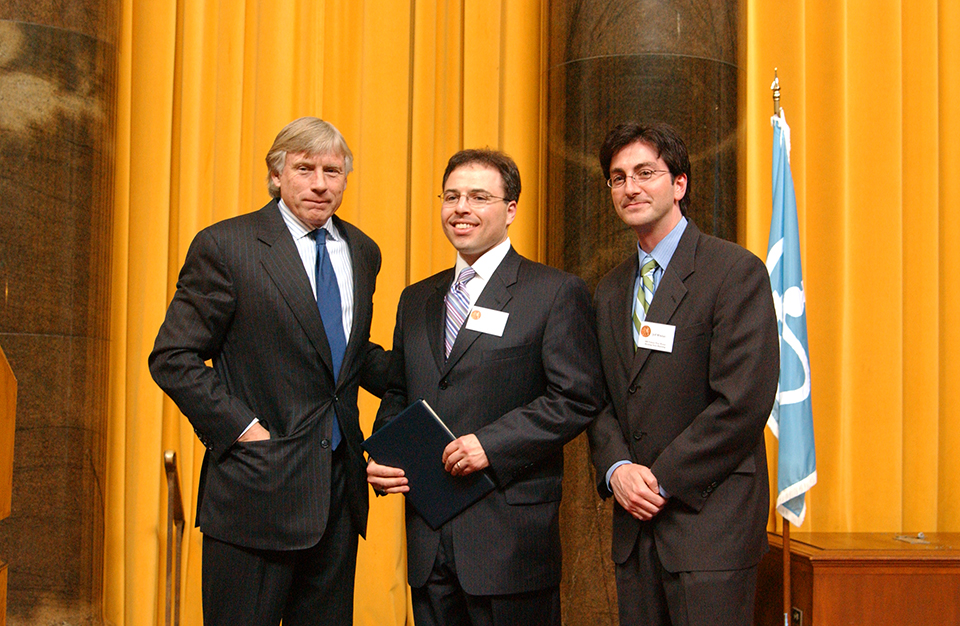
Columbia University President Lee C. Bollinger (left) presents Josh Margolin (center) and Jeff Whelan (right) of The Star-Ledger with the 2005 Pulitzer Prize in Breaking News Reporting.
Winning Work
Governor plans to leave office Nov. 15
Ex-aide expected to sue, claiming sexual harassment
By Jeff Whelan and John Hassell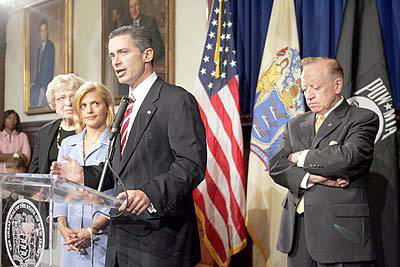
Gov. James C. McGreevey, addressing the public from the Statehouse yesterday, reflects that the admission "I am a gay American" comes relatively late in his life, and he apologizes for hurting his family -- including, from left, his mother, Veronica, his wife, Dina, and his father, Jack -- through his extramarital affair. (Photo by Tony Kurdzuk/The Star-Ledger)
"Shamefully, I engaged in an adult consensual affair with another man, which violates my bonds of matrimony," the governor said from the Statehouse as his wife Dina stood, expressionless, at his side. "It was wrong. It was foolish. It was inexcusable."
McGreevey, the state's 51st chief executive and the first to quit under the cloud of scandal, said he will step down Nov. 15 to protect the governor's office from "rumors, false allegations and threats of disclosure."
"I am removing these threats by telling you directly about my sexuality," he said in a blunt six-minute speech that threw the state political scene into turmoil. He added, "I am required ... to do what is right to correct the consequences of my actions."
Although McGreevey did not name his lover, top administration officials identified him as Golan Cipel, an Israeli citizen who resigned two years ago as the governor's homeland security adviser amid questions about his qualifications for the position.
Officials said they expected Cipel to file a lawsuit today in Superior Court in Mercer County, alleging sexual harassment. Cipel, a 35-year-old former public relations professional, could not be reached for comment.
Three administration sources said that a lawyer representing McGreevey, William Lawler, called the FBI in Newark yesterday morning to say Cipel was attempting to extort money from the governor. It was unclear why Lawler chose to file the complaint yesterday, or if the bureau had launched an investigation.
FBI Special Agent Steve Siegel, a spokesman for the Newark division, said the office would have no comment. A source close to the U.S. Attorney's Office in Newark, however, confirmed that "they are taking the allegations very seriously and the matter is currently under investigation."
By delaying his resignation until Nov. 15, McGreevey prevents a special election this fall to replace him, and instead allows the Democratic president of the state Senate, Dick Codey, to serve as acting governor for the remainder of McGreevey's four-year term, which ends in January 2006. McGreevey said his timing was designed "to facilitate a responsible transition."
Codey, echoing the sentiments of leading Democrats, expressed sadness over McGreevey's decision. "My heart goes out to Jim McGreevey and his family during this difficult personal time," Codey said. "Jim McGreevey is a good person and a good friend."
Republicans described the delay of McGreevey's departure as a ploy to preserve Democratic control of state government. Former Gov. Christie Whitman, for one, called for McGreevey to step aside immediately, saying any postponement "smacks of politics."
McGreevey's announcement, made shortly after 4 p.m., set off widespread speculation about who would run to replace him. Many leading Democrats reached out quickly to U.S. Sen. Jon Corzine, who was traveling in California in his role as chairman of the Democratic Senatorial Campaign Committee.
Corzine released a statement later saying, "I applaud the governor's decision to acknowledge a part of his identity for which he owes no one an apology." Addressing the calls for him to run, Corzine added: "Any speculation about my own political plans in light of the governor's decision is entirely premature."
If Corzine did mount a gubernatorial bid, his deep pockets and political connections probably would discourage many rivals, who potentially include Codey; Reps. Rob Andrews, Frank Pallone and Steve Rothman; and George Zoffinger, chairman of the state Sports and Exposition Authority.
On the Republican side, yesterday's news did little more than fan the ambitions of a large field of possible candidates. They include former Jersey City Mayor Bret Schundler; former Rep. Bob Franks; Christopher Christie, the U.S. attorney for New Jersey; state Sens. Leonard Lance, Diane Allen and Tom Kean Jr.; businessman and former U.S. Senate candidate Douglas Forrester; Assemblyman Paul DiGaetano; Morris County Freeholder John Murphy; and Bergen County businessman Robert Schroeder.
McGreevey's speech, 690 words long, was stunningly direct, even by the standards of a self-revelatory era in American political life. Among other things, he acknowledged the pain he has caused to his wife, Dina, his former wife, Kari Schutz, and his two daughters, 3-year-old Jacqueline and 11-year-old Morag.
"From my early days in school until the present day, I acknowledged some feelings, a certain sense that separated me from others," he said.
"But because of my resolve, and also thinking that I was doing the right thing, I forced what I thought was an acceptable reality onto myself, a reality which is layered and layered with all the, quote, good things and all the, quote, right things of typical adolescent and adult behavior.
"Yet, at my most reflective, maybe even spiritual, level, there were points in my life when I began to question what an acceptable reality really meant for me. Were there realities from which I was running? Which master was I trying to serve?"
HIS OWN WORDS
The governor finalized his decision to resign with top aides yesterday in the library of Drumthwacket, the governor's mansion in Princeton. Among those gathered were chief of staff Jamie Fox, chief counsel Michael DeCotiis, state party chief executive Kevin Hagan, Casino Reinvestment Development Authority executive director Curtis Bashaw and three top political consultants -- Steve DeMicco, Joel Benenson and Jim Margolis.
McGreevey presented the group with a draft of his speech, which he had written himself, and he resisted any heavy editing, several people present said. Then, shortly after 3:30, the governor and his wife joined his security detail in a two- vehicle motorcade to the Statehouse.
After his speech, McGreevey returned to Drumthwacket, spoke with his advisers for 10 minutes, then retired to the mansion's residential quarters with his family.
McGreevey met Cipel four years ago at a reception near Tel Aviv on a visit to Israel sponsored by the United Jewish Federation of MetroWest. At the time, Cipel was working as a spokesman for the mayor of his hometown, Rishon Lezion, after a stint as chief information officer for the Israeli Consulate in New York.
Six months later, McGreevey brought Cipel to New Jersey. From the summer of 2000 through the 2001 election, Cipel earned $30,000 a year as the Jewish outreach director for the state Democratic Party.
To supplement that salary, he also received $30,000 a year as an associate at a development firm owned by McGreevey's top political contributor, Charles Kushner.
Attorneys for Kushner -- who was arrested last month and accused of hiring prostitutes to blackmail federal witnesses -- denied yesterday that the fund-raiser has been cooperating in any matter involving McGreevey.
"Charles Kushner is no way involved in the unfortunate circumstances surrounding the government's resignation," said the attorneys, Jeff Smith and Alfred DeCotiis.
When Cipel arrived in New Jersey, McGreevey assigned campaign staffers to arrange for an apartment a tenth of a mile from McGreevey's own condominium in Woodbridge. Then, after winning the election, McGreevey took time out from his transition plans to accompany Cipel on a last-minute walk-through of the West Windsor townhouse Cipel was about to purchase.
According to the seller, Elaine Dietrich, Cipel said he wanted McGreevey to see the townhouse before he signed the contract. "I thought it was highly unusual," Dietrich said afterward. "I'm counsel to the administrative director of the courts, and I'm not going to ask (the director) to come look at my place and approve a purchase. ... You've got to admit, it's a little bizarre."
In January 2002, Cipel joined the governor's staff at $80,000 a year, a salary that was raised to $110,000 within six weeks with no explanation.
Hired as special counsel on homeland security, Cipel quickly encountered problems. Federal officials told The Star-Ledger that because Cipel was an Israeli national -- a foreigner who could not have top-secret security clearance -- they would refuse to share sensitive information with him.
Cipel resigned from the homeland security post after Republican leaders in the state Senate threatened to hold up key gubernatorial appointments until Cipel sat for questioning. Even so, Cipel retained the title of special counsel and his salary was unchanged.
In September 2002, McGreevey helped Cipel land a job at the prominent public relations and lobbying firm, MWW, for a salary of $120,000. The next month, just before MWW bosses planned to fire him, Cipel went to work for State Street Partners, the lobbying firm where McGreevey's best friend, Rahway Mayor James Kennedy, is a partner. There Cipel got a $30,000 raise, bringing his salary to $150,000.
LEGAL DEADLINE
Cipel's expected lawsuit against McGreevey, which officials said is likely to seek $5 million in damages, would come just before the expiration of a general two-year limitation on workplace sexual harassment claims. He resigned from state government Aug. 14, 2002.
McGreevey's resignation ends a political career that has consumed him since high school. He has always followed a fast track -- whether it was the quick succession of degrees from Columbia University, Georgetown University Law School and Harvard University's graduate school of education, or his early foray into politics.
From his first, successful run for the state Assembly in 1989 to his victory in the 2001 race for governor, McGreevey, 47, has maintained a dogged pace. Friends and foes alike have marveled at his peripatetic travels around the state, which often began well before dawn and lasted well into the night.
According to McGreevey, his work ethic came from his parents, a former Marine Corps drill instructor and a nurse, and from his blue- collar upbringing in Jersey City and Carteret. McGreevey got his favorite motto from his father: "Plan your work and work your plan."
By the time McGreevey made his first, unsuccessful bid for governor in 1997, he had compiled an impressive political résumé, with stints as a state senator and assemblyman, mayor of Woodbridge, executive director of the state Parole Board, assistant prosecutor in Middlesex County and a government lobbyist for the pharmaceutical giant Merck.
Many of McGreevey's political connections have come to haunt him in the past couple of months, however, as his administration has been shaken by a series of high- profile scandals.
THE 'MACHIAVELLI' ALLUSION
In early July, one of McGreevey's top fund-raisers and friends, David D'Amiano, was indicted on charges that he extorted $40,000 in cash and political donations from a farm owner in return for his promise that the governor would help persuade county officials to double their bid for his farmland.
The indictment revealed McGreevey was secretly recorded by the FBI using the word "Machiavelli," which prosecutors said was a code word for the bribery scheme. No charges were brought against McGreevey, who was referred to in the indictment only as "State Official 1." The governor acknowledged uttering the word but said it was an innocent literary allusion. He denied any wrongdoing and accused the U.S. Attorney's Office of mounting a smear campaign against him.
A week later, federal authorities arrested Kushner, McGreevey's one-time pick to head the powerful Port Authority. Prosecutors say Kushner's efforts to entrap witnesses with prostitutes stemmed from an inquiry into allegations that he made illegal campaign and charitable contributions.
The next day, William Watley, McGreevey's commerce secretary, resigned amid conflict-of-interest questions and a state criminal investigation into spending at his agency. Authorities are reviewing if any laws were broken when the mother, sister and two sons of Watley's chief of staff were hired by the agency.
McGreevey's poll numbers had begun to rise earlier this year, after he pushed through a plan to increase income taxes on the wealthy to pay for larger property tax rebates for most New Jersey families. But a recent poll by Quinnipiac University showed the scandals ate away at the governor's public support, and by early this month, half of the state's voters said they had serious concerns about McGreevey's integrity.
Staff writers David Kinney, John P. Martin, Robert Rudolph, Josh Margolin, Robert Gebeloff, Christine V. Baird and Vinessa Erminio contributed to this report.
© 2004, The Star-Ledger
By Jeff Whelan, Tom Hester and John P. Martin
The day New Jersey's governor quit and revealed he is gay started like most Thursdays in August. Vacations had emptied many offices. The stuffy, hurricane-driven weather was the top news. It looked to be a boring day.
Only a small circle of people, those closest to Gov. James E. McGreevey, knew differently. Impending allegations of a sexual relationship with Golan Cipel, whom McGreevey once appointed as the state's homeland security adviser, had forced the governor to his decision. His late afternoon announcement culminated a frantic and often confusing day that, even when it ended, left as many questions as answers.
The governor's public schedule was supposed to be light. As of late Wednesday, it included just one appearance: an 11 a.m. news conference to announce his choice for Department of Personnel commissioner.
But hours earlier, key legislators and supporters began getting phone calls alerting them to a major announcement coming from the governor. At 10 a.m., McGreevey's staff announced that his news conference would be delayed until 4 p.m. They changed the location to the governor's office.
The speculation began rising like the humidity.
McGreevey was believed to be huddling with advisers and key personnel at Drumthwacket, the governor's mansion in Princeton. Meanwhile, three sources said, one of his attorneys called the FBI in Newark to report that Cipel was trying to extort money from the governor in return for his silence over their affair.
Many high-level officials insisted they knew nothing of the impending political bombshell. The Statehouse hallways were nearly empty at lunchtime.
At 1 p.m., Attorney General Peter Harvey was in New Providence for a news conference on a gang- related robbery. When a reporter asked Harvey about the resignation whispers, he dismissed it. "I have not heard this rumor," Harvey said.
But Sen. Joseph Vitale (D-Middlesex) said a staffer called to brief him on McGreevey's plans around the same time. Vitale was stunned; he had been with the governor the previous day. "Everyone was in good spirits," Vitale said.
With word spreading, Democrats began buzzing about a potential gubernatorial replacement. One name tossed about was George Zoffinger, chairman of the Sports and Exposition Authority.
Party leaders also were trying frantically to reach the man some consider the favorite, U.S. Sen. Jon Corzine, who was helping Senate Democrats raise money in California. One of Corzine's top advisers spoke cautiously, saying the senator and governor had not yet talked.
But it was clear how dire the situation was becoming. "Trenton is on fire," the adviser said. McGreevey's parents arrived at the Statehouse after 2 p.m., effectively confirming that this would be no normal news conference. News radio took the hint and started crackling. The top story was not the looming hurricane in Florida; it was the political earthquake preparing to jolt New Jersey.
INSIDE THE MANSION
McGreevey was still home at Drumthwacket, perhaps mulling over the final moments of a private life that he had hidden for four decades. He met in his library with more than a half-dozen key aides and supporters, including chief of staff Jamie Fox, chief counsel Michael DeCotiis and state party executive Kevin Hagan. He shared with them the resignation speech he had written and resisted any heavy changes, sources said. Then he retired to the governor's private residence with his family.
At 3:27 p.m., Sen. Raymond Lesniak (D-Union), one of his key political sponsors, left the mansion in silence.
Ten minutes later, McGreevey and his wife, Dina, slipped out the north door of their home. They climbed into a waiting sedan, the second car in a two-vehicle entourage that gunned out of the main gate. Minutes later, the governor and his wife entered the Statehouse, walking arm in arm.
The governor's outer office is the anteroom that McGreevey has used for dozens of appearances and news conferences since taking office 31 months ago. Rarely has it been so crowded. Nearly 150 reporters, government workers and appointees filled the room, some with tears in their eyes. The air conditioning struggled to keep pace; sweat dripped down the face of an aide who checked the microphone.
Bradley Campbell, who heads the Department of Environmental Protection, wore khakis and a rain slicker, as if he was called suddenly to the building. Not far away, Jim Davy, the human services commissioner, hugged McGreevey spokeswoman Kathy Ellis.
Outside, dozens of onlookers were pressing to get in the building. State Police at the door declared that only people with Statehouse identification tags would be admitted.
Another trooper guarded the governor's office. Behind the door, McGreevey waited with his family and some of his closest supporters. There were no tears shed. As he walked toward the anteroom, Zoffinger said he stepped out and told McGreevey to reconsider, but the governor continued toward the door.
The speech was sketched out on two pages that McGreevey folded and carried to the podium. By this time, most of the local network affiliates and some cable news outlets were airing the scene live.
As political addresses go, it was unrivaled, at least in New Jersey. The governor used words like "confused," "ambivalent," "tortured." He spoke of "the mirror of his soul," though he never mentioned Cipel, the allegations or his response to them.
Dina McGreevey stood at her husband's right side, aiming a tight smile on him as he spoke. His mother, Veronica, stood over his right shoulder while his father, Jack, stood behind the left one, with his arms tightly folded across his chest. At one point as his son spoke, the elder McGreevey, a former Marine, rolled his eyes to the ceiling and sighed.
McGreevey's voice broke only once. His signature line - "My truth is that I am a gay American" - drew audible gasps from observers in the back of the room.
Before the six-minute speech ended, the news was already firing across state lines. In Times Square, passersby stopped and pointed at the revelations on the building tickers. In Athens, reporters covering the Olympics were talking about New Jersey's gay governor.
McGreevey turned his back to the crowd and, with his family in tow, stepped back into his office. Two hours later, he was back at the governor's mansion
As he left the Statehouse with his wife, Jack McGreevey looked more relaxed. "We're doing great," he told reporters. Then, as is his custom, he shook hands with the state troopers who escorted them to their car.
In the outer office, shocked friends and supporters mingled and tried to comprehend what they had just witnessed.
"He must have been under a tremendous amount of pressure," Zoffinger said later. "For somebody to lead a secret life, it must be a relief not to lead that life anymore."
Staff writers Susan K. Livio, Gabriel Gluck and Josh Margolin contributed to this report.
© 2004, The Star-Ledger
If Corzine refuses to fill the void, a free-for-all is a very real possibility
By David Kinney
THE TUMULT
Another political bombshell, another politician stepping aside, and suddenly New Jersey's political world is in tumult like never before.
Gov. James E. McGreevey's abrupt exit from the political stage throws the 2005 campaign for governor wide open, and even before McGreevey made it official yesterday afternoon, both Republicans and Democrats were burning up phone lines and convening strategy sessions to handicap life after McGreevey.
The biggest question on their minds: Would U.S. Sen. Jon Corzine (D-N.J.) jump into the void and come to the party's rescue? If he does, he would become the immediate favorite, "the 2,000-pound gorilla," as one political strategist put it.
If he doesn't, expect next year's race for the governorship to turn into a bloody free-for-all. Half-a- dozen Democrats and a crowd of Republicans are champing at the bit to run.
Richard Codey, Senate president and soon-to-be acting governor; U.S. Reps. Robert Andrews (D-1st Dist.) and Frank Pallone (D-9th Dist.); and George Zoffinger, president of the New Jersey Sports and Exposition Authority, are all on the list of Democratic possibilities.
The Republican field already was crowded even before yesterday's turn of events, with 2001 GOP gubernatorial candidate Bret Schundler leading a group of five who already have filed to run. Others who are weighing their options include state Sens. Tom Kean Jr. (R-Union), Diane Allen (R-Burlington) and Leonard Lance (R- Hunterdon).
"Today, everything has changed in New Jersey politics," said millionaire business executive Doug Forrester, another Republican seriously eyeing a run. "I think we need to seize the opportunity to go in a different direction." A WILD RIDE McGreevey's departure is the latest, and most dramatic, swerve in the wild ride New Jersey politics has taken over the past few years.
In 2001, acting Gov. Donald DiFrancesco quit the race amid ethics allegations. In 2002, U.S. Senate candidate James Treffinger quit the campaign, and later went to prison on campaign finance charges. Later in the same race, U.S. Sen. Robert Torricelli dropped out after being "severely admonished" by Senate colleagues for taking gifts from a campaign supporter.
And more than two dozen local and county officials have been indicted or jailed on corruption charges over the past two years.
McGreevey has had problems of his own, and for months, Democratic leaders have been mulling whether to dump him from next year's gubernatorial ballot.
They worried about McGreevey's sagging job-approval ratings and all-too-frequent scandals involving friends and aides.
The talk escalated last month after the indictment of Democratic fund-raiser David D'Amiano on extortion charges and the arrest of McGreevey's top campaign donor, Charles Kushner, on charges of luring a cooperating witness in a federal investigation into a videotaped encounter with a prostitute. In the D'Amiano case, prosecutors had the governor on tape uttering the word "Machiavelli," which they said the fund-raiser had established as a code word for his plot. (McGreevey was not charged.)
Yesterday, the speculation about a future without McGreevey turned to reality.
Party leaders agree that if Corzine wants to run, the nomination would be his, and officials said that top Democrats reached out to him yesterday to ask him to run. The former Goldman, Sachs & Co. executive is a rising star in the Senate, a popular politician among the party rank-and-file, and as a multimillionaire, could finance his own run.
"Jon Corzine clears the field," one Democratic power broker said yesterday, and he predicted he would sweep into office in November 2005, no matter the GOP opponent.
Corzine, who was in Los Angeles fund-raising for Democrats, issued a statement dousing the talk - for the time being.
"Any speculation about my own political plans in light of the governor's decision is entirely premature," Corzine said. "I am focused today on electing John Kerry to the White House, and on regaining Democratic Party control of the United States Senate."
Officials who spoke to Corzine said he told them he would make no decisions until after the Nov. 2 election. As chairman of the Democratic Senatorial Campaign Committee, Corzine is raising money to help Democrats win back the U.S. Senate.
Had McGreevey decided to resign immediately, New Jersey voters would choose a replacement in a special election Nov. 2. His decision to resign Nov. 15 means that Codey will fill out the remaining year of McGreevey's term.
Presidential politics was one factor in that decision.
A Kerry campaign official said the candidate's advisers told McGreevey aides that they wanted to avoid an unpredictable special election this fall.
Kerry has a comfortable 20-point lead over Bush, according to the most recent Star-Ledger/Eagleton- Rutgers poll, but the official said a special election could create a backlash against McGreevey and hurt the presidential ticket. The official said the Kerry camp feared that Democrats would have to spend money in New Jersey, a state that they believe is now solidly in the Democratic column.
"It creates an unpredictable scenario in New Jersey," said the official, who requested anonymity.
Republicans cried foul and demanded McGreevey immediately quit.
"He's denying voters the opportunity to have an elected governor," said Republican Bill Palatucci. He said McGreevey's admission sheds new light on why McGreevey named Golan Cipel his counterterrorism aide. "He lied to us in office four months after 9/11 about why he was nominating someone to be head of homeland security."
Schundler went so far as to say that McGreevey and the "party bosses" are trying to pave the way for a Corzine candidacy.
Schundler wondered aloud whether "the Democratic bosses who run New Jersey" helped orchestrate the airing of the Golan Cipel affair as a way "to clear Jim McGreevey out of the way so they can run Jon Corzine for governor next year and keep themselves from losing control of the most powerful governor's office in America."
As Corzine makes up his mind, other Democrats are weighing whether they have a shot.
Codey would have the power of incumbency as acting governor for a year leading into the election, and strategists say if Corzine does not run, he would be a favorite for the nomination.
While those close to Codey said he has long wanted to be governor, Codey himself said yesterday he had hardly begun to think about it.
"Let me tell you very candidly, that's the last thing on my mind," the Senate leader said. "I'm not worried about it. I've got to think about what I've got to do to get ready for November 15th."
One obstacle for Codey is that he is at odds with key political power brokers, such as former Sen. John Lynch and South Jersey Democrat George E. Norcross III.
Andrews ran in 1997 and lost to McGreevey in the primary. But Democratic leaders soured on him when he all but vanished from the political scene after losing the nomination instead of helping McGreevey in the general election.
Reached at the beach on vacation yesterday, Andrews said he is focused on winning re-election this fall. But after that, he said, "I'm going to take a serious look at '05."
"I can do this job well," he said. "The state has a crisis of confidence right now. We have big problems."
Also throwing his name in the hat, officials said yesterday, was Zoffinger, a former banking executive who leads the sports authority.
Zoffinger deflected questions about his gubernatorial aspirations, saying, "In the last 24 hours, there has been a lot of discussion, none of which I'm prepared to talk about today. I'm here to support Jim McGreevey." PRESSURE ON THE GOP As for the Republicans, they worry a Corzine candidacy will squash their hopes of winning back the governorship.
"It puts further pressure on the party to come up with the very best candidate we can find," Republican strategist Steven Some said. But he said he hopes Republicans can parlay the tumult of recent years into victory.
"The people of this state have been through a lot, in terms of ethics and corruption and resignations and scandals," he said. "The Republican Party needs to find a person who can rise above all that and can say they are not part of the problem that created all that, but they're the solution."
Some is a supporter of Forrester, who ran against Torricelli in 2002, but lost when Torricelli dropped out and U.S. Sen. Frank Lautenberg jumped in.
Forrester has run a series of TV and radio ads timed to the McGreevey scandals, and yesterday was no different. He went on the air with a 30-second ad criticizing the Democrat-passed budget. It ends, "New Jersey needs a government as good as its people."
Forrester, Kean and Schundler are just the most high-profile of the GOP hopefuls so far.
Former U.S. Rep. Robert Franks, who lost the GOP gubernatorial nod to Schundler in 2001, is talking about a run. If he wins the nomination, that could set up a rematch of the 2000 U.S. Senate race, Corzine vs. Franks.
Four lower-profile Republicans already have joined Schundler in filing to run next year: Assemblyman Paul DiGaetano (R-Essex), Bergen County business executive Robert Schroeder, Morris County Freeholder John Murphy and Bogota Mayor Steve Lonegan.
And like the Democrats, Republicans have a man others fear, a potentially imposing gubernatorial candidate who has refused to say whether he is weighing a run: U.S. Attorney Christopher Christie. He has spent the past two years crusading against political corruption, and some see him as the perfect candidate to run a campaign about restoring integrity to the governor's office.
Palatucci, a personal friend and political ally of Christie's, said many people phoned yesterday asking him about it.
"My phone was ringing off the hook with people urging him to consider it," he said. Christie declined to comment.
© 2004, The Star-Ledger
Codey has history of serendipity in political matters
By Jonathan Schuppe and Matthew Futterman
Once again, the dust has settled, and Richard Codey is standing on top.
Over a 31-year political career, the Democratic state senator from Essex County has risen to the head of his party by weathering bare- knuckle power struggles, personal anguish and twists of fortune. Even so, nothing compares to yesterday, when Gov. James E. McGreevey announced he will resign Nov. 15 because of an adulterous homosexual affair.
As president of the state Senate, Codey, a 57-year-old father of two, is next in line for McGreevey's job.
He'll likely stay on as acting governor at least through January 2006, the end of what would have been McGreevey's first term. The ascension also automatically makes Codey one of the top early Democratic contenders -- along with U.S. Sen. Jon Corzine -- to run for a full four-year term in the 2005 gubernatorial election.
"In a lot of ways, his life has been a matter of providence -- he's always in the right place at the right time," said the Rev. Reginald Jackson, an old friend who heads the Black Ministers Council of New Jersey. "He's been through a lot of battles. But he always retained his dignity and integrity."
In early 2002, an unusual set of political circumstances made Codey the acting governor for a little more than three days before McGreevey took office. It was Codey who handed the reins of state government over to his ally.
When a Star-Ledger photographer introduced himself to Codey outside his West Orange office yesterday, he stuck out his hand and said, "I guess I'll be the new governor."
Codey said that running in 2005 was "the last thing on my mind."
Late in the day, he released a statement that praised McGreevey for his "compassion and commitment" to New Jersey residents. "My heart goes out to Jim McGreevey and his family during this difficult personal time. Jim McGreevey is a good person and a good friend and today's events sadden me."
An aide to Codey, Peter Cammarano, said the senator started the day by taking his wife to the hospital for minor surgery. Later, he went to his district office to talk with aides about McGreevey's resignation. He spoke to the governor around 1 p.m. then fielded several calls from fellow senators. He returned to the hospital to check on his wife, went home to talk to his sons about the news, then went to a dinner meeting.
Asked about Codey's plans for next year's election, Cammarano said: "Dick is focused on the task ahead of him, maintaining the continuity of state government. He hasn't focused at all on next year."
A gentleman brawler in a navy blue suit, Codey is part of an aging breed of Irish-American power brokers from Essex County. Educated at Fairleigh Dickinson University, he was first elected to state office in 1973, when he won a seat in the state Assembly. He moved to the Senate in 1982 and became the Democrats' leader in 1998. He shared the presidency of an evenly divided Senate for two years, then took sole control this year.
"Sen. Codey is well-prepared for the job as acting governor," said Joseph Cryan, a state Assemblyman and vice chairman of the Democratic State Committee. "The thing he does better than anyone is he's a consensus builder. One of the things I'm sure Gov. McGreevey took into consideration is that the state will be in good hands with Dick Codey."
As Senate president, Codey moves bills through the Legislature, and raises money for Democratic candidates through a political action committee that at last count held nearly $500,000. The position is one of the most powerful in state government.
To make it there, Codey has combined shrewd deal-making and blunt muscle-flexing in showdowns with some of the state's most powerful people. Many of those people came from his own party, including South Jersey Democratic boss George Norcross, former state Sen. John Lynch, former U.S. Sen. Robert Torricelli, even McGreevey.
In 2002, Codey and McGreevey butted heads over who should run the New Jersey Sports and Exposition Authority. Codey wanted his longtime friend Michael Rowe, the former Nets president. McGreevey, however, pushed for George Zoffinger, a longtime ally of John Lynch.
McGreevey and Lynch won. But Codey ultimately got something, too.
When Zoffinger set out to change the way New Jersey runs horse racing, Codey gave his blessing for a price: a law giving the Senate president power to appoint a member of the sports authority's board.
Codey also has had to protect his political flank in his home county. In 2002, for example, when Codey backed the loser in the race for Essex County executive, there was talk the winner, Joseph DiVincenzo, might put his power behind a candidate to run against Codey in an upcoming primary.
Since then, Codey has helped DiVincenzo bring state money to county public works projects. He is also leading efforts to get the state to share the burden of running the county prosecutor's office.
For all his efforts, Codey would prefer to be known for his policy work, particularly with mental health issues.
In the Senate, his pet project is mental health policy. He is driven in part by the struggles of his wife, who has suffered from debilitating depression. This year, she fell seriously ill and both of his parents died.
In 1987, Codey went undercover as an orderly on the night shift at Marlboro Psychiatric Hospital to investigate the quality of care there. The deplorable conditions prompted him to write legislation ending lax hiring practices and improving standards of care.
He continues to advocate for reform: Earlier this year, he made surprise visits to state-run mental hospitals in East Orange that led the state health commissioner to halt new admissions.
To Codey, gaining power and helping people is all about positioning.
"In politics, you can't plan," he once told a reporter. "You have to position yourself so if opportunity presents itself you can grab it."
Staff writer David Kinney and staff photographer John Munson contributed to this report.
© 2004, The Star-Ledger
By Robert Schwaneberg
THE POLITICS
Gov. James E. McGreevey's decision to time his resignation to take effect in mid-November keeps the governor's office in Democratic hands at least until January 2006 and gives extraordinary power to his successor, Senate President Richard Codey.
Had McGreevey resigned immediately, the state constitution would have required that his successor be elected during the general election Nov. 2 and take office as soon as his victory was certified.
"That would be a free-for-all," said Robert Williams, a professor at Rutgers School of Law in Camden, who wrote a definitive guide to the New Jersey Constitution.
The Democratic and Republican state committees would have selected candidates for their parties, but any eligible candidate able to garner 800 signatures on a nominating petition could have run as an independent.
McGreevey avoided that scenario by having his resignation take effect Nov. 15. Under the constitution, when a vacancy occurs that close to a scheduled gubernatorial election, the Senate president takes on the governor's powers for the remainder of his term.
That means Codey, a Democrat from Essex County, will simultaneously hold the two most powerful offices in state government until early 2006, unless for some reason he ceases to be Senate president.
Republicans called on McGreevey to step down immediately and allow the voters to pick his successor this November.
"We do feel the governor should resign effective immediately and his ability to govern has been compromised," said Tim White, political director for the Republican State Committee.
Micah Rasmussen, McGreevey's press secretary, said the Nov. 15 date was picked because "90 days allows for an orderly transition."
Asked whether McGreevey would continue to exercise his powers as governor for the next three months, Rasmussen replied: "He expects to spend time with his family over the weekend. He'll be back at work next week."
Williams, the Rutgers law professor, said McGreevey can still carry out routine duties to "keep the government running," but has lost the political ability to get lawmakers to pass "new initiatives."
"He's certainly compromised, no question about that," Williams said. But he said McGreevey's decision to delay the effective date of his resignation until mid-November likely would be respected by the courts.
New Jersey law provides that resignations from state office are only valid if they are filed, in writing, with the secretary of state, which McGreevey has yet to do.
It is doubtful whether McGreevey's decision to delay the effective date of his resignation could be challenged as a ruse to avoid an election this fall. One similar lawsuit failed.
When former Hudson County Executive Robert Janiszewski got caught by a federal corruption probe, he announced his resignation would not take effect until after the deadline for choosing his successor at the next general election had passed. Republicans went to court, arguing that the election should be held because Janiszewski had stopped performing his duties before the deadline, said Peter Sheridan, counsel to the Republican State Committee. He said a judge ruled it was the effective date of the resignation that mattered, so Democrats were able to hand-pick Janiszewski's successor and put off an election for a year.
With no election to replace McGreevey this fall, Codey is in line to become acting governor until the expiration of McGreevey's term on the third Tuesday in January 2006. The governor who takes office then will be chosen at the general election of November 2005, when McGreevey would have been up for re-election.
Technically, Codey will not become governor and will not have that title. Rather, in his role as Senate president, which he will continue to hold, he will inherit all the powers and privileges of being governor. They include a State Police security detail and the right to live in Drumthwacket, the governor's official residence in Princeton, and use of the governor's beach house.
He also will exercise all of the powers of governor - such as making appointments to judgeships and state offices - while simultaneously presiding over the Senate. It is a quirk of New Jersey constitutional law that concentrates extraordinary power in one individual.
As Senate president, Codey will be able to introduce a bill and decide which committee hears it and whether the full Senate votes on it. As acting governor, Codey can send that bill back to the Legislature with proposed changes, sign the revised version and instruct his Cabinet how to enforce it.
"You're going to have far more power than an elected governor, which doesn't make any sense," said Michael Ticktin, a lawyer and the author of a 1998 article in Rutgers Law Journal that criticized the current arrangement.
"It's this horse-and-buggy mechanism that we've had since the 1840s. Government was simpler in those days," Williams said.
Ticktin explained that there is a check on Codey's power: He can lose his position as Senate president, and the acting governorship with it, any time a majority of the Senate votes to replace him.
The same situation arose in January 2001, when Gov. Christie Whitman resigned to become administrator of the federal Environmental Protection Agency and Senate President Donald DiFrancesco continued to lead the Senate while also assuming the powers of the governor. He served as acting governor until the expiration of Whitman's term in January 2002, when McGreevey took office.
DiFrancesco's year as acting governor marked the first time in New Jersey history that so much power was concentrated in one individual. With that situation repeating itself, Frank Askin, founder of the constitutional litigation clinic at Rutgers School of Law in Newark, said it is time for the state to consider a change.
"We ought to have a lieutenant governor," Askin said. "It makes no sense the way we operate now."
© 2004, The Star-Ledger
A casual introduction in Israel 4 years ago would prove to be McGreevey's undoing
By Josh Margolin and Mark Mueller
The seeds for Gov. James E. McGreevey's stunning announcement yesterday that he is gay and that he will resign in November were planted four years ago at an elegant political reception in Israel.
It was at a performing arts center in Rishon Lezion, a middle-class enclave outside Tel Aviv, that McGreevey was introduced to Golan Cipel, a spokesman for the local mayor and a former information officer for the Israeli consulate in New York.
Six months after that chance encounter in March 2000, Cipel left for New Jersey to work on the Woodbridge mayor's campaign for governor. McGreevey helped him find a car, a job and an apartment a tenth of a mile from the Woodbridge townhouse he shared with his wife.
The Israeli national would go on to play a controversial role in McGreevey's political life over the next two years, first as the newly elected governor's homeland security adviser, drawing widespread criticism for his inexperience, and then as a "special counsel" with ill-defined responsibilities and a $110,000 annual salary.
Republicans and Democrats alike, including some members of McGreevey's inner circle, were mystified by Cipel's role in the administration and by the governor's allegiance to him.
Cipel, 35, left state government two years ago this month, an enigma to the public and to the many reporters who sought to figure him out.
Yesterday, several ranking members of the McGreevey administration, speaking on condition of anonymity, said it was Cipel the governor was referring to when he acknowledged in his dramatic afternoon news conference that he had engaged in an extramarital affair with a man.
Separately, a public relations specialist hired by McGreevey said Cipel attempted to extort money from McGreevey, threatening to file a lawsuit against him if he was not paid millions of dollars. That lawsuit was expected to be filed in Mercer County today.
Cipel could not be reached for comment yesterday, and McGreevey, during his nationally televised press conference, did not mention him by name.
But the two men are now inextricably linked in one of the more extraordinary political stories in history.
One of three children, Cipel was raised in Rishon Lezion, Israel's fourth-largest community, where he attended public schools and graduated from a high school geared toward students who excel in science and math.
After graduating high school, Cipel served five years on active duty in the Navy, rising to the rank of first lieutenant.
It was after Cipel's military service that he moved to the United States, studying communications at the New York Institute of Technology in 1995.
A short time later, he landed a job in the public information office of the Israeli consulate.
"He knew English and he was qualified, and he did PR work and he did it pretty well," former Consul General Colette Avital, a member of the Israeli parliament, the Knesset, told The Star-Ledger in 2002.
Avital said Cipel ultimately worked his way up to the position of chief information officer.
Cipel later returned to Israel, earning a position as spokesman for Meir Nitzan, the mayor of Rishon Lezion.
"He wrote communications for the newspapers -- propaganda, if I may say so," Nitzan said in 2002.
Last night, Nitzan was stunned when informed of Cipel's romantic link to McGreevey and of the governor's decision to resign.
"He was a positive person," Nitzan said of his former employee. "Dedicated to his work. He had several girlfriends."
Cipel worked for Nitzan for about 18 months, earning the equivalent of $36,000 a year.
It was during that period when he met McGreevey, who was on a mission to Israel with several other prominent politicians, among them Donald DiFrancesco, then president of the state Senate, and U.S. Sen. Jon Corzine (D-N.J.), then a candidate for office.
The group gathered at Rishon Lezion's performing arts center for a "wine-and-dine" reception organized by the local mayor.
"I introduced (Cipel) to Jim and mentioned that this is the Democratic candidate or something like that, and I guess they started talking," said David Mallach, assistant executive director of New Jersey's United Jewish Federation of MetroWest, told The Star-Ledger in 2002. Mallach's group co-sponsored the trip.
Six months later, McGreevey asked Cipel to move to New Jersey to work on his campaign. In an interview, McGreevey would later call Cipel "bright and tough, not a yes man."
Paid $10,000 by the Democratic State Committee, Cipel worked on McGreevey's behalf as an outreach coordinator for the state's Jewish community. At the same time, McGreevey recommended him for a public relations job to Charles Kushner, the governor's top campaign contributor.
Kushner, a top New Jersey developer who has since been charged by federal authorities with obstructing an investigation into his business dealings, hired Cipel at a $30,000 annual salary.
McGreevey helped Cipel in other ways. He instructed a subordinate at Woodbridge town hall to find Cipel a car and an apartment. In short order, Cipel was living a short block from McGreevey's townhouse.
McGreevey's election as governor would place Cipel squarely in the public eye. Shortly after his inauguration in January 2002, the governor appointed the public relations man to a $110,000-a-year job as his homeland security adviser, a position that seemed to overlap with that of Assistant Attorney General Kathryn Flicker, chief of the state's new Office of Counter- Terrorism.
Moreover, Cipel appeared to have little experience for the job. McGreevey ardently defended him, pointing to his military service and to a short stint as a staffer in the Israeli parliament.
"Golan is smart, incisive, hard- working and trustworthy, and he has brought a unique point of view to the work he does," McGreevey said at the time, seeking to silence his critics.
Cipel's position was further undermined when The Star-Ledger reported that the Secret Service and the FBI would not share sensitive information with him because he was a foreigner who did not have top security clearance.
The controversy came to a head in February 2002, when state Sen. William Gormley, (R-Atlantic) threatened to block McGreevey's appointments in the Legislature if Cipel did not appear before the Senate Judiciary Committee for questioning about his qualifications.
McGreevey refused to allow the appearance, at the same time ordering Cipel to refrain from interviews with the media.
"I would love to speak, but I can't," Cipel said on Feb. 28, 2002. That short statement would mark his most expansive comments throughout his government tenure.
By early March, McGreevey relented to lawmakers' demands, transferring Cipel to a position without security responsibilities. His title remained "special counsel." His salary remained $110,000.
But neither McGreevey nor his aides would immediately explain what Cipel's new duties would be.
Amid continued media inquiries, Cipel resigned in August 2002.
McGreevey continued to support Cipel, helping him obtain a job with a politically connected public relations firm, the MWW Group, in Bergen County. He later left MWW in a dispute over how much time he was expected to put into the job.
Cipel next landed at State Street Partners, recruited by Rahway Mayor Jim Kennedy, a partner in the firm and McGreevey's best friend. The firm eventually fired him.
That McGreevey continued to come to Cipel's aid troubled some of the governor's aides. One, speaking on condition of anonymity, told The Star-Ledger in October 2002: "This is a joke, right? It never seems to stop. You've got to just cut your losses and that's it. He just keeps an issue alive that shouldn't be alive."
© 2004, The Star-Ledger
With the disclosure comes a rewrite of one part of the governor's story
By Mary Jo Patterson
For as long as he was in public office -- and that was 14 years -- everyone who met James E. McGreevey thought they were seeing everything there was to know.
Proud American. Devout Catholic. Workaholic. Advocate for the common man. Policy wonk without any private agenda, much less a private life. A failed first marriage? The man worked too many hours. Didn't the second marriage, and the birth of a baby 14 months later, show his commitment to middle-class family life?
With all his stories -- about his dad, the exacting former Marine drill sergeant; the grandfather who worked on the docks in Bayonne; the brave uncle who died at Iwo Jima -- McGreevey seemed so earnest. So real. So open.
Then yesterday, at the age of 47 and for the first time, he announced to the world he has been living a lie.
"Throughout my life, I have grappled with my own identity, who I am," he said, in an unfocused and emotional statement that was anything but vintage McGreevey. "My truth is that I am a gay American."
Then he made yet another confession, admitting he had engaged in an "adult consensual affair with another man" while married. Given the circumstances surrounding the affair, he said vaguely, he must resign.
Thus began the rewrite of the history of New Jersey's 51st governor, James E. McGreevey.
Or at least the personal part.
His political career and accomplishments remain.
So do the scandals that dogged him, within months of taking office on Jan. 15, 2002. They never really stopped.
McGreevey campaigned for the New Jersey governorship by criticizing "business as usual" in Trenton, but subsequent events showed that he operated very much in the same old way. He courted political bosses, raised more money from more special interests than previous governors, and -- like his predecessors -- used taxpayer money to advance his own popularity by starring in a series of public service announcements.
By last month, a growing pile of scandal suggested to some his political career was over.
A Cabinet official, Commerce Secretary the Rev. William Watley, had just resigned under a cloud. The U.S. attorney for New Jersey had charged Charles Kushner, McGreevey's top contributor, with trying to obstruct an investigation into his political contributions by hiring prostitutes to seduce two witnesses.
Worse, McGreevey himself had been secretly taped by the feds talking to someone at the heart of another investigation. That probe was focused on another Democratic fund-raiser suspected of extortion. McGreevey accused U.S. Attorney Christopher Christie, a Republican, of trying to smear him for political gain.
Things should have gotten better this month when he signed a bill to preserve the northern Highlands, a measure he considered vital to the state's future. It virtually banned development on 395,000 acres of prime watershed land. Many people assumed the measure would guarantee him an important place in New Jersey history.
On Tuesday of this week, standing against the dramatic backdrop of the Wanaque Reservoir and the dense forests ringing it, McGreevey seemed upbeat and joyous as he signed the bill to the applause of two former governors, two troops of Girl Scouts, and a sprinkling of environmentalists.
But, despite the bright sunshine overhead, there was another dark cloud.
Most of New Jersey's key environmental groups boycotted the affair. They were mad at the governor for also signing a bill to streamline development in other parts of the state, designated as growth areas -- and they broadcast their discontent far and wide.
Really, until yesterday, it did not seem things could get worse.
McGreevey was born Aug. 6, 1957, in Jersey City and raised in Carteret, a blue-collar town associated with refineries and oil tanks. His father, the ex-Marine, worked for a trucking company. His mother was a nurse. He had two sisters, both younger than he. In Carteret, he often said, he formed his core values.
One of the things people always said about McGreevey is that he was born to be a politician.
"His second-grade classmates at St. Joseph elementary school in Carteret say they were sure he would run for governor someday," a newspaper article reported after his election as governor in 2001.
He continued in parochial school, graduating from St. Joseph's High School in Metuchen in 1975.
Three years later, he received his bachelor of arts degree from Columbia University. In later interviews, McGreevey always gave the impression he had spent his entire undergraduate career there.
In fact, McGreevey had collected almost half his college credits elsewhere -- at Catholic University in Washington, D.C., Middlesex County College and Rutgers University.
When asked, during his 2001 run for governor, why he had never talked about those schools, McGreevey said he had not intended to mislead anyone. "I apologize for any incorrect perception," he told an interviewer who had been contacted by a former acquaintance from Catholic University.
After college McGreevey went to law school. He graduated from Georgetown in 1981 and received a master's in education from Harvard the following year.
He entered politics as soon as he returned home to New Jersey and worked a year as an assistant prosecutor in Middlesex County. One of his first acts in that job, he once told a reporter chronicling his life, was to put a poster of Robert F. Kennedy up on his office wall. Kennedy, he said, was a hard-as-nails prosecutor "driven for all the right reasons," and he worshipped him.
Still, he spent only a year in the job. At a dinner on the local political circuit, Alan Karcher, then Assembly speaker, offered him a job as a lawyer for the Assembly Democrats.
From there his political career was a straight trajectory. Up.
In 1985 Gov. Thomas Kean named him executive director of the state Parole Board. There was a stint at Merck & Co., the pharmaceutical company that hired him as a lobbyist, but his heart beat in politics.
McGreevey's career as an elected official began in 1989. He served one term in the New Jersey Assembly from 1990 to 1992. He also served in the state Senate from 1994 to 1998.
In the Assembly, McGreevey supported Gov. Jim Florio's record $2.8 billion state tax hike to balance the budget, increase aid to public schools and increase property tax relief programs. He also championed a measure that required health insurance companies to pay for mammograms for women.
But, sensing voter backlash to Florio's tax hikes and with legislative redistricting, he decided not to run for re-election.
Instead, with politics in turmoil in Woodbridge, the sprawling suburban township at the intersection of the New Jersey Turnpike and Garden State Parkway, he launched a campaign for mayor.
It was a rough battle. McGreevey ran against Mayor Joseph DeMarino, a former mentor who was indicted on bribery and conspiracy charges just before the election. McGreevey called his ticket the "Unindicted Democratic ticket." DeMarino, who beat the charges, was humiliated and embittered.
McGreevey was mayor of Woodbridge from 1991 through 2001. He appeared to thrive in that environment, micromanaging municipal departments while burning the midnight oil and going out of his way to eat rubber chicken at local events. He also kept a lid on municipal taxes. (McGreevey so relished the job that he did not resign as mayor of Woodbridge until a few minutes before being inaugurated as governor in January 2002. )
In 1997 he decided to run for governor against incumbent Christie Whitman. On the campaign trail, he talked about auto insurance, rising property taxes and state bonding. Whitman, he scolded, was borrowing too much to finance the state's budget.
As things turned out, McGreevey was criticized the very same thing after becoming governor.
He also took Whitman to task for not sending enough money to the state Division of Youth of Family Services, which had been plagued during her administration by a series of child abuse deaths.
DYFS would also became an issue for him years later. Two of the state's most notorious cases of child abuse occurred when he was governor.
During his first run for governor, McGreevey was criticized for being too robotic. But voter discontent with Whitman, plus McGreevey's finely honed ability to tap into middle-class angst, made him a formidable candidate. Whitman was too aristocratic, he said. He almost beat her, losing by 1 percent.
McGreevey's concession speech, at Woodbridge Town Hall, was viewed as one of his best political moments. He was composed, upbeat and dignified.
Everyone assumed he would start running again the next day.
In fact, he went quietly about his work as mayor, immersing himself in municipal affairs. But he was very much in touch with Democratic Party officials.
By then his first marriage to Karie Shutz McGreevey, a Canadian woman he had met on a singles cruise, was over. In 1995, after four years of marriage, she had taken their young daughter on a vacation to her parents' home near Vancouver, Canada, and refused to come back. The following year, she filed for divorce, saying McGreevey was consumed by his career and neglected his family.
The mayor was now living as a single man in a bare-bones condo near Woodbridge Center. He resumed his habits and reputation as the driven, detail-obsessed mayor.
He married his second wife, Dina Matos McGreevey of Newark, on Oct. 7, 2000. Four months earlier, he had let it be known that he and Matos, an administrator at Columbus Hospital in Newark and 10 years his junior, were engaged. He said they had met at a fund-raiser three years earlier.
McGreevey, normally a publicity hound, was cagey about his wedding plans. The time and place for the ceremony was not revealed for some time. Plans seemed to keep changing. The formal announcement was made at a news conference on an unrelated topic on Aug. 1, 2000.
The next year, during his second and victorious quest for the governor's seat, McGreevey's opponent was Bret D. Schundler, the former mayor of Jersey City. The campaign, played out against the backdrop of the Sept. 11, 2001, terror attacks, did not get much media coverage.
Once again McGreevey beat a steady drumbeat that appealed to the financially strapped middle class. He painted Schundler as an extremist who opposed gun control and wanted to take abortion rights away from women.
He emphasized education reform, lower property taxes and open space preservation.
McGreevey handily beat Schundler on Nov. 6, 2001. At his victory party at the East Brunswick Hilton, he blew a kiss to a television camera and said, "Dina, I love you."
His first year in office wasn't at all smooth.
First came the $75,000 billed to taxpayers from a trade mission to Ireland that included a $720-a-night hotel suite, a tour in a luxury car, $16,000 in cell phone bills and a $3,178 dinner for his Irish relatives.
Then came reports of his taking 14 nongovernment helicopter trips.
McGreevey called them "simple, stupid mistakes," and state Democrats repaid much of the money.
There were also some odd personnel choices. He ousted Joseph Santiago, his state police superintendent, after anonymous sources made unsubstantiated claims that the former Newark top cop had ties to the mob.
And he hired Golan Cipel, a young Israeli, as the state's $110,000-a-year antiterrorism and security adviser, even though Cipel could not get the proper security clearances. Later, amid heated criticism of appointment, Cipel resigned. McGreevey gave him a second public job, as "special counsel" at the same salary. After Cipel relinquishes, he arranged for jobs in the private sector. (Cipel is the man with whom McGreevey had the affair, according to top administration sources speaking on condition of anonymity.)
On the other hand, McGreevey did some good things that year. He managed to balance a big hole in the budget without raising income taxes, no small feat.
But with the next year, 2003, came more missteps.
McGreevey accepted a trip to Puerto Rico to speak at a convention of the International Longshoremen's Association. The union paid for his and his family's airfare and hotel, prompting withering from Republicans and editorial writers. The governor reimbursed the union.
With his approval ratings now in the 30s and low 40s, he acknowledged having stumbled a bit. But he remained optimistic.
"I've just got to keep getting my message out," he told a reporter. "If you keep doing things that affect people's lives, with the DMV, with education, the environment, fighting sprawl, in the end, I think they realize that you made the hard decisions and did the right things."
Throughout the ups and downs, he never seemed to run out of steam. His energy levels were consistently high, his glance focused and intense, and his language was always clear and forceful.
And if he was stressed, he did not look it. McGreevey never had a hair out of a place, or a wrinkle in his jacket.
Jon Shure, former spokesman for ex-Gov. Jim Florio and now president of New Jersey Policy Perspective, said yesterday's startling developments could obscure McGreevey's record.
"On a certain level, he's accomplished a lot. The corporate tax. The Highlands protection. The millionaires tax. All of these are things that addressed long-standing problems in New Jersey. There's clearly some things where you can say he took difficult actions that moved the state ahead. That's a lot for just 2 1/2 years," Shure said.
McGreevey governed in very tough times, facing budget problems no governor would want to face, he added.
"It's hard these days to do bold things because the opposition is greater than it was. ... The ability of the opposition to find ways to attack you is sharper and quicker than it used to be," Shure said. "Judged by those standards, you can argue that a governor might serve eight years and not do any more than what he's done."
Staff writers Robert Gebeloff, Joe Donohue and Steve Chambers contributed to this report.
© 2004, The Star-Ledger
Governor and wife buoyed by response
THE FRIENDS
By Robin Gaby Fisher and Susan Livio
People's hearts bled for her.
Dina Matos McGreevey looked dazed as she stood beside her husband, New Jersey Gov. James E. McGreevey, as he confessed an extramarital affair with another man and then resigned from office.
A frozen, vague smile never left her face during the late afternoon news conference in which the governor stood before more than 100 reporters and laid bare his personal secrets.
Mrs. McGreevey, dressed in a periwinkle blue suit, a string of proper white pearls clasped around her neck, never flinched, as her husband said, "At a point in every person's life, one has to look deeply into the mirror of one's soul and decide one's unique truth in the world, not as we may want to see it or hope to see it, but as it is. And so my truth is that I am a gay American."
But her friends from Down Neck Newark - where Mrs. McGreevey grew up in a close-knit Portuguese community - did react.
"All of her friends feel the same way," said Armando Fontoura, the Essex County sheriff who has known Dina McGreevey since she was in high school, and is a member of her inner circle. "Shocked. Bewildered. We feel terrible for her."
"There have always been rumors, speculation - but no one knew, no one really suspected," Fontoura said. Whether people suspected or not, McGreevey's sudden admission seemed to take everyone by surprise.
John Mitch, McGreevey's friend from his days in Woodbridge, said he was driving back from a vacation with his family when he started to get the phone calls. Then came the stunning news conference
Last night, he still hadn't fully digested it all: "It's still shocking to have heard," Mitch said. "It's still so new to understand it.
"Certainly he is still a friend of mine and my family and that will never change."
McGreevey "is a very strong individual, a man of great courage and he proved that today," Mitch said. "We've been friends for more than a decade. He was at our wedding, we were at his wedding to Dina. Obviously, this came as a surprise."
McGreevey, who held his wife's hand as he walked in and out of the news conference, appeared to choke up a couple of times during his extraordinary remarks.
"I am also here today because, shamefully, I engaged in an adult consensual affair with another man, which violates my bonds of matrimony," he said. "It was wrong. It was foolish. It was inexcusable.
"And for this, I ask the forgiveness and the grace of my wife."
Dina McGreevey's expression never changed.
"She has always conducted herself with dignity and grace, and today she was there by his side with dignity and grace," Fontoura said.
"We were all very proud of her."
When the news conference ended, McGreevey's friends rushed to support him.
"I just gave my friend a hug. I've been his friend for a long time, and I will always be his friend," said James Davy, McGreevey's Human Services commissioner and a confidant from McGreevey's days as Woodbridge mayor.
Davy said McGreevey's composure during what had to be one of the toughest moments of his life "comes from a certain peace."
"He seemed actually liberated. He's at peace."
© 2004, The Star-Ledger
'Only in New Jersey,' says one TV watcher, but even Garden State wasn't ready for this
By Joe Ryan and Rudy Larini
At Antones Tap Room in Union County, the news silenced the jukebox.
Once word arrived that Gov. James E. McGreevey might be resigning, the men in jeans and work boots who had gathered for pints and cheddar burgers at the tavern in Cranford didn't want to hear rock and roll.
They wanted to hear their governor. So the barkeep turned up the television, and the men put down their drinks and listened.
The words left them reeling.
"Wow, wow, wow," said Al O'Neill, a 57-year-old labor leader and longtime McGreevey supporter. "I just can't believe it. I can't believe it. Wow."
Even in a state with a history of public misconduct, McGreevey's announcement that he was resigning because he's a "gay American" who had an affair with a former aide left people stunned.
The news shook New Jerseyans like a heavyweight's one-two punch. First came preliminary reports of the resignation. Then McGreevey's acknowledgment of his homosexuality.
"What? Why? You've got to be kidding me! Oh my Lord!" said 31-year-old Veronica Casiano of Newark when told the news.
"Only in New Jersey," said Ted Ciesla, 56, who sat at the Antones bar and shook his head after listening to McGreevey's announcement. He said he was not a McGreevey supporter.
While the governor's bombshell put him in a tiny circle of openly gay politicians, most of the people interviewed said his sexual orientation was irrelevant.
"The fact that he's a homosexual doesn't really matter to me," said Dan Radziewicz of Somerville. "The only thing that matters to me is the job he's doing as governor."
"Everyone is entitled to their lifestyle, and I don't believe his sexual orientation matters," said Janice Peal, 26, who lives in Long Valley.
Some felt the governor was brave for coming out.
"Good for him," said Margot Garcia, 20, an accountant who was walking into a Cranford clothing boutique and wouldn't believe the news until a bystander to corroborated it.
Some expressed surprise that being gay in 2004 would force a governor to step down.
"I was surprised that he resigned," said Joe Bauer, 37, of Pompton Plains. "I understand the announcement and the implications, but I don't see any reason that he would resign. If it was truly a consensual affair, then there's no reason for him to resign."
Others, however, had heard the simmering rumors that there was more to the story than McGreevey's homosexuality.
Nakia Banister, 29, of Scotch Plains said she had heard news accounts speculating the governor was about to be accused of a sexual indiscretion, possibly sexual harassment, "which I think forced him out of the closet sooner than he would have wanted."
"Obviously sexual harassment has a certain connotation that people just don't like," Banister said. "I know there were allegations about mishandling money, but this is a whole different aspect."
Mike Kitson, 73, of Woodbridge was sipping a soda with his wife at Cafe Paris in Cranford when he heard the news. He said it didn't shock him that McGreevey was gay.
"The rumors have been going around for years," he said.
The news didn't surprise Erin Rapp, either.
The 26-year-old Phillipsburg resident used to live in the Iselin section of Woodbridge -- where McGreevey had been mayor -- and said tales of his homosexuality have swirled for years.
Some said McGreevey would be missed. "New Jersey is losing a great governor," said Nusrat Ahmah, 37, of Morristown.
Kitson said in some ways he was eager to be rid of McGreevey. "I only hope that they stop running all those television commercials about cleaning up the Shore and the DMV," he said.
Some people compared McGreevey's plight to that of former President Bill Clinton, who was impeached for lying about his sexual escapades with White House intern Monica Lewinsky.
"I don't think he needs to resign," 24-year-old Natalie Hordynsky of Springfield said of McGreevey. "I mean, the president didn't step down when he had his, you know, affair with Monica."
"Clinton had an affair and that didn't mean he was a bad person," said Carmen Salamea of Bloomfield. "I was surprised, but I respect his (McGreevey's) decision."
Such sympathy for McGreevey's forthrightness was not uncommon.
"My reaction is that he was honest, and I respect a person for his honesty," said Mel Houston, 34, of Keyport. "I have to admit that I was shocked by it, but I respect that he was honest and I just wish the best for his family."
Back at Antones, O'Neill said McGreevey's resignation is bad news for labor. "He was a fighter for working people, O'Neill said, pausing before adding, "But he's still a fighter.
Staff writers Paul Nelson and Raviya Ismail contributed to this report.
© 2004, The Star-Ledger