The Miami Herald, by Staff
Winning Work
Lightning move took agents just 154 seconds
By Herald Staff Reporters
The lightning raid that plucked Elian Gonzalez from his great-uncle's Little Havana house capped 44 hours of near round-the-clock negotiations, filled with near-agreements, stubbornness and subterfuge, with some of Miami's most prominent citizens trying to mediate a peaceful resolution to the five-month saga of the child rafter.
Attorney General Janet Reno and the Gonzalez family attorneys were in fact still on the phone with the mediators when eight federal agents smashed into the house. Four hours later, the 6-year-old child was in his father's arms and Cuban Americans were spilling in anger onto Miami streets.
It was 4:30 a.m. when Elian was awakened by the sounds of lawyers gathered in his house. The lawyers were talking on the phone with a mediator about a last-ditch offer that would have set a meeting between his father and his Miami relatives in a quiet and private place.
Elian got up from his bed, shaped like a Corvette car. His Easter clothes, a guayabera and shorts, hung from a bedpost. He went to sit in the living room's cream leather love seat with great-uncle Lazaro Gonzalez.
"Mi corazon," (my love) Lazaro told Elian, calmly rubbing his temples and short brown hair. ''Mi vida'' (my life.)
Aaron Podhurst, a respected Miami attorney acting as a mediator, was on the phone. He had talked to Reno and was passing on a final offer to the Miami relatives -- they had five minutes to agree to take the boy to a meeting with Juan Miguel in another state.
They asked for a little more time to think it through. Podhurst put the family's lawyers on hold. But it was too late. The raid was already under way.
Fifteen minutes earlier, Miami Police Chief William O'Brien had received a call at his Kendall home from Assistant Chief John Brooks. Brooks, the police department's liaison with federal authorities, had news.
The negotiations had collapsed. Federal agents would raid the house at 5:15 a.m.
A total of 131 U.S. Immigration and Naturalization Service agents and 20 U.S. marshals wearing SWAT gear and packing submachine guns were gathered at FBI headquarters in North Dade.
It was still dark in Little Havana as the caravan of three white Dodge vans, two pickup trucks and four sports utility vehicles headed for the Gonzalez home, driving south on I-95 then west on State Road 836 to the 12th Avenue exit.
Reporters were sleeping outside the Gonzalez house on lawn chairs or in sleeping bags, some snoring. Maybe 30 demonstrators were standing west of the house, at 2319 NW Second St.
The law enforcement caravan arrived at 5:07 a.m. at the barricade at Northwest 22nd Avenue and Second Street, east of the house. Only then did Brooks, riding in the caravan, inform police in the area that the raid was on. Police parted two metal barricades and the convoy sped to the house where about 30 federal agents leapt out.
Most groggy reporters and demonstrators were surprised and scrambled to action.
"Freeze! Don't move! Stay Back!" agents yelled at everyone.
It was two-pronged attack.
'DOWN OR I'LL SHOOT'
Agents had already scaled the wooden fence behind the Gonzalez house, freezing everyone in the yard.
"Down or I'll shoot you," agents said in English, repeating the command in Spanish.
Among those surprised was Mario Miranda, a former Miami police officer and head of security for the Cuban American National Foundation. Agents knocked him down, forced him to spread his arms and legs. One agent doused him with pepper spray while a second agent racked his shotgun and pushed it against Miranda's right ear.
"I could not think," Miranda recalled. "I could not move."
Inside the house, family and friends heard the commotion outside and peered out.
Someone yelled, "The feds are out here. The feds are out here."
It was 5:15 a.m.
Robert Curbelo Jr., a family friend inside the house, locked the back door.
Family spokesman Armando Gutierrez let in Associated Press photographer Alan Diaz through the front door so he could record the event.
The family then locked the front door.
AGENTS INSIDE
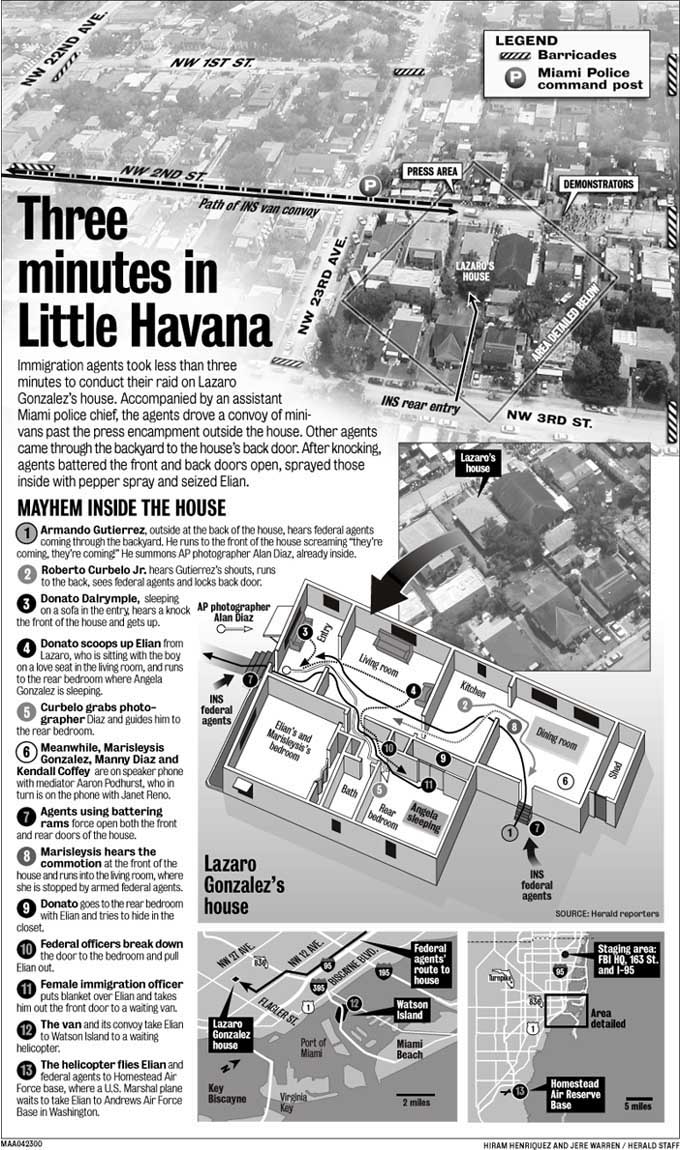
The agents knocked. Knocked again. No answer. A battering ram took out the front door. Eight agents were suddenly inside.
"Here they come!" Lazaro yelled from the love seat.
Donato Dalrymple, one of the men who rescued Elian on Thanksgiving Day and had spent much time in the Gonzalez home, ran from the front foyer and scooped Elian off the couch.
"I was on the sofa dead asleep. What I heard sounded like foot soldiers," Dalymple recalled. "I jumped up. I got him into my arms. He was screaming 'Help me Help me, Que Pasa, Que Pasa?"
Curbelo grabbed Dalrymple and pushed him into the bedroom Lazaro and his still-sleeping wife, Angela, share. Curbelo also pushed in photographer Diaz, Elian's 5-year-old cousin Lazaro Martell and his mother, Yuleidi, and closed the door.
In the living room, one agent pointed his gun at cousin Marisleysis' chest.
Another aimed his gun at Lazaro's head. Other agents aimed guns at attorneys Kendall Coffey and Manny Diaz, who stood frozen in the dining room.
MARISLEYSIS' PLEA
"Don't do this!" Marisleysis screamed, her arms outstretched. "Don't let him see this! I'll give you the boy! Please put the guns down! I'll get the boy up!"
Said Lazaro: "Is this what they trained you for? To take a 6-year-old child?"
"We had no warning that the marshals were coming. We were on the phone negotiating. They took him screaming and crying," Marisleysis complained later.
Agents searched the house for Elian, flipping over tables, breaking more doors and religious artifacts. Elian was not in his room.
"Give me the f---ing boy or I'll shoot," Marisleysis quoted one agent as saying.
Agents prepared to search Lazaro and Angela's bedroom, where Dalrymple had taken the boy. The fisherman, holding the boy in his tattooed arms, tried to hide in a tiny closet, but the closet was packed with boxes and clothes and there was no space.
Agents kicked the door open, splitting it in half. The top half swung on its hinges while the bottom half fell to the floor.
"I took his head and buried it into my shoulder... There was nowhere to go," Dalrymple recalled.
'GIVE ME THE BOY'
"Give me the boy," an agent yelled, pointing a 9mm Heckler & Koch submachine gun at Dalrymple.
Agents told Diaz to stay back, but he kept snapping pictures. His is the photo that quickly went around the world, a picture of an agent holding a gun on Dalrymple as the man hugged the boy to his chest.
INS Agent Betty A. Mills, packing a holstered pistol, entered the room with a blanket and grabbed Elian from Dalrymple.
Trained in hostage rescues, she told Elian in Spanish not to be afraid because he was going to be taken to his father and not back to Cuba, U.S. Immigration and Naturalization Service Commissioner Doris Meissner said later.
The agents backed out of the room with Elian -- the guns still trained on everyone and 5-year-old Lazaro Martell.
Elian screamed for Marisleysis.
"Prima Mari! Prima Mari!," Elian yelled. "Cousin Mari! Cousin Mari!"
Dalrymple begged: "Please Oh God! Don't take the child!"
The agents didn't answer him. Then other agents yelled.
'BINGO!, BINGO!, BINGO!'
"We got him. We got him. Bingo! Bingo! Bingo!"
The agents then retreated and in their rush left behind one dark green and black military helmet and a canister of pepper spray.
Outside, federal agents kept the crowd back, asking for calm. Miami police officers implored the crowd to remain still.
Agent Mills ran from the house with Elian wrapped in the blanket and leapt into the passenger side door of a four-door van. The doors then closed and van backed up.
The street lit up from photoflashes and television lights as protesters threw chairs, soda cans, rocks. The agents sprayed the crowd with pepper gas, hitting protesters as well as reporters and police.
The convoy retreated east on Northwest Second Street with federal agents running alongside and some tripping on television cables.
The whole raid took exactly two minutes and 34 seconds.
'THEY'VE GOT THE KID'
Brooks called Chief O'Brien at about 5:20 and said, "They've got the kid, and he's OK." O'Brien notified City Manager Donald Warshaw a few minutes later. Warshaw then quickly called Miami Mayor Joe Carollo.
O'Brien said he didn't call Carollo earlier because he didn't want to tip off the politicians on this supremely political drama. "This was... not a political issue," the chief said.
AWAITING HELICOPTER
As dawn approached, the federal convoy and several police cars with lights flashing sped to Watson Island, where a helicopter waited with its rotors spinning to take Elian to Homestead Air Force Base.
Two workers at the Casablanca Fish Market on the southwestern side of the island watched the transfer.
"He was kicking and screaming 'Let me go!' and 'I don't want to go!'" recalled Gilberto Castro.
Added Rafael Viera, "It was clear he didn't want to go."
The helicopter soon lifted off for Homestead, where a physician checked Elian to make sure he was OK. Elian, the woman agent and a psychiatrist then piled into a waiting U.S. government jet equipped with toys and Play-Do to entertain him during the two-hour flight to Andrews Air Force base and his waiting father.
NEGOTIATION COLLAPSED
For the INS, the raid looked like a victory. No delays, no major injuries.
But the raid in fact reflected the collapse of a final round of negotiations that had begun Thursday at 10:30 a.m. when a group of Miami power brokers trying to bring a peaceful end to the custody crisis gathered quietly in the downtown law office of lawyer Aaron Podhurst.
In the room with Podhurst, a long-time Reno friend, was University of Miami President Edward T. Foote II and UM Board of Trustee Chairman Carlos de la Cruz, also chairman of Eagle Brands. Another UM trustee, Carlos Saladrigas, head of ADP Total Source, joined the meeting by speaker phone.
Their goal was to come up with a plan for the transfer of Elian to his Cuban father that would be acceptable to Lazaro Gonzalez. The leaders also had to pacify the Cuban exile community, seething over the possibility of Elian's return to his communist homeland.
After the meeting broke up around noon, Foote and de la Cruz traveled to Lazaro's home to talk with the family's attorneys. "We discussed the possibility of our getting involved for the first time," de la Cruz said
The attorneys, including Coffey, Manny Diaz and Jose Garcia-Pedrosa, all seemed open to their involvement -- making clear the relatives' demands and concessions.
Around 1:30 p.m. Thursday, after a business-like meeting at the house, Foote and de la Cruz returned to Podhurst's law office to fine-tune their proposal along with Saladrigas.
CALL TO RENO
The foursome called Reno. "She encouraged us to go ahead. Her conditions were, we had to be able to sell [the deal] to the government and Elian's father."
From 1:30 to 6 p.m., the group hashed out the outline for an agreement while staying in contact with Reno. Sometimes Podhurst spoke to her directly, sometimes they put her on a speakerphone and they all spoke.
By the end of afternoon, they had a hand-written list of six points that could serve as the outline for a deal.
Above all, the relatives wanted to require that Juan Miguel Gonzalez live with them in a temporary residence in Miami-Dade County during the boy's federal court appeal for a political asylum petition.
The relatives wanted no government officials and lawyers in the picture -- just U.S. marshals to protect the site. And they wanted a 'facilitator' -- probably a psychologist -- to help the families "get together and do what is in the best interest of the child."
Foote wanted the transfer to occur in Miami-Dade County. Reno agreed to that condition, which pleased the local group.
DEAL BREAKER POINT
Reno told them the deal breaker was the transfer of custody to Juan Miguel. The family had to agree to that point. The mediators told her that would be hard.
Reno told them she didn't want to be embarrassed. She wanted assurances Juan Miguel would be received with courtesy in Miami.
In the next hour, de la Cruz and Saladrigas had a frantic conference call with several members of Mesa Redonda, a group of Cuban business executives and civic leaders, to explain the proposal.
Several members raised concerns, among them whether Reno was negotiating in good faith. The mediators said they believed she was.
They also briefed Jorge Mas Santos, head of the Cuban American National Foundation, Jose Basulto from Brothers to the Rescue, Ramon Saul Sanchez of the Democracy Movement, and Sister Jeanne O'Laughlin of Barry University.
Saladrigas said the mediators and the Cuban community leaders met at the San Juan Bosco church in Little Havana from 9:30 p.m. Thursday to about 2 a.m. Friday. They concluded the agreement would be tough for the Miami family to accept.
"We didn't see a lot of good alternatives," said Saladrigas.
Saladrigas and de la Cruz met at Kendall Coffey's office in Coconut Grove at 11 a.m. on Good Friday and began to hammer out the final draft of the proposal with family attorneys.
Lazaro and Delfin Gonzalez joined them and by late afternoon the group felt they had come up with a workable deal. Reno instructed them to put the proposal in writing and fax it to her office by 5 p.m.
They met that deadline. Foote was so confident that a compromise was really in the works that he went home to be with his family.
Family friend Curbelo said that Podhurst called the Miami house at 8 p.m. to say that Reno was considering the offer but wanted the child to stay with his father throughout the reunion. The family wanted the child to stay with Marisleysis.
By 9 p.m., Reno's office had sent the proposal to Elian's father and his attorney, Gregory Craig. Lazaro agreed to let Elian decide who he would want to stay with.
WHITE HOUSE BRIEFED
Reno was giving hourly updates to White House Chief of Staff John Podesta on the status of the negotiations. Podesta relayed one optimistic update to President Clinton at 8:30 p.m.
But at 2 a.m., Curbelo said, Podhurst called to say the government was insisting that the meeting take place in a privately run retreat in Washington's Virginia suburbs.
Podesta updated Clinton again at 2:15 a.m., relaying word that Reno still felt the negotiations held promise, said White House spokesman Joe Lockhart.
Reno was negotiating from a small private office at the Justice Department's headquarters in Washington, known as Main Justice, surrounded by about a dozen people, including Deputy Attorney General Eric Holder, Meissner, and INS General Council Bo Cooper.
Reno hoped that Podhurst, on whom she had "great trust," would be able to bring off the deal despite confusion about just who was speaking for the Miami family.
The Miami family felt the meeting site wasn't as important as its demand to speak to Juan Miguel alone. "There was an agreement on the table" Mas said.
Then everything unraveled.
Around 4 a.m., Reno declared the negotiations had broken down. The Miami family "kept moving the goal posts" with new demands and conditions, said an official who attended the Washington meeting.
PATIENCE RAN OUT
She polled the officials present, pointing to each one in turn and asking for their thoughts. Everyone nodded. "Our patience ran out," said the official.
Reno had a ''very pained look'' but agreed, Holder told reporters later, and gave the order to seize the boy.
At 4:20 a.m. Podhurst called Reno to ask for yet another reprieve while he continued to try to persuade the Miami family. Reno agreed to give him another five minutes, but when he called again to ask for even more time she held her ground. At 5:05 a.m., family lawyer Manny Diaz called Podhurst and asked if he had any news from Reno. Podhurst said he had "run out of time," Curbelo said.
Reno telephoned Podesta again shortly before 5 a.m. to inform him of the decision, and then again at 5:30 a.m. to tell him the raid had gone off without a hitch. Podesta rang his boss upstairs.
"The president was pleased," said Lockhart.
WORST NIGHTMARE
In Miami, Cuban Americans woke up to their worst nightmares.
Drivers up and down Calle Ocho began honking their car horns at around 5:20 a.m. as they heard the news on radio, just a few here and there at first, more like forlorn cries for help in the early morning stillness than rousing calls to battle.
At 8:49 a.m., a big cheer went up from the crowd gathered in front of the Gonzalez home as a man draped black ribbons and later black garbage bags around a large U.S. flag flying over Lazaro's shattered front door, and later an adjoining Cuban flag.
Ten minutes later, a group of elderly men delivered to the house a funeral wreath of red white and blue carnations with a ribbon that read "R.I.P. Democracia."
By 10 a.m., small but angry groups of demonstrators had started trying to block traffic near the corner of Flagler and 27th Avenue and threw bus benches, shopping carts and used tires onto other streets.
"This is a day of shame for America," shouted Jose Angel Ramirez, 18, as he ran away from one of the volleys of tear gas that police fired throughout much of the morning and into the afternoon to disperse the most unruly demonstrations.
FATHER-SON REUNION
Juan Miguel Gonzalez arrived at Andrews Air Force in suburban Washington about 9 a.m., and quickly signed a sheaf of INS documents assuming custody of Elian, taking financial responsibility for his upkeep and promising not to remove him from U.S. territory until the court process runs its course.
At 9:30, Juan Miguel walked onto the government plane that had brought Elian from Miami and hugged him.
"Elian appeared very happy, and Juan Miguel was crying," said a Justice Department official.
At 2 p.m., Andrews base officials released photographs of Elian in the arms of a smiling Juan Miguel, with Nersy and the baby by their side.
Elian, who had begun the day crying in terror, was smiling.
© 2000, The Miami Herald
As protest outbursts dwindle, a strike is called for Tuesday
By Manny Garcia, Carolyn Salazar and Andres Viglucci
"This has been a very emotional case for everyone involved," Reno said. "The most important thing is that Elian is safe and that no one was seriously hurt.''
It took five months for the custody battle over Elian Gonzalez to build to a tense standoff. It took federal agents less than three minutes to end it.
In a cleanly executed predawn raid that caught Elian's Miami relatives off guard, armed and helmeted U.S. Border Patrol officers pushed aside a handful of demonstrators to batter in the door of their Little Havana home. At gunpoint, they took the boy from the grip of his Thanksgiving Day rescuer, fisherman Donato Dalrymple.
"We're taking you to see your papa," a Spanish-speaking female agent, Betty Mills, told the terrified boy as she carried him out of the house to a government van.
Before most of Miami awoke Saturday to what had occurred, Elian had been reunited with his father, Juan Miguel Gonzalez, at Andrews Air Force Base outside Washington, D.C.
Gonzalez, who asked U.S. officials for five minutes alone with his son, boarded the airplane that brought Elian from Homestead Air Reserve Base. He emerged carrying the boy, who held his father in a bear hug, arms and legs wrapped tightly around him, Immigration and Naturalization Service officials said.
The government said Elian, his father, stepmother and half-brother would spend "a couple of days" at base housing to allow them time together in private.
As stunning images from the raid were almost instantly and repeatedly broadcast on TV here and across the world, angry protesters began roaming Miami's Flagler Street corridor, upsetting trash bins in the street and setting tires and debris afire at scores of locations.
Riot-clad police showed little tolerance for the disruptions, gassing those who defied orders to clear out, and arresting more than 300 people by sunrise Sunday. Three officers were injured when a demonstrator attacked them with a bat.
By late afternoon, the protests had dwindled to sporadic outbursts. At an evening news conference, Miami Mayor Joe Carollo and Miami-Dade Mayor Alex Penelas urged calm. Cuban exile leaders called for a general strike on Tuesday.
CLINTON'S SUPPORT
In Washington, President Clinton expressed firm support for U.S. Attorney General Janet Reno's decision to send the agents into the house.
"I believed that it was the right thing to do," the president told reporters outside the White House. "I hope that with time and support, Elian and his father will have the opportunity to be a strong family again."
In Cuba, President Fidel Castro vowed not to use Elian as "a trophy" and pledged "no celebrations, nothing" when he returns to Cuba.
The reunion, however, does not put an end to the Miami relatives' efforts to keep Elian in the United States. A federal appeals court in Atlanta has set a hearing for May 11 and ordered the boy to stay in the country until it rules on a pending appeal by the relatives.
The relatives want to force the government to give Elian an asylum hearing, but the chances of that occurring would seem in doubt with the child back in his father's custody.
Elian's relatives, looking shellshocked and exhausted hours after the 5:15 a.m. raid, boarded a midday flight to Washington, where they hoped to be allowed to see Elian. The family showed up at the military base gate at 6:45 p.m. in two vans. They were turned away. Elian's father said "no, for now,'' an INS official said.
HOUSE READY
However, the official said, an adjacent house at the base is ready if the father agrees to a visit from his relatives.
The attorney general ordered the boy's removal by force after all-night negotiations mediated by local civic leaders failed to resolve the central issue in the impasse -- how the Miami relatives would turn over Elian to his father, who two weeks ago flew to Washington from Cuba to await a promised reunification.
The raid was a scenario federal officials had for weeks gone to great lengths to avoid, a posture that brought Reno criticism for perceived inaction.
But it was the end that seemed more likely once Elian's great-uncle Lazaro Gonzalez defied a direct government order to surrender the boy.
Two indelible and sharply contrasting images will forever define the morning's dramatic and dizzying events:
An Associated Press photo of a helmeted Border Patrol officer leveling a submachine gun while a frightened-looking Elian and Dalrymple attempt to squeeze into a bedroom closet.
And -- about six hours later -- another photo of a smiling Elian in the arms of his father, Juan Miguel Gonzalez. The amateur photo was released by Gonzalez's attorney, Gregory Craig, who said Elian showed little sign of trauma and acted happy to see his dad and family.
An INS official said Mills, the agent who escorted Elian from Miami to Andrews, described Elian as "happily playing on the floor of the house with the toys that we provided."
PROTESTERS AT BASE
About 50 protesters were gathered at the gates of the base with Cuban and American flags. Only two supported the government's action.
The raid and the images from it now seem likely to be dissected and debated for months to come.
Many Americans sighed with relief that the long siege, which dominated the news for weeks, was finally over. Others, even some who supported the boy's reunification with his father, expressed shock at the government's show of force.
In Miami-Dade County, the raid prompted cries of outrage among Cuban Americans, the relatives and supporters, who called the use of force excessive.
As soon as demonstrators outside the relatives' house realized that Elian had been carried away they began throwing rocks, bottles and debris at the retreating government caravan. Federal agents tear-gassed them. Some huddled together sobbing, while others shouted insults at police, Reno and Clinton.
Throughout the morning, Elian's cousin, Marisleysis Gonzalez, who regarded herself as the boy's surrogate mother, wept through interview after interview, denouncing government officials as "dogs" in a hoarse voice.
MEDIATORS' EFFORT
The relatives and a group of mediators who tried to forge a last-minute compromise for a peaceful hand-over, including University of Miami President Edward T. Foote II, said they felt betrayed by Reno. They said they believed they were close to an agreement, with prominent Miami lawyer Aaron Podhurst on the phone with Reno when the raid occurred.
"As those conversations were ongoing, the raid took place,'' said Rene Murai, a lawyer and member of the Mesa Redonda group, two of whose members were acting as mediators in the negotiations. "Our members were operating in good faith and all of a sudden the raid took place in the midst of these negotiations."
Reno, however, was unequivocal: The relatives kept "moving the goal posts" each time an agreement seemed near, and she and her advisors reluctantly concluded around 4 a.m. that further negotiation would be fruitless.
"This has been a very emotional case for everyone involved," Reno said. "The most important thing is that Elian is safe and that no one was seriously hurt.''
It was expected that Juan Miguel Gonzalez, his wife and 6-month-old baby would move out of the home of a Cuban diplomat where they have been living since arriving in Washington. One possible location is the Wye Plantation in Maryland.
"Let us give him and his father the space, the calm, the moral support they need to reconnect and reaffirm their bond between father and son," Reno said.
INITIAL PROMISE
Federal officials had initially promised no surprise assaults on the Little Havana family if they had to pick up Elian.
But Reno said the covert operation, and the use of heavy arms in the raid, became necessary given Lazaro Gonzalez's defiant attitude, and intelligence reports of weapons in the Miami relatives' house and in nearby homes.
On Thursday night, Marisleysis, according to a Justice Department official, told a member of the agency's Community Relations Service: "You think we just have cameras in the house? If people try to come in, they could be hurt."
Though relatives and supporters of the family complained that agents were rough and used abusive language, Reno cited the fact that no one was hurt as evidence the raid was appropriately carried out.
She indicated that the agent photographed confronting Dalrymple in the closet with Elian had his gun "pointed to the side" and his "finger was not on the trigger."
Experts who analyzed the photo confirmed Reno's description, and said the rifle's safety was engaged, meaning the weapon could not have been fired.
Herald staff writers Sandra Marquez Garcia and Carol Rosenberg, Herald writers Jasmine Kripalani, Mireidy Fernandez and Diana Marrero, and Herald wire services contributed to this report.
© 2000, The Miami Herald
Despite superheated emotions, violent incidents are sporadic
By Sandra Marquez Garcia, Tyler Bridges and Curtis Morgan
Five months of pent-up passion spilled over Saturday into a bitter daylong series of seesaw clashes in the streets of Little Havana between hundreds of protesters and nearly as many police in full riot gear.
Demonstrators, outraged at the seizure of Elian Gonzalez by a gun-toting federal SWAT team, shouted, wept, waved flags and signs and -- in isolated angrier outbreaks -- blocked traffic, threw rocks, overturned bus benches and torched tires and trash bins. Police met them fast and forcefully -- some say too forcefully -- pumping tear gas canisters into crowds and hauling off dozens in handcuffs.
At least 268 people, including a man charged with attempted murder for attacking three officers with a baseball bat, had been arrested by 10 p.m. Scattered skirmishes were still breaking out into the night but authorities hoped the worst had passed.
''Clinton, Miami is burning!'' protesters chanted around a bonfire built of old tires, a trash bin load of cardboard boxes and a shredded Florida lottery billboard at Flagler Street and Northwest 27th Avenue, an intersection blocks from the home where Elian was snatched before dawn.
But Miami, despite superheated emotions in the streets, was not on fire.
That street blaze and at least 128 others were doused by firefighters. The shifting protests were confined to a dozen or so blocks in Little Havana. There were no reports of serious damage and a few miles to the east, the Miami Heat won an undisturbed playoff opener at AmericanAirlines Arena. Reported injuries, topping 50, were mostly cuts and bruises.
''These are sporadic acts, isolated events, but they are ugly pictures to see,'' said Miami City Manager Donald Warshaw. ''This is not a riot.''
Late Saturday, the biggest protest had moved to Hialeah, where a bumper-to-bumper caravan of horn-honking, flag-waving drivers jammed 49th Street, the city's main thoroughfare. The mostly teenage crowd slowed traffic for dozens of blocks with few police officers in sight.
But Hialeah Police, supervised by Chief Rolando Bolaúos, deployed a force of officers with riot gear into the area after 11 p.m.
PRAYER VIGIL
Political and community leaders -- Miami-Dade Mayor Alex Penelas, U.S. Rep. Lincoln Diaz-Balart, Spanish-language radio hosts and others -- took to the airwaves during the day appealing for calm. Penelas said he planned to organize a large-scale ceremony, possibly a prayer vigil.
''I've asked people to refrain from this kind of behavior,'' he said. ''There is a right way to protest and a wrong way.''
''Right now,'' Diaz-Balart said, ''the worst thing we can do is give our enemies the gasoline to set us on fire.''
At nightfall, tempers seemed to have cooled but the streets remained tense enough that police warned journalists that they were at risk outside the Gonzalez home, prompted by a throng that knocked down the CNN tent. Exile organizers and CNN staffers calmed the crowd and a platoon of police, thumping their batons against their plastic shields, marched in. Within an hour, the strange village of satellite trucks dubbed Camp Elian had folded.
For the most part, the community paid heed but at Ground Zero -- Flagler Street stretching several dozen blocks through a working-class stronghold of Elian supporters -- the scene was chaotic. For much of the day, the air smelled of a stinging mix of tear gas and trash bin fire smoke. At noon, the peak of problems, protests popped up as fast as police broke them up.
CUFFED PROTESTERS
Sweeping the streets in ranks sometimes 10 across, police gruffly cuffed protesters. Dozens of other protesters and bystanders stumbled about, eyes red and burning. After one of the numerous gassings, a crowd fled to a Walgreens drug store, tearing water, soda, anything from the shelves for relief.
''The first time I got gassed I almost got hit by a car,'' said Carmen Cantu. ''It's scary. I'm only 12. They arrested a little girl right before my eyes.''
Officers also were roughed up in at least two clashes and one cruiser's window was smashed. In the most violent confrontation reported, a man was arrested on charges that included attempted murder after he allegedly attacked three officers with a metal baseball bat. Daniel Perez, 29, of 10730 SW 28th St., drove his light blue Toyota through a police barricade at Flagler and West 35th Avenue, nearly running over two officers, according to a police report.
Perez stopped the car, grabbed a bat and started hitting officers, the report said. Three officers were injured, two with back pain and another with a shoulder injury, said Miami Police Lt. William Schwartz. The officers were taken to Jackson Memorial Hospital, where they were in stable condition, Schwartz said.
PUSHED TOO FAR
One woman said police pushed a tense crowd too far.
''They are provoking us,'' said Marta Suarez of Miami. ''Because people are on the sidewalk chanting libertad there is no reason to arrest them. If the police keep acting like this it will get worse. People don't want violence but police are getting violent.''
Schwartz, doing an interview outside the Gonzalez home, also was pushed, pummeled and spit on by protesters before officers and others in the crowd came to his aid.
''I was surprised and angry, and ultimately gratified that people were trying to help me,'' Schwartz said.
The first protests began within an hour of Elian's removal. The crowd around the relatives' home, less than 50 when the lightning raid took place, swelled to hundreds. Others poured into nearby streets.
Isis Cardoso rushed from her Miami Beach home to Flagler and 27th Avenue, also known as Unity Boulevard, after her son called her at 5:30 a.m. She thought it was time to send a message.
''As long as we can't fight in our own homeland, all we can do is fight on the streets of Miami,'' said Cardoso, wearing a black band around her arm. She listened to La Poderosa radio station, but ignored the urges to stay home.
''I had it on this morning but I finally turned it off because they were calling on people for calma, calma (calm), but today is not a day for calm. Today is a day for action.''
AREA SWARMED
By 10 a.m., protesters were swarming Little Havana. Most people simply stood on sidewalks, waving flags or signs. Crowds, arms linked, spilled onto the Dolphin Expressway, temporarily blocking traffic before Florida Highway Patrol troopers arrived.
The mood among protesters was defiant -- toward police but more toward the U.S. government that they felt had betrayed them again.
Juan Contijoch, holding his 2-year-old daughter Yara and waving an American flag smeared with a black paint swastika, stood in the smoke of a Flagler Street trash bin fire and expressed what seemed the prevailing view:
''This is the beginning of the end of this free society. Little by little, they are taking away our rights. Now is the time for us to take the streets.''
''We are going to paralyze Miami,'' vowed Irma Garcia.
About 11:20 a.m., with bonfires burning on a half-dozen street corners and problems spreading, police regrouped. Patrols withdrew and returned in increased force and riot gear -- batons, plastic shields, gas masks.
The city of Miami had about 700 of its 1,127 officers on the street. Miami's officers were reinforced by the Miami-Dade Police Department with 650 county officers in field units and a SWAT team from the Florida Department of Law Enforcement. FHP troopers patrolled the perimeter and Miami Beach officers assisted by providing security at the Heat game.
MANY CHARGED
About noon, officers, marching in near-military formation, started sweeping west to reclaim Flagler, arresting protesters and others on charges that included disorderly conduct and inciting a riot. At least five journalists were also arrested.
Many protesters complained that the police used excessive force. Erika Huerta said a tear gas canister fell at her feet, even though she was peacefully protesting.
''There has been rock-throwing,'' she said, ''but at that moment, we were just walking and saying, 'Justice for Elian.' '
An old man was handcuffed and dragged on his knees. Officers knocked down and handcuffed a teenage girl. Others saw officers kicking and punching protesters.
By afternoon, with the police force swelling, tempers seemed cooler. Armando Perez helped officers remove a concrete bus bench from the street as city maintenance crews began clearing debris.
''We don't have anything against the police,'' he said. ''If they would take off their helmets and put away their batons we would feel better about them.''
About 8 p.m., neary 300 people gathered at Southwest 17th Avenue and First Street and and burned dozens of tires. Police broke it up in 30 minutes.
''This is crazy. The police are crazy. They're kicking people and hurting people,'' said Yvette Gomez, 30.
POTENTIAL PROBLEMS
Police defended the tactics, saying the swift arrests and strong force snuffed potential problems.
''I think they've done an excellent job in very trying conditions,'' said Miami Police Chief William O'Brien. ''They've arrested a whole group of troublemakers and there is no significant property damage.''
Herald staff writers Charles Rabin, Ana Acle, Eunice Ponce, Charles Savage, Mireidy Fernandez and Marika Lynch contributed to this report.
© 2000, The Miami Herald
Show of force crucial to safely grab boy, Reno and police experts say
By Joseph Tanfani, David Kidwell and Ronnie Greene
When federal authorities finally decided to raid the home of Elian Gonzalez's Miami relatives, they came prepared with submachine guns, flak jackets and pepper gas.
But their best weapon was stealth.
Moving swiftly in the pre-dawn lull of an Easter weekend, dozens of federal agents battered down doors, brandished guns at the people inside, grabbed the boy and drove off -- even before many protesters fully realized what had happened.
The haunting image of a gun-wielding agent reaching for the terrified boy enraged the Cuban exile community. The gun was not pointed at the boy, and the safety was on.
"A tragic and disgusting display of power,'' said Kendall Coffey, a former U.S. Attorney who now represents the Miami relatives.
Ron McCarthy, a hostage expert and former Los Angeles Police SWAT team member, said police are supposed to use heavy force only under certain circumstances: if the targets are armed, holding someone against their will, have histories of violence or if the house is heavily barricaded.
"If they didn't have that, what they did was way out of line,'' McCarthy said Saturday.
But the tactics were defended by Attorney General Janet Reno, federal authorities and police experts who described the Elian raid as a textbook police tactical operation.
Reno said she had received information "there were guns -- perhaps in the crowd, perhaps in the house.'' And people outside the house had suggested "that they were going to prevent it [the boy's transfer] from happening,'' she said.
Once federal officials made the decision to stop negotiating and grab the boy, several police experts said, federal agencies had little choice but to go in the house with a substantial show of force.
"I think that the ideal way to take him was to have a few detectives or INS agents in plainclothes go to the door and get him,'' said Gainesville Police Sgt. Ed Van Winkle, who teaches law enforcement officers how to safely enter homes. "The problem is, that would be impossible, because there was so much potential for violence.''
If federal agents tried to take the boy without force, and failed, the next attempt would become vastly more dangerous, experts said. By telegraphing their intentions, the government would lose any chance at surprise and would likely meet much more resistance.
"The night shift of [demonstrators] has gone home, the day shift hasn't come out yet,'' said Clinton Van Zandt, former head of the FBI's hostage negotiation team. "The government had to seize that moment of opportunity. They went in from a tactical standpoint with everything going for them.''
In her office Saturday afternoon, INS Commissioner Doris Meissner defended the level of force as "entirely appropriate for the risky endeavor that this was.
"Remember, the family had always said they would open the door and stand aside while agents came in,'' Meissner said. "That is not what happened.''
Agents were even ready if a Rottweiler next door was set loose. They came with a tranquilizer gun that they never used.
Federal authorities were worried. For weeks, teams of surveillance agents had been hearing reports about guns in the house and nearby.
One report said weapons were being stockpiled in a house in the rear of the Miami relatives' home. To be safe, Miami police and federal agents on Friday quietly arrested two men who lived in the house on immigration charges.
No weapons were found.
Federal authorities in Washington quietly began assembling a team in South Florida last week and began training for what they called Operation Reunion. The preparations were even kept quiet from top federal authorities in Miami, who learned of them Friday evening: they were told to assemble at FBI headquarters in North Dade for a midnight briefing.
"We were stunned,'' one federal source said.
From the beginning, U.S. Attorney Tom Scott had argued against a forced entry of the Little Havana home, citing the potential for violence. By the end, Scott was resigned to the raid, sources said.
By Thursday morning, federal authorities had decided on Saturday as a preferred date. Late Friday, as negotiations stalled, they agreed any raid had to occur before 6 a.m., when traffic signals stop flashing yellow and begin presenting traffic obstacles for getaway vans.
By 4 a.m. Saturday, U.S. Marshals had already closed off Interstate 395 leading to Watson Island and the avenues leading into Little Havana, the route the vans would take. A helicopter was waiting on Watson Island.
A federal force of 131 immigration agents and 20 U.S. marshals assembled at FBI headquarters.
Among them were 53 INS agents assigned to surround the house and guard the perimeter; an eight-member Border Patrol Tactical Unit, the agents who led the charge into the house; and one female Spanish-speaking INS agent in plainclothes coached to grab the boy and start reassuring him even as she was running to the van.
Others were assigned to traffic control and security duty at Watson Island and FBI headquarters.
The caravan of unmarked vehicles -- three white vans, four sport utility vehicles and two pickup trucks -- turned onto Northwest Second Street at about 5:15 a.m., their windows rolled up. Riding in the lead van was Miami Police Assistant Chief John Brooks, to make sure the group could get through the police barricades.
Agents were aggressive in securing the scene, ordering bystanders to the ground and immediately dousing protesters with pepper spray. One man who tried to step in front of the front door was dropped with one punch by an agent.
People inside the house locked the doors when they heard the agents were outside; agents rammed them open and rushed inside, guns pointed at the relatives.
The weapon wielded by the agent who grabbed Elian is German-made Heckler & Koch 9mm submachine gun with a 30-round clip and laser sight -- standard issue for tactical teams. Following the textbook, the safety was on and his finger was near but not on the trigger, experts on police tactics said.
Those experts say intimidation is a standard part of the procedure.
"Those Border Patrol agents are not negotiators. They're there to ensure a strong tactical presence. Their job is to be strong, say it strong,'' Van Zandt said.
"You want to get that boy, get out of the house and get on the road before the element of surprise is lost.''
Herald translator Renato Perez, and staff writers Frances Robles, Tyler Bridges, Carolyn Salazar and Frank Davies contributed to this report.
© 2000, The Miami Herald
By Frank Davies
WASHINGTON -- A few minutes after 4 a.m. Saturday, Attorney General Janet Reno and a dozen top officials who had been awake for 24 hours huddled in a small private office in the Justice Department.
Five months of the Elian saga and a dozen hours of frantic negotiation were about to culminate in a final decision and a three-minute raid.
Talks with the Miami relatives' lawyers were inconclusive, and a complex deal to bring the family to a rural Virginia retreat had failed. Anxious law enforcement officials told Reno a carefully planned operation to seize the boy had to take place before daybreak.
Reno polled everyone present. ''It was unanimous'' to move in, said a top official who was there. Reno gave the go-ahead for ''Operation Reunion.''
The attorney general was ''very pained'' when she gave that order, said Deputy Attorney General Eric Holder. ''It was a somber moment.''
In an interview with The Herald, Doris Meissner, Immigration and Naturalization Services commissioner, described Renos decision at that point: ''She had to weigh a lot. Negotiations were going nowhere, and the operation was ready to go -- it had been delayed one hour. I know she has such a deep affection for Miami, this was very wrenching for her.''
Reno said at her briefing, two hours after the raid: ''I did, until the final moments, try to reach a voluntary solution.'' She knew the raid was imminent. Lawyers in Miami did not.
She added: ''We tried every way we could to encourage Lazaro Gonzalez to voluntarily hand over the child to his father. The Miami relatives rejected our efforts, leaving us no other option but the enforcement action.''
The relatives lawyers dispute that, and accuse the government of negotiating Friday and early Saturday in bad faith while planning the move to take Elian. But federal officials who described the last hours of talks insisted that negotiations were serious.
''There were some in the room who wanted to act quicker [to seize the boy] but the attorney general was firm that every opportunity had to be exhausted,'' said one official in the Justice Department.
Meissner said the deal fell apart for the same reason similar deals in recent weeks failed -- the Miami relatives could not agree to giving up Elian at the start of a family get-together, and they insisted the family meet in the Miami area.
''Those were the sticking points,'' Meissner said. ''They could not get past the transfer of custody.''
Reno said the familys demands and conditions shifted: ''It was one step after another in which they moved the goal posts.''
Holder, active in these negotiations for weeks, also blamed the breakdown of a deal on the relatives and their attorneys: ''I was disappointed that the people who indicated they cared most for the boy were unable to do the right things that would have prevented what happened from occurring.''
Through a long night of talks with the family, with Miami lawyer Aaron Podhurst acting as intermediary, a tentative, complex deal emerged. The major elements were:
The Miami relatives and Elian would go to the federal courthouse in Miami at 3:30 a.m. and then a hotel before taking a plane to Washington.
All family members would go to Airlie Mansion, a large conference center in Virginia about 60 miles south of the capital. Elian would be promptly transferred to his father.
Three new health experts would talk to the boy and advise the family members.
The father would agree to stay with the relatives -- although in different living quarters -- for a period ''not to exceed one week.'' Juan Miguel Gonzalez was ''not happy'' about that part of the deal but decided to accede to it, federal officials said.
''I negotiated through the night,'' Reno said.
At one point, talks were stuck on logistical matters.
The relatives said Elian was afraid of flying, and said the meeting place had to be within driving distance. One participant suggested the family drive from Miami to Washington with Elian.
''By then, the Justice Departments patience had run out,'' the official said.
As the move on the house progressed, Reno and top advisors received reports from the scene and watched it on CNN.
''The scene was jarring, with the armed agents, but everyone was relieved that it ended quickly, with no serious injuries,'' said one participant.
Another participant remembered the two-word answer Reno gave several weeks ago, when reporters pressed her if she was taking too long to resolve the crisis and was really prepared to act.
Her response: ''You bet.''
© 2000, The Miami Herald
By Frances Robles
WASHINGTON -- The shock and pure fear captured on Elian Gonzalez's face during the early-morning raid in Little Havana is gone, his dad's supporters say.
He now sports a big, cheeky smile, the kind a kid has when he's with someone he loves, someone he had missed. After a private moment alone with his father, Juan Miguel Gonzalez, Elian emerged from a U.S. Marshal Service eight-seater plane at Andrews Air Force Base in his father's arms. His head was gently tucked into the crook of his dad's neck, as the beefy agent who plucked him from Donato Dalrymple's arms beamed with pride.
"It was unbelievable," said INS Commissioner Doris Meissner. "Elian was just wrapped around his neck."
After an early-morning raid at his relative's Little Havana home, Elian was flown to Washington, D.C., with U.S. marshals, two doctors, INS agent Betty Mills, assistant director for investigations Jim Goldman, and the lead agent whose machine-gun-wielding photo has been shown around the country.
"I was shaking more than the child was," Mills told Meissner later. "That is one strong kid."
When the flight landed at 8:30 a.m., Juan Miguel Gonzalez boarded. They gave him a minute alone, away from the cameras that have followed his boy for the five months he has lived in the United States.
"I saw him within minutes, and it was clear that there was huge relief on Juan Miguel's face, and a wonderful smile on Elian's," Gonzalez's attorney, Gregory Craig, said. "I saw no evidence that he was terrified, frightened. He seemed to be very happy to be back with his father."
And the father with his son.
'TEARFUL, HAPPY'
"He was tearful and happy," said the Rev. Joan Brown Campbell, who spoke to Juan Miguel by telephone after the reunion. "He was incredibly joyous, crying, joyful and relieved."
Craig, speaking by telephone to CNN, said the hours the father and son spent together at a compound on the Andrews Air Force base were happy ones. "He was laughing with his little brother, Hianny. He was hugging his father," he said. "He's a strong boy. That connection [between father and son] is so profound, so strong. When you see the two of them together, you realize something terrible was being done," when they were kept apart.
Even the 250-pound agent who plucked the boy out of a closet was moved, Craig said.
"I must say, it was a very touching moment in the room when the INS agent, six-two, 250-pound, said how proud they had been to reunite him," he said. "These are non-emotional, nonsentimental people. They'd seen love. It was a very, very warm moment.''
RELATIVES SEETHE
While Craig and Campbell were delighted in the lovefest, the Miami relatives were outside seething. The Miami family, including cousin Marisleysis and great-uncles Lazaro and Delfin, accompanied by rescuer Dalrymple, flew to Washington to see the child.
They were turned away, however, when they tried to enter Andrews Air Force Base.
Craig said the visit was too soon, and not even officially requested.
"There's been no request through us," he said. "With respect and understanding of what they've gone through, they might give it a couple of days time for the father to spend time with Elian, and then maybe it's possible."
A 15-minute drive through the winding roads at Andrews revealed little more than a tranquil Saturday for many service personnel stationed there.
The only sign that the largest news story of the year had shifted from Miami to the base was the heightened security around the Gateway Inn, a series of mostly brown single-story homes where Elian and his father had been taken.
One such home was next to the Officers Club and diagonally across from the base hospital. It was guarded by three plain-clothes agents.
Lori Lessner of The Herald's Washington Bureau and Herald staff writer Frank Davies contributed to this report.
© 2000, The Miami Herald
Media Shares High Emotion
By Curtis Morgan
Five months into the intense coverage of the Elian Gonzalez saga - with no end in sight - the South Florida media find themselves under similar scrutiny, from both the outside and the inside.
Every story elicits dozens of e-mails from readers or viewers - usually split pro and con. News reports are studied for hidden messages.
A heartfelt, 13-page letter that reader Maria Lopez sent to 11 Herald reporters last week is one measure of the power of the microscope. Lopez pored over articles so closely that she questioned a description of Elian at his relatives' Little Havana home sitting in a "sagging love seat" and "wearing a gold chain." The seemingly innocent words, she wrote, sounded as if intended to humiliate the Gonzalez family.
"Wouldn't a sofa be descriptive enough? Is sagging, new, lightly used, etc., relevant?... Is the gold chain indicative of something undefined by the writer?"
As the Elian debate has become one of South Florida's most polarizing issues in decades, staffers and managers inside newsrooms - The Herald's, among them - have grappled with the same powerful emotions and fine points of language. As in the community at large, the friction tends to run the ethnic faultline, the one between Cuban-Americans and other groups.
"People are really feeling under siege," said Ileana Oroza, a Cuba-born former assistant managing editor for The Herald who recently joined the journalism faculty at the University of Miami. "People really feel like racist feelings that have been dormant are coming out. Cubans are feeling really sensitive."
Within The Herald, there have been debates over coverage, concerns about bias in stories - from both sides - as well as reports of offensive remarks. There are differing views on the depth of the divide - including whether one exists at all - but the differences were compelling enough for The New York Times to put a reporter on the story.
Herald Publisher Alberto Ibargüen, echoing the paper's top news executives, said tension was only natural considering the diverse makeup of the staff and the controversy over the 6-year-old.
"I think it is impossible for the newsroom to be different from the rest of society," said Ibargüen, who is of Cuban and Puerto Rican heritage. "I don't see this as a newsroom schism. I see this as a newsroom populated by human beings covering a story."
The Herald and other media are not alone in this. Even before Saturday's outbursts over Elian's seizure, passions have often boiled over, with arguments raging among many kinds of workers in in all kinds of workplaces - nurses, teachers, bureaucrats, attorneys, waiters, bankers. Last week, two Miami-Dade Police Department employees were "counseled" for allegedly criticizing Miami-Dade Mayor Alex Penelas' statements regarding the Elian showdown. Both employees, named in an anonymous memo, called the treatment unfair.
But such tension among journalists is relatively unusual.
So far, one of the most overt political statements by a Miami journalist has gone unreported. Early last week, Cenk Uygur, 30, a news producer for the WAMI show The Times went to the Gonzalez home with a sign advocating the boy's return to Cuba.
He was roughly set upon by the crowd before being removed for his own safety by Miami police. The clash made national television - but he was branded by demonstrators as a pro-Castro agitator, not identified as a journalist.
Uygur, a Turkish immigrant, called himself an adamant anti-communist and said he'd gone to the home on his own, not as a representative of the station. While some have told him the action was inappropriate, Uygur said he saw no conflict of interest. WAMI general manager Chuck Budt said Uygur would not be reprimanded.
"Our policy here is we do not make it a habit of trying to control what people do on their own time," Budt said. It did, however, show how easy it is to be caught up in the controversy, he added.
Roberto Vizcon, news director for Telemundo, said the story was a particular challenge for his almost exclusively Hispanic staff. "Especially if you work in a minority media outlet like ours, it's very hard to distance yourself and cover the story from a cool, very unbiased way of thinking."
Telemundo's coverage, he said, strives to be sensitive to viewers' feelings. Elian, for instance, will never go "home" even if he does go back to Cuba.
"I don't see it is a form of self-censorship. There's a lot of hurt out there," said Vizcon, who was born in Cuba. "There's a saying in Spanish, 'Our wine is sour, but it's our wine.'"
SCRUTINY
In some newsrooms, the tension plays out with management moves scrutinized for hidden meaning. At the Fort Lauderdale Sun-Sentinel, veteran Miami bureau reporter Luisa Yanez, who had covered the Elian saga for months, was recently transferred to an office in Weston.
Rumors flew. Several newsroom sources told The Herald the paper was removing Yanez, raised in a Miami exile family, because her views were too strong. But Joe Jennings, an assistant city editor who supervises the Sun-Sentinel's Miami coverage, says the move was totally unrelated to the story.
Yanez confirmed that but said several colleagues had called her to ask about the transfer "to see if it was fair." She was surprised that some colleagues had apparently misinterpreted the move. "I think maybe since it wasn't clearly explained here maybe people assumed it might have to do with that," she said.
At The Herald, the first internal strains showed April 6, when Managing Editor Larry Olmstead wrote a memo cautioning the staff: "This is a sensitive, potentially volatile situation for the newspaper and the community. Our journalism should reflect that sensitivity."
Olmstead, who is African-American, said the memo was sparked by a number of comments from Cuban-American staffers about isolated comments in the newsroom, including casual wisecracks, that had been construed as offensive. None of The Herald's news executives cited specific complaints.
While no staffers were reprimanded, some comments were considered serious enough - borderline slurs - that Executive Editor Marty Baron, a white non-Hispanic, this week asked department heads to call staff meetings to underline the message.
In the aftermath, some reporters said they believed the few offenders should have been talked to privately because the meetings fed fuel to a small fire that would have soon extinguished itself.
"In their quest to be sensitive and their unwillingness to be clear on what they felt was a problem, I think that caused more turmoil than anything else," said Frances Robles, a city desk reporter of Puerto Rican descent who has covered the Elian story in Cuba, Miami and Washington, D.C.
Baron said his intent was simple. He said he wasn't questioning anyone's journalistic integrity or intending to freeze the free flow of opinions.
"I don't think it's wise for us to be making jokes," he said. "I think when people say the Cubans are this or the Cubans are that, that's the sort of phrase-ology that can be be offensive to any group."
EXECUTIVES CAUTIOUS
Such reminders to news staffs, while rare, aren't unprecedented. Many newspapers issued similar cautions during coverage of the Los Angeles riots and the O.J. Simpson trial.
Baron said concerns had been expressed - by staffers of differing viewpoints - on other issues related to the story as well. The ethnic mix of reporters and editors on the Elian story has been questioned, as have tone and content of particular stories. Some felt stories had been played too hard (the health problems of Marisleysis Gonzalez) or too soft (Juan Miguel Gonzalez's obscene gesture).
Columnist Liz Balmaseda also raised some eyebrows in journalistic circles when she appeared in a prayer circle outside the Gonzalez family home two weeks ago. Balmaseda, a Cuba-born columnist who is on leave while working on a film, said she didn't see a conflict and called her prayer "personal and private."
"I didn't set out to make a political statement," she said. "In that situation, I took a friend's hand. I think it's dehumanizing to say I couldn't do this."
News executives saw no violation of the paper's code of ethics - because Balmaseda's job is to express her own viewpoint. But, Baron said, all journalists also need to maintain an appropriate distance from stories they cover.
"In my 20 years as a reporter and later as a columnist, I've prayed many many times as part of an assignment," Balmaseda said - with the Dalai Lama, Holocaust survivors, inner-city school children and New Age gurus. She also prayed at a Haitian memorial while reporting a column that became part of a collection that won her the Pulitzer Prize.
"It's interesting to me that the only time flags go up is when I pray with Cuban exiles," she said. "We went from Buena Vista Social Club to hell. We are so under the magnifying glass right now that anything that comes out of Miami is going to look unprofessional or wrong."
Robles, a board member of the National Association of Hispanic Journalists, said she had received numerous suggestions on reporting the story from Cuban-American colleagues but did not believe the internal debates had created serious rifts or altered reporting. News executives and other reporters agreed.
"I think it's inevitable that any issue that agitates and divides the community to the level the Elian controversy has done, eventually finds its way into the newsroom," said Juan Tamayo, a Cuba-born reporter who covers the island.
"That said, I certainly haven't seen any major newsroom tension, and I have not seen it affect our coverage at all."
FESTERING EMOTIONS
Deputy Features Editor Nery Ynclan, one of the top-ranking Cuban-American editors, pointed to the duration of the story as one reason for heightened emotions she expected would cool.
"This newsroom has endured hurricanes, riots, Mariel, O.J., bad bosses, bad pay raises and bad cafeteria food - this too shall pass, and we'll be better for it. I only hope the boy can survive all of us."
Overall, news executives said they were proud of the paper's coverage, calling it tough, thorough and balanced.
"We've been covering this story right in the maelstrom for five months," said managing editor Olmstead. "We've written other stories that have generated far more outcry at the newspaper. Even with our critics, I believe we're considered a credible source of information on the story. I'm very gratified that we haven't become a focal point in the controversy."
© 2000, The Miami Herald
Psychologists: Healing harder for Miami kin
By Paul Brinkley-Rogers
Two images, one day. Photos showing a terrified Elian Gonzalez torn from the arms of his Miami relatives in the dark, and less than four hours later photos of a happy-looking Elian hugging his dad on an air base near Washington, D.C.
Can a child easily make such an adjustment from fear to joy, and cope with being wrenched from a loving family screaming out his name?
Surprisingly, mental health professionals who have been intimately involved in the Elian saga say that most children handle trauma that horrifies adults much more easily than their elders do. They say it will be Elian's Miami relatives who have the most difficulty healing.
Dr. Marvin Dunn, chairman of the psychology department at Florida International University, said that Elian ''will probably do very well in the long run. He's with his dad. Six-year-olds do not linger on this kind of thing. . . . In fact, I think he'll be fine in a matter of hours.''
Dunn, a defender of Attorney General Janet Reno, said the sudden appearance of paramilitary agents ''was a traumatic experience for the boy.
''But children are very resilient,'' he said. ''They cope with death and terrible accidents. Children are different.''
DISSENTING VOICE
A dissenting voice among the experts was Dr. Antonio Gordon, of the Nova Southeastern University faculty. He was one of several members of Miami's Finlay Institute -- a group that counsels Caribbean people -- who met Elian at the invitation of his Miami relatives.
Gordon said that he was so disturbed by the police action that he telephoned Florida's child abuse hot line.
''They were unable to channel the report of the abuse,'' he said, ''because they said the abuse was committed by law enforcement officers.''
Dr. Jerry Wiener, professor emeritus in psychiatry at George Washington University, was one of three experts chosen by the government to advise on how to reunite father and son.
''Nobody who sees this picture can help but be disturbed,'' he said of the photo with the officer with the gun. ''Elian is obviously very frightened.''
'POSITIVE REUNION'
But ''Elian calmed down very quickly,'' Wiener said, after being briefed by officials. ''He behaved well, had an easy trip, and had a positive reunion with his father.''
''What happened this morning alone would not have a long-term upsetting affect on him,'' Wiener said. ''He'll spend a few days with his father at the Air Force base, and then longer time in a more stable setting.''
Dr. Lourdes Rigual-Lynch, director of mental health at the Montefiore Medical Center in the Bronx, was in Miami last week to try to get Elian's relatives to turn over the child.
''We have to distinguish between what is traumatic, and what is frightening,'' she said of the experience Elian underwent. ''More traumatic was losing his mother. More frightening was what happened this morning.''
SCRIPT-WRITING
Rigual-Lynch said she helped write the ''script'' used by the Spanish-speaking woman agent who carried Elian out of the house. ''Yes, it was very scary for a few minutes, but soon he is going to feel very good that he is with his father.''
Dr. Janice Perlman, a New York City pediatric psychiatrist, said that even if Elian bounces back from Saturday's experience, he still must come to terms with all that has happened since he was found in the ocean in November.
''He has to make peace with all of that,'' Perlman said. ''The death of his mother. His intense effort to bond with and please his Miami relatives. The weeks of fame. The sudden separation from Marisleysis.''
Dr. Jon Shaw, chief of child and adolescent psychiatry at the University of Miami, said the Miami family will probably have a much harder time than Elian in the coming weeks.
''They are outraged,'' he said. ''They invested so much religiosity in the child, and now that this child is taken away from them you can imagine this family's suffering. It is a kind of combat exhaustion.''
Shaw said that being with his father again is best for Elian. ''You have to put this brief moment [the raid] in context,'' he said. ''Elian has been an emotional hostage for complex propaganda.''
He said he is not surprised by photos showing Elian hugging his father. The boy's smiles during his Miami stay were only ''a Band-Aid'' for the loss of his mother, he said. STRESSFUL
Dr. Alan Delameter, a pediatric psychologist at the University of Miami, said that being snatched out of the Little Havana house was stressful for Elian. ''But did it cause irreparable harm? No.''
More damaging, Delameter said, was the growing siege mentality of the final weeks, and the often noisy round-the-clock protests.
Father and son have a special duty now, Delameter said.
''Elian's task, and his father's task, is to reestablish their relationship. Elian will want to be with his father. This is the caregiver he has had since he was a very young child. This is what is good for him''
Herald staff writer Frances Robles contributed to this report.
© 2000, The Miami Herald
Raid stuns, enthralls fractured public
By Fabiola Santiago, Daniel de Vise and Martin Merzer
Some called it proper and overdue. Some called it brutal and premature. Virtually everyone seemed transfixed by events. Virtually everyone regretted that -- somehow, after all this time and all that talk -- it had come to this.
Aroused by the lightning seizure of Elian Gonzalez and provocative images of the raid, people throughout South Florida -- and much of the nation -- expressed strong and sometimes volatile opinions Saturday.
Often, but not always, the views fractured along ethnic lines, and they revealed simmering resentments.
In the Cuban American community, word of the seizure flashed from home to home as dawn broke over the metropolis. ''Did you hear? Did you hear? They took Elian.'' Many people wept, and as the sky brightened, the mood darkened.
''I feel so frustrated,'' said Octavio Del Rio, 57, of Miami, a former political prisoner in Cuba. ''I saw young men being killed for no reason in Cuban jails. I thought, well, in the U.S., people are respected. Bah.
''The general impression among Cubans here is that we are alone. Our cause is not understood.''
Said Mayra Alvarez, 42: ''I'm disgusted to live in this country right now.''
Many non-Hispanics saw it differently, and they resented criticism of the United States and its leaders.
''I believe that Janet Reno is a hero, that she should be commended for the job that she did,'' said Anna Marie Andriole, a white non-Hispanic woman from Dania Beach. ''It should have been done a lot earlier. I believe the Cuban American people do not act by the U.S. law.''
Charles Abanel, 36, a native of Haiti who lives in North Miami Beach, also praised the action.
''I think the government did the right thing because they kept waiting for the family to cooperate, but they never did,'' he said. ''Without a doubt, the boy should be with his father.''
Not every non-Hispanic agreed.
Lou Musacchio, one of a few non-Hispanics in the crowd outside the Little Havana home of Elian's relatives, distributed white poster boards and black and red markers. He urged demonstrators to write down their feelings.
''I wish they would all read 'Shame,' '' he said. ''My sister is crying in Cleveland. Not all the American people agree with what happened here today.''
Luis Botifoll, a veteran civic leader often called the dean of the Cuban exile community, said he believed the government's approach was dictated by a secret deal it made with Cuban leader Fidel Castro last December after Cuban detainees seized hostages in a Louisiana jail.
''I am convinced that all of this was an agreement to return the child in exchange for the criminals Castro accepted . . .,'' Botifoll said. ''For me, the most serious thing is that this child's well-being was never taken into consideration.''
Reaction to the event extended far across county, state and even national borders.
Thirty miles north of Little Havana, among the trinkets at Fort Lauderdale's Swap Shop, the Elian saga blared from every television and radio.
''I don't think it's over,'' said Tim Gray, a white non-Hispanic resident of Weston. ''There's still a lot of emotion involved in this issue until the community sorts it out.''
Reaction from around the country flowed to The Herald via E-mail. More than 100 arrived by Saturday evening.
''I would bet if Lady Liberty could cry, it certainly would be today,'' wrote Terence Sutherland of Woodlawn, N.Y. ''This is an ugly day in America.''
''Kudos to the President and Attorney General Janet Reno for retrieving Elian and returning him to his father,'' said a note from Adel, Ga. ''A Job Well Done!''
Celebrated Cuban writer Zoe Valdes made her views known from Paris.
''Today, the world has seen how far the repressive and criminal hand of Fidel Castro can reach,'' she said, ''far enough to make the federal police in the United States act like the political police of Castro's Cuba.''
Back in Miami-Dade, some elements of life proceeded normally -- boats criss-crossed the bay and people shopped and went to movies and met for dinner. But Elian and the government raid remained the dominant topics of discussion.
''I think they felt they didn't have the choice, but I think it was wrong because of the guns that scared the little boy,'' Robin Hirsch, 36, a white non-Hispanic from Coral Springs, said as he sought relaxation in South Beach.
And throughout the region, many wondered: Are the fractures too deep to be repaired?
Rene Murai, a lawyer and member of Mesa Redonda, an Hispanic civic group:
''One of the great concerns is that the general public opinion has been so much against the position espoused by Cuban Americans that we wonder how much that will change politics and U.S.-Cuba policy.
''We sometimes kid ourselves in thinking we have such an impact in government things, but we are just one small community.''
Botifoll: ''I do not feel hurt by the United States because one thing is the government and another thing is the people. And Americans are good and noble people. They just don't understand this issue in depth.''
And Vanessa Rogers, an African American resident of Pompano Beach:
''What are they angry about? Angry at what happened? Angry that they weren't there when it did? Angry that this boy is with his father? It's kind of like a saga -- everyone is consuming themselves with this.''
Herald staff writers Anabelle de Gale, Johnny Diaz, Mireidy Fernandez, Diana Marrero and Eunice Ponce contributed to this report.
© 2000, The Miami Herald
By Liz Balmaseda
"The law has been upheld," Clinton said, adding he believed removing the child by force was the right thing to do.
"When all efforts failed."
That was the official disclaimer.
That was President Clinton's shrug for the violent pre-dawn raid and ransack of the house where Elian Gonzalez has lived with his Miami relatives since his November rescue at sea.
"The law has been upheld," Clinton said, adding he believed removing the child by force was the right thing to do.
If the president believes the thug display by armed federal agents against a horrified 6-year-old child constitutes the right thing to do, then we must ask him this:
What country do you govern, sir? Is it the United States or is it Cuba?
In pursuit of Elian, submachine gun-pointing border agents stormed the Gonzalez family house, smashing through a door, blasting pepper spray, even wrecking the child's bed frame.
The peaceful, orderly transfer Attorney General Janet Reno had promised the American people played like a home invasion, with death threats hurled and guns pointed to heads.
"Give me the f---ing boy or I'll shoot," an agent thundered at Elian's relatives, who pleaded with the armed officials not to harm the child.
Let's freeze this frame, as did Associated Press photographer Alan Diaz, who captured the image that exposes the morning's brutality: a federal agent pointing a gun toward a terrified Elian as the boy cried in the arms of one of his sea rescuers, Donato Dalrymple.
Let's freeze this image and examine who is holding the gun near the child's chest. It is not Elian's cousin, Marisleysis Gonzalez, or any of his other relatives. It is not any of the exiles who have rallied and prayed outside his home.
Later in the day there would be references to protests in the streets of Miami. But the most violent images were the ones reserved for Elian's eyes, as he screamed "I don't want to go!"
What has Janet Reno done in the name of reunification? What was the point in her visiting Miami to work out an acceptable transfer?
Are we to believe that ripping the boy out of his house at 5 a.m. was the only course of action, or even that "all efforts failed?"
Family attorneys and community leaders worked deep into the night, brokering an agreement to take Elian, in the company of his closest relatives, to a neutral place where he could reunite with his father. They believed they had reached an accord with Reno, when, after a tense lull, the agents stormed the house.
"What is this, Berkeley 1968?" demanded Pedro Freyre, the chairman of the anti-defamation group Facts About Cuban Exiles and one of the community figures involved in working out the futile accord.
"The administration never had any intention of reuniting this family. Never," concluded the Cuban American National Foundation's Jorge Mas Santos, who arrived at the house minutes after Elian was snatched. As he surveyed the room where Elian slept, he was struck by a poignant detail: The boy had hung his Easter clothes, a tiny guayabera and shorts, on the bedpost.
Indeed it seems as if the administration had no intention of exhausting "all efforts."
From the beginning, Reno and the Immigration and Naturalization Service dismissed the most logical scenario -- to compel Juan Miguel Gonzalez to ditch his Cuban government shadows and travel to the side of his son. Instead, the burden of travel was placed upon Elian, the boy who lost his mother during the voyage from Cuba.
Even when it became clear that the father was a virtual ward of the Castro government, the INS did not budge. It took a 16-page ruling from a federal appeals court in Atlanta on Wednesday to ensure that Elian, the refugee boy rescued on Thanksgiving Day, would not be delivered to the hands of the Cuban government without his day in court.
As Miami took in the shock of Saturday's raid, we contemplated the first photographs of the boy and his father. The pictures depict a smiling Elian. We can only hope they reflect the love he feels for his father and his baby brother.
Back in Miami, the community that weeps for Elian should be comforted by that smile. Despite every effort made to portray us as rabid family-wreckers, many of us still hold firm what we have always wished for Elian -- that he may be surrounded by the love of his family, not the maneuvers of any government.
Juan Miguel Gonzalez stayed away and his son paid for it on Saturday morning.
We can only pray that their reunification will erase the trauma of the brutal force Elian witnessed as he was dragged from his home, as if he were a fugitive.
© 2000, The Miami Herald