The Wall Street Journal, by Dorothy Rabinowitz
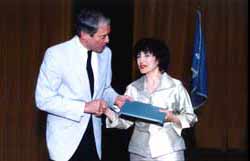
Columbia University President George Rupp presents Dorothy Rabinowitz with the 2001 Pulitzer Prize for Commentary.
Winning Work
By Dorothy Rabinowitz
For those falsely charged and imprisoned for long terms, freedom is, at best, complicated -- harder than anything they imagined in the years behind bars, and different in a thousand ways, most of them disturbing.
None of this can they know, of course, at the beginning -- the day of release, with rejoicing family and friends and the clamor of reporters inevitably on hand for these occasions. It takes a bit of time, after the joy and celebrations, the gratitude for exoneration, to grasp the realities of the life to come. True, it took hardly any time for the nearly 70-year-old Violet Amirault to size up the chaos confronting her, when she was freed, penniless -- no more than two days before, she began to murmur that, in prison, she at least knew where she was and what was going to happen the next hour. The feeling did not last long, but neither did her life in freedom, such as it was.
At his homecoming party the day of his release, former Miami police officer Grant Snowden suddenly stopped at the fence of the house while everyone else in the group walked through. He laughed, recognizing the reflex -- a former prisoner who did not yet walk easily through barricades. Nor would much else come easily, not sleep, relationships, finding a job, or any other aspect of life other, perhaps, than his long morning runs. Freedom had come after he had given up all but the frailest hope. Sentenced to a remarkable five life terms, he had served 12 years, and seen all his state appeals denied when, in March 1998, a federal appeals court threw out his conviction.
At the party following his release, reporters and family members crowded into his mother's small house and the guest of honor looked a happy man, confident of the future ahead.
It did not take long for the realities of that future to sink in, prime among them his trouble finding a job. Because of practices peculiar to Florida's record system, every job he sought brought a computer check that showed convictions on charges of child sex abuse, notwithstanding the court's reversal. His failure to find work made him ever more despondent, struggle though he would against the feelings, which he tried to conceal from family members, his mother in particular. He was, after all, supposed to be grateful for his deliverance, exonerated, free, and about to begin to live again -- except that he felt neither free nor that he was doing much living.
He felt, instead, tense most of the time, along with the beginning of a growing anger. As he had before, endlessly, he thought about 1984 and the baseless charges that had blown his life apart. The difference now was that he was a free man and had begun to think like one -- to consider all that had happened and to ask why no one would be held responsible.
In February, his life took a distinctly happier turn, when he married a spirited and attractive high school government teacher. He considers himself the most fortunate of men to have found her, Grant reports. In addition to all else she brought to the marriage, she had a friendly former husband who also happened to be an attorney. When a letter arrived from the Florida Department of Law Enforcement which announced that Grant Snowden was listed as a sexual predator, that he had to register as one and have his picture distributed in his neighborhood, Mrs. Snowden's former husband undertook to straighten the department out, in no uncertain terms. Grant soon received a letter acknowledging the error.
Having joined the fray, the sympathetic attorney is now trying to correct the file on Grant Snowden so that erroneous reports no longer pop up on the computer. He has much to be thankful for, he is the first to say -- friendship, support, his wife and a job moderately more satisfying than any he has found up to now. All that he lacks is a way to blot out the past.
The realities of their new-found freedom came early to Carol and Mark Doggett, among the numerous citizens of Wenatchee, Wash., falsely accused of child sex abuse in the mid-'90s. New York appellate attorney Robert Rosenthal, who had succeeded in winning Grant Snowden's reversal, also undertook the Doggetts' appeal, won in 1997. Afterward, he told the couple, who had served three years of a 10 years-10 months sentence, that they had about 90 days to enjoy their period of gratitude and exhilaration. After that the rough times would likely begin.
A little more than a month after their liberation, Mrs. Doggett called the attorney to say she and her husband were ahead of schedule. The hard times had already arrived with their efforts to get the state to return their children, sent to foster care when Mark and Carol were accused of assaulting them sexually. Among other allegations, the Doggetts were supposed to have forced their five children to line up outside a bedroom door, nightly, to await their turn to be raped by their parents.
That was in 1995. The courts have since then thrown out one conviction after another in Wenatchee cases, and a few weeks ago -- to avoid the prospect of another reversal -- prosecutors set free the last of the 21 people sent to prison in the now infamous sex ring case. The news made 42-year-old Carol Doggett want to jump up and down and shout aloud for happiness, she reports. The normally self-contained Mrs. Doggett could do nothing of the kind since she was, as it happened, at her office job at the time, but it is possible to hear in her voice the power of that impulse.
Neither she nor her husband have had many occasions for great joy since their release though there have been a few -- not least when the day came that saw every one of their children finally returned.
The last child to come home was the youngest, nine years old at the time her parents were tried, and now in her teens. Before she could return, a court-appointed psychologist had to examine the girl, her parents, look into the family history and at general conditions at home. After concluding her inquiry, the psychologist delivered her report, in which she concluded that Carol and Mark Doggett had never molested their children, but the youngest girl had indeed been injured. She had been traumatized, the report said, by the separation from her parents.
The couple had emerged from prison without funds, or credit. Carol, who had graduated from college with a degree in business, found work in a grocery store and then, with the help of a friend, found her current job working with computers. She and Mark were fortunate in their friends, she says, and were luckier than most people in their position.
"We survived, we have our children."
Survival meant, among other things, learning to deal with the the nightmares that came regularly, and with certain recollections of life in prison. When the couple moved to a different community, she began to cry on entering the church. She could not say exactly why. She sensed it had to do with the degradation of life behind bars. No other woman in that church had ever been strip searched as she had -- a regular event in prison, memories of which filled her with rage and humiliation.
She does not appear a woman easy to humiliate. Nor was she, in prison, when other women cursed her as a child abuser. Only one thing terrified her in prison, as it did Mark, and that was the fear that the children would not survive.
Her husband drives a forklift to make money now, a job that gives him altogether too much time to think about things. A tall man with an easy manner, he is concerned mainly with one thing -- justice -- an idea seldom far from his thoughts. Or Grant Snowden's either.
"All the people responsible -- the prosecutors, the investigators -- they're untouched." For them -- after all the proof of the trumped-up prosecutions, people thrown into prison, the children ruined -- there are, Mark Doggett observes, no consequences.
It is a common enough response, among those in his situation. Like many accused citizens, he had had faith in the legal system, and in the protections guaranteed by the Constitution. So, too, had Grant Snowden and the Amiraults, owners of the Fells Acres Day School. They believed that democracy and fairness and the American system would see them through -- would assure that a jury could not possibly believe lies and wild stories, of the kind offered as evidence against them.
When they were convicted and sentenced, they knew that innocent citizens could be found guilty of horrible crimes they never dreamed of, that they could be separated from society and sent away -- in the case of those falsely accused of child molestation, to multiple life terms.
Even so, an ingrained belief in justice is not easily abandoned. When they emerged from prison, it was justice they sought, even as they understood that they would find none. They understood, and it haunted them, that there there would be no consequences to the prosecutors and the investigators, and still they thought of justice.
Cheryl Amirault has her mind on other matters. There is as yet no news from the Massachusetts governor's Board of Pardons, whose months-long pondering of the question of a pardon for Gerald Amirault -- an epic frozen in time -- has brought no decision.
For Cheryl, the days have only one focus. The mornings are not wonderful, the nights worse, nothing is quite right till she arrives at her job. Work has been her curative since the Amiraults were first charged in the early '80s. In 1983, when authorities closed the Fells Acres Day School, with her picture in the papers daily, she threw herself into her job at United Parcel Service, where she worked up until the day she and Violet stood trial.
Today she works with customers at John Hancock Financial Services. She arrived as an office temporary and was soon hired full time, all the while wondering whether her bosses and co-workers knew anything about her.
More to the point, she had some concern about what they would say if they did -- which she found out, soon enough, when she had been employed at the company six months. In late 1998, the day after a detailed media story on the case, she was called to the office of two company directors -- a summons she answered trembling with apprehension.
Their message was brief. They wanted to tell her, the directors told her, that they were proud to have her as an employee, and that they wanted her to know that.
Back at her desk, she found a flood of supportive e-mails from workers, another measure, she thought -- before tears overcame her -- of the credibility people now ascribed to the charges that the Amiraults were child-molesters. Every time something happens in the case, the e-mails pour in, the directors call, to ask how things are.
It would be nice, she observes, if the rest of life, or for that matter, the nights in her own bed, could be as soothing and free of anxiety as a busy day at the office. Every day she felt compelled to fight the case. While Gerald is still in prison there is no rest. Every day -- because prosecutors placed her on 10 years' probation in the deal in which they allowed her to remain free -- she must call the probation officer. Once a week, without fail, she has to submit to a urine test for drugs, though drug problems are no part of her record.
On a recent morning, she awoke feeling strangely rested, and realized that she had had, for the first time she could remember, no nightmares -- a regular event she took for granted. The dreams are almost always the same. She and her mother and brother are all back, running the Fells Acres Day School, which they love, and where they are happy, with the children all about. Yet she is terrified, as she runs to the windows, fearing that the police will come, as they always do.
© 2000, Dow Jones & Company
By Dorothy Rabinowitz
"People only hear about them when they involve prominent people. A person who has earned a pardon shouldn't be denied one merely because he's prominent."
It is not a scene it would have been easy to envision even a few years back -- Rudolph Giuliani, the mayor of New York, and Michael Milken, former financier, discussing diet, exercise and other health regimens over lunch at the mayor's table. Mr. Milken, recall, had had a spectacularly successful career till 1986, when he was charged with securities trading violations and dispatched to prison for two years. Mr. Giuliani was the federal prosecutor who put him there. Now, in the season of hope and joy, there are some who think that it's time for a presidential pardon for Mr. Milken, Mr. Giuliani among them.
It took the mayor some while, to be sure, to decide he should say this straight out. This he did late last week, after a night's pondering as to how much to say, or whether to say anything at all beyond a statement he had issued early in December, expressing admiration for Mr. Milken's contributions to cancer research and somewhat guardedly noting that support for a pardon was something to which he would have to give serious thought.
'I'd Congratulate Him'
He had, it turned out, quite a bit more to say in the course of a phone conversation. He had served in the Justice Department in both the Ford and Reagan administrations, Mr. Giuliani pointed out. He knew what it meant to issue a pardon and who deserved one, and he knew this much, about a pardon for Michael Milken:
"If I were there sitting in my old place in the Justice Department, I would recommend one, and if I were the president I would sign one, and if the president does sign one, I'd congratulate him."
It is clearly his view that Mr. Milken long ago earned his pardon -- for the cancer research funds he has generated, for his work educating the public about the disease, and a variety of related reasons about which Mr. Giuliani is prepared to hold forth at length. Well before the mayor received word that he, too, had been diagnosed with the disease -- as had Mr. Milken, seven years ago -- he had been attending and speaking at dinners for CaP CURE, a Milken foundation for the cure of prostate cancer. He went in order to educate himself, said the mayor, because his own father had died of the disease.
"You don't really think you're going to get it. But the last dinner I attended came at the period of time my doctors suspected I had it, when my PSA levels were high."
He had sat at the same table with Mr. Milken at one such dinner, Mr. Giuliani recalls, but it was not until he had been diagnosed, last April, that the two actually talked at all. Mr. Milken called him. In the 21/2 hours Mr. Milken spent lunching with his former prosecutor, he dispensed advice and information, and instructed Mr. Giuliani in stress reduction and nutrition and other matters having to do with the effort to cure cancer.
Neither the prosecution, nor any matter remotely related to it, came up in the course of their talk. When they parted, Michael Milken left behind a large quantity of material about the disease and modes of treatment and, no doubt, an incalculably larger store of gratitude.
The mayor isn't disposed to conceal the part gratitude plays in the way he views Mr. Milken, nor could he easily do so; Mr. Giuliani is not renowned for his talent for concealing his feelings. Even so, he is quick to assert the influence of a larger issue -- the promise of Mr. Milken's tireless work toward a cancer cure, his educational seminars on prostate cancer where doctors glean the benefits of cutting-edge research, the thousands of people who have already benefited, and will in the future.
As he describes all this, it is impossible to miss -- gratitude aside -- the mayor's enchantment at the encounter with prodigious talent, with the formidable will and drive Mr. Milken has shown.
"His knowledge is as refined and substantive as any doctor I've talked to," Mr. Giuliani mused. "Its not just the money, it's the organizational skills he brings." They were the same drive and skills he once applied to his business, Mr. Giuliani notes.
The same drive, Mr. Giuliani might have noted, that led to the famous career which ended in U.S. Attorney Giuliani's own tireless pursuit of Mr. Milken, and ultimately in Mr. Milken's agreement to plead guilty to securities trading violations.
To obtain this end -- Mr. Giuliani had by now gone off to other things -- a team of government prosecutors offered Mr. Milken a deal they thought he couldn't refuse. They would not prosecute his younger brother, Lowell, if Mr. Milken would plead guilty to five violations. The prosecutors were right; Mr. Milken did not refuse.
None of this is any part of Mr. Giuliani's conversation, but it is understood. "Look," he will only say, "we're talking about the mid-1980s. People change. There were people who felt he did nothing wrong -- and I heard about that -- and others thought he committed serious crimes." From the president's point of view, Michael Milken was convicted of a crime. The question, Mr. Giuliani said, was where he was now, all that he has done and is doing.
In the course of his consultations, the mayor said, he has talked to at least 50 physicians and discovered thereby how many of them used techniques they had learned in seminars run by Mr. Milken's foundation. One doctor told him how much he had learned in one of those seminars. "Then he stopped and smiled a little and said, `Oh -- maybe I shouldn't say that to you.' "
He wanted it made clear, the mayor emphasized, that no one had asked him to do this -- speak out for a pardon -- neither Mr. Milken's people or anyone else.
This is not hard to believe. Mr. Milken and his attorneys -- never talkative to begin with -- have thrown up an impregnable wall of silence, lest anyone suspect their involvement in any campaign to engender a presidential pardon. As far as they are concerned, there is no campaign.
A Thousand Petitions
Even so, Mr. Giuliani is around to say that he had in his time put his name on a thousand pardons, that they are granted all the time. "People only hear about them when they involve prominent people. A person who has earned a pardon shouldn't be denied one merely because he's prominent."
Mr. Milken's is a prominent name all right, and there is, he knows, no way of knowing what the president will do.
Having worked on so many pardons, he had learned a few things about managing them. If the president intended to give one to Mr. Milken, Mr. Giuliani said, finally, as the Christmas weekend drew near, this was the moment.
© 2000, Dow Jones & Company
By Dorothy Rabinowitz
In the spring of 1996, a university official asked 20-year-old Brandeis junior David Schaer to come to her office. His presence would be helpful, the associate director of the Office of Student Life informed Mr. Schaer, because a student he had briefly dated on and off was upset, and needed support. Perhaps he could just come and listen to her.
He was more than willing, aware as he was that a sexual encounter with the woman a few weeks earlier had gone awry, leaving them both discomfited. What he did not know, as he entered the Student Life office, was that he was already the subject of a charge the woman had just filed with the Brandeis police -- that he had, in the delicate phrasing adopted by the university, committed an act of unwanted sex -- and that anything he said at this meeting would figure in future testimony against him. Indeed, he was the only one of the three people entering that meeting who was unaware of his actual situation, for as it turned out, Alwina Bennett, the Student Life official who had requested that Mr. Schaer come and listen to his friend, had herself escorted the woman to the Brandeis police.
When the three met in her office, Ms. Bennett suggested the woman ask Mr. Schaer why he thought he was there. It was a query he would have cause to remember.
"I think you feel I took advantage of a friend," David Schaer replied, well aware of their conversation the day after, of the woman's dismay and her hostile tone, of his own heated response that he had done everything she told him to do -- stopped when she said stop, continued when she said go.
By the time the office meeting ended, he had learned of the police complaint and also that the woman held him responsible for the perilous emotional straits in which she found herself -- for trouble she had sleeping, focusing and doing her schoolwork. She told him that his offense against her was the first thing she thought about each morning and the last thing on her mind at night, according to the account provided by the associate director of student life. "You knew because I was drunk," the woman charged, "that I couldn't consent to have sex with you."
When the accusing woman had departed, a much-shaken David Schaer asked if he could tell Ms. Bennett what had actually happened that night. He had absorbed all the strictures about consent he had learned at school, about the woman's right to set the boundaries and say stop at any point -- had not only absorbed them but embraced them. No, she did not want to hear it, the associate director replied. "I am the complainant's support here," she instructed Mr. Schaer, now near tears. He pressed her with questions and asked again if he could tell her his side, the official recalled in her later deposition. Noting his emotional state, she suggested he instead find somebody else to talk to. She knew of no men's support groups, Mr. Schaer remembers being told, but she was certain he could find one.
Finding a men's support group was not prime among his concerns as he left the familiar halls of the Student Life building where he had worked and earned a certain respect, as he thought. The son of a middle-class family from Armonk, N.Y., the tall, robust-looking Mr. Schaer, a biology major, had been exceptionally taken with the life he found at Brandeis. Quite simply, he loved the school and felt a powerful connection to it -- one far greater than any of his campus friends felt, as an ironic former classmate recalls. Two aspects of his life at Brandeis he valued above all -- his work in the freshman orientation program and his role as editorial board member and photo editor of the campus newspaper.
In the weeks to come, he would lose one and be threatened with the loss of the other, and these would be, compared with everything else, the least of his worries. None of this did he begin to grasp as he left the meeting, distraught, to talk to family members and friends. Neither could he have imagined, now, the elaborate maze of charges, proceedings and hostilities ahead, all of which would end up in a case that reached Massachusetts' highest court.
This was no ordinary he-said, she-said conflict, the kind common in charges of date rape, a term now shunned by many university officials who instead use the term "unwanted sex." However it was described -- and a Massachusetts appeals court would have something to say about that -- it was trouble, begun in the early hours of Valentine's Day, 1996. About how it began, there is no dispute. Following a party where she had a few drinks with friends, a group that did not include David Schaer, the complainant retired to her room. Somewhere around 11:30 p.m., she called him and asked him to come over. He was reluctant, Mr. Schaer attested, and she persistent in her request that he come over, so they could "fool around." He told her he would call back. In a second call to him, around 1:15, Mr. Schaer said the complainant told him she wanted him to come and sleep over -- she would go down and unlock the door for him. He was to take his shoes off, so as not to wake her housemates.
Asked, in a later deposition, what was said in the calls to Mr. Schaer, his accuser said that she did not remember. She did, however, remember -- under questioning by Mr. Schaer's attorney -- the purpose of the first call and the plans she made with Mr. Schaer.
Q: "What was the purpose?"
A: "So we could fool around."
Q: "What do you mean by fool around?"
A:"I don't know."
Q:"Fool around sexually?"
A: "Yes."
Q: And had she made another phone call to Mr. Schaer? Yes, was the answer. And what was the purpose of that call?
A:"To see where he was."
Q:"To find out whether he was coming over?"
A: "I don't remember."
On the Feb. 14 in question, of course, the depositions and the courtrooms, the campus judicial procedures and the bitterness that flowed from it all lay far ahead. Mr. Schaer had felt a touch grim when he left the woman's room that morning, suspecting that he had been summoned there as a replacement for the man she was actually interested in, who was ignoring her. This was the reason, he was certain, for the sexual debacle that had just ended.
Their prior brief encounters, which consisted mainly of oral sex and one incomplete exercise in intercourse, had not been notably joyful either.
This night they began with oral sex, which she soon asked him to stop, as he did. Then vaginal intercourse, which she apparently found painful and told him to cease. Mr. Schaer attests that at this point he asked if she would like him to leave, but that she told him to stay -- she didn't mean to drive him crazy. After some conversation he understood that she was brooding about Jeremy, the man who dropped her, and who was, she suspected, probably in his room with another woman. Mr. Schaer offered to call and see, and was soon able -- after a chat with Jeremy -- to provide the comforting news that he was alone. Her mood somewhat improved, she got up and fumbled around in her desk to get one of the condoms she kept there -- a lubricated kind, he thought, unlike the sort he brought. Now came another, longer coupling that she asked him to stop because she wanted to perform oral sex on him. This time, Mr. Schaer says, he asked if he could continue a few moments and finish, and that her answer was yes, and he should hurry up.
In the complainant's future version of events, she knew of no phone calls to Jeremy, she had not obtained a condom from her desk, she told her visitor she wanted no sexual activity and she in fact had been asleep when she found him entering her.
The day after the episode she called Mr. Schaer to express her unhappiness, to say she didn't know how her clothes had come off, and that she didn't know what she was going to do. What she was going to do was to become clear enough five weeks later, with the filing of her complaint.
In April, a Brandeis hearing board composed of five students and two faculty members met to consider the complainant's accusation that Mr. Schaer had called and then visited her and engaged in unwanted sexual activity. At this hearing, to which the accused and accuser both brought witnesses, the consequences of the conversation at the Student Life office, to which he had been summoned to help a friend, soon became clear. The associate director, Ms. Bennett, testified -- as witness for the accuser -- that David said, in her presence, that he "took advantage of a friend." This would be presented as an admission of guilt, and officially recorded as evidence against him -- notwithstanding Mr. Schaer's bitter reminder that he had said something quite different. Also among the accuser's witnesses was the Brandeis police officer who had taken the complaint. Sgt. Betty Tehan told the hearing board that that the complainant "looked like a rape victim."
The members of the hearing board went off to consult and returned with a conviction. As the associate dean of student affairs put it in a statement, this case was about the lack of respect for the complainant's "integrity and personal rights and physical abuse which endangered her welfare, and David's unwelcome sexual advances which had the effect of interfering unreasonably with the complainants's educational and living environment."
David Schaer, as a consequence, was to be punished with a three-month suspension -- from the day of his last spring final through August, during which time he would be barred from campus and all activities. He was to be on probation for the remainder of his time at Brandeis, and to undergo counseling.
These sanctions were far from the ones envisioned by the accuser, who wanted David Schaer suspended for no less than three years, and to be forced to resign at once from all student organizations and activities. Passionate in her belief that Mr. Schaer had escaped the measure of punishment due him, she protested to the administrators. Ms. Bennett warned Dean of Student Affairs Rod Crafts that such a brief suspension would cause discomfort and angst in the women's community.
Mr. Schaer in the meantime became the target of vocal hostility from the accuser's supporters, directed by a leader of the Committee on Rape Education -- demonstrators not inclined to the university's preferred language, or distinctions like "unwanted sex." "Rapist Go Home" read the signs confronting Mr. Schaer, around his living quarters and elsewhere. Petitions went around asking that he be made to leave the campus at once.
He was, the dean of student affairs now warned him, "damaged goods," and it would be better if he transferred to another school. If he did so in time -- before the sanctions were officially handed down -- nothing would go on his record.
For David Schaer, daily life at Brandeis was now, indeed, a gauntlet to be run, where fellow students ran up to tell him he was disgusting and to say he should leave. His circle of friends, men and women, stood by him, which helped, but it could not alter the fact that the university of which he had been so proud now dealt with him as an outcast.
Still, he would not cast himself out. In June, his Massachusetts attorney, David M. Lipton, filed a seven-count suit in superior court, charging the university had failed to honor its own code and accord Mr. Schaer basic rights. He asked also for an injunction of the suspension. To allow the lifting of this suspension, Brandeis attorney Alan D. Rose told the court, would surely imperil young women -- freshman and others -- on the campus during the summer. This was an odd argument, given the brevity of the suspension and the fact that Brandeis was prepared to receive Mr. Schaer again in September. Harvey A. Silverglate, the Massachusetts attorney who filed an amicus brief on Mr. Schaer's behalf, observed that in the current political arrangements on the campuses, a summer suspension is the penalty handed down for the innocent.
Rejected by the lower court, Mr. Schaer proceeded to an intermediate appeals court, where a three-judge panel ruled that he had indeed cause to proceed with a case against Brandeis University. Noting the language used to charge Mr. Schaer, the author of the opinion wrote, "Stripped of euphemism, Brandeis's complaint against Schaer was that he raped a fellow student." The university hearing panel had moreover allowed "irrelevant and inflammatory evidence," and failed to apply the clear and convincing evidence standard. No one interviewed Mr. Schaer before the proceedings, and the court found there was nothing in the record to show anyone had evaluated the accuser's credibility. Brandeis officials have refused all comment, though at least two expressed astonishment that Mr. Schaer would continue arguing his case.
Ten private colleges in the area filed briefs in support of Brandeis when that university appealed to the Supreme Judicial Court of Massachusetts. The colleges feared intrusion into their internal judicial proceedings, and worried that if the judgment should stand, they could be swamped with litigation commenced by students brought up before panels like the one that sat in judgment on Mr. Schaer. They had, indeed, reason for concern, considering the vast complex of offenses, sexual and other, on which university panels now sit in judgment -- accusations of intimidation, "creating a hostile environment" and similar vague offenses. In the university justice system, there are no questions as to evidence of the accuser's credibility, no judges asking if the administrators have troubled to talk to the accused.
The colleges were relieved of their concerns in September, when the Supreme Judicial Court of Massachusetts ruled for Brandeis, declaring, among other findings, that the university need not adhere to normal due process standards, but could act in accord with its own standards of justice. The colleges had a close call -- a 3-2 opinion.
In turn Mr. Schaer managed -- after a final year in which he was regularly reviled as a rapist -- to graduate from Brandeis with honors, to enter graduate school and to meet the woman who would become his fiancee. It had been, in all, an expensive education.
By Dorothy Rabinowitz
Just look at those undecided voters, a mass of whiners with oatmeal for brains, sitting around relishing their newfound significance. And who can blame them, with pollsters and members of the media hanging on their every incoherent utterance.
My fellow Americans:
As this election approaches its end, I want to tell you that however it comes out, it was a rare honor to have run for the office of president. From boyhood on through my adult life I've looked at Washington with reverence, wanted to be a part of the place. Few milestones in my life were more thrilling to me than the day I got there. I'm a Washington insider, my fellow citizens, and proud of it.
Oh, I know that for some time now politicians have been thinking they could get a lot of mileage by running against Washington and saying they were Washington outsiders. Every time you hear that claptrap a bell should go off in your heads, as it does in mine -- the signal that this is yet another politician who sees the electorate as a collection of dolts.
Dolts susceptible to the notion that integrity and high principle and common sense are virtues rooted mainly in what's known as the heartland and other places far from the centers of power and glitter, far from the cities and their corruption. You know the places that are supposed to turn out straight shooters -- the small-town Edens -- where the wind comes sweeping down the plain, and the waving wheat sure smells sweet. Apologies here to "Oklahoma!" and Oklahomans, who reside, need I say, in a wonderful state.
My friends, while I'd like to go into all the implications of the sniping at Washington, time is short, so let me just suggest to you that when candidates running for the highest office in the land spend a lot of time preening themselves on their roots and their distance from Washington, you ought to do them a favor and make sure they don't have to set foot in the place.
I suppose, my fellow Americans, by now you're wondering why I've made no mention of children yet. I care for children as much as anyone and I have a couple of my own, but for the life of me I can't imagine why every politician breathing can't get a speech out that doesn't suggest that, if elected, he as the leader of the free world will be preoccupied mainly with children.
When did you last hear a political speech that wasn't swimming in bilge about our children and our children's future? And we're not just talking domestic politics. Here we have Madeleine Albright, secretary of state, who can find nothing better to tell us -- as Middle Eastern war breaks out -- than that the children's hopes for peace have been dashed. Has everyone gone mad?
I want to assure you, since no one else is ready to do so, that I know there are a great many other quarters of the population beside children who merit our notice. That would include the huge numbers of taxpaying citizens who don't happen to belong to that revered category known as a family. When was the last time you heard any notice taken of them in all the blatherings about family-friendly this and family-friendly that? There was once a point to the use of terms like "my fellow Americans." It was meant to encompass everyone, but that, of course, was long before we were sliced into interest sectors: parents of small children, the elderly, minorities, gays and young-adults-who-may-be-cheated-out-of-Social Security.
So be it. I repeat, I want the best for my children and all of America's children, but I promise this fellow Americans. If elected I'll see to it that a tax credit goes to citizens who pledge to withhold their votes from any politician who has shown himself unable to speak three consecutive sentences without mentioning "our children" or "our children's future."
I'd like to say, too, as this campaign ends, that I don't consider myself fit to be president. Really. I would say they've lowered the bar a lot for the highest office in the land, and I'm terrified to think how much, when I let myself think about it at all. My opponent and I -- this is the best America can do? One of us is going to stand up and be sworn in as the new president of the United States? I suppose others in my shoes have had the same feeling, so maybe it'll all work out.
I tell you this, though. If they lowered the bar for presidential candidates, it's been lowered for pollsters too, not to mention the sources they keep consulting. Just look at those undecided voters, a mass of whiners with oatmeal for brains, sitting around relishing their newfound significance. And who can blame them, with pollsters and members of the media hanging on their every incoherent utterance. Of which they're careful to utter very few, lest somebody get the idea that they've decided and -- poof -- the pollsters and reporters go away.
So there I was, my friends, watching the television the other night where they were showing some of these undecideds being interviewed. Somebody told one couple that they sounded like people who had come to some decision -- had they?
Well, you'd have thought they were going to fall down dead in horror. Heavens no, the woman said, they hadn't decided -- there were still reporters who said they needed to come and interview them. You know, my friends, I just turned to my wife -- and I'm going to point out here that I don't usually mention my wife or children or mother or any member of my family, because I'm tired, as you must be, of all the spouses and relatives dragged into candidates' speeches for no good reason. Well, just this once I can say, I told my wife: "Honey, if any one of these undecided nitwits decides for me, I'll figure I have something to worry about."
My fellow citizens, I thank you for your time and your patience, and, if elected president, I'll be asking for your prayers, which we are certainly going to need as never before. I, in turn, promise to uphold what's left of the honor of the office. May God bless America.
© 2000, Dow Jones & Company
By Dorothy Rabinowitz
On Sept. 20, police guards escorted Gerald Amirault to a small Boston hearing room soon to be crowded with relatives, friends and other interested parties.
Here, the last imprisoned member of the Amirault family would meet with the governor's board that recommends approval or denial of commutation appeals. He was permitted a suit and tie for this occasion, and an occasion it was, there could be no doubt. Few prisoners seeking commutation are granted a hearing before the board, as Gerald Amirault and his attorneys knew. They knew, also, how few such appeals are granted.
Among the others here today were Gerald Amirault's wife, children and extended family, a quiet crowd with an air of slightly exhausted anticipation. They had attended many hearings, awaited many decisions, always wary of hope, and invariably, uncontrollably, hopeful nonetheless.
Near them, just across a narrow aisle, another silent contingent of spectators sat. These were the parents and other relatives of the children who testified at the mid-1980s trials of Violet Amirault, the owner of the Fells Acres Day School in Malden, Mass., her adult daughter Cheryl, and son Gerald.
Famous throughout the state and well beyond, the charges against the Amiraults involved atrocious sexual crimes, notably identical to those of most of the other renowned prosecutions of child care workers mounted during this period. The 60-year-old Mrs. Amirault was accused of raping a child with a magic wand, of assaulting another sexually with a large butcher knife, Gerald of abusing children in a magic room while dressed as a clown, and Cheryl of similar unspeakable violations.
Children said that the Amiraults had slaughtered bluebirds, that Cheryl Amirault herself had cut the leg off a squirrel and killed a dog, to name just a few of the charges soberly recorded by the abuse investigators. All across the nation where these trials were held, the clowns and magic rooms and mutilated animals had made their appearance in testimony presented by prosecutors. After two sensational trials based on the testimony from the four- and five-year-old child witnesses, Gerald was sentenced to 30-40 years, and Violet and Cheryl to 8-20 years.
One of those witnesses for the prosecution today sat amid the knot of Fells Acres parents. In her early 20s now, the former nursery school pupil had come, like the parents, to argue against commutation of Gerald's sentence.
First, however, would come certain procedural matters, instructions, introductions, ground rules, and a roster of other speakers, beginning with Gerald -- Gerald who had only to begin speaking to undo every shred of the calm formality with which these proceedings had begun. A palpable tide of emotion flooded the room as he addressed a board composed of three former prosecutors, a former state trooper, a former probation officer and a victim's representative.
He had been in prison more than 14 years, most of them in segregation units; he had tried, all that time, to figure out how this misery had come to him and his family and he had failed, Gerald told the Board of Pardons. He had no answers. He was not an expert. He asked now, he said, only for an end to the nightmare in which he and his family had lived for so many years. He asked also that the Board not hold it against him that he refused to confess that he was guilty, now as always, and that he would continue to do so. "I am absolutely innocent of all these charges."
Under exhaustive questioning by a Board member, he readily conceded that he had entered no prison program for the rehabilitation of sex offenders all the years of his imprisonment. He was not a sex offender, Mr. Amirault carefully explained, by way of response.
The subject was thorny, given the prevailing view in the corrections system that convicted offenders must accept guilt to be considered rehabilitated. Like his mother Violet (now deceased) and his sister, Gerald had continued to assert his innocence from the first accusations, made in 1984, on through all the years of their incarceration. What their refusal to confess guilt cost Violet and Cheryl was abundantly clear in the reports rejecting their parole applications.
"Parole denied. Vigorously denies the offenses," noted the 1992 decision on Violet. The report concluded that the 66-year-old Mrs. Amirault therefore remained, "a risk to the community if released." On Cheryl's parole applications, it was noted that she had committed "heinous crimes for which she takes no responsibility."
Also on the list of those addressing the Board this day were Gerald Amirault's wife, his teenage son, and his two conspicuously handsome daughters -- one a college senior of 21, the other 20 and in her junior year. Their voices breaking, each described the father they had known as children and knew now, the father shut away but at the center of their lives nonetheless. The agony of all the years had pressed itself into these voices raw with longing and grief. In the small hearing room, people fought tears, or stared straight ahead with a trapped look. At the rear of the room, the same briskly professional security officer who had searched everyone sat and wept.
Mr. Amirault's attorney, James L. Sultan, affirmed in his own statement that this hearing concerned only the question of commutation, and of disparate punishment for the same crimes. That disparity was obvious enough in Gerald's sentence as compared to the one given the women. Now, the attorney pointed out, the Board could see evidence of a still more glaring inequity. Last October, when her court appeal had been rejected and Cheryl faced return to prison -- amid widespread publicity -- the District Attorney agreed to revise and revoke her sentence to time served. Yet today, the DA adamantly opposed any such relief for Gerald. That was the issue, Mr.Sultan averred; he understood that it was not the business of the Board to address questions of guilt or innocence, or the merits of the prosecution.
Everyone understood. And still there was no way to ignore the elephant in the living room -- that huge body of opinion, legal and other, which now saw the case against the Amiraults as a sham built on accusations coaxed from children drilled in stories about a bad clown and a magic room. Three lower court judges who had looked at this prosecution were of the same emphatic opinion, and had made no secret of the fact.
In the end, it was the representative from the DA's office who would bring the elephant trundling in, however inadvertently, and remind everyone of all that had made this case notorious. Notwithstanding the stricture against arguments about guilt or innocence -- which the Board is not supposed to consider -- Lynn Rooney, the Asst. District Attorney, began an impassioned address on the case and Gerald's crimes, as well as on the testimony of the children, which she now recited in some detail.
Here again was the magic room in which Gerald attacked the small victims while disguised as a clown; the story about Violet Amirault terrorizing children with threats that they would never see their parents again if they told; another darkly meandering one about Violet selecting certain children to be left behind while others went on field trips, and how she had taken children from one classroom and put them in another. The families had suffered greatly, the children were prone to obsessive compulsive disorders, the Asst. DA argued, and they needed closure. Above all, Gerald Amirault had not even confessed to the crimes that had ravaged their lives. If there were some acknowledgment that he committed the crimes, the Asst. DA maintained, "the parents could begin to process this event."
Board member John Kivlan brought Asst. DA Rooney back to the issue at hand -- the question of the different treatment for the same crimes. Had the DA not agreed, last October, to revise and revoke Cheryl's sentence? And if that was the case, why should Gerald not be treated the same, the questioner wanted to know.
Gerald had been the ringleader in the crimes, the Asst. DA responded. The number of Gerald's crimes was greater. He would pose a danger if freed, whereas Cheryl had proven her reliability, since being freed, by committing no new offenses.
Mr. Kivlan pointed out that Gerald had also proven himself when he stayed free on bail without incident, in the two years he spent awaiting trial. And weren't the crimes charged to Violet and Cheryl the same as those Gerald was accused of committing? Mr. Kivlan, a former prosecutor, pressed relentlessly for answers. If it had been right to make the agreement freeing Cheryl so that the families could have some sense of closure, as the Asst. DA argued now, why wouldn't they be interested in closure in Gerald's case?
To all this, Ms. Rooney responded with further details of the suffering Gerald had inflicted, of the needs of the families and the children. This emphasis may have moved Board member and former prosecutor Maureen Walsh to ask gently whether -- in addition to the families' needs -- society's concern for justice might also be important.
The Asst. DA did not have an easy time, all told. None of the prosecutors who had tried and convicted the Amiraults was present today, nor anyone else from the current DA's office -- absences that said a good deal about the attractions of being identified with this case.
The argument that Gerald was the ringleader who had committed the most terrible offenses was nowhere borne out in the records. These, filed by the then DA Scott Harshbarger, who brought the case, described the crimes alleged against Violet and Cheryl and Gerald in identical language, and emphasized that there were no mitigating circumstances to explain the acts of these perpetrators.
Finally, the Fells Acres parents came before the Board to attest to the anguish they had endured as a result of the crimes. As ever, they asked that the press not reveal their identities. The parents all declared that they lived with the results of the Amiraults' crimes every day, and that nothing could atone for these crimes. One told the Board, with passion, that in her view Gerald never should be free, that a life sentence would have been appropriate. No therapy would ever be enough, another said, to undo the effects of the Amirault's crimes. Clearly for them, Gerald Amirault's lengthy sentence was the confirmation of their case -- the proof of the charges and the confirmation of their suffering.
Finally, the former Fells Acres pupil came forward, flanked by her parents. A massively overweight woman, she described, tearfully, the problems afflicting her as a result of her victimization -- which included, she said, her weight problem. Unable to control her trembling, she asked, fervently, that Gerald's commutation petition be rejected.
There could be no doubting the parents' conviction that their children had been violated and tortured in a magic room, terrorized by their teachers. Nor could there be doubt of the former child witness's certainty that she had endured unspeakable horrors at her preschool, and been sexually assaulted -- a belief now the defining fact of her life and identity. The grievous results of prosecutions like the one that swept the Amiraults off to their ruin came in many forms.
When the proceedings were over, the Amirault family filed out, spent, to await the decision that represented the last real hope for Gerald's freedom. To be sure, there isn't much in the statistics to encourage hope. Between 1988 and 1997, there were 270 petitions for commutation, of which just seven were granted. The recommendation of the Board of Pardons is expected within the next several weeks.
© 2000, Dow Jones & Company
By Dorothy Rabinowitz
Late on a Friday night in July of 1995, Patrick Griffin was arrested, handcuffed and taken off to a holding cell, charged with sexual assault of a patient. The 41-year-old New York City gastroenterologist was held at the Tombs for some 30 hours, time enough for him to absorb, perhaps for the first time, the depths of the peril confronting him, thanks to allegations made months earlier by a long-time patient. He stood charged with the crime of oral sodomy, alleged to have been committed on a 43-year-old woman while performing a colonoscopy on her in his Central Park West office.
His arrest brought a flood of calls from patients who expressed incredulity or who wanted to know what was going on. What the rest were thinking -- the ones who didn't call -- he would never know. What was clear was that everyone in his practice knew within hours that their internist had been taken off to prison as a sexual predator.
Crimes charged to doctors are a news event, especially those involving sex, and this one was no exception. Not long before Dr. Griffin's arrest, a young intern had been marched out of St. Lukes-Roosevelt Hospital in handcuffs when an emergency-room patient accused him of having molested her. This brewing scandal too made news, short-lived though it was -- the accuser having conceded fairly soon that she made the whole thing up. No such resolution would come in the case of Patrick Griffin. Immediately after his arrest, the Manhattan District Attorney's Sex Crimes Unit provided a 1-800 number, and a message broadcast on the radio and published in the New York Post, urging anyone having reports to make against Dr. Griffin to come forward.
Released on bail arranged by his wife, Kimberly Griffin, a critical-care physician at Mt. Sinai Hospital, Patrick Griffin found himself without funds and without a practice. Throughout the summer and fall, one HMO plan after another sent letters announcing they were dropping him, and refused to honor his bills. Unable to pay the rent, to say nothing of all the legal defense fees ahead, he supported himself tending bar part-time, and by driving trucks.
It was not the sort of future anyone could have envisioned for the Oklahoma-born-and-bred Patrick Griffin, an early achiever -- one of nine children born to an oil pipeline worker of distinctly modest means. By the age of 16 he had left Oklahoma for Columbia University, where he had a four-year scholarship. Following his graduation from Columbia Medical School, a residency at Columbia Presbyterian Hospital, and a fellowship at Harvard Medical School, he was appointed, at the age of 33, director of fellowship training and internal medicine at St. Lukes-Roosevelt Hospital.
His private office was necessarily a modest one, an employee testified at his trial. This, she explained, had to do with the fact the doctor continued treating patients whether they ever paid him or not -- a tendency that caused the devoted office manager to sigh that he was not the best businessman.
Nor had he been the best equipped of men to deal with the trouble that announced itself once he was accused. The conspicuously soft-spoken physician proved no match, certainly, for the deftness and sheer force of will of the patient he had treated since 1991, and who would end up, four-and-a-half years later, filing a $10 million lawsuit against him.
It was not the first lawsuit filed by Christine Jeffreys, a 43-year-old woman with a checkered financial history. Temporarily evicted in 1991 for nonpayment of rent, she claimed this trauma had caused her to suffer stomach problems and assorted other forms of emotional anguish, and proceeded to file a $2 million lawsuit against the apartment corporation. Soon after, she began seeing Dr. Griffin for stomach complaints and emotional stress -- visits of no small importance for her civil suit against her landlord. As papers filed in that suit showed, Ms. Jeffreys expected Dr. Griffin to testify to the physical and psychic damage she had suffered -- but in this, she and her attorneys were mistaken.
Subpoenaed to provide such testimony in November 1994, Dr. Griffin declined to comply and informed her attorney that he could not subscribe to the claim that the eviction had caused Ms. Jeffreys's pains and other complaints. Prominent among those complaints was depression, for which he had prescribed Zoloft, an antidepressant.
A few weeks after the doctor's refusal to support her civil suit she visited him again to say she was having stomach pains, whereupon she was given an appointment for a colonoscopy and an upper endoscopy. On the scheduled date -- Jan. 13, 1995 -- she arrived at Dr. Griffin's office suffering bouts of diarrhea and explained that she had had great trouble consuming enough of the prescribed colon cleanser, Golytely, the night before. This was not an uncommon problem among patients, as the doctor would later testify. Informed that she would arrive late, Dr. Griffin sped off to Roosevelt Hospital to perform another colonoscopy. He then returned to his office, administered the standard sedatives -- Versed and Demerol -- and performed the planned examination of Ms. Jeffreys, which took, under the circumstances, twice as long as the usual time he required for such an examination.
Such was the event that led to arrest and public humiliation, conviction and the revocation of the doctor's medical license -- not that anyone could have imagined a hint of this that January day. Certainly no one in the office could have suspected anything amiss from the demeanor of the patient, who rested in the procedure room for 45 minutes after completion of the test, and then sat in the waiting room nearly one hour more, in order, she said, to get a prescription for her cold. She had nothing to say of any trouble, either, to her boyfriend waiting outside to drive her home.
Ms. Jeffreys, indeed, gave numerous and changing accounts of who she first told and what had happened during and after the alleged assault by Dr. Griffin. She did not go to the police until February for various reasons, among them, she testified, because she couldn't find a station with a policewoman. The first person she talked to, it seems, was a chiropractor, who informed Ms. Jeffreys that her husband, an administrative court judge, would be greatly interested in this story -- as he proved to be. After giving Ms. Jeffreys the name of a civil attorney who could bring a case against the doctor, the judge co-signed a retainer agreement that would put him in line for a considerable chunk of the damages that might be awarded.
At the doctor's trial in June of 1996, numerous supporters appeared, some of them patients trying to raise defense funds for their now bankrupt doctor. Along with them sat Kimberly Griffin, who attended each day of the trial in a state of consuming rage -- a tone still in her voice today when she talks about the insanity of the charges the prosecutors brought against her husband.
They were, indeed, remarkable charges. If the accusation were to be believed, the defense attorney pointed out, Dr. Griffin had decided in the midst of his examination, to place his tongue in a vagina swimming in fecal matter thanks to the condition in which the patient arrived for her colonoscopy. And he had chosen to do this in a thinly curtained room surrounded by staff workers four feet away, a room in which his assistants could enter any moment. Dr. Griffin had, in his career, performed close to 9,000 colonoscopies and endoscopies without ever having shown such proclivities -- and now, the defense argument went, of all the women he might have violated he had decided to sodomize one in this condition?
It was not the kind of question likely to concern prosecutor Linda Fairstein's Sex Crimes Unit whose standard mode it was to try to establish a pattern of offenses. That was the function of the 1-800 number calling on the doctor's patients to come forward -- and come forward some women did, with information Assistant District Attorney Bridget Fleming found highly significant. Three women had called her to report that they had been given more sedation than they expected, prosecutor Fleming informed the judge. A woman reported that she had awakened to find her hair mussed. Another called to say that she had woken up in a room different from the one in which she'd had the procedure. Another now remembered that the internist had given her a breast exam, and she wondered whether that was appropriate. Another called to report her discovery -- after awakening from a procedure -- that one of her earrings was missing. There were one or two more reports along these lines -- in addition to one about a woman patient suffering from low blood sugar who claimed, the prosecutor said, the doctor had an affair with her and had bought her a dress.
Each day brought new claims against the doctor, including prosecutor Fleming's allegation, in open court, that she could find no such AIDS clinic as the one the doctor said he donated his services to on Fire Island, New York. She had investigated -- looked in the phone book, the paper and various other places, and had consulted a friend in that community, she informed the judge. An enraged defense attorney demanded the opportunity to present outside witnesses who would testify about the clinic -- which did indeed exist -- and correct the impression Ms. Fleming had left with the jury, that the doctor had lied about his service. No such witnesses would be necessary, the presiding judge, Marcy Kahn, ruled, nor did she have the slightest reason to doubt the prosecutor had made her comments in good faith -- an observation the judge was to make quite often in the course of the trial.
No claim would be more useful to the prosecutors' case than the one the doctor had himself helped to produce, albeit inadvertently. Three-and-a-half months after the alleged assault, Christine Jeffreys had arrived at the doctor's office wearing a huge wig, and swaddled in a very large gold lame raincoat. Under that coat, unknown to the doctor, was a tape recorder supplied by the police. Ms. Jeffreys soon got to the point of her visit -- the charge that the doctor had sodomized her. The doctor exclaimed "Oh, no, no, no no . . . Christine, no way . . . no, no, I did not" -- over and over again, while Ms. Jeffreys insisted, "Yes you did." She told Dr. Griffin: "I'm going to sit right here."
In the middle of all this, the tape reveals, she began to talk about her civil suit against her landlord, and to say she needed Dr. Griffin because he was acquainted with her case.
Ms. Jeffreys continued her assertions of a sexual attack, charging she had been disrespected. The doctor now began trying to placate Ms. Jeffreys, whom he viewed first and foremost as a patient -- one he had treated for depression. He was also a man not given to confrontation, and certainly not with patients, many of whom were drawn to his exceptionally respectful manner, as they later came forward to say.
"It took my breath away to see all those patients, hundreds of them who came down to support him -- there was a meeting in a pub. I looked up and saw this elderly woman who came down from Harlem in a wheelchair -- her home care worker brought her," says Kimberly Griffin. They had reason, she says of the patients' feelings for her now former husband (the Griffins were divorced in 1999). "He was a doctor who would give you the time of day."
The doctor began explaining to Ms. Jeffreys about the effects of the sedatives she had been given, and he apologized for any perceived disrespect. He also undertook -- to his later regret -- a flustered academic effort to illustrate the effect of the drug by telling her something that had not happened -- namely that he had kissed her -- which she would then think she remembered, he hoped, and would perhaps even elaborate on, thus enabling him to show her that she was remembering details about something that had never happened.
Had he been a quicker thinker, he said at his trial, he would have picked a better example -- something like, "Don't you remember me in a clown's suit halfway through the procedure?" He might also have argued, of course, that, given the sexual accusations Mrs. Jeffreys was making, the example that did come to mind was hardly surprising.
Later, angry, apprehensive and aware that Ms. Jeffrey's main preoccupation all the time he had treated her was her civil suit, the doctor composed a self-protective note that reflected the spirit, if not the exact detail, of the meeting. He wrote, for example, that he had told his accuser to see a psychiatrist. This he had done months earlier, in fact, but not at this encounter, as the tape recording showed. On such grounds, the prosecutors decided to charge him with another felony -- falsification of business records.
There would be an additional charge of sex abuse, on Ms. Jeffreys's complaint, that while performing her colonoscopy the doctor touched her vagina.
On the stand Ms. Jeffreys told of the apprehension she had felt about testifying, the strength she had needed to endure. As became clear early in the proceedings, the complaining witness had nothing to fear in this courtroom, where she was given singular protection from questions that might raise questions about her credibility. Judge Kahn prohibited the defense from raising instances of the complainant's alleged perjury in the civil case against her landlord, and in testimony before the Office of Professional and Medical Conduct. The defense could not raise her prior meritless litigation, her history of financial trouble, her string of bounced checks, nor could the jury know the millions she was asking in her suit against the doctor -- all issues that could establish motive and a willingness to lie for financial gain.
Explaining her rulings, Judge Kahn numerous times cited her views, which coincided with those of the prosecutor -- namely that victims of sex crimes merited special protection if others were to be encouraged to come forward. Ms. Jeffreys had a sexual offense claim. Therefore, the judge announced, she would not allow certain questions about perjured testimony, "to avoid harassment of the witness." She wanted to avoid an atmosphere, said the judge, "where someone who says she has suffered a sexual offense does not feel too intimidated to come forward and tell a jury about it."
She was making it impossible to have any meaningful confrontation with the witness, responded the infuriated defense attorney.
The prosecutor, in turn, was permitted to introduce one unsubstantiated story after another about alleged misconduct by Dr. Griffin. Instructed by the court earlier that she should not bring up one of those stories -- about the doctor masturbating in front of a woman patient -- prosecutor Fleming nonetheless proceeded to do just that in open court. Here the judge stopped her, while the defense called for a mistrial. She would not declare a mistrial, Judge Kahn decided, because she instructed the the jury to disregard the inflammatory references to masturbation, which she described as "a buzz word." And there would be no mistrial, because, the judge again found, the prosecutor's offense had been made in good faith.
No witness but Ms. Jeffreys appeared in court to say that the physician had ever molested them. On the witness stand Ms. Jeffreys told of the suffering and injury she had sustained as a result of the doctor's act -- details itemized also in the bill of particulars filed in her lawsuit against him. She watched too much television, the jury learned, she had gained 20 pounds, while also losing her appetite. She had been unable to participate in a dance class.
"I used to frequent the beach," the witness testified, "but now I don't because of what has happened to me."
The day of the alleged assault Dr. Griffin's staff prepared a surprise birthday party for him. Asked at his trial how old he was that day, the doctor replied, "I would have been 40."
It was an oddly worded answer, but clear to at least one person in the courtroom. Marilyn Lasker, whose aged mother Dr. Griffin had treated with a degree of care far beyond the call of duty, reflected, "In his mind, life ended that day."
She and her husband, Judge Arthur Lasker, attended the trial every day. In the long grim months before his trial Dr. Griffin kept a notebook record of everyone, patients or colleagues, who called to offer support or to say hello. Many did, and there were also those doctor friends who turned away. When the defense committee asked for a contribution, one physician Dr. Griffin had befriended sent $10. This he needed no notebook to remember.
On June 20, 1996, the jury brought in a verdict of guilty on charges of sodomy and altering business records. At the sentencing hearing in September, prosecutor Fleming cited the strength of the case against Dr. Griffin -- an address in which she did not neglect to mention the missing earring.
He had held himself out as a healer and protector and committed a crime of cowardly violence whose scars could last a lifetime, declared the judge. She then sentenced the doctor to three-and-one-third years to 10 years in prison. The judge also announced she was issuing an order of protection on behalf of Christine Jeffreys.
While Dr. Griffin prepared for state prison, his new attorney rushed to the appellate court to argue -- successfully -- that the doctor remain free on bail pending appeal. Harvey M. Stone, former chief of the Appeals Division of the U.S. Attorney's Office for the Eastern District of New York, then got to work on the appeal which resulted, in April of 1998, in the reversal of Dr. Griffin's conviction. It was a rare victory in a state Supreme Court not given to overturning criminal convictions, but Dr. Griffin still faced the prospect of a retrial. Appalled by everything about the case -- as the distinct edge of rage in his appellate brief clearly showed -- attorney Stone tried to dissuade the Manhattan District Attorney's office from mounting another trial.
All in vain. The doctor's new trial attorney Paul Callan, former deputy chief of homicide in the Brooklyn District Attorney's office, did, however, meet with the head of the Manhattan District Attorney's Sex Abuse Unit, Linda Fairstein, and with prosecutor Fleming, who had taken a pounding in the appellate court's stinging majority decision. The prosecutors offered a deal -- probation for the doctor in exchange for some admission of guilt on a sex charge. He had committed no such crime and would make no such plea, answered the doctor, notwithstanding Mr. Callan's warnings that he faced an extremely high risk of conviction at retrial.
The atmosphere of the second trial and the rulings from the bench bore small resemblance to that of the first. Unpreoccupied with imperatives like the need to encourage rape victims to come forward, Judge Jeffrey Atlas afforded the defense the standard rights of cross-examination. The judge also precluded any attempt to inject the race of the complaining witness, a black woman, as prosecutor Fleming had done at the first trial.
At this trial, attorney Callan described the effects of Demerol and Versed, a drug known to produce memory loss and sexual fantasy -- noting, for instance, that women going into labor are not given Versed because its power is such it will wipe out the memory of the birth.
When it was all over, five weeks ago, and the verdict of the jury due, Dr. Griffin went to church to say a prayer and then to court where he waited, head bowed. He did not have long to wait before the jurors filed in, looking straight at him, some smiling, and then the foreman announced his acquittal. The doctor broke down in tears and there were tears, too, in the eyes of some of the jurors -- whose views of the prosecutors' case was evidently shared by the judge. After the trial, Judge Atlas asked attorney Callan why the doctor hadn't waived a jury trial.
"I would have had your client acquitted two days ago," the judge told him.
Uncertainly gathering the shards of a career, the doctor -- still stripped of his medical license -- has, as they say, no immediate plans. It will take a lot more than a license to restore the world lost to him when the tort lawyers and the District Attorney's Sex Crimes Unit descended.
© 2000, Dow Jones & Company
By Dorothy Rabinowitz
In the long years since the members of the Amirault family were convicted of atrocious sexual crimes against children at the Fells Acres Day School, the jurors have maintained their silence. That silence has now been broken by one of those who voted, in 1986, for the conviction of Gerald Amirault.
The words of that juror are to be found in his letter to Massachusetts Gov. Paul Cellucci, now considering the petition for executive clemency filed on behalf of Gerald, the Amirault still behind bars serving a 30- to 40-year sentence.
Urging Gerald's immediate release, the juror wrote, "I am convinced that Mr. Amirault was innocent." He had come to this conclusion, the letter continues, on the basis of all he had learned from his reading about the case.
"I think my jury was misled and did not hear all the evidence," the juror writes. Noting that the verdict was based on the children's testimony, he says, further, "We believed the children and did not know that their testimony was tainted." A superior court judge had reviewed the case and shown that taint, the letter continues -- a reference to Judge Isaac Borenstein's detailed inquiry and his ensuing report, which heaped scorn on arguments that the prosecutors had proceeded in the interests of justice and rightly convicted the Amiraults.
"We did not know the children were inappropriately interviewed," writes the juror -- nor did he or the rest of the jurors know how authorities and parents influenced that testimony.
"If I knew then, what I know now from reading the newspaper, I would not have convicted Mr. Amirault," he adds. The juror's letter concludes with a final plea to "release Mr. Amirault and undo a terrible wrong."
Significantly, the juror doesn't ask for Gerald's release on the grounds that it would be merciful, but rather that he was wrongly convicted. It is a plea for justice, not compassion -- an important distinction in a chronicle of state-inflicted evil whose truth has already been muddied by concessions and bargains made, we are informed, in the name of mercy.
It was such an arrangement that ensured that Gerald's sister, Cheryl -- tried in 1987 and sent off, along with their mother, Violet, to do eight to 20 years -- would not have to return to prison when the Supreme Judicial Court of Massachusetts last August reinstated her conviction. In exchange for this act of compassion, the prosecutors' office required a promise that Cheryl Amirault would pursue no further legal efforts to establish her innocence. This bargain, which secured her freedom, also ensured that her conviction would remain intact.
Legally speaking, matters had turned out differently in the case of Violet Amirault, who died with the presumption of her innocence permanently restored. Her death came in 1997, before the Supreme Judicial Court could reinstate the conviction of the once proud and successful Mrs. Amirault, whose preschool had been her life's passion and -- like numerous others in the wrong line of work in the era of hotline accusations and mass abuse trials -- the source, also, of unimaginable ruin and degradation.
A grant of executive clemency for Gerald Amirault would not of course mean legal vindication, but neither would it require any deal that would prevent him from pursuing further efforts to establish his innocence.
It was inevitable that jurors in cases like that of the Amiraults would one day discover all they never knew about the testimony and other evidence the prosecutors had presented. They had once sat listening to dramatic recitals by five- and six-year-olds, all unaware of the pressure, pleading and perseverance it had taken to produce such charges from children who had had to learn from the investigators all about the sexual attacks and tortures that had supposedly been inflicted on them by the Amiraults.
This was no ordinary resort to tainted testimony. The children's interviews were systematic, their sole objective the creation of abuse accusations. The jurors could not have known that investigators looking into the charges against the Amiraults had interested themselves exclusively in efforts to prove the family's guilt -- that the question of whether anything had in fact happened to the children was not one they were prepared to consider.
Begged for stories about bad things that had happened, the children had provided the interviewers with spectacular reports -- all the now-famous tales about invading robots, mutilated squirrels, and how Miss Violet had tied a naked boy to a tree in front of the school while all the teachers and children watched. The jurors could not have considered the point Judge Borenstein, among others, later made -- that the prosecutors never questioned the credibility of child witnesses relating these fantasies.
The juries have spoken, district attorneys defending the Amirault prosecutions regularly inform all challengers -- an argument also made by the Supreme Judicial Court of Massachusetts. The juror who has come forward now is, so far, a lone voice, and as such also a reminder of what might have been. Indeed, a single dissenting vote could have prevented Gerald Amirault's conviction.
The juror has since read and learned and shown himself more alive to the claims of justice than those who sit on the state's highest court. Even in the militant climate of irrationality in which the Amiraults were tried, it would have been difficult to imagine that revelations about fabricated testimony, investigators prompting children to make their accusations, and all the rest of the insults to justice represented by the Amiraults' prosecution would one day be dismissed -- by the justices of the Supreme Judicial Court of Massachusetts -- as insufficient indicators of a miscarriage of justice.
Gov. Cellucci may have a different view.
© 2000, Dow Jones & Company
By Dorothy Rabinowitz
BOSTON -- Those who had followed John McCain's campaign knew beforehand what was likely to happen on Super Tuesday. The message of the polls had grown more unpromising the last few days before March 7's crucial primaries. Still, none of this deterred the crowds waiting to cheer the candidate anywhere they could find him. They had waited, elated, at a Connecticut college auditorium packed to the rafters with people waving homemade McCain signs. They waited here early Saturday morning on blustery Copley Square -- the young, the old, people in wheelchairs, a wildly excited crowd whose rumblings built to a great roar as, finally, the senator emerged from his hotel to walk toward them.
It's possible to argue, of course, that a rally is a rally, that partisan crowds do like to come out to cheer their man. Yet there was something far from ordinary about these crowds, something exceptional in the way they looked at him and up to him -- in the feeling evident in their eyes, the emotion in the air -- something, in short, that we haven't seen on the political landscape for a very long time.
At the rally here, Sen. McCain makes some jokes, directs a few missiles at Clinton-Gore, the buying of elections, the lobbyists and special interests -- all enthusiastically received. Nevertheless, it is clear that who and what this candidate is matters at least as much to the crowd as what he says. What he is is an American hero and, moreover, a man who looks the part. People along his campaign route wave signs with just those two words: "American hero."
That who he is matters so much is particularly relevant in the wake of Tuesday's losses, as emissaries from the Republican Party establishment take to the TV circuit to praise the senator's honor and stature, his qualities of leadership -- which they seem suddenly to have discovered -- and, not least, his loyalty. The loyalty, they suggest -- they pray -- that will cause Mr. McCain to bring his crucial independent, moderate Republican and Democratic followers around. From these sources, as from opinion pages everywhere, flow suggestions about power and influence, the possibility of support for Mr. McCain's prime interests, such as campaign finance reform, that might be his if he embraced George W. Bush.
This may well be the scenario that emerges in the end, but it is not one Mr. McCain's supporters are likely to find inspiring. No one should count on these voters to flock quickly to Mr. Bush's banner because Mr. McCain has been granted influence and support for his issues. It isn't his issues his voters want. What they want is John McCain himself -- the candidate they are certain can win, and more to the point, the man they want as president.
His crowds flock to an airport hangar in Maine -- an exuberant throng giddy at the prospect of meeting the candidate. It is cold out here, but not, obviously, for Mr. McCain supporters, two of whom are standing around in shorts. One woman notes with some pride that this is balmy weather for Maine -- an explanation drowned out by the eruption of cheers and noise booming up from the crowd. The senator has made his way up to the platform and stands before them, touching off another riot of cheers, as people waving signs bearing the words "honor" and "courage."
In Syracuse, N.Y., a rapt assemblage crowds into a college auditorium, many of them pressing close to the rope in the hope he'll sign their copies of his book, "Faith of My Fathers." Spotting my media tags, one boy of 13 who has been standing quietly, clutching a small Bible, asks if I think Mr. McCain would sign it. He will, I inform him, not without authority. The senator has somehow managed to sign a tremendous number of the books thrust at him at rallies.
Rochester, N.Y., is the last stop of the day, and a late one -- the city's Vietnam memorial. In the cold and dark of this night its hard to imagine there will be many people gathering for an outdoor rally. But they are gathered all right, a stunning sight with the lights streaming on this huge assembly of citizens waving flags -- a crowd reverent in mood, given the memorial setting, but undeniably and extraordinarily excited nonetheless.
Looking down at the scene from our perch, a reporter bangs his fist down on the stone parapet and says: "Are the Republicans crazy? Look at this. They could have this guy as their candidate, and they want George W. Bush? I never voted for a Republican in my life, but I'd vote for this guy in a minute. Tell me -- what's wrong with them?"
In New York state, the senator's party now includes Long Island's Rep. Peter King, one of just two New York Republicans to defy the state party and take up for Mr. McCain -- Mr. King having done so the morning after Mr. McCain's loss in South Carolina. In another remote airport hangar, on grounds resembling some Siberian plain, Mr. McCain's crowds greet Mr. King with boisterous applause and call him "Governor King." In Cleveland Sen. Michael DeWine stands waiting on the tarmac, looking very much alone. He is indeed the only Ohio Republican, and one of only four U.S. senators, to support Sen. McCain. Still, Messrs. King and DeWine appear merry, and much buoyed by their roles as defiers of the established order. Cleveland -- where Mr. McCain was greeted by one of the most pumped up crowds of his campaign tour -- would be the final stop before California and the Tuesday that brought the end.
The day after Super Tuesday, media sages were available, as ever, to dispense wisdom about what went wrong, the ways in which Mr. McCain went "off message," his anger about the attack ads and so forth. It is highly doubtful in fact that voters inclined to support Mr. McCain could have been put off much by the sight of the senator pounding away at Mr. Bush and friends over the use of the attack ads that flooded New York's television screen last weekend, all paid for by a Texas ally of Mr. Bush.
Nor would they have been put off much by his similar tough reaction to radio spots suggesting, falsely, that Mr. McCain opposed funding for breast-cancer research -- a particularly cold-blooded piece of opportunism likely to stick to Mr. Bush and give him trouble in the near future among the centrist-independent voters he needs to win. Introduced in New York the weekend before the primary, the ads starred a political activist beholden to New York's governor, George Pataki. Indeed, Mr. Pataki -- evidently eager for a vice-presidential spot -- will long be remembered for this primary campaign that saw him give his all (including, initially, assiduous efforts to keep Mr. McCain off the ballot) to assure a New York victory for George W. Bush.
The victory achieved, along with those in primaries around the nation, Mr. Bush seems secure. Mr. McCain, who ended his campaign yesterday, remains the object of media meditations.
On Wednesday analysts chewed on Mr. McCain's annoyance, displayed, as his campaign's hardest day drew to an end (and as his daughter was being hit on the head with a boom mike), when NBC's Maria Shriver ran up and demanded to know, "How do you feel?" The senator responded by telling her to go away. He may have thus offended Ms. Shriver, but he surely endeared himself by this moment to a vast number of Americans.
Before saying his goodbye, the journalist who wanted to know what was wrong with the Republican party again marveled that they would reject "the most popular politician in America." He wasn't the only one raising the question on the Straight Talk Express -- in actuality a caravan of buses, not to mention the chartered plane, where the candidate sat on his aisle seat, in the middle of hordes of journalists and camera crews.
The Straight Talk Express has ended its run and it is indeed true that the most popular politician in America -- or at least, as polls attest, the one who could most easily beat Mr. Gore -- will not be the candidate of the Republican Party. Still it would be unwise to expect that John McCain -- the candidate who remade the primary season by rescuing it from the torpor which has been its chronic state for decades, who generated so much excitement and change and caused so many people to cross party lines for the chance to vote for him -- will be leaving the stage anytime soon.
© 2000, Dow Jones & Company
By Dorothy Rabinowitz
NEW YORK -- There was something about the way the South Carolina primary ended -- such a bad defeat for John McCain -- that foretold a different outcome in Michigan Tuesday. The McCain campaign has from the outset drawn life from its position as a wholly beleaguered force -- outmanned, outgunned, outsupplied and up against veritable armies of the most determined soldiers the Republican establishment could recruit in their effort to ensure a victory for George W. Bush.
An insurgent army's position can't get more attractive than that, particularly when that army has at its head a leader with Sen. McCain's life history and persona. This is one tough customer.
So tough, indeed, that he thought it possible to show a little steel and issue a bulletin or two on the nature of the Bush campaign in South Carolina, in his briefly famous concession speech -- a speech that quickly brought down on his head a chorus of shocked pundits and political nannies unable to get their minds around the spectacle of a candidate who had taken it upon himself to say what was on his mind. He had done himself in with this, it would blow up in his face, this was unprecedented, the TV commentators sternly predicted Saturday night and into Sunday morning.
Nothing of the sort was even remotely true, of course, as any sane viewer instinctively understood -- just as sane people understand that it is only in the world of the television pundit that moments like this can be inflated to such wild proportions. What we saw Saturday was a display of Mr. McCain's combativeness, and not in its sunnier forms. (Mr. Bush solved his own concession-speech problem in Michigan by not giving one at all.)
Combativeness is a natural fit on Mr. McCain, as it has been on any number of American politicians, Harry Truman among them. In answer to Michigan's Gov. John Engler -- architect of the asbestos firewall -- and his complaint that Mr. McCain had "rented" the Democrats central to his victory, Mr. McCain told the governor to "be a man."
Telling words, those -- very much the kind voters identify with John McCain, and the kind they understand. When it first began to be clear that here in New York the Republican Mr. McCain was attracting a shocking number of admirers among people who had seldom, if ever, voted for a Republican, it seemed reasonable to ask what had attracted them. "He's a man" was one of the most common answers, mostly from men. From women there came the slightly more elaborate -- "He's a real man."
To be sure, these admirers had numerous other explanations for their enthusiasm, among them that they just plain liked Mr. McCain. Nonetheless it's worth noting the he's-a-man response, sexist though it may seem. It is shorthand for the qualities Americans want in their leaders, prime among them courage, resoluteness and, yes, toughness. It becomes clear that in John McCain, Americans have found the qualities they did not, perhaps, know they had missed so much till he came along to remind them.
Put this all together and it's clear the senator didn't have to "rent" those Democrats and independents who came running to vote for him in such numbers. The campaign road he now faces will be increasingly difficult, but it is going to take a lot to dissuade the legions attracted to Mr. McCain & Co. -- an army thriving on impossible odds on whom adversity seems to work like oxygen.
The dramatic logic is clear enough, and it could have been foreseen -- this state of affairs isn't exactly unknown to political history -- but it has all evidently taken Mr. Bush's handlers by surprise. As it has also all those leading Republicans who ostentatiously declared their fealty to the Texas governor -- not least among them New York's Gov. George Pataki, who stonewalled until the last possible minute to hold onto the rigged system that would have kept Mr. McCain off the Republican ballot in New York even as it was clear that he was becoming the most viable of candidates.
Indeed, the more viable Mr. McCain's candidacy became, the greater the number and intensity of the pronouncements streaming from the offices of Mr. Pataki's communications director, Zenia Mucha. Ms. Mucha's bulletins regularly informed us that Mr. McCain was merely seeking attention for a failing candidacy in his effort to get on the ballot -- an effort Ms. Mucha addressed with the kind of ardor normally reserved for violations of the moral order. In one of those communiques, she informed us that Mr. McCain would have "nothing to say" to the people of New York.
Mr. McCain is today running dead even with Mr. Pataki's candidate in polls of New York Republicans, his campaign hopes here having been advanced no little by the attempt to keep him off the ballot. That attempt was finally undone by a court, but the degree of rage it engendered among New York's Republicans, as well as a lot of other kinds of voters here and around the country, cannot be underestimated. Everywhere one went among Republicans and others, one heard -- as the governor and minions might have expected but evidently did not -- the purest, boiling outrage over this issue. Outsider status like this, money cannot buy.
Indeed, it might have done Mr. Bush more good if, instead of making himself over into the reformer-with-results, he had somehow managed to abscond with the mantle of underdog-without-a friend-or-a-firewall: one with no supporters in high places, no mighty assemblage of Republican governors sworn to stop the opponent's candidacy.
Nor did he appear to profit any from the help of Arizona's governor, Jane Hull -- an early supporter of Mr. Bush, on whose behalf she went public with the important news that she had on occasion been moved to hold the phone away from her ear when talking to Sen. McCain. One had the sense things could not be going well for the loquacious Ms. Hull's Bush campaign when, shortly before the Arizona primary, she began delivering word that Sen. McCain would have to win the state by 30% -- nothing less -- or his win couldn't be counted a victory. It is doubtful that this analysis will be of much comfort to Gov. Bush, who lost by a trifling 24%. Indeed, Ms. Hull's efforts turned out to be as useful to Mr. Bush as the $2 million his campaign poured into the Arizona contest.
Mr. McCain, in the meantime, strives on. Night after night, word comes from the all-night analysts on cable TV and elsewhere, of the enormous, quite possibly hopeless problems down the road in California and elsewhere. The more they talk, the more the new enlistees flock to Mr. McCain. If Mr. Bush and his handlers were wise, they'd arrange to have a little of that gloom talk directed their way.
The Republican establishment can read the signs of change. On MSNBC Wednesday, Jim Nicholson, chairman of the Republican National Committee, waxed exultant that the GOP could boast "two such candidates -- a contest between Mark McGwire and Sammy Sosa." Further, he didn't think he'd be seeing any Republican candidates trying to cross over to vote in the Democratic primary. For his part, Democratic National Committee head Ed Rendell launched an extended and bitter attack on Mr. McCain, with only the barest syllable about Mr. Bush -- which says not a little about who it is Democrats fear they may be running against next fall.
© 2000, Dow Jones & Company
By Dorothy Rabinowitz
References to New Hampshire's quirky voters and their propensity to reward maverick candidacies got quite a workout in the commentaries that followed Tuesday's primary results -- just as they had all the weeks and months running up to the event. It is the thing to say about New Hampshire; and no one can doubt that there is a good slice of truth in the view of the Granite State as a place packed with refractory types who love nothing more than a rebellion against established power. It is also true that none of this holds up as a reason for the way the citizens of New Hampshire came out for Sen. John McCain -- a victory, clearly, that had to do with a lot more than quirky voters and their fondness for mavericks.
On Saturday, George W. Bush's mother and his father and his sister and a retinue of Republican luminaries all came to town to help out by appearing at a rally -- a display of both power and family unity, with much kissing and hugging, all of it gratifying, the candidate said in a small speech, because it showed that his family cared so much. The highlight of this event came when President Bush stepped up to say that "this boy" would do everyone proud.
The same evening, the Arts & Entertainment network aired an hour-long biography on Mr. McCain, with its centerpiece the chronicle of his endurance and heroism as a prisoner of war -- not to mention his refusal to accept the Viet Cong's special offer of release because it would violate the military code of honor. The film offered a good deal more about Mr. McCain, his entry into political life, and the rest, but that centerpiece is what everyone would remember.
The voters of New Hampshire didn't have to see that film, of course, to learn these facts. They are known; they are in the air; they are the force roiling just beneath the surface of the roaring acclaim Mr. McCain finds in crowds greeting him on the campaign trail these days -- in the biographies they hold up for him to sign, in the way the people in those crowds want to touch him. Does anyone imagine that it is his advocacy of campaign-finance reform that inspires people to feel this way?
Primary campaigns don't often yield a contrast as dramatic as these two scenes -- the rally with Gov. Bush surrounded by the visiting powers, and the image on the television screen detailing John McCain's history of valor -- and in that contrast lies the reason voters pulled the lever for Mr. McCain in such surprising numbers. It should not have been such a surprise -- not, at least, to anyone paying any attention to the response to Mr. McCain, both in and outside of New Hampshire.
He won the votes of conservatives, moderates and liberals; people against legal abortion, people in favor of abortion rights -- the list is long. This primary campaign proved that the candidate who puts his faith in the wisdom of focus groups and polls may well be undone against an opponent who exudes spontaneity, a man who is frank, sometimes to his disadvantage. The contrast can be deadly -- and nowhere was that contrast more evident than in Mr. Bush's careful refusal during the debates to risk any mention of the Clinton scandals. Somewhere in the course of the New Hampshire campaign, Mr. Bush allowed that "an embarrassment" had taken place but that the American people were now "focused" on other matters.
No one, of course, required the candidates' input on this well-known aspect of the Clinton presidency. What voters did require, perhaps, was some indication that the Republican frontrunner is not so terrorized of offending, not so obedient to the dictates of polls and focus groups as Mr. Bush appears to be when confronted with a subject his camp considers threatening to his image. The image, that is, of a fresh, new, make-it-happen kind of guy -- a forward-looking Republican untainted by involvement in any of those investigations of the president or related dark Washington matters the focus groups say Americans don't want to hear about. It isn't for nothing that those exit polls showed voters swinging lopsidedly to Mr. McCain when asked which candidate was willing to say what he believed, whatever the consequences.
As Mr. Bush's campaign moves on, we may get a clearer answer as to whether he is in fact capable of finding in himself the fight and spirit required to win a presidential contest. This question is particularly relevant against an opponent like Albert Gore, whose ferocious determination to win no one will dispute. It is one thing to watch Mr. Gore debate Bill Bradley -- his equal in confidence, if not in debating skills -- and another to try to imagine Mr. Bush in such a contest with the vice president.
To get a sense of the spirit that drives the Gore campaign, its only necessary to look at what happened over the weekend when Sen. Bob Kerrey of Nebraska -- out stumping on Mr. Bradley's behalf -- tried to make his way to reporters covering one of the vice president's events. In addition to being spattered with mud, the senator -- a Medal of Honor winner who lost part of his leg in Vietnam -- was derided and called "a cripple" by some of Mr. Gore's supporters. Mr. Kerrey told reporters that he is indeed a cripple, and that was "the only honest thing they said all day."
Everyone understands that things happen in the course of a campaign -- offenses by underlings for which the candidate isn't responsible. What made this event interesting was the Gore campaign's official response, first from press secretary Chris Lehane. He asked why anyone thought the Gore campaign should have to apologize to Mr. Kerrey, when Mr. Kerrey had "come to a Gore event to find a crowd."
Even more telling was Mr. Gore's own response, when confronted with the story during a Tuesday night appearance on MSNBC'S "Equal Time." "Oh no," Mr. Gore said. "That's not true. That's just not true. . . . Again, it did not happen." Then he told the host: "Listen, the story tonight is a come-from-behind victory and a wonderful win."
Those acquainted with the vice president's habits of mind -- a fascinating study -- won't be surprised by this outright, unshakable denial of an event to which numerous reporters were witness, not to mention Mr. Kerrey himself. All of which is to say that Mr. Gore has proved himself, over and over, a campaigner who has at his command a fire in the belly and bare-knuckled toughness it would be hard to match. It is hard to imagine him being bested by the candidate the Republican high command appears to have chosen for the job. For that assignment, there would appear to be only one appropriate candidate. The voters of New Hampshire have chosen him.
© 2000, Dow Jones & Company
Biography
Dorothy Rabinowitz is a member of the editorial board and a television critic for The Wall Street Journal. She writes television criticism for the paper and also writes "Dorothy Rabinowitz's Media Log" for OpionJournal.com.
Ms. Rabinowitz joined the Journal in June 1990 as an editorial page writer and television critic. She was named to the paper's editorial board in May 1996.
Prior to joining the Journal, Ms. Rabinowitz had been an independent writer since 1968. Her work has appeared in several publications, including Commentary, Harper's Magazine and New York Magazine. She has been a syndicated columnist and a television and media commentator on WWOR-TV News. She is the author of New Lives, a book about survivors of death camps, published in 1976 by Alfred Knopf, and Home Life, a book about old age, published by Macmillan in 1970.
Ms. Rabinowitz has been named a Pulitzer Prize finalist three times. She was a finalist in the criticism category in 1998 and 1995 for her television critiques and in the commentary category in 1996 for her editorial page features on false sexual abuse charges. She received the 1997 Champion of Justice Award from the National Association of Criminal Defense Lawyers in recognition of her journalistic achievements and commending her in particular for her writing on false sexual abuse charges. In 1993, she won the Distinguished Writing Award from the American Society of Newspaper Editors in the commentary category.
A native of New York, Ms. Rabinowitz earned a bachelor's degree from Queens College, City University of New York. From 1957 to 1960, she worked toward a doctorate in arts and sciences at New York University, while teaching in the English departments at N.Y.U. and Pratt Institute.