The Wall Street Journal, by Paul A. Gigot
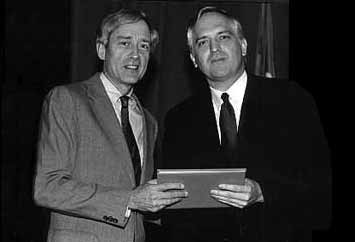
Columbia University President George Rupp (left) presents Paul Gigot with The 2000 Pulitzer Prize for Commentary.
Winning Work
Potomac Watch
By Paul A. Gigot
No matter the Senate vote, the Beltway verdict is in: The political-style judges say the two big impeachment losers are Bill Clinton and Henry Hyde.
The president for obvious reasons, and the House Judiciary chairman because he pressed impeachment without Barney Frank's approval.
This is what passes for moral equivalence in Washington, where the press corps derides the polls but follows them even more slavishly than politicians do. Only here could a man who lies under oath be equated with someone who tries to defend the value of that oath. The point is never, "What's right?" but rather, "Who won?"
The good news is that Mr. Hyde can finally step back and laugh about such nonsense, which he did in an interview yesterday. With impeachment ending, the 74-year-old chairman reflected on the duty he never wanted, his errors along the way and the meaning of Senate acquittal. He's more cheerful than he has a right to be.
"I had a naive, utopian hope that as we documented the record, people who paid only passing attention would come to the conclusion that this was serious," he says. "That just never happened."
Like many others, he isn't sure why. "I'm a little bewildered by the American people," says the World War II Navy man. "I just don't know if our standards have got so low that this behavior is tolerated." He acknowledges that "this was a culture war," and maybe the 1960s' generation "revels in this guy's success. I don't know."
One culprit Mr. Hyde is certain of is modern polling, which he now believes can be politically self-fulfilling. Snapshot polls are taken and then echoed by politicians and the media until their biases harden into concrete, if not wisdom. "Nobody wants to be the oddball," he says.
Mr. Hyde won't say so, but he also wasn't helped by Ken Starr or his fellow GOP leaders. Mr. Starr waited too long to cut a deal with Monica Lewinsky, declined to indict anyone in the case, then dumped a referral on Congress that was only about Monica's case and two months before an election at that.
"You're right, we got sex, and that was the least viable topic for us to run on," he concedes, after praising Mr. Starr for his perseverence.
Newt Gingrich also didn't help by appearing to seek political gain from the scandal without making morally serious arguments about it. And the election rebuke to Republicans convinced Democrats they'd pay no political price for standing by their manchild.
This last is what seems to gall Mr. Hyde the most. He says he got not a whit of cooperation from any House Democrats ever, even as those same Democrats decried "partisanship." It's as if Pamela Anderson Lee denounced cosmetic surgery.
"I did everything but contortions to accommodate the Democrats. My own guys were mad at me for bending over backward. But no matter what we did we were criticized as partisan," says the one-time Democrat.
Why weren't there any Democratic Howard Bakers or Bill Cohens? "The attraction of power," he says of the Democratic calculation. "Do you doubt that if Clinton were a Republican, he would have been gone two years ago?"
None of which is to say that the chairman didn't make his own mistakes. "I probably should not have made the commitment to finish by the end of the year," he concedes, though even that was an attempt to appease Democrats who, recall, wanted to "get it all behind us." David Schippers, his chief impeachment counsel, wanted to widen the probe, but the deadline made that impossible.
Mr. Hyde also concedes he might have had fewer than 13 managers argue the Senate case. "I don't know how to say no, and it's a terrible character flaw," he says. "The first one to ask me was (Georgia firebrand Bob) Barr, and it wasn't a p.r. victory, but I wouldn't break his heart." Some of Mr. Hyde's rhetoric also could be too florid and, on occasion, too defensive. On the other hand, his speech to the Senate about things worth "losing my seat over" will go down as one of democracy's best.
As for the Senate, Mr. Hyde shows admirable -- if not completely candid -- restraint. "It fell short of an adequate trial. And that was because the senators wanted to get it over with as soon as possible," he says. "The senators were very mindful of the polls, and weren't willing to step up to that."
He was blunter in private, once telling a handful of GOP grandees that they treated the House managers like "reformed drunks -- proud of what we did but eager to get us off the premises."
Which makes it all the more remarkable that House Republicans were willing to buck the polls, the Democrats, the press corps and even Pat Robertson. "The alternative was unthinkable, and that was walking away, and saying not on my watch," he explains.
"It would have been worse if we hadn't done it. We would have disillusioned a lot of people who thought the Republican Party should stand for something," he adds. And maybe the House's show of backbone will "count for something, maybe as early as 2000."
Mr. Hyde also takes pride in convincing the public that the president committed crimes. "I think a future president will think twice about perjury and obstruction of justice, knowing the price that Mr. Clinton paid," he says. "We did impeach him. That is unerasable."
Underlying all of this is the conviction of the House managers that Mr. Clinton is a dangerous man. As one of them puts it, not vindictively but all the worse for being matter-of-fact, the evidence convinced him that Mr. Clinton is "evil, amoral," capable of anything.
Mr. Hyde will only say on the record that, "I don't see him doing the right thing on anything" from here to January 20, 2001. The only other modern president who has inspired such deep distrust among serious people is Richard Nixon.
This is one of the reasons Mr. Hyde plans to press ahead with vigorous oversight of the Clinton Justice Department. "We feel it's a very neglected area," he says, and while Mr. Schippers is likely to return to Chicago, some of his investigators may stay.
This matters, because Mr. Clinton isn't about to let his impeachers alone. A president paranoid about his legacy even before the perjury scandal will now begin a campaign to make impeachment seem illegitimate. And he may succeed if Republicans allow him to spin the story by himself. History will vindicate the House, after 2000 if not before, but not if Republicans are naive enough to believe that the Senate trial is the end of Mr. Clinton's scandal history. As James Carville says, "It's never over."
As for Henry Hyde, he likes to joke that when he first came to Washington he wanted to change the world; now he just wants to leave the room with dignity. By impeaching a law-breaking president, he did both.
© 1999, Dow Jones & Company
Potomac Watch
By Paul A. Gigot
As they get older, men can become wise and mellow. Or they can get cranky and despairing. The latter seems to be the tendency of too many of today's political conservatives.
Take Paul Weyrich, the prominent activist who in the wake of President Clinton's impeachment hung jury has decided that conservatives should secede from a corrupt America.
"I do not believe that a majority of Americans actually shares our values," he wrote in an open, overwrought letter to other conservatives this week. "We will be lucky if we escape with any remnants of the great Judeo-Christian civilization that we have known down through the ages."
That's what you call taking defeat hard. Those who know Mr. Weyrich understand that he will focus on the hole in any donut. But now he sees a hole and calls it an abyss.
More alarming, his post-impeachment, Decline-of-Rome pessimism is shared widely enough on the right (Robert Bork and Bill Bennett) that it could become a self-fulfilling prophesy. Especially since his advice is to drop out of politics altogether.
"Politics has failed" conservatives, Mr. Weyrich says, "because of the collapse of the culture." So his solution is to retreat in defeat -- not like de Gaulle in London awaiting liberation, but to a private Idaho of permanent isolation.
It's a shame the old Paul Weyrich seems to have forgotten the progress made by conservatives over the past 30 years. The young Weyrich pushed the GOP to the right as a Senate aide in the 1970s. Later he institutionalized conservative reform through the Heritage and Free Congress Foundations. On today's culture, good and bad, there's no better monitor than Heritage's magazine, Policy Review.
Twenty years ago, when I graduated from college, the U.S. economy was a mess, with inflation roaring and a top tax rate of 70%. The Soviet Union was winning proxy wars in Central America, Africa and Asia. Crime, welfare and illegitimacy had begun their awful gallop. School choice was an idea confined to libertarian monographs.
The nation's progress -- or, since conservatives hate that word, restoration -- in all of these areas represents the triumph of conservative politics. It was achieved despite a hostile media and cultural elite.
These victories, indeed, go a long way to explaining why Mr. Clinton survived impeachment. With times as good as they are, America's risk-averse voters were reluctant to throw over the icon of their boom. They seem to regard Mr. Clinton the way someone described Queen Elizabeth I -- a good king but a bad man.
Few polls even bothered to ask voters why they opposed removing Mr. Clinton. But the one I saw, in November by ABC, found that only 40% thought the offenses weren't serious enough to deserve impeachment. Some 43% said they thought impeachment would be too disruptive.
In a Washington Post focus group, three of 10 New Jersey voters said they didn't want to take their chances on a "scary" President Al Gore. This narrow definition of political self-interest may be regrettable, but it isn't irrational or morally corrupt.
The political blunders of Ken Starr and Newt Gingrich also made it easier to tune out the scandal as partisan warfare. Democrats came to believe they couldn't let Republicans oust the man who had rescued them from oblivion. Saving him became more important to Democrats than ousting him was to Republicans.
Voters weren't saying they share Mr. Clinton's morals. They were saying this president isn't much worse than most politicians, all of whom they mistrust. Throw in the public's ambivalence toward sexual harassment charges, and Mr. Clinton's survival seems preordained. The miracle is that he got himself impeached.
---
In any case, it's hard to see how blaming America first is going to improve things now. Wallowing in defeat will only make it easier for Mr. Clinton and his allies to rewrite the history of impeachment as total exoneration. People also don't usually heed leaders who are denouncing them for "barbarism."
Strangest of all is Mr. Weyrich's echo of the 1960s that conservatives should "tune out" and "drop out." This tendency always exists on the religious right, which cares more about salvation in the next world than in this one. They tuned out at least once earlier this century, after the Scopes trial.
But one reason for the cultural gains of the last 20 years is that religious conservatives re-emerged from their historic political isolation. Some were motivated by Roe v. Wade, others by Jimmy Carter's tax raid on private schools, still others by broader cultural rot.
To ask them to walk away now in disgust and despair is to repeat the errors of the 1960s' left. Liberals then believed they could totally remake the world by the force of their moral arguments. And when they failed they denounced America as corrupt and unworthy of their patriotism. It's taken the left 30 years to recover.
Conservatives used to understand that all political change is slow, that in fact it ought to be slow, and that the task of political persuasion is never done. Russell Kirk, who forgot more about American culture than Mr. Weyrich remembers, liked to say that "There are no lost causes because there are no gained causes."
Conservatives can't save America by becoming anti-American.
© 1999, Dow Jones & Company
Potomac Watch
By Paul A. Gigot
If his aura of inevitability vanishes, how will this first-time presidential candidate respond?
Republicans can be strange. So desperate are they to beat Al Gore in 2000 that they want to hand their party's nomination to George W. Bush even before he proves he can beat other Republicans.
I know they crave order and hierarchy, but this is ridiculous.
That's the only sane response to the Bush-mania now sweeping through establishment and even conservative GOP ranks. A dozen governors endorsed the Texas executive even before he opened his fund-raising "exploratory" committee this week. Every day another GOP official all but begs him to run. And the pilgrimages to Austin have begun to resemble the Moslem hadj in their fervor.
"I've seen a lot of politicians in my day, and I have to tell you his instincts remind me of Reagan," says one right-wing hadji not known for flights of misplaced hope. "The refreshing thing about him is he's not afraid."
It's all impressive so far, but don't be fooled by this enthusiasm into thinking that the GOP contest is already over: George W. is going to have to fight for the prize, and he'll be a stronger challenger to Mr. Gore or Bill Bradley because of it.
Indeed, Mr. Bush's current strengths contain seeds of future vulnerability. As the son of a former president, he has name recognition and a huge fund-raising network. But the family tie also means he must distance himself from his father's political failures. Since Al Gore is sure to link the son to his father's recession and tax increase, the son might as well prove his independence to Republicans first.
Bush II is already doing this by assembling -- and leaking -- a list of policy advisers credible with the party's growth wing. The governor will tell you, even before you ask, that Dick Darman won't be part of his team (though some of us would like to see the governor wearing garlic to be sure). His two early economic coordinators, former Fed governor Larry Lindsey and Indiana businessman Al Hubbard, were part of the anti-Darman "underground" in his father's White House. Mr. Lindsey has ties to Steve Forbes and Mr. Hubbard worked for Dan Quayle.
New speechwriter Michael Gerson is a reporter (U.S. News) widely respected on the Christian right. It's also notable that his father's 1992 campaign team, especially pollster Bob Teeter, is being kept at arm's length.
Mr. Bush's other great strength is that he looks to many Republicans like a candidate who can win. After eight years of Clinton and three years of a Congress in retreat, they're almost as desperate for a champion as Democrats were in 1992. With his charisma, proven appeal to Hispanics, and his down-ballot coattails in a big state, Mr. Bush offers hope.
But if the ability to win is your main rationale, you can't afford to lose. Ronald Reagan, with his solid base, could stumble in Iowa in 1980 and recover. Can George W.? If his aura of inevitability vanishes, how will this first-time presidential candidate respond?
It's no accident that every GOP nominee since Goldwater in 1964 has either run at least once before, or been a sitting president. And if Mr. Bush does stumble, having other plausible candidates to fall back on wouldn't hurt Republicans.
Perhaps the greatest temptation for Mr. Bush will be to play it safe. He's from prudent bloodlines, after all, and many will advise him to stick to his Texas record rather than risk offering his own ideas for the future. But there is no better way to guarantee defeat.
In the primaries, he'd leave openings for Steve Forbes and Dan Quayle on Social Security and taxes. Lamar Alexander, trying to prove that dead candidates don't wear plaid, is going to knock him around on affirmative action. Without his own reform agenda, Mr. Bush would appear less like a fresh voice and more like his party's last two nominees.
Paradoxically, that would also hurt him against Mr. Gore. The conventional wisdom says play it safe in the primaries to have flexibility in a general election. But Mr. Gore would love a Bush challenge that ran merely on charisma and his Texas record. The veep would trump Texas by pointing to what by then could be eight years of prosperity and even further declines in crime and welfare. And after the Clinton chaos, Mr. Gore will gladly dare to be boring.
"We'll get killed if we play it safe," says Ed Gillespie, a GOP strategist now advising long-shot candidate Rep. John Kasich. Adds Jeff Bell, the strategic brains behind Gary Bauer: "You have to change the subject away from the stuff that Clinton and Gore have a good record on. I don't think that's self-evident to Bush, or to the Republican National Committee."
Mr. Bell thinks this means addressing the moral issues, which Mr. Bush has done on occasion in Texas. But it could also mean tying Mr. Gore to teacher's unions and the education status quo, or scoring him for opposing individual Social Security accounts. Mr. Bush's advisers say he understands this, but there's no better focus group than primary voters.
As I was leaving an interview with Mr. Bush last autumn, the governor was halfway inside his car when he suddenly walked back to make a point. "I want you to know something," he said. "If I run I'm going to win."
Republicans who really want a winner should delay the coronation until he proves he can win.
© 1999, Dow Jones & Company
Potomac Watch
By Paul A. Gigot
Bill Clinton can be hard on his foes but he's murder on his friends. Look at the way he's humiliating his supposed buddy and fellow New Democrat, Louisiana Sen. John Breaux.
Mr. Breaux is Mr. Clinton's own hand-picked chairman of the commission to reform Medicare. A year ago, in a private White House meeting, the president told Mr. Breaux he saw Medicare modernization as central to his legacy. He even talked up the federal-worker health insurance system as a model.
But now that the senator has gone out on a limb to do just that, Mr. Clinton is treating him like one of Ken Starr's prosecutors: The president suddenly doesn't know what the meaning of "reform" is.
Mr. Breaux has been trumped by Barney Frank. Over his last two years, Mr. Clinton could define his legacy as getting things done before he retires on a Geffen-Spielberg pension. But his Medicare turnabout shows that, in the wake of impeachment, he's defining it to mean electing Al Gore and a Democratic Congress in 2000. This would both repudiate his GOP impeachers and repay the Barney Frank liberals who saved him.
Mediscare II is the linchpin of this payback strategy: Repeat the demagoguery of 1995-96 and tattoo Republicans for putting "tax cuts for the rich" ahead of spending for seniors.
Never mind that this year Republicans aren't proposing to cut benefits by a single penny. Medicare is an entitlement, which means its benefits are paid automatically, whether or not taxes are cut. But cold facts don't matter when revenge is hot.
What counts is that Democrats would have retaken the House last year if their share of the senior vote hadn't fallen from 1996. Democrats hope to make up that ground next year by offering seniors "free" prescription drugs that would be affordable if only heartless Republicans didn't want to help taxpayers.
White House Chief of Staff John Podesta has told Democratic staff on Capitol Hill that this theme is the key to retaking the House. Mr. Clinton has heard the same from Democratic leader Dick Gephardt. Vice President Al Gore is also in the tank for Mr. Frank.
(Question: When will the media score Al Gore for pandering to the left the way it will George W. Bush if he bows to the right? Answer: Don't hold your breath.)
The only problem is that the big losers won't be Republicans. They'll find a way to blunt the issue. The losers will be seniors stuck with the same old Medicare jalopy driving toward insolvency and rationed care.
Without reform, says Mr. Breaux, "all you're doing is putting more money in it. But it's like putting more gas in a 1965 car. It still doesn't run any better."
Mr. Breaux knows that New Democrats are supposed to reform government, not merely grow it. That's the boast of the so-called Third Way between left and right. And the Breaux proposal comes out of the Progressive Policy Institute, which used to be Bill Clinton's think-tank. The wonks at Robert Rubin's Treasury also like it.
The idea is to remodel Medicare after the system that lets nine-million federal employees choose among dozens of plans offered by private insurers. Even government auditors leery of free-markets have estimated that this reform would save money and improve service over time. And the savings from competition would allow insurers to pay for drugs without robbing taxpayers.
"I think what we have on the table is classic Clinton-New Democrat reform. But there are entrenched people within the White House who don't want any change," says Mr. Breaux.
On his 17-member Commission, Mr. Breaux needs 11 votes for a formal endorsement. He has 10 -- all eight GOP appointees (including health-care experts Deborah Steelman and Tennessee surgeon and Sen. Bill Frist), himself and Democratic Sen. Bob Kerrey of Nebraska. If only one of Mr. Clinton's four appointees came around, he'd have his bipartisan supermajority. But the president won't even follow, much less lead, so the commission is likely to collapse in disagreement next week.
In a larger sense, this Medicare betrayal marks the symbolic end of the New Democrat movement. Its ideas helped Mr. Clinton win in 1992 and outwit Newt Gingrich in 1996, but now they are losing out to the higher goal of uniting liberals for total victory in 2000.
The Third Way rhetoric of New Democrat Al From has thus been hijacked by Sidney Blumenthal and Mr. Gore to provide cover for expanding the entitlement state, not reforming it. We are back to the Clinton-Gore future of 1993-94.
Mr. Breaux, ever a team player, keeps calling Mr. Clinton on the phone and holds out hope the president will come around. But he's the last piano player in this brothel. I asked the senator if he felt used by the president on this. "Yes," he replied, "But I'm no virgin."
As everyone knows by now, neither is Bill Clinton.
© 1999, Dow Jones & Company
Potomac Watch
By Paul A. Gigot
Al Gore released a list this week of 113 Illinois Democratic Party regulars who've endorsed him for president. But it's typical of his recent luck that the vice president was upstaged by a single endorsement for Bill Bradley.
Paul Volcker declared for the former New Jersey senator and sole Democratic challenger to Mr. Gore. The legendary Fed chairman hadn't done that since Adlai Stevenson, long before Tall Paul was a public figure. But what should really scare the veep is Mr. Volcker's reasoning:
"I am a disturbed citizen. For too many years, I've seen the healthy skepticism of Americans about government erode into a corrosive cynicism," he said. "That cynicism and distrust need to be changed. It seemed to me long ago that Bill Bradley had the potential -- had the essential qualities, the character to do just that."
Ouch. There's that word again -- character, campaign 2000's antonym for Clintonism.
But this isn't Jerry Falwell talking. This is a Democrat, one of those Wall Street pillars Mr. Gore is supposed to have in his pocket because of the stock-market boom. But instead of crediting the veep with Clintonomics, Mr. Volcker implies that he's guilty by association with Clinton sleaze.
"Those other guys have played around with campaign finance and haven't done a damn thing. They've got a record of ducking and swerving," Mr. Volcker told me Wednesday from his Manhattan cellphone. Bill Bradley "is serious."
Who would have thought impeachment's biggest loser would be Al Gore? Had Mr. Clinton left office honorably and resigned, the veep would be president now. But the fact that he stayed, forcing Democrats to betray their own principles to defend him, may yet prevent Mr. Gore from winning in 2000.
Democrats were reluctant to break with their president while Republicans might benefit. But next year in the person of Mr. Bradley they have a chance to register their unhappiness by voting for a fellow Democrat. Bill Bradley -- so earnest he's Al Gore without the sense of humor -- may be the vehicle that lets Democrats expiate their guilt for having rolled in the muck to save Monica's soulmate. Mr. Bradley is every Democrat's chance to take a shower.
This is the only way to explain Mr. Bradley's boomlet in the polls -- to within 17 points of Mr. Gore in New Hampshire in the latest Zogby survey. You can't attribute his rise to any issues, because Mr. Bradley so far isn't running on any.
He's had even less to say on Kosovo than George W. Bush. He doesn't sharply disagree with the veep on trade or the environment, or much of anything else. Ask one of his advisers what issues are working for him and the answer is "the idea of leadership and integrity."
Even Mr. Bradley's widely advertised and admirable speech this week on race was more about character than substance. One of his implicit points was that he'd have the moral authority to lead, in contrast to Mr. Gore's pandering to the party's racial activists. Like Mr. Bradley's entire campaign, the speech was about the man more than the message.
Mr. Gore has thought he could run as Bill Clinton's heir the way George Bush ran for Ronald Reagan's third term in 1988. But the veep may want to rethink his strategy of appearing next to the president, Zelig-like in every White House photo-op.
In the latest Wall Street Journal-NBC poll, one in every three voters says Mr. Gore's biggest weakness is "his association with President Clinton." Only 10% call it his greatest strength. Amid today's prosperity that's amazing.
A recent Pew Research poll found that "attitudes toward Gore are more closely linked to Bill Clinton's mixed personal ratings than to his strong job approval." While prosperity trumps scandal for Mr. Clinton, the opposite seems true for Mr. Gore.
According to Pew, 74% of Americans agree with the statement that, "I am tired of all the problems associated with the Clinton administration." That includes 64% of Democrats. Of those Clinton-fatigued, only 35% would vote for Mr. Gore over George W. Bush.
Mr. Gore must be freaked, if not livid: All of that slavish devotion to his boss and this is the reward he gets? Doesn't the public value loyalty any more?
Another problem is that Democrats may worry that Mr. Gore won't be their strongest candidate. Every Republican sure thinks so. "Bradley would have a clean slate," said former Vice President Dan Quayle in an interview this week. "There's a lot of baggage with Bill Clinton -- Gore calling him `one of our greatest presidents' on the day he was impeached.
"Plus Republicans don't like Al Gore. Bradley -- they're indifferent. And they like a sports star." Democrats may wonder about nominating a man who even Dan Quayle is sure he can whip.
The odds are still good that Republicans will get their wish. The veep is awash in campaign cash. As a candidate he's as ruthless as his boss. And his party's establishment and interest groups will fight for him as ferociously as Chicago Mayor Richard Daley did for Hubert Humphrey in 1968. Humphrey won the nomination, remember, despite a war, urban riots and his ties to LBJ.
Then he lost in November.
© 1999, Dow Jones & Company
Potomac Watch
By Paul A. Gigot
The loyal opposition is supposed to urge the right policy, not sit back while the wrong one fails.
A Republican leader in Congress who these days prefers anonymity has been having this nightmare:
It's July of 2000. At the Democratic convention in Los Angeles, Bill Clinton is being "lionized for saving Europe and defeating Milosevic, despite the isolationists in Congress." Al Gore basks in reflected foreign-policy triumph, while Republicans can only grouse that Slick Willie has outwitted them again.
It could happen. But this time Republicans will have only themselves to blame, because of the cynical, Clintonian way they are dodging responsibility in Kosovo. In the debate between Pat Buchanan and John McCain, more and more Republicans are siding with Peacenik Pat. And in the process they may let Mr. Clinton off the political hook for so mishandling the war.
The loneliest Republican in Congress these days is Mr. McCain, a stranger in a suddenly strange party. The lesson he drew from Vietnam was that when you fight a war you fight to win.
But his resolution proposing "all necessary means" to do this can't even get a Senate vote. Trent Lott, the GOP leader who inspires nostalgia for Bob Dole, prefers the brave abdication that it's "Clinton's war," so let him lose it on his own.
The House is worse. Four out of five Republicans voted Wednesday night against even the current air war against Slobodan Milosevic. That included the entire GOP leadership, save Speaker Dennis Hastert, whose belated yes salvaged for Mr. Clinton a still-humiliating 213-213 tie. It's true Democrats had insisted on that vote to score partisan points, but Republicans took the bait.
Republicans were more reasonable in demanding congressional approval for ground troops, except that Mr. Hastert has already said he'll oppose them. The speaker instead suggests inviting Milosevic's Russian friends to negotiate a deal that Slobo can accept.
This peace-at-any-price view is echoed by the GOP's growing Buchananite presidential wing, which now includes John Kasich and Dan Quayle. Curt Weldon, erstwhile hawk from Pennsylvania, is leading a delegation to Vienna this weekend to discuss with the Russians the terms of NATO's retreat. Do Republicans think Milosevic isn't paying attention?
Republicans object when Mr. Clinton calls them "isolationist," but on Kosovo they are writing his talking points. The GOP wants to spend more on the military but doesn't want to use it even in the heart of Europe.
The Little Buchanans say America has "no national interest" in the Balkans, as if NATO's credibility isn't in our interest. The same conservatives who want to contain China don't understand that the best way to do this is to defeat Milosevic.
Mr. Quayle adds that it's a mistake for NATO to apply force in "civil wars" outside its area. Yet by this logic, U.S. NATO forces in Germany shouldn't be used to bomb Iraq in the Persian Gulf either.
The smarter Republicans admit a U.S. interest but fret that Team Clinton is too incompetent to run a war. One House leader says a staffer was griping about U.S. troops serving under foreign command. To which the congressman replied, "Knowing our commander-in-chief, I'd prefer foreign command."
But contempt for Mr. Clinton, however understandable, doesn't free Republicans from their constitutional duty. What is America supposed to do until we get a new president -- take a hiatus from history? The loyal opposition is supposed to urge the right policy, not sit back while the wrong one fails. Republicans who expect to regain the White House in 2000 might want to think about leaving a smaller mess for their president to clean up.
The biggest GOP misjudgment, however, may be political. Mr. McCain at least is well positioned no matter how the war turns out. If Mr. Clinton takes his advice and wins, the Arizonan will share the credit. And if Mr. Clinton takes the far more likely path and signs Dayton II with the Serb he calls "Hitler," Mr. McCain will have the credibility to criticize.
The Buchanan Republicans will have no such standing because they're now urging Mr. Clinton to cut exactly that kind of Milosevic-saving deal. Mr. Clinton will crow, while Republicans will face a vote on ground troops anyway, in that case to enforce another unstable "peace" agreement.
"We're going to be ratifying everything Clinton does, with a vaguely anti-Clinton patina," laments one dissenting senior Republican. It won't be long before Democrats use Kosovo to discredit impeachment, too, saying both votes show Republicans are motivated by nothing but anti-Clinton enmity.
Any GOP hope of running on foreign policy in 2000 could vanish like the balanced budget issue. "They had this issue of foreign affairs and Clinton's lack of leadership," says Gary Schmitt, of the conservative Project for the New American Century. "Now they've muddled the message and made it very difficult for them to run against Clinton while they're sitting on their hands."
Eisenhower had to rescue Republicans from their isolationism of the 1930s. And only the Cold War's end rescued liberal Democrats from their post-Vietnam pacifism. Do Republicans really want to trade places with Bill Clinton and become this generation's McGovernites?
© 1999, Dow Jones & Company
Potomac Watch
By Paul A. Gigot
A Republican senator running for re-election next year recently reacted this way to Hillary Rodham Clinton's now probable New York Senate campaign:
"Can't you get her to run against me?"
Think of the benefits, added this savvy GOP pol. He could immediately fire his fund-raisers. A couple of national mass-mailings would bring in more than enough campaign cash. The chance to beat the First Tiger Lady would unite otherwise fractious Republicans from Jerry Falwell to Christie Whitman. And victory would make him a national GOP celebrity.
That widely shared sentiment says more about Mrs. Clinton's political ambition than all of the canned public Democratic applause she's now hearing. In private, many Democrats are worried about her candidacy. It's Republicans who are pleased, if also dumbfounded at her audacity.
"I continue to be astonished that she's going to run," says one operative charged with re-electing a GOP Senate. "There's a virtual certainty that if she runs it hurts everything else Democrats want to do."
No Democrat can afford to say this on the record, of course. And the First Lady's media friends have stayed quiet, perhaps to encourage what everyone understands would be a reporter's dream -- two presidential races for the price of one.
The exception is The New Republic, which has trashed her candidacy as loudly as it's promoting Al Gore's -- and which is no coincidence, comrade. Its editors know Mr. Gore has enough problems without adding Hillary's.
Any Democrat not inhaling James Carville's exhaust can tell you the risks: She'll suck money and attention away from other viable Democrats, especially those challenging vulnerable GOP incumbents. Sens. Slade Gorton of Washington and Spence Abraham of Michigan, both likely to have women as opponents, should be especially pleased that the First Feminist will have first call on national liberal cash.
Hillary's run also makes it harder for Mr. Gore to establish his own identity. The point isn't that the vice president won't be his own man. It's that Hillary's political prominence will remind everyone of the controversies of the last eight years.
This can't help a candidate whose standing already suffers from national Clinton fatigue. About half the country says the veep is too close to Mr. Clinton, and 52% say they're less likely to vote for him if Saturday Night Bill campaigns actively for him. Like it or not, Hillary would be Mr. Gore's de facto running mate. Her stumping this week as part of "Women for Gore" was an implicit payback for the veep assuming this burden.
My guess is that Mrs. Clinton's scandals would hurt her less in New York than many Republicans hope (even when Ken Starr's final report includes copious detail about her scandal role). Her bigger problem would be her liberalism and her cool, condescending public persona.
Given all of this, the most interesting question is, Why even take such a gamble? Why not leave Washington gracefully, take a job that keeps you in the limelight (say, the Red Cross) but out of the line of fire, and return to politics after the passions of the 1990s recede into misty nostalgia?
Sure, Mrs. Clinton wants to be president and so needs to show she can win votes in her own right. But she could do that more easily in 2004 in Illinois, a state where she has genuine roots, against a weaker Republican than Mayor Rudy Giuliani in New York, a state where she's a carpetbagger.
No, the only way to comprehend a run in 2000 is as part of a compulsive, almost maniacal attempt at political vindication. Her candidacy only makes sense as an In-Your-Face dare to the country to validate the First Couple's years in office.
Her friends say that, even more fiercely than her husband, she believes the pair have been unjustly maligned. In their first term Whitewater cost her the chance to become Eleanor II, and in the second Monica forced her to become the role model she never wanted to be, a national Tammy Wynette. More even than Bill, she holds grudges and wants revenge.
Victory in 2000 would erase the stain of impeachment and scandal, repudiate her critics, and give her the chance to build the New Progressive era that she put up with philandering Bill in order to create.
Understood this way, her candidacy is a monumental act of political vanity that raises the stakes in 2000 even higher than they already are. And it fits the strategy of the past year, when her husband has put victory in 2000 above any second-term accomplishment. It also puts her own fortunes above her party's, but that's always been the Clinton way. The party, c'est moi.
And, who knows, maybe Republicans will be stupid enough to help her. The best news Mrs. Clinton could get would be a late (September 2000) and vicious GOP primary between Mr. Giuliani and Long Island Rep. Rick Lazio that saps their resources and tarnishes the winner. And that could happen.
On the other hand, the Clintons had better hope that Americans, and especially New Yorkers, don't begin to view them as the house guests from Arkansas who entertained us for a while but grew tedious and now refuse to leave.
© 1999, Dow Jones & Company
Potomac Watch
By Paul A. Gigot
WATERLOO, Iowa -- The most poignant moment in politics isn't victory, or even defeat. It's when everyone believes the cause is hopeless except the candidate, who soldiers on like one of those Japanese still fighting World War II on a desert island in the 1950s.
For several Republicans, especially Lamar Alexander and Dan Quayle, that moment is now. These men have spent years planning their campaigns, have been closer than most to the prize, but now find themselves on the edge of extinction six months before the first votes are even cast.
The agony of these premature also-rans is as good a window as any through which to interpret tomorrow's Republican straw poll here.
Their pain is all the more acute because it arrives at the hands of George W. Bush, prodigal son of the president they once served. Mr. Quayle was the 41-year-old vice president whom George W. visited to talk polls and politics. He says that it was Jeb Bush, now the Florida governor, who wanted to talk policy.
Mr. Alexander was a successful two-term governor while George W. was still indulging his now famously misspent youth. In 1996 he came within 9,700 votes of winning the New Hampshire primary and thus probably the GOP nomination. He's campaigned in 63 Iowa counties this year, on top of his 80 visits in 1995 and 1996. George W. has spent all of eight days in Iowa but he's still above 50% in the polls.
Messrs. Quayle and Alexander react to all of this in ways that reflect their distinct political natures. Mr. Quayle is the cheerful conservative, pushing his agenda while barely mentioning George W. Mr. Alexander is the skillful if somewhat desperate tactician, more critical of Mr. Bush and especially the media.
Mr. Bush arrived in the state yesterday with an entourage, an airplane full of reporters and $30 million. Mr. Quayle arrived in this blue-collar town Monday in a sedan with four aides and a press corps of three, none from television. His audience was 21, including a family of five. He drew a larger crowd at two later stops in Cedar Rapids but never broke 50.
None of this fazes the former veep, who launches into his idea-heavy stump speech. He pounds Alan Greenspan for "deflation" that's hurting farmers, touts a 30% cut in income-tax rates and talks about restoring individual choice in health care. He gives a sophisticated tour of China policy and the gold standard, too.
One irony of the Quayle campaign is that this supposed simpleton has put more ideas on the table than anyone except Steve Forbes. Yet the media won't discuss them because he is said to have no chance to win. These are the same reporters who've declared Mr. Bush the winner even though he's given only one substantive speech.
If anything frustrates Mr. Quayle, it's this campaign year's seeming indifference to ideas. It has been dominated instead by biography and the question of electability. "Perhaps it's wishful thinking, but I still think the voters of this state want to know where you stand," he all but begs one crowd.
Later, over dinner, he attributes the George W. phenomenon to "name recognition" and Republican "guilt" over having toppled his father in favor of President Scoundrel. "I'm the only one who can beat George W.," he insists, despite the media mantra that he can't.
Mr. Quayle says that John McCain is too liberal and of the "wrong generation." Steve Forbes can't ascend to the White House as his first elected office -- "he could spend $100 million and he still couldn't win." Lamar Alexander is too much like Mr. Bush, and Elizabeth Dole . . . he rolls his eyes.
But did he make a mistake in not running for governor of Indiana in 1996? "That's a fair question," Mr. Quayle confesses, opening up to a rare moment of self-doubt.
"Maybe." He pauses. "You mean the fact that there was nothing in between" his current run and his Mr. Potatohead caricature. He thinks for a couple of seconds and says, "I may have underestimated the power of that tag line -- `can't win.'"
Mr. Alexander is never one to reveal self-doubt, certainly not to a reporter. But he does express frustration that sometimes edges close to bitterness. Like Mr. Quayle, he attributes the Bush wave to GOP guilt over toppling his Dad.
But he also blames what he calls a "self-fulfilling prophesy" of money, media and polls. A candidate with a popular name can raise money, which gets him declared the front-runner by the media, which keeps him high in the polls, which helps him raise even more money while his opponents struggle for crumbs.
"Why don't we just get the sportswriters together before the baseball season and say, Steinbrenner's got the money, he's got the players, so cancel the season!" says Mr. Alexander, who can get into full rant on the subject. "This is preposterous!"
This is also sour grapes, since Mr. Alexander would love to be rolling in Mr. Bush's dough. Indeed, one irony of his current fate is that Mr. Alexander ran in 1996 on the same argument now lifting Mr. Bush -- that he was the likeliest candidate to win. His slogan then was "Know your ABCs -- Alexander Beats Clinton."
And he was probably right. But because Mr. Alexander has always stressed tactical politics over ideas, he never built a devoted political base. So he was vulnerable this time to another candidate who had a fresher claim (in money, name and charm) to electability -- Mr. Bush.
The Tennessean has a better case when he argues that the GOP shouldn't crown someone without a fight. "The Big Money people could make a mistake," he says. "We might end up in a debate with Albert Gore or Bill Bradley next year and find out we've nominated someone who's not ready to be president.
"Then we get 16 years of Clinton and Gore and eight years of Hillary after that," he riffs, to laughter and applause at a lawn party for 75 in Storm Lake.
"I mean if he were Dwight Eisenhower maybe," Mr. Alexander adds later about his front-running rival. But Mr. Bush is "a one-term governor of a state where the job is mainly ceremonial!"
Iowa has a history of surprising front-runners, so perhaps Saturday's beauty contest will give these candidates some more months to fight. Mr. Alexander admits he's probably got to finish a strong third, while Mr. Quayle insists he'll trudge on regardless, though he may have to live off nuts and berries.
Perhaps the worst outcome would be a Bush victory so large that it all but ends the primary season even before it begins. This would signal a return to the days of Mark Hanna and ward-boss politics, when the elites picked a nominee. Only Steve Forbes or Gary Bauer would fight on, dividing the conservative vote and pleasing Bushies who believe neither is electable.
And maybe pleasing Democrats, who would face a Republican in 2000 who's barely been tested, and who may -- or may not -- be ready for prime time.
© 1999, Dow Jones & Company
Potomac Watch
By Paul A. Gigot
Bill Bradley said the harshest things about President Clinton this week, and without even mentioning his name. He didn't have to. All the Democratic presidential candidate had to do was talk about himself.
"Every day" in his youth, the former senator told an audience in his Missouri hometown, his mother the teacher "began a class with a lesson about some character trait -- honesty, integrity, courage, trust."
His father, a Republican businessman, taught him the virtue of hard work and that, "Character is where you find it."
Still think voters don't care about presidential character? Henry Hyde couldn't have made a bigger hash of the Clinton legacy than this liberal Democrat did with a single speech.
The Bradley speech should prove, at least to anyone outside the Carville Chorus, that in the 2000 campaign personal history is political destiny. Bill Clinton came to the White House as the ultimate policy wonk. But the corrupt soul of his presidency has ironically elevated character above ideas, the personal above policy. Conservatives have long believed that "ideas have consequences," but so far the only idea of consequence is biography.
Among Republicans, the candidates leading in national polls are running mainly on who they are, not what they want to do. Elizabeth Dole is the candidate without a Y chromosome, John McCain the war hero and political maverick.
Front-runner George W. Bush began his campaign in Kennebunkport next to his parents, who voters recall as a first couple with integrity. So far that family history and George W.'s personal charisma are trumping the fact that voters know little else about him.
The idea candidates, meanwhile, have lagged in large part because their biographies are less appealing. Dan Quayle carries the burden of media vilification, while Steve Forbes inherited his money and has never held political office. That's why the Forbes camp is running gauzy TV spots showing his five daughters discussing dad's character.
In less placid times, this all might count for less. It did in 1992. But seven years of Clinton have made voters yearn for an antidote, much as voters favored Jimmy Carter ("Why not the best?") after Richard Nixon.
The media call this "Clinton fatigue," as if there were no moral or ethical judgment involved. But in searching for the un-Clinton, voters are implicitly rejecting the political mores of Clintonism. And all the polls show Vice President Gore suffering guilt by association -- the price of his too slavish loyalty.
Mr. Bradley is certainly counting on this. His kickoff speech this week was a character and ethics assault on several levels. There was the unsubtle personal-life contrast: "the magic of a good marriage or the satisfaction of a life led true to one's own values."
And the predictable appeal to political reform: "I'm running for president to restore trust in public service and confidence in our collective will." No Buddhist Temples for him.
Most intriguing, Mr. Bradley is casting even his liberal ideas as a matter of character. "I'm more interested in leadership than polls and politics, and I believe we need a new kind of leadership," he said, to some of his loudest applause. "A leadership that puts the people front and center, not the president." Louder applause.
Government, he added, shouldn't "be doing trifling things much of the time for some of the people. But it should be doing some large, essential things all of the time for the whole nation." No Dick Morris agenda for him. This is manna to cause-parched liberals who've watched a two-term Democratic president achieve such Gingrichian goals as Nafta, welfare reform and debt retirement.
There's some risk in this strategy, especially its lurch to the left. Part of Mr. Bradley's appeal has been his ideological independence. But to win over liberal interest groups, he has now begun to sound embarrassingly orthodox.
As a senator he voted twice to fund experimental school-voucher programs. But last week in Cleveland, amid a huge school controversy, the Princetonian declared that, "I don't think school vouchers are the answer to the problems of public education." He's also an Iowa convert to the blessings of ethanol. The Gore campaign will remind voters that consistency is a character issue too.
But overall the ethics theme is a big Bradley asset. It tells Democrats they can regain their moral self-respect without rewarding GOP impeachers. And it says they can nominate a candidate who'll be stronger against Republicans in 2000 because he lacks the Clinton baggage.
The Gore campaign consoles itself that this will pass because every recent two-term president has had a last-year surge in popularity. But neither Ike nor Ronald Reagan had a spouse running for Senate to remind voters of everything they didn't like in the past eight years. A sweetheart home loan, clemency for Puerto Rican terrorists: Mr. Bradley should pay Hillary Rodham Clinton's New York filing fee.
Republicans, on the other hand, may want to hold their cheers. As one GOP strategist put it, the Bradley campaign is great news, unless he wins.
© 1999, Dow Jones & Company
Potomac Watch
By Paul A. Gigot
SPARTANBURG, S.C. -- Ask John McCain's campaign whom the presidential candidate consults for economic advice, and the first answer is, we'll get back to you. The second answer is Kevin Hassett, co-author of "Dow 36,000," a super-bullish stock-market tome.
But maybe the real answer is no one, since Mr. McCain recently fretted, during a GOP debate, that today's 11,000-point Dow is a stock-market "bubble."
Texas Gov. George W. Bush has platoons of economists who spent nine months assembling his tax cut. Sen. McCain has -- the top of his own head, which in a sense sums up the entire McCain candidacy. The medium is his message, and the medium is the man himself.
This explains both his recent surge and his vulnerability as he tries to steal the GOP nomination from Mr. Bush. His war record and blunt political style are perfect for a year when prosperity and Bill Clinton have made character count more than issues. Just as Democrats turned to Jimmy Carter as the purest anti-Nixon after Watergate, many Republicans view Mr. McCain as the ideal anti-Clinton.
Rightly offended by media adoration of Mr. McCain over campaign finance, some conservatives have missed this part of his grass-roots appeal. But the reality is as clear as Christmas in this key primary state, perhaps the most anti-Clinton in the country.
It's no accident the senator is introduced by Rep. Lindsey Graham, Carolina's most popular politician since his turn as a House impeachment manager. "John McCain's never going to wave his finger in your face and lie to you," Mr. Graham tells a crowd at Converse College here. "He knows what the definition of is is."
Mr. McCain is only slightly less subtle. "I will never take a poll" about sending Americans into battle, he says, a line that plays well in a state in which 38% of GOP voters are veterans or have one in their family. He's funny and self-deprecating with a crowd. And his fluency on foreign policy is obvious, and would match up well against Al Gore.
Even the senator's main domestic themes are less about the issues than about character and independence. His attack on pork-barrel projects sets him apart from a GOP Congress now spending like liberals. And campaign-finance is "a device to define the guy, to prove he's the anti-Clinton. It's the crusade that makes him a crusader," says his turbo-tongued adviser Mike Murphy.
My own survey of Mr. McCain's sizeable crowds suggests this is working. Asked about his appeal, not a single voter cited a single issue. But dozens said, "honesty" or "I want someone in the White House I can admire."
Poor Steve Forbes thought the issues would make him the anti-establishment candidate, the populist outsider to Mr. Bush. But the politics of biography has let Mr. McCain fill that role, despite his 17 years in Congress. No sitting senator has pulled this off since JFK in 1960.
Mr. McCain's challenge from now on, however, is to show his campaign is more than just another chapter in his autobiography. Especially because his domestic agenda has more holes than a Harold Ickes deposition.
This week he unveiled health-care ideas designed to neutralize that Democratic strength. But when asked twice why prescription drugs were cheaper in Canada than in the U.S., he thrashed around like a beached whale. "We've got to find out why that is," he actually said. Imagine how Bill Bradley would pounce on that one.
A Republican serious about winning would know that the reasons include litigation costs, as well as price controls that would cripple new therapies if the world's biggest drug market (America) imposed them. He'd also point out that free-market Medicare reform blocked by Mr. Clinton would provide such drug insurance.
For all of his supposed bluntness, Mr. McCain is also circumspect when tackling liberal pieties. He shrinks from a fight over tax cuts or art subsidies, much less guns or abortion. Mr. McCain points in defense to his undeniably conservative voting record. But a presidential campaign is about setting a mandate to govern in the future.
His theme that campaign-finance reform is the "gateway" through which all conservative reforms must pass is especially unpersuasive. Pork spending and tax loopholes existed long before "soft money." The reason tax reform and school choice haven't passed Congress is because of genuine political opposition. A president's job is to overcome that with arguments, not assume it will vanish with a single, miracle process-cure.
All the more so because if Republicans do take the White House in 2000 (and keep Congress) they'll have a rare reform opportunity. Yet so far Mr. McCain has proposed no tax cut worth the name and his education proposal -- a vague voucher experiment funded by corporate welfare cuts -- is more posture than plan.
The best news about the McCain threat to Mr. Bush is that it may improve both of them. Mr. McCain's character campaign will force Mr. Bush to get tougher and to run as a tax cutter. This Bush counterpunch will in turn force Mr. McCain to offend the New York Times by running on more than liberal campaign reform.
Republicans might even emerge with a nominee who can win.
© 1999, Dow Jones & Company
Biography
Paul A. Gigot
Washington Columnist
Member of the Editorial Board
The Wall Street Journal
Washington, D.C.
Paul Gigot is a member of the editorial board of The Wall Street Journal and writes the "Potomac Watch" column, appearing in the paper each Friday.
Mr. Gigot appears regularly on public television as a political analyst on "The NewsHour with Jim Lehrer" and periodically on NBC's "Meet the Press" and Fox News. The National Journal has named him one of Washington's 25 most influential journalists.
In 1980, Mr. Gigot joined the Journal as a reporter in Chicago, and in 1982, he became the paper's Asia correspondent, based in Hong Kong. He won a 1984 Overseas Press Club award for his reporting on the Philippines. Also in 1984, he was named the first editorial page editor of The Asian Wall Street Journal. Based in Hong Kong, he contributed commentary to the U.S. and Asian editions of the Journal. He took a year's leave of absence in September 1986 to serve as a White House Fellow and returned to the Journal as a columnist and editorial board member in Washington.
Mr. Gigot is a summa cum laude graduate of Dartmouth College, where he was chairman of the daily student newspaper. He has also worked for the Far Eastern Economic Review in Hong Kong and the National Review in New York. He lives in Alexandria, Virginia.