The Denver Post, by Staff
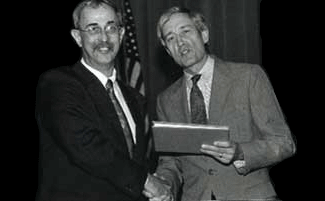
Columbia University President George Rupp (right) presents Pete Chronis, of The Denver Post, with The 2000 Pulitzer Prize for Breaking News Reporting.
Winning Work
By Mark Obmascik
Denver Post Staff Writer
JEFFERSON COUNTY -- Two students, cloaked in black trench coats and armed with guns and bombs, opened fire Tuesday at Columbine High School, killing as many as 25 people and wounding at least 22 others in the worst school shooting in U.S. history.
Police found the two suspects shot to death in the library.
The masked shooters first targeted specific victims, especially ethnic minorities and athletes, then randomly sprayed school hallways about 11:30 a.m. with bullets and shotgun blasts, witnesses said. The bloody rampage spanned four hours.
"I saw them shoot a girl because she was praying to God," said Evan Todd, 15, a sophomore. "They shot a black kid. They called him a nigger. They said they didn't like niggers, so they shot him in the face."
School hallways were booby-trapped with at least 12 bombs, some on timers, which still were exploding at 10:45 p.m. One suspect's coat was laced with explosive devices, and undetonated pipe bombs were planted around bodies, police said.
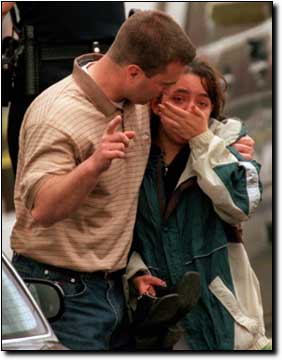
A Columbine High student leaves the school with the assistance of a plainclothes police officer. (The Denver Post/Shaun Stanley)
Students described the shooters as part of an outcast group of a dozen or so suburban high school boys known as the Trench Coat Mafia who often wore dark trench coats and had German slogans and swastikas on their clothes. The suspects were identified as Eric Harris, 18, and Dylan Klebold, 17.
The murders came on the 110th anniversary of Adolf Hitler's birth.
"I've heard numbers as high as 25" deaths, said Jefferson County Sheriff John Stone, adding that 17 were confirmed. "When we did make entry into the library, it was a pretty gruesome scene." He called the murders a "suicide mission."
Byron Kirkland saw the massacre begin: "There was a girl crouched beneath a desk in the library, and the guy came over and said, "Peekaboo,' and shot her in the neck," said Kirkland, a 15-year-old sophomore. "They were hooting and hollering and getting big joy out of this."
Aaron Cohn, 15, a sophomore, said he was ducking beneath a table when he suddenly felt a gun barrel pressed to his head. A gunman said: "- "All the jocks stand up. We are going to kill you,"' Cohn said.
Bree Pasquale, a junior, said: "You could hear them laughing as they ran down the hallways shooting people. He put a gun in my face and said, "I'm doing this because people made fun of me last year.'- " She escaped unshot but splattered with a fellow student's blood.
Meanwhile, Brittany Bollerud, 16, hid under a library table and saw only the gunmen's shoes and long trench coats. "They yelled, "This is revenge,'- " she said. "They asked people if they were jocks. If they were wearing a sports hat, they would shoot them."
"I saw (a teacher) on the floor bleeding from everywhere. He was trying to direct kids, but he couldn't talk," said Rachel Erbert, a 17-year-old senior. "It was really scary. Kids were falling, and you'd help them up. I thought I might get shot."
By 3:45 p.m., shots still rang out inside the school. While more than 200 law enforcement officers and four SWAT teams tried to stop the gunmen and evacuate wounded high school students, paramedics frantically treated victims in makeshift triage units on the front lawns of houses outside the suburban Jefferson County school.
At one point, a bloody boy dangled down from a second-floor window and was caught by two SWATteam members. Another person held up a sign in a classroom window: "Help, I'm bleeding to death."
"There are some who were killed as they were hiding under desks," said an officer who was inside the school. "Some looked like they were trying to crawl away. They were executed - shot in the head."
With news of the murders being broadcast locally and nationally on live television, Columbine High School looked like a war zone. Medical helicopters landed on nearby athletic fields, then whisked the wounded to six local hospitals. More than 2,000 people across metro Denver waited in line to donate blood.
Panicked parents rushed to the school for news about their children. Some talked to their trapped children on cell phones.
At 6:25 p.m., Jefferson County District Attorney Dave Thomas told parents gathered inside Leawood Elementary School that at least 10 bodies could not be removed immediately from the high school because there were bombs near the bodies.
Parents were told to bring their children's dental records. Some parents vomited.
Search warrants were executed Tuesday night at the suspects' homes, the district attorney said. The sheriff said the gunmen used at least one automatic assault rifle and several shotguns in the attack.
At 8 p.m., Michael Shoels was still awaiting word on his son, Isaiah, an 18-year-old senior. Shoels feared his son was targeted because he was black.
"This late, it's not looking good at all," Shoels said. "It's like a dream I'm trying to wake up from. ... I just wish everybody would pray for my family." Shoels' two other children also attend Columbine, and they were safe.
The shootings were the latest in a series of school shootings since 1997 that have shocked the nation and led to calls for tighter security and closer monitoring of troubled students. Two people were killed at a school in Pearl, Miss., three at West Paducah, Ky., five at Jonesboro, Ark., and two at a school in Springfield, Ore.
President Clinton opened a news conference Tuesday by calling for prayers for the students, teachers and staff at Columbine. The murders came as Gov. Bill Owens and the Colorado Legislature have tried to pass a bill to liberalize the state's concealed-weapons laws.
Jenni LaPlante, 18, said one of the suspected shooters was calm Tuesday morning at a beforeschool bowling class. She said the student was extremely smart.
"He knew all the answers. If we were reading Shakespeare, he would know the hidden meaning," LaPlante said.
"I've never seen them lash out at anyone," LaPlante said. "But I would say, "Why do you guys wear all that German stuff? Are you Nazis?' And they would say, "Yeah, Heil Hitler.'- " LaPlante said she never knew whether the suspects were joking.
One shooter was in Michele Fox's creative-writing class.
"They hate our school. They hate everything about it," said Fox, 18, a senior. "In our class, we have to read out loud and stuff, and they would always write about death. They wore black trench coats with combat boots and their pants tucked into them."
Ben Grams, a junior, called the Trench Coat Mafia group "a bunch of unwanted kids who were teased and pushed around a lot."
Another student said the group talked often in class about beheading people, and many often sang and quoted songs by shock-rocker Marilyn Manson. Some also wore bands that read, "I hate people."
Students said the bloodshed began when two students - dressed in black trench coats and masks that were taken on and off - hurled at least one bomb onto the school roof during the A-track lunch hour. Another bomb was stashed in a backpack and left by the front door.
John Cook, 16, a sophomore, was eating lunch outside with friends when the violence started.
"These guys opened fire on every thing that looked human," Cook said. "They were shooting at some kids down below, then they pointed at us and started shooting. Bullets were bouncing everywhere. Two guys next to me got hit."
As the gunmen hustled into the school and through the hallways, panic spread. Casey Fisher, 15, was buying his lunch in the cafeteria with a friend. "My friend came out and he was standing 10 feet from the guy, and they shot him and he fell to the ground," Fisher said.
Karen Nielson, a cafeteria worker, said, "I tried to help the others, but he just kept firing." Some witnesses reported hearing as many as 15 bomb blasts. At one point, a bomb exploded and hurt several students, including one girl later hospitalized with eight shards in her chest. "I was running for my life," said Crystal Enney, 18, a senior.
Smoke spread, and the fire alarm blared. In the chaos, some students sprinted to safety. Others were gunned down in the hall. A few tried locking themselves in bathrooms.
In Katie Crona's freshman earthsciences class, students dived under their desks. In the next classroom, students could hear windows being blasted out by gunmen. A few students escaped and told how others had been shot. "We sat there in a circle for four hours. We were huddled together. It was terrifying," Crona said. The students heard someone tugging at their classroom doorknob, but it was locked. The gunmen continued on.
The worst carnage was in the library, where the gunmen terrorized 45 fellow students with bullets - and maniacal laughs.
"They were going around asking people why they should let them live," said Todd, the 15-year-old sophomore. "Once when they shot a black kid, one of them said, "Oh my God, look at this black kid's brain! Awesome, man!'
"They came up to me, pointed a gun at my head and asked if I was a jock. I said no. Basically I lied. They said, "It's revenge time on jocks for making us outcasts.'- "
Jonathan Vandermark, 16, a sophomore, said he passed three bodies in a stairwell as he and other students were rescued from the biology lab by a SWAT team. Shards of glass were everywhere, he said.
Vandermark was about 20 feet away from one of the shooters when gunfire broke out. He described the weapons as being like Uzis. Other witnesses recalled a sawed-off shotgun and at least one handgun. "A teacher who tried to help us was shot in the arm," said Vandermark, who hid in the biology lab.
Meanwhile, Scott Cornwell, father of senior Matt Cornwell, received a cell-phone call from his trapped son, who was barricaded in the choir room with 40 other students.
"He was whispering. He said, "Dad, we're inside. There are 40 of us. What's going on?'- "
The father took his cell phone to a police commander, who told them, "Get away from the door!"
Police said they found the two suspects shot to death in the library. Several bombs were found in one suspect's house, and police later uncovered two cars parked outside the school that had been booby-trapped with bombs.
Today the Colorado Legislature had been scheduled to debate a bill to liberalize the state's concealedweapons laws, but all legislative work was canceled because of the shootings.
Gov. Owens, who supports liberalized concealed-weapons laws, comforted families at the crime scene with his wife, Frances, but refused to comment on the gun legislation.
"We're not immune from the problems you see in other parts of the country," Owens said. "Perhaps our innocence is lost today."
Some Columbine students said some warnings about trouble from the Trench Coat Mafia were scrawled as graffiti on bathroom walls. "You'd go in there and it would have "Columbine will explode some day," or "All jocks must die," or "Kill all athletes,'- " said Doug Mohr, a senior football player. "There'd be pictures of guns and swastikas."
Jefferson County School District administrators said they didn't know about any racist or threatening graffiti. "I visited the students there and it appeared to be a creating environment, where students feel safe," said schools superintendent Jane Hammond. "We were not aware of the Trench Coat Mafia until today." A photo in last year's yearbook listed one group as the "Trenchcoat Mafia." School principal Frank DeAngelis could not be reached for comment.
Some students said the tragedy could have been worse had it not been a "senior skip day."
The day is known in circles as "4-20" - when students around the country skipped school to smoke marijuana. Aside from it having been April 20, the police code for a drug bust in Los Angeles is also 4-20.
"This is the big day for (smoking marijuana)," said Columbine student Jason Greer, 16.
Many students were aware of the day's significance, and many chose not to attend school Tuesday.
"I can't believe something like this would happen at Columbine," said Joyce Oglesbee, mother of senior Tara Oglesbee. "It's a topclass school, preppy and perfect. We haven't even had a senior prank."
© 1999, The Denver Post
By Bruce Finley and David Olinger
Denver Post Staff Writer
Fanned out across the Denver metro area at work and in their cars, they heard the first sketchy rumors.
Trouble at Columbine.
Gunshots.
Suddenly, existence boiled down to what matters most. And strange kids in trenchcoats were threatening to yank it away.
The result was the most intense moments that some 4,000 Colorado parents have ever known. They screamed. Cried. Hyperventilated. Prayed. One woman ran through the streets in her stockings.
For most, the worst that it got was not knowing.
For some, the pain will be infinite. As many as two dozen kids are gone.
And just about all of these parents were struggling Tuesday night - with counterparts across America - about whether to ever let their children go again.
"You think school is a safe place to send your kids," said Victor Anderson, father of 17-year-old Brian Anderson, who was treated and released from Lutheran Hospital after one of the gunman shot him in the chest.
"It was supposed to be a place where they learned and had fun," Anderson said.
Shortly before noon, the rumors were starting to fly.
A phone call from a daughter-in-law to her tech center office reached Debbie Jones. Kids in trenchcoats taking hostage at the high school. Students falling, bleeding.
Please she thought as she ran for the television in the office, don't let my daughter have been shot.
Co-workers gathered around her, trying to comfort her. She sunk into thoughts that the girl she raised - 16-year-old Jessica - could be lost. "My only one. She"s a teenager. But she's a good kid. Very joyful to be around. An excellent sense of humor. She makes me laugh."
Helpless, Debbie Jones prayed. She wanted to leave. She told herself not to. She trusted and trusted that her girl Jessica would call if she could.
And Jessica came through in the end, calling safe and sound from the Columbine Public Library.
"I just knew she would," Debbie said later. "She was crying."
Some were driven to frenzied action.
Mary Beth Beck, who lives right behind the high school football fields, couldn't find her son for 90 minutes after the shootings began. She got in her car, encountered a police blockade.
She got out of the car and just ran, in her stockings, tearing them open on the asphalt. And didn't care about anything until she found 14-year-old Michael safe at Leawood Elementary.
"Oh God," she said, "I was crying, bawling my head off."
All afternoon, parents fought their way through traffic to Leawood, where dozens of Columbine students sat on a stage waiting to go home. On a wall at the entrance to the school, names were posted of students known to be safe at a nearby public library. Inside, parents gazed anxiously at other lists, writing down names of student still believed to be missing.
Many parents stood outside the school crying, straining to see as busloads of kids from Columbine pulled up to Leawood.
With each busload, there were shouts and tears of recognition, while other parents walked away in disappointment.
Some couldn't handle the uncertainty.
Julie Jorgensen hyperventilated for 15 minutes - fearing her Katie was gone. She breathed into a paper bag.
The best early information went to the people with connections. People like Cyn thia Partridge, principal of Leawood, just a few blocks from Columbine.
She received telephone calls straight from police. An officer told her that some students were being held hostage.
Partridge tried to hide her concern. Her own three sons were Columbine students.
She hurled herself into locking down Leawood to protect the 565 children there.
"We completely locked up, pulled down all the curtains, shades, and blinds, and put paper over all the windows so no one could see in," Partridge said. "We had children eat in their classrooms instead of the cafeteria.
She wouldn't know for hours that her own boys were safe.
Debbie Icke, a middle school secretary whose two sons Luke, 19, and Matt, 15, attended Columbine High, heard first about the trouble from Luke.
He called her at work, saying somebody was shooting in the school. He told her he was safe, away from the school at a friend's house.
Then Luke said he couldn't find his brother.
Tears welling, Debbie ordered Luke to stay. Luke said no. Again she implored. Again he insisted. And he went.
"I had to find my brother," Luke explained.
And she had to find her son.
They met up on the crazy streets outside the school, where students were running, jumping fences. Neither had found Matt. They looked together.
Finally they found him in the crowd - 45 tortuous minutes later. And Luke said he learned something new from how his mother was crying.
"How much they care," is how he described it later at home. "You know that they care. But you don't really get to see that expression on their face. Scared. Lost. I know that they care about me."
Relief came in bursts, and shrieks - knowing at last.
"Please God, Please God, let him be okay." Luann Ingels was saying as she paced near the school. Then the cell phone rang.
"Hello Zach? You at home. You safe? ... Oh thank you, God!"
Terrified as she waited, Jane Savage eyed the other parents nervously in the Columbine public library.
Then a car pulled up, and out came John, her son.
She saw him there. And she screamed.
Then she looked around again at the anxious faces of others. Her terror relieved, she lurched into trying to comfort the others who didn't yet know.
"I hope things turn out for you," she told them.
The victims hadn't been identified Tuesday evening.
And most of their parents were too grief-stricken to speak.
Those who were fortunate now worry that their children will be deeply scarred.
"She's very sensitive," Debbie Jones said of her daughter.
"I'm afraid that this is really going to affect her a lot. Emotionally. I think she's going to have problems accepting that this actually happened at her school."
Denver Post Staff Writers David Olinger, Kevin Simpson, Peggy Lowe, Janet Bingham and Andrew Guy contributed to this report.
© 1999, The Denver Post
By Diane Carman, Patricia Callahan and Andrew Guy, Jr.
Denver Post Staff Writers
It was a scene of chaos, pieced together through the shaky voices of teenagers, some splattered with the blood of their friends, some wondering how it was they managed to get out alive, some too upset even to cry.
Bartholomew Foster, 15, a freshman:
"I was in the cafeteria ... a teacher ran in and said, 'Get down!' After a little while, we saw smoke outside the windows to the student lot ..."
People got up off the floor and ran upstairs. They heard shooting. Foster ran into the first classroom he saw, a science classroom.
"There were about six kids and one teacher in there hiding. The teacher locked the door and put a table up against it."
Foster came in the other door to the classroom, crawling across the floor to stay out of the line of fire. Bullets shot through the window in one of the doors and "wood and glass were flying across the room.
"We were in there for three or four hours ... You could hear a huge explosion, like bombs going off and there was yelling outside the doors of the classroom.
"One of shooter guys was yelling, "I don't give a sh--. They were really close. I wanted to leave. I wanted the SWAT team to come in there. We were cramped in a little corner.
"After about 45 minutes, we started to calm down. We went through the door to next classroom. There were about 20 students in there and we were all talking about how we didn't believe it had happened. Girls were crying and there was a lot of screaming everywhere."
Adam Foss, 18, a senior:
"I was in the choir room and somebody came in and said, 'There's a gun!' There were about 60 kids in there. About half left in a panic and half stayed there.
"I stuck my head out the door and I saw a gun barrel. I saw a teacher say 'Get down!' "
"Then I saw the gun shoot, smoke came out of the barrel. A teacher fell into the lockers. I saw the teacher get shot and he was still trying to get the kids out of the hallway.
"As we go out, we see the legs of people and backpacks everywhere. When we walked outside, we stepped over two bodies."
The cafeteria was flooded with water because the sprinklers went off. There were powder marks from guns on the walls, the doors were kicked in.
"We saw one kid lying on the stairs, and one was on the ground. They were just dead, purple, their eyes still open."
Wade Frank, a senior:
He was out in the parking lot standing talking to a friend when he noticed one of the shooters in a black trench coat at the top of stairs. The shooter aimed and shot a girl in the leg. She was lying on a curb and a young man came to her rescue.
"The trench coat walked up and shot the boy point blank in the back."
The guy in the trench coat then walked up a small incline and threw a hand grenade into a parking lot.
"He was just totally calm about everything."
Nick Foss, 18, a senior:
"I've never seen anything like it in my life. I've never seen so many dead people. We walked out of the cafeteria and saw more bodies. One kid had his face blown off. And I saw one of my friends with his face shot off."
Kids were trying to crawl out through the vents. They were looking for a place to hide, a way to get to safety.
He was in the cafeteria with his friends when the shooting started.
Denny Rowe, 15, a sophomore:
He was outside, having lunch with friends.
"These guys opened fire on everything that looked human."
Two gunmen were on top of the stairs at the entrance of the school.
"They were shooting at some kids down below then they pointed at us and started shooting. Bullets were bouncing everywhere. Two guys next to me got hit."
One of the injured was Mike Johnson, 16, a sophomore, who was shot in the leg.
"He was running and screaming."
Araceli Gaucin, 16, junior:
Running through the hallway "l just saw a bunch of people on the ground lying down in pools of blood."
She and her friend Michelle heard gunshots and ran into the kitchen of the cafeteria.
"We were waiting for (the cops) to get them and they never got them."
Melanie Poleschook, a sophomore:
She was in science class on the second floor of the school when she heard gunshots. The students tried to leave but everyone moved them back into the room and for the next three hours she lay on the floor of that classroom watching a wounded business teacher, Mr. (Dave) Sanders.
"He lost a lot of blood ... his pulse was so slow. He was really cold."
Students tried to help him as much as they could, but for the entire three hours, they were afraid he was going to die.
Brian Ftepp, 16, sophomore:
He was walking across the soccer field when he heard shots. He turned around.
"One guy was wearing a black trench coat. He turned to a girl that was walking near him and he shot her eight times."
Pat Neville, 15, a sophomore:
He was walking toward his car to go to lunch, when he heard what he thought were firecrackers. Then he saw a guy throw a black thing, possibly a hand grenade or a pipe bomb, on top of the school and it exploded into fire. Another gunman was outside the building, carrying an assault rifle.
"I thought, Oh my God, it's not a prank."
"I never ran so fast in my life. There was smoke all over the place."
Jennifer Pierce, 17, a junior:
"We all thought it was a joke, but then the teacher came in and said, 'Get out now!'"
"We ran out of the school, across the street and then we heard gunshots again."
The students ran into neighborhood, knocking on doors, but many of the people in the neighborhood refused to let them in their homes out of fear for their own lives.
© 1999, The Denver Post
By Susan Greene and Bill Briggs
Denver Post Staff Writers
Tuesday's rampage at Columbine High School has focused Columbine High School has focused attention on a close-knit group of students who dress in black and call themselves the "Trench Coat Mafia."
Fellow students describe the shooting suspects as part of a clique of generally quiet, brooding students with penchants for dark trench coats, all-black clothes and shaved heads. By several accounts, the group also interested in the occult, mutilation, shock-rocker Marilyn Manson and Adolf Hitler, whose birthday was Tuesday.
Web sites highlighting poems called "The Writen Works of the Trenchcoat" carry themes of isolation, rage and apocalypse -- all in stark contrast to Jefferson County's upscale and prosperous image.
"They sing Marilyn Manson songs and joke about killing people," said a 12-grade student who asked not to be identified. "They're into Nazis. They take pride in Hitler. They're really, really creepy."
"Everybody knows them. They all hang out together and are really weird," added Lee Patterson, also a Columbine senior.
Some describe the "mafia" as a group with about 30 core members with 70 hangers-on. But others said the clique is composed of only five or six guys who park next to each other in the school parking lot.
"They're a couple of kids who hang out together," said Columbine baseball coach and English teacher Jason Webb. "I suppose that's going to be blown out of proportion."
The group seems to have faint ties to the so-called "goth" scene, but with no ties to other local schools, according to area youth experts and school officials.
"It's pretty clear to me this is a self-styled and self-named group, but it follows a pattern we've seen in other high school terrorist incidents," said Dr. Carl Raschke, author of "Painted Black," which explores violent youth culture.
"It appears you have a bunch of kids who've been into black metal music - Marilyn Manson - who basically have apocolyptic fantasies and (who operate under) a heavy code of neo-Nazism," added Raschke, professor of religious studies at the University of Denver.
'Junior terrorists'
"A lot of these kids start to live out their beliefs," he added. "They conceive themselve as junior terrorists."
Some Columbine students say "mafia" members joined together after having been beaten up by other students.
"People wouldn't mess with them because they were tough and everyone knew they'd beat the living daylights out of them. People left them alone," said Nicole Dickey, 15, a freshman at Columbine.
A student said one of the suspected gunmen didn't attend fourth-period creative writing class Tuesday, just before the rampage began. She said the suspect has written "death poems" and wore an armband reading "I hate people." Columbine students refer to the "mafia" matter-of-factly, as if it were a household name. They describe the group like so many high school cliques - hanging out at a special table in the cafeteria.
A small section at the back of Columbine's 1998 yearbook shows 11 darkly dressed "Trench Coat" mafiosos smiling arm-in-arm in what looks like a happy high school scene.
"We are Josh, Joe, Chris, Horst, Chuck, Brian, Pauline, Nicole, Kristen, Krista, plus Tad, Alex, Corey," the copy reads. "Who says we're different? Insanity's healthy!"
Sophomore Jeremy Mullen described the "mafia" as "a really secluded group of kids, known for drugs and that kind of stuff."
"They keep to themselves," added senior Josiah Pina. "And they're kind of into the gothic look."
The so-called "goth" scene is an outgrowth of the punk movement in which adherents wear all-black clothing with chain accessories plus white face powder, black eye makeup and black lipstick and often dyed black or bleached white hair. Women tend to look like TV's Morticia Addams and men like rocker Manson, an idol to many.
"They're easy to spot because they're so ghastly looking," said Sgt. Less Williams of the Lakewood Police Department. "They dress that way to give the appearance of a dead body, because they worship death in whatever form it happens to come in."
Williams described goths as a "small sect" and "loose knit group" that ranges in age from teens to people in their 40s. The scene draws from satanic worship in medieval Europe.
In August 1997, two avowed goths - a 14-year-old son and his 15-year-old girlfriend - stabbed the boy's father in his Lakewood home. Police found grafitti bearing swastikas and the words "Kill all n------," Williams said.
"This group was obviously a hate group," he added.
Williams said certain goths, such as the teens involved in the stabbing, worship knives and tend to be violent, racist and anti-semetic. But he noted "that is not all of them," saying most goths "are very peaceful and don't believe in the Marilyn Manson approach" of blasphemy, violence and parent-killing.
Manson is scheduled to perform at Red Rocks Amphitheatre April 30 as part of hard-rock station KBPI-FM's annual "Birthday Bash."
Most goths, Williams noted, frequent the scene for fashion and an alternative sense of identity.
"They'll tell you they're having a great time shocking the adult population," he said. "They think it's cool to dress up like that and shock passers-by on the street."
Williams - whose jurisdiction does not include Columbine High School - said Tuesday he had never heard of the Trench Coat Mafia and that it it's too soon to tell if they're goths.
"Any comments referencing them being goths at this point would be a great leap," he said.
Denver school officials, meanwhile, said they had never heard of the term "Trench Coat Mafia" before Tuesday's massacre, though there is "a fringe" of students at least two Denver high schools who are known to wear black trench coats to class.
Those students are considered part of the "goth" cliques.
'It's a fashion thing'
"You hear of kids wearing black trench coats, with black lipstick on their faces. I've considered them more of a satanic cult but they are not labeled (the "Trench Coat Mafia)," said Patrice Hall, the executive director of student services at DPS.
"We have three or four kids who wear the long black trench coats but they are actually great kids. It's a fashion thing," said Ann Bailey, principal at Thomas Jefferson High School in Denver.
At the Hot Topic store in Southwest Plaza, a business that caters to "goth" and other alternative cultures, an employee named Paul said he had never heard of the "Trench Coat Mafia."
"That's a new one on me. Trench coats could be part of lots of different (cliques). I mean cowboys wear trench coats," Paul said.
Goth or not, the "mafia" group is said to have included the late 18-year-old Robert Craig, who during his senior year at Columbine in 1997 apparently killed his stepfather, Steve Sharpe, 44, then turned the gun on himself. Craig carried at 3.8 grade point average at Columbine and played guitar in a heavy-metal band.
"That was his life," a police sergent said after his death. "That seemed to be the only thing he had any interest in."
The University of Denver's Raschke said Tuesday that the fact that the Columbine rampage fell on the birthday of Adolph Hitler "probably explains a lot more than we want to imagine."
"These kids see themselves as young storm troopers," he added. "They want to honor the memory of the master and these kids seriously look to Hitler the same way that young blacks look to Martin Luther King and the way many Christians look to Jesus."
Denver Post staff writers Andrew Guy and Ann Schrader contributed to this story.
© 1999, The Denver Post
Colorado, world mourn deaths at Columbine High
By Mark Obmascik
Denver Post Staff Writer
While the world mourned the senseless killings of 14 students and one teacher at Columbine High School, survivors recalled acts of heroism as police removed bodies Wednesday from the grisly massacre site.
Thousands grieved for the dead at religious services in metro Denver, President Clinton asked for a moment of silent prayer at the White House, and the pope decried the violence from Rome. Meanwhile, investigators in Jefferson County pored over the lives of the two dead murder suspects, Eric Harris, 18, and Dylan Klebold, 17, and asked a simple but troubling question: Why? "I don't know what the motive was, other than hate," said District Attorney Dave Thomas. The Columbine crime scene was so gruesome, Thomas said, that some law enforcement officers dissolved to tears. "There were SWAT team people who were in Vietnam who were crying and weeping over what they saw," he said.
They were witnessing the worst mass school shooting in U.S. history. Though the sheriff said Tuesday that as many as 25 were dead, the confirmed number Wednesday was 15, including the two killers. Of the 22 others wounded, six have been released from hospitals. Five remain in critical condition.
At one point during the four-hour rampage, Klebold's father called the DA to offer help with his son. Law enforcement officials told the father it was too late for help.
The Klebold and Harris families both issued statements, through their attorneys, expressing grief. "Our thoughts, prayer and heartfelt apologies go out to the victims, their families, friends, and the entire community," the Klebold statement said. "Like the rest of the country, we are struggling to understand why this happened."
Police found more than 30 pipe bombs around the school, inside boobytrapped cars and in the suspects' two suburban homes. Some bombs were palm-sized carbon-dioxide cartridges wrapped with nails and BBs to maximize killing power. Other bombs, equipped with timers, were made from propane barbecue tanks.
In the school library, where one gunman died from a gunshot wound to the back of the head and another had a hole in the side of his head, police counted four guns: a 9mm semiautomatic carbine, two sawed-off shotguns and a handgun. It's still unknown where they got the guns.
There were at least eight empty ammunition clips, which each carried at least 10 bullets, plus dozens of spent shotgun shells, investigators said.
Police investigated whether the two killers got help from friends. "This is not something they did overnight," said Sheriff John Stone. "A lot of planning went into this."
Columbine High School will remain closed in definitely, officials said. All other Jefferson County and Denver schools are to reopen today with heightened security.
The two teenagers, part of an outcast school group called the Trench Coat Mafia, were caught burglarizing a car in January 1998. They completed their probation in February of this year.
Rocky Hoffschneider, father of star Columbine wrestler Rocky Jr., said police told him one gunman kept a "hit list" with his son's name atop it. His son escaped unharmed. A sheriff's spokesman said he knew of no such list.
Specific targets
Witnesses said the two laughing gunmen specifically targeted prep athletes and a black youth. Several students recalled earlier tension between the gunmen and athletes.
"It was an ongoing thing. They didn't like us and we didn't like them," John House, a junior, said of the Trench Coat Mafia. Athletes often mocked the outcasts, he said, by calling them "dirt bags," and telling them, "Nice cape" or "Cute makeup."
In a before-school bowling class, the two shooters often would declare, "Heil Hitler," after scoring a strike, House said. Before the Tuesday massacre, one shooter, Harris, showed up at his 6:15 a.m. bowling class in a flannel shirt and blue jeans.
He returned to school with his friend Klebold five hours later in a black trench coat and mask, armed with an arsenal of bombs and guns.
The attack was launched during the 11:30 a.m. lunch hour when one gunman heaved a pipe bomb onto the school roof and started spraying students with gunshots, witnesses said. Two students fell dead, and the two murderers hustled into school hallways.
A sheriff's deputy stationed at the school, Neil Gardner, exchanged gunfire with one of the murderers but didn't hit him. Twenty minutes later, a SWAT team of officers from Denver, Arapahoe County and Littleton peeled into the building. Deputy Paul Smoker and Lt. Terry Manwaring fired at a gunman and missed.
At that point, because the situation was so volatile and deputies were unsure how many snipers were shooting, police said they retreated and set up a safe perimeter outside the school.
"A deputy can't help if he's dead," said department spokesman Steve Davis.
Dozens of students fled. Dozens remained trapped inside. Chaos reigned.
With pipe bombs exploding, smoke filled the hallways, and the fire alarm blared. A broken fire-sprinkler system gushed water and flooded the cafeteria. More bombs blasted, spraying students with shrapnel and collapsing ceiling tiles.
Hid under desks
Students cowered under desks. One teacher, Dave Sanders, the girls basketball coach, was shot and bleeding profusely, but still directed panicking teenagers away from the mayhem.
Teenagers ripped off their shirts and tried to save Sanders' life with makeshift tourniquets. One student, Kevin Starkey, worked to keep Sanders conscious for hours by pulling family photos from the teacher's wallet and asking about them.
The teacher died.
In the library, Crystal Woodman, 16, said a boy, Seth Houy, threw his body over hers and whispered a vow to take a bullet for her. For some reason, the gunmen spared them.
"I could feel them in there," Woodman said.
"They asked a girl if she believed in God. She said yes, and they shot her. I could hear them talking. They said they waited their whole lives for this. They were saying, 'Who's ready to die next?' Then they would whoop and holler when they shot someone."
Another student trapped in the library, Isaiah Shoels, 18, a prep wrestler, was shot and killed because he was black, survivors said.
"He had two strikes against him," said his grieving father, Mike Shoels. "He was black and he was an athlete. ... That's not a reason to die."
Outside, ambulance crews raced to the school to whisk away the injured. The gunmen fired at paramedics on the school's south end, police said.
Lakewood Sgt. George Hinkle raced to help. "There was a body of a boy in front of our armored car that I was going to rescue, but some of my guys said, 'He's dead, Sarge,' so I left the body," Hinkle said. "It was devastating. I've been a cop for 23 years and in SWAT since 1980, and this was clearly the most traumatic and devastating thing I've ever seen. I know for the next couple of weeks, I'll have nightmares."
Meanwhile, a bloody boy begged for help from a window on the school's second floor. Two Lakewood SWAT team members, Sgt. John Romaniec and Agent Donn Kraemer, saw the boy starting to pass out. They called to him, "Stay with us! Stay with us!"
The police stood on top of an armored car and caught the falling boy.
60 in one room
Down the hall, 60 students crammed into an office next to the choir room. For 2. hours, they huddled and cried and prayed the gunmen wouldn't find them. They heard 25 shotgun blasts and 30 more shots from a handgun.
"We had a phone in there. We contacted the outside, then we said we didn't want to make any noise," said Craig Mason, 17, a junior. "We could tell they were coming closer, to the top of the stairs."
The students barricaded themselves in the office, flipped off the lights and ducked.
"You could tell he was right out side," Mason said. "After the first 20 minutes, things got quiet."
"It seemed like every kid had a pager and people's pagers started going off," said Mason. "One student called and said, 'Mom, I love you and I hope I see you, but I love you.'- "
Meanwhile, Theresa Miller, a chemistry teacher, doused flames from a bomb lobbed through a window in an office next to her classroom. Her heroism was singled out by President Clinton.
"We see, in a moment of agony, what is best in our community and in our country," Clinton said on national television.
The president asked for a moment of silent prayer.
"We all must do more to recognize and look for the early warning signals that deeply troubled young people send, often before they explode into violence," Clinton said. "Surely more of them can be saved and more innocent victims and tragedies can be avoided."
From Vatican City, Pope John Paul II said he was "deeply shocked" by the rampage.
The pope sent a telegram to Denver Catholic Archbishop Charles Chaput expressing hope the American society will react "by committing itself to promoting and transmitting the moral vision and the values which alone can ensure respect for the inviolable dignity of human life."
Investigators said they need at least two more days inside the school to collect crime evidence. All bodies finally were removed by 5:30 p.m. Wednesday. The grim task was delayed in part because the killers spread live bombs around bodies. Most officers had left the scene by 7:30 p.m.
Though robots often are used to handle bombs, the machines couldn't be used in the library crime scene because the machines couldn't move around so many bodies, police said. Ten victims and both shooters died in the library.
Surrounded by scores of newspaper and television reporters from around the world, the students who returned to Columbine High School cried, hugged, reminisced and contemplated the rampage.
"I cried hysterically," said Melanie King, a 17-year-old senior who had been looking forward to her last 17 days of school. "Cried and cried and cried. Right now, I'm dry of tears."
At suburban churches and Denver's Civic Center Park, thousands of survivors and well-wishers gathered at commemorative services. Many reflected on their fate.
Justin Woods, a 15-year-old freshman, was playing soccer outside the school when shooting erupted. He saw the gunmen shoot three girls, then turn their weapons on him and his buddies.
The bullets whizzed by their heads without hitting anyone.
"I'm lucky to be here," Woods said. "I didn't eat lunch. I just wanted to play soccer. I guess soccer saved my life."
He paused and reconsidered.
"No," he said, "God saved my life."
Denver Post staff writers Erin Emery, Carlos Illescas, David Olinger, J. Sebastian Sinisi, Kevin Simpson, Cindy Brovsky, Mike McPhee, Peggy Lowe, Kieran Nicholson, Angela Cortez, Patricia Callahan and Jim Kirksey contributed to this report.
© 1999, The Denver Post
By Patricia Callahan
Denver Post Staff Writer
It was a shirt-sleeve day, the kind when the sun bathes pansies and tulips in a way that makes their colors seem unreal - the type of spring day that Colorado is known for.
It's also the time of year that seems so full of promise for high school seniors. With just 17 school days left and graduation a month away, many seniors were filling out surveys for the school newspaper, giving advice to underclassmen and leaving funny notes for their siblings and friends. "Happy stuff,'' the newspaper's co-editor called it.
At senior prom over the weekend, the white tablecloths were covered with flower petals and candles, and students slow-danced to the theme song, "The Way You Look Tonight.''
It all seemed so dreamlike.
On the edge of the soccer field, sophomore Pat Neville was walking through the grass to his car. With a 15-year-old's appetite, Pat was anxious to grab some fast food with his friends. That's when he heard loud noises. Firecrackers, maybe.
Pat turned toward the cafeteria and library and saw a teen in a white shirt and black pants throw something on top of the school. It looked like a grenade. A few seconds later it exploded, and smoke billowed around the school.
Another teenager in a black trench coat stood shooting an assault rifle at the ground, the dirt flying in all directions.
"Oh, my God, it's not a prank,'' Pat said to himself. He took off toward the park. He had never run that fast in his life.
The boy in the trench coat turned to a girl and shot her in the leg. Senior Wade Frank watched as another boy ran to help the girl, bleeding on the curb.
"The trench coat walked up and shot the boy point blank in the back,'' Wade said. "He was just totally calm about everything.''
In the cafeteria, it was free-cookie day. Students were eating sandwiches and gossiping about the prom - who went with whom, who had the best dress. Then they heard loud noises coming from the parking lot. People looked up from their lunches as a group of boys ran through the cafeteria and up the stairs to the upper level.
Must be the senior prank, many students thought. After all, the seniors already had closed the junior parking lot with cement blocks. Everyone thought they'd come up with something better than that.
Then the door flew open, and teacher Dave Sanders jumped up on a plastic cafeteria chair.
"Get under the tables!'' he screamed. "GET DOWN!''
There was just an instant as the words sank in.
Then chaos overwhelmed the cafeteria as hundreds of students scrambled to get underneath the round lunch tables. The semi-circular windows that overlook the senior lot fogged with smoke.
Two boys entered the cafeteria. One, in a white shirt, had an ammunition belt draped around his body and was carrying a large gun. The other, in a black trench coat, had a shotgun and a pistol.
Freshman Casey Fisher hadn't made it under the tables. He was in line getting his lunch when one of the gunman shot someone 10 feet from where he was standing.
"It sounded like a bomb going off,'' Casey said.
Parent and lunchroom worker Karen Nielson ran to help some kids who were hurt. But the boy in the long jacket fired another 20 rounds. "He just kept firing,'' she said. "They went into the kitchen and started blasting.''
Keni Dooley crawled from under the table and slipped out into the parking lot. The 16-year-old crouched between two cars for more than two hours. "Please don't let anything happen to anybody,'' she prayed to herself.
Inside, students started crawling over backpacks toward the stairs out of the cafeteria. Some janitors tried to direct traffic. "Someone got shot!'' a student yelled.
Many students got up and ran up the stairs. They were screaming and crying. They could hear bullets hitting metal: the stair railings, the lockers.
In the hallway upstairs, senior Jon Behunin saw a stampede.
"I had to stand up against the lockers so that I wouldn't get trampled,'' he said. "Everyone was mobbing past me in a panic.''
At the top of the stairs, Dave Sanders, the teacher who had warned the cafeteria of the gunmen, fell to the ground. He was bleeding heavily. "He was on his elbows trying to direct kids,'' said senior Rachel Erbert.
Senior Adam Foss was across the hall in the choir room when someone ran in and yelled, "There's a gun!"
After half the room fled, Adam stuck his head out into the hallway and saw a gun barrel pointed at Sanders.
"I saw the teacher say, 'Get down,'- " Adam said. "I think he was trying to make sure all of the kids got out of the hallway.''
The gun went off and Adam saw Sanders fall into the lockers. Adam locked the door and led students into an office off the choir room. They huddled there for hours.
Senior Seth Houy finished lunch and decided to go the library to leaf through magazines and hang out with his sister. He heard shots but thought they were from a paintball gun.
Then a teacher ran into the library. She had blood on her shoulder.
"There's a guy with a gun. Everyone get down!" she yelled.
Students ducked under the wooden tables and waited. Many turned chairs sideways and tried to use them as shields. Seth tucked his sister's head and her friend's under his body, covering them like a shield underneath the table.
The students heard explosions from downstairs and pieces of the ceiling fell around them.
They heard voices approaching the library: "This is for all the people who have made fun of us all these years."
From underneath a table sophomore Brittany Bollerud could see only the gunmen's combat boots and the bottoms of their coats. They were laughing as they shot at students.
"This is revenge," they said as they fired their guns.
Seth heard them say something about shooting everyone with a white baseball hat. He was wearing one. He ripped it off and stuffed it underneath him. It was the only time he moved while the gunmen were in the room.
As the gunfire continued, the two boys walked around and taunted people.
"Look at this nerd," the gunmen said. Then everyone heard repeated shots.
"Look at this nigger." More shots.
"It was like a war in there," Brittany said.
Seth told his sister to pray. "I told them the only thing that would protect us was God," he said.
Brittany thought she was in a dream. "But then I saw blood everywhere, and I knew it was real," she said. She thought she would never get out.
The shooting continued for about 10 minutes. One of the gunman dropped a clip while the other reloaded. Then they ran out of the room. The students slowly got out from under the tables and fled, stepping over classmates on their way out. There were bodies everywhere.
"Honestly, I think that God made us invisible," Seth said. "We prayed the hardest we'd ever prayed, and God put an invisible shield around us."
Much later, Denver Detective Alex Woods entered the library looking for bombs. What he saw, he described in one word.
Carnage.
There were bodies under desks, some curled up in fetal positions. Nobody was alive. "It's devastating," he said. "These are just defenseless kids."
Teacher Dave Sanders limped to a science room down the hall and collapsed.
"He left a couple teeth where he landed," freshman Kathy Carlston said. "He was bleeding really bad."
Sophomore Kevin Starkey got boys to take off their shirts to cover Sanders. Others got blankets from the room next door. They tried to stop the bleeding with pressure.
Sanders was coughing up blood. His face was pale, but he was breathing. He started to drift off. Kevin knew that he had to give Sanders hope to keep him alive. He took pictures of Sanders' daughters out of the teacher's wallet and held them up.
"Tell me about them," Kevin said.
It worked. Sanders stayed awake. Teacher Theresa Miller called paramedics and gave them detailed directions to the classroom. Then she walked over to Sanders.
"Hang in there, buddy," she said.
The students lay on the cold tile floor and waited.
Another teacher wrote, "One bleeding to death" on a dry-erase board. She propped it in the window for police to see.
Hours went by before the SWAT team arrived. They pointed guns at the students and told them to put their hands on their heads. Kevin asked the police if they all could carry Sanders using a folded up table as a backboard. They said no.
Some rescue workers huddled around the teacher as SWAT team members led the students out of the science room and into the lunchroom.
The cafeteria was flooded with 3 inches of water from the fire sprinklers. A Styrofoam plate with two uneaten pieces of pepperoni pizza sat untouched in the lunch line. Backpacks littered the place.
The SWAT team told the students not to touch any bags as they went outside.
Kathy passed a boy lying next to a stairway outside. His face was pale, and he was surrounded in blood. He was dead.
"It looked like he was looking right at you," she said. "We had to keep going not to throw up."
There was a dead girl at the top of the staircase. She had a pony tail and still had her backpack on.
"Her eyes were glazed over," Kathy said. "You know that last scene in Titanic, where they show all the dead people? It looked so much like that. "We had to keep running."
The students didn't know it then, but Dave Sanders didn't make it. He died in a police officer's arms.
Blocks away, students stood on the stage in an elementary school auditorium waiting for their parents. Cut-out construction paper silhouettes on the wall behind them made a rainbow of faces.
"We still haven't found my brother," one girl said between sobs.
Panicked parents who didn't see their children on the stage wandered the auditorium floor with desperate looks, asking anyone they knew for news of their children.
Outside, teachers posted sign-in lists with children's names. They were filled with the bubbly scrawl of high school students, and parents scanned them frantically looking for familiar handwriting.
Other parents stood on fences, peering over the crowds as yellow school buses full of students pulled up to the school. With each bus, there were ecstatic cries and tearful reunions.
And as the last student got off each bus, some parents had panic in their eyes. Others stood in a daze. For them, there still was no reunion.
On cell phones, they called their child's friends, hospitals.
That night a handful of parents remained at the school. Jefferson County District Attorney Dave Thomas told them that officers could not reach all of the bodies in the school because of bombs and booby traps that surrounded them.
They asked in desperation: Is there any way they could be alive inside the school? They wanted lists of names. Instead, he asked for physical descriptions - tattoos, jewelry. He told them to gather dental records and fingerprints.
"We've never been down this road before," he said.
Two women ran out a side door and vomited.
Counselors, pastors, nuns in habits outnumbered the parents four-to-one. Scrawled on a pink sign over the basketball hoop were the words: "Prayer corner. Please join us."
Michael Shoels walked out of the school almost in a daze as media from all over the world surrounded him. A student had pulled his wife aside and told her that he saw their son, Isaiah, get shot. But still they held out hope. They prayed that he was at a friend's house, that he would call like their other two children had done.
"It's like a dream I'm trying to wake up from," Michael Shoels said. "Things are not looking good at all." But Isaiah never called, never came home. The Shoels found out Wednesday afternoon that police found Isaiah's body in the library. Shoels told television reporters his son had two strikes against him: He was black, and he was an athlete.
"These hate crimes have to stop," he said.
Joann Foss was one of the lucky moms. She felt anxiety at first, then elation as she was reunited with her twin sons. Then helplessness set in.
Like many parents, she could not fathom her boys' experience. Nick and Adam, both seniors, told their heroic, horrific tales. Their mother nodded, understanding nothing.
"I can't relate," she said. "You want to understand, to bond with them, but you can't. I've never seen anyone killed. I've never been in that situation."
That night, Nick went off to a friend's house in the mountains to be alone, to sort it all out. Adam couldn't sleep.
Staff writers Kevin Simpson, Marilyn Robinson and Janet Bingham contributed to this report.
© 1999, The Denver Post
Comfortable suburbs harbor troubled teens
By Susan Greene and Bill Briggs
Denver Post Staff Writers
News of Tuesday's massacre and the killers' involvement in Columbine High School's "Trench Coat Mafia" has triggered questions about how a youth underworld of nihilism and rage could emerge in conservative, cushy South Jefferson County.
Masked gunmen and Eric Harris, 18, and Dylan Klebold, 17, are said to have hung out with the so-called mafia, a small, self-styled group drawing on the satanic "goth" scene and neo-Nazi paramilitarism.
Underlying both those subcultures, experts say, are preoccupation with death, feelings of being misunderstood and isolated, and often unspeakable anger.
Classmates say Klebold and Harris - who apparently killed themselves after their rampage - wore swastikas and worshipped Adolf Hitler. Some say their clique drove hearses, tested friendships by cutting each other with knives, engaged in endless hours of macabre Internet chatter and relished a bloody fantasy game called "Doom" on their computers.
Several Columbine students say the group idolized Marilyn Manson, who claims to be a satanic priest. Others say they pshawed the shock-rocker, preferring instead Euro-technopop.
Whatever their musical taste, both killers were, by all accounts, kids of opportunity and privilege. Both excelled in school, classmates say. And Harris and Klebold lived in $184,400 and $390,710 homes, respectively.
The dark symbols with which they surrounded themselves contrast with the upbeat, upscale image of Jefferson County, which lures 3,500 residents annually with its rolling foothills, its aura of safety and prosperity and its promise of an average 255 sunny days a year.
Indeed, the community's corporate office parks, its strip malls, bike trails and housing tracts contrast with the nefarious, non-conformist image that the clique chose. South Jeffco, if it were an article of clothing, would be a pastel sun-dress or Pat Nixon's respectable Republican wool coat compared to the dark trench coats the "mafia" took as its moniker.
Perhaps the contrast between the two cultures was best portrayed in a cartoon that ran March 11 in Columbine's student newspaper, The Courier. Cartoonist Kim Snyder drew a darkly dressed teen approaching the cosmetic counter at Foley's, asking "Do you have the official Marilyn Manson eyeliner and make-up applicator?"
Columbine, like all high schools, had its student factions: athletes, brainy kids, band members, dramatists, burnouts - some considered cool and others thwarted as outcasts.
So - people shocked by Tuesday's tragedy are asking - what went wrong Tuesday? What accounts for the bravado and rage that led such promising teens to target their schoolmates, whom they derided as "niggers" and "jocks," and then turn their guns on themselves?
How could kids so comfortable, with such pretty homes, computers in their bedrooms and spare cash in their pockets, turn out so brooding, so racist, so fascist? And why did they dabble in death?
Some experts in adolescent psychology find explanations in comfortable neighborhoods such as those in South Jeffco - the very place where this kind of thing isn't supposed to happen.
Ted Hoyer, a psychologist with Jefferson County Schools who recently moved to the suburb from Denver, said he was driving around the area Wednesday noting that "houses are empty and nobody's home. Somehow it feels a little less like a community."
"Parents aren't around and it's fairly easy for kids to feel isolated, with hours to themselves," he said.
Such isolation, coupled with the self-consciousness of adolescence, can lead to angst and anger that nobody understands and nobody's listening.
"High school is tough. Kids can be pretty cruel and some get very marginalized," said Dave DeForest-Stalls, executive director of The Spot, a nighttime activity center for urban high school and older youth in Denver.
Others say problems can stem from a "90s parenting style that aims to shield kids from the harsh side of life. It pervades in the "burbs, said Dr. Brian Brody, a psychologist whose office looks out on Columbine High School and who works with "goth" kids and other adolescents attracted to "kiddie cults."
While some inner city teens are forced to learn survival skills to get by, many suburban kids are growing up "weaker and crippled, without the ability to cope" with any sort of emotional pain, Brody said. It's the same reason why rashes of teen suicides have often struck in white, opulent parts of town, he added.
"I do see some goth kids who are into the dark side of life. But whatever their form of hate - however they express their pain - the underlying root is that these kids are hurting and don't know what to do with the pain," he said. "The pain gets worse, they get angry. And without the skills to process the pain, it escalates."
Further, when teens get pushed to the fringe socially toward "goth"-type groups, a few like Klebold and Harris are destined to lash out in violence, said Dr. Alex Panio, who runs the Adolescent and Family Institute of Colorado in Jefferson County.
They are teased, get angry and crave bloody recognition in order to push aside the feelings that they are society's losers.
"This probably is a group of white, angry kids who want to associate themselves with some sense of power, who are searching for recognition and an identity," Panio said. "It's the recognition that they are "bad' as opposed to inadequate or a nerd. In order to (show) their strength, to show that they have power and control, they go out and victimize and hurt."
Given that violence has become so much a part of kids' worlds - whatever their socioeconomic class - some experts expressed bewilderment Wednesday that so many people are surprised by the Columbine rampage.
"The white picket fence is an illusion," said Julie Polisher, coordinator of an intervention program called Passages in the Boulder Valley School District.
"I don't understand how people think money can't prevent violence," added DeForest-Stalls.
"What it all comes down to is "Who's listening to these kids? Who is spending enough time to listen them? Who knows them?' This is a school of 1,900 kids. Is that place too big to listen?" Deforest-Stalls added.
So, some experts note, Klebold and Harris shouldn't be the only ones held responsible for Tuesday's rampage. Adults, they say, should share some blame.
"We don't spend enough time with kids and we've taught them they're not valued. We'll give them a check, a credit card, a car before we give them our time," DeForest-Stalls said.
"We have to focus on our oun behavior and neglect rather than on what's so wrong with kids these days," he continued, "We have to let them know their lives have value beyond cheap labor at McDonald's."
© 1999, The Denver Post
By Steve Lipsher and Bruce Finley
Denver Post Staff Writers
Cries of anguish and devastation carried across Clement Park on Wednesday, as throngs of students from Columbine High School gathered for an impromptu memorial and reunion in the aftermath of the worst school shooting in the nation's history.
"You see who's OK, and you cry,'' said freshman Chanelle Plank. "Then you find out who's not OK, and you cry some more.''
Authorities did not release the names of the dead. But friends and relatives confirmed the deaths of some victims and the names of several others still unaccounted for.
Dead were teacher and coach Dave Sanders and students Daniel Mauser, Isaiah Shoels and John Tomlin. Still missing - and feared dead - were students Cassie Bernall, Corey DePooter, Matt Kechter, Rachel Scott and Lauren Townsend.
Surrounded by scores of newspaper and television reporters from around the world, the mourning students cried, hugged, reminisced and contemplated the rampage.
"I cried hysterically," said a shellshocked Melanie King, a 17-year-old senior who had been looking forward to her last 17 days of school. "I cried and cried and cried. Right now, I'm dry of tears."
She went from nihilism to born-again, to missing
Her name meant "helpful" and "earthly mother." Friends say it perfectly suited junior Cassie Bernall.
But not long ago, her church youth group leader said, she was a member of "the same sort of group that the killers were from."
At Dakota Ridge middle school, Bernall was enthralled by witchcraft, suicide and a view of life so dark that her desperate parents dragged her to a meeting with Dave McPherson, the youth group leader at West Bowles Community Church.
McPherson remembers that meeting with the sullen youth who spoke in monosyllables. He remembers what he thought afterward: "There's no hope for that girl. Not our kind of hope." A few weeks later, Bernall hurried up to him after a Sunday service.
"You'll never believe what happened," she said, and McPherson smiled in recognition.
She'd become a born-again Christian. She stopped hanging out with the nihilistic crowd and threw herself into the church youth group. She hung a "What Would Jesus Do?" bracelet on her backpack and carried a Bible along with the notebook in which she sometimes wrote poems.
In the past two years, Bernall became a regular at the Bible study classes on Sunday and Tuesday evenings, and at the Friday and Saturday youth group activities that included laser tag, bowling and trips to the movies. Her favorite movie was "Braveheart."
"Because of Mel Gibson, you betcha," Sara Vendras said, smiling tearfully, as she and other youth group members huddled on the steps outside West Bowles Community Church.
"Because of Scotland and England," added another close friend, Cassandra Chase, remembering how much Bernall loved visiting Britain. "She was always there for you," said her Columbine High School classmate and friend Kevin Koeniger.
Close to 1,000 people turned out at the church Wednesday night for a remembrance service for Bernall.
"Cassie was so faithful," Koeniger said. "She was always there for me. I wasn't there for her a lot of the time. We'd eat lunch together, and she'd always be in a good mood, and I wasn't. You'd just look in her eyes, and you'd know she cared.
"Now it makes me feel so bad. I wish I'd done the same for her."
Matthew worked hard to make the football team
The wait was supposed to be over. Matthew Kechter was set to crack the starting lineup of the Columbine High School varsity football team in the fall. Years of practice and lifting weights had the 16-year-old prepped for a breakout junior year.
But Kechter, who was last seen in the library moments after Eric Harris and Dylan Klebold began terrorizing students on Tuesday, was still missing late Wednesday.
"Matt would do anything for anybody," said Michael Mesch, who has been a friend of the Kechter family for four years.
Friends described Kechter as a straight-A student who will go out of his way to help fellow classmates.
"He had a real innocent look to him," said Dustin Hoffschneider, 17, a friend and teammate of Kechter's. "You could talk to him and make friends with him real fast. I don't understand why you would want to do something to someone like him."
Kechter used his smarts on the football field, where he was able to play a number of offensive and defensive line positions, Hoffschneider said.
Hoffschneider said he last saw Kechter early Tuesday during first-period weight-training class.
"Sometimes when I couldn't understand something in class, he would always be ready to help me," Hoffschneider said.
Kevin Parman, an assistant coach on Columbine's ninth-grade football team, described Kechter as a "real dedicated" student-athlete.
"He was a character," Parman said. "He liked to laugh, he played hard and he enjoyed himself."
Kechter was in the upstairs library with a close friend when he was last seen. After the friend crawled into a video room, he called out to Kechter to start moving, according to a friend's father, who asked to remain nameless.
"The last he saw of Matt, he froze," the father said.
Isaish survives surgery -- but not the rampage
Isaiah Shoels' family didn't think he'd survive the recent surgery he needed to repair a defect in his heart.
"They thought he was going to die then," longtime family friend Harold Berry said. "He beat those odds, but he couldn't beat the ones (on Tuesday)."
Shoels, an 18-year-old senior, was cut down in the massacre.
Late Tuesday night his family began to fear that Isaiah would never come home again, but they didn't find out for sure until Jefferson County District Attorney Dave Thomas told them in person at 2:05 p.m. Wednesday. Although they knew in their minds that the news would probably be bad, his father, Michael, mother, Vonda, and his brother and sister still held onto a thread of hope until Thomas knocked on their door. "I still had hope inside," Michael Shoels told Thomas.
Michael Shoels told 9News that he believed his son was targeted both because of his race and because he participated in sports at Columbine. Students have said repeatedly that the shooters appeared to be targeting "jocks" and minorities.
"He had two strikes against him," Shoels said. "He was black and he was an athlete. That's why my son died."
Isaiah Shoels wanted to enter the music business, Berry said.
"He was going to try to go to a school of arts and study music; he was pursuing the music industry," he said.
Short in stature but big in heart, he played football at Lakewood High School and joined the wrestling team when he transferred to Columbine.
"He once benched twice his weight. No one had done that," said Pearce, a wrestling teammate.
Kristi Held, a senior, recalled that Shoels always had a smile and would offer a friendly greeting to anyone he passed in the hallways.
"He was the nicest guy," she said. "He was an innocent kid, never bothered anyone."
Shoels rode the bus with freshman Chanelle Plank.
"He was like the sweetest person," she said, breaking down in tears. "Everyone knew him and liked him. Now we won't see him on the bus anymore."
Two friends dived under the table, but only one got up
Corey DePooter, 17, loved to golf, hunt and fish with his friend Austin Eubanks. They considered themselves practically brothers.
When the shooting and bomb-throwing began, they were in the library and dived under a table together.
Eubanks made it out. DePooter never got up, his friend said.
And Wednesday, Eubanks could hardly talk about what happened.
He clung to the images of DePooter alive. Wrestling.
"He was an excellent athlete," said Eubanks, laid up at home with bullet wounds to his knee and his finger.
Studying.
DePooter had brains enough to get an academic scholarship for college, Eubanks and other friends were convinced. He earned good grades. More important, Eubanks said, "He worked at it."
His biggest frustration this year had been having his wisdom teeth pulled. Complications forced him to miss school, Eubanks said. That bothered him.
Often he stayed over at Eubanks' house, in an extra room with a waterbed that DePooter called his "condo." His family life was great.
A mutual friend, Andrea Bannister, tearfully declared her highest admiration for DePooter. "A great guy." Wrestlers at a rival high school remembered talking with DePooter at meets last year.
DePooter and Eubanks fished together regularly. They enjoyed fishing so much that DePooter quit wrestling this year. He started working - a maintenance job at the Raccoon Creek golf club - for what had become their shared dream.
"He was working to save up to buy a boat with me," Eubanks said.
Over spring break, they set out for fishing on lakes south of Tuttle, Oklahoma, where Eubanks has relatives. On the way down, a big snowstorm hit. They shacked up in Colby, Kan. - and made the best of it, swimming in a Holiday Inn pool. They persisted in their adventure. And it paid off. Great fishing. Bass.
That was the life.
Then came Tuesday at school.
The two were in the library around 11:20 a.m. When a woman ran in screaming that someone had a gun, Eubanks dove under a table with a guy he didn't know, a girl he didn't know, and DePooter. Nobody said anything.
They listened to the gunshots. Then explosions. All downstairs. But then they heard explosions were on the second floor. Closer. For about 15 minutes they huddled there silently.
And the two buddies who had endured so much together were scared.
"Scared to death," Eubanks said. "I was just holding his hand ... I didn't know what was going to happen. I thought I was going to die."
The shooters entered the library. They began aiming underneath the tables.
And Eubanks dared to look up. He knew one shooter, he said - Dylan Klebold. "I looked up right in his eyes," Eubanks said. "He was reloading."
And then it happened.
They cowered.
The shooter "sprayed bullets everywhere. And I made it out."
National honor student loved basketball
Friends were also worried about the fate of 18-year-old Lauren Townsend, captain of the girls varsity basketball team.
Former teammate Taleen Maranaian, 18, said Townsend was "consumed" by the sport. Her mother, Dawn Anna, is the team's head coach.
"She loved it and was good at it," Maranaian said.
Townsend is also a member of National Honor Society.
"She was a very good student who wanted to major in biology," said Lisa Arnell, who coached Townsend during her sophomore year on the volleyball team. "She was a very disciplined person - mentally strong."
Arnell said that even though Townsend was on the varsity team she often came to the volleyball camps for sophomores, just to help out.
"She has a lot of friends," said Maranaian. "She was liked by everyone."
Teacher Sanders died helping others to live
Business teacher Dave Sanders died a hero.
And that only adds to the pain of his loss, according to his students and colleagues.
"Oh, no! Mr. Sanders?" cried an anguished freshman, Candice Cushman, on hearing the news Wednesday. "Oh, no, no, no! Oh, God. Oh, God."
Cushman was one of a slew of students saved from the ricocheting bullets by Sanders, who screamed at her to hit the floor during Tuesday's rampage. He then went upstairs and aided other students before being shot to death.
"He saved my life," Cushman said. "Then there was this kid who got shot in the leg, and Mr. Sanders dragged him to the side so he wouldn't be shot again. He was the one jumping over the kids, getting people out of the way. Now we'll never see him again."
According to several students, the last thing Sanders said to them as the SWAT team led them out of the science room after 3-1/2 hours was: "Tell my daughter I love her."
"Anything he did, it was for somebody else," said Liz Carlston, 17, a junior. "He did things quietly, and he didn't take credit for them."
It wasn't until he didn't show up at a teacher's meeting early Wednesday that his colleagues learned the worst.
"There were just so many good qualities about him, you always knew he would just be there for you," said Rebels softball coach Rick Bath, who recounted his friend through his own tears. "All he ever wanted to do was teach since we were 21. He wouldn't have known what else to do."
A softball and basketball coach in his spare time, Sanders was a favorite teacher of many.
"Our coaching fraternity at Columbine just lost a special guy," said Rebels football coach Andy Lowry.
Jason Fraser, a 1998 Columbine graduate who ran track for Sanders, called him a great guy.
"He treated every student with the utmost dignity," he said at St. Francis Cabrini Catholic Church on Wednesday, where he offered support to students seeking counseling.
After teaching at Columbine for 24 years, Sanders may have been most renowned for wearing "silly looking" pants and telling bad jokes in the hallway.
"His stories were pretty lame, but they cheered you up," said freshman Chanelle Plank, 15.
His sense of humor helped defuse teenage passions, such as when he stopped allowing his students to get restroom passes, knowing they were just headed to the school commons area to gossip.
"He did such a good job in a very unassuming way, and I think that it was made him so special. Whether it was in the classroom or on the playing field, he knew what this (business) was all about and he felt it wasn't place to standout. He was never for that," said Bath, one of his closest friends.
"All he really ever wanted was for the kids to do well, that was what made him the happiest."
Smart kid in track 'just coming into his own'
Daniel Mauser was a smart, shy boy who excelled in math and science but pushed himself to be an outgoing athlete.
"I think that's what I admired so much about my son," Tom Mauser said Wednesday night.
"He wasn't greatly athletic. He wasn't likely to stand up and speak to other people. Yet he took on these challenges of cross-country and debate. He tried to overcome these things. He was a very lovable kid."
Mauser was a sophomore at Columbine High who received all A's on his last report card. He ran cross-country, was on the debate team and recently returned from a two-week trip to Paris with his French club.
Tom Mauser, who works for the Colorado Department of Transportation, and his wife, Linda, have one other child, a 13-year-old daughter named Christie.
Neighbors spoke only in the highest regard about Daniel Mauser, who was "just coming into his own," said neighbor John Brovsky.
"He was the nicest, most innocent young boy," Brovsky said. "He is just a great kid."
Although shy and reserved, Mauser was kind. A few years ago, for instance, an elderly man down the street from the Mausers became ill and Daniel was among the first to volunteer to help, Tom Mauser said.
"He went down there and raked the leaves and asked how he could help. He was a kid who wasn't ashamed to hug his mom," he said.
Tom and Daniel liked to ski and camp, and Daniel broke his arm a couple of seasons ago when he collided with a snowboarder at Breckenridge, his father said. Daniel Mauser could have been going to driver's ed and working on his permit, but he and his father decided to hold off until next summer so he could concentrate on his trip to France and his other school work.
If that seemed unusual for a teenage boy, "that was the kind of kid he was," Tom Mauser said.
"It was a privilege to know Daniel," Brovsky said.
Rachel wanted to be a missionary in Africa
Rachel Scott wanted to help people. She was a member of a Christian youth group. Among her ambitions was to work as a missionary in Africa.
She was also a talented actress - appearing recently in a school play "The Smoke in the Room." She took practice for that play very seriously, said her 17-year-old friend, Rob Salyer. They worked together at a Subway sandwich shop near school and called themselves boyfriend and girlfriend for a while.
A widely popular 17-year-old, Scott somehow managed to do just about everything, from forensics, in which she excelled in the humor events, to earning top grades.
And her path crossed often with the paramilitary-oriented fellow students who committed the shooting rampage. They met regularly in a second-period class, video productions. But they never seemed to talk there, said 17-year-old Tyler Jackman, another student in the class.
In videoproductions, students broke into groups and used school video cameras to make movies and then edit their creations.
The suspects tended to focus on "cars blowing up" and simulated violence involving shooting using computer simulation equipment, Jackman said. "They were like, vulgar, their language and stuff. They didn't really think about being polite."
Meantime, Scott worked in a different group. She was passionate about choreographing Christian music as background in her productions. She liked to listen to Christian music, too. "She was a smart kid," Jackman said.
Nobody noticed any conflict in that class. Jackman figured the killing was random - "coincidence," he called it. He missed videoproductions on the day of the shooting.
One of Scott's close friends this past year was Salyer. They worked long hours together at the Subway sandwich shop within a mile of Columbine High. For a few months at the end of last year, they went out regularly. They went to movies - romantic comedies were her favorites. They dined at restaurants such as Chili's. They bowled.
"She told me she wanted to help people," Salyer said. "She was telling me she wanted to go straight out to Africa."
When he learned about the shooting - his co-worker at Subway heard gunshots and explosions - he thought about the students labeled "the Trench Coat Mafia," the ones other students teased mercilessly. "I can understand how it feels to be picked on," Salyer said.
But late Tuesday night, his father told him his boss at Subway had called to say Scott was still unaccounted for, probably dead. The killing suddenly hit home, too hard.
"I just can't believe she's dead," Salyer said, hunching as he spoke in Subway.
Friends who didn't have to work gathered around Scott's red Acura by a parking lot outside the school. Scott apparently was working hard to earn money to earn that car she borrowed from her parents. The dozens of students who gathered laid flowers on the car and they huddled together, crying. Some knew Scott from forensics. Some knew her from World History class. Some knew her from the youth group at West Bowles Community Church.
"Everybody loved her," said Lynsey Hansen. "She was so caring. She was there for everybody who needed her. What stands out in my mind is her laugh and her smile."
As perfect a kid as you could have
John Tomlin, 16, had been religious since he was a boy - and became a born-again Christian six months ago.
"He was really as perfect a kid as you could have," his father, John Tomlin, said late Wednesday. "He always called when he was going somewhere. He always called if he was going to be late for his curfew. He always did whatever was asked of him."
Patty Bernau, young Tomlin's aunt who lives in Wisconsin, said the Columbine sophomore was true to his friends and family.
"He had extremely good morals, a dynamic personality and a great sense of humor," Bernau said. "He accepted the Lord as a young child and always saw loyalty as an important thing.'
At 14, Tomlin began working at a nursery to save up for the object of his dreams - a 4x4 Chevrolet truck he would eventually purchase just before his 16th birthday.
"Outside of school, his main interest was his truck," his father said. "His plans were to finish up school and join the Army."
The Tomlin family moved to Denver 4-1/2 years ago from Wisconsin. The family will most likely bury Tomlin in Wisconsin.
© 1999, The Denver Post
Crowd, tears overflow at service
By Fred Brown and Peggy Lowe
Denver Post Staff Writers
Thirteen white doves fluttered one by one into the Colorado clouds Sunday as 70,000 people wept and wondered why during a wake for the 13 murdered at Columbine High School.
Memorializing forever the definition of Columbine, a flower whose name is derived from the Latin word for dove, the birds flew above the thousands as Colorado Gov. Bill Owens slowly read the names of the 12 students and one teacher killed Tuesday.
"God, grant them eternal peace," Owens said as the last bird flew toward the clouds.
Killers' names not included
The names of the two suspected gunmen, Columbine seniors Eric Harris and Dylan Klebold, were absent from Owens' list. Then, a squadron of four F-16 fighter jets thundered over the crowd, led by Capt. Scott VanBek, a 1986 graduate of Columbine. A tiny, dark-haired girl in the crowd started to cry as one of the planes broke the formation and disappeared.
Armed against a cool April rain with ski jackets and umbrellas, the crowd was double the size organizers had expected as it moved close to the makeshift memorial at the movie theater parking lot at Bowles Crossing.
"Here in Jefferson County, the spring has yielded to a cold winter of the heart," said Vice President Al Gore.
Dignitaries gathered under a stage decorated with a huge silver and blue ribbon, the same symbol of the school's colors that has been decorating the shirts of thousands of Coloradans this week. Programs and tissues were handed out to the people who began gathering four hours before the scheduled 1 p.m. service began. The 90-minute service actually started at 1:20 p.m. so officials could manage the overflow crowd.
Littleton Fire Department Capt. Jim Olsen, the first paramedic on the scene of Tuesday's Columbine shooting, first got goosebumps Sunday when he walked onto a platform near the victims' families and they applauded him. Then, Olsen cried as the bagpipes played "Amazing Grace." He wept again when the doves were released. The service provided a sense of closure to those who witnessed the carnage, Olsen said. "Several family members thanked us. They hugged us. It meant everything in the world to us," he said.
Two students who were in the school during the shootings opened Sunday's service. Brothers Jonathan and Stephen Cohen sang a tribute to those whose lives ended in the school in suburban Denver.
Brothers created song
Jonathan, a junior, was trapped in the choir room when the shooting started. Stephen, a senior, was in the cafeteria where many students were shot or hit by shrapnel from pipe bombs. They were helped with the song by the Rev. Andy Milar of Living Way Fellowship. "Columbine, flower blue, Columbine, there's hope for you," the brothers sang as people in the crowd let loose silver and blue balloons.
As the balloons rose into the sky, parents with children huddled together, swaying slightly to the music. Slowly, the balloons literally filled the gray sky. People were crying and clutching each other.
"I thought that was the most powerful statement of all, when the balloons went up in the air," said Hilary Round, a 17-year-old junior at Dakota Ridge High School, a neighbor to Columbine.
Many of the thousands who attended the service had first made a pilgrimage from Clement Park, the muddy site that has filled with flowers, homemade signs, sports jerseys and candles. Students made the park near Columbine High School the center of mourning on Wednesday, just a day after Harris, 18, and Klebold, 17, started shooting and throwing bombs during a lunch period, launching the deadliest school shooting in U.S. history. Before killing themselves, the two killed 13 people and injured at least 22.
After Sunday's service, a 150-member bagpipe band led the dignitaries in a solemn procession down Bowles Avenue to a grassy spot in the park. There they, and then the families and friends of the victims, laid flowers at the base of a wreath. A choir sang as a lone violin played.
"This is the most beautiful service I've ever attended - for trying to get over the pain," said U.S. Rep. Tom Tancredo, a Republican freshman whose home is about a mile away from the high school. "My mind can't think of anything but this." Sunday's service was a gigantic show of grief. Thousands filled the parking lot and flowed across a street. Some stood on the roof of a restaurant just to see the podium. A plane flew overhead before the service, towing a banner that read, "Our love and prayers are with you." "Surely the past week is about as much suffering as any community can bear," said Roman Catholic Arch bishop Charles Chaput as he opened the service.
"Love is stronger than death. I believe that," Chaput said.
Along with Gore and his wife, Tipper, other dignitaries included retired Gen. Colin Powell; U.S. Rep. Richard Gephardt, D-Missouri; U.S. Sen. Wayne Allard, R-Colorado; Colorado Lt. Gov. Joe Rogers; and U.S. Reps. Diana DeGette and Mark Udall, both D-Colorado. State Sen. Norma Anderson and state Rep. Don Lee, whose districts include the high school, were also on the podium. Christian singers Amy Grant and Michael W. Smith both sang songs, and the Rev. Franklin Graham, son of evangelist Billy Graham, also spoke.
U.S. Sen. Ben Nighthorse Campbell, R-Colo., did not attend. "We had planned to be with our family. I didn't find out about the memorial service until Friday, and by then I had made plans to be with my family. Family is important, and I think my family's important," he said.
Many speakers remarked on the heroism of those caught in the gunfire Tuesday, retelling tales of courage by teacher Dave Sanders, other teachers and students and the paramedics and police.
"This crime is breathtaking in its horrors, and its victims are many," said Jefferson County Commissioner Pat Halloway as tears ran down her cheeks. "This is what courage looks like."
Gore, also recalling the courage of the young, called on the country to "change our lives to honor these children." All people - parents or not - must teach children that "we can stop the violence and the hate," he said.
"What say we into the open muzzle of this tragedy, cocked and aimed at our hearts?" Gore said, sounding more like a Tennessee preacher than a politician.
Gore said the killings at Columbine made him realize "more than ever" that everyone is responsible for all children.
"The heart of America aches with yours," the vice president said. "May you feel the embrace of the literally hundreds of millions who weep with you." But there were also hearts from another torn country that were with the grieving at Columbine. Cindy Wendelin and Dennis Mudge, Northglenn florists, brought an ornate white cross and a bouquet of flowers to Clement Park. They were delivering the cross for someone from California who had called them, they said, wanting to do something. The bouquet was from a group of schoolchildren in Belgrade, Yugoslavia.
"That's what really got to me," Wendelin said. "They're fleeing their homes, but they're concerned about this happening here." Before the thousands of mourners scattered Sunday, walking to the new memorial, or to an older site atop a muddy hill in Clement Park, Rabbi Fred Greensphan of Beth Shalom closed with a prayer urging them to be "aware of the humanity in all." "Our lives are linked ... We have found heroes," he said.
Denver Post staff writers Patricia Callahan, Ann Schrader, Mark Obmascik, Mike Soraghan, and editorial assistant Karen Willenbrecht contributed to this report. L.A. Daily News staff writer Beth Barrett also contributed.
© 1999, The Denver Post