St. Paul Pioneer Press, by George Dohrmann
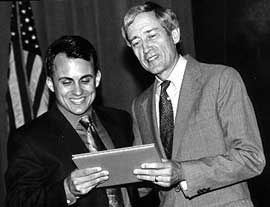
Columbia University President George Rupp (right) presents George Dohrmann with The 2000 Pulitzer Prize for Beat Reporting.
Winning Work
At least 20 men's basketball players at the University of Minnesota had research papers, take-home exams or other course work done for them during a five-year period, according to a former office manager in the academic counseling unit who said she did the work.
By George Dohrmann
Four former players, Courtney James, Russ Archambault, Kevin Loge and Darrell Whaley, confirmed that work was prepared for them in possible violation of the student code of conduct and NCAA regulations. Another former player, Trevor Winter, said he was aware of the practice.
James, Archambault and the office manager, Jan Gangelhoff, said knowledge of the academic fraud was widespread.
"These are serious allegations," University of Minnesota President Mark Yudof said Tuesday. "We've called in legal counsel. I want to look into this promptly. But they are just allegations at this point."
Gangelhoff, 50, said that from 1993 to 1998 she estimates she did more than 400 pieces of course work for players, including some starters on the 1996-97 Final Four team.
"They bring in these high-risk kids, and they know that everything they did in high school was done for them," Gangelhoff said. "It's got to stop somewhere."
Gangelhoff said she "struggled for a long time" whether to disclose the allegations. When asked to prove them, Gangelhoff provided the Pioneer Press with computer files containing more than 225 examples of course work for 19 players, dating to 1994, that she says she wrote and players turned in. Gangelhoff said she kept only about half her files.
Gangelhoff also provided printed copies of five pieces of course work that she said had been turned in by students. Some of the papers had grades and instructor's comments written on them. All five pieces also appeared in Gangelhoff's computer files.
Elayne Donahue, the retired head of the academic counseling unit, said she was unaware of the fraud but warned athletic department administrators that the office manager was tutoring players in violation of department policy and was ignored.
Coach Clem Haskins, interviewed briefly at his hotel in Seattle where the Gophers play Gonzaga in the first round of the NCAA tournament on Thursday, said the allegations were "news to me."
"I've been here 13 years, don't you know me, what I stand for as a man, as a person? I haven't changed," Haskins said. "All I'm trying to do is win a game. All I'm worrying about is beating Gonzaga. It's all I'm concentrating on. All I'll say is I will talk when the tournament is over."
Haskins referred all further comment to McKinley Boston, the vice president of student development and athletics, who questioned the credibility of Gangelhoff's allegations.
"Some of her current allegations seem to be inconsistent with statements she made in the past," he said. "We've had similar allegations made by others (about Gangelhoff), but this is new stuff."
Two former players denied Gangelhoff's allegation that she did work for them. Jermaine Stanford and Ryan Wolf said they completed all their own assignments. Three former players, Micah Watkins, Voshon Lenard and Hosea Crittenden, refused comment. Bobby Jackson said he and Gangelhoff did the work on the papers, with Gangelhoff typing them.
Gangelhoff said she did work for four players on this year's team: Kevin Clark, Miles Tarver, Antoine Broxsie and Jason Stanford. Clark and Tarver refused comment at their Seattle hotel Thursday night. Broxsie and Stanford were not made available for comment by school officials.
Normally, under the team's media policy, all inquiries for player interviews must be directed through school officials.
Five other former players could not be reached for comment.
When asked how he knew players were getting papers done, Winter, who graduated with a degree in business, attended the Carlson School of Management and now plays for the Timberwolves, said it was "common knowledge. It was just one of those things. It was unfortunate.
"If you know your teammate's getting help, if you know that somebody's helping with papers, you just (have the attitude that) 'I don't want to get involved in it.' It's like if you have a friend that's a convicted felon. You don't go around telling everybody he's a convicted felon. You just kind of let it go. It's him. It's his life. It's his choices. It's not me."
The Pioneer Press investigation also found these allegations:
Gangelhoff said she was caught doing a take-home exam with Loge in November 1996 but was allowed to continue to work with players. Loge, who left the program because he wanted to play for a smaller school, confirmed the incident.
Gangelhoff and two players, Archambault and James, said an assistant coach drove the players to Gangelhoff's Minneapolis home for tutoring sessions, a possible violation of NCAA rules. Archambault was dismissed from the team in February 1998 for rules violations, and James chose to turn pro instead of serving a season-long suspension after being convicted of fifth-degree assault in August 1997.
Gangelhoff said she often had different players turn in the same paper for different classes, or she used excerpts from one paper in another. An analysis of the documents provided to the Pioneer Press revealed seven instances of duplication, including one paper that Gangelhoff said was turned in by three different players for three different classes.
Donahue, the academic counseling chief, denied a request to allow Gangelhoff to tutor Broxsie last spring after she had been approved to tutor him during the winter quarter. But Gangelhoff said that Haskins paid her $3,000 in cash to continue tutoring the player.
"Clem Haskins absolutely denies any payment to Jan Gangelhoff for this purpose, or any other," Yudof said. "I think the world of Clem Haskins."
Gangelhoff said Haskins paid her in cash and that after spending $1,000 to pay bills, she deposited the rest. When asked by the Pioneer Press for proof, she provided a bank statement showing she deposited $2,000 on June 29. But the statement did not indicate whether the amount had been deposited in cash.
Gangelhoff said she never was asked by a member of the coaching staff to do course work for players but said she considered it compensation when she was taken on trips to two road games, including accompanying the team when it played at the Big Island Invitational in Hawaii in the 1995-96 season. "Why else do you think I got to go to some of the places I did?" said Gangelhoff, who said she also attended team banquets and parties for the selection of the NCAA tournament field.
Boston said he was unaware Gangelhoff had gone to Hawaii.
"That's a new one on me," he said. "You will have to ask Haskins why he invited her along."
A request Monday to interview athletic director Mark Dienhart; Alonzo Newby, the team's academic counselor; and Chris Schoemann, the school's NCAA compliance director, was ignored by the school's sports information staff. And phone messages left for Newby and Schoemann were not returned.
Gangelhoff said some of the first papers she wrote were edited by Newby and former assistant coach Milton Barnes, now the head coach at Eastern Michigan University. Barnes, reached by telephone, denies the allegation.
"Coach Barnes would read them and say things like: `Now, is this something so and so would say?' And if it wasn't, I would go back and rewrite it to make it sound more like something the player would write," Gangelhoff said.
Barnes said: "I don't know anything about it. I don't recall anything like that. She may have me confused with somebody else, that's all I can say."
Boston said the school has self-reported one potential NCAA violation involving Gangelhoff.
On Oct. 26, Dienhart sent Gangelhoff a letter disassociating her from the program even though she had left the school the previous summer.
In the letter, obtained by the Pioneer Press, Dienhart wrote that the school had "recently reviewed activities in the men's basketball academic counseling unit." It said the action against her had been "reviewed and approved" by the NCAA.
Gangelhoff said after she received the letter, "I came to the conclusion that something has to change" and she decided to make the allegations public.
An NCAA official denied comment about the letter.
"There was reason to question her based on one incident that came to our attention," said Boston, who refused to give further details about the incident.
"Our NCAA compliance officer (Schoemann) investigated her and basically determined that in one particular instance there was an allegation that was valid. We self-reported that one violation to the NCAA. But beyond what was determined in that one particular investigation, everything she is alleging is new information."
Gangelhoff said Schoemann questioned her twice about possible violations, but otherwise her actions went unchecked. Her first meeting with Schoemann came after Gangelhoff was caught helping Loge look up answers for a take-home exam during study table in the Bierman Athletic Building.
Loge, now attending Fergus Falls Community College, confirmed that Gangelhoff helped him look up the answers and admitted as much to Schoemann. Gangelhoff told Schoemann she helped Loge but claimed that she was unaware it was a take-home exam and that she couldn't help him.
Gangelhoff said she was never reprimanded or questioned further about the incident. Loge said he was not disciplined for the incident. Gangelhoff said Schoemann confronted her again a few months later and asked whether she was tutoring basketball players.
"I lied," Gangelhoff said. "And those were the only two times I was questioned."
Archambault said he never was questioned by Schoemann, and James said he was questioned once but lied to Schoemann.
"He asked if Jan did papers. Of course, I said no," James said. "At that time, I didn't want to get Jan in trouble. And, at the same time, I didn't want to get coach Haskins in trouble."
Gangelhoff said when she left the university she never intended to reveal that she did course work for players. But the letter of disassociation angered her, she says, because she never was asked to give her side of the story.
"You look at other programs that are successful that have strong academics, and why can't (Minnesota) have that?" she said. "What are we doing wrong that we can't get these kids to learn? . . . Something has to change or (Minnesota) will continue to bring kids in and then throw them away."
Gangelhoff said she did the course work to help academically at-risk athletes she thought were unprepared for college. Academic services' policy forbids front-office personnel from working with student-athletes. But Gangelhoff, an American Indian, said she felt a particular bond with African-American student-athletes.
"The big thing was that they trusted me. I was like a mother figure to them," Gangelhoff said. "My sisters and I, we treated them like family. We had dinners for them. We exchanged Christmas and birthday presents. And I always praised them."
As office manager, Gangelhoff worked for Donahue. But she said Newby was aware of her tutoring activities.
Gangelhoff said Newby arranged players' schedules so that they took courses with her or courses that she had already completed. Gangelhoff took classes from 1993 to '95 while employed full time as office manager. She received her degree in 1995 in InterCollege Program, a self-designed degree program offered by University College.
Gangelhoff was in the same 1994 class with players Winter, Lenard, Crittenden and Jayson Walton.
"We were in the same class, and, miraculously, we were in the same work group," Gangelhoff said. "I wrote the research paper (on alcoholism among American Indian youth)."
Winter said: "It was a group thing, a group project. She's American Indian. She had a lot more input than the rest of us did. She was a member of the group. It was all above board. . . . That was four years ago. Who knows (the truth) if I say I did 95 percent of the work and she just proofed it. . . . She may have proofed it. She may have written the whole thing. I honestly can't tell you what everyone's contribution was. . . . In groups, somebody does do most of the work."
James and Archambault said members of the coaching staff were aware that Gangelhoff was doing course work for players.
"The coaches knew. Everybody (in the basketball program) knew," Archambault said. "We used to make jokes about it. . . . I would go over there some night and get like four papers done. The coaches would be laughing about it.
James said, "Everybody knew we were going to see Jan."
Although Archambault said Haskins was aware of the practice, Winter said the coach may not have known.
"Clem is the basketball coach," Winter said. "When it comes to academics, there are coaches he puts in charge. If something is against the rules, he honestly, from me to you, has nothing to do with it. If there's things going on, he doesn't want to know about it. So, he has that buffer."
The buffers, he said, were assistant coaches and academic advisers.
Instead of the common practice of tutoring players at the Bierman Athletic Building, Gangelhoff said, she did most of her work at home. She said she drove players to her house or assistant coaches did. Archambault and James confirmed they got rides from an assistant coach, a possible NCAA violation. Under the NCAA's extra-benefits rule, athletes are not allowed services unavailable to other students.
Donahue said she heard from one of her employees that a coach was driving two players to Gangelhoff's home in the spring quarter of 1998, when she was no longer approved to tutor. She said she passed that information on to Dienhart and Schoemann but said that to the best of her knowledge, no investigation took place. Gangelhoff said she never was questioned during that period or since she stopped tutoring last June.
Once in the home, Gangelhoff said the players would either sit next to her as she typed the course work or be in an adjacent room.
"It depended on what we needed to do," Gangelhoff said. "If it was a (homework) assignment and they had been to class, we would talk about what happened in class and what they heard and what they thought about the assignment. And then, they would grab the remote and go watch TV, and I would type (the assignment) up.
"On the research papers, we would rarely meet. They would just give me the assignment and I would do it and then they would pick it up. Sometimes I would read the papers to them and explain them to them just in case they got asked in class about them."
Archambault said: "I thought I was going to actually learn how to write a paper. I never learned in high school. But then I sat down and she just started typing."
Bobby Jackson said Gangelhoff's primary role for him was as a typist, which is also a possible violation of the NCAA extra-benefits rule. Gangelhoff's files turned over to the Pioneer Press show 28 papers under Jackson's name.
"She definitely helped me out," said Jackson, who also plays for the Timberwolves. "She didn't totally do all the papers for me. . . . When we were on the road, of course we needed help. She did the typing. Once we got everything arranged, she did the typing. I'm not going to say she sat down and totally wrote the paper by herself. No. I was doing my papers myself, with the research and everything. At some point in time, she was finding books for us and stuff. Never a point in time she wrote my paper for me."
Winter said he understands why Gangelhoff's work became so prolific.
"I think it was more of a fact of laziness than it was of people really needing the help or really cheating to get by," he said. "During the season it really gets to be a wear. Not to sound like a pampered athlete -- and I did the work -- some people lose concentration. They miss a class here and there when on the road and get behind a little bit.
"It's easier to say, `Will you help me do this class?' or `Will you help me get this paper done?' than actually putting in the work. I would say the help the players got was more due to laziness than it was due to the fact they couldn't actually do the work."
Donahue said she was not surprised to learn from the Pioneer Press last week of Gangelhoff's allegations that she did course work for players.
"I believe anything is possible with Clem," she said. "But I am surprised by how widespread (the allegations are)."
Donahue said she suspected Gangelhoff was working with basketball players in violation of department policy but did not know she was doing course work.
"I believed she was tutoring, but because I didn't know where she was doing this, I had no proof," Donahue said.
Donahue described her relationship with Haskins as "strained" and said the two often disagreed on Newby's roles and whether Newby should have reported to her (see related story, Page 1A). While still at the university, Donahue said she was hesitant to make accusations against Newby and Haskins for that reason.
"There was a difference of philosophies. . . . I believed that (basketball players) should do their homework," Donahue said. "I believe they are in college to become educated. And I worked toward supporting students so they could earn a degree. My understanding of (the basketball program) was that you enabled students to become irresponsible. `It's OK to have someone else do the work.' "
By the spring quarter, Gangelhoff had moved back in with family in Wisconsin. But she continued to do course work, often driving from Wisconsin weekly to meet with players at her sister's home in Minneapolis. But she stopped tutoring because Newby never asked her to continue working with players during the summer, and she began a new job in August.
"It just sort of fizzled out," she said.
Gangelhoff substantiated her claim of writing the papers by pointing out that she often duplicated work or had different players turn in the same paper for different classes.
Gangelhoff said that one of the papers she produced, a 2,000-word essay comparing Martin Luther King Jr. to Malcolm X, was turned in by three players.
"I did that all the time," Gangelhoff said. "Different courses meant different professors so they wouldn't know. I would turn in papers I had written for my classes or take parts of one paper that I used for one player and put in a paper for another player."
In the papers supplied to the Pioneer Press, Gangelhoff at times wrote first-person essays for players. Gangelhoff said she tired of writing papers by the end of her tenure and wrote primarily about topics that interested her.
Among the 1998 work Gangelhoff turned over to the Pioneer Press were papers she said players turned in on the menstrual cycle, women's gains in the workplace and eating disorders. Two papers referred to the plight of the same woman, a one-time employee at US West, and in one of those she identifies the woman as her sister, Jeanne Payer.
Payer also tutored Archambault, Walton and Wolf, Gangelhoff said. Payer was approved to tutor by Donahue, who said she was unaware at the time of her hiring that Payer was Gangelhoff's sister. Payer could not be reached for comment, but Gangelhoff said Payer also did course work for the athletes in violation of NCAA rules during the 1997-98 school year.
Gangelhoff asked that Payer, who is ill, not be contacted.
"Alonzo (Newby) needed help. I needed help, and Jeanne was unemployed at the time," Gangelhoff said. "I said to Alonzo, 'Hire Jeanne,' and he thought that was an excellent idea."
Archambault said: "In the two years I was there, I never did a thing. Either Jan or Jeanne did everything."
Staff writers Judith Yates Borger, Kris Pope, Bob Sansevere and Jeff Seidel contributed to this report.
© 1999, PioneerPlanet / St. Paul (Minnesota) Pioneer Press
How could an office manager in the University of Minnesota's academic counseling unit write papers and do take-home exams for basketball players for five years without being detected?
The answer, according to the university's retired academic counseling director, Elayne Donahue, stems from a pivotal decision made by top athletic department officials in October 1994 that took away any checks and balances for academic help for basketball players.
By George Dohrmann
The decision was done at basketball coach Clem Haskins' request and approved by then-athletic director McKinley Boston. It moved Alonzo Newby, the academic counselor assigned to men's basketball, out of the university's academic counseling department and shifted him to the men's athletic department.
Of 22 sports at the university, the basketball team was the only one whose academic counselor did not report to Donahue.
The move -- billed initially as an "experiment" to better help academically at-risk players, according to internal documents obtained by the Pioneer Press -- mirrored the arrangement Haskins had at Western Kentucky from 1980 to '86. Donahue said Haskins began asking for an academic counselor independent of her department when he was hired in 1986.
Donahue can't say definitively that Newby's move allowed her office manager, Jan Gangelhoff, to secretly tutor basketball players and do their course work in violation of department rules, but said: "There is no doubt in my mind that there was a lack of institutional control."
"This isn't about Jan, nor is it about Alonzo," Donahue said. "It's about a system that allows it to happen."
But Boston said, "We take the academic responsibility of our student athletes very seriously."
Separate departments
Unlike most other schools in the Big Ten, the Minnesota men's athletic department and the university's academic support arm are separate divisions. Athletic director Mark Dienhart heads men's athletics, and the academic counseling unit has its own director. Donahue ran the unit for 15 years, from 1983 to '98, until her retirement last June. John Blanchard, the head of academic counseling at the University of North Carolina, replaced Donahue in January. Both positions report to Boston, former athletic director and now vice president in charge of athletics and student development.
University officials decided separate departments were ideal shortly after an incident in 1986 when three basketball players were accused of sexually assaulting a woman in Madison, Wis.
"That forced a lot of change at the university and in the athletic department," said Donahue, who before 1986 reported to directors in both the men's and women's athletic departments.
The structure, however, came into question in a Nov. 12, 1993, academic audit done by Norm Chervany, a faculty representative to men's athletics.
"The availability of quality tutors for specific needs" was one of three problem areas, Chervany reported in his audit. He quoted academic counselor Newby as saying: "I cannot hire appropriate tutoring." At the end of the audit, Chervany suggested men's basketball could be used "to experiment with new designs" in the academic support area.
Seven months later, at a June 29, 1994, meeting of the Assembly Committee on Intercollegiate Athletics, athletic director Dienhart raised the possibility the basketball program would be treated differently.
"The (basketball) department is looking at its approach in dealing with at-risk athletes, particularly student athletes of color," Dienhart said "The basketball program will potentially be used as a model for dealing with these athletes and to deal with the noted tension (between basketball and the academic counseling unit)," according to minutes of the ACIA meeting. The ACIA is a committee of faculty members often consulted on academic issues pertaining to athletes.
Donahue acknowledged her relationship with Haskins was strained.
"I was in charge of academic counseling, but Alonzo was told differently by Clem," Donahue said. "(Newby) thought he was independent. He looked for his budget, and he didn't have a budget. He didn't understand why he had to get his actions cleared by me. And, he had less understanding the longer he was there."
Part of the problem, Donahue said, was that Boston, then Minnesota's athletic director, clearly sided with the basketball program.
"Before Mac (replaced Rick Bay as) athletic director, I always felt I had the support of central administration and the faculty," she said. "That gave me strength and gave me the authority or power to do something, because people backed me up. But when (Boston was hired as director) that disappeared.
"Boston and (former university vice president Jim) Infante and some of the faculty who were then on (the ACIA) would say: `Elayne, when are you going to try and get along with Clem?' And that was the response I would get any time I reported something."
Donahue said tension and "difference in philosophies" between her and Boston and Haskins led to Chervany's second review of the program in the fall of 1994 and his recommendation that Newby be moved from academic counseling into men's athletics. Boston endorsed Chervany's recommendation in a memo dated Oct. 11, 1994. In that document, Boston wrote that Newby's new "reporting relationship recognizes the unique needs and circumstances surrounding the highly visible and sometimes `at-risk' student athletes in the basketball program."
That was an excuse, Donahue said.
"Football has `at-risk' student-athletes who are high-profile, but they never asked to have their counselor report to men's athletics," said Donahue. She also insisted that her academic counseling unit never ignored the needs of "at-risk" students, but, "I still believed they should do their own work."
However, she signed off on Newby's move. "I said it was wrong, but personally I was overjoyed because I had been asked to oversee something I had no authority over," Donahue said. "And I think they liked that I was no longer looking over (Newby's shoulder)."
Boston said his department merely wanted to try a different management approach.
"It was more a personnel issue," he said. "We had some difficulties and inappropriate communications. We opted to sit down and look at a new experience."
Donahue was still in charge of approving tutors for men's basketball. She said Newby turned in an abnormally low number of potential tutors, about one a quarter, and that she approved all of them.
What Donahue didn't realize was that her office manager, Gangelhoff, was tutoring basketball players and, Gangelhoff says and some players have confirmed, doing their research papers and take-home exams, in violation of department rules.
Gangelhoff said she was approached by Newby and "felt out" about tutoring athletes.
"I was in the right place at the right time," she said.
When asked how she avoided getting caught, Gangelhoff said the new structure made it possible.
"We put up roadblocks, and Alonzo going into men's athletics was the biggest one," she said.
Donahue was surprised by the scope of Gangelhoff's allegations. "I am, as funny as it sounds, broken-hearted," Donahue said. "I trusted her and, though I had my suspicions, I never thought it was so long-lasting and so much. I feel like I was really duped."
"Other than what tutors Alonzo submitted, I had zero knowledge of what was going on in men's basketball, because that is what Clem wanted," Donahue said.
Men's athletics initially seemed pleased with the new chain of command.
In a review of men's basketball by Chervany dated July 5, 1996, he wrote that "it is certainly not the most desirable of situations. But it works, and it works better than the arrangements of the past from Elayne's perspective and from coach Haskins' perspective."
Chervany also suggested that eventually money from men's basketball would be "carved out" so that Newby can "secure tutors."
But in that same memorandum, Chervany wrote of political science professor Bill Flanigan's concern that "student-athletes are feeling some pressure to take courses not directly related to the academic programs to raise GPAs or maintain eligibility."
Chervany explained it as student athletes counseling themselves. -- It may, in fact, not be a product of the system and the influence of the coaches at all."
But a little more than a year later, in fall of 1997, the athletic department changed its mind. Chervany recommended Newby be put back into the academic services unit under the charge of Donahue. Boston said in a memo to Donahue written in October of that year that he hoped Donahue would be open "to do some things in a new way."
Donahue said there was another motive for the change. The NCAA is due to review Minnesota's athletic department for accreditation this year.
"The NCAA would not have looked fondly on Alonzo and men's basketball being the only sport outside of academic counseling," Donahue said. "It would have been obvious then that men's basketball is too much of a controlled society."
Boston said: "We decided it wouldn't work. Communication wasn't as good as we hoped. That was probably the major reason."
Tutor for a quarter
Gangelhoff's secret role as tutor became official for one quarter, the winter of 1998.
She had resigned as office manager in January 1998 and was no longer prohibited by department rules from being a tutor. Newby asked Donahue if Gangelhoff could tutor Antoine Broxsie until the end of that school year, June 30. Newby said the player needed help immediately and thought it would be best for the player to keep the same tutor throughout the school year.
"I could buy the argument they needed continuity through winter, but spring quarter (the player) had the ability, I believed, to adjust to a new tutor; he would be adjusting to new faculty members," Donahue said.
So Donahue approved Gangelhoff through the winter quarter, but told Newby that Gangelhoff could not work with Newby in the spring, a decision athletic director Dienhart, associate athletic director Jeff Schemmel and the university's director of NCAA compliance Chris Shoemann endorsed.
Donahue said she had a conversation with assistant basketball coach Charles Cunningham about a month later that led her to believe the limitation she had placed on Gangelhoff was not being taken seriously.
"Cunningham implied in that conversation that Jan would continue to work with (Broxsie) in the spring. I said Jan wouldn't be working with (Broxsie). He said, `We coaches haven't decided yet.' I said, `You coaches don't decide.' And then he said something like, `You better watch how you are talking here.' "
Donahue said she told Dienhart, Schemmel and Shoemann about that conversation and then sent a memo to Boston dated Feb. 23.
"I am becoming more and more frustrated and need your help," she wrote. "I have been under the impression when men's basketball was re-assigned to academic counseling that there would be some effort made to enforce the new reporting lines.
"However, as time goes by, it is becoming more apparent that I am just a front for whatever is going on in men's basketball. This leaves me in the vulnerable position of being responsible for something (i.e., whatever is going on in the men's basketball program) that I have no control over. That is unfair, and I believe unethical. -- I do not intend to have my reputation sullied by the actions of employees over whom I have no control."
Boston responded in a memo nine days later. It said that he had met with Cunningham and Haskins "to hear their assessment of the effectiveness of the current program" and Donahue's claims. "Both Clem and Charles acknowledged that some adjustments need to be made. They assure me that they are in the process of determining how best to accomplish these changes," Boston wrote.
In May, Donahue said she heard from a member of her staff that Gangelhoff was tutoring Broxsie and another player at the home of Gangelhoff's sister. Gangelhoff confirmed both allegations and produced course work she had done for the players dated during that spring quarter. Donahue twice asked Newby in e-mails if Gangelhoff was tutoring players, and both times his response was: "Jan is not on basketball's payroll."
"Notice he wouldn't say that Jan wasn't tutoring, he would only say that she wasn't on basketball's payroll," said Donahue, who sent copies of those e-mails to Dienhart, Schemmel and Schoemann.
Boston said he spoke with Newby on Tuesday and that he denied Gangelhoff tutored players when she was office manager.
"If she was tutoring players, I'm not so sure someone should have known other than the person responsible, other than the academic counselor (Newby)," Boston said.
Study finds fault
Meanwhile, Fred Amram, a professor of communication of creativity at the university, was assigned to do a study of academic counselors as part of the Academic Counseling Review Committee, a group that reviewed the relationship between counselors and faculty. Included in his two-page report -- submitted on April 16, 1998, to Boston's assistant, Laurie Reich -- were interviews with four college advisers, two each from the College of Liberal Arts and the General College.
In the report, Amram wrote that all four advisers indicated that "one sport was not collaborating well and not counseling students toward appropriate academic goals." The advisers accused a counselor of preparing inadequate year-long plans, of recommending courses "which are frequently inappropriate for the student's major and often not permissible (e.g. 3000- and 5000-level courses for ill-prepared first-year students)."
Amram wrote that "interviewees suggested that this counselor be structurally and physically integrated into Academic Counseling." Donahue, who considered Amram an ally in her battles with Haskins and Boston over men's basketball's actions, said Amram was talking about basketball and academic counselor Newby.
"I believe, and other people believed, there were people like Jan long before there was Jan," Donahue said, "that there were always people who would do the players' work, which we could never prove. They were probably not on the payroll either.
"Everything in basketball was secret. The players didn't participate in the learning center and didn't work in the computer center. -- That is how Clem wanted it. And (Boston) lets Clem do whatever he wants."
© 1999, PioneerPlanet / St. Paul (Minnesota) Pioneer Press
A former University of Minnesota men's basketball team academic counselor, who is suing the school for sexual harassment, alleges in an affidavit filed Jan. 6 that a basketball coach asked him in 1986 to do course work for a player, court documents obtained Thursday show.
By George Dohrmann
Rick Marsden, reached Thursday night, identified the coach as Clem Haskins.
"It was him," Marsden said. "He asked me to write a paper for (the player) and I told him I absolutely would not. He swore at me; I swore at him and then I told my boss."
Haskins, reached at his hotel in Seattle, said: "I don't have a response."
Marsden's supervisor at the time, former academic counseling unit head Elayne Donahue, confirmed Thursday that Marsden told her 13 years ago about the exchange with Haskins. She said she does not remember what she did about Marsden's complaint.
How could Marsden remember the incident from so long ago?
"I remember it so well because it was the only time I was asked to cheat," Marsden said.
Marsden, who is gay, filed a suit against the university in November, contending that "homophobic attitudes of administrators at Minnesota deprived him of advancement," Marsden's lawyer, Judy Schermer, said then.
Marsden said doctors determined he was mentally unable to work in men's athletics after he suffered what he calls "a mental breakdown" in the fall. His request to be transferred to another department at the university was denied, and he has been on unpaid leave since Dec. 17.
"I know people are going to say that I came forward because of the (lawsuit)," Marsden said Thursday. "People can spin it any way they want. But it doesn't matter what they think my motivation might be, just as it doesn't matter why Jan (Gangelhoff) came forward. This is academic fraud, systematic academic fraud, and people need to know the truth."
The Pioneer Press reported Wednesday that Gangelhoff, a former office manager in the academic counseling unit, said she did more than 400 pieces of course work for at least 20 players over a five-year period. Four players confirmed she did the work for them, a possible violation of the school's conduct code and NCAA rules.
Sandra Gardebring, the school's vice president for institutional relations, said she is unfamiliar with the specifics of Marsden's allegations against Haskins. She said Marsden's claims could be looked into by the school's attorneys as part of its overall investigation into Gangelhoff's allegations.
"We will act on allegations that come in from anybody that have a bearing on academic misconduct," she said. "If Rick Marsden has information that has a bearing on this issue, we are interested and we will look at it."
When asked to recount the 1986 incident, Marsden provided the Pioneer Press with the written allegations against the university that he gave his attorney in January so she could prepare the affidavit as part of his lawsuit.
"My first meeting with Coach Clem Haskins when he arrived as head men's basketball coach at the University of Minnesota occurred at 6 p.m. in his office," Marsden wrote. "He had summoned me, as the academic counselor working with the men's basketball team, to his office to inform me of his expectations of me in working with the players on his team.
"The conversation was decidedly one-sided as Coach Haskins lectured me on his philosophy regarding academics and athletics. Finally, in speaking about a specifically academically-fragile member of his team, Coach Haskins told me that he expected me to do `whatever it takes to help (player's name) be successful academically.' I asked Coach Haskins to clarify what he meant. His reply was that `if that means doing a paper for him, then do the paper for him.' He swore at me; I swore back. I immediately went to the office of my supervisor, Dr. Elayne M. Donahue, and reported the incident."
Said Donahue: "I remember it."
Marsden, who joined the academic counseling unit in 1984, never worked with Haskins' players after the alleged conversation. Marsden worked with athletes in other sports and spent the past few years assigned to the men's hockey team. He also served as assistant director to Donahue from 1992-95.
"What (Haskins) was really doing in that meeting was to get the ground rules straight," Marsden said Thursday. "But I refused to do (the player's) work."
Staff writers Bob Sansevere in Seattle and Blake Morrison contributed to this report.
© 1999, PioneerPlanet / St. Paul (Minnesota) Pioneer Press
Gangelhoff sought recommendation for U master's program
University of Minnesota men's basketball coach Clem Haskins once signed a glowing letter of recommendation for the woman who now says she did course work for players on his team.
By George Dohrmann
The Oct. 2, 1995 letter praised former university employee Jan Gangelhoff for her efforts as a mentor to students and her ability to perform "above what is required of her."
"From my personal experience and reports from others who have known her longer, she has a unique ability to help young people realize their potential," according to the letter, written to help Gangelhoff gain entrance to the Master of Liberal Studies program.
Gangelhoff told the Pioneer Press last week that she did an estimated 400 pieces of course work, including term papers, for at least 20 players from 1993 to 1998. At the time of the letter, Gangelhoff was employed as an office manager in the academic counseling unit and was not permitted under its rules to work with basketball players. She said she believes Haskins knew of her activities.
The letter signed by Haskins praises Gangelhoff's work with students in general. It does not indicate whether any of those students were members of the men's basketball team or other athletes. Nonetheless, the letter seems to indicate that Haskins was familiar with Gangelhoff and some of her activities on behalf of university students.
Haskins, who did not return repeated phone calls last week, has said through university Vice President McKinley Boston that he didn't know Gangelhoff was tutoring players. Athletic Director Mark Dienhart also declined to comment.
Gangelhoff, reached Friday, acknowledged that the letter was written on her behalf. She said she asked Alonzo Newby, the academic counselor for men's basketball, to write her a letter of recommendation but that he suggested it come from Haskins.
According to Gangelhoff, Newby suggested the letter would be stronger coming from someone like Haskins.
"Alonzo said something like: `How about if I write something up and coach signs it?' " Gangelhoff said.
Newby declined to comment through his lawyer, Ron Rosenbaum.
The letter is dated less than two months before Gangelhoff says she accompanied the men's Gopher basketball team on a trip to Hawaii at the university's expense. School officials have neither denied nor confirmed that she made the trip.
Gangelhoff said she began doing course work for players in the summer of 1993. After leaving her job as office manager in January 1998, she was hired to tutor for one quarter. Only during that time was she authorized by the academic counseling office to work with student athletes.
After seeking the letter of recommendation, Gangelhoff said she dropped her plans to seek a master's degree in liberal studies and did not submit an application.
Jo Ellen Lundblad, coordinator of the program, said applicants must provide at least two reference letters. Most come from co-workers, supervisors or former professors, she said. "Anyone who can address your brilliance," she added.
Lundblad would neither confirm nor deny that the Haskins letter was received. She added that a letter of recommendation from a coach would be unusual. "But if that has been her employer and he knows of her abilities, we would accept that," she added.
Gangelhoff said Newby told her the original letter signed by Haskins was sent to the program in a sealed envelope. She said Newby gave her a copy.
"I never saw the original because I believe the original had to go directly to the program separate from the other application materials," Gangelhoff said. That's a common procedure with such applications.
Gangelhoff considered an advanced degree after receiving her bachelor's degree from the university's InterCollege Program (ICP) in August 1995. She said she also asked a former co-worker in the public health school to write a letter of recommendation, but later decided not to seek the degree.
"One of the reasons was that the program did not have a lot of courses in the area I wanted to study," Gangelhoff said. "But the main reason was that I didn't have a lot of free time. I was working (in the academic counseling unit) and taking care of my family."
Elayne Donahue, Gangelhoff's boss in academic counseling when the letter was written, said she was surprised Haskins had signed the letter of recommendation.
"The best place to get a recommendation for graduate school would be from someone in academics," Donahue said. "To get a recommendation from a coach seems absurd."
The letter states that one of Gangelhoff's strengths is "the ability to work effectively with differing personalities" and that "her reputation among students is such that they frequently seek her out."
The letter closes with the comment, "I recommend her without reservation" and gives a phone number in the men's basketball office.
© 1999, PioneerPlanet / St. Paul (Minnesota) Pioneer Press
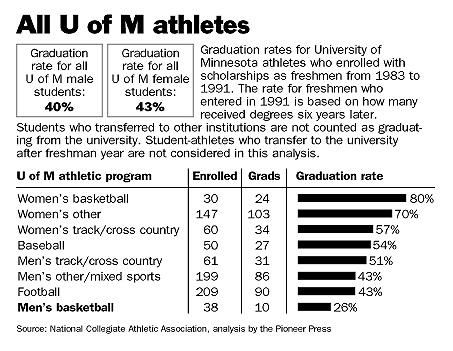
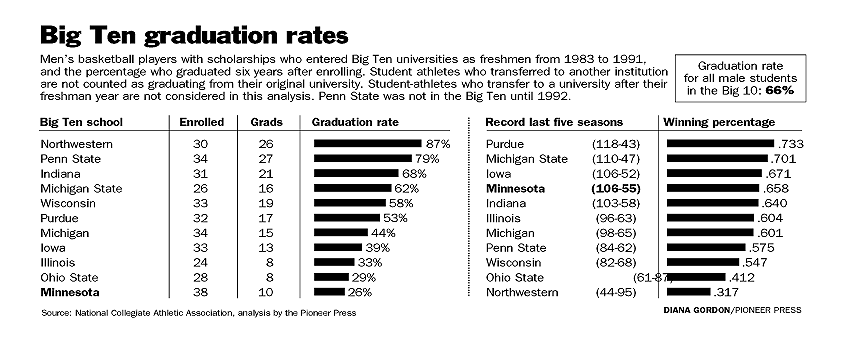
A Pioneer Press analysis of the Gophers men's basketball team shows its graduation rate is 26 percent--half the conference average.
Whether they cheated or not, scholarship athletes on the University of Minnesota men's basketball team have the worst record of earning diplomas in the Big 10 Conference, a Pioneer Press analysis of graduation figures shows.
By David Shaffer and George Dohrmann
Just one in four freshmen Gopher basketball players who were recruited from 1983 to 1991 eventually graduated from the university, the analysis of National Collegiate Athletic Association data shows. On average, about half of the men's basketball players in the Big 10 earned diplomas.
In a separate analysis, the Pioneer Press found that only two of 21 students linked to the academic fraud scandal at the university have received degrees. Most of the other players who allegedly benefited from course work done by former university tutor Jan Gangelhoff have left the university with no degree.
The findings indicate that even as Gangelhoff says she was writing hundreds of papers and take-home tests to help players from 1993 to 1998, the promise of a bachelor's degree eluded the majority of those recruited to play basketball for the Golden Gophers.
Two law firms hired by the university are investigating the allegations of academic fraud first reported last month. But the low graduation rate for basketball players is a problem that has lingered since the 1980s.
Under coach Clem Haskins, who was hired in 1986, the Gophers graduation rate declined slightly in comparison to the three previous years, the analysis shows. The graduation rate for freshmen entering the program during the Haskins years, from 1986 to 1991, was 23 percent.
By contrast, two Big 10 schools, Penn State and Northwestern University, had graduation rates of 80 percent or more for their incoming freshmen basketball players during the same six-year period. Graduation rates at other Big 10 universities ranged from 31 percent to 74 percent during that time.
"This is disturbing," said university President Mark Yudof, who indicated he had no explanation for the low graduation rate. "We are going to have to look at this intensively."
Yudof said higher admission standards already in place at the university may affect the graduation rate in the future. But any changes made in recent years won't show up in the NCAA graduation figures until after the year 2000, he said.
Elayne Donahue, who retired four months ago after having served as director of academic counseling since 1983, said athletic department officials were aware of the low graduation rate but "I never heard a concerned voice." Instead, she said, the low graduation rate has been blamed on players who leave after one year or go on to play professionally.
"People are quick to explain it away instead of taking responsibility for it," said Donahue, who supervised counselors and tutors who worked with athletes.
Men's basketball includes many academically at-risk students, but that is not the only reason for the low graduation rate, she said. Other athletic programs have done a better job at making academics a priority, she added.
"There are coaches who really want their kids to graduate," said Donahue, citing outgoing Gopher hockey coach Doug Woog as an example.
Hockey players' graduation rates are reported in a larger category of other men's sports. That group had a 43 percent graduation rate for the nine-year period.
Woog resigned this week week after two consecutive losing seasons to become an assistant athletic director at the university.
John Blanchard, who replaced Donahue as academic counseling director in January, said he is too new to the university to know why Gopher basketball players are less successful than other Big 10 players at earning diplomas. He said his mission is to work with student-athletes individually to enhance their academic success.
In the graduation-rate analysis, the newspaper compared nine years of data collected by the NCAA, using the same method the association employs. The rate for freshmen who entered in 1991 is based on how many of them earned degrees six years later. Students who transferred to other institutions are not counted as graduating from their original university. Student-athletes who transfer to a university after the freshman year are not considered in this analysis.
Among the former players who have not graduated are the five starters on the 1997 Final Four team: John Thomas, Bobby Jackson, Eric Harris, Courtney James and Sam Jacobson. None registered for classes during the 1998-99 school year. A separate analysis considered 21 players linked to academic fraud allegations at the university. The two who graduated are former reserve center Trevor Winter, who got a business management degree in 1997, and reserve player Ryan Wolf, who received a bachelor of science degree in 1995, according to the university registrar's office.
Gangelhoff has said she wrote one paper for each of the two players, the least amount of course work allegedly done for any of the 21 players.
Winter's paper was written for a group project. The group included Gangelhoff, then a university student, and three other players. Winter has said he does not recall who did the work.
The paper Gangelhoff says she wrote for Wolf is on Martin Luther King Jr. and Malcolm X. It is virtually identical to papers turned in by two other players. Wolf has declined to comment.
Of the 21 students linked to the investigation, two remain enrolled at the university. The others are not currently enrolled.
Antoine Broxsie, the only player with eligibility remaining, is enrolled in classes spring quarter, as is Jason Stanford. Miles Tarver and Kevin Clark, starters this past season, are not currently enrolled, according to the registrar's office.
© 1999, PioneerPlanet / St. Paul (Minnesota) Pioneer Press
Papers allege program intervened for players
The University of Minnesota men's basketball program allegedly intervened with faculty members on behalf of several Gophers players, some of whom needed help to remain eligible to play, according to interviews and documents obtained by the Pioneer Press.
By George Dohrmann, Blake Morrison and David Shaffer
The documents, provided Tuesday by former academic counseling director Elayne Donahue, portray a basketball program desperate to keep players eligible and a university faculty sometimes willing to help.
In a 20-page report she intends to give to lawyers investigating charges of academic fraud "if they ask," Donahue said some faculty members "awarded basketball players final grades before the students completed the course work." She also reported that grades sometimes were changed years after players enrolled in courses, ostensibly to keep them eligible.
"Professors who called my office to say that they knew a basketball player didn't write the paper he turned in because it was `graduate-level work' would in the end accept the paper at face value," Donahue writes in the report. "Faculty who called to say a basketball player cheated on a test would end up accepting the test as written. Faculty who called to say that a certain basketball player never attended a class and, therefore, with one week to go would fail the course, would in the end give the player a passing grade."
One professor named in the documents said he never felt any pressure to keep basketball players eligible. But another spoke of a climate in which some faculty members gave basketball players the benefit of the doubt rather than question suspicious work.
According to the new allegations raised in documents and interviews with university officials:
Academic counselor Alonzo Newby engineered last-minute switches in the grading method for two of player Antoine Broxsie's fall 1997 courses, ensuring Broxsie would remain academically eligible.
Academic counselors reported concerns that one professor was told to give player Kevin Clark a "B-" in a course so he could continue to play.
Haskins made personal visits to instructors for at least two Gophers players and gave one teacher free tickets to a Gophers basketball game.
An Inter-College Program director expressed concern that he was being pressured to accept an athlete who did not meet requirements into the self-designed study program.
University spokeswoman Nina Shepherd said school officials would not comment on specific allegations.
Two outside law firms hired by the university continue to investigate charges of academic fraud after allegations by former university employee Jan Gangelhoff. She said she did more than 400 pieces of course work for 20 players from 1993 to 1998, and has furnished the Pioneer Press with more than 350 copies of the papers, exams and speeches. The latest documents obtained by the newspaper include four memos describing last-minute changes that gave Broxsie non-letter grades in algebra and climatology courses in the fall of 1997, guaranteeing he would remain academically eligible for basketball.
With the switch, Broxsie avoided any risk of a "D" or "F," and received "Not-satisfactory" or "N" grades under an alternate, satisfactory/not-satisfactory grading system. Unlike a "D" or "F," which would count against the requirement for a 2.0 grade-point average, "N" grades don't carry grade points and didn't affect Broxsie's eligibility to play basketball.
Under university rules, all students must choose a grading system either letter grades ("A" through "F") or satisfactory/not-satisfactory within two weeks after classes begin. But the documents allege Broxsie was permitted to switch from letter grades to the alternate system days before fall classes ended.
Newby, the academic counselor assigned to assist basketball players, allegedly contacted Broxsie's academic adviser, Mary Ellen Shaw, seeking a written petition to change from letter grades, according to a detailed account of the incident written by Jennifer Franko, executive secretary in the General College Academic Support Center.
The memo was among 64 pages of e-mails, memos and other documents that Donahue supplied to the newspaper.
Shaw "felt compelled to process the request because Alonzo Newby ... stated to her that if the petition wasn't approved, Broxsie would lose his athletic scholarship" under NCAA regulations, the Franko memo said.
In fact, Broxsie was not in danger of losing his scholarship, Donahue said Tuesday. Neither Shaw nor Franko returned repeated telephone calls. Newby declined to comment through his attorney.
Broxsie's attorney, Phil Resnick, said he could not comment until he has reviewed the memos.
Allen B. Johnson, a professor who taught at least one of the courses in question, said he cannot discuss Broxsie's grades because his comments might violate privacy laws. But he added that maintaining athletic eligibility is not a valid reason to allow a grading-system change after the deadline.
Johnson said he reported the episode to investigators handling the outside inquiry into alleged academic fraud in the men's basketball program.
Donahue said university officials met to discuss the incident last year, but the result was inconclusive.
Separate case
Documents also described a separate case of alleged grading irregularities.
According to an e-mail message dated June 2, 1998, Donahue told top athletic department officials of her concerns about possible grade-fixing relating to Clark. Donahue wrote that she had been told that Delane Welsch, an applied economics professor, gave Clark a "B-" in a micro economics course after someone in the men's basketball program told Welsch that Clark needed that grade to stay eligible.
"It is my understanding of the conversation that Kevin has still not completed the work" for the class, she wrote.
Welsch, who called Clark a "strong student," said in an interview that he has never been asked to change a student's grade, nor has he changed one on his own. "Oh heavens no. For crying out loud, no. No I don't do that," Welsch said.
Donahue's message was sent to men's athletic director Mark Dienhart, NCAA compliance officer Chris Schoemann, and associate athletic director Jeff Schemmel.
Donahue said she cannot recall what became of the issue. She said one of the three told her they would handle the matter, and because she was just weeks away from retirement, she acquiesced.
Clark said Tuesday night he doesn't remember taking the class and can't comment because "the school won't let us."
Dienhart said on Tuesday night that Schoemann "investigated the allegation and was unable to find substantiation to justify the claim."
Faculty members' concerns
Sometimes faculty members raised concerns about players' academic status.
Steve Carnes, an associate director in the university's Undergraduate Program, sent an e-mail to Donahue detailing the 1997 enrollment of former player Sam Jacobson in the Inter-College Program. Carnes wrote that Jacobson's application for enrollment was so late "we were put in the position of making a decision on a star athlete at the last second, and the pressure was clearly there to say yes."
Carnes confirmed Tuesday that he had sent the e-mail, but said he would not comment further. Jacobson, who now plays professionally for the Los Angeles Lakers, could not be reached.
Carnes wrote that Jacobson's grade-point average was below that required for admission and that Jacobson contacted the program less than two weeks before submitting his proposal. Carnes also questioned why Jacobson, a pre-business major since his first quarter at the university, submitted a proposal so late in his academic career.
"I'll be blunt and tell you that I felt behind the proverbial eight ball on this one," the e-mail said. "Getting this request when we did really does feel like it was almost a setup."
Carnes approved Jacobson's proposal, according to the e-mail, because he believed Jacobson was unaware that he didn't meet the requirements of the program and because to deny him would be "punishing Sam for what (at least) I felt was probably a case of poor advising."
According to two other memos, program officials extended deadlines for dropping classes so one men's basketball player would maintain his eligibility and signed a petition that allowed a player to drop a class long after the deadline.
Prof queries student
Val Woodward, a retired biological sciences professor, said in an interview that Newby telephoned him in late 1995 to express alarm that former Gophers basketball center John Thomas faced the threat of academic ineligibility if he didn't achieve a good grade in a human heredity class.
Thomas passed the course with a "B," Woodward said, after submitting a term paper that Gangelhoff, a former tutor and academic counseling office manager, now says she wrote.
Thomas, who now plays for the Toronto Raptors, denied in an interview last week that Gangelhoff wrote the paper, but said she might have accompanied him to the library as he researched it. He said he doesn't remember being in academic trouble at that time.
Woodward, who retired two years ago, said Newby expressed concern that Thomas might end up with an "incomplete" grade. A student can make up an incomplete, but it can affect an athlete's eligibility to play.
The professor said Newby "told me that it would certainly be good if he (Thomas) could remain eligible for winter quarter because with an `I' he couldn't play." Woodward said Thomas also spoke to him about needing to remain eligible.
Newby's attorney, Ron Rosenbaum, said neither he nor Newby would comment.
Woodward said he didn't think Thomas "had any intention of putting forth any effort in that class." At the time, Woodward said his practice was to grade students "A," "B" or "C." Anyone who earned less than that would be given an incomplete, which would become a permanent "D" or "F" if the student didn't re-take the final exam or complete other course work in the next quarter.
Thomas ended up with a "B" in the class, partly on the strength of the paper, entitled "Is There a Biological Basis to Race?" according to Woodward. Yet the professor said he was suspicious that Thomas had written a good paper after displaying little interest in the course.
"I asked him, `Did you write this?' and he said he did," Woodward said. "I had suspicions that he had some help" but made no further inquiries into it.
Thomas told the Pioneer Press that he was never questioned about his authorship of the paper.
Free tickets
Donahue said she made notes logging contact by basketball staff with professors. In one note, Donahue wrote that a former General College teaching assistant, Jed Hopkins, was given free tickets to a basketball game shortly after a visit from Haskins in 1992. She said Haskins told her about the tickets and his conversation with Hopkins after meeting with him to discuss the academic standing of former player Voshon Lenard.
"Clem told me that I didn't know how to do my job," Donahue said in an interview.
"He said `I went over to see the professor and right away I could see he didn't know anything about basketball. He's not from here (Hopkins is British). I told him how we do things over here, and I gave him a few tickets, and now he understands how you do it.' "
Donahue said that Hopkins still failed Lenard, whom Hopkins had said was not attending class or turning in assignments.
Hopkins confirmed Donahue's account, saying that Haskins and one of his assistants visited him during a class. Two Gophers basketball tickets appeared in his office mailbox a few days later.
Dienhart said on Tuesday that coaches are not prohibited from giving tickets to faculty members or from visiting with them to discuss an athlete's academic progress as long as they do not ask for special treatment for players.
Haskins' lawyer Ron Zamansky said Haskins would not comment. Previously, he has denied all allegations of wrongdoing.
Professor reconsiders accusation
Donahue said some professors who called her with concerns subsequently changed their minds about complaining. One such case, memos say, involved Sander Latts, a professor in the General College.
Suspecting that player Mark Jones did not write a paper he turned in for a General College course in 1995, Latts called academic counselor Brian Berube to voice his suspicions, memos show. Just days later, however, Latts reconsidered, writing a memo to Donahue and others saying he did not "wish to challenge Mark that his paper was all his original work."
"Because I didn't want to make any waves, I simply let it go," Latts said Tuesday. "Once I wrote a memo like the one I did, I would simply let it die and hope somebody else did something about it. I just wanted to send up a potential red flag."
"There certainly is an emphasis on keeping athletes eligible. It's impossible not to be aware that athletes need to be eligible," Latts said. "I did not want to be the one that could be charged with `He is the one who made me ineligible."'
Repeated attempts by the Pioneer Press to reach Jones, who is playing professional basketball in Turkey, were unsuccessful.
In the subsequent memo, Latts wrote that Jones' performance in his class "should no longer be questioned or investigated." But Tuesday, he said he wasn't surprised to learn that the paper in dispute - a report on adolescence - was allegedly done by Gangelhoff.
"We know it's been going on for years and years, this kind of help," Latts said of players getting assistance. "This is nothing new. We at the university just kind of assume that there are things going on."
"I probably did more about it than other people who never bothered to contact the athletic department. In some respects I think I am in the position I am because I did do something," he said. "I may not have gone the final step and blown the whistle and report, but at least I alerted people that there was something going on there."
© 1999, PioneerPlanet / St. Paul (Minnesota) Pioneer Press
By George Dohrmann
The University of Minnesota did not report a possible violation of NCAA rules involving Jan Gangelhoff and former basketball player Kevin Loge in 1996 even though they -- as well as the former head of the academic counseling unit -- say they told a university official that the former office manager helped Loge with a take-home exam.
That the incident was not reported by Chris Schoemann, the university's director of compliance, is now being investigated as part of the university's probe into academic fraud in the men's basketball program, said Tonya Moten Brown, chief of staff for university President Mark Yudof.
Under NCAA rules, programs must report "instances in which compliance (with NCAA rules) has not been achieved."
Minnesota officials reported one possible NCAA violation involving Gangelhoff, but it was for typing an assignment for an unidentified player in March 1998, according to documents released by the school Tuesday.
Schoemann said he had no basis for reporting the Loge incident, which appeared in a March 10 Pioneer Press report.
"The information the student-athlete and the employee gave us at the time led us to believe no violation occurred," Schoemann said. "We were not given the facts that were reported in (the Pioneer Press)."
Schoemann would not comment further.
According to the documents released Tuesday, the men's athletic department reported to the NCAA 115 potential violations, 16 of which occurred in the basketball program.
Both Loge and Gangelhoff said they told Schoemann that Gangelhoff helped the player find answers on a take-home exam. In addition, former academic counseling director Elayne Donahue said she told Schoemann one of her employees witnessed the incident.
Gangelhoff's allegations that she did course work for at least 21 players led to the current investigation.
Gangelhoff was questioned about the Loge incident, which both say took place when the rest of the team was in Puerto Rico for a tournament (Nov. 29 to Dec. 1). She said she was in the office of Alonzo Newby, the academic counselor for men's basketball, when Loge asked her for help.
"I was sitting in there and Kevin was across the hall, and he asked me if I knew anything about, I think, business law," Gangelhoff said. "I walked over there and he said he had this take-home exam and that he couldn't even find where the answers were. I looked at the questions and then looked at the back of the sheet where there was some dialogue about the questions and saw that the answer for one of the questions was like in the second paragraph.
"I told Kevin, `Look on the back and you'll find the answers.' "
Gangelhoff said Cindy Kato, a learning specialist in academic counseling, heard the conversation and reported it to Donahue. Kato did not return phone messages left at her office Tuesday, but Donahue confirmed that a member of her staff told her about the incident and that she confronted Gangelhoff. Donahue said she then reported the incident to Schoemann.
Gangelhoff said Schoemann questioned her twice, the first time in December 1996. She said he asked her about helping Loge and that she admitted she told him where to find the answers. Loge has said that Schoemann questioned him and that he admitted Gangelhoff told him where to find the answers.
Loge said he was never punished for the incident but was told never to work with Gangelhoff again. He could not remember by whom.
"I know that someone told Kevin and a lot of the players that I couldn't work with them anymore," Gangelhoff said, "because players like Courtney (James) and Charles (Thomas) were pretty mad at Kevin and pretty hard on him after that."
Following the incident, Loge said he was berated by teammates. He recalled a passing drill during one practice when some teammates called him "snitch."
Gangelhoff said Schoemann questioned her again about a month after their first meeting and showed her an anonymous note that read: "Jan Gangelhoff is typing papers for players." She said she told Schoemann it was untrue. Schoemann said he could not comment on the incident because it is part of the university's investigation.
Schoemann said he reports violations that are proven, not merely allegations, and that he had no proof that a NCAA violation occurred involving Loge and Gangelhoff.
"We don't report allegations," Schoemann said. "Sometimes, as part of a bigger investigation, we might include them in a report or possibly if we had more than one allegation for a particular sport. . . . Or, if more than one person made the same allegation, we might report the incident."
On Oct. 26, 1998, the university reported that a player was given nonpermissable academic support, a violation of NCAA rule 16.3.3. The description given for the incident, which the report says occurred March 3 of that year, states: "(Student Athlete's) tutor typed an assignment for (Student Athlete)."
Gangelhoff received a letter dated Oct. 26, 1998, from athletic director Mark Dienhart that says she was disassociated from the program for undisclosed violations. She said she was never told why she was disassociated and that she was never questioned about typing a paper for a player.
Gangelhoff was hired by the university to tutor Antoine Broxsie, and, according to documents she provided the Pioneer Press, also tutored Kevin Clark during the time of the violation.
"I didn't know that they were looking into whether I typed a paper for a player. No one ever asked me about it," Gangelhoff said Tuesday. "Yes, I did work for Antoine and Kevin during that time, but I don't know what they reported because no one ever told me or asked me what I did."
Among the 16 potential violations reported involving the men's basketball program is a March 1997 incident when "Institution paid for incidental hotel expenses ranging from $12.99 to $673 incurred by numerous student-athletes."
Also, in December 1994 a team trainer evaluated and treated a thigh injury for a recruit, and in 1993 members of the team were given jackets.
Most of the incidents would be considered secondary violations, although the severity of some violations is unknown because of the vagueness of the reports.
Staff writer Dave Shaffer contributed to this story.
© 1999, PioneerPlanet / St. Paul (Minnesota) Pioneer Press
Web of rule-bending emerges from data.
It was perhaps the University of Minnesota basketball program's finest moment. The NCAA Tournament quarterfinals. A national television audience. An 80-72 victory over UCLA. The Gophers advance to their first Final Four.
By George Dohrmann and Kristian Pope
Minnesota's leading scorer that magical day in San Antonio? Bobby Jackson with 18 points. Its leading rebounder? Jackson with nine. The player who made eight free throws in the closing minutes to seal the victory? Jackson again.
But what did Jackson sacrifice in academics for moments like that?
An extensive analysis of documents obtained by the Pioneer Press sheds light on the academic travails of the star basketball player and gives insight into alleged academic improprieties at the university.
Among them:
- The school awarded Jackson credits for a course earlier than school rules allow so that he would be eligible to compete as an incoming transfer.
- An instructor gave Jackson an "A" in a directed-study course in which the only assignment was to type the word "basketball" into a university database and list the articles that appeared.
- Jackson was never enrolled in courses that would fill basic requirements he needed to graduate, such as math and a foreign language.
- Academic advisers allowed Jackson to take so many elective courses that he remains approximately 76 credits (about 18 classes) short of a degree despite having earned 184.4 credits, 1.6 short of the minimum to graduate.
- Faced with the possibility of being ruled ineligible for the 1996-97 season, Jackson was permitted to change his major so he could play, even though the move made it impossible for him to graduate at the end of five college years, a requirement for college athletes.
Jackson is one of at least 21 players whose coursework is being investigated by the university to determine whether papers, take-home exams and other material was done for them by a former office manager. And with the basketball program under fire for having the lowest graduation rate in the Big Ten, Jackson is among the latest in a series of Gophers to complete their playing careers without earning a degree.
Jackson, who declined to be interviewed for this story, has previously said no course work was done for him. He said it was only typed for him. Athletic department officials declined to comment on the specifics of Jackson's case, citing privacy laws.
When Jackson, now playing for the NBA's Minnesota Timberwolves, arrived in the Twin Cities after three years at Western Nebraska Community College in Scottsbluff, coach Clem Haskins raved about his basketball abilities and hinted he could be the Gophers' best player.
Documents show that Jackson brought something more to the school than playing talent: an academic problem.
According to documents obtained by the Pioneer Press, Jackson had earned 110.4 credits while in junior college. While that was enough to satisfy NCAA eligibility requirements, Jackson was short of the 117 credits he needed to to compete in the fall under Big Ten Conference guidelines.
Under NCAA rules, academic counselors are not allowed to begin working with basketball players until they are full-time students or, in the case of football, until practice begins.
But Jan Gangelhoff, the woman at the center of allegations of academic improprieties, says Alonzo Newby, the academic counselor for basketball, approached her in the summer, before Jackson enrolled, and asked her what courses Jackson could quickly take to make up the difference.
Newby declined comment for this story through his attorney, Ron Rosenbaum.
"I remember Alonzo saying that Bobby needed credits badly," Gangelhoff said.
Gangelhoff said that because she had already done course work for other players in two independent study courses in history, Jackson signed up for those classes, History 3910 and 3812, making it easy for her to provide course work for him, too.
In independent study courses, students are given reading and writing assignments, then turn them into the office of independent and distant learning, which passes the materials on to instructors for grading. No classes are ever held.
But students must meet a requirement to spend at least six weeks between the time they turn in their first assignment and the time the complete the independent-study class.
In a letter dated Aug. 25, 1995, that Gangelhoff says she wrote for Jackson, he tells professor Rudolph Vecoli that he needed to take History 3910 to be eligible to "practice and compete with my teammates" and to gain admission to the school.
"I would also very much appreciate it if you could submit a grade as soon as possible so that I can begin the University's admission process," states the letter. "As you can see, the first two assignments are enclosed."
It is unclear if Jackson's admission to the university and its College of Education and Human Development was also contingent on the completion of summer-school classes. One admissions office document dated June 15, 1995, states that Jackson was admitted as a Recreation major with missing information -- his high school transcript. But according to the office of the registrar, Jackson was not admitted to the university until Nov. 9, more than halfway through his first quarter as a member of the Gophers team.
Regardless of his admission date, Jackson needed to earn eight credits by Sept. 21, the first day of classes and the deadline for credits to count toward fall eligibility.
But if Jackson did not turn in his first assignment until Aug. 25, as the letter states, he should not have received a grade and the credits for that course until Oct. 8. University rules specify that independent study courses cannot be completed in less than six weeks from the date the first assignment is turned in.
According to University College, however, Jackson's grade for History 3910 was posted Sept. 28. That means Jackson received credits for the course in violation of school policy and a benefit unavailable to other students, which is against NCAA rules.
When asked how an athlete can have a grade posted so quickly, Debbie Hillengass, director of independent study, initially told the Pioneer Press the six-week rule was not put in until 1996, after a campaign for the rule led by Elayne Donahue, then academic counseling director.
But Donahue said she campaigned for the rule in the late 1980s, at which time it was implemented. When told of Donahue's comments, Hillengass said her earlier statements were incorrect and that the rule had been in effect since 1989.
Asked who would be responsible for submitting a grade earlier than the six weeks, Hillengass said she could not comment because of the ongoing investigation at the university. She did say, however, that her department "did not allow special exemptions."
A copy of the form the university sends to the Big Ten Conference to certify eligibility shows that athletic director Mark Dienhart and an official in the registrar's office signed off on Jackson's eligibility even before the grade for History 3910 had been posted.
"Bobby needed the credits and Alonzo got them for him," Gangelhoff said. "It was that simple."
The university's faculty representative, Norm Chervany, is allowed to make an exception for athletes who have completed work before the eligibility deadline, Sept. 21 in Jackson's case, but who have not yet received a grade because of delays in "normal administrative procedures," according to the Big Ten handbook.
However, both Rick Marsden, a one-time academic counselor for the hockey and basketball teams, and Donahue said that exception is not meant to circumvent the six-week rule and that student-athletes are given a document at the start of the year that outlines that fact.
"The exception is meant for students who might be waiting for credits they took from a class at, say, a junior college to transfer," Marsden said. "There are often delays with things like that. But with independent study courses, a student cannot complete the course in less than six weeks. A student might be able to get the work done, but they cannot get the credits."
Vecoli, whose named is spelled "Vercoli" in the letter, said he designed course 3910 in the 1980s but he did not teach the class in 1995. He speculated that the letter might have been addressed to him because his name is included in the course description.
The instructor for History 3910 for the 1995 second summer session was Anna Kirchman, now a history professor at Eastern Connecticut State. She said she had Jackson as a student for that course but she never received the letter.
She declined further comment.
Another possible problem for the university is the issue of who paid for the classes. Investigators looking into the academic fraud allegation asked Gangelhoff in an interview last month if she knew who paid for the two history courses.
NCAA rules prohibit an institution from paying for classes or housing for a junior-college transfer until the athlete is enrolled full-time.
"I told them I didn't know," Gangelhoff said.
Jackson was injured shortly after practice began that fall and only played in five games that December.
Jackson began taking classes full-time in the fall of 1995, but the task of keeping him eligible had just begun.
A comparison of copies of course work kept by Gangelhoff and other documents appear to show she did work for him in nine of the 10 classes he took during fall, winter and spring quarters his first academic year.
In his first full quarter at the U, Jackson even enrolled in the same public health course as Gangelhoff, and she allegedly provided course work that she says she did and Jackson turned in.
Gangelhoff also allegedly did assignments for Jackson in all six recreation courses he took that year, which were in his major.
Jackson's course selection that first year was not atypical. He mixed courses in his major with those that would count toward the numerous other requirements he needed to graduate.
However, his scheduling changed abruptly during the two summer sessions in 1996. He signed up for three courses -- a business law course, a management course from which he later withdrew, and a directed studies class taught by African-American Studies professor John Taborn.
None of those classes fulfilled his major or the university prerequisites he needed if he hoped to be on track toward a degree at the start of fall quarter 1996.
The main example of that, Gangelhoff claims, is the directed-study class taught by Taborn. Directed-study courses allow the instructor to design the curriculum. According to Gangelhoff, Jackson's only assignment for the four-credit course was to do a search on the word "basketball" on a database at the university library and compile an annotated bibliography.
"And I did it for Bobby," Gangelhoff said. "I could do the search at (the academic counseling office), so I typed in basketball and put together an annotated bibliography of the articles that came up on the search. Bobby turned it in. That was it. That was all Bobby had to do for the class."
Jackson received an "A" for the course, according to documents.
Taborn could not be reached Thursday and on Friday he did not respond to repeated messages.
On June 11, 1996, Jackson applied to the College of Education and Human Development to change his major from Recreation to Sports Studies. Donahue said the change of major was likely what kept Jackson eligible for the 1997-98 season.
Big Ten rules specify that a player must prove at the start of his fifth season that he can graduate at the end of the school year, which is considered to be the end of the second summer session.
By the end of that session in 1996, Jackson was approximately 80 credits, or about 16 classes, from earning a degree, according to his academic progress report.
"If he needed that many credits then it is unlikely he would have been eligible (for the 1996-97 season)," said Marsden. "It would be impossible for a student-athlete in season to get that many credits done. The registrar's office would have noticed that and not certified him."
The change pushed Jackson further from a degree -- approximately 100 credits (about 26 courses) -- but it kept him eligible. Under Big Ten rules, if an athlete changes his major he has one year to meet eligibility requirements. Even though he had no eligibility remaining after that season, Jackson's change gave him another year to meet those standards.
"That rule is met for an athlete who, say, wanted to change his or her major to architecture, because it would be extremely difficult for a student to get on course to graduate with a major such as that," Donahue said. "It is not meant to be used to keep players eligible.
The change in major rendered the six recreation courses Jackson took useless. They counted toward a degree only as electives, as did the two independent-study history courses, Taborn's directed-study course and the business law class. But more electives were the last thing Jackson needed.
Although Jackson was close to the 186 minimum credits needed to earn a degree, he was still far from a diploma because of scheduling that Donahue said "shows that there was no real interest in helping the athlete make progress toward a degree."
In order for Jackson to earn a diploma, he would have to tackle a subject that had been a problem throughout his academic career -- mathematics.
Jackson had been admitted to the university without two high school preparatory requirements, including intermediate algebra. He never enrolled in an algebra course at the University of Minnesota. Jackson also never tried to take a language course. He was deficient in that subject coming out of high school also and needed to take three quarters of a second language to meet graduation requirements.
"Sometimes with an athlete, you will wait until later in their career to enroll them in a math or language course because then they would be mature enough to handle it," Donahue said. "But you obviously can't use that excuse with Bobby, he was going into his fifth year of college."
In fall 1996, the beginning of Jackson's final year and the start of the Final Four season, he enrolled in a child psychology course that met a requirement, and four sports studies courses. Gangelhoff's documents included work for all five of those classes.
He took four more sports studies courses in the fall, getting an incomplete in one and passing the others. Two classes included work Gangelhoff said she did.
In spring 1997, Gophers fans were celebrating the trip to the Final Four and Jackson was closing out his academic career. He enrolled in four classes in his major but withdrew from two and was given incompletes in the others.
He left the university with 184.4 credits, only 1.6 short of the minimum needed to graduate but, according to records, about 76 credits short of his requirement for his major. Of 22 courses he completed, Gangelhoff says she turned in course work for 18.
"There probably isn't a better example of how a basketball player could play but never really get close to a degree," Donahue said. "It is sad."
© 1999, PioneerPlanet / St. Paul (Minnesota) Pioneer Press
Residence hall employee already had NCAA violations
University of Minnesota vice president McKinley Boston created a special position in a residence hall last year and gave it to a former University of Wisconsin NCAA compliance director who resigned after breaking the rules he was supposed to help enforce.
By George Dohrmann
Anthony Adams, who was among the more than a dozen Badgers officials who broke NCAA rules by improperly spending booster-club funds, was hired last October to a 10-month position that paid $35,000. He was given use of an apartment in Wilkins Hall, which houses some of the school's most prominent athletes.
The explanations given for Adams' hiring and his responsibilities while on the job are unclear.
In his first response to written questions submitted by the Pioneer Press, Boston said Adams, who left Wisconsin in 1997, was hired to help him gain "better understanding of the living/learning environment for student-athletes in the residence halls, especially students at risk (academically)."
In answering a second set of written questions, Boston stated that Adams' hiring was prompted by "instances of social misconduct in Wilkins Hall by student-athletes and non student-athletes."
University records indicate that the number of alleged rules violations, ranging from disorderly conduct to smoking, recorded by Wilkins Hall staff and known as "incident reports," more than tripled while Adams lived in the dorm, from 27 the year before he arrived, to 92.
Unlike many other residence halls, where an increase in incidents over the last five years is being blamed partly on the presence of more first-year students, Wilkins Hall, the smallest residential structure on campus, is reserved for juniors, seniors, and graduate students. It houses 126 students, half of whom are athletes, in one- and two-bedroom apartments.
Asked about the increase this week, Boston responded: "I have not attempted to measure or benchmark Mr. Adams' effectiveness based upon an evaluation of incident results."
Boston stated that he has known Adams for 11 years but did not know he had committed two secondary NCAA violations at Wisconsin as part of a scandal that resulted in the Badgers being placed on two years' probation last March for hundreds of booster-club spending violations, including cash payments to coaches.
Boston defended hiring Adams, saying secondary violations are like "parking tickets" and that he couldn't imagine anyone "who would have worked in college athletics for a period of time" not having committed a secondary violation.
Adams' violations consisted of twice using booster-club money to pay for golf outings, at a total cost of $100. Although the violations are considered secondary, the NCAA's Committee on Infractions stated the school received lessened penalties because it had already accepted Adams' resignation.
As compliance director at Wisconsin, Adams was responsible for ensuring that Badgers athletes and employees understood and were acting within the NCAA and Big Ten rules and that proper paperwork was filed. But the NCAA report stated that "there was a failure to monitor the athletics program" and that Wisconsin "either did not maintain or could not locate annual certification of compliance forms."
When Adams came to Minnesota, according to Boston, he reported to the academic counseling and student services director, and the department of housing and residential life. He was often seen with students in the Bierman athletic complex, and one employee in Boston's office said he thought Adams worked for the athletic department. His salary came out of the academic counseling budget.
But Adams, reached at Wilkins Hall before his position ended Aug. 31, said he never worked for academic counseling, where he occasionally attended staff meetings, or the men's or women's athletic departments. When asked to give his job title, he said: "I'm sitting at this desk. That's it." He did not return phone messages following that conversation.
Boston did not answer why Adams was paid $35,000 while live-in hall advisers hired for the 1999-2000 school year are paid no more than $30,000. Boston also did not answer a question about whether Adams had the advanced degree in counseling required of hall advisers this year.
In an earlier response, Boston said Adams' job description included these duties:
Encourage student-athlete involvement in campus and residence hall activities.
Encourage student-athletes in their academic and social transition to the resident halls.
Assist with and help Housing and Residential Life's diversity agenda initiatives.
Serve as a point of contact for student-athlete-related misconduct issues as they arise with hall security monitors.
Adams was also required to assist with special projects or complete other duties assigned to him by his superiors, who included Boston. Boston said Adams' input from his 10-month employment would be part of a report "on how to increase the effectiveness of student development programs."
Boston worked with Adams while the two were at the University of Rhode Island a decade ago. Boston, the Rams' athletic director from 1988-91, said "it was that familiarity and his availability that made him an attractive candidate for the position. Thus, I recruited him." Adams' title was "associate program director, student-athlete welfare," Boston said.
Adams' job at Minnesota was not posted to other candidates and no one else was interviewed for the position, Boston said. He added that university guidelines allow individuals to be hired without a search for a limited appointment period.
"I have known Anthony Adams for 11 years, and I have been an active mentor to him during this time," Boston wrote in one of his responses.
"I view mentoring as a professional obligation to get more people of color involved in athletic management and in higher education."
Boston has been under fire since the Pioneer Press in March reported allegations of alleged academic fraud by the men's basketball team. The Gophers face NCAA sanctions after preliminary findings from an internal investigation found "numerous, maybe even massive" amounts of academic fraud, according to President Mark Yudof.
Boston has maintained he was not aware of any wrongdoing.
Yudof has said he will determine the fate of athletic department officials after he reviews the academic fraud investigation's final report, expected in November.
During Adams' 10 months living in Wilkins Hall, the highest number of incident reports were filed for excess noise (15), disorderly conduct (10) and violations of the hall's alcohol policy (10). The men's and women's athletic departments receive copies of incident reports involving athletes.
In addition to the incident reports, if police action is necessary, a separate report is filed with the university police department. Police charged Wilkins Hall residents with 14 crimes, ranging from burglary to disorderly conduct in the 10 months Adams was living there. In that same period one year earlier, police filed charges 12 times.
Adams, hired by Wisconsin in 1995 after two years as Rhode Island's compliance director, resigned after two years at Madison and less than a year before an internal audit detailed the numerous violations of NCAA rules, mainly regarding the spending of booster-club money, from 1993-97.
Pat Richter, Wisconsin's athletic director, said he and Adams mutually decided he should leave the position.
"We kind of agreed that the best spot for him was not in compliance, but in a mentoring position with athletes," Richter said. "His strength is in the relationships he has with the student-athletes and I am sure that is the same thing (Boston) saw at Rhode Island."
At Minnesota, Adams acted as mentor of "life skills" for student athletes, said John Blanchard, the school's director of academic counseling and student development. Blanchard was Adams' superior for only a few months and said that Adams' job was "restructured" this summer and that Adams was no longer on the academic counseling payroll.
Elayne Donahue, who retired as head of academic counseling at the end of the 1998 school year, said she never heard of a position such as the one filled by Adams while she was director. She also questioned the salary for Adams, which she said was higher than most academic counselors made when she was director.
"This is a department that doesn't have the money to have sexual awareness training but has money to hire a mentor for student athletes," Donahue said. "It doesn't seem right."
Adams was hired when Colleen Evans was interim director of academic counseling, before Blanchard was hired. Evans could not be reached for comment, but one academic counseling employee said Boston created the position and placed Adams in it without informing academic counseling personnel.
Adams attended a few staff meetings, but the employee said no one in the department was sure of his job description. Blanchard said he never acted as an academic counselor or tutor.
© 1999, PioneerPlanet / St. Paul (Minnesota) Pioneer Press
Vento: Player's shouldn't live in public housing
The University of Minnesota will collect at least $1 million for playing Oregon today in the Sun Bowl. Shortly thereafter, negotiations with football coach Glen Mason on a new contract extension that will pay him more than $700,000 a year are expected to intensify.
By George Dohrmann
Vento said he strongly supports helping students, but "I don't think we ought to do it at the expense of low-income families who need the housing.''
All the while, two of the players most responsible for the team's first bowl appearance since 1986, quarterback Billy Cockerham and defensive back Jimmy Wyrick, are living in federally subsidized public housing in St. Paul.
The contrast raises two issues: With National Collegiate Athletic Association schools receiving more than $50 million from bowl games from Dec. 30 to Jan. 4 alone, should the players get a bigger share? The NCAA says no. And if they don't, should their low incomes, partially mandated by NCAA rules, allow them to live in subsidized housing even though the players receive scholarships and housing stipends? At least one congressman doesn't believe so.
Cockerham and Wyrick are in complete compliance with NCAA and state regulations, school and housing officials point out. But as the NCAA's television revenue continues to skyrocket - a $6 billion deal with CBS for its basketball tournament serves as the latest evidence - the irony of two star players living in St. Paul's Seal Street facility is obvious.
"The Sun Bowl sponsor (Wells Fargo) is certainly making money off the athletes at Minnesota. The university is making money off these athletes. Boosters and whoever travels with the team are getting something from the athletes,'' said Alan Sack, a former Notre Dame football player who co-wrote "College Athletes for Hire: The Evolution and Legacy of the NCAA's Amateur Myth.'' "And then you have two athletes living in welfare-like housing. I hope I am not the only one who sees that as bizarre.''
Cockerham and Wyrick would not discuss their living arrangements with the Pioneer Press. Both declined to be interviewed for this story despite repeated requests made last week and again this week in El Paso, Texas, where the team is preparing for today's Sun Bowl. The two said through a university spokesperson that "they followed all the proper procedures in the application process and all the procedures in the housing process after that.''
Rep. Bruce Vento, D-St. Paul, who is on the House subcommittee on housing and is one of the leading voices in Congress on homelessness and affordable housing, believes the process might be flawed. He doesn't believe Cockerham and Wyrick should be allowed to use public housing.
Vento, who said he wasn't familiar with all details of the players' living arrangement, said, "on the face of it, I don't think there's any justification for it.''
"It's just abusing the system. That's wrong, and the first chance I get, if they're not already in violation of the law, they will be pretty soon.''
How they qualify
Under St. Paul Housing Agency rules, Cockerham and Wyrick qualify for public housing because their annual income falls below the $33,450 maximum to get into one of the 14 buildings operated by the agency, according to Al Hester, assistant to the St. Paul Housing Agency's director. Hester said students have as much right as the 143 other residents - 116 of which are elderly and/or disabled - to reside at Seal Street.
Rent in the Seal Street building or one of the other structures run by the St. Paul Public Housing Agency is 30 percent of that individual's total income, Hester said. Cockerham and Wyrick, if they declared the full cost of their room and board, would each pay approximately $180 a month.
Mark Rotenberg, the university's chief legal counsel, said the school does not tell athletes where they can live.
"The University of Minnesota doesn't investigate or control where the young men choose to live,'' he said. "We afford them the opportunity to live in safe, clean and convenient housing on campus and provide scholarship and meal money for that. If any student, an athlete or a physics major, decides not to take advantage of that opportunity, we do not control where they choose to live.''
One reason the players qualify for the housing is that NCAA rules limit the amount of money they can earn. Under legislation passed in 1997 by university presidents, athletes can work during the school year. But they are allowed to earn only an amount calculated by each school that is equal to the full cost of attending school beyond the price of tuition, books and room and board. The range is $1,500 to $2,500.
Athletes can work during the summer, although voluntary workouts and summer classes often limit the time they can spend at an internship or job.
During the school year, athletes receive a monthly housing stipend that varies by area. At Minnesota, athletes get approximately $600 a month, similar to what athletes get at Michigan ($650). Players can use the money to live in dorms or they can find their own housing and pocket any savings.
Wally Renfro, NCAA spokesman, said his organization and the universities that belong to it understand that the bowl season and all of college athletics would not be possible without the athletes. He declined to discuss the case of Cockerham and Wyrick, saying he was unfamiliar with their situation, but disagreed with the view that athletes are forsaken while schools make money.
"There are 973 schools that participate in an NCAA sport, and those schools spend over $3 billion on athletes a year,'' Renfro said. "The notion is that schools are making millions of dollars is not true. Schools are grossing millions of dollars, but very few are profitable.''
Still, the NCAA receives $77 million a year from ABC to televise the Bowl championship Series and will get $6 billion from CBS for the rights to the NCAA men's basketball tournament. The $6 billion, 11-year contract between CBS and the NCAA will begin in 2003.
And coaching salaries have escalated as a result. It once was ludicrous to think a football coach could make $1 million a season, but now several coaches earn that much. That group includes former Michigan State coach Nick Saban, who despite never coaching in a major bowl game was offered $1 million a season to coach at Louisiana State. That figure has become the goal for coaches like Mason, who sources say is being offered a pay raise - to more than $800,000 a year - after one winning season out of three.
In basketball, $1 million-a-year salaries are more common and coaches are more visible. University of Connecticut men's basketball coach Jim Calhoun, whose team won the national title last season, is trying to persuade the state's ethics board to allow him to associate his name with the university in commercials and other advertisements.
Renfro said that to pay athletes even $100 extra a month would cripple some athletics departments. "If you pay the 335,000 NCAA athletes even $100 a month over a 10-month school year, that would be $335 million schools would have to come up with,'' he said.
Renfro said athletes receive something of value from universities in the form of their scholarships, and that grant programs are available for student-athletes needing extra money. Leah Nilsson, a track and cross country runner at Michigan State and the Big Ten Conference's representative on the NCAA student-athlete advisory committee, said not enough students are aware of the available funds, money that she said athletes probably would use for something as simple as doing their laundry.
Many on the student-athlete advisory committee push for a monthly stipend to cover costs beyond a school's room and board rate.
"All it would take is $200 a month, or even just $100 would help,'' Nilsson said. "It would pay for the things not covered by room and board money - paying for a winter coat, a ticket to the movies.''
Schools used to pay the price of laundry, Sack said, but the NCAA, fearing rampant cheating, took those funds away.
"The NCAA and schools are paying athletes even less than years ago even though now they are making more and more money,'' he said.
Home on Seal Street
The Seal Street housing complex, a 20-year-old concrete structure off University Avenue, is the last place one would expect to find a University of Minnesota scholarship athlete. Each month, approximately 125 of the 145 residents receive a check from Social Security, money from a pension or supplemental security come.
Of the 29 residents not elderly or disabled, an unknown number are students and what the agency calls semi-elderly - people between the ages of 51-60. Hester said the number of students in all 16 of the agency's buildings "is not a huge number.''
Students were not eligible as recently as a few years ago, but then a large number of unoccupied single-person apartments were left vacant, Hester said. That is not the case today. There are only two vacancies in the Seal Street building, and Hester said those "will be filled in the next month.''
Yet because of the number of single-individual dwellings that become available every year, the agency gives "preference points'' to students, along with the elderly, disabled and veterans or relatives of veterans, according to application materials.
Hester said a student is not responsible for disclosing he or she is an athlete during the application process, which includes an interview.
"We would not ask for information like that,'' said Hester, who because of privacy laws could not specifically discuss Cockerham's or Wyrick's case or even confirm they were living at Seal Street. "To base a case on something like that would be to discriminate, and that we do not do.''
The average annual income of the Seal Street building inhabitants is about $10,000. Only a dozen tenants moved in last year compared with the high turnover at housing closer to the Minnesota campus.
If a single student applied today and passed a credit and background check, he or she could get an apartment in one of the agency's buildings in three to four months, Hester said.
Vento said about a decade ago, he wrote - and Congress passed - a measure that banned visiting foreign students from "living for practically nothing'' in federally subsidized housing. Based partly on that, he was puzzled that a student could qualify to live in federally subsidized housing.
"I don't see how someone who's a full-time student, I don't see how they can get away with that,'' he said. "I think if you're a student you're not eligible.''
Vento said he was concerned the student-athletes were taking up space during a low-income housing shortage. But Hester said that of the approximately 3,700 names on the waiting list, most are waiting for family-style apartments, not those used by Cockerham and Wyrick.
Hester said if student-athletes were living in public housing, it would be an "image'' concern. "That is not the way some people think public housing should be used,'' he said.
Vento said he strongly supports helping students, but "I don't think we ought to do it at the expense of low-income families who need the housing.''
"It's ridiculous with the type of housing crunch we have for students on athletic scholarships'' to be living in federally subsidized housing, he said.
And it is equally ridiculous, according to Sack and others, for universities to generate millions of dollars off athletes while players are unable to claim a share of those funds.
Renfro said athletes are getting a return on their investment.
"If you take this whole thing away, if college athletics doesn't exist, what have you done?'' Renfro said. "You have taken away an educational opportunity for over 300,000 students. And there is no value in doing that.''
Staff writers Brian Hamilton in El Paso, Texas, and Tom Webb in Washington, D.C., contributed to this report.
© 1999, PioneerPlanet / St. Paul (Minnesota) Pioneer Press
Biography
EXPERIENCE
St. Paul Pioneer Press, staff writer, Sports section, 1997-;
Los Angeles Times, staff writer, Sports section, 1995-1997.
EDUCATION
University of Notre Dame, B.A., American Studies, 1995.
PERSONAL
Born: February 14, 1973, Stockton, CA.
Single.
AWARDS
Associated Press Sports Editors, second place, enterprise reporting, 1995.
Associated Press Sports Editors, second place, investigative reporting, 1996.