The Wall Street Journal, by Amy Dockser Marcus
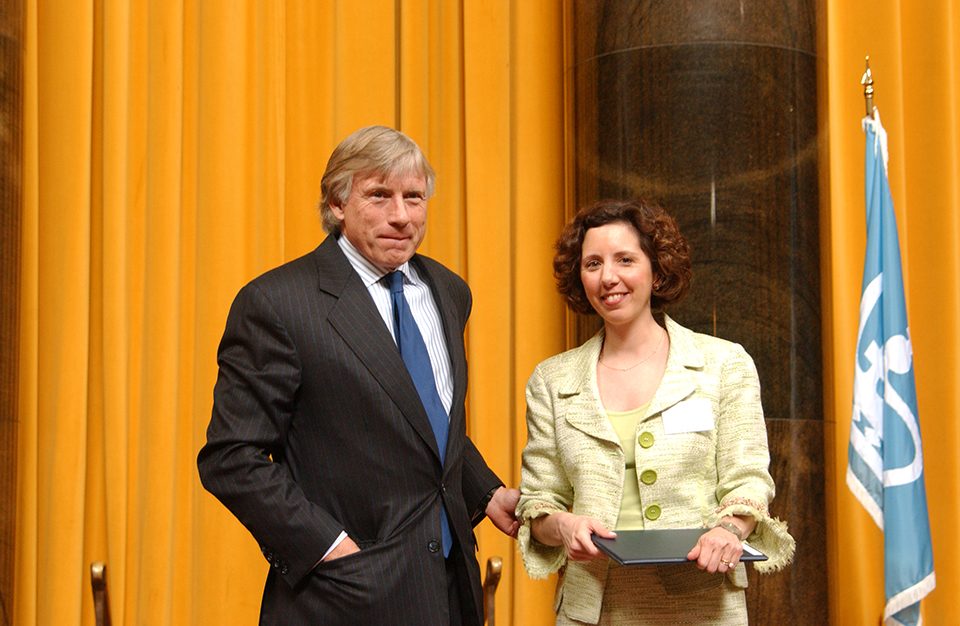
Columbia University President Lee C. Bollinger presents Amy Dockser Marcus with the 2005 Pulitzer Prize in Beat Reporting.
Winning Work
As Lizzie O'Donnell Recovered, Tensions Rose in Marriage; Angry Words in the ICU, A Truce Over Twin Beds
By Amy Dockser Marcus
Sickness and Health
In their more than three decades together, one issue has posed the biggest threat to James and Elizabeth O'Donnell's marriage: cancer.
Nearly 10 years ago, Mrs. O'Donnell found a lump in her breast. At first, she wasn't worried. A routine mammogram a month earlier showed no signs of a tumor. But the lump grew so quickly during a two-week vacation in Hawaii that Mrs. O'Donnell went to see her doctor days after returning home to Indiana. The doctor ordered an immediate biopsy. The 42-year-old mother of three boys was diagnosed with advanced breast cancer and told she had only a 5% chance of surviving the next year.
She proved the doctors wrong. Mrs. O'Donnell began chemotherapy treatments in February 1995, underwent two surgeries, including a mastectomy, and finished her chemotherapy in August 1995. She is now considered cancer-free. She and her husband call that a miracle and say they know how lucky they are. "We had the same goal," Mrs. O'Donnell says, "to keep our family together."
Her survival came at a price. Mrs. O'Donnell, now 51, has chronic health problems arising from her cancer treatment. Just six weeks after her last chemotherapy session, her heart failed -- a side effect of the drugs used to eradicate the cancer. She underwent a heart transplant in June 1996. That, in turn, caused other problems.
The medications she must take every day to ensure her body doesn't reject the heart have weakened her bones, causing spinal deterioration and making her walk with a slight limp. In the past 18 months alone, she has endured shingles, double pneumonia, kidney disease, and two incidents when clots blocked her pulmonary arteries, causing her to be hospitalized. She never stops wondering if the cancer will return someday.
The cancer and related health problems have put the O'Donnells' marriage under siege. "I ponder sometimes how much has been lost ... as a consequence of sweet Lizzie's illnesses," Mr. O'Donnell wrote in 1999 in a journal he keeps. "Her breathtaking good looks; her shapeliness; her breasts; her lovemaking; her lovely tummy; her walks with me; her ability to be counted on for X or Y; her hair on her head; her not needing to shave; her constant need of medical care; her silence when sleeping."
These "all have been 'little deaths,' " Mr. O'Donnell added, "that have powerfully tugged me to despair and grief."
Thanks to advances in medicine, more people are surviving cancer these days, creating new kinds of personal challenges. Even as attention is starting to focus on the many physical and emotional issues cancer survivors face, marriage remains a topic that makes many uncomfortable. "We tell patients that if they had a strong marriage before cancer, they will have a strong marriage after cancer," says a spokeswoman for Living Beyond Breast Cancer, a support group.
Michael Glantz, an oncologist who treats brain-cancer patients at the University of Massachusetts Medical Center in Worcester, recently conducted a study looking at whether couples divorced or separated more frequently after a cancer diagnosis. Among 214 couples in which one of the partners had a malignant brain tumor, the rate of divorce was six times as high as the control group. The vast majority of divorces were in cases where the wife was sick, not the husband. This led Dr. Glantz to conclude that "being a female diagnosed with cancer is a risk factor for divorce," and to call for more study.
The question of whether cancer is a factor in divorce is controversial, because the overall divorce rate is high and this is still a new area of research. Some centers, including Dana-Farber Cancer Institute in Boston and the University of California San Diego Cancer Center, are experimenting with ways to help couples. New programs mark a shift from focusing on the individual patient to looking at "how the couple is faring as a couple with cancer," says Karen Kayser, a professor at Boston College Graduate School of Social Work in Chestnut Hill, Mass.
Summer Getaway
Despite the steady decline in Mrs. O'Donnell's health, every summer the couple spends several weeks in the Catskills. They come to the home in Elka Park, N.Y., owned by Mrs. O'Donnell's family, where she spent summers as a girl. Staying in the house, filled with the same furniture and paintings that have always been there, allows them to remember a time before cancer transformed their relationship.
This is where they met in 1967. Mrs. O'Donnell, then 14, was painting sets at the local theater where she met Mr. O'Donnell, who had the lead in a summer-stock production called "Fancy Meeting You Again." He was a 19-year-old college student working as a tennis instructor. They had their first kiss in her parents' kitchen after he brought her home from a dance. They married four years later, in a church down the road, when she was 18.
After more than two decades of marriage came Mrs. O'Donnell's cancer diagnosis. The couple had just moved to Huntington, Ind., from an affluent Boston suburb. Mr. O'Donnell had given up a banking job to teach economics at Huntington College, a 1,000-student Christian school. The Victorian house they bought near the main campus had a tarp on the skylight and no running water in the kitchen when they moved in.
At first, they tried not to let cancer overwhelm their relationship. When one of them felt frightened by Mrs. O'Donnell's treatments, they asked the other for a "cancer free" period. It could last an hour or a day, but during this time, they agreed not to talk about anything related to her health crisis.
On the two-hour drive to Indianapolis for chemotherapy treatments, Mrs. O'Donnell, an avid gardener, drew sketches, designing an arbor she asked her husband to build for climbing plants. A stay-at-home mother, she tried to ensure her sons' lives continued as normally as possible. She arranged for neighbors to take the boys to school and sports practices. Her mother moved in for a while to take over cooking and cleaning.
The couple soon discovered they had extremely different coping styles, and this became an area of contention. Whenever someone asked Mrs. O'Donnell how she was doing with the chemotherapy, she gave a relentlessly positive answer -- even if that someone was her husband. Mr. O'Donnell began calling her "Svetlana," saying she reminded him of a communist-era newscaster who put an upbeat spin on any news and gave out no real information.
In September 1995, about a month after Mrs. O'Donnell had finished her last chemotherapy treatment, Mr. O'Donnell brought her to the emergency room. She had a cold and felt weak; they wanted to make sure nothing was wrong.
The doctors admitted her for tests and that Sunday, when her husband came to visit, he found her lying in an intensive-care unit, hooked to a heart-monitor machine. Mrs. O'Donnell handed her husband some documents explaining the condition doctors had diagnosed. The drugs that killed her cancer tumor had also severely weakened her heart muscles. Without a heart transplant, she would die.
Mr. O'Donnell read the information in a panic, his eyes welling up with tears. But when he looked up, he was shocked to find that his wife had a smile on her face. "Jimmy," she said, her voice upbeat. "I don't have cancer."
The pity and sadness he felt seeing her lying in the hospital bed quickly gave way to another emotion: anger. "Why are you smiling?" he recalls demanding, his voice rising to a yell. "You have heart failure. You could die."
Looking back on it now, Mr. O'Donnell, 56, says his outburst occurred because "I felt managed by Lizzie, when what I wanted most of all was her honesty about her fears."
Mrs. O'Donnell remembers that moment differently. She says her greatest fear had been a recurrence of cancer, and she felt relieved to learn that she had heart problems instead. "I had grown to respect and fear cancer as a pernicious and sneaky enemy," she says. "I felt the doctors knew a lot more about how to treat heart failure."
They realized their journey as a couple had suddenly diverged. They lived through the same events but experienced them in completely different ways. "We had always said we were in this together," says Mrs. O'Donnell. "But we weren't moving through it the same way."
If Mrs. O'Donnell was a half-hour late from a shopping trip, her husband feared the worst and lost his temper when she returned. He kept asking doctors questions at appointments, long after Mrs. O'Donnell felt there was a need. By April 1996, when Mrs. O'Donnell was admitted to the hospital to await her heart transplant, she no longer told him when the doctors would be coming to see her. She gave him only the broadest outlines of what the doctors said.
Once, Mr. O'Donnell learned that his wife had seen a gastrointestinal specialist only after he saw an unfamiliar name on a bill. When he asked her about it, she told him that one of the consequences of her weakened heart was that other organs were starting to shut down. "I picked and chose what to tell him based on what I thought the toll would be to him," she says. "In preserving Jimmy, I was also preserving myself."
Holding Back
Mr. O'Donnell constantly wanted to talk about what was happening. But his wife held back, because she started to feel that talking about it was a waste of time and too depressing. "Jimmy was always aware and ready to discuss what everything was like," she says. But how could she explain how it felt to have their youngest son, Jonny, then 7, visit her at the hospital, and her pain at having to say goodbye, unsure if she would ever see him again? "I don't think he could understand what that was like, leaving the children," she says. "I thought even if I talked and talked, there was no way he could ever know what that was really like."
Mr. O'Donnell says he was overwhelmed. "I wish for relief," he wrote in his journal in 1996 while his wife stayed at the hospital awaiting the transplant, "but it doesn't come." A born-again Christian like his wife, Mr. O'Donnell continued to go to church and keep up with a Bible-study group they had joined. But he found that his faith -- not only religious faith but also in his marriage's ability to withstand such chronic stress -- were being tested.
"There was never an issue that I would be unfaithful to Lizzie in finding someone else," he says. "It was an issue of being unfaithful by not being loving."
At the time of her mastectomy in 1995, Mrs. O'Donnell worried that the loss of her breast would affect their relationship. "I knew the adjustment would be hard," she says. But Mr. O'Donnell had an even more difficult time accepting the dramatic body changes that took place following Mrs. O'Donnell's heart transplant in June 1996.
Within weeks after the heart transplant, she gained more than 60 pounds. The high doses of steroids she was given to prevent her body from rejecting the new heart caused hair to grow all over her body. She says she had "so much hair on my arms that I could braid it, and rolls of fat on my back." The sudden transformation, she says, "was horrifying to me."
Mr. O'Donnell says he often watched their son Jonny play with his mother, oblivious to the fact that she looked completely different. "It didn't matter to him how his mother looked, that her face had grown round like a moon because of the steroids," he says. "He loved her and was blind to those changes and I was not. It is not something that I am proud of."
Since Mrs. O'Donnell's cancer treatment, Mr. O'Donnell's own health had started to deteriorate. He couldn't sleep at night. During the day, he felt his heart racing. He was anxious all the time. In 1997, he fell asleep at the wheel, drove off the road and ended up in a swamp. He emerged without a scratch.
The couple could no longer do the things they had always enjoyed -- walks around the neighborhood after dinner, trips abroad to explore gardens, spontaneously deciding to go out for the evening. Mr. O'Donnell started taking on household chores his wife no longer had energy to do: making beds, washing dishes, laundry, vacuuming and grocery shopping. He dropped Jonny off at the bus in the morning and was there to pick him up in the afternoon. Sometimes Mrs. O'Donnell would feel better and be able to return to some of her old routines, but "it was always unpredictable," says Mr. O'Donnell.
He felt guilt, he says, about his inability to cope with all the changes. He even wondered if stresses he had put on her had somehow contributed to her cancer. But what he felt most, he says, was fear, that his wife would die and he wouldn't know how to carry on. When he pressed her to write letters about her wishes for her children that he could give to the boys if she died, she refused. She says she felt that doing so would have been admitting she was giving up. "You're going to slip away and I won't know key things," Mr. O'Donnell told her.
Four-Page Letter
Over the years, he kept pressing his wife to talk more. In March 1999, he wrote her a four-page letter outlining how overwhelmed he felt by taking over household chores, while continuing to work. He felt they needed to talk more about how their lives had changed, and that knowing how she felt might help him deal with his own fears. She thanked him for the letter and said they would discuss it. But when two weeks passed without her raising the issue again, he took matters into his own hands.
The couple had been attending Bible-study sessions every other Sunday night with male professors from the college and their wives. The couples met to discuss a particular passage and share events in their lives. At an April 12, 1999, session, Mr. O'Donnell brought up his communication problems with his wife. He asked the group members to pray either for the couple to communicate better or for Mr. O'Donnell to accept their level of communication as it was.
Mrs. O'Donnell was shocked by the unexpected public airing of their difficulties, even among people she considered friends. She ran from the room crying. When they got home, she spent the night in the bedroom downstairs and refused to discuss the incident. "I felt at that point that there had been enough talking," she says. "Things are a mess," Mr. O'Donnell wrote in his journal that night.
From time to time during Mrs. O'Donnell's illnesses, she slept alone downstairs. Sometimes she stayed there when side effects from her chemotherapy treatments kept her in the bathroom all night long. Before the heart transplant, she was simply too weak to climb the stairs to their bedroom on the third floor. But even after the transplant, she began sleeping downstairs more often.
Talking about the physical changes in Mrs. O'Donnell's body didn't seem to alter the tension. "I remember telling Jim, 'I can't help what's happening,' " she says. "It didn't make any difference to Jim. I could see the look in his eyes." Yet, there were times, she says, when she understood her husband's difficulty adjusting. When she looked in the mirror, she didn't recognize herself. "It struck me over and over afresh every morning, just like it did Jim," she says. "I was not blind to what was happening to my body. Neither of us liked it."
When Mr. O'Donnell was invited to a function at the college, she would spend considerable time dressing up and fixing her hair. "I did absolutely the best I could, and there was no comment, no 'you look nice tonight,' " she says. "There was nothing. It was a great sorrow that I carried." Mr. O'Donnell doesn't dispute the hurt he inflicted. "I was a monster," he says.
Each evening, Mrs. O'Donnell would suggest that she sleep downstairs so she wouldn't disturb her husband. Sometimes he would protest, but in the summer of 1999, he stopped. Mrs. O'Donnell snored at night, most likely due to physical changes from the medications she was taking. The medications also resulted in her having uncontrollable leg spasms at night, causing her to kick him. For three months, they didn't sleep in the same room. "I was giving up," he says about that period in their marriage.
But Mrs. O'Donnell insisted they find a way to be together. She suggested giving up their queen-size bed and buying two twin beds. Mr. O'Donnell resisted, saying they had to sleep in the same bed or in different rooms. Hoping to save their marriage, he eventually agreed to the change, and they started sharing the same room again. He bought ear plugs and a sound machine to deal with the snoring.
He also spoke with a doctor about his constant fears, and was taking medication that helped lift his depression. Mr. O'Donnell says he began to accept the idea that "there is to be no closure."
In some ways, he says, his prayers at the Bible-study session that caused his wife to cry had been answered. Mrs. O'Donnell tried to talk more about her feelings. And he began to realize that her refusal to endlessly discuss her fears was one of the ways she kept going. "I started to wonder if by pushing her to cope in a different way, I might be hurting her, maybe even shortening her life," he says.
While their communication has improved since then, the issue still comes up. A few weeks ago, Mr. O'Donnell wanted to talk again about all they had endured. Mrs. O'Donnell demurred. "These are the good times," she told him. "Everything is fine."
Both of them have spoken about their experiences in efforts to help others in similar situations. Earlier this year, a collection of Mr. O'Donnell's letters about his wife's cancer diagnosis and heart transplant, called "Letters for Lizzie," was published by a Christian publishing house. The letters chronicle the vicissitudes of Mrs. O'Donnell's illnesses and some of the difficulties they faced in their marriage.
At the back of the book there is a picture of a much younger Mrs. O'Donnell, holding Jonny as a baby. Her dark hair is cut in a fashionable style, and there's a wide smile on her face. It bothers her, she says, to hear her husband talk at book readings about the toll her illnesses have taken on the way she looks. She says it makes her feel he's implying, "I was once so beautiful and then poof." He says he doesn't feel that way.
When she is feeling well, Mrs. O'Donnell now volunteers 20 hours a week at a hospice where she was once a patient. Mr. O'Donnell says he is moved by her commitment. He recently nominated her for an award recognizing exceptional volunteers who work under challenging circumstances. Mrs. O'Donnell won the award this year for Indiana. Sometimes, Mr. O'Donnell says, he wonders "if she tells the patients things about her sickness that she won't tell me." Mrs. O'Donnell says that isn't the case.
As the years have gone by, they have increasingly found themselves alone. Their older sons, Nick and Andrew, have finished college. Nick is married. Jonny is now 16 and has his first girlfriend. He didn't want to come to Elka Park this summer with his parents. They realize this may have been the last summer he'll spend with them.
In the past few months, there have been what the couple calls "moments of grace." Mrs. O'Donnell has felt better and had more stamina. She is taking fewer steroids these days, so the side effects are less severe. Earlier this year, she suddenly started losing weight. At first, she thought the cancer was back and had her doctor run full body scans. All the tests were negative. Doctors don't have an explanation for the weight loss but it has marked a change in their relationship.
"I don't feel beautiful to myself," she says, "but I recognize myself again. I look more like the way I imagined I would look at the age of 51." Mr. O'Donnell has been more relaxed and affectionate, she says. Mr. O'Donnell acknowledges the weight loss has made a difference. "I regret feeling put off by her. I knew it wasn't right," he said. "I look at what is happening now as a gift."
Last month, Mrs. O'Donnell's sisters came to visit. They sat on the porch with the couple and recalled the two years when Mrs. O'Donnell had cancer and then a heart transplant as a nightmare that had thankfully ended. But for Mr. and Mrs. O'Donnell, it is never over.
Mrs. O'Donnell says she is always aware that the average transplanted heart lasts 10 years and that she has already had hers for eight years. If the medication she is taking to help her kidneys work loses effectiveness, she faces the prospect of dialysis or a kidney transplant. They don't make long-term plans. "I never think about what we'll do together when Jim retires," says Mrs. O'Donnell. She says the furthest out she has planned is this Christmas, when her son and daughter-in-law will visit.
They also try to see themselves as any middle-age married couple. On a recent day, Mr. O'Donnell, dressed in khakis and a blue polo shirt, brings out lemonade and they sit next to one another on wood chairs painted the same lime green as the porch, their feet touching under the table. Last month, they celebrated their 33rd wedding anniversary. They still like to take long drives together, explore old homes and find a new restaurant to try.
Last summer, Mrs. O'Donnell was too weak to walk in the hills surrounding the house in Elka Park. Her husband, sons and daughter-in-law hiked to a monument erected in 1868 by a grieving husband whose wife died in childbirth. Mr. O'Donnell wanted to take a group picture at the top for the family's Christmas card, and Mrs. O'Donnell was upset she couldn't go. This year, she and her husband walked there together. She climbed to the top, looking out at the trees and mountains, "and saw a view I thought I'd never see again," she says. The next day, she was so weak she spent the entire day in bed. But she believes, "If Jim and I didn't have these tiny moments together, we wouldn't make it."
A few weeks ago, Mrs. O'Donnell was in the kitchen of their Elka Park home when Jonny suddenly asked her, "Mom, do you think that someday I will be happily married?"
The question caught her off-guard. She thinks the issue was on his mind not only because he has a girlfriend but also because of what he has seen his parents endure during the past 10 years. She says she didn't hesitate with her reply. "Yes, Jonny," she told him, "I think you will be happily married."
Does she consider herself happily married? "Yes," she said. "I do."
Mr. O'Donnell's reply was more cautious. "In an imperfect world, I am as happily married as I think anybody can be," he said.
A look of surprise seemed to flicker across Mrs. O'Donnell's face. The plate of pasta she cooked and was about to serve remained suspended in her hands as she considered what to say next. "That sounds like a qualifier to me," she said, her voice calm and soft. "But I think I know what you mean." Then another meal together got under way.
© 2004, Dow Jones & Company
By Amy Dockser Marcus
NASHVILLE, Tenn. -- In September 2001, at the age of 42, Lori Monroe was diagnosed with terminal lung cancer.
The oncologist told her and her husband the cancer was inoperable, and the choice wasn't one treatment or another -- but whether to do any treatment at all.
Ms. Monroe, a nurse, was shocked. A month earlier, she had spent three weeks hiking in the mountains of Colorado. She had just returned from a trip water-skiing with her daughters, Emily and Alyson, who were 13 and 10 at the time. She felt and looked healthy. But her doctor said there was nothing Ms. Monroe could do.
So Ms. Monroe came here to Vanderbilt University, an hour's drive from her home in Bowling Green, Ky., for a second opinion. At first, the doctors told her the same thing. Her cancer was inoperable. But one surgeon who saw her was willing to operate. Ms. Monroe wasn't the typical terminally ill patient, he argued. She was young and had no other health problems. He believed she could survive the rigors of a high-stakes operation. He wanted to be aggressive.
When people are told they have "inoperable" cancer, it doesn't always mean that a surgeon can't remove the tumor. Often the surgeon can but has made a calculation that the risks of the procedure aren't worth the possible benefits. Now, at certain cancer centers, including Vanderbilt, Memorial Sloan-Kettering Cancer Center in New York and University of California, San Francisco Comprehensive Cancer Center, some doctors are arguing that it pays to be aggressive -- trying surgery along with other treatments.
This is still a new approach, and the number of advanced-stage cancer patients who undergo surgery is small. But the idea has the potential to change treatment for terminally ill patients, because it comes at a time when new therapies offer the prospect of prolonging lives. Surgery, the thinking goes, may keep a patient alive long enough to take advantage of drugs and new treatments still being developed.
Ms. Monroe's cancer was diagnosed by chance, while she was in the hospital for a hysterectomy. A chest X-ray showed something her doctor thought might be pneumonia. He prescribed antibiotics. When the condition didn't improve, she was sent for more tests, which found she had the most advanced grade of cancer, called Stage IV.
The standard treatment for her condition is chemotherapy, although it is generally ineffective against the type of lung cancer Ms. Monroe has. If chemotherapy fails, patients are treated for symptoms, such as getting morphine for pain or oxygen to help improve shortness of breath. Surgery is rarely an option.
Ms. Monroe, now 45, saw surgery as her best hope of staying alive for more than a year. The doctors who advised her to do nothing had "already condemned me to death, without giving me a chance to fight," she wrote in her journal shortly after being diagnosed. But she also knew that something could go wrong during surgery that could leave her disabled, in pain, or unable to care for herself or her daughters.
Deciding which cancer patients should be treated aggressively is controversial. According to the National Cancer Institute, someone like Ms. Monroe, whose cancer had spread to both lungs, has a 99% chance of being dead within five years of diagnosis, even after surgery.
Ms. Monroe's doctors struggle with whether the chance for extra time is worth a patient's pain and suffering. "Would you operate on someone to get three more weeks of life? Three more months? Two more years?" asks David P. Carbone, 48, Ms. Monroe's current oncologist. "At what point do you draw the line?"
More than 160,000 people in the U.S. are expected to die of lung cancer this year. Treating the disease aggressively represents a significant departure from standard care. In 2001, the National Cancer Institute convened a group of researchers to report on the field; overall, lung cancer has only a 15% five-year survival rate. The group found many doctors felt none of the treatment options -- surgery, chemotherapy or radiation -- appeared effective in significantly extending the lives of patients with advanced lung cancer.
"The stigma that lung cancer is a self-inflicted disease, coupled with a pervasive sense of therapeutic nihilism," the report said, "conspire to create a medical environment in which many patients with advanced cancer are not even offered treatment."
That is slowly starting to change. This year, the National Comprehensive Cancer Network, a group of 19 of the world's leading cancer centers, revised its guidelines for treating the most common form of lung cancer. This form, non-small cell lung cancer, which Ms. Monroe has, is usually associated with a history of smoking. She smoked for nine years before quitting when she was 29 and pregnant with Emily.
Under the new guidelines, patients diagnosed with an early stage of the disease are recommended to have surgery to remove the tumor, and then chemotherapy. Patients who failed previous rounds of chemotherapy are advised to try Iressa, a new "targeted" drug, designed to hold a tumor's growth in check.
Researchers at New York's Memorial Sloan-Kettering published a 2002 paper arguing that certain lung-cancer patients appeared to benefit from having their tumors surgically removed, even when their cancer was advanced. The team said that in such cases, if the nodules can be removed, they should be. Some patients they studied improved from zero percent survival to up to 60% survival using surgical intervention, the study said.
At Vanderbilt, nodules on Ms. Monroe's right lung were removed and tested. When they turned out to be cancerous, Ms. Monroe's first oncologist presented her case to the hospital's tumor board, which makes recommendations. Surgery wasn't a viable option in this case, the board said, because the cancer had already spread to both lungs.
Ms. Monroe says she couldn't stop weeping at the news. But that evening, Mathew Ninan, 40, the Vanderbilt surgeon who did the exploratory procedure, called her while she was still at the hospital. He said he would go ahead with surgery to remove the tumor, despite the board's recommendation. The final decision is up to the doctor and the patient.
After the board meeting, Dr. Ninan went to the medical library and read over the little available literature on cases like Ms. Monroe's. "I was very clear with her," Dr. Ninan says. "I could not assure her that surgery would change her prognosis. But I did not know for sure that it would not change her prognosis." Through that tiny window of opportunity, he decided to proceed.
The night before her Oct. 12, 2001, surgery, Ms. Monroe spent time with her girls. "They laid around and watched TV and then I fussed at both of them," she wrote in her journal. "I hate that. Time with them is precious right now, but at the same time, I can't let them not do what I need them to... Still, I felt bad. I'm worried about tomorrow's surgery and I spent my last awake time with them fussing."
Four weeks after she was diagnosed with inoperable cancer, Dr. Ninan removed her lower left lung, including an 8-centimeter tumor. The right lung, doctors decided, could be treated with chemotherapy. Ms. Monroe woke up in intense pain. Her chest and throat felt constricted. "I felt like I was being choked from the inside," she wrote in her journal.
Ms. Monroe has private insurance, and is also covered by Medicare. She says she hasn't experienced any problems with reimbursement from insurance.
For almost a year, her cancer remained stable. She started a chemotherapy regimen in January 2002, and when that finished a few months later, continued to get weekly infusions of an experimental drug designed to stop tumors.
Since the drug was still being tested, the company developing it closely monitored patients. As in most trials, patients who no longer respond to a drug stop receiving it. In October, Ms. Monroe had a CT scan. The drug company felt the scan showed Ms. Monroe's cancer had progressed, making her ineligible for more of the drug.
"I was terrified," Ms. Monroe recalls. "The one thing that was keeping my disease stable had been denied from me. I felt true fear and panicked." She decided she wanted to have surgery again to remove the remaining nodules -- even after the drug company changed its decision and said she could continue on the drug.
Her oncologist, Dr. Carbone, thought the first surgery had probably extended her life. But he was deeply uncertain that another surgery would. "Her disease was stable with the drugs," he says. "Stable disease in lung cancer is a victory." When she argued that surgery was the only way to get the cancer out of her body, Dr. Carbone says he reminded her, "We are way off the beaten track here."
Dr. Carbone had been Ms. Monroe's oncologist for more than a year by this time, and the two had grown close. Dr. Carbone shared with her details of his own battle with cancer. Diagnosed five years ago, with lymphoma in the chest, doctors initially thought he had lung cancer. He had surgery twice, to remove sections of his left lung. He underwent radiation and chemotherapy, finishing treatment in September 1999.
"Our situations were also similar in a personal way," says Dr. Carbone. Ms. Monroe's marriage of 19 years had fallen apart while she was undergoing chemotherapy. Dr. Carbone's marriage of 19 years ended in divorce in 2001. "I can sympathize with the situation she's in," he says.
Despite Dr. Carbone's reservations about surgery, Ms. Monroe was determined to go ahead. In December 2002, she had another operation. It was a success. Doctors told her that, for the time being, she was disease-free. She went back to work as a nurse at the local hospital. She took her daughters camping. She formed a support group for lung-cancer patients. Last year, Dr. Carbone rode 60 miles as part of the Bristol-Myers Squibb "Tour of Hope" with cyclist Lance Armstrong to raise money for cancer research. Dr. Carbone wrote a message on a panel set up at the finish line: "To Lori Monroe, the bravest person I know."
In April of this year, Ms. Monroe came back to Vanderbilt for a routine scan. She says she could tell right away that something was wrong by the sound of her doctor's heavy steps in the hallway. Dr. Carbone was walking slowly, she says, as if he dreaded telling her something. When he got to the office, his face had a bleak expression, she recalls. There appeared to be five new nodules on her left lung, he said.
Dr. Carbone recommended not doing anything for the time being. The tumors appeared to be growing very slowly. "If we didn't know the spots were there, she could probably go years before any symptoms appeared," he argued. By that time, he thought, there could be new drugs or therapies to treat her. Why risk yet another surgery?
There are always potential complications from surgery. But Ms. Monroe had already had portions of each lung removed, raising the stakes even further. Dr. Carbone worried Dr. Ninan, the surgeon, might start cutting and find the cancer had spread, forcing him to cut even more. Ms. Monroe could be left without enough lung tissue to allow for normal breathing. "I don't want to be a pulmonary cripple," she said, as she weighed her options, "unable to walk across the room without being short of breath."
Patients often want to be aggressive, even if it means extending their lives by only a few weeks, says David H. Johnson, deputy director of the Vanderbilt-Ingram Cancer Center. Fifteen years ago, at the age of 41, Dr. Johnson was diagnosed with a cancer of the lymph nodes. He decided to pursue a chemotherapy treatment that was far more toxic than standard care at the time. "I thought my outcome would be better," he says. "Even if it had only 1% of 1% of a chance of improving my odds of being cured, it was worth it to me."
The treatment worked. But a National Cancer Institute-sponsored clinical trial, started around the same time, found the less-toxic treatment had just as good results, with far fewer side effects. "I was biased, just like many patients are," Dr. Johnson said. "I thought the more aggressive treatment had to be better."
Still, he was ambivalent about whether being aggressive in Ms. Monroe's case was the right choice. He worried her treatment had strayed so far from the mainstream that it was difficult to assess what to do, medically or ethically. "With each step, you go further out into the swamp," Dr. Johnson said. "If you go too far, you can fall through."
That fear ran through the conversation in May, when Ms. Monroe met with her doctors, trying to convince them she should have surgery again. From the outset, she had tried to make her doctors her friends, sending them frequent e-mail messages, sharing details about Emily's cello playing and how Alyson asked her difficult questions about whether she might die. She had gone hiking with Dr. Carbone during a lung-cancer conference. She and Dr. Ninan sometimes had dinner together when she was in town.
Ms. Monroe says she always made a point of looking her best before seeing her doctors. "I want them to look at me and know that I am viable," she said, "that my life is worth saving." On this day, it was hard to tell how seriously ill she was. Toe nails painted bright pink peeked out from sandals. She wore dangling earrings with blue stones that matched her V-neck blouse. Her short brown hair brushed just past her ears. She was quick to smile.
But now, her bond with her doctors made their conversation even more difficult. Ms. Monroe said she'd like to have surgery two days later, on a Wednesday, so that she would have enough time to recover to take her two daughters camping at the end of the month. "Lori, you could have a stroke or a heart attack from surgery," Dr. Carbone warned her. "You could become paraplegic, and then you won't be able to go on that vacation at all," he said. "Surgery is not totally innocuous. Bad things can happen."
At one point, Dr. Carbone left the room to take a phone call. Ms. Monroe turned to Dr. Ninan, the surgeon. "I cannot do nothing," she told him.
"That is not my primary concern," Dr. Ninan responded, his voice somber and measured. "My main issue is, can I help you by doing this?"
When Dr. Carbone came back in the room, he urged Ms. Monroe to wait two months to see how quickly the tumors were growing. She remained adamant about having surgery immediately. Eventually, Dr. Carbone acquiesced, somewhat reluctantly. "I think she can make it through surgery. I just don't know if it's the best decision," he said.
But he had no new drugs to try right now; he estimated it would be a year until new therapies that might help her became available. If surgery offered even a small chance of extending her life until then, he felt he couldn't stop her from pursuing it.
Surgery was scheduled for Friday, May 21. The night before, she wrote an e-mail about what awaited her. "The thing I am dreading the most is the first breath I take when I'm awake enough to know the surgery is over," she wrote. "The pain on this first breath will simply set you on fire, and right away, you know you will have to take another breath, and another, and another."
In some ways, the operation proceeded like the others. A breathing tube was inserted, allowing doctors to ventilate each lung separately. The anesthesiologist then shut off the air to Ms. Monroe's left lung, allowing Dr. Ninan to operate.
Two chest tubes, approximately the size of a garden hose, were also inserted, attached to a suction device that allowed her lung to expand and fluid to drain. But this time, Dr. Ninan had to remove more tissue than he had hoped. The nodules were in places that forced him to take out normal tissue. When Ms. Monroe woke up, there was an eight-inch-long incision in her side.
The chest tubes, usually removed two days after surgery, had to remain in for two weeks. The hospital stay was longer, and more expensive than her previous stays, with a bill of about $80,000.
Every time the doctors turned off the suction device, Ms. Monroe's left lung collapsed. The surgeries had left her with a lung too small to completely fill out the cavity in her body. From her hospital bed, she underwent a painful procedure to try to keep her lung from collapsing. An antibiotic was inserted into the chest tube. It was intended to purposely irritate the sensitive lining of the lung and cause the lung to scar up. Scar tissue, doctors hoped, would help the lung better adhere to her rib cage and not collapse.
While she was recuperating, Dr. Carbone came to see her. No more surgery, he said. Dr. Ninan also came by regularly. He too told her, "I think we have reached the end of the road for this kind of surgery."
Watching Ms. Monroe suffer was upsetting for both doctors. "Lori is my friend and I do not want to harm her," Dr. Ninan said later. "It is a guilt that I carry around." Her doctors may never know if the surgery has actually benefited her. "The hope is that the pain she is enduring is a short-term problem in order to get a long-term benefit," said Dr. Carbone. "But short of magic, predicting how individual patients will do with a particular treatment is impossible."
Given that this surgery resulted in more complications than previous ones, Dr. Ninan knew some people would say he had been too aggressive. "I do not regret it," he said. "At some point, you have to make a decision. When you are dealing with a patient whose case is not standard, these decisions are tough."
For the first time, Ms. Monroe felt something new when she contemplated surgery: doubt. "What have I done?" she wrote in her journal 10 days after surgery. "How much normal tissue did we throw away to take the small cancer?"
Two weeks after the surgery, she was still in the hospital. When she spoke, she sounded short of breath. The pain often woke her up in the middle of the night.
Earlier this month, Ms. Monroe went home. But there was a leak in her left lung. When she moved or took a deep breath, she could hear gurgling from fluid filling the lung cavity. Dr. Ninan was worried about the possibility of infection.
They needed to close the leak in her lung, Dr. Ninan said. One of the possibilities he suggested was an operation, to remove tissue from another part of her body and then use it to try to close the leak.
The idea overwhelmed her, Ms. Monroe says. She knew that if the situation didn't improve in a short time, she might have to consider it. But she had missed saying goodbye to her youngest daughter before Alyson left for camp because of the complications from her last operation. Her daughter was coming home in a few days and she wanted to be there to greet her.
So she did something she thought she would never do. "I said no to surgery," says Ms. Monroe, and she went home to see her children.
© 2004, Dow Jones & Company
Jack Streeter, 8, Joins Ranks Of Cancer Survivors Coping After Treatment/The Challenge of Kickball
NATICK, Mass. -- This month, Jack Streeter will finish the second grade, his first full year at school since being diagnosed with leukemia. By any measure, it will be a celebratory moment.
Two years ago, his parents thought he was going to die. Now the 8-year-old boy is back at school, and thriving. He sits in the top reading group in his class. He just earned a purple belt in karate and hit a single at a recent baseball game. This summer, he plans to go to camp.
Still, this year has been anything but ordinary for the family. After years of focusing on saving Jack's life, they are now facing a new challenge: trying to get back to normal.
"There are so many things we have to worry about for the rest of his life," says Jack's mother, Debby. "But how can I say that without sounding ungrateful, when I am so happy he is alive?"
Reminders are frequent that Jack's treatment will continue to cause him health problems. In the past two years, he had 13 cavities filled and two teeth pulled. His years of chemotherapy and radiation put him at increased risk for a range of dental problems. He underwent two surgeries to remove cataracts in his eyes, another side effect of the drugs.Jack Streeter His mother insists he wear sunscreen whenever he's outside because the full-body radiation makes him more susceptible to melanoma. He is tested regularly for potential cognitive and learning issues.
There have been less-anticipated problems too. Mrs. Streeter, 43, who stopped working two years ago to take care of Jack full time, says she feels adrift now, unsure whether he is well enough for her to return to work. For her husband, Larry, 48, Jack's recovery is bringing back uncomfortable echoes of an ordeal in his own life. The couple say they find it difficult to engage in small talk with other parents in this affluent suburb, 25 miles from Boston. Their relationship with many neighbors, people who rallied around the family after Jack got sick, has become strained now that he is better.
"For many people," says Scott Armstrong, Jack's oncologist at the Dana-Farber Cancer Institute in Boston, "one of the most stressful parts of cancer comes when the treatment stops."
For decades, cancer treatment has focused on trying to save a person's life, not on how it was lived afterward. But in recent years, new therapies have helped increase the number of people surviving five years or more after diagnosis. With this growing success has come the recognition that cancer survivors have special physical and emotional needs. Many will finish treatment and go back to their old lives, only to find that their lives aren't the same.
The President's Cancer Panel, an advisory board established by Congress, released a report on Friday calling for more services to deal with problems people face after treatment is over. The report concludes that some survivors suffer depression and other psychological issues for years.
"We have always focused on how patients physically survive the toxicity of treatment," says Mary Morris, survivorship-research coordinator at the University of Nebraska Medical Center in Omaha, one of several hospitals that have launched studies tracking the long-term health, social and emotional issues of cancer survivors. "But we need to learn more about how they emotionally survive and get on with their lives." Children with cancer pose special challenges of survival, since their experience also transforms the lives of their parents, and often their wider community.
Jack was diagnosed with cancer when he was just 3 years old. His mother noticed he was unusually fatigued, and while giving him a bath, saw bruises all over his body. He spent the next two years undergoing chemotherapy. He seemed to respond, and doctors were optimistic he would be among the 80% of children who are disease-free after two years of treatment.
But in 2001, just a few weeks after starting kindergarten, Jack relapsed. When doctors told his father the leukemia had returned, "I feared this was it," Mr. Streeter recalls. His best option, doctors said, was a bone-marrow transplant.
After the transplant, Jack stayed home for eight months, because he had no resistance to disease. He had a tutor until he got stronger. When he was finally well enough to go back to school in April 2003, his parents were overjoyed -- and conflicted.
"We can't begin to tell everyone how long we've waited for this day!" Mr. Streeter wrote in an online journal entry. "On the one hand, we were so happy to see Jack return to school with his friends," he wrote. But they were also nervous, he said, knowing Jack's exposure to bacteria and viruses was going to increase.
Following Rules
This year, Nell Getz, Jack's second-grade teacher at Natick Memorial Elementary School, says she has focused on getting him used to following rules. Some things he needed to learn are common issues for children who haven't spent much time in a classroom. When Jack knew the answer to a question, he shouted it out without raising his hand. He had a hard time standing quietly in line.
In order to support Jack's transition back to school, four children from his neighborhood were placed in class with him. Mrs. Getz says his two closest friends were always trying to take care of him, bringing him paper or books. She put a stop to that, insisting Jack fend for himself. "More than the other children here, Jack doesn't want to be different," she says. "He doesn't want to be the sick kid anymore."
Earlier in the year, Mrs. Getz tried to get Jack to talk about his cancer experiences in class but he repeatedly refused, she says. She stopped asking. When she asked the children to write about something they did that was courageous, Jack wrote about breaking a board with his hands at karate class. One morning, in a group discussion, a girl mentioned Jack had been in the hospital. Mrs. Getz asked him if he wanted to say something about that. Jack declined, she says, looking down at his sneakers.
Where Jack struggles in school is mainly at recess, Mrs. Getz says, when his closest friends go off to play kickball. Self-conscious about being less athletic, Jack, who has close-cropped blond hair and glasses, stands on the sidelines. When he first returned to school, he didn't know the rules of baseball, basketball or other games the kids played in gym. He had spent a lot of time in bed and playing video games. His face was puffy from the steroids he took, and he had very little stamina.
A few months ago, one of his friends was reaching to pick up a mitten that fell on the floor and elbowed Jack in the stomach as he got up. Jack hit the boy in the jaw, knocking him to the ground, and got sent to the principal's office.
Jack still won't talk about the incident. His mother thinks it came out of his growing frustration at always being the smallest, at having to try so hard to keep up physically with his friends. "When he first went back to school, he got a pass," says Mrs. Streeter. "He was the kid who had cancer. Now, he's treated like everyone else. I think he was tired of people pushing him."
For Mr. Streeter, Jack's struggles remind him of his own. Twenty years ago, at the age of 28, doctors found a large mass in Mr. Streeter's chest. At first, they thought it was benign. But during surgery, after they broke his ribs to get to it, they saw it had grown close to his heart and couldn't be removed. More tests indicated it was malignant, and the cancer had spread to lymph nodes in his abdomen. Mr. Streeter, who was married to his first wife and had a 1-year-old child at the time, underwent a year of treatment, including chemotherapy and radiation. He lost all his hair and, at 5-feet-8, dropped to 106 pounds.
He pushed himself to go back to his job as an information-technology specialist as soon as he could. Friends would stop by his desk, he says, tell him he looked terrible, and wonder why he wasn't home resting. Instead, he started working out everyday. "I wanted to prove to everyone that I was healthy, that I had beaten it," says Mr. Streeter, who keeps in shape by training for an annual 160-mile bike ride to raise money for cancer research.
Mr. Streeter says he and his first wife grew apart. Two years after being diagnosed with cancer, he moved out of the house. The couple, who had two children together, later divorced.
He knew Debby from work and they started dating. They married, and had Jack and his younger sister, Annika, now 5. "I have been reliving everything since Jack got diagnosed," Mr. Streeter says. "Not just the being sick part, but also the difficulties in going back to your regular life."
New Focus
In April, Mrs. Streeter was in the gym at Jack's school, which was holding its annual "jumpathon" for charity. The gym was packed with children and parents watching third- and fourth-graders jumping rope. Music blared, children shouted. The students were raising funds for the American Heart Association.
For the previous two years, the event raised money for cancer research. The first year it was called "Jump for Jack," and children wore T-shirts with Jack's name on them. Last year, when Jack was able to attend class for the final months of first grade, they called it the "Jack is Back" jumpathon. The children raised a total of more than $30,000 in those two years.
Todd Kiley, the physical-education instructor who spearheaded the drive, says now that Jack is at school full time, he thought it was time to focus on another cause. Next year, Jack will be jumping rope with others in the third grade. "I didn't want to put that kind of pressure on him," says Mr. Kiley, "having him jump rope for something associated with himself. I don't want to single him out."
Mrs. Streeter looked around at the gym, decorated with banners. Jack's name was nowhere to be found. "It's strange to be here just as another parent coming to a school event," she says. "Strange but good." Yet this year, when children knocked on her door asking for a pledge, she says she was reminded how hard it is to put everything behind them. Confused, the children forgot the name of the charity and said they were collecting money for "jumping for Jack."
It hasn't been easy for the Streeters' neighbors to move on either. In many ways, Jack's health dominated the life of the neighborhood for years, and the family acknowledges an outpouring of support. But now that Jack's treatment is over, "our relationship with the Streeters is not the same as it once was," says Rick Savoia, one of the neighbors. "We miss the closeness."
When Jack was diagnosed in 1999, Mr. Savoia's wife, Tina, was the first person Mrs. Streeter called. Mrs. Savoia later organized the neighbors so that someone cooked food for the Streeters every night. The couple frequently babysat Annika so the Streeters could stay with Jack in the hospital.
One day, after visiting Jack, Mr. Savoia says it hit him that it could have been his son, Nick -- who is one of Jack's friends -- lying in that hospital bed. Mr. Savoia, who had never been a runner, started training for the Boston Marathon as part of a Dana-Farber program to raise money for cancer research. Mr. Savoia has raised more than $13,000 every year for the past four years running the Marathon in honor of Jack.
Mr. Savoia's eyes welled up as he described how, every year before the Marathon started, he wrote the words, "For Jack," on the front of his shirt. Whenever Mr. Savoia started to falter and wasn't sure he would finish, he says there was always someone on the sidelines that called out, "Keep going for Jack!" That still inspires him, he says.
In February, Mr. Savoia and Mr. Streeter went out for beer. Mr. Savoia says he confronted Mr. Streeter, asking him why he stands apart when the families watch their kids playing baseball, and why he no longer goes to as many neighborhood functions. For both men, the conversation was the first time they'd talked openly about what had been simmering beneath the surface. It also revealed how the end of Jack's treatment has widened, not closed, the gap between their lives.
Mr. Streeter told his friend that he finds it tough to join in the light-hearted banter of his neighbors. It's hard for others to appreciate that Jack's immunizations were totally wiped out by chemotherapy and he remains more vulnerable to infection than other children. He also articulated aloud for the first time his deepest fear: that even now, more than two years after Jack's bone-marrow transplant, Jack might die from his disease -- that he could relapse or get another cancer. Mr. Savoia says his feelings were hurt, though, when Mr. Streeter added, "You don't get it."
"Maybe we don't get it totally because it's not happening to our child," Mr. Savoia said in a later interview. "But we've tried as hard as we can to get it. If we slip up sometimes, if we make a mistake or miss something, I think it should be forgiven." He says he knows the Streeters are still struggling with how to return to normal life. He wants that life to include his family but concedes he isn't sure it will. "I don't know what their definition of normal is anymore," he says.
Mr. and Mrs. Streeter say they aren't sure either. In March, the couple spent a weekend at a retreat sponsored by a camp for children with chronic or life-threatening illnesses. As they sat in a room with 20 other couples who had shared similar experiences, Mr. Streeter said, "This is where I feel I belong." At one point, a priest spoke to the group, telling them it's their responsibility to learn how to live in a world of smaller hurts and more easily corrected grievances. "We've expected others to understand our world and they can't," Mr. Streeter says. "But can we go back to their lives? I don't think it's possible."
Jack's health will need to be closely monitored for the rest of his life. Mrs. Streeter says she recently looked up the medications that Jack used to take on a Web site run by the Children's Oncology Group, a consortium of hospitals that treat pediatric cancer patients. One of his chemotherapy drugs, methotrexate, puts him at a higher risk for learning and memory problems, according to the group. It said Ifosfamide, which Jack received after his relapse, increases his risk of getting a second cancer.
For children who have had the kind of radiation treatment that Jack had, there is a 95% or higher chance that they will be sterile, according to Charles Sklar, director of long-term follow-up at Memorial Sloan-Kettering Cancer Center in New York. Radiation to the brain, which Jack underwent twice, can also stunt growth. Worried because Jack is physically smaller than his peers, his parents recently took him to an endocrinologist to discuss the possibility of taking growth hormones.
At Memorial Sloan-Kettering, child-cancer survivors are tested for cognitive problems every year to two years, even through college. Jack gets similar exams on a regular basis. "Problems can emerge for the first time 10 to 15 years down the line," says Dr. Sklar. "Radiation involves a progressive insult to the brain."
Now that Jack has passed the two-year mark since his bone-marrow transplant, the danger of relapse is receding, says Dr. Armstrong, his oncologist. But then, the doctor leaned over and knocked on a wood panel on the wall. After Jack completed the standard treatment of two years of chemotherapy, his parents threw a big party to celebrate in June 2001. Dr. Armstrong attended. At the time, it seemed Jack had responded successfully to the treatment.
When Jack relapsed a few months later, Dr. Armstrong was devastated. "I will never go to another patient's party again," he says.
Jack's unwillingness to talk about his experiences is another source of worry for his parents. According to the President's Cancer Panel report, 20% of childhood-cancer survivors experience posttraumatic stress disorder, sometimes years after treatment ends. On the advice of a social worker at Dana-Farber, Mrs. Streeter started keeping a scrapbook of Jack's cancer journey. Someday, she believes, he may want to discuss what happened to him.
For now, Jack prefers to put cancer behind him. On a recent morning, he was playing in the backyard with his sister. Dressed in his uniform for baseball practice, he spread a deck of trading cards on the table on the porch. "I wasn't into sports at first," Jack said. "Now I want to do what my friends do."
He said his friends don't ask him anymore about what it was like to have cancer. "I don't really like to talk about it," Jack said. "We like to talk about sports." When asked what he missed most when he was sick and couldn't go to school, he looked up from the cards for the first time. "Everything," he said. "I missed everything."
Mrs. Streeter says that, in some ways, Jack has been more successful than his parents in finding his way back to the routines and rituals of everyday life. "For me, I never feel I belong in the same world as my neighbors," he says.
Annika needed to get ready for a birthday party and couldn't find her friend's present. She wanted her hair to be brushed and braided. Jack asked to hit some baseballs before practice started. He debated whether he should wear cleats instead of his sneakers. "People are scared about what happened to us, what happened to Jack," said Mrs. Streeter, as she listened to her children's chatter. "They want us to go back to normal quickly because the sooner we do, they can put away their fears and go back to normal too."
She's realized that surviving cancer involves more than physical recovery, she said. "I keep waiting to go back to the way things were," Mrs. Streeter said. "But then I think: What if that doesn't happen? What if this is normal?"
© 2004, Dow Jones & Company
Andy Martin Donates Tissue, Then Struggles to Grow Tumor Cells in a Lab Dish
By Amy Dockser Marcus
NEW ORLEANS -- Andy Martin stared so hard at the cells he was examining that the microscope left marks around his eyes.
A third-year medical student, Mr. Martin is a researcher in a cancer lab at Tulane University Health Sciences Center. The cancer cells under scrutiny are the same ones growing inside him -- in his nose, behind his eyes, pressed against his brain.
Mr. Martin, 31 years old, doesn't expect to find a cure for his cancer, sinonasal undifferentiated carcinoma, or SNUC. The disease is almost always fatal. Only 100 cases are documented in the medical literature.
When he was diagnosed, Mr. Martin took up surfing, considered dropping out of school and checked out the price of an air ticket around the world. But then he decided that before he died, he wanted to understand SNUC better. So, for the past six months, while his doctors have been trying to kill the cells that are destroying his body, he has been trying to grow the same cells in the laboratory.
"If I don't study it," he says, "there is no one else that is going to do it."
According to the National Cancer Institute, the most common form of cancer in the U.S. is breast cancer, with 2.2 million people living with the disease in 2000, the latest year for which figures are available. Some 1.6 million have prostate cancer, and another million people have colon and rectum cancer.
While more than $1 billion is spent on cancer research every year, there isn't a lot of money available to do very narrow, specialized research. There was little being done for SNUC. Mr. Martin and other researchers hope that knowledge gained from studying rare cancers such as SNUC may help gain insight into how other cancers grow.
Mr. Martin's quest involved persuading a top scientist to let him work in his lab. He donated tissue from his own tumor to start the study. He spent months trying to concoct the right mixture of chemicals in which the cells would take root. Faced with setbacks in trying to grow the tumor cells, he came up with a plan to collect samples from other people newly diagnosed with SNUC.
Growing a tumor in a lab is extremely difficult. But it is the first step to being able to study a disease. If a tumor can be grown, researchers can do all sorts of experiments on it, tests that would be too risky to try on humans. The pursuit for a cure could continue even if Mr. Martin dies.
In the fall of 2000, a week before he was supposed to fly from his home outside Los Angeles to start medical school, Mr. Martin went camping in the mountains with his girlfriend. His nose started gushing blood. He was unable to stanch the flow and went to an emergency room. Eventually, surgeons turned up a large tumor in his sinuses.
None of the doctors he consulted knew exactly how to characterize the tumor. It was rare, they agreed, but they felt his prognosis was good. Mr. Martin delayed his studies and spent a year in treatment, undergoing surgery, chemotherapy and radiation. At the end, doctors said there was no evidence of cancer. When he started school in 2001, he assumed he had beaten the disease.
In his second year of medical school, he woke one night, his blankets covered in blood. When he went back for tests, doctors said the cancer had returned. This time, they were able to give it a name: SNUC, a very rare, very aggressive tumor that kills most patients within five years.
At first, "I spent a lot of time asking why, and coming up empty handed," Mr. Martin wrote about the weeks following his diagnosis, on a fund-raising Web site. "Even if there is a why, it is so obscured from my view that it is not relevant."
As a high-school student, Mr. Martin won chemistry prizes, then went to Harvard University intending to be a doctor. But he hated the long hours required in the lab and started skipping organic chemistry to go mountain climbing. His grades plummeted and his parents urged him to take time off. Working as a volunteer in an emergency room, he got excited about becoming a doctor again. He went back to Harvard, got good grades, and was accepted at Tulane's medical school. Now, on the verge of reaching his goal, it was about to be taken away.
First Patient
In September 2003, Mr. Martin was supposed to begin making clinical rounds as part of his studies. But he didn't have the emotional energy to deal with the problems of patients while undergoing his own treatment. Still, he didn't want to quit medical school, either. He resolved to make himself his first -- and perhaps only -- patient.
He went to see Tyler Curiel, chief of hematology and medical oncology at Tulane, about working in his lab to earn credits. "I want to study my cancer," Mr. Martin recalls telling him. Dr. Curiel tried to discourage him. "We don't study SNUC," he said.
A week later, Mr. Martin was back. Dr. Curiel's lab had succeeded in using tissue donated by patients with ovarian cancer to grow tumors in the lab. Why not grow SNUC cells the same way?
Dr. Curiel, 47, was skeptical. Growing tumors in a lab is painstaking and tricky, he says, and Mr. Martin had little experience. It had taken two years of intense labor to recruit more than 100 ovarian-cancer patients to donate tissue for that project. The lab also was about to start trying to grow breast- and prostate-cancer cells, both notoriously difficult processes, and didn't have a lot of additional resources.
Besides, growing test tumors is as much alchemy as science, Dr. Curiel argued. With a disease as rare as SNUC, the chance of being able to figure out how to do it was small, at best. He worried Mr. Martin wouldn't be able to handle the emotional toll while undergoing treatment. And even if Dr. Curiel agreed to try, he asked where they would find the tissue needed to get started.
Mr. Martin offered to be the tissue donor. "I drew the line there," says Dr. Curiel. He worried that the surgery could cause brain damage or blindness.
Instead of surgery, Mr. Martin persuaded two surgeons at Tulane to devise a way to get tissue from his tumor by inserting a needle into his sinuses. It was less invasive and could be done in the office; Mr. Martin even volunteered to bring the tissue to the lab. Dr. Curiel says he finally relented because Mr. Martin had no other options. "If I can't cure his cancer," he says, "why not let him take charge of it?"
Mr. Martin started searching for information about SNUC. At the time, it wasn't even listed on the Web site of the National Organization for Rare Disorders. He found and read about 80 medical papers on SNUC and related diseases. He scoured bibliographies, then called researchers. He tried some of the same ingredients scientists had used to nourish cells for other types of cancers. No one he talked to had ever grown a SNUC tumor.
In November, there was a huge breakthrough: Mr. Martin managed to get some cells growing. He came in every day, counting as the cells under the microscope increased. Then, suddenly, they died.
"It was devastating," he says. For a while, he stopped going to the lab. Seeing dead cells floating to the top of their plastic dishes was too much to bear.
He wondered if he was wasting the little time he had left. He took refuge in writing in his journal and searching out other SNUC patients online. "There are times when I had to stop myself from throwing the rest of the wells out the window," he says, referring to the tiny concave containers where the tumor cells were growing.
Dr. Curiel shared the frustration. "The cells wouldn't grow in the lab," he says "but they never stopped growing in Andy."
He asked Brian Barnett, an experienced researcher whose mother died of brain cancer when he was 14, to provide emotional and technical support to Mr. Martin. When they excitedly showed Dr. Curiel cells that they thought might be the tumor growing, he showed little emotion. "It could be nothing," he told them. "I've been down this road before."
The experiment, which had cost about $20,000, was being paid out of the lab's discretionary funds. But Dr. Curiel knew they were going to need more money. His 11-year-old son suggested an unusual fund-raiser: that Dr. Curiel, an avid long-distance runner, try to break the world record for dribbling a basketball the longest distance over 24 hours.
Dr. Curiel, who has won ultra-marathon races of 125 miles, started dribbling a basketball everywhere he went -- during his morning run, while taking his kids to school, or when walking his dog. On Dec. 15, he started out, running around the university's track. Mr. Martin's classmates took turns running next to Dr. Curiel through the night, occasionally passing him slices of pizza and bottles of water. A visiting marching band, practicing on the field, played "You'll Never Walk Alone." The doctor developed tendonitis in his right elbow and had to dribble the last three hours of the 108-mile run left-handed.
The "Bounce for Life" stunt generated more than $28,000 in donations for Mr. Martin's research. Mr. Martin was there when Dr. Curiel broke the record, giving him a hug in the middle of the track.
Being the only donor of tissue made Mr. Martin's attempt to grow a tumor even more difficult. He conceived of a project to have institutions collect and share tissue from any new SNUC patients. Tulane is studying the idea, in conjunction with Louisiana State University. Eventually, they hope to expand it across the country.
Sharing data among institutions "is the only kind of model available to study rare cancers," says Paul Friedlander, a surgeon and oncologist at LSU, who says it can be applied to other rare malignancies, not just SNUC.
To Dr. Curiel, the most important insight gained from this experience is that there may be things all cancers -- even the rarest ones -- share. Scott Saxman, a senior investigator at the National Cancer Institute, says the study of what goes wrong in rare cases could yield discoveries that may apply to more-common forms of cancer.
Dr. Curiel hopes to get funding to allow other cancer patients to study their own tumors in his lab. "It's therapeutic for patients, especially those with hard-to-treat cancers," he says. Ian Taylor, dean of Tulane's medical school, says he supports the idea, but "what we wouldn't want to do is offer false hope to people."
On a recent day in the lab, Mr. Martin wore a wool cap over his short, bristly hair. His brown hair had hung in curls all the way down the middle of his back until it started falling out from chemotherapy treatments. A jagged scar, a remnant of one of the surgeries he underwent to try to remove the tumor, stretches from one end of his scalp to the other.
Silent and Sterile
The lab is silent and sterile, not the kind of place where Mr. Martin expected to spend his medical career. Still, in some ways this task, requiring discipline and persistence, fits his personality. When he was rock climbing, he says, he spent entire afternoons inching his way across the side of the mountain, searching for ways to the top.
On a Friday, there were 15 small plastic dishes, each containing millions of cells culled from thin slices of his tumor. The following Monday, only seven of the dishes were still viable. The rest had been contaminated, probably because the tissue from his tumor comes from the nose, a location filled with bacteria. There were still 30 vials of Mr. Martin's tumor cells in the lab's freezer, but every time a sample got infected, he worried they would run out of tissue before they succeeded in replicating the tumor.
Cells in one of the dishes seemed to be thriving. Mr. Martin called Dr. Curiel in to take a look. "This is what we're thrilled about," he told Dr. Curiel, using a marker to make an X on the cover of one clear plastic dish. "These heinous-looking cells."
Dr. Curiel shifted the microscope lens back and forth. He asked what medium the cells were growing in. It was a complex mixture, involving over 15 different ingredients, an idea Mr. Martin got from his vast reading on SNUC. Dr. Curiel's enthusiasm was tempered. He wasn't yet willing to declare that Mr. Martin had succeeded.
Mr. Martin looked flushed, a reddish hue visible underneath his pale skin. He said he felt like he had a fever and needed to lie down but had stayed in the lab to show the latest results to Dr. Curiel.
Dr. Curiel told him to keep going. "They look like tumors," he told Mr. Martin, whose face remained a tight mask while waiting for the verdict. "But I'm worried they're going to die."
What remains unspoken in the lab is the fear that Mr. Martin is going to die too. Over the past months of work, the two men have grown close. Dr. Curiel, who collects bottles of wine, has invited Mr. Martin over for drinks and shared some rare vintages of port. Sometimes, Dr. Curiel says, he wonders what Mr. Martin feels when he looks down the microscope and watches the cells growing, knowing that they are proliferating inside his body too. So far, he has refrained from asking that question.
In February, Mr. Martin went to the University of Chicago Hospitals, where he received weeks of radiation treatments. There is a possibility the radiation will leave him blind. He bought a digital camera and has spent many afternoons photographing the New Orleans skyline. He worked on a piece of sculpture. He wonders how he will study tumor cells if he can't see. But doctors tell him they have treated so few cases like his that giving any odds about his chances or the side effects of treatment would be meaningless.
While he was in Chicago, Mr. Martin got good news. Dr. Curiel walked into the lab, looked into one dish -- and saw that Mr. Martin had succeeded in getting the tumor to grow. "It was one of the greatest moments of my scientific career," says Dr. Curiel. "I just sat right down on the lab floor next to the microscope, speechless."
Some of the tumor cells grown in the lab were frozen. In coming months, researchers plan to inject the cells into mice, another step in the long process to learn more about the disease. They plan to test different drugs on the mice to see if they can kill or slow down the tumor. They are going to seek a government grant of $1.5 million to launch a five-year study of SNUC and how it might offer insights into other late-stage cancers.
During a week off between rounds of radiation, Mr. Martin flew back to New Orleans, anxious to continue working. The mouth sores from the radiation were so painful that he couldn't talk. He spent the week working in near silence, writing on yellow legal pads to communicate.
How does he feel when watching the tumor growing in the lab? "I have a certain revulsion for it when I see it," he writes in an e-mail. But at least in the laboratory, he says, "I have it helpless, for a change, and not the other way around."
© 2004, Dow Jones & Company
Ms. Grubesich Felt Treatment Helped Her, but Company Found Tests Unconvincing/'We Have to Follow the Science'
Outside Shot
ST. LOUIS -- Elizabeth Grubesich was cooking in her bright yellow and white kitchen in August 2002, when she got a call from her doctor. He told her the cancer drug she believed was keeping her alive would no longer be available. The company making it had decided to stop producing it.
She left the cooking unfinished, sat down at the kitchen table and cried in her husband's arms. Since she began taking the experimental drug, her tumors had gotten smaller and she felt good enough to garden and swim. "I had never met a metastatic breast-cancer patient who was experiencing the kind of health I was," says Ms. Grubesich, 55 years old. "To let this thing go down the tubes seemed insane to me."
It took her two days to calm down. Then she decided to try to save TriAb, a cancer drug made by Titan Pharmaceuticals Inc., a biotechnology company in South San Francisco, Calif.
Advances in biotechnology and a surge of investor money have sparked a huge increase in the number of cancer drugs under development. That means patients have a greater likelihood of finding a treatment that can help them.
But the explosion of new drugs under development is forcing tough decisions about which ones eventually get to market. If a drug shows benefits for most patients in early trials, companies are likely to continue with further tests. If only a small number of patients improve, companies often won't spend the money to determine why those individuals seemed to respond.
Later-stage trials can cost millions of dollars and take years to complete. Many new drugs fail because companies "want to hit a home run" in early tests, says Jeffrey Schlom, chief of the Laboratory of Tumor Immunology and Biology at the National Cancer Institute who has spent years working on cancer vaccines. The pressure for a success is especially high on biotech upstarts like Titan that go public without any products on the market, with investors betting on their potential to come up with a hit.
In a two-year quest to keep her drug alive, Ms. Grubesich made personal appeals. She sent thank-you cards to executives at the company that made it, telling them they had made a difference in her life, and often enclosing her picture. She spent hours on the phone with a public-health specialist at the Food and Drug Administration, to whom she recalls losing her temper and saying: "Don't tell me you're looking out for my interests. If you're looking out for my interests, you'd approve TriAb." She even tracked down and met the co-inventor of the drug, encouraging him to find another company to produce it.
"No one anticipated this situation several decades ago," says Janet L. Woodcock, director of the Center for Drug Evaluation and Research at the FDA. In the past, chemotherapy treatments were so harsh it wasn't a possibility for patients to stay on a drug for years. Either the cancer was wiped out, or the patient died. New "targeted" treatments and vaccines have fewer side effects, offering the promise of extending lives for years.
"We now have many situations where companies may not want to continue development of a drug, but a small population of people who feel they benefited desire to remain on that product for a long time," Dr. Woodcock says.
Ms. Grubesich was diagnosed with breast cancer in 1994, seven months after she got married. She was 45 then, the executive director of two homeless shelters in the St. Louis area. A routine mammogram turned up something suspicious. "I wore a beige and orange-flowered spring skirt and blouse that day," she wrote in a personal account of her treatment. "I've never worn that outfit since. It feels so ugly to me now."
Her doctor told her to give up plans to try to get pregnant. She had surgery, chemotherapy and radiation treatments. By February 1995, the treatment was over. Doctors told her she was disease-free. She went back to work.
'This Was Despair'
Three years later, a pain in her back seemed to be getting worse. After she had an X-ray, she was told the cancer had returned. She had metastatic breast cancer, meaning it had spread to other organs. "This was despair," she wrote. "I really was facing death now."
She had just turned 50 when she started a year-long chemotherapy regimen, including weekly treatments of two cancer drugs. The cancer continued to grow. Her oncologist switched her to a much harsher regimen.
For six months, she suffered nausea, fevers, fatigue and joint pain. Her face and arms broke out in red patches that burned. Her throat and tongue turned white and her eyes were swollen shut. "My life, what I could do and give, was getting smaller and smaller," she wrote.
The weekly chemotherapy was so toxic she felt "the treatment was worse than death for me at times." In 2000, she started searching for other options.
She learned that Barnes-Jewish Hospital in St. Louis was enrolling metastatic-breast-cancer patients in a trial for a new treatment. Women would be given a bone-marrow transplant, along with shots of a promising new vaccine called TriAb. The only expected side effect from the vaccine was a large bump on the leg the day of the shot. Ms. Grubesich signed on.
Most vaccines are given to healthy people and designed to prevent disease. But so-called therapeutic vaccines, such as the one Ms. Grubesich received, are given to treat existing cancer. These vaccines try to jump-start the body's own immune system, to attack the cancer. While vaccines remain a hot area of research, there are no therapeutic cancer vaccines yet on the market.
As part of her trial, Ms. Grubesich's bone marrow -- the material inside bones that produces blood cells -- was removed, frozen and stored. She then was given a single 96-hour dose of chemotherapy to try to eradicate her cancer. After that, the stored blood cells were put back in her, to replace bone marrow damaged by the chemo.
Following the transplant, she and others in the trial received monthly injections of TriAb for two years.
More Choices
Most advanced breast-cancer patients eventually relapse. The idea in this test was to give women the vaccine at a time when they had very little tumor left. The hope was that their juiced-up immune system would then kill any tumor cells the chemo didn't get.
It took a year before Ms. Grubesich felt truly well again. She felt good enough to take classes in botany and Irish history, swim regularly, and cook special meals. As her health improved, she says she felt a sense of wonder that she was still alive. She started gardening again, growing vegetables. She read voraciously, especially mysteries. Every month, she went back to the hospital for the vaccine.
Ms. Grubesich's experience with TriAb remains "remarkable and scientifically promising," says her doctor, John DiPersio, chief of oncology at Washington University School of Medicine in St. Louis. But, he adds, "not all scientifically promising drugs move forward."
In August 2002, she got the phone call from Dr. DiPersio, saying TriAb was essentially finished. For some patients, like Ms. Grubesich, the treatment seemed to work wonders. But for most others, their cancer progressed. Even in the women who seemed to be doing well, it wasn't clear if it was the vaccine or something else -- perhaps the bone-marrow transplant -- that was responsible.
In a written statement, Titan, the company making the vaccine, said that while it couldn't "rule out the possibility" that certain individuals were benefiting from TriAb, its studies didn't show enough "evidence of benefit to justify continuing development." Titan decided it would stop making new batches of the drug.
"We have to follow the science," says Louis R. Bucalo, Titan's chief executive officer. "That is the only way we can help the most people with the resources that we have."
Titan, a small biotech company with fewer than 100 employees, was eager for a success. Founded in 1993, it went public three years later. As of Sept. 30, Titan reported approximately $43.2 million in cash and marketable securities. The company has used a strategy common to biotech concerns -- licensing new drugs from university labs, hoping to pick a winner. Its stock price has fallen dramatically in recent years, hurt by earlier setbacks in trials of its drugs, as well as a general decline in biotech stocks. Titan's stock peaked at $65 a share in 2000; by December 2002, it had plummeted to $1.43 a share. Its stock yesterday rose 10 cents to $2.16 as of 4 p.m. in American Stock Exchange composite trading.
Titan currently has six drugs in various stages of testing. This year, the FDA granted Titan "fast track" status for its drug to treat advanced Parkinson's disease, a designation which expedites the approval process. Dr. Bucalo says the company is developing "other products in our portfolio that we consider more promising" than TriAb, including a drug for schizophrenia, now in late-stage testing. But the company still doesn't have a product on the market.
The revolution in new cancer treatments is forcing the FDA to recognize that certain drugs will benefit only small groups. In a few cases -- such as with Iressa, a lung-cancer drug from AstraZeneca PLC -- the agency has approved a drug when only a small percentage of people benefited. But in that instance, there were few other options available to patients. TriAb, by contrast, would be competing against an array of treatments for breast cancer, according to oncologists familiar with the trials, making it difficult to get FDA approval without demonstrating clear, dramatic benefits.
Changing Fortunes
Because Ms. Grubesich was doing so well on TriAb, her doctor set up a "single-patient compassionate usage trial" for her -- allowing her to stay on the drug after her trial ended. Titan agreed to give her 12 more vials for free. The FDA says such arrangements aren't uncommon, although not every patient knows about, or is motivated enough to push for a single-patient trial.
Still, Ms. Grubesich knew that was only a temporary solution. She wanted the drug around permanently. She began pursuing leads on how to save the drug.
She personally lobbied the company, with two goals. She wanted to get as many vials of the drug as possible for her own use. But she also hoped her story might encourage company officials to consider further trials. In both instances, she felt "it would be more difficult for Titan to say no to a patient than a doctor or a hospital."
She struggled to understand the science behind the vaccine. In March 2003, she brought in a published report from her own TriAb trial to discuss with Dr. DiPersio. According to the paper, the majority of the 54 women in her trial had immune responses to the vaccine -- in other words, their bodies produced cells to attack cancer. And nearly one-third of the women saw their tumors stabilize or shrink over three years.
To Ms. Grubesich, that seemed like wonderful news. "People under a death sentence would take those odds," she said. "I know I would."
But 68% of the women in her trial saw their cancer progress. And even among the patients who improved, investigators said it wasn't clear if it was the vaccine or some other factor that was responsible for their results. More study would be needed, they said.
Without a larger, broader trial, "the drug won't fly," her doctor told her.
In July 2003, when her year's supply of TriAb was almost up, Ms. Grubesich contacted Frank Burroughs, president of a patient-advocacy group called the Abigail Alliance for Better Access to Developmental Drugs. Together, they drafted a press release they hoped to send to the media. They had a mixture of motives: pressure Titan to revive TriAb, galvanize breast-cancer activists to back it, and get more drug for Ms. Grubesich.
"You would think that a drug that works dramatically better than the standard treatment for metastatic breast-cancer patients in a phase I/II clinical trial would be big news," the statement opened. TriAb was a nontoxic alternative that kept her cancer stable, it said. "TriAb not only saved my life," she wrote. "It gave me a life worth living."
Mr. Burroughs showed the statement to Titan's chief financial officer, Robert Farrell, saying they wanted to send it out as a testimonial to how well the drug worked. But Titan felt Ms. Grubesich's statement might be misleading. The company says it "emphasized to her and her physicians that there was no clear scientific evidence that the drug was helping her."
Still, Titan agreed to send Ms. Grubesich another 12 vials of TriAb, enough to last her until October 2004. She and Mr. Burroughs agreed to Titan's request not to send out a press release.
Earlier this year, Ms. Grubesich contacted Titan one more time, asking for another year's supply. This time, Titan said no. Existing supplies were running out, and no new batches were being made.
Ms. Grubesich started searching for the drug in other places. On the National Cancer Institute's Web site, she found a trial of the drug that had been planned for other hospitals around the country. The trial had been scaled down after researchers learned Titan was going to stop making the drug.
She got the name of the trial's principal investigator, at the University of Chicago Hospital, contacted the nurse in his office and asked about any extra TriAb vials. The nurse found four at the hospital pharmacy that weren't being used. If Titan agreed, the hospital might consider transferring them, Ms. Grubesich was told.
Elated, she called Titan in May, asking permission to use those four vials. Titan declined, saying it was concerned about regulations on transferring a drug from one site to another. Instead, it agreed to send her two more months' worth of TriAb, to let her continue treatment to the end of this year. By then, she would have received four years of TriAb -- twice as long as was called for in the protocol to test the drug.
Better Understanding
While she still felt angry that Titan wasn't moving forward with TriAb, Ms. Grubesich says she was gaining a better understanding of the obstacles the company faced. "Cancer patients need to understand the politics surrounding their drug," she says.
On the Web, a friend of Ms. Grubesich's located a copy of the patent Titan filed for her drug. "The government may have certain rights in this invention," the patent stated, because some funding for the research and early trials had come from the National Cancer Institute. "Can the NCI intervene?" Ms. Grubesich scribbled on her list of leads.
The NCI spent more than $20 million for research and tests of three vaccines licensed to Titan. But the institute doesn't usually get involved in a corporate decision when it doesn't own rights to an invention, or a broader public-health issue isn't at stake, says Sherry Ansher, coordinator of research and development agreements for its Cancer Therapy Evaluation Program. "Most companies drop products for a reason," Dr. Ansher says. "It's unfortunate for this individual, but our mission is the larger public health."
Ms. Grubesich got another idea: go directly to the inventor. She read in a document Titan posted online that it agreed to "diligently pursue a vigorous development program" to keep rights licensed from the University of Kentucky for TriAb and two other vaccines. If Titan wasn't developing the vaccines, she thought perhaps Kentucky could get the rights back and find another company to make the drugs.
Titan gave her the name of the vaccine's co-inventor, Kenneth Foon. She found him now working as deputy director for clinical investigations at the University of Pittsburgh Cancer Institute. Calling Dr. Foon one day, she says she asked, "Is there any way I can help save your life's work?"
In August, Dr. Foon flew to St. Louis to speak with Ms. Grubesich and Dr. DiPersio. They met one Saturday morning in a conference room at Barnes-Jewish Hospital. "I'm scared to go off the vaccine," Ms. Grubesich told Dr. Foon, almost as soon as they shook hands.
His coffee untouched in the center of the table, Dr. Foon spoke frankly about the drug's prospects. He wanted to help, he told her. "I have spent the last 15 years developing the vaccines," he said to Ms. Grubesich. "If I didn't believe they worked, I wouldn't keep going."
Dr. Foon told Ms. Grubesich he would ask Kentucky to request the license back. But even if Titan agreed, he said, it would take time. "We're moving further and further away from the data," he said. Without promising data, the chance of getting other companies excited about the drug diminished.
Dressed in a red silk shirt and black pants, Ms. Grubesich slumped in her chair as the doctors laid out the list of obstacles preventing TriAb from being approved. At one point, Ms. Grubesich quietly asked, "So you're saying this probably won't go?"
The two doctors were silent for a moment. "You never know," Dr. DiPersio said. "We admit we don't understand why some people do well on this vaccine."
Dr. Bucalo, Titan's chief executive, says he is glad Ms. Grubesich has fared so well. Her personal plea to stay on the vaccine, and her oncologist's support, convinced Titan to keep providing her with vials, he says. "We want to be compassionate and medically reasonable," he says. But "it may not be medically reasonable to treat a patient indefinitely with this product."
Titan hasn't decided whether to return the vaccine licenses to the University of Kentucky.
In September, Ms. Grubesich sent her most recent thank-you note to Dr. Bucalo. She expressed gratitude for her new life. She explained that, in order to make her remaining vials of TriAb last longer, her doctor decided to space out her treatments to bimonthly instead of monthly shots. Her future seemed as uncertain as the drug's. "I only hope that next year at this time," she said in the note, "I am doing as well as I have been for the last four years."
© 2004, Dow Jones & Company
Mr. MacMahon's Tests Found Signs in Very Early Stages; Screening Younger Patients Researchers' Startling Theory
By Amy Dockser Marcus
Burden of Proof
Two years ago, John MacMahon went in for a routine physical. During his checkup, his doctor drew blood and sent it out to have his prostate specific antigen level, or PSA, measured to screen for prostate cancer. Mr. MacMahon was 29, in great shape and had no family history of prostate cancer. His doctor said he just wanted to see what was normal for Mr. MacMahon, to measure future tests against.
Mr. MacMahon's test came back showing an elevated PSA level -- higher than what is considered normal for a man his age. But because many things, including increased sexual activity, inflammation, or even bike riding, can elevate a man's PSA, the doctor told him not to worry. John MacMahon
In January 2004, a new doctor decided to redo the PSA test, and once again, Mr. MacMahon's level was elevated. It is extremely rare for a man that young to have prostate cancer. Just to be on the safe side, Mr. MacMahon was advised to undergo a biopsy, in which six samples of cells from his prostate were removed and tested for cancer. Five samples came back normal. One was deemed "suspicious," but the pathologist wasn't certain enough to call it cancer.
A few days later, Mr. MacMahon moved from his hometown of Houston to New York City, to take a job as an analyst at a hedge fund. He worked long hours, then went to the gym to lift weights. On weekends, he went on 10-mile runs. But the unusual finding worried him. In May, he went to Memorial Sloan-Kettering Cancer Center in New York and got tested again.
This time, 12 samples of his prostate were removed. Eleven came back normal. One, however, didn't. "It was frustrating," says Mr. MacMahon, who is now 32. "I was so confused."
Did he have cancer?
The pathology report from Memorial Sloan-Kettering said yes. But the experts he consulted in the six months following his diagnosis were divided about whether he needed to be treated immediately. Prostate cancer is often a slow-growing disease, and in older men, some doctors recommend waiting when the amount of cancer is small. Mr. MacMahon's dilemma was different. His cancer was found at such an early stage, and in such a tiny amount, that it wasn't clear what he should do.
His predicament reflects a startling new idea suggested by a growing number of researchers: Almost everyone harbors cells in their body that could be called cancer.
Because detection methods have greatly improved in recent years, more people are being diagnosed with cancer at its earliest stages. This is creating new questions. When is cancer the kind that can kill you and needs to be treated -- with all the toxic therapies and damaging side effects that go along with that decision? And when is it too small to matter?
Autopsy studies have shown that people who died of other causes sometimes have cancer in their bodies. Researchers at Wayne State University in Detroit found 8% of 1,027 men in their 20s, who died of other causes, had small amounts of prostate cancer. In its study of 1,500 men, which lasted more than a decade, the percentage of those with cancer rose during each decade of a man's life. Fully 80% of men in their 70s were found to have microscopic cancers in their prostates during autopsies.
Other autopsy studies have found microscopic amounts of cancer in the lungs, breasts, and thyroids of people who have died of other causes and weren't known to have cancer.
People may live their entire lifetime with trace amounts of some cancers without ever knowing it was there, some doctors now say. In a paper published earlier this year by Judah Folkman of Children's Hospital Boston and Raghu Kalluri of Beth Israel Deaconess Medical Center in Boston, the researchers coined a term for this phenomenon. They called it "cancer without disease."
The National Cancer Institute says the idea is gaining attention, but more research is needed. Yet some are convinced. Says Ian M. Thompson, chairman of the urology department at the University of Texas Health Science Center at San Antonio: "Everyone has cancer growing somewhere in their body."
The number of people living five years or more after being diagnosed with cancer continues to rise and now is an estimated 10 million. New drugs can hold some tumors in check, making cancer more like a manageable chronic illness, such as diabetes. But if nearly everyone has traces of the disease, then "what is meant by having 'cancer'?" asks H. Gilbert Welch, a professor at Dartmouth Medical School who has researched issues surrounding early detection.
In one study, Dr. Welch and his colleague William C. Black looked at an early form of breast cancer, confined within a single milk duct, and how its diagnosis has skyrocketed, thanks to powerful imaging machines that detect the tiniest abnormalities. The cancer was found so early in some patients that doctors weren't sure which would spread to the rest of the breast and turn lethal, and which wouldn't. In such situations, more women are being forced to decide whether to undergo treatment.
Increasingly, cancer tests are being given to younger people by doctors who, like Mr. MacMahon's physician, want to establish a "baseline" -- to see what is normal for a specific patient. But if these tests find anything unusual, they can force an agonizing decision.
In Mr. MacMahon's job at the hedge fund, he sits on a trading floor in front of four screens, tracking the stock market and developments in companies he covers. He often has to make decisions, he says, "in the face of ambiguity and conflicting information." When it came to his cancer, at first, he didn't feel any ambiguity. He wanted whatever was there, no matter how small, out of his body immediately.
"Then I started telling people about it," he says, "and realized surgery was a bigger deal than I thought."
The most established way to treat prostate cancer is to have the prostate removed. Some men opt for radiation treatments, which seek to eradicate the tumor.
Mr. MacMahon's doctors urged him to have surgery. They worried the effects of radiation might not last his entire life. If the cancer came back in 20 years, surgery on a prostate that had already undergone radiation was risky. Removing the entire prostate offered him the best chance for life-long freedom from the disease, they contended.
But surgery has huge risks -- including impotence, incontinence and infertility. Mr. MacMahon, who is single, says he would like to have children someday. The walnut-sized prostate sits near the nerves that control bladder function as well as the ability to have an erection.
He went to discuss his concerns with Peter T. Scardino, chairman of urology at Memorial Sloan-Kettering. Dr. Scardino told him the vast majority of men in their mid-40s to age 70 will, within two years of surgery, be able to have an erection "good enough for intercourse." Men under 50 recover sooner than other patients, he said. But 5% to 10% of patients don't recover erections, even with the help of drugs, he said, "and why this is, we don't fully know."
The statistics frightened him, Mr. MacMahon says. "It is not like 90% in this case is an A," he says. "Anything short of perfection is an F."
Second Opinion
Mr. MacMahon went for a second opinion at New York University School of Medicine. He asked a specialist if he could wait until he was 35 to get treated. The doctor told him his odds of a full cure were never better than if he had the surgery now -- but he probably could delay treatment for years. "It made me think that some people were looking at the same pattern and weren't seeing the same things," Mr. MacMahon says.
This year, more than 240,000 men will be diagnosed with prostate cancer, according to the Prostate Cancer Foundation. Nearly 30,000 will die from it. But the rate of survival five years after diagnosis is excellent -- 98% -- because it is a slow-growing cancer, and often caught early enough to be treated.
In July, Mr. MacMahon flew back to Houston, to consult with Christopher J. Logothetis, director of the Genitourinary Cancer Center at M.D. Anderson Cancer Center in Houston. Mr. MacMahon's father, Andrew, a pediatrician, went with him. "I was on the fence about what he should do," Dr. MacMahon says.
Dr. Logothetis was blunt in analyzing the decision that had to be made.
"John can wait and expose himself to the risk that the disease gets out from under us," Dr. Logothetis recalls telling them. "Or we can operate on him before he may need it," taking the risk of making him infertile and impotent. "He has two awful choices and unfortunately he has to pick one."
Dr. Logothetis told Mr. MacMahon he might want to wait a year, with careful monitoring, to see if the tumor grew in size, before making a decision.
There was no guarantee that surgery would actually find cancer. Memorial Sloan-Kettering says it looked at 2,000 patients whose prostates were removed during the last four years, after biopsies said they had cancer. But in more than 30% of the cases, the prostate removed either had microscopic amounts that weren't life-threatening, or no cancer at all. Dr. Scardino says that in some cases, cells removed in biopsies were cancerous, but the rest of the prostate appeared cancer-free.
Ten years ago, the number of people who had their prostates removed -- only to learn the amount of cancer wasn't life-threatening -- was between 10% to 15%. The rate has risen because more men are having biopsies that indicate they may need treatment, Dr. Scardino says.
Mr. MacMahon says his confusion only deepened. He underwent a test called endorectal magnetic resonance imaging, or eMRI. Using probes put in the rectum, the test takes an image of the inside of the prostate, trying to determine the extent and location of the cancer. Doctors told Mr. MacMahon they saw a spot that hadn't turned up in his two biopsies. They thought it could be an additional tumor.
This was his greatest fear, Mr. MacMahon says -- that the biopsies had missed a more-extensive tumor growing somewhere else. But when he read research papers about the technique, they noted the eMRI test, a nascent technology, had a high false-positive rate. Dr. Scardino acknowledged the spot it found could just be a shadow.
"Now they're talking about surgery based on something that could be a tumor or could be a shadow, they didn't really know," Mr. MacMahon says. On the other hand, he thought, "here was another test coming up on the wrong side. How many more tests did I have to do before I decided what to do?"
Mr. MacMahon's insurer covered most of the costs of his testing. But he estimates he spent $10,000 out-of-pocket this year on his share of test and consultation costs, nutritional supplements, and $2,000 for a DNA test to insure that the Memorial Sloan-Kettering tissue sample was his and hadn't been inadvertently mixed up with someone else's tissue.
Dr. Scardino told Mr. MacMahon he had operated on only one prostate-cancer patient as young as him, a 32-year-old who had also survived testicular cancer. In August, while Mr. MacMahon was taking a train to Baltimore for another medical consultation, the patient called him.
The man reassured Mr. MacMahon he had made a full recovery -- and, using sperm he had banked before his operation, had fathered two children since the surgery. The conversation left him "feeling optimistic," Mr. MacMahon recalls.
In Baltimore, he met with Patrick C. Walsh, who for three decades led the Department of Urology at the Johns Hopkins Hospital and pioneered radical prostatectomy surgery. Dr. Walsh felt Mr. MacMahon's PSA test results were a signal something was going wrong. He thought Mr. MacMahon should have surgery. "In a man his age, no matter how much cancer there is, it's going to progress," says Dr. Walsh. "If we wait too long to treat it, we may overshoot and miss the window of curability."
But Dr. Walsh wanted the Hopkins pathologist to look at the slides from Mr. MacMahon's biopsy before he arrived at a final conclusion. When Mr. MacMahon got the Hopkins pathologist's report a few weeks later, "It sent me through the roof," he says.
Mr. MacMahon's voice had a note of frustration as he read what he refers to as "the disclaimer" paragraph in the report. In cases similar to his, the report stated, about 50% of the prostates removed had minuscule amounts of cancer. "They're basically saying that they might take out my prostate," Mr. MacMahon concluded, "and find nothing."
Dr. Walsh says that could happen. But he felt that in Mr. MacMahon's case, it was more likely that they would find more cancer than the trace amounts that had shown up in his biopsies.
John MacMahon on one of his favorite running routes around Manhattan.
Mr. MacMahon's younger brother, Doug, advised him to take his time before deciding about surgery. Against the wishes of their mother, Doug MacMahon refused to take a PSA test after his brother was diagnosed. He says he didn't want to find himself in a similar dilemma.
The brothers had grown up down the street from four cousins, who Mr. MacMahon said were so close he considered them like sisters. They spent every summer together at their grandmother's beach house in Galveston. Every year, they traveled as a group to a ranch overlooking a national park in Texas and went hiking.
At the age of 19, one of the cousins was diagnosed with advanced Hodgkin's disease after finding a lump in her neck. Mr. MacMahon, who was spending his junior year abroad at the time, flew back from Spain immediately to accompany her to chemotherapy treatments. After she finished treatment, she gave Mr. MacMahon a picture of the two of them, taken right before she cut off her hair and started chemotherapy. Today, it sits prominently on a table in his apartment. As he weighed his own options, he looked frequently at that picture. His cousin survived, and now has a child of her own.
"With my sister, the path was so clear," says Stephanie Teleki, another of Mr. MacMahon's cousins. "But with John, I'm ambivalent. When all this started, I was really in the camp of 'you're young, let's change your diet and watch it and not rush because it seems like there isn't enough information about cancers caught this early.' " But, she adds, "little by little, fear eats away at you."
Mr. MacMahon says knowing he had cancerous cells inside his body, even in a tiny amount, prompted him to make changes. He increased his workouts to six times a week, including weight training with a personal trainer. He went running several times a week. His cousin recommended a nutritionist who worked with cancer patients, and he started carrying a tackle box filled with 30 vitamins he took throughout the day. He drank green tea, ate more soy, fruits, and vegetables, and drank fruit smoothies at his desk. Even as it proved difficult to understand what was happening inside his body, he could see the changes on the outside, as his upper body became more muscular.
'Life Moves On'
Last month, he decided to get a third biopsy. His mother, Candace, questioned the choice. From the start, she thought that he should get surgery right away. At the age of 34, she had a hysterectomy. "Life moves on," she says.
She felt postponing surgery until the disease became active wouldn't allow her son to ever put it behind him. "I wanted John to think in terms of the greater picture of his life," she says. "I don't believe in centering your life on illness."
Mr. MacMahon recognized he was delaying a decision by having another biopsy. Dr. Walsh warned that scar tissue forms after each biopsy, which can make it more difficult to separate the prostate from surrounding nerves if he pursued surgery. The biopsy, which involves having a needle inserted through the rectum to get tissue samples, is painful. He would have to wait at least six weeks for his prostate to heal before he could have surgery, if he chose that route.
He also consulted a colleague of his father's, Thomas M. Wheeler, interim chair of the pathology department at Houston's Baylor College of Medicine. When Dr. Wheeler read the slides, he didn't just give his assessment of the amount of cancer he saw, but set the results in the wider context of his life. "John is in the marketplace for a suitable mate, and this is going to have a bearing on whether he is considered damaged goods," Dr. Wheeler says. "He may be more appealing to a woman who knows he's cured of prostate cancer than if he keeps his prostate and has to say, 'by the way, I have prostate cancer, but we don't think it's threatening.' "
Mr. MacMahon says he realized cancer would be a topic in any future relationship, and a successful surgery "would make that conversation easier." Still, sometimes it seemed impossible to imagine he had cancer. He felt great. The night before the third biopsy, he lifted weights, then went for a run.
"I just want to see if there's more in there, if more than one of the 12 samples comes back positive for cancer," he said after returning from his workout.
Late last month, Mr. MacMahon and his parents gathered in Dr. Scardino's office to discuss the biopsy results. Coming directly from work, Mr. MacMahon wore a blue shirt, a tie, khaki pants, and loafers. His parents, who are divorced, sat across from him. His mother refused to take off her coat, her arms tightly clenched around her purse.
Dr. Scardino opened up Mr. MacMahon's file, and said, "We have what is so often troubling -- conflicting data."
The latest biopsy didn't reveal much that was new. He had a small amount of low-grade cancer in one of the samples. It did result in a bit of good news: the MRI result turned out to be a false positive. "The area we were worried about was probably not cancer, but a shadow," Dr. Scardino said.
The real issue was that Mr. MacMahon's PSA level in his blood test was still elevated. That indicated the possibility of more cancer than the trace amount they had found in the biopsies. For a man his age, a PSA score of less than 1 is normal, Dr. Scardino says. Mr. MacMahon's level in January when he got sent for his first biopsy was 3.1.
There were signs of some pre-malignant changes in another area of his prostate, but the cluster of cells was so small the pathologist couldn't make a definite diagnosis. "We're dealing with a very, very early cancer," he told the family.
Dr. Scardino said there were two options. "You can say you have cancer and it won't go away. If you're going to operate, pick a time, do it, and move on. Or you can say it's cancer, but it's small, you're young, and if we could wait three or five years without treating, great, you've had a chance to live through another phase of life."
Mr. MacMahon sat without speaking for a moment. "So it's up to me to decide," he finally said.
His father, taking notes, looked up and asked about the risks of waiting. Dr. Scardino estimated that if Mr. MacMahon postponed treatment for five years, there was a 5% reduction in the chance that surgery would cure him. "The wisest thing to do is be treated," he said.
His mother strongly favored surgery. Even if he could bank sperm for future use, she was sad that surgery might leave her son infertile. "It's a door that will close, and it's a pretty final door," she says. But when he asked the doctor about the possibility of delaying treatment until he was 40, she didn't wait for the answer. "There is no way you are waiting until you are 40," she told her son.
After the meeting, Dr. MacMahon continued to agonize. He thought the chances of the cancer harming his son in the next five years were small. If the decision had been about him, he says he would wait. But he felt differently about his son. "I don't want him to take the chance," he said.
Dr. Scardino and other researchers recently published a risk-assessment profile to help men decide whether to delay treatment. According to that profile, there was an 80% likelihood Mr. MacMahon had a small cancer that wasn't life-threatening at the moment. "The problem is you want to be 99% sure before you recommend that someone his age do nothing," Dr. Scardino says. "The price you pay for being wrong is very high."
After listening to the doctor tick off the information they had, Mr. MacMahon said, "I wish I had more data." But when he went back to work, he says it struck him that he made choices based on limited data every day.
Since his diagnosis, "I have been living every day like it might be my last," he says. He wanted to find a way to make cancer as normal a part of his life as possible.
The day after Thanksgiving, he went for a run. Later, he joined his parents, his brother and his sister-in-law at a Manhattan restaurant. At the table, he told his family what he had decided. That morning, he said, he signed up to compete in a triathlon to be held in New York City in June. Then he called Dr. Scardino to tell him he would have surgery in August.
© 2004, Dow Jones & Company
As More Patients Outlast Disease, CDC And Hospitals Alter Treatment Strategies
By Amy Dockser Marcus
"We have been preoccupied, and rightfully so, with detecting cancer early and saving people's lives with quality treatment. But once that occurs and the survivor is released back into his or her life, equal attention has not been paid to quality of life issues that can be significant."
For decades, doctors, scientists and researchers have been trying to prevent and cure cancer. Now a new area of effort in this fight is emerging: how to treat cancer survivors.
The National Cancer Institute estimates that there are now over 9.6 million cancer survivors in the U.S., a number that is expected to rise as the population ages. Close to two-thirds of people diagnosed with cancer now live at least five years. That's up from a five-year survival rate of 58.8% in the late 1980s and early 1990s.
This growing pool of survivors has led to calls that more money needs to be spent studying the long-term health effects of treatments used for cancer, ways to prevent second cancers from arising years after treatment is finished, and programs that address the psychological burdens of returning to work and regular life.
In one of the most important signs of change, the Centers for Disease Control and Prevention, along with the Lance Armstrong Foundation, will release next month a plan setting out for the first time national public-health strategies for cancer survivors. The plan calls for the development of databases that track the long-term health of survivors, which may lead to better ways to identify who is most at risk of future health problems and how to prevent them.
The report reflects a significant shift in thinking by the agency. The CDC has previously published similar guidelines on arthritis, heart disease and stroke, but when it comes to cancer, the agency has typically focused on prevention and early detection.
Long-term survival rates still remain dire for many kinds of cancer, such as pancreatic cancer. And even after someone is declared cancer-free, the chance of recurrence years later remains. But the growing interest in what is called "cancer survivorship" arises from the fact that more people will be living with cancer as a chronic health condition.
Many cancer survivors experience sexual dysfunction issues, fertility problems and long-term mental distress, and require continued monitoring for signs the cancer has returned. The majority of cancer survivors today are over the age of 65, when people are also more likely to have other pre-existing chronic conditions such as heart problems, diabetes and arthritis, making it more difficult to assess the financial costs of living longer after diagnosis.
Major cancer centers best known for treating patients are increasing their focus on survivors. At the Dana-Farber Cancer Institute in Boston, doctors are laying the groundwork for a new clinic to open this year to be called the Perini Family Survivors' Center. The clinic will conduct research on the psychosocial needs and long-term health effects on adults who have had breast cancer, genitourinary cancers such as prostate cancer, and Hodgkin's disease.
The President's Cancer Panel this year will publish the results of its investigation into the challenges experienced by survivors and their families, and the National Academy of Science's Institute of Medicine is issuing a report on the policy implications of adult cancer survivorship this year as well.
A new magazine devoted exclusively to cancer survivors and their families, called Heal, will start publishing this summer. The magazine, which is free and expected to have a circulation of 100,000, will focus on articles dealing with survivors' posttreatment issues, from dealing with insurance, emerging side effects of drugs, fear of recurrence, fatigue, even where to go on vacation.
No Consensus
There is no consensus yet on what kind of follow-up care and continued surveillance individuals with a history of cancer need. While doctors increasingly recognize that many survivors face health complications that may arise years, even decades, after their cancer treatment ends, there is a lack of evidence on the best interventions to prevent or ameliorate these conditions or which patients may be most at risk for developing further health problems. In a paper published last year co-written by Julia H. Rowland, director of NCI's Office of Cancer Survivorship, and Noreen M. Aziz, they concluded that "long-term adverse outcomes are more prevalent, serious, and persistent than expected in survivors of both pediatric and adult cancer." And there is virtually nothing known about the impact of cancer on the health -- physical and mental -- of family members and caretakers of people with cancer.
Estimating the costs of treating and monitoring this growing population is also difficult. NCI estimates that in 2003, $64.2 billion was spent in direct medical costs for cancer treatment and an additional $16.3 billion was the cost of lost productivity due to illness, but these figures don't reflect the other burdens of cancer on survivors or family members who may leave the work force to care for them.
The financial data that are available suggest that the economic costs of survivorship are potentially huge. Martin Brown, chief of the health services and economics branch in the division of cancer control and population sciences at NCI, says his unit's examination of breast-cancer patients in the Medicare system reveals that one-third of the medical expenditures, close to $1.5 billion, occur after the initial treatment ends.
The national action plan on cancer survivorship acknowledges these existing gaps, and argues that cancer survivorship needs to be treated as a pressing public-health issue. In the past, the CDC has focused on the prevention and early detection of cancer rather than cancer survivorship issues, says James Marks, director of the National Center for Chronic Disease Prevention and Health Promotion, which is part of the CDC. "But it is increasingly clear to us that the life-long consequences of diseases like cancer are the principal sources of disease burden," Dr. Marks says.
A National Database
The plan calls for establishing a national database to follow cancer survivors from the day of diagnosis through the end of life -- whether that is months or decades -- and for establishing consensus on what data need to be collected so that further surveillance and prevention strategies can be developed. The Lance Armstrong Foundation says it plans to lobby Congress to increase funding for the issues raised by the action plan. CDC currently spends $12 million on state cancer control programs. The foundation wants this budget to be increased to $25 million so that more resources can be devoted to cancer survivorship issues.
The cancer advocacy community in particular has been pushing for more resources to be spent studying the long-term health consequences caused by the disease and its treatment. "We have been preoccupied, and rightfully so, with detecting cancer early and saving people's lives with quality treatment," says Doug Ulman, 26 years old, a survivor of bone cancer and melanoma and now the director of survivorship at the Lance Armstrong Foundation. "But once that occurs and the survivor is released back into his or her life, equal attention has not been paid to quality of life issues that can be significant."
© 2004, Dow Jones & Company
Research Questions Role of Optimism In Beating the Disease
'The Tyranny of Positive Thinking'
By Amy Dockser Marcus
Researchers are having second thoughts about a long-trusted piece of conventional wisdom: that a positive attitude can help patients beat cancer.
Until now, cancer care has included trying to find ways to improve a patient's attitude. Self-help books, cancer Web sites and loved ones often urge patients to stay positive, arguing that an optimistic outlook is a critical tool in overcoming the disease.
But a new body of work examining the biological underpinnings of attitude suggests that its connection to fighting cancer may be more complex. So far, the findings indicate that successful coping isn't necessarily about having a positive outlook.
More important may be coping in a way a patient is used to, which could involve anything from stress relief to exercise rather than simply striving for a cheery disposition. Indeed, if someone is a natural curmudgeon, then continuing to be a curmudgeon may be the very thing to help lower stress, bolster the immune system and, possibly, influence the success of the cancer treatment.
"Many pessimists cope well with cancer," says Jimmie Holland, the chair of psychiatric oncology at Memorial Sloan-Kettering Hospital in New York. "You can be as curmudgeonly or angry or whiny as you want and still survive cancer, as long as it doesn't cause your doctor to throw you out of the office."
The current work is being driven by what Dr. Holland calls "the tyranny of positive thinking" and its impact on patients. Many patients fear they are lowering their chances of survival if they don't feel positive, creating an additional burden at a time when they are overwhelmed by their diagnosis.
The research doesn't focus so much on patients' tendencies to look at the glass as half-full or half-empty and how they may influence survival outcomes. Instead, researchers are examining how different coping styles may affect indicators of disease-fighting ability, such as cortisol rhythms (a measure of stress levels) and natural killer cell counts (a measure of immune response). With better understanding of these variables, doctors and researchers hope to find ways, such as muscle relaxation or problem solving, to help patients keep stress and natural killer cells at levels that improve their chances of extending survival.
Cindy Miller, 46, was diagnosed in 2000 with breast cancer and had a mastectomy, eight rounds of chemotherapy and drugs. She says that she had many bad days when she felt angry, sad and scared. "Telling someone to feel positive makes you feel like you are not being understood," says the mother of two, who lives outside Philadelphia.
Ultimately, Ms. Miller says she did maintain an optimistic view that she could survive, but she doesn't believe that simply being positive improved her survival odds. More important, she says, was staying true to her regular coping style, which involved actively seeking out complementary care to bolster what her doctor was doing. She changed her diet to only organic foods, did massage to ease the pain and ran as much as she could. "I'm a naturally optimistic person," she says. "You are who you are, and you bring that to cancer."
The new approach also stems from the realization that after more than a decade of research trying to link optimism with improved cancer survival, the data haven't revealed much evidence of a connection. In February, the American Cancer Society journal, Cancer, published a report about 179 patients newly diagnosed with non-small-cell lung cancer who were followed for five years.
The investigators found that a patient's level of optimism didn't affect survival time. A British Medical Journal review in 2002 of 37 other studies on the effect of psychological coping styles found most also showed no connection between positive attitude and improved survival.
Mark Petticrew, a public-health researcher at the University of Glasgow in Scotland who helped lead the review, says positive thinking can still help. In a number of studies, it was associated with better compliance with the doctors' orders, improved mood and less pain. "But positive thinking is often sold as a cure all to cancer and it isn't," he said.
The latest work is different in that it is based on "a more complex measure of optimism," says David Spiegel, a psychiatrist at Stanford University School of Medicine, who is heading one of the studies. Back in 1989, he was the lead author on a seminal paper published in Lancet that looked at the effect of participating in support groups on 86 women with metastatic breast cancer. At the 10-year follow up, only three patients were alive -- all support group members -- and death records were obtained for the other 83 women. The study reported that women who participated in the group survived 36.6 months from entry into the study, compared with 18.9 months for the control group.
The results caused a stir, generating huge public and academic interest. Cancer patients were urged to join support groups. But in follow-up studies, the results weren't easily duplicated. In one major study designed to replicate Dr. Spiegel's original findings with metastatic breast-cancer patients, women assigned to a support group showed improved mood and the perception of less pain but didn't survive any longer than women not in the group. Dr. Spiegel says that some randomized trials looking at cancers besides breast cancer, such as melanoma, did find that effective psychological support could predict longer survival. But there were just as many that found it didn't.
As a result, he says his group is now in the 12th year of a similar study but taking a different approach. In the previous study, the only thing measured was length of survival time based on death certificates. In the current one, researchers are assessing the effects of stress and its management on the body, guided by the idea that the stress that cancer patients feel while coping may weaken their immune systems. Researchers are measuring the women's cortisol concentrations in their saliva, an indicator of stress, and counting their circulating natural-killer cells, a measure of immune response.
Although the study is ongoing, in a preliminary report published in 2000 in the Journal of the National Cancer Institute, the researchers found that patients whose cortisol levels were flat and didn't follow the typical pattern of declining throughout the day, died sooner than women with normal cortisol patterns. The finding, researchers believe, indicates that there may be psychological interventions that can boost disease-fighting ability, a notion that in the past has driven the focus on staying positive.
But what if the pressure to be upbeat raised someone's stress level? Researchers are now realizing that people cope with stress in vastly different ways, and that they need to find solutions that match someone's natural temperament and personality. The next step is finding the mechanisms that enable patients to keep their cortisol patterns and natural killer cells at optimum levels and hopefully extend their survival. "For some patients this may happen by being uncooperative and unpleasant rather than positive," Dr. Spiegel says.
At Ohio State University, an ongoing study is measuring not only survival rates but also endocrine responses and biological markers of immunity. Women participating in the study, all of whom share similar diagnoses for breast cancer, are learning muscle relaxation, problem solving, and time management techniques. They are making dietary changes, such as reducing fat and increasing fiber, and exercising, all in the hope that some methods will bolster the women's ability to fight and ultimately beat the disease.
HEALING ATTITUDE
Recent research suggests a new way of looking at positive thinking and cancer:
Patients do better sticking to their regular coping styles.
High stress levels can weaken immune response.
Patients with abnormal cortisol patterns, an indicator of stress, died sooner than those with normal patterns.
- Positive attitude can help some patients eat right, exercise and follow doctor's orders.
© 2004, Dow Jones & Company
Blood Test Detects Beginnings Of Disease, Suggesting Possibility Of Treatment Before Tumors Grow
By Amy Dockser Marcus
The potential of finding a cancer biomarker in blood platelets is so significant because it could trigger treatment much, much earlier.
A group of researchers say they have found a way to detect cancer earlier, even before the type or the location of the tumor can be known.
The method, which is expected to enter clinical trials early next year, is part of a shift in thinking under way about how early to treat cancer. Long before cancer could ever be detected by current imaging scans or blood tests, the idea is to find an ultra-early indicator of the disease: substances in blood platelets that indicate cancer is in the works.
Armed with such information, the researchers involved say, doctors could potentially offer cancer therapies that would prevent tumors from developing -- and save patients from having to undergo much more toxic and aggressive treatment once a cancer grows.\
While such preventive measure aren't yet being used in the general population, some researchers are already studying the prophylactic use of drugs in patients at very high risk to get cancer.
The platelet substances are a so-called biomarker of cancer -- characteristics in bodily fluids that can indicate the presence of disease. Probably the best-known biomarker, prostate specific antigen, or PSA, is related to prostate cancer and is already commonly used. And the search for new and better biomarkers is a hot area of research, with many companies racing to come up with new ones in saliva, urine and blood, among other fluids. The National Cancer Institute earlier this month announced a new round of funding, earmarking $9.8 million to 17 labs looking for cancer biomarkers.
But researchers involved in the platelet study, as well as other cancer experts, say this discovery pushes the issue of early detection further than ever before. In effect, it could allow cancer to be treated similarly to the way doctors now treat heart disease. Just as doctors prescribe statin drugs to help prevent heart attacks in patients with high cholesterol, oncologists could test patients for this early biomarker and prescribe drugs to help prevent cancer. And just as cardiologists don't have to wait for a heart attack in order to act, oncologists wouldn't have to wait until malignant tumors are found.
Drugs in this case would be used to stop the cancerous process itself -- rather than targeting a tumor in a particular part of the body. That would be a radical departure from the current approach. "Cancer treatment has always been about location, location, location," says Judah Folkman, director of the vascular biology lab at Children's Hospital and a co-author of the abstract. "If you don't know where the cancer is -- if you can't feel it, see it, locate it, or biopsy it -- you can't treat it." The marker could also potentially be used to monitor patients who had already had cancer for the earliest signs of recurrence.
Details about the biomarker, developed by researchers at Children's Hospital Boston, the Dana-Farber Cancer Institute in Boston and Ciphergen Biosystems Inc., are being presented today at a meeting of the American Society of Hematology. The substances being examined are needed by tumors to grow new blood vessels -- the so-called angiogenesis process -- which fuels tumors' development.
The usefulness of the marker still needs to be validated in trials involving cancer patients, before it could be used in clinical settings. And some observers note that the cancer biomarkers discovered so far can have problems, such as false positives. Even with the widely used PSA test, doctors still can't tell whether a high reading indicates cancer or a benign condition without doing a biopsy. "Very few biomarkers have really stood up against rigorous testing in a clinical setting," says Sudhir Srivastava, chief of the Cancer Biomarkers Research Group at the NCI.
But researchers on the blood-platelet project believe this biomarker could avoid some of the uncertainties of other markers because it detects substances directly involved in the angiogenesis process in cancer. Giannoula Klement, a pediatric oncologist and the lead author of the abstract, said they plan to launch a trial early next year at Dana-Farber and Children's Hospital in children and adults who either are at very high risk of getting cancer because they have a genetic predisposition, or who have had cancer and may be in danger of recurrence.
William E. Rich, chief executive and president of Ciphergen, which is based in Fremont, Calif., and makes technology involved in studying the platelet substances, said the company "has a very strong interest" in holding clinical trials in other sites around the country as well.
The development in recent years of new, less-toxic cancer treatment is one reason that this new idea of preventive therapies may be feasible. So-called smart drugs such as Gleevec, Tarceva, Iressa and Erbitux target only cancerous cells, and have less toxicity than standard chemotherapy regimens. These targeted therapies, which can sometimes be taken for years, have in many cases turned cancer into a manageable chronic disease, similar to the way diabetes is treated. But the drugs have been approved to treat specific cancers, in certain organs, and are given to patients whose tumors are already large enough to be picked up by blood tests or imaging methods.
The potential of finding a cancer biomarker in blood platelets is so significant because it could trigger treatment much, much earlier. Drugs could be used to stop the development of blood vessels in the cancer process itself, before the tumor even has a chance to grow.
It isn't clear yet what drugs would be given in this preventive step. Some existing therapies, such as Avastin and Iressa, are known to block the ability of tumor cells to make certain substances needed to make more blood vessels. And more than 30 drugs that specifically try to inhibit the process of making more blood vessels are working their way through clinical trials to get federal Food and Drug Administration approval. In addition, some drugs used for other conditions, such as the arthritis drug Celebrex, are known to have certain properties that could affect the cancer-development process.
But such efforts are still in very early stages, and more research needs to be done to see that drug treatment offers people the chance of improved survival outcomes. Again, the process has similarities to the treatment of heart disease. Doctors initially gave statins only to patients who had already had heart attacks -- and only later used them as a preventive measure once research showed it could work.
Researchers continue to study how the substances in blood platelets contribute to cancer. There are already more than 24 substances in the platelets that have been identified as being part of the angiogenesis process. And Dr. Klement says that platelets serve as a natural delivery system inside the body, collecting at the site of a wound and dumping substances there that are needed to heal a wound. The platelets may be performing a similar function for the tumors, she said, releasing and taking up various proteins the tumor needs to grow.
© 2004, Dow Jones & Company
Biography
Amy Dockser Marcus is a Boston-based staff reporter for the New York bureau of The Wall Street Journal. She reports to Edward Felsenthal.
This is Ms. Marcus's second stint with the Journal, where she worked from 1988 to 2000. During her time away from the Journal, she spent two years at Money magazine.
In 1987, she began her journalism career as a reporter for the American Lawyer in New York. She joined the Journal in July 1988 as a news assistant in the New York bureau and became a reporter covering law in October 1989. Prior to moving to the Boston bureau in April 1999, Ms. Marcus had been a reporter in the Journal's Tel Aviv bureau and had covered Israel and the Middle East since July 1991.
Ms. Marcus won first place in the New York State Bar Association's 1990 Media Awards Competition for a group of legal feature stories that covered such subjects as environmental liability for toxic-waste dumping, litigation over privacy rights and new developments in libel law. She received an honorable mention in the 1999 Benjamin Fine Awards for Outstanding Education Reporting in the single article category for her August 1999 article, "New Weights Can Alter SAT Scores."
Ms. Marcus is the author of a book, published in 2000 by Little, Brown & Co., titled The View From Nebo: How Archaeology Is Rewriting the Bible and Reshaping the Middle East. The book grew out of several pieces she wrote for the Journal when she was a Middle East correspondent for the paper from 1991 to 1998.
In 2004. Ms. Marcus received a Harvard Medical School media fellowship, where she focused on cancer, and a CASE media fellowship at the University of Pittsburgh Cancer Center, focusing on cancer as a chronic disease, for spring 2005.
Born in Boston, Ms. Marcus earned a bachelor's degree from Harvard University, magna cum laude.