The Wall Street Journal, by Daniel Golden
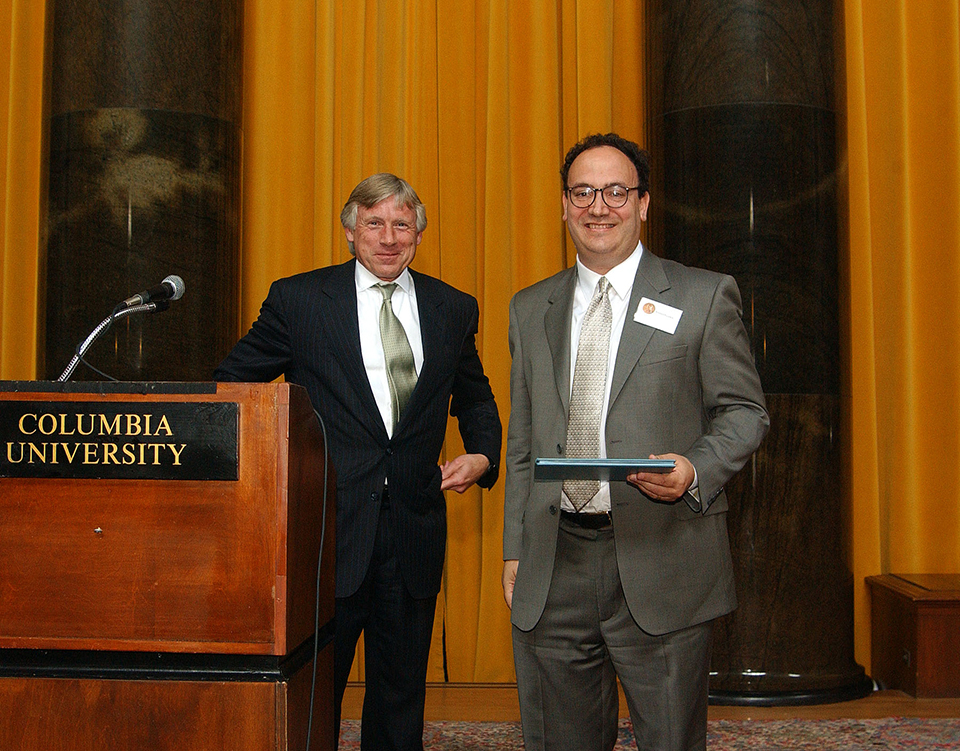
Columbia University President Lee C. Bollinger (left) presents Daniel Golden with the 2004 Pulitzer Prize in Beat Reporting.
Winning Work
A Look at Who Got in Where Shows Preferences Go Beyond Racial Ones
By Daniel Golden
"I was naive. I thought college admissions had something to do with academics."
GROTON, Mass. -- Of the 79 members of the class of 1998 at the Groton School, 34 were admitted to Ivy League universities.
Not Henry Park. He was ranked 14th in his class at Groton, one of the nation's premier boarding schools, and scored a stellar 1560 out of 1600 on his SAT college-admission test. But he was spurned by four Ivies -- Harvard, Yale, Brown and Columbia universities -- as well as Stanford University and the Massachusetts Institute of Technology.
Most of the students in Mr. Park's class who were accepted by those universities had less impressive academic credentials than his. What they had instead were certain characteristics such as money, connections, or minority status that helped them vault over him to the universities of their choice.
"I was naive," says Mr. Park's mother, Suki Park. "I thought college admissions had something to do with academics." She and her husband, middle-class Korean immigrants from New Jersey, scrimped to send their son to Groton because of its notable college-placement record.
In the coming months, the U.S. Supreme Court is expected to rule on a landmark challenge to affirmative action by white applicants who had been rejected from the University of Michigan. The decision will likely have sweeping ramifications for the role of race in admissions to public and private schools. But a look at the fate of Groton's class of '98 shows that minority status is just one of several factors that can trump academic merit in college admissions. Indeed, students who are white and privileged regularly benefit from affirmative action of another kind.
Some of Mr. Park's lower-performing classmates who were picked by top universities were minorities. But several were affluent white children of alumni, known as "legacy" students. The parents of others were either current or prospective financial donors or celebrities. A few were strong rowers, a sport offered predominantly at uppercrust schools and elite colleges.
Unlike these students, Mr. Park couldn't rely on any "hook," as college admissions officers call the criteria for preferential treatment. He did not qualify for affirmative action, which colleges generally limit to underrepresented minorities such as blacks, Hispanics and Native Americans. His parents, who attended college in Korea, say they couldn't afford to donate to a university. Without a hook, applicants to elite universities must, at a minimum, have exemplary scores and grades. These universities also take into account more subjective factors, such as artistic talent and leadership ability. Every year, they reject many valedictorians and students with perfect SAT scores.
"When the decisions came out, and all these other people started getting in, I was a little upset," Mr. Park says. "I feel I have to hold myself to a higher standard."
Lakia Washington, an African-American who grew up in the Bronx and attended Groton on a scholarship, was admitted to Columbia despite ranking 60th in her class and scoring only 1110 on the SAT. She says affirmative action gave her "a great opportunity." But, she says, preferential treatment for children of alumni and donors "amounts to exactly the same thing. That's what upsets me the most about criticism of affirmative action."
Groton doesn't reveal class rankings, even to students. But a document from Groton's college-counseling department that was reviewed by The Wall Street Journal provides details of class ranks (for sophomore year through the first semester of senior year), test scores and college-application results for all of the school's 1998 graduates.
William M. Polk, Groton's headmaster, says the document, titled "Groton School Class of 1998: College Acceptances/Rejections/Wait-Listings by Class Rank," is not an "official school record." But 20 Groton graduates whose names appeared on the list said their test scores and college-admission outcomes listed on the document were accurate.
One striking anomaly: Of nine Groton students listed as applicants to Stanford that year, Margaret Bass was the only one admitted. Ms. Bass's grades placed her 40th in her Groton class, according to the Groton document. She had an SAT score of 1220, lower than those of seven of the eight other Stanford applicants. By contrast, almost 90% of Stanford freshmen rank in the top 10% of their high school class, while 75% have SAT scores of 1360 or better.
But Ms. Bass had an edge: Her father, Texas tycoon Robert Bass, was chairman of Stanford's board and had given $25 million to the university in 1992. Mr. Bass has a degree from the Stanford Graduate School of Business. He and his wife, Anne, are both Groton trustees.
Stanford officials and Martin London, a lawyer for the Bass family, said Ms. Bass's record on the Groton document was inaccurate, but declined to be specific. Another person familiar with Ms. Bass's record at Groton said her data, as listed on the document, were correct. Mr. London added that Ms. Bass compiled a "stellar record" at Stanford and graduated with honors last year. Ms. Bass didn't respond to several requests for comment. Her roommate at Groton, Claire Abernathy, said Ms. Bass is "a great writer," and "I'm sure her admissions essay was fantastic."
Selective universities justify favoring children of alumni and prospective donors on the grounds that tuition doesn't cover the entire cost of education. These schools say private gifts subsidize scholarships, faculty salaries and other needs. Children of celebrities, they add, enhance an institution's visibility. "I will certainly factor in a history of very significant giving to Stanford," said Robin Mamlet, admissions dean. She added that the university's development office each year provides her with names of applicants whose parents have been major donors.
Ms. Bass was far from the only child of prominent parents in the Groton class of '98. It included children of diplomats, international lawyers and famous writers, as well as other wealthy businesspeople. Harvard admitted a dozen members of the class -- more than any other Ivy League university. At least five of those accepted by Harvard were alumni children, including Matthew Burr. His father, Boston venture capitalist Craig L. Burr, gave his alma mater between $1 million and $5 million in the mid-1990s, according to Harvard records.
Matthew Burr ranked fourth in his Groton class but had an SAT score of 1240. Three-fourths of Harvard students have SAT scores of 1380 or higher. Mr. Burr applied to one other college, Williams, which rejected him. Now a Harvard senior, Matthew Burr says he took the SAT four times. "I just don't test well," he says. He acknowledges his father's Harvard ties aided his admission chances. "I don't think legacy is a fair criterion for people to get into college," he adds. "But for me, that was the way it was."
Craig Burr says his donation to Harvard had "absolutely nothing to do" with his son's acceptance. "Matthew did not need any help because he had phenomenal grades," he says. Harvard declines to comment on individual applicants.
Bastion of Elite
Founded in 1884, Groton has long been regarded as a bastion of the elite. Its alumni include Franklin D. Roosevelt, former New York governor W. Averell Harriman, and more recently, actor Sam Waterston. On its graceful campus 40 miles northwest of Boston, brick buildings and a Gothic revival chapel encircle a grassy common. Virtually all the students are boarders, except for a smattering of day students.
Groton borrows heavily from the English "public school" model and vocabulary: Grade years are known as "forms," student leaders are called "prefects," and students attend chapel each morning. Its motto: "To Serve Is To Reign." The school charges $33,000 a year in tuition, room and board. Its students have a median SAT score of 1360, 340 points above the national average. In the class of '98, at least 60 of the 79 graduates were white.
Forbes Reynolds McPherson, a member of the Groton class of '98, traces his lineage all the way back to Increase Mather, a 17th-century Harvard president. Mr. McPherson, known as "Renny," is also the son and grandson of Harvard graduates. He had a solid 1480 SAT score, but ranked 45th in his Groton class. He was initially wait-listed at Harvard; the other top-tier universities to which he applied rejected him.
After his grades improved in his final semester at Groton, Harvard admitted Mr. McPherson on condition that he delay enrolling for a year -- a compromise Harvard often extends to alumni children with borderline qualifications. Harvard admissions dean William Fitzsimmons says the university offered deferred admission to 48 applicants in 1998. Of those, 17 students, or 35%, were children of alumni. Mr. Fitzsimmons says many students can benefit from a year off, and requiring them to defer tests their seriousness about going to Harvard.
"I didn't have the best grades, but I knew I could handle the work at Harvard," says Mr. McPherson, who is now a Harvard senior. He says his college grades are better than his grades at Groton. He's also been editor-in-chief of a campus poetry review, and a staffer on the Harvard Crimson newspaper. He plans to join the U.S. Marines as a lieutenant after graduation.
One Groton student had a record strikingly similar to Henry Park's, but he fared much better in the college-admissions process. John Roberts was 10th in his class -- four spots ahead of Mr. Park -- but had a slightly lower SAT score, 1530. Messrs. Roberts and Park were two of three Groton seniors enrolled in the school's most advanced math course. Their research for an article titled "Mapping the Hypercube" was subsequently published in a math journal for high-school teachers and students. In addition, both students were on the Groton cross-country team.
But Mr. Roberts, unlike Mr. Park, had a significant Harvard hook. His grandfather and uncle, both alumni, gave Harvard an indoor track and tennis center and a professorship, among other donations. Mr. Roberts says that when he was applying to Harvard, his family arranged for him to meet with Mr. Fitzsimmons, the admissions dean, and Jeremy Knowles, then dean of arts and sciences. Mr. Roberts's relatives also linked him up with Harvard's track coach and team members in the hope that he would be given preferential treatment as an athletic recruit. Harvard accepted him.
Mr. Fitzsimmons, Harvard's admissions dean, says he chats briefly with at least 100 applicants a year of all backgrounds. These interviews are not "official," he says, although he notes them in the file. Prof. Knowles says he occasionally saw alumni or friends "with their offspring in tow" but never contacted the admissions office afterward.
Mr. Roberts says his Groton classmate Mr. Park was a "tremendous" math student. "If Henry had some kind of legacy connection, that would have helped him" get into Harvard, he adds. "In my case, I had the scores. The family connection took out the added doubt." He majored in psychology at Harvard and now writes fiction.
Several Groton students had reservations about benefiting from family wealth or prominence. Julia Halberstam's heart was set on attending Brown University, but she pleaded in her application essay to be judged on her own merits and not considered as the daughter of David Halberstam, best-selling writer of "The Best and the Brightest" and the baseball book, "Summer of '49."
But when she and her father visited the campus, Brown admissions dean Michael Goldberger met with them and spent most of the time talking baseball with Mr. Halberstam, according to Julia Halberstam. And, despite Ms. Halberstam's misgivings about benefiting from influence, she says that former Brown President Vartan Gregorian, a family friend, wrote a letter on her behalf
Mr. Goldberger says he meets with 100 applicants and their parents a year, strictly as a courtesy. He says 10 to 15 of those are celebrities, donors or alumni. No records are kept of the conversations, he says, and they have no effect on the admissions decision.
Ms. Halberstam ranked 41st in the Groton class of '98 and had a 1340 SAT score, about 50 points below Brown's average. She says she "really excelled" in English and history in high school, but had C's in subjects that didn't interest her. Brown admitted her. She graduated last year and now teaches kindergarten in the "Teach for America" program at a school in Greenville, Miss. "I don't know if I got into Brown because of my father's celebrity -- I'll never know," she says. "I was very aware of it and uncomfortable with it."
Another student acted on similar qualms, and may have suffered for them. Caroline Braga decided -- against her mother's urging -- not to tell Brown that one of her ancestors, William F. Sayles, endowed Sayles Hall on campus in 1881. Despite a better academic record than Ms. Halberstam's, she was rejected. She attended Georgetown University and plans to go to graduate school in landscape architecture at the University of Virginia. "I was a little bit naive," she says. "In an ideal world, I wouldn't include preferences. In the real world, you use whatever tools you have to get where you want to go." Mr. Goldberger, Brown's admissions dean, acknowledges that "having a building named after your family on our campus would be a plus factor."
Brown also rejected Christina Maloney, who had an SAT score of 1330 and ranked 46th in the Groton class, according to the Groton document. So did Dartmouth College. Bates and Davidson colleges wait-listed her. But she got into Princeton University, where three fourths of students have SAT scores of 1380 or above.
Her father and grandfather attended Princeton. Ms. Maloney also was a skilled rower at Groton, and rowed for Princeton as a freshman. (Bates and Davidson did not have women's intercollegiate crew teams at the time.)
Ms. Maloney is now a policy analyst for the New York City Council; she didn't return phone calls. Her mother, Carolyn Maloney, a Democratic member of Congress from New York City, declines comment on her daughter's admission, but says Christina graduated from Princeton with high honors. "Every child at Groton could do the work at any college in America" because the school is so rigorous, Rep. Maloney adds.
Another Groton student, Danielle Nunez, had the option of seeking preferential treatment as a minority. Ms. Nunez, who is half Peruvian and half Scandinavian, says she asked her father whether to identify herself as Hispanic on her Princeton application. With a 1510 SAT score, a rank of 26th in her class, and the honor of being picked by Groton classmates as Prize Day speaker, she figured she was likely to be accepted anyway.
Taking No Chances
Her father, a salesman, told her that, while affirmative action was not originally designed for students like her, she shouldn't take chances with her future. Ms. Nunez, who grew up in East Windsor, N.J., and attended Groton on a partial scholarship, marked herself as Hispanic.
Ms. Nunez graduated from Princeton last year and is a paralegal in the Manhattan district attorney's office. She says she favors giving preferential treatment to children of alumni and donors. "In a generation, legacies may be more diverse," she said. "I take huge pride that if I have a daughter, she might be listing me as an alumna on her Groton and Princeton applications."
Henry Park says he made few close friends among Groton faculty or students. Despite his prowess in math -- he received the maximum score of 800 on both the math SAT and SAT II achievement test -- and in languages, he says he felt isolated as one of only two male Asian students in his class. Few classmates, he says, shared his interests in martial arts and Korean music.
Nor did he share the affluence that characterized many of his classmates. His father used to own a string of small clothing stores in the New York area, but several failed in the mid-1990s, prompting Mrs. Park to find work teaching Korean. To pay Henry's Groton tuition, she sold her only investment property, an apartment building in Hoboken, N.J.
Henry and his mother say Groton guidance counselors discouraged him from setting his sights on top colleges. Mrs. Park says a counselor told her that her son was a long shot at Harvard because he didn't stand out from the crowd. "I have thought many, many times why Henry failed," Mrs. Park says. "It was just devastating."
Mr. Polk, the Groton headmaster, declines to discuss individual students. In a written statement, he said: "It is always disappointing when a student doesn't get into her/his college of choice, but we understand that a student's academic record is only one of many different factors that colleges consider."
Two leading universities did accept Mr. Park: Carnegie Mellon and Johns Hopkins. He attended Carnegie Mellon for a year before transferring to Johns Hopkins, where he is a senior majoring in neuroscience. He cooks three days a week at a campus restaurant on a work-study job, and is on the dean's list with a grade-point average above 3.5. He plans to go to medical school.
© 2003, Dow Jones & Company
Seeking Big Donors, Duke Woos Beneficent 'Development Admits'
By Daniel Golden
DURHAM, N.C. -- Despite her boarding-school education and a personal tutor, Maude Bunn's SAT scores weren't high enough for a typical student to earn admission to Duke University.
But Ms. Bunn had something else going for her -- coffeemakers. Her Bunn forebears built a fortune on them and, with Duke hoping to woo her wealthy parents as donors, she was admitted.
Afterward, her parents promptly became co-chairmen of a Duke fund-raising effort aimed at other Duke parents. "My child was given a gift, she got in, and now I'm giving back," says Maude's mother, Cissy Bunn, who declines to say how much the family has contributed to the university.
Most universities acknowledge favoring children of alumni who support their alma mater. But to attract prospective donors, colleges are also bending admissions standards to make space for children from rich or influential families that lack longstanding ties to the institutions. Through referrals and word-of-mouth, schools identify applicants from well-to-do families. Then, as soon as these students enroll, universities start soliciting gifts from their parents.
Duke says it has never traded an admission for a donation. "There's no quid pro quo, no bargains have been struck," says Peter Vaughn, director of development communications. While it won't comment on individual cases, the university notes that financial gifts from parents are used to update facilities and provide financial aid, among other things.
The formal practice of giving preference to students whose parents are wealthy -- sometimes called "development admits" -- has implications for the legal challenge to affirmative action, which the U.S. Supreme Court will hear April 1. Special admissions treatment for the affluent has racial overtones, at least indirectly. Reflecting the distribution of wealth in America, the vast majority of major donors to higher education are white. Defenders of minority preference say such advantages for white applicants are precisely why affirmative action is still needed.
Top schools ranging from Stanford University to Emory University say they occasionally consider parental wealth in admission decisions. Other elite schools, such as Massachusetts Institute of Technology, say parental means don't influence them. "I understand why universities leverage parent contacts to enrich themselves," says Marilee Jones, dean of admissions at MIT. "If somebody's offering them a check, why not take it? But I honestly think it's out of control."
While children of the wealthy have long had advantages getting into colleges, a look at how "development" admissions works at Duke shows how institutionalized the process has become at some major universities.
Under-endowed compared with rivals such as Harvard, Princeton and Stanford, Duke has been particularly aggressive in snaring donors through admissions breaks. Widely considered one of the nation's top ten universities, Duke accepts 23% of its applicants and turns down more than 600 high-school valedictorians a year. Three-fourths of its students score above 1320 out of a perfect 1600 on the SATs.
Yet in recent years, Duke says it has relaxed these standards to admit 100 to 125 students annually as a result of family wealth or connections, up from about 20 a decade ago. These students aren't alumni children and were tentatively rejected, or wait-listed, in the regular admissions review. More than half of them enroll, constituting an estimated 3% to 5% of Duke's student body of 6,200.
The strategy appears to be paying off. For the last six years, Duke says it has led all universities nationwide in unrestricted gifts to its annual fund from nonalumni parents: about $3.1 million in 2001-2002. A university fund-raising campaign recently met its $2 billion goal. While 35% of alumni donate to Duke, 52% of parents of last year's freshman class contributed to the university -- besides paying $35,000 in tuition and room and board.
Students admitted for development reasons graduate at a higher rate than the overall student body, Duke says, although their grades are slightly lower. These applicants are held to the same lesser standard as some top athletes; not whether they can excel, but whether they can graduate. "There's never been a case where I think the student can't be successful at Duke, and the student is admitted," says admissions director Christoph Guttentag.
Caroline Diemar, a Duke senior, says she favors maintaining minority preference for college admissions because she knows from experience that well-connected white students get a boost too. The daughter of an investment banker, she applied early to Duke despite an 1190 SAT score. Her candidacy was deferred to the spring.
She then buttressed her application with recommendations from two family friends who were Duke donors, and she was accepted. "I needed something to make me stand out," says Ms. Diemar, a sociology major with a 3.2 grade point average, below the 3.4 average of the senior class. "Everybody at Duke has something that got them in." The lesson she learned: "Networking is how you go about everything."
After she enrolled, Duke recruited Ms. Diemar's parents to serve as co-chairmen of a fund-raising effort. Her father, Robert Diemar, declined to say how much he has given to Duke. "We support all of our five children's schools," said Mr. Diemar, a Princeton alumnus. He said Duke accepted his daughter on merit.
The practice of giving preference to the children of potential donors has caused fissures on Duke's campus, with some worrying that it dilutes the student body's intellectual vitality and undermines racial and economic diversity. In November 2000, a report to the trustees by a university committee on admissions called for a one-third cut in applicants accepted for development reasons. Mr. Guttentag says he plans to reduce such admissions to about 65 this year to achieve "greater flexibility" in shaping next fall's freshman class.
Duke President Nannerl O. Keohane thinks the Supreme Court should uphold affirmative action because preferences for children of potential donors is "disproportionately favorable to white students ... . The two are definitely linked, and it seems odd to me to allow one sort of preference, but not the other."
The University of Michigan, defendant in the affirmative action case before the Supreme Court, wants to continue to allow preferential treatment for minorities. It also gives preferential admissions treatment to children of potential donors -- but only if they're white or Asian.
Discretionary Points
Under the 150-point "Selection Index" Michigan uses for undergraduate admissions, a review committee may award 20 "discretionary" points to children of donors, legislators, faculty members and other key supporters. Minorities underrepresented in higher education -- Hispanics, African-Americans and Native Americans -- qualify for an automatic 20 points, but they are ineligible for the discretionary points. The university says less than 1% of admitted students receive this edge.
The late Terry Sanford, Duke president from 1969 to 1985, practiced donor preference on a large scale. Mr. Sanford, a gregarious former North Carolina governor, used his wide circle of contacts in business, politics and the media to elevate Duke from a regional to a national university. According to Keith Brodie, Duke's president emeritus, Mr. Sanford would personally meet each year with the admissions and development directors to ensure special attention for 200 of these friends' children applying to Duke. More than 100 would ultimately enroll.
As president from 1985 to 1993, Dr. Brodie says, he removed himself from the admissions process, resisted lobbying by some trustees, and trimmed the number of underqualified students admitted due to donor preference to 20 a year. "A Duke education is too valuable an asset to squander," says Dr. Brodie, a professor of psychiatry, who was criticized as president for a lack of fund-raising zeal. "University presidents are under greater pressure than ever to raise money," he adds. "I suspect many of them have turned to admissions to help that process."
Harold Wingood, who was senior associate director of admissions under Dr. Brodie, recalls that 30 to 40 students per year were upgraded from "rejected" to "wait-list," or from "wait-list" to "admit" due to their family ties. "We'd take students in some cases with SAT scores 100 points below the mean, or just outside the top 15% of their class," says Mr. Wingood, now dean of admissions at Clark University in Worcester, Mass. "They weren't slugs, but they weren't strong enough to get in on their own."
The numbers have increased under Ms. Keohane, Duke's current president. Duke says it admitted about 125 nonalumni children in 1998, and again in 1999, who had been tentatively rejected or wait-listed prior to considering family connections. It accepted 99 such students in 2000. Similar data aren't available for 2001 or 2002, the school says.
Ms. Keohane says she didn't intentionally increase the number of wealthy applicants given a leg up. She says "it is possible that the numbers drifted upward" during the recent $2 billion-fundraising campaign because "more people in development expressed interest in candidates. But this was certainly not a policy directive, or even a conscious choice."
The system at Duke works this way: Through its own network and names supplied by trustees, alumni, donors and others, the development office identifies about 500 likely applicants with rich or powerful parents who are not alumni. (Children of major alumni donors are given similar preference in a separate process.) It cultivates them with campus tours and basic admissions advice; for instance, applying early increases their chances. It also relays the names to the admissions office, which returns word if any of the students forget to apply -- so development can remind them.
The development office then winnows the initial 500 into at least 160 high-priority applicants. Although these names are flagged in the admissions-office computer, admissions readers evaluate them on merit, without regard to family means. About 30 to 40 are accepted, the others tentatively rejected or wait-listed. During an all-day meeting in March, Mr. Guttentag and John Piva Jr., senior vice president for development, debate these 120 cases, weighing their family's likely contribution against their academic shortcomings.
In her 2001 book, "Admissions Confidential," former Duke admissions officer Rachel Toor recalled that most admissions officers "hated to see these kids get in" because they were "the weakest part of our applicant pool." Nevertheless, most of the 120 students are admitted.
Once these children of privilege enroll, the development office enlists their parents as donors and fund raisers. According to Dr. Brodie, Duke's parent program originated as a forum for parent concerns about safety issues, but it has evolved into a fund-raising vehicle.
A committee of more than 200 nonalumni parents provides its volunteer army for the four classes currently at Duke. Committee members usually give at least $1,000 to Duke, and the eight co-chairmen and the national chairman much more -- including at least two seven-figure gifts endowing faculty chairs.
Membership in the parents' committee is by invitation only and is overwhelmingly white. Lately, one affluent Chicago suburb -- Lake Forest -- has dominated its higher echelons. Lake Forest luminaries on the committee have included department-store heir Marshall Field V, who has given at least $100,000 to Duke; Paul Clark, chief executive of Icos Corp., a biotech firm; Robert DePree, chairman of corn-meal maker House-Autry Mills Inc.; and investment banker Willard Bunn III, Maude's father.
The Lake Forest couples are social friends, serve on many of the same Chicago-area boards and several sent their children to the same private elementary school, Lake Forest Country Day. They write recommendations to Duke for each other's children.
'Pretty Intimate Group'
Susan DePree, Robert's wife, describes the Duke parents committee as a "pretty intimate group" but not "clubby." She declined to say how much she and her husband have contributed to Duke, but says they solicited at least one six-figure gift from a parent-committee member.
Maude Bunn, whose family lives in Lake Forest, attended an elite boarding school in Lawrenceville, N.J., where the Bunn Library opened in 1996. She says other Lake Forest parents recommended her to Duke.
Cissy Bunn acknowledges her daughter didn't fit the academic profile of a Duke student. "She's bright, she had good grades, but she doesn't meet the superstar status," Mrs. Bunn says. "Did my normal child take the place of somebody who could really make a difference in the world? Sure, yes, to an extent. But there are so many things you can lose sleep over. I'm happy for me and my child."
Maude Bunn says she initially felt very awkward at Duke because her admission "wasn't necessarily on my own merits." But these days, the sophomore says she is thriving. "The more time I've spent here, I feel more and more confident -- they didn't have to take me if they didn't think I was equal to all the other students they are admitting," she says. "I'm doing just as well as everybody I know if not better." She is studying art history and wants a career in fashion.
Now her younger sister Meg, a high-school senior, is applying to Duke. Maude says the family likes Meg's chances. "The people my mother works with for fund raising told her, 'It's really hard to get the first child in,' " she says. "After that, sisters and brothers are easier." Duke says it, like many universities, gives some preference to siblings.
Mrs. Bunn says she's not twisting anyone's arm. "I told them, 'If she's qualified at all, that would be lovely,' " she says. "If she gets in, I'd be happy to stay on the parents' committee."
As college admission becomes increasingly competitive, parents try to help their children's chances in any way they can. Duke accepted Jane Hetherington in 2000, despite SAT scores in the mid-1200s and what she calls "average" grades in high school. She attributes her acceptance to a "wonderful recommendation" by Norman Christensen Jr., then dean of Duke's Nicholas School of the Environment and Earth Sciences, a graduate program. She got the recommendation after one meeting with him.
At the time, her father, John Hetherington, was vice president of Westvaco Corp., a paper-products firm that had donated to the school, sponsored research there and hired some of its graduates. Mr. Hetherington asked a family friend on the school's advisory board to have the dean interview Ms. Hetherington.
Mr. Christensen, a Duke professor, says he was impressed by Ms. Hetherington's devotion to environmental studies. The student's father later reciprocated by arranging a meeting between the school's new dean and Westvaco's chief executive officer, hoping the company would increase support for the school. Nothing came of it, says Mr. Hetherington. (Westvaco merged with Mead Corp. last year.)
"I don't feel we benefited from anything you would describe as the traditional white power structure network," says Mr. Hetherington, who is now a Republican state representative in Connecticut and favors a "sunset law" for affirmative action. He doesn't think his position affected his daughter's acceptance into college. "It worked out for some reason," he says. "In all candor, we got lucky."
© 2003, Dow Jones & Company
Aiding Mainly Whites, Legacy Policy Gets Embroiled in Debate Over Affirmative Action
By Daniel Golden
"Without legacy preference, there would be a significant decrease in giving from a core body of traditional support -- families in which at least a second generation has gone to the institution."
With two cases challenging affirmative action at the University of Michigan pending before it, the Supreme Court will soon decide the fate of race-based preferences in college admissions. But the cases also may affect the future of a longer-standing kind of preference: the one favoring children of alumni.
The legacy preference, as it is known, is nearly as widespread as those based on race and ethnicity. Colleges like it because it keeps alumni happy and more inclined to donate. But overwhelmingly, the legacy preference benefits whites. Now, calls to abandon the legacy preference are on the rise from minority groups and politicians who see it as a perpetuation of class distinction and white advantage.
Because it isn't racially discriminatory on its face, the preference for children of alumni may be less vulnerable than affirmative action to legal challenge. But politically, the fates of the two preferences appear intertwined. "If the Supreme Court were to end affirmative action, colleges would be under tremendous pressure to reconsider whether they give preference to alumni children, of whom the vast majority are white and privileged," says Gary Orfield, a Harvard University professor of education and social policy.
Two state universities, Georgia's and California's, have already dropped legacy preference after having been forced to end racial preferences. A court ruling knocked out the University of Georgia's racial preferences in 2001, and a voter initiative undid those in California in 1996. One Democratic presidential hopeful, Sen. John Edwards of North Carolina, is calling for an end to legacy preferences.
But curbing them could have serious financial implications for colleges and universities. Alumni provide 28% of the private donations to higher education -- $6.83 billion in the 2000-2001 school year. When their children are rejected for admission, alumni sometimes react as did Richard Hokin, Princeton 1962. He stopped giving to his alma mater after it turned away two daughters several years ago. "I took it as a personal affront," says Mr. Hokin, chairman of Intermountain Industries Inc., an Idaho natural-gas distributor.
Sheldon Steinbach, general counsel of the American Council on Education, a Washington lobbying group, says, "Without legacy preference, there would be a significant decrease in giving from a core body of traditional support -- families in which at least a second generation has gone to the institution."
Even Grandkids
The edge that a legacy preference conveys is almost never as large as that conveyed by affirmative-action policies. But most U.S. universities give at least some degree of preference to graduates' relatives, sometimes even a little to grandchildren, siblings and nieces or nephews. Schools are candid in saying that long-term financial support is the chief reason, although some, such as Harvard, also cite the importance of encouraging graduates to get involved with interviewing applicants and other institutional tasks.
Sons and daughters of graduates make up 10% to 15% of students at most Ivy League schools and enjoy sharply higher rates of acceptance. Harvard accepts 40% of legacy applicants, compared with an 11% overall acceptance rate. Princeton took 35% of alumni children who applied last year, and 11% of overall applicants. The University of Pennsylvania accepts 41% of legacy applicants, compared with 21% overall.
At Notre Dame, about 23% of all students are children of graduates.
Some of these "legacies," as the students are often called, tell of an uneasiness akin to that felt by some minorities at elite schools. "I'm a little uncomfortable with the idea that I'm a legacy, and that people think I got in because I'm a legacy," says Sara Sedgwick, a Harvard freshman whose Crimson lineage includes five generations on her father's side and four on her mother's. She had straight A's in high school and captained soccer and basketball teams, but her SAT scores -- in the high 1300's -- were below those of about three-fourths of her Harvard classmates. "I thought I presented a good case for myself without it," she says. "With the legacy thrown in, that assured it a bit more."
Deborah Perlman, a psychologist at Georgetown University, says she often counsels legacies there who wonder if they deserved their admission. "There's a self-doubt that creeps in," she says. "You find a parallel feeling among minorities." Princeton's alumni weekly recently published a letter from her and her father, Theodore Perlman -- both legacies at the university -- advocating an end to legacy preference. "The greater good is to be found in equality of treatment," they wrote.
Although universities have always paid special attention to their alumni, the legacy preference was formalized early last century, in some cases partly to limit enrollment of Jews. Today, the practice often has that effect on other groups. At the University of Virginia, 91% of legacy applicants accepted on an early-decision basis for next fall are white; 1.6% are black, 0.5% are Hispanic, and 1.6% are Asian. Among applicants with no alumni parents, the pool of those accepted is more diverse: 73% white, 5.6% black, 9.3% Asian and 3.5% Hispanic.
About half of the legacies Virginia accepted were children of out-of-state alumni. Virginia gives these applicants a break by grouping them with its in-state applicants. The SAT scores of accepted state residents average 30 to 35 points lower than those of accepted out-of-state applicants.
Virginia Admissions Dean John Blackburn makes no bones about the reason for the preference. "In light of very deep budget cuts from the state, our private support particularly from alumni is crucial to maintaining the quality of the institution," he says. "The legacy preference helps ensure that support by recognizing their financial contributions and their service on university committees and task forces." Out-of-state alumni contributed the majority of $1.4 billion raised in a recent university fund drive.
Selection Index
The University of Michigan has a 150-point "Selection Index" for undergraduates, with 100 points usually enough to get in. The university awards a four-point bonus to children and stepchildren of alumni, or one point to grandchildren, spouses or siblings of alumni.
Michigan also gives an automatic 20-point bonus to blacks, Hispanics and native Americans (though not to Asian-Americans). This practice is the target of one of the affirmative-action cases before the Supreme Court -- filed by two white students denied admission in 1997.
Defenders of that racial preference say it compensates for the legacy edge as well as for certain other preferences Michigan awards, such as six extra points given to applicants from under-represented regions of the state. One such region is the Upper Peninsula, which happens to be overwhelmingly white. Of Michigan undergraduates with alumni parents, less than 3% are Hispanic and 4% black, compared with rates of 5% and 8%, respectively, in the overall enrollment, say court documents filed by minority students. The university says it can't verify the legacy percentages.
"What does legacy preference do to advance fairness and merit?" asks Theodore M. Shaw, a lawyer for the NAACP Legal Defense and Educational Fund Inc., who represents 17 minority high-school students granted defendant status in the affirmative-action suit against the university. "Why is it more defensible than an attempt to include people from minority groups that have been excluded in the past and are still under-represented?"
The reply from the white students' lawyer, Michael Rosman: "Because some small percentage of white students are getting legacy preference, that doesn't mean we should disadvantage all whites" by allowing racial preferences. Mr. Rosman is general counsel of the Center for Individual Rights, a Washington nonprofit that represents the two white students whom Michigan rejected in 1997.
One of those students, Patrick Hamacher, was turned down by Michigan despite having a legacy preference. An earlier version of Michigan's legacy preference had boosted his 2.9 high-school grade-point average to 3 for purposes of considering him. The suit that he and co-plaintiff Jennifer Gratz filed asks for the elimination of race as a factor in admissions at the university. But Mr. Hamacher says he actually doesn't think Michigan should consider either race or parentage in its admissions. He is now a graduate of another university, Michigan State.
The University of Michigan's law school -- the defendant in the other affirmative-action case before the Supreme Court -- doesn't use the point system but does give an edge to children of out-of-state alumni. It treats them as in-state applicants, who receive extra consideration. Last May, a federal appeals court upheld the law school's affirmative-action policy, 5 to 4. But since other federal appellate courts have gone the other way, all eyes are on the Supreme Court, which is expected to hear the Michigan cases in the spring.
Under Siege
Some Democrats are trying to reposition affirmative action as a populist cause under siege from an old-boy network of Republicans -- notably President Bush, who was a third-generation legacy student at Yale. Sen. Edwards said in a November speech that "the legacy preference rewards students who had the most advantages to begin with. It is a birthright out of 18th-century British aristocracy, not 21st-century American democracy.''
In both the House and Senate education committees, an attack on legacy preference is expected this year from the panels' ranking Democrats, Rep. George Miller of California and Sen. Edward M. Kennedy of Massachusetts. Mr. Kennedy was a legacy student at Harvard.
Some bipartisan support is likely. Sen. Trent Lott supported "aggressive" minority recruiting to "balance" legacy admissions, while speaking to Black Entertainment Television last month as he sought to defuse criticism of his remarks about Strom Thurmond's segregationist 1948 presidential run.
In fact, one of the first politicians to assail the legacy preference was a Republican, Bob Dole. In 1990, when Mr. Dole was Senate Minority Leader, he called legacy preference an "unfair advantage" for children of "wealthy contributors" and urged the federal Office for Civil Rights to examine whether it was legal under the 1964 Civil Rights Act.
The office concluded the preference was legal. It also found that although the preference contributed to a gap in the rate at which white and Asian applicants to Harvard were accepted, Harvard had "legitimate institutional goals" for favoring alumni children.
At Harvard today, Admissions Dean William Fitzsimmons says he personally reads all applications from children of alumni, which numbered 727 last year. He says the average SAT score of legacies admitted is just two points below the school's overall average, and that legacy status is basically used as a tie-breaker between comparable candidates.
Harvard's legacy students are becoming more diverse, reflecting the surge in minority enrollment in the 1970s. Still, only 7.6% of legacy applicants accepted last year were black, Hispanic or native American, compared with 17.8% of all successful applicants.
Asked how he defends a policy so little rooted in merit, Mr. Fitzsimmons says that the school's alumni "volunteer an immense amount of their free time in recruiting students, raising money for their financial aid, taking part in Harvard Club activities at the local level, and in general promoting the college." He adds, "They often bring a special kind of loyalty and enthusiasm for life at the college that makes a real difference in the college climate ... and makes Harvard a happier place." Therefore, he says, "when their sons and daughters apply, we review their applications with great care and will give a 'tip' in the admissions process to them."
John Sedgwick, the father of Harvard freshman Sara Sedgwick, argues that legacy preference helps keep the past alive. The family's Harvard ties go back to Ms. Sedgwick's great-great-grandfather, Henry Dwight Sedgwick II, who graduated in 1843. Her grandfather played on Harvard's undefeated, Rose-Bowl-winning 1919 football team.
"One of the salient characteristics of a college like Harvard is its history," says Mr. Sedgwick, a novelist. "Legacy students are a visible representation of that history and make it real for the students who are attending."
© 2003, Dow Jones & Company
Judges or Their Kids Are College 'Legacies'
By Daniel Golden
In one of the most controversial cases of the year, the nine U.S. Supreme Court justices are expected soon to decide the fate of racial preferences in college admissions. As it happens, a majority of the justices are already familiar with another type of admissions preference.
Five justices or their children qualified for an admissions edge known as "legacy preference," which most U.S. colleges give to the sons and daughters of their alumni. This preference is sometimes criticized as affirmative action for wealthy whites, since the students who benefit from it overwhelmingly fall into that category.
Two justices, Stephen Breyer and Anthony Kennedy, have family ties to Stanford University that span three generations. A third justice, Sandra Day O'Connor, is a Stanford graduate and the mother of two Stanford alumni, and has served on the university's board of trustees. Justice John Paul Stevens attended the University of Chicago and Northwestern Law School, as did his father. Ruth Bader Ginsburg and her daughter Jane formed the first mother-daughter combination ever to attend Harvard Law School.
It isn't clear whether academic lineage played a role in the admissions of these justices' children, and several of them had stellar high-school records. Yet judges -- like everyone else wrestling with the affirmative-action debate -- inevitably filter it through the prism of their own personal history. In this case, college ties exert "at a minimum, a subconscious influence over how they think," says Edward Lazarus, a former U.S. Supreme Court clerk and author of a 1998 book about the inner workings of the court. Mr. Lazarus and other legal experts say the legacy link wouldn't require the justices to recuse themselves.
Legacy preference isn't directly at issue in the case, a challenge to affirmative action by white students who were rejected from the University of Michigan. But during oral arguments on April 1, Justice Breyer drew a parallel. "What is the difference," the justice asked a lawyer representing the white students, between a university spurning a student because he isn't a minority, or because he isn't the child of an alumnus? The lawyer answered that the Equal Protection Clause of the U.S. Constitution prohibits race discrimination, but not discrimination on the basis of alumni affiliation.
In a brief filed before the court, minority students at Michigan and elsewhere argue that legacy preference is one of several factors favoring whites that must be counterbalanced by affirmative action. As the case was en route to the Supreme Court, a federal appeals-court judge invoked a similar argument. Lawyers for the white students argue that children of minority alumni are also eligible for legacy preference. At the University of Michigan, legacy preference confers a much smaller benefit than racial preference. On the 150-point scale the university uses to rank candidates, alumni children receive four points, compared with 20 points for black, Hispanic and Native American students.
Justice Breyer's father, Irving, attended Stanford. So did his son, Michael, who graduated in 1997. In his Stanford commencement address that year, Justice Breyer spoke of walking the previous day through the university's inner quadrangle and seeing "the three paving stones that mark my family's three graduations: my father's graduation, my own in 1959, and yours, Michael, now."
Before admitting Michael Breyer, Stanford placed him on its wait-list -- a frequent refuge for legacy applicants with borderline credentials. While it's not certain why Mr. Breyer was on the waiting list, former Stanford admissions dean Jean Fetter described the waiting list in a 1995 book as "an appropriate place to acknowledge any legacy preference."
Susan Case, former director of college counseling at Milton Academy in Milton, Mass., where Michael Breyer went to high school, confirmed that he was wait-listed by Stanford. "I don't know that legacy was the reason he was admitted," she says. "He was a strong candidate in his own right." Another person familiar with his Milton credentials said the legacy connection "obviously contributed." Michael Breyer declined to comment.
Justices Breyer, Stevens, Kennedy, O'Connor and Ginsburg said through a court spokeswoman that it would be inappropriate to comment while the case is pending. Stanford declined to comment, citing applicants' privacy rights.
The Ivy League and other top colleges, which defend legacy preference as essential to alumni fund raising, admit alumni children at two to four times the rate of their overall applicant pools. Stanford admits one-fourth of all legacies, compared with one-eighth of applicants overall. Colleges say they rely on legacy preference as a tie-breaker between relatively equal applicants, and that many alumni children are top-notch students who would likely have been admitted regardless of preference.
Prestigious college connections on the high court aren't new. Among its most famous Ivy League legacies are Harvard grad Oliver Wendell Holmes Jr., the son of a well-known essayist who attended the school, and former Chief Justice William Howard Taft, one of a long line of his family members who attended Yale. One notable justice who wasn't a legacy: Clarence Thomas, the only black justice on the court. He grew up in poverty and graduated from the College of the Holy Cross in Worcester, Mass., and Yale Law School. His only child, Jamal, attended Virginia Military Institute.
Some of the current justices' legacy ties date back to an era before widespread SAT testing and other standardized measures of academic merit. More than half a century ago, Justice Stevens followed in the footsteps of his father, Ernest Stevens, at both the University of Chicago and Northwestern University Law School. None of the justice's children went to Chicago, according to the university, but four of his nephews and nieces have attended.
Richard Bischoff, the University of Chicago's associate director of admissions, says the university doesn't have formal preference for legacies. However, he says, applicants "who grow up with University of Chicago alums usually articulate why they desire a liberal education better than most high school seniors," and thus are more likely to be admitted. Northwestern Law says it does favor legacies.
Justice Ginsburg and her husband Martin both attended Harvard Law School. (The justice completed her degree at Columbia.) Their daughter, Jane Ginsburg, says she had excellent undergraduate grades and was accepted at three other top law schools besides Harvard. A Harvard Law spokesman said the school gives a small edge to legacies but declined to comment on individual students.
The younger Ms. Ginsburg -- now a professor at Columbia Law, where her mother used to teach -- describes her attitude toward being a legacy this way: "However you got in, you're in. Now you just have to prove you belong."
Justice Kennedy -- son of Stanford alumna Gladys McLeod Kennedy -- went to Stanford, as did his two sons and one daughter. Both sons, Justin and Gregory, graduated from Jesuit High School in Carmichael, Calif. An administrator there declined to comment. Justice Kennedy's daughter, Kristin Marie, graduated in 1986 from St. Francis High School, a Catholic girls' school in Sacramento, where she was an honor-roll student and played on the tennis team, according to the school. Justin Kennedy declined to comment; his brother and sister couldn't be reached.
Sandra Day O'Connor wrote in "Lazy B," her 2002 memoir about growing up on a cattle ranch by that name, that her father "always regretted that he did not attend Stanford." She fulfilled his dream, going there both as an undergraduate and a law student -- as did her husband, John J. O'Connor III. Two of their three sons, Scott and Jay, enrolled at Stanford; the other, Brian, went to Colorado College. Jay, the youngest, was admitted to Stanford in 1980, while his mother was on the university's board of trustees.
Jay O'Connor, now a technology executive in the San Francisco area, says he applied to Stanford and four Ivy League schools -- and was accepted by all but Princeton, where he was wait-listed. In high school, he says, he ranked near the top of his class and was editor-in-chief of the school newspaper. He declined to divulge his SAT scores, but said they "met or exceeded the standard ranges" published by the top-tier schools. "I was seen by all of the schools to which I applied as an outstanding academic candidate," he says. "I don't know what happened inside any of those schools. I have no way of knowing that."
Mr. O'Connor adds: "I'm a big believer that you should make your own mark. Who your parents are shouldn't be relevant." He says his brother, Scott, was an outstanding student and state champion swimmer in high school, and that Scott, too, was accepted at top universities with which their parents weren't affiliated. Scott O'Connor declined to comment.
In 1982, Justice O'Connor, who is regarded as a swing vote in the affirmative-action case, delivered the Stanford commencement address. At the time, Jay was a sophomore, and Scott had already graduated. She expressed the wish that "you will all be lucky enough to have your children attend this paradise on earth ... that we call Stanford."
© 2003, Dow Jones & Company
State Affirmative-Action Bans Bring Creative Solutions at UCLA, Elsewhere
By Daniel Golden
The Critical Race Studies boost is available to white applicants, too. But the subject is particularly popular among minority students. Established two years ago, it has helped the law school increase its enrollment of black first-year students to 13 in 2002 from five in 2000 -- out of a class of 305 each year. Black enrollment is still less than in 1996, the last year affirmative action was allowed in California.
Next week, the U.S. Supreme Court is expected to decide on a challenge to minority preferences, made by white applicants rejected by Michigan's undergraduate and law-school programs. Should the court narrow or eliminate affirmative action, colleges and graduate schools nationwide would face the same predicament UCLA Law did: how to maintain some semblance of racial diversity despite the continuing test-score gap between whites and black and Hispanic minorities.
In the handful of states that have already banned or restricted affirmative action, some universities use what many educators call "proxies" -- ostensibly race-neutral criteria, such as interest in Critical Race Studies, that mainly attract minority applicants. Proxies are just one of a number of strategies intended to increase minority enrollment without explicit affirmative-action policies, from greater faculty discretion in admissions to more emphasis on overcoming socio-economic disadvantage.
Of the 959 UCLA law applicants admitted in 2002, 10.5% were black, Hispanic or Native American. Twelve of the 23 students accepted through the school's "programmatic admissions" -- primarily Critical Race Studies -- are members of those groups. Students accepted in this category had a median grade-point average of 3.42 and a median Law School Admission Test score of 159 -- compared with the median 3.72 grade-point average and 167 LSAT score for all admitted students.
Dean Jonathan Varat says UCLA Law initiated the Critical Race Studies program in 2001 to capitalize on the expertise of its faculty in the area. He acknowledges applicants citing interest in the program receive "something of an admissions boost" but says that is necessary to attract a wide range of students interested in the topic. "Nothing about the program is structured or designed to introduce race preference by stealth."
'Very Unhealthy'
Not everyone on the UCLA Law faculty agrees. Prof. Richard H. Sander says the school turned to Critical Race Studies after a preferential formula to help socio-economically disadvantaged applicants, which he helped design and UCLA implemented in 1997, didn't yield enough racial diversity to satisfy some faculty. In a 2001 dissent to an internal report recommending Critical Race Studies, Prof. Sander described the program as a "very unhealthy" and "legally suspect" way of increasing minority enrollment.
"I do not believe the solution is to find ways to rig the application process so that very small numbers of underrepresented minorities with weak academic qualifications are admitted through the back door," wrote Prof. Sander, who specializes in law and social science."
Kirk Kolbo, a Minnesota attorney who represents rejected white applicants in the Michigan case, says the Critical Race Studies boost "comes very close to" preference for minorities. "I'm not willing to say it's facially unconstitutional, but it sounds a little cute to me."
Other proxies are drawing scrutiny as well. On the undergraduate level, the best-known strategy -- used in Texas, California and Florida and favored by the Bush administration -- involves admitting applicants from the top tier of their high-school class, regardless of standardized test scores. In Texas, for instance, it's the top 10%. Since some high schools in these states are overwhelmingly black or Hispanic, "percent plans" guarantee that some minority graduates will get in.
But the class-rank emphasis doesn't fit elite law schools, which draw most of their applicants from predominantly white colleges. So law schools operating under affirmative-action bans have experimented with an array of substitutes. After a federal court prohibited race preference at the University of Texas School of Law in 1996, the school turned to the proxy of geographic diversity.
Three years ago, the law school set a goal of admitting at least 15 students a year from five state campuses in south Texas, a region traditionally underrepresented in its student body, and that happens to be overwhelmingly Hispanic. Such applicants "get a second look," says Monica Ingram, the law school's assistant admissions dean. Last year, 25 were admitted, and 19 enrolled, helping the school boost Hispanic enrollment from 5.6% in 1997 to 8% in 2002 -- still below the 12.5% in 1995 prior to the court decision.
The University of Washington School of Law -- in a state where voters banned affirmative action in admissions in 1998 -- favors applicants from "diverse backgrounds" who are "persevering against substantial obstacles such as prejudice or discrimination." Assistant student-affairs dean Sandra Madrid says the language could apply to any applicant and "is not strictly for students of color." The school's first-year class last fall had 13 blacks, Hispanics and Native Americans, two less than the entering class of 1998, when affirmative action was allowed.
Along with proxies, law schools are using two other tactics: stepped-up minority recruiting, and greater faculty discretion in admissions. This past year, for instance, the University of Washington law school instituted an LSAT-prep course for 120 juniors and seniors at the university, including about 100 minority students. Anyone can take the course, but law-school staff especially target minorities, Ms. Madrid says.
Despite the ban on racial preferences in California, first-year minority enrollment at Boalt Hall, the University of California at Berkeley's law school, has almost quadrupled in the last five years. There were 55 minority students out of 277 total in 2002, up from 15 out of 268 in 1997. The level now is slightly higher than it was in 1996, when restrictions on affirmative action in the state hadn't yet taken effect.
One reason, Boalt says, is that the school has reduced the proportion of applications categorically denied because of low grades or test scores. Instead, more applications are referred to the faculty admissions committee. Members may consider subjective factors such as hardships overcome and leadership ability, before deciding whether to accept, reject or wait-list each applicant.
Some suspect this system encourages tacit preference for minorities on the part of sympathetic faculty members. Blacks who enrolled at Boalt last year had a median LSAT score nine points below whites, 157 to 166. Michigan Law, which openly uses affirmative action, also had a nine-point gap.
In oral arguments before the Supreme Court on April 1, a lawyer for the University of Michigan, addressing the question of why affirmative action is needed if Boalt can maintain racial diversity without it, cited the LSAT figures. The attorney, Maureen Mahoney, told the court "there is no reason to think" Boalt could achieve racial diversity without relaxing standards for minorities. Mr. Kolbo, the lawyer for the other side, also says the LSAT data suggest Boalt still favors minority applicants.
Robert C. Berring Jr., Boalt's interim dean, says such allegations are "just wrong. We know we have to live under the dictates of the law. We also know we're being watched closely. I assume we'll be sued at some point, by one side or the other."
Of the 4,461 applicants nationwide entering law school in the fall of 2002 who had LSAT scores of 165 or above and undergraduate grade-point averages of 3.5 or above, only 29 were black and 114 were Hispanic, according to a Supreme Court brief filed by the Law School Admission Council, which administers the LSAT.
Before the affirmative-action ban in 1996, UCLA Law was one of the nation's most racially mixed elite law schools. It enrolled 60% of its students based solely on academic measures, while 40% received preferences, primarily for minority status. In some years, such as 1994, more than half of the entering class was nonwhite, including Asian-Americans.
After the voter initiative banned racial preferences, UCLA still admitted 60% of its students on academics alone. But for the other 40%, Prof. Sander helped develop a formula giving preference to students from families and communities with low incomes and limited education.
While this system yielded a socio-economically diverse class, it didn't replace affirmative action in boosting blacks and Hispanics. The main beneficiaries were working-class and lower-middle-class white and Asian students with solid academic credentials. Asian enrollment rose to 82 in 1997 from 48 students the year before, while black enrollment fell to 10 from 19.
Lena Hines, one of only two black graduates in 2002, recalled in a Supreme Court brief filed by UCLA law students supporting Michigan's affirmative-action policy, "I was repeatedly stunned by racist comments made by my fellow classmates."
More Leeway
Now UCLA Law has phased out Prof. Sander's formula and aims to admit 23% of its first-year class through socio-economic preference. Programmatic admissions, such as Critical Race Studies make up 5%. Those entering a separate program, public-interest law, make up 6%. Another 6% receive a boost for other discretionary reasons. The school is giving the faculty admissions committee more leeway -- as at Boalt Hall -- to decide who is disadvantaged. "We do a pretty damn good job," says Grant Nelson, chairman of the admissions committee. "If race is ever taken into account, it's at a very subliminal level."
Anthony Solana Jr., a Mexican-American student from East Los Angeles and the first member of his family to go to college, believes he was admitted to UCLA Law based on socio-economic preference.
After his parents died during his freshman year at Berkeley, Mr. Solana worked fulltime to support his three brothers and stepmother. He scored 153 on his LSAT, a dozen points below the median for UCLA law students. Like Ms. Dowdell, he was rejected by Michigan. Mr. Solana, who isn't in the Critical Race Studies program, says he maintains a B average and plans to graduate next year.
Mr. Solana has also written a 77-page guide for minority students applying to UCLA Law School. It advises applicants to "state that you are a person of color, or member of a historically underrepresented group, who has faced and overcome some sort of adversity." Asked why race would be relevant, Mr. Solana says, "the admissions process is very subjective." His guide also tells applicants that interest in Critical Race Studies "can be a key factor."
Prof. Devon Carbado, director of the Critical Race Studies program, defines it as "an approach to law that takes as its point of departure the notion that race is a social construction." Students take courses in five areas, including "comparative subordination" -- described as "how racial inequality is affected by discrimination based on gender, sexual orientation and disability." One popular seminar: "Race-Conscious Remedies," which analyzes affirmative action law. Students also edit ethnic law reviews at UCLA.
The program -- and the accompanying admissions break -- are much debated on the UCLA Law campus. Critics say it's too politically correct. "It is seeking a certain type of ideological perspective among applicants," says Prof. Nelson, of the admissions committee. "A minority group member who applies saying, 'I don't believe in race, I believe in assimilation,' may not qualify."
Some Critical Race Studies students feel stigmatized by classmates. "Students who are enrolled in corporatelaw programs frown upon students who choose to study Critical Race," says Khaled Beydoun, an Arab-American student from Michigan. "In many respects, that exacerbates the stereotype that students of color can only succeed because they're pursuing an academic track that's less respected."
Students don't formally elect the program until their second year of law school. This past year the program had a total of 33 students. But UCLA Law applicants indicate their interest by responding to an optional question on the application. They are also asked to describe extracurricular experience in the field.
Ms. Dowdell, who was raised by a single mother who works as a nurse's aide, declines to give her LSAT score and says her undergraduate grades were "competitive." She says she chose UCLA because of its Critical Race Studies program, the only one of its kind in the nation. "I'm not really interested in learning about the law unless I can relate it to race and how it's used to sustain the status quo," she says.
© 2003, Dow Jones & Company
Educators Divert Resources From Classes for Smartest To Focus on Basic Literacy
By Daniel Golden
SPRINGFIELD, Ill. -- To make sure even the most disadvantaged students learn the three R's, Congress two years ago passed a law known as No Child Left Behind. National test scores suggest it is indeed helping the weakest students.
There's just one problem: It may be leaving behind some of the strongest.
The 2001 law, championed by the Bush administration, calls for all public-school students to be proficient in reading and math by 2014. Schools must make steady progress toward these goals. They face penalties if they don't continually raise their proportion of proficient students, both overall and within various racial and other categories. Schools that miss milestones can be required to pay for outside tutors and let parents transfer children elsewhere. But a school faces no penalty if top students tail off as long as they remain proficient.
To abide by the law, schools are shifting resources away from programs that help their most gifted students. Because "all the incentives in No Child Left Behind are to focus on the bottom or the middle," says Stanford University education professor Michael Kirst, "reallocating resources there makes sense if you want to stay out of trouble."
Illinois eliminated its $19 million in state funding for gifted-student programs this year, spurring Springfield and some other school districts to trim their offerings for top students. California reduced funding for such initiatives by $10 million, or 18%, a deeper cut than the cash-strapped state imposed in most other education programs.
In Connecticut, which doesn't provide state funding for gifted-student education, 22% of school districts last year reduced or abolished programs they had been funding on their own. And East Providence, R.I., where several schools fall short of goals set by the No Child Left Behind law, plans to drop a program for the most promising elementary and middle schoolers, while increasing funds for reading initiatives. Officials and advocates for the gifted in all of these places cite the No Child Left Behind law as causing or at least contributing to the cutbacks.
This shift in the delicate balance between the pursuits of excellence and of equality may create a more knowledgeable U.S. citizenry overall. That's a goal important to economic competitiveness and a flourishing democracy. But reducing programs for the best students also could make it harder to replenish -- and diversify -- the country's ranks of top intellectuals and scientists.
The effects may be felt most by gifted low-income minority pupils whose parents don't have the option of shifting them to private schools or providing outside enrichment to compensate for cutbacks. Moreover, the priority changes wrought by the law are coming just as districts had been making progress in identifying and nurturing brainy minority students, who've long been underrepresented in such programs.
Seven-year-old Devion Ross lives in a ramshackle house opposite a pawnshop in Springfield. He and an older brother recently slept several nights on bare mattresses in a front room because a raccoon had gnawed through their bedroom ceiling.
In kindergarten, Devion scored in the 99th percentile on an intelligence test, making him the only African-American at his elementary school to qualify for services for gifted children. In first grade, during weekly sessions with a specialist, he arranged cubes in intricate patterns and solved logic puzzles designed for older students.
But this fall, Springfield dropped that program after state funding for it vanished. Devion now daydreams in the back of his second-grade class, rarely raising his hand. His report card brims with "unsatisfactory" grades, he often fails to hand in homework, and he has been suspended four times. His mother says he is bored and needs "that one-on-one attention."
"I believe we could do away with affirmative action [in college admissions] if the needs of these young, bright minority children are met at an early age," says Susan Rhodes, gifted-education coordinator in Springfield. "But No Child Left Behind leaves them behind, because it doesn't let us spend money on children already meeting the standards."
Test scores seem to reflect the shift in priorities. In the National Assessment of Educational Progress, low-achieving public-school fourth and eighth graders have posted larger gains since 2000 than top students. In fourth-grade reading, for example, the bottom 10% of students jumped 10 points on a 500-point scale. The top 10% of students showed only a two-point gain. In eighth-grade math, the bottom 10% of students rose seven points, compared with just one point for the top 10%.
Eugene Hickok, acting U.S. deputy secretary of education, says top students made smaller gains because "it's easier to bring a student up from an F to a C than it is from a B-plus to an A." The Bush administration's highest education priority is to narrow the achievement gap between minority and white students, the official says.
Mr. Hickok says No Child Left Behind may unearth some diamonds in the rough: gifted students scoring below proficiency level. School districts shouldn't use the law as an excuse for shortchanging the brightest of any race, he says: "It's a false dichotomy. If they get rid of the achievement gap, the entire school should improve."
One reason gifted-child education is vulnerable to cutbacks is that the U.S. government doesn't mandate programs for the three million or so students considered to be in the category. The federal contribution is limited to $11.2 million a year for research and state grants. More than half of states require districts to offer gifted-student programs, but few provide enough state aid to cover the cost. Even so, many school districts set up such programs over the years, including "magnet" schools, regular sessions of independent study and museum tours.
Now, they're making hard choices. The Plymouth, Mass., district last year began dismantling a program for gifted students. It reassigned the program's three teachers to regular classrooms. One Plymouth school principal, Lyman Goding, says resources needed to be shifted because some schools barely meet No Child Left Behind targets in math. Plymouth also is paying teachers $100 a day to tutor struggling students during summers and school vacations.
Before Plymouth's program for the gifted was discontinued, eighth-grader Marina Ramsay says she studied everything from robotics to the stock market. She won first prize in the state science fair for a project on the effects of magnetic fields on plants. Now her classes rarely excite her. In science this year, Marina says, she was assigned to "memorize the order of the planets in the solar system. I learned that in kindergarten." Her parents are considering teaching her at home next year.
Meanwhile, Fairview Elementary in High Point, N.C. -- 85% black or Hispanic and 95% from low-income families -- has raised its proficiency rate sharply by intensively tutoring low achievers. Only one segment has lagged. "The group here that did the worst was our academically gifted children," says Carol Forsyth, a third-grade teacher.
Illinois, in addition to eliminating last year's grants for gifted-child education, stopped requiring districts to identify top students and develop programs for them. Brenda Holmes, an education aide to Gov. Rod Blagojevich, says he figured that identifying preschoolers at risk of failure was especially important, and $29 million more went to that task. Gail Lieberman, federal liaison for the state board of education, says these spending shifts also reflected the impact of No Child Left Behind.
The Jefferson Middle School in Springfield landed on a watch list for showing insufficient progress under the law. It responded by targeting 60 low-scoring students for improvement and putting them in classes of just 20. The move increased high achievers' class sizes to 30 or more.
English teacher Barbara Boosinger, a former Jefferson "teacher of the year," says that though she prefers teaching high achievers, she switched to the lower track because of the smaller classes. "No Child Left Behind is a real joke, because children are going to be left behind," she says. "It may be the ones in the higher track, because they didn't get the individual attention they needed."
In Springfield, as in much of the country, white children have long been overrepresented in gifted-student programs. Donna Ford, an Ohio State professor who has studied the issue, cites several reasons. She mentions a lack of referrals of promising minority students by some white teachers, possible cultural bias in tests, and a reluctance by some black and Hispanic students to participate because "they don't think it's cool."
A federal survey in 2000 found that blacks made up 17% of public-school students but only 8.2% of those in programs for the gifted. For Hispanics, the figures were 16% of all students and 9.6% of those in programs for the gifted.
By contrast, whites made up 62% of public-school students and 74% of gifted-education pupils. Asians, while just 4.1% of all students, made up 7.1% of those in programs for the gifted. Gaps in Illinois are similar.
Kendra Lockhart was among low-income minority students to benefit from the full array of services Springfield once offered for gifted children. Kendra was reared by her grandparents because her mother couldn't afford to support her. In small groups in their neighborhood schools, she and other talented students met in weekly sessions with Ms. Rhodes, Springfield's gifted-education coordinator. Ms. Rhodes nurtured Kendra's interest in science by taking her to meet doctors and observe laboratory research at Southern Illinois School of Medicine.
In 1999-2000, Kendra transferred to a magnet school Springfield had set up for gifted children. She was one of three blacks in a sixth-grade class of 28.
At first, Kendra says, she floundered academically there. She was so lonely she argued with others in hopes of being sent back to her neighborhood school. But when her family told her she had to stay in the magnet school, known as Iles Elementary, "I figured I might as well start getting along," she says. Persistence paid off, and she scored 197 out of 200 in the state eighth-grade math test. Now she's a Springfield High sophomore, and the only black in her German class. She hopes to become a psychologist.
Recently, Springfield has made strides toward diversity in gifted-student education. All kindergarteners now take the Naglieri Nonverbal Ability Test, which requires them to detect patterns of geometric shapes and aims to eliminate the influence of parental education and socioeconomic status. "It levels the playing field," says the test's developer, Jack Naglieri of George Mason University in Fairfax, Va. Top scorers on the test, along with high-achievers nominated by teachers, are eligible for Springfield's gifted-student services.
Devion Ross scored 141 out of a possible 150 on the test as a kindergartener in January 2002. At home, he often reads or does word puzzles while his friends play outside. He is writing a book of several chapters on the family's 10-year-old computer, which was bought second-hand for $100 and has a broken mouse. "I like to read books all day long," he says. "I'm the only one I know that writes stories. It's a special secret I keep."
His first chapter, called "The Three Boys," displays a flair for math. "One day, three boys named B.J., Maurice and Stanley wanted to go to the bowling alley. But they had $98 and it cost $202 to get in the bowling alley," the story reads in part. "So they went to their mom and their mom gave them $202 and they had $300 and they got in the bowling alley."
Devion's high Naglieri score brought him an invitation to attend the magnet school last year. His parents didn't follow up on it. His mother, Lasand, says she missed the appointment, exhausted from working an overnight shift as a caretaker. His father, Steven, was recently laid off from a bookbinding job. The five-member family has a $12,000 annual income, say the parents, both of whom have high-school equivalency diplomas.
Devion would have continued having weekly sessions with a specialist in gifted-child education. That was before Illinois -- its priorities under pressure from the No Child Left Behind law -- ended its grant for gifted education. Springfield had used its share of the grant to fund the weekly sessions. Deprived of the money, it ended them.
The discontinued program had served as many as 550 talented students a year. That's more than twice as many as in the Iles magnet school, which wasn't funded by the state gifted-education grant and therefore was largely unaffected.
Devion attends class in a middle-class white neighborhood, under a desegregation plan. His second-grade teacher there, Paula Gruebel, says she is unaware of his Naglieri score. She says she doesn't look at intelligence-test results for fear of prejudging students.
Specialists in gifted children say some exhibit behavior problems and inattention when their intellectual needs aren't met, and Devion seems to fit that mold. He has been barred from two field trips because of misbehavior. Mrs. Gruebel says he is "extremely bright, but he's not doing the work he can do" and often doesn't follow directions.
She recently told the class to write to Mickey Mouse, congratulating the cartoon character on his 75th birthday and on being a good role model. "Second-graders have to learn how to write a friendly letter," she said.
Devion began the heading, but Mrs. Gruebel corrected him for putting the date on the top-left side of the page instead of the top-right. He changed it, but then lost interest. Afterward, Devion said the assignment bored him because he prefers Pokemon to Mickey Mouse: "I could write 100 pages about Pokemon. A whole book."
Devion may soon get more instruction that's geared to his abilities. Although the Iles magnet school is so crowded it rarely accepts transfers, after The Wall Street Journal began looking at Devion's situation, he was invited to transfer in. He is expected to start there Jan. 5.
© 2003, Dow Jones & Company
Haverford and Rich Oil Man Jousted For 2 Decades Over How Much He'd Give
By Daniel Golden
HAVERFORD, Pa. -- Haverford College has the Marshall scholarships, the Marshall professorship and the Marshall Fine Arts Center.
What it doesn't have is the Marshall money to pay for them.
"My friends often introduce me as the Marshall Unfunded Professor of the Natural Sciences," says Haverford astronomer Bruce Partridge, holder of the faculty chair. "It's an interesting and sad saga. Here's an alumnus who could have been remembered as the single greatest benefactor of the college."
Instead, J. Howard Marshall II is likely to be remembered at Haverford for his role in one of the most prolonged misadventures in the annals of college fund raising. Known to the public as the Texas oil tycoon who married former Playboy Playmate Anna Nicole Smith in 1994 -- he was 89 years old, she 26 -- Mr. Marshall was also one of Haverford's wealthiest alumni and a longtime board member of the college, founded by Quakers in 1833.
The case affords a rare look at the lengths to which a financially strapped college went to secure big gifts. Interviews and memos filed in a school lawsuit against Mr. Marshall's estate show that both Haverford and Mr. Marshall were less than candid with each other. Together, they created a cautionary tale for colleges about the hazards of pinning their hopes on reluctant angels.
Harsh feelings linger on both sides. "Among many evils, the most glaring ethical violation committed by Haverford in my opinion was the callous, blatant criticism they heaped upon J. Howard in private and in their notes while simultaneously praising him to his face in an attempt to get his money," said E. Pierce Marshall, a son of Mr. Marshall and his principal heir, in a written statement.
Haverford President Thomas Tritton warns that Mr. Partridge's professorship and other unfunded memorials "won't necessarily retain" the Marshall name. "For twenty-some years, the college relied on promises he made to us," he says. "It strains credibility to think we'd build a building and name it after his wife if we didn't think he was good for it."
In 1976, Haverford's then-president, John R. Coleman, cajoled Mr. Marshall into making what was then the largest pledge in Haverford's history: $4 million. Hoping for up to $50 million, college leaders courted Mr. Marshall assiduously for the next two decades. Leading alumni, including former Goldman Sachs co-chairman John Whitehead and former U.S. Transportation Secretary Drew Lewis, were conscripted for the effort.
But while the cantankerous Mr. Marshall basked in all this attention, he had donated less than $2 million by his death in 1995. Haverford sued his estate in a Houston probate court, contending it was owed $5 million in unpaid pledges, including some it said Mr. Marshall made after the first one. In April, a jury found that Haverford hadn't been injured because it hadn't relied on Mr. Marshall's pledges but instead had named already-funded projects after him.
Haverford does stand to get $1.2 million from a trust Mr. Marshall set up in 1993 to pay his charitable obligations. But Mr. Tritton says Haverford's endowment will have to write off a $1 million loan it made to the college to help build the Fine Arts Center in the 1980s, plus $1.2 million in interest. The college had expected to repay the loan with a gift from Mr. Marshall. Mr. Tritton says Haverford no longer embarks on any project without having half of the money for it in hand.
Haverford's fund raising "was very, very aggressive," says jury foreman Gary Robert Thomas, an insurance underwriter. "It didn't do anything illegal, but it operated in a gray area."
The juror says he didn't like the fact that Haverford kept an extensive file on Mr. Marshall, including details of his and his then-wife's drinking habits, confidential financial information and health. In one 1987 memo, Haverford's then-president, Robert Stevens, warned, "Howard can still change his will and Howard will live another five years at least in my view. If I am not here for the whole of that time, whoever is the next president better work damned hard to make certain that the will is not changed."
The documents show that Mr. Stevens, Haverford's president from 1978 to 1987, also sought to leverage a business dispute between Mr. Marshall and Mr. Whitehead into larger gifts from both. Some of the college's information about Mr. Marshall's finances was obtained without his knowledge from a former aide to him.
Colleges have long had problems with unpaid pledges. Elihu Yale broke his promise to give his namesake university £200 a year. Manufacturer Paul Tulane died in 1887 without leaving a will, disappointing the New Orleans school named after him, which expected to get his entire estate. Chicago investor Charles Alberding died in 1989 soon after pledging $10 million for a field house at Cornell. His heirs didn't honor the nonbinding pledge, Cornell says, so the building now bears another name. The heirs couldn't be reached for comment.
But colleges rarely sue donors, fearing a backlash from other benefactors. When Mr. Marshall retreated from a $25 million donation he had discussed with Yale Law School, the school went along.
Born in Philadelphia, Mr. Marshall starred in soccer and tennis at Haverford and edited the student newspaper. Fellow seniors voted him "most important man" in the class. After getting a degree from Yale Law School, he taught there, doing research on the oil industry. He became a federal regulator, then an executive at Ashland Oil and Signal Oil & Gas. Mr. Marshall developed much of the legal and regulatory doctrine for the oil industry, says Robert Bradley Jr., an energy historian who edited his autobiography. Despite their collaboration, Mr. Bradley says, Mr. Marshall declined to give to the historian's own nonprofit institute: "He was a hard nut to crack on the philanthropic side."
The size of his fortune was disputed, because it depended on valuation of his 15% interest in closely held Koch Industries, a Kansas energy concern. Forbes put his wealth as high as $725 million in 1990 but said he "vehemently denied" the figure. One Haverford official noted in a 1980 memo, "He describes himself as 'cash-poor' but richer every day, a condition with which he will apparently be afflicted for the indefinite future."
Pressed to Contribute
Haverford has a reputation as one of the nation's best small colleges. But its endowment, now $260 million, was just $20 million in 1976. The school planned a $20 million fund drive and looked to Mr. Marshall to launch it with a major gift.
He dodged its urgings. The evening before the campaign's kickoff, Mr. Marshall and Bettye Bohanon Marshall, the second of his three wives, stayed over at the home of Mr. Coleman, the college president. Mr. Coleman was holding a party but arranged to have other guests leave at 10:30 so he could make a last appeal to the Marshalls.
Mr. Coleman says he pleaded with them until 2 a.m., when Mrs. Marshall finally offered $1 million, far less than the school wanted. Catering to the Marshalls' political views, Mr. Coleman says he responded, "Remember, if we don't get the money, the federal government's going to get the money, and it's going to go to welfare."
Mr. Coleman says he used that argument because he was "desperate. I figured it would be a good button to push, but I ain't proud of it. It was the most shameful thing I ever said in my life."
Nevertheless, it worked. The next day, before an alumni audience, Mr. Marshall promised "to give the college at least $4 million.... Hopefully, it will be considerably more."
Elated, Haverford administrators began to think bigger. One wrote in an internal memo that Mr. Whitehead, then chairman of Haverford's board, saw "the chance that Howard and Bettye might set up wills that give us half the estate when the first one of them passes away and the remainder when the second one goes."
But 18 months after his pledge, Mr. Marshall laid out its terms: At his death, Haverford would get $4 million -- minus any gifts to the college he'd made in the meantime. These terms worried the college. Not only did they set $4 million as a maximum, but it was uncertain whether the commitment would be enforceable.
It also wasn't clear if the pledge, given its uncertain date of fulfillment, should count toward the campaign goal. Haverford memos show Mr. Whitehead grew discouraged with what he regarded as Mr. Marshall's irresponsibility, and felt the pledge should be deducted from the campaign total so far. Other administrators feared that such a move might publicly humiliate Mr. Marshall and ruin any chance at his millions.
Into this confusion stepped a new Haverford president: Mr. Stevens. Like Mr. Marshall, he had attended and taught at Yale Law School. He began visiting the Marshalls in Houston frequently, staying at their home and dining with them at their country club, River Oaks.
Mr. Stevens and G. Holger "Hogie" Hansen, who became Haverford's vice president for institutional advancement, took a "good cop, bad cop" approach to soliciting Mr. Marshall, Mr. Stevens said in a deposition taken in 2000. "I was a good cop." Mr. Stevens says he made that remark in an "irreverent" spirit.
Initially, Mr. Stevens was pessimistic. "Frankly, I think we should not count" on the $4 million "until we see the check, indeed until the check has cleared the bank," he wrote to his fund raisers in May 1979. But in mid-1980, he persuaded the Marshalls to write a $160,000 check to resurface tennis courts. He offered to name them for Mrs. Marshall, although they already bore the name of a retired tennis coach. In the end, plaques recognized both the coach and Mrs. Marshall.
Mr. Stevens then moved to "tie up" the rest of the pledge by allocating it for specific purposes. That would let the college count the $4 million toward the campaign total. He says another purpose was to enable Mr. Marshall to enjoy the benefits of his pledge right away. In a letter, he suggested to Mr. Marshall earmarking $3 million for a scholarship fund and $840,000 for a professorship.
Mr. Stevens's letter didn't spell out another implication of this proposal: that it would effectively revise Mr. Marshall's 1977 document, in which he had said that any new pledges would be deducted from the $4 million. Since $4 million would now be committed to specific items, if Mr. Marshall made subsequent pledges, Haverford could argue that they added to his estate's ultimate obligation.
Mr. Marshall signed a copy of the terms. He attended Mr. Partridge's first lecture as Marshall professor, and expressed his hope that Haverford wouldn't use "reverse discrimination" in choosing scholarship recipients. "Neither of us believes in 'quotas,' 'percentages,' or even 'diversity,' " he wrote to Mr. Stevens. Haverford, which practices affirmative action in admissions, assured him race wouldn't be weighed in the scholarships.
With the $4 million earmarked, Mr. Stevens persuaded Mr. Marshall in 1981 to pay $1.6 million to renovate an auditorium. Mr. Stevens says it was "clearly understood" this was in addition to the $4 million. But there appears to be no written record of such a stipulation.
In fact, Mr. Marshall declined to sign a pledge concerning this $1.6 million. He told Haverford he preferred "verbal assurances" because he didn't want to have to list the pledge as a contingent liability on his balance sheet. Each month, Mr. Stevens flew to Houston and gave the construction bill to Mr. Marshall, who wrote a check to take back to Haverford.
At this point, Mr. Marshall asked for an honorary degree. "We obviously have to do an honorary degree for Howard very soon," President Stevens wrote in a May 1981 memo to the development office. "I wouldn't exactly say that was a quid pro quo for the latest gift, but Howard has done a great deal for Haverford." Two years later, the college gave honorary degrees to the Marshalls. Mr. Stevens says it was recognizing them chiefly for supporting its 1980 transition to coeducational status from all-male.
Next, Mr. Stevens moved to take advantage of a Koch Industries split in which Mr. Marshall and Mr. Whitehead were on opposite sides. In the early 1980s, Mr. Marshall helped Charles Koch quash a bid for control by a brother, Bill, who was advised by Goldman Sachs, Mr. Whitehead's firm.
In a September 1983 memo, Mr. Stevens described his latest pitch to the Marshalls. "I put it in terms of them making a commitment so that we could get even more money out of John Whitehead. That is very attractive to them because they feel badly about the part that Goldman, Sachs played in advising the dissident member of the Koch family."
Four months later, Mr. Stevens wrote Mr. Marshall asking for "a pledge to be paid over time.... That will help in terms of my leverage of getting more out of John Whitehead."
Mr. Marshall took the bait. "Of course I would enjoy helping to pick John Whitehead's pocket for the benefit of Haverford," he responded. In June 1984, he changed the living trust -- a document akin to a will -- that embodied his bequests. The change raised his Haverford pledge to $5 million from $4 million.
Shortly afterward, Mr. Stevens had dinner with Mr. Whitehead. He then reported back to Mr. Marshall: "The strategy worked -- at least partially. John will give us at least another $180,000 in cash right away and we may get another million. I can't thank you enough!"
Mr. Stevens, who says he was "extremely fond" of Mr. Marshall, adds that challenging alumni to top each other's gifts is the "lifeblood" of fund raising. Mr. Whitehead says he didn't know of Mr. Stevens's strategy but isn't offended by it.
Mr. Stevens also began to cultivate Mr. Marshall's assistant, Judy Wilson. In 1984, as Mr. Stevens was negotiating the extra $1 million, Bettye Marshall was showing signs of Alzheimer's disease. "Howard is becoming more and more dependent on Judy and less and less on Bettye so I raised with Judy the issue of the money," Mr. Stevens noted on June 8.
Mr. Stevens often conferred with Ms. Wilson on his visits to Houston, even after Mr. Marshall fired her. In 1990, Mr. Stevens, who had left Haverford, had breakfast with Ms. Wilson at an airport hotel. He then passed along to the college what he had gleaned about Mr. Marshall's recent will changes and efforts to avoid estate taxes. Mr. Stevens says that "good intelligence is not in any sense unethical." Ms. Wilson couldn't be reached for comment.
In the mid-1980s, Haverford asked Mr. Marshall to help pay for a new Fine Arts Center. Although he agreed with naming it after Bettye -- a landscape she painted is displayed in its hall today -- he again eschewed a written contract, and took umbrage when Haverford sought to bill him for interest on a loan from its own endowment.
"I expect to pay for a substantial cost of the new facility," he wrote to Haverford's Mr. Hansen in August 1988. "But how and when is something I want left to my own discretion." Mr. Hansen declined to comment.
Mr. Marshall was soon backing away. In 1989, he revised his living trust again, this time reducing Haverford's share to well below $5 million. But in February 1990, Mr. Hansen, new Haverford President Thomas Kessinger and board member Mr. Lewis met Mr. Marshall at the Ritz-Carlton Hotel in Houston. Mr. Lewis asked Mr. Marshall to "carve out from your assets a total of $50 million for Haverford." Mr. Marshall, implying that only his Koch Industries stock could fulfill such a donation, replied he would never give those shares away.
Other Expenses
Mr. Marshall's reluctance to part with Koch shares wasn't the only obstacle Haverford faced. Starting in the early 1980s, he lavished $2 million a year on a Houston stripper named Jewell "Lady" Walker, according to a judge's decision in a suit later filed in federal court in Los Angeles by Anna Nicole Smith.
In January 1991, Mr. Marshall recommended Ms. Walker's nephew, Herndon Walker, to Haverford as "an outstanding student, a good athlete and always a leader." Haverford accepted him and gave him financial aid. Mr. Walker says he had been accepted at other selective colleges as well, including Emory University, and graduated magna cum laude from Haverford.
Ms. Walker and Bettye Marshall both died in 1991. The oil man transferred his attentions and largess to Ms. Smith. After his death in 1995, she filed suit in Houston probate court, seeking half of his estate. A high school Mr. Marshall had attended in Philadelphia, the George School, also sued, saying he had promised money to renovate a gym; the school hasn't pursued the case, though.
Ms. Smith, like Haverford, cited oral promises by Mr. Marshall that had scant written support. Also like Haverford, she lost in probate court. But after she filed for bankruptcy in Los Angles, a federal court there awarded her $88.5 million from the estate. The estate's lawyers are appealing.
In Mr. Marshall's final years, he sparred with Haverford over his obligations. The college said he owed $5 million. Mr. Marshall took the position that Haverford was due no more than $2.4 million: his original pledge minus what he had already paid to renovate the auditorium. After much legal wrangling, the distribution of money in his charitable trust will leave Haverford only $1.2 million. The school is finally slated to get that check this summer.
© 2003, Dow Jones & Company
By Daniel Golden
Ms. Robinson added, "Schools should anticipate that there may be other legal challenges to higher-education programs and policies by opponents of affirmative action."
The Supreme Court's June rulings on racial preferences in University of Michigan admissions were widely interpreted as a victory for affirmative action.
Six months later, the impact looks considerably more ambiguous. Although the decisions allowed colleges to preserve the ability to consider race in choosing students, many schools have felt obliged to change how they factor race into other big academic decisions, particularly in awarding minority-only scholarships.
In the Michigan cases, both of which were brought by rejected white applicants to the university, the court approved of using race as one tool to achieve a diverse student body. But the court said schools can't maintain quotas or separate admissions tracks for racial groups -- nor define diversity solely in terms of race. As such, it struck down a point scale for admitting undergraduates that gave an automatic boost to blacks, Hispanics and Native Americans, ruling that applicants must receive "truly individualized consideration." In other words, all aspects of a student's life should be taken into account, from race to family background to economic opportunity.
The court didn't mention financial aid or scholarships in its decisions. But because aid is so closely linked to admissions, many schools fear that race-conscious scholarships and other programs would be interpreted by lower courts as impermissible under the standard set in the Michigan cases. Already, the court's decisions have accelerated conservative legal activists' challenges of minority scholarships.
In the months since the rulings, Williams College, Indiana University, Carnegie Mellon University and other schools have opened minority scholarships to all races -- even at the risk of alienating some minority students, alumni and donors. Amherst and Mount Holyoke colleges have taken the same step with campus minority-recruitment events. Among the biggest potential beneficiaries of scholarships that until now were reserved for minorities: white students with diversity credentials, such as those who come from disadvantaged backgrounds or specialize in unlikely fields.
Meanwhile, the U.S. Department of Education's Office for Civil Rights is investigating complaints by conservative activists and students about race-exclusive programs at several public and private universities. Among the programs are tuition waivers for native Hawaiians at the University of Hawaii and minority scholarships and job fairs at Seton Hall University School of Law, in Newark, N.J. Schools found in violation could forfeit federal funding, although the Office for Civil Rights generally works with schools to bring them into compliance, rather than penalizing them.
Many schools have opened minority scholarships to all races since the Michigan rulings. Among them are:
Williams College: Bolin Fellowships for Minority College Graduate Students/Bolin Dissertation Fellowships
Indiana University: Minority Achievers/Hudson & Holland Scholars
Carnegie Mellon University: Carnegie Mellon Scholarships (no change in name)
"Minority scholarships are quite common in undergraduate institutions around the country," says Kent Syverud, dean of Vanderbilt Law School, a former Michigan professor who testified in the Michigan case, "but that's likely to change" into scholarships that have race as one factor among many.
Amy Agbayani, who oversees diversity issues at the University of Hawaii at Manoa, declines to comment on the investigation but says the Michigan rulings "will require us to carefully administer our affirmative-action programs." She says only 9% of the campus's undergraduates are native Hawaiians, compared with 27% of public-school students in the state.
Seton Hall says it recently told the Office for Civil Rights that its minority scholarships, which are partially funded by six large New Jersey law firms that then assign partners to mentor the six recipients, are constitutional. The university said its scholarships pass muster under the Supreme Court's new rulings because the programs contribute to the diversity both of the law school and the state bar.
The reduction in race-exclusive scholarships reflects a wider shift by colleges, in response to the Michigan rulings, to emphasize income and social class in admissions as well as financial aid. Both Michigan and Ohio State, for instance, have begun asking applicants whether their parents and grandparents went to college. The decline of race-exclusive scholarships is also likely to make it harder for some minority students to afford college tuitions. More may instead seek minority scholarships offered by private organizations and foundations, which aren't affected by the Michigan cases because they don't receive federal funding.
In the most recent national study on race-exclusive aid, the federal General Accounting Office found in 1994 that two-thirds of colleges, one-third of graduate schools and three-fourths of professional schools awarded at least one minority scholarship. Minority scholarships accounted for 5% or less of college and graduate-school scholarship money, but 14% of scholarship money at professional schools, the GAO said. Private donors funded about 60% of minority scholarships for undergraduates, while most of the money for minority graduate scholarships came out of schools' pockets.
Since then, minority scholarships have diminished as colleges reacted to a growing legal threat. In 1994, the U.S. Court of Appeals for the Fourth Circuit in Richmond, Va., struck down a University of Maryland scholarship program for African-Americans, saying the university failed to show the scholarships were needed to remedy past discrimination. The decision didn't principally address the contribution of minority scholarships to a diverse student body, which many colleges now cite as a justification. Worried by the Fourth Circuit decision and others, state universities in North Carolina, Colorado, Delaware and Florida, and elsewhere, later opened minority scholarships to all races.
The U.S. Supreme Court's Michigan decisions have reinforced that pattern. Since 1985, Williams College in Williamstown, Mass., has annually awarded the Bolin Fellowships for Minority Graduate Students, named after the school's first black alumnus. This year, Williams changed the scholarship's name to the Bolin Dissertation Fellowships, and for the first time applicants of all races will be considered as long as they belong to an "underrepresented group." That could include academic rarities such as female physicists of any ethnicity or Caucasian researchers in Asian Studies, according to acting dean of faculty William Lenhart.
"The college thought it was a reasonable change" in light of the Supreme Court's decisions, Mr. Lenhart says.
In the wake of the June rulings, Yale general counsel Dorothy Robinson wrote in Trusteeship magazine this fall that universities face "daunting challenges" in defending race-exclusive programs, as well as a "delicate" process of negotiation with campus constituencies and outside donors. Ms. Robinson said in an e-mail interview that Yale is "carefully reviewing" its race-based programs, which include a four-day summer orientation for African-American, Asian-American, Latino and Native American freshmen. She said Yale has "modified those enrichment programs" in some cases, but she declined to be more specific.
Ms. Robinson added, "Schools should anticipate that there may be other legal challenges to higher-education programs and policies by opponents of affirmative action.
One powerful opponent is the Center for Equal Opportunity, a conservative think tank in Sterling, Va. Founded in 1995, the center has spearheaded the fight against race-exclusive programs in higher education. For instance, before the Michigan rulings, the center prevailed on the Massachusetts Institute of Technology to open minority summer-enrichment programs to all races. Since May 2002, the center has asked colleges to make 75 minority-only programs available to all races, and most have complied, says the organization's counsel, Roger Clegg. The center is talking with other schools and has filed complaints with the Office for Civil Rights against six, including one last week against Pepperdine University in Malibu, Calif. Underrepresented minorities at Pepperdine qualify for a scholarship program that also offers receptions, retreats, excursions and guidance counseling. The Department of Education is evaluating the complaint. A Pepperdine spokesman declined to comment, saying the university was still reviewing that complaint.
Another current target: African-American scholarships at Washington University in St. Louis. Mr. Clegg argued in a Sept. 9 complaint to the U.S. Department of Education that the university's Ervin Scholars Program, which provides full four-year tuition plus a $2,500 stipend and other academic support to 10 African-American freshmen each year, violates the "individualized consideration" required by the Michigan cases.
Washington University said in a statement that the Ervin program "serves to further the compelling interest in securing for all students the educational benefits of a diverse student body." The school cites 1994 policy guidance from the Department of Education that financial aid based on race is justified either for diversity or to remedy the effects of past discrimination. The Bush administration hasn't issued official guidance of its own, but its strong support of race-neutral approaches to diversity in the Michigan cases suggests it may be less sympathetic than its predecessor to race-exclusive scholarships. A Department of Education spokeswoman says the Office for Civil Rights is evaluating whether to investigate the complaint against the school.
Ervin Scholar Shaun Koiner says he has misgivings about race-exclusive scholarships. Mr. Koiner, a Washington University senior, comes from a middle-class family and went to a Catholic high school in Hyattsville, Md. With excellent grades and a 1370 SAT score, he chose Washington over Stanford, Yale, Princeton and other elite universities that didn't match the Ervin Scholars financial package
Although the scholarships serve "a good purpose," Mr. Koiner says, "maybe more consideration needs to be given to socioeconomic class, as those minorities who have resources are receiving a double benefit." Mr. Koiner, who has a 3.7 grade-point average at Washington, says all the Ervin Scholars are so outstanding that they would have qualified for merit aid even if the competition had been open to all races.
Such a competition is about to start at schools across the country. Indiana University, for example, recently renamed its "Minority Achievers Program" the "Hudson and Holland Scholars Program." The program, which will provide stipends of $4,000 to $7,000 a year to 150 freshmen in fall 2004, will give an edge to minorities underrepresented in higher education -- blacks, Hispanics and Native Americans -- but others are now eligible to apply.
"We'll still have a disproportionate number of African-Americans, Latinos and Native American students" receiving the scholarships, says Charlie Nelms, vice president for institutional development and student affairs for the Indiana University system. "But you'll see Caucasian students from low-income backgrounds from rural Indiana in this program. You'll also have Asian-American first-generation college students."
Mr. Nelms says the change wasn't prompted by the Michigan decisions but by a desire to "get more high-achieving students enrolling, majority and minority."
The Tennessee Board of Regents, which oversees six universities and 13 two-year colleges, is also reconsidering race-exclusive scholarships. To overcome its heritage of segregation, the state operates under a federal consent decree requiring scholarships for African-Americans at formerly all-white schools, and for white students at Tennessee State, a historically black university. But the decree is set to expire in 2005-2006.
Wendy Thompson, special assistant to the chancellor in charge of the system, says she expects the board to expand the scholarships to all races as a result of the Michigan decisions. "We won't be able to contain it to black and white," she says. "We can broaden it so we'll have as much diversity as possible."
Meanwhile, starting next year, Carnegie Mellon University in Pittsburgh will open its full-tuition minority scholarships to students of all races who contribute to diversity, such as low-income whites and Asian-Americans. Admissions director Mike Steidel says the change was prompted by the Michigan decisions as well as a complaint filed with the Office for Civil Rights by a white student who sought unsuccessfully to be considered for the scholarship
Carnegie Mellon has also restructured its need-based financial-aid policy. Prior to the Supreme Court decisions, Carnegie Mellon evaluated candidates for need-based aid from both university and federal funds on a point scale that gave an edge to black, Hispanic and Native American students. From now on, says Mr. Steidel, "everyone is starting at the same base."
The University of Texas at Austin plans to resume considering race as a factor in admissions for freshmen in the 2005-06 school year, because the Michigan decisions take precedence over a 1996 federal appeals court decision banning affirmative action at the school. But the university, which had offered a variety of minority scholarships before that federal ban, will not return to race-exclusive aid. Instead, it will take race into account but review applicants individually. "That's what the court requires," says admissions director Bruce Walker.
Iowa State University, on the other hand, isn't backing down from its scholarships for minority freshmen interested in engineering, for which two-thirds of the funds come from private donations. "We think we owe it to the donors to preserve" the race-exclusive criteria, says University Counsel Paul Tanaka. "That was their desire, that the funds be spent in that way."
Some donors were disappointed when Clemson University in Clemson, S.C., shelved minority scholarships prior to the Michigan decisions. "We had to go back and contact donors and we just had to do the best we could," says financial-aid director Marvin Carmichael. "To say we had 100% agreement would be false." Mr. Carmichael adds that Clemson has turned down a number of potential donors who offered to endow race-exclusive scholarships.
One minority scholarship Clemson opened to all races is named after Harvey Gantt, Clemson's first black student and the first African-American mayor of Charlotte, N.C. The 60-year-old Mr. Gantt, a substantial donor to the scholarship fund, says he was unaware of the change and finds it disconcerting. "They can call it anything they want as long as the intent of it is that we get minority students who otherwise might not have a chance to go to Clemson," Mr. Gantt says.
© 2003, Dow Jones & Company
Biography
Daniel Golden is a senior special writer in The Wall Street Journal's Boston bureau, covering education. He joined the paper as a reporter in July 1999 and was named to his current position in August 2000.
Before joining the Journal, Mr. Golden spent 17 years with the Boston Globe. He began as a regional correspondent in 1981, and was a general assignment and investigative reporter before becoming a writer for the paper's Sunday "Focus" section in 1986. From 1988 to 1993, he was a writer for the Boston Globe Sunday Magazine. He became a medical investigative reporter in 1993 and was a projects reporter from 1994 to mid-1998, when he received a John S. Knight Fellowship and studied at Stanford University. Before joining the Globe, he was a staff reporter for the Springfield (MA) Daily News from 1978 to 1981.
In 2002, Mr. Golden received first prize in the National Awards for Education Reporting in the series category for "The New Affirmative Action," which included a story about preference for Jewish applicants at Vanderbilt University. Mr. Golden won two National Headliner Awards while working at the Boston Globe: one in 1999 in the beat reporting category and the other in 1989 in the feature writing category. He was a special citation winner in both the 2000 and the 1999 National Awards for Education Reporting. His special citation in 2000 was for his Journal article "Fudge Factor," a page-one piece that showed that some Texas high schools were fudging class rank in order to qualify more of their graduates or the state university. In 1999, his citation was for his page-on Journal article, "Making the Grade." It examined the schools operated by the Defense Department for military dependents on military bases. Mr. Golden has received three first-place awards for investigative reporting in 1995 from the Education Writers Association, in 1993 from the Associated Press Sports Editors, and in 1990 from the Sunday Magazine Editors. He was honored with a first prize in magazine reporting from Sigma Delta Chi in 1989 and with a George Polk Award for business reporting in 1985.
Born in Toldeo, Ohio, Mr. Golden received a bachelor's degree, magna cum laude, from Harvard University.