The Baltimore Sun, by Diana K. Sugg
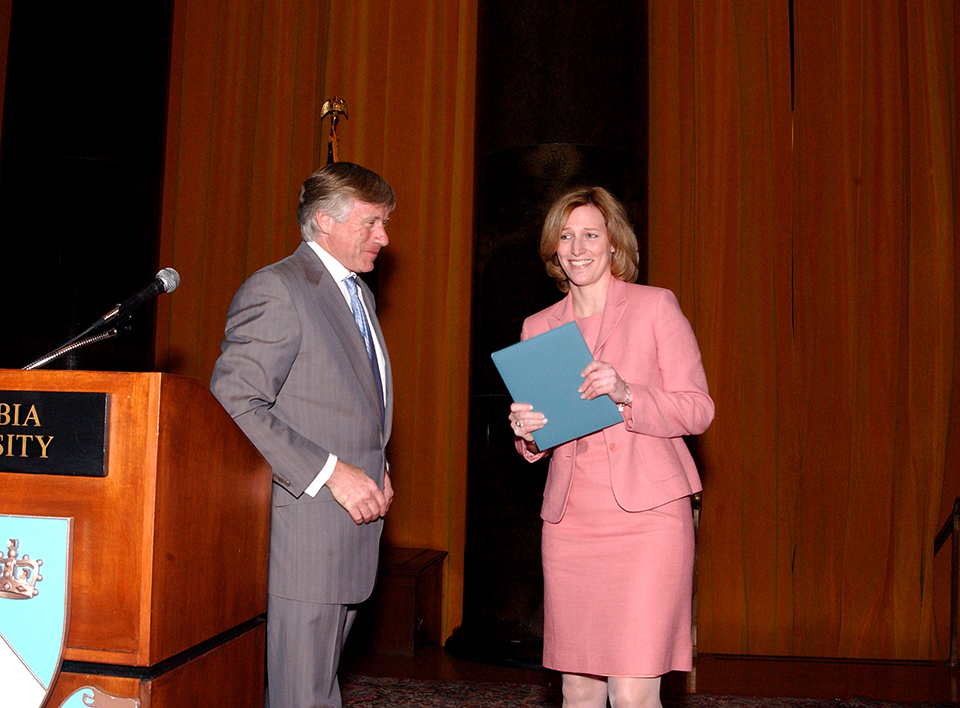
Columbia University President Lee C. Bollinger presents Diana K. Sugg with the 2003 Pulitzer Prize in Beat Reporting.
Winning Work
Stillbirth: Researchers hope their new efforts will reduce the incidences of unexplained loss of infants in the last days of seemingly normal pregnancies.
By Diana K. Sugg
Sun Staff
That chilly night in late October, the delivery room was so quiet. The doctor wrapped the 8-pound, 21-inch newborn girl in a pink-and-blue striped cotton blanket, pulled a matching cap over her brown hair and gently passed her to her mother.
Margarete Heber cradled the baby. In the dim light, Heber could see the infant had her dark eyes, turned-up nose and distinctive chin. Perfect, except she was tinged blue. She had died just hours before she was born. Her birth would be her good-bye.
"I am sorry," Heber whispered, kissing her stillborn daughter on the forehead. "I am so, so sorry."
Heber would never know what killed her child. In a time when surgeons can operate on fetuses, when parents can select the sex of their offspring, when physicians can screen embryos for genetic diseases, medicine has no answer for stillbirths. They are one of the last, great mysteries of obstetrics.
But the death of Heber's daughter, Elisabetha, that night in 1998 would be the catalyst for researchers taking on this puzzle. Heber, a scientist, started digging in medical databases and libraries.
She discovered that thousands and thousands of babies, many full-term, are dying every year, and few researchers have ever investigated why. Now, spurred by Heber, leaders at the National Institute of Child Health and Human Development are making stillbirths their No. 1 priority.
"Stillbirths are a huge problem. Research is just so desperately needed," said Dr. Cathy Spong, a top physician who oversees research funding. "I was shocked at the numbers."
Even though the rate of stillbirths in the United States has dropped since the 1960s, there are nearly as many cases today - about 26,000 a year - as there are deaths of babies in the entire first year of life.
One major study found that stillbirths are five times more common than sudden infant death syndrome. Hundreds die every year in the Baltimore area, and three local hospitals have created special gravesites for these stillborn babies.
But many parents, like Heber, won't ever know what went wrong.
Scientists can't say exactly how many stillbirths there are, who is at risk for them and how they can be prevented. They don't know why black women have twice the risk of other women. They don't know whether women whose mothers suffered stillbirths are at higher risk, or why some women have repeated stillbirths.
There isn't even a uniform definition of stillbirth, though most doctors consider it the loss of a pregnancy at 20 weeks' gestation or later. Technically, even though many are full-term, stillborn infants aren't even considered babies. They never took a breath, so they are labeled fetuses. And families say they are forgotten.
"With children who are stillborn, no one ever saw them. It's a lot easier just to sweep them away," said Fran Howard, an Ellicott City woman who lost her first child, a boy, seven years ago on his due date.
Doctors don't know why he died. Howard didn't get a birth certificate for Michael Francis; she was issued a fetal death certificate. Afterward, some friends and co-workers never said a word to her.
"That baby was real to me the moment I knew he was there," Howard said. "It's like losing a part of your heart."
Scientists believe stillbirths hold crucial insights about pregnancy, childbirth and birth defects. And with the National Institutes of Health putting stillbirths at the top of its agenda, researchers are hoping to explore questions that have haunted them for years: Is a condition similar to sudden infant death syndrome - SIDS - killing some of these babies? Could screening tests pick up babies in distress and save them?
The NICHD has already begun a survey of obstetricians and gynecologists around the country, to see how they handle these cases. And Maryland is preparing to issue its first-ever fetal mortality report.
But to find answers, researchers will have to overcome a long legacy of secrecy, the sense of stillbirths as taboo.
For generations, nurses hustled stillborns out of the delivery room without showing them to the mothers. Hospitals disposed of most of the babies as pathological specimens. And scientists, like much of society, wrongly assumed that women would be too traumatized to discuss their tragedies - and too emotional to give researchers reliable information.
Even today, there is no consistency in how hospitals handle the cases. Many don't follow the standard evaluation recommended for stillbirths. And because of the cost and the need for perinatal pathologists, experts say relatively few autopsies are done.
These problems lead to poor data in the fetal mortality reports. Funeral directors or pathologists, not the women's doctors, often complete the forms, and studies have found the cause of death to be misleading almost half the time. On top of this, experts say the number of stillborn babies is underreported.
"In most states, we get a mismatch of garbage being reported on these records," said Dr. Russell Kirby, a perinatal epidemiologist at the University of Wisconsin Medical School who did the studies. "It's a travesty."
Maryland is one state trying to do a better job. Health officials have revamped the fetal death certificate and sent staff into hospitals to push physicians to fill out the forms more carefully. The new data, to be released in a few weeks in the state's first fetal mortality report, show disturbing trends.
Adolescents under 18 had the highest stillbirth rate, roughly twice that of women ages 20 to 34. And after years of declining rates, the state's fetal mortality rate increased in the past several years, although it's unclear why.
The report revealed another surprise: In 2000, Maryland recorded 658 fetal deaths, 20 percent more than the number of infant deaths, a problem on which authorities focus so much money and research.
"This is a serious problem in Maryland," said Isabelle Horon, director of the state health department's Vital Statistics Administration. "It's really important that we put an effort into figuring out what is going on and why."
With so little attention paid to stillbirths, most pregnant women rarely hear about the possibility. They feel safe after they've passed the first trimester, when most pregnancy losses occur. Heber, who works as an aquatic toxicologist at the U.S. Environmental Protection Agency, thought no one could lose a baby, not so close to delivery. Not in 1998.
But a few days before her due date, she noticed the baby wasn't moving much. Doctors didn't find any problem. Two days later, the Northern Virginia woman woke up feeling ill and feverish. At first, physicians at the hospital said something must be wrong with the fetal monitor. So they tried a second monitor, a third, and then a portable ultrasound. They called in a chief resident and a radiologist.
"We're sorry," they finally told her. "There is no heartbeat."
Later that night, after he delivered her stillborn baby girl, Heber's physician sat in the corner of her hospital room, his head in his hands. "I don't know," he was saying. "I don't know."
In the following weeks, after genetic analysis, hormone tests, blood work, and even an autopsy, no one else could tell Heber why either. Even though about 20 percent of stillbirths, or 5,000 babies a year, are full-term, and even though they undergo extensive testing, most of the time, as in Heber's case, not a single clue will turn up. The babies appear as healthy as any in the nursery. Doctors don't know the cause of more than half of all stillbirths.
"This shouldn't be happening anymore," said Heber, 46. "Babies don't die the day before they're supposed to be born."
But thousands of healthy women discover just that.
From the moment Liz Norton found out she was pregnant on Valentine's Day 1999, the 28-year-old Annapolis woman felt strong. Every test was normal, every week typical.
Norton and her husband, Jack, played music and read Good Night, Moon and Runaway Bunny to their developing child. They planned. Their extended family couldn't wait for the arrival of the first grandchild.
But in late August, more than eight months into the pregnancy, Norton noticed after an evening Lamaze class that the baby was quiet. She calmed her fears, only to wake up about 2 a.m. panicked, in a cold sweat.
At nearby Anne Arundel Medical Center, doctors hooked her up to a sonogram. The baby had died. Soon, there were few sounds except Norton's sobs, echoing through the hospital hall.
Early the next morning, doctors gave her drugs to deliver the baby, and during two full days of labor, Norton and her husband had to decide on an autopsy and funeral arrangements for the child they hadn't seen or touched. At 10:30 p.m. Aug. 27, Liz Norton delivered a boy. His father held him and recognized his own features in his son's face.
"It was all very cold," Norton remembered. "Very quiet."
As at other hospitals including St. Joseph, St. Agnes and Mercy medical centers, staff at Anne Arundel recognized the Nortons' son as they would a healthy birth. Nurses saved the boy's footprints. Jack Norton bathed the baby. The couple took pictures. And past midnight, with family all around, a minister held the infant in his arms and baptized him Chandler John, or C.J., in honor of his grandfathers.
A year later, when Liz Norton gave birth to a healthy daughter, Kelsey Ann, she would look back on her first pregnancy and realize her son had moved much less than Kelsey. But no one could tell her whether that was a sign of trouble. And to this day, no one knows what went wrong.
Many women end up blaming themselves, at a time when their arms are aching to hold their babies, and their breast milk is painfully coming in. For weeks, some are haunted in the night by the sound of a baby crying, and they search their homes in vain.
Friends and relatives tell these women that they are young, that they will have another baby. But often, their confidence as mothers is shattered.
"My perfect little family was going to be all set. The guilt was overwhelming," said Loretta Gallup, 38. She was five months pregnant in 1996 when she lost the baby, a boy, named Patrick Edward. Her parents and her physicians at St. Joseph Medical Center told her it wasn't her fault. But it didn't comfort the Parkville nurse.
"If you don't know what caused it," Gallup remembers screaming at them, "how can you say it's not my fault?"
Researchers such as Dr. Ruth Fretts at Harvard Medical School have started to tease out some risks, factors such as mothers being obese, over age 35, or having their first child. Other studies have implicated smoking. But little is known about these risks, and many women who had stillborn babies don't fall into any of these categories.
Last year, at the first stillbirth conference held at the NICHD, Spong and another leading maternal health expert, Dr. Marian Willinger, gathered researchers to hash out the most pressing questions. Scientists want to determine whether there is a connection between SIDS and stillbirth. They want to learn more about a clotting disorder, thrombophilia, that might cause stillbirth. They also want to explore what biological and genetic factors protect women from stillbirths, and which factors put them at risk.
These and other issues, like the racial disparity and better data collection, are likely targets for research funding next year under the NICHD's new stillbirth initiative.
One of the few research programs dedicated to stillbirth, the Wisconsin Stillbirth Service, has trained nurses and doctors in a standard protocol and evaluated about 1,600 cases over the past 19 years. Dr. Richard Pauli, a pediatrics and genetics professor at the University of Wisconsin-Madison, created the program after losing his own stillborn son. He tries to diagnose the cause of death, and he has found that roughly 50 percent of the cases are a mystery.
About 25 percent have a fetal cause of death, such as birth defects, genetic anomalies and malformations. The remaining stillbirths are caused by such conditions as placenta problems, maternal infections and cord accidents.
One scientist believes that umbilical cord problems are killing far more babies than anyone realizes. Dr. Jason Collins, a New Orleans obstetrician who has studied 400 cases, says many full-term babies die between midnight and 6 a.m.
When a mother is sleeping, her blood pressure drops, he says, diminishing blood flow and oxygen to the baby. In reaction, a baby might kick and move, entangling itself in the umbilical cord.
"I truly believe half these babies don't have to die. There's nothing wrong with them," said Collins. While other physicians don't agree with his theory, Collins recommends that a woman in the late stages of pregnancy be aware of her baby's behavior at bedtime, and if the baby is sluggish, go in immediately for testing.
Other strategies for prevention include routine care, initiating testing at 36 weeks and early delivery. Some physicians will not let a woman who has had one stillbirth carry her next pregnancy a day beyond when she lost the previous pregnancy. But according to Fretts of Harvard, these strategies are based on little or no data.
Scientists say answers will be difficult to come by. That's because doctors usually don't recognize the problem until after the baby has died. By then, clues they might see in a live infant have disappeared. And it's tough to do clinical trials and research on someone's developing child.
"Pregnancy is a black box that people don't want to get too invasive with, because you don't want to harm the outcome," said Spong, chief of the NICHD's pregnancy and perinatology branch. "This is the most precious thing in the world - your child."
But parents are pushing for research. They're also putting together support groups and working to change state laws - similar to what Arizona recently did - so stillborn babies can get birth certificates.
"In their eyes, if he didn't take a breath, he wasn't a child," said Lisa D'Argenio, 32, a Reisterstown woman fighting to change Maryland law. D'Argenio was nine months pregnant in 1999 when she lost her son, Harley Michael, because of a blood pressure condition, pre-eclampsia. "But in our eyes, Harley will always be our son, whether he's here or not."
More families are taking comfort in burying their stillborn babies. St. Joseph Medical Center holds a twice-yearly service at Most Holy Redeemer Cemetery, where relatives pray and leave white roses. Some couples will walk the old cemetery afterward, holding hands. Some parents return for quiet visits on Easter, Christmas or a child's due date, to leave the presents they never got to give: a Tonka truck, a Barbie doll, a pinwheel blowing and sparkling in the wind.
Tucked in carefully among the toys are handwritten notes that tell of heartbreak. "Happy Birthday to you. Every year, please remember, we will never forget you," said one card. "We love you and miss you. Love, Mommy and Daddy."
Sadly, those rituals will be repeated. Room has been set aside in the graveyard, and in the coming years, hundreds more stillborn babies will be buried here, under the gray stone, in the hard ground.
Support groups
St. Joseph, St. Agnes, Greater Baltimore medical centers and other hospitals; new group starting in Westminster, call 410-833-2592.
MISS Foundation, 623-979-1000, www.misschildren.org.
National Stillbirth Society, 800-611-SADS.,www.stillnomore.org
Wisconsin Stillbirth Service, 608-262-6228,www.wisc.edu/wissp.
© 2002, The Baltimore Sun
By Diana K. Sugg
Sun Staff
Across the country, a cultural shift is under way in medicine as doctors realize the value of communication in everything from patients sticking to treatments, to fewer malpractice cases, to families dealing better with a death.
After they'd injected the dying man with IV medications, after they'd pounded his chest, after they'd cut Robert Jackson open and jolted his heart with electricity, there was nothing left for Dr. Carnell Cooper, except to prepare for the moment doctors dread, the hardest job in medicine.
Cooper changed out of his bloodstained scrubs and tried to think through what to say. Then, heavy with the pain he was going to inflict on Jackson's girlfriend, he started the walk downstairs.
Cooper and Dr. Steven Johnson came upon Annette Edmonds, 32, in the long hallway. She was standing alone, holding her arms tight against her body, waiting for them. The doctors cleared the other families from Maryland Shock Trauma Center's waiting room, turned off the blaring television and closed the door. The Baltimore woman sat on a small sofa and looked down at the carpet. Suddenly, the only sound that July night was the hum of the fluorescent lights.
"Is there anyone here with you?" Cooper asked. She shook her head no. Cooper pulled a chair close to her, and Johnson sat on her other side. Nurse Joe Larivey stood by. Then, slowly, gently, Johnson began. "Mr. Jackson suffered a serious injury...."
It is a painful, centuries-old ritual that physicians and nurses hate. They get little training for this moment, and no matter how many times they break news of a death, it never gets any easier. Many doctors struggle through this devastating conversation. But organized medicine has finally realized its importance, stepping up training nationwide for medical students, residents and even veteran physicians.
Nowhere is this task more difficult than in the nation's emergency rooms, where about 300,000 people die every year. The deaths are usually sudden, with no chance for goodbyes, and without the comfort of doctor and family knowing each other.
At Shock Trauma, part of the University of Maryland Medical Center in downtown Baltimore, the medical team handles 7,000 of the worst traumas in the region every year and manages to compile a 96 percent survival rate. But that still means that about five times a week, doctors and nurses will have to leave behind the science that so often shows them the way, walk into a room, and speak the most awful words in their vocabulary.
"You've just got to open your mouth and say it," said Dr. Thomas M. Scalea, 51, physician in chief of the 100-bed Shock Trauma hospital. "But it wears me down as I get older."
Said Cooper, 47: "My delivery has gotten better, but I don't think it's gotten a bit easier. It's still a family like my family. They feel the same pain that my family would feel. It's much easier to be up all night and operate for 10 hours."
All patients enter Shock Trauma through the Trauma Resuscitation Unit on the second floor. With the nursing station at its hub, the L-shaped unit has large areas ready for 10 patients, but on busy nights, the staff can handle twice that many.
In one four-hour stretch on a Friday night in late June, the trauma phone line buzzed a dozen times, each call announcing a new patient. The onslaught arrived by ambulance and helicopter: a man stabbed in the heart, a 21-year-old whose Mustang hit a tree head-on, a motorcyclist who ran into a guardrail, a Baltimore teen-ager bleeding from more than a dozen gunshot wounds. A routine shift.
Most of the nurses have worked here for years, long enough to have learned certain truths: Don't tell a family that you're calling from Shock Trauma, or they'll get so upset that they'll crash on the way to the hospital. When you spot pale feet on patients, it means they're probably bleeding to death. And when a patient says, "I'm going to die," he's almost always right.
'Don't leave me!'
The night of July 2, Edmonds had discovered Jackson, 38, screaming for help on the front steps of their Sandtown-Winchester rowhouse. Her boyfriend of four years had been beaten by a man with a baseball bat. She cradled Jackson's bloody head in her lap and pleaded with him to live. The couple, who both used heroin, were trying to make a new start: They'd finally found spots in a drug rehab program, and in two weeks, they were to be married. But by the time paramedics arrived, Jackson's heart had stopped.
At Shock Trauma, as Johnson spoke to her, Edmonds kept looking down, twisting her hands together, seeming to mentally block what she suspected he was going to say.
"When he arrived here, we did everything that we could for him," Johnson told her. Then he spoke the words that would be burned into her mind: "We were unable to resuscitate him."
For five long seconds, Edmonds said nothing. She began to rock, back and forth, until the cries burst out of her. "Oh God, no, no, no. Oh dear. Oh. No. No. NOOOOO!" she screamed, curling in on herself, sobbing, praying. "Oh God, don't leave me, don't leave me!"
Johnson put his arm around her, and she fell into him. On her other side, Cooper leaned closer and put his hand on her shoulder. He could feel her screams reverberating through his chest. They sat like that for a few minutes as she rocked herself and gasped for breath. Gradually, the long cries started to fade until she was letting out only small sobs.
It is an outpouring of emotion that the staff must endure. While some shocked relatives react to the news with a simple "thank you" and get up and walk away, most can't hold themselves together. Some women struggle to catch their breath. Other people wail or collapse on the floor.
Sometimes, the grief becomes violent, so the team is prepared: A nurse always goes down with the doctor, and when dealing with a large family, staff members will keep their backs to the door, ready for an easy escape. More than once, distraught relatives have smashed the nearby long glass bookcase. Just recently, a nurse and trauma technician were chased down the hall by an irate man who didn't think they'd done enough to save his relative.
In Edmonds' case, after she calmed down, Cooper told her in a tender voice that Jackson had never regained consciousness, and that once he got to the hospital, he was never in pain.
"We did everything we possibly could," the trauma surgeon assured her. "Do you have any questions for us?"
"No," she gasped, shaking. "No." Cooper told her that if she wanted, she could see Jackson's body soon. "OK," she answered, still trying to hold down sobs. "I'm OK."
Finally, she seemed to will herself into one piece. She looked up at them and said, "Thank you."
The doctors and nurse left, and once beyond the double doors, Cooper called for a chaplain for Edmonds. Then he put his hands on his head and let out a long agonized sigh.
"I can't cut out her pain. I can't give her something to relieve her pain. I can't do what I normally do to help my patient," he said. "Your only saving grace is that you know you've done everything you possibly could have done to save that patient. That's your only comfort."
Faith and Oreos
Deep down, though, many physicians feel that when a patient dies, they have failed. Doctors and nurses try to tell themselves they did everything they could. They try to encourage each other. Some want to believe it was the patient's fault - for driving too fast, or dealing drugs, or being careless at home or work. Others rely on faith or cope by munching on Oreos and gumballs at the nurses' station, sharing ghoulish jokes or even adopting a lost doll and performing fake operations on her. A few claim they've grown hard.
But when a staffer at Shock Trauma meets with a mother or a brother, the patient turns into a person. Nurses and doctors see someone die, and they realize it could have been anyone - their wife, their son. One trauma tech, Monica Nashan, instinctively sits by a child who has died, to hold a hand until parents arrive. When another tech, Julie Hall, gently cleans a body, readying it for the family to see, she finds herself whispering, "I'm sorry," to the dead. The staff is haunted by relatives who ask, "Why?" They don't have any answers for the families, or for themselves.
"In the end, it doesn't matter if I did everything I could; the kid is still dead, and you get really sad when someone dies," said Scalea. "Why did a drunk driver jump the curb and hit that kid? Why didn't that person buckle their seatbelt? A bunch of these people didn't have to die."
Some of the deaths have inspired him to do research, studies in geriatric trauma and the physiology of blood loss, which have saved lives. He tries to compartmentalize, he knows he needs to let go, but at home, he'll find himself thinking about a patient he lost, making a private farewell.
"Most of the time, you've never even spoken to them, yet you still feel that connection," Scalea said. "But it has to matter to you. You have to be able to hurt with the families."
Injury is the most common cause of death in people younger than 44, and experts say delivering bad news is the most important communication skill a surgeon can have. Yet very little research has been done about what families want in these situations. A 2000 study by Dr. Gregory J. Jurkovich of Seattle's Harborview Medical Center found the clarity of the message, privacy and the doctor's knowledge of the case were most important to families. So were sympathy and time for questions.
Unfortunately, doctors and nurses don't always heed that advice, especially when they're rushed. The Seattle study found that a third of the time, hospital staff delivered news of death in a hallway or other public space. Some physicians ramble on with vague, confusing medical terms or make an abrupt announcement and walk out. At the moment family members most need to let out their emotions, many nurses and doctors don't do what Cooper did; instead, they cut the relatives off with a slew of medical details.
But how this is handled matters a great deal.
First, people whose relatives die in a sudden accident or trauma struggle much more with coping, as well as depression and suicide, than do families who have time to say goodbye, studies have found. And when the news is broken in an insensitive way, research shows, these people suffer even more.
"When doctors handle it badly, families remember that for the rest of their lives," said Dr. Robert Shochet, an internist at Sinai Hospital and president of the American Academy on Physician and Patient, a medical group dedicated to improving communication among doctors, patients and families. "It's a flash point of trauma that they really have a hard time getting past."
Except for certain terminal illnesses, though, there has been little attention to breaking bad news. Within medicine, it has always been considered a gift, an innate skill - like a musician's perfect pitch, something that couldn't be taught. Typically, new doctors get little more than a lecture or a few hours of training on the topic and then watch a veteran do it a couple of times before they take the plunge themselves.
But that is beginning to change. Across the country, a cultural shift is under way in medicine as doctors realize the value of communication in everything from patients sticking to treatments, to fewer malpractice cases, to families dealing better with a death. Soon, before medical students graduate, they will have to sit down with actors and show they can break bad news with compassion. In hospitals, medical residents will be graded on these conversations. Even veteran physicians will have to prove they can do it appropriately.
At Shock Trauma, Scalea and other attending physicians make a point of bringing young doctors in on these talks. He teaches them to find a private space, to sit, hold a hand, be direct and skip euphemisms such as "passed on," or "expired," and instead use the verb "died." To give more support to families and staff, the hospital also wants to make permanent a successful pilot project in which chaplains were posted there overnight on weekends.
"Taking care of the family is part of taking care of the patient," said Scalea, who, as does Cooper, makes a personal phone call to the family a few weeks after a death to answer questions and see how relatives are doing. "What's more important than that?"
'Hanging crepe'
Sometimes, that means preparing a family for the worst possibility. Within medical circles, the practice is called "hanging crepe," a reference to the black fabric that drapes funeral homes. It is a delicate job, dealing with relatives who have been at work or asleep thinking their world is safe, when they get that terrible phone call, or a police officer knocking at their door. They arrive teary, trying to catch their breath after running down a hallway as long as a football field to get from the main lobby to Shock Trauma's waiting area.
At 3:20 a.m. on a July day, charge nurse Gael Whetstone left the busy unit, her mind clicking, worrying about what she would say to the mother and stepfather of a 22-year-old Baltimore man who had been hit in the head with a brick. For the past hour, Whetstone, Cooper and the rest of the team had been trying to stabilize the patient, Ben Galvan. His heart rate was dropping, and bleeding was putting pressure on his brain.
Whetstone found the Perry Hall couple in the waiting area and sat down with them. "Let me tell you what I know," she began, explaining that Galvan had been rushed into the operating room for brain surgery.
His mother, Veronica Tsitakis, put her hand on her forehead, gasping and starting to cry. Questions spilled out of her: "You're going to drill a hole in his head? Is he knocked out? Does he know it happened?" Tsitakis was trying to make sense of it all, but finally, it hit her. "Is he going to make it?"
Whetstone looked into her eyes. "He is critical," she said carefully and slowly. "Does he have brothers and sisters? You might want to give them a call.
Those words seemed to knock Tsitakis over. She fell against her husband, leaning on him until she could gather herself. At the end of the conversation, Whetstone promised she'd bring them up to see their son as soon as possible, and she gave the mother a long hug.
"If you speak from the heart, you'll always say the right thing," the nurse said later. "But you have to be able to go down there and sort of bare your soul, and then come back up and shift gears."
(In this case, the family recently got good news: Galvan was upgraded to stable condition and is in rehab.)
When there is no doubt that the patient is dying, the staff tries to give the family a chance to say goodbye. Sometimes, that means nurses must blurt out the news and then rush parents to the CT scanner or even into the operating room. Once, nurse Cheri Carver ran downstairs to bring up the parents of an Eastern Shore teen-ager who was in a bad car accident on her way home from the beach.
"I told them: 'She is not going to make it. But I need to bring you up if you are going to be with her,'" said Carver. She started to run, the parents tailing her up the stairs and through the Trauma Resuscitation Unit. It was midnight, the unit was full of patients; but the place seemed quiet, sad, respectful, recalled the girl's mother, Vivian Taylor. They reached the bedside, just as their daughter Dianna was taking her last breaths, enough time for the Taylors to tell her they loved her, that they would see her again. Enough time to notice someone had brushed out Dianna's long, blond hair.
"It was like she knew they were coming, and she was waiting for them," recalled Carver. The nurse reached into her backpack and pulled out a worn thank-you letter the Taylors had sent her a few weeks after Dianna's death in August 1997, along with her senior portrait. Dianna had dreamed of becoming a nurse at Shock Trauma.
"I always cry when I tell families. You think, 'What a waste,'" Carver said, wiping away tears. "She was a beautiful girl."
Patients not forgotten
From the housekeepers who mop up the blood to X-ray techs, nurses and the most senior physicians, staff members all have cases that stay with them. They remember the faces and the injuries and the last words, and years later, can point out in which bed a certain patient died. The team reviews every death to see whether there was anything else they could have done. They also talk about cases that bother them, and when one of the staff gets discouraged, a colleague will put a hand on his shoulder and remind him, "You can't save them all."
Sometimes, though, nothing can make the staff feel better. And all they can do for a family is be there in the final moments.
For one young nurse in particular, Amy Bositis, that case came in the early hours of Easter morning. Two patients arrived about the same time, and as often happens, they were from the same car crash. Within a few hours, word started to spread: The woman driving one car was not badly hurt, but the 30-year-old driver of the other car, Don Meadows of Crofton, had one of the worst brain injuries doctors had ever seen.
When the neurosurgeon went downstairs to talk with family members, the doctor found Michelle Desrosiers, 28, pacing, in a cold sweat. She and Meadows were to be married in one week. Desrosiers knew it must be serious for Meadows to be in Shock Trauma, and she realized there wouldn't be any big dance at their wedding, but she had hope - until she saw the physician's face and heard the words: "It doesn't look good."
Bositis, 25, the nurse who handled much of Meadows' care, knew the injury was fatal. But a part of her believed Meadows might have a chance, and she quickly found herself drawn into the family. They showed her pictures of the handsome, athletic salesman and told her stories about how he made friends everywhere and planned to raise children in the house he'd grown up in. Even tougher, the nurse noticed Meadows' fiancee had a Tiffany-setting engagement ring just like the one she was wearing. Then the nurse learned the Crofton couple's date was just one week before her wedding.
Twelve hours a day for three days, Bositis watched over Meadows, meticulously checking the pressure in his brain, managing his ventilator, talking to him, thinking what it would be like if this happened to her fiance.
On Thursday, the director of neurotrauma, Dr. Bizhan Aarabi, told a hushed room packed with family and friends that Meadows wouldn't survive without machines. The family didn't debate much: The day of the accident, Meadows had told his brother, Jason, that he'd never want to be kept alive like that. But before the final decision, the family talked with the nurse.
"They invited me in," Bositis said, "as if I was a part of their family."
On that last night, doctors removed Meadows from life support. Then, with Irish music playing, relatives and friends jammed his hospital room. Meadows' mother stood on one side of him, with Desrosiers on the other. Directly behind his bed were the nurses, Meadows' mother remembered, lined up in their pastel uniforms like a row of angels, with Bositis in the middle, keeping vigil.
Slowly, the room emptied out, and Desrosiers leaned close, giving the man who would have been her husband her last words, her last kisses. She clung to him until she felt a touch on her shoulder. It was the hand of the nurse, comforting her, giving her the strength to stand up and leave.
© 2002, The Baltimore Sun
Some hospitals let families stay at CPR
By Diana K. Sugg
Sun Staff
Early that morning in the emergency room, with a soft "oh" and a drop of his head, 11-year-old Ryan King stopped breathing. Within moments, a young doctor straddled the boy, pumping his chest. Nurses quickly wheeled the gurney from the exam room to the trauma room. Ryan's mother grabbed her son's panda and stray sneaker and ran after them.
For a few minutes, Donna King was left alone in the hallway, outside closed doors.
But, like an increasing number of physicians around the country, doctors at the Johns Hopkins pediatric emergency department did what was once unthinkable: They let Donna King be with her son. As doctors struggled to get intravenous lines into his collapsing veins, injected him with drugs and took turns doing manual compressions on his chest, his mother climbed under staffers' arms and between IV poles. She cradled Ryan's head and put her cheek against his.
"Mommy's here," she said.
For years, at the most critical moment in emergency medicine - when someone's heart stops - the drill has been the same. Nurses rush relatives out, chaplains distract them and, later, physicians deliver the bad news. But in the past few years, many in the health care field have arrived at a surprising conclusion: It can be good to bring families in the room during resuscitation efforts.
Even though the scene can be graphic, even though most patients in cardiac arrest will die, many family members are more accepting of the death if they witness it. They see the desperate efforts of medical staff, so they aren't haunted by doubts about whether everything was tried. They get a chance to say goodbye.
At least 15 hospitals in Maryland, including Maryland General, Northwest, Sinai, Anne Arundel Medical Center and Western Maryland, are allowing the practice, mostly case by case.
About half of the 1,000 emergency room and critical-care nurses in a recent national survey reported that their hospitals allow families to be present for what's known as a "code." And the American Heart Association unanimously voted to change its guidelines to encourage health care providers to offer the opportunity.
Called witnessed resuscitation, the practice raises all sorts of medical, ethical and legal issues, and has sparked fierce debate.
'A fad'
Trauma physicians worry that relatives will become hysterical and distracting. Others fear families might witness mistakes, or what they think are mistakes, and file more lawsuits. And in an era of crowded emergency rooms and nursing shortages, some say hospitals don't have the space or staff to do it.
"It's a mistake. It's a fad. There are too many potential negatives," declared Dr. L.D. Britt, vice chairman of the national committee on trauma for the American College of Surgeons. "The next thing you're going to want is to sit in the mortician's office and watch your loved one get embalmed."
Supporters believe witnessed resuscitation is part of medicine's evolution toward more family involvement. Several studies have found that relatives observing a failed resuscitation effort reported less anxiety and depression after a death than family members who weren't there. And almost all relatives surveyed said they would do it again.
"It's a great gift," said Donna King, 42.
Ryan, the oldest of her three boys, had been fighting an aggressive form of leukemia for two years. That night in November 2000, his parents found out that the Boy Scout and budding sports statistician had relapsed a third time and needed to be admitted to Hopkins. But the Glen Arm boy wasn't expected to die for a few months, and his parents weren't prepared to lose him so soon.
Now, just hours later, Ryan was on the border between life and death. Donna King watched emergency workers put a long, plastic tube down his throat. She saw them shock him. Before her eyes, her son's fragile chest was turning black and blue.
"You see the horror of it," King said. "You get it." Someone in the room came over and held her. She didn't cry or lose control; she just prayed for strength. She stroked her son's cheek, assured him that she had his favorite stuffed animal and named all the doctors he knew in the room, people she trusted to do everything they could.
But as the minutes wore on, she anguished over whether it was right to keep going until her husband, Stephen, arrived. The doctors assured her that they could continue.
"Daddy's coming," she told Ryan. "Hold on. Daddy's coming."
Within moments, Ryan's heart restarted.
In some ways, witnessed resuscitation is the next step for hospitals that have been letting parents stay with children for broken bones and other basic care. Hospitals have also been relaxing visiting rules, and emergency departments are trying to become more friendly to consumers.
At Hopkins, the state's designated pediatric trauma service, doctors have been bringing parents into resuscitations, and other treatments such as spinal taps, for at least the past few years without problems. Other hospitals have become more open to the idea because their own nurses had personal experiences.
"Nobody wants to die alone," said Jocelyn Fiedler, an intensive care nurse at Atlantic General Hospital in Berlin. Like many smaller hospitals around the state, the hospital is open to family presence. When her great-aunt Anne "Nancy" Sears, 72, suffered a fatal heart attack Christmas Eve, Fiedler stayed with her in the emergency room. "It would have meant a lot to her that somebody was with her," Fiedler said.
At most hospitals, family members who request to be present during the crisis are permitted only when physicians and other staff members agree. The procedures can be disturbing to laymen: shocking a heart, inserting IV lines deep into the chest, performing compressions so hard that the ribs can crack. Ideally, a nurse, chaplain or patient advocate stays with the relative to explain, comfort and, if necessary, escort the person out.
Imagination 'worse'
Families say they can endure the ordeal because it is better than not being there at all.
Several years ago, in a case at Dallas' Parkland Hospital, a mother and father waited all night to see their critically injured 14-year-old son, who had fallen from a tree. Just as they were going into his room, the teen-ager stopped breathing.
His mother, Susan Hott, insisted on seeing her son, Donnie, and the nurse, after asking permission, let the parents in. The act almost got the nurse fired and provoked a debate in the hospital that led to research that found benefits in family presence.
"Those were some of the most painful moments of my life. But my imagination would have been worse than the experience," said Hott. The time allowed Hott to rub Donnie's head and sing his favorite song into his ear. Her husband apologized to the teen for yelling at him earlier in the day. Both parents saw how hard the doctors worked to save him.
"If I was not allowed in there," Hott said, "it would have haunted me forever."
'No going back'
For the medical team, having a relative present changes the dynamic. They say the atmosphere is more sober. Some report that they have developed a deeper sense of camaraderie. And nurses and doctors now face a reminder that their patient is someone's husband or daughter.
"Once we tried it, there was no going back. It was an experience I would never begrudge anyone," said Mary Anne Belanger, an emergency room nurse in Wooster, Ohio, who had originally been a skeptic.
The staff there started the practice in 1994. Now, about two-thirds of their roughly 100 codes each year are witnessed by family members. In one case, Belanger said, a man who was resuscitated later recalled his wife's voice, urging him to fight.
Many relatives wouldn't want to be in the room, but studies and interviews reveal that in almost every case where they are present, they remain composed. Families can also play a crucial role, advising physicians about a patient's medication or wishes for lifesaving steps such as ventilators.
At Peninsula Regional Medical Center in Salisbury, relatives of an elderly woman told doctors to stop cardiopulmonary resuscitation after aggressive efforts failed.
"They came to see it didn't make sense," said Dr. Clark Morres, medical director of emergency services. He has increasingly invited families to be present during resuscitations. But he said it is a difficult decision. "It's a lot easier to just draw the line and say, 'No family allowed.' "
Many physicians have strong reservations. They say they would feel more stress under the eye of a relative. They point to the isolated cases when relatives have interfered with treatment.
One relative flung herself over a patient after doctors started to use a defibrillator, according to a survey for the Emergency Nurses Association. Also, doctors say, there is little time to confirm that a person really is a family member.
"During a resuscitation, there is less than zero time to figure out who's who," said Dr. Gabe Kelen, chair of emergency medicine at Johns Hopkins Hospital. "This area is just plain new, and most of us are supportive of the idea and trying to figure out a way how to do this practically."
Advocates point to a harsh reality: Even with resuscitative efforts, more than 90 percent of people in cardiac arrest will die, whether they were in car accidents, had heart attacks at home or were already in the hospital.
At Maryland General Hospital, Dr. Robert E. Roby, chief of emergency services, said he felt bad that every time he broke the news of a death, family members had the same reaction: They worried about whether everything possible was done, and they anguished over never getting to say goodbye.
That, together with the recent studies, led Roby to decide to allow families in during resuscitations. He is urging colleagues to try it. "It's what every doctor or nurse would insist on if it was their father or mother or child," he said.
The Kings believe it's the natural thing to do. They were there when Ryan was born, and at 10:18 a.m. on Nov. 28, 2000, they were with him when he died.
"We were able to go with Ryan all the way to the end," said his father.
Now, every night, the brothers Ryan left behind, Kevin, 10, and David, 6, wrap up in his blue knit blanket and cuddle with his pillow. And someday, when they are ready, their mother knows they will come to her with questions.
Because Donna King was there for every minute, she will be able to tell them that after Ryan heard her voice, his heart started long enough for their father to get there, that the doctors did everything they could and that she and her husband stood over their brother, hugging him until he was gone. Almost as if he had just fallen asleep.
© 2002, The Baltimore Sun
Sepsis: In their efforts to fight a degenerative, often-lethal infection, doctors explore a new drug treatment.
By Diana K. Sugg
Sun Staff
She thought it was just a cold. Her throat was sore, and she felt tired all over. But as JoAnn Barr got her son ready for school that morning in March, she started gasping for breath. Within a few hours, Barr was on a ventilator in intensive care, her blood pressure bottoming out, her kidneys failing.
For a month, the 41-year-old Westminster woman hovered near death, a victim of the fast-moving, often-lethal condition known as sepsis. It's an illness that rages through the victim's bloodstream, unleashing a fury of reactions that kill tissues and shut down organs.
After years of frustration, doctors believe a new frontier might be opening in treating sepsis. Last year, large clinical trials showed the benefits of early intervention, and researchers hit on a drug that might reverse the illness' fatal course.
Yet sepsis remains one of the most devastating and humbling conditions in medicine. A third of the 750,000 Americans per year who develop sepsis will die, a toll that equals that of heart attacks, or of all deaths from breast, colon, prostate and pancreatic cancers combined.
And as in Barr's case, sepsis can move with a swiftness that is shocking. In hours or a few days, the illness can kill. Doctors have a saying for it: "Fine in the morning, dead in the evening."
"It's the most awful, scary thing to actually take care of," said Dr. Trish Perl, Johns Hopkins Hospital's epidemiologist. "You just watch people die, and it doesn't matter what you do."
Early symptoms subtle
With an aging population and more aggressive, invasive procedures driving up the number of sepsis cases - by about 90 percent in the past decade - treatment questions are becoming more urgent.
"It's a huge problem," said Dr. Carl B. Shanholtz, director of the medical intensive care unit at the University of Maryland Medical Center. "This is probably the most common diagnosis we take care of."
Unfortunately, the early signs are subtle and mimic many other conditions, so many patients dismiss it, as Barr did. Without a simple diagnostic test, physicians miss as many as a quarter of the cases.
Then, the illness explodes with symptoms including violent chills, delirium, a spiking fever or faintness. When Barr felt short of breath, she called a neighbor, but when they arrived at Carroll County General Hospital's emergency room 10 minutes later, Barr's blood pressure was so low she was almost unconscious.
Nurses and doctors raced to get antibiotics pumping into Barr. They tried to push up her blood pressure with fluid and medicines. But soon, as in 80 percent of patients with sepsis, Barr needed to be put on a ventilator.
"She just went straight downhill, like she was falling off a cliff," said her husband, Ray Barr. Just 24 hours before, JoAnn had been healthy, exercising every other day, working in disease prevention at Baltimore's health department, raising their 9-year-old son, Ian. Now, she was hooked up to at least eight IV pumps, and she was so swollen from fluids that her hospital bracelet was embedded in her wrist. Feeling like she was suffocating on the ventilator, she frantically scribbled on a piece of paper, "I can't breathe."
Then she lost consciousness. It would be weeks later, after a transfer to the University of Maryland, before she would wake up again, and eventually recover.
Sepsis starts out simply enough, with an infection.
An otherwise-healthy person can get pneumonia, a urinary tract infection, gall bladder disease or diverticulitis. Barr had a group A strep infection in her throat that traveled to her lungs, causing pneumonia. People who are in car accidents or suffer burns or undergo medical procedures might get staph or other infections. Or most commonly, the elderly, or those with weakened immune systems, like cancer or AIDS patients, contract an infection.
Most of the time, a person is able to fight the infection and keep it from spreading. But in sepsis, the infection moves into the bloodstream, probably because of factors including the type of germ, the patient's immune system health, and even his or her genes.
Once the bacteria get into the blood, the body launches an overwhelming, system-wide counterattack. Blood vessels become inflamed, and their cell walls leak fluid. The body's clotting system goes awry, simultaneously causing bleeding and throwing clots that block the tiny blood vessels that feed organs.
One by one - or sometimes all at once - tissues start to die, organs fail. It can happen in a day or over weeks. In septic shock, the patient's cardiovascular system shuts down. One author described sepsis in 1881 as "the rude unhinging of the machinery of life," said Dr. Gordon R. Bernard, a Vanderbilt University professor of medicine and founding chairman of the International Sepsis Forum. That's an apt description, Bernard noted, because "everything falls apart."
Said Dr. Steven Johnson, chief of the division of critical care at Maryland Shock Trauma Center: "There are some bacteria that can take somebody who is normal at lunch time, and by dinner time that evening, they'll be in a situation where the mortality rate is more than 50 percent."
Doctors try to kill the infection with antibiotics, but if they are to have a chance against the condition, they must give the antibiotics before they know for certain the patient has sepsis and before they've identified the bacteria responsible.
Jack Griffin, a cancer patient weakened by a recent bone marrow transplant, happened to have a scheduled appointment at Johns Hopkins Hospital the morning after he had suffered violent chills and pain. On a hunch, Griffin's oncologist, Dr. Louis Diehl, decided to admit Griffin and start antibiotics. By the time Griffin, 55, got to his hospital room that day in February, the Northern Virginia lawyer was confused and turning beet red, his temperature soaring from 102 to 106 degrees, his blood pressure plummeting so low that machines couldn't measure it.
"He was reading The Wall Street Journal at 3 p.m., and by 5 p.m., it was hard to believe it was the same person," said Janet Goetz, who was with him throughout the ordeal. "I kept saying, `What's happening to him? What's happening to him?'"
Sometimes, even getting antibiotics early won't help. But in this case, the quick action saved Griffin, and by the next morning he was sitting in bed, reading the newspaper again.
Other patients need much more intervention to survive sepsis. About a quarter of them will require dialysis, at least for a time, to do the work of their failing kidneys. As many as a third to half of them will undergo surgery to remove infected tissue, drain abscesses or take out pockets of pus from areas like the brain, liver, skin wounds or heart valves, Johnson said. In severe cases, some people suffer strokes. Some must have fingers or toes amputated.
At Maryland's medical intensive care unit last week, as with most such units around the country, more than half the patients had sepsis. In one room, Nancy Howard, 54, lay under a clean white sheet, still except for the rise and fall of her chest, pushed by the ventilator. Shanholtz believes the Calvert County woman developed sepsis from deep ulcers caused by her diabetes. Just 24 hours before, she had survived a cardiac arrest.
Earlier, her husband, Owen, had heard her calling the names of relatives who have died.
"I've never heard of anything like it," he said, referring to sepsis. "I know her chances are 50-50. People don't go this far down and make it."
Supportive therapies such as fluids and dialysis have helped boost survival, but finding a drug to stop the body's over-reaction to infection has been much more difficult.
During the past 15 years or so, more than 20 agents in more than 30 studies failed to show any benefit against sepsis. But last fall, the U.S. Food and Drug Administration approved Xigris, a synthetic version of a human protein. Physicians believe the medicine works by helping to normalize the body's clotting system and calming inflammation. A large, multicenter study found that the medicine reduced mortality among the most severe sepsis patients by 24 percent.
"In most diseases, that would be viewed as miraculous," said Dr. Michael A. Matthay, a professor of medicine at the University of California, San Francisco. "It does start a new frontier."
Other physicians don't see the drug as a significant breakthrough. First, Xigris is supposed to be used only in the most critical cases. Doctors are also worried about the drug's side effect, bleeding, and hospitals are concerned with its cost, about $6,800 for a four-day intravenous dose. Dr. Alan Cross, an infectious disease specialist at Maryland's Greenebaum Cancer Center, who voted against Xigris on the narrowly split FDA review committee, said physicians also don't understand why two similar drugs didn't work.
Many aspects of sepsis are still a mystery.
Doctors don't know what drives a patient's organs to shut down - the clots, the low blood pressure or something going awry in cells. Physicians also debate the best supportive care. Administering fluid will help blood pressure, but that can also backfire and fluid might leak into the lungs, as happened to Barr. A national network of 24 hospitals are probing another long-standing question: what role steroids have in treatment.
One reason many questions haven't been answered is political, doctors say. With various medical specialties treating sepsis, there has not been one group rallying dollars and attention, as cardiologists have done for heart attacks or neurologists have done for strokes.
"Sepsis is not a chic disease," said Dr. Emanuel Rivers, research director in emergency medicine at Henry Ford Hospital in Detroit.
The approval of the new drug, however, is finally winning attention for sepsis, and recent studies are changing how doctors and hospitals handle the condition. In a key finding, researchers showed last year that patients treated earlier and more aggressively in the emergency room had significantly better survival rates.
"A lot of patients don't get definitive treatment until they get to the ICU. By then, several hours may have elapsed," said Rivers, who led the study. "And once you get past a certain phase, there's not a lot you can do."
Scars follow ordeal
As Barr lingered for weeks in a critical state, her husband struggled to understand how something he had never heard of was destroying his wife. He kept notes each day on her up-and-down course. He thought about her funeral.
Eventually, though, after treatment with Xigris and other medicines, JoAnn Barr was weaned from the ventilator. Nearly a month had passed when Barr returned home in late March, so weak she could barely lift a pencil. She slept 12 hours at a time. Her husband once saw her slowly climbing the stairs and, for a moment, he thought she was an old woman.
Sepsis scars some patients, leaving them with neurological or other permanent deficits. For Barr, all that's left is fatigue, a weak, throaty voice from the ventilator, and a dim memory of the morning she first got sick.
Mercifully, like most sepsis patients, she can't remember anything else.
Signs of sepsis:
People with these symptoms should go to the emergency room:
• Violent, uncontrollable shakes or chills
• Spiking fever
• Mental confusion
• Shortness of breath
• Weakness, inability to stand
Source: National Initiative in Sepsis Education
© 2002, The Baltimore Sun
Drugs dissolves clots; some worry it's too risky
By Diana K. Sugg
Sun Staff
When Ruth Johnston got a crushing headache and started to slur words that morning on the sailboat, her husband took action. He radioed the Coast Guard that she was having a stroke.
Within 15 minutes, Maryland medics whisked the woman to North Arundel Hospital, where doctors started an IV with a clot-busting drug and sent her on, sirens blaring, to the University of Maryland Medical Center. In those few hours, the treatment stopped the massive stroke spreading across her brain. The only mark the attack left was an occasional cold tingling in her hand.
But six years after the discovery of this stroke therapy, Johnston, 51, is among a relative few who happened to be in the right place at the right time. Most patients don't get to a hospital within the required three-hour window. Some doctors, worried that that the drug is too risky, are reluctant to give it. And hospitals are still wrestling with getting the staff and other resources needed to treat patients around the clock.
"The miracle cases are the exception. Most of the cases are the miserable cases," said Dr. Kieran Murphy, director of interventional neuroradiology at Johns Hopkins Hospital. He routinely sees patients who have been transferred from other hospitals too late to save them from a nursing home.
It's one of the oldest stories in medicine: Researchers come up with a breakthrough, but it takes years to figure out how to make it work at the local hospital. This week, neurologists, emergency-room physicians and others from around the country are meeting on the issue at the National Institutes of Health.
But solutions require answering tough questions, such as whether only certain hospitals should become stroke centers, how to pay for care, and why, after millions of dollars spent in media campaigns, the public isn't getting the message that a stroke is an emergency.
In Maryland, doctors are working on many fronts. They have spread the word on billboards and buses. The state's emergency system is developing a list of hospitals that can give advanced care, and starting in the summer, medics will reroute stroke patients to these facilities.
The University of Maryland's Brain Attack Center advises smaller, faraway hospitals, flies patients in by helicopter and has cameras in ambulances so neurologists can evaluate patients en route.
"The whole field is close to a revolution," said the center's director, Dr. Marian LaMonte, who has led the efforts.
Clot-busting drug
It has been a long time coming. For generations, doctors could do little for stroke patients. Then in 1995, a study showed that the drug t-PA, used to break up clots in heart attacks, also worked in strokes if administered quickly, reducing disability by a third. Neurologists were ecstatic. Some recall getting chills when they first gave the treatment and saw some stroke patients regain movement or speak again.
Over the past several years, the improvements neurologists expected for stroke - the country's No. 3 killer and a leading cause of disability - haven't panned out. Of the 600,000 Americans who have strokes every year, about four-fifths have the type of stroke that can be helped by t-PA. But experts say about 3 percent are getting the medicine.
Many of these patients recover fully or have less disability than they might have had without the medicine. A small number, though, have suffered brain hemorrhages and died, provoking debate over whether the drug is safe, or whether some physicians are giving it wrong.
"Everyone assumed, 'Hey, we've got a treatment for stroke now,' " said Dr. Eric Aldrich, an assistant professor of neurology at Hopkins. "But it's turned out to be much harder than anyone ever anticipated."
For starters, many people ignore common stroke symptoms, or wait hours and sometimes days before going to a hospital. Others suffer a stroke in their sleep, and it's difficult to determine what time it happened.
At the hospital, physicians must distinguish a stroke from other conditions that mimic it, such as seizures or complicated migraines, but they don't have quick, reliable tests - such as monitors or blood work that help verify heart attacks.
Because the clot-busting drug can cause bleeding in the brain, doctors must do a CT scan to make sure the patient doesn't have the type of stroke, known as hemorrhagic, in which a blood vessel bursts.
But at night, many smaller hospitals don't have the technicians or specialists to do the scans. Nor do they have neurologists who can race in with the expertise to diagnose a stroke and approve the patient as a candidate for the drug.
And all this has to be done within three hours. That's because by then, brain tissue has begun to die, and there is little chance of reversing damage - and some think the threat of bleeding is greater.
'Incredibly lucky'
Johnston's case shows how the system can work. Two years ago, the 51-year-old Canadian woman and her husband were eating cereal on their boat, anchored in the water near Annapolis, when she developed classic stroke symptoms: sudden garbled language and a splitting headache. What Johnston's husband only vaguely realized was that from those first moments, a clock was ticking.
Without blood and oxygen, the cells in the immediate area of the blockage had died. A larger section of tissue surrounding these cells had essentially gone to sleep. If blood flow was not soon restored, those brain cells would also be doomed.
"This could go either way," a nurse at North Arundel Hospital told Johnston's husband, Byron Boucher.
Doctors determined that Johnston had the most common type of stroke, in which a clot blocks a blood vessel in the neck or brain. They explained to her husband that although there was a 10 percent chance the clot-busting drug could cause bleeding in the brain, the medicine gave his wife a much better chance of minimizing disability. And with or without the drug, neurologists said, her risk of dying was the same.
So Boucher gave doctors the go-ahead. The medicine helped dissolve the clot some, but when his wife developed more problems, medics sent her to the University of Maryland Medical Center. Because Johnston's clot was in a particular artery, the doctors were able to use a more advanced procedure up to six hours after the stroke. They threaded a catheter through an artery in the brain and dripped the t-PA over the clot, dissolving it. LaMonte, the physician, said all of Johnston's care was done in five hours.
"I was incredibly lucky. It was because of where we were that I ended up in the hands of such experts," said Johnston.
From hospital to hospital, the level of stroke care varies widely. With an aging population and a lifetime cost that ranges between $90,000 and $225,000 per patient, the issue is taking on more urgency nationwide. But physicians are divided about what constitutes the best care, and who should do it.
Some emergency-room physicians point out that some stroke patients recover without the drug. They worry that, with complications such as bleeding in the brain, the medicine can sometimes do more harm than good.
The American College of Emergency Physicians has taken the position that the drug is not the standard of care for stroke, unless doctors have the expert backup and resources.
"It's kind of like the 'Mom test.' Would you give this to your mom? A lot of us are 'No,' " said Dr. Linda DeFeo, an emergency physician at Prince George's Hospital Center who heads the group's Maryland chapter.
To answer the critics, the National Institute of Neurological Disorders and Stroke recently appointed an independent panel to review the data from the original t-PA study. At the same time, the Centers for Disease Control and Prevention have set up a registry in several states to monitor how medics and hospitals handle strokes.
Doctors say the debate is a natural part of the give-and-take in medicine, and that over time, as more evidence comes out, the course will be clear.
"There was a time when heart attacks were not treated so aggressively," said Dr. John Marler, associate director for clinical trials at the neurological disorders institute. "In 10 years, it will be as unthinkable to leave a stroke patient untreated in an emergency room as it would be now to leave severe chest pain untreated."
Maryland, Hopkins, Hopkins Bayview, North Arundel, Sinai and Suburban hospitals have set up stroke teams ready to respond 24 hours a day. But for many institutions, it's a tough call. If they give t-PA, can they do it safely? If they don't, will they be sued, or will they lose a competitive edge?
Several hospitals in the state report that they give t-PA, although it may depend on the time of day and which physicians are available.
Some, such as St. Mary's Hospital, tap the expertise of physicians at the University of Maryland, who review the cases over video and computer links. Others, like Franklin Square Hospital Center, set up their own programs because they get many stroke patients, and they fear shipping a patient elsewhere could be a costly delay.
"The longer you wait, the more irreversible damage is occurring, " said Dr. Jerry Fleishman, chief of neurology at Franklin Square.
At Calvert Memorial Hospital in Southern Maryland, Dr. Kraig Melville stopped the policy of giving t-PA for stroke in the emergency department. He pointed to evidence that although it can be done safely in the hands of experts using strict protocols, physicians in community hospitals and academic medical centers are often giving the wrong dose, to the wrong patients, or administering it beyond the three-hour window. Studies found higher rates of hemorrhage and death.
Melville said his team is able to evaluate patients, alert University of Maryland, and get patients there for treatment within three hours.
Specialized units
Ultimately, many believe these patients will be sent to specialized stroke centers, just as trauma patients are handled.
Places such as Maryland and Hopkins have created stroke units where patients are monitored closely for complications, and staff are better able to control factors such as fever, which can have a big impact on recovery. Studies show that even patients who do not get the clot-busting drug do much better in these units.
Eventually, neurologists hope to expand the time window in which patients can get t-PA. They are also working on other medicines and trying to cool the body as a way to protect the brain after stroke.
Until then, experts say, people should do the same things to avoid other health problems, such as exercising and eating right, and stopping smoking. And because hospitals are handling these cases differently, Marler, of NIH, advises one more step:
"Call your local hospital and see if they have a good system for treating acute stroke," he said. "Part of preventing strokes is to be in the place where they can treat it."
© 2002, The Baltimore Sun
Study: Assertions that historical figures suffered from ailments or learning disorders spark both hope and doubt.
By Diana K. Sugg
Sun Staff
"It's just one of the pitiful facts of our society that you have to have a famous person to get the attention," said Abbey Meyers, president of the National Organization for Rare Disorders.
The claims are everywhere: on posters and T-shirts, on the Internet and in books, even sometimes headlining the national news. Thomas Jefferson's eccentricities were actually a form of autism. Albert Einstein's genius flourished despite a learning disability. And Winston Churchill overcame a stutter and later suffered from Alzheimer's disease.
The conclusions, made many years after the deaths of these famous men, grab the public's attention, inspire today's patients and bring in money for research and advocacy. There's only one problem: Often, the diagnoses are wrong.
"It's a lie. It's like saying to somebody, 'Churchill overcame this; therefore you can.' Maybe you can, but it shouldn't be a lie, or a misrepresentation," said Dr. John Mather, a Washington physician who has debunked several medical myths about Churchill. "It's a matter of forthrightness and accuracy."
The roll call of historic disease sufferers seems endless: Hans Christian Andersen was supposed to be dyslexic. Marie Curie may have had a form of autism. Frederick Chopin could have suffered from cystic fibrosis. Sergei Rachmaninoff may have had Marfan syndrome.
Scholars, physicians and history buffs have always been fascinated by the medical stories behind famous people. The connections are also compelling to the public, who feel they know these figures. At the University of Maryland Medical Center, doctors have been doing post-mortems on historical figures for a decade, and they have grabbed headlines and worldwide attention.
"There's something very powerful about this, particularly for people who don't have any direct experience with the disease," said David Shenk, an author who recently spent time examining similar claims for his book on Alzheimer's, The Forgetting. After extensive work, he concluded Churchill didn't have the condition. Said Shenk: "It's so easy to be reckless about this."
Those who make these retrospective diagnoses, sometimes called "pathographies," say they have researched biographies and other evidence. But historians say old records can be scanty and unreliable. Few if any contemporaries are alive to speak for the dead. And most of the time, the bodies can't be examined.
Yet plenty of people are publicizing their spin on history.
The Stuttering Foundation of America ran a full-page ad in a May issue of the Journal of the American Medical Association, with a photo of Churchill and this headline: "The voice of freedom never faltered, even though it stuttered." The foundation cites five sources, all dated before 1975, making references varying from a "slight stutter" to a "stutter that took him years to overcome." Mather and others say Churchill never had a stutter; they point to tapes of his speeches and a medical evaluation that show Churchill simply had a lisp on his s's and p's.
Likewise, a color poster of six accomplished figures from history, including Andersen, Churchill, Thomas Edison and Einstein, highlights them as people who had learning disabilities and managed to succeed. Created almost 20 years ago by the Hill School in Fort Worth, Texas, the poster has gone into its third printing and is hanging in 41 states and 13 countries. Lucille Helton, the school's former principal, said a committee, looking for famous figures to inspire children, found the information in the local library.
But experts who have closely studied the lives of these men say there is little or no evidence that four of them had a learning disability. Thomas Edison got kicked out of school for not paying attention and later had a hearing problem, but historians say there isn't any proof that he had a learning disability. Similarly, besides speaking later than most children, Einstein never revealed in his schoolwork or voluminous writings problems consistent with a learning disability, experts say.
"Something that can't be proved is taken very blithely as fact," said Marlin Thomas, an expert in learning disabilities at Iona College who published an analysis of the claim about Einstein. Thomas became curious when he saw the diagnosis showcased on T-shirts, Web sites, ads and even brochures from the American Academy of Pediatrics.
Two years ago, Danish researchers published an analysis of Andersen's letters, poems and diaries and concluded a long-standing claim that Andersen was dyslexic was wrong.
It's unclear where the rumor started that Churchill had Alzheimer's. But the connection circulated enough that recently, when Charlton Heston announced he had the degenerative disease, ABC's World News Tonight and Fox television named the former British prime minister as another prominent person who died with the condition.
Celebrity advocates
In a celebrity-driven culture, the strategy is a popular public relations tool. Pharmaceutical companies are increasingly hiring stars with health problems, such as actress Kathleen Turner and skater Dorothy Hamill, to promote medicines. Patient advocacy groups post names of prominent patients on Web sites such as "Famous Texans with Disabilities," "Famous People with Asthma," and a quiz that matches celebrities with their disorders.
"It's just one of the pitiful facts of our society that you have to have a famous person to get the attention," said Abbey Meyers, president of the National Organization for Rare Disorders.
But those who have advanced some of these connections say they have done their homework, closely reading biographies and looking for symptoms and patterns. Jane Fraser, the Stuttering Foundation's president, said Churchill's stutter wasn't always evident because he memorized his speeches.
"I think he [Mather] doesn't have an in-depth understanding of stuttering," Fraser said. "And I think by denying that Churchill stuttered, he's trying to turn it into something to be ashamed of."
Norm Ledgin, a former educator and newspaper editor, has written about famous people with autism. The Kansas man was reading biographies of Jefferson when he began to notice dozens of traits consistent with a rare form of autism, Asperger's syndrome, that Ledgin's teen-age son has. Ledgin wound up writing a book detailing the connection, called Diagnosing Jefferson.
Wanting to encourage and inspire young people with autism and their parents, Ledgin published a follow-up book this year that described other famous characters who he says most likely had a form of autism, including Curie, Charles Darwin and Einstein.
"I've done it with people who can't defend themselves against me, but I've looked very closely at their childhoods. I based it on what their biographers said," said Ledgin, who has spoken about his book around the country. Parents and children with various forms of autism have said the book turned their lives around.
Seeing is believing
But physicians and others expert at diagnosing these types of disorders, like Dr. Rebecca Landa, director of the autism center at the Kennedy Krieger Institute, say seeing and questioning the patient in person is critical.
In a few cases, scientists can examine bits of hair or other evidence to solve an old medical mystery. Researchers are testing President Abraham Lincoln's DNA to determine whether he had Marfan syndrome. Other figures have sparked debates that may never be settled.
Scholars have advanced several theories about Joan of Arc, including epilepsy, tuberculosis and psychiatric disorders. Others have argued over the maladies that ailed Vincent van Gogh, explaining them as migraines, epilepsy and bipolar disorder.
Historians worry that some of the people making these diagnoses after the fact have preconceived ideas of what to look for.
"Jefferson is such a complex and varied personality, that you can pull out any strands to support what you want," said J. Jefferson Looney, editor of The Papers of Thomas Jefferson: Retirement Series, referring to the diagnosis of autism.
Interpretations
Ultimately, like much of history, it boils down to how one interprets the evidence. And using the facts selectively can lead to the wrong conclusion.
If these conclusions are new or unusual, they're much more likely to get attention in the news media. In the case of Edgar Allan Poe, scholars had said for years that the writer died from chronic alcoholism. When doctors at the University of Maryland Medical Center decided to review the case as an exercise, they offered a new cause of death: rabies. The conclusion became news around the world and even was used as the final question on the television game show Jeopardy.
Only now, years later, in reviewing the case, has Dr. Philip A. Mackowiak, the Poe exercise organizer, determined that the doctors' analysis was skewed by the facts that he had been given.
If one can never know for certain, some people ask, "Is there really anything wrong with giving out these diagnoses?"
More conditions will be diagnosed and treated, advocates say. The public will better understand confusing conditions. And patients and families will have hope.
Karen Simmons, whose 12-year-old son has a form of autism, eagerly posted the information about Einstein and other famous people on her Web site, Autism Today, which gets about 200,000 hits a month.
"It's quite an inspiration that my son could do something that Einstein could do, that he could do something great for society," the Canadian woman said. "What does it hurt? Except possibly the reputation of a person who's not here anymore."
© 2002, The Baltimore Sun
Mystery: Scientists have turned their attention to the causes of the disease and what might be done to prevent it.
By Diana K. Sugg
Sun Staff
The end for the Alzheimer's patient is a horror: The person is mute, bedridden, adrift from the thoughts and feelings that make up a life. The brain undergoes an equally disturbing transformation, shrunken by as much as half, mottled all over with hardened plaques. Where neurons used to crackle with messages, all that's left are twisted threads, fittingly referred to by scientists as tombstones.
Now, after years of work detailing this devastating finale, scientists are increasingly tracking the path of Alzheimer's back to its roots.
They're scrutinizing how certain proteins gum up the brain mechanisms needed for memory. They're developing blood tests and other ways to diagnose Alzheimer's early. Researchers are even testing whether drugs such as painkillers and estrogen can prevent the disease.
For a society facing an epidemic of Alzheimer's - an estimated 360,000 new cases each year - getting at these early stages is critical. But it's also significant because years and possibly even decades before symptoms surface, subtle changes are already under way in the brain.
"It's like an iceberg building," said Dr. Dennis Selkoe, a professor of neurologic diseases at Harvard Medical School. "It takes a while until it breaks the water."
Doctors want to find a way to intervene. But Alzheimer's raises some of the most daunting questions in medicine, because the condition takes over the human body's most complex organ, one that is still largely a mystery: the brain.
Thirty years ago, physicians thought Alzheimer's was an inevitable consequence of aging. But they came to see that only certain people suffered from what was, in fact, a disease. Its hallmarks are sticky protein deposits, or plaques, and abnormal tangles in nerve cells.
By killing brain cells, Alzheimer's causes patients - who have included Ronald Reagan, Iris Murdoch, E.B. White, Rita Hayworth and Willem de Kooning - to deteriorate to an infant-like state. Their thinking and memory erode, their personality changes, and they eventually forget to feed or bathe themselves.
"We can tell you in horrifying detail all the later stages of the disease," said Dr. Marcelle Morrison-Bogorad, associate director of neuroscience and neuropsychology at the National Institute on Aging. "Now, we're beginning to get a handle on the earliest stages."
This month, Selkoe's study of rats in the journal Nature showed which form of the protein involved in Alzheimer's - beta amyloid - builds up in the brain. The work proved that the protein does its damage by interfering with memory circuits.
Many scientists are trying to figure out ways to pick up these and other brain changes. Researchers have already identified several genes that can cause Alzheimer's. They've also discovered that some neuropsychological tests can reveal deficits, such as visual memory errors, that are prevalent in people who go on to develop the disease.
Some physicians are enhancing imaging techniques so they can see the microscopic deposits and tangles in the brains of living patients. Right now, there is no way to view this destruction until autopsy.
"Somehow, you have to look in there and see if the treatments are working," said Dr. William Klunk, an associate professor of psychiatry at the University of Pittsburgh School of Medicine. He and Dr. Chester Mathis are testing a dye that can penetrate the blood-brain barrier and highlight the plaques during a PET scan.
In another approach, a recent study suggests a blood test might be able to detect Alzheimer's pathology in the brain, even before a person shows symptoms.
Dr. David Holtzman, an associate professor of neurology at Washington University School of Medicine, along with Dr. Steven Paul at the pharmaceutical company Eli Lilly, reported that intravenously injecting mice with an antibody to the beta amyloid protein decreases the level of the harmful protein. Apparently, the antibody flushes it from the brain to the bloodstream. There, the amyloid doesn't appear to cause any problems - and can be measured.
Other scientists are working their way back even earlier in the progression of Alzheimer's, by trying to prevent it.
About 5 percent to 10 percent of people who develop the condition have the inherited, or familial, form, which means they'll get Alzheimer's early, between the ages of 40 and 60.
But the bulk of patients with the disease develop it after age 65. One in 10 adults over 65, and nearly half of those over age 85, have Alzheimer's. These people's risk is probably influenced by factors that can be changed, such as environment or diet.
Some findings in mice offer hope that even simple steps, such as low-calorie diets or taking folic acid, might help nerve cells endure aging and resist the disease, according to Dr. Mark P. Mattson, chief of the neurosciences lab at the National Institute on Aging's Gerontology Research Center.
Nationwide, seven large-scale clinical trials are looking at ways to prevent or delay the disease in healthy people. Physicians are testing agents such as estrogen, anti-inflammatory drugs and gingko.
One of the more intriguing avenues scientists are exploring is the complex relationship between Alzheimer's and heart disease. According to several studies, lowered blood pressure in mid-life seems to correlate with a reduced risk of Alzheimer's later. At the same time, other research has shown that the most common type of cholesterol-lowering drugs, statins, might also decrease one's risk of Alzheimer's.
The findings hold out promise that treatments proved safe and effective for one major disease could be tapped for another. But experts aren't expecting easy answers.
"We can describe things, but we can't say how they work. Quite often, our attempts to explain how they work is just sort of skating over the surface of our ignorance - not because we're stupid, but because there's so much to know," said Morrison-Bogorad of the National Institute on Aging. "There are huge questions."
Scientists need to figure out why Alzheimer's starts, where it starts, how it progresses and what can stop it. They have to decipher why some neurons are vulnerable to the disease, and conversely, what protective factors enable other nerve cells to survive.
But the brain is a tough region to access for study. And with a disease that lasts years and years, testing treatments takes a long time. Making matters harder, no animal gets Alzheimer's, and scientists had to create an experimental model - a genetically modified mouse.
Researchers were reminded of these difficulties recently when a promising clinical trial in Alzheimer's patients had to be halted. The therapy, a vaccine, had reversed the formation of plaques in mice. But in the human trial, a small percentage of participants suffered a serious side effect, brain inflammation.
In the meantime, to help the rest of us ward off Alzheimer's, a stream of studies suggest all sorts of steps, from doing crossword puzzles to taking vitamins and even engaging in leisure activities such as watching movies.
But the truth is, no one knows what can be done to stop this slow killer. At least not yet.
© 2002, The Baltimore Sun
Biography
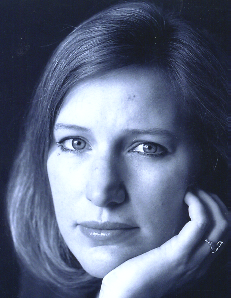
As a health reporter at The Baltimore Sun, Diana K. Sugg covers a broad range of medical advances, research and health policy. But Sugg always looks for the people behind the story: the young psychiatry resident scrambling to handle a load of children in the emergency room, the brothers offering their bodies to test sickle cell treatments, the harpist who plays for the dying.
In her eight years at the paper, Sugg has won local, state and national awards. She started covering medicine at The Sacramento Bee in 1993, writing about the revolution remaking California’s health care system, Medicaid managed care and other major issues.
Previously, Sugg covered crime at The Bee. Her beat coverage has been featured in Crime on Deadline, as well as New Reporting and Writing, the country’s most popular journalism textbook. She has written about her crime reporting for the Nieman Reports.
She has also worked at The Spartanburg (SC) Herald-Journal and the Associated Press in Philadelphia. Sugg graduated Phi Beta Kappa from Villanova University and earned her Master’s degree in journalism on a Kiplinger Fellowship at Ohio State University. She lectured on beat reporting this past summer at the Poynter Institute and was recently named to Poynter’s National Advisory Board.