The Washington Post, by Colbert I. King
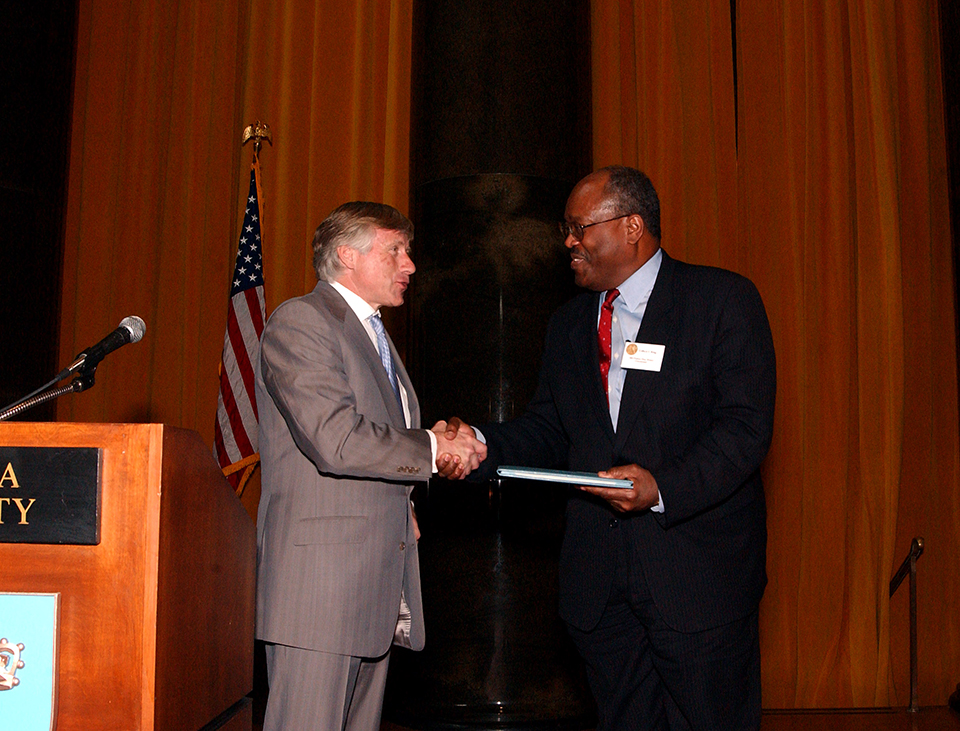
Columbia University President Lee C. Bollinger (left) presents Colbert I. King with the 2003 Pulitzer Prize in Commentary.
Winning Work
By Colbert I. King
The folks at Starbucks can be downright fussy about their world-famous logo: You know, the one depicting a longhaired mermaid with a crown on her head, encircled by a band of green. When, for instance, a San Francisco cartoonist created a not-so-nice parody of the Starbucks trademark in 1998, he found himself sued by Starbucks for copyright infringement. And two years ago, Starbucks Coffee Japan Limited went to court to seek an injunction against a Japanese coffee chain operator for coming up with a logo that was similar to Starbucks'.
You don't mess with the mermaid, pure and simple. That is unless you want to do business in Saudi Arabia, where the display of the female figure -- even in the form of a mermaid -- is regarded as porn.
Starbucks' solution to a Saudi selling stumbling block? "Bye-bye, mermaid."
In a further bow to Saudi male sensitivities (Starbucks, along with McDonald's and other U.S. fast-food shops, already practices gender segregation, providing separate entrances, service and seating) the Starbucks logo found on coffee cups, signs, aprons and napkins in the kingdom is reportedly triangular shaped with a crown, but without a sign of that -- wash my mouth out -- woman.
Asked about this alteration of its jealously guarded trademark, Peter Maslen, president of Starbucks Coffee International in Seattle, said in a statement:
"As a company that is entering many international markets, we are very sensitive to, and highly respectful of, local religious customs, social norms and laws." He declared further that Starbucks won't impose its will and values in countries where it does business. Describing his company as a "responsible, respectful and caring corporate citizen," Maslen said: "In the kingdom of Saudi Arabia, Starbucks customized its company's logo on the advice of our Middle East business partner."
Said the observer in Saudi Arabia who brought the censored Starbucks logo to my attention: "It appears that like apartheid in South Africa, U.S. businesses are willing to sacrifice just about anything in pursuit of riyals [Saudi currency] -- even their corporate identities."
But sacrifice in Saudi Arabia isn't limited to American businesses and their principles. Consider the situation at the American Embassy.
If the embassy's political counselor or the administrative chief wishes to run out in the evening for a quick meal, it's a simple matter to get behind the wheel of a car and drive. But if the deputy chief of mission -- the embassy's second in command -- or, say, the economic counselor should wish to do the same, those seasoned diplomats must call the motor pool and wait for someone to drive them, because they happen to have been born female.
There's another cost. Since Saudi law prohibits women from driving, the embassy maintains a 24-hour motor pool in case female staffers require transportation.
Female American military in Saudi Arabia fare no better. Until this week, it was mandatory for them to wear abayas, the black head-to-toe gowns covering the face that are worn by Saudi women, when leaving their posts or bases. That is, until Air Force Lt. Col. Martha McSally, America's highest-ranking female fighter pilot, launched her protest. Until then, it mattered not to the Pentagon, according to McSally, that the religious freedom of nearly 1,000 American women stationed in Saudi Arabia was being violated by forcing them to wear the clothing of another faith.
But even with this latest Pentagon concession to American values, the Defense Department still can't see its way clear to drop regulations barring American military women from sitting in the front seats of cars or from leaving their bases only in the company of men. As for allowing U.S. female diplomats and military personnel in Saudi Arabia to behave like adult males and drive themselves? Now hear this from (1) the Army brass, (2) the Foggy Bottom set and (3) the Saudis: "Fuggedaboutit!"
But should we?
Gender segregation in U.S. fast-food restaurants and sexist restrictions imposed on female American officials are only a small part of the Saudi problem.
We're talking about a country where, reports the Saudi Institute, a Saudi woman must get the permission of a male relative before she can have surgery, go to college, seek a job, accept a marriage proposal, buy a mobile phone or go to court -- even when accused of murder. Now substitute "African American" for "Saudi woman" and "white male" for "male relative." Get the picture?
For the United States to profess deep respect for human rights and deplore the Taliban's persecution of women, and then regard the treatment of women in Saudi Arabia as a matter of no consequence, is hypocrisy at best and cowardice at worst.
It's hypocritical because the Saudis' segregation of women in schools, public transportation, workplaces and restaurants -- coupled with their trampling on freedoms of speech, assembly, religion and press -- are the antithesis of everything that we as a nation profess to hold dear. How dare the United States lecture Africans, Asians and the rest of the world about democracy and human rights but then turn a blind eye to the Saudis.
It's cowardly because, at bottom, we are scared to death of getting on the wrong side of an oil-producing monarchy that provides 20 percent of the total U.S. crude oil imports and 10 percent of U.S. consumption.
So we let them play us for chumps.
The kingdom publicly boasts of its proselytizing in America under King Fahd, heralding the fact that it has spent millions of dollars funding an Islamic academy in Washington, 15 mosques and Islamic centers, and nine Islamic research institutes across the length and breadth of America.
Okay, that's fine by me.
But get this. If an American shows up in Saudi Arabia carrying a Bible, wearing a cross or a Star of David -- or if he or she gathers with a handful of like-minded Christians, Jews, Sikhs, etc., for the express purpose of holding public worship -- he or she will be subject to harassment or worse by Saudi authorities.
In short, U.S. respect and tolerance for Saudi Arabia's promotion of its official religion in America is reciprocated with contempt when non-Muslim Americans seek to observe -- not propagate, simply observe -- their faith on Saudi soil.
And yet we are the ultimate guarantor of Saudi security, propping the Saudis up with Patriot and Hawk missiles, F-15s, AWACS and UH-60 Blackhawks, tanks, smart bombs, infantry fighting vehicles plus the training in how to use them.
Washington should abandon its human rights double standard and get serious about producing an energy policy that makes this country less dependent on Saudi oil. It should also quit doing a "Starbucks" -- bowing, scraping and selling out time-honored principles to Saudi princes.
© 2002, The Washington Post Company
By Colbert I. King
"There's the Robert C. Byrd Highway, the Robert C. Byrd Hilltop Office Complex, the Robert C. Byrd Federal Courthouse, the Robert C. Byrd Life Long Learning Center, the Robert C. Byrd Locks and Dams, the Robert C. Byrd Rural Health Center, the Robert C. Byrd Academic and Technology Center, the Robert C. Byrd United Technical Center, the Robert C. Byrd High School, the Robert C. Byrd Health Sciences Center, the Robert C. Byrd Institute for Advanced Flexible Manufacturing..."
Things finally started to calm down in Darrell's barbershop after Big Jerome, the trash talker, left the premises. The place had been in an uproar minutes earlier when Jerome, angry at being left out of the poor-mouthing contest between Sen. Robert Byrd and Treasury Secretary Paul O'Neill, cut loose with some of his own choice "I'm so poor..." lines.
The fellows were still wiping away tears of laughter. But Darrell hoped the shop would get back to normal so he and the other barbers could get on with their work. Before long, with composure regained, customers and barbers were lost in their reveries.
It didn't last long.
Fishbone, now seated in Darrell's chair, broke the silence. "Somebody help me," he pleaded.
"Look, I understand all that stuff Byrd and O'Neill were laying on each other about not having running water, telephones and electricity when they were young. And I get the bit about 'little wooden outhouses.' "
"But," said Fishbone, wrinkling his brow, "when Byrd took a shot at O'Neill for once being a big shot in a big-bucks corporation, O'Neill got all teary-eyed and said something about dedicating his life to getting rid of rules that limit human potential. And he started talking about rules that said, 'Colored don't enter here.' Can somebody tell me what that was all about?" wailed Fishbone.
The only sound was that of scissors snipping away.
Finally Fatmouth piped up. "Man, don'tcha know? It was in all the papers!"
"I don't take the paper," said Fishbone sheepishly.
"See there," thundered Fatmouth. "If you wanna keep a secret from certain folks," he said, "all you have to do is put it in a book." "Man," Fatmouth said indignantly, "you should start reading The Post." (Yes, 'tis a shameless promotion, but my wife and two dogs also have to eat.)
"All right, you guys, chill," ordered number two barber Bobby T. "Fishbone," he said with exasperation, "O'Neill was cracking on Byrd for having been a member of the Ku Klux Klan."
"He was what?" asked Fishbone incredulously. "You mean that powerful ol' dude in the Senate was one of those Kluxers in sheets and pointed hoods who burned crosses and hated black folks?"
"If I'm lyin', I'm flyin'," said Bobby T.
Herman, who was sweeping up hair cuttings on the floor, tried to come to Byrd's rescue. "As I recall," said Herman, "they said it was a 'youthful indiscretion' or something like that."
" 'Youthful indiscretion' my butt," interjected Rodney, who, despite having already had his hair cut, couldn't leave the shop.
"Sounds just like when my Aunt Edith shot her boyfriend and said it was an accident," he said. "Aunt Marilyn was downstairs when it happened. She heard the gun when it went off.
" 'One "boom" sounds like an accident,' Aunt Marilyn announced.
" 'Boom, boom, boom' sure ain't."
Just then, Mr. Jackson, a Washington old-timer and local historian known for his photographic memory, entered the shop for his weekly trim and chance to smoke his cigar, since Mrs. Jackson was having none of that in her house. He soon caught the drift of the discussion and waited patiently until Darrell turned to him for a definitive reading on the Byrd situation.
"What's the real deal, Mr. Jackson?" asked Darrell.
Settling into a well-worn chair in the middle of the shop where he usually held court, Mr. Jackson pulled out his stogie, lit it, took a few unhurried puffs and let the smoke drift to the ceiling. "The real story came out during the 1960 presidential primary in West Virginia, where Byrd was a key figure in the 'Stop Kennedy' campaign," Jackson said.
"Word got around that Byrd had been a Klan member, but he tried to say it was only briefly." Mr. Jackson, who'd anticipated a barbershop discussion of just this topic, pulled an old news clipping out of his pocket, an April 21, 1960, Washington Post story by David Wise of the Herald Tribune News Service. He read from it:
"The Ku Klux Klan developed primarily as a terrorist group aimed at the Southern Negro in Reconstruction times, but it is also virulently anti-Catholic."
John F. Kennedy, Mr. Jackson reminded his audience, was Catholic.
On the business about Byrd's brief Klan membership, Mr. Jackson again quoted the story: "The fact is that he was a Kleagle, or organizer, for the Klan during World War II and wrote as late as 1946 to Dr. Samuel Green of Atlanta, Imperial Grand Wizard of the Klan, recommending a friend as a Kleagle and urging promotion of the Klan throughout the nation."
Mr. Jackson said the story also reported that in 1946, Byrd wrote to Imperial Wizard Green: "The Klan is needed today as never before and I am anxious to see its rebirth here in West Virginia."
As for "youthful indiscretion," Mr. Jackson observed that in 1946, Robert Byrd was 29 years old. American Taliban John Walker Lindh, he pointed out, is 20.
Byrd knew what he was doing, said Mr. Jackson. In 1945, a year earlier, Byrd wrote to Mississippi's virulent segregationist Sen. Theodore Bilbo that he would never serve in an integrated Army. "Rather I should die a thousand times, and see Old Glory trampled in the dirt never to rise again, than to see this beloved land of ours become degraded by race mongrels, a throwback to the blackest specimen from the wilds," Byrd wrote. Confronted with the letter in 1999, Byrd said he didn't recall writing it, but he said, "I will not dispute the quote, though I consider it deplorable."
Mr. Jackson, ever the historian, said that in 1946, the same year Kleagle Robert Byrd was writing to his imperial wizard, six blacks were lynched in America, including two black couples at the Moore's Ford Bridge near Monroe, Ga., and a young black man who was burned alive with a blowtorch by a Louisiana mob. And a black Army veteran also had his eyes gouged out with the butt of a billy club by South Carolina police.
The resurgence of lynchings and violence against blacks in the South got so bad in '46 that President Truman was spurred to order a special federal investigation. That same year, Byrd was elected to the West Virginia legislature. Four years later, he went to Congress, where he's been ever since.
And that, said Mr. Jackson, may help explain why Sen. Byrd rode the city so hard when he became chairman of the Senate Appropriations subcommittee on the District of Columbia.
At a public hearing this week, said Mr. Jackson, Byrd lectured the Bush administration on the difficulties of rooting out terrorists. Mr. Jackson added softly, "He should know."
With that recitation, Mr. Jackson crossed his legs at the knee, folded his hands in his lap and said primly, "You gentlemen may take it from there."
A hush fell over the shop.
An angry voice was heard from the back of the shop.
"And since he's been in Washington, Byrd's been using my money and yours to build monuments to himself in West Virginia." It was Fast Frankie, who, until that moment, had not said a word.
Frankie has folks in the Charleston area and gets back to visit frequently. Frankie said Byrd has more pork in West Virginia than there is in all the packing houses in the world -- all in his name.
"Don't think so?" he challenged. "There's the Robert C. Byrd Highway, the Robert C. Byrd Hilltop Office Complex, the Robert C. Byrd Federal Courthouse, the Robert C. Byrd Life Long Learning Center, the Robert C. Byrd Locks and Dams, the Robert C. Byrd Rural Health Center, the Robert C. Byrd Academic and Technology Center, the Robert C. Byrd United Technical Center, the Robert C. Byrd High School, the Robert C. Byrd Health Sciences Center, the Robert C. Byrd Institute for Advanced Flexible Manufacturing..."
It was getting dark outside, and everyone was eager to go home. But Darrell couldn't budge Fast Frankie. So he flipped the "closed" sign on the door, locked his barbershop and left Fast Frankie inside, comfortably seated in his chair, still going strong:
". . . the Robert C. Byrd Green Bank Telescope, the Robert C. Byrd National Technology Transfer Center, the Robert C. Byrd Intermodal Transportation Center and Garage..."
© 2002, The Washington Post Company
By Colbert I. King
Her name and that of the congressman were on everybody's lips. Sex, secrecy and the likelihood of foul play were all part of the drama. But, hey, that's what it was all about, wasn't it? Levy, the California college graduate and intern, and Rep. Gary Condit: a fascinating story of other people's troubles.
In time, we now tell ourselves, it will all fade away. Another Washington tale of infatuation, lust, power and the inevitable fall.
Pure garbage.
What happened to Chandra Levy is not about the tribulations of a white middle-class kid from way out West who, in some strange twist of fate, ran into harm's way while interning in the nation's capital. Chandra Levy's story is an older and more familiar one. And it is a reality that we would just as soon pretend does not exist.
At bottom, it's about violence against women. The crime scene in Rock Creek Park is not the last word on that evil - not in this city anyway.
Forget all that talk about this being a new day for women, that in 2002 women in the District of Columbia are no longer treated differently or looked down upon because of their sex. Don't believe for one second that the era of abusive partners working overtime on the minds - and bodies - of women is over.
Or that our city has been transformed by law, by the teachings of the home and by the words of our exalted civic and religious leadership to the point that some women no longer need to walk on eggshells behind closed doors in fear of getting put down, slapped around or threatened in some despicable way.
That, my friends, is pure, unadulterated hogwash, at least in this town of ours.
Here's a little something that they'll never tell you downtown, something that you'll never hear intoned from the pulpit, where women are unctuously lifted up as creatures unspotted by the world.
Guess how many reports of violence against women were made to the D.C. police in 2000. I'm talking about domestic violence, sexual assaults, desperate calls for civil protection orders. Ready? More than 22,500.
That's right. Violence against women made up about 50 percent of all reported violent crimes to the D.C. police in that year. If those numbers take your breath away, they should. Because the reported incidents are only the tip of the iceberg.
Most abuse occurs behind closed doors, where the abused don't have anyone to help them. Behind closed doors, where they are dependent upon the person who's whipping up on them or forcing them to do things that they ought not have to do.
Most of our abused friends and neighbors suffer in silence, ashamed and scared, hanging in there out of fear of breaking up the family or of getting their own heads broken.
Some of them also believe deep down inside that no one's going to believe them anyway.
And why shouldn't they?
Even when they call for help, the cops often show up but don't make reports.
A special order was put on the books in April 2000 requiring reports on sexual assaults. It might as well have been written in Sanskrit. In that year, 571 calls, or 51 percent, were not written up by police, according to an internal Metropolitan Police Department report. The same noncompliance applies to other domestic violence reporting.
Despite a general order demanding a report on every domestic violence calls, most responses to calls simply don't get documented by police. In 2000, in approximately 66 percent of police responses, not one report was made, according to a June 2001 report sponsored by the D.C. police's Family Violence Prevention Unit, (which is now defunct).
It gets worse.
Say a woman who has been beaten - who's been kept away from her family and friends and made to feel like dirt all the time - finally screws up her nerve, leaves that turkey and gets a civil protection order. So what? It's a hope and a prayer that the order ever gets served.
In December 2000, only 55 percent of civil protection orders were served. In January 2001, the number slipped to 47 percent. In March 2001, the last month for which data are available, the court had managed to serve only 69 percent. Why? Wrong addresses, lack of staff - you name it. Bottom line: The offenders weren't served. They were free to keep choking and kicking and browbeating.
And they kept at it to a fare-thee-well, too.
There are more than 800 addresses in this city that the police had to visit six or more times in 2000, responding to violence-against-women calls. That equates to about 5,000 responses to those locations. What did they do when they got there? Check this out:
From a dwelling in the 5400 block of 5th Street NW: 17 calls - and only two reports.
A household in the 100 block of Kennedy Street NW: 13 calls - not a single report.
A household in the 1800 block of Wiltberger Street NW: 7 calls - not a single report.
In an apartment building in the 3700 block of 9th Street SE there were 47 calls from at least 19 different apartments - and only 12 reports.
Likewise, there were 27 calls from at least eight different apartments in a building in the 200 block of N Street SW - and only four reports.
Even then, some of the reports were sloppy, contained inaccurate or illegible information, lacked victim contact information, or the contact number was no longer in service.
This helps explain why, of the more than 6,000 domestic violence reports submitted to the U.S. attorney's office in 2000, prosecutors refused to pursue, or "no papered," approximately 2,000. Bottom line: Less than 10 percent of calls for domestic violence in the District result in a conviction.
Oh, yes. All the organizational rigamarole to handle violence against women is neatly in place. Laws, regulations and directives galore have been written. Folks with appropriate titles within the bureaucracy have been designated to deal with the problem. When it comes to talking a good game, the D.C. government has no peer. But those aren't the standards by which this city should be judged.
Count the victims. Count the homes that have been violated. Count the trusted relationships broken. Count the children who have seen the slapping and biting and kicking and cursing and who are more likely to grow up and do the same damn thing.
Count the police officers who have said, as one domestic crime victim reports: "There are too many real crimes being committed to be dealing with stuff like this."
Now face the truth about violence against women in our city: It's bigger than Chandra Levy.
© 2002, The Washington Post Company
By Colbert I. King
The name Mikea Rahul Washington may not ring a bell. Maybe it's because Mikea wasn't with us very long. In fact, Mikea's time was so short he never learned to spell his own name or count to 10 or do any of the fun things little boys and girls usually enjoy. You see, 'round about this time two weeks ago in a rowhouse in Northwest Washington, a knife-wielding assailant nearly took Mikea's head off.
Mikea did absolutely nothing to bring on his own murder. He couldn't stop it, either. For goodness sake, Mikea was only 18 months old.
He didn't die alone. Simona Druyard, an 80-year-old woman who owned the house in the 1400 block of Spring Road NW, also went to glory with him, as a result of her throat being slashed by the same person. Mikea's father, Amin Washington, got his throat cut, too, but he lived to tell the cops about it.
Published reports say authorities attribute the mayhem to a dispute over a planned restaurant venture between Mikea's father and the alleged slayer, Allen Logan, 31, of Northeast Washington.
With all due respect, D.C. cops may wish to probe into that tale a little deeper. Word on the street is that the late Ms. Druyard never wanted Logan and his "mess" around her home -- and she didn't have a restaurant in mind.
But that's not why we're revisiting a double homicide that has all but disappeared from the screen. It's Topic A today because a little poking around has raised the possibility that toddler Mikea and octogenarian Simona Druyard might still be around to celebrate the Fourth of July had responsible parties along the criminal justice food chain lived up to their job descriptions.
Truth be known, Allen Logan's bad side didn't make its debut just two weeks ago. By all accounts, he's a mean sucker who should have been taken off the streets a long time ago.
Just ask Hope Carlisle and her former boyfriend, Gregory Dawson.
This from papers filed in Superior Court by the U.S. attorney in 1999:
Carlisle and Dawson were asleep in Mr. Dawson's apartment in April 1998 when Dawson heard banging on the front door. It was Logan. He was swearing and carrying on about the romantic relationship that Ms. Carlisle had ended five months earlier.
Dawson saw Logan walk away from the apartment building, but minutes later he heard a commotion outside. Dawson's 1990 Mazda Miata was in flames. A federal Bureau of Alcohol, Tobacco and Firearms agent determined that the fire was deliberately set.
Three days later, Logan called Dawson at his job and told him to "stop hanging around" with Carlisle. Said Logan, "I'm playing for keeps, whether I'm locked up or not. . . . I don't care. . . . What do I have to do to get you to stop messing with her?"
Logan also said, "I've burned your car. . . . What more does it take? Do I have to kill you? I was gonna come up in your apartment and shoot both of you."
Logan, according to the same court papers, has been acting out for a while. In March 1996, he broke the front and back passenger-side windows of Carlisle's car.
He broke several windows in her apartment in early April 1998. In the same month, Logan carved the word "Next" into Dawson's front door, prosecutors said.
Incidentally, at the time he was torching Dawson's car, Logan was also on bail, having pleaded guilty in 1997 to assault and making threats against his live-in girlfriend, whom he had threatened with a gun.
The car burning got Logan arrested, indicted and convicted on a felony destruction of property charge. He faced a 20- to 60-month jail sentence -- which, if imposed, might have kept him and his knife away from the 1400 block of Spring Road two Fridays ago. Unfortunately for Mikea and Druyard, Logan -- parole violator, domestic violence offender and arsonist -- as a result of a plea bargain, spent only three months in jail and was given five years' probation by D.C. Superior Court Judge Robert E. Morin. Logan also had violated the Bail Reform Act, but Judge Morin also gave and suspended a 90-day sentence for that.
Logan promptly showed his appreciation by violating terms of his probation. He never contacted his probation officer.
Enter another criminal justice actor: the federal Court Services and Offender Supervision Agency, which handles the city's probation system.
Although Logan violated probation in September 1999, the offender supervision agency didn't notify Judge Morin until August 2000. Why the nearly one-year delay? "We are conducting an investigation into that," Cedric Hendricks, the agency's acting associate director for legislative, intergovernmental and public affairs said this week. Asked what happened in the meantime to catch up with probationer Logan, Hendricks said, "We sent letters to the home and called the phone number listed for him." Have mercy.
Judge Morin wasn't exactly a ball of fire, either. Notified of the probation violation in August, Morin set a "show cause" hearing for October 2000 so Logan would have a chance to explain why jail shouldn't be in his future.
Logan, however, was a no-show for that date, too. So Morin issued a bench warrant.
Now enter a third actor: the U.S. Marshals Service. The bench warrant was issued in October 2000. Marshals didn't find him until February 2002.
Where was Logan all that time?
Please note: Between Logan's violation of probation in September 1999 and his apprehension 2 1/2 years later, a man bearing his name and sharing his race and date of birth was in Norfolk, doing such unpleasant things as committing larceny, assault and battery, and other misdemeanors, according to Virginia court records. That Allen Logan also didn't keep court dates. He was branded a fugitive, too.
Note to judge, probation supervisors and U.S. marshals: Could it be the same person?
Here's what's not in dispute: The toddler and senior citizen who had their air passages severed on June 14 might be alive today if:
- Logan had been given a good stiff sentence instead of probation in 1999;
- The Court Services and Offender Supervision Agency had not dilly-dallied for nearly a year before notifying the judge about Logan's probation violation;
- The U.S. Marshals Service had not taken 2 1/2 years to find and put him in jail.
What next? If experience with the District's civic leadership is any guide, absolutely nothing. No one is going to raise a stink. The politicians are preoccupied with photo-ops, their own reelections and bringing the Olympics to Washington. Criminal justice system actors are waiting for payday to roll around. And before the week is out, there's a good bet some friend of the court will find a way to remind me in the most condescending tones, that I am unschooled in the law, the majesty of judicial decision-making and the way the system works -- and that I should mind my own business.
After all, little Mikea and old Ms. Druyard -- nobodies to downtown Washington's powers-that-be -- are now history.
© 2002, The Washington Post Company
By Colbert I. King
The call came at 12:17 a.m.
Charlene Booker knows because she checked the log on her caller ID when she returned home more than four hours later. But it never occurred to her at the time to look at the clock. When the phone rang, she just lifted the receiver and there was the voice of Ezekiel, or "Zikki," as she called her 18-year-old son. He was crying. But through the sobs, Charlene Booker heard the words that seem to get spoken in one form or another nearly every other day in the nation's capital: "Mommie, somebody shot Charlie and he's dead."
Screaming. Charlene Booker found herself screaming.
"Where are you?" she asked.
"I don't know," said Zikki, as he bawled. Pulling herself together, mother calmed down son.
"I'm here in old town," he said. Mrs. Booker had no idea where that was.
"Near the townhouses around by McDonald's," he explained, referring to the Mickey D's on South Dakota Avenue NE.
Mrs. Booker doesn't recall who said what next, but she remembers hanging up the phone, leaving her home with her fiance, Glen Brown, jumping into her car and, with Brown behind the wheel, racing to the nearby area where the townhouses were located.
Charlie, to the best of my knowledge, didn't make the TV news. He hardly made The Post. On Monday, July 22, we gave you this much on an inside page of the Metro section: "Police found Charles Booker, 19, in the 4100 block of Seventh Street NE, less than a block from Catholic University. Booker, who lived in the 5000 block of 11th Street NW, had been shot in the head. He was pronounced dead at D.C. General Hospital shortly after arrival, police said."
End of story.
It was actually the 4400 block of Seventh Street NE, but no matter.
When his mother's car reached Sixth Place NE, only a few minutes from her home, she thought a block party was underway.
"About 100 teenagers were milling around. We were blowing the horn, trying to get through, but they were slow to move." One boy on a bicycle shouted, "Why are you driving so fast? You're not going to get any further through this crowd." They continued inching through the throng, but when they turned onto Seventh Street, the car was forced to stop. Mrs. Booker said there must have been 300 kids on the block.
She got out and started running through the crowd shouting: "Where's Zikki, where's Zikki?" Someone said, "He left."
By that time, Mrs. Booker had reached the yellow police tape that's used to cordon off a crime scene. She looked over to her right and saw a body face down, arms spread wide, lying in front of a driveway.
A voice in the crowd asked: "Is that your son over there?" From where she was standing, Mrs. Booker said the body appeared much larger than Charlie's so she answered, "That's not my son." She knows now that she was in denial.
She heard another voice say, "There's a parent here." A police officer turned to her and asked, "Are you his parent?" She ducked under the police tape to get a better look, but they wouldn't let her approach the body.
At that moment her cell phone rang. It was Zikki, crying again, and complaining that the police wouldn't let him get through to reach his brother. Zikki, it turned out, was farther up the street, also held behind police tape. The police were waiting for the arrival of the coroner's office, Mrs. Booker said.
It was about 12:45 a.m.
The police wouldn't let kids leave. There was a lot of grumbling and some of the onlookers were getting hysterical.
"Why is he just lying in the street?"
"Why won't they cover him up?"
A teenage boy who lived on the block went home and returned with a sheet. The police, declaring that the body was part of the crime scene, wouldn't let them cover Charlie.
And so he stayed that way on Seventh Street NE, face down on the ground.
One-thirty a.m.
Two a.m.
Two-thirty a.m.
A mother standing there, eyes fixed on her sprawling son, kept from his side by the police.
Charlie, she said, wasn't a gang member or hustler. He didn't hang out in the streets. He was a computer geek who, in an unusual move, went to a house party in the 4300 block of Varnum Place NE on Saturday night, July 20, but decided to leave with his brother, Zikki, because the place was too crowded.
How was Charlie to know that at the moment the two of them reached Zikki's car, another vehicle would come speeding around the corner with a passenger shooting in the air? Or that Zikki would be able to dive into the car but that Charlie, who in his heart of hearts really didn't want to be out there anyway, would take a bullet in the head?
Three a.m. He's still lying there on the ground, his mother looking on.
Three-thirty a.m.
Four a.m. The coroner's van arrives. Occupants get out, glance over at Charlie and then confer with police and detectives.
Someone starts snapping pictures of Charlie. Then they turn him over and rummage through his pockets.
A detective -- Mrs. Booker thinks her name was "Susan Blue" -- tells the mother she can't get closer to see the body.
"What do you mean? I've been here for four hours and I can't see my child?"
Detective Blue says, "Wait, I'll check."
The detective comes back after consulting with other officers and tells Mrs. Booker she can go over there, but she must be alone.
Glen Brown, the fiance, speaks up.
"Do you think it's wise to let her go alone? For goodness sakes, it's her child!"
Detective Blue says, "Wait, I'll check."
The detective returns, and says, "Okay. But only two people are allowed."
By that time, Charlie is in a body bag.
With Brown at her side, Mrs. Booker looks at her oldest child.
There's a bullet hole in his forehead. His mouth is partially open with a surprised look on his face.
"Then they took him away," she said.
The detective handed her a plastic bag containing money -- $8 -- and a cell phone. But the cops took back the phone. They still have it.
The coroner was late arriving, Detective Blue said, because there had been other shootings in the city.
Blue spoke the truth. In a four-hour period over July 21 and 22, eight people were shot in the District, three fatally.
Charlene Booker's elder son, Charlie, was one of them.
© 2002, The Washington Post Company
By Colbert I. King
When Maynard Jackson, Atlanta's first black mayor, sought the chairmanship of the Democratic National Committee two years ago, "the Dems shoved him to the back of the bus so fast -- in favor of [Bill Clinton's top money-raiser, Terry] McAuliffe -- that the poor guy didn't even have a chance to put in a call to Johnnie Cochran." That dig came from an admittedly acerbic source this week. But it was close to the truth.
Now look at DNC Chairman McAuliffe's record in his first midterm election: The Republicans recaptured the Senate, expanded their majority in the House, won more seats in state legislatures than Democrats did for the first time in a half-century and, in the final blow, elected the first Republican governor of Georgia since Reconstruction. Could Maynard Jackson have done any worse?
Despite having sterling party credentials, a genius for organizing and a record of political achievement, Jackson had one problem: the unmitigated gall to reach too high. Sure, it's fine to be a lieutenant who organizes and turns out the grass-roots vote. They'll even give you a fancy-sounding title. But some things in life are just too precious to share, such as party leadership and control of the money that comes with the job. Running for president is another, but more about that later.
So McAuliffe expects to stay right where he is, schmoozing with fat cats, huddling with power brokers, playing the inside game with the next crop of presidential wannabes, and continuing to hone his strategy of winning over suburban voters while maintaining the affection of environmentalists, abortion rights advocates and gun foes. And if Democratic politics run true to form, two years from now -- after the labor-dominated primaries winnow the current field of singularly unexceptional presidential candidates to a Democratic ticket bearing a vanilla message for independents and swing voters -- McAuliffe and top party leaders will turn their attention back to urban America. Its legions of preachers, pols and party loyalists will be exhorted to get out the African American vote in time for November 2004.
If that happens, as it did this year and in every election cycle in the past two decades, and African American Democrats, the party's most loyal constituency, are once again taken for granted, who really deserves the blame?
The continued passivity of black Democrats in the face of such disrespect is an offense to the memory of ancestors who arrived on these shores in bondage and through sheer grit and determination survived slavery and went on to make it possible for future generations to reach the top in business, education, the military, law and science. Why, then, stop short of where the nation's agenda is set? Why not the presidency?
The days of settling for second string in the country's electoral process must end -- now. There are choices: African Americans can join another party, form another party, become independents or stay Democrats. But if switching's not in the cards, then at least leave the fields and fight for something.
The first target should be Terry McAuliffe. He took Democrats down in flames. It was McAuliffe who wasted funds in Florida seeking puerile revenge against Jeb Bush for brother George's victory in 2000. McAuliffe blew money that Carl McCall could have used in his historic bid to become New York's first black governor. But McAuliffe said that he didn't think McCall could win and that he would spend the money elsewhere -- like in the Sunshine State. Get this: The outpoliticked and underfunded McCall lost his bid by 16 points. But Jeb Bush also buried McAuliffe's guy in a 13-point landslide.
Carl McCall wasn't the only black candidate left in the lurch. McAuliffe talks a good game, but in contrast to the GOP, which threw tons of money into advertising on black-oriented TV and radio stations and in newspapers to cynically suppress the black vote for Democrats, the DNC, arrogantly assuming that black voters had nowhere else to go, spent relatively little on black media.
So on to step two. African American Democrats should assume a larger role in the selection of the party's presidential nominees.
No more days of white Democratic presidential candidates breezing into the African American community toward election time -- or worse still, sending in black surrogates or a Bill Clinton -- to make all sorts of promises that won't be kept. When candidates come calling in the 2004 presidential primaries, they should be greeted by a local African American favorite son or daughter who has also declared for the presidency.
For example, a popular Democrat such as D.C. Del. Eleanor Holmes Norton should declare in 2004, field a delegate slate and prepare to do battle with any outside candidate who comes to the city hunting supporters for the next convention. If the candidates aren't prepared to compete with Norton on issues of importance to District voters, such as D.C. voting rights, job creation and improving public schools, then Norton wins the primary and goes to the convention with delegates committed to her values and causes.
A similar scenario should occur in primaries all over the country, especially since Democratic Party rules allow the proportional selection of delegates.
Why shouldn't Rep. James Clyburn adopt a similar strategy in the South Carolina primary? Or Rep. Charlie Rangel in New York? Rep. John Conyers in Michigan? Rep. Maxine Waters in California? Rep. John Lewis in Georgia? Rep. Bobby Scott in Virginia? Members of the Congressional Black Caucus, and politicians such as Texas's defeated Democratic Senate nominee, Ron Kirk, ought to be planning now to launch their own candidacies or to back strong alternatives as presidential candidates in their own state primaries. Talk about energizing the black base.
Chances are, African American candidates who ran aggressive, issue-oriented campaigns in their states and districts would receive enough votes proportionally to show up at the convention with committed delegates of their own. That would give them a stronger voice when talks turned to determining the platform and the next presidential and vice presidential nominees. And, unlike in times past, those voices would be heard.
And please don't hand me that stuff about African Americans not being qualified to run for the big one. For goodness' sake, look at who's running now: John Edwards, a North Carolina newcomer to the Senate whose claim to fame is that he made loads of money as a trial lawyer. John Kerry, a Massachusetts senator and decorated veteran with a Dudley Do-Right persona. Joe Lieberman, a Connecticut senator and nice guy who doesn't have half the legislative and public policy experience or war record of Rangel, or history of advocacy for women, children, the poor and people of color of Waters, or grounding in the Constitution, the law and social policy of Norton.
The days of playing supplicant are over. It's time for self-respecting black Democrats to get it on with their party -- or look for another home.
And somebody please alert Johnnie Cochran.
© 2002, The Washington Post Company
By Colbert I. King
It was Aug. 31, a little after 1 a.m. Hattie Purefoy, a New York woman in Washington for a religious crusade, was standing at the bus stop at Bladensburg Road and Morse Street NE waiting to transfer to the B2 bus.
Without warning, a man came up from behind and stabbed her twice in the back. He next went around front, started stabbing her in the chest, and said, "Give me your money. Give me your money." He knocked her to the ground, snatched the plastic shopping bag she was carrying, which contained her purse as well as identification, and took off running in the direction of Maryland Avenue.
It was a horrible welcome to Washington for a woman in search of religious uplifting. She may have found spiritual fulfillment during her visit, but physically speaking, she ended up with multiple stab wounds, including a collapsed lung and a laceration dangerously near her heart. She was eventually transported to the MedStar unit at Washington Hospital Center, but not before some heroic citizens and police sprang into action.
A motorist in a van at the traffic light in front of the bus stop observed what happened. He got out, helped Ms. Purefoy into his van and followed the assailant up the street shouting, "We're going to get you." The motorist, however, then wisely decided instead to drive Ms. Purefoy to the nearby Hechinger Mall and notified a security officer, who called police.
The van driver wasn't the only good Samaritan. Two other motorists in separate vehicles also witnessed the attack. They followed the assailant, flagged down police officers on the street, and pointed him out. The police promptly made an arrest in the 2000 block of Maryland Avenue.
The assailant was taken to the scene. Ms. Purefoy was there. She positively identified him as the person who assaulted and stabbed her. The driver of the van also identified the assailant. The two other motorists also identified him, stating that they saw the assailant struggle with Ms. Purefoy, knock her to the ground and strike her. The police took the assailant's shirt as evidence because it had fresh blood on it.
The assailant, according to court papers, was identified as Gregory Antonio Johnson, 41, of the 2100 block of M Street NE. According to a pretrial services agency report, Johnson was arrested in Mississippi in 1990 for possession of crack cocaine and received a 1999 sentence in the District for drinking in public.
Let us now proceed to Friday, the 13th of September, and the courtroom of D.C. Superior Court Associate Judge Frederick H. Weisberg.
The foregoing account of the attack and robbery was provided by William Gregory White, an 18-year veteran of the D.C. police department, during direct examination on the witness stand by Assistant U.S. Attorney Florence Pan. White, assigned to the 5th District's detective unit, participated in Johnson's arrest and interviewed Ms. Purefoy in the hospital.
The prosecution had charged Johnson with assault with intent to kill while armed and was seeking to have him indefinitely detained for trial. And why not? With three eyewitness accounts, plus that of Ms. Purefoy, why wouldn't the government think that there was probable cause that Johnson committed assault with intent to kill while armed, and that there was clear and convincing evidence that he was dangerous and should be kept off the streets?
Judge Weisberg didn't see it that way. After the prosecution and defense counsel completed their examinations of White, the judge took over:
"Did [Ms. Purefoy] or any other witness describe to you the stabbing motion of how the weapon was used to stab the victim, whether it was slashing or thrusting, or any other description of that kind?" White repeated how the attack took place. Weisberg said: "You're telling me where she was stabbed, but I'm asking now the manner in which she was stabbed. How the knife was used. Was it overhand plunging down, underhand plunging -- thrusting up, slashing or don't you know?" White said the victim didn't say, and he didn't ask her.
After dismissing the detective from the stand, Weisberg announced that he was concerned about the charge of intent to kill while armed.
Prosecutor Pan gave it her best shot: "Your honor, we think, based on the fact that he stabbed this woman multiple times in her chest and in her stomach and in her back, shows an intent to kill her because those are areas where her vital organs are . . . and the way in which the victim's attack was conducted from behind; and then also the way -- he wasn't just trying to rob her, your honor, because he stabbed her before he even asked her for her money. And . . . he continued to stab her even afterwards."
Judge Weisberg replied: "I don't think I can find a substantial probability. Somebody wants to kill somebody, he can kill somebody. He didn't. He took her purse and ran. I agree there's a lot of stab wounds. I agree they're in pretty important parts of her body, and that's why I asked the question about the manner in which he did it; and there's no evidence on that."
Prosecutor Pan: "Your honor -- "
Judge Weisberg: "Look, there's no point having an argument about this, Ms. Pan."
Courageously, Pan gave it one more shot.
After pointing out that people are assumed to intend the ordinary result of the action they take, and that intent can be inferred from action, she said that when someone is stabbed the way Ms. Purefoy was, the "natural consequence of what he's trying to cause is the person's death. . . . Why else would he stab a person five different times? Including twice in the chest?" she asked.
Judge Weisberg: "Because he's a nasty guy and wanted to rob her. And maybe he wanted to kill her. But if he wanted to kill her, he could have and didn't. Look, this is a silly argument to have."
Pan stood her ground: "It is, your honor. But I would only point out that when somebody points a gun at somebody and shoots them . . . I believe we charge with assault with intent to kill while armed, the same way. Because they are responsible for their actions. We consider this in the same way when somebody stabs somebody in the chest."
You go, Ms. Pan!
She didn't win. Judge Weisberg announced that he couldn't find "substantial probability" that Johnson committed that offense because his intent was not shown very clearly on the evidence presented. A D.C. court of appeals decision guided the judge's ruling. He said he would "order [Johnson] at least to a halfway house" and indicated that he was open to entertaining a lesser charge of armed robbery.
Finding themselves licked, the prosecutors returned to court last Monday and filed a new complaint of assault with a deadly weapon. Judge Weisberg accepted the complaint and ordered Johnson held without bond for 100 days on the lesser charge.
And that, Hattie Purefoy, is a taste of justice in Washington below the radar screen.
© 2002, The Washington Post Company
By Colbert I. King
At the core of current U.S.-Saudi interaction is a relationship that, despite professions of mutual friendship and support, cuts only in one direction.
It was the kind of delegation that makes Saudiphiles swell with pride. Among the eight Saudi visitors were impressively credentialed lawyers, bankers and business leaders, including two Western-educated women unadorned in abayas, the full-length black cloaks (complete with veils) that women must wear in public in Saudi Arabia. One female visitor was even wearing trousers, a clear no-no on the streets of Riyadh. It was, in truth, the kind of gathering that runs afoul of the kingdom's strictly enforced social and dress codes. But that's life over there. These men and women, presenting the Western face of Saudi Arabia, had come to town to discuss U.S.-Saudi relations over coffee with Washington Post editors and writers.
The one-hour meeting was all sweetness and light, even as our guests served up saccharine-laced barbs that only the uninitiated to Saudi sophistry might overlook. Prompted by a question, they allowed how the Saudi elite and man in the street are at a loss to understand why the United States is bent on attacking Iraq when the real trouble in the Middle East is in the occupied territories, where Palestinians are being assaulted and killed. There is a suspicion in the Arab world, they suggested more in sorrow than in anger, that American policy in the Middle East is under the heavy-handed influence of Israel. The late NFL coach Vince Lombardi used to say of football injuries: "The knee. It's always the knee." With the Saudis, it's Israel. It's always Israel.
Our guests also expressed disappointment at the way in which the United States has regressed since the Sept. 11, 2001, attacks. Nowhere is the backward drift more apparent than in U.S. visa policy, they said.
Alas, 'tis true. Gone, since jet airliners crashed into the Pentagon and demolished the World Trade Center and thousands of lives, is Visa Express, the State Department program that allowed Saudis to obtain visas to enter the United States without having to apply in person or be interviewed. That 15 of the 19 Sept. 11 hijackers hailed from Saudi Arabia may have had something to do with the policy change. That point seemed lost on them, however.
By tightening visa regulations, one of them said, America is closing off an important avenue by which Saudis can learn about Western values, transmitting same back home. "Shame, shame, you ol' retrogrades," seemed to be the message.
Curiously, nary a visitor uttered one word about Saudi Arabia's "enlightened" visa policy.
What are your chances of visiting Saudi Arabia alone as a tourist? Slim to none. Join an approved tour group, get your itinerary blessed by the government, and then maybe, just maybe, you can enter the kingdom. Does your passport show that you were born in Israel? Prepare to wait until kingdom come.
A woman traveling to Saudi Arabia alone? If your sponsor (yes, you need one) isn't there to meet you upon arrival, expect to be confined to the airport or be seated on the next flight out. Live in Saudi Arabia and want to leave the country? If you're a woman, you'd better get the permission of the Saudi male head of your household, even if you're an adult American female married to a Saudi man. Unmarried woman? You aren't going anywhere without the okay of Daddy or a male guardian. But I digress, since the meeting wasn't about Saudi inhospitality but rather about why America comes up short in Saudi eyes.
We were treated to a gentle upbraiding for having on American soil the likes of the Rev. Jerry Falwell, televangelist Pat Robertson and the Rev. Franklin Graham, all of whom have elected to say some pretty ugly things about Islam and the Prophet. It mattered not to our visitors that President Bush and Secretary of State Colin Powell had publicly rejected the anti-Muslim rhetoric. The repudiation was too mild for our visitors' tastes.
If an observer didn't know any better, the impression might be gained that our visitors were inhabitants of a country where people of all faiths are welcome, and where tolerance is a national watchword.
Not so.
Saudi Arabia not only is a place where no religion but Islam is respected, it is a country where no religion but Islam can exist. Our visitors' unhappiness with the degree of official distance between the U.S. government and Christian conservatives was palpable. But they didn't seem the least bit inclined to rush back to Saudi Arabia to take on their own government for prohibiting public display of the Holy Bible, crosses, the Star of David and the Torah, religious songbooks and Christian CDs. They were eager to knock American religious extremists, but they didn't seem ready to challenge their own country's practice of fining or jailing people who publicly observe any non-Islamic religion.
That's because when it comes to Saudis, religion is a one-way street. Saudis expect to practice and proselytize their faith across the United States without hindrance. But reciprocation is out of the question. And that double standard is enforced without shame.
Saudi leaders crow about the financial contribution of King Fahd, either personally or through his government, to the propagation of Islam throughout the United States. They do that even as the mutawa, the Saudi religious police, launch search-and-destroy missions in the kingdom against practicing Christians and other non-Muslim religious observers.
And when it comes to promoting his faith, King Fahd has something to boast about. The kingdom of Saudi Arabia has spent millions doing that in America. To encourage understanding of Muslim beliefs, Saudi money created the King Abdul Aziz Chair at the University of California at Santa Barbara and the King Fahd Chair at Harvard University.
Saudi Arabia reportedly has been a supplier of funds for Islamic studies at colleges and universities across America. U.S. mosques and Islamic centers have benefited from Saudi financial support as well. Beneficiaries, according to Saudi Web sites, can be found in California, Illinois, Maryland, Michigan, Missouri, New Jersey, New York, Ohio and Washington. The bottom line: Christianity, Judaism and other world religions are banned in the kingdom, even as Saudis officially nourish Islam in America.
Which brings us back to our visitors and a reality that they were too polite to throw in our faces: At the core of current U.S.-Saudi interaction is a relationship that, despite professions of mutual friendship and support, cuts only in one direction. And the kingdom -- with all of its piety and with a sharp eye on its own religious fundamentalists -- is all about keeping it that way.
© 2002, The Washington Post Company
By Colbert I. King
Sen. Strom Thurmond's 100th birthday party will go down in the annals of Washington soirees as an event most noted for who was there and, above all, what was said and by whom. But the celebration was also remarkable because of a person not in attendance.
The audience was full of luminaries, including current and former members of Congress, Supreme Court justices and friends and family of the retiring South Carolina senator. But the party failed to include a retired schoolteacher in her late seventies now living in Los Angeles. A widow since 1964, the former teacher, Essie Mae Williams, was born Essie Mae Washington in 1925 in Edgefield, S.C. Washington reportedly is the fruit of a relationship between a white Edgefield school superintendent and a black teenager, Essie Butler, nicknamed "Tunch," who worked as a maid in the superintendent's stately house.
Now, it could have been an oversight, a deliberate snub or maybe Essie Mae Washington was invited but chose not to come. But this much is true: The fair-skinned woman, a member of Delta Sigma Theta sorority and a 1950 graduate of traditionally black South Carolina State College, was not on hand to help honor the man believed by many to be her father, the former Edgefield school superintendent and the oldest and longest-serving senator in U.S. history, Strom Thurmond.
This is not a groundbreaking column on the story of Thurmond's alleged black daughter. Marilyn Thompson, The Post's assistant managing editor for investigations, included a chapter about then-Gov. Thurmond's alleged support for an alleged black daughter named Essie Mae in "Ol' Strom," an unauthorized biography of Thurmond that she wrote with Jack Bass in 1998. Thompson, a veteran South Carolina reporter who had spent the better part of 10 years tracking the story, also wrote a lengthy article about the senator and his longtime ties with an African American woman for The Post's Style section in 1992. Both Thurmond and Washington have acknowledged a relationship, but she denies he is her father, though the senator has never issued a categorical denial.
The purpose of today's column is not to rehash the strong circumstantial evidence or to repeat interviews with knowledgeable sources about the long-standing and secret relationship between Thurmond and Washington. Thompson unearthed all that. But this annotation to Thurmond's life is worth highlighting, given that his fiery advocacy of segregation did more to stifle racial progress in America than the actions of any single human being in the postwar era until Alabama Gov. George Wallace came along.
Strom Thurmond was among the vanguard of southerners who passed and enforced laws legalizing segregation and discrimination in virtually every aspect of daily life. And leading the list of noxious Jim Crow laws were statutes specifically put on the books outlawing and punishing interracial cohabitation and marriage.
Thurmond was chief among those who believed and argued that drawing a tight color line and strictly segregating the races was the only way to prevent what Theodore Bilbo of Mississippi called "the mongrelization of the Nation." Thurmond was so motivated that he captured the Senate floor in 1957 and filibustered for 24 straight hours against a civil rights bill and "race-mixing." It was Thurmond who vowed to preserve the integrity of the white race and to keep the races distinct.
And it was Strom Thurmond who, according to published reports, did not practice what he so fervently preached.
The very thing Thurmond condemned, he did. Learn the story of Thurmond, Essie Mae and her mom, and come to understand the true meaning of deception, arrogance and what it means to be unprincipled. But this is not the time to wage war against Strom Thurmond. His day has come and gone. Rather we must address the damage that he did and his legacy of racial ill will that live on.
Thurmond helped create a world with walls separating people from people, the vestiges of which still exist. He was among those who vowed to protect the virtue of the white women of the South even as he allegedly used the back stairs to have his way with a woman of the darker race, surreptitiously exercising a prerogative preserved for Southern white men.
While doing that, he and they preserved an evil social system that used the gun and the noose to say that the gift of love cannot come to people of different races. Segregation, to be sure, left generations of African Americans with broken dreams and unrealized ambitions, even as others enriched themselves with better schools, jobs, housing, health care and the like. But the official rules and racial customs of Thurmond's Jim Crow era also made it possible for untold numbers of people to miss out on the mystery of love, to never know the pleasure of sharing, if even for a moment. Thurmond stood between the natural coming together of men and women, even as men like him gave themselves a pass.
And now he goes out glorified. Because in Washington, that's the way it is. But the birthday party is not the last word or act. For some of us, this is the season to put aside our agendas and turn to quiet reflection, repentance and recommitment.
This is also a time of giving. So reach out with a thought to the one untouched by the joy of Ol' Strom's birthday party: the woman who wasn't there.
© 2002, The Washington Post Company
By Colbert I. King
About four years ago -- Dec. 19, 1998, to be exact -- I wrote a column, "Lott's Odd Friends," that urged senators to make their first order of business in January 1999 a review of "Majority Leader Trent Lott's fitness to serve as guiding light of the world's most deliberative body." Of course, the Senate did no such thing.
Instead, Republicans, with the acquiescence of their fellow Democratic club members, blithely went on with business as usual, looking past revelations about Lott's warm and fuzzy association with xenophobic, race-baiting bigots in the Council of Conservative Citizens.
Look at where it got them. Yesterday, Lott proved the old adage "A crisis is when you can't say, 'Let's forget the whole thing.' " Nothing that Lott said has undone the damage he has done to himself and to his party. All of today's huffing and puffing about Lott's record is old news. The Senate was aware of Lott's CCC connections in 1999, as well as his earlier opposition to civil and voting rights legislation and to the creation of a Martin Luther King Jr. federal holiday. It was well known at the time that Lott styled himself a top defender of Confederate symbols and protector of southern "heritage and traditions." There were stories in The Post by Tom Edsall, while this columnist and a few other, mainly African American columnists around the country called for the Senate to take a closer look at its leader. But the Washington establishment -- Congress, political reporters, Sunday talk shows and the nation's editorial boards -- gave the Mississippi senator a pass. And that, of course, is what he's counting on now.
He expects his pals to keep pretending they don't know who he really is. Let's be clear: Trent Lott is not a New South Republican born in the post-segregation era. He came to Washington in 1968 as a Democrat and worked as the right-hand man of one Capitol Hill's chief executioners of civil rights legislation, Mississippi's rabidly segregationist Democratic congressman William Colmer. And when Colmer retired, Lott joined the flight of other race-conscious white southerners to the Republican Party and won Colmer's seat.
And, as if Trent Lott's own civil rights record weren't lousy enough, it turns out that he can't count, either. In one of his several alibis for the remarks he made at Sen. Strom Thurmond's 100th birthday party, Lott allowed how Thurmond's segregationist beliefs were abandoned "over 50 years ago." As reader Edward Boswell pointed out, "Lott needs to figure out how subtracting 1,957 from 2,002 will provide him with a figure 'over 50.' "
Boswell was referring to the fact that in 1957, Thurmond filibustered in the Senate for 24 hours and 18 minutes to derail a vote on a housing measure that he denounced as "race mixing."
Ah, but this will not become a screed against Strom Thurmond. Thanks to the potent Voting Rights Act and a surge in black voter registration in the late 1960s and '70s, Thurmond came to see South Carolinians of color in a whole new light. Funny how the prospect of throngs of African Americans trudging to the polls on Election Day can focus a politician's mind wonderfully. So it was with Thurmond.
Which may help explain why throngs of people braved a snowstorm to hear a Marilyn Monroe impersonator sing a breathy happy birthday to Thurmond. Who knows which phase of Thurmond's life they were celebrating? Was it the first 80 years, during which Thurmond, as state senator, state circuit judge, governor and U.S. senator successfully subordinated the aspirations of black citizens in his state and in the South? Or the past two decades, when, recognizing defeat, Thurmond went along with the rest of the nation?
It's clear which Strom Thurmond was being honored by Lott.
The Republican leader was gushing over the man from South Carolina who wrote the first draft of the "Southern Manifesto" denouncing the Supreme Court's 1954 school desegregation decision and the man who walked out of the 1948 Democratic National Convention to create the segregationist Dixiecrat party.
And by now everyone knows what Lott had to say at Thurmond's birthday bash -- and back in 1980 as well -- about how much better off America would have been had Thurmond the segregationist been elected president in 1948.
What's left to know is how the Senate will deal with Lott. Senate Republicans hope to do nothing, even in the face of a strong and welcome repudiation of Lott's remarks by President Bush. And Democrats, despite their public hissy fits over his remarks, would love to keep Lott around and out front as the face of the Republican Party. That's inside-the-Beltway stuff.
Running through Lott's political career is a thirst to appease the worst side of his Old South roots. It informs his public behavior. Trent Lott may be a modern-day political leader, but he belongs to an era that is fading away. His presence in one of the government's most prominent positions says the wrong thing about where the nation should be headed. In the words of black abolitionist and Republican Frederick Douglass, the Republican Party must "scorn the counsel of cowards" in its ranks. It's time to cut Lott loose. And let him go commune with his soul brothers, Roy Innis and Bob Johnson.
© 2002, The Washington Post Company
Biography
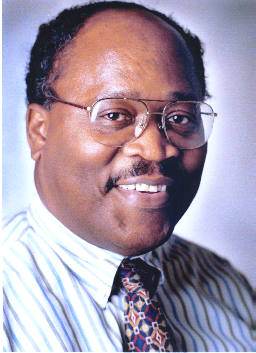
Colbert I. King was born in Washington, DC on Sept. 20, 1939. He was awarded a bachelor of arts degree in government in 1961 by Howard University, where he also pursued graduate work in public administration.
“Colby” King joined the editorial board of The Washington Post on August 1, 1990, and was appointed deputy editor of the editorial page on January 3, 2000.
Before joining The Post, he served as an executive vice president and member of the board of directors of the Riggs National Bank of Washington, DC. During his nearly 10 years with Riggs, Mr. King concentrated on international banking and federal financial services.
In the fall of 1979, President Jimmy Carter nominated Mr. King to serve as U.S. executive director to the World Bank.
From 1977 to 1979, Mr. King was a deputy assistant secretary of the treasury with responsibility for international legislation. In addition to his executive branch experience, he served from 1972 to 1976 as minority staff director of the Senate’s District of Columbia Committee, where he helped draft home-rule legislation and campaign-finance and conflict-of-interest rules for the nation’s capital.
In 1970-71, Mr. King participated in a Department of Health, Education and Welfare fellowship, allowing him to work on a special sickle-cell anemia project that helped launch the disease into national prominence.
Mr. King worked for the State Department from 1964 to 1980, including a three-year stint at the U.S. Embassy in Bonn. Before that he served as a commissioned officer in the U.S. Army Adjutant General’s Corps from 1961 to 1963.
He is married to Gwendolyn Stewart King. They have three children and live in Washington, DC.