The New York Times, by Thomas Friedman
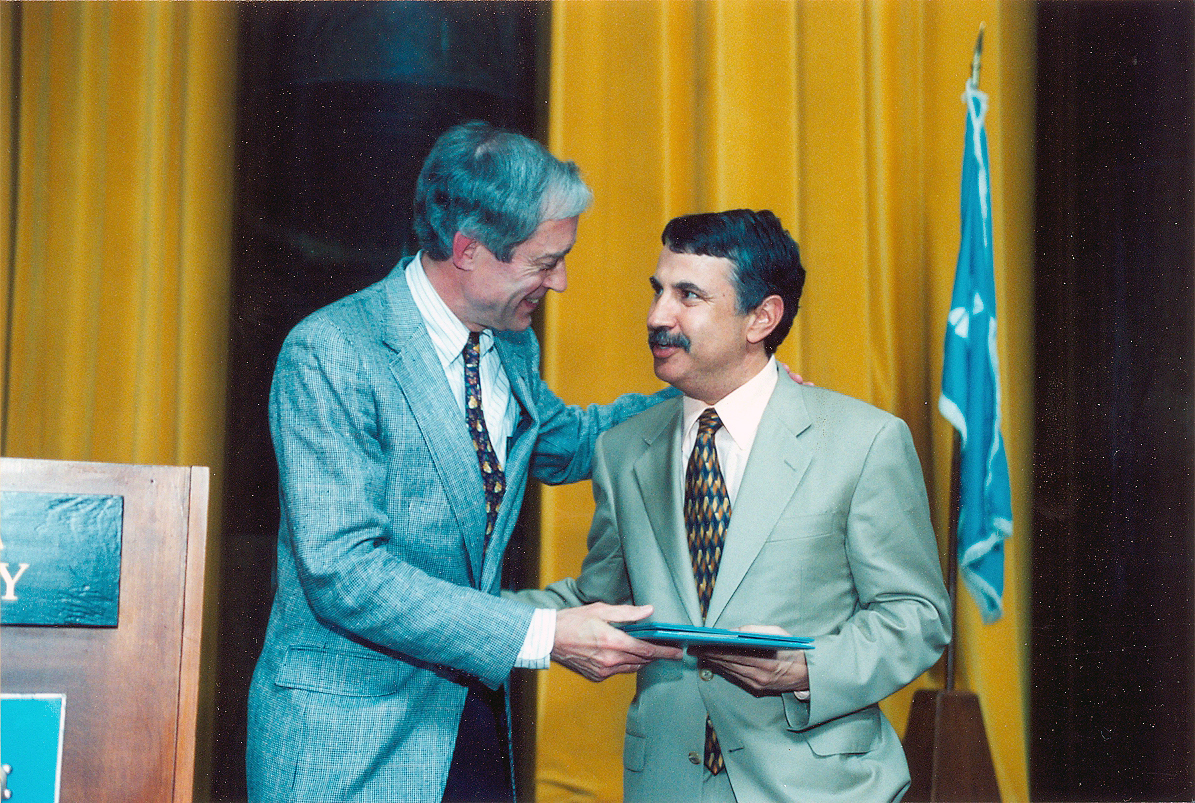
Columbia University President George Rupp (left) presents Thomas Friedman with the 2002 Pulitzer Prize for Commentary.
Winning Work
By Thomas L. Friedman
And unless we are ready to put our best minds to work combating them -- the World War III Manhattan Project -- in an equally daring, unconventional and unremitting fashion, we're in trouble.
JERUSALEM -- As I restlessly lay awake early yesterday, with CNN on my TV and dawn breaking over the holy places of Jerusalem, my ear somehow latched onto a statement made by the U.S. transportation secretary, Norman Mineta, about the new precautions that would be put in place at U.S. airports in the wake of Tuesday's unspeakable terrorist attacks: There will be no more curbside check-in, he said. I suddenly imagined a group of terrorists somewhere here in the Middle East, sipping coffee, also watching CNN and laughing hysterically: "Hey boss, did you hear that? We just blew up Wall Street and the Pentagon and their response is no more curbside check- in?"
I don't mean to criticize Mr. Mineta. He is doing what he can. And I have absolutely no doubt that the Bush team, when it identifies the perpetrators, will make them pay dearly. Yet there was something so absurdly futile and American about the curbside ban that I couldn't help but wonder: Does my country really understand that this is World War III? And if this attack was the Pearl Harbor of World War III, it means there is a long, long war ahead.
And this Third World War does not pit us against another superpower. It pits us -- the world's only superpower and quintessential symbol of liberal, free-market, Western values -- against all the super-empowered angry men and women out there. Many of these super-empowered angry people hail from failing states in the Muslim and third world. They do not share our values, they resent America's influence over their lives, politics and children, not to mention our support for Israel, and they often blame America for the failure of their societies to master modernity.
What makes them super-empowered, though, is their genius at using the networked world, the Internet and the very high technology they hate, to attack us. Think about it: They turned our most advanced civilian planes into human-directed, precision-guided cruise missiles -- a diabolical melding of their fanaticism and our technology. Jihad Online. And think of what they hit: The World Trade Center -- the beacon of American-led capitalism that both tempts and repels them, and the Pentagon, the embodiment of American military superiority.
And think about what places in Israel the Palestinian suicide bombers have targeted most. "They never hit synagogues or settlements or Israeli religious zealots," said the Haaretz columnist Ari Shavit. "They hit the Sbarro pizza parlor, the Netanya shopping mall. The Dolphinarium disco. They hit the yuppie Israel, not the yeshiva Israel."
So what is required to fight a war against such people in such a world? To start with, we as Americans will never be able to penetrate such small groups, often based on family ties, who live in places such as Afghanistan, Pakistan or Lebanon's wild Bekaa Valley. The only people who can penetrate these shadowy and ever-mutating groups, and deter them, are their own societies. And even they can't do it consistently. So give the C.I.A. a break.
Israeli officials will tell you that the only time they have had real quiet and real control over the suicide bombers and radical Palestinian groups, such as Hamas and Islamic Jihad, is when Yasir Arafat and his Palestinian Authority tracked them, jailed them or deterred them.
So then the question becomes, What does it take for us to get the societies that host terrorist groups to truly act against them?
First we have to prove that we are serious, and that we understand that many of these terrorists hate our existence, not just our policies. In June I wrote a column about the fact that a few cell-phone threats from Osama bin Laden had prompted President Bush to withdraw the F.B.I. from Yemen, a U.S. Marine contingent from Jordan and the U.S. Fifth Fleet from its home base in the Persian Gulf. This U.S. retreat was noticed all over the region, but it did not merit a headline in any major U.S. paper. That must have encouraged the terrorists. Forget about our civilians, we didn't even want to risk our soldiers to face their threats.
The people who planned Tuesday's bombings combined world-class evil with world-class genius to devastating effect. And unless we are ready to put our best minds to work combating them -- the World War III Manhattan Project -- in an equally daring, unconventional and unremitting fashion, we're in trouble. Because while this may have been the first major battle of World War III, it may be the last one that involves only conventional, non-nuclear weapons.
Second, we have been allowing a double game to go on with our Middle East allies for years, and that has to stop. A country like Syria has to decide: Does it want a Hezbollah embassy in Damascus or an American one? If it wants a U.S. embassy, then it cannot play host to a rogue's gallery of terrorist groups.
Does that mean the U.S. must ignore Palestinian concerns and Muslim economic grievances? No. Many in this part of the world crave the best of America, and we cannot forget that we are their ray of hope. But apropos of the Palestinians, the U.S. put on the table at Camp David a plan that would have gotten Yasir Arafat much of what he now claims to be fighting for. That U.S. plan may not be sufficient for Palestinians, but to say that the justifiable response to it is suicide terrorism is utterly sick.
Third, we need to have a serious and respectful dialogue with the Muslim world and its political leaders about why many of its people are falling behind. The fact is, no region in the world, including sub-Saharan Africa, has fewer freely elected governments than the Arab-Muslim world, which has none. Why? Egypt went through a whole period of self- criticism after the 1967 war, which produced a stronger country. Why is such self-criticism not tolerated today by any Arab leader?
Where are the Muslim leaders who will tell their sons to resist the Israelis -- but not to kill themselves or innocent non-combatants? No matter how bad, your life is sacred. Surely Islam, a grand religion that never perpetrated the sort of Holocaust against the Jews in its midst that Europe did, is being distorted when it is treated as a guidebook for suicide bombing. How is it that not a single Muslim leader will say that?
These are some of the issues we will have to address as we fight World War III. It will be a long war against a brilliant and motivated foe. When I remarked to an Israeli military official what an amazing technological feat it was for the terrorists to hijack the planes and then fly them directly into the most vulnerable spot in each building, he pooh-poohed me.
"It's not that difficult to learn how to fly a plane once it's up in the air," he said. "And remember, they never had to learn how to land."
No, they didn't. They only had to destroy. We, by contrast, have to fight in a way that is effective without destroying the very open society we are trying to protect. We have to fight hard and land safely. We have to fight the terrorists as if there were no rules, and preserve our open society as if there were no terrorists. It won't be easy. It will require our best strategists, our most creative diplomats and our bravest soldiers. Semper Fi.
By Thomas L. Friedman
When I lived in Beirut in the early 1980's -- the era when suicide bombing was born -- I had a Lebanese friend, Diala, who used to quip that whenever she traveled on an airplane she carried a bomb in her luggage, because the odds against two people carrying a bomb on the same plane were so much higher.
Diala's was one of a million mind games Lebanese played in order to survive in a city where suicide bombings and exploding cars became part of the background noise of daily life. My favorite quote from those days was from the Beirut hostess who turned to us at a dinner party one evening and asked casually: "Would you like to eat now, or wait for the cease-fire?"
I never expected that I or my neighbors would ever have to play such mind games in America. I certainly understand why Americans are scared. I understand why at a parent-teacher meeting at my daughter's junior high school last week, there was unanimous support for postponing the eighth-grade class's trip to New York, scheduled in two weeks. I understand that this particular act of terrorism we just experienced is something so much more frightening than what Beirutis had to deal with.
How so? It is hard to trust anything after such an attack, because trust is based on a certain presumptive morality, a sense that certain actions are simply outside the bounds of human behavior or imagination. That 19 people would take over four civilian airliners and then steer three of them into buildings loaded with thousands of innocent people was, I confess, outside the boundary of my imagination. The World Trade Center is not the place where our intelligence agencies failed. It is the place where our imaginations failed.
What we know of these terrorists is that they were evil, educated and suicidal. That is a combination I have never seen before in a large group of people. People who are evil and educated don't tend to be suicidal (they get other people to kill themselves). People who are evil and suicidal don't tend to be educated.
Naturally, when our imaginations fail us in such a shocking way, there is a tendency to push out the boundaries so far that we see threats everywhere and become paralyzed. We must not. I took my family to the Baltimore Orioles baseball game last Friday night, and as we drove into the parking lot we were handed a slip of paper with "security precautions" -- new restrictions about things you could not take into the ballpark anymore. When I get on a plane at the airport, frankly, you can X-ray me until I glow in the dark, but I hope we are not headed for a day where we permanently do the same at ballgames and concerts.
Believe me, I'm not naïve about these threats. But I'm still hoping that what we're dealing with here is a relatively small number of terrorists, and possibly a crazy state or two -- which, over time, can be combated and contained without totally shackling ourselves.
Beirutis had it right: There is no such thing as perfect security in today's world. All rational precautions need to be taken. But once you take them, then you basically have to decide: Am I going to sit home and hide in the basement forever, or am I, like my friend Diala, going to play whatever mind game it takes, or none at all, and just go on with my life?
My mentor in such things is my late departed friend George Beaver, a crazy Englishman who played golf -- as a man in his 80's -- almost every day of the Lebanese civil war at the Beirut Golf and Country Club. (I confess that I joined him on some days.) When I would say to him, "You know, George, it's crazy to play golf under such conditions," he always had the best answer: "I know I am crazy to do it, but I would be even crazier if I didn't."
Unable to actually imprison us, these terrorists want us to imprison ourselves. Sorry, but no way. It breaks my heart to think about the people who lost loved ones on Sept. 11, but I will not let it break my spirit.
I went to the ballgame Friday night, took in Dvorak's "New World" Symphony at the Kennedy Center Saturday, took my girls out to breakfast in Washington Sunday morning, and then flew to the University of Michigan. Heck, I even went out yesterday and bought some stock. What a great country.
I wonder what Osama bin Laden did in his cave in Afghanistan yesterday?
By Thomas L. Friedman
I recently attended meet-the-teacher night at Eastern Middle School, my daughter Natalie's school in Silver Spring, Md. The evening began with the principal noting that Eastern, a public school in suburban Washington, had 40 different nationalities among its students. Before the teachers were introduced, the school's choir and orchestra, a Noah's ark of black, Hispanic, Asian and white kids, led everyone in "God Bless America." There was something about the way those kids sang together, and the earnest, if not always melodious, way the school orchestra pounded out the National Anthem, that was both moving and soothing. As I took in the scene, it occurred to me how much the Islamic terrorists who just hit America do not understand about America.
Their constant refrain is that America is a country with wealth and power but "no values." The Islamic terrorists think our wealth and power is unrelated to anything in the soul of this country -- that we are basically a godless nation, indeed the enemies of God. And if you are an enemy of God you deserve to die. These terrorists believe that wealth and power can be achieved only by giving up your values, because they look at places such as Saudi Arabia and see that many of the wealthy and powerful there lead lives disconnected from their faith.
Of course, what this view of America completely misses is that American power and wealth flow directly from a deep spiritual source -- a spirit of respect for the individual, a spirit of tolerance for differences of faith or politics, a respect for freedom of thought as the necessary foundation for all creativity and a spirit of unity that encompasses all kinds of differences. Only a society with a deep spiritual energy, that welcomes immigrants and worships freedom, could constantly renew itself and its sources of power and wealth.
Which is why the terrorists can hijack Boeing planes, but in the spiritless, monolithic societies they want to build, they could never produce them. The terrorists can exploit the U.S.- made Internet, but in their suffocated world of one God, one truth, one way, one leader, they could never invent it.
Lord knows, ours is hardly a perfect country. Many times we have deviated from the American spirit or applied it selfishly. But it is because we come back to this spirit more times than not, in more communities than not, that our country remains both strong and renewable.
Why can't we convey that? In part, we're to blame. President Bush denigrated Washington during his campaign and repeated the selfish mantra about the surplus that "it's your money -- not the government's money." How thankful we are today that we have a Washington, D.C., with its strong institutions -- FEMA, the F.A.A., the F.B.I. and armed forces -- not to mention a surplus to help manage our way out of this crisis.
In part we don't talk about these issues so we don't embarrass our autocratic allies in the Middle East. But this negative view of America as a nation that achieved wealth and power without any spiritual values is also deliberately nurtured by governments and groups in the Middle East. It is a way of explaining away their own failures to deliver a better life for their own people: The Americans are powerful only because they stole from us or from others -- not because of anything intrinsically spiritual or humane in their society.
A society that will dig until it has found every body in the World Trade Center rubble -- because at some level it believes every individual is created in the image of God -- a society that raises $600 million for the victims in two weeks, is a godless, spiritless place? Guess again.
These terrorists so misread America. They think our strength lies only in the World Trade Center and the Pentagon -- the twin pillars of our wealth and power -- and if they can just knock them down we'll start to fold: as if we, like them, have only one truth, one power center.
Actually, our strength lies in the slightly dilapidated gym of Eastern Middle School on parent-teacher night, and in thousands of such schools across the land. That is where you'll find the spirit that built the twin towers and can build them over again anytime we please.
So in these troubled times, if you want to feel reassured about how strong this country is, or what we're fighting to preserve, just attend a P.T.A. meeting. It's all there, hiding in plain sight.
© 2001, The New York Times Company
By Thomas L. Friedman
So let me see if I've got this all straight now: Pakistan will allow us to use its bases Mondays, Wednesdays and Fridays -- provided we bomb only Taliban whose names begin with Omar and who don't have cousins in the Pakistani secret service. India is with us on Tuesdays and Fridays, provided it can shell Pakistani forces around Kashmir all other days. Egypt is with us on Sundays, provided we don't tell anyone and provided we never mention that we give the Egyptians $2 billion a year in aid. Yasir Arafat is with us only after 10 p.m. on weekdays, when Palestinians who have been dancing in the streets over the World Trade Center attack have gone to bed. The Northern Alliance is with us, provided we buy all its troops new sandals and give U.S. passports to the first 1,000 to reach Kabul.
Israel is with us provided we never question the lunacy of 7,000 Israeli colonial settlers living in the middle of a million Palestinians in the Gaza Strip. Kuwait would like to be with us, it really would, since we saved Kuwait from Iraq, but two Islamists in the Kuwaiti Parliament spoke out against the war, so the emir just doesn't want to take any chances. You understand. The Saudis, of course, want to be with us, but Saudis are not into war-fighting. That's for the household help. Don't worry. Prince Alwaleed has promised to rent us some Bangladeshi soldiers through a Saudi temp agency -- at only a small markup.
The Saudi ruling family would love to cooperate by handing over its police files on the 15 Saudis involved in the hijackings, but that would be a violation of its sovereignty, and, well, you know how much the Saudis respect sovereignty -- like when the Saudi Embassy in Washington rushed all of Osama bin Laden's relatives out of America after Sept. 11 on a private Saudi jet, before they could be properly questioned by the F.B.I.
And then there's my personal favorite: All our Arab-Muslim allies would love us to get bin Laden quickly, but the Muslim holy month of Ramadan is coming soon and the Muslim "street" will not tolerate fighting during Ramadan. Say, do you remember the 1973 Middle East war, launched by Egypt and Syria against Israel? Remember what that war was called in the Arab world? "The Ramadan war" -- because that's when it was started. Oh, well. I guess the Arab world can launch wars on Ramadan, but not receive them.
My fellow Americans, I hate to say this, but except for the good old Brits, we're all alone. And at the end of the day, it's U.S. and British troops who will have to go in, on the ground, and eliminate bin Laden.
Ah, you ask, but why did we have so many allies in the gulf war against Iraq? Because the Saudis and Kuwaitis bought that alliance. They bought the Syrian Army with billions of dollars for Damascus. They bought us and the Europeans with promises of huge reconstruction contracts and by covering all our costs. Indeed, with the money Japan paid, we actually made a profit on the gulf war; Coalitions "R" Us.
This time we'll have to pay our own way, and for others. Unfortunately, killing 5,000 innocent Americans in New York just doesn't get the rest of the world that exercised. In part we're to blame. The unilateralist message the Bush team sent from its first day in office -- get rid of the Kyoto climate treaty, forget the biological treaty, forget arms control, and if the world doesn't like it that's tough -- has now come back to haunt us.
And who can blame other countries for wanting to shake down U.S. taxpayers when Dick Armey and his greedy band of House Republicans are doing the same thing -- pushing a stimulus bill with more tax breaks for the rich, lobbyists and corporations, and virtually nothing for the working Americans who will fight this war?
My advice: Try not to focus on any of this. Focus instead on the firemen who rushed into the trade center towers without asking, "How much?" Focus on the thousands of U.S. reservists who have left their jobs and families to go fight in Afghanistan without asking, "What's in it for me?" Unlike the free-riders in our coalition, these young Americans know that Sept. 11 is our holy day -- the first day in a just war to preserve our free, multi-religious, democratic society. And I don't really care if that war coincides with Ramadan, Christmas, Hanukkah or the Buddha's birthday -- the most respectful and spiritual thing we can do now is fight it until justice is done.
© 2001, The New York Times Company
By Thomas L. Friedman
PESHAWAR, Pakistan -- You need only spend an afternoon walking through the Storytellers' Bazaar here in Peshawar, a few miles from the Afghan border, to understand that America needs to do its business in Afghanistan -- eliminate Osama bin Laden and his Taliban protectors -- as quickly as possible and get out of here. This is not a neighborhood where we should linger. This is not Mr. Rogers's neighborhood.
What makes me say that? I don't know, maybe it was the street vendor who asked me exactly what color Osama bin Laden T-shirt I wanted -- the yellow one with his picture on it or the white one simply extolling him as the hero of the Muslim nation and vowing "Jihad Is Our Mission." (He was doing a brisk business among the locals.) Or maybe it was the wall poster announcing: Call this phone number if you want to join the "Jihad against America." Or maybe it was all the Urdu wall graffiti reading "Honor Is in Jihad" and "The Alliance Between the Hunood [Indians] and Yahood [Jews] Is Unacceptable." Or maybe it was the cold stares and steely eyes that greeted the obvious foreigner. Those eyes did not say "American Express accepted here." They said "Get lost."
Welcome to Peshawar. Oh, and did I mention? This is Pakistan -- these guys are on our side. Fat chance. This whole region of northwest Pakistan is really just an extension of Afghanistan, dominated by the same ethnic Pashtuns that make up the Taliban. This is bin Laden land. This is not a region where America is going to sink any friendly roots. In part it's because the Pashtuns here all, understandably, side with their brothers in Afghanistan; in part it's because they were jilted once before by the Americans -- after the U.S. just dropped Pakistan like a used hanky once the Soviets left Afghanistan. But most important, it's because of the education system here.
On the way into Peshawar I stopped to visit the Darul Uloom Haqqania, the biggest madrasa, or Islamic school, in Pakistan, with 2,800 live-in students -- all studying the Koran and teachings of the Prophet Muhammad with the hope of becoming mullahs, or spiritual leaders. I was allowed to sit in on a class with young boys, who sat on the floor, practicing their rote learning of the Koran from holy texts perched on wooden holders. This was the core of their studies. Most will never be exposed to critical thinking or modern subjects.
It was at once impressive and disquieting. It was impressive because the madrasas provide room, board, education and clothing for thousands of Pakistani boys -- who would otherwise be left out on the streets because of the gradual collapse of Pakistan's secular, state education system. In 1978 there were 3,000 madrasas in Pakistan; today there are 39,000. It was disquieting because their almost entirely religious curriculum was designed by the Mogul emperor Aurangzeb Alamgir, who died in 1707. There was one shelf of science books in the library -- largely from the 1920's.
The air in the Koran class was so thick and stale you could have cut it into blocks and sold it like ice. A sign on the wall said this room was "A gift of the Kingdom of Saudi Arabia." The teacher asked an 8-year-old boy to chant a Koranic verse for us, which he did with the beauty and elegance of an experienced muezzin. What did it mean? It was a famous verse: "The faithful shall enter paradise and the unbelievers shall be condemned to eternal hellfire."
I asked one of the students, an Afghan refugee, Rahim Kunduz, age 12, what his reaction was to the Sept. 11 attacks, and he said: "Most likely the attack came from Americans inside America. I am pleased that America has had to face pain, because the rest of the world has tasted its pain." And his view of Americans generally? "They are unbelievers and do not like to befriend Muslims and they want to dominate the world with their power."
The Darul Uloom Haqqania madrasa is famous because the Taliban leader, Mullah Muhammad Omar, once attended it, as did many other top Taliban figures. Mullah Omar never graduated, our guide explained, "but we gave him an honorary degree anyway, because he left to do jihad and to create a pristine Islamic government."
As we were leaving, my Pakistani friend asked the school's rector a question he had posed to me, which I couldn't answer: How come Americans are so good at selling Coke and McDonald's to people all over the world, but can't sell their policies?
"Because their policies are poisonous and their Coke is sweet," said Moulana Samiul Haq.
I am all for reviewing our policies, but only the Pakistanis can rebuild their schools so they meld modernity, Islam and pluralism. Bin Laden is a sideshow, but one we must deal with. The real war for peace in this region, though, is in the schools. Which is why we must do our military operation against bin Laden quickly and then get out of here. When we return, and we must, we have to be armed with modern books and schools -- not tanks. Only then might we develop a new soil -- a new generation as hospitable to our policies as to our burgers.
Until then, nothing pro-American will grow here.
© 2001, The New York Times Company
By Thomas L. Friedman
If 9/11 was indeed the onset of World War III, we have to understand what this war is about. We're not fighting to eradicate "terrorism." Terrorism is just a tool. We're fighting to defeat an ideology: religious totalitarianism. World War II and the cold war were fought to defeat secular totalitarianism -- Nazism and Communism -- and World War III is a battle against religious totalitarianism, a view of the world that my faith must reign supreme and can be affirmed and held passionately only if all others are negated. That's bin Ladenism. But unlike Nazism, religious totalitarianism can't be fought by armies alone. It has to be fought in schools, mosques, churches and synagogues, and can be defeated only with the help of imams, rabbis and priests.
The generals we need to fight this war are people like Rabbi David Hartman, from the Shalom Hartman Institute in Jerusalem. What first attracted me to Rabbi Hartman when I reported from Jerusalem was his contention that unless Jews reinterpreted their faith in a way that embraced modernity, without weakening religious passion, and in a way that affirmed that God speaks multiple languages and is not exhausted by just one faith, they would have no future in the land of Israel. And what also impressed me was that he knew where the battlefield was. He set up his own schools in Israel to compete with fundamentalist Jews, Muslims and Christians, who used their schools to preach exclusivist religious visions.
After recently visiting the Islamic madrasa in Pakistan where many Taliban leaders were educated, and seeing the fundamentalist religious education the young boys there were being given, I telephoned Rabbi Hartman and asked: How do we battle religious totalitarianism?
He answered: "All faiths that come out of the biblical tradition -- Judaism, Christianity and Islam -- have the tendency to believe that they have the exclusive truth. When the Taliban wiped out the Buddhist statues, that's what they were saying. But others have said it too. The opposite of religious totalitarianism is an ideology of pluralism -- an ideology that embraces religious diversity and the idea that my faith can be nurtured without claiming exclusive truth. America is the Mecca of that ideology, and that is what bin Laden hates and that is why America had to be destroyed."
The future of the world may well be decided by how we fight this war. Can Islam, Christianity and Judaism know that God speaks Arabic on Fridays, Hebrew on Saturdays and Latin on Sundays, and that he welcomes different human beings approaching him through their own history, out of their language and cultural heritage? "Is single-minded fanaticism a necessity for passion and religious survival, or can we have a multilingual view of God -- a notion that God is not exhausted by just one religious path?" asked Rabbi Hartman.
Many Jews and Christians have already argued that the answer to that question is yes, and some have gone back to their sacred texts to reinterpret their traditions to embrace modernity and pluralism, and to create space for secularism and alternative faiths. Others -- Christian and Jewish fundamentalists -- have rejected this notion, and that is what the battle is about within their faiths.
What is different about Islam is that while there have been a few attempts at such a reformation, none have flowered or found the support of a Muslim state. We patronize Islam, and mislead ourselves, by repeating the mantra that Islam is a faith with no serious problems accepting the secular West, modernity and pluralism, and the only problem is a few bin Ladens. Although there is a deep moral impulse in Islam for justice, charity and compassion, Islam has not developed a dominant religious philosophy that allows equal recognition of alternative faith communities. Bin Laden reflects the most extreme version of that exclusivity, and he hit us in the face with it on 9/11.
Christianity and Judaism struggled with this issue for centuries, but a similar internal struggle within Islam to re-examine its texts and articulate a path for how one can accept pluralism and modernity -- and still be a passionate, devout Muslim -- has not surfaced in any serious way. One hopes that now that the world spotlight has been put on this issue, mainstream Muslims too will realize that their future in this integrated, globalized world depends on their ability to reinterpret their past.
© 2001, The New York Times Company
By Thomas L. Friedman
So, yes, let us grill Mr. Ashcroft and President Bush every time they propose deviating from our legal norms. And let us certainly demand judicial oversight for their steps. But let's not debate all this in a vacuum.
I was being interviewed the other day by an Arab satellite TV station when the host drifted into a line of questioning that one hears so often in the Arab-Muslim world today: "What proof do you have that bin Laden is guilty? How can you be sure the Arab passengers were the hijackers? Won't you be embarrassed if in a couple of years it turns out that the hijackers were really from Colombia?"
The host was a serious Arab journalist, who was partly playing devil's advocate -- but he was certainly reflecting his Arab viewer's opinions. As I absorbed those questions, a famous picture came to my mind. It was the snapshot of American black and white college students reacting at the moment O. J. Simpson was pronounced "not guilty" -- the blacks exploding in celebration, the whites grim-faced and angry.
Remember that picture? Well that picture is us and the Arab-Muslim world today. Just as many African- Americans felt abused for decades by the U.S. judicial system and expressed their anger by rallying to O. J. and refusing to acknowledge his apparent guilt, many Arabs and Muslims now passively back bin Laden to express their rage at U.S. support for Israel and repressive Arab regimes. America is to many Arabs and Muslims today what the L.A.P.D. was to many African-Americans -- an unfair power structure. This is why so many intelligent Arabs and Muslims refuse to acknowledge bin Laden's guilt. They don't endorse his murders, but they relish his trying to beat the system. If bin Laden were to have a trial by his peers, he would be acquitted faster than you could say "Marcia Clark."
I raise this issue to make a simple point: Attorney General John Ashcroft is not completely crazy in his impulse to adopt unprecedented, draconian measures and military courts to deal with suspected terrorists. Do not get me wrong: I am glad critics are in Mr. Ashcroft's face, challenging his every move. His draconian measures go against our fundamental notion that people have a right to be let alone by government when there is no evidence that they have committed a crime and, if there is evidence, to be charged and tried in public, with judicial oversight, not in some secret proceeding. When our officials deviate from those norms they should be grilled and grilled again.
But having said that, I find myself with some sympathy for Mr. Ashcroft's moves. Listening to the debate, it is almost as if people think we're safe now: the Taliban have fallen, we've won and we can act as if it were Sept. 10 -- with no regard to the unique enemy we're up against.
At some level our legal system depends on certain shared values and assumptions between accusers and accused. But those simply do not apply in this case. When we were at war with the Soviet Union, we saw the world differently, but there were still certain basic human norms that the two sides accepted. With bin Laden and al Qaeda we are up against radical evil -- people who not only want to destroy us but are perfectly ready to destroy themselves as well. They are not just enemies of America; they are enemies of civilization.
Before we totally repudiate what Mr. Ashcroft is doing we need to remember something very basic: most of these hijackers came from big families. They left behind parents, brothers, sisters and, in at least one case, a fiancée. What does that say? It says they hate us more than they love their own families.
As the Israeli author Ari Shavit noted, they hate us more than they love life itself. In the cold war, we could always count on the fact that at the end of the day, the Soviets loved life as much as we did -- which is why the Soviets finally backed down in the Cuban missile crisis. That is not the kind of enemy we are up against here at all.
So, yes, let us grill Mr. Ashcroft and President Bush every time they propose deviating from our legal norms. And let us certainly demand judicial oversight for their steps. But let's not debate all this in a vacuum. Let's not forget what was surely the smile on those hijackers' faces as they gunned the engines on our passenger planes to kill as many Americans as possible in the World Trade Center. Let's not forget what they would do had they had access to even bigger weapons. And let's not forget how long they lived among us and how little they absorbed -- how they went to their deaths believing that American laws were only something to be eluded, American citizens only targets to be killed and American society only something to be destroyed.
© 2001, The New York Times Company
By Thomas L. Friedman
News anchor Tom Brokaw tells the story of meeting a young New York City fireman a week after Sept. 11. The fireman had just participated in a memorial service for some of his fallen colleagues and the two of them talked about the tragedy. "As I said goodbye," Mr. Brokaw recalled, "he grabbed my arm and his expression took on a tone of utter determination as he said, `Mr. Brokaw, watch my generation now, just watch us.' " As the author of the acclaimed "The Greatest Generation," the story of the World War II cohort that saved America from Nazism, Mr. Brokaw told me he knew just what the man was saying: " `This is our turn to be a greatest generation.' "
There is a lot of truth to that. I have nothing but respect for the way President Bush has conducted this war. But this moment cannot just be about moving troops and tracking terrorists. There is a deep hunger in America post-Sept. 11 in many people who feel this is their war in their backyard and they would like to be summoned by the president to do something more than go shopping. If you just look at the amount of money spontaneously donated to victims' families, it's clear that there is a deep reservoir of energy out there that could be channeled to become a real force for American renewal and transformation -- and it's not being done. One senses that President Bush is intent on stapling his narrow, hard-right Sept. 10 agenda onto the Sept. 12 world, and that is his and our loss.
Imagine if tomorrow President Bush asked all Americans to turn down their home thermostats to 65 degrees so America would not be so much of a hostage to Middle East oil? Trust me, every American would turn down the thermostat to 65 degrees. Liberating us from the grip of OPEC would be our Victory Garden.
Imagine if the president announced a Manhattan Project to make us energy independent in a decade, on the basis of domestic oil, improved mileage standards and renewable resources, so we Americans, who are 5 percent of the world's population, don't continue hogging 25 percent of the world's energy? Imagine if the president called on every young person to consider enlisting in some form of service -- the Army, Navy, Marines, Air Force, Coast Guard, Peace Corps, Teach For America, AmeriCorps, the F.B.I., the C.I.A.? People would enlist in droves. Imagine if the president called on every corporate chieftain to take a 10 percent pay cut, starting with himself, so fewer employees would have to be laid off? Plenty would do it.
I don't toss these ideas out for some patriotic high. There is a critical strategic point here: If we are going to be stomping around the world wiping out terrorist cells from Kabul to Manila, we'd better make sure that we are the best country, and the best global citizens, we can be. Otherwise, we are going to lose the rest of the world.
That means not just putting a fist in the face of the world's bad guys, but also offering a hand up for the good guys. That means doubling our foreign aid, intensifying our democracy promotion programs, increasing our contributions to world development banks (which do microlending to poor women) and lowering our trade barriers for textile and farm imports from the poorest countries. Imagine if the president called on every U.S. school to raise money to buy solar-powered light bulbs for every village in Africa that didn't have electricity so African kids could read at night? And let every one of those light bulbs carry an America flag decal on it, so when those kids grew up they would remember who lit up their nights?
The world's perception of us and our values matters even more now, and it is not going to be changed by an ad campaign, or by just winning in Afghanistan, as important as that is. It will be changed only by what we do -- at home and abroad. This war can't end with only downtown Kabul on the mend, and not downtown Washington, Chicago and Los Angeles. Remember: the victims on Sept. 11 were a cross section of America -- black, white, Hispanic, rich, poor and middle class -- and that same cross section has to share in the healing. If we've learned anything from Sept. 11, it is that if you don't visit a bad neighborhood, it will visit you.
The first Greatest Generation won its stripes by defending America and its allies. This Greatest Generation has to win its stripes by making sure that the America that was passed onto us, and that now claims for itself the leadership of a global war against evil terrorists, is worthy of that task.
Mr. President, where do we enlist?
By Thomas L. Friedman
Memo from: President Bush
To: Sheik Saleh al-Sheikh, Saudi Arabia's minister of Islamic affairs
Dear Minister: I'm sure you find it unusual to be receiving a letter from me. In the past, U.S. presidents have been interested in writing only the Saudi oil minister, because we just looked on Saudi Arabia as a big gas station to be pumped and defended but never to be taken seriously as a society. But we've learned from the terrorist attacks of Sept. 11 that you are the minister we need to talk with, because, sadly, 15 young Saudis were involved in these attacks -- or, to put it another way, 15 recent graduates of your schools and religion classes.
First, let me make something very clear: America has not suddenly decided to become anti-Saudi. There is no "Zionist" plot here to sour our relations. I beg you not to fall prey to such conspiracy nonsense. There's actually broad recognition here that Saudi Arabia has been a good ally and that many Saudis have studied here and are pro-American. More important, we know it will be impossible for us to counter radical Islamism without Saudi help. Saudi Arabia is the keeper of the Muslim holy places and leader of the Islamic world; it finances thousands of Islamic schools and mosques around the globe; we can't be effective without you.
But having said all that, you would also be dead wrong to think there's no problem between us, or that the only thing you need is better P.R. and a few meetings with Washington elites to smooth things over. You have a problem with the American people, who, since Sept. 11, have come to fear that your schools, and the thousands of Islamic schools your government and charities are financing around the world, are teaching that non-Muslims are inferior to Muslims and must be converted or confronted.
I want to be sensitive here. We can't tell you how to teach your children, but we can tell you that several thousand American children are without a parent today because they were hit by radical Islamists educated in your schools, who justified their mass murder in the name of Islam. We can't tell you how to teach your children, but we can tell you that in a wired world -- in which tools for mass destruction are increasingly available to individuals -- we need you to interpret Islam in ways that sanctify religious tolerance and the peaceful spread of your faith. If you can't do that then we will have a problem -- then Saudi Arabia will become to our war on terrorism what the Soviet Union was to our war on Communism: the source of the money, ideology and people who are threatening us.
What encourages us is that you seem to understand that and are taking steps to curtail incitement in your mosques and media. I notice that Crown Prince Abdullah recently called on your country's leading clerics "to examine with restraint every word that leaves our mouths, [because] Allah has said in the Koran: `We have made you a moderate nation.' " I also noticed that you told a group of Saudi religious leaders that "what is important here is for a centrist trend [in Islam] to grow gradually. If this trend grows rationally, other trends will become weak." And I was also heartened that Sheik al- Sabil, the imam of the Holy Mosque in Mecca, denounced the suicide killing of civilians as against Islamic law.
These are important words. We hope that they will enter your textbooks and classrooms. And we invite you to come over and look at our public schools, and if there are texts that you find offensive to Islam, tell us. Look, in the age of globalization, how we each educate our kids is a strategic issue. In the 1990's we learned that another country's faulty financial software can harm our Wall Street portfolios. On Sept. 11 we learned that another country's faulty education software can destroy all of Wall Street.
We understand that the issue of Palestine is also very important for you. But you can't come here and tell us that it must be America's business how Israel behaves, but it is none of our business how you behave, or what you teach, when 15 of your sons helped to kill 4,000 Americans. We do not want you as an enemy and we don't want a war with Islam. We want a war within Islam -- a war against intolerance and extremism. We want you to be the voice for moderation that we and all Muslims will listen to. But we can only listen to what you say about us when you talk honestly about yourselves. Good luck.
Sincerely, George W. Bush -- the first U.S. president who wants to be your friend, not just your customer.
© 2001, The New York Times Company
By Thomas L. Friedman
In the wake of the attempted bombing last week of the American Airlines flight from Paris by a terrorist nut with explosives in his shoe, I'm thinking of starting my own airline, which would be called: Naked Air. Its motto would be: "Everybody flies naked and nobody worries." Or "Naked Air -- where the only thing you wear is a seat belt."
Think about it. If everybody flew naked, not only would you never have to worry about the passenger next to you carrying box cutters or exploding shoes, but no religious fundamentalists of any stripe would ever be caught dead flying nude, or in the presence of nude women, and that alone would keep many potential hijackers out of the skies. It's much more civilized than racial profiling. And I'm sure that it wouldn't be long before airlines would be offering free dry-cleaning for your clothes while you fly. Well, you get the point: if the terrorists are just going to keep using technology to become better and better, how do we protect against that, while maintaining an open society -- without stripping everyone naked? I mean, what good is it to have a free and open America when someone can easily get on an airplane in Paris and bring a bomb over in the heel of his shoe or plot a suicide attack on the World Trade Center from a cave in Kandahar and then pop over and carry it out?
This is America's core problem today: A free society is based on openness and on certain shared ethics and honor codes to maintain order, and we are now intimately connected to too many societies that do not have governments that can maintain order and to peoples who have no respect for our ethics or our honor codes.
Remember the electronic ticket machines that were used for the Boston-New York-Washington shuttles? Ever use one? Not only were you automatically issued your ticket with a credit card by pressing a touch-screen, but they asked you -- electronically -- "Did you pack your bags yourself?" and "Did any strangers give you anything?" And you answered those security questions by touching a screen! Think about the naive trust and honor code underlying those machines.
If I had my way they would now take all those machines and put them in a special room in the Smithsonian museum called: "Artifacts From America Before Sept. 11, 2001."
We're not alone. I just flew in and out of Moscow, where you now have to fill out a detailed customs form. It asks the usual questions: Are you carrying any fruits, plants, large amounts of foreign currency, special electronics or weapons? But there was one box that unnerved me a bit. It asked: Are you carrying any "radioactive materials?" Hmm, I wondered, how many people (i.e. smugglers) are going to check that box? Can you imagine going through Moscow customs and the couple in front of you turning to each other and asking: "Dear, did we pack the nuclear waste in your suitcase or mine?" Or, "Honey, is the plutonium in your purse or the black duffel?" I don't think so.
Which is why we are entering a highly problematic era, one that we are just beginning to get our minds around. We are becoming much more keenly aware of how freedom and order go together (see the Ashcroft debates). For America to stay America, a free and open society, intimately connected to the world, the world has to become a much more ordered and controlled place. And order emerges in two ways: It is either grown from the bottom up, by societies slowly developing good democratic governance and shared ethics and values, or it is imposed from the top down, by non-democratic, authoritarian regimes rigidly controlling their people.
But in today's post-cold-war world, many, many countries to which we are connected are in a transition between the two -- between a rigid authoritarian order that was imposed and voluntary self-government that is being home-grown. It makes for a very messy world, especially as some countries -- Afghanistan being the most extreme example -- are not able to make the transition.
"The problem with top-down control is that more governments around the world are fragmenting today, rather than consolidating," said the Israeli political theorist Yaron Ezrahi. "At the same time, America's technologies are being universalized -- planes that go faster and faster and electronics that are smaller and smaller -- but the American values and honor system that those technologies assume have not been universalized. In the hands of the wrong people they become weapons of mass destruction."
So there you have our dilemma: Either we become less open as a society, or the world to which we are now so connected has to become more controlled -- by us and by others -- or we simply learn to live with much higher levels of risk than we've ever been used to before.
Or, we all fly naked.
© 2001, The New York Times Company
Biography
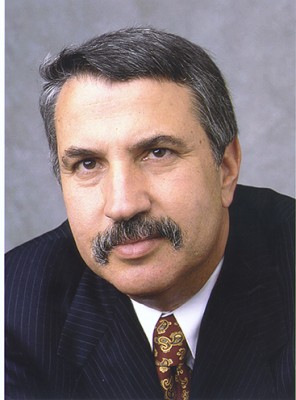
Thomas L. Friedman, a three-time Pulitzer Prize winner for The New York Times, became the newspaper's foreign affairs columnist on the Op-Ed page in January 1995. He had been the chief economic correspondent in The Times' Washington bureau since January 1994. From November 1992 until December 1993, he was the chief White House correspondent, and from January 1989 until November 1992, the chief diplomatic correspondent.
Mr. Friedman joined The Times in May 1981 as a general assignment business reporter, specializing in OPEC and oil-related news. In April 1982, he was appointed Beirut bureau chief, a post he took up six weeks before the Israeli invasion of Lebanon. Over the next 26 months he covered the massacre at the Sabra and Chatilla refugee camps, the bombings of the American embassy and Marine headquarters, the P.L.O. split, and the Israeli withdrawal from Beirut.
In June 1984, Mr. Friedman was transferred from Beirut to Jerusalem, where he became the Israel bureau chief, serving until February 1988. After a leave of absence, until January 1989, he became chief diplomatic correspondent. During his tour there, lasting until May 1981, he covered the coup in Turkey as well as the Iran-Iraq war.
Born in Mineneapolis on July 20, 1953, Mr. Friedman received a B.A. in Mediterranean studies from Brandeis University in 1975. As an undergraduate, he spent semesters abroad at the American University in Cairo and the Hebrew University of Jerusalem; he also took part in a summer internship in intelligence analysis sponsored by the Central Intelligence Agency in Washington. After receiving his B.A., Mr. Friedman attended St. Antony's College, Oxford, on a Marshall Scholarship. In 1978, he received a master of philosophy degree in modern Middle East studies from Oxford.
Mr. Friedman was awarded the 1983 Pulitzer Prize for international reporting (from Lebanon) and the 1988 Pulitzer Prize for international reporting (from Israel). He has also received the 1987 New Israel Fund Award for Outstanding Reporting From Israel; the 1985 Marine Corps Historical Foundation Award, for writing on the history of the Marines; the 1984 New York Newspaper Guild Page One Award; the 1982 George Polk Award; the 1982 Livingston Award for Young Journalists, and the 1980 Overseas Press Club Award.
His book From Beirut to Jerusalem, published by Farrar, Straus & Giroux in 1989, won the 1989 National Book Award for nonfiction. Mr. Friedman also wrote the text for the photographer Micha Bar-Am's book, Israel: A Photobiography, published in 1998 by Simon & Schuster. His most recent book, The Lexus and the Olive Tree: Understanding Globalization, was published in 1999 by Farrar, Straus & Giroux. It has been translated into more than 20 languages and won the 1999 Overseas Press Club Award for the best book on foreign policy.
Mr. Friedman, who is married and has two daughters, lives in Bethesda, MD.