Rutland (VT) Herald, by David Moats
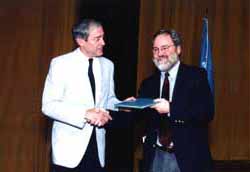
Columbia University President George Rupp (left) presents David Moats with the 2001 Pulitzer Prize for Editorial Writing.
Winning Work
By David Moats
Same-sex marriage was the topic of an extraordinary hearing at the State House Tuesday night when members of the House and Senate Judiciary Committees were urged on the basis of fundamental moral values to do diametrically opposite things.
The committees had called the hearing to allow members of the public the chance to express their views on the issue. Rep. Thomas Little, chairman of the House Judiciary Committee, urged speakers at the hearing to focus on steps they thought the Legislature should take. As they did so, many speakers on both sides of the issue made clear their views were based on religious faith and questions of essential morality.
What is a legislator to do? He is told by one speaker that according to God's law, expressed in the Bible, homosexuality is a sin and same-sex marriage would be an abomination. He is told by the next speaker that divine compassion demands that we treat everyone with respect and that gays and lesbians deserve the right to marry.
Each legislator will have to make up his or her own mind. It is important to remember, however, that our legislators are elected, not to represent a specific religious denomination or to impose a personal moral code. They are elected to represent all the Vermonters within their districts and to follow the secular code embodied in our state constitution and laws. Indeed, our secular democracy is broad enough to allow for the legitimacy and freedom of the diverse and opposing religious viewpoints that were on display Tuesday night.
As legislators have learned on issues such as abortion, the difficulty comes when an issue is so charged with moral significance that political compromise seems to some like moral capitulation.
Supporters of abortion rights say they do not impose their views on anyone by advocating for legal abortions: People who believe abortion is wrong do not have to have an abortion. Nor should they stand in the way of people who do not share their view.
An atmosphere of tolerance, therefore, allows people to make their own choices about what they believe is right. For opponents of abortion, however, tolerance is a cover for state-sanctioned wrongdoing. And because they believe abortion is wrong, they have sought to enact laws putting their own views in the place of the moral laissez-faire that allows individuals to choose what is right or wrong.
On abortion rights some political leaders have been able to rise above the personal to discharge their political duty with the whole of their constituency in mind. Liberal Catholics such as Sen. Patrick Leahy and former Gov. Mario Cuomo of New York have recognized that, even if they believe abortion to be wrong, many others believe otherwise. Freedom of choice thus becomes a way for people to find their own morality.
On the question of same-sex marriage, legislators are faced with another question of choice. The Supreme Court has told the Legislature that the Vermont Constitution requires that same-sex couples have access to the benefits enjoyed by other couples. And it is clear that if the Legislature fails to act, the court will impose its own solution.
Allowing gay and lesbian couples to form either marriage partnerships or domestic partnerships is simply a way of bringing the law into conformance with the constitutional requirement for equal treatment. It is beyond the power of the Legislature to resolve the moral differences that exist today about gay and lesbian relationships and will continue to exist even after same-sex partners gain legal recognition. Those moral differences are for all Vermonters to wrestle with in the privacy of their spiritual domain.
© 2000, Rutland Herald
By David Moats
After two massive public hearings, the House and Senate Judiciary committees have been well-educated on the moral viewpoints guiding those who support and oppose same-sex marriage. The Vermont Legislature will never reconcile the clashing moral absolutes of the two sides. The task now left for the Legislature is a political one.
To transform a fundamental moral question into a political question may seem to partisans on both sides as a corruption. But even leaders of the civil rights movement had constantly to gauge when, where and how hard to push for rights they knew they deserved. The question of how to respond to the Supreme Court's requirement that same-sex couples be granted the benefits of marriage is a moral question that now requires a political response.
The depth of opposition to same-sex marriage is broad and profound. And it is not easy as easy to counter that opposition on moral grounds as it was to counter racism in the civil rights era. The views of many opponents are shaped by ideas of sexuality taught by their religions. These moral teachings, even if one disagrees with them, have a legitimacy that racism does not have.
This opposition creates a political reality that supporters of same-sex marriage cannot ignore. The Supreme Court left the resolution of the question to the political arena, and though the court found that the Vermont Constitution required equality for gays and lesbians, the constitution, too, exists in the political arena.
The Legislature has before it a variety of options, including a constitutional amendment declaring that marriage must involve a man and a woman only. It is unlikely that two-thirds of the Senate would approve such an amendment. But supporters of same-sex marriage must consider the possibilities. What if opposition grows so fierce that same-sex marriage becomes an important election issue in November? It is possible that legislators approving same-sex marriage or domestic partnership would be thrown out of office. A new Legislature might have different ideas about a constitutional amendment.
The people ultimately determine what the constitution says, and it is the constitution that is the foundation of the Supreme Court's decision in the Baker case. That is why supporters of same-sex marriage cannot ignore the politics of the issue.
In the aftermath of the two public hearings at the State House, it is hard to know what the broader public believes on the issue. Gov. Howard Dean has pointed out that the advocates on both sides were the ones motivated to turn out in Montpelier in the dead of winter. He and others are still hoping that a middle ground can be found.
In fact, Vermont is a liberal state with a record of tolerance and respect for human rights. In a recent poll it was only a narrow majority of Vermonters who disagreed with the Supreme Court's decision.
As the discussion moves forward, Vermonters will increasingly get used to the idea that the state has a responsibility to treat fairly those among us who are gay and lesbian.
The problem facing the Legislature is that the two dimensions of marriage - as a civil partnership and as a religious institution - are not separate in the minds of many Vermonters. Getting a marriage license is not the same as getting a driver's license. This fusion of the civil and the sacred has filled the State House with uncommon emotion.
Rep. Thomas Little and Sen. Dick Sears, chairmen of the House and Senate Judiciary committees, have done a good job maintaining the atmosphere of decorum and respect required for this debate. As our political leadership considers the political dimensions of this highly charged moral issue, that atmosphere will be all the more crucial.
© 2000, Rutland Herald
By David Moats
The House Judiciary Committee heard moving testimony last week from one of the lawyers who brought the suit that led to the Supreme Court's decision requiring the state to provide equal benefits to gay and lesbian couples.
The lawyer, Susan Murray, described the pain of people who must listen to frequent and repeated public denunciations of their morality and character. "It's really painful to hear people say, 'You're immoral. You're an abomination,'" Murray said.
Gay and lesbian Vermonters have heard a full range of denunciation in the past several weeks. It is something they have heard all their lives, beginning with common school yard taunts and culminating in the passionate condemnations heard at the two public hearings inside the State House.
Murray used the words of Episcopal Bishop Mary Adelia McLeod in saying, "Gays and lesbians are the only group that are still politically correct to kick."
Sometimes, the attacks on gays are plainly mean-spirited and oblivious to the pain they cause. In some cases an unholy mix of anger and fear suffuse the language of those who condemn gays and lesbians as immoral. These attacks are the equivalent of the fire hoses and police dogs that were turned on civil rights workers in the South in an earlier day. They are a reminder that seeking justice exacts a price.
But opposition to same-sex marriage or domestic partnerships comes in many shadings, and it is useful to distinguish those who hate from those whose opposition has other origins.
Bishop Kenneth Angell has prompted resentment in asserting the Roman Catholic opposition to same-sex marriage. It's helpful, however, to realize that the Catholic position arises, not from bigotry, but from a specific teaching about sexuality, a teaching that a lot of people have difficulty with, including millions of Catholics.
It is the Catholic teaching that sex is a gift meant for the purposes of procreation and that sex indulged in for other reasons is a misuse of that gift. Thus, sex outside of marriage is not condoned. Even sex within marriage when the possibility of procreation has been blocked by birth control is not condoned. Gay sex, in this view, does not fall into the category of permissible sex.
It is possible to disagree with this view while still recognizing it to be a legitimate doctrine of a major religion aimed at providing guidance in the chaotic realm of human sexuality. It may offer some comfort to supporters of same-sex marriage to see through to the humanity of the opposition and to recognize the reasons for opposition are not always founded in bigotry.
At the same time, opponents of same-sex marriage have an obligation to see through to the humanity of a vulnerable minority. Anyone tempted to condemn homosexuality as other than normal ought to consider that it is quite normal that within our population 5 to 10 percent - the number is not important - happen to be gay or lesbian. For each of us, it is normal to be who we are, whether we are heterosexual or homosexual. It has always been that way, and the sooner we recognize it the better.
There are among us already those eager to sharpen the swords of conflict on the issue of same-sex marriage.
But the people of Vermont are in this together. Opponents and supporters of the Supreme Court's ruling are part of the same community, and as the discussion moves forward it is important to cultivate a charitable view of those on the other side. That way, however the issue is resolved, Vermont will be a better place in the end.
© 2000, Rutland Herald
By David Moats
There will be bitterness in the fact of compromise. But a domestic partnership law should be seen as a vehicle for eliminating inequity rather than as a vehicle for imposing discrimination.
Ever since the Supreme Court issued its ruling on same-sex marriage in December, it has been clear the state's political leadership hoped to forestall the wrath of the people by pursuing the option of domestic partnerships for same-sex couples.
The House Judiciary Committee took that step on Wednesday, deciding by a vote of 8-3 to support domestic partnerships as it begins the job of drafting legislation.
Supporters of same-sex marriage are disappointed, reasoning that any option short of marriage treats gays and lesbians as second-class citizens. But the president of a group opposed to same-sex marriage had a different view. In describing why she also opposed domestic partnership, she said: "If it looks like marriage, acts like marriage and talks like marriage, it's marriage."
Domestic partnership ought to look like marriage. It could even be connected to marriage. The Legislature could provide that one of the means of securing legal standing as domestic partners would be a marriage certificate from one of the religious faiths now willing to marry same-sex couples.
In choosing to pursue domestic partnerships, the committee is aware of the disappointment that will be felt by those who believe that treating heterosexual and homosexual couples differently creates a stigma. The sting of that disappointment may be lessened by considering the pluses and minuses of each approach.
It is likely that either domestic partnerships or marriage would satisfy the substance of the demand by the Supreme Court that same-sex couples receive benefits equal to those enjoyed by heterosexual married couples. Marriage, however, would go further than domestic partnerships, granting a victory of principle and using the imprimatur of the state to erase the stigma attached to same-sex unions.
But the stigma, at least in some people's minds, won't be erased so easily. Resistance to same-sex marriage among Vermonters is widely felt and deeply ingrained. Some of it is grounded in homophobia, ignorance and fear. Some of it is grounded in good faith differences about sexuality and marriage.
The court left the burden of choice to the Legislature. By opting at this stage for same-sex marriage, the Legislature would bequeath to gay and lesbian Vermonters the equal benefits they seek and a victory of principle, plus an atmosphere of exaggerated bitterness and hate. By opting for domestic partnerships, the Legislature provides the benefits, minus that victory of principle, but minus also the bitterness.
There will be bitterness in the fact of compromise. But a domestic partnership law should be seen as a vehicle for eliminating inequity rather than as a vehicle for imposing discrimination. Laws creating separate schools for African-Americans were a ruse designed to perpetuate discrimination. Vermont's domestic partnership law could be a wedge to open up the laws for greater equality.
Compromise on a matter of principle is harder if one believes one's opponents are absolutely wrong. But if one can accept the fact of honest differences, then compromise is more palatable.
On the idea of gay marriage legislators would be hard-pressed not to recognize a wide divergence of views, honestly arrived at, among Vermonters. For them to ignore those differences would leave them open to charges of arrogance, and they would be vulnerable at the polls.
Political survival, of course, should not be the highest priority when it comes to matters of principle, but the perception of arrogance could lead to a destructive backlash.
The brilliance of the ruling by Chief Justice Jeffrey Amestoy was that it allowed the people themselves to address head on these questions of politics and principle as they resolve the issue of same-sex marriage. The House Judiciary Committee has made a conscientious start.
© 2000, Rutland Herald
By David Moats
The House this week is due to take up the bill establishing legal recognition for the civil union of same-sex couples, and more than a few legislators face the prospect of voting contrary to the expressed view of their constituents.
About 50 towns voted at town meeting on same-sex marriage. Voters nowhere approved marriage for gay and lesbian couples, but 11 towns out of 49 voted in favor of domestic partnerships.
The aggregate vote total on the issue was about 15,000 opposed to benefits for same-sex couples and about 10,000 in favor.
Some opponents have vowed to take revenge against representatives who disregard the vote of the people by voting to support civil unions. It is by no means clear, however, that the margin of difference is so vast that defeat of anyone based on this issue is assured.
Politicians frequently face criticism because they pay attention only to the polls. Those who do so are accused of being followers rather than leaders.
A sort of poll has now been taken on the issue of same-sex marriage. Are our politicians supposed to surrender their judgment so as to mirror the town meeting ballot results? On that question the famous quote from Edmund Burke is in order: "Your representative owes you, not his industry only, but his judgment; and he betrays instead of serving you if he sacrifices it to your opinion."
Moreover, the ballot questions faced by voters on Town Meeting Day were not the best reflection of the realities to be faced by the House members. Voters were asked whether they favored same-sex marriage or domestic partnerships. House members face a different question, which might be phrased as follows: Do you favor civil unions in light of the fact that the Supreme Court has said that civil unions or marriages are necessary to redress injustice and in light of the fact that if you don't approve civil unions the court will probably imposed same-sex marriage?
In addition, most of those who voted on Town Meeting Day were probably not aware that the bill before the House contains a paragraph stating that marriage exists only between a man and a woman. Would all those town meeting voters have voted no to a proposal defining marriage in that manner and extending benefits to same-sex couples as well?
These imponderables show only that the town meeting vote was not definitive. Whether or not it was definitive, House members now must do what elected representatives are meant to do. They have listened to testimony and studied the question. And in many cases House members inclined to oppose civil unions were persuaded that the bill before the House is fair and necessary.
The raw numbers may scare some representatives who feat their political future. Others are determined to vote their consciences, knowing that their duty is not merely to follow the numbers but to exercise leadership. The House should support the bill establishing civil unions. It is an honorable compromise between the requirements of the law and the cherished institutions of the people.
© 2000, Rutland Herald
By David Moats
The Vermont House of Representatives took a courageous step Wednesday in giving preliminary approval to a bill providing for civil unions between same-sex couples.
The events of the past two and a half months have been an example of extraordinary lawmaking. Republicans and Democrats joined together to respond to a constitutional mandate. The confidence of their own convictions ought to serve as their best shield against criticism. The swift, sure action they have taken ought to serve as the best protection against the deep division that a protracted conflict would create.
Two people stood out in the debate that preceded the vote Wednesday evening. One was Rep. Thomas Little, the Shelburne Republican who shepherded the bill through the House Judiciary Committee and to the floor of the House. His reasoned, low-key approach to the task kept the debate focused and properly restrained. His conviction in the rightness of his course can only have helped to stiffen the courage of fellow House members.
The other was Rep. William Lippert, a Democrat from Hinesburg, who spoke before a vote was taken, defeating an amendment that would have diluted and weakened the bill.
As Lippert began to speak Wednesday, the House fell silent. Lippert, who is gay, spoke with dignity and with passion. He began by saying it was important for his fellow House members to understand reality.
Gay relationships, he said, are in some ways "miracles" because they manage to take shape within an atmosphere of unremitting prejudice. He asked his fellow House members to imagine how difficult it would be for them to form lasting relationships in such circumstances. He said gay relationships represented a "triumph against discrimination and prejudice."
Lippert said that until two and a half months ago he believed Vermont had made great progress in guaranteeing gay rights. But in the last two and half months, he said, "I have been called names in this chamber and in this building the likes of which I have never seen in my life." He understood that his fellow House members had been subjected to a similar barrage of hate. "I wouldn't have wished this on any of them," he said.
He said he felt, in these circumstances, it was strange to ask, "Should we get our rights now, or should we wait a little longer, or should we ask all the people whether we should get our rights."
He spoke of the burden that the AIDS epidemic had placed on gays. "Don't tell me what a committed relationship is and isn't," he said. The emotional power of Lippert's message combined with Little's reasoned approach to the task were hard for the House to resist.
The House turned aside amendments that would have delayed their decision, either by calling for a constitutional convention or an advisory referendum. Opponents said the people wanted a say on the issue.
But House members already know that a majority probably opposes the action they have taken. Two extraordinary public hearings allowed the public an unprecedented opportunity to express its views, and the volume of mail to the Legislature and to the press has provided the Legislature with a full spectrum of opinion. Votes on Town Meeting Day showed continuing opposition to same-sex marriage or civil unions.
What the House required was not more finely calibrated gauges of public opinion, but the power to weigh the opinion it heard against the requirements of the law. In the end, that is what the House did.
It is likely that, if this bill becomes law, Vermonters will recognize they have lost nothing by extending fair treatment to neighbors who have had to conduct their personal lives in a shadow of discrimination. Vermonters, in the end, will appreciate the leadership shown by the House on Wednesday.
© 2000, Rutland Herald
By David Moats
Some readers have expressed concern that the Herald has carried a series of political advertisements using innuendo and distortion to attack Gov. Howard Dean on the issue of civil unions for same-sex couples. One letter writer was dismayed that the Herald "supported" such advertisements.
It may be helpful for readers to know that political advertising is a service available to the community without regard to point of view. The Herald does not censor the political advertising it publishes. Nor does the Herald endorse it.
The result is that over time political advertising containing widely varying views will be carried in the paper. Some of it will be offensive and outrageous, but it is up to the public to make that determination. Freedom of speech means that all kinds of speech are placed before the public in a clamorous and open marketplace of ideas. Individual readers will decide which ideas to buy. It is not the Herald's role to decide for them by excluding ideas deemed to be offensive.
Readers of the Herald's editorials know where the Herald stands editorially on the issue of same-sex marriage. Our editorials have strongly endorsed the action of the House in passing legislation allowing for the civil unions of same-sex couples.
That view is expressed in the editorial column. It is not the paper's purpose to impose that view either on the letters to the editor page or in the content of our political advertising. The wide diversity of views contained on those pages demonstrates what is meant by the phrase "marketplace of ideas."
It could happen that a political ad would be so blatantly false, homophobic, racist, or otherwise offensive that the paper could not in good conscience print it. The paper reserves that right. But there is a wide range of speech that may, in our view, be motivated by homophobia or racism without crossing into the territory of the impermissibly tasteless or offensive. It is not the Herald's purpose to limit that wide range of political speech.
A recent news story described the controversy created in San Luis Obispo, Calif., when the publisher of a newspaper there decided he would accept no advertising or cover any news that in his view promoted abortion or gay rights. Using the Herald in that way to further a particular viewpoint, even a viewpoint favored on the editorial page, is not the Herald's purpose.
There is a great benefit to democracy by allowing for the expression of extreme points of view. Suppressing extreme speech only drives it underground where it becomes more dangerous. The free expression of extreme speech is a sign that we are not afraid of democracy, that we are confident a good idea is the best corrective for a bad one.
Another benefit of allowing the expression of extreme speech is that it allows the public to see extremists for what they are. A person full of hate is his own worst enemy. Freedom of speech exposes his hate for all to see.
The present discussion of same-sex unions is testing the confidence and convictions of people on all sides. It has been useful, however, that all sides have had a hearing. A process that is open to all points of view leads to a legitimate result.
Supreme Court Justice Louis Brandeis wrote in a famous dissent that the Founding Fathers "believed liberty to be the secret of happiness and courage to be the secret of liberty."
It requires courage, and also forbearance, to engage in the clash of ideas, but it is the clash of ideas that gives effect to our freedom and ensures the health of our free society.
© 2000, Rutland Herald
By David Moats
One of the most commonly heard complaints about House actions on civil unions is that House members have not listened to the people.
The House, responding to a Supreme Court ruling, has passed a bill allowing for civil unions for same-sex couples. The Senate will take up a similar bill soon. The charge that House members did not listen to the people arises in part from town meeting votes in which people in some towns expressed their disapproval of same-sex marriage or civil unions
The assumption is that, unless legislators heed the perceived will of the majority, they have not listened. To the contrary, however, House members and senators have done an extraordinary amount of listening. The outpouring of sentiment on all sides has been voluminous, and an awareness that civil unions are unpopular has certainly not been lost on members of the Legislature.
In considering the actions of their legislators, however, private citizens might ask themselves how they make up their own minds on important public questions. How many of us would be proud of admitting that, in determining what is right or wrong, we allow our minds to be made up by our neighbors? Doesn't the individual citizen form his convictions on the basis of his own values and his assessment of the public good? How could any of us say we have convictions at all if we were to let the majority of our neighbors determine what our convictions are?
A legislator has a greater responsibility than an individual citizen in making decisions on public issues. The legislator has to take into consideration the views of the public and to balance public opinion with his or her own reading of the public good. But to ask our legislators to surrender their judgment in order to reflect the shifting shape of public opinion is to ask them to leave at home the very qualities for which we elect them to office: their intelligence, judgment, sensitivity, and courage.
Members of the Legislature have listened to the public, and what they have heard is complex. As they listened, they heard, among other things, that it is fair and decent to treat all Vermonters with compassion and not to exclude same-sex couples from the benefits that attach to marriage. The House wouldn't have passed the bill it passed if members hadn't been listening to Vermonters who said these things. Nor would they have passed the bill they passed if they had checked their judgment at the door and allowed themselves to be swayed by the majoritarian winds.
There is a segment of the population that will never accept civil unions for same-sex couples. One of the fundamental divides on the issue has to do with people's understanding of homosexuality. Some people believe homosexuality is a choice and that those who choose it are immoral. The actions of the Supreme Court and the House are premised on another view: that sexual orientation is a condition, like left- or right-handedness and that sexual orientation is no justification for condemning a segment of society to pariah's status.
Some people will never be reconciled to that view. But the moral condemnation of homosexuality has not prevailed. Rather, a Legislature that has listened to the many voices of Vermont is moving toward a conclusion that humanity is diverse and that fair treatment for all should be the goal.
Supporters of civil unions have shown exemplary courage in heeding the call of conscience, but it is not fair to say that they have a corner on conscience. Conscience is active on both sides of the question.
As the Senate nears a vote on civil unions, senators have the job of hearing what Vermonters say and then putting the question to test of their convictions. That is all anyone could ask.
© 2000, Rutland Herald
By David Moats
One of Vermont's weekly newspapers recently carried a letter to the editor, like others that have been seen in recent weeks, condemning homosexuality as a disordered state and criticizing the movement to give it the imprimatur of public approval through the creation of civil unions for same-sex couples.
The same edition of the paper happened to carry the obituary of a man who for many years had been a pillar of his town. He was a Navy veteran, an educator, a business owner, chairman of his school board, president of the Chamber of Commerce, clerk of the fire district, president of the museum, and a philanthropist who gave land for a town park. At the end of the obituary it said he was survived by his partner of 56 years.
The two don't compute. On the one hand, there is a beloved local figure who for decades worked to make his community a better place. On the other, there is an eagerness to condemn him for the relationship that was central to his life.
The emotional tenor of the debate about civil unions has gained intensity because people's moral beliefs about sexuality are often deeply felt. Also deeply felt is the sense many have that it is wrong to denigrate people who have lived exemplary lives by submitting them to the cross-examination of someone else's moral code.
The state Senate is scheduled to take up the civil unions bill today. The Senate Judiciary Committee has given the matter careful consideration under the conscientious chairmanship of Sen. Dick Sears.
Votes are easier to count in the Senate than in the House, and approval in the Senate is expected. Of course, the Senate may opt to adopt the bill passed by the House instead of the bill developed by the Judiciary Committee. That course would avoid the need to call a conference committee to resolve the differences between House and Senate bills and avoid revotes in both houses.
Either bill would serve. Neither bill harms traditional marriage between a man and a woman. Both bills recognize that gay and lesbian relationships exist and that gays and lesbians who are committed to one another ought to be accorded certain rights and responsibilities.
A constitutional amendment has been forwarded to the Senate floor which would strip the Supreme Court of the power to require equal treatment for same-sex couples. The amendment is not necessary.
Rep. Tom Little, chairman of the House Judiciary Committee, stated that the civil union bill was a good bill, not because it satisfied the demands of the Supreme Court, but because it was the right thing to do.
The Senate is poised to do the right thing today. Its action, and the action of the House, were impelled by the Supreme Court decision, but the court's decision was impelled by the demands of justice.
Many Vermonters will be disappointed by the Senate's approval of the bill, believing that legitimizing civil unions will further habits of immorality. But the civil unions bill is based on the premise that it is not ours as a state to judge the morality or immorality of private relationships. We are all free to form our judgments about sexuality, love, and family and to live our lives as we see fit.
It is our responsibility, however, to conduct public policy in a way that does not consign a portion of the public to a policy ghetto, forbidden to enjoy the rights that are accorded to others.
Senate approval of the bill for civil unions will open that ghetto and establish a policy of fairness for same-sex couples in Vermont. In time that attitude of fairness will seem as natural as the shining of the sun.
© 2000, Rutland Herald
By David Moats
The issue was not about biological theories of homosexuality. It was not about the dictates of one religion or another. It was about ordinary Vermonters who wanted to share in rights and responsibilities they had long been denied.
The House on Tuesday gave final approval to the bill establishing civil unions for same-sex couples, and with the signature of Gov. Howard Dean, the bill will become law.
The Senate had made some changes in the bill, and the House approved those changes on Tuesday. The majorities in the House and Senate understand that opposition among Vermonters is broad and deep, but they can take solace in the knowledge that on a difficult and emotionally fraught issue they did the right thing.
Two events shaped the nature of the debate about civil unions. The first occurred when the House and Senate Judiciary Committees held extraordinary public hearings at the State House to which hundreds of Vermonters on both sides of the issue came to express their views.
One of the results of those hearings was that legislators and Vermonters who listened or watched became acquainted, maybe for the first time, with their gay and lesbian neighbors. They could see what the issue was about.
The issue was not about biological theories of homosexuality. It was not about the dictates of one religion or another. It was about ordinary Vermonters who wanted to share in rights and responsibilities they had long been denied. These were not people with an agenda other than the agenda every Vermonter shares: the desire for equal treatment under the law.
Fears about a homosexual agenda or about a flamboyant and alien gay lifestyle diminished before the sight of hundreds of honest and sincere Vermonters seeking fair treatment from fellow Vermonters.
The other event shaping the debate was the town meeting voting on March 7 when about 50 towns voted on same-sex marriage or domestic partnership or both. No town voted in favor of same-sex marriage, and only a handful approved of domestic partnership. The town meeting balloting created the impression of a broad consensus in opposition to the civil unions bill. That impression has added an edge of anger to the complaints of opponents who believe the Legislature has ignored the will of the people.
It's hard to determine the will of the people from partial voting on Town Meeting Day. In the aggregate about 15,000 voters opposed and about 10,000 voters supported some sort of same-sex union. What would the result have been if voters from Burlington had voted? No one knows. No one can deny that civil unions are unpopular, but it is impossible to discern a decisive consensus from voting as incomplete as that on Town Meeting Day. Most public opinion polls show that the margin is close, though tilting against civil unions.
The effect of the voting, however, was to give ammunition to opponents of the measure, and it is likely that Republicans in the coming campaign will use the new law as a sign that the present Legislature and governor are out of touch with the people.
That will be the political aftermath. The actual aftermath of the law's passage is likely to be somewhat anticlimactic. Gay and lesbian couples will continue to live together quietly, as they have been for years; the difference is that some will go down to their town clerks for certificates that will allow them to receive fair treatment under the laws.
The majority of Vermonters will still have the right to form judgments on the morality of homosexuality. But those private judgments will no longer form a basis for the legal exclusion of gays and lesbians from the rights and responsibilities of marriage.
People on both sides of the issue have been troubled by things said on the other side. Supporters have been aghast at the mean-spirited bigotry of some extremists. Opponents have been dismayed by the assumption of moral superiority by those who believe all opponents are bigots.
But the conduct of the Legislature is reason to take heart. Legislators on both sides of the issue worked from conviction and maintained a respectful atmosphere. That includes the two chairmen, Rep. Thomas Little and Sen. Richard Sears, as well as opponents such as Reps. Peg Flory and Walter Freed. And it includes legislators willing to endure insults and abuse and to risk their political futures for doing what they believe is right.
Let us hope that Vermonters of diverse views appreciate and respect the courage and leadership provided by the Vermont Legislature on this trying question.
© 2000, Rutland Herald
Biography
David Moats has been editorial page editor of the Rutland Herald since 1992. Previously, he worked as wire editor, state editor, assistant managing editor and city editor of the Herald.
He was born in 1947 in Salt Lake City, Utah. He received a bachelor's degree in English from the University of California at Santa Barbara in 1969. From 1969 to 1972, he served as a Peace Corps volunteer in Afghanistan.
He is also the author of 11 plays. Four of his plays have been produced by theater companies in Vermont. One of them, entitled "Hard News," won the Vermont Playwright's Award in 1988 from the Valley Players in Waitsfield, VT.
He lives in Middlebury, Vt., and is the father of three children, Jared, Thatcher, and Nina Moats.