The Riverdale (NY) Press, by Bernard L. Stein
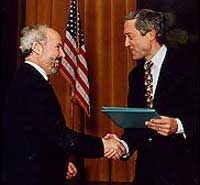
Columbia University President, George Rupp (right), presents Bernard L. Stein with the Pulitzer Prize for Editorial Writing.
Winning Work
By Bernard L. Stein
One of the things Peter Mott's students learn in his biology class at Fieldston School is that he thinks numbers are important. He's been known to have them count the number of fallen leaves on a particular patch of ground.
For many years, Mr. Mott himself has been counting birds on the Fieldston campus. That's hardly surprising, since he is also the president of the New York Audubon Society. His observations form the basis of a recently completed scientific paper, and also of his column in the January-February issue of The Urban Audubon, the Society's newsletter.
They lead him to a surprising conclusion, one that can help illuminate this area's perennial battle to preserve green and open space and demonstrate that what's at stake are neither selfish nor parochial concerns.
As he walked to work along Riverdale Avenue one morning in May, 1985, Mr. Mott recalls in his Urban Audubon column, he heard the distinctive song of the parula warbler coming from a tree on the Fieldston campus. For 11 years thereafter, he watched the five-acre area behind the school library during the migratory season.
Between April 25 and June 5 of those years, he observed 25 species of warbler, including the mourning warbler, a somberly fledged bird spotted infrequently enough to cause John Kieran to exclaim over sightings in Van Cortlandt Park 40 years ago. Nine species have come to Fieldston every year; another six have missed only a year or two; and all of them have visited for at least two years. "If you come to visit on the busiest day of migration, day 130, you could expect to find up to eleven species," Mr. Mott reports.
The plot he surveilled constitutes no urban Eden. It's a rather shabby patch of ground concealing a small parking lot from which a rutted track leads to well-tended tennis courts and to abandoned older courts that have fallen into ruin.
The trees that dot the landscape are scruffy. Most are thin and some are twisted; they are remarkable more for what they say about nature's tenacity than its beauty. A pair has pushed through the asphalt to grow in the doubles alley of a disused tennis court. Another, struggling to find sun, has bent through a chain link fence, and has burst the links as it continued to grow.
But Beth Robinson, one of Mr. Mott's students, established the importance of these slatternly trees to the bird life they shelter and nourish. True to her teacher's methods, she counted the trees in the little woodland. There are 400 of them, and 69 percent are oaks, the warblers' favorite tree. The spent 92 percent of their time in the oaks, she found.
She also noted that different species used different portions of the trees for cover. The mourning warblers favored the underbrush, as did the yellowthroats and five other species. All but two species spent time in the suckers that are trimmed away by landscapers and home gardeners concerned with the appearance of specimen trees.
"The 'Fieldston Warblers' are a delight," Mr. Mott writes. "They please and they raise another questions. How important are these patches? How many of these pockets are there in the city? What will happen if they go?"
Can they, he wonders, be as important cumulatively as the larger oases being classified as Important Bird Areas, places like Jamaica Bay and Central Park? Should the, he asks, be identified and protected in the same way?
Isn't this just another way of sounding the same warning the Riverdale Nature Preservancy sounded when it found that if Riverdale's institutions, including Fieldston School, expanded to the maximum allowed by their acreage they would add more than 8.6 million square feet of buildings? Isn't it just another way of saying what opponents of building a massive filtration plant in the Jerome Park Reservoir have been saying?
For decades, Riverdalians have struggled to strike a balance between development and open space. For decades, their instincts have told them what Mr. Mott's study tells him: how valuable, how nourishing a patch of green is, and how much it contributes to the human endeavors in its midst.
© 1997, The Riverdale Press
By Bernard L. Stein
It is, perhaps, understandable that the railroad doesn't want to be bothered with looking for ways that people could safely share the site. But it passes comprehension that the Parks Department would so willingly acquiesce in their exclusion.
A stiff breeze ruffled the Hudson River one morning early this week, sending white-topped wavelets scudding inshore and setting a lone swimming bird bobbing on the swell. The steel-blue water reflected fat clouds and the towering Palisades, the cliffs austere in their winter cloak of granite.
Just gazing at the river from the platform of the Spuyten Duyvil train station made the heart sing. Imagine if Riverdale were no longer cut off from that beauty. Imagine a Hudson able to feed the minds and spirits of New Yorkers as it once fed their bellies and pocketbooks.
The possibility of realizing the dream so many have dreamed for so long is very real. But a Parks Department suffering from amnesia threatens it.
The Department has endorsed a scheme to create artificial wetlands in the Harlem River alongside the train station and Spuyten Duyvil Shorefront Park. $365,000 in the capital budget for parks would extend the bridge used by commuters to reach the station platforms across the railroad tracks. But the Parks Department's chief planner said last week that he did not envision using the bridge to give people access to the largest plot of land west of the train tracks, the Spuyten Duyvil Triangle at the confluence of the Harlem and Hudson.
In so cavalierly dismissing the possibility of access to the Triangle, Stephen Whitehouse, director of planning for the Parks Department, squandered not only decades of citizen efforts to gain access to the Hudson, but the quite recent work and promises of New York City's government.
Indeed, the funds to extend the bridge at Spuyten Duyvil Station are in the capital budget because they city envisioned using the Triangle as park land.
In 1987, the Parks Department under Commissioner Henry Stern threatened to take Metro-North to court in insure access to the Hudson's shore. "We want the public to have access to the river, and we'll do anything to get that done," said the Department's lawyer.
Three years later, the Dinkins Administration began discussions with Penn Central Corp., which owns the air rights to the Triangle, to lay the foundation for a purchase. Parks Commissioner Betsy Gotbaum told The Press the land was pivotal to New Yorkers' hopes for the Greenway.
The failure of Mario Cuomo's environmental bond issue disrupted plans to purchase the site from Penn Central, but the city's 1993 Plan for the Bronx Waterfront, which used a picture of the Henry Hudson Bridge, Spuyten Duyvil station, and the Triangle on its cover, asserted that the "most important waterfront issues" in Riverdale and Spuyten Duyvil "relate to the need for increased public access." It recommended emphatically that the city acquire the Triangle and add its five acres to Spuyten Duyvil Shorefront Park. "Pedestrian access to the site could be provided by extending the overpass at the Spuyten Duyvil railroad station," it added.
In 1995, just after the State Legislature voted to include New York City in the Greenway, local elected officials and community activists toured the Triangle. State Senator Guy Velella said he was confident that state funds should be found to acquire the site.
Metro-North has ambitious plans to reroute commuter trains to Penn Station. It wants to restore disused tracks in the Triangle leading to the swing bridge at the mouth of the Harlem to send its Harlem Line trains down the West Side.
It is, perhaps, understandable that the railroad doesn't want to be bothered with looking for ways that people could safely share the site. But it passes comprehension that the Parks Department would so willingly acquiesce in their exclusion.
It would be absurd to build the bridge to the Triangle only to build a fence at its foot. Riverdalians have not struggled for 30 years to rescue the shorefront from development to be confronted at the last by an ugly barbed-wire-topped chain link fence at the banks of the Hudson.
Nor is this merely a Riverdale issue. At stake is the possibility of opening the city's shoreline to all New Yorkers, instead of forcing the Greenway to an upland route.
How the Triangle can be used both by the railroad and for recreation is a dilemma. To solve it, someone has to think seriously about how to achieve that goal.
The Parks Council confronted a similar problem at the Jerome Park Reservoir, and hired a landscape architect who solved it elegantly. The Council is a partner in the Harlem River Restoration project. Perhaps it could lend its expertise again.
The Hudson River Valley Greenways Council makes grants to further the goal of river access. It could be a source of funds to employ a park designer to study the Triangle.
With plans being made to build the bridge, the time to begin such a study is now. It would serve to remind the Parks Department that the Spuyten Duyvil Triangle offers an opportunity to complete the most visionary and majestic public space of our time, a necklace of green along a great river that restores the Hudson to the people.
© 1997, The Riverdale Press
By Bernard L. Stein
Every day when those of us who are parents say good-bye to our children, a little tooth of anxiety gnaws at us until we see them again. No matter how old or how mature they are, no matter how confident we are that we have prepared them for the traps the world sets, deep down we fear that something terrible will happen to those we love.
For one family of Riverdalians, the call every parent dreads came last week, when their 17-year-old son was waylaid, threatened, terrified, and humiliated in North Riverdale in broad daylight.
The young man wasn't mugged. What happened to him was far worse. He was attacked because of the color of his skin.
A middle-aged white man who claimed to be a police officer stopped the young man on Spencer Avenue by brandishing a gun. He pushed him up against a parked car, forcing him to assume the position of a suspected criminal, and peppered him with questions about what someone who looked like him would be doing in a neighborhood like North Riverdale (the neighborhood where the young man has lived all his life). "If you ever come into this neighborhood again," he threatened, "I'll kill you."
In a cry for justice addressed to Mayor Rudolph Giuliani, the young man's mother asks, "What are the leaders of this city going to do about restoring my son's confidence? What are we supposed to tell him after training him to respect all authority? Our son is a sensitive young man who celebrated the diversity of his community . . . What do we do for him now? He's afraid to walk in his own neighborhood."
Three and a half years ago, hoodlums assaulted a group of young Orthodox Jewish students at the 235th Street overpass, taunting them with epithets. Hundreds of residents flocked to a rally organized by Rabbi Avi Weiss of the Hebrew Institute two days later. Mayor David Dinkins dispatched the city's Human Rights Commissioner to express his concern. Borough President Fernando Ferrer, Councilwoman June Eisland, two members of the State Assembly, and representatives of Congressman Eliot Engel and mayoral candidate Rudolph Giuliani spoke. The clergy turned out in a body. The entire community made its revulsion at bigotry clear.
By contrast, virtual silence has greeted last week's incident. Councilwoman June Eisland and Assemblyman Jeffrey Dinowitz have contacted the family and expressed their outrage. After the young man's mother followed up her letter with a phone call, Bronx Borough President Fernando Ferrer's office called back. But at press time, nine days after the victim's mother appealed to the Mayor, neither he nor his police commissioner have responded. And no other community leader has come forward to voice concern or compassion.
As a community, we need to answer the young man's mother's questions. We need to assure her son that he is welcome here. We need to promise him that we won't assume a black man must be up to no good. In our homes and schools, we need to tell his story to our children, so that they'll understand that racism is not a phenomenon of America's past but a present threat to our own lives.
The thugs who assaulted this young man insulted all of us. They assumed we would applaud what they did, or at least regard it with indifference. Don't let our silence prove them right.
© 1997, The Riverdale Press
By Bernard L. Stein
Sid Davidoff's law firm is the Boston Celtics of New York City politics. It may be struggling just now, but it's remembered for one of the longest winning streaks in municipal annals, when the former aide to Mayor John Lindsay, buddy of Queens Borough President Donald Manes, and tennis partner of Mayor David Dinkins could procure a contract, license, zoning variance, or permit with a phone call.
In 1990, Mr. Davidoff explained his long reign as the city's top lobbyist to Newsday this way: "The government doesn't change that much when the top of government moves.... The government still is the same basic set of rules."
That's a proposition Rudolph W. Giuliani disputed when he set out to become Mayor. He lambasted David Dinkins, and rightly so, for his tennis dates with Mr. Davidoff. When Mr. Davidoff paid for First Deputy Mayor Norman Steisel's Miami vacation, Rudy didn't accept the explanation that the two were close personal friends who didn't talk shop when they socialized together.
More recently, however, the Mayor has denounced news stories about the lobbying of Riverdalian Raymond Harding and former Riverdalian Herman Badillo, who, The Times reported, "have built a prosperous lobbying business at their law firm even as they continue to serve as close advisers to Mr. Giuliani."
Five years ago, the same paper reported that "One of every three dollars in new lobbying money was paid to the law firm . . . headed by Sid Davidoff," whom it described as "tennis partner, friend and sometime adviser to Mr. Dinkins."
Not only doesn't the government change, even the excuses remain the same.
In 1991, Mr. Dinkins said Mr. Davidoff had never lobbied him personally. "All matters are considered on the merits," he asserted. Last week, Deputy Mayor Fran Reiter, Mr. Harding's Liberal Party protege, said she did not talk to her mentor about matters involving clients, and a testy Mayor Giuliani insisted that people who hire lobbyists "do not get an edge."
No one who has observed how government works will believe that, any more than they will believe that because Mr. Harding and Mr. Badillo have now said they will no longer personally lobby for clients, the law firm of Fishbein Badillo Wagner Harding no longer has an inside track at City Hall.
Those who lobby the executive branch are paid for knowing whom to call and knowing their calls will be returned. They are paid for gaining a respectful hearing from commissioners, deputy commissioners, and staff members who decide how contracts and requests for proposals shall be worded, and who are responsible for creating or unlocking administrative log jams.
"The people who are my advisers are following the law, the letter and spirit, in every respect," the Mayor pronounced last week. He did not accept that reasoning in the Koch or Dinkins years.
Although the City Conflict of Interest Board cleared Mr. Steisel of wrongdoing, Mr. Giuliani made Mr. Davidoff a campaign issue.
In a pivotal moment in his cross-examination of Bronx Democratic leader Stanley Friedman, United States Attorney Giuliani asked about a phone call Mr. Friedman made to facilitate a city lease. You got paid $10,000 for making a couple of phone calls, didn't you, the prosecutor asked. "It was just one phone call," the boastful Friedman replied. The answer was his undoing. Although there was nothing illegal about the call, his defiant cockiness showed the jury the seamy underside of New York City government, where access is often indistinguishable from sleaze.
In those days Rudolph Giuliani understood that what you had a right to do wasn't identical to what was right to do.
Now, however, he has developed what might be called the Mayor's blindspot--an affliction that prevents the occupants of City Hall from seeing ethical lapses.
But what the eye can't see, the nose should still be able to detect. When a political associate trades on his personal relationship to those in power to enrich himself, that smells.
Mayor Giuliani has only to think back to his triumphs in the courtroom to recognize the odor.
© 1997, The Riverdale Press
By Bernard L. Stein
"I inform the proud Muslim people of the world that the author of The Satanic Verses book which is against Islam, the Prophet and the Koran, and all involved in its publication who were aware of its content, are sentenced to death."
-- Ayatollah Ruhollah Khomeini, February, 1989
In The Satanic Verses, the Ayatollah Khomeini is portrayed as the enemy of time. "We will make a revolution," he proclaims, "against history . . . the intoxicant, the creation of the Devil, of the great Shaitan, the greatest of the lies--progress, science, rights." His disciple--a satiric rendering of rock singer Cat Stevens--sings "Burn the books and trust the Book; shred the papers and hear the Word."
Salman Rushdie has learned a great deal in the eight years since the Ayatollah's decree made him a marked man, but he had already understood why the right to speak freely is democracy's most fundamental right, the cornerstone of our freedom. He already understood that words and the ideas they convey offer us the possibility of change, and that without that possibility, self-government is a meaningless concept.
"In totalitarian societies," said Rushdie in one of his guerrilla speeches when he emerges briefly from hiding and as quickly disappears again, "there is always an attempt to replace the many truths of freedom by the one truth of power, be it secular or religious power. Totalitarian regimes seek to halt the motion of society."
That is why what happens to Rushdie should matter to all of us, why his fate transcends the issue of his personality, his religion, or his literary merit, all of which have been invoked to his discredit. Whether Salman Rushdie can go to the corner newsstand for a paper, book a table in his own name at a restaurant, or announce a speaking engagement in advance is a measure not only of his freedom but of ours. It will tell us whether we can really read what we please, whether we can grapple with ideas as we wish, whether we can be changed and make change.
So it is a pity that the anniversary of the Ayatollah's death sentence passed so quietly this year. The author published an op-ed piece on his plight in The Times; CNN took notice of his existence; but the storm of articles and appeals that characterized years past dwindled to a drizzle.
It would be comforting to think that the author no longer needs defending, that the fact that eight years have passed, that the Ayatollah is dead, and that Rushdie has grown bolder shows the danger has past. But a bounty of millions remains on the novelist's head and he continues to live underground.
Moreover only eight years ago this nation's largest bookstore chains withdrew the book from their shelves in the face of threats. More recently, Penguin refused to publish a paperback edition, leaving the task to an underground consortium out of fear of reprisals. What that says about the state of our own freedom is not comforting.
"How fragile civilization is; how easily, how merrily a book burns!" wrote Salman Rushdie as he watched Moslem demonstrators in York consign The Satanic Verses to the flames. The need to defend our fragile civilization remains undiminished. The ashes are not yet cold.
© 1997, The Riverdale Press
By Bernard L. Stein
In a city where racial divisions are an open sore as raw as anywhere in the country, New York's mayors are doomed to be defined by racial strife.
Howard Beach summed up the years of coded insults directed at the city's black and Latino residents during the Koch years. Crown Heights fixed an image of David Dinkins as a remote and ineffectual leader who was slow to crack down on black criminals.
Now, as we enter the last months of Rudolph Giuliani's first term, comes the torture of a Haitian immigrant at the hands of white police officers in Brooklyn.
Anyone who has been in a precinct house knows that what happened to Abner Louima can not be explained as the isolated action of a couple of officers run amuck. The idea that a man can have a wooden rod rammed up his rectum and then have his teeth knocked out with the bloody, excrement-covered club without the other officers on duty knowing it is absurd. The cover-up that followed can only be explained as a precinct-wide conspiracy.
No one can doubt the genuine horror and revulsion Mayor Giuliani feels at the disgusting brutalization of Abner Louima. But this horrible incident is the culmination of years of giving police officers accused of brutality and racism the benefit of the doubt. It is consistent with the Mayor's macho public persona and with his Police Department's policy of rewarding officers who project an unyielding, no-nonsense image that mirrors the Mayor's own.
Police officers know what all New Yorkers know: that Giuliani's New York is a better place for white people than for black people. They know that for four years Mr. Giuliani has rejected efforts to create an independent investigative agency to respond to accusations of police misconduct. They know that he admires toughness and swagger.
In subtle and not-so-subtle fashions, mayors set the tone for the city's police force. If Crown Heights was the culmination of David Dinkins' tread-softly policy, Brooklyn's 70th Precinct is where Rudolph Giuliani's chickens have come home to roost.
Brutalizing a prisoner with a washroom plunger may be beyond the pale, but a Mayor who himself bristles and attacks at any suggestion of criticism ought not to be too surprised when a young man in a blue uniform figures his fists or his night stick are an appropriate response to a show of disrespect.
A man who delivered a profane address to a rally of off-duty police officers, as Mr. Giuliani did at the start of the 1992 campaign--a rally where unruly officers referred to Mayor Dinkins as "that washroom attendant"--ought not to be shocked when officers hurl racial slurs at people they consider criminals or low-lifes.
According to Mr. Louima, one of his assailants summed up the police culture succinctly. As he shoved the plunger into Mr. Louima's rectum, he told him, "This is Giuliani time, not Dinkins time."
Our city needs a mayor--either this one or another one--able to admit that black and Latino New Yorkers are as likely to fear the police as to welcome them. It needs a mayor who wants to change that. It needs a mayor who wants his or her time to be a time of healing, not a time of fear.
© 1997, The Riverdale Press
By Bernard L. Stein
The pictures that accompany this editorial are a small selection from an archive of Press photographs showing students in every local school attending classes held in closets, hallways, lunchrooms, dressing rooms, medical offices, a vault, and bathrooms.
We've published photographs like these for nearly 20 years. Some of the students who endured these conditions have graduated from college by now. Some who didn't go to college might have, if the setting in which they were taught had not so clearly proclaimed to them that their city had so little respect for children and for learning.
Whenever we publish these pictures, principals wince. "You're giving the schools a black eye," they say. But how are citizens to be moved to change these conditions, if they aren't kept vividly aware of them?
Last week, the Schools Chancellor saw a picture similar to these. Like the principals, he winced. He attacked mayoral candidate Ruth Messinger for an advertisement that showed a class being held in a bathroom and blamed Mayor Rudolph Giuliani for failing the city's children.
Ms. Messinger's commercial was a dramatization, shot in a private school, since the public schools cannot be used for partisan political purposes. Dr. Crew characterized her message as an attack on the school system and on its children.
The Chancellor seemed particularly upset by the urinals in Ms. Messinger's ad.
When have we heard the Chancellor speak so forcefully about the appalling conditions in which thousands of students spend their school day as he spoke about Ms. Messinger's ad?
Our pictures of the bathrooms where the children of Riverdale and Kingsbridge have gone to class show no urinals. Does that make them fit places for learning?
Whatever Rudy Crew may say, children are going to class in bathrooms in this city. They are going to class in bathrooms in Riverdale. But if they weren't, we would still not be educating them in a fit setting for learning.
At PS 310, prefab huts have sat in the school yard for so long that today's parents probably don't know their school once had a playground. Those huts have no urinals, but are they the classrooms our children deserve?
At the David A. Stein Riverdale School, MS 141, and at other local schools, new walls have been built to divide many classrooms in half. The students, and even some young teachers, may not know that an earlier generation was better accommodated. Does that make these cramped rooms the classrooms our children deserve?
At PS 95, some students are shunted to an annex; at John F. Kennedy High School, they have begun attending classes in prefab modular units; at PS 7, a projection booth has been pressed into service. And in every building there are too many students in classes that are too large to permit teachers to offer enough individual attention to their charges.
At last week's meeting of Community School Board 10 the district's UFT representative, Marsha Silberman, chastised the board and Superintendent Irma Zardoya for failing to speak out forcefully about overcrowding. She is right.
District 10 is the city's largest school district. Few districts have been overcrowded longer. It continues to grow each year. This year more than 900 new students will attend its schools, but it has added only 400 seats. The best the Board of Ed can promise is some 4,200 seats over the next two years in leased buildings and more huts. Is that what our children deserve?
Mayor Giuliani turned an indifferent eye to the school system until this year, when polls told him that his record on education was vulnerable. In this election year, he has turned on the money spigot. But he has shown none of the understanding and none of the urgency that characterized his attack on crime.
The crisis of New York's public schools is as deep and its solution as vital as calming New Yorkers' fear of crime. Our city cannot be a beacon for immigrants or a haven for the middle class citizens of communities like Riverdale without first-rate public schools.
The issue is not where a commercial was shot but where teachers are going to teach and kids are going to learn. The issue is when the children starting kindergarten today will have the classrooms they deserve.
© 1997, The Riverdale Press
By Bernard L. Stein
Election time ought to be more than a time to assess candidates for public office. It ought to be a time to assess the condition and the future of the city, state or nation.
Doing that matters as much as who is going to be elected mayor of New York City next week or whether the media handicapping the horse race are going to be proven right or wrong about a Giuliani landslide.
In most parts of this city, New Yorkers feel safer on the streets and subways and in their homes. If Rudolph Giuliani gains another four years in City Hall, the drop in crime will be why. And no matter how you analyze the decline -- which has occurred nationwide and inmost of the country's big cities -- it is surely cause for rejoicing.
In this election year, the city's perennial economic woes were suddenly forgotten, as a politically driven agenda used a Wall Street windfall to fund a variety of popular initiatives. Despite the stock market boom, however, New York's economy is in deep trouble. The gap between rich and poor continues to widen; while the market for Upper East Side co-ops sizzles, so does the market for cardboard boxes where the homeless can spend the night.
The city's unemployment rate is 9.5 percent, nearly twice the national average, and worse that Detroit, Houston, Dallas, Chicago, Washington, or Los Angeles. In the Bronx, unemployment stands at 12.6 percent. Welfare reform has resulted in cleaner parks, but not in jobs that provide dignity and a living wage.
The city's strategy for nurturing the private economy continues to be tilted heavily towards large companies, especially in the finance industry. Its main tactic continues to be tax breaks for big businesses.
As state Senator Franz Leichter has shown, nine of the 31 companies that got tax breaks, then laid off workers. The city has struck tax incentive deals even with companies that expressed no interest in leaving the city, and funneled double doses of tax breaks to some of the biggest and most profitable companies. Small companies can't afford the lawyering it takes to participate in the city's incentive programs, yet they create most of the new jobs and help build the diversified economy the city will need and still won't have when the financial markets turn downward.
This is a city that doesn't seem to care for its young. The state of the public schools -- where classes are conducted in the bathrooms and storage closets of buildings that leak, creak, and crumble -- is shocking. Ed Koch was unaware of this as of so many scandals; David Dinkins and Rudolph Giuliani each conspired to make things worse by deferring maintenance and cutting budgets.
Now schools Chancellor Rudy Crew has begun a campaign against the small alternative schools, like the Bronx New School and Jonas Bronck Academy, that constitute one of the few hopeful initiatives in public education. Schools that offered hope that New York would have the innovative fire to inspire the city's students, and to reclaim the lives of some of those now left to wander lost, are in danger of being supervised, standardized, and marginalized to death.
Mr. Giuliani has also turned his back on after-school programs for the young. Appealed to at a town hall meeting in Riverdale a couple of years back, he asserted that teen centers such as those run by the Riverdale Community Center made little difference in the lives of children and, good as his word, cut the funding for it and other area youth agencies.
Racism compounds each of these problems. It is at the root of the growing tendency of middle class New Yorker whose children don't attend public schools to give up on them, of the police brutality symbolized by but by no means confined to the Louima case, of a mean-spiritedness cloaked as tough-mindedness in public discourse.
If the poor are getting poorer, if even the crumbs of welfare and poverty programs are being denied them, if the hope that their children will live a life better than their parents is dimming, how long can it be before the crime rate becomes a kind of Dow Jones Index of misery and begins to climb?
Or even if the stock market ignores the laws of fiscal gravity, even if communities like Riverdale remain safe and insulated from the buffets of a cruel economy and an indifferent city, will New York again become a city to celebrate?
There was a time when New York was a city with a mission. It was a place that not only welcomed immigrants from all over the world and ambitious young from all over the nation, but offered them the tools to transform themselves into better men and women. That was why New York City nourished a wonderful public library system, great public schools, a municipal radio station unique in the Untied States, and the country's only municipal public colleges.
The moral vision that underlay the creation of such institutions has been absent from the city's political life for decades. Without it, election time becomes just a time to pull a lever, instead of a time to reflect on how we can make our New York a city worth living in, not just a place to earn a living in.
© 1997, The Riverdale Press
By Bernard L. Stein
The possibility that local school yards might be encumbered with pre-fab classrooms should send every parent -- and every resident concerned about his community's and his city's future -- to the telephone, the computer, the fax machine, and, if necessary, the picket line to let their public officials know that they won't tolerate solving one problem by creating another.
Where ever these classrooms-in-a-hut have been built as "temporary" solutions to overcrowding, they have remained, becoming educational slums that have robbed generations of children of their playgrounds. District 10 Superintendent Irma Zardoya acknowledges that once built they are "virtually permanent" structures, since it can cost up to a quarter of a million dollars to dismantle just one.
As the history of PS 122 in Kingsbridge Heights demonstrates, these huts do not even fulfill their stated purpose. Its "temporary" classrooms simply allowed school officials to cram still more children onto the register, until at one point the elementary school groaned under twice the load it was built for. Then it failed.
High on the list to receive "transportables," as the Board of Education calls that latest generation of pre-fabs, is the Sheila Mencher Van Cortlandt School, PS/MS 95. The Van Cortlandt Village school already has the dubious distinction of being the most crowded school in the Riverdale-Kingsbridge area this year. It will shortly have a new principal, who, if the plan is carried out, will not only have to administer three buildings -- PS/MS 95 uses two annexes -- but classroom huts, as well.
PS7, PS 24, and the Robert Christen School, PS 81, may also be asked to sacrifice their school yards, according to District 10 administrators. All are crowded, but not so crowded that they need pre-fabs to accommodate their own students. But district administrators warn that so many schools elsewhere are jammed that they may turn to bussing the overflow to ease the crunch.
These local schools are lower on the list than some others in District 10, but Riverdale and Kinsgbridge residents should not breathe a sign of relief. Two and half years ago, School Board President Charles Williams threatened to place portable buildings at PS 81, with a kind of glee that Riverdale's schools could be made to suffer. His perverted logic suggested that there was something wrong with any school being in better shape than the worst school.
In a classic bit of bureaucratic double-speak at an election-eve press conference, Mayor Rudolph Giuliani told Press school reporter Pam Frederick that "Transportables are a good transition solution and are far better than people realize. It's a conceptual problem rather than a reality problem."
If what the Mayor means is "People think it's a bad thing to destroy playgrounds, but it's not really," his response would not be surprising from a man who doesn't believe after-school recreational programs matter.
Nevertheless, school yards are valuable not just during the school day but as a resource for the entire community after school lets out. In fact, PS 81's school yard was built in a three-cornered partnership among the Board of Education, the Parks Department and Riverdale Neighborhood House in recognition of the fact that the space was a resource not just for the school but for the entire community.
Despite the opportunities for price-gouging, bungling and corruption that leasing classroom space entails, leasing is a far better solution than building trailer-park classrooms that will rob entire communities of recreational space and accelerate the flight of the middle class from the public schools, and, perhaps, from New York City altogether.
It is time for city and school officials to treat the overcrowding crisis with the same urgency with which they treated the asbestos crisis of a couple of years back. That means a crash program to create new schools, not finding more and more ways to cram students into existing schools so that they swell and swell until they destroy themselves.
© 1997, The Riverdale Press
By Bernard L. Stein
Then there's caring for the weak, the unemployed, the abused or neglected child, the homeless man shivering this week in an encampment in Riverdale Park or riding the IRT No. 1 train to nowhere. The Mayor hasn't taken credit for that.
Let's hear it for His Honor, Rudolph W. Giuliani -- our Mayor. Last weekend, the Mayor forced the Metropolitan Transportation Authority to remove an advertisement for New York magazine from the sides of city buses. The poster showed the magazine and the slogan "Possibly the only good thing in New York Rudy hasn't taken credit for."
Mr. Giuliani explained that he didn't want his image exploited for commercial gain. But those who know him know that's not the real reason. The real reason is his unyielding devotion to truth.
Rudy Giuliani knows that there are many good things in New York he can't take credit for.
In fact, we called his press secretary to ask for a list. She declined to provide one. Isn't that Rudy all over? Modesty is the man's middle name.
But we're not about to let him hide his light under a barrel. We've been observing the life of our neighborhood and our city for long enough to ferret out at least a little of what the Mayor won't boast about. So, here are some other good things about New York Rudy Giuliani can't take credit for.
First and foremost, of course, is decent schools. Schools that in their design, their spacious classrooms, and their manageable size pay homage to the dignity of learning. Schools that don't leak. Schools where no one is taught in a projection booth, a closet, or a bathroom. Schools that offer each student books, paper, pencils and the opportunity to use a computer.
Then there's caring for the weak, the unemployed, the abused or neglected child, the homeless man shivering this week in an encampment in Riverdale Park or riding the IRT No. 1 train to nowhere. The Mayor hasn't taken credit for that.
He hasn't taken credit for teen centers, like the Riverdale Community Center's at the David A. Stein Riverdale School, MS 141, places that offer young people a place to hang out, to play, to find help with their homework, to stay out of trouble.
And he certainly wouldn't take credit for the New Yorker's traditional generosity, his willingness to share. Not Rudy. Last spring, he refused to share a ribbon-cutting ceremony at the refurbished Enid Haupt Conservatory of the New York Botanical Garden with Bronx Borough President Fernando Ferrer. During the recent campaign, he prevented a housing group from inviting his opponent to the opening of a new low-income apartment complex, even though as Manhattan Borough President, Ruth Messinger had appropriated a substantial portion of the funds to build the apartments. And on Monday, Mr. Ferrer got to attend ceremonies for the opening of the new Bronx housing court building only by threatening to crash the festivities, to which he hadn't been invited.
Sharing? Rudy certainly wouldn't take credit for that. Or for skilled parks workers, a vigorous recycling program, well-maintained streets and bridges: why, the list could go on and on.
A Riverdalian long prominent in our political life was discoursing the other day about the sickly condition of our democracy, in which so few people even bother to vote. It's the press's fault, he said. News reports that trumpet the bad and never point out the good that elected officials do have so eroded the people's faith that they no longer trust their leaders.
He was absolutely right. Why, many newspaper articles even implied that Mr. Giuliani's insistence that the New York ads come off the buses was tyrannical. Some stories held it up as another example of his authoritarian nature, called him a control freak, questioned his sense of humor. Can you imagine?
That's why we've donned our hair shirt to extol a Mayor who's no content with ridding our city of crime, grime, graffiti, and squeegee men, a man of such integrity that he's now embarked on a campaign to rid New York of falsehoods.
And he won't even take credit for it.
© 1997, The Riverdale Press
Biography
Bernard L. Stein grew up in Riverdale, where his father founded The Riverdale Press in 1950.
In 1978, he succeeded his father as the newspaper's editor. Two years later, when his parents retired, he and his brother became co-publishers.
Under Mr. Stein's editorship, The Press has won more than 300 state and national awards for excellence and has been named the best weekly newspaper in New York State eight times.
In 1986, The New York Press Association named Mr. Stein "Writer of the Year." In 1987 and again in 1988, he was a finalist for the Pulitzer Prize for editorial writing.
In 1989, The Press office was destroyed by firebombs in retaliation for an editorial defending the right to read the novel The Satanic Verses. The national Society of Professional Journalists honored Richard and Bernard Stein with its First Amendment Award for "exceptional efforts by individuals and institutions to preserve the rights of free speech and free press."
Mr. Stein graduated from PS 81 and the Bronx High School of Science and earned a bachelor's degree in literature at Columbia. He continued his studies at the University of California at Berkeley, where he was active in the student, civil rights, and anti-war movements.
For 12 years after leaving graduate school and before returning to Riverdale, he was part of a team of scholars editing Mark Twain's writing for publication by the University of California Press.
Mr. Stein is 56. He lives in Riverdale with his wife Marguerite Adams and their 19-year-old daughter Anna.