The New York Times, by Robert B. Semple
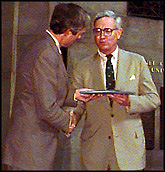
Robert B. Semple, Jr. accepts the 1996 Pulitzer Prize in Editorial Writing from George Rupp, Columbia University President.
Winning Work
By Robert B. Semple, Jr.
Congress is in a mood to abandon the preservation of America's ecological heritage. It is therefore imperative that the Clinton Administration muster its resolve and its executive powers to block at least one monumental and irreversible environmental catastrophe. This disaster-in-waiting is a proposed gold mine in the upper reaches of Montana's Henderson Mountain, less than three miles from Yellowstone National Park.
The mine and its lethal wastes threaten not only the original crown jewel of the national park system, but one of the most beautiful and fragile wilderness areas in the country. So grave are those risks that this page suggested last year that Congress appropriate the necessary funds, about $35 million, to compensate Noranda Inc., the Canadian conglomerate that owns the site, for its exploratory expenses and then ask the company to go away.
That is still the best course of action for saving the great national park established by President Ulysses S. Grant. But it is unlikely that the Republican Congress will spend the necessary money or pay attention to various creative strategies offered by opponents of the mine. These include a proposal by Representative Bill Richardson, Democrat of New Mexico, to put the area off limits to mining by declaring it a national recreation area.
But the battle is far from lost. Under the 1872 Mining Law, the Federal Government cannot simply seize claims to which Noranda has already taken lawful title. It can, however, use existing statutes and its regulatory machinery to break Noranda's resolve. This is a company that persists in building a mine that few others want. Washington has enough legal authority, if the White House will wake up, to prevent the desecration of an American treasure by a foreign corporation.
Under the 1972 Clean Water Act, for example, the Environmental Protection Agency, through the Army Corps of Engineers, can prohibit development on wetlands. This is an important power because Noranda proposes to dig out 56 acres of wetlands high on the mountain. There it would build what it calls a "state of the art" impoundment site for storing acid wastes -- a deep reservoir the size of 70 football fields. Reputable geologists say that any such structure, no matter how beautifully engineered, is bound to crack at some point given the region's extreme weather and its history of earthquakes. That will send poisons directly into the surrounding watershed, which includes two of the nation's important wild rivers.
If the E.P.A. and the Corps deny Noranda the necessary permits, the company will have to look elsewhere to store its toxic material. Alternative sites could be prohibitively expensive. But even if the two agencies duck what is an obvious moral obligation, there are other weapons available.
Noranda's 200-acre mine site is in the Gallatin National Forest, which is under the jurisdiction of the Agriculture Department's Forest Service. Noranda owns most of this land but does not yet have clear title to 27 acres that sit directly above a portion of the mother lode of gold, valued by Noranda at $500 million. Environmental lawyers believe that Secretary of the Interior Bruce Babbitt, following a formal request from the Forest Service, has the power under the 1976 Land Policy and Management Act to take permanent title to these acres on behalf of the Federal Government.
If these experts are right, then the Forest Service should promptly ask Mr. Babbitt to declare these acres off limits and the Secretary should rapidly comply. Deprived of some of its potential riches, Noranda might fold its tent.
Two environmental groups -- American Rivers and Trout Unlimited -- have suggested yet another approach to those pivotal 27 acres. They argue that a close reading of the 1872 Mining Law and a handful of court cases suggest that Mr. Babbitt can deny Noranda's claim if he can show that the land has greater value in an undisturbed state than it does as a mine. They also argue that even the $500 million in estimated deposits cannot begin to compare to the ecological and recreational values of Yellowstone and its adjoining ecosystem.
Mr. Babbitt may have trouble quantifying those values, but of course American Rivers and Trout Unlimited are right. The numbers are not important. As a nation, we have to draw a line and announce that some places are simply too valuable and too sacred to our history to be put at risk.
© 1995, The New York Times
By Robert B. Semple, Jr.
The Republicans have now begun phase two of their campaign to destroy the network of laws developed over 25 years to protect the nation's environment. Until last week, they had attacked by stealth and indirection, using the promise of "regulatory reform" to weaken enforcement of those laws. Phase two is more direct but just as bad.
Last week, the House Subcommittee on Water and Environment approved crippling revisions to the Clean Water Act of 1972. This act has done much to make America's waters fishable and swimmable. Experts in both parties regard it as the most successful of the environmental mandates passed by Congress since Earth Day 1970.
These new provisions blast so many holes in this worthy law that it is hard to know where to begin. Basically, they would demolish the underlying strategy of the original act. The 1972 law conceded that it was impossible to measure the dollar benefits of clean water against the cost of cleaning it up. So, in effect, it instructed industry to use "the best available technology" to control pollution. It was not a perfect answer but it worked.
The new law, by contrast, would postpone any further improvement in water quality unless it can be proved that the benefits -- in health, swimma-bility, fish stocks, whatever -- are worth the cost. That means "monetizing" the value of a cleaner environment, a well-nigh impossible process.
The bill would also relax national water quality standards, provide certain industries with further exemptions from whatever pallid laws remain on the books and make voluntary a program that now requires states and cities to control storm-water pollution.
Not least, it would reverse a 25-year effort to preserve diminishing wetlands. Scientists now estimate that there are 100 million acres of wetlands remaining in the United States, doing what wetlands do so well: filtering pollutants and nourishing organisms essential to the food chain. By drastically narrowing the definition of what a wetland is, the bill would make millions of acres available to developers and the oil and gas industry.
In brief, the subcommittee bill will make it much easier for polluters to pollute. But that is no surprise. Polluters wrote the bill.
Congress usually invites testimony from people on all sides of an issue. In this case, Bud Shuster, a Pennsylvania Republican, held what amounted to an open house for the lobbyists and lawyers representing the special interests the 1972 act is designed to regulate. He did not solicit comment from conservationists or from the Environmental Protection Agency, which administers the 1972 act. He let the special interests draft the bill.
Mr. Shuster's bizarre legislative methodology is as appalling as the bill he produced. He seems to believe that the 1994 election gave him and his fellow Republicans a clear mandate to gut the Clean Water Act. If so, he would do well to consult the polls, which suggest that three-fourth of Americans want cleaner water. He might also consult his constituents. Thirty years ago, the streams and waterways in his district were little more than sumps for municipal sewage and industrial wastes. Today they are accessible to fish and to people -- largely because of the Clean Water Act.
The House is almost certain to rubber-stamp this bill. The Senate, less beholden to local industrial and municipal interests, may hold a broader view of the national interest. That interest is not served by legislation that stops a quarter-century of progress in its tracks.
© 1995, The New York Times
By Robert B. Semple, Jr.
President Clinton, whose record on conservation issues has been tepid, may yet turn out to be the last, best line of defense against Congress's blitzkrieg on the nation's environmental laws.
In the last three weeks, he has promised to veto so-called "takings" legislation that would reward private landholders at the expense of important community values. He has promised to veto a budget rescission bill that would allow indiscriminate logging on Federal land. Yesterday, at a ceremony next to a polluted stream in Washington's Rock Creek Park, he promised a third veto, pledging that a House bill gutting the Clean Water Act of 1972 "won't get past my desk.''
Mr. Clinton was slow to grasp the threat, possibly because the Republican attack on the laws and regulations that protect America's natural resources has been a masterpiece of legislative subterfuge -- seductively packaged as "deregulation,'' "'property rights" and "balancing the budget.'' Much of this has been the House's handiwork, which the Senate must undo. But in cases where the Senate has joined the attack, Mr. Clinton will have to stick to his veto pledges. Here is the legislative state of play as Congress takes a brief recess from its destructive behavior.
Clean Water. The House bill, written in large part by industry lobbyists, eases pollution controls for industries and cities, shifts many regulatory responsibilities to the states and lifts protections for at least half the nation's wetlands. Wiser heads must prevail against this huge sellout in the Senate, which has yet to begin work on a bill.
Risk Assessment. Under the guise of making regulators conscious of costs, the House passed a "reform" bill with so many layers of review that it would undercut Washington's ability to promulgate any environmental rules, good or bad. Senator Bob Dole, eager to board the anti-regulatory bandwagon, proposes a similar recipe for paralysis. A better bill requiring regulators to pay attention to costs without destroying their ability to protect the public has been offered by Senator William Roth, Republican of Delaware. The Senate's choice will say much about where it lies on environmental issues.
National Forests. Virtually identical bills passed by both houses would rapidly accelerate logging on Federal lands, overriding all existing environmental protections. Until Vice President Al Gore pointed them out, these provisions went unnoticed in the White House because they were craftily tucked into the budget rescission bill -- a perfect illustration of Congress's stealth strategy of making environmental policy without calling it that.
Oil Drilling. With equal craftiness, both houses have passed budget bills with provisions exposing an ecological treasure, the Arctic National Wildlife Refuge, to unneeded oil exploration. These provisions are advertised as a way to help balance the budget by raising a little over $1 billion in Federal sales of oil leases. But they are mainly a sop to the oil companies and Alaska's politicians, who have been trying to get their hands on this Federal wilderness for years.
Property Rights. As part of the Republicans' Contract With America, the House has passed a "takings" bill that would indemnify owners against losses in property values caused by laws protecting wetlands, water quality and endangered species. Not to be outdone, Mr. Dole proposes to indemnify owners who claim to have been harmed by any government law. The costs could be enormous.
Taken together, these acts of legislative folly represent a decision by Congress to abandon, wholesale, its responsibility for national stewardship. They also represent a marvelous opportunity for Mr. Clinton to earn, speedily, an honorable claim to being an environmental President.
© 1995, The New York Times
By Robert B. Semple, Jr.
A sample of recent bulletins from the Old West: Montana rewrites some of the country's strongest water pollution laws as a favor to the mining industry. Idaho lawmakers award potential polluters a major voice in setting clean water standards. Utah's Governor rebuffs the stated wishes of Utah's citizens to set aside 5.7 million acres of state land as protected wilderness. Washington State's Legislature passes the nation's most far-reaching "takings" law, weakening essential land-use controls. Wyoming's Legislature authorizes a bounty on wolves -- recently re-introduced into Yellowstone National Park and protected under the Federal Endangered Species Act.
Clearly, the United States Congress is not the only place where laws protecting the environment are under siege. Throughout the West, particularly in the Rocky Mountains, state legislators and governors, egged on by commercial interests and by small but noisy groups of property-rights advocates, are engaged in full-scale mutiny against Federal and state regulations meant to protect what is left of America's natural resources.
What we are seeing is an updated but more ominous version of the Sagebrush Rebellion of the early Reagan years. That revolt was dominated by ranching interests protesting Federal regulation of public lands. The present explosion embraces not only those familiar despoilers but mining companies, timber barons, developers, big commercial farmers and virtually anyone else who stands to profit from relaxation of environmental controls.
The war in the West and the war in Congress on basic environmental protections have much in common. First, both are being driven and in some cases underwritten by big business. Second, both are being waged to save the "little guy" from Federal tyranny. Third, this alleged little guy is nowhere to be found when the time comes to draft crippling legislation. Indeed, his wishes have been largely ignored. Poll after poll suggests that what ordinary citizens want is more environmental protection if it means a cleaner environment and a healthier society. But that is not what this Congress and its Western allies want to give them.
Montana and Idaho are particularly sad cases. Despite citizen complaints, and nearly unanimous editorial opposition, two bills whistled through the Montana Legislature that would in effect permit higher levels of toxic wastes to reach the state's streams and lakes. They were signed, with some reluctance, by the Governor. Mining lobbyists were conspicuous during the parliamentary maneuvering -- including representatives from Crown Butte and its Canadian parent, Noranda Inc. These companies are working relentlessly for permission to build in geologically precarious terrain a gold mine that would leave a permanent reservoir of pollutants in the watershed of one of Montana's most important wilderness streams.
Idaho's people -- not to mention its endangered Snake River salmon -- face a double threat. Under a new statute, acceptable water quality levels will be set by watershed advisory groups. These groups will be well stocked with large landowners and representatives from timber, mining, and agribusiness companies who are almost certain to write new and more permissive regulations. Meanwhile, back in Washington, an Idaho Republican, Dirk Kempthorne, is leading the Senate charge to cripple the Endangered Species Act, which provides what little protection the salmon have. If Senator Kempthorne succeeds in transferring protection of endangered species from Washington to Boise, it will be goodbye salmon, with grizzlies and wolves to follow.
There are, of course, honorable exceptions. In Colorado, for example, ranchers, environmentalists and state officials were able to agree on less destructive grazing practices -- although it took a half-dozen or so exhausting visits from Interior Secretary Bruce Babbitt to get the agreement. But nearly everywhere one turns the anti-Washington ideologues seem to have the upper hand.
The most conspicuous example is Nevada, where officials in Nye County passed a series of ordinances claiming ownership of Federal lands and then set about physically intimidating employees from the Forest Service and the Bureau of Land Management. The Justice Department has now sued to reaffirm Federal jurisdiction, but Nye County's rebels have inspired imitators: More than 70 rural Western counties have passed or proposed laws to "take back" the public lands.
Lost in all the rhetoric about individualism and states' rights is one basic legal fact: At no time have the Western public lands belonged to the states. They were acquired by treaty, conquest or purchase by the Federal Government acting on behalf of all the citizens of the United States. Lost, too, is a colossal irony. Western ranchers have traditionally fed well at the trough of Federal beneficence. In their war against Washington, they are biting the hand that has fed them lavish subsidies and protected them against the disasters of nature and the vagaries of the marketplace.
But all of this escapes the Sons-of-Sagebrushers. The fact that there might be an overriding national interest in preserving the public lands and forests from exploitation is not something that quickly pops to their minds. Nor does this fact seem to register with the newer breed of rebels in the statehouses and state legislatures who would nullify more than two decades of struggle to clean America's waterways, preserve its wetlands and otherwise protect its dwindling natural heritage.
There can be no satisfaction in any of this -- except perhaps to the enemies of the environment in a Congress that is well on its way to abandoning any pretense to national stewardship.
© 1995, The New York Times
By Robert B. Semple, Jr.
This is the time of year when Americans begin flocking to their national parks. Some will find what they were looking for: vistas of spectacular beauty, hours of restorative silence. But others may find themselves wondering whether they have traded one rat race for another. The national parks contain most of America's greatest scenic wonders. They also suffer from the urban nuisances vacationers had hoped to leave behind: traffic jams, noise, dirty air and garbage.
There is, as Representative Bill Richardson of New Mexico notes, "trouble in paradise." If past experience is any guide, for example, there will be gridlock today in Yosemite. By one estimate, the Grand Canyon alone needs $350 million to repair roads, sewers and water systems. Many of the park system's 22,000 historic buildings, as any visitor to Ellis Island can confirm, are simply falling apart.
Human overload is the most visible culprit. Nationwide attendance at the Park Service's 368 separate units is expected to reach 270 million this year, 300 million by the turn of the century. But the real culprit is Congress. In the past 20 years, it has established more than 80 new parks while refusing to give the Interior Department's Park Service enough money to do its job. The service's $1.5 billion annual budget barely covers operating costs. The result is an estimated $6 billion repair and construction backlog.
Congress is responsible for cleaning up the mess it created. The question is how. Not surprisingly, given Washington's anti-environmental, budget-conscious mood, the most popular option is to trim back the system itself. A bill before the House would direct the Interior Department to review all parks and determine which ones are "nationally significant." At that point, a special commission would decide which parks should get the ax and then present its list to Congress.
The proposal excludes 54 "major" national parks but leaves open for review more than 300 monuments, historic sites, scenic trails, urban parks and assorted recreation areas.
On its surface, this bill, co-sponsored by Joel Hefley, Republican of Colorado, and Bruce Vento, Democrat of Minnesota, has an appealing simplicity. The park system definitely includes substandard sites -- what Mr. Hefley calls "pork parks, " shoe-horned into the system to enhance local economies and the careers of the politicians who sponsored them. Get rid of these, Mr. Hefley argues, and we will have more money to spend on the "crown jewels" like Yellowstone and the Grand Canyon.
In the end, though, this is an unnecessarily messy and potentially dangerous approach to the problem. Mr. Vento says that Congress will vote on each recommendation "on its merits." But a more likely scenario is that the proposed closings will be lumped together in one omnibus "closings" bill, threatening valuable wilderness along with mediocre sites that do not belong in the system.
A more positive approach to rescuing the parks is contained in two other bills confronting the Senate and House. One would overhaul entrance fees, which are ridiculously low. The average entrance fee is $3, less than half the cost of a ticket to "Batman Forever." A carload of people can explore Yellowstone for a whole week for only $10 -- the same price they would have paid in 1916. Doubling entrance fees, a not unreasonable proposition, could generate an extra $100 million for the parks. The second bill would end the sweetheart contracts awarded years ago to the companies that run the lodges, souvenir shops and other facilities inside the parks. In 1993, concessions generated gross revenues of $657 million but returned only $18.7 million -- 2.8 per cent -- to the Federal Treasury. The bill would mandate competitive bidding for these lucrative enterprises, giving the Park Service a bigger cut of the proceeds and generating $60 million more for long-neglected repairs.
Both measures were well on their way to approval when time ran out on the 103rd Congress last December. There is now in place a vastly different Congress, more inclined to budgetary parsimony than environmental stewardship. Its basic philosophy is that to save the patient we have to cut off an arm here, a leg there.
That is the wrong way to go. The right way is to provide the park system with enough resources not just to survive but to renew itself. The language in the original mandate establishing the Park Service was unambiguous. The national parks should be left "unimpaired for the enjoyment of future generations." Congress wrote that language, and Congress needs to honor it now.
© 1995, The New York Times
By Robert B. Semple, Jr.
Later this month President Clinton will vacation on a ranch near Jackson Hole, Wyo. Here is a modest suggestion for him. The President should take a short flight in one of his military helicopters to the upper reaches of Henderson Mountain in Montana, just over the Wyoming border. There he will discover a beautiful and fragile wilderness. He will also see the proposed site of a huge gold, silver and copper mine that a Canadian conglomerate wants to build.
This mine and its lethal wastes will threaten not only Yellowstone National Park, which lies three miles away, but also the adjacent wilderness. This is a catastrophe-in-waiting. The risks to the crown jewel of the national park system are so grave that Congress should appropriate $35 million to compensate the mining company, Noranda, for its exploratory expenses and then tell it to go away.
The present anti-environmental Congress is unlikely to take such a step. It is also unlikely to pay much attention to an imaginative proposal offered by Representative Bill Richardson, Democrat of New Mexico, to put the area off limits to mining by establishing a national recreation area.
That is where Mr. Clinton comes in. If Congress will not stop this mine, he must. The Federal Government cannot simply seize the property; Noranda has established lawful title. But it has enough regulatory authority to make it onerous for the company to proceed. So far, the officials who have those powers have been reluctant to exercise them. Mr. Clinton needs to see that they do.
Under the 1972 Clean Water Act, for example, the Environmental Protection Agency and the Army Corps of Engineers can prohibit development on wetlands. Noranda proposes to dig out 56 acres of wetlands high on the mountain, where it would then build a deep reservoir the size of 70 football fields to store acid wastes. Geologists say any such structure, no matter how beautifully engineered, is bound to crack at some point given the region's extreme weather and its history of earthquakes. That would send poisons directly into the watershed. If the E.P.A. and the Corps deny Noranda the necessary permits, the company will have to look elsewhere to store its toxic material. Alternative sites could be prohibitively expensive and the company might simply fold its tent.
On June 1 Mr. Clinton told a town meeting in Billings, Mont., that he was "very worried" about the mine but wanted to let negotiations between Noranda and various state and Federal agencies run their course. The way things look now, the agencies are likely to give Noranda the go-ahead in exchange for pledges that it will spend whatever is required to prevent environmental damage. That would be good but not good enough. Even if Noranda takes extraordinary precautions every step of the way, it cannot guarantee that the poisons produced now can be safely contained for future generations.
Mr. Clinton, or his Vice President, should summon the key players -- Interior Secretary Bruce Babbitt, Carol Browner, the E.P.A. administrator, and Jim Lyons, who oversees the Forest Service -- and tell them to work out a plan. He may also have to come up with some money, but geologists say fair compensation to Noranda should not be more than $50 million. That is a good deal less than the $200 million Mr. Babbitt recently paid to oil companies to buy out drilling leases in sensitive coastal waters.
Mr. Clinton has been making an effort in recent days to polish up his environmental credentials. Figuring out a way to stop this mine would surely help. He alone can make this the national issue it deserves to be. At risk is the oldest and greatest of our national parks.
© 1995, The New York Times
By Robert B. Semple, Jr.
Every state in the union will suffer in one way or another from the Republicans' relentless effort to undermine 25 years of legislation designed to protect the environment. But Alaska faces a double insult. If bills now moving through Congress receive final approval, the pristine Arctic National Wildlife Refuge would be opened to oil drilling and the Tongass National Forest -- the country's largest -- would be exposed to ruinous logging.
All this is courtesy of Alaska's Congressional delegation, which consists of three Republicans. They are Representative Don Young, Senator Ted Stevens and Senator Frank Murkowski, who would also extend his fervor for logging to the old-growth forests of the Pacific Northwest. Mr. Murkowski and Mr. Young are men with legendarily retrograde views on the environment. By a stroke of ill fortune known as the 1994 mid-term elections, they now preside over the two key natural resources committees in the Senate and House.
They argue that opening up the refuge and the forest will create jobs and revenue for the state. If oil is found in the refuge, there will indeed be new jobs and an infusion of cash to every Alaskan citizen. For these reasons, Alaskans as a whole would like to see drilling proceed. They are far less enthusiastic about increasing the timber harvest in Tongass.
Conservationists oppose exploitation of both the refuge and the forest. We agree. The short-term benefits of drilling and logging are not worth the long-term degradation of the environment.
The Tongass National Forest is a vast expanse of islands and lush valleys covering most of the Alaska Panhandle. It is home to grizzly bears, bald eagles and countless salmon. It also includes magnificent stands of old-growth trees coveted by timber companies. After years of rapacious logging in the forest, Congress passed a bill in 1990 that set aside one million acres as protected wilderness, imposed strict land-management rules in other parts of the forest and sharply reduced Federal subsidies to the timber companies.
Mr. Murkowski now seeks to overturn that act with legislation requiring the Forest Service to increase the yearly "harvest" to provide enough timber to guarantee a minimum of 2,400 jobs. In case Mr. Murkowski gets nowhere with his proposal, Senator Stevens has attached a rider to the Interior Department's appropriation bill that would accomplish the same result, mandating a far higher annual cut than presently allowed.
These are shortsighted proposals, a point well made by Alaska's Democratic Governor, Tony Knowles. He has told Mr. Murkowski that by exalting timber-related jobs over other economic activities in the forest -- like fishing and tourism -- he will not only degrade Tongass but undermine the future economic health of southeast Alaska.
Regrettably, for political reasons, Mr. Knowles does not display the same zeal on the question of opening the wildlife refuge to oil drilling. At risk is the refuge's coastal plain -- a narrow, 1.6 million-acre wilderness that flanks the Beaufort Sea. It is home to 180,000 caribou, polar bears, wolves, dozens of rare Arctic species and possibly a large undiscovered oilfield.
Since 1980 -- despite efforts by Presidents Reagan and Bush to open up the area -- Congress has kept the coastal plain off limits to drilling. But a new breed is now in charge on Capitol Hill. Non-binding budget resolutions passed by both houses would open up the refuge in order to help balance the budget over the next seven years. Meanwhile, Mr. Young has proposed a freestanding bill that would achieve the same objective.
The revenue argument is weak. Even if there is oil under the plain, Government royalties would not surface for years. Under the most optimistic scenario,there is a 50 percent chance that the coastal plain will produce 3.5 billion barrels of oil. This would be a huge find for any oil company but only six months of United States oil consumption at best. Any number of known efficiency measures could achieve the same end without violating an innocent landscape with a vast spider web of rigs, pipelines, drilling pods and airfields.
In recent testimony before Mr. Young's committee, Interior Secretary Bruce Babbitt attacked the economic arguments but also made a valuable larger point. Opening up the refuge, he said, would be an ethical calamity, "the equivalent of offering Yellowstone National Park for geothermal drilling, or calling for bids to construct hydropower dams in the Grand Canyon. We can find a better way to produce energy and conserve our natural heritage.'' He is right. Congress should not be seduced by its acquisitive members from Alaska.
© 1995, The New York Times
By Robert B. Semple, Jr.
President Clinton is vacationing this year in western Wyoming, playing golf and reveling in the wonders of Grand Teton and Yellowstone national parks. Last Friday, too late for the evening news shows, he took a crucial first step toward protecting Yellowstone and much of the adjacent wilderness from an environmental catastrophe.
This disaster-in-waiting is the proposed New World mine, which a Canadian conglomerate, Noranda, wants to build on land it controls in the upper reaches of Montana's Henderson Mountain, less than three miles from Yellowstone and in the watershed of the irreplaceable Clark's Fork of the Yellowstone River. Conservationists reasonably fear that the 5.5 million tons of waste the company wants to bury in an active earthquake area will ruin this sensitive watershed in America's first and most important conservation zone.
Mr. Clinton toured the mine site by helicopter and then declared a moratorium on mining activity on 4,500 acres of Federal land surrounding the site. The moratorium will not affect the actual site, to which the Canadian company has legal title, and will therefore not by itself stop the mine. But it tightens the noose around the company and signals the need for further action to block the mine if the Canadian company does not read this Presidential order as a signal of American resolve to protect its oldest national park.
The most controversial aspect of the project is a proposed tailings impoundment -- a deep reservoir the size of 70 football fields -- where the company would store acid wastes. Reputable geologists say that given the region's extreme weather and history of earthquakes, any such structure is bound to crack at some point in the future.
The reservoir would be built on 56 acres of wetlands that lie under the jurisdiction of the Army Corps of Engineers. If the Corps denies a permit to build, the company will have to look elsewhere to store its toxic wastes. Nearly every suitable alternate site is on the 4,500 acres the President has ruled off limits. The company may then be forced to truck its wastes to a site miles away -- an operation that could be prohibitively expensive.
This drama is not over. But the President has now ratcheted up the discomfort level. He deserves credit for responding to the rising outrage among the national environmental community over what the miners and some shortsighted Western politicians have tried to portray as a strictly local issue. Heretofore, Mr. Clinton has often disappointed those who thought he would bring a new level of environmental consciousness to Washington. This time he seems to have gotten the message that some places are too precious to sacrifice to a 19th-century mining law that needs to be repealed for both economic and environmental reasons.
© 1995, The New York Times
By Robert B. Semple, Jr.
If there is any connective theme in the yearlong assault on the nation's environmental laws, it is Congress's clear desire to enrich state, local and commercial interests at the expense of the long-term health of America's national resources. The notion of stewardship is foreign to this Congress, a fact made clear when it tried to cripple the Clean Water Act and strip Federal agencies of much of their regulatory authority over the environment. But nowhere is the urge to trifle with public resources more nakedly expressed than in a web of bills that would transfer huge tracts of Federal land to state and private control.
Congress has already spoken on one of these measures. A provision in the pending budget reconciliation bill would open up the coastal plain of the Arctic National Wildlife Refuge to oil exploration. Although President Clinton has promised to veto the bill, environmentalists are worried that the drilling provision will survive in later negotiations between Mr. Clinton and Congress.
There is another test just around the corner. Companion bills in the House and Senate would take about 22 million acres of Federal land in Utah now run by the Federal Bureau of Land Management, give wilderness protection to a mere 1.8 million acres in southeastern Utah's fabled canyonlands and open the rest to mining, road-building and development.
The bills are sponsored by Representative James Hansen and Senator Orrin Hatch, both Utah Republicans. A competing bill sponsored by Representative Maurice Hinchey of New York is much better. It would protect 5.7 million acres, which environmentalists think is the minimum required to maintain the integrity of the canyonlands. According to several polls, Utah's rank-and-file citizens prefer the Hinchey approach and believe that there is more to be gained from tourism if the terrain is left alone than from bulldozing some of the nation's most fragile and scenic lands. But Utah's Congressional delegation prefers the bulldozer.
Critics of the Hatch-Hansen bill have two further complaints. First, it would undermine the intent of the 1964 Wilderness Act -- an act that designates wilderness as a place "where man himself is but a visitor" -- by allowing development even in the 1.8 million protected acres. Second, it forecloses the possibility of future wilderness designations. The B.L.M. will continue to manage the 20 million Utah acres left unprotected by the Hansen-Hatch bills. But the bills say the land must henceforth be reserved for commercial users. Wilderness designation will no longer be an option.
Finally, victory for the Hansen-Hatch bills could provide smoother sailing for other measures that are aimed at stripping the Federal Government of control over public lands. The most brazen of these are identical bills sponsored by Senator Craig Thomas, Republican of Wyoming, and Mr. Hansen that would transfer to the states every single acre managed anywhere by the B.L.M., some 270 million acres in all. A variant has been offered by Senator Conrad Burns, Republican of Montana, who would establish a commission to identify national forests and other public lands that could be sold or transferred to the states or private interest.
The Thomas-Hansen measure proposes a giveaway. The Burns bill threatens a national yard sale of the country's natural heirlooms. Mr. Thomas says the lands would be better administered "by the people who truly understand the needs of local citizens.'' That, of course, means Western state legislatures, which tend to be far more inclined to exploit public resources for commercial gain than even this Congress.
These are destructive ideas, and the only sure way to stop them is to send a clear conservationist signal by defeating the Utah lands bill. The main hope is on the House floor, where a growing group of moderate Republicans is having strong second thoughts about legislation that endangers the environment. The preservation of a sound national public lands strategy may lie in their hands.
© 1995, The New York Times
By Robert B. Semple, Jr.
Companies do not like to write off investments. But Noranda has to realize that it will earn lasting public condemnation if it builds the mine and enormous public acclaim for canceling it in an act of global environmental statesmanship.
A United Nations committee has now designated Yellowstone National Park as a "world heritage site in danger" largely because a Canadian conglomerate wants to build a huge gold, silver and copper mine less than three miles from the park's borders. The designation carries no legal weight, but it adds an international voice to the virtually unanimous chorus of opposition to the mine, which includes President Clinton. Nobody seems to want this mine except Noranda, the Canadian company, and its American subsidiary, Crown Butte, which has title to the mine site and has so far invested about $35 million in this project.
After listening patiently to the company's safety pitch, this page is convinced that the proposed New World Mine is a disaster-in-waiting that could ruin one of America's leading ecosystems. Reputable geologists say the company's proposed reservoir for storing buried liquid wastes in perpetuity is bound to crack someday, given the region's weather patterns and history of earthquakes. That would send tons of toxic material directly into the irreplaceable Clark's Fork of the Yellowstone River. Meanwhile, the mining operations would stir up underground wastes that would then seep into Yellowstone National Park itself.
Government officials from Mr. Clinton on down would like to take unilateral action to stop the mine, but Noranda has legal title to the land. Therefore, as Mr. Clinton noted when he visited Yellowstone in August, he will wait for the E.I.S., or "environmental impact statement,'' to run its course. The E.I.S. involves detailed scientific studies and laborious negotiations between government agencies, interested private parties and the company.
President Clinton will have to monitor this process to make sure Government bureaucrats do not bow to arguments that the mine can be made safe on a permanent basis. The claim defies science and common sense. Unfortunately, the lead Federal agency in the E.I.S. process is not Secretary Bruce Babbitt's Interior Department, but the Agriculture Department's Forest Service, which controls most of the land near the mine. The service has an unfortunate history of favoring commercial values over environmental values, and its key negotiators are sounding the same tune now. Mr. Clinton should not be timid about muscling these negotiators to give full weight to the views of other Federal agencies, including the National Park Service, which think the mine is a terrible idea.
There is, however, a cleaner, quicker way to end the controversy. That is for Noranda to walk away from the project. It could cede the site to the Federal Government and win large tax credits or ask for a Federal buyout equal to its investment costs. The Greater Yellowstone Coalition -- a reputable environmental group composed of earnest citizens who just happen to love their neighborhood -- is willing to work with the company and Washington to ease the pain of disengagement.
Companies do not like to write off investments. But Noranda has to realize that it will earn lasting public condemnation if it builds the mine and enormous public acclaim for canceling it in an act of global environmental statesmanship. Among Noranda's principal stockholders are the two Canadian Bronfman brothers, Edward and Peter, shy and brilliant financiers who have a history of public service. Noranda itself recently published a glossy report detailing its efforts to minimize air and water pollution from its vast mining and smelter operations. What better way to demonstrate that concern than by disengaging honorably from a project that would permanently threaten America's first and most important national park?
© 1995, The New York Times
Biography
Robert B. Semple, Jr. was named associate editor of the editorial page of The New York Times on June 1, 1988, after having served since April, 1982 as editor of the Op Ed-page.
Mr. Semple began his career with The Times as a general assignment reporter in the Washington bureau in 1963 and subsequently became a political reporter and White House correspondent during the first Nixon term. He was appointed deputy national editor in New York in 1973 and was named London bureau chief in 1975. In February 1977 he returned to New York as foreign editor, responsible for directing the work of the papers foreign bureaus.
Born in St. Louis, Missouri on August 12, 1936, he graduated from Phillips Academy in 1954 and, after a year abroad, from Yale in 1959. He received an M.A. in history from the University of California at Berkeley in 1961.
Mr. Semple has lectured extensively on domestic and foreign policy and the role of the press in shaping the news. He is a member of the Council on Foreign Relations. He is married and lives in Manhattan.