The St. Petersburg (FL) Times, by Jeffrey Good
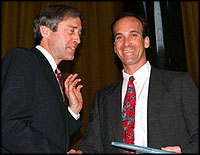
Jeffrey Good receiving his 1995 Pulitzer Prize in Editorial Writing from Columbia University President George Rupp.
Winning Work
By Jeffrey Good
A DIFFERENT KIND OF EDITORIAL
Today and for the next three Sundays, the Times is publishing a different kind of editorial. Final Indignities is an examination of the estate system, based on months of research and writing by editorial staff member Jeffrey Good. It appears on the front page of this section to convey its importance. Floridians should be able to face death trusting the legal system to carry out their last wishes. But we have found that, too often, the trust is broken. We invite you to educate yourselves and join our call for reform.
Joe Thomas wanted to end his life as he lived it: with quiet dignity. In Florida, that was too much to ask.
For most of his nine decades, Thomas had made do without the help of others. He paid his bills on a parks department salary, saving pennies by sprinkling warm water on his cereal. He lived alone, retiring to a modest boarding hotel where he bothered no one and even made his own funeral plans.
But there was one job Thomas could not do alone: Leave a final gift to 32 beloved grandnieces and grandnephews. He wrote a will asking Florida's probate courts to carry out his wish.
When Thomas died in 1988, he left enough for each beneficiary to inherit about $8,500. The heirs made earthy plans for Uncle Joe's bequest: help a child through college, put money down on a house in a safer neighborhood, weather a spell of joblessness.
A judge appointed St. Petersburg lawyer Lauren Sill to serve as executor of the Thomas estate. Although she was supposed to begin distributing the inheritances within one year, the courts let her keep the cash for nearly five.
By the time a judge asked Sill what had become of the money, it was too late. She had stolen $270,000, nearly all the dead man's savings. With help from Florida's probate court, she had stolen something else: Joe Thomas' final dignity.
Each year, more than 140,000 people die in Florida. Many are like Joe Thomas: They work for decades and retire to this place in the sun. As the end nears, they write wills leaving a final gift to friends, family, a favorite charity. Somewhere along the way, a lawyer says, "Don't worry. The courts will take care of your last wish."
We face death believing this promise, trusting that our passing will be marked with a final measure of dignity. Too often, the trust is broken.
Make no mistake: Most estates are administered honestly and well. But these successes come not because the system demands it, but because individual executors, lawyers and court officials choose to do the right thing.
Florida's probate system is designed to be "self-administering," that is, the courts generally don't get involved unless someone raises a red flag. That system works fine when estate administrators are honest, efficient and open about their work.
But in other cases, the system's loose oversight opens the door to wrongdoing. Trusted executors loot estates, while court officials look the other way. Wrongdoers receive light punishments, while victims get an empty promise of repayment. And as the probate horror stories mount, elderly Floridians take refuge in living-trust plans that leave them even more vulnerable to exploitation.
The probate system is not intrinsically evil. Run properly, it is a fine way for people to pass wealth from one generation to the next. Assets are gathered, bills are paid and bequests are passed to the rightful heirs -- all under the court's watchful eye.
But the system is no better than the law that governs it, or the people who run it. Today, in the first of a series of editorials on Florida's estate system, the Times explores how probate court fails the people it is designed to protect.
Too often, the people who take advantage are the ones in whom the courts -- and the public -- place the greatest trust: lawyers.
BROKEN DEADLINES
Would you give someone a one-year deadline for distributing $283,000, then wait five years to ask what had become of the money? That's exactly what Pinellas County judges did with Joe Thomas' life savings.
Florida law gives nearly unchecked power over estates to the executors -- also known as "personal representatives" -- appointed to administer them. In return, executors are supposed to begin distributing inheritances within a year, or provide a good reason why they have not.
That time limit is written into law, but court officials don't always enforce it. As Sill blew off deadline after deadline, the judges granted her extension after extension. Sill celebrated by writing herself fresh checks from Joe Thomas' bank account. After Circuit Judge Helen Hansel gave Sill a 60-day extension in 1992, for instance, Sill stole nearly $97,000.
Last year, after Sill had enjoyed eleven deadline extensions, Hansel finally called her bluff. Sill was summoned to court and asked: Where is the cash?
"In the bank," Sill replied.
All $283,000?
"That's correct," said Sill.
Then an amazing thing happened. After five years of lies, someone thought to check up on Sill. Five minutes later, he reported, "Your Honor, I have been advised by the Chase Bank that the balance in the estate account at this time is $3,611."
Five minutes and a phone call. That's all it took to expose Sill as a thief and a disgrace to the probate system. That's more than the courts had been willing to do -- until it was too late.
Earlier this year, Sill was convicted of stealing money from four estates, including Joe Thomas'. She was sentenced to 2-1/2 years in prison. While the delays in her case were extreme, they are far from unusual.
As of March 31 -- the most recent date for which statistics are available -- nearly half of all Florida estates were open past the one-year limit. The percentage of overdue estates varied widely among counties. For instance, Pinellas had 31 percent over deadline, while Hillsborough had 49 percent and Palm Beach a whopping 86 percent. (These figures are for estates under $600,000 that don't involve a legal contest; more complicated estates have longer deadlines.)
In recent years, court officials have done a good job sending out warnings on delinquent cases. But they need to do more. They need to demand proof that executors are not delaying estates to drain them.
The system failed when it didn't demand that proof of Lauren Sill. Joe Thomas, 1901-1988, deserved better.
COZY DEALS
Overseeing an estate isn't always as simple as calling the bank. Many people die leaving not only cash, but also antiques, art, jewelry and rare stamps.
Florida law gives estate administrators vast power to sell such valuables and distribute the proceeds to heirs. In a logical world, the law would require the administrators to prove they had conducted these sales honestly and in the best interest of the estate.
But this isn't a logical world. It's Florida.
State law does not require executors to obtain objective, professional appraisals. Because of this loophole, the courts don't know if executors are protecting estates -- or looting them.
Consider the case of Margaret Fiala.
Mrs. Fiala was a widow who died in Pasco County, leaving her life's treasures to two grown children. Because the heirs lived out-of-state and could not properly administer the estate, a judge appointed Pasco lawyer David C. Gilmore to carry out Mrs. Fiala's final wishes.
Gilmore needed to sell the estate's stamp collection and distribute the proceeds to Mrs. Fiala's children. While not required by law, an appraisal was important; the untrained eye can't distinguish between a 10-cent stamp and a $10,000 one. So, Gilmore hired a professional appraiser.
The appraiser, Pasco Coins & Jewelry owner Tim Carr, set the collection's value at nearly $5,000. Did Gilmore then use that appraisal to guide him as he put the stamps on the market, seeking the highest price? No. Gilmore simply turned around and sold the stamps to Carr for $5,000 -- without seeking any other bids.
Gilmore and Carr insist that was a fair price. One of the heirs, Diane Fiala, has her doubts. Fiala has obtained professional estimates setting the stamps' value as high as $100,000 -- 20 times Gilmore's sales price.
Fiala initially approved Carr's hiring. But now she wonders if Gilmore and the appraiser struck a deal to get the stamps cheap and then resell them at a profit, a suspicion both men vehemently deny. What is the truth? That's the $95,000 question -- one the courts can't answer, because they didn't require Gilmore to prove he had sold the stamps at arm's length. In fact, Gilmore didn't even have to tell court officials who had appraised and purchased the stamps.
Pasco Circuit Judge Lynn Tepper, who oversaw Gilmore's work, refused to answer questions from the Times. But a veteran probate judge not involved in the case said selling property to an appraiser raises serious questions. Pinellas-Pasco Circuit Judge Thomas E. Penick Jr. said, "That's loose operations."
It's also an insult to a woman who put her faith in the courts. Margaret Fiala, 1911-1985, deserved better.
PROTECTION LOST
Diane Fiala might never have known how much the stamps in her mother's estate had sold for, if she had done what too many beneficiaries do: waive her right to a final accounting.
The law requires executors to submit a detailed financial report before closing an estate, unless they get a waiver from the beneficiaries. Many lawyers urge their clients to sign away this important protection, saying, You can trust me.
Really? Consider the case of the red Mercedes. After Esther Specht died, Tampa lawyer Karl Stevens Jr. administered her estate and asked the beneficiaries to waive a final accounting. Not suspecting any skullduggery, they signed the forms. No longer accountable, Stevens bled the estate, taking a $16,400 "loan" to treat himself to a Mercedes-Benz convertible. The color: Sunset Red.
Normally, Stevens' cash grab would have gone undetected; a judge would have seen the waivers and closed the estate. Luckily, though, Stevens' secretary had a conscience and tipped off the Florida Bar.
After he was caught, Stevens repaid the money and pleaded guilty to grand theft and related crimes. But his case reveals a serious flaw in the probate system: While beneficiaries expect the court to be protecting them, officials expect beneficiaries to be savvy enough to protect themselves. In the canyon between those expectations, deceit flourishes.
Even in cases where accountings are completed, court officials do little more than stuff the documents in a forgotten file. A survey of court officials in six estate-heavy counties -- Pinellas, Hillsborough, Broward, Palm Beach, Orange and Pasco -- found that none routinely audit accountings.
Said Orange County probate manager Robert Herndon: "If they (beneficiaries) have no objections to how the funds are managed, or mismanaged, then the court has no concern."
Herndon is right, and the system couldn't be more wrong.
In many cases, beneficiaries live out of state, are unfamiliar with probate law, or lack the financial knowledge to police an estate administrator. They count on the courts for that protection.
People facing death have a right to expect that their money will go to chosen beneficiaries, not to a crook in a convertible. Esther Specht, 1909-1987, deserved better.
UNCARING COURTS
When problems do surface in estates, judges have the power to ask the tough questions and make things right.
Judges can order estate administrators to court and put them under oath. They can demand documentation of bank balances and estate sales. In the worst cases, they can appoint investigators and throw errant administrators off the case or into jail.
Used judiciously, these powers allow judges to ferret out wrongdoers and strike fear in potential villains. Yet, some judges seem ridiculously reluctant to use them.
In the Thomas estate, court officials issued warning after warning to attorney Sill, but didn't back them up until it was too late. In the Fiala estate, the judge seemed more interested in making excuses for attorney Gilmore than in investigating legitimate questions about his work.
Probate is a cozy club. The same judges see the same lawyers every day inside the courtroom, and often outside. When the lawyers say something is so, the judges tend to believe them.
Diane Fiala was like many beneficiaries of Florida estates. She lived a thousand miles away, didn't understand Florida law and could only communicate with the court by letters, phone or an occasional visit.
Gilmore says Fiala has no right to complain now, because she didn't protest the stamp sale when it was done. But court records show that while Diane Fiala did not specifically object to the appraiser buying the stamps for $5,000, she did tell court officials that a stamp club president said her parents owned "very good stamps, worth over $25,000." And in a formal objection to Gilmore's financial accounting, Ms. Fiala protested that Gilmore "has failed to properly account for the true value of the personal property of the Decedent."
That objection forced Pasco court officials to address her concerns. But when they did, Ms. Fiala didn't have a friend in the right place.
Probate judges often rely on court clerks to watchdog problem files. In the Fiala case, that job fell to Pasco deputy clerk Lisa A. Peters -- who had worked nearly three years as Gilmore's probate secretary before she began examining his work on the Fiala estate.
Neither Peters, her bosses, nor Judge Tepper would answer questions about how that past relationship affected the court's actions. They don't have to; Peters' conflict-of-interest clearly disqualified her from being an objective overseer.
When Fiala raised questions about Gilmore's actions on the stamps and other estate issues, the judge should have appointed an independent investigator, sometimes known as an administrator ad litem. Instead, Tepper brushed off the protests and closed the estate -- leaving questions that have hounded Fiala and Gilmore through years of legal feuding.
Diane Fiala once trusted Florida's legal system, but now she is justifiably bitter. "The people who are supposed to uphold the trust are more geared to their personal networks," says Fiala. "It isn't a system of checks and balances. It's more like a good ol' boy network."
We all deserve better.
THE PROBATE PROCESS
How wealth passes from one generation to the next:
- A person signs a will outlining how his or her life savings, real estate and personal mementos should be distributed upon death. The will often names an executor, also known as a "personal representative," who is to gather assets, pay bills and distribute inheritances.
- After death, an estate is opened in probate court. If the executor is not named, or cannot serve, the judge will appoint one. If the executor is not a lawyer, one must be hired to provide legal guidance.
- Creditors have three months to submit bills to the estate for medical care, funeral services or other unpaid debts. After those debts are paid, the executor can distribute inheritances.
- Unless there is a federal tax return or other complication, the executor should file a financial accounting and close the estate within one year.
This series is based on information gathered from court records, Florida Bar proceedings, and interviews with judges, lawyers and the citizens affected by their work. It was researched and written by editorial writer Jeffrey Good, who has worked for the Times since 1983 and written extensively about the probate court's impact on elderly Floridians.
© 1994, The St. Petersburg Times
By Jeffrey Good
What officials can do
Problem: Broken promises of repayment.
Solution: A lawyer who steals from an estate is a white-collar grave robber. Any judge who gives an estate thief probation should include restitution as a vital component, setting a firm schedule of repayment instead of the ""suggested schedule'' now used by the Department of Corrections. Criminal justice officials should keep clever crooks from hiding assets, and throw those who don't pay into prison.
Problem: Florida Bar victim fund falls short.
Solution: When bad lawyers don't repay victims, good ones should help. Increase each lawyer's annual contribution to the Clients' Security Fund by $40. This modest increase would generate an extra $2-million -- enough to speed processing of victims' claims and replace more of the misappropriated money.
Problem: Estates without insurance policies.
Solution: Change state law to require a bond to cover all liquid assets in an estate, unless beneficiaries sign a document acknowledging that they are giving up an important protection.
What citizens can do
Demand that prosecutors notify you of trial and sentencing dates in cases where someone has robbed your inheritance. Also, don't be afraid to contact officials, including the judge, if restitution payments fall behind.
Think hard before waiving the bond when writing a will or collecting an inheritance. The bond need not cover the entire estate, just the amount that could be converted to cash.
Be aware that the Florida Bar Clients' Security Fund can repay at least some of the money stolen or misappropriated by a lawyer. For more information, write or call: Florida Bar Clients' Security Fund, 650 Apalachee Parkway, Tallahassee, FL 32399-2300; (904) 561-5812.
Carefully select a lawyer to handle a will-based estate or a living trust. For help in finding a lawyer, call the Florida Bar's referral line at 1-800-342-8011. Before hiring one, call the Bar's ethics office (Tampa 875-9821) to see if the lawyer has any history of misconduct.
This series is based on information gathered from court records, Florida Bar proceedings, and interviews with judges, lawyers and the citizens affected by their work. It was researched and written by editorial writer Jeffrey Good, who has worked for the Times since 1983 and written extensively about the probate court's impact on elderly Floridians.
© 1994, The St. Petersburg Times
By Jeffrey Good
In Florida, it's perfectly legal to rob an estate. All lawyers and bankers have to do is belly up to the trough our elected representatives built for them.
Estate lawyers and executors do important work when they transfer wealth between generations, and they deserve a reasonable fee. For years, "reasonable" was defined as a percentage of an estate. But in 1991, the Florida Supreme Court scrapped that practice, which overpays those who handle large but simple estates. The court ruled that estate managers should simply charge for the time worked.
The bankers who often serve as estate administrators didn't like that. Nor did the lawyers. They argued that billing strictly by the hour encourages unethical professionals to pad their time sheets and discourages good ones from working efficiently.
Those are valid points, but they don't justify what happened next. Under pressure from the Florida Bar and Florida Bankers Association, legislators last year handed estate professionals a license to steal. Consider how the new pay law could bleed a typical Florida estate, one worth $300,000:
- Under the old law, a $150-an-hour lawyer who worked 20 hours on the estate would collect $3,000. The new law says the lawyer can keep that money, plus charge 2 percent of the estate as a "reasonable" fee. That's an extra $6,000.
- The executor cleans up, too. Regardless of how much work was done, he pockets 3 percent of the estate, or $9,000. And if there's another executor -- who could easily be the estate lawyer -- the estate is out another $9,000 fee.
- Don't think a living trust will necessarily avoid this penalty. Lawyers can now take a 1 percent cut of assets that bypass probate in large trusts.
Heirs can save money by negotiating a lower fee or challenging an excessive one in court. But the new law burdens them with proving the fee is "unreasonable." Many heirs -- particularly ones who are drowning in grief, live out-of-state, or can't afford a lawyer -- are not going to challenge fees. Greedy estate professionals know that; they're banking on it.
While decent lawyers are not abusing the new law, unscrupulous ones are. As he considered fees in one Orange County case, Circuit Judge R. James Stroker called the law what it is:
An invitation to gouge. It's time for legislators to put the law where it belongs: in the trash.
© 1994, The St. Petersburg Times
By Jeffrey Good
For many probate professionals, reforming the system won't mean extra work. They're already doing things the right way.
While some judges regard their time in probate court as a long nap, others take seriously their duty to deceased Floridians and grieving heirs. Pinellas-Pasco Circuit Judge Thomas E. Penick Jr. is one who cares.
Penick has forged a statewide reputation as a probate judge who doesn't sit back and wait for someone else to identify problem estates. Penick scours case files for warning signs, appoints independent investigators and cracks down on wayward executors and lawyers. With Penick's heavy caseload, that often means working from dawn to dark.
Other judges call Penick "The Hammer." He says, "I've never been a person to keep my mouth shut."
Judges have an easier job when the lawyers who appear before them are hard-working and honest. Recognizing that Florida law doesn't always require vital safeguards, these lawyers voluntarily take steps to protect the wishes of deceased clients and their loved ones.
St. Petersburg lawyer Thomas Churchill Dunn, for instance, advises clients against waiving estate accountings. When he administers an estate, Dunn says, he routinely prepares a detailed explanation of where the money went.
"I'm proud of our work and I want everybody to say, 'Yes I understand what's been done here,'" says Dunn. "It's a valuable protection that should only rarely be waived."
While the law doesn't require executors to obtain appraisals when selling estate goods, responsible professionals take the extra step. It's a way to insure that beneficiaries are getting the best price, and a protection against even the suggestion of back-alley deals.
"I always get them, always," says Charles Ian Nash, a Melbourne lawyer and co-chairman of the Florida Bar's probate consumer protection committee.
What's more, Nash said, he makes sure appraisers are objective. That means they aren't tempted to lowball a price on something they also plan to buy. Nash says, "Most reputable appraisers will not buy something they appraise."
While some lawyers are abusing Florida's probate fee law to inflate bills, others are behaving honorably. Although the law allows lawyers to charge hourly rates plus a percentage of the estate, St. Petersburg attorney Nancy E. Rutland charges strictly by the hour.
"It's fair," says Rutland, who charges between $155 and $195 an hour on most estates. "People pay for the services they're getting."
To lawyers like Rutland and judges like Penick, probate is more than an occasion to soak fees and push paper. It is a solemn opportunity: to carry out final wishes, to insure a final dignity.
© 1994, The St. Petersburg Times
By Jeffrey Good
You've heard the sales pitch: Living trusts are the best way to escape the "horrors of probate." Simply sign a trust and, after you die, every dime of your estate will automatically pass to chosen friends, family and charities.
Sounds wonderful, doesn't it? Too bad it's a lie.
For some people, living trusts are a legitimate alternative to the traditional will-based estate plan. But promoters often frighten and mislead people into buying expensive trusts when a simple will would serve them better -- and provide more protection against exploitation.
The concept of a living trust is simple. When you die possessing worldly goods, probate court steps in to oversee the estate. By transferring substantial assets into a trust before death, you can leave the court with nothing to supervise.
Probate has its failings. But the answer to these problems is to fix them, not run away. Once it has proper safeguards and affordable fees, probate will remain the best system for carrying out most people's last wishes.
In recent years, Florida attorneys have successfully crusaded against the non-lawyers who push unsuspecting consumers into flawed or unnecessary trusts. The Bar should continue that campaign, but it should also take out its own trash. When it comes to slimy trust peddling, nobody beats a lawyer.
"READY TO DIE?"
That was the headline, big and bold, of an ad taken out in the Times by the Palm Harbor law firm of Frank and Judy Spees. The ad went on: "Find out why you need a Living Trust no matter how big or small your estate is! Find out how anyone who tells you not to get a Living Trust is misinformed or profiting by your mistake!"
Truth is, it's people like Spees & Spees who are spreading the misinformation -- and pocketing the profits.
The ad touched a nerve. At a May 2 seminar sponsored by the husband-and-wife legal team, the room quickly filled with elderly people for whom death was no abstraction. One woman could only take a few steps before stopping for breath. Another man complained of the insomnia that followed his wife's passing. Most everyone worried that the money they wanted loved ones to inherit would instead disappear into some probate black hole.
Spees & Spees played on those anxieties.
Frank, tall and handsome, began by demeaning his profession. "What do you have when you have a lawyer who's up to his neck in cement?" he joked. "Not enough cement."
Next came Judy, tall and wholesome, who assured the crowd that Spees & Spees were not typical lawyers. They left behind flashy careers in television and LA-style law to help the little people -- by selling them living trusts.
Frank and Judy Spees are not typical lawyers. They are typical hucksters: people who make money by feeding unrealistic fears of probate, while failing to disclose the perils of living trusts. Cutting through to the facts
Here is the sales pitch -- and the truth.
Probate costs swallow estates, the hucksters say. Judy Spees told her elderly audience that probate costs "will eat up 5 to 15 percent of your estate."
The Spees present these frightening figures as fact, and then open the cash register as clients line up to pay from $450 to $2,190 for a trust package. There's just one problem: The numbers are bogus.
Most experts say that Florida probate costs seldom exceed 5 percent of an estate. When asked to prove otherwise, Frank Spees hemmed and hawed before saying that his information came from a living trust book and an article in the Wall Street Journal. The Times examined both sources; neither backed the sky-high figures quoted by Spees.
When challenged later, the Spees backed away from their claim. Frank Spees said, "You may have pointed out something that I need to change in the seminar."
Certainly, probate can cost too much, particularly if lawyers and executors charge the outrageous fees allowed by current state law. But those same fees can be duplicated by the trustees and lawyers who administer trusts. And because trusts have little court oversight, no judge is standing by to cut excessive fees.
The Spees inflate their estimates by talking about the expense of notifying creditors, sorting out tax issues, and accounting to beneficiaries. Those expenses are no different in a properly administered trust, says Tim Flanagan, a Jacksonville trust lawyer. "The work is virtually the same."
The only automatic extra cost in probate is the court fee, the price of admission to a court system designed to protect against fraud and mismanagement. In Pinellas County, that fee is $170 -- a fraction of the price of a Spees & Spees living trust package.
Probate takes too long, the hucksters say. At his seminar, Frank Spees claimed, "According to a recent survey of attorneys, the average probate takes two and one-half years."
When questioned after the seminar, Spees couldn't produce that "recent survey." The best he could do was point to that same newspaper article. The article -- which is 7 years old -- said"The average probate takes two years to complete in California."
We live in Florida. Here, court officials say there are no reliable statistics on the length of probate. But lawyers in various parts of Florida say they can process most estates in three to nine months. One of those lawyers was none other than Judy Spees, who said her average probate estate requires seven months.
Probate court backlogs can account for a few days or weeks of that delay. Beyond that, however, living trusts take just as long.
Florida law requires probate estates and revocable living trusts to give creditors three months to submit bills for medical care, funeral services and other unpaid debts. Other delays are caused by factors unrelated to the legal form of estate: tax returns, trouble selling property -- and foot-dragging by trustees, executors, lawyers and heirs.
Here's something the hucksters won't tell you: Living trusts can take longer.
Florida law sets a 3-month deadline for contesting a will, but there is no such time limit on people trying to break a trust. And because living trusts lack probate's clear procedures for settling disputes, feuds can drag on for months and even years.
"For married couples," say the Spees, "Living trusts can save up to $235,000 in estate taxes."
Here's what they didn't say: A will-based estate plan can do the same thing. The key to saving on taxes is to properly organize assets before death, a goal that can be reached through a will or a living trust.
When confronted, Frank Spees acknowledged this point and said he may disclose it at future seminars. He said, "It's important not to misrepresent."
"There are very few people who don't need a living trust," said Judy Spees.
The fact is, there are very few people who do need a living trust. It can be useful for people who own property in many states, because it reduces the need for opening probate files in different places. It can also appeal to celebrities like Buc owner Hugh Culverhouse, who would rather keep their finances out of a public court file.
But for most people, a trust is too much money, too much trouble, and an invitation to abuse.
Money: While offering few benefits, a revocable living trust costs two to four times as much as a will-based estate plan. For people on limited incomes, the difference between a $300 will and a $1,000 trust can mean a lot of groceries.
Trouble: A living trust is worthless unless its creators legally transfer bank accounts, stocks and other assets to the trust. For younger people, that can mean decades of title changes and inconvenience. And if you forget one asset, guess what? That part of your estate is headed for probate.
If a trust is improperly written, it could unravel your estate plan after you die, leading to costly litigation or a distribution decided by the court.
Abuse: Responsible lawyers say living trusts are most useful not after death, but during the waning days of a person's life. When someone becomes too frail to manage his or her own finances, a trustee (a reliable relative, friend or professional) can step in without having to become a court-supervised guardian. After death, the trustee would pay remaining bills and settle the estate without court involvement.
But that flexibility holds a risk: Without judicial oversight, the trustee could waste or steal money. "If you name a bad trustee, you're doing yourself more harm than good," says Charles Ian Nash, co-chairman of the Bar's probate and trust consumer protection committee. "It's no better than having somebody rob you on the street." (See related story above.) On the positive side
Spees & Spees deserve some credit. They warn clients against a common mistake: buying a trust but not activating it with a transfer of assets. They do a good job of translating legal terms into understandable English. And they say their trusts are carefully written to meet clients' needs.
Even if their trusts are first-rate, though, their sales pitch is inexcusable. At best, Spees & Spees are badly misinformed. At worst, they are deliberately misleading elderly citizens into trusts they may not need. Whichever is true, the Spees are profiting.
Funny thing about Spees & Spees: When you ask about the ethics of their sales pitch, they talk a lot about themselves. How clever their ad is. How they want to be seen as "good guys." How negative publicity might cut the income that allows them to live and work half the year in Florida, and half in Lake Tahoe.
We hate to break it to the Spees, but the issue here is not their smarts, image, or Lake Tahoe lifestyle. It is their moral duty to elderly clients who toil a lifetime and then come seeking honest guidance -- not hucksterism.
While acknowledging the gaping holes in his living trust sales pitch, Frank Spees insists that trusts are the best alternative to the "big, lumbering bureaucracy" of probate. He said, "There are no negatives to the living trust, only positives."
The Spees certainly have a right to believe that. But when they are placing newspaper ads and holding seminars to "inform" the public, they also have a responsibility to tell the truth, the whole truth.
Spees & Spees are not alone. Other opportunistic attorneys, non-lawyer trust mills, financial advisers and mail-order outfits do the same thing. They win people over with half truths -- and then reach into their pockets.
What an affront to the dignity of elderly Floridians. What a betrayal of trust.
THREE FORMS OF ESTATE PLANNING
There are many ways to distribute property after death. The three most common are:
- WILL: Provides instructions for gathering assets, paying bills and distributing inheritances under the rules and protections of probate court. Can include a testamentary trust to provide for family members after death.
- LIVING TRUST: This method avoids probate by transferring property out of an individual's name and into a legal entity called a trust. Many people administer their own trusts during life, but name successor trustees to step in after incapacity or death. Trusts are generally "revocable," meaning you can change the terms before death. They provide little court protection.
- JOINT OWNERSHIP WITH RIGHTS OF SURVIVORSHIP: Also avoids probate, because property transfers to the second owner upon the death of the first. However, it can increase taxes and leave one co-owner vulnerable to the other's creditors.
Series at a glance: This series is based on information gathered from court records, Florida Bar proceedings, and interviews with judges, lawyers and the citizens affected by their work. It was researched and written by editorial writer Jeffrey Good, who has worked for the Times since 1983 and written extensively about the probate court's impact on elderly Floridians.
© 1994, The St. Petersburg Times
By Jeffrey Good
What officials can do
- The Florida Bar should expand its crusade against sleazy trust peddlers to include lawyers. Any lawyer who preys on elderly clients should be stopped and, if necessary, disbarred.
- The Bar should tighten screening of lawyer ads. Current procedures allow lawyers to run a sleazy living trust promotion for weeks before the Bar registers its disapproval.
- The state attorney general and local prosecutors should watch for cases of consumer fraud, and vigorously prosecute those who exploit Florida's most vulnerable citizens. One starting place: Send knowledgeable investigators to check out public trust seminars.
- Legislators should increase protections without changing the unique character of living trusts. For instance, state law now requires formal notification of creditors. Lawmakers could extend similar protection to beneficiaries, by requiring trustees to register with the court.
What citizens can do
- Be skeptical of claims that you don't need a lawyer for a living trust. Like a will, a trust is a legal document with the power to either fulfill or derail your estate plan. Better to spend a few dollars now than leave heirs a costly legal mess.
- Shop carefully for a lawyer who will clearly explain the benefits, and risks, of both wills and living trusts. For help, call the Florida Bar's lawyer referral line at (800) 342-8011. Before hiring one, contact the Bar's ethics office (Tampa 875-9821) to see if the lawyer has any documented history of misconduct.
- Pay attention to hidden costs. If you can't retitle assets in the name of the trust, what will a lawyer or other professional charge? What help is required to manage the trust after death?
- Carefully pick a trustee. Dishonesty isn't the only issue. Without proper guidance, even a well-meaning trustee could botch your estate -- and deprive heirs of their inheritance.
- Whoever the trustee is, give strong consideration to requiring a bond to cover theft or mismanagement. You wouldn't leave your home uninsured; why leave your life savings unprotected?
© 1994, The St. Petersburg Times
By Jeffrey Good
Promoters sell living trusts as a way to pass on an inheritance without sacrificing privacy. What they don't say is that because living trusts have no probate court oversight, their "privacy" opens the door to abuse. Consider the case of the good father and his crooked lawyers.
Peter J. Mooney was a retired Catholic priest who was dying of liver disease when he asked St. Petersburg lawyers Burt D. Moore and Jacquelyn M. Bowsman to draft an estate plan. They set up Father Mooney with a living trust.
The priest had made his wishes clear. He wanted to make an anonymous gift of his life savings -- nearly $83,000 -- to the St. Petersburg Free Clinic, which provides the working poor and elderly with services including medical care, food, shelter and emergency financial assistance.
If the estate had gone through probate, court officials would have read his will and seen that the charity got its inheritance. Father Mooney's living trust came with no such safeguards; his wishes rested solely in the hands of his lawyers.
After Father Mooney's death, a friend got suspicious about those lawyers and called the Florida Bar. When a Bar investigator asked Burt Moore what had become of the dead priest's money, the lawyer refused to answer, citing the trust's "sacrosanct privileges" of freedom from official oversight.
The Bar pressed on, working with prosecutors to uncover a trail of heartless deceit. According to them, Moore and Bowsman began plundering the priest's estate a month before his death. By the time the law caught up, the money was gone.
Father Mooney's gift could have purchased nearly a year's worth of medicine for 1,200 Free Clinic patients, said executive director Marcie Biddleman. That's one thousand, two hundred men and women who cannot otherwise afford medications for high blood pressure, diabetes, heart disease and other chronic ailments.
What became of the cash? According to prosecutors, attorneys Bowsman and Moore played the stock market, paid personal loans, and covered office expenses. In other words they used Father Mooney's legacy as a personal slush fund.
The two pleaded guilty to grand theft and, earlier this year, were sentenced. Bowsman, who cooperated with authorities, was given probation. Moore, who had fled, was sentenced to 30 months in prison for notary fraud and probation for theft. They are supposed to repay the stolen $82,725, although the Free Clinic has not yet seen any of the cash.
Living trust advocates will dismiss this case as a fluke, arguing that most trusts are administered properly. But think about it: What would have happened if one of Father Mooney's friends had not grown suspicious and contacted the Bar? Working in the "sacrosanct" privacy of the living trust, the lawyers could have stolen the money and never been caught.
Maybe that only happens once in a while. Or maybe it happens all the time.
© 1994, The St. Petersburg Times
By Jeffrey Good
How long must Karen Wanich wait?
Ms. Wanich is a 50-year-old woman with cerebral palsy who uses a wheelchair. When her Aunt Myrtle died, she waited for the inheritance that would help her face old age with more than a government disability check.
The money never came.
When St. Petersburg lawyer Dennis D. Correa was convicted of stealing $900,000 from seven estates and punished only with probation, Ms. Wanich and other beneficiaries waited for Correa to make good on his promise of speedy repayment.
They're still waiting.
Twice trusting, twice betrayed: After seeing lawyers plunder their inheritances, victims of estate rip-offs suffer again when the legal system leaves them empty-handed.
A judge set Correa free to make restitution, but officials have collected only a pittance. The Florida Bar promises justice through a victim's repayment fund, but fails to deliver. State law provides for insurance policies to compensate the victims of looted estates, but judges routinely skimp on this important protection.
It's bad enough that Florida law provides so many opportunities for dishonesty in probate estates and living trusts. It's doubly outrageous that when money is taken, officials forget the victims.
After scraping for decades on a secretary's wage, Myrtle Trembley turned to lawyer Dennis D. Correa for help in leaving a final gift to her niece and other loved ones. She trusted Correa completely, said Mrs. Trembley's sister-in-law, Rosemary Dent. "He was like a god to her."
Correa returned that faith by stealing $391,000 from Mrs. Trembley's savings, and more than $500,000 from six other estates. On Nov. 8, he stood before Pinellas Circuit Judge Claire Luten to admit his guilt and plead for mercy.
Correa didn't come to court alone. An impressive parade of supporters filled the courtroom with talk of remorse and restitution.
Correa's therapist said the lawyer felt deep sorrow and had "worked really hard in therapy." A financial planner talked of giving Correa a job with a potential "six-figure income" that could help quickly repay victims. Banking scion Hubert Rutland III pledged "my personal financial support."
Finally, there was Correa himself. He declared, "I will repay these people."
Judge Luten has slapped other rip-off artists with long prison terms. In this case, she went easy.
State sentencing guidelines allowed a 7-year prison term, and even Correa's lawyer hoped for no better than 2-1/2 years. But Luten decided instead to release Correa on probation. She cited his "strong support group," his "sincere remorse," and his "desire to pay restitution."
That was ten months ago. By now, the restitution should be cascading in, right?
Wrong. Correa has paid less than 1 percent of his $910,000 debt. Karen Wanich's share so far totals only $272.
Although Correa technically stole from his deceased clients, it is their beneficiaries who suffer. Take Ms. Wanich. She is forced to rely on her father to make up the difference between a modest government disability check and her needs for shelter, food and heat in the hard Pennsylvania winter. Bill Wanich does his best, but he worries about what will happen when he's gone.
"I'm 74 years old," he says. "Who's going to take care of her?"
In stealing Aunt Myrtle's gift, Correa stole Karen Wanich's financial security and her father's peace of mind. Wanich is outraged that the legal system set Correa free without demanding that he make good on the promise of rapid repayment.
"As I see it, there's no penalty," Wanich said. "It's a joke on the whole legal system."
Correa has his excuses. His lawyer, Shawn Burklin, said Correa can't begin his "six-figure" job until a higher court rules on prosecutors' appeal of Luten's probation sentence. Correa's prospective employer doesn't want to train him for a job if he might go to prison, Burklin said.
But what of Correa's other resources? Property records show that he and his wife sold their home for $327,000 shortly before Correa's arrest; what happened to the money from that sale? Burklin promised to answer that question, but never called the Times back. Correa also owned a pleasure boat, which was sold last year for $3,000. Once again, Burklin did not explain where that money went.
Correa did not answer questions from the Times, but his lawyer said, "He has a great desire to make full restitution."
Correa's desire won't buy Karen Wanich one loaf of bread. Meanwhile, officials are doing little to hold Correa to his promises.
The Department of Corrections, which oversees Correa's probation, has established a "suggested schedule" of restitution that would have Correa paying $3,198 a month. Although Correa has paid just over one month's worth of that sum, DOC spokeswoman Laura Levings said officials are satisfied: "The guy is making an effort."
The lesson of Correa's case is clear. A lawyer who robs nearly $1-million from vulnerable clients can walk away without a prison term or significant financial penalty. All he has to do is show up in court with some fancy promises, and then stroll out the courthouse door.
As Correa enjoys his freedom, Karen Wanich waits for justice.
A Fair Share For Lawyers
Many thieving lawyers are like Correa. They can't, or won't, repay stolen money. To help these people and improve the legal community's image, Florida lawyers have created a victim's reimbursement fund.
The Florida Bar Clients' Security Fund is one of the oldest in the nation. It is far from the best.
Teresa Hile is one of the victims who went to the fund looking for a measure of justice. Hile had trusted St. Petersburg lawyer Jay M. Thorpe to handle her mother's estate; instead, the lawyer stole $172,000.
Hile was devastated. At a hearing in May, Hile testified that the theft forced her to file bankruptcy, lose her car, and forgo important care and medication for her learning-disabled son. Rather than being able to benefit from her mother's life savings, she had to take a $5.50-an-hour job, even as she struggles to overcome breast and bone cancer.
"Before all this happened, I could borrow $30,000 on my signature and I did," the 47-year-old testified. "Now that's not possible, probably never will be in my lifetime. At a time when I should be retiring or be able to be at home to take care of my health, I have to work in order to try to keep some insurance."
Thorpe was convicted of grand theft, ordered to repay the money, and sent to jail. So far, he has made no restitution. In hopes of speeding reimbursement, Hile filed a claim with the Clients' Security Fund late last year.
She shouldn't hold her breath.
According to a 1993 study by the American Bar Association, Florida's fund was the second-slowest in the nation in paying claims. When and if the Bar gets around to paying Hile, it will likely reimburse only a fraction of what her lawyer stole.
To appreciate how badly Florida's legal community treats its victims, consider a similar program in New Jersey. While Florida takes a year to 18 months to pay most claims, New Jersey takes six months. While Florida pays a maximum of $50,000 per claim (and often much less), New Jersey pays up to $200,000.
The key to New Jersey's success -- and Florida's failure -- is money. And not a lot of money.
In New Jersey, most lawyers contribute $50 a year to the victims' fund. In Florida, by contrast, each lawyer chips in only $11. Starved for cash, the Florida fund relies on a hard-working but tiny staff and the lawyers who serve as volunteer investigators.
Although on paper the fund pays up to $50,000 on large claims, it is so short on money that last year's maximum payment was $35,000 -- in a state where lawyers have stolen ten times that much.
The Florida Bar clearly wants to use the Clients' Security Fund to improve its public image. It's time lawyers put their money where their PR is.
The solution is simple: a modest increase in the fees lawyers pay to the victims fund. Increasing each lawyer's yearly contribution by $40 would generate an extra $2-million for the fund, enough to elevate it toward New Jersey's level of consumer service.
Forty dollars. That's how much an average estate lawyer would charge for fifteen minutes of his time. But ask lawyers about that modest contribution, and listen to them howl.
We're honest professionals, the refrain goes. Why should we pay for the crimes of the bad apples?
Because decency demands it. Citizens trust lawyers to uphold the law that provides them with a handsome living. When one lawyer violates that trust, every lawyer is diminished. The victims are waiting for Florida lawyers to recognize that fact, and make amends.
Skimping on bond coverage
When all else fails, the law provides for an insurance policy to cover theft of estate funds. But all too often, judges blithely eliminate this important safeguard -- and beneficiaries are left empty-handed.
The family of Inez Michelsen-Hoyer learned this lesson the hard way. When Ms. Michelsen-Hoyer died, the family and judge saw no need to require a bond of the lawyer serving as executor of her estate. After all, Michael L. Nikolas was the family lawyer, a man they trusted absolutely.
Nikolas returned that trust by stealing $414,000. According to court records, he used the money to pay office expenses, make mortgage payments on his parents' home, and help run a place called Lou's Restaurant.
Nikolas pleaded guilty to grand theft last year, was sentenced to a year in jail and ordered to repay the money. So far, he has paid about 1 percent of his debt. A bond could have repaid the entire amount, but the judge presiding over the case said he generally waives that insurance policy for lawyers handling estates.
"I rarely require lawyers to post bonds," said Palm Beach Circuit Judge Gary Vonhof.
Such decisions are all-too-common. Judges routinely waive the bond, or require a bond too low to cover assets vulnerable to theft. In Pinellas County, judges deserve credit for consistently requiring some bond, but the bonds are often low. Pinellas court guidelines call for $100,000 estates to carry $25,000 bonds, for instance, and $1-million estates to carry $100,000 protection.
Judges cite several reasons for skimping on bond coverage: They trust their lawyer colleagues. Some people waive the bond in their wills (often at their lawyer's suggestion). But the most important reason, say judges and lawyers, is to save estates the cost of a bond premium.
How absurd. Would these same judges insure a $100,000 home for one-quarter its value? Of course not. Yet, that's exactly what they are doing with other people's property.
Here's the real irony: Estate bonds cost only a fraction of what they could save.
To guard against attorney Nikolas' $414,000 theft, the beneficiaries would have spent $1,395 on a yearly bond premium. In the case of St. Petersburg lawyer Lauren Sill, who stole $270,000 from an estate, each of the 32 beneficiaries could have had bond protection for $30 a year. (The expense would not come out of pocket; bond premiums are simply subtracted from the inheritance.)
Surely, many beneficiaries would be willing to sacrifice a fraction of their inheritance to guard against losing it all. If some wanted to go without a bond, they should be allowed to -- as long as they understand they are giving up important protection.
Beneficiaries are waiting for judges to give them that choice -- before it's too late.
Lawyers occupy a special position of trust in our legal system. As officers of the court, they enjoy great freedom and power. When lawyers abuse that power to plunder an inheritance, the system must help make things right.
Too often, Florida courts and lawyers have forgotten that duty.
Recall the case study that began this series. Joe Thomas was an 86-year-old man who died believing that the courts would distribute his life savings to 32 beloved grandnieces and grandnephews. Instead, attorney Lauren Sill stole $270,000 -- nearly all the money.
Thomas' heirs are working folks who planned to use Uncle Joe's gift to pay off medical bills, send their kids to school, or invest in a safer home. Instead, for years, they have waited.
Sill pleaded guilty to grand theft this year and was ordered to make restitution, but she has paid nothing. Judges ordered an estate bond, but it only replaced $25,000 (some of which will cover legal expenses). A claim is pending with the Bar's victim fund, but the heirs can only hope to collect a small slice of their inheritance.
The money is lost. So is their faith in the Florida courts.
"They keep writing and telling us, 'Soon.' Why do they keep telling us that?" said one heir, Margaret Jendrejzak. "It's just wrong . . . And nobody tried to make it right."
Like the other victims, Uncle Joe's family is waiting . . . to be remembered.
© 1994, The St. Petersburg Times
By Jeffrey Good
What officials can do
Problem: Timid courts.
Solution: Exercise judicial authority. Judges and other court officials don't just have the power to investigate problems in estates; they have the duty.
Problem: Excessive fees.
Solution: Derail the estate fee gravy train. Slash the percentage fees for estate lawyers and executors; require them to charge for the work they actually do. Limit "double-dipping" by lawyers who serve as executor and attorney on the same estate.
Problem: Busted deadlines, stolen money.
Solution: Enforce deadlines. When an executor keeps an estate open beyond the time limit, require a formal accounting of the money before granting a time extension.
Problem: No appraisals, cozy deals.
Solution: Require executors to obtain independent appraisals before selling valuable estate goods, and to provide copies to the court and beneficiaries. Forbid appraisers to buy or arrange the sale of items they have valued, unless they can prove the deal was made at arms-length.
Problem: No accountability.
Solution: Require a financial accounting in every case; a responsible estate administrator will have no trouble providing one. Require court clerks to examine the accountings for signs of trouble.
Beneficiaries could waive these safeguards to save money or time. Before they do, however, estate administrators should be required to notify them in writing that they are giving up important protections.
What citizens can do
Even if officials do nothing to reform the probate system, consumers can protect themselves by using existing legal rights:
- Contact the judge and demand an explanation if an estate stays open too long, or if there are signs of trouble.
- Demand appraisals of potentially valuable estate property and question an administrator who wants to sell valuables to the appraiser who set their price.
- Don't waive your right to a final accounting. Estate administrators who must document their work will be much less inclined to waste or steal your inheritance.
- Hammer out a reasonable fee with lawyers and executors before hiring them to manage an estate. (Just because a lawyer wrote a will does not mean he has to handle the estate.) Even if you have no prior agreement, the law gives you the right to challenge excessive fees before a judge.
- Pick a lawyer carefully. Make sure the attorney has solid experience in estate-planning, and will plainly discuss legal issues and fees. For help in finding a lawyer, call the Florida Bar's referral line at 1-800-342-8011. Before hiring one, call the Bar's ethics office (Tampa 875-9821) to see if the lawyer has any documented history of misconduct.
© 1994, The St. Petersburg Times
By Jeffrey Good
An 86-year-old man left a gift for his family, only to have it stolen. A crowd of senior citizens sought guidance on living trusts, only to be hoodwinked. The heirs of looted estates heard promises of repayment, only to be forgotten.
These are some of the citizens who trusted Florida's legal system to carry out final wishes. Instead, they suffered a final indignity.
More than 140,000 people die in Florida each year, many leaving wills or living trusts remembering family, friends and charities. Most of these estates are properly administered, thanks to the honesty and hard work of individual executors, trustees, judges and lawyers.
Too often, though, legal loopholes allow the unscrupulous to plunder inheritances. Florida must close those loopholes and restore public confidence in our system for passing wealth from one generation to the next.
Probate judges should enforce safeguards already on the books, requiring bonds to cover theft and punishing wayward administrators. The courts can't do the job if they're overworked: The Legislature must stop shortchanging probate when allocating judicial seats and other resources.
Criminal justice officials should set strict schedules of restitution for estate thieves, and Florida prosecutors should follow the lead of Pinellas-Pasco State Attorney Bernie McCabe in aggressively prosecuting crooked estate lawyers.
Legislators should strengthen the protections of probate court, by requiring bonds, accountings and appraisals unless waived by fully informed beneficiaries. Lawmakers should derail the probate fee gravy train and pass a tough elder abuse law to help punish wrongdoers.
Lawyers should prove they care about consumers by supporting reform of the probate fee law. The Florida Bar generally does a good job cracking down on unethical lawyers, but it should tighten regulation of misleading advertising and expand its victims reimbursement fund.
Citizens should carefully choose lawyers and other estate professionals, be skeptical of claims about the "wonders'' of living trusts, and use the low-cost protections afforded by probate court.
For too long, Florida's estate system has been shaped by a small clique of lawyers and lawyer-legislators. Some work with a sense of public responsibility, but others look no further than their own bank balances. It is time for these leaders to remember the citizens who pay their salaries and put them in office.
It is time for a final dignity.
OTHER VOICES
For the three previous Sundays, we have told you stories of individual greed and official indifference, of wishes ignored and dreams denied in Florida's estate system. Today, we invite citizens and their leaders to begin the dialogue of reform. Today, we share some of those other voices.
"Uncle Joe's was not the first case of such criminal manipulations of a dead man's money by greedy lawyers; nor, sad to say, will it be the last. It could happen to you."
-- Charlene Romanello, victim
"Florida lawyers are reluctant to add complexities and expense to the probate system. Nevertheless, we share your concerns over the 'bad cases' and 'bad lawyers.'"
-- Bruce Marger, attorney
"The legal profession in the state of Florida is blessed with some of the finest probate practitioners and estate planners in the country... Yet, they must be more aggressive in disciplining the dishonest and incompetent in their ranks."
-- Thomas Penick Jr., circuit judge
© 1994, The St. Petersburg Times
By Jeffrey Good
Does Florida need to reform its system for passing wealth between generations? In the Legislature, it depends on whom you ask.
At one end of the spectrum is Rep. John F. Cosgrove, D-Miami. Cosgrove said he will push for reforms that increase protections without piling on red tape. He also wants to throw out the law allowing excessive fees for probate lawyers.
The time for change is now, said Cosgrove. "I don't want to see the Legislature form a study commission to look at this and report back in a year."
By contrast, Sen. John A. Grant Jr., R-Tampa, thinks the Times has exaggerated shortcomings in Florida's estate system. While there are some flaws, he said, there is no need for broad reform.
"To say that the problem is the system because of a few people who disobey the system is ridiculous," said Grant. Nor does the law setting fees for probate lawyers trouble him. Grant said, "I don't think that fees are excessive."
The lawmaker who most strongly defends the status quo is also the one who makes a living from it. Both Cosgrove and Grant are lawyers with probate experience, but it is Grant who says he devotes a "good bit" of his practice to estate planning and administration.
In fact, Grant's attorney fees exceed those termed "ordinary" by Florida law. While the law endorses charging hourly fees plus 2 percent of estates, Grant generally charges $175 an hour plus 5 percent (although he charges less on large-but-simple estates).
In return for such fees, Grant says he and other established lawyers provide skilled and honest service to their clients. In fact, he said, if everyone gets their probate work done with a firm such as his, "there aren't going to be any horror stories."
How far should Florida courts go to protect those who don't know -- or can't afford -- prestigious lawyers? Again, Cosgrove and Grant differ.
Cosgrove said the courts should check for trouble in estates open beyond the 12-month deadline set by law, and should require safeguards such as appraisals and final accountings unless beneficiaries provide an "informed waiver."
"They ought to know what they're giving up," Cosgrove said.
Grant said the answer is not toughening the law, but making sure that lawyers, judges and citizens know and use it. He said, "We have an excellent probate code."
Grant did say that responsible estate administrators would avoid the actions of one executor profiled by the Times, who sold a stamp collection to the man who had set its price. "A responsible (executor) would never hire an appraiser who's going to buy the property."
Another lawmaker advocated tougher measures for lawyers who manage to steal from estates. Rep. Brian P. Rush, D-Tampa, said the Legislature should consider imposing a minimum mandatory prison term -- instead of giving the criminals probation and hoping for restitution.
"Lawyers who steal ought to go to jail," said Rush.
Rush, also a lawyer, said he would cheerfully pay increased Bar dues to compensate the victims of imprisoned lawyers. "But I'm unwilling to do that if the lawyer who committed the fraud gets to walk."
© 1994, The St. Petersburg Times
By Jeffrey Good
Too often, Florida's legal system has betrayed the citizens who trust it to carry out their last wishes. That could change soon, if officials seize opportunities to increase protections, reimburse victims and rein in lawyers who mislead vulnerable clients.
More than 140,000 people die here each year, many leaving a final gift to family, friends and charity. While most of their estates are administered honestly, an alarming number are not. Trusted lawyers rob inheritances, while their victims get empty promises of repayment. As the horror stories mount, hucksters exploit the fears of elderly Floridians to sell them risky and expensive probate alternatives.
Since these problems were detailed in a Times editorial series three months ago, legal officials have been working to restore public confidence. While some of their ideas are imperfect, they represent the first step toward reform.
Strengthening The Law
With its huge population of retirees, Florida needs a law that respects last wishes without creating layers of red tape. That's the test for state lawmakers now preparing for the 1995 Legislature. They need to provide new safeguards, while bolstering protections already in place.
Probate is designed to work like this: A person signs a will and names an executor to carry out his or her final wishes. After death, the executor and estate lawyer (who can be the same person) pay bills and distribute the remaining money to heirs. Throughout the process, the court stands by to guard against mismanagement and theft.
Since the system doesn't always work, two lawmakers are proposing constructive changes. While the law currently requires no appraisal of estate goods, Sen. Ginny Brown-Waite, R-Spring Hill, wants to require executors to obtain professional, independent appraisals before selling other people's valuables. While the law now lets executors wiggle out of reporting their financial deeds, Rep. John Cosgrove, D-Miami, wants to require financial accountings unless heirs provide an informed waiver of this important safeguard.
In the past, politicians have shaped probate law to please probate lawyers; these proposals would put ordinary citizens first. Brown-Waite said she was dismayed by the story of a woman who saw family heirlooms vanish even as she grieved.
"She lost her parents, and a lot of her heritage too," said Brown-Waite. "It's bad enough Florida's known for crime. I don't want it also to be known for crime against people who come here to settle estates."
Reformers will need support at the highest levels. House Speaker Peter Rudy Wallace, D-St. Petersburg, has identified estate reform as "a priority issue." Senate leaders such as Judiciary Chairman Fred Dudley, R-Cape Coral, should also seize this chance to show they care.
Helping Victims
The victims of estate rip-offs are not usually jet-setters who need pocket money for a European holiday. Instead, they are people like Theresa Hile, a cancer patient who had to file for bankruptcy after a lawyer stole the money her mother left to support her.
The Florida Bar's victim fund recently repaid Hile $10,000 of the $172,000 bled from her mother's estate. If the fund's oversight committee has its way, the Bar will soon more fully compensate Hile and other victims of dishonest lawyers.
Chester L. Skipper, chairman of the Clients' Security Fund Committee, has asked the Bar to dig up an extra $674,000 for victim reimbursement. Although that would not fully compensate Hile and other victims of large thefts, it would pay up to $50,000 on reimbursement claims approved from 1992 through next June.
"We ought to do whatever's necessary to discharge these terrible tragedies that happen when lawyers go bad," said Skipper, a St. Petersburg lawyer. "As the old saying goes, it lessens us all."
Skipper's request is a good one, but the Bar should take it one step further. By raising each lawyer's annual contribution to the fund by $40, the Bar could eliminate future cash shortfalls and provide quicker and fuller reimbursement to wronged clients.
Another idea comes from Bruce Marger, chairman of the state probate Bar. Marger has proposed a slight increase in court fees to create a statewide victim's fund. The fund would replace money embezzled by lawyers and non-lawyers in estates and guardianships; the Legislature should give it full consideration.
Derailing The Probate Gravy Train
With barely a whisper of debate, the Legislature last year handed probate lawyers a license to steal. In addition to charging their hourly wage for probate work, attorneys are now allowed to charge an extra 2 percent of an estate's value.
The unscrupulous have used the law to inflate fees without doing a lick of extra work. Stung by public criticism, the Florida Bar will soon ask lawmakers to create a fee system based on percentages alone.
The Bar's proposal is a step in the right direction. It just needs to go on a diet.
Many consumers are unsure how much to pay a lawyer overseeing a probate estate or living trust; the law can help them by providing a schedule of reasonable fees. If the law says a lawyer handling an ordinary $100,000 estate generally deserves a 3 percent fee, for instance, consumers would know to ask questions if the bill climbed above $3,000.
Fees prescribed by law must be simple and minimal, while allowing lawyers and their clients to negotiate a fee that is higher or lower. The Bar's proposal, by contrast, sets percentages that are uneven on small estates and gluttonous on big ones.
Legislators should keep the good points of the Bar's plan while cutting the pork. They should consider a basic fee of 3 percent on smaller probate estates, dropping to 2 percent or lower above $100,000. Living trust fees should be smaller if they involve less work.
If they don't cut the proposed fees, lawyers leave themselves open to charges of making another cash grab. "It's an attempt to keep the fat rolling for the high rollers," says Pinellas Circuit Judge Thomas E. Penick Jr. It's up to lawyers and legislators to prove him wrong. Telling the truth about living trusts
As anxieties about probate have grown, a cottage industry has emerged to sell elderly Floridians on estate planning alternatives. The most common of these is the living trust.
While trusts are a legitimate tool for people with complicated estates, they cost more and provide less court protection than traditional will-based estate plans. You wouldn't have known that to listen to Frank and Judy Spees, a legal team criticized by the Times for selling trusts with scare tactics and half-truths.
The Florida Bar has opened an investigation into the Spees' sales tactics, said Joseph A. Corsmeier of the Bar's Tampa grievance office. The Spees, meanwhile, say they are mending their ways.
"We admit the wrongdoing," Frank Spees said last week. "We'll do everything we can to be good people and be good attorneys."
There are signs that the Spees are making good on that pledge. Their ads -- which once screamed that "anyone who tells you not to get a Living Trust is misinformed or profiting by your mistake!" -- now invite prospective clients to "compare the pros & cons of Living Trusts and 'will-based estate plans.' "
And while the Spees maintain that living trusts are superior, they say they are now making it clear that will-based estates offer the same tax advantages, are less expensive to initiate, and don't drag on as long as the Spees had previously claimed.
Bar investigators should not limit their scrutiny to the Spees. Other lawyers may be using subtler -- but equally slippery -- techniques to mislead clients. They must be stopped.
All in all, these proposals represent an encouraging first step toward reform. If officials follow through on their promises, the New Year could bring Floridians greater protection -- and final dignity.
© 1994, The St. Petersburg Times
Biography
Jeffery Good was born in St. Louis, Missouri on January 19, 1959. He is a graduate of Creighton Preparatory School in Omaha, Nebraska, and St. Michael's College in Winooski, Vermont.
Before joining the St. Petersburg Times, he was editor of Public Citizen magazine in Washington D.C., associate editor of the Vermont Vanguard Press in Burlington, Vermont, and a freelance writer. He is married, has one daughter, and enjoys skiing, swimming and windsurfing.