The Daily Tribune, by Michael Gartner
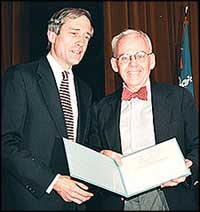
Columbia University President, George Rupp (left), presents Michael Gartner with the Pulitzer Prize for Editorial Writing.
Winning Work
By Michael Gartner
If we were the people at Lowe's, we'd be looking around Ames for another place to build our store.
If we were the City Council, we'd be wondering why the Lowe's matter is even on the agenda for Tuesday night.
And if we were the owners of those empty 23 acres off Grand and Bloomington, we'd be looking around for someone to develop apartments on the land.
For nice as it might be to have a big Lowe's Home Improvement Center in Ames, it shouldn't be built on those 23 acres north of Cub Foods. It shouldn't be, and it probably can't be.
It probably can't be because of an unusual covenant between the owners of the parcel - the Furmans and Israels - and a dozen neighbors along Top O Hollow Road to the north. In return for getting the land just south of this parcel rezoned to allow the Cub Foods store, the owners 14 years ago agreed to give the Top O Hollow neighbors veto power over any proposed rezoning of the 23 acres. That doesn't expire until Jan. 1, 2002.
No matter what the owners might want, no matter what the city staff might recommend, no matter what the City Council might vote, the land must be used for housing unless at least half the property owners agree in writing to a rezoning. That means six or perhaps seven owners must agree. Last week, Rob Hoffman of The Tribune talked with most of the owners, and it seemed unlikely six or seven would sign on.
So, a couple of questions:
1. Why is the City Council even bothering with this Tuesday night until it knows for sure whether the residents will support it?
2. Why haven't the people at Lowe's, or the landowners, sought such a petition?
But even if the homeowners agree to let Lowe's onto the site, it's a bad idea.
That plot, on the north side of town, is not a good site for a big commercial store. That's what the people who zoned the city years ago believed, and that's what the architects of the new land-use plan believe. That, too, is what the city staff thinks. The staff has put together a 14-page memo arguing against the proposal, citing everything from traffic that would be too heavy to lights that would be too bright. And the whole idea of zoning the plot for apartments was to provide a transition from the blocks with Wal-Mart and Cob Food to the orderly single-family homes north of Bloomington Road. That was a good idea 14 years ago, and it's a good idea today.
But lots of people in town - including the advertising sales people and the owners of this newspaper - think it would be nice to have a Lowe's in Ames, and Lowe's clearly wants to come here. So that raises a third question:
3. Is there another good site?
There are three.
Lowe's could be the lead tenant with the prime spot in what clearly someday will be a major retail development on the 37 acres at the northwest corner of 13th Street and Dayton Road. That land is already zoned for general commercial development. An even larger chunk, 54.6 acres, stands west of the K-Mart on South 16th Street; it, too, is zoned commercial, and it's in the midst of existing, traffic-pulling stores. A third possibility is the 21-acre plot off South 16th Street and west of the growing Aspen Business Park.
As Erik Munn noted in a letter to council member Ann Campbell, a big chunk of Lowe's business will come from outside of Ames. That would argue for a site near Interstate 35 or Highway 30, not five miles into town. And we suspect, as Munn does, that there would be far more than the 10 to 15 trucks that Lowe's says would be unloading at the store each day. So even if there weren't a zoning problem, it would seem that the Grand Avenue site is the worst of the four - the worst for the company, the worst for its suppliers and the worst for many of its customers.
This whole thing - the location, the zoning, the covenant - leaves us puzzled. It raises two final questions:
4. Why would Lowe's pick that site in the first place?
5. Why - if there is a vote - would anyone on the City Council support it?
If we were the people at Lowe's, we'd be looking around Ames for another place to build our store.
If we were the City Council, we'd be wondering why the Lowe's matter is even on the agenda for Tuesday night.
And if we were the owners of those empty 23 acres off Grand and Bloomington, we'd be looking around for someone to develop apartments on the land.
For nice as it might be to have a big Lowe's Home Improvement Center in Ames, it shouldn't be built on those 23 acres north of Cub Foods. It shouldn't be, and it probably can't be.
It probably can't be because of an unusual covenant between the owners of the parcel - the Furmans and Israels - and a dozen neighbors along Top O Hollow Road to the north. In return for getting the land just south of this parcel rezoned to allow the Cub Foods store, the owners 14 years ago agreed to give the Top O Hollow neighbors veto power over any proposed rezoning of the 23 acres. That doesn't expire until Jan. 1, 2002.
No matter what the owners might want, no matter what the city staff might recommend, no matter what the City Council might vote, the land must be used for housing unless at least half the property owners agree in writing to a rezoning. That means six or perhaps seven owners must agree. Last week, Rob Hoffman of The Tribune talked with most of the owners, and it seemed unlikely six or seven would sign on.
So, a couple of questions:
1. Why is the City Council even bothering with this Tuesday night until it knows for sure whether the residents will support it?
2. Why haven't the people at Lowe's, or the landowners, sought such a petition?
But even if the homeowners agree to let Lowe's onto the site, it's a bad idea.
That plot, on the north side of town, is not a good site for a big commercial store. That's what the people who zoned the city years ago believed, and that's what the architects of the new land-use plan believe. That, too, is what the city staff thinks. The staff has put together a 14-page memo arguing against the proposal, citing everything from traffic that would be too heavy to lights that would be too bright. And the whole idea of zoning the plot for apartments was to provide a transition from the blocks with Wal-Mart and Cob Food to the orderly single-family homes north of Bloomington Road. That was a good idea 14 years ago, and it's a good idea today.
But lots of people in town - including the advertising sales people and the owners of this newspaper - think it would be nice to have a Lowe's in Ames, and Lowe's clearly wants to come here. So that raises a third question:
3. Is there another good site?
There are three.
Lowe's could be the lead tenant with the prime spot in what clearly someday will be a major retail development on the 37 acres at the northwest corner of 13th Street and Dayton Road. That land is already zoned for general commercial development. An even larger chunk, 54.6 acres, stands west of the K-Mart on South 16th Street; it, too, is zoned commercial, and it's in the midst of existing, traffic-pulling stores. A third possibility is the 21-acre plot off South 16th Street and west of the growing Aspen Business Park.
As Erik Munn noted in a letter to council member Ann Campbell, a big chunk of Lowe's business will come from outside of Ames. That would argue for a site near Interstate 35 or Highway 30, not five miles into town. And we suspect, as Munn does, that there would be far more than the 10 to 15 trucks that Lowe's says would be unloading at the store each day. So even if there weren't a zoning problem, it would seem that the Grand Avenue site is the worst of the four - the worst for the company, the worst for its suppliers and the worst for many of its customers.
This whole thing - the location, the zoning, the covenant - leaves us puzzled. It raises two final questions:
4. Why would Lowe's pick that site in the first place?
5. Why - if there is a vote - would anyone on the City Council support it?
© 1996, The Daily Tribune, Ames-Iowa
By Michael Gartner
One client just keeps the other busy.
Keep coughing.
Keep coughing because Iowans will continue this year to smoke some 260 million packs of cigarettes.
Keep coughing because Iowa youngsters this year will continue to be able to buy cigarettes pretty easily.
Keep coughing because 4,000 to 5,000 of your Iowa relatives and neighbors will die from smoking this year.
Keep coughing.
Keep coughing because the Iowa Legislature has decided not to do anything about all this - again this year.
Sen. Johnie Hammond of Ames had introduced a bill that would have barred smoking in Iowa almost everywhere except in homes and cars and motel rooms, that would have outlawed the sale of cigarettes through vending machines, and that would have made sellers and distributors of tobacco products pay into a state fund to educate Iowans about the hazards of smoking.
Parts of the bill were awful and probably unconstitutional - the restrictions on advertising and on use of cigarette names in sporting and entertainment events were a terrible suppression of speech - but they could have been discarded.
Instead, the Legislature never really took up the issue.
Why?
Because they want to see us smoke ourselves to death? (Every minute a person spends smoking takes a minute off that person's life.) Because they wanted to see us pour our money into medical care? (Smoking costs Americans $22 billion a year in health care.) Because they think it's neat if our sons and daughters start to smoke? (About 3,000 teen-agers take up smoking every day, and half of them will ultimately die from smoking.) Because they want the tax revenue? (Iowa took in $93.2 million in taxes from cigarettes last year - about half of what smoking costs us in health dollars.)
Legislative leaders often have a hard time explaining why they do do something, so they rarely offer explanations of why they don't do something.
But here's a hint.
We stopped by the Capitol Friday and picked up a list of registered lobbyists for this session. And we counted at least 11 - including some big names - working for tobacco clients. We doubt they were working in favor of Hammond's bill or a similar bill proposed by Gov. Terry Branstad.
For the record, here are the lobbyists and their clients:
- Frank Chiodo, Smokeless Tobacco Products/Multi-States Association.
- Ned Chiodo, Smokeless Tobacco Products/Multi-States Association.
- Kim Haus, Philip Morris USA.
- Cal Hultman, Philip Morris USA.
- Bill Hutchins, RJ Reynolds Tobacco Co.
- Robert Miller, RJ Reynolds Tobacco Co.
- Lawrence Pope, Smokeless Tobacco Products/Multi-States Association.
- John Schachterle, Iowa Association of Candy and Tobacco Distributors.
- William Wimmer, the Tobacco Institute.
That's a pretty powerful group, and they're the kind of folks you want on your side if you're going to try to influence legislation.
They're just hired guns, they'll tell you, and just doing their job. The fact that their job can be linked to hooking Iowa's young people on the most addictive drug there is, to killing hundreds of grandfathers and grandmothers before they ever get to see their grandchildren grow up, to peopling this state with widows and to keeping its hospitals filled is, well, just business.
But you have to say this about them:
They earned their money this session.
Meantime ...
Keep coughing.
Which side are they on?
There are a couple of ironies in that list of lobbyists.
The Chiodos and Pope also represent Iowa Methodist Medical Center and St. Luke's Hospital in Cedar Rapids.
Hutchins and Miller also represent the Iowa Health Care Association.
And Schachterle also represents the Iowa Managed Care Association.
No conflicts there, of course. One client just keeps the other busy.
© 1996, The Daily Tribune, Ames-Iowa
By Michael Gartner
Let's think about this now.
Why would anyone want to build a Burger King or a convenience store or a gas station at 13th Street and Interstate 35?
To get folks from Ames to drive out there to buy Whoppers or Twinkies or gasoline? Some, maybe. But there already are Burger Kings and convenience stores and gas stations closer to a lot of people in town. If townsfolk were your target, you probably wouldn't put your stores a couple of miles from the nearest house.
No, if you build a Burger King or a convenience store or a gas station at 13th Street and Interstate 35, you're hoping to get a lot of tourists and travelers off Interstate 35, families who want Whoppers or salesmen who need Listerine or vacationers who need gasoline.
But how are those people who are speeding along at 65 or 70 mph going to know there's a Burger King or convenience store or gas station at the 13th Street exit? Well, they won't know unless you put up a sign. And since it takes a while to slow down for an interstate exit, it should be a pretty big sign, a sign that can be seen from a ways up and down the road. That's why, in fact, you see those big signs at Interstate exits in Story City and elsewhere along the interstate.
It seems so simple.
But it isn't.
Not in this town. When it comes to signs, nothing is simple in Ames. This is the town where billboards stir passions. This is the town that doesn't like signs in a drugstore window. This is the town where it's illegal to put a sign on a rock.
Yes, a rock.
So it is natural that a flap has arisen over Krause Gentle Corp.'s request to put up a Burger King and a Kum & Go sign on the property where it plans to build on 13th Street. The signs would be on top of a pole already on the site; it would be 107 feet from the top of the Burger King bun to the bottom of the pole. That's 57 feet higher than the sign ordinance allows.
At a meeting of the Ames Zoning Board of Adjustment Wednesday night, Krause Gentle couldn't round up the three votes needed for a variance. Board member Stuart Huntington was absent, Leonard Goldman abstained and Bonnie Homstad, saying big signs are blight, voted no. That left just two votes - those of Ken Anderson and Brian McWater - and two votes weren't enough.
So no sign.
No sign, no store, says Kum & Go. And it stopped construction.
What nonsense.
Exactly how is that sign going to screw up life in Ames? Is it too tall? It's not as tall as the radio tower almost next door. Is it too ugly? It couldn't be as ugly as that half-broken, taller-than-current-law-allows Amoco sign across the street. Is it bothersome to the neighbors? No problem, says Sauer-Sundstrand Co., the main neighbor. Is it unsafe? Nope, says the city Department of Planning and Housing. Will it "alter the essential character of the area?" Nope, the department says, adding that "in fact, the construction of the new building on the site will be an improvement to this current area."
The board will reconsider the application later, perhaps in a couple of weeks.
Before it does, it might want to take a trip up and down the interstate.
The board members might want to look at those signs in Story City and everywhere else.
When they do, they'll realize those aren't signs of blight.
They're signs of progress.
***
Meanwhile, across the highway ...
A Grand Junction company wants to put a farm-equipment dealership just across that intersection, on the northeast corner of 13th and the Interstate. The Ames Planning and Zoning Commission, which has an advisory role because the site is within two miles of the city limits, recommended against this. The vote was 3-2.
That's another short-sighted decision.
The Story County Planning and Zoning Commission and, eventually, the County Board of Supervisors will have the final say. And that say should be "yes."
© 1996, The Daily Tribune, Ames-Iowa
By Michael Gartner
And if the Jaycees think they need to sell beer to attract a crowd, let the city wrestle with that question.
There's nothing wrong with folks getting together for a few beers after work.
Unless it's in Bandshell Park.
Then, there's everything wrong with it.
One thing: It's a public park, and the city shouldn't be in the business of abetting drinking, even if it's a pleasant event like a Friday after-work get-together sponsored by the Jaycees for the men and women who work downtown. Even if it's only from 5 to 7 p.m. Even if it's only a few Fridays in the summer.
Another thing: It's the wrong park. Even if it's city policy to aid and abet beer drinkers on public land, this is not the land to do it on. Bandshell Park is a small, neighborhood park, used mainly by nearby families and their children. Roping off a part of it for a private party where beer is sold is a bad idea.
A third thing: It's the wrong time. For more than a year, the neighbors and the city have been talking about a way to make Bandshell an alcohol-free park, a way to rid it of the occasional derelict sitting around half the day drinking wine, the occasional bum sitting around half the night drinking beer. Let those discussions continue before experimenting with exceptions to the rule.
No, this is the wrong event, at the wrong park, at the wrong time.
The Parks and Recreation Commission should reject the proposal Thursday night.
***
Reject the proposal, but not the idea.
For the idea of Friday night get-togethers is a good one, and the Jaycees are nice to take it on. Nice - and good-hearted. They not only would provide a place for young business people to mingle after the week's work, they also would raise some money for the many good deeds the Jaycees undertake.
But isn't there a better place?
A place that isn't a park, that doesn't have kids on swings, that doesn't have families just across the street?
How about the parking lot at the old depot?
How about the parking lot behind Main Street? Or maybe just a part of that, the part between Duff Avenue and Douglas Avenue?
How about the parking lot just east of City Hall - the lot that many people think should be a central plaza for downtown?
That City Hall lot seems like an especially good place. Let's test it out as a meeting place and plaza and focal point to see if it works. If it does, then let's start the downtown revitalization process by building that plaza that some Iowa State University designers, some city officials and those Minnesota consultants all think is a good idea.
Why not?
And if the Jaycees think they need to sell beer to attract a crowd, let the city wrestle with that question.
But let it wrestle with it away from the parks.
Away from the neighbors.
Away from the children.
© 1996, The Daily Tribune, Ames-Iowa
By Michael Gartner
This lap-dancing thing has us puzzled.
Ames Police Chief Dennis Ballantine says lap-dancing leads to prostitution, so he wants it outlawed. (If you're of the generation that doesn't know what lap-dancing is, read on. We'll get to a rather technical definition in a few paragraphs.) As proof, he cites the arrest for prostitution of a lap-dancer at Blondie's.
He says other lap-dancers have been involved in prostitution, too, though there have been no other arrests.
Since lap-dancing regularly occurs at three Ames establishments, you have to conclude one of two things:
- Most lap-dancing ends with lap-dancing.
- The police aren't enforcing the prostitution laws.
Neither one of those conclusions seems to warrant an ordinance to make lap-dancing illegal, an ordinance that was given first approval by the City Council Tuesday night.
If it doesn't lead to prostitution, why outlaw it?
If it does lead to prostitution, why not just enforce the prostitution laws?
This is a dangerous slope the chief and the counsel have set foot on. It's intruding into the private lives of people with the vaguest of justifications and the slimmest of legality, though Ames City Attorney John Klaus has found two federal cases that he says "have held that regulations of this kind do not unconstitutionally burden essential rights of free speech protected by the First Amendment." (Though there's not much talking during lap-dancing, it is a form of speech, most scholars would agree.)
Nevertheless, "the Ames City Council may want to ask itself whether the private conduct of consenting grown-ups is an appropriate subject for its attention," the Iowa Civil Liberties Union said this week. "One could wonder what the council would consider doing next: outlaw kissing on the first date or necking in the back of a theater?"
Lap-dancing isn't exactly kissing. It is, in the words of the proposed ordinance drawn up by Klaus, when an entertainer in a bar or adult-entertainment business "shall fondle, caress or sit on the lap of any customer on said premises if the entertainer presents a performance on the premises while nude or so attired as to leave exposed the entertainer's genitals, or pubic hair, or anus, or buttocks, or female breast, or female breast with only the nipple covered."
It goes on to say that "'Fondle or caress' shall mean to bring any part of the body into contact with the body of another, in a sportive or suggestive manner, for the purpose of producing or experiencing sexual arousal or excitement."
The proposed ordinance is as bizarre as the language is stilted. Exactly who is going to determine the state of mind of the sportive or affectionate lap-dancer? If she says she was lap-dancing merely for entertainment - and that she certainly didn't intend to sexually excite the owner of the lap - who can challenge her? Further, this seems to say that lap-dancing is OK by people who aren't entertainers - the lady at the next table, for instance - but is a "municipal infraction" if done by an entertainer.
All that is amusing, but irrelevant.
For it's really quite simple.
You enforce laws by arresting the law breakers, not by harassing everyone else.
If bank robbery is a problem, you don't outlaw banking.
If carjacking is a problem, you don't outlaw driving.
If street-walking is a problem, you don't outlaw walking.
Or, in this case, dancing.
Even if it's on someone's lap.
© 1996, The Daily Tribune, Ames-Iowa
By Michael Gartner
Leonard Goldman should resign.
That's a harsh judgment about the man who built the ISU Research Park into a grand success.
And it's rendered with sadness.
But Leonard Goldman has become an embarrassment to Iowa State University and Ames. His successes have been overshadowed by a series of alarming lawsuits alleging harassment of women employees, discrimination against them, and general obnoxious behavior - screaming and swearing and telling sexual jokes - in front of them.
Nothing has been proven. Three of the lawsuits were settled this summer, and a settlement is certainly no admission of guilt. Indeed, as lawyers are quick to point out, even people who file frivolous lawsuits are sometimes paid settlements just to avoid the expense of the litigation.
So Leonard Goldman has been found guilty of nothing.
If that were the end of it, we would hold our tongue.
But there's more.
There's a particularly damning document in the file. It's a letter from Gordon E. Allen, Iowa's deputy attorney general, and Craig Kelinson, a special assistant attorney general, to the Iowa Department of Management asking the state to draw a check for $157,700 as its share of the settlement of the three suits.
"...although Iowa State University and the individual defendants have denied all liability, it is my [sic] belief that a jury would have awarded some damages to one or all of these plaintiffs after a prolonged trial," the two men wrote. "The defendants would then be obligated to pay plaintiff's attorneys fees for pretrial and trial proceedings. The amount of the settlement negotiated is in my view substantially less than those damages and attorneys fees which would be awarded by a jury."
In other words, the lawyers for the state and the university and most of the individual defendants - but not for the Research Park or Goldman himself - thought a jury would find Goldman discriminated against the women or harassed them. They thought giving these women and their lawyer $157,700 of state money was the prudent course.
That's strong - and expensive - stuff. What's more, it can be argued that Goldman's behavior - whatever it was - has cost taxpayers even more than $157,700.
The Research Park, which has been subsidized by city taxpayers and which has close links to the state-subsidized university, also settled. A clause in that settlement bars both sides from disclosing the terms, but it probably was for quite a bit less than $157,700. Plaintiffs and their lawyers like round numbers, so one guess - and there's nothing to base this on - might be $42,300, which would put the total at $200,000.
Whatever the amount, it has come out of the operating funds of the Research Park, funds that could have been used to reduce the subsidy from the city. Will it have an impact on the park, which always seems to be wanting things from the city? "I'm not free to comment" on that or anything else, Goldman said last week. He did say the payment would show up in the Park's annual audit, which, he quickly added, "is not a matter of public record."
All this secrecy adds to our uneasiness. Is Goldman himself required to make a payment out of his $100,000-a-year salary? Who asked that the settlement with Goldman and the Park be kept quiet? No one will say - the nondisclosure agreement bars even that - but it's a safe bet that neither the three women nor their lawyers demanded that the settlement be secret.
Is there even more to this sorry episode?
What is it that the Research Park and Goldman want to hide?
The board of the Research Park approved the settlement, and John Shors, the Des Moines lawyer who is counsel to the Park and whose firm represented it, says "I don't think there were any dissenting votes." That seems odd. Someone on that board - some of the Ames business people or Iowa State officials or successful alums - should have asked that the air be cleared, that the taxpayers of Ames and the supporters of the university be given the full story.
For until we get that full story, we can only guess.
And the guesses - aided by a hint here, a wink there and a tough letter from the Attorney General's office - can lead to only one conclusion.
Leonard Goldman should resign.
If he doesn't, he should be fired.
© 1996, The Daily Tribune, Ames-Iowa
By Michael Gartner
Let's build a new sports center in town.
Let's have it include a great new swimming pool, with all those things like slides and rafts and a sloped bottom that makes it seem like you're just walking into a lake or ocean - all those things that turn a swimming pool into an "aquatic center."
Let's have it include a first class ice arena, with two rinks so the hockey players can play while the recreational skaters skate, where you can have hockey tournaments and - with the flip of a switch - indoor soccer games.
Let's have it include a nifty recreation center, a bright and airy place with a couple of gyms and all the latest equipment, a place with glass walls so you could watch the hockey as you work out or glance over at the swimmers as you line up for a free throw.
Let's have it be a five-way partnership: the city, the university, private donors, industry and students.
There's a real need for this. There's a perfect place for it. There's a way to finance it.
The need is clear:
Fifty-seven percent of the people who responded to the latest "resident satisfaction survey" said they want the city to build an aquatic center. The current Ames/ISU Ice Arena "has reached the end of its economic life," a consultant says. And gym use at the Community Center in City Hall is about as jammed as it can get.
The site is perfect:
The Ames/ISU Ice Arena is operated by the City of Ames on land owned by Iowa State University. It is just across the road from Gateway Pool, a small and deteriorating pool that has about 7,500 admissions each summer but that, like the arena itself, is on its last breaths. Between the 42 acres of the city-owned Gateway Park and the Dairy Farm land used by the Ice Arena, there's plenty of space - with a little land juggling by the university - for a nifty new complex. Ames will continue to grow to the southwest, and that fact, plus the fact that students from nearby Iowa State are big users of both the ice arena and Gateway Pool, dictates that the arena and pool stay in that area.
The financing is possible:
A first-rate complex probably would cost $10 million. If that were financed by a bond issue - a 12-year issue at 6 percent - it would cost the owner of a $100,000 home about $66 in extra taxes the first year - that's 18 cents a day - a number that would drop to under $30, or 8 cents a day, by the 12th year.
But it needn't be financed just by property taxes. Historically, the Ice Arena has been a partnership among the city, the university and the citizens. Built in 1978, it was financed by private donations, constructed on Iowa State land, and managed by the city's Parks and Recreation Department.
The same partnership could and should continue. The university's Murray Blackwelder this week offered the services of the ISU Foundation to see if millions could be raised for the arena portion of a complex. The city should jump at that offer, for Blackwelder is a master money-raiser. But the university could go a step further: it is in the midst of a $300 million fund-raising drive, and it could promise to allocate to the complex the first $4.5 million raised over the $300 million goal - a goal that is sure to be surpassed.
It's proper that the Foundation help raise money for the arena, since the main users are the 3,550 university students who sign up each year for intramural hockey. And while $4.5 million might sound like a lot of money, put it in perspective: it's less than the university is planning for its new press tower and skyboxes at the football stadium.
That would cut the $100,000-home owner's cost to $33 the first year - about 9 cents a day - and $15, or 4 cents a day, in the 12th year.
But that's not all.
Students could help, too. The Government of the Student Body at Iowa State regularly supports community facilities used by students, from Cy-Ride to social services. Until recently, it was giving about $500,000 to the university's athletic department, but to save some minority sports the student group agreed to kick in another $500,000 a year. But now the athletic department seems to be on firmer financial ground, and if just $100,000 of that extra were reallocated it would cover the interest and principal on another $1 million of that $10 million sports center.
That would knock another $6 to $7 off the home owner's tax bill.
Finally, industry could help. There's no particular reason for the city to operate a recreation center, but there's every reason for one to be at a new sports complex. Why not contract with an experienced operator - from Ames or elsewhere - to run the center. The contract could be drawn so that the lease covers the maintenance and upkeep, assures a reasonable profit for the operator and amortizes another $1 million or so of the cost.
That would put the property tax portion at somewhere around $23 the first year - 6 cents a day - and $10, or 3 cents a day, the last year.
That's just the way we figure it. We're sure Steve Schainker and those smart folks at City Hall could come up with wizardry to cut those costs even more.
But you get the idea. The university could offer land and fund-raising expertise. Private donors could come up with the cost of the arena itself. Students could underwrite another piece. A private operator could absorb some of the costs. And taxpayers could pay the rest - a matter of pennies a day.
It could be done.
It should be done.
Let's do it.
© 1996, The Daily Tribune, Ames-Iowa
By Michael Gartner
Here's a note to the folks at that new Burger King and Kum & Go on 13th Street.
You might want to get a copy of the Municipal Code and read Section 5.214.
Then you might want to hire a guy with a really tall ladder and unscrew those two lightbulbs atop your sign.
Because they're not just annoying.
They're illegal.
You can be excused, of course, for not knowing that the flashing lightbulbs violate the code. Ames does, after all, devote nine pages of the code to the regulation of signs, defining 17 types of signs and regulating everything from size to location, from lighting to materials. You can't, for instance, put up a sign with a "whirligig" - whatever a whirligig is - and you can't put a sign on a tree.
At any rate, section 5.214, subsection 3, bans signs that "employ flashing, blinking, or rotating lights, except time and temperature signs."
So those two strobe-like lights atop the Burger King and Kum & Go sign - lights than can be seen for four or five miles - are clearly illegal. Unless you add the time and temperature to the sign, you'd better unscrew them.
We wouldn't make a big deal of this but for two things:
First, the lights really are annoying and distracting and could be considered a traffic hazard.
Second, we're the folks who went to bat for you after the Zoning Board of Adjustment told you you couldn't put any sign on that big empty pole that was sitting on the site of your new store. The law, as you'll recall, limits the height of signs in this town to 50 feet, and it's 107 feet from the top of your burger bun to the bottom of the pole. That's a silly rule for signs at Interstate exits, whose businesses need signs high enough to inform speeding drivers and lure them off for a burger or a tank of gas.
We said that that sign wasn't going to screw up life in Ames, and we urged the powers that be to grant you a variance. And, ultimately, they did.
So we're glad you got your sign, and we hope it attracts all kinds of motorists and lets you sell zillions of Whoppers and tanker-loads of gasoline and carloads of Twinkies and all that other stuff that fills your shelves.
But we think it would be nice if you'd unscrew those lightbulbs.
Oh, another thing:
Don't go putting any signs on rocks in this town.
That's illegal, too.
© 1996, The Daily Tribune, Ames-Iowa
By Michael Gartner
We have more than a passing interest, of course, in Christopher Gartner Memorial Park in west Ames. We stopped by, throughout the fall, and watched the children playing on the little playground or romping on the two acres of lawn. We smiled when we saw a mother or father with a youngster - pushing a swing, perhaps, or tossing a ball, or just sitting and watching. We grinned, especially, the day we saw a little boy with a big dog, each watching out for the other. We laughed out loud when we saw two little boys getting into harmless mischief.
The park, just a few months old, is already serving its purpose, we thought.
That purpose is to provide joy unbounded - joy for little kids, joy for their parents, joy for their dogs.
For Christopher Carl Gartner was the most joyous boy that ever lived.
He was born grinning, and the grin only got bigger as he grew - and grew and grew and grew. He laughed at everything - when he was little, at his grandpa's wild stories; when he was bigger, at his pals' wild escapades. By the time he was 15, he was an exuberant story-teller, regaling his pals with the latest funny thing his friend Andrew said, the latest crazy thing his friend Joey did. His grin and his laughter were infectious. Life for him was fun, and he wanted his friends and his mom and his dad and his grandparents to have fun, too. (He was genuinely kind, as well as cheerful, and early on he figured out that was an advantage. "You know," he once clued in his little brother, "if you're nice to your teachers you don't have to study nearly as hard," something he liked because being nice was a lot easier for him than studying.)
Life for him was love, too. By his early teens, he was a bear of a boy, probably six-feet three-inches or so, and he would almost have to bend over double to kiss his tiny grandma, whom he stopped by to see almost every day. But he never had that reticence or shyness that boys sometimes develop. He was an unabashed hugger from the day he was born in 1976 till the day he died in 1994. His last words to his father, as he lay in the hospital early in the morning of the summer day he died so suddenly and unexpectedly, were, "I love you too, dad."
We tell you this today, with more joy than sadness, for a couple of reasons. The first is just a technical one. The deed to the park was turned over to the city the other evening, so Christopher Gartner Memorial Park is now an official city park, and we just thought we'd tell you a bit about the boy the park is named after. (We could tell you much more - about how he goofily learned to walk with the help of a big unruly dog, who cushioned every fall; about how he drove his mother's new convertible into a tree the very day he got his driver's license - it was the tree's fault, he laughingly argued; about how he's wake his parents at midnight to report in - and then tell them funny stories of what happened at the game or the party or wherever he'd been. All those or the million other happy memories that vie for space against the grieving a hundred times a day.)
The second reason we tell all this is because this is the Christmas season, the time of joy and of families and of fun and of love. We thought there was no better way to wish you a merry Christmas than to tell you the story of a boy who embodied laughter and love and giving, a boy who brought so much joy to so many people in just 17 years.
Our purpose surely is evident: to urge you to have fun this holiday season with your kids or your parents - or both. To urge you to sit around and tell family stories as two or three or sometimes four generations gather at the table - to share in the laughter. And to urge you to tell one another, the young and the old and the very old, that your family is a pretty nice family - to share in the love.
Finally, if it's a nice day tomorrow, you might want to wander over to Christopher Gartner Park - it's tucked away at the dead end of Abraham Drive - and toss a ball around or romp with a dog or push a swing. And think nice thoughts about the cheerful boy who has lent it his name.
It's too bad you never knew him.
You'd have loved his laugh.
You'd have loved him.
© 1996, The Daily Tribune, Ames-Iowa
Biography
Michael Gartner, 58, is the editor and co-owner of The Daily Tribune in Ames, Iowa. He has had a long and varied career in journalism, starting when he began answering phones in the sports department of The Des Moines Register at age 15. Over the years, he has been Page One Editor of The Wall Street Journal; editor and president of The Des Moines Register; general news executive of Gannett Co. and USA Today; editor of the Courier-Journal of Louisville; and president of NBC News.
He has been, at various times, a regular columnist for the op-ed page of The Wall Street Journal and more recently, a weekly columnist for the op-ed page of USA Today. He is a commentator on Iowa Public Radio and the Voice of America. He is a past president of the American Society of Newspaper Editors, a former member of the board of advisers of the Nieman Fellow program at Harvard, a former member (for 10 years) and chairman (one year) of the Pulitzer Prize Board, and a former fellow at the Institute of Politics at the John F. Kennedy School of Government at Harvard University.
He is on the board of advisers of the First Amendment Center of the Freedom Forum at Vanderbilt University and of the Freedom Forum's new Newseum in Arlington, Virginia.
A lawyer as well as a newspaperman, Gartner is a graduate of the Law School of New York University and a member of the bar in New York and Iowa. He writes frequently on First Amendment issues. His editorials in Ames have won many awards -- including the ASNE editorial-writing award and the Inland Press Association award for best editorials.
Gartner is a third-generation Iowa newspaperman. His maternal grandfather was city editor of the now-defunct Waterloo Morning Tribune, and his father was a writer and editor at The Des Moines Register for more than 40 years. Gartner's wife, the former Barbara McCoy, was a copy editor at The Wall Street Journal when they met. The Gartners have a 26-year-old daughter, Melissa, who lives in the Twin Cities, and a 17-year-old son, Mike, who is a high-school junior. Their other son, Christopher, died in 1994 at age 17.