The Orlando Sentinel, by John C. Bersia
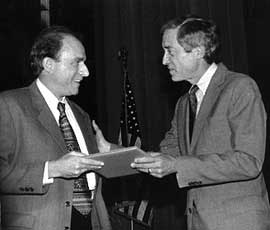
Columbia University President George Rupp (right) presents John C. Bersia with The 2000 Pulitzer Prize for Editorial Writing.
Winning Work
By John C. Bersia
Whether lawmakers want to admit it or not, Florida has legalized loan-sharking.
Consider:
A Sanford woman who's going through a divorce has only her car to her name. She turns to a title-loan company for a paltry, $250 loan. In return, she is charged interest and fees totaling 264 percent a year - plus the company keeps an extra set of keys to her car, just in case she doesn't pay up.
It's all perfectly legal.
A homeless Orlando couple with too little money to maintain a bank account must pay a fee and forfeit 3 percent of their meager earnings simply to cash a paycheck. Then, to pay their bills, they have to shell out even more to buy money orders because they can't write a check.
It's all perfectly legal.
A Winter Springs woman needs $100 for car repairs. She goes to a store where she gets an advance on her paycheck - for what amounts to a triple-digit annual interest rate. Still struggling to pay her bills, in the next two and a half years, she will wind up borrowing nearly $2,500 and paying back more than $6,500. And still she will be in debt.
Again, it's all perfectly legal.
Title-loan companies that require you to put up your car for collateral, check-cashers that can take a huge cut from people too poor to open an account at a regular bank, stores that give you an advance on your paycheck at absurd interest rates - those businesses all prey on the working poor, the elderly on fixed incomes and others desperate for money. And they do so with the state's blessing.
In Florida, the law treats the poor and financially strapped differently from those who have money. And the shameful truth is that the poor pay more than the rich. Though state law limits the interest rate that banks and Florida-based credit-card companies can charge to 18 percent a year, predatory businesses on the financial fringe are flourishing. They are devouring the meager assets of hundreds of thousands of Floridians who live payday to payday - the very people who can least afford to be exploited.
No knee-caps get broken, but - in a manner of speaking - lots of backs do. The charges are more than the poor can bear.
Florida's booming tourism industry, which has brought comfortable salaries to those at the top, has spawned a huge population of minimum-wage workers. Unfortunately, banks have had little desire tobusy themselves with such meager paychecks.
The fringe lenders, on the other hand, are only too happy to step in - at an exorbitant price. They defend their practices by pointing out the risks they take. They say they stay open long hours in neighborhoods that banks have abandoned, dealing with people who have credit problems and who may not pay back the money at all.
It seems plausible enough - until you stop to wonder why, if the risk is so great, those businesses are proliferating into empires. Consider just one, ACE Cash Express Inc., the nation's largest check-casher and also a payday lender. In just over 10 years, it has managed to expand to more than 800 stores and, despite that aggressive expansion, already had profits of more than $6 million last year.
Such businesses lure desperate people with a promise of fast cash, just what someone a few dollars away from eviction wants to hear. You can see the lenders' signs littering the roadside: "Need a loan? Have a car?"
But what those greedy sirens know is that people in a financial pinch aren't likely to be helped by a small, payday advance for, say, two weeks or a title loan for 30 days. The lenders know that many of their customers will never quite be able to pay back in full and on time, that they'll always be a few dollars short and a few days late. They know that what was supposed to be a two-week or one-month loan likely will escalate into a burden of a year or more. Meanwhile, the interest will soar into triple digits.
Let the buyer beware, the lenders say. No one is forcing people to borrow. And if they do borrow, they can read the fine print for themselves.
In an ideal world, yes. But the world of people who need those loans is not ideal. They may be single parents. They may be sick or disabled. They may be unemployed, underemployed or unable to read. Many of them don't have the minimum balance needed to open a bank account.
They don't have a lot of options.
The loan sharks are only too happy to invite them in for a swim.
So, what have our lawmakers done?
Well, when they haven't been snoozing, they've been accepting generous campaign contributions from those businesses - and making matters worse.
In 1995, the Legislature passed a law allowing these predatory businesses to charge a monstrous rate of as much as 22 percent a month - that's 264 percent a year - on loans secured by a car title. Most lawmakers say they didn't even realize what they had voted for in the waning days of the session. How could that possibly be?
Whatever the excuse, legalized loan-sharking is disgraceful, ever more so in a prosperous state such as Florida.
The two key players now are Senate President Toni Jennings and House of Representatives Speaker John Thrasher. Today, Ms. Jennings sits by quietly, letting it happen, and Mr. Thrasher looks to be doing all he can to help these lenders stick it to the poor. Yet, together they share a unique responsibility to protect the poor, the powerless and the politically unconnected.
Can they not hear the victims crying out for help? Do they care?
They need to lead the charge to rein in these predatory money-lenders and wrestle their interest rates down from the stratosphere.
These businesses are part of a dangerous slide toward a Florida in which the have-nots are thrust into a minimum-wage, or worse, subculture to be used, abused and tossed aside. It feeds off the low-paying tourism industry, the poorly educated, the new immigrants and those just poor. It is simply wrong and cannot be allowed to happen.
The governor and Florida legislators need to speak up and say "enough," that Florida is better than what these high-interest lenders would make us.
This kind of loan-sharking should be against the law.
© 1999, Sentinel Communications Co.
By John C. Bersia
Title-loan companies pull the poor ever deeper into debt with titanic fees and interest blessed by the state.
When Mary Kinnaird and her husband split up, it wasn't just her marriage that hit the rocks.
She quickly found herself sinking in debt, reaching desperately for anything to stay afloat. But what looked at first like a life preserver turned out to be an anchor, pulling her deeper into poverty.
The Sanford woman became a victim of one of the latest gimmicks in separating people from their money - the title loan, in which borrowers pledge their cars and pay triple-digit interest in return for fast cash.
Mary Kinnaird knew that a bank wouldn't help her. She was broke, her credit a mess, and the only thing of value she owned was a 1986 Camaro. The car, she began to think, was her lifeline.
At a small, title-loan store in Sanford, she plunked down the title to the $3,600 Camaro and got $250 she needed to pay bills and contribute to the cost of her daughter's wedding. She agreed to pay it back, plus $54 interest and fees, in one month.
Sure, the 22-percent-a-month rate was high - it added up to 264 percent a year - but she felt that she had no choice. Besides, she was expecting an income-tax refund by the time the loan was due.
The refund didn't come in time. She found herself fighting month after month just to keep her head above water. It took a year to save her car from being repossessed - and she wound up paying back more than twice the amount she borrowed.
This may be hard to believe, but Ms. Kinnaird was lucky. Many people who get themselves entangled in title loans end up missing a payment and losing their cars. Outrageously, lenders often demand to keep a spare set of keys, just in case.
If it seems like loan-sharking, that's because it is. And it should be illegal.
As recently as 1993, the Legislature had outlawed the title-loan business, despite the influ-ence of well-monied lobbyists. Just one year later, though, the industry pushed through a bill to make them legit again. Fortunately, the late Gov. Lawton Chiles vetoed their brazen attempt.
But, the industry didn't give up. In 1995, it tried again, using Donald Tucker, former speaker of the Florida House of Representatives, as its main lobbyist. Mr. Tucker, with his buddies in the Legislature, managed to take advantage of the notoriously chaotic closing days of the session, slipping through an amendment to legalize title loans. And there was something in there about a 22 percent rate.
Some lawmakers - who now express shock and embarrassment at results of the hurried vote - say they mistakenly believed that they were supporting a rate of 22 percent a year. It turned out to be 22 percent a month - 264 percent a year.
Can you say "price-gouging''?
It's no coincidence that the title-loan industry now makes about a half-million loans every year in Florida. Were it a bank, it would be the 160th largest in the state.
And the more it makes, the bigger the pile of money it funnels to campaign contributions to protect its interests - $168,000 in 1997-98 alone. Title Loans of America, the industry heavyweight, was most generous, handing out nearly $80,000 to its favorite politicians.
Shamefully, the money seems to have had its intended effect: Legislators have built a brick wall around their 1995 mistake, repelling every attempt at correction. Last year, the House voted to put strict controls on the industry, but then senators said, oh, no, what's wrong with triple-digit interest rates?
This year, state Rep. Bill Sublette and state Sen. Kendrick Meek - again - tried to stop the outrage. They have pushed to cut the maximum that title-loan companies can charge from what amounts to an absurd 264 percent a year in interest to 30 percent a year.
That's still high, but it's a whole lot better. But guess what: Senators have decided that it is more important to protect the loan-sharks than the poor. Already, a Senate committee has discarded Mr. Meek's bill in favor of one filed by Sen. W.D. Childers and touted, laughably, as reform. It would allow title-loan companies to charge an interest rate of 96 percent a year.
Ouch. Thus far, Senate President Toni Jennings, who promised to ensure a fair hearing for title-loan reform, has done nothing to stop the outrage. She has been sitting by quietly, letting it happen. In the House, the situation is no better. In a thinly veiled attempt to bury reform, Speaker John Thrasher has assigned the bill to five committees - an almost-certain kiss of death. If one committee won't kill it, then another one will.
So, as expected, the first committees to hear Mr. Sublette's bill shoved it aside.
But, then, what did Mr. Sublette do?
Seeing his bill lose steam, he rolled over, proposing to allow 8 percent interest a month - lower at first than Mr. Childers' industry-backed bill but amounting to the same outrageous 96 percent a year.
Is there no backbone anywhere in this mess?
To no one's surprise, the 96-percent-a-year plan passed - along with an amendment to tie the hands of local communities that might want to lower those rates.
Amazingly, Ms. Jennings and Mr. Thrasher are talking about running for the U.S. Senate while letting Florida's poor be victimized by big-time campaign contributors.
If the title-loan companies are feeling any pain, it probably is a little indigestion from wining and dining the politicians - or perhaps back strain from the weight of lugging around all that cash.
© 1999, Sentinel Communications Co.
By John C. Bersia
Check-cashing companies say it's a risky business they're in, but they're the only ones crying all the way to the bank. This is a story of people on a financial treadmill that pulls them in reverse faster than they can limp forward.
When Carin and Gene Schmidt left their small hometown in Tennessee last October, family problems had exhausted their savings, and Orlando, rich with jobs, seemed like a good place to start over.
But with no money and nowhere to stay, they wound up at a homeless shelter. Five months later, they're still there, able only to dream of an apartment of their own.
In what must seem like an upside-down world, it was their attempts to cash paychecks and do their banking, as much as anything else, that has kept them there.
Gene, who has suffered from heart trouble and asthma, is studying computer electronics. Carin works nights as a waitress at a cheap-eats restaurant in the tourist district, taking home $169 every two weeks.
That wasn't enough to maintain a bank account. But, when she turned to a check-cashing outlet, the fees started to add up.
The couple had to pay $10 just to open an account with the outlet. Each time she cashed her $169 check, she got back only $164. Those charges may not seem like much, but in a year's time, the fees would amount to nearly two weeks' salary.
Banks, though, generally won't bother with such small fish. Banks, after all, can't legally charge their customers sky-high fees. And these aren't customers likely to build cash-rich accounts or take out profitable loans, on which banks make their money.
Not so the check-cashing stores. In fact, they set up shop in poor neighborhoods for a reason. They can demand outrageous fees from those small fish.
The result is a scandalous, two-tiered financial system - one for the haves, another for the have-nots. And the have-nots, who can afford it the least, wind up paying the most.
Under Florida law, check-cashing businesses can charge 3 percent to cash government checks and 5 percent for business checks.
And the fees skyrocket if the check is a personal one. A handyman who makes $15 doing an odd job for a homeowner would lose a third of his pay to a check-casher.
Yes, the check-cashers respond, but it is a risky business. And they work in rough places, staying open long hours, often seven days a week. Those hardships have the industry crying all the way to the proverbial bank. Life's so tough that check-cashing outlets now number 6,000 throughout the country, with about 340 in Florida.
Where's the outpouring of concern? Where's the champion for the working poor who are being exploited? And why will banks not throw out a lifeline?
Instead, a kind of financial ``red-lining'' has developed, with the poor cut off from the services available to those with money. Perhaps that's not intentional, but it's what results from having to keep money in a bank just to cash a check.
Florida's banks need to come up with an alternative for the poor in their communities - services that help, rather than hurt. The American Association of Retired Persons, many of whose members use check-cashing services, recommends that banks offer more accounts that carry minimal fees and low minimum-balance requirements.
That's happening in some areas of the country. New York and New Jersey have required state-chartered banks to provide such low-cost accounts with low minimum balances, a monthly fee not exceeding $3 and at least eight free transactions monthly.
Or Florida banks could follow the lead of institutions such as Union Bank in Los Angeles. Instead of the 3 percent to 4 percent that check-cashing services charge, the bank set fees in the range of 1.5 percent. The program to convert check-cashing customers into regular customers has worked so well that the bank is expanding it.
Several states also limit check-cashing charges to 1 percent or 2 percent.
Florida should follow suit. Until that happens, a service vacuum will remain, and it will be filled all too eagerly by check-cashing businesses that profit from misfortune.
The immediate need is for Senate President Toni Jennings and House of Representatives Speaker John Thrasher to stop pretending that there is nothing wrong with what is going on. They need to put some distance between themselves and those who would take advantage of Florida's poor. They need to get behind serious reform.
Carin and Gene Schmidt deserve that much.
© 1999, Sentinel Communications Co.
By John C. Bersia
For those on shaky financial ground, offers of fast cash are hard to resist. And payday advancers are all too eager to take advantage of the situation.
Florida's ample supply of low-wage jobs has spawned a population of workers who constantly struggle just to get by.
Some succeed. Some stumble and fall -- and quickly become the victims of financial predators.
Wendy Woodruff is one who stumbled.
Like a lot of low-wage workers, she found herself a bit short of cash. All she needed was $100 to get her car fixed and to pay some bills.
So, the Winter Springs administrative assistant turned to ACE America's Cash Express in Fern Park, part of a new industry that offers something called a payday advance.
It seemed simple: Ms. Woodruff wrote a check to cover principal and fees, and ACE would hold the check until her next payday.
In return, ACE gave her the hundred bucks. But when payday arrived, she came up short again -- so she got another advance to cover her first check to ACE.
That was almost three years ago -- and still she owes ACE money.
Ever since she got that first $100, though, it has been like financial quicksand. The more she has struggled, the deeper she has sunk. She wound up getting advances on her paycheck more than a dozen times from different stores, sometimes taking one advance to pay back another. Her merry-go-round of debt has become a ride she can't get off -- and certainly a ride with no brass ring.
In all, Ms. Woodruff has received advances of about $2,400 -- and paid back more than $6,500 -- during the past two and a half years. And she still owes more than she has received.
Ms. Woodruff soon discovered that the plain, small store she first entered, with its solitary clerk, was part of a sprawling, predatory empire.
ACE Cash Express Inc., like many businesses offering payday advances, started out strictly as a check-cashing operation. But payday advances, with their promise of fast money, have turned out to be much more lucrative.
Get an advance of 100 bucks and you could wind up paying fees and charges amounting to more than 380 percent annually - that in a state that limits banks and Florida-based credit-card companies to 18 percent interest a year. How did it get like that?
First, Florida has a huge number of low-paid service workers -- 115,000 tourism workers in Central Florida, alone -- who form a prime target for such predators.
Second, the state has given these businesses its blessing by looking the other way. There is no law that specifically covers payday advances. Instead, they operate under a catch-all law that lets them charge as much as 10 percent of the money they advance, plus other fees.
So now, only a few years old but rolling in cash, the industry has decided that it needs to write its own law to press its advantage.
In fact, industry lobbyists initially suggested doubling what they now charge. They eventually decided that they could scrape by with a 50-percent increase. That would cap all charges but amount, on a typical two-week advance, to 390 percent annually.
That effort also has the backing of payday-advance businesses that haven't yet even entered the state, particularly Check Into Cash, an industry heavyweight with 340 stores that wants to set up shop in Florida.
The Florida Legislature should pass a law, all right. But not one that lets payday advancers gouge the poor.
It's time for state Senate President Toni Jennings and House of Representatives Speaker John Thrasher to inject some sanity into this mess.
"Not a day goes by that I don't think of this," Wendy Woodruff said ruefully. "This industry exploits people. If I can keep even one person from getting into this kind of mess, I'll be happy.''
© 1999, Sentinel Communications Co.
By John C. Bersia
There are ways to get rich feeding off the finincial woes of those who have little. It's interesting to note who shares in the feast.
Mr. Malnik was reputed for many years to work for the late Meyer Lansky, financier to the mob -- an allegation Mr. Malnik denies. Whatever his background, he's prospering.
Who's making money off the poor?
Steve McKenzie for one. He owns a company called National Cash Advance, based in Cleveland, Tenn. It mushroomed in three years from nothing to 165 outlets, including some in Florida, that exploit people desperate for fast money.
His company advances money to people who need a little cash to get by until payday. In Florida, companies such as Mr. McKenzie's can charge fees amounting to 260 percent a year plus processing charges. No wonder business is booming.
But payday advances aren't the only way to get rich taking money from people who have far too little to lose already. There also are title loans that can wrest from their pockets whatever money is left.
Title lenders typically lend a small portion of a car's worth and charge 22 percent a month in interest and fees. When a borrower falls behind in payments -- as often happens -- the lenders are quick to repossess and sell the car, usually keeping any excess profit.
The giant of the industry is Title Loans of America Inc., based in Atlanta. Yet the principal owner is Alvin Malnik, a multimillionaire lawyer from Boca Raton. Mr. Malnik was reputed for many years to work for the late Meyer Lansky, financier to the mob -- an allegation Mr. Malnik denies. Whatever his background, he's prospering.
By contrast, the people who patronize these businesses often live modestly, some even in homeless shelters. And when the high-rate lenders share their ill-gotten wealth, it is not with the unfortunate but with lobbyists and lawmakers who protect these companies' interests.
They hire men such as Robert Levy. He represents the Florida Check Cashers Association, many of whose members offer payday advances.
The title lenders also certainly can afford high-profile people to look out for their interests. One is lobbyist Donald Tucker, a former speaker of the Florida House of Representatives. He was the force behind a mysterious 11th-hour ploy in the 1995 session to legalize charging 264 percent in interest and fees.
In addition to Mr. Tucker, the title-loan team includes former House Speaker Ralph Haben; former legislator and former Dade County Commission Chairman Mike Abrams; and Jim Magill, organizer of Gov. Jeb Bush's inauguration. The list of expensive talent goes on.
And their clout has been evident: Whenever an upstart legislator offers a bill to end this outrage, they serve up a bill of their own, with a considerably sweeter deal for the industry. And they invariably get their way.
That may have something to do with the money they spread around. Title-loan companies poured at least $168,000 into Florida campaigns in 1997-98, giving to both political parties and to individual candidates.
Who got the money?
Lots of folks, but a few merit attention:
Sen. Betty Holzendorf is the vice chair of the Banking and Insurance Committee. Hers is one of three committees to review a bill favorable to the title-loan industry. She strongly championed the lenders' cause, and her committee approved. Her take in 1997-98 campaign contributions: at least $6,500.
Sen. John McKay, who sits on the Agriculture and Consumer Services Committee. His campaign received at least $1,000 from the industry in 1997-98. Openly hostile to reform efforts, he supported the industry's bill.
Rep. Mark Ogles chairs the committee that practically derailed title-loan reform recently. It approved an outrageous rate of 96 percent a year. If that weren't bad enough, he then voted to prohibit local governments from acting on their own to lower those rates. Mr. Ogles' campaign received at least $1,000.
Rep. Victor Crist received at least $1,500. He proposed the amendment that would tie the hands of local governments bent on cracking down on title-loan companies.
Meanwhile, the payday-advance folks, relative newcomers to Florida, are just cranking up their money machine. Along with the Florida Check Cashers Association, they gave more than $50,000 in political contributions. But it's early in their influence game.
Their strategy is somewhat different. They're aiming right for the top, pouring about $3,000 into Gov. Jeb Bush's campaign and thousands more dollars into the campaign funds of the political parties.
The sad irony is that the money the industry spends to keep people in financial chains comes right out of its victims' pockets.
Florida has a long and checkered history as a haven for unscrupulous practices. Now the check cashers and high-interest lenders seem to have figured out the system.
Senate President Toni Jennings, House Speaker John Thrasher and even Gov. Jeb Bush need to dust off their code of ethics and make it clear that their job is to protect people who can't protect themselves.
These leaders are saying money talks louder than the powerless poor -- a real disgrace.
This relentless feeding off Florida's poor must stop.
© 1999, Sentinel Communications Co.
By John C. Bersia
Predatory lenders are circling Florida's poor. It's up to state leaders to come to the rescue and fend off the sharks.
The loan-sharking industry is having a pool party in Florida.
It's swimming in money while the working poor and the financially strapped who turn to it for help are being eaten alive by the industry's triple-digit interest rates, charges and fees.
The sharks are a collection of check-cashing businesses, stores that offer consumers advances on their paychecks and companies that lend people money in exchange for car titles. All charge exorbitant interest rates or outrageous fees to desperate people, many of whom can't even afford to maintain a bank account.
In other words, the people being charged the most are those who have the least.
Meanwhile, Florida lawmakers, who could set this right, seem to have been co-opted by their lobbyist buddies and the lenders' free-flowing campaign contributions.
Richard Wilson, a disabled mechanic from Ocala, summed up the plight of the needy at the hands of the greedy during the opening days of this year's Legislature. To get a $100 loan, he put his $1,500 vehicle up for grabs by a title-loan company. As long as he made payments -- at a whopping 22 percent a month in interest and fees - things were fine. He had paid back more than $140 -- $40 more than he borrowed -- when he missed a payment, and the title-loan company seized his car.
A Georgia man fared even worse. After he borrowed $150 from Georgia Auto Pawn in Macon, the company said Henry James Hubbard III had been falling behind on his payments, amounting to 300 percent a year. So it dispatched a collection agent to repossess the car. Mr. Hubbard protested. Both he and the agent drew guns, and Mr. Hubbard was shot dead.
Obviously, that was an extreme case. But, the stakes are high. Lots of money is on the table.
The industry pulls out a laundry list of reasons to defend its outrageous fees -- it does business in rough neighborhoods; its customers often have bad credit; and it loses more money than banks do on loans that aren't repaid.
But business is booming. Every year, an estimated half-million Floridians empty their pockets to sate the lenders' greed. And every year, the victims parade before the Legislature, begging for relief -- to no avail.
Yet it doesn't have to be that way:
Lawmakers should limit the title-loan companies to 18-percent-a-year interest, the same rate banks can charge. The total, with fees, shouldn't exceed the 30 percent that consumer-finance companies can charge. If title lenders can't make money at that price, good riddance.
State Senate President Toni Jennings should quit hiding on the sidelines. She promised that this issue would get a fair hearing -- and that's not happening. She needs to live up to her word and get involved.
Ditto for John Thrasher, speaker of the state House of Representatives. If he really favors reform, as he says, why did he jettison into near oblivion a bill that would have reformed the industry? He sent it through an all-but-impossible gantlet of committees, knowing that it had little chance to survive.
Speak up, Mr. Speaker.
Lawmakers shouldn't stop with the title-loan industry. They should limit fees on payday advances to 30 percent, too. There should be no room for abuse. Lawmakers also should rein in the 3-percent-to-10-percent rates that check-cashing services charge. Those should come down to between 1 percent and 2 percent, as other states have mandated.
The Legislature bears primary responsibility for controlling Florida's financial predators, but Gov. Jeb Bush also has a role to play. He's a Republican governor with a Republican legislature. He and Ms. Jennings and Mr. Thrasher can decide this issue. They need to make clear that they won't let loan sharks continue to feed on Florida's poor.
The federal government also has to get involved. These lenders have ballooned into interstate empires that reach beyond Florida's borders, hitting people in the armed forces particularly hard.
Finally, banks must do the right thing. A big reason the legal loan-sharking industry has flourished is that banks no longer want to set up shop in poor neighborhoods. The profit margin is too slim for their tastes.
The social obligation that goes with the right to operate a bank ought to include helping people surrounded by predatory lenders.
Banks elsewhere -- most notably Union Bank in Los Angeles -- have taken that obligation seriously, working actively to convert check-cashing customers into regular customers. The program has worked so well that it is being expanded.
That can happen in Florida.
The poor and financially strapped in Florida need a life preserver.
How long before their cries are heard?
© 1999, Sentinel Communications Co.
By John C. Bersia
Lawmakers should send a message to abusive lenders that Florida will not tolerate exploitation of its people.
State lawmakers are running out of time to rescue thousands of Floridians the Legislature unwittingly threw to the sharks four years ago.
In the chaotic final moments of the 1995 session, lawmakers approved letting businesses lend small amounts of money in exchange for car titles - and charge 22 percent in interest and fees each month.
That's 264 percent a year in a state that limits banks and credit-card companies to charging 18 percent interest.
And for the past four years, businesses have sprung up all over the state to take advantage of that outrageous opportunity.
Meanwhile, people down on their luck have been putting up their car titles, falling down a black hole of debt and, in many cases, losing their only means of getting to work to pay off that debt.
It's wrong, and everyone knows that it's wrong.
Everyone, it seems, except an unsavory group of politicians who are in the hip pocket of the businesses taking advantage of the Legislature's lapse of judgment.
Repeated attempts in the past few years to correct the problem have fallen victim to two potent forces:
- Politicians who in the most recent election cycle, directly or indirectly, received at least $168,000 in contributions from the very businesses that are resisting regulation.
- An army of well-connected lobbyists, including two former speakers of the Florida House of Representatives.
This year, though, things are different. That army of lobbyists bumped into the U.S. Navy, which said, "Enough."
Sailors had been victimized once too often by those loan sharks, and the Navy - like most Floridians - wants it stopped.
That message resonated like reveille in the ears of House Speaker John Thrasher, in whose district the Navy has a significant presence. The House immediately passed a reform bill 115-0, which would bring car-title lending rates down to the 30 percent that consumer-finance companies can charge - and would protect local communities' right to set lower limits.
In the Senate, however, industry lackeys have insisted on charging a still-outrageous 96 percent a year.
What is going on here?
Are the people crying out for triple-digit loans? Does state government exist to protect businesses that prey on Floridians?
Of course not. Governor Jeb Bush said it quite eloquently in his inaugural address: "Let the capacity of our courage and caring be the measure by which we are judged.''
Well, Floridians are looking for some of that courage and caring, and it has not been forthcoming - not from the governor, who has refused to step forward on this issue, and not yet from the Senate.
With two days left in this year's scheduled legislative session, Mr. Bush and those in the Legislature who truly do care, and have the courage to stand up for what's right, should end the nightmare of 1995.
They should send a message to abusive lenders of all stripes that this state will not tolerate exploitation of its people.
They should make clear that Florida is an unhealthy environment for loan sharks.
© 1999, Sentinel Communications Co.
By John C. Bersia
Banks should work on creative approaches to help the working poor and financially strapped get their heads above water.
The working poor and other financially strapped individuals aren't treated like the rest of Florida's people.
The poor pay more - as much as 10 percent when cashing checks and triple-digit rates to take out small loans - although they can afford it the least.
The industries that prey on the needy defend what they do by contending that no other business would deal with their customers.
They suggest that mainstream financial institutions practice a kind of financial red-lining, separating out the poor and financially strapped.
That's not true, but banks could do a better job both of serving those on the financial fringe and of making those services known.
What's needed most, of course, is aggressive government action to bring down to earth the sky-high rates charged by check-cashing services and businesses that lend money in exchange for car titles or provide advances on paychecks.
Another part of the answer, though, lies with mainstream financial institutions. Banks benefit from providing an essential public service, but they also have an inescapable social responsibility.
That, of course, doesn't eclipse the financial responsibilities they have to their owners or depositors, or obligate them to take unnecessary risks. It does, however, call for banks to make their services available to everyone in their communities, including the poor, at reasonable rates.
Union Bank of California has shown what a bank can do when it commits to making a difference. In 1994, the bank launched a program in Los Angeles to compete with check-cashing services for the business of low-income immigrants. In a largely Hispanic shopping district, the bank offered check-cashing and basic banking services at half what check-cashing services charged. It also offered low-cost savings accounts and secured credit cards.
Of course, Union Bank is in business to make a profit. But that hasn't stopped it from doing good. It has succeeded at both, with the program growing to 15 centers in several cities and continuing to expand.
Another option is for banks to take over check-cashing services and make those services more consumer-friendly. One bank with extensive operations in Florida, Banco Popular, has been acquiring check-cashing services in several states - including Florida - since 1997. Banco Popular says it wants to point people in difficult situations toward the financial mainstream. But so far Banco Popular hasn't cut rates at its check-cashing stores. What's it waiting for?
Banks also could offer more low-cost checking accounts that carry few fees and require little or no minimum balance. The federal government is encouraging banks to set up lifeline accounts for people without customary bank accounts to receive federal payments electronically.
Some local banks already are trying creative approaches to help consumers:
- SunTrust Banks launched what it calls "economy checking'' in 1996. The account requires no minimum balance and is designed for people of limited means.
- NationsBank has set up partnerships with consumer-credit counseling services to help the poor manage their finances.
- First Union has a customer-for-life program through which it strives to know its customers and provide needed services - such as help for people in getting their financial life in order.
That's good, but more could be done.
Area banks should review their array of services. Those without inexpensive checking accounts should develop such services.
Banks also should do a better job of getting the word out about loans - such as those secured by car titles. Many people in financial distress have bought the predatory lenders' line that banks wouldn't touch those customers. But most banks offer loans at a fraction of the cost of those hawked by car-title-loan businesses.
Banks have a chance to address the needs of all citizens better and, in doing that, help the working poor fend off Florida's predatory loan sharks. It's time to test the water. It can help, and it will feel good, too.
© 1999, Sentinel Communications Co.
By John C. Bersia
The County Council's action to give car-title lenders safe harbor undermines the good work of other counties. A Change of Heart is in Order.
Central Floridians have found in recent years that they have good reason to think regionally.
Because Lake, Orange, Osceola, Seminole and Volusia counties have overlapping interests, residents benefit by cooperating with one another across political boundaries.
By the same token, when one community acts in a way that affects the region adversely, everyone suffers. A recent Volusia County Council decision offers a case in point.
Volusia County officials, like their counterparts throughout Florida, have an opportunity to reel in predatory businesses that offer cash for car titles at outrageous rates - as much as 264 percent a year.
The same law that allows those loan sharks to gouge people in dire financial straits also reserves local governments' right to lower those rates. At least 13 counties and cities in Florida have done so, mostly in response to the Legislature's shameful refusal this year to fix the problem. Another five either have proposed ordinances or have approved drafts for ordinances.
Locally, the Osceola County Commission plans to take up the issue soon. Osceola County has cooperated with other Central Florida counties in efforts to agree upon setting a reasonable regional rate. Orange and Seminole counties already have acted responsibly, setting the limit at 30 percent a year. Lake County also is moving in that direction.
But when Volusia County's turn came to show its concern for loan sharks' victims, four council members balked: Big John, Dwight Lewis, Ann McFall and Jim Ward.
Oh, they cut the rate a bit - to 120 percent a year for a one-month loan. The law limits banks and credit-card companies in Florida to 18 percent, consumer-finance companies to 30. Nothing justifies allowing car-title-loan companies in Volusia County to charge several times those rates.
After all, residents aren't putting up stereos and old jewelry to borrow money. They are risking the transportation they need to survive financially.
The Volusia County Council's action has given car-title lenders a safe harbor, providing a base from which to prey on consumers in neighboring counties. That undermines the good work those counties have done in approving the 30 percent rate.
Worse, it will turn Volusia County into a magnet for a type of business that few legitimate businesses - or residents - would want nearby.
The council members who voted for the outrageously high rate can't actually believe that Volusia County would become a better place because car-title lenders do business there. They can't really believe that anything warrants charging people as much as 120 percent a year to borrow money or that encouraging more car-title-loan stores would benefit the economy.
Mr. John, Mr. Lewis, Ms. McFall and Mr. Ward have shown poor stewardship in selling Volusia County residents short.
At least Ms. McFall and Mr. Lewis apparently have had a change of heart. Ms. McFall said last week that she has considered changing her vote to 30 percent, after talking with many concerned constituents. Good for her.
Mr. Lewis indicated that he didn't understand all the details of the ordinance that Volusia County passed. It masqueraded as providing for a 64 percent rate, which still would have been too high. Mr. Lewis said the county should make rates more restrictive. Unfortunately, his idea of a proper rate - 60 percent, with a maximum of 5 percent a month - would double what exists in neighboring counties.
To get the message to other errant council members that they have done the wrong thing, Volusia County residents can complain directly, using the accompanying information. Residents also should contact Ms. McFall and Mr. Lewis to encourage them to move in the appropriate direction.
Mr. John, Mr. Lewis, Ms. McFall and Mr. Ward have a chance to redeem themselves by voting to reconsider the issue at the next council meeting, Thursday. If that happens, Volusia County's sorry new law could be reversed as early as July. If the council fails, though, Volusia County residents will have to look to the next election and support leaders who care about their community and its people.
© 1999, Sentinel Communications Co.
By John C. Bersia
Consumer-credit counseling services go a long way toward helping those who have fallen prey to car-title lenders get their heads above water again.
Already drowning in debt, Debra Noland felt new pressure: A daughter needed help paying for college.
After exhausting every other solution she could imagine, the divorced mother of two turned in desperation last summer to a car-title lender, which offered her a $300 loan secured by the title to her 1988 Thunderbird.
The Ormond Beach woman knew better. She had worked for a check-cashing store that advanced customers money on their paychecks - and, like car-title lenders, charged triple-digit rates. She knew that those businesses exploit people's distress.
So, she vowed to pay back the loan quickly, adding several dollars to each month's $66 payment. After four months - and more than $500 in payments - Ms. Noland had her car title back. But not for long.
Short of cash after the holidays, she returned to the car-title lender and borrowed $500. Seven months later, she has paid back more than $700 and still owes about $450.
What to do?
Many people ask that question - including local officials considering lowering the 264 percent a year in interest and fees the state allows title lenders to charge.
In Central Florida, Orange, Seminole and Volusia counties have answered the question, as they should, by limiting annual charges to 30 percent. Lake and Osceola counties appear ready to do the same.
The industry says that such caps will drive it out of business.
Clearly, if that occurs, borrowers will need help paying their debts. Some mainstream lenders are working on innovative alternatives. But another solution exists. People who struggle with car-title loans and other debts have access to immediate relief: consumer-credit counseling services.
The biggest, Consumer Credit Counseling Service of Central Florida Inc., draws support from United Way and other groups. It has 30 locations in this region and now helps more than 11,000 consumers.
Ms. Noland added her name to the agency's list two weeks ago, and she's glad she did. It may take a year or longer to pay off her bills, but at least she now has a life preserver. On her own, she was sinking.
Many people don't realize that consumer-credit counselors stand ready to help. Those organizations, which used to show consumers how to reduce credit-card burdens, have expanded their services.
CCCS, for example, helps people clean up their credit so they can apply for home mortgages, shows how to set up a realistic household budget, assists in devising plans to pay down debts, teaches classes onmanaging money - the list goes on.
The agency also offers a service unusual in the credit-counseling industry: emergency funds. That lets CCCS pay someone's rent, utilities and other bills temporarily.
So, anyone who runs out of cash and considers going to a car-title lender should touch base with CCCS. Even if a consumer has borrowed from predatory lenders, it's not too late, as Ms. Noland found out.
Granted, swallowing pride and setting up an appointment with a consumer-credit counselor can prove a tough decision. But, what relief the experience can deliver.
CCCS counselors understand the consumer's predicament. They reserve judgment and go out of their way to make the consumer feel at ease, offering advice in comfortable, private settings.
First-time visitors commonly spend an hour with a counselor. Subsequent sessions usually last a half-hour or so. Consumers don't have to show up in person. They can receive counseling over the telephone.
Many CCCS counselors speak more than one language. For example, Liz Ovalles, shown in the accompanying photo, helps consumers in English and Spanish. If counselors at a given site don't speak a consumer's language, they can arrange for an interpreter - from Portuguese to sign language.
Two weeks ago, Debra Noland was drowning in debt. Today, thanks to consumer-credit counseling, she can look to the future with hope. Counselors can't make a financial crisis disappear, but they can direct panicked consumers toward high ground, out of predatory lenders' clutches.
How to get help:
Consumer Credit Counseling Service of Central Florida
In Lake County, call: (352) 326-9004
In Orange, Osceola and Seminole counties, call: (407) 895-8886
In Volusia County, call: (904) 761-5414 (Daytona area)
(904) 774-2227 (Deltona/Orange City area)
Or, to reach the national service number, call (800) 388-2227
© 1999, Sentinel Communications Co.
Biography
John C. Bersia, 43, is an editorial writer at The Orlando Sentinel who specializes in international relations, national affairs, and business and economic issues.
Before joining the Sentinel in 1985, he was editor of Global Perspectives, a journal of foreign affairs; an international consultant; and an analyst for the U.S. government. In addition to serving as a member of the newspaper's editorial board, he also teaches political-science college courses.
Bersia has a master's degree in international relations and political economy from the London School of Economics. He also holds master's degrees in government from Georgetown University and public information administration from American University. He is a 1977 University of Central Florida graduate in political science and French.