New York Daily News, by Editorial Board
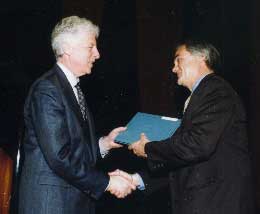
Columbia University Provost Jonathan R. Cole (left) presents Michael Goodwin of the Daily News with the Pulitzer Prize for Editorial Writing.
Winning Work
(All articles are attributed to the Editorial Board.)
The motto of Harlem's fabled Apollo Theatre is "Where stars are born and legends are made." For four decades -- from the '30s, when owners first admitted black audiences, to the '70s, when it was shuttered -- the Apollo gave more to American popular music than any other single venue.
Winners of the Apollo's famed Amateur Night include Pearl Bailey (in 1934, the year it started), Sarah Vaughan, James Brown, Gladys Knight, Dionne Warwick and the Jackson Five. Billie Holiday performed there. So, too, Ella Fitzgerald, Richard Pryor, Stevie Wonder and Bill Cosby.
But today the Apollo's grand legacy has been reduced to a faded mural in the lobby. The 1,400-seat auditorium is empty nearly six nights out of seven. The venerable Tree of Hope, a stump performers touched for good luck, sits on an empty stage. Luck has not smiled on the Apollo in decades. Among the most serious problems:
Money: The state-owned theater lives a hand-to-mouth existence despite "Showtime at the Apollo," a lucrative syndicated TV show taped there by Percy Sutton, the businessman and former Manhattan borough president. Although required by contract to pay a percentage of his show's revenue to the Apollo Theatre Foundation, the nonprofit corporation that runs the theater, Sutton has paid only a nominal sum.
The foundation is headed by Sutton's very close friend Rep. Charles Rangel. Sutton's lawyer, Basil Paterson, is also treasurer of Rangel's reelection campaign. The tangle of relationships raises doubts about whether the deal is truly arm's length.
Physical Condition: Despite a renovation in the '80s that Sutton puts at $20 million, a recent New York Landmarks Conservancy report notes that the facade is crumbling, the famous "APOLLO" sign is in disrepair and the marquee requires major work. Inside, seats are shabby, plaster is crumbling and auditorium stairs "require attention as a matter of safety," says the conservancy, a private group.
Empty Stage: Mostly, the Apollo sits dark -- a major economic loss to Harlem. In a city teeming with talent, the foundation attracts only sporadic events, though the theater boasts a modern recording studio and sound system.
The current crisis has been gathering for years.
After the death of its long-time owner, the Apollo fell into bankruptcy in the 1970s and closed. In 1982, Sutton, whose Inner City Broadcasting owns radio stations WLIB and WBLS, persuaded the state's Harlem Urban Development Corp. to buy the theater and turn it over to him to operate.
While that kept the theater alive, the benefits have gone almost exclusively to Sutton. His "Showtime at the Apollo" is seen by 2.5 million people a week and is tied for third place among syndicated programs nationwide. Variety, the entertainment trade paper, says the show's costs are "surprisingly small."
High ratings and low costs usually translate into big profits, and they almost certainly have for Sutton. But not for the Apollo.
Under a 1992 license agreement, Sutton is required to pay the foundation $2,000 for every day he uses the building or 25% of his show's net profits, whichever is greater. From 1992 to 1997, Sutton typically used the theater about 20 days a year, and he never paid more than the $2,000 daily minimum.
As the five-year deal drew to a close in December, the foundation's somnambulant board began asking Sutton for back payments. Sutton agreed to pay a mere $145,000 -- less than 5% of the millions knowledgeable sources believe the deal calls for.
Like so much at the Apollo, the talks were an insiders' game. Asked about the $145,000 settlement figure, foundation Vice Chairman Eugene McCabe said it was based on "how much the Apollo needed" -- not a formal accounting. Sutton refused to be interviewed, though he said he would answer written questions. When a list of questions was sent to his office, he refused to comment.
Some 15 years ago, Sutton got $11 million in low-interest loans from the state and city and $2.9 from Manufacturer's Hanover for renovations. He has said he put $6 million of his own into the project. A 1987 state audit found shoddy bookkeeping and missing files. Four years later, the loans were set aside and HUDC set up the nonprofit corporation to operate the theater.
But, under his contract, Sutton kept the Apollo's most valuable assets -- use of the building, its legendary name and trademark rights. The terms were favorable enough to Sutton, but they got even better when the foundation board failed to collect its royalties. The board is headed by Congressman Rangel.
© 1998, Daily News
No one symbolizes the power of Harlem more than Rep. Charles Rangel. With 28 years on Capitol Hill, he is the dean of the state's congressional delegation. And he has put his clout to good use, with the $300 million Upper Manhattan Empowerment Zone being the most visible sign.
But as chairman for seven years of the Apollo Theatre Foundation, the nonprofit corporation entrusted with the crown jewel of 125th St., Rangel has been woefully ineffective. He has allowed the Apollo to fall into sad disrepair and be sapped of its vast economic and cultural potential.
The first, and most crucial, step toward restoring the Apollo's legacy must be for Rangel to sever his link to the theater. During his reign, the Apollo has become a physical eyesore. It sits dark most of the week. And its modern recording studio and sound stage remain underused.
Only on Wednesdays does the theater come alive -- for the popular Amateur Night, where new talent has been hailed, hooted and hooked since the 1930s. The show proves the theater's lure is magical -- if properly presented.
Then there is the popular syndicated TV show "It's Showtime at the Apollo," whose producer, powerbroker Percy Sutton, is Rangel's life-long friend and ally. Thanks to a five-year-old sweetheart licensing deal, the Apollo -- and all its trademarks -- essentially have become Sutton's exclusive domain.
That lopsided deal has been compounded by the failure of Rangel and his board to enforce the contract terms. Late last year, with Sutton owing what some insiders estimated at more than $3 million, a board panel accepted a mere $145,000 as full payment. It is not clear whether the full board has ratified that settlement and whether any money has actually been paid.
Rangel claims to know nothing about the settlement. And therein lies the problem: Rangel's absentee leadership. He has entrusted the theater to Sutton and an insular board that bears the taint of the Harlem Urban Development Corp.
Rangel and HUDC formed the Apollo foundation in 1991 -- four years before HUDC was disbanded amid allegations of corruption and fiscal chicanery. Apollo board members Eugene McCabe, Richard Greene and the Rev. William James all served with Rangel on the HUDC board. Of the 11 founding foundation board members, eight remain. As McCabe said, half in jest, in an interview, serving on the Apollo board is a "lifetime appointment." That must change.
In a telephone interview, Rangel said, "The Apollo is very dear and near to me and probably deserves better than me." He's right. Rangel has left the theater begging for money, while his pal Sutton continues to enjoy its fruits.
Until the Apollo Theatre Foundation has a leader with vision, expertise and the fiscal sense to spend wisely, the organization's campaign to raise $30 million for renovations and a stabilizing endowment must be halted. Under current leadership, donors would be throwing good money after bad.
The board must be reconstituted -- sans Rangel and his cronies -- with a mandate to renegotiate the "It's Showtime at the Apollo" deal. The current agreement with Sutton expired in December but has been extended temporarily. A new agreement must not be signed until the board can demonstrate it has collected all the money Sutton owes. Even then, the board, despite hiring a respected law firm to guide it, has forfeited all trust that it can properly run the theater.
Under inspired new leadership, the Apollo could take advantage of the Harlem tourism boom. A lucrative gift shop and cafe -- dreams of executive director Grace Blake -- could become a reality under an energized, creative board.
If business (or lack thereof) as usual continues under Rangel, the state, the owner of the Apollo, must step in. Its lease requires the foundation to maintain the theater in good condition and to provide quarterly financial reports. The foundation has done neither -- ample justification for turning the operation over to a more responsible group.
Also, under state law, Attorney General Dennis Vacco or a board member can petition the court to remove Rangel or dissolve the entire body. All that's required is evidence of a breach of fiduciary duties. Although no government agency has ever audited the foundation, there is evidence aplenty -- as this page has shown today and yesterday.
When the Apollo Theatre Foundation was created, the goal was to insure that the legendary theater would remain a haven of dreams, ambition and talent. Rangel can now put it back on that path. By stepping down gracefully.
© 1998, Daily News
To make sense of the flurry of headlines about the Apollo Theatre, forget the charges that politics and racism motivate them. For this is a story of impartial, cold numbers -- numbers that show convincingly that the legendary state-owned theater has not been getting its fair share of revenues.
As the Daily News reported Sunday, the controller of the Apollo Theatre Foundation concluded that Percy Sutton's Inner City Theatre Group owed the theater $4.4 million under a license agreement for the popular TV program "It's Showtime at the Apollo." But the foundation didn't get anywhere close to $4.4 million. It got, until recently, only $50,000 -- over five years.
Put in stark terms, for every dollar of the $17.5 million Sutton took in from "Showtime," the foundation got less than a penny. That fact shames Sutton, the board and anyone else who professes love for the Apollo.
Love means having to pay what you owe.
The memo outlining these numbers is the surest evidence yet that the foundation board failed to safeguard the Apollo. The board is chaired by Rep. Charles Rangel, Sutton's old friend.
The heart of the issue is in the December 1992 deal between Inner City Theatre Group and the Apollo foundation. It says that Sutton "shall pay to ATF for 'It's Showtime at the Apollo' $2,000 for each day of taping . . . or 25% of the annual net profits to be derived from the said television show, whichever is greater." The deal was signed by just two people -- Sutton and Rangel.
Sutton's complaints that the show only recently became profitable are irrelevant, because the agreement clearly defines "net profit" as "gross invoice selling prices thereof in the form in which they are sold . . . without any other deductions of any kind whatsoever."
The language is dense, but the high-powered law firm of Paul, Weiss -- whose analysis of the contract was requested by exective director Grace Blake -- said the language means the Apollo is entitled to about 25 cents of every dollar Sutton takes in, not just his profits.
The show, Sutton acknowledges, took in $26.45 million in the five years of the license agreement. Using that base, and allowing some generous deductions, the foundation's controller still calculated that, for purposes of the agreement, the show made $17.5 million -- thus entitling the Apollo to $4.4 million.
Sutton said the Apollo deserved only $195,000, or $145,000 more than the $50,000 he had paid. Faced with getting $4.4 million or $145,000, Rangel and the board accepted Sutton's number, instead of their own controller's.
Who loves the Apollo? The numbers don't lie.
For the Apollo to regain its luster, it must be freed of a board majority that doesn't take seriously its responsibilities to this national treasure. An increasingly vocal minority is emerging -- finally -- and its members are asking the tough questions. They deserve answers, and they deserve public support.
© 1998, Daily News
That the question must be asked a full two months after this page exposed the terrible conditions of Harlem's Apollo Theatre is troubling. The famed venue is on life support, but nobody in the emergency room is in a hurry.
When it was revealed that the state-owned landmark was physically deteriorating, flat broke and sitting empty five or six nights a week, state economic development officials and the attorney general both announced they were on the case. Since then, there has been no clear progress in saving the theater.
Most important, officials have not yet demanded that any new licensing agreements for the valuable Apollo trademarks be put up for competitive bid. Nor have they demanded a shakeup of the board of directors that failed the theater in the first place.
The result is that, instead of being the centerpiece of a revived 125th St., the Apollo is becoming more like a millstone.
The prime responsibility now rests with Attorney General Dennis Vacco. He launched an investigation into whether the Apollo got its full share of money from a license agreement with Inner City Broadcasting, producer of the popular syndicated TV show "It's Showtime at the Apollo."
Vacco is examining the five-year agreement, which expired in December, under which the Apollo was supposed to get 25% of the revenues from the show. Although the program generated at least $26 million, the theater received only $200,000. The disparity led the foundation's own controller, who is backed by a growing board faction, to say it is owed $4 million more. It's hard to see how Vacco could conclude otherwise.
Inner City is owned by former Manhattan Borough President Percy Sutton, a close associate of Rep. Charles Rangel, the chairman of the theater foundation.
Despite the agreement's expiration, there is talk among some board members of another extension for Inner City. That must not happen until any delinquent payments are made. And certainly a new deal must be based on competitive bidding. Never again can insiders decide to award the valuable trademarks to a friend of the board chairman without seeking other bidders.
Rangel says he foresees no need for changes on the board. Let's hope he's wrong. He does agree, however, that open bidding is essential.
That could happen quickly. Television executive Frank Mercado-Valdes wants to produce and distribute the show and has offered guarantees far above anything Sutton has paid.
The offer should inspire Vacco to move quickly and forcefully. Other media companies also might be interested. But he'll never know if he allows the current board to continue its peculiar brand of business as usual.
© 1998, Daily News
By blanketing the Apollo Theatre Foundation with subpoenas, state Attorney General Dennis Vacco has taken a bold step toward fixing the mess at the landmark hall. Now he must go all the way: Remove its inept board of directors.
Vacco's move, which includes a subpoena for Rep. Charles Rangel, chairman of the foundation and dean of the New York congressional delegation, proves the AG means business. But unless the current board is removed, it will be business as usual. And that means the Apollo will continue to deteriorate as the very people entrusted to save it look the other way, or worse.
Vacco realizes as much, which is why he has summoned all 11 members of the Apollo board to his office today. He had obtained documents about the Apollo's shaky finances but has concluded that the board has no intention of cleaning up its act.
The showdown follows several developments that illustrate just how determined the board majority is to run the Apollo like a private club instead of the state-owned gem that it is.
For example, television producer Frank Mercado-Valdes, who submitted a bid for the lucrative TV contract with the foundation for "It's Showtime at the Apollo," has complained that someone close to key board members suggested he withdraw the bid so Rangel pal Percy Sutton could keep the contract for one more year. The Mercado bid, which would have guaranteed the theater at least $2 million over four years, was vastly superior for the theater than the recently expired five-year deal with Sutton's Inner City Broadcasting. Under that sweetheart agreement, the theater got a paltry $200,000 over five years.
That's the crux of the Vacco probe: The show pulled in more than $26 million, but the theater got only $200,000, despite the fact that it was supposed to get 25% of revenues. The "Showtime" syndicator, Western International, also was supposed to get 25%, and it got $6 million. Go figure.
As this page has said, something's rotten when the theater gets so little while everybody else is getting so much.
The Apollo must get its fair share of the largess gained through its name. And that can happen only if the "Showtime" contract is competitively bid. The current board, however, seems determined to see that Sutton keeps the contract.
The loyalty to the Harlem icon is admirable, but the board's legal duty is to the theater and the taxpayers who own it. The members have the job of saving a priceless institution that has contributed so much to the culture of New York and America.
If this board can't understand that role, others deserve a chance. After all, this is the media capital of the world. A new board could assemble new talent and make the theater hum as the entertainment engine of 125th St. redevelopment.
That revival begins as soon as Vacco closes the current flop.
© 1998, Daily News
It's too early to pop the champagne, but there's reason to hope that theDaily News' campaign to save the Apollo Theatre is bearing fruit. Media behemoth Time Warner is looking to get involved with the legendary theater. And two bids came in this week for the rights to the popular TV program "It's Showtime at the Apollo."
Both bids offer the historic theater on 125th St. far more than it ever received under the previous contract. One promises almost a giddy amount of money.
All that remains is for the Apollo Theatre Foundation to get the most money it can next week when it meets to award the rights to the TV show for the 1998-99 season. In that case, the foundation's board of directors -- chaired by Rep. Charles Rangel -- would be hard-pressed to reject the offer submitted by Frank Mercado-Valdes.
The president of the African Heritage Network (AHN) has vaulted every hurdle put in his path by the Apollo board in its drive to give the contract back to Inner City Broadcasting honcho Percy Sutton.
Take a look at what Mercado-Valdes is offering:
- A $250,000 donation to the foundation for badly needed infrastructure repairs was raised yesterday to $500,000.
- A $1 million nonrefundable advance against 50% of "Showtime's" gross revenue.
- In addition to agreeing to pay $3,000 for each day it uses the theater for production, AHN would pay fair-market rate fees for use of the Apollo staff and building during production; it estimates these to be in the range of $500,000 to $850,000 for the year.
That's quite a breathtaking offer when you remember this: Under the five-year agreement that expired in December between Sutton and the foundation, the show generated $26 million, but the Apollo saw a paltry $200,000.
The only thing remarkable about the bid presented by Inner City and its partner Western International Syndication is that it offers a nonrefundable guarantee of $100,000 above any bid -- up to $1.5 million.
Actually, both bids are extraordinary in that they prove once and for all that "Showtime" is a profitable program. Why else would they put so much on the table for just a one-year contract?
It is also a vindication of what this page has said since April. That the Apollo foundation was due much more money than it was getting.
If the contract is awarded to Meracado-Valdes, the Apollo board will have turned a corner. It would show that the board finally has put the interests of the theater ahead of those of its chairman (Rangel) and his best friend (Sutton).
An even more hopeful sign is the talk going on that might lead to Time Warner "adopting the Apollo." It would be a dream come true to have the world's largest media company provide money and expertise to a national treasure that lacks both.
Toni Fay, Time Warner vice president for community relations, has been nominated to the board. There is even speculation that she could be the next chair of the foundation if Rangel steps aside.
For now, however, all the hope of change is just that. Next week will tell whether it was justified.
© 1998, Daily News
In filing a lawsuit yesterday to oust the Apollo Theatre Foundation board of directors, Attorney General Dennis Vacco has taken the only action that can save the famed Harlem landmark.
Alerted to chicanery at the theater by a series of Daily News editorials, Vacco opened an investigation in May. What he found echoed what he read on this page. To wit: The state-owned theater is crumbling, empty and broke, victimized by sweetheart contracts and a somnambulent board of directors that saw no evil as the theater was deprived of millions of dollars it was due.
Vacco's suit charges 18 counts of dereliction involving years of fiscal finagling, bidding boondoggles, licensing irregularities and a pattern of hiding profits that left the theater with a pittance. While the "It's Showtime at the Apollo" television show generated revenues of $26 million, the theater, which owned the rights to the show, got a mere $200,000 over five years.
And through it all, Vacco charges, the board "generally abdicated, through their conduct and omissions, their fiduciary responsibility to reasonably, prudently, loyally, carefully and obediently manage" the theater's affairs.
Those are damning charges, backed up by persuasive facts. And they fall heaviest on Rep. Charles Rangel, the Harlem pol and Apollo board chairman. Vacco is seeking his removal, along with the entire board, save four members he says tried to do the right thing in recent months.
Count on Rangel, seeking his 15th term in Congress, to decry the suit as a political attack by a Republican attorney general weeks before Election Day. Don't be fooled. Even Vacco's Democratic opponent, Eliot Spitzer, recognizes that the problems at the Apollo must be addressed.
Vacco gave the Apollo board multiple chances to avoid the suit, but the members ducked, dodged and deceived until he had no alternative.
Rangel let his long-time pal, businessman Percy Sutton, produce "It's Showtime at the Apollo" in the theater while turning a blind eye to the requirement that the theater receive 25% of the show's revenue. After the foundation's controller calculated Sutton's arrears at $4.4 million, he coughed up $145,000, bringing his total payment to a mere $200,000. The board accepted the fraction without complaint — thereby sealing its fate as a shill for Sutton instead of protector of the theater.
And that's only the money owed for the past. Still disputed is a new one-year contract the Rangel board handed to Sutton for "Showtime," even after the businessman submitted a post-deadline bid to top a rival. The board accepted Sutton's $1.6 million bid but has yet to collect a nickel. As Vacco said, "Nobody has been trying to get the $1.6 million for the foundation. It's so transparent that this was a sham."
That, sad to say, is what the Apollo has been for years — a sham. That's because no one was minding the store. To Rangel and Sutton and their allies on the board, the Harlem landmark was just a cash cow to be milked.
Those days are over, and the Apollo must be returned to its rightful place as the crown jewel of Harlem and an icon for the entire city.
© 1998, Daily News
The showdown at the Apollo has entered a critical phase, with state Attorney General Dennis Vacco building a convincing case in court. With sworn documents, he is confirming what this page first revealed: Years of cronyism, sweetheart contracts and fiscal finagling have left the famed Harlem site a physical wreck and a financial bust.
Vacco has gone to court to boot Rep. Charles Rangel as chairman of the foundation that has run the state-owned theater into the ground and to dismiss Rangel's cronies from its board of directors. Vacco wants to replace them with a court-appointed receiver. It can't happen soon enough.
Rangel's defense is as lame as it is predictable. "I had no idea the attorney general's reelection campaign was in such bad shape that he would attack the Apollo Theatre to gain votes upstate," Rangel said. The reasoning: Rangel is a Democrat; Vacco, a Republican; it's all just election-year politics.
Pure blather. The latest evidence are the affidavits of two board members and the foundation's controller. They blow Rangel's defense out of the water.
In her affidavit, Evelyn Cunningham, a board member since 1994, wrote that "decisions are made by one faction of the board, virtually behind closed doors, and then foisted upon other board members."
Marianne Spraggins, also on the board since '94, wrote that she had an analysis prepared of the two bids competing for a one-year contract for the rights to the popular "It's Showtime at the Apollo" TV show: "When I attempted to distribute for discussion the spreadsheet analysis, [board member] Lloyd Williams objected to the other directors seeing this information and Chairman Rangel criticized me for attempting to share this information." Spraggins' analysis, prepared by the foundation's controller, Anthony Murrell, went unread.
That's damning enough, but Murrell's own sworn affidavit provides the smoking gun.
It shows how Rangel & Co. put the interests of the producer of "Showtime," Percy Sutton — the congressman's long-time pal — ahead of those of the struggling theater.
When the five-year licensing deal for "Showtime" was set to expire, Murrell prepared an analysis for a three-person committee picked by Rangel. Murrell's conclusion: The theater was due 25% of gross revenues. It meant the foundation was owed $4 million.
But the panel "refused to present my findings to the foundation's board of directors and directed me not to pursue the claim for money owed against [Sutton's] Inner City Theater Group," Murrell wrote.
Murrell's affidavit seals the case. Instead of trying to get every penny it could for the theater — its responsibility under the law — the board took Sutton's side.
That the theater got shafted is all the more galling given the cascade of money. "Showtime" generated $26 million over five years. The syndicator, Western International, took in $6 million. But the Apollo Theatre Foundation — owner of the lucrative trademark — settled for a measly $200,000 from Inner City.
This act of betrayal is why Rangel and his cronies must be forced from the Apollo. It is not about politics. It is about rescuing a world-famous icon.
© 1998, Daily News
The fate of the famed Apollo Theatre rests in the hands of Judge Ira Gammerman. The Manhattan Supreme Court jurist is considering whether to remove the board of directors. He should do so without hesitation.
Armed with ample evidence that the board failed in its legal duties to guide and protect the state-owned theater, State Attorney General Dennis Vacco petitioned the court to appoint a receiver. A bizarre legal defense the board has adopted shows why a change is essential if the theater is to thrive.
Members of the board have used everything from high-priced legal talent to behind-the-scenes mud slinging to defend themselves. But the most imaginative effort comes from lawyer Dan Kurtz, who represents the nonprofit foundation that runs the theater. Kurtz claims that contract wording that led to the fiscal finagling was merely a "draftsman's error."
When it was pointed out that the contract was signed by all parties six years ago, Kurtz told this page, "Yeah, but they meant to sign a different deal." In other words, the board wasn't corrupt; it was asleep at the switch. Hardly reassuring.
At issue is a deal signed in 1992 with Percy Sutton's Inner City Theatre Group for the lucrative TV program "It's Showtime at the Apollo." The contract specifies that the Apollo Theatre Foundation was entitled to 25% of "net profits," which the contract defined as gross revenues. By that definition, the foundation should have reaped $4.4 million over five years. It received only $200,000. Blame the somnambulant board, which never even bothered to examine Sutton's books.
But, says Kurtz, that's because no one on the board was aware of how the contract defined profits. According to him, the foundation believed it was supposed to receive 25% of the profits — revenue minus expenses. Which, by entertainment industry standards, would have meant 25% of nothing. Agreeing to such a deal would have been the height of irresponsibility.
The Los Angeles-based syndicator of the TV show, Western International, wasn't bamboozled. It took its 25% off the top of the $26 million in show revenues, for a $6 million payday. Meanwhile, the Apollo had to beg Sutton for its measly $200,000.
The "draftsman's error" defense is a defining moment. First, the board signed a deal that worked to its benefit, then it failed to take advantage of that benefit and now it claims the contract was a mistake. Phew!
New voices, new ideas and renewed vigilance are desperately needed at the Apollo. Gammerman must clear the decks so the crown jewel of 125th St. can sparkle again.
© 1998, Daily News
The current board, under chairman Rep. Charles Rangel, a Democrat, handed away to private interests the lucrative TV rights to the Apollo name but got very little in return. An expired five-year deal has allowed businessman and Rangel pal Percy Sutton to produce his successful "It's Showtime at the Apollo" program, which generated $26 million during the contract.
The spurious claim that the state attorney general's lawsuit against the operators of the Apollo Theatre was a Republican political attack is about to have its bluff called. Thankfully, the new attorney general, Eliot Spitzer, a Democrat, vows to push ahead with the case.
Indeed, in an echo of Dennis Vacco, the Republican incumbent he defeated in November, Spitzer is urging the theater's board of directors to step down. That was sound advice when Vacco gave it, and it is equally sound now.
Spitzer, saying that "clearly, something is amiss" at the Apollo, vowed to "go forward as the law demands and the facts demand" when he takes office in two days. He added: "Wouldn't it be nice if everyone on the board said, 'Okay, you know what, let's start on day one, start fresh.'? Maybe if everybody just got off it would be the cleanest way to proceed."
His comments, made in a meeting with this page, prove once again that the case is not about politics. It's about the fact that the government-owned Apollo has fallen into a dismal state. The legendary building is crumbling, the bank account is empty, and the stage is dark.
You don't need to be a Republican to be outraged. You need only care about the law, a decaying icon and the lost opportunity to revitalize 125th St.
The current board, under chairman Rep. Charles Rangel, a Democrat, handed away to private interests the lucrative TV rights to the Apollo name but got very little in return. An expired five-year deal has allowed businessman and Rangel pal Percy Sutton to produce his successful "It's Showtime at the Apollo" program, which generated $26 million during the contract.
The Beverly Hills-based syndicator took its cut of $6 million. But the Apollo got only $200,000 — even though the agreement called for a full quarter of the revenues, a shortfall of millions.
Vacco, after a preliminary probe, sued most of the board members for a failure of fiduciary responsibility and asked that a receiver be named to protect the Apollo assets. The request is under consideration by Justice Ira Gammerman of Manhattan Supreme Court.
Board members, their lawyers said yesterday, are eager for a trial and have no intention of quitting. Perhaps. Or perhaps someone can convince Rangel that now that Democrat Spitzer has joined the chorus of those calling on him to step aside, the congressman should, finally, heed the call. The Apollo is too important to let games continue to get in the way of its rebirth.
© 1998, Daily News